Semantic Web for
Advanced Engineering
Marta Sabou
Vienna University of Technology,
Institute of Software Technology and Interactive Systems,
Christian Doppler Laboratory for „Software Engineering
Integration for Flexible Automation Systems“ (CDL-Flex)
2
Dimensions not to scale. Adapted from Stefan Biffl.
Semantic Web
Software
Engineering
Automation
Engineering
Mechanical
Engineering
Electrical
Engineering
Mechatronic
Engineering
Business
Informatics
CDL-Flex
My Research Universe
Human
Computation
Content
 What is the Fourth Industrial Revolution?
– What are scenarios where Semantic Web technologies could be used?
 To what extent can Semantic Web (SW) technologies be used
to support the scenario of multi-disciplinary engineering?
 What are challenges of applying SW technologies?
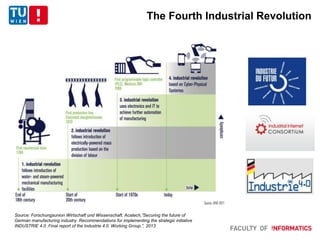
The Fourth Industrial Revolution
Source: Forschungsunion Wirtschaft und Wissenschaft, Acatech,”Securing the future of
German manufacturing industry. Recommendations for implementing the strategic initiative
INDUSTRIE 4.0 .Final report of the Industrie 4.0. Working Group.”, 2013
Cyber-Physical Systems (CPS)
Flexible, adaptive manufacturing (CPPS)Smart, distributed transportation systems
Estimated Economic Impact
Potential boost to the
European Union’s gross
domestic product by €110
billion annually over the
next five years.
Manufacturing
 70% of global trade
 In EU:
– 2 million businesses
– 34 million jobs
– 60% of EU economic growth
 (Some) Challenges:
– Shorter time to market
– Increased product diversification and customization
– Highly flexibilized (mass-) production
– Higher product quality
– Improved efficiency
Towards Flexible Production Systems and
Processes
Source: Forschungsunion Wirtschaft und Wissenschaft, Acatech,”Securing the future of German manufacturing industry. Recommendations for
implementing the strategic initiative INDUSTRIE 4.0. Final report of the Industrie 4.0. Working Group.”, 2013
Production System: Product-Process-Resource
Production step: Slicing
Material: Body with
slices
Production
resource:
Slicing robot
Material: Breadbody
Production step: Baking
Product: Bread
Production
resource:
Oven
Characteristics of modern, flexible
production systems
 plug-and-participate capabilities of production resources
– the integration and use of new or changed production resources
during production system use without any changes within the rest of
the production system
 self-* capabilities of production resources
– self-programming of production process control, self-maintenance in
case of technical failures, or self-monitoring for quality
 late freeze of product-related production system behaviour
– fixing the characteristics of an ordered product at the latest possible
point before production step execution, e.g., enabling to change the
ordered colour of a car until the start of painting
Engineering Phase
Business Requirements
Cyber Physical Production
System (CPPS)
Integrate Business
Requirements in Engineering
Deploy created artifacts
Production TransportSales
Process Eng.
Electrical Eng.
CAD, Pipe &
Instrumentation
Electrical Plan
Tool Data
Tool Data
Customer
Representative
Software Eng.
Customer
Reqs. & Review
Tool Data
Software Dev.
Environment
Tool Data
Control Eng.
PLC program
Tool Data
Project
Manager
Engineering
Cockpit
PLC
Test/Operation Phase
Operator
SCADA
Tool Data
Multi-Model
Dashboard
Tool Data
Diagnosis
Analysis
Tool Data
OPC UA Server
Config
ERP System
Tool Data
Production
Planning
Tool Data
Business
Manager
Production
Manager
Control Eng.
PLC program
Tool Data
Cyber Physical Production
System (CPPS)
Access runtime information
Access engineering information
Production TransportSales
Engineering
Cockpit
OPC UA Server
(augmented)
Business
Manager
Enrich runtime
information
1
2
3
4
Scenario 1:
Engineering
Tool Network
Scenario 2:
Multi-disciplinary
Reuse
Scenario 3:
Flexible
Production
Scenario 4:
Maintenance
Support
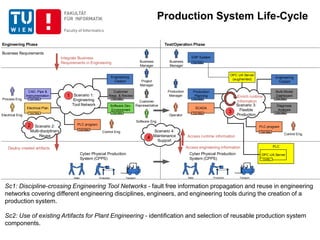
Production System Life-Cycle
Sc1: Discipline-crossing Engineering Tool Networks - fault free information propagation and reuse in engineering
networks covering different engineering disciplines, engineers, and engineering tools during the creation of a
production system.
Sc2: Use of existing Artifacts for Plant Engineering - identification and selection of reusable production system
components.
Engineering Phase
Business Requirements
Cyber Physical Production
System (CPPS)
Integrate Business
Requirements in Engineering
Deploy created artifacts
Production TransportSales
Process Eng.
Electrical Eng.
CAD, Pipe &
Instrumentation
Electrical Plan
Tool Data
Tool Data
Customer
Representative
Software Eng.
Customer
Reqs. & Review
Tool Data
Software Dev.
Environment
Tool Data
Control Eng.
PLC program
Tool Data
Project
Manager
Engineering
Cockpit
PLC
Test/Operation Phase
Operator
SCADA
Tool Data
Multi-Model
Dashboard
Tool Data
Diagnosis
Analysis
Tool Data
OPC UA Server
Config
ERP System
Tool Data
Production
Planning
Tool Data
Business
Manager
Production
Manager
Control Eng.
PLC program
Tool Data
Cyber Physical Production
System (CPPS)
Access runtime information
Access engineering information
Production TransportSales
Engineering
Cockpit
OPC UA Server
(augmented)
Business
Manager
Enrich runtime
information
1
2
3
4
Scenario 1:
Engineering
Tool Network
Scenario 2:
Multi-disciplinary
Reuse
Scenario 3:
Flexible
Production
Scenario 4:
Maintenance
Support
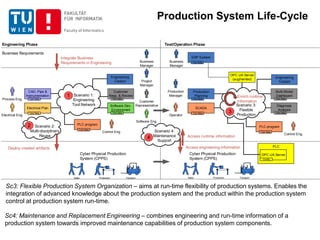
Production System Life-Cycle
Sc3: Flexible Production System Organization – aims at run-time flexibility of production systems. Enables the
integration of advanced knowledge about the production system and the product within the production system
control at production system run-time.
Sc4: Maintenance and Replacement Engineering – combines engineering and run-time information of a
production system towards improved maintenance capabilities of production system components.
Semantic Needs for Industrie4.0 Scenarios
Production System Engineering Needs & Scenarios SC1 SC2 SC3 SC4
N1 Explicit engineering knowledge representation ✔ ✔ ✔ ✔
N2 Engineering data integration ✔ ✔ ✔ ✔
N3 Engineering knowledge access and analytics ✔ ✔ ✔ ✔
N4 Efficient access to semi-structured data in the
organization and on the Web
✔ ✔ ✔
N5 Support for multi-disciplinary engineering process
knowledge
✔ ✔ ✔ ✔
N6 Provisioning of integrated engineering knowledge at
production-system run-time
✔ ✔
Content
 What is the Fourth Industrial Revolution?
– Industry 4.0 = flexibility through cyber-physical systems
– Manufacturing an important area
– Need for flexible production systems and processes (CPPS)
– Several scenarios and needs for semantic technologies in the
complex life-cycle of production systems
 To what extent can Semantic Web technologies be used to
support the scenario of multi-disciplinary engineering?
16
CPPS Engineering - Complex scenario
 Data complexity
 Engineering data
 From different disciplines
 Complex dependencies
 Changing
 Large (40+K signals)
 Distributed and concurrent
engineering
 Different disciplines
Different terminology
Different tools
Heterogeneous data
models and formats
Software Eng.Mechanical Eng. Electrical Eng.
17
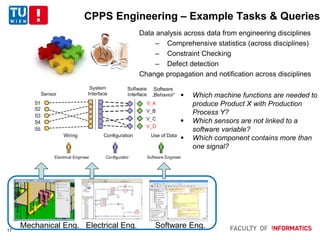
CPPS Engineering – Example Tasks & Queries
Data analysis across data from engineering disciplines
– Comprehensive statistics (across disciplines)
– Constraint Checking
– Defect detection
Change propagation and notification across disciplines
Software Eng.Mechanical Eng. Electrical Eng.
 Which machine functions are needed to
produce Product X with Production
Process Y?
 Which sensors are not linked to a
software variable?
 Which component contains more than
one signal?
18
Software Eng.Mechanical Eng. Electrical Eng.
Solution Idea: Common Concepts
19
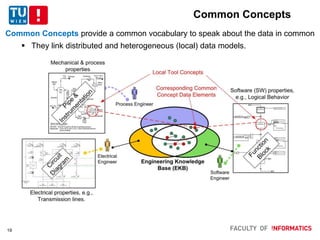
Common Concepts provide a common vocabulary to speak about the data in common
 They link distributed and heterogeneous (local) data models.
Common Concepts
Data Integration Solution
Ontology Based Information
Integration (OBII) Approach
 Integration of data from
heterogeneous sources using
[Cal01, Wac01].
 Three components of the OBII
approach:
– (1) Local ontologies - to
represent data specific to a data
source.
– (2) A common ontology - to
represent the aggregation of
relevant concepts
– (3) The mapping between local
ontologies and the common
ontology.
PLC Tool
Database
Client’s Electrical
Requirement
Spreadsheet
MCAD Tool
XML Export
Local Ontology
(Software)
Local Ontology
(Electrical)
Local Ontology
(Mechanical)
Common Ontology
(Power Plant)
ECAD Tool
Database
Lifting schema and data into local ontologies
Mapping between common and local ontologies
2
1
3
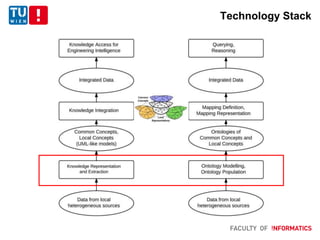
Technology Stack
Common Concepts in Production Systems Engineering
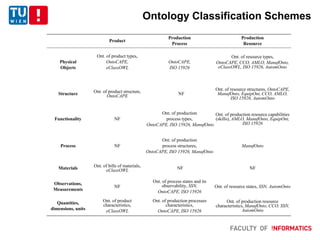
Ontology Classification Schemes
Product
Production
Process
Production
Resource
Physical
Objects
Ont. of product types,
OntoCAPE,
eClassOWL
OntoCAPE,
ISO 15926
Ont. of resource types,
OntoCAPE, CCO, AMLO, ManufOnto,
eClassOWL, ISO 15926, AutomOnto
Structure Ont. of product structure,
OntoCAPE NF
Ont. of resource structures, OntoCAPE,
ManufOnto, EquipOnt, CCO, AMLO,
ISO 15926, AutomOnto
Functionality NF
Ont. of production
process types,
OntoCAPE, ISO 15926, ManufOnto
Ont. of production resource capabilities
(skills), AMLO, ManufOnto, EquipOnt,
ISO 15926
Process NF
Ont. of production
process structures,
OntoCAPE, ISO 15926, ManufOnto
ManufOnto
Materials Ont. of bills of materials,
eClassOWL NF NF
Observations,
Measurements
NF
Ont. of process states and its
observability, SSN,
OntoCAPE, ISO 15926
Ont. of resource states, SSN, AutomOnto
Quantities,
dimensions, units
Ont. of product
characteristics,
eClassOWL
Ont. of production processes
characteristics,
OntoCAPE, ISO 15926
Ont. of production resource
characteristics, ManufOnto, CCO, SSN,
AutomOnto
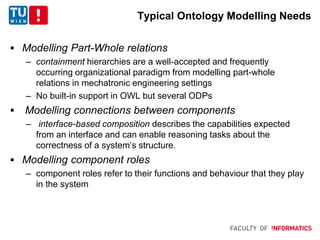
Typical Ontology Modelling Needs
 Modelling Part-Whole relations
– containment hierarchies are a well-accepted and frequently
occurring organizational paradigm from modelling part-whole
relations in mechatronic engineering settings
– No built-in support in OWL but several ODPs
 Modelling connections between components
– interface-based composition describes the capabilities expected
from an interface and can enable reasoning tasks about the
correctness of a system’s structure.
 Modelling component roles
– component roles refer to their functions and behaviour that they play
in the system
Technology Stack
26
Semantic Mappings between Engineering Concepts
Evaluation of Mapping Alternatives
Source: Kovalenko O, Euzenat J (2016) Semantic Matching of Engineering Data Structures. In Biffl S, Sabou M (Eds.) Semantic Web for Intelligent
Engineering Applications. Springer
Technology Stack
Automating Cross-Disciplinary
Defect Detection and Data Analysis
29
30
Constraint Checking across Engineering Disciplines
 “All safe software variables should be linked to exactly two sensors”
 “Check that all sensors have PLC variables defined”
SELECT ?sensor ?sensor_id
WHERE {
?sensor a hw:Sensor .
?sensor hw:hasKeyValue ?sensor_id .
?hw_var a hw:Variable .
?hw_var hw:isDefinedOnDevice ?sensor .
?hw_var hw:hasItemName ?hw_var_name .
OPTIONAL {
?var a cs:GlobalVariable .
?var cs:hasName ?cs_var_name .
FILTER (?hc_var_name = ?cs_var_name) .
}
FILTER (!bound(?cs_var)) }SELECT ?kks ?signal WHERE {
{SELECT ?kks WHERE {
?kks :hasSignal ?signal }
GROUP BY ?kks HAVING (COUNT (?signal) >= 2)}
?kks :hasSignal ?signal}}
31
Signal List -Version 1 Version 2
Knowledge Change Management –
“Change Compression”
25 deletes, 30 updates, 15 insertions.From syntactic level
Pump XA_20 was moved to sector AH1To semantic level
In real-life scenarios scale is a major issue, e.g:
• 40,000 signals
• 2,500 deletes, 3,000 updates, 1,500 insertions.
Knowledge Change Management :
Change Propagation
Knowledge
Engineer (KE)
Project
Manager (PM)
Domain
Experts (DE)
Common Data
Model & Mapping
Definition
Change
Validation
Common Data Model
& Mapping Definition
Common Data Model &
Mapping Definition
Change
Detection
Local Data ETL
Local data
Detected Changes
Changes
Propagation
Latest Version of Data
Validated
Changes
Validation Rules &
Workflows
Latest Version of Axioms
Validation Results
Data Store &
Analysis
Relevant Data
for Change Analysis
Knowledge Change Queries
Domain Tools
Input Data
Analysis
Results
High-Level
Changes Definition
Relevant Changes to Domain Tools
Local Data
Model Axioms
Domain Knowledge &
Analysis Requirements
DE KE
KE
DE KE
KE
(C) (W)
(R) (W)
(Q) (P)
(Q) Query (C) Contraints (R) Rules (W) Workflow (P) Change Representation
PM KE
3
4
5
62
7
(Q) (R)
(C) (R)
Local Data Model
Definition
Local Data Model
Axioms
Local
Data
Structure
1
DE KE
DE KE
Browsing and Querying of
Cross-disciplinary Engineering Data
33
AML Files
Development
External Sources
Development
(e.g., Ecl@ss)
Quality
Manager
Analysis &
Monitoring
Validation &
Defect Detection
Browsable
Visualization
OWL
Transformation
RDF
Triple
store
(Predefined)
SPARQL Queries
Linked Data
Visualization
Ontology Based
Data Integration
& Enhancement
1
AML files
AML
models
OWL/RDF
external data
linked data
interface
end-user
interface
2
Project
Manager
Domain
Experts
Engineers
AML Analyzer
SPARQL query;
query results
AMLHub - AML
Management
3
4
SPARQL
Querying
Endpoint
enhanced
OWL/RDF data
Feedbacks
AutomationML Analyzer: relies on Linked Data technologies to enable
efficient integration, browsing, querying, and analysis of diverse
engineering models represented in AutomationML.
Browser based Visualisation
34
Browsable
internal
links
Different
Views on
Data
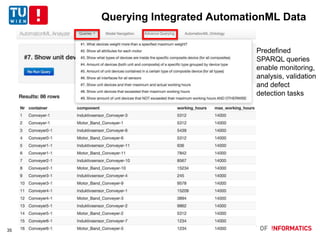
Querying Integrated AutomationML Data
35
Predefined
SPARQL queries
enable monitoring,
analysis, validation
and defect
detection tasks
Semantic Web Capabilities for
Engineering Settings
Semantic Web Capabilities & Needs N1 N2 N3 N4 N5 N6
C1 Formal semantic modeling ++ + ++ + + +
C2 Intelligent, web-scale knowledge
integration
+ ++ ++ ++ ++
C3 Browsing and exploration of
distributed data set
+ ++ + +
C4 Quality assurance of knowledge with
reasoning
++ ++
C5 Knowledge reuse + + ++ ++ +
Summary
 What is the Fourth Industrial Revolution?
– Industry 4.0 = flexibility through cyber-physical systems
– Manufacturing an important area
– Need for flexible production systems and processes (CPPS)
– Several scenarios and needs for semantic technologies in the complex life-
cycle of production systems
 To what extent can Semantic Web technologies be used to support the
scenario of multi-disciplinary engineering?
– CPPS engineering is a complex scenario
– Data integration is crucial
– There is a good match between Semantic Web technology capabilities and
the needs of Industrie 4.0 scenarios
 What are challenges of applying SW technologies?
Challenges
 Lack of knowledge acquisition interfaces that are easy to
use by engineers
– Trend: use SysML and SysML4Mechatronics as front-end for
acquiring ontologies of engineering models
 Lack of support for mathematical calculations:
– Trend: Hybrid solutions integrating data mining, statistical analysis
and relational constraint solvers
 OWA not a natural fit for engineering
– Must adopt a CWA style presentation of results at the interface level
 Dealing with dynamic engineering data
– Trend: applying ongoing research in semantic stream reasoning
Outlook
 Ample opportunities for using SW in Industrie 4.0 settings
– Only one of the four identified scenarios has been well explored
– How about other scenarios?
Engineering Phase
Business Requirements
Cyber Physical Production
System (CPPS)
Integrate Business
Requirements in Engineering
Deploy created artifacts
Production TransportSales
Process Eng.
Electrical Eng.
CAD, Pipe &
Instrumentation
Electrical Plan
Tool Data
Tool Data
Customer
Representative
Software Eng.
Customer
Reqs. & Review
Tool Data
Software Dev.
Environment
Tool Data
Control Eng.
PLC program
Tool Data
Project
Manager
Engineering
Cockpit
PLC
Test/Operation Phase
Operator
SCADA
Tool Data
Multi-Model
Dashboard
Tool Data
Diagnosis
Analysis
Tool Data
OPC UA Server
Config
ERP System
Tool Data
Production
Planning
Tool Data
Business
Manager
Production
Manager
Control Eng.
PLC program
Tool Data
Cyber Physical Production
System (CPPS)
Access runtime information
Access engineering information
Production TransportSales
Engineering
Cockpit
OPC UA Server
(augmented)
Business
Manager
Enrich runtime
information
1
2
3
4
Scenario 1:
Engineering
Tool Network
Scenario 2:
Multi-disciplinary
Reuse
Scenario 3:
Flexible
Production
Scenario 4:
Maintenance
Support
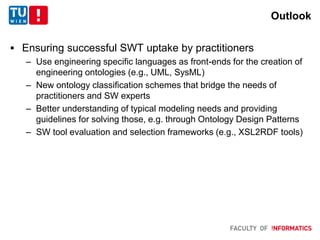
Outlook
 Ensuring successful SWT uptake by practitioners
– Use engineering specific languages as front-ends for the creation of
engineering ontologies (e.g., UML, SysML)
– New ontology classification schemes that bridge the needs of
practitioners and SW experts
– Better understanding of typical modeling needs and providing
guidelines for solving those, e.g. through Ontology Design Patterns
– SW tool evaluation and selection frameworks (e.g., XSL2RDF tools)
Outlook
 Extensions to current SW technologies:
– High-performance tools that can deal with large, diverse and rapidly
changing datasets
 Knowledge change management on integrated data sources
 Managing dynamic engineering data (e.g., stream reasoning)
– Data integration
 Automatic identification of semantic overlaps between
engineering models
 More expressive languages to declare mappings between
engineering models
– Evaluation of software architectures taking into account the needs of
Industrie4.0 specific applications
 Further investigating the use of Linked Data technologies in
engineering scenarios
42
Source: By Leonardo da Vinci - Bortolon, The Life and Times of Leonardo, Paul Hamlyn, Public Domain, https://commons.wikimedia.org/w/index.php?curid=1647253
Be part of the current revolution in
engineering!
Use Semantic Web technologies to
improve engineering!
A Final Word

Semantic Web for Advanced Engineering

  • 1.
    Semantic Web for AdvancedEngineering Marta Sabou Vienna University of Technology, Institute of Software Technology and Interactive Systems, Christian Doppler Laboratory for „Software Engineering Integration for Flexible Automation Systems“ (CDL-Flex)
  • 2.
    2 Dimensions not toscale. Adapted from Stefan Biffl. Semantic Web Software Engineering Automation Engineering Mechanical Engineering Electrical Engineering Mechatronic Engineering Business Informatics CDL-Flex My Research Universe Human Computation
  • 4.
    Content  What isthe Fourth Industrial Revolution? – What are scenarios where Semantic Web technologies could be used?  To what extent can Semantic Web (SW) technologies be used to support the scenario of multi-disciplinary engineering?  What are challenges of applying SW technologies?
  • 5.
    The Fourth IndustrialRevolution Source: Forschungsunion Wirtschaft und Wissenschaft, Acatech,”Securing the future of German manufacturing industry. Recommendations for implementing the strategic initiative INDUSTRIE 4.0 .Final report of the Industrie 4.0. Working Group.”, 2013
  • 6.
    Cyber-Physical Systems (CPS) Flexible,adaptive manufacturing (CPPS)Smart, distributed transportation systems
  • 7.
    Estimated Economic Impact Potentialboost to the European Union’s gross domestic product by €110 billion annually over the next five years.
  • 8.
    Manufacturing  70% ofglobal trade  In EU: – 2 million businesses – 34 million jobs – 60% of EU economic growth  (Some) Challenges: – Shorter time to market – Increased product diversification and customization – Highly flexibilized (mass-) production – Higher product quality – Improved efficiency
  • 9.
    Towards Flexible ProductionSystems and Processes Source: Forschungsunion Wirtschaft und Wissenschaft, Acatech,”Securing the future of German manufacturing industry. Recommendations for implementing the strategic initiative INDUSTRIE 4.0. Final report of the Industrie 4.0. Working Group.”, 2013
  • 10.
    Production System: Product-Process-Resource Productionstep: Slicing Material: Body with slices Production resource: Slicing robot Material: Breadbody Production step: Baking Product: Bread Production resource: Oven
  • 11.
    Characteristics of modern,flexible production systems  plug-and-participate capabilities of production resources – the integration and use of new or changed production resources during production system use without any changes within the rest of the production system  self-* capabilities of production resources – self-programming of production process control, self-maintenance in case of technical failures, or self-monitoring for quality  late freeze of product-related production system behaviour – fixing the characteristics of an ordered product at the latest possible point before production step execution, e.g., enabling to change the ordered colour of a car until the start of painting
  • 12.
    Engineering Phase Business Requirements CyberPhysical Production System (CPPS) Integrate Business Requirements in Engineering Deploy created artifacts Production TransportSales Process Eng. Electrical Eng. CAD, Pipe & Instrumentation Electrical Plan Tool Data Tool Data Customer Representative Software Eng. Customer Reqs. & Review Tool Data Software Dev. Environment Tool Data Control Eng. PLC program Tool Data Project Manager Engineering Cockpit PLC Test/Operation Phase Operator SCADA Tool Data Multi-Model Dashboard Tool Data Diagnosis Analysis Tool Data OPC UA Server Config ERP System Tool Data Production Planning Tool Data Business Manager Production Manager Control Eng. PLC program Tool Data Cyber Physical Production System (CPPS) Access runtime information Access engineering information Production TransportSales Engineering Cockpit OPC UA Server (augmented) Business Manager Enrich runtime information 1 2 3 4 Scenario 1: Engineering Tool Network Scenario 2: Multi-disciplinary Reuse Scenario 3: Flexible Production Scenario 4: Maintenance Support Production System Life-Cycle Sc1: Discipline-crossing Engineering Tool Networks - fault free information propagation and reuse in engineering networks covering different engineering disciplines, engineers, and engineering tools during the creation of a production system. Sc2: Use of existing Artifacts for Plant Engineering - identification and selection of reusable production system components.
  • 13.
    Engineering Phase Business Requirements CyberPhysical Production System (CPPS) Integrate Business Requirements in Engineering Deploy created artifacts Production TransportSales Process Eng. Electrical Eng. CAD, Pipe & Instrumentation Electrical Plan Tool Data Tool Data Customer Representative Software Eng. Customer Reqs. & Review Tool Data Software Dev. Environment Tool Data Control Eng. PLC program Tool Data Project Manager Engineering Cockpit PLC Test/Operation Phase Operator SCADA Tool Data Multi-Model Dashboard Tool Data Diagnosis Analysis Tool Data OPC UA Server Config ERP System Tool Data Production Planning Tool Data Business Manager Production Manager Control Eng. PLC program Tool Data Cyber Physical Production System (CPPS) Access runtime information Access engineering information Production TransportSales Engineering Cockpit OPC UA Server (augmented) Business Manager Enrich runtime information 1 2 3 4 Scenario 1: Engineering Tool Network Scenario 2: Multi-disciplinary Reuse Scenario 3: Flexible Production Scenario 4: Maintenance Support Production System Life-Cycle Sc3: Flexible Production System Organization – aims at run-time flexibility of production systems. Enables the integration of advanced knowledge about the production system and the product within the production system control at production system run-time. Sc4: Maintenance and Replacement Engineering – combines engineering and run-time information of a production system towards improved maintenance capabilities of production system components.
  • 14.
    Semantic Needs forIndustrie4.0 Scenarios Production System Engineering Needs & Scenarios SC1 SC2 SC3 SC4 N1 Explicit engineering knowledge representation ✔ ✔ ✔ ✔ N2 Engineering data integration ✔ ✔ ✔ ✔ N3 Engineering knowledge access and analytics ✔ ✔ ✔ ✔ N4 Efficient access to semi-structured data in the organization and on the Web ✔ ✔ ✔ N5 Support for multi-disciplinary engineering process knowledge ✔ ✔ ✔ ✔ N6 Provisioning of integrated engineering knowledge at production-system run-time ✔ ✔
  • 15.
    Content  What isthe Fourth Industrial Revolution? – Industry 4.0 = flexibility through cyber-physical systems – Manufacturing an important area – Need for flexible production systems and processes (CPPS) – Several scenarios and needs for semantic technologies in the complex life-cycle of production systems  To what extent can Semantic Web technologies be used to support the scenario of multi-disciplinary engineering?
  • 16.
    16 CPPS Engineering -Complex scenario  Data complexity  Engineering data  From different disciplines  Complex dependencies  Changing  Large (40+K signals)  Distributed and concurrent engineering  Different disciplines Different terminology Different tools Heterogeneous data models and formats Software Eng.Mechanical Eng. Electrical Eng.
  • 17.
    17 CPPS Engineering –Example Tasks & Queries Data analysis across data from engineering disciplines – Comprehensive statistics (across disciplines) – Constraint Checking – Defect detection Change propagation and notification across disciplines Software Eng.Mechanical Eng. Electrical Eng.  Which machine functions are needed to produce Product X with Production Process Y?  Which sensors are not linked to a software variable?  Which component contains more than one signal?
  • 18.
    18 Software Eng.Mechanical Eng.Electrical Eng. Solution Idea: Common Concepts
  • 19.
    19 Common Concepts providea common vocabulary to speak about the data in common  They link distributed and heterogeneous (local) data models. Common Concepts
  • 20.
    Data Integration Solution OntologyBased Information Integration (OBII) Approach  Integration of data from heterogeneous sources using [Cal01, Wac01].  Three components of the OBII approach: – (1) Local ontologies - to represent data specific to a data source. – (2) A common ontology - to represent the aggregation of relevant concepts – (3) The mapping between local ontologies and the common ontology. PLC Tool Database Client’s Electrical Requirement Spreadsheet MCAD Tool XML Export Local Ontology (Software) Local Ontology (Electrical) Local Ontology (Mechanical) Common Ontology (Power Plant) ECAD Tool Database Lifting schema and data into local ontologies Mapping between common and local ontologies 2 1 3
  • 21.
  • 22.
    Common Concepts inProduction Systems Engineering
  • 23.
    Ontology Classification Schemes Product Production Process Production Resource Physical Objects Ont.of product types, OntoCAPE, eClassOWL OntoCAPE, ISO 15926 Ont. of resource types, OntoCAPE, CCO, AMLO, ManufOnto, eClassOWL, ISO 15926, AutomOnto Structure Ont. of product structure, OntoCAPE NF Ont. of resource structures, OntoCAPE, ManufOnto, EquipOnt, CCO, AMLO, ISO 15926, AutomOnto Functionality NF Ont. of production process types, OntoCAPE, ISO 15926, ManufOnto Ont. of production resource capabilities (skills), AMLO, ManufOnto, EquipOnt, ISO 15926 Process NF Ont. of production process structures, OntoCAPE, ISO 15926, ManufOnto ManufOnto Materials Ont. of bills of materials, eClassOWL NF NF Observations, Measurements NF Ont. of process states and its observability, SSN, OntoCAPE, ISO 15926 Ont. of resource states, SSN, AutomOnto Quantities, dimensions, units Ont. of product characteristics, eClassOWL Ont. of production processes characteristics, OntoCAPE, ISO 15926 Ont. of production resource characteristics, ManufOnto, CCO, SSN, AutomOnto
  • 24.
    Typical Ontology ModellingNeeds  Modelling Part-Whole relations – containment hierarchies are a well-accepted and frequently occurring organizational paradigm from modelling part-whole relations in mechatronic engineering settings – No built-in support in OWL but several ODPs  Modelling connections between components – interface-based composition describes the capabilities expected from an interface and can enable reasoning tasks about the correctness of a system’s structure.  Modelling component roles – component roles refer to their functions and behaviour that they play in the system
  • 25.
  • 26.
    26 Semantic Mappings betweenEngineering Concepts
  • 27.
    Evaluation of MappingAlternatives Source: Kovalenko O, Euzenat J (2016) Semantic Matching of Engineering Data Structures. In Biffl S, Sabou M (Eds.) Semantic Web for Intelligent Engineering Applications. Springer
  • 28.
  • 29.
  • 30.
    30 Constraint Checking acrossEngineering Disciplines  “All safe software variables should be linked to exactly two sensors”  “Check that all sensors have PLC variables defined” SELECT ?sensor ?sensor_id WHERE { ?sensor a hw:Sensor . ?sensor hw:hasKeyValue ?sensor_id . ?hw_var a hw:Variable . ?hw_var hw:isDefinedOnDevice ?sensor . ?hw_var hw:hasItemName ?hw_var_name . OPTIONAL { ?var a cs:GlobalVariable . ?var cs:hasName ?cs_var_name . FILTER (?hc_var_name = ?cs_var_name) . } FILTER (!bound(?cs_var)) }SELECT ?kks ?signal WHERE { {SELECT ?kks WHERE { ?kks :hasSignal ?signal } GROUP BY ?kks HAVING (COUNT (?signal) >= 2)} ?kks :hasSignal ?signal}}
  • 31.
    31 Signal List -Version1 Version 2 Knowledge Change Management – “Change Compression” 25 deletes, 30 updates, 15 insertions.From syntactic level Pump XA_20 was moved to sector AH1To semantic level In real-life scenarios scale is a major issue, e.g: • 40,000 signals • 2,500 deletes, 3,000 updates, 1,500 insertions.
  • 32.
    Knowledge Change Management: Change Propagation Knowledge Engineer (KE) Project Manager (PM) Domain Experts (DE) Common Data Model & Mapping Definition Change Validation Common Data Model & Mapping Definition Common Data Model & Mapping Definition Change Detection Local Data ETL Local data Detected Changes Changes Propagation Latest Version of Data Validated Changes Validation Rules & Workflows Latest Version of Axioms Validation Results Data Store & Analysis Relevant Data for Change Analysis Knowledge Change Queries Domain Tools Input Data Analysis Results High-Level Changes Definition Relevant Changes to Domain Tools Local Data Model Axioms Domain Knowledge & Analysis Requirements DE KE KE DE KE KE (C) (W) (R) (W) (Q) (P) (Q) Query (C) Contraints (R) Rules (W) Workflow (P) Change Representation PM KE 3 4 5 62 7 (Q) (R) (C) (R) Local Data Model Definition Local Data Model Axioms Local Data Structure 1 DE KE DE KE
  • 33.
    Browsing and Queryingof Cross-disciplinary Engineering Data 33 AML Files Development External Sources Development (e.g., Ecl@ss) Quality Manager Analysis & Monitoring Validation & Defect Detection Browsable Visualization OWL Transformation RDF Triple store (Predefined) SPARQL Queries Linked Data Visualization Ontology Based Data Integration & Enhancement 1 AML files AML models OWL/RDF external data linked data interface end-user interface 2 Project Manager Domain Experts Engineers AML Analyzer SPARQL query; query results AMLHub - AML Management 3 4 SPARQL Querying Endpoint enhanced OWL/RDF data Feedbacks AutomationML Analyzer: relies on Linked Data technologies to enable efficient integration, browsing, querying, and analysis of diverse engineering models represented in AutomationML.
  • 34.
  • 35.
    Querying Integrated AutomationMLData 35 Predefined SPARQL queries enable monitoring, analysis, validation and defect detection tasks
  • 36.
    Semantic Web Capabilitiesfor Engineering Settings Semantic Web Capabilities & Needs N1 N2 N3 N4 N5 N6 C1 Formal semantic modeling ++ + ++ + + + C2 Intelligent, web-scale knowledge integration + ++ ++ ++ ++ C3 Browsing and exploration of distributed data set + ++ + + C4 Quality assurance of knowledge with reasoning ++ ++ C5 Knowledge reuse + + ++ ++ +
  • 37.
    Summary  What isthe Fourth Industrial Revolution? – Industry 4.0 = flexibility through cyber-physical systems – Manufacturing an important area – Need for flexible production systems and processes (CPPS) – Several scenarios and needs for semantic technologies in the complex life- cycle of production systems  To what extent can Semantic Web technologies be used to support the scenario of multi-disciplinary engineering? – CPPS engineering is a complex scenario – Data integration is crucial – There is a good match between Semantic Web technology capabilities and the needs of Industrie 4.0 scenarios  What are challenges of applying SW technologies?
  • 38.
    Challenges  Lack ofknowledge acquisition interfaces that are easy to use by engineers – Trend: use SysML and SysML4Mechatronics as front-end for acquiring ontologies of engineering models  Lack of support for mathematical calculations: – Trend: Hybrid solutions integrating data mining, statistical analysis and relational constraint solvers  OWA not a natural fit for engineering – Must adopt a CWA style presentation of results at the interface level  Dealing with dynamic engineering data – Trend: applying ongoing research in semantic stream reasoning
  • 39.
    Outlook  Ample opportunitiesfor using SW in Industrie 4.0 settings – Only one of the four identified scenarios has been well explored – How about other scenarios? Engineering Phase Business Requirements Cyber Physical Production System (CPPS) Integrate Business Requirements in Engineering Deploy created artifacts Production TransportSales Process Eng. Electrical Eng. CAD, Pipe & Instrumentation Electrical Plan Tool Data Tool Data Customer Representative Software Eng. Customer Reqs. & Review Tool Data Software Dev. Environment Tool Data Control Eng. PLC program Tool Data Project Manager Engineering Cockpit PLC Test/Operation Phase Operator SCADA Tool Data Multi-Model Dashboard Tool Data Diagnosis Analysis Tool Data OPC UA Server Config ERP System Tool Data Production Planning Tool Data Business Manager Production Manager Control Eng. PLC program Tool Data Cyber Physical Production System (CPPS) Access runtime information Access engineering information Production TransportSales Engineering Cockpit OPC UA Server (augmented) Business Manager Enrich runtime information 1 2 3 4 Scenario 1: Engineering Tool Network Scenario 2: Multi-disciplinary Reuse Scenario 3: Flexible Production Scenario 4: Maintenance Support
  • 40.
    Outlook  Ensuring successfulSWT uptake by practitioners – Use engineering specific languages as front-ends for the creation of engineering ontologies (e.g., UML, SysML) – New ontology classification schemes that bridge the needs of practitioners and SW experts – Better understanding of typical modeling needs and providing guidelines for solving those, e.g. through Ontology Design Patterns – SW tool evaluation and selection frameworks (e.g., XSL2RDF tools)
  • 41.
    Outlook  Extensions tocurrent SW technologies: – High-performance tools that can deal with large, diverse and rapidly changing datasets  Knowledge change management on integrated data sources  Managing dynamic engineering data (e.g., stream reasoning) – Data integration  Automatic identification of semantic overlaps between engineering models  More expressive languages to declare mappings between engineering models – Evaluation of software architectures taking into account the needs of Industrie4.0 specific applications  Further investigating the use of Linked Data technologies in engineering scenarios
  • 42.
    42 Source: By Leonardoda Vinci - Bortolon, The Life and Times of Leonardo, Paul Hamlyn, Public Domain, https://commons.wikimedia.org/w/index.php?curid=1647253 Be part of the current revolution in engineering! Use Semantic Web technologies to improve engineering! A Final Word

Editor's Notes

  • #4 What I am proud of, a major outcome of a lab that reflects lessons learned during 7 years on applying SW technologies for engineering. Acknowledgements to all authors whose material I reuse in this talk.
  • #8 Source: http://www.rkw-innovationsblog.de/2014/07/01/industrie-4-0-das-potenzial-in-zahlen/