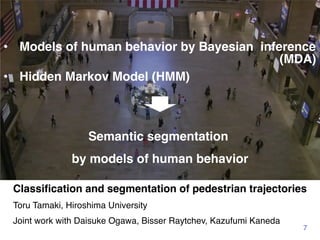
Classification and segmentation of pedestrian trajectories
Toru Tamaki, Hiroshima University
Joint work with Daisuke Ogawa, Bisser Raytchev, Kazufumi Kaneda
7
Semantic segmentation
by models of human behavior
• Models of human behavior by Bayesian inference
• Hidden Markov Model (HMM)
(MDA)
8
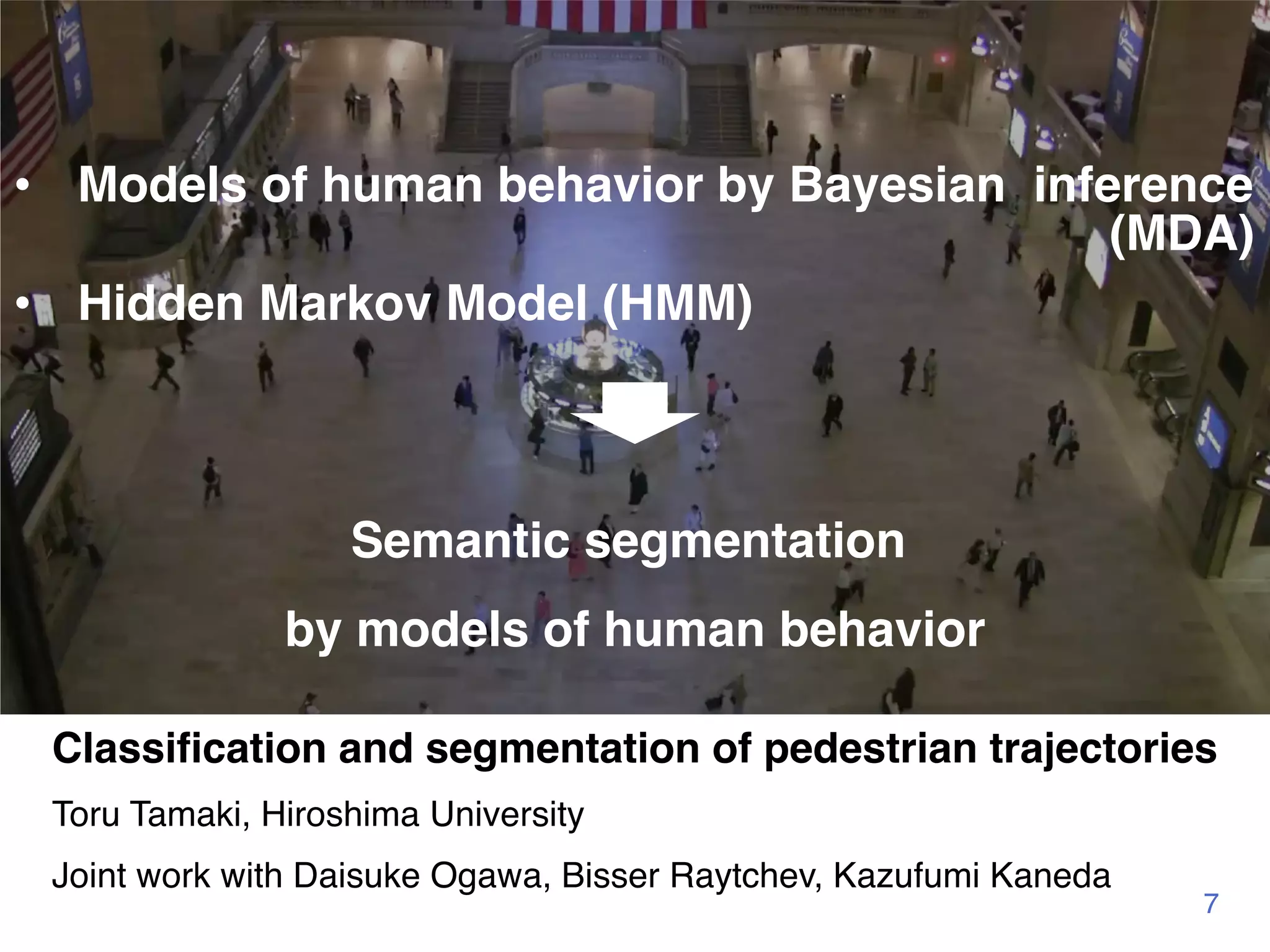
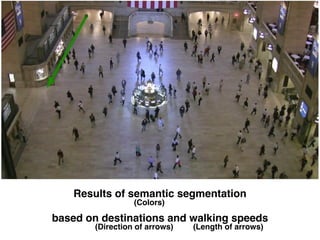
Results of semantic segmentation
based on destinations and walking speeds
(Length of arrows)(Direction of arrows)
(Colors)
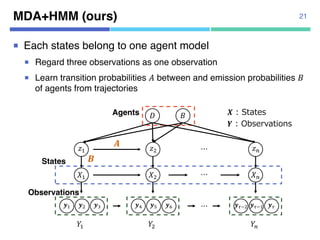
Background 9
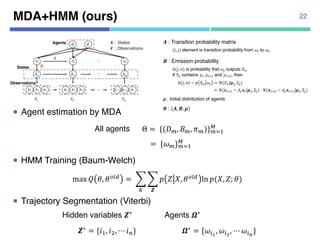
¡ Trajectory prediction
¡ Abnormal behavior detection ¡ Crowd behavior analysis
[Zhou+, IJCV2015] [Lee+,CVPR2017]
[Saligrama+,CVPR2012] [Solmaz+,PAMI2012]
¡ Trajectory classification
Related work
¡ TRAOD [Lee+, ICDE2008]
¡ Trajectory outlier detection
¡ Segmentation by MDL as preprocessing
¡ Transportation Mode [Zheng+, ACM WWW2008]
¡ Estimation of Transportation Mode (Walk, Car Bus, Bike)
from GPS data
¡ Semantic segmentation based on Transportation Mode
10
No segmentation methods
based on human behavior
(Minimum Description Length)
Proposed method (MDA+HMM)
¡ Extend classification method to semantic segmentation
by combining with Hidden Markov Model
11
Models of human behavior (or agents) Parameter estimation
Pedestrian trajectory Semantic segmentation
MDA+HMM
MDA
[Zhou+, IJCV2015]
HMM
[Baum, 1972]
[Viterbi, 1967]
!" !# !$ !% !& !' !()# !()" !(⋯
+" +# +,
-" -# -,⋯
. /Agents
Observations
0" 0# 0,⋯
States
1
2
3
4
MDA: Mixture model of Dynamic pedestrian-Agents
¡ Example : Input trajectories (blue) and two agent models
12
[Zhou+, IJCV2015]
MDA (Mixture model of Dynamic pedestrian-Agents)
¡ Initialize LDS and Gaussian distributions
13
start
goal
start goalD
D
[Zhou+, IJCV2015]
B
B
B
B
Agents have D and B respectively
• D (dynamics) : Linear dynamic system
• B (belief) : Gaussian distributions
(start, goal)
MDA (Mixture model of Dynamic pedestrian-Agents)
¡ Learn agents by EM algorithm
14
start
goal
goal
start D
D
[Zhou+, IJCV2015]
B
B
B
B
Agents have D and B respectively
• D (dynamics) : Linear dynamic system
• B (belief) : Gaussian distributions
(start, goal)
Dynamics and Beliefs
¡ belief parameter
15
! = ($, &, ', () : dynamics
* = (+,, Φ,, +., Φ.): belief
/
0
(!, *, 1) : Agent model
1 : Weights
!"
!#
missing missingobserved$%
$&
'%~)($%, Φ%)
'&~)($&, Φ&)
$%
$&
.
Kalman filter + Kalman smoother
¡ dynamics parameter
!"#$
%"
Observation !"~'(!"|%")
= ,(!"|%", .)
State
!"#$
%!"#$ + '
!"~) !" !"#$
= +(!"|%!"#$ + ., 0)
*( ⋯ *)
ervations
/ 0-
Figure 1. State space model of MDA [9]
the sequence of states x except xs and xe. Figure 1 shows the state
= {yk} MDA estimates M agents ⇥ = {(Dm, Bm, ⇡m)} by maximizing
ood;
L =
X
k
log p(yk
, xk
, zk
, tk
s , tk
e|⇥), (6)
Hereafter, x1:T denotes the sequence of states x except xs and xe. Figure 1 shows the
pace model of MDA.
.2 Learning
Given K trajectories Y = {yk} MDA estimates M agents ⇥ = {(Dm, Bm, ⇡m)} by maxim
he following log likelihood;
L =
X
k
log p(yk
, xk
, zk
, tk
s , tk
e |⇥),
where the joint probability is given by
p(yk
, xk
, zk
, tk
s , tk
e ) = p(zk
)p(tk
s )p(tk
e )p(xk
s )p(xk
e )
⌧k
+tk
eY
t= tk
s +1
p(xk
t |xk
t 1)
⌧k
Y
t=1
p(yk
t |xk
t )
with respect to parameters ⇥.
This can be rewritten by replacing hidden variables H = {hk}, hk = {zk, tk
s , tk
e } as follow
¡ Joint distribution of trajectory k
¡ Log likelihood for k trajectories
3.2 Learning
Given K trajectories Y = {yk} MDA estimates M agents ⇥ = {(Dm, Bm, ⇡m)} by ma
the following log likelihood;
L =
X
k
log p(yk
, xk
, zk
, tk
s , tk
e |⇥),
where the joint probability is given by
p(yk
, xk
, zk
, tk
s , tk
e ) = p(zk
)p(tk
s )p(tk
e )p(xk
s )p(xk
e )
⌧k
+tk
eY
t= tk
s +1
p(xk
t |xk
t 1)
⌧k
Y
t=1
p(yk
t |xk
t )
with respect to parameters ⇥.
This can be rewritten by replacing hidden variables H = {hk}, hk = {zk, tk
s , tk
e } as fo
L =
X
k
log p(yk
, xk
, hk
|⇥)
Hereafter, x1:T denotes the sequence of states x except xs and xe. Figure 1 shows
space model of MDA.
3.2 Learning
Given K trajectories Y = {yk} MDA estimates M agents ⇥ = {(Dm, Bm, ⇡m)} by ma
the following log likelihood;
L =
X
k
log p(yk
, xk
, zk
, tk
s , tk
e |⇥),
where the joint probability is given by
p(yk
, xk
, zk
, tk
s , tk
e ) = p(zk
)p(tk
s )p(tk
e )p(xk
s )p(xk
e )
⌧k
+tk
eY
t= tk
s +1
p(xk
t |xk
t 1)
⌧k
Y
t=1
p(yk
t |xk
t )
with respect to parameters ⇥.
This can be rewritten by replacing hidden variables H = {hk}, hk = {zk, tk
s , tk
e } as fo
Hidden variables
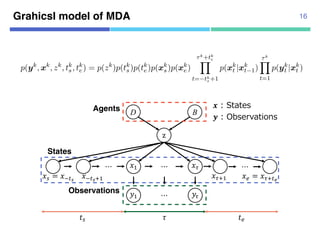
Grahicsl model of MDA 16
D B
z
"# = "%&'
"( ")
*( ⋯
⋯⋯
*)
"%&',( "),(
⋯
"- = "),&.
Agents
States
Observations
/0# 0-
1
2
k
s e
ere the joint probability is given by
p(yk
, xk
, zk
, tk
s , tk
e ) = p(zk
)p(tk
s )p(tk
e )p(xk
s )p(xk
e )
⌧k
+tk
eY
t= tk
s +1
p(xk
t |xk
t 1)
⌧k
Y
t=1
p(yk
t |xk
t )
th respect to parameters ⇥.
This can be rewritten by replacing hidden variables H = {hk}, hk = {zk, tk
s , tk
e } as follows
L =
X
k
log p(yk
, xk
, hk
|⇥)
e EM algorithm estimates iteratively as H is not observed.
3
EM algorithm for MDA 17
¡ EM algorithm
max $ = &
'
log +(-'|/', ℎ', 2)
ℎ' = {5', 67
', 68
'}
:2∗ = arg =>?@A 2, :2
¡ E step
¡ M step
3.2.1 E step of original MDA
Q(⇥, ˆ⇥) = EX,H|Y,ˆ⇥[L]
= EH|Y,ˆ⇥[EX|Y,H,ˆ⇥[L]]
=
X
k
X
hk
k
Exk|yk,hk [log p(yk
, xk
, hk
|⇥)]
=
X
k
X
hk
k
log p(yk
, ˆxk
, hk
|⇥),
where ˆxk
= Exk|yk,hk [xk] is computed by the modified Kalman filter [9, 12
Weights k are posterior probabilities given as follows;
k
= p(hk
|yk
, ˆ⇥)
=
p(hk|ˆ⇥)p(yk|hk, ˆ⇥)
p(yk|ˆ⇥)
By further assuming the independence among hidden variables z, t , t , w
Q(⇥, ˆ⇥) = EX,H|Y,ˆ⇥[L]
= EH|Y,ˆ⇥[EX|Y,H,ˆ⇥[L]]
=
X
k
X
hk
k
Exk|yk,hk [log p(yk
, xk
, hk
|⇥)]
=
X
k
X
hk
k
log p(yk
, ˆxk
, hk
|⇥),
where ˆxk
= Exk|yk,hk [xk] is computed by the modified Kalman filter [9, 12].
Weights k are posterior probabilities given as follows;
k
= p(hk
|yk
, ˆ⇥)
=
p(hk|ˆ⇥)p(yk|hk, ˆ⇥)
p(yk|ˆ⇥)
By further assuming the independence among hidden variables z, ts, te, we have
p(hk
|ˆ⇥) = p(zk
, tk
s , tk
e|ˆ⇥) = p(zk
|ˆ⇥)p(tk
s |ˆ⇥)p(tk
e|ˆ⇥)
=
X
k
X
hk
k
log p(yk
, ˆxk
, hk
|⇥),
where ˆxk
= Exk|yk,hk [xk] is computed by the modified Kalman filter [9, 12].
Weights k are posterior probabilities given as follows;
k
= p(hk
|yk
, ˆ⇥)
=
p(hk|ˆ⇥)p(yk|hk, ˆ⇥)
p(yk|ˆ⇥)
By further assuming the independence among hidden variables z, ts, te, we have
p(hk
|ˆ⇥) = p(zk
, tk
s , tk
e |ˆ⇥) = p(zk
|ˆ⇥)p(tk
s |ˆ⇥)p(tk
e |ˆ⇥)
By removing ts, te by assuming those be uniform, we have
k
=
p(zk|ˆ⇥)p(yk|hk, ˆ⇥)
P
hk p(zk|ˆ⇥)p(yk|hk, ˆ⇥)
where likelihood p(yk|hk, ˆ⇥) is also computed by the modified Kalman filter [9, 12].
Kalman filter
3.2.1 E step of original M
Q(⇥
where ˆxk
= Exk|yk,hk [xk] i
Weights k are posterior
Weights
Issue of MDA 19
¡ One trajectory is represented by one agent model
¡ Cannot switch agent models in one trajectory
[Zhou+, IJCV2015]
D B
z
"# = "%&'
"( ")
*( ⋯
⋯⋯
*)
"%&',( "),(
⋯
"- = "),&.
Agents
States
Observations
/0# 0-
1
2
Related model : Switching Kalman Filter
¡ Can estimate agents !" in time series
¡ Transition probabilities between agent models are required
20
Observations
States
Agents z" z#$"z% z# z#&"⋯ ⋯
(" (#$"(% (# (#&"
)" )#$")% )# )#&"
⋯ ⋯
[Murphy, 1998]
MDA+HMM (ours)
¡ Each states belong to one agent model
¡ Regard three observations as one observation
¡ Learn transition probabilities ! between and emission probabilities "
of agents from trajectories
21
!" !# !$ !% !& !' !()# !()" !(⋯
+" +# +,
-" -# -,⋯
. /Agents
Observations
0" 0# 0,⋯
States
1
2
3
4
MDA+HMM (ours) 22
¡ Agent estimation by MDA
All agents Θ = {(%&, (&, )&)}&,-
.
= {/&}&,-
.
¡ HMM Training (Baum-Welch)
¡ Trajectory Segmentation (Viterbi)
0∗ = {2-, 23, ⋯ 25}
Hidden variables 0∗
6∗ = {/78
, /79
, ⋯ /7:
}
Agents 6∗
max > ?, ?@AB = C
D
C
0
E F G, ?@AB ln E(G, F; ?)
!" !# !$ !% !& !' !()# !()" !(⋯
+" +# +,
-" -# -,⋯
. /Agents
Observations
0" 0# 0,⋯
States
1
2
3
4
K : Emission probability
L : Initial distribution of agents
M : Transition probability matrix
N : (M, K, L)
(2, O) element is transition probability from /7 to /P.
Q(O, R) is probability that /P outputs G5.
If S5 contains TU, TUV- and TUV3, then
Q O, R ~ E G5 /P = X(G5|ZP, ΣP)
= X(UV- − ^PU|ZP, ΣP) _ X(UV3 − ^PUV-|ZP, ΣP)
¡ Real data
¡ 104 trajectories from “Pedestrian
Walking Path Dataset”
¡ Annotated segmentation points
manually
¡ 1920x1080 pixels
¡ 4-fold cross validation
Datasets
¡ Synthetic data
¡ Using 10 agent models
¡ Uniform transition probabilities
¡ 10,000 trajectories for estimation,
10,000 trajectories for test
¡ 1920x1080 pixels
23
[Yi+, CVPR2015]
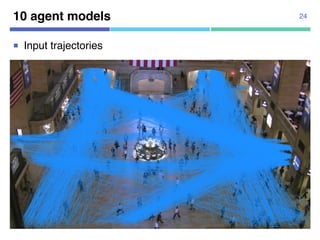
¡ Input trajectories
10 agent models 24
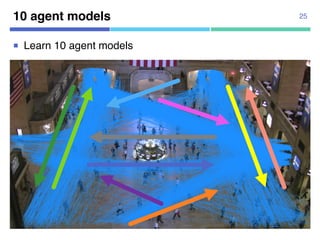
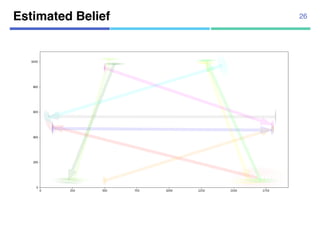
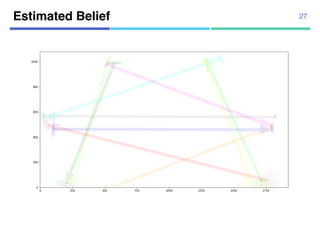
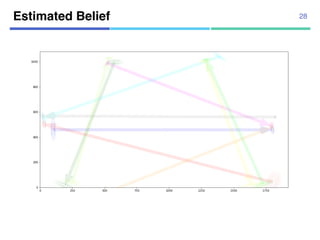
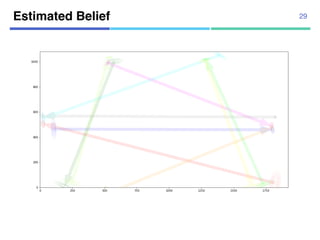
¡ Learn 10 agent models
10 agent models 25
Estimated Belief 26
Estimated Belief 27
Estimated Belief 28
Estimated Belief 29
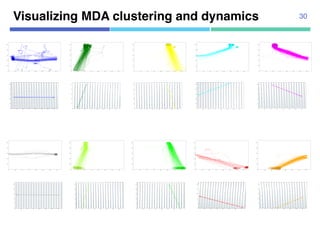
Visualizing MDA clustering and dynamics 30
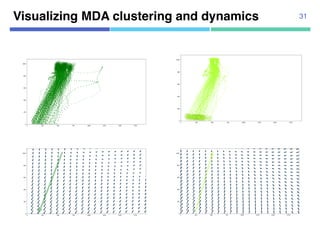
Visualizing MDA clustering and dynamics 31
¡ Real data
¡ 104 trajectories from “Pedestrian
Walking Path Dataset”
¡ Annotated segmentation points
manually
¡ 1920x1080 pixels
¡ 4-fold cross validation
Datasets
¡ Synthetic data
¡ Using 10 agent models
¡ Uniform transition probabilities
¡ 10,000 trajectories for estimation,
10,000 trajectories for test
¡ 1920x1080 pixels
32
[Yi+, CVPR2015]
Baseline 33
¡ Ramer-Douglas-Peucker (RDP) algorithm
¡ Trajectory simplification with parameter !
¡ Segmentation with keeping trajectory’s shape
¡ Appropriate ! setting is required
¡ No estimation of agent models
Wikipedia, “Ramer–Douglas–Peucker algorithm”
[Ramer, 1972] [Douglas+, 1973]
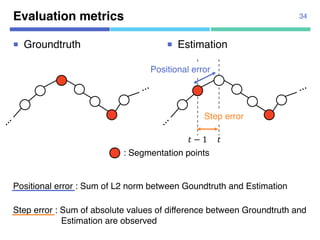
Evaluation metrics
¡ Groundtruth
34
¡ Estimation
⋰
⋰
⋰
⋰
"" − 1
Positional error : Sum of L2 norm between Goundtruth and Estimation
Step error : Sum of absolute values of difference between Groundtruth and
Estimation are observed
: Segmentation points
Positional error
Step error
¡ Real data
¡ 104 trajectories from “Pedestrian
Walking Path Dataset”
¡ Annotated segmentation points
manually
¡ 1920x1080 pixels
¡ 4-fold cross validation
Datasets
¡ Synthetic data
¡ Using 10 agent models
¡ Uniform transition probabilities
¡ 10,000 trajectories for estimation,
10,000 trajectories for test
¡ 1920x1080 pixels
35
[Yi+, CVPR2015]
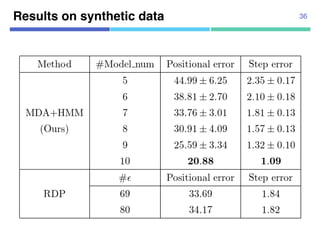
Results on synthetic data 36
¡ Real data
¡ 104 trajectories from “Pedestrian
Walking Path Dataset”
¡ Annotated segmentation points
manually
¡ 1920x1080 pixels
¡ 4-fold cross validation
Datasets
¡ Synthetic data
¡ Using 10 agent models
¡ Uniform transition probabilities
¡ 10,000 trajectories for estimation,
10,000 trajectories for test
¡ 1920x1080 pixels
37
[Yi+, CVPR2015]
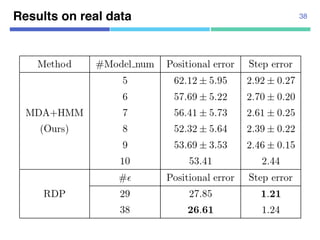
Results on real data 38
39
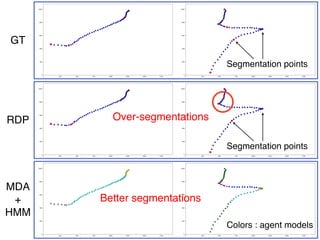
GT
RDP
MDA
+
HMM
Colors : agent models
Better segmentations
Over-segmentations
Segmentation points
Segmentation points
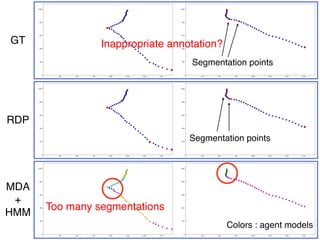
40
GT
RDP
MDA
+
HMM
Too many segmentations
Inappropriate annotation?
Colors : agent models
Segmentation points
Segmentation points
41
Conclusion 42
¡ We proposed semantic segmentation method (MDA+HMM)
by extending classification method (MDA)
¡ We validated effectiveness of proposed method by
comparing with baseline method (RDP) on synthetic and
real data
¡ We realized trajectory semantic segmentation based on
human behavior models

Semantic segmentation of trajectories with agent models

  • 1.
    Classification and segmentationof pedestrian trajectories Toru Tamaki, Hiroshima University Joint work with Daisuke Ogawa, Bisser Raytchev, Kazufumi Kaneda 7 Semantic segmentation by models of human behavior • Models of human behavior by Bayesian inference • Hidden Markov Model (HMM) (MDA)
  • 2.
    8 Results of semanticsegmentation based on destinations and walking speeds (Length of arrows)(Direction of arrows) (Colors)
  • 3.
    Background 9 ¡ Trajectoryprediction ¡ Abnormal behavior detection ¡ Crowd behavior analysis [Zhou+, IJCV2015] [Lee+,CVPR2017] [Saligrama+,CVPR2012] [Solmaz+,PAMI2012] ¡ Trajectory classification
  • 4.
    Related work ¡ TRAOD[Lee+, ICDE2008] ¡ Trajectory outlier detection ¡ Segmentation by MDL as preprocessing ¡ Transportation Mode [Zheng+, ACM WWW2008] ¡ Estimation of Transportation Mode (Walk, Car Bus, Bike) from GPS data ¡ Semantic segmentation based on Transportation Mode 10 No segmentation methods based on human behavior (Minimum Description Length)
  • 5.
    Proposed method (MDA+HMM) ¡Extend classification method to semantic segmentation by combining with Hidden Markov Model 11 Models of human behavior (or agents) Parameter estimation Pedestrian trajectory Semantic segmentation MDA+HMM MDA [Zhou+, IJCV2015] HMM [Baum, 1972] [Viterbi, 1967] !" !# !$ !% !& !' !()# !()" !(⋯ +" +# +, -" -# -,⋯ . /Agents Observations 0" 0# 0,⋯ States 1 2 3 4
  • 6.
    MDA: Mixture modelof Dynamic pedestrian-Agents ¡ Example : Input trajectories (blue) and two agent models 12 [Zhou+, IJCV2015]
  • 7.
    MDA (Mixture modelof Dynamic pedestrian-Agents) ¡ Initialize LDS and Gaussian distributions 13 start goal start goalD D [Zhou+, IJCV2015] B B B B Agents have D and B respectively • D (dynamics) : Linear dynamic system • B (belief) : Gaussian distributions (start, goal)
  • 8.
    MDA (Mixture modelof Dynamic pedestrian-Agents) ¡ Learn agents by EM algorithm 14 start goal goal start D D [Zhou+, IJCV2015] B B B B Agents have D and B respectively • D (dynamics) : Linear dynamic system • B (belief) : Gaussian distributions (start, goal)
  • 9.
    Dynamics and Beliefs ¡belief parameter 15 ! = ($, &, ', () : dynamics * = (+,, Φ,, +., Φ.): belief / 0 (!, *, 1) : Agent model 1 : Weights !" !# missing missingobserved$% $& '%~)($%, Φ%) '&~)($&, Φ&) $% $& . Kalman filter + Kalman smoother ¡ dynamics parameter !"#$ %" Observation !"~'(!"|%") = ,(!"|%", .) State !"#$ %!"#$ + ' !"~) !" !"#$ = +(!"|%!"#$ + ., 0) *( ⋯ *) ervations / 0- Figure 1. State space model of MDA [9] the sequence of states x except xs and xe. Figure 1 shows the state = {yk} MDA estimates M agents ⇥ = {(Dm, Bm, ⇡m)} by maximizing ood; L = X k log p(yk , xk , zk , tk s , tk e|⇥), (6) Hereafter, x1:T denotes the sequence of states x except xs and xe. Figure 1 shows the pace model of MDA. .2 Learning Given K trajectories Y = {yk} MDA estimates M agents ⇥ = {(Dm, Bm, ⇡m)} by maxim he following log likelihood; L = X k log p(yk , xk , zk , tk s , tk e |⇥), where the joint probability is given by p(yk , xk , zk , tk s , tk e ) = p(zk )p(tk s )p(tk e )p(xk s )p(xk e ) ⌧k +tk eY t= tk s +1 p(xk t |xk t 1) ⌧k Y t=1 p(yk t |xk t ) with respect to parameters ⇥. This can be rewritten by replacing hidden variables H = {hk}, hk = {zk, tk s , tk e } as follow ¡ Joint distribution of trajectory k ¡ Log likelihood for k trajectories 3.2 Learning Given K trajectories Y = {yk} MDA estimates M agents ⇥ = {(Dm, Bm, ⇡m)} by ma the following log likelihood; L = X k log p(yk , xk , zk , tk s , tk e |⇥), where the joint probability is given by p(yk , xk , zk , tk s , tk e ) = p(zk )p(tk s )p(tk e )p(xk s )p(xk e ) ⌧k +tk eY t= tk s +1 p(xk t |xk t 1) ⌧k Y t=1 p(yk t |xk t ) with respect to parameters ⇥. This can be rewritten by replacing hidden variables H = {hk}, hk = {zk, tk s , tk e } as fo L = X k log p(yk , xk , hk |⇥) Hereafter, x1:T denotes the sequence of states x except xs and xe. Figure 1 shows space model of MDA. 3.2 Learning Given K trajectories Y = {yk} MDA estimates M agents ⇥ = {(Dm, Bm, ⇡m)} by ma the following log likelihood; L = X k log p(yk , xk , zk , tk s , tk e |⇥), where the joint probability is given by p(yk , xk , zk , tk s , tk e ) = p(zk )p(tk s )p(tk e )p(xk s )p(xk e ) ⌧k +tk eY t= tk s +1 p(xk t |xk t 1) ⌧k Y t=1 p(yk t |xk t ) with respect to parameters ⇥. This can be rewritten by replacing hidden variables H = {hk}, hk = {zk, tk s , tk e } as fo Hidden variables
  • 10.
    Grahicsl model ofMDA 16 D B z "# = "%&' "( ") *( ⋯ ⋯⋯ *) "%&',( "),( ⋯ "- = "),&. Agents States Observations /0# 0- 1 2 k s e ere the joint probability is given by p(yk , xk , zk , tk s , tk e ) = p(zk )p(tk s )p(tk e )p(xk s )p(xk e ) ⌧k +tk eY t= tk s +1 p(xk t |xk t 1) ⌧k Y t=1 p(yk t |xk t ) th respect to parameters ⇥. This can be rewritten by replacing hidden variables H = {hk}, hk = {zk, tk s , tk e } as follows L = X k log p(yk , xk , hk |⇥) e EM algorithm estimates iteratively as H is not observed. 3
  • 11.
    EM algorithm forMDA 17 ¡ EM algorithm max $ = & ' log +(-'|/', ℎ', 2) ℎ' = {5', 67 ', 68 '} :2∗ = arg =>?@A 2, :2 ¡ E step ¡ M step 3.2.1 E step of original MDA Q(⇥, ˆ⇥) = EX,H|Y,ˆ⇥[L] = EH|Y,ˆ⇥[EX|Y,H,ˆ⇥[L]] = X k X hk k Exk|yk,hk [log p(yk , xk , hk |⇥)] = X k X hk k log p(yk , ˆxk , hk |⇥), where ˆxk = Exk|yk,hk [xk] is computed by the modified Kalman filter [9, 12 Weights k are posterior probabilities given as follows; k = p(hk |yk , ˆ⇥) = p(hk|ˆ⇥)p(yk|hk, ˆ⇥) p(yk|ˆ⇥) By further assuming the independence among hidden variables z, t , t , w Q(⇥, ˆ⇥) = EX,H|Y,ˆ⇥[L] = EH|Y,ˆ⇥[EX|Y,H,ˆ⇥[L]] = X k X hk k Exk|yk,hk [log p(yk , xk , hk |⇥)] = X k X hk k log p(yk , ˆxk , hk |⇥), where ˆxk = Exk|yk,hk [xk] is computed by the modified Kalman filter [9, 12]. Weights k are posterior probabilities given as follows; k = p(hk |yk , ˆ⇥) = p(hk|ˆ⇥)p(yk|hk, ˆ⇥) p(yk|ˆ⇥) By further assuming the independence among hidden variables z, ts, te, we have p(hk |ˆ⇥) = p(zk , tk s , tk e|ˆ⇥) = p(zk |ˆ⇥)p(tk s |ˆ⇥)p(tk e|ˆ⇥) = X k X hk k log p(yk , ˆxk , hk |⇥), where ˆxk = Exk|yk,hk [xk] is computed by the modified Kalman filter [9, 12]. Weights k are posterior probabilities given as follows; k = p(hk |yk , ˆ⇥) = p(hk|ˆ⇥)p(yk|hk, ˆ⇥) p(yk|ˆ⇥) By further assuming the independence among hidden variables z, ts, te, we have p(hk |ˆ⇥) = p(zk , tk s , tk e |ˆ⇥) = p(zk |ˆ⇥)p(tk s |ˆ⇥)p(tk e |ˆ⇥) By removing ts, te by assuming those be uniform, we have k = p(zk|ˆ⇥)p(yk|hk, ˆ⇥) P hk p(zk|ˆ⇥)p(yk|hk, ˆ⇥) where likelihood p(yk|hk, ˆ⇥) is also computed by the modified Kalman filter [9, 12]. Kalman filter 3.2.1 E step of original M Q(⇥ where ˆxk = Exk|yk,hk [xk] i Weights k are posterior Weights
  • 12.
    Issue of MDA19 ¡ One trajectory is represented by one agent model ¡ Cannot switch agent models in one trajectory [Zhou+, IJCV2015] D B z "# = "%&' "( ") *( ⋯ ⋯⋯ *) "%&',( "),( ⋯ "- = "),&. Agents States Observations /0# 0- 1 2
  • 13.
    Related model :Switching Kalman Filter ¡ Can estimate agents !" in time series ¡ Transition probabilities between agent models are required 20 Observations States Agents z" z#$"z% z# z#&"⋯ ⋯ (" (#$"(% (# (#&" )" )#$")% )# )#&" ⋯ ⋯ [Murphy, 1998]
  • 14.
    MDA+HMM (ours) ¡ Eachstates belong to one agent model ¡ Regard three observations as one observation ¡ Learn transition probabilities ! between and emission probabilities " of agents from trajectories 21 !" !# !$ !% !& !' !()# !()" !(⋯ +" +# +, -" -# -,⋯ . /Agents Observations 0" 0# 0,⋯ States 1 2 3 4
  • 15.
    MDA+HMM (ours) 22 ¡Agent estimation by MDA All agents Θ = {(%&, (&, )&)}&,- . = {/&}&,- . ¡ HMM Training (Baum-Welch) ¡ Trajectory Segmentation (Viterbi) 0∗ = {2-, 23, ⋯ 25} Hidden variables 0∗ 6∗ = {/78 , /79 , ⋯ /7: } Agents 6∗ max > ?, ?@AB = C D C 0 E F G, ?@AB ln E(G, F; ?) !" !# !$ !% !& !' !()# !()" !(⋯ +" +# +, -" -# -,⋯ . /Agents Observations 0" 0# 0,⋯ States 1 2 3 4 K : Emission probability L : Initial distribution of agents M : Transition probability matrix N : (M, K, L) (2, O) element is transition probability from /7 to /P. Q(O, R) is probability that /P outputs G5. If S5 contains TU, TUV- and TUV3, then Q O, R ~ E G5 /P = X(G5|ZP, ΣP) = X(UV- − ^PU|ZP, ΣP) _ X(UV3 − ^PUV-|ZP, ΣP)
  • 16.
    ¡ Real data ¡104 trajectories from “Pedestrian Walking Path Dataset” ¡ Annotated segmentation points manually ¡ 1920x1080 pixels ¡ 4-fold cross validation Datasets ¡ Synthetic data ¡ Using 10 agent models ¡ Uniform transition probabilities ¡ 10,000 trajectories for estimation, 10,000 trajectories for test ¡ 1920x1080 pixels 23 [Yi+, CVPR2015]
  • 17.
    ¡ Input trajectories 10agent models 24
  • 18.
    ¡ Learn 10agent models 10 agent models 25
  • 19.
  • 20.
  • 21.
  • 22.
  • 23.
  • 24.
  • 25.
    ¡ Real data ¡104 trajectories from “Pedestrian Walking Path Dataset” ¡ Annotated segmentation points manually ¡ 1920x1080 pixels ¡ 4-fold cross validation Datasets ¡ Synthetic data ¡ Using 10 agent models ¡ Uniform transition probabilities ¡ 10,000 trajectories for estimation, 10,000 trajectories for test ¡ 1920x1080 pixels 32 [Yi+, CVPR2015]
  • 26.
    Baseline 33 ¡ Ramer-Douglas-Peucker(RDP) algorithm ¡ Trajectory simplification with parameter ! ¡ Segmentation with keeping trajectory’s shape ¡ Appropriate ! setting is required ¡ No estimation of agent models Wikipedia, “Ramer–Douglas–Peucker algorithm” [Ramer, 1972] [Douglas+, 1973]
  • 27.
    Evaluation metrics ¡ Groundtruth 34 ¡Estimation ⋰ ⋰ ⋰ ⋰ "" − 1 Positional error : Sum of L2 norm between Goundtruth and Estimation Step error : Sum of absolute values of difference between Groundtruth and Estimation are observed : Segmentation points Positional error Step error
  • 28.
    ¡ Real data ¡104 trajectories from “Pedestrian Walking Path Dataset” ¡ Annotated segmentation points manually ¡ 1920x1080 pixels ¡ 4-fold cross validation Datasets ¡ Synthetic data ¡ Using 10 agent models ¡ Uniform transition probabilities ¡ 10,000 trajectories for estimation, 10,000 trajectories for test ¡ 1920x1080 pixels 35 [Yi+, CVPR2015]
  • 29.
  • 30.
    ¡ Real data ¡104 trajectories from “Pedestrian Walking Path Dataset” ¡ Annotated segmentation points manually ¡ 1920x1080 pixels ¡ 4-fold cross validation Datasets ¡ Synthetic data ¡ Using 10 agent models ¡ Uniform transition probabilities ¡ 10,000 trajectories for estimation, 10,000 trajectories for test ¡ 1920x1080 pixels 37 [Yi+, CVPR2015]
  • 31.
  • 32.
    39 GT RDP MDA + HMM Colors : agentmodels Better segmentations Over-segmentations Segmentation points Segmentation points
  • 33.
    40 GT RDP MDA + HMM Too many segmentations Inappropriateannotation? Colors : agent models Segmentation points Segmentation points
  • 34.
  • 35.
    Conclusion 42 ¡ Weproposed semantic segmentation method (MDA+HMM) by extending classification method (MDA) ¡ We validated effectiveness of proposed method by comparing with baseline method (RDP) on synthetic and real data ¡ We realized trajectory semantic segmentation based on human behavior models