1
FUTURE: BE GOING TO (PLANS AND PREDICTIONS).
PRESENT CONTINUOUS FOR
FUTURE. COUNTABLE AND UNCOUNTABLE NOUNS: A / AN,
SOME / ANY.
HOW MUCH / HOW MANY. A LOT / NOT MUCH, ETC.
2021-2
9
PREUNIVERSITARIO
2
3
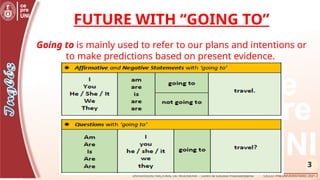
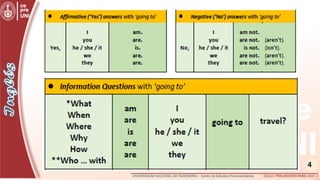
FUTURE WITH “GOING TO”
Going to is mainly used to refer to our plans and intentions or
to make predictions based on present evidence.
4
5
EXAMPLES
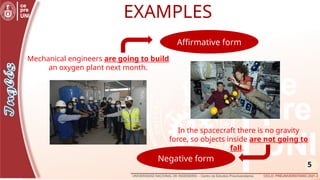
In the spacecraft there is no gravity
force, so objects inside are not going to
fall.
Mechanical engineers are going to build
an oxygen plant next month.
Affirmative form
Negative form
6
EXAMPLES
The First International Workshop on
Chemical Engineering isn’t going to
take place tomorrow, but on June
9th
.
Technological advances in
agricultural engineering are going
to allow a better ground utilization
in the coming years.
Negative form
Affirmative
form
7
EXAMPLES
Is the government going to
increase investment in geological
engineering research in 2022?
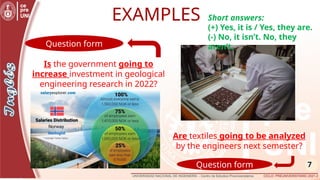
Are textiles going to be analyzed
by the engineers next semester?
Question form
Question form
Short answers:
(+) Yes, it is / Yes, they are.
(-) No, it isn’t. No, they
aren’t.
8
9
10
11
12
PRESENT CONTINUOUS FOR
FUTURE
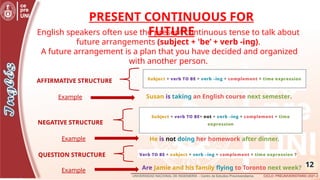
English speakers often use the present continuous tense to talk about
future arrangements (subject + 'be’ + verb -ing).
A future arrangement is a plan that you have decided and organized
with another person.
Susan is taking an English course next semester.
AFFIRMATIVE STRUCTURE
Example
NEGATIVE STRUCTURE
Example He is not doing her homework after dinner.
QUESTION STRUCTURE
Example Are Jamie and his family flying to Toronto next week?
13
EXAMPLES
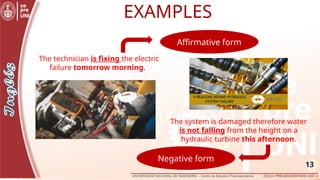
The system is damaged therefore water
is not falling from the height on a
hydraulic turbine this afternoon.
The technician is fixing the electric
failure tomorrow morning.
Affirmative form
Negative form
14
EXAMPLES
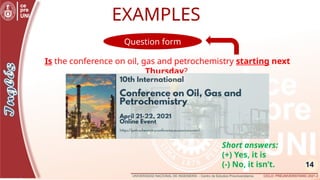
Is the conference on oil, gas and petrochemistry starting next
Thursday?
Question form
Short answers:
(+) Yes, it is
(-) No, it isn’t.
15
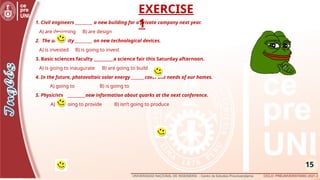
1. Civil engineers _________ a new building for a private company next year.
A) are designing B) are design
2. The university _________ on new technological devices.
A) is invested B) is going to invest
3. Basic sciences faculty __________a science fair this Saturday afternoon.
A) is going to inaugurate B) are going to build
4. In the future, photovoltaic solar energy _______cover the needs of our homes.
A) going to B) is going to
5. Physicists ___________new information about quarks at the next conference.
A) are going to provide B) isn’t going to produce
EXERCISE
1
16
17
18
19
20
21
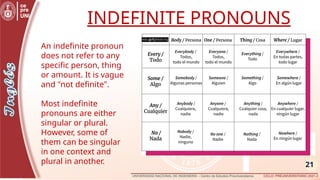
An indefinite pronoun
does not refer to any
specific person, thing
or amount. It is vague
and "not definite".
Most indefinite
pronouns are either
singular or plural.
However, some of
them can be singular
in one context and
plural in another.
INDEFINITE PRONOUNS
22
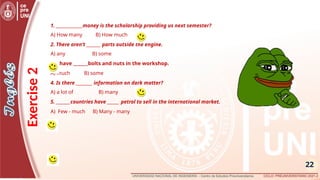
1. _____________money is the scholarship providing us next semester?
A) How many B) How much
2. There aren’t _______ parts outside the engine.
A) any B) some
3. I have _______bolts and nuts in the workshop.
A) much B) some
4. Is there ________ information on dark matter?
A) a lot of B) many
5. _______countries have ______ petrol to sell in the international market.
A) Few - much B) Many - many
Exercise
2

23

SEMANA 9 - PPT.pptx "GOING TO, PRESENT CONTINOUS FOR FUTURE"

  • 1.
    1 FUTURE: BE GOINGTO (PLANS AND PREDICTIONS). PRESENT CONTINUOUS FOR FUTURE. COUNTABLE AND UNCOUNTABLE NOUNS: A / AN, SOME / ANY. HOW MUCH / HOW MANY. A LOT / NOT MUCH, ETC. 2021-2 9 PREUNIVERSITARIO
  • 2.
  • 3.
    3 FUTURE WITH “GOINGTO” Going to is mainly used to refer to our plans and intentions or to make predictions based on present evidence.
  • 4.
  • 5.
    5 EXAMPLES In the spacecraftthere is no gravity force, so objects inside are not going to fall. Mechanical engineers are going to build an oxygen plant next month. Affirmative form Negative form
  • 6.
    6 EXAMPLES The First InternationalWorkshop on Chemical Engineering isn’t going to take place tomorrow, but on June 9th . Technological advances in agricultural engineering are going to allow a better ground utilization in the coming years. Negative form Affirmative form
  • 7.
    7 EXAMPLES Is the governmentgoing to increase investment in geological engineering research in 2022? Are textiles going to be analyzed by the engineers next semester? Question form Question form Short answers: (+) Yes, it is / Yes, they are. (-) No, it isn’t. No, they aren’t.
  • 8.
  • 9.
  • 10.
  • 11.
  • 12.
    12 PRESENT CONTINUOUS FOR FUTURE Englishspeakers often use the present continuous tense to talk about future arrangements (subject + 'be’ + verb -ing). A future arrangement is a plan that you have decided and organized with another person. Susan is taking an English course next semester. AFFIRMATIVE STRUCTURE Example NEGATIVE STRUCTURE Example He is not doing her homework after dinner. QUESTION STRUCTURE Example Are Jamie and his family flying to Toronto next week?
  • 13.
    13 EXAMPLES The system isdamaged therefore water is not falling from the height on a hydraulic turbine this afternoon. The technician is fixing the electric failure tomorrow morning. Affirmative form Negative form
  • 14.
    14 EXAMPLES Is the conferenceon oil, gas and petrochemistry starting next Thursday? Question form Short answers: (+) Yes, it is (-) No, it isn’t.
  • 15.
    15 1. Civil engineers_________ a new building for a private company next year. A) are designing B) are design 2. The university _________ on new technological devices. A) is invested B) is going to invest 3. Basic sciences faculty __________a science fair this Saturday afternoon. A) is going to inaugurate B) are going to build 4. In the future, photovoltaic solar energy _______cover the needs of our homes. A) going to B) is going to 5. Physicists ___________new information about quarks at the next conference. A) are going to provide B) isn’t going to produce EXERCISE 1
  • 16.
  • 17.
  • 18.
  • 19.
  • 20.
  • 21.
    21 An indefinite pronoun doesnot refer to any specific person, thing or amount. It is vague and "not definite". Most indefinite pronouns are either singular or plural. However, some of them can be singular in one context and plural in another. INDEFINITE PRONOUNS
  • 22.
    22 1. _____________money isthe scholarship providing us next semester? A) How many B) How much 2. There aren’t _______ parts outside the engine. A) any B) some 3. I have _______bolts and nuts in the workshop. A) much B) some 4. Is there ________ information on dark matter? A) a lot of B) many 5. _______countries have ______ petrol to sell in the international market. A) Few - much B) Many - many Exercise 2

  • 23.