1 | P a g e
Maulana Abul Kalam Azad University of Technology, West Bengal
(Formerly West Bengal University of Technology)
Syllabus for B. Tech in Civil Engineering
(Applicable from the academic session 2018-2019)
SEMESTER –III (2ND YR)
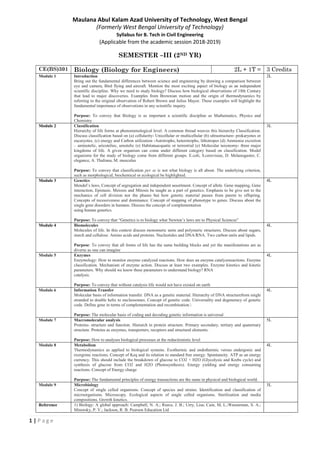
CE(BS)301 Biology (Biology for Engineers) 2L + 1T = 3 Credits
Module 1 Introduction
Bring out the fundamental differences between science and engineering by drawing a comparison between
eye and camera, Bird flying and aircraft. Mention the most exciting aspect of biology as an independent
scientific discipline. Why we need to study biology? Discuss how biological observations of 18th Century
that lead to major discoveries. Examples from Brownian motion and the origin of thermodynamics by
referring to the original observation of Robert Brown and Julius Mayor. These examples will highlight the
fundamental importance of observations in any scientific inquiry.
Purpose: To convey that Biology is as important a scientific discipline as Mathematics, Physics and
Chemistry
2L
Module 2 Classification
Hierarchy of life forms at phenomenological level. A common thread weaves this hierarchy Classification.
Discuss classification based on (a) cellularity- Unicellular or multicellular (b) ultrastructure- prokaryotes or
eucaryotes. (c) energy and Carbon utilization -Autotrophs, heterotrophs, lithotropes (d) Ammonia excretion
– aminotelic, uricoteliec, ureotelic (e) Habitataacquatic or terrestrial (e) Molecular taxonomy- three major
kingdoms of life. A given organism can come under different category based on classification. Model
organisms for the study of biology come from different groups. E.coli, S.cerevisiae, D. Melanogaster, C.
elegance, A. Thaliana, M. musculus
Purpose: To convey that classification per se is not what biology is all about. The underlying criterion,
such as morphological, biochemical or ecological be highlighted.
3L
Module 3 Genetics
Mendel’s laws, Concept of segregation and independent assortment. Concept of allele. Gene mapping, Gene
interaction, Epistasis. Meiosis and Mitosis be taught as a part of genetics. Emphasis to be give not to the
mechanics of cell division nor the phases but how genetic material passes from parent to offspring.
Concepts of recessiveness and dominance. Concept of mapping of phenotype to genes. Discuss about the
single gene disorders in humans. Discuss the concept of complementation
using human genetics.
Purpose: To convey that “Genetics is to biology what Newton’s laws are to Physical Sciences”
4L
Module 4 Biomolecules
Molecules of life. In this context discuss monomeric units and polymeric structures. Discuss about sugars,
starch and cellulose. Amino acids and proteins. Nucleotides and DNA/RNA. Two carbon units and lipids.
Purpose: To convey that all forms of life has the same building blocks and yet the manifestations are as
diverse as one can imagine
4L
Module 5 Enzymes
Enzymology: How to monitor enzyme catalyzed reactions. How does an enzyme catalyzereactions. Enzyme
classification. Mechanism of enzyme action. Discuss at least two examples. Enzyme kinetics and kinetic
parameters. Why should we know these parameters to understand biology? RNA
catalysis.
Purpose: To convey that without catalysis life would not have existed on earth
4L
Module 6 Information Transfer
Molecular basis of information transfer. DNA as a genetic material. Hierarchy of DNA structurefrom single
stranded to double helix to nucleosomes. Concept of genetic code. Universality and degeneracy of genetic
code. Define gene in terms of complementation and recombination.
Purpose: The molecular basis of coding and decoding genetic information is universal
4L
Module 7 Macromolecular analysis
Proteins- structure and function. Hierarch in protein structure. Primary secondary, tertiary and quaternary
structure. Proteins as enzymes, transporters, receptors and structural elements.
Purpose: How to analyses biological processes at the reductionistic level
5L
Module 8 Metabolism
Thermodynamics as applied to biological systems. Exothermic and endothermic versus endergonic and
exergoinc reactions. Concept of Keq and its relation to standard free energy. Spontaneity. ATP as an energy
currency. This should include the breakdown of glucose to CO2 + H2O (Glycolysis and Krebs cycle) and
synthesis of glucose from CO2 and H2O (Photosynthesis). Energy yielding and energy consuming
reactions. Concept of Energy charge
Purpose: The fundamental principles of energy transactions are the same in physical and biological world.
4L
Module 9 Microbiology
Concept of single celled organisms. Concept of species and strains. Identification and classification of
microorganisms. Microscopy. Ecological aspects of single celled organisms. Sterilization and media
compositions. Growth kinetics.
3L
Reference 1) Biology: A global approach: Campbell, N. A.; Reece, J. B.; Urry, Lisa; Cain, M, L.;Wasserman, S. A.;
Minorsky, P. V.; Jackson, R. B. Pearson Education Ltd
2 | P a g e
Maulana Abul Kalam Azad University of Technology, West Bengal
(Formerly West Bengal University of Technology)
Syllabus for B. Tech in Civil Engineering
(Applicable from the academic session 2018-2019)
2) Outlines of Biochemistry, Conn, E.E; Stumpf, P.K; Bruening, G; Doi, R.H., John Wiley and Sons
3) Principles of Biochemistry (V Edition), By Nelson, D. L.; and Cox, M. M.W.H. Freeman andCompany
4) Molecular Genetics (Second edition), Stent, G. S.; and Calender, R.W.H. Freeman and
company,Distributed by Satish Kumar Jain for CBS Publisher
5) Microbiology, Prescott, L.M J.P. Harley and C.A. Klein 1995. 2nd edition Wm, C. BrownPublishers
6) Biology of Engineers, McGraw Hill (ISBN: 978-11-21439-931)
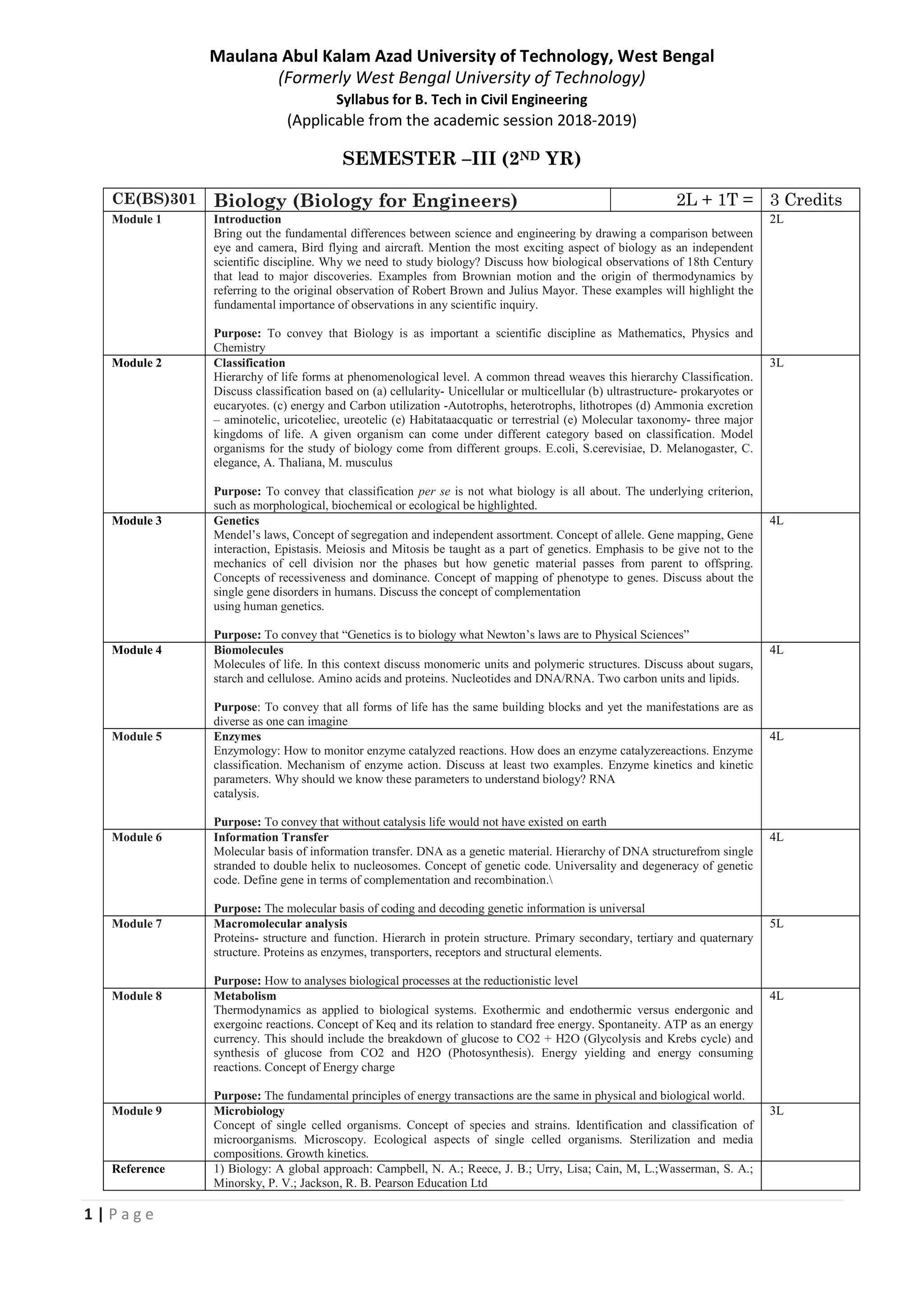
CE(ES)301 Engineering Mechanics 3L + 1T = 4 Credits
Module 1 Introduction to Engineering Mechanics
Force Systems Basic concepts, Particleequilibrium in 2-D & 3-D; Rigid Body equilibrium;
System of Forces, Coplanar Concurrent Forces,Components in Space – Resultant- Moment of
Forces and its Application; Couples and Resultant ofForce System, Equilibrium of System of
Forces, Free body diagrams, Equations of Equilibrium ofCoplanar Systems and Spatial
Systems; Static Indeterminacy
6L
Module 2 Friction
Types of friction, Limiting friction, Laws of Friction, Static andDynamic Friction; Motion of
Bodies, wedge friction, screw jack & differential screw jack;
3L
Module 3 Basic Structural Analysis
Equilibrium in three dimensions; Method of Sections;Method of Joints; How to determine if a
member is in tension or compression; Simple Trusses; Zeroforce members; Beams & types of
beams; Frames & Machines;
4L
Module 4 Centroid and Centre of Gravity
Centroid of simple figures from first principle,centroid of composite sections; Centre of Gravity
and its implications; Area moment of inertia-Definition, Moment of inertia of plane sections
from first principles, Theorems of moment of inertia,Moment of inertia of standard sections and
composite sections; Mass moment inertia of circularplate, Cylinder, Cone, Sphere, Hook.
5L
Module 5 Virtual Work and Energy Method-
Virtual displacements, principle of virtual work forparticle and ideal system of rigid bodies,
degrees of freedom. Active force diagram, systems withfriction, mechanical efficiency.
Conservative forces and potential energy (elastic and gravitational),energy equation for
equilibrium. Applications of energy method for equilibrium. Stability ofequilibrium.
4L
Module 6 Review of particle dynamics-
Rectilinear motion; Plane curvilinear motion (rectangular,path, and polar coordinates). 3-D
curvilinear motion; Relative and constrained motion; Newton’s 2nd
law (rectangular, path, and
polar coordinates). Work-kinetic energy, power, potentialenergy.Impulse-momentum (linear,
angular); Impact (Direct and oblique).
4L
Module 7 Introduction to Kinetics of Rigid Bodies
Basic terms, general principles indynamics; Types of motion, Instantaneous centre of rotation in
plane motion and simple problems;D’Alembert’s principle and its applications in plane motion
and connected bodies; Work energyprinciple and its application in plane motion of connected
bodies; Kinetics of rigid body rotation;
5L
Module 8 Mechanical Vibrations
Basic terminology, free and forced vibrations,resonance and its effects; Degree of freedom;
Derivation for frequency and amplitude of freevibrations without damping and single degree of
freedom system, simple problems, types ofpendulum, use of simple, compound and torsion
pendulums;
5L
Tutorials From the above modules covering, To find the various forces and angles including
resultants in various parts of wall crane, roof truss, pipes, etc.; To verify the line of polygon on
various forces; To find coefficient of friction between various materials on inclined plan; Free
bodydiagrams various systems including block-pulley; To verify the principle of moment in the
discapparatus; Helical block; To draw a load efficiency curve for a screw jack
6L
Reference 1. D.S. Bedi (2018), Engineering Mechanics, Khanna Publishing House, 2019
2. Irving H. Shames (2006), Engineering Mechanics, 4th Edition, Prentice Hall
3. F. P. Beer and E. R. Johnston (2011), Vector Mechanics for Engineers, Vol I - Statics, Vol II,
–Dynamics, 9th Ed, Tata McGraw Hill
4. R.C. Hibbler (2006), Engineering Mechanics: Principles of Statics and Dynamics, Pearson
Press.
5. Andy Ruina and RudraPratap (2011), Introduction to Statics and Dynamics, Oxford
UniversityPress
6. Shanes and Rao (2006), Engineering Mechanics, Pearson Education,
7. Hibler and Gupta (2010),Engineering Mechanics (Statics, Dynamics) by Pearson Education
8. Reddy Vijaykumar K. and K. Suresh Kumar(2010), Singer’s Engineering Mechanics
9. Bansal R.K.(2010), A Text Book of Engineering Mechanics, Laxmi Publications
10. Khurmi R.S. (2010), Engineering Mechanics, S. Chand & Co.
11. Tayal A.K. (2010), Engineering Mechanics, Umesh Publications
3 | P a g e
Maulana Abul Kalam Azad University of Technology, West Bengal
(Formerly West Bengal University of Technology)
Syllabus for B. Tech in Civil Engineering
(Applicable from the academic session 2018-2019)
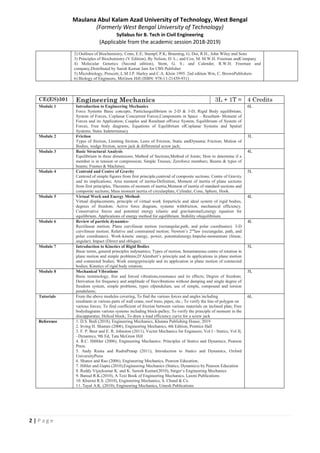
CE(ES)302 Energy Science & Engineering 1L + 1T = 2 Credits
Module 1 Introduction to Energy Science
Scientific principles and historical interpretation to place
energy use in the context of pressing societal, environmental and climate issues; Introduction to
energy systems and resources; Introduction to Energy, sustainability & the environment.
Tutorials:Compile a World map showing Energy Reserves by source, Total
Energyconsumption, Per capita energy consumption and Carbon Footprint
3L
Module 2 Energy Sources
Overview of energy systems, sources, transformations, efficiency, andstorage. Fossil fuels
(coal, oil, oil-bearing shale and sands, coal gasification) - past, present & future,Remedies &
alternatives for fossil fuels - biomass, wind, solar, nuclear, wave, tidal and
hydrogen;Sustainability and environmental trade-offs of different energy systems; possibilities
for energy
storage or regeneration (Ex. Pumped storage hydro power projects, superconductor-based
energystorages, high efficiency batteries)
Tutorials:Compile a Word Map showing Alternative Energy sourceusage; Compile a Process
diagram for a Pumped Storageproject; Collect details of a typical North Sea oil platform.
Compile a map of India showing exiting potential and utilizedpotential for hydro power. List
the pros and cons for Thermal,hydro, nuclear and solar power projects.
4L
Module 3 Energy & Environment
Energy efficiency and conservation; introduction to clean energy
technologies and its importance in sustainable development; Carbon footprint, energy
consumptionand sustainability; introduction to the economics of energy; How the economic
system determinesproduction and consumption; linkages between economic and environmental
outcomes; How futureenergy use can be influenced by economic, environmental, trade, and
research policy
Tutorials:Study the functioning of an Electro Static Precipitator in athermal power plant; study
the uses of coarse and fine Fly Ashfrom thermal power plants. Compile the safety provisions
indesign and construction of a reactor containment building
5L
Module 4 Civil Engineering Projects connected with the Energy Sources
Coal miningtechnologies, Oil exploration offshore platforms, Underground and under-sea oil
pipelines, solarchimney project, wave energy caissons, coastal installations for tidal power,
wind mill towers; hydropower stations above-ground and underground along with associated
dams, tunnels, penstocks, etc.;Nuclear reactor containment buildings and associated buildings,
design and construction constraintsand testing procedures for reactor containment buildings;
Spent Nuclear fuel storage and disposalsystems
Tutorials:Compile a process diagram for a typical underground hydropower project; Collect
details of a model solar chimneyproject; collect details of a wave energy project at
Vizhinjam;Collect details of the Kalpasar (Tidal energy) project
10L
Module 5 Engineering for Energy conservation
Concept of Green Building and GreenArchitecture; Green building concepts (Green building
encompasses everything from the choice ofbuilding materials to where a building is located,
how it is designed and operated); LEED ratings;Identification of energy related enterprises that
represent the breath of the industry and prioritizingthese as candidates; Embodied energy
analysis and use as a tool for measuring sustainability. EnergyAudit of Facilities and
optimization of energy consumption.
Tutorials:Draw a typical geometrical orientation of a house in your areato avoid sun’s radiation
in the bed room in the evening;Identify typical examples of Indian buildings having
variousLEED ratings; List various building materials with theirembodied energy content. Do an
Energy Audit of yourDepartmental Building in the college
8L
Reference 1. O.P, Gupta, Energy Technology, Khanna Book Publishing, (2019)
2. Boyle, Godfrey (2004), Renewable Energy (2nd edition). Oxford University Press
3. Boyle, Godfrey, Bob Everett, and Janet Ramage (Eds.) (2004), Energy Systems
andSustainability: Power for a Sustainable Future. Oxford University Press
4. Chakrabarti, Energy Engineering & Management, PHI
5.Schaeffer, John (2007), Real Goods Solar Living Sourcebook: The Complete Guide to
Renewable Energy Technologies and Sustainable Living, Gaiam
6. Jean-Philippe; Zaccour, Georges (Eds.), (2005), Energy and Environment Set: Mathematicsof
Decision Making, Loulou, Richard; Waaub, XVIII,
7. Ristinen, Robert A. Kraushaar, Jack J. AKraushaar, Jack P. Ristinen, Robert A. (2006)
Energy and the Environment, 2nd Edition, John Wiley
8. UNDP (2000), Energy and the Challenge of Sustainability, World Energy assessment
9. E H Thorndike (1976), Energy & Environment: A Primer for Scientists and Engineers,
Addison-Wesley Publishing Company
10. Related papers published in international journals
4 | P a g e
Maulana Abul Kalam Azad University of Technology, West Bengal
(Formerly West Bengal University of Technology)
Syllabus for B. Tech in Civil Engineering
(Applicable from the academic session 2018-2019)
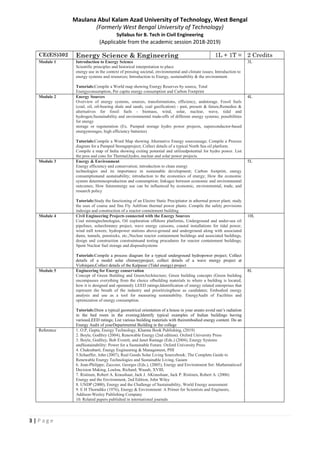
CE(BS)302 Mathematics-III
(Transform & Discrete Mathematics)
2L + 0T 2 Credits
(Prerequisite 2c, 5b-d, 6b)
Module 1 Transform Calculus -1
Polynomials – Orthogonal Polynomials – Lagrange’s, Chebysev Polynomials; Trigonometric
Polynomials;aplace Transform, Properties of Laplace Transform, Laplace transform of periodic
functions.Finding inverse Laplace transform by different methods, convolution theorem.
Evaluation ofintegrals by Laplace transform, solving ODEs and PDEs by Laplace Transform
method.
6 L
Module 2 Transform Calculus-2
Fourier transforms, Z-transform and Wavelet transforms: properties, methods, inverses and
theirapplications.
6 L
Module 3 Sets, relations and functions
Basic operations on sets, Cartesian products, disjoint union (sum), and power sets. Different
types ofrelations, their compositions and inverses. Different types of functions, their
compositions andinverses.
4 L
Module 4 Propositional Logic
Syntax and semantics, proof systems, satisfiability, validity, soundness, completeness,
deductiontheorem, etc. Decision problems of propositional logic. Introduction to first order
logic and firstorder theory.
4 L
Module 5 Partially ordered sets
Complete partial ordering, chain, lattice, complete, distributive, modular and complemented
lattices.Boolean and pseudo Boolean lattices.
4 L
Module 6 Algebraic Structures
Algebraic structures with one binary operation – semigroup, monoid and group. Cosets,
Lagrange’stheorem, normal subgroup, homomorphic subgroup. Congruence relation and
quotient structures.Error correcting code. Algebraic structures with two binary operations- ring,
integral domain, andfield. Boolean algebra and boolean ring (Definitions and simple examples
only).
4 L
Module 7 Introduction to Counting
Basic counting techniques – inclusion and exclusion, pigeon-hole principle,
permutation,combination, summations. Introduction to recurrence relation and generating
functions.
3 L
Module 8 Introduction to Graphs
Graphs and their basic properties – degree, path, cycle, subgraph, isomorphism, Eulerian and
Hamiltonian walk, trees.
3 L
Reference 1.C. L. Liu, Elements of Discrete Mathematics, 2nd Ed., Tata McGraw-Hill, 2000.
2. R. C. Penner, Discrete Mathematics: Proof Techniques and Mathematical Structures, World
Scientific, 1999.
3. R.L. Graham, D. E. Knuth, and O. Patashnik, Concrete Mathematics, 2nd Ed., Addison-
Wesley, 1994.
4. K. H. Rosen, Discrete Mathematics and its Applications, 6th Ed., Tata McGraw-Hill, 2007.
5. J. L. Hein, Discrete Structures, Logic, and Computability, 3rd Ed., Jones and Bartlett, 2010.
6. N. Deo, Graph Theory, Prentice Hall of India, 1974.
7. S. Lipschutz and M. L. Lipson, Schaum's Outline of Theory and Problems of Discrete
Mathematics,
2nd Ed., Tata McGraw-Hill, 1999.
8. J. P. Tremblay and R. P. Manohar, Discrete Mathematics with Applications to Computer
Science,
Tata McGraw-Hill, 1997.
9. Erwin Kreyszig, Advanced Engineering Mathematics, 9th Edition, John Wiley & Sons, 2006.
10. N.P. Bali and Manish Goyal, A text book of Engineering Mathematics, Laxmi Publications,
Reprint, 2010.
11. B.S. Grewal, Higher Engineering Mathematics, Khanna Publishers, 35th Edition, 2000.
12. S.B. Singh. Discrete Structures, Khanna Publishing House, 2019
13. Veerarajan T., Engineering Mathematics, Tata McGraw-Hill, New Delhi, 2008.
14. Chandrika Prasad, Advanced Engineering Mathematics, KPB
5 | P a g e
Maulana Abul Kalam Azad University of Technology, West Bengal
(Formerly West Bengal University of Technology)
Syllabus for B. Tech in Civil Engineering
(Applicable from the academic session 2018-2019)
CE(HS)301 Humanities-I
(Effective Technical Communication)
3L + 0T 3 Credits
Module 1 Information Design and Development- Different kinds of technical documents,Information
development life cycle, Organization structures, factors affecting information anddocument
design, Strategies for organization, Information design and writing for print and for
onlinemedia.
4L
Module 2 Technical Writing, Grammar and Editing- Technical writing process, forms of
discourse,Writing drafts and revising, Collaborative writing, creating indexes, technical writing
style andlanguage. Basics of grammar, study of advanced grammar, editing strategies to achieve
appropriatetechnical style. Introduction to advanced technical communication, Usability, Hunan
factors,Managing technical communication projects, time estimation, Single sourcing,
Localization.
8L
Module 3 Self Development and Assessment- Self assessment, Awareness, Perception andAttitudes,
Values and belief, Personal goal setting, career planning, Self-esteem. Managing Time;Personal
memory, Rapid reading, Taking notes; Complex problem solving; Creativity
8L
Module 4 Communication and Technical Writing- Public speaking, Group discussion, Oral;presentation,
Interviews, Graphic presentation, Presentation aids, Personality Development. Writingreports,
project proposals, brochures, newsletters, technical articles, manuals, official notes,
businessletters, memos, progress reports, minutes of meetings, event report.
8L
Module 5 Ethics- Business ethics, Etiquettes in social and office settings, Email etiquettes,Telephone
Etiquettes, Engineering ethics, Managing time, Role and responsibility of engineer,
Workculture in jobs, Personal memory, Rapid reading, Taking notes, Complex problem
solving,Creativity.
8L
Reference 1. David F. Beer and David McMurrey, Guide to writing as an Engineer, John Willey. New
York, 2004
2. Diane Hacker, Pocket Style Manual, Bedford Publication, New York, 2003. (ISBN
0312406843)
3. Kulbhushan Kumar, Effective Communication Skills, Khanna Publishing House
4. Shiv Khera, You Can Win, Macmillan Books, New York, 2003.
5. Raman Sharma, Technical Communications, Oxford Publication, London, 2004.
6. Dale Jungk, Applied Writing for Technicians, McGraw Hill, New York, 2004. (ISBN:
07828357-4)
7. Sharma, R. and Mohan, K. Business Correspondence and Report Writing, TMH New Delhi
2002.
8. Xebec, Presentation Book, TMH New Delhi, 2000. (ISBN 0402213)
6 | P a g e
Maulana Abul Kalam Azad University of Technology, West Bengal
(Formerly West Bengal University of Technology)
Syllabus for B. Tech in Civil Engineering
(Applicable from the academic session 2018-2019)
CE(HS)302 Introduction to Civil Engineering 1L + 1T= 2 Credits
Module 1 Basic Understanding: What is Civil Engineering/ Infrastructure? Basics of Engineering and
Civil Engineering; Broad disciplines of Civil Engineering; Importance of Civil Engineering,
Possible scopes for a career
Tutorials
Develop a matrix of various disciplines and possibleroles for engineers in each
1 L
Module 2 History of Civil engineering: Early constructions and developments over time; Ancient
monuments & Modern marvels; Development of various materials of construction and methods
of construction; Works of Eminent civil engineers
Tutorials
Identify 10 ancient monuments and ten modern marvels and list the uniqueness of each
1 L
Module 3 Overview of National Planning for Construction and Infrastructure Development;
Positionof construction industry vis-à-vis other industries, five year plan outlays for
construction; currentbudgets for infrastructure works
Tutorials
Develop a Strategic Plan for Civil Engineering worksfor next ten years based on past
investments andidentify one typical on-going mega project in eacharea
1 L
Module 4 Fundamentals of Architecture & Town Planning: Aesthetics in Civil Engineering,
Examples of great architecture, fundamentals of architectural design & town planning;
BuildingSystems (HVAC, Acoustics, Lighting, etc.); LEED ratings; Development of Smart
cities
Tutorials
Identify ten best civil engineering projects with highaesthetic appeal with one possible factor
for each; Listdown the possible systems required for a typical SmartCity
1 L
Module 5 Fundamentals of Building Materials: Stones, bricks, mortars, Plain, Reinforced
&PrestressedConcrete, Construction Chemicals; Structural Steel, High Tensile Steel, Carbon
Composites;Plastics in Construction; 3D printing; Recycling of Construction & Demolition
wastes
Tutorials
Identify three top new materials and their potential inconstruction; Visit a Concrete Lab and
make a report
2 L
Module 6 Basics of Construction Management & Contracts Management: Temporary Structures in
Construction; Construction Methods for various types of Structures; Major Construction
equipment; Automation & Robotics in Construction; Modern Project management Systems;
Advent of Lean Construction; Importance of Contracts Management
Tutorials
Identify 5 typical construction methods and list theiradvantages/ positive features
2 L
Module 7 Environmental Engineering & Sustainability: Water treatment systems; Effluent treatment
systems; Solid waste management; Sustainability in Construction
Tutorials
Sustainability principles, Sustainable builtenvironment, water treatment systems, and good
practicesof wastewater management. examples of Solid andhazardous waste management, Air
pollution andcontrol
2L
Module 8 Geotechnical Engineering: Basics of soil mechanics, rock mechanics and geology; various
types of foundations; basics of rock mechanics & tunnelling
Tutorials
List top five tunnel projects in India and their features;collect and study geotechnical
investigation report ofany one Metro Rail (underground) project; Visit aconstruction site and
make a site visit report
2 L
Module 9 Hydraulics, Hydrology &Water Resources Engineering: Fundamentals of fluid flow, basics
ofwater supply systems; Underground Structures; Underground Structures Multi-purpose
reservoirprojects
Tutorials
Identify three river interlinking projects and theirfeatures; visit a Hydraulics Lab and make a
report
1 L
Module 10 Ocean Engineering: Basics of Wave and Current Systems; Sediment transport systems; Ports
&Harbours and other marine structures
Tutorials
Identify 5 typical ports in India and list the structuresavailable in them; Visit a related/similar
1 L
7 | P a g e
Maulana Abul Kalam Azad University of Technology, West Bengal
(Formerly West Bengal University of Technology)
Syllabus for B. Tech in Civil Engineering
(Applicable from the academic session 2018-2019)
facility, ifpossible in nearby place and make a report
Module 11 Power Plant Structures: Chimneys, Natural & Induced Draught Colling towers, coal handling
systems, ash handling systems; nuclear containment structures; hydro power projects
Tutorials
Collect the typical layout for a large thermal powerplant and a large hydro power plant and
identify all thestructures and systems falling in them.
1 L
Module 12 Structural Engineering: Types of buildings; tall structures; various types of bridges; Water
retaining structures; Other structural systems; Experimental Stress Analysis; Wind tunnel
studies;
Tutorials
Identify 5 unique features for typical buildings,bridges, tall structures and large span structures;
VisitStructures Testing Lab/facility and make a report
3 L
Module 13 Surveying & Geomatics: Traditional surveying techniques, Total Stations, Development of
Digital Terrain Models; GPS, LIDAR;
Tutorials
Collect visual representations prepared by a TotalStation and LIDAR and compare; Study
typicalGoogle street map and Google Earth Map and studyhow each can facilitate the other
1 L
Module 14 Traffic &Transportation Engineering: Investments in transport infrastructure development
inIndia for different modes of transport; Developments and challenges in integrated transport
development in India: road, rail, port and harbour and airport sector; PPP in transport sector;
Intelligent Transport Systems; Urban Public and Freight Transportation; Road Safety
underheterogeneous traffic; Sustainable and resilient pavement materials, design, construction
andmanagement; Case studies and examples.
Tutorials
Investments in transport infrastructure; Developmentsand challenges; Intelligent Transport
Systems; SmartCities, Urban Transport; Road Safety; Sustainable andresilient highway design
principles; Plan a sustainabletransport system for a city; Identify keyfeatures/components in the
planning and design of agreen field highway/airport/port/railway and the cost –economics.
1 L
Module 15 Repairs & Rehabilitation of Structures: Basics of corrosion phenomena and other structural
distress mechanisms; some simple systems of rehabilitation of structures; Non-
Destructivetesting systems; Use of carbon fibre wrapping and carbon composites in repairs.
Tutorials
Collect the history of a major rehabilitation project andlist the interesting features
1 L
Module 16 Computational Methods, IT, IoT in Civil Engineering: Typical software used in Civil
Engineering- Finite Element Method, Computational Fluid Dynamics; Computational
Geotechnical Methods; highway design (MX), Building Information Modelling; Highlighting
typical available software systems (SAP, STAAD, ABAQUS, MATLAB, ETAB, NASTRAN,
NISA, MIKE 21, MODFLOW, REVIT, TEKLA, AUTOCAD,…GEOSTUDIO, EDUSHAKE,
MSP, PRIMAVERA, ArcGIS, VisSIM, …)
Tutorials
Visit an AutoCad lab and prepare a report; Identify teninteresting software systems used in
Civil Engg andtheir key features
2 L
Module 17 Industrial lectures: Case studies of large civil engineering projects by industry professionals,
covering comprehensive planning to commissioning;
Tutorials
For each case study list the interesting features
2 L
Module 18 Basics of Professionalism: Professional Ethics, Entrepreneurial possibilities in Civil
Engineering, Possibilities for creative & innovative working, Technical writing Skills
enhancement; Facilities Management; Quality & HSE Systems in Construction
3 L
Tutorials List 5 cases of violation of professional ethics and listpreventive measures; Identify 5
interesting projectsand their positive features; Write 400 word reports on
one ancient monument and a modern marvel of civilengineering
5L
Reference 1. Patil, B.S.(1974), Legal Aspects of Building and Engineering Contract
2. The National Building Code, BIS, (2017)
3. RERA Act, (2017)
4. Meena Rao (2006), Fundamental concepts in Law of Contract, 3rd Edn. Professional Offset
5. Chandiramani, Neelima (2000), The Law of Contract: An Outline, 2nd Edn. Avinash
Publications Mumbai
6. Avtarsingh (2002), Law of Contract, Eastern Book Co.
7. Dutt (1994), Indian Contract Act, Eastern Law House
8. Anson W.R.(1979), Law of Contract, Oxford University Press
9. Kwatra G.K.(2005), The Arbitration & Conciliation of Law in India with case law on
UNCITRAL Model Law on Arbitration, Indian Council of Arbitration
10. Avtarsingh (2005), Law of Arbitration and Conciliation, Eastern Book Co.
8 | P a g e
Maulana Abul Kalam Azad University of Technology, West Bengal
(Formerly West Bengal University of Technology)
Syllabus for B. Tech in Civil Engineering
(Applicable from the academic session 2018-2019)
11. Wadhera (2004), Intellectual Property Rights, Universal Law Publishing Co.
12. P. S. Narayan (2000), Intellectual Property Rights, Gogia Law Agency
13. T. Ramappa (2010), Intellectual Property Rights Law in India, Asia Law House
14. Bare text (2005), Right to Information Act
15. O.P. Malhotra, Law of Industrial Disputes, N.M. Tripathi Publishers
16. K.M. Desai(1946), The Industrial Employment (Standing Orders) Act
17. Rustamji R.F., Introduction to the Law of Industrial Disputes, Asia Publishing House
18. Vee, Charles &Skitmore, Martin (2003) Professional Ethics in the Construction Industry,
Engineering Construction and Architectural management, Vol.10, Iss. 2, pp 117-127, MCB
UP Ltd
19. American Society of Civil Engineers (2011) ASCE Code of Ethics – Principles Study and
Application
20. Ethics in Engineering- M.W.Martin&R.Schinzinger, McGraw-Hill
21. Engineering Ethics, National Institute for Engineering Ethics, USA
22. www.ieindia.org
23. Engineering ethics: concepts and cases – C. E. Harris, M.S. Pritchard, M.J.Rabins
24. Resisting Bureaucratic Corruption: Alacrity Housing Chennai (Teaching Case Study) -S.
Ramakrishna Velamuri -CEIBS
25. CONSTRUCTION CONTRACTS, http://www.jnormanstark.com/contract.htm
26. Internet and Business Handbook, Chap 4, CONTRACTS LAW,
http://www.laderapress.com/laderapress/contractslaw1.html
27. Contract &Agreements ,
http://www.tco.ac.ir/law/English/agreements/General/Contract%20Law/C.htm
28. Contracts, http://206.127.69.152/jgretch/crj/211/ch7.ppt
29. Business & Personal Law. Chapter 7. “How Contracts Arise”,
http://yucaipahigh.com/schristensen/lawweb/lawch7.ppt
30. Types of Contracts, http://cmsu2.cmsu.edu/public/classes/rahm/meiners.con.ppt
31. IV. TYPES OF CONTRACTS AND IMPORTANT PROVISIONS,
http://www.worldbank.org/html/opr/consult/guidetxt/types.html
32. Contract Types/Pricing Arrangements Guideline- 1.4.G (11/04/02),
http://www.sandia.gov/policy/14g.pdf
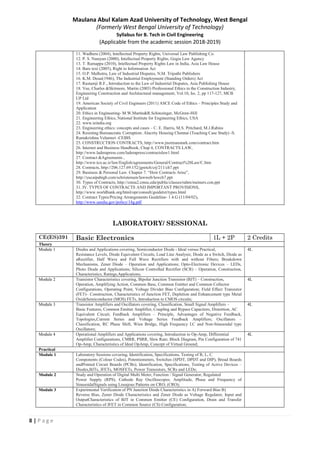
LABORATORY/ SESSIONAL
CE(ES)391 Basic Electronics 1L + 2P 2 Credits
Theory
Module 1 Diodes and Applications covering, Semiconductor Diode - Ideal versus Practical,
Resistance Levels, Diode Equivalent Circuits, Load Line Analysis; Diode as a Switch, Diode as
aRectifier, Half Wave and Full Wave Rectifiers with and without Filters; Breakdown
Mechanisms, Zener Diode – Operation and Applications; Opto-Electronic Devices – LEDs,
Photo Diode and Applications; Silicon Controlled Rectifier (SCR) – Operation, Construction,
Characteristics, Ratings,Applications;
4L
Module 2 Transistor Characteristics covering, Bipolar Junction Transistor (BJT) – Construction,
Operation, Amplifying Action, Common Base, Common Emitter and Common Collector
Configurations, Operating Point, Voltage Divider Bias Configuration; Field Effect Transistor
(FET)– Construction, Characteristics of Junction FET, Depletion and Enhancement type Metal
OxideSemiconductor (MOS) FETs, Introduction to CMOS circuits;
4L
Module 3 Transistor Amplifiers and Oscillators covering, Classification, Small Signal Amplifiers –
Basic Features, Common Emitter Amplifier, Coupling and Bypass Capacitors, Distortion, AC
Equivalent Circuit; Feedback Amplifiers – Principle, Advantages of Negative Feedback,
Topologies,Current Series and Voltage Series Feedback Amplifiers; Oscillators –
Classification, RC Phase Shift, Wien Bridge, High Frequency LC and Non-Sinusoidal type
Oscillators;
4L
Module 4 Operational Amplifiers and Applications covering, Introduction to Op-Amp, Differential
Amplifier Configurations, CMRR, PSRR, Slew Rate; Block Diagram, Pin Configuration of 741
Op-Amp, Characteristics of Ideal OpAmp, Concept of Virtual Ground;
4L
Practical
Module 1 Laboratory Sessions covering, Identification, Specifications, Testing of R, L, C
Components (Colour Codes), Potentiometers, Switches (SPDT, DPDT and DIP), Bread Boards
andPrinted Circuit Boards (PCBs); Identification, Specifications, Testing of Active Devices –
Diodes,BJTs, JFETs, MOSFETs, Power Transistors, SCRs and LEDs;
Module 2 Study and Operation of Digital Multi Meter, Function / Signal Generator, Regulated
Power Supply (RPS), Cathode Ray Oscilloscopes; Amplitude, Phase and Frequency of
SinusoidalSignals using Lissajous Patterns on CRO; (CRO);
Module 3 Experimental Verification of PN Junction Diode Characteristics in A) Forward Bias B)
Reverse Bias, Zener Diode Characteristics and Zener Diode as Voltage Regulator, Input and
OutputCharacteristics of BJT in Common Emitter (CE) Configuration, Drain and Transfer
Characteristics of JFET in Common Source (CS) Configuration;
9 | P a g e
Maulana Abul Kalam Azad University of Technology, West Bengal
(Formerly West Bengal University of Technology)
Syllabus for B. Tech in Civil Engineering
(Applicable from the academic session 2018-2019)
Module 4 Study of Half Wave and Full Wave Rectification, Regulation with Filters, Gain and
Bandwidth of BJT Common Emitter (CE) Amplifier, Gain and Bandwidth of JFET Common
Source(CS) Amplifier, Gain and Bandwidth of BJT Current Series and Voltage Series
Feedback Amplifiers,Oscillation Frequency of BJT based RC Phase Shift, Hartley and Colpitts
Oscillators;
Module 5 Op-Amp Applications – Adder, Subtractor, Voltage Follower and Comparator; Op-Amp
Applications – Differentiator and Integrator, Square Wave and Triangular Wave Generation,
Applications of 555 Timer – Astable and MonostableMultivibrators;
Module 6 Truth Tables and Functionality of Logic Gates – NOT, OR, AND, NOR, NAND, XOR
and XNOR Integrated Circuits (ICs); Truth Tables and Functionality of Flip-Flops – SR, JK
and DFlip-Flop ICs; Serial-In-Serial-Out and Serial-In-Parallel-Out Shift operations using 4-
bit/8-bit ShiftRegister ICs; Functionality of Up-Down / Decade Counter ICs;
Reference 1. David. A. Bell (2003), Laboratory Manual for Electronic Devices and Circuits, Prentice Hall,
India
2. SantiramKal (2002), Basic Electronics- Devices, Circuits and IT Fundamentals, Prentice
Hall,
India
3. Thomas L. Floyd and R. P. Jain (2009), Digital Fundamentals by Pearson Education,
4. Paul B. Zbar, A.P. Malvino and M.A. Miller (2009), Basic Electronics – A Text-Lab.
Manual,
TMH
5. R.T. Paynter (2009), Introductory Electronic Devices & Circuits, Conventional Flow
Version,
Pearson
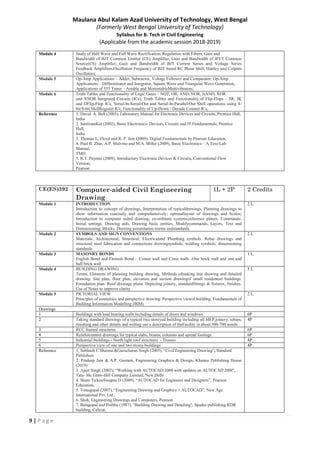
CE(ES)392 Computer-aided Civil Engineering
Drawing
1L + 2P 2 Credits
Module 1 INTRODUCTION
Introduction to concept of drawings, Interpretation of typicaldrawings, Planning drawings to
show information concisely and comprehensively; optimallayout of drawings and Scales;
Introduction to computer aided drawing, co-ordinate systems,reference planes. Commands:
Initial settings, Drawing aids, Drawing basic entities, Modifycommands, Layers, Text and
Dimensioning, Blocks. Drawing presentation norms andstandards.
2 L
Module 2 SYMBOLS AND SIGN CONVENTIONS
Materials, Architectural, Structural, Electricaland Plumbing symbols. Rebar drawings and
structural steel fabrication and connections drawingsymbols, welding symbols; dimensioning
standards
2 L
Module 3 MASONRY BONDS
English Bond and Flemish Bond – Corner wall and Cross walls -One brick wall and one and
half brick wall
1 L
Module 4 BUILDING DRAWING
Terms, Elements of planning building drawing, Methods ofmaking line drawing and detailed
drawing. Site plan, floor plan, elevation and section drawingof small residential buildings.
Foundation plan. Roof drainage plans. Depicting joinery, standardfittings & fixtures, finishes.
Use of Notes to improve clarity
5 L
Module 5 PICTORIAL VIEW
Principles of isometrics and perspective drawing. Perspective viewof building. Fundamentals of
Building Information Modelling (BIM)
2 L
Drawings
1 Buildings with load bearing walls including details of doors and windows. 6P
2 Taking standard drawings of a typical two storeyed building including all MEP,joinery, rebars,
finishing and other details and writing out a description of theFacility in about 500-700 words
4P
3 RCC framed structures 6P
4 Reinforcement drawings for typical slabs, beams, columns and spread footings 6P
5 Industrial buildings - North light roof structures – Trusses 4P
6 Perspective view of one and two storey buildings 4P
Reference 1. Subhash C Sharma &Gurucharan Singh (2005), “Civil Engineering Drawing”, Standard
Publishers
2. Pradeep Jain & A.P. Gautam, Engineering Graphics & Design, Khanna Publishing House
(2019)
3. Ajeet Singh (2002), “Working with AUTOCAD 2000 with updates on AUTOCAD 200I”,
Tata- Mc Graw-Hill Company Limited, New Delhi
4. Sham TickooSwapna D (2009), “AUTOCAD for Engineers and Designers”, Pearson
Education,
5. Venugopal (2007), “Engineering Drawing and Graphics + AUTOCAD”, New Age
International Pvt. Ltd.,
6. Shah, Engineering Drawings and Computers, Pearson
7. Balagopal and Prabhu (1987), “Building Drawing and Detailing”, Spades publishing KDR
building, Calicut,
10 | P a g e
Maulana Abul Kalam Azad University of Technology, West Bengal
(Formerly West Bengal University of Technology)
Syllabus for B. Tech in Civil Engineering
(Applicable from the academic session 2018-2019)
8. (Corresponding set of) CAD Software Theory and User Manuals.
9. Malik R.S., Meo, G.S. (2009) Civil Engineering Drawing, Computech Publication Ltd New
Asian.
10. Sikka, V.B. (2013), A Course in Civil Engineering Drawing, S.K.Kataria& Sons,
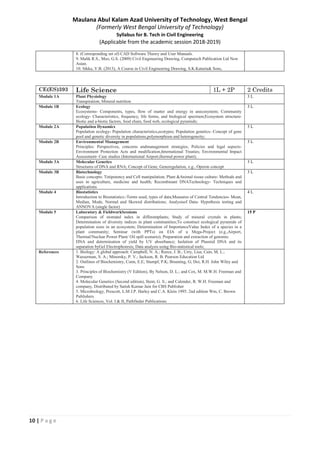
CE(ES)393 Life Science 1L + 2P 2 Credits
Module 1A Plant Physiology
Transpiration; Mineral nutrition
3 L
Module 1B Ecology
Ecosystems- Components, types, flow of matter and energy in anecosystem; Community
ecology- Characteristics, frequency, life forms, and biological spectrum;Ecosystem structure-
Biotic and a-biotic factors, food chain, food web, ecological pyramids;
3 L
Module 2A Population Dynamics
Population ecology- Population characteristics,ecotypes; Population genetics- Concept of gene
pool and genetic diversity in populations,polymorphism and heterogeneity;
3 L
Module 2B Environmental Management
Principles: Perspectives, concerns andmanagement strategies; Policies and legal aspects-
Environment Protection Acts and modification,International Treaties; Environmental Impact
Assessment- Case studies (International Airport,thermal power plant);
3 L
Module 3A Molecular Genetics
Structures of DNA and RNA; Concept of Gene, Generegulation, e.g., Operon concept
3 L
Module 3B Biotechnology
Basic concepts: Totipotency and Cell manipulation; Plant &Animal tissue culture- Methods and
uses in agriculture, medicine and health; Recombinant DNATechnology- Techniques and
applications
3 L
Module 4 Biostatistics
Introduction to Biostatistics:-Terms used, types of data;Measures of Central Tendencies- Mean,
Median, Mode, Normal and Skewed distributions; Analysisof Data- Hypothesis testing and
ANNOVA (single factor)
4 L
Module 5 Laboratory & FieldworkSessions
Comparison of stomatal index in differentplants; Study of mineral crystals in plants;
Determination of diversity indices in plant communities;To construct ecological pyramids of
population sizes in an ecosystem; Determination of ImportanceValue Index of a species in a
plant community; Seminar (with PPTs) on EIA of a Mega-Project (e.g.,Airport,
Thermal/Nuclear Power Plant/ Oil spill scenario); Preparation and extraction of genomic
DNA and determination of yield by UV absorbance; Isolation of Plasmid DNA and its
separation byGel Electrophoresis; Data analysis using Bio-statistical tools;
15 P
References 1. Biology: A global approach: Campbell, N. A.; Reece, J. B.; Urry, Lisa; Cain, M, L.;
Wasserman, S. A.; Minorsky, P. V.; Jackson, R. B. Pearson Education Ltd
2. Outlines of Biochemistry, Conn, E.E; Stumpf, P.K; Bruening, G; Doi, R.H. John Wiley and
Sons
3. Principles of Biochemistry (V Edition), By Nelson, D. L.; and Cox, M. M.W.H. Freeman and
Company
4. Molecular Genetics (Second edition), Stent, G. S.; and Calender, R. W.H. Freeman and
company, Distributed by Satish Kumar Jain for CBS Publisher
5. Microbiology, Prescott, L.M J.P. Harley and C.A. Klein 1995. 2nd edition Wm, C. Brown
Publishers
6. Life Sciences, Vol. I & II, Pathfinder Publications

Sem3

  • 1.
    1 | Pa g e Maulana Abul Kalam Azad University of Technology, West Bengal (Formerly West Bengal University of Technology) Syllabus for B. Tech in Civil Engineering (Applicable from the academic session 2018-2019) SEMESTER –III (2ND YR) CE(BS)301 Biology (Biology for Engineers) 2L + 1T = 3 Credits Module 1 Introduction Bring out the fundamental differences between science and engineering by drawing a comparison between eye and camera, Bird flying and aircraft. Mention the most exciting aspect of biology as an independent scientific discipline. Why we need to study biology? Discuss how biological observations of 18th Century that lead to major discoveries. Examples from Brownian motion and the origin of thermodynamics by referring to the original observation of Robert Brown and Julius Mayor. These examples will highlight the fundamental importance of observations in any scientific inquiry. Purpose: To convey that Biology is as important a scientific discipline as Mathematics, Physics and Chemistry 2L Module 2 Classification Hierarchy of life forms at phenomenological level. A common thread weaves this hierarchy Classification. Discuss classification based on (a) cellularity- Unicellular or multicellular (b) ultrastructure- prokaryotes or eucaryotes. (c) energy and Carbon utilization -Autotrophs, heterotrophs, lithotropes (d) Ammonia excretion – aminotelic, uricoteliec, ureotelic (e) Habitataacquatic or terrestrial (e) Molecular taxonomy- three major kingdoms of life. A given organism can come under different category based on classification. Model organisms for the study of biology come from different groups. E.coli, S.cerevisiae, D. Melanogaster, C. elegance, A. Thaliana, M. musculus Purpose: To convey that classification per se is not what biology is all about. The underlying criterion, such as morphological, biochemical or ecological be highlighted. 3L Module 3 Genetics Mendel’s laws, Concept of segregation and independent assortment. Concept of allele. Gene mapping, Gene interaction, Epistasis. Meiosis and Mitosis be taught as a part of genetics. Emphasis to be give not to the mechanics of cell division nor the phases but how genetic material passes from parent to offspring. Concepts of recessiveness and dominance. Concept of mapping of phenotype to genes. Discuss about the single gene disorders in humans. Discuss the concept of complementation using human genetics. Purpose: To convey that “Genetics is to biology what Newton’s laws are to Physical Sciences” 4L Module 4 Biomolecules Molecules of life. In this context discuss monomeric units and polymeric structures. Discuss about sugars, starch and cellulose. Amino acids and proteins. Nucleotides and DNA/RNA. Two carbon units and lipids. Purpose: To convey that all forms of life has the same building blocks and yet the manifestations are as diverse as one can imagine 4L Module 5 Enzymes Enzymology: How to monitor enzyme catalyzed reactions. How does an enzyme catalyzereactions. Enzyme classification. Mechanism of enzyme action. Discuss at least two examples. Enzyme kinetics and kinetic parameters. Why should we know these parameters to understand biology? RNA catalysis. Purpose: To convey that without catalysis life would not have existed on earth 4L Module 6 Information Transfer Molecular basis of information transfer. DNA as a genetic material. Hierarchy of DNA structurefrom single stranded to double helix to nucleosomes. Concept of genetic code. Universality and degeneracy of genetic code. Define gene in terms of complementation and recombination. Purpose: The molecular basis of coding and decoding genetic information is universal 4L Module 7 Macromolecular analysis Proteins- structure and function. Hierarch in protein structure. Primary secondary, tertiary and quaternary structure. Proteins as enzymes, transporters, receptors and structural elements. Purpose: How to analyses biological processes at the reductionistic level 5L Module 8 Metabolism Thermodynamics as applied to biological systems. Exothermic and endothermic versus endergonic and exergoinc reactions. Concept of Keq and its relation to standard free energy. Spontaneity. ATP as an energy currency. This should include the breakdown of glucose to CO2 + H2O (Glycolysis and Krebs cycle) and synthesis of glucose from CO2 and H2O (Photosynthesis). Energy yielding and energy consuming reactions. Concept of Energy charge Purpose: The fundamental principles of energy transactions are the same in physical and biological world. 4L Module 9 Microbiology Concept of single celled organisms. Concept of species and strains. Identification and classification of microorganisms. Microscopy. Ecological aspects of single celled organisms. Sterilization and media compositions. Growth kinetics. 3L Reference 1) Biology: A global approach: Campbell, N. A.; Reece, J. B.; Urry, Lisa; Cain, M, L.;Wasserman, S. A.; Minorsky, P. V.; Jackson, R. B. Pearson Education Ltd
  • 2.
    2 | Pa g e Maulana Abul Kalam Azad University of Technology, West Bengal (Formerly West Bengal University of Technology) Syllabus for B. Tech in Civil Engineering (Applicable from the academic session 2018-2019) 2) Outlines of Biochemistry, Conn, E.E; Stumpf, P.K; Bruening, G; Doi, R.H., John Wiley and Sons 3) Principles of Biochemistry (V Edition), By Nelson, D. L.; and Cox, M. M.W.H. Freeman andCompany 4) Molecular Genetics (Second edition), Stent, G. S.; and Calender, R.W.H. Freeman and company,Distributed by Satish Kumar Jain for CBS Publisher 5) Microbiology, Prescott, L.M J.P. Harley and C.A. Klein 1995. 2nd edition Wm, C. BrownPublishers 6) Biology of Engineers, McGraw Hill (ISBN: 978-11-21439-931) CE(ES)301 Engineering Mechanics 3L + 1T = 4 Credits Module 1 Introduction to Engineering Mechanics Force Systems Basic concepts, Particleequilibrium in 2-D & 3-D; Rigid Body equilibrium; System of Forces, Coplanar Concurrent Forces,Components in Space – Resultant- Moment of Forces and its Application; Couples and Resultant ofForce System, Equilibrium of System of Forces, Free body diagrams, Equations of Equilibrium ofCoplanar Systems and Spatial Systems; Static Indeterminacy 6L Module 2 Friction Types of friction, Limiting friction, Laws of Friction, Static andDynamic Friction; Motion of Bodies, wedge friction, screw jack & differential screw jack; 3L Module 3 Basic Structural Analysis Equilibrium in three dimensions; Method of Sections;Method of Joints; How to determine if a member is in tension or compression; Simple Trusses; Zeroforce members; Beams & types of beams; Frames & Machines; 4L Module 4 Centroid and Centre of Gravity Centroid of simple figures from first principle,centroid of composite sections; Centre of Gravity and its implications; Area moment of inertia-Definition, Moment of inertia of plane sections from first principles, Theorems of moment of inertia,Moment of inertia of standard sections and composite sections; Mass moment inertia of circularplate, Cylinder, Cone, Sphere, Hook. 5L Module 5 Virtual Work and Energy Method- Virtual displacements, principle of virtual work forparticle and ideal system of rigid bodies, degrees of freedom. Active force diagram, systems withfriction, mechanical efficiency. Conservative forces and potential energy (elastic and gravitational),energy equation for equilibrium. Applications of energy method for equilibrium. Stability ofequilibrium. 4L Module 6 Review of particle dynamics- Rectilinear motion; Plane curvilinear motion (rectangular,path, and polar coordinates). 3-D curvilinear motion; Relative and constrained motion; Newton’s 2nd law (rectangular, path, and polar coordinates). Work-kinetic energy, power, potentialenergy.Impulse-momentum (linear, angular); Impact (Direct and oblique). 4L Module 7 Introduction to Kinetics of Rigid Bodies Basic terms, general principles indynamics; Types of motion, Instantaneous centre of rotation in plane motion and simple problems;D’Alembert’s principle and its applications in plane motion and connected bodies; Work energyprinciple and its application in plane motion of connected bodies; Kinetics of rigid body rotation; 5L Module 8 Mechanical Vibrations Basic terminology, free and forced vibrations,resonance and its effects; Degree of freedom; Derivation for frequency and amplitude of freevibrations without damping and single degree of freedom system, simple problems, types ofpendulum, use of simple, compound and torsion pendulums; 5L Tutorials From the above modules covering, To find the various forces and angles including resultants in various parts of wall crane, roof truss, pipes, etc.; To verify the line of polygon on various forces; To find coefficient of friction between various materials on inclined plan; Free bodydiagrams various systems including block-pulley; To verify the principle of moment in the discapparatus; Helical block; To draw a load efficiency curve for a screw jack 6L Reference 1. D.S. Bedi (2018), Engineering Mechanics, Khanna Publishing House, 2019 2. Irving H. Shames (2006), Engineering Mechanics, 4th Edition, Prentice Hall 3. F. P. Beer and E. R. Johnston (2011), Vector Mechanics for Engineers, Vol I - Statics, Vol II, –Dynamics, 9th Ed, Tata McGraw Hill 4. R.C. Hibbler (2006), Engineering Mechanics: Principles of Statics and Dynamics, Pearson Press. 5. Andy Ruina and RudraPratap (2011), Introduction to Statics and Dynamics, Oxford UniversityPress 6. Shanes and Rao (2006), Engineering Mechanics, Pearson Education, 7. Hibler and Gupta (2010),Engineering Mechanics (Statics, Dynamics) by Pearson Education 8. Reddy Vijaykumar K. and K. Suresh Kumar(2010), Singer’s Engineering Mechanics 9. Bansal R.K.(2010), A Text Book of Engineering Mechanics, Laxmi Publications 10. Khurmi R.S. (2010), Engineering Mechanics, S. Chand & Co. 11. Tayal A.K. (2010), Engineering Mechanics, Umesh Publications
  • 3.
    3 | Pa g e Maulana Abul Kalam Azad University of Technology, West Bengal (Formerly West Bengal University of Technology) Syllabus for B. Tech in Civil Engineering (Applicable from the academic session 2018-2019) CE(ES)302 Energy Science & Engineering 1L + 1T = 2 Credits Module 1 Introduction to Energy Science Scientific principles and historical interpretation to place energy use in the context of pressing societal, environmental and climate issues; Introduction to energy systems and resources; Introduction to Energy, sustainability & the environment. Tutorials:Compile a World map showing Energy Reserves by source, Total Energyconsumption, Per capita energy consumption and Carbon Footprint 3L Module 2 Energy Sources Overview of energy systems, sources, transformations, efficiency, andstorage. Fossil fuels (coal, oil, oil-bearing shale and sands, coal gasification) - past, present & future,Remedies & alternatives for fossil fuels - biomass, wind, solar, nuclear, wave, tidal and hydrogen;Sustainability and environmental trade-offs of different energy systems; possibilities for energy storage or regeneration (Ex. Pumped storage hydro power projects, superconductor-based energystorages, high efficiency batteries) Tutorials:Compile a Word Map showing Alternative Energy sourceusage; Compile a Process diagram for a Pumped Storageproject; Collect details of a typical North Sea oil platform. Compile a map of India showing exiting potential and utilizedpotential for hydro power. List the pros and cons for Thermal,hydro, nuclear and solar power projects. 4L Module 3 Energy & Environment Energy efficiency and conservation; introduction to clean energy technologies and its importance in sustainable development; Carbon footprint, energy consumptionand sustainability; introduction to the economics of energy; How the economic system determinesproduction and consumption; linkages between economic and environmental outcomes; How futureenergy use can be influenced by economic, environmental, trade, and research policy Tutorials:Study the functioning of an Electro Static Precipitator in athermal power plant; study the uses of coarse and fine Fly Ashfrom thermal power plants. Compile the safety provisions indesign and construction of a reactor containment building 5L Module 4 Civil Engineering Projects connected with the Energy Sources Coal miningtechnologies, Oil exploration offshore platforms, Underground and under-sea oil pipelines, solarchimney project, wave energy caissons, coastal installations for tidal power, wind mill towers; hydropower stations above-ground and underground along with associated dams, tunnels, penstocks, etc.;Nuclear reactor containment buildings and associated buildings, design and construction constraintsand testing procedures for reactor containment buildings; Spent Nuclear fuel storage and disposalsystems Tutorials:Compile a process diagram for a typical underground hydropower project; Collect details of a model solar chimneyproject; collect details of a wave energy project at Vizhinjam;Collect details of the Kalpasar (Tidal energy) project 10L Module 5 Engineering for Energy conservation Concept of Green Building and GreenArchitecture; Green building concepts (Green building encompasses everything from the choice ofbuilding materials to where a building is located, how it is designed and operated); LEED ratings;Identification of energy related enterprises that represent the breath of the industry and prioritizingthese as candidates; Embodied energy analysis and use as a tool for measuring sustainability. EnergyAudit of Facilities and optimization of energy consumption. Tutorials:Draw a typical geometrical orientation of a house in your areato avoid sun’s radiation in the bed room in the evening;Identify typical examples of Indian buildings having variousLEED ratings; List various building materials with theirembodied energy content. Do an Energy Audit of yourDepartmental Building in the college 8L Reference 1. O.P, Gupta, Energy Technology, Khanna Book Publishing, (2019) 2. Boyle, Godfrey (2004), Renewable Energy (2nd edition). Oxford University Press 3. Boyle, Godfrey, Bob Everett, and Janet Ramage (Eds.) (2004), Energy Systems andSustainability: Power for a Sustainable Future. Oxford University Press 4. Chakrabarti, Energy Engineering & Management, PHI 5.Schaeffer, John (2007), Real Goods Solar Living Sourcebook: The Complete Guide to Renewable Energy Technologies and Sustainable Living, Gaiam 6. Jean-Philippe; Zaccour, Georges (Eds.), (2005), Energy and Environment Set: Mathematicsof Decision Making, Loulou, Richard; Waaub, XVIII, 7. Ristinen, Robert A. Kraushaar, Jack J. AKraushaar, Jack P. Ristinen, Robert A. (2006) Energy and the Environment, 2nd Edition, John Wiley 8. UNDP (2000), Energy and the Challenge of Sustainability, World Energy assessment 9. E H Thorndike (1976), Energy & Environment: A Primer for Scientists and Engineers, Addison-Wesley Publishing Company 10. Related papers published in international journals
  • 4.
    4 | Pa g e Maulana Abul Kalam Azad University of Technology, West Bengal (Formerly West Bengal University of Technology) Syllabus for B. Tech in Civil Engineering (Applicable from the academic session 2018-2019) CE(BS)302 Mathematics-III (Transform & Discrete Mathematics) 2L + 0T 2 Credits (Prerequisite 2c, 5b-d, 6b) Module 1 Transform Calculus -1 Polynomials – Orthogonal Polynomials – Lagrange’s, Chebysev Polynomials; Trigonometric Polynomials;aplace Transform, Properties of Laplace Transform, Laplace transform of periodic functions.Finding inverse Laplace transform by different methods, convolution theorem. Evaluation ofintegrals by Laplace transform, solving ODEs and PDEs by Laplace Transform method. 6 L Module 2 Transform Calculus-2 Fourier transforms, Z-transform and Wavelet transforms: properties, methods, inverses and theirapplications. 6 L Module 3 Sets, relations and functions Basic operations on sets, Cartesian products, disjoint union (sum), and power sets. Different types ofrelations, their compositions and inverses. Different types of functions, their compositions andinverses. 4 L Module 4 Propositional Logic Syntax and semantics, proof systems, satisfiability, validity, soundness, completeness, deductiontheorem, etc. Decision problems of propositional logic. Introduction to first order logic and firstorder theory. 4 L Module 5 Partially ordered sets Complete partial ordering, chain, lattice, complete, distributive, modular and complemented lattices.Boolean and pseudo Boolean lattices. 4 L Module 6 Algebraic Structures Algebraic structures with one binary operation – semigroup, monoid and group. Cosets, Lagrange’stheorem, normal subgroup, homomorphic subgroup. Congruence relation and quotient structures.Error correcting code. Algebraic structures with two binary operations- ring, integral domain, andfield. Boolean algebra and boolean ring (Definitions and simple examples only). 4 L Module 7 Introduction to Counting Basic counting techniques – inclusion and exclusion, pigeon-hole principle, permutation,combination, summations. Introduction to recurrence relation and generating functions. 3 L Module 8 Introduction to Graphs Graphs and their basic properties – degree, path, cycle, subgraph, isomorphism, Eulerian and Hamiltonian walk, trees. 3 L Reference 1.C. L. Liu, Elements of Discrete Mathematics, 2nd Ed., Tata McGraw-Hill, 2000. 2. R. C. Penner, Discrete Mathematics: Proof Techniques and Mathematical Structures, World Scientific, 1999. 3. R.L. Graham, D. E. Knuth, and O. Patashnik, Concrete Mathematics, 2nd Ed., Addison- Wesley, 1994. 4. K. H. Rosen, Discrete Mathematics and its Applications, 6th Ed., Tata McGraw-Hill, 2007. 5. J. L. Hein, Discrete Structures, Logic, and Computability, 3rd Ed., Jones and Bartlett, 2010. 6. N. Deo, Graph Theory, Prentice Hall of India, 1974. 7. S. Lipschutz and M. L. Lipson, Schaum's Outline of Theory and Problems of Discrete Mathematics, 2nd Ed., Tata McGraw-Hill, 1999. 8. J. P. Tremblay and R. P. Manohar, Discrete Mathematics with Applications to Computer Science, Tata McGraw-Hill, 1997. 9. Erwin Kreyszig, Advanced Engineering Mathematics, 9th Edition, John Wiley & Sons, 2006. 10. N.P. Bali and Manish Goyal, A text book of Engineering Mathematics, Laxmi Publications, Reprint, 2010. 11. B.S. Grewal, Higher Engineering Mathematics, Khanna Publishers, 35th Edition, 2000. 12. S.B. Singh. Discrete Structures, Khanna Publishing House, 2019 13. Veerarajan T., Engineering Mathematics, Tata McGraw-Hill, New Delhi, 2008. 14. Chandrika Prasad, Advanced Engineering Mathematics, KPB
  • 5.
    5 | Pa g e Maulana Abul Kalam Azad University of Technology, West Bengal (Formerly West Bengal University of Technology) Syllabus for B. Tech in Civil Engineering (Applicable from the academic session 2018-2019) CE(HS)301 Humanities-I (Effective Technical Communication) 3L + 0T 3 Credits Module 1 Information Design and Development- Different kinds of technical documents,Information development life cycle, Organization structures, factors affecting information anddocument design, Strategies for organization, Information design and writing for print and for onlinemedia. 4L Module 2 Technical Writing, Grammar and Editing- Technical writing process, forms of discourse,Writing drafts and revising, Collaborative writing, creating indexes, technical writing style andlanguage. Basics of grammar, study of advanced grammar, editing strategies to achieve appropriatetechnical style. Introduction to advanced technical communication, Usability, Hunan factors,Managing technical communication projects, time estimation, Single sourcing, Localization. 8L Module 3 Self Development and Assessment- Self assessment, Awareness, Perception andAttitudes, Values and belief, Personal goal setting, career planning, Self-esteem. Managing Time;Personal memory, Rapid reading, Taking notes; Complex problem solving; Creativity 8L Module 4 Communication and Technical Writing- Public speaking, Group discussion, Oral;presentation, Interviews, Graphic presentation, Presentation aids, Personality Development. Writingreports, project proposals, brochures, newsletters, technical articles, manuals, official notes, businessletters, memos, progress reports, minutes of meetings, event report. 8L Module 5 Ethics- Business ethics, Etiquettes in social and office settings, Email etiquettes,Telephone Etiquettes, Engineering ethics, Managing time, Role and responsibility of engineer, Workculture in jobs, Personal memory, Rapid reading, Taking notes, Complex problem solving,Creativity. 8L Reference 1. David F. Beer and David McMurrey, Guide to writing as an Engineer, John Willey. New York, 2004 2. Diane Hacker, Pocket Style Manual, Bedford Publication, New York, 2003. (ISBN 0312406843) 3. Kulbhushan Kumar, Effective Communication Skills, Khanna Publishing House 4. Shiv Khera, You Can Win, Macmillan Books, New York, 2003. 5. Raman Sharma, Technical Communications, Oxford Publication, London, 2004. 6. Dale Jungk, Applied Writing for Technicians, McGraw Hill, New York, 2004. (ISBN: 07828357-4) 7. Sharma, R. and Mohan, K. Business Correspondence and Report Writing, TMH New Delhi 2002. 8. Xebec, Presentation Book, TMH New Delhi, 2000. (ISBN 0402213)
  • 6.
    6 | Pa g e Maulana Abul Kalam Azad University of Technology, West Bengal (Formerly West Bengal University of Technology) Syllabus for B. Tech in Civil Engineering (Applicable from the academic session 2018-2019) CE(HS)302 Introduction to Civil Engineering 1L + 1T= 2 Credits Module 1 Basic Understanding: What is Civil Engineering/ Infrastructure? Basics of Engineering and Civil Engineering; Broad disciplines of Civil Engineering; Importance of Civil Engineering, Possible scopes for a career Tutorials Develop a matrix of various disciplines and possibleroles for engineers in each 1 L Module 2 History of Civil engineering: Early constructions and developments over time; Ancient monuments & Modern marvels; Development of various materials of construction and methods of construction; Works of Eminent civil engineers Tutorials Identify 10 ancient monuments and ten modern marvels and list the uniqueness of each 1 L Module 3 Overview of National Planning for Construction and Infrastructure Development; Positionof construction industry vis-à-vis other industries, five year plan outlays for construction; currentbudgets for infrastructure works Tutorials Develop a Strategic Plan for Civil Engineering worksfor next ten years based on past investments andidentify one typical on-going mega project in eacharea 1 L Module 4 Fundamentals of Architecture & Town Planning: Aesthetics in Civil Engineering, Examples of great architecture, fundamentals of architectural design & town planning; BuildingSystems (HVAC, Acoustics, Lighting, etc.); LEED ratings; Development of Smart cities Tutorials Identify ten best civil engineering projects with highaesthetic appeal with one possible factor for each; Listdown the possible systems required for a typical SmartCity 1 L Module 5 Fundamentals of Building Materials: Stones, bricks, mortars, Plain, Reinforced &PrestressedConcrete, Construction Chemicals; Structural Steel, High Tensile Steel, Carbon Composites;Plastics in Construction; 3D printing; Recycling of Construction & Demolition wastes Tutorials Identify three top new materials and their potential inconstruction; Visit a Concrete Lab and make a report 2 L Module 6 Basics of Construction Management & Contracts Management: Temporary Structures in Construction; Construction Methods for various types of Structures; Major Construction equipment; Automation & Robotics in Construction; Modern Project management Systems; Advent of Lean Construction; Importance of Contracts Management Tutorials Identify 5 typical construction methods and list theiradvantages/ positive features 2 L Module 7 Environmental Engineering & Sustainability: Water treatment systems; Effluent treatment systems; Solid waste management; Sustainability in Construction Tutorials Sustainability principles, Sustainable builtenvironment, water treatment systems, and good practicesof wastewater management. examples of Solid andhazardous waste management, Air pollution andcontrol 2L Module 8 Geotechnical Engineering: Basics of soil mechanics, rock mechanics and geology; various types of foundations; basics of rock mechanics & tunnelling Tutorials List top five tunnel projects in India and their features;collect and study geotechnical investigation report ofany one Metro Rail (underground) project; Visit aconstruction site and make a site visit report 2 L Module 9 Hydraulics, Hydrology &Water Resources Engineering: Fundamentals of fluid flow, basics ofwater supply systems; Underground Structures; Underground Structures Multi-purpose reservoirprojects Tutorials Identify three river interlinking projects and theirfeatures; visit a Hydraulics Lab and make a report 1 L Module 10 Ocean Engineering: Basics of Wave and Current Systems; Sediment transport systems; Ports &Harbours and other marine structures Tutorials Identify 5 typical ports in India and list the structuresavailable in them; Visit a related/similar 1 L
  • 7.
    7 | Pa g e Maulana Abul Kalam Azad University of Technology, West Bengal (Formerly West Bengal University of Technology) Syllabus for B. Tech in Civil Engineering (Applicable from the academic session 2018-2019) facility, ifpossible in nearby place and make a report Module 11 Power Plant Structures: Chimneys, Natural & Induced Draught Colling towers, coal handling systems, ash handling systems; nuclear containment structures; hydro power projects Tutorials Collect the typical layout for a large thermal powerplant and a large hydro power plant and identify all thestructures and systems falling in them. 1 L Module 12 Structural Engineering: Types of buildings; tall structures; various types of bridges; Water retaining structures; Other structural systems; Experimental Stress Analysis; Wind tunnel studies; Tutorials Identify 5 unique features for typical buildings,bridges, tall structures and large span structures; VisitStructures Testing Lab/facility and make a report 3 L Module 13 Surveying & Geomatics: Traditional surveying techniques, Total Stations, Development of Digital Terrain Models; GPS, LIDAR; Tutorials Collect visual representations prepared by a TotalStation and LIDAR and compare; Study typicalGoogle street map and Google Earth Map and studyhow each can facilitate the other 1 L Module 14 Traffic &Transportation Engineering: Investments in transport infrastructure development inIndia for different modes of transport; Developments and challenges in integrated transport development in India: road, rail, port and harbour and airport sector; PPP in transport sector; Intelligent Transport Systems; Urban Public and Freight Transportation; Road Safety underheterogeneous traffic; Sustainable and resilient pavement materials, design, construction andmanagement; Case studies and examples. Tutorials Investments in transport infrastructure; Developmentsand challenges; Intelligent Transport Systems; SmartCities, Urban Transport; Road Safety; Sustainable andresilient highway design principles; Plan a sustainabletransport system for a city; Identify keyfeatures/components in the planning and design of agreen field highway/airport/port/railway and the cost –economics. 1 L Module 15 Repairs & Rehabilitation of Structures: Basics of corrosion phenomena and other structural distress mechanisms; some simple systems of rehabilitation of structures; Non- Destructivetesting systems; Use of carbon fibre wrapping and carbon composites in repairs. Tutorials Collect the history of a major rehabilitation project andlist the interesting features 1 L Module 16 Computational Methods, IT, IoT in Civil Engineering: Typical software used in Civil Engineering- Finite Element Method, Computational Fluid Dynamics; Computational Geotechnical Methods; highway design (MX), Building Information Modelling; Highlighting typical available software systems (SAP, STAAD, ABAQUS, MATLAB, ETAB, NASTRAN, NISA, MIKE 21, MODFLOW, REVIT, TEKLA, AUTOCAD,…GEOSTUDIO, EDUSHAKE, MSP, PRIMAVERA, ArcGIS, VisSIM, …) Tutorials Visit an AutoCad lab and prepare a report; Identify teninteresting software systems used in Civil Engg andtheir key features 2 L Module 17 Industrial lectures: Case studies of large civil engineering projects by industry professionals, covering comprehensive planning to commissioning; Tutorials For each case study list the interesting features 2 L Module 18 Basics of Professionalism: Professional Ethics, Entrepreneurial possibilities in Civil Engineering, Possibilities for creative & innovative working, Technical writing Skills enhancement; Facilities Management; Quality & HSE Systems in Construction 3 L Tutorials List 5 cases of violation of professional ethics and listpreventive measures; Identify 5 interesting projectsand their positive features; Write 400 word reports on one ancient monument and a modern marvel of civilengineering 5L Reference 1. Patil, B.S.(1974), Legal Aspects of Building and Engineering Contract 2. The National Building Code, BIS, (2017) 3. RERA Act, (2017) 4. Meena Rao (2006), Fundamental concepts in Law of Contract, 3rd Edn. Professional Offset 5. Chandiramani, Neelima (2000), The Law of Contract: An Outline, 2nd Edn. Avinash Publications Mumbai 6. Avtarsingh (2002), Law of Contract, Eastern Book Co. 7. Dutt (1994), Indian Contract Act, Eastern Law House 8. Anson W.R.(1979), Law of Contract, Oxford University Press 9. Kwatra G.K.(2005), The Arbitration & Conciliation of Law in India with case law on UNCITRAL Model Law on Arbitration, Indian Council of Arbitration 10. Avtarsingh (2005), Law of Arbitration and Conciliation, Eastern Book Co.
  • 8.
    8 | Pa g e Maulana Abul Kalam Azad University of Technology, West Bengal (Formerly West Bengal University of Technology) Syllabus for B. Tech in Civil Engineering (Applicable from the academic session 2018-2019) 11. Wadhera (2004), Intellectual Property Rights, Universal Law Publishing Co. 12. P. S. Narayan (2000), Intellectual Property Rights, Gogia Law Agency 13. T. Ramappa (2010), Intellectual Property Rights Law in India, Asia Law House 14. Bare text (2005), Right to Information Act 15. O.P. Malhotra, Law of Industrial Disputes, N.M. Tripathi Publishers 16. K.M. Desai(1946), The Industrial Employment (Standing Orders) Act 17. Rustamji R.F., Introduction to the Law of Industrial Disputes, Asia Publishing House 18. Vee, Charles &Skitmore, Martin (2003) Professional Ethics in the Construction Industry, Engineering Construction and Architectural management, Vol.10, Iss. 2, pp 117-127, MCB UP Ltd 19. American Society of Civil Engineers (2011) ASCE Code of Ethics – Principles Study and Application 20. Ethics in Engineering- M.W.Martin&R.Schinzinger, McGraw-Hill 21. Engineering Ethics, National Institute for Engineering Ethics, USA 22. www.ieindia.org 23. Engineering ethics: concepts and cases – C. E. Harris, M.S. Pritchard, M.J.Rabins 24. Resisting Bureaucratic Corruption: Alacrity Housing Chennai (Teaching Case Study) -S. Ramakrishna Velamuri -CEIBS 25. CONSTRUCTION CONTRACTS, http://www.jnormanstark.com/contract.htm 26. Internet and Business Handbook, Chap 4, CONTRACTS LAW, http://www.laderapress.com/laderapress/contractslaw1.html 27. Contract &Agreements , http://www.tco.ac.ir/law/English/agreements/General/Contract%20Law/C.htm 28. Contracts, http://206.127.69.152/jgretch/crj/211/ch7.ppt 29. Business & Personal Law. Chapter 7. “How Contracts Arise”, http://yucaipahigh.com/schristensen/lawweb/lawch7.ppt 30. Types of Contracts, http://cmsu2.cmsu.edu/public/classes/rahm/meiners.con.ppt 31. IV. TYPES OF CONTRACTS AND IMPORTANT PROVISIONS, http://www.worldbank.org/html/opr/consult/guidetxt/types.html 32. Contract Types/Pricing Arrangements Guideline- 1.4.G (11/04/02), http://www.sandia.gov/policy/14g.pdf LABORATORY/ SESSIONAL CE(ES)391 Basic Electronics 1L + 2P 2 Credits Theory Module 1 Diodes and Applications covering, Semiconductor Diode - Ideal versus Practical, Resistance Levels, Diode Equivalent Circuits, Load Line Analysis; Diode as a Switch, Diode as aRectifier, Half Wave and Full Wave Rectifiers with and without Filters; Breakdown Mechanisms, Zener Diode – Operation and Applications; Opto-Electronic Devices – LEDs, Photo Diode and Applications; Silicon Controlled Rectifier (SCR) – Operation, Construction, Characteristics, Ratings,Applications; 4L Module 2 Transistor Characteristics covering, Bipolar Junction Transistor (BJT) – Construction, Operation, Amplifying Action, Common Base, Common Emitter and Common Collector Configurations, Operating Point, Voltage Divider Bias Configuration; Field Effect Transistor (FET)– Construction, Characteristics of Junction FET, Depletion and Enhancement type Metal OxideSemiconductor (MOS) FETs, Introduction to CMOS circuits; 4L Module 3 Transistor Amplifiers and Oscillators covering, Classification, Small Signal Amplifiers – Basic Features, Common Emitter Amplifier, Coupling and Bypass Capacitors, Distortion, AC Equivalent Circuit; Feedback Amplifiers – Principle, Advantages of Negative Feedback, Topologies,Current Series and Voltage Series Feedback Amplifiers; Oscillators – Classification, RC Phase Shift, Wien Bridge, High Frequency LC and Non-Sinusoidal type Oscillators; 4L Module 4 Operational Amplifiers and Applications covering, Introduction to Op-Amp, Differential Amplifier Configurations, CMRR, PSRR, Slew Rate; Block Diagram, Pin Configuration of 741 Op-Amp, Characteristics of Ideal OpAmp, Concept of Virtual Ground; 4L Practical Module 1 Laboratory Sessions covering, Identification, Specifications, Testing of R, L, C Components (Colour Codes), Potentiometers, Switches (SPDT, DPDT and DIP), Bread Boards andPrinted Circuit Boards (PCBs); Identification, Specifications, Testing of Active Devices – Diodes,BJTs, JFETs, MOSFETs, Power Transistors, SCRs and LEDs; Module 2 Study and Operation of Digital Multi Meter, Function / Signal Generator, Regulated Power Supply (RPS), Cathode Ray Oscilloscopes; Amplitude, Phase and Frequency of SinusoidalSignals using Lissajous Patterns on CRO; (CRO); Module 3 Experimental Verification of PN Junction Diode Characteristics in A) Forward Bias B) Reverse Bias, Zener Diode Characteristics and Zener Diode as Voltage Regulator, Input and OutputCharacteristics of BJT in Common Emitter (CE) Configuration, Drain and Transfer Characteristics of JFET in Common Source (CS) Configuration;
  • 9.
    9 | Pa g e Maulana Abul Kalam Azad University of Technology, West Bengal (Formerly West Bengal University of Technology) Syllabus for B. Tech in Civil Engineering (Applicable from the academic session 2018-2019) Module 4 Study of Half Wave and Full Wave Rectification, Regulation with Filters, Gain and Bandwidth of BJT Common Emitter (CE) Amplifier, Gain and Bandwidth of JFET Common Source(CS) Amplifier, Gain and Bandwidth of BJT Current Series and Voltage Series Feedback Amplifiers,Oscillation Frequency of BJT based RC Phase Shift, Hartley and Colpitts Oscillators; Module 5 Op-Amp Applications – Adder, Subtractor, Voltage Follower and Comparator; Op-Amp Applications – Differentiator and Integrator, Square Wave and Triangular Wave Generation, Applications of 555 Timer – Astable and MonostableMultivibrators; Module 6 Truth Tables and Functionality of Logic Gates – NOT, OR, AND, NOR, NAND, XOR and XNOR Integrated Circuits (ICs); Truth Tables and Functionality of Flip-Flops – SR, JK and DFlip-Flop ICs; Serial-In-Serial-Out and Serial-In-Parallel-Out Shift operations using 4- bit/8-bit ShiftRegister ICs; Functionality of Up-Down / Decade Counter ICs; Reference 1. David. A. Bell (2003), Laboratory Manual for Electronic Devices and Circuits, Prentice Hall, India 2. SantiramKal (2002), Basic Electronics- Devices, Circuits and IT Fundamentals, Prentice Hall, India 3. Thomas L. Floyd and R. P. Jain (2009), Digital Fundamentals by Pearson Education, 4. Paul B. Zbar, A.P. Malvino and M.A. Miller (2009), Basic Electronics – A Text-Lab. Manual, TMH 5. R.T. Paynter (2009), Introductory Electronic Devices & Circuits, Conventional Flow Version, Pearson CE(ES)392 Computer-aided Civil Engineering Drawing 1L + 2P 2 Credits Module 1 INTRODUCTION Introduction to concept of drawings, Interpretation of typicaldrawings, Planning drawings to show information concisely and comprehensively; optimallayout of drawings and Scales; Introduction to computer aided drawing, co-ordinate systems,reference planes. Commands: Initial settings, Drawing aids, Drawing basic entities, Modifycommands, Layers, Text and Dimensioning, Blocks. Drawing presentation norms andstandards. 2 L Module 2 SYMBOLS AND SIGN CONVENTIONS Materials, Architectural, Structural, Electricaland Plumbing symbols. Rebar drawings and structural steel fabrication and connections drawingsymbols, welding symbols; dimensioning standards 2 L Module 3 MASONRY BONDS English Bond and Flemish Bond – Corner wall and Cross walls -One brick wall and one and half brick wall 1 L Module 4 BUILDING DRAWING Terms, Elements of planning building drawing, Methods ofmaking line drawing and detailed drawing. Site plan, floor plan, elevation and section drawingof small residential buildings. Foundation plan. Roof drainage plans. Depicting joinery, standardfittings & fixtures, finishes. Use of Notes to improve clarity 5 L Module 5 PICTORIAL VIEW Principles of isometrics and perspective drawing. Perspective viewof building. Fundamentals of Building Information Modelling (BIM) 2 L Drawings 1 Buildings with load bearing walls including details of doors and windows. 6P 2 Taking standard drawings of a typical two storeyed building including all MEP,joinery, rebars, finishing and other details and writing out a description of theFacility in about 500-700 words 4P 3 RCC framed structures 6P 4 Reinforcement drawings for typical slabs, beams, columns and spread footings 6P 5 Industrial buildings - North light roof structures – Trusses 4P 6 Perspective view of one and two storey buildings 4P Reference 1. Subhash C Sharma &Gurucharan Singh (2005), “Civil Engineering Drawing”, Standard Publishers 2. Pradeep Jain & A.P. Gautam, Engineering Graphics & Design, Khanna Publishing House (2019) 3. Ajeet Singh (2002), “Working with AUTOCAD 2000 with updates on AUTOCAD 200I”, Tata- Mc Graw-Hill Company Limited, New Delhi 4. Sham TickooSwapna D (2009), “AUTOCAD for Engineers and Designers”, Pearson Education, 5. Venugopal (2007), “Engineering Drawing and Graphics + AUTOCAD”, New Age International Pvt. Ltd., 6. Shah, Engineering Drawings and Computers, Pearson 7. Balagopal and Prabhu (1987), “Building Drawing and Detailing”, Spades publishing KDR building, Calicut,
  • 10.
    10 | Pa g e Maulana Abul Kalam Azad University of Technology, West Bengal (Formerly West Bengal University of Technology) Syllabus for B. Tech in Civil Engineering (Applicable from the academic session 2018-2019) 8. (Corresponding set of) CAD Software Theory and User Manuals. 9. Malik R.S., Meo, G.S. (2009) Civil Engineering Drawing, Computech Publication Ltd New Asian. 10. Sikka, V.B. (2013), A Course in Civil Engineering Drawing, S.K.Kataria& Sons, CE(ES)393 Life Science 1L + 2P 2 Credits Module 1A Plant Physiology Transpiration; Mineral nutrition 3 L Module 1B Ecology Ecosystems- Components, types, flow of matter and energy in anecosystem; Community ecology- Characteristics, frequency, life forms, and biological spectrum;Ecosystem structure- Biotic and a-biotic factors, food chain, food web, ecological pyramids; 3 L Module 2A Population Dynamics Population ecology- Population characteristics,ecotypes; Population genetics- Concept of gene pool and genetic diversity in populations,polymorphism and heterogeneity; 3 L Module 2B Environmental Management Principles: Perspectives, concerns andmanagement strategies; Policies and legal aspects- Environment Protection Acts and modification,International Treaties; Environmental Impact Assessment- Case studies (International Airport,thermal power plant); 3 L Module 3A Molecular Genetics Structures of DNA and RNA; Concept of Gene, Generegulation, e.g., Operon concept 3 L Module 3B Biotechnology Basic concepts: Totipotency and Cell manipulation; Plant &Animal tissue culture- Methods and uses in agriculture, medicine and health; Recombinant DNATechnology- Techniques and applications 3 L Module 4 Biostatistics Introduction to Biostatistics:-Terms used, types of data;Measures of Central Tendencies- Mean, Median, Mode, Normal and Skewed distributions; Analysisof Data- Hypothesis testing and ANNOVA (single factor) 4 L Module 5 Laboratory & FieldworkSessions Comparison of stomatal index in differentplants; Study of mineral crystals in plants; Determination of diversity indices in plant communities;To construct ecological pyramids of population sizes in an ecosystem; Determination of ImportanceValue Index of a species in a plant community; Seminar (with PPTs) on EIA of a Mega-Project (e.g.,Airport, Thermal/Nuclear Power Plant/ Oil spill scenario); Preparation and extraction of genomic DNA and determination of yield by UV absorbance; Isolation of Plasmid DNA and its separation byGel Electrophoresis; Data analysis using Bio-statistical tools; 15 P References 1. Biology: A global approach: Campbell, N. A.; Reece, J. B.; Urry, Lisa; Cain, M, L.; Wasserman, S. A.; Minorsky, P. V.; Jackson, R. B. Pearson Education Ltd 2. Outlines of Biochemistry, Conn, E.E; Stumpf, P.K; Bruening, G; Doi, R.H. John Wiley and Sons 3. Principles of Biochemistry (V Edition), By Nelson, D. L.; and Cox, M. M.W.H. Freeman and Company 4. Molecular Genetics (Second edition), Stent, G. S.; and Calender, R. W.H. Freeman and company, Distributed by Satish Kumar Jain for CBS Publisher 5. Microbiology, Prescott, L.M J.P. Harley and C.A. Klein 1995. 2nd edition Wm, C. Brown Publishers 6. Life Sciences, Vol. I & II, Pathfinder Publications