COURSE DATA SHEET
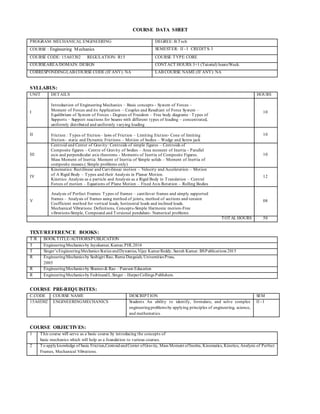
PROGRAM: MECHANICAL ENGINEERING DEGREE: B.Tech
COURSE : Engineering Mechanics SEMESTER: II - I CREDITS: 3
COURSE CODE: 15A03302 REGULATION: R15 COURSE TYPE: CORE
COURSEAREA/DOMAIN: DESIGN CONTACT HOURS: 3+1 (Tutorial) hours/Week.
CORRESPONDINGLAB COURSE CODE (IF ANY): NA LAB COURSE NAME (IF ANY): NA
SYLLABUS:
UNIT DETAILS HOURS
I
Introduction of Engineering Mechanics – Basic concepts - System of Forces –
Moment of Forces and its Application – Couples and Resultant of Force System –
Equilibrium of System of Forces - Degrees of Freedom – Free body diagrams –Types of
Supports – Support reactions for beams with different types of loading – concentrated,
uniformly distributed and uniformly varying loading
10
II Friction : Types of friction– laws of Friction – Limiting friction- Cone of limiting
friction– static and Dynamic Frictions – Motion of bodies – Wedge and Screw jack
10
III
Centroid and Center of Gravity: Centroids of simple figures – Centroids of
Composite figures – Centre of Gravity of bodies – Area moment of Inertia - Parallel
axis and perpendicular axis theorems - Moments of Inertia of Composite Figures.
Mass Moment of Inertia: Moment of Inertia of Simple solids – Moment of Inertia of
composite masses.( Simple problems only)
10
IV
Kinematics: Rectilinear and Curvilinear motion – Velocity and Acceleration – Motion
of A Rigid Body – Types and their Analysis in Planar Motion.
Kinetics: Analysis as a particle and Analysis as a Rigid Body in Translation – Central
Forces of motion – Equations of Plane Motion – Fixed Axis Rotation – Rolling Bodies
12
V
Analysis of Perfect Frames: Types of frames – cantilever frames and simply supported
frames – Analysis of frames using method of joints, method of sections and tension
Coefficient method for vertical loads, horizontal loads and inclined loads.
Mechanical Vibrations: Definitions, Concepts-Simple Harmonic motion-Free
vibrations-Simple, Compound and Torsional pendulum- Numerical problems
08
TOTAL HOURS 50
TEXT/REFERENCE BOOKS:
T/R BOOK TITLE/AUTHORS/PUBLICATION
T EngineeringMechanics by Jayakumar, Kumar, PHI,2014
T Singer’s EngineeringMechanics Statics andDynamics,Vijay KumarReddy, Suresh Kumar. BSPublications 2015
R EngineeringMechanics by Seshigiri Rao, Rama Durgaiah, Universities Press,
2005
R EngineeringMechanics by Shames & Rao – Pearson Education
R EngineeringMechanics by FedrinandL.Singer – HarperCollings Publishers.
COURSE PRE-REQUISITES:
C.CODE COURSE NAME DESCRIPTION SEM
15A03302 ENGINEERINGMECHANICS Students An ability to identify, formulate, and solve complex
engineeringproblems by applying principles of engineering, science,
and mathematics.
II - I
COURSE OBJECTIVES:
1 This course will serve as a basic course by introducing the concepts of
basic mechanics which will help as a foundation to various courses.
2 To applyknowledge of basic Friction,CentroidandCenter ofGravity, Mass Moment ofInertia, Kinematics, Kinetics, Analysis of Perfect
Frames, Mechanical Vibrations.
COURSE OUTCOMES:
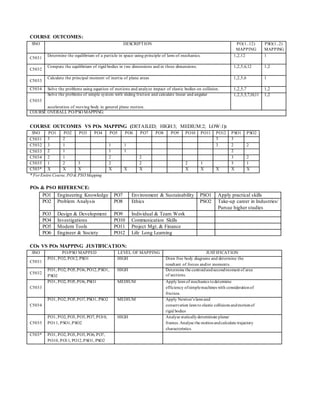
SNO DESCRIPTION PO(1..12)
MAPPING
PSO(1..2)
MAPPING
C5031
Determine the equilibrium of a particle in space using principle of laws of mechanics. 1,2,12 1
C5032
Compute the equilibrium of rigid bodies in two dimensions and in three dimensions. 1,2,5,6,12 1,2
C5033
Calculate the principal moment of inertia of plane areas 1,2,5,6 1
C5034 Solve the problems using equation of motions and analyze impact of elastic bodies on collision. 1,2,5,7 1,2
C5035
Solve the problems of simple system with sliding friction and calculate linear and angular
acceleration of moving body in general plane motion.
1,2,3,5,7,10,11 1,2
COURSE OVERALL PO/PSO MAPPING:
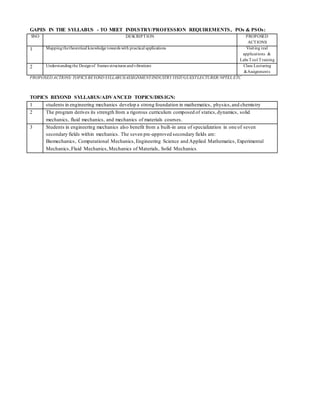
COURSE OUTCOMES VS POs MAPPING (DETAILED; HIGH:3; MEDIUM:2; LOW:1):
SNO PO1 PO2 PO3 PO4 PO5 PO6 PO7 PO8 PO9 PO10 PO11 PO12 PSO1 PSO2
C5031 3 2 3 3
C5032 3 1 1 1 3 2 2
C5033 2 1 1 1 2
C5034 2 1 2 2 3 2
C5035 1 2 3 2 2 2 1 3 1
C503* X X X X X X X X X X X
* For Entire Course, PO & PSO Mapping
POs & PSO REFERENCE:
PO1 Engineering Knowledge PO7 Environment & Sustainability PSO1 Apply practical skills
PO2 Problem Analysis PO8 Ethics PSO2 Take-up career in Industries/
Pursue higher studies
PO3 Design & Development PO9 Individual & Team Work
PO4 Investigations PO10 Communication Skills
PO5 Modern Tools PO11 Project Mgt. & Finance
PO6 Engineer & Society PO12 Life Long Learning
COs VS POs MAPPING JUSTIFICATION:
SNO PO/PSO MAPPED LEVEL OF MAPPING JUSTIFICATION
C5031
PO1, PO2, PO12, PSO1 HIGH Draw free body diagrams and determine the
resultant of forces and/or moments.
C5032
PO1, PO2, PO5,PO6, PO12,PSO1,
PSO2
HIGH Determine the centroidandsecondmoment of area
of sections.
C5033
PO1, PO2, PO5,PO6, PSO1 MEDIUM Apply laws of mechanics todetermine
efficiency ofsimplemachines with considerationof
friction.
C5034
PO1, PO2, PO5,PO7, PSO1, PSO2 MEDIUM Apply Newton’s laws and
conservation laws to elastic collisions andmotionof
rigid bodies
C5035
PO1, PO2, PO3,PO5, PO7, PO10,
PO11, PSO1,PSO2
HIGH Analyse staticallydeterminate planar
frames. Analyse the motionandcalculate trajectory
characteristics.
C503* PO1, PO2, PO3,PO5, PO6, PO7,
PO10, PO11, PO12,PSO1, PSO2
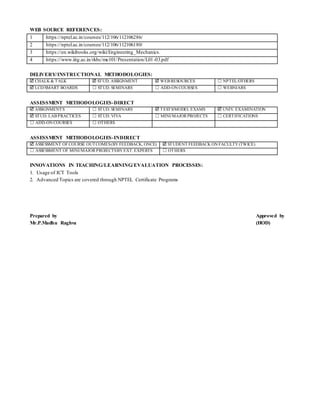
GAPES IN THE SYLLABUS - TO MEET INDUSTRY/PROFESSION REQUIREMENTS, POs & PSOs:
SNO DESCRIPTION PROPOSED
ACTIONS
1 Mappingthetheoretical knowledge towards with practical applications Visiting real
applications &
Labs Tool Training
2 Understandingthe Designof frames structures andvibrations Class Lecturing
&Assignments
PROPOSED ACTIONS: TOPICS BEYOND SYLLABUS/ASSIGNMENT/INDUSTRY VISIT/GUESTLECTURER/NPTEL ETC
TOPICS BEYOND SYLLABUS/ADVANCED TOPICS/DESIGN:
1 students in engineering mechanics develop a strong foundation in mathematics, physics,and chemistry
2 The program derives its strength from a rigorous curriculum composed of statics,dynamics, solid
mechanics, fluid mechanics, and mechanics of materials courses.
3 Students in engineering mechanics also benefit from a built-in area of specialization in one of seven
secondary fields within mechanics. The seven pre-approved secondary fields are:
Biomechanics, Computational Mechanics,Engineering Science and Applied Mathematics, Experimental
Mechanics,Fluid Mechanics,Mechanics of Materials, Solid Mechanics
WEB SOURCE REFERENCES:
1 https://nptel.ac.in/courses/112/106/112106286/
2 https://nptel.ac.in/courses/112/106/112106180/
3 https://en.wikibooks.org/wiki/Engineering_Mechanics.
4 https://www.iitg.ac.in/rkbc/me101/Presentation/L01-03.pdf
DELIVERY/INSTRUCTIONAL METHODOLOGIES:
 CHALK & TALK  STUD. ASSIGNMENT  WEB RESOURCES ☐ NPTEL/OTHERS
 LCD/SMART BOARDS ☐ STUD. SEMINARS ☐ ADD-ON COURSES ☐ WEBNIARS
ASSESSMENT METHODOLOGIES-DIRECT
 ASSIGNMENTS ☐ STUD. SEMINARS  TESTS/MODEL EXAMS  UNIV. EXAMINATION
 STUD. LAB PRACTICES ☐ STUD. VIVA ☐ MINI/MAJOR PROJECTS ☐ CERTIFICATIONS
☐ ADD-ON COURSES ☐ OTHERS
ASSESSMENT METHODOLOGIES-INDIRECT
 ASSESSMENT OF COURSE OUTCOMES(BY FEEDBACK, ONCE)  STUDENT FEEDBACK ON FACULTY (TWICE)
☐ ASSESSMENT OF MINI/MAJOR PROJECTSBY EXT.EXPERTS ☐ OTHERS
INNOVATIONS IN TEACHING/LEARNING/EVALUATION PROCESSES:
1. Usage of ICT Tools
2. Advanced Topics are covered through NPTEL Certificate Programs
Prepared by Approved by
Mr.P.Madhu Raghva (HOD)

#Engineering Mechanics course data sheet

  • 1.
    COURSE DATA SHEET PROGRAM:MECHANICAL ENGINEERING DEGREE: B.Tech COURSE : Engineering Mechanics SEMESTER: II - I CREDITS: 3 COURSE CODE: 15A03302 REGULATION: R15 COURSE TYPE: CORE COURSEAREA/DOMAIN: DESIGN CONTACT HOURS: 3+1 (Tutorial) hours/Week. CORRESPONDINGLAB COURSE CODE (IF ANY): NA LAB COURSE NAME (IF ANY): NA SYLLABUS: UNIT DETAILS HOURS I Introduction of Engineering Mechanics – Basic concepts - System of Forces – Moment of Forces and its Application – Couples and Resultant of Force System – Equilibrium of System of Forces - Degrees of Freedom – Free body diagrams –Types of Supports – Support reactions for beams with different types of loading – concentrated, uniformly distributed and uniformly varying loading 10 II Friction : Types of friction– laws of Friction – Limiting friction- Cone of limiting friction– static and Dynamic Frictions – Motion of bodies – Wedge and Screw jack 10 III Centroid and Center of Gravity: Centroids of simple figures – Centroids of Composite figures – Centre of Gravity of bodies – Area moment of Inertia - Parallel axis and perpendicular axis theorems - Moments of Inertia of Composite Figures. Mass Moment of Inertia: Moment of Inertia of Simple solids – Moment of Inertia of composite masses.( Simple problems only) 10 IV Kinematics: Rectilinear and Curvilinear motion – Velocity and Acceleration – Motion of A Rigid Body – Types and their Analysis in Planar Motion. Kinetics: Analysis as a particle and Analysis as a Rigid Body in Translation – Central Forces of motion – Equations of Plane Motion – Fixed Axis Rotation – Rolling Bodies 12 V Analysis of Perfect Frames: Types of frames – cantilever frames and simply supported frames – Analysis of frames using method of joints, method of sections and tension Coefficient method for vertical loads, horizontal loads and inclined loads. Mechanical Vibrations: Definitions, Concepts-Simple Harmonic motion-Free vibrations-Simple, Compound and Torsional pendulum- Numerical problems 08 TOTAL HOURS 50 TEXT/REFERENCE BOOKS: T/R BOOK TITLE/AUTHORS/PUBLICATION T EngineeringMechanics by Jayakumar, Kumar, PHI,2014 T Singer’s EngineeringMechanics Statics andDynamics,Vijay KumarReddy, Suresh Kumar. BSPublications 2015 R EngineeringMechanics by Seshigiri Rao, Rama Durgaiah, Universities Press, 2005 R EngineeringMechanics by Shames & Rao – Pearson Education R EngineeringMechanics by FedrinandL.Singer – HarperCollings Publishers. COURSE PRE-REQUISITES: C.CODE COURSE NAME DESCRIPTION SEM 15A03302 ENGINEERINGMECHANICS Students An ability to identify, formulate, and solve complex engineeringproblems by applying principles of engineering, science, and mathematics. II - I COURSE OBJECTIVES: 1 This course will serve as a basic course by introducing the concepts of basic mechanics which will help as a foundation to various courses. 2 To applyknowledge of basic Friction,CentroidandCenter ofGravity, Mass Moment ofInertia, Kinematics, Kinetics, Analysis of Perfect Frames, Mechanical Vibrations.
  • 2.
    COURSE OUTCOMES: SNO DESCRIPTIONPO(1..12) MAPPING PSO(1..2) MAPPING C5031 Determine the equilibrium of a particle in space using principle of laws of mechanics. 1,2,12 1 C5032 Compute the equilibrium of rigid bodies in two dimensions and in three dimensions. 1,2,5,6,12 1,2 C5033 Calculate the principal moment of inertia of plane areas 1,2,5,6 1 C5034 Solve the problems using equation of motions and analyze impact of elastic bodies on collision. 1,2,5,7 1,2 C5035 Solve the problems of simple system with sliding friction and calculate linear and angular acceleration of moving body in general plane motion. 1,2,3,5,7,10,11 1,2 COURSE OVERALL PO/PSO MAPPING: COURSE OUTCOMES VS POs MAPPING (DETAILED; HIGH:3; MEDIUM:2; LOW:1): SNO PO1 PO2 PO3 PO4 PO5 PO6 PO7 PO8 PO9 PO10 PO11 PO12 PSO1 PSO2 C5031 3 2 3 3 C5032 3 1 1 1 3 2 2 C5033 2 1 1 1 2 C5034 2 1 2 2 3 2 C5035 1 2 3 2 2 2 1 3 1 C503* X X X X X X X X X X X * For Entire Course, PO & PSO Mapping POs & PSO REFERENCE: PO1 Engineering Knowledge PO7 Environment & Sustainability PSO1 Apply practical skills PO2 Problem Analysis PO8 Ethics PSO2 Take-up career in Industries/ Pursue higher studies PO3 Design & Development PO9 Individual & Team Work PO4 Investigations PO10 Communication Skills PO5 Modern Tools PO11 Project Mgt. & Finance PO6 Engineer & Society PO12 Life Long Learning COs VS POs MAPPING JUSTIFICATION: SNO PO/PSO MAPPED LEVEL OF MAPPING JUSTIFICATION C5031 PO1, PO2, PO12, PSO1 HIGH Draw free body diagrams and determine the resultant of forces and/or moments. C5032 PO1, PO2, PO5,PO6, PO12,PSO1, PSO2 HIGH Determine the centroidandsecondmoment of area of sections. C5033 PO1, PO2, PO5,PO6, PSO1 MEDIUM Apply laws of mechanics todetermine efficiency ofsimplemachines with considerationof friction. C5034 PO1, PO2, PO5,PO7, PSO1, PSO2 MEDIUM Apply Newton’s laws and conservation laws to elastic collisions andmotionof rigid bodies C5035 PO1, PO2, PO3,PO5, PO7, PO10, PO11, PSO1,PSO2 HIGH Analyse staticallydeterminate planar frames. Analyse the motionandcalculate trajectory characteristics. C503* PO1, PO2, PO3,PO5, PO6, PO7, PO10, PO11, PO12,PSO1, PSO2
  • 3.
    GAPES IN THESYLLABUS - TO MEET INDUSTRY/PROFESSION REQUIREMENTS, POs & PSOs: SNO DESCRIPTION PROPOSED ACTIONS 1 Mappingthetheoretical knowledge towards with practical applications Visiting real applications & Labs Tool Training 2 Understandingthe Designof frames structures andvibrations Class Lecturing &Assignments PROPOSED ACTIONS: TOPICS BEYOND SYLLABUS/ASSIGNMENT/INDUSTRY VISIT/GUESTLECTURER/NPTEL ETC TOPICS BEYOND SYLLABUS/ADVANCED TOPICS/DESIGN: 1 students in engineering mechanics develop a strong foundation in mathematics, physics,and chemistry 2 The program derives its strength from a rigorous curriculum composed of statics,dynamics, solid mechanics, fluid mechanics, and mechanics of materials courses. 3 Students in engineering mechanics also benefit from a built-in area of specialization in one of seven secondary fields within mechanics. The seven pre-approved secondary fields are: Biomechanics, Computational Mechanics,Engineering Science and Applied Mathematics, Experimental Mechanics,Fluid Mechanics,Mechanics of Materials, Solid Mechanics
  • 4.
    WEB SOURCE REFERENCES: 1https://nptel.ac.in/courses/112/106/112106286/ 2 https://nptel.ac.in/courses/112/106/112106180/ 3 https://en.wikibooks.org/wiki/Engineering_Mechanics. 4 https://www.iitg.ac.in/rkbc/me101/Presentation/L01-03.pdf DELIVERY/INSTRUCTIONAL METHODOLOGIES:  CHALK & TALK  STUD. ASSIGNMENT  WEB RESOURCES ☐ NPTEL/OTHERS  LCD/SMART BOARDS ☐ STUD. SEMINARS ☐ ADD-ON COURSES ☐ WEBNIARS ASSESSMENT METHODOLOGIES-DIRECT  ASSIGNMENTS ☐ STUD. SEMINARS  TESTS/MODEL EXAMS  UNIV. EXAMINATION  STUD. LAB PRACTICES ☐ STUD. VIVA ☐ MINI/MAJOR PROJECTS ☐ CERTIFICATIONS ☐ ADD-ON COURSES ☐ OTHERS ASSESSMENT METHODOLOGIES-INDIRECT  ASSESSMENT OF COURSE OUTCOMES(BY FEEDBACK, ONCE)  STUDENT FEEDBACK ON FACULTY (TWICE) ☐ ASSESSMENT OF MINI/MAJOR PROJECTSBY EXT.EXPERTS ☐ OTHERS INNOVATIONS IN TEACHING/LEARNING/EVALUATION PROCESSES: 1. Usage of ICT Tools 2. Advanced Topics are covered through NPTEL Certificate Programs Prepared by Approved by Mr.P.Madhu Raghva (HOD)