Page Object
Generation
Lose the maintenance,
increase the productivity
The Problem
 Failuresguide our work
 The product is ever-changing
 Developers do not communicate
  changes proactively (or at all)
 40% of our time is spent accounting for
  these changes
 Who can analyze 300 test failures every
  night?
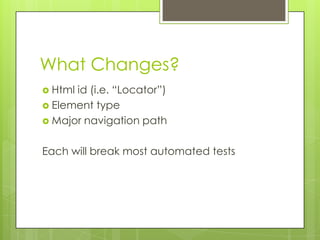
What Changes?
 Htmlid (i.e. “Locator”)
 Element type
 Major navigation path


Each will break most automated tests
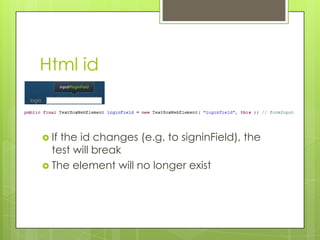
Html id


 Ifthe id changes (e.g. to signinField), the
  test will break
 The element will no longer exist
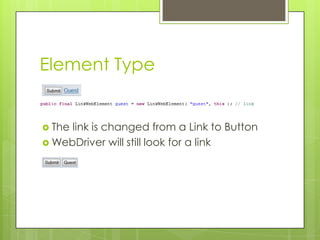
Element Type


 Thelink is changed from a Link to Button
 WebDriver will still look for a link
Navigation Path
 Pages  are added
 Popups are introduced
 Buttons and forms are split up across
  pages
 UI Look and feel “reset”
 WebDriver scripts don’t stand a chance—
  you just start over
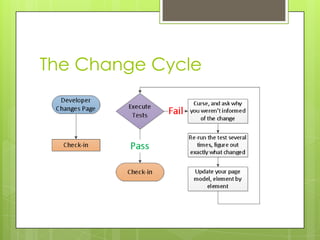
The Change Cycle
Wish List for a Solution
 Build  in a mechanism for change
  communication
 Account for the changes AS THEY
  HAPPEN, not reactively
 Tighter integration with development
 Pass rate needs to be 97% or better, with
  all failures accounted for within 24 hours
Page Object Generation
 Generate   the pages on every build
 Web Controls are mapped to specific
  WebElement types
 If the type of an object changes in a way
  that breaks automation, the whole build
  fails
Let’s See It!
What you get
A   page, containing every element in the
  UI
 Each element is aware of its Tab
 Including every Rich WebElement
 A Fields object, usable by those writing
  Test Scripts
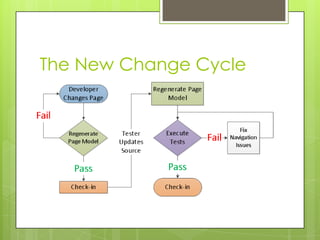
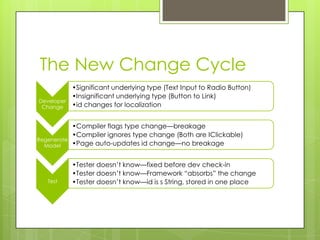
The New Change Cycle
          •Significant underlying type (Text Input to Radio Button)
          •Insignificant underlying type (Button to Link)
Developer
 Change   •id changes for localization


           •Compiler flags type change—breakage
           •Compiler ignores type change (Both are IClickable)
Regenerate
  Model    •Page auto-updates id change—no breakage


          •Tester doesn’t know—fixed before dev check-in
          •Tester doesn’t know—Framework “absorbs” the change
   Test   •Tester doesn’t know—id is s String, stored in one place
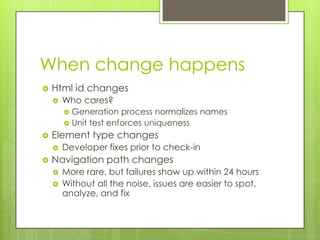
When change happens
   Html id changes
       Who cares?
         Generation process normalizes names
         Unit test enforces uniqueness
   Element type changes
       Developer fixes prior to check-in
   Navigation path changes
       More rare, but failures show up within 24 hours
       Without all the noise, issues are easier to spot,
        analyze, and fix
Where do you go now?
   You have a model of your system
   Use it to “analyze itself”
   The all-table test
   Role-based security tests
   Algorithms to
       Iterate through every page looking for
        standards compliance
       500 errors
       Forms
       Security issues (code injection, XSS etc)
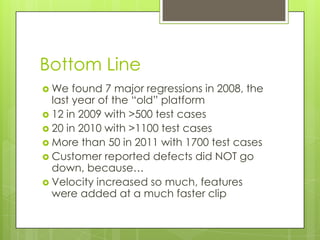
Bottom Line
 We   found 7 major regressions in 2008, the
  last year of the “old” platform
 12 in 2009 with >500 test cases
 20 in 2010 with >1100 test cases
 More than 50 in 2011 with 1700 test cases
 Customer reported defects did NOT go
  down, because…
 Velocity increased so much, features
  were added at a much faster clip
Questions?

Self-Generating Test Artifacts for Selenium/WebDriver

  • 1.
    Page Object Generation Lose themaintenance, increase the productivity
  • 2.
    The Problem  Failuresguideour work  The product is ever-changing  Developers do not communicate changes proactively (or at all)  40% of our time is spent accounting for these changes  Who can analyze 300 test failures every night?
  • 3.
    What Changes?  Htmlid(i.e. “Locator”)  Element type  Major navigation path Each will break most automated tests
  • 4.
    Html id  Iftheid changes (e.g. to signinField), the test will break  The element will no longer exist
  • 5.
    Element Type  Thelinkis changed from a Link to Button  WebDriver will still look for a link
  • 6.
    Navigation Path  Pages are added  Popups are introduced  Buttons and forms are split up across pages  UI Look and feel “reset”  WebDriver scripts don’t stand a chance— you just start over
  • 7.
  • 8.
    Wish List fora Solution  Build in a mechanism for change communication  Account for the changes AS THEY HAPPEN, not reactively  Tighter integration with development  Pass rate needs to be 97% or better, with all failures accounted for within 24 hours
  • 9.
    Page Object Generation Generate the pages on every build  Web Controls are mapped to specific WebElement types  If the type of an object changes in a way that breaks automation, the whole build fails
  • 10.
  • 11.
    What you get A page, containing every element in the UI  Each element is aware of its Tab  Including every Rich WebElement  A Fields object, usable by those writing Test Scripts
  • 12.
  • 13.
    The New ChangeCycle •Significant underlying type (Text Input to Radio Button) •Insignificant underlying type (Button to Link) Developer Change •id changes for localization •Compiler flags type change—breakage •Compiler ignores type change (Both are IClickable) Regenerate Model •Page auto-updates id change—no breakage •Tester doesn’t know—fixed before dev check-in •Tester doesn’t know—Framework “absorbs” the change Test •Tester doesn’t know—id is s String, stored in one place
  • 14.
    When change happens  Html id changes  Who cares?  Generation process normalizes names  Unit test enforces uniqueness  Element type changes  Developer fixes prior to check-in  Navigation path changes  More rare, but failures show up within 24 hours  Without all the noise, issues are easier to spot, analyze, and fix
  • 15.
    Where do yougo now?  You have a model of your system  Use it to “analyze itself”  The all-table test  Role-based security tests  Algorithms to  Iterate through every page looking for standards compliance  500 errors  Forms  Security issues (code injection, XSS etc)
  • 16.
    Bottom Line  We found 7 major regressions in 2008, the last year of the “old” platform  12 in 2009 with >500 test cases  20 in 2010 with >1100 test cases  More than 50 in 2011 with 1700 test cases  Customer reported defects did NOT go down, because…  Velocity increased so much, features were added at a much faster clip
  • 17.