

Self-Employed Taxpayers Trinity Tax and Bookkeeping Service, Inc. www.trinitytbs.com   304-237-7065
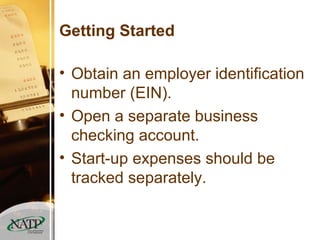
Getting Started Obtain an employer identification number (EIN). Open a separate business checking account. Start-up expenses should be tracked separately.
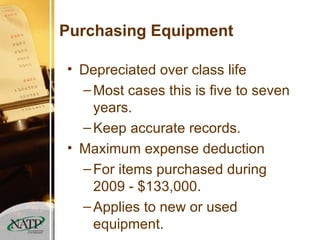
Purchasing Equipment Depreciated over class life Most cases this is five to seven years. Keep accurate records. Maximum expense deduction  For items purchased during 2009 - $133,000. Applies to new or used equipment.
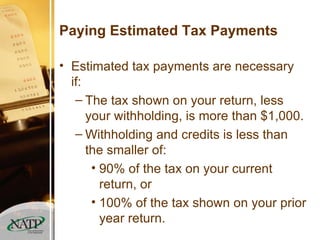
Paying Estimated Tax Payments Estimated tax payments are necessary if: The tax shown on your return, less your withholding, is more than $1,000. Withholding and credits is less than the smaller of: 90% of the tax on your current return, or 100% of the tax shown on your prior year return.
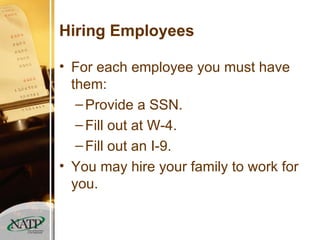
Hiring Employees For each employee you must have them: Provide a SSN. Fill out at W-4. Fill out an I-9. You may hire your family to work for you.
Home Office Calculations Direct and indirect expenses. Allocate indirect expenses between business and nonbusiness portions of the home. Multiply the indirect expenses by the business percentage to apply the limitations.
Home Office Limitations Base the overall limitation on your net income. Losses do not qualify as a deduction. Deductions allowed in full: Mortgage interest. Real estate taxes. Casualty or theft loss. If net income is zero, carry forward the balance of expenses.
Starting a Retirement Plan You are the employer and employee Plans available: SEP SIMPLE SIMPLE 401(k) Solo 401(k)
Summary These are just some of the most commonly asked questions in reference self-employed taxpayers. Tax planning and tax return processing can be a confusing process. I’m available to help you and to give you the best tax outcome possible.
Thank you.

Selfemployed 2009 Tax Season

  • 1.
    Self-Employed Taxpayers TrinityTax and Bookkeeping Service, Inc. www.trinitytbs.com 304-237-7065
  • 2.
    Getting Started Obtainan employer identification number (EIN). Open a separate business checking account. Start-up expenses should be tracked separately.
  • 3.
    Purchasing Equipment Depreciatedover class life Most cases this is five to seven years. Keep accurate records. Maximum expense deduction For items purchased during 2009 - $133,000. Applies to new or used equipment.
  • 4.
    Paying Estimated TaxPayments Estimated tax payments are necessary if: The tax shown on your return, less your withholding, is more than $1,000. Withholding and credits is less than the smaller of: 90% of the tax on your current return, or 100% of the tax shown on your prior year return.
  • 5.
    Hiring Employees Foreach employee you must have them: Provide a SSN. Fill out at W-4. Fill out an I-9. You may hire your family to work for you.
  • 6.
    Home Office CalculationsDirect and indirect expenses. Allocate indirect expenses between business and nonbusiness portions of the home. Multiply the indirect expenses by the business percentage to apply the limitations.
  • 7.
    Home Office LimitationsBase the overall limitation on your net income. Losses do not qualify as a deduction. Deductions allowed in full: Mortgage interest. Real estate taxes. Casualty or theft loss. If net income is zero, carry forward the balance of expenses.
  • 8.
    Starting a RetirementPlan You are the employer and employee Plans available: SEP SIMPLE SIMPLE 401(k) Solo 401(k)
  • 9.
    Summary These arejust some of the most commonly asked questions in reference self-employed taxpayers. Tax planning and tax return processing can be a confusing process. I’m available to help you and to give you the best tax outcome possible.
  • 10.