Self Directed Healthcare
Overview : Consumer Directed HealthCare  Bob Johnston,CBC
Agenda : Overview of CDHC Basics Market Experience of CDHC Side by Side Comparison of Tax Advantaged Accounts
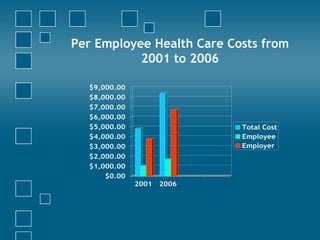
Per Employee Health Care Costs from 2001 to 2006
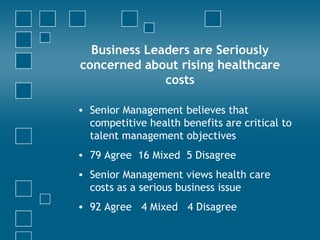
Business Leaders are Seriously concerned about rising healthcare costs Senior Management believes that competitive health benefits are critical to talent management objectives 79 Agree  16 Mixed  5 Disagree Senior Management views health care costs as a serious business issue 92 Agree  4 Mixed  4 Disagree
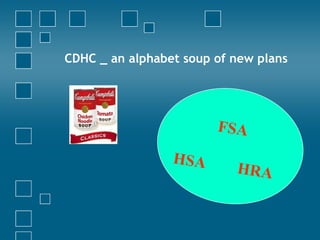
CDHC _ an alphabet soup of new plans FSA HSA  HRA
Common Ingredients of Consumer Directed Plan Make Consumers aware of the true cost of their care Engage consumers in health care purchases Give members a financial stake Provide resources for informed decisions
Three Types of CDHC Accounts Flexible Spending Accounts ( FSA ) Health Re Imbursement Accounts ( HRA ) Health Savings Accounts ( H S A )
Flexible Spending Accounts  ( FSA ) A Health FSA is an account funded by the employee, the employer, or both under a group plan that re imburses the employee for out-of-pocket medical expenses as defined in IRC 213 (d)  Pre Tax Contributions “  Use it or lose it “ No Underlying plan design requirements
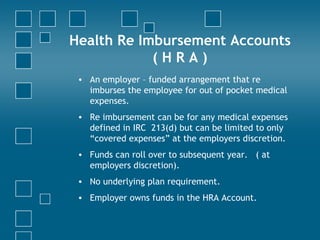
Health Re Imbursement Accounts ( H R A ) An employer – funded arrangement that re imburses the employee for out of pocket medical expenses. Re imbursement can be for any medical expenses defined in IRC  213(d) but can be limited to only “covered expenses” at the employers discretion. Funds can roll over to subsequent year.  ( at employers discretion). No underlying plan requirement. Employer owns funds in the HRA Account.
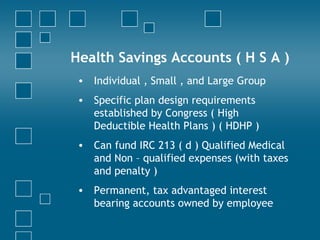
Health Savings Accounts ( H S A ) Individual , Small , and Large Group Specific plan design requirements established by Congress ( High Deductible Health Plans ) ( HDHP ) Can fund IRC 213 ( d ) Qualified Medical and Non – qualified expenses (with taxes and penalty ) Permanent, tax advantaged interest bearing accounts owned by employee
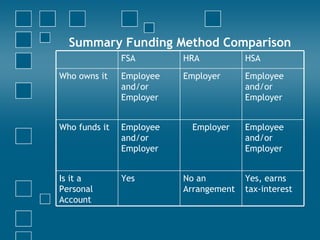
Summary Funding Method Comparison Yes, earns tax-interest No an Arrangement Yes Is it a Personal Account Employee and/or Employer Employer Employee and/or Employer Who funds it Employee and/or Employer Employer Employee and/or Employer Who owns it  HSA HRA FSA
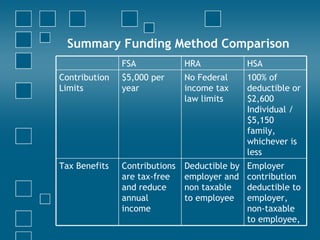
Summary Funding Method Comparison  HSA HRA FSA Employer contribution deductible to employer, non-taxable to employee, Deductible by employer and non taxable to employee Contributions are tax-free and reduce annual income Tax Benefits 100% of deductible or $2,600 Individual / $5,150 family, whichever is less No Federal income tax law limits $5,000 per year Contribution Limits
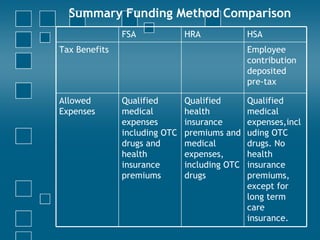
Summary Funding Method Comparison HSA HRA FSA Qualified medical expenses,including OTC drugs. No health insurance premiums, except for long term care insurance. Qualified health insurance premiums and medical expenses, including OTC drugs Qualified medical expenses including OTC drugs and health insurance premiums Allowed Expenses Employee contribution deposited pre-tax Tax Benefits
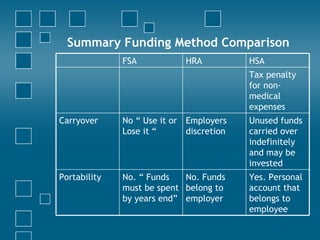
Summary Funding Method Comparison HSA HRA FSA Yes. Personal account that belongs to employee No. Funds belong to employer No. “ Funds must be spent by years end” Portability Unused funds carried over indefinitely and may be invested Employers discretion No “ Use it or Lose it “ Carryover  Tax penalty for non-medical  expenses

Self Directed Healthcare

  • 1.
  • 2.
    Overview : ConsumerDirected HealthCare Bob Johnston,CBC
  • 3.
    Agenda : Overviewof CDHC Basics Market Experience of CDHC Side by Side Comparison of Tax Advantaged Accounts
  • 4.
    Per Employee HealthCare Costs from 2001 to 2006
  • 5.
    Business Leaders areSeriously concerned about rising healthcare costs Senior Management believes that competitive health benefits are critical to talent management objectives 79 Agree 16 Mixed 5 Disagree Senior Management views health care costs as a serious business issue 92 Agree 4 Mixed 4 Disagree
  • 6.
    CDHC _ analphabet soup of new plans FSA HSA HRA
  • 7.
    Common Ingredients ofConsumer Directed Plan Make Consumers aware of the true cost of their care Engage consumers in health care purchases Give members a financial stake Provide resources for informed decisions
  • 8.
    Three Types ofCDHC Accounts Flexible Spending Accounts ( FSA ) Health Re Imbursement Accounts ( HRA ) Health Savings Accounts ( H S A )
  • 9.
    Flexible Spending Accounts ( FSA ) A Health FSA is an account funded by the employee, the employer, or both under a group plan that re imburses the employee for out-of-pocket medical expenses as defined in IRC 213 (d) Pre Tax Contributions “ Use it or lose it “ No Underlying plan design requirements
  • 10.
    Health Re ImbursementAccounts ( H R A ) An employer – funded arrangement that re imburses the employee for out of pocket medical expenses. Re imbursement can be for any medical expenses defined in IRC 213(d) but can be limited to only “covered expenses” at the employers discretion. Funds can roll over to subsequent year. ( at employers discretion). No underlying plan requirement. Employer owns funds in the HRA Account.
  • 11.
    Health Savings Accounts( H S A ) Individual , Small , and Large Group Specific plan design requirements established by Congress ( High Deductible Health Plans ) ( HDHP ) Can fund IRC 213 ( d ) Qualified Medical and Non – qualified expenses (with taxes and penalty ) Permanent, tax advantaged interest bearing accounts owned by employee
  • 12.
    Summary Funding MethodComparison Yes, earns tax-interest No an Arrangement Yes Is it a Personal Account Employee and/or Employer Employer Employee and/or Employer Who funds it Employee and/or Employer Employer Employee and/or Employer Who owns it HSA HRA FSA
  • 13.
    Summary Funding MethodComparison HSA HRA FSA Employer contribution deductible to employer, non-taxable to employee, Deductible by employer and non taxable to employee Contributions are tax-free and reduce annual income Tax Benefits 100% of deductible or $2,600 Individual / $5,150 family, whichever is less No Federal income tax law limits $5,000 per year Contribution Limits
  • 14.
    Summary Funding MethodComparison HSA HRA FSA Qualified medical expenses,including OTC drugs. No health insurance premiums, except for long term care insurance. Qualified health insurance premiums and medical expenses, including OTC drugs Qualified medical expenses including OTC drugs and health insurance premiums Allowed Expenses Employee contribution deposited pre-tax Tax Benefits
  • 15.
    Summary Funding MethodComparison HSA HRA FSA Yes. Personal account that belongs to employee No. Funds belong to employer No. “ Funds must be spent by years end” Portability Unused funds carried over indefinitely and may be invested Employers discretion No “ Use it or Lose it “ Carryover Tax penalty for non-medical expenses