Open enrollment 101
for 2020
Disclaimer: The presentation provided is general in nature and does not apply to any specific U.S. state except where noted. Health insurance regulations differ in each state. See a licensed agent for detailed information on your state. PeopleKeep, Inc., does not sell health insurance.
Our story
At PeopleKeep, we’re passionate about helping small
businesses offer competitive benefits to their
employees, at a price they can afford.
Our cloud-based benefits software automates
benefits compliance and employee
support—enabling businesses to manage their
benefits in just minutes per month.
Today, 3,000+ companies across the United States
trust PeopleKeep to successfully automate their
benefits.
PeopleKeep is located in scenic Salt Lake City, Utah.
J.D. Cleary, Director of Sales and Business Development
An expert in small business benefits, J.D. has successfully helped
owners and advisors navigate the landscape of small business
benefits. If he’s not exploring the beautiful outdoors in Utah with his
family, you’ll probably find him cheering on his alma mater Villanova
or any Boston sports team.
Connect on LinkedIn at https://www.linkedin.com/in/jdcleary/.
About the presenter
What
we’ll cover
Health reimbursement arrangement (HRA)
Shopping during open enrollment
Key takeaways
Health coverage basics
2020 open enrollment1
2
3
4
5
2020 open enrollment
What is it?
Open enrollment is the one time of year when you can shop, compare, and buy a
health insurance plan without a qualifying life event.
Then and now
Prior to 2013, open enrollment generally applied to employer-sponsored health plans,
but this changed under the Affordable Care Act. Now, individuals and families who don’t
have employer-sponsored coverage may shop for and buy health insurance during open
enrollment.
2020 open enrollment
Categories of open enrollment
The timing of open enrollment depends on the type of health insurance. It’s
important to know because it’s the one time you can sign up for health
insurance without a qualifying life event.
2020 Open Enrollment
Plan type Dates
Individual health insurance plans Nov. 1 to Dec. 15 (generally)
Employer-sponsored health plans Dependent upon employer
Medicaid Applications accepted any time
Medicare Oct. 15 to Dec. 7
2020 open enrollment
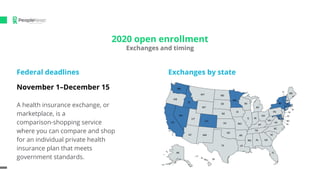
Exchanges and timing
Federal deadlines
November 1–December 15
A health insurance exchange, or
marketplace, is a
comparison-shopping service
where you can compare and shop
for an individual private health
insurance plan that meets
government standards.
Exchanges by state
2020 open enrollment
Exchanges and timing
2020 PLAN EFFECTIVE DATE DEADLINES FOR STATE EXCHANGES
State Jan 1, 2020 Feb 1, 2020 Mar 1, 2020
CA Dec 15, 2019 Jan 15, 2020 -
CO Dec 15, 2019 Jan 15, 2020 -
CT Dec 15, 2019 - -
ID Dec 15, 2019 - -
MA Dec 23, 2019 - -
MD Dec 15, 2019 Jan 23, 2020 -
MN Dec 15, 2019 Jan 13, 2020 -
NV Dec 15, 2019
NY Dec 15, 2019 Jan 15, 2020 Jan 31, 2020
RI Dec 31, 2019 - -
VT Dec 15, 2019 - -
WA Dec 15, 2019 - -
DC Dec 15, 2019 Jan 15, 2020 Jan 31, 2020
To help you better compare plans,
the individual health insurance
plans offered through the exchange
are categorized into four levels of
coverage, or metal tiers.
The tier indicates the percentage of
covered health care expenses the
plan will pay.
Health coverage basics
The health insurance exchange
Metal Tiers of
Coverage
Health coverage basics
Key insurance terms to know
To select the right health insurance plan for you, it’s important to understand
key insurance terms.
● Premium. The amount you pay to the insurance company for the plan, usually
monthly.
● Deductible. The amount paid for covered care before the insurer begins to pay.
● Copayment. A flat dollar amount paid to the health care provider for a covered
service.
● Coinsurance. The percentage of allowed charges for covered services you are
required to pay.
● Out-of-pocket maximum. The maximum amount of money you will pay for
covered services during a benefit period.
Health coverage basics
Funding options
Finding the best health benefit for your small business in 2020 requires you
to take a good look at the needs of your business and employees.
Health benefit funding options include:
● Traditional employer-sponsored group plan
● Taxable stipends or wage increases
● No employer contribution
● Health reimbursement arrangement (HRA)
Health reimbursement arrangement (HRA)
What is it?
An HRA is an employer-funded reimbursement program for health care
benefits. Employers set aside a specific amount of money for employees to
pay for eligible health care expenses. The HRA contributions are tax
deductible to the employer and tax-free to the employee.
Perks of an HRA
● Cost control
● Tax-advantaged account
● Flexibility
● Talent recruitment and retention
1. Business offers a
monthly allowance.
The allowance represents the
maximum amount for which
the business will reimburse
the employee.
2. Employees purchase
health care.
All items listed in IRS Publication
502, including individual health
insurance premiums, are
reimbursable.
3. Business reimburses
employees.
Reimbursements are free of
payroll tax and income tax.
Health reimbursement arrangement (HRA)
How it works
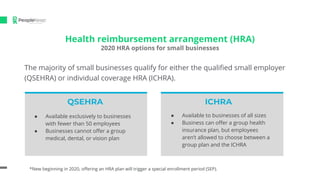
● Available exclusively to businesses
with fewer than 50 employees
● Businesses cannot offer a group
medical, dental, or vision plan
QSEHRA
● Available to businesses of all sizes
● Business can offer a group health
insurance plan, but employees
aren’t allowed to choose between a
group plan and the ICHRA
ICHRA
Health reimbursement arrangement (HRA)
2020 HRA options for small businesses
The majority of small businesses qualify for either the qualified small employer
(QSEHRA) or individual coverage HRA (ICHRA).
*New beginning in 2020, offering an HRA plan will trigger a special enrollment period (SEP).
Shopping for health insurance
How to shop for an insurance plan
Knowing where to shop for health insurance can help set you and your
employees up for success.
Shopping options
For both on-exchange and
off-exchange plans, you can
shop on your own, or your can
enlist a broker for help.
For off-exchange plans, you
can buy directly from an
insurance company, or
enlist a broker for help.
What is a premium tax credit?
To help people buy health insurance in the exchanges, the
ACA created a federal tax credit.
The premium tax credit can be used to buy the four
different types of plans offered through the marketplace:
bronze, silver, gold, and platinum.
Shopping for health insurance
Premium tax credit
You can choose to have your
premium tax credit payments
go directly to you, or wait
until you file taxes to claim
them.
Shopping for health insurance
How premium tax credits are calculated
Depending on your income,
premium tax credits range
from 2-9.5% of income.
Source: https://www.healthcare.gov/lower-costs/
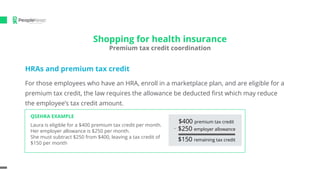
HRAs and premium tax credit
For those employees who have an HRA, enroll in a marketplace plan, and are eligible for a
premium tax credit, the law requires the allowance be deducted first which may reduce
the employee’s tax credit amount.
Shopping for health insurance
Premium tax credit coordination
QSEHRA EXAMPLE
Laura is eligible for a $400 premium tax credit per month.
Her employer allowance is $250 per month.
She must subtract $250 from $400, leaving a tax credit of
$150 per month
$400 premium tax credit
$250 employer allowance
$150 remaining tax credit
2020 open enrollment
Key Takeaways
There’s a lot to take into consideration for open enrollment, but understanding
the ins and out of open enrollment will help you to make the best decisions for
your business.
Key Takeaways
● Individual health insurance open enrollment is relatively short
● Where you reside matters, you may have more time
● Health insurance can be confusing but with the marketplace plans are standardized
● HRAs may be a good fit for businesses that wish to help financially toward
employees’ health insurance during open enrollment
● New regulations allow HRAs to trigger special enrollment in 2020
Thank you for joining us today.
Next month is the start of our HRA educational webinar series!
Your invite is coming soon.
The Small Business's Guide to Health Benefits in 2020
The HRA, an alternative benefit.
Blog: Is the QSEHRA or the ICHRA better for my business?
PeopleKeep self assessment
Additional resources

Open enrollment 101

  • 1.
    Open enrollment 101 for2020 Disclaimer: The presentation provided is general in nature and does not apply to any specific U.S. state except where noted. Health insurance regulations differ in each state. See a licensed agent for detailed information on your state. PeopleKeep, Inc., does not sell health insurance.
  • 2.
    Our story At PeopleKeep,we’re passionate about helping small businesses offer competitive benefits to their employees, at a price they can afford. Our cloud-based benefits software automates benefits compliance and employee support—enabling businesses to manage their benefits in just minutes per month. Today, 3,000+ companies across the United States trust PeopleKeep to successfully automate their benefits. PeopleKeep is located in scenic Salt Lake City, Utah.
  • 3.
    J.D. Cleary, Directorof Sales and Business Development An expert in small business benefits, J.D. has successfully helped owners and advisors navigate the landscape of small business benefits. If he’s not exploring the beautiful outdoors in Utah with his family, you’ll probably find him cheering on his alma mater Villanova or any Boston sports team. Connect on LinkedIn at https://www.linkedin.com/in/jdcleary/. About the presenter
  • 4.
    What we’ll cover Health reimbursementarrangement (HRA) Shopping during open enrollment Key takeaways Health coverage basics 2020 open enrollment1 2 3 4 5
  • 5.
    2020 open enrollment Whatis it? Open enrollment is the one time of year when you can shop, compare, and buy a health insurance plan without a qualifying life event. Then and now Prior to 2013, open enrollment generally applied to employer-sponsored health plans, but this changed under the Affordable Care Act. Now, individuals and families who don’t have employer-sponsored coverage may shop for and buy health insurance during open enrollment.
  • 6.
    2020 open enrollment Categoriesof open enrollment The timing of open enrollment depends on the type of health insurance. It’s important to know because it’s the one time you can sign up for health insurance without a qualifying life event. 2020 Open Enrollment Plan type Dates Individual health insurance plans Nov. 1 to Dec. 15 (generally) Employer-sponsored health plans Dependent upon employer Medicaid Applications accepted any time Medicare Oct. 15 to Dec. 7
  • 7.
    2020 open enrollment Exchangesand timing Federal deadlines November 1–December 15 A health insurance exchange, or marketplace, is a comparison-shopping service where you can compare and shop for an individual private health insurance plan that meets government standards. Exchanges by state
  • 8.
    2020 open enrollment Exchangesand timing 2020 PLAN EFFECTIVE DATE DEADLINES FOR STATE EXCHANGES State Jan 1, 2020 Feb 1, 2020 Mar 1, 2020 CA Dec 15, 2019 Jan 15, 2020 - CO Dec 15, 2019 Jan 15, 2020 - CT Dec 15, 2019 - - ID Dec 15, 2019 - - MA Dec 23, 2019 - - MD Dec 15, 2019 Jan 23, 2020 - MN Dec 15, 2019 Jan 13, 2020 - NV Dec 15, 2019 NY Dec 15, 2019 Jan 15, 2020 Jan 31, 2020 RI Dec 31, 2019 - - VT Dec 15, 2019 - - WA Dec 15, 2019 - - DC Dec 15, 2019 Jan 15, 2020 Jan 31, 2020
  • 9.
    To help youbetter compare plans, the individual health insurance plans offered through the exchange are categorized into four levels of coverage, or metal tiers. The tier indicates the percentage of covered health care expenses the plan will pay. Health coverage basics The health insurance exchange Metal Tiers of Coverage
  • 10.
    Health coverage basics Keyinsurance terms to know To select the right health insurance plan for you, it’s important to understand key insurance terms. ● Premium. The amount you pay to the insurance company for the plan, usually monthly. ● Deductible. The amount paid for covered care before the insurer begins to pay. ● Copayment. A flat dollar amount paid to the health care provider for a covered service. ● Coinsurance. The percentage of allowed charges for covered services you are required to pay. ● Out-of-pocket maximum. The maximum amount of money you will pay for covered services during a benefit period.
  • 11.
    Health coverage basics Fundingoptions Finding the best health benefit for your small business in 2020 requires you to take a good look at the needs of your business and employees. Health benefit funding options include: ● Traditional employer-sponsored group plan ● Taxable stipends or wage increases ● No employer contribution ● Health reimbursement arrangement (HRA)
  • 12.
    Health reimbursement arrangement(HRA) What is it? An HRA is an employer-funded reimbursement program for health care benefits. Employers set aside a specific amount of money for employees to pay for eligible health care expenses. The HRA contributions are tax deductible to the employer and tax-free to the employee. Perks of an HRA ● Cost control ● Tax-advantaged account ● Flexibility ● Talent recruitment and retention
  • 13.
    1. Business offersa monthly allowance. The allowance represents the maximum amount for which the business will reimburse the employee. 2. Employees purchase health care. All items listed in IRS Publication 502, including individual health insurance premiums, are reimbursable. 3. Business reimburses employees. Reimbursements are free of payroll tax and income tax. Health reimbursement arrangement (HRA) How it works
  • 14.
    ● Available exclusivelyto businesses with fewer than 50 employees ● Businesses cannot offer a group medical, dental, or vision plan QSEHRA ● Available to businesses of all sizes ● Business can offer a group health insurance plan, but employees aren’t allowed to choose between a group plan and the ICHRA ICHRA Health reimbursement arrangement (HRA) 2020 HRA options for small businesses The majority of small businesses qualify for either the qualified small employer (QSEHRA) or individual coverage HRA (ICHRA). *New beginning in 2020, offering an HRA plan will trigger a special enrollment period (SEP).
  • 15.
    Shopping for healthinsurance How to shop for an insurance plan Knowing where to shop for health insurance can help set you and your employees up for success. Shopping options For both on-exchange and off-exchange plans, you can shop on your own, or your can enlist a broker for help. For off-exchange plans, you can buy directly from an insurance company, or enlist a broker for help.
  • 16.
    What is apremium tax credit? To help people buy health insurance in the exchanges, the ACA created a federal tax credit. The premium tax credit can be used to buy the four different types of plans offered through the marketplace: bronze, silver, gold, and platinum. Shopping for health insurance Premium tax credit You can choose to have your premium tax credit payments go directly to you, or wait until you file taxes to claim them.
  • 17.
    Shopping for healthinsurance How premium tax credits are calculated Depending on your income, premium tax credits range from 2-9.5% of income. Source: https://www.healthcare.gov/lower-costs/
  • 18.
    HRAs and premiumtax credit For those employees who have an HRA, enroll in a marketplace plan, and are eligible for a premium tax credit, the law requires the allowance be deducted first which may reduce the employee’s tax credit amount. Shopping for health insurance Premium tax credit coordination QSEHRA EXAMPLE Laura is eligible for a $400 premium tax credit per month. Her employer allowance is $250 per month. She must subtract $250 from $400, leaving a tax credit of $150 per month $400 premium tax credit $250 employer allowance $150 remaining tax credit
  • 19.
    2020 open enrollment KeyTakeaways There’s a lot to take into consideration for open enrollment, but understanding the ins and out of open enrollment will help you to make the best decisions for your business. Key Takeaways ● Individual health insurance open enrollment is relatively short ● Where you reside matters, you may have more time ● Health insurance can be confusing but with the marketplace plans are standardized ● HRAs may be a good fit for businesses that wish to help financially toward employees’ health insurance during open enrollment ● New regulations allow HRAs to trigger special enrollment in 2020
  • 20.
    Thank you forjoining us today. Next month is the start of our HRA educational webinar series! Your invite is coming soon.
  • 21.
    The Small Business'sGuide to Health Benefits in 2020 The HRA, an alternative benefit. Blog: Is the QSEHRA or the ICHRA better for my business? PeopleKeep self assessment Additional resources