PRESENTED BY:
JESVIN FERNANDEZ,
B.Sc. NURSING IV YEAR,
SMVNC,
PUDUCHERRY.
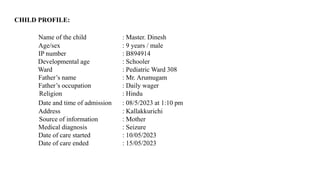
CHILD PROFILE:
Name of the child : Master. Dinesh
Age/sex : 9 years / male
IP number : B894914
Developmental age : Schooler
Ward : Pediatric Ward 308
Father’s name : Mr. Arumugam
Father’s occupation : Daily wager
Religion : Hindu
Date and time of admission : 08/5/2023 at 1:10 pm
Address : Kallakkurichi
Source of information : Mother
Medical diagnosis : Seizure
Date of care started : 10/05/2023
Date of care ended : 15/05/2023
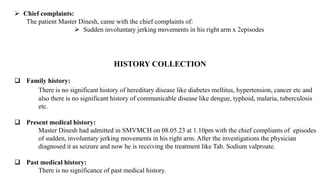
 Chief complaints:
The patient Master Dinesh, came with the chief complaints of:
 Sudden involuntary jerking movements in his right arm x 2episodes
HISTORY COLLECTION
 Family history:
There is no significant history of hereditary disease like diabetes mellitus, hypertension, cancer etc and
also there is no significant history of communicable disease like dengue, typhoid, malaria, tuberculosis
etc.
 Present medical history:
Master Dinesh had admitted in SMVMCH on 08.05.23 at 1.10pm with the chief compliants of episodes
of sudden, involuntary jerking movements in his right arm. After the investigations the physician
diagnosed it as seizure and now he is receiving the treatment like Tab. Sodium valproate.
 Past medical history:
There is no significance of past medical history.
 Present surgical history:
There is no significance of present surgical history.
 Past surgical history:
There is no significance of past surgical history.
 Birth history:
• prenatal history:
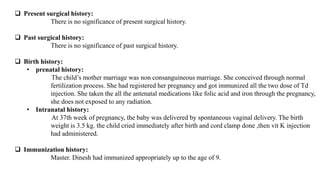
The child’s mother marriage was non consanguineous marriage. She conceived through normal
fertilization process. She had registered her pregnancy and got immunized all the two dose of Td
injection. She taken the all the antenatal medications like folic acid and iron through the pregnancy,
she does not exposed to any radiation.
• Intranatal history:
At 37th week of pregnancy, the baby was delivered by spontaneous vaginal delivery. The birth
weight is 3.5 kg. the child cried immediately after birth and cord clamp done ,then vit K injection
had administered.
 Immunization history:
Master. Dinesh had immunized appropriately up to the age of 9.
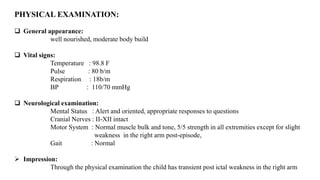
PHYSICAL EXAMINATION:
 General appearance:
well nourished, moderate body build
 Vital signs:
Temperature : 98.8 F
Pulse : 80 b/m
Respiration : 18b/m
BP : 110/70 mmHg
 Neurological examination:
Mental Status : Alert and oriented, appropriate responses to questions
Cranial Nerves : II-XII intact
Motor System : Normal muscle bulk and tone, 5/5 strength in all extremities except for slight
weakness in the right arm post-episode,
Gait : Normal
 Impression:
Through the physical examination the child has transient post ictal weakness in the right arm
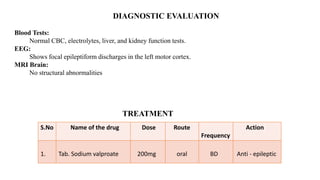
DIAGNOSTIC EVALUATION
Blood Tests:
Normal CBC, electrolytes, liver, and kidney function tests.
EEG:
Shows focal epileptiform discharges in the left motor cortex.
MRI Brain:
No structural abnormalities
TREATMENT
S.No Name of the drug Dose Route
Frequency
Action
1. Tab. Sodium valproate 200mg oral BD Anti - epileptic
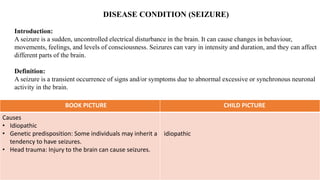
DISEASE CONDITION (SEIZURE)
Introduction:
A seizure is a sudden, uncontrolled electrical disturbance in the brain. It can cause changes in behaviour,
movements, feelings, and levels of consciousness. Seizures can vary in intensity and duration, and they can affect
different parts of the brain.
Definition:
A seizure is a transient occurrence of signs and/or symptoms due to abnormal excessive or synchronous neuronal
activity in the brain.
BOOK PICTURE CHILD PICTURE
Causes
• Idiopathic
• Genetic predisposition: Some individuals may inherit a
tendency to have seizures.
• Head trauma: Injury to the brain can cause seizures.
idiopathic
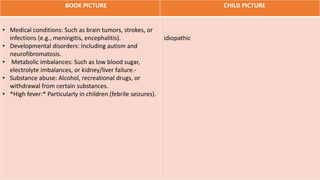
BOOK PICTURE CHILD PICTURE
• Medical conditions: Such as brain tumors, strokes, or
infections (e.g., meningitis, encephalitis).
• Developmental disorders: Including autism and
neurofibromatosis.
• Metabolic imbalances: Such as low blood sugar,
electrolyte imbalances, or kidney/liver failure.-
• Substance abuse: Alcohol, recreational drugs, or
withdrawal from certain substances.
• *High fever:* Particularly in children (febrile seizures).
idiopathic
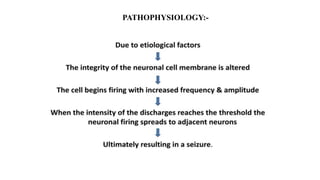
PATHOPHYSIOLOGY:-
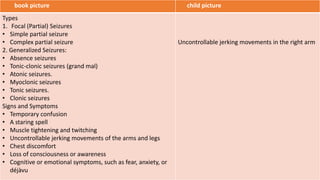
book picture child picture
Types
1. Focal (Partial) Seizures
• Simple partial seizure
• Complex partial seizure
2. Generalized Seizures:
• Absence seizures
• Tonic-clonic seizures (grand mal)
• Atonic seizures.
• Myoclonic seizures
• Tonic seizures.
• Clonic seizures
Signs and Symptoms
• Temporary confusion
• A staring spell
• Muscle tightening and twitching
• Uncontrollable jerking movements of the arms and legs
• Chest discomfort
• Loss of consciousness or awareness
• Cognitive or emotional symptoms, such as fear, anxiety, or
déjàvu
Uncontrollable jerking movements in the right arm
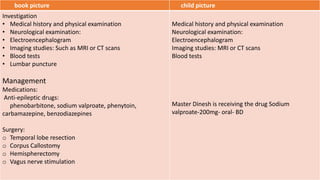
book picture child picture
Investigation
• Medical history and physical examination
• Neurological examination:
• Electroencephalogram
• Imaging studies: Such as MRI or CT scans
• Blood tests
• Lumbar puncture
Management
Medications:
Anti-epileptic drugs:
phenobarbitone, sodium valproate, phenytoin,
carbamazepine, benzodiazepines
Surgery:
o Temporal lobe resection
o Corpus Callostomy
o Hemispherectomy
o Vagus nerve stimulation
Medical history and physical examination
Neurological examination:
Electroencephalogram
Imaging studies: MRI or CT scans
Blood tests
Master Dinesh is receiving the drug Sodium
valproate-200mg- oral- BD
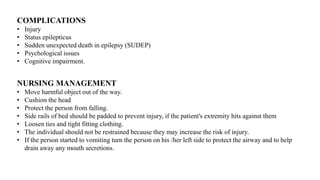
NURSING MANAGEMENT
• Move harmful object out of the way.
• Cushion the head
• Protect the person from falling.
• Side rails of bed should be padded to prevent injury, if the patient's extremity hits against them
• Loosen ties and tight fitting clothing.
• The individual should not be restrained because they may increase the risk of injury.
• If the person started to vomiting turn the person on his /her left side to protect the airway and to help
drain away any mouth secretions.
COMPLICATIONS
• Injury
• Status epilepticus
• Sudden unexpected death in epilepsy (SUDEP)
• Psychological issues
• Cognitive impairment.
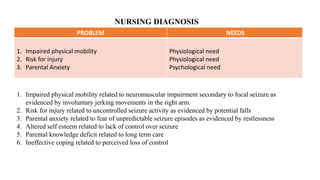
NURSING DIAGNOSIS
1. Impaired physical mobility related to neuromuscular impairment secondary to focal seizure as
evidenced by involuntary jerking movements in the right arm.
2. Risk for injury related to uncontrolled seizure activity as evidenced by potential falls
3. Parental anxiety related to fear of unpredictable seizure episodes as evidenced by restlessness
4. Altered self esteem related to lack of control over seizure
5. Parental knowledge deficit related to long term care
6. Ineffective coping related to perceived loss of control
PROBLEM NEEDS
1. Impaired physical mobility
2. Risk for injury
3. Parental Anxiety
Physiological need
Physiological need
Psychological need
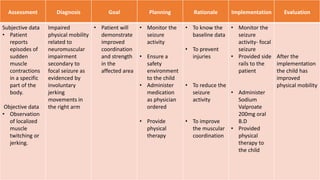
Assessment Diagnosis Goal Planning Rationale Implementation Evaluation
Subjective data
• Patient
reports
episodes of
sudden
muscle
contractions
in a specific
part of the
body.
Objective data
• Observation
of localized
muscle
twitching or
jerking.
Impaired
physical mobility
related to
neuromuscular
impairment
secondary to
focal seizure as
evidenced by
involuntary
jerking
movements in
the right arm
• Patient will
demonstrate
improved
coordination
and strength
in the
affected area
• Monitor the
seizure
activity
• Ensure a
safety
environment
to the child
• Administer
medication
as physician
ordered
• Provide
physical
therapy
• To know the
baseline data
• To prevent
injuries
• To reduce the
seizure
activity
• To improve
the muscular
coordination
• Monitor the
seizure
activity- focal
seizure
• Provided side
rails to the
patient
• Administer
Sodium
Valproate
200mg oral
B.D
• Provided
physical
therapy to
the child
After the
implementation
the child has
improved
physical mobility
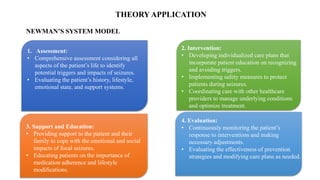
THEORY APPLICATION
NEWMAN’S SYSTEM MODEL
2. Intervention:
• Developing individualized care plans that
incorporate patient education on recognizing
and avoiding triggers.
• Implementing safety measures to protect
patients during seizures.
• Coordinating care with other healthcare
providers to manage underlying conditions
and optimize treatment.
1. Assessment:
• Comprehensive assessment considering all
aspects of the patient’s life to identify
potential triggers and impacts of seizures.
• Evaluating the patient’s history, lifestyle,
emotional state, and support systems.
3. Support and Education:
• Providing support to the patient and their
family to cope with the emotional and social
impacts of focal seizures.
• Educating patients on the importance of
medication adherence and lifestyle
modifications.
4. Evaluation:
• Continuously monitoring the patient’s
response to interventions and making
necessary adjustments.
• Evaluating the effectiveness of prevention
strategies and modifying care plans as needed.
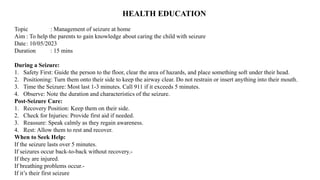
HEALTH EDUCATION
Topic : Management of seizure at home
Aim : To help the parents to gain knowledge about caring the child with seizure
Date: 10/05/2023
Duration : 15 mins
During a Seizure:
1. Safety First: Guide the person to the floor, clear the area of hazards, and place something soft under their head.
2. Positioning: Turn them onto their side to keep the airway clear. Do not restrain or insert anything into their mouth.
3. Time the Seizure: Most last 1-3 minutes. Call 911 if it exceeds 5 minutes.
4. Observe: Note the duration and characteristics of the seizure.
Post-Seizure Care:
1. Recovery Position: Keep them on their side.
2. Check for Injuries: Provide first aid if needed.
3. Reassure: Speak calmly as they regain awareness.
4. Rest: Allow them to rest and recover.
When to Seek Help:
If the seizure lasts over 5 minutes.
If seizures occur back-to-back without recovery.-
If they are injured.
If breathing problems occur.-
If it’s their first seizure
SUMMARY:
So, far, I have discussed about the baby. Master Dinesh, who got admitted with the chief complaints of ,
involuntary jerking movements in his right arm. I had explained about his history, physical examination,
investigation, treatment, disease condition of SEIZURE, nursing diagnosis, nursing intervention, health
education etc.
CONCLUSION:
Through this clinical presentation we possess some knowledge regarding SEIZURE.
BIBLIOGRAPHY:
BOOK REFERENCES:
 Parul datta, paediatric nursing 4th edition
 Rimple sharma textbook of essentials of pediatric nursing 3rd edition
 Marlos’s textbook of pediatric nursing south asian edition
 Pr. Ashalatha textbook of anatomy and physiology fourth edition.
NET REFERENCES:
 www.ncbi.nlm.nih.gov
 www.nursestudy.net
 www.myoclinic.com
 www.wekipidia.com
JOURNAL REFERNCE
TOPIC : Management of acute seizure in children
AUTHOR : Ornella Ciccone et.al,
PUBLICATION : 28 Oct 2017
JOURNAL : PubMed Central (PMC6246874)
ABSTRACT
Acute seizures are a prevalent medical emergency in African settings, necessitating simultaneous
management and diagnostic assessment, particularly for life-threatening causes like hypoglycemia and malaria.
Initial treatment with benzodiazepines is recommended for ongoing seizures, with evidence supporting various
agents and delivery modes. If seizures persist after two doses of benzodiazepines, longer-acting antiepileptic
drugs (AEDs) should be administered. There is limited evidence on the comparative efficacy of different long-
acting AEDs for acute seizure management in African children, and data from Western settings may not be
directly applicable due to differing etiologies and risk factors.
Seizure Nursing care plan with journal reference

Seizure Nursing care plan with journal reference

  • 1.
    PRESENTED BY: JESVIN FERNANDEZ, B.Sc.NURSING IV YEAR, SMVNC, PUDUCHERRY.
  • 2.
    CHILD PROFILE: Name ofthe child : Master. Dinesh Age/sex : 9 years / male IP number : B894914 Developmental age : Schooler Ward : Pediatric Ward 308 Father’s name : Mr. Arumugam Father’s occupation : Daily wager Religion : Hindu Date and time of admission : 08/5/2023 at 1:10 pm Address : Kallakkurichi Source of information : Mother Medical diagnosis : Seizure Date of care started : 10/05/2023 Date of care ended : 15/05/2023
  • 3.
     Chief complaints: Thepatient Master Dinesh, came with the chief complaints of:  Sudden involuntary jerking movements in his right arm x 2episodes HISTORY COLLECTION  Family history: There is no significant history of hereditary disease like diabetes mellitus, hypertension, cancer etc and also there is no significant history of communicable disease like dengue, typhoid, malaria, tuberculosis etc.  Present medical history: Master Dinesh had admitted in SMVMCH on 08.05.23 at 1.10pm with the chief compliants of episodes of sudden, involuntary jerking movements in his right arm. After the investigations the physician diagnosed it as seizure and now he is receiving the treatment like Tab. Sodium valproate.  Past medical history: There is no significance of past medical history.
  • 4.
     Present surgicalhistory: There is no significance of present surgical history.  Past surgical history: There is no significance of past surgical history.  Birth history: • prenatal history: The child’s mother marriage was non consanguineous marriage. She conceived through normal fertilization process. She had registered her pregnancy and got immunized all the two dose of Td injection. She taken the all the antenatal medications like folic acid and iron through the pregnancy, she does not exposed to any radiation. • Intranatal history: At 37th week of pregnancy, the baby was delivered by spontaneous vaginal delivery. The birth weight is 3.5 kg. the child cried immediately after birth and cord clamp done ,then vit K injection had administered.  Immunization history: Master. Dinesh had immunized appropriately up to the age of 9.
  • 5.
    PHYSICAL EXAMINATION:  Generalappearance: well nourished, moderate body build  Vital signs: Temperature : 98.8 F Pulse : 80 b/m Respiration : 18b/m BP : 110/70 mmHg  Neurological examination: Mental Status : Alert and oriented, appropriate responses to questions Cranial Nerves : II-XII intact Motor System : Normal muscle bulk and tone, 5/5 strength in all extremities except for slight weakness in the right arm post-episode, Gait : Normal  Impression: Through the physical examination the child has transient post ictal weakness in the right arm
  • 6.
    DIAGNOSTIC EVALUATION Blood Tests: NormalCBC, electrolytes, liver, and kidney function tests. EEG: Shows focal epileptiform discharges in the left motor cortex. MRI Brain: No structural abnormalities TREATMENT S.No Name of the drug Dose Route Frequency Action 1. Tab. Sodium valproate 200mg oral BD Anti - epileptic
  • 7.
    DISEASE CONDITION (SEIZURE) Introduction: Aseizure is a sudden, uncontrolled electrical disturbance in the brain. It can cause changes in behaviour, movements, feelings, and levels of consciousness. Seizures can vary in intensity and duration, and they can affect different parts of the brain. Definition: A seizure is a transient occurrence of signs and/or symptoms due to abnormal excessive or synchronous neuronal activity in the brain. BOOK PICTURE CHILD PICTURE Causes • Idiopathic • Genetic predisposition: Some individuals may inherit a tendency to have seizures. • Head trauma: Injury to the brain can cause seizures. idiopathic
  • 8.
    BOOK PICTURE CHILDPICTURE • Medical conditions: Such as brain tumors, strokes, or infections (e.g., meningitis, encephalitis). • Developmental disorders: Including autism and neurofibromatosis. • Metabolic imbalances: Such as low blood sugar, electrolyte imbalances, or kidney/liver failure.- • Substance abuse: Alcohol, recreational drugs, or withdrawal from certain substances. • *High fever:* Particularly in children (febrile seizures). idiopathic
  • 9.
  • 10.
    book picture childpicture Types 1. Focal (Partial) Seizures • Simple partial seizure • Complex partial seizure 2. Generalized Seizures: • Absence seizures • Tonic-clonic seizures (grand mal) • Atonic seizures. • Myoclonic seizures • Tonic seizures. • Clonic seizures Signs and Symptoms • Temporary confusion • A staring spell • Muscle tightening and twitching • Uncontrollable jerking movements of the arms and legs • Chest discomfort • Loss of consciousness or awareness • Cognitive or emotional symptoms, such as fear, anxiety, or déjàvu Uncontrollable jerking movements in the right arm
  • 11.
    book picture childpicture Investigation • Medical history and physical examination • Neurological examination: • Electroencephalogram • Imaging studies: Such as MRI or CT scans • Blood tests • Lumbar puncture Management Medications: Anti-epileptic drugs: phenobarbitone, sodium valproate, phenytoin, carbamazepine, benzodiazepines Surgery: o Temporal lobe resection o Corpus Callostomy o Hemispherectomy o Vagus nerve stimulation Medical history and physical examination Neurological examination: Electroencephalogram Imaging studies: MRI or CT scans Blood tests Master Dinesh is receiving the drug Sodium valproate-200mg- oral- BD
  • 12.
    NURSING MANAGEMENT • Moveharmful object out of the way. • Cushion the head • Protect the person from falling. • Side rails of bed should be padded to prevent injury, if the patient's extremity hits against them • Loosen ties and tight fitting clothing. • The individual should not be restrained because they may increase the risk of injury. • If the person started to vomiting turn the person on his /her left side to protect the airway and to help drain away any mouth secretions. COMPLICATIONS • Injury • Status epilepticus • Sudden unexpected death in epilepsy (SUDEP) • Psychological issues • Cognitive impairment.
  • 13.
    NURSING DIAGNOSIS 1. Impairedphysical mobility related to neuromuscular impairment secondary to focal seizure as evidenced by involuntary jerking movements in the right arm. 2. Risk for injury related to uncontrolled seizure activity as evidenced by potential falls 3. Parental anxiety related to fear of unpredictable seizure episodes as evidenced by restlessness 4. Altered self esteem related to lack of control over seizure 5. Parental knowledge deficit related to long term care 6. Ineffective coping related to perceived loss of control PROBLEM NEEDS 1. Impaired physical mobility 2. Risk for injury 3. Parental Anxiety Physiological need Physiological need Psychological need
  • 14.
    Assessment Diagnosis GoalPlanning Rationale Implementation Evaluation Subjective data • Patient reports episodes of sudden muscle contractions in a specific part of the body. Objective data • Observation of localized muscle twitching or jerking. Impaired physical mobility related to neuromuscular impairment secondary to focal seizure as evidenced by involuntary jerking movements in the right arm • Patient will demonstrate improved coordination and strength in the affected area • Monitor the seizure activity • Ensure a safety environment to the child • Administer medication as physician ordered • Provide physical therapy • To know the baseline data • To prevent injuries • To reduce the seizure activity • To improve the muscular coordination • Monitor the seizure activity- focal seizure • Provided side rails to the patient • Administer Sodium Valproate 200mg oral B.D • Provided physical therapy to the child After the implementation the child has improved physical mobility
  • 15.
    THEORY APPLICATION NEWMAN’S SYSTEMMODEL 2. Intervention: • Developing individualized care plans that incorporate patient education on recognizing and avoiding triggers. • Implementing safety measures to protect patients during seizures. • Coordinating care with other healthcare providers to manage underlying conditions and optimize treatment. 1. Assessment: • Comprehensive assessment considering all aspects of the patient’s life to identify potential triggers and impacts of seizures. • Evaluating the patient’s history, lifestyle, emotional state, and support systems. 3. Support and Education: • Providing support to the patient and their family to cope with the emotional and social impacts of focal seizures. • Educating patients on the importance of medication adherence and lifestyle modifications. 4. Evaluation: • Continuously monitoring the patient’s response to interventions and making necessary adjustments. • Evaluating the effectiveness of prevention strategies and modifying care plans as needed.
  • 16.
    HEALTH EDUCATION Topic :Management of seizure at home Aim : To help the parents to gain knowledge about caring the child with seizure Date: 10/05/2023 Duration : 15 mins During a Seizure: 1. Safety First: Guide the person to the floor, clear the area of hazards, and place something soft under their head. 2. Positioning: Turn them onto their side to keep the airway clear. Do not restrain or insert anything into their mouth. 3. Time the Seizure: Most last 1-3 minutes. Call 911 if it exceeds 5 minutes. 4. Observe: Note the duration and characteristics of the seizure. Post-Seizure Care: 1. Recovery Position: Keep them on their side. 2. Check for Injuries: Provide first aid if needed. 3. Reassure: Speak calmly as they regain awareness. 4. Rest: Allow them to rest and recover. When to Seek Help: If the seizure lasts over 5 minutes. If seizures occur back-to-back without recovery.- If they are injured. If breathing problems occur.- If it’s their first seizure
  • 17.
    SUMMARY: So, far, Ihave discussed about the baby. Master Dinesh, who got admitted with the chief complaints of , involuntary jerking movements in his right arm. I had explained about his history, physical examination, investigation, treatment, disease condition of SEIZURE, nursing diagnosis, nursing intervention, health education etc. CONCLUSION: Through this clinical presentation we possess some knowledge regarding SEIZURE.
  • 18.
    BIBLIOGRAPHY: BOOK REFERENCES:  Paruldatta, paediatric nursing 4th edition  Rimple sharma textbook of essentials of pediatric nursing 3rd edition  Marlos’s textbook of pediatric nursing south asian edition  Pr. Ashalatha textbook of anatomy and physiology fourth edition. NET REFERENCES:  www.ncbi.nlm.nih.gov  www.nursestudy.net  www.myoclinic.com  www.wekipidia.com
  • 19.
    JOURNAL REFERNCE TOPIC :Management of acute seizure in children AUTHOR : Ornella Ciccone et.al, PUBLICATION : 28 Oct 2017 JOURNAL : PubMed Central (PMC6246874) ABSTRACT Acute seizures are a prevalent medical emergency in African settings, necessitating simultaneous management and diagnostic assessment, particularly for life-threatening causes like hypoglycemia and malaria. Initial treatment with benzodiazepines is recommended for ongoing seizures, with evidence supporting various agents and delivery modes. If seizures persist after two doses of benzodiazepines, longer-acting antiepileptic drugs (AEDs) should be administered. There is limited evidence on the comparative efficacy of different long- acting AEDs for acute seizure management in African children, and data from Western settings may not be directly applicable due to differing etiologies and risk factors.