1
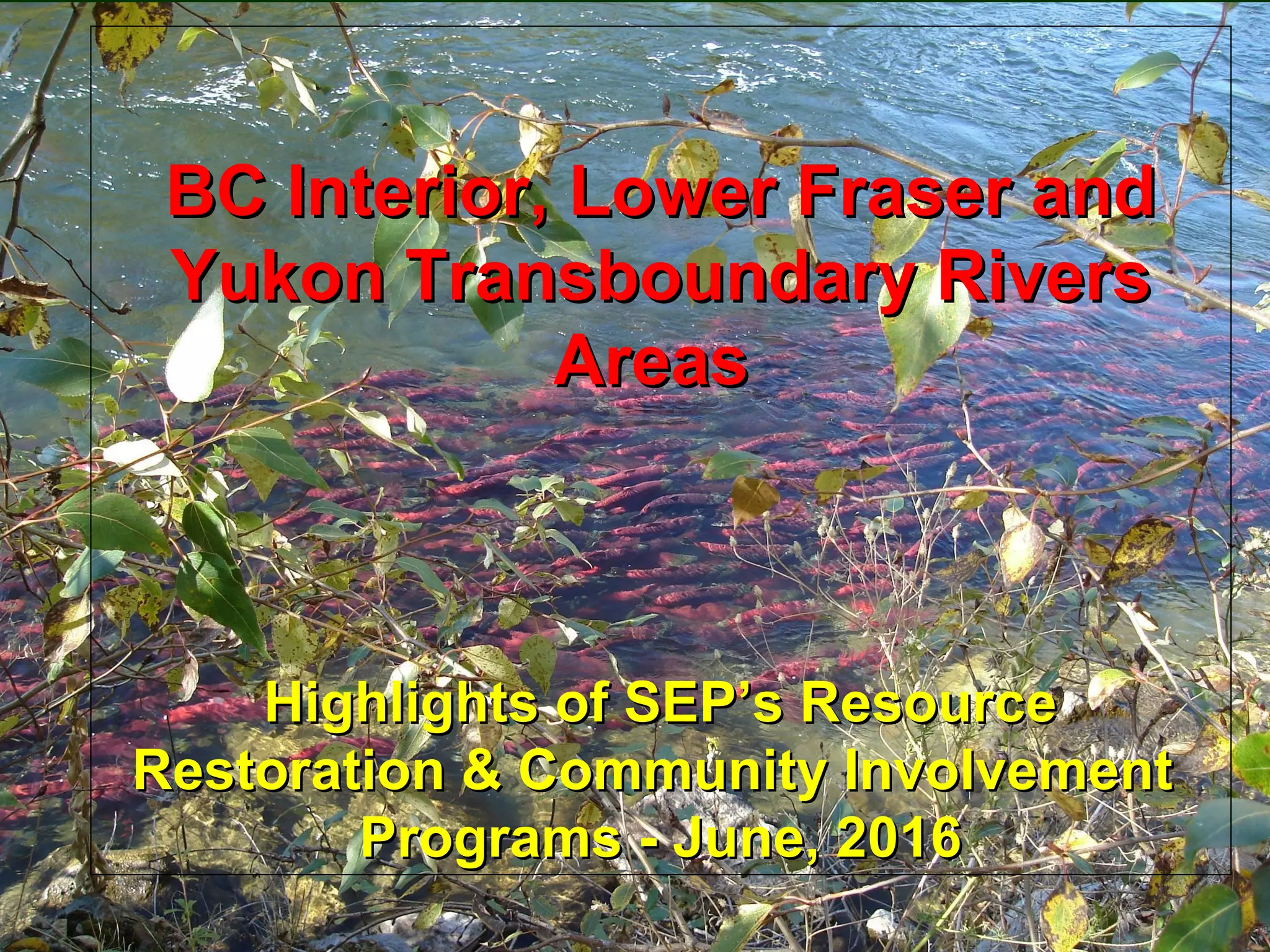
BC Interior, Lower Fraser andBC Interior, Lower Fraser and
Yukon Transboundary RiversYukon Transboundary Rivers
AreasAreas
Highlights of SEP’s ResourceHighlights of SEP’s Resource
Restoration & Community InvolvementRestoration & Community Involvement
Programs - June, 2016Programs - June, 2016
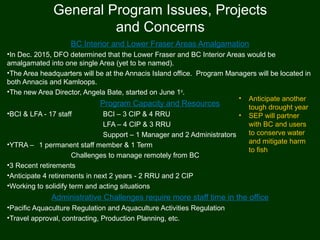
General Program Issues, Projects
and Concerns
BC Interior and Lower Fraser Areas Amalgamation
•In Dec. 2015, DFO determined that the Lower Fraser and BC Interior Areas would be
amalgamated into one single Area (yet to be named).
•The Area headquarters will be at the Annacis Island office. Program Managers will be located in
both Annacis and Kamloops.
•The new Area Director, Angela Bate, started on June 1st
.
Program Capacity and Resources
•BCI & LFA - 17 staff BCI – 3 CIP & 4 RRU
LFA – 4 CIP & 3 RRU
Support – 1 Manager and 2 Administrators
•YTRA – 1 permanent staff member & 1 Term
Challenges to manage remotely from BC
•3 Recent retirements
•Anticipate 4 retirements in next 2 years - 2 RRU and 2 CIP
•Working to solidify term and acting situations
Administrative Challenges require more staff time in the office
•Pacific Aquaculture Regulation and Aquaculture Activities Regulation
•Travel approval, contracting, Production Planning, etc.
• Anticipate another
tough drought year
• SEP will partner
with BC and users
to conserve water
and mitigate harm
to fish
Spruce City Wildlife
•Spruce City Wildlife has been a long standing PIP
partner, but has been relatively dormant for a number
of years.
•Recent leadership changes have resulted in a re-
invigorated interest in the facility and its support for
Education and Stewardship.
•This begins to address a missing gap in the Upper
Fraser Program since loss of Penny CEDP
2017 SEP Community Workshop
•Baker Creek Society in Quesnel has been
selected to host the 2017 Regional Community
Workshop
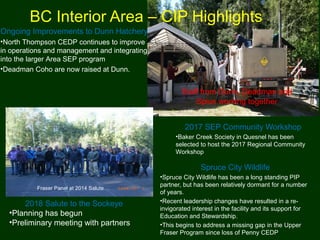
Ongoing Improvements to Dunn Hatchery
•North Thompson CEDP continues to improve
in operations and management and integrating
into the larger Area SEP program
•Deadman Coho are now raised at Dunn.
2018 Salute to the Sockeye
•Planning has begun
•Preliminary meeting with partners
Staff from Dunn, Deadman and
Spius working together
Fraser Panel at 2014 Salute
BC Interior Area – CIP Highlights
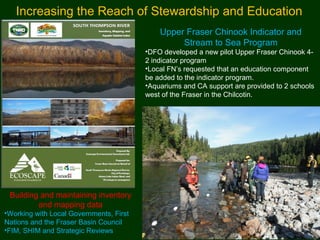
Upper Fraser Chinook Indicator and
Stream to Sea Program
•DFO developed a new pilot Upper Fraser Chinook 4-
2 indicator program
•Local FN’s requested that an education component
be added to the indicator program.
•Aquariums and CA support are provided to 2 schools
west of the Fraser in the Chilcotin.
Increasing the Reach of Stewardship and Education
Building and maintaining inventory
and mapping data
•Working with Local Governments, First
Nations and the Fraser Basin Council
•FIM, SHIM and Strategic Reviews
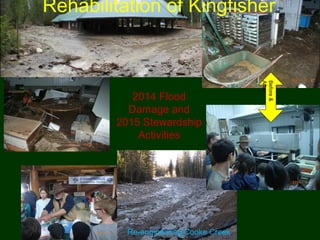
2014 Flood
Damage and
2015 Stewardship
Activities
Rehabilitation of Kingfisher
Re-engineering Cooke Creek
Before&
After
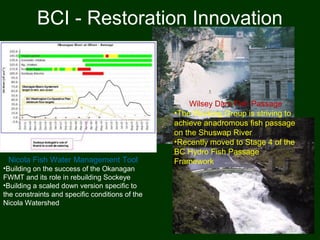
BCI - Restoration Innovation
Nicola Fish Water Management Tool
•Building on the success of the Okanagan
FWMT and its role in rebuilding Sockeye
•Building a scaled down version specific to
the constraints and specific conditions of the
Nicola Watershed
Wilsey Dam Fish Passage
•The Working Group is striving to
achieve anadromous fish passage
on the Shuswap River
•Recently moved to Stage 4 of the
BC Hydro Fish Passage
Framework
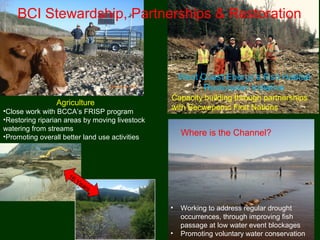
Agriculture
•Close work with BCCA’s FRISP program
•Restoring riparian areas by moving livestock
watering from streams
•Promoting overall better land use activities
Where is the Channel?
• Working to address regular drought
occurrences, through improving fish
passage at low water event blockages
• Promoting voluntary water conservation
BCI Stewardship, Partnerships & Restoration
West Coast Energy’s Fish Habitat
Restoration Initiative
Capacity building through partnerships
with Secwepemc First Nations
16 Years
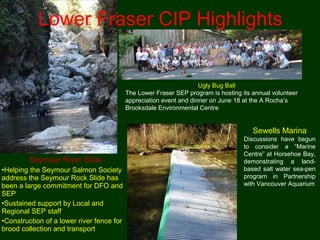
Ugly Bug Ball
The Lower Fraser SEP program is hosting its annual volunteer
appreciation event and dinner on June 18 at the A Rocha’s
Brooksdale Environmental Centre
Sewells Marina
Discussions have begun
to consider a “Marine
Centre” at Horsehoe Bay,
demonstrating a land-
based salt water sea-pen
program in Partnership
with Vancouver Aquarium
Seymour River Slide
•Helping the Seymour Salmon Society
address the Seymour Rock Slide has
been a large commitment for DFO and
SEP
•Sustained support by Local and
Regional SEP staff
•Construction of a lower river fence for
brood collection and transport
Lower Fraser CIP Highlights
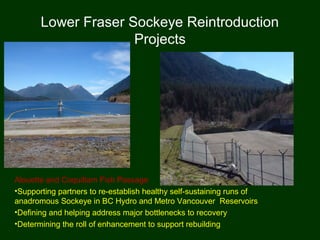
Lower Fraser Sockeye Reintroduction
Projects
Alouette and Coquitlam Fish Passage
•Supporting partners to re-establish healthy self-sustaining runs of
anadromous Sockeye in BC Hydro and Metro Vancouver Reservoirs
•Defining and helping address major bottlenecks to recovery
•Determining the roll of enhancement to support rebuilding
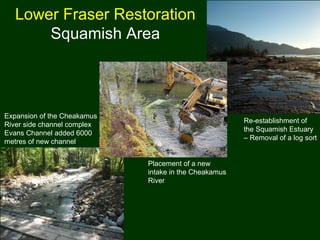
Lower Fraser Restoration
Squamish Area
Re-establishment of
the Squamish Estuary
– Removal of a log sort
Expansion of the Cheakamus
River side channel complex
Evans Channel added 6000
metres of new channel
Placement of a new
intake in the Cheakamus
River
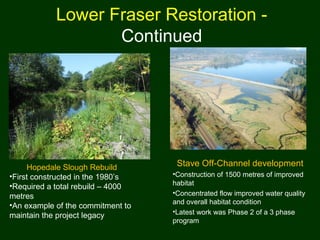
Lower Fraser Restoration -
Continued
Stave Off-Channel development
•Construction of 1500 metres of improved
habitat
•Concentrated flow improved water quality
and overall habitat condition
•Latest work was Phase 2 of a 3 phase
program
Hopedale Slough Rebuild
•First constructed in the 1980’s
•Required a total rebuild – 4000
metres
•An example of the commitment to
maintain the project legacy
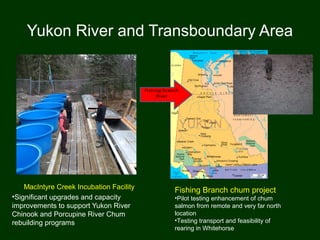
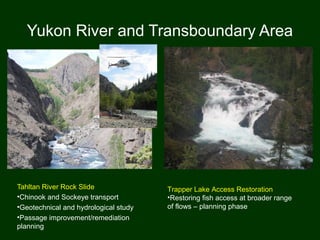
Yukon River and Transboundary Area
MacIntyre Creek Incubation Facility
•Significant upgrades and capacity
improvements to support Yukon River
Chinook and Porcupine River Chum
rebuilding programs
Fishing Branch chum project
•Pilot testing enhancement of chum
salmon from remote and very far north
location
•Testing transport and feasibility of
rearing in Whitehorse
Yukon River and Transboundary Area
Tahltan River Rock Slide
•Chinook and Sockeye transport
•Geotechnical and hydrological study
•Passage improvement/remediation
planning
Trapper Lake Access Restoration
•Restoring fish access at broader range
of flows – planning phase

June 4, 2016 - BC Interior,Lower Fraser and Yukon Transboundary RiversAreas

  • 1.
    1 BC Interior, LowerFraser andBC Interior, Lower Fraser and Yukon Transboundary RiversYukon Transboundary Rivers AreasAreas Highlights of SEP’s ResourceHighlights of SEP’s Resource Restoration & Community InvolvementRestoration & Community Involvement Programs - June, 2016Programs - June, 2016
  • 2.
    General Program Issues,Projects and Concerns BC Interior and Lower Fraser Areas Amalgamation •In Dec. 2015, DFO determined that the Lower Fraser and BC Interior Areas would be amalgamated into one single Area (yet to be named). •The Area headquarters will be at the Annacis Island office. Program Managers will be located in both Annacis and Kamloops. •The new Area Director, Angela Bate, started on June 1st . Program Capacity and Resources •BCI & LFA - 17 staff BCI – 3 CIP & 4 RRU LFA – 4 CIP & 3 RRU Support – 1 Manager and 2 Administrators •YTRA – 1 permanent staff member & 1 Term Challenges to manage remotely from BC •3 Recent retirements •Anticipate 4 retirements in next 2 years - 2 RRU and 2 CIP •Working to solidify term and acting situations Administrative Challenges require more staff time in the office •Pacific Aquaculture Regulation and Aquaculture Activities Regulation •Travel approval, contracting, Production Planning, etc. • Anticipate another tough drought year • SEP will partner with BC and users to conserve water and mitigate harm to fish
  • 3.
    Spruce City Wildlife •SpruceCity Wildlife has been a long standing PIP partner, but has been relatively dormant for a number of years. •Recent leadership changes have resulted in a re- invigorated interest in the facility and its support for Education and Stewardship. •This begins to address a missing gap in the Upper Fraser Program since loss of Penny CEDP 2017 SEP Community Workshop •Baker Creek Society in Quesnel has been selected to host the 2017 Regional Community Workshop Ongoing Improvements to Dunn Hatchery •North Thompson CEDP continues to improve in operations and management and integrating into the larger Area SEP program •Deadman Coho are now raised at Dunn. 2018 Salute to the Sockeye •Planning has begun •Preliminary meeting with partners Staff from Dunn, Deadman and Spius working together Fraser Panel at 2014 Salute BC Interior Area – CIP Highlights
  • 4.
    Upper Fraser ChinookIndicator and Stream to Sea Program •DFO developed a new pilot Upper Fraser Chinook 4- 2 indicator program •Local FN’s requested that an education component be added to the indicator program. •Aquariums and CA support are provided to 2 schools west of the Fraser in the Chilcotin. Increasing the Reach of Stewardship and Education Building and maintaining inventory and mapping data •Working with Local Governments, First Nations and the Fraser Basin Council •FIM, SHIM and Strategic Reviews
  • 5.
    2014 Flood Damage and 2015Stewardship Activities Rehabilitation of Kingfisher Re-engineering Cooke Creek Before& After
  • 6.
    BCI - RestorationInnovation Nicola Fish Water Management Tool •Building on the success of the Okanagan FWMT and its role in rebuilding Sockeye •Building a scaled down version specific to the constraints and specific conditions of the Nicola Watershed Wilsey Dam Fish Passage •The Working Group is striving to achieve anadromous fish passage on the Shuswap River •Recently moved to Stage 4 of the BC Hydro Fish Passage Framework
  • 7.
    Agriculture •Close work withBCCA’s FRISP program •Restoring riparian areas by moving livestock watering from streams •Promoting overall better land use activities Where is the Channel? • Working to address regular drought occurrences, through improving fish passage at low water event blockages • Promoting voluntary water conservation BCI Stewardship, Partnerships & Restoration West Coast Energy’s Fish Habitat Restoration Initiative Capacity building through partnerships with Secwepemc First Nations 16 Years
  • 8.
    Ugly Bug Ball TheLower Fraser SEP program is hosting its annual volunteer appreciation event and dinner on June 18 at the A Rocha’s Brooksdale Environmental Centre Sewells Marina Discussions have begun to consider a “Marine Centre” at Horsehoe Bay, demonstrating a land- based salt water sea-pen program in Partnership with Vancouver Aquarium Seymour River Slide •Helping the Seymour Salmon Society address the Seymour Rock Slide has been a large commitment for DFO and SEP •Sustained support by Local and Regional SEP staff •Construction of a lower river fence for brood collection and transport Lower Fraser CIP Highlights
  • 9.
    Lower Fraser SockeyeReintroduction Projects Alouette and Coquitlam Fish Passage •Supporting partners to re-establish healthy self-sustaining runs of anadromous Sockeye in BC Hydro and Metro Vancouver Reservoirs •Defining and helping address major bottlenecks to recovery •Determining the roll of enhancement to support rebuilding
  • 10.
    Lower Fraser Restoration SquamishArea Re-establishment of the Squamish Estuary – Removal of a log sort Expansion of the Cheakamus River side channel complex Evans Channel added 6000 metres of new channel Placement of a new intake in the Cheakamus River
  • 11.
    Lower Fraser Restoration- Continued Stave Off-Channel development •Construction of 1500 metres of improved habitat •Concentrated flow improved water quality and overall habitat condition •Latest work was Phase 2 of a 3 phase program Hopedale Slough Rebuild •First constructed in the 1980’s •Required a total rebuild – 4000 metres •An example of the commitment to maintain the project legacy
  • 12.
    Yukon River andTransboundary Area MacIntyre Creek Incubation Facility •Significant upgrades and capacity improvements to support Yukon River Chinook and Porcupine River Chum rebuilding programs Fishing Branch chum project •Pilot testing enhancement of chum salmon from remote and very far north location •Testing transport and feasibility of rearing in Whitehorse
  • 13.
    Yukon River andTransboundary Area Tahltan River Rock Slide •Chinook and Sockeye transport •Geotechnical and hydrological study •Passage improvement/remediation planning Trapper Lake Access Restoration •Restoring fish access at broader range of flows – planning phase

Editor's Notes

  • #3 Set out the realities of service delivery and support capacity. Help set lower expectations of support in coming years as capacity and availability to be in the field declines.
  • #5 Upper Fraser Chinnok Indicator/S2S - we are also working hard at trying to bring partners together to provide S2S type programing for the remote and very rural 1st nation communities as well in the Middle Fraser and North Thompson areas (about 30 sites). Point is that not all kids especially those in small communities who rely on fish get this programing as its difficult to support in these areas compares to urban areas. Looking for partners with a few $.
  • #6 This slide is intended to provide a quick update in the Kingfisher recovery and show the hard work of the volunteers and agencies to get the facility repaired very quickly – in less than a year it was back into production. Most of the cost and agency work (Doug Edwards was instrumental) went into the engineered dyke and flood protection works. This was essential to getting an occupancy permit to re-start the program
  • #8 There is a very blurred line between the activities of CIP and RRU. Most activities engage both groups. Anticipate BCI will be supporting over 40 Restoration projects in 2016-17 WCE Secwepemc program is the most successful in the BCI, and possibly BC. - working very well and meeting program objectives – good projects, building strong relationships, close cooperation between FN, RRU and CIP.
  • #10 These projects require a combination of CIP and RRU support, along with close coordination with SEP Region, and Science
  • #12 LFA RRU expects that it will be participating, and supporting over 40 projects in 2016-17
  • #13 Unlike the rest of the Yukon River Chum which are doing quite well, the Fishing Branch River fish have declined rapidly for reasons that are unknown. There is an emphasis on this river as it is actually named in the Treaty with designated escapement requirements.  Therefore, there is a lot of pressure to sort out why it is declining and try to reverse it.   There are stock and habitat assessments being conducted to try and figure out the causes.  It may be due to their northern latitude and amplified habitat changes from climate change resulting in warmer winters and changes to the permafrost – but no-one knows yet.   What is being conducted this year is a small scale test of the feasibility of logistics and infrastructure of moving fish to a hatchery facility to determine if enhancement could be a component of a recovery program.  This is all very small scale.  Can the fish be caught, held to ripeness in-situ, stripped, transported, reared, marked and returned?  Is it cost prohibitive? There are many variables that need to tested.
  • #14 Tahltan slide in 2014. High freshet flow blocked Chinook and Sockeye Migration. Stocks are important to Pacific Salmon Treaty Fisheries. In partnership with Tahltan Nation Capture and Helicopter transport of ~1091 Chinook and 3,391 . 2015 low freshet fish delayed but migrated as water levels fell. 2016 Northern Endowment funding supported remediation planning. NEF funded studies on Trapper lake suggest sockeye access and reintroduction viable with improvements to fish access at small water fall. Planning project feasibility phase underway.