Seeing Instead of Looking 
By William Deskin, Makenna Schumacher, Jordan Spangrud, Jacquelyn Swanson, and Kendria Zard
Table Of Contents 
• Editorial Team Letter- Slide 3 
• A Boring Night With the Lions- Slides 4-7 
• Saving Private Ryan and the Boy in the Striped Pajamas: Society's Viewpoints- Slides 
8-12 
• Halloween 1978 vs Halloween 2007- Slides 13-16 
• The Fault in Remembering- Slides 17-20 
• Carpe Diem- Slides 21-29
A letter from the editorial team 
No matter what major you plan on pursing in college, one of the classes we are all required to take is English 
101. For many of us, we may approach the class with a martyred sigh of resignation because we have no intent of 
becoming an English major and either feel like “my writing is already good enough” or “I already know writing isn’t 
something I’m very good at”. At the end of this course however, as we stop and reflect on what we have learned 
and examine our writing from the beginning of the class to the end of the class, we are all pleasantly surprised with 
the growth we see and are excited to see what other classes these improved techniques and skills will be used in. 
We learned a lot about the English language, how language connects us to our world, and how it can make 
us think about things in completely different ways. We learned how to think critically, integrate sources into our 
texts, have open minds about how the audience might perceive our essay, the importance of using a wide variety of 
descriptive phrases and words to draw the reader in and keep their attention, what type of writing style works best 
for us, and the importance of thoughtful and careful revisions and editing. In connection with revisions and editing, it 
was interesting to learn how helpful the peer editing process could be, as that was something that pushed many of 
us out of our comfort zone. It’s not human nature to share unfinished work and get peoples critical input and 
opinions. We are much more prone to wait until we feel that something is polished and perfect before we want 
some else to read it; however peer revision and editing turned out to be an excellent tool. It was intriguing to delve 
deeper into the pop culture of music, movies, and television and how that can all impact us. We learned the 
importance of looking at multiple resources to be able to better understand a topic and be equipped to create 
thoughtful responses. 
Another thing we learned was how while the pop culture of music, movies, and television can have brief 
influences on our lives, it can also sometimes have a deep and lasting impact if we really take the time to look at 
what message was trying to be conveyed to us. Sometimes pop culture is dismissed as unimportant, however we 
found that especially through the medium of film, pop culture can have a long and lasting impact. We chose to look 
harder at why musicals and film seem to have such a lasting impact on many of our lives and have decided to 
share our collection of essays on movies and musicals with the hope that the next time you sit down to watch one, 
you will do so with an open mind, ready to really see and not just merely look. 
- William, Jordan, Makenna, Jackie, & Kendria
A Boring Night With the Lions 
by William Deskin 
I stared at the ground as I trudged forward through the shower of rain pouring from the night sky. It was 
perfect. Terrible weather partnered well with the depressing night. I was being dragged into Seattle by my parents 
to see some stupid Lion King musical. I had already seen the movie plenty of times! What a waste of a night. The 
rhythmic pattering of raindrops and the whir of cars driving by was replaced by the roar of thousands of people 
chattering away as we entered the massive building. My mom told me we had 30 minutes until we could go take 
our seats, and then another 15 before the show starts. "Whatever" I mumbled. I was already defeated at this point. 
She could have told me it was going to be 5 hours until the show started and I would have felt exactly the same. 
With a sigh, I sat down against the wall near my parents, who were standing and chatting, somehow enjoying this 
monotony. I thought back to just a few hours ago when I got forced to go along with my parents. Well, I suppose 
they didn't force me. 
"Hey William, we're about to head off to see the musical, change your mind about coming?" My mom asked. 
I don't know why her voice beamed with hopefulness, and I don't know why she was disappointed when I told her 
"No" for the tenth time that week. She couldn't possibly have expected a different answer. "Aww, come on. Why 
don't you want to go? It's the Lion King!" I told her in an irritated voice "Yeah, it may be the Lion King, but watching 
people in costumes dance around singing songs has got to be the most boring activities ever." I thought my 
explanation was clear and understandable, but still she pleaded on. "Oh, please? It's just one night! You never want 
to go places with me and Dad. I promise it will be fun! Besides, what else do you have to do around here?" I quickly 
snapped back "I have homework I need to finish, and I'm never gonna get to do that if you keep talking to me." She 
let out a smirk and stared at me with a knowing gaze. "But I let you play games on my computer earlier because 
you said you were already finished with your homework." Oops. She caught me. "Fine," I said. "I don't have 
homework to do, but staying here will be far more enjoyable than going to that stupid musical." And then, she pulled 
the trigger. The one move of hers that I haven't yet learned how to beat. She pulled her head away from me, and 
sounding as if she was on the verge of tears, she quietly mumbled "Okay, William. You can stay here. We'll miss 
you." A second later she was out of my room and I felt like I was going to explode with frustration. I gave up. 
Without a word I left my room and followed my parents out the door.
At last we had gotten into our seats, and the show was starting any second now. And once it finally started, 
after two or so boring hours, we’ll be out of here and this pointless night will be done with. During the next few 
minutes, I pondered over my feelings. It was my decision to come here. Sure, my mom's guilt strategies played a 
factor in that decision, but no one forced me to come here. In the past, whenever my parents made me go 
somewhere with them, I'd act unhappy and pouty so they would feel as if it was a bad choice to make me come 
with them. And then they'd stop making me go places with them. But if I decided to come here, why shouldn't I be 
able to enjoy myself? Like clockwork, as soon as I finished my train of thought the lights vanished, reappearing on 
the stage a few seconds later. The show had finally begun. Like a fly mindlessly gazing at the infinite light radiating 
from a light bulb, I seemed to disappear from existence. All that was there was the stage. As the orchestra started 
playing, waves of serene sound completely enchanted me. I had never heard anything like it. So much emotion, so 
much beauty. All compressed into simple noise. Vibrations in the air. How was it possible? The music lifted me far 
above the clouds and towards the sun. With my new perspective, suddenly my mentality was refreshed. Why did I 
always want to stay at home? Countless adventures surrounded me. Other worlds to explore, new friends to meet, 
and so much music to hear! I want to experience it all! As warmth flooded my mind, I had my eyes pointed at the 
stage, forever. 
And then, the colors. So many colors! As the performers danced around the stage, glowing beams of light 
shot through the dark theater, exposing the bouquet of flowers everyone seemed to be wearing. I couldn't take my 
eyes off them, not for a second. I couldn't comprehend how the colors were so bright and vivid. As the colors took 
over my vision, I could be anywhere. A lush forest on a sunny day. Looking off the peak of a mountain. I could be in 
Africa with the lions. Entranced and consumed by the show, the concept of time was pushed far aside in my mind 
and suddenly the musical had ended.
As I was walking out of the theater into the lobby, a stumble nearly sent me plummeting to the floor, but my 
mom caught me. I guess I was so focused on the musical that I forgot how to walk. "You okay?" she asked. I 
nodded and she said in a comforting voice "Don't worry, we'll go straight home." But as we were walking through 
the lobby, something caught my eye. "Wait!" My parents stopped walking and looked back at me. I pointed over to 
a vendor in the lobby. "Could we buy the soundtrack of that musical?" As I sat in the car heading towards home, 
with my new C.D. in my hands, my mom was discussing plans with my dad. "So we'll go to the movies next Sunday 
at lunch time. Sounds good." She turned her head back and asked me "Any chance you'd want to come with us 
too? It's fine if you don't want to." Her tone of voice indicated that she expected me to deny the invitation; but she 
was in for a surprise. "Are you kidding me? I'd love to go!"
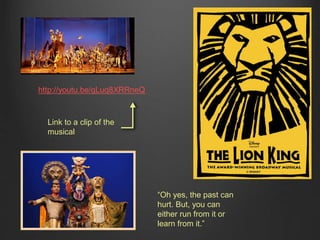
http://youtu.be/gLuq8XRRneQ 
Link to a clip of the 
musical 
“Oh yes, the past can 
hurt. But, you can 
either run from it or 
learn from it.”
Saving Private Ryan and the Boy in the Striped Pajamas: 
Society’s Viewpoints 
Makenna Schumacher 
Over the last sixteen years, incredible movies showcasing the action and horror of World War II were 
created and show many similarities and differences to each other. One film that won numerous Oscars for 
portraying the view points of the soldiers who stormed the beach at Normandy and fought throughout the war in 
Europe, is Saving Private Ryan, directed by Steven Spielberg. This film shows the war from the viewpoints of 
soldiers from the United States. Another film that captured audiences worldwide, was the emotional story of The 
Boy in the Striped Pajamas, directed by Mark Herman. This film captures the story between the son of a Nazi 
Sergeant and a young boy from a neighboring concentration camp. These two films are not only set in the same 
time period, but they also show the many conflicting viewpoints of the different countries involved in World War 
II. Basically, these two films show us how all of society has different views towards certain conflicts and solutions 
based on location, and personal beliefs and also how two completely different films can showcase exactly how 
every human has the capacity to understand different views, emotions, and censors on society. 
Saving Private Ryan tells the story of eight soldiers from the 2nd Ranger Battalion of the 29th Infantry 
Division searching to find the fourth of four brothers who have died fighting in the war. The journey is led by 
Captain Miller, played by actor Tom Hanks. The eight soldiers consist of actors Tom Sizemore, Edward Burns, 
Barry Pepper, Adam Goldberg, Vin Diesel, Giovanni Ribisi and Jeremy Davies.
In the movie the Boy in the Striped Pajamas, a young boy by the name of Bruno, played by Asa 
Butterfield, is faced head on with the war in Germany after he is forced to move to a house next to a 
concentration camp because of his father’s position in the Nazi Army. The story continues with Bruno 
adventuring to the concentration camp and making friends with a young boy about his age, Shmuel, played by 
Jack Scanlon. The boys both don’t necessarily understand what is happening and why Shmuel is in the “farm” as 
renamed by Bruno’s father, played by David Thewlis. The two boys showcase exactly how the two sides, 
consisting of the Arian Race and the other races, did not fully understand why the war was happening. 
When looking at these two films together, you can see that they are taken from different viewpoints and 
believe it or not, those viewpoints could be based on where people are located in the world and whether or not 
they are of a certain race or social group. It’s kind of a hard concept to grasp that countries other than the United 
States viewed World War II from adifferent perspective. For instance, in the movie The Boy in the Striped 
Pajamas, the movie was taken from the perspectives of children from both sides of the war: Bruno of the 
“dominate” Arian Race and Shmuel of the “other races” that were not accepted by the Nazis. When Bruno is at 
his home, he hears about how nice the concentration camps are, but when he talks to Shmuel, he finds out that 
all of the nice things he heard were lies to cover up how awful the adults and children in the concentration camps 
were treated. This just shows one of the ways society had and has different viewpoints towards certain issues in 
society based on location. This is also relevant in the movie Saving Private Ryan. When the group of soldiers is 
part way through their mission to find Private Ryan, they run into a group of Nazi Soldiers at a radio outpost. 
After they bomb the outpost and one of their own men dies of shrapnel wounds, they come in contact with one 
Nazi soldier. The solider does everything he can to try and reverse their decision to kill him, such as trying to sing 
the United States’ National Anthem and cursing Hitler. They let him go, though they fear he will be recaptured by 
the Nazi Army and put back into circulation. Unfortunately, this happens and one of the eight soldiers confronts 
him and kills him for disobeying orders. The Nazi soldier, even though he had been caught in the situation 
between himself and the Americans, still believed he should be fighting with the Nazi Army because it was what 
people back then believed they were supposed to do in Germany. This just shows how society gets their 
viewpoints on certain issues based on what location they are in. Unfortunately, this localization of viewpoints 
within certain areas, social groups and races is very common in today’s society. In popular culture, for example, 
you can use football teams to explain why some viewpoints are dependant on location. According to a survey 
done by Facebook, each state in the United States that has a football team, favors that team as well as the 
surrounding states that also do not have teams (1). Therefore, these movies and even football show us that 
society’s viewpoints on certain issues and subjects are based on their locations.
Between these two films, you can see a resemblance between the characters as well. The two 
characters that connect the most are James’ Mother and Bruno’s Mother. Even though they never say it out loud, 
you can see by their reactions to their children’s deaths and you can tell that they both share the sorrow of losing 
their loved ones to a war for which they could’ve never been involved with in the first place. This shows at the 
end of the film Saving Private Ryan. The end of the movie quotes George C. Marshall saying “Nothing, not even 
the safe return of a beloved son, can compensate you, or the thousands of other American families, who have 
suffered great loss in this tragic war.” This idea of no compensation for death because of the war shows as well 
in the expressions of Bruno’s family at the end of the movie. You could say they were sad but if you think about 
why they were living by the concentration camp in the first place, you realize that in the father’s expression at the 
very end of the movie that the death of his son was preventable and could never be fixed. Regardless to say, 
there is always going to be death caused by preventable things. It will always have an affect on our society no 
matter who is personally involved with the death and these movies show how society also faces this same issue 
of dealing with grief. 
In addition to the films showcasing similar ideas about viewpoints and death, you can see a huge 
difference in the interpretation of the war. In the Boy in the Striped Pajamas, the war is shown from the 
perspective of the Nazis in Germany. You hear about the war from a family that is shielding their children from it. 
Bruno’s father is only ever spoken of as a man of “authority” in the Nazi Army. Bruno has no idea that 
concentration camp that is behind their house is a place where Jews and people of other religions and races are 
sent to die. Whereas, Saving Private Ryan is from the perspective of soldiers in the war. It shows every gory 
detail of the war including the hundreds killed on the beach. It also adds on to show the war at home in America 
including the delivery to their families that their sons were killed in action. For example, in the film, you see six 
out of the eight original soldiers on the mission to find Ryan killed in action including Captain Miller as well. This 
movie is one of the only movies that shows exactly how awful the war in Germany was, whereas the Boy in the 
Striped Pajamas does not. In popular culture, this is common. When looking back on the war in Afghanistan and 
Iraq, you don’t see the blood, you see the soldiers pictures of them before they lost their lives. Granted, the 
movies can’t show you exactly what happened to every man killed in World War II, it shows you how awful the 
war was even though the United States was shielded of that horror until 1998.
Overall, when you look at these two films together, you can see that they show a lot about popular 
culture. They show that viewpoints are based on location, society is shielded from the reality of worldwide issues 
and the loss of a loved one results most commonly in questioning and sorrow. These movies really support the 
fact that our society functions this way. There had been censoring for years, everyone deals with untimely death 
and everyone has certain viewpoints based on their location. These movies based in the same time period show 
these things through their characters and are excellent examples of how our society functions.
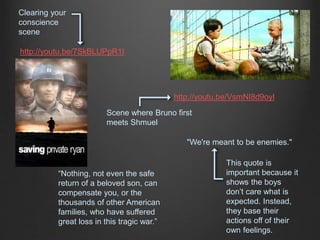
http://youtu.be/VsmNI8d9oyI 
http://youtu.be/7SkBLUPpR1I 
Scene where Bruno first 
meets Shmuel 
Clearing your 
conscience 
scene 
“Nothing, not even the safe 
return of a beloved son, can 
compensate you, or the 
thousands of other American 
families, who have suffered 
great loss in this tragic war.” 
"We're meant to be enemies." 
This quote is 
important because it 
shows the boys 
don’t care what is 
expected. Instead, 
they base their 
actions off of their 
own feelings.
Halloween 1978 vs Halloween 2007 
By Jordan Spangrud 
The original “Halloween” (directed by John Carpenter) is one of if not my favorite horror movie. I 
remember seeing it when I was 8 years old and it scared the hell out of me. I had seen a ton of horror films and 
it was the first one that I thought “this could happen!” I wasn’t scared of people under the stairs, giant sharks in 
the ocean, a killer who stalks a campground. What I was scared of was someone, anyone who can stalk and kill 
people on a day when everyone is dressed up as something scary. The effect of this movie was felt every fall 
when Halloween got closer, I would start the film and when the first scene happens at night I would turn it off. I 
could watch all the sequels at any time but the first movie always struck a chord with me and I chose to keep 
distance from it. 
I had heard rumblings for years that studios were trying to remake the film, but it never got off the ground 
because most people would agree “why mess with something that isn’t broken?”. After the huge success of Rob 
Zombies “The Devils Rejects” he had mentioned in an interview that if he had to remake a movie he would 
choose his favorite movie “Halloween”. The Weinstein Company approached him with the idea of directing a 
remake of the film. He said he would only remake it if he can do a reimaging of the film. They agreed and signed 
him on to direct. 
While he made a successful film (it grossed more than three times its budget and is the most successful 
film by Rob Zombie) it was plagued with so many issues and was hailed as one of the many remakes that are 
more like “why did this need to be made?”. Most people see this as an inferior film to the original. But how did a 
filmmaker whose favorite movie he got to remake fail terribly in the execution? How can someone be such a fan 
of a film and change it in a way that ruins the concept completely?
First, the need to tell the back-story of Michael Meyers. Rob Zombie had said that he wanted to explore 
the concept of “why Michael kills”. This was explored in later sequels to the original which ties into runes and 
about the rune Thorn and how Michael was given special powers in hopes of killing his family as a sacrifice to 
the gods. This was not a loved concept to fans and the execution got sloppy and was hard to understand. In 
John Carpenters original film it is never said why he does the things he does and for me that made it even more 
effective. He only lets on to little bits of information given out by his doctor Samuel Loomis (Donald Pleasence). 
Rob Zombie decided to give him the back-story that he was brought up in a dysfunctional home (mom is a 
stripper, dad is a drunk) and was mentally unstable (killed animals). Rob Zombie, also instead of having Michael 
kill only his sister on Halloween he pretty much takes out his whole family (except his younger sister who he tries 
to kill throughout the movie) due to him being tormented. While this was supposed to enrich the story and make 
Michael more intriguing I remember watching it and feeling worse for the character than afraid. 
Second, the amount of violence in the film. If you watch the original film there is hardly any gore or 
violence. While yes there are people being choked and stabbed to death most of the violence is shown off 
screen. When the movie aired on TV they only had to cut five minutes of the film. The part that made the movie 
scary was the suspense of watching the killer stalk his victims from afar never knowing when he will strike. Rob 
Zombie’s film is extremely violent. From the first killing (off a classmate with a baseball bat) to the slitting of his 
father’s throat and the repeated stabbing of Michael’s sister, it’s a completely different film. Also gone is the 
suspense of watching the killer stalk his victims. Rob Zombies film follows Michael as he does the things he does 
so you are with him the whole way. Where the original allowed people to not know where he would be at times 
creating the suspension of where he could be at any moment.
Third, the characters. In the original film you come to love the main heroine Laurie. You also get to enjoy 
the little bit of back-story that is given by Michaels doctor Sam Loomis. I remember John Carpenter said in an 
interview that he wanted to have Laurie played by an actor that would bring to the role someone who “lives next 
door” and I remember Jamie Lee Curtis (who played Laurie) in the original (and was her first role) looked exactly 
like my next door neighbors daughter which made the character. In Zombies version we are given Scott Taylor 
Compton (who plays Laurie) who brings no connectivity to the viewer. We are also instead given a slacker 
teenager who swears more than the Meyer’s family, but it is with the Loomis character that Rob Zombie made 
the biggest mistake in the film. While played by the ever great Malcom McDowell (Clockwork Orange) we are 
given an ego-cynical Dr. Loomis who instead of trying to keep Michael locked up goes and flaunts his patient in 
seminars and books. When Michael escapes in the original it is Dr. Loomis who knows the evil that has been 
released, while in Zombies “reimagining” Dr. Loomis seems surprised at everything Michael does. In the 
performance I was most excited about I found the character to be my least favorite in the movie. 
Last, we come to character the of Michael Meyers himself. In the original file Michael was actually called 
“the Shape” and was that way until John Carpenter decided to give him a name and a small back-story that still 
didn’t explain why he did the things he did (in the end credits the actor Nick Castle is still credited as “the Shape”. 
In Zombie’s film again we are given this terrible back-story on Michael and told the reason for his killing which is 
to get to his sister (which was not told in the original but in the first sequel). We are also given the reason for 
Michael’s ability to sustain injury. In the original he is stabbed, shot, thrown down stairs and yet still gets up, for 
no reason resulting Laure saying “he’s the boogeyman”. In the remake he is played by Tyler Mane who is a 7 
foot behemoth and is explained that the reason he can take a 4x4 to the face, shot in the head and beaten to a 
pulp is because “he’s a big guy” again ruining the fact that they are trying to make something so frightening and 
turning it into something more realistic and possible. 
Rob Zombies “Halloween” has its fans and even spawned a sequel (which the Weinstein’s gave Rob free 
reign on and tanked at the box office) which most people consider the worst sequel in the franchise, but there will 
never be an argument that supports the fact that Rob Zombies reimagining will ever come close to what most 
people call the “perfect horror film” John Carpenters “Halloween”.
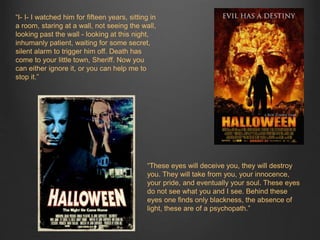
“I- I- I watched him for fifteen years, sitting in 
a room, staring at a wall, not seeing the wall, 
looking past the wall - looking at this night, 
inhumanly patient, waiting for some secret, 
silent alarm to trigger him off. Death has 
come to your little town, Sheriff. Now you 
can either ignore it, or you can help me to 
stop it.” 
“These eyes will deceive you, they will destroy 
you. They will take from you, your innocence, 
your pride, and eventually your soul. These eyes 
do not see what you and I see. Behind these 
eyes one finds only blackness, the absence of 
light, these are of a psychopath.”
The Fault in Remembering 
by Jacquelyn Swanson 
The one thing in life we all are guaranteed to endure is life and death. Some happen 
to have the experience before others, and many have a longer shot at life. Two movies that 
have similar story lines are, "The Fault in Our Stars" and "A Walk to Remember." Each has 
similar meaning as well; love and loss are things that many have to endure throughout a 
lifetime. We dream for one and fear for the other in most cases. These movies show what 
to be grateful for in life before it is whisked away in a fast motion. Over the course of this 
essay, I will introduce the many times in which each of these movies shares the same 
interests in their plot. 
The first topic that gives a first look connection into both films is the setting. In "A 
Walk to Remember" Jamie and Landon the star-crossed lovers are going through their last 
year of high school as seniors. The same applies to "The Fault in Our Stars" Augustus and 
Hazel are roughly sophomores in high school. I believe the reason for these settings was to 
show the audience that they could be involved for high school students to even college 
students. These stories are true and can happen to anyone like us at any stage in our 
lives.
The usual twist with a high school movie is usually some girl likes a guy but another 
girl wants to like him too and so on. These two films have a different spin on the popular 
culture of boy meets girl. In "A Walk to Remember" Jamie and Landon meet and slowly 
grow closer to interest in one another, Jamie has Landon promise that he won't fall in love 
with her. From then on it's a genuine connection that love cannot avoid. With "The Fault in 
Our Stars" the same concept happens but Hazel refers to herself as a "Grenade" in saying 
that she doesn't want to burden Augustus by having his heart broken. Augustus says 
something cheesy that no high school film can avoid, and they go on to loving every 
moment spent together. The plot twist you ask? Well, over time of each getting to know 
each other, a surprise hits. Jamie in "A Walk to Remember" tells Landon that she has 
Leukemia, which is Cancer in the blood. The Cancer progressed so much through her body 
from missing treatments by being with Landon. In "The Fault in Our Stars" Hazel is already 
known to have a type of cancer that doesn't allow her to do much, but Augustus was known 
to be Cancer free. Augustus soon tells Hazel that he has Cancer in his leg, and it has 
increased so much that the doctor says they have a few months left together. Augustus 
had missed chemotherapy because he wanted to be with Hazel, and he didn't like how he 
felt with the chemotherapy. Over time, both Jamie from "A Walk to Remember" and 
Augustus from "The Fault in Our Stars" (spoiler alert) eventually died. Together each 
couple carried one another through very harsh times, until the end. 
Before both of their energy and lives ran out there were a few things that both 
characters in the movies wanted to fulfill in order to make the most of their lives. For 
example, in "The Fault in Our Stars" Augustus wanted to use his wish from the "Make-a- 
Wish Foundation" on Hazel. Hazel obsesses over this author whom she had Augustus read 
her favorite book by him. The author lived in Amsterdam, and they had emailed the Author 
to go visit and talk to him about what happens after the novel abruptly ends. One another 
left with empty feelings about the authors awful mentality of life. Going on they learn that 
not everything is what we think it will be made out to be.
In the movie "A Walk to Remember" Jamie has a bucket list of things she wants to 
accomplish in order for her life to be well lived. This way she can look back upon everything 
and know that her life was worth living. Landon wants to make all her dreams come true so 
they slowly check things off her bucket list. Starting with getting a tattoo, Jamie always 
wanted a tattoo of a butterfly on her shoulder and so that made this possibly by getting a 
temporary butterfly tattoo and put it exactly where she wanted it. The next thing was being 
in two places at once, Landon drove Jamie out to the middle of nowhere for a length of 
time without her knowing what was going on. He then paused and made her get out of the 
car, placing her feet so that they were straddling a line. He then tells her that she is 
standing in two different states at one time. I think that the significance to our pop culture in 
this one bucket list point is to be spontaneous, if you want something for the purpose of 
yourself in a quick instant to feel something good, then do it to benefit you as a person. 
Often times many people get discouraged and hardly think of themselves. We also 
experience people that abuse the privilege of loving ourselves first. Through popular culture 
when we know we have an allotted time to live, people don’t want to remember those last 
few moments they have feeling sorry for there selves. The last spontaneous act that was 
done was Landon found out her last bucket list item. The last one was to get married. He 
then asked Jamie’s father for approval and then married Jamie before time fell short. 
Throughout everything, these two movies are love stories that often happen through 
our culture and among other cultures. Whether they share the same qualities as love in 
family or love in romance people do show affection toward one another. More so when 
someone is dying rather than living in the moment and sharing the love with him or her 
before it is too late. I believe that our popular culture can learn a lot from the movies we 
spend the time to pay for as well as watch. Just like with school if we pay for something we 
need to gain something from the money spent. I think this applies to everything, even time. 
Time wasted well is time learning of something important to you. This goes back to 
spending time with people you actually care about, because one day your real life story 
could end up like “The Fault in Our Stars” or “A Walk to Remember.” Lets hope that you 
make the best of it like the movies did.
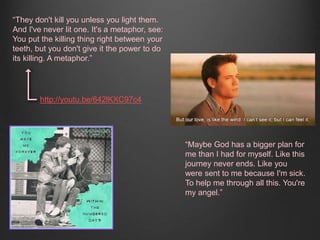
“Maybe God has a bigger plan for 
me than I had for myself. Like this 
journey never ends. Like you 
were sent to me because I'm sick. 
To help me through all this. You're 
my angel.” 
“They don't kill you unless you light them. 
And I've never lit one. It's a metaphor, see: 
You put the killing thing right between your 
teeth, but you don't give it the power to do 
its killing. A metaphor.” 
http://youtu.be/642lKXC97c4
Carpe Diem 
by Kendria Zard 
Have you ever watched a movie and felt such a strong connection to it that its message impacts 
you in a manner that alters your way of thinking, and perhaps even the course of your life? 
Sometimes it’s a specific character that inspires us to become more than what we thought was 
possible, perhaps one scene that resonates deep within, a powerful quote that imbeds itself forever in 
your mind, the age we were when we saw it, who we saw it with or sometimes it’s a combination of 
multiple factors. I felt like two movies that have strong, positive, and impactful messages for many 
audiences but especially for young adults trying to discover who they really are and what they want 
to achieve are the legendary movies “Dead Poet’s Society,” and the lesser known but equally powerful 
movie “Finding Forester”. 
Have you ever felt a tsunami of stress crash over your life, leaving behind a trail of 
destruction? I think that we have all felt the pressure of life pressing down on us like heavyweights 
dragging us under water. Trying to please everyone never works out, and in the end you never end up 
making yourself happy. You create a battlefield inside your mind but you always end in a stale mate. 
Like a wooden bridge groaning under the weight of semi-trucks, we seem destined to splinter, crack, 
and ultimately succumb to the pressure of pleasing everyone else. In both the films “The Dead Poet’s 
Society” and “Finding Forrester,” a young man must battle the desires of his own heart vs. the desires 
and expectations of his family and peers. All of us face a similar battle in our own lives as we try to 
decide if we are going to chase our dreams and live our life to its fullest potential or conform to the 
expectations placed on us, even if that means settling for a life of mediocrity. In both of these movies 
the pivotal characters encountered a mentor who helped shape them and guide them on their 
journey, something we should all strive to have in our lives.
In the beginning of “Finding Forrester” we are introduced to a young black student named 
Jamal who is growing up in the Bronx of New York and is a noted to be a great basketball player. In 
his world, the accepted way to measure success in life is for him to be an outstanding athlete and use 
his skills on the basketball court to achieve better things for himself and his family. In the beginning 
of “The Dead Poet’s Society” we are introduced to a young white student named Neil who is 
attending a highly regarded boarding school where the expectations to succeed academically are 
drilled into the students from the first day as they recite the 4 pillars of Welton: tradition, honor, 
excellence and discipline. The head master greets Neil’s parents with a comment of them having high 
expectations for him to which his father replies “he won’t disappoint you” (The Dead Poet’s Society). 
While there is a clear set of expectations laid out for both of them, at first glance it seems like Jamal 
has an easier path to success as he simply has to continue to be the great basketball player he already 
is. You get a sense that Neil has an enormous amount of pressure to perform academically and 
somehow that feels like a path that is inherently more difficult. This type of pressure is something 
many of us can relate to, even if we are feeling that pressure in places in our lives other than just the 
academic realm. We may have pressure in our jobs, our personal lives, our athletic accomplishments, 
our academic endeavors, and all too often in multiple areas of our lives. We work harder and longer, 
trying to chase the measure of success and happiness that often times someone else has laid out for us. 
Both of these movies are impactful for many of us because we can relate on so many levels to both the 
characters of Neil and Jamal. 
While both Jamal and Neil seem to be naturally gifted and destined for greatness in the 
course their lives are being pushed into, neither Jamal nor Neil seem to be content, but instead seem 
to be just doing what they are expected to do. They were living lives how many of us end up living our 
lives, just going through the motions without being bold enough to pursue our dreams with passion 
and vigor. However, both Jamal and Neil find their outlook towards the path they are taking to 
success flipped on its head when they meet someone unexpected. Jamal meets Forrester on a dare 
from his friends to sneak into his apartment and when he does he is confronted by Forrester causing 
him to run from the apartment leaving his backpack behind. He eventually gets his backpack 
returned but soon realizes Forrester had found his collection of notebooks and edited his writing. 
This draws Jamal to Forrester because secretly Jamal has a passion for writing, reading and learning 
in general. He has a desire to be more than a basketball player but is afraid to let anybody see that 
side of him.
Neil on the other hand is shown to have a natural gift for academics and is expected by his 
parents to attend Harvard and become a doctor. He is positioned on that path by being enrolled at the 
prestigious Welton Academy. There is an almost tangible stuffy and proper academic environment 
that you see portrayed in the opening scenes of the science, math, and Latin classrooms with the 
monotone teachers, continuous note-taking, and emphasis on homework. Then Neil and his 
classmates are shown their English classroom, which looks just like the previous classrooms with the 
exception of the professor. Their English professor, Mr. Keating, strolls into the classroom whistling 
and invites them to follow him as he exits a different door. Immediately they are challenged by 
Keating to “Carpe Diem,” seize the day. He reminds them that we are all dying and points to an old 
picture of past students saying: 
They’re not that different from you are they? Same haircuts. Full of hormones, just like 
you. Invincible just like you feel. The world is their oyster. They believe they’re destined for 
great things just like many of you, their eyes are full of hope just like you. Did they wait 
until it was too late to make from their lives even one iota of what they were capable? 
Because you see gentlemen, these boys are now fertilizing daffodils. But if you listen real 
close, you can hear them whisper their legacy to you. Carpe, carpe diem, seize the day boys, 
make your lives extraordinary (The Dead Poet’s Society). 
In one of the more memorable scenes in the movie, Keating exuberantly climb on top of his 
desk demanding the class to tell him why they think he’s standing there. He gleefully shouts, “I stand 
upon my desk to remind myself that we must constantly look at things in a different way” (The Dead 
Poet’s Society). I think this scene resonates with so many of us because we have either had the 
privilege of having a teacher like this ourselves, or we wish we would have been fortunate enough to 
have had a teacher like that. In the movie, Keating’s challenge to his students to always be thinking, 
to be looking at things from different perspectives, to not be afraid to make a deliberate choice to 
examine how things have been done and to be brave enough to take a different approach was a 
pivotal point in the movie. However, that challenge is one that stays with the viewer long after the 
movie ends. In the movie, you almost immediately see a change in Neil as he becomes more animated 
and excited; it’s like he has never been allowed or encouraged to actually think for himself and finds 
that directive to be enticing. The transformation is reminiscent of when the wooden puppet Pinocchio 
becomes a real boy. Are we content to be mere puppets, or are we ready to cut the strings?
On the other hand, Jamal has no strong academic expectations from his mom. She is called in 
by the counselor to discuss his grades and the fact that they are mostly C’s, which the counselor says 
is most likely because Jamal feels safe turning in those types of grades, he’s not expected to do more 
than that academically by anyone. However, she is surprised to hear that his test scores are extremely 
high showing that his intelligence level is quite exceptional and certainly more than anyone has given 
him credit for. When they discuss why Jamal has seemed to hide his intelligence the counselor 
remarks that basketball is where he feels safe, it’s what he is expected to be good at and where he 
finds acceptance from his peers. Jamal is like most of us in his desire to do what is safe and expected 
of him. We all long for acceptance as well as success however we tend to be afraid to take a risk and 
do something new or show someone a side of us that then never new existed. For Jamal, his test scores 
combined with his athletic prowess opens the door for an academic scholarship at a prestigious 
private school where he will have the chance to challenge his mind and shine, not only athletically, 
but academically as well. Jamal is faced with a choice to either stick with what he knows or start to 
follow his dream of being more than just a ball player. Forrester is talking to Jamal when he says, 
“There’s a question in your writing about what you want to do with your life. That’s a question your 
present school cannot answer for you” (Finding Forrester). Jamal then decides to enroll in Mailor 
and find out. He is however met with a different set of challenges at the new school as some people, 
especially the teachers, have the preconceived idea that he’s only there because he’s good at 
basketball. Mr. Crawford remarks “We’ll see if you are here for an education or for other endeavors” 
(Finding Forrester). The actor Rob Brown, who plays Jamal, delivers a convincing and compelling 
performance that draws you in and makes you really stop and examine your own life to see if you are 
being bold enough to try something new and different. The inspiration for his character paralleled his 
own life in the fact that Rob Brown was a high school student from New York who was also a 
basketball player and took a chance to try his hand at acting by responding to a flyer he saw. He said 
that he “figured he had nothing to lose by giving it a try” (http://www.catspawdynamics.com/the-finding- 
forrester-press-kit/).
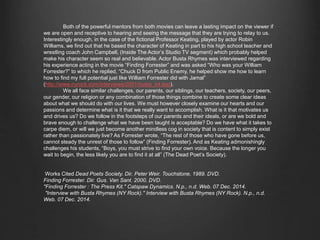
Jamal continues his unlikely friendship with Forrester and Forrester mentors Jamal in the 
craft of writing. Jamal struggles at first with writing an essay and Forrester challenges him saying 
“no thinking – that comes later. You must write your first draft with your heart. You re-write with 
your head. The fist key to writing is….to write, not to think!” (Finding Forrester). In a similar scene 
in “The Dead Poet’s Society,” Keating admonishes one of the students that is afraid to speak in front 
of the class to “close your eyes and say the first thing that comes to your mind” (The Dead Poet’s 
Society). They proceed to go through an exercise where he builds on each new sentence until he comes 
up with an amazingly descriptive piece of poetry that has the class applauding. Keating finishes the 
scene admonishing him to “don’t ever forget this” (The Dead Poet’s Society). These scenes show that 
both mentors have a remarkable ability to challenge their students to achieve more than they thought 
they were capable of doing. Having a positive influence can really help you grow in your gift as well 
as make you more comfortable with being who you really are, even if it’s a little different. 
As the movies progress both Jamal and Neil are challenged by their respective mentor’s to 
grow in ways they weren’t sure they were capable of; they are shown to not be afraid to challenge the 
status quo or the expectations that are set out for them. Jamal decides to follow his passion of writing 
by entering an essay contest the school has. He uses part of Forrester’s work as a springboard into his 
essay and unfortunately finds himself charged by the administration office with plagiarism. They 
recognize the title and opening paragraph as a work published by Forrester so doubt the authenticity 
of the rest of his essay. He is told he can just admit that he didn’t write the essay and all will be 
forgiven with a new academic scholarship waiting for him for the following year. He just needs to go 
out and do his job of winning basketball games as that is what he is there for anyway. Jamal 
purposefully decides to miss the free-throws that would have won the game to prove the point that he 
was there to do more than just play basketball. That courage inspires Forrester to leave his 
apartment and come to the school to defend Jamal’s essay proving that he indeed had Forrester’s 
permission to use his works as part of the introduction to Jamal’s essay.
In “The Dead Poet’s Society” Neil also finds himself with a choice as he discovered an 
opportunity to finally pursue a lifelong dream of acting by auditioning for a school play. He gets the 
part and then decides to forge his dad’s signature for permission to take part in it as he knows there 
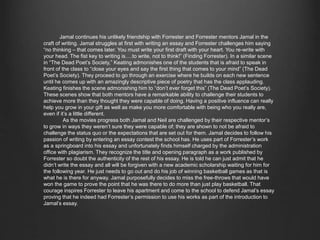
is no way his father would really give him permission. When his father finds out anyway and 
demands that Neil immediately quit the play, Neil’s paths come to a crossroad and he has to choose if 
he will make his father happy and stay on the path that is expected of him or if he will make himself 
happy and stay on the path of acting. He decides to continue to do the play as his father is to be out of 
town; however, he is confronted by an angry and disappointed father after the play. His father 
berates him and dictates that he will be enrolled in a different school and in no uncertain terms will 
remain firmly on the path his father has had planned for him of attending Harvard and becoming a 
doctor. When Neil protests exclaiming, “10 years! That’s a lifetime” (The Dead Poet’s Society) he’s 
dismissed as being melodramatic and that he should just go to bed. Neil resignedly decides to not 
fight his father any longer on the issue as he sees no chance in winning. Tragically, Neil is unable to 
find the courage to stand up to his father and follow his heart and dreams of acting and ends his own 
life. He decided that living a life without “sucking the marrow out of the bones” (The Dead Poet’s 
Society) was instead like choking on the bones and not worthwhile continuing. 
Both of these movies have a similar theme of young people faced with the dilemmas of 
conforming to living their lives in the manner that was expected of them. They are trying to find the 
courage to go against those expectations and following their truest passions. However, the movies 
differ in the ultimate decision that each young person made in the fact that Jamal was able to break 
free of the expectations of his life whereas Neil was unable to do that and became actually beaten by 
the weight of the expectations in his life.
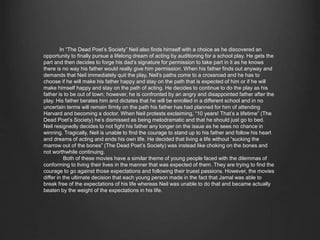
Both of the powerful mentors from both movies can leave a lasting impact on the viewer if we 
are open and receptive to hearing and seeing the message that they are trying to relay to us. 
Interestingly enough, in the case of the fictional Professor Keating, played by actor Robin Williams, 
we find out that he based the character of Keating in part to his high school teacher and wrestling 
coach John Campbell, (Inside The Actor’s Studio TV segment) which probably helped make his 
character seem so real and believable. Actor Busta Rhymes was interviewed regarding his experience 
acting in the movie “Finding Forrester” and was asked “Who was your William Forrester?” to which 
he replied, “Chuck D from Public Enemy, he helped show me how to learn how to find my full 
potential just like William Forrester did with Jamal” 
(http://www.nyrock.com/interviews/2001/busta_int.asp). 
We all face similar challenges, our parents, our siblings, our teachers, society, our peers, our 
gender, our religion or any combination of those things combine to create some clear ideas about 
what we should do with our lives. We must however closely examine our hearts and our passions and 
determine what is it that we really want to accomplish. What is it that motivates us and drives us? Do 
we follow in the footsteps of our parents and their ideals, or are we bold and brave enough to 
challenge what we have been taught is acceptable? Do we have what it takes to carpe diem, or will we 
just become another mindless cog in society that is content to simply exist rather than passionately 
live? As Forrester wrote, “The rest of those who have gone before us, cannot steady the unrest of 
those to follow” (Finding Forrester). And as Keating admonishingly challenges his students, “Boys, 
you must strive to find your own voice. Because the longer you wait to begin, the less likely you are to 
find it at all” (The Dead Poet’s Society). 
Works Cited Dead Poets Society. Dir. Peter Weir. Touchstone, 1989. DVD. 
Finding Forrester. Dir. Gus. Van Sant. 2000. DVD. 
"Finding Forrester : The Press Kit." Catspaw Dynamics. N.p., n.d. Web. 07 Dec. 2014. 
"Interview with Busta Rhymes (NY Rock)." Interview with Busta Rhymes (NY Rock). N.p., n.d. 
Web. 07 Dec. 2014.
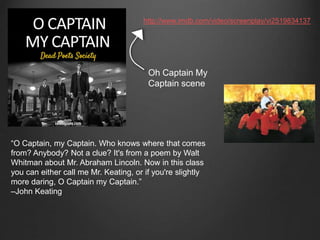
http://www.imdb.com/video/screenplay/vi2519834137 
Oh Captain My 
Captain scene 
“O Captain, my Captain. Who knows where that comes 
from? Anybody? Not a clue? It's from a poem by Walt 
Whitman about Mr. Abraham Lincoln. Now in this class 
you can either call me Mr. Keating, or if you're slightly 
more daring, O Captain my Captain.” 
–John Keating
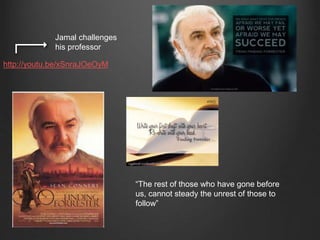
“The rest of those who have gone before us, 
cannot steady the unrest of those to follow” 
Jamal challenges 
his professor 
http://youtu.be/xSnraJOeOyM
We hope that you enjoyed our collection of essays 
and that perhaps we inspired you so that in the future, 
when you sit down to watch a movie or musical, you 
don’t merely complacently look at it, but rather that 
you see it with eyes wide open and a heart ready to 
receive the message.

Seeing Instead of Looking

  • 1.
    Seeing Instead ofLooking By William Deskin, Makenna Schumacher, Jordan Spangrud, Jacquelyn Swanson, and Kendria Zard
  • 2.
    Table Of Contents • Editorial Team Letter- Slide 3 • A Boring Night With the Lions- Slides 4-7 • Saving Private Ryan and the Boy in the Striped Pajamas: Society's Viewpoints- Slides 8-12 • Halloween 1978 vs Halloween 2007- Slides 13-16 • The Fault in Remembering- Slides 17-20 • Carpe Diem- Slides 21-29
  • 3.
    A letter fromthe editorial team No matter what major you plan on pursing in college, one of the classes we are all required to take is English 101. For many of us, we may approach the class with a martyred sigh of resignation because we have no intent of becoming an English major and either feel like “my writing is already good enough” or “I already know writing isn’t something I’m very good at”. At the end of this course however, as we stop and reflect on what we have learned and examine our writing from the beginning of the class to the end of the class, we are all pleasantly surprised with the growth we see and are excited to see what other classes these improved techniques and skills will be used in. We learned a lot about the English language, how language connects us to our world, and how it can make us think about things in completely different ways. We learned how to think critically, integrate sources into our texts, have open minds about how the audience might perceive our essay, the importance of using a wide variety of descriptive phrases and words to draw the reader in and keep their attention, what type of writing style works best for us, and the importance of thoughtful and careful revisions and editing. In connection with revisions and editing, it was interesting to learn how helpful the peer editing process could be, as that was something that pushed many of us out of our comfort zone. It’s not human nature to share unfinished work and get peoples critical input and opinions. We are much more prone to wait until we feel that something is polished and perfect before we want some else to read it; however peer revision and editing turned out to be an excellent tool. It was intriguing to delve deeper into the pop culture of music, movies, and television and how that can all impact us. We learned the importance of looking at multiple resources to be able to better understand a topic and be equipped to create thoughtful responses. Another thing we learned was how while the pop culture of music, movies, and television can have brief influences on our lives, it can also sometimes have a deep and lasting impact if we really take the time to look at what message was trying to be conveyed to us. Sometimes pop culture is dismissed as unimportant, however we found that especially through the medium of film, pop culture can have a long and lasting impact. We chose to look harder at why musicals and film seem to have such a lasting impact on many of our lives and have decided to share our collection of essays on movies and musicals with the hope that the next time you sit down to watch one, you will do so with an open mind, ready to really see and not just merely look. - William, Jordan, Makenna, Jackie, & Kendria
  • 4.
    A Boring NightWith the Lions by William Deskin I stared at the ground as I trudged forward through the shower of rain pouring from the night sky. It was perfect. Terrible weather partnered well with the depressing night. I was being dragged into Seattle by my parents to see some stupid Lion King musical. I had already seen the movie plenty of times! What a waste of a night. The rhythmic pattering of raindrops and the whir of cars driving by was replaced by the roar of thousands of people chattering away as we entered the massive building. My mom told me we had 30 minutes until we could go take our seats, and then another 15 before the show starts. "Whatever" I mumbled. I was already defeated at this point. She could have told me it was going to be 5 hours until the show started and I would have felt exactly the same. With a sigh, I sat down against the wall near my parents, who were standing and chatting, somehow enjoying this monotony. I thought back to just a few hours ago when I got forced to go along with my parents. Well, I suppose they didn't force me. "Hey William, we're about to head off to see the musical, change your mind about coming?" My mom asked. I don't know why her voice beamed with hopefulness, and I don't know why she was disappointed when I told her "No" for the tenth time that week. She couldn't possibly have expected a different answer. "Aww, come on. Why don't you want to go? It's the Lion King!" I told her in an irritated voice "Yeah, it may be the Lion King, but watching people in costumes dance around singing songs has got to be the most boring activities ever." I thought my explanation was clear and understandable, but still she pleaded on. "Oh, please? It's just one night! You never want to go places with me and Dad. I promise it will be fun! Besides, what else do you have to do around here?" I quickly snapped back "I have homework I need to finish, and I'm never gonna get to do that if you keep talking to me." She let out a smirk and stared at me with a knowing gaze. "But I let you play games on my computer earlier because you said you were already finished with your homework." Oops. She caught me. "Fine," I said. "I don't have homework to do, but staying here will be far more enjoyable than going to that stupid musical." And then, she pulled the trigger. The one move of hers that I haven't yet learned how to beat. She pulled her head away from me, and sounding as if she was on the verge of tears, she quietly mumbled "Okay, William. You can stay here. We'll miss you." A second later she was out of my room and I felt like I was going to explode with frustration. I gave up. Without a word I left my room and followed my parents out the door.
  • 5.
    At last wehad gotten into our seats, and the show was starting any second now. And once it finally started, after two or so boring hours, we’ll be out of here and this pointless night will be done with. During the next few minutes, I pondered over my feelings. It was my decision to come here. Sure, my mom's guilt strategies played a factor in that decision, but no one forced me to come here. In the past, whenever my parents made me go somewhere with them, I'd act unhappy and pouty so they would feel as if it was a bad choice to make me come with them. And then they'd stop making me go places with them. But if I decided to come here, why shouldn't I be able to enjoy myself? Like clockwork, as soon as I finished my train of thought the lights vanished, reappearing on the stage a few seconds later. The show had finally begun. Like a fly mindlessly gazing at the infinite light radiating from a light bulb, I seemed to disappear from existence. All that was there was the stage. As the orchestra started playing, waves of serene sound completely enchanted me. I had never heard anything like it. So much emotion, so much beauty. All compressed into simple noise. Vibrations in the air. How was it possible? The music lifted me far above the clouds and towards the sun. With my new perspective, suddenly my mentality was refreshed. Why did I always want to stay at home? Countless adventures surrounded me. Other worlds to explore, new friends to meet, and so much music to hear! I want to experience it all! As warmth flooded my mind, I had my eyes pointed at the stage, forever. And then, the colors. So many colors! As the performers danced around the stage, glowing beams of light shot through the dark theater, exposing the bouquet of flowers everyone seemed to be wearing. I couldn't take my eyes off them, not for a second. I couldn't comprehend how the colors were so bright and vivid. As the colors took over my vision, I could be anywhere. A lush forest on a sunny day. Looking off the peak of a mountain. I could be in Africa with the lions. Entranced and consumed by the show, the concept of time was pushed far aside in my mind and suddenly the musical had ended.
  • 6.
    As I waswalking out of the theater into the lobby, a stumble nearly sent me plummeting to the floor, but my mom caught me. I guess I was so focused on the musical that I forgot how to walk. "You okay?" she asked. I nodded and she said in a comforting voice "Don't worry, we'll go straight home." But as we were walking through the lobby, something caught my eye. "Wait!" My parents stopped walking and looked back at me. I pointed over to a vendor in the lobby. "Could we buy the soundtrack of that musical?" As I sat in the car heading towards home, with my new C.D. in my hands, my mom was discussing plans with my dad. "So we'll go to the movies next Sunday at lunch time. Sounds good." She turned her head back and asked me "Any chance you'd want to come with us too? It's fine if you don't want to." Her tone of voice indicated that she expected me to deny the invitation; but she was in for a surprise. "Are you kidding me? I'd love to go!"
  • 7.
    http://youtu.be/gLuq8XRRneQ Link toa clip of the musical “Oh yes, the past can hurt. But, you can either run from it or learn from it.”
  • 8.
    Saving Private Ryanand the Boy in the Striped Pajamas: Society’s Viewpoints Makenna Schumacher Over the last sixteen years, incredible movies showcasing the action and horror of World War II were created and show many similarities and differences to each other. One film that won numerous Oscars for portraying the view points of the soldiers who stormed the beach at Normandy and fought throughout the war in Europe, is Saving Private Ryan, directed by Steven Spielberg. This film shows the war from the viewpoints of soldiers from the United States. Another film that captured audiences worldwide, was the emotional story of The Boy in the Striped Pajamas, directed by Mark Herman. This film captures the story between the son of a Nazi Sergeant and a young boy from a neighboring concentration camp. These two films are not only set in the same time period, but they also show the many conflicting viewpoints of the different countries involved in World War II. Basically, these two films show us how all of society has different views towards certain conflicts and solutions based on location, and personal beliefs and also how two completely different films can showcase exactly how every human has the capacity to understand different views, emotions, and censors on society. Saving Private Ryan tells the story of eight soldiers from the 2nd Ranger Battalion of the 29th Infantry Division searching to find the fourth of four brothers who have died fighting in the war. The journey is led by Captain Miller, played by actor Tom Hanks. The eight soldiers consist of actors Tom Sizemore, Edward Burns, Barry Pepper, Adam Goldberg, Vin Diesel, Giovanni Ribisi and Jeremy Davies.
  • 9.
    In the moviethe Boy in the Striped Pajamas, a young boy by the name of Bruno, played by Asa Butterfield, is faced head on with the war in Germany after he is forced to move to a house next to a concentration camp because of his father’s position in the Nazi Army. The story continues with Bruno adventuring to the concentration camp and making friends with a young boy about his age, Shmuel, played by Jack Scanlon. The boys both don’t necessarily understand what is happening and why Shmuel is in the “farm” as renamed by Bruno’s father, played by David Thewlis. The two boys showcase exactly how the two sides, consisting of the Arian Race and the other races, did not fully understand why the war was happening. When looking at these two films together, you can see that they are taken from different viewpoints and believe it or not, those viewpoints could be based on where people are located in the world and whether or not they are of a certain race or social group. It’s kind of a hard concept to grasp that countries other than the United States viewed World War II from adifferent perspective. For instance, in the movie The Boy in the Striped Pajamas, the movie was taken from the perspectives of children from both sides of the war: Bruno of the “dominate” Arian Race and Shmuel of the “other races” that were not accepted by the Nazis. When Bruno is at his home, he hears about how nice the concentration camps are, but when he talks to Shmuel, he finds out that all of the nice things he heard were lies to cover up how awful the adults and children in the concentration camps were treated. This just shows one of the ways society had and has different viewpoints towards certain issues in society based on location. This is also relevant in the movie Saving Private Ryan. When the group of soldiers is part way through their mission to find Private Ryan, they run into a group of Nazi Soldiers at a radio outpost. After they bomb the outpost and one of their own men dies of shrapnel wounds, they come in contact with one Nazi soldier. The solider does everything he can to try and reverse their decision to kill him, such as trying to sing the United States’ National Anthem and cursing Hitler. They let him go, though they fear he will be recaptured by the Nazi Army and put back into circulation. Unfortunately, this happens and one of the eight soldiers confronts him and kills him for disobeying orders. The Nazi soldier, even though he had been caught in the situation between himself and the Americans, still believed he should be fighting with the Nazi Army because it was what people back then believed they were supposed to do in Germany. This just shows how society gets their viewpoints on certain issues based on what location they are in. Unfortunately, this localization of viewpoints within certain areas, social groups and races is very common in today’s society. In popular culture, for example, you can use football teams to explain why some viewpoints are dependant on location. According to a survey done by Facebook, each state in the United States that has a football team, favors that team as well as the surrounding states that also do not have teams (1). Therefore, these movies and even football show us that society’s viewpoints on certain issues and subjects are based on their locations.
  • 10.
    Between these twofilms, you can see a resemblance between the characters as well. The two characters that connect the most are James’ Mother and Bruno’s Mother. Even though they never say it out loud, you can see by their reactions to their children’s deaths and you can tell that they both share the sorrow of losing their loved ones to a war for which they could’ve never been involved with in the first place. This shows at the end of the film Saving Private Ryan. The end of the movie quotes George C. Marshall saying “Nothing, not even the safe return of a beloved son, can compensate you, or the thousands of other American families, who have suffered great loss in this tragic war.” This idea of no compensation for death because of the war shows as well in the expressions of Bruno’s family at the end of the movie. You could say they were sad but if you think about why they were living by the concentration camp in the first place, you realize that in the father’s expression at the very end of the movie that the death of his son was preventable and could never be fixed. Regardless to say, there is always going to be death caused by preventable things. It will always have an affect on our society no matter who is personally involved with the death and these movies show how society also faces this same issue of dealing with grief. In addition to the films showcasing similar ideas about viewpoints and death, you can see a huge difference in the interpretation of the war. In the Boy in the Striped Pajamas, the war is shown from the perspective of the Nazis in Germany. You hear about the war from a family that is shielding their children from it. Bruno’s father is only ever spoken of as a man of “authority” in the Nazi Army. Bruno has no idea that concentration camp that is behind their house is a place where Jews and people of other religions and races are sent to die. Whereas, Saving Private Ryan is from the perspective of soldiers in the war. It shows every gory detail of the war including the hundreds killed on the beach. It also adds on to show the war at home in America including the delivery to their families that their sons were killed in action. For example, in the film, you see six out of the eight original soldiers on the mission to find Ryan killed in action including Captain Miller as well. This movie is one of the only movies that shows exactly how awful the war in Germany was, whereas the Boy in the Striped Pajamas does not. In popular culture, this is common. When looking back on the war in Afghanistan and Iraq, you don’t see the blood, you see the soldiers pictures of them before they lost their lives. Granted, the movies can’t show you exactly what happened to every man killed in World War II, it shows you how awful the war was even though the United States was shielded of that horror until 1998.
  • 11.
    Overall, when youlook at these two films together, you can see that they show a lot about popular culture. They show that viewpoints are based on location, society is shielded from the reality of worldwide issues and the loss of a loved one results most commonly in questioning and sorrow. These movies really support the fact that our society functions this way. There had been censoring for years, everyone deals with untimely death and everyone has certain viewpoints based on their location. These movies based in the same time period show these things through their characters and are excellent examples of how our society functions.
  • 12.
    http://youtu.be/VsmNI8d9oyI http://youtu.be/7SkBLUPpR1I Scenewhere Bruno first meets Shmuel Clearing your conscience scene “Nothing, not even the safe return of a beloved son, can compensate you, or the thousands of other American families, who have suffered great loss in this tragic war.” "We're meant to be enemies." This quote is important because it shows the boys don’t care what is expected. Instead, they base their actions off of their own feelings.
  • 13.
    Halloween 1978 vsHalloween 2007 By Jordan Spangrud The original “Halloween” (directed by John Carpenter) is one of if not my favorite horror movie. I remember seeing it when I was 8 years old and it scared the hell out of me. I had seen a ton of horror films and it was the first one that I thought “this could happen!” I wasn’t scared of people under the stairs, giant sharks in the ocean, a killer who stalks a campground. What I was scared of was someone, anyone who can stalk and kill people on a day when everyone is dressed up as something scary. The effect of this movie was felt every fall when Halloween got closer, I would start the film and when the first scene happens at night I would turn it off. I could watch all the sequels at any time but the first movie always struck a chord with me and I chose to keep distance from it. I had heard rumblings for years that studios were trying to remake the film, but it never got off the ground because most people would agree “why mess with something that isn’t broken?”. After the huge success of Rob Zombies “The Devils Rejects” he had mentioned in an interview that if he had to remake a movie he would choose his favorite movie “Halloween”. The Weinstein Company approached him with the idea of directing a remake of the film. He said he would only remake it if he can do a reimaging of the film. They agreed and signed him on to direct. While he made a successful film (it grossed more than three times its budget and is the most successful film by Rob Zombie) it was plagued with so many issues and was hailed as one of the many remakes that are more like “why did this need to be made?”. Most people see this as an inferior film to the original. But how did a filmmaker whose favorite movie he got to remake fail terribly in the execution? How can someone be such a fan of a film and change it in a way that ruins the concept completely?
  • 14.
    First, the needto tell the back-story of Michael Meyers. Rob Zombie had said that he wanted to explore the concept of “why Michael kills”. This was explored in later sequels to the original which ties into runes and about the rune Thorn and how Michael was given special powers in hopes of killing his family as a sacrifice to the gods. This was not a loved concept to fans and the execution got sloppy and was hard to understand. In John Carpenters original film it is never said why he does the things he does and for me that made it even more effective. He only lets on to little bits of information given out by his doctor Samuel Loomis (Donald Pleasence). Rob Zombie decided to give him the back-story that he was brought up in a dysfunctional home (mom is a stripper, dad is a drunk) and was mentally unstable (killed animals). Rob Zombie, also instead of having Michael kill only his sister on Halloween he pretty much takes out his whole family (except his younger sister who he tries to kill throughout the movie) due to him being tormented. While this was supposed to enrich the story and make Michael more intriguing I remember watching it and feeling worse for the character than afraid. Second, the amount of violence in the film. If you watch the original film there is hardly any gore or violence. While yes there are people being choked and stabbed to death most of the violence is shown off screen. When the movie aired on TV they only had to cut five minutes of the film. The part that made the movie scary was the suspense of watching the killer stalk his victims from afar never knowing when he will strike. Rob Zombie’s film is extremely violent. From the first killing (off a classmate with a baseball bat) to the slitting of his father’s throat and the repeated stabbing of Michael’s sister, it’s a completely different film. Also gone is the suspense of watching the killer stalk his victims. Rob Zombies film follows Michael as he does the things he does so you are with him the whole way. Where the original allowed people to not know where he would be at times creating the suspension of where he could be at any moment.
  • 15.
    Third, the characters.In the original film you come to love the main heroine Laurie. You also get to enjoy the little bit of back-story that is given by Michaels doctor Sam Loomis. I remember John Carpenter said in an interview that he wanted to have Laurie played by an actor that would bring to the role someone who “lives next door” and I remember Jamie Lee Curtis (who played Laurie) in the original (and was her first role) looked exactly like my next door neighbors daughter which made the character. In Zombies version we are given Scott Taylor Compton (who plays Laurie) who brings no connectivity to the viewer. We are also instead given a slacker teenager who swears more than the Meyer’s family, but it is with the Loomis character that Rob Zombie made the biggest mistake in the film. While played by the ever great Malcom McDowell (Clockwork Orange) we are given an ego-cynical Dr. Loomis who instead of trying to keep Michael locked up goes and flaunts his patient in seminars and books. When Michael escapes in the original it is Dr. Loomis who knows the evil that has been released, while in Zombies “reimagining” Dr. Loomis seems surprised at everything Michael does. In the performance I was most excited about I found the character to be my least favorite in the movie. Last, we come to character the of Michael Meyers himself. In the original file Michael was actually called “the Shape” and was that way until John Carpenter decided to give him a name and a small back-story that still didn’t explain why he did the things he did (in the end credits the actor Nick Castle is still credited as “the Shape”. In Zombie’s film again we are given this terrible back-story on Michael and told the reason for his killing which is to get to his sister (which was not told in the original but in the first sequel). We are also given the reason for Michael’s ability to sustain injury. In the original he is stabbed, shot, thrown down stairs and yet still gets up, for no reason resulting Laure saying “he’s the boogeyman”. In the remake he is played by Tyler Mane who is a 7 foot behemoth and is explained that the reason he can take a 4x4 to the face, shot in the head and beaten to a pulp is because “he’s a big guy” again ruining the fact that they are trying to make something so frightening and turning it into something more realistic and possible. Rob Zombies “Halloween” has its fans and even spawned a sequel (which the Weinstein’s gave Rob free reign on and tanked at the box office) which most people consider the worst sequel in the franchise, but there will never be an argument that supports the fact that Rob Zombies reimagining will ever come close to what most people call the “perfect horror film” John Carpenters “Halloween”.
  • 16.
    “I- I- Iwatched him for fifteen years, sitting in a room, staring at a wall, not seeing the wall, looking past the wall - looking at this night, inhumanly patient, waiting for some secret, silent alarm to trigger him off. Death has come to your little town, Sheriff. Now you can either ignore it, or you can help me to stop it.” “These eyes will deceive you, they will destroy you. They will take from you, your innocence, your pride, and eventually your soul. These eyes do not see what you and I see. Behind these eyes one finds only blackness, the absence of light, these are of a psychopath.”
  • 17.
    The Fault inRemembering by Jacquelyn Swanson The one thing in life we all are guaranteed to endure is life and death. Some happen to have the experience before others, and many have a longer shot at life. Two movies that have similar story lines are, "The Fault in Our Stars" and "A Walk to Remember." Each has similar meaning as well; love and loss are things that many have to endure throughout a lifetime. We dream for one and fear for the other in most cases. These movies show what to be grateful for in life before it is whisked away in a fast motion. Over the course of this essay, I will introduce the many times in which each of these movies shares the same interests in their plot. The first topic that gives a first look connection into both films is the setting. In "A Walk to Remember" Jamie and Landon the star-crossed lovers are going through their last year of high school as seniors. The same applies to "The Fault in Our Stars" Augustus and Hazel are roughly sophomores in high school. I believe the reason for these settings was to show the audience that they could be involved for high school students to even college students. These stories are true and can happen to anyone like us at any stage in our lives.
  • 18.
    The usual twistwith a high school movie is usually some girl likes a guy but another girl wants to like him too and so on. These two films have a different spin on the popular culture of boy meets girl. In "A Walk to Remember" Jamie and Landon meet and slowly grow closer to interest in one another, Jamie has Landon promise that he won't fall in love with her. From then on it's a genuine connection that love cannot avoid. With "The Fault in Our Stars" the same concept happens but Hazel refers to herself as a "Grenade" in saying that she doesn't want to burden Augustus by having his heart broken. Augustus says something cheesy that no high school film can avoid, and they go on to loving every moment spent together. The plot twist you ask? Well, over time of each getting to know each other, a surprise hits. Jamie in "A Walk to Remember" tells Landon that she has Leukemia, which is Cancer in the blood. The Cancer progressed so much through her body from missing treatments by being with Landon. In "The Fault in Our Stars" Hazel is already known to have a type of cancer that doesn't allow her to do much, but Augustus was known to be Cancer free. Augustus soon tells Hazel that he has Cancer in his leg, and it has increased so much that the doctor says they have a few months left together. Augustus had missed chemotherapy because he wanted to be with Hazel, and he didn't like how he felt with the chemotherapy. Over time, both Jamie from "A Walk to Remember" and Augustus from "The Fault in Our Stars" (spoiler alert) eventually died. Together each couple carried one another through very harsh times, until the end. Before both of their energy and lives ran out there were a few things that both characters in the movies wanted to fulfill in order to make the most of their lives. For example, in "The Fault in Our Stars" Augustus wanted to use his wish from the "Make-a- Wish Foundation" on Hazel. Hazel obsesses over this author whom she had Augustus read her favorite book by him. The author lived in Amsterdam, and they had emailed the Author to go visit and talk to him about what happens after the novel abruptly ends. One another left with empty feelings about the authors awful mentality of life. Going on they learn that not everything is what we think it will be made out to be.
  • 19.
    In the movie"A Walk to Remember" Jamie has a bucket list of things she wants to accomplish in order for her life to be well lived. This way she can look back upon everything and know that her life was worth living. Landon wants to make all her dreams come true so they slowly check things off her bucket list. Starting with getting a tattoo, Jamie always wanted a tattoo of a butterfly on her shoulder and so that made this possibly by getting a temporary butterfly tattoo and put it exactly where she wanted it. The next thing was being in two places at once, Landon drove Jamie out to the middle of nowhere for a length of time without her knowing what was going on. He then paused and made her get out of the car, placing her feet so that they were straddling a line. He then tells her that she is standing in two different states at one time. I think that the significance to our pop culture in this one bucket list point is to be spontaneous, if you want something for the purpose of yourself in a quick instant to feel something good, then do it to benefit you as a person. Often times many people get discouraged and hardly think of themselves. We also experience people that abuse the privilege of loving ourselves first. Through popular culture when we know we have an allotted time to live, people don’t want to remember those last few moments they have feeling sorry for there selves. The last spontaneous act that was done was Landon found out her last bucket list item. The last one was to get married. He then asked Jamie’s father for approval and then married Jamie before time fell short. Throughout everything, these two movies are love stories that often happen through our culture and among other cultures. Whether they share the same qualities as love in family or love in romance people do show affection toward one another. More so when someone is dying rather than living in the moment and sharing the love with him or her before it is too late. I believe that our popular culture can learn a lot from the movies we spend the time to pay for as well as watch. Just like with school if we pay for something we need to gain something from the money spent. I think this applies to everything, even time. Time wasted well is time learning of something important to you. This goes back to spending time with people you actually care about, because one day your real life story could end up like “The Fault in Our Stars” or “A Walk to Remember.” Lets hope that you make the best of it like the movies did.
  • 20.
    “Maybe God hasa bigger plan for me than I had for myself. Like this journey never ends. Like you were sent to me because I'm sick. To help me through all this. You're my angel.” “They don't kill you unless you light them. And I've never lit one. It's a metaphor, see: You put the killing thing right between your teeth, but you don't give it the power to do its killing. A metaphor.” http://youtu.be/642lKXC97c4
  • 21.
    Carpe Diem byKendria Zard Have you ever watched a movie and felt such a strong connection to it that its message impacts you in a manner that alters your way of thinking, and perhaps even the course of your life? Sometimes it’s a specific character that inspires us to become more than what we thought was possible, perhaps one scene that resonates deep within, a powerful quote that imbeds itself forever in your mind, the age we were when we saw it, who we saw it with or sometimes it’s a combination of multiple factors. I felt like two movies that have strong, positive, and impactful messages for many audiences but especially for young adults trying to discover who they really are and what they want to achieve are the legendary movies “Dead Poet’s Society,” and the lesser known but equally powerful movie “Finding Forester”. Have you ever felt a tsunami of stress crash over your life, leaving behind a trail of destruction? I think that we have all felt the pressure of life pressing down on us like heavyweights dragging us under water. Trying to please everyone never works out, and in the end you never end up making yourself happy. You create a battlefield inside your mind but you always end in a stale mate. Like a wooden bridge groaning under the weight of semi-trucks, we seem destined to splinter, crack, and ultimately succumb to the pressure of pleasing everyone else. In both the films “The Dead Poet’s Society” and “Finding Forrester,” a young man must battle the desires of his own heart vs. the desires and expectations of his family and peers. All of us face a similar battle in our own lives as we try to decide if we are going to chase our dreams and live our life to its fullest potential or conform to the expectations placed on us, even if that means settling for a life of mediocrity. In both of these movies the pivotal characters encountered a mentor who helped shape them and guide them on their journey, something we should all strive to have in our lives.
  • 22.
    In the beginningof “Finding Forrester” we are introduced to a young black student named Jamal who is growing up in the Bronx of New York and is a noted to be a great basketball player. In his world, the accepted way to measure success in life is for him to be an outstanding athlete and use his skills on the basketball court to achieve better things for himself and his family. In the beginning of “The Dead Poet’s Society” we are introduced to a young white student named Neil who is attending a highly regarded boarding school where the expectations to succeed academically are drilled into the students from the first day as they recite the 4 pillars of Welton: tradition, honor, excellence and discipline. The head master greets Neil’s parents with a comment of them having high expectations for him to which his father replies “he won’t disappoint you” (The Dead Poet’s Society). While there is a clear set of expectations laid out for both of them, at first glance it seems like Jamal has an easier path to success as he simply has to continue to be the great basketball player he already is. You get a sense that Neil has an enormous amount of pressure to perform academically and somehow that feels like a path that is inherently more difficult. This type of pressure is something many of us can relate to, even if we are feeling that pressure in places in our lives other than just the academic realm. We may have pressure in our jobs, our personal lives, our athletic accomplishments, our academic endeavors, and all too often in multiple areas of our lives. We work harder and longer, trying to chase the measure of success and happiness that often times someone else has laid out for us. Both of these movies are impactful for many of us because we can relate on so many levels to both the characters of Neil and Jamal. While both Jamal and Neil seem to be naturally gifted and destined for greatness in the course their lives are being pushed into, neither Jamal nor Neil seem to be content, but instead seem to be just doing what they are expected to do. They were living lives how many of us end up living our lives, just going through the motions without being bold enough to pursue our dreams with passion and vigor. However, both Jamal and Neil find their outlook towards the path they are taking to success flipped on its head when they meet someone unexpected. Jamal meets Forrester on a dare from his friends to sneak into his apartment and when he does he is confronted by Forrester causing him to run from the apartment leaving his backpack behind. He eventually gets his backpack returned but soon realizes Forrester had found his collection of notebooks and edited his writing. This draws Jamal to Forrester because secretly Jamal has a passion for writing, reading and learning in general. He has a desire to be more than a basketball player but is afraid to let anybody see that side of him.
  • 23.
    Neil on theother hand is shown to have a natural gift for academics and is expected by his parents to attend Harvard and become a doctor. He is positioned on that path by being enrolled at the prestigious Welton Academy. There is an almost tangible stuffy and proper academic environment that you see portrayed in the opening scenes of the science, math, and Latin classrooms with the monotone teachers, continuous note-taking, and emphasis on homework. Then Neil and his classmates are shown their English classroom, which looks just like the previous classrooms with the exception of the professor. Their English professor, Mr. Keating, strolls into the classroom whistling and invites them to follow him as he exits a different door. Immediately they are challenged by Keating to “Carpe Diem,” seize the day. He reminds them that we are all dying and points to an old picture of past students saying: They’re not that different from you are they? Same haircuts. Full of hormones, just like you. Invincible just like you feel. The world is their oyster. They believe they’re destined for great things just like many of you, their eyes are full of hope just like you. Did they wait until it was too late to make from their lives even one iota of what they were capable? Because you see gentlemen, these boys are now fertilizing daffodils. But if you listen real close, you can hear them whisper their legacy to you. Carpe, carpe diem, seize the day boys, make your lives extraordinary (The Dead Poet’s Society). In one of the more memorable scenes in the movie, Keating exuberantly climb on top of his desk demanding the class to tell him why they think he’s standing there. He gleefully shouts, “I stand upon my desk to remind myself that we must constantly look at things in a different way” (The Dead Poet’s Society). I think this scene resonates with so many of us because we have either had the privilege of having a teacher like this ourselves, or we wish we would have been fortunate enough to have had a teacher like that. In the movie, Keating’s challenge to his students to always be thinking, to be looking at things from different perspectives, to not be afraid to make a deliberate choice to examine how things have been done and to be brave enough to take a different approach was a pivotal point in the movie. However, that challenge is one that stays with the viewer long after the movie ends. In the movie, you almost immediately see a change in Neil as he becomes more animated and excited; it’s like he has never been allowed or encouraged to actually think for himself and finds that directive to be enticing. The transformation is reminiscent of when the wooden puppet Pinocchio becomes a real boy. Are we content to be mere puppets, or are we ready to cut the strings?
  • 24.
    On the otherhand, Jamal has no strong academic expectations from his mom. She is called in by the counselor to discuss his grades and the fact that they are mostly C’s, which the counselor says is most likely because Jamal feels safe turning in those types of grades, he’s not expected to do more than that academically by anyone. However, she is surprised to hear that his test scores are extremely high showing that his intelligence level is quite exceptional and certainly more than anyone has given him credit for. When they discuss why Jamal has seemed to hide his intelligence the counselor remarks that basketball is where he feels safe, it’s what he is expected to be good at and where he finds acceptance from his peers. Jamal is like most of us in his desire to do what is safe and expected of him. We all long for acceptance as well as success however we tend to be afraid to take a risk and do something new or show someone a side of us that then never new existed. For Jamal, his test scores combined with his athletic prowess opens the door for an academic scholarship at a prestigious private school where he will have the chance to challenge his mind and shine, not only athletically, but academically as well. Jamal is faced with a choice to either stick with what he knows or start to follow his dream of being more than just a ball player. Forrester is talking to Jamal when he says, “There’s a question in your writing about what you want to do with your life. That’s a question your present school cannot answer for you” (Finding Forrester). Jamal then decides to enroll in Mailor and find out. He is however met with a different set of challenges at the new school as some people, especially the teachers, have the preconceived idea that he’s only there because he’s good at basketball. Mr. Crawford remarks “We’ll see if you are here for an education or for other endeavors” (Finding Forrester). The actor Rob Brown, who plays Jamal, delivers a convincing and compelling performance that draws you in and makes you really stop and examine your own life to see if you are being bold enough to try something new and different. The inspiration for his character paralleled his own life in the fact that Rob Brown was a high school student from New York who was also a basketball player and took a chance to try his hand at acting by responding to a flyer he saw. He said that he “figured he had nothing to lose by giving it a try” (http://www.catspawdynamics.com/the-finding- forrester-press-kit/).
  • 25.
    Jamal continues hisunlikely friendship with Forrester and Forrester mentors Jamal in the craft of writing. Jamal struggles at first with writing an essay and Forrester challenges him saying “no thinking – that comes later. You must write your first draft with your heart. You re-write with your head. The fist key to writing is….to write, not to think!” (Finding Forrester). In a similar scene in “The Dead Poet’s Society,” Keating admonishes one of the students that is afraid to speak in front of the class to “close your eyes and say the first thing that comes to your mind” (The Dead Poet’s Society). They proceed to go through an exercise where he builds on each new sentence until he comes up with an amazingly descriptive piece of poetry that has the class applauding. Keating finishes the scene admonishing him to “don’t ever forget this” (The Dead Poet’s Society). These scenes show that both mentors have a remarkable ability to challenge their students to achieve more than they thought they were capable of doing. Having a positive influence can really help you grow in your gift as well as make you more comfortable with being who you really are, even if it’s a little different. As the movies progress both Jamal and Neil are challenged by their respective mentor’s to grow in ways they weren’t sure they were capable of; they are shown to not be afraid to challenge the status quo or the expectations that are set out for them. Jamal decides to follow his passion of writing by entering an essay contest the school has. He uses part of Forrester’s work as a springboard into his essay and unfortunately finds himself charged by the administration office with plagiarism. They recognize the title and opening paragraph as a work published by Forrester so doubt the authenticity of the rest of his essay. He is told he can just admit that he didn’t write the essay and all will be forgiven with a new academic scholarship waiting for him for the following year. He just needs to go out and do his job of winning basketball games as that is what he is there for anyway. Jamal purposefully decides to miss the free-throws that would have won the game to prove the point that he was there to do more than just play basketball. That courage inspires Forrester to leave his apartment and come to the school to defend Jamal’s essay proving that he indeed had Forrester’s permission to use his works as part of the introduction to Jamal’s essay.
  • 26.
    In “The DeadPoet’s Society” Neil also finds himself with a choice as he discovered an opportunity to finally pursue a lifelong dream of acting by auditioning for a school play. He gets the part and then decides to forge his dad’s signature for permission to take part in it as he knows there is no way his father would really give him permission. When his father finds out anyway and demands that Neil immediately quit the play, Neil’s paths come to a crossroad and he has to choose if he will make his father happy and stay on the path that is expected of him or if he will make himself happy and stay on the path of acting. He decides to continue to do the play as his father is to be out of town; however, he is confronted by an angry and disappointed father after the play. His father berates him and dictates that he will be enrolled in a different school and in no uncertain terms will remain firmly on the path his father has had planned for him of attending Harvard and becoming a doctor. When Neil protests exclaiming, “10 years! That’s a lifetime” (The Dead Poet’s Society) he’s dismissed as being melodramatic and that he should just go to bed. Neil resignedly decides to not fight his father any longer on the issue as he sees no chance in winning. Tragically, Neil is unable to find the courage to stand up to his father and follow his heart and dreams of acting and ends his own life. He decided that living a life without “sucking the marrow out of the bones” (The Dead Poet’s Society) was instead like choking on the bones and not worthwhile continuing. Both of these movies have a similar theme of young people faced with the dilemmas of conforming to living their lives in the manner that was expected of them. They are trying to find the courage to go against those expectations and following their truest passions. However, the movies differ in the ultimate decision that each young person made in the fact that Jamal was able to break free of the expectations of his life whereas Neil was unable to do that and became actually beaten by the weight of the expectations in his life.
  • 27.
    Both of thepowerful mentors from both movies can leave a lasting impact on the viewer if we are open and receptive to hearing and seeing the message that they are trying to relay to us. Interestingly enough, in the case of the fictional Professor Keating, played by actor Robin Williams, we find out that he based the character of Keating in part to his high school teacher and wrestling coach John Campbell, (Inside The Actor’s Studio TV segment) which probably helped make his character seem so real and believable. Actor Busta Rhymes was interviewed regarding his experience acting in the movie “Finding Forrester” and was asked “Who was your William Forrester?” to which he replied, “Chuck D from Public Enemy, he helped show me how to learn how to find my full potential just like William Forrester did with Jamal” (http://www.nyrock.com/interviews/2001/busta_int.asp). We all face similar challenges, our parents, our siblings, our teachers, society, our peers, our gender, our religion or any combination of those things combine to create some clear ideas about what we should do with our lives. We must however closely examine our hearts and our passions and determine what is it that we really want to accomplish. What is it that motivates us and drives us? Do we follow in the footsteps of our parents and their ideals, or are we bold and brave enough to challenge what we have been taught is acceptable? Do we have what it takes to carpe diem, or will we just become another mindless cog in society that is content to simply exist rather than passionately live? As Forrester wrote, “The rest of those who have gone before us, cannot steady the unrest of those to follow” (Finding Forrester). And as Keating admonishingly challenges his students, “Boys, you must strive to find your own voice. Because the longer you wait to begin, the less likely you are to find it at all” (The Dead Poet’s Society). Works Cited Dead Poets Society. Dir. Peter Weir. Touchstone, 1989. DVD. Finding Forrester. Dir. Gus. Van Sant. 2000. DVD. "Finding Forrester : The Press Kit." Catspaw Dynamics. N.p., n.d. Web. 07 Dec. 2014. "Interview with Busta Rhymes (NY Rock)." Interview with Busta Rhymes (NY Rock). N.p., n.d. Web. 07 Dec. 2014.
  • 28.
    http://www.imdb.com/video/screenplay/vi2519834137 Oh CaptainMy Captain scene “O Captain, my Captain. Who knows where that comes from? Anybody? Not a clue? It's from a poem by Walt Whitman about Mr. Abraham Lincoln. Now in this class you can either call me Mr. Keating, or if you're slightly more daring, O Captain my Captain.” –John Keating
  • 29.
    “The rest ofthose who have gone before us, cannot steady the unrest of those to follow” Jamal challenges his professor http://youtu.be/xSnraJOeOyM
  • 30.
    We hope thatyou enjoyed our collection of essays and that perhaps we inspired you so that in the future, when you sit down to watch a movie or musical, you don’t merely complacently look at it, but rather that you see it with eyes wide open and a heart ready to receive the message.