Glossary(Important words usedin the PPT)
Farmlands - Land
used for farming
Soil exhaustion - When the
soil reaches a point where
it can no longer support
plant life.
Tropical Low lands –
Characterized by high
humidity and annual
rainfall
3.
Introduction
In early times,people used to move from one
place to another as food gatherer, hunter,
herder or shifting cultivator. When the farmer
learnt to maintain soil fertility, he settled down
at one place. He adopted technique like crop
rotation to conserve soil fertility. He also
developed simple tools for cultivation and
started rearing cattle.
4.
What is Sedentary
Farming?
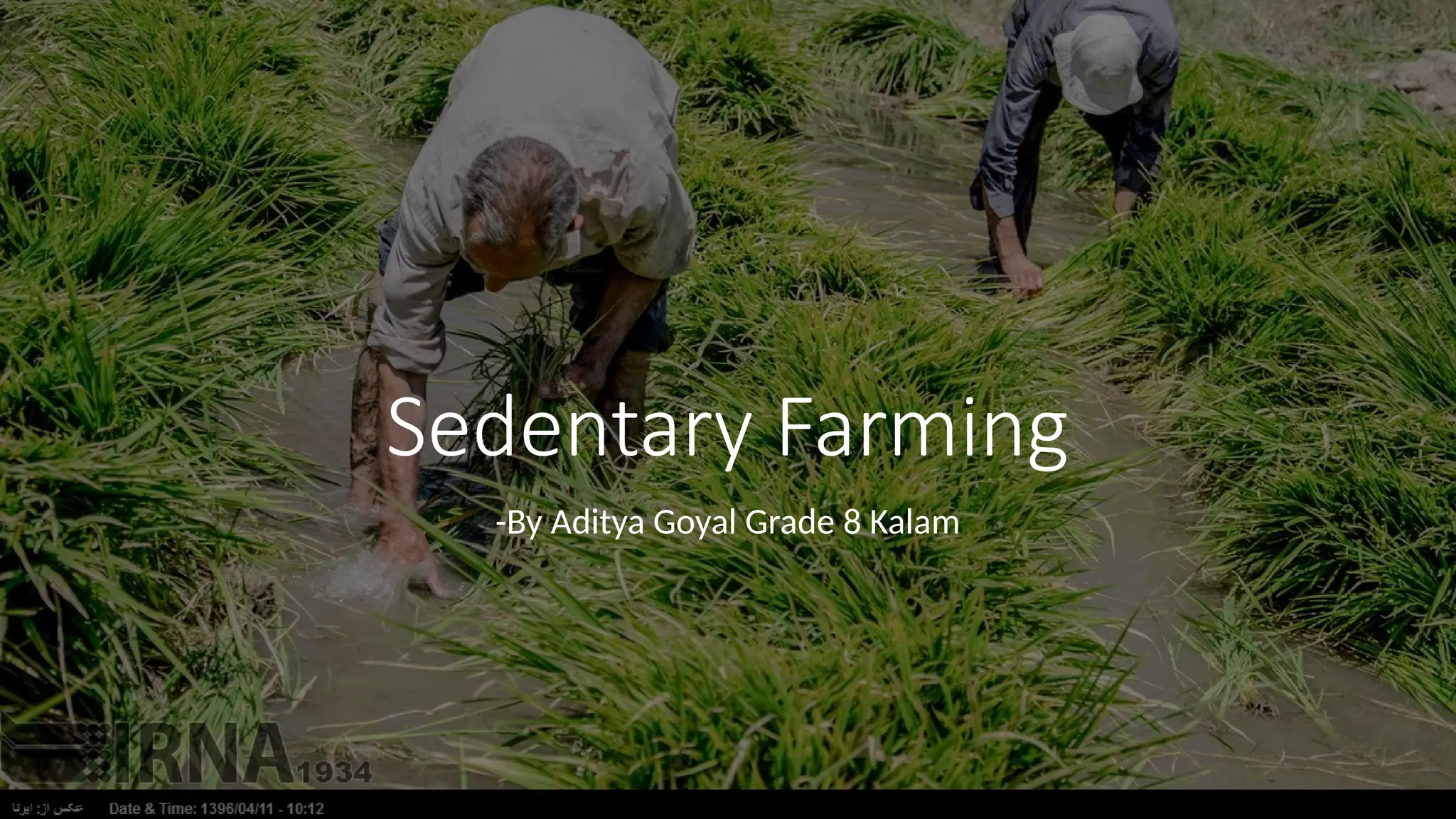
Sedentaryagriculture refers to farming that takes place in a
single location by a settled farmer without rotating the fields
Sedentary farming is a more advanced form of subsistence
agriculture practiced in the tropical lowlands. Here the people
settle on the land and earn their livelihood from agriculture.
Hence, it is sometimes called Sedentary subsistence
agriculture. Cultivators stay permanently on the land in this
type of farming, and the farmlands are reused continuously.
5.
Merits and
Demerits of
Sedentary
Farming
•Merits -
Sedentary farming offers
permanent interest in land. Hence,
the land is conserved.
Farmers get permanent benefits
from land.
Soil is preserved. Hence, it restricts
soil erosion.
• Demerits -
The demerits of sedentary
agriculture are small and they
differ from place to place.
In sedentary farming, sometimes,
soil exhaustion poses problems. It
can be overcome by introducing
crop rotation and using fertilizers
Glossary(Important words
used inthe PPT)
Capital Investment - The expenditure of money to fund a
company’s long term growth.
Stake - Loosely tying plastic wires on saplings to stabilize its
vertical growth.
Mulch - The addition of undecomposed plane materials such as
straw, hay or processor’s refuse to the soil under the plants.
Processor’s refuse - Agricultural Waste refers to unwanted by-
products created during agricultural activities and operations.
8.
Introduction
Plantation crops haveplayed a significant role in shaping our
world and continue to do so today. These crops have become
an integral part of our daily lives. From the morning cup of
coffee to the sweet treats we enjoy, plantation crops touch us
in many ways.
9.
What is Plantation
Agriculture?
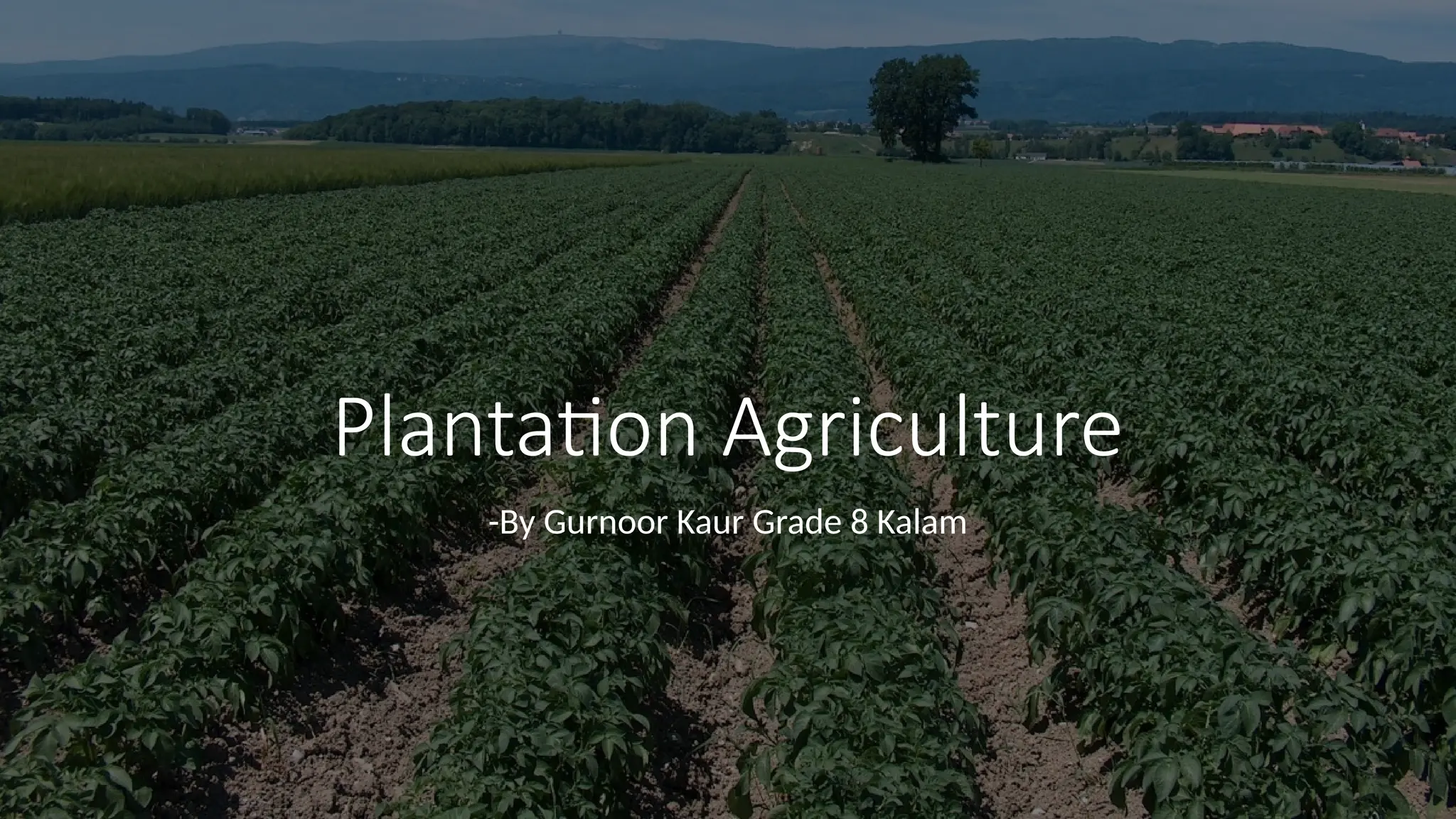
Plantationagriculture is a type of commercial farming.
It was first introduced by the Europeans in the tropical and subtropical regions.
The farms, called estates are very large .
Efficient and scientific methods are used. Cheap and skilled labour and huge
capital investments are required.
Mostly a single crop of tea, coffee, sugarcane, rubber, banana, spices and
cotton is grown.
The plantations are managed like industrial units.
Examples of places where it is practiced are the rubber plantations in Malaysia,
coffee plantations in Brazil, tea plantations in India and banana plantations in
West Indies.
10.
Process for PlantationAgriculture
1. Choose the
right tree
species.
2. Determine
the planting
location.
3. Prepare the
planting site.
4. Dig the
planting hole.
5. Remove the
tree from its
container.
6. Place the tree
in the planting
hole.
7. Backfill the
planting hole.
8. Stake or coat
plastic wires on
sapling to stabilize
its vertical growth.
9. Mulch or add undecomposed plant
materials such as straw, hay, or
processor’s refuse to the soil under the
plants.
11.
Merits and
Demerits of
Plantation
Agriculture
•Merits -
It plays a crucial role in global economy.
They create jobs and support communities
all around the world.
Many plantation crops are grown
sustainably, helping to preserve our
environment and protect biodiversity.
• Demerits -
It can result in deforestation.
It leads to high amount of green house gas
emissions.
It can uproot people from their homes.
It requires significant capital investment.
Glossary(Important words
used inthe PPT)
Livestock - The domesticated animals
raised in an agricultural setting in order to
provide labour and produce diversified
products for consumption such as meat,
eggs, milk, fur, leather, and wool.
14.
What is
Subsistence
Farming?
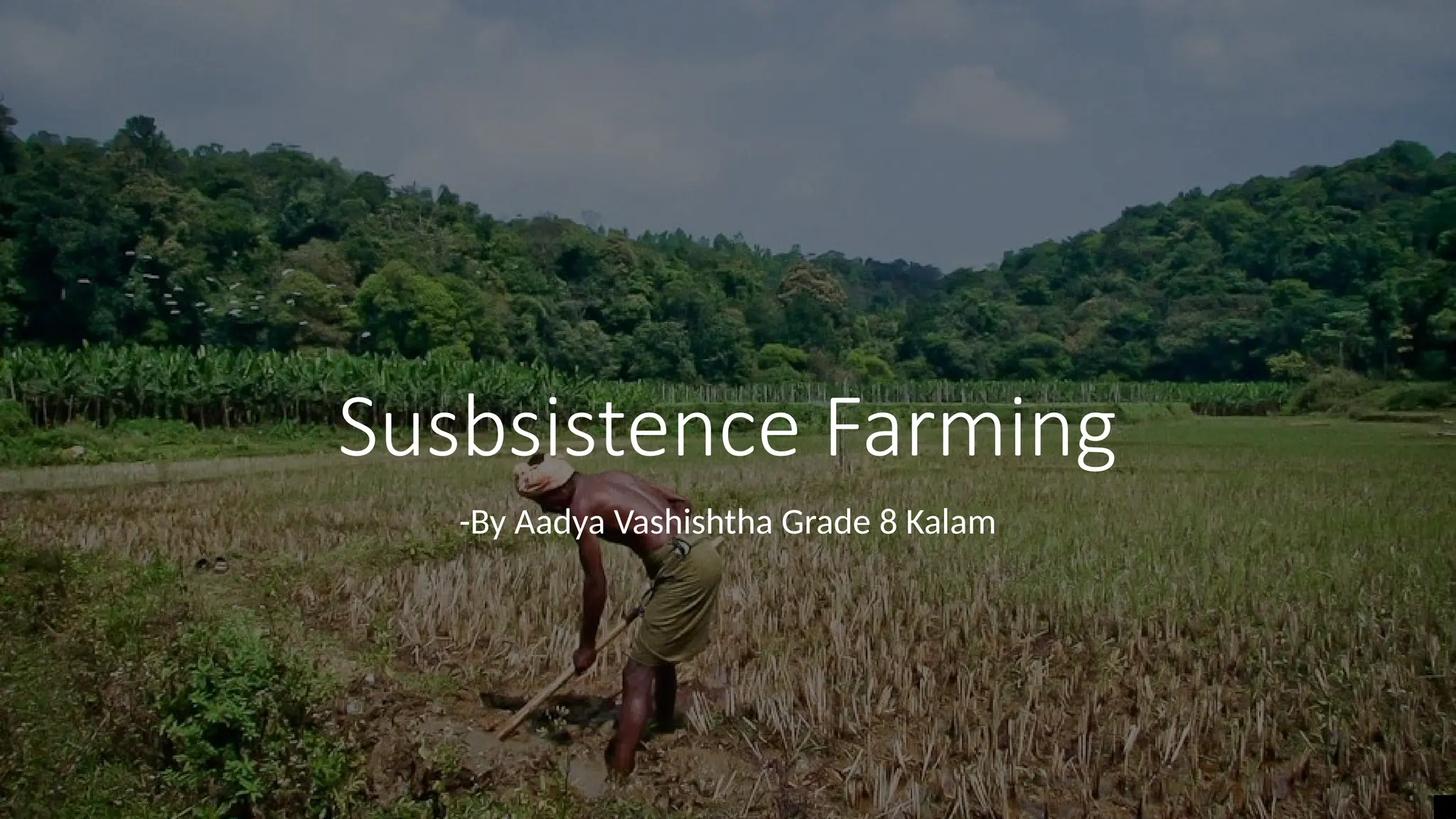
Subsistence farmingor subsistence agriculture
is a mode of agriculture in which all the crops
and livestock raised are used to maintain the
farmer and farmer’s family.
All produce grown is intended for consumption
purposes as opposed to market sale or trade.
In this type of farming, the farmer uses
primitive methods to produce a variety of
crops.
The labour is provided by the famer’s family.
All types of manure and a little of chemical
fertilizers are used.
The production is generally low.
15.
Where is it
practiced?
Subsistencefarming is found in small
patches and in some
underdeveloped mountainous
regions or remote valleys of Asia and
Africa.
It is also found in several parts of
Nepal, Bhutan, Myanmar, Ethiopia,
Sudan, Kenya, Sri Lanka etc.
A classic example is Nagaland in the
northeast hilly region of India. In the
hill tracts and valleys, Naga people
follow this type of farming.
Considering the region’s natural
environment, the Naga people
cultivate paddy and produce rice.
16.
Merits and
Demerits of
Subsistence
farming
•Merits -
Food security because farmers
produce crops for their
requirements only.
Environmental sustainability
Low financial risk.
• Demerits -
Low productivity
Limited access to inputs and
markets.
Low income