Bhargav Dangar
Roll No. 20
Law Of Evidence
 What evidence to be given when statement forms part of,
a) conversation
b) a longer statement or,
c) a document,
d) electronic record book or series of letters or papers.
 The Court considers necessary in that particular case to the
full understanding of nature & effect of the statement.
 Evidence against a party without giving to the party at the
same time the benefit of the entire residue of what he wrote
or said on the same occasion.
Amendment :
 The Amendment introduced this section under the I.T.
Act, 2000.
 The reform of this section became necessary because a
few new words had to be put into the section, such as
“electronic record”, “forms part of electronic record”.
 The existence of any judgment, decree, or order which by law
prevents any court from taking cognizance of a suit or holding
trial.
 The main object of doctrine of res judicata is to prevent
multiplicity of suits & interminable disputes between litigants.
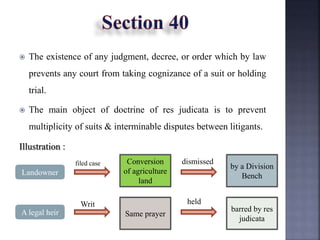
Illustration :
Landowner
filed case Conversion
of agriculture
land
by a Division
Bench
dismissed
A legal heir Same prayer
barred by res
judicata
Writ held
 The judgment of Civil court is not admissible in a criminal
prosecution to prove the innocence of the accused.
 A judgment or a decree is not admissible in evidence in all
cases as a matter of course, a judgment is only admissible to
show its date & legal consequences.
 Where a civil suit for compensation was filed & at the same
time criminal proceedings were also instituted on the same
cause of action & the civil suit was dismissed.
Section 39 & 40

Section 39 & 40

  • 1.
    Bhargav Dangar Roll No.20 Law Of Evidence
  • 2.
     What evidenceto be given when statement forms part of, a) conversation b) a longer statement or, c) a document, d) electronic record book or series of letters or papers.  The Court considers necessary in that particular case to the full understanding of nature & effect of the statement.
  • 3.
     Evidence againsta party without giving to the party at the same time the benefit of the entire residue of what he wrote or said on the same occasion. Amendment :  The Amendment introduced this section under the I.T. Act, 2000.  The reform of this section became necessary because a few new words had to be put into the section, such as “electronic record”, “forms part of electronic record”.
  • 4.
     The existenceof any judgment, decree, or order which by law prevents any court from taking cognizance of a suit or holding trial.  The main object of doctrine of res judicata is to prevent multiplicity of suits & interminable disputes between litigants. Illustration : Landowner filed case Conversion of agriculture land by a Division Bench dismissed A legal heir Same prayer barred by res judicata Writ held
  • 5.
     The judgmentof Civil court is not admissible in a criminal prosecution to prove the innocence of the accused.  A judgment or a decree is not admissible in evidence in all cases as a matter of course, a judgment is only admissible to show its date & legal consequences.  Where a civil suit for compensation was filed & at the same time criminal proceedings were also instituted on the same cause of action & the civil suit was dismissed.