Secondary Market: Meaning – History – Functions – Regulatory Framework
(b) Secondary Market: Meaning – History – Functions – Regulatory Framework – Listing and Delisting of Securities –
Trading Procedure – Stock Exchanges in India – Growth o
Difference
The industrialsecurities market consists of the new issue
(NIM)/primary market and the secondary/ stock exchange
market. The two parts of the market have some differences as
well as some similarities.
The difference between the NIM and stock exchanges pertain to
the types of securities dealt with, the nature of financing and
organization.
The NIM deals in new securities, which are offered to the
investing public for the first time. The stock market is a market
for old securities, which have been issued already and granted a
stock exchange quotation.
4.
Functions of NIM
Themain function of the NIM is to facilitate the transfer of
resources from the savers to the entrepreneurs. Its general
function is split, up operationally into a triple service function:
Origination
Under-writing
Distribution
5.
Origination
Origination refers tothe investigation and analysis and processing
of new issue proposals. One aspect is the preliminary
investigation, entailing a careful study of the technical, economic,
financial and legal aspects of the issuer to ensure that the issue is a
sound one. To improve the quality of the capital issue, the
sponsor also renders services of an advisory natures such as type
and price, timing and magnitude of issues, methods of flotation
and so on.
6.
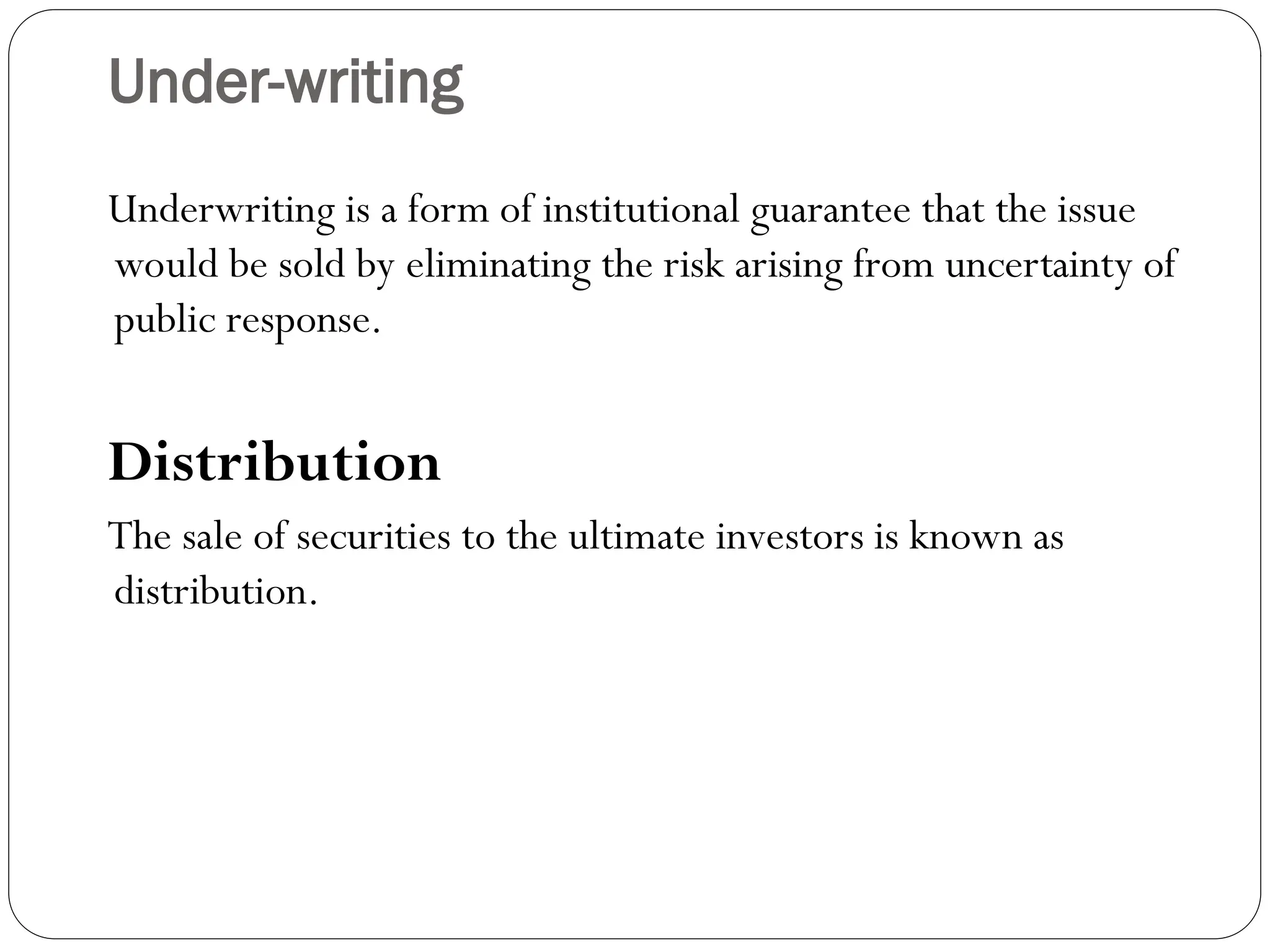
Under-writing
Underwriting is aform of institutional guarantee that the issue
would be sold by eliminating the risk arising from uncertainty of
public response.
Distribution
The sale of securities to the ultimate investors is known as
distribution.
7.
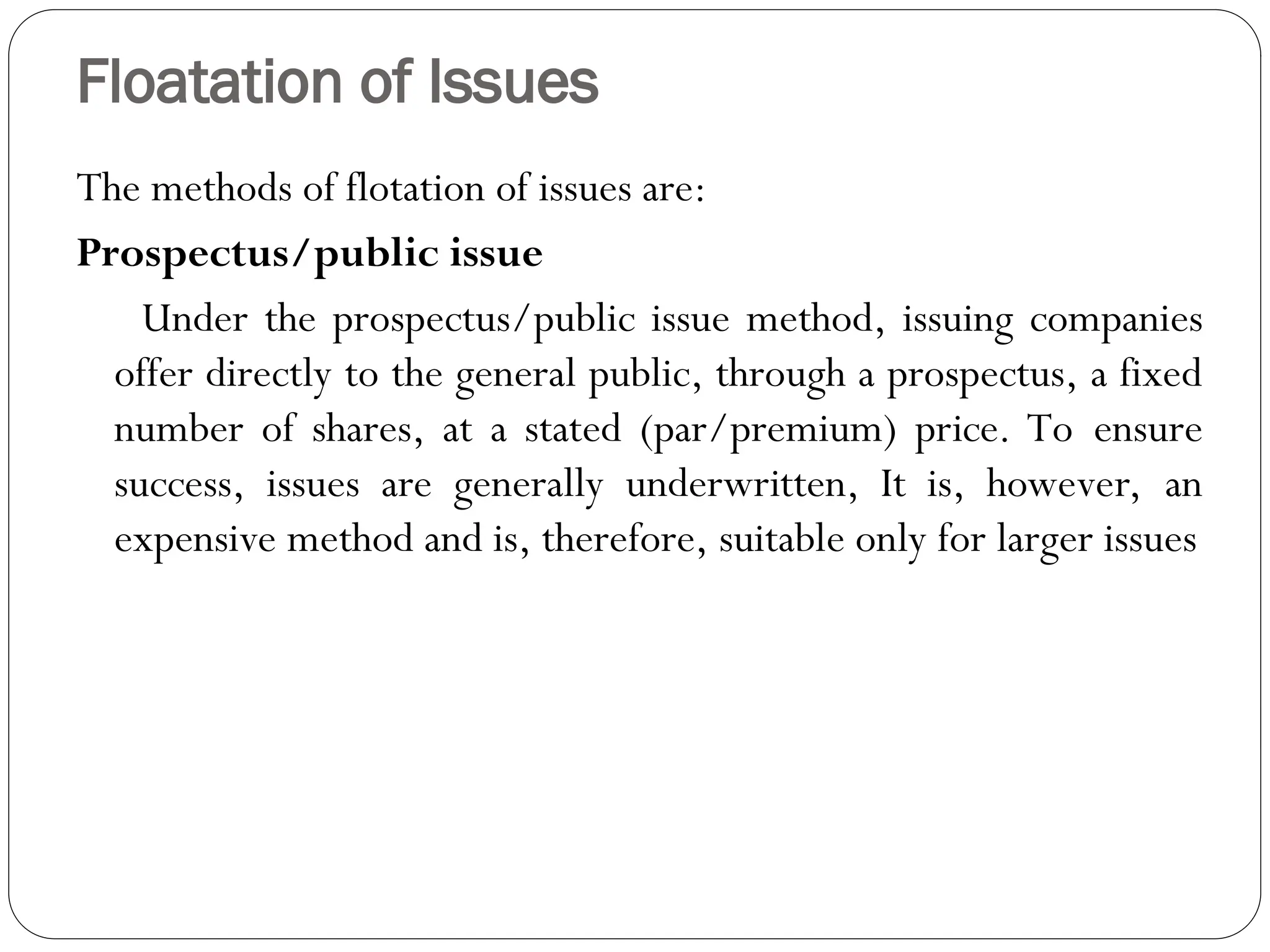
Floatation of Issues
Themethods of flotation of issues are:
Prospectus/public issue
Under the prospectus/public issue method, issuing companies
offer directly to the general public, through a prospectus, a fixed
number of shares, at a stated (par/premium) price. To ensure
success, issues are generally underwritten, It is, however, an
expensive method and is, therefore, suitable only for larger issues
8.
Floatation of IssuesConti..
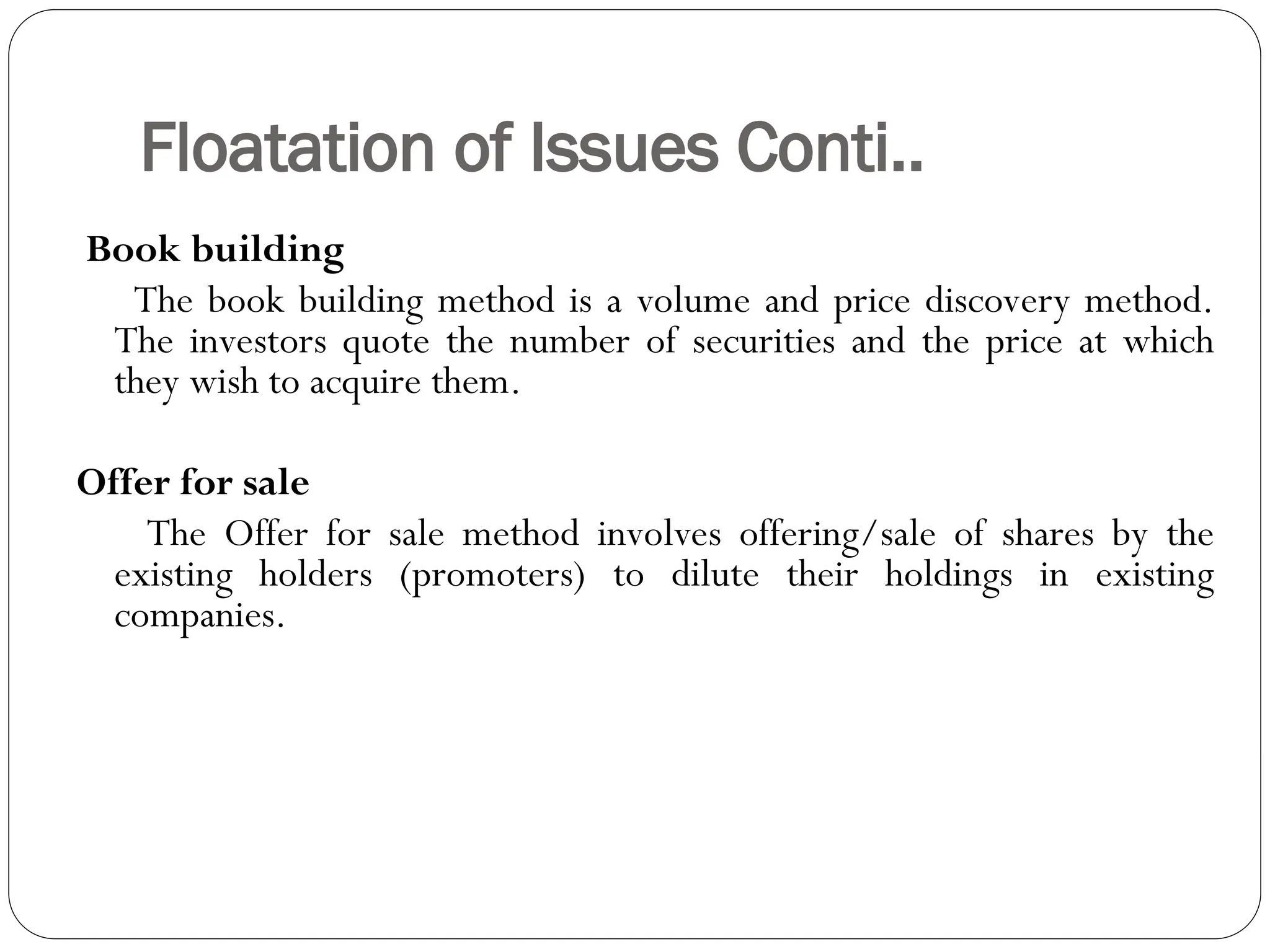
Book building
The book building method is a volume and price discovery method.
The investors quote the number of securities and the price at which
they wish to acquire them.
Offer for sale
The Offer for sale method involves offering/sale of shares by the
existing holders (promoters) to dilute their holdings in existing
companies.
9.
Floatation of IssuesConti..
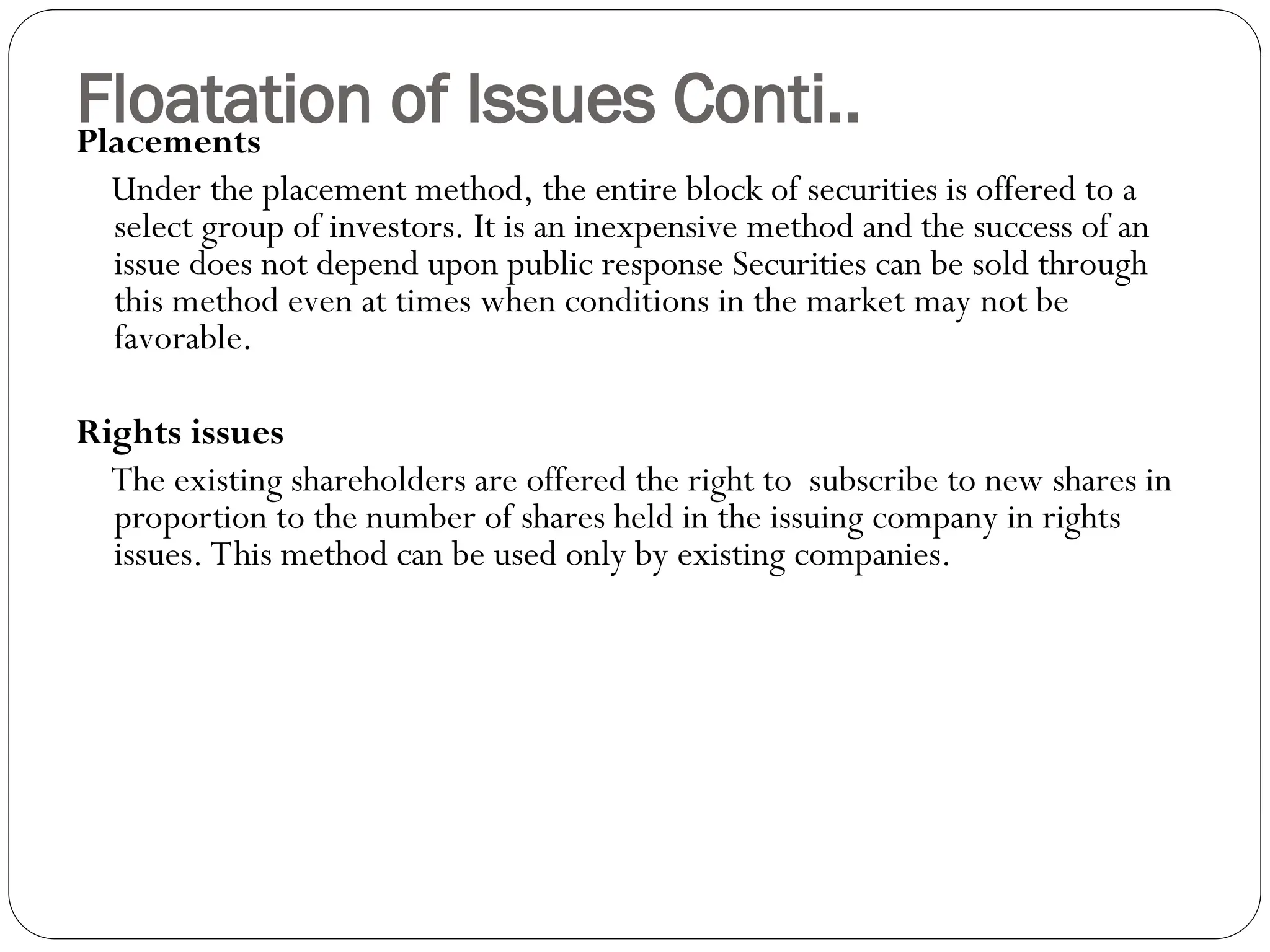
Placements
Under the placement method, the entire block of securities is offered to a
select group of investors. It is an inexpensive method and the success of an
issue does not depend upon public response Securities can be sold through
this method even at times when conditions in the market may not be
favorable.
Rights issues
The existing shareholders are offered the right to subscribe to new shares in
proportion to the number of shares held in the issuing company in rights
issues. This method can be used only by existing companies.