QUARTERLY EXAMINATION in TLE 7
Agriculture and Fishery Arts
Name: ______________________________________________________ Date: _____________________
Grade and Section: ____________________________________ Teacher:
Read the following statements/questions carefully. Choose the capital letter of the best answer.
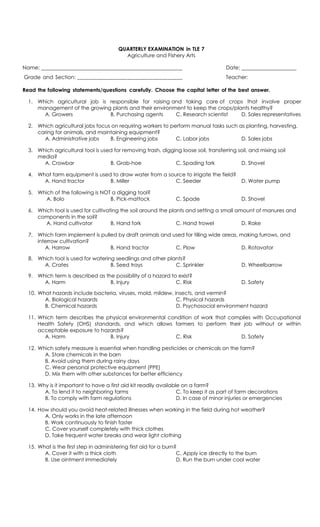
1. Which agricultural job is responsible for raising and taking care of crops that involve proper
management of the growing plants and their environment to keep the crops/plants healthy?
A. Growers B. Purchasing agents C. Research scientist D. Sales representatives
2. Which agricultural jobs focus on requiring workers to perform manual tasks such as planting, harvesting,
caring for animals, and maintaining equipment?
A. Administrative jobs B. Engineering jobs C. Labor jobs D. Sales jobs
3. Which agricultural tool is used for removing trash, digging loose soil, transferring soil, and mixing soil
media?
A. Crowbar B. Grab-hoe C. Spading fork D. Shovel
4. What farm equipment is used to draw water from a source to irrigate the field?
A. Hand tractor B. Miller C. Seeder D. Water pump
5. Which of the following is NOT a digging tool?
A. Bolo B. Pick-mattock C. Spade D. Shovel
6. Which tool is used for cultivating the soil around the plants and setting a small amount of manures and
components in the soil?
A. Hand cultivator B. Hand fork C. Hand trowel D. Rake
7. Which farm implement is pulled by draft animals and used for tilling wide areas, making furrows, and
interrow cultivation?
A. Harrow B. Hand tractor C. Plow D. Rotavator
8. Which tool is used for watering seedlings and other plants?
A. Crates B. Seed trays C. Sprinkler D. Wheelbarrow
9. Which term is described as the possibility of a hazard to exist?
A. Harm B. Injury C. Risk D. Safety
10. What hazards include bacteria, viruses, mold, mildew, insects, and vermin?
A. Biological hazards
B. Chemical hazards
C. Physical hazards
D. Psychosocial environment hazard
11. Which term describes the physical environmental condition of work that complies with Occupational
Health Safety (OHS) standards, and which allows farmers to perform their job without or within
acceptable exposure to hazards?
A. Harm B. Injury C. Risk D. Safety
12. Which safety measure is essential when handling pesticides or chemicals on the farm?
A. Store chemicals in the barn
B. Avoid using them during rainy days
C. Wear personal protective equipment (PPE)
D. Mix them with other substances for better efficiency
13. Why is it important to have a first aid kit readily available on a farm?
A. To lend it to neighboring farms
B. To comply with farm regulations
C. To keep it as part of farm decorations
D. In case of minor injuries or emergencies
14. How should you avoid heat-related illnesses when working in the field during hot weather?
A. Only works in the late afternoon
B. Work continuously to finish faster
C. Cover yourself completely with thick clothes
D. Take frequent water breaks and wear light clothing
15. What is the first step in administering first aid for a burn?
A. Cover it with a thick cloth
B. Use ointment immediately
C. Apply ice directly to the burn
D. Run the burn under cool water
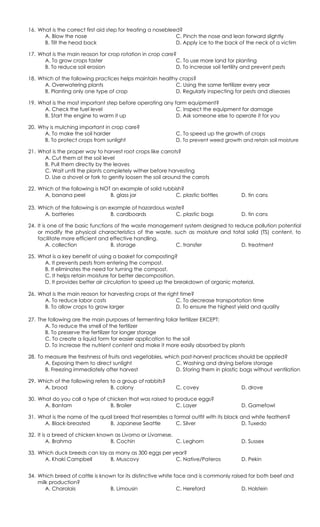
16. What is the correct first aid step for treating a nosebleed?
A. Blow the nose
B. Tilt the head back
C. Pinch the nose and lean forward slightly
D. Apply ice to the back of the neck of a victim
17. What is the main reason for crop rotation in crop care?
A. To grow crops faster
B. To reduce soil erosion
C. To use more land for planting
D. To increase soil fertility and prevent pests
18. Which of the following practices helps maintain healthy crops?
A. Overwatering plants
B. Planting only one type of crop
C. Using the same fertilizer every year
D. Regularly inspecting for pests and diseases
19. What is the most important step before operating any farm equipment?
A. Check the fuel level
B. Start the engine to warm it up
C. Inspect the equipment for damage
D. Ask someone else to operate it for you
20. Why is mulching important in crop care?
A. To make the soil harder
B. To protect crops from sunlight
C. To speed up the growth of crops
D. To prevent weed growth and retain soil moisture
21. What is the proper way to harvest root crops like carrots?
A. Cut them at the soil level
B. Pull them directly by the leaves
C. Wait until the plants completely wither before harvesting
D. Use a shovel or fork to gently loosen the soil around the carrots
22. Which of the following is NOT an example of solid rubbish?
A. banana peel B. glass jar C. plastic bottles D. tin cans
23. Which of the following is an example of hazardous waste?
A. batteries B. cardboards C. plastic bags D. tin cans
24. It is one of the basic functions of the waste management system designed to reduce pollution potential
or modify the physical characteristics of the waste, such as moisture and total solid (TS) content, to
facilitate more efficient and effective handling.
A. collection B. storage C. transfer D. treatment
25. What is a key benefit of using a basket for composting?
A. It prevents pests from entering the compost.
B. It eliminates the need for turning the compost.
C. It helps retain moisture for better decomposition.
D. It provides better air circulation to speed up the breakdown of organic material.
26. What is the main reason for harvesting crops at the right time?
A. To reduce labor costs
B. To allow crops to grow larger
C. To decrease transportation time
D. To ensure the highest yield and quality
27. The following are the main purposes of fermenting foliar fertilizer EXCEPT;
A. To reduce the smell of the fertilizer
B. To preserve the fertilizer for longer storage
C. To create a liquid form for easier application to the soil
D. To increase the nutrient content and make it more easily absorbed by plants
28. To measure the freshness of fruits and vegetables, which post-harvest practices should be applied?
A. Exposing them to direct sunlight
B. Freezing immediately after harvest
C. Washing and drying before storage
D. Storing them in plastic bags without ventilation
29. Which of the following refers to a group of rabbits?
A. brood B. colony C. covey D. drove
30. What do you call a type of chicken that was raised to produce eggs?
A. Bantam B. Broiler C. Layer D. Gamefowl
31. What is the name of the quail breed that resembles a formal outfit with its black and white feathers?
A. Black-breasted B. Japanese Seattle C. Silver D. Tuxedo
32. It is a breed of chicken known as Livorno or Livornese.
A. Brahma B. Cochin C. Leghorn D. Sussex
33. Which duck breeds can lay as many as 300 eggs per year?
A. Khaki Campbell B. Muscovy C. Native/Pateros D. Pekin
34. Which breed of cattle is known for its distinctive white face and is commonly raised for both beef and
milk production?
A. Charolais B. Limousin C. Hereford D. Holstein
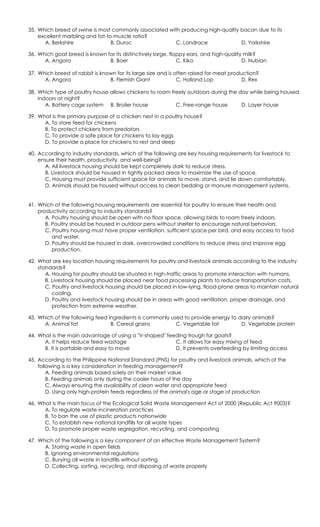
35. Which breed of swine is most commonly associated with producing high-quality bacon due to its
excellent marbling and fat-to-muscle ratio?
A. Berkshire B. Duroc C. Landrace D. Yorkshire
36. Which goat breed is known for its distinctively large, floppy ears, and high-quality milk?
A. Angora B. Boer C. Kiko D. Nubian
37. Which breed of rabbit is known for its large size and is often raised for meat production?
A. Angora B. Flemish Giant C. Holland Lop D. Rex
38. Which type of poultry house allows chickens to roam freely outdoors during the day while being housed
indoors at night?
A. Battery cage system B. Broiler house C. Free-range house D. Layer house
39. What is the primary purpose of a chicken nest in a poultry house?
A. To store feed for chickens
B. To protect chickens from predators
C. To provide a safe place for chickens to lay eggs
D. To provide a place for chickens to rest and sleep
40. According to industry standards, which of the following are key housing requirements for livestock to
ensure their health, productivity, and well-being?
A. All livestock housing should be kept completely dark to reduce stress.
B. Livestock should be housed in tightly packed areas to maximize the use of space.
C. Housing must provide sufficient space for animals to move, stand, and lie down comfortably.
D. Animals should be housed without access to clean bedding or manure management systems.
41. Which of the following housing requirements are essential for poultry to ensure their health and
productivity according to industry standards?
A. Poultry housing should be open with no floor space, allowing birds to roam freely indoors.
B. Poultry should be housed in outdoor pens without shelter to encourage natural behaviors.
C. Poultry housing must have proper ventilation, sufficient space per bird, and easy access to food
and water.
D. Poultry should be housed in dark, overcrowded conditions to reduce stress and improve egg
production.
42. What are key location housing requirements for poultry and livestock animals according to the industry
standards?
A. Housing for poultry should be situated in high-traffic areas to promote interaction with humans.
B. Livestock housing should be placed near food processing plants to reduce transportation costs.
C. Poultry and livestock housing should be placed in low-lying, flood-prone areas to maintain natural
cooling.
D. Poultry and livestock housing should be in areas with good ventilation, proper drainage, and
protection from extreme weather.
43. Which of the following feed ingredients is commonly used to provide energy to dairy animals?
A. Animal fat B. Cereal grains C. Vegetable fat D. Vegetable protein
44. What is the main advantage of using a "V-shaped" feeding trough for goats?
A. It helps reduce feed wastage
B. It is portable and easy to move
C. It allows for easy mixing of feed
D. It prevents overfeeding by limiting access
45. According to the Philippine National Standard (PNS) for poultry and livestock animals, which of the
following is a key consideration in feeding management?
A. Feeding animals based solely on their market value
B. Feeding animals only during the cooler hours of the day
C. Always ensuring the availability of clean water and appropriate feed
D. Using only high-protein feeds regardless of the animal's age or stage of production
46. What is the main focus of the Ecological Solid Waste Management Act of 2000 (Republic Act 9003)?
A. To regulate waste incineration practices
B. To ban the use of plastic products nationwide
C. To establish new national landfills for all waste types
D. To promote proper waste segregation, recycling, and composting
47. Which of the following is a key component of an effective Waste Management System?
A. Storing waste in open fields
B. Ignoring environmental regulations
C. Burying all waste in landfills without sorting
D. Collecting, sorting, recycling, and disposing of waste properly
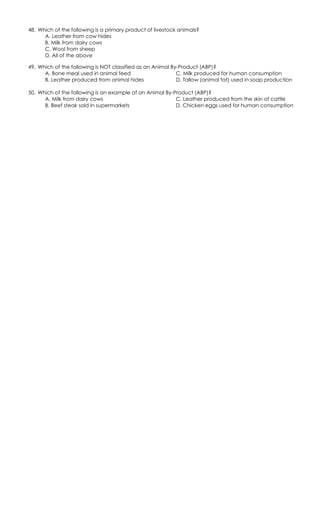
48. Which of the following is a primary product of livestock animals?
A. Leather from cow hides
B. Milk from dairy cows
C. Wool from sheep
D. All of the above
49. Which of the following is NOT classified as an Animal By-Product (ABP)?
A. Bone meal used in animal feed
B. Leather produced from animal hides
C. Milk produced for human consumption
D. Tallow (animal fat) used in soap production
50. Which of the following is an example of an Animal By-Product (ABP)?
A. Milk from dairy cows
B. Beef steak sold in supermarkets
C. Leather produced from the skin of cattle
D. Chicken eggs used for human consumption
KEY TO CORRECTIONS:
1. A 11. D 21. D 31. D 41. C
2. C 12. C 22. A 32. C 42. D
3. D 13. D 23. A 33. A 43. B
4. D 14. D 24. D 34. C 44. A
5. A 15. D 25. D 35. A 45. C
6. C 16. C 26. D 36. D 46. D
7. C 17. D 27. C 37. B 47. D
8. C 18. D 28. C 38. C 48. D
9. C 19. C 29. B 39. C 49. C
10. A 20. D 30. C 40. C 50. C

SECOND PERIODICAL TEST IN TLE AFA 7.docx

  • 1.
    QUARTERLY EXAMINATION inTLE 7 Agriculture and Fishery Arts Name: ______________________________________________________ Date: _____________________ Grade and Section: ____________________________________ Teacher: Read the following statements/questions carefully. Choose the capital letter of the best answer. 1. Which agricultural job is responsible for raising and taking care of crops that involve proper management of the growing plants and their environment to keep the crops/plants healthy? A. Growers B. Purchasing agents C. Research scientist D. Sales representatives 2. Which agricultural jobs focus on requiring workers to perform manual tasks such as planting, harvesting, caring for animals, and maintaining equipment? A. Administrative jobs B. Engineering jobs C. Labor jobs D. Sales jobs 3. Which agricultural tool is used for removing trash, digging loose soil, transferring soil, and mixing soil media? A. Crowbar B. Grab-hoe C. Spading fork D. Shovel 4. What farm equipment is used to draw water from a source to irrigate the field? A. Hand tractor B. Miller C. Seeder D. Water pump 5. Which of the following is NOT a digging tool? A. Bolo B. Pick-mattock C. Spade D. Shovel 6. Which tool is used for cultivating the soil around the plants and setting a small amount of manures and components in the soil? A. Hand cultivator B. Hand fork C. Hand trowel D. Rake 7. Which farm implement is pulled by draft animals and used for tilling wide areas, making furrows, and interrow cultivation? A. Harrow B. Hand tractor C. Plow D. Rotavator 8. Which tool is used for watering seedlings and other plants? A. Crates B. Seed trays C. Sprinkler D. Wheelbarrow 9. Which term is described as the possibility of a hazard to exist? A. Harm B. Injury C. Risk D. Safety 10. What hazards include bacteria, viruses, mold, mildew, insects, and vermin? A. Biological hazards B. Chemical hazards C. Physical hazards D. Psychosocial environment hazard 11. Which term describes the physical environmental condition of work that complies with Occupational Health Safety (OHS) standards, and which allows farmers to perform their job without or within acceptable exposure to hazards? A. Harm B. Injury C. Risk D. Safety 12. Which safety measure is essential when handling pesticides or chemicals on the farm? A. Store chemicals in the barn B. Avoid using them during rainy days C. Wear personal protective equipment (PPE) D. Mix them with other substances for better efficiency 13. Why is it important to have a first aid kit readily available on a farm? A. To lend it to neighboring farms B. To comply with farm regulations C. To keep it as part of farm decorations D. In case of minor injuries or emergencies 14. How should you avoid heat-related illnesses when working in the field during hot weather? A. Only works in the late afternoon B. Work continuously to finish faster C. Cover yourself completely with thick clothes D. Take frequent water breaks and wear light clothing 15. What is the first step in administering first aid for a burn? A. Cover it with a thick cloth B. Use ointment immediately C. Apply ice directly to the burn D. Run the burn under cool water
  • 2.
    16. What isthe correct first aid step for treating a nosebleed? A. Blow the nose B. Tilt the head back C. Pinch the nose and lean forward slightly D. Apply ice to the back of the neck of a victim 17. What is the main reason for crop rotation in crop care? A. To grow crops faster B. To reduce soil erosion C. To use more land for planting D. To increase soil fertility and prevent pests 18. Which of the following practices helps maintain healthy crops? A. Overwatering plants B. Planting only one type of crop C. Using the same fertilizer every year D. Regularly inspecting for pests and diseases 19. What is the most important step before operating any farm equipment? A. Check the fuel level B. Start the engine to warm it up C. Inspect the equipment for damage D. Ask someone else to operate it for you 20. Why is mulching important in crop care? A. To make the soil harder B. To protect crops from sunlight C. To speed up the growth of crops D. To prevent weed growth and retain soil moisture 21. What is the proper way to harvest root crops like carrots? A. Cut them at the soil level B. Pull them directly by the leaves C. Wait until the plants completely wither before harvesting D. Use a shovel or fork to gently loosen the soil around the carrots 22. Which of the following is NOT an example of solid rubbish? A. banana peel B. glass jar C. plastic bottles D. tin cans 23. Which of the following is an example of hazardous waste? A. batteries B. cardboards C. plastic bags D. tin cans 24. It is one of the basic functions of the waste management system designed to reduce pollution potential or modify the physical characteristics of the waste, such as moisture and total solid (TS) content, to facilitate more efficient and effective handling. A. collection B. storage C. transfer D. treatment 25. What is a key benefit of using a basket for composting? A. It prevents pests from entering the compost. B. It eliminates the need for turning the compost. C. It helps retain moisture for better decomposition. D. It provides better air circulation to speed up the breakdown of organic material. 26. What is the main reason for harvesting crops at the right time? A. To reduce labor costs B. To allow crops to grow larger C. To decrease transportation time D. To ensure the highest yield and quality 27. The following are the main purposes of fermenting foliar fertilizer EXCEPT; A. To reduce the smell of the fertilizer B. To preserve the fertilizer for longer storage C. To create a liquid form for easier application to the soil D. To increase the nutrient content and make it more easily absorbed by plants 28. To measure the freshness of fruits and vegetables, which post-harvest practices should be applied? A. Exposing them to direct sunlight B. Freezing immediately after harvest C. Washing and drying before storage D. Storing them in plastic bags without ventilation 29. Which of the following refers to a group of rabbits? A. brood B. colony C. covey D. drove 30. What do you call a type of chicken that was raised to produce eggs? A. Bantam B. Broiler C. Layer D. Gamefowl 31. What is the name of the quail breed that resembles a formal outfit with its black and white feathers? A. Black-breasted B. Japanese Seattle C. Silver D. Tuxedo 32. It is a breed of chicken known as Livorno or Livornese. A. Brahma B. Cochin C. Leghorn D. Sussex 33. Which duck breeds can lay as many as 300 eggs per year? A. Khaki Campbell B. Muscovy C. Native/Pateros D. Pekin 34. Which breed of cattle is known for its distinctive white face and is commonly raised for both beef and milk production? A. Charolais B. Limousin C. Hereford D. Holstein
  • 3.
    35. Which breedof swine is most commonly associated with producing high-quality bacon due to its excellent marbling and fat-to-muscle ratio? A. Berkshire B. Duroc C. Landrace D. Yorkshire 36. Which goat breed is known for its distinctively large, floppy ears, and high-quality milk? A. Angora B. Boer C. Kiko D. Nubian 37. Which breed of rabbit is known for its large size and is often raised for meat production? A. Angora B. Flemish Giant C. Holland Lop D. Rex 38. Which type of poultry house allows chickens to roam freely outdoors during the day while being housed indoors at night? A. Battery cage system B. Broiler house C. Free-range house D. Layer house 39. What is the primary purpose of a chicken nest in a poultry house? A. To store feed for chickens B. To protect chickens from predators C. To provide a safe place for chickens to lay eggs D. To provide a place for chickens to rest and sleep 40. According to industry standards, which of the following are key housing requirements for livestock to ensure their health, productivity, and well-being? A. All livestock housing should be kept completely dark to reduce stress. B. Livestock should be housed in tightly packed areas to maximize the use of space. C. Housing must provide sufficient space for animals to move, stand, and lie down comfortably. D. Animals should be housed without access to clean bedding or manure management systems. 41. Which of the following housing requirements are essential for poultry to ensure their health and productivity according to industry standards? A. Poultry housing should be open with no floor space, allowing birds to roam freely indoors. B. Poultry should be housed in outdoor pens without shelter to encourage natural behaviors. C. Poultry housing must have proper ventilation, sufficient space per bird, and easy access to food and water. D. Poultry should be housed in dark, overcrowded conditions to reduce stress and improve egg production. 42. What are key location housing requirements for poultry and livestock animals according to the industry standards? A. Housing for poultry should be situated in high-traffic areas to promote interaction with humans. B. Livestock housing should be placed near food processing plants to reduce transportation costs. C. Poultry and livestock housing should be placed in low-lying, flood-prone areas to maintain natural cooling. D. Poultry and livestock housing should be in areas with good ventilation, proper drainage, and protection from extreme weather. 43. Which of the following feed ingredients is commonly used to provide energy to dairy animals? A. Animal fat B. Cereal grains C. Vegetable fat D. Vegetable protein 44. What is the main advantage of using a "V-shaped" feeding trough for goats? A. It helps reduce feed wastage B. It is portable and easy to move C. It allows for easy mixing of feed D. It prevents overfeeding by limiting access 45. According to the Philippine National Standard (PNS) for poultry and livestock animals, which of the following is a key consideration in feeding management? A. Feeding animals based solely on their market value B. Feeding animals only during the cooler hours of the day C. Always ensuring the availability of clean water and appropriate feed D. Using only high-protein feeds regardless of the animal's age or stage of production 46. What is the main focus of the Ecological Solid Waste Management Act of 2000 (Republic Act 9003)? A. To regulate waste incineration practices B. To ban the use of plastic products nationwide C. To establish new national landfills for all waste types D. To promote proper waste segregation, recycling, and composting 47. Which of the following is a key component of an effective Waste Management System? A. Storing waste in open fields B. Ignoring environmental regulations C. Burying all waste in landfills without sorting D. Collecting, sorting, recycling, and disposing of waste properly
  • 4.
    48. Which ofthe following is a primary product of livestock animals? A. Leather from cow hides B. Milk from dairy cows C. Wool from sheep D. All of the above 49. Which of the following is NOT classified as an Animal By-Product (ABP)? A. Bone meal used in animal feed B. Leather produced from animal hides C. Milk produced for human consumption D. Tallow (animal fat) used in soap production 50. Which of the following is an example of an Animal By-Product (ABP)? A. Milk from dairy cows B. Beef steak sold in supermarkets C. Leather produced from the skin of cattle D. Chicken eggs used for human consumption
  • 5.
    KEY TO CORRECTIONS: 1.A 11. D 21. D 31. D 41. C 2. C 12. C 22. A 32. C 42. D 3. D 13. D 23. A 33. A 43. B 4. D 14. D 24. D 34. C 44. A 5. A 15. D 25. D 35. A 45. C 6. C 16. C 26. D 36. D 46. D 7. C 17. D 27. C 37. B 47. D 8. C 18. D 28. C 38. C 48. D 9. C 19. C 29. B 39. C 49. C 10. A 20. D 30. C 40. C 50. C