ARTIFICIAL INTELLIGENCE (SEM-I)
Chapter 1: Introduction to Artificial Intelligence
By,
Asst. Prof. Vaishnavi B. Lokhande
INTRODUCTION
 “The science and engineering of making intelligent
machines, especially intelligent computer programs”. -
John McCarthy-
 Artificial Intelligence is an approach to make a
computer, a robot, or a product to think how smart
human think.
 AI is a study of how human brain think, learn, decide
and work, when it tries to solve problems. And finally
this study outputs intelligent software systems.
 The aim of AI is to improve computer functions which
are related to human knowledge, for example,
reasoning, learning, and problem-solving.
 The intelligence is intangible. It is composed of
 Reasoning
 Learning
 Problem Solving
 Perception
 Linguistic Intelligence
 The objectives of AI research are reasoning,
knowledge representation, planning, learning,
natural language processing, realization, and
ability to move and manipulate objects.
 There are long-term goals in the general
intelligence sector.
APPLICATIONS OF AI
 Gaming − AI plays important role for machine to think of large number
of possible positions based on deep knowledge in strategic games. for
example, chess, river crossing, N-queens problems and etc.
 Natural Language Processing − Interact with the computer that
understands natural language spoken by humans.
 Expert Systems − Machine or software provide explanation and advice
to the users.
 Vision Systems − Systems understand, explain, and describe visual
input on the computer.
 Speech Recognition − There are some AI based speech recognition
systems have ability to hear and express as sentences and understand
their meanings while a person talks to it. For example Siri and Google
assistant.
 Handwriting Recognition − The handwriting recognition software
reads the text written on paper and recognize the shapes of the letters
and convert it into editable text.
 Intelligent Robots − Robots are able to perform the instructions given
by a human.
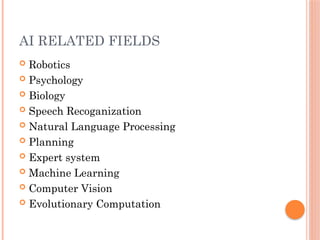
AI RELATED FIELDS
 Robotics
 Psychology
 Biology
 Speech Recoganization
 Natural Language Processing
 Planning
 Expert system
 Machine Learning
 Computer Vision
 Evolutionary Computation
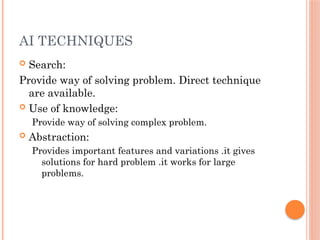
AI TECHNIQUES
 Search:
Provide way of solving problem. Direct technique
are available.
 Use of knowledge:
Provide way of solving complex problem.
 Abstraction:
Provides important features and variations .it gives
solutions for hard problem .it works for large
problems.

Artificial Intelligence Basics part 1 for UG students

  • 1.
    ARTIFICIAL INTELLIGENCE (SEM-I) Chapter1: Introduction to Artificial Intelligence By, Asst. Prof. Vaishnavi B. Lokhande
  • 2.
    INTRODUCTION  “The scienceand engineering of making intelligent machines, especially intelligent computer programs”. - John McCarthy-  Artificial Intelligence is an approach to make a computer, a robot, or a product to think how smart human think.  AI is a study of how human brain think, learn, decide and work, when it tries to solve problems. And finally this study outputs intelligent software systems.  The aim of AI is to improve computer functions which are related to human knowledge, for example, reasoning, learning, and problem-solving.
  • 3.
     The intelligenceis intangible. It is composed of  Reasoning  Learning  Problem Solving  Perception  Linguistic Intelligence  The objectives of AI research are reasoning, knowledge representation, planning, learning, natural language processing, realization, and ability to move and manipulate objects.  There are long-term goals in the general intelligence sector.
  • 4.
    APPLICATIONS OF AI Gaming − AI plays important role for machine to think of large number of possible positions based on deep knowledge in strategic games. for example, chess, river crossing, N-queens problems and etc.  Natural Language Processing − Interact with the computer that understands natural language spoken by humans.  Expert Systems − Machine or software provide explanation and advice to the users.  Vision Systems − Systems understand, explain, and describe visual input on the computer.  Speech Recognition − There are some AI based speech recognition systems have ability to hear and express as sentences and understand their meanings while a person talks to it. For example Siri and Google assistant.  Handwriting Recognition − The handwriting recognition software reads the text written on paper and recognize the shapes of the letters and convert it into editable text.  Intelligent Robots − Robots are able to perform the instructions given by a human.
  • 5.
    AI RELATED FIELDS Robotics  Psychology  Biology  Speech Recoganization  Natural Language Processing  Planning  Expert system  Machine Learning  Computer Vision  Evolutionary Computation
  • 6.
    AI TECHNIQUES  Search: Provideway of solving problem. Direct technique are available.  Use of knowledge: Provide way of solving complex problem.  Abstraction: Provides important features and variations .it gives solutions for hard problem .it works for large problems.