The journey to rails
Seamless Migration
Jeffery Yeary
jeff@debug.ninja | http://debug.ninja
Who am I?
❖ Jeff Yeary
❖ Yes I made a slide with my name on it, otherwise I
would forget to have an introduction
❖ Software Architect
❖ 10 + Years, unique perspective
Outline
❖ Platform [ ~5 min ]
❖ History (~2 min)
❖ Why a new platform? (~2 min)
❖ Rails? (~1 min)
❖ Our basic approach [ ~15 min ]
❖ APIs (~3 min)
❖ Mobile / responsive site (~2 min)
❖ Authentication (~2 min)
❖ Zuul (~8 min)
❖ Q/A
Platform: History
❖ Tibco Platform (ASP / C++ / VB)
❖ Matrix Platform [US / INTL / MINI] (.Net)
❖ Hero Platform (.Net)
❖ Niche Platform (Rails 3.0)
❖ Highlander (Rails 3.0)
❖ Punchkick Tablet Platform (PHP outsourced)
❖ Mobile Site (PHP outsourced)
❖ Global Responsive Rails Platform (Rails 4)
Which of these is a competitive
advantage?
❖ Ability to scale to millions of users
❖ Ability to deploy multiple times a day
❖ Continuous Integration / Delivery
❖ Agile software development process
❖ Providing a compelling and engaging user experience
Why write another platform?
❖ Consistent user experience
❖ Focus our resources
❖ Actually think globally
❖ Global feature set
❖ Chance to name something (GRRP)
Platform: Rails
❖ Fast to deploy (.net was taking an hour to deploy)
❖ Fast to develop on (no local compilation)
❖ Community (rubygems > nuget packages)
❖ Mature
Our basic approach
❖ Changing the tires while the car is in motion
❖ Make the change with minimal disruption to the user
❖ Same URLs when needed
❖ Consistent look and feel
❖ Stay logged in across platforms
❖ Adopt SOA -> Create responsive website -> Maintain
login state between platforms -> Proxy between the
applications
Transitioning: APIs
❖ service-oriented architecture (SOA) is a style of
software architecture for designing and developing
software in the form of interoperable services. These
services have well-defined business functionalities that
are built as software components which can be reused
for different purposes
❖ Public API
❖ Delivery Mechanism
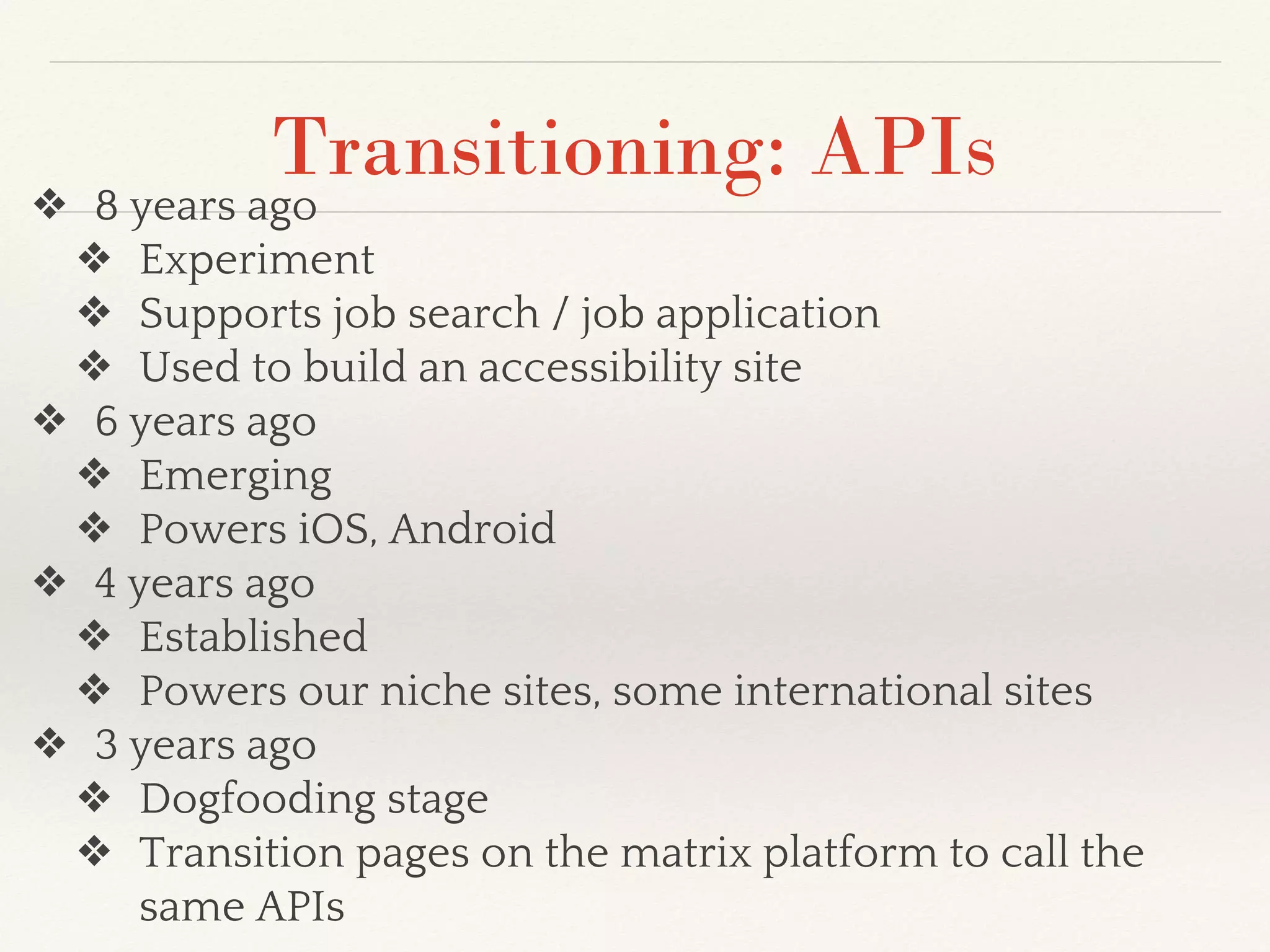
Transitioning: APIs
❖ 8 years ago
❖ Experiment
❖ Supports job search / job application
❖ Used to build an accessibility site
❖ 6 years ago
❖ Emerging
❖ Powers iOS, Android
❖ 4 years ago
❖ Established
❖ Powers our niche sites, some international sites
❖ 3 years ago
❖ Dogfooding stage
❖ Transition pages on the matrix platform to call the
same APIs
Transitioning: Mobile site
❖ Started with something impactful (nearly 50% off all of
our users are on non-desktop devices)
❖ Opportunity to end desktop / mobile divide
❖ Responsive (foundation)
❖ First version of this is two separate domains
Transitioning: Authentication
❖ Adopt an oauth authentication flow
❖ Two step flow (think facebook connect)
❖ Follow the facebook JS sdk methodology
❖ Each platform has its own session but checks back to
the mothership
❖ Javascript says something changed, we make a server to
server call to update our session
Transitioning: Reverse Proxy
❖ Now that we have feature parity on our rails platform
and we have a central authentication authority we need
a way to select between the platforms
❖ Previous experience using HAProxy, NGinx and Zuul
Zuul
❖ What is Zuul? ( github.com/Netflix/zuul )
❖ Why use zuul?
❖ Very low overhead
❖ Powerful language (java / groovy) for making changes
to requests
❖ Simple web app example
❖ Example does almost everything needed out of the
box
Zuul: High Level
❖ Pre
❖ Add a bunch of headers to the request
❖ Stats logging about the incoming urls
❖ Route
❖ Choose which application to go to, make the request
and send it back
❖ Post
❖ Stats logging about the time taken for each request
Zuul: It’s this simple
1. https://github.com/cbdr/consumer-zuul-www/blob/master/src/main/groovy/filters/route/SimpleHostRequest.groovy#L190
2. https://github.com/cbdr/consumer-zuul-www/blob/master/src/main/groovy/filters/route/SimpleHostRequest.groovy#L240
Zuul
❖ How are routes stored?
❖ Each record contains a domain, a destination and a list
of routes
{
“incoming_url” => “www.careerbuilder.com”,
“destination_elb” =>
“someelb.us-east1.elb.amazon.com”,
“routes” => [“/”, “/assets”, “/jobs/[:id]”]
}
Zuul
❖ Route Discovery ( bit.ly/routes-revealer )
❖ UI for turning routes on and off ( Show UI )
Conclusion / Questions

Seamless Migration

  • 1.
    The journey torails Seamless Migration Jeffery Yeary jeff@debug.ninja | http://debug.ninja
  • 2.
    Who am I? ❖Jeff Yeary ❖ Yes I made a slide with my name on it, otherwise I would forget to have an introduction ❖ Software Architect ❖ 10 + Years, unique perspective
  • 3.
    Outline ❖ Platform [~5 min ] ❖ History (~2 min) ❖ Why a new platform? (~2 min) ❖ Rails? (~1 min) ❖ Our basic approach [ ~15 min ] ❖ APIs (~3 min) ❖ Mobile / responsive site (~2 min) ❖ Authentication (~2 min) ❖ Zuul (~8 min) ❖ Q/A
  • 4.
    Platform: History ❖ TibcoPlatform (ASP / C++ / VB) ❖ Matrix Platform [US / INTL / MINI] (.Net) ❖ Hero Platform (.Net) ❖ Niche Platform (Rails 3.0) ❖ Highlander (Rails 3.0) ❖ Punchkick Tablet Platform (PHP outsourced) ❖ Mobile Site (PHP outsourced) ❖ Global Responsive Rails Platform (Rails 4)
  • 5.
    Which of theseis a competitive advantage? ❖ Ability to scale to millions of users ❖ Ability to deploy multiple times a day ❖ Continuous Integration / Delivery ❖ Agile software development process ❖ Providing a compelling and engaging user experience
  • 6.
    Why write anotherplatform? ❖ Consistent user experience ❖ Focus our resources ❖ Actually think globally ❖ Global feature set ❖ Chance to name something (GRRP)
  • 7.
    Platform: Rails ❖ Fastto deploy (.net was taking an hour to deploy) ❖ Fast to develop on (no local compilation) ❖ Community (rubygems > nuget packages) ❖ Mature
  • 8.
    Our basic approach ❖Changing the tires while the car is in motion ❖ Make the change with minimal disruption to the user ❖ Same URLs when needed ❖ Consistent look and feel ❖ Stay logged in across platforms ❖ Adopt SOA -> Create responsive website -> Maintain login state between platforms -> Proxy between the applications
  • 9.
    Transitioning: APIs ❖ service-orientedarchitecture (SOA) is a style of software architecture for designing and developing software in the form of interoperable services. These services have well-defined business functionalities that are built as software components which can be reused for different purposes ❖ Public API ❖ Delivery Mechanism
  • 10.
    Transitioning: APIs ❖ 8years ago ❖ Experiment ❖ Supports job search / job application ❖ Used to build an accessibility site ❖ 6 years ago ❖ Emerging ❖ Powers iOS, Android ❖ 4 years ago ❖ Established ❖ Powers our niche sites, some international sites ❖ 3 years ago ❖ Dogfooding stage ❖ Transition pages on the matrix platform to call the same APIs
  • 11.
    Transitioning: Mobile site ❖Started with something impactful (nearly 50% off all of our users are on non-desktop devices) ❖ Opportunity to end desktop / mobile divide ❖ Responsive (foundation) ❖ First version of this is two separate domains
  • 12.
    Transitioning: Authentication ❖ Adoptan oauth authentication flow ❖ Two step flow (think facebook connect) ❖ Follow the facebook JS sdk methodology ❖ Each platform has its own session but checks back to the mothership ❖ Javascript says something changed, we make a server to server call to update our session
  • 13.
    Transitioning: Reverse Proxy ❖Now that we have feature parity on our rails platform and we have a central authentication authority we need a way to select between the platforms ❖ Previous experience using HAProxy, NGinx and Zuul
  • 14.
    Zuul ❖ What isZuul? ( github.com/Netflix/zuul ) ❖ Why use zuul? ❖ Very low overhead ❖ Powerful language (java / groovy) for making changes to requests ❖ Simple web app example ❖ Example does almost everything needed out of the box
  • 15.
    Zuul: High Level ❖Pre ❖ Add a bunch of headers to the request ❖ Stats logging about the incoming urls ❖ Route ❖ Choose which application to go to, make the request and send it back ❖ Post ❖ Stats logging about the time taken for each request
  • 16.
    Zuul: It’s thissimple 1. https://github.com/cbdr/consumer-zuul-www/blob/master/src/main/groovy/filters/route/SimpleHostRequest.groovy#L190 2. https://github.com/cbdr/consumer-zuul-www/blob/master/src/main/groovy/filters/route/SimpleHostRequest.groovy#L240
  • 17.
    Zuul ❖ How areroutes stored? ❖ Each record contains a domain, a destination and a list of routes { “incoming_url” => “www.careerbuilder.com”, “destination_elb” => “someelb.us-east1.elb.amazon.com”, “routes” => [“/”, “/assets”, “/jobs/[:id]”] }
  • 18.
    Zuul ❖ Route Discovery( bit.ly/routes-revealer ) ❖ UI for turning routes on and off ( Show UI )
  • 19.