

Shared Decision Making, Decision Support and  Breast Conserving Therapy Matthew S. Katz, MD Radiation Oncology Associates, PA Saints Medical Center Lowell, MA April 27, 2009
Shared decision making (SDM) and informed consent Background Patient-related factors Role of health care professional SDM in Breast Conserving Therapy (BCT) Decision Aids and Decision Support Definition Goals Role in SDM Overview
Decision support tools Nomograms IBTR! Effect on BCT utilization Relevance to multidisciplinary setting Conclusions Overview
What I learned in  medical school
Doctor-Patient  Relationship Docere  = to teach Obligated to transmit increasingly complex information to facilitate decision making Increasingly collaborative rather than paternalistic
Challenges in Making  Treatment Recommendations Do patients understand their own needs when making treatment decisions? Each patient has different levels of need for information, support and autonomy Patient’s needs/expectations change over time
Shared Decision Making More actively engages patients in becomes partners in decision-making process Opportunity for clinicians to educate and reassure Risk of increasing patient anxiety
Key Elements of SDM Patient knowledge Explicit encouragement of patient participation Appreciation of the patient's ability to play an active role in decision Awareness of choice Time Fraenkel & McGraw, J Gen Intern Med. 2007
What factors contribute to patient’s decision process? At time of decision Knowledge Deficit  Preferred decisional role Uncertainty Anxiety Evaluation of Decision Satisfaction  Decisional Regret Provider Trust
Tools to Assess SDM Breast Cancer Information Test State-Trait Anxiety Inventory CES-D Scale Decisional Conflict Scale:   Knowledge, Values, Certainty, Support Decisional Preferences Scale Others
Information Needs Essential for informed consent Transmission of information Comprehension  Whether information is considered relevant by patient and clinician can vary Patients express desire to know more, whether negative or positive
Breast Conserving Therapy Since early to mid-1980s, lumpectomy + radiation therapy have been considered equally effective as mastectomy Majority of women prefer BCT to mastectomy when offered both options
How informed  are   decisions about BCT? Population based sample of 1844 women Only 48% knew that survival is equal between mastectomy and BCT Only 16% knew that BCT may have higher local recurrence rate than mastectomy Lower knowledge with :  male surgeon lack of treatment options less Internet or health pamphlet use Fagerlin et al, Patient Ed Counseling 2006
What decisional role do cancer patients want? Preferred Role Incidence Active 20 - 39% Collaborative 28 - 64% Passive 8 - 52% True autonomy in decision-making is rare (0.5-1%) Deber et al, Health Expectations 2007
Desired vs. Actual Role  in Breast Cancer Survey of 145 women with breast CA 1 week after surgery or neoadjuvant chemotherapy  Only 41% felt they had a choice in their treatment 63% had desired decisional role 30% preferred SDM 78% preferring active or passive Vogel et al, Psychooncology 2008
Preferred Role and  Psychological Distress Passive preference associated with depression SDM preference patients had highest anxiety levels Vogel et al, Psychooncology 2008
Do breast cancer patients’ desired role change? Longitudinal study of 205 breast cancer patients Desired decision-making role asessed at baseline A ctive,  C ollaborative or  P assive Subsequently asked again ~ 3 years later Hack et al, Psychooncology 2006
Hack et al, Psychooncology 2006 Desired role changes over time Baseline Preferred Role Active Collaborative Passive Total Role Preference at 3 years A 33 18 21 36% C 19 22 43 42% P 3 2 41 22% 27% 21% 52%
“ Active” patients had better QoL, physical, emotional metrics and less fatigue through treatment Patients that had been passive expressed ‘role regret’ more than decisional regret Hack et al, Psychooncology 2006
Satisfaction and Provider Trust after BCS U Michigan survey of 714 breast cancer patients after BCS Patients answered several months to several years after initial plans for BCS Rated satisfaction, decisional conflict, decisional regret and provider trust Walgee et al, Cancer 2008
Surgical Results Re-Excision One   43% Two     12% Required Mastectomy     11%  Infection     13% Seroma     14% Breast Asymmetry Minimal       36% Moderate     33% Large   30% Walgee et al, Cancer 2008
Decisional Conflict  and Regret Endpoint  % Certain of decision 55 Prepared to make decision   61 Felt effective in the decision-making process 87 Regretted decision 13 Walgee et al, Cancer 2008
Patient Satisfaction No correlation with #re-excisions, complications or need for mastectomy Breast asymmetry is associated with less satisfaction, less certainty in decision for BCS and more decisional regret Women receiving RT more likely to feel have decisional conflict Walgee et al, Cancer 2008
Provider Trust Lower MD trust with asymmetry, postop complications, need for re-excision Trend toward less MD trust with higher education and Caucasian ethnicity Walgee et al, Cancer 2008
Differences by Age Older women tend to make more immediate decisions Limited cognitive resources Greater knowledge/experience More likely to take passive role Often have lower QoL, physical and emotional functioning scores Older women still benefit from SDM Meyer & Talbot, Psych Aging 2008 Hack et al, Psychooncology 2006 Liang et al, JCO 2002
What Barriers to Doctors  see to SDM? Doctor-Related : Insufficient information @ 1 st  Visit 29% Insufficient time with the patient 28% Patient-Related : Misconceptions about disease 27% Indecision 24% Anxiety 22% Lack of understand of information 20% Shepard et al, JCO 2008
Can clinicians interpret  the patients’ desired role? 101 candidates for BCS evaluated at baseline and f/u interview Surgeons of these patients also interviewed Assessed patient preference, patient and MD’s perception of the decision-making process Average consultation = 21 minutes Jann et al, JCO 2004
85% of women wanted shared or active role Among patients desiring shared role: 50% felt more active than preferred 16% didn’t feel involved enough Perception of patient and doctor correlated in only 38% Jann et al, JCO 2004
Perceived Decision-Making Process Type of Decision Patient MD Patient Only     6% 17% Patient with MD Input      56% 25% SDM     30% 56% MD     8%     8% Patient satisfaction correlated to perceived rather than preferred role Similar study showed clinicians have difficulty assessing patient’s desired role Jann et al, JCO 2004 Hudak  et al, Med Decis Making 2008
SDM and  Breast Conserving Therapy Early stage patients have several different treatment options  Mastectomy +/- reconstruction BCS +/- RT Whole breast RT APBI External Beam, MammoSite, Interstitial Intraoperative
Decisional Aids and BCS Walgee et al, JCO 2007
Increased BCS with DA Walgee et al, JCO 2007
DA Enhances  Patient Knowledge Walgee et al, JCO 2007
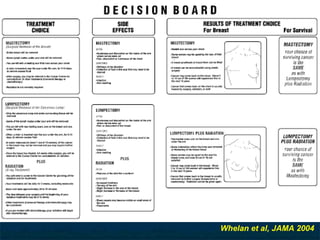
Decision Board from JAMA Whelan et al, JAMA 2004
May improve: Knowledge Patient satisfaction Improve physical/emotional function May reduce: Decisional conflict Sensation of pain No increased anxiety/depression using a DA Decision Aids (DA) Walgee et al, JCO 2007
62% of patients felt a DA improved communication with the doctor 98% would recommend using the DA to other patients  DA use also favored by physicians Walgee et al, JCO 2007
Decision Support Computer based information resource to provide users with support for making decisions Can help to standardize approaches to diagnosis, workup and treatment Can also be used to individualize the process to the needs of different users
Goals in Decision Support  Improve patient knowledge base Individualize information to each patient  Reduce clinicians’ knowledge deficit Reduce effect of physician bias Reduce patient distress and decisional regret
Advantages of  Decision Support Tools*  Help set tone and put patients at ease Ensure essential information is transmitted May be better than clinician: Reduce embarrassment Allow learning at comfortable pace Make it more effective time use when meeting with clinician May more effectively engage in SDM Green et al, Am J Med Genetics 2001 *  For genetic counseling
Decision Support and  SDM in Breast Cancer Multicenter phase III trial randomized 246 women <60 with breast cancer to: Standardized written materials Computer support at home Both given before seeing MD Patients surveyed 2 and 5 months later Gustafson et al, J Gen Intern Med 2001
Decision Support and  SDM in Breast Cancer At two months: Increased patient’s competence to deal with new information Improved patient comfort in level of participation in decision-making Increased confidence in MD At five months: Enhanced patient’s information competence No difference in participation metrics Gustafson et al, J Gen Intern Med 2001
Computer support was particularly helpful for: Less educated Non-Caucasian Underinsured Gustafson et al, J Gen Intern Med 2001
Predictive Models  in Breast Cancer Statistical methods of determining the most likely factors that predict a certain outcome Statistical relationship doesn’t necessarily equal cause/effect relationship
Different Statistical Models Risk group stratification Nomograms Artificial Neural Networks (ANN) Classification and Regression Tree (CART) Formulae
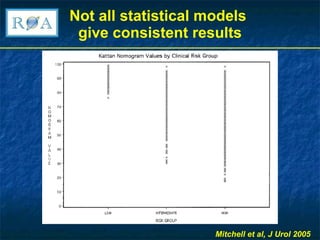
Not all statistical models  give consistent results Mitchell et al, J Urol 2005
Individualized  Decision Support Provide clinician with evidence-based risk estimates More helpful to cancer patients than standardized information Interface can help optimize transmitting information by Age Ethnicity, Language Education Psychological state Gender
IBTR! Similar tool to Adjuvant! for determining risk of ipsilateral breast tumor recurrence after BCS Included RCTs, meta-analyses and created composite estimate of 10-yr risk of LRR
IBTR! Includes data from RCTs, EBCTG  meta-analyses and single institution data Variables included to calculate LR were: Age Tumor size Margin status LVI Grade Use of chemotherapy Use of hormonal therapy Sanghani et al, Am J Clin Oncol 2007
IBTR! Results
MGH Validation Not enough women without RT to assess IBTR! estimates of no RT Used IBTR! to estimate LRR in 1138 eligible women undergoing BCS and RT Divided women into five risk groups: LRR <3% 3-5% 5.1-10% 10.1-20% >20% Sanghani et al, ASTRO 2008
Women with IBTR! estimates of <10% were accurate within 1% Less accurate for Group 4 (4%) and Group 5 (7%) but still within 95% CI Similar study from Vancouver demonstrated IBTR! reliable for low risk women, but  overestimated  LRR in <41, +margins or no RT Sanghani et al, ASTRO 2008 Truong et al, ASTRO 2008
Caveats May not reflect more recently published research Differences in patient population May not include all the relevant variables ER/PR/Her2-neu status Biomarkers IBTR! limited to 10-Yr rates no comparison to mastectomy
Will Decision Support Increase BCT Utilization? Use of decision support doesn’t guarantee favoring BCT Uncertainty in best RT modality may be impediment to choosing BCT
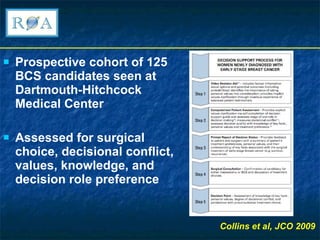
Prospective cohort of 125 BCS candidates seen at Dartmouth-Hitchcock Medical Center Assessed for surgical choice, decisional conflict, values, knowledge, and decision role preference Collins et al, JCO 2009
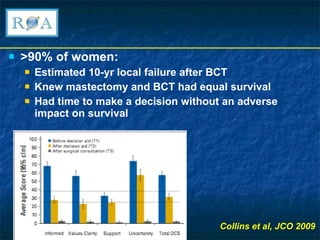
>90% of women: Estimated 10-yr local failure after BCT Knew mastectomy and BCT had equal survival Had time to make a decision without an adverse impact on survival Collins et al, JCO 2009
Collins et al, JCO 2009 Treatment Choice Before DA After DA After Consult Mastectomy 22% 31% 35% Breast Conserving Surgery 34% 31% 65% Uncertain 43% 38% --
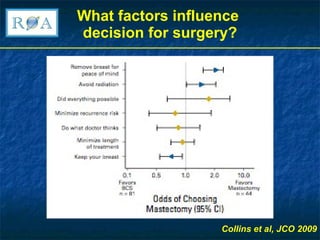
What factors influence  decision for surgery? Collins et al, JCO 2009
Treatment Options in BCT: More is Less* More RT options may lead to: Sense of Knowledge Deficit Uncertainty Anxiety Distress  Regret Dissatisfaction Increasing the complexity of decision-making for BCT may  increase  mastectomy rates *  Barry Schwartz, The Paradox of Choice
SDM and Multidisciplinary  Breast Cancer Care Pros : Enhances specialist communication Increases patient confidence in “team” approach Improves patient’s efficiency in obtaining expert opinions in a single visit Cons : Information overload (? enough depth) May affect patient’s ability to assert a more active decisional role  Medico legal aspects 33% of MDs feels discussion environment is suboptimal 85% may disagree with MDM decision but 71% don’t voice it
Decision Support  before Consultation?  Provide information resource to patients before meeting with clinician Assess patient’s desired decisional role more accurately Cognitive/psychological support to “prime” patient for SDM Reduce decisional regret, improve patient’s cancer experience
Conclusions SDM has become increasingly important Unmet patient needs when deciding between mastectomy and BCT Patient’s perceived role is key to satisfaction and provider  trust We don’t always assess patient’s desired decisional role accurately
Conclusions Better doctor-patient communication can reduce distress and decisional regret Decision support can facilitate SDM for patient-clinician dyad Effective SDM is a more important goal than BCT rates Adjuvant! and IBTR! are just the beginning
Acknowledgements Julie Jones, MD Alphonse Taghian, MGH David Wazer, Tufts Medical Ctr.

Shared Decision Making, Decision Support and Breast Conservation Therapy

  • 1.
    Shared Decision Making,Decision Support and Breast Conserving Therapy Matthew S. Katz, MD Radiation Oncology Associates, PA Saints Medical Center Lowell, MA April 27, 2009
  • 2.
    Shared decision making(SDM) and informed consent Background Patient-related factors Role of health care professional SDM in Breast Conserving Therapy (BCT) Decision Aids and Decision Support Definition Goals Role in SDM Overview
  • 3.
    Decision support toolsNomograms IBTR! Effect on BCT utilization Relevance to multidisciplinary setting Conclusions Overview
  • 4.
    What I learnedin medical school
  • 5.
    Doctor-Patient RelationshipDocere = to teach Obligated to transmit increasingly complex information to facilitate decision making Increasingly collaborative rather than paternalistic
  • 6.
    Challenges in Making Treatment Recommendations Do patients understand their own needs when making treatment decisions? Each patient has different levels of need for information, support and autonomy Patient’s needs/expectations change over time
  • 7.
    Shared Decision MakingMore actively engages patients in becomes partners in decision-making process Opportunity for clinicians to educate and reassure Risk of increasing patient anxiety
  • 8.
    Key Elements ofSDM Patient knowledge Explicit encouragement of patient participation Appreciation of the patient's ability to play an active role in decision Awareness of choice Time Fraenkel & McGraw, J Gen Intern Med. 2007
  • 9.
    What factors contributeto patient’s decision process? At time of decision Knowledge Deficit Preferred decisional role Uncertainty Anxiety Evaluation of Decision Satisfaction Decisional Regret Provider Trust
  • 10.
    Tools to AssessSDM Breast Cancer Information Test State-Trait Anxiety Inventory CES-D Scale Decisional Conflict Scale: Knowledge, Values, Certainty, Support Decisional Preferences Scale Others
  • 11.
    Information Needs Essentialfor informed consent Transmission of information Comprehension Whether information is considered relevant by patient and clinician can vary Patients express desire to know more, whether negative or positive
  • 12.
    Breast Conserving TherapySince early to mid-1980s, lumpectomy + radiation therapy have been considered equally effective as mastectomy Majority of women prefer BCT to mastectomy when offered both options
  • 13.
    How informed are decisions about BCT? Population based sample of 1844 women Only 48% knew that survival is equal between mastectomy and BCT Only 16% knew that BCT may have higher local recurrence rate than mastectomy Lower knowledge with : male surgeon lack of treatment options less Internet or health pamphlet use Fagerlin et al, Patient Ed Counseling 2006
  • 14.
    What decisional roledo cancer patients want? Preferred Role Incidence Active 20 - 39% Collaborative 28 - 64% Passive 8 - 52% True autonomy in decision-making is rare (0.5-1%) Deber et al, Health Expectations 2007
  • 15.
    Desired vs. ActualRole in Breast Cancer Survey of 145 women with breast CA 1 week after surgery or neoadjuvant chemotherapy Only 41% felt they had a choice in their treatment 63% had desired decisional role 30% preferred SDM 78% preferring active or passive Vogel et al, Psychooncology 2008
  • 16.
    Preferred Role and Psychological Distress Passive preference associated with depression SDM preference patients had highest anxiety levels Vogel et al, Psychooncology 2008
  • 17.
    Do breast cancerpatients’ desired role change? Longitudinal study of 205 breast cancer patients Desired decision-making role asessed at baseline A ctive, C ollaborative or P assive Subsequently asked again ~ 3 years later Hack et al, Psychooncology 2006
  • 18.
    Hack et al,Psychooncology 2006 Desired role changes over time Baseline Preferred Role Active Collaborative Passive Total Role Preference at 3 years A 33 18 21 36% C 19 22 43 42% P 3 2 41 22% 27% 21% 52%
  • 19.
    “ Active” patientshad better QoL, physical, emotional metrics and less fatigue through treatment Patients that had been passive expressed ‘role regret’ more than decisional regret Hack et al, Psychooncology 2006
  • 20.
    Satisfaction and ProviderTrust after BCS U Michigan survey of 714 breast cancer patients after BCS Patients answered several months to several years after initial plans for BCS Rated satisfaction, decisional conflict, decisional regret and provider trust Walgee et al, Cancer 2008
  • 21.
    Surgical Results Re-ExcisionOne 43% Two 12% Required Mastectomy 11% Infection 13% Seroma 14% Breast Asymmetry Minimal 36% Moderate 33% Large 30% Walgee et al, Cancer 2008
  • 22.
    Decisional Conflict and Regret Endpoint % Certain of decision 55 Prepared to make decision 61 Felt effective in the decision-making process 87 Regretted decision 13 Walgee et al, Cancer 2008
  • 23.
    Patient Satisfaction Nocorrelation with #re-excisions, complications or need for mastectomy Breast asymmetry is associated with less satisfaction, less certainty in decision for BCS and more decisional regret Women receiving RT more likely to feel have decisional conflict Walgee et al, Cancer 2008
  • 24.
    Provider Trust LowerMD trust with asymmetry, postop complications, need for re-excision Trend toward less MD trust with higher education and Caucasian ethnicity Walgee et al, Cancer 2008
  • 25.
    Differences by AgeOlder women tend to make more immediate decisions Limited cognitive resources Greater knowledge/experience More likely to take passive role Often have lower QoL, physical and emotional functioning scores Older women still benefit from SDM Meyer & Talbot, Psych Aging 2008 Hack et al, Psychooncology 2006 Liang et al, JCO 2002
  • 26.
    What Barriers toDoctors see to SDM? Doctor-Related : Insufficient information @ 1 st Visit 29% Insufficient time with the patient 28% Patient-Related : Misconceptions about disease 27% Indecision 24% Anxiety 22% Lack of understand of information 20% Shepard et al, JCO 2008
  • 27.
    Can clinicians interpret the patients’ desired role? 101 candidates for BCS evaluated at baseline and f/u interview Surgeons of these patients also interviewed Assessed patient preference, patient and MD’s perception of the decision-making process Average consultation = 21 minutes Jann et al, JCO 2004
  • 28.
    85% of womenwanted shared or active role Among patients desiring shared role: 50% felt more active than preferred 16% didn’t feel involved enough Perception of patient and doctor correlated in only 38% Jann et al, JCO 2004
  • 29.
    Perceived Decision-Making ProcessType of Decision Patient MD Patient Only 6% 17% Patient with MD Input 56% 25% SDM 30% 56% MD 8% 8% Patient satisfaction correlated to perceived rather than preferred role Similar study showed clinicians have difficulty assessing patient’s desired role Jann et al, JCO 2004 Hudak et al, Med Decis Making 2008
  • 30.
    SDM and Breast Conserving Therapy Early stage patients have several different treatment options Mastectomy +/- reconstruction BCS +/- RT Whole breast RT APBI External Beam, MammoSite, Interstitial Intraoperative
  • 31.
    Decisional Aids andBCS Walgee et al, JCO 2007
  • 32.
    Increased BCS withDA Walgee et al, JCO 2007
  • 33.
    DA Enhances Patient Knowledge Walgee et al, JCO 2007
  • 34.
    Decision Board fromJAMA Whelan et al, JAMA 2004
  • 35.
    May improve: KnowledgePatient satisfaction Improve physical/emotional function May reduce: Decisional conflict Sensation of pain No increased anxiety/depression using a DA Decision Aids (DA) Walgee et al, JCO 2007
  • 36.
    62% of patientsfelt a DA improved communication with the doctor 98% would recommend using the DA to other patients DA use also favored by physicians Walgee et al, JCO 2007
  • 37.
    Decision Support Computerbased information resource to provide users with support for making decisions Can help to standardize approaches to diagnosis, workup and treatment Can also be used to individualize the process to the needs of different users
  • 38.
    Goals in DecisionSupport Improve patient knowledge base Individualize information to each patient Reduce clinicians’ knowledge deficit Reduce effect of physician bias Reduce patient distress and decisional regret
  • 39.
    Advantages of Decision Support Tools* Help set tone and put patients at ease Ensure essential information is transmitted May be better than clinician: Reduce embarrassment Allow learning at comfortable pace Make it more effective time use when meeting with clinician May more effectively engage in SDM Green et al, Am J Med Genetics 2001 * For genetic counseling
  • 40.
    Decision Support and SDM in Breast Cancer Multicenter phase III trial randomized 246 women <60 with breast cancer to: Standardized written materials Computer support at home Both given before seeing MD Patients surveyed 2 and 5 months later Gustafson et al, J Gen Intern Med 2001
  • 41.
    Decision Support and SDM in Breast Cancer At two months: Increased patient’s competence to deal with new information Improved patient comfort in level of participation in decision-making Increased confidence in MD At five months: Enhanced patient’s information competence No difference in participation metrics Gustafson et al, J Gen Intern Med 2001
  • 42.
    Computer support wasparticularly helpful for: Less educated Non-Caucasian Underinsured Gustafson et al, J Gen Intern Med 2001
  • 43.
    Predictive Models in Breast Cancer Statistical methods of determining the most likely factors that predict a certain outcome Statistical relationship doesn’t necessarily equal cause/effect relationship
  • 44.
    Different Statistical ModelsRisk group stratification Nomograms Artificial Neural Networks (ANN) Classification and Regression Tree (CART) Formulae
  • 45.
    Not all statisticalmodels give consistent results Mitchell et al, J Urol 2005
  • 46.
    Individualized DecisionSupport Provide clinician with evidence-based risk estimates More helpful to cancer patients than standardized information Interface can help optimize transmitting information by Age Ethnicity, Language Education Psychological state Gender
  • 47.
    IBTR! Similar toolto Adjuvant! for determining risk of ipsilateral breast tumor recurrence after BCS Included RCTs, meta-analyses and created composite estimate of 10-yr risk of LRR
  • 48.
    IBTR! Includes datafrom RCTs, EBCTG meta-analyses and single institution data Variables included to calculate LR were: Age Tumor size Margin status LVI Grade Use of chemotherapy Use of hormonal therapy Sanghani et al, Am J Clin Oncol 2007
  • 49.
  • 50.
    MGH Validation Notenough women without RT to assess IBTR! estimates of no RT Used IBTR! to estimate LRR in 1138 eligible women undergoing BCS and RT Divided women into five risk groups: LRR <3% 3-5% 5.1-10% 10.1-20% >20% Sanghani et al, ASTRO 2008
  • 51.
    Women with IBTR!estimates of <10% were accurate within 1% Less accurate for Group 4 (4%) and Group 5 (7%) but still within 95% CI Similar study from Vancouver demonstrated IBTR! reliable for low risk women, but overestimated LRR in <41, +margins or no RT Sanghani et al, ASTRO 2008 Truong et al, ASTRO 2008
  • 52.
    Caveats May notreflect more recently published research Differences in patient population May not include all the relevant variables ER/PR/Her2-neu status Biomarkers IBTR! limited to 10-Yr rates no comparison to mastectomy
  • 53.
    Will Decision SupportIncrease BCT Utilization? Use of decision support doesn’t guarantee favoring BCT Uncertainty in best RT modality may be impediment to choosing BCT
  • 54.
    Prospective cohort of125 BCS candidates seen at Dartmouth-Hitchcock Medical Center Assessed for surgical choice, decisional conflict, values, knowledge, and decision role preference Collins et al, JCO 2009
  • 55.
    >90% of women:Estimated 10-yr local failure after BCT Knew mastectomy and BCT had equal survival Had time to make a decision without an adverse impact on survival Collins et al, JCO 2009
  • 56.
    Collins et al,JCO 2009 Treatment Choice Before DA After DA After Consult Mastectomy 22% 31% 35% Breast Conserving Surgery 34% 31% 65% Uncertain 43% 38% --
  • 57.
    What factors influence decision for surgery? Collins et al, JCO 2009
  • 58.
    Treatment Options inBCT: More is Less* More RT options may lead to: Sense of Knowledge Deficit Uncertainty Anxiety Distress Regret Dissatisfaction Increasing the complexity of decision-making for BCT may increase mastectomy rates * Barry Schwartz, The Paradox of Choice
  • 59.
    SDM and Multidisciplinary Breast Cancer Care Pros : Enhances specialist communication Increases patient confidence in “team” approach Improves patient’s efficiency in obtaining expert opinions in a single visit Cons : Information overload (? enough depth) May affect patient’s ability to assert a more active decisional role Medico legal aspects 33% of MDs feels discussion environment is suboptimal 85% may disagree with MDM decision but 71% don’t voice it
  • 60.
    Decision Support before Consultation? Provide information resource to patients before meeting with clinician Assess patient’s desired decisional role more accurately Cognitive/psychological support to “prime” patient for SDM Reduce decisional regret, improve patient’s cancer experience
  • 61.
    Conclusions SDM hasbecome increasingly important Unmet patient needs when deciding between mastectomy and BCT Patient’s perceived role is key to satisfaction and provider trust We don’t always assess patient’s desired decisional role accurately
  • 62.
    Conclusions Better doctor-patientcommunication can reduce distress and decisional regret Decision support can facilitate SDM for patient-clinician dyad Effective SDM is a more important goal than BCT rates Adjuvant! and IBTR! are just the beginning
  • 63.
    Acknowledgements Julie Jones,MD Alphonse Taghian, MGH David Wazer, Tufts Medical Ctr.

Editor's Notes

  • #19 48% role congruence 61% of initially passive patients preferred collaborative or active role 3 years later Only 5% desiring collaborative/active role wished for a passive role
  • #27 Survey of 604 Australian MDs (51% treat breast cancer patients) * Of note, only 19% of surveyed MDs elicited patient’s values/preferences
  • #58 Consistent with findings in other studies Another large population-based study found that 75% of women choosing mastectomy had concerns regarding radiation Minimize risk of breast recurrence should be taken with grain of salt since only 69% correctly identified difference in LRR in M vs. BCT
  • #60 In theory multidisciplinary clinics help bring all the specialists together to come up with a joint plan. However, it may not always work best for the patient