Clean and Affordable
Energy
SDG7
Reem Hany Ahmed Mehanna
Why is Energy important?
• To cook
• To heat or cool houses and buildings
• To operate all sorts of machines (cars, computers, elevators, phones, TVs, servers, etc.)
• To communicate
Why is Energy supply considered problematic?
• Much of the world's population has too little energy to meet basic human needs;
• Monetary costs of energy are rising nearly everywhere;
• Environmental impacts of energy supply are growing contributing to: air pollution, water pollution, ocean
pollution, and climate change
• Sociopolitical risks of energy supply (conflicts over energy resources and the links between nuclear energy
and nuclear weapons)
• About billion People currently live without electricity
• More than 3 billion people rely on wood, charcoal, animal and crop waste or other solid fuels
• Yearly about 4 million people die from illness attributed to household air pollution
Current Situation Facts and Figures
Clean and Affordable Energy
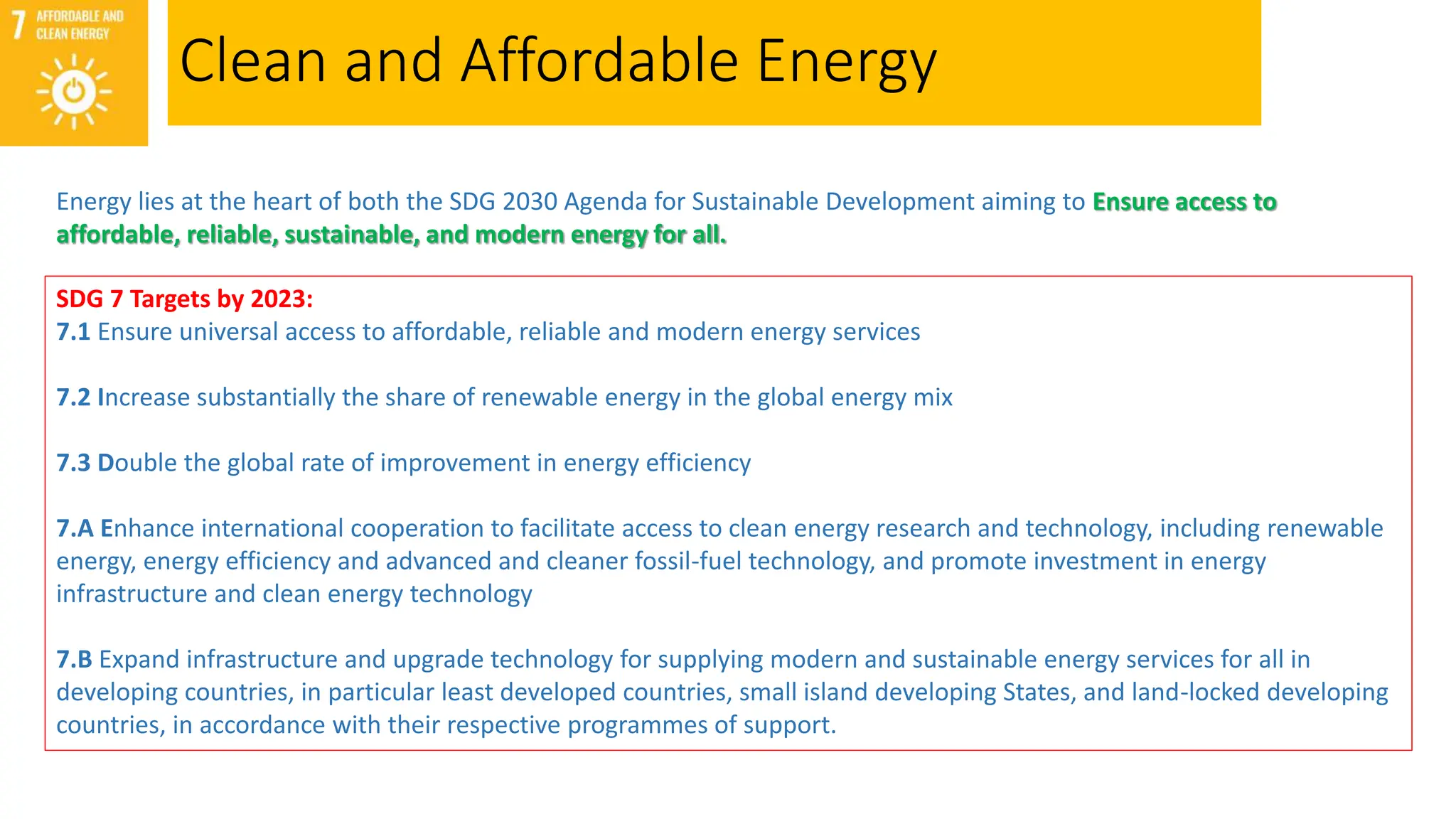
Energy lies at the heart of both the SDG 2030 Agenda for Sustainable Development aiming to Ensure access to
affordable, reliable, sustainable, and modern energy for all.
SDG 7 Targets by 2023:
7.1 Ensure universal access to affordable, reliable and modern energy services
7.2 Increase substantially the share of renewable energy in the global energy mix
7.3 Double the global rate of improvement in energy efficiency
7.A Enhance international cooperation to facilitate access to clean energy research and technology, including renewable
energy, energy efficiency and advanced and cleaner fossil-fuel technology, and promote investment in energy
infrastructure and clean energy technology
7.B Expand infrastructure and upgrade technology for supplying modern and sustainable energy services for all in
developing countries, in particular least developed countries, small island developing States, and land-locked developing
countries, in accordance with their respective programmes of support.
Clean and Affordable Energy
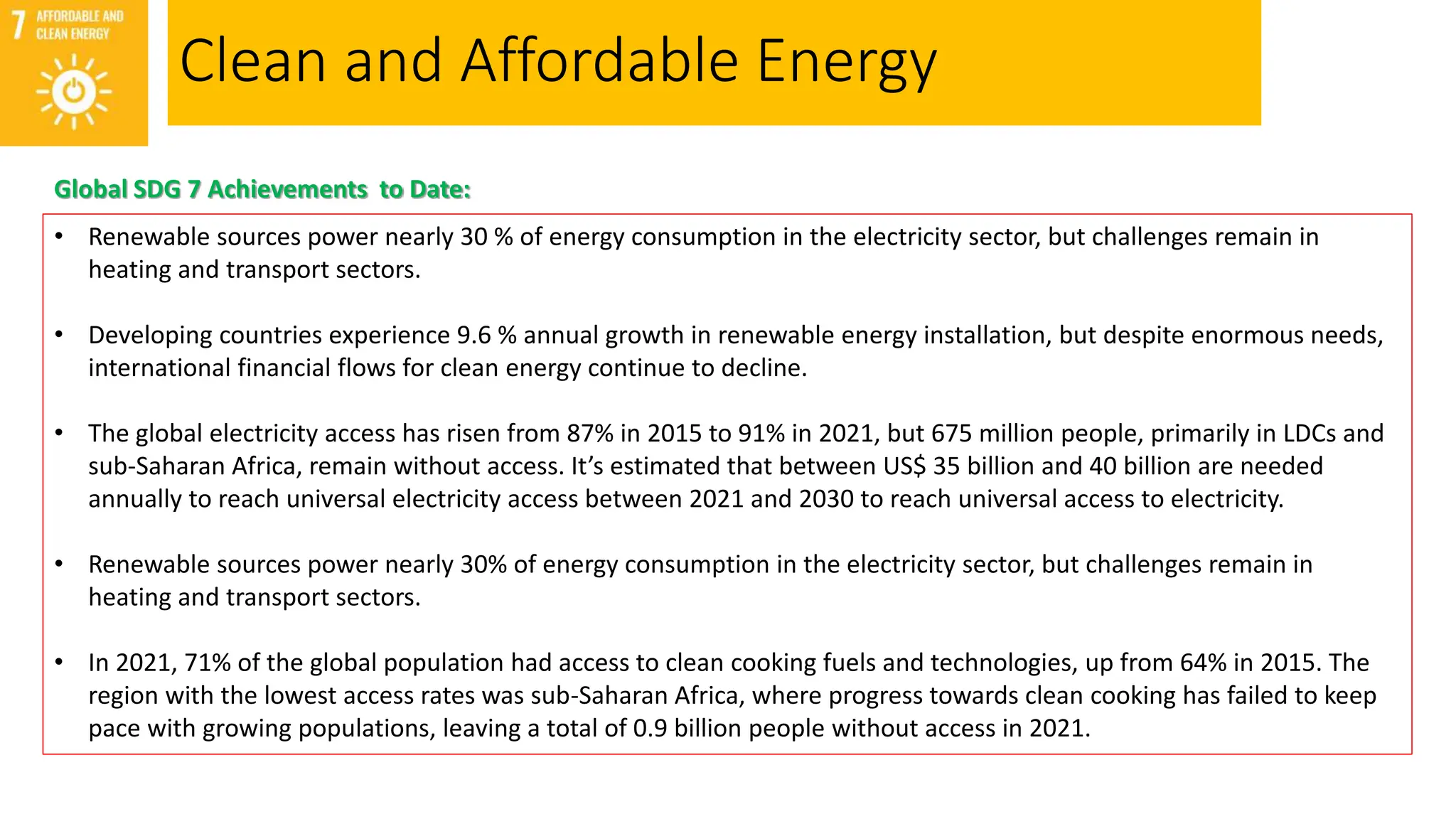
Global SDG 7 Achievements to Date:
• Renewable sources power nearly 30 % of energy consumption in the electricity sector, but challenges remain in
heating and transport sectors.
• Developing countries experience 9.6 % annual growth in renewable energy installation, but despite enormous needs,
international financial flows for clean energy continue to decline.
• The global electricity access has risen from 87% in 2015 to 91% in 2021, but 675 million people, primarily in LDCs and
sub-Saharan Africa, remain without access. It’s estimated that between US$ 35 billion and 40 billion are needed
annually to reach universal electricity access between 2021 and 2030 to reach universal access to electricity.
• Renewable sources power nearly 30% of energy consumption in the electricity sector, but challenges remain in
heating and transport sectors.
• In 2021, 71% of the global population had access to clean cooking fuels and technologies, up from 64% in 2015. The
region with the lowest access rates was sub-Saharan Africa, where progress towards clean cooking has failed to keep
pace with growing populations, leaving a total of 0.9 billion people without access in 2021.
Clean and Affordable Energy
Main UN mechanisms managing SDG 7:
• UN High-level Political Forum (HLPF) reviewed
progress achieved towards SDG 7 in 2018.
• Roadmap for Accelerated SDG 7 Action in 2021
providing a guide for collective action on
energy across sectors with milestones for 2025
and 2030.
• 200 Energy Compacts with voluntary
commitments of over $600 billion USD into
SDG 7.
• HLPF 2023 review provides insights towards
the Global Stock-take on SDG7 Implementation
to take place in 2024.
SDG 7 Review Findings:
• Urgent need for ambitious targets set by policy
makers aided by financial incentives and capacity
building
• Interlinkages between energy and other SDGs must
be considered and leveraged to accelerate progress
across the board
• Achieving universal access to affordable and clean
energy as a key factor in achieving a successful just
energy transition.
• Involving relevant actors such as civil society, private
sector, and other stakeholders at all levels of
decision-making to ensure Inclusive stakeholder
engagement.
Clean and Affordable Energy
Main global initiatives related to renewable Energy is the Conference of the Parties COP.
COP conference is held annually since 1997 issuing global environmental agreements and treaties such as
Kyoto Protocol and its major evolution into the Paris agreement
What is Paris Agreement?
A legally binding international treaty on climate change. It was adopted by 196 Parties at the UN
Climate Change Conference (COP21) in Paris, 2015 and entered into force in 2016.
Its overarching goal is to hold “the increase in the global average temperature to well below 2°C
above pre-industrial levels” and pursue efforts “to limit the temperature increase to 1.5°C above
pre-industrial levels.”
Last COP was held in Egypt 2022 and next one will be held in UAE 2023
Clean and Affordable Energy
Egypt Energy Sector Achievements:
1- Double wind energy production.
2- Accelerate adaptation activities, such as
building desalination plants and infrastructure
for flood control to deal with the rising water
stress
3- Issue green bonds, allocating $750 million
towards sustainable water management and
clean public transportation.
4- Start Carbon Market dealings through FRA
5- CBE mandating environmental reports prior
to banking investments
1. Overall climate strategy is vague and
unambitious.
2. Natural gas and other fossil fuels make up
about 90% of the country’s capacity for
power generation
3. Plans to enhance the nation’s production of
oil and natural gas.
4. Egypt’s new NDC lacks a specific goal for
attaining net-zero emissions.
5. Placing more of an emphasis on adaptation
rather than emission reduction in its 2022
National Climate Change Strategy
Egypt Energy Sector Critism:
Clean and Affordable Energy

SDG 7 presddddďdddddddddddddentation.pptx

  • 1.
  • 2.
    Why is Energyimportant? • To cook • To heat or cool houses and buildings • To operate all sorts of machines (cars, computers, elevators, phones, TVs, servers, etc.) • To communicate Why is Energy supply considered problematic? • Much of the world's population has too little energy to meet basic human needs; • Monetary costs of energy are rising nearly everywhere; • Environmental impacts of energy supply are growing contributing to: air pollution, water pollution, ocean pollution, and climate change • Sociopolitical risks of energy supply (conflicts over energy resources and the links between nuclear energy and nuclear weapons) • About billion People currently live without electricity • More than 3 billion people rely on wood, charcoal, animal and crop waste or other solid fuels • Yearly about 4 million people die from illness attributed to household air pollution Current Situation Facts and Figures Clean and Affordable Energy
  • 3.
    Energy lies atthe heart of both the SDG 2030 Agenda for Sustainable Development aiming to Ensure access to affordable, reliable, sustainable, and modern energy for all. SDG 7 Targets by 2023: 7.1 Ensure universal access to affordable, reliable and modern energy services 7.2 Increase substantially the share of renewable energy in the global energy mix 7.3 Double the global rate of improvement in energy efficiency 7.A Enhance international cooperation to facilitate access to clean energy research and technology, including renewable energy, energy efficiency and advanced and cleaner fossil-fuel technology, and promote investment in energy infrastructure and clean energy technology 7.B Expand infrastructure and upgrade technology for supplying modern and sustainable energy services for all in developing countries, in particular least developed countries, small island developing States, and land-locked developing countries, in accordance with their respective programmes of support. Clean and Affordable Energy
  • 4.
    Global SDG 7Achievements to Date: • Renewable sources power nearly 30 % of energy consumption in the electricity sector, but challenges remain in heating and transport sectors. • Developing countries experience 9.6 % annual growth in renewable energy installation, but despite enormous needs, international financial flows for clean energy continue to decline. • The global electricity access has risen from 87% in 2015 to 91% in 2021, but 675 million people, primarily in LDCs and sub-Saharan Africa, remain without access. It’s estimated that between US$ 35 billion and 40 billion are needed annually to reach universal electricity access between 2021 and 2030 to reach universal access to electricity. • Renewable sources power nearly 30% of energy consumption in the electricity sector, but challenges remain in heating and transport sectors. • In 2021, 71% of the global population had access to clean cooking fuels and technologies, up from 64% in 2015. The region with the lowest access rates was sub-Saharan Africa, where progress towards clean cooking has failed to keep pace with growing populations, leaving a total of 0.9 billion people without access in 2021. Clean and Affordable Energy
  • 5.
    Main UN mechanismsmanaging SDG 7: • UN High-level Political Forum (HLPF) reviewed progress achieved towards SDG 7 in 2018. • Roadmap for Accelerated SDG 7 Action in 2021 providing a guide for collective action on energy across sectors with milestones for 2025 and 2030. • 200 Energy Compacts with voluntary commitments of over $600 billion USD into SDG 7. • HLPF 2023 review provides insights towards the Global Stock-take on SDG7 Implementation to take place in 2024. SDG 7 Review Findings: • Urgent need for ambitious targets set by policy makers aided by financial incentives and capacity building • Interlinkages between energy and other SDGs must be considered and leveraged to accelerate progress across the board • Achieving universal access to affordable and clean energy as a key factor in achieving a successful just energy transition. • Involving relevant actors such as civil society, private sector, and other stakeholders at all levels of decision-making to ensure Inclusive stakeholder engagement. Clean and Affordable Energy
  • 6.
    Main global initiativesrelated to renewable Energy is the Conference of the Parties COP. COP conference is held annually since 1997 issuing global environmental agreements and treaties such as Kyoto Protocol and its major evolution into the Paris agreement What is Paris Agreement? A legally binding international treaty on climate change. It was adopted by 196 Parties at the UN Climate Change Conference (COP21) in Paris, 2015 and entered into force in 2016. Its overarching goal is to hold “the increase in the global average temperature to well below 2°C above pre-industrial levels” and pursue efforts “to limit the temperature increase to 1.5°C above pre-industrial levels.” Last COP was held in Egypt 2022 and next one will be held in UAE 2023 Clean and Affordable Energy
  • 7.
    Egypt Energy SectorAchievements: 1- Double wind energy production. 2- Accelerate adaptation activities, such as building desalination plants and infrastructure for flood control to deal with the rising water stress 3- Issue green bonds, allocating $750 million towards sustainable water management and clean public transportation. 4- Start Carbon Market dealings through FRA 5- CBE mandating environmental reports prior to banking investments 1. Overall climate strategy is vague and unambitious. 2. Natural gas and other fossil fuels make up about 90% of the country’s capacity for power generation 3. Plans to enhance the nation’s production of oil and natural gas. 4. Egypt’s new NDC lacks a specific goal for attaining net-zero emissions. 5. Placing more of an emphasis on adaptation rather than emission reduction in its 2022 National Climate Change Strategy Egypt Energy Sector Critism: Clean and Affordable Energy
  • 8.