Jaison Prem D'Souza
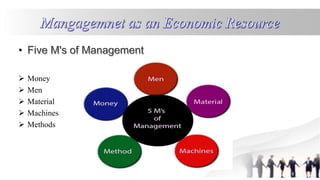
 Money
 Men
 Material
 Machines
 Methods
 Managers constitues a class of professional who are elite all over the
world.
 A manager is a person who has people working under him, and that
could be in any part of the activity.
Rule making and rule enforcing body
Web of relationships
Managers enjoy more authority than people working
under them.
Top manangement defines objectives and provides
directions.
Lower management is concerned with routine
activities.
Operations Management includes work analysis, planning, scheduling,
routing, quality control, inventory control and work study.
It includes economic forecasting, cost accounting, budgesting, insurance and
financial statistics.
Personnel management takes care of recruitment, placement, training, transfer,
promotional, safety, health, welfare, services etc., of the employees.
It is the process of getting the right product to the right place in the right
quantity at the price and at the right time.
Maintenance refers to actions carried out to replace, repair or service all
the components in a manufacturing plant so that it continues to operate at a
required level for a specified time.
Direction and organization of resources in order to keep the buildings,
equipment's and other service facilities in the working condition.
 Three inputs to organizations - Men, Machines and Materials
Material Management - Planning, directing, controlling and coordinating all
activities which are important to manufacturing process.
Purchasing and Procurement - 5 R's (of the Right Quality, Right Quantity,
from the Right Source, at Right Prices and the Right Time)
Transportation of raw materials as well as finished goods.
Includes studies on - transportation by rail, road, air and water, packing and
warehousing etc.,
Actions to reduce transportion costs.
Modular decomposition of projects, deligate duties, track status
perodically, communicate with clients, integrate modules, test the software
and responsible for meeting the deadline for project completion.
Rural resources and issues managment such as water resource
managment, forest and forest product management, crop management,
cattle managment, rural man power management.
Organized documentation of all avtivities.
Planning and controlling all office work including maintainig and keeping
record.
Science is a systematized body of knowledge which establishes
relationships between cause and effect.
• Systemised body of knowledge
• Based on collection of facts, Anaysis and experiments
• Universal Application
• Cause and effect Relationship
• Verification of validity and Prediction of results possible.
• Art is bringing a desired result through application of skill.
• Personal skill
• Concrete result oriented approach.
• Development through practice.
• Creative Power
• Profession is a occupation in which one professes to have acquired
specialised knowledge, which is used either in instructing, guiding or
advising others.
 Body of specialised knowledge and technique
 Formalised methods of acquiring training and experience
 Establishment of representative professional association
Regulate behaviour
To create code of conduct
Support the image of its members
Code of conduct
Priority of service over economic consideration
• From the study above , we say that management is both art and
science.
• According to ASME (American Society of Mechanical
Engineers)
“Management is the art and the science of preparing,
organizing and directing human efforts to control the forces and
utilize the material of nature for the benefit of men”
Scope of management 2019

Scope of management 2019

  • 1.
  • 2.
     Money  Men Material  Machines  Methods
  • 3.
     Managers constituesa class of professional who are elite all over the world.  A manager is a person who has people working under him, and that could be in any part of the activity.
  • 4.
    Rule making andrule enforcing body Web of relationships Managers enjoy more authority than people working under them. Top manangement defines objectives and provides directions. Lower management is concerned with routine activities.
  • 5.
    Operations Management includeswork analysis, planning, scheduling, routing, quality control, inventory control and work study. It includes economic forecasting, cost accounting, budgesting, insurance and financial statistics. Personnel management takes care of recruitment, placement, training, transfer, promotional, safety, health, welfare, services etc., of the employees.
  • 6.
    It is theprocess of getting the right product to the right place in the right quantity at the price and at the right time. Maintenance refers to actions carried out to replace, repair or service all the components in a manufacturing plant so that it continues to operate at a required level for a specified time. Direction and organization of resources in order to keep the buildings, equipment's and other service facilities in the working condition.
  • 7.
     Three inputsto organizations - Men, Machines and Materials Material Management - Planning, directing, controlling and coordinating all activities which are important to manufacturing process. Purchasing and Procurement - 5 R's (of the Right Quality, Right Quantity, from the Right Source, at Right Prices and the Right Time) Transportation of raw materials as well as finished goods. Includes studies on - transportation by rail, road, air and water, packing and warehousing etc., Actions to reduce transportion costs.
  • 8.
    Modular decomposition ofprojects, deligate duties, track status perodically, communicate with clients, integrate modules, test the software and responsible for meeting the deadline for project completion. Rural resources and issues managment such as water resource managment, forest and forest product management, crop management, cattle managment, rural man power management. Organized documentation of all avtivities. Planning and controlling all office work including maintainig and keeping record.
  • 9.
    Science is asystematized body of knowledge which establishes relationships between cause and effect. • Systemised body of knowledge • Based on collection of facts, Anaysis and experiments • Universal Application • Cause and effect Relationship • Verification of validity and Prediction of results possible.
  • 10.
    • Art isbringing a desired result through application of skill. • Personal skill • Concrete result oriented approach. • Development through practice. • Creative Power
  • 11.
    • Profession isa occupation in which one professes to have acquired specialised knowledge, which is used either in instructing, guiding or advising others.  Body of specialised knowledge and technique  Formalised methods of acquiring training and experience  Establishment of representative professional association
  • 12.
    Regulate behaviour To createcode of conduct Support the image of its members Code of conduct Priority of service over economic consideration
  • 13.
    • From thestudy above , we say that management is both art and science. • According to ASME (American Society of Mechanical Engineers) “Management is the art and the science of preparing, organizing and directing human efforts to control the forces and utilize the material of nature for the benefit of men”