Scope of Cultural Resources Studies 
Text-Mining of a Newly Created Interdisciplinary 
Graduate Program with MIMA Search 
Yusuke Nakamura* 
Hideki Mima 
Katsuya Masuda 
Chikahiko Suzuki** 
(The University of Tokyo)
Research Question 
How do 
research/education programs 
develop to form their own 
and find their own in 
? 
The target institution for this research is:
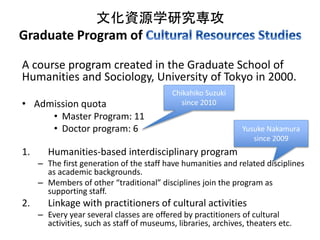
文化資源学研究専攻 
Graduate Program of 
A course program created in the Graduate School of 
Humanities and Sociology, University of Tokyo in 2000. 
• Admission quota 
• Master Program: 11 
• Doctor program: 6 
Chikahiko Suzuki 
since 2010 
1. Humanities-based interdisciplinary program 
Yusuke Nakamura 
since 2009 
– The first generation of the staff have humanities and related disciplines 
as academic backgrounds. 
– Members of other “traditional” disciplines join the program as 
supporting staff. 
2. Linkage with practitioners of cultural activities 
– Every year several classes are offered by practitioners of cultural 
activities, such as staff of museums, libraries, archives, theaters etc.
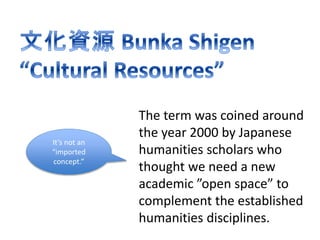
The term was coined around 
the year 2000 by Japanese 
humanities scholars who 
thought we need a new 
academic ”open space” to 
complement the established 
humanities disciplines. 
It’s not an 
“imported 
concept.”
What are Cultural Resources? 
are 
“a totality of invaluable materials 
accessible for understanding 
society and culture of a particular 
historical period.” (original text in Japanese) 
– Charter of the Association for the Study of 
Cultural Resources (2002)
“We coined the term “ 
” in order to re-explore diverse human 
cultures back from their original sources through 
“words”, “sounds” and “figures,” free of the 
prevailing concepts and existent institutions. We 
aim to reconsider cultures from multiple 
perspectives to (re)discover new meanings, and to 
develop the new ways to contribute to the 
realization of a better society”. (original text in Japanese) 
– Home page of Dept. Cultural Resources Studies, U-Tokyo 
(2014)
The Program is broad and 
open enough to accept 
students with diverse 
research interests. But, no 
format to follow to write a 
thesis (--yet). cf. IMRaD
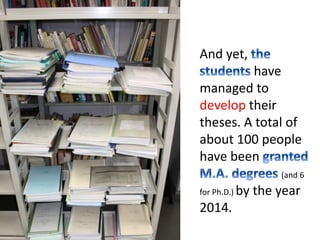
And yet, 
have 
managed to 
develop their 
theses. A total of 
about 100 people 
have been 
(and 6 
for Ph.D.) by the year 
2014.
Here we have an interesting case of 
by the faculty and 
students to of 
interdisciplinary studies from scratch. 
Therefore, we decided to mine the 
principal texts of the CRS program 
using the search engine, .
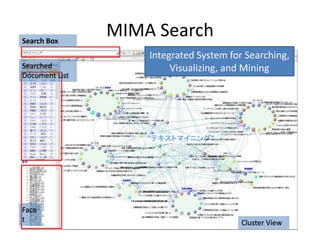
MIMA Search 
Search Box 
Searched 
Document List 
Integrated System for Searching, 
Visualizing, and Mining 
Face 
t Cluster View
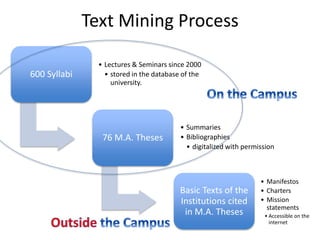
Text Mining Process 
600 Syllabi 
• Lectures & Seminars since 2000 
• stored in the database of the 
university. 
76 M.A. Theses 
• Summaries 
• Bibliographies 
• digitalized with permission 
Basic Texts of the 
Institutions cited 
in M.A. Theses 
• Manifestos 
• Charters 
• Mission 
statements 
• Accessible on the 
internet
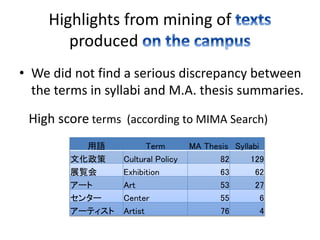
Highlights from mining of 
produced 
• We did not find a serious discrepancy between 
the terms in syllabi and M.A. thesis summaries. 
High score terms (according to MIMA Search) 
用語Term MA Thesis Syllabi 
文化政策Cultural Policy 82 129 
展覧会Exhibition 63 62 
アートArt 53 27 
センターCenter 55 6 
アーティストArtist 76 4
What have the 
students focused on to write 
M.A. theses of Cultural 
Resources Studies?
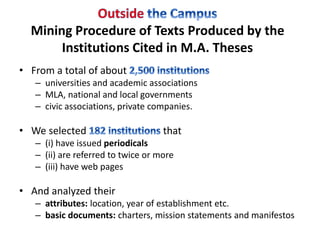
Mining Procedure of Texts Produced by the 
Institutions Cited in M.A. Theses 
• From a total of about 
– universities and academic associations 
– MLA, national and local governments 
– civic associations, private companies. 
• We selected that 
– (i) have issued periodicals 
– (ii) are referred to twice or more 
– (iii) have web pages 
• And analyzed their 
– attributes: location, year of establishment etc. 
– basic documents: charters, mission statements and manifestos
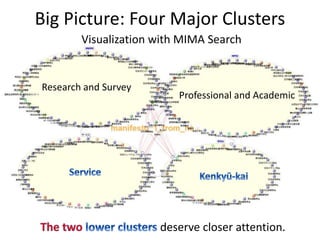
Big Picture: Four Major Clusters 
Visualization with MIMA Search 
Research and Survey 
Professional and Academic 
deserve closer attention.
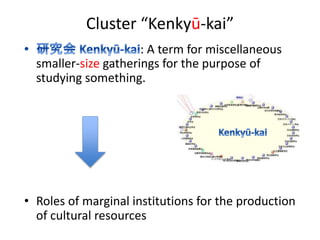
Cluster “Kenkyū-kai” 
: A term for miscellaneous 
smaller-size gatherings for the purpose of 
studying something. 
• Roles of marginal institutions for the production 
of cultural resources
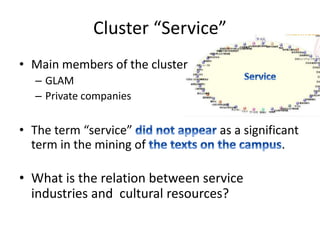
Cluster “Service” 
• Main members of the cluster 
– GLAM 
– Private companies 
• The term “service” as a significant 
term in the mining of . 
• What is the relation between service 
industries and cultural resources?
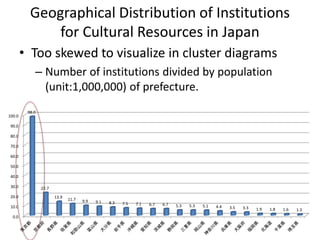
Geographical Distribution of Institutions 
for Cultural Resources in Japan 
• Too skewed to visualize in cluster diagrams 
– Number of institutions divided by population 
(unit:1,000,000) of prefecture. 
100.0 
90.0 
80.0 
70.0 
60.0 
50.0 
40.0 
30.0 
20.0 
10.0 
0.0 
98.0 
22.7 
13.9 
11.7 9.9 9.1 8.3 7.5 7.1 6.7 6.7 5.3 5.3 5.1 4.4 3.5 3.3 1.9 1.8 1.6 1.3
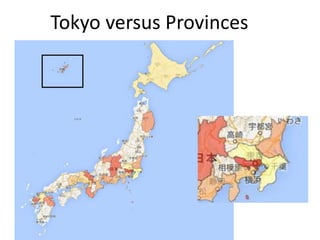
Tokyo versus Provinces
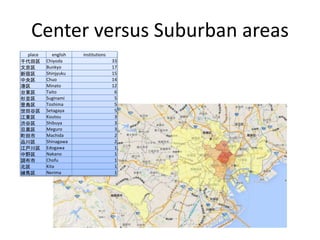
Center versus Suburban areas 
place english institutions 
千代田区Chiyoda 33 
文京区Bunkyo 17 
新宿区Shinjyuku 15 
中央区Chuo 14 
港区Minato 12 
台東区Taito 6 
杉並区Suginami 5 
豊島区Toshima 5 
世田谷区Setagaya 5 
江東区Koutou 3 
渋谷区Shibuya 3 
目黒区Meguro 3 
町田市Machida 2 
品川区Shinagawa 2 
江戸川区Edogawa 1 
中野区Nakano 1 
調布市Chofu 1 
北区Kita 1 
練馬区Nerima 1
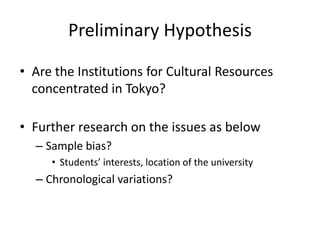
Preliminary Hypothesis 
• Are the Institutions for Cultural Resources 
concentrated in Tokyo? 
• Further research on the issues as below 
– Sample bias? 
• Students’ interests, location of the university 
– Chronological variations?
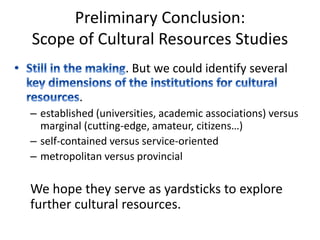
Preliminary Conclusion: 
Scope of Cultural Resources Studies 
. But we could identify several 
. 
– established (universities, academic associations) versus 
marginal (cutting-edge, amateur, citizens…) 
– self-contained versus service-oriented 
– metropolitan versus provincial 
We hope they serve as yardsticks to explore 
further cultural resources.

Scope of Cultural Resources Studies (JADH2014_Tsukuba)

  • 1.
    Scope of CulturalResources Studies Text-Mining of a Newly Created Interdisciplinary Graduate Program with MIMA Search Yusuke Nakamura* Hideki Mima Katsuya Masuda Chikahiko Suzuki** (The University of Tokyo)
  • 2.
    Research Question Howdo research/education programs develop to form their own and find their own in ? The target institution for this research is:
  • 3.
    文化資源学研究専攻 Graduate Programof A course program created in the Graduate School of Humanities and Sociology, University of Tokyo in 2000. • Admission quota • Master Program: 11 • Doctor program: 6 Chikahiko Suzuki since 2010 1. Humanities-based interdisciplinary program Yusuke Nakamura since 2009 – The first generation of the staff have humanities and related disciplines as academic backgrounds. – Members of other “traditional” disciplines join the program as supporting staff. 2. Linkage with practitioners of cultural activities – Every year several classes are offered by practitioners of cultural activities, such as staff of museums, libraries, archives, theaters etc.
  • 4.
    The term wascoined around the year 2000 by Japanese humanities scholars who thought we need a new academic ”open space” to complement the established humanities disciplines. It’s not an “imported concept.”
  • 5.
    What are CulturalResources? are “a totality of invaluable materials accessible for understanding society and culture of a particular historical period.” (original text in Japanese) – Charter of the Association for the Study of Cultural Resources (2002)
  • 6.
    “We coined theterm “ ” in order to re-explore diverse human cultures back from their original sources through “words”, “sounds” and “figures,” free of the prevailing concepts and existent institutions. We aim to reconsider cultures from multiple perspectives to (re)discover new meanings, and to develop the new ways to contribute to the realization of a better society”. (original text in Japanese) – Home page of Dept. Cultural Resources Studies, U-Tokyo (2014)
  • 7.
    The Program isbroad and open enough to accept students with diverse research interests. But, no format to follow to write a thesis (--yet). cf. IMRaD
  • 8.
    And yet, have managed to develop their theses. A total of about 100 people have been (and 6 for Ph.D.) by the year 2014.
  • 9.
    Here we havean interesting case of by the faculty and students to of interdisciplinary studies from scratch. Therefore, we decided to mine the principal texts of the CRS program using the search engine, .
  • 10.
    MIMA Search SearchBox Searched Document List Integrated System for Searching, Visualizing, and Mining Face t Cluster View
  • 11.
    Text Mining Process 600 Syllabi • Lectures & Seminars since 2000 • stored in the database of the university. 76 M.A. Theses • Summaries • Bibliographies • digitalized with permission Basic Texts of the Institutions cited in M.A. Theses • Manifestos • Charters • Mission statements • Accessible on the internet
  • 12.
    Highlights from miningof produced • We did not find a serious discrepancy between the terms in syllabi and M.A. thesis summaries. High score terms (according to MIMA Search) 用語Term MA Thesis Syllabi 文化政策Cultural Policy 82 129 展覧会Exhibition 63 62 アートArt 53 27 センターCenter 55 6 アーティストArtist 76 4
  • 13.
    What have the students focused on to write M.A. theses of Cultural Resources Studies?
  • 14.
    Mining Procedure ofTexts Produced by the Institutions Cited in M.A. Theses • From a total of about – universities and academic associations – MLA, national and local governments – civic associations, private companies. • We selected that – (i) have issued periodicals – (ii) are referred to twice or more – (iii) have web pages • And analyzed their – attributes: location, year of establishment etc. – basic documents: charters, mission statements and manifestos
  • 15.
    Big Picture: FourMajor Clusters Visualization with MIMA Search Research and Survey Professional and Academic deserve closer attention.
  • 16.
    Cluster “Kenkyū-kai” :A term for miscellaneous smaller-size gatherings for the purpose of studying something. • Roles of marginal institutions for the production of cultural resources
  • 17.
    Cluster “Service” •Main members of the cluster – GLAM – Private companies • The term “service” as a significant term in the mining of . • What is the relation between service industries and cultural resources?
  • 18.
    Geographical Distribution ofInstitutions for Cultural Resources in Japan • Too skewed to visualize in cluster diagrams – Number of institutions divided by population (unit:1,000,000) of prefecture. 100.0 90.0 80.0 70.0 60.0 50.0 40.0 30.0 20.0 10.0 0.0 98.0 22.7 13.9 11.7 9.9 9.1 8.3 7.5 7.1 6.7 6.7 5.3 5.3 5.1 4.4 3.5 3.3 1.9 1.8 1.6 1.3
  • 19.
  • 20.
    Center versus Suburbanareas place english institutions 千代田区Chiyoda 33 文京区Bunkyo 17 新宿区Shinjyuku 15 中央区Chuo 14 港区Minato 12 台東区Taito 6 杉並区Suginami 5 豊島区Toshima 5 世田谷区Setagaya 5 江東区Koutou 3 渋谷区Shibuya 3 目黒区Meguro 3 町田市Machida 2 品川区Shinagawa 2 江戸川区Edogawa 1 中野区Nakano 1 調布市Chofu 1 北区Kita 1 練馬区Nerima 1
  • 21.
    Preliminary Hypothesis •Are the Institutions for Cultural Resources concentrated in Tokyo? • Further research on the issues as below – Sample bias? • Students’ interests, location of the university – Chronological variations?
  • 22.
    Preliminary Conclusion: Scopeof Cultural Resources Studies . But we could identify several . – established (universities, academic associations) versus marginal (cutting-edge, amateur, citizens…) – self-contained versus service-oriented – metropolitan versus provincial We hope they serve as yardsticks to explore further cultural resources.

Editor's Notes

  • #3 In this short paper, we report the preliminary results of mining of texts related to a new graduate program created in the Graduate School of Humanities and Sociology, University of Tokyo in 2000. Cultural Resources Studies
  • #5 It is not an “imported concept” from the West, as is often the case for concepts in academia of Japan. Cf. “DH”
  • #6 私たちは、これまでの豊かな文化資源を有効に活用し、新たな文化資源を創成して未来へ引き継ぐ責任があります。文化資源とは、ある時代の社会と文化を知る ための手がかりとなる貴重な資料の総体であり、これを私たちは文化資料体と呼びます。文化資料体には、博物館や資料庫に収めきれない建物や都市の景観、あ るいは伝統的な芸能や祭礼など、有形無形のものが含まれます。
  • #7 文化資源学研究室は、2000年春に、東京大学大学院人文社会系研究科の中に誕生しました。正しくは、文化資源学研究専攻といいます。文化資源学Cultural Resources Studiesと いう言葉も、この時にはじめて、わたしたちが使い始めました。それは、人間が生み出すさまざまな文化を、既成の観念や既存の制度にとらわれず、「ことば」 と「おと」と「かたち」を手掛かりに、根源に立ち返って見直そうとする姿勢から生まれました。多様な観点から文化をとらえ直し、新たな価値を発見・再評価 し、それらを活かしたよりよい社会の実現をめざす方法を研究・開発しようとするものです。
  • #8 it is difficult to put them into the academic format of thesis.
  • #9 And 6 people with doctral degress.
  • #10 M.A. students tend to pursue the themes not covered by other disciplines (one major reason why they chose the CRS). The seminars offered also tend to cover a variety of topics in ways that are more experimental as compared to traditional humanities curricula. Many M.A. students write a truly academic paper for the first time, and yet there has not been an established model to follow. When examined as a group, syllabi and M.A. theses of the first decade would reveal us an interesting case of collective efforts to create a new form of interdisciplinary studies from scratch.
  • #11 It’s a search engine which calculates the similarity among texts based on the weighted frequency of terms. And it has a powerful visualizing tools such as cluster diagram.
  • #15 There are a total of about 2,500 institutions in our master thesis bibliography database, from universities and academic associations, MLA, national and local governments, civic associations, to private companies. We have selected 257 institutions that (i) have issued periodicals, (ii) are referred to twice or more, and (iii) have web pages. We analyzed their attributes and basic documents (such as charters, mission statements and manifestos) to study what kinds of institutions our M.A. students have considered as the key organizations for the study of cultural resources in modern Japan. 182 institutions are objects of the following analysis.
  • #16 This big picture is cluster diagram according to MIMA Search. There are four cluster in this picture, Research and Survey (in Japanese, 調査研究), Professional and Academic(専門性)、Service and Kenkyū-kai. These cluster’s key-words are elected by MIMA Search, based on frequency and co-occurrence. Upper two clusters, “Research and Survey” and “Professional and Academic”, are within expected limits. Those two clusters are major elements of almost all academic program obviously. So, Lower two clusters deserve closer attention.
  • #17 Let us show about Kenkyu-kai first. Kenkyu-kai is a Japanese term for miscellaneous minor-rank gatherings for the purpose of studying something. This finding reads that marginal institutions play important roles for the production of cultural resources. And we must reveal what roles these institutions play in the future investigation.
  • #18 And Service cluster. Main members of the cluster are Galleries, Libraries, Archives and Museums. Of course, private companies such as Publisher and News Agency are members too. We remember that the term “service” did not appear as a significant term in the mining of the texts on the campus. We did not take the word “service” into consideration about our program. So we must consider, what is the relation between service industries and cultural resources.
  • #19 And, we also analyzed locations of institutions. In this part, we do not use MIMA search, it is too skewed to visualize in cluster diagram. Rightly, Tokyo is the most frequent location, and Kyoto is second one. But, some minor prefectures, such as Nagano, Saga and Wakayama, have middle ranked frequency. What does this geographical data mean?
  • #22 Concentration is an undeniable fact. But the reason is not clear yet. We must research further. Such as Sample bias or Chronological variations and Chronological changes of institutions.  Some questions are still be researched anyhow, this is our finding as of now. I pass the mike to Prof. Nakamura for a conclusion.
  • #23 We would like to keep collecting the data and improve the methodologies, and if other people of JADH community join us in this kind of research, It will be great for all of us. Thank you.