Rates of reactions LI:  To identify factors which may effect the rate of a chemical reaction.  Key terms: Concentration, volume, evidence, conclusion
What is a chemical reaction? Can you define it? Can you give an example?
Match them up Loss of electrons Equilibrium Takes in energy – gets cold Soluble base Breaking up with heat Reduction Removal of oxygen Oxidation Thermit reaction Neutralisation Reaction in a state of balance Precipitation Alkali Reversible reaction A salt and water is formed Metal displacement A  solid forms within a solution Endothermic Dehydrating copper sulphate Thermal decomposition
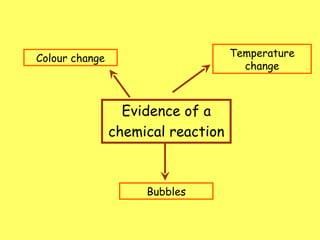
Evidence of a chemical reaction Colour change Bubbles Temperature change
Rates of reactions Some reactions are fast and some are slow.  Concrete setting…  Can take days!!! Antacids kill heartburn Quickly relieve the symptoms
Which is fastest? Paint drying Fruit going rotten Cooking gas burning Cake baking Metal nail rusting 1 every second 2 about an hour 3 a day or so 4 few days to a week 5 could take months or years
What is a rate? Rate is the measure of the change that happens in a single unit of time.  e.g. litres per minute mass per second See boardworks on rates
Solution X and Y Aim: To investigate the effect of concentration on the rate of a reaction.   Apparatus: 1 x 25ml measuring cylinders (wash with water in between) Beaker of water 4 x 100ml beakers spill tray Stop clock goggles Stirring rod
Variables Independent variable: Dependent variable: Control variable: Prediction
Method Measure 25ml of X and pour it into a beaker, rinse measuring cylinder.  Measure 20ml of water and pour into the beaker , rinse measuring cylinder.  Measure 5ml of Y and rinse measuring cylinder. .  Add Y to the beaker and start the stop clock, stir continuously. When the solution changes colour STOP the clock. Record the time taken for the blue colour to appear. Repeat the procedure for the volumes
Table of results Average time Time taken to change colour Vol. of water Vol. of Y
Your graph should be drawn in pencil using a ruler have clearly labelled axis (x and y have a clear title describing what the graph shows take up most of the graph paper have curve/line of best fit When you are finished complete the questions at the bottom of the sheet in your book.
Particle size Aim: Does the speed at which a solid reacts depend on the size of the solid pieces? Apparatus: List the equipment you will require for your experiment Prediction: Make a prediction about what will happen during the experiment Variables: List the dependant, independent and control variables Method: You must outline the exact steps you will follow during your experiment Results: Draw a table which you will use to record your  results.
Year 11 Task 1:- Read P118 & 119 of Red Chemistry books.  Answer all the questions in full on the file paper available.  Task 2:-  Plan an investigation into the effect of surface area on the rate of the reaction.
Your practical…. 1. Weight as 5g of marble chips using the pan top balance.  2. ….conical flask.  3. Place conical flask on the pan balance and add the marble chip.  Immediately record the mass, and begin timing. 4. Record the mass every 10 seconds for 2 minutes.  Weigh enough crushed marble chips to equal the mass of the first marble chip and repeat the experiment.
90 sec 80 sec 70 sec 60 sec 50 sec 40 sec 30 sec 20 sec 10 sec Starting mass Change in mass Mass of crushed marble  Change in mass Mass of marble chip Time

ScienceShare.co.uk Shared Resource

  • 1.
    Rates of reactionsLI: To identify factors which may effect the rate of a chemical reaction. Key terms: Concentration, volume, evidence, conclusion
  • 2.
    What is achemical reaction? Can you define it? Can you give an example?
  • 3.
    Match them upLoss of electrons Equilibrium Takes in energy – gets cold Soluble base Breaking up with heat Reduction Removal of oxygen Oxidation Thermit reaction Neutralisation Reaction in a state of balance Precipitation Alkali Reversible reaction A salt and water is formed Metal displacement A solid forms within a solution Endothermic Dehydrating copper sulphate Thermal decomposition
  • 4.
    Evidence of achemical reaction Colour change Bubbles Temperature change
  • 5.
    Rates of reactionsSome reactions are fast and some are slow. Concrete setting… Can take days!!! Antacids kill heartburn Quickly relieve the symptoms
  • 6.
    Which is fastest?Paint drying Fruit going rotten Cooking gas burning Cake baking Metal nail rusting 1 every second 2 about an hour 3 a day or so 4 few days to a week 5 could take months or years
  • 7.
    What is arate? Rate is the measure of the change that happens in a single unit of time. e.g. litres per minute mass per second See boardworks on rates
  • 8.
    Solution X andY Aim: To investigate the effect of concentration on the rate of a reaction. Apparatus: 1 x 25ml measuring cylinders (wash with water in between) Beaker of water 4 x 100ml beakers spill tray Stop clock goggles Stirring rod
  • 9.
    Variables Independent variable:Dependent variable: Control variable: Prediction
  • 10.
    Method Measure 25mlof X and pour it into a beaker, rinse measuring cylinder. Measure 20ml of water and pour into the beaker , rinse measuring cylinder. Measure 5ml of Y and rinse measuring cylinder. . Add Y to the beaker and start the stop clock, stir continuously. When the solution changes colour STOP the clock. Record the time taken for the blue colour to appear. Repeat the procedure for the volumes
  • 11.
    Table of resultsAverage time Time taken to change colour Vol. of water Vol. of Y
  • 12.
    Your graph shouldbe drawn in pencil using a ruler have clearly labelled axis (x and y have a clear title describing what the graph shows take up most of the graph paper have curve/line of best fit When you are finished complete the questions at the bottom of the sheet in your book.
  • 13.
    Particle size Aim:Does the speed at which a solid reacts depend on the size of the solid pieces? Apparatus: List the equipment you will require for your experiment Prediction: Make a prediction about what will happen during the experiment Variables: List the dependant, independent and control variables Method: You must outline the exact steps you will follow during your experiment Results: Draw a table which you will use to record your results.
  • 14.
    Year 11 Task1:- Read P118 & 119 of Red Chemistry books. Answer all the questions in full on the file paper available. Task 2:- Plan an investigation into the effect of surface area on the rate of the reaction.
  • 15.
    Your practical…. 1.Weight as 5g of marble chips using the pan top balance. 2. ….conical flask. 3. Place conical flask on the pan balance and add the marble chip. Immediately record the mass, and begin timing. 4. Record the mass every 10 seconds for 2 minutes. Weigh enough crushed marble chips to equal the mass of the first marble chip and repeat the experiment.
  • 16.
    90 sec 80sec 70 sec 60 sec 50 sec 40 sec 30 sec 20 sec 10 sec Starting mass Change in mass Mass of crushed marble Change in mass Mass of marble chip Time