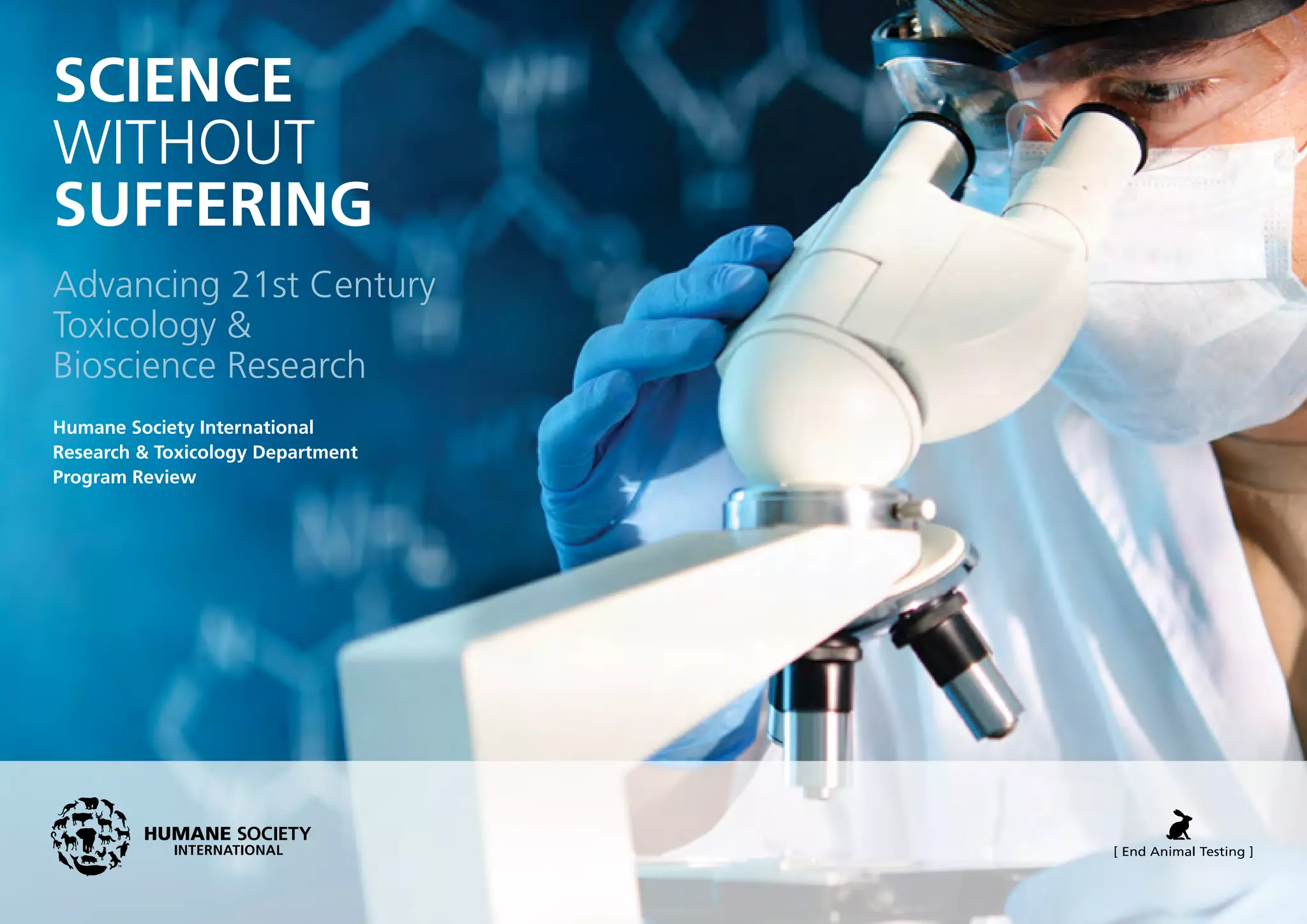
SCIENCE
WITHOUT
SUFFERING
Advancing 21st Century
Toxicology &
Bioscience Research
Humane Society International
Research & Toxicology Department
Program Review
“HSI is the leading international NGO working
to advance non-animal safety testing and
bioscience research worldwide.” Photos: Front cover – iStockPhoto, MatTek. Opposite – Troy Seidle. Above, from left to right – Siqui Sanchez, Yves Forestier-Sygma-Corbis, HSUS
[ Key Accomplishments ]
	 4.5 million animals spared from suffering and
	 death in duplicative chemical toxicity tests in Europe.
	 Ban on harmful great ape research and other
	 life-saving new measures secured through revisions
	 to the European Union’s (EU) animal experiments
	directive.
	 Founded and co-led the high-profile AXLR8
	project in developing a strategic European research
	 agenda to advance animal-free safety testing
	 which, together with political work by HSI, helped
	 to secure more than 250 million € (euros) in new
	 funding for human-relevant science and infrastructures.
	 Helped drive the EU and Canada to end lethal
	 animal testing to detect toxins in shellfish.
	 Negotiated the largest-ever reduction in animal
	 test requirements and uptake of modern alternatives
	 in the European pesticide and biocide sectors.
	 Joined forces with cruelty-free giant LUSH Cosmetics 	
	 to cement the EU’s long promised sales ban for
	 animal tested cosmetics and launch the global
	 #BeCrueltyFree campaign to end cosmetics animal
	 testing worldwide.
	 India bans cosmetics animal testing, with similar
	 measures proposed in the United States, Australia,
	 New Zealand, Brazil, Taiwan and other #BeCrueltyFree
	 campaign regions.
	 China discontinues mandatory animal test
	requirements for many domestically produced
	 cosmetics, and South Korea invests more than 166
	billion ₩ (Korean Won) to develop the country’s first
	 centre of excellence for animal testing alternatives.
“HSI believes that compassion for animals is a natural human
condition regardless of culture, economic circumstance, or political
system. By recognizing and celebrating the bond between animals
and people throughout the world, we can start to break down the
barriers to animal protection and create a new global culture:
a culture of compassion for all animals.”
#BeCrueltyFree:
Aligning cosmetics regulatory
policy in the top global markets
to promote safe and humane
innovation without animal
testing or the sale of beauty
products tested on animals after
a fixed cut-off date.
…6
Regulatory Toxicology:
Accelerating cross-sector acceptance
and use of internationally recognized
“3R” testing methods, and the
transition to a “21st century”, non-
animal approach to chemical safety
assessment.
…10
Bioscience Research:
Extending the 21st century testing
paradigm to the wider bioscience
research sector, emphasizing a
shift in funding away from failing
animal models in favour of human
biology-based approaches.
…16
[ Table of Contents ]
“From Europe to China, Brazil and beyond, HSI’s team of research and toxicology
experts is present on the ground in the world’s top economies, driving progress through
an ambitious, multifaceted scientific, corporate, legislative and educational effort.”
Follow HSI’s efforts
hsi.org/endanimaltesting
[ Foreword ]
This publication is a compendium of the
pain and suffering inflicted upon more
than 115 million animals worldwide used
for regulatory testing and bioscience
research, and a chronicle of HSI’s global
efforts to turn the situation around for
the benefit of animals and humans alike.
For nearly a century, drug and chemical
safety assessments have been based
on laboratory testing involving rodents,
rabbits, dogs, and other animals. Aside
from the immense pain and suffering
they inflict, animal tests are time- and
resource-intensive, restrictive in the
number of substances that can be tested,
provide little understanding of how
chemicals behave in the body, and in
many cases do not correctly predict
real-world human reactions.
Current drug attrition rates see 9 out
of every 10 candidate medicines that
appear safe and effective in animal
studies fail when given to humans—a
waste of untold billions of precious public
health funds, millions of animal lives,
and all the while failing to effectively
address pressing human health
needs. Scientists are also increasingly
questioning the relevance of research
aimed at “modeling” human diseases
in the laboratory by artificially creating
symptoms in other animal species.
At the same time, unprecedented
scientific and technological advances
are being made, which have the
potential to transform the landscape of
bioscience research and safety testing.
The sequencing of the human genome
and birth of functional genomics, the
explosive growth in computing power
and computational biology, and high-
speed robot automation of cell-based
(in vitro) screening systems, to name a
few, has sparked a revolution in biology.
Together, these innovations have
produced new tools and ways of
thinking that can help uncover exactly
how chemicals and drugs disrupt
normal processes in the human body
at the level of cells and molecules. The
resulting predictions regarding human
safety and risk are potentially more
relevant to people in the real world than
tests on rats, dogs or monkeys.
From Europe to China, Brazil and beyond,
HSI’s team of research and toxicology
experts is present on the ground in the
world’s top economies, driving progress
through an ambitious, multifaceted
scientific, corporate, legislative and
educational effort.
An investment in the science to replace
the use of animals in testing and
research is more than a political objective
driven ethical considerations; it is an
opportunity to improve our fundamental
understanding of human biology as a
means of achieving optimal health and
being able to effectively treat—and
ultimately, prevent—disease. This is a
universal challenge, which can only be met
by moving beyond last century’s research
paradigm and fully embracing the science
of the 21st century.
	 Troy Seidle, Director
	 HSI Research & Toxicology Department
Science Without Suffering | 54 | Science Without Suffering
[ Meet the Team ]
Troy Seidle
Director
Emily McIvor
Policy Director
Wendy Higgins
Communications
Director
Gill Langley, PhD
Senior Science Advisor
Antoniana Ottoni
Brazil Policy Advisor
Peter Li, PhD
China Policy Advisor
Susie Wilks
EU Policy Advisor
Aviva Vetter
Development &
Program Officer
Claire Mansfield
#BeCrueltyFree
Campaign Director
Helder Constantino
Brazil #BeCrueltyFree
Campaign Manager
Irene Zhang
China #BeCrueltyFree
Campaign Manager
Tina Qu
China Regulatory
Affairs
Alokparna Sengupta
India #BeCrueltyFree
Campaign Manager
Renée Fernandez
India #BeCrueltyFree
Campaign Assistant
Sachiko Azuma
Japan #BeCrueltyFree
Policy Advisor
Sakiko Yamazaki
Japan #BeCrueltyFree
Campaign Consultant
Progresstow
ard
fullreplacem
entofanim
als
cosmetics regulatory toxicology bioscience research
[ HSI’s Global End Animal Testing Campaign ]
UNITED STATES
CANADA
EUROPE
RUSSIA
BRAZIL
INDIA
JAPAN
TAIWAN
CHINA
AUSTRALIA
NEW ZEALAND
SOUTH
KOREA
Science Without Suffering | 7
[ #BeCrueltyFree ]
“#BeCrueltyFree is putting the issue of animal testing
and alternatives on the agenda for governments
around the world, often for the first time.”
— Claire Mansfield, #BeCrueltyFree Campaign Director
The leading campaign to end animal testing for cosmetics worldwide.
Our results:
	 High-profile role in helping to create the world’s largest cruelty-free
	 market for beauty products in the European Union.
	 Driving force behind new legislative and regulatory measures in China,
	 the United States, Brazil, New Zealand, Australia, South Korea, Taiwan,
	 Canada, and beyond.
	 $100,000+ in grant funds to train Chinese, Russian and Brazilian
	 scientists in the use of internationally recognized non-animal
	 test methods.
	 Securing funding to expand non-animal testing infrastructures in
	 developing economies.
	 1 million+ #BeCrueltyFree petition signatures collected in 70+
	 countries in partnership with LUSH Cosmetics.
	 Learn more at hsi.org/becrueltyfree
“HSI’s funding of hands-on in vitro test method
training in emerging economies is helping to improve
access to modern safety assessment tools to protect
consumers without harming animals or creating
barriers to trade—a win-win for everyone.”
— Wendy Higgins, #BeCrueltyFree Communications Director
The Ugly Face of the
Beauty Industry
Worldwide, rabbits, guinea pigs,
hamsters, mice and rats are still being
blinded, poisoned and killed to test
new cosmetic products and their
ingredients.
In most countries, animal testing
is neither required nor prohibited
for ordinary cosmetics like makeup
and shampoo, yet some companies
continue to develop or purchase new
animal-tested chemicals for use as
cosmetic ingredients. Other products,
such as sunscreens, anti-wrinkle
creams, hair dyes, antiperspirants
and toothpaste, are regulated in
some countries as “medicated”
cosmetics or pharmaceutical
drugs, which can involve extensive
animal testing for new ingredients.
Additionally, China continues to
require all foreign manufactured
cosmetic products to undergo
pre-market animal testing,
consuming an estimated
100,000 animals every year.
Cruelty-Free Pioneers
At the same time, more than 500
beauty brands from around the world
— including LUSH Cosmetics, Barry M,
Aromatica, MooGoo, Lippy Girl and Miss
Apricot — are recognized as “cruelty-
free,” meaning these companies do not:
	 Conduct or commission new
	 animal testing for any reason.
	 Use new ingredients in their
	 formulations unless human safety
	 can be established without animal
	testing.
	 Sell in countries that require
	 animal testing for cosmetics.
In 2013, the European Union and Israel
became the world’s first cruelty-free
cosmetic markets by banning animal
testing for cosmetics as well as the sale
of beauty products and ingredients
that have been animal-tested after a
fixed cut-off date. At the root of these
laws is the principle of responsible
innovation, which recognizes that
cosmetic companies can create safe,
effective and profitable new products
using more than 8,000 established
cosmetic ingredients that have been
tested in the past, and need never be
tested on another animal.
[#BeCrueltyFree]
6 | Science Without Suffering
Photo:PETA
Photos:PETA,TaiwanSPCA
Science Without Suffering | 9
[#BeCrueltyFree]
A Growing, Global Movement
Today, the #BeCrueltyFree campaign is the leading force
working around the globe to end cosmetics animal
testing and the trade in newly animal tested beauty
products. HSI country teams and our national partners
are working closely with governments, companies,
scientists, and rallying public support in the world’s
largest cosmetics markets to usher in the next wave
of legal reforms.
India has already heeded our call for a prohibition on
animal testing for cosmetic products and ingredients,
and through #BeCrueltyFree’s efforts, similar legislative
proposals have been introduced in the United States,
Brazil, Australia, New Zealand, Taiwan and elsewhere.
#BeCrueltyFree is also recognized to have played a
role in influencing China to take the significant step of
ending its longstanding requirement for animal testing
of all domestically manufactured ordinary cosmetics.
Building Humane Economies
Among the challenges to moving
away from animal testing in emerging
economies is a lack of practical experience
in the use of internationally recognized
non-animal test methods, and limited
access to specialized in vitro (cell-based)
systems, equipment and other vital
infrastructures.
To help overcome the education barrier,
HSI has provided more than $100,000
in grant funding to the Institute for In
Vitro Sciences to offer hands-on laboratory
training in internationally recognized
in vitro tests for eye and skin irritation,
sunlight-induced photo-toxicity, and other
cosmetic safety concerns. Since 2011, HSI
funding has supported training events for
Brazilian, Russian and Chinese scientists,
as well as regulatory science workshops
to build consensus around replacement
of outdated animal testing requirements
and guidelines with today’s state-of-the-
art in vitro.
HSI is also leading efforts with national
governments and companies to enhance
non-animal testing infrastructures and
capacity. In some cases, this means
securing funding to open in-country
laboratories capable of producing artificial
human tissues, or removing legal or
other barriers to the import and use of
commercially available in vitro test kits
such as EpiDerm™. The government of
South Korea has invested 166 billion ₩
(Korean Won) to construct a national
centre of excellence for animal testing
alternatives, and Brazil is similarly working
to increase its domestic in vitro testing
capacity.
People Power
We often hear that consumer demand for “new and
improved” products to conceal wrinkles, darken or
lighten skin tone, etc. is the main reason why cosmetics
animal testing still goes on. Yet opinion polling
commissioned by HSI and our partners reveals that
public opposition to cosmetics animal testing is at an
all-time high across the globe.
More than a million people from around the world
have joined #BeCrueltyFree in calling on companies and
governments to end cosmetics animal testing. Among
them are famed musicians Sir Paul McCartney and
Leona Lewis, comedian Ricky Gervais, Chinese film star
Zhu Zhu and violinist Vanessa Mae, Bollywood film star
Kunal Kapoor, Brazilian supermodel Fernanda Tavares,
and many others.
Together, we have thrown back the curtain on animal
suffering for cosmetics, bringing cruelty-free into the
public and corporate consciousness like never before.
And we won’t stop until we achieve a world where
no animal is ever again made to suffer in the name of
beauty.
8 | Science Without Suffering
Photos:IIVS,TroySeidle
“If every cosmetic tested on rabbits or
mice had a photo on the packaging
showing these animals with weeping
swollen eyes and inflamed skin, I
believe everyone would leave cruelty
on the shelf.”
— Sir Paul McCartney
Photos,fromtop,lefttoright:RobertSebree,AvivaVetter,HSI,PeterLi,SAFE,HSI,LUSHJapan
[ Regulatory Toxicology ]
“Scientific innovation, the need for robust product
safety regulations and a growing desire to apply ethics
in science are driving the move away from animal tests
towards superior non-animal methods. HSI’s efforts
are central to the transformation and I’m proud to
be part of it.”
— Emily McIvor, Policy Director
Accelerating cross-sector acceptance and use of internationally
recognized “3R” testing methods, and the transition to a “21st century,”
non-animal approach to chemical safety assessment.
Our results:
	 4.5 million animals spared from suffering and death in duplicative
	 chemical toxicity tests in the European Union.
	 Helped drive the EU and Canada to end lethal seafood animal testing
	 to detect toxins in shellfish.
	 Led negotiations for the largest-ever reduction in animal test
	 requirements and uptake of alternative methods and testing strategies
	 in the pesticide and biocide sectors in the EU and United States.
	 Instrumental in promoting more rapid regulatory acceptance of
	 non-animal methods through the Organisation for Ecomomic
	 Co-Operations and Development (OECD) Test Guidelines Program.
	 Founded and co-led the high-profile AXLR8 project in developing a
	 strategic European research agenda to advance animal-free safety testing 	
	 which, together with political work by HSI, helped to secure more than
	 250 million € in new funding for human-relevant science and infrastructures.
	 Learn more at hsi.org/endanimaltesting
“From drugs to pesticides and
household cleaners, chemicals
and products of all descriptions
are still being tested in massive
doses on dogs, mice, rabbits
and other animals.”
3R Best Practices
HSI’s Research & Toxicology Team is
working around the globe in cooperation
with companies and government
authorities to replace outdated testing
regulations and guidelines with the latest
“3R best practices”—proven alternative
methods that replace, reduce or refine
animal use while continuing to protect
human health and the environment from
toxic hazards.
Between 2009 and 2012, HSI led
a successful campaign in the EU to
dramatically reduce animal testing
requirements for agricultural pesticides
and non-food biocides. EU legislation
at the time was 15-20 years out of date
with 3R best practices, but following
intensive scientific input from HSI, more
than 80 changes were made to EU testing
requirements, including the deletion of
a notorious 12-month daily-poisoning
study in beagle dogs. Collectively, the
changes have the potential to reduce the
number of animals used to test a new
biocide chemical by up to half compared
to previous requirements.
Toxicity testing to evaluate the safety or
effectiveness of chemicals, pharmaceutical
drugs, cosmetics, pesticides and other regulated
products accounts for approximately 10% of
animal use, and 70% of the most severe pain
and suffering, for all scientific purposes. Some
tests use hundreds, or even thousands, of
animals at a time, while others may be repeated
using two or more different animal species
or routes of chemical administration (e.g.,
oral force-feeding, forced inhalation and skin
application).
In addition to ethical considerations, there is
also growing frustration with animal-based
testing methods from a scientific perspective:
These approaches date from the 1920s, are
time-consuming, restrictive in the number of
substances that can be tested, seldom represent
realistic human exposure, and provide little
understanding of how chemicals behave in
the human body. In many cases they fail to
correctly predict real-world human reactions,
as illustrated by the fact that more than 90%
of pharmaceutical drug candidates that appear
safe and effective in animal tests are later
shown to be unsafe and/or ineffective in
human trials.
Modernizing Testing Guidelines
Internationally agreed guidelines
for the testing of chemicals and
pharmaceutical drugs have served
as important tools for minimizing
duplicative animal testing. Yet
guidelines developed by the
Organization for Economic
Co-operation and Development
(OECD), the International Conference
on Harmonization (ICH), and the
Veterinary International Co-operation
on Harmonization (VICH) continue
to rely heavily on animal use for most
health concerns.
HSI works alongside other animal
protection organizations to promote
efficient uptake of validated in vitro
tests and other sophisticated testing
tools and strategies to better assess
human and environmental hazards of
chemicals and products while replacing,
reducing or refining animal use. Today,
3R guidelines account for approximately
50% of the work plan for the OECD
Test Guidelines Program.
Science Without Suffering | 11
[RegulatoryToxicology]
10 | Science Without Suffering
Photo:RichardT.Nowitz/CORBIS
Photos,fromleft:RNIEHS/SteveMcCaw,MatTek
Science Without Suffering | 13
[RegulatoryToxicology]
Promoting Global Change
Through HSI’s network of country offices and campaign teams, we are now working to extend
the animal-saving achievements made in the EU biocide and pesticide sectors to other countries
and product sectors. We have already been successful in convincing U.S. and Canadian pesticide
authorities to adopt some of the same animal reduction measures, and are now working with
authorities in Brazil and India to update their decades old pesticide testing requirements to
incorporate contemporary 3R best practices.
Revision of the EU’s chemicals regulation, REACH (Registration, Evaluation and Authorization of
Chemicals), is another priority work area for HSI, given that millions of animals could live or die
depending on how quickly and completely the 2006 testing requirements are updated. While HSI
fully supports the environmental and health objectives of REACH, we are deeply disappointed that
EU institutions and member countries have largely disregarded REACH’s legal requirement to use
animal testing alternatives where available, and to revise the regulation itself to reflect scientific
progress on alternatives.
HSI is also working to entrench 3R best practices through free trade agreements, such as the
EU-U.S. Transatlantic Trade and Investment Partnership (TTIP).
21st
Century Toxicology
In 2007, the U.S. National Academy of Sciences (NAS)
identified the need for fundamental change in the way
safety testing is carried out—moving away from tests
on rats and dogs toward “a new toxicity-testing system
that evaluates biologically significant perturbations
in key toxicity pathways by using new methods in
computational biology and a comprehensive array of in
vitro tests based on human biology.” Such an approach
could enable safety assessment to be made:
	 Of a much larger number of substances and
	 mixtures than is currently possible (tens of thousands
	 of chemicals per year vs. a few hundred at present).
	 More rapidly, efficiently, and cost-effectively than at
	 present (answers reached in weeks vs. years, at a cost 	
	 per chemical that is 1000-fold lower).
	 In systems that may be more relevant to humans.
	 Using fewer or no animals.
The NAS vision is predicated on a comprehensive
understanding how chemicals affect human biology,
from the level of cells and molecules up to organs like
the liver, kidneys or brain. Today, scientists are working
to discover and catalogue “adverse outcome pathways”
(AOPs)—the sequence of biological events between
a person’s exposure to a chemical or product and
an adverse health outcome, such as skin allergy
or cancer—and to develop human in vitro and
computational tools to evaluate chemically induced
perturbations along an AOP as the basis for a non-
animal safety assessment.
The vision of 21st century toxicology articulated
by the NAS has been instrumental in shifting the
scientific and regulatory discussion from whether
animal testing can be replaced to how quickly this
goal can be achieved.
12 | Science Without Suffering
Photo:Alamy
Photo:TaylorMcKenzie
Science Without Suffering | 15
[RegulatoryToxicology]
The AXLR8 Project
AXLR8 was a four-year, EU-funded project founded and co-led by
HSI, aimed at accelerating the transition to a 21st century approach
to chemical safety assessment through internationally coordinated
research and technology development. The project served as a focal
point for strategic dialogue and coordination among leading European
and global research teams working to develop advanced tools for
safety testing and risk assessment, and as a bridge between test
method developers and end-users to ensure that the needs of industry
and regulators are understood in order to support efficient uptake of
novel testing and assessment tools as they become available.
AXLR8 also provided strategic inputs into the EU’s current research
and innovation funding framework, Horizon 2020, to address pressing
health and economic challenges facing industry, regulators and
health scientists through an ambitious program of internationally
coordinated research, 21st century infrastructure development, and
accelerated translation of novel tools and approaches into real-world
use to support safe innovation for European industry and consumers.
Scientific recommendations emerging from AXLR8 workshops have
already been taken up and reflected in the first calls of Horizon 2020,
and in its final report, AXLR8 has highlighted additional research and
coordination avenues as candidates for priority investment by the EU.
Human Biology-Based Investment
HSI also undertook an intensive two-year effort to
entrench directional language within the Horizon 2020
legal framework to ensure that high priority is given
to funding for research and technology infrastructures
needed to fully replace animal use in toxicity testing.
In December 2013, the European Commission
published the first set of calls for proposals under
Horizon 2020, a number of which address concepts,
tools and technologies germane to 21st century, non-
animal toxicology, with tens of millions of € (Euros) in
relevant new funding.
HSI is now working to secure similar public and private
investments in other science- and innovation-based
economies.
For the full report, please visit hsi.org/endanimaltesting
and click on ‘Advancing Humane Science’.
For one-fifth the cost of a single rodent cancer
test, the U.S. National Institutes of Health
Chemical Genomics Center can screen 1,000
chemicals in 200 different robot-automated cell
tests in as little as two weeks. Photo: NCGC.
14 | Science Without Suffering
Photos:alliStockphoto
Science Without Suffering | 17
[BioscienceResearch]
[ Bioscience Research ]
“A new strategy for bioscience research requires an
investment in the science needed to replace animals
as research ‘models’. This is an opportunity to improve
our understanding of human biology and so to gain
better ways of preventing, diagnosing and treating
human diseases, through the use of modern tools and
technologies that are directly relevant to our species.”
—Gill Langley, MA, PhD (Cantab), Senior Science Advisor
Working with the scientific community to extend the “adverse outcome
pathway” paradigm from toxicology to the wider bioscience sector,
emphasizing a shift in funding away from failing animal models in
favour of human biology-based approaches.
Our results:
	 Secured substantial revisions to the EU’s animal experiments directive, including
	 a ban on harmful great ape research, enhanced scientific scrutiny of animal
	 experiments, and the extension of the directive’s scope to include a wider range
	 of animal species and types of animal use.
	 Published critical reviews of animal models of Asthma and Alzheimer’s disease
	 in high-impact science journals.
	 Launched a new grant program to commission additional scholarly reviews
	 by independent medical and academic experts, toward development of human
	 biology-based (non-animal) research agendas for advancing key diseases.
	 Participated in political negotiations for the EU’s 2014-20 research funding
	 framework, helping to secure more than 250 million € (euros) in new funding
	 for human-relevant science and infrastructures.
	 Learn more at hsi.org/endanimaltesting
Last Century’s Science
As with toxicology testing, basic and biomedical research have
failed to keep pace with scientific advances, remaining firmly
wedded to last century’s concepts and tools. Chief among these
is the “animal model”—the notion that human disease can be
artificially replicated in other species in the laboratory by invasive
means. This can include drilling into monkeys’ skulls and exposing
their brains to different chemicals to simulate migraine headaches,
electro-shocking rats until they stop trying to escape as a model
for depression, genetic manipulation, or any number of other
techniques involving variously rodents, fish, rabbits, pigs, dogs,
cats, primates and other species.
Animal experiments are typically rationalized in harm-benefit terms,
i.e., that the benefits to humans—be it an understanding of basic
biology, how to prevent or treat diseases, or identification of the
risks associated with products and chemicals—outweigh whatever
harms are experienced by animals in laboratories. Yet the actual
benefits of today’s research and testing are becoming harder to
discern despite unprecedented levels of animal use.
Bioscience research is
responsible for the greatest
proportion of animal use
in laboratory experiments,
accounting for approximately
85% of the estimated
115+ million annual total
worldwide. The majority of
such research (approximately
70%) focuses on the study of
“basic biology”, as opposed to
research with direct medical
relevance to humans or other
animals (approximately 30%).
A Crisis for Health Care
The average time and cost to develop and test a single drug has
soared to between 10-13 years and $1 billion, with a stunning 9
out of every 10 new drug candidates that appear safe and effective
in animal studies failing subsequent clinical trials, having been found
either to be unsafe or ineffective in human patients. Not surprisingly,
many disease areas have seen little progress despite decades of
intensive animal research. For example:
	 Out of more than 1,000 potential drugs for stroke tested in
	 animals, only one of these has proved effective in patients.
	 Only two new classes of asthma treatment have become
	 available for patients in the last 50 years.
	 The war on cancer that began all the way back in the
	 1970s has produced relatively modest advances in terms of
	 life-saving therapies.
	 And it’s the same story across the spectrum of human disease.
“We have moved away from
studying human disease in
humans... The problem is
that it hasn’t worked, and
it’s time we stopped dancing
around the problem… We
need to refocus and adapt
new methodologies for use
in humans to understand
disease biology in humans.”
—Dr Elias Zerhouni, former
director of the U.S. National
Institutes of Health
16 | Science Without Suffering
Photo:Iculig
Photo:NathanBenn/Ottochrome/Corbis
Humanizing Health Research
As in toxicology, a shift in the conceptual paradigm is needed to
move the strategic focus away from artificial animal models and towards a
genuine understanding of human biology and pathways of disease. Disease
pathways, like AOPs, are disruptions of normal biology at the levels of genes,
proteins, cells and organs. They provide the key to unlocking why and how
human illness occurs. A strategic change of focus could greatly advance
bioscience research and drug discovery, and as funding for animal-based
research declines, so too will animal use.
To stimulate constructive discussion within the research community, HSI
scientists have begun contributing scholarly reviews in several human disease
areas, identifying failing animal models and proposing a forward-looking
scientific “roadmap” for the disease area based on the ever expanding
“21st
century toolbox” of human biology-based methods and concepts.
HSI has also launched a grant program to commission additional reviews and
publications by independent academic scientists, who will also receive funding
to present their publications at relevant scientific conferences worldwide.
Together we will provide briefings for public and private research funding
bodies, with an eye to shifting resources away from failing models in
the interests of more-humane investments and better returns for human
health. HSI’s intervention in political negotiations for the EU’s 2014-20
research funding framework has already achieved new directional language
to better-focus future bioscience research funding on human-relevant
approaches, with more than 250 million € (euros) in relevant new funding
having already been announced.
Strengthening Legal Protections
So long as animal research continues, HSI is committed to ensuring
the highest levels of legal protection for animals so used. To this
end, we played a leading role in political negotiations to revise the
EU’s 25-year-old law for the protection of animals used for scientific
purposes. The revised law contains many new animal protective
measures, including:
	 Ban on the use of great apes such as chimpanzees (with
	 prohibitive limitations on opportunities to deviate from the ban).
	 Extending legal scope to protect cephalopods and fetal forms
	 of vertebrate animals.
	 Ethical and scientific review before any animal experiments
	 are authorized.
	 Requirement that all breeders, suppliers and users of animals
	 demonstrate 3Rs compliance.
	 Increased action at EU and Member State levels to develop and
	 promote non-animal methods in all areas including medical
	 research and education.
Now we’re working to extend these precedents globally, with an eye
to the eventual full replacement of all animal experiments.
18 | Science Without Suffering
Photo:iStock,HSI
“Only if we understand can we care.
Only if we care will we help.
Only if we help shall they be saved.”
—Dr. Jane Goodall
Headquarters
Humane Society International
Research & Toxicology Department
2100 L St NW, Washington, DC 20037
hsi.org/endanimaltesting
info@hsi.org
Regional Offices & Programs
Australia
Brazil
Canada
China
European Union
India
Japan
Korea
New Zealand
Taiwan
Russia

Science without suffering spreads

  • 1.
    SCIENCE WITHOUT SUFFERING Advancing 21st Century Toxicology& Bioscience Research Humane Society International Research & Toxicology Department Program Review
  • 2.
    “HSI is theleading international NGO working to advance non-animal safety testing and bioscience research worldwide.” Photos: Front cover – iStockPhoto, MatTek. Opposite – Troy Seidle. Above, from left to right – Siqui Sanchez, Yves Forestier-Sygma-Corbis, HSUS [ Key Accomplishments ] 4.5 million animals spared from suffering and death in duplicative chemical toxicity tests in Europe. Ban on harmful great ape research and other life-saving new measures secured through revisions to the European Union’s (EU) animal experiments directive. Founded and co-led the high-profile AXLR8 project in developing a strategic European research agenda to advance animal-free safety testing which, together with political work by HSI, helped to secure more than 250 million € (euros) in new funding for human-relevant science and infrastructures. Helped drive the EU and Canada to end lethal animal testing to detect toxins in shellfish. Negotiated the largest-ever reduction in animal test requirements and uptake of modern alternatives in the European pesticide and biocide sectors. Joined forces with cruelty-free giant LUSH Cosmetics to cement the EU’s long promised sales ban for animal tested cosmetics and launch the global #BeCrueltyFree campaign to end cosmetics animal testing worldwide. India bans cosmetics animal testing, with similar measures proposed in the United States, Australia, New Zealand, Brazil, Taiwan and other #BeCrueltyFree campaign regions. China discontinues mandatory animal test requirements for many domestically produced cosmetics, and South Korea invests more than 166 billion ₩ (Korean Won) to develop the country’s first centre of excellence for animal testing alternatives. “HSI believes that compassion for animals is a natural human condition regardless of culture, economic circumstance, or political system. By recognizing and celebrating the bond between animals and people throughout the world, we can start to break down the barriers to animal protection and create a new global culture: a culture of compassion for all animals.” #BeCrueltyFree: Aligning cosmetics regulatory policy in the top global markets to promote safe and humane innovation without animal testing or the sale of beauty products tested on animals after a fixed cut-off date. …6 Regulatory Toxicology: Accelerating cross-sector acceptance and use of internationally recognized “3R” testing methods, and the transition to a “21st century”, non- animal approach to chemical safety assessment. …10 Bioscience Research: Extending the 21st century testing paradigm to the wider bioscience research sector, emphasizing a shift in funding away from failing animal models in favour of human biology-based approaches. …16 [ Table of Contents ]
  • 3.
    “From Europe toChina, Brazil and beyond, HSI’s team of research and toxicology experts is present on the ground in the world’s top economies, driving progress through an ambitious, multifaceted scientific, corporate, legislative and educational effort.” Follow HSI’s efforts hsi.org/endanimaltesting [ Foreword ] This publication is a compendium of the pain and suffering inflicted upon more than 115 million animals worldwide used for regulatory testing and bioscience research, and a chronicle of HSI’s global efforts to turn the situation around for the benefit of animals and humans alike. For nearly a century, drug and chemical safety assessments have been based on laboratory testing involving rodents, rabbits, dogs, and other animals. Aside from the immense pain and suffering they inflict, animal tests are time- and resource-intensive, restrictive in the number of substances that can be tested, provide little understanding of how chemicals behave in the body, and in many cases do not correctly predict real-world human reactions. Current drug attrition rates see 9 out of every 10 candidate medicines that appear safe and effective in animal studies fail when given to humans—a waste of untold billions of precious public health funds, millions of animal lives, and all the while failing to effectively address pressing human health needs. Scientists are also increasingly questioning the relevance of research aimed at “modeling” human diseases in the laboratory by artificially creating symptoms in other animal species. At the same time, unprecedented scientific and technological advances are being made, which have the potential to transform the landscape of bioscience research and safety testing. The sequencing of the human genome and birth of functional genomics, the explosive growth in computing power and computational biology, and high- speed robot automation of cell-based (in vitro) screening systems, to name a few, has sparked a revolution in biology. Together, these innovations have produced new tools and ways of thinking that can help uncover exactly how chemicals and drugs disrupt normal processes in the human body at the level of cells and molecules. The resulting predictions regarding human safety and risk are potentially more relevant to people in the real world than tests on rats, dogs or monkeys. From Europe to China, Brazil and beyond, HSI’s team of research and toxicology experts is present on the ground in the world’s top economies, driving progress through an ambitious, multifaceted scientific, corporate, legislative and educational effort. An investment in the science to replace the use of animals in testing and research is more than a political objective driven ethical considerations; it is an opportunity to improve our fundamental understanding of human biology as a means of achieving optimal health and being able to effectively treat—and ultimately, prevent—disease. This is a universal challenge, which can only be met by moving beyond last century’s research paradigm and fully embracing the science of the 21st century. Troy Seidle, Director HSI Research & Toxicology Department Science Without Suffering | 54 | Science Without Suffering [ Meet the Team ] Troy Seidle Director Emily McIvor Policy Director Wendy Higgins Communications Director Gill Langley, PhD Senior Science Advisor Antoniana Ottoni Brazil Policy Advisor Peter Li, PhD China Policy Advisor Susie Wilks EU Policy Advisor Aviva Vetter Development & Program Officer Claire Mansfield #BeCrueltyFree Campaign Director Helder Constantino Brazil #BeCrueltyFree Campaign Manager Irene Zhang China #BeCrueltyFree Campaign Manager Tina Qu China Regulatory Affairs Alokparna Sengupta India #BeCrueltyFree Campaign Manager Renée Fernandez India #BeCrueltyFree Campaign Assistant Sachiko Azuma Japan #BeCrueltyFree Policy Advisor Sakiko Yamazaki Japan #BeCrueltyFree Campaign Consultant Progresstow ard fullreplacem entofanim als cosmetics regulatory toxicology bioscience research [ HSI’s Global End Animal Testing Campaign ] UNITED STATES CANADA EUROPE RUSSIA BRAZIL INDIA JAPAN TAIWAN CHINA AUSTRALIA NEW ZEALAND SOUTH KOREA
  • 4.
    Science Without Suffering| 7 [ #BeCrueltyFree ] “#BeCrueltyFree is putting the issue of animal testing and alternatives on the agenda for governments around the world, often for the first time.” — Claire Mansfield, #BeCrueltyFree Campaign Director The leading campaign to end animal testing for cosmetics worldwide. Our results: High-profile role in helping to create the world’s largest cruelty-free market for beauty products in the European Union. Driving force behind new legislative and regulatory measures in China, the United States, Brazil, New Zealand, Australia, South Korea, Taiwan, Canada, and beyond. $100,000+ in grant funds to train Chinese, Russian and Brazilian scientists in the use of internationally recognized non-animal test methods. Securing funding to expand non-animal testing infrastructures in developing economies. 1 million+ #BeCrueltyFree petition signatures collected in 70+ countries in partnership with LUSH Cosmetics. Learn more at hsi.org/becrueltyfree “HSI’s funding of hands-on in vitro test method training in emerging economies is helping to improve access to modern safety assessment tools to protect consumers without harming animals or creating barriers to trade—a win-win for everyone.” — Wendy Higgins, #BeCrueltyFree Communications Director The Ugly Face of the Beauty Industry Worldwide, rabbits, guinea pigs, hamsters, mice and rats are still being blinded, poisoned and killed to test new cosmetic products and their ingredients. In most countries, animal testing is neither required nor prohibited for ordinary cosmetics like makeup and shampoo, yet some companies continue to develop or purchase new animal-tested chemicals for use as cosmetic ingredients. Other products, such as sunscreens, anti-wrinkle creams, hair dyes, antiperspirants and toothpaste, are regulated in some countries as “medicated” cosmetics or pharmaceutical drugs, which can involve extensive animal testing for new ingredients. Additionally, China continues to require all foreign manufactured cosmetic products to undergo pre-market animal testing, consuming an estimated 100,000 animals every year. Cruelty-Free Pioneers At the same time, more than 500 beauty brands from around the world — including LUSH Cosmetics, Barry M, Aromatica, MooGoo, Lippy Girl and Miss Apricot — are recognized as “cruelty- free,” meaning these companies do not: Conduct or commission new animal testing for any reason. Use new ingredients in their formulations unless human safety can be established without animal testing. Sell in countries that require animal testing for cosmetics. In 2013, the European Union and Israel became the world’s first cruelty-free cosmetic markets by banning animal testing for cosmetics as well as the sale of beauty products and ingredients that have been animal-tested after a fixed cut-off date. At the root of these laws is the principle of responsible innovation, which recognizes that cosmetic companies can create safe, effective and profitable new products using more than 8,000 established cosmetic ingredients that have been tested in the past, and need never be tested on another animal. [#BeCrueltyFree] 6 | Science Without Suffering Photo:PETA Photos:PETA,TaiwanSPCA
  • 5.
    Science Without Suffering| 9 [#BeCrueltyFree] A Growing, Global Movement Today, the #BeCrueltyFree campaign is the leading force working around the globe to end cosmetics animal testing and the trade in newly animal tested beauty products. HSI country teams and our national partners are working closely with governments, companies, scientists, and rallying public support in the world’s largest cosmetics markets to usher in the next wave of legal reforms. India has already heeded our call for a prohibition on animal testing for cosmetic products and ingredients, and through #BeCrueltyFree’s efforts, similar legislative proposals have been introduced in the United States, Brazil, Australia, New Zealand, Taiwan and elsewhere. #BeCrueltyFree is also recognized to have played a role in influencing China to take the significant step of ending its longstanding requirement for animal testing of all domestically manufactured ordinary cosmetics. Building Humane Economies Among the challenges to moving away from animal testing in emerging economies is a lack of practical experience in the use of internationally recognized non-animal test methods, and limited access to specialized in vitro (cell-based) systems, equipment and other vital infrastructures. To help overcome the education barrier, HSI has provided more than $100,000 in grant funding to the Institute for In Vitro Sciences to offer hands-on laboratory training in internationally recognized in vitro tests for eye and skin irritation, sunlight-induced photo-toxicity, and other cosmetic safety concerns. Since 2011, HSI funding has supported training events for Brazilian, Russian and Chinese scientists, as well as regulatory science workshops to build consensus around replacement of outdated animal testing requirements and guidelines with today’s state-of-the- art in vitro. HSI is also leading efforts with national governments and companies to enhance non-animal testing infrastructures and capacity. In some cases, this means securing funding to open in-country laboratories capable of producing artificial human tissues, or removing legal or other barriers to the import and use of commercially available in vitro test kits such as EpiDerm™. The government of South Korea has invested 166 billion ₩ (Korean Won) to construct a national centre of excellence for animal testing alternatives, and Brazil is similarly working to increase its domestic in vitro testing capacity. People Power We often hear that consumer demand for “new and improved” products to conceal wrinkles, darken or lighten skin tone, etc. is the main reason why cosmetics animal testing still goes on. Yet opinion polling commissioned by HSI and our partners reveals that public opposition to cosmetics animal testing is at an all-time high across the globe. More than a million people from around the world have joined #BeCrueltyFree in calling on companies and governments to end cosmetics animal testing. Among them are famed musicians Sir Paul McCartney and Leona Lewis, comedian Ricky Gervais, Chinese film star Zhu Zhu and violinist Vanessa Mae, Bollywood film star Kunal Kapoor, Brazilian supermodel Fernanda Tavares, and many others. Together, we have thrown back the curtain on animal suffering for cosmetics, bringing cruelty-free into the public and corporate consciousness like never before. And we won’t stop until we achieve a world where no animal is ever again made to suffer in the name of beauty. 8 | Science Without Suffering Photos:IIVS,TroySeidle “If every cosmetic tested on rabbits or mice had a photo on the packaging showing these animals with weeping swollen eyes and inflamed skin, I believe everyone would leave cruelty on the shelf.” — Sir Paul McCartney Photos,fromtop,lefttoright:RobertSebree,AvivaVetter,HSI,PeterLi,SAFE,HSI,LUSHJapan
  • 6.
    [ Regulatory Toxicology] “Scientific innovation, the need for robust product safety regulations and a growing desire to apply ethics in science are driving the move away from animal tests towards superior non-animal methods. HSI’s efforts are central to the transformation and I’m proud to be part of it.” — Emily McIvor, Policy Director Accelerating cross-sector acceptance and use of internationally recognized “3R” testing methods, and the transition to a “21st century,” non-animal approach to chemical safety assessment. Our results: 4.5 million animals spared from suffering and death in duplicative chemical toxicity tests in the European Union. Helped drive the EU and Canada to end lethal seafood animal testing to detect toxins in shellfish. Led negotiations for the largest-ever reduction in animal test requirements and uptake of alternative methods and testing strategies in the pesticide and biocide sectors in the EU and United States. Instrumental in promoting more rapid regulatory acceptance of non-animal methods through the Organisation for Ecomomic Co-Operations and Development (OECD) Test Guidelines Program. Founded and co-led the high-profile AXLR8 project in developing a strategic European research agenda to advance animal-free safety testing which, together with political work by HSI, helped to secure more than 250 million € in new funding for human-relevant science and infrastructures. Learn more at hsi.org/endanimaltesting “From drugs to pesticides and household cleaners, chemicals and products of all descriptions are still being tested in massive doses on dogs, mice, rabbits and other animals.” 3R Best Practices HSI’s Research & Toxicology Team is working around the globe in cooperation with companies and government authorities to replace outdated testing regulations and guidelines with the latest “3R best practices”—proven alternative methods that replace, reduce or refine animal use while continuing to protect human health and the environment from toxic hazards. Between 2009 and 2012, HSI led a successful campaign in the EU to dramatically reduce animal testing requirements for agricultural pesticides and non-food biocides. EU legislation at the time was 15-20 years out of date with 3R best practices, but following intensive scientific input from HSI, more than 80 changes were made to EU testing requirements, including the deletion of a notorious 12-month daily-poisoning study in beagle dogs. Collectively, the changes have the potential to reduce the number of animals used to test a new biocide chemical by up to half compared to previous requirements. Toxicity testing to evaluate the safety or effectiveness of chemicals, pharmaceutical drugs, cosmetics, pesticides and other regulated products accounts for approximately 10% of animal use, and 70% of the most severe pain and suffering, for all scientific purposes. Some tests use hundreds, or even thousands, of animals at a time, while others may be repeated using two or more different animal species or routes of chemical administration (e.g., oral force-feeding, forced inhalation and skin application). In addition to ethical considerations, there is also growing frustration with animal-based testing methods from a scientific perspective: These approaches date from the 1920s, are time-consuming, restrictive in the number of substances that can be tested, seldom represent realistic human exposure, and provide little understanding of how chemicals behave in the human body. In many cases they fail to correctly predict real-world human reactions, as illustrated by the fact that more than 90% of pharmaceutical drug candidates that appear safe and effective in animal tests are later shown to be unsafe and/or ineffective in human trials. Modernizing Testing Guidelines Internationally agreed guidelines for the testing of chemicals and pharmaceutical drugs have served as important tools for minimizing duplicative animal testing. Yet guidelines developed by the Organization for Economic Co-operation and Development (OECD), the International Conference on Harmonization (ICH), and the Veterinary International Co-operation on Harmonization (VICH) continue to rely heavily on animal use for most health concerns. HSI works alongside other animal protection organizations to promote efficient uptake of validated in vitro tests and other sophisticated testing tools and strategies to better assess human and environmental hazards of chemicals and products while replacing, reducing or refining animal use. Today, 3R guidelines account for approximately 50% of the work plan for the OECD Test Guidelines Program. Science Without Suffering | 11 [RegulatoryToxicology] 10 | Science Without Suffering Photo:RichardT.Nowitz/CORBIS Photos,fromleft:RNIEHS/SteveMcCaw,MatTek
  • 7.
    Science Without Suffering| 13 [RegulatoryToxicology] Promoting Global Change Through HSI’s network of country offices and campaign teams, we are now working to extend the animal-saving achievements made in the EU biocide and pesticide sectors to other countries and product sectors. We have already been successful in convincing U.S. and Canadian pesticide authorities to adopt some of the same animal reduction measures, and are now working with authorities in Brazil and India to update their decades old pesticide testing requirements to incorporate contemporary 3R best practices. Revision of the EU’s chemicals regulation, REACH (Registration, Evaluation and Authorization of Chemicals), is another priority work area for HSI, given that millions of animals could live or die depending on how quickly and completely the 2006 testing requirements are updated. While HSI fully supports the environmental and health objectives of REACH, we are deeply disappointed that EU institutions and member countries have largely disregarded REACH’s legal requirement to use animal testing alternatives where available, and to revise the regulation itself to reflect scientific progress on alternatives. HSI is also working to entrench 3R best practices through free trade agreements, such as the EU-U.S. Transatlantic Trade and Investment Partnership (TTIP). 21st Century Toxicology In 2007, the U.S. National Academy of Sciences (NAS) identified the need for fundamental change in the way safety testing is carried out—moving away from tests on rats and dogs toward “a new toxicity-testing system that evaluates biologically significant perturbations in key toxicity pathways by using new methods in computational biology and a comprehensive array of in vitro tests based on human biology.” Such an approach could enable safety assessment to be made: Of a much larger number of substances and mixtures than is currently possible (tens of thousands of chemicals per year vs. a few hundred at present). More rapidly, efficiently, and cost-effectively than at present (answers reached in weeks vs. years, at a cost per chemical that is 1000-fold lower). In systems that may be more relevant to humans. Using fewer or no animals. The NAS vision is predicated on a comprehensive understanding how chemicals affect human biology, from the level of cells and molecules up to organs like the liver, kidneys or brain. Today, scientists are working to discover and catalogue “adverse outcome pathways” (AOPs)—the sequence of biological events between a person’s exposure to a chemical or product and an adverse health outcome, such as skin allergy or cancer—and to develop human in vitro and computational tools to evaluate chemically induced perturbations along an AOP as the basis for a non- animal safety assessment. The vision of 21st century toxicology articulated by the NAS has been instrumental in shifting the scientific and regulatory discussion from whether animal testing can be replaced to how quickly this goal can be achieved. 12 | Science Without Suffering Photo:Alamy Photo:TaylorMcKenzie
  • 8.
    Science Without Suffering| 15 [RegulatoryToxicology] The AXLR8 Project AXLR8 was a four-year, EU-funded project founded and co-led by HSI, aimed at accelerating the transition to a 21st century approach to chemical safety assessment through internationally coordinated research and technology development. The project served as a focal point for strategic dialogue and coordination among leading European and global research teams working to develop advanced tools for safety testing and risk assessment, and as a bridge between test method developers and end-users to ensure that the needs of industry and regulators are understood in order to support efficient uptake of novel testing and assessment tools as they become available. AXLR8 also provided strategic inputs into the EU’s current research and innovation funding framework, Horizon 2020, to address pressing health and economic challenges facing industry, regulators and health scientists through an ambitious program of internationally coordinated research, 21st century infrastructure development, and accelerated translation of novel tools and approaches into real-world use to support safe innovation for European industry and consumers. Scientific recommendations emerging from AXLR8 workshops have already been taken up and reflected in the first calls of Horizon 2020, and in its final report, AXLR8 has highlighted additional research and coordination avenues as candidates for priority investment by the EU. Human Biology-Based Investment HSI also undertook an intensive two-year effort to entrench directional language within the Horizon 2020 legal framework to ensure that high priority is given to funding for research and technology infrastructures needed to fully replace animal use in toxicity testing. In December 2013, the European Commission published the first set of calls for proposals under Horizon 2020, a number of which address concepts, tools and technologies germane to 21st century, non- animal toxicology, with tens of millions of € (Euros) in relevant new funding. HSI is now working to secure similar public and private investments in other science- and innovation-based economies. For the full report, please visit hsi.org/endanimaltesting and click on ‘Advancing Humane Science’. For one-fifth the cost of a single rodent cancer test, the U.S. National Institutes of Health Chemical Genomics Center can screen 1,000 chemicals in 200 different robot-automated cell tests in as little as two weeks. Photo: NCGC. 14 | Science Without Suffering Photos:alliStockphoto
  • 9.
    Science Without Suffering| 17 [BioscienceResearch] [ Bioscience Research ] “A new strategy for bioscience research requires an investment in the science needed to replace animals as research ‘models’. This is an opportunity to improve our understanding of human biology and so to gain better ways of preventing, diagnosing and treating human diseases, through the use of modern tools and technologies that are directly relevant to our species.” —Gill Langley, MA, PhD (Cantab), Senior Science Advisor Working with the scientific community to extend the “adverse outcome pathway” paradigm from toxicology to the wider bioscience sector, emphasizing a shift in funding away from failing animal models in favour of human biology-based approaches. Our results: Secured substantial revisions to the EU’s animal experiments directive, including a ban on harmful great ape research, enhanced scientific scrutiny of animal experiments, and the extension of the directive’s scope to include a wider range of animal species and types of animal use. Published critical reviews of animal models of Asthma and Alzheimer’s disease in high-impact science journals. Launched a new grant program to commission additional scholarly reviews by independent medical and academic experts, toward development of human biology-based (non-animal) research agendas for advancing key diseases. Participated in political negotiations for the EU’s 2014-20 research funding framework, helping to secure more than 250 million € (euros) in new funding for human-relevant science and infrastructures. Learn more at hsi.org/endanimaltesting Last Century’s Science As with toxicology testing, basic and biomedical research have failed to keep pace with scientific advances, remaining firmly wedded to last century’s concepts and tools. Chief among these is the “animal model”—the notion that human disease can be artificially replicated in other species in the laboratory by invasive means. This can include drilling into monkeys’ skulls and exposing their brains to different chemicals to simulate migraine headaches, electro-shocking rats until they stop trying to escape as a model for depression, genetic manipulation, or any number of other techniques involving variously rodents, fish, rabbits, pigs, dogs, cats, primates and other species. Animal experiments are typically rationalized in harm-benefit terms, i.e., that the benefits to humans—be it an understanding of basic biology, how to prevent or treat diseases, or identification of the risks associated with products and chemicals—outweigh whatever harms are experienced by animals in laboratories. Yet the actual benefits of today’s research and testing are becoming harder to discern despite unprecedented levels of animal use. Bioscience research is responsible for the greatest proportion of animal use in laboratory experiments, accounting for approximately 85% of the estimated 115+ million annual total worldwide. The majority of such research (approximately 70%) focuses on the study of “basic biology”, as opposed to research with direct medical relevance to humans or other animals (approximately 30%). A Crisis for Health Care The average time and cost to develop and test a single drug has soared to between 10-13 years and $1 billion, with a stunning 9 out of every 10 new drug candidates that appear safe and effective in animal studies failing subsequent clinical trials, having been found either to be unsafe or ineffective in human patients. Not surprisingly, many disease areas have seen little progress despite decades of intensive animal research. For example: Out of more than 1,000 potential drugs for stroke tested in animals, only one of these has proved effective in patients. Only two new classes of asthma treatment have become available for patients in the last 50 years. The war on cancer that began all the way back in the 1970s has produced relatively modest advances in terms of life-saving therapies. And it’s the same story across the spectrum of human disease. “We have moved away from studying human disease in humans... The problem is that it hasn’t worked, and it’s time we stopped dancing around the problem… We need to refocus and adapt new methodologies for use in humans to understand disease biology in humans.” —Dr Elias Zerhouni, former director of the U.S. National Institutes of Health 16 | Science Without Suffering Photo:Iculig Photo:NathanBenn/Ottochrome/Corbis
  • 10.
    Humanizing Health Research Asin toxicology, a shift in the conceptual paradigm is needed to move the strategic focus away from artificial animal models and towards a genuine understanding of human biology and pathways of disease. Disease pathways, like AOPs, are disruptions of normal biology at the levels of genes, proteins, cells and organs. They provide the key to unlocking why and how human illness occurs. A strategic change of focus could greatly advance bioscience research and drug discovery, and as funding for animal-based research declines, so too will animal use. To stimulate constructive discussion within the research community, HSI scientists have begun contributing scholarly reviews in several human disease areas, identifying failing animal models and proposing a forward-looking scientific “roadmap” for the disease area based on the ever expanding “21st century toolbox” of human biology-based methods and concepts. HSI has also launched a grant program to commission additional reviews and publications by independent academic scientists, who will also receive funding to present their publications at relevant scientific conferences worldwide. Together we will provide briefings for public and private research funding bodies, with an eye to shifting resources away from failing models in the interests of more-humane investments and better returns for human health. HSI’s intervention in political negotiations for the EU’s 2014-20 research funding framework has already achieved new directional language to better-focus future bioscience research funding on human-relevant approaches, with more than 250 million € (euros) in relevant new funding having already been announced. Strengthening Legal Protections So long as animal research continues, HSI is committed to ensuring the highest levels of legal protection for animals so used. To this end, we played a leading role in political negotiations to revise the EU’s 25-year-old law for the protection of animals used for scientific purposes. The revised law contains many new animal protective measures, including: Ban on the use of great apes such as chimpanzees (with prohibitive limitations on opportunities to deviate from the ban). Extending legal scope to protect cephalopods and fetal forms of vertebrate animals. Ethical and scientific review before any animal experiments are authorized. Requirement that all breeders, suppliers and users of animals demonstrate 3Rs compliance. Increased action at EU and Member State levels to develop and promote non-animal methods in all areas including medical research and education. Now we’re working to extend these precedents globally, with an eye to the eventual full replacement of all animal experiments. 18 | Science Without Suffering Photo:iStock,HSI “Only if we understand can we care. Only if we care will we help. Only if we help shall they be saved.” —Dr. Jane Goodall
  • 11.
    Headquarters Humane Society International Research& Toxicology Department 2100 L St NW, Washington, DC 20037 hsi.org/endanimaltesting info@hsi.org Regional Offices & Programs Australia Brazil Canada China European Union India Japan Korea New Zealand Taiwan Russia