science & Tech ii. full power point on science current affairs
1.
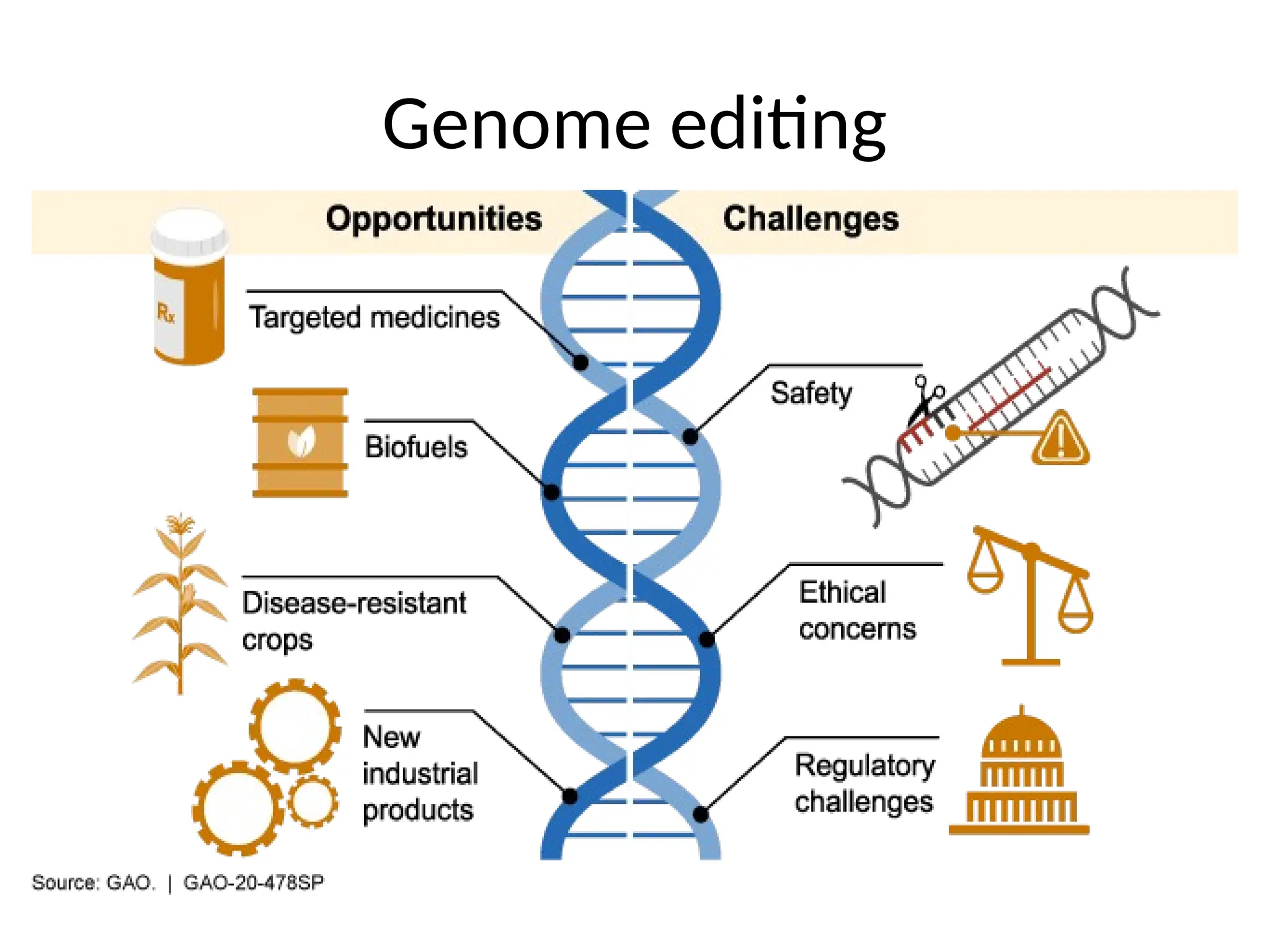
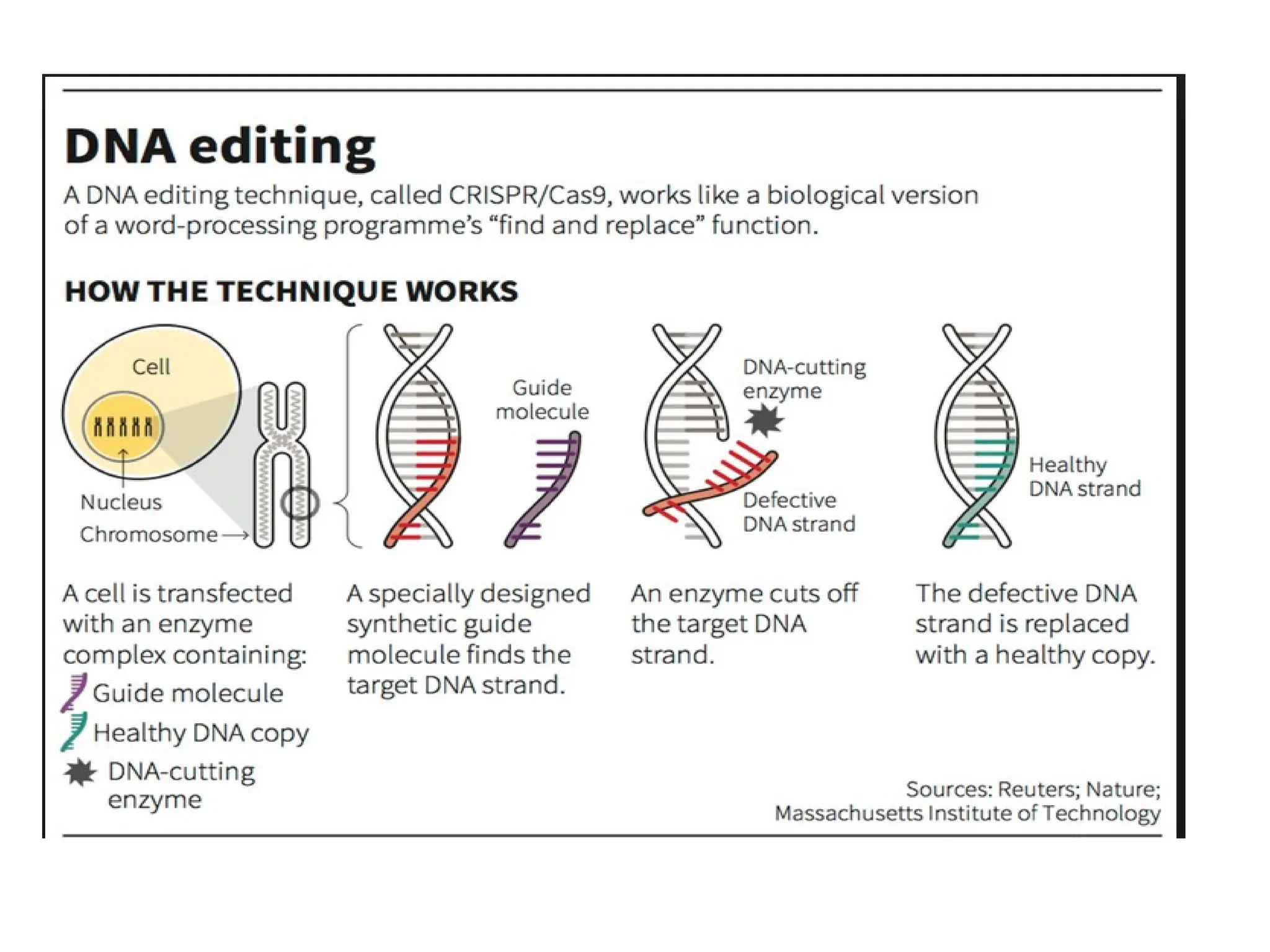
Genome editing
• Genomeediting or gene editing or gene
engineering is a type of genetic engineering in
which DNA is inserted, deleted or modified or
replaced in the genome of living organism
• Unlike early genetic engineering techniques
that randomly inserts genetic materials into a
host genome, genome editing targets the
insertions to site specific locations
DNA Technology RegulationBill, 2019
• Purpose:
– It allows law enforcement agencies to collect DNA samples,
create DNA profiles and special databanks for forensic-criminal
investigations. It states that all DNA data, including DNA
samples, DNA profiles and records, will be only used for
identification of the person and not for any other purpose.
• DNA profiling board:
– It creates DNA Profiling Board (DPB) that will be final authority
that will authorise creation of State-level DNA databanks,
approve the methods of collection and analysis of DNA-
technologies. It makes accreditation and regulation mandatory
for DNA laboratories.
5.
DNA REGULATION BILL2019
• DNA banks:
– It allows the government to set up DNA data banks across
India to store profiles. These banks will maintain a national
database for identification of victims, accused, suspects,
undertrials, missing persons and unidentified human remains.
• Penalty:
– It also empowers the government to impose jail term of up to
3 years and fine of up to Rs. 1 lakh on those who leak
information stored in such facilities. It prescribes similar
punishment for those who seek information on DNA profiles
illegally.
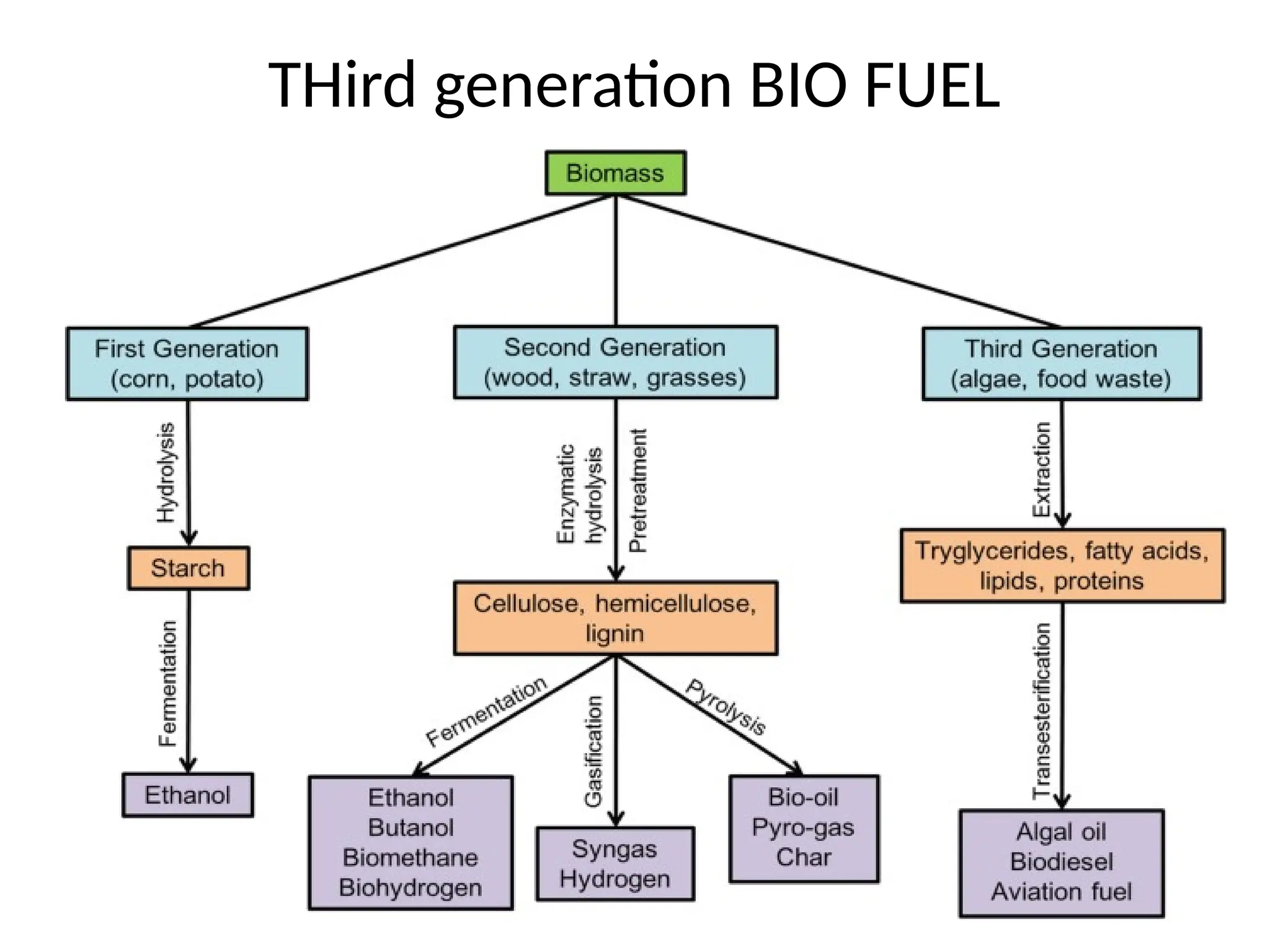
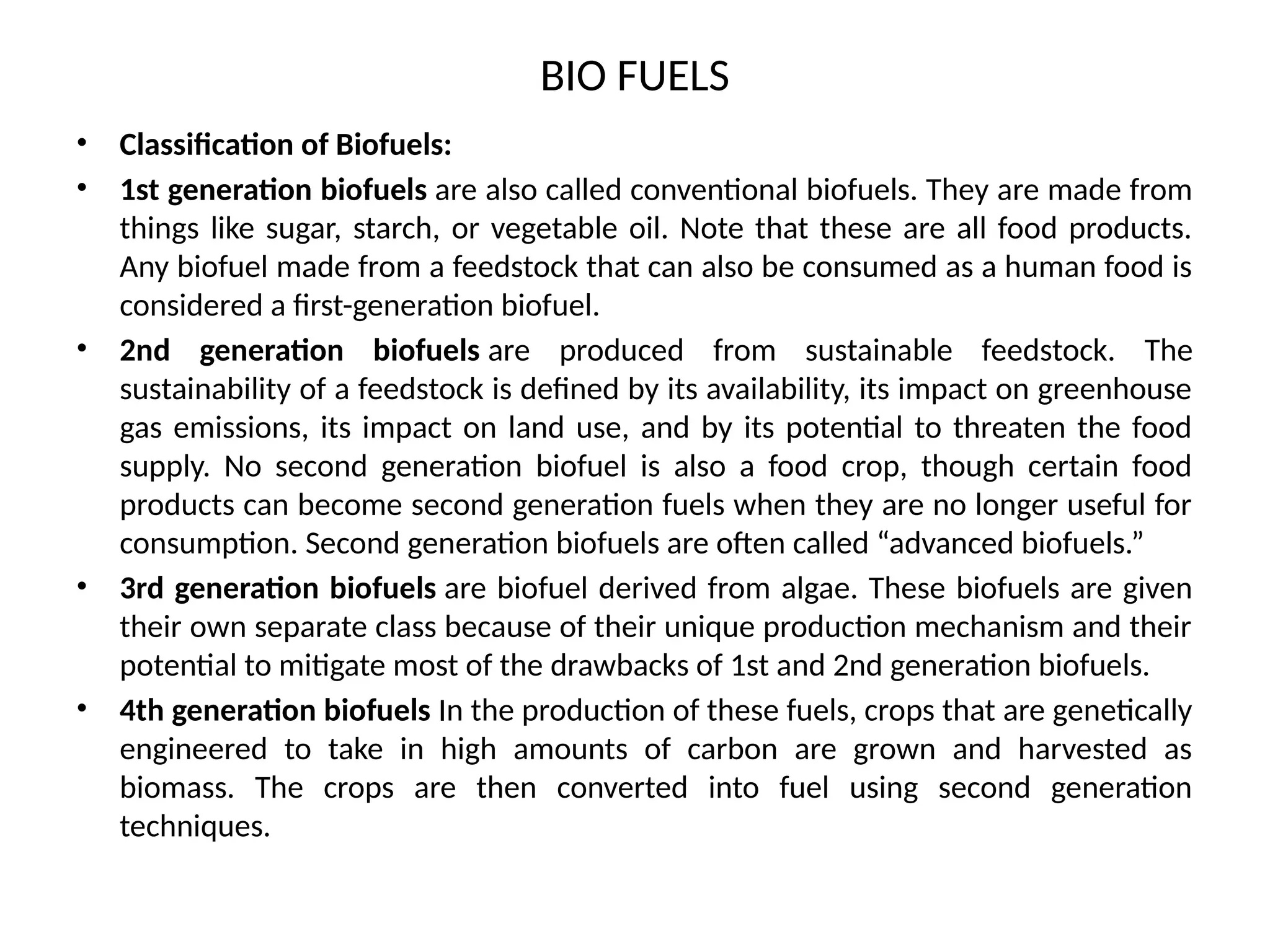
BIO FUELS
• Classificationof Biofuels:
• 1st generation biofuels are also called conventional biofuels. They are made from
things like sugar, starch, or vegetable oil. Note that these are all food products.
Any biofuel made from a feedstock that can also be consumed as a human food is
considered a first-generation biofuel.
• 2nd generation biofuels are produced from sustainable feedstock. The
sustainability of a feedstock is defined by its availability, its impact on greenhouse
gas emissions, its impact on land use, and by its potential to threaten the food
supply. No second generation biofuel is also a food crop, though certain food
products can become second generation fuels when they are no longer useful for
consumption. Second generation biofuels are often called “advanced biofuels.”
• 3rd generation biofuels are biofuel derived from algae. These biofuels are given
their own separate class because of their unique production mechanism and their
potential to mitigate most of the drawbacks of 1st and 2nd generation biofuels.
• 4th generation biofuels In the production of these fuels, crops that are genetically
engineered to take in high amounts of carbon are grown and harvested as
biomass. The crops are then converted into fuel using second generation
techniques.
9.
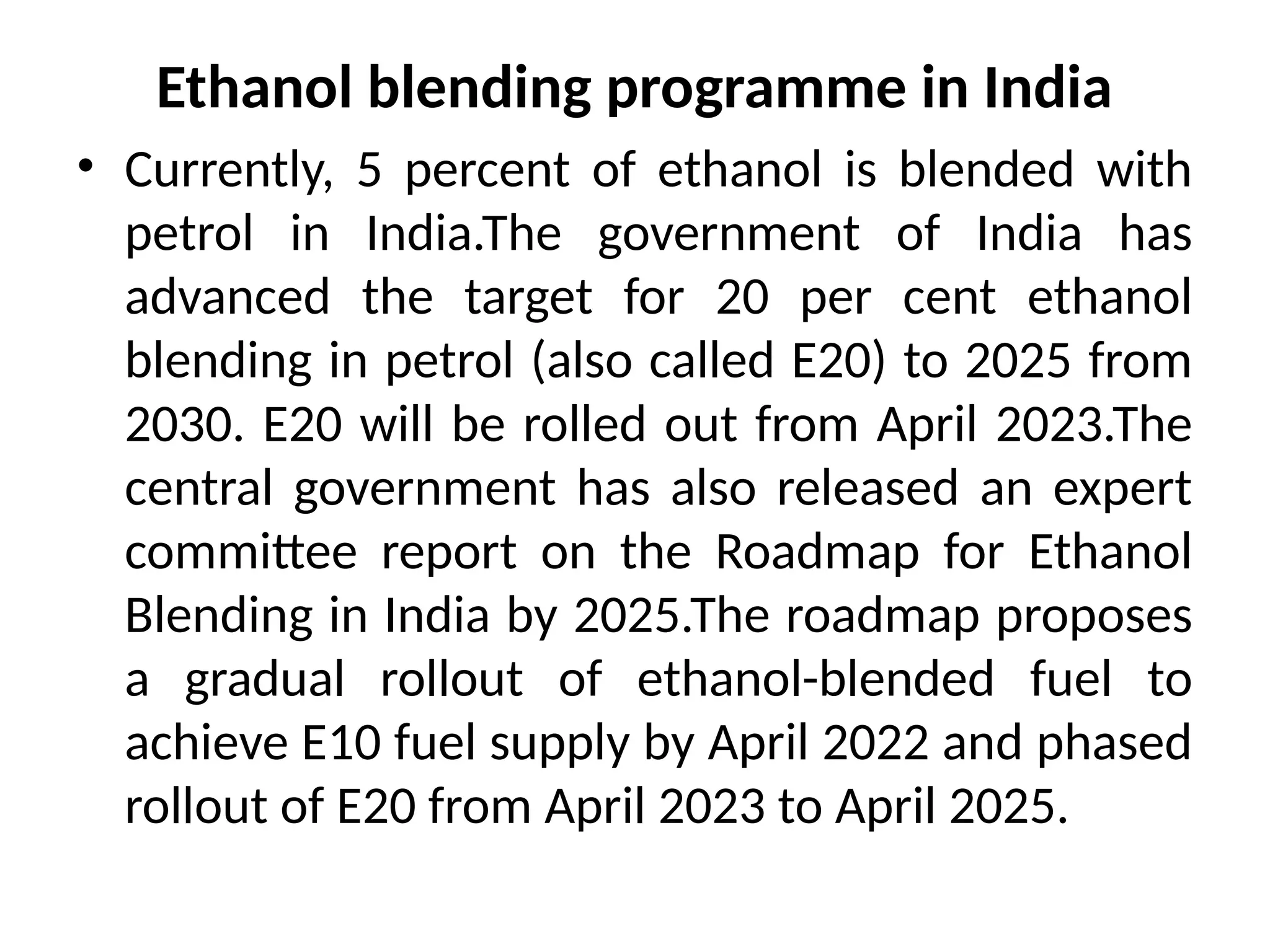
Ethanol blending programmein India
• Currently, 5 percent of ethanol is blended with
petrol in India.The government of India has
advanced the target for 20 per cent ethanol
blending in petrol (also called E20) to 2025 from
2030. E20 will be rolled out from April 2023.The
central government has also released an expert
committee report on the Roadmap for Ethanol
Blending in India by 2025.The roadmap proposes
a gradual rollout of ethanol-blended fuel to
achieve E10 fuel supply by April 2022 and phased
rollout of E20 from April 2023 to April 2025.
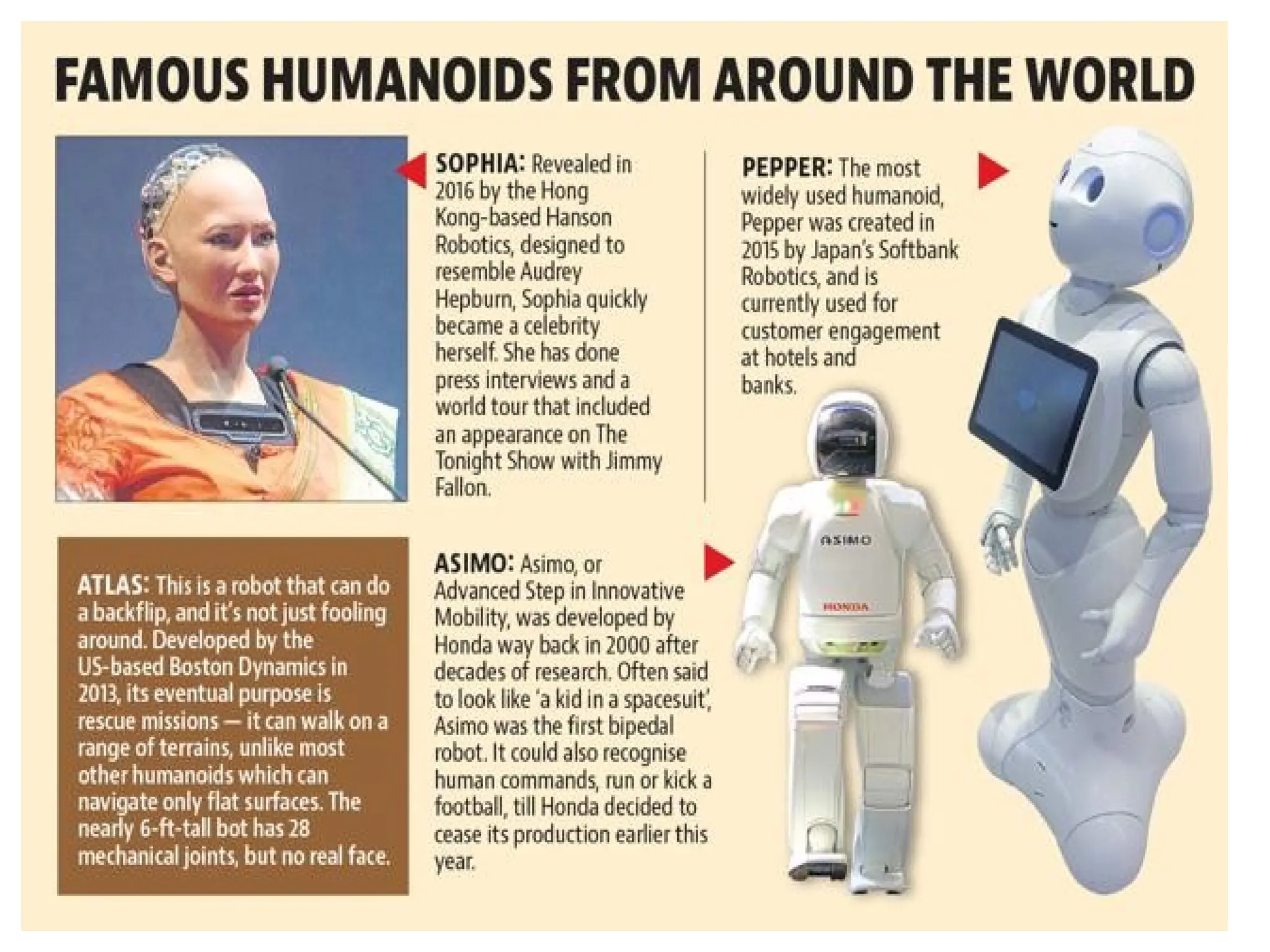
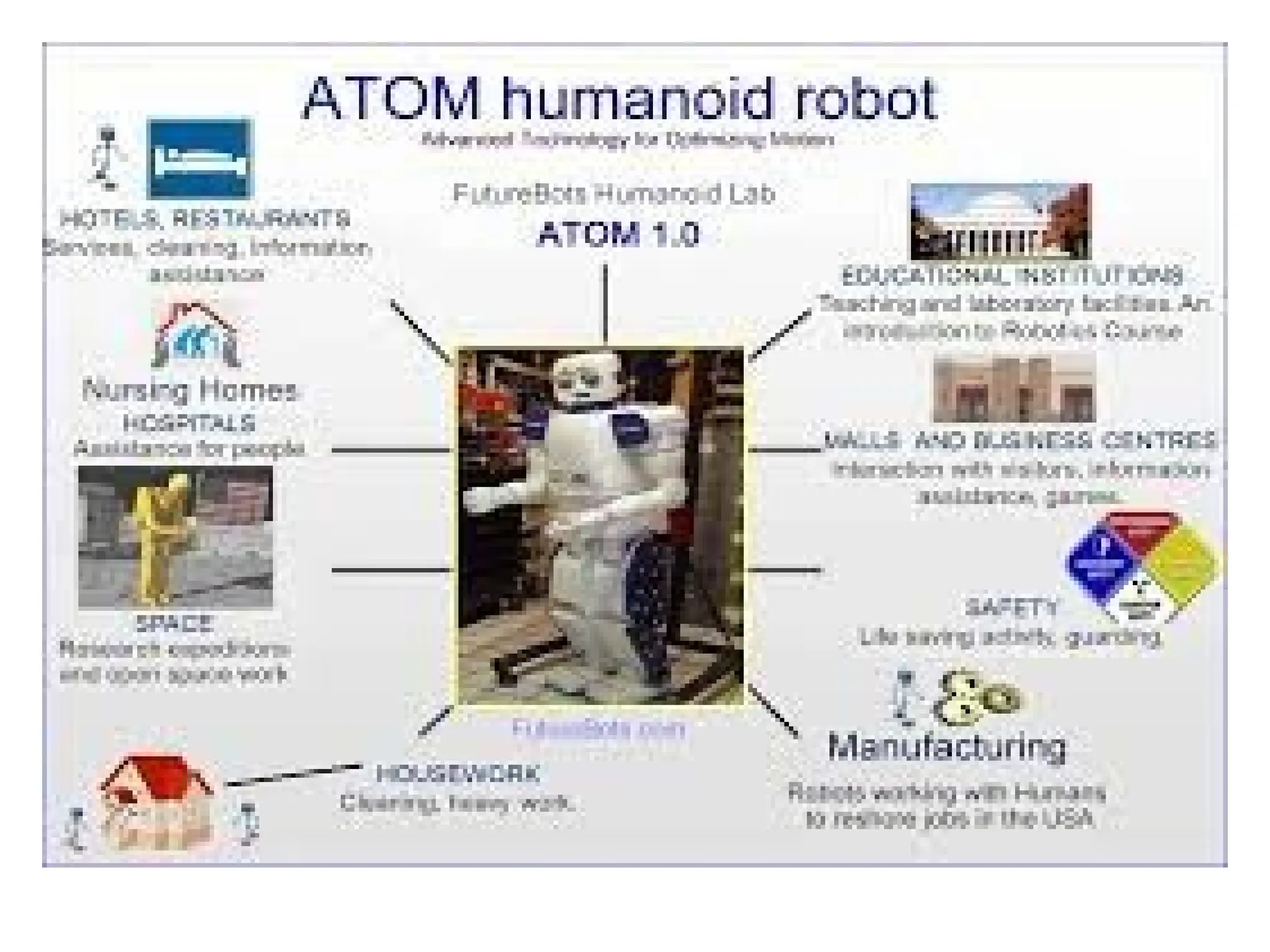
Robotics is thebranch of technology that deals with the design, construction,
operation, structural depositions, manufacture and application of robots. Today
Robotics is the rapidly growing field and it is continue in research, design, and
build new robots that serve various practical purposes
Laws of Robotics
Applications of Robotics
Components of Robots
Robotic process automation (RPA)
Application of Robotics for Old Age
Robotics in Agriculture
Challenges in Robotics
Artificial Intelligence and Robotics
Artificial Intelligence in Pandemics
Robotics in Pandemics
4th Industrial revolution and Robotics
18.
SPACE TECHNOLOGY
• Milestonesin India’s Space Programme
• What is an Orbit?
• Lagrange points
• Satellite
• List of Earth Observation Satellites
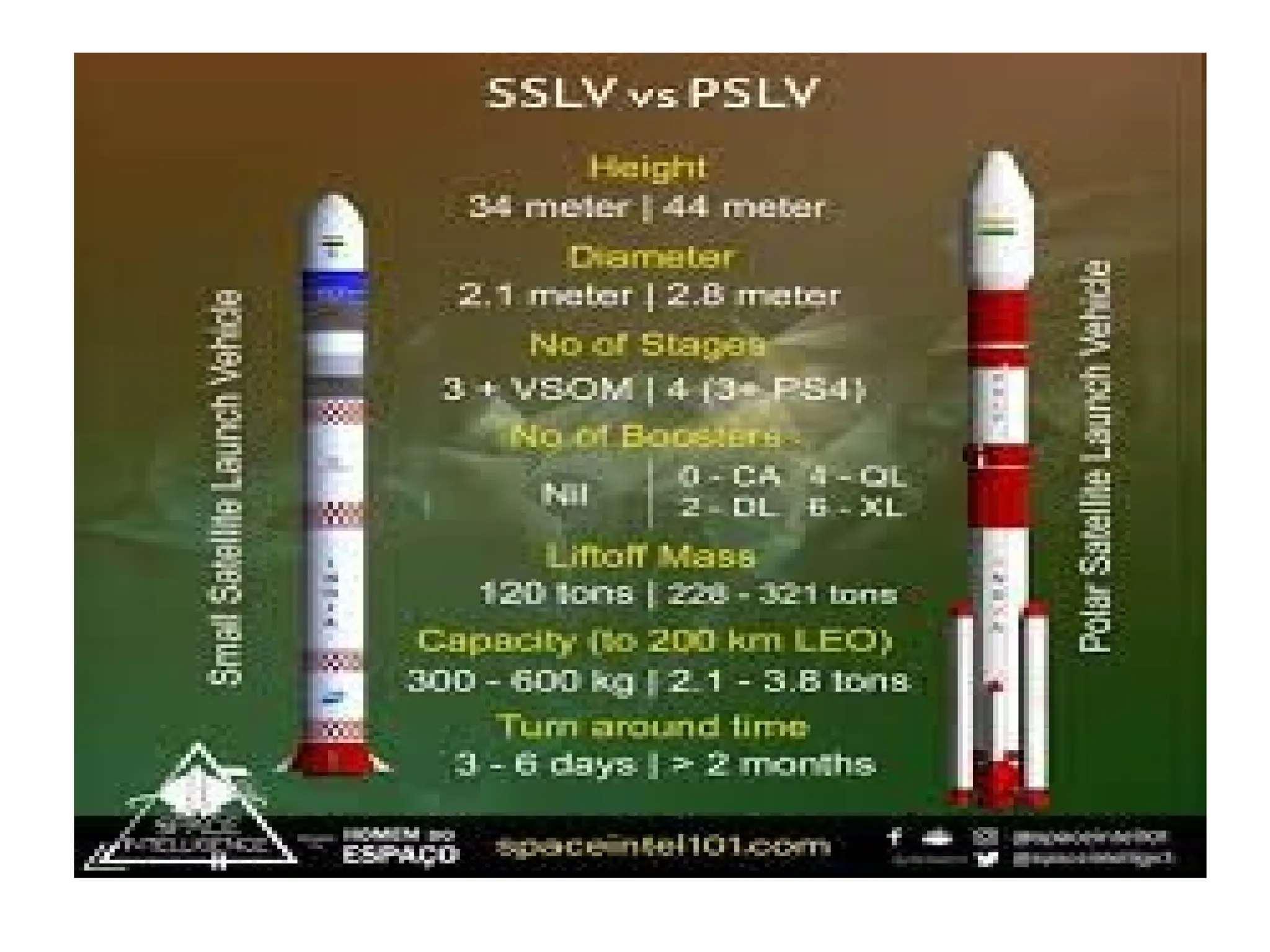
• Satellite Launching Vehicles
• Recent launches
• NAVIC
• NISAR
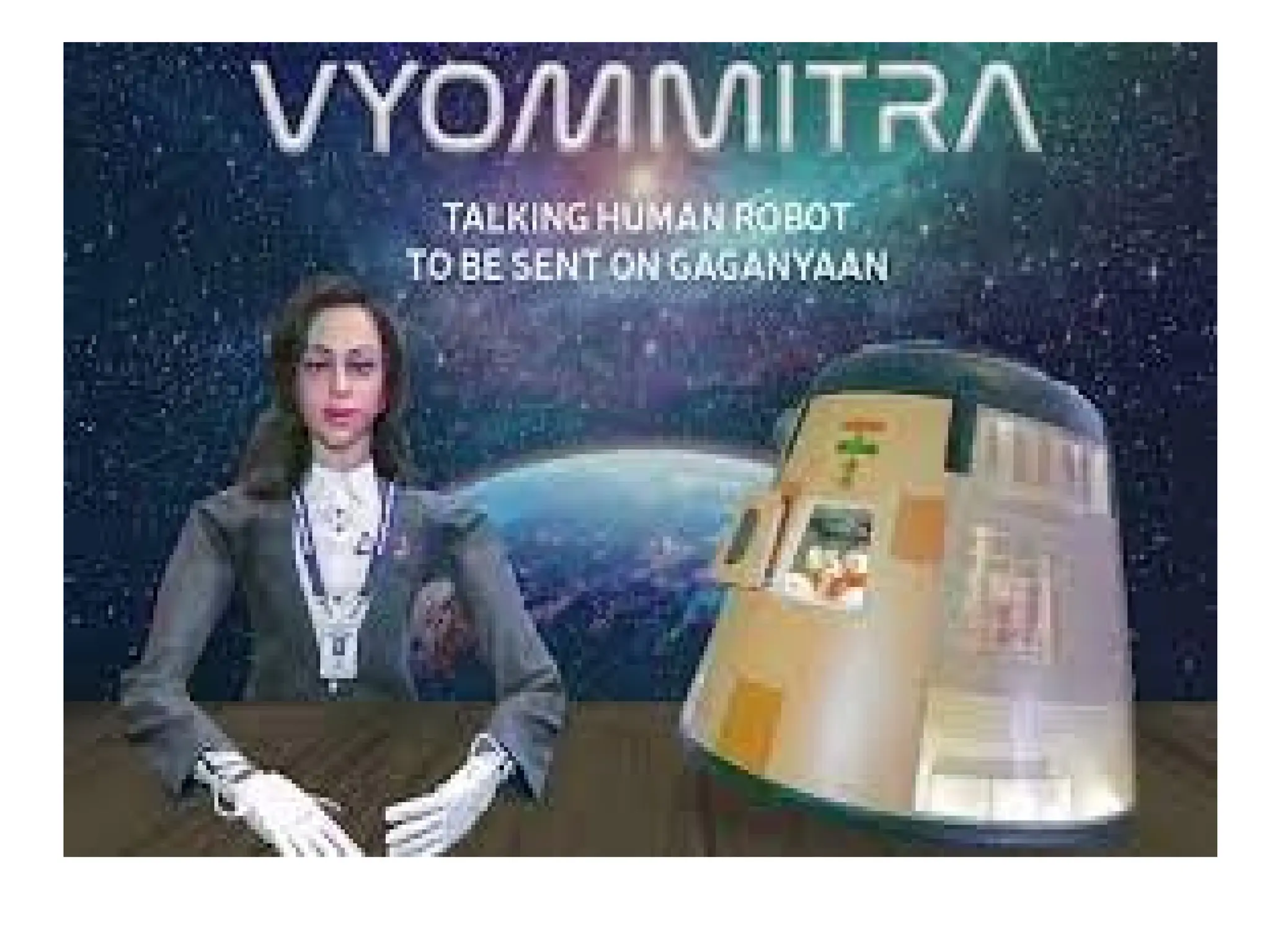
• GAGANYAN
• Project NETRA
• BHUVAN 3.0
• MASS ORBITER MISSION
• Mission Shakti
• Seven mega missions by ISRO
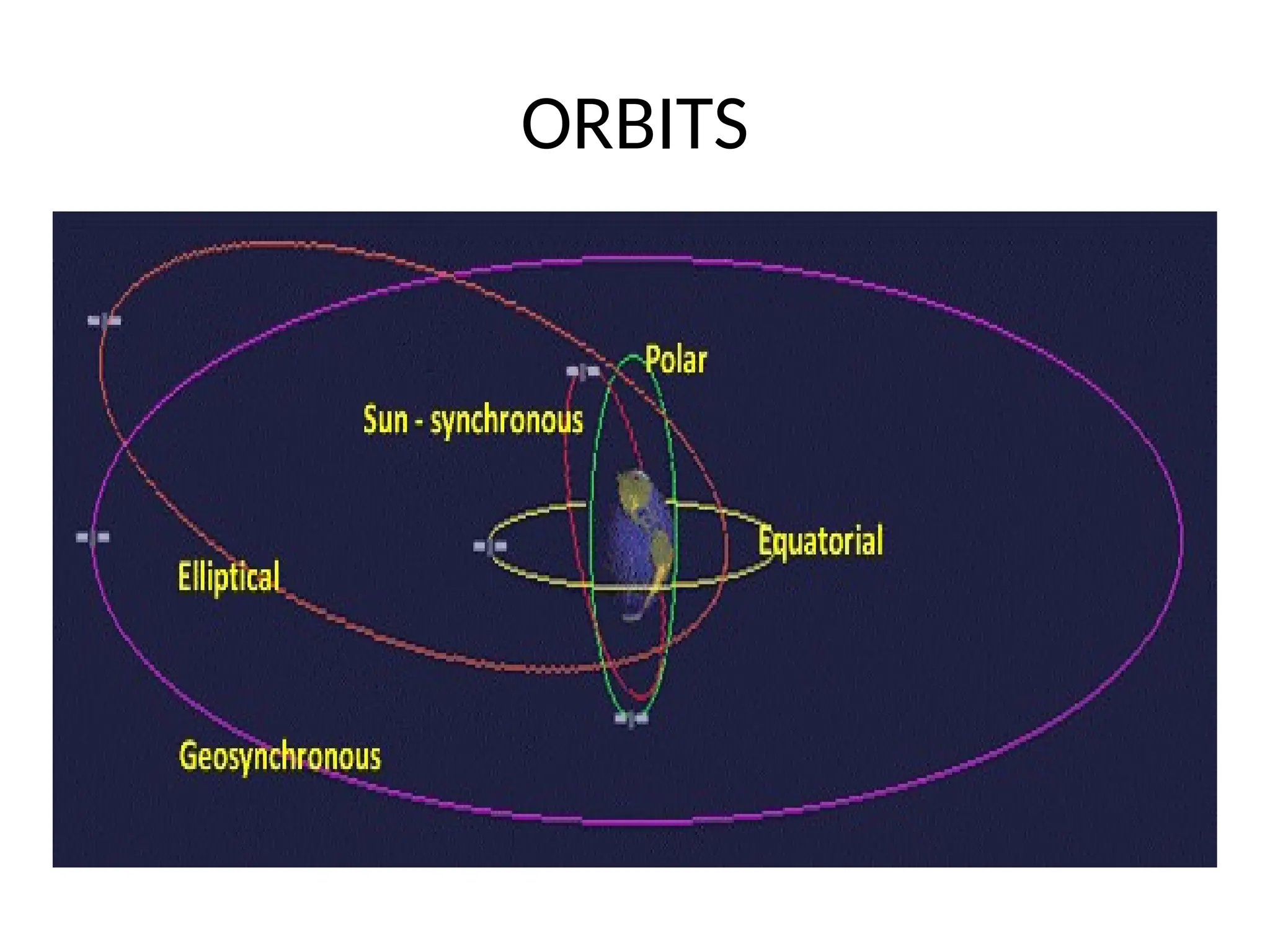
ORBITS
• Geostationary orbit(GEO)
• Low Earth orbit (LEO)
• Medium Earth orbit (MEO)
• Polar orbit and Sun-synchronous orbit (SSO)
• Transfer orbits and geostationary transfer
orbit (GTO)
• Lagrange points (L-points)
21.
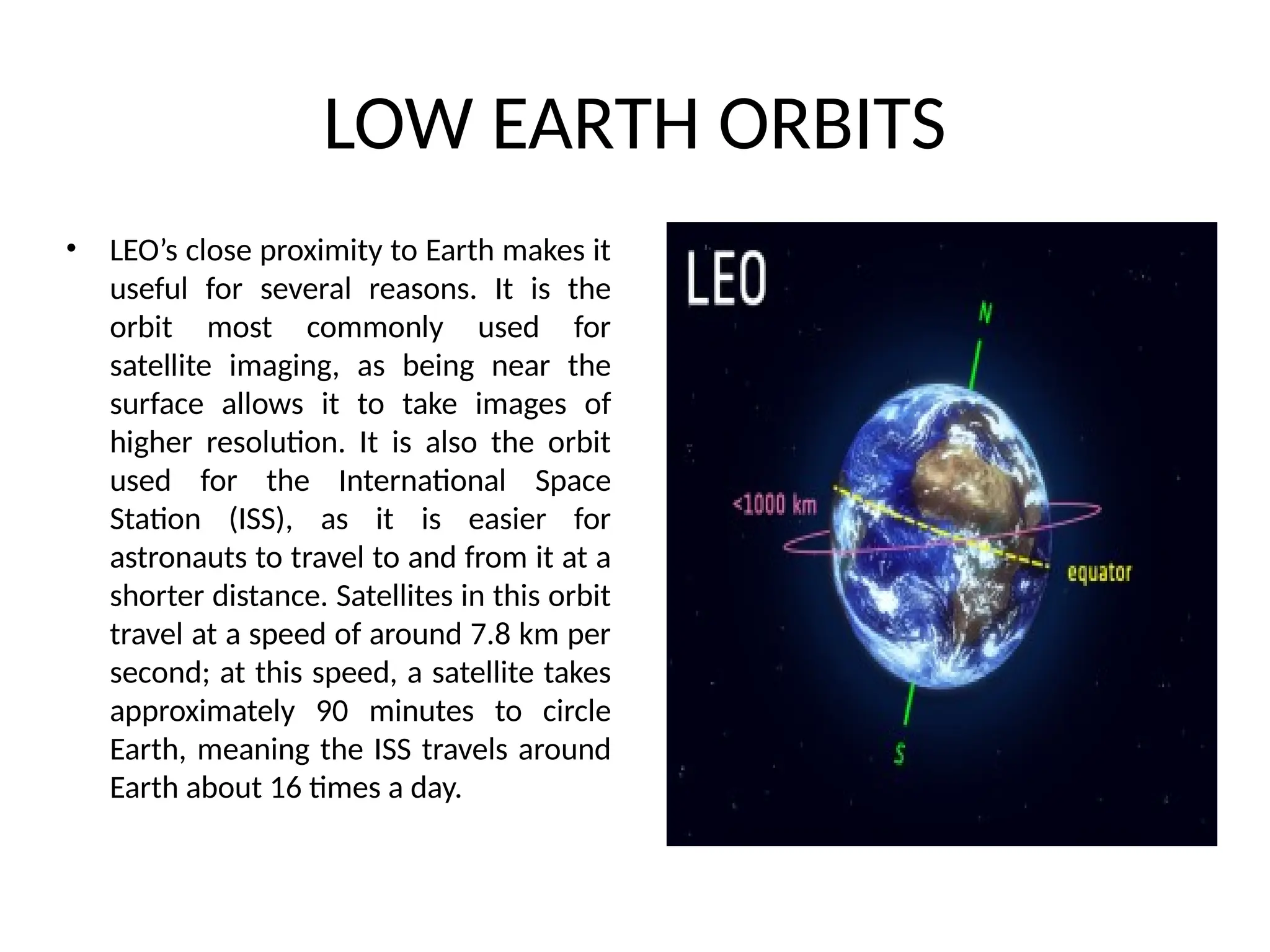
LOW EARTH ORBITS
•LEO’s close proximity to Earth makes it
useful for several reasons. It is the
orbit most commonly used for
satellite imaging, as being near the
surface allows it to take images of
higher resolution. It is also the orbit
used for the International Space
Station (ISS), as it is easier for
astronauts to travel to and from it at a
shorter distance. Satellites in this orbit
travel at a speed of around 7.8 km per
second; at this speed, a satellite takes
approximately 90 minutes to circle
Earth, meaning the ISS travels around
Earth about 16 times a day.
22.
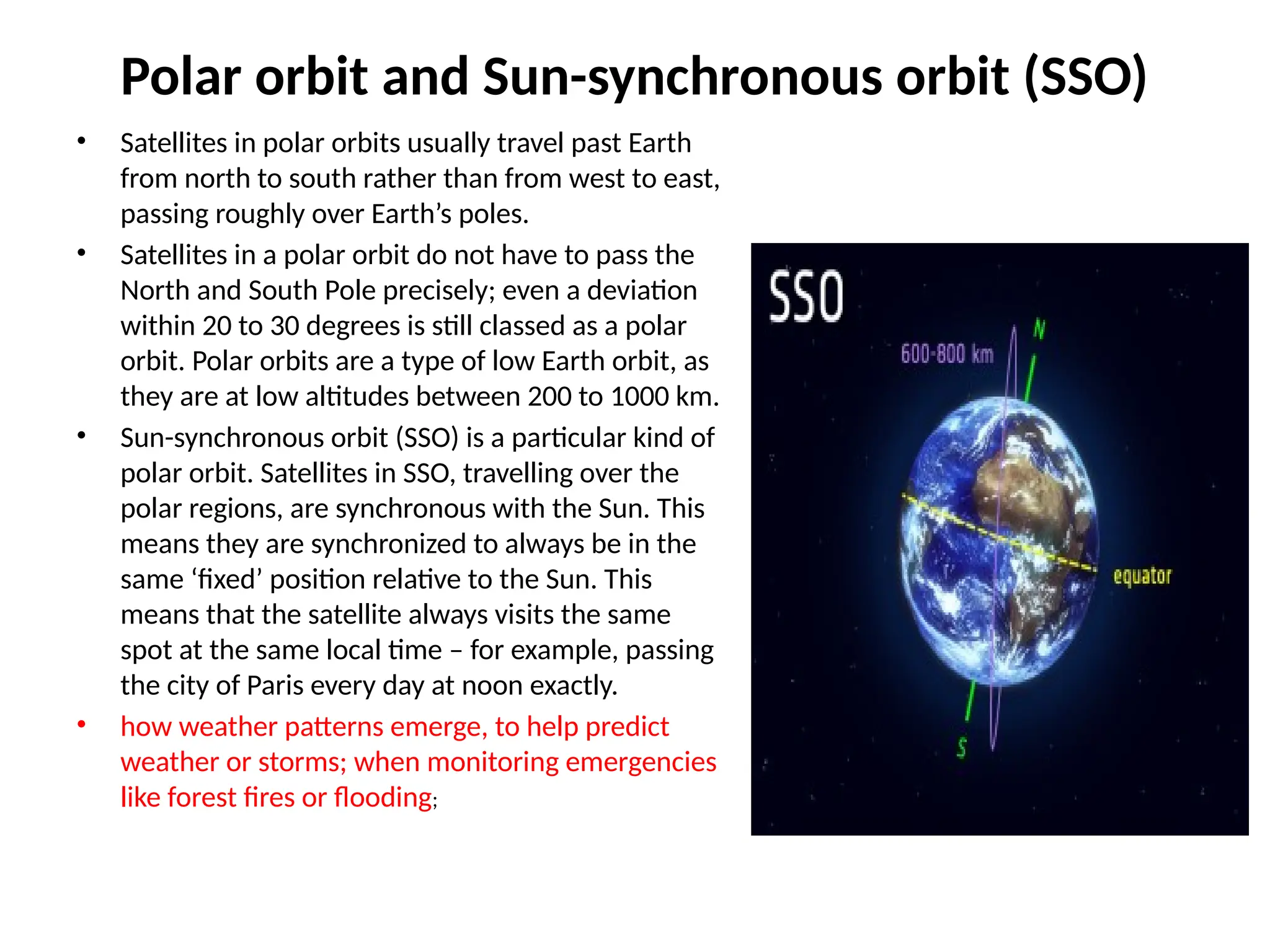
Polar orbit andSun-synchronous orbit (SSO)
• Satellites in polar orbits usually travel past Earth
from north to south rather than from west to east,
passing roughly over Earth’s poles.
• Satellites in a polar orbit do not have to pass the
North and South Pole precisely; even a deviation
within 20 to 30 degrees is still classed as a polar
orbit. Polar orbits are a type of low Earth orbit, as
they are at low altitudes between 200 to 1000 km.
• Sun-synchronous orbit (SSO) is a particular kind of
polar orbit. Satellites in SSO, travelling over the
polar regions, are synchronous with the Sun. This
means they are synchronized to always be in the
same ‘fixed’ position relative to the Sun. This
means that the satellite always visits the same
spot at the same local time – for example, passing
the city of Paris every day at noon exactly.
• how weather patterns emerge, to help predict
weather or storms; when monitoring emergencies
like forest fires or flooding;
23.
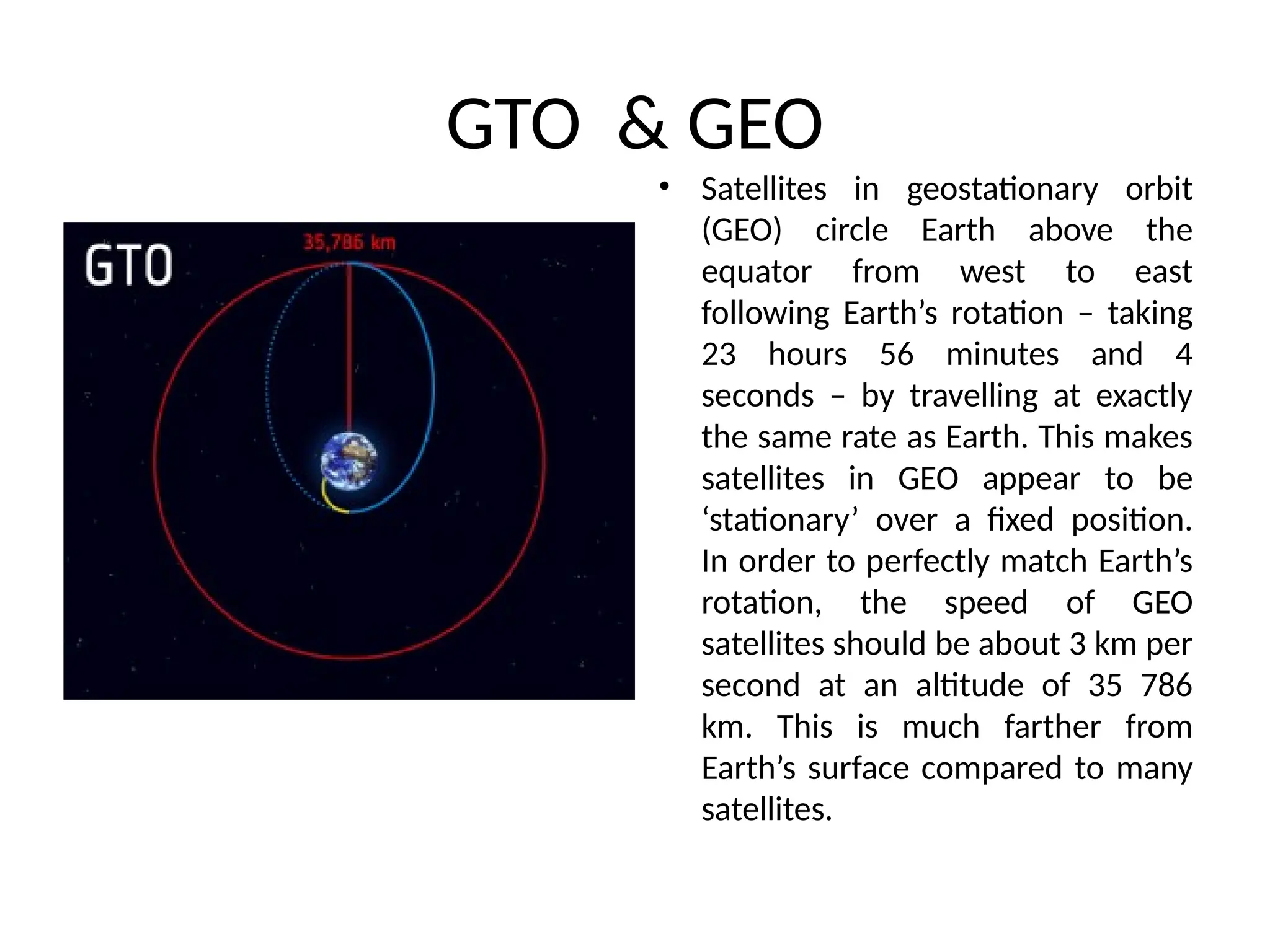
GTO & GEO
•Satellites in geostationary orbit
(GEO) circle Earth above the
equator from west to east
following Earth’s rotation – taking
23 hours 56 minutes and 4
seconds – by travelling at exactly
the same rate as Earth. This makes
satellites in GEO appear to be
‘stationary’ over a fixed position.
In order to perfectly match Earth’s
rotation, the speed of GEO
satellites should be about 3 km per
second at an altitude of 35 786
km. This is much farther from
Earth’s surface compared to many
satellites.
24.
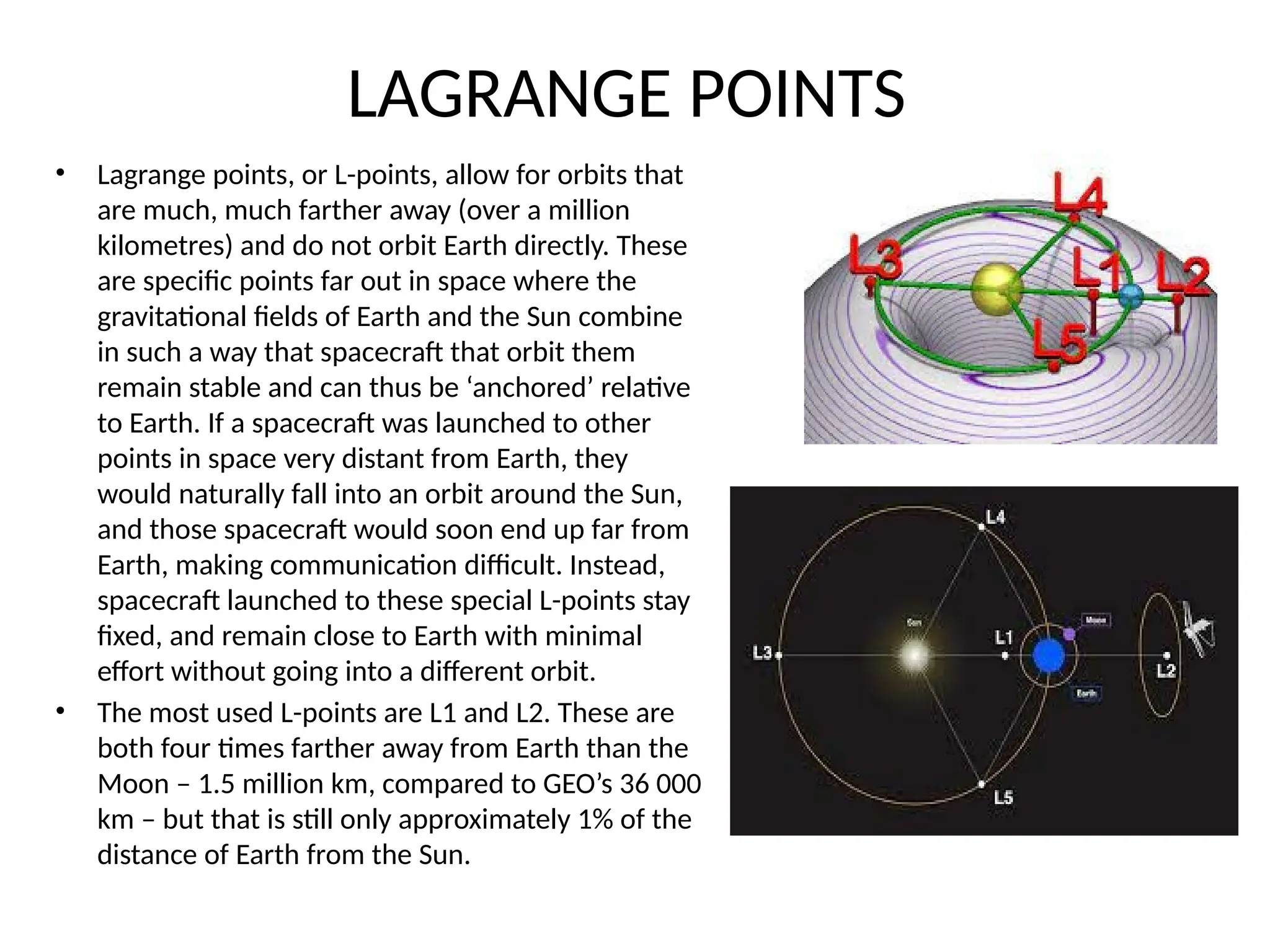
LAGRANGE POINTS
• Lagrangepoints, or L-points, allow for orbits that
are much, much farther away (over a million
kilometres) and do not orbit Earth directly. These
are specific points far out in space where the
gravitational fields of Earth and the Sun combine
in such a way that spacecraft that orbit them
remain stable and can thus be ‘anchored’ relative
to Earth. If a spacecraft was launched to other
points in space very distant from Earth, they
would naturally fall into an orbit around the Sun,
and those spacecraft would soon end up far from
Earth, making communication difficult. Instead,
spacecraft launched to these special L-points stay
fixed, and remain close to Earth with minimal
effort without going into a different orbit.
• The most used L-points are L1 and L2. These are
both four times farther away from Earth than the
Moon – 1.5 million km, compared to GEO’s 36 000
km – but that is still only approximately 1% of the
distance of Earth from the Sun.
25.
• Types ofSatellites
• 1.Astronomical: Deployed for observation of distant planets, stars, galaxies, and objects in-universe. It is
a space Telescope hanging in space to photograph objects in space.
• 2.Biosatellite : Places animals or plants in space to conduct research on the effects of space on these
living objects.
• 3.Communication:These satellites support telecommunication. Telecasting, Phone calls, Internet
connectivity, Radio, and much remote connectivity are typical applications.
• 4.Earth Observation: Deployed to study environment, monitor climatic changes and mapping the earth
for non-military purposes.
• 5.Navigation: Facilitates to trace the exact location of any objects on the Earth. This leads to the
development of new applications, technology, and business cases.
• 6.Killer (Military) : Deployed to attack enemy satellites and space objects during the war period.
• 7.Space Stations : Designed for human beings to live and conduct research on objects on planets, stars,
and galaxies.
• 8.Reconnaissance: Deployed for spying, surveying and scouting enemy territory during the war period.
• 9.Crewed Spacecraft: These satellites ferry astronauts to space and bring them back to earth. It has good
grounding facilities and helps astronauts in accessing space stations.
• 10.Recovery: Recovery satellites are mainly used to recover bio, reconnaissance and other satellites back
to earth.
• 11.Solar Power:Space-based satellites gather energy from the Sun and transmit it to earth for
consumption.
• 12.Miniaturized: Smaller sized and lower weight satellites are launched at an economical cost used for
the limited purpose of scientific data gathering and radio relay.
• 13.Tether:Tether satellites are connected to another satellite by the tether. It is used as a secondary
payload to another main satellite mainly used in students and mini-projects.
28.
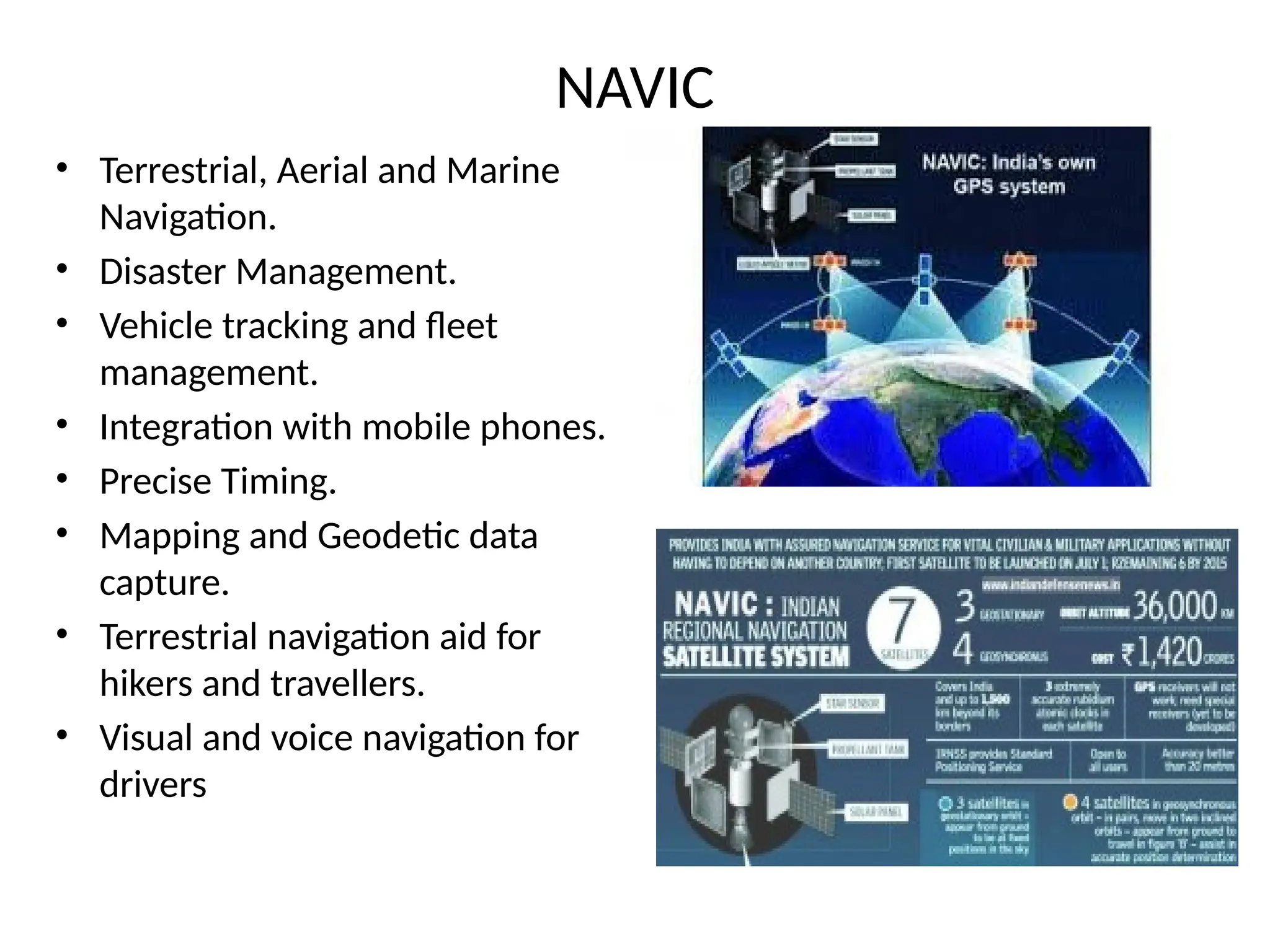
NAVIC
• Terrestrial, Aerialand Marine
Navigation.
• Disaster Management.
• Vehicle tracking and fleet
management.
• Integration with mobile phones.
• Precise Timing.
• Mapping and Geodetic data
capture.
• Terrestrial navigation aid for
hikers and travellers.
• Visual and voice navigation for
drivers
29.
NAVIC
• Navigation withIndian Constellation (NavIC) is an
independent regional navigation satellite
system designed to provide position information in
the Indian region and 1500 km around the Indian
mainland.
• IRNSS would provide two types of services, namely
Standard Positioning Services available to all users
and Restricted Services provided to authorised
users.
30.
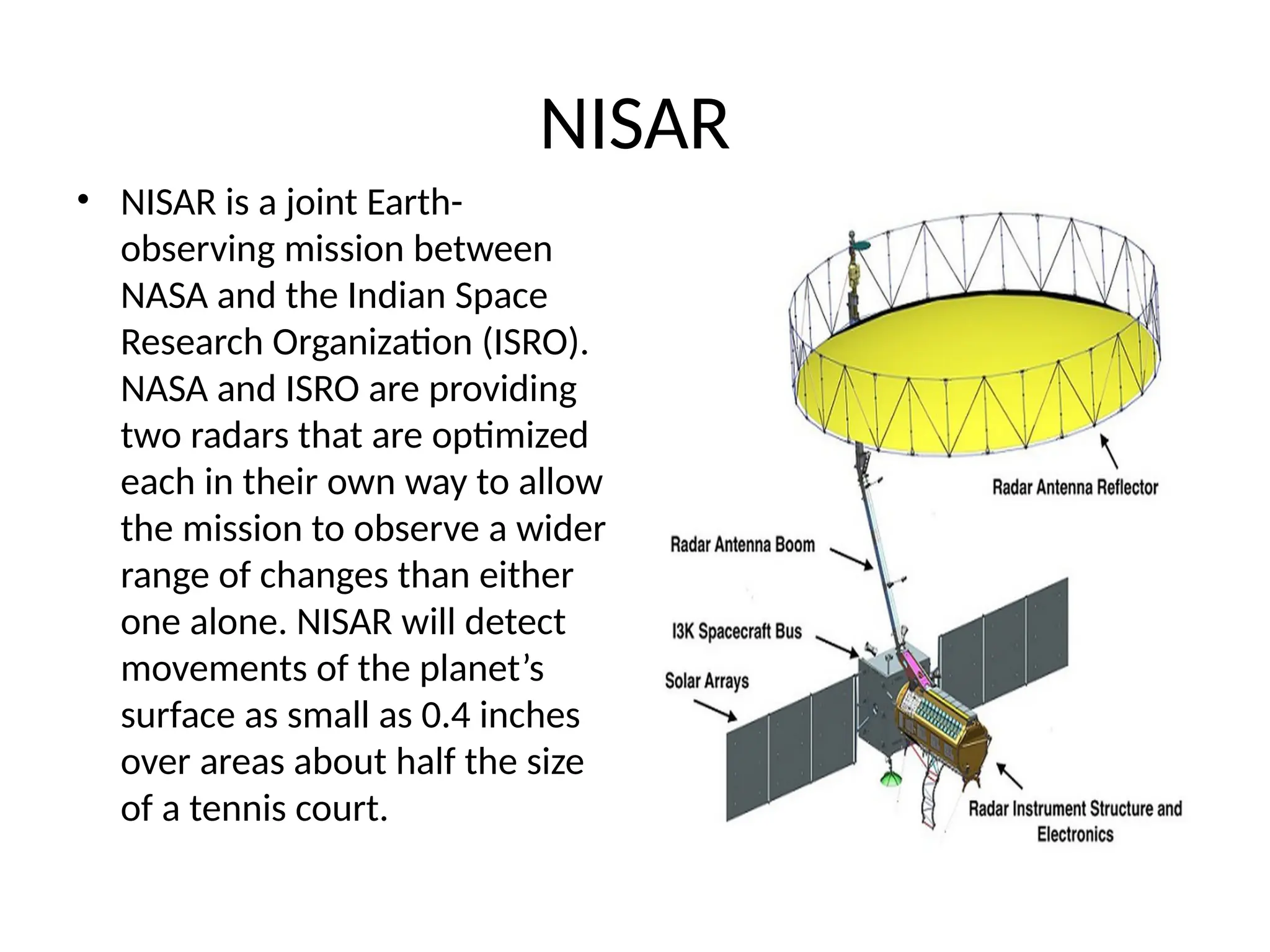
NISAR
• NISAR isa joint Earth-
observing mission between
NASA and the Indian Space
Research Organization (ISRO).
NASA and ISRO are providing
two radars that are optimized
each in their own way to allow
the mission to observe a wider
range of changes than either
one alone. NISAR will detect
movements of the planet’s
surface as small as 0.4 inches
over areas about half the size
of a tennis court.
31.
NISAR
• It’s anSUV-sized satellite that is being jointly developed by the
space agencies of the US and India.
• The partnership agreement was signed between NASA and ISRO
in September 2014, according to which NASA will provide one of
the radars for the satellite, a high-rate communication subsystem
for science data, GPS receivers and a payload data subsystem.
• ISRO, on the other hand, will provide the spacecraft bus, the
second type of radar (called the S-band radar), the launch
vehicle and associated launch services.
• The satellite will be launched in 2022 from the Satish Dhawan
Space Center in Sriharikota, India, into a near-polar orbit and will
scan the globe every 12 days over the course of its three-year
mission of imaging the Earth’s land, ice sheets and sea ice to give
an “unprecedented” view of the planet.
32.
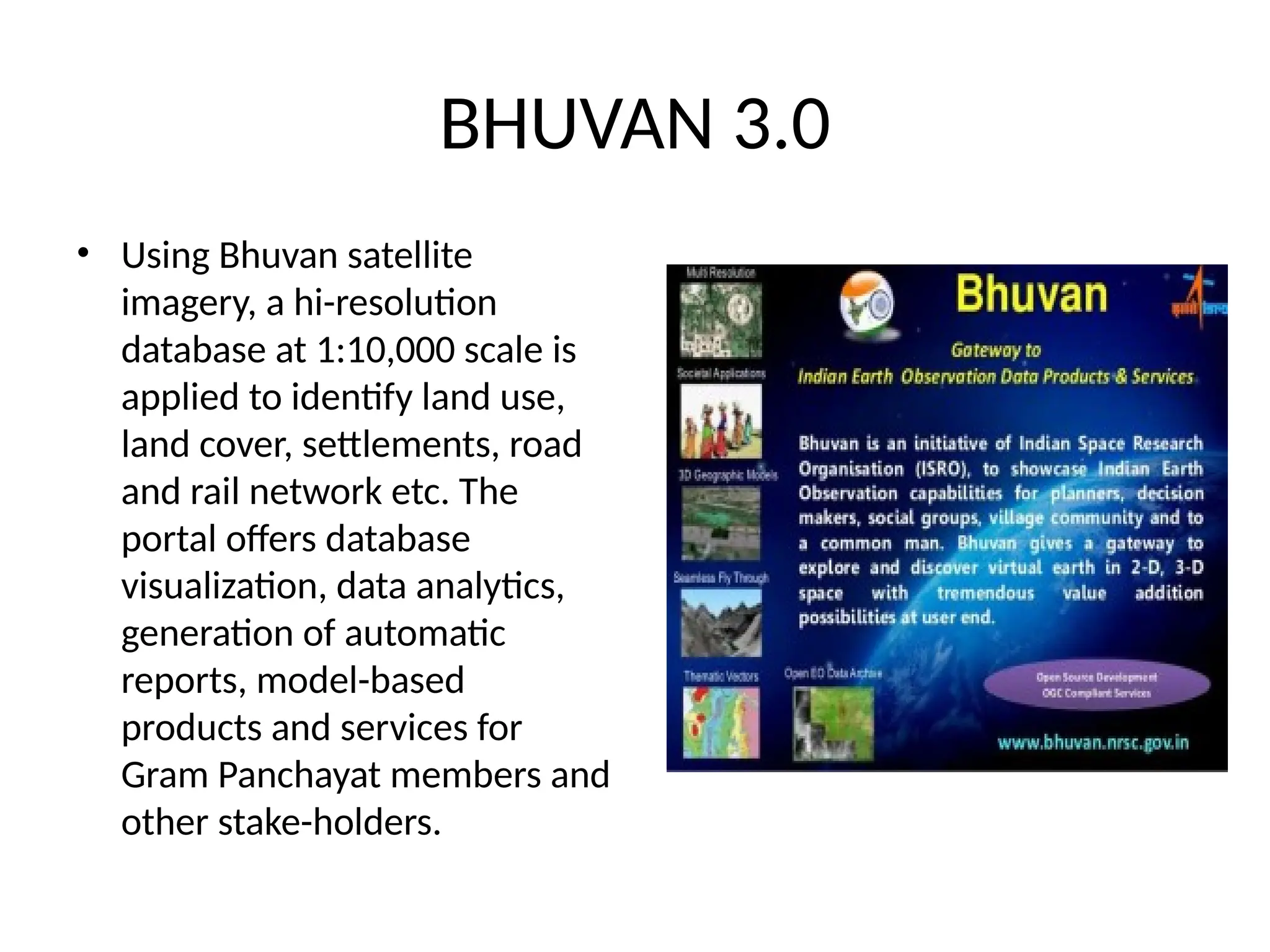
BHUVAN 3.0
• UsingBhuvan satellite
imagery, a hi-resolution
database at 1:10,000 scale is
applied to identify land use,
land cover, settlements, road
and rail network etc. The
portal offers database
visualization, data analytics,
generation of automatic
reports, model-based
products and services for
Gram Panchayat members and
other stake-holders.
33.
Project NETRA
• Whatis Project NETRA (Network
for space object Tracking and
Analysis)?
• Under the project, the ISRO plans
to put up many observational
facilities: connected radars,
telescopes; data processing units
and a control centre.
• They can, among others, spot,
track and catalogue objects as
small as 10 cm, up to a range of
3,400 km and equal to a space
orbit of around 2,000 km.
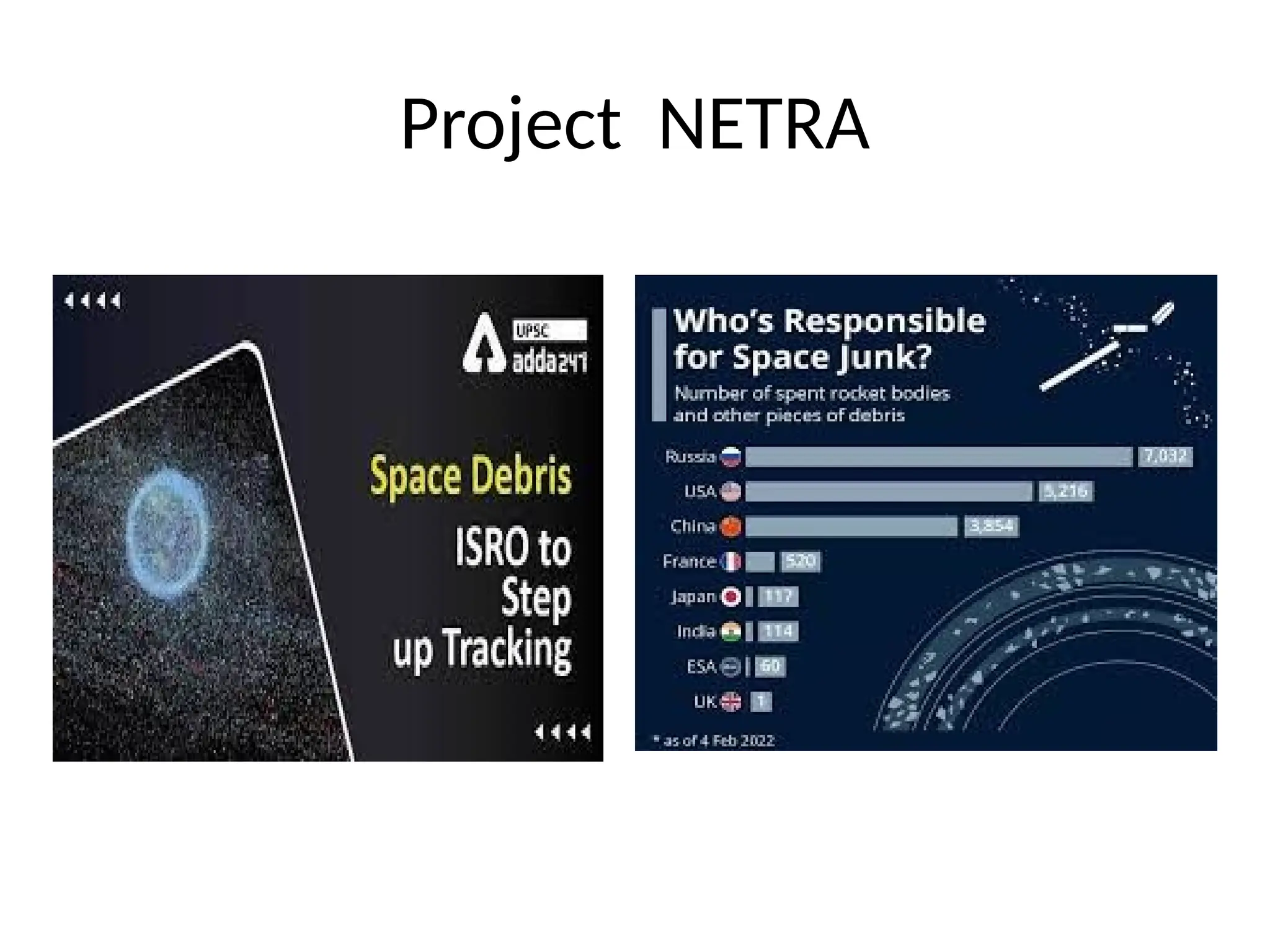
• The project will give India its
own capability in space
situational awareness (SSA)
like the other space powers —
which is used to ‘predict’
threats from debris to Indian
satellites.
• NETRA’s eventual goal is to
capture the GEO, or
geostationary orbit, scene at
36,000 km where
communication satellites
operate.
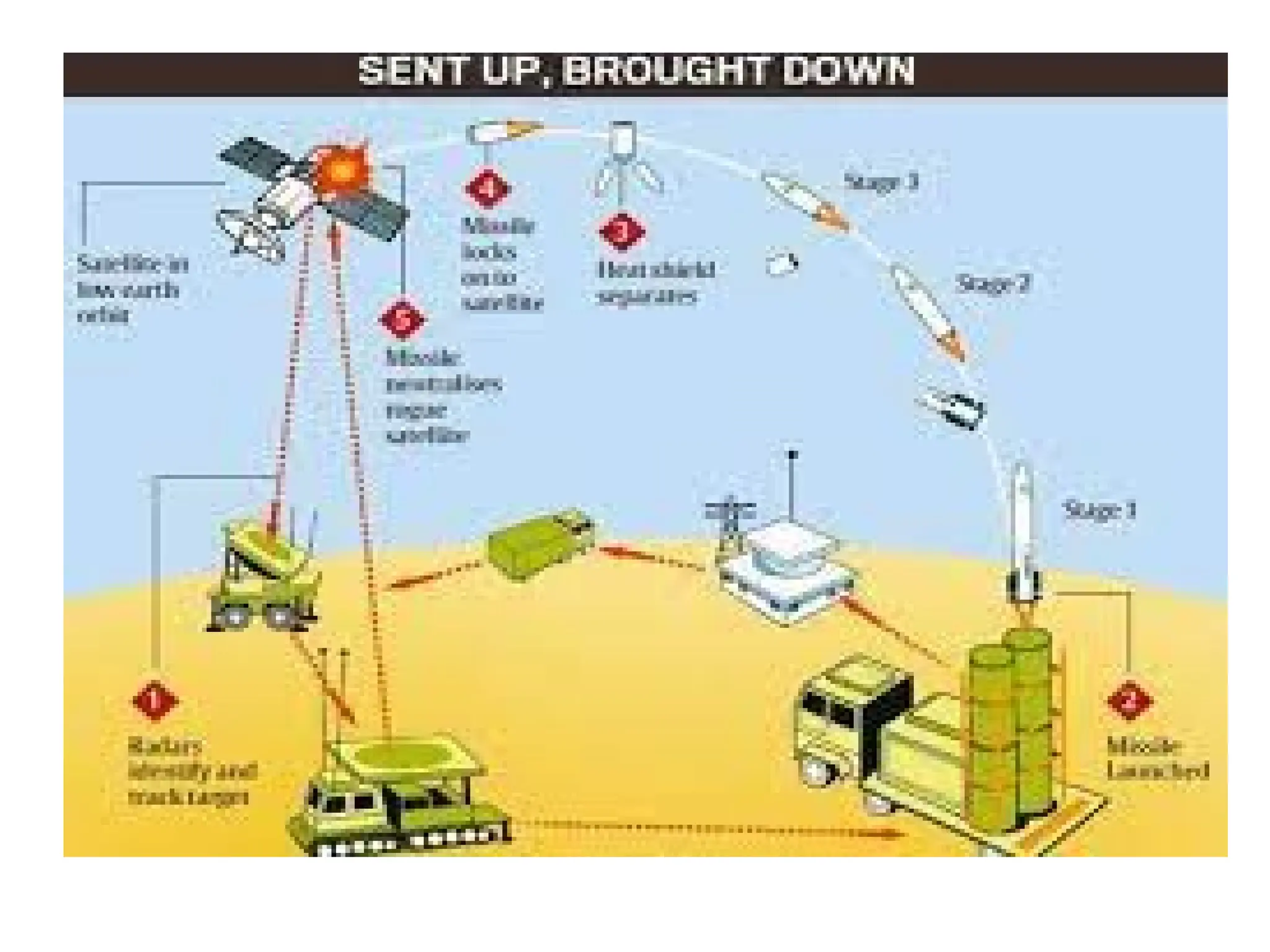
Mission SHAKTHI
• MissionShakti is a joint
programme of the Defence
Research and Development
Organisation (DRDO) and the
Indian Space Research
Organisation (ISRO).
• As part of the mission, an anti-
satellite (A-SAT) weapon was
launched and targeted an Indian
satellite which had been
decommissioned. Mission Shakti
was carried out from DRDO’s
testing range in Odisha’s Balasore.
• India is only the 4th
country to acquire
such a specialised
and modern
capability, and Entire
effort is indigenous.
Till now, only the US,
Russia and China had
the capability to hit a
live target in space.
37.
Seven mega missionsby ISRO
• Chandrayaan-2, XPoSat (to study
cosmic radiation in 2020)
and Aditya-L1(to the Sun in
2021).
• Undefined Missions – which
include missions which are still in
planning stage
namely Mangalyaan-2 (or Mars
Orbiter Mission-2 in 2022), Lunar
Polar Exploration (or
Chandrayaan-3 in 2024), Venus
mission (in
2023), Exoworlds (exploration
outside the solar system in 2028).
• About Xposat:
• The X-ray Polarimeter Satellite (or
Xposat), is ISRO’s dedicated mission to
study polarization. It will launch in
2020.
• It will be a five-year mission and will
study cosmic radiation.
• It will be carrying a payload named
‘polarimeter instrument in X-rays’
(POLIX) made by Raman Research
Institute. POLIX will study the degree
and angle of polarisation of bright X-ray
sources in the energy range 5-30 keV.
• The spacecraft will be placed in a
circular 500-700km orbit.
38.
Seven mega missionsby ISRO
• About Aditya- L1 mission:
• What is it? It is India’s first solar mission.
• Objectives: It will study the sun’s outermost layers, the
corona and the chromospheres and collect data about
coronal mass ejection, which will also yield information for
space weather prediction.
• Significance of the mission: The data from Aditya mission
will be immensely helpful in discriminating between
different models for the origin of solar storms and also for
constraining how the storms evolve and what path they take
through the interplanetary space from the Sun to the Earth.
39.
NUCLEAR TECHNOLOGY
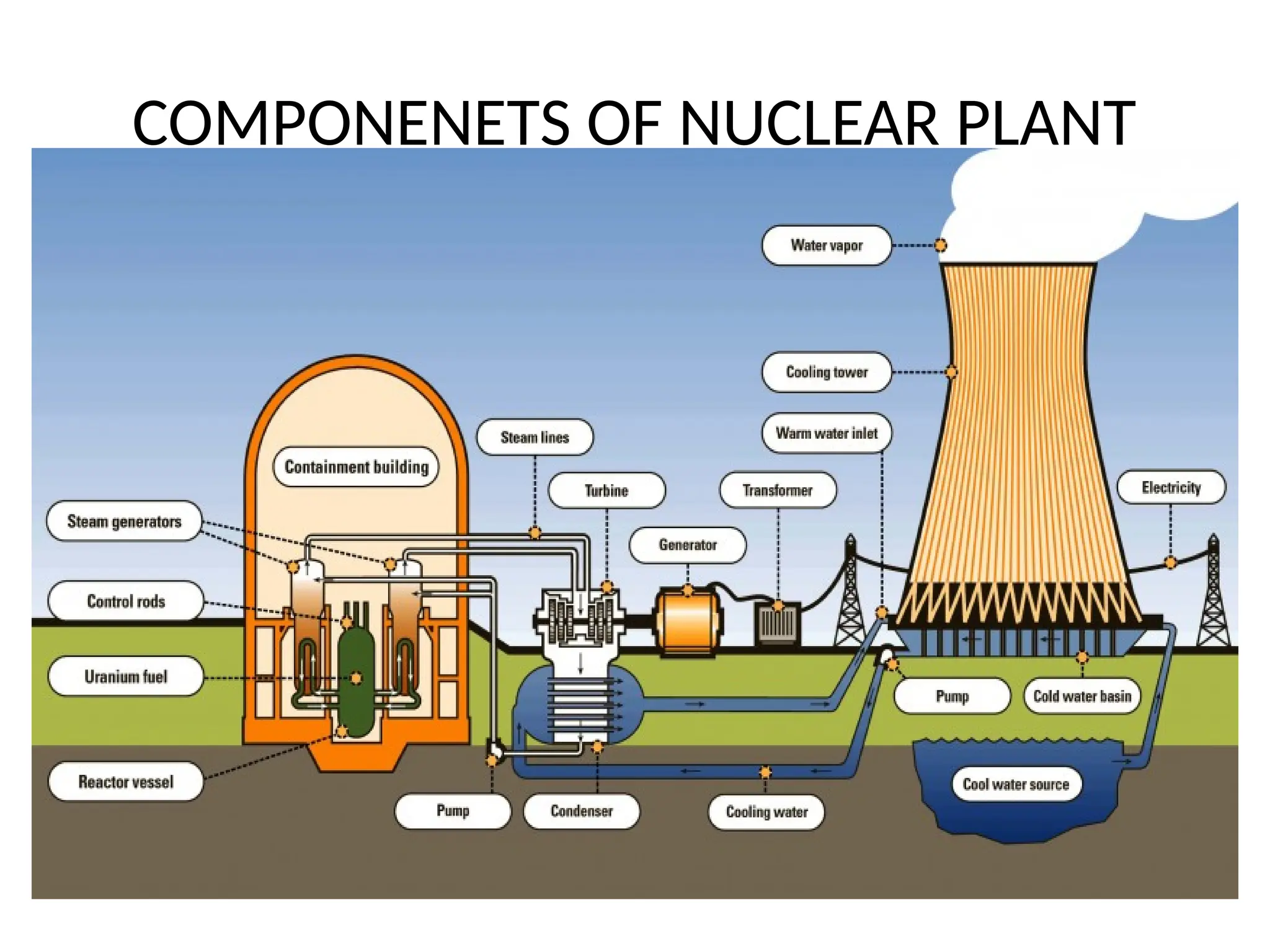
• NuclearEnergy in India
• Components of a nuclear power plant
• Types of Reactors
• India three stage nuclear programme
• Evolution of India’s nuclear policy
• IAEA
• Civil Nuclear Liability Act
• Applications
• NPT (Nuclear Non-Proliferation Treaty)
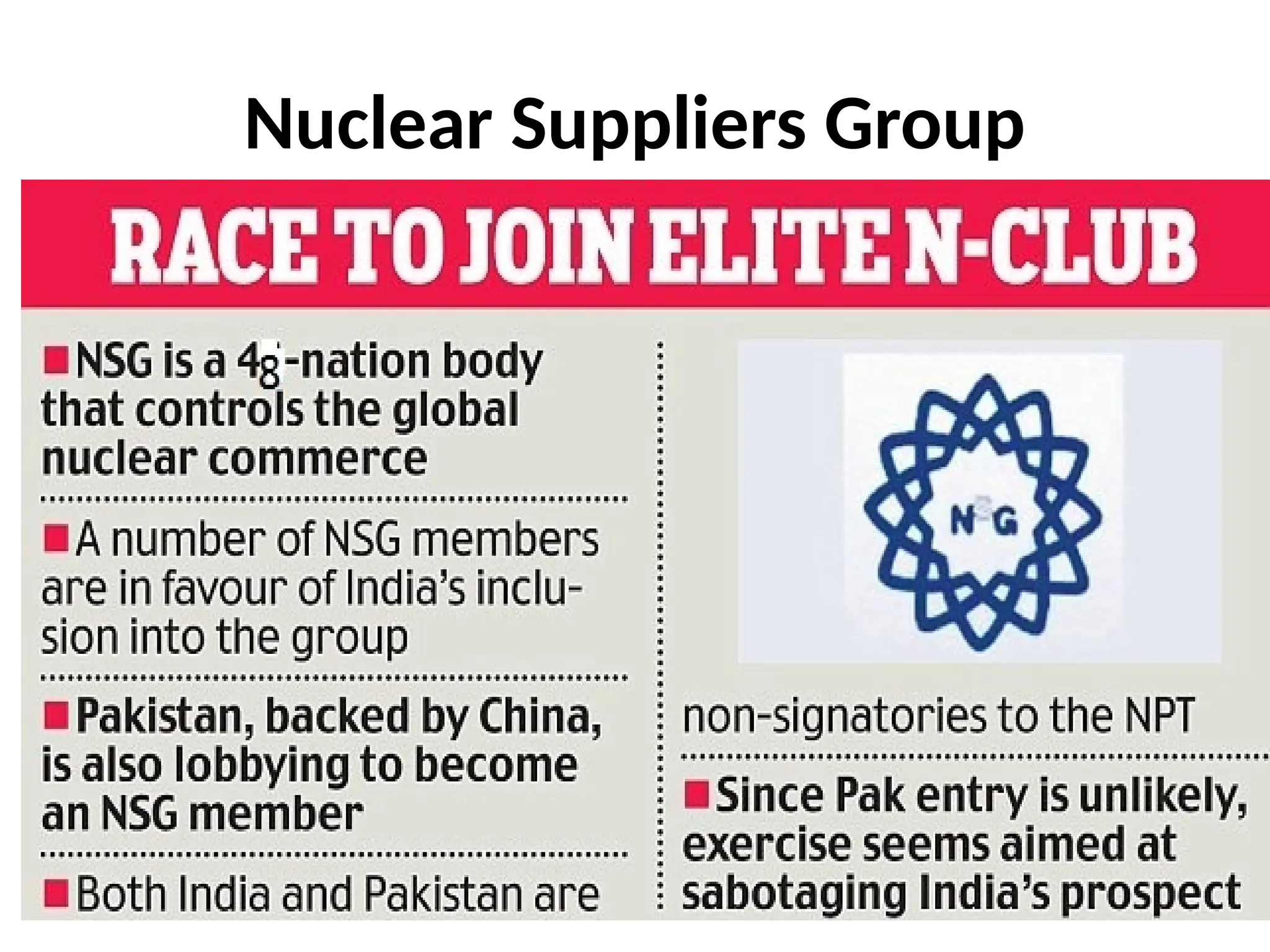
• Nuclear Suppliers Group
40.
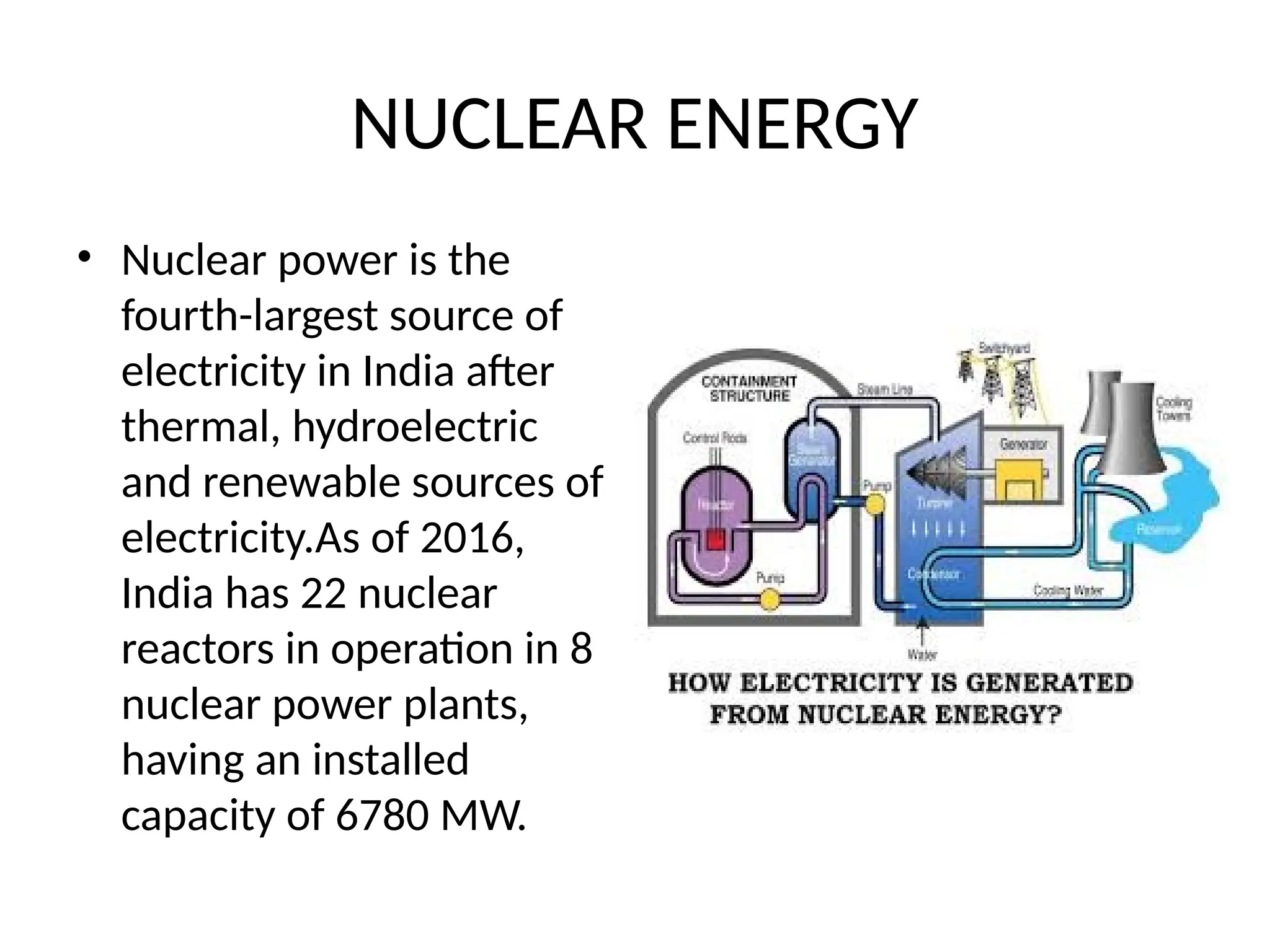
NUCLEAR ENERGY
• Nuclearpower is the
fourth-largest source of
electricity in India after
thermal, hydroelectric
and renewable sources of
electricity.As of 2016,
India has 22 nuclear
reactors in operation in 8
nuclear power plants,
having an installed
capacity of 6780 MW.
PARTS OF NUCLEARPLANT
• Fuel
• Uranium is the basic fuel. Usually pellets of uranium oxide (UO2)
are arranged in tubes to form fuel rods. The rods are arranged
into fuel assemblies in the reactor core.* In a 1000 MWe class
PWR there might be 51,000 fuel rods with over 18 million pellets.
• Moderator
• Material in the core which slows down the neutrons released
from fission so that they cause more fission. It is usually water,
but may be heavy water or graphite.
• Control rods or blades
• These are made with neutron-absorbing material such as
cadmium, hafnium or boron, and are inserted or withdrawn from
the core to control the rate of reaction, or to halt it.
43.
• Coolant
• Afluid circulating through the core so as to transfer the
heat from it. In light water reactors the water moderator
functions also as primary coolant
• Pressure vessel or pressure tubes
• Usually a robust steel vessel containing the reactor core and
moderator/coolant, but it may be a series of tubes holding
the fuel and conveying the coolant through the surrounding
moderator.
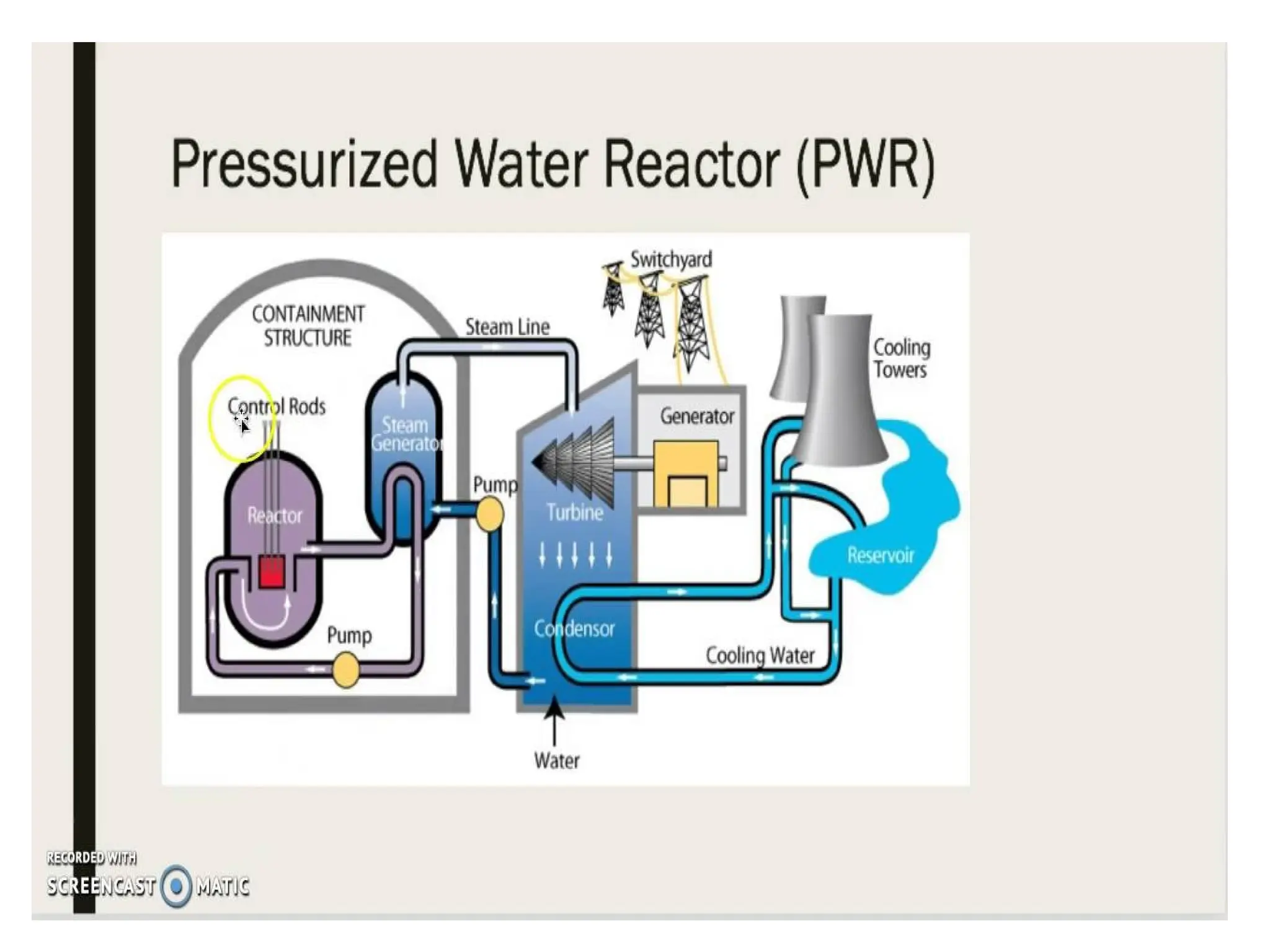
• Steam generator
• Part of the cooling system of pressurised water reactors
(PWR & PHWR) where the high-pressure primary coolant
bringing heat from the reactor is used to make steam for
the turbine, in a secondary circuit.
44.
TYPES OF REACTORS
•Light water reactors
• Pressurized water reactors
• CANDU ( pressurized Heavy water reactors)
• Sodium coolant fast reactors
• Fast reactors
45.
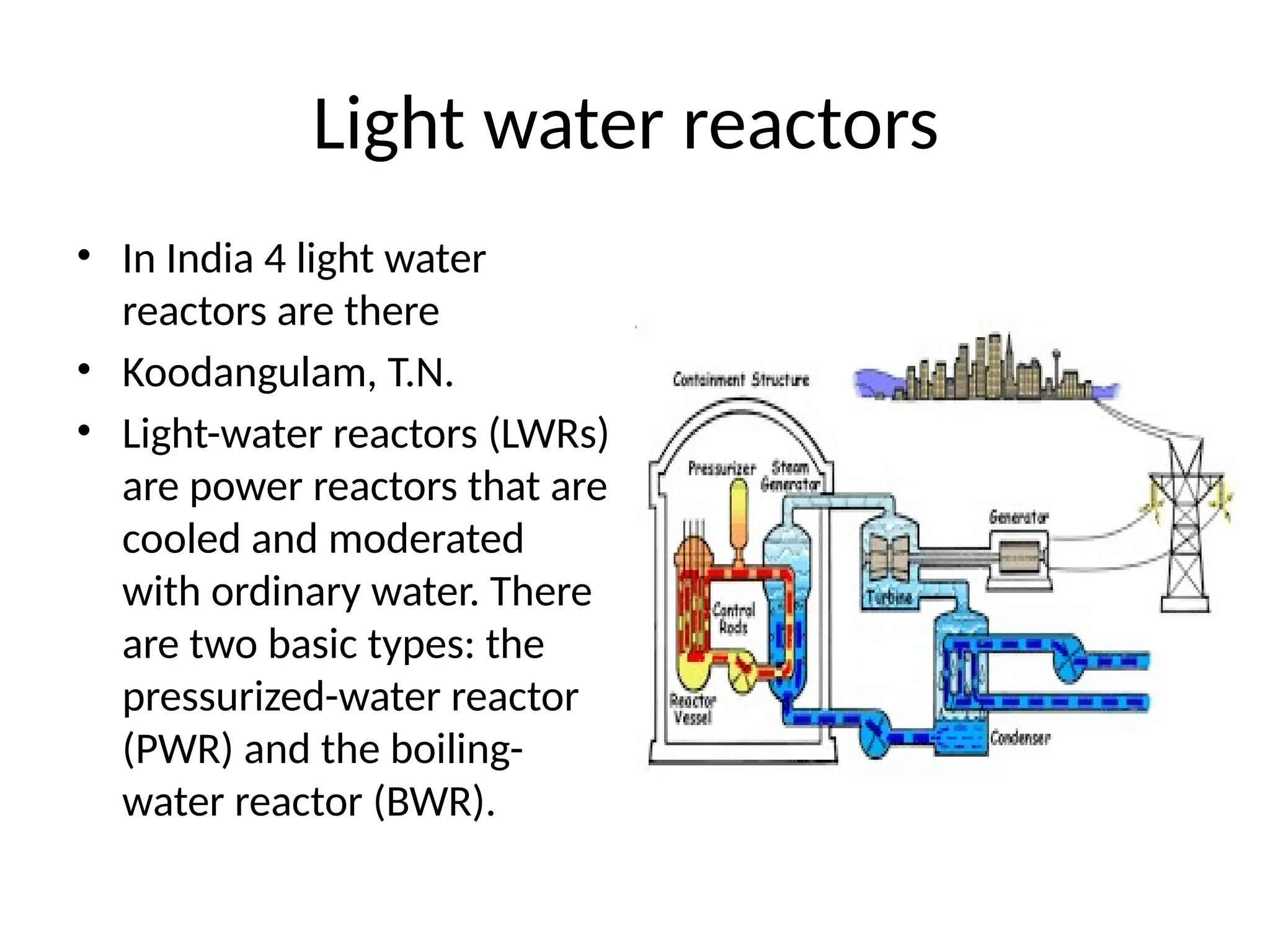
Light water reactors
•In India 4 light water
reactors are there
• Koodangulam, T.N.
• Light-water reactors (LWRs)
are power reactors that are
cooled and moderated
with ordinary water. There
are two basic types: the
pressurized-water reactor
(PWR) and the boiling-
water reactor (BWR).
47.
PHWR - india
•The baseline 220 MWe design was developed
from the CANDU based RAPS-1 and RAPS-2
reactors built at Rawatbhata, Rajasthan. The
design was later expanded into 540 MW and
700 MW designs. Currently there are 17
units of various types operational at various
locations in India.
48.
Fast breedor –liquid sodium
• These reactors are cooled by liquid sodium metal. Sodium is
heavier than hydrogen, a fact that leads to the neutrons moving
around at higher speeds (hence fast). These can use metal or
oxide fuel, and burn a wide variety of fuels.
• Pros:
• Can breed its own fuel, effectively eliminating any concerns about
uranium shortages (see what is a fast reactor?)
• Can burn its own waste
• Metallic fuel and excellent thermal properties of sodium allow for
passively safe operation — the reactor will shut itself down safely
without any backup-systems working (or people around), only
relying on physics.
49.
IAEA - Vienna- austria
• Set up as the world’s “Atoms for Peace” organization in 1957
within the United Nations family.
• Reports to both the United Nations General Assembly and
Security Council. Headquarters in Vienna, Austria.
• Works with its Member States and multiple partners worldwide to
promote the safe, secure and peaceful use of nuclear
technologies.
• Seeks to promote the peaceful use of nuclear energy, and to
inhibit its use for any military purpose, including nuclear weapons.
• Board of Governors:22 member states (must represent a
stipulated geographic diversity) — elected by the General
Conference (11 members every year) – 2 year term.
• At least 10 member states — nominated by the outgoing
Board.Board members each receive one vote.
50.
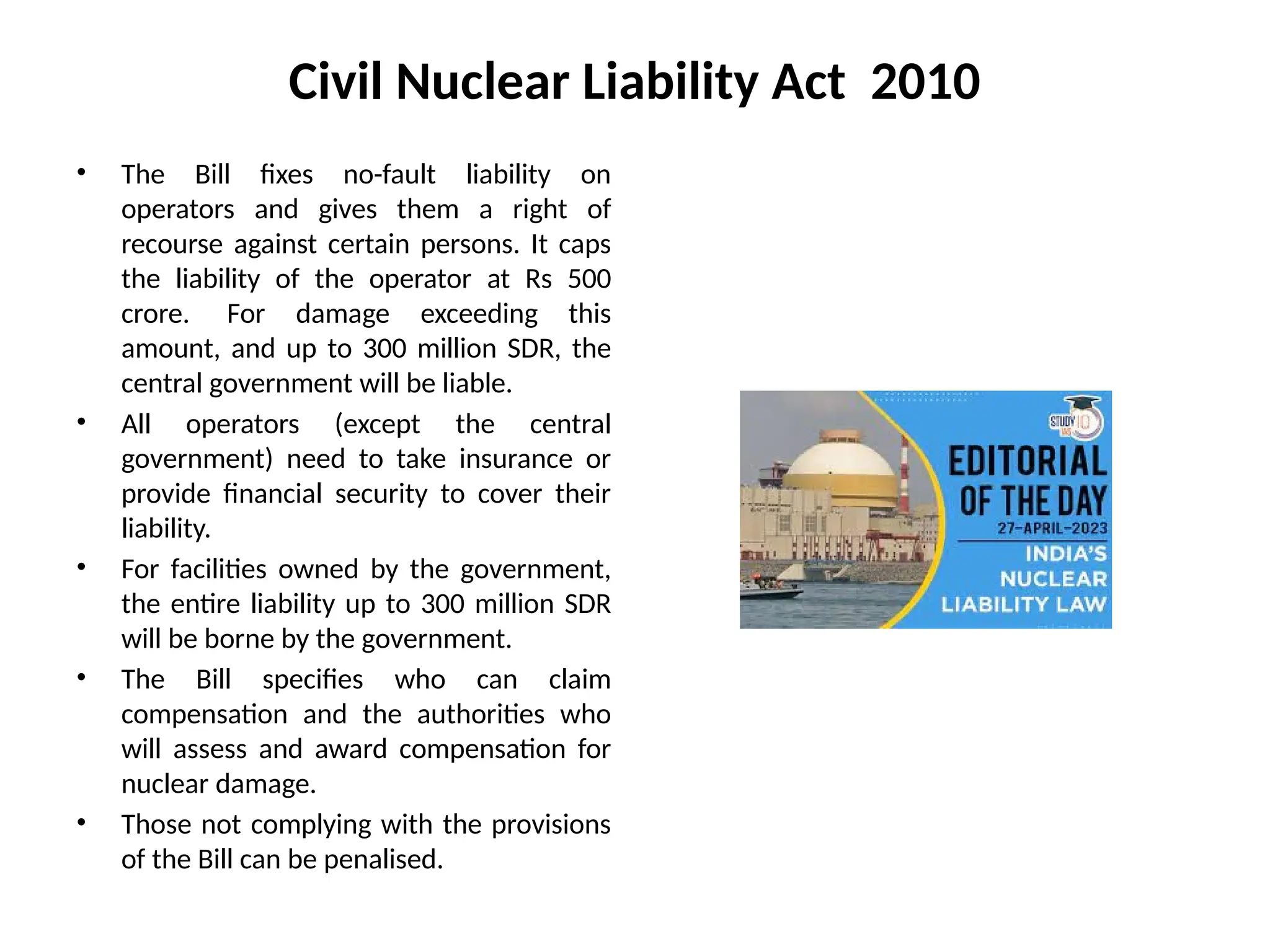
Civil Nuclear LiabilityAct 2010
• The Bill fixes no-fault liability on
operators and gives them a right of
recourse against certain persons. It caps
the liability of the operator at Rs 500
crore. For damage exceeding this
amount, and up to 300 million SDR, the
central government will be liable.
• All operators (except the central
government) need to take insurance or
provide financial security to cover their
liability.
• For facilities owned by the government,
the entire liability up to 300 million SDR
will be borne by the government.
• The Bill specifies who can claim
compensation and the authorities who
will assess and award compensation for
nuclear damage.
• Those not complying with the provisions
of the Bill can be penalised.
51.
NON PROLIFERATION TREATY
•The Treaty on the Non-Proliferation of Nuclear Weapons, commonly
known as the Non-Proliferation Treaty or NPT, is an international treaty
whose objective is to prevent the spread of nuclear weapons and weapons
technology, to promote cooperation in the peaceful uses of nuclear
energy, and to further the goal of achieving nuclear disarmament and
general and complete disarmament
• Between 1965 and 1968, the treaty was negotiated by the Eighteen Nation
Committee on Disarmament, a United Nations-sponsored organization
based in Geneva, Switzerland
– But, the treaty entered into force in 1970.
• More countries are parties to the NPT than any other arms limitation and
disarmament agreement, a testament to the treaty’s significance
• Four UN member states have never accepted the NPT, three of which
possess or are thought to possess nuclear weapons: India, Israel, and
Pakistan. In addition, South Sudan, founded in 2011, has not joined.
NSG
• Brought in1974– in response to the Indian nuclear test (smiling
Buddha).
• It is a Multilateral export control regime.
• It is a Group of nuclear supplier countries that seek to prevent
nuclear proliferation by controlling the export of materials,
equipment and technology that can be used to manufacture
nuclear weapons.
• The NSG first met in November 1975 in London, and is thus
popularly referred to as the “London Club”.
• It is Not a formal organization, and its guidelines are not binding.
Decisions, including on membership, are made by consensus.
• Membership: 48 supplier states.
54.
Defence Technology
• Thedefence industry of India is a strategically important sector in India.[1] India
has one of the world’s largest military forces with a strength of over 14.4 lakh
(1.44 million) active personnel. It has the world’s largest volunteer military of
over 51 lakh (5.1 million) personnel.[2] The total budget sanctioned for the
Indian military for the financial year 2021 is ₹4.78 lakh crore (US$67 billion).It
has the third largest annual defence budget behind USA (US$732 b) and China
(US$261 b). It is the second largest defence importer behind Saudi Arabia
making up 9.2% of global arms import. India has a domestic defence industry of
which 80% is government owned. The public sector includes DRDO and its 50
labs, 4 defence shipyards, 5 defence PSUs and 41 ordnance factories. India has a
new defence procurement, acquisition and manufacturing policy to reduce
imports and enhance domestic manufacturing.[5]
• Post-independence, the Defence Research and Development Organisation
(DRDO) was formed in 1958 for the military’s research and development under
the control of the Ministry of Defence.
55.
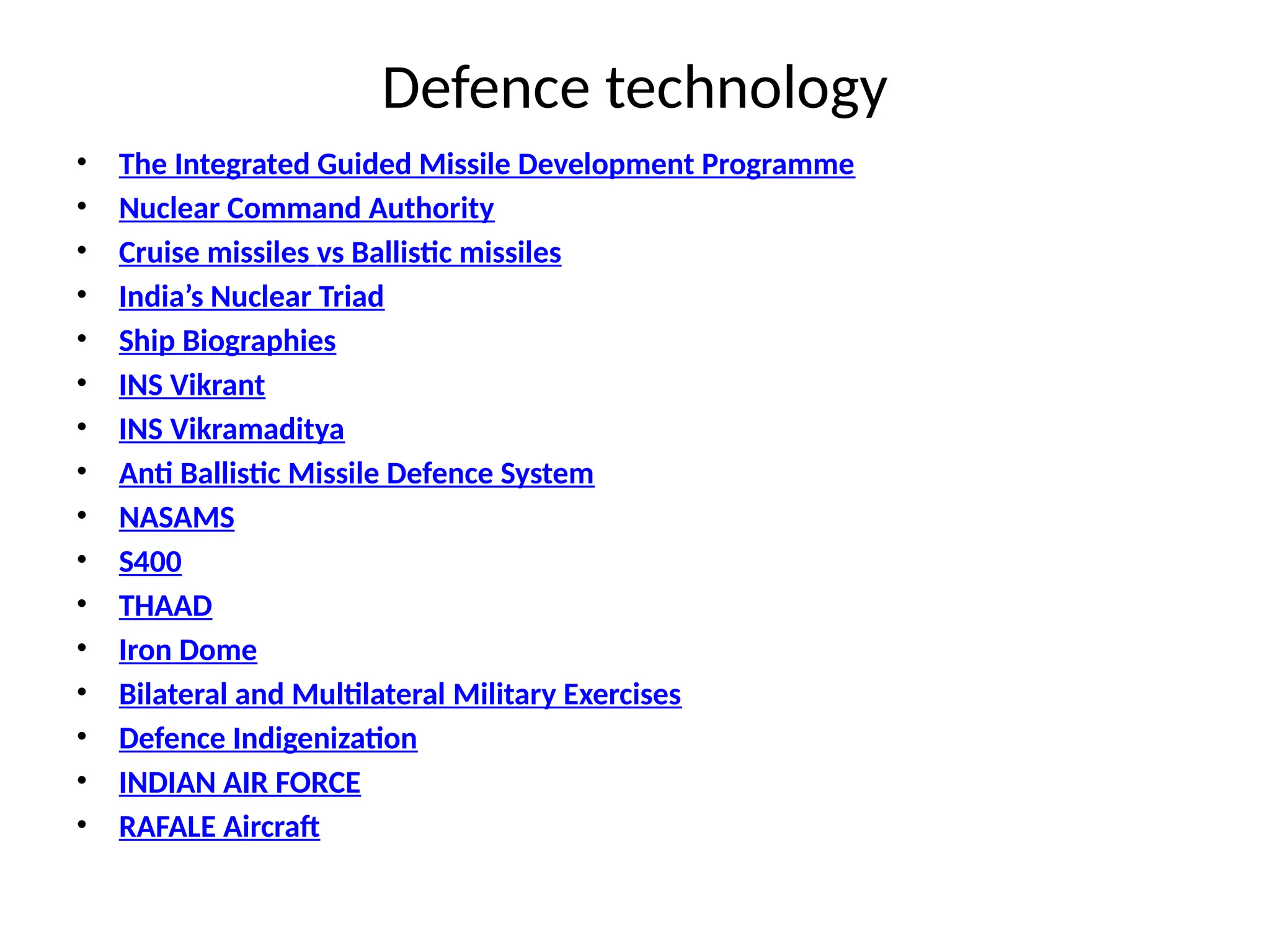
Defence technology
• TheIntegrated Guided Missile Development Programme
• Nuclear Command Authority
• Cruise missiles vs Ballistic missiles
• India’s Nuclear Triad
• Ship Biographies
• INS Vikrant
• INS Vikramaditya
• Anti Ballistic Missile Defence System
• NASAMS
• S400
• THAAD
• Iron Dome
• Bilateral and Multilateral Military Exercises
• Defence Indigenization
• INDIAN AIR FORCE
• RAFALE Aircraft
56.
THAAD
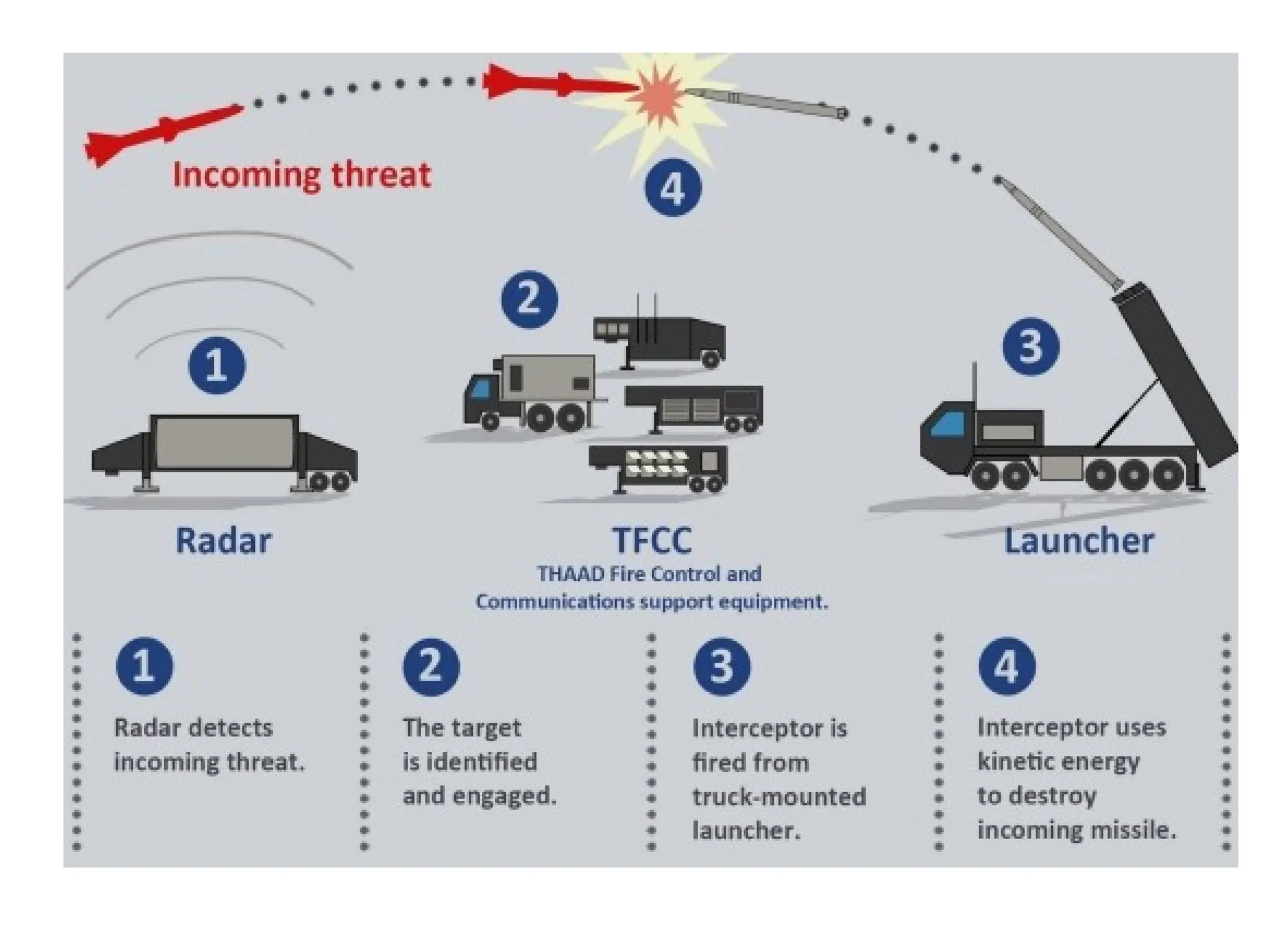
• The TerminalHigh Altitude Area Defense, or simply
abbreviated as THAAD, is a missile defence system
that is designed to intercept and destroy short and
medium-range ballistic missiles in their final flight
phase.
• First proposed in 1987 and then finally deployed in
2008, the THAAD cannot be used as a form of attack
against an enemy.
• Its role, by use of a powerful radar, is to simply track
and destroy missiles before they are launched.
58.
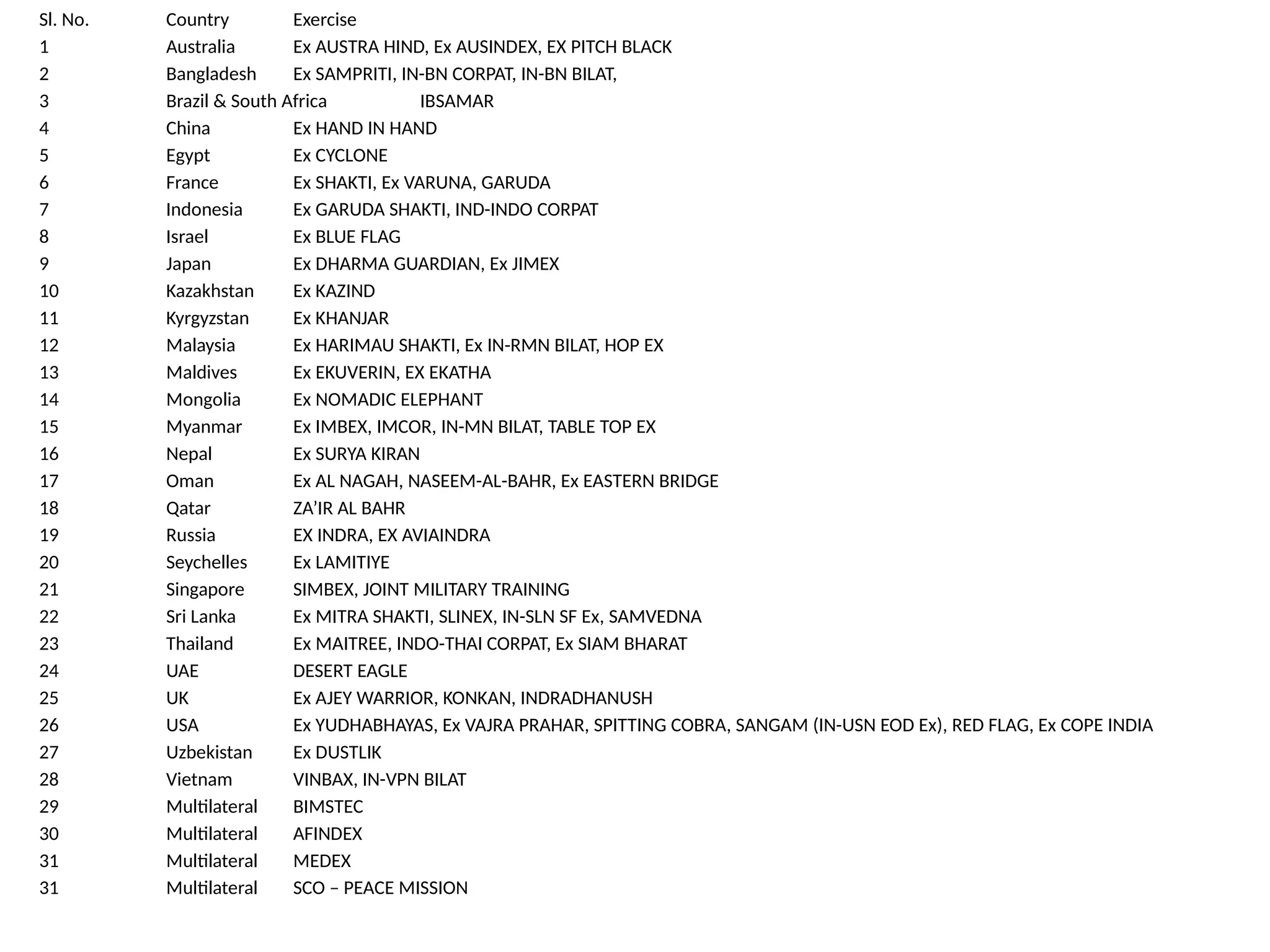
Sl. No. CountryExercise
1 Australia Ex AUSTRA HIND, Ex AUSINDEX, EX PITCH BLACK
2 Bangladesh Ex SAMPRITI, IN-BN CORPAT, IN-BN BILAT,
3 Brazil & South Africa IBSAMAR
4 China Ex HAND IN HAND
5 Egypt Ex CYCLONE
6 France Ex SHAKTI, Ex VARUNA, GARUDA
7 Indonesia Ex GARUDA SHAKTI, IND-INDO CORPAT
8 Israel Ex BLUE FLAG
9 Japan Ex DHARMA GUARDIAN, Ex JIMEX
10 Kazakhstan Ex KAZIND
11 Kyrgyzstan Ex KHANJAR
12 Malaysia Ex HARIMAU SHAKTI, Ex IN-RMN BILAT, HOP EX
13 Maldives Ex EKUVERIN, EX EKATHA
14 Mongolia Ex NOMADIC ELEPHANT
15 Myanmar Ex IMBEX, IMCOR, IN-MN BILAT, TABLE TOP EX
16 Nepal Ex SURYA KIRAN
17 Oman Ex AL NAGAH, NASEEM-AL-BAHR, Ex EASTERN BRIDGE
18 Qatar ZA’IR AL BAHR
19 Russia EX INDRA, EX AVIAINDRA
20 Seychelles Ex LAMITIYE
21 Singapore SIMBEX, JOINT MILITARY TRAINING
22 Sri Lanka Ex MITRA SHAKTI, SLINEX, IN-SLN SF Ex, SAMVEDNA
23 Thailand Ex MAITREE, INDO-THAI CORPAT, Ex SIAM BHARAT
24 UAE DESERT EAGLE
25 UK Ex AJEY WARRIOR, KONKAN, INDRADHANUSH
26 USA Ex YUDHABHAYAS, Ex VAJRA PRAHAR, SPITTING COBRA, SANGAM (IN-USN EOD Ex), RED FLAG, Ex COPE INDIA
27 Uzbekistan Ex DUSTLIK
28 Vietnam VINBAX, IN-VPN BILAT
29 Multilateral BIMSTEC
30 Multilateral AFINDEX
31 Multilateral MEDEX
31 Multilateral SCO – PEACE MISSION
59.
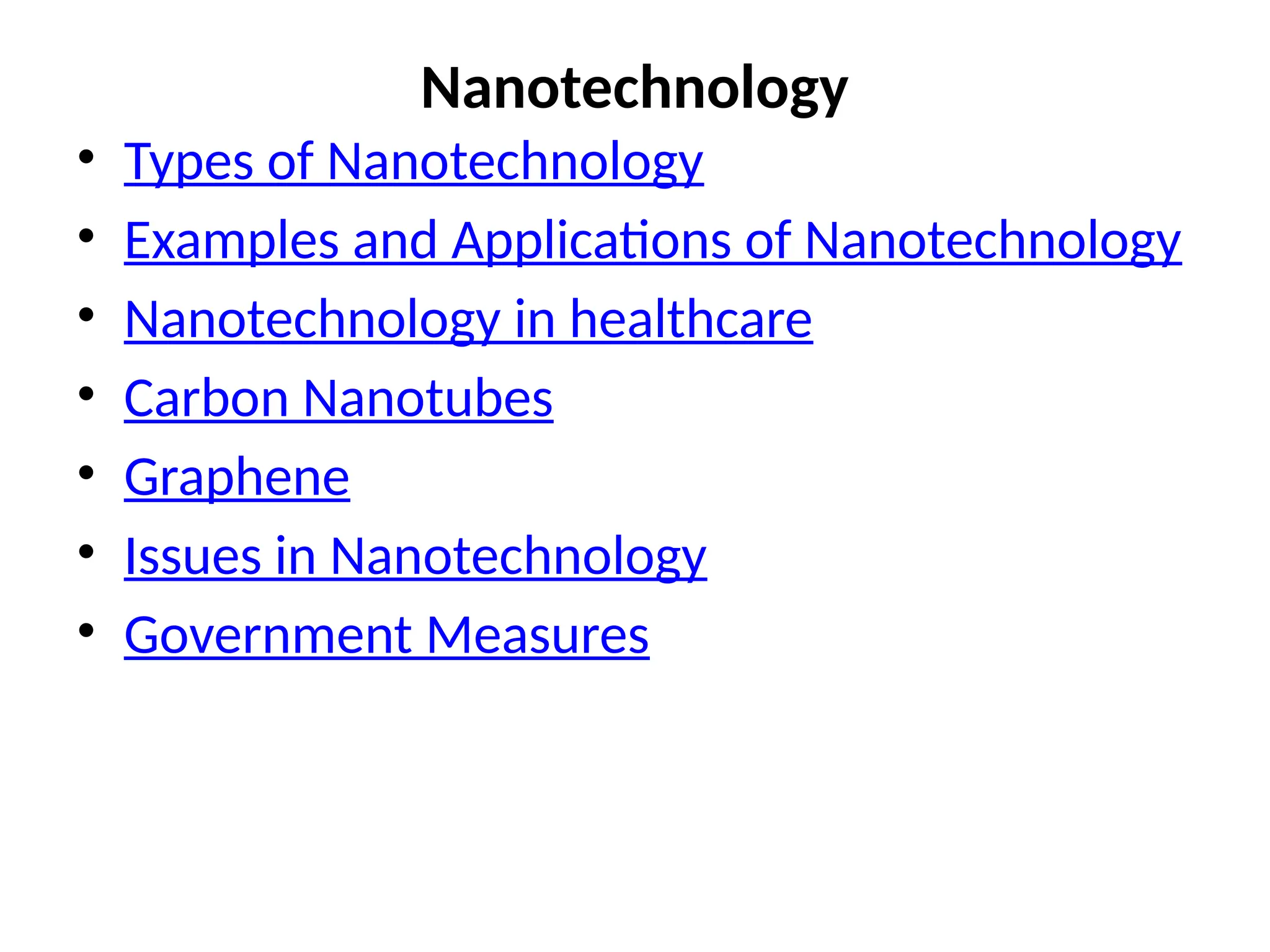
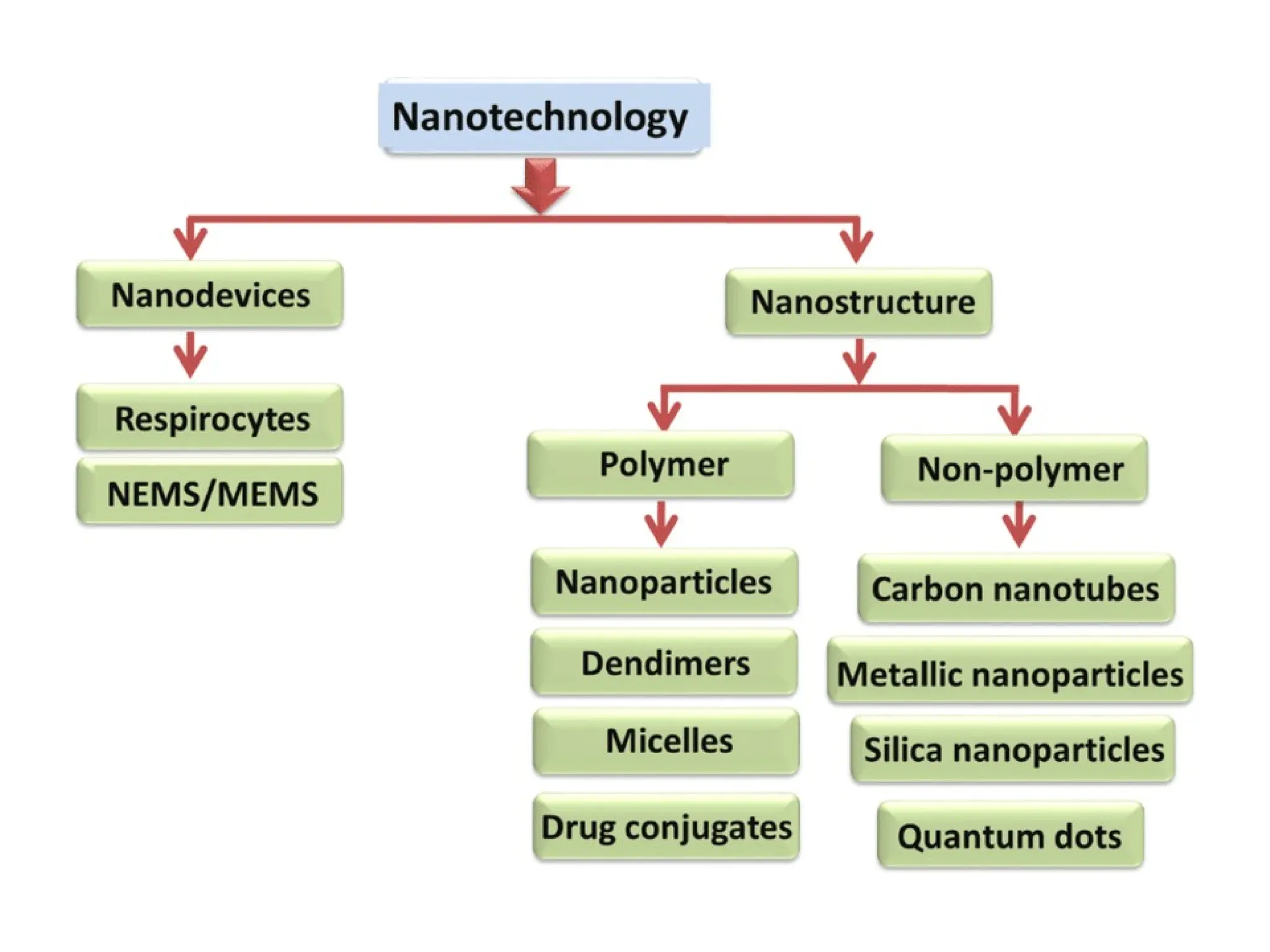
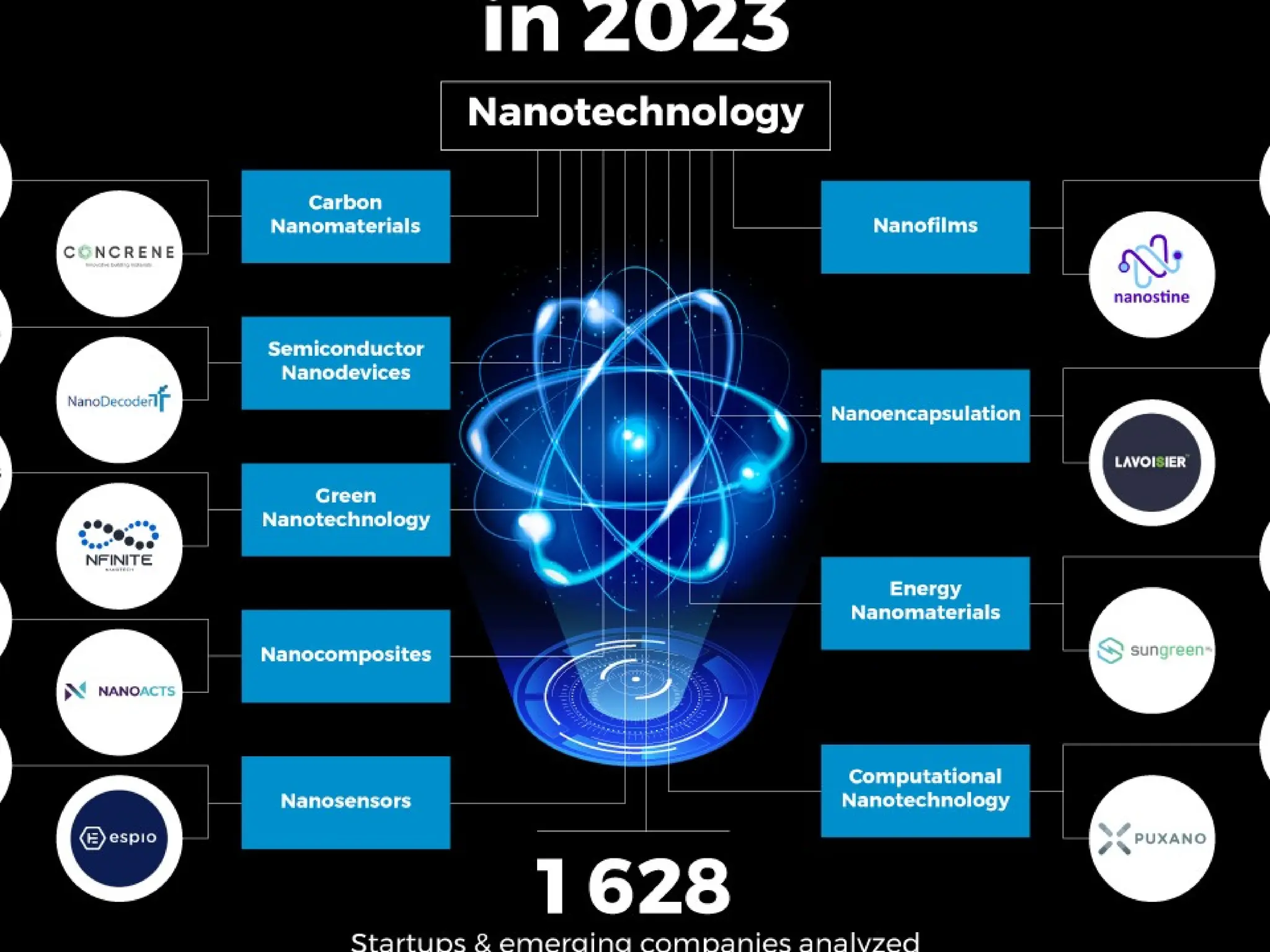
Nanotechnology
• Types ofNanotechnology
• Examples and Applications of Nanotechnology
• Nanotechnology in healthcare
• Carbon Nanotubes
• Graphene
• Issues in Nanotechnology
• Government Measures
60.
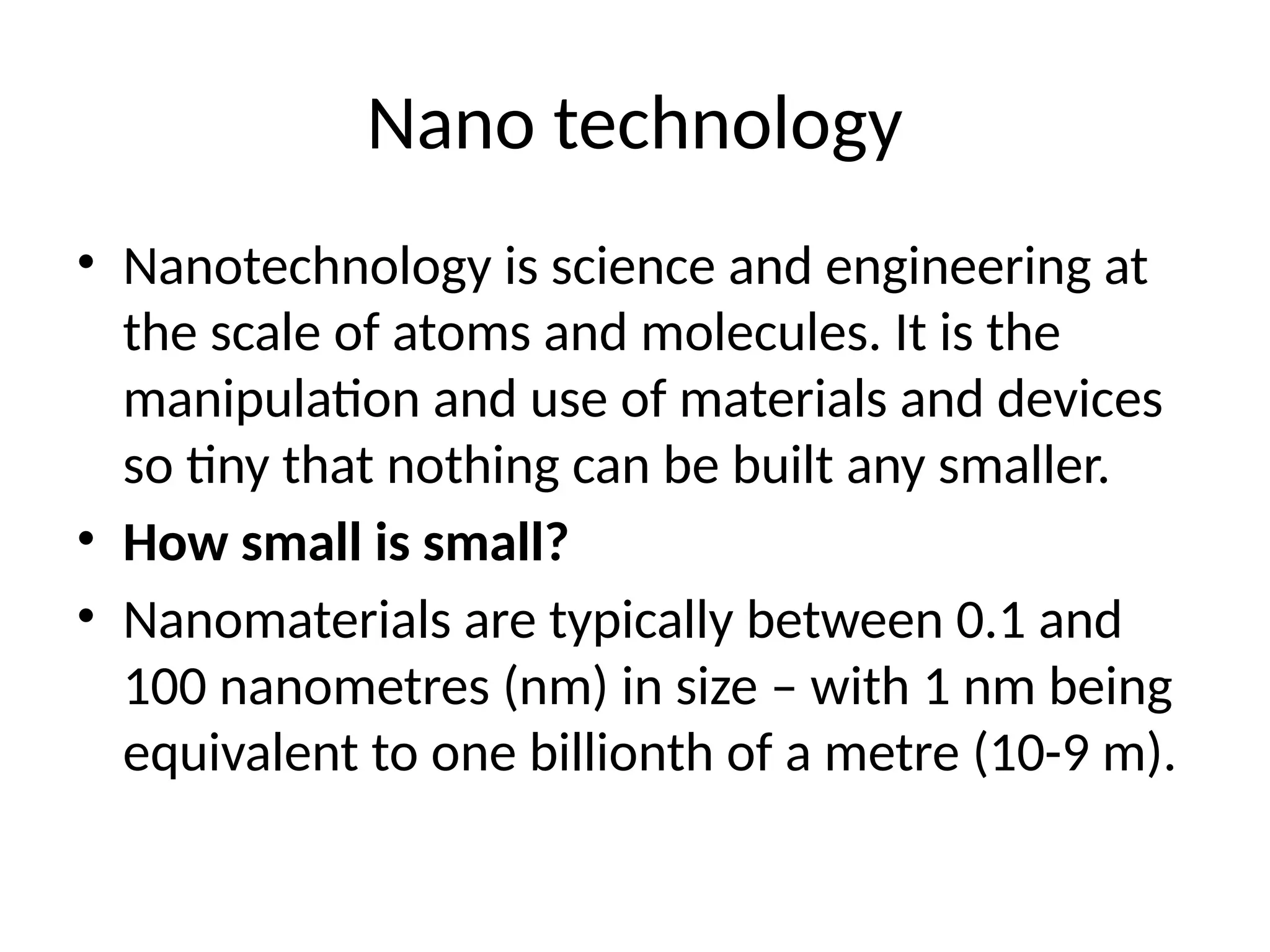
Nano technology
• Nanotechnologyis science and engineering at
the scale of atoms and molecules. It is the
manipulation and use of materials and devices
so tiny that nothing can be built any smaller.
• How small is small?
• Nanomaterials are typically between 0.1 and
100 nanometres (nm) in size – with 1 nm being
equivalent to one billionth of a metre (10-9 m).
61.
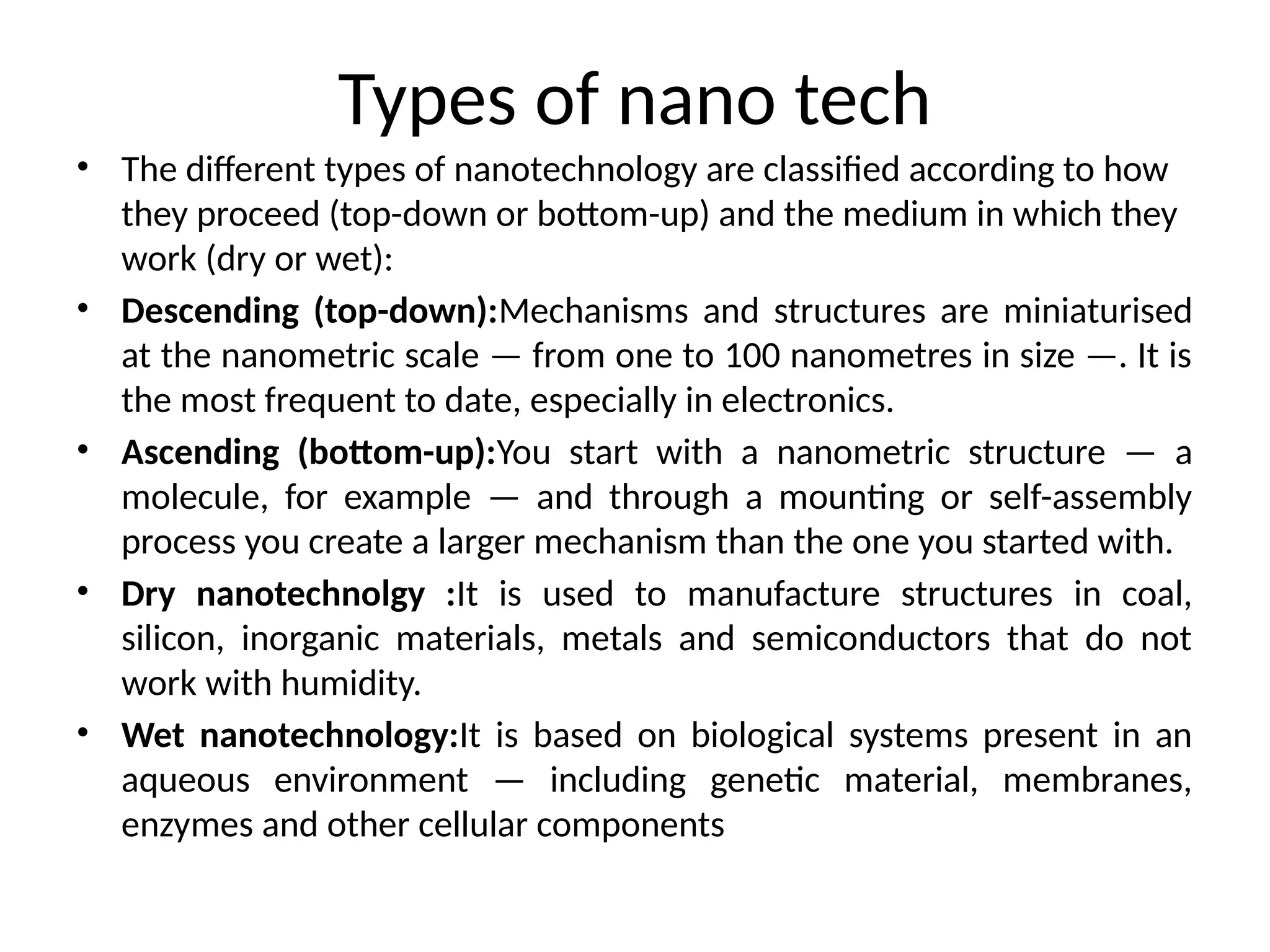
Types of nanotech
• The different types of nanotechnology are classified according to how
they proceed (top-down or bottom-up) and the medium in which they
work (dry or wet):
• Descending (top-down):Mechanisms and structures are miniaturised
at the nanometric scale — from one to 100 nanometres in size —. It is
the most frequent to date, especially in electronics.
• Ascending (bottom-up):You start with a nanometric structure — a
molecule, for example — and through a mounting or self-assembly
process you create a larger mechanism than the one you started with.
• Dry nanotechnolgy :It is used to manufacture structures in coal,
silicon, inorganic materials, metals and semiconductors that do not
work with humidity.
• Wet nanotechnology:It is based on biological systems present in an
aqueous environment — including genetic material, membranes,
enzymes and other cellular components
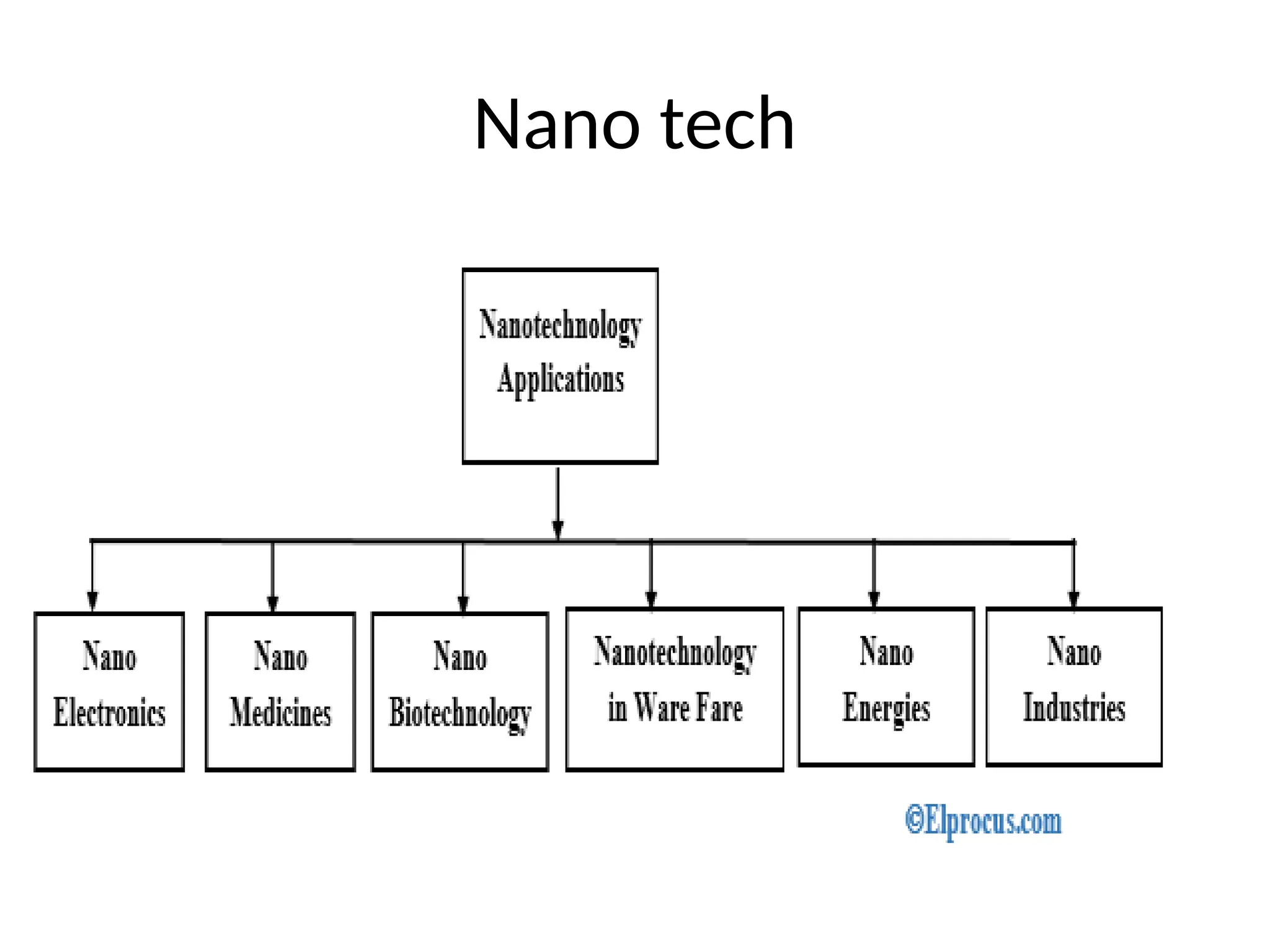
• Nanotechnology andnanomaterials can be applied in all kinds of industrial sectors. They are usually found
in these areas:
• Electronics
• Carbon nanotubes are close to replacing silicon as a material for making smaller, faster and more efficient
microchips and devices, as well as lighter, more conductive and stronger quantum nanowires. Graphene’s
properties make it an ideal candidate for the development of flexible touchscreens.
• Energy
• A new semiconductor developed by Kyoto University makes it possible to manufacture solar panels that
double the amount of sunlight converted into electricity. Nanotechnology also lowers costs, produces
stronger and lighter wind turbines, improves fuel efficiency and, thanks to the thermal insulation of some
nanocomponents, can save energy.
• Biomedicine
• The properties of some nanomaterials make them ideal for improving early diagnosis and treatment of
neurodegenerative diseases or cancer. They are able to attack cancer cells selectively without harming
other healthy cells. Some nanoparticles have also been used to enhance pharmaceutical products such as
sunscreen.
• Environment
• Air purification with ions, wastewater purification with nanobubbles or nanofiltration systems for heavy
metals are some of its environmentally-friendly applications. Nanocatalysts are also available to make
chemical reactions more efficient and less polluting.
66.
Carbon nano tubes
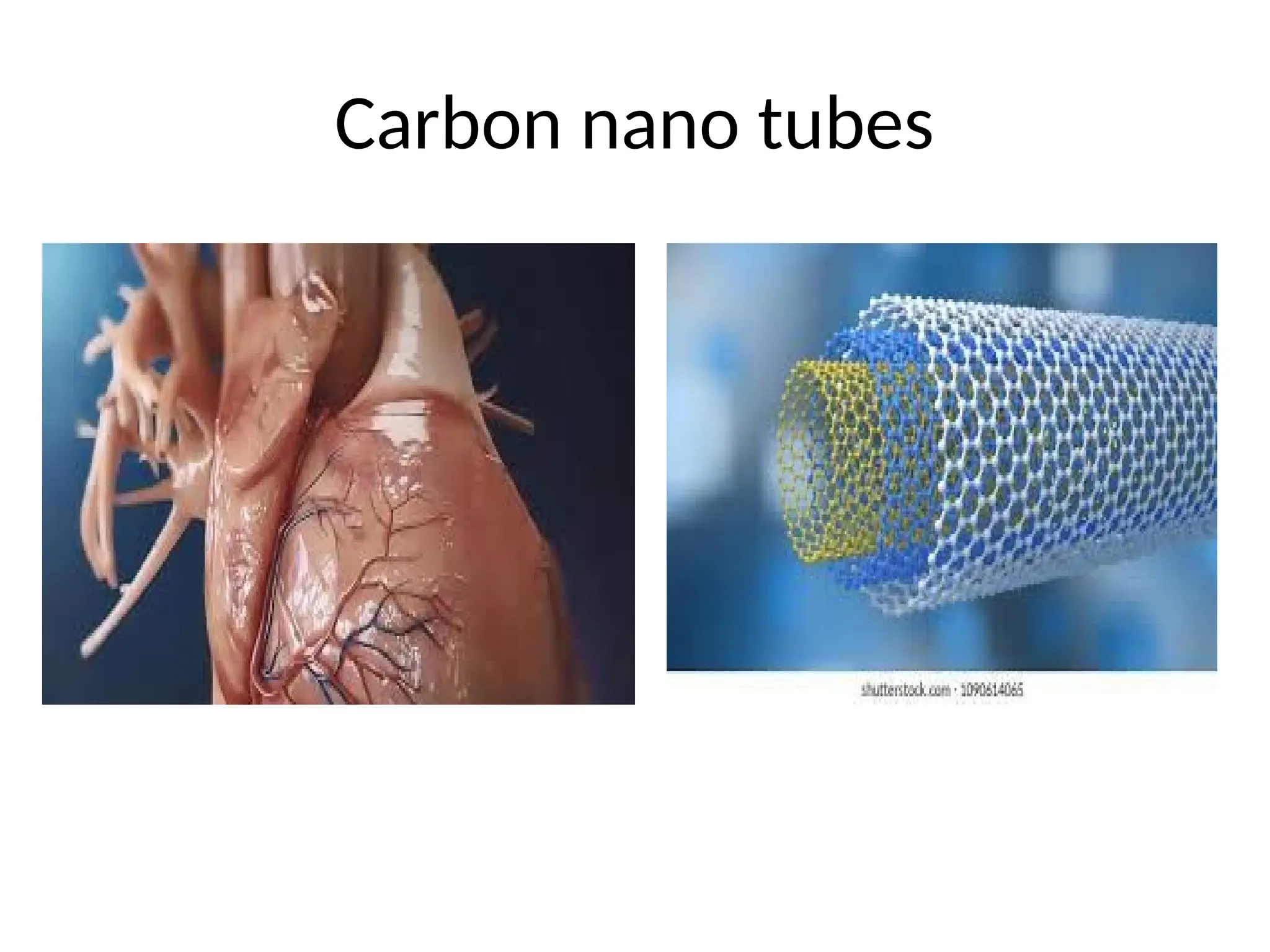
•Carbon nanotubes (CNTs) are cylindrical molecules that
consist of rolled-up sheets of single-layer carbon atoms
(graphene). They can be single-walled (SWCNT) with a
diameter of less than 1 nanometer (nm) or multi-walled
(MWCNT), consisting of several concentrically interlinked
nanotubes, with diameters reaching more than 100 nm. Their
length can reach several micrometers or even millimeters.
• Like their building block graphene, CNTs are chemically
bonded with sp2 bonds, an extremely strong form of
molecular interaction
• Applications:
• Used in electric wires to reduce losses
• It can replace silicon made transistors as they are small and
emit less heat and it can revolutionise electronics
• Can be used in solar cell
Graphene
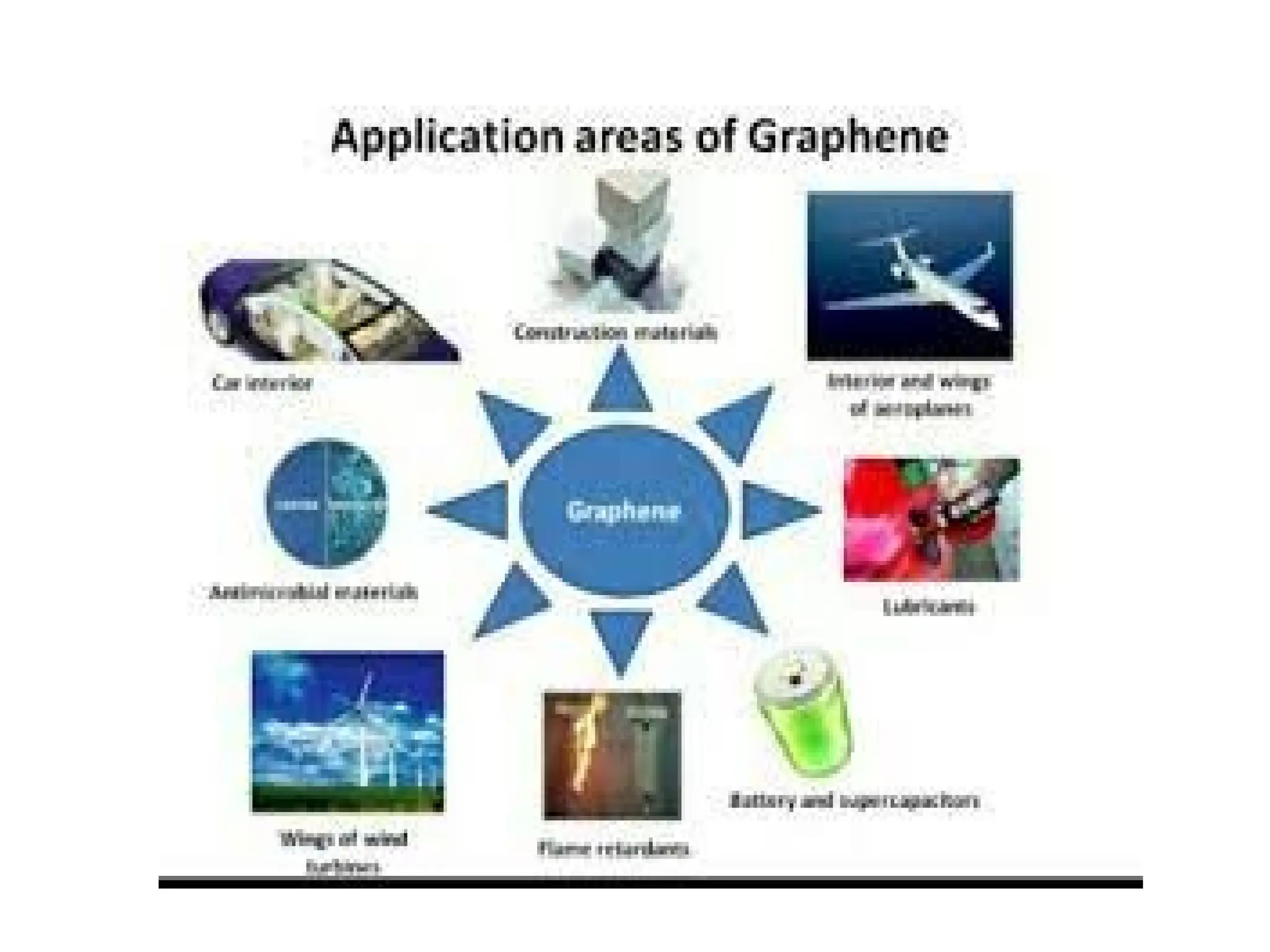
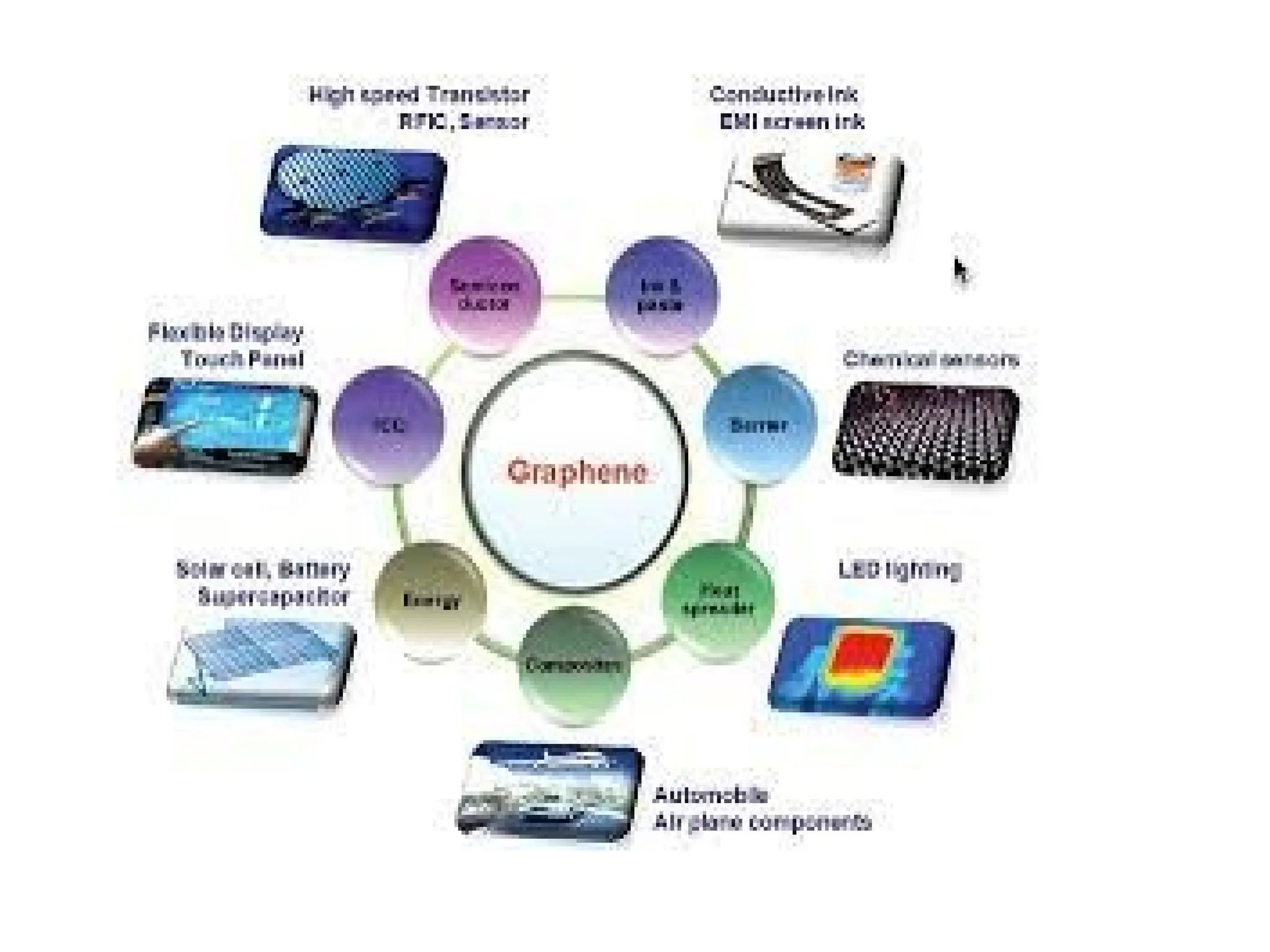
• Graphene isa one-atom-thick sheet of carbon atoms arranged in a honeycomb-like pattern.
Graphene is considered to be the world’s thinnest, strongest and most conductive material –
of both electricity and heat. All of these properties are exciting researchers and businesses
around the world – as graphene has the potential to revolutionize entire industries – in the
fields of electricity, conductivity, energy generation, batteries, sensors and more.
• Mechanical strength
• Graphene is the world’s strongest material, and can be used to enhance the strength of other
materials. Dozens of researchers have demonstrated that adding even a trace amount of
graphene to plastics, metals or other materials can make these materials much stronger – or
lighter (as you can use a smaller amount of material to achieve the same strength).
•
• Thermal applications
• Graphene is the most heat conductive found to date. As graphene is also strong and light, it
means that it is a great material for making heat-spreading solutions, such as heat sinks or
heat dissipation films. This could be useful in both microelectronics (for example to
make LED lighting more efficient and longer lasting) and also in larger applications – for
example thermal foils for mobile devices. Huawei’s latest smartphones, for example, have
adopted graphene-based thermal films.
74.
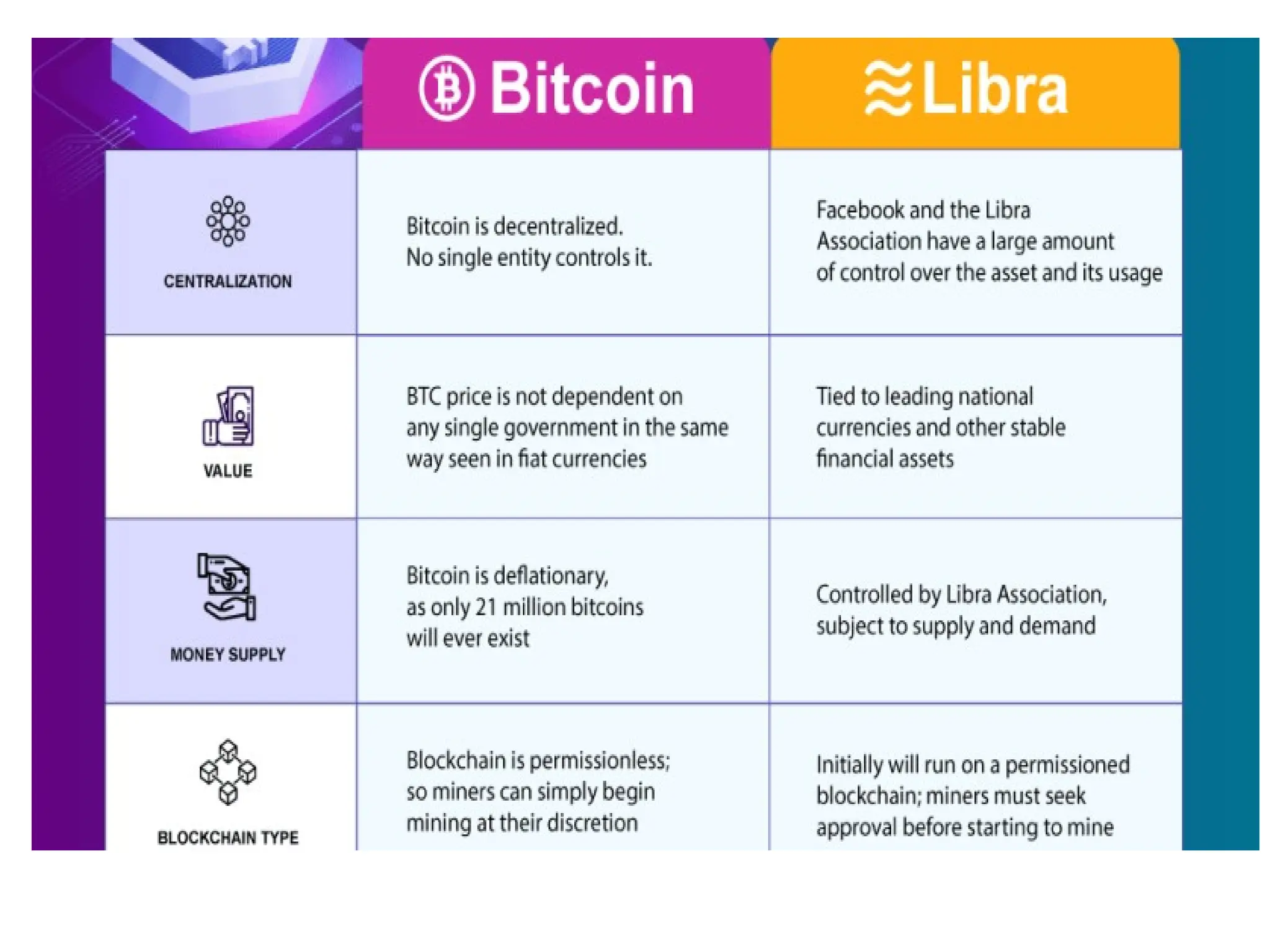
Libra
• What isLibra?
• Facebook says Libra is a “global currency and financial infrastructure”. In other words,
it is a digital asset built by Facebook and powered by a new Facebook-created version
of blockchain, the encrypted technology used by bitcoin and other cryptocurrencies.
•
• Why is it called Libra?
• The name Libra comes from the basic Roman measurement of weight. The
abbreviation lb for pound is derived from Libra, and the £ symbol originally comes
from an ornate L in Libra.
•
• Who is in charge of Libra?
• The currency will be serviced by a collective of companies called the “Libra
Association”. It functions as what is known as a “stablecoin”, pegged to existing
assets like the dollar or euro, in the aim of making it less subject to the volatility that
many cryptocurrencies experience.

![Defence Technology
• The defence industry of India is a strategically important sector in India.[1] India
has one of the world’s largest military forces with a strength of over 14.4 lakh
(1.44 million) active personnel. It has the world’s largest volunteer military of
over 51 lakh (5.1 million) personnel.[2] The total budget sanctioned for the
Indian military for the financial year 2021 is ₹4.78 lakh crore (US$67 billion).It
has the third largest annual defence budget behind USA (US$732 b) and China
(US$261 b). It is the second largest defence importer behind Saudi Arabia
making up 9.2% of global arms import. India has a domestic defence industry of
which 80% is government owned. The public sector includes DRDO and its 50
labs, 4 defence shipyards, 5 defence PSUs and 41 ordnance factories. India has a
new defence procurement, acquisition and manufacturing policy to reduce
imports and enhance domestic manufacturing.[5]
• Post-independence, the Defence Research and Development Organisation
(DRDO) was formed in 1958 for the military’s research and development under
the control of the Ministry of Defence.](https://image.slidesharecdn.com/sciencetechii-250518170829-068fd223/75/science-Tech-ii-full-power-point-on-science-current-affairs-54-2048.jpg)