Science LessonPlan#1
Natalie Garner
AdaptedFrom:
http://school.discoveryeducation.com/lessonplans/pdf/understandinggeography/understandinggreogra
phy.pdf
Objectives -Studentswilllearntouse geographyskillsto
learnhow to read maps
-Studentswillmake connectionsbetween
geographyandculture
Materials -Large white construction paper
-Pencilsanderasers
-Coloredmarkersorcrayons
- Maps of towns nearthe ocean
-Informationaboutthe economy,industryand
attractionsinthat area
-InternetAccess
Procedures -Beginthe lessonbytalkingaboutthe science of
geography,the typesof thingsgeographers
study, andthe reasonstheystudythem.
-Discussindustriesthatare involvedwiththe
oceantown you choose to study
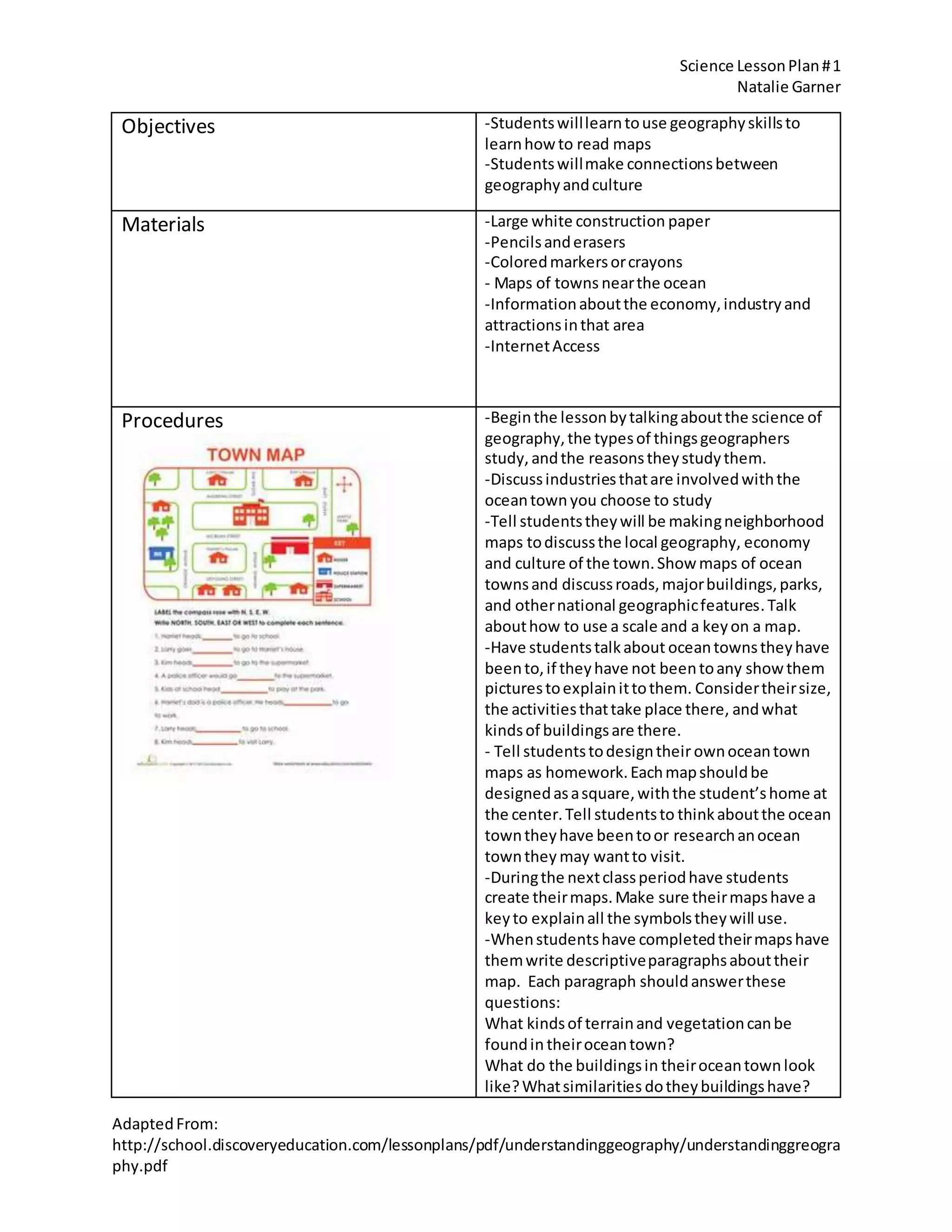
-Tell studentstheywill be makingneighborhood
maps todiscussthe local geography, economy
and culture of the town.Show maps of ocean
townsand discussroads,majorbuildings,parks,
and othernational geographicfeatures.Talk
abouthow to use a scale and a keyon a map.
-Have studentstalkabout oceantownstheyhave
beento,if theyhave not beentoany show them
picturestoexplainittothem. Considertheirsize,
the activitiesthattake place there, andwhat
kindsof buildingsare there.
- Tell studentstodesigntheir ownoceantown
maps as homework.Eachmapshouldbe
designedasasquare,withthe student’shome at
the center.Tell studentsto thinkaboutthe ocean
towntheyhave beentoor researchanocean
townthey may wantto visit.
-Duringthe nextclassperiodhave students
create theirmaps.Make sure theirmapshave a
keyto explainall the symbolstheywill use.
-Whenstudentshave completedtheirmapshave
themwrite descriptiveparagraphsabouttheir
map. Each paragraph shouldanswerthese
questions:
What kindsof terrainand vegetationcanbe
foundin theiroceantown?
What do the buildingsin theiroceantownlook
like?Whatsimilarities dotheybuildingshave?
Science LessonPlan#1
Natalie Garner
AdaptedFrom:
http://school.discoveryeducation.com/lessonplans/pdf/understandinggeography/understandinggreogra
phy.pdf
What kindsof activitiestake place inyour ocean
town?Where do theytake place?
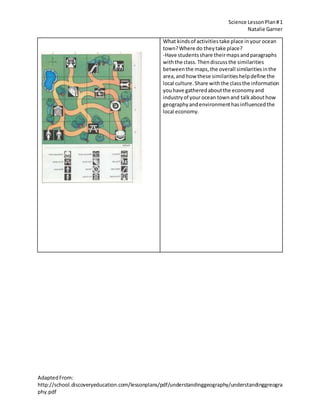
-Have studentsshare theirmapsandparagraphs
withthe class.Thendiscussthe similarities
betweenthe maps,the overall similaritiesinthe
area,and how these similaritieshelpdefine the
local culture.Share withthe classthe information
youhave gatheredaboutthe economyand
industryof yourocean town and talkabouthow
geographyandenvironmenthasinfluencedthe
local economy.
Science LessonPlan#1
Natalie Garner
AdaptedFrom:
http://school.discoveryeducation.com/lessonplans/pdf/understandinggeography/understandinggreogra
phy.pdf
Assessment 5 Points:Studentsactivelyparticipatedinclass
discussions;createdartisticandinformative
oceantown maps that includednatural and
manmade featuresaswell asa keyto explainthe
map’ssymbol;andwrote clear,informative
paragraphsabout theiroceantowns.Answering
all three questions.
3 Points:Studentssomewhatparticipatedinclass
discussions;createdsomewhatinformative
oceantown maps that includedeithernatural or
manmade featuresanda keyexplainingmostof
the symbolsusedonthe map; andincludedtwo
of three answerstothe classquestionsintheir
neighborhoodparagraphs.
1 Point:Studentssomewhatparticipatedinclass
discussions;createdunfinishedorillegible ocean
townmaps; andwrote disorganizedparagraphs
answeringonlyone ornoquestions.
Science LessonPlan#1
Natalie Garner
AdaptedFrom:
http://school.discoveryeducation.com/lessonplans/pdf/understandinggeography/understandinggreogra
phy.pdf
Resources -Computerwiththe InternetAccess
- Understanding:Geography

Science lesson plan #1

  • 1.
    Science LessonPlan#1 Natalie Garner AdaptedFrom: http://school.discoveryeducation.com/lessonplans/pdf/understandinggeography/understandinggreogra phy.pdf Objectives-Studentswilllearntouse geographyskillsto learnhow to read maps -Studentswillmake connectionsbetween geographyandculture Materials -Large white construction paper -Pencilsanderasers -Coloredmarkersorcrayons - Maps of towns nearthe ocean -Informationaboutthe economy,industryand attractionsinthat area -InternetAccess Procedures -Beginthe lessonbytalkingaboutthe science of geography,the typesof thingsgeographers study, andthe reasonstheystudythem. -Discussindustriesthatare involvedwiththe oceantown you choose to study -Tell studentstheywill be makingneighborhood maps todiscussthe local geography, economy and culture of the town.Show maps of ocean townsand discussroads,majorbuildings,parks, and othernational geographicfeatures.Talk abouthow to use a scale and a keyon a map. -Have studentstalkabout oceantownstheyhave beento,if theyhave not beentoany show them picturestoexplainittothem. Considertheirsize, the activitiesthattake place there, andwhat kindsof buildingsare there. - Tell studentstodesigntheir ownoceantown maps as homework.Eachmapshouldbe designedasasquare,withthe student’shome at the center.Tell studentsto thinkaboutthe ocean towntheyhave beentoor researchanocean townthey may wantto visit. -Duringthe nextclassperiodhave students create theirmaps.Make sure theirmapshave a keyto explainall the symbolstheywill use. -Whenstudentshave completedtheirmapshave themwrite descriptiveparagraphsabouttheir map. Each paragraph shouldanswerthese questions: What kindsof terrainand vegetationcanbe foundin theiroceantown? What do the buildingsin theiroceantownlook like?Whatsimilarities dotheybuildingshave?
  • 2.
    Science LessonPlan#1 Natalie Garner AdaptedFrom: http://school.discoveryeducation.com/lessonplans/pdf/understandinggeography/understandinggreogra phy.pdf Whatkindsof activitiestake place inyour ocean town?Where do theytake place? -Have studentsshare theirmapsandparagraphs withthe class.Thendiscussthe similarities betweenthe maps,the overall similaritiesinthe area,and how these similaritieshelpdefine the local culture.Share withthe classthe information youhave gatheredaboutthe economyand industryof yourocean town and talkabouthow geographyandenvironmenthasinfluencedthe local economy.
  • 3.
    Science LessonPlan#1 Natalie Garner AdaptedFrom: http://school.discoveryeducation.com/lessonplans/pdf/understandinggeography/understandinggreogra phy.pdf Assessment5 Points:Studentsactivelyparticipatedinclass discussions;createdartisticandinformative oceantown maps that includednatural and manmade featuresaswell asa keyto explainthe map’ssymbol;andwrote clear,informative paragraphsabout theiroceantowns.Answering all three questions. 3 Points:Studentssomewhatparticipatedinclass discussions;createdsomewhatinformative oceantown maps that includedeithernatural or manmade featuresanda keyexplainingmostof the symbolsusedonthe map; andincludedtwo of three answerstothe classquestionsintheir neighborhoodparagraphs. 1 Point:Studentssomewhatparticipatedinclass discussions;createdunfinishedorillegible ocean townmaps; andwrote disorganizedparagraphs answeringonlyone ornoquestions.
  • 4.