Imperial College
10 Oct 2017
Katherine Mathieson
@Kath_math
https://www.linkedin.com/in/katherinemathieson
Making science a fundamental part of
society and culture.
September 2015
September 2015
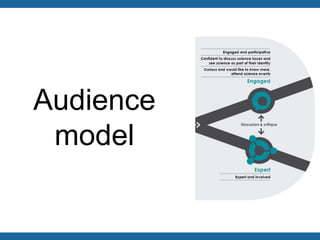
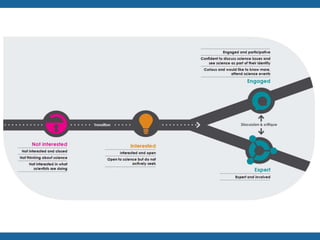
Audience
model
September 2015
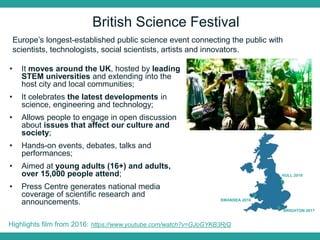
• It moves around the UK, hosted by leading
STEM universities and extending into the
host city and local communities;
• It celebrates the latest developments in
science, engineering and technology;
• Allows people to engage in open discussion
about issues that affect our culture and
society;
• Hands-on events, debates, talks and
performances;
• Aimed at young adults (16+) and adults,
over 15,000 people attend;
• Press Centre generates national media
coverage of scientific research and
announcements. SWANSEA 2016
BRIGHTON 2017
HULL 2018
British Science Festival
Highlights film from 2016: https://www.youtube.com/watch?v=GJoGYKB3RjQ
Europe’s longest-established public science event connecting the public with
scientists, technologists, social scientists, artists and innovators.
Future Debates
Highlights of our flagship Future Debate
on robotics & autonomous systems:
https://www.youtube.com/watch?v=BulX5OuwfrA
And our topic animation on genomics and
genome data privacy:
https://www.youtube.com/watch?v=I7fCW1ed_5E
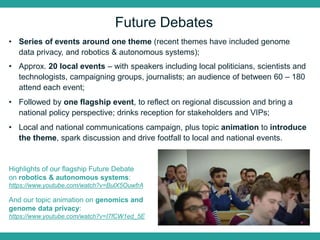
• Series of events around one theme (recent themes have included genome
data privacy, and robotics & autonomous systems);
• Approx. 20 local events – with speakers including local politicians, scientists and
technologists, campaigning groups, journalists; an audience of between 60 – 180
attend each event;
• Followed by one flagship event, to reflect on regional discussion and bring a
national policy perspective; drinks reception for stakeholders and VIPs;
• Local and national communications campaign, plus topic animation to introduce
the theme, spark discussion and drive footfall to local and national events.
British Science Week
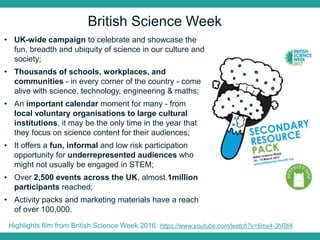
• UK-wide campaign to celebrate and showcase the
fun, breadth and ubiquity of science in our culture and
society;
• Thousands of schools, workplaces, and
communities - in every corner of the country - come
alive with science, technology, engineering & maths;
• An important calendar moment for many - from
local voluntary organisations to large cultural
institutions, it may be the only time in the year that
they focus on science content for their audiences;
• It offers a fun, informal and low risk participation
opportunity for underrepresented audiences who
might not usually be engaged in STEM;
• Over 2,500 events across the UK, almost 1million
participants reached;
• Activity packs and marketing materials have a reach
of over 100,000.
Highlights film from British Science Week 2016: https://www.youtube.com/watch?v=6mx4-3hRllA
Strengthening community engagement
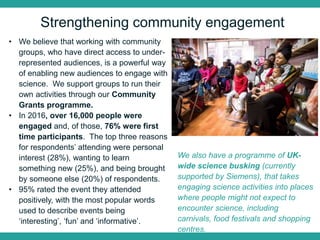
• We believe that working with community
groups, who have direct access to under-
represented audiences, is a powerful way
of enabling new audiences to engage with
science. We support groups to run their
own activities through our Community
Grants programme.
• In 2016, over 16,000 people were
engaged and, of those, 76% were first
time participants. The top three reasons
for respondents’ attending were personal
interest (28%), wanting to learn
something new (25%), and being brought
by someone else (20%) of respondents.
• 95% rated the event they attended
positively, with the most popular words
used to describe events being
‘interesting’, ‘fun’ and ‘informative’.
We also have a programme of UK-
wide science busking (currently
supported by Siemens), that takes
engaging science activities into places
where people might not expect to
encounter science, including
carnivals, food festivals and shopping
centres.
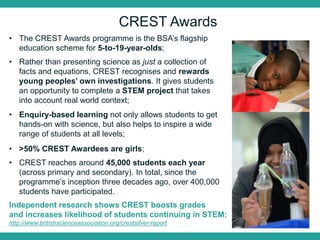
CREST Awards
• The CREST Awards programme is the BSA’s flagship
education scheme for 5-to-19-year-olds;
• Rather than presenting science as just a collection of
facts and equations, CREST recognises and rewards
young peoples’ own investigations. It gives students
an opportunity to complete a STEM project that takes
into account real world context;
• Enquiry-based learning not only allows students to get
hands-on with science, but also helps to inspire a wide
range of students at all levels;
• >50% CREST Awardees are girls;
• CREST reaches around 45,000 students each year
(across primary and secondary). In total, since the
programme’s inception three decades ago, over 400,000
students have participated.
Independent research shows CREST boosts grades
and increases likelihood of students continuing in STEM:
http://www.britishscienceassociation.org/crestsilver-report
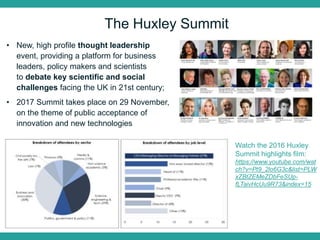
The Huxley Summit
• New, high profile thought leadership
event, providing a platform for business
leaders, policy makers and scientists
to debate key scientific and social
challenges facing the UK in 21st century;
• 2017 Summit takes place on 29 November,
on the theme of public acceptance of
innovation and new technologies
Watch the 2016 Huxley
Summit highlights film:
https://www.youtube.com/wat
ch?v=Pt9_2lo6G3c&list=PLW
xZBtZEMeZDbFeSUp-
fLTaivHcUu9R73&index=15
Our strategy 2018 - 2020
We are currently preparing our new three-year organisational plan and are
seeking partners to help advance, amplify and fund our work.
To achieve our vision, there is a need to improve the inclusivity of science
engagement and outreach in the UK, and to reposition science as a cultural
endeavour, not just a professional one. This ambition lies at the heart of our
new strategy: we will take a strong and over-arching commitment to
diversity and inclusion.
Our strategic objectives:
1. Reaching under-served and disadvantaged audiences – c.75% of the UK
population identifies as not engaged in science. Our work, and the partnerships
we create, will give more people a chance to engage with and enjoy science.
2. Improving science education – we will campaign for young people’s
experience of science education to engage all students, not just future scientists;
empowering a generation of scientifically literate young people.
3. Influencing science organisations – we will drive the sector to be more
inclusive in its approach, engage with more diverse audiences and make better
use of evidence.
Katherine Mathieson
Chief Executive
British Science Association
T: 020 7019 4935 | M: 07502 419 223
cienceassociation.org
@kath_math
Contact

Science communication & public engagement introduction

  • 1.
    Imperial College 10 Oct2017 Katherine Mathieson @Kath_math https://www.linkedin.com/in/katherinemathieson
  • 2.
    Making science afundamental part of society and culture. September 2015
  • 3.
  • 4.
  • 5.
    • It movesaround the UK, hosted by leading STEM universities and extending into the host city and local communities; • It celebrates the latest developments in science, engineering and technology; • Allows people to engage in open discussion about issues that affect our culture and society; • Hands-on events, debates, talks and performances; • Aimed at young adults (16+) and adults, over 15,000 people attend; • Press Centre generates national media coverage of scientific research and announcements. SWANSEA 2016 BRIGHTON 2017 HULL 2018 British Science Festival Highlights film from 2016: https://www.youtube.com/watch?v=GJoGYKB3RjQ Europe’s longest-established public science event connecting the public with scientists, technologists, social scientists, artists and innovators.
  • 6.
    Future Debates Highlights ofour flagship Future Debate on robotics & autonomous systems: https://www.youtube.com/watch?v=BulX5OuwfrA And our topic animation on genomics and genome data privacy: https://www.youtube.com/watch?v=I7fCW1ed_5E • Series of events around one theme (recent themes have included genome data privacy, and robotics & autonomous systems); • Approx. 20 local events – with speakers including local politicians, scientists and technologists, campaigning groups, journalists; an audience of between 60 – 180 attend each event; • Followed by one flagship event, to reflect on regional discussion and bring a national policy perspective; drinks reception for stakeholders and VIPs; • Local and national communications campaign, plus topic animation to introduce the theme, spark discussion and drive footfall to local and national events.
  • 7.
    British Science Week •UK-wide campaign to celebrate and showcase the fun, breadth and ubiquity of science in our culture and society; • Thousands of schools, workplaces, and communities - in every corner of the country - come alive with science, technology, engineering & maths; • An important calendar moment for many - from local voluntary organisations to large cultural institutions, it may be the only time in the year that they focus on science content for their audiences; • It offers a fun, informal and low risk participation opportunity for underrepresented audiences who might not usually be engaged in STEM; • Over 2,500 events across the UK, almost 1million participants reached; • Activity packs and marketing materials have a reach of over 100,000. Highlights film from British Science Week 2016: https://www.youtube.com/watch?v=6mx4-3hRllA
  • 8.
    Strengthening community engagement •We believe that working with community groups, who have direct access to under- represented audiences, is a powerful way of enabling new audiences to engage with science. We support groups to run their own activities through our Community Grants programme. • In 2016, over 16,000 people were engaged and, of those, 76% were first time participants. The top three reasons for respondents’ attending were personal interest (28%), wanting to learn something new (25%), and being brought by someone else (20%) of respondents. • 95% rated the event they attended positively, with the most popular words used to describe events being ‘interesting’, ‘fun’ and ‘informative’. We also have a programme of UK- wide science busking (currently supported by Siemens), that takes engaging science activities into places where people might not expect to encounter science, including carnivals, food festivals and shopping centres.
  • 9.
    CREST Awards • TheCREST Awards programme is the BSA’s flagship education scheme for 5-to-19-year-olds; • Rather than presenting science as just a collection of facts and equations, CREST recognises and rewards young peoples’ own investigations. It gives students an opportunity to complete a STEM project that takes into account real world context; • Enquiry-based learning not only allows students to get hands-on with science, but also helps to inspire a wide range of students at all levels; • >50% CREST Awardees are girls; • CREST reaches around 45,000 students each year (across primary and secondary). In total, since the programme’s inception three decades ago, over 400,000 students have participated. Independent research shows CREST boosts grades and increases likelihood of students continuing in STEM: http://www.britishscienceassociation.org/crestsilver-report
  • 10.
    The Huxley Summit •New, high profile thought leadership event, providing a platform for business leaders, policy makers and scientists to debate key scientific and social challenges facing the UK in 21st century; • 2017 Summit takes place on 29 November, on the theme of public acceptance of innovation and new technologies Watch the 2016 Huxley Summit highlights film: https://www.youtube.com/wat ch?v=Pt9_2lo6G3c&list=PLW xZBtZEMeZDbFeSUp- fLTaivHcUu9R73&index=15
  • 11.
    Our strategy 2018- 2020 We are currently preparing our new three-year organisational plan and are seeking partners to help advance, amplify and fund our work. To achieve our vision, there is a need to improve the inclusivity of science engagement and outreach in the UK, and to reposition science as a cultural endeavour, not just a professional one. This ambition lies at the heart of our new strategy: we will take a strong and over-arching commitment to diversity and inclusion. Our strategic objectives: 1. Reaching under-served and disadvantaged audiences – c.75% of the UK population identifies as not engaged in science. Our work, and the partnerships we create, will give more people a chance to engage with and enjoy science. 2. Improving science education – we will campaign for young people’s experience of science education to engage all students, not just future scientists; empowering a generation of scientifically literate young people. 3. Influencing science organisations – we will drive the sector to be more inclusive in its approach, engage with more diverse audiences and make better use of evidence.
  • 12.
    Katherine Mathieson Chief Executive BritishScience Association T: 020 7019 4935 | M: 07502 419 223 cienceassociation.org @kath_math Contact

Editor's Notes

  • #2 A privilege….this course changed my life My journey; the BSA’s mission; forces shaping our sector Science degree, 2 years with Merck