Science Advice to Government 
Sir Mark Walport 
Chief Scientific Adviser to HM Government
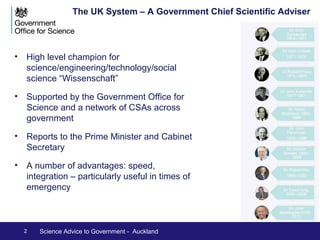
The UK System – A Government Chief Scientific Adviser 
• High level adviser and champion for 
science/engineering/technology/social 
science – “Wissenschaft” 
• Supported by the Government Office for 
Science and a network of CSAs across 
government; Head of Profession for 
scientists across government 
• Reports to the Prime Minister and Cabinet 
Secretary, works across government 
• A number of advantages: speed, 
continuity, integration – particularly useful 
in times of emergency 
2 Science Advice to Government - Auckland 
Sir Solly 
Zuckerman 
1964–1971 
Sir Alan Cottrell 
1971-1974 
Dr Robert Press 
1974–1976 
Dr John Ashworth 
1977 1981 
Sir Robin 
Nicholson 1982- 
1985 
Sir John 
Fairclough 
1986–1990 
Sir William 
Stewart 1990– 
1995 
Sir Robert May 
1995–2000 
Sir David King, 
2000–2008 
Sir John 
Beddington 2008– 
2013
3 Science Advice to Government - Auckland 
Government Office for Science 
Form should follow function 
What do we know that they 
ought to know? 
yes but... 
What do they know that we 
ought to know? 
To be useful we must be 
relevant 
Do things with Government 
- not to them 
iStockphoto
Mike Quinn/CC BY-SA 2.0 dyntr/CC BY-ND 2.0 
Gavin Schaefer/CC BY-SA 3.0 
4 Science Advice to Government - Auckland 
What does Government 
care about? 
Infrastructure 
(Natural and built) 
Emergencies 
Nic McPhee/CC BY-SA 2.0 
The economy Science Policy
5 Science Advice to Government - Auckland 
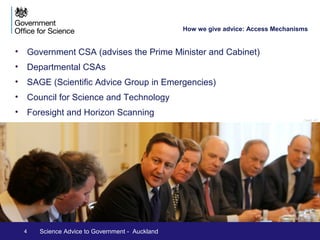
How we give advice: 
Access Mechanisms 
• Government CSA (advises the Prime Minister and Cabinet) 
• Departmental CSAs 
• SAGE (Scientific Advice Group in Emergencies) 
• Council for Science and Technology 
• Foresight and Horizon Scanning 
Credit: AP
6 Science Advice to Government - Auckland 
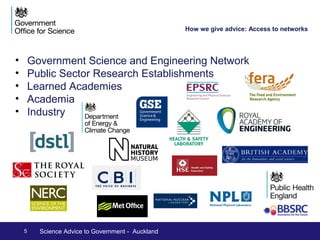
How we give advice: The 
engine room 
• Government Science and Engineering Network 
• Public Sector Research Establishments 
• Learned Academies 
• Academia 
• Industry
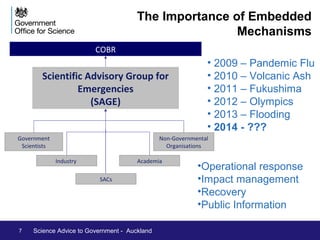
COBR 
The Importance of Embedded 
Scientific Advisory Group for 
Emergencies 
(SAGE) 
Non-Governmental 
Organisations 
Government 
Scientists 
Industry Academia 
Mechanisms 
• 2009 – Pandemic Flu 
• 2010 – Volcanic Ash 
• 2011 – Fukushima 
• 2012 – Olympics 
• 2013 – Flooding 
• 2014 – Ebola 
•Operational response 
•Impact management 
•Recovery 
•Public Information 
SACs 
Home Office Rapid 7 Science Advice tDoi aGgnoovsetircnsm, 2e5ntht J-unAeu 2c0k1la3nd
Fitting in with the policy process: be a 
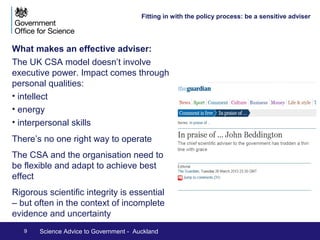
What makes an effective adviser: 
The UK CSA model doesn’t involve 
executive power. Impact comes through 
personal qualities: 
• scientific standing 
• energy 
• interpersonal skills 
There’s no one right way to operate 
The CSA and the organisation need to 
be flexible and adapt to achieve best 
effect 
Rigorous scientific integrity is essential – 
but often in the context of incomplete 
evidence and uncertainty 
8 Science Advice to Government - Auckland 
sensitive adviser
Fitting in with the policy process: 
Influencing Policymakers 
Influencing policymakers: 
• What do they need? 
• Building trust 
• Agreeing and understanding the questions 
• Providing the best evidence 
Ultimately policymakers will make decisions based on a 
view of the issue through a number of ‘lenses’ – of 
which science is one 
9 Science Advice to Government - Auckland 
Sgt Tom Robinson RLC/OGL v1.0
Science – adding value across 
Government 
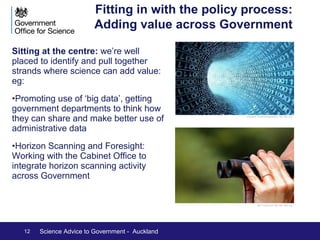
Sitting at the centre: we’re well placed 
to identify and pull together strands 
where science can add value: eg: 
•Promoting use of ‘big data’, better use 
of administrative data 
•Expert customer for science in 
government 
•Socialising the work of academies etc 
•Horizon Scanning and Foresight: 
Working with the Cabinet Office 
•Future cities; Ageing society; Internet 
of Things; Financial technologies 
10 Science Advice to Government - Auckland 
infocux Technologies/CC BY-NC 2.0 
Mr.TinDC/CC BY-NC-ND 2.0
Science and the policy process: 
obvious areas 
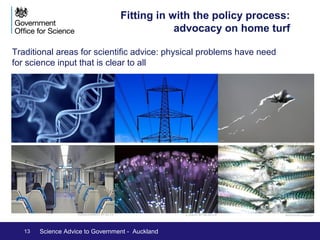
Traditional areas for scientific advice: physical problems have need 
for science input that is clear to all 
iStockphoto iStockphoto 
11 Science Advice to Government - Auckland 
Sdr Ldr Nikki Lofthouse/CC BY-NC-ND 2.0 
mattbuck4950/CC BY-SA 2.0 x_tine/CC BY-NC-ND 2.0 defra/crown copyright
Science and the policy process: less 
obvious areas 
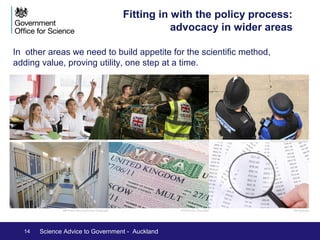
In other areas we need to build appetite for the scientific method, 
adding value, proving utility, one step at a time. 
Cathy Yeulet/123RF Cpl Neil Bryden RAF/Crown Copyright 
HM Prison Service/Crown Copyright Home Office/Crown Copyright 
12 Science Advice to Government - Auckland
Science and the policy process: 
understanding the different lenses 
e.g. energy policy: must address three aspects : 
effective policy 
space 
13 Science Advice to Government - Auckland
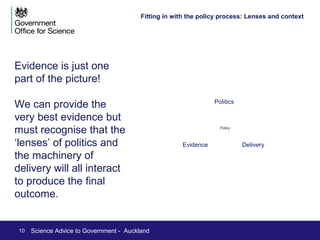
Evidence is just one 
part of the picture! 
We can provide the 
very best evidence but 
must recognise that the 
‘lenses’ of politics and 
the machinery of 
delivery will all interact 
to produce the final 
outcome. 
10 Science Advice to Government - Auckland 
Lenses
Engaging the public 
• The public can be great advocates for 
science, if we communicate well 
• Policymakers listen to the public – 
democracy 
• Values matter 
How should we engage with the public 
successfully? 
Tim O’Riordan – CST – 5 Principles: the importance of social 
science 
1. We need to reassure people that all potential alternative solutions 
are being looked at 
2. Allow decision making at the appropriate geographical level 
3. We need to involve the public in decision making – not just experts 
4. We need to tailor communications 
5. Engage the public’s emotions and sense of responsibility 
15 Science Advice to Government - Auckland 
iStockphoto
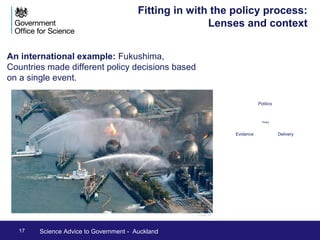
An international example: Fukushima - 
countries made different policy decisions based 
on the same evidence from a single event. 
16 Science Advice to Government - Auckland 
International lenses 
Credit: AP
Building Capability: Meshing supply and 
17 Science Advice to Government - Auckland 
demand 
Advice comes from different areas, each 
requires capacity development: 
• From the centre: CSAs, etc. 
• From government’s own science 
research establishments: eg Met Office, 
Defence laboratories 
• From outside Government: Universities, 
National Academies
Building Capability – Pull from 
government – a quiet revolution 
Increasing demand: 
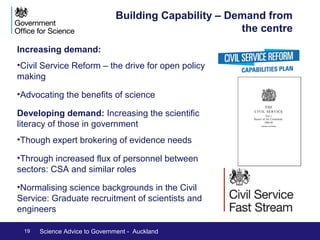
•Civil Service Reform – the drive for open policy 
making 
•Advocating the benefits of science 
Developing demand: Increasing the scientific 
literacy of those in government 
•Though expert brokering of evidence needs 
•Through increased flux of personnel between 
sectors: CSA and similar roles 
•Normalising science backgrounds in the Civil 
Service: Graduate recruitment of scientists and 
engineers 
18 Science Advice to Government - Auckland
Building Capability – ‘push’: the supply chain from 
national institutions to government 
Articulating government’s evidence needs 
better 
Incentivising collaboration. 
•Impact on policy and the UK’s Research 
Excellence Framework 
•Incentives for Industry: making a better 
environment for business too eg RAEng 
energy work 
19 Science Advice to Government - Auckland 
Policy 
demand 
through 
Open 
Policy 
Making 
Science 
supply 
through 
the 
Impact 
Agenda
Dealing with uncertainty - when 
science advice is difficult 
Risk 
Hazard 
Uncertainty 
Vulnerability 
20 Science Advice to Government - Auckland 
Credit: Warren Photographic
Dealing with uncertainty: in the evidence 
We are only as good as our evidence 
Examples of significant uncertainty in the 
evidence: 
• Neonicotinoid insecticides 
• Bovine tuberculosis 
Here our role is to assess and 
communicate the balance of evidence 
between opposing policy options 
Identify gaps in our knowledge and look to 
fill them 
21 Science Advice to Government - Auckland
Dealing with uncertainty 
• When is there enough evidence to make a decision? 
• Not for advisers to make the decision – policymakers must, 
often on incomplete evidence. 
• Who should we listen to? 
• A broad range of expertise 
• Easier to build consensus in an emergency, less so 
without the pressing need. 
• Good science advice communicates uncertainty 
effectively 
22 Science Advice to Government - Auckland
Building international consensus 
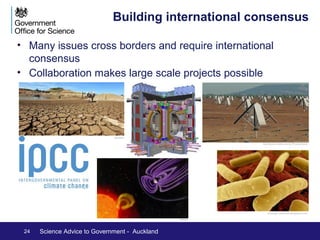
• Many issues cross borders and require international 
consensus 
• Collaboration makes large scale projects possible 
Reuters 
23 Science Advice to Government - Auckland 
Swinburne Astronomy Productions 
NASA 
biology- pictures.blogspot.com
Science matters 
• Embedded science 
advice is important – and 
vital in emergencies 
• Know your customer 
• Act as an effective 
transmission mechanism 
between the world of 
science and the world of 
politics 
24 Science Advice to Government - Auckland 
NASA
@uksciencechief 
www.gov.uk/go-science 
Every effort has been made to trace copyright holders and to obtain their permission for the use of copyright material. We apologise 
for any errors or omissions in the included attributions and would be grateful if notified of any corrections that should be incorporated 
in future versions of this slide set. We can be contacted through go-science@bis.gsi.gov.uk .

Science advice to government - Auckland conference

  • 1.
    Science Advice toGovernment Sir Mark Walport Chief Scientific Adviser to HM Government
  • 2.
    The UK System– A Government Chief Scientific Adviser • High level adviser and champion for science/engineering/technology/social science – “Wissenschaft” • Supported by the Government Office for Science and a network of CSAs across government; Head of Profession for scientists across government • Reports to the Prime Minister and Cabinet Secretary, works across government • A number of advantages: speed, continuity, integration – particularly useful in times of emergency 2 Science Advice to Government - Auckland Sir Solly Zuckerman 1964–1971 Sir Alan Cottrell 1971-1974 Dr Robert Press 1974–1976 Dr John Ashworth 1977 1981 Sir Robin Nicholson 1982- 1985 Sir John Fairclough 1986–1990 Sir William Stewart 1990– 1995 Sir Robert May 1995–2000 Sir David King, 2000–2008 Sir John Beddington 2008– 2013
  • 3.
    3 Science Adviceto Government - Auckland Government Office for Science Form should follow function What do we know that they ought to know? yes but... What do they know that we ought to know? To be useful we must be relevant Do things with Government - not to them iStockphoto
  • 4.
    Mike Quinn/CC BY-SA2.0 dyntr/CC BY-ND 2.0 Gavin Schaefer/CC BY-SA 3.0 4 Science Advice to Government - Auckland What does Government care about? Infrastructure (Natural and built) Emergencies Nic McPhee/CC BY-SA 2.0 The economy Science Policy
  • 5.
    5 Science Adviceto Government - Auckland How we give advice: Access Mechanisms • Government CSA (advises the Prime Minister and Cabinet) • Departmental CSAs • SAGE (Scientific Advice Group in Emergencies) • Council for Science and Technology • Foresight and Horizon Scanning Credit: AP
  • 6.
    6 Science Adviceto Government - Auckland How we give advice: The engine room • Government Science and Engineering Network • Public Sector Research Establishments • Learned Academies • Academia • Industry
  • 7.
    COBR The Importanceof Embedded Scientific Advisory Group for Emergencies (SAGE) Non-Governmental Organisations Government Scientists Industry Academia Mechanisms • 2009 – Pandemic Flu • 2010 – Volcanic Ash • 2011 – Fukushima • 2012 – Olympics • 2013 – Flooding • 2014 – Ebola •Operational response •Impact management •Recovery •Public Information SACs Home Office Rapid 7 Science Advice tDoi aGgnoovsetircnsm, 2e5ntht J-unAeu 2c0k1la3nd
  • 8.
    Fitting in withthe policy process: be a What makes an effective adviser: The UK CSA model doesn’t involve executive power. Impact comes through personal qualities: • scientific standing • energy • interpersonal skills There’s no one right way to operate The CSA and the organisation need to be flexible and adapt to achieve best effect Rigorous scientific integrity is essential – but often in the context of incomplete evidence and uncertainty 8 Science Advice to Government - Auckland sensitive adviser
  • 9.
    Fitting in withthe policy process: Influencing Policymakers Influencing policymakers: • What do they need? • Building trust • Agreeing and understanding the questions • Providing the best evidence Ultimately policymakers will make decisions based on a view of the issue through a number of ‘lenses’ – of which science is one 9 Science Advice to Government - Auckland Sgt Tom Robinson RLC/OGL v1.0
  • 10.
    Science – addingvalue across Government Sitting at the centre: we’re well placed to identify and pull together strands where science can add value: eg: •Promoting use of ‘big data’, better use of administrative data •Expert customer for science in government •Socialising the work of academies etc •Horizon Scanning and Foresight: Working with the Cabinet Office •Future cities; Ageing society; Internet of Things; Financial technologies 10 Science Advice to Government - Auckland infocux Technologies/CC BY-NC 2.0 Mr.TinDC/CC BY-NC-ND 2.0
  • 11.
    Science and thepolicy process: obvious areas Traditional areas for scientific advice: physical problems have need for science input that is clear to all iStockphoto iStockphoto 11 Science Advice to Government - Auckland Sdr Ldr Nikki Lofthouse/CC BY-NC-ND 2.0 mattbuck4950/CC BY-SA 2.0 x_tine/CC BY-NC-ND 2.0 defra/crown copyright
  • 12.
    Science and thepolicy process: less obvious areas In other areas we need to build appetite for the scientific method, adding value, proving utility, one step at a time. Cathy Yeulet/123RF Cpl Neil Bryden RAF/Crown Copyright HM Prison Service/Crown Copyright Home Office/Crown Copyright 12 Science Advice to Government - Auckland
  • 13.
    Science and thepolicy process: understanding the different lenses e.g. energy policy: must address three aspects : effective policy space 13 Science Advice to Government - Auckland
  • 14.
    Evidence is justone part of the picture! We can provide the very best evidence but must recognise that the ‘lenses’ of politics and the machinery of delivery will all interact to produce the final outcome. 10 Science Advice to Government - Auckland Lenses
  • 15.
    Engaging the public • The public can be great advocates for science, if we communicate well • Policymakers listen to the public – democracy • Values matter How should we engage with the public successfully? Tim O’Riordan – CST – 5 Principles: the importance of social science 1. We need to reassure people that all potential alternative solutions are being looked at 2. Allow decision making at the appropriate geographical level 3. We need to involve the public in decision making – not just experts 4. We need to tailor communications 5. Engage the public’s emotions and sense of responsibility 15 Science Advice to Government - Auckland iStockphoto
  • 16.
    An international example:Fukushima - countries made different policy decisions based on the same evidence from a single event. 16 Science Advice to Government - Auckland International lenses Credit: AP
  • 17.
    Building Capability: Meshingsupply and 17 Science Advice to Government - Auckland demand Advice comes from different areas, each requires capacity development: • From the centre: CSAs, etc. • From government’s own science research establishments: eg Met Office, Defence laboratories • From outside Government: Universities, National Academies
  • 18.
    Building Capability –Pull from government – a quiet revolution Increasing demand: •Civil Service Reform – the drive for open policy making •Advocating the benefits of science Developing demand: Increasing the scientific literacy of those in government •Though expert brokering of evidence needs •Through increased flux of personnel between sectors: CSA and similar roles •Normalising science backgrounds in the Civil Service: Graduate recruitment of scientists and engineers 18 Science Advice to Government - Auckland
  • 19.
    Building Capability –‘push’: the supply chain from national institutions to government Articulating government’s evidence needs better Incentivising collaboration. •Impact on policy and the UK’s Research Excellence Framework •Incentives for Industry: making a better environment for business too eg RAEng energy work 19 Science Advice to Government - Auckland Policy demand through Open Policy Making Science supply through the Impact Agenda
  • 20.
    Dealing with uncertainty- when science advice is difficult Risk Hazard Uncertainty Vulnerability 20 Science Advice to Government - Auckland Credit: Warren Photographic
  • 21.
    Dealing with uncertainty:in the evidence We are only as good as our evidence Examples of significant uncertainty in the evidence: • Neonicotinoid insecticides • Bovine tuberculosis Here our role is to assess and communicate the balance of evidence between opposing policy options Identify gaps in our knowledge and look to fill them 21 Science Advice to Government - Auckland
  • 22.
    Dealing with uncertainty • When is there enough evidence to make a decision? • Not for advisers to make the decision – policymakers must, often on incomplete evidence. • Who should we listen to? • A broad range of expertise • Easier to build consensus in an emergency, less so without the pressing need. • Good science advice communicates uncertainty effectively 22 Science Advice to Government - Auckland
  • 23.
    Building international consensus • Many issues cross borders and require international consensus • Collaboration makes large scale projects possible Reuters 23 Science Advice to Government - Auckland Swinburne Astronomy Productions NASA biology- pictures.blogspot.com
  • 24.
    Science matters •Embedded science advice is important – and vital in emergencies • Know your customer • Act as an effective transmission mechanism between the world of science and the world of politics 24 Science Advice to Government - Auckland NASA
  • 25.
    @uksciencechief www.gov.uk/go-science Everyeffort has been made to trace copyright holders and to obtain their permission for the use of copyright material. We apologise for any errors or omissions in the included attributions and would be grateful if notified of any corrections that should be incorporated in future versions of this slide set. We can be contacted through go-science@bis.gsi.gov.uk .

Editor's Notes

  • #8 The role of science in a national or international emergency S&T advice needs to be made available at very short notice (typically in an hour or so in the first instance) I convene a Science Advisory Group in an Emergency (SAGE) based on pre-arranged lists of experts to help me advise the Prime Minister and Cabinet in ‘real-time’. SAGE needs to advise on the potential impacts of any emergency. Combined with legal, political, economic considerations by COBR who decide on national response [NJ: It would be good to give a couple of historic examples]; [i.e. presumably the likes of Fukushima, Icelandic volcanoes; could also cite recent examples of flooding, etc. where forecasts and preparedness have been fairly good]
  • #10 Consider the audience! What are they looking for, how best can it be framed. Build trust. Look to answer their questions as well as suggesting your own. (answering their questions isn't the same as giving them the answers they want to hear!) From observing CSAs for the last few years I have to say they are pretty unique individuals, and no one departmental structure works best to bring out all their varying talents. It can take some time for a CSA and a department to get used to each other, and reporting structure and working styles can change over the course of their term (both formally and informally). Some have extensive management experience and are comfortable leading a large team directly, others are better suited to a more hands off roll. In such situations it isn't unheard of for a more traditional civil servant to take on management responsibilities either of them or the divisions they would have led.   It's Mark's view that a CSA's effectiveness in a Department has a lot more to do with the qualities of the individual, and a change in reporting like this should be no bar in their being effective. Particularly considering the high quality of the perm Sec and reporting line manager in question. Indeed at this level intellect, energy and interpersonal skills would supersede any formal line management issues. I would imagine one of the criteria for selection would be an ability to work effectively with others to get things done.
  • #11 Address the needs of Ministers and the department well as raising new issues Answering the questions of Ministers isn't the same as giving them the answers they want! Where difficult issues have a science component look to intervene rapidly to frame constructively before they become political footballs
  • #26 Established international culture of science: communication, collaboration, etc. built up informally, some flaws but is generally effective. Corollary for science advice? Just by discussing the area more we will improve it. But perhaps we can jump start the process with a common language.