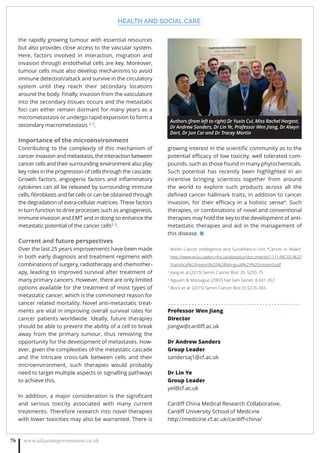
Barry Ulmer of the Chronic Pain
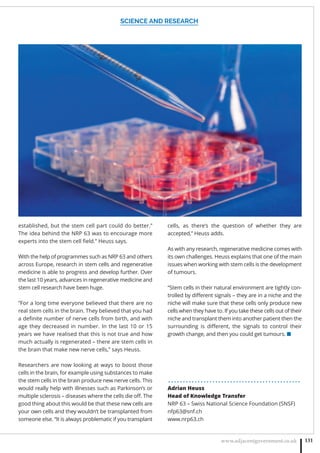
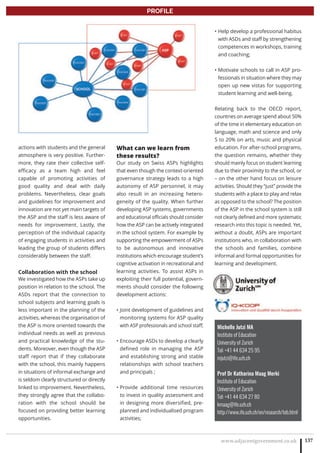
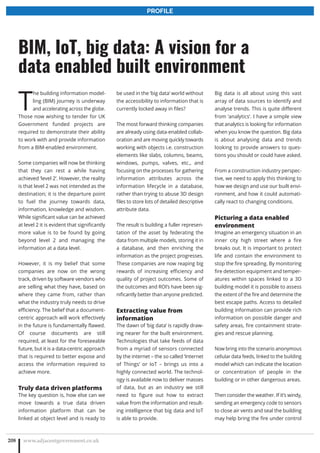
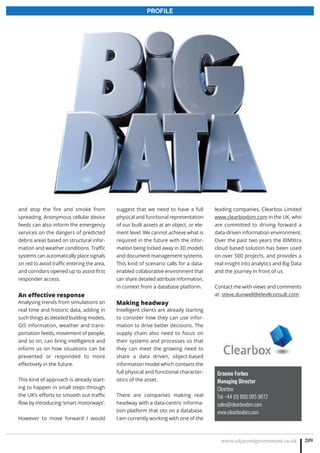
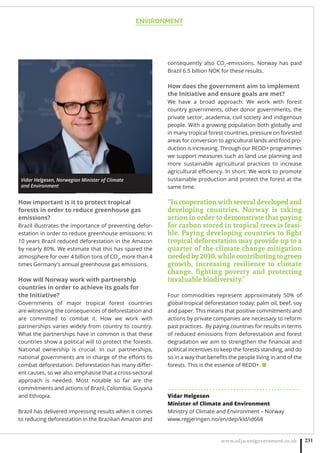
Association of Canada outlines
the many challenges faced by
people living with chronic pain
222 | Organising climate
action in Germany
Barbara Hendricks Federal Minister
for the Environment outlines how
Germany is committed to reducing
greenhouse gases
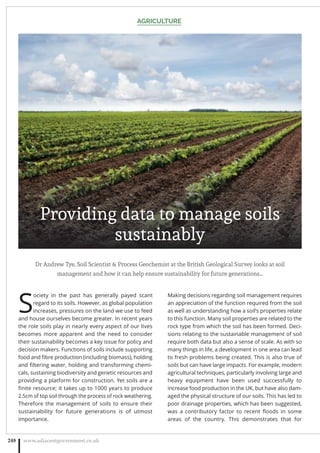
248 | Providing data to
manage soils sustainably
ISSN 2055-7612
Supported by
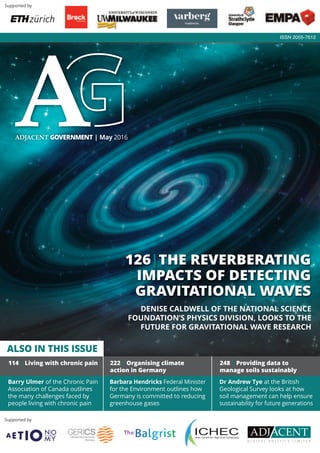
126|THE REVERBERATING
IMPACTS OF DETECTING
GRAVITATIONAL WAVES
ADJACENT GOVERNMENT | May 2016
114 | Living with chronic pain
ALSO IN THIS ISSUE
DENISE CALDWELL OF THE NATIONAL SCIENCE
FOUNDATION’S PHYSICS DIVISION, LOOKS TO THE
FUTURE FOR GRAVITATIONAL WAVE RESEARCH
Dr Andrew Tye at the British
Geological Survey looks at how
soil management can help ensure
sustainability for future generations
Supported by
varberg.se
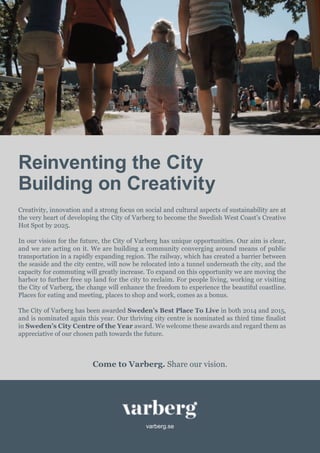
Creativity, innovation and a strong focus on social and cultural aspects of sustainability are at
the very heart of developing the City of Varberg to become the Swedish West Coast’s Creative
Hot Spot by 2025.
In our vision for the future, the City of Varberg has unique opportunities. Our aim is clear,
and we are acting on it. We are building a community converging around means of public
transportation in a rapidly expanding region. The railway, which has created a barrier between
the seaside and the city centre, will now be relocated into a tunnel underneath the city, and the
capacity for commuting will greatly increase. To expand on this opportunity we are moving the
harbor to further free up land for the city to reclaim. For people living, working or visiting
the City of Varberg, the change will enhance the freedom to experience the beautiful coastline.
Places for eating and meeting, places to shop and work, comes as a bonus.
The City of Varberg has been awarded Sweden’s Best Place To Live in both 2014 and 2015,
and is nominated again this year. Our thriving city centre is nominated as third time finalist
in Sweden’s City Centre of the Year award. We welcome these awards and regard them as
appreciative of our chosen path towards the future.
Reinventing the City
Building on Creativity
Come to Varberg. Share our vision.
www.adjacentgovernment.co.uk 3
FOREWORD
D
ebates concerning the value of science and
scientific research for society should not miss
the point. For true and lasting impact for our
societies and their citizens, science policy cannot be
effective without clear focus on what makes science
work: free-thinking, curiosity-driven exploration, discovery
and comprehension! Unfortunately, one can encounter
quite a few confusing narratives around this topic and,
given its importance, it is therefore crucial that Europe
reaffirms its focus on science in its science policy.
Surprisingly, the essential role and value of scientific
research in a knowledge-based society is often forgotten.
Debates about public policies for research seem to
imply that value for money and direct economic impact
are the primary justifications for investing in research.
This reasoning is much too restrictive, since scientific
research has intrinsic value in and of itself, resulting
directly from what research produces: knowledge and
discovery. Sensible public policies for science are those
that help ensure a steady and long-term supply of the
most essential public good any policy maker can aim
to provide: a robust knowledge ecosystem that allows
societies to produce and employ a wide variety of
knowledge leading to all sorts of and often unexpected,
impact.
We need to sort out the confusion about the value of
science for society.
Another source of confusion that seems to creep
regularly into policy debates about science is the
blurred distinction between research and innovation.
In a knowledge-based society – and that includes a
knowledge-based economy – innovation is the result
of knowledge put to new use. Research contributes to
innovation in the presence of an innovative culture
capable of creative use of the rich variety of new knowl-
edge and discovery. Research and innovation are
nevertheless two very distinct concepts, and whilst they
are cross-fertilising, they need to be addressed and
supported by equally distinct public-policy approaches.
Publicly funded research is an activity that produces
knowledge and skills that no other activity can or will
develop. Innovation is a culture that allows new solutions
to emerge when the right kind of knowledge and skills
meet. Both need to be developed without competing
against each other for the same public support.
We need to sort out the confusion between research
and innovation.
Much like education, the research system is a basic
knowledge infrastructure that underpins a society’s
ability to meet its own goals. European society has
ambitious goals and it needs to meet important
challenges. It therefore needs to focus its science policy
on true scientific research for long-term societal benefit.
It is time to make science the top priority in our policies
and in our research funding programmes. ■
Michael Matlosz
President
Science Europe
www.adjacentgovernment.co.uk4
WELCOME
T
he coming months could prove to
be very important for the UK. In
June voters will be heading to the
polls to decide whether they want the
country to remain as part of the Euro-
pean Union. If the result is a Brexit, this
could prove tricky for a number of
areas, including science and research. A
great deal of funding for UK research
comes through the European Commis-
sion’s Horizon 2020 programme.
In the May edition of Adjacent Govern-
ment we look at both sides of the
argument. Standing on opposite ends
of the debate, MEPs Vicky Ford and
Andrew Lewer put across their thoughts
on the Referendum and how they feel
people should vote.
Elsewhere in the publication we shine
the light on Canada. In a special focus,
we highlight science and healthcare in
the country with a number of editorial
pieces. A feature by Yves Joanette at the
Canadian Institutes of Health Research
– Institute of Aging focuses on brain
health and the differences between
men and women. We also highlight key
priorities from the Minister for Health,
Jane Philpott, and Kirsty Duncan, Minister
of Science.
The environment section sheds further
light on the circular economy and what
more Europe can be doing to make this
a reality. Karmenu Vella opens the
section detailing why Europe needs a
positive vision for economic develop-
ment – in short, a circular economy.
Other articles that highlight this include
a piece by the European Environment
Agency, and MEP Sirpa Pietikäinen.
We also feature impressive articles
from German Federal Minister for the
Environment Barbara Hendricks;
Norwegian Minister for Fisheries Per
Sanberg, and Norwegian Minister for
Climate and the Environment Vidar
Helgesen. Each minister details environ-
mental and climate policy for their
respective countries.
As always the health section has an
array of features, including a piece from
Richard Bergstrom, Director General at
the European Federation of Pharma-
ceutical Industries Association, on the
importance of collaborative efforts to
tackle the global problem of antimicro-
bial resistance (AMR).
Other areas of focus in this edition
include: cancer prevention; the Zika
virus; STEM investment in Ireland; edu-
cation exchange programmes; and The
Norwegian Climate and Forest Initiative.
As always, I hope you find the articles
featured informative and useful, and
welcome any feedback you may have. ■
The editor does not necessarily agree
with or endorse any of the views or
contents of the articles and features
within this document. All articles and
editorials remain the copyright of the
authors, organisations and other
relevant authorities by whose kind
permission they are reproduced. All
information has been checked and is
correct at the time of going to press.
The publisher will not be liable for any
loss suffered directly or indirectly as
a result of the use of or reliance on
the information contained herein.
© Adjacent Digital Politics Ltd 2016
Adjacent Digital Politics Ltd and its
suppliers collect and process personal
information for the purposes of
customer analysis and market research.
Our group/affiliate companies may
also wish to contact you about our
products or services, or the products
of carefully selected third parties that
we think you may be interested in.
Adjacent Digital Politics Ltd
Datum House
Electra Way
Crewe Business Park
Crewe
Cheshire CW1 6ZF
Registered in England & Wales.
Company Reg No. 8667479.
VAT Registration No. 169 9152 64.
Laura Evans
Editor
Production Coordinator
Nick Wilde
Designers
Andrew Bosworth
Ben Green
Sales
Henry Ballam
Natalia Barbah
. . . . . . . . . . . . . . . . . . . . . . . . . . . . . . . . .
Laura Evans
Editor
@Adjacent_Gov
CONTENTS
16 Tackling the risks associated
with diabetes.
In a speech on World Health Day, EU
Commissioner for Health and Food Safety,
Vytenis Andriukaitis shares his thoughts
at the Portuguese Parliament in Lisbon on
how Europe can tackle chronic diseases
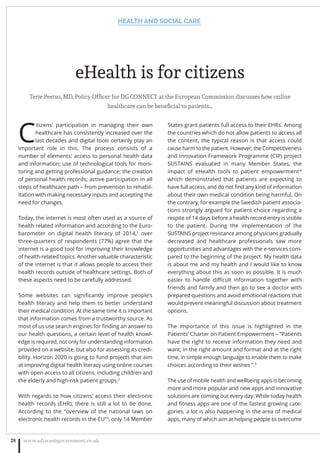
28 eHealth is for citizens.
Terje Peetso, MD, Policy Officer for
DG CONNECT at the European Commission
discusses how online healthcare can be
beneficial to patients
34 Our daily digital health –
is everyone ready?
Marc Lange, Secretary-General and Diane
Whitehouse, Member of the Secretariat at
the European Health Telematics Association
(EHTEL) explain how digital technologies are
helping to transform health service delivery
36 mHEALTH: Challenges,
hopes and doubts.
There are many hopes and at the same
time, doubts related to the mHealth
development. Here MEP Michal Boni
explains the reasons why
40 The cost of dementia.
Julia Stuart of the Alzheimer’s
Society sheds lights on the true cost of
dementia on the UK’s finances and resources
44 Dementia to become trillion
dollar disease by 2018.
Marc Wortmann, Executive Director of
Alzheimer’s Disease International (ADI),
outlines the major impact dementia has
worldwide and the urgent need for
governments to help provide a better
quality of life for people with the condition
48 How future-proof are the
NHS new ‘Healthy Towns?
Dr David Usher of human factors
consultancy InterAction of Bath, discusses
the issue of enabling independent living
later in life and asks will the NHS new Healthy
Towns be designed to accommodate
societal changes already upon us?
50 Understanding ALS.
Adjacent Government sheds light
on amyotrophic lateral sclerosis (ALS) and
the work of the ALS Association in raising
awareness and tackling the disease
54 Why we need to invest in
adolescent mental health care.
Ophélie Martin, Communications Officer
at Mental Health Europe outlines the
importance of early intervention and care
for young people who may develop
mental health issues
64 The lifelong impact of air
pollution.
Professor Jonathan Grigg, the Royal
College of Paediatrics and Child Health
(RCPCH) writes about the risks air
pollution poses to our country’s children
66 Surviving cancer in Europe.
Satu Lipponen, Director of
Communications and Foresight at the
Cancer Society of Finland sheds light on the
Joint Action Cancon and its role in guiding
the way forward for quality cancer care
69 Understanding pancreatic
cancer.
Pancreatic cancer is a devastating disease
with the poorest prognosis of all solid
tumours. Dr Catherine Hogan of the
European Cancer Stem Cell Research
Institute explains how an innovative
approach to understanding the early stages
of this disease may pave the way for the
development of earlier detection tools
73 Identifying research
priorities for cancer.
Pavel Poc, Vice-Chair of the Committee on
Environment, Public Health and Food
Safety at the European Parliament,
outlines why cancer research and
innovation must not be at the expense of
healthcare equity
75 Molecular and cellular
mechanisms of cancer.
Professor Wen Jiang, Dr Andrew Sanders
and Dr Lin Ye from the Cardiff China
Medical Research Collaborative, Cardiff
University School of Medicine highlight the
work being done to combat cancer and
develop new treatments
77 Fight Zika virus before it
gets out of control.
European Parliament MEP Annie Schreijer-
Pierik (NL, EPP Group) and co-author of
the resolution on Zika Virus, sheds light on
what more could be done in Europe to
help prevent the deadly disease
HEALTH AND
SOCIAL CARE
SPECIAL FOCUS:
EU REFERENDUM
ADJACENT GOVERNMENT | May 2016
09 MEPs outline opposite
sides of the debate.
Adjacent Government highlights two
sides of the argument with regards the
EU Referendum from MEP’s at the
European Parliament
12 Should we stay
or should we go?
Digital Editor Amy Caddick gives a
perspective on the confusion surrounding
whether to remain or leave the EU
14 Why the UK and EU work
better together.
Adjacent Government’s Sean Heath
outlines why community is more
important than sovereignty and why the
UK should remain in the European Union
SCIENCE AND
RESEARCH
CANADA
FOCUS
116 Open access = open
science.
In a speech delivered in Amsterdam last
month, Carlos Moedas, EU Commissioner
for Research, Science and Innovation
outlines why open science is a good thing
126 The reverberating impacts
of detecting gravitational
waves. Denise Caldwell, Director of the
National Science Foundation’s Physics
Division in the Directorate for Mathematical
and Physical Sciences, looks to the future
for gravitational wave research
130 A boost for stem cell
research.
Adrian Heuss, Head of Knowledge
Transfer on the NRP63 Programme tells
Editor Laura Evans more about NRP63
and Stem Cell Research
138 The brain challenge.
Professor David Nutt, President
of The European Brain Council highlights
the economic impact of poor brain health
and how they are calling for new thinking
towards how it is treated
140 Denmark – a strong
research nation.
Professor Peter Munk Christiansen, Chair
of the Danish Council for Independent
Research outlines how independent
research funds were awarded to a record-
high number of young researchers in 2015
144 Funding research
excellence in Germany.
Adjacent Government highlights the work
of the German Research Foundation and
in particular their Excellence Initiative
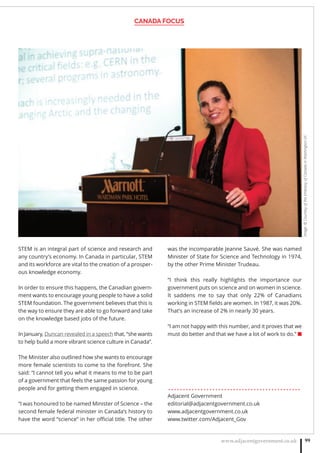
98 The tale of two ministers.
Adjacent Government outlines
how Canada is investing in science and
research in order to make further advances
in the arena
108 Cognitive brain health
in aging: Why is it so
important for women?
Yves Joanette from the Institute of Aging,
and Cara Tannenbaum from the Institute
of Gender and Health at the Canadian
Institutes of Health Research, detail why
cognitive brain health is so important as
we age, specifically for women
110 Keeping Canadians
healthy.
Adjacent Government highlights how the
Canadian Minister for Health is committed
to preventing chronic diseases and
supports World Health Day
114 Living with chronic pain.
Barry Ulmer, Executive Director
of the Chronic Pain Association of Canada
outlines the many challenges faced by
people who live with chronic pain
81 Understanding the effects
of the Zika virus.
Laura Merson and Stephen Kennedy from
the University of Oxford highlight a new
online data-sharing platform for images
of fetal and newborn heads in the context
of the Zika virus outbreak
83 Underscoring the
pharmaceutical industry’s
commitment to combatting AMR.
Richard Bergström, Director General of the
European Federation of Pharmaceutical
Industries and Associations (EFPIA),
highlights the importance of collaborative
efforts to tackle antimicrobial resistance
88 Virtual Reality based
therapies.
Scott Lowe, General Manager – North
America at Psious explains how Virtual
Reality technology can help with health
issues such as anxiety
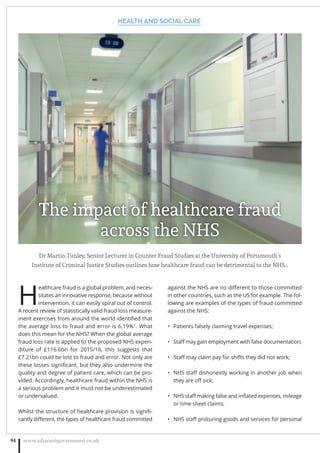
94 The impact of healthcare
fraud across the NHS.
Dr Martin Tunley, Senior Lecturer in
Counter Fraud Studies at the University of
Portsmouth’s Institute of Criminal Justice
Studies outlines how healthcare fraud can
be detrimental to the NHS
150 Strengthening science
and research in Portugal.
Adjacent Government highlights a speech
by Portuguese Minister of Science,
Technology and Higher Education,
Manuel Heitor, which details key priorities
over the coming years
154 Future-proofing our
talent pipeline –
A national approach. Niamh Lyons,
Interim Director of Communications,
Education and Public Engagement at
Science Foundation Ireland highlights the
importance of STEM in Ireland, and how
the funding agency is supporting projects
in this arena
160 Investing in scientists
of the future.
Adjacent Government Editor Laura Evans
highlights new investments for UK science
and what Minister for Science and
Universities, Jo Johnson thinks a Brexit
could mean for our status in this arena
168 Increasing skills in the
aerospace sector.
Following on from the last edition,
John Laughlin, Aerospace Programme
Lead at Innovate UK answers further
questions from Adjacent Government on
the UK aerospace sector and challenges
that lie ahead
172 Scientific progress in
Israel.
Adjacent Government details how science
and technology is progressing in Israel,
with comment from Minister of Science,
Technology and Space, Ofir Akunis
176 Protecting your R&D.
Gary Townley, Business
Manager at the UK Intellectual Property
Office outlines the importance of
protecting your innovation and research
through Intellectual Property protection
EDUCATION
AND SKILLS
190 Ljubljana – European
Green Capital 2016.
The European Green Capital team outline
why Ljubljana is the first and only
European green capital in central and
south eastern Europe
196 Strengthening
partnerships between
cities. Hella Dunger-Löper Member of
the European Committee of the Regions
(COR) outlines the core principles that
should shape the EU’s new Urban Agenda
202 Indoor Positioning
Systems – We know
where you are. Jim Sinopoli, Managing
Principal at Smart Buildings LLC highlights
the benefits for Indoor Positioning Systems
206 Engineering happiness
in our cities.
Simon Price, Ramboll Liveable Cities
Director looks at how engineering and
infrastructure in our cities can lead to
happiness
210 Training – the first step to
competency.
Association for Specialist Fire Protection CEO
Wilf Butcher explains why competency is
important for the specification, installation
and maintenance of passive fire protection
213 The circular economy –
an investment with a
triple win. Karmenu Vella, EU
Commissioner for the Environment
highlights why Europe needs a circular
economy
215 A paradigm shift to
sustainable financing.
MEP Sirpa Pietikäinen highlights progress
already made towards a circular economy,
as well as, what more needs to be done
216 Moving beyond waste
management towards a
green economy.
Hans Bruyninckx, Executive Director of the
European Environment Agency outlines
why we need to facilitate a transition
towards a circular, green economy
218 De-Icing sewage treatment
– a clever combination.
Ms. Caterina Talerico and Mr. Dirk Kauffeld
from Zurich Airport Ltd detail how the
airport is using new methods to treat the
sewage from the de-icing of planes
222 Organising climate
action in Germany.
Barbara Hendricks, Federal Minister for
the Environment outlines how the German
government is committed to reducing
greenhouse gases
226 Let the fish see the plate.
Providing enough food for a
growing population is one of the most
challenging questions in our time, as
The Norwegian Minister of Fisheries
Per Sandberg explains
230 Protecting tropical
forests worldwide.
Vidar Helgesen, Norwegian Minister of
Climate and Environment answers questions
about how Norway is contributing to
sustainable development by reducing
deforestations in the worlds tropical forests
236 A new Sustainable
Development Strategy
for Switzerland.
Daniel Dubas, Head of the Sustainable
Development Section at the Federal Office
for Spatial Development outlines the
Federal Council’s Sustainable Development
Strategy and its aims
THE BUILT
ENVIRONMENT
ENVIRONMENT
180
The Swedish Council for Higher Education
outlines the benefits of exchange
programmes such as Linnaeus-Palme
183
Andreas Schleicher, Director
for Education and Skills at the OECD
highlights the long term consequences
of poor performing students and the
importance of reducing them
187Natasha Levanti, ACE Group
Communications Executive celebrates the
rising number of apprentices in Scotland
which has reached a five-year high
256 Following on from COP21.
At the public session of the
Environment Council in March, EU
Commissioner for Climate Action and
Energy, Miguel Arias Cañete delivers a
follow up speech to COP21
262 A call for speed, focus
and results.
At the high level ‘Global Action Day’ which
opened the World Future Energy Summit
in Abu Dhabi, Ms Marie-José Nadeau,
Chair of The World Energy Council,
addressed the plenary session
266 Call for action for UK
energy.
Our national identity, not just energy
security, hangs in the balance while
decisions over Hinkley Point C and
Swansea Tidal Lagoon are delayed,
explains Dr. Nelson Ogunshakin OBE,
chief executive of Association for
Consultancy and Engineering (ACE)
268 Smarter homes: How
to save money and cut
emissions. Russell Bowes outlines how
the implementation of smart technologies
can impact the way our homes are built
and heated
272 Is there a place for electric
heating in the UK?
Paul Bennett, registered professional
energy consultant with the Energy
Institute and Executive Chairman of
BSSEC, looks at the technologies available
for electric heating and the building
regulations you should be aware of
ENERGY
284 Digitalising Europe.
Adjacent Government highlights
plans from EU Commissioner for the Digital
Economy, Günther H. Oettinger to make
the EU a digital force to be reckoned with
288 PETRAS – Cybersecurity
of the Internet of Things.
Jeremy Watson, Professor of Engineering
Systems at UCL and Emil Lupu from
Imperial College London outline how the
new PETRAS research hub aims to fill
knowledge gaps and promote safe and
secure use of the Internet of Things
292 UK to benefit from big
data and IoT.
Mark Wilkinson, Regional Vice President –
Northern Europe and Russia/CIS at SAS
Software UK outlines the value of the
Internet of Things and big data for the UK
economy
294 Shedding light on
government shadow IT.
Joel Dolisy, SVP and CTO/CIO of SolarWinds
gives an overview of Shadow IT, and how it
can make a difference within government
IT departments
296 Tackling the challenges
of cyber-attacks – a local
authority perspective. Cath Birch, Chief
Information Officer at Buckinghamshire
County Council outlines why they take
cyber security very seriously
298 Protecting data from the
insider threat.
Esther George, Director of Cyber Crime
and Prevention at 8MAN highlights how
organisations such as local authorities are
discovering data breaches every day and
what can be done to prevent them
300 The General Data
Protection Regulation.
FEDMA interviews Olivier Proust from
Fieldfisher regarding the General Data
Protection Regulation and its importance
ICT
274 Biometrics gaining
identity.
As the influence of biometrics continues,
Christopher Brown, Programme Manager
for Governance & Resilience at BSI, explores
its growing role in modern society
278 Urban terrorism.
Jonathan Wood, Director of
Control Risks outlines how urban areas
are increasingly becoming targets for
terrorist attacks
282 Smart cities: the
implications for the
private sector. Nicolas Reys, Cyber
Security Services Consultant at Control
Risks looks at the risks of cyber-attacks
on smart cities
SECURITY
AGRICULTURE
241At the 2016 Forum for the Future of
Agriculture, EU Commissioner for Rural
Development Phil Hogan outlines how
the EU is stepping up its role in
sustainable development
248Dr Andrew Tye, Soil Scientist & Process
Geochemist at the British Geological
Survey looks at soil management and
how it can help ensure sustainability for
future generations
www.adjacentgovernment.co.uk 9
O
n 23rd June UK voters will head to the polls
and decide whether they think, as a country,
we are better on our own or as part of the EU.
Voters will have a very important decision to make
regarding our status in Britain and Northern Ireland.
The campaign has already been swamped with contro-
versy, and as we get closer things are just beginning to
hot up.
According to the latest ORB poll, as it stands at the
moment the Remain campaign are ahead with 52% of
the votes, and Leave stand at just 43%. This has
changed somewhat from March 15, when an ORB poll
revealed that the Leave campaign was ahead with 52%
and the Remain on 45%.
A higher proportion of people, however, are now
undecided about which way they would rather vote.
Without sufficient information, people feel a decision
is hard to make faced with uncertainty over the future
if Brexit should happen.
The government were highly criticised for their Remain
information booklet, with the Leave campaign suggesting
it was ‘biased’ and highlighting the fact it cost £9m to
print and distribute. However, the government have
defended their choice by saying that the leaflet was a
“moderate” response to people wanting information
about the referendum.
Labour MP and Leave campaigner Graham Stringer said
while the public did want information, the leaflets were
“very biased” and broke the government’s pledge to
have facts independently verified. The official budget for
the campaign is £7m for each camp, which includes
£600k of public money.
“Voterswillhaveaveryimportantdecision
to make regarding our status in Britain
and Northern Ireland. The campaign has
already been swamped with controversy,
and as we get closer things are just
beginning to hot up.”
There are still many unanswered questions with
regards to Britain’s future in or out of the EU. What will
it mean for jobs and trade? A number of people are
particular concerned with how it will affect our borders.
With immigration on people’s minds at the moment,
this is something that could sway the votes. The pressure
is on, as UK voters have an integral decision to make
which could change the country enormously.
Here, Adjacent Government highlights two views from
MEP’s on whether they think the UK would be better
off in or out of the EU. Andrew Lewer and Vicky Ford
highlight how they will be voting, and why they feel the
UK will be better off in or out of the European Union…
EU Referendum
– should we stay or should we go?
Adjacent Government highlights two sides of the argument with regards the EU Referendum
from MEP’s at the European Parliament…
SPECIAL FOCUS
SPECIAL FOCUS
www.adjacentgovernment.co.uk10
E
ver since I became an MEP  I have said that
the status quo could not continue. Europe needs
to change and our relationship with it needs
to change.  
In just 7 years the Eurozone has gone from a Monetary
Union to a Fiscal Union and Banking Union – now they
are discussing “Social Union” too. This is a massive fun-
damental change to the governance of the economies
of countries in the euro. We, outside the Eurozone,
could not keep muddling along without change. The
Prime Minister’s negotiation keeps the UK out of the
euro, safeguards our economic independence,
cements the independence of the Bank of England,
and protects the pound. It takes us out of the “ever-
closer union” and importantly prevents those within
the euro from forming a cartel and discriminating
against those outside. This has always been a red line
for me in the renegotiation. It has been achieved.
On migration, the removal of job-seeker’s allowances
and limits on benefits for new arrivals will reduce some
of the pressures we have seen.   Proper border control
means being able to take action against those who
present a danger to our communities. Sharing of cross-
border criminal records will help us in the fight against
crime and terror.
As an MEP I have fought against unwarranted red-tape
and unnecessary laws. This negotiation sets up an
annual review of all EU law and establishes sector by
sector targets for removing unnecessary costs, return-
ing decision-making to national parliaments where
international EU rules are not warranted. There is of
course more I would like to see.
The single market does help us to trade  across
Europe’s 500 million consumers. But the devil in the
detail of EU law can affect every sector of our economy.
This is why I have rolled up my sleeves to negotiate
trade terms on cars, pharmaceuticals, banking,
telecommunications, digital, offshore oil and gas, pack-
age travel, science and research, and many more
areas.  Other countries such as Norway have to accept
these business laws without having a say on the under-
lying terms.  For an economy as diverse as the UK,
indeed as the East of England, we cannot afford to be
in a position like that of Norway.
There is of course more I would like to see, not least a
less profligate attitude to the spending of tax payers’
money, an end to the wasteful Strasbourg circus, and
a closer eye being given to warnings from the court of
auditors, but these are battles we can and will continue
to fight. 
To get to this stage has been a mammoth negotiation
which has needed all 28 countries to agree, each of
which have their own internal political debates and
many of whom are facing deep uncertainty in their
own economies and national security.  
If vote “Leave” we will need to secure a new trade deal,
which would again need unanimous consent of 28
countries, plus the European Parliament. Much as I
would like to be able to walk away quietly from the
bureaucracy of the EU institutions, all my instincts tell
me that leaving would lead to a very expensive and
drawn out divorce.
Across the world economies, security and natural
resources are under pressure.  We are not immune;
our own economic recovery is still fragile. Everyone will
need to think very hard about their own decision. To
me, this does not feel like the right time to be walking
away from allies or taking unquantifiable risks. This
deal is not perfect, but it is a step in the right direction
and better than a leap into the unknown. ■
. . . . . . . . . . . . . . . . . . . . . . . . . . . . . . . . . . . . . . . . . . . . .
Vicky Ford
MEP
European Parliament
Why I will be voting to remain
in European Union:
www.adjacentgovernment.co.uk 11
SPECIAL FOCUS
I
believe we need fundamental reform of the
European Union to drive out waste, unnecessary
interference and red tape. Unfortunately, that is
not what is on offer when the British public vote in the
June referendum.
Our deal with the EU should not have been simply
about keeping Britain happy. It was the opportunity for
the EU to start delivering real benefits and changes
for all its member states. It was our best chance to rein
in the EU and hand back powers to national parliaments.
If we are to stay in the EU, it needs to become a
modern, effective force across Europe. In its current
shape, it is not.
There are very real and difficult issues facing Europe
today – such as the refugee and Euro crises. So far, the
EU has failed to provide the necessary leadership to
properly tackle these issues. Yet it seems determined
to press ahead and create an ever-closer union, claiming
even more powers for itself.
The UK does not need this creeping interference in
national government affairs – neither do many other
member states. But the response to the UK’s modest
set of reform proposals, suggests there is no appetite
among our partners for doing things truly differently.
We did not ask for much – not nearly enough in my
opinion. And what we have asked for has been badly
watered down. Not only that, the deal could be further
diluted by the European Parliament or thrown out by
the European Court of Justice after we have had our
UK remain or leave referendum. We will not know until
after we have voted.
If – and it is a big if – we are to remain, we need to
tackle the EU’s significant drawbacks including:
Over-regulation and interference;•
Loss of sovereignty;•
The huge transfer payments we make – £350m a week;•
The continuing aim for an ever-closer union;•
The lack of control over our borders and over migration.•
Unfortunately, I do not believe the EU is willing or
capable of delivering what is needed. Taken together,
I believe these outweigh the benefits of staying in. And
I believe – on balance – we will be better off economi-
cally and democratically outside the EU.
Neither do I subscribe to the belief that the UK is safer
inside the EU – it is not borne out by recent history. The
EU has just thrown billions at an autocratic Turkish
regime for a bizarre migrant swapping scheme. It also
means free access to the EU for a further 77 million
people.
None of us has a crystal ball to predict the future.
However, the leave camp is expected to have more
answers. The idea that a future inside the EU is a
model of calm and safe status quo is not borne out by
recent history. Over the last decade it has lurched from
unpredictable crisis to unpredictable crisis.
In an uncertain world is it not safer to have the ability
to react, adapt and change? Or would we rather be tied
to 27 other countries’ agendas and problems?
The EU does have its good points and leaving would have
negative as well as positive consequences. On balance, I
believe, we would be better off leaving. The choice, will
be made by the British people and not by politicians. And
we have David Cameron and a Conservative government
to thank for that – whatever the result. ■
. . . . . . . . . . . . . . . . . . . . . . . . . . . . . . . . . . . . . . . . . . . . .
Andrew Lewer MBE
MEP
European Parliament
Why the UK should leave the EU
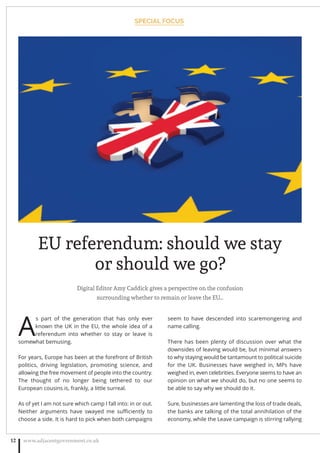
Digital Editor Amy Caddick gives a perspective on the confusion
surrounding whether to remain or leave the EU…
A
s part of the generation that has only ever
known the UK in the EU, the whole idea of a
referendum into whether to stay or leave is
somewhat bemusing.
For years, Europe has been at the forefront of British
politics, driving legislation, promoting science, and
allowing the free movement of people into the country.
The thought of no longer being tethered to our
European cousins is, frankly, a little surreal.
As of yet I am not sure which camp I fall into: in or out.
Neither arguments have swayed me sufficiently to
choose a side. It is hard to pick when both campaigns
seem to have descended into scaremongering and
name calling.
There has been plenty of discussion over what the
downsides of leaving would be, but minimal answers
to why staying would be tantamount to political suicide
for the UK. Businesses have weighed in, MPs have
weighed in, even celebrities. Everyone seems to have an
opinion on what we should do, but no one seems to
be able to say why we should do it.
Sure, businesses are lamenting the loss of trade deals,
the banks are talking of the total annihilation of the
economy, while the Leave campaign is stirring rallying
SPECIAL FOCUS
www.adjacentgovernment.co.uk12
EU referendum: should we stay
or should we go?
SPECIAL FOCUS
www.adjacentgovernment.co.uk 13
cries about sovereignty and independence. It is easy to
get swept up in flying the banner of freedom, but no
one has actually explained what freedom looks like.
Conversely, staying in a political arrangement simply
because it is easier than dealing with the fallout of
leaving is a dangerous path to take. To stay or go must
be a decision based in facts and understanding of the
ramifications. Staying will keep us tied to the union.
Even with the reforms secured by PM David Cameron is
this what is best for our country in the long term? On
the other side of the coin, would distancing ourselves
from Europe be in our best interest in a society that
increasingly globalised?
In all honesty, I do not have the answers to any of these
questions. What the best course of action will be does
not have an easy answer. Staying could be risky; leaving
could be just as dicey.
What I have discovered during my exploration for
knowledge on the referendum is no one really seems
to know what an exit would entail. It might bring down
the entire structure of society, decimating trade and
the economy and liberty and a whole host of other
terrible calamities. On the other hand, it probably
won’t do any of those things. The problem is there is
no precedence for this type of action. The EU is a club
most nations want to join, not leave. It is that uncer-
tainty that is leading to an amount of dithering on the
issue. Better the devil you know than taking a plunge
into the unknown.
What is clear is the Remain campaign seems to be
heading for the shock and awe tactic of worst case
scenarios, while the Leave campaign has done little to
inspire faith in what the UK would look like without the
EU. There are agendas driving both sides of the debate,
making it next to impossible to know which side to
listen to. It is little wonder voters are confused.
As of yet neither side has put forward definitive
arguments for why we should jump ship and go solo
or stay best friends with the union. The arguments for
Remain or Leave have done little to inspire thoughts
either way.
To hear the stay campaign talk, leaving the EU would
rain down Armageddon, complete with economic
collapse and the death of freedom as we know it. Our
Scottish neighbours would push for another vote for
independence and we would be overrun by terrorists
within a week.
“What I have discovered during my explo-
ration for knowledge on the referendum is
no one really seems to know what an exit
would entail. It might bring down the
entire structure of society, decimating
trade and the economy and liberty and a
whole host of other terrible calamities.”
On the other hand the Leave campaign does not seem
to know what will happen, but they maintain it will be a
fist-bump for democracy. At this stage I would settle for
knowing what kind of exit strategy we are looking at.
All this posturing and backbiting is tiresome. Wading
through the political gesturing is becoming more of a
slog as June moves closer. The time has undoubtedly
come for both sides to set out their stalls and deliver the
facts. Whether we are better or worse in the EU I’m still
not sure, and I’m sure I am not alone in my indecision.
At Adjacent Government we would like to hear
your thoughts on the Referendum – complete our
online survey. ■
. . . . . . . . . . . . . . . . . . . . . . . . . . . . . . . . . . . . . . . . . . . . .
Amy Caddick
Digital Editor
Adjacent Government
editorial@adjacentgovernment.co.uk
www.adjacentgovernment.co.uk
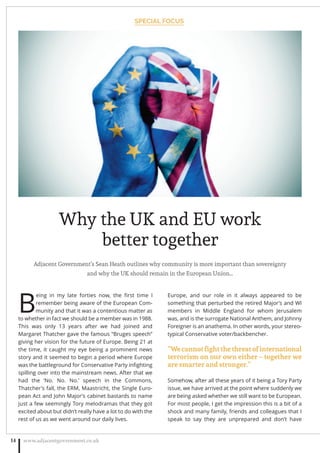
Adjacent Government’s Sean Heath outlines why community is more important than sovereignty
and why the UK should remain in the European Union…
B
eing in my late forties now, the first time I
remember being aware of the European Com-
munity and that it was a contentious matter as
to whether in fact we should be a member was in 1988.
This was only 13 years after we had joined and
Margaret Thatcher gave the famous “Bruges speech”
giving her vision for the future of Europe. Being 21 at
the time, it caught my eye being a prominent news
story and it seemed to begin a period where Europe
was the battleground for Conservative Party infighting
spilling over into the mainstream news. After that we
had the ‘No. No. No.’ speech in the Commons,
Thatcher’s fall, the ERM, Maastricht, the Single Euro-
pean Act and John Major’s cabinet bastards to name
just a few seemingly Tory melodramas that they got
excited about but didn’t really have a lot to do with the
rest of us as we went around our daily lives.
Europe, and our role in it always appeared to be
something that perturbed the retired Major’s and WI
members in Middle England for whom Jerusalem
was, and is the surrogate National Anthem, and Johnny
Foreigner is an anathema. In other words, your stereo-
typical Conservative voter/backbencher.
“Wecannotfightthethreatofinternational
terrorism on our own either – together we
are smarter and stronger.”
Somehow, after all these years of it being a Tory Party
issue, we have arrived at the point where suddenly we
are being asked whether we still want to be European.
For most people, I get the impression this is a bit of a
shock and many family, friends and colleagues that I
speak to say they are unprepared and don’t have
www.adjacentgovernment.co.uk14
Why the UK and EU work
better together
SPECIAL FOCUS
SPECIAL FOCUS
www.adjacentgovernment.co.uk 15
enough information. I for one had been feeling as
though I was European as well as British / English for
some time now, and to think that part of my wider
identity might now be taken away is disturbing.
I like being part of a larger community. What’s the
phrase? ‘Strength in Numbers’? France, Germany,
Holland, Spain etc are not strange overseas lands filled
with undesirables, I like the ease of the Euro, I like the
tunnel and passport control. To me, being part of
Europe feels natural. Who knew we’d like tapas so
much. More importantly it feels good to have a wide
range of nationalities that essentially want to work
together to build a safer, stronger, more prosperous
and harmonious region.
We know where we stand with our current position
being part of the wider European community. We know
there are problems to resolve with the migration crisis.
We know there is resentment brewing through
the Schengen Agreement on open borders. There are
irritations with our NET contribution to the EU budget
and there is rising ill feeling because of the perceived
lack of accountability of EU law makers and the
imposition of unnecessary bureaucracy.
However, these points are seized upon by the ‘out’
campaign associated media like the Express and Mail
and fed to us on a daily basis to distort our view and
give us the impression we are somehow different from
the rest of Europe and therefore should be separate.
They make us feel we are under daily threat of being
pillaged by a modern day equivalent of the Viking
hordes except this time they are economic migrants
and refugees who want to come to Britain because our
benefits system is so great. Unfortunately there is a
large and growing proportion of the population being
influenced by this propaganda and sadly believe it.
Immigration is undoubtedly a troubling topic for many
people up and down the country, but it should be our
aim to solve it, not allow it to become something that
turns us into a nationalistic, Nigel Farage-inspired UK
version of Nazi Germany. When we see children dying
on Greek beaches on the news and our own colleagues
come back from the camps in Calais with stories and
photographs of unimaginable living conditions for
mainly innocent people, we have to be part of a
European union that sets about sorting this out rather
than leaving it to other nations.
The fact is we know what our problems are being part
of the EU. We don’t know what our problems will be
being out on our own – it is guesswork at best and
blind faith at worst.
Hindsight is a valuable tool, and with it comes the
knowledge that the Scots made a great decision to vote
‘NO’ in their referendum. Despite the fact that they are
according to the Kevin Bridges joke, “the only country
in history to vote against their own independence”, the
whole ‘YES’ campaign was built around being self- sus-
tainable underpinned by the price of a barrel of oil
which is now worth less than half of what it was at that
time. The newly formed Scottish economy would have
been decimated. I don’t remember anyone predicting
that in advance.
The world is smaller; technology is eroding old
traditional boundaries of trade and communication.
Better transport links are making it easier and quicker
to get to pretty much wherever we want. Turning
insular and away from our continental neighbours
somehow seems to be at odds with this concept.
Without being overly dramatic, future conflict in
Europe must be avoided at all costs and for that reason
alone we must make sure that all the people of Europe
feel part of a collective that can celebrate their differ-
ences but rejoice in being part of something bigger,
stronger and diverse that can show the rest of the
world the way forward. We cannot fight the threat of
international terrorism on our own either – together
we are smarter and stronger.
Conflict drains prosperity, resources, energy and takes
attention away from other problems and issues many
of which Europe faces today. It is our responsibility for
the sake of future generations that we grasp the nettle
and focus on the task of resolving problems. We might
live on an island, but we also all live on the same planet
and just because we are surrounded by water, it
doesn’t mean we should pull up the drawbridge, ramp
up our border security and disengage. ■
. . . . . . . . . . . . . . . . . . . . . . . . . . . . . . . . . . . . . . . . . . . . .
Sean Heath
Adjacent Government
editorial@adjacentgovernment.co.uk
www.adjacentgovernment.co.uk
www.twitter.com/Adjacent_Gov
Tackling the risks
associated with diabetes
In a speech on World Health Day, EU Commissioner for Health and Food Safety,
Vytenis Andriukaitis shares his thoughts at the Portuguese Parliament in Lisbon on how
Europe can tackle chronic diseases such as diabetes…
I
am very pleased to join you in Lisbon to mark World
Health Day 2016. I am honoured to be here with all
of you who have worked so hard to improve health
in Portugal. I congratulate in advance those of who will
get the awards, but also those who will not. Your work
can not be defined by award only and your efforts are
priceless for those who received your help and care.
This year’s theme – “Beat Diabetes” is indeed of special
importance here in Portugal, where so many women
and men, and increasingly a big number of children,
are affected and suffer. 
Currently in the EU, over 32 million people are living
with diabetes. It is not just a number. On average it
represents at least one of your neighbours, one of
your children’s school friends or someone who you
see on the bus to work every day suffering from the
consequences of this disease.
The good news is that some of this challenge –
diabetes type 2 (which accounts to almost 80% of all
diabetes cases) – is fully preventable!
As a medical doctor, I know the suffering that diseases
such as diabetes cause. As the European Health Com-
missioner and former Health Minister of Lithuania, I
also know the price that our citizens pay not only in
suffering for themselves or their beloved ones but also
for the care that is needed.
My message is simple: the time has come to shift
our focus, to promoting good health and preventing
diseases.
The challenge is to start seriously tackling the risk
factors – not only obesity, poor nutrition, lack of exercise,
tobacco, alcohol misuse and stress, but also wider
social inequalities that amplify the risks for our most
vulnerable citizens.
Believe me, it is not possible to reduce the number of
people suffering, nor the burden on our healthcare
systems if these risk factors are not tackled.
Let me give you one example – tobacco. Tobacco kills
prematurely 700,000 Europeans every year. EU coun-
tries spend over €25bn a year to treat their citizens for
diseases caused by tobacco. And most smokers start
early – in school, by age 17.
The case for acting on tobacco is clear. Just think of all
the human suffering and economic costs we could
avoid if people stopped smoking!
This is why the European Union adopted an ambitious
law on tobacco products. This law stipulates that, as
from 20 May onwards, all new tobacco products sold
here in Portugal – and throughout the EU – will have
large photo and text warnings informing people of
what smoking does to their health. So that people can
make informed choices.
And I am pleased that Portugal already last summer
adopted the relevant national legislation.
Another example: obesity is on the rise in Europe.
More than 1 in 5 schoolchildren are overweight
or obese; and are at risk of getting diabetes and other
diseases later in life.
The costs related to obesity are, naturally, also on the
rise: in Portugal they already spend over 3% of your
health budget on obesity.
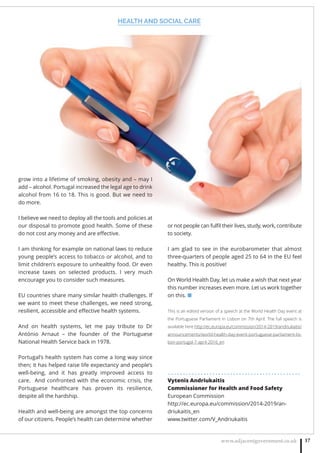
We cannot watch and do nothing while our children
HEALTH AND SOCIAL CARE
www.adjacentgovernment.co.uk16
HEALTH AND SOCIAL CARE
www.adjacentgovernment.co.uk 17
or not people can fulfil their lives, study, work, contribute
to society.
I am glad to see in the eurobarometer that almost
three-quarters of people aged 25 to 64 in the EU feel
healthy. This is positive!
On World Health Day, let us make a wish that next year
this number increases even more. Let us work together
on this. ■
This is an edited version of a speech at the World Health Day event at
the Portuguese Parliament in Lisbon on 7th April. The full speech is
available here http://ec.europa.eu/commission/2014-2019/andriukaitis/
announcements/world-health-day-event-portuguese-parliament-lis-
bon-portugal-7-april-2016_en
. . . . . . . . . . . . . . . . . . . . . . . . . . . . . . . . . . . . . . . . . . . . .
Vytenis Andriukaitis
Commissioner for Health and Food Safety
European Commission
http://ec.europa.eu/commission/2014-2019/an-
driukaitis_en
www.twitter.com/V_Andriukaitis
grow into a lifetime of smoking, obesity and – may I
add – alcohol. Portugal increased the legal age to drink
alcohol from 16 to 18. This is good. But we need to
do more.
I believe we need to deploy all the tools and policies at
our disposal to promote good health. Some of these
do not cost any money and are effective.
I am thinking for example on national laws to reduce
young people’s access to tobacco or alcohol, and to
limit children’s exposure to unhealthy food. Or even
increase taxes on selected products. I very much
encourage you to consider such measures.
EU countries share many similar health challenges. If
we want to meet these challenges, we need strong,
resilient, accessible and effective health systems.
And on health systems, let me pay tribute to Dr
António Arnaut – the founder of the Portuguese
National Health Service back in 1978.
Portugal’s health system has come a long way since
then; it has helped raise life expectancy and people’s
well-being, and it has greatly improved access to
care.  And confronted with the economic crisis, the
Portuguese healthcare has proven its resilience,
despite all the hardship.
Health and well-being are amongst the top concerns
of our citizens. People’s health can determine whether
N
eurodegenerative diseases
are a growing global challenge
as medical advances ensures
more individuals live longer. By 2020
there will be more than 40 million indi-
viduals in the world with Alzheimer’s
disease and by 2040, without the
development of truly disease modifying
drugs this will be more than 80 million.
Similar trends are also seen for
Parkinson’s disease. The annual treat-
ment and social care of individuals
with Neurodegenerative diseases is
estimated to be more than $1 trillion
by 2050, making it one of the most
important socioeconomic challenges
of this century. Discovering and devel-
oping disease modifying drugs i.e.
those that prevent progression of the
disease, has been very challenging
with many programs failing. One of the
reasons why the biopharmaceutical
industry is having challenges in
converting the emerging science in
these diseases is the way we classify
them. This is referred to as the
disease taxonomy.
Disease taxonomy
The medical disease taxonomy is
actually based on the work of William
Farr in the 19th century. It has been
refined since then as medical science
has advanced, but it is still based on
the signs and symptoms of the disease
that the patients have when they see
their doctor. This “phenotypic” based
system has served us well for many
decades but as it does not reflect the
causes of the disease itself it is failing
when used to develop treatments
directed at the molecular causes of
disease. The current phenotypic
classification means that we cluster
together individuals with the same
symptoms even if the underlying
cause of the disease is different and
we separate individuals with the same
underlying cause of their disease if
the symptoms look different. This is
resulting in patients getting treated
with therapies where they have little
or no potential to respond and simi-
larly patients being denied treatments
they would benefit from.
An indication as to the importance of
this classification can be seen in 2
therapeutic areas where a more dis-
ease aetiological (causative) approach
has been used. These are in antibiotics
and cancer therapies. With regard to
infection a movement from broad
organ based classification e.g. pneu-
monia, UTI etc, to a pathogen based
system e.g. Streptococcus, Klebsiella
in the early and middle part of last
century led to the development of
treatments which could be based on
treating the pathogens regardless of
the organ that was affected. Similarly
in oncology at present the latest
personalised medicines which are
transforming patients’ lives are based
on the molecular cause of the disease
rather than the organ or tissue the
cancer is in.
The lack of detailed understanding of
the causes of neurodegenerative
diseases in individual patients and a
corresponding classification system is
significantly impacting the discovery
and development of true disease
modifying therapies.
Aetionomy
Aetionomy is an Innovative Medicine
Initiative (IMI) funded consortium
established to develop an initial
mechanistic based classification of
neurodegenerative diseases focusing
on Alzheimer’s and Parkinson’s disease.
This public- private partnership is
co-led by Duncan McHale from UCB
and Martin Hofman-Apitius from SCAI
Fraunhofer. The premise behind the
project is that although large sums
have been invested in research in
neurodegeneration and a lot of data
generated the co-ordination and inte-
gration of this data across the com-
munity has been less well addressed.
The consortium has brought together
experts in informatics, computing,
engineering, and mathematical
modelling of disease, neuroscience
and clinical neurology from leading
academic centres, as well as, neuro-
science, informatics and neurology
drug development experts from the
EFPIA Industry partners.
The project therefore is not focusing
on generating more data but on bringing
together all accessible data, curating
it to ensure consistency and putting it
into a knowledgebase which can be
mined and used for disease modelling.
Once finalised the knowledgebase will
www.adjacentgovernment.co.uk18
Reclassifying neurodegenerative diseases to
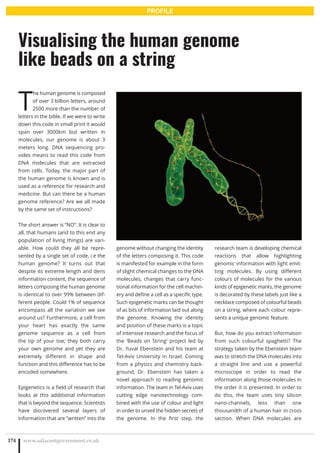
enable drug development and help patients
PROFILE
www.adjacentgovernment.co.uk 19
PROFILE
Professor Duncan McHale
Head Global Exploratory Development
UCB
Tel: +32 2 386 21 11
Duncan.mchale@ucb.com
http://www.aetionomy.org/
be available for both researchers to
access, as well as being a curated and
harmonised repository for the storage
of future research datasets.
The Aetionomy researchers will use
this database to identify sub-groups
of patients with different molecular
causes and will use this to develop a
new taxonomy of disease.
The need to truly share data
The biomedical community has already
spent over €10 billion in research
into the causes and treatments for
neurodegenerative diseases. This has
led to a high quality evidence base but
a lack of real progress for patients.
One contributing factor is the fact that
these projects often focus on individual
technologies e.g. genetics or hypothe-
ses e.g. the amyloid hypothesis in
Alzheimer’s disease. Aetionomy there-
fore decided that rather than generate
another set of data it would look to
create a framework
where the currently
available data could
be brought together
harmonised and stored
so that researchers
could look across
100s of millions of
euros of research
and develop new
hypotheses.
The knowledgebase
is now built and
based in Germany
and Luxembourg. It is
currently being popu-
lated using data from
publically available datasets, partner
data sets including EFPIA company
clinical trial datasets and datasets
from collaborators. We are now reach-
ing out to the whole neurodegenera-
tion research community and asking
for them to share their data so that
we can integrate together all of the
high quality science that has already
been performed and enable drug
discovery and developments for the
millions of current and future suffer-
ers of this disease. This call to share
data is being driven at the highest
levels and was a key recommendation
of the OECD meetings on meeting the
Alzheimer’s disease challenge, and
was christened “unleashing the power
of Big Data for Alzheimer’s Disease
and Dementia Research”. A failure to
share data will result in duplicating
research or wasting resources on
areas that have not been validated
and delaying getting treatments to
patients.
“By 2020 there will be more than
40 million individuals in the world
with Alzheimer’s disease and by
2040, without the development of
truly disease modifying drugs this
will be more than 80 million.”
The Future
The future will include a new way to
classify neurodegenerative diseases
based on the causes of the disease in
each individual. We will have screening
programs to identify patients at risk of
developing neurodegenerative diseases
and we will start treatment before
symptoms occur. However before we
get to this nirvana we must come
together and share the data that is
being generated across large num-
bers of publically and privately funded
research programs to deliver on our
common goal of discovering and
developing treatments for neurode-
generative conditions.
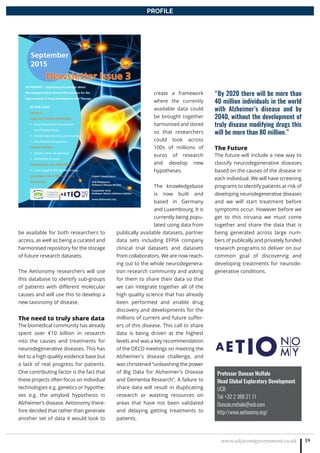
September
2015
AETIONOMY – Organising Knowledge about
Neurodegenerative Disease Mechanisms for the
Improvement of Drug Development and Therapy
IN THIS ISSUE
Editorial
Legal and Ethical Challenges
• Data Protection Framework
and Clinical Study
• Closed data-sharing community
• The Patient Perspective
• Leibniz Univ. of Hanover
• Alzheimer Europe
Cooperation with PRECISESADS
• Joint Legal & Ethical Workshop
Secondary Use of Medical Data
References
Newsletter Issue 3
N O
M Y
Project Coordinators:
UCB Biopharma
Professor Duncan McHale
Fraunhofer SCAI
Professor Martin Hofmann-Apitius
www.aetionomy.org
PATHway vision
Cardiovascular disease (CVD) is the
leading cause of premature death
(30% of all deaths) and disability in
Europe and worldwide (WHO), costing
the EU economy almost EUR 196 billion
a year. With changing demographics
and deteriorating lifestyle this situa-
tion will worsen considerably, which is
neither economically or socially
sustainable. Effective cardiac rehabil-
itation (CR) can significantly improve
mortality and morbidity rates, leading
to longer independent living and a
reduced use of health care resources.
However, uptake of traditional com-
munity-based long-term (phase III) CR
is very low across member states
(approx. 11%), and is further dimin-
ished by low subsequent adherence
rates. Key reasons for this include:
severe lack of programmes, travel
time, scheduling issues, lack of peer
mentoring, and low self-efficacy asso-
ciated with poor exercise technique
and perceived poor ‘body image’ (not
wanting to exercise with large groups
of ‘strangers’).
In summary, PATHway constitutes a
home-based lifestyle behavioural
change program that will adapt to a
patient’s progress through the CR pro-
gram, as well as, providing feedback
on this progress to both the patient
and the clinician. Realising the PATH-
way vision offers a unique opportunity
to put in place a novel approach to
CR that has the potential to address
key limitations associated with the
currently unsustainable provision of
healthcare for CVD.
Furthermore, the overall concept and
system is easily transferrable to address
other diseases/conditions including
diabetes, osteoporosis, breast/colon
cancers, and obesity providing market
opportunities for the commercialisa-
tion of PATHway beyond CVD. The
technical tools required to implement
PATHway will leverage and extend the
state of art in a number of different
areas, including motion capture, exercise
evaluation, physiological and lifestyle
monitoring, exergaming/exerclass,
home-based human-computer inter-
faces, multi-parametric data modeling
and decision support systems, ensuring
the creation of valuable Intellectual
Property (IP) that can be leveraged
within a considered and strategically
sound exploitation plan as the basis
for successful commercialization of
the PATHway concept.
www.adjacentgovernment.co.uk20
PATHway leading the way:
ERS paving the way
PROFILE
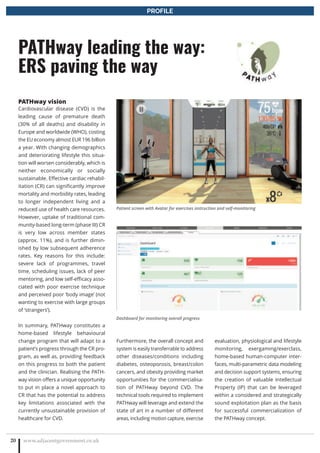
Patient screen with Avatar for exercises instruction and self-monitoring
Dashboard for monitoring overall progress
www.adjacentgovernment.co.uk 21
PROFILE
René Schippers
Director
Electronic Record Services B.V.
Tel: +31 623 961 239
r.schippers@e-recordservices.eu
www.e-recordservices.eu
PATHway project
The PATHway project ( www.pathway
2health.eu/ ) is an EU H2020 project
lead by Dublin City University (DCU),
Ireland’s University of Enterprise.
PATHway will provide individualised
cardiac rehabilitation (CR) programs
that use regular and socially inclusive
exercise sessions. These are used to
support a personalised comprehensive
lifestyle intervention program. This
encompasses patient’s exercise/physical
activity, smoking, diet, stress manage-
ment, alcohol use and medication
compliance. Patients are enabled to
better understand and deal with their
own condition and to lead a healthier
lifestyle in general. An internet-enabled
sensor-based home exercise platform
allows remote participation in CR
exercise programs at any time from
the comfort of their own living room. 
PATHway will perform research to proof
the additional value of such personal
home based cardiac rehabilitation
training.
ERS – EHR-system
ERS is a Dutch SME (www.e-recordser-
vices.eu) and partner in the PATHway
project. ERS provides the Health Data
management System (HDMS) to process
all clinical, administrative and research
related data such as data from devices
at home and data from clinical deci-
sion support services. The PATHway
HDMS supports open data for clinical
and population research. The HDMS
uses highly structured data and is fully
model driven. HDMS includes a con-
figurable rules editor and rules engine
to create ‘intelligent’ screens and pro-
vide clinical decision support services.
In an automated way, using these
structured data specifications, data
entry screens, the data base schema
and application program interfaces
(API’s) are generated. This results in a
very flexible EHR-system that can be
configured in a controlled and stan-
dardised way to support users. It can
be adapted for all Clinical Pathway’s.
The EHR-system adheres to all EU and
local rules and regulations with respect
to data privacy.
Benefits
Potential benefits of the PATHway
HDMS are:
a cost-effective, flexible, Electronic•
Health Record system;
supporting generic continuity of care•
and clinical pathways with capabilities
for Clinical and Population research
using Electronic Data Research Capture
Forms to re-use Clinical Data from HDMS;
integration with commercial sensors,•
devices, games, and;
intelligent Decision Support Systems•
with access to normalised patient
data all supporting (self-) treatment
of patients at home in a monitored
manner by the care giver.
ERS HDMS can be used for:
p-Health, because it supports tailor-•
made and adaptive treatment of
patients at home;
m-Health, because mobile sensing•
devices are integrated, and;
e-Health, because of the integration•
with EHR-system(s) and supporting
research.
PATHway partners
DCU, Ireland
KU Leuven, Belgium
CERTH, Greece
ERS, the Netherlands
Nurogames, Germany
Engineering, Italy
University of Glasgow, Scotland
University of Ulster, North Ireland
PATHway project is funded by the Horizon 2020 Framework Programme
of the European Union, under grant agreement nr:643491
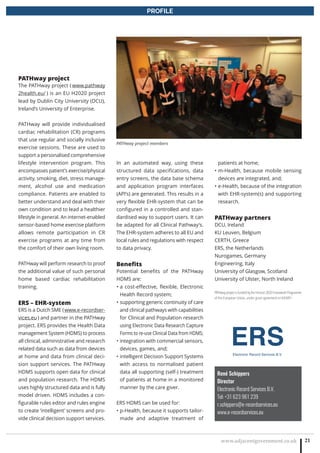
PATHway project members
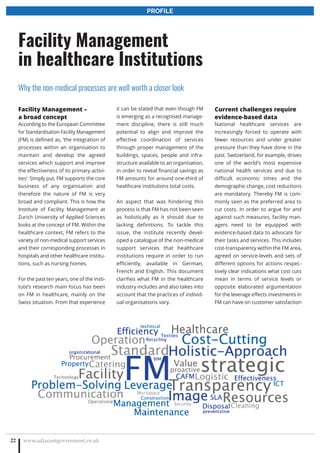
Facility Management –
a broad concept
According to the European Committee
for Standardisation Facility Management
(FM) is defined as, ‘the integration of
processes within an organisation to
maintain and develop the agreed
services which support and improve
the effectiveness of its primary activi-
ties’. Simply put, FM supports the core
business of any organisation and
therefore the nature of FM is very
broad and compliant. This is how the
Institute of Facility Management at
Zurich University of Applied Sciences
looks at the concept of FM. Within the
healthcare context, FM refers to the
variety of non-medical support services
and their corresponding processes in
hospitals and other healthcare institu-
tions, such as nursing homes.
For the past ten years, one of the insti-
tute’s research main focus has been
on FM in healthcare, mainly on the
Swiss situation. From that experience
it can be stated that even though FM
is emerging as a recognised manage-
ment discipline, there is still much
potential to align and improve the
effective coordination of services
through proper management of the
buildings, spaces, people and infra-
structure available to an organisation,
in order to reveal financial savings as
FM amounts for around one-third of
healthcare institutions total costs.
An aspect that was hindering this
process is that FM has not been seen
as holistically as it should due to
lacking definitions. To tackle this
issue, the institute recently devel-
oped a catalogue of the non-medical
support services that healthcare
institutions require in order to run
efficiently, available in German,
French and English. This document
clarifies what FM in the healthcare
industry includes and also takes into
account that the practices of individ-
ual organisations vary.
Current challenges require
evidence-based data
National healthcare services are
increasingly forced to operate with
fewer resources and under greater
pressure than they have done in the
past. Switzerland, for example, drives
one of the world’s most expensive
national health services and due to
difficult economic times and the
demographic change, cost reductions
are mandatory. Thereby FM is com-
monly seen as the preferred area to
cut costs. In order to argue for and
against such measures, facility man-
agers need to be equipped with
evidence-based data to advocate for
their tasks and services. This includes
cost-transparency within the FM area,
agreed on service-levels and sets of
different options for actions respec-
tively clear indications what cost cuts
mean in terms of service levels or
opposite elaborated argumentation
for the leverage effects investments in
FM can have on customer satisfaction
www.adjacentgovernment.co.uk22
Facility Management
in healthcare Institutions
Why the non-medical processes are well worth a closer look
PROFILE
www.adjacentgovernment.co.uk 23
PROFILE
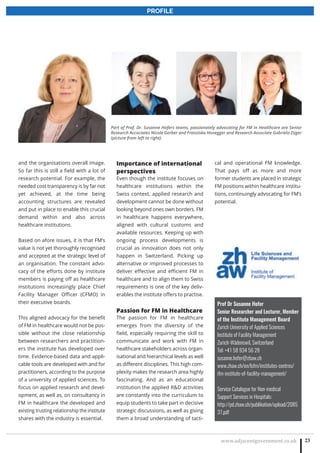
Prof Dr Susanne Hofer
Senior Researcher and Lecturer, Member
of the Institute Management Board
Zurich University of Applied Sciences
Institute of Facility Management
Zurich-Wädenswil, Switzerland
Tel: +41 58 934 56 28
susanne.hofer@zhaw.ch
www.zhaw.ch/en/lsfm/institutes-centres/
ifm-institute-of-facility-management/
Service Catalogue for Non-medical
Support Services in Hospitals:
http://pd.zhaw.ch/publikation/upload/2085
37.pdf
and the organisations overall image.
So far this is still a field with a lot of
research potential. For example, the
needed cost transparency is by far not
yet achieved, at the time being
accounting structures are revealed
and put in place to enable this crucial
demand within and also across
healthcare institutions.
Based on afore issues, it is that FM’s
value is not yet thoroughly recognised
and accepted at the strategic level of
an organisation. The constant advo-
cacy of the efforts done by institute
members is paying off as healthcare
institutions increasingly place Chief
Facility Manager Officer (CFMO) in
their executive boards.
This aligned advocacy for the benefit
of FM in healthcare would not be pos-
sible without the close relationship
between researchers and practition-
ers the institute has developed over
time. Evidence-based data and appli-
cable tools are developed with and for
practitioners, according to the purpose
of a university of applied sciences. To
focus on applied research and devel-
opment, as well as, on consultancy in
FM in healthcare the developed and
existing trusting relationship the institute
shares with the industry is essential.
Importance of international
perspectives
Even though the institute focuses on
healthcare institutions within the
Swiss context, applied research and
development cannot be done without
looking beyond ones own borders. FM
in healthcare happens everywhere,
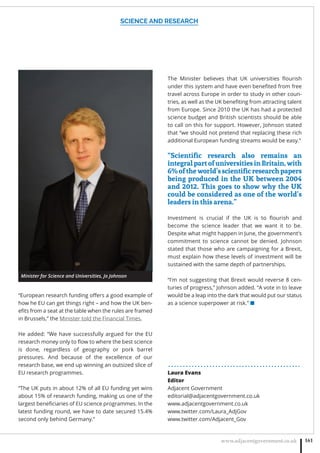
aligned with cultural customs and
available resources. Keeping up with
ongoing process developments is
crucial as innovation does not only
happen in Switzerland. Picking up
alternative or improved processes to
deliver effective and efficient FM in
healthcare and to align them to Swiss
requirements is one of the key deliv-
erables the institute offers to practise.
Passion for FM in Healthcare
The passion for FM in healthcare
emerges from the diversity of the
field, especially requiring the skill to
communicate and work with FM in
healthcare stakeholders across organ-
isational and hierarchical levels as well
as different disciplines. This high com-
plexity makes the research area highly
fascinating. And as an educational
institution the applied R&D activities
are constantly into the curriculum to
equip students to take part in decisive
strategic discussions, as well as giving
them a broad understanding of tacti-
cal and operational FM knowledge.
That pays off as more and more
former students are placed in strategic
FM positions within healthcare institu-
tions, continuingly advocating for FM’s
potential.
Part of Prof. Dr. Susanne Hofers teams, passionately advocating for FM in Healthcare are Senior
Research Accociates Nicole Gerber and Franziska Honegger and Research Associate Gabriela Züger
(picture from left to right).
Leading independent European
providers of Healthcare System
Assessment since 2004
Europe
• Euro Health Consumer Index 2005, 2006, 2007,
2008, 2009, 2012, 2013, 2014
• Euro Consumer Heart Index 2008
• Euro Diabetes Care Index 2008, 2014
• Euro HIV Index 2009
• Euro Patient Empowerment Index 2009
• Nordic COPD Index 2010
• Tobacco Harm Prevention Index 2011
• Euro Headache Index 2011
• Euro Hepatitis Index 2012
• Euro Vision Scorecard 2013
• Euro Pancreatic Cancer Index 2014
Sweden, others
• Health Consumer Index Sweden 2004, 2005, 2006
• Diabetes Care Index Sweden 2006, 2007, 2008
• Breast Cancer Index Sweden 2006
• Vaccination Index Sweden 2007, 2008
• Renal Care Index Sweden 2007, 2008
• Smoke Cessation Index Sweden 2008
• COPD Index Sweden 2009, Nordic 2010
• Advanced Home Care Index Sweden 2010
• Euro-Canada Health Consumer Index
Canada 2008, 2009
• Provincial Health Consumer Index Canada 2008,
2009, 2010
• All Hospitals Index Sweden 2011
www.healthpowerhouse.com
Dr Arne Bjornberg | Chairman  COO | Tel: +46 705 848 451 | arne.bjornberg@healthpowerhouse.com
Johan Hjertqvist | Founder  President | Tel: +46 707 521 899 | johan.hjertqvist@healthpowerhouse.com
› Comparing healthcare systems performance in
37 countries from a consumer/patient view.
› Since 2004, more than 40 index editions, available for free.
› Index projects financed through unconditional development
grants, similar to medical faculty sponsored research.
eHealth is for citizens
Terje Peetso, MD, Policy Officer for DG CONNECT at the European Commission discusses how online
healthcare can be beneficial to patients…
C
itizens’ participation in managing their own
healthcare has consistently increased over the
last decades and digital tools certainly play an
important role in this. The process consists of a
number of elements: access to personal health data
and information; use of technological tools for moni-
toring and getting professional guidance; the creation
of personal health records; active participation in all
steps of healthcare path – from prevention to rehabil-
itation with making necessary inputs and accepting the
need for changes.
Today, the internet is most often used as a source of
health related information and according to the Euro-
barometer on digital health literacy of 2014,1
over
three-quarters of respondents (77%) agree that the
internet is a good tool for improving their knowledge
of health-related topics. Another valuable characteristic
of the internet is that it allows people to access their
health records outside of healthcare settings. Both of
these aspects need to be carefully addressed.
Some websites can significantly improve people’s
health literacy and help them to better understand
their medical condition. At the same time it is important
that information comes from a trustworthy source. As
most of us use search engines for finding an answer to
our health questions, a certain level of health knowl-
edge is required, not only for understanding information
provided on a website, but also for assessing its credi-
bility. Horizon 2020 is going to fund projects that aim
at improving digital health literacy using online courses
with open access to all citizens, including children and
the elderly and high-risk patient groups.2
With regards to how citizens’ access their electronic
health records (EHR), there is still a lot to be done.
According to the “overview of the national laws on
electronic health records in the EU”3
, only 14 Member
States grant patients full access to their EHRs. Among
the countries which do not allow patients to access all
the content, the typical reason is that access could
cause harm to the patient. However, the Competitiveness
and Innovation Framework Programme (CIP) project
SUSTAINS evaluated in many Member States, the
impact of eHealth tools to patient empowerment 4
which demonstrated that patients are expecting to
have full access, and do not find any kind of information
about their own medical condition being harmful. On
the contrary, for example the Swedish patient associa-
tions strongly argued for patient choice regarding a
respite of 14 days before a health record entry is visible
to the patient. During the implementation of the
SUSTAINS project resistance among physicians gradually
decreased and healthcare professionals saw more
opportunities and advantages with the e-services com-
pared to the beginning of the project. My health data
is about me and my health and I would like to know
everything about this as soon as possible. It is much
easier to handle difficult information together with
friends and family and then go to see a doctor with
prepared questions and avoid emotional reactions that
would prevent meaningful discussion about treatment
options.
The importance of this issue is highlighted in the
Patients’ Charter on Patient Empowerment – “Patients
have the right to receive information they need and
want, in the right amount and format and at the right
time, in simple enough language to enable them to make
choices according to their wishes “.5
The use of mobile health and wellbeing apps is becoming
more and more popular and new apps and innovative
solutions are coming out every day. While today health
and fitness apps are one of the fastest growing cate-
gories, a lot is also happening in the area of medical
apps, many of which aim at helping people to overcome
HEALTH AND SOCIAL CARE
www.adjacentgovernment.co.uk28
HEALTH AND SOCIAL CARE
www.adjacentgovernment.co.uk 29
acute diseases, as well as effectively cope with chronic
diseases.  Of course, the use of both types of apps
requires a good level of health literacy and it adds valu-
able information to our health record. For example, a
simple measurement of steps can first of all remind us
about the importance of physical activity, but at the
same time it can provide valuable information about
the status of our health with different medical condi-
tions e.g. with mental diseases, where a decrease
in physical activity may be one of the early symptoms
and may provide useful information for healthcare
professionals. As validity and reliability of the data
that health apps collect and process is essential, the
Commission has set up a working group to develop
guidelines for assessing the issue. Twenty members
from civil society, research and industry organisations
plus Member States’ government representatives
participate in the working group 6
. The guidelines are
expected to be published by the end of this year.
How eHealth can support patients in health and care
management will be thoroughly discussed at the
eHealth Week 2016 in Amsterdam on 8-10 June
organised by the Dutch Ministry of Health as part of
the Dutch Presidency of the Council of the European
Union, the European Commission and HIMSS
Europe7
. ■
Disclaimer: This paper expresses the personal views of
the author and in no way constitutes a formal/official
position of the European Commission.
1 http://ec.europa.eu/public_opinion/flash/fl_404_en.pdf
2 http://ec.europa.eu/research/participants/portal/desktop/en/opportun-
ities/h2020/topics/2439-sc1-hco-12-2016.html
3 http://ec.europa.eu/health/ehealth/docs/laws_report_recommendat-
ions_en.pdf
4 http://www.sustainsproject.eu/
5 http://www.eu-patient.eu/globalassets/campaign-patient-empowerm-
ent/charter/epf_pe_charter_110316.pdf
6 https://ec.europa.eu/digital-single-market/en/news/new-eu-working-
group-aims-draft-guidelines-improve-mhealth-apps-data-quality
7 http://www.ehealthweek.org/ehome/index.php?eventid=128630
. . . . . . . . . . . . . . . . . . . . . . . . . . . . . . . . . . . . . . . . . . . . .
Terje Peetso, MD
Policy officer – Unit H1 – Health and wellbeing
Directorate-General Communications Networks,
Content and Technology (DG CONNECT) – European
Commission
terje.peetso@ec.europa.eu
www.ec.europa.eu/digital-single-market/en/dg-connect
B
RIDGE Health is a European
project under the third Euro-
pean Union (EU) Health
Programme. The acronym stands
for Bridging Information and Data
Generation for Evidence-based health
policy and research. One of its major
tasks is to prepare a comprehensive,
integrated and sustainable EU health
information system which will incor-
porate know-how and technical tools
to coordinate and harmonise research
and surveillance for Member States in
key EU health policy areas.
Why do we need an EU health
information system?
European countries are struggling
with common challenges, such as pro-
viding care to ageing populations with
rising occurrences of chronic diseases
and multi-morbidity that are largely,
but not exclusively, associated with
unhealthy lifestyles. At the same time,
each country has to maintain excellent
health care systems. Health care costs
are generally rising, partly because of
demographic pressures, but also due
to costly innovations in healthcare.
Moreover, resources available to
Member States’ health systems are
diminishing due to the current eco-
nomic situation. Scientific evidence
from sound data and information,
and relevant research are needed to
address these common challenges
through evidence-based policy making.
Only a system operating at European
level will be able to deliver comparable
information on health and disease
patterns, health service use and
outcomes, and trends across Europe.
An EU health information system is
therefore a prerequisite to tackle
these common challenges effectively.
What are the benefits of an EU
health information system?
Working with an EU-wide health
information system supports sharing
comparable information on popula-
tion health and health systems across
Europe. This would allow Member
States to have a precise picture of the
situation in their country and compare
their outcomes to other Member
States. At EU level, a unified general
picture of the public health situation
in Europe can be generated.
Before comparison and benchmarking
can be possible, data needs to be har-
monised and a single methodological
approach to data collection needs to
be developed and supported for
better data quality. An EU health
information system can provide the
framework for that and involve key
stakeholders at Member States and
EU level, such as public health institutes.
It can facilitate the exchange of data
and ensure the sustainability of data
collection and availability of data for
evidence-based policy making.
Fostering EU-wide cooperation also
allows for an exchange of expertise
and capacity building, through strong
health information networks Member
States can learn from each other.
Simultaneously, such an approach can
address health information inequali-
ties in Member States and the EU.
Having the appropriate tools and
knowledge allows policymakers to
respond effectively to population
health and health systems’ challenges
and to evaluate policy measures.
But most importantly, what the EU
needs today is a coherent health
information strategy which would
guide and coordinate EU action in
public health and across policy areas
in the coming decades. Currently, a
variety of EU institutions perform
activities in health information. It is
not clear which institutions are
involved in which activities and
how those activities are distributed. A
holistic approach is lacking. An over-
arching EU health information system
can coordinate activities and provide
a link between institutions and
projects. It can centralise discussions
and overcome silo mentalities which
the current European Commission
(EC) is trying to overcome.
What is the political context?
Discussions on the creation of a
health information system at EU level
have a long history. Some Member
States have called for a new agency to
be created or to extend the mandate
of the European Centre for Disease
Prevention and Control (ECDC) to
include health information. The Coun-
cil of the EU conclusions of December
2013 invited the EC and Member
www.adjacentgovernment.co.uk30
BRIDGE Health: working towards
an EU health information system
Petronille Bogaert, Jean-Marie Robine, Herman Van Oyen for BRIDGE Health
PROFILE
www.adjacentgovernment.co.uk 31
PROFILE
Bridge Health Coordination
Scientific Institute of Public Health
Tel: +32 2 642 57 48
bridge.coordination@wiv-isp.be
www.bridge-health.eu
www.twitter.com/bridge_health
States “to cooperate with a view to
establishing a sustainable and inte-
grated EU health information system
[...] built on what has already been
achieved through different groups
and projects […] exploring in particu-
lar the potential of a comprehensive
health information research infra-
structure consortium (ERIC) as a tool”.
However, the EU and its Member
States still fail at putting it into place.
Nonetheless, investments have been
made in the past 20 years through EU
projects of the health programme.
Although the project-driven approach
is fragmented, it has led to success
stories in the development of common,
harmonised EU instruments such as
health indicators, and health interview
and examination tools.
What is BRIDGE Health doing?
BRIDGE Health is working towards an
EU health information system. It coor-
dinates and converges the best of EU
projects in domains of population and
health system monitoring, indicator
development, health examination
surveys, environment and health,
population injury and disease reg-
istries, clinical and administrative
health data collection systems and
methods of health systems monitoring
and evaluation. It builds on existing
knowledge and expertise to work
through horizontal activities with the
following objectives:
Enhance the transferability of health•
information and data for policy and
improve the utility and use of data
and indicators for stakeholders in
policy making, public health surveil-
lance and health care;
Reduce health information inequal-•
ity within the EU and within Member
States;
Develop a blueprint for a sustainable•
and integrated EU Health informa-
tion system by developing common
methods for :
- Standardisation of health informa-
tion gathering and exchange
between population health and
health systems information within
and between Member States;
- Standardisation of data quality
assurance systems;
- Health information priority settings;
and
- Harmonisation of ethical-legal issues.
The horizontal activities will provide
the building blocks for the EU health
information system. In May 2016
BRIDGE Health will present a policy
paper which can serve as a draft
agreement between Member States,
candidate and EEA/EFTA countries and
international organisations for the
construction of an EU health informa-
tion system. The policy paper will
include the scope, tasks, activities and
governance structure of a future EU
health information system. It will pres-
ent the strengths and limitations of a
set of possible structural and institu-
tional options to allow an informed
decision by the stakeholders.
Second General Assembly of BRIDGE Health on 22nd April 2016
L
ast year I attended an exhibition
entitled ‘500 years Vesalius’.
Andreas Vesalius (1514-1564)
was a Belgian physician who played a
pivotal role in the discovery of human
anatomy (The Fabric of the Human
Body).
The element of the exhibition that
struck me the most was the dissection
theatre in which the whole anatomy
of the human body was examined and
explained. It was extremely simple, an
open theatre where a number of
physicians opened a human corpse
and explained to all attendees their
understanding of the anatomy and
physiology. This lead to the most
important documentation on anatomy
and medical science in that era and
we still use the knowledge acquired by
Vesalius today.
This article is not about Vesalius, it’s
about innovation through and accel-
eration of digital health, ideally imply-
ing the following good practices:
Using the full potential of the increas-•
ingly available data while respecting
the owner’s privacy;
Turning data into information, infor-•
mation into knowledge, knowledge
into actionable insights;
Sharing and disseminating data,•
knowledge and insights amongst
professionals that are into the same
subject;
Pre-competitive interaction and•
collaboration amongst potential
competitors;
Creating a platform where profes-•
sionals can meet, test, experiment
and share lessons learned, based on
a vast amount of available real-life
data.
It goes without saying that the compu-
tational powers of the 21st Century
offer both enormous opportunities
and risks in taking healthcare to the
next level. Obviously this double-
edged sword creates dilemmas between
personal privacy and data sharing
for collaborative purposes. Risk
mitigation and transparency on the
ownership, sharing and use of data
are all key for guaranteeing the
personal rights of every citizen.
From my professional point of view on
digital health innovation and health
industry incubation and acceleration,
I started reasoning:
Imagine that there would be a•
neutral shared IT space that allows
companies to test their software/
hardware equipment against a ‘known
set of real-life health data records’;
Imagine that such a platform would•
facilitate message brokerage between
www.adjacentgovernment.co.uk32
Vesalius Health 4.0
Tomorrow’s breakthrough innovation in healthcare
PROFILE
www.adjacentgovernment.co.uk 33
PROFILE
Eric Van der Hulst
Program Manager Health
Tel: +32 495 58 44 04
eric.vanderhulst@iminds.be
Roger Lemmens   
VP Incubation, Industry  Health
Tel: +32 9 248 55 15
Mobile: +32 473 98 62 53
roger.lemmens@iminds.be
iMinds
www.iminds.be
www.twitter.com/iminds
applications and could check inter-
operability standards (both syntactic
and semantic);
Imagine that the comparison and•
incremental ‘wisdom’ of its mechanism
was able to ‘validate’ applications
in comparison to other (previously
accepted/validated) applications;
And imagine that the users (both•
citizens and care-providers) could
visit and monitor in a transparent way
the results of these experiments,
tests and validations.
At iMinds Health (Belgium) we help
great academic research grow into
start-ups and accelerate into success-
ful companies. In that position, we are
well placed for getting a good feel of
the as yet unmet needs in Flanders’
Digital Health innovation ecosystem.
Triggered by these learnings, we are in
the process of implementing an Inter-
operability, Test and Validation Lab
(ITV lab), seeking to create the oppor-
tunity lined out above. The target
audience of the ITV lab are, start-ups
and SME’s that are developing health
applications. We focus on helping
them understand the complexities of
the health and care market, its current
opportunities and challenges. We
enable experiments in silico in a
protected environment, i.e. without
having to enter the ‘real’ health
market without this prior testing.
The lab works with anonymised or
self-generated data. It currently serves
three purposes:
It promotes and showcases future•
health innovations;
It serves to promote government•
initiated eHealth applications
(+ standards) towards commercial
software vendors;
It offers a low-cost playing field•
to suppliers of health applications
of any size where they can test,
integrate and partially validate their
applications.
Partially similar initiatives exist in other
domains and have proven their value:
FabLabs where startups can used•
shared facilities and 3D-print their
prototypes on a pay for use basis;
Biobanks of well-documented human•
tissues accessible to researchers
(with strict guidelines).
Provided privacy and transparency
are guaranteed by the competitive
ecosystem of applications handling
the data, big data is not equal to big
brother.
I believe that having a Vesalius Health
4.0 open Health Innovation Lab has the
potential to significantly accelerate
the use, acceptance and validation of
healthcare applications. That kind of
initiatives across the world will boost
innovation and integration of health,
increase competition in a faster grow-
ing market and build bridges between
the consumer, the healthcare profes-
sional, his suppliers and government
authorities. With iMinds Interoperabil-
ity, Test and Validation Lab, we are
fully committed to doing our share.
Marc Lange, Secretary-General and Diane Whitehouse, Member of the Secretariat at
the European Health Telematics Association (EHTEL) explain how digital technologies are helping
to transform health service delivery…
O
ur daily life is becoming increasingly digital,
and people are considering this move as
the way to go for more and more activities.
Digital health is really happening now too. Technology-
enabled care and health is on the agenda of people,
patients, health services, and researchers. Mobile
devices in particular are accelerating the use of health
apps, and are easing people’s access to health data
based on their own electronic healthcare records.
In EHTEL, this is exactly what we are seeing. EHTEL (the
European Health Telematics Association) has been
active on digital health since its launch in Brussels in
1999. EHTEL supports more than 60 corporate
members – who come from all over the European
scene – in expanding the use of digital health services.
As a result, the association is a leader in sharing
lessons learned on the latest developments in digital
health: telehealth use is growing, with and through the
association’s members.
Transforming health delivery and its impact
As in many other sectors, digital health is having a
transformational impact on the way health is
delivered. Digitalisation is expected to have a positive
impact on the efficiency, hence sustainability, of
healthcare systems. It is also expected to have a
positive impact on the integration of health and social
care to the benefit of all the actors in the field.
The fact is well known: today chronic diseases represent
a potential major burden to our healthcare systems
HEALTH AND SOCIAL CARE
www.adjacentgovernment.co.uk34
Our daily digital health
– is everyone ready?
HEALTH AND SOCIAL CARE
www.adjacentgovernment.co.uk 35
and to patients’ quality of life. Any efficiency gains in
managing and treating patients with chronic diseases
is therefore likely to be beneficial.
Currently, in routine care, patients with a chronic
disease – with no complications – are self-managing
their conditions through regular follow-up visits, every
3 or 6 months, to their general practitioners. They
are given guidance to improve their self-management
and of course, if necessary, referred to a specialist or
a hospital.
Working with telehealth centres
With telehealth, patients’ health can be followed every
single day by a telehealth centre. Patients can use a
variety of digital solutions that collect and send their
physiological measurements to a centre (for example,
in the case of patients with chronic heart failure or dia-
betes type 2, a blood pressure or blood glucose meter,
a pulse oximeter and intelligent weight scales). The role
of the telehealth centre is to assess whether the meas-
urements are in or out of the patient’s range, according
to a predefined and personalised set of parameters. If
the readings are out of range, an alert is generated that
follows the clinical protocol. The centre can also be in
charge of distance coaching for patients, so as to rein-
force self-management, provide further guidance, or
adapt their plans.
Learning from the results of United4Health
Earlier in 2016, the transformational impact of
telehealth was analysed by the United4Health project.
The project successfully implemented and assessed
the impact of telehealth services for patients with
chronic conditions. Its initiatives are underway in
Scotland, Wales, Slovenia and 11 other regions on the
continent. The results of this analysis were publicly
communicated for the first time on the occasion of the
project’s final conference, organised jointly with EHTEL.
Several key messages were delivered at the conference:
“Helping you live your life your way”: patients can•
indeed manage their chronic conditions more
efficiently, hence better prevent the worsening of their
health;
“Clinicians are now able to make important sensible•
decisions” by analysing patient data collected on a
daily basis;
“Telehealth can reduce unnecessary visits to clinicians”:•
it enables healthcare systems to use the resources
they have more efficiently.
Tangible benefits of the efficiency gains
While there is enough evidence about telehealth
benefits when it is used to transform healthcare, it is
still not so easy to assess its economic impact.
Evidence is only now emerging.
Economic analysis is often about analysing a moving
target. It is common sense that the cost of telehealth
depends strongly on factors like the size of the market
– at present, small although growing. Yet a shared ICT
infrastructure is still lacking. If the infrastructure were
to exist, it would enable pooling of some of the costs
over several services.
It is important to bear in mind that savings are likely
not to be directly ‘cashable’ (they might be absorbed
by another part of a healthcare system) and that they
may easily be side tracked from the direct aim of offer-
ing increased capacity in healthcare systems.
United4Health’s own positive experiences demonstrate
that transforming care delivery processes through
telehealth often need several cycles to optimise the
organisational and financial benefits. ■
. . . . . . . . . . . . . . . . . . . . . . . . . . . . . . . . . . . . . . . . . . . . .
Marc Lange
Secretary-General
Diane Whitehouse
Member of the Secretariat
The European Health Telematics Association (EHTEL)
info@ehtel.eu
www.ehtel.eu
mHEALTH: Challenges,
hopes and doubts
There are many hopes and at the same time, doubts related to the mHealth development.
Here MEP Michal Boni explains the reasons why…
F
irstly, mHealth development is part of the digital
revolution. It means that all aspects of the func-
tions of the healthcare systems can be changed
under the conditions related to the digital tools. On the
one hand, the new opportunities in the area of genetic
research and the possibilities to use the molecular
insights into health and diseases – open the new ways
for diagnosis. On the other, many new devices, wear-
ables, applications can give us the possibility to monitor
the real state of health in the real time. It is the back-
ground for adequate, fast intervention. Both: better
and deeper diagnosis and faster interventions create
the framework for the shift paradigm in the healthcare
area. This is the transit from the model of reaction on
the diseases to the model of avoiding of the diseases.
One of the important parts of this shift paradigm is
oriented on changing the minds of patients – to build
the possibility for taking the self-responsibility for their
own health via knowledge accessible by apps. It is easy
for some groups, but difficult for many people. So,
there are hopes and doubts.
“Better understanding of mHealth as a
game changer for the whole healthcare
system and the strong involvement of
partners can lead to the success.”
Secondly, what is the key factor of this healthcare shift
paradigm? All diagnostic efforts are focused on the
individual dimensions of the state of health of the
individual person. It establishes the personalisation of
the service. This is the special added value to the
healthcare system, which can give us the cost savings
(better organisation of the work, proper therapies
based on the real evidence etc.) and the stronger
patients’ satisfaction. A whole range of mHealth
devices and applications are user friendly. Of course,
for the effective functioning they require better infra-
structure: fast internet, future 5G for transferring data
and information in the milliseconds, and proper High
Performance Computing Centers. In addition, they
require standarisation of solutions and certified high
quality of measures. It is the hope for the future, but it
is also the threat: if the technology and infrastructure
is or in the shoot time, will be really ready?
Thirdly, the new model of healthcare is focused on
patients’ expectations and future, possible benefits of
personalised medicine. So it needs framework for the
new model of relations between the patients and doc-
tors. There is no possibility to make this shift paradigm
in the medical area without doctors. There is no danger
for keeping and improving the human dimension of
the relations between patients and physicians. The
human factor is fundamental: for interpretation of the
same phenomena and the results of the state of health
monitoring. It is also important for building the
personal climate between two sides of the process for
cooperation during the time of sickness and the time
of taking the self-responsibility by some patients. Of
course, all those – require the trust and the digital and
medical literacy. The education and promotion are very
much needed, as the only way to avoid weaknesses
and doubts – and develop mHealth solutions.
HEALTH AND SOCIAL CARE
www.adjacentgovernment.co.uk36
Michal Boni, MEP
HEALTH AND SOCIAL CARE
www.adjacentgovernment.co.uk 37
Fourthly, this new model of the healthcare system is
based on the Big Data, on the possibilities to process
the data, collect, transfer and share those data. At last,
it requires the privacy protection and the security – as
a basis for the trust. The rules need to be clear, trans-
parent at that area. It is important, if we want to avoid
many doubts. The problem of the privacy protection
and the security at the area of healthcare is important
because of the sensitiveness of those data. Anonimi-
sation and pseudonimisation of the data, together
with full encryption from the starting point to the end
of the transferring of the data – are the guarantees of
the safe development of the new mHealth solutions.
Finally, the shift paradigm is needed for the better
future, which during implementation processes
requires the cooperation between all stakeholders.
Why it is so important? Better understanding of the
mHealth as a game changer for the whole healthcare
system and the strong involvement of partners can
lead to success. In Europe the healthcare area belongs
to the Member States competences. This shift paradigm
in the health system depends on common efforts of all
European countries. And depends on the cooperation
of all partners: patients, physicians, managers, decision
and policy makers, researchers, business. If so, some
kind of the action plan for stakeholders is required. We
need to develop opportunities and hopes, than to
create still new doubts. ■
. . . . . . . . . . . . . . . . . . . . . . . . . . . . . . . . . . . . . . . . . . . . .
Michal Boni
MEP
European Parliament
michal.boni@europarl.europa.eu
http://www.europarl.europa.eu/meps/en/124896/MI
CHAL_BONI_home.html
www.twitter.com/MichalBoni
T
he implantation of genomic
medicine is one of the major
challenges of health science
for this century, in order to be able to
predict disease risk many years
before the onset of a particular illness,
implementing effective disease pre-
vention, and personalising pharmaco-
logical treatment. However, it is likely
that many current expectations will
become frustrating realities based on
delusional fantasies emerging from
unrealistic perspectives. We are at
the beginning of a very exciting
opportunity, just crossing the border
that separates conventional (repara-
tive) medicine from future (predictive)
medicine. There remains a few
conundrums surrounding the novel-
ties of genomics, transcriptomics, pro-
teomics and metabolomics. Genomics
cannot explain in full many different
aspects of the enigmatic world of
disease, especially the impact that
environmental factors may exert on
people with a vulnerable genomic
background prone to the develop-
ment of specific diseases. Epigenetics
seems to be a superb interpreter of
the symphony of our genome.
Epigenetics is the molecular phenom-
enon by which phenotypic changes
are transmitted from one generation
to another, with no apparent alter-
ations in structural DNA. Classical
epigenetic mechanisms, including DNA
methylation, histone modifications,
and microRNA (miRNA) regulation, are
among the major regulatory elements
that control metabolic pathways at
the molecular level. These epigenetic
modifications regulate gene expression
transcriptionally, and miRNAs suppress
gene expression post-transcriptionally.
Vertebrate genomes undergo epige-
netic reprogramming during develop-
ment and disease. Stable transmission
of DNA methylation, transcriptomes
and phenotypes from parent to clonal
offspring are demonstrated in various
asexual species, and clonal genotypes
from natural populations show
habitat-specific DNA methylation.
Methylation varies spatially across
the genome, with a majority of the
methylated sites mapping to intra-
genic regions. Not only nuclear DNA,
but also mitochondrial DNA may be
subjected to epigenetic modifications
related to disease development, envi-
ronmental exposure, drug treatment
and aging. Distinctly methylated
genes identified in different human
populations suggest an influence of
DNA methylation on phenotype
differences, such as, susceptibility to
certain diseases and pathogens, and
a response to drugs and xenobiotic
agents.
Epigenetics has emerged in recent
years as one of the most important
biological mechanisms linking expo-
sures during the course of life to long-
term health. Epigenetic status is
influenced by a range of environmen-
tal exposures, including diet and nutri-
tion, social status, chemical and
emotional environment, pregnancy
conditions, infertility, contraception,
and different modalities of pharmaco-
logical intervention. Epigenetic status
is also influenced by genotype, and
genetic variation in genes encoding a
plethora of enzymes and proteins.
Furthermore, DNA methylation con-
tributes to natural human variation.
Epigenomic modifications are involved
in a great variety of physiological and
pathological conditions; of major
importance are those associated with
age-related processes and with major
problems of health such as cardiovas-
cular disorders, obesity, cancer,
inflammatory processes, asthma and
allergy, and brain disorders. Multiple
epigenetic changes have been
reported in different tissues with
aging. Epigenetic factors influence life
span in several species. Major prob-
lems of health, such as cardiovascular
disorders, cancer and neurodegener-
ation are age-dependent processes in
which epigenetic alterations also play
a pathogenic role. Most of these
complex disorders are the result of
multiple defects distributed across
the human genome together with the
interaction of environmental factors
and epigenetic phenomena. Some of
these medical conditions are suscep-
tible to epigenetic intervention
with epigenetic drugs. Interventions
targeting epigenetic regulation might
be effective in treating a range of age-
related neurodegenerative disorders.
Pharmaceuticals, pesticides, air
pollutants, industrial chemicals, heavy
metals, hormones, nutrition, and
behavior can change gene expression
through a broad array of gene regula-
tory mechanisms. Mechanisms
include regulation of gene transloca-
tion, histone modifications, DNA
methylation, DNA repair, transcription,
www.adjacentgovernment.co.uk38
Epigenetics: The missing link at
the frontier of health and disease
PROFILE
www.adjacentgovernment.co.uk 39
PROFILE
Ramón Cacabelos,
M.D., Ph.D., D.M.Sci.
Professor
Genomic Medicine, Camilo José Cela
University, Madrid
President
EuroEspes Biomedical Research
Center, Institute of Medical Science and
Genomic Medicine, Corunna, Spain
President
World Association of Genomic Medicine
EuroEspes Biomedical Research Center
www.euroespes.com
RNA stability, alternative RNA splicing,
protein degradation, gene copy
number, and transposon activation.
Genetic variation associated with
different diseases interferes with
miRNA-mediated regulation by creat-
ing, destroying, or modifying miRNA
binding sites. miRNA-target variability
is a ubiquitous phenomenon in the
adult human brain, which may influ-
ence gene expression in physiological
and pathological conditions.
A good paradigm of the influence of
epigenetic factors on human pathol-
ogy is the oncogenic process in some
types of cancer. For instance,
myelodysplastic syndromes (MDS) are
clonal diseases of the elderly, charac-
terised by chronic cytopenias, dyspla-
sia, and a variable risk of progression
to acute myeloid leukemia (AML).
Aberrant methylation of tumor
suppressor gene promoters has been
established, suggesting that these
alterations are drivers of MDS patho-
genesis. Recurrent somatic mutations
in genes encoding proteins involved in
DNA methylation and demethylation,
and in covalent histone modifications,
have been reported in myeloid malig-
nancies, including MDS. Some clinical
trials have established hypomethylat-
ing agents as the mainstay of therapy
in the advanced forms of the disease.
Epigenetic modifications are reversible
and can potentially be targeted by
pharmacological and dietary interven-
tions. A series of epigenetic drugs
have been developed, and some of
these compounds have been approved
by the FDA for the treatment of neo-
plastic processes. Examples of epige-
netic drugs include the following: (i)
DNA methyltransferase inhibitors
(nucleoside analogs: decitabine,
azacitidine; small molecules; natural
products: curcumin derivatives,
psammaplins, tea polyphenols,
catechins, bioflavonoids); (ii) histone
deacetylase (HDAC) inhibitors (short-
chain fatty acids: sodium butyrate,
valproic acid, pivanex; hydroxamic
acids: vorinostat, oxamflatin, pyrox-
amide, trichostatin A, derivatives of
the marine sponge Psammaplysilla
purpurea, panobinostat, givinostat,
belinostat; cyclic peptides: romidepsin,
apicidin, trapoxin, chlamydocin;
benzamides: entinostat, mocetinostat;
ketones; sirtuin modulators (inhibitors
and activators); (iii) histone
acetyltransferase modulators; (iv)
histone methyltransferase inhibitors
(lysine/arginine methyltransferase
inhibitors); (v) histone demethylase
inhibitors; (vi) histone methyltrans-
ferase inhibitors; (vii) histone demethy-
lase inhibitors; (viii) chromodomain
inhibitors; (ix) bromodomain inhibitors;
and (x) miRNAs.
Epigenetic modifications are associated
with drug resistance. Chemotherapy
resistance remains an important
problem in cancer. The acquisition of
drug resistance is tightly regulated by
post-transcriptional regulators such
as RNA-binding proteins and miRNAs,
which change the stability and
translation of mRNA-encoding factors
involved in cell survival, proliferation,
epithelial-mesenchymal transition,
and drug metabolism. Alterations
mediated by epigenetic mechanisms
are important factors in cancer pro-
gression and in response to treatment
in different types of cancer.
Epigenetic intervention may modify
brain transcriptome, potentially revers-
ing age-related cognitive dysfunction.
Consequently, epigenetics is of consid-
erable translational significance to the
field of neuroprotection. In addition,
the efficacy and safety of both epige-
netic drugs and other medications are
closely associated with the efficiency of
the pharmacogenetic process in which
the gene clusters involved in the
pharmacogenetic network (pathogenic,
mechanistic, metabolic, transporter,
pleiotropic genes) are also under the
influence of epigenetic changes; there-
fore, the pharmacoepigenetic machin-
ery may determine the therapeutic
outcome (drug efficacy and safety). The
redundancy and promiscuity of this
complex system regulating drug effects
and toxicity will be a scientific challenge
of paramount importance for the phar-
maceutical industry and the medical
community in the coming years.
The cost of dementia
Julia Stuart of the Alzheimer’s Society sheds lights on the true cost of dementia
on the UK’s finances and resources and what it means for care received…
T
he Health Secretary’s ambitious aim to make
the UK the most dementia-friendly society in the
world by 2020 will fail without a dramatic
increase in social care resources.
In March Jeremy Hunt announced a series of commit-
ments to boost diagnosis rates, raise awareness and
encourage research.
But the Alzheimer’s Society estimates that the amount
spent by government on social care for people with
dementia will need to more than double, from £3.7bn
in 2015, to £8.5bn by 2030 just to keep pace with
demand and care inflation.
“The NHS could be the best at looking after people with
dementia, but that will be irrelevant if something isn’t
done about social care,” said Laurie Thraves, senior
policy officer for the charity. “And doing something
about social care is about the money, essentially.
Unless the money is there, I don’t think we can ever be
the best in the world.”
Around 70% of people in care homes have memory
problems or a dementia diagnosis. Social care is also
critical for those with dementia living at home, as many
need help washing and dressing. “Some people with
dementia who live alone won’t be able to perform these
basic tasks, or they’ll do them badly,” said Thraves. “If
someone is being cared for, these needs put additional
pressure on the carer. Caring is a full-time job and
people need as much help as they can get. It’s particu-
larly tricky when you have 2 frail elderly people, one of
whom has dementia, and you’re essentially asking the
other frail person to do a lot of heavy lifting.”
Carer burnout is one of the most common reasons
why someone with dementia is admitted to a care
home or a nursing home.
When people with dementia are unable to get care in
the community they often reach a crisis point more
quickly and end up in hospital, where they spend a lot
longer than other older people. Many become less
mobile, their muscles waste, and they find the environ-
ment more distressing and confusing than their peers
do. A significant proportion will then be admitted to a
care home rather than return to their own home.
“In 2 years the global cost of dementia is
estimated to reach $1 trillion, according
to the World Alzheimer Report 2015. The
report, commissioned by Alzheimer’s
Disease International, also found that the
costs of dementia in Europe increased by
25% to $300bn last year.”
“The vast majority of NHS spend goes on the final years
of our lives. We know that at the very end of life people
with dementia are often admitted to hospital for
expensive acute care when they could be cared for in
a care home if they had access to specialist palliative
services which people with other long-term conditions
such as cancer are more likely to be able to access,”
he said.
There are currently 850,000 people with dementia in
the UK. This is predicted to rise to 1 million within 10
years, and reach 2 million by 2050. A third of people
with dementia are already living in care homes.
Numbers are expected to increase from 313,000 to just
under half a million by 2030. This would require the
creation of an estimated additional 175,000 care home
places for people with dementia alone.
Since 2010, £4.6bn has already been taken from the
adult social care budget, resulting in an estimated
500,000 older and disabled people being denied access
to care. The government has promised around £1.5bn
HEALTH AND SOCIAL CARE
www.adjacentgovernment.co.uk40
HEALTH AND SOCIAL CARE
www.adjacentgovernment.co.uk 41
through the Better Care Fund, which tries to integrate
spend between health and social care, but the money
won’t materialise until between 2019 and 2020.
The total cost of dementia to society in the UK already
stands at £26.3bn, which is enough to pay the energy
bill for the entire country. Of that £4.3 bn is spent on
healthcare costs and £10.3bn on social care, met partly
by local councils and partly by people with dementia
themselves. A further £11.6bn is contributed by the
work of unpaid carers, many of whom have had to give
up their jobs to look after someone with dementia,
which can have a devastating effect on their own
finances and career.
In 2 years the global cost of dementia is estimated to
reach $1 trillion, according to the World Alzheimer
Report 2015. The report, commissioned by Alzheimer’s
Disease International, also found that the costs of
dementia in Europe increased by 25% to $300bn
last year.
“The best case scenario is that the government realises
that failing to invest in the right support in people’s
homes, care homes and residential homes is creating
additional costs for the NHS, and it’s also destroying
the lives of vulnerable older people,” said Thraves.
“We certainly welcome Jeremy Hunt’s commitment to
making the NHS better for people with dementia, but
that’s only half of the solution. We won’t be the best in
the world until we have a social care system that is
adequately resourced and on a sustainable financial
footing.” ■
. . . . . . . . . . . . . . . . . . . . . . . . . . . . . . . . . . . . . . . . . . . . .
Julia Stuart
Alzheimer’s Society
Enquiries@alzheimers.org.uk
www.alzheimers.org.uk
I
t is estimated that 10% of the costs
of health care in Switzerland (or
an equivalent of €500billion per
annum in the EU) being associated
with lost work is related to injury or
dysfunction of the musculoskeletal
system (Fig. 1). Surgical and subsequent
rehabilitative interventions are impor-
tant part of the therapy that re-estab-
lishes musculoskeletal function.
The Laboratory for Muscle Plasticity at
Balgrist University Hospital aims to
shed light on the underlying mecha-
nisms in skeletal muscle with the goal
of translating the findings into more
effective clinical applications.
Skeletal muscle plays a major part in
the control of movement and posture
and affects whole body metabolism
through its effects on energy expendi-
ture. Affections ranging from simple
overuse injury to rupture of tendon
and bones, or disease, lead to decon-
ditioning of skeletal muscle as a result
of inactivity and damage signals 1
. The
consequent loss in muscle strength
and fatigue resistance exerts a distinct
negative impact on the quality of life
and may render the affected individu-
als dependent. In these situations a
surgical intervention and rehabilitation
may be indicated, yet may come too
late as irreversible changes may have
resulted.
Focus on muscle plasticity: The labo-
ratory for muscle plasticity investigates
the mechanisms that underlie the
conditioning of skeletal muscle struc-
ture and function during recovery
from surgical interventions and reha-
bilitation. As shown through research
on Sport Performance this process is
driven by mechanical and metabolic
stimuli. It is mediated through a gene
response that instructs adjustments
in muscle composition with the repeated
impact of exercise during training. In
consequence, force production and
fatigue resistance of muscle may be
improved or maintained.
On the opposite muscle’s functional
capacity is reduced in the absence of
a physiological stimulus by a reduc-
tion in the size of muscle fibers and
their content in mitochondria (Fig. 2).
In fact, while the safety and effective-
ness of physical factors for muscle
conditioning are well established, the
dose-effect relationship between
exercise and muscle adaptation is
often not fully respected in clinical
practice. An example of this biological
regulation is the important role of
muscle contraction and loading in
preserving muscle mass of the bedrid-
den musculoskeletal patient after
surgery which otherwise loose muscle
mass at a pronounce rate. Genetic fac-
tors (so called gene polymorphisms)
importantly affect this adaptation 2
.
This indicates that gene polymorphisms
contribute to the inter-individual
variability of the response to surgical
interventions and rehabilitation.
“The Laboratory for Muscle Plasticity
at Balgrist University Hospital aims
to bring light into the underlying
mechanismsinskeletalmusclewiththe
goal of translating the findings into
more effective clinical applications.”
Research projects: The emphasis of
the research team lead by Prof. Martin
Flück at Balgrist is put on major mus-
culoskeletal affections that arise in the
context of the Orthopedic Clinics at
Balgrist Hospital. A special focus is put
on resolving the contribution of gene
polymorphisms to inter-individual dif-
ferences in the healing of muscle with
re-attachment of the ruptured rotator
cuff tendon, and the strengthening of
skeletal muscle with rehabilitative
exercise in patients.
www.adjacentgovernment.co.uk42
Therapies for weak muscles
PROFILE
Figure 1: Health Care costs in 2011 of the 7 major non-transmissive diseases
www.adjacentgovernment.co.uk 43
PROFILE
The aim is to develop personalised
forms of interventions that maximise
muscle adaptation (Fig. 3). The latter
approach is based on our previous
work that points out the important
exercise-intensity and exercise-type
related influence of gene polymor-
phisms on the muscle response to the
leisure type Sports activities 3
. This
opens a venue to tailor the therapeu-
tically effective exercise intervention
for patients which otherwise would
demonstrate little plasticity to a
generic exercise stimulus and for
which pharmaceuticals alone do not
work due to the importance of activity-
induced muscle metabolism for muscle
adaptations.
Patient-lead research: Since the begin-
ning of 2016, the laboratory has been
expanding its activities with the move
into brand new research facilities at
the Balgrist Campus (http://www.bal-
gristcampus.ch/en/). A key ingredient
of this research facility is an open-
space landscape where research
and development into musculoskeletal
medicine is integrated under one roof
between clinicians, biologist, engineers,
and industry. The facility is situated in
the vicinity of the orthopedic hospital
at Balgrist; thus providing a pipeline
for a reality-driven approach that
re-integrates questions from bedside
to bench and returns to the patient.
The laboratory for muscle plasticity is
looking for potential partners that may
want to exploit the research options
presented in the future Campus in the
frame of collaboration.
Bibliography
1 Muscle Injuries in Sports - Müller-Wohlfahrt HW, Ueblacker P,
HänselL,GarrettWE,GeorgThiemeVerlag,ISBN:9783131624710.
2 Flück M (2013). Diagnostics of endurance performance on the
level of gene expression. Sport-Orthopadie - Sport-Traumatologie,
29(3):203-213.
3 van Ginkel S, Amami M, Dela F, Niederseer D, Narici MV, Niebauer
J, Scheiber P, Müller E, Flück M. Adjustments of muscle capillarity
but not mitochondrial protein with skiing in the elderly. Scand J
Med Sci Sports. 2014 Sep 28. doi: 10.1111/sms.12324. [Epub
ahead of print]
Figure 2: Sketch summarising consequences of
overuse injury (rapture) and inactivity (reduced cross
sectional area) of muscle fibers. This is visualised in
micrographs vs. scale bars of 10 micrometer length
Figure 3: Overview of factors
that may be considered for a
personalised rehabilitation of
the patient
Professor Dr Martin Fluck
Laboratory for Muscle Plasticity
Balgrist Campus AG
Tel: +41 44 510 7350
mflueck@research.balgrist.ch
http://balgrist.ch/en/Home/Research-
and-Education/Orthopaedics/Muske-
lplastizitaet.aspx
Dementia to become trillion
dollar disease by 2018
Marc Wortmann, Executive Director of Alzheimer’s Disease International (ADI),
outlines the major impact dementia has worldwide and the urgent need for governments
to help provide a better quality of life for people with the condition…
T
he World Alzheimer Report 2015 estimates that
someone in the world develops dementia every
3 seconds. There are currently around 47 million
people living with dementia globally, with numbers
projected to nearly double every 20 years.
In the report, ‘World Alzheimer Report 2015: An
analysis of prevalence, incidence, cost and trends’ we
highlight the global impact of dementia and its social
and economic cost – currently estimated at $818bn. By
2018, dementia is set to become a trillion dollar
disease. By 2050, it will affect over 131 million people.
If global dementia care were a country, it would be
the 18th largest economy in the world, exceeding the
market values of companies like Apple and Google.
“ADI believes that the key to winning the
fight against dementia lies in a unique
combination of global solutions and local
knowledge. As such, it works locally, by
empowering Alzheimer associations to
promote and offer care and support for
people with dementia and their carers,
while working globally to focus attention
on dementia and campaign for policy
change from governments.”
The report further illustrates the geographic prevalence
and impact of a growing dementia crisis, showing that
58% of all people living with dementia today reside in
low and middle income countries. As the unique
challenges of dementia continue to pose a serious
challenge to healthcare systems worldwide, it is these
regions where dementia awareness and research is
critical, and where the stigma attached to illnesses
such as dementia poses a greater challenge.
The 10/66 Dementia Research Group, made of over
100 active researchers from more than 30 developing
countries and supported by ADI, is a key part of effort
to redress this balance. When the group was founded
less than 10% of all population based research into
dementia was directed towards the 66% of all people
with dementia who will live in developing countries. As
the only global federation, ADI works closely with
Alzheimer associations worldwide, fostering twinning
relationships, running Alzheimer University training
events and supporting dementia care projects.
ADI is continuing to urge policy makers around the
world to approach the issue with a broader agenda
and a wider representation of countries and regions,
particularly those in the G20 group of nations. A key
call in the report is for a significant upscaling of
research investment into care, treatment, prevention
and cure, as well as to build on the success of demen-
tia friendly community initiatives worldwide. These
initiatives provide a key framework for integrating a
better awareness of dementia needs in the community,
removing barriers to the involvement of people with
dementia in everyday life.
HEALTH AND SOCIAL CARE
www.adjacentgovernment.co.uk44
HEALTH AND SOCIAL CARE
www.adjacentgovernment.co.uk 45
The report findings demonstrate the urgent need for
governments to implement policies and legislation to
provide a better quality of life for people living with
dementia, both now and in the future.
You can read the full report on the ADI website at:
www.alz.co.uk/worldreport2015
About Alzheimer’s Disease International
ADI is the international federation of 83 Alzheimer
associations around the world, in official relations with
the World Health Organization. ADI’s vision is an
improved quality of life for people with dementia and
their families throughout the world. ADI believes that
the key to winning the fight against dementia lies in a
unique combination of global solutions and local
knowledge. As such, it works locally, by empowering
Alzheimer associations to promote and offer care and
support for people with dementia and their carers,
while working globally to focus attention on dementia
and campaign for policy change from governments.
For more information, visit www.alz.co.uk . ■
The World Alzheimer Report 2015 was independently
researched by King’s College London and Karolinska
Institute, Stockholm and was supported by Bupa.
. . . . . . . . . . . . . . . . . . . . . . . . . . . . . . . . . . . . . . . . . . . . .
Marc Wortmann
Executive Director
Alzheimer’s Disease International (ADI)
info@alz.co.uk
www.alz.co.uk
www.twitter.com/AlzDisInt
The global impact of dementia
We must now involve more
countries and regions in the
global action on dementia.
The World Alzheimer Report 2015 was independently researched
by King’s College London and supported by Bupa.
Around the world, there will be 9.9 million
new cases of dementia in 2015,
one every
3 seconds
46.8 million people worldwide are
living with dementia in 2015.
This number will almost
double every 20 years.
Much of the increase
will take place in low
and middle income
countries (LMICs):
in 2015, 58% of all people
with dementia live in LMICs,
rising to 63% in 2030
and 68% in 2050.
2015
2015
2018
2030
2050
The total estimated worldwide cost of
dementia in 2015 is US$ 818 billion.
By 2018, dementia will become
a trillion dollar disease, rising to
US$ 2 trillion
by 2030
If global dementia care were
a country, it would be the
18th largest
economy
in the world exceeding the
market values of companies
such as Apple and Google
Google
$368
billion (source: Forbes 2015 ranking).
Apple
$742
billion
Dementia
$818
billion
THE
AMERICAS
9.4MILLION
AFRICA
4.0MILLION
EUROPE
10.5MILLION
ASIA
22.9MILLION
68%
2050
This map shows
the estimated
number of
people living
with dementia
in each world
region in 2015.
gehT milaoblg fotcapm emdf tenf d iat d
hh aammiittssl el etataooe te t
n 2a iitneme
, d810y 2B
dolnoillirta
d
fft ot ossooe ce cddiiwwddllrrood wd weettaa
.noilli8 b1$ 8Ss U5 i10
emocl belia witneme, d
otgniisr,esaeisdraldol
ff
e
o
.l be 9lie wreh, tdl
aitnemef ds oesa
veeno
es3
ro
ondc
w
w c
noilli9 m
510n 2i
yrve
snd
,
1502
8102
SU illir2
03y 2b
g
not$
0
1.31 5
caintemedlaboglfI
d be tluot w, iyrtnuoa c
gralh8t1
omonce
8102
reewreac
ehbe t
tsge
ym
epplA
274$
noillib
eloogGG
D aitenemD
188$
noillib
n poilli8 m.64
h dtig wniil
nushiT
ve elb
mev
m
uod
oe wlpope
n 2
alliwre
sear0 yy 2rev
ere adiwdlr
.510a iitnem
tsolmr wb
86.4
noillim
.74
oiillm
7
no
noillim n
decexd eexoe whn ti
of cs oeulat vekram
d Ge anlpps Ah acus
lr
y
ehg tni
seianpmo
eloogG
PEORUE
eloogG
836$
noillibbilli
G
PE
: Fecruos( )gnikna5 r1s 20ebroF .)
ve elbuod rev .sear0 yy 2
02 15
320 03
0520 0
ETH
ARICEMA
49. NOLLIIM
SA
4N
ARICFA
.04
PEORUE
.10OLLIIM
PE
5NO
AIAS
.922 NOLLIIM
.9N
cuM
l tliw
f th o
e pka
ddimnda
siertounc
esearcne ihf t
won le icale p
eomncieldd
s :)CsIML(
hh
e
T
h
u
t
u
e
n
e
i
p
wi
i
.04 NOLLIIM
% o8, 5510n 2i
tnemedhtwi
3% io 6g tnisir
n 2% i8d 6an
elpol pelf a% o
s,CILMnieivlai
300n 23% i
.050n 2
ni
nogire
d Alrohe WT
.5102in mednoniotaclbalog
5 w10t 2roper Remihezld A
ne Logelols C’ngiy Kb
noiged rs aneirtnuoc
.iatnem
hecrrcaesey rltndenepdens ia
uy Bd betroppud snn ado
ehn ts in
dhe
.apu
S
ince the initial hypothesis by
Denham Harman that free
radicals are linked to aging,
60 years of research have focused on
unravelling the relationship between
reactive oxygen species (ROS) and bio-
logical function(s). This has led to the
field of redox biology, where the phys-
iological roles of ROS in cell signalling
that regulate biological and physiolog-
ical processes and in the generation of
energy through oxidative phosphory-
lation are being defined. Many types
of ROS are physiologically present in
tissues with the superoxide, hydrogen
peroxide, and nitric oxide species
being the most prominent. A number
of endogenous antioxidant and
enzyme systems are present in cells to
regulate ROS levels and a breakdown
of these protective antioxidant sys-
tems results in an elevated generation
of ROS. When combined with the
presence of free transition metals
such as iron, increased superoxide
and hydrogen peroxide radicals can
generate hydroxyl radicals. In addi-
tion, superoxide can also react with
nitric oxide to generate peroxynitrite
radical. Both the hydroxyl and perox-
ynitrite radicals are very toxic radicals,
although very short lived, for which no
endogenous detoxification systems
exist. Elevated ROS, referred to as
oxidative stress, can damage lipids,
proteins and DNA. Most importantly,
increased ROS has been detected in
almost all cancers, and in age related
diseases linked to neurodegeneration,
inflammation, diabetes, and vision/
sensory loss. Mitochondria generate
the majority of ROS, and this has also
led to a focus on the role of mitochon-
drial dysfunction in ROS-associated
pathology.
The complexity of most tissues and
organs makes elucidating the role(s)
of oxidative stress/redox dysregula-
tion and mitochondrial dysfunction in
the development of disease or aging
difficult. However, this process can be
simplified by using the transparent
mammalian lens of the eye as a
model. It is composed of an anterior
monolayer of cuboidal epithelial cells
and specifically aligned fiber cells that
are all enclosed in a collagenous
capsule to form the largest avascular
tissue in the body. The anterior
epithelial cells contain mitochondria
and other organelles, large amounts
of cytoskeletal proteins such as micro-
tubules and actin, and structural
proteins called crystallines. At the
germinative zone located in the lens
periphery, epithelial cells divide and
move to the equator where they
differentiate and elongate into lens
fibers to form highly ordered concen-
tric shells. In these new mature fiber
cells, the mitochondria and nuclei are
lost and new and different crystalline
proteins are produced. This process
occurs throughout life, so that the
fiber cells increase in age the closer
one goes to the lens centre, and at the
nucleus the fiber cells contain pro-
teins that were synthesised at the
foetal stage. The fiber cells and their
structural proteins are highly ordered
and this order must be maintained for
lens clarity. The unique structure and
biochemical differences between the
epithelial and fiber cells result in sig-
nificant differences in redox biology.
This difference makes the lens highly
susceptible to oxidative stress, causing
irreversible protein and membrane
changes that eventually results in
loss of transparency, i.e., cataract
formation. In the lens, one can clearly
investigate the role of oxidative
changes associated with mitochondrial
dysfunction, endoplasmic reticulum
stress, the reduction of detoxification
systems with age, and the role of
environmental factors which include
exposure to light and other radiation
effects that can generate radicals.
Because of the link between oxidative
stress and age-related diseases, pro-
grams designed to encourage one to
acquire a healthy lifestyle which
includes a diet rich in antioxidants
have been initiated. This has also
spawned a nutraceutical industry that
provides the consumer with natural
antioxidants with little or no demon-
strated evidence for their product effi-
cacy. In fact, a number of large clinical
trials, some sponsored by the National
Institutes of Health (NIH), have failed
to show significant efficacy. For exam-
ple, 7 randomised, double-masked,
placebo-controlled cataract trials with
trial populations ranging from 1,000
to nearly 40,000 participants orally
receiving select antioxidants or vitamin
formulations have failed to reduce
age-related cataract formation despite
oxidative stress being established to
be linked to cataract formation. This
failure may be due to the inability of
select antioxidants to achieve ade-
www.adjacentgovernment.co.uk46
The Ocular Lens as a tool for
developing antioxidant therapies
PROFILE
www.adjacentgovernment.co.uk 47
PROFILE
Peter F Kador PhD FARVO
Professor
College of Pharmacy
University of Nebraska
President and CEO
Therapeutic Vision, Inc.
Tel: +1 402 740 4397
pkador@unmc.edu
pkador@therapeuticvision.com
www.therapeuticvision.com/
quate therapeutic levels after oral
administration. This hypothesis is
supported by results from the AREDS
trials where retinal but not lens effi-
cacy was observed. Based on their
antioxidant effects in the eye, we have
developed and patented a nutraceuti-
cal formulation containing EGCG,
astaxanthin, resveratrol, and ethyl
pyruvate that when topically applied
to animal models delay the progres-
sion of lens changes associated with
diabetes-induced ER stress and UV
light. In addition, the formulation also
preserves tear flow in scopolamine-
induced dry eye and neural retinal oxi-
dation in dark-adapted light exposed
rats, a model for dry AMD. The formu-
lation is currently licensed for veteri-
nary use under the name Optixcare
Eye Health, and is anticipated to be
available soon for the human market.
Since natural antioxidants may also
not have adequate potency, we have
developed multifunctional antioxidants
that not only can scavenge free radicals
but also sequester and redistribute
free transition metals that can partic-
ipate in the generation of toxic
hydroxyl radicals. The compounds
contain a 2-amino-5-hydroxy-pyrimi-
dine group that has 100-fold greater
scavenging activity than vitamin E.
These orally active compounds have
been shown to achieve therapeutic
levels in the lens and retina as well as
the brain. In animal studies, these
compounds have been shown to
reduce cataract formation induced by
whole-head gamma irradiation, as
well as diabetic ER stress and UV light.
They also protect both the neural
retina and photoreceptor layer against
retinal degeneration induced by light
in dark-adapted rats, as well as reduce
amyloid beta plaque formation in the
brain, lens and retina of Alzheimer’s
transgenic mice. Recent studies also
suggest that these compounds protect
rats from noise-induced neurodegen-
erative damage and may protect against
blast-induced retinal neurodegenera-
tive damage. In vitro, the compounds
also appear to protect mitochondrial
function. These studies, combined
with the low apparent toxicity of the
compounds, suggest that these multi-
functional antioxidants (MFAOs) are
promising therapeutic agents for neu-
roprotection of the eye and brain, and
prevention of age-related ocular diseases
that merit clinical investigation.
Therapeutic Vision, Inc. is a small
company that is focused on the
development of pharmaceuticals
primarily for the companion animal
market and eventually their owners.
We are developing age-related
and diabetic therapies for the
preservation of vision and the
prevention of neurodegeneration.
How future-proof are the NHS
new ‘Healthy Towns?
Dr David Usher of human factors consultancy InterAction of Bath, discusses the issue
of enabling independent living later in life and asks will the NHS new Healthy Towns be designed
to accommodate societal changes already upon us?...
W
hen NHS England Chief Executive Simon
Stevens announced the plans for 10 new
‘Healthy Towns’ in February 2016 he said,
“The much-needed push to kick start affordable
housing across England creates a golden opportunity
for the NHS to help promote health and keep people
independent. We want to see neighbourhoods and
adaptable home designs that make it easier for older
people to continue to live independently wherever
possible.”
“We are a rapidly ageing society. The
Organisation for Economic Co-operation
and Development (OECD) warned in 2015
that within the next 15 years the UK will
become ‘super-aged’, having more than
21% of the population aged 65 or older. “
While exact details of the proposed 10 new towns
are yet to be revealed, there are a couple of obvious
questions regarding the eventual form they will take,
and especially regarding the issue of keeping people
independent as they grow older.
The worry is; that from the scant details so far
revealed, aged living appears to be viewed only
through the lens of elderly care. For example, within
the proposed new developments at Whitehill and
Bordon in Hampshire, 3,350 new homes will be built
that include ‘care-ready homes’ designed to be ‘adapt-
able to the needs of people with long-term conditions
with a nurse-led treatment centre, a pharmacy and
integrated care hub’. This more modern approach to
elderly care for those who need it is to be admired,
especially when you consider the funding crisis
currently weighing down on the elderly care sector.
However, there appears to be a shortfall in thinking
about the stages of life leading up to the point where
care is needed – that grey area where people are
becoming aged, but where they are still able to lead
relatively independent lives.
The reality is that in 10 years’ time the national demo-
graphic of the UK will be markedly different from what
it is today, so to plan these new towns according to our
current understanding of elderly living may mean we
miss the opportunity to truly design in health, wellbeing
and independence.
HEALTH AND SOCIAL CARE
www.adjacentgovernment.co.uk48
HEALTH AND SOCIAL CARE
www.adjacentgovernment.co.uk 49
We are a rapidly ageing society. The
Organisation for Economic Co-operation
and Development (OECD) warned in
2015 that within the next 15 years the
UK will become ‘super-aged’, having
more than 21% of the population
aged 65 or older. At the same time,
we are working later in life. Accord-
ing to figures from the Department
of Work and Pensions, more than a
million people over the age of 65 are
currently in work in the UK, and that figure is
set to grow steadily and substantially.
These are the changes that need to be
factored in to any thinking about future
urban development. In the case of the new
Healthy Towns the planners will fail in their
ambition to create effective environments
if they do not recognise that although
people are aging they still need to operate
effectively and independently within the
infrastructure, buildings, businesses,
culture and even IT and communications
systems around them.
Research is already suggesting that whilst the next
generation of old people will have stronger digital skills
after a lifetime of living in the digital age, their propensity
to use digital technologies may well drop as cognitive
ability and dexterity decline. With so much day-to-day
management of our lives now taking place through
technology channels, this will present a big problem
for both government and business.
All elements of the new Healthy Towns need to be
designed to accommodate these fundamental
changes. From transport systems, to houses, retail,
business and leisure, it is no longer good enough to
think of society through a polarised lens which says
you are either young, active and able; or old and in
need of care. There is a significant stage in between.
The key to developing strategies to address this
challenge is a better understanding of people
as they get older. Generally speaking, this is
an area of knowledge that we are lacking
as a society, probably because we have
not had a pressing imperative until now
to gather such information, and to map
the human environment against it.
As a priority we need to start
measuring older people and compil-
ing the data on older living that can inform how
we should develop the buildings, infrastructure
and systems around us. A first step would be the
development of databases of anthropometry –
the sizes and shapes of people – using new
technology such as 3D scanners. A knowledge
base of such data and other information (such as
visual acuity, hearing, strength, dexterity and
cognitive ability) would be invaluable in informing
the design and planning of all environments.
Techniques such as link analysis can then be
used to map out how tasks are performed
within the design proposals.
It will be interesting to see the final form the new
Healthy Towns take, but if they overlook the challenge
of the stage of life BEFORE elderly care, they will have
failed, and the cost will be counted down the line when
rectification work becomes a necessity. ■
. . . . . . . . . . . . . . . . . . . . . . . . . . . . . . . . . . . . . . . . . . . . .
Dr David Usher
InterAction of Bath
info@interactionofbath.com
www.interactionofbath.com
www.twitter.com/InterActionBath
Understanding ALS
Adjacent Government sheds light on amyotrophic lateral sclerosis (ALS) and the work
of the ALS Association in raising awareness and tackling the disease…
A
lthough amyotrophic lateral sclerosis (ALS) is
something you don’t hear of everyday, it does
affect over 5,600 people in the US every year.
The neurological disorder is commonly referred to as
Lou Gehrig’s disease, after a famous baseball player
who was forced to retire at the age of 36 due to its effects
and died 2 years later. The disease also became well
known in 2014 with videos going viral on the internet of
the ‘ice bucket challenge’, intended to raise awareness
and increase public support.
ALS is a progressive neurodegenerative disease which
attacks nerve cells and pathways in the brain and spinal
cord. There are 2 different types of ALS – sporadic and
familial – sporadic being the most common with almost
90-95% of cases in the US.
According to the National Institutes of Health in America
about 5 to 10% of all ALS cases are inherited, which
comes under the familial form. The National Institute of
Neurological Disorders and Stroke (NINDS) says:
“The familial form of ALS usually results from a pattern
of inheritance that requires only one parent to carry
the gene responsible for the disease. Mutations in
more than a dozen genes have been found to cause
familial ALS.”
The ALS Association is the only non-profit organisation
fighting Lou Gehrig’s disease on every front. Established
in 1985, the Association leads the way in research, care
services, public education and policy, as well as providing
help and support to those facing the disease.
The Association has committed more than $67m to
find effective treatments and a cure for ALS. Their
global research has also helped to increase the
number of scientists working on the disease and
advanced new discoveries and treatments.
In February the ALS Association announced it was
investing up to $2.5m in the new TREAT ALS Drug
Development Contract Grant Program. The programme
supports preclinical assessment of therapeutics for
ALS. The investment is expected to fund milestone-
driven research to develop new treatments for ALS,
and supports research from early target identification
to preclinical research and early pilot clinical trials.
Investment such as this is key in developing new
treatments, and the work of the Association is evidence
of this.
According to NINDS, the onset of ALS can be subtle and
differs from patient to patient. Early symptoms may
include fasciculations, cramps, tight and stiff muscles,
muscle weakness affecting an arm or a leg, and slurred
speech. These early symptoms can sometimes be so
subtle however, that they often get overlooked.
NINDS says: “The parts of the body showing early
symptoms of ALS depend on which muscles in the
body are affected. Many individuals first see the effects
of the disease in a hand or arm as they experience
difficulty with simple tasks requiring manual dexterity
such as buttoning a shirt, writing, or turning a key in
a lock.”
In other cases, symptoms initially affect one of the legs,
and people experience awkwardness when walking or
running or they notice that they are tripping or stumbling
more often. When symptoms begin in the arms or legs,
it is referred to as “limb onset” ALS.
As well as funding and supporting much needed
research for Lou Gehrig’s disease, the ALS Association
takes an active role in helping patients and families
cope with the day to day challenges of living with
the disease.
HEALTH AND SOCIAL CARE
www.adjacentgovernment.co.uk50
HEALTH AND SOCIAL CARE
www.adjacentgovernment.co.uk 51
They do this by providing information, resources and
referrals to many sources, including a wide variety of
community services.
The cause of ALS is unknown, however in 1993 scien-
tists supported by NINDS made an important step in
answering this question. The scientists discovered that
mutations in the gene that produces the SOD1 enzyme
were associated with some cases of familial ALS.
“Although it is still not clear how mutations in the SOD1
gene lead to motor neuron degeneration, there is
increasing evidence that mutant SOD1 protein can
become toxic,” said NINDS.
“Since then, over a dozen additional genetic mutations
have been identified, many through NINDS – supported
research, and each of these gene discoveries has pro-
vided new insights into possible mechanisms of ALS.”
The ALS Association are working together with ALS ONE
to develop and potentially fund appropriate clinical
research initiatives to maximise synergies that will make
a significant impact on the disease. In January the World’s
leading ALS experts united for ALS ONE with a goal of
finding a treatment for the disease within 4 years.
Lucie Bruin, chief scientist at the ALS Association and a
member of ALS One’s Board of Directors said of the
union: “Collaborations are key to expediting treatments
for people living with this disease and we are pleased
to see these groups coming together in Massachusetts,
a key areas of the country were tremendous ALS work
is happening.”
Continual research by both the ALS Association and
National Institute of Neurological Disorders and Stroke
(NINDS) can only further these developments and in
time lead to a greater understanding and even a cure
for the disease. ■
For more information regarding ALS and the work of the ALS Association
visit www.ALSA.org . Or visit http://www.ninds.nih.gov/disorders/amy-
otrophiclateralsclerosis/detail_ALS.htm
. . . . . . . . . . . . . . . . . . . . . . . . . . . . . . . . . . . . . . . . . . . . .
Adjacent Government
editorial@adjacentgovernment.co.uk
www.adjacentgovernment.co.uk
A
myotrophic Lateral Sclerosis
(ALS) is one of the most com-
plex diseases of the nervous
system, and one that is very special
for humankind. There exists a long-term
debate about what makes us “human”.
Is it really the ability to perform very
skilled voluntary movements or our
high-level cognitive function? Both
movement and cognition sets us apart,
but which one is more essential for
being a “human”? ALS proves that it is
our cognitive function.
ALS patients lose their ability to move
their arms, legs and at times they
cannot even control the muscles that
help them breathe. Yet they remem-
ber the smell of their favourite flower,
sense the comforting touch of a friend
and will remember the names of the
places you have long forgotten. But
they will not be able to tell you how
much they love you, nor will they be
able to feed themselves or go to the
bathroom alone.
ALS patients, with their ever-growing
struggle to have a decent life and to
retain their dignity, remind us what it
really means to be a human. Some
consider ALS an “orphan” disease and
try to correlate the amount of
research funds with a total number of
patients, to make proper assessment
of funds. They at times conclude that
“too much is spent on ALS research
already”, but miss the point that ALS
is not only a disease, but an active
fight of people, real people, to reclaim
their lives, hopes, and dignity. Thus
ALS is not just an orphan disease we
can ignore, and helping ALS patients
is not only a medical need, but also a
moral obligation.
ALS is a calling, which was answered
by the ICE BUCKET Challenge. Millions
of people worldwide joined in the
largest international outcry, generat-
ing an immense momentum among
scientists and foundations worldwide.
Momentum is the energy we need to
pave the way for an effective solution,
but there are many setbacks along the
way; 1) even though patients display
similar pathologies, the underlying
causes could be very different; 2) it is
very unlikely that one drug will cure all
patients, and we have to develop
better inclusion criteria for clinical
trials; 3) we need to develop better drug
candidates by improving preclinical
assessments using motor neuron
viability as a readout for success, and
determine the mode of action prior to
clinical trials so that better groups of
patients can be included in future
studies; 4) the disease progresses very
quickly and the window of opportu-
nity to include patients into clinical
trials is very slim; 5) the total number
of patients within a given medical
center is usually very limited to per-
form statistically significant studies.
These limitations come with chal-
lenges, but also with an important
opportunity: an opportunity for all of
us humans to work together for a
common goal of helping people gain
their dignity and restore humanity.
This is something we can achieve with
global leadership and it is time we
tackle this important problem. Since
ALS is one of the most complex
neurodegenerative diseases known,
understanding ALS will help reveal the
secrets of others.
Finding a cure for ALS is a collabora-
tive effort, and it is better if that
collaboration is international and
www.adjacentgovernment.co.uk52
Helping ALS patients is not only a
medical need, but also a moral obligation
PROFILE
By: Hande Ozdinler, PhD.
www.adjacentgovernment.co.uk 53
PROFILE
Hande Ozdinler PhD
Assistant Professor of Neurology
Northwestern University
Feinberg School of Medicine
Tel: +1 312 503 2774
ozdinler@northwestern.edu
http://labs.feinberg.northwestern.edu/ozdin-
ler/index.html
www.twitter.com/DrOzdinler
multi-institutional. The International
Alliance of ALS/MND Associations and
the Federation for International ALS
Associations play a pivotal role in
bringing ALS clinicians and researchers
in many countries to the same level in
terms of rules, regulations, accredita-
tion, and inclusion criteria for clinical
trials. Many different foundations and
institutions recently came together to
establish C4C (Collaboration for a
Cure), to improve the pathway for ALS
Drug Development.
Since the ICE BUCKET Challenge
numerous ALS Centers have been
established in the United States and
in the world. They play a pivotal role
in setting the right example for others
and generating a framework for trans-
parent and collaborative effort. I want
to give Les Turner ALS Foundation as
an example of what a few good people
can achieve.
Les Turner ALS Foundation is one of
the first ALS foundations in the United
States, established by the friends and
family members of Les Turner, who
was diagnosed with ALS at the age of
37 in 1976, at a time when very little
was known about the disease. Friends
and family of Les established the Les
Turner ALS Foundation in 1977, and it
remains one of the United States’
oldest, independent ALS organisa-
tions, invested in both patient care
and research. Patient care is at the
heart of the Foundation’s mission; in
1986 the Foundation opened the Lois
Insolia ALS Clinic, one of the nation’s
first resources to provide multidiscipli-
nary expertise to those with ALS. The
Foundation has long had a support
services team that offers continuity of
care from the clinic to the home. The
team provides home visits, conducts
support group meetings, provides
educational seminars and materials
and coordinates care with the clinic
health providers. Through these
services, the Foundation supports
nearly 90% of ALS patients in the
Chicagoland area.
Joining global vision with local
strength, Les Turner ALS Foundation
established a pivotal collaboration
with Northwestern University, Fein-
berg School of Medicine, where it has
supported research efforts for the
past 38 years. Recently, the Foundation
established Les Turner ALS Research
and Patient Center at Northwestern
Medicine, generating a unique collab-
orative avenue for scientists and
clinicians to work together for the
common goals of building effective
treatment strategies for ALS.
Les Turner ALS Foundation is part of
the C4C group together with ALS ETF,
ALS Finding a Cure, Answer ALS,
ALS Hope Foundation, ALS Therapy
Development Institute, International
Alliance of ALS/MND Associations,
Iron Horse Foundation, Muscular
Dystrophy Association, PROJECT A.L.S.,
Team Gleason and the ALS Association.
I think the future is very bright for ALS
patients and for all of us. There is an
immense sense of urgency at local,
national and international levels. The
message sent by the ICE BUCKET
Challenge has been globally received,
and now it is time for the lawmakers
and the legislators to join in the fight,
and support important matters that
would expedite formation of proper
clinical trials, and translations from
bench to bedside. ALS Survivor… Let’s
make it possible…
Hande Ozdinler is an Assistant Professor
at the Department of Neurology, and
a member of Les Turner ALS Research
and Patient Center at Northwestern
University, Feinberg School of Medicine.
Her research focuses on the biology
of upper motor neurons, and she
believes in the power of transparent
and collaborative approach.
Why we need to invest in
adolescent mental health care
Ophélie Martin, Communications Officer at Mental Health Europe outlines the importance of early
intervention and care for young people who may develop mental health issues…
A
dolescence can be a turbulent and challenging
period. It is a time when young people are build-
ing their identity against a backdrop of physical
and developmental changes. Educational pressure can
mount, and increasingly complex social interactions
and relationships need to be negotiated. It is therefore
unsurprising that adolescence is a time of challenging
behaviours and wide fluctuations of mood and emo-
tion. These are, in many ways, normal reactions to var-
ious pressures and changes. However, some young
people will experience more extreme distress. How can
we identify what is ‘unusual’ distress, and how can par-
ents, professionals and mental health services best
support adolescents experiencing it?
Distress can take many forms. Anxiety, depression,
body image issues (commonly known as anorexia ner-
vosa and bulimia), violence or substance abuse are all
problems that many young people will face. Studies
show that one in 5 adolescents is affected by at least
one psychological problem in any given year. Even
more alarmingly, there is strong evidence to suggest
that mental health problems developed during adoles-
cence can continue in adulthood and in some cases
become chronic and enduring.1
Mental health prob-
lems do not only affect young people, their family and
friends but they can also therefore have a longer-term
impact on their social development and their adult
lives. Addressing mental health problems during child-
hood and adolescence is therefore crucial and should
form part of an integrated approach to mental health
through the lifespan.
That is why researchers, organisations and health pro-
fessionals are calling for appropriate prevention and
care for young people2
, in particular adolescents. Ado-
lescents have different care needs to adults and chil-
dren as they are in a transition process and are living
with constant change. Detection and prevention are
even more challenging as adolescents tend to be reluc-
tant to share their worries or feeling with adults in their
family or at school.
“We know that young people spend an
increasing amount of time online on the
Internet or on their smartphone. We now
live in the digital era and should seize this
opportunity to improve access to mental
health care and information for young
people. The Internet and online presence
play an increasing role in the lives of
millions of adolescents today.”
What can we do to help without being
too intrusive?
The first question is perhaps- what is ‘unusual’ dis-
tress? When should a parent or youth worker be wor-
ried? The answer to this is crucial: there is no right or
wrong distress. Normalising emotions is a vital first
step in opening up communication and building trust
with a young person. But normalising does not mean
minimising. Validating and acknowledging distress,
whilst promoting hope, is how we can start conversa-
tions with young people around the causes of their dis-
tress, and ways in which it might be managed. This
non-stigmatising approach, which is being delivered in
some adolescent mental health care (AMHC) services
in Europe, ensures that the young person is not ‘prob-
lematised’ and communication channels stay open.
In some cases, adolescents may need to access profes-
sional support. However, too many adolescents who
access services are placed in child or adult services. A
recent study3
has showed that many adolescents and
young adults with mental health problems do not
receive adequate care or get no treatment at all. It is
HEALTH AND SOCIAL CARE
www.adjacentgovernment.co.uk54
HEALTH AND SOCIAL CARE
www.adjacentgovernment.co.uk 55
worrying that we have failed to address this treatment
gap given what we know about prevention and the
development and costs involved in chronic mental
health problems. It is vital that there is adequate and
widespread provision of AMHC services across Europe
and that more healthcare professionals are trained in
delivering age-sensitive support for adolescents.
To address this treatment gap and promote youth
mental health, we need to invest in appropriate pro-
grammes in schools, where adolescents spend most of
their time (5 days a week, more or less 7 hours per day
across Europe). Appropriate programmes could take
the form of psycho-education, coaching and coun-
selling in school settings, which may be more effective
to reach out to adolescents. Sport, music and art can
also be important coping strategies and give meaning
to young people’s lives, and could also be used as part
of an integrated support system.
“Distress can take many forms. Anxiety,
depression, body image issues (commonly
known as anorexia nervosa and bulimia),
violenceorsubstanceabuseareallproblems
that many young people will face.”
The ADOCARE report4
presents very interesting findings
and key recommendations to prevent and promote
mental health in schools, which include basic trainings
for teachers, classes on mental health in the curricula
as well as the involvement of health professionals
within a school setting. It is crucial to give teachers the
right tools to detect early signs of mental distress, and
to learn how to approach students in a non-intrusive
way to improve communication and mutual under-
standing.
Mental Health First Aid for parents, teachers, youth
workers and young people themselves could be
HEALTH AND SOCIAL CARE
www.adjacentgovernment.co.uk56
considered as a first step in acknowledging that mental
health is as important as physical health. Mental
Health First Aid is an educational course teaching
people how to identify, understand and help a person
who may be living with distress. It can help give the
right tools to family and friends to detect early signs of
distress and to work with the young person to help
them make sense of their experiences and develop
coping strategies.
“In some cases, adolescents may need to
access professional support. However, too
many adolescents who access services are
placed in child or adult services.”
We know that young people spend an increasing
amount of time online, on the internet or on their
smartphone. We now live in the digital era and should
seize this opportunity to improve access to mental
health care and information for young people. The
internet and online presence play an increasing role in
the lives of millions of adolescents today.
The development of web-based interventions and
mobile applications are therefore essential since they
can provide appropriate help and support to young
people through their screens. Mobile health (m-health)
service are being developed and have proved in some
cases to be very helpful. Websites and apps have enor-
mous potential to inform adolescents about their own
mental health care, access to care, but also to engage
them more actively during treatment through follow-
up planning and additional support. Adolescents may
also look for information online before speaking up
about their own experience. The sense of anonymity
and community that can be found online gives room
and opportunity to develop adapted support and infor-
mation tools for young people.
Numerous avenues can be explored to improve the
prevention and promotion of youth mental health, and
this article outlines only some of them. Raising aware-
ness is not always enough. Normalising feelings and
experiences, acknowledging distress and promoting
hope, thinking creatively and collaboratively about
coping strategies- these are basic but powerful ways in
which parents and teachers can support a young
person. Adolescent mental health services need to be
appropriate, flexible and integrated. Rather than plac-
ing young people as passive recipients of services, they
would meaningfully consult them in the devising and
delivery of services. This would ensure that mental
health care provision can respond to the real needs of
young people experiencing distress. ■
1
World Health Organization. (2005a). Child and adolescent mental
health policies and plans.
2
Adocare final report. (2015) Adolescent mental health care in Europe:
state of the art, recommendations, and guidelines by the ADOCARE
network.
3
Copeland, Shanahan L, Davis M, Burns BJ, Angold A, Costello EJ. (2015)
Increase in untreated cases of psychiatric disorders during the
transition to adulthood.
4
Adocare final report. (2015) Adolescent mental health care in Europe:
state of the art, recommendations, and guidelines by the ADOCARE
network.
Mental Health Europe is an umbrella organisation which
represents associations, organisations and individuals
active in the field of mental health and well-being in
Europe, including (ex) users of mental health services, vol-
unteers and professionals. As such, MHE bridges the gap
between its 73 member organisations and the European
institutions, and keeps its members informed and involved
in any developments at European Union level.
. . . . . . . . . . . . . . . . . . . . . . . . . . . . . . . . . . . . . . . . . . . . .
Ophélie Martin
Communications Officer
Mental Health Europe
ophelie.martin@mhe-sme.org
www.mhe-sme.org
www.adjacentgovernment.co.uk 57
PROFILE
T
he Children’s Hospital of the
University of Illinois Hospital
and Health Sciences (UIH)
system in Chicago is at the forefront
of the dramatic changes taking place
in the provision of healthcare. The era
of routine hospitalisation for the treat-
ment of many diseases or injuries
is now being replaced by extensive
outpatient and same-day services, and
an emphasis on ensuring the patient
has a regular primary care provider.
For most of the 20th Century, the pre-
vailing view was that medicine was
responsible only for the clinical issues
a patient presented, and not for the
constellation of other non-medical
factors that impact health. 21st Century
mandates to decrease healthcare costs
by reducing preventable hospitalisa-
tions and primary care sensitive emer-
gency room visits are leading both
providers and payers to a recognition
that medicine must take account of the
social and economic circumstances
of the patient in order to facilitate
successful health outcomes and min-
imise preventable high cost interven-
tions. These changes in the health
system are requiring both providers
and hospitals to take a much broader
view of their role in the patient’s life.
The origin of the modern hospital has
its roots in the charitable activities of
those who sought to provide aid to
the poor, sick, and disabled. For many
children, the saving grace of hospital-
isation was the opportunity to eat reg-
ular meals and, later as germ theory
advanced, live in a clean environment.
The UIH system has its origins in the
need to educate physicians, pharma-
cists, and other clinicians. In 1881the
College of Physicians and Surgeons
(PS) of Chicago was established,
becoming the University of Illinois
College of Medicine in 1913. In 1917,
the university worked with the Illinois
Department of Public Welfare to
establish the Research and Educa-
tional Hospital as a teaching facility. In
1980 the current University Hospital
was built and in 2011 the Children’s
Hospital was opened. It includes a
101-bed paediatric hospital, which
provides general and paediatric
subspecialty care to children from
throughout the state.
Its primary catchment area includes
some of the poorest communities in
Chicago. The primarily African-American
and Latino residents are beset with a
multitude of challenges, including
substandard housing, lack of jobs, low
educational status, and high levels of
violence and criminal activity in their
neighbourhoods. These challenges
interfere with a family’s ability to focus
on the mental and physical health of
their children, leading to vulnerabilities
(e.g. legal issues, racism) and adverse
events (stressors such as “daily hassles”),
that must be considered in treatment
and prevention programs for both
children and adults.
Disparities in health status result from
ongoing interactions across the
health care environment, health care
organizations, community and provider
characteristics, and person level
factors throughout the course of a
child’s development. These complex
interactions, also known as the social
determinants of health, affect a child’s
health status, as well as his life out-
comes. These ecological influences have
an impact through multiple processes
across time. An example might include
a parent-child interaction that does
not provide sufficient structure and
discipline to prevent the development
of oppositional behaviour. This behav-
iour then negatively affects the child’s
development and progress at the
community school level. Poor educa-
tional outcomes often mean poor
employment opportunities in adult-
hood. In short, child health models
must include sufficient social force
(forward moving impetus) to posi-
tively impact multiple processes of
disparities development over time.
The child should be conceptualised as
developing across time within an
ecological framework that includes
the individual, family, school/peers
and community. Each individual’s life
course moves through a physical and
social space. This space can be con-
strued as concentric layers of family,
friends/intimates (e.g. close relation-
ships), school/work, community and
wider social systems. Social support
Back to the Future: Modelling the children’s hospital
and healthcare delivery system for the next century
Dr. Benjamin Van Voorhees from the Department of Paediatrics,
University of Illinois at Chicago College of Medicine
www.adjacentgovernment.co.uk58
PROFILE
Dr. Benjamin Van Voorhees
Department of Paediatrics,
University of Illinois at
Chicago College of Medicine
Tel: +1 312 996 8352
bvanvoor@uic.edu
www.chicago.medicine.uic.edu/cms/One.asp
x?portalId=506244pageId=763950
can be derived from any one of these
layers, but may be most effectively
obtained from relationships that are
most proximal in social space to the
individual. However, the outer rings of
community and systems provide many
key social influences that determine
behaviour and health outcomes. For
example, the lack of availability of
fresh foods in low income neighbour-
hoods may constrain healthy eating
choices. Other forms of community
influence include norm setting, peer
pressure and peer group comparisons,
all of which affect health and other
behaviours.
A medical neighbourhood needs to be
constructed around each child such
that the balance of protective and
vulnerability factors can be optimised
to minimise illness and optimise
development. To function in this “opti-
misation role’ the medical neighbour-
hood must:
(1) Effectively link to social and
mental health services;
(2) Use an integrated referral and
tracking data base;
(3) Co-locate social and mental
health services or make them other-
wise convenient to patients;
(4) Establish the primary care clinic
as the backbone of neighbourhood-
based services and link it to services
in the neighbourhood;
(5) Integrate community health work-
ers into the health care team, build-
ing on their role of enhancing a
family’s ability to navigate to care
and developmental and social serv-
ice opportunities; and,
(6) Take advantage of technological
innovations that can provide low cost
behavioural health interventions and
supportive patient contacts.
The concept of a children’s hospital
must be broadened to address the
morbidity of children in adversity –
mental health, oral disease, obesity,
asthma, and sickle cell, consequences
of prematurity, developmental disabil-
ities – in the context of where they live
and learn.
The goal of the children’s hospital
must be to focus on diseases and con-
ditions that directly affect educational
progress, work force participation,
relationship formation and civic/moral
development. We suggest a particular
focus on oral disease and mental dis-
orders because they share common
risk factors with each other and other
common chronic diseases, are
widespread with high morbidity, com-
monly interfere with management of
chronic diseases, and also because
treatment for these conditions is often
unavailable to socially disadvantaged
groups. We are developing a neigh-
bourhood delivery model that focuses
on modifying the social determinants
of health in order to promote the
health and well-being of both the
child and the family.
In summary, in order to address the
morbidities that most profoundly
affect children living in adversity, we
need a new model for the delivery of
health care services and of the role of
the children’s hospital. This fully inte-
grated model disrupts the progres-
sion of disease and adverse outcomes
using a comprehensive model that
includes mental, developmental, oral
and physical diseases. It includes a
medical neighbourhood linked with
electronic data bases to track out-
comes, innovative behaviour change
technology, and community health
workers linked through advanced
data warehouses and portals that
allow them to track patient contacts
and predict future needs. It is a model
that facilitates the successful develop-
ment of the child so as to promote
health and wellbeing across the life
span. The Children’s Hospital at the
University of Illinois in Chicago is mod-
elling these future solutions for the
problems of today.
www.adjacentgovernment.co.uk 59
PROFILE
I
n the field of mental health, the
paradigmatic distinction between
the treatment of diseases on the
one hand and health promotion on
the other becomes particularly evident.
Although the necessity to prevent
mental diseases is obvious because
the cost for mental health care has
risen enormously in Germany in the
last few years, the major part of the
resources is invested reactively, i.e.
when an increased risk disposition or
a disease has been diagnosed. There-
fore, in terms of the pathogenetic
approach it is rather a treatment of
diseases than the promotion of health.
Strictly speaking, even the term
‘prevention‘, aiming at the reduction
of health risks and damages and,
thus, looking primarily at avoiding the
occurrence or spreading of diseases,
is associated rather with disease or
potentially disease-causing factors.
Health promotion, however, has
another focus: From a salutogenetic
perspective, it looks at protective
factors and resources and aims at
strengthening the individual skills for
coping with life and at building health-
promoting environmental conditions1
.
A decisive point here is resilience.
That is the ability to cope well with
changes and the ups and downs of life
and to develop oneself under the
most adverse conditions2
. Sufficient
resilience enables the individual to
maintain a balance between the
subjective perception of stress and
one’s own coping resources. Such an
approach has a special potential to
sustainably improve the population’s
mental health because in the develop-
ment process of mental disorders it
starts at the earliest possible time. So
it should be possible to reduce not
only the incidence rates and the
individuals’ disease burden but also
excessive treatment and follow-up
cost as well as problems due to
gaps in medical care. But addressing
resilience only by emphasising the
individual’s responsibility for preserv-
ing mental health carries the risk that
relevant socio-contextual factors of
mental health promotion are not
sufficiently taken into account. This
corresponds to wide experiences of
health professionals concerned and
involved, who clearly state that the
current conceptions of mental health
and resilience have to be extended and
amended. Therefore, it is important to
take this systemic and socio-ecological
perspective into consideration when-
ever efforts of mental health promo-
tion are developed3
.
From disease communication to
health communication
At its core, the promotion of health is a
communicative challenge – at the indi-
vidual level, at the level of the social
environment, as well as at the political
level and at the level of the society as
a whole. On every level it is necessary
to initiate a ‘salutogenetic change of
perspective‘and to first raise aware-
ness for the value of and the need
for resilience. Analogous to the way
the health system is focusing on the
treatment of diseases rather than on
health promotion, communication
efforts and public discourses are
concentrating on aspects of diseases
instead of health: ‘Disease communi-
cation‘ – which in the pathogenetic
sense focuses on illness and risk
factors – is dominating, while a salu-
togenetic perspective and, thus,
mental health and conditions promot-
ing mental health are hardly made a
subject of discussion. Accordingly,
mainly mental stress and its conse-
quences are recognised as important
social topics. These ‘disease-accentu-
ating discourses’ are supposed to be
a major cause of the lack of public
awareness, understanding of and
support for measures to strengthen
resilience and it calls for a change of
thinking and acting in all social areas.
These changes of perspective can only
be initiated by communication. Con-
sequently, any effort of mental health
promotion requires a ‘resilience-ori-
ented communication strategy’, i.e. to
emphasise the importance of mental
stability, the requirements and possi-
bilities to strengthen mental health.
This should stimulate public aware-
ness and initiate changes in social
discourses which can lead to political
and programmatic innovations and,
finally, make change happen4
.
Cognitive schemata and cultural
models as starting points
Communicators face the challenge
that frequently they do not even reach
people with their messages or that
messages are understood in a different
way than intended. This often results
from a large discrepancy between the
health and communication experts’
demand for high quality standards of
health information on the one hand,
Mental health: A communication challenge
Pfalzklinikum and the Hanover Center for Health Communication
outline why mental health requires a social change…
www.adjacentgovernment.co.uk60
PROFILE
and the existing knowledge, problem
awareness as well as the willingness
and ability of information processing
of lay people on the other hand. This
particularly holds true for vulnerable
and, thus, especially important, target
groups. Therefore, the analysis of the
factors influencing whether and how
information reaches people is funda-
mental. It depends on the individual’s
available cognitive scheme. Schemata
are structured and quite stable
patterns of knowledge, attitudes, and
experiences regarding issues, events,
situations, and objects which form a
network of associations5
. This associ-
ation network has an impact on how
people select, process and respond to
information. A cognitive scheme that
is culturally shaped and shared in a
social group, is referred to as a
cultural model.6
Looking at the topic
of resilience it is to be assumed that
to date, for mental health no differen-
tiated or only a rather biased cognitive
scheme or cultural model exists;
the awareness for resilience, for the
importance of resilience-sensitive atti-
tudes and for the need of promoting
resilience has not been considered
really relevant in the broad public.
Changing the individual and the
public agenda by framing
Adequate communications strategies
are capable to influence cognitive
schemata or cultural models, impart
knowledge and encourage an individ-
ual’s self-reference and, thus, open up
new roads for our thinking. By using
so-called strategic framing7
, certain
aspects of reality are selected, empha-
sised and evaluated, while other
elements are neglected. Aiming to
modify attitudes and cognitive associ-
ations referring to resilience requires
to emphasise health-related aspects
and protective factors and to put
this facet of the topic on the public
and individual agenda by means of
communication and public relations.
A comprehensive framing strategy
considers the existing perceptions
and values of individuals and groups,
as well as, the socio-cultural contexts
by considering people’s every-day
reality and living environment when
developing the message. Promising
means are illustrative and narrative
ways of communication breaking
down complex scientific information to
simple and low-threshold messages
customised for each target group. For
instance, metaphors can concretise
abstract concepts in such a way that
they are easy to understand and acti-
vate emotions. As a result, it is possible
to reorganise information, fill in gaps of
understanding, and, therefore, reframe
existing frames and cultural models8
.
This framing process should take place
on all levels of communication in order
to change the social debate and initiate
a change in the system towards the
promotion of resilience.
1
Hurrelmann  Richter, 2013, p. 14
2
Mandery  Bomke, 2015, p. 37
3
Bomke, 2015
4
Bomke  Kendall-Taylor, 2014, p. 179
5
e.g. Brosius, 1991; Scheufele, 2006
6
D’Andrade, 1987, p. 112
7
Matthes, 2007
8
Lindland  Kendall-Taylor, 2012, p. 49
Bomke, P.  Kendall-Taylor, N. (2014). Framing change. Pan
European Networks, 11, pp. 178-179.
Bomke, P. (2015). Tracking down the effect of resilience – a systemic
view helps, in: http://www.adjacentgovernment.co.uk/special-re-
ports/tracking-effect-resilience-systemic-view-helps/19212/
(downloaded on 03/31/2016)
Brosius, H.-B. (1991). Schema-Theorie – ein brauchbarer Ansatz in
der Wirkungsforschung. Publizistik, 36 (3), pp. 285-297.
D’Andrade, R. (1987). A folk model of the mind. In D. Holland  N.
Quinn (Editor), Cultural Models in Language and Thought
(pp. 112–148). Cambridge: Cambridge University Press.
Hurrelmann, K.  Richter, M. (2013). Gesundheits- und Medizin-
soziologie (8th revised edition). Wennheim  Basel: Beltz Juventa.
Lindland, E. H.  Kendall-Taylor, N. (2012). Sensical translations:
Three case studies in applied cognitive communications. Annals of
anthropological practice, 36, pp. 45–67. DOI:10.1111/j.2153-
9588.2012.01092.x
Mandery, M.  Bomke, P. (2015). Der richtige Rahmen. Gesund-
heitsWirtschaft, 9(4), pp. 36-37.
Matthes, J. (2007). Framing-Effekte. Zum Einfluss der Politik-
berichterstattung auf die Einstellungen der Rezipienten. München:
Verlag Reinhard Fischer.
Scheufele, B. (2006). Frames, schemata, and news reporting.
Communications, 31 (1), pp. 65-83.
About the Authors
Paul Bomke, CEO, Pfalzklinkum – AdöR
Eva Baumann, PhD, Professor of Communication Studies at Hanover
UniversityofMusic,Drama,andMedia|DepartmentofJournalismand
CommunicationResearch|HanoverCenterforHealthCommunication.
Mareike Schwepe, B.A., Student Assistant at Hanover University of
Music, Drama, and Media | Department of Journalism and Com-
munication Research | Hanover Center for Health Communication.
The Hanover Center for Health Communication is a member of the
‘The Palatinate Regions maakes itself/you strong – ways to
Resilience‘ initiative.
Paul Bomke
CEO
Pfalzklinkum – AdöR
Die Pfalz macht sich/Dich stark – Wege
zur Resilienz
Weinstraße 100
76889 Klingenmünster
Germany
paul.bomke@pfalzklinikum.de
www.pfalzklinikum.de
www.adjacentgovernment.co.uk 61
PROFILE
L
ately the general discussion
has revolved around how we as
a society can take better care of
the young people who fall into a
criminal pattern. Which options do we
have in terms of how they serve their
sentence, and how we can help them
to avoid a relapse afterwards?
The Municipality of Esbjerg has
expanded their cooperation with the
Danish Prison and Probation Service
and the consultancy MindLab in order
to evaluate the existing measures,
and in particular to encounter ways to
improve them.
The project focuses on people age 18
– 30 years, and the primary aim is to
reduce the percentage of young
people who relapse to crime after
imprisonment. Some of the central
collaborators are the Police, the Job
Centre, the Citizen Service Centre,
consultants and social workers from
the municipality and the government-
subsidised initiative called Kraftcen-
tret, which exists to help people
who suffer from psychosocial issues,
acquired brain injury, or intellectual
disability or abuse, for example.
Collaboration improves the
critical transitions
The Danish Prison and Probation
Service already sees benefits from
the expanded collaboration and
believe in the potential of committing
all concerned parties during both the
plea, the serving of the sentence and
after the release. It is vital to help
young people, particularly during the
critical transitions.
“The project focuses on people age
18-30 years, and the primary aim is
to reduce the percentage of young
people who relapse to crime after
imprisonment.”
Hopefully this initiative will reveal
more focus areas to test in order to
achieve the mail goal of enabling
young people to continue a life
without crime once they have served
their sentence.
The target group includes people
aged between 18 and 30, who have
almost served the entire sentence or
Esbjerg Municipality, The department for Social Services for adults with special needs and
Danish Prison and Probation Service collaborate to help young people in the age between
18-30 years. The project was introduced in June 2014, and the initial results are promising…
Danish model to reduce young people’s
relapse to crime after imprisonment
www.adjacentgovernment.co.uk62
PROFILE
Britta Martinsen
Esbjerg Municipality
Denmark
Tel: +45 232 796 37
brmar@esbjergkommune.dk
www.esbjergkommune.dk
who have been released within
the last year. It is important to the
research project that the experience is
still at the front of their minds.
Research and experience shows that
this particular group is difficult to
reach and motivate to avoid crime.
Therefore it is important to specify a
particular goal to determine what
could help motivate them.
Waiting time is critical
Many of the young people in the
target group indicate that they felt
insecure in the period after they had
received their sentence, but awaited
the day they would begin serving it.
For many of them the consequences
of the waiting were severe. Some
dropped out of school, some lost their
home and others terminated their
abuse treatment.
In Esbjerg Municipality, they will there-
fore explore the options to engage as
soon as the sentence is handed to the
young person. The waiting time is
often quite long, and it is vital to use
it wisely, for instance prepare the
practical matters. It is important to
know what awaits you when you
return to your ordinary life after
imprisonment.
“Hopefully this initiative will reveal
more focus areas to test in order to
achieve the mail goal of enabling
young people to continue a life
without crime once they have
served their sentence.”
One of the significant changes in
Esbjerg Municipality is that the Danish
Prison and Probation Service now
meet the young convict as soon as
he or she receives the sentence. They
plan for the future together and
explore how to make the best use of
the waiting time. Before the young
person has to serve their sentence,
they have looked into possibilities to
continue, for example, treatment or
education in prison.
One of many strategic initiatives
Esbjerg Municipality draws on their
experience from a former project
called “The good release” and from
their Homeless Strategy, and are
engaged in several coherent strategic
initiatives.
The overall aim is to ensure that the
young person convicted experience a
better transition from sentencing to
commitment and finally to return to
an everyday life on the other side.
To learn more about the projects and
results in Esbjerg Municipality, feel
free to contact Britta Martinsen mail:
brmar@esbjergkommune.dk
www.adjacentgovernment.co.uk 63
PROFILE
I
n November 2013 it was ready to be
launched – The house for children
and adolescents. Over 100 profes-
sionals moved into the House, under
the same roof, to give integrated help,
guidance and treatment to families
with children under 18 years of age.
Previously there had been 17 different
addresses for children´s services, one
profession here and another there.
The house for children and adoles-
cents, integrates social and health
care and offers its know-how and
concrete help to the inhabitants of
South Karelia, Finland (population
133 000). Various processes including
every day work habits were – and are
– developed to a new kind of integrated
easy access service that works tightly
on the frame of preventive work and
problem solving.
The professionals working in the
house for children and adolescents
are from different areas of expertise.
There are social workers, child and
adolescence psychiatrists, psychiatric
nurses, family workers, psychologists,
pediatrician, general practitioners
(part of student health care) and office
workers. Depending on the matter of
the child (and one´s family) they
form multidisciplinary teams that can
support the family in a crisis, or on a
matter that can be solved with more
time and patience.
There are eight main principles that
concern both family services and the
house for children and adolescents:
Easy access. The help-seeker doesn´t•
have to know what kind of help
he/she needs. Contacting methods
are easy (e.g. mobile, walk-in, e-con-
tact), there is no referral needed;
Counselling and early support. First•
one to five times evaluation for all
new patients;
Straight guidance to right address.•
Patients with certain symptoms are
guided straight to the special depart-
ment (such as child welfare);
The whole family is taken into•
consideration, not just the one who
looks for help;
A contact person will be named for•
every family;
Tailored treatment plans for those•
who need care from many depart-
ments at the same time (such as
child welfare and psychiatry);
Cooperation inside the house and•
also outside with schools, daycare
and child health centers. The family
can give a permission to exchange
the needed information in a multital-
ented team;
Treatment and support at homes•
and schools.
After the first year of activity there
are several results to be seen: The
customers get instant help which is
convenient and at the right time. They
Merja Tepponen
Chief Development Officer, Doc Sci.
South Karelia Social and Health Care District
Tel: +358 400 655 197
merja.tepponen@eksote.fi
www.eksote.fi
are also more confident on getting
help. The service system is more
equal than before and the access is
easier. The institutional child care
has decreased, there has been less
custody cases and short term place-
ments from home. The knowledge
and know-how of professionals has
increased.
“Over 100 professionals moved into
the House, under the same roof, to
give integrated help, guidance and
treatment to families with children
under 18 years of age.”
However, the development work
continues and prevention has an even
greater meaning than before.
The House for Children and Adoles-
cents is located at the former garrison
area in the City of Lappeenranta.
Welcome to the house for children
and adolescents
The lifelong impact of air pollution
Professor Jonathan Grigg, the Royal College of Paediatrics and Child Health (RCPCH)
writes about the risks air pollution poses to our country’s children…
T
his year marks the 60th anniversary of the Clean
Air Act, the first air pollution law of its kind. The
Act was in response to London’s ‘Great Smog of
‘52’ which the government at the time estimated had
led to 4,000 deaths and 100,000 Londoners falling ill –
later research would estimate the death toll was nearer
12,000. Nowadays the so called ‘pea soup fog’ floating
over the capital is nothing but a distant memory, but that
does not mean the effects of air pollution are not still
perilous today. The children of the 1950’s were subjected
to breathing in large quantities of soot particles from
coal burning and lead from petrol, leading to both
respiratory and neurological problems. Now our young
people are left to breathe an invisible mix of diesel soot
particles and nitrogen dioxide (NO2
), a different, but
similarly dangerous proposition.
“That thick smog of the past may be exactly
that – a thing of the past – but just because
you can’t see the pollution of today doesn’t
mean it isn’t harmful. Collectively, if we all
do our bit to reduce air pollution we can all
make a difference.”
Our recent joint report with the RCP, Every breath we
take: The lifelong impact of air pollution, found that
40,000 deaths a year in the UK can be linked in some
way to air pollution, and that high exposure to toxic
traffic fumes can lead to serious health problems in
children with lifelong implications and could lead to
detrimental effects on growth, intelligence and neuro-
logical development. As is so often the case, it is
children that are more vulnerable to the effects of
our environment, and they who bear the brunt of our
actions. They are especially vulnerable to the effect of
inhaled pollutants, indeed, at no other point is the
body undergoing such rapid changes, as the brain,
lung and immune system mature.
These rapid changes are at their most robust during
the first months and years, with babies and toddlers
often struggling with wheezing and frequent coughs as
a result of air pollution. But perhaps the most signifi-
cant finding of our report is that, after years of debate,
there is now overwhelming evidence that air pollution
is associated with reduced lung growth during child-
hood and increased risk of developing asthma. At a
time when every 20 minutes a child is admitted to
hospital because of an asthma attack, and 1 in 3 in
every classroom is suffering from the disease, it is clear
that we must as matter of urgency clean up our act on
air pollution.
But pollution is not just something you breathe in
when shopping in our busy city centres – there are also
air pollutants in the home. Anything from kitchen
products, to open fires through to faulty boilers can
emit compounds with the potential to cause long term
ill health. When we are thought to spend around 26
years of our life sleeping in our home, the risks
attached to highly polluted homes are obvious.
HEALTH AND SOCIAL CARE
www.adjacentgovernment.co.uk64
HEALTH AND SOCIAL CARE
www.adjacentgovernment.co.uk 65
What steps must we take to overcome this issue? The
RCPCH and RCP want to see the onus put on the pol-
luters. We want to see those who pollute most take
responsibility for the negative effect they have on our
health and see tougher regulations introduced in the
UK to ensure reductions in emissions. We want to see
better monitoring of air pollution by central and local
governments to more accurately identify where most
people are exposed, and then see these results effec-
tively communicated to the public. We also want to see
more research into the effects of indoor-generated air
pollution. We want our paediatricians to be trained to
communicate both the risks of air pollution, but also
ways of reducing exposure to parents and children. But
we also want individuals to take responsibility. If you
are only a small commute from work, try cycling. For
those travelling further afield, can you take public
transport?
That thick smog of the past may be exactly that – a
thing of the past – but just because you can’t see the
pollution of today doesn’t mean it isn’t harmful. Collec-
tively, if we all do our bit to reduce air pollution we can
all make a difference. But most importantly we need
Government to act to reduce emissions from roads –
maybe we really do need a new Clean Air Act. ■
“Asissooftenthecase,itischildrenthatare
more vulnerable to the effects of our envi-
ronment, and they who bear the brunt of
our actions. They are especially vulnerable
to the effect of inhaled pollutants, indeed,
at no other point is the body undergoing
such rapid changes, as the brain, lung and
immune system mature.”
. . . . . . . . . . . . . . . . . . . . . . . . . . . . . . . . . . . . . . . . . . . . .
Professor Jonathan Grigg
Report Lead
Royal College of Paediatrics and Child Health (RCPCH)
www.rcpch.ac.uk
www.twitter.com/rcpchtweets
Surviving cancer in Europe
Satu Lipponen, Director of Communications and Foresight at the Cancer Society of Finland sheds light
on the Joint Action Cancon and its role in guiding the way forward for quality cancer care…
W
hat if cancer experts decided to work
together and find answers to current policy
problems? How to improve quality of life of
cancer patients? How to secure quality care? What
does survivorship mean in practice?
This has actually happened. Up to February 2017 the
Cancon Joint Action will be working on these themes.
The result will be the European Guide on Quality
Improvement in Comprehensive Cancer Control.
The Guide is in its final phases. Special policy
papers are prepared for decision makers. Europe
needs effective cancer control, and this can happen
only via concerted action.
Guide – why and how?
There is one Work Package in Cancon dedicated to the
Guide coordination itself. The Guide is the single most
important outcome of the project. The guide will be a
coherent, patient-centred document, and key strategic
tool for governments and policy makers.
The core chapters of the Guide are integrated cancer
control, community-based post-oncological care, cancer
survivorship and rehabilitation – from treatment to
recovery and beyond – and population-based screening
programmes.
The Guide will be in editing phase, compiled, in
September 2016 and as a printed book in February
2017, when the final Joint Action conference is in Malta.
It will be distributed in many channels, as digital ver-
sions, as research papers and as executive summaries,
and also available online. In the last months of the Joint
Action, the consortium puts much energy into getting
it available in all member countries of the European
Union. The Guide is directed at governments, parlia-
mentarians, health care providers and funders and
cancer care professionals at every level.
Dozens of organisations working together
The overall coordination of this EU Joint Action is in
Slovenia, at the Public Health Institute in Ljubljana.
There are 65 organisations involved in Cancon and 25
countries, of which 23 are EU member states.
In addition to the Guide, there will be special policy
papers, which help governments to implement
recommendations. Policy papers are coordinated by
the Italian Ministry of Health. Altogether 5 policy
papers are being prepared currently. Their topics range
from cancer genomics to health inequalities, national
cancer control plans, prevention and re-allocation of
resources for effective management.
What do patients need?
At the centre of this action is the cancer patient. Early
diagnosis is essential for getting the best treatments.
Cancer Society of Finland coordinates cancer screening,
and looks at population-based programmes. Their
implementation varies a lot in Europe. INCA, the
French National Cancer Institute is in charge of
survivorship and rehabilitation. As cancer patients
survive their disease, quality of life becomes more
important than before – the question is not how long
but how well. ■
Cancon Joint Action supports full transparency. Easiest way to
follow is to register to receive a bi-monthly CanCon newsletter from
www.cancercontrol.eu/news-events/newsletters/
. . . . . . . . . . . . . . . . . . . . . . . . . . . . . . . . . . . . . . . . . . . . .
Satu Lipponen
Director – Communications and Foresight
Cancer Society of Finland
www.cancercontrol.eu
www.twitter.com/EU_Cancon
HEALTH AND SOCIAL CARE
www.adjacentgovernment.co.uk66
www.adjacentgovernment.co.uk 67
PROFILE
A
lterations in our way of living
over the last decades, including
high caloric intake (e.g. through
high fructose and high fat diet) com-
bined with a sedentary lifestyle, have
augmented the incidence of overweight
and metabolic syndrome, characterised
by abdominal obesity, insulin resist-
ance, hypertonia and dyslipidemia.
This trend is observed not only in
industrialised countries such as the
United States of America or Europe
but also step by step in developed as
well as developing countries.
Overweight and metabolic syndrome
lead to diseases of several kinds,
including coronary heart diseases,
Type 2 diabetes, and also cancer (e.g.
liver, colorectal). Epidemiological data
clearly indicate that overweight and
metabolic syndrome are reaching pan-
demic dimensions in industrialised
countries. Notably, it is suggested that
newly developing countries – as a
consequence of industrialisation and
adaptation of their lifestyle – will also
experience a steep increase in over-
weight and metabolic syndrome-trig-
gered diseases. In the past ten years,
the rate of obesity has doubled in
adults and tripled in children in the
USA. A similar trend has also been
observed in Europe.
The liver – which is the most impor-
tant metabolic organ – is strongly
affected by a chronic state of over-
weight and metabolic syndrome. Non-
alcoholic fatty liver disease (NAFLD),
the most frequent liver disease world-
wide, is a clinical manifestation of
overweight and metabolic syndrome.
NAFLD is a chronic disease that can
last several decades, characterised by
predominant macrovesicular steatosis
of the liver. Although the prevalence
of NAFLD is increasing globally,
epidemiology and demographic char-
acteristics of NAFLD vary worldwide. It
is becoming increasingly clear that a
number of pathways are involved in
the pathogenesis of NAFLD and NASH
and its progression to advanced stages
of liver disease. These pathways may
be diverse in different cohorts of
patients suffering from the condition,
and understanding which pathways
play a role in its development will be
critical before launching treatment
modalities.
A significant number of NAFLD
patients develop nonalcoholic steato-
hepatitis (NASH), fibrosis and conse-
quently hepatocellular carcinoma
(HCC). In recent years, obesity, leading
to metabolic syndrome, steatosis and
steatohepatitis, has attracted increased
attention due to an increased HCC
incidence in the US and Europe. In line
with this, the most common etiology
for HCC in industrialised countries has
recently switched from chronic viral
infections (e.g. hepatitis B and hepati-
tis C virus) to obesity, making HCC the
most rapidly increasing type of cancer
in the US, with a similar trend observed
in Europe. Today we lack a detailed
understanding of how chronic steato-
sis develops into NASH and what
factors control its transition from
NASH to HCC. At the same time, no
therapeutics exist to efficiently treat
NASH, and treatment options for the
therapy of late stage HCC are limited
and prolong the lifespan of patients
for between three to six months.
Obesity, fatty liver disease
and liver cancer in Europe
www.adjacentgovernment.co.uk68
PROFILE
Prof Dr Mathias Heikenwälder
Institute of Virology – TU Munich
heikenwaelder@helmholtz-muenchen.de
www.helmholtz-muenchen.de
www.virologie.med.tu-muenchen.de
“In the past ten years, the rate
of obesity has doubled in adults
and tripled in children in the USA.
A similar trend has also been
observed in Europe.”
In laboratory mice, NASH can be
induced by several different diets,
such as a methionine/choline-defi-
cient (MCD) or choline-deficient diet
(CD) but not by a high-fat diet (HFD)
alone. However, C57BL/6 mice fed with
MCD or CD do not develop obesity or
metabolic syndrome, and the diet has
to be discontinued after a few months
due to weight loss (up to 40%) or
occasional cachexia. Hence, these
approaches do not recapitulate NASH
and its consequences (e.g. transition
to HCC) in humans, and appropriate
mouse models for genetically and
mechanistically dissecting NAFLD-
induced NASH and NASH-triggered
HCC development have been thus far
lacking.
Deficiency in the essential nutrient
choline was described in NAFLD
patients to exacerbate NAFLD and
NASH. Moreover, humans with inade-
quate choline uptake were shown to
have defects in hepatic lipoprotein
secretion, oxidative damage caused
by mitochondrial dysfunction and ER
stress.
Based on the clinical observations of
choline deficiency to exacerbate NAFDL
and NASH patients, we have recently
combined choline deficiency with a
high fat diet (CD-HFD) as a chronic diet
for laboratory mice, which may lead to
metabolic syndrome, steatosis, liver
damage and NASH, thus delivering
the ‘second hit’ that promotes dietary-
induced liver carcinogenesis – similar
to the human situation. This approach
has enabled us to establish a chronic
mouse model of NASH and metabolic
syndrome, triggering subsequent HCC
in a wild-type C57BL/6 mouse, in the
absence of chemical carcinogens or
genetic mutations predisposing to
NASH or HCC development (Wolf et
al., Cancer Cell, 2014). CD-HFD-treated
mice display obesity, overweight,
insulin resistance, liver damage and
fibrosis and hepatic mitochondrial
damage, dyslipidemia and NASH, as
observed in human patients. HCC
developed 12 months post-CD-HFD
start and resembled histologically,
genetically and morphologically
human HCC. Interestingly, by using
this novel model we could show that
adaptive immune cells (e.g. cytotoxic
T-cells as well as natural killer T cells)
greatly contribute to the diet-induced
liver pathology. Consequently, we also
analyzed NASH patients and patients
suffering from other liver diseases
with concomitant lipid deposition
diseases (e.g. chronic HCV infection)
and could find the same activated
immune cells in livers of NASH patients,
as well as the same cytokines, which
we identified to be causally linked to
NASH and HCC disease development.
We thus believe that our mouse
model recapitulates several patho-
physiological aspects of human NASH
and enables us to study its develop-
ment and transition to HCC. In the
future, the link between activated
T-cells in the liver and their crosstalk to
hepatocytes could give us important
insights into how we can generate
novel therapeutics for treating NASH
as well as NASH-induced HCC in
industrialised countries.
References:
Wolf M J, Adili A, Piotrowitz K, Abdullah Z, Boege Y, Stemmer K,
Ringelhan M, Simonavicius N, Egger M, Wohlleber D, Lorentzen A,
Einer C, Schulz S, Clavel T, Protzer U, Thiele C, Zischka H, Moch H,
**Tschöp M, Tumanov A V, Haller D, Unger K, Karin M, Kopf M,
Knolle P, Weber A, and Heikenwalder M. Metabolic activation of
intrahepatic CD8+ T-cells and NKT cells causes non-alcoholic steato-
hepatitis and liver cancer via cross-talk with hepatocytes. Cancer
Cell.13October2014;26(4):549-64.doi:10.1016/j.ccell.2014.09.003
HEALTH AND SOCIAL CARE
www.adjacentgovernment.co.uk 69
Understanding pancreatic cancer
Pancreatic cancer is a devastating disease with the poorest prognosis of all solid tumours. Dr Catherine Hogan
of the European Cancer Stem Cell Research Institute explains how an innovative approach to understanding
the early stages of this disease may pave the way for the development of earlier detection tools…
T
he European Cancer Stem Cell Research Institute
at Cardiff University is the first institute of its
kind to focus on cancer stem cell biology and
related therapies.
Since joining the Institute in September 2013, my
research has primarily focused on gaining a better
understanding of the early stages of pancreatic cancer.
Pancreatic cancer is a particularly devastating disease,
with a 5 year survival rate of less than 5%. This is
due to the highly aggressive nature of the illness and a
lack of suitable screening methods to detect at-risk
individuals.
Early detection is key to improved patient prognosis,
but while our knowledge of the genetics and pathology
of pancreatic cancer has improved considerably in
recent years, our knowledge of how this disease begins
and develops at the cellular level remains insufficient.
It is this ‘knowledge gap’ that we are working to
address.
Our focus is on understanding how cancer starts in
epithelial tissues (the tissue that lines the surfaces
and cavities of organs). Many human cancers start
spontaneously when normal cells acquire genetic
mutations and become transformed. What remains
poorly understood is how transformed cells expand
to form tumours within an environment of tight
regulation and control.
While working as a postdoctoral researcher at University
College London, I demonstrated that local cell to cell
interactions with normal cells profoundly affect the
fate of transformed cells. Specifically, cells expressing
activating mutations in the cancer-causing gene Ras
are detected by normal cells and are subsequently
pushed out of epithelial tissues.
At the Institute, we have recently discovered that this
elimination step is driven by signals transmitted at
cell to cell interactions between the transformed and
the normal cell, which instruct the transformed cell to
change shape and position in the tissue. This elimina-
tion process may act as a clearing mechanism that
prevents the early stages of cancer from developing,
or it may promote the escape of mutant cells to metas-
tasise even before a solid tumour has formed. In order
to determine the significance of this finding, we are
applying our knowledge and experimental systems to
pancreatic cancer.
Pancreatic ductal adenocarcinoma (PDAC), the
most common form of pancreatic cancer, arises from
transformed cells in the exocrine pancreas that
express activating mutations in the KRas gene. The ear-
liest detectable stages of PDAC are the microscopic
precursor lesions called pancreatic intraepithelial
neoplasia (PanINs).
The cell of origin for these lesions has been a
contentious issue for many years. However, it is now
generally accepted that PanINs originate from a
duct-like cell. We also know that acinar cells, the most
abundant cell of the exocrine pancreas, reprogramme
to a duct-like state preceding PanIN development.
Acinar-to-ductal reprogramming (ADR) is largely triggered
by inflammation of the pancreas (e.g., pancreatitis) as
well as by activating mutations in the oncogene KRas.
The pancreas has an inherent ability to regenerate
following inflammation and, in this situation, ADR is
reversible. However, the expression of activating muta-
tions in the oncogene KRas blocks this reversible
HEALTH AND SOCIAL CARE
www.adjacentgovernment.co.uk70
regenerative switch and cells stay ‘fixed’ in a duct like
state, promoting PanIN lesion development.
In collaboration with Professor Owen Sansom’s team
at the Beatson Institute of Cancer Research in Glasgow,
we are currently investigating whether KRas-expressing
mutant cells are competing with their ‘normal’ neigh-
bours for survival in the tissue, or are being kicked
out of the normal tissue in a manner that is promoting
disease progression.
Indeed, recent studies from labs in the USA have
revealed that KRas-transformed cells can be detected
in the bloodstream and can metastasise to the liver
before a solid tumour has formed. It is possible that
although spreading out of the pancreas at very early
stages of the disease, these mutant cells, once seeded
in secondary sites, become dormant or grow at a
slower rate and are not detected until years later. We
are also exploring whether signals communicated from
neighbouring normal cells delay the reprogramming of
KRas-transformed acinar cells during early PanIN
development.
We are hopeful that our research will improve our
knowledge of how pancreatic cancer starts and devel-
ops. By understanding the signals that control the early
stages of the disease we may identify new biomarkers
and diagnostic tools that will help contribute to more
positive prognoses for pancreatic cancer patients. ■
. . . . . . . . . . . . . . . . . . . . . . . . . . . . . . . . . . . . . . . . . . . . .
Dr Catherine Hogan
European Cancer Stem Cell Research Institute
europeancancerstemcell@cardiff.ac.uk
http://www.cardiff.ac.uk/research/cancer-stem-cell
Dr Catherine Hogan of the European Cancer Stem Cell
Research Institute
www.adjacentgovernment.co.uk 71
PROFILE
I
t is an exciting time for physics.
Highly advanced technologies like
the Hubble Space Telescope and
Laser Interferometer Gravitational-
Wave Observatory (LIGO) have trans-
formed astronomy, enabling the study
of an entire spectrum of processes in
the universe, including asteroids,
planets, stars, black holes, galaxies,
and more.
For example, scientists have used
images from Hubble and other obser-
vatories to gain insight into funda-
mental questions of our very existence.
How do planets form? How do stars
evolve? How does life emerge?
Astronomers approach these ques-
tions using the laws of physics. Mass
and energy are conserved. We have
used the same principles of physics to
understand cancer. Just as astronomers
have developed the knowledge that
enables them to look at a galaxy and
say whether it is an avid star producer
or not, we are developing ways to
analyse the images of cancer (Fig. 1).
One example of our work in this area
is pancreatic cancer. Diagnostic imaging
with computed tomography is a vital
piece of patient care in this disease
because the cancer exhibits physical
properties that are different from the
surrounding normal tissues. This enables
physicians to see where the abnor-
malities are. We have recognised that
there is much more information in the
images than just the simple diagnostic
data. These physical properties provide
insight into the fundamental nature of
the cancer itself!
We demonstrated this in a recent
study published in the Journal of Clin-
ical Investigations (Koay et al., 2014;
PMC3973100) and another study in
Physical Biology (Koay et al., 2015;
PMC4266401). We used methods to
measure the enhancement character-
istics of the tumors, providing a way to
characterise their perfusion properties.
We also developed a mathematical
model to describe these properties.
The model used our multiple, system-
atic measurements of the density of
the tissue of interest (i.e., tumor or
normal pancreas) at sequential time
Understanding cancer
through physics
How physics can help to develop technology to analyse images of cancer
Fig. 1. Measuring enhancement profiles of pancreatic cancer during the timed phases of standard-of-care computed tomography scans. Patients 1
and 2 both had adenocarcinoma of the pancreas but different imaging characteristics and enhancement profiles in the tumor. Adapted from (Koay
et al., J Clin Invest 2014; PMC3973100). Reprinted with permission.
www.adjacentgovernment.co.uk72
PROFILE
Vittorio Cristini PhD
UTHealth McGovern Medical School
Department of Nanomedicine and
Biomedical Engineering
Center for Advanced Biomedical Imaging
(CABI) building
Tel: +1 713 486 2315
Fax: +1 713 796 9697
Vittorio.Cristini@uth.tmc.edu
https://med.uth.edu/nbme/faculty/vittorio-
cristini/
ISI Highly-Cited Researchers in Mathematics:
http://highlycited.com
Google scholar:
http://scholar.google.com/citations?user=u
wl5tw0AAAAJhl=enoi=ao
points during the CT scan. By using
the data from the patient to fit the
model, we quantified the physical
properties of individual tumors.
In doing so, we found that these
model parameters correlated with the
amount of fibrous scar tissue in the
tumors, how much chemotherapy could
reach the cancer cells, the response of
the cancer cells to chemotherapy and
radiation, and – most importantly – the
overall survival of the patients (Fig. 2).
This work is the first demonstration
that the physical transport properties
of pancreatic cancer can be derived
from CT scans and should be consid-
ered biomarkers.
It is quite remarkable that this infor-
mation was in front of our eyes for
years without being used. By applying
principles of physics to the images of
these patients, we gain significant
insight into the micro-universe within
pancreatic cancer and the outcomes
of patients. Indeed, this is an exciting
time for physics – both in astronomy
and in cancer. We are now expanding
our approach in other settings for
pancreatic cancer, including new and
emerging therapies like immunotherapy.
We are also integrating this approach
into the next generation of clinical
trials. One clear application of this
approach in the clinic is to properly
select patients for specific treatments,
increasing the chances that they will
have a response. In this manner, our
physics-based approach aims to help
patients with this deadly disease.
Eugene J. Koay1
, Jason B. Fleming2
, Zhihui Wang3,4
, and Vittorio
Cristini3,4
1
Department of Radiation Oncology, University of Texas MD Ander-
son Cancer Center, Houston, TX 77030, USA
2
Department of Surgical Oncology, University of Texas MD Anderson
Cancer Center, Houston, TX 77030, USA
3
Department of NanoMedicine and Biomedical Engineering, Uni-
versity of Texas Health Science Center at Houston (UTHealth) Mc-
Govern Medical School, Houston, TX 77054, USA
4
Brown Foundation Institute of Molecular Medicine, University of
Texas Health Science Center at Houston (UTHealth) McGovern
Medical School, Houston, TX 77030, USA
Additional resources:
http://physics.cancer.gov/
http://www.internationalinnovation.com/taking-cancer-out-of-the-
equation/
http://www.pnas.org/content/110/35/14266.long
http://www.ncbi.nlm.nih.gov/pubmed/26839407
Fig. 2. Survival outcomes of patients with pancreatic cancer, stratified according to the imaging
characteristic of the area under the enhancement curve (AUC). Adapted from (Koay et al., J Clin
Invest 2014; PMC3973100). Reprinted with permission.
HEALTH AND SOCIAL CARE
www.adjacentgovernment.co.uk 73
Identifying research priorities
for cancer
Pavel Poc, Vice-Chair of the Committee on Environment, Public Health and Food Safety at the European
Parliament, outlines why cancer research and innovation must not be at the expense of healthcare equity…
T
here is no doubt cancer is one of the greatest
challenges of the current society. When discussing
healthcare strategies, many tend to focus inten-
sively on cancer research and the development of
innovative therapies. Despite personally considering
research in general as the motor of our progress in
knowledge, we must be careful when identifying our
priorities in this area.
Research and new technologies are of significant
importance. What is even more important however, is
its application and its consequent availability through-
out our healthcare systems in an equally accessible
way. Issues such as lengthy certification procedures,
ethical questions, reimbursement management, or
simultaneous adaptation of the health care infrastruc-
ture to the influx of innovations must be resolved in
order to gain a real added value.
“Effective and humane treatment and care
is an imperative, but I also highlight
prevention,bothprimaryandsecondary,as
it should have an outstanding place in the
strategy planning of our cancer research
efforts.”
As a parliamentarian, when making conclusions after
a day full of meetings and events related to healthcare,
I must repeatedly battle 4 questions, which are
essential for setting the strategy of any EU health care
system or plan related, but not limited, to cancer:
1) In the EU, which one would wish to think of as the
flagship of the modern civilization, we have too many
people dying simply because of not having access to
basic healthcare because they simply cannot afford it.
Have we forgotten the true sense of healthcare? In my
opinion it is not to make money profits. Or is it?
2) Many Europeans do not even have access to a plain
paracetamol; forget about complicated cancer treat-
ments. Despite considering myself a pioneer or inno-
vator in regard to progress of the human kind and
crossing distant boundaries, I ask whether it is effective
and useful to obstinately invest in more innovations at
any cost when this happens at the expense of using
the existing medicine, procedures and technologies by
as many people as possible?
3) There are still considerable amounts of people, who
cannot make a phone call because there isn’t simply
any mobile phone reception in their area or because
they do not a have a landline or, because they are
simply too old or unable to manipulate a phone. In this
case, is the so-called eHealth really the best way to a
personalised medicine? Wouldn’t it be much easier to
restart the time-tested idea of family doctors? Is per-
sonalised medicine about being more human or about
being more techno, shiny and trendy?
4) As lawmakers, we often hear it is necessary to lift
obstacles and regulatory barriers of the healthcare
industry. I ask, instead of disintegrating an already
fragile house of cards, wouldn’t it be better to make all
the regulations “bomben-fest und idioten-sicher” to
prevent another breast implants scandals?
Pavel Poc,
Vice-Chair
HEALTH AND SOCIAL CARE
www.adjacentgovernment.co.uk74
I am not saying that research and innovative methods
should not be explored. In fact it is quite contrary; con-
sider the issue of pancreatic cancer for example. But it
will simply not bring us any good if the results, which
always come at the expense of other important items
of the healthcare budgets, were at the end of the day
available only to a small select group of people, who
can both access and afford it. Equity must be the
fundamental principle of healthcare management.
Effective and humane treatment and care is an imper-
ative, but I also highlight prevention, both primary and
secondary, as it should have an outstanding place in
the strategy planning of our cancer research efforts.
Last, but not least, it is important to note that none of
the above can be used to its full potential without the
cooperation and interest of the public. General aware-
ness is a fundamental key to success. Therefore any
action, which contributes to making people around us
more aware about the basic cancer issues, is praise-
worthy. Not matter whether it is the World Cancer Day,
European Week Against Cancer, European Digestive
Cancer Days or a simple chat with a friend.
Food for thought: I dare to raise one example of
strange priorities in the EU decision making process
related to healthcare: How much research about the
cancerogenicity of glyphosate still needs to be done in
order for the European Commission and the EU
Member States to make an informed decision on the
re-approval of this widely used, yet potentially
carcinogenic, herbicide substance? ■
. . . . . . . . . . . . . . . . . . . . . . . . . . . . . . . . . . . . . . . . . . . . .
Pavel Poc
Vice-Chair of the Committee on Environment,
Public Health and Food Safety
Vice-Chair of the MEPs Against Cancer Group
European Parliament
pavel.poc@europarl.europa.eu
http://www.europarl.europa.eu/meps/en/96715/PAVE
L_POC_home.html
HEALTH AND SOCIAL CARE
www.adjacentgovernment.co.uk 75
Professor Wen Jiang, Dr Andrew Sanders and Dr Lin Ye from the Cardiff China
Medical Research Collaborative, Cardiff University School of Medicine highlight the work
being done to combat cancer and develop new treatments…
C
ancer presents a serious issue worldwide for
healthcare systems and results in substantial
morbidity and mortality for afflicted patients. In
Wales alone there were 8933 reported cancer deaths
in 2014, an increase of 7% compared to cases recorded
in 20051
. Dissemination of cancer cells away from the
primary site to secondary locations, through metastatic
spread, is tightly linked to patient outcome and
treatment options. Whilst substantial progress has
been made in the field of cancer research, specific
anti-metastatic treatments are limited in comparison.
The prevention of such metastatic spread would
significantly improve cancer management and patient
survival.
The metastatic cascade/mechanisms of spread
The metastatic dissemination of cancer cells from the
primary tumour occurs through a sequential system of
events, termed the metastatic cascade. Following carci-
noma development, cancer cells can develop an invasive
phenotype, invade through the basement membrane
and expand into surrounding tissues. Here they will fre-
quently secrete angiogenic or lymphangiogenic factors,
develop their own blood or lymphatic vessels and sub-
sequently invade (intravasation) and use these vessels
to spread around the body to a secondary site. Here they
will arrest, invade out of the circulatory system (extrava-
sation) and develop micro- or macrometastasis2, 3
.
Dysregulation of key cellular events enables cancer cells
to proceed through this cascade unchecked. For exam-
ple, expansion of primary cancer arises through the
acquisition or enhancement of pro-metastatic/tumori-
genic genes or the loss of metastasis/tumour suppres-
sor genes. Subsequently, the loss of cell-cell contact
molecules, such as E-cadherin and tight junction
proteins, enhanced protease activity or expression, and
enhanced cellular motility occur, resulting in the cells
taking on a more mesenchymal rather than epithelial
state (a process known as epithelial to mesenchymal
transition or EMT), enabling cancer cells to invade.
Secretion of pro-angiogenic factors, such as vascular
endothelial growth factor (VEGF) enables cancer cells to
develop their own vasculature which not only provides
Molecular and cellular
mechanisms of cancer
HEALTH AND SOCIAL CARE
www.adjacentgovernment.co.uk76
the rapidly growing tumour with essential resources
but also provides close access to the vascular system.
Here, factors involved in interaction, migration and
invasion through endothelial cells are key. Moreover,
tumour cells must also develop mechanisms to avoid
immune detection/attack and survive in the circulatory
system until they reach their secondary locations
around the body. Finally, invasion from the vasculature
into the secondary tissues occurs and the metastatic
foci can either remain dormant for many years as a
micrometastasis or undergo rapid expansion to form a
secondary macrometastasis 2, 3
.
Importance of the microenvironment
Contributing to the complexity of this mechanism of
cancer invasion and metastasis, the interaction between
cancer cells and their surrounding environment also play
key roles in the progression of cells through the cascade.
Growth factors, angiogenic factors and inflammatory
cytokines can all be released by surrounding immune
cells, fibroblasts and fat cells or can be obtained through
the degradation of extra-cellular matrices. These factors
in turn function to drive processes such as angiogenesis,
immune invasion and EMT and in doing so enhance the
metastatic potential of the cancer cells2, 3
.
Current and future perspectives
Over the last 25 years improvements have been made
in both early diagnosis and treatment regimens with
combinations of surgery, radiotherapy and chemother-
apy, leading to improved survival after treatment of
many primary cancers. However, there are only limited
options available for the treatment of most types of
metastatic cancer, which is the commonest reason for
cancer related mortality. Novel anti-metastatic treat-
ments are vital in improving overall survival rates for
cancer patients worldwide. Ideally, future therapies
should be able to prevent the ability of a cell to break
away from the primary tumour, thus removing the
opportunity for the development of metastases. How-
ever, given the complexities of the metastatic cascade
and the intricate cross-talk between cells and their
microenvironment, such therapies would probably
need to target multiple aspects or signalling pathways
to achieve this.
In addition, a major consideration is the significant
and serious toxicity associated with many current
treatments. Therefore research into novel therapies
with lower toxicities may also be warranted. There is
growing interest in the scientific community as to the
potential efficacy of low toxicity, well tolerated com-
pounds, such as those found in many phytochemicals.
Such potential has recently been highlighted in an
incentive bringing scientists together from around
the world to explore such products across all the
defined cancer hallmark traits, in addition to cancer
invasion, for their efficacy in a holistic sense4
. Such
therapies, or combinations of novel and conventional
therapies may hold the key to the development of anti-
metastatic therapies and aid in the management of
this disease. ■
1
Welsh Cancer Intelligence and Surveillance Unit “Cancer in Wales”
http://www.wcisu.wales.nhs.uk/sitesplus/documents/1111/WCISU%20
Statistical%20report%20%28bilinguall%29%20rotated.pdf
2
Jiang et al (2015) Semin Cancer Biol. 35: S255-75
3
Nguyen  Massague (2007) Nat Gen Genet. 8:341-352
4
Block et al. (2015) Semin Cancer Biol 35:S276-304
. . . . . . . . . . . . . . . . . . . . . . . . . . . . . . . . . . . . . . . . . . . . .
Professor Wen Jiang
Director
jiangw@cardiff.ac.uk
Dr Andrew Sanders
Group Leader
sandersaj1@cf.ac.uk
Dr Lin Ye
Group Leader
yel@cf.ac.uk
Cardiff China Medical Research Collaborative,
Cardiff University School of Medicine
http://medicine.cf.ac.uk/cardiff-china/
Authors (from left to right) Dr Yuxin Cui, Miss Rachel Hargest,
Dr Andrew Sanders, Dr Lin Ye, Professor Wen Jiang, Dr Alwyn
Dart, Dr Jun Cai and Dr Tracey Martin
HEALTH AND SOCIAL CARE
www.adjacentgovernment.co.uk 77
Fight Zika virus before it gets
out of control
European Parliament MEP Annie Schreijer-Pierik (NL, EPP Group) and co-author of the resolution on
Zika Virus, sheds light on what more could be done in Europe to help prevent the deadly disease…
E
urope should step up efforts to fight the Zika virus.
More research, more money more awareness is
needed. The European Parliament stated this in a
resolution, adopted with a large majority this month.
The Zika virus is seen as the cause of a trail of misery,
mostly in tropical countries. The World Health Organi-
zation (WHO) considers it the prime suspect for the
increasing number of babies born with too small heads
(microcephaly).
Starting among monkeys in the Zika forest in Uganda,
the virus has spread to humans in Africa, then Asia, the
Pacific and now the Americas.
In 2014 in French Polynesia, the arrival of the virus
coincided with a remarkable rise in microcephaly. Now
in Brazil there are also indications of a similar rise,
although not all numbers are yet confirmed. It seems
the microcephaly occurs more often when the mother
gets the Zika virus in the early months of the pregnancy.
In Europe, a few cases of autochthonous Zika
virus transmission have been reported. A group of
researchers from Slovenia presented a first case
of mother-to-fetus Zika transmission. A 25 year
old woman had her pregnancy terminated due to
microcephaly.
In this case it was a woman who had travelled outside
Europe. But the WHO warns that a certain mosquito,
that could transmit the Zika virus, is also common in
Southern Europe in summertime.
Some say we should wait until further evidence
emerges about the link between Zika and micro-
cephaly. However, the European Parliament does not
agree. Our opinion is, better safe than sorry.
We have no time to waste in protecting young mothers
and their babies outside and inside the EU – only in the
EU 5 million babies are born every year.
But how could we fight the Zika virus before it gets out
of control? All we can do now is focus on prevention
and control: trying to terminate the mosquito’s from
transmitting the virus, by using repellents, mosquito
nets, sprays and eliminating breeding sites. The
European Parliament favours free distribution of nets.
An approved vaccine is not available yet. The European
Commission mobilised €10m (Just under £8m) for
research on this virus. This amount is by far too small.
More money should be allocated from the huge
research funds of the EU, like Horizon2020.
Most EU Member States have asked pregnant women
to delay travels to Zika affected areas. Our parliament
resolution calls for more awareness of clinicians
and travel health clinics. We also ask on EU Member
States and the European Commission to enhance
vigilance towards early detection of imported cases
from the EU overseas countries and territories.
European Parliament MEP
Annie Schreijer-Pierik
HEALTH AND SOCIAL CARE
www.adjacentgovernment.co.uk78
Cargo carriers should increase levels of disinsection of
their cargo, to help keep the mosquitos out.
Despite the clear indications from WHO about the
Zika virus, some politicians of Green parties in
the European Parliament tried to shift the focus to
pyriproxifen. The chemical that is widely used against
insects, including ants and mosquito larvas. This prod-
uct came into the picture because of the Argentinian
press, which mentioned a report that pyriproxifen
could be the cause of the rising number of micro-
cephaly in Brazil, which resulted in a state in Brazil
suspending its use in their water supply.
One could say the EU would have to ban this chemical
as a safety precaution. But I don’t agree, as long as
there are no leading experts pleading for this. On the
contrary, the Brazilian ministry criticised this state deci-
sion, the Argentine authors of the report stated they
were misinterpreted and the WHO doesn’t suspect this
chemical. I think we should follow experts and not
rumours. Most politicians are not scientists themselves.
In the debate in the European Parliament sexual
prevention also became an issue. Some liberals and
left wing MEPs stress the importance of condoms and
abortion, as a prevention against the Zika virus. Indeed
there are rare reports about the virus being transmitted
via sexual intercourse. But I think decisions about abor-
tion are very personal and substantial, and EU politi-
cians should niether interfere with the national values
on this controversial theme.
We do understand Europe has more crises to deal with
then the Zika virus alone. For example, the attacks in
Brussels, the conflicts in Syria and Ukraine, the migrants
entering Europe – and not to forget the financial crises.
Nevertheless, our citizens count on us to prevent a crisis
and not just to deal with the present ones. ■
. . . . . . . . . . . . . . . . . . . . . . . . . . . . . . . . . . . . . . . . . . . . .
Annie Schreijer-Pierik
MEP
European Parliament
annie.schreijer-pierik@europarl.europa.eu
www.europarl.europa.eu/meps/en/125030/ANNIE_SC
HREIJER-PIERIK_home.html
www.adjacentgovernment.co.uk 79
PROFILE
O
ver the course of human
evolution, infectious diseases
have been one of the biggest
causes of death. This reality is now
hidden for most of us who had the
luxury of being born in high-income
countries, but it is still a matter of life
and death in poor countries.
The best way to avoid the burden of
infectious diseases is to be born in a
more developed country...
The World Health Organization (WHO)
estimates that if you are born in a rich
country, 70% of you will live to your
70s. If you were unlucky to be born in
a low-income country, only 20% of you
will make it that far. Instead, 40% of
people in a poor country die before
15. In a rich country, you are most
likely to die due to a chronic disease.
In a poor country, the top ten causes
of death is dominated by infectious
diseases, including: lower respiratory
infections, HIV, diarrheal diseases,
tuberculosis, and malaria. The impact
of infectious diseases can be
markedly avoided in rich countries
with better access to antibiotics,
vaccines, and clean drinking water.
Vaccines are one of the
most cost-effective medical
interventions
The basic premise of vaccines is to
prevent infections and diseases
before they happen. Vaccines are also
relatively blind to wealth and are a
cost-effective means for not only
wealthy countries, but also people in
economically-disadvantaged locations.
While there are some potent vaccines,
it has been said that all of the easy
vaccines have been made and we are
now faced with engineering to protect
against some of the most intractable
infectious diseases.
Which vaccines are needed?
There is great debate about the value
and risks of vaccines in developed
countries. Any medical intervention
will have finite risks associated with its
benefits. Vaccines are no different.
This debate is a luxury. It is hard to
debate this if you have been affected
by a vaccine-preventable disease.
Absent that luxury, vaccines are one
cost-effective approach to improve
health to the mass of people dying
early due to infectious diseases.
2016 dawned with an excellent
Feature on vaccines on page 16 of
Science by Jon Cohen titled “Unfilled
Vials” (Vol. 351, Issue 6268, pp. 16-19
DOI: 10.1126/science.351.6268.16).
The feature outlines in part the top 10
The hidden burden of
infectious diseases
list of vaccine priority ranked by 50
experts. These included: 1) Ebola
Sudan, 2) Chikungunya, 3) MERS, 4)
Lassa Fever, 5) Marburg, 6) Paraty-
phoid fever, 7) Schistosomiasis, 8) Rift
Valley fever, 9) SARS, and 10) Hook-
worm. This ranking is based on the
ability to generate and test the
vaccines and having animal models
that can explore efficacy.
Vaccines against “Big Rock”
pathogens
While these are laudable vaccines that
need to produced, arguably, some of
these infectious agents kill a relatively
small fraction of people each year. In
terms of the Seven Habits of Highly
Effective Vaccines, these are relatively
“small rocks” and ignore the “big rock”
pathogens. More than 90 million
people died world-wide due to
infectious diseases in 2012.
(http://www.who.int/mediacentre/fact
sheets/fs310/en/index1.html). Respi-
ratory infectious killed more than 40
www.adjacentgovernment.co.uk80
PROFILE
million. HIV/AIDS and diarrheal dis-
eases each killed more than 21 million
people, tuberculosis killed 13 million
and malaria killed another 8 million.
These are frank estimates of death
and this ignores years of morbidity
and costs to families and to the health
care infrastructure.
“The World Health Organization
(WHO) estimates that if you are
born in a rich country, 70% of you
will live to your 70s. If you were
unlucky to be born in a low-income
country, only 20% of you will make
it that far.”
Despite killing so many people, we still
need vaccines for most of these “big
rock” infectious diseases. Therefore,
we should probably amend Science’s
Top Ten list to be a Top 14 list starting
with: 1) diarrheal diseases, 2) HIV, 3)
malaria, 4) tuberculosis.
Vaccines against emerging and
epidemic pathogens
Many of science’s list of needed vac-
cines are potential or actual epidemic
or emerging pathogens. The problem
of developing vaccines against poten-
tial epidemics or pandemics is that
you either need to produce them and
store them “hoping” that they will be
used or hope to respond rapidly to
make a vaccine against a looming
epidemic or pandemic.
Current industrial-government collab-
orations to generate vaccines do not
really work for either approach. Stock-
piling vaccines is expensive and you
would hope to waste most of the
money spent by never needing the
vaccines. In contrast, rapid response
to emerging pathogens is a great idea.
However, there really is no “rapid” in
current system. The 2014 Ebola
epidemic is an excellent example of
how risky current strategies are to
respond to epidemics.
Seasonal influenza vaccines are a
bellwether for what works and
doesn’t work for an omni-present
and potential pandemic pathogen.
Compared to HIV, the number of
deaths due to influenza year to year is
relatively low, estimated to be about
0.25 to 0.5 million per year. Yet, we
invest in seasonal influenza vaccines
every year because this is an excellent
health care investment. Making these
vaccines also may head off the con-
version of seasonal flu into a lethal
pandemic that could decimate the
human population.
Predicting seasonal influenza with
vaccines provides proof of principle
for predicting emerging pathogens.
Year to year, scientists aim to predict
which influenza viruses may circulate
in the following year. These predic-
tions can be quite poor, for example
between 1997 and 2005, the
predicted selected vaccine actually
mismatched the influenza wave 4 out
of 8 (50%) times in the USA.
If we can’t get it right for influenza
consistently, this does not bode well
for stockpiling vaccines for potential
emerging pathogens. Nor does this
speak well for our ability to generate
robust vaccines rapidly in a fight or
Michael A Barry Phd
Professor
Mayo Clinic
Tel: 507 266 9090
mab@mayo.edu
www.mayo.edu/research/labs/vector-vac-
cine-engineering
flight response to pathogens like
Ebola or other emerging pathogens
like MERS, Chikungunya virus, and the
new worrisome Zika virus.
Paths forward
Rich countries need to invest in vac-
cines for poorer countries, or those
infectious diseases may spill over into
the rich countries. The industrial-gov-
ernment system to generate vaccines
is currently expensive, over-burdened
by regulatory oversight, and is lethally
slow. Decision makers need to apply
the 7 habits to deciding which
vaccines are needed and invest in
rapid technologies to make vaccines.
A proactive plan needs to be in place
to rapidly respond to emerging
pathogens with a timeline less than 6
months or the next Ebola or Zika may
overwhelm to planet. Invest in smart
and fast rather than in luck.
HEALTH AND SOCIAL CARE
www.adjacentgovernment.co.uk 81
Understanding the effects
of the Zika virus
Laura Merson and Stephen Kennedy from the University of Oxford highlight a new online data-sharing
platform for images of fetal and newborn heads in the context of the Zika virus outbreak…
I
n November 2015, the Brazilian Ministry of Health
reported an unusual increase in the number of
babies born with microcephaly in the north-eastern
states of the country, during a Zika virus outbreak. The
worst affected state was Pernambuco, where the
incidence of microcephaly that year was 77 times
higher than in 2010-14.
Microcephaly literally means a smaller head than
expected for a baby’s age and sex. It is a clinical sign,
not a disease in itself. However, when the baby’s head
is very small, the condition is associated with brain
abnormalities due to a range of possible genetic,
environmental and infectious causes (including, almost
certainly, Zika virus).
On 1st February 2016, WHO declared, on the advice of
an Emergency Committee of the International Health
Regulations, that the cluster of cases of microcephaly
and other neurological disorders in Brazil, following a
similar cluster in French Polynesia in 2014 associated
with Zika virus, met the conditions for a Public Health
Emergency of International Concern (PHEIC).
In a Lancet article published a week later, the emer-
gency committee emphasised how little was actually
known about the effects of Zika virus infection on, for
example, the development of the baby’s brain during
pregnancy.1
They also felt that the lack of a clear
definition of microcephaly was hampering research
efforts. This comment arose because, at the start of
the outbreak, microcephaly was being defined on the
basis of head circumference criteria alone, i.e. without
taking into account the sex and gestational age of the
baby at birth.
A group of Brazilian epidemiologists then demonstrated
that the initial definition of microcephaly almost
certainly led to considerable over-reporting of cases
through the inclusion of normal babies with small
heads, including many born prematurely.2
Given that
over-reporting of suspected cases can lead to parental
anxiety, unnecessary terminations and wastage of
precious health care resources, the epidemiologists
urged the international community to adopt the
recently published INTERGROWTH-21st
international
Newborn Size Standards that are gestational age and
sex specific.3
“In simple terms, we aim to determine
whether the size and shape of fetal and
newbornheadscanbemeasuredaccurately
by analysis of images alone, and whether
there are any facial features (similar for
example to those found in Down’s Syn-
drome) that are characteristic of micro-
cephaly due to infection with Zika virus, as
opposed to one of the many other causes.”
In addition, the emergency committee stressed the
importance of creating a confidential environment for
openly sharing data with the scientific community so
that maximum knowledge can be extracted from all
available datasets. The recommendation is based
upon the fundamental premise that every researcher
generating information related to a public health
emergency has a moral obligation to share the primary
data. A group of international stakeholders have even
declared that ‘timely and transparent pre-publication
sharing of data and results during public health emer-
gencies must become the global norm – using modern
fit-for-purpose pre-publication platforms’.4
As we jointly have extensive experience of developing
data-sharing platforms in emerging infections and
standards for measuring fetuses and newborn babies,
HEALTH AND SOCIAL CARE
www.adjacentgovernment.co.uk82
we submitted an innovative proposal to the UK Medical
Research Council (MRC) and Wellcome Trust ‘rapid
response’ funding initiative to tackle the global threat
posed by the Zika virus.
In 2 weeks, we assembled a multi-disciplinary team
of clinician scientists, epidemiologists, geneticists,
engineers, computational biologists and radiologists
from Brazil, the USA and UK.5
Our proposal, which was
recently funded, was to build a secure, online, digital
information platform for transferring, storing and
analysing anonymised 2D and 3D photographic, ultra-
sound, CT and MR images of fetal and newborn heads
(plus associated clinical data) from studies already
initiated by the Brazilian Medical Genetics Society Zika
Embryopathy Task Force (SBGM-ZETF) and Microcephaly
Epidemic Research Group (MERG).
The rationale for the platform is to enable researchers
to mine and interrogate the participant level data so
as to: 1) Improve the characterisation and objective
assessment of fetal and newborn heads against INTER-
GROWTH-21st
gestational age specific standards; 2)
Explore, as potential diagnostic markers, the facial
characteristics of newborns and infants with suspected
microcephaly, and 3) Facilitate research into the causal
association between Zika virus infection in pregnancy
and microcephaly.
In simple terms, we aim to determine whether the
size and shape of fetal and newborn heads can be
measured accurately by analysis of images alone,
and whether there are any facial features (similar for
example to those found in Down’s Syndrome) that are
characteristic of microcephaly due to infection with Zika
virus, as opposed to one of the many other causes.
Our consortium faces an interesting set of challenges.
Some are unique to this project, e.g. how to anonymise
photos of newborn babies; many others have been
encountered by other data-sharing projects. First and
foremost, however, we must establish an appropriate
ethical and governance framework to protect the
patients and their families. As custodians of the dataset,
we also have a responsibility to ensure that the data
are utilised meaningfully; that the contribution of
those who generated the data is recognised in all
resulting publications; that wherever possible the
project enhances research capacity in the Zika-affected
countries, and that relevant findings are communi-
cated rapidly to parents to reduce the impact of the
outbreak. ■
1
Heymann DL, Hodgson A, Sall AA, et al. Zika virus and microcephaly:
why is this situation a PHEIC? Lancet 2016; 387(10020): 719-21.
2
Victora CG, Schuler-Faccini L, Matijasevich A, Ribeiro E, Pessoa A, Barros
FC. Microcephaly in Brazil: how to interpret reported numbers? Lancet
2016; 387(10019): 621-4.
3
https://intergrowth21.tghn.org
4
http://www.who.int/medicines/ebola-treatment/blueprint_phe_data-
share-results/en/
5
http://www.obs-gyn.ox.ac.uk/news/uk-trebles-funding-to-tackle-zika-
virus
. . . . . . . . . . . . . . . . . . . . . . . . . . . . . . . . . . . . . . . . . . . . .
Laura Merson
Infectious Diseases Data Observatory (IDDO),
Centre for Tropical Medicine/Global Health
University of Oxford
laura.merson@ndm.ox.ac.uk
www.iddo.org
Stephen Kennedy
Nuffield Department of Obstetrics  Gynaecology
University of Oxford
stephen.kennedy@obs-gyn.ox.ac.uk
www.obs-gyn.ox.ac.uk
Image:©EPA/ANTONIOLACERDA
HEALTH AND SOCIAL CARE
www.adjacentgovernment.co.uk 83
Richard Bergström, Director General of the European Federation of Pharmaceutical Industries and
Associations (EFPIA), highlights the importance of collaborative efforts to tackle antimicrobial resistance…
A
ntimicrobial resistance (AMR) represents one of
the most significant threats to global public
health and also one against which the pharma-
ceutical industry is committed to fighting. In order to
address this effectively, though, healthcare stakeholders
need to alter former approaches to the issue and
embrace new solutions.
The World Health Organization already expressed serious
concerns about the rise of AMR in 2014. At that time,
it warned that without urgent, coordinated action, the
world was hurtling towards a post-antibiotic era, in which
common infections and minor injuries could once again
kill. The European Commission has also suggested that
if the current trend is not altered, 300 million people
worldwide are expected to die prematurely because of
drug resistance over the next 35 years.
The industry’s determination to rise to the challenge
of AMR has therefore been outlined comprehensively
in the Declaration by the Pharmaceutical, Biotechnology
and Diagnostics Industries on Combating Antimicrobial
Resistance, which was launched on 21 January 2016, at
the World Economic Forum in Davos, Switzerland.
The agreement was signed by 85 companies and 9
industry associations, representing the global pharma-
ceutical, diagnostics and biotechnology industries in 18
different countries.
The value given to antibiotics and diagnostics rarely
reflects the investment required to develop them.
There is an urgent need for investment via coordinated
global routes, targeting the development of diagnostics,
antibiotics, vaccines, and alternative technologies. Our
declaration therefore calls on governments to work
Underscoring the pharmaceutical industry’s
commitment to combatting AMR
HEALTH AND SOCIAL CARE
www.adjacentgovernment.co.uk84
with industry with a view to creating new and alterna-
tive market structures that provide more dependable
and sustainable market models for antibiotics, and to
commit the necessary funds to implement them.
By creating investment mechanisms in the antibiotics
research and development sector, these ultimately will
provide appropriate incentives – along with safeguards
to support antibiotic conservation – for companies to
do this. Increased focus on research and development
(RD) will enable them to overcome the formidable
technical and scientific challenges of antibiotic discovery
and development.
These include mechanisms to ensure that, where appro-
priate, the pricing of antibiotics can more adequately
reflect the benefits they bring. In line with the European
pharmaceutical industry’s drive towards creating
outcomes-driven health systems, we believe that
health systems should only pay for success.
It is also essential to develop novel payment models
that reduce the link between the profitability of an
antibiotic and the volume sold, thereby decreasing the
need for promotional activity by companies.
Solutions to the AMR conundrum are unlikely to be
realised without the adoption of a “one health approach”.
This means harnessing the collaborative effort of
multiple disciplines at local, national and global level,
including the pharmaceutical and diagnostics industries,
health technology assessment bodies, regulators
and payers.
There is also an extensive network of European collab-
orative projects within the framework of the Innovative
Medicines Initiative (IMI), the world’s largest public-
private partnership in the life sciences sector, which is
funded jointly by EFPIA and the European Union. These
projects, which address the challenges of antibiotic
resistance, form the New Drugs for Bad Bugs (ND4BB)
programme and focus on the following key obstacles to
the discovery and development of new agents, designed
to prevent and treat resistant bacterial infections.
There are in fact 7 projects launched within ND4BB that
cover all the key areas of antibacterial RD: COMBACTE;
TRANSLOCATION; ENABLE; DRIVE-AB; COMBACTE-CARE;
COMBACTE-MAGNET; and iABC. More information on
these projects is available here:
http://www.imi.europa.eu/content/ongoing-projects
Finally, industry understands that creating high-quality
antibiotics is simply not enough if we cannot improve
access and availability to all. We support mechanisms
that will ensure affordable access to new and existing
antibiotics to the patients who need them, in all parts
of the world and at all levels of income. Already in place
are a series of international programmes that have
to date enjoyed considerable success in improving
global access to drugs in HIV, TB, and malaria. What
we need going forward is a comparable collaborative
effort to address issues of access to antibiotics.
About the Author
Richard Bergström was appointed Director General of
the European Federation of Pharmaceutical Industries
and Associations (EFPIA) in April 2011. Over the past
20 years, he has worked for Roche, Novartis, and with
the Swedish pharmaceutical industry association (LIF).
A pharmacist by training, he received his MScPharm
degree from the University of Uppsala, Sweden in
1988. Since 2006, he has been an advisor to the
World Health Organization on Good Governance in
Medicine. ■
. . . . . . . . . . . . . . . . . . . . . . . . . . . . . . . . . . . . . . . . . . . . .
Richard Bergström
Director General
European Federation of Pharmaceutical Industries
and Associations (EFPIA)
info@efpia.eu
http://www.efpia.eu/
www.twitter.com/EFPIA
www.adjacentgovernment.co.uk 85
PROFILE
I
’ve spent a whole career teaching
and researching in the field of
heterocyclic chemistry. Heterocyclic
chemistry is intrinsically interesting to
scientists like me, but perhaps intimi-
dating to the lay person. If you’re in
the latter class, have a look at my
e-book published by Adjacent Govern-
ment, which explains how heterocyclic
chemistry works with reference to the
field of drug discovery. However, these
days, probably more important than
the science itself is the context in
which it works. Heterocyclic chemistry
is behind many technologies most
notably today in electronics and
medicine.
Here I want to highlight what has
been referred to sensationally but
perhaps justifiably as the ‘Antibiotic
Apocalypse’. Media features, scientific
papers, and official government
sponsored reports all paint the same
picture in different ways and with
appropriately differing emphasis.
For most of us, most of the time an
Antibiotic Apocalypse is as remote as
a universal apocalypse but for many
people, especially those otherwise ill
and with weakened immune systems,
it is real and immediately life-threat-
ening. Every time I talk to my clinical
colleague, Dr Stephanie Dancer, who
is a consultant clinical microbiologist
at an NHS District General Hospital in
central Scotland, her frustration at
being unable to help patients with
life-threatening infections because of
the lack of effective antibiotics is both
challenging and moving. When you
get closer to people afflicted by
incurable infections the Antibiotic
Apocalypse transforms from a media
feature, scientific discourse, or an offi-
cial pronouncement to an imperative
for action. We are all vulnerable. A
world without antibiotics is a public
health issue.
Don’t just stand there –
do something!
Having issued the order, what are we
doing about it? What does heterocyclic
chemistry contribute in this context?
Coping with microbial resistance has
many aspects. It’s inevitable that
sooner or later bacteria, fungi, viruses
and other infective agents including
parasites will become resistant to
available drugs. Those infective
individuals that are not killed by the
drug will multiply and form a resistant
population. It’s an aspect of natural
selection and there are many possible
mechanisms that can lead to
resistance. The more extensively an
antibiotic is used, the more rapidly
resistance can be expected to
develop. One approach, therefore, is
to manage carefully the use of antibi-
otics, so-called antibiotic stewardship.
It’s something that can be tackled by
health care providers – especially in
the public sector, and regulators and
is easier to do for human health than
for animal health.
Management of the use of antibiotics
is, of course, beyond the range of
heterocyclic chemistry itself, although
colleagues at the University of Strath-
clyde led by one of our pharmacists,
Professor Marion Bennie, are playing
a major role in this aspect in Scotland.
There are two particular contributions
of heterocyclic chemistry, both active
topics of research and development
at Strathclyde that face up to the
Antibiotic Apocalypse. The first is get-
ting the right antibiotic to the patient
in the shortest possible time; in this
case, the heterocyclic compounds are
essential components of an advanced
analytical technique to identify the
infecting organism. The second is
providing the clinician with new antibi-
otics that have been developed to
have the best chance of avoiding the
rapid emergence of resistance; in this
case, the heterocyclic compounds
make up the new antibiotic itself.
The antibiotic apocalypse – can
heterocyclic chemistry help?
Heterocyclic Chemistry as imagined
in an embroidery by the author’s mother,
Margaret Suckling. The components repre-
sent organic chemistry (the tetrahedra)
porphyrins (purple structures), quanta of
light, DNA helices, and molecular recogni-
tion chemistry (the key, to drug discovery)
Setting up assays for new drugs
www.adjacentgovernment.co.uk86
PROFILE
Speeding up the diagnosis
of infection
Getting the right antibiotic to the
patient requires knowing what the
infection is. In a traditional clinical lab-
oratory, this has to be done by micro-
bial culturing to grow the infectious
agent and identify it by microscopy
and test the effects of available antibi-
otics on it, a process that can take
days. All the while, the patient may
become more and more poorly. Is it
possible to get useful information in a
matter of hours so that the right
antibiotic can be rapidly deployed?
This is something that my colleagues
Professors Karen Faulds and Duncan
Graham have been developing at the
Centre for Molecular Nanometrology
at the University of Strathclyde.
The Centre is now housed in the
University’s Technology and Innova-
tion Centre about which Professor
Graham writes: ‘Intensive collabora-
tion between experts in a range of
fields is central to research which
achieves positive, lasting results for
patients. This is fundamental to the
approach which is being taken at the
Technology and Innovation Centre.’
http://www.strath.ac.uk/research/tech
nologyandinnovationcentre/
Research at the Centre (and also
elsewhere) has found that using a
detection method known as Surface
Enhanced Raman Spectroscopy (SERS)
it is possible to detect the presence of
several different bacterial pathogens
at once in a biologically relevant
sample. This method relies on the
exquisite intrinsic sensitivity of the
SERS technique coupled with hetero-
cyclic dye molecules suitably tailored
to reveal the contents of the mixture.
For example, three bacterial meningi-
tis pathogens, from Neisseria menin-
gitides, Streptococcus pneumonia,
and Haemophilus influenza were
detected in a single sample by SERS
analysis of their DNA. It is not fanciful
to suggest that this sort of analysis
might be developed for front line clin-
ical use. Indeed, based upon research
into SERS methods at Strathclyde,
Renishaw diagnostics has launched a
multiplex assay system for the quali-
tative detection of the DNA from the
fungi of Candida and Aspergillus
species. Using this technology, assay
can be speeded up from days to a
matter of hours, which is a major
advance. Analysis at the bedside or in
the clinician’s office has yet to be fully
developed but, with heterocyclic
compounds playing their part, we can
see this technology coming. When the
diagnosis is clear, as these technolo-
gies promise, the doctor can prescribe
the best treatment rapidly to the
benefit of the patient.
New antibiotics from Strathclyde
The best treatment may be an estab-
lished antibiotic. On the other hand, it
is likely that antimicrobial resistance
may have been identified, in which
case new antibiotics are needed. This
is where my own team’s work comes
in. We’re vigorously engaged in the
study of a class of compounds that
bind to DNA known as minor groove
binders (MGBs) and we refer to the
compounds designed and synthe-
sised at Strathclyde as S-MGBs. This
study has yielded a rich harvest of
anti-infective compounds that can be
targeted at bacterial, viral, or parasitic
diseases, all of which need new treat-
ments because all show resistance to
established drugs. We obtain our
selectivity of action and avoid toxicity
by taking advantage of the vast range
of available structures in heterocyclic
compounds. A sort of molecular mix
and match allows us to find compounds
with the required profile.
Working with colleagues around the
world (including Australia, South
Africa, India, and Switzerland) in uni-
versities and industry the S-MGB col-
lection now has lead compounds for
the treatment of Gram-positive bacte-
rial infections in general, tuberculosis,
animal African trypanosomiasis, and
malaria. The front runner by some
distance is a compound known as
MGB-BP-3, which is licensed to a small
Scottish company, MGB Biopharma.
http://www.mgb-biopharma.com/ .
Excitingly, MGB-BP-3 recently com-
pleted Phase 1 clinical trials in an oral
formulation for the treatment of
Clostridium difficile infections. MGB
Biopharma is now working hard to
set up the Phase 2 trial for efficacy in
late 2016. This development was
highlighted in a BBC Scotland feature
( http://www.bbc.co.uk/news/uk-scot-
land-34106754 ).
We will continue to work with MGB
Biopharma in the discovery of other
www.adjacentgovernment.co.uk 87
PROFILE
antibacterial drugs for which we have
active but un-optimised S-MGBs,
notably to treat Gram-negative bacte-
rial infections and tuberculosis. For
tuberculosis, academic colleagues at
the University of Cape Town, South
Africa, have shown that a new class
of S-MGB in which we have included
an unusual heterocyclic component,
contains significant leads.
Antimicrobial therapy also includes
drugs to treat parasitic diseases and
in our research we have found
compounds of interest to treat
malaria and infections caused by
trypanosomes. The significant things
about the antimalarial S-MGBs are
that they have different structural
features from the antibacterial
compounds, suggesting that we can
get selectivity, and that they are active
against strains that are resistant to
current available drugs. This encour-
ages us to take this work forward,
which we are doing in collaboration
with academic partners at the
University of Queensland, Australia.
It’s not just human health for which
there are problems with antimicrobial
resistance. Arguably, because of indis-
criminate use of antibiotics, the chal-
lenges are greater in animal health,
upon which the livelihood of millions
of people worldwide depends. We’ve
been working with colleagues at the
University of Glasgow, the Swiss
Tropical and Public Health Institute in
Basel, and Galvmed, a not-for-profit
company dedicated to animal health,
to discover compounds to treat
sleeping sickness in animals caused
by parasites known as trypanosomes.
Trypanosomiasis in cattle is a devast-
ing disease not only for the animals
but also for the human populations
that depend upon them. We have
achieved proof of concept in animal
models that S-MGBs are able to treat
successfully one species of infection
of cattle. Moreover, as with malaria,
we can treat strains resistant to exist-
ing drugs and have found that
S-MGBs work by a different biological
mechanism from existing drugs, all of
which encourages further develop-
ment. We are about to start on a
three year collaborative programme
to tackle this funded by the UK’s Bio-
science and Biotechnology Research
Council led by Prof Mike Barrett at the
University of Glasgow.
At Strathclyde, we’re optimistic that by
harnessing heterocyclic chemistry in
the ways that I have described and in
others, we’ll be able to make a big
contribution to avoiding the Antibiotic
Apocalypse and thereby support the
best possible quality of life for millions
of people and their livestock around
the world.
Representation of S-MGBs (stick image)
binding to DNA (solid image)
A cow suffering from trypanosomiasis
Image:©ILRI
Prof Colin J Suckling OBE DSc FRSE
Research Professor of Chemistry
Department of Pure  Applied Chemistry
University of Strathclyde
Tel: 0141 548 2271
www.strath.ac.uk/chemistry
Filled capsules of MGB-BP-3
Image:©MGBBiopharma
Virtual Reality based therapies
Scott Lowe, General Manager – North America at Psious explains
how Virtual Reality technology can help with health issues such as anxiety…
T
here may not be a “typical” anxiety patient
profile, but many people suffer from anxiety who
firmly believe they have no use for therapy –
which could offer a cure for their ailment.
Let’s take the example of Kevin, a fast-rising executive
who has a habit of confronting his fears head-on. He
leads large teams and has developed a reputation as a
fair but confrontational boss, capable of inciting strong
performances in others through his own strong example.
In his late thirties, Kevin’s frequent duty to travel by
plane caused him to experience a gradual but steady
increase in anxiety and stress. Particularly when the
travel was urgent and without time to plan, his fear of
flying came to be the only thing in life that could make
him lose control. The symptoms of panic – racing
heartbeat, uncontrollable sweat, a focus on the worst
possible outcome – seemed so ingrained as to be a fact
of life.
Many people like Kevin, with no other anxiety symptoms,
seek situational relief from anti-anxiety drugs, with a
variety of side effects to monitor but more importantly,
which only offer symptomatic relief. In fact, such treat-
ment can eventually backfire, exaggerating the sense
of helplessness when unavailable, as with Kevin’s
short-notice trips. In the end, people like Kevin often
deal with triggering situations by avoiding them, living
life with the limitations of anxiety and panic.
Pharmaceuticals do not address the root cause of
the problem, and in fact can attenuate the outcome of
clinical therapy. Clinical therapy, on the other hand,
offers a path to permanent resolution, but requires
commitment and can be taxing and unpleasant.
The treatment of reference for extinguishing anxiety
related to specific fear is exposure therapy, consisting
of 2 steps: imaginal and in vivo exposure. Imaginal
exposure uses guided imagery to have the patient
process thoughts related to their anxiety, while in vivo
exposure is the gradual integration of lived experience
to the treatment hierarchy. Both techniques present
difficulties for both patient and therapist: therapists
experience dropouts and resistance due to the inherent
stress of guiding patients through the process, and
patients can find the work of imaginal therapy arduous
and stressful, while in vivo exposure can be costly or
impossible (think of Kevin’s potential therapist accom-
panying him on a commercial flight). Most importantly,
the kinds of specific fears that can be treated by therapy
often co-occur with general anxiety, and patients can
come to believe their specific fears are unfixable,
instead practicing avoidance behaviours that only exac-
erbate their symptoms when eventually confronted.
Searching for alternatives to long-term therapy, Kevin
discovers that technology offers a new way to achieve
progress through the established protocol of exposure
therapy. Virtual Reality-based therapies have been
researched for decades, establishing their fundamental
viability for exposure therapy and a now expanding
suite of clinical psychology applications. While virtual
reality is an emerging consumer technology, it actually
refers to any system that can reliably give a sense of
presence in a different place, and the means to achieve
this presence go beyond the visual and auditory – in
the future, it will commonly include reinforcement of
smells and tactile sensations. Although complex
systems will evolve, past research shows that Virtual
Reality (VR) does not need realism to be clinically effec-
tive – rather, it has to replicate the physical dynamics
and cues of stimuli. With increasing fidelity and quality
affordably available, patients are finding recent therapy
applications even more effective at stimulating anxiety
HEALTH AND SOCIAL CARE
www.adjacentgovernment.co.uk88
HEALTH AND SOCIAL CARE
www.adjacentgovernment.co.uk 89
– or, if the therapist chooses, to have them practice
immersive relaxation.
The reason it works is simple – Virtual Reality provokes
a similar physiological response as the corresponding
live experience. Since the primary mechanism for
exposure therapy is to recondition the patient’s
response to stimuli, Virtual Reality achieves this by
exposing patients to fear in digital form. Among the
repeated findings of VR psychology research is that
patients find it more manageable than imaginal and in
vivo exposure, increasing effectiveness both by its
nature and by resulting in more completed courses of
therapy, compared to imaginal or in vivo exposure. The
patient understands they are safe in a clinical setting,
yet the symptoms of panic appearing from a virtual
experience present an opportunity, a space within
which the therapist can work with cognitive behav-
ioural therapy and other protocols to retrain the
patient’s cognition of situational stimuli.
More powerfully, it is bringing long-suffering patients
like Kevin, who did not previously consider rigorous
therapy, into the clinic for the first time. By word of
mouth among patients and therapists, VR therapy has
made the leap from theoretical to clinical usefulness,
a potent option for getting directly to the source of
the problem and allowing the patient to practice – the
aspect of the therapy that appealed to Kevin. VR
therapy even has the potential to allow therapists to
work online with severe social phobia patients, for whom
the very trip to the therapist’s office may present
unmanageable anxiety and cause avoidance.
Technological evolution and proliferation is sometimes
maligned as adding to complexity in modern life, con-
tributing to anxiety by giving reinforcement designed
to perpetuate its use. In this case, our patient Kevin is
suffering from a phobia owed partially to technology
and his life’s complexity, in particular an expectation of
regular travel. However, with fundamental science
validating technological treatments in virtual reality,
coupled with leaps in low-cost computing power, best
practices in anxiety are achievable right now by a
growing class of therapists trained to potentiate their
existing expertise with one of the few truly ground-
breaking technology applications in clinical psychology:
Virtual Reality . ■
. . . . . . . . . . . . . . . . . . . . . . . . . . . . . . . . . . . . . . . . . . . . .
Scott Lowe
General Manager – North America
Psious
scott@psious.com
www.psious.com
P
atients presenting to the
Emergency Department (ED)
may have characteristics that
impede intravenous (IV) access. Such
characteristics may include hypoten-
sion, dialysis dependence, morbid
obesity, or a history of diabetes, sickle
cell disease, or IV drug use. One
prospective observational study
identified nearly one in every 9 to 10
adults presenting to an urban ED had
difficult venous access requiring 3 or
more IV attempts.1
If peripheral IVs
are not established, patients may
need a central venous catheter placed
for life saving medications to be
administered. In addition to requiring
physician skill, central venous catheter
insertion carries a risk of complications
including infection, arterial puncture
or aneurysm, and pneumothorax.
Ultrasound-guidance for peripheral IV
placement (UGPIV) has prevented the
need for central venous catheter
placement in 85% of patients with
difficult IV access.2
UGPIV has been
performed by Emergency Medical
Technicians (EMTs) in prehospital
settings, as well as nurses and
physicians. Patients who have been
identified as having difficult access,
have higher patient satisfaction
scores when ultrasound is used in
peripheral IV access attempts.3
Frequently, the large veins of the ante-
cubital fossa are sufficient to place
large bore peripheral IVs needed for
resuscitation. The brachial and basilic
veins are easy to locate. The brachial
artery is typically flanked by 2 smaller
veins and the median nerve. Anatom-
ically, these structures are medial to
the insertion of the medial biceps
tendon. This tendon is palpable in the
antecubital fossa as the patient flexes
then extends the elbow. The basilic
vein is located medial to the brachial
vessels. Generally, it is more superfi-
cial, larger, and does not have an
accompanying artery or nerve at the
level of the antecubital fossa. As you
move proximally up the arm (towards
the head) the basilic vein dives deeper
toward the humerus bone, and longer
angio-catheters may be required for
cannulation.
When considering vascular access,
there are 2 views, a short and long
axis view. A short axis approach
“looks” at a cross section of the vessel.
Long axis uses an “in plane” approach
with the needle entering from the
probe marker end, and “looks” along
the length of the vessel. Figure 1
identifies a vessel using color Doppler
in the short axis view. Figure 2 demon-
strates a long axis view with the
needle and tip seen in the vessel.
While both short and long approaches
may be used for UGPIV placement,
the benefit for the short axis is the
ability to identify target veins as well
as accompanying non-target (arteries
and nerve) structures.
Identify the Vein:
Remember the C’s
The two C’s to remember for UGPIV
access or for central venous cannulation
are Compression and Color (or Power)
Doppler. Veins are thinner-walled and
www.adjacentgovernment.co.uk90
Point-of-care ultrasound for
intravenous access
PROFILE
Figure 1. Short axis view of a peripheral vessel visualised with Color Doppler (blue). The scale
on the right of the screen demonstrates a total depth of 2.6 cm. A guide (white dots) in the
center of the screen marks each 0.5cm of depth. Therefore the depth of the vessel is between
1-1.5cm deep to the skin surface
www.adjacentgovernment.co.uk 91
PROFILE
Virginia M Stewart
MD RDMS RDCS RDMSK
Emergency Ultrasound Director,
Emergency Ultrasound
Fellowship Director
Department of Emergency Medicine
Tel: (757) 594 2000
www.rmgultrasound.com
more easily compressed than arteries.
This author advocates for finding a
vessel first in the short plane, and
compressing the vessel to ensure it is
indeed a vein, rather than a less
compressible artery. Color or Power
Doppler may be utilised to determine
if pulsatile flow is consistent with an
artery or vein. Color Doppler uses red
and blue to determine flow towards
or away from the probe respectively.
Power Doppler detects flow without
concern for direction. Color should
not be relied on alone to determine
arterial or venous flow due to the
color scale setting that can be flipped
or reversed, or aliasing can occur.
Arterial flow is more pulsatile than
venous. Venous flow may require
distal augmentation (by squeezing
the forearm distal to the probe) to
appreciate the blush of color.
Once the target vein is identified, the
depth from the skin surface should
be noted. A common mistake is to
use an angio-catheter that is too long
or too short. A general rule of thumb
is to use a catheter length that is
more than twice the depth of the
vessel to ensure at least half the
catheter lies within the vein. Sterile
ultrasound gel should be used, with a
covered probe to prevent infection.
To prevent the risk of multiple
punctures, it is recommended to first
bounce the needle on the skin over
the point of entry. The tissue should
deform at the top of the screen, and
confirm the needle is over the target
vessel. Once the skin is punctured,
the needle tip is kept in view by
angling the ultrasound probe until
the target vessel is punctured.
To confirm placement, either a
“bubble study” with agitated saline
may be performed or Color (or Power)
Doppler utilised to visualise saline
flow through the cannulated vessel. A
vessel that is not properly cannulated
will demonstrate extravasation of
saline around the vessel into the
tissue before the tissue swells to a
degree which is palpable on the
surface of the skin. Figure 3 demon-
strates confirmation of intraosseous
(IO) lines utilise Power Doppler. A 10cc
saline flush is rapidly pushed through
the line, and flow is demonstrated
beneath the bony cortex in this adult
tibia. If the line is improperly placed,
the blush of color using Doppler
would appear in the soft tissues.
For further information about UGPIV
placement, visit: http://rmgultra-
sound.com/piv-access/
1
Fields, J.M., Piela, N.E., Au, A.K., Ku, B.S., Risk factors associated
with difficult venous access in adult ED patients. Am J Emerg Med.
2014 Oct; 32(10):1179-82.
2
Au, A.K., Rotte, M.J., Grzybowski, R.J., Ku, B.S., Fields, J.M.,
Decrease in central venous catheter placement due to use of
ultrasound guidance for peripheral intravenous catheters. Am J
Emerg Med. 2012 Nov;30(9):1950-4.
3
Schoenfield, E., Shokoohi, H., Boniface, K. Ultrasound-guided
peripheral intravenous access in the emergency department:
patient-centered survey. West J Emerg Med. 2011 Nov;12(4):475-7.
Figure 2. (Left) Long axis view of a peripheral vessel. The hyperechoic needle is visualise approaching from the top left of the screen into the
vessel lumen. Figure 3. (Right) Power Doppler (orange) confirms placement of an intraosseus line within the distal tibia. The bright white line of
the tibia cortex (in long axis view) is visualised at the top of the screen, with flow confirmation from a 10cc saline flush immediately distal (below)
to the hyperechoic cortex
O
ur medical colleagues have
been capturing the causes of
death for centuries using
standardised diagnostic terms. The
first international conference to revise
the International Classification of
Diseases (ICD) was convened in 1900.
In 1948, the World Health Organisation
(WHO) took responsibility for the now
renamed International Classification
of Diseases, Injuries, and Causes of
Death with the sixth edition. The WHO
expects to launch ICD-11 in 2020. Oral
health diagnoses are classified in the
early and current revisions of ICD.
However, they are not granular enough
and difficult to find throughout the
ICD volumes. Additionally, the dental
profession does not mandate docu-
mentation of a dental diagnosis as
part of the billing process and conse-
quently, diagnoses are not captured
in a structured format. Hence, until
recently dentistry did not capture why
a tooth becomes non-vital or why it
had to be extracted, much to the
disadvantage of clinical dentistry,
dental public health and dental quality
improvement efforts.
Several attempts to address this
problem have been made throughout
the years, including the development
of the Toronto codes in 1999 and the
Systemised Nomenclature of Dentistry
(SNODENT) by the American Dental
Association (ADA). SNODENT, which is
integrated into SNOMED, has proved
largely ineffective as a chair-side
terminology, not least because it is
composed of more than 7,000 terms,
is not widely available and is yet to be
finalised.
“The DDS aligns dentistry with
medicine, in terms of establishing
standard clinical practice. Enabling
diagnoses to be clearly recorded
after examination and providing
care is important to facilitating
communication between clinicians,
patients, epidemiologists, researchers
and students.”
To meet the need for a comprehensive
yet concise set of dental diagnostic
terms, a happy medium between ICD
sparseness and SNODENT/SNOMED
enormousness, an academic work-
group came together in 2009 to create
and implement the EZCodes dental
diagnostic terminology, later renamed
Dental Diagnostic System (DDS). Key
motivators included the dire need
for the dental profession to enter a
diagnosis in the patient record that is
clear and can be used to inform both
the provider and the patient. A stan-
dardised terminology can capture a
granular diagnosis in the electronic
health record (EHR) that then helps
inform the providers of the specific
treatment procedures appropriate for
the chosen diagnoses. For the patient
it will specify information why a certain
procedure is being done, by providing
detailed reasoning behind each
procedure. From an educational
perspective, it allows faculty to
create a diagnostic-centered academic
approach that will facilitate students
to learn.
Led by Dr. Elsbeth Kalenderian from
Harvard School of Dental Medicine, an
academic workgroup developed the
first diagnostic interface terminology
specifically applicable to the field of
dentistry. The Dental Diagnostic
System (DDS) – formerly known as
EZCodes, contains dental diagnostic
terms at the granularity level required
by practicing dentists chair-side.
Developing the DDS terminology was
an iterative process that began with
the University of California, San Fran-
cisco School of Dentistry’s Toronto Z
skeleton, as it was representative of
dental clinical practice. The Z Codes
were based on the original Toronto
codes proposed earlier, but never
widely adopted. This Z skeleton was
then populated with concepts from
the American Academy of Periodon-
tology, the American Board of
Endodontics, UCSF own Z codes and
International Classification of Disease
terms to ensure adequate concept
orientation. The first version of the
DDS diagnostic terminology was
produced following two rounds of
discussion with domain experts and
subsequent review by the workgroup.
This produced DDS-2010 with 1,158
terms in 13 categories and 78 sub-cat-
egories. Subsequent revisions
produced a robust DDS terminology
with DDS-2015 consisting of 1589
terms, in 17 categories and 107
sub-categories.
www.adjacentgovernment.co.uk92
Dental diagnostics system (DDS)
Providing clear information for patient and provider…
PROFILE
www.adjacentgovernment.co.uk 93
PROFILE
Members of the workgroup include
Drs. Joel White, Muhammad Walji,
Oluwabunmi Tokede, Maxim Lagerweij,
and Rachel Ramoni. All are united by
a common goal to improve dental
research, education and patient care
by creating a go-to terminology for
clinical and public health research.
There were several considerations for
the workgroup members to take into
account during the process of devel-
oping a terminology that should be
easy to use in the clinic and be usable
for research through secondary data
analysis. First and foremost, the team
must ensure that clinicians use the
standardised terminology consistently
and accurately. Hence the DDS research
team completes ongoing validation
and measuring of DDS utilisation.
The DDS aligns dentistry with medicine,
in terms of establishing standard
clinical practice. Enabling diagnoses to
be clearly recorded after examination
and providing care is important to
facilitating communication between
clinicians, patients, epidemiologists,
researchers and students. While the
standardisation of dental diagnostic
terminologies is of obvious benefit to
dentistry, it is important that additional
consideration is given to how the
terminology will be shared. Facilitating
and encouraging its use is key to the
DDS realising its potential. With that in
mind, NIH/NIDCR is supporting the
development of the DDS implementa-
tion toolkit, which will enable the
terminology to be rolled out to
non-academic dental institutions and
general practitioners.
Eighteen dental institutions from the
US, Canada and Europe use the DDS
for patient care, teaching and research.
Ten additional schools are slated to
implement the DDS terminology within
the next year. Incorporated within
axiUm, Exan Corporation’s dental EHR,
the DDS is available to almost every
dental school in the US. Two other
EHR vendors are revising their EHR
interface in order to effectively upload
the DDS. This as a result of pressure
from their users who are concerned
about government mandates to doc-
ument a diagnosis as part of Medicaid
reimbursement requirements. The
DDS has been shown to be useful and
accurate, and its terms are routinely
paired with dental procedures provid-
ing a treasure trove of usable data on
dental diagnosis and treatment for
appropriateness of care and outcome
research.
The Dental Diagnostic System (DDS)
terminology has been harmonized
with the ADA’s SNODENT reference
terminology. As such, the DDS has
been renamed SNODDS.
The DDS is a crucial component of the
BigMouth Dental Data Repository
(which houses data from six institu-
tions with nearly 2 million patients).
Structured data entry is essential for
developing effective electronic data
repository systems and helping
clinicians and researchers use them
in a meaningful way. With the creation
of the DDS, the team has made this
possible.
Dr. Elsbeth Kalenderian
Chair
Dept. of Oral Health Policy
and Epidemiology
Chief of Quality
Harvard Dental Center
Harvard School of Dental Medicine
Tel: 1 617 432 4375
ohpe@hsdm.harvard.edu
www.dentaldiagnosticsystem.org
Dr Martin Tunley, Senior Lecturer in Counter Fraud Studies at the University of Portsmouth’s
Institute of Criminal Justice Studies outlines how healthcare fraud can be detrimental to the NHS…
H
ealthcare fraud is a global problem, and neces-
sitates an innovative response, because without
intervention, it can easily spiral out of control.
A recent review of statistically valid fraud loss measure-
ment exercises from around the world identified that
the average loss to fraud and error is 6.19%1
. What
does this mean for the NHS? When the global average
fraud loss rate is applied to the proposed NHS expen-
diture of £116.6bn for 2015/16, this suggests that
£7.21bn could be lost to fraud and error. Not only are
these losses significant, but they also undermine the
quality and degree of patient care, which can be pro-
vided. Accordingly, healthcare fraud within the NHS is
a serious problem and it must not be underestimated
or undervalued.
Whilst the structure of healthcare provision is signifi-
cantly different, the types of healthcare fraud committed
against the NHS are no different to those committed
in other countries, such as the US for example. The fol-
lowing are examples of the types of fraud committed
against the NHS:
Patients falsely claiming travel expenses;•
Staff may gain employment with false documentation;•
Staff may claim pay for shifts they did not work;•
NHS staff dishonestly working in another job when•
they are off sick;
NHS staff making false and inflated expenses, mileage•
or time sheet claims;
NHS staff procuring goods and services for personal•
HEALTH AND SOCIAL CARE
www.adjacentgovernment.co.uk94
The impact of healthcare fraud
across the NHS
HEALTH AND SOCIAL CARE
www.adjacentgovernment.co.uk 95
gain, such as ordering IT equipment or printer cartridges
then keeping for their own use, or selling on the Internet
or at car boot sales;
Job applicants failing to disclose criminal convictions•
or providing false documentation such as qualifica-
tions, passports and Home Office documents to gain
NHS employment;
Patients claiming free treatment and services when•
not entitled, such as prescriptions/glasses/dental
treatment; or ‘health tourists’ providing false personal
details to gain hospital treatment;
Contractors may exaggerate or falsify records of NHS•
work. Contractors and suppliers to the NHS submitting
false invoices for work they have not done or submitting
duplicate invoices for payment. 
A notable similarity between the NHS and US healthcare
providers Medicare and Medicaid, and one that gives
cause for concern, is the increased use of private
contractors to deliver healthcare services. This is not
without its pitfalls, as economic and political science
literature suggests that any government should expect
an increase in fraud when any public services, such as
healthcare, are contracted out from the state to the
private sector2
. In fact ,there is already evidence of
major fraud by organisations charged with delivering
healthcare provision for NHS England, which offers
empirical evidence to support the argument that the
system can be exploited for illicit gain, and increased
use of ‘for profit’ organisations will only exacerbate this
risk. The scandal surrounding the provision of out of
hours GP care by a private contractor in Cornwall being
one example.
So how can the NHS address the fraud problem? I suggest
a 2 pronged approach. Firstly, by being proactive and
seeking to pre-empt healthcare fraud. Accordingly,
fraud loss measurement is the key, because it reveals
the nature and extent of the problem and allows a
proportionate and specifically focussed solution to be
applied. Rather than simply reacting after fraud has
taken place and losses have already been incurred, the
aim is to ensure that less fraud is attempted in the first
place and that less opportunity exists where it still is.
Where organisations have measured their losses, even
the best performing organisations have been found to
detect as little as one thirtieth of the total cost – some-
thing which should point us all in the direction of pre-
empting fraud rather than trying to detect it all. Losses to
fraud and error – described as ‘the last great uncontrolled
business cost’ – can now be measured, managed and
minimised like any other business cost.
In conjunction with these fraud loss measurement
exercises, there is also a requirement for a tactical
resource charged with investigating and prosecuting
major frauds identified by loss measurement exercises.
This sends a strong message to would be fraudsters,
and will have the desired deterrent effect.
In sum, there is a need for a powerful, well resourced
counter fraud infrastructure within the NHS. Taking the
fraud problem seriously, and doing something tangible
to address it, will make a material difference to the
lives of NHS patients across the UK. ■
1
Gee, J. and Button, M., 2015, The Financial Cost of Healthcare Fraud
2015: What Data from Around the World Shows, available at:
http://www.pkf-littlejohn.com/media/documents/protected/PKF_Little-
johns_The_financial_cost_of_healthcare_fraud.pdf (accessed 29 Octo-
ber 2015).
2
Button, M. and Leys, C., 2013, Healthcare Fraud in the New NHS
Market – A Threat to Patient Care, Centre for Health and the Public
Interest, London.
. . . . . . . . . . . . . . . . . . . . . . . . . . . . . . . . . . . . . . . . . . . . .
Dr Martin Tunley
Senior Lecturer in Counter Fraud Studies
Institute of Criminal Justice Studies, University of
Portsmouth
martin.tunley@port.ac.uk
www.port.ac.uk/institute-of-criminal-justice-studies/
A
recent report from the General
Secretariat of the Benelux on
patient mobility between Bel-
gium, the Netherlands, Luxembourg,
France and Germany shows that in
2015 more than 168,000 patients have
crossed borders to seek healthcare in
one of the neighbouring countries, for
planned as well as for non-planned
care (EHIC).1
A European Observatory publication
on “Cross border healthcare in the
European Union” from 2011 refers to
an estimate of as many as 2 million
patients from within the European
Economic Area (EEA) having travelled
in 2005 to another EEA country for
healthcare, generating a financial flux
between all EEA countries of approxi-
mately €1.5 billion.2
The various forms of cross-border
care are legally based on different EU
frameworks which also define the
rules for payment of healthcare provi-
sions and for the financial fluxes
between the country of origin of the
patient and the country where the
healthcare has been provided.
The most important of these are Reg-
ulation (EC) No 883/2004 of 29 April
2004 on the coordination of social
security systems and Directive
2011/24/EU of 9 March 2011 on the
application of patients’ rights in cross-
border healthcare.
According to Marion Del Sol, in the
2014 publication “EU Citizenship and
Free Movement”, both the Regulation
and the Directive establish a judicial
framework capable of reducing the
risk of erroneous payment. This should
ensure that patients’ information is
sufficiently recorded and properly
transmitted. It should also enable
institutions to detect errors by
exchanging information with other
institutions.
Compared to these advances, fraud
control issues seem almost neglected
by the present legislation3
. This relates
to patient mobility as well as to health-
care professionals crossing borders.
Patients crossing borders
Evidence of recent abuses of the Euro-
pean Health Insurance Card (EHIC)4
by patients raise concerns about the
ability of the EEA countries to tackle
the issue of fraud and about their
willingness to exchange information
on these matters:
UK and Dutch patients (131 in total)
have been found to use their EHIC
card in Belgium for planned care such
as hysterectomy, myectomy, and knee
and hip replacements over the years
2011 to 2015. The fact that the care
was obviously planned made the use
of the EHIC card to be fraudulent.
Additionally, patients were residing
(not temporarily) at 5 addresses only
and the reimbursements were executed
on a small number of joint accounts.
Belgian patients have been found to
regularly “shop” in Dutch pharmacies
for medication worth thousands of
Euros (for example 1,544 prescriptions
in January 2008 for an amount of
€152,109). By presenting their EHIC
card patients are exempt of paying
the copayment amount they normally
pay in Belgium. The Belgian health
insurance service reimburses the total
amount of the medication to its Dutch
counterpart, often at a higher amount
then the cost of the medication in
Belgium.
Neither the National Contact Points
created in the context of the 2011
Patient Mobility Directive, nor the
Points of Contact for Fraud and Error,
created by decision H5 of the European
Administrative Commission5
, have been
informed by the competent authorities
of these fraud cases. As a consequence
other EEA countries have not been
alerted to the prevalence of these
kind of infringements.
Healthcare professionals
crossing borders
From 18 January 2016 on, healthcare
regulators across the EU have to warn
all other member states when a
health professional is banned or their
practice is restricted. According to
article 56 of the Directive 2005/36/EC
on the recognition of professional
qualifications, “the competent author-
ities of the home and the host
Member States shall exchange infor-
mation regarding disciplinary action
or criminal sanctions taken [...] For these
purposes the competent authorities
shall use the Internal Market Informa-
tion System (‘IMI’).” 6
However, in practice this alert mecha-
nism remains restricted to information
about “a professional whose pursuit
on the territory of that Member State
www.adjacentgovernment.co.uk96
Cross border fraud in healthcare:
Blind spots on the map of Europe?
PROFILE
www.adjacentgovernment.co.uk 97
PROFILE
Paul Vincke
Managing Director
European Healthcare Fraud and
Corruption Network
https://ehfcn-powerhouse.org/welcome
of the following professional activities
in their entirety or parts thereof has
been restricted or prohibited, even
temporarily, by national authorities or
courts”. Any other [administrative]
sanction related to fraudulent activi-
ties but with no consequences for the
healthcare professionals’ license to
practice is not subject to information
sharing between competent authorities.
This is the reason why recently a French
practitioner could move to Belgium and
set up a new practice even though he
had been sanctioned for defrauding
the French healthcare system without
disciplinary consequences. In this
particular case the French competent
authority did not alert the Belgian
authority. This case is particularly
remarkable because a bilateral agree-
ment on information sharing between
both countries had been concluded in
May 2014.
For the same reason a Belgian ortho-
pedic surgeon, after practicing in the
UK, could start over again in Belgium
although he had been sanctioned for
defrauding a private health insurer in
the UK, as there was no information
exchange in this particular case
between the Belgian and British com-
petent authorities.
More and better use of the European
information systems in place is there-
fore paramount in the effective con-
trol of fraud risks related to patient
and healthcare professional mobility
in Europe.
According to Gabriella Berki in her
doctorate on cross border patient
mobility7
, it is essential, in order to
prevent fraudulent and abusive
behaviour of patients, providers and
healthcare funds, that the competent
institutions in the various Member
States are in direct contact and sup-
port each other.
She agrees with Marion Del Sol on the
idea that the key to effectively fight
fraud and abuse in the field of health-
care is efficient inter-institutional
cooperation. Moreover, a central coord-
inating institution would, according to
Gabriella Berki, hugely contribute to
the common work of both European
and national institutions in that respect.
In the end this would help eliminating
the blind spots of cross border fraud
on the map of Europe.
1 Patiënten zonder grenzen, Grensoverschrijdende patiënten-
stromen in de Benelux, January 2016
2 Cross border healthcare in the European Union, European
observatory on Health Systems and Policies, 2011 – The data
collected are incomplete for a number of countries.
3 Taking Measures Against European Healthcare Fraud, Marion
Del Sol, Ch. 27, Eu Citizenship and Free Movement of Patients, 2014.
4 The EHIC Card entitles travelers to care in emergencies and for
pre-existing conditions to be reimbursed by their healthcare funder.
5 Decision No H5 of 18 March 2010 concerning cooperation on
combating fraud and error within the framework of Council Reg-
ulation (EC) No 883/2004 and Regulation (EC) No 987/2009 of
the European parliament and of the Council on the coordination
of social security systems.
6 The Internal Market Information System (‘IMI’) is a software ap-
plication accessible via the internet, developed by the Commis-
sion in cooperation with the Member States, in order to assist
Member States with the practical implementation of information
exchange requirements laid down in Union acts by providing a
centralised communication mechanism to facilitate cross-border
exchange of information and mutual assistance – Regulation No
1024/2012 of 25 October 2012 on administrative cooperation
through the Internal Market Information System and repealing
Commission Decision 2008/49/EC (‘the IMI Regulation’)
7 Gabriella Berki: Cross border patient mobility: The legal frame-
work of obtaining healthcare abroad within the European Union
– a patients’ perspective, 2015
ABOUT EHFCN
EHFCN was formally established in 2005 as a not for profit international association
under Belgian law.
The Network is membership based. The actual 16 members from 14 European
countries represent public and private healthcare insurers, health financers and
payers who all have the countering of fraud, waste and corruption in healthcare
as their core business or as part of their mission.
The aim of EHFCN is to improve European healthcare systems by reducing losses
to fraud, waste and corruption and its objective is to help members to be
more efficient and effective in their work of prevention, detection, investigation,
sanctioning and redress of healthcare fraud, waste and corruption, with the ulti-
mate goal of preventing money being lost and returning money to healthcare
services for the benefit of every patient.
EHFCN provides its members with high quality information, tools, training, global
links and access to professional consultancy. It also promotes the sharing of
good practice, joint work, bilateral agreements and the development of common
working standards.
The tale of two ministers
Adjacent Government outlines how Canada is investing in science and research
in order to make further advances in the arena…
I
n one of his first acts as the new Prime Minister of
Canada, Justin Trudeau created a new post of Science
Minister. Differing from the government before
him, Trudeau appointed 2 ministers to posts
committed to furthering science, research and innovation
in the country.
The new post of Science Minister was taken up by
Kirsty Duncan, who has a vast amount of experience
in science herself. Trudeau also appointed Navdeep
Bains as Minister of Innovation, Science and Economic
Development.
As a potential leader in science and research, Canada
is making great advances. And, in order to gain further
ground, the 2016 Budget aims to support scientists in
Canada to expand research excellence.
As part of the Budget, the government are introducing
new ways to support research which, includes
investing €2bn to improve research and innovation
infrastructure, and €95m to the granting councils to
support research.
Last month, during a keynote address at the Canada
Excellence Research Chairs (CERC) Summit, the
Honourable Kirsty Duncan, highlighted the recent
budget announcement of €95m to support discovery
research – underpinning the Canadian government’s
commitment to all sciences.
This includes natural health sciences, social sciences
and humanities, and this is the highest amount of new
annual funding for this purpose in over 10 years.
“The government of Canada is proud to invest in the
federal granting councils, which play a central role in
supporting researchers, who in turn generate the
evidence needed to make sound policy decisions.
Granting council funding programs, including the
prestigious Canada Excellence Research Chairs
(CERCs) programme, are cultivating the research talent
we need to build an innovative and clean economy,”
said Duncan.
The Minister also highlighted how the government’s
investments in post-secondary research are integral
for the country to keep on track for a sustainable
future. Through federal funding from 3 granting
agencies – The Natural Sciences and Engineering
Research Council, the Social Sciences and Engineering
Research Council, and the Canadian Institutes of
Health Research – scientists are able to develop new
technologies and approaches that are key to an
innovative economy.
As well as the €95m highlighted above, the government
have also committed an additional €20m to 2
new CERCs in fields related to clean and sustainable
technology.
Ted Hewitt, President of the Social Sciences and
Humanities research Council of Canada and Chair of
the CERC Steering Committee also commented on the
investments.
He said: “The government of Canada’s commitment to
social sciences and humanities research will support
the country’s innovation agenda, which relies not only
on technology, but also on human creativity and
understanding.
“Our researchers provide insight into the complex
individual, social, cultural and economic issues
surrounding technology, so that Canadians can
embrace it and become early adopters.”
CANADA FOCUS
www.adjacentgovernment.co.uk98
CANADA FOCUS
www.adjacentgovernment.co.uk 99
STEM is an integral part of science and research and
any country’s economy. In Canada in particular, STEM
and its workforce are vital to the creation of a prosper-
ous knowledge economy.
In order to ensure this happens, the Canadian govern-
ment wants to encourage young people to have a solid
STEM foundation. The government believes that this is
the way to ensure they are able to go forward and take
on the knowledge based jobs of the future.
In January, Duncan revealed in a speech that, “she wants
to help build a more vibrant science culture in Canada”.
The Minister also outlined how she wants to encourage
more female scientists to come to the forefront. She
said: “I cannot tell you what it means to me to be part
of a government that feels the same passion for young
people and for getting them engaged in science.
“I was honoured to be named Minister of Science – the
second female federal minister in Canada’s history to
have the word “science” in her official title. The other
was the incomparable Jeanne Sauvé. She was named
Minister of State for Science and Technology in 1974,
by the other Prime Minister Trudeau.
“I think this really highlights the importance our
government puts on science and on women in science.
It saddens me to say that only 22% of Canadians
working in STEM fields are women. In 1987, it was 20%.
That’s an increase of 2% in nearly 30 years.
“I am not happy with this number, and it proves that we
must do better and that we have a lot of work to do.” ■
. . . . . . . . . . . . . . . . . . . . . . . . . . . . . . . . . . . . . . . . . . . . .
Adjacent Government
editorial@adjacentgovernment.co.uk
www.adjacentgovernment.co.uk
www.twitter.com/Adjacent_Gov
Image:©CourtesyoftheEmbassyofCanadainWashingtonDC
W
orldbuilding is the construc-
tion of 3D worlds, for what-
ever purpose, that have
realistic statics (i.e. the description of
both the geometry (e.g. shapes) and
semantics (e.g. names and purposes))
and dynamics (i.e. the description and
efficient modelling of both the physical
behaviour of the described and how
that world’s statics can be modified).
Seen in this way, worldbuilding of a
modern city would result in a model of
use to gamers wishing to build a
new game, to urban planners and
engineers carrying out planning, and
perhaps to geographers interested in
demographics. Ideally, a single model
would serve all of these purposes.
Even if significant research is still
necessary for this to be realised,
already few technologies are embrac-
ing this concept of a digital 3D city
model capturing the complex spatial
and temporal implications of urban
life. The recent framework of smart
cities has fostered the design of these
solutions, where modeling and
simulation tools are indispensable in
responding to the challenges of an
ever-increasing urban population.
Smart 3D models of cities are
required by city planners in order to
optimise urban sustainability. They
could provide analytical and exploratory
functionalities in a decision-support
context. However, they would need an
increased level of detail compared to
that of current virtual 3D city models.
For instance, representations includ-
ing geometric description of doors
and windows rather than facades will
improve simulation models dedicated
to estimating building energy efficiency.
There is a need for data collection
systems capable of providing such a
level of detail and precision to large
scale 3D city models.
The past few years have seen remark-
able development in mobile laser scan-
ning (MLS) to accommodate the need
for large area and high-resolution 3D
data acquisition involved in building a
smart city model. The advantages of
MLS data for high resolution 3D city
models are obvious: MLS provides fast,
efficient, and cost-effective data collec-
tion, accurate to a few centimetres
out to hundreds of metres from the
sensor. In addition, MLS data is a key
enabler of outdoor augmented reality
(AR) applications in urban contexts.
Augmented reality overlays computer-
mediated information on the real
world in real time. This ability enriches
environments for action and learning
and offers the potential for new kinds
of shared experiences.
Augmented reality deployed in the
city is already foreseen as a disruptive
technology. Indeed, this is a transversal
technology with major improvement
and innovation potential in various
application fields (e.g. cultural, enter-
tainment, urban planning sectors). AR
can become a strong vector of
economic activities. Some countries,
like France, have already developed a
national augmented reality plan and
roadmap in order for the technology
to boost competitiveness and
profitability. The concept of the “Aug-
mented City” has emerged from such
initiatives. It stands for city space
enriched with information. The
content, which can include historic
information, personal stories, and
commercial information, when added
to space changes the experience of
users with their urban environment,
which becomes intrinsic. Users can
interact with the world in a more
meaningful and tangible way.
“…smart 3D city models are
indispensable simulation and
modeling tools to optimise urban
management. From the acquisition
standpoint, mobile laser scanning
can bring a strong contribution to
the efficient building of a smart 3D
city model.”
AR and Augmented City can have a
significant impact on several sectors
related to urban management and
sustainability. One of them is that of
utility locating technologies. Under-
standing underground assets remains
vital for utilities and construction con-
tractors. AR solutions offer the ability
to make visible items in the environ-
ment that are not accessible to the
naked eye. Such technology allows
engineers to perform field tasks with
the awareness of both the physical
world (e.g. the ground and under-
ground) and the synthetic world (e.g.
3D models of cables and pipelines
aligned and blended with their real
background). Other sectors in con-
struction, architecture or engineering
could benefit from such AR visualisa-
tion in order to monitor progress
during a project construction phase,
underline discrepancies between
as-built and as-planned project, detect
www.adjacentgovernment.co.uk100
Situated and Augmented 3D Cities
PROFILE
www.adjacentgovernment.co.uk 101
PROFILE
Dr Sylvie Daniel
Full Professor
Université Laval
Tel: +1 418 656 7182
Sylvie.daniel@scg.ulaval.ca
http://syldan.wordpress.com
https://www.scg.ulaval.ca/sylvie-daniel
http://www.crg.ulaval.ca/?page_id=851id-
Fonction=96
defective infrastructure, and assist
inspection of architectural structure,
to name a few.
AR technology still has key challenges
to overcome in outdoor and urban
contexts: mobility, ergonomics, power
limitations, adverse weather condi-
tions, difficulties in term of spatial
alignment of real and virtual entities
(due to inaccurate positioning in
urban context) and visual illusion of
real and virtual world coexistence
(due to moving obstacle and occlusion).
Alternate mixed reality solutions exist.
Situated simulation is among them.
Its principles involve a 3D virtual
model of the user location and
environment displayed on a mobile
platform. The view and the position in
the virtual world follow dynamically, in
real time, the user’s movements.
Thus, the viewpoint on the virtual
model always matches the viewpoint
on the physical world.
Situated simulation is less immersive
than a true mobile augmented reality
approach but offers more detailed
3D visualisation and rich interaction
capabilities. Situated simulation is
also less sensitive to phenomena
related to the external environment
(occlusions, illumination changes).
Situated simulation takes fully advan-
tage of smart 3D models of cities. It
provides a unique point of view on
phenomena on a large scale.
As an example, we designed such a
solution for a large urban planning
project in Rennes, France, involving an
entire district of the city. The high level
of detail of the 3D models, the capabil-
ity to see the environment from vari-
ous perspectives, the user mobility,
and displacement contributed to
increase the user’s sense of immersion
and provided a better awareness of
the impacts of this project on the
urban landscape. Such technology can
bridge the gap between citizens, urban
developers and decision-makers in
the context of consultations on future
construction planning.
To summarise, smart 3D city models
are indispensable simulation and
modeling tools to optimise urban
management. From the acquisition
standpoint, mobile laser scanning
can bring a strong contribution to the
efficient building of a smart 3D city
model. It is far more efficient than any
other known approach for building
centimetre-scale models of large
domains. As such, MLS offer great
advantages for building the ‘where’ in
situated and augmented urban
applications. And situated simulation
and Augmented Cities have the
potential to revolutionise people’s
personal and professional lives by
providing new and improved services
at the city scale.
A
fter ten years of conducting
interviews and field research
with Punjabi diaspora commu-
nities in Frankfurt and Toronto,
Professor Michael Nijhawan highlights
the vulnerability, resilience and agency
of young migrants as important
change-makers in our contemporary
world.
At a moment when the European
Union seals its morally convoluted
refugee relocation deal with Turkey
and as we see how in North America
the debate about admitting more
refugees is triggering new moral panics
around Muslims as potential terrorists,
it is worthwhile to pause and take a
deep look into how state policies of
immigration affect the displaced and
vulnerable even further.
This issue has been the focus of a
Social Sciences and Humanities
Research Council (SSHRC)-funded
research project led by Michael
Nijhawan of York University Toronto in
conjunction with a similarly themed
and funded conference on youth
migrations in collaboration with
Sociologist Ratiba Hadj-Moussa.
Selecting Frankfurt and Toronto as
two global and interconnected cities
that have been recognised for their
progressive multiculturalist policies
and vibrant migrant communities,
Nijhawan situates migrant lives as
they strive for legal and cultural
citizenship. Working with Sikhs and
Ahmadis as religious minorities, he
shows the multidimensionality by
which violence affects migrant
precarity.
Whereas the public sphere is often
exclusively focused on how well
migrants integrate, Nijhawan uses a
different optic and demonstrates how
it is not so much the lack of a “will” to
integrate, but instead the forces of
law, state and public discourse that
causes profound problems. His main
findings concern the role of refugee
determination procedures, the public
image of religious minorities that don’t
fit common frameworks of recogni-
tion and the everyday exclusion and
violence faced by those pushed to
the social margin. Nijhawan’s work
further considers the new and impor-
tant role of next generations: young
people in both communities who
break with common stereotypes and
emerge as visible social actors pushing
for the recognition of injustices past
and present and social change.
Impact 1
With the gradual erosion of asylum
law and the imperative to deport
those who don’t qualify current
admission policies, how are those not
typically eligible affected? While much
of the current refugee determination
procedures in Europe are in flux,
Nijhawan shows how in the recent
past, the German asylum courts have
assumed a pivotal role in affecting
migrant lives very differently. This is
especially true for Sikhs and Ahmadis,
who were offered dramatically differ-
ent results in legalisation. Examining
the relationship between the legal
field and religion is particularly telling
in this context. Considering the
discourses of judges in the adminis-
trative court, lawyers and asylum
claimants’ testimonies, as well as
recent appeal courts’ decisions,
Nijhawan arrives a new understand-
ing of the cultural transactions and
interpretations that inform adjudica-
tion in the field of asylum law. On the
one hand, credibility assessments are
often highly arbitrary and betray a cul-
tural bias. On the other hand, judges
and courts (including the EuHC) have
developed theories of religion and
religious persecution that intersect
with communities where such religion
is practiced and where it remains
subject to change. In this context, it
matters how religious sincerity is
defined and validated before the
court. Compared to international legal
debates, he finds how asylum adjudi-
cation influences the debate on the
recognition of religious freedoms, even
though we do not typically think of
this legal domain as affecting the
governance of religion.
Impact 2
As religious minorities, Sikhs and
Ahmadi migrants are also subject to
negative public sentiments. Being
entangled within a social nexus of
migration, race and religion has at
specific points of time led to a ques-
www.adjacentgovernment.co.uk102
Looking beyond the
Rhetoric of ‘Refugee Crisis’
What are the long-term impacts and transgenerational effects of violence?
PROFILE
www.adjacentgovernment.co.uk 103
PROFILE
Michael Nijhawan
Associate Professor
York University
Tel: 1 416 736 2100
nijhawan@yorku.ca
tioning of their claims to belonging as
Germans or Canadians. In Canada this
was particularly so in the context of
the Air India Inquiry as a consequence
of the continuing debate about the
support for Sikh militant groups
among Canadian Sikhs. In Germany
as in other European countries, public
anxieties over the presence of foreign
bodies have resulted in a discourse of
suspicion that is felt as profoundly
alienating by both Sikhs and Ahmadis.
Members of both communities are
often called out and mistakenly
profiled as terrorists, something that
is widely discussed on social media
and has led to new forms of advocacy
and recognition campaigns. Nijhawan
demonstrates how Islamophobia has
had important repercussions in every-
day life in places such as Frankfurt
or Toronto, despite the significant
transatlantic differences with regard
to such presence and force by which
such sentiments are played out. Prej-
udiced discourse brands many minor-
ity religious groups as inassimilable
in mainstream society. Importantly,
suspicion co-exists with increasing
recognition of Sikhs and Ahmadis as
model minorities and hence the
effects of assimilation often remain
tacit or are not intelligible to publics
and policy makers.
“At a moment when the European
Union seals its morally convoluted
refugee relocation deal with Turkey
and as we see how in North America
the debate about admitting more
refugees is triggering new moral
panics around Muslims as potential
terrorists, it is worthwhile to pause
and take a deep look into how state
policies of immigration affect the
displaced and vulnerable even
further.”
Impact 3
The group that most openly contests
these pressures is the so-called
millennial- or next generation of
young Sikhs and Ahmadis. Nijhawan
contributes to a better understanding
of their positioning with respect to
institutionalised religion and forms of
religious and political organisation
that the youth wants to see over-
hauled. What is moreover interesting
is the continuing importance of class
and race when it comes to how
families have struggled with legacies
of violence. This is seldom understood
by a public preoccupied with the
many, and certainly important,
success and integration stories of
Punjabis in Canada. Yet, Nijhawan
portrays a next generation of young
Sikhs and Ahmadis who openly con-
front issues of colonialism, genocide
and oppression while seeking solidar-
ities across community boundaries
and localities in a context in which
national identity is being redefined. In
this context, he finds that intergener-
ational transmission is a complex
process that entails social narratives
around labor, migration and religion.
Contrary to the common crisis motif
of portraying religious immigrant
youth as a problem category, we
instead find that these young individ-
uals make sense of their everyday in
constructive ways, actively create new
and innovative cultural spaces and
find ways to imagine their cultural and
religious belonging that promise a
better future.
Professor Michael Nijhawan
T
here are decades of research
documenting the significant
challenges that Indigenous stu-
dents in Canada face when negotiat-
ing the Canadian education systems.
This research is often positioned and
used to identify a “crisis” in Indigenous
education and to turn the focus on
Indigenous students, their families,
and their communities as being the
problem. During his resignation,
former AFN Nation Chief Shawn Atleo
stressed the importance of the work
in Indigenous education that began
over 40 years ago, with the Indian
Control of Indian Education document
in 1972 (Atleo, 2014). In his last
statement as the AFN National Chief,
Atleo never referred to Indigenous
education as being in crisis but rather
referred to the importance of the
work and the need to “smash the
status quo.” In summer 2015, Prime
Minister Justin Trudeau committed
$2.6 billion over four years to First
Nations education (kindergarten to
grade 12) and $500 million over three
years to support education infrastruc-
ture for First Nations schools. While
this has been seen by Indigenous
communities as a welcome change
from the previous government’s
approach, it is not clear whether
Trudeau is ready to do the work
required to address the issue of the
status quo in education, or if his gov-
ernment will only focus on addressing
crisis situations.
There is a clear trend in media
accounts and government speeches
that indicates mainstream Canadians
are more comfortable with a crisis
than addressing the significant prob-
lem with the status quo in education.
It is much easier to compartmentalise
the issue as a problem or crisis in
Indigenous education, rather than
face the clear evidence that there are
significant problems within Canadian
education systems. National and
provincial trends indicate that Aborig-
inal adolescents ages 12-18, tend to
leave school before completing high
school and report 40% drop-out rates
among Indigenous young people
aged 15 and over in, comparison to
13% rates for their non-Indigenous
counterparts. Much of the research
focusing on Indigenous student
engagement in schools has identified
systemic problems within Canada’s
education systems and schools citing
alienation, devaluing of Indigenous
culture, othering, and racism as
systemic problems within education
systems.
“Students stressed the importance
of teachers and staff understanding
First Nations culture and realities,
and spoke about how they felt more
connected to teachers who had
some understanding of First Nation
culture.”
According to Battiste (2013, 159),
Canadian education and its associated
institutions are “neither culturally neu-
tral nor fair” and have been created
out of a “patriarchal, Eurocentric soci-
ety.” Thus, education systems have a
self-perpetuating cycle wherein those
who are seen to be mainstream are
www.adjacentgovernment.co.uk104
Indigenous education in Canada:
Challenging the status quo
Dawn Zinga, Associate Professor and Chair of the Department of Child and Youth Studies at
Brock University highlights some of the challenges faced by Indigenous pupils in Canada…
PROFILE
www.adjacentgovernment.co.uk 105
PROFILE
Dawn Zinga
Associate Professor and Chair
Department of Child and Youth Studies
Brock University
Tel: +1 905 688 5550 ext. 3152
dzinga@brocku.ca
https://brocku.ca/social-sciences/depart-
ments-and-centres/child-and-youth-studies
indoctrinated in accepted beliefs and
ideologies associated with mainstream
society, while simultaneously those
accepted beliefs and ideologies act to
subjugate and devalue beliefs, ideolo-
gies and people who do not fit the
prescribed mould. Educational institu-
tions from elementary through to
postsecondary have colonial history
embedded within their structures,
policies, procedures and classrooms
and yet struggle to understand why
their specialised outreach programs
for Indigenous students are not more
effective without questioning that the
root of the problem can be found in
the structural and systemic imposition
of that colonial history.
Research conducted by the Student
Success Research Consortium with Six
Nations of the Grand River Territory in
Southern Ontario found that, students
from the Six Nations community felt
devalued in provincial schools. Parents
and other community members are
concerned about how their students
are valued in provincial schools and
whether or not those schools are safe
and welcoming spaces. Students also
spoke about their resilience within
challenging school contexts where
they often faced racism and discrimi-
nation. They spoke about finding
connection and belonging through
friends and sports and the impor-
tance of having people in their lives
that cared about them. They also
described how some provincial
teachers “wrote them off” and how
they valued teachers who were tough
and pushed them to reach their
potential, while supporting them with
assistance and encouragement.
Similarly, research conducted in
Northern Ontario (Zinga  Gordon,
2014) also found that Indigenous stu-
dents routinely encountered racism
and discrimination in high school.
Students stressed the importance of
teachers and staff understanding First
Nations culture and realities, and
spoke about how they felt more
connected to teachers who had some
understanding of First Nation culture.
Like their counterparts in the Six
Nations community, these students
from the Northern Nishnawbe Aski
territory reported being “written off”
by some teachers and connected to
teachers who cared about them and
pushed them to do their work. They
also identified the need for the other
mainstream students to be more
aware of First Nations history and to
challenge their preconceptions of First
Nation people.
The realities that Indigenous students
face in Southern and Northern
Ontario have some interesting
parallels and differences. In Southern
Ontario, First Nations communities
have better access to the internet and
to easily accessible provincial schools,
although their students’ experiences
in those provincial schools is remark-
ably similar to that of their Northern
counter parts. In contrast, First
Nations communities in Northern
Ontario have more limited access to
the internet and the location of the
closest provincial school requires
most students to live outside their
First Nation community for high
school. While First Nations communi-
ties throughout Ontario struggle with
significant educational infrastructure
gaps, these are more pronounced in
Northern Ontario where school
structures are not up to the minimum
standards in provincial schools and
often take the form of dilapidated
portable structures, while communities
wait for a proper school building for
years. The challenges in Indigenous
education require significant educa-
tional reform that addresses embed-
ded systemic inequalities that devalue
and other Indigenous students.
“National and provincial trends in-
dicate that Aboriginal adolescents
ages 12-18, tend to leave school
before completing high school and
report 40% drop-out rates among
Indigenous young people aged 15
and over in, comparison to 13%
rates for their non-Indigenous
counterparts.”
Atleo, S. 2014. “Shawn Atleo’s Statement of Resignation.” CBC News,
May 2, 2014, accessed July 31, 2014, http://www.cbc.ca/news/abo-
riginal/shawn-atleo-s-statement-of-resignation-1.2630279 .
Battiste, M. 2013. Decolonizing Education: Nourishing the Learning
Spirit. Saskatoon, SK: Purich Publishing.
Zinga, D.  Gordon, M. (2013). ‘Racism under the Radar’: Student
perceptions of school experiences in a multicultural context. Race
Ethnicity and Education, DOI: 10.1080/13613324.2014.885429
M
ultiple drug resistance (MDR)
can be present from the
outset (inherent) or develop
(acquired) in response to drug therapy,
whether it be to treat viral or bacterial
infections, or aggressive cancers. MDR
implies that treatment resistance is
present not only to the original drug(s)
used for therapy, but also against
chemically and structurally distinct
drugs that may have not yet been
used in treatment. MDR places a
heavy burden on society, with finan-
cial, emotional and mental costs, with
few effective treatments, particularly
those that are tolerable. Not surpris-
ingly, common mechanisms of drug
resistance occur in all systems 1
.
Examples include new mutations of
drug targets (to avoid their recogni-
tion), such of that the drug-drug target
interaction is abolished, or mutations
that amplify drug efflux pumps that
result in low intracellular drug concen-
trations; these are universal steps
towards drug resistance. However,
the development of MDR is not this
simple, and as research progresses it
is becoming clear that there are mul-
tiple, complex ways that cells develop
treatment resistance and that the
development of an MDR cell popula-
tion is not arising from a single under-
lying mechanism, but likely multiple,
stacked events. As we identify the
numerous biological pathways pre-
dicted to be hijacked for MDR cell sur-
vival, it is likely that, in turn, this will
reveal clinically useful biomarkers of
MDR development and novel targets
to facilitate MDR reversal.
When considering individuals with
cancer, the diagnosis of acquired MDR
cancer is based on response to therapy,
including the observation of ongoing
disease progression during treatment
or a robust regrowth/spread of cancer,
shortly after therapy is completed 2
.
A great limitation to current cancer
therapy is our inability to predict,
detect, and effectively treat these MDR
malignancies. Protein markers of MDR
have been described in a variety of
unrelated cancer types, but are not
currently used to make clinical deci-
sions. Screening cancer patients for
expression of these protein markers
prior to clinical presentation may be a
means to detect MDR development
even before ineffective, toxic chemo-
therapy is given again. Overexpression
of the drug efflux pumps, such as
MDR-1 (Multiple Drug Resistance 1)
and BCRP (Breast Cancer Resistance
Protein), are well-established markers
of MDR, yet for a variety of reasons
inhibitors against MDR-1 have not
been successful in clinical trials in part
because of toxic side effects to these
designer drugs 3
. Currently, treatment
of MDR cancers involve multi-drug
cocktails of second line agents that
have less tolerable side effects and
potentially more significant toxicities
to the patients. The decision to forego
further therapy and switch to palliation
is a common result of the appearance
of MDR malignancy. There is an urgent
need in this important population of
cancer patients to address these issues.
In order to effectively treat patients
with MDR cancers, it will be critical to
identify markers of MDR to enable early
detection of MDR development prior
to clinical failure, and to find non-toxic,
effective, and synergistic methods to
reverse the MDR phenotype.
How to study MDR
in a test-tube
The questions our research group are
asking currently focus on two concepts:
how does MDR develop? and, how can
it be reversed? We have developed
a rapid method for selecting drug
sensitive cancer cell lines, grown in
the lab, for drug resistance, as an
in vitro model to reveal the biological
pathways that are recruited during
MDR development 4, 5
. We are identi-
fying key pathways necessary for MDR
development through comparative
gene expression between the original
sensitive, and selected resistant, cell
populations. Genes that are signifi-
cantly differentially regulated between
these two states may be considered as
novel targets so that new therapeutics
can be designed against them and
alter their function. For example, using
breast cancer cells selected for resist-
ance to the first-line anthracycline
cancer drug class, we were able to show
that proteins that are switched off in
developing cancer cells, are turned
on again as the cells transform into
aggressive MDR cells4
. One particular
protein, called Tissue Factor Pathway
Inhibitor 1 (TFPI1), was of interest, as
it was one of the most highly expressed
genes as cells develop MDR, suggesting
that inhibiting this step may abrogate
MDR development. Intriguingly, we
www.adjacentgovernment.co.uk106
Development of multiple
drug resistance (MDR)
Terra G. Arnason and Troy A.A. Harkness from the Departments of Medicine, and Anatomy and Cell Biology at the
University of Saskatchewan detail current strategies to prevent or reverse multiple drug resistant malignancy
PROFILE
www.adjacentgovernment.co.uk 107
PROFILE
Troy A A Harkness PhD
Department of Anatomy and Cell Biology
Tel: +1 306 931 3134
troy.harkness@usask.ca
https://medicine.usask.ca/profiles/anatomy
-and-cell-biology/troy-harkness.php
http://www.facebook.com/troy.harkness.92
http://bit.ly/LinkedInTHarkness
Terra G Arnason PhD MD FRCPC
Medicine, Division of Endocrinology
and Metabolism
Tel: +1 306 844 1119
terra.arnason@usask.ca
University of Saskatchewan
Saskatoon, SK S7N 5E5
CANADA
found that TFPI1 transitioned from
the cell surface to a position within
the nucleus called the nucleolus during
this transformation, and that artificial
overexpression of TFPI1 in drug sensi-
tive cells rapidly led to augmented levels
of multiple markers of aggressive cancer.
TFPI1 is not currently considered a target
for cancer therapies, yet further testing
may support development of agents
against TFPI1.
Can MDR be reversed or
prevented?
As noted above, attempts to treat MDR
malignancy frequently involve toxic
agents with significant side effects
to prolong survival, without providing
a cure. For over 10 years, we have
appreciated that insulin-sensitising
agents contribute synergistically to the
effective killing of MDR cells in the lab.
Insulin sensitisers, including Troglita-
zone and Metformin (MET), were used
worldwide to treat insulin resistance
associated with Type 2 Diabetes and
other insulin resistant states 6
. Cur-
rently, MET is globally prescribed to
millions of Type 2 Diabetics, with
patients taking MET having reduced
onset of many types of cancers 7
, sup-
porting a role in primary prevention, yet
we, and others, have demonstrated that
these agents inhibit the proliferation of
existing cancer cells grown using cell
culture, including those classified as
MDR. Interestingly, protein expression
of the drug efflux pumps (MDR-1 and
BCRP) was reduced following MET
treatment in vitro. We find MET to
work synergistically in combination
with other drugs to kill MDR cancer
cells, even those drugs that the cells
are resistant to. Also exciting is our
recent observation that MET can prevent
the development of MDR cell popula-
tions in vitro, despite strong selection
pressure for drug resistance. If this
holds true with further testing, then
MET may play an important role fol-
lowing initial treatment response, to
prolong the disease free duration and
prevent the development of MDR,
particularly in those cancers with
high MDR rates such as breast, colon,
and lung.
Difficulties in studying
MDR malignancy in cancer
patients
In vitro artificial cancer cell lines, with
their homogeneous genetics, cannot
replace the assessment of MDR
cancer arising within cancer patients
(in vivo). However, the years required
to follow these patients, and our cur-
rent inability to identify those who are
particularly at risk of developing MDR
prior to obvious clinical failure, makes
human studies extremely difficult to
carry out. We have made use of an
excellent heterogeneous animal model
of spontaneous MDR. We have
recruited companion canines present-
ing with recurrent, treatment resistant
(MDR) lymphoma into our study,
where they were treated with MET in
addition to their regular failed therapy.
In all cases, MET reduced markers of
MDR in these very sick dogs, and in 1
of the 4 cases studied, remission was
achieved with loss of tumour mass. We
are repeatedly sampling these lymph
node tumours, and analysing the
changes in tumour gene expression of
these dogs over time as they progress
through their treatment. Using
microarray, we are identifying biologi-
cal pathways involved in the reversal of
MDR tumours.
To address the clinical usefulness of
MET in preventing, or delaying MDR
development, we are again using our
in vivo companion canine model. In
this case, we are recruiting treatment-
naive dogs upon their first presenta-
tion of lymphoma and prior to any
chemotherapy, to determine if the
additional of adjunct oral MET effects
relapse rates and MDR development.
Canine lymphoma relapses at very
high rates, typically over 1 year, and
MDR arises predictably with each sub-
sequent relapse, making this a useful
model to study MDR prevention with
the addition of MET therapy. Our results
using cell and animal models provide
hope that MDR cancers can be both
prevented and reversed.
References
1. Hughes, D., and Andersson, D. I. (2015) Evolutionary conse-
quences of drug resistance: shared principles across diverse
targets and organisms. Nat Rev Genet 16, 459-471
2. Schmitt, M. W., Loeb, L. A., and Salk, J. J. (2015) The influence
of subclonal resistance mutations on targeted cancer therapy.
Nat Rev Clin Oncol
3. Palmeira, A., Sousa, E., Vasconcelos, M. H., and Pinto, M. M.
(2012) Three decades of P-gp inhibitors: skimming through
several generations and scaffolds. Curr Med Chem 19, 1946-2025
4. Davies, G. F., Berg, A., Postnikoff, S. D., Wilson, H. L., Arnason, T.
G., Kusalik, A., and Harkness, T. A. (2014) TFPI1 Mediates Resist-
ance to Doxorubicin in Breast Cancer Cells by Inducing a Hypoxic-
Like Response. PloS one 9, e84611
5. Davies, G. F., Juurlink, B. H., and Harkness, T. A. (2009) Troglita-
zone reverses the multiple drug resistance phenotype in cancer
cells. Drug design, development and therapy 3, 79-88
6. Abuissa, H., Bel, D. S., and O’Keefe J, H., Jr. (2005) Strategies to
prevent type 2 diabetes. Curr Med Res Opin 21, 1107-1114
7. Wu L, Z. J., Prokop LJ, Hassan Murad M. (2015) Pharmacologic
Therapy of Diabetes and Overall Cancer Risk and Mortality: A
Meta-Analysis of 265 Studies. Scientific reports 5, 10147
Yves Joanette from the Institute of Aging, and Cara Tannenbaum from the Institute
of Gender and Health at the Canadian Institutes of Health Research, detail why cognitive brain health
is so important as we age, specifically for women…
R
emaining cognitively healthy as we age is some-
thing we all desire. Dementia – a progressive
deterioration of cognition accompanied by
personality and mood changes – ranks highest among
mid-life and older adults’ concerns about growing old.
This fear is justified, and is based on hard facts:
dementia affects less than 3% of adults between the
ages of 65-75, with a sharp rise in prevalence to 30
to 40% at age 85 and beyond. Like many other health
and social issues, the lifetime probability of being
diagnosed with dementia is not an equal gender
opportunity for women and men. Women are almost
twice as likely as men to be living with dementia,
representing 70% of all cases worldwide.
Women’s increased longevity is not sufficient to explain
the fact that women are far more likely to develop the
disease, and to decline more rapidly, both cognitively
and functionally, compared to men. Sex hormones and
hormone replacement therapy may play a role. During
the 1980’s and 1990’s, hormone replacement therapy
was liberally prescribed to peri- and post-menopausal
women prior to the discovery that hormone replace-
ment increases dementia risk, the exact opposite of
what was predicted. Women may also be more vulner-
able to recurrent stressful life events than men. Stress
hormones affect the female brain differently over time,
possibly leading to more memory impairment, inflam-
mation, damage and degeneration. The reason why
dementia disproportionately affects women in both
prevalence and severity, the biologic mechanisms
underpinning these sex differences, and the socialised
gender roles that make women more vulnerable, have
yet to be fully understood.
CANADA FOCUS
www.adjacentgovernment.co.uk108
Cognitive brain health in aging:
Why is it so important for women?
CANADA FOCUS
www.adjacentgovernment.co.uk 109
The World Health Organization (WHO) recognises that
dementia is a leading public health threat for the world.
Estimates indicate that the number of people living with
dementia will double in high-income countries, and
more than triple in low- and middle-income countries.
Older women will be most affected, and younger
women will bear the brunt of the caregiving burden. The
effect this will have on the expanded family structure,
and on the mental health and resources of affected
individuals raises significant concern.
To address this challenge, the UK government led the
2013-2015 joint effort of all G8 countries to establish
the Global Action Against Dementia initiative. The WHO
scaled up this commitment at its March 2015 First Min-
isterial Conference on Dementia, where 93 countries
agreed to work together to face the challenge of
dementia. The World Dementia Council is helping to
lead and coordinate this global effort along with the
WHO, the OECD and many international and national
organisations, including associations representing
people living with dementia.
One priority is for future research efforts to be sex
sensitive in order to understand the root cause and
progression of the neurodegenerative diseases causing
dementia. Currently, only a small proportion of
national and international research efforts include sex
and gender variables or considerations at all levels of
their analyses. One example is the Canadian Consortium
on Neurodegeneration in Aging, supported by CIHR
and many partners, in which more than 350
researchers from across Canada focusing on all
aspects of dementia research – from basic biomedical
to social dimensions – are encouraged to include sex
and gender at all levels of their research. This unique
effort was made possible through advocacy from one
of the partners of this Consortium, the Women’s Brain
Health Initiative, who brought attention and extra
funding to support the women in dementia dimension.
Fortunately, we now have a better understanding of
how brain health can be optimised to push back the
onset of dementia. One strategy is to reduce vascular
risk factors, such as high blood pressure and obesity.
Another is to avoid events known to trigger neurode-
generative conditions, such as early life head injuries
and concussions, which occur in women due to sports
and domestic violence. Men are believed to have more
cognitive reserve than women; women can be taught
compensatory strategies to recruit more parts of their
brains. Prevention also requires being physically active
throughout the lifespan. Prevention may involve de-
prescribing drugs, such as sleeping pills and some
classes of anticholinergic medication that are now
known to affect memory and concentration. Women
are more frequent consumers of these medicines than
men. Putting in place de-prescription drug policies that
encourage patients, pharmacists and physicians to
curb the use of these drugs may help reduce the risk
of dementia.
Cognitive brain health in aging is important for
everyone, but even more so for women. Innovation
and transformation in health care delivery to better
serve those living with dementia will need to be
considered from an equity standpoint, to include
women’s priorities. This is equally true for programs
meant to encourage the social inclusion of those living
with dementia, such as the UK and the Canadian
Dementia Friends programs.
A complementary set of research, care and social
policies will allow us to tackle and overcome the critical
and specific challenges of dementia in women. ■
. . . . . . . . . . . . . . . . . . . . . . . . . . . . . . . . . . . . . . . . . . . . .
Yves Joanette
Scientific Director
Institute of Aging
Canadian Institutes of Health Research
Chair
World Dementia Council
yves,Joanette@umontreal.ca
Cara Tannenbaum
Scientific Director
Institute of Gender and Health
Canadian Institutes of Health Research
Cara.Tannenbaum@umontreal.ca
www.cihr-irsc.gc.ca/e/8671.html
Keeping Canadians healthy
Adjacent Government highlights how the Canadian Minister for Health is committed to preventing
chronic diseases and supports World Health Day…
C
ardiovascular diseases (CVD’s) are one of the
biggest causes of death globally. In 2012 alone an
estimated 17.5 million people died from CVD’s,
which represents 31% of all global deaths. CVD’s are a
group of disorders of the heart and blood vessels,
which include: coronary heart disease; cerebrovascular
disease; congenital heart disease; rheumatic heart disease;
deep vein thrombosis; and peripheral arterial disease.
In Canada alone, each year 1.4 million people are
diagnosed with heart disease. It is believed that 9 out
of 10 Canadians over the age of 20 are said to have at
least one risk factor for heart disease. Due to this the
Minister for Health, Jane Philpott is taking action. In
February’s Ministerial Message she outlines steps that
can be taken in order to prevent these killer diseases.
“As Minister of Health, I would like to take this oppor-
tunity to help raise awareness of the importance of
heart health and cardiovascular disease prevention.
“Each year more than 1.4 million Canadians are
diagnosed with heart disease. As a family physician, I
saw countless patients who were living with
chronic diseases that may have been preventable with
a few lifestyle changes. We can all reduce our risk by
eating healthy foods, being physically active and
not smoking.”
With so many Canadians being affected by these
diseases on a yearly basis, the Minister believes that
through investment in research, new treatments could
be discovered and help with the prevention.
CANADA FOCUS
www.adjacentgovernment.co.uk110
CANADA FOCUS
www.adjacentgovernment.co.uk 111
“Government programs are supporting partnerships
in communities across Canada that promote healthy
living and that provide Canadians with information to
make healthier choices,” she said.
“In addition, through the Canadian Institutes of Health
Research (CIHR), the Government of Canada has
invested in research into heart disease prevention
techniques, promising treatments and tackling health
inequalities in Canada.
“In Canada alone, each year 1.4 million
people are diagnosed with heart disease. It
is believed that 9 out of 10 Canadians over
the age of 20 said to have at least one risk
factor for heart disease.”
“The government has also partnered with the Heart
and Stroke Foundation and others on the Canadian
Resuscitation Outcomes Consortium – the first large
scale focused on making Canadians more aware of how
to perform life-saving intervention when someone
suffers cardiac arrest outside of a hospital setting.”
She went on to say, “this Heart Month, I encourage you
to think about what can be done within your community,
your organisation, or personally to prevent heart disease
and stroke. For example, you can start by aiming for 30
minutes of physical activity every day, learning how
to cope with stress in a healthy way or teaching your
children about heart-healthy habits.”
There are a number of ways to help minimise the risk
and prevent heart diseases. Smoking is a big contribut-
ing factor as it can block arteries and increase the risk
of blood clots. It also reduces oxygen in the blood and
increases blood pressure. It is estimated that more
than 37,000 Canadians die prematurely each year from
tobacco use.
Unhealthy eating and a lack of exercise could also
contribute. People who are physically inactive are
believed to have twice the risk of having heart disease
and a stroke. Add on top of that an unhealthy diet, with
some 56% of Canadians eating less than 5 servings of
fresh fruit and veg per day. This could put the risk of
heart diseases a lot higher.
The Minister also marked World Health Day last
month, which celebrates the birth of the World Health
Organization (WHO) in 1948. This year the day was
dedicated to raising awareness for diabetes, which is
on the rise in Canada and around the globe.
WHO estimates that 422 million worldwide have the
chronic disease, which includes an estimated 2.4 million
Canadians.
“The good news is that Type 2 diabetes is preventable,”
the Minister said. “The government of Canada is helping
understand and address the challenge of diabetes
through surveillance activities, diabetes awareness and
health prevention programmes.
“The government of Canada supports leading edge
research on diabetes. I recently announced funding
for a new cross-Canada research network focused on
improving the care of Canadians with diabetes and
related complications.
“Through the Global Alliance of Chronic Diseases, we
are supporting the work of Canadian researchers who
are working to improve the prevention and treatment
of Type 2 diabetes in low- and middle-income
countries.” ■
. . . . . . . . . . . . . . . . . . . . . . . . . . . . . . . . . . . . . . . . . . . . .
Adjacent Government
editorial@adjacentgovernment.co.uk
www.adjacentgovernment.co.uk
www.twitter.com/Adjacent_Gov
P
ain is a universal experience
that is critical for survival, serv-
ing as an alarm system when
noxious but undetectable events occur
in the body. For instance, myocardial
infarction would go unnoticed before
its fatal blow without chest and arm
pain, which warns us to evoke adap-
tive behaviours such as seeking
medical care, when time allows.
Neural processes underlying pain per-
ception also have a defensive function
by producing a withdrawal response
to protect the body against tissue
damage. This response is automatic
and is evoked by a spinal cord reflex
pathway, even before we notice pain
through cerebral processes. Because
of this, we all learnt that fire or
heat sources can burn and produce
injuries. The importance of the
protective function of pain can be
exemplified by diseases involving con-
genital pain insensitivity, for which the
affected individual cannot feel pain
and suffer from multiple and severe
injuries, leading to bone fractures,
infections and eventually, death.
In spite of these adaptive and protec-
tive functions, pain can also have
devastating impacts. Indeed, in some
individuals, acute pain may lead to
modifications in the central nervous
system, including the spinal cord and
the brain. These changes underlie the
transition of acute pain into persistent
pain, which lasts over the natural
history of a condition or disease and
becomes chronic. Chronic pain is a
major issue for most societies. In
Canada, approximately 20% of the
adult population is affected by some
form of chronic pain, which leads to
important personal and economic
consequences. For example, in affected
individuals, chronic pain can lead to a
lower quality of life, psychological
disorders, such as anxiety and depres-
sion, difficulties with interpersonal
relationships, as well as decreased
work productivity and satisfaction.
From a societal point of view, these
consequences result in high costs
related to the use of health cares, work
compensations and reduced incomes.
Addressing these issues remains a
challenging and demanding task.
“His research is based on a transla-
tional approach using various tech-
niques such as electrophysiology
and brain imaging, ranging from
basic studies on pain mechanisms
in animals to clinical studies aiming
at developing or improving pain
treatments.”
Research perspectives
Considering that more than 50% of
individuals with chronic pain cannot
obtain pain relief and live with more
or less constant pain, solutions are
needed to address this serious issue.
Basic and clinical pain research can
offer several avenues to improve this
critical situation. On one hand, basic
research provides a window on the
mechanisms of acute and chronic
pain, which must be understood
thoroughly in order to develop and
improve treatments. It also allows for
testing new drugs and acting on these
mechanisms for pain management.
On the other hand, clinical research is
essential to validate pain treatments
and ensure cost-effectiveness (for
example, see RQRCC below).
The team at Université du Québec à
Trois-Rivières is currently working on
ways to improve brain function that
allows pain inhibition in patients with
chronic pain. By stimulating the brain
with non-invasive magnetic fields
and electrical currents, they hope to
establish effective protocols to manage
chronic pain as part of an interdisci-
plinary intervention (see CogNAC
research group). One example is the
stimulation of the dorsolateral pre-
frontal cortex, which supports working
memory, to enhance the capacity of
the brain to process information and
perform cognitive tasks, without
being affected by pain perception. In
patients with chronic pain, this ability
is altered. Thus, this kind of brain
www.adjacentgovernment.co.uk112
Research contribution to
improvement of pain management
Mathieu Piché, a professor at Université du Québec à Trois-Rivières
sheds light onto acute and chronic pain…
PROFILE
www.adjacentgovernment.co.uk 113
PROFILE
Mathieu Piché, DC, PhD
Professor
Université du Québec à Trois-Rivières 
Tel: 01 819 609 4897
Mathieu.piche@uqtr.ca
www.uqtr.ca/cognac
stimulation protocol could improve
working memory and therefore, pain
inhibition mechanisms and pain
management.
“Considering that more than 50%
of individuals with chronic pain
cannot obtain pain relief and live
with more or less constant pain,
solutions are needed to address this
serious issue.”
Pain neurophysiology laboratory
Dr. Mathieu Piché is professor of
neurophysiology in the departement
of chiropractic at Université du
Québec à Trois-Rivières (UQTR) where
he holds the UQTR research chair in
pain neurophysiology and the chiro-
practic research chair from Fondation
Chiropratique du Québec. His research
is based on a translational approach
using various techniques such as
electrophysiology and brain imaging,
ranging from basic studies on pain
mechanisms in animals to clinical
studies aiming at developing or
improving pain treatments.
Quebec chiropractic practice-
based research network (RQRCC)
The RQRCC is a provincial chiropractic
practice-based research network made
up of over 150 chiropractors, conduct-
ing clinical research to improve the
effectiveness and the quality of chiro-
practic cares, including interventions
aiming at relieving pain. One of the
current research project aims at
determining the factors predicting the
evolution of pain, function and quality
of life of patients with acute and
chronic spinal pain following a chiro-
practic intervention.
Research group on Cognition,
neuroscience, affect and
behaviour (CogNAC)
Co-directed by Professor Isabelle
Blanchette and Professor Mathieu
Piché, the CogNAC is an interdiscipli-
nary research group at the Université
du Québec à Trois-Rivières, which
includes 13 professors from five
departments and over 50 graduate
and undergraduate students and
postdocs. The team works on various
themes related to brain and spinal
cord research including emotion,
attention, sensorimotor systems and
pain, from functional neuroanatomy
and single cell recordings to behaviour
in animals and humans of all ages.
Funded by several sources including
the Canadian Funds for Innovation, the
Natural Science and Engineering
Research Council of Canada, Fonds de
Recherche du Québec and the Canadian
Institutes of Health Research, the
CogNAC offers a unique plateform to
conduct innovative research using a
combination of tools to stimulate and
record brain activity.
The RQRCC steering committee. From left to right, Dr. André Bussières, Samuel Langlois (front),
Dr. Mathieu Piché, Dr. Patrice Normandeau, Dr. Johanne Martel and Vincent Gagnon
Normandin (back)
Living with chronic pain
Barry Ulmer, Executive Director of the Chronic Pain Association of Canada outlines the many challenges
faced by people who live with chronic pain…
P
eople living with chronic pain experience signifi-
cant changes to their physical and psychological
health, which often leads to a huge reduction in
their quality of life. It is important that they have a
management plan in place to help improve their quality
of life, so they can actually live life to as full an extent
as possible. This means their physician must accept
the fact their pain is real and work with them to
manage it. In fact, pain affects more people than heart
disease, cancer and diabetes combined, yet remains
largely ignored by many in the medical community.
“Thereare2maintypesofpain:nociceptive
pain and neuropathic pain. Alternatively,
pain may be classified according to the
duration of the pain, as acute, chronic or
breakthrough pain.”
A major challenge to people living with pain is that pain
management is not a unified field, and care is often not
coordinated or even available. There are a number of
providers who treat pain, from primary care, to
interventionists, to psychiatrists, to chiropractors, and
others. Each profession has different training, focuses
on different areas, and different approaches to treating
pain. For example, a primary care physician may rely
on prescription medication as a first-line therapy in
addressing pain, but may or may not be familiar with
the intricacies of dosing, or have experience in the
management of chronic pain. This should not be
surprising as research shows most physicians receive
little training on the subject as they progress through
medical school. In fact, in Canada, veterinarians receive
far more training on pain than medical doctors do. A
psychiatrist may offer an anti-depressant combined
with therapy, and so it goes with all disciplines based
on what their discipline indicates. Nothing is coordi-
nated. Typically the care that a person receives is
based on a random selection process of providers,
which is costly to our health care system and often
benefits are limited.
All this leaves the pain sufferer frustrated and isolated.
It reduces their quality of life even more with greater
impact on their daily lives and stops them from taking
part in activities they normally would. In turn, this has
an effect on the psychological health of them as they
try to deal with changes this brings. It is common for
people in pain to feel frustrated or angry, particularly
when they are unable to participate in normal every-
day life. This stems their social life and many may have
difficulty creating and maintaining relationships with
loved ones.
To address some of these issues, it is important that
people have the resources to enable them to access a
strong support network where they feel comfortable
to talk about and work through any issues. However,
CANADA FOCUS
www.adjacentgovernment.co.uk114
CANADA FOCUS
www.adjacentgovernment.co.uk 115
these resources for peer groups are extremely limited
causing the pain sufferer to become more isolated.
“…pain affects more people then heart
disease, cancer and diabetes combined, yet
remains largely ignored by many in the
medical community.”
There are 2 main types of pain: nociceptive pain and
neuropathic pain. Alternatively, pain may be classified
according to the duration, as acute, chronic or break-
through pain. Nociceptive pain is the normal response
of our body to potential harm and serves to help pro-
tect us from dangers that are encountered. It may be
acute or chronic in nature. Neuropathic pain is caused
by an injury to the nerves involved in the propagation
of electrical signals that send messages of pain to the
brain. This pain is often described as a sharp, shooting
pain and may be quite intense. Acute pain is pain that
alerts us to an injury and can vary in intensity. Chronic
pain continues longer than acute pain and is often
defined as any pain that lasts 12 weeks or longer.
At any rate people in pain continue to be the most
stigmatised and forgotten people within our commu-
nities. Pain is expensive to our health care systems, but
the cost of pain in humanistic terms (e.g. loss of jobs,
relationships, concepts of self and even life itself) is
incalculable. ■
. . . . . . . . . . . . . . . . . . . . . . . . . . . . . . . . . . . . . . . . . . . . .
Barry D. Ulmer
Executive Director
The Chronic Pain Association of Canada
cpac@chronicpaincanada.com
http://chronicpaincanada.com/
Open access = open science
In a speech delivered in Amsterdam last month, Carlos Moedas, EU Commissioner for Research,
Science and Innovation outlines why open science is a good thing…
T
he Washington Post recently published an article
about Alexandra Elbakyan, a 27 year old student
from Kazakhstan and Founder of Sci-Hub, an
online database of nearly 50 million pirated academic
journal articles. To some, she is “The Robin Hood of Sci-
ence.” To others, she is a notorious cyber-criminal.
Elbakyan’s case raises many questions. To me the most
important one is: is this a sign that academic journals
will face the same fate as the music and media indus-
tries? If so – and there are strong parallels to be drawn
− then scientific publishing is about to be transformed.
So, either we open up to a new publishing culture,
with new business models, and lead the market... Or
we keep things as they are, and let the opportunity
pass us by. As I see it, European success now lies in
sharing as soon as possible, because the days of
“publish or die” are disappearing. The days of open
science have arrived.
So today I want to talk to you about:
Why open science is a good thing;•
A common vision for open science;•
And what we plan to do next.•
In my view, there is a strong economic, scientific and
moral case for embracing open science. Which brings
me to my first point: why open science is a good thing
and one of the 3 core priorities of my mandate.
Let’s take the example of open access first of all.
A recent study analysed the economic impact of
opening-up research data. Using the example of the
European Bioinformatics Institute of the European
Molecular Biology Laboratory, the study demonstrated
that the institute generates a benefit to users and their
funders of around €1.3 bn per year − just by making
scientific information freely available to the global life
science community. This is equivalent to more than 20
times the direct operational cost of the institute!
So open access increases the value of public investment
in science.  But, more than that, it also contributes to sci-
entific excellence and integrity by: opening up research
results to wider analysis, allowing research results to be
reused for new discoveries, and enabling the kind of
multi-disciplinary research that is increasingly needed to
solve global problems in the 21st century.
Then, there is the moral case for open access. I think
the public have the right to see the results of the
research they have invested in.
In short, open access makes complete sense. It gener-
ates income, raises excellence and integrity, and
involves the public in what they pay for.  The question
is rather how do we make the transition? Who pays
and who benefits, and how do we do this together?
This brings me to my second point today, which is my
vision for open science.
First, we need open access. Europe must transition
from a pay to read to free to read culture. Free doesn’t
mean no revenue, it just means different revenue. I
believe every scientific article from Europe should be
open access, for the reasons I mentioned before.
Second, we must clarify copyright. Europe must also
transition from legal uncertainty, to a clear legal frame-
work for using data for research: so that researchers
SCIENCE AND RESEARCH
www.adjacentgovernment.co.uk116
SCIENCE AND RESEARCH
www.adjacentgovernment.co.uk 117
are able to reuse and recombine big data − enabling
Europe to become a leader of data driven science.
Third, we must create infrastructure. Europe’s final
transition must be one from fragmented data sets to
an integrated European Open Science Cloud. By 2020,
we want all European researchers to be able to
deposit, access and analyse European scientific data
through a European Open Science Cloud.
So what do we need to achieve all this?
Scientific publishing needs to be financially sustainable,
so who should pay? The Dutch scientific community
has led the way in establishing a new funding arrange-
ment with publishing companies.
This is the kind of new business model that we can all
learn from, but one that only works if we remove other
barriers to open access. For example, we need to look
at how scientific success is measured, and make use of
alternative methods that do not rely solely on scientific
publications. In Horizon 2020, open access is already
mandatory and other funders are beginning to require
the same.
Of course, open access naturally leads to researchers
reusing data and research results, but often the legal
framework for doing so is unclear, or differs from
country to country.
So, to answer this need for clarity, the Commission
will  propose a Copyright Directive that will include
research exemptions, and we have introduced specific
provisions within the EU Data Protection framework. 
On infrastructure, the Commission will set out an action
plan to establish a European Open Science Cloud in the
next few days. While I cannot go into details now, I can
say that this action plan can only be realised in close
partnership with the scientific community, because,
together, we can not only generate more scientific col-
laboration, research and education − but innovations
in the fast emerging digital economy as well.
So I welcome your ideas, on all of these ambitions and
any others you may have, here today and in the future.
And I am inviting you to continue to take part in
the development of the European Open Science
Agenda.  Help us decide how to provide incentives for
open science. Help us reflect on new ways to reward
open scientists.   Help us ensure citizen scientists
contribute to European Science as valid knowledge
producers, by 2020.
Finally, I am pleased to announce that we will soon
launch the “Open Science Policy Platform” to advise the
Commission on the policy actions required to imple-
ment the Open Science Agenda, as well as help with
their implementation. We will announce its members
at the May 2016 Competitiveness Council.
Only last year, a group of leading international linguists,
wanted accessibility to their research results to be
independent of expensive commercial publishers. So
what did they do? They left the editorial boards of their
academic journals and embarked on a new venture.
They found an open access publisher that could make
their dream of low-cost open access into a viable reality. 
So, instead of asking ourselves how to stop the unstop-
pable… Let’s ask ourselves how we’re going to make
openness work for us. ■
The full speech can be viewed here http://europa.eu/rapid/press-re-
lease_SPEECH-16-1225_en.htm
. . . . . . . . . . . . . . . . . . . . . . . . . . . . . . . . . . . . . . . . . . . . .
Carlos Moedas
Commissioner for Research,
Science and Innovation
European Commission
www.ec.europa.eu/commission/2014-2019/moedas_en
Carlos Moedas, EU Commissioner for Research,
Science and Innovation
D
isruptive Demographics is the
current demographics, as for
the first time in human his-
tory the proportion of seniors (65+)
tends to be higher than that of young
people. In this sense, the concept of
active aging appears as a way of pro-
moting a positive, as well as socially
integrative aging process.
An Age-Friendly society is one where
the conditions exist, and are always
being recreated, to allow an optimal
aging process with clear implications
for the economy, because, among
other things, it opens up new busi-
ness opportunities. For this to be pos-
sible it is necessary that organisations
understand how this demographic
phenomenon affects their business
and how they can best be suited, and
effectively respond, to this reality. As
well as understand how to position
themselves in the so called silver
economy.
It is in this context that in 2013, the
40+Lab was created in Portugal, the
only business strategy consultancy firm
specialising in the senior consumer, in
the aging process and in how it
impacts any organisation’s business.
Our mission is to work with organisa-
tions and together place them at the
forefront of the 21st Century econ-
omy, where aging and longevity stand
for much of many societies’ growth.
Because the senior market, as a
promising market for business devel-
opment, although in reality still a new
concept to fully grasp, it calls for
organisations to adapt their policies
and strategies in order to satisfy a seg-
ment with specific and varied needs.
With potential consumers needs and
motivations often unmet, it is up to
organisations to tailor their services to
the market, identifying these segments,
often untapped and easily capable, to
assure returns on future investments.
Although there are areas in which the
impacts of a large proportion of
senior consumers are noticed in a
more significant way, the need to
www.adjacentgovernment.co.uk118
PROFILE
Active aging as
corporate mission
How 40+Lab is helping organizations and businesses
to outrival in attending the senior population and
prepare for the silver economy
www.adjacentgovernment.co.uk 119
PROFILE
Ana João Sepulveda
Managing Partner
40+Lab
Tel: +351 964 648 186
ana.sepulveda@40maislab.pt
www.40maislab.pt
www.facebook.com/40maisLab
change how organisations look at
their markets is transversal and not
only limited to specific business areas,
such as tourism or health.
In Portugal we at 40+Lab are working
for a growing transformation of towns
in age-friendly cities, in close collabo-
ration with various social and economic
players, through structural consulting
projects. It is a core work aimed, on
one hand, to change mindsets and
help economic and social agents to
view the positive side of the silver
economy, and on the other, to reflect
upon the development of products,
services and business offers, focusing
on the diversity of segments within
the macro age group of 50+.
To complement this effort in strategic
consulting, we developed a new
sphere of activity regarding human
resources training. Here, with a spe-
cialised team, we give assistance to
HR directors of public and private cor-
porations in the development of a HR
management policy that takes into
account aspects related to the pro-
ductivity of people 50+ and also retire-
ment friendly processes.
At the individual level, we have a HR
training offer (INNOVageing) specially
designed to empower all those who
interact directly with consumers, par-
ticularly seniors. This project is the
outcome of a partnership between
40+Lab and the Institute of Negotia-
tion and Sales (INV – www.inv.pt). In
this commercial environment, cus-
tomer care should be adapted, as it
cannot express signs of impatience or
paternalism towards the elderly that
might have greater difficulty in under-
standing the latest products and serv-
ices linked, for example, to new
technologies. The commercial spaces
themselves should also have adequate
comfort conditions, in particular the
availability of rest areas, the product
placement within easy access, among
other situations, as stated by Ana
Sepulveda, CEO of 40+Lab: “We should
look at these people as normal con-
sumers with specific characteristics”,
she argues.
For all this knowledge, focused on the
senior segment, 40+Lab becomes a
strategic partner in the development
of the silver economy in its various
aspects. We act in a comprehensive
method to assist companies wishing
to develop a targeted approach to the
population over 50, adapting their
structures and offer to the undeniable
demographic trends. For 40+Lab,
2016 is a year of great prosperity and
development where the international-
isation becomes a reality with the
entry into the Brazilian market and
other European markets as source of
study. It is also the year we move for-
ward with HR training for individuals
who wish to think their new “half-life”,
focusing on the rediscovery of individ-
ual talent, retirement planning and
support senior (or intergenerational)
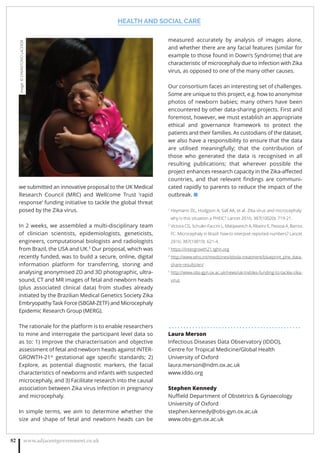
entrepreneurship projects.
S
tem cells, which retain the
capacity to divide and generate
newly differentiated cells within
a mature tissue, have been identified
in many organs of the human body.
They serve as a physiological source
of “young” cells for rapid cellular
turnover (eg. for the replacement of
skin or hematopoietic cells), as a
source for repair (eg. for muscle cells
damaged by exercise) or as a platform
for functional plasticity (eg. to provide
young and malleable new neurons to
brain memory centres). The physio-
logical importance of stem cells is
further attested by the functional
decline of most organs with ageing,
when stem cell pools progressively
shrink and exhaust. For their potential
to generate fresh mature cells in the
adult body, stem cells are also consid-
ered as a promising source to be
therapeutically mobilised following
accidental injury or degeneration.
These results motivate the enormous
effort placed by today’s biologists to
dissect the mechanisms controlling
“stemness” (the progenitor potential of
stem cells) and its long-lasting mainte-
nance in selected cells of the body.
Our understanding of these processes,
however, remains fragmented.
A major determinant of stemness
maintenance is the extrinsic niche, ie
the local context of stem cells in
relation within surrounding tissue.
In the brain for example, neural stem
cells contact blood vessels and the
spino-cerebral fluid, two sources of
molecules preserving stem cell poten-
tial. Another, yet relatively overlooked
parameter, is the “intrinsic” niche, ie
the influence of stem cells themselves
and their division activity on the fate
of neighbouring stem cells. Recent
experiments following stem cells over
time in the mouse intestine, skin or
brain demonstrate that stem cell
pools maintenance is achieved at
the population rather than at the
individual cell level 1
. In other words,
statistically, loss of a stem cell is com-
pensated for by the amplification of
another stem cell. Further spatial
analyses of neural stem cell popula-
tions in the rodent brain highlighted
spatially patterned arrangements of
stem cells in different states 2
.
Together this argues for communica-
tion between stem cells being a
fundamental parameter in the main-
tenance of stem cell pools. Under-
standing the intrinsic niche will be
key to future applications of stem cell
research. For this, a major challenge
remains to access the behaviour of
stem cell populations in the physio-
logical context of their niche.
Our work of the past years revealed
the formidable power of a new verte-
brate model system, the “zebrafish”
(Danio rerio), to tackle this challenge in
the brain. Teleost fish diverged from
mammals some 450 million years
ago. This is very recent in evolutionary
terms, and zebrafish and man share
most molecular, cellular and organic
processes underlying vertebrate
development, physiology, behaviour,
and disease 3
. These similarities
extend to the neural stem cell field 4
:
in both mouse and zebrafish, consti-
tutively active adult neural stem
cells are astroglial cells, organised in
ventricular niches, and generally
quiescent, activating to enter the cell
cycle at low frequency to generate
additional astroglial cells and/or
neurons. Activation is controlled in
both species by identical molecular
pathways 5
. Thus extracting basic
neural stem cell principles from
zebrafish will likely be, in a large part,
translatable to mammals.
www.adjacentgovernment.co.uk120
Fish at the rescue to unravel
mechanisms of stem cell maintenance
PROFILE
!µ#$
$ $$$$$$$$$$$$$$$$$$$$$$$$$$$$$$$Live neural stem cells (red and green) observed in the brain through the skin and skull of an
adult zebrafish (Danio rerio)
www.adjacentgovernment.co.uk 121
PROFILE
Laure Bally-Cuif, PhD
Research Director and Group Leader
Centre National de la Recherche Scientifique
and Institut Pasteur
Tel: +33 1 6982 4276
laure.bally-cuif@pasteur.fr
http://neuro-psi.cnrs.fr/spip.php?
article145lang=en
https://research.pasteur.fr/en/team/
zebrafish-neurogenetics/
Major advantages of the zebrafish
over mammals lie in the amount of
adult neural stem cells and in their
experimental accessibility 6,7
. Mam-
mals rapidly exhaust their neural stem
cell pools past the juvenile stage and
the remaining niches are buried in
deep regions of the telencephalon
(the most anterior brain territory),
making experimental access difficult
in vivo. Zebrafish efficiently maintain
numerous active neural stem cell
pools until adulthood and, in the
telencephalon, these organise as a
large monolayer with some ten thou-
sands cells conveniently arranged at
the dorsal surface of the brain 8,9
.
Taking advantage of this unique prop-
erty, a key technical step, achieved in
collaboration with Emmanuel Beaure-
paire and Willy Supatto (Ecole Poly-
technique, Palaiseau, France), was to
develop a live imaging technique
permitting to film zebrafish adult
telencephalic neural stem cells
directly in their niche over weeks. We
used transgenic lines expressing
fluorescent proteins in adult neural
stem cells, crossed into a transparent
pigmentation mutant 10
. Using a
biphoton imaging procedure jointly
recording fluorescence (stem cells)
and harmonic signals (generated from
lipids or collagen-rich structures), we
could reach into the telencephalic
neural stem cell layer with single cell
resolution while imaging through the
skin and skull of an anesthetised
animal. This enabled us to reconstruct
the life of over a thousand neighbour-
ing neural stem cells over a number
of weeks 11
.
The zebrafish therefore becomes the
first vertebrate model where entire
adult neural stem cell pools can be
filmed non-invasively for extensive
periods of time, in their endogenous
environment, and with single cell
resolution.
The perspectives of this model are
huge. Using transgenic backgrounds
highlighting neural stem cell states,
such as for example a cell’s activation
status, we could position activation
events across space and time within
the pool. This will now show how the
quiescence/activation state of a cell
relates spatiotemporally with that of
its neighbours and, compared to the
behaviour of single cells in a dish, will
reveal the properties emerging in real
life from neural stem cells being
organised in pools. Transgenic lines
expressing biosensors or modulators
of candidate molecules will reveal
some molecular bases for these prop-
erties. Finally, like their mammalian
counterparts, zebrafish adult neural
stem cells are subject to alterations or
disease. They exhaust with age, are
subject to neoplasia, or can be biased
towards generating neurons following
lesions. It will now be possible to
monitor which single cell rules and/or
emerging population properties are
affected in these contexts and underlie
the observed alterations of the pool.
Overall, we are on the cusp of a new
opening into neural stem cell research
that will address, for the first time in
the context of an unperturbed animal,
the coordinated properties of stem
cell pools. This will be highly relevant
to physiological and disease situations
in humans, and will shed unprece-
dented light on how neural stem cell
maintenance can go awry.
1
Simons, B. D.  Clevers, H. Strategies for homeostatic stem cell
self-renewal in adult tissues. Cell 145, 851-862 (2011).
2
Codega, P. et al. Prospective identification and purification of
quiescent adult neural stem cells from their in vivo niche. Neuron
82, 545-559 (2014).
3
Phillips, J. B.  Westerfield, M. Zebrafish models in translational
research: tipping the scales toward advancements in human
health. Dis Model Mech 7, 739-743 (2014).
4
Than-Trong, E.  Bally-Cuif, L. Radial glia and neural progenitors
in the adult zebrafish central nervous system. Glia 63, 1406-1428
(2015).
5
Alunni, A. et al. Notch3 signaling gates cell cycle entry and limits
neural stem cell amplification in the adult pallium. Development
140, 3335-3347 (2013).
6
Grandel, H.  Brand, M. Comparative aspects of adult neural
stem cell activity in vertebrates. Dev Genes Evol 223, 131-147
(2013).
7
Chapouton, P., Jagasia, R.  Bally-Cuif, L. Adult neurogenesis in
non-mammalian vertebrates. Bioessays 29, 745-757 (2007).
8
Adolf, B. et al. Conserved and acquired features of adult
neurogenesis in the zebrafish telencephalon. Dev Biol 295,
278-293 (2006).
9
Grandel, H., Kaslin, J., Ganz, J., Wenzel, I.  Brand, M. Neural
stem cells and neurogenesis in the adult zebrafish brain: origin,
proliferation dynamics, migration and cell fate. Dev Biol 295,
263-277 (2006).
10
White, R. M. et al. Transparent adult zebrafish as a tool for in vivo
transplantation analysis. Cell Stem Cell 2, 183-189 (2008).
11
Dray, N. et al. Large-scale live imaging of adult neural stem cells
in their endogenous niche. Development 142, 3592-3600 (2015).
www.adjacentgovernment.co.uk122
Chromatin and epigenetic
changes the immune response
PROFILE
H
istone modifications and
chromatin remodelling are
involved in regulating the
immune response to different
pathogens. A proper immune response
is essential in combating viruses, bac-
teria and parasites that are harmful
for us. We have several lines of
defence; from the physical barrier of
the skin to specific cells in the body.
The innate system is an early
response and is composed of several
cell types; monocytes, macrophages
and natural killer cells (NK cells).
These cells react unspecifically to
infectious viruses, bacteria or para-
sites and present these agents to the
adaptive immune cells. T-cells and
B-cells comprise the adaptive immune
system and these cells recognise spe-
cific antigens of the infectious agents.
These cells constitute the memory,
developing specific memory cells that
can quickly be stimulated upon a
further infection. Several studies have
now shown that a memory exists in
the absence of T-cells and B-cells,
trained immunity, but the mechanisms
behind are not fully understood1
.
Several recent studies have shown
that both the innate and the adaptive
immune system change the epigenetic
landscape in response to infections.
The development of immune cells in
the bone marrow involves a large
epigenetic reprogramming. Depending
on signal, the different cells in the
immune cells develops and acquire
the specific gene profile for the cell
lineage2, 3, 4, 5, 6
. High through-put
transcriptome analyses, performed
together with ChIP seq of histone
modifications7, 8
and analyses of the
global DNA methylation profile9, 10, 11
,
has shown that the change in gene
expression follows changes in the
epigenetic landscape in the different
cell lineages. In particular, cell type
specific transcription factors and sig-
nalling pathway factors are regulated
by histone modifications and DNA
methylation.
The further response of different
immune cells to infections also
involves transcriptional and epigenetic
responses12, 13
. In response to viral
infections, not only genes regulating
the immune response, such as
cytokines and signalling factors, are
modulated, but also genes involved in
DNA methylation and histone modifi-
cation changed, maybe to adjust cells
to the new epigenetic state. Similar
changes also occur upon the induction
of inflammation processes in response
www.adjacentgovernment.co.uk 123
PROFILE
to infection, but also to non-infections
stimuli, such as nutrients, stress and
exercise. Inflammation is the host
early response induced by innate
immune cells, creating fever, swelling
and pain. When the response go
wrong, inflammation can be harmful.
Genes involved in the inflammatory
response is particularly regulated and
is marked by epigenetic mechanisms14
.
The immune system protects us upon
infections, but can also be the cause
of diseases. Allergy is caused by
the immune system overreacting
and autoimmune diseases, such as
rheumatism and MS, is caused by the
immune cells starting to attack our
own tissues. Autoimmunity together
with chronic inflammatory response
have now been linked to many dis-
eases and disorders, and may be the
underlying cause for yet many more.
The immune response differs slightly
depending on the pathogen involved.
Many pathogens have evolved ways
to elude or inhibit the full response of
the host. The immune system has
particular difficulty when combating
pathogens with a life cycle in several
stages. One such pathogen is the Plas-
modium parasite, which is the cause
for malaria. Studies towards specific
antigens produced by the parasite has
been investigating specific responses.
The biology of the mosquito15, 16
has
also been studied and the immune
response elicited to understand to
many ways the plasmodium parasite
affects its hosts. Malaria affects mainly
children, those that survive are less
susceptible as adults, but no real
immunity is obtained. There are, how-
ever, differences in response between
individuals as well as populations,
most likely caused by genetic factors.
One ethnic group in Africa, the Fulani,
which has been extensively studied
because of the resistance to malaria.
The immune response upon infection
in the Fulani have been studied and
compared with the response in various
other neighbouring ethnic groups.
These studies have mainly been SNP
analyses, investigating variations in
genes coding for factors in the
immune response. One such example
is the SNP study performed between
them and the Dogon people in Mali
that found genetic differences17
. How-
ever, these studies have so far not
been able to fully explain the
differences in response between
ethnic groups in the sub Saharan
region. The relative resistance found
in the Fulani group could therefore be
explained by other factors. Interest-
ingly, it was shown that miRNA also
involved in the response to malaria
and most likely other parasites18
. Hence,
we are interested in studying the
underlying cause for the difference in
immune response on another level; in
epigenetic factors, such as differences
in DNA methylation and histone
modification profiles as well as in
non-coding RNA levels. A further phe-
nomenon of certain complex pathogens
that needs to be explained is the lack
of real immunity. Immune tolerance
could be part of it, but not fully explain
the lack of immunity. The memory of
the innate immune system, trained
immunity1
, could be involved in the
finding that adult people living in
exposed areas are less susceptible to
malaria, a protection that is lost when
leaving these areas.
To understand the human immune
response to complex pathogens, and
how host and the pathogen
interacts, can then shed light to other
Prof Ann-Kristin Ostlund-Farrants
Stockholm University
The Wenner Gren Institute
Cell Biology
Tel: +46 816 4097
Fax: +46 815 9837
anki.ostlund@wgi.su.se
responses causing a varity of
diseases, such as stress-induced
immune responses, autoimmunity
and chronic inflammation.
1 Quintin et al. (2014) Current opinion in Immunology 29, 1-7
2 Tondeur et al. (2010) PLoS One 5(2), e8990
3 Lui et al. (2011) Physiol Genomics 43(20), 1117-1134
4 Shi et al. (2014) Hum Mol Genet 23(17), 4528-42
5 Prassade et al. (2014) Blood 123(17), e46-57
6 Chen (2014) Science 345, 1251033
7 Sashida and Iwarna (2012) Int J Heamatol 96(4), 405-1
8 Kondilis-Magnum and Wade (2013) Mol. Aspects Med. 34,
813-825
9 Ji et al. (2010) Nature 467, 338-342
10 Hodges et al. (2011) Mol Cell 44, 17-28
11 Zhang et al (2014 Epigentics and Chromatin 7, 21
12 Pasis et al. (2014) Current Opinion in Immunology 29, 119-126.
13 Mejias and Ramiro (2014) J. Infect. 68 Suppl 1, S94-99
14 Alvarez-Errico et al. (2015) Natl Rev Immunology 15(1), 7-17
15 Wright and Rayner (2014) PLoS Pathogens 10(3), e1003943
16 Olivier et al. (2014) Frontiers in Immunol. 5, 25. doi: 10.3389/
fimmu.2014.00025. 
17 Maiga et al. (2013) PLoS One 8(10), e75675.
18 LaMonte (2012) Cell Host Microbe. 12(2), 187-99.
C
apturing and retaining talent is
key to fostering a knowledge-
based society. Yet we are failing
to achieve this goal by not allowing
a pool of talent – namely women – to
reach its full potential. Indeed, the
ratio of women to men progressively
decreases along the career ladder,
with few women reaching top posi-
tions in research and decision-making
bodies. Despite improvements in
awareness and policies that have been
implemented to redress this imbal-
ance, progress is overly slow, such
that positive action is needed. The
issue is highly complex and comprises
multidimensional factors ranging from
the general cultural framework of
societies to numerous more specific –
and more addressable – problems.
However, addressing these problems
with innovative actions first requires
that we better understand them. To
tackle both of these steps, thirteen
top European life science research
institutes from the EU-LIFE alliance –
10 as partners and 3 as associated
partners, located in 13 countries (see
Figure) – teamed with gender experts
of ASDO (Italy) to design the ambitious
LIBRA project (http://www.eu-libra.eu/).
LIBRA, which is coordinated by CRG
(Barcelona), has been funded by the
European Union from October 2015
to March 2018. The project will benefit
from guidance from a board of inter-
nationally renowned gender-in-science
experts: Dr Ineke Klinge, Prof Kurt Rice
and Dr Ines Sánchez de Madariaga.
LIBRA aims to remove institutional
barriers and empower women to be
as successful as men in their research
careers on a European-wide scale. In
an initial phase, the current status
and policies in place for each partner
institute will be assessed at group and
individual levels. The results from this
will provide an excellent snapshot of
issues underlying gender imbalances
at the top positions in European life
science research institutes. LIBRA will
also obtain realistic data about the
degree of implicit bias towards gender
issues amongst the research institute
employees and scientists in the 10
partner institutes from an implicit
association test (IAT).
In a second phase, LIBRA will design
and implement 10 harmonised and
institute-tailored Gender Equality
Plans (GEPs) based on a process of
mutual learning and idea exchanges.
The goal is to introduce long-lasting,
profound structural changes to these
research environments.
Overall, LIBRA will address 4 main
areas of intervention for improvement
or implementation:
assuring gender-neutral recruitment•
Isabelle Vernos
LIBRA Coordinator
isabelle.vernos@crg.eu
Natalia Dave
LIBRA Scientific Project Manager
natalia.dave@crg.eu
Centre for Genomic Regulation (CRG)
http://www.eu-libra.eu/
www.twitter.com/libra_science
policies and procedures;
measures and activities to promote•
career development and training;
providing a good work-life balance•
environment, and;
including sex and gender dimensions•
in research.
www.adjacentgovernment.co.uk124
LIBRA tackles gender imbalance
in European life science research
PROFILE
The thirteen European life science research
institutes from the EU-LIFE alliance that are
involved in LIBRA are shown on the map.
Sizes of dots reflect the proportional
number of staff at each institute. CRG
(Centre for Genomic Regulation); CeMM
(Research Center for Molecular Medicine of
the Austrian Academy of Sciences); IC
(Institute Curie); BI (Babraham Institute);
IEO (European Institute of Oncology); BRIC
(Biotech Research  Innovation Centre); FMI
(Friedrich Miescher Institute for Medical
Research); MDC (Max Delbrück Center for
Molecular Medicine); CEITEC (Central
European Institute of Technology); NKI (The
Netherlands Cancer Institute); VIB (Flanders
Institute for Biotechnology); FiMM (Institute
for Molecular Medicine Finland); and IGC
(Instituto Gulbenkian de Ciência).
www.adjacentgovernment.co.uk
Whether you agree, disagree, or have another
viewpoint with any news and features on our
website, we want to hear from you.
Leaving a comment on any item on our website is
easy, so please engage and join the debate today.
YOUR OPINION
MATTERS
O
n February 11, The National Science Foundation
(NSF) hosted a press conference to announce
that its Laser Interferometer Gravitational-wave
Observatory (LIGO) had detected gravitational waves
from 2 merging black holes, approximately 1.3 billion
light years away. Since that time, this news – which rep-
resents a major breakthrough in observing our universe
– has not only excited the scientific community; it has
transcended pop culture – from Garrison Keillor’s Prairie
Home Companion and Stephen Colbert’s late night show
to the annual Washington Post peeps diorama contest.
The attention is well deserved, and the tributes that
have been paid are intensely gratifying. Not just
because the science is so remarkable, but the path to
get to this point has not always been so smooth.
LIGO’s history reflects notable determination, inspiration
and tenacity. It’s true, Einstein predicted gravitational
waves a hundred years ago, but even he thought
detection was likely impossible. However, as Dr. Fleming
Crim, our assistant director for NSF’s Mathematical and
Physical Sciences Directorate noted recently, “the
possibility of opening a new window on the universe
was so tantalising that NSF began funding research on
prototype laser interferometers in the 1970s. And, in
1994, the agency committed almost $300m to a group
led by Kip Thorne and Ron Drever of Caltech and
Rainer Weiss of MIT to transform their prototypes into
a full-blown gravitational wave observatory.”
For those of us at the agency today, it’s hard not to
respect the brilliance, vision, enthusiasm, experimental
prowess and deep theoretical insights these researchers
had, persuading NSF, the National Science Board and
Congress to take a risk. Even though NSF had not
funded anything on such a scale previously, the
potential for transformative science justified such a big
commitment. In fact, the agency embarked on a new
role by funding this large, high-risk, high-reward
research platform. It was basic scientific research with
a clear eye toward future possibilities.
While many on the day of the press conference found
they might view the discovery as a comfortable landing
where one might pause and take in the view, we here
SCIENCE AND RESEARCH
www.adjacentgovernment.co.uk126
The reverberating impacts
of detecting gravitational waves
Denise Caldwell, Director of the National Science Foundation’s Physics Division in the Directorate
for Mathematical and Physical Sciences, looks to the future for gravitational wave research…
SCIENCE AND RESEARCH
www.adjacentgovernment.co.uk 127
at NSF see this as only the beginning of an entirely
new subarea of physics and astronomy, the opening
of a new window on the cosmos. We have sights on a
future of learning even more about the violent
phenomena that inhabit these dark corners of our
universe.
LIGO is expected to reveal objects out there that no
one even knew existed. As the results from LIGO are
combined with other observations NSF has fostered
over the last decade, we will start to probe the universe
closer and closer to its very origin. At the NSF telescope
at the South Pole we will, for example, look for
the imprint of gravitational waves on the cosmic
microwave background, that faint, leftover light from
when hydrogen atoms first formed after the Big Bang.
At an NSF funded Physics Frontiers Center, scientists
studying pulsars will search for indirect evidence of
gravitational waves. As these discoveries are combined
with measurements utilising electromagnetic radiation
and elementary particles, this multi-messenger approach
will enable us to paint a more comprehensive picture
of this vast cosmos we inhabit.
“Wehavesightsonafutureoflearningeven
more about the violent phenomena that
inhabitthesedarkcornersofouruniverse.”
Of course, basic research like this provides no promises.
And the risk of failure is an ever-present specter lurking
in the background. But for those doing the work – as
well as those of us who make decisions to fund it – the
results can be utterly revolutionary. LIGO may have
made international news, but this really is our agency’s
daily work: to support science at its earliest stages,
being mindful of the long road ahead and being
prepared to accept the risk involved. To again quote
Fleming Crim, “fundamental science has transformed
our world and will continue to change it in ways we
have not yet imagined – in much the same way that
Einstein’s own theory of relativity is what ensures the
accuracy of our GPS or that the same technique used
to stabilise LIGO’s sensitive laser frequencies also helps
to build the semiconductors in our computers and
cellphones.”
Just as in those cases of fundamental science
driving innovation forward, we again will keep trying to
push the envelope and look toward the future with
gravitational wave research. In February, we got to help
open a window to our universe that was a long time in
coming. Now, we must also be good stewards for
ensuring we continue to fund science with the vision
to see what’s beyond that window. ■
. . . . . . . . . . . . . . . . . . . . . . . . . . . . . . . . . . . . . . . . . . . . .
Denise Caldwell
Director, Physics Division
Directorate for Mathematical and Physical
Sciences – U.S. National Science Foundation
info@nsf.gov
www.nsf.gov
www.twitter.com/NSF
T
he US funding agencies were
perhaps the first to realise
the potential of the X-ray free
electron laser (XFEL). They responded
immediately by pumping unusually
large amounts of funds into these
unproven machines. The world’s first
XFEL was developed at the Stanford
Linear Accelerator Center for the cost of
several hundreds of millions of dollars.
This is a machine capable of producing
X-rays of some 10 billion times brighter
than any previous X-ray source on
earth. One of the crucial applications is
the novel opportunity for biomolecular
structure determination. The ultrashort
pulses produced by XFELs allows the
possibility of circumventing radiation
damage altogether by scattering off a
particle before radiation damage can
manifest itself1
. Subsequently an XFEL
was developed in Japan, just outside
Osaka. A European XFEL is now planned
for Hamburg in Germany, due to come
online in 2017. Others are also planned
for Korea, Switzerland and China. The
enormous novel capabilities of the
XFEL are now perhaps becoming more
widely appreciated.
Up until the development of the XFEL,
almost all structure determination at
the atomic scale was done on macro-
scopic crystals, where the relatively
weak X-rays from conventional sources
scatter off perhaps trillions of identical
unit cells to reveal the structure of a
single unit cell.
The ultra-brightness of X-rays from an
XFEL may allow structure determination
to be performed on individual mole-
cules without a need to crystallise
them. This is of significance, as there
are some important biomolecules,
e.g. membrane proteins that are very
resistant to crystallisation. In any case,
a crystalline state is not one which, in
general biomolecules perform their
functions in nature. The ultra-bright-
ness of an XFEL will allow meaningful
diffraction patterns to be measured
from individual biomolecules in envi-
ronments closer to those in which they
may be found in nature, e.g. in solution.
The shortness of the X-ray pulse could
allow one to outrun radiation damage
which takes place over a time period
longer than the X-ray pulse. Thus the
X-ray diffraction patterns would be
characteristic of their native states
before radiation damage. One may
also use any degree of incident flux
and be completely impervious to
radiation damage!
Of course, the use of such completely
different conditions for structure
determination also requires the devel-
opment of a completely new theory 2
.
No longer can one use the theory
originally developed by the Braggs,
von Laue and other pioneers of x-ray
crystallography which were designed
for crystals 3
. In fact, x-ray diffraction
patterns from individual molecules
look very different from those from
crystals. The latter are dominated by
the “Bragg spots” which arise from the
crystalline periodicity. This is both a
boon and a curse. The maximum
intensities of the Bragg spots increase
with the number of “unit cells” in a
crystal and make them much more
visible even with much weaker X-rays.
On the other hand, the crystal perio-
dicity prevents the sampling of these
intensities at intervals smaller than
the positions of the Bragg peaks.
Although that scattering is weaker
from an individual molecule the pos-
sibility of measuring such “oversam-
pled” intensities is often crucial for
structure determination. Here is the
advantage of the 10 billion-fold increase
in brightness of the incident x-rays
allowed by the XFEL. However it should
be borne in mind that a single molecule
is perhaps a trillion times smaller than
a typical crystal used in x-ray crystal-
lography, so the measured intensities
would inevitably be significantly smaller
even with the use of an XFEL. This also
necessitates a careful consideration of
signal to noise ratios in any theory.
Also, the absence of Bragg spots in
scattering by individual molecules
www.adjacentgovernment.co.uk128
The X-ray free electron laser for
biomolecular structure determination
PROFILE
Figure 1. Structure of an icosahedral virus,
satellite tobacco necrosis virus (STNV)
recovered from simulated diffraction patterns
by the method of angular correlations. The
artificial cut allows us to show that the
reconstruction of the PDB structure assumed
in the calcuations, which contains only the
capsid structure.
www.adjacentgovernment.co.uk 129
PROFILE
Dr Dilano K Saldin
Department of Physics
University of Wisconsin-Milwaukee
Tel: +1 414 2296 423
dksaldin@uwm.edu
https://uwm.edu/physics/
requires entirely new methods of
taking account of the orientations of
the individual scatters.
It has been found that the angular
correlation of the intensities when
averaged over all the million or so
diffraction patterns expected to be
measured in an XFEL (the repetition
rate is about 100 diffraction patterns
(DPs) per second) is found to be inde-
pendent of orientation. Over a typical
experimental shift it is not unexpected
that about a million DPs will be meas-
ured. This means that at long last one
has a quantity that is characteristic of
the structure and independent of the
orientation of an individual molecule.
This means that once one cracks the
code for recovering the structure from
the correlations one had a method for
recovering the structure of a molecule
from ensembles that may not be
perfectly aligned as in a crystal. The
potential for recovering the structures
of molecules from such misaligned
ensembles as may be found from
ensembles of molecules as they are
found in nature.
References
1 Potential for biomolecular imaging with ultrashort x-ray pulses,
R. Neutze, R. Wouts, D. Van Der Spoel, E. Weckert, and J. Hajdu,
Nature 406, 752 (2000).
2 Structure of isolated biomolecules from ultrashort x-ray puldes:
exploiting the symmetry of random orientations, D. K. Saldin, V.
L. Shneerson, R. Fung, and A. Ourmazd, J. Phys.: Condens. Matter
21, 134014 (2009).
3 Principles of Protein X-ray Crystatallography, J. Drenth
Figure 2. Structure of tobacco mosaic virus (TMV) recovered from simulated XFEL diffraction
patterns by the method of angular correlations.
Dr Dilano K Saldin
A boost for stem cell research
Adrian Heuss, Head of Knowledge Transfer on the NRP63 Programme tells
Editor Laura Evans more about NRP63 and Stem Cell Research…
S
tem cell research can play an integral role in
developing new treatments and therapies for
major healthcare challenges, such as cancer. It is
still considered a relatively new area with high poten-
tial. At the Swiss National Science Foundation (SNSF)
their National Research Programme – Stem Cells and
Regenerative Medicine (NRP 63) aims at boosting basic
research on stem cells and regenerative medicine.
Editor Laura Evans spoke to Adrian Heuss, Head of
Knowledge Transfer for NRP 63, to find out why stem
cell research is so interesting and how the programme
offers this much needed boost.
“Stem cell research is interesting because it is not just
about one specific illness,” explains Heuss. “There are
a number of different illnesses that you can look at,
including: cancer, diabetes, and Parkinson’s.”
Stem cell research can benefit a number of different
areas, even for muscle regeneration or repairing the
retina. “There are so many different projects going on,
not just in Switzerland, but worldwide.”
Connected to stem cell research is regenerative medi-
cine, which can be defined as the ‘process of replacing,
engineering or regenerating human cells, tissues or
organs to restore or establish normal function’.
“Regenerative medicine could in theory be used for
more or less all diseases where cells die off or are
damaged,” says Heuss.
For example, one NRP 63 research team worked on
diabetes, they found a way to develop new insulin
producing cells. Another team worked on an ear project:
they developed a new material that can be used to
reconstruct ears for patients who have lost theirs in an
accident or whose ear didn’t grow or form properly
when they were born.
At the moment the standard technique for these
patients is to use cartilage from other parts of the
body, but what they have developed is a new material
which has more or less the same stability as natural
cartilage. “This new material could be used for any part
of the body where the cartilage is damaged,” says Heuss.
“For a long time everyone believed that
there are no real stem cells in the brain.
They believed that you had constant
number of nerve cells from birth, and with
age they reduce in number. In the last 10 or
15yearswehaverealisedthat’snottrueand
how much actually is regenerated – there
are stem cells in the brain that make new
nerve cells.”
The NRP 63’s intention was to boost basic research on
stem cells and regenerative medicine, as well as
encouraging top scientists with an excellent track
record in development and cell biology to engage in
this field.
“The NRP 63 increased the visibility of Swiss research
in the international arena”, explains Heuss. “Most
projects were basic research, but several groups are
already in touch with biotech and pharmaceutical
companies that are interested in utilising their results
for the good of patients in the future. This, I think, is
really interesting and worth the money.”
Over a 5 year period, the SNSF dedicated 10 million
Swiss francs. Between 2010 and 2015 12 research
groups based in Basel, Berne, Geneva, Lausanne and
Zurich investigated new approaches to the treatment
of various diseases.
“In order to further boost research in this area, the
programme also focused on young scientists. In
Switzerland, research in molecular biology is well
SCIENCE AND RESEARCH
www.adjacentgovernment.co.uk130
SCIENCE AND RESEARCH
www.adjacentgovernment.co.uk 131
established, but the stem cell part could do better.”
The idea behind the NRP 63 was to encourage more
experts into the stem cell field.” Heuss says.
With the help of programmes such as NRP 63 and others
across Europe, research in stem cells and regenerative
medicine is able to progress and develop further. Over
the last 10 years, advances in regenerative medicine and
stem cell research have been huge.
“For a long time everyone believed that there are no
real stem cells in the brain. They believed that you had
a definite number of nerve cells from birth, and with
age they decreased in number. In the last 10 or 15
years we have realised that this is not true and how
much actually is regenerated – there are stem cells in
the brain that make new nerve cells,” says Heuss.
Researchers are now looking at ways to boost those
cells in the brain, for example using substances to make
the stem cells in the brain produce new nerve cells. This
would really help with illnesses such as Parkinson’s or
multiple sclerosis – diseases where the cells die off. The
good thing about this would be that these new cells are
your own cells and they wouldn’t be transplanted from
someone else. “It is always problematic if you transplant
cells, as there’s the question of whether they are
accepted,” Heuss adds.
As with any research, regenerative medicine comes with
its own challenges. Heuss explains that one of the main
issues when working with stem cells is the development
of tumours.
“Stem cells in their natural environment are tightly con-
trolled by different signals – they are in a niche and the
niche will make sure that these cells only produce new
cells when they have to. If you take these cells out of their
niche and transplant them into another patient then the
surrounding is different, the signals to control their
growth change, and then you could get tumours. ■
. . . . . . . . . . . . . . . . . . . . . . . . . . . . . . . . . . . . . . . . . . . . .
Adrian Heuss
Head of Knowledge Transfer
NRP 63 – Swiss National Science Foundation (SNSF)
nfp63@snf.ch
www.nrp63.ch
The medical revolution
Though great progress has been made
in medicine, current treatments are
increasingly unable to keep pace with
patients’ need, especially given our
aging population. In fact, there are few
effective ways to treat the root causes of
many common diseases, injuries, and
congenital conditions. In many cases
clinicians can only manage patients’
symptoms using medications or devices.
This is especially true, for example, in
the case of acute myocardial infarction
and other heart diseases. If most tissues
and organs in the human body have in
fact a regular turnover of cells (meaning
that entire tissues or organs are
replaced over a period of weeks or years
depending on the type of cells), heart
cells are an exception. Adult cardiac cells
experience no (or extremely slow)
replacement over time. This means
that any injury of the heart has serious
consequences for the patients.
Regenerative medicine is a game-
changing area of medicine because it
intervenes exactly where traditional
medicine fails, by regenerating dam-
aged tissues or organs and therefore
restore the normal functions of the
body. This is made possible through
the development and the application
of new therapies based on the use of
stem cells, i.e. undifferentiated pro-
genitors cells that have the ability
to evolve – through a process called
“differentiation” – into diverse types of
specialised cells.
By studying the properties of each kind
of stem cell, scientists are today able to
regenerate entire organs or at least part
of them, and therefore cure damages
that were previously considered irre-
versible. Heart disease is just one exam-
ple of a condition that is going to be
completely revolutionised by regenera-
tive medicine. Other potential applica-
tions are found in Parkinson’s disease,
cerebral palsy, degenerative retinal
diseases, pulmonary disease, spinal
cord injury, arthritis, and many more.
Only a few decades ago, the concept of
regenerating parts of the human body
was firmly restricted to the realm of sci-
ence fiction; however, in a very short
space of time, it has become a tangible
scientific and therapeutic reality all over
the world. In fact, even though many
people perceive regenerative medicine
as a matter of the future, it is already a
tangible reality. A significant quantity of
regenerative medicine products are in
fact already commercially and clinically
successful. In addition to over 60,000
stem cell transplants that are annually
performed worldwide for the treat-
ment of oncology and blood disorders,
in 2012 over 160,000 patients were
treated using new, experimental regen-
erative medicine drugs. At the same
time, more products are being approved
and new data are becoming available
from mid and late-stage regenerative
medicine clinical trials. Going forward,
the industry expects the approvals to
multiply annually.
Obviously, research in regenerative
medicine requires significant effort
and investments. Treatment, before
becoming a reality, may take up to 10
or 15 years of development and testing.
This has not stopped some particu-
larly forward-thinking countries in
investing in what is often called “the
medicine of the future”, also because
research in this field is capable of pro-
ducing an extremely important scien-
tific and economic advancement. An
example of forward-thinking in this
regard is in the state of California
which, following the so-called “Propo-
sition 71” – the state law approved by
referendum in 2004 – has allocated
$3bn to regenerative medicine. Thanks
to this major investment, California
can now rely on 2,600 biomedical
companies, 87 university and private
research institutes generating an
annual revenue of $32.3bn, 15 of which
are reinvested annually for research.
www.adjacentgovernment.co.uk132
Transforming regenerative medicine
into an opportunity for patients
Regenerative medicine is the medical revolution that is increasingly challenging the way we approach
and fight diseases. At the Swiss Institute for Regenerative Medicine, hospitals, research institutions,
companies and universities are joining forces to bring innovation from bench to bedside
PROFILE
www.adjacentgovernment.co.uk 133
PROFILE
Antonino Tramonte
Managing Director
Swiss Institute for Regenerative Medicine
Tel: +4191 805 39 78
info@sirm-institute.ch
www.sirm-institute.ch
Making the dream true:
the Swiss Institute for
Regenerative Medicine
In the last decade, the growth of the
biotech sector in the southern and
Italian-speaking Ticino Canton has
become increasingly important for
the economy of the region and for the
surrounding scientific environment. It
is here, just 15 minutes far from the
Italian city of Como, less than an hour
from Milan, in a region known for its
ability to blend Italian lifestyle and cul-
ture with Swiss precision, top-level
services and political stability, that the
first stem cell transplant of the coun-
try has been performed in 2004, on a
patient with acute myocardial infarc-
tion. The intervention was carried out
by a cardiology team led by Prof.
Tiziano Moccetti at Cardiocentro
Ticino, a Lugano based, cutting edge
heart clinic, known to be one of the
most important cardiac centres in
Switzerland. This pioneering and
encouraging experience eventually
led the clinic to investigate further on
the matter by building the first autho-
rised “cell factory” of the country,
which is a special facility to safely pro-
duce experimental drugs based on
stem cells. Starting in 2005, these
experiences led to the creation of a
growing biomedical cluster of compa-
nies, research institutes and other
clinics interested in the exploration
and application of regenerative medi-
cine in various medical fields. In 2013,
tis group finally created the Swiss
Institute for Regenerative Medicine
(SIRM), a new research centre entirely
committed to exploring the full poten-
tial of regenerative medicine. The
institute, supported by the Cardiocen-
tro Ticino Foundation, and funded by
the Foundation for Cardiological and
Research Education (FCRE), has a bold
mission: To unleash the enormous
potential of human body regeneration
and thereby support the development
of next generation therapies and cures
that will shape the medicine of the future.
This is not a simple task, explains
Antonino Tramonte, SIRM Managing
director: “To effectively become a real
solution for patients, the new thera-
pies require several years of research
and development. At SIRM we strive
to accelerate this process by combin-
ing and integrating competences of
several different but complementary
institutions that are actually part of the
same ecosystem: Clinicians, researchers
and biotech companies.
“This is why SIRM laboratories, based
in Taverne, currently host 5 partner
institutions: Cardiocentro Ticino, Neu-
rocenter of Southern Switzerland, Uni-
versity of Applied Sciences and Arts of
Southern Switzerland (SUPSI) and two
innovative biotech companies: Swiss
Stem Cell Bank and Hyperstem.”
“This is indeed a successful example
of cooperation,” explains Claudio Massa,
President of the FCRE Foundation. “In
just 3 years of activity, we completely
saturated the spaces in our current
headquarter and we deal quite on a
daily basis with new requests from new
companies and new research insti-
tutes that would like to join us in our
research for regenerative medicine.
We’re now talking with new partners
and with Lugano municipality to buy
together a new building, big enough
to support our growth in the medtech
field. We’re amazed by the SIRM proj-
ect so far, it truly exceeded our most
optimistic prevision”.
“Our dream”, concludes Prof. Tiziano
Moccetti, scientific director of Cardio-
centro Ticino and of SIRM, “is to create
with our joint work a real treatment
opportunity for patients. Everything
starts from the patient whose needs
are the main goals for the clinician.
Doctors’ research for solutions creates
research projects and consequently
opportunities for the biomedical
industry. Only when all these stake-
holders communicate and cooperate
patients’ needs are finally met. This is
the real meaning of the translational
research we do at SIRM. Literally:
From bench to bedside, that is our
philosophy and the path we want to
follow for the medicine of the future.”
A
round 2500 years ago, Hip-
pocrates realised that bone
can heal without scaring. How-
ever, the natural healing potential is
restricted to small defects and large
bone defects caused by trauma or
during tumour resections still pose a
huge problem in orthopaedics and
cranio-maxillofacial surgery, not men-
tioning the immense costs associated
with non-healing fractures or bony
defects.
Personalised bone substitutes
The natural healing potential of bone
is based on three pillars:
Mesenchymal stem cells;•
Osteoinduction by growth factors•
deposited in bone;
Osteoconduction, as potential of bone•
tissue to grow into 3D structures.
Mesenchymal stem cells can be har-
vested from bone marrow or adipose
tissue and therapies, applying them
clinically as tested or already used.
However, the costs associated with
any stem cell therapy are very high.
Mesenchymal stem cells can be differ-
entiated to bone forming osteoblasts
by growth factors like bone morpho-
genetic proteins, which entered clinics
as FDA approved medical devices in
2002 as option for spinal fusion to
treat degenerative disc disease and
tibia fractures, not able to heal by
themselves. Both advanced and cost
intensive therapies need delivery
systems to properly apply the cells or
the growth factors. Ideally the delivery
system should be osteoconductive, to
further enhance bone healing and
to minimise the need for stem cells or
growth factors.
The research at Oral Biotechnology 
Bioengineering (Center of Dental
Medicine, University Zurich) has a long
track record of the clinical use of
osteoinduction in dental medicine and
the delivery of bone morphogenetic
proteins. To optimise osteoinduction,
the combination with an osteoconduc-
tive bone substitute material appears
to be a promising strategy. To that
end we started a project on scaffold
design and osteoconduction to develop
osteoconductive/osteoinductive bone
substitutes and initially got funding
from the AOCMF, the Cranio-Maxillofa-
cial Specialty of the AO Foundation and
since 2014 full funding from the Swiss
National Science Foundation (SNF).
The SNF project: “Osteoconductive and
osteoinductive customised implants
for large mandibular defects” is set to
run for a period of three years and
involves collaborators from around
the world. Experience of titanium
implants and their production through
rapid prototyping is provided by
researchers at the University of
Applied Sciences North-western
Switzerland (Professor Michael de
Wild and Professor Ralf Schumacher);
technologies on extracellular matrices,
osteoinductive hydrogels and osteo-
conductive bone substitutes are pro-
vided by researchers at the University
of Zurich (Prof. Franz E. Weber and
Dr. Chafik Ghayor); and the Hong
Kong Polytechnic University offers
experience in selective magnesium
alloys laser melting (Professor H Man
and Professor Monica Mahesh
Savalani). In combining a unique body
of knowledge, the team, headed by
Prof. Franz E. Weber as principle
investigator, hopes to achieve the
aims of the project and develop a
much needed personalised treatment
for large mandibular defects. The
solutions found in this project can
easily be translated in osteoconduc-
tive bone substitutes for use in
orthopaedics and increase the number
of patients to profit from our research
results substantially.
The ultimate goal of research
performed at: Oral Biotechnology 
Bioengineering (Center of Dental
Medicine, University Zurich) is to bring
research results from the bench to the
bedside. To that end, we recently
acquired a lithography-based additive
manufacturing machine which allows
the production of osteoconductive
bone substitutes from calcium-phos-
phates. Seventy per cent of bone is
www.adjacentgovernment.co.uk134
Personalised medicine in
bone regeneration
PROFILE
Professor Dr. Franz E. Weber
www.adjacentgovernment.co.uk 135
PROFILE
Professor Dr. Franz E. Weber
Head of Oral Biotechnology
 Bioengineering
University Zurich
Center of Dental Medicine
Tel: +41 634 3140
franz.weber@zzm.uzh.ch
www.zzm.uzh.ch/en/research/staff/weber-
franz.html
made up from calcium-phosphates in
the form of hydroxyapatite. Therefore
we aim at to develop personalised,
biomimetic, osteoconductive bone
substitutes which can be produced in
our laboratory by additive manufac-
turing and clinically applied to per-
fectly match and treat bone defects
located either in the mandible or any
other bone.
Epigenetics and bone
regeneration
Epigenetics describes changes to the
expression of genes that are not linked
to changes in the DNA sequence. In
another SNF funded project with the
title “The potential of N-methylpyrroli-
done (NMP) to prevent osteoporosis
and to enhance bone regeneration”
we found that NMP and 2 other small
molecules to possess an activity on
the level of epigenetics and patented
these findings (Unitectra, University of
Zurich) for treatment and prevention
of osteoporosis, adiposity, periodonti-
tis, peri-implantitis and several other
disorders. Although this project fin-
ished at the end of 2015, we hope to
continue on this novel approach to
use epigenetics for bone regeneration
and to combine these findings with
osteoconductive bone substitutes.
Funding
Swiss National Science Foundation•
(SNF);
EU Seventh Framework Programme•
(FP7);
Swiss Dental Society (SSO); AOCMF,•
the Cranio-Maxillofacial Specialty of
the AO Foundation.
Biography of the principle
investigator
FRANZ E WEBER graduated from the
University of Konstanz (Germany) with
a PhD in Biology/Muscle Biochemistry.
He completed three years of postdoc-
toral training on muscle cell biology at
Cornell University Medical College in
New York City and served as a lecturer
in the Department of Cell Biology and
Anatomy. He spent the following two
years at the Biochemistry Department
of ETH Zurich (Federal Institutes of
Technology in Zurich) working on the
lipid uptake from the small intestine.
In 1995, he joined the Department of
Cranio-Maxillofacial and Oral Surgery
at the University Hospital Zurich, and
the Dental School of the University of
Zurich. In addition to his obligations at
the University of Zurich, he became
Director of the European Technical
Center of Inion Ltd in Cambridge (UK)
in 2005 and occupied this position
until 2009. His main area of interest
is bone regeneration. His research
encompasses bone morphogenetic
proteins, delivery systems, bone sub-
stitute materials, osteoconduction,
epigenetics, additive manufacturing
and in vitro bone tissue engineering.
Weber has authored 94 original
research articles published in interna-
tional journals amounting to more
than 3,800 citations and has an
h-index of 30. He is member of TERMIS
(Tissue Engineering international 
Regenerative Medicine Society), IADR
(International Association for Dental
Research), and SSB+RM (Swiss Society
for Biomaterials and Regenerative
Medicine).
A
ccording to a recent publication
by the OECD, after-school pro-
grams (ASPs) have been evolving
all over the world in the last decades,
providing institutionalised care before
school, at lunch time and after the
compulsory school hours. Those reports
point out that in most countries, the
coverage of ASP activities ranges (with
some exceptions) between 15 and 45%
of the elementary student populations.
Nevertheless, official guidelines, doc-
umentation and monitoring systems
often vary by jurisdiction or state and
therefore impede the comparison of the
use and effectiveness of such programs
on a national and international level.
Yet, there remains an increased demand
for institutionalised care since ASPs
are a reaction to changing societal,
economic and family structures and
are often promoted as an instrument
to reduce social inequality. Accord-
ingly, since ASPs not only provide
recreational activities, but also home-
work support, they are often con-
nected to the school. Therefore, ASPs
are educational reform projects, which
have to be integrated in the school
system. So how can this integration
be achieved? How can educational
officials secure a well-developed
after-school system, which accounts
for the demands of the parents, pro-
vides activities of good quality for the
children and achieve the manifold
educational goals?
In a longitudinal study conducted in
Switzerland, we were able to analyse
these questions carefully.
Schools in Switzerland usually run
between 8am and 3pm, whereas
many children have the afternoons off
and are not supervised during lunch.
The Canton of Bern (one of the 26
provinces in Switzerland) has found
one first solution to this declared
“state of emergency” in the lack of
available hours of institutionalised
care. The local government in Bern
passed an amendment to the public
school law that the municipalities
have to assess the parent`s needs
and supply this demand appropri-
ately. According to the register data
from the Canton of Bern, the develop-
ment of ASPs indeed has increased by
67% in hours of care between 2010
and 2016. Studying these ASPs, we
investigate how the government
guidelines and other development
mechanisms may influence the ASP`s
collaboration with the school.
In the study, we were interested how
the ASPs are organised and how after-
school directors (ASD) and personnel
evaluate their role and influence on
student development. We argue that
there are four main dimensions which
need to be considered, when develop-
ing ASPs: The quality of the activities
and the ASP institution as a whole, the
competences and leadership behavior
of the ASD, the actions and attitudes
of the staff, as well as, the collaboration
with the school.
Quality of the activities and
the ASPs
A systematic observation in 22 ASPs
points out that they vary considerably
concerning the observed quality of
the program and activities. Whereas
some ASPs reach very good overall
quality ratings, some ASPs range
between minimal and inadequate
quality. According to the applied
School-Age Care Environment Rating
Scale (SACERS), the ASPs on average
reach high ratings for space and fur-
nishing, and interactions but could
improve concerning health regulations,
staff development and the organisation
of activities. ASDs report that most
activities in ASPs are not preplanned
and are more oriented towards physi-
cal activities than reflection of project-
based activities.
Competences and leadership
behavior
We asked 47 ASP directors about how
they perceive their role and how they
manage the ASPs. The most common
professional role category that ASDs
relate to is the “Primus inter Pares”, in
which leaders have little professional
distance to the team and rather posi-
tion themselves at a similar status
level as their coworkers. Furthermore,
ASDs report that they spend most of
their work-day engaged in staff man-
agement as well as organisation and
administrational tasks. Quality devel-
opment and evaluation is less focused
in the daily practice of the ASD.
Actions and attitudes of the staff
We looked at how the ASP personnel
feel about their work on a range of
scales from organisational psychology.
About 250 ASP staff report that the
working climate concerning the inter-
www.adjacentgovernment.co.uk136
Effective after-school programs?
Supporting student well-being and learning – The development of after-school programs
PROFILE
www.adjacentgovernment.co.uk 137
PROFILE
Michelle Jutzi MA
Institute of Education
University of Zurich
Tel: +41 44 634 25 95
mjutzi@ife.uzh.ch
Prof Dr Katharina Maag Merki
Institute of Education
University of Zurich
Tel: +41 44 634 27 80
kmaag@ife.uzh.ch
http://www.ife.uzh.ch/en/research/teb.html
actions with students and the general
atmosphere is very positive. Further-
more, they rate their collective self-
efficacy as a team high and feel
capable of promoting activities of
good quality and deal with daily
problems. Nevertheless, clear goals
and guidelines for improvement and
innovation are not yet main targets of
the ASP and the staff is less aware of
needs for improvement. Lastly, the
perception of the individual capacity
of engaging students in activities and
leading the group of students differs
considerably between the staff.
Collaboration with the school
We investigated how the ASPs take up
position in relation to the school. The
ASDs report that the connection to
school subjects and learning goals is
less important in the planning of the
activities, whereas the organisation of
the ASP is more oriented towards the
individual needs as well as previous
and practical knowledge of the stu-
dents. Moreover, even though the ASP
staff report that if they collaborate
with the school, this mainly happens
in situations of informal exchange and
is seldom clearly structured or directly
linked to improvement. Nevertheless,
they strongly agree that the collabo-
ration with the school should be
focused on providing better learning
opportunities.
What can we learn from
these results?
Our study on Swiss ASPs highlights
that even though the context-oriented
governance strategy leads to a high
autonomy of ASP personnel, it may
also result in an increasing hetero-
geneity of the quality. When further
developing ASP systems, governments
and educational officials should consider
how the ASP can be actively integrated
in the school system. For example by
supporting the empowerment of ASPs
to be autonomous and innovative
institutions which encourage student’s
cognitive activation in recreational and
learning activities. To assist ASPs in
exploiting their full potential, govern-
ments should consider the following
development actions:
Joint development of guidelines and•
monitoring systems for ASP quality
with ASP professionals and school staff;
Encourage ASDs to develop a clearly•
defined role in managing the ASP
and establishing strong and stable
relationships with school teachers
and principals ;
Provide additional time resources•
to invest in quality assessment and
in designing more diversified, pre-
planned and individualised program
activities;
Help develop a professional habitus•
with ASDs and staff by strengthening
competences in workshops, training
and coaching;
Motivate schools to call in ASP pro-•
fessionals in situation where they may
open up new vistas for supporting
student learning and well-being.
Relating back to the OECD report,
countries on average spend about 50%
of the time in elementary education on
language, math and science and only
5 to 20% on arts, music and physical
education. For after-school programs,
the question remains, whether they
should mainly focus on student learning
due to their proximity to the school, or
– on the other hand focus on leisure
activities. Should they “just” provide the
students with a place to play and relax
as opposed to the school? The position
of the ASP in the school system is still
not clearly defined and more systematic
research into this topic is needed. Yet,
without a doubt, ASPs are important
institutions who, in collaboration with
the schools and families, combine
informal and formal opportunities for
learning and development.
The brain challenge
Professor David Nutt, President of The European Brain Council highlights the economic impact
of poor brain health and how they are calling for new thinking towards how it is treated…
T
he brain is the key to humanity, providing the
immense capabilities of our species. However
despite its considerable capacity for self-repair
the brain also frequently fails. The costs of poor brain
health to Europe are enormous. Traumatic brain
injuries, mental illness and cognitive disorders are
likely to afflict more than a third of European Union
citizens – 179 million people. They cost Europe €798bn
per annum – more than any other medical area. This
is 7 times the €110bn cost of the 2010 Greek financial
rescue, and it is every year.
The economic crisis has put health back on the
European Union (EU) agenda. Austerity, low growth
and demographic change are calling into question the
sustainability of our healthcare and social protection
systems. Nowhere is the situation starker than in the
area of brain health.
Speaking in one voice
The European Brain Council (EBC) was formed in 2002
to bring together all of the major stakeholders in Euro-
pean “brain space”, in order to talk at the high strategic
level with a single voice for brain health and brain
disorders. As such, it is working in partnership with
patients, scientists, healthcare specialists, industry
professionals and policymakers to harness science and
innovation for better societal outcomes.
The EBC is calling for new thinking on European brain
health and the quality, productivity and mental
well-being of the EU workforce. There are practical
measures we can take that would make a significant,
long-term difference.
We need to focus on outcomes
Within the European Semester – the EU’s new economic
governance framework – the European Commission
recommends Member States to improve the cost-
effectiveness of their healthcare systems. While the
objective of sustainable health systems is essential,
it is imperative that the emphasis is not just on cost-
limitation, but on the outcomes that health systems
deliver – for the patient and society. We need to under-
stand the benefits that come from more active and
productive populations, and less social exclusion.
“Healthy brains need to be put right at the
hearth of Europe and its 2020 Strategy
if indeed we are to increase health of
European citizens as well as to increase
European’s economic competitiveness.”
We need to recognise how investments now – for
example, in early diagnosis and prevention – con-
tribute to more sustainable health systems later.
We need to analyse and understand how well our
health systems are currently performing, and which
investments deliver the most lasting value.
To make the transition to an outcome-focused
approach, we need data to provide us with indicators
and benchmarks of best practice. In the area of mental
health, the Organisation for Economic Co-operation and
Development’s (OECD) work on assessing health sys-
tems performance provides an excellent starting point.
Cost-effective investments are critical
Data alone is not enough. We also need a readiness to
make investments that will deliver better outcomes
and improve effectiveness in the future. From a finan-
cial perspective, the message is clear: by improving the
brain health of our citizens, we can enable them to live
more active and productive lives, to the benefit of all
our economies, including our public finances.
SCIENCE AND RESEARCH
www.adjacentgovernment.co.uk138
SCIENCE AND RESEARCH
www.adjacentgovernment.co.uk 139
Given its relevance to the sustainability challenge,
action to address brain-related disorders must be a
high priority.
Value of treatment for brain disorders
EBC is responding to current challenges and in January
2016 it has launched its new research project on the
value of treatment (VoT) for brain disorders. Analyses
demonstrate that there is a considerable treatment
gap in Europe, with only about a third of cases receiv-
ing the therapy or medication needed. EBC’s VoT
project will generate evidence on the socio-economic
benefits of healthcare interventions through analysis
of case studies in order to build towards closing this
treatment gap and develop a workable model of care
for brain disorders. The study results will be released
during EU Maltese Presidency in the first half of 2017.
European and national brain plans
EBC considers that improved cooperation and coordi-
nation are absolutely critical to address in an efficient
manner both the challenges and opportunities posed
by our brains. With this in mind, in November 2015 it
launched a call to foster a dialogue on developing
National Brain Plans, which would be brought under
the umbrella of an EU-wide plan addressing brain
health in an integrated, collaborative and comprehen-
sive way. Successful examples of strategies in other
disease areas already exist in Europe. These efforts
shall focus on implementing evidence based strategies
for research, prevention, early detection and diagnosis,
and adequate treatment. The aim is to meet the needs
of patients, carers, doctors, researchers and industry.
Healthy brains need to be put right at the hearth of
Europe and its 2020 Strategy if indeed we are to
increase health of European citizens as well as to
increase European’s economic competitiveness. ■
. . . . . . . . . . . . . . . . . . . . . . . . . . . . . . . . . . . . . . . . . . . . .
Professor David Nutt
President
The European Brain Council
www.braincouncil.eu
www.twitter.com/EU_Brain
Denmark – a strong research nation
Professor Peter Munk Christiansen, Chair of the Danish Council for Independent Research outlines how
independent research funds were awarded to a record-high number of young researchers in 2015…
A
strong research nation relies on having a
well-supported growth segment where inven-
tiveness thrives. The Danish Council for Inde-
pendent Research (DFF) emphasises the cultivation of
excellent ideas, not least those coming from Denmark’s
most talented young researchers. In 2015, more than
50% of the Council’s grants went to researchers aged
40 or less.
In order for Denmark to keep developing as a strong
research nation, it is important to continue to attend
to the growth segment of promising research ideas
and talents that is nurtured at universities and in pri-
vate sector research labs. Having a comprehensive
research funding system in Denmark is essential
for capturing and promoting the most talented
researchers and ideas within all academic genres. In
this regard the Danish Council for Independent
Research plays a central role as catalyst for young
researchers in the early stages of their careers.
This testifies to the Council’s emphasis on strengthen-
ing the growth segment of research. By providing
funding through postdoc grants and the Sapere Aude
Elite Programme, DFF is undertaking the important
task of encouraging young researchers to pursue their
research interests, thereby ensuring the presence of
excellent research profiles within Danish research.
Sapere Aude
The Sapere Aude Programme offers the most talented
researchers in Denmark the best possible conditions
for conducting scientific research at the highest inter-
national level. DFF both invests in ground-breaking
ideas and the researchers’ careers through the
DFF-Research Talent grants, Sapere Aude: DFF-Starting
Grants and Sapere Aude: DFF-Advanced Grants. For
Danish top level researchers, the Sapere Aude Pro-
gramme offers an important launch pad for an interna-
tional career, and moreover it creates important synergy
effects by furthering new expertise, e.g. in relation to
research methods and the application of advanced
equipment that the researchers are able to acquire for
their Danish research environments.
Between 2010–2015, DFF has awarded 981 individual
postdoc grants and MOBILEX grants to promising
young research talents, and 411 grants under the
Sapere Aude Elite Programme, 242 of which were
Research Talent grants. In addition, the Council has
awarded a large number of postdocs embedded in
larger research projects.
Does it make a difference?
The question is whether it makes a discernible differ-
ence that the Danish research system focuses so heavily
on helping the young research talents at the early stages
of their careers? The answer is clearly ‘Yes’. With its
emphasis on scientific excellence and originality, the
Danish Council for Independent Research serves as a
catalyst for research funding from other private and
public foundations, both nationally and internationally.
For example, 95% of the researchers heading the
Danish National Research Foundation’s Centre’s of
Excellence between 2005 and 2015 have also been
recipients of DFF funding, while 65% of those receiving
European Research Council grants between 2007 and
2014 have previously been awarded one or more grants
from DFF.
The effects of investing in the growth segments of
scientific research are not just discernible here and
now. It takes time to build a capacity of young elite
researchers, whose task is to conduct research, as well
as research-based teaching at the universities, con-
tributing to a high level of knowledge as well as societal
SCIENCE AND RESEARCH
www.adjacentgovernment.co.uk140
SCIENCE AND RESEARCH
www.adjacentgovernment.co.uk 141
growth and welfare. Some of these researchers will be
collaborating with private enterprises and take up jobs
in researched-based industries. At the same time,
having a healthy growth segment is a precondition for
allowing the universities to meet the future demands
concerning prioritised areas of strategic research. The
growth segment of Danish research ensures the
necessary capacity to meet the knowledge demands of
the future.
“In 2015, more than 50% of the Council’s
grants have been awarded to researchers
aged40yearsoldorless.Thistestifiestothe
Council’s emphasis on strengthening the
growth segment of research.”
Ideas generate new ideas
There is no shortage of research ideas. Autumn 2015
saw an 11% increase in the number of applicants
competing for the Council’s research funds for 2016.
The high number of applicants and the fierce compe-
tition among them actually go hand in hand with the
Council’s focus on research excellence, helping to
ensure that only the very best talents are awarded
funding for the most promising research ideas. In
addition, due to the competition for the Council’s
funds, talented young candidates are at an early stage
encouraged to develop their research ideas into more
ambitious projects, while the DFF grants give them an
opportunity to establish a research career at a similar
stage. In a survey among researchers conducted in the
autumn of 2015, 97% of the respondents stated that
their research carried out on the basis of funding from
DFF became a source for new research ideas. Ideas can
be turned into research that is valuable to both society
and the business sector. ■
. . . . . . . . . . . . . . . . . . . . . . . . . . . . . . . . . . . . . . . . . . . . .
Professor Peter Munk Christiansen
Chair
Danish Council for Independent Research
dff@fi.dk
http://ufm.dk/en/research-and-innovation/councils-
and-commissions/the-danish-council-for-indepen-
dent-research
C
opper substituted zeolites are
considered prime candidates
as catalysts for reducing NOx
emissions from exhaust fumes. Until
recently, the mechanism by which they
work has not been fully understood,
but researchers from DTU Chemistry
believe they may have finally found
the answer.
Stricter laws regarding emission
requirements for exhaust gases are
being introduced in many countries
around the world as concern for the
environment increases. Reducing NOx
emissions from the exhausts of diesel
engines and power plants is an impor-
tant part of this, which can be achieved
through the selective catalytic reduc-
tion of NO to N2
by ammonia, NH3
.
Copper substituted zeolites have been
shown to be effective catalysts for this
reaction. Especially copper chabazite,
which has been proven to be particu-
larly useful for application in diesel
engines, due to a high catalytic activity
and resistance to the harsh conditions
in the exhaust after treatment system.
These catalysts will no doubt see
widespread use in the future,
although a problem facing scientists
studying them has been to under-
stand the reactant mechanisms by
which the catalysis occurs. Sugges-
tions have been put forward and all
have had shortcomings, but Associate
Professor Susanne Mossin from DTU
Chemistry believes that she, collabo-
rators at Haldor Topsoe A/S and the
University of Turin have now solved
the conundrum.
A new catalytic cycle
A specialist in electron paramagnetic
resonance (EPR) spectroscopy, Susanne
Mossin originally approached the task
by evaluating the existing literature.
“I could see that the suggestions put
forward for the mechanism did not
seem right,” she explains. “I tend to
approach these challenges from an
inorganic chemistry perspective, so in
the end, rather than try and find fault
in these suggestions, we tried to come
up with a solution working from the
very beginning, writing down all the
possible reactions that could take place
between the molecules involved. After
working on it for a while, everything
suddenly fell into place and I could
see straight away that we had some-
thing promising.”
www.adjacentgovernment.co.uk142
deNOx catalysis with copper zeolites
Susanne Mossin, Associate Professor at DTU Chemistry
PROFILE
www.adjacentgovernment.co.uk 143
PROFILE
Susanne Mossin
Associate Professor
DTU Chemistry
Tel: +45 4525 2391
slmo@kemi.dtu.dk
www.kemi.dtu.dk
According to the scheme, which was
recently published in the journal ACS
Catalysis, the reaction can be very
simply divided into a reduction of the
catalyst by NO + NH3
and an oxidation
either by NO + O2
or by NO2
. N2
and
water are produced in both the oxida-
tion and reduction steps. Together these
constitute a complete catalytic cycle.
Every step of the cycle uses only
stable molecules known to be present
in the system, eliminating the issues
of charged or “half molecules” present
in other suggestions.
Since finding a solution to the catalytic
cycle, Susanne Mossin, and her PhD
student Anita Godiksen have been
performing in situ EPR spectroscopy to
back up their work.
“Catalysts do not enter their active
state until you expose the catalyst
system to the conditions of the reac-
tion,” says Susanne Mossin.
“It is therefore not good enough to
investigate these materials with ex situ
methods – you need to look at them
under in situ or operando conditions.”
EPR spectroscopy is undemanding
instrument-wise compared to other
advanced spectroscopic methods,
making it particularly suited for in situ
and operando investigations for sys-
tems containing EPR active species
such as copper ions. The relevant
copper species have a distinct spec-
troscopic fingerprint that can be used
to follow the distribution of species
under elevated temperatures and
under relevant reaction conditions.
The information gained is comple-
mentary to the information gained
from other methods. Collaborators
from the University of Turin have pro-
vided extra experimental evidence on
the catalytic cycle in the form of in situ
X-ray absorption spectroscopy and
Fourier transform infrared spectroscopy.
Further investigation
With the framework for the catalysis
mechanism now in place, Susanne
Mossin will spend the remainder of
the three year project confirming the
individual steps, investigating differ-
ences between the different types of
active sites, as well as looking for the
mechanism of deactivation when the
catalyst is exposed to high tempera-
tures and traces of impurity gasses.
“Knowing what makes a catalyst work
and what stops it working is useful,”
she explains. “Catalysts must be
designed to fit specific criteria such as
lifespan and stability. The more knowl-
edge you have about how they work,
the more you can tweak them to work
more efficiently under certain condi-
tions.”
Next step...
...is twofold: To use the unrivaled
sensitivity of EPR spectroscopy to
investigate the reactivity and rate
of the individual active sites and
to investigate the mechanism of
catalyst deactivation.
The catalytic cycle. For the first time a chemically consistent reaction cycle is suggested for the
environmentally important selective catalytic reduction (SCR) reaction for removal of harmful
NO and NO2 from exhaust gases.
IllustrationbyPhDstudentAnitaGodiksen,DTUChemistry
Funding research excellence
in Germany
Adjacent Government highlights the work of the German Research Foundation and in particular
their Excellence Initiative…
R
esearch and development (RD) are 2 key areas
for public funding in Germany, as they are the
basis for new ideas and technologies of the
future. In 2013 the gross domestic expenditure on RD
in Germany was estimated at €80bn. Higher education
institutions are said to account for 18% of this spend-
ing, while non-university research institutions such as
the Helmholz Centres and the Institutes of Fraunhofer-
Gesellschaft invest 15% of the RD total.
In recent years, Germany’s power to innovate is said to
have grown considerably. In order to further the growth
in RD, research organisations such as The German
Research Foundation (DFG) aim to support and pro-
mote research excellence and facilitate national and
international collaboration among researchers.
In its mission statement, the Foundation states: “In
meeting its responsibilities as a research funding organi-
sation, the DFG must remain abreast of current develop-
ments in higher education. In doing so, the DFG is able to
address challenges such as the need to provide sustain-
able support for young researchers, the interdisciplinari-
sation of the sciences and humanities, and support for
networking in the field of research.”
The DFG can achieve their mission through funding
programmes such as The Excellence Initiative. This began
in 2006/2007 and aims to promote top-level research
and to improve the quality of German universities and
research institutions in general. Through this programme
the DFG hopes to make the country a more attractive
research location, and internationally competitive.
At the beginning of the year the DFG outlined expecta-
tions of the research community with regards to the
planned new federal-state initiative for further devel-
opment of the Excellence Initiative.
Speaking in January 2016, Professor Dr. Peter
Strohschneider, President of the DFG, detailed the
aims of the Initiative.
SCIENCE AND RESEARCH
www.adjacentgovernment.co.uk144
SCIENCE AND RESEARCH
www.adjacentgovernment.co.uk 145
“The Excellence Initiative had a clear objective, towards
which the funding lines, clearly categorised by function
and format, were oriented,” he said. “The different cri-
teria of the funding lines determined the competition,
and the distribution if funds was in accordance with
the results of this competition, as established through
scientific review and evaluation and therefore with the
aims of the Excellence Initiative.
“The key features of the new federal-state initiative will
include a science-based selection process that will
promote the transparency and acceptance of funding
decisions. Indeed, it was the very nature of the trusting
collaboration between politicians and the research
community in the realisation of the aims in the Excel-
lence Initiative, as well as the science-based nature of
its processes, that earned this competition and the
resulting funding decisions such exceptional recogni-
tion both nationally and internationally.”
The DFG is jointly responsible for running the initiative
together with the German Council of Science and
Humanities. Between 2006 and 2011, €1.9bn in additional
funding was received by the DFG for 3 funding lines of
the Initiative:
Graduate schools to promote early career researchers;•
Clusters of excellence to promote top-level research;•
Institutional strategies to promote top-level university•
research.
In June 2009 the Initiative was given approval for a
further 5 years from the federal and state government,
allocating €2.7bn of funding for the period 2012 to 2017.
“The DFG, which has acquired a wealth of experience
in the Excellence Initiative, has described many times
over the last 2 years the directions that it believes the
funding formats and processes of the new round of
competition should follow,” said Strohschneider.
“We have proposed concrete development measures
for the clusters of excellence funding line, which have
been broadly welcomed both in the research community
and by politicians.
“The broad consensus in the DFG is that the following
points are crucial in the new initiative as a whole: Fund-
ing lines and procedures must satisfy the standard of
excellence; universities and top level research must
be the focus of all measures; and there must be a
competitive process at the level of both research fields
and institutions.
“Equally importantly, there must be openness in com-
petition for all research fields and topics, there must
be funding periods that can extend beyond normal
project durations, and there must be access to the
competition for both previously funded projects and
new proposals,” he said.
The DFG is the largest independent research organisation
in Germany and its work to support and promote
research across the country is integral to its success.
As well as supporting researchers already in work, the
DFG is leading the charge to support new young
researchers make their first proposals for creative and
innovative ideas.
The DFG provides useful information to young scien-
tists in the process of submitting their first funding
proposal. Through programmes such as this and the
Excellence Initiative, research in Germany has some
great backing and the ability to grow and tackle some
of society’s main challenges. ■
. . . . . . . . . . . . . . . . . . . . . . . . . . . . . . . . . . . . . . . . . . . . .
Adjacent Government
editorial@adjacentgovernment.co.uk
www.adjacentgovernment.co.uk
www.twitter.com/Adjacent_Gov
Ageing
“Youth is the gift of nature, but age is a
work of art”. Stanislaw Jerzy Lec.
Ageing is the process of growing
older. Every living being undergoes
this process which is genetically
determined but modulated by various
environmental factors. Demographic
ageing is characterised by increased
mortality rate and decreased repro-
ductive rate. The aged population in
the world is rapidly increasing. WHO
estimates that between 2020 and
2050, the world's population above 60
year will increase from 12% to 22%.
Already, by 2020, the number of
people aged 60 year and older will
surpass the number of children
younger than 5 years. Currently this
demographic shift is being sensed in
developed nations and focused meas-
ures to improve health and social sys-
tems are discussed. However, older
people are increasing in low- and
middle-income countries at an alarm-
ing rate. Therefore it becomes a global
challenge to ensure that health sys-
tems are in place to accommodate
this demographic shift. Ageing and
age-related morbidity is unavoidable
at the moment, but research to
understand and alleviate age-related
health issues is the need of the hour
to ascertain healthy-ageing.
Metabolism and Immunity are
fundamental for survival
Metabolic and immune systems are
fundamental for any organism, as
the ability to tolerate under energy
limiting situations and to fight against
pathogens are vital for their survival.
Infections pose the strongest selective
pressure on immune systems and
www.adjacentgovernment.co.uk146
Ageing, immunity and metabolism
Ageing and age-related morbidity is unavoidable at the moment, but research to understand
and alleviate age-related health issues is the need of the hour to ascertain healthy-ageing…
PROFILE
www.adjacentgovernment.co.uk 147
PROFILE
Dr. Nirmal Robinson
Principal Investigator
CECAD Research Centre
University of Cologne
Tel: +49 221 478 84083
nirmal.robinson@uk-koeln.de
http://cecad.uni-koeln.de/Dr-Nirmal-Robin-
son.270.0.html
mankind, particularly after the mas-
sive decline in population during peri-
ods of infectious disease epidemics
and pandemics. Hence, deterioration
of immune and metabolic functions
are hallmarks of most of the age-asso-
ciated pathologies. Interestingly,
metabolic regulation and immune
responses are integrated. This is evi-
dent from many infectious diseases;
e.g. infectious diseases caused by
pathogens such as, Mycobacterium
tuberculosis and HIV can lead to
disruption in metabolism and result in
wasting of metabolically active lean
tissues. This phenomenon is also
apparent in patients with cancer,
obstructive pulmonary disease and
congestive heart failure. Tissue
wasting is mediated by inflammatory
cytokines such as tumor necrosis
factor alpha (TNF-α), interleukin-6
(IL-6) and interferon gamma (IFN-γ),
which are components of the immune
system. On the other hand, several
metabolic disorders such as diabetes
and obesity possess a chronic inflam-
matory condition, which is thought to
propel the pathology associated with
these diseases.
Intimate relationship between
metabolism and immunity
When nutrient availability is dimin-
ished, an organism opts to operate
in an energy efficient mode. For
instance, cells undergo autophagy, a
process by which some of the
damaged cellular components such
as damaged-mitochondria are taken
into a vesicle, degraded and recycled
to derive energy. This process is
analogous to products made out of
recycled materials, and it also cleans
up the intracellular milieu. During
this time pathogens that present
within the cells are also taken for
degradation and the immune system
is alerted (e.g. autophagy is employed
by immune cells in clearing intracellular
pathogens such as Mycobacterium
tuberculosis and Salmonella
Typhimurium). In laboratory animals,
autophagy, which is triggered upon
caloric restriction have also been
shown to increase lifespan. A cell can
also utilise alternate resources such
as lipids instead of glucose to derive
energy when glucose availability is
reduced, thereby depletes stored fat.
However, when surplus nutrients are
available, the metabolic state which
was beneficial could lead to the stor-
age of excess fat and its associated
diseases. A combination of these
traits to use energy efficiently during
strife and to use metabolic functions
to mount immune responses have
given rise to a biological organisation
that is not only capable of processing
and storing energy but also utilising
the metabolic pathways to generate
immune responses.
“WHO estimates that between 2020
and 2050, the world's population
above 60 year will increase from
12% to 22%. Already, by 2020, the
number of people aged 60 year and
older will surpass the number of
children younger than 5 years.”
Understanding the molecular mecha-
nisms which tether the energy
generating metabolic and immune
systems is very important to resolve
age-associated diseases and improve
health span. “Hackers don’t take
realities of the world for granted; they
seek to break and rebuild what they
don’t like. They seek to outsmart the
world”, said Sarah Lacy.
Similarly, pathogens which hack our
immune system break in and rebuild
it to their advantage. Therefore, in our
laboratory we have chosen to follow
the pathogens to understand the
intricate molecular interface between
metabolism and immunity.
Dr. Nirmal Robinson
Principal Investigator
T
he relationship between tradi-
tional religion and processes of
modernity is a central issue in
contemporary public discussions, as
well as in debates within the field of
social sciences. The latter shall ask
about short-term incidents like topics
such as Islamist terrorist attacks, anti-
Islamic populism, and new develop-
ments in the Arabic world, which
prevail in the daily news, give an
empirical basis, and integrate them
into long-term concepts. Overall,
there is a strong relevance of a scien-
tific analysis of religion in pluralist
society today.
The research project `Religious Elites
and Societal Organization in South-
Eastern Europe` includes two central
issues. The first one is to detect types
of attitudes regarding the societal
order within the religious elite of
south-eastern Europe without a nor-
mative background. Thus, this part of
the project also has no thesis and
seeks to find out the perspective of
the religious sphere in an explorative
way. Several major branches of Chris-
tianity and Islam are traditionally
rooted in this region, so the second
part asks for the integrative as well
as the conflict-afflicted potentials of
religion in multi-religious societies. Do
these attitudes have rather integrating
or separating consequences for society?
And how important is religion at all in
building identity today? Are reasons
for so-called `religious conflict` located
exclusively within the religious sphere,
or rather caused by external factors as
political power arrangements? The
selection of cases is based on the spe-
cific differences in the structure of the
religious field and comprises Albania,
Macedonia, and Slovenia.
Why south-eastern Europe?
In order to represent the traditional
religions and religious communities
with a large amount of followers in
Europe adequately, central types of
attitudes of religious dignitaries
towards the triangle religion – politics
– population in multi-religious soci-
eties of south-eastern Europe are in
focus. Here, Christianity with its major
branches (Roman-Catholic, Orthodox,
Protestant), Islam (mostly Sunni but
also Shiite), and other religious com-
munities are represented since cen-
turies. Since the collapse of socialism
in 1989 and the beginning of transfor-
mation of the societies in Eastern
Europe, religion experienced a recovery
and was able to enhance its influence
over wider parts of society and politics.
Why religion today?
Today, we as Europeans experience a
strong revival of religion in the public
and political sphere as daily news indi-
cate (terrorist attacks in the name of
a religion, `Anti-Islam` movements that
become violent, and the reaction of
democratic politics). Additionally,
above-mentioned remarks show that
religion was brought back to the polit-
ical arena recently by political actors
in south-eastern Europe. Hence, reli-
gious dignitaries are able to influence
the (positive and negative) political
decision-making of parts of the popu-
lation. Over the 20th century, they lost
www.adjacentgovernment.co.uk148
Religious elites and societal organisation
in south-eastern Europe
Dr. rer. pol. Jochen Töpfer of the Free University of Berlin, Institute for
East European Studies outlines how region can play a role in modern society…
PROFILE
Image:©Dr.rer.pol.JochenTöpfer
www.adjacentgovernment.co.uk 149
PROFILE
Dr. rer. pol. Jochen Töpfer
Free University of Berlin-Institute for East
European Studies
Tel: +49 30 838 50595
jochen.toepfer@fu-berlin.de
www.oei.fu-berlin.de/en/
their function as economic and politi-
cal power-elite but can be regarded
today as value-elite.
The existence of attitudes towards
the societal order originates also
from considered world religions
themselves: a major characteristic of
them is the claim to handle reality in
its entireness (`Ganzheit`) – hence,
they follow a holistic program.
How to catch attitudes
adequately and consider
subjectivity
In order to determine these attitudes
adequately, an innovative qualitative
method1
is applied which refers
explicitly to the internal frame of
reference of the respondents, called
Q-method. It is designed for explorative
approaches; e.g. a data collection in
areas of society which were rarely
subject of scientific analysis before.
The method takes into account the
subjectivity of the researcher and of the
respondents: Therefore, no questions
for the interview are pre-formulated,
which would ask just for the accept-
ance of models of the researcher
among the religious elite. In a first
step, a scientific content analysis of
speeches and public statements of
religious dignitaries in Albania, Mace-
donia, and Slovenia was conducted.
Extracting 36 central statements
regarding the topic, the researcher in
a second step presents these to the
religious dignitaries in focus, who are
the origin, and asks for a grading and
a comment of them.
The Q-method needs a relatively small
number of respondents (20-40) in order
to explore types of attitudes within a
group in focus. Although the field work
is not completed, results of a first analy-
sis show two central types of attitudes:
rather modern and progressive views
prevail in a first group of respondents,
while conservative attitudes can be
located just in a minority of cases
whereas the overall potential for reli-
gious conflict is rather small.
Goals
After a quantitative and qualitative
analysis of all three societies and a
comparison of attitudes, the results
shall answer the questions: Which dis-
courses dominate within religious
communities in south-eastern Europe
towards the society, the state, and
other religions? And, how far do these
perceptions correlate with current
societal arrangements? Identifying
discourses in the framework of the
project does not mean you need to
focus on short-term issues or scan-
dals – rather, long-term conceptions
of society are of interest.
The specific goals of the project are
manifold and can be classified along
four groups: theoretical as well as
empirical objectives following current
debates in the social sciences, links for
further research, and the generation
of applicable recommendations for
policy makers (and responsible per-
sons in the religious sphere).
The overall goal is the detection of
attitudes towards the above-men-
tioned triangle of religion – state –
society from the perspective of religion
and more precisely of religious digni-
taries. From the point of view of the
scientific discipline of sociology of reli-
gion, there are only very few empirical
studies asking for the attitudes of reli-
gious elites towards the societal order
in the multi-religious sphere of south-
eastern Europe. Beyond external
ascriptions – which discourses can be
revealed by the application of the Q-
method? Where are convergences
and divergences – among different
religions, states, or communities? Do
these attitudes foster cultural and
political integration or exclusion in the
societies under scrutiny?
Results from the empirical study are
able to bring about conclusions also
for the development of existing theo-
retical models in branches of science
as `religion and politics` or `religion
and conflict` that are of importance
to a wider public audience. The first
contribution in the area of religion
and politics is the capture of the
actual spectrum of attitudes of reli-
gious elites and a comparison with
classification about the relationship of
religion and politics. In the area of reli-
gion and conflict there is the need to
ask whether religion is an important
element of basic distinctions between
social groups and to analyse here
the differences and convergences in
intra- and interreligious comparison.
Additionally, patterns for analysing
sources of societal conflict can be
specified.
The third point is the strong connection
to further research. On the empirical
side, a basis is produced for the quan-
tification of the results. To what extent
are the attitudes and discourses
represented among religious people
or the whole population? Additionally,
the types of attitudes found in south-
eastern Europe can be surveyed in
other societies of the continent in
order to see their distribution.
1 Contrary to its rare application in Social Sciences, there´s exten-
sive scientific literature on Q-method available. See also the In-
ternational Society for the Scientific Study of Subjectivity (ISSSS).
Strengthening science and
research in Portugal
Adjacent Government highlights a speech by Portuguese Minister of Science, Technology and Higher
Education, Manuel Heitor, which details key priorities over the coming years…
S
cience in Portugal has been steadily progressing
over the last 20 years. Under the responsibility
of the Ministry of Science, Technology and
Higher Education, the country has gained a place in the
international research panorama. Manuel Heitor has
been the Minister responsible for this area since 2011,
having previously filled the role of Secretary of State
from 2005.
Under the auspices of the Ministry is the Fundação
para a Ciência e a Tecnologia (FCT), which is Portugal’s
national funding agency for the support of science,
technology and innovation in all domains. Since being
established in 1997, the FCT has continually promoted
the advancement of knowledge in science and
technology across Portugal.
“Itremainsanongoingefforttosupportsci-
entificactivity,itsinstitutions,relationship
mechanisms and proximity to society.”
In a speech delivered in February announcing the new
Board of Directors for the FCT, Minister Manuel Heitor
outlined the priorities of the government over the next
few years, as well as the role that the FCT and new Board
of Directors will play in the science and research arena.
“It is now the consensus in Portuguese society that FCT
has been an essential entity for the development of
science and technology in Portugal. Following the
investment in training and development plan in recent
decades this has contributed to its success and the
results achieved. Their role has been fundamental to
the rationale, development and affirmation of the
Portuguese scientific system, and to the development
and internationalisation of researchers, universities,
polytechnics, scientific institutions and production of
science, including the introduction of practices and
evaluation methodologies indispensable to national
recognition and internationally.
“FCT has established itself as an indisputable reference
on a national and international level, recognised and
respected by the academic and scientific community.
However, in recent years, the policy options that were
imposed by changing expectations and priorities of
scientific development and the national technology
plan, led to growing criticism and debate, generalised
to the entire scientific community.
“It is exactly the reverse of this process and the reaffir-
mation of the mission of FCT, as the central institution
in the implementation of science and technology policy
based on appropriate assessment practices and fund-
ing, which I entrust to the new Board Directors FCT.
“Our priority for the coming months and until 2017,
when we celebrate 50 years of the creation of JNICT and
20 years of the FCT, is to establish an indispensable
framework for strengthening the autonomy of academic
and scientific institutions, implement an evaluation
system based on best practices and recognised by the
community, and ensure a scenario of stable funding
projects and RD activities.
“In order to meet these objectives, we ensured that
the proposed State 2016 budget delivered last week
devotes a budget change, finally reversing the little
investment in science, technology and higher education,
which we all targeted in recent years.
“But times are bringing increasing demand and great
fiscal restraints, requiring a community of co-respon-
sibility in the context of science for the development
of Portugal, as well as in the first instance, the agents
of science policy, including the FCT, playing a unique
SCIENCE AND RESEARCH
www.adjacentgovernment.co.uk150
SCIENCE AND RESEARCH
www.adjacentgovernment.co.uk 151
role in Portuguese society. Immediate priorities of FCT
will be:
Ensure in the coming weeks the launch of a new•
process and evaluation system of RD activity, com-
plying with international standards and clear and
transparent rules recognised by the scientific commu-
nity. This will give credibility to the practice of inde-
pendent scientific assessment, excluding the use of
irresponsible and uncritical metrics for evaluation
and ensuring processes allow the use of results as a
strategic management tool within institutions;
Ensure a versatile and open organisational environ-•
ment for innovation, able to provide institutional and
financial stability essential for the proper functioning
of institutions;
Encourage and support the continuous renewal of•
the scientific community, ensuring generational tran-
sition and maintenance of scientific capital via the
statute for research and teaching careers; Guidance
for the Foundation for Science and Technology, FCT.
“I would also like to refer to two critical issues for FCT
and science policy, which we are now promoting.
“First, the absolute need to promote the dissemination
and sharing of knowledge; promoting the systematic
dissemination of results of RD activity, along with the
development and coordination of digital repositories
and pursuing an active strategy on open access. It is in
this context that today, we also launched the principle
of national open science policy collaboration and close
coordination at the European level.
“We intend to ensure comprehensive open access to
content, data and results of scientific research activities
funded by FCT.
“Thank you for the action of the Secretary of State
Fernanda Rollo in preparing this policy and its imple-
mentation in the coming months, in close collaboration
with scientists and researchers, FCT, and all those
involved in and with access to scientific information.
“Secondly, it is crucial to strengthen the development
of the social base of support for knowledge and
systematic RD activity. So today we also launch a
new action policy to strengthen research activity in
the polytechnics and value its impact on Portuguese
society and economy.
“The network infrastructure and integrated human
capital in polytechnics at the national level is an
important asset with strong regional integration, and
it should be promoted to stimulate the development
of regions and the country. It requires incentives, and
it is for this purpose that FCT and ANI, the Coordination
Committees and Regional Development, local
authorities and the Agency Life Science, are launching
a programme of support for RD activity, specifically
dedicated to polytechnics.
“This is a structured programme in observational skills
specific to each polytechnic and territorial, economic
and social context of which it is part, considering the
system as a whole and the clear importance for the
development of the country and the valuation of each
particular region.
“Betting on knowledge and strengthening polytechnics
represents a collective responsibility which must be
continuous and persistent, demanding the participa-
tion of all of society, involving, at all levels, its
various political, social and economic actors.
“It remains an ongoing effort to support scientific
activity, its institutions, relationship mechanisms and
proximity to society.
“Certainly investing in advanced training and scientific
jobs brings scientists closer to the general population
and especially its young people, encouraging public
participation inform agendas of scientific and cultural
development.” ■
The full version of the speech can be viewed here –
https://www.fct.pt/docs/Intervencao_Posse_FCT_10fev2016.pdf
. . . . . . . . . . . . . . . . . . . . . . . . . . . . . . . . . . . . . . . . . . . . .
Adjacent Government
editorial@adjacentgovernment.co.uk
www.adjacentgovernment.co.uk
www.twitter.com/Adjacent_Gov
www.adjacentgovernment.co.uk1
PROFILE
www.adjacentgovernment.co.uk152
PROFILE
“A solid reputation, a passion for
research, a commitment to a better
future. This is Católica – visit us
and feel inspired”
(Maria da Glória Garcia, Rector)
Universidade Católica Portuguesa
(UCP) is a leading research university
with a humanist vision committed to
the well-being of society, with a global
outreach and ground breaking contri-
butions in all areas of knowledge.
A propitious environment for teachers
and students, along with a competi-
tive hub for research and innovation
(RI), are provided by UCP through its
4 regional campi (Lisboa, Porto, Braga
and Viseu), favouring strong intersec-
toral ties to the surrounding regions.
In addition to the commitment to
fundamental research, the University
is recognised for both the social
impact of its research agenda and its
contribution to policy making.
UCP’s Research Strategy (UCP2020)
for the upcoming years focuses on
subjects that meet transversal and
complex social challenges, gathering
research domains with international
excellence that produce a differentiat-
ing global impact: 1) economy and
digital culture; 2) environment, health
and sustainability; 3) citizenship and
social responsibility; and 4) memory,
change and innovation. With an intel-
lectual and inherently international
agenda, the UCP2020 Strategy aims to
advance research and impact knowl-
edge production, to foster interna-
tional and intersectoral cooperation,
and to contribute to the global
innovation agenda.
UCP is leading research in the areas of
business, social sciences and biotech-
nology, having within the National
Scientific System one of the 26 Por-
tuguese Associate Laboratories – the
Centre of Biotechnology and Fine
Chemistry (CBQF) – and two nationally
recognised Excellence Research Centres
in Business  Social Sciences – the
Católica Research Unit in Business and
Economics (CUBE) and the Research
Centre for Communication and
Culture (CECC), as well as the recently
created Interdisciplinary Research
Centre in Health (CIIS), which works
across different areas to tackle socially
relevant scientific challenges in the
fields of health and ageing.
The core competences of CBQF are
based around biosciences, analytical
chemistry and engineering applied
within two main thematic challenges:
Health and well-being of the citizen
and the competitiveness of agriculture
and food. CUBE, hosted by the
Católica Lisbon School of Business
and Economics – ranking 25 on the
Financial Times Business School List –
elected as main research areas: eco-
nomics and evaluation of policy; busi-
ness and banking, namely proving its
capability to translate fundamental
research into policy-making tools,
such as the Patient Innovation Plat-
form. CECC’s research agenda focuses
on the development of studies at the
intersection of a) culture and conflict;
b) cognition and creativity; and c) media
and digital innovation. This Centre has
done extensive work across the social
and cultural impact of risk and hazard.
CIIS, under UCP’s Institute of Health
Sciences (UCP-ICS), has research pro-
grammes ranging from dentistry to
nursing (in tandem with the national
School of Nursing), public health and
also excels in the areas of cognition,
Building bridges between
research and society
Joana Camilo, Executive Director of CREATING HEALTH outlines how Universidade Católica
Portuguesa (UCP) is a leading research university and presents its new office dedicated to
support institutions to apply to health research and innovation funding…
www.adjacentgovernment.co.uk 2
PROFILE
www.adjacentgovernment.co.uk 153
PROFILE
Joana Camilo
Executive Director
CREATING HEALTH – Research and
Innovation Funding
Tel: +351 217214275
joana.camilo@ucp.pt
geral.creatinghealth@ucp.pt
www.creatinghealth.pt
www.ucp.pt
neurosciences and aged related
diseases (Parkinson, Dementia, and
Alzheimer).
Recognising the importance of effi-
ciently exploring the European fund-
ing opportunities for health RI in a
professional but affordable manner,
the researcher and Head of ICS Public
Health Department, Ricardo Baptista
Leite, felt the need to create an office
that could provide the required assis-
tance in applying to European funding
for health RI projects, releasing both
institutions and researchers from
its time-consuming and sometimes
discouraging technical procedures.
In current moments of budgetary
restraints, the European Union HORI-
ZON 2020 programme is the oxygen
mask many researchers and companies
are looking for to allow their research
and innovative projects to breathe and
hopefully improve people’s health.
Within this context, «CREATING
HEALTH – Research and Innovation
Funding» Office – launched by the
UCP-ICS – opened its doors to any
institution in 2015, providing support
at the pre-application stage, through-
out the preparation and submission
of the application, and if necessary
post-award assistance.
To accomplish its mission, the office
gathered the support of 16 private
institutions and the High Patronage of
the President of the Portuguese
Republic and of the Portuguese
Government.
Who we are: CREATING HEALTH is a
non-profit office that provides support
for applying to the multiple health RI
funding opportunities under HORIZON
2020 and other programmes, with the
guidance of a Scientific and Ethical
Council and a Social Council, aimed at
extending the social impact of its mis-
sion by bridging research and society.
What we do: endorse the fulfillment
of the national RI potential by
providing a tailored support to access
European and national funds for
health related projects. This office also
bestows international collaborations
by bridging local and international
players in order to establish strategic
and synergetic partnerships for
building competitive consortia.
Who can rely on us: all entities
(academia, scientific institutions, health
care providers, NGOs like patient
associations, public and private com-
panies, etc).
Why CREATING HEALTH: this office
distinguishes itself by its public, aca-
demic based, non-profit and specialised
in health RI funding services.
Niamh Lyons, Interim Director of communications, Education and Public Engagement at
Science Foundation Ireland highlights the importance of STEM in Ireland, and how the funding agency
is supporting projects in this arena…
A
St. Patrick’s Day card I received this year told
that the Intel Quark chip which is powering the
internet of things around the world is proudly
marked ‘Designed in Ireland’. The card also extolled the
engineers and scientists working in Ireland who are
responsible for the production of 80% of the world’s
life-saving stents and 33% of the global requirement
for contact lenses. Only days before a local supermar-
ket sent a brochure of great things to do during Easter
school holidays with a full 2 page spread dedicated to
science experiments to explore at home. There is a
sense that the true importance and relevance of
science, technology and engineering in our lives is
bubbling up amongst the Irish public to take its place
in our culture alongside our recognised ability as
writers, poets and artists. With the #ScienceRising cam-
paign, Science Foundation Ireland aims to build on this
emerging pride and motivate industry, the public and
policymakers to celebrate our innovators, discoverers,
inventors, scientists, coders, engineers and entrepre-
neurs. To stand proud of past achievements and
confident of the future potential and it couldn’t be
more important than now to do this.
Globally we face challenges. The world population is
estimated to grow to 8 billion people by 2020. Experts
are predicting that existing land used for food production
will need to increase yield by 70% by 2050; challenging
when more people will live on what land we have and
climates change. Solutions from how we feed this
population to ensuring our aging population enjoys
good quality of life to protecting and using the infor-
mation and data we produce as citizens every minute
of the day rely heavily on the public engaging, debating
and developing skills in the areas of science and
technology. In January 2016 the National Skills Strategy
for Ireland identified that leading employment sectors
in Ireland will need to fill over 200,000 jobs by 2020.
SCIENCE AND RESEARCH
www.adjacentgovernment.co.uk154
Future-proofing our talent pipeline
– A national approach
SCIENCE AND RESEARCH
www.adjacentgovernment.co.uk 155
Over 70% of these jobs will be filled by those with
backgrounds and qualifications in science, technology,
engineering and maths, widely known as STEM. As the
national funding agency for research in these areas
Science Foundation Ireland is committed to achieving
the most engaged and scientifically informed public in
Ireland. What does this mean to the agency? An
engaged public understands the role of science in our
society; it can debate on competing priorities and argu-
ments; it encourages our young people to be curious
and confident to study STEM; and it feels engaged with,
and has an influence upon, research.
We are all shaped by the environment we grow up in.
Research has shown that people are more likely to go
on to study in STEM if they have grown up with families
and friends who actively embrace science as part of
normal life. These families view is that science is for
everybody and not just for the elite. With such skills
needs facing the Irish economy, it is important to
create a science culture where people value the
underpinning role of science and technology in their
lives and how it addresses the economic, social and
environmental challenges we face as a society.
In 2015 the Science in Ireland Barometer research
was commissioned by Science Foundation Ireland.
The research sought to examine the Irish public’s
awareness and value of STEM in our society. Amongst
the results the barometer found that 1 in 2 people in
Ireland feel informed in science and technology but
71% feel that these areas are often too specialised to
understand. These findings have informed national
targets set out in the national science strategy, Innova-
tion 2020, and the National Skills Strategy 2025. The
barometer also identified particular groups within Irish
society that are more disconnected from science such
as those from socially or economically disadvantaged
backgrounds and in particular those aged 30-55 and
women. These findings, which are reflective of similar
research throughout the western world, have directly
informed the Science Foundation Ireland approach to
engaging the public.
Through its education and public engagement pro-
gramme Science Foundation Ireland aims to build
public confidence and pride in Ireland’s STEM achieve-
ments to date and our future potential. The diversity
of projects supported through the programme ensure
that there is an offering for a wide cross section of
society. Some of the projects are large scale, one off
type events like festivals and others are deeper
engagements such as mentor projects, teacher
supports or developing coding skills. In 2015, Science
Foundation Ireland directly managed initiatives such
as Science Week and Smart Futures, a careers role
model programme. It also supported the wider
research community to engage with the public and
through its Discover funding call funded 54 new projects
with a direct audience reach of over 4.6 million people.
In 2016 a further 42 initiatives have been supported
through the call to reach over 3.6 million people by the
end of 2017.
Since 2015 Science Foundation Ireland entered a joint
agreement with the national broadcaster RTÉ to
catalyse an increase in science related programming.
The objectives of the agreement are to encourage the
broader public, who normally don’t engage in typical
science or technology programming, to tune in. At the
same time the Discover funding call invited broadcast
proposals from other national broadcasters, film makers
and animators. This strategic approach has resulted in
Science Foundation Ireland supporting projects such
as a big-event live programme on technology in our
rural lives, a comedy panel series, documentary film
making, a travel series, and a science in sport
programme. Brain Freeze, co-supported by Science
Foundation Ireland, CBBC and RTÉ, picked up the Kid’s
Choice Award for Best Animated Series at the Irish
Animation Awards.
Science Foundation Ireland has concentrated on building
networks and shared knowledge of practice amongst
the public engagement community. The agency will
commission a further Science in Ireland barometer in
2 to 3 year cycles to measure the impact of this
engagement portfolio with the aim of a noted improve-
ment on the attitudes of the Irish public to science,
technology and engineering in our lives. ■
. . . . . . . . . . . . . . . . . . . . . . . . . . . . . . . . . . . . . . . . . . . . .
Niamh Lyons
Interim Director of Communications,
Education and Public Engagement
Science Foundation Ireland
http://www.sfi.ie/
www.twitter.com/scienceirel
H
igh-performance computing
(HPC) has emerged as a key
platform technology of modern
times. Its ability to boost performance
and speed is transforming domains
such as energy exploration, environ-
mental monitoring, next-generation
computing and medical devices, to
name but a few.
People often assume that HPC simply
means supercomputers, but super-
computing is just one aspect, and the
growth of cloud computing will make
HPC services more readily available.
High-performance =
high-power
HPC lets us make better use of big
data and computer modelling. Practical
outputs include more accurate weather
forecasts to help mitigate the deadly
impacts of extreme weather events,
and HPC will underpin the emerging
Internet of Things and decision-
making in the increasingly intercon-
nected digital economy and the Digital
Single Market.
This power has not gone unnoticed,
the European Commission now regards
HPC as essential for innovation,
growth and jobs1
and its impact, both
societal and economic, is gaining
widespread recognition with leading
policy-makers such as the Commis-
sioner for Digital Economy  Society,
Günther Oettinger. Through the
planned European Open Science Cloud,
Europe is putting in place infrastructure
to ensure it participates in the global
race for high-performance computing.
There are plenty of reasons why HPC
can boost productivity and innovation.
It performs at speed and it increases
energy efficiency, which means we can
do more in less time with less power.
It enables upscaling, high-throughput
and handling of larger datasets, prob-
lems and models, and we can process
large volumes of data in near real-
time, which is critical for financial serv-
ices, telecoms and harnessing satellite
imagery.
Ireland: small country,
big ambitions for HPC
The Irish Centre for High-End Comput-
ing (ICHEC) provides the National HPC
Service to academia in Ireland, sup-
porting more than 1,400 researchers
to date. It also conducts industrial
RD collaboration across sectors
including high-resolution weather
forecasting, bioinformatics, oil  gas
exploration and remote observation
for precision agriculture and land
planning.
ICHEC’s strength comes from its
human capital and its expert technol-
ogists, which places Ireland at the
forefront of HPC-enabled innovation.
This expertise allows ICHEC to engage
in high profile RD collaborations
with leading companies as part of its
industry engagement programme.
So where is ICHEC making its mark?
Mining for energy resources
At ICHEC we focus on challenges
posed by data-intensive applications.
The oil and gas industry faces such a
challenge: exploring for underground
resources involves processing extremely
large seismic datasets. However, much
of the software used on a daily basis
in the field was built before the era of
big data, which makes it difficult to
process information within a required
time.
Together with Tullow Oil plc, and HPC
storage specialists DDN, ICHEC is
researching and developing leading-
edge data management software for
handling large seismic datasets. A new,
three year research project funded by
Science Foundation Ireland is expected
to make an impact in the energy
industry through more cost-efficient
and time-effective exploration.
ICHEC is also at the forefront in pro-
moting the use of renewable energy
technologies in Ireland. We have
collaborated with Irish energy compa-
nies on prediction modelling and data
processing to generate high-resolution
short-term forecasts of wind and solar
fields for use in renewable energy
applications.
Eyes on Earth
The new “Sentinel” generation of
Earth Observation satellites provides
an unprecedented capacity for moni-
toring our environment for climate
change, agriculture and maritime
www.adjacentgovernment.co.uk156
HPC fuelling innovation:
The Irish experience
Jean-Christophe Desplat, Director at the Irish Centre for High-End Computing
(ICHEC) explains the benefits of high-performance computing…
PROFILE
www.adjacentgovernment.co.uk 157
PROFILE
Jean-Christophe Desplat
Director
Irish Centre for High-End Computing (ICHEC)
Tel: +353 1 5241608
j-c.desplat@ichec.ie
http://www.ichec.ie/
www.twitter.com/ichec
safety. ICHEC is working with Irish
technology company Skytek to provide
an archive for the European Space
Agency for Sentinel and other data. A
portal will provide archived products,
real-time data and on-demand process-
ing for public sector and commercial
users in Ireland.
ICHEC also operates an Earth System
Grid Federation node, providing climate
model information to scientists around
the globe, supplying the data we
need to manage and adapt to climate
change.
Next-generation software
As one of the very first Intel Parallel
Computing Centres (IPCCs) to be
established by Intel, ICHEC has posi-
tioned itself at the leading edge of
many-core RD, HPC software design
and end-user exploitation.
ICHEC’s focus is currently placed on
“revolutionary” approaches for next-
generation computing platforms.
In close partnership with Intel engi-
neers, we are investigating advanced
parallel programming methods, models
and tools to modernise and re-factor
complex and mission-critical software
applications across a wide range of
domains, including materials science,
weather forecasting, ocean-wave
modelling, seismic imaging and crypt-
analysis, and the core aim is to signif-
icantly boost software performance
and lower energy costs.
New blood test
At ICHEC we like HPC to get to the
heart of a problem, and our ongoing
collaboration with Prof. Dermot Kenny
at the Royal College of Surgeons in Ire-
land, Prof. Antonio Ricco at Stanford
University, NASA Ames and Dublin
City University, and more recently the
global medical technology company
BD (Becton, Dickinson and Company),
is no exception.
The consortium is developing a point-
of-care technology for heart disease
that monitors the behaviour of small
particles in the blood called platelets.
The patient provides a small amount
of blood, which is then videoed as it
flows on a vascular protein-coated
surface within a microfluidic chip.
HPC has shortened the time to results
from 24 hours down to five minutes,
and the ultimate end product could
help doctors to quickly identify indi-
viduals at risk of heart disease and
better manage existing patients who
are commonly prescribed anti-platelet
medication.
Transformative technology
HPC is a transformative technology of
global significance. As a small country,
Ireland cannot compete on infrastruc-
ture, but the renowned expertise of
our HPC technologists can ensure that
we play a role in significant interna-
tional developments in this key inter-
national platform.
1 https://ec.europa.eu/digital-single-market/en/high-perform-
ance-computing
M
uch has changed in the
financial industry since 2008.
In 2016, the industry faces
higher levels of regulatory oversight
than ever before. This is reflected in
the truly enormous volume, variety,
breadth, and complexity of regulations
that need to be complied with. This
places burdens on financial organisa-
tions of all shapes and sizes. While
compliance with regulatory principles
and rules is now more problematic,
so too is the management of risks,
such as operational risks, particularly
sub-categories such as conduct risk
and cyber risk. Thus, the problems of
governance, risk management, and
compliance reporting have grown to
almost unmanageable proportions.
In response to these challenges, the
Governance Risk and Compliance
Technology Centre (GRCTC) was insti-
tuted in 2013 by Enterprise Ireland
and the IDA, on behalf of the Irish
Government. Its mission was to inves-
tigate how semantic technologies could
be employed to solve the problems
of regulatory compliance and risk
management in the financial industry.
In this, the GRCTC is unique as it is the
only industry-led, multi-institutional,
and multi-disciplinary research centre
to be addressing such problems.
Avoiding the groundhog day
of regulatory compliance in
the financial industry
It is clear from our research at the
GRCTC that the approaches financial
institutions are applying in order to
deal with the mountain of ever-complex
regulations are analogous to that of
the mythical Greek King Sisyphus, or
the experiences of Phil Connors, the
central character in the film Groundhog
Day. Financial institutions are seemingly
repeating the same regulatory compli-
ance process over and over and are not
developing a cumulative knowledge of
financial regulations and rules. They
are effectively stuck in what Harvard
Business School Professor Chris Argyris
called single-loop learning. Take the
Markets in Financial Instruments Direc-
tive (MiFID), for example, researchers at
the Governance Risk and Compliance
Technology Centre found no evidence
of cumulative, double-loop learning in
major financial institutions as they
began to address MiFID II. And so it will
be with MiFID III, when it comes along,
as the organisational mental models
or knowledge bases are not enriched
by previous experience in unpacking
MiFID II.
The multi-disciplinary team of
researchers at the GRC Technology
Centre have developed a standards-
based methodology for unpacking
regulations and extracting the knowl-
edge contained therein. The method-
ology’s semantic model and related
guidelines form the architectural basis
of a prototype software application
called Ganesha – named after the Hindu
God associated with wisdom and
learning, and known as the remover
of obstacles. Ganesha is designed to
be both a regulatory compliance
information system and knowledge
base. Based on the Object Management
Group (OMG) standard, the Semantics
of Business Vocabulary and Rules
(SBVR), the methodology, guidelines,
and Ganesha software application
enable business practitioners to capture
regulations in a Regulatory Natural
Language (RNL), that is both human
readable (in structured English) and
machine readable in XML and, in a
future version, RDF/OWL. Essentially,
it stores the unstructured data of a
regulatory text or rule as semantically
enriched structured data in XML and,
ultimately, in an RDF triple store or
knowledge base. This XML data store/
knowledge base can then be queried
using Xquery/SPARQL to identify
obligations, derogations, exemptions,
exclusions, etc. expressed as regulatory
rules. The advantage of this approach is
that an organisation can cumulatively
build a knowledge base of regulations
represented as regulatory vocabulary
elements and regulatory rules.
Ganesha currently provides the capa-
bilities for legal or financial SMEs to
cumulatively build disambiguated and
clarified vocabularies and rules in a
regulatory natural language (RNL)
that is complete, logical and free of
legalese, complexity, and ambiguity.
We are also developing the capability
to use a combination of semantic
technologies such as our Financial
Industry Regulatory Ontology (FIRO)
and standard Natural Language Pro-
cessing (NLP) tools to identify, extract
and load into Ganesha obligations,
prohibitions and so on, in a semi-
www.adjacentgovernment.co.uk158
Using semantic technologies for
GRC in the financial industry
Peter G Cowap and Professor Tom Butler from the GRC Technology Centre
PROFILE
www.adjacentgovernment.co.uk 159
PROFILE
Peter G Cowap
Centre Director
Professor Tom Butler
Centre Principal Investigator
GRC Technology Centre
Tel: +353(0) 214 658 631
info@grctc.com
www.grctc.com
www.twitter.com/GRCTC@GRCTC_Tweet
structured XML format thereby
automating part of this process. Build-
ing on these innovations, sophisticated
tagging of knowledge in SBVR-compli-
ant XML documents by the Ganesha
application provides powerful capabil-
ities for practitioners to query, extract,
transform and load regulatory compli-
ance information into a user interface
for the purpose of knowledge sharing
or training inexperienced personnel.
Future versions will enable the creation
of knowledge bases using sematic
technologies such as RDF and triple
stores.
Navigating the digital
labyrinth of structured and
unstructured data
At the core of many of the problems
financial institutions face in managing
risk is the manner in which they
manage their data – structured and
unstructured. In contrast with regula-
tory oversight, the approach has seen
little change since 2008. It remains to
be seen whether BCBS 239 will herald
in a new era for risk data governance,
let along risk data aggregation.
In an industry that generates more
data, and spends more on its storage
than any other, there still persists a
basic inability to manage that data, to
interconnect it, link it with external
information, and to make inferences
from disparate and diverse data,
wherever it exists. This makes risk
management and compliance reporting
hugely problematic and expensive.
The solution to the problem of the
digital labyrinth is technically feasible
and practically possible, although
there are few players in the market
providing comprehensive solutions
for the financial industry. One approach
that is receiving much attention is Data
Virtualisation. This approach provides
access to data directly from one or
more disparate data sources, without
physically moving the data, and
presenting it in a form that makes
the technical complexity transparent
to the end-user. There is broad agree-
ment across industry sectors that
semantic metadata is required to make
data virtualisation and other NoSQL
approaches work.
In our view, semantic metadata should
be expressed in the Web Ontology
Language (OWL). Indeed this is exactly
the approach adopted by the EDM
Council and the application of their
Financial Industry Business Ontology
(FIBO). In the area of operational risk,
we have created the Financial Industry
Operational Risk Ontology (FiORO).
Two approaches are then available to
underpin data virtualisation. In the
first, the ontology-based semantic
metadata is used to develop SPARQL
queries, which are then translated to
SQL queries that are then used to
query relational database silos and
extract the data of interest for further
analysis, without disruption to the
financial systems of record. In the
second approach, semantic technolo-
gies are used to perform extraction,
Transformation and Loading (ETL) of
data from heterogeneous data stores,
such as relational databases and
spreadsheets, into RDF and persist it
in a triple store, which is one type of
graph data store. A combination of
semantic metadata and instance data
in the RDF triple store will enable
enhanced querying and relationship
identification among data. The exis-
tence of a semantic metadata in OWL
will also enable sophisticated inferenc-
ing of data, to identify previously
unknown relationships. Take, for exam-
ple, FiORO, which could be applied to
the classification of operational risk
data with greater precision through
the semantic enrichment of multiple
relational databases and other data
stores. It could also enable enhanced
predictive analytics using the data.
Once of the clear benefits of such a
model is that the semantic metadata
model in OWL with instance data in
RDF, and using Uniform Resource
Indicators-URIs, is that such models
can be linked automatically with
related semantic models like the
Financial Industry Business Ontology
(FIBO) and any other standards-based
knowledge base. Also unlike tradi-
tional SQL-based approaches, the
model can be extended easily. In
addition, adopting such an approach
avoids the danger of floundering in
the digital labyrinth.
Investing in scientists of the future
Adjacent Government Editor Laura Evans highlights new investments for UK science and what Minister
for Science and Universities, Jo Johnson thinks a Brexit could mean for our status in this arena…
T
he UK has developed some keystone discoveries
in science, including: hydrogen by Henry
Cavendish, and penicillin by Alexander Fleming,
and not forgetting the structure of DNA, Francis Crick.
So in terms of progress made, the UK continues to
play a major role in the development of science and
new technologies.
Scientific research also remains an integral part of
universities in Britain, with 6% of the world’s scientific
research papers being produced in the UK between
2004 and 2012. This goes to show why the UK could be
considered as one of the world’s leaders in this arena.
UK science has certainly had a boost in recent years
and only in March did the government announce a
budget of £26.3bn for science over the next 5 years.
They also confirmed that the science resource budget
of £4.7bn will continue to be protected in real-terms,
along with a continual investment in scientific infra-
structure on a record scale.
The new budget will also include the introduction of
the Global Challenges Research Fund. This will be used
to invest in British science projects that tackle some of
the world’s life threatening issues. For example, the
£1.5bn fund has already been used for a Rapid
Response call for research grant applications to tackle
the Zika virus.
“From the invention of the lightbulb to the creation of
the World Wide Web, UK scientists have been instru-
mental in many of the world’s most significant discov-
eries, and we are determined to continue this legacy
on a global scale,” Johnson said about the new budget.
“In a time of tight control over public spending, we
have guaranteed record investment for UK scientists
so they can help us tackle climate change, produce
disease-resistant crops and cure rare diseases.”
Following these allocations, over the course of this
Parliament, the UK government will have invested a
massive £30.3bn in science, which includes £6.9bn in
capital infrastructure. That shows a major commitment
to supporting science and research up and down
the country.
Funding for PhD students in engineering and physical
sciences has also recently been boosted. With over
£200m allocated to support the UK’s research into
quantum technologies. This funding is crucial to
support cutting-edge research across the UK and help
top students into a PhD.
The government believes that the UK’s quantum
technologies programme helps to develop important
relationships with EU partners. The hope is that
the funding will further strengthen the position of UK
scientists, who are able to access a much broader
range of academic research through the EU.
“We are committed to securing the UK’s position as a
world leader in science and innovation,” add Johnson.
“The government is ensuring major new discoveries
happen here, such as the creation of super-powerful
quantum computers which scientists are working
in Oxford.”
One thing in coming months that could have a major
impact on UK science and research is the upcoming EU
Referendum in June. For Minister Jo Johnson however,
there is only one result he believes should be achieved
in a few months and that is for Britain to remain.
Johnson recently put his views across and spoke about
the impact it would have on UK science should we leave.
SCIENCE AND RESEARCH
www.adjacentgovernment.co.uk160
SCIENCE AND RESEARCH
www.adjacentgovernment.co.uk 161
“European research funding offers a good example of
how he EU can get things right – and how the UK ben-
efits from a seat at the table when the rules are framed
in Brussels,” the Minister told the Financial Times.
He added: “We have successfully argued for the EU
research money only to flow to where the best science
is done, regardless of geography or pork barrel
pressures. And because of the excellence of our
research base, we end up winning an outsized slice of
EU research programmes.
“The UK puts in about 12% of all EU funding yet wins
about 15% of research funding, making us one of the
largest beneficiaries of EU science programmes. In the
latest funding round, we have to date secured 15.4%
second only behind Germany.”
The Minister believes that UK universities flourish
under this system and have even benefited from free
travel across Europe in order to study in other coun-
tries, as well as the UK benefiting from attracting talent
from Europe. Since 2010 the UK has had a protected
science budget and British scientists should be able
to call on this for support. However, Johnson stated
that “we should not pretend that replacing these rich
additional European funding streams would be easy.”
“Scientific research also remains an
integralpartofuniversitiesinBritain,with
6%oftheworld’sscientificresearchpapers
being produced in the UK between 2004
and 2012. This goes to show why the UK
could be considered as one of the world’s
leaders in this arena.”
Investment is crucial if the UK is to flourish and
become the science leader that we want it to be.
Despite what might happen in June, the government’s
commitment to science cannot be denied. Johnson
stated that those who are campaigning for a Brexit,
must explain how these levels of investment will be
sustained with the same depth of partnerships.
“I’m not suggesting that Brexit would reverse 8 cen-
turies of progress,” Johnson added. “A vote in to leave
would be a leap into the dark that would put our status
as a science superpower at risk.” ■
. . . . . . . . . . . . . . . . . . . . . . . . . . . . . . . . . . . . . . . . . . . . .
Laura Evans
Editor
Adjacent Government
editorial@adjacentgovernment.co.uk
www.adjacentgovernment.co.uk
www.twitter.com/Laura_AdjGov
www.twitter.com/Adjacent_Gov
Minister for Science and Universities, Jo Johnson
The UK’s Newton Fund is enabling
new scientific collaborations with
developing countries to be built in
many different areas. Here a pro-
gramme where radio astronomy is
being used to inspire young people
to take up STEM training in Africa is
described. A partnership between
universities in the UK and South
Africa, along with industrial partners
from the space sector, are creating
a next generation of scientists in
countries such as Ghana, Kenya and
Zambia.
T
he UK government’s commitment
to spending 0.7% of GDP on
Overseas Development Assistance
(ODA) is being utilised for innovative
new ways of promoting development
via the Newton Fund. The People
strand of this new fund aims to train
and inspire a next generation of scien-
tists in developing countries through
collaboration with the UK. It is well
recognised that the highly developed
science and technology sector that
the government supports in the UK is
a driver for economic growth. There-
fore, growing a highly trained cadre of
scientists and inspiring the take-up
of STEM subjects in a developing
country is seen as a new way to meet
ODA goals.
Astronomy has long been known as a
subject that inspires young people to
take an interest in science. In Africa it
is radio astronomy that is coming to
the fore with the continent hosting its
first big science project in the form of
the Square Kilometre Array (SKA) – the
world’s next generation radio telescope.
One half of the first phase of this
€650M international project will be
constructed in South Africa and com-
pleted by 2023. This is an endeavour
in which the UK is playing a leading
role. The second phase is planned to
extend the network of advanced radio
antennas into eight African partner
countries by around 2030. In the run
up to the full SKA, South African engi-
neers are currently constructing a
network of more traditional radio
dishes in the eight African partner
countries called the African Very-Long-
Baseline-Interferometry Network (AVN).
These will be linked together to simulate
a telescope the size of the continent
and deliver very high spatial resolution
radio images.
At present there is little or no astro-
physics activity in the African partner
countries. The construction of the AVN
has been the catalyst for a Newton
Fund project called Development in
Africa with Radio Astronomy (DARA).
This has received £650k in its first
three years to train a first generation
of radio astronomers in Kenya, Zambia,
Ghana, Namibia and Botswana. The
project is a partnership between the
universities of Leeds, Manchester,
Oxford and Hertfordshire and various
South African partners. Industrial
partners include Goonhilly Earth Station
Ltd. (GES), an SME that is running a
satellite communications business on
the ex-BT site in Cornwall, with some
assistance from the UK’s Regional
Growth Fund. GES are also working with
university partners to develop radio
astronomy capabilities on the large
www.adjacentgovernment.co.uk162
Newton Fund’s novel
development opportunities
PROFILE
Three Ghanaian students getting a close up view of the radio dish from two South African trainers
www.adjacentgovernment.co.uk 163
PROFILE
Professor Melvin Hoare
Professor of Astrophysics
University of Leeds
Tel: +44 113 3433864
m.g.hoare@leeds.ac.uk
Goonhilly dishes. This re-purposing
of defunct telecommunications infra-
structure is also the model for some of
the AVN dishes in Africa.
Training by the DARA project is
delivered in a three-tiered approach.
Advanced training is provided to a few
students via PhD and MSc placements
in the UK and SA, with the aim of
establishing the cores of sustainable
astrophysics research groups in each
of the AVN partner countries. Basic
training is delivered to ten students
per year, per partner country to
provide a pool of candidates for
advanced training and to educate the
trainees in the many industrial oppor-
tunities in areas related to radio
astronomy, especially in the burgeoning
space sector that is growing at a rapid
rate in the UK. The trainees also
receive training in science outreach
and this leads directly to the third tier.
An outreach programme is going into
many schools in each of the partner
countries to bring the excitement of
astronomy and space science to a
large number of young people. One
such event at the high school situated
next to the dish to be converted in
Zambia involved hands-on astronomy
activities for the whole school delivered
by the newly recruited team of basic
trainees and was very well received.
These activities have the aim of
increasing STEM take-up at all levels
and hence growing the fraction of
the population who are equipped to
use this knowledge for economic
development.
It has been clear from the start of
the DARA project that despite the
circumstances in these developing
countries the appetite for learning
about radio astronomy and the
related skills in science and technology
is huge. Applications for places on
both the advanced and basic training
programmes have been significantly
over-subscribed and there is great
interest from the local universities to
start-up astrophysics provision in
their curricula. This is a good step on
the way to self-sustainability for the
project with those returning from
advanced training in the UK able to
teach the subsequent generations.
The partnerships and collaborations
built up between the UK, South African
and the African partners during the
project will be sustained and grow
into the era when the SKA is up and
running in Africa. This will benefit the
UK partners through increased research
activity and the development of deep
links with African universities. The
long-standing commitment of the UK to
science and technology together with
the new use of scientific collaboration
to achieve international development
goals will result in economic benefits
for both the UK and Africa.
Goonhilly Earth Station where a similar conversion of ex-telecommunications antennas into radio
telescopes is ongoing in partnership between UK universities and the SME GES Ltd
I
t’s time to break down credibility
barriers, challenge conventional
regulatory standards, blow away
the smoke and mirrors data claimed
for man-made packaging materials and
raise the global performance bar for
insulated pharmaceutical packaging
by using ‘smart’ materials such as pure
wool – a natural technical fibre.
Why is change needed?
Incredibly, up to 50% of certain vac-
cines delivered globally still arrive
unfit for use due to failings in cold
chain distribution and insulated pack-
aging, despite The World Health
Organization (WHO) having published
a paper in 2005 drawing attention
to the fact and by inference, the
inevitable loss of human life.
This is an unacceptable
situation. What has been
done to address it?
Nothing much until 2013, when the
European Commission recognised
this serious challenge and published
revised ‘Guidelines on Good Distribu-
tion Practice of Medicinal Products
for Human Use’, to ensure stricter
procedures and greater accountability
throughout the supply chain.
The new GDP regulations have turned
the global pharmaceutical distribution
sector on its head. No longer can
‘pre-validated’ temperature control
performance data be relied upon for
insulated packaging.
Packaging validation trials conducted
in real-time summer and winter
conditions, with real product on real
journeys to real customers must now
prove the tight cold chain tempera-
ture controls for chilled medicines,
such as vaccines (2°C to 8°C), and
controlled room temperature (CRT)
products, (e.g. 15°C to 25°C). The latter
often being those everyday items
found on the chemist’s shelf, such as
cough medicines or paracetamol.
Put simply, the temperature control
range (e.g. 2°C to 8°C) shown on the
product label must be maintained
throughout the cold chain journey
from dispatch to eventual destination,
which may take 72 hours and longer.
Only if the packaging passes these
stringent tests, will licenses to distrib-
ute medicines for human and veteri-
nary use be issued by the Medical 
Healthcare Regulatory Authority (MHRA)
in the UK or Food  Drug Administra-
tion (FDA) in the USA.
Concentrates the mind, doesn’t it?
How enthusiastically is
the pharmaceutical and
healthcare sector embracing
this regulatory change?
It varies. At the positive end, respon-
sible pharmaceutical manufacturers,
wholesale distributors and logistics
companies are actively re-examining
cold chain distribution practice and
insulated packaging performance to
ensure compliance with the new GDP
guidelines.
In the middle sit many companies and
organisations that do not actually
understand what the new GDP regu-
lations require, or indeed where to
begin to implement changes. This
category can also include our NHS
hospitals, doctor’s surgeries and phar-
www.adjacentgovernment.co.uk164
Disruptive innovation and
‘smart’ natural materials
PROFILE
Challenging pharmaceutical
cold chain packaging convention
www.adjacentgovernment.co.uk 165
PROFILE
Angela Morris BA Hons MA MinstPkg FRSA
CEO
The Wool Packaging Company Ltd
(known as WOOLCOOL)
Tel: +44 (0)1785 262030
Mobile: +44 (0)7773 613676
angela@woolcool.com
www.woolcool.com
www.twitter.com/WeAreWoolcool
macies. Many also fail to appreciate
the whole company training required
for personnel to understand their
personal responsibility for maintaining
cold chain integrity.
At the negative end, beyond the
confused category, sit those cynical
organisations for whom it is just ‘busi-
ness as usual’ – simply waiting until
the MHRA or FDA turns up on their
doorstep, and they are forced to
comply.
Astonishingly, we meet many compa-
nies in this latter category, where the
priority is to avoid on-cost associated
with regulatory compliance and the
potential impact on margin for as long
as possible. CEO’s that promote this
short-term thinking are putting their
businesses and stakeholders at risk.
Non-compliance ultimately means no
license to distribute. That should be
pretty clear shouldn’t it?
What insulated packaging
solutions are responsible
companies considering to
achieve GDP compliance?
Quite wrongly, a common perception
is that if conventional passive plastic
insulated packaging is not cutting the
mustard, then the only solution to
GDP compliance must be to make
greater use of more expensive tem-
perature controlled transport and/or
active packaging solutions. (Active
packaging frequently relies on integral
and/or external power sources for
refrigeration control)
This strategy continues to fail to
recognise the weak link in cold chain
– damage caused by exposure to
uncontrolled temperature excursions
during transit.
Damage often occurs when goods are
trans-shipped from one mode of
transport to another. Perhaps from
temperature controlled truck to air-
plane hold, where pallets might sit on
the runway for several hours, exposed
to extreme heat or cold, depending upon
time of day, season and geography.
Even active packaging is vulnerable.
Keynote speakers at the January 2016
Cold Chain Conference in Frankfurt,
recently described how difficult it is
for sea and air freight companies to
guarantee no interruptions to power
sources for active packaging containers
during transit.
Can conventional plastic
passive packaging be made
more effective?
Passive packaging is often described
as a system typically insulated with
polystyrene, polyurethane or vacuum
insulated panels. Many have been
‘pre-qualified’ to hold temperature for
a certain payload capacity for a speci-
fied period of time: 24, 72 or 96 hours,
and more. With these types of config-
urations, gel packs or other types of
phase change materials (PCM’s) are
used to help maintain desired tem-
peratures.
To further improve temperature control
performance, the only option for
conventional plastic passive packaging
is to ‘go large’ – with bigger, heavier
cartons and more PCM’s, making the
unit cost of shipment more expensive.
What disruptive design
innovation is needed in the
packaging sector to deliver
GDP compliance?
In our view, the lowest common
denominator in the whole cold chain
equation is passive packaging.
Since 2012 Woolcool has been quietly
innovating. With £1.5m funding support
from UK Government via Innovate UK
and close scientific collaboration with
leading UK Universities such as Cam-
bridge, Bangor and Leeds, Woolcool
has gained a deep understanding of
how wool works at the molecular level
and successfully translated natural
insulative properties that have evolved
over millennia into a disruptive,
groundbreaking solution for passive
insulated pharmaceutical packaging –
‘LifeGUARDIAN’.
Exceeding all internationally recognised
standards, Woolcool brings superior
performance and cost savings to the
party. Better insulation means fewer
ice-packs, meaning smaller packs,
meaning in turn lower weight, lower
logistics costs – the list of ‘no-brainers’
goes on.
What is our vision for
the future?
The Woolcool passive packaging
solution for pharmaceuticals isn’t just
for today; it’s a genuinely sustainable,
economically viable game changer
that will contribute to improvement in
the health of future generations and
potentially save lives.
M
artin Warren, Professor of
Biochemistry at the Univer-
sity of Kent and co-director
of the Metals in Biology Network
describes how a recent meeting of
academic and industrial scientists
helped to cross-fertilise research on
the role of metals in the sustainable
production of chemicals and the
removal of pollutants.
It is well known that metals play key
roles in many essential biological
processes and indeed, it has been
estimated that nearly a third of pro-
teins and almost half of all enzymes
are associated with at least one
metal 1
. Given the biological importance
of metals, one of the Networks in
Biotechnology and Bioenergy set up
by the BBSRC to promote collaboration
between academia and industry 2
was
entitled Metals in Biology. Many
metals – in particular iron, copper and
nickel – also have unique properties
that endear them to specific functions
in the production of industrially useful
chemicals from gases by biological
organisms. Indeed, another BBSRC
network, known as C1net, aims to
understand the processes associated
with gas fermentation and to realise
the potential of this through commer-
cial application. Given the shared
interest of the role of metals in biolog-
ical processes, such as gas fermenta-
tion, members from the two networks
recently met in Canterbury to explore
the scope for joint research.
A better knowledge of the important
role of metal-containing enzymes that
are used in gas fermentation could
aid the production of low-carbon fuels
and chemicals, as well as reduce
pollution caused by greenhouse gases
and other waste products. Iron is
known to be central to the role of a
range of hydrogenases as well as
methane mono-oxygenase and carbon
monoxide dehydrogenase. Copper is
involved in the function of particulate
methane monooxygenase. However,
nickel wins the title for being the most
versatile in terms of its involvement
with gas biogenesis; it is linked with
eight enzymes that are associated with
the production or use of of methane,
carbon monoxide, carbon dioxide,
hydrogen, ammonia and oxygen 3
.
The production of fuels and chemicals
from gases often uses microbes that
have been re-engineered using
biotechnology processes to optimise
the supply of metals to their enzymes;
this re-engineering process is often
referred to as synthetic biology. So
understanding how metals are han-
dled and stored within the microbes
will help generate synthetic metal
supply systems that can be incorpo-
rated into microbes to allow them to
produce chemicals both efficiently
and greenly. Moreover, synthetic
biology offers the opportunity to
incorporate non-biological metals into
novel cellular processes, allowing the
chance to employ metals such as
palladium or platinum, which are
currently used as catalysts in many
chemical reactions.
With this in mind the meeting in Can-
terbury brought together academic
scientists and industrialists with shared
interests in exploiting the power of
metals for the use of C1 gases (that
is, gases containing one carbon atom)
in chemical production systems and
other applications such as bioremedi-
ation – the use of biological organisms
to remove or neutralise pollutants.
Nigel Minton introduced C1net and
the Synthetic Biology Research Centre
at the University of Nottingham,
which together aim to facilitate the
enhanced production of commodity
chemicals such as hydroxypropionic
acid, isoprene, ethylene, isobutene,
propylene and butadiene from either
carbon monoxide or carbon dioxide.
He highlighted that although
challenges remain concerning the use
of some gas-fermenting microbes –
such as acetogens (microbes that gen-
erate acetate) and methanotrophs
(microbes that metabolise methane) –
the potential very much exists for the
redesign of their metabolism.
Therefore, there is a need to under-
stand the full repertoire of cellular
components and other cofactors that
aid the supply of metals to enzymes.
In this respect Peter Chivers (Durham
University) was able to outline the
challenges and problems associated
with intracellular metal supply. He
explained how it may be possible to
reset metallosensors to allow the
incorporation of suitable levels of
metals in recombinant strains
of microbes. Developing the theme of
the redesign of enzymatic function,
Frank Sargent (University of Dundee)
described how his team were able
to engineer an hydrogenlyase enzyme
to allow it to fix carbon dioxide into
www.adjacentgovernment.co.uk166
Researchers come together to
push green science forward
PROFILE
www.adjacentgovernment.co.uk 167
PROFILE
Martin Warren
School of Biosciences
University of Kent
Tel: 01227 824692
m.j.warren@kent.ac.uk
www.kent.ac.uk/bio/profiles/staff/warren.html
the more environmentally friendly
formate.
Companies such as AlgaeCytes
explained their remit, which included
developing healthcare, personal care
and agro-science products from algal
extracts. They are looking at the
potential of algal extracts for antimi-
crobial effects, production of metal-
related nutrient supplements (such as
vitamin B12) and the synthesis of
high-value industrial feedstocks, all
from renewable sources. Mike Allen
(Plymouth Marine Laboratory)
developed the algae theme further,
explaining how algae can be used in
the remediation of potentially pollu-
tant metals from contaminated sites.
He also described a novel technology
– known as vortex bioreactors – that
was developed to recover and purify
products from biofuel production, yet
now has the potential to facilitate
waste water treatment in low-income
countries.
The idea of compartmentalisation
of metabolic processes in cells was
introduced by Jon Marles-Wright
(University of Edinburgh) as a way of
enhancing not only metabolic flux
(the turnover of molecules through a
metabolic pathway) but also for metal
storage in the form of ferritins. He
revealed how ferritins store iron
within a protein cage and how their
biochemical features can be exploited
for the production of metal nanopar-
ticles, which could have a broad range
of medical and biological uses. Bernard
Golding (NewChem Technologies and
University of Newcastle) provided an
education on the amazing reactions
catalysed by the biological forms of
vitamin B12, which are often involved
in enzymatic catalysis that proceeds
through mechanisms involving free
radicals. This led to a further discus-
sion among delegates about the
advantages of anaerobic fermentation,
which generally employs a greater
array of radical chemistry than
aerobic fermentation and has the
potential to be exploited for industrial
biotechnology uses.
“A better knowledge of the role of
metal-containing enzymes that are
used in gas fermentation could aid
the production of low-carbon fuels
and chemicals as well as reduce
pollution.”
Tom Smith (Sheffield Hallam University)
returned to the problems of methane
oxidation by discussing research he
has been undertaking with Colin
Murrell at the University of East
Anglia. Together they have been look-
ing at the soluble methane monoxy-
genase. Using a recombinant system,
they have gained new insights into the
use of the enzyme to oxidise a range
of other organic substrates. As such
the enzyme could have uses in biore-
mediation of hydrophobic organic
pollutants and in the synthesis of fine
chemicals. Hendrik Schäfer (University
of Warwick) talked about a novel
but widespread copper-dependent
enzyme that is associated with the
degradation of methanethiol (a
naturally produced gas with a putrid
smell). His ideas on C1 gas-degrading
bacteria included their use for the
deodorisation of waste gas and the
purification of sulphur-containing
gases from feedstocks.
The workshop revealed a broad range
of interests across the biological
metal-sphere and the application of
this expertise to C1 gas fermentation.
The meeting also had attendees from
the Universities of Kent, Durham,
Greenwich, Southampton, Dublin, and
Sheffield and further afield from Ulm,
Germany, as well as, delegates from
the biotech companies ZuvaSyntha,
Green Biologics, Sasol, Chain Biologics
and HGEN Cleantech. What became
clear was that the imagination of
synthetic biology approaches has to
be met with the careful design of
appropriate metal supply systems to
allow for the integration of the metal
species in a form that allows for full
functionality of the enzymes. Several
of the attendees are now planning
collaborative projects to valorise ideas
discussed at the meeting.
1
Waldron KJ, Rutherford JC, Ford D, Robinson NJ. Metalloproteins
and metal sensing. Nature 460: 823-830 (2009).
2
http://www.bbsrc.ac.uk/about/institutes/nibb/
3
Ragsdale SW. Biochemistry of methyl-coenzyme M reductase: the
nickel metalloenzyme that catalyzes the final step in synthesis and
the first step in anaerobic oxidation of the greenhouse gas
methane. Met. Ions Life Sci. 14: 125-145 (2014).
Increasing skills
in the aerospace sector
Following on from the last edition, John Laughlin, Aerospace Programme Lead at Innovate UK answers
further questions from Adjacent Government on the UK aerospace sector and challenges that lie ahead…
U
K businesses are well placed to take advantage
of growing global demand for faster, quieter
and greener aircraft. With the biggest aerospace
industry in Europe and second largest in the world, the
sector makes a major contribution to economic growth
and employment in the UK.
The aerospace sector and its supply chain employ
239,000 people, many of them highly skilled engineers
and technicians. They – and thousands of other work-
ers in the supply chain, helped to generate nearly
£28bn in turnover, 90% of which is export business.
Sustaining growth in sectors such as aerospace is a
critical part of supporting the UK economy.
Given the highly competitive global nature of the aero-
space sector, increasing the skills capacity in the sector
is crucial. A decline in a country’s skills base can
happen very quickly and recovering those skills can be
expensive and can take a generation, a risk that cannot
be taken with the UK aerospace sector.
The worldwide push for more energy efficient, less
polluting aircraft presents a potentially lucrative oppor-
tunity to harness a range of key skills we have in the
UK (from across multiple industries) and significantly
enhance returns for the UK plc.
In addition, the mission-critical nature of aerospace
products mean that the timescales for RD, testing
and introduction of new products to market are elon-
gated within the aerospace sector compared to other
sectors. This presents challenges around retaining
the skills and experience necessary to design the next
generation of aircraft, whether it be skills in aerody-
namics, propulsion, advanced systems or structures.
Maintaining and growing the necessary skills required
to maintain the UK’s position in the aerospace market-
place (no. 2 globally) requires us to continue to encour-
age new, skilled staff into the aerospace sector (rather
than other buoyant sectors such as automotive) to
offset both the ageing workforce, and renewing the
skills and knowledge in the sector.
The government’s £3.9bn Aerospace Technology Insti-
tute (ATI) programme, which stimulates new research
which would not have happened under normal market
conditions, not only creates new technology and
commercial offerings, but creates and refines the skills
needed in the longer-term.
How important are investments such as
these in order to bring forward solutions to
key aerospace industry challenges?
The aerospace sector is very competitive, with high
barriers to entry both technically and financially, if we
are to maintain and then grow our world class capability
we need to harness all the resources at our disposal to
advance technology innovation. It is with that in mind
that we, with our partners – including government, are
constantly refining the development pathway for aero-
space innovation from academic research, through to
Innovate UK’s support for translating technology
SCIENCE AND RESEARCH
www.adjacentgovernment.co.uk168
SCIENCE AND RESEARCH
www.adjacentgovernment.co.uk 169
from other sectors , such as advances in materials and
from new emerging technologies such as graphene
and quantum, into commercial reality.
The (ATI) programme is then well placed to harness
these new innovations to exploit the significant global
potential.
What are the key challenges currently facing
the aerospace sector? And how can these be
overcome?
In order to effectively compete for a significant share
of a potential $5 trillion market, we need to look at how
we overcome some of the challenges from the
profitability of airlines, to the ability for the UK supply
chain to rapidly respond to market demands as well as
addressing the threat of global competition.
Profitability of the airlines themselves is a major
challenge, as it is a strained part of the value chain with
small operating margins. The pressure on airlines to
remain profitable is complex and is driven by a number
of market and industry factors. The fall in the price of
oil will undoubtedly see a short term profitability
boost. However, with aircraft assets being in service for
upwards of 30 years, capacity and fleet planning
requires a long term view and many market factors
need to be considered. At Innovate UK, we are looking
to invest in technologies that reduce the cost of owner-
ship for the airline, reducing the amount of downtime
for the aircraft by investing in technologies that can
better predict the health of systems, reducing the
amount of maintenance and increasing the time
between intervals for repair and overhaul.
Another challenge is the expected increase in volumes
for our current products, as we work to grow our
market share UK companies need to be able to
respond to the increased uptake from the primes right
through the smaller players in the supply chain.
Innovate UK looks to enhance the competitiveness of
the UK by investing in new advanced manufacturing
technologies, to meet the market demand for
increased volumes and also to increase productivity
and reduce manufacturing costs. We are achieving
this through our Manufacturing and Materials team
and our investment in the High Value Manufacturing
Catapult network.
Alongside global competition from the existing estab-
lished countries in the aerospace supply chain, we can
expect China, India and Russia to play a part in the
future market. These countries will be looking to place
large orders for new aircraft and will also look to
increase their proportion of supplying high value com-
ponents for the new platforms and also potentially
enter into the market themselves with new product
offerings.
“A decline in a country’s skills base can
happen very quickly and recovering those
skills can be expensive and can take a
generation,ariskthatcannotbetakenwith
the UK aerospace sector. “
We are looking to support (and ultimately improve) the
UK’s position as the world’s second largest aerospace
manufacturer by investing in new technologies that
can create value within the supply chain, keeping
ahead of the global competition and anchoring high
value, highly innovative technology solutions to the UK
for the long-term. This is particularly challenging for
SME’s as the cost of developing new aerospace
technologies – and the time required to achieve the
required certifications and get product to market, can
be prohibitive. We are addressing this challenge by
looking at potential virtual product development tools
to reduce these cycle times and reduce cost overall,
potentially allowing SME’s to disrupt current supply
chains, by getting new, game-changing solutions to
market. We also are looking to other industries
that have mature technologies where we pull these
into the aerospace sector. For example, some of the
developments in battery power density and power
and efficiency of electric machines developed in the
automotive industry could have a part to play. ■
. . . . . . . . . . . . . . . . . . . . . . . . . . . . . . . . . . . . . . . . . . . . .
John Laughlin
Programme Lead – Aerospace
Innovate UK
www.gov.uk/government/organisations/innovate-uk
S
wansea Materials Research and
Testing Ltd (SMaRT) is a specialist
spin out materials testing
company created by Swansea Univer-
sity in 2009 to combine two long
standing areas of expertise: world
class characterisation of advanced
structural materials and the academic
interpretation of the mechanisms
controlling materials deformation and
fracture. Starting with one customer
and three staff in 2009 SMaRT has
now grown to eleven full time staff
working with over thirty companies,
turning over approximately £1M per
year. Based on this success, in August
2015 SMaRT moved to a purpose
built facility located in the Institute of
Structural Materials Building on the
new Swansea University Bay Campus.
This provides world class accommo-
dation for the test and research
activities and allows a close working
relationship between the research
and testing activities the building
houses.
With this unique combination of test-
ing facilities and academic research,
SMaRT provides industry and academia
many forms of mechanical property
assessment, whilst at the same time
addressing bespoke forms of speci-
men or sub-element testing where
novel test method development is
required. In addition to generating
mechanical test data, SMaRT has the
capability to undertake post-test
failure analysis utilising optical and
scanning electron microscopy, electron
back scattered detection and metallo-
graphic sectioning.
Academic staff affiliated to SMaRT,
based in the Institute of Structural
Materials, Swansea University, offer
particular expertise in the fields of
aerospace and power generation
materials, including titanium and nickel
based super alloys, advanced steels,
metal and ceramic matrix composites.
We have the capabilities to conduct
short-term consultancies or support
large scale, long term, research
programmes.
Our equipment base offers an exten-
sive creep laboratory (75 frames) and
fatigue machines (60 frames) with
ancillary facilities to support monotonic
and cyclic waveforms under load or
strain control at loads up to 250kN and
temperatures ranging from –190ºC to
1400ºC. Environmental chambers allow
for assessments under high vacuum,
aqueous salt and hot corrosion condi-
tions, including SO2
and alternative
gaseous atmospheres. Torsion and
thermomechanical fatigue (TMF) test-
ing are available, particularly relevant to
sub-element or even component test
pieces (e.g. full scale aerofoils etc).
SMaRT is registered for ISO17025
accreditation under the regular
surveillance of the United Kingdom
Accreditation Service (UKAS), ensuring
the quality of our operation. Five
specific test types are accredited
(detailed below):
Tensile testing: BS EN ISO 6892-•
1:2009, BS EN ISO 6892-2:2011, BS
EN2002-1:2005, BS EN 2002-2:2005;
Creep testing: BS EN ISO 204:2009,•
BS EN 2002-005:2007;
Stress rupture: BS EN ISO204:2009,•
BS EN 2002-005:20007;
Low and High Cycle fatigue (Load•
Control):BS EN 7270:2006;
www.adjacentgovernment.co.uk170
World class mechanical
property assessments
Colin Small, Chief Operating Officer at Swansea Materials Research and Testing (SMaRT) Ltd outlines
how the company provides industry and academia many forms of mechanical property assessment…
PROFILE
Institute of Structural Materials Building, Swansea University Bay Campus
www.adjacentgovernment.co.uk 171
PROFILE
Colin Small
Chief Operating Officer
Swansea Materials Research and
Testing (SMaRT) Ltd
Tel: +44 (0)1792 602277
c.small@swansea.ac.uk
www.smart-swansea.com
Fatigue crack growth: BS ISO•
12108:2012.
In addition, the range of test frames
and skills enables SMaRT to under-
take a wide range of bespoke and
novel testing outside of these directly
accredited test types for a wide range
of customers from the UK and over-
seas. Where necessary, SMaRT, in
collaboration with the customer and
ISM staff, actively develops testing to
meet new customer needs, resulting
in some unique test capabilities that
give SMaRT world class capability, e.g.
in thermomechanical testing and high
temperature fatigue behaviour in
hostile, gaseous, environments.
As a result, SMaRT has a direct input
into many large UK materials research
and development programmes through
the provision of high quality materials
test data, through both the academic
research run through the Institute of
Structural Materials and as a direct
subcontractor to the programme
participants. These programmes are
focussed around the internationally
agreed “ACARE 2020” and “Flightpath
2050” targets for more efficient gas
turbine operation with accompanying
reductions in fuel consumption and
greenhouse gas emissions. This will
be achieved by engine designs that
operate at higher temperatures com-
pared to the existing fleet, thus push-
ing the capability of existing metallic
systems to their structural limits. The
characterisation of metallic systems
fabricated by advanced processing
techniques is central to our interest.
In addition, novel ‘Vision 20’ alloys are
also under investigation – a new
generation of materials for potential
entry into service within 20 years (e.g.
alloys beyond polycrystalline or single
crystal forms of nickel currently used
as the basis for high pressure turbine
operations).
Our ongoing portfolio includes
contributions to large scale initiatives
funded through Innovate UK and the
Aerospace Technology Institute (ATI),
including:
SAMULET II (Strategic Affordable•
Manufacturing of UK Leading
Environmental Technologies):
- Advanced repair technologies (cost
efficient high integrity blisk repair).
SILOET II (Strategic Investment in•
Low Energy Turbines):
- CMC and high temperature
technologies;
- High temperature nickel alloys;
- High temperature capability –
compressors and discs;
- High temperature turbine technol-
ogy and demonstration.
“Starting with one customer and
three staff in 2009 SMaRT has now
grown to eleven full time staff
working with over thirty companies,
turning over approximately £1M
per year.”
All of the above projects are aimed at
improving manufacturing processes,
increasing the material “fly to buy
ratio” and to increase gas turbine
efficiency. It is estimated that the
deliverables from this combined
portfolio should contribute to a 1%
improvement in specific fuel con-
sumption in Rolls-Royce civil engines,
yielding a reduction of between 500
and 1000 tonnes of CO2
per aircraft
per year within the next ten years,
depending upon aircraft configuration
and loading.
Swansea Materials Research and Testing Ltd, Creep Laboratory
Scientific progress in Israel
Adjacent Government details how science and technology is progressing in Israel,
with comment from Minister of Science, Technology and Space, Ofir Akunis…
S
cience and technology is said to be one of the
most developed sectors in Israel. Ranked 13th in
the World for scientific activity, the nation boasts
the highest number of scientists, technicians and
engineers per capita in the World.
Scientists in the country have contributed to a number
of different areas, such as agriculture, computer
sciences, electronics, health care and solar energy.
And, in 1998, Tel Aviv was named as one of the 10 most
technologically influential cities.
The Ministry of Science, Technology and Space, in Israel
is responsible for advancing and encouraging science
to its highest level. In March the Ministry launched a
year-long exhibit of 60 Israeli science developments
and discoveries that have affected the World. By doing
so, the Ministry hopes to raise public awareness of
science in the country and what is being achieved, as
they believe many people in Israel and worldwide are
unaware of some of its achievements.
This was highlighted in a recent survey, which revealed
that 43% of Israeli’s are unaware that the country’s first
President, Chaim Weizmann was originally a chemist,
and 50% said they were unable to name even one
Israeli Nobel laureate scientist.
Commenting on the exhibition, Minister for Science,
Technology and Space, Ofir Akunis said: “The exhibit is
a major public diplomacy asset for Israel.
“We are showing the vast contributions of Israel
science and technology to the world and all humanity.
We have what and who to be proud of. Israel is a
pioneering country and innovative leader. The entire
world admires, and is amazed by our achievements,
therefore it is fitting that they be shown at the gateway
into and out of Israel.”
The exhibition is to be held at the Ben-Gurion Interna-
tional (BGI) Airport, in cooperation with the Israel
Young Academy.
“One of the main goals of the Ministry of
Science,TechnologyandSpaceistoconnect
links between basic research, applied
research and industrial development, as
well as strengthening international scien-
tific collaborations with other countries.”
Akunis was appointed as the Minister of Science, Tech-
nology and Space in August 2015. On his appointment,
he said: “I thank the Prime Minister for his confidence.
I am proud to head a ministry that is a growth engine
for industry in Israel. Israel’s astounding achievements
and breakthroughs in science and technology have a
global reputation. The challenge facing me is to
advance and encourage technological innovation in
Israel and prevent a brain drain overseas.”
Prior to his appointment, Akunis was given the
responsibility to lead the ‘Computer for Every Child’
project. Discussing this he said: “This is one of the most
important social projects taking place in Israel.
“That reducing the technological gaps is a critical element
in reducing social disparities,” and he promised that he
would work to “promote strengthen and upgrade”, the
project. In 2013, the project was indeed upgraded to
“Tablet for Every Child”, to coincide with advances in
technology. In 2014 the Minister announced the
government had allocated NIS 1.8 million to provide
tablets for each and every child living in the south of
the country.
One of the main goals of the Ministry of Science,
Technology and Space is to connect links between
basic research, applied research and industrial
SCIENCE AND RESEARCH
www.adjacentgovernment.co.uk172
SCIENCE AND RESEARCH
www.adjacentgovernment.co.uk 173
development, as well as strengthening international
scientific collaborations with other countries.
In a survey conducted across the country, results reveal
that most Israeli parents would be happy for their
children to take job roles in science and technology
when they are older.
Results of the report were revealed to coincide with
Israeli Science Day on 14 March, which showed that
doctors and scientists are perceived in the country as
the greatest contribution to the country’s strength and
deemed the most prestigious profession.
The survey showed that 59% of Israelis would like their
children to be doctors, followed by tech workers and
engineers. Scientists were fourth on the list with 36%.
Minister Ofir Akunis saw the results as positive.
“The survey results demonstrate that the Israelis
believe in the future of medicine, science and technol-
ogy and how professions such as these will benefit
their children. The fact that Israel is a superpower in
hi-tech and technology and a leader in innovation
permeates all Israeli citizens.
“Encouragements from parents to their children regard-
ing these subject will strengthen Israel for breakthroughs
in the future.”
It is encouraging to see that not only people involved
in the sector are aware of the power and importance
of science and technology to their country. Through
the Ministry’s firm goals and vision, science in Israel
could have a great impact in the near future. ■
. . . . . . . . . . . . . . . . . . . . . . . . . . . . . . . . . . . . . . . . . . . . .
Adjacent Government
editorial@adjacentgovernment.co.uk
www.adjacentgovernment.co.uk
www.twitter.com/Adjacent_Gov
T
he human genome is composed
of over 3 billion letters, around
2500 more than the number of
letters in the bible. If we were to write
down this code in small print it would
span over 3000km but written in
molecules, our genome is about 3
meters long. DNA sequencing pro-
vides means to read this code from
DNA molecules that are extracted
from cells. Today, the major part of
the human genome is known and is
used as a reference for research and
medicine. But can there be a human
genome reference? Are we all made
by the same set of instructions?
The short answer is “NO”. It is clear to
all, that humans (and to this end any
population of living things) are vari-
able. How could they all be repre-
sented by a single set of code, i.e the
human genome? It turns out that
despite its extreme length and dens
information content, the sequence of
letters composing the human genome
is identical to over 99% between dif-
ferent people. Could 1% of sequence
encompass all the variation we see
around us? Furthermore, a cell from
your heart has exactly the same
genome sequence as a cell from
the tip of your toe; they both carry
your own genome and yet they are
extremely different in shape and
function and this difference has to be
encoded somewhere.
Epigenetics is a field of research that
looks at this additional information
that is beyond the sequence. Scientists
have discovered several layers of
information that are “written” into the
genome without changing the identity
of the letters composing it. This code
is manifested for example in the form
of slight chemical changes to the DNA
molecules, changes that carry func-
tional information for the cell machin-
ery and define a cell as a specific type.
Such epigenetic marks can be thought
of as bits of information laid out along
the genome. Knowing the identity
and position of these marks is a topic
of intensive research and the focus of
the ‘Beads on String’ project led by
Dr. Yuval Ebenstein and his team at
Tel-Aviv University in Israel. Coming
from a physics and chemistry back-
ground, Dr. Ebenstein has taken a
novel approach to reading genomic
information. The team in Tel-Aviv uses
cutting edge nanotechnology com-
bined with the use of colour and light
in order to unveil the hidden secrets of
the genome. In the first step, the
research team is developing chemical
reactions that allow highlighting
genomic information with light emit-
ting molecules. By using different
colours of molecules for the various
kinds of epigenetic marks, the genome
is decorated by these labels just like a
necklace composed of colourful beads
on a string, where each colour repre-
sents a unique genomic feature.
But, how do you extract information
from such colourful spaghetti? The
strategy taken by the Ebenstein team
was to stretch the DNA molecules into
a straight line and use a powerful
microscope in order to read the
information along those molecules in
the order it is presented. In order to
do this, the team uses tiny silicon
nano-channels, less than one
thousandth of a human hair in cross
section. When DNA molecules are
www.adjacentgovernment.co.uk174
Visualising the human genome
like beads on a string
PROFILE
www.adjacentgovernment.co.uk 175
PROFILE
Dr. Yuval Ebenstein
Principal Investigator
Department of Chemical Physics
School of Chemistry,
Tel Aviv University
Tel: +972 3640 8901
uv@post.tau.ac.il
www.nanobiophotonix.com
squeezed into these channels the mol-
ecules are straightened and can be
visualised by a scientific microscope as
straight lines decorated with luminous
spots.
The Beads on String project, funded
by a European Research Council (ERC)
starter grant, aims at developing a
new genomics research toolbox
that will offer the ability to profile
individual genomic DNA molecules. As
opposed to existing methods, the
name of the game is “Multiplexing” i.e
visualising a rich variety of informa-
tion coexisting on the same stretch of
DNA, meaning that it originated from
a single cell. By comparing hundreds
or thousands of molecules to each
other and to the known properties of
these genomic regions we may open
a window to new landscapes of
genomic variation. Allowing researchers
to pin point the differences between
individual cells and perhaps tracking
down unique cell populations with
distinct genetic and epigenetic prop-
erties. In order to achieve this goal,
the Ebenstein group is developing a
pellet of biochemical assays aimed at
“painting” various genomic marks
with distinct colours by chemically
attaching light emitting molecules to
these marks. Thus far, the team has
demonstrated the ability to tag differ-
ent kinds of DNA damage types and
the epigenetic mark 5hmC, a chemical
change in DNA that alters its function.
One example for the utility of
this approach is demonstrated in
another research project performed
in the lab. The BeyondSeq project
( www.beyondseq.eu ), a consortium of
seven research groups across Europe
and Israel, which was recently funded
by the European Commission with
the aim of bringing single molecule
genomics technologies into the clinic.
Within this large effort, the Ebenstein
team is developing an ultra-sensitive
test for several types of blood cancer.
It is based on evidence that shows
that the epigenetic mark 5hmC is
reduced significantly in many types of
cancer and may serve as a biomarker
for detecting and monitoring the
disease. Due to the low levels of 5hmC
in blood, it has been extremely
challenging to reliably measure and
requires alternative solutions to the
methods used today. The single
molecule approach developed by the
Ebenstein team is specifically tailored
for such sensitive detection, being
able to detect single marks along indi-
vidual DNA molecules. Preliminary
results measuring the 5hmC levels of
cancer patients compared to healthy
volunteers show a 30% reduction in
cancer, and the team is now working
to collect more data in order to estab-
lish these findings. Further develop-
ment of the assay and its adaptation
for clinical use may provide doctors
with a new tool for monitoring blood
cancer patients. Another exciting
potential for this test is personalised
medicine. Treatment could be admin-
istered to the blood cells taken from
the patient in order to evaluate the
effect of several therapy options before
choosing the best option for the
actual patient.
Gary Townley, Business Manager at the UK Intellectual Property Office outlines the importance of protecting
your innovation and research through Intellectual Property protection…
S
taying ahead of the competition and innovating
are key elements to the success of any business.
Without innovation it is only a matter of time
before your rivals leave you behind and your business
quickly becomes yesterday’s news.
For many, research and development (RD) is the
answer however it is often an expensive and time-con-
suming process. With this cost and effort in mind,
protecting the resulting breakthroughs should be a
priority for any business.
At the outset of any RD project, businesses should
decide what type of Intellectual Property (IP) protection
is appropriate, whether to register the rights and who will
own them. IP protection falls into 4 main categories:
Patents (for inventions);•
Copyright (for creative works);•
Trade marks (for brands);•
Design Rights (for appearance).•
Patents, designs, copyright and trade marks all have
different advantages but cover different aspects of
innovation or inventiveness.
Patents vs trade secrets
Most businesses instantly think of patents if they have
developed a new product or process. Patents protect
these developments but by filing a patent your tech-
SCIENCE AND RESEARCH
www.adjacentgovernment.co.uk176
Protecting your RD
SCIENCE AND RESEARCH
www.adjacentgovernment.co.uk 177
nology will be published (usually at 18 months). This
gives anyone access to how your invention works. So
although you get a limited monopoly on your invention
for 20 years, you are allowing others and competitors
to see a detailed description of how it works.
Would a trade secret be better? After all, a trade secret
such as the recipe for Coca Cola can last potentially
indefinitely. Can the product or process be reverse
engineered, can confidentiality obligations be main-
tained? These are decisions that a company needs to
make. Filing patents, however, can flag up to financial
institutions and potential investors that the invention
is worth investment and will often deter would be
infringers.
Filing patents  collaboration
So having created something new and decided that
patents are the best form of protection the first thing
to remember is that your application must be filed
before the invention is disclosed. Prior to filing, a strict
policy of secrecy should be applied and the proper use
of confidentiality agreements should be made.
To ensure you get the right advice it is often best to
consult a patent attorney who can formulate a strategy
for protecting your invention in the UK and overseas.
A patent attorney will also draft your application to give
the broadest protection, and will prepare the docu-
ments so they are technically and legally correct.
Many RD projects can require collaboration, using the
skills, expertise and facilities of other parties, either
businesses or more often than not universities. If you
are thinking of undertaking collaborative research
with a university, the UK IPO has developed a set of
agreements that you can put in place to cover the
ownership, financial, and other contributions made by
the commercial partner and the use of the results for
academic purposes. The Lambert agreements can be
accessed via the IPO website.
Look before you leap
Patents are also a great source of technical informa-
tion. Businesses have access to millions of patent
documents giving full disclosure of the invention and
often this technology is free to use as the patent has
expired, been withdrawn or lapsed.
It is often said that a lot of RD is wasted because the
technology is already available in a patent document.
So before investing significant amounts of money in
research projects, why not search the free patents
database, Espacenet. This can give you an early indica-
tion of whether the technology is worth pursuing
further and whether investment should be made.
But remember patent searching is a specialist art
and another reason why consulting a patent expert is
beneficial. ■
. . . . . . . . . . . . . . . . . . . . . . . . . . . . . . . . . . . . . . . . . . . . .
Gary Townley
Business Manager
UK Intellectual Property Office
https://www.gov.uk/government/organisations/
intellectual-property-office
Gary Townley, Business Manager
BARCELONA
MADRID
COPENHAGEN
EUROPEAN AND SPANISH
PATENT ATTORNEYS
EU AND SPANISH
TRADEMARK ATTORNEYS
MAIN OFFICE, ENGINEERING
 TRADEMARKS
Pl. Catalunya, 1 (Ed. El Triangle)
08002 Barcelona · SPAIN
zbm@zbm-patents.eu
+34 933 426 472
CHEMISTRY, PHARMACY
 BIOTECHNOLOGY
Parc Científic de Barcelona
Baldiri Reixac, 4
08028 Barcelona · SPAIN
zbm@zbm-patents.eu
+34 934 034 526
MADRID
C/ Orense, 12
28020 Madrid · SPAIN
zbm@zbm-patents.eu
+34 911 593 175
COPENHAGEN
Symbion
Fruebjergvej, 3
DK-2100 Copenhagen
DENMARK
dk@zbm-patents.eu
+45 702 81022
Take
your invention
to the top
We provide worldwide services in intellectual property
including patent drafting, prosecution of patents, trademarks
and designs, patentability searches, validity and infringement
reports, freedom to operate opinions, due diligence,
oppositions and appeals at the European Patent Office
and at the European Union Intellectual Property Office.
Our international team of more than 25 engineers
and scientists offers a sound understanding of our client's
technologies in every field, ranging from chemistry and
biotechnology to electronics and mechanics, and is always
up-to-date on the latest developments of the patent system.
Through ZBM BUSINESS CONNECT we also assist
our clients in technology transfer, with a business model
that is affordable and attractive for our clients.
We help you make the most of your invention!
www.adjacentgovernment.co.uk 179
PROFILE
H
ere’s a frequent problem: On
the one hand, “smaller-than-
corporate” entities such as
SMEs, scientific organisations, or
sometimes even specific business
units or affiliates of a larger company
typically have only limited IP budgets,
few IP activities and small patent
portfolios, if any. Thus, they usually
cannot afford an own IP department
with sophisticated senior IP attorneys
having many years of experience
across the relevant technical and legal
fields, including the marketing and
strategic use of IP assets. On the other
hand, in many industries IP increas-
ingly forms a key element of commer-
cial opportunities and risks. Therefore
a professional targeted approach
towards IP is needed for both solving
short term issues and ensuring
mid- and long-term success.
Against this background, we have
developed our IP 360˚-solution, a
modular multi-step and cost-efficient
approach for defining and implement-
ing a professional IP-strategy tailored
to the specific needs of “smaller-than-
corporate” entities and reflecting all IP
aspects of their business:
In a first step, all of the entity’s poten-
tially relevant IP assets, IP-related
agreements, IP- and Research and
Development (RD) processes etc.,
known risks and opportunities as well
as its related business objectives and
strategies are identified and collected.
Based thereon, a suitable fixed budget
range for the second step is defined.
This first step is offered at a limited
fixed fee that is defined once an initial
idea about the amount of relevant
information exists.
The second step is an IP 360˚-review
process, where all the material and
information collected during the first
step is analysed and based thereon a
report is created that characterises all
identified opportunities and risks
including their priority and urgency
as well as suggested measures and
budgets for properly addressing
them. In other words, the results of
the second step provide management
with a solid basis for taking decisions
regarding the further IP strategy
and its implementation according to
individually defined action modules.
The third and potential further steps
are directed to the modular imple-
mentation of the IP strategy resulting
from the second step. Usually this
means that in view of budget and
bandwidth limitations only selected
high priority modules of the IP strategy
are implemented in the short term,
while other modules having been
rated as being less urgent or having
Michael Platzoeder
German Patent Attorney,
European Patent Attorney
Wallinger Ricker Schlotter Tostmann
Tel: +49 (0)89 210 23 20
platzoeder@wallinger.de
www.wallinger.com
lower priority might be implemented
only at a later stage.
“Against this background, we have
developed our IP 360˚-solution, a
modular multi-step and cost-effi-
cient approach for defining and
implementing a professional IP-
strategy tailored to the specific
needs of “smaller-than-corporate”
entities and reflecting all IP aspects
of their business.”
Interested?
Any further questions?
Please let us know.
Need to build an effective
Intellectual Property (IP) approach?
Internationalisation through the
Linnaeus-Palme programme
The Swedish Council for Higher Education outlines the benefits of exchange programmes
such as Linnaeus-Palme…
L
innaeus-Palme is an international exchange
programme that supports long-term, bilateral
collaboration at the department level between
higher education institutions in low and middle-
income countries, and Sweden. In 2015 the qualitative
effects of the programme were summarised in a
publication based on 2 earlier reports1
.
The importance of reciprocity
Reciprocity is one of the basic pillars of the Linnaeus-
Palme programme. The collaboration takes place in the
form of projects based on teacher and student exchanges,
each of which must have a concrete academic purpose
and usefulness. The studies indicate that a mutual
understanding within the programme is of great impor-
tance and plays an important part in the success of any
given project. Both Linnaeus and Palme participants2
agree that projects which are founded on close collab-
oration, common interests and a mutual benefit
achieve the best results with the greatest effects.
Global knowledge
One thing that unites almost all of the teachers inter-
viewed is their belief that the knowledge gained during
an international exchange cannot be gained through
theory. It is in the meeting with phenomena perceived
as different – in the place that is being studied – that the
added value we understand as global knowledge is
founded. One teacher expresses the experience like this:
“It’s when you meet others that something happens,
and something new is created. The exchange does not
just shape the research, but also the way you write and
think. It gives you a new perspective and raises new
questions.”
For teachers, this can involve new methods, educational
models and new teaching perspectives. Several of the
teachers interviewed stated that the Linnaeus-Palme
collaboration has enabled structural changes to take
place, as it has allowed elements of other educational
systems to be introduced into their system.
Specialist knowledge in a different way
However, the predominant view is that the major
academic gains are at content level. One way of adding
content is by exchanging specialist skills. New specialist
knowledge sometimes leads to the institutes developing
new courses together, or offering more courses in English;
yet, the greatest benefit is usually described as a change
of perspective. As one of the teachers interviewed
explains:
“The skills are perhaps not that different, compared to
Swedish teachers. It’s more to do with the South African
perspective. Their context – which in turn shapes their
research – is very different and we cannot access it if
we bring in a lecturer from Sweden. When South
African teachers use examples from South Africa this
often proves successful. We are not doing something
entirely new, but the ordinary is given a new angle. It is
done differently.”
New perspectives
The academic specialities do not depend on the
teacher’s origin. The difference is the contextual starting
points. Shifting perspectives means seeing the world
in a new way, and this forces teachers and students to
formulate new problems and ask new questions. New
knowledge is created and this results in a greater
understanding of global contexts and problems. Teachers
who have participated in the Linnaeus-Palme collabo-
ration note an increased understanding of political,
financial, social, and environmental situations. This can
be defined as a form of global knowledge that
increases the ability to interpret and question global
EDUCATION
www.adjacentgovernment.co.uk180
EDUCATION
www.adjacentgovernment.co.uk 181
issues, for instance. As such, this kind of global knowl-
edge establishes common and nuanced images of
global problems. This process develops reflective think-
ing and creates greater diversity within their teaching.
Other effects
Apart from global knowledge and new perspectives
qualitative effects shown in the studies can be sum-
marised as:
Personal development;•
The teachers’ professional development meaning the•
gain of new insights into the subject and their own
teaching – a consequence of having to explain ideas
in another context and having the time and opportu-
nity to review and reflect;
Development within the participating institutes as the•
teachers and organisations complement each other.
This leads, amongst other things, to the exchange of
specialist knowledge and the creation of new net-
works and generates an interest in moving forward
together, for instance through offering joint courses.
This in turn creates new formulations of problems
and new pedagogical approaches and often lay the
foundations for collaboration to continue, even after
the project has ended. Another positive effect is that
the participating institutes often attract talented
students to their masters and doctoral programmes.
One might also come to the conclusion that teachers
with this new experience and knowledge, as well as
foreign teachers participating in an exchange, also
cause impacts for their students.
Read more about the effects of the Linnaeus-Palme
programme in the publication Internationalisation
through the Linnaeus-Palme programme – effects and
result that can be required at linnaeuspalme@uhr.se ■
1
To develop global learning with Linnaeus-Palme – Added value
through international collaboration within higher education. Report
no. 37, the International Programme Office for Education and Training,
2011. Site visit to Indonesia in 2014. Internal report, the Swedish
Council for Higher Education, 2014 and Internationalisation through
the Linnaeus-Palme programme – effects and results, the Swedish
Council for Higher Education, 2015.
2
Within the programme the Swedish participants are referred to as
Linnaeus and foreign partners are referred to as Palme.
. . . . . . . . . . . . . . . . . . . . . . . . . . . . . . . . . . . . . . . . . . . . .
Swedish Council for Higher Education
www.uhr.se
Image:©JesperKlemedsson
Wellbeing Dynamics
Good Leadership is all about managing people’s
hearts and minds: the mind is about communication
and the heart is about giving people the passion,
respect and desire to want to come to work.
Organisations that are the most successful have
leaders with that ethos right now.
Leaders do this best when they themselves are in
all-round good shape, well trained, well supported
and able to contribute. But no one has it all and,
sadly, the last person on the list for support and
encouragement is often the leader him or herself!
WHAT DO YOU MEAN?
Leaders tend not to complain – they just cruise silently
to Burnout! Pressure of the job, family sickness, dead-
lines to meet, parent-teacher evenings, contracts to
negotiate, elderly parents with health issues…! Even
where they can successfully switch between the two,
over time it can take a toll and leave them out of Flow
[i.e. stressed]. And that’s not a good place for a leader
to be!
www.wellbeingdynamics.com Tel: +44 (0)20 8213 5898
We cover this in our Leadership Coaching where we
analyse levels of Resilience and Flow in the context
of work – and also the context of home/private life.
Usually with interesting results!
LEADERS HAVE VISION
One of the key distinctions between a leader and a
manager is that a leader not only believes passionately
in what they are doing and where they are going, but
they hold a Vision for their section of the business and
they have the ability to inspire people to want to be a
part of it.
This generates a workforce who are flooded with an
energy of self-sustained loyalty, motivation and en-
gagement, for whom stress is a thing of the past and
discretionary effort is a given. Just think of the differ-
ence that would make to their and your working day.
You can download the worksheets for Creating your
Vision Statement HERE.
The question is, do your Leadership and Work/Life bal-
ance skills support you to be the best you can be too?
SECRETS OF LEADERSHIP SUCCESS is an
intensive coaching programme for Managers and
Professionals who are committed to their success.
To learn more, please click HERE.
SECRETS OF
LEADERSHIP
SUCCESS
EDUCATION
www.adjacentgovernment.co.uk 183
Poor educational performance – the
challenge for individuals and nations
Andreas Schleicher, Director for Education and Skills at the OECD highlights the long term
consequences of poor performing students and the importance of reducing them…
F
ar too many students around the world are
trapped in a vicious cycle of poor performance
and demotivation that leads only to more bad
marks and further disengagement from school.
Results from PISA 2012 show that more than one in
four 15-year-old students in OECD countries were not
able to read a simple text, perform a simple mathe-
matical operation, or demonstrate the understanding
of basic scientific concepts, even after being at school
for at least 9 years.
Poor performance at school has long-term consequences
that are hard to compensate, both for individuals and
nations. Students who perform poorly at age 15 face a
high risk of dropping out of school altogether. And
when a large share of the population lacks basic skills,
a country’s long-term economic growth is severely
compromised. In fact, the economic output that is lost
because of poor education policies and practices
leaves many countries in what amounts to a perma-
nent state of economic recession – and one that can
be larger and deeper than the one that resulted from
the financial crisis at the beginning of the millennium,
out of which many countries are still struggling to climb.
Put the other way round, for lower-middle income
countries, the discounted present value of economic
future gains from ensuring that all 15-year-olds would
at least reach the PISA baseline level of performance
would be 13 times current GDP and would average out
to a 28% higher GDP over the next 80 years. And for
upper-middle income countries, which generally show
higher levels of learning outcomes, it would average
out to a 16% higher GDP.
Reducing the number of low-performing students is
not only a goal in its own right but also an effective way
to improve an education system’s overall performance
– and equity, since low performers are disproportion-
ately from socio-economically disadvantaged families.
Brazil, Germany, Italy, Mexico, Poland, Portugal, Tunisia
and Turkey, for example, improved their performance
in mathematics between 2003 and 2012 by reducing
the share of low performers in this subject.
Multiple risk factors acting in concert
Poor performance at age 15 is not the result of any single
risk factor, but rather of a combination and accumula-
tion of various barriers and disadvantages that affect
students throughout their lives. Who is most likely to be
a low performer in mathematics? On average across
OECD countries, a socio-economically disadvantaged girl
who lives in a single-parent family in a rural area, has an
immigrant background, speaks a different language at
home from the language of instruction, had not
attended pre-primary school, had repeated a grade, and
is enrolled in a vocational track has a 83% probability of
being a low performer in mathematics.
While these background factors can affect all students,
among low performers the combination of risk factors
is much more detrimental to disadvantaged than to
advantaged students. Indeed, all of the demographic
characteristics considered by PISA, as well as the lack
EDUCATION
www.adjacentgovernment.co.uk184
of pre-primary education, increase the probability of
low performance by a larger margin among disadvan-
taged than among advantaged students, on average
across OECD countries. In contrast, only repeating a
grade or enrolment in a vocational track have greater
penalties for advantaged students. In other words, dis-
advantaged students tend not only to be encumbered
with more risk factors, but those risk factors have a
stronger impact on these students’ performance.
“Results from PISA 2012 show that more
than one in four 15-year-old students in
OECD countries were not able to read a
simpletext,performasimplemathematical
operation, or demonstrate the understand-
ing of basic scientific concepts, even after
being at school for at least 9 years.”
Less supportive teachers and schools
Students attending schools where teachers are more
supportive and have better morale are less likely to be
low performers, while students whose teachers have
low expectations for them and are absent more often
are more likely to be low performers in mathematics,
even after accounting for the socio-economic status of
students and schools.
In addition, in schools with larger concentrations of low
performers, the quality of educational resources is
lower, and the incidence of teacher shortage is higher,
on average across OECD countries, even after account-
ing for students’ and schools’ socio-economic status.
In countries and economies where educational
resources are distributed more equitably across
schools, there is less incidence of low performance in
mathematics, and a larger share of top performers,
even when comparing school systems whose educa-
tional resources are of similar quality.
Policies that can help to break the cycle of
disengagement and low performance
Given the extent to which the profile of low performers
varies across countries, tackling low performance
requires a multi-pronged approach, tailored to national
and local circumstances. An agenda to reduce the
incidence of low performance should therefore include
several dimensions:
Dismantle the multiple barriers to learning;•
Create demanding and supportive learning environ-•
ments at school;
Provide remedial support as early as possible;•
Encourage the involvement of parents and local•
communities;
Inspire students to make the most of available•
education opportunities;
Identify low performers and design a tailored•
policy strategy;
Provide targeted support to disadvantaged schools•
and/or families;
Offer special programmes for immigrant, minority-•
language and rural students;
Tackle gender stereotypes and assist single-parent•
families;
Reduce inequalities in access to early education and•
limit the use of student sorting. ■
. . . . . . . . . . . . . . . . . . . . . . . . . . . . . . . . . . . . . . . . . . . . .
Andreas Schleicher
Director for Education and Skills
OECD
Andreas.Schleicher@oecd.org  
www.oecd.org/edu
www.adjacentgovernment.co.uk 185
PROFILE
I
n Newton’s terms the symbolism
of ‘reflection’ seems obvious. Given
our first apperceptive views of
ourselves as objects in a mirror as
neonates. To the empirically minded
spirit, at least, reflective practice
constituting grounds for professional
activity in a wide range of professions,
following the works of Schön and
Argyris in America along with Boud
and his colleagues in Australia in the
1980s, seems to remain almost beyond
any space for questioning.
One measure of the powers involved
comes from the fact that over the last
thirty years, no one has been pre-
pared to take a step into such space.
Bucking the trend in a recent study for
the ‘helping professions’ Flint and his
colleagues have sought to do just that.
Let us for the moment remain with the
metaphors. Such signs each purport
to point towards something else. In
physics, for example, three contrasting
languages have emerged; Newtonian,
Maxwellian and quantum theories of
light mean that reflection may now be
understood in terms of the actions of
light particles [quanta] and waves.
Each of these discourses constitutes
its own quite different understandings
of the same phenomenon, reflection.
But, in Foucault’s ‘apparatus of educa-
tion’ only one possible understanding
of reflection derived from the seven-
teenth century prevails. Herein with
the aid of Foucault’s [1977] perhaps
over zealous narrative, Discipline and
Punish, is manifest the production of
the ‘docile body’; the iteration and
re-iteration each day of this compliant
and submissive social body within
disciplinary apparatuses found in all
so-called developed economies and
most developing economies around
the globe. Despite his later obvious
revisions of this genealogy in a series
of lectures entitled Security, Territory,
Population, a mark of the sovereign
powers constituted by reflective prac-
tice is that its effects continue to be
experienced daily across almost every
professional practice in most leading
economies around the globe. No pro-
fessional activity worthy of this name
is excluded: architecture, medicine,
engineering, the helping professions,
management, the media etc.
Reflective practice based on Newton’s
discourse remains the only show
currently available on this small island
in the solar system we call earth.
One is not suggesting by analogy with
Maxwell and quantum physics that
somehow reflective practice should
adopt parallel languages. Rather
the question is raised concerning the
very constitution of possible languages
of reflective practice and the under-
standings cultivated by such languages
within all professional activity.
Currently within all professional appa-
ratuses and their aligned research
activity only one form of discourse
constituting reflective practice prevails.
And its ontotheological structuring
privileges the principle of assessment:
nothing is of educational value in
professional practice without assessment.
Though conveniently consonant with
the simulacra of dominant forms of
performativity at work in most profes-
sional practice, this principle serves to
reduce human beings to a ‘standing
reserve’ of energy that is both avail-
able for use and driving such systems.
Rather than being autonomous pro-
fessional agents, professionals are
always in danger of being reduced to
becoming the machinery of profes-
sional apparatuses.
Reflective practice: Power,
paradox and professionalism
www.adjacentgovernment.co.uk186
PROFILE
Dr Kevin J. Flint
Reader in Education
International Association for
Practice Doctorates
Tel: 07531754709
kevin.flint@ntu.ac.uk
www.professionaldoctorates.org
Moreover, a mark of the sovereign
powers constituted in the language of
reflective practice is that it has the
capacity to produce exceptions. Flint
and his colleagues’ on-going studies of
reflective practice have so far revealed
that while there is some questioning
concerned variously with the efficacy
of reflective practices in particular
professional settings. Until now no
one has yet asked the question about
the delimiting effects upon our under-
standings iterated and re-iterated
daily in such discursive practices.
The reason for this impasse is clear. In
moving to this reason, despite Fou-
cault’s [1977] obvious later reserva-
tions concerning the capillary actions
of the ‘micro-physics’ [ibid: 27] of
modern power, gathering together,
conditioning and shaping societies
through in this case the disciplinary
apparatuses of the professions, one
needs to examine what is the basis for
such powers. It is, of course, the very
naming force and gathering powers
constituted by that tiniest of words in
our lexicon, the is, being as presence.
As the present participle of the verb,
to be, the economies of what are
given by being as presence purport to
inscribe as objective facts matters
concerned no less with every nomi-
nalisation and verb in the lexicon of
the English language.
In all professional apparatuses two
powerful ‘meaning makers’ are used,
ensuring that in any projected under-
standings of entities arising from
reflective practices the integrity of
each and every projection is main-
tained. Moreover as principles, with
two of our most powerful meaning
makers, ‘reason’ and ‘assessment’,
each constituting their own axes
around which understandings are
formed. As principles ‘reason’ privi-
leges the connection of subject with
object, and ‘assessment’ privileges
what is valued in the pedagogic appa-
ratuses of the professions.
It is here that we come to the paradox
of professionalism and its aligned
‘emotivist’ and managerialist cultures
where ends available to human
beings in their various practices have
become the very means of evaluating
the performativity of any reflective
practice. ‘Performatives’, of course,
following Austin’s [1975] delibera-
tions, are those statements that carry
with them the promise of simultane-
ous action. Herein lies the paradox.
The principle of assessment concerns
itself only with the ‘object’ formed in
reflection in the mirror. In so doing, in
purporting to create the basis for
caring for other human beings, reflec-
tive practice creates a double division.
There is a division between real
human beings and their objects
formed in the mirror. It also creates a
divide between winners and losers in
the ‘language game’ of performativity.
The real paradox arises from two
inter-related matters. Despite the
endless barrage of the measures of
professionalism in different practices,
such divisions at the heart of reflective
practice always falls short of being a
whole practice. The very possibilities
open to human beings in their prac-
tices simply constitutes a reservoir of
energy that is available for use in such
systems. Secondly that very ‘object’ is
never a unity. It has other identities at
play within it. Consequently, as Der-
rida [2000] suggested, what is given in
any economy of the ‘object’ consti-
tuted by reflective practice ‘can only
be possible as impossible, ‘that is,
unconditionally’, ‘as the impossible’
[ibid: 300].
The danger, ironically, is that the pre-
rogatives of professional practice
remain locked within this seventeenth
century model. Consequently failing
to reflect on how to work not only
with homogeneous economies of the
conditional, calculable and possible
aspects of practice, but also with their
heterogeneous counterparts. The
danger lies in not only not taking
further action in researching this
matter. But, not in the current fog of
polysemic space constituted from
objects of reflective practice, rather
within the disseminative drift – that
‘empire of signs’ that grows everyday.
Bibliography
Austin, J.L. [1975] How to Do Things with Words, Cambridge, MA
Harvard University Press.
Derrida, J. (2000) ‘Et Cetera’ in, Royle, N.  Royle, N. (eds.) Decon-
structions: A User’s Guide, trans. Bennington, G., London: Palgrave
Macmillan.
Foucault, M. [1977] Discipline and Punish: The Birth of a Prison,
trans. Sheridan, A., London: Penguin Books.
EDUCATION
www.adjacentgovernment.co.uk 187
A celebration of apprentices
in Scotland
Natasha Levanti, ACE Group Communications Executive celebrates the rising number
of apprentices in Scotland which has reached a five-year high…
T
he Scottish Build Apprenticeship and Training
Council (SBATC) as well as the Construction
Industry Training Board (CITB) have both released
figures around the Scottish Apprenticeship Week
(29 February – 4 March) that reveal an increase in
the number of apprentices in Scotland for construction
and building.
Also revealed by the SNP is the upcoming achievement
of the new apprentice numbers promised in the
2007 manifesto, which further drive to ensure more
apprenticeship positions are created in Scotland.
Construction Industry Training Board (CITB) has
revealed that the number of Scottish apprentices
registered in construction has reached a five year high,
with 1876 apprentices hired during 2015. This 32%
increase in the number of construction apprentices
from 2011 (1422) is a positive sign for the continued
drive towards increased apprenticeship opportunities
from both the public and private sector. Given the
February 2016 CITB prediction that Scotland will need
over 21,000 new skilled workers – and the larger UK
wide skills gap, with the required engineering estimate
to be 1.82 million jobs over 10 years – the push for
apprentices within construction is well-founded.
The Scottish Build Apprenticeship and Training Council
(SBATC) subsequently released on 29 February that the
number of building apprentices registered in Scotland
has risen by 8% to a total of 1683 apprentices
registered in building during 2015.
Compared to years past, the 2015 Scottish building
apprenticeship registrations is 29% higher than the
number of registrations in 2012, which was 1299. How-
ever, within this it must be noted that 2012 marked a
15 year low for Scottish apprenticeships in the building
industry, making it of vital importance that increased
opportunities are continued to be seen. Scottish
building apprentice registrations must increase by 39%
in order to see registration numbers akin to 2007 – a
peak year when 2,700 Scottish apprentices were
registered within building. Again this solidifies the need
for private and public efforts to increase the number
of apprenticeships in Scotland.
The Scottish government is very much aware of the
need to increase apprenticeship numbers in Scotland,
taking the opportunity during Scottish Apprenticeship
Week 2016 (29 Feb – 4 March) to say that their 2007
manifesto apprenticeship targets are in close proximity,
with the expectation that these will be reached shortly.
The SNP took office in 2007 under a manifesto that set
forth a goal to deliver a total of 200,000 apprentice
positions for Scotland, at a rate of approximately
25,000 positions per year.
This week the SNP has reported that 186,855 individuals
have been able to secure a ‘modern apprenticeship
(MA)’. With only 13,145 registrations to be secured
prior to the 2007 Manifesto target, this positive
Natasha Levanti,
Group Communications
Executive
EDUCATION
www.adjacentgovernment.co.uk188
progress for Scottish apprentices is to be celebrated
during Scottish Apprenticeship Week 2016. The widely
used MA employment programme, partially funded by
Skills Development Scotland (SDS), is intended to
provide work-based learning for a variety of industries,
including engineering, building and construction
amongst others.
However, considering the hard hit apprenticeship
numbers took during and after 2008, as well as the
predicted skills gap for skilled workers, further efforts
must be made.
As of yet, it appears that the Scottish government is
highly aware of this, with the proposition that the goal
set for apprenticeship registration be increased to
30,000 per year by 2021.
The government is also working to counter the miscon-
ceptions that apprenticeships are only for school
leavers, which was revealed in recent survey from
Scottish gas. To highlight that apprenticeships are
worthwhile training programmes for all ages and assist
not only in establishing a career but also in switching
career focuses, as well as to reveal contributions
apprentices make to Scotland, the Scottish minister for
housing  welfare, Margaret Burgess MSP, helped
launch the Scottish Federation of Housing Associations’
(SFHA) Apprentice Challenge on 29 February geared
towards video diaries of apprentice-
ships. The winning video diaries from
this competition fully expected to reveal
benefits of apprenticeships will be shown
at the Scottish Federation of Housing
Associations’ Conference in June.
It is only through efforts, big and small, of
public and private stakeholders that the
number of quality apprentices in Scot-
land will be raised to fulfil the skills gap,
as well as overturn the misconceptions
present, allowing Scotland and potential
Scottish apprentices to fully benefit from
apprenticeship opportunities.
The Association for Consultancy and
Engineering (ACE), through the support
of the Technician Apprenticeship Con-
sortium (TAC), is highly cognisant that apprenticeships
are a key tool for our industry to overcome the looming
skills gap of 1.82 million skilled jobs over the next ten
years across the UK, including Scotland. For Scottish
Apprenticeship Week, as well as for National
Apprenticeship Week (14-18 March) ACE and TAC will
continue to highlight the benefits of apprentices for
future progress. ■
Want to participate in highlighting apprentices?
Contact consult@acenet.co.uk
. . . . . . . . . . . . . . . . . . . . . . . . . . . . . . . . . . . . . . . . . . . . .
Natasha Levanti
Group Communications Executive
Association for Consultancy and Engineering (ACE)
Tel: 020 7222 6557
consult@acenet.co.uk
www.acenet.co.uk
www.twitter.com/ACE_Updates
www.adjacentgovernment.co.uk/subscribe
Adjacent Government is pleased to offer a
FREE subscription service to all our products
including our regular newsletters.
We can offer you news and features focusing
on a specific topic plus a monthly round-up.
SUBSCRIBE FOR FREE
Click here to go to our subscription page
You can choose from a variety of newsletters
from our selection of subject areas
Ljubljana – European Green
Capital 2016
The European Green Capital team outline why Ljubljana is the first and only
European green capital in central and south eastern Europe…
L
jubljana is a city that will surprise you and exceed
your expectations. It is unique – small by surface
area, but huge in its hospitality and quality of life.
On 275 m2
you will find all the characteristics of big
metropolises and at the same time, you will be fasci-
nated by its greenery, cleanness, safety, and friendli-
ness of its 287,000 residents. In the last decade,
numerous sustainable changes have happened, and
this is one of the reasons why the European Commis-
sion awarded Ljubljana with the title of European
Green Capital 2016. According to the jury, Ljubljana is
the city that made the biggest change in the field of
sustainability in the shortest period of time.
Since 2007, when we introduced the Vision Ljubljana
2025, we set out to ensure that our city becomes a
sustainable and ideal city by 2025. In the Vision, the
concept of sustainable development and urban plan-
ning are closely intertwined. In the last 9 years we have
successfully implemented more than 1,700 projects
that are in line with the Vision.
Representatives of various world cities we meet, often
see Ljubljana as an example of good practice, pointing
out its determination and courage to implement
sustainable mobility projects in the city centre, where
we established an ecological zone by closing it to
motorised vehicles and opening it to pedestrians and
cyclists. We completely transformed the main artery in
the centre with altered traffic regime and the creation
of shared space dedicated only to pedestrians, cyclists
and public transport. Now, on the main road, there are
no private motorised vehicles, and the refurbished city
walkway is lined with young ash trees attracting
butterflies and bees.
The city has become revitalised with new energy; it has
become not only an ecological zone but it is a big living
room for diverse social, cultural, sporting and other
events where people can meet and enjoy.
However, one of the major challenges was to change
the established habits of residents, to make a shift in
their mind-sets in order to allow a better quality of life
and a sustainable future. For this reason, we cooperate
and communicate with numerous stakeholders, espe-
cially with those that are the most affected by the
change. Sustainable strategies are carefully formu-
THE BUILT ENVIRONMENT
www.adjacentgovernment.co.uk190
Image:©A.Rebec
THE BUILT ENVIRONMENT
www.adjacentgovernment.co.uk 191
lated, and projects are thoughtfully carried out in
the cooperation with numerous local, regional and
national stakeholders. Participation in the process is
not limited only to experts or certain stakeholder
groups but is wide and open to all.
According to the jury, Ljubljana successfully combines
2 things: we are protecting and preserving the
recognisable green identity of the city and actively
transforming areas that not too long ago were not
green or environmentally sustainable.
We have a large share of green surfaces. Almost 3/4 of
the city’s surface is covered with green areas. There are
4 nature parks in Ljubljana. Among them the Ljubljana
Marsh Nature Park – Natura 2000 areas represent
more than 16% of the city’s surface. The park is also
listed in the UNESCO World Heritage List. Forests cover
46% of the entire area of Ljubljana and reach right into
the city centre. 20% of Ljubljana’s area has a nature
protection status. We have also revitalised a large
number of degraded areas and brownfields and
created 80 acres of new parks.
Furthermore, we are continuing to offer sustainable
mobility options to our residents and visitors, such as
building park  ride facilities, greening our public
transport bus fleet and prolonging the travel routes
into neighbouring municipalities, expanding the
network of the bike-sharing system BicikeLJ and
encouraging electrical mobility.
Ljubljana is the capital that has already exceeded the
EU’s recycling targets for 2020 by 10%. We rank first in
separately collected waste in Europe and we are also
the first European capital to be part of the Zero Waste
Europe network. Our regional centre for waste man-
agement has the most advanced system of processing
mixed and organic waste in Europe. It will manage
waste for one-third of the country while creating new
green jobs.
The main water source for Ljubljana and its outskirts is
groundwater from 2 different ecosystems: Ljubljana
Marsh and Ljubljansko Field. Water is of outstanding
quality, and there is no need for technical treatment.
This proves that the city’s development has been closely
Image:©N.Rovan
THE BUILT ENVIRONMENT
www.adjacentgovernment.co.uk192
tied up to sustainable measures for the protection of
water sources.
The city carries out a number of actions, campaigns
and events to encourage its residents towards more
green lifestyles. It has become a yearly tradition to
conduct a month-long spring cleaning campaign For a
More Beautiful Ljubljana as well as the Sustainable
Energy Week and the twice-awarded European Mobility
Week. We decided that every member of our so-called
‘large city family’, which comprises more than 12000
colleagues in the city administration along with public
companies and institutions, should plant their own
tree. Tree planting campaign has been launched last
year and it will be completed this year.
Even though we have not only met, but even exceed
some important goals, one can always find room for
improvement and further development. At the moment,
we are implementing over 90 projects and each one of
them is “green”. We will continue to restore degraded
areas and nurture the established green ones. To fight
climate change, we will, through various measures,
reduce CO2
emissions by 30% by 2020 in addition to
balancing the distribution of mobility; so by the end of
the decade, one-third of all journeys will be made by
public transport, one-third by foot and bicycle, and
one-third by car. Additionally, we will reduce water loss
and preserve clean drinking water, which must remain
a public good, accessible to all.
We are very proud and honoured to be the seventh
European city that won the prestigious title of Euro-
pean Green Capital. In 2016, every month is dedicated
to different sustainable topic and we are carrying out
numerous daily activities with different stakeholders
to raise awareness among citizens on green issues
and encourage them to make Ljubljana even more
green, clean, hospitable and friendly. We would like to
invite readers to visit Ljubljana and experience our city
first hand. ■
. . . . . . . . . . . . . . . . . . . . . . . . . . . . . . . . . . . . . . . . . . . . .
European Green Capital 2016 team
City of Ljubljana
www.ljubljana.si
www.greenljubljana.com
Image:©V.Hoffmann
WWW.BAFE.ORG.UK
DON’T GAMBLE WITH YOUR
FIRE PROTECTION
If you are the appointed ‘Responsible Person’ for your company’s fire policy
you need to be sure that the contractors you use are competent. To find these
competent providers, you need BAFE.
By using third party certified BAFE approved companies, you can be confident you
are using independently assessed skilled professionals for your requirements,
which will help meet your obligations with UK fire legislation.
Promoting Quality in Fire Safety
Search FREE to find certified competent companies at
FIRE EXTINGUISHER MAINTENANCE // FIRE RISK ASSESSMENTS
EMERGENCY LIGHTING // FIRE DETECTION AND ALARM SYSTEMS
FIXED GASEOUS FIRE SUPPRESSION SYSTEMS
T
he Nordic Built “Active Roofs and
Facades” project has received
support from Nordic Innovation,
EUDP(DK), Energimyndigheten(SE) and
Rannis(IS) allowing strong develop-
ment of leading Nordic competences
in the area of building renovation. This
is achieved by creating transnational
Public Private Partnership models to
support the development of nearly
zero energy building solutions and
associated performance documenta-
tion – which is required in the EU
building directive.
The proposed cooperation with the
building industry on developing models
and the demonstration of “Active
House” based sustainable renovation is
creating a strong Nordic alliance.
The project runs from 2014 to 2017
and involves companies which are
represented in the Nordic countries
and companies, from the international
Active House Alliance. The development
will use the best transnational compe-
tences and networks, creating greater
possibilities to export technology.
The background of building renovation
in both Nordic and European projects,
where energy use is often 30-40%
higher in practice, compared to what
was expected from calculations and
where innovative solutions are seldom
used, is very much connected to the
way the building industry is organised.
Here consultants will normally only
want to operate in a conservative
way. This is because, they are not only
selling their expertise, but also the
insurance that goes with it, and due to
consultants fees being considerably
reduced, it is common to work with
well-known large suppliers, who can
contribute to large parts of the design
process. This means there is a ten-
dency to not choose the most energy
efficient solutions, but to allow more
mediocre and old fashioned solutions,
that the suppliers prefer. It is also
common knowledge that detailed
performance of equipment in practice
is never controlled, there is no incen-
tive to perform better, and higher
energy use will often be explained by
the user behaviour.
A main issue of the proposed Nordic
Built project will be to realise the ren-
ovation projects in a much better way
and secure positive involvement of
consultants, so they can be more
proactive, e.g. by full scale testing of
innovative solutions before large scale
implementation. And, by monitoring
key performance indicators as a basis
for negotiating guarantees of per-
formance results as part of the overall
procurement process, something
which also might be used to avoid
normal tendering in connection to
development of renovation projects.
An important challenge is to introduce
holistic oriented demands in the so-
called Nordic Built Charter in practice,
in involved demonstration projects.
Further background of the Nordic Built
Active Roofs and Facades in Sustain-
able Renovation project Coordinated
by the Danish energy specialist com-
pany Cenergia, the project will utilise
the results from the recently finalised
EU-Concerto project Green Solar Cities
( www.greensolarcities.com ).
These results has been presented in a
book by Routledge/Earthscan in 2015,
while main results from Copenhagen
are illustrated in the two small videos
opposite:
www.adjacentgovernment.co.uk194
Building renovations – The Nordic way
PROFILE
Work on innovative ventilation solutions
with heat recovery. Demonstration of
improved decentralised heat recovery
ventilation with low electricity use.
Window integrated heat recovery
ventilation in Sydhavnen in Copenhagen
has been made in 2013 with great
satisfaction for the involved tenant also
because there was absolutely no noise and
the combined injection of paper granulate
insulation in the floors along the facades
ensured a much lower air leakage than
before. Each of two units only uses 5-6 W
of electricity when providing approx. 50-60
m³/h of 95 % preheated fresh air
www.adjacentgovernment.co.uk 195
PROFILE
Peder Vejsig Pedersen
Director
Cenergia
Tel: +45 20 46 67 55
pvp@cenergia.dk
www.cenergia.dk
http://vimeo.com/98926904
http://vimeo.com/98926905
Important features of the workplan
is e.g.:
To work along side Active House
Alliance ( www.activehouse.info )
aiming at involving Nordic best practice
producers and using the Active House
Specifications in practice. Here the
Finnish company ZED Consult will give
a special input, whilst at the same time
comparing it to existing certification
schemes like LEED, Bream and DGNB
as well as the Nordic Built Charter
in general.
Both innovative and best practice
solutions will be full scale tested in
cooperation with the housing associ-
ation, KAB (DK). This will realise the
overall winning project of the Nordic
Built Challenge architectural competi-
tion, Ellebo Garden Room in Ballerup
near Copenhagen and the WSP Group
working with the housing company
Trianon in Malmø, as basis of later
implementation of sustainable reno-
vation in Denmark and Sweden. There
will be a special focus on innovative
building integrated PV modules from
the Danish company Gaia Solar
together with Steni façade and roof
plates with a long service life.
Besides new decentralised heat
recovery ventilation (HRV) solution
developed for housing renovation by
the Danish companies, Øland and
Ecovent will be full scale tested and
documented. Innovative features that
will be introduced here are window
integrated inlet of air, use of a new
type of “automatic filter shift box”,
which only need to be exchanged
every 10 years. And, the use of a new
intelligent control device which allows
for continuous registration of airflow
and electricity use through the inter-
net. At the same time this secures a
reading of the mean seasonal factor
of performance (SFP) and general
survey of operation.
As an alternative there will also be a
focus on compact window integrated
HRV solutions, both for housing and
schools. The benefit here will be much
lower total costs due to the avoidance
of large amounts of duct work, but the
challenges include an optimised
operation in correspondence with a
minimum air exhaust possibility from
wet rooms based on humidity sen-
sors. Besides this, handling of conden-
sate from the used air in a way that
does not create problems.
In Norway the building renovation
specialist company, Høyer Finseth, will
work with full scale testing of best
practice solutions and will at the same
time work with the Norwegian solar
thermal panel producer AVENTA.
Here is shown an optimised decentralised HRV system from Ecovent / Øland mounted under
the loft in connection to urban renewal at Gl. Kongevej in Copenhagen
School facade in Copenhagen with window
integrated heat recovery ventilation
Strengthening partnerships
between cities
Hella Dunger-Löper Member of the European Committee of the Regions (COR) outlines
the core principles that should shape the EU’s new Urban Agenda…
A
wall once ran through my city. When it came down,
two halves had to be connected, neglected
areas restored, new communities created, a
shared direction agreed. Berlin is not, of course, alone
in needing re-integration. Belfast has achieved that. In
Cyprus, efforts to foster contacts between the ethnic
Greek and ethnic Turk parts of Nicosia encourage
the hope that, sometime soon, the island’s divisions
will end.
Berlin took away from that extraordinary post-1989
period 2 core principles. Firstly, participation is crucial:
residents need to be engaged in shaping the city, just
as local and regional government and national policy-
makers must be. Secondly, participation is only possible
if cities’ administrations are open and transparent. If
they are to develop the city, all those involved need to
be able to see what is going on at any point.
These principles are backed by my peers across
Europe: on 8 April, the European Committee of the
Regions, the EU’s assembly of local and regional politi-
cians, adopted an opinion drafted by me that said that
these are 2 of the 3 principles that should underpin the
EU’s new Urban Agenda.
They backed it because they recognise that the rela-
tionship (and understanding) of state and society, of
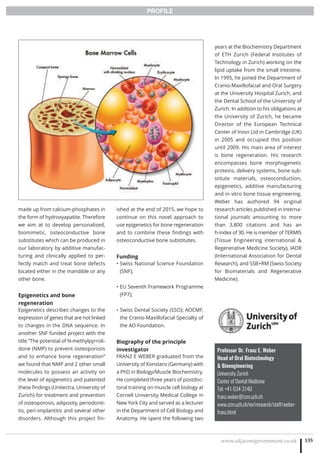
citizens and community is shifting significantly. Some-
times in the past – and still in some places – cities were
viewed almost as passive objects, to be worked upon
by urban planners and engineers. Now, cities are pro-
moting more participation by residents; they realise
that they need to coordinate more with the local,
regional, national, and European levels; and they are
collaborating more with other cities. With the internet,
participation is easier. Coordination is more important,
because complex global challenges such as climate
change need agreements between member states and
action by local government. Networks of cities and
regions have developed, making collaboration easier.
Increasingly, there is also a realisation – as the Com-
mittee of the Regions argues – that social cohesion
needs to be reinforced in the face of growing inequality
and other pressures.
For example, the arrival of a large number of refugees
in Europe makes inclusive policies and an integrated
approach even more important. In Berlin, one well-
known project is the ‘neighbourhood mothers’ pro-
gramme, through which women with a migrant
background support other migrants in everyday life in
areas where, for instance, the role of social workers is
limited because of language barriers and trust issues.
Integration requires this type of imagination and hard
work at the local level. It also requires support from the
regional, national and European level.
The EU’s new Urban Agenda, which ministers will
endorse in Amsterdam, is a recognition of this shift by
local governments towards a more inclusive approach.
It is also a response to criticism that the EU needs to
take a more integrated approach to issues affecting
cities. The EU has no urban policy – urban policy is
determined by national governments. Yet around 70%
of legislation agreed by EU member states – on, for
example, transport – require some implementation at
the regional or municipal level. In the absence of an EU
urban policy, urban issues have been addressed in a
fragmented, sometimes incoherent way. The Pact of
Amsterdam will set specific priorities and some work-
ing methods, including a strengthening of partnerships
between cities.
This is good. There is no attempt to suggest a one-size-
fits-all solution. The Pact promotes a bottom-up
THE BUILT ENVIRONMENT
www.adjacentgovernment.co.uk196
THE BUILT ENVIRONMENT
www.adjacentgovernment.co.uk 197
approach. There is no threat to Member States’ power
to determine urban policy. It will enable a state and a
city to discover what other states and cities are plan-
ning, and they should be able to work together more
easily. Crucially, the aim is to ‘urban-proof’ EU policies,
so that European institutions take urban issues into
account as a matter of course from the beginning of
the legislative process.
But ‘urban-proofing’ and implementation require more
political commitment. The EU’s member states agreed
to an urban action plan in 2000 (in Lille), identified doc-
uments that could act as common ground for urban
development policies in 2004 (the Rotterdam Urban
Acquis), and in 2009 agreed to start integrating sustain-
ability strategies into national, regional, and local
development policies (the Leipzig Charter). We now
need to work more on implementation, which is what
the Pact of Amsterdam encourages. But the pact
should be binding – that is the third principle that the
CoR is calling for.
The EU’s Urban Agenda is, in effect, an attempt to
improve the quality of life in Europe’s cities. But it is
also crucial to the health of our societies. The EU’s
approach could also help cities across the globe that
face bigger challenges with fewer resources. This year,
the UN will hold its biggest gathering in 20 years,
Habitat III, on sustainable urban policies. The Pact of
Amsterdam is, therefore, the right message at a big
moment for the world’s cities. ■
Hella Dunger-Löper is the state secretary of the Land of Berlin, with
responsibility for European affairs. She is a member of the European
Committee of the Regions (CoR), representing the Party of European
Socialists, and is the author of the CoR’s “Concrete steps for implementing
the EU Urban Agenda”.
. . . . . . . . . . . . . . . . . . . . . . . . . . . . . . . . . . . . . . . . . . . . .
Hella Dunger-Löper
Member representing the Party of
European Socialists
European Committee of the Regions (CoR)
http://cor.europa.eu/en/Pages/home.aspx
Hella Dunger-Löper,
Member representing the
Party of European Socialists
www.adjacentgovernment.co.uk198
PROFILE
C
oncrete and reinforced/pre-
stressed concrete is and will be
the main construction material
for civil engineering infrastructure.
Much more then in the past this con-
struction technology faces challenges
that have been discussed at the Inter-
national RILEM workshop held at ETH
Zurich in Switzerland on 17-18 April
2012 1
.
For new structures that will be built in
industrialised and emerging countries
to expand the civil engineering infra-
structure, the challenge is to achieve
long service life, practical, cost-effec-
tive solutions with materials having a
reduced environmental footprint. To
achieve this, cement industry made
great efforts in substituting clinker
(responsible for great part of the
CO2
emissions) with supplementary
cementitious materials (SCM). These
modern binder systems containing
limestone, fly-ash, burnt oil shale etc.
in a complex blend (see e.g. European
Cement Standards EN 197-1) are
increasingly used worldwide. This
ongoing substitution is reflected in
the decreasing amount of Portland
cement (CEM I) and the increase of
blended cements (CEM II, CEM III etc.).
Whereas these new blends are suit-
able for achieving strength similar to
Portland cement, thus can be used to
build concrete structures, their long-
term durability when used to make
the final product concrete is far less
established. The key durability chal-
Corrosion rate of steel in carbonated
concrete made with modern binders
lenge for engineers in the design
process of new concrete structures
lies in predicting long-term perform-
ance of these new materials with an
ever-increasing diversity of cement
blends.
To address durability of reinforced
concrete structures, the European
concrete standard EN 206-1 defines
exposure classes (a kind of standard-
ised environmental conditions) and
the (national) requirements for con-
crete such as water/cement ratio,
minimum cover depth and minimum
cement content. Concrete for a bridge
in the Swiss mountains exposed to a
severe climate and de-icing salts
(exposure condition XD3) must be of
much higher quality (lower w/c ratio,
higher cover depth) compared to
concrete inside a building (XC1). This
prescriptive approach is based on
long-term experience of the past.
Long experience with concrete struc-
tures made with Portland cement
(CEM I) has shown that carbonation,
Fig. 1: Service life model of a reinforced concrete structure exposed to carbonation. At the end
of the initiation period the steel is depassivated and corrosion can start
www.adjacentgovernment.co.uk 199
PROFILE
thus the reaction of CO2
from the envi-
ronment with the alkaline compo-
nents of concrete leading to loss of
the corrosion protection of the rein-
forcing steel, was not a problem for
durability. Concrete cover, water /
cement ratio and cement content
according to the prescriptions for the
exposure condition and good execu-
tion were sufficient to avoid corrosion
due to carbonation. For the new
blended cements with SCM – despite
they are increasingly used – this is
questioned. Due to the reduced
clinker content, the pH of the concrete
pore solution is lower, the alkali
reserve is reduced and questions
arise regarding the corrosion protec-
tion of the steel 2
. Thus the traditional
prescriptive approach with exposure
classes and deemed-to-satisfy rules
might no more be sufficient in this
new situation.
The carbonation of concrete made of
new, blended cements is now increas-
ingly studied. It is quite established
that the well-known laws that
describe the propagation of the car-
bonation front into OPC concrete can
be applied for new blended cements,
too. However the rate of carbonation
process, expressed with the carbona-
tion coefficient K, seems to be much
faster at least for some of the modern
binders 3
. Thus the carbonation front
reaches the reinforcing steel much
earlier and the steel becomes depas-
sivated (Fig. 1). In presence of oxygen
and humidity corrosion can start 2
.
One approach to achieve the required
long service life also with modern
binders would be to include also part
of the propagation period (Fig. 1) –
thus the corrosion rate of steel in car-
bonated concrete becomes of out-
most importance. In principle, the
corrosion rate will vary according to
the exposure conditions and the con-
crete quality 2
and work on Portland
cement concrete shows an exponen-
tial increase of corrosion rate with
relative humidity (Fig. 2). Detailed and
quantitative information for concrete
made of modern binders is lacking. A
research project at the Institute for
Building Materials at ETH Zurich
“Corrosion rate of steel in carbonated
concrete” is addressing this open
question. In order to limit the time
needed for full carbonation, thin
samples made of cement paste and
mortar containing different modern
binders are produced. On these sam-
ples the corrosion rate, oxygen diffu-
sion and resistivity can be measured
as a function of composition, expo-
sure condition (relative humidity) and
time. Results of this research will allow
a much stronger link between durabil-
ity related performance characteristics
of the new cements and the properties
of concrete. In particular it will
become clear under which conditions
the corrosion rate in carbonated
concrete can be considered negligible.
1 U. Angst, R.D. Hooton, J. Marchand, C.L. Page, R.J. Flatt, B. Elsener,
C.GehlenandJ.Gulikers,MaterialsandCorrosion63(2012)No.12
2 L. Bertolini, B. Elsener, E. Redaelli, P. Pedeferri, R. Polder, Corro-
sion of Steel in Concrete – Prevention, Diagnosis, Repair, WILEY
VCH second edition (2013)
3 A. Leemann, P. Nygaard, J. Kaufmann, R. Loser, Cement  Concrete
Composites 62 (2015) 33–43
4 C.L. Page et al., Corrosion Science 12 (1991) 1283
Prof. Dr. Bernhard Elsener
Head Durability Research Group
Institute for Building Materials
ETH Zurich
Tel: +41 44 633 2791
elsener@ethz.ch
www.ifb.ethz.ch/corrosion
Fig. 2: Influence of relative humidity on the corrosion rate of steel in carbonated OPC mortar
adapted from C.L. Page et al. 4
Varberg takes
responsibility
– again
For the coastal city of Varberg, Sweden, 2015
was the year when the community united in a
joint effort to take responsibility for peace
and human rights – just as they did at an
international peace summit held there one
hundred years before. The municipality has
an active role to play and views the project as
an extension of the work towards its vision of
developing the city of Varberg as the Swedish
West Coast’s creative hotspot, with the help of
local residents.
As the 100th anniversary of a significant peace
summit approached, here in Varberg we chose
a different way to celebrate. The result was the
VARBERG CALLING for Peace project, with
the aim of engaging and involving residents in
actively working for peace and a sustainable
society. The basic idea is to draw attention
to the local and international history of peace,
and in doing so combine the forces of
Varberg’s administrative bodies, organisations,
civil society and local residents to increase
awareness of the important perspectives that
are vital for peace and a sustainable future. It
is also important to encourage participation
in order to highlight issues of democracy,
human rights, cultural understanding and
sustainable environment, and to examine
them in greater detail. Also for there to be a
legacy once the project has ended, which can
be built on and will provide support for future
development.
Greater awareness of the age in which we are
living and a common educational perspective
on our history provide the conditions for
future creativity, innovation and action. We
believe that the big, universal human issues
can unite many, both organisations and
individuals.
Thinking globally and taking into consideration
situation analysis and environmental and
resource perspectives cannot be restricted
to municipal or national borders. VARBERG
CALLING for Peace is an opportunity,
therefore, for Varberg municipality to take a
forward-looking, general approach to
sustainable development in a project that
involves local residents. Engagement on
humanitarian issues and the all-pervading
problems we now face in the world around us
may also increase interest in important issues
at local level. The project therefore represents
a step towards the realisation of Varberg’s
plan: Vision 2025 “Swedish West Coast’s
creative hotspot” and a sustainable future.
Christina Josefsson
Head of the Culture and Leisure department
The City of Varberg
Photo:MimmiPersson
Come to Varberg. Share our vision.
varberg.se
Inspiring people
to create
everyday peace
The city’s local education centre, Campus
Varberg, is today the largest vocational college
in the Halland region and is one of Sweden’s
leading providers of vocational education.
The core values at Campus Varberg include
knowledge, innovation and creativity, and it
was not long before it became involved in the
VARBERG CALLING for Peace project.
At the college’s events and management course
a number of students are running their own
projects as part of VARBERG CALLING for
Peace. Here they tell us about the solid peace
work they have done, which has given them
valuable experiences.
“We are studying on a three-year events and
management course and during February and
March we studied a course in ‘project-based
development work’,” explains Lina Rundbom,
one of the students.
“During the course, we had the opportunity to
choose from a number of assignments to work
on and we five chose ‘VARBERG CALLING’.
We had to examine and communicate the
questions ‘What do you stand for?’ and ‘How
can you get strangers to talk to one another?’
to the general public.”
The assignment came from the two process
managers for VARBERG CALLING for Peace,
Malin Bellman and Jon Liinason.
“They gave us some good advice before we
started. ‘Don’t think – just do it and see what
happens!’ they said. So we did. We tried out
our ideas on people using quick and easy
prototype tests, with the results leading to
new ideas.”
One of the prototype tests involved leaving a
bicycle in the entrance to the city’s galleria.
The girls left the bicycle “right in the way” and
stood a few metres away to see how people
reacted. Contrary to what you might expect,
most people did not seem particularly irritated.
It gave some people something to talk about
as they wondered why the bicycle was there.
Another was the mobile “everyday peace cycle
café”. Loaded up with coffee and pastries, the
bicycle was pushed around to various parts of
the city, offering coffee and cakes for free.
They asked the people they met how we can
create everyday peace. Smile at someone you
don’t know, pick up litter, and hold open the
door for someone were some of the suggestions.
“It really doesn’t need to be any more difficult
than that,” says Lina. “Everyone can do
something. The cool thing was seeing how our
own positive energy clearly spread to those
people we were talking to.”
Annette Wenklo
Indoor Positioning Systems –
We know where you are
Jim Sinopoli, Managing Principal at Smart Buildings LLC highlights
the benefits for Indoor Positioning Systems…
S
tudies have found that people spend 80-90% of
their time indoors, so it’s no surprise that one of
the most promising technologies for buildings is
Indoor Positioning Systems (IPS). An IPS simply locates
objects and people in a building and provides location
dependent information and data to occupants to assist
in finding their way. It has much more potential, such
as providing valuable information to businesses and
building owners, security and life safety aspects.
The most popular approach to the architecture of the
IPS is “Bluetooth Beaconing”, although Wi-Fi can be
used, it is not as accurate as Bluetooth. Bluetooth was
created in 1994 to essentially replace short cables.
Today every smartphone is Bluetooth enabled and
we’re all familiar with using it to connect ear buds,
headsets, printers, game consoles, keyboards, etc. It is
the Bluetooth capabilities of smartphones together
with the beacons that can provide the location of the
smartphone users. The use of Bluetooth beacon have
an accuracy around 0.3 meters (1 foot), with no latency.
The ISP system will use a variety of methods to identify
the location of a personal or object including triangu-
lation, signal fingerprinting and direct association.
Large national and international companies have formed
the In-Location Alliance for indoor positioning systems
to standardise and commercialise the technology. The
alliance includes large multi-national companies such
as Nokia, Samsung, Qualcomm, Sony and dozens of
other companies.
Some of the companies involved in IPS are high tech
companies motivated to extend their existing outdoor
mapping applications to the indoor environment
where GPS doesn’t work well due to signal attenuation.
In addition to extending their mapping applications
and advertising revenue the companies have an
opportunity to create a treasure trove of data that
will assist businesses, primarily retail, in identifying
customers and product placement.
One of the key metrics for building management is
data on how occupants are using building spaces. That
may include when and where building occupants enter
and exit a building, what building spaces occupants
inhabit, what time or day they occupy the area 8, dura-
tion of occupancy, etc. Such data can be used to optimise
the building operations, correlating the occupant data
to building systems, energy consumption, space utili-
sation, and even utilising the data for renovations of
existing buildings or design of new buildings. IPS could
also be part of addressing life safety events, for example
locating people for safety and security purposes in
an emergency.
IPS technology can be used for almost any size building
but appears to be particularly well-suited for large
commercial buildings, educational campuses, malls,
airports and museums.
Some of the applications involve real time location of
personnel such as doctors, supervisors, technicians, or
tracking team members and assets on missions in dark
or crowded locations. Some companies have also used
IPS to identify occupancy and adjust energy manage-
ment systems based on where people are gathered.
IPS has many uses such as life safety and security, pro-
viding an innovative way to locate and communicate
with people inside buildings during emergency situa-
tions. The United States Federal Communications
Commission (FCC) is looking at indoor positioning to
enhance emergency response as well. FCC has
suggested a current baseline for indoor positioning for
use in emergency response. One of the concerns is
THE BUILT ENVIRONMENT
www.adjacentgovernment.co.uk202
THE BUILT ENVIRONMENT
www.adjacentgovernment.co.uk 203
determining vertical location in a multilevel building.
An FCC report concludes: “While the location positioning
platforms tested provided a relatively high level of yield,
as well as improved accuracy performance, the results
clearly indicate additional development is required”.
It is worth noting that over 70% of all emergency calls
come from mobile phones. The indoor positioning
system can also be used in conjunction with an Access
Control System to trigger an alarm notification if a worker
or asset enters or leaves certain predefined zones.
Many deployments of indoor positioning systems use
multiple technologies; Wi-Fi and Bluetooth BLE. Such
installations strive for more precise and exact locations.
Multiple technologies also provide some resiliency
and reliability in the system, and the use of multiple
technologies may allow for compatibility with a larger
spectrum of support for user smartphone and tablet
devices.
Given the high profile incidents that are occurring with
growing frequency in shopping malls, office buildings,
schools and even government facilities, hybrid IPS
technologies combining Wi-Fi and beacons offer the
best methodology available to protect individuals,
reduce injuries and prevent loss of life. Indoor Position-
ing Systems do not work without indoor maps. Building
owners will need to survey their area and incorporate
the maps into the facility’s app.
We track and locate people and objects outdoors in
real-time via GPS; IPS provides for similar tracking
indoors. In the near future it may be that there will be
few places on Earth where we can’t be tracked and
identified. ■
. . . . . . . . . . . . . . . . . . . . . . . . . . . . . . . . . . . . . . . . . . . . .
Jim Sinopoli
Managing Principal
Smart Buildings LLC
jsinopoli@smart-buildings.com
www.smart-buildings.com
W
e spend the vast majority of
our time in indoor spaces,
be this at home, at work, or
while travelling. Despite most of us
being used to location-based services
(LBS), for instance to find the nearest
point of interest, this experience is
essentially limited to outdoor spaces
since GPS-based location becomes of
limited use, when locating the position
of objects or people within indoor
scenarios.
In recent years, several indoor loca-
tion solutions have reached technical
maturity, opening up unprecedented
“smart building” scenarios including,
but not limited to, personal mobility,
facility management, retail, etc.
How i-locate has addressed
existing barriers
Today, the indoor location-based serv-
ices market is very fragmented with
several corporates, SMEs and start-
ups developing specialised solutions
based on a variety of different tech-
nologies (Bluetooth, Ultra Wide Band,
geomagnetism, Li-Fi, etc.). The three
main barriers which have traditionally
limited widespread adoption of these
technologies are: the lack of online
services capable to support the creation
and sharing of indoor maps as open
data, the lack of technological ecosys-
tems leveraging on indoor mapping
data, and limited availability of dedi-
cated standards for indoor location
based services. These three obstacles
have been targeted by i-locate
( www.i-locate.eu ), a project co-funded
by the European Commission, which
has developed an online service to
create and share (as open data) indoor
maps and a software ecosystem
for indoor location based on open
standards.
The resulting technologies have been
used to create “smart” building scenar-
ios within publically accessible buildings
(e.g. city halls, hospitals, universities,
etc.), by leveraging on indoor location of
objects and people. The technology is
being piloted for 12 months in 14
locations across 8 countries, addressing
several scenarios selected for their
social and economic relevance, with the
involvement of real downstream users
including, operators from hospitals,
public officers, and citizens, etc.
Indoor location as the driver for
smarter buildings
Although indoor location technologies
have proved to be an enabler for
smarter buildings in domains such as
industry, retail, health, etc., their benefit
for scenarios related to the ageing pop-
ulation has been still largely unexploited.
However, indoor location, used in
conjunction with technologies of the
Internet of Things (IoT), can be a very
effective leverage to the creation of
smarter buildings, specifically designed
to promote more “independent living”
for older people by monitoring, adapt-
ing and responding to the needs of an
ageing population.
The extent of the impact, in both
social and economic terms, of having
smart buildings designed for ageing
people becomes clear if we analyse
evolution of demographics. Our fast
aging population may threat sustain-
ability of healthcare financing, with an
www.adjacentgovernment.co.uk204
Indoor location and IoT for smarter
and more inclusive buildings
PROFILE
increasingly smaller share of popula-
tion providing the resources for a
larger group of elderly people who will
generate increasing costs.
Particularly critical is the rising
Long-Term Care (LTC) expenditure as
frailties, chronicity or multi-morbidity
significantly rise with age, especially in
the very old (+80), the fastest growing
age group, straining an already
challenged healthcare model (their
costs are set to increase from 1.8% of
GDP in 2013 to 3.4% in 2060).
Such a demographical evolution clearly
requires new health-care and assis-
tance paradigms based on old people
staying in their homes as long as pos-
sible and it calls for smarter buildings
specifically designed to account for the
requirements of older people.
“Imagine an old person, living in a sen-
iors home, that wakes up from bed at
night and falls on her way to the toilet.
The accident could be discovered only
after hours. To limit risks, today, beds
are fitted with barriers, which -however-
affect seniors’ dignity and autonomy.
Future smart buildings will be able to
detect the danger, turn on the lights and
immediately send an alert to caregivers,
granting the old person the freedom she
would enjoy at home. Smart and high-
accuracy location technologies capable
to understand dangerous situations and
-if needed- react, are an essential com-
ponent of such a smarter building.”
The achievements of the
UNCAP project
The aforementioned scenario depicts
the typicaly used case addressed by
www.adjacentgovernment.co.uk 205
PROFILE
Dr Giuseppe Conti  
CTO of Trilogis Srl and Nively SAS
Tel: +39 366 338 4232
giuseppe.conti@trilogis.it
conti@nively.com
www.trilogis.it
www.nively.com
www.twitter.com/trilogis
www.twitter.com/nively_sas
UNCAP “Ubiquitous iNteroperable
Care for Ageing People”, a project co-
funded by the European Commission
that, in line with modern literature, fos-
ters a non-pharmacologic approach
where “smarter buildings” become
part of a wider strategy to help old
people maintain dignity, autonomy,
and a qualitative good level of life for a
longer period.
This is done through the development
of an IT ecosystem for AAL, capable to
transform a private or nursing home
into a “smart building”. This would
specifically be designed for older
people, to help them live as independ-
ently and as long as possible, while
reducing dependence from other
people to perform Activities of Daily
Living (ADL), e.g. to find the container
of the medicines.
The underling principle is to leverage
on interoperable access to biosensors
(based on Internet of Things – IoT), to
indoor location technologies (based on
the aforementioned i-locate platform)
and home automation systems, to
create added-value services capable to
ensure active monitoring and predic-
tion of incidents of their guests, adapt-
ing to gradual deterioration of patients’
cognitive, physical, and social functions.
Examples of such integrated vision
includes services to monitor physical
movements and clinical parameters, to
promote exercise and training (both at
a physical, emotional and cognitive
level), to support ADL, to detect when
an old person with cognitive impair-
ment leaves their room at night, or to
turn on the lights if the person starts a
night wandering episode or -worse- if
he/she falls to the floor.
Emergence of new
services models
At policy level, such a technological
convergence should be exploited to
promote social and organisational
changes, as well as new service models
beyond the simple care domain, which
can leverage on a more autonomous
ageing population living within smart
buildings.
Policies should promote not only
collection and access to health infor-
mation but they should promote the
transformation of existing houses into
smart buildings that facilitate self-
empowerment of old people and,
most notably, their families. Self-
empowerment will promote proactive
involvement of elderly people, and
their families, in turn facilitating better
dialogue with clinical staff, bringing to
a generally improved care system.
Barriers and obstacles and
framework conditions
The most significant barriers that
need to be overcome to promote such
a radical change, include:
Lack of common policies across•
EU, which are often not developed
nor harmonised, to promote trans-
formation of existing buildings into
smart spaces;
Fragmentation of markets at•
national level, as well as fragmenta-
tion of provision/ reimbursement
schemas that could be applied to
re-fitting of existing buildings;
Very complex value chains and lack of•
synergies across public and private
stakeholders;
Undefined boundaries and respon-•
sibility structures and clarification of
liability issues connected to smart
buildings as part of more compre-
hensive health and care systems.
The lack of high-level standards (more
than low-level standards for hardware
communication), is perhaps the most
urgent barriers to overcome, and it is
associated to the risk of emergence of
de facto standards from companies
that can take benefit of such a
fragmentation. As highlighted by
European Innovation Partnership on
Active and Healthy Ageing (EIP on
AHA), most solutions are based on
single provider design and therefore
cannot be adapted or adopted to dif-
ferent technologies. The lack of inter-
operability is one of the key barriers
to increasing competition, it does not
allow synergising between different
systems, it may cause market domi-
nance by major vendors preventing
true competition (especially by SMEs)
and -ultimately- it increases costs.
A grand challenge and a major
economic opportunity
To conclude, if we consider that, in
Europe alone, people aged 65+ possess
wealth and revenues worth over €3,000
billion, it becomes clear that, if properly
exploited, such a major change in
demographics will create a significant
market opportunity around smart
buildings for the “silver economy”.
Acknowledgements
Both i-locate and UNCAP are coordinated by Dr Giuseppe Conti,
CTO of Trilogis, an Italian SME specialising in geospatial solutions
and CTO of Nively, a French start-up spin-off of both i-locate and
UNCAP, specialising in location-based Ambient Assisted Living
solutions targeted to elderly persons.
i-locate and UNCAP are co-funded respectively by the ICT-PSP and
Horizon 2020 Framework Programmes of the European Union.
Engineering happiness in our cities
Simon Price, Ramboll Liveable Cities Director looks at how engineering
and infrastructure in our cities can lead to happiness…
C
ities are where most of us live, not just in the UK
but across the world. Every city is different,
characterised by its geographical position, its
history of development and its population. But in an
ever increasingly connected world and with the
increased mobility of individuals, and indeed whole
populations, cities are in competition with each other
for success.
Increasingly it is recognised that for a city to thrive it
must engender a sense of wellbeing within its citizens,
a sense of happiness. Happiness is considered to
provide a better indicator of human welfare than does
income, poverty, education, health and good govern-
ment measured separately (World Happiness Report).
For many years, the role of engineering within cities
was simply seen as the means to provide the core
infrastructure required to support urban life. To meet
the basic needs of energy, water and waste services,
transport etc. More recently though the concept of
place making has emerged, but has often been inter-
preted by design professionals, including engineers, as
‘place’ being defined by some particular sort of infra-
structure, a square, a cultural facility perhaps; often to
address perceived needs with little recourse to an
area’s population.
Exploring issues of human wellbeing and happiness
means we too can draw on the work of other disci-
plines and studies. For example the New Economics
Foundation (NEF) – The Five Ways to Well Being. This
can provide engineers and planners with new insights
into how to support the frame conditions for happiness
through good planning and design.
The Ramboll concept of the ‘liveable’ city is an
approach that builds on the ideas which underpin the
findings of the NEF and others and combines this with
expertise to design and deliver urban infrastructure.
We recognise that engineering has a key role to play in
creating the opportunity for wellbeing and happiness.
This approach has underpinned much of the recent
development within Copenhagen.
Copenhagen, named as the European Green capital in
2014 already has an established reputation as one of
the most liveable cities in world. It is recognised for
how green solutions have both benefited sustainability
and growth. It is the world’s best city for cyclists with
in excess of 40% of commuters choosing to use bikes
over their cars and has the ambition for all to be in a
15 minute walking distance of a beach or a park. With
over a million people linked to a multi fuel district
THE BUILT ENVIRONMENT
www.adjacentgovernment.co.uk206
THE BUILT ENVIRONMENT
www.adjacentgovernment.co.uk 207
heating system, the city has the ambition to be CO2
neutral by 2025.
Through being a more attractive city to live and work
in, the city has turned around a situation of population
decline to one of growth resulting in the need for new
housing districts. Nordhaven, situated just 4km from
the centre of Copenhagen, will provide housing and
workspace for over 40,000 people as it is developed
over the next 40-50 years. This new urban district will
eventually reuse over 500 acres of old port facilities but
rather than being all designed in one go, much of the
early effort went into establishing the overall vision for
the development, that is the framework which will
guide all future development across the 40-50 year
period. The vision was broken down into 6 supporting
elements all considered to be supportive of sustain-
ability and happiness. The elements are: islets and
canals, CO2
friendliness, the 5 minute city, the blue
green city, an intelligent grid, and identity and history.
Considering these 6 elements the first development
quarter nearest to Copenhagen has already been
planned, and construction is underway. The design of
this quarter carries many of the influences of the
existing city to create the feel of a natural extension to
something which is familiar, and not of an isolated
project. Scale has been an important consideration
since it is known that people feel more inspired by their
environment when it offers great variety. To support
this approach, building plots have been limited in size
and the network of streets limits individual street
lengths with an emphasis on the concept of 5 minute
mobility, which means the goal of making all service
facilities reachable within a 5 minute walk. Therefore
housing and workplaces throughout the district will all
be within a convenient distance of public transport,
bicycle paths, green areas, public institutions and com-
mercial facilities. All will be connected to the district
heating system and linked into the wider cycle and
public transport networks.
Will good planning and engineering design provide the
conditions for happiness for the populace of Nord-
haven? Well time will tell, but it seems arriving citizens
of Copenhagen are recognising the value of a vision
driven by liveability with all the apartments already
been sold ahead of schedule. ■
. . . . . . . . . . . . . . . . . . . . . . . . . . . . . . . . . . . . . . . . . . . . .
Simon Price
Liveable Cities Director
Ramboll
simon.price@ramboll.co.uk
www.ramboll.co.uk
T
he building information model-
ling (BIM) journey is underway
and accelerating across the globe.
Those now wishing to tender for UK
Government funded projects are
required to demonstrate their ability
to work with and provide information
from a BIM-enabled environment.
Some companies will now be thinking
that they can rest a while having
achieved ‘level 2’. However, the reality
is that level 2 was not intended as the
destination; it is the departure point
to fuel the journey towards data,
information, knowledge and wisdom.
While significant value can be achieved
at level 2 it is evident that significantly
more value is to be found by going
beyond level 2 and managing the
information at a data level.
However, it is my belief that some
companies are now on the wrong
track, driven by software vendors who
are selling what they have, based on
where they came from, rather than
what the industry truly needs to drive
efficiency. The belief that a document-
centric approach will work effectively
in the future is fundamentally flawed.
Of course documents are still
required, at least for the foreseeable
future, but it is a data-centric approach
that is required to better expose and
access the information required to
achieve more.
Truly data driven platforms
The key question is, how else can we
move towards a true data driven
information platform that can be
linked at object level and is ready to
be used in the ‘big data’ world without
the accessibility to information that is
currently locked away in files?
The most forward thinking companies
are already using data-enabled collab-
oration and are moving quickly towards
working with objects i.e. construction
elements like slabs, columns, beams,
windows, pumps, valves, etc., and
focusing on the processes for gathering
information attributes across the
information lifecycle in a database,
rather than trying to abuse 3D design
files to store lots of detailed descriptive
attribute data.
The result is building a fuller represen-
tation of the asset by federating the
data from multiple models, storing it in
a database, and then enriching the
information as the project progresses.
These companies are now reaping big
rewards of increasing efficiency and
quality of project outcomes. Some of
the outcomes and ROI’s have been sig-
nificantly better than anyone predicted.
Extracting value from
information
The dawn of ‘big data’ is rapidly draw-
ing nearer for the built environment.
Technologies that take feeds of data
from a myriad of sensors connected
by the internet – the so called ‘Internet
of Things’ or IoT – brings us into a
highly connected world. The technol-
ogy is available now to deliver masses
of data, but as an industry we still
need to figure out how to extract
value from the information and result-
ing intelligence that big data and IoT
is able to provide.
Big data is all about using this vast
array of data sources to identify and
analyse trends. This is quite different
from ‘analytics’. I have a simple view
that analytics is looking for information
when you know the question. Big data
is about analysing data and trends
looking to provide answers to ques-
tions you should or could have asked.
From a construction industry perspec-
tive, we need to apply this thinking to
how we design and use our built envi-
ronment, and how it could automati-
cally react to changing conditions.
Picturing a data enabled
environment
Imagine an emergency situation in an
inner city high street where a fire
breaks out. It is important to protect
life and contain the environment to
stop the fire spreading. By monitoring
fire detection equipment and temper-
atures within spaces linked to a 3D
building model it is possible to assess
the extent of the fire and determine the
best escape paths. Access to detailed
building information can provide rich
information on possible danger and
safety areas, fire containment strate-
gies and rescue planning.
Now bring into the scenario anonymous
cellular data feeds, linked to the building
model which can indicate the location
or concentration of people in the
building or in other dangerous areas.
Then consider the weather. If it’s windy,
sending an emergency code to sensors
to close air vents and seal the building
may help bring the fire under control
www.adjacentgovernment.co.uk208
BIM, IoT, big data: A vision for a
data enabled built environment
PROFILE
www.adjacentgovernment.co.uk 209
PROFILE
Graeme Forbes
Managing Director
Clearbox
Tel: +44 (0) 800 085 9872
sales@clearboxbim.com
www.clearboxbim.com
and stop the fire and smoke from
spreading. Anonymous cellular device
feeds can also inform the emergency
services on the dangers of predicted
debris areas based on structural infor-
mation and weather conditions. Traffic
systems can automatically place signals
on red to avoid traffic entering the area,
and corridors opened up to assist first
responder access.
An effective response
Analysing trends from simulations on
real time and historic data, adding in
such things as detailed building models,
GIS information, weather and trans-
portation feeds, movement of people,
and so on, can bring intelligence and
inform us on how situations can be
prevented or responded to more
effectively in the future.
This kind of approach is already start-
ing to happen in small steps through
the UK’s efforts to smooth out traffic
flow by introducing ‘smart motorways’.
However to move forward I would
suggest that we need to have a full
physical and functional representation
of our built assets at an object, or ele-
ment level. We cannot achieve what is
required in the future with the infor-
mation being locked away in 3D models
and document management systems.
This kind of scenario calls for a data-
enabled collaborative environment that
can share detailed attribute information,
in context from a database platform.
Making headway
Intelligent clients are already starting
to consider how they can use infor-
mation to drive better decisions. The
supply chain also need to focus on
their systems and processes so that
they can meet the growing need to
share a data driven, object-based
information model which contains the
full physical and functional character-
istics of the asset.
There are companies making real
headway with a data-centric informa-
tion platform that sits on a database.
I am currently working with one of the
leading companies, Clearbox Limited
www.clearboxbim.com in the UK, who
are committed to driving forward a
data-driven information environment.
Over the past two years the BIMXtra
cloud based solution has been used
on over 500 projects, and provides a
real insight into analytics and Big Data
and the journey in front of us.
Contact me with views and comments
at: steve.dunwell@elev8consult.com
Training – the first step to
competency
Association for Specialist Fire Protection CEO Wilf Butcher explains why competency is important for the
specification, installation and maintenance of passive fire protection…
W
ithin the fire sector world, one of the most
common ‘buzz words’ you are currently likely
to hear is ‘competency’.
The dictionary offers a range of explanations to define
the meaning of competency, not least of which is ‘the
capacity to testify in a court of law’. A sobering thought, as
without doubt, the penalty for proven ‘incompetence’
can be very severe. One only has to be aware of the
number of heavy fines, and indeed custodial sentences
brought about through incompetent fire risk assess-
ments under the Regulatory Reform (Fire Safety) Order
2005 to understand the importance of competency in
achieving a given objective.
In relation to fire safety, competency can only be
assured by a combination of education, training and
experience, starting with the design concept and pro-
gressing through specification, the main contractor
tendering process, installation, inspection and finally
the onward management for the life of a building.
In other words, fire protection is a cradle to grave
process, specified, installed and managed by many dif-
ferent professions, all of whom should have, in varying
degrees, an appropriate knowledge and understand-
ing of the functionality of the fire protection measures
installed and its surrounding structure.
Improving competency
Over the last 20 years, the Association for Specialist Fire
Protection (ASFP) has promoted both product and
installer third party certification as a vital means of
demonstrating competency in the quality of product
selection and the installation of appropriate fire protec-
tion systems. Such a UKAS accredited process offers:
Supporting evidence of the quality of the product or•
service for the architect, specifier, contractor, building
control authority, end-user, responsible person and
any other stakeholders;
Assures the quality of the product or service•
independently of the supplier.
Third party certification is encouraged by authorities
such as DCLG (AD-B), Scottish Government, Local
Authority Building Control, the fire services and many
others key bodies, and is encouraged by all fire protec-
tion trade associations. In fact, it is mandatory for
all ASFP contracting members to hold and maintain
third party certification to become and maintain ASFP
membership.
Whilst the third party certification approach is now
widespread within the ‘specialist installer’ sector of the
fire community, the ASFP has long been aware that a
considerable element of the workforce currently
installing passive fire protection is doing so as a
secondary activity, which may be outside of its core
construction competencies. These contractors therefore
cannot be considered as ‘specialist’ operators. As a result,
there is an identifiable ‘under skilling’ of essential
elements of the construction industry workforce, all of
which would benefit from having an appropriate
understanding of passive fire protection.
Industry wide training
Given the above, the ASFP, has now taken the next
important step. Working in partnership with the Fire
Protection Association (FPA) and part funded by CITB
(the Industry Training Board for the construction indus-
try), the ASFP has now developed an industry wide
THE BUILT ENVIRONMENT
www.adjacentgovernment.co.uk210
THE BUILT ENVIRONMENT
www.adjacentgovernment.co.uk 211
training scheme which encapsulates in one syllabus
the necessary awareness training to assist in improving
capabilities during the installation process.
This comprehensive awareness training programme is
offered in two parts:
Core Module
This 2-day core module introduces attendees to essential
fire safety concepts, explaining the need for a holistic
approach to fire safety in which all types of fire protection
system, both passive and active, have a role to play.
The core module:
Outlines the legal, standard and other code-driven•
requirements for passive fire protection installations;
Identifies the role of passive protection to ensure the•
safety of buildings and their occupants;
Develops an understanding of the responsibilities of•
those involved in the process including the designer,
specifier, distributor, installer and end user;
Presents some of the common problems and issues•
caused by building alterations and potential solutions;
Explains the principles of fire science and the role of•
fire engineering.
Pathway Modules
For those wishing to progress their understanding of
the passive fire protection process in more detail, the
ASFP and FPA have developed a number of specific
‘Pathway’ modules in each of the passive fire protection
disciplines.
Each of these modules combine both theoretical and
practical application to reinforce the required awareness
for the installation of passive fire protection, and can
act as a springboard to assist in the process of onward
development to an NVQ in passive fire protection.
Reaching a wider audience
This new training scheme has been designed to signifi-
cantly improve overall standards of passive fire protec-
tion specification, inspection and installation within the
construction sector, and in the process will enable an
up-skilling of the existing workforce by creating a
recognised and measurable industry benchmark.
Further analysis of the passive fire protection sector
has identified that there are a number of other groups
that should be better advised and trained in appropriate
passive fire protection awareness. These include but
are not limited to:
Site supervisors;•
Inspectors of fire systems e.g. the fire services;•
Approved inspectors and building control officers;•
Fire risk assessors;•
Facilities managers.•
It is essential that adequate knowledge is communi-
cated throughout the industry to ensure necessary
up-skilling of the existing workforce and to reach those
within the process who are not familiar with passive
fire protection practice to enable them to achieve a
minimum level of competency.
The ASFP’s Passive Fire Protection Awareness Training
Programme is a first step in an important process
which aims to raise levels of competency throughout
the construction sector and improve standards of
passive fire protection specification, inspection and
installation. Ignore it at your peril. ■
For further information on ASFP training, seminars and technical guid-
ance visit www.asfp.org.uk; or to book a place on the Core module visit
http://www.thefpa.co.uk/training/training-courses_detail.introduction-
to-passive-fire-protection.html
. . . . . . . . . . . . . . . . . . . . . . . . . . . . . . . . . . . . . . . . . . . . .
Wilf Butcher
CEO
Association for Specialist Fire Protection
Tel: 01420 471612
wilf.butcher@asfp.org.uk
www.asfp.org.uk
PROMOTING QUALITY IN FIRE SAFETY
WWW.BAFE.ORG.UK
HEADLINES LIKE THESE...
FIRE SAFETY LEGISLATION IS NOW BEING SERIOUSLY
ENFORCED TO ENSURE THAT PROPERTY OWNERS MEET THEIR
OBLIGATIONS TO PROTECT STAFF, CUSTOMERS AND PREMISES
A London hotel has had to pay more
than £260,000 in fines and costs in
what is believed to be the first jury
trial of a case under the Regulatory
Reform (Fire Safety) Order 2005
The former owners of a WolverhamptonHotel have been fined almost £44,000following 11 breaches of fire safety
FIRE SAFETY LEGISLATION IS NOW BEING SERIOUSLY
A landlord has been jailed for four months
and ordered to pay £10,000 costs after
pleading guilty to three offences under the
Regulatory Reform (Fire Safety) Order 2005
Adequate Fire Protection starts with a
comprehensive and competent fire risk
assessment.
That’s why BAFE developed a scheme for the
certification of companies who provide fire risk
assessment services.
BAFE scheme ‘Life Safety Fire Risk
Assessment’ (SP205) ensures that UKAS
accredited certification bodies can assess
staff and procedures, so that property owners
can be sure that the provider that they use
meets appropriate standards.
BAFE is the independent third party approvals
organisation, which ensures quality for the
fire protection industry and provides the vital
reassurance that the services being bought or
specified are effective and reliable.
Don’t leave everything to chance.
Make sure that your suppliers are certified and
registered with BAFE at WWW.BAFE.ORG.UK
...ARE BECOMING
ALL TOO FAMILIAR
DON’T GAMBLE
WITH YOUR FIRE
RISK ASSESSMENT!
USE BAFE TO FIND
QUALITY FIRE PROTECTION
COMPANIES NEAR YOU
ENVIRONMENT
www.adjacentgovernment.co.uk 213
The circular economy – an
investment with a triple win
Karmenu Vella, EU Commissioner for the Environment highlights why Europe needs a circular economy…
E
veryone who looks closely at the economic and
environmental realities of the world today
agrees that the ‘take, make, use and throw away’
economy is the model of the past. In an age where the
global population grows by 200,000 every day, these
ways of thinking are no longer sustainable.
“The circular economy will also be on the
agenda at Green Week, Europe’s biggest
annualeventonenvironmentpolicy,which
will take place from 30 May to 3 June.”
What Europe needs is a positive vision for economic
development. We need a new model, where we use
resources more efficiently to boost Europe’s competi-
tiveness. A model that retains precious resources in
the production chain, and exploits the economic value
they contain to the full. What we need, in short, is a
more circular economy.
In a circular model, products are designed to be used
for as long as possible, easily repaired and, once they
reach the end of their lives, recycled or disposed of
effectively. This brings major environmental benefits,
as resources are used efficiently and waste is reduced.
But the economic opportunities are just as big.
Studies show that a shift towards a circular economy
could bring savings of €600bn for EU businesses, and
reduce greenhouse gas emissions by 2 to 4% every
year. There is also significant employment potential
with low, medium and high-skill jobs in eco-design,
engineering, waste sorting and recycling, and in new
services based on renting or sharing products. A circu-
lar economy promotes innovative technologies that
give European companies a competitive edge, and it
benefits consumers, who enjoy more durable and
innovative products.
The European Commission presented a package on
the circular economy in December 2015 showing how
this future can be achieved, with a legislative proposal
on waste and an Action Plan for the economy.
The waste proposal acknowledges a hard truth: waste
in the EU could be better managed. Only 36% is effec-
tively recycled, and 37% is sent for disposal, wasting
precious resources that the EU cannot afford to lose.
Recycling rates reach 80% in some countries, while in
others they languish below 5% (the UK recycled 45% of
its municipal waste in 2014, which is above the EU
average of 43%). What we propose is a plan for raising
that average, while still taking into account the
differences between Member States.
ENVIRONMENT
www.adjacentgovernment.co.uk214
Food waste is an area of particular concern. The UN
Sustainable Development Goals adopted last Septem-
ber include a target to halve food waste by 2030. The
Commission is committed to helping EU Member
States deliver on this target.
The circular economy is not just about recycling.
It’s about the whole lifecycle of products. It’s about
incorporating sustainability into products from the
outset – rethinking design, rethinking production
processes, giving better choices to consumers, and
changing existing business models.
The UK already has a number of champions in this
area. On a recent visit to Scotland I saw how Kalopsia,
a textile company in Edinburgh, is putting the circular
economy into action. Their “Facility Space” is a commu-
nal area that encourages fashion and textile designers
to work more sustainably by sharing skills and ideas,
using machines that would otherwise lie idle, and
utilising offcuts and waste.
The Bay, a fish and chip shop in North East Scotland, is
another beacon – a small company that takes care of
resources at all stages of their activities. They monitor
their electricity, gas and water use, reduce food waste,
recycle extensively and minimise their carbon footprint.
Their efforts took them to the shortlist in the European
Commission’s 2014-2015 European Business Awards
for the Environment.
These trends are very real, but they need more support.
This is why I was delighted to hear about Scotland’s
ambitious plans for a more circular economy. We are
looking forward to working with Scotland to help
“Make Things Last” and turn a circular economy into
a reality.
Europe is home to many energy-efficient, low-carbon
and resource-efficient technologies, and many small and
medium enterprises are ready to make the shift. But
these investments are sometimes perceived as risky.
EU finance can help. To reinforce circular economy-
related innovation and attract investors, the EU is
mobilising European Structural and Investments Funds,
its flagship Research and Innovation Programme Hori-
zon 2020, and working closely with the European
Investment Bank. The ‘Industry 2020 in the Circular
Economy’ initiative will grant over €650m to innovative
demonstration projects.
One major support and funding tool is the European
Fund for Strategic Investments (EFSI). This can help
raise private finance, especially in areas where com-
mercial banking is still hesitant to get involved.
But we need to do more. We need to channel private
sector funding towards these new opportunities. In the
coming months a series of initiatives are planned to
help businesses and consumers continue to move
towards a circular economy. The circular economy will
also be on the agenda at Green Week, Europe’s biggest
annual event on environment policy, which will take
place from 30 May to 3 June. Focusing on the theme
‘Investing for a greener future’, discussions will zoom
in on opportunities and challenges of green finance.
“The circular economy is not just about
recycling. It’s about the whole lifecycle of
products.”
With the circular economy we are looking at a triple
win. Society can win through job creation, savings for
businesses and lower carbon emissions. It’s a major
opportunity – let’s make sure we grasp it. ■
. . . . . . . . . . . . . . . . . . . . . . . . . . . . . . . . . . . . . . . . . . . . .
Karmenu Vella
Commissioner for Environment,
Maritime Affairs and Fisheries
European Commission
http://ec.europa.eu/commission/2014-2019/vella_en
www.twitter.com/KarmenuVella
ENVIRONMENT
www.adjacentgovernment.co.uk 215
A paradigm shift to
sustainable financing
MEP Sirpa Pietikäinen highlights progress already made towards a circular economy,
as well as, what more needs to be done…
T
raditionally, we are used to thinking about
ecology and economy as 2 different worlds. This
thinking is premised on the assumption of
unlimited natural resources, a world with such
abundant resources that the end to those resources
doesn’t figure in traditional models of economic
thought. Neither do the negative external costs such
as the ones posed by climate change.
However, the fact is that physical limits to growth
exist. It has been forecast that global demand for
resources will triple by 2050. Currently we already
consume some 1.5 planets’ worth of resources every
year. Following the estimates, we would need some 4
planets full of resources to satisfy the demand by 2050
under business as usual.  Estimations vary, but it is
clear that under business as usual, we are also set to
exceed the 2 degree Celsius global warming, a limit set
by the global community.
Taking into account these facts, it is clear that the
current Cartesian worldview can no longer apply. What
is needed is a true paradigm shift, one with a holistic
approach. When the physical limits to growth are
factored in, the whole basis of our economic thinking
changes: the way we measure the success and viability
of companies or countries, the way we value assets –
the list goes on.
A lot of work has already gone into developing
resource accounting methodologies, in organisations
such as United Nations Environment Programme
(UNEP) or OECD. The parameters are there; what is
needed now is to put this work into practice. A set of
indicators that most parties can globally agree to,
needs to be chosen, and applied to different countries
and sectors. A concerted international effort is
required to bring this forth and the Financial Stability
Board can and should play a central role to promote
this effort. Another important aspect is the fact
that these indicators need to be binding, to ensure
comparability.
This set of agreed-upon accounting rules should
subsequently be applied across the whole financial
system, to measure the situation of national and global
accounts much the same way the GDP currently does.
By the same token, credit ratings as well as capital
requirements rules must take these sustainability
parameters into account.
The financial system is the bloodline feeding our
societies, which is why it needs to be at the forefront
of the paradigm shift. If the incentives of the financial
sector run counter to the goal of building more
resource efficient societies and combatting climate
change, the latter efforts are destined to fail. ■
. . . . . . . . . . . . . . . . . . . . . . . . . . . . . . . . . . . . . . . . . . . . .
Sirpa Pietikäinen
MEP
European Parliament
sirpa.pietikainen@europarl.europa.eu
www.europarl.europa.eu/meps/en/40599/SIRPA_PIET
IKAINEN_home.html
Hans Bruyninckx, Executive Director of the European Environment Agency outlines why
we need to facilitate a transition towards a circular, green economy by moving beyond waste policies
and focusing on eco-design, innovation and investments…
O
ur current resource use is not sustainable and
is putting pressure on our planet. Research can
foster not only innovation in production, but
also in business models and financing mechanisms.
The European Commission proposed on 2 December
2015 a new legislative package on circular economy.
The package covers different stages of a product’s
extended lifecycle from production and consumption
to waste management and the market for secondary
raw materials. The proposed actions are designed to
benefit both the environment and the economy, and
extract the maximum value and use from all raw mate-
rials, products and waste, fostering energy savings and
reducing greenhouse gas emissions.
Over the last decades, legislation to protect the envi-
ronment has evolved from issue-specific responses to
more integrated and systemic responses. The circular
economy package is one of the latest examples of such
integrated policy responses and is certainly a signifi-
cant step towards the European Union’s objective of
‘living well within the planet’s ecological limits’.
Our European environment: State and Outlook 2015
report (SOER2015) underlines the sustainability chal-
lenge we are facing today. We are consuming and
extracting more resources, both in Europe and in the
world, than our planet can replace at any given time.
On the one hand, economic activities contribute to
human well-being and poverty reduction. On the other,
they pollute the environment, warm the planet, damage
human health, while weakening the planet’s capacity
to provide for us. Climate change and population
growth projection add to the urgency for comprehen-
sive and immediate action.
Although no country has achieved so far both ‘living
well’ and within its natural means, there are some
encouraging signs. The European Union has started to
break the link between economic growth and con-
sumption of energy and materials. Europeans are
recycling a larger share of their municipal waste and
sending less to landfills. Eco-industries (e.g. working on
renewable energy, waste water treatment, air pollution
control, etc.) have grown considerably over the last
decade and created jobs despite the recent recession.
Reducing dependence on raw materials
A circular economy strives to reduce the ‘inflow’ of new
resources, especially non-renewable resources, to use,
re-use and valorise the resources in the economy as
much as possible, and to minimise the ‘outflow’ of
emissions and waste.
The message is clear: potential reductions in waste
could generate substantial gains for the economy and
human health. Keeping already extracted resources in
use would not only reduce dependence on raw mate-
rials (domestically extracted or imported), but also
boost competitiveness while reducing environmental
ENVIRONMENT
www.adjacentgovernment.co.uk216
Moving beyond waste management
towards a green economy
ENVIRONMENT
www.adjacentgovernment.co.uk 217
pressures. A preliminary analysis by the EEA shows
that European countries are already taking action
to improve their resource efficiency, mainly due to
economic concerns linked to resource dependency.
“The proposed actions are designed to
benefit both the environment and the
economy, and extract the maximum value
and use from all raw materials, products
and waste, fostering energy savings and
reducing greenhouse gas emissions.”
Waste prevention, recycling and better waste manage-
ment in general are all certainly crucial to minimise the
flows into and out of the economy. However, closing
the material loop is not sufficient to prevent further
impacts on the environment, human health and
well-being. Circular economy approaches need to go
beyond waste management, and facilitate a transition
to green economy. We need to re-think the way we
produce, consume and dispose of products.
Unlocking the eco-design potential
To start with, eco-design is essential for increasing
recycling potential and extending the lifetime of
products. We can design products in a way that they
can be easily repaired, have only their broken pieces
replaced and have their components easily sorted for
optimal recycling.
We also need to consider health and environmental
aspects of the materials we use in our products.
Eco-design could equally help replace materials with
high environmental impacts with better alternatives.
For example, it is clear that exposure to hazardous
chemicals is a serious health concern. We can adopt
clean materials cycles to prevent human exposure to
hazardous substances and to protect ecosystems from
chemical pollution.
Similarly, bio-based materials, such as wood, crops or
fibres, can be used for a wide range of products and
energy needs. Apart from providing an alternative to
fossil-based products, bio-based materials are also
renewable, biodegradable and compostable. However,
a potential to shift to bio-based materials should
be analysed in view of associated ecosystem and
health impacts. There are for example limits to forest
exploitation and burning wood for energy could
worsen air quality.
Investments to foster innovation
Eco-innovation and research promoting innovative
solutions are essential for a shift to a circular economy.
Innovation is not only limited to production processes.
New business models could be encouraged and sup-
ported. There are already many examples of innovative
solutions providing services rather than selling prod-
ucts: you don’t for example need to own a car to meet
your transport needs. Such collaborative business
models focusing on service provision could benefit
from new financing mechanisms, since investment and
profit follow a different pattern in time.
Public funds across Europe are already supporting eco-
innovation but they can play an even stronger role than
they do today. Investments in infrastructure, research
and cities could all be geared towards facilitating the
transition to a green economy. A strong commitment to
sustainability backed by a clear financial and regulatory
framework sends the right signal to all stakeholders.
It is clear that moving towards a green, circular economy
will benefit some groups and sectors, while putting
pressure on others. Policy makers will need to take into
account equity considerations, both within Europe
and globally, and offer support measures to facilitate
and steer the socio-economic transition needed. ■
EEA Editorial published in the issue no. 2016/1 of the EEA newsletter,
March 2016.
. . . . . . . . . . . . . . . . . . . . . . . . . . . . . . . . . . . . . . . . . . . . .
Hans Bruyninckx
Executive Director
European Environment Agency (EEA)
http://www.eea.europa.eu/
De-Icing sewage treatment
– a clever combination
Ms. Caterina Talerico and Mr. Dirk Kauffeld from Zurich Airport Ltd detail how the airport
is using new methods to treat the sewage from the de-icing of planes…
A
ircraft operating areas and aircraft itself have to
be kept free of ice and snow for safe flight
operations also during winter-time. Mechanical
clearance is therefore not sufficient. However, use of
conventional de-icing salts is not acceptable due to
their corrosive effects on aircraft. On these grounds,
operating areas are cleared mechanically at snowfall
before chemical de-icing agents are applied. Addition-
ally, the formation of ice at the wings and engines of
aircraft must be prevented and the aircraft needs to be
cleared from adherent snow and ice. For this purpose,
the organic compound Propylene Glycol, for certain
applications diluted with hot water, is applied by spe-
cialised vehicles. Depending on the weather conditions
and the respective size of the aircraft, 200 to 500 liters
of Propylene Glycol are needed for a single de-icing of
an airplane. During the application, already more than
one third of the agent drips off.
As a result of the de-icing and the dilution of precipita-
tion, a large amount of sewage incurs on the operating
areas during winter, which is contaminated with de-icing
agents. A direct discharge of this sewage containing
organic compound into local water courses would
cause an impairment of the ecological system. The
consequences would be the growth of fungi, an
increase of silting and the decrease of the oxygen
content. This is why these kinds of sewages are treated
at Zurich Airport.
The active treatment system for de-icing sewage is the
result of a long-time evaluation phase at the Airport.
The system today involves chemical and physical
methods as well as natural degradation processes.
Depending on the concentration of carbon, the sewage
is treated through a different process. A specifically
developed control system delivers the data basis
for adequate decisions. This system automatically
evaluates all measured parameters such as carbon
concentration, filling level of storage ponds or ground-
water level.
“During the past 15 years, Zurich Airport
invested more than 100 million in total to
develop and construct the whole drainage
andtreatmentsystem.Today,thecatchment
area comprises 57% of the airport’s opera-
tional areas, which contains all substantial
sources of de-icing sewage.”
Highly concentrated sewage, which incurs on the de-icing
pads, is collected in an extensive channel system and
is led to the distillation plant of Zurich Airport. There it
is distilled and afterwards recycled by the chemical
industry. Two plants treat all highly concentrated
sewage from Zurich Airport.
Medium concentrated sewage is led to the spray irri-
gation system. This is a method specifically developed
for Zurich Airport and it was actually copied from
nature. Sprinklers spray the sewage on suitable grass
land. The organic compound contained in the sewage
is degenerated during the infiltration process by ways
ENVIRONMENT
www.adjacentgovernment.co.uk218
ENVIRONMENT
www.adjacentgovernment.co.uk 219
of microbial activity in the top 60-90cm of the soil. The
cleaned waste water is led through the drainage
system into the Glatt river. The performance of this
system is 99%. The idea of this procedure is based on
the fact that always a considerable amount of the
de-icing fluid, dropping from aircraft during take-off,
has been dispersed into the fields without contaminating
the groundwater.
“The active treatment system for de-icing
sewage is the result of a long-time evalua-
tion phase at the Airport. The system today
involves chemical and physical methods as
well as natural degradation processes.”
Low contaminated de-icing sewage is led through
retention filter ponds. These are particular soil filters
which are also used for treatment of sewage from
roads. Storm water from the operating areas is also
discharged in these ponds during summer.
The complex drainage system of Zurich Airport and
the treatment of de-icing sewage in particular, enable
the airport to capture and treat 95% of the carbon
load in waste water. This is a substantial share to the
protection of the water quality of the Glatt river, which
is the main receiving water course at Zurich Airport.
During the past 15 years, Zurich Airport invested more
than 100 million in total to develop and construct the
whole drainage and treatment system. Today, the
catchment area comprises 57% of the airport’s opera-
tional areas, which contains all substantial sources of
de-icing sewage. The volume of subterranean storage
ponds is 10’000 m3
and retention filter ponds have an
extent of 6 hectares. The spray irrigation system
extends on an area of 45 hectares of grassland. ■
. . . . . . . . . . . . . . . . . . . . . . . . . . . . . . . . . . . . . . . . . . . . .
Ms. Caterina Talerico
Project Leader Environmental Protection
Mr. Dirk Kauffeld
Head Water and Waste Management,
Airfield Maintenance
Zurich Airport Ltd
www.zurich-airport.com
www.adjacentgovernment.co.uk220
Glycol – a rare resource
PROFILE
Areas of Expertise:
We have developed a globally unique
purification method whereby we purify
used glycol so that it can be re-used.
In this manner, we will save the Earth’s
resources since glycol is extracted
from crude oil and is a non-renewable
resource. In addition, glycol is a scarce
commodity since demand is consis-
tently higher than the supply. Glycol is
used in a number of different indus-
tries and there is an abundance of
areas of use. Below is a list of some of
the most common segments and
areas of use for glycol.
Research Interests:
We have developed a globally unique
purification method whereby we purify
used glycol so that it can be re-used.
From used glycol we produce, with our
globally unique model, new re-usable
glycol with concentrations up to 98.5%
depending on our customers’ require-
ments. With our re-used glycol, chem-
ical companies are able to offer more
ecofriendly options.
Today, most used glycol is incinerated.
We currently collaborate with a number
of recycling companies to take a more
ecofriendly step toward managing
glycol.
Recyctec has agreements with some
municipalities for glycol management.
Municipalities work according to the
so-called ‘waste hierarchy’, which
provides a hierarchy for the order in
which various methods for managing
waste should be used. It is based on
the EU directive and is a method for
achieving the EU’s environmental
objectives. In co-operation with us, they
will be able to contribute to taking
glycol management from step four to
step two in the waste hierarchy,
meaning instead of energy extraction
(incineration) of the glycol, we jointly
take the step to re-use.
With Recyctec’s assistance, airports
are able to gain both financial and
environmental advantages. Airports
will be able to become nearly self-
sufficient since the glycol can be
re-used time and time again with
Recyctec’s help.
Working alongside Recyctec, the auto-
motive industry can actually impact
today’s glycol management by ensur-
ing the quality of the handling process
and filling with re-used glycol. For
example, each new vehicle that rolls
out from an automotive plant can be
refilled with re-used glycol, which will
enable automotive manufacturers to
take another step in keeping their
environmental promises.
Unfortunately, glycol is in short supply
and demand is always greater. Glycol is
also a non-renewable natural resource,
meaning the supply will run out. This
is one of the reasons that the re-use
of glycol is becoming increasingly
important.
Göran Ahlquist
Founder  CEO
Recyctec Holding AB
Tel: +46 (0)76 021 7388
goran.ahlquist@recyctec.se
www.recyctec.se/en
USING A GLOBALLY UNIQUE METHOD,
SO THAT IT
CAN BERE-USED
WE PURIFY USED GLYCOL
Recyctec Holding AB (publ.) Ideon Gateway, Forskningsbyn Ideon, 223 70 Lund, Sweden
E-mail: info@recyctec.se Webb: recyctec.se
We have developed a globally unique purification method
whereby we purify and concentrate used glycol so that it can
be re-used. In this manner, we will save the earth’s resources
since glycol is extracted from crude oil and is a non-renewable
resource. In addition, glycol is a scarce commodity since demand
is consistently higher than the supply.
Glycol is used in a number of different industries and there is an
abundance of areas of use.
Our vision is to spread our knowledge throughout the world
and thus contribute positively to our common environment and
to a better world.
Our business concept is to refine used glycol and restore it to
an industrial product using an efficient and unique eco-friendly
method.
PREVENTION
RE-USE
RECYCLING
RECOVERY
DISPOSAL
1
2
3
4
5
Minimize the amount of waste
through various means of control.
All waste will be re-used
to the greatest extent possible.
When raw material can be recycled
major resources are saved.
Combustible waste is a resource
for energy extraction.r.
As a final step, deposit
at a refuse dump.
Read more about us? Visit www.recyctec.se
Glycol
Users
Recycling-
companies
Recyctecs unique cleaning method enables
you to clean and re-use glycol as many
times as you like.
UNIQUE PURIFICATION METHOD
EU’s WASTE HIERARCHY
Organising climate action
in Germany
Barbara Hendricks, Federal Minister for the Environment outlines how the German governnent is
committeed to reducing greenhouse gases through their Climate Action Programme 2020...
C
limate change is one of the biggest global
challenges of the 21st century. The United
Nations Climate Change Conference in Paris in
December 2015 has proven that the international
community is serious about preventing serious
damage by acting jointly and ambitiously. It is a
milestone agreement that, for the first time, binds all
countries to a clear target: to limit global warming to
well below 2 degree Celsius, above pre-industrial levels
and to pursue efforts to limit the temperature increase
to 1.5 degree Celsius.
“I am convinced that climate action will
boostmodernisationandinnovationofour
economy. Billions of investments are going
to be made anyway in the next decades –
together we need to steer them in the right
direction.”
The key to success in this endeavor is implementation
on the ground based on ambitious national contribu-
tions and efforts in line with the common objective.
Germany and the European Union will continue to take
the lead by undertaking ambitious economy-wide
absolute emission reduction targets.
Already in 2007, the German government set itself the
goal to reduce greenhouse gas emissions by at least
40% by 2020, compared to 1990. This is an important
milestone towards the long-term objective of Germany
and the European Union to reduce emissions by 80 to
95% by 2050 compared to 1990.
The German target for 2020 is more ambitious than
the overall EU target. With a broad mix of instruments,
ranging from the EU wide emissions trading system
and other market based instruments, to regulations
and incentives through funding programmes as well as,
targeted information, Germany has already achieved
a reduction of about 27% by 2014, compared to 1990.
Important pillars of this success are improved energy
efficiency in all sectors as well as growth of renewable
energy supply.
However, projections published in 2013 show that
with measures adopted and implemented so far
Germany would achieve a reduction of around 32 to
35% by 2020. To achieve the remaining 5 to 8 percent-
age points, the German government adopted the
Climate Action Programme 2020 in December 2014: A
broad package of about 100 additional measures to be
implemented to close the gap for the 2020 target with
efforts in all sectors – ranging from energy supply,
housing, transport, and industry to agriculture and the
waste management sector.
A key element of the process to develop this
action programme was a broad participation process,
involving key actors that need to be on board to
achieve the ambitious climate targets: Not only govern-
ment agencies and ministries, but also the federal
ENVIRONMENT
www.adjacentgovernment.co.uk222
Barbara Hendricks,
Federal Minister for
Environment
ENVIRONMENT
www.adjacentgovernment.co.uk 223
states, local authority associations and a broad range
of business and civil society groups were invited to
submit proposals to help close the climate mitigation
gap. Within 2 months more than 700 proposals were
submitted and then compiled in clusters of comparable
measures and quantified. This formed the basis of the
inter-ministerial discussions leading to the agreed
package of additional measures.
The programme aims to address the potentials identi-
fied in all sectors without setting any sector-specific
targets. It comprises 9 key components and lists the
contribution each component can make to close
the mitigation gap. The National Action Plan on Energy
Efficiency (NAPE) is one example. It was adopted to
increase energy efficiency in buildings, as well as to
present energy-saving as a business opportunity
and to support individual responsibility for energy
efficiency. Other components are a reform of the emis-
sions trade, a climate-friendly building and housing
strategy, climate action measures in the transport
sector, in the industry sector (non-energy related
emissions), in the waste management sector, as well
as in the agriculture sector.
All these measures need to be implemented
ambitiously and swiftly. To ensure this actually
happens, the government follows 2 main strategies:
Transparency and participation.
Transparency: Since 1990, emissions have already
been lowered in all sectors, but by varying degrees. It
is important to keep track and monitor progress of
implementation, as well as emissions trends and
expected mitigation contributions of different
measures. An annual climate action report adopted by
cabinet ensures that all these aspects are monitored
and ultimately, the emission development is on the
right path.
Participation: The success of climate change action
depends to a great degree on whether the individual
measures secure popular support and how many
people and different parts of society actively partici-
pate in this endeavor. Therefore, the government
has established a Climate Action Alliance involving all
stakeholder groups as well as federal states and local
governments. This Alliance meets twice a year. Groups
are encouraged to develop initiatives and discuss them
in this alliance.
Beyond 2020, the German government is also working
on a Climate Action Plan 2050 in the light of the Paris
Agreement. We intend to adopt this Plan in summer
and to update it regularly to monitor if the adopted
measures are effective or if they need modification.
The Climate Action Plan will develop concrete guiding
principles for individual fields of action for 2050, out-
line transformative paths for all sectors, look at critical
path dependencies and present interdependencies
between different fields of action. And finally, it will
specify concrete reduction steps and measures for the
2030 interim target in particular.
I am convinced that climate action will boost moderni-
sation and innovation of our economy. Billions of
investments are going to be made in the next decades
– together we need to steer them in the right direction.
This will involve change in many areas. My job is to
organise this structural development in a way that is
climate friendly and socially balanced. The earlier
we begin to do this, the greater are our chances to
succeed in a global economy geared towards climate
neutrality in this century. ■
You can find the Climate Action Plan here: http://www.bmub.bund.de/
fileadmin/Daten_BMU/Pools/Broschueren/aktionsprogramm_kli-
maschutz_2020_broschuere_en_bf.pdf
. . . . . . . . . . . . . . . . . . . . . . . . . . . . . . . . . . . . . . . . . . . . .
Barbara Hendricks
German Federal Minister for Environment
Federal Minsitry for the Environment,
Nature Conservation, Building and Nuclear Safety
www.bmub.bund.de
A
fter the dust has settled on
COP21 – and now that the
Paris Agreement is open for
signature – it remains the case that
the agreement represents a very
important step forward in relation to
global climate change mitigation, as
well as adaptation to the impacts of
climate change. For the first time, an
international climate agreement has a
goal to not just hold global warming
below 2°C, but also critically specifies
this goal as holding global warming
well below 2°C. In addition, the agree-
ment contains a clear aspiration to
limit warming to 1.5°C. Furthermore,
the Paris Agreement specifies that
anthropogenic greenhouse gas emis-
sions and removals have to balance in
the 2nd half of the century.
However, let’s not forget that based
on the current INDCs (Intended
Nationally Determined Contributions)
we are not even on track for 2°C, let
alone 1.5°C. On the contrary, the
national mitigation contributions
would most probably lead to a
median warming of around 2.7°C by
2100. On the one hand, this means
that a majority of national govern-
ments need to enhance their mitiga-
tion contributions in order to achieve
this main Paris Agreement’s purpose.
On the other, we have to recognise
that we are living in a changing cli-
mate and that impacts of climate
change are already visible today. This
is why it was important, that besides
mitigation also adaptation was promi-
nently addressed in the Paris Agreement.
Climate services for
adaptation
This is the point where an institution
like the Climate Service Center Germany
(GERICS) comes into play, with its mis-
sion to offer products and services in
a scientifically sound manner to help
decision makers in a range of different
organisations from government, to
administration and business, adapt to
climate change and variability. GERICS
works at the interface between science
and society, and as such its work is
characterised as being highly inter-
and transdisciplinary in nature. The
institution was initiated in 2009 and
has become a well-established and
influential player in the climate serv-
ices arena both within Germany and
internationally. As such, GERICS has
strong connections with major scientific
research organisations across the
world, and is equally well connected
in a number of business and adminis-
tration networks.
In developing prototypical climate
service products, the focus is on the
development of products which can
enable and assist the decision making
process, and so are duly highly prac-
tice oriented. GERICS has a number
of different resources at its disposal
for developing products, not only the
in-house scientific expertise, but also
through scientific networks, and has
access to high-performance comput-
ing for complex model simulations.
The user specific knowledge transfer
through an iterative approach ensures
that products are tailored specifically
to the users’ needs. Moreover, as part
www.adjacentgovernment.co.uk224
Climate Service Center Germany (GERICS)
– COP21 and the role of climate services
PROFILE
What are climate services?
Based on the “European Research and Innovation Roadmap for Climate
Services”, the term climate services has a broad meaning, which covers “the
transformation of climate-related data – together with other relevant infor-
mation – into customised products such as projections, trends, economic
analysis, assessments (including technology assessment), counselling on best
practices, development and evaluation of solutions, and any other service in
relation to climate that may be of use for the society at large. As such, these
services include data, information and knowledge that support adaptation,
mitigation and disaster risk management”.
www.adjacentgovernment.co.uk 225
PROFILE
Prof Dr Daniela Jacob
Climate Service Center Germany (GERICS)
Tel: +49 40 226 338 406
daniela.jacob@hzg.de
http://www.climate-service-center.de/
of its commitment to quality assur-
ance, GERICS undertakes a critical
evaluation of the products, by assessing
the impact they have on decision making.
Impacts under a global
+2°C warming
One activity of GERICS which was
highly linked to the Paris Agreement
and also influenced the debate at
COP21, was the participation in and
the coordination of the four-year EU-
project IMPACT2C (www.impact2c.eu),
with 29 partner institutions. In this
project a team of researchers from
twelve European and four Asian and
African countries identified and quan-
tified the impacts and most appropri-
ate response strategies of a 2°C global
warming for Europe and selected
vulnerable regions in other parts of
the world.
“Even under global warming of only
two degrees, society will have to
find ways to adapt”
(Prof. Dr. Daniela Jacob, Director of GERICS
and Project Coordinator of IMPACT2C)
The key findings, summarised in the
IMPACT2C web-atlas, indicate that
+2°C global warming will have major
impacts on the environment, society
and the economy across the project
case studies. According to most new
climate scenarios, we will hit 2°C
warming before mid-century. If we
continue in the direction of a high
emission scenario, 2°C will be reached
around 2040 and even under a stabil-
isation scenario, 2°C will be reached
before 2050. Therefore a follow up
activity led by GERICS will now take a
more detailed look at the impacts
under 1.5°C, referring also to the Paris
Agreement.
Decarbonisation,
adaptation and critical
infrastructure
Particularly since COP21 it has
become even more apparent that
responding to climate change involves
both mitigation to address the causes
and adaptation as a response to the
changes. Hence a main current activ-
ity at GERICS is focusing on the energy
sector and other critical infrastructure,
and analysing how climate change
might influence the transformation to
a low-carbon-society. Critical infra-
structure is of particular importance
since failure or functional impairment
can have immediate and high impacts
on numerous economic sectors, and
society as a whole.
Climatic changes are also of relevance
for the energy sector in Germany. The
German “Energiewende” – as a role
model for decarbonisation – is charac-
terised by an increasing share of
decentralised small-scale renewable
energy sources feeding directly into
the regional distribution grids. This
triggers the need for grids and other
infrastructure projects. Due to the
long life expectancy of investments,
the planning of such infrastructure
should consider the potential impact
of changes in regional climatic condi-
tions on the necessary requirements.
First results show that mainly the
system grid infrastructure has to be
designed such that it is adapted to
future climatic conditions, since a
maladaptation may lead to deadweight
losses, either due to stranded invest-
ments, or due to losses resulting from
recurring outages.
Let the fish see the plate
Providing enough food for a growing population is one of the most challenging questions in our time. Blue
growth is the key to a sustainable future, as The Norwegian Minister of Fisheries Per Sandberg explains…
T
wo billion extra people are expected to live on
earth by 2050. Food production must rise by
70%. At the same time, the UN claims we are
about to reach the limit for agriculture. Finding new
ways to produce food is crucial. Furthermore, in order
to be sustainable, we have to use energy and fresh
water more efficiently in our food production.
Seafood is good for the environment and great for
your health. Fish either drink water or use energy to
keep warm, which gives seafood a high rank regarding
sustainability. In most countries in the world, even in
Norway, people will benefit from increasing their
seafood consumption. It is a great resource not only
when it comes to proteins and omega 3 fat, but also
containing essential minerals. Fish is good for your
heart and brain.
Oceans, seas and inland waters cover almost three
quarters of the world`s surface. However, our marine
areas are generally under-utilised. Today less than 5%
of the food comes from the sea. In other words, there
is a huge potential for food production.
To bring more fish to the food tables of the world, we
have to implement better fisheries management and
increase the aquaculture production.
We have to harvest wild resources carefully in order to
secure seafood as a renewable resource. Globally,
overfishing is still a challenge. Our fish resources
shouldn´t be mismanaged or wasted and it certainly
shouldn´t be plundered by illegal vessels. Discarding
of fish is part of the challenge. Around 8% of all catches
are discarded every year. Throwing away food this
way is simply not acceptable anymore. In Norway, a
ban on discard was first established in 1987. We
strongly welcome the EU ban on discard which is now
being phased in.
The history of agriculture is more than 10, 000 years
old, turning mankind from hunters to farmers. Now we
have to prepare for the next revolution. We must use
the oceans as farmers, not only as hunters. The
amount of wild fish is limited, and the resources are by
no mean sufficient to meet the demand for food.
“ThepotentialforgrowthinNorwayiscon-
sidered by scientists to be fivefold within
the next 30 years. Norway’s long coastline
withclearandcoldwatersprovidesperfect
conditions for aquaculture.”
The farming industry, however, must be developed in
a sustainable way. The footprint on the environment
must be at an acceptable level. We have to overcome
challenges such as disease and escape. In addition,
increasing the farming industry also increases the
demand for new resources for fish-feed. A lot of prom-
ising research is ongoing around the world. Norwegian
researchers are at the moment collaborating with
Dutch colleagues in building an insect-farm. The insects
eat waste which means the factory is renewable in its
own way, turning waste into a feed. So far, the results
are promising. Fish that eat insects is both healthy
and tasty.
Norway may be a small country, but when it comes to
seafood we play a big role. Norway is not only the
biggest supplier of seafood to Europe, we are also the
world’s second largest exporter of seafood bringing 36
million plates of fish to more than 140 countries every
day of the year. Being the world largest producer of
farmed salmon, Norway is prepared to develop the
aquaculture in a sustainable way.
Firstly, we are developing systems that allow us to
regulate the industry according to the limits of nature.
These days, Norway is in the process of implementing
ENVIRONMENT
www.adjacentgovernment.co.uk226
ENVIRONMENT
www.adjacentgovernment.co.uk 227
a new system for further growth in the Norwegian
aquaculture industry. It is a “traffic light system” where
environmental impact is the determining factor for
future growth in the salmon farming industry.
Secondly, we must encourage the industry to further
innovation. We have recently announced special licenses
for innovation projects. This gives the incentive to
develop and commercialise new, more environmentally
sustainable technology paving the way for future growth.
The potential for growth in Norway is considered by
scientists to be fivefold within the next 30 years.
Norway’s long coastline with clear and cold waters
provides perfect conditions for aquaculture. To be able
to reach the potential for growth, however, we need to
expand our knowledge and technology.
There is a Chinese saying: If you give a man a fish he
will be satisfied for the rest of the day. If you teach him
to fish, he will be satisfied every day. Being a small
country, Norway alone will never be able to feed the
world’s growing population with fish. What we can do,
however, is provide our experience and knowledge and
with that contribute to the planet’s food production.
For Norway this is not only a challenge, it is also an
opportunity. As we are now facing a shift from a petro-
leum-based to a knowledge-based economy, we must
create new knowledge-based jobs and contribute to the
necessary shift in the economy. Actually, knowledge of
the oil industry can contribute to the blue growth, for
example in developing off-shore sea-farms.
Fish should not only be put on the Norwegian govern-
ment’s plate. Providing sustainable food should be on the
menu for decision-makers all over the world. The oppor-
tunities swimming in our oceans will not be realised by
themselves. We must seize the opportunities through
cooperation and interaction between government,
researchers, commercial actors and industry. Together
we must welcome and encourage innovation. ■
. . . . . . . . . . . . . . . . . . . . . . . . . . . . . . . . . . . . . . . . . . . . .
Per Sandberg
Minister of Fisheries
Ministry of Trade, Industry and Fisheries
postmottak@nfd.dep.no 
www.regjeringen.no
H
arp seals are major fish and
zooplankton consumers in
the Arctic marine food web.
But how much food does a harp seal
need to sustain itself, grow and
ultimately gather sufficient reserves
to reproduce successfully? Can we
develop smart animal-borne instru-
ments that can track changes in
energy expenditure, body condition
and ultimately diet in free-ranging
harp seals and other organisms?
Under the leadership of Akvaplan-
niva AS in Tromsø, researchers from
Norway, Japan, UK and the US have
joined forces to develop instrumenta-
tion and on-board processing
approaches to achieve just this.
COEXIST – Condition and Energy
Expenditure Estimates from free-
ranging seals, was funded by the
Norwegian Research Council to
develop methods to provide better
management advice for a key Arctic
marine predator. Once the concept
has been successfully applied to harp
seals, it can be extended to other
species of seals, and potentially other
marine predators.
For the past 4 decades, animal-borne
instruments have revolutionised the
study of free-ranging marine organ-
isms, but the information provided
thus far has been mostly limited to
where animals go, both geographically
across ocean basins and vertically
throughout the water column. To
better understand why animals go
where they go, and how their feeding
success may be affected by environ-
mental conditions and potential
competition with fisheries and other
human activities, approaches are
needed that allow us to monitor not
only their food consumption but
also what animals do with the food
resources they obtain. How much of
the ingested energy goes toward
maintaining vital body functions and
body activity? How much is allocated
to growth? And, how much can be
stored as energy reserves in prepara-
tion for reproduction? While some of
these questions will remain elusive in
the short term, others can now be
addressed thanks to the use of smart
sensors such as accelerometers and
small cameras, together with advanced
data processing approaches.
Accelerometers have found broad
industrial use for measuring the accel-
eration of objects relative to their
surroundings. In addition to being
vital components in, for instance, iner-
tial navigation and image stabilisation
systems, they are now also included in
consumer electronics such as smart-
phones and training watches to allow
everyday functionality such as screen
autorotation and step counting etc.
When deployed on marine organisms,
accelerometer data loggers can
continuously detect and record
swimming movements and body
orientation, which may in turn tell us
something about both energy expen-
diture and body condition. Since
acceleration has to be measured at
very high frequency, sending these
data via low bandwidth satellite
telemetry channels is not possible. In
order for accelerometry data to
become a useful tool for long-ranging
marine organisms that cannot be
recaptured once instruments have
been deployed, these high-frequency
www.adjacentgovernment.co.uk228
Tracking harp seals
Dr Martin Biuw, Senior Scientist at Akvaplan-Niva AS highlights
how research is key to track the diet of harp seals…
PROFILE
Image:©MichaelPoltermann
www.adjacentgovernment.co.uk 229
PROFILE
Dr Martin Biuw
Senior Scientist  
Akvaplan-Niva AS
Tel: (+47) 77 75 03 16
Martin.Biuw@akvaplan.niva.no
www.akvaplan.niva.no
data must be drastically compressed
into simple indexes of body condition
and energy expenditure. The aim of
COEXIST is to develop such data
compression algorithms that can be
implemented on board the satellite
linked animal-borne instruments.
“To better understand why animals
go where they go, and how their
feeding success may be affected
by environmental conditions and
potential competition with fisheries
and other human activities, ap-
proaches are needed that allow
us to monitor not only their food
consumption but also what animals
do with the food resources they
obtain.”
COEXIST researchers built a state-of
the art experimental facility at an old
fish farm outside Tromsø. Using a
modified salmon pen where access to
the sea surface is limited to a small
moon pool covered by a Perspex
dome, researchers can use so-called
open-flow respirometer to monitor
the energy expenditure by measuring
O2
consumption and CO2
production
when a seal is at the surface inside the
dome. By fitting an accelerometer
data logger to the seal, the true
energy expenditure can then be
related to the swimming activity of the
seal during dives. The relationship
between these measures can then be
turned into an algorithm that can use
on-board accelerometer on free-rang-
ing seals to estimate their energy
expenditure.
But, how can we estimate if, when and
where seals find sufficient food to also
accumulate on-board energy reserves
in their blubber? Because fat is much
less denser than water, while remain-
ing body tissues are denser than
water, the body condition of a seal (i.e.
its fat content) directly affects its body
density and therefore buoyancy. This
will in turn affect the swimming activ-
ity of a seal on descent and ascent in
a predictable way. In simple terms, a
fat seal will have to swim hard on the
way down in order to overcome the
buoyant force of the low-density fats,
while it can glide on its return to the
surface. Conversely, a skinny seal can
glide effortlessly on descent but will
have to swim very actively on ascent
back to the surface. These patterns
can be monitored by the on-board
accelerometer. By fitting floats,
weights or neutral blocks to seals in
the experimental facility, COEXIST
researchers can modify the buoyancy
to simulate different body conditions,
and this relationship can then be used
to fine-tune an on-board algorithm
that can provide estimates of changes
in body condition.
COEXIST is coming to a close at the
end of this year, but the researchers
plan to continue and extend their
studies by developing approaches to
monitor the diet of seals. Attaching
miniature cameras to the seals allows
researchers to see the prey that seals
encounter and ingest. Specific patterns
in the acceleration data can be used
to trigger the camera when seals
chase prey, thereby optimising power
and memory requirements of the
instruments. But again, entire images
cannot be relayed via the low band-
width of available satellite relay sys-
tems. Instead, on-board processing
using advanced object identification
algorithms may present a solution.
To train such advanced algorithms to
recognise fish and zooplankton is no
mean feat. It will require extensive
image libraries of potential prey
species, and the captive facility used
in the COEXIST project can again be
used to conduct controlled feeding
trials. This has already been initiated
during COEXIST, and will be continued
in a future project, in order to extend
the capability of animal-borne
instruments.
Together, estimates of energy
expenditure and body condition can
be used to track the energy budgets
of free-ranging seals over their entire
at-sea feeding periods, indirectly
providing an estimate of their food
requirements. In combination with
prey recognition from animal-borne
cameras, we will also be able to parti-
tion the energy/food requirement
between different prey species. Once
we scale up these detailed results
from a small number of individuals, to
an entire seal population, we can gain
a better understanding of the prey
requirements and prey preference of
harp seals, and therefore provide
improved management advice for this
species and ultimately other marine
top predators.
Protecting tropical forests
worldwide
Vidar Helgesen, Norwegian Minister of Climate and Environment
answers Adjacent Governments questions about how Norway is contributing to sustainable
development by reducing deforestations in the worlds tropical forests…
A
s part of their International Climate and Forest
Initiative (NICFI), Norway has pledged up to 3
billion NOK a year to help save the world’s trop-
ical forests and improve the lives of those who live off
and near them. Deforestation of tropical forests
accounts for approximately 11% of global greenhouse
gas emissions and as part of the NICFI, Norway aims
to support efforts to reduce emissions. Here Vidar
Helgesen, the Norwegian Minister of Climate and Envi-
ronment answers Adjacent Government’s questions
about the Initiative and its goals…
What are the aims of the Norwegian Climate
and Forest Initiative?
Reducing Emissions from Deforestation and Forest
Degradation (REDD+), our aims are: Firstly, that REDD+
as part of the Paris-agreement will be an effective
measure of reducing emissions from forests; secondly,
to contribute to large scale emission reductions from
deforestation in selected countries; and thirdly to
contribute to the protection of natural forests. As an
overarching goal, our support should contribute to
sustainable development. This is also a prerequisite for
countries to succeed in reducing deforestation.
In cooperation with several developed and developing
countries, Norway is taking action in order to demon-
strate that paying for carbon stored in tropical trees is
feasible. Paying developing countries to fight tropical
deforestation may provide up to a quarter of the climate
change mitigation needed by 2030, while contributing
to green growth, increasing resilience to climate change,
fighting poverty and protecting invaluable biodiversity.
How important are programmes such as
this to help protect and preserve natural
environments?
We support one of the most important actions to pro-
tect some of the world’s largest forests that contribute
to regulate the climate and global rainfall patterns:
reducing tropical deforestation. This is a global respon-
sibility. And it is absolutely necessary if we are to
reduce greenhouse gas emissions fast enough to avert
the most serious consequences.
Worldwide, approximately 1.6 billion people depend
directly or indirectly on tropical forests for their liveli-
hoods. These forests are home to more than half of
the world’s land based species and store enormous
amounts of carbon.
ENVIRONMENT
www.adjacentgovernment.co.uk230
Image:©ElisabethBrinchSand
ENVIRONMENT
www.adjacentgovernment.co.uk 231
How important is it to protect tropical
forests in order to reduce greenhouse gas
emissions?
Brazil illustrates the importance of preventing defor-
estation in order to reduce greenhouse emissions: In
10 years Brazil reduced deforestation in the Amazon
by nearly 80%. We estimate that this has spared the
atmosphere for over 4 billion tons of CO2
, more than 4
times Germany’s annual greenhouse gas emissions.
How will Norway work with partnership
countries in order to achieve its goals for
the Initiative?
Governments of major tropical forest countries
are witnessing the consequences of deforestation and
are committed to combat it. How we work with
partnerships varies widely from country to country.
What the partnerships have in common is that these
countries show a political will to protect the forests.
National ownership is crucial. In our partnerships,
national governments are in charge of the efforts to
combat deforestation. Deforestation has many differ-
ent causes, so we also emphasise that a cross-sectoral
approach is needed. Most notable so far are the
commitments and actions of Brazil, Colombia, Guyana
and Ethiopia.
Brazil has delivered impressing results when it comes
to reducing deforestation in the Brazilian Amazon and
consequently also CO2
-emissions. Norway has paid
Brazil 6.5 billion NOK for these results.
How does the government aim to implement
the Initiative and ensure goals are met?
We have a broad approach. We work with forest
country governments, other donor governments, the
private sector, academia, civil society and indigenous
people. With a growing population both globally and
in many tropical forest countries, pressure on forested
areas for conversion to agricultural lands and food pro-
duction is increasing. Through our REDD+ programmes
we support measures such as land use planning and
more sustainable agricultural practices to increase
agricultural efficiency. In short: We work to promote
sustainable production and protect the forest at the
same time. 
“Incooperationwithseveraldevelopedand
developing countries, Norway is taking
action in order to demonstrate that paying
for carbon stored in tropical trees is feasi-
ble. Paying developing countries to fight
tropical deforestation may provide up to a
quarter of the climate change mitigation
neededby2030,whilecontributingtogreen
growth, increasing resilience to climate
change, fighting poverty and protecting
invaluable biodiversity.”
Four commodities represent approximately 50% of
global tropical deforestation today; palm oil, beef, soy
and paper. This means that positive commitments and
actions by private companies are necessary to reform
past practices.  By paying countries for results in terms
of reduced emissions from deforestation and forest
degradation we aim to strengthen the financial and
political incentives to keep the forests standing, and do
so in a way that benefits the people living in and of the
forests. This is the essence of REDD+. ■
. . . . . . . . . . . . . . . . . . . . . . . . . . . . . . . . . . . . . . . . . . . . .
Vidar Helgesen
Minister of Climate and Environment
Ministry of Climate and Environment – Norway
www.regjeringen.no/en/dep/kld/id668
Vidar Helgesen, Norwegian Minister of Climate
and Environment
B
eech has a wide distribution in
Europe, but reaches its northern
boundary in South-East Norway.
With future climate change, it is
expected that the beech will expand
northwards, probably at the cost of
spruce. Beech in other words have the
potential to get a far greater distribu-
tion than today. One can already see
that regrowth of beech is establishing
rapidly in older spruce stands at its
northern brim in Norway. At the same
time, spruce is expected to struggle
under the climatic conditions expected
in this area in the future.
The dominant tree species and their
impact on ecosystems above and
below ground has great importance
for future climate, through their
potential for binding CO2
. Previous
www.adjacentgovernment.co.uk232
PROFILE
From spruce to beech forests –
fundamental ecosystem
transformation driven by climate
Fresh beech leaves (Photo: Christian Strømme).
www.adjacentgovernment.co.uk 233
PROFILE
Line Nybakken
Professor
Norwegian University of Life Sciences
Tel: +47 6723 1787
line.nybakken@nmbu.no
www.nmbu.no/emp/line.nybakken
studies, mostly done in temperate
forests, suggest that CO2
sequestered
is somewhat larger in coniferous
forests compared with broadleaf
forests. Beech forests, however, are
assumed to have a potential approxi-
mate to what we find for conifers. As
the deciduous forests also have a
higher albedo than the dark conifer-
ous forests, the effect of more beech
forests in boreal regions may have a
counteracting effect on climatic warm-
ing. We need more knowledge about
both the capability for adaption, both
of beech and spruce, about how the
two tree species affect decomposition
and thus CO2
storage below ground.
To understand this, we also need
more knowledge about the historical
emergence and distribution of beech
in Norway, and not least about how
likely the projected future expansion
is. These are some of the aspects we
cover in our ongoing project “From
spruce to beech forests – fundamental
ecosystem transformation driven by
climate change”.
The climatic potential of beech
Using climate chamber and field
experiments we try to define the
climatic potential of the Norwegian
beech provenances by studying i.e.
winter dormancy stability and frost
resistance, growth and carbon allocation.
Investigations of spring bud break
from field and greenhouse indicate
that bud break dates of European
beech at its northern distribution
brim are mainly governed by temper-
ature, in contrast to the Central Euro-
pean populations that are regulated
also by day length. This means that
warming in the north will give earlier
bud break in spring, with increased risk
of spring frost damage of shoot tips.
In a comparative study of 81 pairs of
neighboring old spruce and beech trees,
we show that both species already
struggle with increasing temperature
and decreasing precipitation. The effect
is, however, strongest for spruce, indi-
cating that beech is handling the new
climate regime better in this region.
Decomposers and belowground C
The community of fungi, small animals
and bacteria living below ground, is
decisive for both how fast nutrients
from litter is released for the next
generation and how much carbon is
stored over longer time periods. How
this community is composed is in turn
largely decided by what trees are
dominating above ground. We see
that spruce litter decompose quicker
than that of beech. This may be
related to another finding, namely
that the biomass of fungi is greater
under spruce. On the other hand,
beech litter release its nitrogen faster,
and may therefore provide better
growing conditions. Interestingly, the
societies of fungi and bacteria under
the two tree species are very different,
which means that the diversity below
ground change will alter with a shift in
dominating tree species.
With beech at its northern distribution
limit in Norway, these studies provide
valuable information about adaption
potential in a long-lived species under
climate change, as well as the effect of
an expansion on an ecosystem level.
At the same time, information on the
outcome of the competition and inter-
play between beech and spruce will
be important for future forestry in the
region.
Which of the neighbors is better suited for future growing conditions? (Photo: Line Nybakken)
C
onflicts associated with the
recovery of populations of wolves,
bears, lynx and wolverines in
Norway during the last 30 years have
motivated intensive research projects.
The results have led to an in-depth
understanding of many aspects of
these species ecology’s, and of the
conflicts they cause with people. The
extent to which these results have
influenced policy sheds a lot of light
on the complexity of the science –
policy interface.
The recovery of large carnivores to
Norway, in recent years can be viewed
as a success for conservation. However,
it has also been associated with very
many conflicts, especially associated
with the killing of sheep and domestic
reindeer.
To better address these conflicts there
has been a massive investment in
research on large carnivores since the
mid 1990’s, in both Norway and neigh-
bouring Sweden. A large part of this
has focused on the ecology of these
species. One of the main tools used
has been to equip individuals with col-
lars carrying a GPS unit which allows
researchers to follow their move-
ments. This makes it possible to study
how it lives, and dies, how much it
moves, which habitats it lives in,
when it reproduces, how it interacts
with other species, and what it eats.
Another powerful method in the
modern wildlife researcher’s tool-kit is
to extract DNA from hair or scats. If
scats are collected over many years
and large areas it is also possible to
follow the movement, family relation-
ships and survival of these animals.
We are also increasingly using auto-
matic camera-traps. These cameras
can now work for months at a time
without supervision. For lynx this
method is especially useful as individ-
uals can be recognised from their coat
patterns.
During the last 20 years we, and our
colleagues in Sweden, have deployed
these methods across large parts of
Scandinavia, from the alpine tundra of
the north, through the boreal conifer-
ous forests to the more urbanised
mixed forest-farmland areas around
the southern cities. The result of this
massive research effort has been an
explosion of knowledge about these
secretive and previously poorly under-
stood animals. We now have insights
into how they live their lives, moving
across enormous areas of forest and
tundra, and navigating the diversity of
human activities and structures that
dominate all landscapes, even in
Scandinavia. A key finding has been
that that the modern Scandinavian
landscape constitutes potential habi-
tat for these species despite the inten-
sity of human land-uses like forestry,
hunting and livestock grazing. This
research effort has made it possible to
not only produce applied knowledge
for wildlife management, but also to
address many fundamental ecological
and evolutionary questions. Over 600
scientific papers have been produced
during the last 20 years documenting
many of the smallest details of these
species’ otherwise secret lives! Some
of these articles have even appeared
in top journals like Nature and Science.
Social science methods have also
been used to understand the deeper
nature of the conflicts which they
cause. These studies have revealed
how rural people’s reactions to the
return of these species are very
mixed. In many ways the large carni-
vores have become symbols (and
scapegoats) for a range of other
underlying social and economic issues
that are bringing unwanted change to
rural lives and livelihoods.
The motivation for initiating this
research was to help improve their
management and reduce conflicts, so
it is important to consider how the
research has been used to inform
policy. One of the greatest successes
has been in using research results to
design effective monitoring systems
so that we now have an incredible
level of detailed knowledge about
how the populations develop over
time, and how they respond to differ-
ent management measures. Research
results have been used to set more
realistic levels of compensation pay-
ments for livestock that are lost while
grazing during summer. Results have
also been used to justify changes in
the reindeer herding system that
should both increase its sustainability
www.adjacentgovernment.co.uk234
Using large carnivore research to inform
wildlife management policies in Norway
John D C Linnell, Norwegian Institute for Nature Research
PROFILE
www.adjacentgovernment.co.uk 235
PROFILE
John Linnell
Senior Researcher
Norwegian Institute for Nature Research –
NINA
Tel: +47 73 80 14 00 
Mobile: +47 900 125 33 
Fax: +47 73 80 14 01
John.Linnell@nina.no
scandlynx.nina.no/
www.nina.no
www.projectwaghoba.in/
www.lcie.org
and lower losses to predators. How-
ever, much less progress has been
made in adapting modes of sheep
husbandry to production systems that
are compatible with the presence of
large carnivores. As a result, Norway
practices exceptionally restrictive poli-
cies (compared to all other European
countries) concerning how many large
carnivores should be permitted to live
in the country. In essence, the system
continues to focus most of its efforts
on managing the predators rather
than managing the livestock.
This underlines several aspects related
to integrating science into policy.
Firstly, it shows how poorly the differ-
ent sectors (in this case environment
and agriculture) coordinate their policies.
Secondly, it illustrates how conserving
controversial wildlife species can
come into conflict with some of the
economic interests and fundamental
values, held by rural people who are
being asked to share their landscape
with these predators. This creates
what is called a “wicked problem” in
wildlife management, where conflicts
are so fundamental that it may be
impossible to find consensus solu-
tions. Our insights into the nature of
conflicts would never have been pos-
sible without combining both natural
science and social science perspec-
tives. Thirdly, it reveals the clear limits
to how far science can be integrated
into policy. Science can be used to
inform the public and decision makers
about the state of the situation on the
ground and the outcome of alterna-
tive polices. But when it comes to it,
making decisions about conservation
goals, it is a political decision concern-
ing many competing interests, which
will be prioritised. Therefore, the extent
to which large carnivores will be able
to return to large parts of Norway
(and Europe) will be limited by the
vagaries of public opinion and political
power struggles than by the ecological
potential, which is considerable.
Further information
Scandinavian Lynx Project http://scandlynx.nina.no/
Camera trapping in Norway http://viltkamera.nina.no/
Scandinavian Wolf Project http://www.slu.se/skandulv
Scandinavian Brown Bear Project http://bearproject.info/
Large Carnivore Initiative for Europe http://www.lcie.org/
European Commissions Large Carnivore Initiative http://ec.eu-
ropa.eu/environment/nature/conservation/species/carnivores/ind
ex_en.htm
A new Sustainable Development
Strategy for Switzerland
Daniel Dubas, Head of the Sustainable Development Section at the Federal Office for Spatial Development
outlines the Federal Council’s Sustainable Development Strategy and its aims…
I
n Switzerland, sustainable development is a consti-
tutional obligation. To ensure that the country con-
tinuously meets this obligation, the Swiss Federal
Council (government) recently renewed its Sustainable
Development Strategy for 2016–2019 as a part of its
legislative planning. This federal strategy has existed
since 1997, and renewed every 4 years. Its primary aim
is to ensure coherent sustainable development policies
on a national level. The strategy focuses on coordinating
various activities of the federal administration, but
many other public and private actors also use it as a
point of reference for their own policies and activities.
Sustainable development is not considered a separate
policy field, but a cross-cutting issue that needs to be
integrated into all policies while respecting economic
efficiency, social solidarity and economic responsibility,
as well as minimising trade-offs.
In recent decades, much has been achieved in Switzer-
land with regard to this. Social security systems are con-
stantly reinforced, for instance, and water and air quality
have been improved quite substantially, while retaining
excellent conditions for the economy. However, there is
still much ground to be covered on the path to sustain-
able development. Considerable challenges remain, for
example, with regard to demographic opportunities,
the development of spatial and transport infrastructure,
climate change, and social cohesion.
Guidelines for the Federal Council’s sustainability
policy are defined in its strategy, of which the central
element is an action plan that focuses primarily on
domestic issues. However, the strategy also shows
how Switzerland is strengthening its international
engagement. For every policy field, the action plan
includes a long-term vision, medium-term goals (2030)
and actions for the current legislative period. It is
structured as follows:
Consumption and production;•
Urban development, mobility and infrastructure;•
Energy and climate;•
Natural resources;•
Economic and financial systems;•
Education, research and innovation;•
Social security;•
Social cohesion and gender equality;•
Health.•
One interesting thematic example of measures set out
in the action plan is sustainable construction, which
has been included since 2008. In this case, a predefined
work schedule has enabled the government to create
a joint public and private network for sustainable con-
struction as well as a new standard for sustainable
buildings in Switzerland.
In September 2015, the international community
reached a major agreement at the United Nations’ spe-
cial summit in New York by adopting the universal 2030
agenda for sustainable development. For the first time
in history, all heads of state agreed on a series of global
sustainable development goals (SDGs), which are to be
achieved by the international community by 2030. All
states – in the global north as well as in the south have
been called upon to implement the SDGs both at home
and abroad. For Switzerland, which played a very active
role in the negotiation process, one of the challenges
will be to align its federal Sustainable Development
ENVIRONMENT
www.adjacentgovernment.co.uk236
ENVIRONMENT
www.adjacentgovernment.co.uk 237
Strategy with this international agenda even further,
whilst also involving public and private actors in this
process. Although the 2030 Agenda is not legally
binding, it provides an important implementation
framework for the federal government.
To ensure that the 2030 Agenda is implemented coher-
ently, it is especially important that domestic and inter-
national policies be well coordinated. It should be bear
in mind, for example, that more than two-thirds of the
environmental impact of consumption is generated in
countries other than Switzerland. One principal focus
of the country’s foreign policy is on international coop-
eration. Indeed, Switzerland strongly supports partner
countries in implementing coherent sustainable devel-
opment policies, especially within the 2030 Agenda,
thus helping less developed countries to implement
their own actions and making it possible to measure
any progress made. Furthermore, Switzerland, as a
member of international organisations, is committed
to supporting well-coordinated and consistent policies.
Sustainable development can be achieved, but only if
all societal actors contribute towards implementing it.
Shared objectives on which most societal actors agree
are therefore of great importance. Close collaboration
with the other federal state levels, as well as civil society,
economic actors and the research community are
required. The Swiss Confederation will maintain its
efforts to support the sub-national and local levels in
implementing the 2030 Agenda, as well as sustainable
development programmes and projects. Examples of
this include the Sustainable Development Forum – a
tried and tested platform for exchange and networking
between different national levels – and the sustainable
development promotion programme.
By adopting its Sustainable Development Strategy for
2016–2019, the Federal Council has taken an important
step towards implementing the 2030 Agenda at a
comparatively early stage. However, the real work is
only just beginning. All actors in Switzerland are called
upon to exploit this opportunity and to contribute by
their actions towards achieving their common goals.
Daniel Dubas studied Political Science and Urban Plan-
ning. Since 2013, he has been Head of the Sustainable
Development Section at the Federal Office for Spatial
Development, which coordinates sustainable development
within the federal administration in Switzerland. ■
. . . . . . . . . . . . . . . . . . . . . . . . . . . . . . . . . . . . . . . . . . . . .
Daniel Dubas
Head of the Sustainable Development Section
Federal Office for Spatial Development
daniel.dubas@are.admin.ch
www.are.admin.ch/sds
C
limate change remains at the
top of the global agenda with
a priority for action. In current
climate debates the problem of
relations between industrial societies
emitting greenhouse gases and soci-
eties that are impacted by the result
of the atmospheric warming are often
complex. There exists a strong dispar-
ity between industrialised nations
and victims of climate change that
most lack the capacity to influence its
outcomes. The problem is that devel-
oping and emerging countries can
lose a lot due to the consequences of
climate change but often they do
not possess neither the capacity nor
the political will to make significant
contributions to its mitigation. Many
of those nations are confronted with
poverty, corruption and conflicts and
climate change is therefore not on
their priority list. However, human
caused atmospheric warming is a
global problem and requires global
solutions. One of the current biggest
deficits faced in climate related
science is a lack of sufficient data from
less developed parts of the world.
At this point, the project Capacity
Building and Twinning for Climate
Observing Systems (CATCOS) is one of
many projects helping to build up
sustainably long-term monitoring.
Funded by the Swiss Agency for
Development and Cooperation (SDC)
and coordinated by the Federal Office
of Meteorology and Climatology
(MeteoSwiss), a broad association of
Swiss and international institutions is
aiming to fill gaps in the Global Climate
Observing System (GCOS).
The project is very ambitious, as many
observation networks on the entire
globe have large gaps in a spatial, as
well as, temporal extent. The CATCOS
project is covering observations on
atmospheric essential climate variables
(ECVs) such as, greenhouse gases and
aerosols, and on terrestrial variables
like glaciers.
Scientists from the University of
Fribourg, Department of Geosciences
are coordinating efforts for the moni-
toring of glaciers in the Central Asian
nations Kyrgyzstan and Uzbekistan.
The re-establishing of former glacier
monitoring network is based on new
monitoring strategies. It is important
that the project tries to ensure a
sustainable development of the mon-
itoring activities in the years to come.
Countries in Central Asia are especially
vulnerable to climate change, because
runoff during the dry summer months
is mainly dependent on the vast
glacierised areas in the mountain
ranges of the Tien Shan and Pamir.
The Tien Shan mountain glaciers
cover around 12,400 km2
from which
about 7,400 km2
are located within
Kyrgyzstan. In the Pamir mountain
glaciers cover an area of around
12,100 km2
. Of this area approxi-
mately 1,900 km2
are situated in
Kyrgyzstan. These Central Asian
www.adjacentgovernment.co.uk238
Capacity Building and Twinning for Climate
Observing Systems (CATCOS) in Central Asia
Analysing glaciers to fight impact of climate change…
PROFILE
Abramov glacier, Pamir Alay range, Kyrgyzstan. The photo is showing a glaciologist carrying a
Heucke steam drill equipment to install stakes to measure ice melt of the glacier. Abramov
glacier is part of the Global Terrestrial Network for Glaciers run by the World Glacier
Monitoring Service. For the glacier a rich past data set from 1968 to 1998 on glacier mass
balance measurements exists and the measurements are resumed in 2012 and continued
until present
Image:©MartinaBarandun,UniversityofFribourg
www.adjacentgovernment.co.uk 239
PROFILE
Professor Martin Hoelzle
Department of Geosciences
University of Fribourg
Tel: +41 263 009022
martin.hoelzle@unifr.ch
www.unifr.ch/geoscience/geographie
glaciers are suffering from rising air
temperatures. Ultimately, enhanced
melting will lead in the coming
decades to an increased runoff in
spring and summer and will often
cause natural hazards such as flood-
ing which carries a high potential to
destroy settlements and disrupt agri-
culture. In a later stage of this century
runoff in the dry summer month
will continuously decrease because of
strongly decreased ice volumes.
Therefore, reduced runoff patterns
will affect local communities, agricul-
ture and ecosystems.
Kyrgyz glaciers whose long-term
monitoring programmes had col-
lapsed after the breakdown of the
Soviet Union, have been selected by
our team as reference glaciers. The
historical data has been re-analysed
and is used as a foundation for the
new established monitoring strategy.
Measuring the glaciological mass
balance is a well-established conven-
tional method that refers to point
measurements documenting snow
accumulation or ice ablation on
the glacier surface. When analysing
glacier-wide point measurements,
researchers are able to assess
whether a glacier is losing or gaining
mass. New methods are additionally
applied including remote sensing
observations on satellite and camera
images and the measurements of
meteorological components with
automatic weather stations. The
combination of all these technologies,
allows us to gain an in depth under-
standing of the processes and enables
us to develop models that can better
predict the fate of the Central Asian
glaciers.
Phase 1 of CATCOS finished in early
2014. This project period focused
primarily on the re-establishment of
the glacier measurements and first
components of capacity building, with
limited focus on ensuring the sustain-
ability of the project. The current
phase 2 is aiming for the preparation
of local scientists to take over the
monitoring activities independently. It
is important to ensure that the moni-
toring efforts do not come to such an
abrupt halt like in the past. The local
partners are being provided with
good field training, as well as, data
analysis and how to transfer the data
to the international archives. More
and more, they should independently
organise the field measurements and
afterwards analyse and work with the
collected data.
During the 2nd phase of the project,
we have been able to train promising
Kyrgyz students during time spent at
our department. As well as the expe-
rience to work in an international
environment they have learned how
to compute mass balance analysis for
Kyrgyz Glaciers with different methods.
One of the outcomes is a publication,
submitted to an international journal
and the preparation of articles for
Kyrgyz journals. For us, this repre-
sented an important success in
our efforts to increase regional
researcher’s capacity
Of course, high-quality publications
are an important step in developing a
local scientific community. However,
the objective of this project is to
produce high-quality data that serves
as Kyrgyzstan’s contribution to GCOS.
This means that the data needs to be
sent to the international data centres,
which in this case, the World Glacier
Monitoring Service, located at the
University of Zurich, Switzerland.
Gathering all collected data at this
centre allows a better global picture of
climate change impact on mountain
glaciers and will enable estimates of
related changes such as global sea
level rise, regional water cycle, and
local hazard situations.
We have been able to estimate some
trends from the data collected in the
recent past. Unfortunately it is not
good news for the ‘health’ of the
glaciers. Abramov glacier in the Pamir-
Alay range is one of the four key
glaciers we have investigated so far in
the project. The glacier has clearly
undergone considerable mass loss
which is not an exception, as results
from other glaciers show similar
tendencies.
The work being undertaken by our
group and our Central Asian col-
leagues will have profound impacts.
With the gathered information, efforts
to mitigate – or at the very least adapt
to – the oncoming effects of climate
change is a starting point to take better
action in the concerned regions. The
need for international cooperation to
overcome this global threat was clearly
pointed out at the recent Conference
of the Parties (COP21) in Paris in
December 2015. Our efforts are a just
a small part of the action to establish
the required database necessary for
mitigation and adaptation measures.
Planning and Building Control Today
provides cutting edge policy analysis from experts
combined with insight and opinions from
trade associations and other professionals.
We welcome contact from all experts with an
interest in making an editorial contribution.
CONTACT
Lisa Carnwell at:
lcarnwell@pbctoday.co.uk
The national planning and
building control publication
www.planningandbuildingcontroltoday.co.uk PLANNING BUILDING CONTROL TODAY
AGRICULTURE
www.adjacentgovernment.co.uk 241
Transforming the
agricultural model
At the 2016 Forum for the Future of Agriculture, EU Commissioner for Rural Development
Phil Hogan outlines how the EU is stepping up its role in sustainable development…
I
wish to make the case that the European Union
is stepping up to the plate, both at home and
abroad, when it comes to taking a leadership role
in sustainable development.
Agenda 2030 is universal. This means that our commit-
ments under the Sustainable Development Goals (or
SDGs) apply to both our external and internal policies.
I also want to make it clear that sustainable agriculture
is central to this leadership.
Today I want to confirm the integration of sustainable
development goals into the Common Agricultural
Policy, into our agricultural research and innovation
policy, and into our agri-food trade policy.
The Sustainable Development Goals (SDGs) and the
Paris Climate Agreement have given us a clear roadmap
for sustainable development in the years to come.
However, without meaningful implementation on the
ground, these goals will remain aspirational in nature.
To achieve real progress, there needs to be a promi-
nent role for sustainable agriculture policy. Indeed, we
are witnessing an increasing focus on agriculture policy
in all international fora addressing global sustainability.
Among the Sustainable Development Goals there are
particular priority areas for agriculture – notably the
zero hunger target by 2030 in SDG 2. In SDG 12, there
is an emphasis on the sustainable use of resources
and climate action through responsible consumption
and production.
Climate action is the priority of SDG 13, while “life on
land” – in other words how we manage forests, tackle
land degradation, and stop biodiversity loss – is the
focus of SDG 15. We are all familiar with the challenges
underpinning these goals:
As global population growth continues to accelerate,
the world needs to produce more and better food. In
the 21st Century, with our knowledge, our wealth and
our technology, no-one should have to experience
systematic hunger.
But that same population growth will put even greater
pressure on our environment and resources. So the
way we think about food, and the way we produce
food, has to adapt accordingly.
We know the world possesses enough available land,
water, and people to make this happen. We already
have much of the technology and know-how to tackle
both hunger and climate change. We already produce
enough to feed the world, but we waste or lose
upwards of 30% of our production.
So the challenge is a political one: can we organise
ourselves to make zero hunger a reality? It is a very
substantial challenge and responsibility: resting in part
on the shoulders of everyone in this room.
As EU Commissioner for Agriculture and Rural Devel-
opment, I am responsible for the Common Agricultural
Policy – still today the only EU policy fully funded and
administered from Brussels.
The CAP has changed to reflect a changing world,
and I firmly believe it has evolved for the better. I’d
like to present you with an overview of what the CAP
is currently doing to help Europe meet its SDG
commitments.
I’d also like to show you where we can aim to be even
more ambitious. It is true that in the past, the CAP did
not have a strong emphasis on sustainable develop-
ment. However, the reformed CAP has a positive story
to tell, both at home and in the developing world.
AGRICULTURE
www.adjacentgovernment.co.uk242
The objectives of the CAP are fixed by the EU Treaties
and have not changed since 1958. The policy, however,
has changed tremendously. Traditionally, the CAP
was a very inward-looking and protectionist policy.
Today, the CAP continues to guarantee a decent
livelihood for our farmers and agribusinesses, and can
be summarised in 3 key aims:
Viable food production contributing to food security;
The sustainable use of resources; And balanced
territorial development of our rural areas.
But the policy has also become far more outward-look-
ing and is truly plugged into the global economy. This
means that European farmers and agri-businesses
are competing in international markets to sell our
products. And it means a more global outlook and a
more nuanced understanding of the policy’s impact on
other parts of the world.
In line with the aims of SDG 2, the CAP contributes to –
Correct and prevent trade restrictions and distortions
in global markets, due to its increased market orienta-
tion; It also prioritises sustainable food production
systems and resilient agricultural practices to improve
the ecological performance of EU agriculture; This is
beneficial for Europe’s contribution to other SDGs, be
it in terms of enhancing the sustainable management
and efficient use of natural resources (as in SDG 12),
or combating climate change and its impacts (as in
SDGs 13 and 15).
And thanks to its rural development policy, the CAP can
be considered as a role model for keeping lives and
livelihoods in rural areas. We aim to support sustainable
rural communities by providing them with the eco-
nomic opportunities and social and cultural cohesion
they need.
The CAP is now more aligned with other EU policies, in
particular agricultural trade and research. This means
a continuing focus on healthy and quality products
without hampering Europe’s very open access for
agricultural products from developing countries. We also
EU Commissioner for Rural Development Phil Hogan
AGRICULTURE
www.adjacentgovernment.co.uk 243
provide a wealth of opportunities for third countries to
adopt out best practice and benefit from knowledge
spill-over. Let’s look at the climate and environmental
dimension. While moving towards a stronger market
orientation, we have reoriented the CAP to improve the
environmental performance of EU agriculture and to
contribute to the provision of public goods not remu-
nerated by the markets. In the 2014-2020 period, 30%
of CAP funding supporting farmers’ incomes is spent
on environmental and resource friendly production
methods (“greening”).
And nearly half of the EU-budget for rural development
programmes is spent on a series of measures benefit-
ting the environment or the fight against climate
change. In addition, the European Union is a commit-
ted leader in the area of climate action. This was clearly
demonstrated at the COP21 Climate Change Confer-
ence. Implementing the Paris Agreement on the
ground will be difficult, but it is a commitment that
the EU embraces. And we have already come a long
way. Greenhouse gas emissions from agriculture have
dropped by 24% since 1990.
Agriculture and forestry must continue delivering on
the EU’s ambitious pledge to reduce greenhouse gas
emissions even further. And I’m happy to remind you
that the farming sector is already contributing a grow-
ing share of the EU’s total output of renewable energy,
with almost 10 % provided in 2012. In the same year,
forestry contributed with 47%. This is very promising
for the road ahead. We will also continue to work
closely with our developing country partners to assist
them wherever possible in meeting their own SDG tar-
gets. We have strong links at multiple levels, including
in international fora.
Sharing expertise and addressing problems together
is the smartest way of achieving these ambitions. But
we mustn’t take our eye off the bottom line, either.
These challenges will only be solved with significant
investment, from both public and private sources.
The reality is that in today’s squeezed global economy,
aid budgets are under pressure. Needs far outweigh
capacity. Development aid and emergency assistance
are still at the forefront of our efforts. And the private
sector has the resources to transform the agricultural
economy of developing countries. Under SDG2, there
is an onus on all parties to “make markets work”. This
means galvanising responsible private investment in
developing countries, promoting smart, sustainable
and profitable farming practices.
I’m proud to say that the EU is already making real
progress on this front. - Just before World Food Day last
year, we launched a process to reach out to EU agri-
businesses and persuade them to invest in African
agricultural growth. The Addis Ababa Action Agenda,
which provides a blueprint for implementing the SDGs,
makes it clear that developing countries have the
primary responsibility for their own development.
In the coming years, we will continue to persuade EU
agribusinesses to enter partnerships with African and
developing country farmers’ organisations to provide
responsible investments. Ladies, and gentlemen, the
CAP is now attuned to its political responsibilities when
it comes to sustainable development. European agri-
cultural policy is assuming leadership in implementing
the relevant SDGs. This leadership will evolve and
deepen in the coming years, working on its own steam
and in tandem with other EU and international policies.
In conclusion, the European Commission’s commitment
is this: we must continue on this path and we will do
so. We will honour our commitments, and add to them
where possible.
We are ready to lead from the front. ■
Speech by Commissioner Hogan – 2016 Forum for the Future of Agri-
culture 22nd March – Brussels – http://ec.europa.eu/agriculture/com-
missioner-speeches/pdf/hogan-ffa-22-03-2016.pdf
. . . . . . . . . . . . . . . . . . . . . . . . . . . . . . . . . . . . . . . . . . . . .
Phil Hogan
EU Commissioner for Rural Development
European Commission
http://ec.europa.eu/commission/2014-2019/hogan_en
www.twitter.com/PhilHoganEU
W
hen the Italian astronomer
Galileo Galilei wrote 400
years ago, “What greater
stupidity can be imagined than that of
calling jewels, silver, and gold ‘precious,’
and earth and soil ‘base’?”, he was high-
lighting the undervalued role of soil in
sustaining human well-being. Unfor-
tunately, political establishments and
society at large, still continue to disre-
gard the importance and true value of
life-critical functions provided by soil.
As the keystone resource for agricul-
ture, soils also mitigate flood events,
provide resilience during droughts,
buffer the effects of pollutants and
preserve cultural heritage, while regu-
lating global nutrient cycles and climate
processes1
. With increased attention
on biofuels, soil is even viewed in
some quarters as a component of the
energy sector.
Soils generate an abundance of valu-
able products and services for human
well-being, also from a broader envi-
ronmental perspective, and as the
basis of economies. Yet the fact that
soils perform many, if not all, of these
functions simultaneously, albeit with
different levels of efficiency, is due
mainly to the presence, quantity and
quality of soil organic carbon (SOC).
Soil is a biological entity, which distin-
guishes it from rocks, comprising
organisms, plant and animal residues
(some synthesised or exuded, others
at various stages of decay). During
decomposition, organic residues are
converted into several carbon (C)
products (about 58% of the mass of
organic matter is C). These compounds,
depending on their chemical compo-
sition, degradation pathway and soil
characteristics, can be stabilised by
different mechanisms. Therefore, in
soils we can find carbon pools with
turnover rates ranging from centuries
to months or days.
A remarkable property of these
organic carbon (OC) substances is
their ability to enhance plant growth
either by facilitating the exchange
of nutrients (mostly metal cations)
between the soil and the plant, or
through aggregate formation which in
turn enhances soil aeration, rootability
and water holding capacity. Soils with
low levels of OC are unable to perform
these functions effectively; many
agronomists consider soils with less
than 1% SOC to be a precursor of
desertification.
Levels of SOC, and the exchange
between different pools, is governed
by climate, soil characteristics, vegeta-
tion and the diversity of soil organ-
isms. Anthropogenic activities, such as
land take (urbanisation, infrastructure
development), land use change
(deforestation, abandonment) and
intensive arable agriculture can have
a major impact on natural SOC levels.
The harvesting of crops results in a
net export of C from the soil to
‘market’. Repetitive tillage results in
www.adjacentgovernment.co.uk244
Soil organic carbon – the most
precious substance on the planet
By Arwyn Jones and Emanuele Lugato
PROFILE
www.adjacentgovernment.co.uk 245
PROFILE
Arwyn Jones and Emanuele Lugato
European Commission Directorate-
General Joint Research Centre
Land Resource Management Unit,
TP440, Via Fermi 2749,
21027 Ispra (VA),
Italy
arwyn.jones@jrc.ec.europa.eu
disturbance of the C pools and its
removal through mineralisation or
erosion. Overgrazing or the use of
crop residues for fuel, animal bedding
or feed, also lower SOC content.
Unless replaced by other sources,
such as manure, OC levels in the soil
will gradually decrease. Low SOC
content is a trigger for decreased soil
fertility, increased susceptibility to
erosion and compaction, reduced
resilience to droughts and pollution
events, higher and more sudden flood
peaks. The Status of the World’s Soil
Resources report2
noted that 45% of
soils in Europe have low or very low
SOC content; while particularly evi-
dent in many southern countries, this
occurs also in parts of France, United
Kingdom, Germany and Belgium.
In parallel, the draining of peat (the
most carbon-rich soil) and the associ-
ated loss of SOC has major conse-
quences. Most European Union (EU)
countries have lost 50-90% of their
natural peatlands – the Netherlands
has lost virtually all natural peatlands,
Ireland has lost 93% of its raised bogs,
most natural peatlands in Finland are
impacted by drainage for forestry3
.
Locally, these represent a loss of habi-
tat and natural water management;
globally, emissions of CO2
from exten-
sive areas of drained peat contributes
to global warming.
It’s worth reflecting on the fact that
the soils of the EU store 73-79 billion
tonnes of C4
, equivalent to almost 50
times the annual greenhouse gas
emissions of the EU. In this context,
there is increasing realisation that
soils are a significant component of
the global climate system. This aspect
was given a global platform during the
recent UNFCCC COP in Paris through
a French initiative, “4 pour mille” 5
,
which aims to significantly offset
global carbon emissions by increasing
SOC levels annually by 0.4% through
changes in land management.
Researchers have shown that several
agricultural practices can be used to
raise SOC stocks6
– these range from
the conversion of cultivated land to
grass or woodlands and the restora-
tion of peatlands, to the use of green
manure crops, optimising rotation
patterns to provide a ‘pulse’ of organic
matter, retaining and incorporating
crop residues, reduced tillage, and
increasing crop biomass.
Modelling carried out by the JRC7
showed that the adoption of such
practices in the soils of the EU is
generally effective, leading to an
increased rate of carbon sequestra-
tion without significant impact on pro-
duction and markets. Results can be
improved by using combining meas-
ures (e.g. residue management with
cover crops). However, the research
highlights that there is no single ‘silver
bullet’ that can be applied every-
where, as local effectiveness reflects
limitations imposed by climate, soil
conditions and actual agricultural
practices. Critically, the research
shows that the impacts of such prac-
tices are effective only over short to
medium timescales, after which a
‘saturation’ level is reached. While
supportive of the concept, the
research also indicates that achieving
the targets of the 4 pour mille initiative
may be challenging throughout the
EU given current cropping patterns
and land management policies; never-
theless, there may be possibilities
at local scales. However, any increase
in SOC levels is beneficial to soil
functions; even if sequestration rates
decrease from a peak, soils will have
helped offset the impacts of climate
change while alternative solutions to
curb emissions are implemented.
We hope that this article has con-
vinced you of the true value of soil
organic carbon and, given its inherent
role in our present and future well-
being, should be treasured as the most
precious substance on the planet.
Please visit:
http://esdac.jrc.ec.europa.eu/themes
/soil-organic-carbon-content
1 European Commission, 2006, Thematic Strategy for Soil Protection
COM/2006/0231 final
2 FAO, 2015. Status of the World’s Soil Resources - Regional assess-
ment of soil changes in Europe and Eurasia. FAO, Rome, Italy.
3 Wetlands International, 2014. http://www.iucn-uk-peatlandpro-
gramme.org/sites/www.iucn-uk-peatlandprogramme.org/files/
Threats%20to%20peatlandsVCoelho.pdf
4 JRC, 2012. The State of Soil in Europe. http://esdac.jrc.ec.eu-
ropa.eu/ESDB_Archive/eusoils_docs/other/EUR25186.pdf
5 http://4p1000.org/
6 Söderström et al, 2014. What are the effects of agricultural
management on soil organic carbon (SOC) stocks? Environmental
Evidence 2014 3:2 doi:10.1186/2047-2382-3-2
7 Lugato, E. et al, 2014. Potential carbon sequestration of European
arable soils estimated by modelling a comprehensive set of
management practices. Glob Change Biol. 20:3557–3567
doi:10.1111/gcb.12551
B
iological control relies on
the use of natural enemies –
including predators, parasites,
and pathogens – to reduce and
manage pest populations. This can be
an ecologically benign alternative to
pesticides for reducing agricultural
losses due to arthropod pests.
One of the most important disadvan-
tages of the use of chemical pesticides
is that many pest species develop
resistance in a relatively short period
of time. Although developing resist-
ance to the attack of natural enemies
is much more complicated, the use
of biological control is not totally
immune to the impact of evolving
defence mechanisms in the target
pest species. Fire ants as social insects
have developed efficient defence
mechanisms against predators and
diseases affecting the colony (Rojas,
et. al. 2016).
Fire Ant Antimicrobials
Fire ants, including both Solenopsis
invicta (red imported fire ant) and S.
richteri (black imported fire ant)
and their hybrid, construct elaborate
underground nests which can extend
2 to 3 m in depth. The underground
habitat harbours, among others,
entomopathogenic fungi such as
Metarhizium anisopliae and Beauveria
bassiana. It is not hard to conceive
that red imported fire ants must have
experienced a great selection pressure
from those pathogens. 
A range of defence strategies have
evolved for countering infectious
diseases in social insects (Schlüns and
Crozier 2009), including “social immu-
nity” (Cremer et al. 2007). Antimicro-
bial agents are a crucial component in
social immunity, including substances
obtained from the environment (Lenoir
et al. 1999; Christe et al. 2003), gland
secretions (Baracchi et al. 2012) and
body exudates (Rosengaus et al. 1998).
Behaviours such as self- and mutual-
grooming have been recognised for
some time as important antimicrobial
strategies in ants, as well as removal
of dead individuals – or necrophoresis
– from the nest (Diez et al. 2014).
Recently, Wang et. al. 2015 reported
that some nest volatiles of the red
imported fire ant have antimicrobial
properties and that the germination
rate of B. bassiana GHA spores was
significantly reduced after exposure
to these nest volatiles within an artifi-
cial ant nest. Thus, fumigation may be
a component of ant social immunity.
Active inclusion of antimicrobial plant
resins into nest materials affording
protection from microbes has also
been documented (Schluns and Crozier
2009). Probably the most studied
antimicrobial strategy is the secretion
of various antimicrobial compounds
through various glands, most impor-
tantly the poison gland in fire ants. As
early as 1958, Blum et al. (1958)
documented antimicrobial properties
of fire ant venom, and Vander Meer
and Morel (1995) reported that queens
deposit a queen-specific piperidine
www.adjacentgovernment.co.uk246
The hurdles of biological control of
the red imported fire ant: Part 2
M Guadalupe Rojas, Brad Elliott, Jian Chen, Michael Grodowitz,
Margaret Allen, and Juan A Morales-Ramos…
PROFILE
Red Imported Fire ant workers and brood
www.adjacentgovernment.co.uk 247
PROFILE
Dr M Guadalupe Rojas
USDA ARS SEA BCPRU
Stoneville, MS 38776
Tel: +1 662 686 3070
Guadalupe.Rojas@ars.usda.gov
www.ars.usda.gov/main/main.htm
www.anbp.org
www.iobc-global.org
www.biocontrol.entomology.cornell.edu/
index.php
venom alkaloid on eggs as they pass
out of the vulva and are pushed across
the sting.
Hundreds of manuscripts on fire
ant venom chemistry detailing various
components, antimicrobial proper-
ties, and behaviours associated with
venom dispersal (incorporation in
nest materials, among others) have
been published (Vander Meer 2012).
However, the biosynthesis of fire ant
venom components can be disrupted.
For instance, ingestion of boric acid by
fire ant workers had a detrimental
effect on the venom chemistry, reduc-
ing the concentration of some alka-
loids in the fire ant venom including
piperidine (Rojas, et. al. 2011).
Disrupting the fire ant venom chem-
istry may also impact social immunity
by reducing its antimicrobial proper-
ties. Current research on fire ant
biological control focuses on finding
plant chemicals or natural products
that disrupt social immunity. Most
of the known plant-derived toxic
compounds induce different levels of
physiological disruption when used
at sub-lethal concentrations. Such
products can be combined with
spores of entomopathogens such as
Metarhizium or Beauveria to improve
their virulence.
Blum, M. S., Walker, J. R., Callahan, P. S., and Novak, A. F. 1958.
Chemical, insecticidal, and antibiotic properties of fire venom.
Science, 128:306–307.
Baracchi, D., Mazza, G., and Turillazzi, S. 2012. From individual to
collective immunity: the role of the venom as antimicrobial agent
in the Stenogastrinae wasp societies. J. Insect Physiol. 58:188-193.
Christe, P., Oppliger, A., Bancala, F., Castella, G., and Chapuisat, M.
2003. Evidence for collective medication in ants. Ecol. Lett. 6:19-22.
Cremer, S., Armitage, SAO., and Schmid-Hempel, P. 2007. Social
immunity. Curr. Biol. 17:R693- R702.
Diez, L., Lejeune, P., and Detrain, C. 2014. Keep the nest clean: sur-
vival advantages of corpse removal in ants.  Biol. Let. 10: 20140306.
Lenoir, L., Bengtsson, J., and Persson, T. 1999. Effects of coniferous
resin on fungal biomass and mineralisation processes in wood ant
nest materials. Biol Fertil Soils 30:251-257.
Rojas, M. G., Morales-Ramos, J. A., and Chen, J. 2011. Ingested
boric acid effect on the venom chemistry of Solenopsis invicta Buren
(Hymenoptera: Formicidae). J. Entomol. Sci. 46: 89-95.
Rojas, M. G., Morales-Ramos, J. A., Chen, J., Grodowitz, M., and
Allen, M. 2016. The hurdles of biological control to control the red
imported fire ant. Part 1. Review article. Adjacent Government UK
Magazine. 9: 184-185.
Rosengaus, R.B., Maxmen, A. B., Coates, L. E., and Traniello, J. F. A.
1998. Disease resistance: a benefit of sociality in the dampwood
termite Zootermopsis angusticollis (Isoptera: Termopsidae). Behav.
Ecol. Sociobiol. 44: 125-134.
Schlüns, H. and Crozier, R.H. 2009. Molecular and chemical
immune defenses in ants (Hymenoptera: Formicidae). Myrmecol.
News, 12: 237-249.
Vander Meer, R., 2012. Ant interactions with soil organisms and
associated semiochemicals. J. Chem. Ecol. 38: 728-745.
Vander Meer, R. K., and Morel, L. 1995. Ant queens deposit
pheromonesandantimicrobialagentsoneggs.Naturwissenschaften,
82: 93-95.
Wang, L., Elliott, B., Jin, X, Zeng, L., and Chen, J. 2015. Antimicrobial
properties of nest volatiles in red imported fire ants, Solenopsis
invicta (Hymenoptera: Formicidae). Sci. Nat. 102: 66-69.
Red Imported Fire ant queen and sister
Dr Andrew Tye, Soil Scientist  Process Geochemist at the British Geological Survey looks at soil
management and how it can help ensure sustainability for future generations…
S
ociety in the past has generally payed scant
regard to its soils. However, as global population
increases, pressures on the land we use to feed
and house ourselves become greater. In recent years
the role soils play in nearly every aspect of our lives
becomes more apparent and the need to consider
their sustainability becomes a key issue for policy and
decision makers. Functions of soils include supporting
food and fibre production (including biomass), holding
and filtering water, holding and transforming chemi-
cals, sustaining biodiversity and genetic resources and
providing a platform for construction. Yet soils are a
finite resource; it takes up to 1000 years to produce
2.5cm of top soil through the process of rock weathering.
Therefore the management of soils to ensure their
sustainability for future generations is of utmost
importance.
Making decisions regarding soil management requires
an appreciation of the function required from the soil
as well as understanding how a soil’s properties relate
to this function. Many soil properties are related to the
rock type from which the soil has been formed. Deci-
sions relating to the sustainable management of soil
require both data but also a sense of scale. As with so
many things in life, a development in one area can lead
to fresh problems being created. This is also true of
soils but can have large impacts. For example, modern
agricultural techniques, particularly involving large and
heavy equipment have been used successfully to
increase food production in the UK, but have also dam-
aged the physical structure of our soils. This has led to
poor drainage properties, which has been suggested,
was a contributory factor to recent floods in some
areas of the country. This demonstrates that for
AGRICULTURE
www.adjacentgovernment.co.uk248
Providing data to manage soils
sustainably
AGRICULTURE
www.adjacentgovernment.co.uk 249
successful sustainable management, soils need to be
considered from the pore to landscape or catchment
scale. This requires good quality data upon which to
base decisions.
The UK has significant datasets that can contribute to
many aspects of sustainable soils management. These
datasets range from soil maps which classify soil types
and how they change at a range of scales (1:250000 –
1:10000), soil parent material maps which link soils to
geology as well as datasets of soil properties, geohaz-
ards and geochemistry. Much of this information is
available via the NERC funded UK Soils Observatory
( www.ukso.org ) that is hosted by the British Geological
Survey (BGS). This site holds soils data from a range of
Institutions including the BGS, Forest Research, the
Centre of Ecology and Hydrology, Cranfield University,
Rothamsted Research, Agri-Food and Biosciences Insti-
tute, and the James Hutton Institute as well as Higher
Education Establishments. The information in the UKSO
brings national soil data together and makes it acces-
sible in line with government policy. A key aim is that
policy makers, scientists and engineers will develop
new collaborations, and use this data to understand
how future development and environmental change
may affect a soils ability to sustain the diverse func-
tions we require of it. Using this data will also allow
predictive modelling of society’s impacts on soils on
the wider landscape.
The objective of the UKSO is to give simple, free access
to data for non-profit making use and to facilitate its
licensing for commercial use for wealth creation. The
UKSO project will acquire new data, harmonise licens-
ing and develop accessibility software to ensure data
interoperability to improve the clarity and ease-of-use
of our national and regional soil data resources.
For example data can be viewed through the UKSO
map viewer ( http://www.ukso.org/mapviewer.html )
which can work with any desktop, laptop, tablet or
mobile device with web access. In addition, the UKSO
project works alongside the mySoil smartphone app
( www.bgs.ac/mysoil ), which enables UK and European
soil information to be examined in the palm of a hand,
and crowd-sources soil data from around the world. ■
. . . . . . . . . . . . . . . . . . . . . . . . . . . . . . . . . . . . . . . . . . . . .
Dr Andrew Tye
Soil Scientist  Process Geochemist
British Geological Survey
atye@bgs.ac.uk
www.bgs.ac.uk/
T
he International Union of Soil
Sciences (IUSS) is the global
union of soil scientists and the
umbrella of all national soil science
societies. The IUSS was founded as
the International Society of Soil
Science (ISSS) on 19th May 1924 in
Rome and became a scientific union
member of the International Council
for Science (ICSU) in 1993. The objec-
tives of the IUSS are to promote all
branches of soil science, and to sup-
port all soil scientists across the world
in the pursuit of their activities. In
addition, the IUSS aims to put soils
and soil science on the global agenda.
In the ‘Vienna Soil Declaration’ of
Dec. 7, 2015, the IUSS identified the
key roles played by soils in addressing
the major resource, environmental,
health and social problems which
humanity is currently facing. The
worldwide responsibility for conserv-
ing soils, their properties and func-
tions as environmental keystones
requires an improved knowledge and
understanding that soils are the basis
for microbial, plant and animal life, as
well as a major reservoir of biodiver-
sity, antibiotics for human health and
a gene reserve.
Soil filters water, critical for supplying
drinking water and other water
resources, stores water for the use by
plants and acts as a buffer to prevent
rapid run off. Soil stores and releases
plant nutrients and is able to trans-
form many compounds including
pollutants.
Soil is the basis for most of the food
produced globally, is necessary for the
production of biomass such as wood,
fibre and energy crops, capture
carbon and can help mitigate climate
change.
Given this situation, the IUSS believes
that it is incumbent on IUSS members
to not only maintain the level of
activity generated in IYS 2015, but to
increase the momentum and the
extent of our contributions on these
issues as we move towards the Cente-
nary of the IUSS formation in 2024.
The Executive Committee and the
Council of the IUSS will play a pivotal
role in setting overall objectives and
directions during this period. How-
ever, it is essential that not only all
IUSS Divisions, Commissions, Working
Groups, National, Regional and indi-
vidual Members, but also experts of
related fields of expertise accept the
challenge to undertake activities to
ensure that the significance of soils in
maintaining a healthy life and envi-
ronment remain continually at the
forefront of political and scientific
planning and decision making.
The International Decade of Soils shall
thus be a continuation of the efforts
made during the International Year of
the Soils 2015. It will be marked by a
number of activities on the national
and international levels. IUSS plans to
play a key role in education, dissemi-
www.adjacentgovernment.co.uk250
IUSS launches the International
Decade of Soils (2015-2024)
Following the International Year of Soils 2015, the International Union of Soil Sciences
has proclaimed the International Decade of Soils to increase the momentum of raising
awareness of the importance of soil for life…
PROFILE
www.adjacentgovernment.co.uk 251
PROFILE
Rainer Horn
President
Sigbert Huber
Secretary
Roger Swift
Chair of Committee
on Presidential elections
IUSS (International Union of Soil Sciences)
Tel: +43 (0)1 313 04 / 3670
iuss@umweltbundesamt.at
http://www.iuss.org/
nation of information, issuing inform-
ative press statements on key issues,
co-ordinating activities across the
world through our National Members
(e.g. World Soils Day) and maintaining
a historical record and collecting
personal biographies. Furthermore, a
public outreach campaign is envis-
aged to show the emotional and
cultural relevance of soils to reach
the general public and other target
groups.
As a first step, a logo was designed:
The logo design describes a healthy
soil profile. The logo is made up of ten
lines – each representing one year in
the international decade of soils. Each
line also represents a decade of IUSS,
leading up to the organisation’s cen-
tenary in 2024. The brown of the soil
horizons in the logo is darker towards
the top and gradually becomes lighter
further down, demonstrating a soil
organic matter content declining
with depth. A green plant sprouts
out of the soil – demonstrating soil as
the origin of life itself. Earthworms
symbolise the vitality of soil life.
Secondly, the Vienna Soil Declaration
was translated into Spanish and Por-
tuguese. Its key messages will be used
for dissemination purposes. And, last
but not least, upon the initiative of the
Latin American Society for Soil Science
(SLCS), the first outreach campaign via
social media was launched in which
the global soil science community is
invited to participate. In the frame-
work of a project called Thus are Soils
of my Nation® a ‘Soil’s Friends Virtual
Network’ will be created to generate
public awareness of the need to
preserve soil.
Partnerships will be forged with other
international organisations (e.g. IAEA,
CGIAR, UNEP, Worldbank, WWF, and
Friends of the Earth) who could help
propagate IDS messages and support
us in our endeavours. Furthermore,
interested media (National Geographic,
Discover etc.) may help us to reach
the general public and companies
who share the same values, as well as
others who wish to propagate IUSS
IDS messages through their own
channels by becoming “soil ambassa-
dors”; all working together with poten-
tial sponsors, who would benefit from
publicly showing their interest in
protecting soil etc.
With regard to education, the main
focus of our activities will be on school
age children (who will be teenagers
and young adults in 10 years’ time).
Some young children’s books already
exist; we could assist with their
translation into other languages. Web-
based material needs to be developed
(together with teachers notes) that
would target several age groups
(including adults). When this material
has been developed it could again be
translated into other languages.
Another idea was to create a soil
jigsaw which would allow every
person doing the jigsaw to make their
own world of soils.
The IUSS will act as an independent,
reliable source of information about
soils and their role in key areas
affecting humanity, such as: food
production, food security, climate
change, carbon sequestration, nuclear
contamination, etc.
Following the very successful publica-
tion of Soil Matters – solutions under
foot 1
, a series of books on new
and upcoming soil related topics is
planned. The next book in this series
will be on urban soils and shall be
published by the end of 2016.
Soil is essential to human life. Soil
around the world is being degraded
and too few people know about it. To
preserve the soils in which we grow
our food, long-term, we need to do
everything we can to educate people
and to raise awareness of how
important soils are. Experts, decision-
makers, politicians and the general
public – we all need to work together.
Play your part! Please send your
activities, ideas and suggestions for
how to promote soil awareness to
iuss@umweltbundesamt.at .
If you want to be informed about
our activities, please subscribe to our
monthly newsletter called IUSS Alert.
1
Edited by Stephen Nortcliff on behalf of the IUSS, Nov. 2015,
Catena Verlag, GeoEcology Essays. 160 pages, ISBN 978-3-923381-
63-0. The book can be ordered from: iuss@umweltbundesamt.at
www.adjacentgovernment.co.uk252
PROFILE
T
he USDA National Soil Dynamics
Laboratory (NSDL) has a long
history of research on developing
sustainable agriculture. Originally
founded as the Farm Tillage Machinery
Laboratory in 1933 on the Auburn
University campus in Auburn, Alabama,
USA, it was initially charged with
researching tillage, associated traction
practices, and machines used in cotton
production. The lab was instrumental
in the development of engineering
principles for modern agricultural
equipment design. Currently, NSDL’s
mission is to develop tools, practices,
and products to better manage soil
for environmentally sustainable and
economically profitable agricultural
production systems. While the research
is centered around Southeastern USA
production systems, implications of
findings clearly have a more global
prospective, especially in the context
of efforts to understand how agricul-
ture influences global change.
The Laboratory solves agricultural
problems in three major areas:
Conservation systems;•
Organic waste management; and•
Global change.•
Specific objectives include developing
conservation systems that reduce
drought risk and sequester soil carbon,
developing environmentally sound
waste management systems, and
determining the effects of atmospheric
CO2
levels on above- and below-
ground processes that affect crop
production, soil carbon storage, and
trace gas emissions.
Currently, there are many uncertainties
concerning agriculture’s role in global
environmental change including the
effects of rising atmospheric CO2
con-
centration. Agricultural practices have
the potential to increase soil C storage
which can positively influence soil
quality and help mitigate this rise in
atmospheric CO2
. Research at NSDL is
examining the effects of atmospheric
CO2
on both biomass production and
soil C sequestration.
The concentrations of trace gases
(nitrous oxide and methane) in the
atmosphere are also increasing with
agriculture being a primary contributor.
The NSDL has a multi-disciplinary
research team investigating ways
that agriculture can help reduce
greenhouse gas (GHG) loss through
improved practices and fertiliser use
in cropping and horticulture systems.
This work is evaluating new, innovative
application techniques that reduce
GHG emissions, including determin-
ing fertiliser N use efficiency and
fate of fertiliser N in these systems as
well as changes in C and N cycling
processes. This work showed that soil
C storage is sensitive to soil N dynamics
and that the decomposition of plant
material grown under elevated CO2
depends on crop species and indige-
nous soil properties. It has also lead
to research on the use of microbial
inoculations to reduce nitrous oxide
emissions.
Research at NSDL develops conserva-
tion systems that improve soil quality,
conserve natural resources, and
increase production efficiency by con-
sidering input costs and profitability.
A major focus is to evaluate the use of
alternative fertiliser sources, such as
poultry litter (a poultry manure and
bedding material mix), compared to
commercial fertiliser in tillage systems
designed to enhance soil organic
matter accumulation, crop productivity,
and grower profitability. Application of
poultry litter to soil can improve soil
A Global Perspective on
Agriculture Research
www.adjacentgovernment.co.uk 253
PROFILE
conditions and provide nutrients
needed for plant production. This
seems to be a viable option for South-
eastern USA producers due to rising
costs of inorganic fertilisers and the
fact that the growing poultry industry
generates large amounts of manure.
Field and laboratory studies are being
conducted to develop improved meth-
ods to utilise waste products for soil
and crop benefits while minimising
environmental degradation since
improper manure application can
increase hypoxia, eutrophication of
surface waters, human health
problems, and GHG emissions.
Furthermore, using poultry litter in
conservation agricultural systems
could sequester atmospheric C in soil.
Research has shown that the use of
poultry litter in long term research
plots resulted in increased soil C
levels and thus higher atmospheric
C sequestration. However, best man-
agement practices must be developed
for poultry litter application that max-
imises nutrient uptake and minimises
GHG loss.
Allen Torbert
Supervisory Soil Scientist,
Research leader
United States Department of
Agriculture, Agriculture Research Service,
National Soil Dynamics
Laboratory
Tel: 1 334 844 3979
allen.torbert@ars.usda.gov
www.ars.usda.gov/sea/nsdl
Tillage and fertilisation practices used
in row crop production can alter GHG
emissions from soil. A new prototype
implement for applying poultry litter
in subsurface bands in the soil was
used in studies to determine the
impact of management practices and
fertiliser source and placement meth-
ods on GHG emissions. As part of this
effort, a new method was developed
for calculating Effective Gas Flux from
soil following band application of
manure or fertiliser. Banding of fer-
tiliser resulted in the greatest concen-
tration of gaseous loss compared to
surface application and conventional
tillage resulted in a higher concentra-
tion of CO2
and N2
O loss. These
results suggest that poultry litter can
be used to sequester soil C, but appli-
cation by banding has the potential to
increase GHG emissions.
Why is Corn Yield so Important?
The key to feeding a growing world with less demand on
scare resources and lower environmental impacts lies in
increasing yield. Research has shown that increasing
corn yield results in better efficiencies in nutrient and
water use thanks to the fact that corn plants that yield
more also have bigger root systems and more effective
leaf area. The challenge for corn producers is to find
management practices that allow them to maximize yield
given the soil and environmental constraints they are
operating with. Among the many management options
that corn producers have what practices will provide the
best return on investment in terms of increasing yield
with the lowest cost and risk. This publication discusses
some of the key principles and practices corn growers
should consider when seeking to increase yield in corn.
It is All About Intercepting Light
At the most basic level corn is a starch factory that
depends in turning light energy into starch. Therefore the
most critical practice in managing for higher yield is
maximizing light interception. There are three
management practices that can be used to increase light
interception. These are growing longer season hybrids,
increasing seeding rate and plant population, and
decreasing row spacing. Of these three the most effective
practice is increasing seeding rate and plant population.
While growing hybrids that require a longer growing
period increases the amount of light intercepted it also
increases water requirements and does not improve root
mass or leaf efficiency. Using narrow rows only increases
light interception for a short period of time. In contrast
high plant populations increase light interception across
the entire growing period, result in improved efficiency in
light interception, and along with other key management
practices increase root mass in the field. Figure 1 shows
the impact of increasing plant density on the morphology
of corn plants. As plant population increases the corn
plant grows taller resulting in more effective placement
of leaf area to intercept sunlight. This results in optimum
yield potential. However, there is a limit to this response.
As plant density increases so does the need for water and
nutrients. When the demand for water and nutrients
exceeds the ability of the environment to provide these to
the plant the corn plant responds by reducing its height
and yield potential is reduced. Note that in Figure 1 there
is a narrow range of plant densities over which the plant
reaches maximum height and productivity. Corn
producers must precisely match plant population to the
environment of the field.
Supporting Plant Density with the Right
Management Practices
As is apparent in Figure 1 planting at a higher seeding
rate is not the only step producers should use to achieve
higher yield. Higher plant densities result in individual
plants that have smaller root systems and thinner stalks.
THE EVOLUTION OF YIELD IN CORN
Dr. Ronnie Heiniger
North Carolina State University
Figure 1. Change in plant density from 29,343 plants ha-1 on
the left to 107,593 plants ha-1 on the right.
These negative effects must be compensated for. There
are two key practices that must be used in a systems
approach along with higher seeding rates to make higher
corn yield possible. These two key practices are starter
fertilizer and multiple applications of nitrogen. The root
is the first plant part to be developed in the growth cycle
of the corn plant. The faster the corn plant growers from
germination to flowering the more root mass will be
produced. Since the root system is the key to better
nutrient and water use efficiency this is a critical
component of a high yield corn plant. Starter fertilizer
which contains small amounts of nitrogen and
phosphorus increases the early growth of the corn plant
(Figure 2). Research shows that increasing early growth
by using starter fertilizer results in a plant with more root
mass and thicker stalks overcoming the negative effects
of higher plant populations.
Likewise, a corn plant depends on nitrogen to maintain
leaf chlorophyll levels and efficient conversion of light
into starch. Unfortunately, most growers only apply
nitrogen at the beginning of the season or, at most, twice
at planting and again at canopy closure. Since nitrogen is
mobile in the soil and subject to loss these applications
often donít cover the full season nitrogen demands of the
plant (Figure 3). Growers often apply more nitrogen than
the plant actually needs to cover the fact that some
nitrogen will be lost by the time the plant reaches the
reproductive stages. A better system for producing high
yield corn is to apply small Oamounts of nitrogen
throughout the season. This approach allows growers to
just meet the needs of the plant at a given time resulting
in little or no waste while ensuring optimum growth and
yield. Furthermore, nitrogen rates can be adjusted as the
growing season progress to match changes in weather
(particularly rainfall) resulting in maximum nitrogen
use efficiency.
In Summary – A High Yield Corn System
Capturing more light while increasing root mass and light
use efficiency requires a systems approach to corn
production. The future of high-yield corn production lies
in precisely matching plant population with the
environment of the field and then supporting that
population with starter fertilizer and regular feeding with
small amounts of nitrogen. This approach has the
potential to increase yield resulting in less demand on
land resources. Research at the Vernon G. James
Research and Extension Center at North Carolina State
University over the past three years documents that this
systems approach consistently produced maximum corn
yield ranging from 21.1 to 23.7 mt ha-1
. Only by using a
systems approach can growers increase water and
nutrient use efficiency in corn production resulting in
better utilization of scarce resources and improving the
amount of carbon fixed in a corn field resulting in less
climate impacts.
Figure 2. No planting or starter fertilizer was used on the
four-row plot on the left while 22.5 L ha-1 of 11-37-0 was
applied in a 2 x 2 band at planting to the four-row plot on
the right.
Figure 3. Nitrogen was applied at four different times during
the growth cycle of the corn plant to the four-row plot on the
right while nitrogen was only applied at planting to the four-
row plot on the left.
www.ncsu.edu
Following on from COP21
At the public session of the Environment Council in March, EU Commissioner for Climate Action and Energy,
Miguel Arias Cañete delivers a follow up speech to COP21…
I
t is a pleasure to address you today following the
adoption of the Commission’s Communication on
the Paris Agreement and its implications for EU
climate and energy policy. 
I would like to thank Minister Dijksma and the
Presidency for preparing their headline reading of the
Paris Agreement which is also important for today’s
discussion. 
We have already reflected on the  historic achieve-
ment  of Paris and the opportunity the  global low
carbon transition presents. But much work lies ahead.
In our Communication adopted, we set out our initial
reflections on implementing the Paris Agreement in
the EU. Our message is clear: the EU needs to continue
to show global leadership.
Long-term goal
The Paris Agreement includes a long-term goal to put
the world on track to limit global warming to  well
below 2°C above pre-industrial levels, and to pursue
efforts to limit the temperature increase to 1.5°C. 
It also contains a  dynamic mechanism  to review
ambition over time. The  2018 facilitative dialogue 
presents a first opportunity to assess collective efforts
in achieving the long-term goal before the first global
stocktake in 2023. 
The special report by the Intergovernmental Panel on
Climate Change on the specific policy implications of a
1.5°C goal will be critical in informing those discussions.
The EU will provide input into the work that will be
undertaken internationally for that purpose. 
Along with other Parties, the EU is also invited to
communicate by 2020, its mid-century long-term low
emission development strategies. To facilitate the
preparation of these strategies, and the political
debate in the Parliament and Council, the Commission
will prepare an in-depth analysis of the economic and
social transformations required for this purpose. 
In this context, some argue that the EU needs to
raise its level of ambition already today. Let me give
you my view:
The EU 2030 target is an ambitious contribution
to the Paris Agreement, as part of a global effort,
and in comparison to other Parties contributions.
This is because:
It is consistent with what science requires. Reducing•
our emissions by at least 40% by 2030 is in line, in the
medium term, with the Paris Agreement’s goals;
It is the most ambitious form of mitigation target. It•
is an economy wide cap, binding in European law, and
accountable down to each tonne;
It will require a significant transformation of the•
European economy. In the energy sector, transport,
buildings, agriculture. In fact this concerns all sectors.
It will not be easy, but we are determined to deliver;
And importantly, it is designed as a first step in a•
roadmap towards a low carbon economy.  As I just
mentioned, the EU will prepare, by 2020, a mid-cen-
tury low emissions development strategy, that will
enable the EU to lead the global transformation
towards climate neutrality. 
2030 climate and energy framework
Coming back to the Paris Agreement, a key element is
the legally binding obligation on all Parties to pursue
domestic mitigation efforts necessary to achieve their
emission reduction targets.
ENERGY
www.adjacentgovernment.co.uk256
ENERGY
www.adjacentgovernment.co.uk 257
The EU was the  first major economy to  submit its
intended nationally determined contribution (INDC) on
6 March 2015 which reflects the European Council
Conclusions of October 2014 on the 2030 climate and
energy framework.
We must live up to our commitments made in Paris and
implement swiftly the EU’s climate and energy frame-
work, as agreed by the EU leaders in October 2014.
The Commission began the process of implementation
even before the Paris Conference with its proposal to
revise the EU emissions trading system (ETS).
As a next step the Commission is currently preparing
proposals for the non-ETS sectors, including on effort
sharing and land use, land use change and forestry, as
well as a new governance mechanism to streamline
planning and reporting requirements for the post-2020
period. This will also cover energy policy, with the
revision of the energy efficiency and renewable energy
directives as well as our work on the electricity market
design scheduled for autumn.
Low carbon transition
The Paris Agreement has sent a clear signal to stake-
holders and investors that the global transition to a
low-carbon economy and clean energy is here to stay.
We should reflect for a moment that being in the lead
on the drive towards a low carbon economy is a clear
opportunity for our economy, for jobs and growth here
in Europe.
To support this transition, we need an enabling
framework to a real long term transition to a low
carbon economy, in particular by delivering on the
Energy Union.
With the scope of needed investments, it is clear that
shifting and scaling up private investment is essential.
EU funds, such the European Fund for Strategic
Investments, will play an important role to mobilise
the markets.
Indeed the EU as a whole is well placed to exploit these
new opportunities. I believe that with our strong track
record and continued focus on innovation, Europe is
on the right track. 
Climate Diplomacy
The Paris Agreement was without a doubt a great
success for EU climate diplomacy. The EU spoke with a
unified voice which was crucial in the lead-up to Paris
and in developing the High Ambition Coalition – the
alliance of countries that fought for a high level of
ambition – which shaped the successful outcome. 
We must maintain this momentum in all international
fora including the G7 and G20, not least because of
the  critical negotiations in the International Civil
Aviation Organization (ICAO) later this year as well as
further talks on the Montreal Protocol, both of which
provide a good opportunity to scale up the level of
ambition in the pre-2020 period. We must also ensure
tangible progress on many of the left-overs from Paris
before the Marrakech conference. 
As a first step I welcome the Conclusions adopted by
the Foreign Affairs Council on 15 February, which
recognise that climate action is amajor strategic
foreign policy challenge  in a range of areas with
implications in development aid and cooperation,
trade and security. 
We should continue to support developing countries in
the implementation of their national climate action
plans, with such support programmes to be rolled out
as of this year. In that regard, we (the EU and the
Member States) should deliver on our commitment to
scale up the mobilisation of climate finance in order to
contribute our share of the €100bn per year by 2020. ■
Taken from a speech on the EU Commissioners website –
http://europa.eu/rapid/press-release_SPEECH-16-586_en.htm
. . . . . . . . . . . . . . . . . . . . . . . . . . . . . . . . . . . . . . . . . . . . .
Miguel Arias Cañete
EU Commissioner for Climate Action and Energy
European Commission
http://ec.europa.eu/commission/2014-2019/arias-
canete_en
H
eat consumption of residential,
commercial and public build-
ings is about 30% of all energy
use in the EU. Heat demand is mainly
satisfied by individual fossil gas, oil
and coal boilers, with total market
share of 64%, in addition the share of
biomass is 11%. Heating is the key
sector concerning emissions reduction,
together with traffic.
Some 25% of heating is based on elec-
tric and district heating which are in
the EU emissions trading scheme (EU
ETS). However, the rest of residential,
commercial and public buildings heat-
ing has slipped outside of it, the most
effective policy instrument to reduce
CO2
emissions. Today, these individual
heating appliances in buildings emit
more than 600 million tons of CO2
annually, whereas the total emissions
from the ETS sector are now some
1,880 million tons of CO2
.
So far, actions at the EU level to limit
the emissions of the non-ETS sector
have been weak. Introduction of a
binding cap and financial instruments
to limit these emissions have not
been a real topic in the EU. For many
reasons, now would be the right time
to start a debate on what kind of
policy instruments EU should have
to reduce the emissions of the non–
ETS sector. For example, could the
extension of the EU ETS to cover the
heating sector deliver cost-efficient
CO2
reductions?
All heating should be
incorporated into to the
emissions trading system
In the heating market different solu-
tions should compete with each other.
This means that customers should
have the option to choose their
heating solution. Therefore it is crucial
that EU-wide energy policy does not
distort the competition in heating.
Unfortunately, existing policies are
distortive. The EU emissions trading
system is a good example of distortion
between different heating solutions.
District and electric heating are covered
by EU ETS and these products have
the cost burden of the ETS. At the
same time and in the same market gas,
oil and smaller amounts of coal used
in individual boilers are not covered
by the EU ETS. These products have
no cost burden and therefore they
have a competitive advantage.
In some cases this may cause carbon
leakage from the ETS sector to non-ETS
sectors. Direction should be opposite.
Customers should replace individual
boilers to use less carbon intensive
solutions like district heating, as well
as electricity where that is feasible.
Biomass is also a heating option in
many member states, too.
The share of emissions covered by the
EU ETS was 42% in 2013. After sectoral
expansion of the ETS to cover all
space heating, the share of the EU ETS
would be 56-58% of the total GHG
emissions.
Renewable energy and CO2
reductions could be done on
behalf of the customers
The widespread use of district heating
in urban areas in some EU member
states, like Denmark, Netherland and
Finland, is a concrete and a good
www.adjacentgovernment.co.uk258
Space heating – the blind spot of
the EU energy and climate policy
Pertti Salminen, Director, EU Affairs and Antti Kohopää, Adviser of Distirict heating
at Finnish Energy highlight the benefits of district heating
PROFILE
www.adjacentgovernment.co.uk 259
PROFILE
Pertti Salminen
Director, EU Affairs
Antti Kohopää
Adviser, Distirict heating
Finnish Energy
Tel: +358 9 530 5200
pertti.salminen@energia.fi
http://energia.fi/en
example on how to change or at least
how to create an opportunity to
change large parts of the buildings
from house-specific fossil heating to a
carbon neutral future. During the past
four years, the share of renewables in
district heating has increased from
18% to 35% in Finland. Finnish Energy
has estimated that the share could be
above 50% in 2030.
Furthermore, over 70% of all district
heat in Finland is produced in com-
bined heat and power plants. CHP
reduces one third of the CO2
emissions
compared to the dominant technology
producing the same amount of heat
and electricity in separate utilities.
Existing or new customers do not need
to invest in renewable energy sources
in heating because district heating
companies do it for them. The EU
heating and cooling communication is
a very welcome strategy. It emphasises
the need for this kind of consumer
based holistic and systemic approach.
The national effort sharing
of emissions is a major
political, technological and
funding challenge
Almost all EU member states will have
huge difficulties to achieve targeted
emissions reduction in the non-ETS
sector while emissions of the ETS
sector will be reduced as agreed, for
sure. In the future the problem is
growing larger year, by year. Expanding
the ETS to cover house-specific oil, gas
and coal heating would make reaching
the greenhouse targets much more
cost-efficient and confident.
On the other hand extension of the
EU ETS would improve the functioning
of the emissions trading market. There
would be more actors, more tradable
allowances and more subjects for
emissions reduction.
More incomes for
member states
Possible extension of the emissions
trading scheme would bring more
emissions under the scheme and it
would change the amount of auctioned
emission allowances, and increase the
price of allowances. This would increase
the revenue of the auctioning and
incomes to the member states.
In the long run, state economy should
not be based on emission pricing
because the target is to reduce emis-
sions and therefore, base of incomes
will dry up, but in the short term this
could and will have a positive impact.
Need for further
information and actions
Today, EU and all member states have
economic instruments like taxes, build-
ing regulations, regulated energy prices,
as well as, capacity and support mech-
anisms which all are incentives for
heavy renewable investments without
market based thinking or the overall
advantage of the society. This is weak-
ening the competitiveness of district
heating, as well as electricity towards
alternative solutions. Before any new
legislative proposals, these policies
should be analysed in the perspective
of the heating market. Europe should
make an analysis at the EU level.
On the other hand, our knowledge
about the heating sector is still incom-
plete, even thinking about the statistics,
which should be one of the key bases
for all political decisions. We would
need thorough analysis from where
and how much emissions are caused
by the non-ETS heating sector and what
kind of emissions reduction policies
exits. It would be important to know
the price of emissions reduction in the
heating sector, and why existing policies
are not delivering emissions reduction.
Global Climate Change 
Health Impacts
Climate change has been identified as
the greatest threat to human health
this century. It is anticipated that the
impacts will have wide-ranging conse-
quences globally, including increased
risk, frequency, and distribution of
foodborne, waterborne, vectorborne,
and zoonotic diseases sensitive to
climate factors; challenges to food
security due to food shortages and
agricultural losses; increased heat
stress leading to early deaths or
aggressive acts; increased morbidity
and mortality due to extreme weather
events; increased respiratory and car-
diovascular disease due to changes in
air quality; and wide-ranging impacts
to mental and emotional health,
including strong emotional reactions
and psychological trauma, increased
substance abuse, and increased
suicide ideation and attempts.
The Gender and Climate
Change Narrative
While research examining the gen-
dered dimensions of global climate
change is relatively new, the majority
of the research is emerging from the
global south, and is primarily focused
on women working within an agricul-
tural context. From this research,
there is a generalized narrative that
women are more vulnerable to climate
change than men, and are likely to
experience the impacts of a changing
climate and environment on their
health and wellbeing before men, and
in a more acute and profound manner.
Yet, recent research from the Cana-
dian North is expanding this narrative.
Learning from the
Circumpolar North
Inuit have been at the frontlines of
global climate change, experiencing
rapid changes in seasonal tempera-
tures, leading to later freeze-up and ear-
lier break-up of the sea ice, and overall
declining sea ice coverage. The weather
has also become increasingly unpre-
dictable, with more frequent and
extreme storms. As a result, travel is
more dangerous, and many Indigenous
populations are finding it increasingly
difficult to travel safely to hunting
grounds, feed their families, and main-
tain subsistence livelihoods and cultural
practices, all of which have serious con-
sequences on wellbeing. Many commu-
nities are also experiencing noticeable
changes in wildlife and vegetation.
Nunatsiavut, Labrador, Canada:
The Labrador Inuit and their ancestors
have been living on and surviving from
the land along the North Coast of
Labrador for thousands of years.
Comprised of five coastal, remote,
fly-in communities – Nain, Hopedale,
Postville, Makkovik, and Rigolet –
Nunatsiavut has a population of 2600,
approximately 4% of the Canadian Inuit
population. Over 120 Inuit participated
in this research over a five-year period.
Data was collected through interviews,
surveys, focus groups, documentary
film interviews, and digital stories.
Iqaluit, Nunavut, Canada:
Inuit have been living and travelling
through the lands in and around Iqaluit,
the capital of the Territory of Nunavut,
for thousands of years. Iqaluit is the
largest Inuit community in Canada, with
a population of approximately 7000
people. 42 Inuit participated in this
www.adjacentgovernment.co.uk260
The gender dimensions of climate
change and mental health
Recent participatory research from the Canadian North adds nuance to
global literature on gender, climate change, and mental wellbeing…
PROFILE
Portion of mural by Jonathon Cruz in Iqaluit, Nunavut
Image:©AnnaBunce2013
www.adjacentgovernment.co.uk 261
PROFILE
Ashlee Cunsolo Willox, PhD
Canada Research Chair in
Determinants of Healthy
Communities
Assistant Professor of
Community Health
Departments of Nursing and
Indigenous Studies
Tel: +1 902 563 1949
ashlee_cunsolowillox@cbu.ca
http://ashleecunsolowillox.ca
www.twitter.com/CunsoloWillox
www.lamentfortheland.ca
Anna Bunce, MA
Project Manager
Climate Change Adaptation
Research Group
Tel: +1 438 880 0697
anna@annabunce.com
www. annabunce.com
www.twitter.com/AnnaBunce
research through interviews and partic-
ipatory photography.
What Was Shared: The Gender
Dimensions of Climate Change
 Mental Health
From this research, all who partici-
pated, whether men or women,
agreed that being able to travel safely,
reliably, and regularly on the land was
essential for Inuit identity, culture,
livelihoods, and wellbeing. As one
Inuk explained, “People like to go out
on the land to feel good. If they can’t
go out on the land, they don’t feel like
people.” Yet, due to gender norms
and post-colonial labour division, it
was primarily Inuit men who were
most often travelling on the land, and
who had maintained active connec-
tions to hunting, fishing, and trapping
to sustain themselves, their families,
their communities, and their culture.
With the changing weather patterns,
the decreasing ice formation, and the
fluctuating travel conditions, many men
found themselves unable to get out on
the land regularly, and were expressing
strong emotions: anger, frustration,
sadness, fear, grief, distress, stress, and
depression. Many men also felt like they
were losing their identities as Inuk men,
as providers for their families, and as
culture carriers, and were suddenly
experiencing “empty time”, where they
didn’t feel like productive members of
their communities.
Many women also expressed these
strong emotional reactions to losing
time on the land, sharing that without
being able to go off on the land, they
didn’t “feel whole” and felt like a “piece
of their body had been removed,”
especially when traditionally-important
activities such as berry-picking were
being disrupted. Women, however,
also articulated how worried they were
for the males in their family when they
were travelling on the land, due to
safety concerns with the changing ice
and weather conditions. Many women
also expressed concern for the mental
and emotional wellbeing of males, due
to the inability to practice a land-based
lifestyle, and who were now “cooped
up” in the house without other options.
This often led to household stress and
increased family arguments and ten-
sions, following a “he’s stressed, she’s
stressed” pattern.
Implications for Policy and
Practice: Adding a Gender Lens
to Climate Change  Mental
Health Actions
While Inuit women still expressed
many ways in which climate change
was impacting their mental health
and wellbeing, the overall impacts of
climate change on Inuit women were
often mitigated based on their con-
temporary roles, which typically
involved earning a living through
wage-based employment, rather than
land-based employment. In contrast,
middle-aged adult males, who were
active hunters and trappers, and
relied on stable weather and climate
conditions to travel, feed their fami-
lies, and support their cultural identity
as Inuk men, often experienced the
largest mental and emotional impacts.
These findings are adding nuance and
variance to understanding the ways in
which the mental impacts of climate
change will be enacted and experi-
enced along gender lines within the
Circumpolar North. While many global
recommendations suggest focusing
on women and children when design-
ing protective and preventative poli-
cies related to climate change and
health, this research indicates that in
the Circumpolar North – or indeed, in
areas where males primarily rely on
the land for identity, wellbeing, and
survival – specific policies and pro-
gramming should also be targeted
towards men. This is not to say that
women and other populations, such
as children and the elderly, should be
excluded; rather, it is to highlight
the importance of recognizing and
exploring varied gender experiences
and of expanding global narratives
and recommendations, particularly
related to mitigating the mental
health impacts of a changing climate
and environment.
Research Funding
HealthCanada’sClimateChangeHealthAdaptationinNorthernFirst
NationsInuitCommunitiesProgram|NasivvikCentreforInuitHealth
ChangingEnvironments|CanadaResearchChairsProgram|Cana-
dianInstitutesforHealthResearch(CIHR)|InternationalDevelopment
ResearchCentre|FondsdelarecherchéensantéQuébec|Northern
Scientific Training Program| Climate Change Adaptation Research
Group | Nunatsiavut Department of Health  Social Development |
Cape Breton University | McGill University
At the high level ‘Global Action Day’ which opened the World Future Energy Summit in Abu Dhabi,
Ms Marie-José Nadeau, Chair of The World Energy Council, addressed the plenary session…
T
he role of cooperative action in supporting the
future of global energy and boosting innovation.
The session explored the future of the global
energy industry as nations seek to transition to a low
carbon economy while maintaining economic growth
and supplying energy to growing populations.
The Paris Agreement is only a starting point for
governments and the energy industry. The Agreement
will not stabilise the climate, but the collective efforts
of 195 countries who have published their Intended
Nationally Determined Contributions, INDCs, will go a
long way to achieving success.
Countries must now do what they said they would do,
and deliver on their INDCs and report in a transparent
mode to their national stakeholders as well as to the
international community.
The findings of the World Energy Council’s Scenarios
for 2050 on current trends, total energy demand is set
to increase, with fossil fuels remaining the dominant
energy source, supplying roughly between a quarter
and a third of the global primary energy mix.
Nations cannot suddenly force each other to stop
emitting greenhouses gases, because fossil fuels are
fundamental to the way that many economies work.
However, with new technologies coming on stream,
the share of renewables is set to record its highest rate
of growth reaching between 20% and 30% of the global
energy mix by the year 2050.
www.adjacentgovernment.co.uk262
A call for speed, focus and results
ENERGY
ENERGY
www.adjacentgovernment.co.uk 263
There is the need for sustainable energy policies that
balance the need for de-carbonisation on the one
hand, and the need to ensure energy security and to
alleviate energy poverty on the other hand.
As the global economy continues to experience difficult
times, balancing the Trilemma is not going to be an
easy task. But the Paris Agreement does offer a range
of mechanisms and a roadmap to achieving goals.
Countries have pledged more money to help the
poorest and more vulnerable countries adapt to the
effects of climate change. The Agreement requires a
flow of $100bn a year from developed countries to
developing ones by 2020 – a total which is to be
reconsidered in 2025. There is also the basis for new
carbon pricing mechanisms.
In presenting the results of the World Energy Council’s
survey of 1000 energy leaders from across the globe
on what they perceived as the top priorities the energy
industry must also play its part. There are 5 key actions
that the survey highlighted:
Trade and technology transfer;•
Carbon pricing;•
Address the costs that may accompany commitments•
to targets, particularly relevant for developing
economies;
Better management of demand and energy efficiency•
programmes;
RDD investment in key areas such as electricity•
storage, smart grids, high efficiency combustion
engines, fuel cells and batteries, new renewable
technologies and advanced biofuels.
However, it has to be recognised that at the moment
the energy sector is facing disruptive change. The deep
dive of the price of crude oil is badly hurting both
the industry and resource dependent countries. In
the electricity sector, the combined effects of
de-carbonisation, digitalisation and decentralisation is
forcing a profound transformation of the industry.
Furthermore, rates of returns and earnings are
deteriorating which is leading to a reconfiguration of
businesses with subsequent impacts on jobs, assets,
operation budgets and Capex. But, even against this
turbulent background, positive transformation is
occurring in the energy sector.
On a positive note, it is encouraging to see that
countries want to reduce the risks posed by climate
change and know that they will have to find a way of
working together. The real question now is for
governments – will policymakers embrace the much
needed policy decisions at the pace that they
themselves called for in Paris?
What is needed is speed, focus and results so that
when the first opportunity in 2018 comes to take stock,
we can see real progress being made.
Footnote: Marie-José Nadeau was appointed Member
to the Order of Canada in the country’s 2016 New
Year’s Honors List in recognition of her outstanding
lifetime achievements in the energy sector. It is one of
the country’s highest civilian honors. ■
. . . . . . . . . . . . . . . . . . . . . . . . . . . . . . . . . . . . . . . . . . . . .
Marie-José Nadeau
Chair
World Energy Council – For sustainable energy
www.worldenergy.org
Marie-José Nadeau,
Chair of The World
Energy Council
www.adjacentgovernment.co.uk264
PROFILE
A
t Aalto University’s Department
of Energy Technology, Profes-
sor Mika Järvinen’s Energy
Engineering and Environmental Pro-
tection research group is conducting
pioneering research on biomass
combustion, carbon (CO2
) capture and
storage (CCS) by mineral carbonation,
circulating fluidised bed gasification of
waste, and advanced modelling of
industrial processes, mainly for
energy and metallurgical applications.
To foster good industrial collabora-
tion, the group carries out laboratory,
pilot and full-scale research to avoid
problems in scale-up and provide
sustainable and economically feasible
solutions for companies.
In 2011 the Aalto University Founda-
tion, together with Abo Akademi
University and SSAB (formerly Ruukki)
Raahe Works, successfully secured a
patent for a technique that produces
precipitated calcium carbonate (PCC)
from alkaline by-products. This CCS
approach aims to reduce CO2
emissions
by using alkaline industrial waste
materials and flue gas rich in CO2
to
produce a valuable PCC that is
marketable to paper, pharmaceutical
or plastics industries, (see the above
figure 1). The conventional production
of this PCC requires limestone to be
mined, transported and subjected to
a very energy intensive calcination
processes that also emits CO2
. However,
by substituting limestone with indus-
trial Ca-rich wastes (e.g. steel slag) our
method reduces waste, saves energy
and reduces CO2
emissions.
Almost 1500 Mt of steel is manufac-
tured globally every year producing
2700 Mt CO2
corresponding 6.7% of
anthropogenic emissions. In addition
to the direct and indirect emissions of
CO2
, the production of steel also
annually generates about 400 Mt of a
solid by-product known as slag. Slag is
formed from species in pig iron such
as Si, Mn, Mg, some Fe and also
valuable Cr that are oxidised during
steelmaking. One major component
in slag formation is CaO that is fed to
the top of the slag to remove silicon
and sulfur and improve flowability.
CaO is produced in the lime kiln by
heating the lime stone up to 1100 °C.
There are several different types of
slag produced at different stages of
the steelmaking process. Basic oxygen
steel converter slag is very well suited
for a Slag2PCC process as it contains
a large amount of free calcium that can
be effectively extracted, with annual
slag availibity being 135 Mt. Steelmak-
ing slag finds applications in road
construction as well as the cement
industry, however, about 13% is unus-
able for these purposes and is gener-
ally landfilled. Figure 2 presents the
simplified principle of our Slag2PCC
process implemented to steelmaking.
Steelmaking requires calcium oxide
CaO that is produced from CaCO3
. In
Success story on mineral
carbonation of CO2
Pushing academic research towards industrial scale
through advanced modelling and piloting
our process, a water solution of an
ammonium salt is used to extract
calcium from the steelmaking slag.
The resulting Ca-rich solution is bub-
bled with CO2
gas which reacts to form
PCC, precipitated calcium carbonate.
The quality of synthetic PCC generally
surpasses that of even the highest
quality natural ground PCC as the
process can be tailored and controlled
to produce a wide variety of PCC
products with very high purity and
different crystal properties. For this
reason PCC can be sold at a higher
price. The global consumption of PCC
increased from 10 Mt in 2004 to 14 Mt
in 2011 and is expected to continue to
grow. There are many requirements
for the PCC properties including parti-
cle size, purity, brightness and crystal
morphology, and these vary depend-
ing on the application.
Current research challenges
and main developments
There could be a significant surplus of
PCC available if all steel converter slag
production in the world would be
utilised by our process. As one exam-
Figure 1
www.adjacentgovernment.co.uk 265
PROFILE
ple, our synthetic PCC could partly
replace the limestone used in the
production of steel, reducing the need
for mining. PCC could be sold at a
higher price as a commodity chemical
to several other industries. We are
also able to bind most CO2
emissions,
30 Mt, related to calcium treatment in
the steel mill. If the lime kiln is heated
by biofuels, the process would be
mostly CO2
neutral. The global annual
emissions from the blast furnace in
iron making are in the order of 2600
Mt, being far too large for Slag2PCC
process to be applicable. The slag
from blast furnace is also not suitable
for our process and is already mainly
used the cement industry. The biggest
benefit from our process is in the
reduced need of virgin lime stone
required for steel converters.
The feasibility of PCC production from
steel making slag has been success-
Mika Järvinen and Arshe Said
Aalto University
Department of Energy Technology P.O. Box
14400
FI-00076 Aalto
Finland
Sähkömiehentie 4A
00076 Aalto
Tel: +358 50 4142593
mika.jarvinen@aalto.fi
www.energytech.aalto.fi
fully demonstrated by our pilot plant,
launched in 2014, both on batch and
continuous modes. We can success-
fully produce high quality PCC of
rhombohedral calcite and aragonite
of various sizes. We have recently
published results showing that by
applying ultrasonic extraction, extrac-
tion efficiency can be significantly
increased (Said et al. Enhancement of
calcium dissolution from steel slag by
ultrasound, Chemical Engineering and
Processing 89 (2015) 1–8). We are also
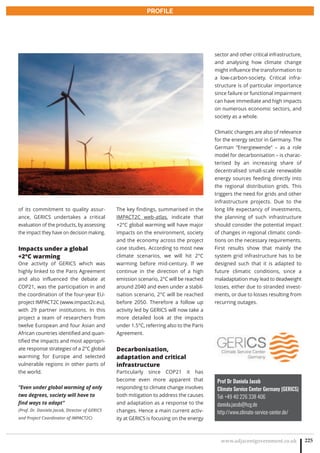
currently working on developing
alternative PCC products based on the
particular advantages of the Slag2PCC
process for potential high value niche
applications. Recovery of the ammo-
nium salt solvent and effectiveness of
the filtering are still critical aspects of
the process and how to best achieve
this at minimal energy cost is a major
challenge.
Figure 2
Call for action for UK energy
Our national identity, not just energy security, hangs in the balance while decisions over
Hinkley Point C and Swansea Tidal Lagoon are delayed, explains Dr. Nelson Ogunshakin OBE,
chief executive of Association for Consultancy and Engineering (ACE)…
T
he professional consultancy and engineering
sector, which is at the forefront of capital project
development, is going from strength to strength
at the moment. The government has taken impressively
clear action to improve British critical infrastructure as
HS2, the Crossrail projects, Tideway tunnel and the
Northern Powerhouse agenda surge ahead. However,
indications that decisions pertaining to the energy
sector are faltering may relegate what could be an
infrastructure boom to a flash in the pan.
Two longstanding UK energy generation projects have
recently looked increasingly beleaguered, a show of
form that must be reversed if the UK is to remain
energy secure in terms of baseload capacity. Both
Swansea Bay Tidal Lagoon and Hinkley Point C are
facing delays in decisions to fund the projects amid
fears that they will be too costly to justify expenditure.
I would argue, however, that these projects will not
only contribute to the invaluable instrumental goal of
energy security, but also have a symbolic value that is
just as important to UKPLC.
Swansea Bay Tidal Lagoon is a genuinely ground-
breaking project that is going unduly cold at the
moment. Once heralded as a key point in the energy
plan laid out in the Conservative’s 2015 manifesto,
Prime Minister David Cameron’s enthusiasm for the
project is now said to be ‘reducing’. Indeed, just last
week, it was announced that an independent review
would be launched into the feasibility and practicality
of tidal lagoon energy in the UK – perhaps an existential
threat to the project.
In spite of these challenges, I remain hopeful for the
prospects of the project. The scheme already has plan-
ning permission, an intelligently laid out supply chain
and £200m from equity sponsors, not to mention huge
local, national and international support. Indeed, the
project has recently agreed to a strike price that rivals
new nuclear plants, proving its competitiveness.
Importantly, what is at stake here is not simply the
£1bn facility, but the entire legacy of the UK’s tidal
energy generation. If tidal energy in the UK was a
housing development, Swansea is but a marketing
suite; it is designed to prove the efficacy of this kind
of project so that larger projects (benefitting from
economies of scale) can be rolled out along the West
coast, providing clean energy for millions. Swansea Bay
Tidal Lagoon represents a modern Britain – green,
decentralised and enterprising – and I would encourage
the government to push past the current sticking
points so that construction can begin. It is the thin end
of a green energy generating wedge that we must sup-
port to secure Britain’s energy and make a statement
about the country we can become.
The decision to begin work on Hinkley Point C is the
second deliberation to dither. Indeed, dithering has
characterised this process for some time; back in 2007,
Vincent de Rivaz, EDF’s boss in the UK, said that the
British would be cooking turkeys using Hickley power
by Christmas 2017, for example. Indeed, the largely
state-owned French energy giant is under financial
pressure and is struggling to finance the £18bn project,
even with China’s state nuclear firm CGN picking up the
slack and taking on a third of the costs.
Despite all this, Hinkley Point C represents a good
opportunity for the UK to meet its energy needs. In
2013 the site received planning permission and a strike
price was agreed, which would make it competitive
with other low carbon generation methods. Over the
60 years the plant would operate, it would save the UK
600 million tonnes of CO2 all the while producing 7%
ENERGY
www.adjacentgovernment.co.uk266
ENERGY
www.adjacentgovernment.co.uk 267
of the UK’s generation needs. Even before the facility
formally begins producing electricity, the construction
process will create 25,000 new jobs.
Beyond the stats, Hinkley Point C symbolises an oppor-
tunity to embrace our stated values of openness and
internationalism with expertise and capital from around
the world coalescing in the UK to produce something
that would make a real impact. Hinkley Point C gives
the UK the chance to reframe nuclear energy post-
Fukushima as not only safe but an essential ingredient
to a healthy mix of energy generation in the UK. Here
the UK can boldly push ahead with nuclear power –
proving it is open to businesses and world leading,
even in the event of a crisis. What is clear is that these
projects, although they have measurable outputs,
creating jobs, promoting investment and providing
electricity, also have important softer impacts that
change the way others think of us and, perhaps most
importantly, how we think about ourselves.
All good professional engineers and consultants
understand that the results of their work mean more
than just projects’ instrumental outputs. How we solve
the critical problem of energy security is more than
just about avoiding blackouts. Rather, going ahead
with these projects would contribute to indicating that
the UK is a progressive, green and outward looking
nation, the country we always aspire to be. If we
embrace innovation and enterprise in this instance it
enables us to retain the fantastic position we are
currently in – any decisions to the contrary might mean
we lose our spark. ■
. . . . . . . . . . . . . . . . . . . . . . . . . . . . . . . . . . . . . . . . . . . . .
Dr. Nelson Ogunshakin OBE
Chief Executive
Association for Consultancy and Engineering (ACE)
www.acenet.co.uk/home/57
Swansea Bay Tidal Lagoon is a genuinely
ground-breaking project that is going
unduly cold at the moment. Once heralded
as a key point in the energy plan laid out in
the Conservative’s 2015 manifesto, Prime
Minister David Cameron’s enthusiasm for
the project is now said to be ‘reducing’.
Smarter homes: How to save money
and cut emissions
Russell Bowes outlines how the implementation of smart technologies can impact
the way our homes are built and heated…
T
he home of the future is almost here. A phrase
which has become a little overused in the past
few decades. The difference in using it at the
start of 2016 is that in a very real way, our homes
are already becoming homes of the future. Smart,
connected devices are permeating every room in our
homes and almost every aspect of our daily lives. What
makes this revolution much more muted than one
might have expected is both the gradual rollout of new
technology and the non-invasiveness of it.
Disruptive technologies are affecting and changing
every aspect of our homes from the way they are built,
using natural cement churned produced by bacteria or
constructed from fungi, to how we interact with and
control our homes through connected devices. Cloud
computing, energy and water saving technologies are
becoming ubiquitous across every room in the home
and will become standard in the future.
Perhaps the most disruptive concept driving the
adoption and application of new, smarter home
technologies is what is known as ‘the internet of things’
(IoT). The internet of things is not a new idea. The
concept has been around for several decades. At its
most fundamental it is a simple idea. What if your
fridge could tell when you run out of milk or when the
butter was past its use-by date and could notify you
and order more butter or milk? Pretty useful, and that
is the IoT at a day-to-day level. Within the UK the most
common application of this technology has so far been
in home heating and energy usage.
In part this is due to the government’s aggressive
rollout of smart meters which allow you to control
every aspect of your heating from your mobile phone,
at home or remotely. ‘Smarter’ devices can also control
heating and lighting to work with natural light levels,
warmth and weather and even shut off or switch on
heating and lighting when you are away from home.
These and other technologies will combine to help
consumers to better monitor their energy usage
through connected heating systems, appliances and
smartphone applications. This monitoring via apps and
smarter, self-controlling technology will push down
energy usage by making our use of heating and lighting
much more focused. Imagine a world where your fridge
freezer, washing machine and boiler can all switch off
for peak energy price periods - whilst still keeping your
food fresh, water hot enough to shower and getting
your clothes clean.
More intelligent and thus lower energy usage will
ultimately result in lower energy bills and in the end
lower emissions.
As I mentioned earlier, smarter technology is also
pervading how homes are being designed and built.
Traditional house building with bricks and mortar is a
carbon intensive process. New homes may use building
materials such as natural cement created by bacteria
and the reintroduction of straw-bale panels as a super
insulator.
Roofs will also become smarter utilising super reflective
tiles in warmer climates and bio solar roofs in moderate
climates. These will combine habitats for pollinators
alongside energy-generating panels and self-cleaning
finishes. These technologies will help to lower mains
energy usage with more homes generating a greater
proportion of their energy through smart and green
technologies. The follow on from this is a lowering of
energy bills and carbon emissions from people living in
these homes.
Perhaps for the next few years the area we will see the
greatest progress and uptake of smart technology and
ENERGY
www.adjacentgovernment.co.uk268
ENERGY
www.adjacentgovernment.co.uk 269
the internet of things is in home heating controls.
Smart thermostats and heating controls give you
almost immediate insight into your energy usage via
smartphone apps. This is information which you can
use to reduce your energy usage and bills whilst
making your life a little more comfortable.
With devices such as NEST and competitors you can
switch your heating and lighting off when you leave in
the morning safe in the knowledge that should the
temperature drop or it get dark before you get home
both your heating and lighting will come on in time for
you to come back to a warm and welcoming home,
without having wasted energy heating empty rooms
and lighting an empty house. Intelligent thermostats
will know how long it takes for your home to reach and
maintain a specified temperature and will switch on at
the optimum time to reach it.
As these devices are connected to the cloud and to
your smartphone they can also be location activated,
switching off as you leave and switching on as you
return home without you having to pre-program timers.
The major benefit of both of these is a reduction in
overall energy usage, bills and carbon emissions.
Other applications of this type of connected technology
which are just around the corner include the instinct
vacuum cleaner - a dog like vacuum which will patrol
your home using 3D mapping, smart toilets which
recognise you and can analyse and monitor your
excrement shedding light on the state of your health
and microbiome. Bathrooms will also become smarter
with gadgets such as Water Pebbles, a water activated
shower timer to save water, and thus heating and
energy wastage. The bedroom will also see the
introduction of smart mattresses which track sleeping
patterns, breathing and heart rate. Some may also
prompt couples when they haven’t been intimate in a
little while. ■
. . . . . . . . . . . . . . . . . . . . . . . . . . . . . . . . . . . . . . . . . . . . .
Russell Bowes
Freelance writer
https://plus.google.com/+RussellBowes
https://twitter.com/russellbowes
F
inally, following years of lobby-
ing, Ofgem has introduced
legislative changes that will alter
the face of competition in electricity
connections forever, finally creating a
truly competitive and open market
that will offer customers improved
service and reduced costs.
These changes have the potential to
revolutionise the customer experience
by allowing far more customer centric
Independent Connection Providers
(ICPs) to deliver an end to end connec-
tion service to customers without any
reliance upon the DNO.
Self-service for ICPs
The new Competition in Connections
Code of Practice was formally approved
by Ofgem on 16 July 2015. The objec-
tives of the Code of Practice can be
summarised as follows:
Distribution Network Operators (DNOs)
must, as far as reasonably practicable,
minimise their involvement in the
provision of new connections by
ICPs to their customers.
Should an ICP require a service from
the DNO to enable it to provide con-
nections for its customer(s) then the
DNO must provide the service on an
equivalent basis as it would to its
owns connections business.
Finally, DNOs must work to harmonise
their processes and procedures relating
to competition in connections in line
with industry best practice thereby
allowing ICPs to freely and easily operate
across DNO boundaries.
Legally enforceable
The Code of Practice becomes legally
enforceable through the new Electricity
Distribution Standard License Condition
52 that came into force on 30th October
2015. The license mandates that the
DNO must adhere to their Code of
Practice which shall be published and
maintained through regular review. In
addition to the Incentive on Customer
Engagement (ICE) that came into
place at the beginning of the latest
Electricity Distribution Price Control
(ED1), the Code of Practice is a further
incentive on DNOs to take a more
positive and proactive approach
towards competition in connections.
When Ofgem completed their review
of the electricity connections market
in 2014, they concluded that the most
appropriate way to further develop the
market was to remove the DNO from
the critical path of their competitors
that are offering connection services
to their own customers. As a result,
the Code of Practice has a strong
focus on DNOs empowering their
competitors to undertake previously
non-contestable activities themselves
much like the gas connections market
which has successfully operated for
the last 10 to 15 years.
Ofgem set out these minimum
requirements which have now been
incorporated into the Code of Practice.
This means that ICPs in future will
be able to liaise directly with their
perspective customers to obtain all of
the necessary information to:
undertake the study of the distribution•
network to determine the most
appropriate point of connection;
complete the design for the network•
extension and any required reinforce-
ment; and
carry out all of the works including•
the final connection and network
reinforcement.
Further changes are currently being
made to the Code of Practice to make
the processes for self-determination
of point of connections to, and design
approval of DNO adoptable networks
more definitive. These will come into
force this summer and are built upon
the outcome of stakeholder consultation
by the DNOs.
“Finally, DNOs must work to
harmonise their processes and
procedures relating to competition
in connections in line with industry
best practice thereby allowing ICPs
to freely and easily operate across
DNO boundaries.”
Power On, like many ICPs has built its
business on a commitment to, and
proven track record of delivering first
class customer service in the provision
of connections. Unlike DNOs, who
need to focus on their wider statutory
obligations to ensure they can keep
the lights on, the sole focus of the ICP
is to deliver connections in a timely
and cost effective manner.
The challenge that now lies ahead is
bringing all of this into business as usual.
DNOs must give ICPs the same level of
www.adjacentgovernment.co.uk270
Power on Connections – Self-service
for ICPs is great news for customers
PROFILE
www.adjacentgovernment.co.uk 271
PROFILE
Bob Theobald
Managing Director
Power On Connections
Tel: 03453 223322
Mobile: 07557 430558
bobtheobald@poweronconnections.co.uk
www.poweronconnections.co.uk
access to their network information
as their own equivalent connections
business or service providers.
For many DNOs this will require changes
to their IT systems and processes.
Many DNOs are still running pilot or
proof of concept schemes to ensure
the seamless transition to this new
way of working.
Power on has, in many instances been
the first ICP, alongside its BUUK sister
company GTC to carry out these self
service activities. We have also assisted
DNOs to understand the requirements
of the detailed processes for Self
Determination of POCs, Self-Approval of
Designs and Self Connection including
the associated operational activities.
It is recognised that not all ICPs will be
able to move at the same pace so it
also important that where the ICP
does require a service from the DNO
that the service level provided by the
DNO is to the same standard that is
offered to its own business.
Power On has built its business on a
commitment to, and proven track
record of delivering first class customer
service in the provision of connections.
Next Steps…
In addition to the change proposal
currently going through the gover-
nance process of the Code of Practice
which are expected to receive backing
from Ofgem, it is anticipated that
future change proposals may look to
mandate that DNOs provide IDNO
customers with emergency response
services and the ability to trade
unmetered supply inventories under
the DNOs MPAN.
Such changes will help support the
development of IDNO networks;
which in itself promotes competition
in connections as many ICPs construct
assets for adoption by IDNOs.
Proposed changes will be tested
against the objectives of the Code of
Practice. Where a proposed change is
shown to have the potential to better
meet the objectives of the Code, a
working group will be established by
the Code governance panel to take
the proposal forward. The working
group will be tasked with creating a
Change Report for presentation to
Ofgem for their decision on where or
not to direct the DNOs to update the
Code of Practice with the proposed
changes.
Each change report will need to show
that relevant stakeholders have been
consulted on the developed change
proposal and that the changes will
improve the Code of Practice’s alignment
to the Code objectives.
Is there a place for electric
heating in the UK?
Paul Bennett, registered professional energy consultant with the Energy Institute and
Executive Chairman of BSSEC, looks at the technologies available for electric heating and the building
regulations you should be aware of…
A
s a technology, electric heating has been with us
since the invention of electricity in the late
1800’s with the first available electric heaters
being used in the 1900’s. Electric heating has devel-
oped greatly over the last 115 or so years, from electric
resistive heaters that have been used in panel heaters,
night storage heaters, radiant heaters to warm air
heaters and more complex heat pumps.
At the same time, the way electricity is generated has
changed dramatically from coal-powered electricity
generating stations, to gas and nuclear and now
onto greener hydro, wave, solar and wind-powered
methods.
Electric heating is a controversial choice to heat a build-
ing. On the one hand, it is seen as the most carbon
intensive method to provide heat for thermal comfort
and the most expensive to run. When compared
against gas heating, electric heating causes carbon
dioxide emissions that are approximately 2.7 times
higher, and energy running costs are approximately
three times higher. However, owing to cleaner and
greener methods to generate electricity, electric heat-
ing can have zero-rated carbon emissions. Green
electricity can also benefit from government subsidies.
Technology has moved on tremendously, and electric
driven heat pumps can dramatically reduce the carbon
dioxide emissions and energy costs further owing to
their high efficiency – termed as Coefficient of Per-
formance (CoP). The CoP rating is the multiplier of
input energy to the heat output. A CoP of 2 would
mean that, for every unit of electrical energy input,
twice as much heat output can be achieved. The
seasonal CoP rating for an air source heat pump in a
heating mode is typically 2.5. However, if the heat
pump takes its heat from a more stable source than
the air, for example the ground, then the efficiencies
improve to around a seasonal CoP of 4.
What do the building regulations say about
electric heating?
Part L2 of the Building Regulations requires that the
actual Buildings Emissions Rate (BER) is determined
using software and is compared against a building
regulation compliant Target Emissions Rate (TER). In
order to pass, the BER must be lower than the TER. The
TER is based upon a notional building specification that
typically includes standard thermal resistivity ‘U values’
for elemental constructions (e.g. roof, wall, floor, and
windows) and a building air permeability standard that
restricts air leakage from buildings. In terms of systems,
it assumes a heating efficiency (gas heating and hot
water) of 91%. Heating is only one of all the building
services that consume energy and systems such as
lighting, ventilation and cooling collectively make up
the TER. So it is important to understand that the heat-
ing system is only a part of the overall TER.
The choice of heating impacts the whole BER and can
therefore affect the choice of other building services.
This is the concept of the trade-off. For example, a
highly efficient heating system can enable the provi-
sion of a lower efficient ventilation system to achieve
compliance. Most designers would prefer to opt for the
highest efficiency choices – where the budget can
afford the best systems.
The Building Regulations are technology neutral and
do not require that any specific heating system be
provided. However, these regulations do recognise
that low and zero carbon options exist and can help.
These include co-generation (using Combined Heat
and Power (CHP) techniques), district heating (from a
centralised heat network that feeds many buildings,
ENERGY
www.adjacentgovernment.co.uk272
ENERGY
www.adjacentgovernment.co.uk 273
typically from biomass or CHP), energy from renewable
sources (including solar, geothermal water, biomass,
biogases) and heat pumps.
As far as the Building Regulations are concerned, the
best choice for a compliant electric heating system, is
whether it is going to be a form of heat pump and
whether it being air/water/ground source. There are also
options for using heat pumps to recover waste heat.
Taking technology and legislation into account, in my
personal opinion, electric heating using heat pumps that
are fed from green energy is the ideal heating solution.
It can be zero carbon and very efficient (with seasonal
CoP’s at 4), meaning that running costs can be cheaper
than gas. They can also attract Renewable Heat
Incentives making the business case quite attractive.
Looking to the future and thinking about how we heat
our buildings in the UK, my own prediction is that, as
battery technology continues to improve at a dramatic
rate, we will see some very clever takes on the simple
storage heater design that are linked to heat pump
designs. Watch this space!
Paul Bennett is a Chartered Engineer, Chartered
Director and Executive Chairman of BSSEC. He is an
approved ESOS Lead Assessor and accredited with the
Energy Institute on its Register of Professional Energy
Consultants. ■
For more information from the Energy Institute, please
visit their website at www.energyinst.org and follow
them on Twitter @EnergyInstitute
. . . . . . . . . . . . . . . . . . . . . . . . . . . . . . . . . . . . . . . . . . . . .
Paul Bennett
Executive Chairman
Building Services Sustainability  Environmental
Consultancy (BSSEC)
Tel: 01373 300490
www.bssec.co.uk
As the influence of biometrics continues, Christopher Brown, Programme Manager for
Governance  Resilience at BSI, explores its growing role in modern society…
B
iometrics can be defined as the identification
of an individual based on biological (such as
fingerprint, iris and facial) and behavioural
(such as voice, gestures and gait) characteristics.
Such information can be recorded by an electronic
device or system as a means of distinguishing and
confirming an individual’s identity.
Having an increasingly significant impact on a wide
range of applications, biometrics is spreading its
tentacles globally into many facets of everyday life.
As such, the UK needs to continue to invest in the
development of biometrics standards to ensure that
our current pre-eminent position in using biometric
data is not eroded.
BSI committee IST/44 is responsible for developing
British standards in this area and also providing input
to international standards via its work with ISO IEC JTC1
SC37, which has dedicated expert working groups cov-
ering such diverse topics as ‘Harmonised biometrics
vocabulary’, ‘Biometric data interchange formats’, ‘Test-
ing  reporting’, and ‘Cross-jurisdictional and societal
aspects of biometrics’. The use of a wide range of stan-
dards can therefore assist government in the creation
and maintenance of effective national regulation.
Over the next 5 to 10 years there are a number of
key areas likely to impose the biggest challenges to
systems that are becoming increasingly dependent on
biometric technologies. A familiar and universal trend
is that of mobile biometrics. When the iPhone 5s was
launched in 2013, its in-built biometric sensor repre-
sented the largest deployment of biometric devices
ever, with reportedly over 9 million units sold on the
first weekend alone. As Dr Peter Waggett, Chairman of
IST/44 and Director, Emerging Technology for IBM UK
SECURITY
www.adjacentgovernment.co.uk274
Biometrics gaining identity
SECURITY
www.adjacentgovernment.co.uk 275
Ltd exclaimed: “This sensor has done much to make
the general public familiar and comfortable with the
use of biometric technology. Since that launch more
manufacturers have shipped devices with different
biometric technologies and it is becoming the de-facto
security mechanism for mobile technologies.”
The sensor system was not only used to unlock the
phone but also to access and authorise transactions
on iTunes. It is likely that this technology will continue
to progress as the interfaces to such devices are
enhanced and more accurate biometric techniques
(e.g. iris recognition) are developed for mobile use. “The
systems in use are becoming increasingly sophisticated
and this trend will continue”, adds Dr Waggett. “The
uses for the technology are increasing. The interface
has been opened up for general application and this
wide-scale use has gained great public acceptance.
New applications being developed should ensure that
they take advantage of this technology.”
Another area primed for growth is that of Presentation
Attacks. The increasing use of biometrics has led to
sophisticated approaches to attempt to fool their
successful operation. As Dr Waggett points out: “If we
take face recognition technologies as an example, early
systems could be fooled by simple photographs being
presented to them.
“The ‘flat’ nature of these photographs was used to
detect and counter this technique and this led to more
sophisticated masks being used. This required more
sophisticated counter techniques that used skin texture
measures to ensure that they were not being attacked.
“Currently state of the art masks made from pig skin
can fool most systems and these are likely to require
liveness detection to ensure operation. Future measures
will be required to counter increasingly sophisticated
counter measures.”
The issue of privacy and particularly of enhancing
biometric technologies in this area will always be under
the spotlight. According to Dr Waggett, “public concern
about the storage of biometric data can be reduced or
eliminated by the use of techniques to ensure that
their biometric data cannot be stolen or misused. One
example of this is cancellable biometrics.”
In this instance a fingerprint is intentionally distorted
in a repeatable manner and this new print is used. If,
for some reason, an old fingerprint is stolen or lost, a
new print can be issued by simply changing the
parameters of the distortion process. This also results
in enhanced privacy for the user since the true finger-
print is never used anywhere.
There are several other trends indicating that biometrics
will have a significant impact on a range of applications
affecting the general public. Examples include:
Incorporating biometric technologies in debit/credit•
cards used for withdrawals at ATMs and making pur-
chases. These could be extended for remote payment
over the internet;
Biometric algorithms are becoming more capable,•
making it possible to identify individuals using data
sets that would have been considered as non-biomet-
ric data in the past (e.g. real-time analysis of signatures
as they are written);
Voice recognition biometrics which are now gaining•
favour in banking and financial institutions to provide
additional security.
As with any fast moving technology, there will always
be concern that the development, implementation and
use of biometric systems are appropriate and respect
the rights of citizens and consumers.
The challenge ahead is to ensure that this rapid
pace is met with a marriage of robust solutions and
practicality. ■
To see the current IST/44 scope and work programme, visit http://stan-
dardsdevelopment.bsigroup.com/Home/Committee/50087978 or to
purchase standards in this sector, visit http://shop.bsigroup.com
. . . . . . . . . . . . . . . . . . . . . . . . . . . . . . . . . . . . . . . . . . . . .
Christopher Brown
Programme Manager for Governance
 Resilience
BSI Group
www.bsigroup.com
www.twitter.com/BSI_UK
T
he geographically extensive
municipality of Egedal now
offers their civil service in a new
way. With the Citizen Bus, the civil
service is brought to the public.
The Citizen Bus is equipped with a
high-tech suitcase that can record the
biometrics necessary for issuing iden-
tity papers in Denmark: passport
photos, fingerprints and signatures.
When citizens in the municipality of
Egedal need a new passport it is
handled via the municipal website.
Citizens enter their data, pay the fee
for the application online and book an
appointment in the booking system,
so they can just show up when the
bus comes by and be processed with-
out delay.
Civil service in your backyard
The municipality of Egedal is a merger
of 3 municipalities. On March 1st 2015
the civil service and the library were
joined. This sparked thoughts about
how to make the civil service more
efficient.
“After the merger, Egedal was a very
large municipality with many small
towns. We felt it was necessary to make
an effort to accommodate those who had
a long way to travel to the Civil Service
office,” says Birgit Hansen, Coordinator
with the Civil Service in Egedal.
With a suitcase from Biometric Solu-
tions ApS, it was possible to move the
Civil Service out into the communities,
which has been a success.
“Everyone uses the Citizen Bus, both
families with children and the elderly.
People are delighted that we are practi-
cally in their backyard,” says Birgit
Hansen.
The municipality hired an interior
designer to organise the bus, but the
solution has been so popular that the
bus is not always large enough.
“When we announced a tour with the
suitcase, the list was quickly filled, and
the bus was limited by its size. When we,
for example, go out to the village of
Slagslunde, we set up in a children’s
institution, and in Smørum we set up at
the library. The suitcase solution makes
it possible to set up our service wherever
there is room.”
The citizen’s experience
in focus
According to Alex Ramskov Johannsen,
CEO of Biometric Solutions, who deliv-
ered the suitcase to the municipality
of Egedal, the solution has been
designed to make the civil service
more efficient, but with just as much
thought to the fact that citizens need
to have a positive experience with the
service:
“The core of the solution is not the tech-
nology itself, on the contrary, it is the
process supported by the solution. The
system is designed to streamline the civil
service to accommodate both the need
for flexibility and mobility of families
with children, as well as help those who
find it difficult to get around,” he says.
“The municipality of Egedal is the first to
install our biometrics suitcase on a bus,
www.adjacentgovernment.co.uk276
Civil Service on the road
The municipality of Egedal in Denmark has put wheels on their civil service,
with the municipality now issuing passports to citizens from a minibus
PROFILE
www.adjacentgovernment.co.uk 277
PROFILE
Alex Ramskov Johannsen
CEO
Biometric Solutions ApS
Tel: +45 2684 2695
ar@biometric.dk
http://biometricsolutions.dk/
Biometric Solutions
offering mobile citizen services to the
entire municipality. The computer in the
suitcase is connected to the municipal-
ity’s servers via an encrypted VPN tunnel
over the cellular network (LTE). With the
suitcase the civil service staff can record
biometrics and make passports, driver’s
licenses and ID, but they are also able to
supply all other services, such as helping
with relocation, tax folders or pensions.”
A passport takes 3 minutes
10 minutes have been allotted for each
citizen who needs a new passport,
although the procedure typically only
takes 3-5 minutes. This extra time allows
room for unforeseen events, for exam-
ple, when a child needs help taking
their passport photo or a citizen turns
up without an appointment.
At the same time the suitcase makes
it possible to conduct the civil service
outside of the regular office hours of
the municipality.
“In some places we are out at 3-5 pm,
and at other times we go out on Satur-
days. We try to accommodate the needs
of the working people, making ourselves
available in places where it makes the
most sense for the citizens,” says Birgit
Hansen.
Satisfied citizens makes for
committed staff
The suitcase is a novelty in Egedal,
and so far the Citizen Bus has only
recorded biometrics for passports,
but the flexible civil service has been
a great success in the municipality.
“The self-service solution creates flow
and the suitcase makes the civil service
more accessible. This provides for both
satisfied citizens and happy employees.
The staff thinks it’s great to get out and
deal with happy citizens, it is a bit of a
kick. The last time we were planning a
trip, more employees than necessary
wanted to come,” says Birgit Hansen.
“We have no doubt that the suitcase is
here to stay. All types of citizens are
making use of the extra service. When
we set up around the municipality, we
meet people’s needs and that creates a
good atmosphere.”
Alex Ramskov Johannsen adds: “We
are pleased that the municipality of
Egedal, with great creativity, is making
our vision of enabling the municipalities
to provide civil service where their citi-
zens are, come true.”
Try it: Order a passport in the munic-
ipality of Egedal at:
https://selvbetjening.mitpas.dk/?key=A240
(NB: In Danish)
Read about the passport suitcase:
http://biometric.dk/en/biometric-suitcase/
Urban terrorism
Jonathan Wood, Director of Control Risks outlines how urban areas
are increasingly becoming targets for terrorist attacks…
U
rban terrorism is not new, or even the ‘new
normal’. Previous waves of terrorist activity,
such as decades-long campaigns by the Irish
Republican Army (IRA) in London and Euskadi Ta
Askatasuna (ETA) in Madrid, consistently targeted capital
cities. The most lethal terrorist attacks in history on 11
September 2001 symbolically targeted the financial and
political centres of the US. Baghdad, Cairo, Islamabad,
Mumbai, Buenos Aires, Beirut, Jerusalem, Paris, Jakarta,
Los Angeles, Nairobi: regrettably few major urban areas
are unfamiliar with major terrorist attacks.
Terrorist groups target cities because they are centres
of political power and population, (Also, leftist terrorism
associated with agrarian peasant insurgencies has
largely subsided outside of South Asia.) In cities, more
people are directly or indirectly exposed to individual
terrorist acts, and the concentration of interest ensures
publicity and attention. Urban systems such as mass
transit also rapidly transmit the disruptive effects of
terrorism citywide. Put another way, population density
and urban complexity multiply the desired physical,
psychological and strategic impacts of terrorism. The
attractiveness of cities to terrorists will only increase:
since 2007, more people live in urban than rural areas
for the first time in human history; by 2050, its
estimated that 75% of the global population will
be urban.
The speed of urbanisation over the last few decades,
especially in emerging and developing countries, has
also shaped the threat environment. Rapid, often
unplanned city growth leaves glaring gaps in
public service provision, including law enforcement.
Concurrently, it has aggravated social divisions by
thrusting disparate ethnic, religious, linguistic and
economic groups into often uncomfortable proximity.
Terrorist groups strive to take advantage of gaps – for
example, by cultivating safe havens and staging
grounds in the anonymous urban sprawl – and exploit
social divisions to radicalise sympathisers.
Threat environment
Urban terrorism is certainly evolving. Post-9/11
obstacles to al-Qaida’s preferred strategy of symbolic
‘spectacular’ attacks in top tier Western cities devolved
much responsibility to homegrown, lone wolf extremists
by the late 2000s. Al-Qaida propagandists have long
incited sympathisers to strike local, familiar targets
using any available means. As a result, the terrorism
threat environment became less severe, but also much
less predictable: plots and attacks spread to secondary
cities like Exeter (UK), Little Rock, Springfield, and
Portland (all US), Toulouse and Nantes (France),
and Victoria (Canada).
In Western countries, increase surveillance and strict
controls on explosives also shifted tactics away from
complex, large-scale vehicle bomb attacks against hard
SECURITY
www.adjacentgovernment.co.uk278
Jonathan Wood, Director of Control Risks
SECURITY
www.adjacentgovernment.co.uk 279
targets towards so-called marauding terrorist firearm
attacks (MTFAs) in public spaces. Both al-Qaida- and
Islamic State (IS)-affiliated terrorist groups embrace the
tactic: firearms are cheap and widely available, and
uncertainty around the movements, size and capabilities
of mobile teams of gunmen can effectively paralyse a
city during an attack. Indeed, disrupting the normal life
of a city – and by extension a society – by forcing an
indefinite security lockdown is likely to be part of the
point of such attacks.
Urban attacks are often even more effective in emerging
and developing countries, where law enforcement
capabilities are usually under-developed and under-
resourced. Most Western and some developing country
civilian law enforcement agencies responded to earlier
waves of terrorism (or social unrest) by developing units
specialising in intelligence collection, hostage rescue,
and building assault. Similar capabilities in most
emerging and developing country police forces are non-
existent or very limited, forcing them to rely on slower
and blunter military intervention. The September 2013
assault on Nairobi’s Westgate shopping mall highlighted
gaps – widespread globally – between the terrorist and
security force capabilities.
Response
Cities continue to develop ways to deter, prevent and
mitigate terrorist attacks. The City of London instituted
its famous ‘ring of steel’, the US Department of
Homeland Security (DHS) disbursed risk-adjusted
urban security funding after 9/11, and companies
worldwide incorporated building design features and
security procedures intended to thwart common
attack scenarios. Many of these innovations are now
standard urban planning practice, especially in the
construction sector, and threat mitigation is becoming
more effective and less obtrusive.
Recent efforts, in both the public and private sectors,
revolve around ‘big data’ analysis of social media and
other communications activity. The unpredictability
inherent in soft target attacks – and the potential
lethality of firearm assaults – puts a premium on threat
identification and early warning. Many major attacks
since 2014 have been cases of failing to connect
intelligence dots, rather than failing to develop
intelligence in the first place.
Law enforcement agencies are also working to overcome
jurisdictional and organisational structures that inhibit
rapid response. So called ‘fusion centres’, which cut
across agency, jurisdictional and political boundaries, are
a primary response: such structures became widespread
in the US after 9/11, and are currently under
development in Europe. Western countries are deeply
involved in supporting such structures internationally,
particularly in sub-Saharan Africa.
“Thespeedofurbanisationoverthelastfew
decades, especially in emerging and devel-
oping countries, has also shaped the threat
environment. Rapid, often unplanned city
growthleavesglaringgapsinpublicservice
provision, including law enforcement.”
Conclusion
The future is undeniably urban. This ensures that
cities will also dominate the future terrorism threat
environment. While cities are inherently – and
impressively – resilient, even in the face of devastating
attacks, they are also complex and vulnerable to
disruption. The challenge for cities – meaning municipal
officials, law enforcement, private organisations and
urban residents – is to continue to innovate ways of
enhancing response and resilience in tune with the
changing terrorism threat environment. In particular,
the rising threat to public, open access spaces is likely
to encourage increased emphasis on automated threat
identification and early warning, as well as increased
investment in more robust response capability. ■
. . . . . . . . . . . . . . . . . . . . . . . . . . . . . . . . . . . . . . . . . . . . .
Jonathan Wood
Director
Control Risks
jonathan.wood@controlrisks.com
www.controlrisks.com
S
AFEPOST enhanced the security
and safety of approximately 1.6
million postal employees in the
EU, by mitigating the risk of explosives,
radioactive materials, biological weapons,
and dangerous chemical substances,
among other harmful materials, caus-
ing health or life-threatening incidents
with the personnel operating the
postal networks. The project supports
the reduction of theft and pilferage in
the postal system, e.g. through more
accurate mail identification and track-
ing capabilities, as well by introducing
training and creating a strong trans-
parent, co-operative culture.
The Postal system plays an important
role in the smuggling activities of nar-
cotics, including cocaine and heroin,
with societal costs (health care, legal
etc.) in billions of Euros in the EU.
SAFEPOST supports the identification
(and seizures) of mail containing nar-
cotics materials, thus reducing the
societal cost in the EU.
SAFEPOST has made significant con-
tribution in the following areas:
1. Improved the EU’s awareness and
coordination of activities within and
between EU Member States in the
field of postal security and develop-
ments in supply chain security.
2. Linked EU projects from (DG MOVE,
DG TAXUD, DG ENTR) and national
efforts, to exploit synergies and created
a coordinated approach to security
throughout the entire supply chain.
3. Encouraged all European postal
providers and related authorities to
assume responsibility in securing their
own processes within a European wide
cooperative distributed model.
4. Created transparency on the way
postal security measures are enforced,
and provided benchmarks.
5. Established a Europe wide forum
to discuss and agree a Postal Security
Target Operating Model (PostEurop
Framework), which will provide the
basis for potential improvements in
the existing standards.
The quality, efficiency and reliability of
postal services are a pan-European
challenge. If equipment, procedures
or competencies in a European post
office differ from one Member State
to another, there will be a high risk
that organised crime and terrorists
will take advantage of the weaker
checkpoints, jeopardising the efforts
of other Member States and of the
European Union as a whole. Because
of this, SAFEPOST is coordinated by
PostEurop with the ultimate goal to
establish solutions designed to
address collectively agreed priority
areas and have been adopted by all.
SAFEPOST promoted new operational
concepts through increased integration
between systems and organisations,
it is clear that this cannot be achieved
without international cooperation.
The SAFEPOST integrated Project
gathered all the operational critical
mass necessary to conduct such a
complex project. The size of the con-
sortium was kept to the necessary
minimum, as SAFEPOST reused an
extensive know how from reference
projects and incorporated existing
products and prototypes, focusing
effort on innovative improvement,
adaptation and integration and not on
the full development of completely new
technologies. This approach focused
on producing real tangible results
creating added value to the whole
European postal services community.
SAFEPOST being an EU scale project
answered to key European policy chal-
lenges by allowing better integration
of European RD, facilitating the trans-
fer of skills and knowledge across
Member States.
SAFEPOST Project Work Package 6
(WP6) - SAFEPOST Pilot (Demonstra-
tion) is a crucial part of the project and
is well on its way. WP6 is aimed at
organising full scale demonstrators of
SAFEPOST, based solutions in order to
www.adjacentgovernment.co.uk280
SAFEPOST Project Pilots
Dr Antonino Scribellito, European Affairs – Senior Project Manager at PostEurop
highlights how SAFEPOST has enhanced security in postal systems across Europe
PROFILE
www.adjacentgovernment.co.uk 281
PROFILE
evaluate the feasibility and the bene-
fits of the SAFEPOST approach. This
helped in acquiring postal operations
related data, handling it, exchanging
it, sharing it and in screening and opti-
mising the distribution chain.
One of the SAFEPOST Project partners
TelluSecure (TLS) has developed a
prototype system, D-tube, for scanning
controlled substances. The prototype
system is able to detect packets and
bags containing explosives or nar-
cotics in real time and is suitable for
integration into the sorting facility
conveyor belt flow.
The D-tube prototype detection system
uses a multi element detector for the
generation of the chemical profiles. The
system operates in near real time with
high precision and specificity by exam-
ining vapour substances. The system
also takes into account the varying
background vapours ubiquitously pres-
ent in the air. Following a positive
match to one or more targeted profiles,
a number of possible actions are trig-
gered: as an example, by interaction
with the IT system in the packet sorting
facility suspicious packets could be
automatically diverted to a separate
destination and information sent to the
appropriate authorities.
One of the most important events in
relation to the SAFEPOST Project is the
live demonstration meetings applied
on the field in the Postal Operators
Sorting centers. The demonstrators
have been designed to validate the
SAFEPOST solutions under realistic
conditions, to ascertain feasibility and
benefits of the solutions and to provide
feedback to enable improvements.
The first live demonstration took place
in Reykjavik, Iceland, on 20th May 2015
to thoroughly analyse the process of
postal items flow through D-Tube and
find any room for improvements.
The second demonstration was held in
Correos sorting center on 11th June
2015 in Zaragoza, Spain with a high
level of participation. In total 70 par-
ticipants, from European Commission
DG Home Affairs, DG TAXUD, PostEu-
rop members, external supply chain
stakeholder, Customs Authorities and
SAFEPOST Project Consortium part-
ners. The live demonstration of the
SAFEPOST Project illustrated the
improvements made since the first
demonstration in Iceland. The meet-
ing at Correos provided a showcase
for the ‘e-Nose’, the Image Recogni-
tion software, the risk assessment
module (PSS) and the CPSS Dash-
board. The primary objectives were
to demonstrate how these solutions
could enhance the operators capabil-
ity, for effective  effortless risk
assessment, including a new range of
detection options which are cost-
effective, and do not slow down the
existing parcels throughput in the
operators sorting centres. Further-
more, through the provided CPSS
Dashboard, the operators are able to
consolidate in a single user interface,
a view of all their common as well as
security related data, and draw con-
clusions both on a parcel level as well
as on a set of parcels examined for a
specific period of time.
The third live demonstration meeting
took place in Athens, Greece, again with
high-level participation of PostEurop
Members, Customs Authorities, Law
Enforcement Agencies, UPU and several
stakeholders – in total 90 participants.
The demonstration meetings at Ice-
land Post, Correos and Hellenic Post
showed that the SAFEPOST technol-
ogy can be applied directly in postal
production lines and processes that
are currently separate but can be
brought together with the Common
Postal Security Space. The purpose of
the SAFEPOST demonstration was to
provide an operational environment
to showcase and test the SAFEPOST
security solutions in order to evaluate
the feasibility and the benefits of the
project’s approach in acquiring mail
related data, handling it, exchanging it
and sharing it.
Dr Antonino Scribellito
European Affairs – Senior Project Manager
PostEurop
Tel: +32 2773 1193
antonino.scribellito@posteurop.org
http://www.posteurop.org/
http://www.safepostproject.eu/
First demonstration in Iceland Second demonstration in Spain Third demonstration in Greece
Smart cities: the implications
for the private sector
Nicolas Reys, Cyber Security Services Consultant at Control Risks
looks at the risks of cyber-attacks on smart cities…
F
aced with rapid urbanisation, city planners are
turning to technology to solve a wide range of
problems. Smart cities are the outcome of the
deepening integration between technology and the
urban landscape.
Smart cities are set to fundamentally change how
many of us experience the world. In practice, this
transformation will arise from the combination of
3 technologies: inexpensive logic controllers, millions
of sensors connected to devices dispersed across a
city, and networks that connect everything together.
But, although smart cities enable the more efficient
provision of complex urban services, increased
connectivity carries with it potentially severe cyber
security risks. City planners would do well to start
thinking about them.
How smart is smart?
The potential benefits of smart cities are numerous.
For instance, a city’s electricity infrastructure can
be significantly improved with ‘smart meters’ which
provide real-time data, via an internet connection, to
consumers, suppliers, and authorities. This would
allow better management of the power supply by
tailoring it to demand, thereby reducing the costs and
outages which blight many traditional, and analogue
cities. These benefits are replicable across almost all
domains of urban life. Cities such as Amsterdam,
Barcelona, Santa Cruz and Stockholm have all started
to incorporate elements of a “smart grid” – or a
network of interconnected sensors within the city –
across energy provision, transport systems and
telecommunications infrastructure.
New city, new risk
Smart cities are dependent on machine-to-machine
(M2M) interactions. This is partly a result of the sheer
speed with which associated calculations need to be
completed. In the case of a smart energy grid, it would
be impossible for a human operator to process all
the data necessary to make decisions at the speed
required. However, while M2M decision-making (M2MD)
is an unavoidable feature of smart cities, it is also one
of their greatest vulnerabilities.
“Smart cities provide cyber activists with a
big surface on which to be a nuisance – or
worse. Hackers might simply deface a
city’s billboards, but at the extreme end
they can attempt to destroy cities’ physical
infrastructure.”
The risk of a cascading error is especially acute. A
cascading error is a small mistake which spreads
through a system and becomes a systemic risk. For
instance, if a minor bug caused a smart electricity
reader to transmit inaccurate data readings to its
control centre, this could lead to an automated
(and mistaken), assessment that a company’s premises
required increased power. This would necessitate
rerouting energy to the building which would raise
costs for the affected company and would reduce the
energy pool available for everyone else. On a bigger
scale, the consequences of such cascading errors could
prove disastrous.
Smart cities and cyber threats
Smart cities also provide cyber threat actors with a
large – and tempting – attack surface. Cybercriminals,
hacktivists, and even sovereign states can all exploit
smart cities for nefarious ends.
Cybercriminals
Smart cities are a boon to criminals capable of
deploying self-propagating malware. ‘Worms’ injected
SECURITY
www.adjacentgovernment.co.uk282
SECURITY
www.adjacentgovernment.co.uk 283
into the digital fabric of a city might be used to acquire
healthcare information, social security numbers
and banking credentials. Were attackers able to
successfully hijack these systems they could then be
used for powerful distributed denial of service (DDoS)
attacks or to hold an entire city for ransom in
extortion attacks.
Cyber activists
Smart cities provide cyber activists with a big surface
on which to be a nuisance – or worse. Hackers might
simply deface a city’s billboards, but at the extreme
end they can attempt to destroy cities’ physical
infrastructure.
“Smart cities are set to fundamentally
change how many of us experience the
world. In practice, this transformation
will arise from the combination of 3
technologies:inexpensivelogiccontrollers,
millions of sensors connected to devices
dispersed across a city, and networks that
connect everything together.”
The potential destructiveness of a cyber-attack on
smart cities is such that even its mere threat is likely to
be viewed by governments and businesses as existen-
tially significant. When capricious and uncontrollable
cyber activists have the power to cause widespread
material damage, the security of smart cities becomes
essential to their survival.
Nation states
As well as criminals and activists, state actors can also
pose a threat to smart cities. For instance, belligerent
states can interfere with the traffic management
system of foreign cities, with the possibility of causing
substantial damage. Similar scenarios are conceivable
for the interruption of energy supplies or water networks.
Securing the implementation of smart
cities for the private sector
Smart cities offer clear benefits, but they are also
burdened by risk. Businesses and city planners can
take a number of precautions to ensure a smoother
implementation process and, ultimately, more secure
infrastructure.
Prioritise the security of critical assets: Contemporary
networks are already impossible to protect in their
entirety, a problem which applies equally to smart
cities. Some components of the system will have to be
made more secure than others. Public and private
sector organisations will need to work together to
identify cities’ critical assets and oversee the institution
of appropriate security measures.
Behaviour based security: Auditing millions of separate
devices for signs of malware simply isn’t feasible. A
superior approach would be to evaluate the behaviour
of smart city components and systems against an
established baseline of normal functionality. Any
deviation from the norm above a pre-determined
threshold would trigger an investigation into the
possible presence of malware on the subcomponents.
Rapid component replacement: Given the potential for
component failure or attacks compromising these
components, an automated replacement system will
enhance the security of the whole system. Although
difficult to apply to critical components without
full redundancy, such measures would be suitable for
low-level, relatively isolated components. ■
. . . . . . . . . . . . . . . . . . . . . . . . . . . . . . . . . . . . . . . . . . . . .
Nicolas Reys
Consultant, Cyber Security Services
Control Risks
nicolas.reys@controlrisks.com
www.controlrisks.com
Nicolas Reys,
Cyber Security Services
Consultant
T
he European Commission’s Digital Agenda is one
of their top priorities to develop a more digital
friendly Europe. In order to develop their Digital
Single Market, the Commission aims to help Europe
overcome barriers with regards to infrastructure,
broadband accessibility, copyright and data protection.
They will do this by enhancing the use of online serv-
ices and digital technologies.
In February the Commission published results of the
2016 edition of the Digital Economy and Society Index
(DESI), which shows which member states have made
progress in areas such as connectivity and digital skills.
The results revealed that the pace or progress is
slowing down and action is still needed at both EU and
national levels.
The DESI revealed that Denmark, the Netherlands,
Sweden and Finland continue to lead the rankings.
The EU as a whole attains a score of 0.52 out
of 1, which is an improvement from 0.5 last year.
It revealed that all EU countries bar Sweden had
improved their score.
Leading the digital revolution is Commissioner for the
Digital Economy and Society, Günther H. Oettinger.
Speaking about the results in February, he said: “The
EU makes progress, but too slowly. There is no room
for complacency. Action is needed if we want to catch
up with Japan, the USA and South Korea. Based on
today’s Index, we will come forward in May with con-
crete recommendations for EU Member States to
improve their national performance.
ICT
www.adjacentgovernment.co.uk284
Digitalising Europe
Adjacent Government highlights plans from EU Commissioner for the Digital Economy,
Günther H. Oettinger to make the EU a digital force to be reckoned with…
ICT
www.adjacentgovernment.co.uk 285
“With this, combined with our work to create a Digital
Single Market, I am sure that the EU as a whole and its
Member States will do much better in the coming years.”
One area in particular that Oettinger is keen to push is
new 5G technologies. The Commission hails the next
generation technologies of 5G and Oettinger sees the
adoption of this as “the most important goal” of his
mandate.
Speaking at the Mobile World Congress in Barcelona
earlier this year, Oettinger expressed his support,
labelling 5G as the “essential network infrastructure for
the digital transformation of our economy and society”.
He said in his speech: “My vision for 5G which I presented
at the MWC in 2015 is not only about more speed
and more bandwith for mobile but about building the
communication platform that will power the digital
revolution.
“This means that public service, utilities, manufacturing,
healthcare and farming will all be using 5G networks to
deliver new, smart products and services based on
next generation connectivity.
“The 5G public-private-partnership we announced at
the MWC back in 2013 has brought together telecom
sector and experts from other industries to discuss
how 5G technology can match the expectations of
many industrial sectors.
“However, it is not enough simply to develop technology:
4G technology was made in Europe but first deployed
in Asia and the United States. Telecom operators will
not invest in new networks in Europe if it does not
make economic sense.
“The Digital Single Market which we are building will
ensure that 5G technology will benefit industry and
customers in Europe, mainly because it will provide a
large scale. Support for investment in Europe for 5G
networks needs to start now.
“We need to take a close look at the necessary frame-
work conditions and incentives that can lead to the
deployment of the underlying network infrastructures.
And we need to make sure that there will be industrial
players who are ready to invest in 5G services.
“This discussion must not only include EU telecom
operators and equipment manufacturers but also
representatives from key industries. We are starting
already with the area of connected cars.
“However, our 5G action plan for Europe needs
eventually to cover all sectors if we are to secure our
leadership in 5G technologies, deploy new networks in
time and most importantly contribute to the digitalisa-
tion of European industry and society.
“The race is on: we have 4 years to make it happen.
With everybody on board I am confident that we will
be successful.” ■
. . . . . . . . . . . . . . . . . . . . . . . . . . . . . . . . . . . . . . . . . . . . .
Adjacent Government
editorial@adjacentgovernment.co.uk
www.adjacentgovernment.co.uk
www.twitter.com/Adjacent_Gov
T
he next, 5th generation of mobile
communication networks is
expected to support ultra-high-
bit-rate services, such as for high-def-
inition video, low-latency, for gaming,
self-driving vehicles, tele-surgery, etc.,
and the vast interconnection of
devices which will be the internet of
everything. Substantial changes will
be needed in the way mobile net-
works operate to support these
diverse demands, with the technology
advances being made in current
research around the globe, including
that funded by the European Union’s
Horizon 2020 (H2020) programme,
vital for success.
While many developments have been
occurring for the high-speed core of
the networks, for data centres and for
increased “softwarisation” to enhance
the organisation and optimisation of
networks, it is in the radio access,
which must connect the many, and
often bandwidth-hungry users, that
revolutionary changes may be needed.
It may seem odd that a Professor of
Optical Fibre Communications, such
as Nathan Gomes at the University of
Kent should be leading projects con-
tributing to such advances, but fibre
optics has a key role to play in future
radio access networks. “5G will need
numerous radio access nodes, closer
to the user to provide high band-
widths – only fibre optics can bring the
necessary bandwidth to these nodes,
for many of the services envisaged”,
says Professor Gomes.
In projects such as iCIRRUS (funded by
the EU’s H2020 programme) and NIR-
VANA (funded by the UK’s Engineering
and Physical Sciences Research Coun-
cil), the integration of the optical fibre
distribution within the radio access
network is being investigated. The
fibre distribution and the radio access
are seen and designed as a whole.
The projects use the concept of a
virtualised radio access network (or
vRAN), where the communication
functions that need to be carried out
can be distributed as required in
different physical entities, dependent
on current demands and in a manner
that optimises user experience and
overall network performance. In iCIR-
RUS and NIRVANA, an Ethernet-based
fibre optic distribution network (a
“fronthaul”) is used to interconnect
these flexible physical entities, Ether-
net offering a high potential for
shared infrastructures and low cost.
The vRAN is a new concept going
beyond the centralised, cloud-RAN,
which has quite recently been of sig-
nificant interest to mobile operators.
Whereas the cloud-RAN envisages
centralised operation, the vRAN per-
mits functions to be performed where
necessary. This can bring benefits to
device-to-device (D2D) communications,
where users are allocated network
resources to communicate directly,
unburdening the rest of the network.
Placing some control locally in a vRAN
could enhance the setup processes
necessary. Also, users who are between
radio access points can beneficially
send/receive signals to both (it could
be more than 2) while those close to a
radio access point do not need to.
This affects where the signals for such
users should be processed – a flexibility
enabled with a vRAN. In iCIRRUS, an 11
partner project, a University of Kent
D2D team collaborates with industry
www.adjacentgovernment.co.uk286
Accessing 5G mobile networks
The University of Kent is leading research focussed on the
radio access network of future mobile communications
PROFILE
www.adjacentgovernment.co.uk 287
PROFILE
Professor Nathan Gomes
Professor of Optical Fibre Communications
University of Kent
Tel: +44 1227 823719
N.J. Gomes@kent.ac.uk
www.eda.kent.ac.uk
partners such as InterDigital in the UK
and Primetel, Cyprus, while an Ethernet
fronthaul team collaborates with part-
ners such as ADVA Optical Networking,
Germany and Orange, France.
Over the last couple of years, stan-
dardisation work has started for using
Ethernet in the RAN fronthaul. How-
ever, up to now, it has not taken into
account the vRAN and its flexible
allocation of functions to physical
entities. “Among EU projects, iCIRRUS
is unique in its proposal and detailed
investigation of the use of Ethernet
within the new vRAN”, says Professor
Gomes. “The iCIRRUS partners have a
particular opportunity to contribute to
new, flourishing international research
and standardisation efforts. It is a
project like no other I have been
involved in, with rapid developments
to keep track of from industry and
academia across the globe. Conversely,
it also means that there is a great deal
of international interest in what we
are doing; iCIRRUS partners are dis-
seminating the progress being made
in the project in meetings of many
international standards bodies and
industry groups, as well as at major
conferences”.
What are the next steps? They mainly
focus on validation of the key con-
cepts. In fact, there are considerable
challenges in making an Ethernet
fronthaul work, as the packetisation
and variable buffering delays that
typically occur in these networks
could be catastrophic within the
vRAN. After laboratory experiments,
for example, at University of Kent,
Faunhofer-HHI (Berlin), and ADVA
(Munich) it is intended to use the
operators in the consortium, such as
Orange and Telekom Slovenije, to
validate the technology in their test
networks. Watch this space, as some
of the validation setups should be
opened for a public viewing at the end
of the project (late next year).
Fronthaul information
Fronthaul is used to describe the links
between base stations and radio units
in a mobile network (as opposed to
backhaul which connects the base
stations to the core network). Currently,
fronthaul technology is mainly based
on an industry specification called
CPRI, which transports digital samples
of radio waveforms, and leads to
bit-rates orders of magnitude higher
than the user data bit-rates. Projects
such as iCIRRUS and NIRVANA propose
transporting different digital signals
with reduced bit-rate requirements.
Other projects, such as the EU-Japan
project RAPID propose analogue
signal transport to reduce bandwidth
requirements. For more information,
visit the project websites.
http://www.icirrus-5gnet.eu
http://www.intelligent-nirvana.net
http://www.rapid-5g.eu
Professor Nathan Gomes, Professor of Optical Fibre Communications
PETRAS – Cybersecurity of
the Internet of Things
Jeremy Watson, Professor of Engineering Systems at UCL and Emil Lupu from
Imperial College London outline how the new PETRAS research hub aims to fill knowledge gaps
and promote safe and secure use of the Internet of Things…
T
he PETRAS Hub, with £9.8m funding recently
awarded by the Engineering and Physical Science
Research Council (EPSRC), brings together 9
leading UK universities and around 50 user partners
representing both the private and public sectors. User
support extends the funding by a further £13m, to
nearly £23m.
Strategic review of IoT
Following a strategic review chaired by the Government
Chief Scientific Advisor in 2014, a report, ‘The Internet
of Things: making the most of the Second Digital Revo-
lution’, was published. This emphasised the economic
importance of the IoT, which would only be released by
maximising its cybersecurity while not inhibiting vibrant
technical and business development. Recommenda-
tions included research and skills development, smart
procurement by government and the creation of stan-
dards to ensure a safe and effective IoT ecosystem.
A response by government including EPSRC and Inno-
vate UK, created the £40m IoTUK initiative, which is
being delivered through funding from DCMS.  This also
includes a city demonstrator (won by Manchester with
their CityVerve initiative), Healthcare projects with NHS
England, an Innovation Accelerator and the PETRAS
Hub. The Digital and Cities Catapults are playing a key
role in connecting outcomes from IoTUK with the
greater community.
Principles of the PETRAS Hub
PETRAS stands for Privacy, Ethics, Trust, Reliability,
Acceptability and Security – these are vital in ensuring
the successful adoption of the Internet of Things (IoT).
These 6 themes form the central focus of PETRAS, which
gives emphasis in equal measure, to the physical and
social science aspects of the adoption of new technology.
The Hub partners comprise a core cross-disciplinary
team of UCL, Imperial College, Oxford, Lancaster and
Warwick, augmented by 4 specialist contributors at
Surrey, Southampton, Cardiff and Edinburgh. Each of the
academic partners links to several of our large cohort of
user partners, which range across sectors from banking,
through healthcare to mobile telecommunications.
“PETRAS stands for Privacy, Ethics, Trust,
Reliability, Acceptability and Security –
these are vital in ensuring the successful
adoption of the Internet of Things (IoT).
These 6 themes form the central focus of
PETRAS, which gives emphasis in equal
measure, to the physical and social science
aspects of the adoption of new technology.”
In order to best represent and investigate the oppor-
tunities and challenges of the wide span of IoT appli-
cations, we have created a project structure which
feeds into the generic themes of interest; privacy 
trust, safety  security, harnessing economic value,
standards, governance  public policy, and adoption 
acceptability. A number of projects will provide evi-
dence under these headings; these we have grouped
by type or sector into ‘Constellations’. Around 20 initial
projects cover the constellation themes. The programme
has been designed so that further internal calls for
projects can be shaped to fill the research gaps identified
with user partners and then consolidate the research
outcomes into concrete demonstrators. PETRAS aspires
to become the go-to place for research in cyber security
of the IoT in the UK by creating an inclusive technical
and social platform for innovation that will continue
beyond the end of the funded period.
Constellation project examples
Transport  Mobility projects will include smart street
planning, pricing and road maintenance, and security
ICT
www.adjacentgovernment.co.uk288
ICT
www.adjacentgovernment.co.uk 289
and privacy solutions for communicating autonomous
and semi-autonomous cars and infrastructures. The
Health  Care constellation will include modelling and
analysis for body sensor networks, security mechanisms
for miniaturised low power chips, and an investigation
of the factors of user trust in medical applications of
IoT. Design  Behaviour explores the role design plays
in influencing the adoption of IoT. In particular, how
design and engineering can actively encourage or
discourage behaviours, so that privacy and trust are
enhanced and adoption is promoted. Projects under
the Infrastructure heading look, from a policy angle, at
approaches in various countries and across borders to
manage IoT threats and increased attack surfaces.
These projects include tools to analyse threats in many
contexts. Identification constellation projects deal with
the trustworthiness of identification systems and eval-
uating identification technologies, protocols, and pro-
cedures alongside privacy strategies, to identify robust
solutions that deliver a balance between identifiability
and privacy of IoT technology. Supply  Control
Systems projects cover secure IoT-augmented control
systems for industry and buildings, and exploring the
economic value of IoT data in cyber-physical supply
chains. The Ambient Environments constellation inves-
tigates the impact of security on adaptability within
cross-layered network wide protocols for low powered
IoT devices. A combination of ‘In the Wild’ experiments
on the Olympic Park and focus groups will explore the
boundaries of privacy, trust and personalisation. ■
. . . . . . . . . . . . . . . . . . . . . . . . . . . . . . . . . . . . . . . . . . . . .
Jeremy Watson CBE FREng
Director: PETRAS, and Vice-Dean of
Engineering Sciences at UCL
jeremy.watson@ucl.ac.uk
www.ucl.ac.uk/steapp/people/watson
Emil C Lupu
Deputy Director: PETRAS,
and Director of the Academic Centre of
Excellence in Cyber Security Research
Imperial College London
e.c.lupu@imperial.ac.uk
www.imperial.ac.uk/people/e.c.lupu
www.adjacentgovernment.co.uk
As part of our package of information
services, Adjacent Digital Politics Ltd
are proud to present the option of a
personalised mini publication we call
an ‘e-book’.
Our e-books are a bespoke tool used by our
clients to target a specialised readership with
informative content. They can be 8, 12 or
even 16 pages dedicated to your profession
and services. Our production, editorial and
design teams will work with you to identify
and develop your message before delivering
it electronically to a targeted audience using
the latest digital publishing technology for
ease of reading.
We have access to an extensive database of
contacts within specialised areas that can be
utilised. All our data is cleansed and complies
with all data law, so you can be confident
that your message will be delivered to the
right people at the right time.
TAILOR-MADE
PROMOTION
Our database will ensure your message is delivered and read
by those in your sector, so get in touch today to plan your
communication strategy.
Tel: 0843 504 4560
UK to benefit from big data and IoT
Mark Wilkinson, Regional Vice President – Northern Europe and Russia/CIS at SAS Software UK
outlines the value of the Internet of Things and big data for the UK economy…
T
he value of big data equity in the UK was
estimated at £12bn a year or 0.7% of the annual
Gross Domestic Product (GDP) in 2012. Four
years flew by and the second report by the Centre
for Economics and Business Research (Cebr) has put
the opportunity at £46bn by 2020, or 2.2% of GDP –
nearly 4 times the original value.
That’s just big data analytics adoption. We’ve now put
a value on what adoption of the Internet of Things (IoT)
could deliver to the UK economy in 2020 – a
further £16bn, so £62bn in total.
Big data and IoT together are expected to generate
£322bn in revenue for the UK economy from 2015 to
2020. To put this in perspective, it’s twice the size of the
combined education, NHS and defence budgets for
2014-15, and more than one-fifth (22%) of the UK’s net
public debt (circa. £1.5 trillion in 2014-15).
This extra revenue to UK plc should be taken seriously
when you consider how the UK government – as evi-
denced by The Chancellor’s recent Budget – is having
to tighten spending, amid predictions of an economic
slowdown.
Manufacturing bucks the trend
Big data and the IoT are expected to bring much
needed relief to the manufacturing sector. Big data is
expected to inject a healthy sum of £57bn, along with
£27bn of IoT value by 2020.
This is largely driven by the diversity of firms in the
industry and variety of areas in which efficiency gains
can be achieved. Benefits are multifold. Over time, the
industry should expect improvements in areas such
as supply chain management and enhancements in
customer intelligence.
For example, one of our customers provides cranes to
ports and industries. By looking at sensor data from
the cranes, it’s possible to detect in advance when they
need repairs or maintenance carried out. This max-
imises the time they’re in service, reduces repair costs
and optimises spare part availability.
Other key industry sectors set to benefit most are
telecoms and retail.
Customer intelligence sparks
telecoms adoption
The telecoms industry will experience the highest
current rate of big data analytics and IoT adoption at
67% and 61% respectively. However, by 2020, retail
banking is expected to leapfrog telecoms and become
leaders in big data analytics adoption at 81%, while the
telecoms sector remains ahead in IoT adoption at 81%.
There are plenty of other interesting findings and
industry sector comparisons to be found in the
report. What’s for certain over the coming years, is that
more organisations from multiple industries will
embrace data and IoT to improve decision-making that
affects efficiency, risk management and new business
opportunities.
So the real question is what’s holding some businesses
back from doing this now?
Barriers to adoption
The skills gap is something we’re all aware of – we need
more data scientists and people in the workplace now
(as well as future graduates), with skills in handling and
analysing data to meet the current demand.
Technology has helped in that the latest data visuali-
sation solutions, for example, can be used by people
ICT
www.adjacentgovernment.co.uk292
ICT
www.adjacentgovernment.co.uk 293
who aren’t necessarily experts in statistics or data
science. The outputs are easy to understand and
solutions that have a predictive analytics capability
built-in do much more than simply historical reporting.
Cloud-based as-a-service offerings also allow organi-
sations to effectively hire in the analytical expertise
where they don’t have this in-house.
But a major barrier can be creating a valid business
case. This may require the leadership and/or culture
within an organisation to become more data driven.
But often it can be how do we justify the investment,
and how will new technology be integrated into what
we have already?
A way forward
Well, organisations can easily build a business case. It
may be a very specific business problem that they know
they can resolve with data – that might be something
that we could help them with using SAS Results. This is
analytics-as-a-service where we provide a solution and
expertise to answer that particular problem. If it’s a
more complex, big data issue, then a business can
experiment with its data to see what the potential ROI
is, using our Big Data Innovation Lab.
SAS solutions are also scalable and can be integrated
with existing technology from other vendors, so there’s
no need to always ‘rip and replace’. We have many
customers whose analytics platform is a combination
of SAS and other technologies.
As our report on ‘The value of big data and the Internet
of Things to the UK economy’ clearly shows, many
organisations will be adopting solutions to exploit big
data and IoT over the next few years – but the ones
that don’t risk being left behind by the competition. ■
. . . . . . . . . . . . . . . . . . . . . . . . . . . . . . . . . . . . . . . . . . . . .
Mark Wilkinson 
Regional Vice President –
Northern Europe and Russia/CIS
SAS Software UK
www.sas.com/en_gb/home.html
www.twitter.com/SASsoftwareUK 
Joel Dolisy, SVP and CTO/CIO of SolarWinds gives an overview of Shadow IT, and
how it can make a difference within government IT departments…
E
veryone wants the shiniest new mobile or tablet
on the market, so it’s no surprise that employees
are continuing to bring personal devices into
the workplace. Although these devices may arguably
increase productivity and connectivity, this influx of
technology into people’s lives makes them think they
know best, even when unauthorised devices or
software can create major challenges and wreak havoc
for the IT team.
‘Shadow IT’ is the term referring to the IT systems,
solutions and services used by employees in an
organisation without the approval or knowledge of the
IT department. According to a SolarWinds survey,
Shadow IT was ranked second among the areas that IT
departments have least control over, and this threat
will continue to grow as 58% of survey respondents
expect an increase in its use over the next 2 years.
With the popularity of mobile technology and devices
so pervasive that everybody believes they need to
be able to use them anytime and anywhere, the IT
department is often kept in the dark about these
technologies, losing control of the cyber environment
is expected.
Understanding the tech know-it-all
As employees seem willing to compromise their security
by using their own devices, government IT professionals
need to identify the reasons behind the use of other
devices to allow IT to address them and keep the
network safe and secure.
www.adjacentgovernment.co.uk294
Shedding light on
government shadow IT
ICT
www.adjacentgovernment.co.uk 295
With the need to feel empowered to have access to the
latest gadgets, to be connected at all times and feel
ahead of the tech-curve, employees often believe that
they know better than their IT counterparts on what
they need to do their job. Furthermore, security has
always taken a backseat to convenience, as employees
enjoy being able to use their own devices without
considering the potential cyber security risks.
By gaining a better understanding of the end user,
government IT pros can better identify the triggers to
unsecure mobile device use and develop safe practices
while ensuring their employees’ technological needs
are being met.
Active management
In order to better secure government IT environments,
a focus on an active management of endpoint security
is required. Rather than burying their heads in the
sand, IT professionals need to use network
management software to identify unauthorised apps
before they start causing problems.
An overview of what devices are connected to the
network, what they are accessing and to whom they
belong is crucially important. While micromanaging
everybody on the network is not necessary or realistic,
proactive IT monitoring can enable employees to
continue to explore new mobile technologies while still
maintaining security.
Awareness and network management
In addition to proactive monitoring, IT pros can tackle
shadow IT by educating employees about potential
dangers to the business, as well as vigilantly managing
and monitoring access to the network.
Awareness campaigns are excellent tools to educate
employees about their mobile technologies and
potential threats to cyber security. The IT department
should encourage best practice in terms of making it
necessary for devices to be regularly patched to use
the latest versions of protocols. This will help IT
professionals to ensure that systems aren’t vulnerable
to unauthorised and insecure devices.
Network management ensures protocols are up to date.
Government IT pros must be aware of the importance
of having strong policies in place for controlling access
to their networks. These policies help IT professionals
track who uses the network, how they access the
network and what devices they use. In fact, research
showed that organisations who use management and
monitoring software are significantly more confident
than those who do not, in terms of their ability to protect
against the negative consequences of shadow IT.
Sharing best practice
Each level of government has its own perspective on
cybersecurity and threats. However, the ability to
safeguard networks and infrastructure exponentially
increases when different levels combine resources,
improving the overall response efforts with more
manpower and better technology.
By keeping tabs on business cycles, strong partners
can be identified to make for better problem solving.
Organisations can keep up-to-date on cyber risks and
mobile technology by learning best practices from
third party organisations and identifying common
vulnerabilities.
Shed light in the shadows
Government IT pros must actively manage and
monitor behaviours and best practices in order to
move towards access of newer technology and devices
which, in the end, will make the employees happy. The
best way to tackle Shadow IT is to shed some light onto
the issue by embracing new technology within a secure
and satisfied organisation. ■
. . . . . . . . . . . . . . . . . . . . . . . . . . . . . . . . . . . . . . . . . . . . .
Joel Dolisy
SVP and CTO/CIO
SolarWinds
www.solarwinds.com
www.twitter.com/solarwinds
ICT
N
o one can deny that digital technology is
having a huge impact on the way we live our
lives. From video calls to online shopping,
almost every aspect is being transformed.
At Buckinghamshire County Council (BCC) we are also
embracing new trends like bring your own device to
work (BYOD), remote and mobile working policies and
cloud computing applications.
However, as cyber-attacks become more sophisticated
and widespread one of the main challenges we face
today is how best to ensure security in an intercon-
nected world where employees’ ability to communicate
anywhere and at any time via multiple devices can put
them at greater risk of a cyber-attack.
As a local authority delivering a number of statutory
services – our biggest risk due to slipping security
standards, would mean personal and/or sensitive data
being leaked or falling into the wrong hands.
For us, it’s all about having assurance that what we
have in place is fit for purpose.
Every year we complete the Public Service Network (PSN)
Compliance Assessment and have N3 accreditation.
The PSN is a network which allows organisations,
authorities, and agencies that deliver public services,
whether national, regional, or local to share information.
To provide PSN services, we must meet agreed standards
of security, technical performance, service management
and governance.
N3 is a very large network, with 1.3 million NHS users.
The accreditation allows us to access and share data
securely with colleagues in health and social services
including GP practices and hospitals.
In addition, we were offered free ‘cyber assessments’
by central government which helped us to identify and
ICT
www.adjacentgovernment.co.uk296
Tackling the challenges of cyber-attacks
– a local authority perspective
Cath Birch, Chief Information Officer at Buckinghamshire County Council outlines
why they take cyber security very seriously…
ICT
www.adjacentgovernment.co.uk 297
address areas where we were potentially susceptible
to risks.
Furthermore we have recently achieved ISO 20000
accreditation. ISO 20000 is the international standard
for IT Service Management (ITSM) and is published by
the International Organization for Standardization
(ISO) and the International Electoral Commission (IEC).
It allows us to not only continually improve our delivery
of IT services for the authority but also demonstrate
excellence and prove best practice in IT service man-
agement.
Our next step is to look at cyber essentials – a scheme
which covers the basics of cyber security in an organi-
sation’s enterprise or corporate IT system.
For an organisation such as Buckinghamshire
County Council with vast information systems that are
susceptible to a wide range of security threats, the
cyber essentials controls scheme will be a beneficial
component.
Implementation of these controls will significantly
reduce the risk of prevalent but unskilled cyber-attacks.
From a technical perspective we are a member of
the South East Government’s Warning, Advice and
Reporting Points (SEGWARP) and the Cyber-Security
Information Sharing Partnership (CiSP) to share
knowledge and best practice.
If we can tackle problems, such as malware threats,
before they happen it means we can learn as we go
and benefit from a greater level of protection.
Our e-mail system is filtered through MS Exchange
Online Protection (EOP) which helps to eliminate
threats before they reach staff email inboxes, and
has real time anti-spam and anti-malware protection.
All emails passed clean are then subject to virus
protection at the desktop.
However, in recent months there has been an increase
in sophisticated scam and malware attacks attempting
to get information and/or plant potentially dangerous
viruses into BCC computer systems. 
We are now looking to implement Microsoft’s Exchange
Online Advanced threat protection (EOATP). This will
allow us to protect our email system against new
attacks in real time by pre-screening any emails con-
taining links or attachments in a secure environment
before they are let through.
To raise awareness amongst staff, who can potentially
be our biggest threat to cyber security, we continuously
run internal campaigns so they are clear on the
‘do’s and don’ts’. We hope training staff, especially new
joiners, will mean greater protection across the system. 
We have recently updated our IT policy security proto-
cols – a set of guidelines for managing, operating and
using the council's information systems.
We ensure these policies are always available on
our intranet system so staff, contractors and third
parties can familiarise with them and understand
their obligations.
We are now looking to enhance this system further
with the introduction of software to record if staff, have
‘accepted’ individual policies to support our compliance
and assurance agenda.
As the majority of BCC staff live in the County, the best
way we feel to get messages to residents is by encour-
aging them to share any advice we give about staying
safe online with their friends and family.
For example, when ransomware (a type of malware)
was doing the rounds we advised people not to click
on any suspicious emails or links attached to them,
and offered guidance on the different ways scammers
try to plant malware or extract sensitive information
such as passwords. ■
. . . . . . . . . . . . . . . . . . . . . . . . . . . . . . . . . . . . . . . . . . . . .
Cath Birch
Chief Information Officer
Buckinghamshire County Council
www.buckscc.gov.uk
www.twitter.com/buckscc
Protecting data from the
insider threat
Esther George, Director of Cyber Crime and Prevention at 8MAN highlights how organisations such as
local authorities are discovering data breaches every day and what can be done to prevent them…
D
ata protection has become one of the biggest
challenges for organisations of every size and in
every sector in recent years, as demonstrated
by the now familiar headlines of household names
being hit by huge data breaches.
While all sectors are at risk however, the public sector
has unfortunately established a poor track record in
the field, especially at a local government level.
Research from Big Brother Watch found that more
than 4,000 data breaches occurred in local councils in
just 3 years – equalling almost 4 breaches every day.
While most people tend to think of anonymous hack-
ers as the cause, a surprisingly large number of these
incidents are caused by staff within the organisation
itself. Often these cases are accidents that could easily
have been prevented, such as emailing sensitive data
to the wrong recipient.
Less common, but much more damaging are malicious
incidents where employees have purposefully stolen
or misused confidential data, usually with the intent of
selling it on the black market.
Cybercrime and the law
These incidents can be extremely damaging, with single
employees often able to steal records of tens or even
hundreds of thousands of people at a time, including
sensitive data such as financial and medical information.
Despite this however, such insider thefts tend to be
taken lightly by the legal system. One recent case,
which saw an administrative assistant at Enterprise
Rent-A-Cat steal 28,000 customer records, resulted in
a fine of just £1,000, with just under £1,000 more in
other costs. The case prompted the Information
Commissioner, Christopher Graham, to call for greater
sentencing powers for insider cyber thieves to end
the disconnection between their actions and the
punishments they receive.
At present, most cases if handed to the Police and
Crown Prosecution Service (CPS), can be  dealt with
under Section One of the Computer Misuse Act 1990,
which deals with unauthorised access to a computer and
can result in a fine and imprisonment of up to 6
months. The ICO prosecutes under the Data Protection
Act, so they are limited to fines alone. 
However, we should be looking to prosecute offenders
under Section 55 of the Data Protection Act. Currently
this means that only fines can be imposed, but the
Secretary of State has the power to alter the penalty
for an offence of unlawful obtaining data which will
give  judges greater sentencing powers, including
longer imprisonment. This hasn’t happened yet and
therefore lighter penalties are still given. It is no
surprise that cyber- crime continues to rise with low
fines acting as the only deterrent.
More importantly though is the need for much greater
education within organisations as to how to handle
these incidents, who they inform and what they should
do to prevent them in the first place. For many organ-
isations they presume that if data is lost that they
should go to the ICO, who then run their own investi-
gation and prosecute. This means that the police and
CPS are not even aware or able to impose tougher
sanctions. Education must also take place into what
policies and procedures are needed to prevent these
incidents, when they should go to the police versus the
ICO and what information needs to be provided to
build a solid case for prosecution under the Data
Protection Act. Only with tougher penalties will we
deter cyber criminals.
ICT
www.adjacentgovernment.co.uk298
ICT
www.adjacentgovernment.co.uk 299
Safeguarding data
While stronger sentencing powers should help to
deter thieves, organisations should of course be doing
everything they can to protect their data directly. Many
internal data breaches can be prevented by simple
policies and technology implementation to prevent
users accessing restricted files.
Even large organisations tend to give users admin
access by default because the native Windows Active
Directory System, which governs access rights, makes
assigning access rights for each new user into a slow
chore. This also makes it difficult to gain an oversight
of the existing access rights that each employee has.
As a result, many organisations have little idea about
what information their staff can access, and rarely
rescind access once granted, even when someone has
left. The issue is greatly increased when large numbers
of staff join at once, either full time as the result of a
project or merger, or as temps.
Locking down access
Unfortunately, insider thieves are often taking advan-
tage of data they have legitimate access to. Without the
right measures in place, staff abusing their employer’s
trust in this way can easily get clean away with their
crime. With the right technology in place however,
organisations can effectively set an alarm for their
most important data. This will alert them whenever it
is accessed if needs be, or when the user is attempting
something strange such as access it out of office hours
or from a remote location. ■
. . . . . . . . . . . . . . . . . . . . . . . . . . . . . . . . . . . . . . . . . . . . .
Esther George
Director of Cyber Crime and Prevention
8MAN
www.8man.com
The General Data Protection
Regulation
FEDMA interviews Olivier Proust from Fieldfisher regarding the
General Data Protection Regulation and its importance…
F
EDMA, the Federation of European Direct and
Interactive Marketing, wishes to dedicate this
editorial to the implementation of the General
Data Protection Regulation (GDPR). Indeed, organisa-
tions, Data Protection Authorities, the European Data
Protection Supervisor and all other stakeholders are
now impatient to start implementing this Regulation.
In this context of anticipation, we decided to interview
Olivier Proust, Of Counsel, Privacy and Information at
Fieldfisher, to help us all “keep calm and carry on”.
What would you recommend organisations do
immediately with regards to processing data?
Before the GDPR comes into force (most likely in 2018),
organisations should do 2 things: build a case to their
senior management and assess their compliance with
the GDPR.
Organisations need to build a case to their C-level
management (if they haven’t done so already) to
explain the legal changes under the GDPR and how
these will affect them. Raising awareness is an impor-
tant first step to ensure the management understands
the challenges ahead, supports the overall strategy for
compliance and provides the necessary human and
financial resources to its teams to start putting in place
a privacy compliance program.
Following that, organisations need to start assessing
their level of compliance to the GDPR. The simplest
way to do that is by carrying out a gap analysis that
helps them to understand the standards and require-
ments of the GDPR, the organisation’s current level of
compliance, whether there are gaps in their compliance,
and the actions to be taken in order to remedy these
gaps. Once they have carried out this gap analysis, it
then becomes easier to develop a privacy project plan
setting out specific actions and priorities.
What would you recommend data-driven
marketing organisations to focus on?
Companies in the field of direct marketing, data
analytics and the Internet of Things, should focus on 2
key requirements: consent and data profiling.
The broader definition of consent under the GDPR can
have a real impact for marketing companies because
the ePrivacy Directive mandates consent requirements,
both for direct marketing and for the use of cookies or
other tracking technologies. Furthermore, where
consent is relied upon as a legal basis for processing
personal data, the GDPR imposes the burden of proof
on companies to demonstrate that they have obtained
valid consent, in particular that consent was obtained
by means of a “clear and affirmative action” of the
individual. In light of these changes, companies may
need to bolster their existing e-marketing and cookies
consent notices. They also need to check their internal
consent mechanisms so as to keep track of any given
or withdrawn consents by individuals (in particular, to
expunge an individual’s personal data from the system
where that individual has withdrawn consent). Finally,
when providing information society services to minors
below the age of 16, companies must ensure they
obtain consent from a parent or legal guardian.
Second, the GDPR will also have an important impact
on companies who carry out profiling activities given
the broad definition of ‘profiling’ and the fact that it
falls within the scope of “automated decision making”.
As a result, those companies will need to assess
whether their profiling activities are based solely on an
automated form of processing that enables them to
make decisions that either produce a legal effect or
significantly affect individuals. Where that is the case,
they must demonstrate that such automated decision-
making is authorised by a law, or is necessary for the
ICT
www.adjacentgovernment.co.uk300
ICT
www.adjacentgovernment.co.uk 301
performance of a contract with the individual, or is
based on the individual’s explicit consent.  
It is important to note that the GDPR will apply to
organisations that are established outside the European
Union, but nonetheless are monitoring the behavior of
individuals within the EU. Therefore, even though a
company has no presence in Europe, it may still be
subject to the GDPR, for example, if it is does online
behavioural analysis of individuals in Europe.
What further legislative proposals will
impact data-driven organisations?
The EU Commission has proposed an array of reforms
that are aimed at bolstering existing privacy and data
security laws, enhancing consumer rights and protect-
ing online privacy. A key development will be the
announced reform of the ePrivacy Directive. It remains
to be seen how the EU Commission wants to amend
the ePrivacy Directive and what will be the impact of
this reform on the marketing sector. One thing is for
sure: privacy is very much a key priority for the current
Commission and many new laws that regulate privacy
at a general and a sectoral level are likely to be adopted
in the years to come.
Should organisations communicate with
their consumers about these new rules?
Absolutely, they must. Individuals have a right to fair
processing and the GDPR imposes on data controllers
an obligation to provide detailed information to their
data subjects regarding the types of data they collect
and the purposes for which they process such data.
Organisations must provide notice in a concise, trans-
parent, intelligible and easily accessible form, using
clear and plain language. Companies will need to be
creative and to adapt their privacy notices to the type
of audience (particularly if they are targeting minors)
and the medium that is being used.
Beyond what is required by law, what matters also is
that companies should build a relationship with their
consumers based on trust. Communicating about
privacy goes beyond providing a legal notice to individ-
uals. It’s also ensuring that consumers understand
and feel comfortable with the way an organisation is
using their data. Such level of trust may be obtained,
for example, by communicating often and via open
channels of communication, by explaining clearly to
consumers what the uses of their data are, and provid-
ing consumers with accessible means to contact an
organisation when they have a query or a complaint.
Olivier Proust is a French-qualified
lawyer specialised in privacy, data
protection and cybersecurity law
and a member of Fieldfisher’s
Privacy, Security  Information
group. Olivier can be contacted on –
olivier.proust@fieldfisher.com ■
. . . . . . . . . . . . . . . . . . . . . . . . . . . . . . . . . . . . . . . . . . . . .
The Federation of European Direct and Interactive
Marketing (FEDMA)
www.fedma.org
X-RAY VISION
ACXIS PROJECT
The project ACXIS brings together the
expertise in X-ray cargo inspection of
leading research centres in Germany,
France and Switzerland, the major
European supplier for cargo inspection
systems, a research and development
organisation focusing on training of
X-ray inspection officers, and Customs
administrations of the Netherlands and
Switzerland.
The main objectives of this project are to
implement a manufacturer independent
reference database for X-ray images of
illegal and legal cargo, to develop
procedures and algorithms in order to
uniform X-ray images of different cargo
scanners, to develop a training simulator
for inspection officers and a toolbox
enclosing several assisted/automated
identification techniques for potentially
illegal cargo. Historic images of real
detections, images of illegal cargo mock-
ups as well as images of legitimate cargo
will be integrated into the reference
database.
To read the digital ebook
Automated Comparison of X-ray Images
for cargo Scanning (ACXIS)
INDEX
www.adjacentgovernment.co.uk304
A
Aalto University, School of Engineering . . . . . . . . . . . . . . . . . . . . . . . . . . . . . . . . . . . . . 264-265
Akvaplan-niva AS. . . . . . . . . . . . . . . . . . . . . . . . . . . . . . . . . . . . . . . . . . . . . . . . . . . . . . . . 228-229
Ana João Sepulveda Unipessoal LDA . . . . . . . . . . . . . . . . . . . . . . . . . . . . . . . . . . . . . . . . 118-119
Association of European Public Postal Operators AISB-SAFEPOST Project. . . . . . . . 280-281
B
BAFE. . . . . . . . . . . . . . . . . . . . . . . . . . . . . . . . . . . . . . . . . . . . . . . . . . . . . . . . . . . . . . . . . . . 193, 212
Biological Control of Pests Research . . . . . . . . . . . . . . . . . . . . . . . . . . . . . . . . . . . . . . . 246-247
Biometric Solutions ApS . . . . . . . . . . . . . . . . . . . . . . . . . . . . . . . . . . . . . . . . . . . . . . . . . . 276-277
Brock University, Faculty of Social Sciences . . . . . . . . . . . . . . . . . . . . . . . . . . . . . . . . . . 104-105
C
CECAD Research Center . . . . . . . . . . . . . . . . . . . . . . . . . . . . . . . . . . . . . . . . . . . . . . . . . . 146-147
Center of Dental Medicine, University of Zurich . . . . . . . . . . . . . . . . . . . . . . . . . . . . . . 134-135
Clearbox Ltd . . . . . . . . . . . . . . . . . . . . . . . . . . . . . . . . . . . . . . . . . . . . . . . . . . . . . . . . . . . 208-209
Climate Service Center . . . . . . . . . . . . . . . . . . . . . . . . . . . . . . . . . . . . . . . . . . . . . . . . . . . 224-225
College of Pharmacy, University of Nebraska Medical Center . . . . . . . . . . . . . . . . . . . . 46-47
CRG-Center for Genomic Regulation . . . . . . . . . . . . . . . . . . . . . . . . . . . . . . . . . . . . . . . . . . . 124
D
Department of Anatomy and Cell Biology, University of Saskatchewan . . . . . . . . . . 106-107
Department of Chemistry, School of Biological  Biomedical Sciences. . . . . . . . . . . 166-167
Department of Emergency Medicine, BRIPPED Project . . . . . . . . . . . . . . . . . . . . . . . . . . 90-91
Department of Geomatics Sciences, Laval University. . . . . . . . . . . . . . . . . . . . . . . . . . 100-101
Department of Geosciences, University of Fribourg . . . . . . . . . . . . . . . . . . . . . . . . . . 238-239
Department of Molecular Biosciences, The Wenner-Gren Institute. . . . . . . . . . . . . . 122-123
Department of Nursing  Indigenous Studies . . . . . . . . . . . . . . . . . . . . . . . . . . . . . . . 260-261
Department of Oral Health Policy, Harvard School of Dental Medicine . . . . . . . . . . . . 92-93
Department of Orthopaedics, Balgrist University Hospital . . . . . . . . . . . . . . . . . . . . . . . 42-43
Department of Paediatrics, University of Illionois at Chicago, College of Medicine . . . . . 57-58
Department of Virology, TU Munich . . . . . . . . . . . . . . . . . . . . . . . . . . . . . . . . . . . . . . . . . . 67-68
Dr Kevin J Flint. . . . . . . . . . . . . . . . . . . . . . . . . . . . . . . . . . . . . . . . . . . . . . . . . . . . . . . . . . . 185-186
DTU Technical University of Denmark, Department of Chemistry . . . . . . . . . . . . . . . 142-143
E
Electronic Record Services BV. . . . . . . . . . . . . . . . . . . . . . . . . . . . . . . . . . . . . . . . . . . . . . . . 20-21
EMPA-ACXIS Project. . . . . . . . . . . . . . . . . . . . . . . . . . . . . . . . . . . . . . . . . . . . . . . . . . . . . . 302-303
Esbjerg Kommune . . . . . . . . . . . . . . . . . . . . . . . . . . . . . . . . . . . . . . . . . . . . . . . . . . . . . . . . . 61-62
ETH ZURICH . . . . . . . . . . . . . . . . . . . . . . . . . . . . . . . . . . . . . . . . . . . . . . . . . . . . . . . . . . . . 198-199
EuroEspes Biomedical Research Center . . . . . . . . . . . . . . . . . . . . . . . . . . . . . . . . . . . . . . . 38-39
European Commission, Directorate-General Joint Research Centre . . . . . . . . . . . . . 244-245
European Healthcare Fraud  Corruption Network . . . . . . . . . . . . . . . . . . . . . . . . . . . . . 96-97
F
Feinberg School of Medicine-Northwestern University . . . . . . . . . . . . . . . . . . . . . . . . . . 52-53
Finnish Energy . . . . . . . . . . . . . . . . . . . . . . . . . . . . . . . . . . . . . . . . . . . . . . . . . . . . . . . . . . 258-259
Free University of Berlin, Institute for East European Studies . . . . . . . . . . . . . . . . . . 148-149
G
Governance, Risk  Compliance Technology Centre. . . . . . . . . . . . . . . . . . . . . . . . . . . 158-159
H
Health Consumer Powerhouse . . . . . . . . . . . . . . . . . . . . . . . . . . . . . . . . . . . . . . . . . . . . . . 26-27
I
iMinds. . . . . . . . . . . . . . . . . . . . . . . . . . . . . . . . . . . . . . . . . . . . . . . . . . . . . . . . . . . . . . . . . . . . 32-33
Institut Scientifique de Santé Publique di Bruxelles . . . . . . . . . . . . . . . . . . . . . . . . . . . . . 30-31
International Union of Soil Sciences . . . . . . . . . . . . . . . . . . . . . . . . . . . . . . . . . . . . . . . . 250-251
Irish Centre for High-End Computing (ICHEC) . . . . . . . . . . . . . . . . . . . . . . . . . . . . . . . . 156-157
L
Luminex B-V . . . . . . . . . . . . . . . . . . . . . . . . . . . . . . . . . . . . . . . . . . . . . . . . . . . . . . . . . . . . . . 24-25
M
Mayo Clinic . . . . . . . . . . . . . . . . . . . . . . . . . . . . . . . . . . . . . . . . . . . . . . . . . . . . . . . . . . . . . . . 79-80
N
National Soil Dynamics Laboratory. . . . . . . . . . . . . . . . . . . . . . . . . . . . . . . . . . . . . . . . . 252-253
Nordic Built Active Roof  Facades . . . . . . . . . . . . . . . . . . . . . . . . . . . . . . . . . . . . . . . . . 194-195
Norwegian Institute for Nature Research . . . . . . . . . . . . . . . . . . . . . . . . . . . . . . . . . . . 234-235
Norwegian University of Life Sciences . . . . . . . . . . . . . . . . . . . . . . . . . . . . . . . . . . . . . . 232-233
O
Ordnance Survey . . . . . . . . . . . . . . . . . . . . . . . . . . . . . . . . . . . . . . . . . . . . . . . . . . . . . . 290, OBC
P
Paris-Saclay Institute for Neuroscience. . . . . . . . . . . . . . . . . . . . . . . . . . . . . . . . . . . . . . 120-121
Pfalzklinkum fur Psychiatrie und Neurologie Ador. . . . . . . . . . . . . . . . . . . . . . . . . . . . . . 59-60
Power on Connections Ltd . . . . . . . . . . . . . . . . . . . . . . . . . . . . . . . . . . . . . . . . . . . . . . . . 270-271
Professor Colin J Suckling, University of Strathclyde. . . . . . . . . . . . . . . . . . . . . . . . . . . . . 85-87
R
Recyctec Holding AB . . . . . . . . . . . . . . . . . . . . . . . . . . . . . . . . . . . . . . . . . . . . . . . . . . . . . 220-221
Reigning Paradigms LTD T/a Hot Frog Indicator . . . . . . . . . . . . . . . . . . . . . . . . . . . . . . . . . . 182
S
School of Chmistry, Tel Aviv University . . . . . . . . . . . . . . . . . . . . . . . . . . . . . . . . . . . . . . 174-175
School of Engineering  Digital Arts, University of Kent . . . . . . . . . . . . . . . . . . . . . . . 286-287
School of Physics  Astronomy, University of Leeds . . . . . . . . . . . . . . . . . . . . . . . . . . 162-163
South Karelia District of Social  Health Services . . . . . . . . . . . . . . . . . . . . . . . . . . . . . . . . . . 63
Swiss Institute for Regenerative Medicine . . . . . . . . . . . . . . . . . . . . . . . . . . . . . . . . . . . 132-133
T
The City of Varberg. . . . . . . . . . . . . . . . . . . . . . . . . . . . . . . . . . . . . . . . . . . . . . . . . . IFC, 200-201
The Rolls Royce University Technology Centre, College of Engineering . . . . . . . . . . . 170-171
The University of Texas Health Science Center at Houston . . . . . . . . . . . . . . . . . . . . . . . 71-72
The University of Wisconsin, Milwaukee. . . . . . . . . . . . . . . . . . . . . . . . . . . . . . . . . . . . . 128-129
The Wool Packaging Company LTD . . . . . . . . . . . . . . . . . . . . . . . . . . . . . . . . . . . . . . . . . 164-165
Trilogis Srl. . . . . . . . . . . . . . . . . . . . . . . . . . . . . . . . . . . . . . . . . . . . . . . . . . . . . . . . . . . . . . 204-205
U
UCB . . . . . . . . . . . . . . . . . . . . . . . . . . . . . . . . . . . . . . . . . . . . . . . . . . . . . . . . . . . . . . . . . 18-19, IBC
Universidade Católica Portuguesa . . . . . . . . . . . . . . . . . . . . . . . . . . . . . . . . . . . . . . . . . . 152-153
Universite du Quebec a Trois-Rivieres, Department of Chiropractic . . . . . . . . . . . . . . 112-113
University of Zurich, Institute of Education. . . . . . . . . . . . . . . . . . . . . . . . . . . . . . . . . . . 136-137
V
Vernon G James Research and Extension Center . . . . . . . . . . . . . . . . . . . . . . . . . . . . . 254-255
W
Wallinger Ricker Schlotter Tostmann . . . . . . . . . . . . . . . . . . . . . . . . . . . . . . . . . . . . . . . . . . . 179
Y
York University, Department of Sociology . . . . . . . . . . . . . . . . . . . . . . . . . . . . . . . . . . . 102-103
Z
ZBM: Patents. . . . . . . . . . . . . . . . . . . . . . . . . . . . . . . . . . . . . . . . . . . . . . . . . . . . . . . . . . . . . . . . 178
Zurich University of Applied Sciences, Institute for Facility Management. . . . . . . . . . . 22-23
Developing a“mechanism-based taxonomy”
of Alzheimer´s and Parkinson’s Disease.
Currently, the established disease classification systems such
as ICD (international classification of disease) make use of
phenotypes measured clinically or using standard laboratory
and imaging techniques to establish major types and subtypes
of diseases.
In contrast to the established disease classification systems, a
“mechanism-based taxonomy”is based upon the knowledge
about the biological pathways involved in the aetiology of a
disease to guide the classification of disease classes and
subclasses.
A specific challenge we face in the course of the AETIONOMY
project lies in the fact that for most neurodegenerative diseases
the dysfunctional biological pathways underlying the disease
are not well understood.
Prof. Duncan McHale
Vicepresident, Head of Global Exploratory
Development.
UCB S.A.
- Send E-Mail
Prof. Dr. Martin Hofmann-Apitius
Head of Department for Bioinformatics.
Fraunhofer Institute for Algorithms and
Scientific Computing SCAI.
- Send E-Mail
Contact
www.aetionomy.eu
Adjacent Government : May 2016 eddition

Adjacent Government : May 2016 eddition

  • 1.
    Barry Ulmer ofthe Chronic Pain Association of Canada outlines the many challenges faced by people living with chronic pain 222 | Organising climate action in Germany Barbara Hendricks Federal Minister for the Environment outlines how Germany is committed to reducing greenhouse gases 248 | Providing data to manage soils sustainably ISSN 2055-7612 Supported by 126|THE REVERBERATING IMPACTS OF DETECTING GRAVITATIONAL WAVES ADJACENT GOVERNMENT | May 2016 114 | Living with chronic pain ALSO IN THIS ISSUE DENISE CALDWELL OF THE NATIONAL SCIENCE FOUNDATION’S PHYSICS DIVISION, LOOKS TO THE FUTURE FOR GRAVITATIONAL WAVE RESEARCH Dr Andrew Tye at the British Geological Survey looks at how soil management can help ensure sustainability for future generations Supported by
  • 2.
    varberg.se Creativity, innovation anda strong focus on social and cultural aspects of sustainability are at the very heart of developing the City of Varberg to become the Swedish West Coast’s Creative Hot Spot by 2025. In our vision for the future, the City of Varberg has unique opportunities. Our aim is clear, and we are acting on it. We are building a community converging around means of public transportation in a rapidly expanding region. The railway, which has created a barrier between the seaside and the city centre, will now be relocated into a tunnel underneath the city, and the capacity for commuting will greatly increase. To expand on this opportunity we are moving the harbor to further free up land for the city to reclaim. For people living, working or visiting the City of Varberg, the change will enhance the freedom to experience the beautiful coastline. Places for eating and meeting, places to shop and work, comes as a bonus. The City of Varberg has been awarded Sweden’s Best Place To Live in both 2014 and 2015, and is nominated again this year. Our thriving city centre is nominated as third time finalist in Sweden’s City Centre of the Year award. We welcome these awards and regard them as appreciative of our chosen path towards the future. Reinventing the City Building on Creativity Come to Varberg. Share our vision.
  • 3.
    www.adjacentgovernment.co.uk 3 FOREWORD D ebates concerningthe value of science and scientific research for society should not miss the point. For true and lasting impact for our societies and their citizens, science policy cannot be effective without clear focus on what makes science work: free-thinking, curiosity-driven exploration, discovery and comprehension! Unfortunately, one can encounter quite a few confusing narratives around this topic and, given its importance, it is therefore crucial that Europe reaffirms its focus on science in its science policy. Surprisingly, the essential role and value of scientific research in a knowledge-based society is often forgotten. Debates about public policies for research seem to imply that value for money and direct economic impact are the primary justifications for investing in research. This reasoning is much too restrictive, since scientific research has intrinsic value in and of itself, resulting directly from what research produces: knowledge and discovery. Sensible public policies for science are those that help ensure a steady and long-term supply of the most essential public good any policy maker can aim to provide: a robust knowledge ecosystem that allows societies to produce and employ a wide variety of knowledge leading to all sorts of and often unexpected, impact. We need to sort out the confusion about the value of science for society. Another source of confusion that seems to creep regularly into policy debates about science is the blurred distinction between research and innovation. In a knowledge-based society – and that includes a knowledge-based economy – innovation is the result of knowledge put to new use. Research contributes to innovation in the presence of an innovative culture capable of creative use of the rich variety of new knowl- edge and discovery. Research and innovation are nevertheless two very distinct concepts, and whilst they are cross-fertilising, they need to be addressed and supported by equally distinct public-policy approaches. Publicly funded research is an activity that produces knowledge and skills that no other activity can or will develop. Innovation is a culture that allows new solutions to emerge when the right kind of knowledge and skills meet. Both need to be developed without competing against each other for the same public support. We need to sort out the confusion between research and innovation. Much like education, the research system is a basic knowledge infrastructure that underpins a society’s ability to meet its own goals. European society has ambitious goals and it needs to meet important challenges. It therefore needs to focus its science policy on true scientific research for long-term societal benefit. It is time to make science the top priority in our policies and in our research funding programmes. ■ Michael Matlosz President Science Europe
  • 4.
    www.adjacentgovernment.co.uk4 WELCOME T he coming monthscould prove to be very important for the UK. In June voters will be heading to the polls to decide whether they want the country to remain as part of the Euro- pean Union. If the result is a Brexit, this could prove tricky for a number of areas, including science and research. A great deal of funding for UK research comes through the European Commis- sion’s Horizon 2020 programme. In the May edition of Adjacent Govern- ment we look at both sides of the argument. Standing on opposite ends of the debate, MEPs Vicky Ford and Andrew Lewer put across their thoughts on the Referendum and how they feel people should vote. Elsewhere in the publication we shine the light on Canada. In a special focus, we highlight science and healthcare in the country with a number of editorial pieces. A feature by Yves Joanette at the Canadian Institutes of Health Research – Institute of Aging focuses on brain health and the differences between men and women. We also highlight key priorities from the Minister for Health, Jane Philpott, and Kirsty Duncan, Minister of Science. The environment section sheds further light on the circular economy and what more Europe can be doing to make this a reality. Karmenu Vella opens the section detailing why Europe needs a positive vision for economic develop- ment – in short, a circular economy. Other articles that highlight this include a piece by the European Environment Agency, and MEP Sirpa Pietikäinen. We also feature impressive articles from German Federal Minister for the Environment Barbara Hendricks; Norwegian Minister for Fisheries Per Sanberg, and Norwegian Minister for Climate and the Environment Vidar Helgesen. Each minister details environ- mental and climate policy for their respective countries. As always the health section has an array of features, including a piece from Richard Bergstrom, Director General at the European Federation of Pharma- ceutical Industries Association, on the importance of collaborative efforts to tackle the global problem of antimicro- bial resistance (AMR). Other areas of focus in this edition include: cancer prevention; the Zika virus; STEM investment in Ireland; edu- cation exchange programmes; and The Norwegian Climate and Forest Initiative. As always, I hope you find the articles featured informative and useful, and welcome any feedback you may have. ■ The editor does not necessarily agree with or endorse any of the views or contents of the articles and features within this document. All articles and editorials remain the copyright of the authors, organisations and other relevant authorities by whose kind permission they are reproduced. All information has been checked and is correct at the time of going to press. The publisher will not be liable for any loss suffered directly or indirectly as a result of the use of or reliance on the information contained herein. © Adjacent Digital Politics Ltd 2016 Adjacent Digital Politics Ltd and its suppliers collect and process personal information for the purposes of customer analysis and market research. Our group/affiliate companies may also wish to contact you about our products or services, or the products of carefully selected third parties that we think you may be interested in. Adjacent Digital Politics Ltd Datum House Electra Way Crewe Business Park Crewe Cheshire CW1 6ZF Registered in England & Wales. Company Reg No. 8667479. VAT Registration No. 169 9152 64. Laura Evans Editor Production Coordinator Nick Wilde Designers Andrew Bosworth Ben Green Sales Henry Ballam Natalia Barbah . . . . . . . . . . . . . . . . . . . . . . . . . . . . . . . . . Laura Evans Editor @Adjacent_Gov
  • 5.
    CONTENTS 16 Tackling therisks associated with diabetes. In a speech on World Health Day, EU Commissioner for Health and Food Safety, Vytenis Andriukaitis shares his thoughts at the Portuguese Parliament in Lisbon on how Europe can tackle chronic diseases 28 eHealth is for citizens. Terje Peetso, MD, Policy Officer for DG CONNECT at the European Commission discusses how online healthcare can be beneficial to patients 34 Our daily digital health – is everyone ready? Marc Lange, Secretary-General and Diane Whitehouse, Member of the Secretariat at the European Health Telematics Association (EHTEL) explain how digital technologies are helping to transform health service delivery 36 mHEALTH: Challenges, hopes and doubts. There are many hopes and at the same time, doubts related to the mHealth development. Here MEP Michal Boni explains the reasons why 40 The cost of dementia. Julia Stuart of the Alzheimer’s Society sheds lights on the true cost of dementia on the UK’s finances and resources 44 Dementia to become trillion dollar disease by 2018. Marc Wortmann, Executive Director of Alzheimer’s Disease International (ADI), outlines the major impact dementia has worldwide and the urgent need for governments to help provide a better quality of life for people with the condition 48 How future-proof are the NHS new ‘Healthy Towns? Dr David Usher of human factors consultancy InterAction of Bath, discusses the issue of enabling independent living later in life and asks will the NHS new Healthy Towns be designed to accommodate societal changes already upon us? 50 Understanding ALS. Adjacent Government sheds light on amyotrophic lateral sclerosis (ALS) and the work of the ALS Association in raising awareness and tackling the disease 54 Why we need to invest in adolescent mental health care. Ophélie Martin, Communications Officer at Mental Health Europe outlines the importance of early intervention and care for young people who may develop mental health issues 64 The lifelong impact of air pollution. Professor Jonathan Grigg, the Royal College of Paediatrics and Child Health (RCPCH) writes about the risks air pollution poses to our country’s children 66 Surviving cancer in Europe. Satu Lipponen, Director of Communications and Foresight at the Cancer Society of Finland sheds light on the Joint Action Cancon and its role in guiding the way forward for quality cancer care 69 Understanding pancreatic cancer. Pancreatic cancer is a devastating disease with the poorest prognosis of all solid tumours. Dr Catherine Hogan of the European Cancer Stem Cell Research Institute explains how an innovative approach to understanding the early stages of this disease may pave the way for the development of earlier detection tools 73 Identifying research priorities for cancer. Pavel Poc, Vice-Chair of the Committee on Environment, Public Health and Food Safety at the European Parliament, outlines why cancer research and innovation must not be at the expense of healthcare equity 75 Molecular and cellular mechanisms of cancer. Professor Wen Jiang, Dr Andrew Sanders and Dr Lin Ye from the Cardiff China Medical Research Collaborative, Cardiff University School of Medicine highlight the work being done to combat cancer and develop new treatments 77 Fight Zika virus before it gets out of control. European Parliament MEP Annie Schreijer- Pierik (NL, EPP Group) and co-author of the resolution on Zika Virus, sheds light on what more could be done in Europe to help prevent the deadly disease HEALTH AND SOCIAL CARE SPECIAL FOCUS: EU REFERENDUM ADJACENT GOVERNMENT | May 2016 09 MEPs outline opposite sides of the debate. Adjacent Government highlights two sides of the argument with regards the EU Referendum from MEP’s at the European Parliament 12 Should we stay or should we go? Digital Editor Amy Caddick gives a perspective on the confusion surrounding whether to remain or leave the EU 14 Why the UK and EU work better together. Adjacent Government’s Sean Heath outlines why community is more important than sovereignty and why the UK should remain in the European Union
  • 6.
    SCIENCE AND RESEARCH CANADA FOCUS 116 Openaccess = open science. In a speech delivered in Amsterdam last month, Carlos Moedas, EU Commissioner for Research, Science and Innovation outlines why open science is a good thing 126 The reverberating impacts of detecting gravitational waves. Denise Caldwell, Director of the National Science Foundation’s Physics Division in the Directorate for Mathematical and Physical Sciences, looks to the future for gravitational wave research 130 A boost for stem cell research. Adrian Heuss, Head of Knowledge Transfer on the NRP63 Programme tells Editor Laura Evans more about NRP63 and Stem Cell Research 138 The brain challenge. Professor David Nutt, President of The European Brain Council highlights the economic impact of poor brain health and how they are calling for new thinking towards how it is treated 140 Denmark – a strong research nation. Professor Peter Munk Christiansen, Chair of the Danish Council for Independent Research outlines how independent research funds were awarded to a record- high number of young researchers in 2015 144 Funding research excellence in Germany. Adjacent Government highlights the work of the German Research Foundation and in particular their Excellence Initiative 98 The tale of two ministers. Adjacent Government outlines how Canada is investing in science and research in order to make further advances in the arena 108 Cognitive brain health in aging: Why is it so important for women? Yves Joanette from the Institute of Aging, and Cara Tannenbaum from the Institute of Gender and Health at the Canadian Institutes of Health Research, detail why cognitive brain health is so important as we age, specifically for women 110 Keeping Canadians healthy. Adjacent Government highlights how the Canadian Minister for Health is committed to preventing chronic diseases and supports World Health Day 114 Living with chronic pain. Barry Ulmer, Executive Director of the Chronic Pain Association of Canada outlines the many challenges faced by people who live with chronic pain 81 Understanding the effects of the Zika virus. Laura Merson and Stephen Kennedy from the University of Oxford highlight a new online data-sharing platform for images of fetal and newborn heads in the context of the Zika virus outbreak 83 Underscoring the pharmaceutical industry’s commitment to combatting AMR. Richard Bergström, Director General of the European Federation of Pharmaceutical Industries and Associations (EFPIA), highlights the importance of collaborative efforts to tackle antimicrobial resistance 88 Virtual Reality based therapies. Scott Lowe, General Manager – North America at Psious explains how Virtual Reality technology can help with health issues such as anxiety 94 The impact of healthcare fraud across the NHS. Dr Martin Tunley, Senior Lecturer in Counter Fraud Studies at the University of Portsmouth’s Institute of Criminal Justice Studies outlines how healthcare fraud can be detrimental to the NHS
  • 7.
    150 Strengthening science andresearch in Portugal. Adjacent Government highlights a speech by Portuguese Minister of Science, Technology and Higher Education, Manuel Heitor, which details key priorities over the coming years 154 Future-proofing our talent pipeline – A national approach. Niamh Lyons, Interim Director of Communications, Education and Public Engagement at Science Foundation Ireland highlights the importance of STEM in Ireland, and how the funding agency is supporting projects in this arena 160 Investing in scientists of the future. Adjacent Government Editor Laura Evans highlights new investments for UK science and what Minister for Science and Universities, Jo Johnson thinks a Brexit could mean for our status in this arena 168 Increasing skills in the aerospace sector. Following on from the last edition, John Laughlin, Aerospace Programme Lead at Innovate UK answers further questions from Adjacent Government on the UK aerospace sector and challenges that lie ahead 172 Scientific progress in Israel. Adjacent Government details how science and technology is progressing in Israel, with comment from Minister of Science, Technology and Space, Ofir Akunis 176 Protecting your R&D. Gary Townley, Business Manager at the UK Intellectual Property Office outlines the importance of protecting your innovation and research through Intellectual Property protection EDUCATION AND SKILLS 190 Ljubljana – European Green Capital 2016. The European Green Capital team outline why Ljubljana is the first and only European green capital in central and south eastern Europe 196 Strengthening partnerships between cities. Hella Dunger-Löper Member of the European Committee of the Regions (COR) outlines the core principles that should shape the EU’s new Urban Agenda 202 Indoor Positioning Systems – We know where you are. Jim Sinopoli, Managing Principal at Smart Buildings LLC highlights the benefits for Indoor Positioning Systems 206 Engineering happiness in our cities. Simon Price, Ramboll Liveable Cities Director looks at how engineering and infrastructure in our cities can lead to happiness 210 Training – the first step to competency. Association for Specialist Fire Protection CEO Wilf Butcher explains why competency is important for the specification, installation and maintenance of passive fire protection 213 The circular economy – an investment with a triple win. Karmenu Vella, EU Commissioner for the Environment highlights why Europe needs a circular economy 215 A paradigm shift to sustainable financing. MEP Sirpa Pietikäinen highlights progress already made towards a circular economy, as well as, what more needs to be done 216 Moving beyond waste management towards a green economy. Hans Bruyninckx, Executive Director of the European Environment Agency outlines why we need to facilitate a transition towards a circular, green economy 218 De-Icing sewage treatment – a clever combination. Ms. Caterina Talerico and Mr. Dirk Kauffeld from Zurich Airport Ltd detail how the airport is using new methods to treat the sewage from the de-icing of planes 222 Organising climate action in Germany. Barbara Hendricks, Federal Minister for the Environment outlines how the German government is committed to reducing greenhouse gases 226 Let the fish see the plate. Providing enough food for a growing population is one of the most challenging questions in our time, as The Norwegian Minister of Fisheries Per Sandberg explains 230 Protecting tropical forests worldwide. Vidar Helgesen, Norwegian Minister of Climate and Environment answers questions about how Norway is contributing to sustainable development by reducing deforestations in the worlds tropical forests 236 A new Sustainable Development Strategy for Switzerland. Daniel Dubas, Head of the Sustainable Development Section at the Federal Office for Spatial Development outlines the Federal Council’s Sustainable Development Strategy and its aims THE BUILT ENVIRONMENT ENVIRONMENT 180 The Swedish Council for Higher Education outlines the benefits of exchange programmes such as Linnaeus-Palme 183 Andreas Schleicher, Director for Education and Skills at the OECD highlights the long term consequences of poor performing students and the importance of reducing them 187Natasha Levanti, ACE Group Communications Executive celebrates the rising number of apprentices in Scotland which has reached a five-year high
  • 8.
    256 Following onfrom COP21. At the public session of the Environment Council in March, EU Commissioner for Climate Action and Energy, Miguel Arias Cañete delivers a follow up speech to COP21 262 A call for speed, focus and results. At the high level ‘Global Action Day’ which opened the World Future Energy Summit in Abu Dhabi, Ms Marie-José Nadeau, Chair of The World Energy Council, addressed the plenary session 266 Call for action for UK energy. Our national identity, not just energy security, hangs in the balance while decisions over Hinkley Point C and Swansea Tidal Lagoon are delayed, explains Dr. Nelson Ogunshakin OBE, chief executive of Association for Consultancy and Engineering (ACE) 268 Smarter homes: How to save money and cut emissions. Russell Bowes outlines how the implementation of smart technologies can impact the way our homes are built and heated 272 Is there a place for electric heating in the UK? Paul Bennett, registered professional energy consultant with the Energy Institute and Executive Chairman of BSSEC, looks at the technologies available for electric heating and the building regulations you should be aware of ENERGY 284 Digitalising Europe. Adjacent Government highlights plans from EU Commissioner for the Digital Economy, Günther H. Oettinger to make the EU a digital force to be reckoned with 288 PETRAS – Cybersecurity of the Internet of Things. Jeremy Watson, Professor of Engineering Systems at UCL and Emil Lupu from Imperial College London outline how the new PETRAS research hub aims to fill knowledge gaps and promote safe and secure use of the Internet of Things 292 UK to benefit from big data and IoT. Mark Wilkinson, Regional Vice President – Northern Europe and Russia/CIS at SAS Software UK outlines the value of the Internet of Things and big data for the UK economy 294 Shedding light on government shadow IT. Joel Dolisy, SVP and CTO/CIO of SolarWinds gives an overview of Shadow IT, and how it can make a difference within government IT departments 296 Tackling the challenges of cyber-attacks – a local authority perspective. Cath Birch, Chief Information Officer at Buckinghamshire County Council outlines why they take cyber security very seriously 298 Protecting data from the insider threat. Esther George, Director of Cyber Crime and Prevention at 8MAN highlights how organisations such as local authorities are discovering data breaches every day and what can be done to prevent them 300 The General Data Protection Regulation. FEDMA interviews Olivier Proust from Fieldfisher regarding the General Data Protection Regulation and its importance ICT 274 Biometrics gaining identity. As the influence of biometrics continues, Christopher Brown, Programme Manager for Governance & Resilience at BSI, explores its growing role in modern society 278 Urban terrorism. Jonathan Wood, Director of Control Risks outlines how urban areas are increasingly becoming targets for terrorist attacks 282 Smart cities: the implications for the private sector. Nicolas Reys, Cyber Security Services Consultant at Control Risks looks at the risks of cyber-attacks on smart cities SECURITY AGRICULTURE 241At the 2016 Forum for the Future of Agriculture, EU Commissioner for Rural Development Phil Hogan outlines how the EU is stepping up its role in sustainable development 248Dr Andrew Tye, Soil Scientist & Process Geochemist at the British Geological Survey looks at soil management and how it can help ensure sustainability for future generations
  • 9.
    www.adjacentgovernment.co.uk 9 O n 23rdJune UK voters will head to the polls and decide whether they think, as a country, we are better on our own or as part of the EU. Voters will have a very important decision to make regarding our status in Britain and Northern Ireland. The campaign has already been swamped with contro- versy, and as we get closer things are just beginning to hot up. According to the latest ORB poll, as it stands at the moment the Remain campaign are ahead with 52% of the votes, and Leave stand at just 43%. This has changed somewhat from March 15, when an ORB poll revealed that the Leave campaign was ahead with 52% and the Remain on 45%. A higher proportion of people, however, are now undecided about which way they would rather vote. Without sufficient information, people feel a decision is hard to make faced with uncertainty over the future if Brexit should happen. The government were highly criticised for their Remain information booklet, with the Leave campaign suggesting it was ‘biased’ and highlighting the fact it cost £9m to print and distribute. However, the government have defended their choice by saying that the leaflet was a “moderate” response to people wanting information about the referendum. Labour MP and Leave campaigner Graham Stringer said while the public did want information, the leaflets were “very biased” and broke the government’s pledge to have facts independently verified. The official budget for the campaign is £7m for each camp, which includes £600k of public money. “Voterswillhaveaveryimportantdecision to make regarding our status in Britain and Northern Ireland. The campaign has already been swamped with controversy, and as we get closer things are just beginning to hot up.” There are still many unanswered questions with regards to Britain’s future in or out of the EU. What will it mean for jobs and trade? A number of people are particular concerned with how it will affect our borders. With immigration on people’s minds at the moment, this is something that could sway the votes. The pressure is on, as UK voters have an integral decision to make which could change the country enormously. Here, Adjacent Government highlights two views from MEP’s on whether they think the UK would be better off in or out of the EU. Andrew Lewer and Vicky Ford highlight how they will be voting, and why they feel the UK will be better off in or out of the European Union… EU Referendum – should we stay or should we go? Adjacent Government highlights two sides of the argument with regards the EU Referendum from MEP’s at the European Parliament… SPECIAL FOCUS
  • 10.
    SPECIAL FOCUS www.adjacentgovernment.co.uk10 E ver sinceI became an MEP  I have said that the status quo could not continue. Europe needs to change and our relationship with it needs to change.   In just 7 years the Eurozone has gone from a Monetary Union to a Fiscal Union and Banking Union – now they are discussing “Social Union” too. This is a massive fun- damental change to the governance of the economies of countries in the euro. We, outside the Eurozone, could not keep muddling along without change. The Prime Minister’s negotiation keeps the UK out of the euro, safeguards our economic independence, cements the independence of the Bank of England, and protects the pound. It takes us out of the “ever- closer union” and importantly prevents those within the euro from forming a cartel and discriminating against those outside. This has always been a red line for me in the renegotiation. It has been achieved. On migration, the removal of job-seeker’s allowances and limits on benefits for new arrivals will reduce some of the pressures we have seen.   Proper border control means being able to take action against those who present a danger to our communities. Sharing of cross- border criminal records will help us in the fight against crime and terror. As an MEP I have fought against unwarranted red-tape and unnecessary laws. This negotiation sets up an annual review of all EU law and establishes sector by sector targets for removing unnecessary costs, return- ing decision-making to national parliaments where international EU rules are not warranted. There is of course more I would like to see. The single market does help us to trade  across Europe’s 500 million consumers. But the devil in the detail of EU law can affect every sector of our economy. This is why I have rolled up my sleeves to negotiate trade terms on cars, pharmaceuticals, banking, telecommunications, digital, offshore oil and gas, pack- age travel, science and research, and many more areas.  Other countries such as Norway have to accept these business laws without having a say on the under- lying terms.  For an economy as diverse as the UK, indeed as the East of England, we cannot afford to be in a position like that of Norway. There is of course more I would like to see, not least a less profligate attitude to the spending of tax payers’ money, an end to the wasteful Strasbourg circus, and a closer eye being given to warnings from the court of auditors, but these are battles we can and will continue to fight.  To get to this stage has been a mammoth negotiation which has needed all 28 countries to agree, each of which have their own internal political debates and many of whom are facing deep uncertainty in their own economies and national security.   If vote “Leave” we will need to secure a new trade deal, which would again need unanimous consent of 28 countries, plus the European Parliament. Much as I would like to be able to walk away quietly from the bureaucracy of the EU institutions, all my instincts tell me that leaving would lead to a very expensive and drawn out divorce. Across the world economies, security and natural resources are under pressure.  We are not immune; our own economic recovery is still fragile. Everyone will need to think very hard about their own decision. To me, this does not feel like the right time to be walking away from allies or taking unquantifiable risks. This deal is not perfect, but it is a step in the right direction and better than a leap into the unknown. ■ . . . . . . . . . . . . . . . . . . . . . . . . . . . . . . . . . . . . . . . . . . . . . Vicky Ford MEP European Parliament Why I will be voting to remain in European Union:
  • 11.
    www.adjacentgovernment.co.uk 11 SPECIAL FOCUS I believewe need fundamental reform of the European Union to drive out waste, unnecessary interference and red tape. Unfortunately, that is not what is on offer when the British public vote in the June referendum. Our deal with the EU should not have been simply about keeping Britain happy. It was the opportunity for the EU to start delivering real benefits and changes for all its member states. It was our best chance to rein in the EU and hand back powers to national parliaments. If we are to stay in the EU, it needs to become a modern, effective force across Europe. In its current shape, it is not. There are very real and difficult issues facing Europe today – such as the refugee and Euro crises. So far, the EU has failed to provide the necessary leadership to properly tackle these issues. Yet it seems determined to press ahead and create an ever-closer union, claiming even more powers for itself. The UK does not need this creeping interference in national government affairs – neither do many other member states. But the response to the UK’s modest set of reform proposals, suggests there is no appetite among our partners for doing things truly differently. We did not ask for much – not nearly enough in my opinion. And what we have asked for has been badly watered down. Not only that, the deal could be further diluted by the European Parliament or thrown out by the European Court of Justice after we have had our UK remain or leave referendum. We will not know until after we have voted. If – and it is a big if – we are to remain, we need to tackle the EU’s significant drawbacks including: Over-regulation and interference;• Loss of sovereignty;• The huge transfer payments we make – £350m a week;• The continuing aim for an ever-closer union;• The lack of control over our borders and over migration.• Unfortunately, I do not believe the EU is willing or capable of delivering what is needed. Taken together, I believe these outweigh the benefits of staying in. And I believe – on balance – we will be better off economi- cally and democratically outside the EU. Neither do I subscribe to the belief that the UK is safer inside the EU – it is not borne out by recent history. The EU has just thrown billions at an autocratic Turkish regime for a bizarre migrant swapping scheme. It also means free access to the EU for a further 77 million people. None of us has a crystal ball to predict the future. However, the leave camp is expected to have more answers. The idea that a future inside the EU is a model of calm and safe status quo is not borne out by recent history. Over the last decade it has lurched from unpredictable crisis to unpredictable crisis. In an uncertain world is it not safer to have the ability to react, adapt and change? Or would we rather be tied to 27 other countries’ agendas and problems? The EU does have its good points and leaving would have negative as well as positive consequences. On balance, I believe, we would be better off leaving. The choice, will be made by the British people and not by politicians. And we have David Cameron and a Conservative government to thank for that – whatever the result. ■ . . . . . . . . . . . . . . . . . . . . . . . . . . . . . . . . . . . . . . . . . . . . . Andrew Lewer MBE MEP European Parliament Why the UK should leave the EU
  • 12.
    Digital Editor AmyCaddick gives a perspective on the confusion surrounding whether to remain or leave the EU… A s part of the generation that has only ever known the UK in the EU, the whole idea of a referendum into whether to stay or leave is somewhat bemusing. For years, Europe has been at the forefront of British politics, driving legislation, promoting science, and allowing the free movement of people into the country. The thought of no longer being tethered to our European cousins is, frankly, a little surreal. As of yet I am not sure which camp I fall into: in or out. Neither arguments have swayed me sufficiently to choose a side. It is hard to pick when both campaigns seem to have descended into scaremongering and name calling. There has been plenty of discussion over what the downsides of leaving would be, but minimal answers to why staying would be tantamount to political suicide for the UK. Businesses have weighed in, MPs have weighed in, even celebrities. Everyone seems to have an opinion on what we should do, but no one seems to be able to say why we should do it. Sure, businesses are lamenting the loss of trade deals, the banks are talking of the total annihilation of the economy, while the Leave campaign is stirring rallying SPECIAL FOCUS www.adjacentgovernment.co.uk12 EU referendum: should we stay or should we go?
  • 13.
    SPECIAL FOCUS www.adjacentgovernment.co.uk 13 criesabout sovereignty and independence. It is easy to get swept up in flying the banner of freedom, but no one has actually explained what freedom looks like. Conversely, staying in a political arrangement simply because it is easier than dealing with the fallout of leaving is a dangerous path to take. To stay or go must be a decision based in facts and understanding of the ramifications. Staying will keep us tied to the union. Even with the reforms secured by PM David Cameron is this what is best for our country in the long term? On the other side of the coin, would distancing ourselves from Europe be in our best interest in a society that increasingly globalised? In all honesty, I do not have the answers to any of these questions. What the best course of action will be does not have an easy answer. Staying could be risky; leaving could be just as dicey. What I have discovered during my exploration for knowledge on the referendum is no one really seems to know what an exit would entail. It might bring down the entire structure of society, decimating trade and the economy and liberty and a whole host of other terrible calamities. On the other hand, it probably won’t do any of those things. The problem is there is no precedence for this type of action. The EU is a club most nations want to join, not leave. It is that uncer- tainty that is leading to an amount of dithering on the issue. Better the devil you know than taking a plunge into the unknown. What is clear is the Remain campaign seems to be heading for the shock and awe tactic of worst case scenarios, while the Leave campaign has done little to inspire faith in what the UK would look like without the EU. There are agendas driving both sides of the debate, making it next to impossible to know which side to listen to. It is little wonder voters are confused. As of yet neither side has put forward definitive arguments for why we should jump ship and go solo or stay best friends with the union. The arguments for Remain or Leave have done little to inspire thoughts either way. To hear the stay campaign talk, leaving the EU would rain down Armageddon, complete with economic collapse and the death of freedom as we know it. Our Scottish neighbours would push for another vote for independence and we would be overrun by terrorists within a week. “What I have discovered during my explo- ration for knowledge on the referendum is no one really seems to know what an exit would entail. It might bring down the entire structure of society, decimating trade and the economy and liberty and a whole host of other terrible calamities.” On the other hand the Leave campaign does not seem to know what will happen, but they maintain it will be a fist-bump for democracy. At this stage I would settle for knowing what kind of exit strategy we are looking at. All this posturing and backbiting is tiresome. Wading through the political gesturing is becoming more of a slog as June moves closer. The time has undoubtedly come for both sides to set out their stalls and deliver the facts. Whether we are better or worse in the EU I’m still not sure, and I’m sure I am not alone in my indecision. At Adjacent Government we would like to hear your thoughts on the Referendum – complete our online survey. ■ . . . . . . . . . . . . . . . . . . . . . . . . . . . . . . . . . . . . . . . . . . . . . Amy Caddick Digital Editor Adjacent Government editorial@adjacentgovernment.co.uk www.adjacentgovernment.co.uk
  • 14.
    Adjacent Government’s SeanHeath outlines why community is more important than sovereignty and why the UK should remain in the European Union… B eing in my late forties now, the first time I remember being aware of the European Com- munity and that it was a contentious matter as to whether in fact we should be a member was in 1988. This was only 13 years after we had joined and Margaret Thatcher gave the famous “Bruges speech” giving her vision for the future of Europe. Being 21 at the time, it caught my eye being a prominent news story and it seemed to begin a period where Europe was the battleground for Conservative Party infighting spilling over into the mainstream news. After that we had the ‘No. No. No.’ speech in the Commons, Thatcher’s fall, the ERM, Maastricht, the Single Euro- pean Act and John Major’s cabinet bastards to name just a few seemingly Tory melodramas that they got excited about but didn’t really have a lot to do with the rest of us as we went around our daily lives. Europe, and our role in it always appeared to be something that perturbed the retired Major’s and WI members in Middle England for whom Jerusalem was, and is the surrogate National Anthem, and Johnny Foreigner is an anathema. In other words, your stereo- typical Conservative voter/backbencher. “Wecannotfightthethreatofinternational terrorism on our own either – together we are smarter and stronger.” Somehow, after all these years of it being a Tory Party issue, we have arrived at the point where suddenly we are being asked whether we still want to be European. For most people, I get the impression this is a bit of a shock and many family, friends and colleagues that I speak to say they are unprepared and don’t have www.adjacentgovernment.co.uk14 Why the UK and EU work better together SPECIAL FOCUS
  • 15.
    SPECIAL FOCUS www.adjacentgovernment.co.uk 15 enoughinformation. I for one had been feeling as though I was European as well as British / English for some time now, and to think that part of my wider identity might now be taken away is disturbing. I like being part of a larger community. What’s the phrase? ‘Strength in Numbers’? France, Germany, Holland, Spain etc are not strange overseas lands filled with undesirables, I like the ease of the Euro, I like the tunnel and passport control. To me, being part of Europe feels natural. Who knew we’d like tapas so much. More importantly it feels good to have a wide range of nationalities that essentially want to work together to build a safer, stronger, more prosperous and harmonious region. We know where we stand with our current position being part of the wider European community. We know there are problems to resolve with the migration crisis. We know there is resentment brewing through the Schengen Agreement on open borders. There are irritations with our NET contribution to the EU budget and there is rising ill feeling because of the perceived lack of accountability of EU law makers and the imposition of unnecessary bureaucracy. However, these points are seized upon by the ‘out’ campaign associated media like the Express and Mail and fed to us on a daily basis to distort our view and give us the impression we are somehow different from the rest of Europe and therefore should be separate. They make us feel we are under daily threat of being pillaged by a modern day equivalent of the Viking hordes except this time they are economic migrants and refugees who want to come to Britain because our benefits system is so great. Unfortunately there is a large and growing proportion of the population being influenced by this propaganda and sadly believe it. Immigration is undoubtedly a troubling topic for many people up and down the country, but it should be our aim to solve it, not allow it to become something that turns us into a nationalistic, Nigel Farage-inspired UK version of Nazi Germany. When we see children dying on Greek beaches on the news and our own colleagues come back from the camps in Calais with stories and photographs of unimaginable living conditions for mainly innocent people, we have to be part of a European union that sets about sorting this out rather than leaving it to other nations. The fact is we know what our problems are being part of the EU. We don’t know what our problems will be being out on our own – it is guesswork at best and blind faith at worst. Hindsight is a valuable tool, and with it comes the knowledge that the Scots made a great decision to vote ‘NO’ in their referendum. Despite the fact that they are according to the Kevin Bridges joke, “the only country in history to vote against their own independence”, the whole ‘YES’ campaign was built around being self- sus- tainable underpinned by the price of a barrel of oil which is now worth less than half of what it was at that time. The newly formed Scottish economy would have been decimated. I don’t remember anyone predicting that in advance. The world is smaller; technology is eroding old traditional boundaries of trade and communication. Better transport links are making it easier and quicker to get to pretty much wherever we want. Turning insular and away from our continental neighbours somehow seems to be at odds with this concept. Without being overly dramatic, future conflict in Europe must be avoided at all costs and for that reason alone we must make sure that all the people of Europe feel part of a collective that can celebrate their differ- ences but rejoice in being part of something bigger, stronger and diverse that can show the rest of the world the way forward. We cannot fight the threat of international terrorism on our own either – together we are smarter and stronger. Conflict drains prosperity, resources, energy and takes attention away from other problems and issues many of which Europe faces today. It is our responsibility for the sake of future generations that we grasp the nettle and focus on the task of resolving problems. We might live on an island, but we also all live on the same planet and just because we are surrounded by water, it doesn’t mean we should pull up the drawbridge, ramp up our border security and disengage. ■ . . . . . . . . . . . . . . . . . . . . . . . . . . . . . . . . . . . . . . . . . . . . . Sean Heath Adjacent Government editorial@adjacentgovernment.co.uk www.adjacentgovernment.co.uk www.twitter.com/Adjacent_Gov
  • 16.
    Tackling the risks associatedwith diabetes In a speech on World Health Day, EU Commissioner for Health and Food Safety, Vytenis Andriukaitis shares his thoughts at the Portuguese Parliament in Lisbon on how Europe can tackle chronic diseases such as diabetes… I am very pleased to join you in Lisbon to mark World Health Day 2016. I am honoured to be here with all of you who have worked so hard to improve health in Portugal. I congratulate in advance those of who will get the awards, but also those who will not. Your work can not be defined by award only and your efforts are priceless for those who received your help and care. This year’s theme – “Beat Diabetes” is indeed of special importance here in Portugal, where so many women and men, and increasingly a big number of children, are affected and suffer.  Currently in the EU, over 32 million people are living with diabetes. It is not just a number. On average it represents at least one of your neighbours, one of your children’s school friends or someone who you see on the bus to work every day suffering from the consequences of this disease. The good news is that some of this challenge – diabetes type 2 (which accounts to almost 80% of all diabetes cases) – is fully preventable! As a medical doctor, I know the suffering that diseases such as diabetes cause. As the European Health Com- missioner and former Health Minister of Lithuania, I also know the price that our citizens pay not only in suffering for themselves or their beloved ones but also for the care that is needed. My message is simple: the time has come to shift our focus, to promoting good health and preventing diseases. The challenge is to start seriously tackling the risk factors – not only obesity, poor nutrition, lack of exercise, tobacco, alcohol misuse and stress, but also wider social inequalities that amplify the risks for our most vulnerable citizens. Believe me, it is not possible to reduce the number of people suffering, nor the burden on our healthcare systems if these risk factors are not tackled. Let me give you one example – tobacco. Tobacco kills prematurely 700,000 Europeans every year. EU coun- tries spend over €25bn a year to treat their citizens for diseases caused by tobacco. And most smokers start early – in school, by age 17. The case for acting on tobacco is clear. Just think of all the human suffering and economic costs we could avoid if people stopped smoking! This is why the European Union adopted an ambitious law on tobacco products. This law stipulates that, as from 20 May onwards, all new tobacco products sold here in Portugal – and throughout the EU – will have large photo and text warnings informing people of what smoking does to their health. So that people can make informed choices. And I am pleased that Portugal already last summer adopted the relevant national legislation. Another example: obesity is on the rise in Europe. More than 1 in 5 schoolchildren are overweight or obese; and are at risk of getting diabetes and other diseases later in life. The costs related to obesity are, naturally, also on the rise: in Portugal they already spend over 3% of your health budget on obesity. We cannot watch and do nothing while our children HEALTH AND SOCIAL CARE www.adjacentgovernment.co.uk16
  • 17.
    HEALTH AND SOCIALCARE www.adjacentgovernment.co.uk 17 or not people can fulfil their lives, study, work, contribute to society. I am glad to see in the eurobarometer that almost three-quarters of people aged 25 to 64 in the EU feel healthy. This is positive! On World Health Day, let us make a wish that next year this number increases even more. Let us work together on this. ■ This is an edited version of a speech at the World Health Day event at the Portuguese Parliament in Lisbon on 7th April. The full speech is available here http://ec.europa.eu/commission/2014-2019/andriukaitis/ announcements/world-health-day-event-portuguese-parliament-lis- bon-portugal-7-april-2016_en . . . . . . . . . . . . . . . . . . . . . . . . . . . . . . . . . . . . . . . . . . . . . Vytenis Andriukaitis Commissioner for Health and Food Safety European Commission http://ec.europa.eu/commission/2014-2019/an- driukaitis_en www.twitter.com/V_Andriukaitis grow into a lifetime of smoking, obesity and – may I add – alcohol. Portugal increased the legal age to drink alcohol from 16 to 18. This is good. But we need to do more. I believe we need to deploy all the tools and policies at our disposal to promote good health. Some of these do not cost any money and are effective. I am thinking for example on national laws to reduce young people’s access to tobacco or alcohol, and to limit children’s exposure to unhealthy food. Or even increase taxes on selected products. I very much encourage you to consider such measures. EU countries share many similar health challenges. If we want to meet these challenges, we need strong, resilient, accessible and effective health systems. And on health systems, let me pay tribute to Dr António Arnaut – the founder of the Portuguese National Health Service back in 1978. Portugal’s health system has come a long way since then; it has helped raise life expectancy and people’s well-being, and it has greatly improved access to care.  And confronted with the economic crisis, the Portuguese healthcare has proven its resilience, despite all the hardship. Health and well-being are amongst the top concerns of our citizens. People’s health can determine whether
  • 18.
    N eurodegenerative diseases are agrowing global challenge as medical advances ensures more individuals live longer. By 2020 there will be more than 40 million indi- viduals in the world with Alzheimer’s disease and by 2040, without the development of truly disease modifying drugs this will be more than 80 million. Similar trends are also seen for Parkinson’s disease. The annual treat- ment and social care of individuals with Neurodegenerative diseases is estimated to be more than $1 trillion by 2050, making it one of the most important socioeconomic challenges of this century. Discovering and devel- oping disease modifying drugs i.e. those that prevent progression of the disease, has been very challenging with many programs failing. One of the reasons why the biopharmaceutical industry is having challenges in converting the emerging science in these diseases is the way we classify them. This is referred to as the disease taxonomy. Disease taxonomy The medical disease taxonomy is actually based on the work of William Farr in the 19th century. It has been refined since then as medical science has advanced, but it is still based on the signs and symptoms of the disease that the patients have when they see their doctor. This “phenotypic” based system has served us well for many decades but as it does not reflect the causes of the disease itself it is failing when used to develop treatments directed at the molecular causes of disease. The current phenotypic classification means that we cluster together individuals with the same symptoms even if the underlying cause of the disease is different and we separate individuals with the same underlying cause of their disease if the symptoms look different. This is resulting in patients getting treated with therapies where they have little or no potential to respond and simi- larly patients being denied treatments they would benefit from. An indication as to the importance of this classification can be seen in 2 therapeutic areas where a more dis- ease aetiological (causative) approach has been used. These are in antibiotics and cancer therapies. With regard to infection a movement from broad organ based classification e.g. pneu- monia, UTI etc, to a pathogen based system e.g. Streptococcus, Klebsiella in the early and middle part of last century led to the development of treatments which could be based on treating the pathogens regardless of the organ that was affected. Similarly in oncology at present the latest personalised medicines which are transforming patients’ lives are based on the molecular cause of the disease rather than the organ or tissue the cancer is in. The lack of detailed understanding of the causes of neurodegenerative diseases in individual patients and a corresponding classification system is significantly impacting the discovery and development of true disease modifying therapies. Aetionomy Aetionomy is an Innovative Medicine Initiative (IMI) funded consortium established to develop an initial mechanistic based classification of neurodegenerative diseases focusing on Alzheimer’s and Parkinson’s disease. This public- private partnership is co-led by Duncan McHale from UCB and Martin Hofman-Apitius from SCAI Fraunhofer. The premise behind the project is that although large sums have been invested in research in neurodegeneration and a lot of data generated the co-ordination and inte- gration of this data across the com- munity has been less well addressed. The consortium has brought together experts in informatics, computing, engineering, and mathematical modelling of disease, neuroscience and clinical neurology from leading academic centres, as well as, neuro- science, informatics and neurology drug development experts from the EFPIA Industry partners. The project therefore is not focusing on generating more data but on bringing together all accessible data, curating it to ensure consistency and putting it into a knowledgebase which can be mined and used for disease modelling. Once finalised the knowledgebase will www.adjacentgovernment.co.uk18 Reclassifying neurodegenerative diseases to enable drug development and help patients PROFILE
  • 19.
    www.adjacentgovernment.co.uk 19 PROFILE Professor DuncanMcHale Head Global Exploratory Development UCB Tel: +32 2 386 21 11 Duncan.mchale@ucb.com http://www.aetionomy.org/ be available for both researchers to access, as well as being a curated and harmonised repository for the storage of future research datasets. The Aetionomy researchers will use this database to identify sub-groups of patients with different molecular causes and will use this to develop a new taxonomy of disease. The need to truly share data The biomedical community has already spent over €10 billion in research into the causes and treatments for neurodegenerative diseases. This has led to a high quality evidence base but a lack of real progress for patients. One contributing factor is the fact that these projects often focus on individual technologies e.g. genetics or hypothe- ses e.g. the amyloid hypothesis in Alzheimer’s disease. Aetionomy there- fore decided that rather than generate another set of data it would look to create a framework where the currently available data could be brought together harmonised and stored so that researchers could look across 100s of millions of euros of research and develop new hypotheses. The knowledgebase is now built and based in Germany and Luxembourg. It is currently being popu- lated using data from publically available datasets, partner data sets including EFPIA company clinical trial datasets and datasets from collaborators. We are now reach- ing out to the whole neurodegenera- tion research community and asking for them to share their data so that we can integrate together all of the high quality science that has already been performed and enable drug discovery and developments for the millions of current and future suffer- ers of this disease. This call to share data is being driven at the highest levels and was a key recommendation of the OECD meetings on meeting the Alzheimer’s disease challenge, and was christened “unleashing the power of Big Data for Alzheimer’s Disease and Dementia Research”. A failure to share data will result in duplicating research or wasting resources on areas that have not been validated and delaying getting treatments to patients. “By 2020 there will be more than 40 million individuals in the world with Alzheimer’s disease and by 2040, without the development of truly disease modifying drugs this will be more than 80 million.” The Future The future will include a new way to classify neurodegenerative diseases based on the causes of the disease in each individual. We will have screening programs to identify patients at risk of developing neurodegenerative diseases and we will start treatment before symptoms occur. However before we get to this nirvana we must come together and share the data that is being generated across large num- bers of publically and privately funded research programs to deliver on our common goal of discovering and developing treatments for neurode- generative conditions. September 2015 AETIONOMY – Organising Knowledge about Neurodegenerative Disease Mechanisms for the Improvement of Drug Development and Therapy IN THIS ISSUE Editorial Legal and Ethical Challenges • Data Protection Framework and Clinical Study • Closed data-sharing community • The Patient Perspective • Leibniz Univ. of Hanover • Alzheimer Europe Cooperation with PRECISESADS • Joint Legal & Ethical Workshop Secondary Use of Medical Data References Newsletter Issue 3 N O M Y Project Coordinators: UCB Biopharma Professor Duncan McHale Fraunhofer SCAI Professor Martin Hofmann-Apitius www.aetionomy.org
  • 20.
    PATHway vision Cardiovascular disease(CVD) is the leading cause of premature death (30% of all deaths) and disability in Europe and worldwide (WHO), costing the EU economy almost EUR 196 billion a year. With changing demographics and deteriorating lifestyle this situa- tion will worsen considerably, which is neither economically or socially sustainable. Effective cardiac rehabil- itation (CR) can significantly improve mortality and morbidity rates, leading to longer independent living and a reduced use of health care resources. However, uptake of traditional com- munity-based long-term (phase III) CR is very low across member states (approx. 11%), and is further dimin- ished by low subsequent adherence rates. Key reasons for this include: severe lack of programmes, travel time, scheduling issues, lack of peer mentoring, and low self-efficacy asso- ciated with poor exercise technique and perceived poor ‘body image’ (not wanting to exercise with large groups of ‘strangers’). In summary, PATHway constitutes a home-based lifestyle behavioural change program that will adapt to a patient’s progress through the CR pro- gram, as well as, providing feedback on this progress to both the patient and the clinician. Realising the PATH- way vision offers a unique opportunity to put in place a novel approach to CR that has the potential to address key limitations associated with the currently unsustainable provision of healthcare for CVD. Furthermore, the overall concept and system is easily transferrable to address other diseases/conditions including diabetes, osteoporosis, breast/colon cancers, and obesity providing market opportunities for the commercialisa- tion of PATHway beyond CVD. The technical tools required to implement PATHway will leverage and extend the state of art in a number of different areas, including motion capture, exercise evaluation, physiological and lifestyle monitoring, exergaming/exerclass, home-based human-computer inter- faces, multi-parametric data modeling and decision support systems, ensuring the creation of valuable Intellectual Property (IP) that can be leveraged within a considered and strategically sound exploitation plan as the basis for successful commercialization of the PATHway concept. www.adjacentgovernment.co.uk20 PATHway leading the way: ERS paving the way PROFILE Patient screen with Avatar for exercises instruction and self-monitoring Dashboard for monitoring overall progress
  • 21.
    www.adjacentgovernment.co.uk 21 PROFILE René Schippers Director ElectronicRecord Services B.V. Tel: +31 623 961 239 r.schippers@e-recordservices.eu www.e-recordservices.eu PATHway project The PATHway project ( www.pathway 2health.eu/ ) is an EU H2020 project lead by Dublin City University (DCU), Ireland’s University of Enterprise. PATHway will provide individualised cardiac rehabilitation (CR) programs that use regular and socially inclusive exercise sessions. These are used to support a personalised comprehensive lifestyle intervention program. This encompasses patient’s exercise/physical activity, smoking, diet, stress manage- ment, alcohol use and medication compliance. Patients are enabled to better understand and deal with their own condition and to lead a healthier lifestyle in general. An internet-enabled sensor-based home exercise platform allows remote participation in CR exercise programs at any time from the comfort of their own living room.  PATHway will perform research to proof the additional value of such personal home based cardiac rehabilitation training. ERS – EHR-system ERS is a Dutch SME (www.e-recordser- vices.eu) and partner in the PATHway project. ERS provides the Health Data management System (HDMS) to process all clinical, administrative and research related data such as data from devices at home and data from clinical deci- sion support services. The PATHway HDMS supports open data for clinical and population research. The HDMS uses highly structured data and is fully model driven. HDMS includes a con- figurable rules editor and rules engine to create ‘intelligent’ screens and pro- vide clinical decision support services. In an automated way, using these structured data specifications, data entry screens, the data base schema and application program interfaces (API’s) are generated. This results in a very flexible EHR-system that can be configured in a controlled and stan- dardised way to support users. It can be adapted for all Clinical Pathway’s. The EHR-system adheres to all EU and local rules and regulations with respect to data privacy. Benefits Potential benefits of the PATHway HDMS are: a cost-effective, flexible, Electronic• Health Record system; supporting generic continuity of care• and clinical pathways with capabilities for Clinical and Population research using Electronic Data Research Capture Forms to re-use Clinical Data from HDMS; integration with commercial sensors,• devices, games, and; intelligent Decision Support Systems• with access to normalised patient data all supporting (self-) treatment of patients at home in a monitored manner by the care giver. ERS HDMS can be used for: p-Health, because it supports tailor-• made and adaptive treatment of patients at home; m-Health, because mobile sensing• devices are integrated, and; e-Health, because of the integration• with EHR-system(s) and supporting research. PATHway partners DCU, Ireland KU Leuven, Belgium CERTH, Greece ERS, the Netherlands Nurogames, Germany Engineering, Italy University of Glasgow, Scotland University of Ulster, North Ireland PATHway project is funded by the Horizon 2020 Framework Programme of the European Union, under grant agreement nr:643491 PATHway project members
  • 22.
    Facility Management – abroad concept According to the European Committee for Standardisation Facility Management (FM) is defined as, ‘the integration of processes within an organisation to maintain and develop the agreed services which support and improve the effectiveness of its primary activi- ties’. Simply put, FM supports the core business of any organisation and therefore the nature of FM is very broad and compliant. This is how the Institute of Facility Management at Zurich University of Applied Sciences looks at the concept of FM. Within the healthcare context, FM refers to the variety of non-medical support services and their corresponding processes in hospitals and other healthcare institu- tions, such as nursing homes. For the past ten years, one of the insti- tute’s research main focus has been on FM in healthcare, mainly on the Swiss situation. From that experience it can be stated that even though FM is emerging as a recognised manage- ment discipline, there is still much potential to align and improve the effective coordination of services through proper management of the buildings, spaces, people and infra- structure available to an organisation, in order to reveal financial savings as FM amounts for around one-third of healthcare institutions total costs. An aspect that was hindering this process is that FM has not been seen as holistically as it should due to lacking definitions. To tackle this issue, the institute recently devel- oped a catalogue of the non-medical support services that healthcare institutions require in order to run efficiently, available in German, French and English. This document clarifies what FM in the healthcare industry includes and also takes into account that the practices of individ- ual organisations vary. Current challenges require evidence-based data National healthcare services are increasingly forced to operate with fewer resources and under greater pressure than they have done in the past. Switzerland, for example, drives one of the world’s most expensive national health services and due to difficult economic times and the demographic change, cost reductions are mandatory. Thereby FM is com- monly seen as the preferred area to cut costs. In order to argue for and against such measures, facility man- agers need to be equipped with evidence-based data to advocate for their tasks and services. This includes cost-transparency within the FM area, agreed on service-levels and sets of different options for actions respec- tively clear indications what cost cuts mean in terms of service levels or opposite elaborated argumentation for the leverage effects investments in FM can have on customer satisfaction www.adjacentgovernment.co.uk22 Facility Management in healthcare Institutions Why the non-medical processes are well worth a closer look PROFILE
  • 23.
    www.adjacentgovernment.co.uk 23 PROFILE Prof DrSusanne Hofer Senior Researcher and Lecturer, Member of the Institute Management Board Zurich University of Applied Sciences Institute of Facility Management Zurich-Wädenswil, Switzerland Tel: +41 58 934 56 28 susanne.hofer@zhaw.ch www.zhaw.ch/en/lsfm/institutes-centres/ ifm-institute-of-facility-management/ Service Catalogue for Non-medical Support Services in Hospitals: http://pd.zhaw.ch/publikation/upload/2085 37.pdf and the organisations overall image. So far this is still a field with a lot of research potential. For example, the needed cost transparency is by far not yet achieved, at the time being accounting structures are revealed and put in place to enable this crucial demand within and also across healthcare institutions. Based on afore issues, it is that FM’s value is not yet thoroughly recognised and accepted at the strategic level of an organisation. The constant advo- cacy of the efforts done by institute members is paying off as healthcare institutions increasingly place Chief Facility Manager Officer (CFMO) in their executive boards. This aligned advocacy for the benefit of FM in healthcare would not be pos- sible without the close relationship between researchers and practition- ers the institute has developed over time. Evidence-based data and appli- cable tools are developed with and for practitioners, according to the purpose of a university of applied sciences. To focus on applied research and devel- opment, as well as, on consultancy in FM in healthcare the developed and existing trusting relationship the institute shares with the industry is essential. Importance of international perspectives Even though the institute focuses on healthcare institutions within the Swiss context, applied research and development cannot be done without looking beyond ones own borders. FM in healthcare happens everywhere, aligned with cultural customs and available resources. Keeping up with ongoing process developments is crucial as innovation does not only happen in Switzerland. Picking up alternative or improved processes to deliver effective and efficient FM in healthcare and to align them to Swiss requirements is one of the key deliv- erables the institute offers to practise. Passion for FM in Healthcare The passion for FM in healthcare emerges from the diversity of the field, especially requiring the skill to communicate and work with FM in healthcare stakeholders across organ- isational and hierarchical levels as well as different disciplines. This high com- plexity makes the research area highly fascinating. And as an educational institution the applied R&D activities are constantly into the curriculum to equip students to take part in decisive strategic discussions, as well as giving them a broad understanding of tacti- cal and operational FM knowledge. That pays off as more and more former students are placed in strategic FM positions within healthcare institu- tions, continuingly advocating for FM’s potential. Part of Prof. Dr. Susanne Hofers teams, passionately advocating for FM in Healthcare are Senior Research Accociates Nicole Gerber and Franziska Honegger and Research Associate Gabriela Züger (picture from left to right).
  • 26.
    Leading independent European providersof Healthcare System Assessment since 2004
  • 27.
    Europe • Euro HealthConsumer Index 2005, 2006, 2007, 2008, 2009, 2012, 2013, 2014 • Euro Consumer Heart Index 2008 • Euro Diabetes Care Index 2008, 2014 • Euro HIV Index 2009 • Euro Patient Empowerment Index 2009 • Nordic COPD Index 2010 • Tobacco Harm Prevention Index 2011 • Euro Headache Index 2011 • Euro Hepatitis Index 2012 • Euro Vision Scorecard 2013 • Euro Pancreatic Cancer Index 2014 Sweden, others • Health Consumer Index Sweden 2004, 2005, 2006 • Diabetes Care Index Sweden 2006, 2007, 2008 • Breast Cancer Index Sweden 2006 • Vaccination Index Sweden 2007, 2008 • Renal Care Index Sweden 2007, 2008 • Smoke Cessation Index Sweden 2008 • COPD Index Sweden 2009, Nordic 2010 • Advanced Home Care Index Sweden 2010 • Euro-Canada Health Consumer Index Canada 2008, 2009 • Provincial Health Consumer Index Canada 2008, 2009, 2010 • All Hospitals Index Sweden 2011 www.healthpowerhouse.com Dr Arne Bjornberg | Chairman COO | Tel: +46 705 848 451 | arne.bjornberg@healthpowerhouse.com Johan Hjertqvist | Founder President | Tel: +46 707 521 899 | johan.hjertqvist@healthpowerhouse.com › Comparing healthcare systems performance in 37 countries from a consumer/patient view. › Since 2004, more than 40 index editions, available for free. › Index projects financed through unconditional development grants, similar to medical faculty sponsored research.
  • 28.
    eHealth is forcitizens Terje Peetso, MD, Policy Officer for DG CONNECT at the European Commission discusses how online healthcare can be beneficial to patients… C itizens’ participation in managing their own healthcare has consistently increased over the last decades and digital tools certainly play an important role in this. The process consists of a number of elements: access to personal health data and information; use of technological tools for moni- toring and getting professional guidance; the creation of personal health records; active participation in all steps of healthcare path – from prevention to rehabil- itation with making necessary inputs and accepting the need for changes. Today, the internet is most often used as a source of health related information and according to the Euro- barometer on digital health literacy of 2014,1 over three-quarters of respondents (77%) agree that the internet is a good tool for improving their knowledge of health-related topics. Another valuable characteristic of the internet is that it allows people to access their health records outside of healthcare settings. Both of these aspects need to be carefully addressed. Some websites can significantly improve people’s health literacy and help them to better understand their medical condition. At the same time it is important that information comes from a trustworthy source. As most of us use search engines for finding an answer to our health questions, a certain level of health knowl- edge is required, not only for understanding information provided on a website, but also for assessing its credi- bility. Horizon 2020 is going to fund projects that aim at improving digital health literacy using online courses with open access to all citizens, including children and the elderly and high-risk patient groups.2 With regards to how citizens’ access their electronic health records (EHR), there is still a lot to be done. According to the “overview of the national laws on electronic health records in the EU”3 , only 14 Member States grant patients full access to their EHRs. Among the countries which do not allow patients to access all the content, the typical reason is that access could cause harm to the patient. However, the Competitiveness and Innovation Framework Programme (CIP) project SUSTAINS evaluated in many Member States, the impact of eHealth tools to patient empowerment 4 which demonstrated that patients are expecting to have full access, and do not find any kind of information about their own medical condition being harmful. On the contrary, for example the Swedish patient associa- tions strongly argued for patient choice regarding a respite of 14 days before a health record entry is visible to the patient. During the implementation of the SUSTAINS project resistance among physicians gradually decreased and healthcare professionals saw more opportunities and advantages with the e-services com- pared to the beginning of the project. My health data is about me and my health and I would like to know everything about this as soon as possible. It is much easier to handle difficult information together with friends and family and then go to see a doctor with prepared questions and avoid emotional reactions that would prevent meaningful discussion about treatment options. The importance of this issue is highlighted in the Patients’ Charter on Patient Empowerment – “Patients have the right to receive information they need and want, in the right amount and format and at the right time, in simple enough language to enable them to make choices according to their wishes “.5 The use of mobile health and wellbeing apps is becoming more and more popular and new apps and innovative solutions are coming out every day. While today health and fitness apps are one of the fastest growing cate- gories, a lot is also happening in the area of medical apps, many of which aim at helping people to overcome HEALTH AND SOCIAL CARE www.adjacentgovernment.co.uk28
  • 29.
    HEALTH AND SOCIALCARE www.adjacentgovernment.co.uk 29 acute diseases, as well as effectively cope with chronic diseases.  Of course, the use of both types of apps requires a good level of health literacy and it adds valu- able information to our health record. For example, a simple measurement of steps can first of all remind us about the importance of physical activity, but at the same time it can provide valuable information about the status of our health with different medical condi- tions e.g. with mental diseases, where a decrease in physical activity may be one of the early symptoms and may provide useful information for healthcare professionals. As validity and reliability of the data that health apps collect and process is essential, the Commission has set up a working group to develop guidelines for assessing the issue. Twenty members from civil society, research and industry organisations plus Member States’ government representatives participate in the working group 6 . The guidelines are expected to be published by the end of this year. How eHealth can support patients in health and care management will be thoroughly discussed at the eHealth Week 2016 in Amsterdam on 8-10 June organised by the Dutch Ministry of Health as part of the Dutch Presidency of the Council of the European Union, the European Commission and HIMSS Europe7 . ■ Disclaimer: This paper expresses the personal views of the author and in no way constitutes a formal/official position of the European Commission. 1 http://ec.europa.eu/public_opinion/flash/fl_404_en.pdf 2 http://ec.europa.eu/research/participants/portal/desktop/en/opportun- ities/h2020/topics/2439-sc1-hco-12-2016.html 3 http://ec.europa.eu/health/ehealth/docs/laws_report_recommendat- ions_en.pdf 4 http://www.sustainsproject.eu/ 5 http://www.eu-patient.eu/globalassets/campaign-patient-empowerm- ent/charter/epf_pe_charter_110316.pdf 6 https://ec.europa.eu/digital-single-market/en/news/new-eu-working- group-aims-draft-guidelines-improve-mhealth-apps-data-quality 7 http://www.ehealthweek.org/ehome/index.php?eventid=128630 . . . . . . . . . . . . . . . . . . . . . . . . . . . . . . . . . . . . . . . . . . . . . Terje Peetso, MD Policy officer – Unit H1 – Health and wellbeing Directorate-General Communications Networks, Content and Technology (DG CONNECT) – European Commission terje.peetso@ec.europa.eu www.ec.europa.eu/digital-single-market/en/dg-connect
  • 30.
    B RIDGE Health isa European project under the third Euro- pean Union (EU) Health Programme. The acronym stands for Bridging Information and Data Generation for Evidence-based health policy and research. One of its major tasks is to prepare a comprehensive, integrated and sustainable EU health information system which will incor- porate know-how and technical tools to coordinate and harmonise research and surveillance for Member States in key EU health policy areas. Why do we need an EU health information system? European countries are struggling with common challenges, such as pro- viding care to ageing populations with rising occurrences of chronic diseases and multi-morbidity that are largely, but not exclusively, associated with unhealthy lifestyles. At the same time, each country has to maintain excellent health care systems. Health care costs are generally rising, partly because of demographic pressures, but also due to costly innovations in healthcare. Moreover, resources available to Member States’ health systems are diminishing due to the current eco- nomic situation. Scientific evidence from sound data and information, and relevant research are needed to address these common challenges through evidence-based policy making. Only a system operating at European level will be able to deliver comparable information on health and disease patterns, health service use and outcomes, and trends across Europe. An EU health information system is therefore a prerequisite to tackle these common challenges effectively. What are the benefits of an EU health information system? Working with an EU-wide health information system supports sharing comparable information on popula- tion health and health systems across Europe. This would allow Member States to have a precise picture of the situation in their country and compare their outcomes to other Member States. At EU level, a unified general picture of the public health situation in Europe can be generated. Before comparison and benchmarking can be possible, data needs to be har- monised and a single methodological approach to data collection needs to be developed and supported for better data quality. An EU health information system can provide the framework for that and involve key stakeholders at Member States and EU level, such as public health institutes. It can facilitate the exchange of data and ensure the sustainability of data collection and availability of data for evidence-based policy making. Fostering EU-wide cooperation also allows for an exchange of expertise and capacity building, through strong health information networks Member States can learn from each other. Simultaneously, such an approach can address health information inequali- ties in Member States and the EU. Having the appropriate tools and knowledge allows policymakers to respond effectively to population health and health systems’ challenges and to evaluate policy measures. But most importantly, what the EU needs today is a coherent health information strategy which would guide and coordinate EU action in public health and across policy areas in the coming decades. Currently, a variety of EU institutions perform activities in health information. It is not clear which institutions are involved in which activities and how those activities are distributed. A holistic approach is lacking. An over- arching EU health information system can coordinate activities and provide a link between institutions and projects. It can centralise discussions and overcome silo mentalities which the current European Commission (EC) is trying to overcome. What is the political context? Discussions on the creation of a health information system at EU level have a long history. Some Member States have called for a new agency to be created or to extend the mandate of the European Centre for Disease Prevention and Control (ECDC) to include health information. The Coun- cil of the EU conclusions of December 2013 invited the EC and Member www.adjacentgovernment.co.uk30 BRIDGE Health: working towards an EU health information system Petronille Bogaert, Jean-Marie Robine, Herman Van Oyen for BRIDGE Health PROFILE
  • 31.
    www.adjacentgovernment.co.uk 31 PROFILE Bridge HealthCoordination Scientific Institute of Public Health Tel: +32 2 642 57 48 bridge.coordination@wiv-isp.be www.bridge-health.eu www.twitter.com/bridge_health States “to cooperate with a view to establishing a sustainable and inte- grated EU health information system [...] built on what has already been achieved through different groups and projects […] exploring in particu- lar the potential of a comprehensive health information research infra- structure consortium (ERIC) as a tool”. However, the EU and its Member States still fail at putting it into place. Nonetheless, investments have been made in the past 20 years through EU projects of the health programme. Although the project-driven approach is fragmented, it has led to success stories in the development of common, harmonised EU instruments such as health indicators, and health interview and examination tools. What is BRIDGE Health doing? BRIDGE Health is working towards an EU health information system. It coor- dinates and converges the best of EU projects in domains of population and health system monitoring, indicator development, health examination surveys, environment and health, population injury and disease reg- istries, clinical and administrative health data collection systems and methods of health systems monitoring and evaluation. It builds on existing knowledge and expertise to work through horizontal activities with the following objectives: Enhance the transferability of health• information and data for policy and improve the utility and use of data and indicators for stakeholders in policy making, public health surveil- lance and health care; Reduce health information inequal-• ity within the EU and within Member States; Develop a blueprint for a sustainable• and integrated EU Health informa- tion system by developing common methods for : - Standardisation of health informa- tion gathering and exchange between population health and health systems information within and between Member States; - Standardisation of data quality assurance systems; - Health information priority settings; and - Harmonisation of ethical-legal issues. The horizontal activities will provide the building blocks for the EU health information system. In May 2016 BRIDGE Health will present a policy paper which can serve as a draft agreement between Member States, candidate and EEA/EFTA countries and international organisations for the construction of an EU health informa- tion system. The policy paper will include the scope, tasks, activities and governance structure of a future EU health information system. It will pres- ent the strengths and limitations of a set of possible structural and institu- tional options to allow an informed decision by the stakeholders. Second General Assembly of BRIDGE Health on 22nd April 2016
  • 32.
    L ast year Iattended an exhibition entitled ‘500 years Vesalius’. Andreas Vesalius (1514-1564) was a Belgian physician who played a pivotal role in the discovery of human anatomy (The Fabric of the Human Body). The element of the exhibition that struck me the most was the dissection theatre in which the whole anatomy of the human body was examined and explained. It was extremely simple, an open theatre where a number of physicians opened a human corpse and explained to all attendees their understanding of the anatomy and physiology. This lead to the most important documentation on anatomy and medical science in that era and we still use the knowledge acquired by Vesalius today. This article is not about Vesalius, it’s about innovation through and accel- eration of digital health, ideally imply- ing the following good practices: Using the full potential of the increas-• ingly available data while respecting the owner’s privacy; Turning data into information, infor-• mation into knowledge, knowledge into actionable insights; Sharing and disseminating data,• knowledge and insights amongst professionals that are into the same subject; Pre-competitive interaction and• collaboration amongst potential competitors; Creating a platform where profes-• sionals can meet, test, experiment and share lessons learned, based on a vast amount of available real-life data. It goes without saying that the compu- tational powers of the 21st Century offer both enormous opportunities and risks in taking healthcare to the next level. Obviously this double- edged sword creates dilemmas between personal privacy and data sharing for collaborative purposes. Risk mitigation and transparency on the ownership, sharing and use of data are all key for guaranteeing the personal rights of every citizen. From my professional point of view on digital health innovation and health industry incubation and acceleration, I started reasoning: Imagine that there would be a• neutral shared IT space that allows companies to test their software/ hardware equipment against a ‘known set of real-life health data records’; Imagine that such a platform would• facilitate message brokerage between www.adjacentgovernment.co.uk32 Vesalius Health 4.0 Tomorrow’s breakthrough innovation in healthcare PROFILE
  • 33.
    www.adjacentgovernment.co.uk 33 PROFILE Eric Vander Hulst Program Manager Health Tel: +32 495 58 44 04 eric.vanderhulst@iminds.be Roger Lemmens    VP Incubation, Industry Health Tel: +32 9 248 55 15 Mobile: +32 473 98 62 53 roger.lemmens@iminds.be iMinds www.iminds.be www.twitter.com/iminds applications and could check inter- operability standards (both syntactic and semantic); Imagine that the comparison and• incremental ‘wisdom’ of its mechanism was able to ‘validate’ applications in comparison to other (previously accepted/validated) applications; And imagine that the users (both• citizens and care-providers) could visit and monitor in a transparent way the results of these experiments, tests and validations. At iMinds Health (Belgium) we help great academic research grow into start-ups and accelerate into success- ful companies. In that position, we are well placed for getting a good feel of the as yet unmet needs in Flanders’ Digital Health innovation ecosystem. Triggered by these learnings, we are in the process of implementing an Inter- operability, Test and Validation Lab (ITV lab), seeking to create the oppor- tunity lined out above. The target audience of the ITV lab are, start-ups and SME’s that are developing health applications. We focus on helping them understand the complexities of the health and care market, its current opportunities and challenges. We enable experiments in silico in a protected environment, i.e. without having to enter the ‘real’ health market without this prior testing. The lab works with anonymised or self-generated data. It currently serves three purposes: It promotes and showcases future• health innovations; It serves to promote government• initiated eHealth applications (+ standards) towards commercial software vendors; It offers a low-cost playing field• to suppliers of health applications of any size where they can test, integrate and partially validate their applications. Partially similar initiatives exist in other domains and have proven their value: FabLabs where startups can used• shared facilities and 3D-print their prototypes on a pay for use basis; Biobanks of well-documented human• tissues accessible to researchers (with strict guidelines). Provided privacy and transparency are guaranteed by the competitive ecosystem of applications handling the data, big data is not equal to big brother. I believe that having a Vesalius Health 4.0 open Health Innovation Lab has the potential to significantly accelerate the use, acceptance and validation of healthcare applications. That kind of initiatives across the world will boost innovation and integration of health, increase competition in a faster grow- ing market and build bridges between the consumer, the healthcare profes- sional, his suppliers and government authorities. With iMinds Interoperabil- ity, Test and Validation Lab, we are fully committed to doing our share.
  • 34.
    Marc Lange, Secretary-Generaland Diane Whitehouse, Member of the Secretariat at the European Health Telematics Association (EHTEL) explain how digital technologies are helping to transform health service delivery… O ur daily life is becoming increasingly digital, and people are considering this move as the way to go for more and more activities. Digital health is really happening now too. Technology- enabled care and health is on the agenda of people, patients, health services, and researchers. Mobile devices in particular are accelerating the use of health apps, and are easing people’s access to health data based on their own electronic healthcare records. In EHTEL, this is exactly what we are seeing. EHTEL (the European Health Telematics Association) has been active on digital health since its launch in Brussels in 1999. EHTEL supports more than 60 corporate members – who come from all over the European scene – in expanding the use of digital health services. As a result, the association is a leader in sharing lessons learned on the latest developments in digital health: telehealth use is growing, with and through the association’s members. Transforming health delivery and its impact As in many other sectors, digital health is having a transformational impact on the way health is delivered. Digitalisation is expected to have a positive impact on the efficiency, hence sustainability, of healthcare systems. It is also expected to have a positive impact on the integration of health and social care to the benefit of all the actors in the field. The fact is well known: today chronic diseases represent a potential major burden to our healthcare systems HEALTH AND SOCIAL CARE www.adjacentgovernment.co.uk34 Our daily digital health – is everyone ready?
  • 35.
    HEALTH AND SOCIALCARE www.adjacentgovernment.co.uk 35 and to patients’ quality of life. Any efficiency gains in managing and treating patients with chronic diseases is therefore likely to be beneficial. Currently, in routine care, patients with a chronic disease – with no complications – are self-managing their conditions through regular follow-up visits, every 3 or 6 months, to their general practitioners. They are given guidance to improve their self-management and of course, if necessary, referred to a specialist or a hospital. Working with telehealth centres With telehealth, patients’ health can be followed every single day by a telehealth centre. Patients can use a variety of digital solutions that collect and send their physiological measurements to a centre (for example, in the case of patients with chronic heart failure or dia- betes type 2, a blood pressure or blood glucose meter, a pulse oximeter and intelligent weight scales). The role of the telehealth centre is to assess whether the meas- urements are in or out of the patient’s range, according to a predefined and personalised set of parameters. If the readings are out of range, an alert is generated that follows the clinical protocol. The centre can also be in charge of distance coaching for patients, so as to rein- force self-management, provide further guidance, or adapt their plans. Learning from the results of United4Health Earlier in 2016, the transformational impact of telehealth was analysed by the United4Health project. The project successfully implemented and assessed the impact of telehealth services for patients with chronic conditions. Its initiatives are underway in Scotland, Wales, Slovenia and 11 other regions on the continent. The results of this analysis were publicly communicated for the first time on the occasion of the project’s final conference, organised jointly with EHTEL. Several key messages were delivered at the conference: “Helping you live your life your way”: patients can• indeed manage their chronic conditions more efficiently, hence better prevent the worsening of their health; “Clinicians are now able to make important sensible• decisions” by analysing patient data collected on a daily basis; “Telehealth can reduce unnecessary visits to clinicians”:• it enables healthcare systems to use the resources they have more efficiently. Tangible benefits of the efficiency gains While there is enough evidence about telehealth benefits when it is used to transform healthcare, it is still not so easy to assess its economic impact. Evidence is only now emerging. Economic analysis is often about analysing a moving target. It is common sense that the cost of telehealth depends strongly on factors like the size of the market – at present, small although growing. Yet a shared ICT infrastructure is still lacking. If the infrastructure were to exist, it would enable pooling of some of the costs over several services. It is important to bear in mind that savings are likely not to be directly ‘cashable’ (they might be absorbed by another part of a healthcare system) and that they may easily be side tracked from the direct aim of offer- ing increased capacity in healthcare systems. United4Health’s own positive experiences demonstrate that transforming care delivery processes through telehealth often need several cycles to optimise the organisational and financial benefits. ■ . . . . . . . . . . . . . . . . . . . . . . . . . . . . . . . . . . . . . . . . . . . . . Marc Lange Secretary-General Diane Whitehouse Member of the Secretariat The European Health Telematics Association (EHTEL) info@ehtel.eu www.ehtel.eu
  • 36.
    mHEALTH: Challenges, hopes anddoubts There are many hopes and at the same time, doubts related to the mHealth development. Here MEP Michal Boni explains the reasons why… F irstly, mHealth development is part of the digital revolution. It means that all aspects of the func- tions of the healthcare systems can be changed under the conditions related to the digital tools. On the one hand, the new opportunities in the area of genetic research and the possibilities to use the molecular insights into health and diseases – open the new ways for diagnosis. On the other, many new devices, wear- ables, applications can give us the possibility to monitor the real state of health in the real time. It is the back- ground for adequate, fast intervention. Both: better and deeper diagnosis and faster interventions create the framework for the shift paradigm in the healthcare area. This is the transit from the model of reaction on the diseases to the model of avoiding of the diseases. One of the important parts of this shift paradigm is oriented on changing the minds of patients – to build the possibility for taking the self-responsibility for their own health via knowledge accessible by apps. It is easy for some groups, but difficult for many people. So, there are hopes and doubts. “Better understanding of mHealth as a game changer for the whole healthcare system and the strong involvement of partners can lead to the success.” Secondly, what is the key factor of this healthcare shift paradigm? All diagnostic efforts are focused on the individual dimensions of the state of health of the individual person. It establishes the personalisation of the service. This is the special added value to the healthcare system, which can give us the cost savings (better organisation of the work, proper therapies based on the real evidence etc.) and the stronger patients’ satisfaction. A whole range of mHealth devices and applications are user friendly. Of course, for the effective functioning they require better infra- structure: fast internet, future 5G for transferring data and information in the milliseconds, and proper High Performance Computing Centers. In addition, they require standarisation of solutions and certified high quality of measures. It is the hope for the future, but it is also the threat: if the technology and infrastructure is or in the shoot time, will be really ready? Thirdly, the new model of healthcare is focused on patients’ expectations and future, possible benefits of personalised medicine. So it needs framework for the new model of relations between the patients and doc- tors. There is no possibility to make this shift paradigm in the medical area without doctors. There is no danger for keeping and improving the human dimension of the relations between patients and physicians. The human factor is fundamental: for interpretation of the same phenomena and the results of the state of health monitoring. It is also important for building the personal climate between two sides of the process for cooperation during the time of sickness and the time of taking the self-responsibility by some patients. Of course, all those – require the trust and the digital and medical literacy. The education and promotion are very much needed, as the only way to avoid weaknesses and doubts – and develop mHealth solutions. HEALTH AND SOCIAL CARE www.adjacentgovernment.co.uk36 Michal Boni, MEP
  • 37.
    HEALTH AND SOCIALCARE www.adjacentgovernment.co.uk 37 Fourthly, this new model of the healthcare system is based on the Big Data, on the possibilities to process the data, collect, transfer and share those data. At last, it requires the privacy protection and the security – as a basis for the trust. The rules need to be clear, trans- parent at that area. It is important, if we want to avoid many doubts. The problem of the privacy protection and the security at the area of healthcare is important because of the sensitiveness of those data. Anonimi- sation and pseudonimisation of the data, together with full encryption from the starting point to the end of the transferring of the data – are the guarantees of the safe development of the new mHealth solutions. Finally, the shift paradigm is needed for the better future, which during implementation processes requires the cooperation between all stakeholders. Why it is so important? Better understanding of the mHealth as a game changer for the whole healthcare system and the strong involvement of partners can lead to success. In Europe the healthcare area belongs to the Member States competences. This shift paradigm in the health system depends on common efforts of all European countries. And depends on the cooperation of all partners: patients, physicians, managers, decision and policy makers, researchers, business. If so, some kind of the action plan for stakeholders is required. We need to develop opportunities and hopes, than to create still new doubts. ■ . . . . . . . . . . . . . . . . . . . . . . . . . . . . . . . . . . . . . . . . . . . . . Michal Boni MEP European Parliament michal.boni@europarl.europa.eu http://www.europarl.europa.eu/meps/en/124896/MI CHAL_BONI_home.html www.twitter.com/MichalBoni
  • 38.
    T he implantation ofgenomic medicine is one of the major challenges of health science for this century, in order to be able to predict disease risk many years before the onset of a particular illness, implementing effective disease pre- vention, and personalising pharmaco- logical treatment. However, it is likely that many current expectations will become frustrating realities based on delusional fantasies emerging from unrealistic perspectives. We are at the beginning of a very exciting opportunity, just crossing the border that separates conventional (repara- tive) medicine from future (predictive) medicine. There remains a few conundrums surrounding the novel- ties of genomics, transcriptomics, pro- teomics and metabolomics. Genomics cannot explain in full many different aspects of the enigmatic world of disease, especially the impact that environmental factors may exert on people with a vulnerable genomic background prone to the develop- ment of specific diseases. Epigenetics seems to be a superb interpreter of the symphony of our genome. Epigenetics is the molecular phenom- enon by which phenotypic changes are transmitted from one generation to another, with no apparent alter- ations in structural DNA. Classical epigenetic mechanisms, including DNA methylation, histone modifications, and microRNA (miRNA) regulation, are among the major regulatory elements that control metabolic pathways at the molecular level. These epigenetic modifications regulate gene expression transcriptionally, and miRNAs suppress gene expression post-transcriptionally. Vertebrate genomes undergo epige- netic reprogramming during develop- ment and disease. Stable transmission of DNA methylation, transcriptomes and phenotypes from parent to clonal offspring are demonstrated in various asexual species, and clonal genotypes from natural populations show habitat-specific DNA methylation. Methylation varies spatially across the genome, with a majority of the methylated sites mapping to intra- genic regions. Not only nuclear DNA, but also mitochondrial DNA may be subjected to epigenetic modifications related to disease development, envi- ronmental exposure, drug treatment and aging. Distinctly methylated genes identified in different human populations suggest an influence of DNA methylation on phenotype differences, such as, susceptibility to certain diseases and pathogens, and a response to drugs and xenobiotic agents. Epigenetics has emerged in recent years as one of the most important biological mechanisms linking expo- sures during the course of life to long- term health. Epigenetic status is influenced by a range of environmen- tal exposures, including diet and nutri- tion, social status, chemical and emotional environment, pregnancy conditions, infertility, contraception, and different modalities of pharmaco- logical intervention. Epigenetic status is also influenced by genotype, and genetic variation in genes encoding a plethora of enzymes and proteins. Furthermore, DNA methylation con- tributes to natural human variation. Epigenomic modifications are involved in a great variety of physiological and pathological conditions; of major importance are those associated with age-related processes and with major problems of health such as cardiovas- cular disorders, obesity, cancer, inflammatory processes, asthma and allergy, and brain disorders. Multiple epigenetic changes have been reported in different tissues with aging. Epigenetic factors influence life span in several species. Major prob- lems of health, such as cardiovascular disorders, cancer and neurodegener- ation are age-dependent processes in which epigenetic alterations also play a pathogenic role. Most of these complex disorders are the result of multiple defects distributed across the human genome together with the interaction of environmental factors and epigenetic phenomena. Some of these medical conditions are suscep- tible to epigenetic intervention with epigenetic drugs. Interventions targeting epigenetic regulation might be effective in treating a range of age- related neurodegenerative disorders. Pharmaceuticals, pesticides, air pollutants, industrial chemicals, heavy metals, hormones, nutrition, and behavior can change gene expression through a broad array of gene regula- tory mechanisms. Mechanisms include regulation of gene transloca- tion, histone modifications, DNA methylation, DNA repair, transcription, www.adjacentgovernment.co.uk38 Epigenetics: The missing link at the frontier of health and disease PROFILE
  • 39.
    www.adjacentgovernment.co.uk 39 PROFILE Ramón Cacabelos, M.D.,Ph.D., D.M.Sci. Professor Genomic Medicine, Camilo José Cela University, Madrid President EuroEspes Biomedical Research Center, Institute of Medical Science and Genomic Medicine, Corunna, Spain President World Association of Genomic Medicine EuroEspes Biomedical Research Center www.euroespes.com RNA stability, alternative RNA splicing, protein degradation, gene copy number, and transposon activation. Genetic variation associated with different diseases interferes with miRNA-mediated regulation by creat- ing, destroying, or modifying miRNA binding sites. miRNA-target variability is a ubiquitous phenomenon in the adult human brain, which may influ- ence gene expression in physiological and pathological conditions. A good paradigm of the influence of epigenetic factors on human pathol- ogy is the oncogenic process in some types of cancer. For instance, myelodysplastic syndromes (MDS) are clonal diseases of the elderly, charac- terised by chronic cytopenias, dyspla- sia, and a variable risk of progression to acute myeloid leukemia (AML). Aberrant methylation of tumor suppressor gene promoters has been established, suggesting that these alterations are drivers of MDS patho- genesis. Recurrent somatic mutations in genes encoding proteins involved in DNA methylation and demethylation, and in covalent histone modifications, have been reported in myeloid malig- nancies, including MDS. Some clinical trials have established hypomethylat- ing agents as the mainstay of therapy in the advanced forms of the disease. Epigenetic modifications are reversible and can potentially be targeted by pharmacological and dietary interven- tions. A series of epigenetic drugs have been developed, and some of these compounds have been approved by the FDA for the treatment of neo- plastic processes. Examples of epige- netic drugs include the following: (i) DNA methyltransferase inhibitors (nucleoside analogs: decitabine, azacitidine; small molecules; natural products: curcumin derivatives, psammaplins, tea polyphenols, catechins, bioflavonoids); (ii) histone deacetylase (HDAC) inhibitors (short- chain fatty acids: sodium butyrate, valproic acid, pivanex; hydroxamic acids: vorinostat, oxamflatin, pyrox- amide, trichostatin A, derivatives of the marine sponge Psammaplysilla purpurea, panobinostat, givinostat, belinostat; cyclic peptides: romidepsin, apicidin, trapoxin, chlamydocin; benzamides: entinostat, mocetinostat; ketones; sirtuin modulators (inhibitors and activators); (iii) histone acetyltransferase modulators; (iv) histone methyltransferase inhibitors (lysine/arginine methyltransferase inhibitors); (v) histone demethylase inhibitors; (vi) histone methyltrans- ferase inhibitors; (vii) histone demethy- lase inhibitors; (viii) chromodomain inhibitors; (ix) bromodomain inhibitors; and (x) miRNAs. Epigenetic modifications are associated with drug resistance. Chemotherapy resistance remains an important problem in cancer. The acquisition of drug resistance is tightly regulated by post-transcriptional regulators such as RNA-binding proteins and miRNAs, which change the stability and translation of mRNA-encoding factors involved in cell survival, proliferation, epithelial-mesenchymal transition, and drug metabolism. Alterations mediated by epigenetic mechanisms are important factors in cancer pro- gression and in response to treatment in different types of cancer. Epigenetic intervention may modify brain transcriptome, potentially revers- ing age-related cognitive dysfunction. Consequently, epigenetics is of consid- erable translational significance to the field of neuroprotection. In addition, the efficacy and safety of both epige- netic drugs and other medications are closely associated with the efficiency of the pharmacogenetic process in which the gene clusters involved in the pharmacogenetic network (pathogenic, mechanistic, metabolic, transporter, pleiotropic genes) are also under the influence of epigenetic changes; there- fore, the pharmacoepigenetic machin- ery may determine the therapeutic outcome (drug efficacy and safety). The redundancy and promiscuity of this complex system regulating drug effects and toxicity will be a scientific challenge of paramount importance for the phar- maceutical industry and the medical community in the coming years.
  • 40.
    The cost ofdementia Julia Stuart of the Alzheimer’s Society sheds lights on the true cost of dementia on the UK’s finances and resources and what it means for care received… T he Health Secretary’s ambitious aim to make the UK the most dementia-friendly society in the world by 2020 will fail without a dramatic increase in social care resources. In March Jeremy Hunt announced a series of commit- ments to boost diagnosis rates, raise awareness and encourage research. But the Alzheimer’s Society estimates that the amount spent by government on social care for people with dementia will need to more than double, from £3.7bn in 2015, to £8.5bn by 2030 just to keep pace with demand and care inflation. “The NHS could be the best at looking after people with dementia, but that will be irrelevant if something isn’t done about social care,” said Laurie Thraves, senior policy officer for the charity. “And doing something about social care is about the money, essentially. Unless the money is there, I don’t think we can ever be the best in the world.” Around 70% of people in care homes have memory problems or a dementia diagnosis. Social care is also critical for those with dementia living at home, as many need help washing and dressing. “Some people with dementia who live alone won’t be able to perform these basic tasks, or they’ll do them badly,” said Thraves. “If someone is being cared for, these needs put additional pressure on the carer. Caring is a full-time job and people need as much help as they can get. It’s particu- larly tricky when you have 2 frail elderly people, one of whom has dementia, and you’re essentially asking the other frail person to do a lot of heavy lifting.” Carer burnout is one of the most common reasons why someone with dementia is admitted to a care home or a nursing home. When people with dementia are unable to get care in the community they often reach a crisis point more quickly and end up in hospital, where they spend a lot longer than other older people. Many become less mobile, their muscles waste, and they find the environ- ment more distressing and confusing than their peers do. A significant proportion will then be admitted to a care home rather than return to their own home. “In 2 years the global cost of dementia is estimated to reach $1 trillion, according to the World Alzheimer Report 2015. The report, commissioned by Alzheimer’s Disease International, also found that the costs of dementia in Europe increased by 25% to $300bn last year.” “The vast majority of NHS spend goes on the final years of our lives. We know that at the very end of life people with dementia are often admitted to hospital for expensive acute care when they could be cared for in a care home if they had access to specialist palliative services which people with other long-term conditions such as cancer are more likely to be able to access,” he said. There are currently 850,000 people with dementia in the UK. This is predicted to rise to 1 million within 10 years, and reach 2 million by 2050. A third of people with dementia are already living in care homes. Numbers are expected to increase from 313,000 to just under half a million by 2030. This would require the creation of an estimated additional 175,000 care home places for people with dementia alone. Since 2010, £4.6bn has already been taken from the adult social care budget, resulting in an estimated 500,000 older and disabled people being denied access to care. The government has promised around £1.5bn HEALTH AND SOCIAL CARE www.adjacentgovernment.co.uk40
  • 41.
    HEALTH AND SOCIALCARE www.adjacentgovernment.co.uk 41 through the Better Care Fund, which tries to integrate spend between health and social care, but the money won’t materialise until between 2019 and 2020. The total cost of dementia to society in the UK already stands at £26.3bn, which is enough to pay the energy bill for the entire country. Of that £4.3 bn is spent on healthcare costs and £10.3bn on social care, met partly by local councils and partly by people with dementia themselves. A further £11.6bn is contributed by the work of unpaid carers, many of whom have had to give up their jobs to look after someone with dementia, which can have a devastating effect on their own finances and career. In 2 years the global cost of dementia is estimated to reach $1 trillion, according to the World Alzheimer Report 2015. The report, commissioned by Alzheimer’s Disease International, also found that the costs of dementia in Europe increased by 25% to $300bn last year. “The best case scenario is that the government realises that failing to invest in the right support in people’s homes, care homes and residential homes is creating additional costs for the NHS, and it’s also destroying the lives of vulnerable older people,” said Thraves. “We certainly welcome Jeremy Hunt’s commitment to making the NHS better for people with dementia, but that’s only half of the solution. We won’t be the best in the world until we have a social care system that is adequately resourced and on a sustainable financial footing.” ■ . . . . . . . . . . . . . . . . . . . . . . . . . . . . . . . . . . . . . . . . . . . . . Julia Stuart Alzheimer’s Society Enquiries@alzheimers.org.uk www.alzheimers.org.uk
  • 42.
    I t is estimatedthat 10% of the costs of health care in Switzerland (or an equivalent of €500billion per annum in the EU) being associated with lost work is related to injury or dysfunction of the musculoskeletal system (Fig. 1). Surgical and subsequent rehabilitative interventions are impor- tant part of the therapy that re-estab- lishes musculoskeletal function. The Laboratory for Muscle Plasticity at Balgrist University Hospital aims to shed light on the underlying mecha- nisms in skeletal muscle with the goal of translating the findings into more effective clinical applications. Skeletal muscle plays a major part in the control of movement and posture and affects whole body metabolism through its effects on energy expendi- ture. Affections ranging from simple overuse injury to rupture of tendon and bones, or disease, lead to decon- ditioning of skeletal muscle as a result of inactivity and damage signals 1 . The consequent loss in muscle strength and fatigue resistance exerts a distinct negative impact on the quality of life and may render the affected individu- als dependent. In these situations a surgical intervention and rehabilitation may be indicated, yet may come too late as irreversible changes may have resulted. Focus on muscle plasticity: The labo- ratory for muscle plasticity investigates the mechanisms that underlie the conditioning of skeletal muscle struc- ture and function during recovery from surgical interventions and reha- bilitation. As shown through research on Sport Performance this process is driven by mechanical and metabolic stimuli. It is mediated through a gene response that instructs adjustments in muscle composition with the repeated impact of exercise during training. In consequence, force production and fatigue resistance of muscle may be improved or maintained. On the opposite muscle’s functional capacity is reduced in the absence of a physiological stimulus by a reduc- tion in the size of muscle fibers and their content in mitochondria (Fig. 2). In fact, while the safety and effective- ness of physical factors for muscle conditioning are well established, the dose-effect relationship between exercise and muscle adaptation is often not fully respected in clinical practice. An example of this biological regulation is the important role of muscle contraction and loading in preserving muscle mass of the bedrid- den musculoskeletal patient after surgery which otherwise loose muscle mass at a pronounce rate. Genetic fac- tors (so called gene polymorphisms) importantly affect this adaptation 2 . This indicates that gene polymorphisms contribute to the inter-individual variability of the response to surgical interventions and rehabilitation. “The Laboratory for Muscle Plasticity at Balgrist University Hospital aims to bring light into the underlying mechanismsinskeletalmusclewiththe goal of translating the findings into more effective clinical applications.” Research projects: The emphasis of the research team lead by Prof. Martin Flück at Balgrist is put on major mus- culoskeletal affections that arise in the context of the Orthopedic Clinics at Balgrist Hospital. A special focus is put on resolving the contribution of gene polymorphisms to inter-individual dif- ferences in the healing of muscle with re-attachment of the ruptured rotator cuff tendon, and the strengthening of skeletal muscle with rehabilitative exercise in patients. www.adjacentgovernment.co.uk42 Therapies for weak muscles PROFILE Figure 1: Health Care costs in 2011 of the 7 major non-transmissive diseases
  • 43.
    www.adjacentgovernment.co.uk 43 PROFILE The aimis to develop personalised forms of interventions that maximise muscle adaptation (Fig. 3). The latter approach is based on our previous work that points out the important exercise-intensity and exercise-type related influence of gene polymor- phisms on the muscle response to the leisure type Sports activities 3 . This opens a venue to tailor the therapeu- tically effective exercise intervention for patients which otherwise would demonstrate little plasticity to a generic exercise stimulus and for which pharmaceuticals alone do not work due to the importance of activity- induced muscle metabolism for muscle adaptations. Patient-lead research: Since the begin- ning of 2016, the laboratory has been expanding its activities with the move into brand new research facilities at the Balgrist Campus (http://www.bal- gristcampus.ch/en/). A key ingredient of this research facility is an open- space landscape where research and development into musculoskeletal medicine is integrated under one roof between clinicians, biologist, engineers, and industry. The facility is situated in the vicinity of the orthopedic hospital at Balgrist; thus providing a pipeline for a reality-driven approach that re-integrates questions from bedside to bench and returns to the patient. The laboratory for muscle plasticity is looking for potential partners that may want to exploit the research options presented in the future Campus in the frame of collaboration. Bibliography 1 Muscle Injuries in Sports - Müller-Wohlfahrt HW, Ueblacker P, HänselL,GarrettWE,GeorgThiemeVerlag,ISBN:9783131624710. 2 Flück M (2013). Diagnostics of endurance performance on the level of gene expression. Sport-Orthopadie - Sport-Traumatologie, 29(3):203-213. 3 van Ginkel S, Amami M, Dela F, Niederseer D, Narici MV, Niebauer J, Scheiber P, Müller E, Flück M. Adjustments of muscle capillarity but not mitochondrial protein with skiing in the elderly. Scand J Med Sci Sports. 2014 Sep 28. doi: 10.1111/sms.12324. [Epub ahead of print] Figure 2: Sketch summarising consequences of overuse injury (rapture) and inactivity (reduced cross sectional area) of muscle fibers. This is visualised in micrographs vs. scale bars of 10 micrometer length Figure 3: Overview of factors that may be considered for a personalised rehabilitation of the patient Professor Dr Martin Fluck Laboratory for Muscle Plasticity Balgrist Campus AG Tel: +41 44 510 7350 mflueck@research.balgrist.ch http://balgrist.ch/en/Home/Research- and-Education/Orthopaedics/Muske- lplastizitaet.aspx
  • 44.
    Dementia to becometrillion dollar disease by 2018 Marc Wortmann, Executive Director of Alzheimer’s Disease International (ADI), outlines the major impact dementia has worldwide and the urgent need for governments to help provide a better quality of life for people with the condition… T he World Alzheimer Report 2015 estimates that someone in the world develops dementia every 3 seconds. There are currently around 47 million people living with dementia globally, with numbers projected to nearly double every 20 years. In the report, ‘World Alzheimer Report 2015: An analysis of prevalence, incidence, cost and trends’ we highlight the global impact of dementia and its social and economic cost – currently estimated at $818bn. By 2018, dementia is set to become a trillion dollar disease. By 2050, it will affect over 131 million people. If global dementia care were a country, it would be the 18th largest economy in the world, exceeding the market values of companies like Apple and Google. “ADI believes that the key to winning the fight against dementia lies in a unique combination of global solutions and local knowledge. As such, it works locally, by empowering Alzheimer associations to promote and offer care and support for people with dementia and their carers, while working globally to focus attention on dementia and campaign for policy change from governments.” The report further illustrates the geographic prevalence and impact of a growing dementia crisis, showing that 58% of all people living with dementia today reside in low and middle income countries. As the unique challenges of dementia continue to pose a serious challenge to healthcare systems worldwide, it is these regions where dementia awareness and research is critical, and where the stigma attached to illnesses such as dementia poses a greater challenge. The 10/66 Dementia Research Group, made of over 100 active researchers from more than 30 developing countries and supported by ADI, is a key part of effort to redress this balance. When the group was founded less than 10% of all population based research into dementia was directed towards the 66% of all people with dementia who will live in developing countries. As the only global federation, ADI works closely with Alzheimer associations worldwide, fostering twinning relationships, running Alzheimer University training events and supporting dementia care projects. ADI is continuing to urge policy makers around the world to approach the issue with a broader agenda and a wider representation of countries and regions, particularly those in the G20 group of nations. A key call in the report is for a significant upscaling of research investment into care, treatment, prevention and cure, as well as to build on the success of demen- tia friendly community initiatives worldwide. These initiatives provide a key framework for integrating a better awareness of dementia needs in the community, removing barriers to the involvement of people with dementia in everyday life. HEALTH AND SOCIAL CARE www.adjacentgovernment.co.uk44
  • 45.
    HEALTH AND SOCIALCARE www.adjacentgovernment.co.uk 45 The report findings demonstrate the urgent need for governments to implement policies and legislation to provide a better quality of life for people living with dementia, both now and in the future. You can read the full report on the ADI website at: www.alz.co.uk/worldreport2015 About Alzheimer’s Disease International ADI is the international federation of 83 Alzheimer associations around the world, in official relations with the World Health Organization. ADI’s vision is an improved quality of life for people with dementia and their families throughout the world. ADI believes that the key to winning the fight against dementia lies in a unique combination of global solutions and local knowledge. As such, it works locally, by empowering Alzheimer associations to promote and offer care and support for people with dementia and their carers, while working globally to focus attention on dementia and campaign for policy change from governments. For more information, visit www.alz.co.uk . ■ The World Alzheimer Report 2015 was independently researched by King’s College London and Karolinska Institute, Stockholm and was supported by Bupa. . . . . . . . . . . . . . . . . . . . . . . . . . . . . . . . . . . . . . . . . . . . . . Marc Wortmann Executive Director Alzheimer’s Disease International (ADI) info@alz.co.uk www.alz.co.uk www.twitter.com/AlzDisInt The global impact of dementia We must now involve more countries and regions in the global action on dementia. The World Alzheimer Report 2015 was independently researched by King’s College London and supported by Bupa. Around the world, there will be 9.9 million new cases of dementia in 2015, one every 3 seconds 46.8 million people worldwide are living with dementia in 2015. This number will almost double every 20 years. Much of the increase will take place in low and middle income countries (LMICs): in 2015, 58% of all people with dementia live in LMICs, rising to 63% in 2030 and 68% in 2050. 2015 2015 2018 2030 2050 The total estimated worldwide cost of dementia in 2015 is US$ 818 billion. By 2018, dementia will become a trillion dollar disease, rising to US$ 2 trillion by 2030 If global dementia care were a country, it would be the 18th largest economy in the world exceeding the market values of companies such as Apple and Google Google $368 billion (source: Forbes 2015 ranking). Apple $742 billion Dementia $818 billion THE AMERICAS 9.4MILLION AFRICA 4.0MILLION EUROPE 10.5MILLION ASIA 22.9MILLION 68% 2050 This map shows the estimated number of people living with dementia in each world region in 2015. gehT milaoblg fotcapm emdf tenf d iat d hh aammiittssl el etataooe te t n 2a iitneme , d810y 2B dolnoillirta d fft ot ossooe ce cddiiwwddllrrood wd weettaa .noilli8 b1$ 8Ss U5 i10 emocl belia witneme, d otgniisr,esaeisdraldol ff e o .l be 9lie wreh, tdl aitnemef ds oesa veeno es3 ro ondc w w c noilli9 m 510n 2i yrve snd , 1502 8102 SU illir2 03y 2b g not$ 0 1.31 5 caintemedlaboglfI d be tluot w, iyrtnuoa c gralh8t1 omonce 8102 reewreac ehbe t tsge ym epplA 274$ noillib eloogGG D aitenemD 188$ noillib n poilli8 m.64 h dtig wniil nushiT ve elb mev m uod oe wlpope n 2 alliwre sear0 yy 2rev ere adiwdlr .510a iitnem tsolmr wb 86.4 noillim .74 oiillm 7 no noillim n decexd eexoe whn ti of cs oeulat vekram d Ge anlpps Ah acus lr y ehg tni seianpmo eloogG PEORUE eloogG 836$ noillibbilli G PE : Fecruos( )gnikna5 r1s 20ebroF .) ve elbuod rev .sear0 yy 2 02 15 320 03 0520 0 ETH ARICEMA 49. NOLLIIM SA 4N ARICFA .04 PEORUE .10OLLIIM PE 5NO AIAS .922 NOLLIIM .9N cuM l tliw f th o e pka ddimnda siertounc esearcne ihf t won le icale p eomncieldd s :)CsIML( hh e T h u t u e n e i p wi i .04 NOLLIIM % o8, 5510n 2i tnemedhtwi 3% io 6g tnisir n 2% i8d 6an elpol pelf a% o s,CILMnieivlai 300n 23% i .050n 2 ni nogire d Alrohe WT .5102in mednoniotaclbalog 5 w10t 2roper Remihezld A ne Logelols C’ngiy Kb noiged rs aneirtnuoc .iatnem hecrrcaesey rltndenepdens ia uy Bd betroppud snn ado ehn ts in dhe .apu
  • 46.
    S ince the initialhypothesis by Denham Harman that free radicals are linked to aging, 60 years of research have focused on unravelling the relationship between reactive oxygen species (ROS) and bio- logical function(s). This has led to the field of redox biology, where the phys- iological roles of ROS in cell signalling that regulate biological and physiolog- ical processes and in the generation of energy through oxidative phosphory- lation are being defined. Many types of ROS are physiologically present in tissues with the superoxide, hydrogen peroxide, and nitric oxide species being the most prominent. A number of endogenous antioxidant and enzyme systems are present in cells to regulate ROS levels and a breakdown of these protective antioxidant sys- tems results in an elevated generation of ROS. When combined with the presence of free transition metals such as iron, increased superoxide and hydrogen peroxide radicals can generate hydroxyl radicals. In addi- tion, superoxide can also react with nitric oxide to generate peroxynitrite radical. Both the hydroxyl and perox- ynitrite radicals are very toxic radicals, although very short lived, for which no endogenous detoxification systems exist. Elevated ROS, referred to as oxidative stress, can damage lipids, proteins and DNA. Most importantly, increased ROS has been detected in almost all cancers, and in age related diseases linked to neurodegeneration, inflammation, diabetes, and vision/ sensory loss. Mitochondria generate the majority of ROS, and this has also led to a focus on the role of mitochon- drial dysfunction in ROS-associated pathology. The complexity of most tissues and organs makes elucidating the role(s) of oxidative stress/redox dysregula- tion and mitochondrial dysfunction in the development of disease or aging difficult. However, this process can be simplified by using the transparent mammalian lens of the eye as a model. It is composed of an anterior monolayer of cuboidal epithelial cells and specifically aligned fiber cells that are all enclosed in a collagenous capsule to form the largest avascular tissue in the body. The anterior epithelial cells contain mitochondria and other organelles, large amounts of cytoskeletal proteins such as micro- tubules and actin, and structural proteins called crystallines. At the germinative zone located in the lens periphery, epithelial cells divide and move to the equator where they differentiate and elongate into lens fibers to form highly ordered concen- tric shells. In these new mature fiber cells, the mitochondria and nuclei are lost and new and different crystalline proteins are produced. This process occurs throughout life, so that the fiber cells increase in age the closer one goes to the lens centre, and at the nucleus the fiber cells contain pro- teins that were synthesised at the foetal stage. The fiber cells and their structural proteins are highly ordered and this order must be maintained for lens clarity. The unique structure and biochemical differences between the epithelial and fiber cells result in sig- nificant differences in redox biology. This difference makes the lens highly susceptible to oxidative stress, causing irreversible protein and membrane changes that eventually results in loss of transparency, i.e., cataract formation. In the lens, one can clearly investigate the role of oxidative changes associated with mitochondrial dysfunction, endoplasmic reticulum stress, the reduction of detoxification systems with age, and the role of environmental factors which include exposure to light and other radiation effects that can generate radicals. Because of the link between oxidative stress and age-related diseases, pro- grams designed to encourage one to acquire a healthy lifestyle which includes a diet rich in antioxidants have been initiated. This has also spawned a nutraceutical industry that provides the consumer with natural antioxidants with little or no demon- strated evidence for their product effi- cacy. In fact, a number of large clinical trials, some sponsored by the National Institutes of Health (NIH), have failed to show significant efficacy. For exam- ple, 7 randomised, double-masked, placebo-controlled cataract trials with trial populations ranging from 1,000 to nearly 40,000 participants orally receiving select antioxidants or vitamin formulations have failed to reduce age-related cataract formation despite oxidative stress being established to be linked to cataract formation. This failure may be due to the inability of select antioxidants to achieve ade- www.adjacentgovernment.co.uk46 The Ocular Lens as a tool for developing antioxidant therapies PROFILE
  • 47.
    www.adjacentgovernment.co.uk 47 PROFILE Peter FKador PhD FARVO Professor College of Pharmacy University of Nebraska President and CEO Therapeutic Vision, Inc. Tel: +1 402 740 4397 pkador@unmc.edu pkador@therapeuticvision.com www.therapeuticvision.com/ quate therapeutic levels after oral administration. This hypothesis is supported by results from the AREDS trials where retinal but not lens effi- cacy was observed. Based on their antioxidant effects in the eye, we have developed and patented a nutraceuti- cal formulation containing EGCG, astaxanthin, resveratrol, and ethyl pyruvate that when topically applied to animal models delay the progres- sion of lens changes associated with diabetes-induced ER stress and UV light. In addition, the formulation also preserves tear flow in scopolamine- induced dry eye and neural retinal oxi- dation in dark-adapted light exposed rats, a model for dry AMD. The formu- lation is currently licensed for veteri- nary use under the name Optixcare Eye Health, and is anticipated to be available soon for the human market. Since natural antioxidants may also not have adequate potency, we have developed multifunctional antioxidants that not only can scavenge free radicals but also sequester and redistribute free transition metals that can partic- ipate in the generation of toxic hydroxyl radicals. The compounds contain a 2-amino-5-hydroxy-pyrimi- dine group that has 100-fold greater scavenging activity than vitamin E. These orally active compounds have been shown to achieve therapeutic levels in the lens and retina as well as the brain. In animal studies, these compounds have been shown to reduce cataract formation induced by whole-head gamma irradiation, as well as diabetic ER stress and UV light. They also protect both the neural retina and photoreceptor layer against retinal degeneration induced by light in dark-adapted rats, as well as reduce amyloid beta plaque formation in the brain, lens and retina of Alzheimer’s transgenic mice. Recent studies also suggest that these compounds protect rats from noise-induced neurodegen- erative damage and may protect against blast-induced retinal neurodegenera- tive damage. In vitro, the compounds also appear to protect mitochondrial function. These studies, combined with the low apparent toxicity of the compounds, suggest that these multi- functional antioxidants (MFAOs) are promising therapeutic agents for neu- roprotection of the eye and brain, and prevention of age-related ocular diseases that merit clinical investigation. Therapeutic Vision, Inc. is a small company that is focused on the development of pharmaceuticals primarily for the companion animal market and eventually their owners. We are developing age-related and diabetic therapies for the preservation of vision and the prevention of neurodegeneration.
  • 48.
    How future-proof arethe NHS new ‘Healthy Towns? Dr David Usher of human factors consultancy InterAction of Bath, discusses the issue of enabling independent living later in life and asks will the NHS new Healthy Towns be designed to accommodate societal changes already upon us?... W hen NHS England Chief Executive Simon Stevens announced the plans for 10 new ‘Healthy Towns’ in February 2016 he said, “The much-needed push to kick start affordable housing across England creates a golden opportunity for the NHS to help promote health and keep people independent. We want to see neighbourhoods and adaptable home designs that make it easier for older people to continue to live independently wherever possible.” “We are a rapidly ageing society. The Organisation for Economic Co-operation and Development (OECD) warned in 2015 that within the next 15 years the UK will become ‘super-aged’, having more than 21% of the population aged 65 or older. “ While exact details of the proposed 10 new towns are yet to be revealed, there are a couple of obvious questions regarding the eventual form they will take, and especially regarding the issue of keeping people independent as they grow older. The worry is; that from the scant details so far revealed, aged living appears to be viewed only through the lens of elderly care. For example, within the proposed new developments at Whitehill and Bordon in Hampshire, 3,350 new homes will be built that include ‘care-ready homes’ designed to be ‘adapt- able to the needs of people with long-term conditions with a nurse-led treatment centre, a pharmacy and integrated care hub’. This more modern approach to elderly care for those who need it is to be admired, especially when you consider the funding crisis currently weighing down on the elderly care sector. However, there appears to be a shortfall in thinking about the stages of life leading up to the point where care is needed – that grey area where people are becoming aged, but where they are still able to lead relatively independent lives. The reality is that in 10 years’ time the national demo- graphic of the UK will be markedly different from what it is today, so to plan these new towns according to our current understanding of elderly living may mean we miss the opportunity to truly design in health, wellbeing and independence. HEALTH AND SOCIAL CARE www.adjacentgovernment.co.uk48
  • 49.
    HEALTH AND SOCIALCARE www.adjacentgovernment.co.uk 49 We are a rapidly ageing society. The Organisation for Economic Co-operation and Development (OECD) warned in 2015 that within the next 15 years the UK will become ‘super-aged’, having more than 21% of the population aged 65 or older. At the same time, we are working later in life. Accord- ing to figures from the Department of Work and Pensions, more than a million people over the age of 65 are currently in work in the UK, and that figure is set to grow steadily and substantially. These are the changes that need to be factored in to any thinking about future urban development. In the case of the new Healthy Towns the planners will fail in their ambition to create effective environments if they do not recognise that although people are aging they still need to operate effectively and independently within the infrastructure, buildings, businesses, culture and even IT and communications systems around them. Research is already suggesting that whilst the next generation of old people will have stronger digital skills after a lifetime of living in the digital age, their propensity to use digital technologies may well drop as cognitive ability and dexterity decline. With so much day-to-day management of our lives now taking place through technology channels, this will present a big problem for both government and business. All elements of the new Healthy Towns need to be designed to accommodate these fundamental changes. From transport systems, to houses, retail, business and leisure, it is no longer good enough to think of society through a polarised lens which says you are either young, active and able; or old and in need of care. There is a significant stage in between. The key to developing strategies to address this challenge is a better understanding of people as they get older. Generally speaking, this is an area of knowledge that we are lacking as a society, probably because we have not had a pressing imperative until now to gather such information, and to map the human environment against it. As a priority we need to start measuring older people and compil- ing the data on older living that can inform how we should develop the buildings, infrastructure and systems around us. A first step would be the development of databases of anthropometry – the sizes and shapes of people – using new technology such as 3D scanners. A knowledge base of such data and other information (such as visual acuity, hearing, strength, dexterity and cognitive ability) would be invaluable in informing the design and planning of all environments. Techniques such as link analysis can then be used to map out how tasks are performed within the design proposals. It will be interesting to see the final form the new Healthy Towns take, but if they overlook the challenge of the stage of life BEFORE elderly care, they will have failed, and the cost will be counted down the line when rectification work becomes a necessity. ■ . . . . . . . . . . . . . . . . . . . . . . . . . . . . . . . . . . . . . . . . . . . . . Dr David Usher InterAction of Bath info@interactionofbath.com www.interactionofbath.com www.twitter.com/InterActionBath
  • 50.
    Understanding ALS Adjacent Governmentsheds light on amyotrophic lateral sclerosis (ALS) and the work of the ALS Association in raising awareness and tackling the disease… A lthough amyotrophic lateral sclerosis (ALS) is something you don’t hear of everyday, it does affect over 5,600 people in the US every year. The neurological disorder is commonly referred to as Lou Gehrig’s disease, after a famous baseball player who was forced to retire at the age of 36 due to its effects and died 2 years later. The disease also became well known in 2014 with videos going viral on the internet of the ‘ice bucket challenge’, intended to raise awareness and increase public support. ALS is a progressive neurodegenerative disease which attacks nerve cells and pathways in the brain and spinal cord. There are 2 different types of ALS – sporadic and familial – sporadic being the most common with almost 90-95% of cases in the US. According to the National Institutes of Health in America about 5 to 10% of all ALS cases are inherited, which comes under the familial form. The National Institute of Neurological Disorders and Stroke (NINDS) says: “The familial form of ALS usually results from a pattern of inheritance that requires only one parent to carry the gene responsible for the disease. Mutations in more than a dozen genes have been found to cause familial ALS.” The ALS Association is the only non-profit organisation fighting Lou Gehrig’s disease on every front. Established in 1985, the Association leads the way in research, care services, public education and policy, as well as providing help and support to those facing the disease. The Association has committed more than $67m to find effective treatments and a cure for ALS. Their global research has also helped to increase the number of scientists working on the disease and advanced new discoveries and treatments. In February the ALS Association announced it was investing up to $2.5m in the new TREAT ALS Drug Development Contract Grant Program. The programme supports preclinical assessment of therapeutics for ALS. The investment is expected to fund milestone- driven research to develop new treatments for ALS, and supports research from early target identification to preclinical research and early pilot clinical trials. Investment such as this is key in developing new treatments, and the work of the Association is evidence of this. According to NINDS, the onset of ALS can be subtle and differs from patient to patient. Early symptoms may include fasciculations, cramps, tight and stiff muscles, muscle weakness affecting an arm or a leg, and slurred speech. These early symptoms can sometimes be so subtle however, that they often get overlooked. NINDS says: “The parts of the body showing early symptoms of ALS depend on which muscles in the body are affected. Many individuals first see the effects of the disease in a hand or arm as they experience difficulty with simple tasks requiring manual dexterity such as buttoning a shirt, writing, or turning a key in a lock.” In other cases, symptoms initially affect one of the legs, and people experience awkwardness when walking or running or they notice that they are tripping or stumbling more often. When symptoms begin in the arms or legs, it is referred to as “limb onset” ALS. As well as funding and supporting much needed research for Lou Gehrig’s disease, the ALS Association takes an active role in helping patients and families cope with the day to day challenges of living with the disease. HEALTH AND SOCIAL CARE www.adjacentgovernment.co.uk50
  • 51.
    HEALTH AND SOCIALCARE www.adjacentgovernment.co.uk 51 They do this by providing information, resources and referrals to many sources, including a wide variety of community services. The cause of ALS is unknown, however in 1993 scien- tists supported by NINDS made an important step in answering this question. The scientists discovered that mutations in the gene that produces the SOD1 enzyme were associated with some cases of familial ALS. “Although it is still not clear how mutations in the SOD1 gene lead to motor neuron degeneration, there is increasing evidence that mutant SOD1 protein can become toxic,” said NINDS. “Since then, over a dozen additional genetic mutations have been identified, many through NINDS – supported research, and each of these gene discoveries has pro- vided new insights into possible mechanisms of ALS.” The ALS Association are working together with ALS ONE to develop and potentially fund appropriate clinical research initiatives to maximise synergies that will make a significant impact on the disease. In January the World’s leading ALS experts united for ALS ONE with a goal of finding a treatment for the disease within 4 years. Lucie Bruin, chief scientist at the ALS Association and a member of ALS One’s Board of Directors said of the union: “Collaborations are key to expediting treatments for people living with this disease and we are pleased to see these groups coming together in Massachusetts, a key areas of the country were tremendous ALS work is happening.” Continual research by both the ALS Association and National Institute of Neurological Disorders and Stroke (NINDS) can only further these developments and in time lead to a greater understanding and even a cure for the disease. ■ For more information regarding ALS and the work of the ALS Association visit www.ALSA.org . Or visit http://www.ninds.nih.gov/disorders/amy- otrophiclateralsclerosis/detail_ALS.htm . . . . . . . . . . . . . . . . . . . . . . . . . . . . . . . . . . . . . . . . . . . . . Adjacent Government editorial@adjacentgovernment.co.uk www.adjacentgovernment.co.uk
  • 52.
    A myotrophic Lateral Sclerosis (ALS)is one of the most com- plex diseases of the nervous system, and one that is very special for humankind. There exists a long-term debate about what makes us “human”. Is it really the ability to perform very skilled voluntary movements or our high-level cognitive function? Both movement and cognition sets us apart, but which one is more essential for being a “human”? ALS proves that it is our cognitive function. ALS patients lose their ability to move their arms, legs and at times they cannot even control the muscles that help them breathe. Yet they remem- ber the smell of their favourite flower, sense the comforting touch of a friend and will remember the names of the places you have long forgotten. But they will not be able to tell you how much they love you, nor will they be able to feed themselves or go to the bathroom alone. ALS patients, with their ever-growing struggle to have a decent life and to retain their dignity, remind us what it really means to be a human. Some consider ALS an “orphan” disease and try to correlate the amount of research funds with a total number of patients, to make proper assessment of funds. They at times conclude that “too much is spent on ALS research already”, but miss the point that ALS is not only a disease, but an active fight of people, real people, to reclaim their lives, hopes, and dignity. Thus ALS is not just an orphan disease we can ignore, and helping ALS patients is not only a medical need, but also a moral obligation. ALS is a calling, which was answered by the ICE BUCKET Challenge. Millions of people worldwide joined in the largest international outcry, generat- ing an immense momentum among scientists and foundations worldwide. Momentum is the energy we need to pave the way for an effective solution, but there are many setbacks along the way; 1) even though patients display similar pathologies, the underlying causes could be very different; 2) it is very unlikely that one drug will cure all patients, and we have to develop better inclusion criteria for clinical trials; 3) we need to develop better drug candidates by improving preclinical assessments using motor neuron viability as a readout for success, and determine the mode of action prior to clinical trials so that better groups of patients can be included in future studies; 4) the disease progresses very quickly and the window of opportu- nity to include patients into clinical trials is very slim; 5) the total number of patients within a given medical center is usually very limited to per- form statistically significant studies. These limitations come with chal- lenges, but also with an important opportunity: an opportunity for all of us humans to work together for a common goal of helping people gain their dignity and restore humanity. This is something we can achieve with global leadership and it is time we tackle this important problem. Since ALS is one of the most complex neurodegenerative diseases known, understanding ALS will help reveal the secrets of others. Finding a cure for ALS is a collabora- tive effort, and it is better if that collaboration is international and www.adjacentgovernment.co.uk52 Helping ALS patients is not only a medical need, but also a moral obligation PROFILE By: Hande Ozdinler, PhD.
  • 53.
    www.adjacentgovernment.co.uk 53 PROFILE Hande OzdinlerPhD Assistant Professor of Neurology Northwestern University Feinberg School of Medicine Tel: +1 312 503 2774 ozdinler@northwestern.edu http://labs.feinberg.northwestern.edu/ozdin- ler/index.html www.twitter.com/DrOzdinler multi-institutional. The International Alliance of ALS/MND Associations and the Federation for International ALS Associations play a pivotal role in bringing ALS clinicians and researchers in many countries to the same level in terms of rules, regulations, accredita- tion, and inclusion criteria for clinical trials. Many different foundations and institutions recently came together to establish C4C (Collaboration for a Cure), to improve the pathway for ALS Drug Development. Since the ICE BUCKET Challenge numerous ALS Centers have been established in the United States and in the world. They play a pivotal role in setting the right example for others and generating a framework for trans- parent and collaborative effort. I want to give Les Turner ALS Foundation as an example of what a few good people can achieve. Les Turner ALS Foundation is one of the first ALS foundations in the United States, established by the friends and family members of Les Turner, who was diagnosed with ALS at the age of 37 in 1976, at a time when very little was known about the disease. Friends and family of Les established the Les Turner ALS Foundation in 1977, and it remains one of the United States’ oldest, independent ALS organisa- tions, invested in both patient care and research. Patient care is at the heart of the Foundation’s mission; in 1986 the Foundation opened the Lois Insolia ALS Clinic, one of the nation’s first resources to provide multidiscipli- nary expertise to those with ALS. The Foundation has long had a support services team that offers continuity of care from the clinic to the home. The team provides home visits, conducts support group meetings, provides educational seminars and materials and coordinates care with the clinic health providers. Through these services, the Foundation supports nearly 90% of ALS patients in the Chicagoland area. Joining global vision with local strength, Les Turner ALS Foundation established a pivotal collaboration with Northwestern University, Fein- berg School of Medicine, where it has supported research efforts for the past 38 years. Recently, the Foundation established Les Turner ALS Research and Patient Center at Northwestern Medicine, generating a unique collab- orative avenue for scientists and clinicians to work together for the common goals of building effective treatment strategies for ALS. Les Turner ALS Foundation is part of the C4C group together with ALS ETF, ALS Finding a Cure, Answer ALS, ALS Hope Foundation, ALS Therapy Development Institute, International Alliance of ALS/MND Associations, Iron Horse Foundation, Muscular Dystrophy Association, PROJECT A.L.S., Team Gleason and the ALS Association. I think the future is very bright for ALS patients and for all of us. There is an immense sense of urgency at local, national and international levels. The message sent by the ICE BUCKET Challenge has been globally received, and now it is time for the lawmakers and the legislators to join in the fight, and support important matters that would expedite formation of proper clinical trials, and translations from bench to bedside. ALS Survivor… Let’s make it possible… Hande Ozdinler is an Assistant Professor at the Department of Neurology, and a member of Les Turner ALS Research and Patient Center at Northwestern University, Feinberg School of Medicine. Her research focuses on the biology of upper motor neurons, and she believes in the power of transparent and collaborative approach.
  • 54.
    Why we needto invest in adolescent mental health care Ophélie Martin, Communications Officer at Mental Health Europe outlines the importance of early intervention and care for young people who may develop mental health issues… A dolescence can be a turbulent and challenging period. It is a time when young people are build- ing their identity against a backdrop of physical and developmental changes. Educational pressure can mount, and increasingly complex social interactions and relationships need to be negotiated. It is therefore unsurprising that adolescence is a time of challenging behaviours and wide fluctuations of mood and emo- tion. These are, in many ways, normal reactions to var- ious pressures and changes. However, some young people will experience more extreme distress. How can we identify what is ‘unusual’ distress, and how can par- ents, professionals and mental health services best support adolescents experiencing it? Distress can take many forms. Anxiety, depression, body image issues (commonly known as anorexia ner- vosa and bulimia), violence or substance abuse are all problems that many young people will face. Studies show that one in 5 adolescents is affected by at least one psychological problem in any given year. Even more alarmingly, there is strong evidence to suggest that mental health problems developed during adoles- cence can continue in adulthood and in some cases become chronic and enduring.1 Mental health prob- lems do not only affect young people, their family and friends but they can also therefore have a longer-term impact on their social development and their adult lives. Addressing mental health problems during child- hood and adolescence is therefore crucial and should form part of an integrated approach to mental health through the lifespan. That is why researchers, organisations and health pro- fessionals are calling for appropriate prevention and care for young people2 , in particular adolescents. Ado- lescents have different care needs to adults and chil- dren as they are in a transition process and are living with constant change. Detection and prevention are even more challenging as adolescents tend to be reluc- tant to share their worries or feeling with adults in their family or at school. “We know that young people spend an increasing amount of time online on the Internet or on their smartphone. We now live in the digital era and should seize this opportunity to improve access to mental health care and information for young people. The Internet and online presence play an increasing role in the lives of millions of adolescents today.” What can we do to help without being too intrusive? The first question is perhaps- what is ‘unusual’ dis- tress? When should a parent or youth worker be wor- ried? The answer to this is crucial: there is no right or wrong distress. Normalising emotions is a vital first step in opening up communication and building trust with a young person. But normalising does not mean minimising. Validating and acknowledging distress, whilst promoting hope, is how we can start conversa- tions with young people around the causes of their dis- tress, and ways in which it might be managed. This non-stigmatising approach, which is being delivered in some adolescent mental health care (AMHC) services in Europe, ensures that the young person is not ‘prob- lematised’ and communication channels stay open. In some cases, adolescents may need to access profes- sional support. However, too many adolescents who access services are placed in child or adult services. A recent study3 has showed that many adolescents and young adults with mental health problems do not receive adequate care or get no treatment at all. It is HEALTH AND SOCIAL CARE www.adjacentgovernment.co.uk54
  • 55.
    HEALTH AND SOCIALCARE www.adjacentgovernment.co.uk 55 worrying that we have failed to address this treatment gap given what we know about prevention and the development and costs involved in chronic mental health problems. It is vital that there is adequate and widespread provision of AMHC services across Europe and that more healthcare professionals are trained in delivering age-sensitive support for adolescents. To address this treatment gap and promote youth mental health, we need to invest in appropriate pro- grammes in schools, where adolescents spend most of their time (5 days a week, more or less 7 hours per day across Europe). Appropriate programmes could take the form of psycho-education, coaching and coun- selling in school settings, which may be more effective to reach out to adolescents. Sport, music and art can also be important coping strategies and give meaning to young people’s lives, and could also be used as part of an integrated support system. “Distress can take many forms. Anxiety, depression, body image issues (commonly known as anorexia nervosa and bulimia), violenceorsubstanceabuseareallproblems that many young people will face.” The ADOCARE report4 presents very interesting findings and key recommendations to prevent and promote mental health in schools, which include basic trainings for teachers, classes on mental health in the curricula as well as the involvement of health professionals within a school setting. It is crucial to give teachers the right tools to detect early signs of mental distress, and to learn how to approach students in a non-intrusive way to improve communication and mutual under- standing. Mental Health First Aid for parents, teachers, youth workers and young people themselves could be
  • 56.
    HEALTH AND SOCIALCARE www.adjacentgovernment.co.uk56 considered as a first step in acknowledging that mental health is as important as physical health. Mental Health First Aid is an educational course teaching people how to identify, understand and help a person who may be living with distress. It can help give the right tools to family and friends to detect early signs of distress and to work with the young person to help them make sense of their experiences and develop coping strategies. “In some cases, adolescents may need to access professional support. However, too many adolescents who access services are placed in child or adult services.” We know that young people spend an increasing amount of time online, on the internet or on their smartphone. We now live in the digital era and should seize this opportunity to improve access to mental health care and information for young people. The internet and online presence play an increasing role in the lives of millions of adolescents today. The development of web-based interventions and mobile applications are therefore essential since they can provide appropriate help and support to young people through their screens. Mobile health (m-health) service are being developed and have proved in some cases to be very helpful. Websites and apps have enor- mous potential to inform adolescents about their own mental health care, access to care, but also to engage them more actively during treatment through follow- up planning and additional support. Adolescents may also look for information online before speaking up about their own experience. The sense of anonymity and community that can be found online gives room and opportunity to develop adapted support and infor- mation tools for young people. Numerous avenues can be explored to improve the prevention and promotion of youth mental health, and this article outlines only some of them. Raising aware- ness is not always enough. Normalising feelings and experiences, acknowledging distress and promoting hope, thinking creatively and collaboratively about coping strategies- these are basic but powerful ways in which parents and teachers can support a young person. Adolescent mental health services need to be appropriate, flexible and integrated. Rather than plac- ing young people as passive recipients of services, they would meaningfully consult them in the devising and delivery of services. This would ensure that mental health care provision can respond to the real needs of young people experiencing distress. ■ 1 World Health Organization. (2005a). Child and adolescent mental health policies and plans. 2 Adocare final report. (2015) Adolescent mental health care in Europe: state of the art, recommendations, and guidelines by the ADOCARE network. 3 Copeland, Shanahan L, Davis M, Burns BJ, Angold A, Costello EJ. (2015) Increase in untreated cases of psychiatric disorders during the transition to adulthood. 4 Adocare final report. (2015) Adolescent mental health care in Europe: state of the art, recommendations, and guidelines by the ADOCARE network. Mental Health Europe is an umbrella organisation which represents associations, organisations and individuals active in the field of mental health and well-being in Europe, including (ex) users of mental health services, vol- unteers and professionals. As such, MHE bridges the gap between its 73 member organisations and the European institutions, and keeps its members informed and involved in any developments at European Union level. . . . . . . . . . . . . . . . . . . . . . . . . . . . . . . . . . . . . . . . . . . . . . Ophélie Martin Communications Officer Mental Health Europe ophelie.martin@mhe-sme.org www.mhe-sme.org
  • 57.
    www.adjacentgovernment.co.uk 57 PROFILE T he Children’sHospital of the University of Illinois Hospital and Health Sciences (UIH) system in Chicago is at the forefront of the dramatic changes taking place in the provision of healthcare. The era of routine hospitalisation for the treat- ment of many diseases or injuries is now being replaced by extensive outpatient and same-day services, and an emphasis on ensuring the patient has a regular primary care provider. For most of the 20th Century, the pre- vailing view was that medicine was responsible only for the clinical issues a patient presented, and not for the constellation of other non-medical factors that impact health. 21st Century mandates to decrease healthcare costs by reducing preventable hospitalisa- tions and primary care sensitive emer- gency room visits are leading both providers and payers to a recognition that medicine must take account of the social and economic circumstances of the patient in order to facilitate successful health outcomes and min- imise preventable high cost interven- tions. These changes in the health system are requiring both providers and hospitals to take a much broader view of their role in the patient’s life. The origin of the modern hospital has its roots in the charitable activities of those who sought to provide aid to the poor, sick, and disabled. For many children, the saving grace of hospital- isation was the opportunity to eat reg- ular meals and, later as germ theory advanced, live in a clean environment. The UIH system has its origins in the need to educate physicians, pharma- cists, and other clinicians. In 1881the College of Physicians and Surgeons (PS) of Chicago was established, becoming the University of Illinois College of Medicine in 1913. In 1917, the university worked with the Illinois Department of Public Welfare to establish the Research and Educa- tional Hospital as a teaching facility. In 1980 the current University Hospital was built and in 2011 the Children’s Hospital was opened. It includes a 101-bed paediatric hospital, which provides general and paediatric subspecialty care to children from throughout the state. Its primary catchment area includes some of the poorest communities in Chicago. The primarily African-American and Latino residents are beset with a multitude of challenges, including substandard housing, lack of jobs, low educational status, and high levels of violence and criminal activity in their neighbourhoods. These challenges interfere with a family’s ability to focus on the mental and physical health of their children, leading to vulnerabilities (e.g. legal issues, racism) and adverse events (stressors such as “daily hassles”), that must be considered in treatment and prevention programs for both children and adults. Disparities in health status result from ongoing interactions across the health care environment, health care organizations, community and provider characteristics, and person level factors throughout the course of a child’s development. These complex interactions, also known as the social determinants of health, affect a child’s health status, as well as his life out- comes. These ecological influences have an impact through multiple processes across time. An example might include a parent-child interaction that does not provide sufficient structure and discipline to prevent the development of oppositional behaviour. This behav- iour then negatively affects the child’s development and progress at the community school level. Poor educa- tional outcomes often mean poor employment opportunities in adult- hood. In short, child health models must include sufficient social force (forward moving impetus) to posi- tively impact multiple processes of disparities development over time. The child should be conceptualised as developing across time within an ecological framework that includes the individual, family, school/peers and community. Each individual’s life course moves through a physical and social space. This space can be con- strued as concentric layers of family, friends/intimates (e.g. close relation- ships), school/work, community and wider social systems. Social support Back to the Future: Modelling the children’s hospital and healthcare delivery system for the next century Dr. Benjamin Van Voorhees from the Department of Paediatrics, University of Illinois at Chicago College of Medicine
  • 58.
    www.adjacentgovernment.co.uk58 PROFILE Dr. Benjamin VanVoorhees Department of Paediatrics, University of Illinois at Chicago College of Medicine Tel: +1 312 996 8352 bvanvoor@uic.edu www.chicago.medicine.uic.edu/cms/One.asp x?portalId=506244pageId=763950 can be derived from any one of these layers, but may be most effectively obtained from relationships that are most proximal in social space to the individual. However, the outer rings of community and systems provide many key social influences that determine behaviour and health outcomes. For example, the lack of availability of fresh foods in low income neighbour- hoods may constrain healthy eating choices. Other forms of community influence include norm setting, peer pressure and peer group comparisons, all of which affect health and other behaviours. A medical neighbourhood needs to be constructed around each child such that the balance of protective and vulnerability factors can be optimised to minimise illness and optimise development. To function in this “opti- misation role’ the medical neighbour- hood must: (1) Effectively link to social and mental health services; (2) Use an integrated referral and tracking data base; (3) Co-locate social and mental health services or make them other- wise convenient to patients; (4) Establish the primary care clinic as the backbone of neighbourhood- based services and link it to services in the neighbourhood; (5) Integrate community health work- ers into the health care team, build- ing on their role of enhancing a family’s ability to navigate to care and developmental and social serv- ice opportunities; and, (6) Take advantage of technological innovations that can provide low cost behavioural health interventions and supportive patient contacts. The concept of a children’s hospital must be broadened to address the morbidity of children in adversity – mental health, oral disease, obesity, asthma, and sickle cell, consequences of prematurity, developmental disabil- ities – in the context of where they live and learn. The goal of the children’s hospital must be to focus on diseases and con- ditions that directly affect educational progress, work force participation, relationship formation and civic/moral development. We suggest a particular focus on oral disease and mental dis- orders because they share common risk factors with each other and other common chronic diseases, are widespread with high morbidity, com- monly interfere with management of chronic diseases, and also because treatment for these conditions is often unavailable to socially disadvantaged groups. We are developing a neigh- bourhood delivery model that focuses on modifying the social determinants of health in order to promote the health and well-being of both the child and the family. In summary, in order to address the morbidities that most profoundly affect children living in adversity, we need a new model for the delivery of health care services and of the role of the children’s hospital. This fully inte- grated model disrupts the progres- sion of disease and adverse outcomes using a comprehensive model that includes mental, developmental, oral and physical diseases. It includes a medical neighbourhood linked with electronic data bases to track out- comes, innovative behaviour change technology, and community health workers linked through advanced data warehouses and portals that allow them to track patient contacts and predict future needs. It is a model that facilitates the successful develop- ment of the child so as to promote health and wellbeing across the life span. The Children’s Hospital at the University of Illinois in Chicago is mod- elling these future solutions for the problems of today.
  • 59.
    www.adjacentgovernment.co.uk 59 PROFILE I n thefield of mental health, the paradigmatic distinction between the treatment of diseases on the one hand and health promotion on the other becomes particularly evident. Although the necessity to prevent mental diseases is obvious because the cost for mental health care has risen enormously in Germany in the last few years, the major part of the resources is invested reactively, i.e. when an increased risk disposition or a disease has been diagnosed. There- fore, in terms of the pathogenetic approach it is rather a treatment of diseases than the promotion of health. Strictly speaking, even the term ‘prevention‘, aiming at the reduction of health risks and damages and, thus, looking primarily at avoiding the occurrence or spreading of diseases, is associated rather with disease or potentially disease-causing factors. Health promotion, however, has another focus: From a salutogenetic perspective, it looks at protective factors and resources and aims at strengthening the individual skills for coping with life and at building health- promoting environmental conditions1 . A decisive point here is resilience. That is the ability to cope well with changes and the ups and downs of life and to develop oneself under the most adverse conditions2 . Sufficient resilience enables the individual to maintain a balance between the subjective perception of stress and one’s own coping resources. Such an approach has a special potential to sustainably improve the population’s mental health because in the develop- ment process of mental disorders it starts at the earliest possible time. So it should be possible to reduce not only the incidence rates and the individuals’ disease burden but also excessive treatment and follow-up cost as well as problems due to gaps in medical care. But addressing resilience only by emphasising the individual’s responsibility for preserv- ing mental health carries the risk that relevant socio-contextual factors of mental health promotion are not sufficiently taken into account. This corresponds to wide experiences of health professionals concerned and involved, who clearly state that the current conceptions of mental health and resilience have to be extended and amended. Therefore, it is important to take this systemic and socio-ecological perspective into consideration when- ever efforts of mental health promo- tion are developed3 . From disease communication to health communication At its core, the promotion of health is a communicative challenge – at the indi- vidual level, at the level of the social environment, as well as at the political level and at the level of the society as a whole. On every level it is necessary to initiate a ‘salutogenetic change of perspective‘and to first raise aware- ness for the value of and the need for resilience. Analogous to the way the health system is focusing on the treatment of diseases rather than on health promotion, communication efforts and public discourses are concentrating on aspects of diseases instead of health: ‘Disease communi- cation‘ – which in the pathogenetic sense focuses on illness and risk factors – is dominating, while a salu- togenetic perspective and, thus, mental health and conditions promot- ing mental health are hardly made a subject of discussion. Accordingly, mainly mental stress and its conse- quences are recognised as important social topics. These ‘disease-accentu- ating discourses’ are supposed to be a major cause of the lack of public awareness, understanding of and support for measures to strengthen resilience and it calls for a change of thinking and acting in all social areas. These changes of perspective can only be initiated by communication. Con- sequently, any effort of mental health promotion requires a ‘resilience-ori- ented communication strategy’, i.e. to emphasise the importance of mental stability, the requirements and possi- bilities to strengthen mental health. This should stimulate public aware- ness and initiate changes in social discourses which can lead to political and programmatic innovations and, finally, make change happen4 . Cognitive schemata and cultural models as starting points Communicators face the challenge that frequently they do not even reach people with their messages or that messages are understood in a different way than intended. This often results from a large discrepancy between the health and communication experts’ demand for high quality standards of health information on the one hand, Mental health: A communication challenge Pfalzklinikum and the Hanover Center for Health Communication outline why mental health requires a social change…
  • 60.
    www.adjacentgovernment.co.uk60 PROFILE and the existingknowledge, problem awareness as well as the willingness and ability of information processing of lay people on the other hand. This particularly holds true for vulnerable and, thus, especially important, target groups. Therefore, the analysis of the factors influencing whether and how information reaches people is funda- mental. It depends on the individual’s available cognitive scheme. Schemata are structured and quite stable patterns of knowledge, attitudes, and experiences regarding issues, events, situations, and objects which form a network of associations5 . This associ- ation network has an impact on how people select, process and respond to information. A cognitive scheme that is culturally shaped and shared in a social group, is referred to as a cultural model.6 Looking at the topic of resilience it is to be assumed that to date, for mental health no differen- tiated or only a rather biased cognitive scheme or cultural model exists; the awareness for resilience, for the importance of resilience-sensitive atti- tudes and for the need of promoting resilience has not been considered really relevant in the broad public. Changing the individual and the public agenda by framing Adequate communications strategies are capable to influence cognitive schemata or cultural models, impart knowledge and encourage an individ- ual’s self-reference and, thus, open up new roads for our thinking. By using so-called strategic framing7 , certain aspects of reality are selected, empha- sised and evaluated, while other elements are neglected. Aiming to modify attitudes and cognitive associ- ations referring to resilience requires to emphasise health-related aspects and protective factors and to put this facet of the topic on the public and individual agenda by means of communication and public relations. A comprehensive framing strategy considers the existing perceptions and values of individuals and groups, as well as, the socio-cultural contexts by considering people’s every-day reality and living environment when developing the message. Promising means are illustrative and narrative ways of communication breaking down complex scientific information to simple and low-threshold messages customised for each target group. For instance, metaphors can concretise abstract concepts in such a way that they are easy to understand and acti- vate emotions. As a result, it is possible to reorganise information, fill in gaps of understanding, and, therefore, reframe existing frames and cultural models8 . This framing process should take place on all levels of communication in order to change the social debate and initiate a change in the system towards the promotion of resilience. 1 Hurrelmann Richter, 2013, p. 14 2 Mandery Bomke, 2015, p. 37 3 Bomke, 2015 4 Bomke Kendall-Taylor, 2014, p. 179 5 e.g. Brosius, 1991; Scheufele, 2006 6 D’Andrade, 1987, p. 112 7 Matthes, 2007 8 Lindland Kendall-Taylor, 2012, p. 49 Bomke, P. Kendall-Taylor, N. (2014). Framing change. Pan European Networks, 11, pp. 178-179. Bomke, P. (2015). Tracking down the effect of resilience – a systemic view helps, in: http://www.adjacentgovernment.co.uk/special-re- ports/tracking-effect-resilience-systemic-view-helps/19212/ (downloaded on 03/31/2016) Brosius, H.-B. (1991). Schema-Theorie – ein brauchbarer Ansatz in der Wirkungsforschung. Publizistik, 36 (3), pp. 285-297. D’Andrade, R. (1987). A folk model of the mind. In D. Holland N. Quinn (Editor), Cultural Models in Language and Thought (pp. 112–148). Cambridge: Cambridge University Press. Hurrelmann, K. Richter, M. (2013). Gesundheits- und Medizin- soziologie (8th revised edition). Wennheim Basel: Beltz Juventa. Lindland, E. H. Kendall-Taylor, N. (2012). Sensical translations: Three case studies in applied cognitive communications. Annals of anthropological practice, 36, pp. 45–67. DOI:10.1111/j.2153- 9588.2012.01092.x Mandery, M. Bomke, P. (2015). Der richtige Rahmen. Gesund- heitsWirtschaft, 9(4), pp. 36-37. Matthes, J. (2007). Framing-Effekte. Zum Einfluss der Politik- berichterstattung auf die Einstellungen der Rezipienten. München: Verlag Reinhard Fischer. Scheufele, B. (2006). Frames, schemata, and news reporting. Communications, 31 (1), pp. 65-83. About the Authors Paul Bomke, CEO, Pfalzklinkum – AdöR Eva Baumann, PhD, Professor of Communication Studies at Hanover UniversityofMusic,Drama,andMedia|DepartmentofJournalismand CommunicationResearch|HanoverCenterforHealthCommunication. Mareike Schwepe, B.A., Student Assistant at Hanover University of Music, Drama, and Media | Department of Journalism and Com- munication Research | Hanover Center for Health Communication. The Hanover Center for Health Communication is a member of the ‘The Palatinate Regions maakes itself/you strong – ways to Resilience‘ initiative. Paul Bomke CEO Pfalzklinkum – AdöR Die Pfalz macht sich/Dich stark – Wege zur Resilienz Weinstraße 100 76889 Klingenmünster Germany paul.bomke@pfalzklinikum.de www.pfalzklinikum.de
  • 61.
    www.adjacentgovernment.co.uk 61 PROFILE L ately thegeneral discussion has revolved around how we as a society can take better care of the young people who fall into a criminal pattern. Which options do we have in terms of how they serve their sentence, and how we can help them to avoid a relapse afterwards? The Municipality of Esbjerg has expanded their cooperation with the Danish Prison and Probation Service and the consultancy MindLab in order to evaluate the existing measures, and in particular to encounter ways to improve them. The project focuses on people age 18 – 30 years, and the primary aim is to reduce the percentage of young people who relapse to crime after imprisonment. Some of the central collaborators are the Police, the Job Centre, the Citizen Service Centre, consultants and social workers from the municipality and the government- subsidised initiative called Kraftcen- tret, which exists to help people who suffer from psychosocial issues, acquired brain injury, or intellectual disability or abuse, for example. Collaboration improves the critical transitions The Danish Prison and Probation Service already sees benefits from the expanded collaboration and believe in the potential of committing all concerned parties during both the plea, the serving of the sentence and after the release. It is vital to help young people, particularly during the critical transitions. “The project focuses on people age 18-30 years, and the primary aim is to reduce the percentage of young people who relapse to crime after imprisonment.” Hopefully this initiative will reveal more focus areas to test in order to achieve the mail goal of enabling young people to continue a life without crime once they have served their sentence. The target group includes people aged between 18 and 30, who have almost served the entire sentence or Esbjerg Municipality, The department for Social Services for adults with special needs and Danish Prison and Probation Service collaborate to help young people in the age between 18-30 years. The project was introduced in June 2014, and the initial results are promising… Danish model to reduce young people’s relapse to crime after imprisonment
  • 62.
    www.adjacentgovernment.co.uk62 PROFILE Britta Martinsen Esbjerg Municipality Denmark Tel:+45 232 796 37 brmar@esbjergkommune.dk www.esbjergkommune.dk who have been released within the last year. It is important to the research project that the experience is still at the front of their minds. Research and experience shows that this particular group is difficult to reach and motivate to avoid crime. Therefore it is important to specify a particular goal to determine what could help motivate them. Waiting time is critical Many of the young people in the target group indicate that they felt insecure in the period after they had received their sentence, but awaited the day they would begin serving it. For many of them the consequences of the waiting were severe. Some dropped out of school, some lost their home and others terminated their abuse treatment. In Esbjerg Municipality, they will there- fore explore the options to engage as soon as the sentence is handed to the young person. The waiting time is often quite long, and it is vital to use it wisely, for instance prepare the practical matters. It is important to know what awaits you when you return to your ordinary life after imprisonment. “Hopefully this initiative will reveal more focus areas to test in order to achieve the mail goal of enabling young people to continue a life without crime once they have served their sentence.” One of the significant changes in Esbjerg Municipality is that the Danish Prison and Probation Service now meet the young convict as soon as he or she receives the sentence. They plan for the future together and explore how to make the best use of the waiting time. Before the young person has to serve their sentence, they have looked into possibilities to continue, for example, treatment or education in prison. One of many strategic initiatives Esbjerg Municipality draws on their experience from a former project called “The good release” and from their Homeless Strategy, and are engaged in several coherent strategic initiatives. The overall aim is to ensure that the young person convicted experience a better transition from sentencing to commitment and finally to return to an everyday life on the other side. To learn more about the projects and results in Esbjerg Municipality, feel free to contact Britta Martinsen mail: brmar@esbjergkommune.dk
  • 63.
    www.adjacentgovernment.co.uk 63 PROFILE I n November2013 it was ready to be launched – The house for children and adolescents. Over 100 profes- sionals moved into the House, under the same roof, to give integrated help, guidance and treatment to families with children under 18 years of age. Previously there had been 17 different addresses for children´s services, one profession here and another there. The house for children and adoles- cents, integrates social and health care and offers its know-how and concrete help to the inhabitants of South Karelia, Finland (population 133 000). Various processes including every day work habits were – and are – developed to a new kind of integrated easy access service that works tightly on the frame of preventive work and problem solving. The professionals working in the house for children and adolescents are from different areas of expertise. There are social workers, child and adolescence psychiatrists, psychiatric nurses, family workers, psychologists, pediatrician, general practitioners (part of student health care) and office workers. Depending on the matter of the child (and one´s family) they form multidisciplinary teams that can support the family in a crisis, or on a matter that can be solved with more time and patience. There are eight main principles that concern both family services and the house for children and adolescents: Easy access. The help-seeker doesn´t• have to know what kind of help he/she needs. Contacting methods are easy (e.g. mobile, walk-in, e-con- tact), there is no referral needed; Counselling and early support. First• one to five times evaluation for all new patients; Straight guidance to right address.• Patients with certain symptoms are guided straight to the special depart- ment (such as child welfare); The whole family is taken into• consideration, not just the one who looks for help; A contact person will be named for• every family; Tailored treatment plans for those• who need care from many depart- ments at the same time (such as child welfare and psychiatry); Cooperation inside the house and• also outside with schools, daycare and child health centers. The family can give a permission to exchange the needed information in a multital- ented team; Treatment and support at homes• and schools. After the first year of activity there are several results to be seen: The customers get instant help which is convenient and at the right time. They Merja Tepponen Chief Development Officer, Doc Sci. South Karelia Social and Health Care District Tel: +358 400 655 197 merja.tepponen@eksote.fi www.eksote.fi are also more confident on getting help. The service system is more equal than before and the access is easier. The institutional child care has decreased, there has been less custody cases and short term place- ments from home. The knowledge and know-how of professionals has increased. “Over 100 professionals moved into the House, under the same roof, to give integrated help, guidance and treatment to families with children under 18 years of age.” However, the development work continues and prevention has an even greater meaning than before. The House for Children and Adoles- cents is located at the former garrison area in the City of Lappeenranta. Welcome to the house for children and adolescents
  • 64.
    The lifelong impactof air pollution Professor Jonathan Grigg, the Royal College of Paediatrics and Child Health (RCPCH) writes about the risks air pollution poses to our country’s children… T his year marks the 60th anniversary of the Clean Air Act, the first air pollution law of its kind. The Act was in response to London’s ‘Great Smog of ‘52’ which the government at the time estimated had led to 4,000 deaths and 100,000 Londoners falling ill – later research would estimate the death toll was nearer 12,000. Nowadays the so called ‘pea soup fog’ floating over the capital is nothing but a distant memory, but that does not mean the effects of air pollution are not still perilous today. The children of the 1950’s were subjected to breathing in large quantities of soot particles from coal burning and lead from petrol, leading to both respiratory and neurological problems. Now our young people are left to breathe an invisible mix of diesel soot particles and nitrogen dioxide (NO2 ), a different, but similarly dangerous proposition. “That thick smog of the past may be exactly that – a thing of the past – but just because you can’t see the pollution of today doesn’t mean it isn’t harmful. Collectively, if we all do our bit to reduce air pollution we can all make a difference.” Our recent joint report with the RCP, Every breath we take: The lifelong impact of air pollution, found that 40,000 deaths a year in the UK can be linked in some way to air pollution, and that high exposure to toxic traffic fumes can lead to serious health problems in children with lifelong implications and could lead to detrimental effects on growth, intelligence and neuro- logical development. As is so often the case, it is children that are more vulnerable to the effects of our environment, and they who bear the brunt of our actions. They are especially vulnerable to the effect of inhaled pollutants, indeed, at no other point is the body undergoing such rapid changes, as the brain, lung and immune system mature. These rapid changes are at their most robust during the first months and years, with babies and toddlers often struggling with wheezing and frequent coughs as a result of air pollution. But perhaps the most signifi- cant finding of our report is that, after years of debate, there is now overwhelming evidence that air pollution is associated with reduced lung growth during child- hood and increased risk of developing asthma. At a time when every 20 minutes a child is admitted to hospital because of an asthma attack, and 1 in 3 in every classroom is suffering from the disease, it is clear that we must as matter of urgency clean up our act on air pollution. But pollution is not just something you breathe in when shopping in our busy city centres – there are also air pollutants in the home. Anything from kitchen products, to open fires through to faulty boilers can emit compounds with the potential to cause long term ill health. When we are thought to spend around 26 years of our life sleeping in our home, the risks attached to highly polluted homes are obvious. HEALTH AND SOCIAL CARE www.adjacentgovernment.co.uk64
  • 65.
    HEALTH AND SOCIALCARE www.adjacentgovernment.co.uk 65 What steps must we take to overcome this issue? The RCPCH and RCP want to see the onus put on the pol- luters. We want to see those who pollute most take responsibility for the negative effect they have on our health and see tougher regulations introduced in the UK to ensure reductions in emissions. We want to see better monitoring of air pollution by central and local governments to more accurately identify where most people are exposed, and then see these results effec- tively communicated to the public. We also want to see more research into the effects of indoor-generated air pollution. We want our paediatricians to be trained to communicate both the risks of air pollution, but also ways of reducing exposure to parents and children. But we also want individuals to take responsibility. If you are only a small commute from work, try cycling. For those travelling further afield, can you take public transport? That thick smog of the past may be exactly that – a thing of the past – but just because you can’t see the pollution of today doesn’t mean it isn’t harmful. Collec- tively, if we all do our bit to reduce air pollution we can all make a difference. But most importantly we need Government to act to reduce emissions from roads – maybe we really do need a new Clean Air Act. ■ “Asissooftenthecase,itischildrenthatare more vulnerable to the effects of our envi- ronment, and they who bear the brunt of our actions. They are especially vulnerable to the effect of inhaled pollutants, indeed, at no other point is the body undergoing such rapid changes, as the brain, lung and immune system mature.” . . . . . . . . . . . . . . . . . . . . . . . . . . . . . . . . . . . . . . . . . . . . . Professor Jonathan Grigg Report Lead Royal College of Paediatrics and Child Health (RCPCH) www.rcpch.ac.uk www.twitter.com/rcpchtweets
  • 66.
    Surviving cancer inEurope Satu Lipponen, Director of Communications and Foresight at the Cancer Society of Finland sheds light on the Joint Action Cancon and its role in guiding the way forward for quality cancer care… W hat if cancer experts decided to work together and find answers to current policy problems? How to improve quality of life of cancer patients? How to secure quality care? What does survivorship mean in practice? This has actually happened. Up to February 2017 the Cancon Joint Action will be working on these themes. The result will be the European Guide on Quality Improvement in Comprehensive Cancer Control. The Guide is in its final phases. Special policy papers are prepared for decision makers. Europe needs effective cancer control, and this can happen only via concerted action. Guide – why and how? There is one Work Package in Cancon dedicated to the Guide coordination itself. The Guide is the single most important outcome of the project. The guide will be a coherent, patient-centred document, and key strategic tool for governments and policy makers. The core chapters of the Guide are integrated cancer control, community-based post-oncological care, cancer survivorship and rehabilitation – from treatment to recovery and beyond – and population-based screening programmes. The Guide will be in editing phase, compiled, in September 2016 and as a printed book in February 2017, when the final Joint Action conference is in Malta. It will be distributed in many channels, as digital ver- sions, as research papers and as executive summaries, and also available online. In the last months of the Joint Action, the consortium puts much energy into getting it available in all member countries of the European Union. The Guide is directed at governments, parlia- mentarians, health care providers and funders and cancer care professionals at every level. Dozens of organisations working together The overall coordination of this EU Joint Action is in Slovenia, at the Public Health Institute in Ljubljana. There are 65 organisations involved in Cancon and 25 countries, of which 23 are EU member states. In addition to the Guide, there will be special policy papers, which help governments to implement recommendations. Policy papers are coordinated by the Italian Ministry of Health. Altogether 5 policy papers are being prepared currently. Their topics range from cancer genomics to health inequalities, national cancer control plans, prevention and re-allocation of resources for effective management. What do patients need? At the centre of this action is the cancer patient. Early diagnosis is essential for getting the best treatments. Cancer Society of Finland coordinates cancer screening, and looks at population-based programmes. Their implementation varies a lot in Europe. INCA, the French National Cancer Institute is in charge of survivorship and rehabilitation. As cancer patients survive their disease, quality of life becomes more important than before – the question is not how long but how well. ■ Cancon Joint Action supports full transparency. Easiest way to follow is to register to receive a bi-monthly CanCon newsletter from www.cancercontrol.eu/news-events/newsletters/ . . . . . . . . . . . . . . . . . . . . . . . . . . . . . . . . . . . . . . . . . . . . . Satu Lipponen Director – Communications and Foresight Cancer Society of Finland www.cancercontrol.eu www.twitter.com/EU_Cancon HEALTH AND SOCIAL CARE www.adjacentgovernment.co.uk66
  • 67.
    www.adjacentgovernment.co.uk 67 PROFILE A lterations inour way of living over the last decades, including high caloric intake (e.g. through high fructose and high fat diet) com- bined with a sedentary lifestyle, have augmented the incidence of overweight and metabolic syndrome, characterised by abdominal obesity, insulin resist- ance, hypertonia and dyslipidemia. This trend is observed not only in industrialised countries such as the United States of America or Europe but also step by step in developed as well as developing countries. Overweight and metabolic syndrome lead to diseases of several kinds, including coronary heart diseases, Type 2 diabetes, and also cancer (e.g. liver, colorectal). Epidemiological data clearly indicate that overweight and metabolic syndrome are reaching pan- demic dimensions in industrialised countries. Notably, it is suggested that newly developing countries – as a consequence of industrialisation and adaptation of their lifestyle – will also experience a steep increase in over- weight and metabolic syndrome-trig- gered diseases. In the past ten years, the rate of obesity has doubled in adults and tripled in children in the USA. A similar trend has also been observed in Europe. The liver – which is the most impor- tant metabolic organ – is strongly affected by a chronic state of over- weight and metabolic syndrome. Non- alcoholic fatty liver disease (NAFLD), the most frequent liver disease world- wide, is a clinical manifestation of overweight and metabolic syndrome. NAFLD is a chronic disease that can last several decades, characterised by predominant macrovesicular steatosis of the liver. Although the prevalence of NAFLD is increasing globally, epidemiology and demographic char- acteristics of NAFLD vary worldwide. It is becoming increasingly clear that a number of pathways are involved in the pathogenesis of NAFLD and NASH and its progression to advanced stages of liver disease. These pathways may be diverse in different cohorts of patients suffering from the condition, and understanding which pathways play a role in its development will be critical before launching treatment modalities. A significant number of NAFLD patients develop nonalcoholic steato- hepatitis (NASH), fibrosis and conse- quently hepatocellular carcinoma (HCC). In recent years, obesity, leading to metabolic syndrome, steatosis and steatohepatitis, has attracted increased attention due to an increased HCC incidence in the US and Europe. In line with this, the most common etiology for HCC in industrialised countries has recently switched from chronic viral infections (e.g. hepatitis B and hepati- tis C virus) to obesity, making HCC the most rapidly increasing type of cancer in the US, with a similar trend observed in Europe. Today we lack a detailed understanding of how chronic steato- sis develops into NASH and what factors control its transition from NASH to HCC. At the same time, no therapeutics exist to efficiently treat NASH, and treatment options for the therapy of late stage HCC are limited and prolong the lifespan of patients for between three to six months. Obesity, fatty liver disease and liver cancer in Europe
  • 68.
    www.adjacentgovernment.co.uk68 PROFILE Prof Dr MathiasHeikenwälder Institute of Virology – TU Munich heikenwaelder@helmholtz-muenchen.de www.helmholtz-muenchen.de www.virologie.med.tu-muenchen.de “In the past ten years, the rate of obesity has doubled in adults and tripled in children in the USA. A similar trend has also been observed in Europe.” In laboratory mice, NASH can be induced by several different diets, such as a methionine/choline-defi- cient (MCD) or choline-deficient diet (CD) but not by a high-fat diet (HFD) alone. However, C57BL/6 mice fed with MCD or CD do not develop obesity or metabolic syndrome, and the diet has to be discontinued after a few months due to weight loss (up to 40%) or occasional cachexia. Hence, these approaches do not recapitulate NASH and its consequences (e.g. transition to HCC) in humans, and appropriate mouse models for genetically and mechanistically dissecting NAFLD- induced NASH and NASH-triggered HCC development have been thus far lacking. Deficiency in the essential nutrient choline was described in NAFLD patients to exacerbate NAFLD and NASH. Moreover, humans with inade- quate choline uptake were shown to have defects in hepatic lipoprotein secretion, oxidative damage caused by mitochondrial dysfunction and ER stress. Based on the clinical observations of choline deficiency to exacerbate NAFDL and NASH patients, we have recently combined choline deficiency with a high fat diet (CD-HFD) as a chronic diet for laboratory mice, which may lead to metabolic syndrome, steatosis, liver damage and NASH, thus delivering the ‘second hit’ that promotes dietary- induced liver carcinogenesis – similar to the human situation. This approach has enabled us to establish a chronic mouse model of NASH and metabolic syndrome, triggering subsequent HCC in a wild-type C57BL/6 mouse, in the absence of chemical carcinogens or genetic mutations predisposing to NASH or HCC development (Wolf et al., Cancer Cell, 2014). CD-HFD-treated mice display obesity, overweight, insulin resistance, liver damage and fibrosis and hepatic mitochondrial damage, dyslipidemia and NASH, as observed in human patients. HCC developed 12 months post-CD-HFD start and resembled histologically, genetically and morphologically human HCC. Interestingly, by using this novel model we could show that adaptive immune cells (e.g. cytotoxic T-cells as well as natural killer T cells) greatly contribute to the diet-induced liver pathology. Consequently, we also analyzed NASH patients and patients suffering from other liver diseases with concomitant lipid deposition diseases (e.g. chronic HCV infection) and could find the same activated immune cells in livers of NASH patients, as well as the same cytokines, which we identified to be causally linked to NASH and HCC disease development. We thus believe that our mouse model recapitulates several patho- physiological aspects of human NASH and enables us to study its develop- ment and transition to HCC. In the future, the link between activated T-cells in the liver and their crosstalk to hepatocytes could give us important insights into how we can generate novel therapeutics for treating NASH as well as NASH-induced HCC in industrialised countries. References: Wolf M J, Adili A, Piotrowitz K, Abdullah Z, Boege Y, Stemmer K, Ringelhan M, Simonavicius N, Egger M, Wohlleber D, Lorentzen A, Einer C, Schulz S, Clavel T, Protzer U, Thiele C, Zischka H, Moch H, **Tschöp M, Tumanov A V, Haller D, Unger K, Karin M, Kopf M, Knolle P, Weber A, and Heikenwalder M. Metabolic activation of intrahepatic CD8+ T-cells and NKT cells causes non-alcoholic steato- hepatitis and liver cancer via cross-talk with hepatocytes. Cancer Cell.13October2014;26(4):549-64.doi:10.1016/j.ccell.2014.09.003
  • 69.
    HEALTH AND SOCIALCARE www.adjacentgovernment.co.uk 69 Understanding pancreatic cancer Pancreatic cancer is a devastating disease with the poorest prognosis of all solid tumours. Dr Catherine Hogan of the European Cancer Stem Cell Research Institute explains how an innovative approach to understanding the early stages of this disease may pave the way for the development of earlier detection tools… T he European Cancer Stem Cell Research Institute at Cardiff University is the first institute of its kind to focus on cancer stem cell biology and related therapies. Since joining the Institute in September 2013, my research has primarily focused on gaining a better understanding of the early stages of pancreatic cancer. Pancreatic cancer is a particularly devastating disease, with a 5 year survival rate of less than 5%. This is due to the highly aggressive nature of the illness and a lack of suitable screening methods to detect at-risk individuals. Early detection is key to improved patient prognosis, but while our knowledge of the genetics and pathology of pancreatic cancer has improved considerably in recent years, our knowledge of how this disease begins and develops at the cellular level remains insufficient. It is this ‘knowledge gap’ that we are working to address. Our focus is on understanding how cancer starts in epithelial tissues (the tissue that lines the surfaces and cavities of organs). Many human cancers start spontaneously when normal cells acquire genetic mutations and become transformed. What remains poorly understood is how transformed cells expand to form tumours within an environment of tight regulation and control. While working as a postdoctoral researcher at University College London, I demonstrated that local cell to cell interactions with normal cells profoundly affect the fate of transformed cells. Specifically, cells expressing activating mutations in the cancer-causing gene Ras are detected by normal cells and are subsequently pushed out of epithelial tissues. At the Institute, we have recently discovered that this elimination step is driven by signals transmitted at cell to cell interactions between the transformed and the normal cell, which instruct the transformed cell to change shape and position in the tissue. This elimina- tion process may act as a clearing mechanism that prevents the early stages of cancer from developing, or it may promote the escape of mutant cells to metas- tasise even before a solid tumour has formed. In order to determine the significance of this finding, we are applying our knowledge and experimental systems to pancreatic cancer. Pancreatic ductal adenocarcinoma (PDAC), the most common form of pancreatic cancer, arises from transformed cells in the exocrine pancreas that express activating mutations in the KRas gene. The ear- liest detectable stages of PDAC are the microscopic precursor lesions called pancreatic intraepithelial neoplasia (PanINs). The cell of origin for these lesions has been a contentious issue for many years. However, it is now generally accepted that PanINs originate from a duct-like cell. We also know that acinar cells, the most abundant cell of the exocrine pancreas, reprogramme to a duct-like state preceding PanIN development. Acinar-to-ductal reprogramming (ADR) is largely triggered by inflammation of the pancreas (e.g., pancreatitis) as well as by activating mutations in the oncogene KRas. The pancreas has an inherent ability to regenerate following inflammation and, in this situation, ADR is reversible. However, the expression of activating muta- tions in the oncogene KRas blocks this reversible
  • 70.
    HEALTH AND SOCIALCARE www.adjacentgovernment.co.uk70 regenerative switch and cells stay ‘fixed’ in a duct like state, promoting PanIN lesion development. In collaboration with Professor Owen Sansom’s team at the Beatson Institute of Cancer Research in Glasgow, we are currently investigating whether KRas-expressing mutant cells are competing with their ‘normal’ neigh- bours for survival in the tissue, or are being kicked out of the normal tissue in a manner that is promoting disease progression. Indeed, recent studies from labs in the USA have revealed that KRas-transformed cells can be detected in the bloodstream and can metastasise to the liver before a solid tumour has formed. It is possible that although spreading out of the pancreas at very early stages of the disease, these mutant cells, once seeded in secondary sites, become dormant or grow at a slower rate and are not detected until years later. We are also exploring whether signals communicated from neighbouring normal cells delay the reprogramming of KRas-transformed acinar cells during early PanIN development. We are hopeful that our research will improve our knowledge of how pancreatic cancer starts and devel- ops. By understanding the signals that control the early stages of the disease we may identify new biomarkers and diagnostic tools that will help contribute to more positive prognoses for pancreatic cancer patients. ■ . . . . . . . . . . . . . . . . . . . . . . . . . . . . . . . . . . . . . . . . . . . . . Dr Catherine Hogan European Cancer Stem Cell Research Institute europeancancerstemcell@cardiff.ac.uk http://www.cardiff.ac.uk/research/cancer-stem-cell Dr Catherine Hogan of the European Cancer Stem Cell Research Institute
  • 71.
    www.adjacentgovernment.co.uk 71 PROFILE I t isan exciting time for physics. Highly advanced technologies like the Hubble Space Telescope and Laser Interferometer Gravitational- Wave Observatory (LIGO) have trans- formed astronomy, enabling the study of an entire spectrum of processes in the universe, including asteroids, planets, stars, black holes, galaxies, and more. For example, scientists have used images from Hubble and other obser- vatories to gain insight into funda- mental questions of our very existence. How do planets form? How do stars evolve? How does life emerge? Astronomers approach these ques- tions using the laws of physics. Mass and energy are conserved. We have used the same principles of physics to understand cancer. Just as astronomers have developed the knowledge that enables them to look at a galaxy and say whether it is an avid star producer or not, we are developing ways to analyse the images of cancer (Fig. 1). One example of our work in this area is pancreatic cancer. Diagnostic imaging with computed tomography is a vital piece of patient care in this disease because the cancer exhibits physical properties that are different from the surrounding normal tissues. This enables physicians to see where the abnor- malities are. We have recognised that there is much more information in the images than just the simple diagnostic data. These physical properties provide insight into the fundamental nature of the cancer itself! We demonstrated this in a recent study published in the Journal of Clin- ical Investigations (Koay et al., 2014; PMC3973100) and another study in Physical Biology (Koay et al., 2015; PMC4266401). We used methods to measure the enhancement character- istics of the tumors, providing a way to characterise their perfusion properties. We also developed a mathematical model to describe these properties. The model used our multiple, system- atic measurements of the density of the tissue of interest (i.e., tumor or normal pancreas) at sequential time Understanding cancer through physics How physics can help to develop technology to analyse images of cancer Fig. 1. Measuring enhancement profiles of pancreatic cancer during the timed phases of standard-of-care computed tomography scans. Patients 1 and 2 both had adenocarcinoma of the pancreas but different imaging characteristics and enhancement profiles in the tumor. Adapted from (Koay et al., J Clin Invest 2014; PMC3973100). Reprinted with permission.
  • 72.
    www.adjacentgovernment.co.uk72 PROFILE Vittorio Cristini PhD UTHealthMcGovern Medical School Department of Nanomedicine and Biomedical Engineering Center for Advanced Biomedical Imaging (CABI) building Tel: +1 713 486 2315 Fax: +1 713 796 9697 Vittorio.Cristini@uth.tmc.edu https://med.uth.edu/nbme/faculty/vittorio- cristini/ ISI Highly-Cited Researchers in Mathematics: http://highlycited.com Google scholar: http://scholar.google.com/citations?user=u wl5tw0AAAAJhl=enoi=ao points during the CT scan. By using the data from the patient to fit the model, we quantified the physical properties of individual tumors. In doing so, we found that these model parameters correlated with the amount of fibrous scar tissue in the tumors, how much chemotherapy could reach the cancer cells, the response of the cancer cells to chemotherapy and radiation, and – most importantly – the overall survival of the patients (Fig. 2). This work is the first demonstration that the physical transport properties of pancreatic cancer can be derived from CT scans and should be consid- ered biomarkers. It is quite remarkable that this infor- mation was in front of our eyes for years without being used. By applying principles of physics to the images of these patients, we gain significant insight into the micro-universe within pancreatic cancer and the outcomes of patients. Indeed, this is an exciting time for physics – both in astronomy and in cancer. We are now expanding our approach in other settings for pancreatic cancer, including new and emerging therapies like immunotherapy. We are also integrating this approach into the next generation of clinical trials. One clear application of this approach in the clinic is to properly select patients for specific treatments, increasing the chances that they will have a response. In this manner, our physics-based approach aims to help patients with this deadly disease. Eugene J. Koay1 , Jason B. Fleming2 , Zhihui Wang3,4 , and Vittorio Cristini3,4 1 Department of Radiation Oncology, University of Texas MD Ander- son Cancer Center, Houston, TX 77030, USA 2 Department of Surgical Oncology, University of Texas MD Anderson Cancer Center, Houston, TX 77030, USA 3 Department of NanoMedicine and Biomedical Engineering, Uni- versity of Texas Health Science Center at Houston (UTHealth) Mc- Govern Medical School, Houston, TX 77054, USA 4 Brown Foundation Institute of Molecular Medicine, University of Texas Health Science Center at Houston (UTHealth) McGovern Medical School, Houston, TX 77030, USA Additional resources: http://physics.cancer.gov/ http://www.internationalinnovation.com/taking-cancer-out-of-the- equation/ http://www.pnas.org/content/110/35/14266.long http://www.ncbi.nlm.nih.gov/pubmed/26839407 Fig. 2. Survival outcomes of patients with pancreatic cancer, stratified according to the imaging characteristic of the area under the enhancement curve (AUC). Adapted from (Koay et al., J Clin Invest 2014; PMC3973100). Reprinted with permission.
  • 73.
    HEALTH AND SOCIALCARE www.adjacentgovernment.co.uk 73 Identifying research priorities for cancer Pavel Poc, Vice-Chair of the Committee on Environment, Public Health and Food Safety at the European Parliament, outlines why cancer research and innovation must not be at the expense of healthcare equity… T here is no doubt cancer is one of the greatest challenges of the current society. When discussing healthcare strategies, many tend to focus inten- sively on cancer research and the development of innovative therapies. Despite personally considering research in general as the motor of our progress in knowledge, we must be careful when identifying our priorities in this area. Research and new technologies are of significant importance. What is even more important however, is its application and its consequent availability through- out our healthcare systems in an equally accessible way. Issues such as lengthy certification procedures, ethical questions, reimbursement management, or simultaneous adaptation of the health care infrastruc- ture to the influx of innovations must be resolved in order to gain a real added value. “Effective and humane treatment and care is an imperative, but I also highlight prevention,bothprimaryandsecondary,as it should have an outstanding place in the strategy planning of our cancer research efforts.” As a parliamentarian, when making conclusions after a day full of meetings and events related to healthcare, I must repeatedly battle 4 questions, which are essential for setting the strategy of any EU health care system or plan related, but not limited, to cancer: 1) In the EU, which one would wish to think of as the flagship of the modern civilization, we have too many people dying simply because of not having access to basic healthcare because they simply cannot afford it. Have we forgotten the true sense of healthcare? In my opinion it is not to make money profits. Or is it? 2) Many Europeans do not even have access to a plain paracetamol; forget about complicated cancer treat- ments. Despite considering myself a pioneer or inno- vator in regard to progress of the human kind and crossing distant boundaries, I ask whether it is effective and useful to obstinately invest in more innovations at any cost when this happens at the expense of using the existing medicine, procedures and technologies by as many people as possible? 3) There are still considerable amounts of people, who cannot make a phone call because there isn’t simply any mobile phone reception in their area or because they do not a have a landline or, because they are simply too old or unable to manipulate a phone. In this case, is the so-called eHealth really the best way to a personalised medicine? Wouldn’t it be much easier to restart the time-tested idea of family doctors? Is per- sonalised medicine about being more human or about being more techno, shiny and trendy? 4) As lawmakers, we often hear it is necessary to lift obstacles and regulatory barriers of the healthcare industry. I ask, instead of disintegrating an already fragile house of cards, wouldn’t it be better to make all the regulations “bomben-fest und idioten-sicher” to prevent another breast implants scandals? Pavel Poc, Vice-Chair
  • 74.
    HEALTH AND SOCIALCARE www.adjacentgovernment.co.uk74 I am not saying that research and innovative methods should not be explored. In fact it is quite contrary; con- sider the issue of pancreatic cancer for example. But it will simply not bring us any good if the results, which always come at the expense of other important items of the healthcare budgets, were at the end of the day available only to a small select group of people, who can both access and afford it. Equity must be the fundamental principle of healthcare management. Effective and humane treatment and care is an imper- ative, but I also highlight prevention, both primary and secondary, as it should have an outstanding place in the strategy planning of our cancer research efforts. Last, but not least, it is important to note that none of the above can be used to its full potential without the cooperation and interest of the public. General aware- ness is a fundamental key to success. Therefore any action, which contributes to making people around us more aware about the basic cancer issues, is praise- worthy. Not matter whether it is the World Cancer Day, European Week Against Cancer, European Digestive Cancer Days or a simple chat with a friend. Food for thought: I dare to raise one example of strange priorities in the EU decision making process related to healthcare: How much research about the cancerogenicity of glyphosate still needs to be done in order for the European Commission and the EU Member States to make an informed decision on the re-approval of this widely used, yet potentially carcinogenic, herbicide substance? ■ . . . . . . . . . . . . . . . . . . . . . . . . . . . . . . . . . . . . . . . . . . . . . Pavel Poc Vice-Chair of the Committee on Environment, Public Health and Food Safety Vice-Chair of the MEPs Against Cancer Group European Parliament pavel.poc@europarl.europa.eu http://www.europarl.europa.eu/meps/en/96715/PAVE L_POC_home.html
  • 75.
    HEALTH AND SOCIALCARE www.adjacentgovernment.co.uk 75 Professor Wen Jiang, Dr Andrew Sanders and Dr Lin Ye from the Cardiff China Medical Research Collaborative, Cardiff University School of Medicine highlight the work being done to combat cancer and develop new treatments… C ancer presents a serious issue worldwide for healthcare systems and results in substantial morbidity and mortality for afflicted patients. In Wales alone there were 8933 reported cancer deaths in 2014, an increase of 7% compared to cases recorded in 20051 . Dissemination of cancer cells away from the primary site to secondary locations, through metastatic spread, is tightly linked to patient outcome and treatment options. Whilst substantial progress has been made in the field of cancer research, specific anti-metastatic treatments are limited in comparison. The prevention of such metastatic spread would significantly improve cancer management and patient survival. The metastatic cascade/mechanisms of spread The metastatic dissemination of cancer cells from the primary tumour occurs through a sequential system of events, termed the metastatic cascade. Following carci- noma development, cancer cells can develop an invasive phenotype, invade through the basement membrane and expand into surrounding tissues. Here they will fre- quently secrete angiogenic or lymphangiogenic factors, develop their own blood or lymphatic vessels and sub- sequently invade (intravasation) and use these vessels to spread around the body to a secondary site. Here they will arrest, invade out of the circulatory system (extrava- sation) and develop micro- or macrometastasis2, 3 . Dysregulation of key cellular events enables cancer cells to proceed through this cascade unchecked. For exam- ple, expansion of primary cancer arises through the acquisition or enhancement of pro-metastatic/tumori- genic genes or the loss of metastasis/tumour suppres- sor genes. Subsequently, the loss of cell-cell contact molecules, such as E-cadherin and tight junction proteins, enhanced protease activity or expression, and enhanced cellular motility occur, resulting in the cells taking on a more mesenchymal rather than epithelial state (a process known as epithelial to mesenchymal transition or EMT), enabling cancer cells to invade. Secretion of pro-angiogenic factors, such as vascular endothelial growth factor (VEGF) enables cancer cells to develop their own vasculature which not only provides Molecular and cellular mechanisms of cancer
  • 76.
    HEALTH AND SOCIALCARE www.adjacentgovernment.co.uk76 the rapidly growing tumour with essential resources but also provides close access to the vascular system. Here, factors involved in interaction, migration and invasion through endothelial cells are key. Moreover, tumour cells must also develop mechanisms to avoid immune detection/attack and survive in the circulatory system until they reach their secondary locations around the body. Finally, invasion from the vasculature into the secondary tissues occurs and the metastatic foci can either remain dormant for many years as a micrometastasis or undergo rapid expansion to form a secondary macrometastasis 2, 3 . Importance of the microenvironment Contributing to the complexity of this mechanism of cancer invasion and metastasis, the interaction between cancer cells and their surrounding environment also play key roles in the progression of cells through the cascade. Growth factors, angiogenic factors and inflammatory cytokines can all be released by surrounding immune cells, fibroblasts and fat cells or can be obtained through the degradation of extra-cellular matrices. These factors in turn function to drive processes such as angiogenesis, immune invasion and EMT and in doing so enhance the metastatic potential of the cancer cells2, 3 . Current and future perspectives Over the last 25 years improvements have been made in both early diagnosis and treatment regimens with combinations of surgery, radiotherapy and chemother- apy, leading to improved survival after treatment of many primary cancers. However, there are only limited options available for the treatment of most types of metastatic cancer, which is the commonest reason for cancer related mortality. Novel anti-metastatic treat- ments are vital in improving overall survival rates for cancer patients worldwide. Ideally, future therapies should be able to prevent the ability of a cell to break away from the primary tumour, thus removing the opportunity for the development of metastases. How- ever, given the complexities of the metastatic cascade and the intricate cross-talk between cells and their microenvironment, such therapies would probably need to target multiple aspects or signalling pathways to achieve this. In addition, a major consideration is the significant and serious toxicity associated with many current treatments. Therefore research into novel therapies with lower toxicities may also be warranted. There is growing interest in the scientific community as to the potential efficacy of low toxicity, well tolerated com- pounds, such as those found in many phytochemicals. Such potential has recently been highlighted in an incentive bringing scientists together from around the world to explore such products across all the defined cancer hallmark traits, in addition to cancer invasion, for their efficacy in a holistic sense4 . Such therapies, or combinations of novel and conventional therapies may hold the key to the development of anti- metastatic therapies and aid in the management of this disease. ■ 1 Welsh Cancer Intelligence and Surveillance Unit “Cancer in Wales” http://www.wcisu.wales.nhs.uk/sitesplus/documents/1111/WCISU%20 Statistical%20report%20%28bilinguall%29%20rotated.pdf 2 Jiang et al (2015) Semin Cancer Biol. 35: S255-75 3 Nguyen Massague (2007) Nat Gen Genet. 8:341-352 4 Block et al. (2015) Semin Cancer Biol 35:S276-304 . . . . . . . . . . . . . . . . . . . . . . . . . . . . . . . . . . . . . . . . . . . . . Professor Wen Jiang Director jiangw@cardiff.ac.uk Dr Andrew Sanders Group Leader sandersaj1@cf.ac.uk Dr Lin Ye Group Leader yel@cf.ac.uk Cardiff China Medical Research Collaborative, Cardiff University School of Medicine http://medicine.cf.ac.uk/cardiff-china/ Authors (from left to right) Dr Yuxin Cui, Miss Rachel Hargest, Dr Andrew Sanders, Dr Lin Ye, Professor Wen Jiang, Dr Alwyn Dart, Dr Jun Cai and Dr Tracey Martin
  • 77.
    HEALTH AND SOCIALCARE www.adjacentgovernment.co.uk 77 Fight Zika virus before it gets out of control European Parliament MEP Annie Schreijer-Pierik (NL, EPP Group) and co-author of the resolution on Zika Virus, sheds light on what more could be done in Europe to help prevent the deadly disease… E urope should step up efforts to fight the Zika virus. More research, more money more awareness is needed. The European Parliament stated this in a resolution, adopted with a large majority this month. The Zika virus is seen as the cause of a trail of misery, mostly in tropical countries. The World Health Organi- zation (WHO) considers it the prime suspect for the increasing number of babies born with too small heads (microcephaly). Starting among monkeys in the Zika forest in Uganda, the virus has spread to humans in Africa, then Asia, the Pacific and now the Americas. In 2014 in French Polynesia, the arrival of the virus coincided with a remarkable rise in microcephaly. Now in Brazil there are also indications of a similar rise, although not all numbers are yet confirmed. It seems the microcephaly occurs more often when the mother gets the Zika virus in the early months of the pregnancy. In Europe, a few cases of autochthonous Zika virus transmission have been reported. A group of researchers from Slovenia presented a first case of mother-to-fetus Zika transmission. A 25 year old woman had her pregnancy terminated due to microcephaly. In this case it was a woman who had travelled outside Europe. But the WHO warns that a certain mosquito, that could transmit the Zika virus, is also common in Southern Europe in summertime. Some say we should wait until further evidence emerges about the link between Zika and micro- cephaly. However, the European Parliament does not agree. Our opinion is, better safe than sorry. We have no time to waste in protecting young mothers and their babies outside and inside the EU – only in the EU 5 million babies are born every year. But how could we fight the Zika virus before it gets out of control? All we can do now is focus on prevention and control: trying to terminate the mosquito’s from transmitting the virus, by using repellents, mosquito nets, sprays and eliminating breeding sites. The European Parliament favours free distribution of nets. An approved vaccine is not available yet. The European Commission mobilised €10m (Just under £8m) for research on this virus. This amount is by far too small. More money should be allocated from the huge research funds of the EU, like Horizon2020. Most EU Member States have asked pregnant women to delay travels to Zika affected areas. Our parliament resolution calls for more awareness of clinicians and travel health clinics. We also ask on EU Member States and the European Commission to enhance vigilance towards early detection of imported cases from the EU overseas countries and territories. European Parliament MEP Annie Schreijer-Pierik
  • 78.
    HEALTH AND SOCIALCARE www.adjacentgovernment.co.uk78 Cargo carriers should increase levels of disinsection of their cargo, to help keep the mosquitos out. Despite the clear indications from WHO about the Zika virus, some politicians of Green parties in the European Parliament tried to shift the focus to pyriproxifen. The chemical that is widely used against insects, including ants and mosquito larvas. This prod- uct came into the picture because of the Argentinian press, which mentioned a report that pyriproxifen could be the cause of the rising number of micro- cephaly in Brazil, which resulted in a state in Brazil suspending its use in their water supply. One could say the EU would have to ban this chemical as a safety precaution. But I don’t agree, as long as there are no leading experts pleading for this. On the contrary, the Brazilian ministry criticised this state deci- sion, the Argentine authors of the report stated they were misinterpreted and the WHO doesn’t suspect this chemical. I think we should follow experts and not rumours. Most politicians are not scientists themselves. In the debate in the European Parliament sexual prevention also became an issue. Some liberals and left wing MEPs stress the importance of condoms and abortion, as a prevention against the Zika virus. Indeed there are rare reports about the virus being transmitted via sexual intercourse. But I think decisions about abor- tion are very personal and substantial, and EU politi- cians should niether interfere with the national values on this controversial theme. We do understand Europe has more crises to deal with then the Zika virus alone. For example, the attacks in Brussels, the conflicts in Syria and Ukraine, the migrants entering Europe – and not to forget the financial crises. Nevertheless, our citizens count on us to prevent a crisis and not just to deal with the present ones. ■ . . . . . . . . . . . . . . . . . . . . . . . . . . . . . . . . . . . . . . . . . . . . . Annie Schreijer-Pierik MEP European Parliament annie.schreijer-pierik@europarl.europa.eu www.europarl.europa.eu/meps/en/125030/ANNIE_SC HREIJER-PIERIK_home.html
  • 79.
    www.adjacentgovernment.co.uk 79 PROFILE O ver thecourse of human evolution, infectious diseases have been one of the biggest causes of death. This reality is now hidden for most of us who had the luxury of being born in high-income countries, but it is still a matter of life and death in poor countries. The best way to avoid the burden of infectious diseases is to be born in a more developed country... The World Health Organization (WHO) estimates that if you are born in a rich country, 70% of you will live to your 70s. If you were unlucky to be born in a low-income country, only 20% of you will make it that far. Instead, 40% of people in a poor country die before 15. In a rich country, you are most likely to die due to a chronic disease. In a poor country, the top ten causes of death is dominated by infectious diseases, including: lower respiratory infections, HIV, diarrheal diseases, tuberculosis, and malaria. The impact of infectious diseases can be markedly avoided in rich countries with better access to antibiotics, vaccines, and clean drinking water. Vaccines are one of the most cost-effective medical interventions The basic premise of vaccines is to prevent infections and diseases before they happen. Vaccines are also relatively blind to wealth and are a cost-effective means for not only wealthy countries, but also people in economically-disadvantaged locations. While there are some potent vaccines, it has been said that all of the easy vaccines have been made and we are now faced with engineering to protect against some of the most intractable infectious diseases. Which vaccines are needed? There is great debate about the value and risks of vaccines in developed countries. Any medical intervention will have finite risks associated with its benefits. Vaccines are no different. This debate is a luxury. It is hard to debate this if you have been affected by a vaccine-preventable disease. Absent that luxury, vaccines are one cost-effective approach to improve health to the mass of people dying early due to infectious diseases. 2016 dawned with an excellent Feature on vaccines on page 16 of Science by Jon Cohen titled “Unfilled Vials” (Vol. 351, Issue 6268, pp. 16-19 DOI: 10.1126/science.351.6268.16). The feature outlines in part the top 10 The hidden burden of infectious diseases list of vaccine priority ranked by 50 experts. These included: 1) Ebola Sudan, 2) Chikungunya, 3) MERS, 4) Lassa Fever, 5) Marburg, 6) Paraty- phoid fever, 7) Schistosomiasis, 8) Rift Valley fever, 9) SARS, and 10) Hook- worm. This ranking is based on the ability to generate and test the vaccines and having animal models that can explore efficacy. Vaccines against “Big Rock” pathogens While these are laudable vaccines that need to produced, arguably, some of these infectious agents kill a relatively small fraction of people each year. In terms of the Seven Habits of Highly Effective Vaccines, these are relatively “small rocks” and ignore the “big rock” pathogens. More than 90 million people died world-wide due to infectious diseases in 2012. (http://www.who.int/mediacentre/fact sheets/fs310/en/index1.html). Respi- ratory infectious killed more than 40
  • 80.
    www.adjacentgovernment.co.uk80 PROFILE million. HIV/AIDS anddiarrheal dis- eases each killed more than 21 million people, tuberculosis killed 13 million and malaria killed another 8 million. These are frank estimates of death and this ignores years of morbidity and costs to families and to the health care infrastructure. “The World Health Organization (WHO) estimates that if you are born in a rich country, 70% of you will live to your 70s. If you were unlucky to be born in a low-income country, only 20% of you will make it that far.” Despite killing so many people, we still need vaccines for most of these “big rock” infectious diseases. Therefore, we should probably amend Science’s Top Ten list to be a Top 14 list starting with: 1) diarrheal diseases, 2) HIV, 3) malaria, 4) tuberculosis. Vaccines against emerging and epidemic pathogens Many of science’s list of needed vac- cines are potential or actual epidemic or emerging pathogens. The problem of developing vaccines against poten- tial epidemics or pandemics is that you either need to produce them and store them “hoping” that they will be used or hope to respond rapidly to make a vaccine against a looming epidemic or pandemic. Current industrial-government collab- orations to generate vaccines do not really work for either approach. Stock- piling vaccines is expensive and you would hope to waste most of the money spent by never needing the vaccines. In contrast, rapid response to emerging pathogens is a great idea. However, there really is no “rapid” in current system. The 2014 Ebola epidemic is an excellent example of how risky current strategies are to respond to epidemics. Seasonal influenza vaccines are a bellwether for what works and doesn’t work for an omni-present and potential pandemic pathogen. Compared to HIV, the number of deaths due to influenza year to year is relatively low, estimated to be about 0.25 to 0.5 million per year. Yet, we invest in seasonal influenza vaccines every year because this is an excellent health care investment. Making these vaccines also may head off the con- version of seasonal flu into a lethal pandemic that could decimate the human population. Predicting seasonal influenza with vaccines provides proof of principle for predicting emerging pathogens. Year to year, scientists aim to predict which influenza viruses may circulate in the following year. These predic- tions can be quite poor, for example between 1997 and 2005, the predicted selected vaccine actually mismatched the influenza wave 4 out of 8 (50%) times in the USA. If we can’t get it right for influenza consistently, this does not bode well for stockpiling vaccines for potential emerging pathogens. Nor does this speak well for our ability to generate robust vaccines rapidly in a fight or Michael A Barry Phd Professor Mayo Clinic Tel: 507 266 9090 mab@mayo.edu www.mayo.edu/research/labs/vector-vac- cine-engineering flight response to pathogens like Ebola or other emerging pathogens like MERS, Chikungunya virus, and the new worrisome Zika virus. Paths forward Rich countries need to invest in vac- cines for poorer countries, or those infectious diseases may spill over into the rich countries. The industrial-gov- ernment system to generate vaccines is currently expensive, over-burdened by regulatory oversight, and is lethally slow. Decision makers need to apply the 7 habits to deciding which vaccines are needed and invest in rapid technologies to make vaccines. A proactive plan needs to be in place to rapidly respond to emerging pathogens with a timeline less than 6 months or the next Ebola or Zika may overwhelm to planet. Invest in smart and fast rather than in luck.
  • 81.
    HEALTH AND SOCIALCARE www.adjacentgovernment.co.uk 81 Understanding the effects of the Zika virus Laura Merson and Stephen Kennedy from the University of Oxford highlight a new online data-sharing platform for images of fetal and newborn heads in the context of the Zika virus outbreak… I n November 2015, the Brazilian Ministry of Health reported an unusual increase in the number of babies born with microcephaly in the north-eastern states of the country, during a Zika virus outbreak. The worst affected state was Pernambuco, where the incidence of microcephaly that year was 77 times higher than in 2010-14. Microcephaly literally means a smaller head than expected for a baby’s age and sex. It is a clinical sign, not a disease in itself. However, when the baby’s head is very small, the condition is associated with brain abnormalities due to a range of possible genetic, environmental and infectious causes (including, almost certainly, Zika virus). On 1st February 2016, WHO declared, on the advice of an Emergency Committee of the International Health Regulations, that the cluster of cases of microcephaly and other neurological disorders in Brazil, following a similar cluster in French Polynesia in 2014 associated with Zika virus, met the conditions for a Public Health Emergency of International Concern (PHEIC). In a Lancet article published a week later, the emer- gency committee emphasised how little was actually known about the effects of Zika virus infection on, for example, the development of the baby’s brain during pregnancy.1 They also felt that the lack of a clear definition of microcephaly was hampering research efforts. This comment arose because, at the start of the outbreak, microcephaly was being defined on the basis of head circumference criteria alone, i.e. without taking into account the sex and gestational age of the baby at birth. A group of Brazilian epidemiologists then demonstrated that the initial definition of microcephaly almost certainly led to considerable over-reporting of cases through the inclusion of normal babies with small heads, including many born prematurely.2 Given that over-reporting of suspected cases can lead to parental anxiety, unnecessary terminations and wastage of precious health care resources, the epidemiologists urged the international community to adopt the recently published INTERGROWTH-21st international Newborn Size Standards that are gestational age and sex specific.3 “In simple terms, we aim to determine whether the size and shape of fetal and newbornheadscanbemeasuredaccurately by analysis of images alone, and whether there are any facial features (similar for example to those found in Down’s Syn- drome) that are characteristic of micro- cephaly due to infection with Zika virus, as opposed to one of the many other causes.” In addition, the emergency committee stressed the importance of creating a confidential environment for openly sharing data with the scientific community so that maximum knowledge can be extracted from all available datasets. The recommendation is based upon the fundamental premise that every researcher generating information related to a public health emergency has a moral obligation to share the primary data. A group of international stakeholders have even declared that ‘timely and transparent pre-publication sharing of data and results during public health emer- gencies must become the global norm – using modern fit-for-purpose pre-publication platforms’.4 As we jointly have extensive experience of developing data-sharing platforms in emerging infections and standards for measuring fetuses and newborn babies,
  • 82.
    HEALTH AND SOCIALCARE www.adjacentgovernment.co.uk82 we submitted an innovative proposal to the UK Medical Research Council (MRC) and Wellcome Trust ‘rapid response’ funding initiative to tackle the global threat posed by the Zika virus. In 2 weeks, we assembled a multi-disciplinary team of clinician scientists, epidemiologists, geneticists, engineers, computational biologists and radiologists from Brazil, the USA and UK.5 Our proposal, which was recently funded, was to build a secure, online, digital information platform for transferring, storing and analysing anonymised 2D and 3D photographic, ultra- sound, CT and MR images of fetal and newborn heads (plus associated clinical data) from studies already initiated by the Brazilian Medical Genetics Society Zika Embryopathy Task Force (SBGM-ZETF) and Microcephaly Epidemic Research Group (MERG). The rationale for the platform is to enable researchers to mine and interrogate the participant level data so as to: 1) Improve the characterisation and objective assessment of fetal and newborn heads against INTER- GROWTH-21st gestational age specific standards; 2) Explore, as potential diagnostic markers, the facial characteristics of newborns and infants with suspected microcephaly, and 3) Facilitate research into the causal association between Zika virus infection in pregnancy and microcephaly. In simple terms, we aim to determine whether the size and shape of fetal and newborn heads can be measured accurately by analysis of images alone, and whether there are any facial features (similar for example to those found in Down’s Syndrome) that are characteristic of microcephaly due to infection with Zika virus, as opposed to one of the many other causes. Our consortium faces an interesting set of challenges. Some are unique to this project, e.g. how to anonymise photos of newborn babies; many others have been encountered by other data-sharing projects. First and foremost, however, we must establish an appropriate ethical and governance framework to protect the patients and their families. As custodians of the dataset, we also have a responsibility to ensure that the data are utilised meaningfully; that the contribution of those who generated the data is recognised in all resulting publications; that wherever possible the project enhances research capacity in the Zika-affected countries, and that relevant findings are communi- cated rapidly to parents to reduce the impact of the outbreak. ■ 1 Heymann DL, Hodgson A, Sall AA, et al. Zika virus and microcephaly: why is this situation a PHEIC? Lancet 2016; 387(10020): 719-21. 2 Victora CG, Schuler-Faccini L, Matijasevich A, Ribeiro E, Pessoa A, Barros FC. Microcephaly in Brazil: how to interpret reported numbers? Lancet 2016; 387(10019): 621-4. 3 https://intergrowth21.tghn.org 4 http://www.who.int/medicines/ebola-treatment/blueprint_phe_data- share-results/en/ 5 http://www.obs-gyn.ox.ac.uk/news/uk-trebles-funding-to-tackle-zika- virus . . . . . . . . . . . . . . . . . . . . . . . . . . . . . . . . . . . . . . . . . . . . . Laura Merson Infectious Diseases Data Observatory (IDDO), Centre for Tropical Medicine/Global Health University of Oxford laura.merson@ndm.ox.ac.uk www.iddo.org Stephen Kennedy Nuffield Department of Obstetrics Gynaecology University of Oxford stephen.kennedy@obs-gyn.ox.ac.uk www.obs-gyn.ox.ac.uk Image:©EPA/ANTONIOLACERDA
  • 83.
    HEALTH AND SOCIALCARE www.adjacentgovernment.co.uk 83 Richard Bergström, Director General of the European Federation of Pharmaceutical Industries and Associations (EFPIA), highlights the importance of collaborative efforts to tackle antimicrobial resistance… A ntimicrobial resistance (AMR) represents one of the most significant threats to global public health and also one against which the pharma- ceutical industry is committed to fighting. In order to address this effectively, though, healthcare stakeholders need to alter former approaches to the issue and embrace new solutions. The World Health Organization already expressed serious concerns about the rise of AMR in 2014. At that time, it warned that without urgent, coordinated action, the world was hurtling towards a post-antibiotic era, in which common infections and minor injuries could once again kill. The European Commission has also suggested that if the current trend is not altered, 300 million people worldwide are expected to die prematurely because of drug resistance over the next 35 years. The industry’s determination to rise to the challenge of AMR has therefore been outlined comprehensively in the Declaration by the Pharmaceutical, Biotechnology and Diagnostics Industries on Combating Antimicrobial Resistance, which was launched on 21 January 2016, at the World Economic Forum in Davos, Switzerland. The agreement was signed by 85 companies and 9 industry associations, representing the global pharma- ceutical, diagnostics and biotechnology industries in 18 different countries. The value given to antibiotics and diagnostics rarely reflects the investment required to develop them. There is an urgent need for investment via coordinated global routes, targeting the development of diagnostics, antibiotics, vaccines, and alternative technologies. Our declaration therefore calls on governments to work Underscoring the pharmaceutical industry’s commitment to combatting AMR
  • 84.
    HEALTH AND SOCIALCARE www.adjacentgovernment.co.uk84 with industry with a view to creating new and alterna- tive market structures that provide more dependable and sustainable market models for antibiotics, and to commit the necessary funds to implement them. By creating investment mechanisms in the antibiotics research and development sector, these ultimately will provide appropriate incentives – along with safeguards to support antibiotic conservation – for companies to do this. Increased focus on research and development (RD) will enable them to overcome the formidable technical and scientific challenges of antibiotic discovery and development. These include mechanisms to ensure that, where appro- priate, the pricing of antibiotics can more adequately reflect the benefits they bring. In line with the European pharmaceutical industry’s drive towards creating outcomes-driven health systems, we believe that health systems should only pay for success. It is also essential to develop novel payment models that reduce the link between the profitability of an antibiotic and the volume sold, thereby decreasing the need for promotional activity by companies. Solutions to the AMR conundrum are unlikely to be realised without the adoption of a “one health approach”. This means harnessing the collaborative effort of multiple disciplines at local, national and global level, including the pharmaceutical and diagnostics industries, health technology assessment bodies, regulators and payers. There is also an extensive network of European collab- orative projects within the framework of the Innovative Medicines Initiative (IMI), the world’s largest public- private partnership in the life sciences sector, which is funded jointly by EFPIA and the European Union. These projects, which address the challenges of antibiotic resistance, form the New Drugs for Bad Bugs (ND4BB) programme and focus on the following key obstacles to the discovery and development of new agents, designed to prevent and treat resistant bacterial infections. There are in fact 7 projects launched within ND4BB that cover all the key areas of antibacterial RD: COMBACTE; TRANSLOCATION; ENABLE; DRIVE-AB; COMBACTE-CARE; COMBACTE-MAGNET; and iABC. More information on these projects is available here: http://www.imi.europa.eu/content/ongoing-projects Finally, industry understands that creating high-quality antibiotics is simply not enough if we cannot improve access and availability to all. We support mechanisms that will ensure affordable access to new and existing antibiotics to the patients who need them, in all parts of the world and at all levels of income. Already in place are a series of international programmes that have to date enjoyed considerable success in improving global access to drugs in HIV, TB, and malaria. What we need going forward is a comparable collaborative effort to address issues of access to antibiotics. About the Author Richard Bergström was appointed Director General of the European Federation of Pharmaceutical Industries and Associations (EFPIA) in April 2011. Over the past 20 years, he has worked for Roche, Novartis, and with the Swedish pharmaceutical industry association (LIF). A pharmacist by training, he received his MScPharm degree from the University of Uppsala, Sweden in 1988. Since 2006, he has been an advisor to the World Health Organization on Good Governance in Medicine. ■ . . . . . . . . . . . . . . . . . . . . . . . . . . . . . . . . . . . . . . . . . . . . . Richard Bergström Director General European Federation of Pharmaceutical Industries and Associations (EFPIA) info@efpia.eu http://www.efpia.eu/ www.twitter.com/EFPIA
  • 85.
    www.adjacentgovernment.co.uk 85 PROFILE I ’ve spenta whole career teaching and researching in the field of heterocyclic chemistry. Heterocyclic chemistry is intrinsically interesting to scientists like me, but perhaps intimi- dating to the lay person. If you’re in the latter class, have a look at my e-book published by Adjacent Govern- ment, which explains how heterocyclic chemistry works with reference to the field of drug discovery. However, these days, probably more important than the science itself is the context in which it works. Heterocyclic chemistry is behind many technologies most notably today in electronics and medicine. Here I want to highlight what has been referred to sensationally but perhaps justifiably as the ‘Antibiotic Apocalypse’. Media features, scientific papers, and official government sponsored reports all paint the same picture in different ways and with appropriately differing emphasis. For most of us, most of the time an Antibiotic Apocalypse is as remote as a universal apocalypse but for many people, especially those otherwise ill and with weakened immune systems, it is real and immediately life-threat- ening. Every time I talk to my clinical colleague, Dr Stephanie Dancer, who is a consultant clinical microbiologist at an NHS District General Hospital in central Scotland, her frustration at being unable to help patients with life-threatening infections because of the lack of effective antibiotics is both challenging and moving. When you get closer to people afflicted by incurable infections the Antibiotic Apocalypse transforms from a media feature, scientific discourse, or an offi- cial pronouncement to an imperative for action. We are all vulnerable. A world without antibiotics is a public health issue. Don’t just stand there – do something! Having issued the order, what are we doing about it? What does heterocyclic chemistry contribute in this context? Coping with microbial resistance has many aspects. It’s inevitable that sooner or later bacteria, fungi, viruses and other infective agents including parasites will become resistant to available drugs. Those infective individuals that are not killed by the drug will multiply and form a resistant population. It’s an aspect of natural selection and there are many possible mechanisms that can lead to resistance. The more extensively an antibiotic is used, the more rapidly resistance can be expected to develop. One approach, therefore, is to manage carefully the use of antibi- otics, so-called antibiotic stewardship. It’s something that can be tackled by health care providers – especially in the public sector, and regulators and is easier to do for human health than for animal health. Management of the use of antibiotics is, of course, beyond the range of heterocyclic chemistry itself, although colleagues at the University of Strath- clyde led by one of our pharmacists, Professor Marion Bennie, are playing a major role in this aspect in Scotland. There are two particular contributions of heterocyclic chemistry, both active topics of research and development at Strathclyde that face up to the Antibiotic Apocalypse. The first is get- ting the right antibiotic to the patient in the shortest possible time; in this case, the heterocyclic compounds are essential components of an advanced analytical technique to identify the infecting organism. The second is providing the clinician with new antibi- otics that have been developed to have the best chance of avoiding the rapid emergence of resistance; in this case, the heterocyclic compounds make up the new antibiotic itself. The antibiotic apocalypse – can heterocyclic chemistry help? Heterocyclic Chemistry as imagined in an embroidery by the author’s mother, Margaret Suckling. The components repre- sent organic chemistry (the tetrahedra) porphyrins (purple structures), quanta of light, DNA helices, and molecular recogni- tion chemistry (the key, to drug discovery) Setting up assays for new drugs
  • 86.
    www.adjacentgovernment.co.uk86 PROFILE Speeding up thediagnosis of infection Getting the right antibiotic to the patient requires knowing what the infection is. In a traditional clinical lab- oratory, this has to be done by micro- bial culturing to grow the infectious agent and identify it by microscopy and test the effects of available antibi- otics on it, a process that can take days. All the while, the patient may become more and more poorly. Is it possible to get useful information in a matter of hours so that the right antibiotic can be rapidly deployed? This is something that my colleagues Professors Karen Faulds and Duncan Graham have been developing at the Centre for Molecular Nanometrology at the University of Strathclyde. The Centre is now housed in the University’s Technology and Innova- tion Centre about which Professor Graham writes: ‘Intensive collabora- tion between experts in a range of fields is central to research which achieves positive, lasting results for patients. This is fundamental to the approach which is being taken at the Technology and Innovation Centre.’ http://www.strath.ac.uk/research/tech nologyandinnovationcentre/ Research at the Centre (and also elsewhere) has found that using a detection method known as Surface Enhanced Raman Spectroscopy (SERS) it is possible to detect the presence of several different bacterial pathogens at once in a biologically relevant sample. This method relies on the exquisite intrinsic sensitivity of the SERS technique coupled with hetero- cyclic dye molecules suitably tailored to reveal the contents of the mixture. For example, three bacterial meningi- tis pathogens, from Neisseria menin- gitides, Streptococcus pneumonia, and Haemophilus influenza were detected in a single sample by SERS analysis of their DNA. It is not fanciful to suggest that this sort of analysis might be developed for front line clin- ical use. Indeed, based upon research into SERS methods at Strathclyde, Renishaw diagnostics has launched a multiplex assay system for the quali- tative detection of the DNA from the fungi of Candida and Aspergillus species. Using this technology, assay can be speeded up from days to a matter of hours, which is a major advance. Analysis at the bedside or in the clinician’s office has yet to be fully developed but, with heterocyclic compounds playing their part, we can see this technology coming. When the diagnosis is clear, as these technolo- gies promise, the doctor can prescribe the best treatment rapidly to the benefit of the patient. New antibiotics from Strathclyde The best treatment may be an estab- lished antibiotic. On the other hand, it is likely that antimicrobial resistance may have been identified, in which case new antibiotics are needed. This is where my own team’s work comes in. We’re vigorously engaged in the study of a class of compounds that bind to DNA known as minor groove binders (MGBs) and we refer to the compounds designed and synthe- sised at Strathclyde as S-MGBs. This study has yielded a rich harvest of anti-infective compounds that can be targeted at bacterial, viral, or parasitic diseases, all of which need new treat- ments because all show resistance to established drugs. We obtain our selectivity of action and avoid toxicity by taking advantage of the vast range of available structures in heterocyclic compounds. A sort of molecular mix and match allows us to find compounds with the required profile. Working with colleagues around the world (including Australia, South Africa, India, and Switzerland) in uni- versities and industry the S-MGB col- lection now has lead compounds for the treatment of Gram-positive bacte- rial infections in general, tuberculosis, animal African trypanosomiasis, and malaria. The front runner by some distance is a compound known as MGB-BP-3, which is licensed to a small Scottish company, MGB Biopharma. http://www.mgb-biopharma.com/ . Excitingly, MGB-BP-3 recently com- pleted Phase 1 clinical trials in an oral formulation for the treatment of Clostridium difficile infections. MGB Biopharma is now working hard to set up the Phase 2 trial for efficacy in late 2016. This development was highlighted in a BBC Scotland feature ( http://www.bbc.co.uk/news/uk-scot- land-34106754 ). We will continue to work with MGB Biopharma in the discovery of other
  • 87.
    www.adjacentgovernment.co.uk 87 PROFILE antibacterial drugsfor which we have active but un-optimised S-MGBs, notably to treat Gram-negative bacte- rial infections and tuberculosis. For tuberculosis, academic colleagues at the University of Cape Town, South Africa, have shown that a new class of S-MGB in which we have included an unusual heterocyclic component, contains significant leads. Antimicrobial therapy also includes drugs to treat parasitic diseases and in our research we have found compounds of interest to treat malaria and infections caused by trypanosomes. The significant things about the antimalarial S-MGBs are that they have different structural features from the antibacterial compounds, suggesting that we can get selectivity, and that they are active against strains that are resistant to current available drugs. This encour- ages us to take this work forward, which we are doing in collaboration with academic partners at the University of Queensland, Australia. It’s not just human health for which there are problems with antimicrobial resistance. Arguably, because of indis- criminate use of antibiotics, the chal- lenges are greater in animal health, upon which the livelihood of millions of people worldwide depends. We’ve been working with colleagues at the University of Glasgow, the Swiss Tropical and Public Health Institute in Basel, and Galvmed, a not-for-profit company dedicated to animal health, to discover compounds to treat sleeping sickness in animals caused by parasites known as trypanosomes. Trypanosomiasis in cattle is a devast- ing disease not only for the animals but also for the human populations that depend upon them. We have achieved proof of concept in animal models that S-MGBs are able to treat successfully one species of infection of cattle. Moreover, as with malaria, we can treat strains resistant to exist- ing drugs and have found that S-MGBs work by a different biological mechanism from existing drugs, all of which encourages further develop- ment. We are about to start on a three year collaborative programme to tackle this funded by the UK’s Bio- science and Biotechnology Research Council led by Prof Mike Barrett at the University of Glasgow. At Strathclyde, we’re optimistic that by harnessing heterocyclic chemistry in the ways that I have described and in others, we’ll be able to make a big contribution to avoiding the Antibiotic Apocalypse and thereby support the best possible quality of life for millions of people and their livestock around the world. Representation of S-MGBs (stick image) binding to DNA (solid image) A cow suffering from trypanosomiasis Image:©ILRI Prof Colin J Suckling OBE DSc FRSE Research Professor of Chemistry Department of Pure Applied Chemistry University of Strathclyde Tel: 0141 548 2271 www.strath.ac.uk/chemistry Filled capsules of MGB-BP-3 Image:©MGBBiopharma
  • 88.
    Virtual Reality basedtherapies Scott Lowe, General Manager – North America at Psious explains how Virtual Reality technology can help with health issues such as anxiety… T here may not be a “typical” anxiety patient profile, but many people suffer from anxiety who firmly believe they have no use for therapy – which could offer a cure for their ailment. Let’s take the example of Kevin, a fast-rising executive who has a habit of confronting his fears head-on. He leads large teams and has developed a reputation as a fair but confrontational boss, capable of inciting strong performances in others through his own strong example. In his late thirties, Kevin’s frequent duty to travel by plane caused him to experience a gradual but steady increase in anxiety and stress. Particularly when the travel was urgent and without time to plan, his fear of flying came to be the only thing in life that could make him lose control. The symptoms of panic – racing heartbeat, uncontrollable sweat, a focus on the worst possible outcome – seemed so ingrained as to be a fact of life. Many people like Kevin, with no other anxiety symptoms, seek situational relief from anti-anxiety drugs, with a variety of side effects to monitor but more importantly, which only offer symptomatic relief. In fact, such treat- ment can eventually backfire, exaggerating the sense of helplessness when unavailable, as with Kevin’s short-notice trips. In the end, people like Kevin often deal with triggering situations by avoiding them, living life with the limitations of anxiety and panic. Pharmaceuticals do not address the root cause of the problem, and in fact can attenuate the outcome of clinical therapy. Clinical therapy, on the other hand, offers a path to permanent resolution, but requires commitment and can be taxing and unpleasant. The treatment of reference for extinguishing anxiety related to specific fear is exposure therapy, consisting of 2 steps: imaginal and in vivo exposure. Imaginal exposure uses guided imagery to have the patient process thoughts related to their anxiety, while in vivo exposure is the gradual integration of lived experience to the treatment hierarchy. Both techniques present difficulties for both patient and therapist: therapists experience dropouts and resistance due to the inherent stress of guiding patients through the process, and patients can find the work of imaginal therapy arduous and stressful, while in vivo exposure can be costly or impossible (think of Kevin’s potential therapist accom- panying him on a commercial flight). Most importantly, the kinds of specific fears that can be treated by therapy often co-occur with general anxiety, and patients can come to believe their specific fears are unfixable, instead practicing avoidance behaviours that only exac- erbate their symptoms when eventually confronted. Searching for alternatives to long-term therapy, Kevin discovers that technology offers a new way to achieve progress through the established protocol of exposure therapy. Virtual Reality-based therapies have been researched for decades, establishing their fundamental viability for exposure therapy and a now expanding suite of clinical psychology applications. While virtual reality is an emerging consumer technology, it actually refers to any system that can reliably give a sense of presence in a different place, and the means to achieve this presence go beyond the visual and auditory – in the future, it will commonly include reinforcement of smells and tactile sensations. Although complex systems will evolve, past research shows that Virtual Reality (VR) does not need realism to be clinically effec- tive – rather, it has to replicate the physical dynamics and cues of stimuli. With increasing fidelity and quality affordably available, patients are finding recent therapy applications even more effective at stimulating anxiety HEALTH AND SOCIAL CARE www.adjacentgovernment.co.uk88
  • 89.
    HEALTH AND SOCIALCARE www.adjacentgovernment.co.uk 89 – or, if the therapist chooses, to have them practice immersive relaxation. The reason it works is simple – Virtual Reality provokes a similar physiological response as the corresponding live experience. Since the primary mechanism for exposure therapy is to recondition the patient’s response to stimuli, Virtual Reality achieves this by exposing patients to fear in digital form. Among the repeated findings of VR psychology research is that patients find it more manageable than imaginal and in vivo exposure, increasing effectiveness both by its nature and by resulting in more completed courses of therapy, compared to imaginal or in vivo exposure. The patient understands they are safe in a clinical setting, yet the symptoms of panic appearing from a virtual experience present an opportunity, a space within which the therapist can work with cognitive behav- ioural therapy and other protocols to retrain the patient’s cognition of situational stimuli. More powerfully, it is bringing long-suffering patients like Kevin, who did not previously consider rigorous therapy, into the clinic for the first time. By word of mouth among patients and therapists, VR therapy has made the leap from theoretical to clinical usefulness, a potent option for getting directly to the source of the problem and allowing the patient to practice – the aspect of the therapy that appealed to Kevin. VR therapy even has the potential to allow therapists to work online with severe social phobia patients, for whom the very trip to the therapist’s office may present unmanageable anxiety and cause avoidance. Technological evolution and proliferation is sometimes maligned as adding to complexity in modern life, con- tributing to anxiety by giving reinforcement designed to perpetuate its use. In this case, our patient Kevin is suffering from a phobia owed partially to technology and his life’s complexity, in particular an expectation of regular travel. However, with fundamental science validating technological treatments in virtual reality, coupled with leaps in low-cost computing power, best practices in anxiety are achievable right now by a growing class of therapists trained to potentiate their existing expertise with one of the few truly ground- breaking technology applications in clinical psychology: Virtual Reality . ■ . . . . . . . . . . . . . . . . . . . . . . . . . . . . . . . . . . . . . . . . . . . . . Scott Lowe General Manager – North America Psious scott@psious.com www.psious.com
  • 90.
    P atients presenting tothe Emergency Department (ED) may have characteristics that impede intravenous (IV) access. Such characteristics may include hypoten- sion, dialysis dependence, morbid obesity, or a history of diabetes, sickle cell disease, or IV drug use. One prospective observational study identified nearly one in every 9 to 10 adults presenting to an urban ED had difficult venous access requiring 3 or more IV attempts.1 If peripheral IVs are not established, patients may need a central venous catheter placed for life saving medications to be administered. In addition to requiring physician skill, central venous catheter insertion carries a risk of complications including infection, arterial puncture or aneurysm, and pneumothorax. Ultrasound-guidance for peripheral IV placement (UGPIV) has prevented the need for central venous catheter placement in 85% of patients with difficult IV access.2 UGPIV has been performed by Emergency Medical Technicians (EMTs) in prehospital settings, as well as nurses and physicians. Patients who have been identified as having difficult access, have higher patient satisfaction scores when ultrasound is used in peripheral IV access attempts.3 Frequently, the large veins of the ante- cubital fossa are sufficient to place large bore peripheral IVs needed for resuscitation. The brachial and basilic veins are easy to locate. The brachial artery is typically flanked by 2 smaller veins and the median nerve. Anatom- ically, these structures are medial to the insertion of the medial biceps tendon. This tendon is palpable in the antecubital fossa as the patient flexes then extends the elbow. The basilic vein is located medial to the brachial vessels. Generally, it is more superfi- cial, larger, and does not have an accompanying artery or nerve at the level of the antecubital fossa. As you move proximally up the arm (towards the head) the basilic vein dives deeper toward the humerus bone, and longer angio-catheters may be required for cannulation. When considering vascular access, there are 2 views, a short and long axis view. A short axis approach “looks” at a cross section of the vessel. Long axis uses an “in plane” approach with the needle entering from the probe marker end, and “looks” along the length of the vessel. Figure 1 identifies a vessel using color Doppler in the short axis view. Figure 2 demon- strates a long axis view with the needle and tip seen in the vessel. While both short and long approaches may be used for UGPIV placement, the benefit for the short axis is the ability to identify target veins as well as accompanying non-target (arteries and nerve) structures. Identify the Vein: Remember the C’s The two C’s to remember for UGPIV access or for central venous cannulation are Compression and Color (or Power) Doppler. Veins are thinner-walled and www.adjacentgovernment.co.uk90 Point-of-care ultrasound for intravenous access PROFILE Figure 1. Short axis view of a peripheral vessel visualised with Color Doppler (blue). The scale on the right of the screen demonstrates a total depth of 2.6 cm. A guide (white dots) in the center of the screen marks each 0.5cm of depth. Therefore the depth of the vessel is between 1-1.5cm deep to the skin surface
  • 91.
    www.adjacentgovernment.co.uk 91 PROFILE Virginia MStewart MD RDMS RDCS RDMSK Emergency Ultrasound Director, Emergency Ultrasound Fellowship Director Department of Emergency Medicine Tel: (757) 594 2000 www.rmgultrasound.com more easily compressed than arteries. This author advocates for finding a vessel first in the short plane, and compressing the vessel to ensure it is indeed a vein, rather than a less compressible artery. Color or Power Doppler may be utilised to determine if pulsatile flow is consistent with an artery or vein. Color Doppler uses red and blue to determine flow towards or away from the probe respectively. Power Doppler detects flow without concern for direction. Color should not be relied on alone to determine arterial or venous flow due to the color scale setting that can be flipped or reversed, or aliasing can occur. Arterial flow is more pulsatile than venous. Venous flow may require distal augmentation (by squeezing the forearm distal to the probe) to appreciate the blush of color. Once the target vein is identified, the depth from the skin surface should be noted. A common mistake is to use an angio-catheter that is too long or too short. A general rule of thumb is to use a catheter length that is more than twice the depth of the vessel to ensure at least half the catheter lies within the vein. Sterile ultrasound gel should be used, with a covered probe to prevent infection. To prevent the risk of multiple punctures, it is recommended to first bounce the needle on the skin over the point of entry. The tissue should deform at the top of the screen, and confirm the needle is over the target vessel. Once the skin is punctured, the needle tip is kept in view by angling the ultrasound probe until the target vessel is punctured. To confirm placement, either a “bubble study” with agitated saline may be performed or Color (or Power) Doppler utilised to visualise saline flow through the cannulated vessel. A vessel that is not properly cannulated will demonstrate extravasation of saline around the vessel into the tissue before the tissue swells to a degree which is palpable on the surface of the skin. Figure 3 demon- strates confirmation of intraosseous (IO) lines utilise Power Doppler. A 10cc saline flush is rapidly pushed through the line, and flow is demonstrated beneath the bony cortex in this adult tibia. If the line is improperly placed, the blush of color using Doppler would appear in the soft tissues. For further information about UGPIV placement, visit: http://rmgultra- sound.com/piv-access/ 1 Fields, J.M., Piela, N.E., Au, A.K., Ku, B.S., Risk factors associated with difficult venous access in adult ED patients. Am J Emerg Med. 2014 Oct; 32(10):1179-82. 2 Au, A.K., Rotte, M.J., Grzybowski, R.J., Ku, B.S., Fields, J.M., Decrease in central venous catheter placement due to use of ultrasound guidance for peripheral intravenous catheters. Am J Emerg Med. 2012 Nov;30(9):1950-4. 3 Schoenfield, E., Shokoohi, H., Boniface, K. Ultrasound-guided peripheral intravenous access in the emergency department: patient-centered survey. West J Emerg Med. 2011 Nov;12(4):475-7. Figure 2. (Left) Long axis view of a peripheral vessel. The hyperechoic needle is visualise approaching from the top left of the screen into the vessel lumen. Figure 3. (Right) Power Doppler (orange) confirms placement of an intraosseus line within the distal tibia. The bright white line of the tibia cortex (in long axis view) is visualised at the top of the screen, with flow confirmation from a 10cc saline flush immediately distal (below) to the hyperechoic cortex
  • 92.
    O ur medical colleagueshave been capturing the causes of death for centuries using standardised diagnostic terms. The first international conference to revise the International Classification of Diseases (ICD) was convened in 1900. In 1948, the World Health Organisation (WHO) took responsibility for the now renamed International Classification of Diseases, Injuries, and Causes of Death with the sixth edition. The WHO expects to launch ICD-11 in 2020. Oral health diagnoses are classified in the early and current revisions of ICD. However, they are not granular enough and difficult to find throughout the ICD volumes. Additionally, the dental profession does not mandate docu- mentation of a dental diagnosis as part of the billing process and conse- quently, diagnoses are not captured in a structured format. Hence, until recently dentistry did not capture why a tooth becomes non-vital or why it had to be extracted, much to the disadvantage of clinical dentistry, dental public health and dental quality improvement efforts. Several attempts to address this problem have been made throughout the years, including the development of the Toronto codes in 1999 and the Systemised Nomenclature of Dentistry (SNODENT) by the American Dental Association (ADA). SNODENT, which is integrated into SNOMED, has proved largely ineffective as a chair-side terminology, not least because it is composed of more than 7,000 terms, is not widely available and is yet to be finalised. “The DDS aligns dentistry with medicine, in terms of establishing standard clinical practice. Enabling diagnoses to be clearly recorded after examination and providing care is important to facilitating communication between clinicians, patients, epidemiologists, researchers and students.” To meet the need for a comprehensive yet concise set of dental diagnostic terms, a happy medium between ICD sparseness and SNODENT/SNOMED enormousness, an academic work- group came together in 2009 to create and implement the EZCodes dental diagnostic terminology, later renamed Dental Diagnostic System (DDS). Key motivators included the dire need for the dental profession to enter a diagnosis in the patient record that is clear and can be used to inform both the provider and the patient. A stan- dardised terminology can capture a granular diagnosis in the electronic health record (EHR) that then helps inform the providers of the specific treatment procedures appropriate for the chosen diagnoses. For the patient it will specify information why a certain procedure is being done, by providing detailed reasoning behind each procedure. From an educational perspective, it allows faculty to create a diagnostic-centered academic approach that will facilitate students to learn. Led by Dr. Elsbeth Kalenderian from Harvard School of Dental Medicine, an academic workgroup developed the first diagnostic interface terminology specifically applicable to the field of dentistry. The Dental Diagnostic System (DDS) – formerly known as EZCodes, contains dental diagnostic terms at the granularity level required by practicing dentists chair-side. Developing the DDS terminology was an iterative process that began with the University of California, San Fran- cisco School of Dentistry’s Toronto Z skeleton, as it was representative of dental clinical practice. The Z Codes were based on the original Toronto codes proposed earlier, but never widely adopted. This Z skeleton was then populated with concepts from the American Academy of Periodon- tology, the American Board of Endodontics, UCSF own Z codes and International Classification of Disease terms to ensure adequate concept orientation. The first version of the DDS diagnostic terminology was produced following two rounds of discussion with domain experts and subsequent review by the workgroup. This produced DDS-2010 with 1,158 terms in 13 categories and 78 sub-cat- egories. Subsequent revisions produced a robust DDS terminology with DDS-2015 consisting of 1589 terms, in 17 categories and 107 sub-categories. www.adjacentgovernment.co.uk92 Dental diagnostics system (DDS) Providing clear information for patient and provider… PROFILE
  • 93.
    www.adjacentgovernment.co.uk 93 PROFILE Members ofthe workgroup include Drs. Joel White, Muhammad Walji, Oluwabunmi Tokede, Maxim Lagerweij, and Rachel Ramoni. All are united by a common goal to improve dental research, education and patient care by creating a go-to terminology for clinical and public health research. There were several considerations for the workgroup members to take into account during the process of devel- oping a terminology that should be easy to use in the clinic and be usable for research through secondary data analysis. First and foremost, the team must ensure that clinicians use the standardised terminology consistently and accurately. Hence the DDS research team completes ongoing validation and measuring of DDS utilisation. The DDS aligns dentistry with medicine, in terms of establishing standard clinical practice. Enabling diagnoses to be clearly recorded after examination and providing care is important to facilitating communication between clinicians, patients, epidemiologists, researchers and students. While the standardisation of dental diagnostic terminologies is of obvious benefit to dentistry, it is important that additional consideration is given to how the terminology will be shared. Facilitating and encouraging its use is key to the DDS realising its potential. With that in mind, NIH/NIDCR is supporting the development of the DDS implementa- tion toolkit, which will enable the terminology to be rolled out to non-academic dental institutions and general practitioners. Eighteen dental institutions from the US, Canada and Europe use the DDS for patient care, teaching and research. Ten additional schools are slated to implement the DDS terminology within the next year. Incorporated within axiUm, Exan Corporation’s dental EHR, the DDS is available to almost every dental school in the US. Two other EHR vendors are revising their EHR interface in order to effectively upload the DDS. This as a result of pressure from their users who are concerned about government mandates to doc- ument a diagnosis as part of Medicaid reimbursement requirements. The DDS has been shown to be useful and accurate, and its terms are routinely paired with dental procedures provid- ing a treasure trove of usable data on dental diagnosis and treatment for appropriateness of care and outcome research. The Dental Diagnostic System (DDS) terminology has been harmonized with the ADA’s SNODENT reference terminology. As such, the DDS has been renamed SNODDS. The DDS is a crucial component of the BigMouth Dental Data Repository (which houses data from six institu- tions with nearly 2 million patients). Structured data entry is essential for developing effective electronic data repository systems and helping clinicians and researchers use them in a meaningful way. With the creation of the DDS, the team has made this possible. Dr. Elsbeth Kalenderian Chair Dept. of Oral Health Policy and Epidemiology Chief of Quality Harvard Dental Center Harvard School of Dental Medicine Tel: 1 617 432 4375 ohpe@hsdm.harvard.edu www.dentaldiagnosticsystem.org
  • 94.
    Dr Martin Tunley,Senior Lecturer in Counter Fraud Studies at the University of Portsmouth’s Institute of Criminal Justice Studies outlines how healthcare fraud can be detrimental to the NHS… H ealthcare fraud is a global problem, and neces- sitates an innovative response, because without intervention, it can easily spiral out of control. A recent review of statistically valid fraud loss measure- ment exercises from around the world identified that the average loss to fraud and error is 6.19%1 . What does this mean for the NHS? When the global average fraud loss rate is applied to the proposed NHS expen- diture of £116.6bn for 2015/16, this suggests that £7.21bn could be lost to fraud and error. Not only are these losses significant, but they also undermine the quality and degree of patient care, which can be pro- vided. Accordingly, healthcare fraud within the NHS is a serious problem and it must not be underestimated or undervalued. Whilst the structure of healthcare provision is signifi- cantly different, the types of healthcare fraud committed against the NHS are no different to those committed in other countries, such as the US for example. The fol- lowing are examples of the types of fraud committed against the NHS: Patients falsely claiming travel expenses;• Staff may gain employment with false documentation;• Staff may claim pay for shifts they did not work;• NHS staff dishonestly working in another job when• they are off sick; NHS staff making false and inflated expenses, mileage• or time sheet claims; NHS staff procuring goods and services for personal• HEALTH AND SOCIAL CARE www.adjacentgovernment.co.uk94 The impact of healthcare fraud across the NHS
  • 95.
    HEALTH AND SOCIALCARE www.adjacentgovernment.co.uk 95 gain, such as ordering IT equipment or printer cartridges then keeping for their own use, or selling on the Internet or at car boot sales; Job applicants failing to disclose criminal convictions• or providing false documentation such as qualifica- tions, passports and Home Office documents to gain NHS employment; Patients claiming free treatment and services when• not entitled, such as prescriptions/glasses/dental treatment; or ‘health tourists’ providing false personal details to gain hospital treatment; Contractors may exaggerate or falsify records of NHS• work. Contractors and suppliers to the NHS submitting false invoices for work they have not done or submitting duplicate invoices for payment.  A notable similarity between the NHS and US healthcare providers Medicare and Medicaid, and one that gives cause for concern, is the increased use of private contractors to deliver healthcare services. This is not without its pitfalls, as economic and political science literature suggests that any government should expect an increase in fraud when any public services, such as healthcare, are contracted out from the state to the private sector2 . In fact ,there is already evidence of major fraud by organisations charged with delivering healthcare provision for NHS England, which offers empirical evidence to support the argument that the system can be exploited for illicit gain, and increased use of ‘for profit’ organisations will only exacerbate this risk. The scandal surrounding the provision of out of hours GP care by a private contractor in Cornwall being one example. So how can the NHS address the fraud problem? I suggest a 2 pronged approach. Firstly, by being proactive and seeking to pre-empt healthcare fraud. Accordingly, fraud loss measurement is the key, because it reveals the nature and extent of the problem and allows a proportionate and specifically focussed solution to be applied. Rather than simply reacting after fraud has taken place and losses have already been incurred, the aim is to ensure that less fraud is attempted in the first place and that less opportunity exists where it still is. Where organisations have measured their losses, even the best performing organisations have been found to detect as little as one thirtieth of the total cost – some- thing which should point us all in the direction of pre- empting fraud rather than trying to detect it all. Losses to fraud and error – described as ‘the last great uncontrolled business cost’ – can now be measured, managed and minimised like any other business cost. In conjunction with these fraud loss measurement exercises, there is also a requirement for a tactical resource charged with investigating and prosecuting major frauds identified by loss measurement exercises. This sends a strong message to would be fraudsters, and will have the desired deterrent effect. In sum, there is a need for a powerful, well resourced counter fraud infrastructure within the NHS. Taking the fraud problem seriously, and doing something tangible to address it, will make a material difference to the lives of NHS patients across the UK. ■ 1 Gee, J. and Button, M., 2015, The Financial Cost of Healthcare Fraud 2015: What Data from Around the World Shows, available at: http://www.pkf-littlejohn.com/media/documents/protected/PKF_Little- johns_The_financial_cost_of_healthcare_fraud.pdf (accessed 29 Octo- ber 2015). 2 Button, M. and Leys, C., 2013, Healthcare Fraud in the New NHS Market – A Threat to Patient Care, Centre for Health and the Public Interest, London. . . . . . . . . . . . . . . . . . . . . . . . . . . . . . . . . . . . . . . . . . . . . . Dr Martin Tunley Senior Lecturer in Counter Fraud Studies Institute of Criminal Justice Studies, University of Portsmouth martin.tunley@port.ac.uk www.port.ac.uk/institute-of-criminal-justice-studies/
  • 96.
    A recent report fromthe General Secretariat of the Benelux on patient mobility between Bel- gium, the Netherlands, Luxembourg, France and Germany shows that in 2015 more than 168,000 patients have crossed borders to seek healthcare in one of the neighbouring countries, for planned as well as for non-planned care (EHIC).1 A European Observatory publication on “Cross border healthcare in the European Union” from 2011 refers to an estimate of as many as 2 million patients from within the European Economic Area (EEA) having travelled in 2005 to another EEA country for healthcare, generating a financial flux between all EEA countries of approxi- mately €1.5 billion.2 The various forms of cross-border care are legally based on different EU frameworks which also define the rules for payment of healthcare provi- sions and for the financial fluxes between the country of origin of the patient and the country where the healthcare has been provided. The most important of these are Reg- ulation (EC) No 883/2004 of 29 April 2004 on the coordination of social security systems and Directive 2011/24/EU of 9 March 2011 on the application of patients’ rights in cross- border healthcare. According to Marion Del Sol, in the 2014 publication “EU Citizenship and Free Movement”, both the Regulation and the Directive establish a judicial framework capable of reducing the risk of erroneous payment. This should ensure that patients’ information is sufficiently recorded and properly transmitted. It should also enable institutions to detect errors by exchanging information with other institutions. Compared to these advances, fraud control issues seem almost neglected by the present legislation3 . This relates to patient mobility as well as to health- care professionals crossing borders. Patients crossing borders Evidence of recent abuses of the Euro- pean Health Insurance Card (EHIC)4 by patients raise concerns about the ability of the EEA countries to tackle the issue of fraud and about their willingness to exchange information on these matters: UK and Dutch patients (131 in total) have been found to use their EHIC card in Belgium for planned care such as hysterectomy, myectomy, and knee and hip replacements over the years 2011 to 2015. The fact that the care was obviously planned made the use of the EHIC card to be fraudulent. Additionally, patients were residing (not temporarily) at 5 addresses only and the reimbursements were executed on a small number of joint accounts. Belgian patients have been found to regularly “shop” in Dutch pharmacies for medication worth thousands of Euros (for example 1,544 prescriptions in January 2008 for an amount of €152,109). By presenting their EHIC card patients are exempt of paying the copayment amount they normally pay in Belgium. The Belgian health insurance service reimburses the total amount of the medication to its Dutch counterpart, often at a higher amount then the cost of the medication in Belgium. Neither the National Contact Points created in the context of the 2011 Patient Mobility Directive, nor the Points of Contact for Fraud and Error, created by decision H5 of the European Administrative Commission5 , have been informed by the competent authorities of these fraud cases. As a consequence other EEA countries have not been alerted to the prevalence of these kind of infringements. Healthcare professionals crossing borders From 18 January 2016 on, healthcare regulators across the EU have to warn all other member states when a health professional is banned or their practice is restricted. According to article 56 of the Directive 2005/36/EC on the recognition of professional qualifications, “the competent author- ities of the home and the host Member States shall exchange infor- mation regarding disciplinary action or criminal sanctions taken [...] For these purposes the competent authorities shall use the Internal Market Informa- tion System (‘IMI’).” 6 However, in practice this alert mecha- nism remains restricted to information about “a professional whose pursuit on the territory of that Member State www.adjacentgovernment.co.uk96 Cross border fraud in healthcare: Blind spots on the map of Europe? PROFILE
  • 97.
    www.adjacentgovernment.co.uk 97 PROFILE Paul Vincke ManagingDirector European Healthcare Fraud and Corruption Network https://ehfcn-powerhouse.org/welcome of the following professional activities in their entirety or parts thereof has been restricted or prohibited, even temporarily, by national authorities or courts”. Any other [administrative] sanction related to fraudulent activi- ties but with no consequences for the healthcare professionals’ license to practice is not subject to information sharing between competent authorities. This is the reason why recently a French practitioner could move to Belgium and set up a new practice even though he had been sanctioned for defrauding the French healthcare system without disciplinary consequences. In this particular case the French competent authority did not alert the Belgian authority. This case is particularly remarkable because a bilateral agree- ment on information sharing between both countries had been concluded in May 2014. For the same reason a Belgian ortho- pedic surgeon, after practicing in the UK, could start over again in Belgium although he had been sanctioned for defrauding a private health insurer in the UK, as there was no information exchange in this particular case between the Belgian and British com- petent authorities. More and better use of the European information systems in place is there- fore paramount in the effective con- trol of fraud risks related to patient and healthcare professional mobility in Europe. According to Gabriella Berki in her doctorate on cross border patient mobility7 , it is essential, in order to prevent fraudulent and abusive behaviour of patients, providers and healthcare funds, that the competent institutions in the various Member States are in direct contact and sup- port each other. She agrees with Marion Del Sol on the idea that the key to effectively fight fraud and abuse in the field of health- care is efficient inter-institutional cooperation. Moreover, a central coord- inating institution would, according to Gabriella Berki, hugely contribute to the common work of both European and national institutions in that respect. In the end this would help eliminating the blind spots of cross border fraud on the map of Europe. 1 Patiënten zonder grenzen, Grensoverschrijdende patiënten- stromen in de Benelux, January 2016 2 Cross border healthcare in the European Union, European observatory on Health Systems and Policies, 2011 – The data collected are incomplete for a number of countries. 3 Taking Measures Against European Healthcare Fraud, Marion Del Sol, Ch. 27, Eu Citizenship and Free Movement of Patients, 2014. 4 The EHIC Card entitles travelers to care in emergencies and for pre-existing conditions to be reimbursed by their healthcare funder. 5 Decision No H5 of 18 March 2010 concerning cooperation on combating fraud and error within the framework of Council Reg- ulation (EC) No 883/2004 and Regulation (EC) No 987/2009 of the European parliament and of the Council on the coordination of social security systems. 6 The Internal Market Information System (‘IMI’) is a software ap- plication accessible via the internet, developed by the Commis- sion in cooperation with the Member States, in order to assist Member States with the practical implementation of information exchange requirements laid down in Union acts by providing a centralised communication mechanism to facilitate cross-border exchange of information and mutual assistance – Regulation No 1024/2012 of 25 October 2012 on administrative cooperation through the Internal Market Information System and repealing Commission Decision 2008/49/EC (‘the IMI Regulation’) 7 Gabriella Berki: Cross border patient mobility: The legal frame- work of obtaining healthcare abroad within the European Union – a patients’ perspective, 2015 ABOUT EHFCN EHFCN was formally established in 2005 as a not for profit international association under Belgian law. The Network is membership based. The actual 16 members from 14 European countries represent public and private healthcare insurers, health financers and payers who all have the countering of fraud, waste and corruption in healthcare as their core business or as part of their mission. The aim of EHFCN is to improve European healthcare systems by reducing losses to fraud, waste and corruption and its objective is to help members to be more efficient and effective in their work of prevention, detection, investigation, sanctioning and redress of healthcare fraud, waste and corruption, with the ulti- mate goal of preventing money being lost and returning money to healthcare services for the benefit of every patient. EHFCN provides its members with high quality information, tools, training, global links and access to professional consultancy. It also promotes the sharing of good practice, joint work, bilateral agreements and the development of common working standards.
  • 98.
    The tale oftwo ministers Adjacent Government outlines how Canada is investing in science and research in order to make further advances in the arena… I n one of his first acts as the new Prime Minister of Canada, Justin Trudeau created a new post of Science Minister. Differing from the government before him, Trudeau appointed 2 ministers to posts committed to furthering science, research and innovation in the country. The new post of Science Minister was taken up by Kirsty Duncan, who has a vast amount of experience in science herself. Trudeau also appointed Navdeep Bains as Minister of Innovation, Science and Economic Development. As a potential leader in science and research, Canada is making great advances. And, in order to gain further ground, the 2016 Budget aims to support scientists in Canada to expand research excellence. As part of the Budget, the government are introducing new ways to support research which, includes investing €2bn to improve research and innovation infrastructure, and €95m to the granting councils to support research. Last month, during a keynote address at the Canada Excellence Research Chairs (CERC) Summit, the Honourable Kirsty Duncan, highlighted the recent budget announcement of €95m to support discovery research – underpinning the Canadian government’s commitment to all sciences. This includes natural health sciences, social sciences and humanities, and this is the highest amount of new annual funding for this purpose in over 10 years. “The government of Canada is proud to invest in the federal granting councils, which play a central role in supporting researchers, who in turn generate the evidence needed to make sound policy decisions. Granting council funding programs, including the prestigious Canada Excellence Research Chairs (CERCs) programme, are cultivating the research talent we need to build an innovative and clean economy,” said Duncan. The Minister also highlighted how the government’s investments in post-secondary research are integral for the country to keep on track for a sustainable future. Through federal funding from 3 granting agencies – The Natural Sciences and Engineering Research Council, the Social Sciences and Engineering Research Council, and the Canadian Institutes of Health Research – scientists are able to develop new technologies and approaches that are key to an innovative economy. As well as the €95m highlighted above, the government have also committed an additional €20m to 2 new CERCs in fields related to clean and sustainable technology. Ted Hewitt, President of the Social Sciences and Humanities research Council of Canada and Chair of the CERC Steering Committee also commented on the investments. He said: “The government of Canada’s commitment to social sciences and humanities research will support the country’s innovation agenda, which relies not only on technology, but also on human creativity and understanding. “Our researchers provide insight into the complex individual, social, cultural and economic issues surrounding technology, so that Canadians can embrace it and become early adopters.” CANADA FOCUS www.adjacentgovernment.co.uk98
  • 99.
    CANADA FOCUS www.adjacentgovernment.co.uk 99 STEMis an integral part of science and research and any country’s economy. In Canada in particular, STEM and its workforce are vital to the creation of a prosper- ous knowledge economy. In order to ensure this happens, the Canadian govern- ment wants to encourage young people to have a solid STEM foundation. The government believes that this is the way to ensure they are able to go forward and take on the knowledge based jobs of the future. In January, Duncan revealed in a speech that, “she wants to help build a more vibrant science culture in Canada”. The Minister also outlined how she wants to encourage more female scientists to come to the forefront. She said: “I cannot tell you what it means to me to be part of a government that feels the same passion for young people and for getting them engaged in science. “I was honoured to be named Minister of Science – the second female federal minister in Canada’s history to have the word “science” in her official title. The other was the incomparable Jeanne Sauvé. She was named Minister of State for Science and Technology in 1974, by the other Prime Minister Trudeau. “I think this really highlights the importance our government puts on science and on women in science. It saddens me to say that only 22% of Canadians working in STEM fields are women. In 1987, it was 20%. That’s an increase of 2% in nearly 30 years. “I am not happy with this number, and it proves that we must do better and that we have a lot of work to do.” ■ . . . . . . . . . . . . . . . . . . . . . . . . . . . . . . . . . . . . . . . . . . . . . Adjacent Government editorial@adjacentgovernment.co.uk www.adjacentgovernment.co.uk www.twitter.com/Adjacent_Gov Image:©CourtesyoftheEmbassyofCanadainWashingtonDC
  • 100.
    W orldbuilding is theconstruc- tion of 3D worlds, for what- ever purpose, that have realistic statics (i.e. the description of both the geometry (e.g. shapes) and semantics (e.g. names and purposes)) and dynamics (i.e. the description and efficient modelling of both the physical behaviour of the described and how that world’s statics can be modified). Seen in this way, worldbuilding of a modern city would result in a model of use to gamers wishing to build a new game, to urban planners and engineers carrying out planning, and perhaps to geographers interested in demographics. Ideally, a single model would serve all of these purposes. Even if significant research is still necessary for this to be realised, already few technologies are embrac- ing this concept of a digital 3D city model capturing the complex spatial and temporal implications of urban life. The recent framework of smart cities has fostered the design of these solutions, where modeling and simulation tools are indispensable in responding to the challenges of an ever-increasing urban population. Smart 3D models of cities are required by city planners in order to optimise urban sustainability. They could provide analytical and exploratory functionalities in a decision-support context. However, they would need an increased level of detail compared to that of current virtual 3D city models. For instance, representations includ- ing geometric description of doors and windows rather than facades will improve simulation models dedicated to estimating building energy efficiency. There is a need for data collection systems capable of providing such a level of detail and precision to large scale 3D city models. The past few years have seen remark- able development in mobile laser scan- ning (MLS) to accommodate the need for large area and high-resolution 3D data acquisition involved in building a smart city model. The advantages of MLS data for high resolution 3D city models are obvious: MLS provides fast, efficient, and cost-effective data collec- tion, accurate to a few centimetres out to hundreds of metres from the sensor. In addition, MLS data is a key enabler of outdoor augmented reality (AR) applications in urban contexts. Augmented reality overlays computer- mediated information on the real world in real time. This ability enriches environments for action and learning and offers the potential for new kinds of shared experiences. Augmented reality deployed in the city is already foreseen as a disruptive technology. Indeed, this is a transversal technology with major improvement and innovation potential in various application fields (e.g. cultural, enter- tainment, urban planning sectors). AR can become a strong vector of economic activities. Some countries, like France, have already developed a national augmented reality plan and roadmap in order for the technology to boost competitiveness and profitability. The concept of the “Aug- mented City” has emerged from such initiatives. It stands for city space enriched with information. The content, which can include historic information, personal stories, and commercial information, when added to space changes the experience of users with their urban environment, which becomes intrinsic. Users can interact with the world in a more meaningful and tangible way. “…smart 3D city models are indispensable simulation and modeling tools to optimise urban management. From the acquisition standpoint, mobile laser scanning can bring a strong contribution to the efficient building of a smart 3D city model.” AR and Augmented City can have a significant impact on several sectors related to urban management and sustainability. One of them is that of utility locating technologies. Under- standing underground assets remains vital for utilities and construction con- tractors. AR solutions offer the ability to make visible items in the environ- ment that are not accessible to the naked eye. Such technology allows engineers to perform field tasks with the awareness of both the physical world (e.g. the ground and under- ground) and the synthetic world (e.g. 3D models of cables and pipelines aligned and blended with their real background). Other sectors in con- struction, architecture or engineering could benefit from such AR visualisa- tion in order to monitor progress during a project construction phase, underline discrepancies between as-built and as-planned project, detect www.adjacentgovernment.co.uk100 Situated and Augmented 3D Cities PROFILE
  • 101.
    www.adjacentgovernment.co.uk 101 PROFILE Dr SylvieDaniel Full Professor Université Laval Tel: +1 418 656 7182 Sylvie.daniel@scg.ulaval.ca http://syldan.wordpress.com https://www.scg.ulaval.ca/sylvie-daniel http://www.crg.ulaval.ca/?page_id=851id- Fonction=96 defective infrastructure, and assist inspection of architectural structure, to name a few. AR technology still has key challenges to overcome in outdoor and urban contexts: mobility, ergonomics, power limitations, adverse weather condi- tions, difficulties in term of spatial alignment of real and virtual entities (due to inaccurate positioning in urban context) and visual illusion of real and virtual world coexistence (due to moving obstacle and occlusion). Alternate mixed reality solutions exist. Situated simulation is among them. Its principles involve a 3D virtual model of the user location and environment displayed on a mobile platform. The view and the position in the virtual world follow dynamically, in real time, the user’s movements. Thus, the viewpoint on the virtual model always matches the viewpoint on the physical world. Situated simulation is less immersive than a true mobile augmented reality approach but offers more detailed 3D visualisation and rich interaction capabilities. Situated simulation is also less sensitive to phenomena related to the external environment (occlusions, illumination changes). Situated simulation takes fully advan- tage of smart 3D models of cities. It provides a unique point of view on phenomena on a large scale. As an example, we designed such a solution for a large urban planning project in Rennes, France, involving an entire district of the city. The high level of detail of the 3D models, the capabil- ity to see the environment from vari- ous perspectives, the user mobility, and displacement contributed to increase the user’s sense of immersion and provided a better awareness of the impacts of this project on the urban landscape. Such technology can bridge the gap between citizens, urban developers and decision-makers in the context of consultations on future construction planning. To summarise, smart 3D city models are indispensable simulation and modeling tools to optimise urban management. From the acquisition standpoint, mobile laser scanning can bring a strong contribution to the efficient building of a smart 3D city model. It is far more efficient than any other known approach for building centimetre-scale models of large domains. As such, MLS offer great advantages for building the ‘where’ in situated and augmented urban applications. And situated simulation and Augmented Cities have the potential to revolutionise people’s personal and professional lives by providing new and improved services at the city scale.
  • 102.
    A fter ten yearsof conducting interviews and field research with Punjabi diaspora commu- nities in Frankfurt and Toronto, Professor Michael Nijhawan highlights the vulnerability, resilience and agency of young migrants as important change-makers in our contemporary world. At a moment when the European Union seals its morally convoluted refugee relocation deal with Turkey and as we see how in North America the debate about admitting more refugees is triggering new moral panics around Muslims as potential terrorists, it is worthwhile to pause and take a deep look into how state policies of immigration affect the displaced and vulnerable even further. This issue has been the focus of a Social Sciences and Humanities Research Council (SSHRC)-funded research project led by Michael Nijhawan of York University Toronto in conjunction with a similarly themed and funded conference on youth migrations in collaboration with Sociologist Ratiba Hadj-Moussa. Selecting Frankfurt and Toronto as two global and interconnected cities that have been recognised for their progressive multiculturalist policies and vibrant migrant communities, Nijhawan situates migrant lives as they strive for legal and cultural citizenship. Working with Sikhs and Ahmadis as religious minorities, he shows the multidimensionality by which violence affects migrant precarity. Whereas the public sphere is often exclusively focused on how well migrants integrate, Nijhawan uses a different optic and demonstrates how it is not so much the lack of a “will” to integrate, but instead the forces of law, state and public discourse that causes profound problems. His main findings concern the role of refugee determination procedures, the public image of religious minorities that don’t fit common frameworks of recogni- tion and the everyday exclusion and violence faced by those pushed to the social margin. Nijhawan’s work further considers the new and impor- tant role of next generations: young people in both communities who break with common stereotypes and emerge as visible social actors pushing for the recognition of injustices past and present and social change. Impact 1 With the gradual erosion of asylum law and the imperative to deport those who don’t qualify current admission policies, how are those not typically eligible affected? While much of the current refugee determination procedures in Europe are in flux, Nijhawan shows how in the recent past, the German asylum courts have assumed a pivotal role in affecting migrant lives very differently. This is especially true for Sikhs and Ahmadis, who were offered dramatically differ- ent results in legalisation. Examining the relationship between the legal field and religion is particularly telling in this context. Considering the discourses of judges in the adminis- trative court, lawyers and asylum claimants’ testimonies, as well as recent appeal courts’ decisions, Nijhawan arrives a new understand- ing of the cultural transactions and interpretations that inform adjudica- tion in the field of asylum law. On the one hand, credibility assessments are often highly arbitrary and betray a cul- tural bias. On the other hand, judges and courts (including the EuHC) have developed theories of religion and religious persecution that intersect with communities where such religion is practiced and where it remains subject to change. In this context, it matters how religious sincerity is defined and validated before the court. Compared to international legal debates, he finds how asylum adjudi- cation influences the debate on the recognition of religious freedoms, even though we do not typically think of this legal domain as affecting the governance of religion. Impact 2 As religious minorities, Sikhs and Ahmadi migrants are also subject to negative public sentiments. Being entangled within a social nexus of migration, race and religion has at specific points of time led to a ques- www.adjacentgovernment.co.uk102 Looking beyond the Rhetoric of ‘Refugee Crisis’ What are the long-term impacts and transgenerational effects of violence? PROFILE
  • 103.
    www.adjacentgovernment.co.uk 103 PROFILE Michael Nijhawan AssociateProfessor York University Tel: 1 416 736 2100 nijhawan@yorku.ca tioning of their claims to belonging as Germans or Canadians. In Canada this was particularly so in the context of the Air India Inquiry as a consequence of the continuing debate about the support for Sikh militant groups among Canadian Sikhs. In Germany as in other European countries, public anxieties over the presence of foreign bodies have resulted in a discourse of suspicion that is felt as profoundly alienating by both Sikhs and Ahmadis. Members of both communities are often called out and mistakenly profiled as terrorists, something that is widely discussed on social media and has led to new forms of advocacy and recognition campaigns. Nijhawan demonstrates how Islamophobia has had important repercussions in every- day life in places such as Frankfurt or Toronto, despite the significant transatlantic differences with regard to such presence and force by which such sentiments are played out. Prej- udiced discourse brands many minor- ity religious groups as inassimilable in mainstream society. Importantly, suspicion co-exists with increasing recognition of Sikhs and Ahmadis as model minorities and hence the effects of assimilation often remain tacit or are not intelligible to publics and policy makers. “At a moment when the European Union seals its morally convoluted refugee relocation deal with Turkey and as we see how in North America the debate about admitting more refugees is triggering new moral panics around Muslims as potential terrorists, it is worthwhile to pause and take a deep look into how state policies of immigration affect the displaced and vulnerable even further.” Impact 3 The group that most openly contests these pressures is the so-called millennial- or next generation of young Sikhs and Ahmadis. Nijhawan contributes to a better understanding of their positioning with respect to institutionalised religion and forms of religious and political organisation that the youth wants to see over- hauled. What is moreover interesting is the continuing importance of class and race when it comes to how families have struggled with legacies of violence. This is seldom understood by a public preoccupied with the many, and certainly important, success and integration stories of Punjabis in Canada. Yet, Nijhawan portrays a next generation of young Sikhs and Ahmadis who openly con- front issues of colonialism, genocide and oppression while seeking solidar- ities across community boundaries and localities in a context in which national identity is being redefined. In this context, he finds that intergener- ational transmission is a complex process that entails social narratives around labor, migration and religion. Contrary to the common crisis motif of portraying religious immigrant youth as a problem category, we instead find that these young individ- uals make sense of their everyday in constructive ways, actively create new and innovative cultural spaces and find ways to imagine their cultural and religious belonging that promise a better future. Professor Michael Nijhawan
  • 104.
    T here are decadesof research documenting the significant challenges that Indigenous stu- dents in Canada face when negotiat- ing the Canadian education systems. This research is often positioned and used to identify a “crisis” in Indigenous education and to turn the focus on Indigenous students, their families, and their communities as being the problem. During his resignation, former AFN Nation Chief Shawn Atleo stressed the importance of the work in Indigenous education that began over 40 years ago, with the Indian Control of Indian Education document in 1972 (Atleo, 2014). In his last statement as the AFN National Chief, Atleo never referred to Indigenous education as being in crisis but rather referred to the importance of the work and the need to “smash the status quo.” In summer 2015, Prime Minister Justin Trudeau committed $2.6 billion over four years to First Nations education (kindergarten to grade 12) and $500 million over three years to support education infrastruc- ture for First Nations schools. While this has been seen by Indigenous communities as a welcome change from the previous government’s approach, it is not clear whether Trudeau is ready to do the work required to address the issue of the status quo in education, or if his gov- ernment will only focus on addressing crisis situations. There is a clear trend in media accounts and government speeches that indicates mainstream Canadians are more comfortable with a crisis than addressing the significant prob- lem with the status quo in education. It is much easier to compartmentalise the issue as a problem or crisis in Indigenous education, rather than face the clear evidence that there are significant problems within Canadian education systems. National and provincial trends indicate that Aborig- inal adolescents ages 12-18, tend to leave school before completing high school and report 40% drop-out rates among Indigenous young people aged 15 and over in, comparison to 13% rates for their non-Indigenous counterparts. Much of the research focusing on Indigenous student engagement in schools has identified systemic problems within Canada’s education systems and schools citing alienation, devaluing of Indigenous culture, othering, and racism as systemic problems within education systems. “Students stressed the importance of teachers and staff understanding First Nations culture and realities, and spoke about how they felt more connected to teachers who had some understanding of First Nation culture.” According to Battiste (2013, 159), Canadian education and its associated institutions are “neither culturally neu- tral nor fair” and have been created out of a “patriarchal, Eurocentric soci- ety.” Thus, education systems have a self-perpetuating cycle wherein those who are seen to be mainstream are www.adjacentgovernment.co.uk104 Indigenous education in Canada: Challenging the status quo Dawn Zinga, Associate Professor and Chair of the Department of Child and Youth Studies at Brock University highlights some of the challenges faced by Indigenous pupils in Canada… PROFILE
  • 105.
    www.adjacentgovernment.co.uk 105 PROFILE Dawn Zinga AssociateProfessor and Chair Department of Child and Youth Studies Brock University Tel: +1 905 688 5550 ext. 3152 dzinga@brocku.ca https://brocku.ca/social-sciences/depart- ments-and-centres/child-and-youth-studies indoctrinated in accepted beliefs and ideologies associated with mainstream society, while simultaneously those accepted beliefs and ideologies act to subjugate and devalue beliefs, ideolo- gies and people who do not fit the prescribed mould. Educational institu- tions from elementary through to postsecondary have colonial history embedded within their structures, policies, procedures and classrooms and yet struggle to understand why their specialised outreach programs for Indigenous students are not more effective without questioning that the root of the problem can be found in the structural and systemic imposition of that colonial history. Research conducted by the Student Success Research Consortium with Six Nations of the Grand River Territory in Southern Ontario found that, students from the Six Nations community felt devalued in provincial schools. Parents and other community members are concerned about how their students are valued in provincial schools and whether or not those schools are safe and welcoming spaces. Students also spoke about their resilience within challenging school contexts where they often faced racism and discrimi- nation. They spoke about finding connection and belonging through friends and sports and the impor- tance of having people in their lives that cared about them. They also described how some provincial teachers “wrote them off” and how they valued teachers who were tough and pushed them to reach their potential, while supporting them with assistance and encouragement. Similarly, research conducted in Northern Ontario (Zinga Gordon, 2014) also found that Indigenous stu- dents routinely encountered racism and discrimination in high school. Students stressed the importance of teachers and staff understanding First Nations culture and realities, and spoke about how they felt more connected to teachers who had some understanding of First Nation culture. Like their counterparts in the Six Nations community, these students from the Northern Nishnawbe Aski territory reported being “written off” by some teachers and connected to teachers who cared about them and pushed them to do their work. They also identified the need for the other mainstream students to be more aware of First Nations history and to challenge their preconceptions of First Nation people. The realities that Indigenous students face in Southern and Northern Ontario have some interesting parallels and differences. In Southern Ontario, First Nations communities have better access to the internet and to easily accessible provincial schools, although their students’ experiences in those provincial schools is remark- ably similar to that of their Northern counter parts. In contrast, First Nations communities in Northern Ontario have more limited access to the internet and the location of the closest provincial school requires most students to live outside their First Nation community for high school. While First Nations communi- ties throughout Ontario struggle with significant educational infrastructure gaps, these are more pronounced in Northern Ontario where school structures are not up to the minimum standards in provincial schools and often take the form of dilapidated portable structures, while communities wait for a proper school building for years. The challenges in Indigenous education require significant educa- tional reform that addresses embed- ded systemic inequalities that devalue and other Indigenous students. “National and provincial trends in- dicate that Aboriginal adolescents ages 12-18, tend to leave school before completing high school and report 40% drop-out rates among Indigenous young people aged 15 and over in, comparison to 13% rates for their non-Indigenous counterparts.” Atleo, S. 2014. “Shawn Atleo’s Statement of Resignation.” CBC News, May 2, 2014, accessed July 31, 2014, http://www.cbc.ca/news/abo- riginal/shawn-atleo-s-statement-of-resignation-1.2630279 . Battiste, M. 2013. Decolonizing Education: Nourishing the Learning Spirit. Saskatoon, SK: Purich Publishing. Zinga, D. Gordon, M. (2013). ‘Racism under the Radar’: Student perceptions of school experiences in a multicultural context. Race Ethnicity and Education, DOI: 10.1080/13613324.2014.885429
  • 106.
    M ultiple drug resistance(MDR) can be present from the outset (inherent) or develop (acquired) in response to drug therapy, whether it be to treat viral or bacterial infections, or aggressive cancers. MDR implies that treatment resistance is present not only to the original drug(s) used for therapy, but also against chemically and structurally distinct drugs that may have not yet been used in treatment. MDR places a heavy burden on society, with finan- cial, emotional and mental costs, with few effective treatments, particularly those that are tolerable. Not surpris- ingly, common mechanisms of drug resistance occur in all systems 1 . Examples include new mutations of drug targets (to avoid their recogni- tion), such of that the drug-drug target interaction is abolished, or mutations that amplify drug efflux pumps that result in low intracellular drug concen- trations; these are universal steps towards drug resistance. However, the development of MDR is not this simple, and as research progresses it is becoming clear that there are mul- tiple, complex ways that cells develop treatment resistance and that the development of an MDR cell popula- tion is not arising from a single under- lying mechanism, but likely multiple, stacked events. As we identify the numerous biological pathways pre- dicted to be hijacked for MDR cell sur- vival, it is likely that, in turn, this will reveal clinically useful biomarkers of MDR development and novel targets to facilitate MDR reversal. When considering individuals with cancer, the diagnosis of acquired MDR cancer is based on response to therapy, including the observation of ongoing disease progression during treatment or a robust regrowth/spread of cancer, shortly after therapy is completed 2 . A great limitation to current cancer therapy is our inability to predict, detect, and effectively treat these MDR malignancies. Protein markers of MDR have been described in a variety of unrelated cancer types, but are not currently used to make clinical deci- sions. Screening cancer patients for expression of these protein markers prior to clinical presentation may be a means to detect MDR development even before ineffective, toxic chemo- therapy is given again. Overexpression of the drug efflux pumps, such as MDR-1 (Multiple Drug Resistance 1) and BCRP (Breast Cancer Resistance Protein), are well-established markers of MDR, yet for a variety of reasons inhibitors against MDR-1 have not been successful in clinical trials in part because of toxic side effects to these designer drugs 3 . Currently, treatment of MDR cancers involve multi-drug cocktails of second line agents that have less tolerable side effects and potentially more significant toxicities to the patients. The decision to forego further therapy and switch to palliation is a common result of the appearance of MDR malignancy. There is an urgent need in this important population of cancer patients to address these issues. In order to effectively treat patients with MDR cancers, it will be critical to identify markers of MDR to enable early detection of MDR development prior to clinical failure, and to find non-toxic, effective, and synergistic methods to reverse the MDR phenotype. How to study MDR in a test-tube The questions our research group are asking currently focus on two concepts: how does MDR develop? and, how can it be reversed? We have developed a rapid method for selecting drug sensitive cancer cell lines, grown in the lab, for drug resistance, as an in vitro model to reveal the biological pathways that are recruited during MDR development 4, 5 . We are identi- fying key pathways necessary for MDR development through comparative gene expression between the original sensitive, and selected resistant, cell populations. Genes that are signifi- cantly differentially regulated between these two states may be considered as novel targets so that new therapeutics can be designed against them and alter their function. For example, using breast cancer cells selected for resist- ance to the first-line anthracycline cancer drug class, we were able to show that proteins that are switched off in developing cancer cells, are turned on again as the cells transform into aggressive MDR cells4 . One particular protein, called Tissue Factor Pathway Inhibitor 1 (TFPI1), was of interest, as it was one of the most highly expressed genes as cells develop MDR, suggesting that inhibiting this step may abrogate MDR development. Intriguingly, we www.adjacentgovernment.co.uk106 Development of multiple drug resistance (MDR) Terra G. Arnason and Troy A.A. Harkness from the Departments of Medicine, and Anatomy and Cell Biology at the University of Saskatchewan detail current strategies to prevent or reverse multiple drug resistant malignancy PROFILE
  • 107.
    www.adjacentgovernment.co.uk 107 PROFILE Troy AA Harkness PhD Department of Anatomy and Cell Biology Tel: +1 306 931 3134 troy.harkness@usask.ca https://medicine.usask.ca/profiles/anatomy -and-cell-biology/troy-harkness.php http://www.facebook.com/troy.harkness.92 http://bit.ly/LinkedInTHarkness Terra G Arnason PhD MD FRCPC Medicine, Division of Endocrinology and Metabolism Tel: +1 306 844 1119 terra.arnason@usask.ca University of Saskatchewan Saskatoon, SK S7N 5E5 CANADA found that TFPI1 transitioned from the cell surface to a position within the nucleus called the nucleolus during this transformation, and that artificial overexpression of TFPI1 in drug sensi- tive cells rapidly led to augmented levels of multiple markers of aggressive cancer. TFPI1 is not currently considered a target for cancer therapies, yet further testing may support development of agents against TFPI1. Can MDR be reversed or prevented? As noted above, attempts to treat MDR malignancy frequently involve toxic agents with significant side effects to prolong survival, without providing a cure. For over 10 years, we have appreciated that insulin-sensitising agents contribute synergistically to the effective killing of MDR cells in the lab. Insulin sensitisers, including Troglita- zone and Metformin (MET), were used worldwide to treat insulin resistance associated with Type 2 Diabetes and other insulin resistant states 6 . Cur- rently, MET is globally prescribed to millions of Type 2 Diabetics, with patients taking MET having reduced onset of many types of cancers 7 , sup- porting a role in primary prevention, yet we, and others, have demonstrated that these agents inhibit the proliferation of existing cancer cells grown using cell culture, including those classified as MDR. Interestingly, protein expression of the drug efflux pumps (MDR-1 and BCRP) was reduced following MET treatment in vitro. We find MET to work synergistically in combination with other drugs to kill MDR cancer cells, even those drugs that the cells are resistant to. Also exciting is our recent observation that MET can prevent the development of MDR cell popula- tions in vitro, despite strong selection pressure for drug resistance. If this holds true with further testing, then MET may play an important role fol- lowing initial treatment response, to prolong the disease free duration and prevent the development of MDR, particularly in those cancers with high MDR rates such as breast, colon, and lung. Difficulties in studying MDR malignancy in cancer patients In vitro artificial cancer cell lines, with their homogeneous genetics, cannot replace the assessment of MDR cancer arising within cancer patients (in vivo). However, the years required to follow these patients, and our cur- rent inability to identify those who are particularly at risk of developing MDR prior to obvious clinical failure, makes human studies extremely difficult to carry out. We have made use of an excellent heterogeneous animal model of spontaneous MDR. We have recruited companion canines present- ing with recurrent, treatment resistant (MDR) lymphoma into our study, where they were treated with MET in addition to their regular failed therapy. In all cases, MET reduced markers of MDR in these very sick dogs, and in 1 of the 4 cases studied, remission was achieved with loss of tumour mass. We are repeatedly sampling these lymph node tumours, and analysing the changes in tumour gene expression of these dogs over time as they progress through their treatment. Using microarray, we are identifying biologi- cal pathways involved in the reversal of MDR tumours. To address the clinical usefulness of MET in preventing, or delaying MDR development, we are again using our in vivo companion canine model. In this case, we are recruiting treatment- naive dogs upon their first presenta- tion of lymphoma and prior to any chemotherapy, to determine if the additional of adjunct oral MET effects relapse rates and MDR development. Canine lymphoma relapses at very high rates, typically over 1 year, and MDR arises predictably with each sub- sequent relapse, making this a useful model to study MDR prevention with the addition of MET therapy. Our results using cell and animal models provide hope that MDR cancers can be both prevented and reversed. References 1. Hughes, D., and Andersson, D. I. (2015) Evolutionary conse- quences of drug resistance: shared principles across diverse targets and organisms. Nat Rev Genet 16, 459-471 2. Schmitt, M. W., Loeb, L. A., and Salk, J. J. (2015) The influence of subclonal resistance mutations on targeted cancer therapy. Nat Rev Clin Oncol 3. Palmeira, A., Sousa, E., Vasconcelos, M. H., and Pinto, M. M. (2012) Three decades of P-gp inhibitors: skimming through several generations and scaffolds. Curr Med Chem 19, 1946-2025 4. Davies, G. F., Berg, A., Postnikoff, S. D., Wilson, H. L., Arnason, T. G., Kusalik, A., and Harkness, T. A. (2014) TFPI1 Mediates Resist- ance to Doxorubicin in Breast Cancer Cells by Inducing a Hypoxic- Like Response. PloS one 9, e84611 5. Davies, G. F., Juurlink, B. H., and Harkness, T. A. (2009) Troglita- zone reverses the multiple drug resistance phenotype in cancer cells. Drug design, development and therapy 3, 79-88 6. Abuissa, H., Bel, D. S., and O’Keefe J, H., Jr. (2005) Strategies to prevent type 2 diabetes. Curr Med Res Opin 21, 1107-1114 7. Wu L, Z. J., Prokop LJ, Hassan Murad M. (2015) Pharmacologic Therapy of Diabetes and Overall Cancer Risk and Mortality: A Meta-Analysis of 265 Studies. Scientific reports 5, 10147
  • 108.
    Yves Joanette fromthe Institute of Aging, and Cara Tannenbaum from the Institute of Gender and Health at the Canadian Institutes of Health Research, detail why cognitive brain health is so important as we age, specifically for women… R emaining cognitively healthy as we age is some- thing we all desire. Dementia – a progressive deterioration of cognition accompanied by personality and mood changes – ranks highest among mid-life and older adults’ concerns about growing old. This fear is justified, and is based on hard facts: dementia affects less than 3% of adults between the ages of 65-75, with a sharp rise in prevalence to 30 to 40% at age 85 and beyond. Like many other health and social issues, the lifetime probability of being diagnosed with dementia is not an equal gender opportunity for women and men. Women are almost twice as likely as men to be living with dementia, representing 70% of all cases worldwide. Women’s increased longevity is not sufficient to explain the fact that women are far more likely to develop the disease, and to decline more rapidly, both cognitively and functionally, compared to men. Sex hormones and hormone replacement therapy may play a role. During the 1980’s and 1990’s, hormone replacement therapy was liberally prescribed to peri- and post-menopausal women prior to the discovery that hormone replace- ment increases dementia risk, the exact opposite of what was predicted. Women may also be more vulner- able to recurrent stressful life events than men. Stress hormones affect the female brain differently over time, possibly leading to more memory impairment, inflam- mation, damage and degeneration. The reason why dementia disproportionately affects women in both prevalence and severity, the biologic mechanisms underpinning these sex differences, and the socialised gender roles that make women more vulnerable, have yet to be fully understood. CANADA FOCUS www.adjacentgovernment.co.uk108 Cognitive brain health in aging: Why is it so important for women?
  • 109.
    CANADA FOCUS www.adjacentgovernment.co.uk 109 TheWorld Health Organization (WHO) recognises that dementia is a leading public health threat for the world. Estimates indicate that the number of people living with dementia will double in high-income countries, and more than triple in low- and middle-income countries. Older women will be most affected, and younger women will bear the brunt of the caregiving burden. The effect this will have on the expanded family structure, and on the mental health and resources of affected individuals raises significant concern. To address this challenge, the UK government led the 2013-2015 joint effort of all G8 countries to establish the Global Action Against Dementia initiative. The WHO scaled up this commitment at its March 2015 First Min- isterial Conference on Dementia, where 93 countries agreed to work together to face the challenge of dementia. The World Dementia Council is helping to lead and coordinate this global effort along with the WHO, the OECD and many international and national organisations, including associations representing people living with dementia. One priority is for future research efforts to be sex sensitive in order to understand the root cause and progression of the neurodegenerative diseases causing dementia. Currently, only a small proportion of national and international research efforts include sex and gender variables or considerations at all levels of their analyses. One example is the Canadian Consortium on Neurodegeneration in Aging, supported by CIHR and many partners, in which more than 350 researchers from across Canada focusing on all aspects of dementia research – from basic biomedical to social dimensions – are encouraged to include sex and gender at all levels of their research. This unique effort was made possible through advocacy from one of the partners of this Consortium, the Women’s Brain Health Initiative, who brought attention and extra funding to support the women in dementia dimension. Fortunately, we now have a better understanding of how brain health can be optimised to push back the onset of dementia. One strategy is to reduce vascular risk factors, such as high blood pressure and obesity. Another is to avoid events known to trigger neurode- generative conditions, such as early life head injuries and concussions, which occur in women due to sports and domestic violence. Men are believed to have more cognitive reserve than women; women can be taught compensatory strategies to recruit more parts of their brains. Prevention also requires being physically active throughout the lifespan. Prevention may involve de- prescribing drugs, such as sleeping pills and some classes of anticholinergic medication that are now known to affect memory and concentration. Women are more frequent consumers of these medicines than men. Putting in place de-prescription drug policies that encourage patients, pharmacists and physicians to curb the use of these drugs may help reduce the risk of dementia. Cognitive brain health in aging is important for everyone, but even more so for women. Innovation and transformation in health care delivery to better serve those living with dementia will need to be considered from an equity standpoint, to include women’s priorities. This is equally true for programs meant to encourage the social inclusion of those living with dementia, such as the UK and the Canadian Dementia Friends programs. A complementary set of research, care and social policies will allow us to tackle and overcome the critical and specific challenges of dementia in women. ■ . . . . . . . . . . . . . . . . . . . . . . . . . . . . . . . . . . . . . . . . . . . . . Yves Joanette Scientific Director Institute of Aging Canadian Institutes of Health Research Chair World Dementia Council yves,Joanette@umontreal.ca Cara Tannenbaum Scientific Director Institute of Gender and Health Canadian Institutes of Health Research Cara.Tannenbaum@umontreal.ca www.cihr-irsc.gc.ca/e/8671.html
  • 110.
    Keeping Canadians healthy AdjacentGovernment highlights how the Canadian Minister for Health is committed to preventing chronic diseases and supports World Health Day… C ardiovascular diseases (CVD’s) are one of the biggest causes of death globally. In 2012 alone an estimated 17.5 million people died from CVD’s, which represents 31% of all global deaths. CVD’s are a group of disorders of the heart and blood vessels, which include: coronary heart disease; cerebrovascular disease; congenital heart disease; rheumatic heart disease; deep vein thrombosis; and peripheral arterial disease. In Canada alone, each year 1.4 million people are diagnosed with heart disease. It is believed that 9 out of 10 Canadians over the age of 20 are said to have at least one risk factor for heart disease. Due to this the Minister for Health, Jane Philpott is taking action. In February’s Ministerial Message she outlines steps that can be taken in order to prevent these killer diseases. “As Minister of Health, I would like to take this oppor- tunity to help raise awareness of the importance of heart health and cardiovascular disease prevention. “Each year more than 1.4 million Canadians are diagnosed with heart disease. As a family physician, I saw countless patients who were living with chronic diseases that may have been preventable with a few lifestyle changes. We can all reduce our risk by eating healthy foods, being physically active and not smoking.” With so many Canadians being affected by these diseases on a yearly basis, the Minister believes that through investment in research, new treatments could be discovered and help with the prevention. CANADA FOCUS www.adjacentgovernment.co.uk110
  • 111.
    CANADA FOCUS www.adjacentgovernment.co.uk 111 “Governmentprograms are supporting partnerships in communities across Canada that promote healthy living and that provide Canadians with information to make healthier choices,” she said. “In addition, through the Canadian Institutes of Health Research (CIHR), the Government of Canada has invested in research into heart disease prevention techniques, promising treatments and tackling health inequalities in Canada. “In Canada alone, each year 1.4 million people are diagnosed with heart disease. It is believed that 9 out of 10 Canadians over the age of 20 said to have at least one risk factor for heart disease.” “The government has also partnered with the Heart and Stroke Foundation and others on the Canadian Resuscitation Outcomes Consortium – the first large scale focused on making Canadians more aware of how to perform life-saving intervention when someone suffers cardiac arrest outside of a hospital setting.” She went on to say, “this Heart Month, I encourage you to think about what can be done within your community, your organisation, or personally to prevent heart disease and stroke. For example, you can start by aiming for 30 minutes of physical activity every day, learning how to cope with stress in a healthy way or teaching your children about heart-healthy habits.” There are a number of ways to help minimise the risk and prevent heart diseases. Smoking is a big contribut- ing factor as it can block arteries and increase the risk of blood clots. It also reduces oxygen in the blood and increases blood pressure. It is estimated that more than 37,000 Canadians die prematurely each year from tobacco use. Unhealthy eating and a lack of exercise could also contribute. People who are physically inactive are believed to have twice the risk of having heart disease and a stroke. Add on top of that an unhealthy diet, with some 56% of Canadians eating less than 5 servings of fresh fruit and veg per day. This could put the risk of heart diseases a lot higher. The Minister also marked World Health Day last month, which celebrates the birth of the World Health Organization (WHO) in 1948. This year the day was dedicated to raising awareness for diabetes, which is on the rise in Canada and around the globe. WHO estimates that 422 million worldwide have the chronic disease, which includes an estimated 2.4 million Canadians. “The good news is that Type 2 diabetes is preventable,” the Minister said. “The government of Canada is helping understand and address the challenge of diabetes through surveillance activities, diabetes awareness and health prevention programmes. “The government of Canada supports leading edge research on diabetes. I recently announced funding for a new cross-Canada research network focused on improving the care of Canadians with diabetes and related complications. “Through the Global Alliance of Chronic Diseases, we are supporting the work of Canadian researchers who are working to improve the prevention and treatment of Type 2 diabetes in low- and middle-income countries.” ■ . . . . . . . . . . . . . . . . . . . . . . . . . . . . . . . . . . . . . . . . . . . . . Adjacent Government editorial@adjacentgovernment.co.uk www.adjacentgovernment.co.uk www.twitter.com/Adjacent_Gov
  • 112.
    P ain is auniversal experience that is critical for survival, serv- ing as an alarm system when noxious but undetectable events occur in the body. For instance, myocardial infarction would go unnoticed before its fatal blow without chest and arm pain, which warns us to evoke adap- tive behaviours such as seeking medical care, when time allows. Neural processes underlying pain per- ception also have a defensive function by producing a withdrawal response to protect the body against tissue damage. This response is automatic and is evoked by a spinal cord reflex pathway, even before we notice pain through cerebral processes. Because of this, we all learnt that fire or heat sources can burn and produce injuries. The importance of the protective function of pain can be exemplified by diseases involving con- genital pain insensitivity, for which the affected individual cannot feel pain and suffer from multiple and severe injuries, leading to bone fractures, infections and eventually, death. In spite of these adaptive and protec- tive functions, pain can also have devastating impacts. Indeed, in some individuals, acute pain may lead to modifications in the central nervous system, including the spinal cord and the brain. These changes underlie the transition of acute pain into persistent pain, which lasts over the natural history of a condition or disease and becomes chronic. Chronic pain is a major issue for most societies. In Canada, approximately 20% of the adult population is affected by some form of chronic pain, which leads to important personal and economic consequences. For example, in affected individuals, chronic pain can lead to a lower quality of life, psychological disorders, such as anxiety and depres- sion, difficulties with interpersonal relationships, as well as decreased work productivity and satisfaction. From a societal point of view, these consequences result in high costs related to the use of health cares, work compensations and reduced incomes. Addressing these issues remains a challenging and demanding task. “His research is based on a transla- tional approach using various tech- niques such as electrophysiology and brain imaging, ranging from basic studies on pain mechanisms in animals to clinical studies aiming at developing or improving pain treatments.” Research perspectives Considering that more than 50% of individuals with chronic pain cannot obtain pain relief and live with more or less constant pain, solutions are needed to address this serious issue. Basic and clinical pain research can offer several avenues to improve this critical situation. On one hand, basic research provides a window on the mechanisms of acute and chronic pain, which must be understood thoroughly in order to develop and improve treatments. It also allows for testing new drugs and acting on these mechanisms for pain management. On the other hand, clinical research is essential to validate pain treatments and ensure cost-effectiveness (for example, see RQRCC below). The team at Université du Québec à Trois-Rivières is currently working on ways to improve brain function that allows pain inhibition in patients with chronic pain. By stimulating the brain with non-invasive magnetic fields and electrical currents, they hope to establish effective protocols to manage chronic pain as part of an interdisci- plinary intervention (see CogNAC research group). One example is the stimulation of the dorsolateral pre- frontal cortex, which supports working memory, to enhance the capacity of the brain to process information and perform cognitive tasks, without being affected by pain perception. In patients with chronic pain, this ability is altered. Thus, this kind of brain www.adjacentgovernment.co.uk112 Research contribution to improvement of pain management Mathieu Piché, a professor at Université du Québec à Trois-Rivières sheds light onto acute and chronic pain… PROFILE
  • 113.
    www.adjacentgovernment.co.uk 113 PROFILE Mathieu Piché,DC, PhD Professor Université du Québec à Trois-Rivières  Tel: 01 819 609 4897 Mathieu.piche@uqtr.ca www.uqtr.ca/cognac stimulation protocol could improve working memory and therefore, pain inhibition mechanisms and pain management. “Considering that more than 50% of individuals with chronic pain cannot obtain pain relief and live with more or less constant pain, solutions are needed to address this serious issue.” Pain neurophysiology laboratory Dr. Mathieu Piché is professor of neurophysiology in the departement of chiropractic at Université du Québec à Trois-Rivières (UQTR) where he holds the UQTR research chair in pain neurophysiology and the chiro- practic research chair from Fondation Chiropratique du Québec. His research is based on a translational approach using various techniques such as electrophysiology and brain imaging, ranging from basic studies on pain mechanisms in animals to clinical studies aiming at developing or improving pain treatments. Quebec chiropractic practice- based research network (RQRCC) The RQRCC is a provincial chiropractic practice-based research network made up of over 150 chiropractors, conduct- ing clinical research to improve the effectiveness and the quality of chiro- practic cares, including interventions aiming at relieving pain. One of the current research project aims at determining the factors predicting the evolution of pain, function and quality of life of patients with acute and chronic spinal pain following a chiro- practic intervention. Research group on Cognition, neuroscience, affect and behaviour (CogNAC) Co-directed by Professor Isabelle Blanchette and Professor Mathieu Piché, the CogNAC is an interdiscipli- nary research group at the Université du Québec à Trois-Rivières, which includes 13 professors from five departments and over 50 graduate and undergraduate students and postdocs. The team works on various themes related to brain and spinal cord research including emotion, attention, sensorimotor systems and pain, from functional neuroanatomy and single cell recordings to behaviour in animals and humans of all ages. Funded by several sources including the Canadian Funds for Innovation, the Natural Science and Engineering Research Council of Canada, Fonds de Recherche du Québec and the Canadian Institutes of Health Research, the CogNAC offers a unique plateform to conduct innovative research using a combination of tools to stimulate and record brain activity. The RQRCC steering committee. From left to right, Dr. André Bussières, Samuel Langlois (front), Dr. Mathieu Piché, Dr. Patrice Normandeau, Dr. Johanne Martel and Vincent Gagnon Normandin (back)
  • 114.
    Living with chronicpain Barry Ulmer, Executive Director of the Chronic Pain Association of Canada outlines the many challenges faced by people who live with chronic pain… P eople living with chronic pain experience signifi- cant changes to their physical and psychological health, which often leads to a huge reduction in their quality of life. It is important that they have a management plan in place to help improve their quality of life, so they can actually live life to as full an extent as possible. This means their physician must accept the fact their pain is real and work with them to manage it. In fact, pain affects more people than heart disease, cancer and diabetes combined, yet remains largely ignored by many in the medical community. “Thereare2maintypesofpain:nociceptive pain and neuropathic pain. Alternatively, pain may be classified according to the duration of the pain, as acute, chronic or breakthrough pain.” A major challenge to people living with pain is that pain management is not a unified field, and care is often not coordinated or even available. There are a number of providers who treat pain, from primary care, to interventionists, to psychiatrists, to chiropractors, and others. Each profession has different training, focuses on different areas, and different approaches to treating pain. For example, a primary care physician may rely on prescription medication as a first-line therapy in addressing pain, but may or may not be familiar with the intricacies of dosing, or have experience in the management of chronic pain. This should not be surprising as research shows most physicians receive little training on the subject as they progress through medical school. In fact, in Canada, veterinarians receive far more training on pain than medical doctors do. A psychiatrist may offer an anti-depressant combined with therapy, and so it goes with all disciplines based on what their discipline indicates. Nothing is coordi- nated. Typically the care that a person receives is based on a random selection process of providers, which is costly to our health care system and often benefits are limited. All this leaves the pain sufferer frustrated and isolated. It reduces their quality of life even more with greater impact on their daily lives and stops them from taking part in activities they normally would. In turn, this has an effect on the psychological health of them as they try to deal with changes this brings. It is common for people in pain to feel frustrated or angry, particularly when they are unable to participate in normal every- day life. This stems their social life and many may have difficulty creating and maintaining relationships with loved ones. To address some of these issues, it is important that people have the resources to enable them to access a strong support network where they feel comfortable to talk about and work through any issues. However, CANADA FOCUS www.adjacentgovernment.co.uk114
  • 115.
    CANADA FOCUS www.adjacentgovernment.co.uk 115 theseresources for peer groups are extremely limited causing the pain sufferer to become more isolated. “…pain affects more people then heart disease, cancer and diabetes combined, yet remains largely ignored by many in the medical community.” There are 2 main types of pain: nociceptive pain and neuropathic pain. Alternatively, pain may be classified according to the duration, as acute, chronic or break- through pain. Nociceptive pain is the normal response of our body to potential harm and serves to help pro- tect us from dangers that are encountered. It may be acute or chronic in nature. Neuropathic pain is caused by an injury to the nerves involved in the propagation of electrical signals that send messages of pain to the brain. This pain is often described as a sharp, shooting pain and may be quite intense. Acute pain is pain that alerts us to an injury and can vary in intensity. Chronic pain continues longer than acute pain and is often defined as any pain that lasts 12 weeks or longer. At any rate people in pain continue to be the most stigmatised and forgotten people within our commu- nities. Pain is expensive to our health care systems, but the cost of pain in humanistic terms (e.g. loss of jobs, relationships, concepts of self and even life itself) is incalculable. ■ . . . . . . . . . . . . . . . . . . . . . . . . . . . . . . . . . . . . . . . . . . . . . Barry D. Ulmer Executive Director The Chronic Pain Association of Canada cpac@chronicpaincanada.com http://chronicpaincanada.com/
  • 116.
    Open access =open science In a speech delivered in Amsterdam last month, Carlos Moedas, EU Commissioner for Research, Science and Innovation outlines why open science is a good thing… T he Washington Post recently published an article about Alexandra Elbakyan, a 27 year old student from Kazakhstan and Founder of Sci-Hub, an online database of nearly 50 million pirated academic journal articles. To some, she is “The Robin Hood of Sci- ence.” To others, she is a notorious cyber-criminal. Elbakyan’s case raises many questions. To me the most important one is: is this a sign that academic journals will face the same fate as the music and media indus- tries? If so – and there are strong parallels to be drawn − then scientific publishing is about to be transformed. So, either we open up to a new publishing culture, with new business models, and lead the market... Or we keep things as they are, and let the opportunity pass us by. As I see it, European success now lies in sharing as soon as possible, because the days of “publish or die” are disappearing. The days of open science have arrived. So today I want to talk to you about: Why open science is a good thing;• A common vision for open science;• And what we plan to do next.• In my view, there is a strong economic, scientific and moral case for embracing open science. Which brings me to my first point: why open science is a good thing and one of the 3 core priorities of my mandate. Let’s take the example of open access first of all. A recent study analysed the economic impact of opening-up research data. Using the example of the European Bioinformatics Institute of the European Molecular Biology Laboratory, the study demonstrated that the institute generates a benefit to users and their funders of around €1.3 bn per year − just by making scientific information freely available to the global life science community. This is equivalent to more than 20 times the direct operational cost of the institute! So open access increases the value of public investment in science.  But, more than that, it also contributes to sci- entific excellence and integrity by: opening up research results to wider analysis, allowing research results to be reused for new discoveries, and enabling the kind of multi-disciplinary research that is increasingly needed to solve global problems in the 21st century. Then, there is the moral case for open access. I think the public have the right to see the results of the research they have invested in. In short, open access makes complete sense. It gener- ates income, raises excellence and integrity, and involves the public in what they pay for.  The question is rather how do we make the transition? Who pays and who benefits, and how do we do this together? This brings me to my second point today, which is my vision for open science. First, we need open access. Europe must transition from a pay to read to free to read culture. Free doesn’t mean no revenue, it just means different revenue. I believe every scientific article from Europe should be open access, for the reasons I mentioned before. Second, we must clarify copyright. Europe must also transition from legal uncertainty, to a clear legal frame- work for using data for research: so that researchers SCIENCE AND RESEARCH www.adjacentgovernment.co.uk116
  • 117.
    SCIENCE AND RESEARCH www.adjacentgovernment.co.uk117 are able to reuse and recombine big data − enabling Europe to become a leader of data driven science. Third, we must create infrastructure. Europe’s final transition must be one from fragmented data sets to an integrated European Open Science Cloud. By 2020, we want all European researchers to be able to deposit, access and analyse European scientific data through a European Open Science Cloud. So what do we need to achieve all this? Scientific publishing needs to be financially sustainable, so who should pay? The Dutch scientific community has led the way in establishing a new funding arrange- ment with publishing companies. This is the kind of new business model that we can all learn from, but one that only works if we remove other barriers to open access. For example, we need to look at how scientific success is measured, and make use of alternative methods that do not rely solely on scientific publications. In Horizon 2020, open access is already mandatory and other funders are beginning to require the same. Of course, open access naturally leads to researchers reusing data and research results, but often the legal framework for doing so is unclear, or differs from country to country. So, to answer this need for clarity, the Commission will  propose a Copyright Directive that will include research exemptions, and we have introduced specific provisions within the EU Data Protection framework.  On infrastructure, the Commission will set out an action plan to establish a European Open Science Cloud in the next few days. While I cannot go into details now, I can say that this action plan can only be realised in close partnership with the scientific community, because, together, we can not only generate more scientific col- laboration, research and education − but innovations in the fast emerging digital economy as well. So I welcome your ideas, on all of these ambitions and any others you may have, here today and in the future. And I am inviting you to continue to take part in the development of the European Open Science Agenda.  Help us decide how to provide incentives for open science. Help us reflect on new ways to reward open scientists.   Help us ensure citizen scientists contribute to European Science as valid knowledge producers, by 2020. Finally, I am pleased to announce that we will soon launch the “Open Science Policy Platform” to advise the Commission on the policy actions required to imple- ment the Open Science Agenda, as well as help with their implementation. We will announce its members at the May 2016 Competitiveness Council. Only last year, a group of leading international linguists, wanted accessibility to their research results to be independent of expensive commercial publishers. So what did they do? They left the editorial boards of their academic journals and embarked on a new venture. They found an open access publisher that could make their dream of low-cost open access into a viable reality.  So, instead of asking ourselves how to stop the unstop- pable… Let’s ask ourselves how we’re going to make openness work for us. ■ The full speech can be viewed here http://europa.eu/rapid/press-re- lease_SPEECH-16-1225_en.htm . . . . . . . . . . . . . . . . . . . . . . . . . . . . . . . . . . . . . . . . . . . . . Carlos Moedas Commissioner for Research, Science and Innovation European Commission www.ec.europa.eu/commission/2014-2019/moedas_en Carlos Moedas, EU Commissioner for Research, Science and Innovation
  • 118.
    D isruptive Demographics isthe current demographics, as for the first time in human his- tory the proportion of seniors (65+) tends to be higher than that of young people. In this sense, the concept of active aging appears as a way of pro- moting a positive, as well as socially integrative aging process. An Age-Friendly society is one where the conditions exist, and are always being recreated, to allow an optimal aging process with clear implications for the economy, because, among other things, it opens up new busi- ness opportunities. For this to be pos- sible it is necessary that organisations understand how this demographic phenomenon affects their business and how they can best be suited, and effectively respond, to this reality. As well as understand how to position themselves in the so called silver economy. It is in this context that in 2013, the 40+Lab was created in Portugal, the only business strategy consultancy firm specialising in the senior consumer, in the aging process and in how it impacts any organisation’s business. Our mission is to work with organisa- tions and together place them at the forefront of the 21st Century econ- omy, where aging and longevity stand for much of many societies’ growth. Because the senior market, as a promising market for business devel- opment, although in reality still a new concept to fully grasp, it calls for organisations to adapt their policies and strategies in order to satisfy a seg- ment with specific and varied needs. With potential consumers needs and motivations often unmet, it is up to organisations to tailor their services to the market, identifying these segments, often untapped and easily capable, to assure returns on future investments. Although there are areas in which the impacts of a large proportion of senior consumers are noticed in a more significant way, the need to www.adjacentgovernment.co.uk118 PROFILE Active aging as corporate mission How 40+Lab is helping organizations and businesses to outrival in attending the senior population and prepare for the silver economy
  • 119.
    www.adjacentgovernment.co.uk 119 PROFILE Ana JoãoSepulveda Managing Partner 40+Lab Tel: +351 964 648 186 ana.sepulveda@40maislab.pt www.40maislab.pt www.facebook.com/40maisLab change how organisations look at their markets is transversal and not only limited to specific business areas, such as tourism or health. In Portugal we at 40+Lab are working for a growing transformation of towns in age-friendly cities, in close collabo- ration with various social and economic players, through structural consulting projects. It is a core work aimed, on one hand, to change mindsets and help economic and social agents to view the positive side of the silver economy, and on the other, to reflect upon the development of products, services and business offers, focusing on the diversity of segments within the macro age group of 50+. To complement this effort in strategic consulting, we developed a new sphere of activity regarding human resources training. Here, with a spe- cialised team, we give assistance to HR directors of public and private cor- porations in the development of a HR management policy that takes into account aspects related to the pro- ductivity of people 50+ and also retire- ment friendly processes. At the individual level, we have a HR training offer (INNOVageing) specially designed to empower all those who interact directly with consumers, par- ticularly seniors. This project is the outcome of a partnership between 40+Lab and the Institute of Negotia- tion and Sales (INV – www.inv.pt). In this commercial environment, cus- tomer care should be adapted, as it cannot express signs of impatience or paternalism towards the elderly that might have greater difficulty in under- standing the latest products and serv- ices linked, for example, to new technologies. The commercial spaces themselves should also have adequate comfort conditions, in particular the availability of rest areas, the product placement within easy access, among other situations, as stated by Ana Sepulveda, CEO of 40+Lab: “We should look at these people as normal con- sumers with specific characteristics”, she argues. For all this knowledge, focused on the senior segment, 40+Lab becomes a strategic partner in the development of the silver economy in its various aspects. We act in a comprehensive method to assist companies wishing to develop a targeted approach to the population over 50, adapting their structures and offer to the undeniable demographic trends. For 40+Lab, 2016 is a year of great prosperity and development where the international- isation becomes a reality with the entry into the Brazilian market and other European markets as source of study. It is also the year we move for- ward with HR training for individuals who wish to think their new “half-life”, focusing on the rediscovery of individ- ual talent, retirement planning and support senior (or intergenerational) entrepreneurship projects.
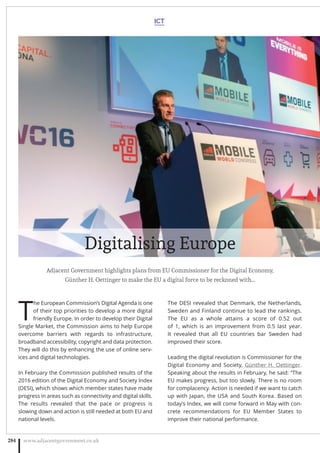
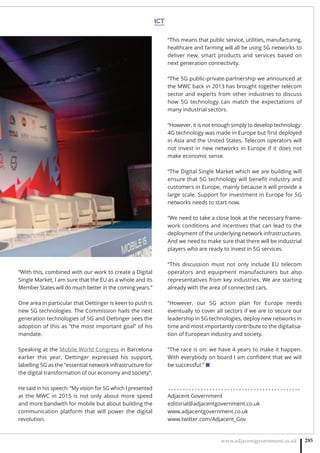
  • 120.
    S tem cells, whichretain the capacity to divide and generate newly differentiated cells within a mature tissue, have been identified in many organs of the human body. They serve as a physiological source of “young” cells for rapid cellular turnover (eg. for the replacement of skin or hematopoietic cells), as a source for repair (eg. for muscle cells damaged by exercise) or as a platform for functional plasticity (eg. to provide young and malleable new neurons to brain memory centres). The physio- logical importance of stem cells is further attested by the functional decline of most organs with ageing, when stem cell pools progressively shrink and exhaust. For their potential to generate fresh mature cells in the adult body, stem cells are also consid- ered as a promising source to be therapeutically mobilised following accidental injury or degeneration. These results motivate the enormous effort placed by today’s biologists to dissect the mechanisms controlling “stemness” (the progenitor potential of stem cells) and its long-lasting mainte- nance in selected cells of the body. Our understanding of these processes, however, remains fragmented. A major determinant of stemness maintenance is the extrinsic niche, ie the local context of stem cells in relation within surrounding tissue. In the brain for example, neural stem cells contact blood vessels and the spino-cerebral fluid, two sources of molecules preserving stem cell poten- tial. Another, yet relatively overlooked parameter, is the “intrinsic” niche, ie the influence of stem cells themselves and their division activity on the fate of neighbouring stem cells. Recent experiments following stem cells over time in the mouse intestine, skin or brain demonstrate that stem cell pools maintenance is achieved at the population rather than at the individual cell level 1 . In other words, statistically, loss of a stem cell is com- pensated for by the amplification of another stem cell. Further spatial analyses of neural stem cell popula- tions in the rodent brain highlighted spatially patterned arrangements of stem cells in different states 2 . Together this argues for communica- tion between stem cells being a fundamental parameter in the main- tenance of stem cell pools. Under- standing the intrinsic niche will be key to future applications of stem cell research. For this, a major challenge remains to access the behaviour of stem cell populations in the physio- logical context of their niche. Our work of the past years revealed the formidable power of a new verte- brate model system, the “zebrafish” (Danio rerio), to tackle this challenge in the brain. Teleost fish diverged from mammals some 450 million years ago. This is very recent in evolutionary terms, and zebrafish and man share most molecular, cellular and organic processes underlying vertebrate development, physiology, behaviour, and disease 3 . These similarities extend to the neural stem cell field 4 : in both mouse and zebrafish, consti- tutively active adult neural stem cells are astroglial cells, organised in ventricular niches, and generally quiescent, activating to enter the cell cycle at low frequency to generate additional astroglial cells and/or neurons. Activation is controlled in both species by identical molecular pathways 5 . Thus extracting basic neural stem cell principles from zebrafish will likely be, in a large part, translatable to mammals. www.adjacentgovernment.co.uk120 Fish at the rescue to unravel mechanisms of stem cell maintenance PROFILE !µ#$ $ $$$$$$$$$$$$$$$$$$$$$$$$$$$$$$$Live neural stem cells (red and green) observed in the brain through the skin and skull of an adult zebrafish (Danio rerio)
  • 121.
    www.adjacentgovernment.co.uk 121 PROFILE Laure Bally-Cuif,PhD Research Director and Group Leader Centre National de la Recherche Scientifique and Institut Pasteur Tel: +33 1 6982 4276 laure.bally-cuif@pasteur.fr http://neuro-psi.cnrs.fr/spip.php? article145lang=en https://research.pasteur.fr/en/team/ zebrafish-neurogenetics/ Major advantages of the zebrafish over mammals lie in the amount of adult neural stem cells and in their experimental accessibility 6,7 . Mam- mals rapidly exhaust their neural stem cell pools past the juvenile stage and the remaining niches are buried in deep regions of the telencephalon (the most anterior brain territory), making experimental access difficult in vivo. Zebrafish efficiently maintain numerous active neural stem cell pools until adulthood and, in the telencephalon, these organise as a large monolayer with some ten thou- sands cells conveniently arranged at the dorsal surface of the brain 8,9 . Taking advantage of this unique prop- erty, a key technical step, achieved in collaboration with Emmanuel Beaure- paire and Willy Supatto (Ecole Poly- technique, Palaiseau, France), was to develop a live imaging technique permitting to film zebrafish adult telencephalic neural stem cells directly in their niche over weeks. We used transgenic lines expressing fluorescent proteins in adult neural stem cells, crossed into a transparent pigmentation mutant 10 . Using a biphoton imaging procedure jointly recording fluorescence (stem cells) and harmonic signals (generated from lipids or collagen-rich structures), we could reach into the telencephalic neural stem cell layer with single cell resolution while imaging through the skin and skull of an anesthetised animal. This enabled us to reconstruct the life of over a thousand neighbour- ing neural stem cells over a number of weeks 11 . The zebrafish therefore becomes the first vertebrate model where entire adult neural stem cell pools can be filmed non-invasively for extensive periods of time, in their endogenous environment, and with single cell resolution. The perspectives of this model are huge. Using transgenic backgrounds highlighting neural stem cell states, such as for example a cell’s activation status, we could position activation events across space and time within the pool. This will now show how the quiescence/activation state of a cell relates spatiotemporally with that of its neighbours and, compared to the behaviour of single cells in a dish, will reveal the properties emerging in real life from neural stem cells being organised in pools. Transgenic lines expressing biosensors or modulators of candidate molecules will reveal some molecular bases for these prop- erties. Finally, like their mammalian counterparts, zebrafish adult neural stem cells are subject to alterations or disease. They exhaust with age, are subject to neoplasia, or can be biased towards generating neurons following lesions. It will now be possible to monitor which single cell rules and/or emerging population properties are affected in these contexts and underlie the observed alterations of the pool. Overall, we are on the cusp of a new opening into neural stem cell research that will address, for the first time in the context of an unperturbed animal, the coordinated properties of stem cell pools. This will be highly relevant to physiological and disease situations in humans, and will shed unprece- dented light on how neural stem cell maintenance can go awry. 1 Simons, B. D. Clevers, H. Strategies for homeostatic stem cell self-renewal in adult tissues. Cell 145, 851-862 (2011). 2 Codega, P. et al. Prospective identification and purification of quiescent adult neural stem cells from their in vivo niche. Neuron 82, 545-559 (2014). 3 Phillips, J. B. Westerfield, M. Zebrafish models in translational research: tipping the scales toward advancements in human health. Dis Model Mech 7, 739-743 (2014). 4 Than-Trong, E. Bally-Cuif, L. Radial glia and neural progenitors in the adult zebrafish central nervous system. Glia 63, 1406-1428 (2015). 5 Alunni, A. et al. Notch3 signaling gates cell cycle entry and limits neural stem cell amplification in the adult pallium. Development 140, 3335-3347 (2013). 6 Grandel, H. Brand, M. Comparative aspects of adult neural stem cell activity in vertebrates. Dev Genes Evol 223, 131-147 (2013). 7 Chapouton, P., Jagasia, R. Bally-Cuif, L. Adult neurogenesis in non-mammalian vertebrates. Bioessays 29, 745-757 (2007). 8 Adolf, B. et al. Conserved and acquired features of adult neurogenesis in the zebrafish telencephalon. Dev Biol 295, 278-293 (2006). 9 Grandel, H., Kaslin, J., Ganz, J., Wenzel, I. Brand, M. Neural stem cells and neurogenesis in the adult zebrafish brain: origin, proliferation dynamics, migration and cell fate. Dev Biol 295, 263-277 (2006). 10 White, R. M. et al. Transparent adult zebrafish as a tool for in vivo transplantation analysis. Cell Stem Cell 2, 183-189 (2008). 11 Dray, N. et al. Large-scale live imaging of adult neural stem cells in their endogenous niche. Development 142, 3592-3600 (2015).
  • 122.
    www.adjacentgovernment.co.uk122 Chromatin and epigenetic changesthe immune response PROFILE H istone modifications and chromatin remodelling are involved in regulating the immune response to different pathogens. A proper immune response is essential in combating viruses, bac- teria and parasites that are harmful for us. We have several lines of defence; from the physical barrier of the skin to specific cells in the body. The innate system is an early response and is composed of several cell types; monocytes, macrophages and natural killer cells (NK cells). These cells react unspecifically to infectious viruses, bacteria or para- sites and present these agents to the adaptive immune cells. T-cells and B-cells comprise the adaptive immune system and these cells recognise spe- cific antigens of the infectious agents. These cells constitute the memory, developing specific memory cells that can quickly be stimulated upon a further infection. Several studies have now shown that a memory exists in the absence of T-cells and B-cells, trained immunity, but the mechanisms behind are not fully understood1 . Several recent studies have shown that both the innate and the adaptive immune system change the epigenetic landscape in response to infections. The development of immune cells in the bone marrow involves a large epigenetic reprogramming. Depending on signal, the different cells in the immune cells develops and acquire the specific gene profile for the cell lineage2, 3, 4, 5, 6 . High through-put transcriptome analyses, performed together with ChIP seq of histone modifications7, 8 and analyses of the global DNA methylation profile9, 10, 11 , has shown that the change in gene expression follows changes in the epigenetic landscape in the different cell lineages. In particular, cell type specific transcription factors and sig- nalling pathway factors are regulated by histone modifications and DNA methylation. The further response of different immune cells to infections also involves transcriptional and epigenetic responses12, 13 . In response to viral infections, not only genes regulating the immune response, such as cytokines and signalling factors, are modulated, but also genes involved in DNA methylation and histone modifi- cation changed, maybe to adjust cells to the new epigenetic state. Similar changes also occur upon the induction of inflammation processes in response
  • 123.
    www.adjacentgovernment.co.uk 123 PROFILE to infection,but also to non-infections stimuli, such as nutrients, stress and exercise. Inflammation is the host early response induced by innate immune cells, creating fever, swelling and pain. When the response go wrong, inflammation can be harmful. Genes involved in the inflammatory response is particularly regulated and is marked by epigenetic mechanisms14 . The immune system protects us upon infections, but can also be the cause of diseases. Allergy is caused by the immune system overreacting and autoimmune diseases, such as rheumatism and MS, is caused by the immune cells starting to attack our own tissues. Autoimmunity together with chronic inflammatory response have now been linked to many dis- eases and disorders, and may be the underlying cause for yet many more. The immune response differs slightly depending on the pathogen involved. Many pathogens have evolved ways to elude or inhibit the full response of the host. The immune system has particular difficulty when combating pathogens with a life cycle in several stages. One such pathogen is the Plas- modium parasite, which is the cause for malaria. Studies towards specific antigens produced by the parasite has been investigating specific responses. The biology of the mosquito15, 16 has also been studied and the immune response elicited to understand to many ways the plasmodium parasite affects its hosts. Malaria affects mainly children, those that survive are less susceptible as adults, but no real immunity is obtained. There are, how- ever, differences in response between individuals as well as populations, most likely caused by genetic factors. One ethnic group in Africa, the Fulani, which has been extensively studied because of the resistance to malaria. The immune response upon infection in the Fulani have been studied and compared with the response in various other neighbouring ethnic groups. These studies have mainly been SNP analyses, investigating variations in genes coding for factors in the immune response. One such example is the SNP study performed between them and the Dogon people in Mali that found genetic differences17 . How- ever, these studies have so far not been able to fully explain the differences in response between ethnic groups in the sub Saharan region. The relative resistance found in the Fulani group could therefore be explained by other factors. Interest- ingly, it was shown that miRNA also involved in the response to malaria and most likely other parasites18 . Hence, we are interested in studying the underlying cause for the difference in immune response on another level; in epigenetic factors, such as differences in DNA methylation and histone modification profiles as well as in non-coding RNA levels. A further phe- nomenon of certain complex pathogens that needs to be explained is the lack of real immunity. Immune tolerance could be part of it, but not fully explain the lack of immunity. The memory of the innate immune system, trained immunity1 , could be involved in the finding that adult people living in exposed areas are less susceptible to malaria, a protection that is lost when leaving these areas. To understand the human immune response to complex pathogens, and how host and the pathogen interacts, can then shed light to other Prof Ann-Kristin Ostlund-Farrants Stockholm University The Wenner Gren Institute Cell Biology Tel: +46 816 4097 Fax: +46 815 9837 anki.ostlund@wgi.su.se responses causing a varity of diseases, such as stress-induced immune responses, autoimmunity and chronic inflammation. 1 Quintin et al. (2014) Current opinion in Immunology 29, 1-7 2 Tondeur et al. (2010) PLoS One 5(2), e8990 3 Lui et al. (2011) Physiol Genomics 43(20), 1117-1134 4 Shi et al. (2014) Hum Mol Genet 23(17), 4528-42 5 Prassade et al. (2014) Blood 123(17), e46-57 6 Chen (2014) Science 345, 1251033 7 Sashida and Iwarna (2012) Int J Heamatol 96(4), 405-1 8 Kondilis-Magnum and Wade (2013) Mol. Aspects Med. 34, 813-825 9 Ji et al. (2010) Nature 467, 338-342 10 Hodges et al. (2011) Mol Cell 44, 17-28 11 Zhang et al (2014 Epigentics and Chromatin 7, 21 12 Pasis et al. (2014) Current Opinion in Immunology 29, 119-126. 13 Mejias and Ramiro (2014) J. Infect. 68 Suppl 1, S94-99 14 Alvarez-Errico et al. (2015) Natl Rev Immunology 15(1), 7-17 15 Wright and Rayner (2014) PLoS Pathogens 10(3), e1003943 16 Olivier et al. (2014) Frontiers in Immunol. 5, 25. doi: 10.3389/ fimmu.2014.00025.  17 Maiga et al. (2013) PLoS One 8(10), e75675. 18 LaMonte (2012) Cell Host Microbe. 12(2), 187-99.
  • 124.
    C apturing and retainingtalent is key to fostering a knowledge- based society. Yet we are failing to achieve this goal by not allowing a pool of talent – namely women – to reach its full potential. Indeed, the ratio of women to men progressively decreases along the career ladder, with few women reaching top posi- tions in research and decision-making bodies. Despite improvements in awareness and policies that have been implemented to redress this imbal- ance, progress is overly slow, such that positive action is needed. The issue is highly complex and comprises multidimensional factors ranging from the general cultural framework of societies to numerous more specific – and more addressable – problems. However, addressing these problems with innovative actions first requires that we better understand them. To tackle both of these steps, thirteen top European life science research institutes from the EU-LIFE alliance – 10 as partners and 3 as associated partners, located in 13 countries (see Figure) – teamed with gender experts of ASDO (Italy) to design the ambitious LIBRA project (http://www.eu-libra.eu/). LIBRA, which is coordinated by CRG (Barcelona), has been funded by the European Union from October 2015 to March 2018. The project will benefit from guidance from a board of inter- nationally renowned gender-in-science experts: Dr Ineke Klinge, Prof Kurt Rice and Dr Ines Sánchez de Madariaga. LIBRA aims to remove institutional barriers and empower women to be as successful as men in their research careers on a European-wide scale. In an initial phase, the current status and policies in place for each partner institute will be assessed at group and individual levels. The results from this will provide an excellent snapshot of issues underlying gender imbalances at the top positions in European life science research institutes. LIBRA will also obtain realistic data about the degree of implicit bias towards gender issues amongst the research institute employees and scientists in the 10 partner institutes from an implicit association test (IAT). In a second phase, LIBRA will design and implement 10 harmonised and institute-tailored Gender Equality Plans (GEPs) based on a process of mutual learning and idea exchanges. The goal is to introduce long-lasting, profound structural changes to these research environments. Overall, LIBRA will address 4 main areas of intervention for improvement or implementation: assuring gender-neutral recruitment• Isabelle Vernos LIBRA Coordinator isabelle.vernos@crg.eu Natalia Dave LIBRA Scientific Project Manager natalia.dave@crg.eu Centre for Genomic Regulation (CRG) http://www.eu-libra.eu/ www.twitter.com/libra_science policies and procedures; measures and activities to promote• career development and training; providing a good work-life balance• environment, and; including sex and gender dimensions• in research. www.adjacentgovernment.co.uk124 LIBRA tackles gender imbalance in European life science research PROFILE The thirteen European life science research institutes from the EU-LIFE alliance that are involved in LIBRA are shown on the map. Sizes of dots reflect the proportional number of staff at each institute. CRG (Centre for Genomic Regulation); CeMM (Research Center for Molecular Medicine of the Austrian Academy of Sciences); IC (Institute Curie); BI (Babraham Institute); IEO (European Institute of Oncology); BRIC (Biotech Research Innovation Centre); FMI (Friedrich Miescher Institute for Medical Research); MDC (Max Delbrück Center for Molecular Medicine); CEITEC (Central European Institute of Technology); NKI (The Netherlands Cancer Institute); VIB (Flanders Institute for Biotechnology); FiMM (Institute for Molecular Medicine Finland); and IGC (Instituto Gulbenkian de Ciência).
  • 125.
    www.adjacentgovernment.co.uk Whether you agree,disagree, or have another viewpoint with any news and features on our website, we want to hear from you. Leaving a comment on any item on our website is easy, so please engage and join the debate today. YOUR OPINION MATTERS
  • 126.
    O n February 11,The National Science Foundation (NSF) hosted a press conference to announce that its Laser Interferometer Gravitational-wave Observatory (LIGO) had detected gravitational waves from 2 merging black holes, approximately 1.3 billion light years away. Since that time, this news – which rep- resents a major breakthrough in observing our universe – has not only excited the scientific community; it has transcended pop culture – from Garrison Keillor’s Prairie Home Companion and Stephen Colbert’s late night show to the annual Washington Post peeps diorama contest. The attention is well deserved, and the tributes that have been paid are intensely gratifying. Not just because the science is so remarkable, but the path to get to this point has not always been so smooth. LIGO’s history reflects notable determination, inspiration and tenacity. It’s true, Einstein predicted gravitational waves a hundred years ago, but even he thought detection was likely impossible. However, as Dr. Fleming Crim, our assistant director for NSF’s Mathematical and Physical Sciences Directorate noted recently, “the possibility of opening a new window on the universe was so tantalising that NSF began funding research on prototype laser interferometers in the 1970s. And, in 1994, the agency committed almost $300m to a group led by Kip Thorne and Ron Drever of Caltech and Rainer Weiss of MIT to transform their prototypes into a full-blown gravitational wave observatory.” For those of us at the agency today, it’s hard not to respect the brilliance, vision, enthusiasm, experimental prowess and deep theoretical insights these researchers had, persuading NSF, the National Science Board and Congress to take a risk. Even though NSF had not funded anything on such a scale previously, the potential for transformative science justified such a big commitment. In fact, the agency embarked on a new role by funding this large, high-risk, high-reward research platform. It was basic scientific research with a clear eye toward future possibilities. While many on the day of the press conference found they might view the discovery as a comfortable landing where one might pause and take in the view, we here SCIENCE AND RESEARCH www.adjacentgovernment.co.uk126 The reverberating impacts of detecting gravitational waves Denise Caldwell, Director of the National Science Foundation’s Physics Division in the Directorate for Mathematical and Physical Sciences, looks to the future for gravitational wave research…
  • 127.
    SCIENCE AND RESEARCH www.adjacentgovernment.co.uk127 at NSF see this as only the beginning of an entirely new subarea of physics and astronomy, the opening of a new window on the cosmos. We have sights on a future of learning even more about the violent phenomena that inhabit these dark corners of our universe. LIGO is expected to reveal objects out there that no one even knew existed. As the results from LIGO are combined with other observations NSF has fostered over the last decade, we will start to probe the universe closer and closer to its very origin. At the NSF telescope at the South Pole we will, for example, look for the imprint of gravitational waves on the cosmic microwave background, that faint, leftover light from when hydrogen atoms first formed after the Big Bang. At an NSF funded Physics Frontiers Center, scientists studying pulsars will search for indirect evidence of gravitational waves. As these discoveries are combined with measurements utilising electromagnetic radiation and elementary particles, this multi-messenger approach will enable us to paint a more comprehensive picture of this vast cosmos we inhabit. “Wehavesightsonafutureoflearningeven more about the violent phenomena that inhabitthesedarkcornersofouruniverse.” Of course, basic research like this provides no promises. And the risk of failure is an ever-present specter lurking in the background. But for those doing the work – as well as those of us who make decisions to fund it – the results can be utterly revolutionary. LIGO may have made international news, but this really is our agency’s daily work: to support science at its earliest stages, being mindful of the long road ahead and being prepared to accept the risk involved. To again quote Fleming Crim, “fundamental science has transformed our world and will continue to change it in ways we have not yet imagined – in much the same way that Einstein’s own theory of relativity is what ensures the accuracy of our GPS or that the same technique used to stabilise LIGO’s sensitive laser frequencies also helps to build the semiconductors in our computers and cellphones.” Just as in those cases of fundamental science driving innovation forward, we again will keep trying to push the envelope and look toward the future with gravitational wave research. In February, we got to help open a window to our universe that was a long time in coming. Now, we must also be good stewards for ensuring we continue to fund science with the vision to see what’s beyond that window. ■ . . . . . . . . . . . . . . . . . . . . . . . . . . . . . . . . . . . . . . . . . . . . . Denise Caldwell Director, Physics Division Directorate for Mathematical and Physical Sciences – U.S. National Science Foundation info@nsf.gov www.nsf.gov www.twitter.com/NSF
  • 128.
    T he US fundingagencies were perhaps the first to realise the potential of the X-ray free electron laser (XFEL). They responded immediately by pumping unusually large amounts of funds into these unproven machines. The world’s first XFEL was developed at the Stanford Linear Accelerator Center for the cost of several hundreds of millions of dollars. This is a machine capable of producing X-rays of some 10 billion times brighter than any previous X-ray source on earth. One of the crucial applications is the novel opportunity for biomolecular structure determination. The ultrashort pulses produced by XFELs allows the possibility of circumventing radiation damage altogether by scattering off a particle before radiation damage can manifest itself1 . Subsequently an XFEL was developed in Japan, just outside Osaka. A European XFEL is now planned for Hamburg in Germany, due to come online in 2017. Others are also planned for Korea, Switzerland and China. The enormous novel capabilities of the XFEL are now perhaps becoming more widely appreciated. Up until the development of the XFEL, almost all structure determination at the atomic scale was done on macro- scopic crystals, where the relatively weak X-rays from conventional sources scatter off perhaps trillions of identical unit cells to reveal the structure of a single unit cell. The ultra-brightness of X-rays from an XFEL may allow structure determination to be performed on individual mole- cules without a need to crystallise them. This is of significance, as there are some important biomolecules, e.g. membrane proteins that are very resistant to crystallisation. In any case, a crystalline state is not one which, in general biomolecules perform their functions in nature. The ultra-bright- ness of an XFEL will allow meaningful diffraction patterns to be measured from individual biomolecules in envi- ronments closer to those in which they may be found in nature, e.g. in solution. The shortness of the X-ray pulse could allow one to outrun radiation damage which takes place over a time period longer than the X-ray pulse. Thus the X-ray diffraction patterns would be characteristic of their native states before radiation damage. One may also use any degree of incident flux and be completely impervious to radiation damage! Of course, the use of such completely different conditions for structure determination also requires the devel- opment of a completely new theory 2 . No longer can one use the theory originally developed by the Braggs, von Laue and other pioneers of x-ray crystallography which were designed for crystals 3 . In fact, x-ray diffraction patterns from individual molecules look very different from those from crystals. The latter are dominated by the “Bragg spots” which arise from the crystalline periodicity. This is both a boon and a curse. The maximum intensities of the Bragg spots increase with the number of “unit cells” in a crystal and make them much more visible even with much weaker X-rays. On the other hand, the crystal perio- dicity prevents the sampling of these intensities at intervals smaller than the positions of the Bragg peaks. Although that scattering is weaker from an individual molecule the pos- sibility of measuring such “oversam- pled” intensities is often crucial for structure determination. Here is the advantage of the 10 billion-fold increase in brightness of the incident x-rays allowed by the XFEL. However it should be borne in mind that a single molecule is perhaps a trillion times smaller than a typical crystal used in x-ray crystal- lography, so the measured intensities would inevitably be significantly smaller even with the use of an XFEL. This also necessitates a careful consideration of signal to noise ratios in any theory. Also, the absence of Bragg spots in scattering by individual molecules www.adjacentgovernment.co.uk128 The X-ray free electron laser for biomolecular structure determination PROFILE Figure 1. Structure of an icosahedral virus, satellite tobacco necrosis virus (STNV) recovered from simulated diffraction patterns by the method of angular correlations. The artificial cut allows us to show that the reconstruction of the PDB structure assumed in the calcuations, which contains only the capsid structure.
  • 129.
    www.adjacentgovernment.co.uk 129 PROFILE Dr DilanoK Saldin Department of Physics University of Wisconsin-Milwaukee Tel: +1 414 2296 423 dksaldin@uwm.edu https://uwm.edu/physics/ requires entirely new methods of taking account of the orientations of the individual scatters. It has been found that the angular correlation of the intensities when averaged over all the million or so diffraction patterns expected to be measured in an XFEL (the repetition rate is about 100 diffraction patterns (DPs) per second) is found to be inde- pendent of orientation. Over a typical experimental shift it is not unexpected that about a million DPs will be meas- ured. This means that at long last one has a quantity that is characteristic of the structure and independent of the orientation of an individual molecule. This means that once one cracks the code for recovering the structure from the correlations one had a method for recovering the structure of a molecule from ensembles that may not be perfectly aligned as in a crystal. The potential for recovering the structures of molecules from such misaligned ensembles as may be found from ensembles of molecules as they are found in nature. References 1 Potential for biomolecular imaging with ultrashort x-ray pulses, R. Neutze, R. Wouts, D. Van Der Spoel, E. Weckert, and J. Hajdu, Nature 406, 752 (2000). 2 Structure of isolated biomolecules from ultrashort x-ray puldes: exploiting the symmetry of random orientations, D. K. Saldin, V. L. Shneerson, R. Fung, and A. Ourmazd, J. Phys.: Condens. Matter 21, 134014 (2009). 3 Principles of Protein X-ray Crystatallography, J. Drenth Figure 2. Structure of tobacco mosaic virus (TMV) recovered from simulated XFEL diffraction patterns by the method of angular correlations. Dr Dilano K Saldin
  • 130.
    A boost forstem cell research Adrian Heuss, Head of Knowledge Transfer on the NRP63 Programme tells Editor Laura Evans more about NRP63 and Stem Cell Research… S tem cell research can play an integral role in developing new treatments and therapies for major healthcare challenges, such as cancer. It is still considered a relatively new area with high poten- tial. At the Swiss National Science Foundation (SNSF) their National Research Programme – Stem Cells and Regenerative Medicine (NRP 63) aims at boosting basic research on stem cells and regenerative medicine. Editor Laura Evans spoke to Adrian Heuss, Head of Knowledge Transfer for NRP 63, to find out why stem cell research is so interesting and how the programme offers this much needed boost. “Stem cell research is interesting because it is not just about one specific illness,” explains Heuss. “There are a number of different illnesses that you can look at, including: cancer, diabetes, and Parkinson’s.” Stem cell research can benefit a number of different areas, even for muscle regeneration or repairing the retina. “There are so many different projects going on, not just in Switzerland, but worldwide.” Connected to stem cell research is regenerative medi- cine, which can be defined as the ‘process of replacing, engineering or regenerating human cells, tissues or organs to restore or establish normal function’. “Regenerative medicine could in theory be used for more or less all diseases where cells die off or are damaged,” says Heuss. For example, one NRP 63 research team worked on diabetes, they found a way to develop new insulin producing cells. Another team worked on an ear project: they developed a new material that can be used to reconstruct ears for patients who have lost theirs in an accident or whose ear didn’t grow or form properly when they were born. At the moment the standard technique for these patients is to use cartilage from other parts of the body, but what they have developed is a new material which has more or less the same stability as natural cartilage. “This new material could be used for any part of the body where the cartilage is damaged,” says Heuss. “For a long time everyone believed that there are no real stem cells in the brain. They believed that you had constant number of nerve cells from birth, and with age they reduce in number. In the last 10 or 15yearswehaverealisedthat’snottrueand how much actually is regenerated – there are stem cells in the brain that make new nerve cells.” The NRP 63’s intention was to boost basic research on stem cells and regenerative medicine, as well as encouraging top scientists with an excellent track record in development and cell biology to engage in this field. “The NRP 63 increased the visibility of Swiss research in the international arena”, explains Heuss. “Most projects were basic research, but several groups are already in touch with biotech and pharmaceutical companies that are interested in utilising their results for the good of patients in the future. This, I think, is really interesting and worth the money.” Over a 5 year period, the SNSF dedicated 10 million Swiss francs. Between 2010 and 2015 12 research groups based in Basel, Berne, Geneva, Lausanne and Zurich investigated new approaches to the treatment of various diseases. “In order to further boost research in this area, the programme also focused on young scientists. In Switzerland, research in molecular biology is well SCIENCE AND RESEARCH www.adjacentgovernment.co.uk130
  • 131.
    SCIENCE AND RESEARCH www.adjacentgovernment.co.uk131 established, but the stem cell part could do better.” The idea behind the NRP 63 was to encourage more experts into the stem cell field.” Heuss says. With the help of programmes such as NRP 63 and others across Europe, research in stem cells and regenerative medicine is able to progress and develop further. Over the last 10 years, advances in regenerative medicine and stem cell research have been huge. “For a long time everyone believed that there are no real stem cells in the brain. They believed that you had a definite number of nerve cells from birth, and with age they decreased in number. In the last 10 or 15 years we have realised that this is not true and how much actually is regenerated – there are stem cells in the brain that make new nerve cells,” says Heuss. Researchers are now looking at ways to boost those cells in the brain, for example using substances to make the stem cells in the brain produce new nerve cells. This would really help with illnesses such as Parkinson’s or multiple sclerosis – diseases where the cells die off. The good thing about this would be that these new cells are your own cells and they wouldn’t be transplanted from someone else. “It is always problematic if you transplant cells, as there’s the question of whether they are accepted,” Heuss adds. As with any research, regenerative medicine comes with its own challenges. Heuss explains that one of the main issues when working with stem cells is the development of tumours. “Stem cells in their natural environment are tightly con- trolled by different signals – they are in a niche and the niche will make sure that these cells only produce new cells when they have to. If you take these cells out of their niche and transplant them into another patient then the surrounding is different, the signals to control their growth change, and then you could get tumours. ■ . . . . . . . . . . . . . . . . . . . . . . . . . . . . . . . . . . . . . . . . . . . . . Adrian Heuss Head of Knowledge Transfer NRP 63 – Swiss National Science Foundation (SNSF) nfp63@snf.ch www.nrp63.ch
  • 132.
    The medical revolution Thoughgreat progress has been made in medicine, current treatments are increasingly unable to keep pace with patients’ need, especially given our aging population. In fact, there are few effective ways to treat the root causes of many common diseases, injuries, and congenital conditions. In many cases clinicians can only manage patients’ symptoms using medications or devices. This is especially true, for example, in the case of acute myocardial infarction and other heart diseases. If most tissues and organs in the human body have in fact a regular turnover of cells (meaning that entire tissues or organs are replaced over a period of weeks or years depending on the type of cells), heart cells are an exception. Adult cardiac cells experience no (or extremely slow) replacement over time. This means that any injury of the heart has serious consequences for the patients. Regenerative medicine is a game- changing area of medicine because it intervenes exactly where traditional medicine fails, by regenerating dam- aged tissues or organs and therefore restore the normal functions of the body. This is made possible through the development and the application of new therapies based on the use of stem cells, i.e. undifferentiated pro- genitors cells that have the ability to evolve – through a process called “differentiation” – into diverse types of specialised cells. By studying the properties of each kind of stem cell, scientists are today able to regenerate entire organs or at least part of them, and therefore cure damages that were previously considered irre- versible. Heart disease is just one exam- ple of a condition that is going to be completely revolutionised by regenera- tive medicine. Other potential applica- tions are found in Parkinson’s disease, cerebral palsy, degenerative retinal diseases, pulmonary disease, spinal cord injury, arthritis, and many more. Only a few decades ago, the concept of regenerating parts of the human body was firmly restricted to the realm of sci- ence fiction; however, in a very short space of time, it has become a tangible scientific and therapeutic reality all over the world. In fact, even though many people perceive regenerative medicine as a matter of the future, it is already a tangible reality. A significant quantity of regenerative medicine products are in fact already commercially and clinically successful. In addition to over 60,000 stem cell transplants that are annually performed worldwide for the treat- ment of oncology and blood disorders, in 2012 over 160,000 patients were treated using new, experimental regen- erative medicine drugs. At the same time, more products are being approved and new data are becoming available from mid and late-stage regenerative medicine clinical trials. Going forward, the industry expects the approvals to multiply annually. Obviously, research in regenerative medicine requires significant effort and investments. Treatment, before becoming a reality, may take up to 10 or 15 years of development and testing. This has not stopped some particu- larly forward-thinking countries in investing in what is often called “the medicine of the future”, also because research in this field is capable of pro- ducing an extremely important scien- tific and economic advancement. An example of forward-thinking in this regard is in the state of California which, following the so-called “Propo- sition 71” – the state law approved by referendum in 2004 – has allocated $3bn to regenerative medicine. Thanks to this major investment, California can now rely on 2,600 biomedical companies, 87 university and private research institutes generating an annual revenue of $32.3bn, 15 of which are reinvested annually for research. www.adjacentgovernment.co.uk132 Transforming regenerative medicine into an opportunity for patients Regenerative medicine is the medical revolution that is increasingly challenging the way we approach and fight diseases. At the Swiss Institute for Regenerative Medicine, hospitals, research institutions, companies and universities are joining forces to bring innovation from bench to bedside PROFILE
  • 133.
    www.adjacentgovernment.co.uk 133 PROFILE Antonino Tramonte ManagingDirector Swiss Institute for Regenerative Medicine Tel: +4191 805 39 78 info@sirm-institute.ch www.sirm-institute.ch Making the dream true: the Swiss Institute for Regenerative Medicine In the last decade, the growth of the biotech sector in the southern and Italian-speaking Ticino Canton has become increasingly important for the economy of the region and for the surrounding scientific environment. It is here, just 15 minutes far from the Italian city of Como, less than an hour from Milan, in a region known for its ability to blend Italian lifestyle and cul- ture with Swiss precision, top-level services and political stability, that the first stem cell transplant of the coun- try has been performed in 2004, on a patient with acute myocardial infarc- tion. The intervention was carried out by a cardiology team led by Prof. Tiziano Moccetti at Cardiocentro Ticino, a Lugano based, cutting edge heart clinic, known to be one of the most important cardiac centres in Switzerland. This pioneering and encouraging experience eventually led the clinic to investigate further on the matter by building the first autho- rised “cell factory” of the country, which is a special facility to safely pro- duce experimental drugs based on stem cells. Starting in 2005, these experiences led to the creation of a growing biomedical cluster of compa- nies, research institutes and other clinics interested in the exploration and application of regenerative medi- cine in various medical fields. In 2013, tis group finally created the Swiss Institute for Regenerative Medicine (SIRM), a new research centre entirely committed to exploring the full poten- tial of regenerative medicine. The institute, supported by the Cardiocen- tro Ticino Foundation, and funded by the Foundation for Cardiological and Research Education (FCRE), has a bold mission: To unleash the enormous potential of human body regeneration and thereby support the development of next generation therapies and cures that will shape the medicine of the future. This is not a simple task, explains Antonino Tramonte, SIRM Managing director: “To effectively become a real solution for patients, the new thera- pies require several years of research and development. At SIRM we strive to accelerate this process by combin- ing and integrating competences of several different but complementary institutions that are actually part of the same ecosystem: Clinicians, researchers and biotech companies. “This is why SIRM laboratories, based in Taverne, currently host 5 partner institutions: Cardiocentro Ticino, Neu- rocenter of Southern Switzerland, Uni- versity of Applied Sciences and Arts of Southern Switzerland (SUPSI) and two innovative biotech companies: Swiss Stem Cell Bank and Hyperstem.” “This is indeed a successful example of cooperation,” explains Claudio Massa, President of the FCRE Foundation. “In just 3 years of activity, we completely saturated the spaces in our current headquarter and we deal quite on a daily basis with new requests from new companies and new research insti- tutes that would like to join us in our research for regenerative medicine. We’re now talking with new partners and with Lugano municipality to buy together a new building, big enough to support our growth in the medtech field. We’re amazed by the SIRM proj- ect so far, it truly exceeded our most optimistic prevision”. “Our dream”, concludes Prof. Tiziano Moccetti, scientific director of Cardio- centro Ticino and of SIRM, “is to create with our joint work a real treatment opportunity for patients. Everything starts from the patient whose needs are the main goals for the clinician. Doctors’ research for solutions creates research projects and consequently opportunities for the biomedical industry. Only when all these stake- holders communicate and cooperate patients’ needs are finally met. This is the real meaning of the translational research we do at SIRM. Literally: From bench to bedside, that is our philosophy and the path we want to follow for the medicine of the future.”
  • 134.
    A round 2500 yearsago, Hip- pocrates realised that bone can heal without scaring. How- ever, the natural healing potential is restricted to small defects and large bone defects caused by trauma or during tumour resections still pose a huge problem in orthopaedics and cranio-maxillofacial surgery, not men- tioning the immense costs associated with non-healing fractures or bony defects. Personalised bone substitutes The natural healing potential of bone is based on three pillars: Mesenchymal stem cells;• Osteoinduction by growth factors• deposited in bone; Osteoconduction, as potential of bone• tissue to grow into 3D structures. Mesenchymal stem cells can be har- vested from bone marrow or adipose tissue and therapies, applying them clinically as tested or already used. However, the costs associated with any stem cell therapy are very high. Mesenchymal stem cells can be differ- entiated to bone forming osteoblasts by growth factors like bone morpho- genetic proteins, which entered clinics as FDA approved medical devices in 2002 as option for spinal fusion to treat degenerative disc disease and tibia fractures, not able to heal by themselves. Both advanced and cost intensive therapies need delivery systems to properly apply the cells or the growth factors. Ideally the delivery system should be osteoconductive, to further enhance bone healing and to minimise the need for stem cells or growth factors. The research at Oral Biotechnology Bioengineering (Center of Dental Medicine, University Zurich) has a long track record of the clinical use of osteoinduction in dental medicine and the delivery of bone morphogenetic proteins. To optimise osteoinduction, the combination with an osteoconduc- tive bone substitute material appears to be a promising strategy. To that end we started a project on scaffold design and osteoconduction to develop osteoconductive/osteoinductive bone substitutes and initially got funding from the AOCMF, the Cranio-Maxillofa- cial Specialty of the AO Foundation and since 2014 full funding from the Swiss National Science Foundation (SNF). The SNF project: “Osteoconductive and osteoinductive customised implants for large mandibular defects” is set to run for a period of three years and involves collaborators from around the world. Experience of titanium implants and their production through rapid prototyping is provided by researchers at the University of Applied Sciences North-western Switzerland (Professor Michael de Wild and Professor Ralf Schumacher); technologies on extracellular matrices, osteoinductive hydrogels and osteo- conductive bone substitutes are pro- vided by researchers at the University of Zurich (Prof. Franz E. Weber and Dr. Chafik Ghayor); and the Hong Kong Polytechnic University offers experience in selective magnesium alloys laser melting (Professor H Man and Professor Monica Mahesh Savalani). In combining a unique body of knowledge, the team, headed by Prof. Franz E. Weber as principle investigator, hopes to achieve the aims of the project and develop a much needed personalised treatment for large mandibular defects. The solutions found in this project can easily be translated in osteoconduc- tive bone substitutes for use in orthopaedics and increase the number of patients to profit from our research results substantially. The ultimate goal of research performed at: Oral Biotechnology Bioengineering (Center of Dental Medicine, University Zurich) is to bring research results from the bench to the bedside. To that end, we recently acquired a lithography-based additive manufacturing machine which allows the production of osteoconductive bone substitutes from calcium-phos- phates. Seventy per cent of bone is www.adjacentgovernment.co.uk134 Personalised medicine in bone regeneration PROFILE Professor Dr. Franz E. Weber
  • 135.
    www.adjacentgovernment.co.uk 135 PROFILE Professor Dr.Franz E. Weber Head of Oral Biotechnology Bioengineering University Zurich Center of Dental Medicine Tel: +41 634 3140 franz.weber@zzm.uzh.ch www.zzm.uzh.ch/en/research/staff/weber- franz.html made up from calcium-phosphates in the form of hydroxyapatite. Therefore we aim at to develop personalised, biomimetic, osteoconductive bone substitutes which can be produced in our laboratory by additive manufac- turing and clinically applied to per- fectly match and treat bone defects located either in the mandible or any other bone. Epigenetics and bone regeneration Epigenetics describes changes to the expression of genes that are not linked to changes in the DNA sequence. In another SNF funded project with the title “The potential of N-methylpyrroli- done (NMP) to prevent osteoporosis and to enhance bone regeneration” we found that NMP and 2 other small molecules to possess an activity on the level of epigenetics and patented these findings (Unitectra, University of Zurich) for treatment and prevention of osteoporosis, adiposity, periodonti- tis, peri-implantitis and several other disorders. Although this project fin- ished at the end of 2015, we hope to continue on this novel approach to use epigenetics for bone regeneration and to combine these findings with osteoconductive bone substitutes. Funding Swiss National Science Foundation• (SNF); EU Seventh Framework Programme• (FP7); Swiss Dental Society (SSO); AOCMF,• the Cranio-Maxillofacial Specialty of the AO Foundation. Biography of the principle investigator FRANZ E WEBER graduated from the University of Konstanz (Germany) with a PhD in Biology/Muscle Biochemistry. He completed three years of postdoc- toral training on muscle cell biology at Cornell University Medical College in New York City and served as a lecturer in the Department of Cell Biology and Anatomy. He spent the following two years at the Biochemistry Department of ETH Zurich (Federal Institutes of Technology in Zurich) working on the lipid uptake from the small intestine. In 1995, he joined the Department of Cranio-Maxillofacial and Oral Surgery at the University Hospital Zurich, and the Dental School of the University of Zurich. In addition to his obligations at the University of Zurich, he became Director of the European Technical Center of Inion Ltd in Cambridge (UK) in 2005 and occupied this position until 2009. His main area of interest is bone regeneration. His research encompasses bone morphogenetic proteins, delivery systems, bone sub- stitute materials, osteoconduction, epigenetics, additive manufacturing and in vitro bone tissue engineering. Weber has authored 94 original research articles published in interna- tional journals amounting to more than 3,800 citations and has an h-index of 30. He is member of TERMIS (Tissue Engineering international Regenerative Medicine Society), IADR (International Association for Dental Research), and SSB+RM (Swiss Society for Biomaterials and Regenerative Medicine).
  • 136.
    A ccording to arecent publication by the OECD, after-school pro- grams (ASPs) have been evolving all over the world in the last decades, providing institutionalised care before school, at lunch time and after the compulsory school hours. Those reports point out that in most countries, the coverage of ASP activities ranges (with some exceptions) between 15 and 45% of the elementary student populations. Nevertheless, official guidelines, doc- umentation and monitoring systems often vary by jurisdiction or state and therefore impede the comparison of the use and effectiveness of such programs on a national and international level. Yet, there remains an increased demand for institutionalised care since ASPs are a reaction to changing societal, economic and family structures and are often promoted as an instrument to reduce social inequality. Accord- ingly, since ASPs not only provide recreational activities, but also home- work support, they are often con- nected to the school. Therefore, ASPs are educational reform projects, which have to be integrated in the school system. So how can this integration be achieved? How can educational officials secure a well-developed after-school system, which accounts for the demands of the parents, pro- vides activities of good quality for the children and achieve the manifold educational goals? In a longitudinal study conducted in Switzerland, we were able to analyse these questions carefully. Schools in Switzerland usually run between 8am and 3pm, whereas many children have the afternoons off and are not supervised during lunch. The Canton of Bern (one of the 26 provinces in Switzerland) has found one first solution to this declared “state of emergency” in the lack of available hours of institutionalised care. The local government in Bern passed an amendment to the public school law that the municipalities have to assess the parent`s needs and supply this demand appropri- ately. According to the register data from the Canton of Bern, the develop- ment of ASPs indeed has increased by 67% in hours of care between 2010 and 2016. Studying these ASPs, we investigate how the government guidelines and other development mechanisms may influence the ASP`s collaboration with the school. In the study, we were interested how the ASPs are organised and how after- school directors (ASD) and personnel evaluate their role and influence on student development. We argue that there are four main dimensions which need to be considered, when develop- ing ASPs: The quality of the activities and the ASP institution as a whole, the competences and leadership behavior of the ASD, the actions and attitudes of the staff, as well as, the collaboration with the school. Quality of the activities and the ASPs A systematic observation in 22 ASPs points out that they vary considerably concerning the observed quality of the program and activities. Whereas some ASPs reach very good overall quality ratings, some ASPs range between minimal and inadequate quality. According to the applied School-Age Care Environment Rating Scale (SACERS), the ASPs on average reach high ratings for space and fur- nishing, and interactions but could improve concerning health regulations, staff development and the organisation of activities. ASDs report that most activities in ASPs are not preplanned and are more oriented towards physi- cal activities than reflection of project- based activities. Competences and leadership behavior We asked 47 ASP directors about how they perceive their role and how they manage the ASPs. The most common professional role category that ASDs relate to is the “Primus inter Pares”, in which leaders have little professional distance to the team and rather posi- tion themselves at a similar status level as their coworkers. Furthermore, ASDs report that they spend most of their work-day engaged in staff man- agement as well as organisation and administrational tasks. Quality devel- opment and evaluation is less focused in the daily practice of the ASD. Actions and attitudes of the staff We looked at how the ASP personnel feel about their work on a range of scales from organisational psychology. About 250 ASP staff report that the working climate concerning the inter- www.adjacentgovernment.co.uk136 Effective after-school programs? Supporting student well-being and learning – The development of after-school programs PROFILE
  • 137.
    www.adjacentgovernment.co.uk 137 PROFILE Michelle JutziMA Institute of Education University of Zurich Tel: +41 44 634 25 95 mjutzi@ife.uzh.ch Prof Dr Katharina Maag Merki Institute of Education University of Zurich Tel: +41 44 634 27 80 kmaag@ife.uzh.ch http://www.ife.uzh.ch/en/research/teb.html actions with students and the general atmosphere is very positive. Further- more, they rate their collective self- efficacy as a team high and feel capable of promoting activities of good quality and deal with daily problems. Nevertheless, clear goals and guidelines for improvement and innovation are not yet main targets of the ASP and the staff is less aware of needs for improvement. Lastly, the perception of the individual capacity of engaging students in activities and leading the group of students differs considerably between the staff. Collaboration with the school We investigated how the ASPs take up position in relation to the school. The ASDs report that the connection to school subjects and learning goals is less important in the planning of the activities, whereas the organisation of the ASP is more oriented towards the individual needs as well as previous and practical knowledge of the stu- dents. Moreover, even though the ASP staff report that if they collaborate with the school, this mainly happens in situations of informal exchange and is seldom clearly structured or directly linked to improvement. Nevertheless, they strongly agree that the collabo- ration with the school should be focused on providing better learning opportunities. What can we learn from these results? Our study on Swiss ASPs highlights that even though the context-oriented governance strategy leads to a high autonomy of ASP personnel, it may also result in an increasing hetero- geneity of the quality. When further developing ASP systems, governments and educational officials should consider how the ASP can be actively integrated in the school system. For example by supporting the empowerment of ASPs to be autonomous and innovative institutions which encourage student’s cognitive activation in recreational and learning activities. To assist ASPs in exploiting their full potential, govern- ments should consider the following development actions: Joint development of guidelines and• monitoring systems for ASP quality with ASP professionals and school staff; Encourage ASDs to develop a clearly• defined role in managing the ASP and establishing strong and stable relationships with school teachers and principals ; Provide additional time resources• to invest in quality assessment and in designing more diversified, pre- planned and individualised program activities; Help develop a professional habitus• with ASDs and staff by strengthening competences in workshops, training and coaching; Motivate schools to call in ASP pro-• fessionals in situation where they may open up new vistas for supporting student learning and well-being. Relating back to the OECD report, countries on average spend about 50% of the time in elementary education on language, math and science and only 5 to 20% on arts, music and physical education. For after-school programs, the question remains, whether they should mainly focus on student learning due to their proximity to the school, or – on the other hand focus on leisure activities. Should they “just” provide the students with a place to play and relax as opposed to the school? The position of the ASP in the school system is still not clearly defined and more systematic research into this topic is needed. Yet, without a doubt, ASPs are important institutions who, in collaboration with the schools and families, combine informal and formal opportunities for learning and development.
  • 138.
    The brain challenge ProfessorDavid Nutt, President of The European Brain Council highlights the economic impact of poor brain health and how they are calling for new thinking towards how it is treated… T he brain is the key to humanity, providing the immense capabilities of our species. However despite its considerable capacity for self-repair the brain also frequently fails. The costs of poor brain health to Europe are enormous. Traumatic brain injuries, mental illness and cognitive disorders are likely to afflict more than a third of European Union citizens – 179 million people. They cost Europe €798bn per annum – more than any other medical area. This is 7 times the €110bn cost of the 2010 Greek financial rescue, and it is every year. The economic crisis has put health back on the European Union (EU) agenda. Austerity, low growth and demographic change are calling into question the sustainability of our healthcare and social protection systems. Nowhere is the situation starker than in the area of brain health. Speaking in one voice The European Brain Council (EBC) was formed in 2002 to bring together all of the major stakeholders in Euro- pean “brain space”, in order to talk at the high strategic level with a single voice for brain health and brain disorders. As such, it is working in partnership with patients, scientists, healthcare specialists, industry professionals and policymakers to harness science and innovation for better societal outcomes. The EBC is calling for new thinking on European brain health and the quality, productivity and mental well-being of the EU workforce. There are practical measures we can take that would make a significant, long-term difference. We need to focus on outcomes Within the European Semester – the EU’s new economic governance framework – the European Commission recommends Member States to improve the cost- effectiveness of their healthcare systems. While the objective of sustainable health systems is essential, it is imperative that the emphasis is not just on cost- limitation, but on the outcomes that health systems deliver – for the patient and society. We need to under- stand the benefits that come from more active and productive populations, and less social exclusion. “Healthy brains need to be put right at the hearth of Europe and its 2020 Strategy if indeed we are to increase health of European citizens as well as to increase European’s economic competitiveness.” We need to recognise how investments now – for example, in early diagnosis and prevention – con- tribute to more sustainable health systems later. We need to analyse and understand how well our health systems are currently performing, and which investments deliver the most lasting value. To make the transition to an outcome-focused approach, we need data to provide us with indicators and benchmarks of best practice. In the area of mental health, the Organisation for Economic Co-operation and Development’s (OECD) work on assessing health sys- tems performance provides an excellent starting point. Cost-effective investments are critical Data alone is not enough. We also need a readiness to make investments that will deliver better outcomes and improve effectiveness in the future. From a finan- cial perspective, the message is clear: by improving the brain health of our citizens, we can enable them to live more active and productive lives, to the benefit of all our economies, including our public finances. SCIENCE AND RESEARCH www.adjacentgovernment.co.uk138
  • 139.
    SCIENCE AND RESEARCH www.adjacentgovernment.co.uk139 Given its relevance to the sustainability challenge, action to address brain-related disorders must be a high priority. Value of treatment for brain disorders EBC is responding to current challenges and in January 2016 it has launched its new research project on the value of treatment (VoT) for brain disorders. Analyses demonstrate that there is a considerable treatment gap in Europe, with only about a third of cases receiv- ing the therapy or medication needed. EBC’s VoT project will generate evidence on the socio-economic benefits of healthcare interventions through analysis of case studies in order to build towards closing this treatment gap and develop a workable model of care for brain disorders. The study results will be released during EU Maltese Presidency in the first half of 2017. European and national brain plans EBC considers that improved cooperation and coordi- nation are absolutely critical to address in an efficient manner both the challenges and opportunities posed by our brains. With this in mind, in November 2015 it launched a call to foster a dialogue on developing National Brain Plans, which would be brought under the umbrella of an EU-wide plan addressing brain health in an integrated, collaborative and comprehen- sive way. Successful examples of strategies in other disease areas already exist in Europe. These efforts shall focus on implementing evidence based strategies for research, prevention, early detection and diagnosis, and adequate treatment. The aim is to meet the needs of patients, carers, doctors, researchers and industry. Healthy brains need to be put right at the hearth of Europe and its 2020 Strategy if indeed we are to increase health of European citizens as well as to increase European’s economic competitiveness. ■ . . . . . . . . . . . . . . . . . . . . . . . . . . . . . . . . . . . . . . . . . . . . . Professor David Nutt President The European Brain Council www.braincouncil.eu www.twitter.com/EU_Brain
  • 140.
    Denmark – astrong research nation Professor Peter Munk Christiansen, Chair of the Danish Council for Independent Research outlines how independent research funds were awarded to a record-high number of young researchers in 2015… A strong research nation relies on having a well-supported growth segment where inven- tiveness thrives. The Danish Council for Inde- pendent Research (DFF) emphasises the cultivation of excellent ideas, not least those coming from Denmark’s most talented young researchers. In 2015, more than 50% of the Council’s grants went to researchers aged 40 or less. In order for Denmark to keep developing as a strong research nation, it is important to continue to attend to the growth segment of promising research ideas and talents that is nurtured at universities and in pri- vate sector research labs. Having a comprehensive research funding system in Denmark is essential for capturing and promoting the most talented researchers and ideas within all academic genres. In this regard the Danish Council for Independent Research plays a central role as catalyst for young researchers in the early stages of their careers. This testifies to the Council’s emphasis on strengthen- ing the growth segment of research. By providing funding through postdoc grants and the Sapere Aude Elite Programme, DFF is undertaking the important task of encouraging young researchers to pursue their research interests, thereby ensuring the presence of excellent research profiles within Danish research. Sapere Aude The Sapere Aude Programme offers the most talented researchers in Denmark the best possible conditions for conducting scientific research at the highest inter- national level. DFF both invests in ground-breaking ideas and the researchers’ careers through the DFF-Research Talent grants, Sapere Aude: DFF-Starting Grants and Sapere Aude: DFF-Advanced Grants. For Danish top level researchers, the Sapere Aude Pro- gramme offers an important launch pad for an interna- tional career, and moreover it creates important synergy effects by furthering new expertise, e.g. in relation to research methods and the application of advanced equipment that the researchers are able to acquire for their Danish research environments. Between 2010–2015, DFF has awarded 981 individual postdoc grants and MOBILEX grants to promising young research talents, and 411 grants under the Sapere Aude Elite Programme, 242 of which were Research Talent grants. In addition, the Council has awarded a large number of postdocs embedded in larger research projects. Does it make a difference? The question is whether it makes a discernible differ- ence that the Danish research system focuses so heavily on helping the young research talents at the early stages of their careers? The answer is clearly ‘Yes’. With its emphasis on scientific excellence and originality, the Danish Council for Independent Research serves as a catalyst for research funding from other private and public foundations, both nationally and internationally. For example, 95% of the researchers heading the Danish National Research Foundation’s Centre’s of Excellence between 2005 and 2015 have also been recipients of DFF funding, while 65% of those receiving European Research Council grants between 2007 and 2014 have previously been awarded one or more grants from DFF. The effects of investing in the growth segments of scientific research are not just discernible here and now. It takes time to build a capacity of young elite researchers, whose task is to conduct research, as well as research-based teaching at the universities, con- tributing to a high level of knowledge as well as societal SCIENCE AND RESEARCH www.adjacentgovernment.co.uk140
  • 141.
    SCIENCE AND RESEARCH www.adjacentgovernment.co.uk141 growth and welfare. Some of these researchers will be collaborating with private enterprises and take up jobs in researched-based industries. At the same time, having a healthy growth segment is a precondition for allowing the universities to meet the future demands concerning prioritised areas of strategic research. The growth segment of Danish research ensures the necessary capacity to meet the knowledge demands of the future. “In 2015, more than 50% of the Council’s grants have been awarded to researchers aged40yearsoldorless.Thistestifiestothe Council’s emphasis on strengthening the growth segment of research.” Ideas generate new ideas There is no shortage of research ideas. Autumn 2015 saw an 11% increase in the number of applicants competing for the Council’s research funds for 2016. The high number of applicants and the fierce compe- tition among them actually go hand in hand with the Council’s focus on research excellence, helping to ensure that only the very best talents are awarded funding for the most promising research ideas. In addition, due to the competition for the Council’s funds, talented young candidates are at an early stage encouraged to develop their research ideas into more ambitious projects, while the DFF grants give them an opportunity to establish a research career at a similar stage. In a survey among researchers conducted in the autumn of 2015, 97% of the respondents stated that their research carried out on the basis of funding from DFF became a source for new research ideas. Ideas can be turned into research that is valuable to both society and the business sector. ■ . . . . . . . . . . . . . . . . . . . . . . . . . . . . . . . . . . . . . . . . . . . . . Professor Peter Munk Christiansen Chair Danish Council for Independent Research dff@fi.dk http://ufm.dk/en/research-and-innovation/councils- and-commissions/the-danish-council-for-indepen- dent-research
  • 142.
    C opper substituted zeolitesare considered prime candidates as catalysts for reducing NOx emissions from exhaust fumes. Until recently, the mechanism by which they work has not been fully understood, but researchers from DTU Chemistry believe they may have finally found the answer. Stricter laws regarding emission requirements for exhaust gases are being introduced in many countries around the world as concern for the environment increases. Reducing NOx emissions from the exhausts of diesel engines and power plants is an impor- tant part of this, which can be achieved through the selective catalytic reduc- tion of NO to N2 by ammonia, NH3 . Copper substituted zeolites have been shown to be effective catalysts for this reaction. Especially copper chabazite, which has been proven to be particu- larly useful for application in diesel engines, due to a high catalytic activity and resistance to the harsh conditions in the exhaust after treatment system. These catalysts will no doubt see widespread use in the future, although a problem facing scientists studying them has been to under- stand the reactant mechanisms by which the catalysis occurs. Sugges- tions have been put forward and all have had shortcomings, but Associate Professor Susanne Mossin from DTU Chemistry believes that she, collabo- rators at Haldor Topsoe A/S and the University of Turin have now solved the conundrum. A new catalytic cycle A specialist in electron paramagnetic resonance (EPR) spectroscopy, Susanne Mossin originally approached the task by evaluating the existing literature. “I could see that the suggestions put forward for the mechanism did not seem right,” she explains. “I tend to approach these challenges from an inorganic chemistry perspective, so in the end, rather than try and find fault in these suggestions, we tried to come up with a solution working from the very beginning, writing down all the possible reactions that could take place between the molecules involved. After working on it for a while, everything suddenly fell into place and I could see straight away that we had some- thing promising.” www.adjacentgovernment.co.uk142 deNOx catalysis with copper zeolites Susanne Mossin, Associate Professor at DTU Chemistry PROFILE
  • 143.
    www.adjacentgovernment.co.uk 143 PROFILE Susanne Mossin AssociateProfessor DTU Chemistry Tel: +45 4525 2391 slmo@kemi.dtu.dk www.kemi.dtu.dk According to the scheme, which was recently published in the journal ACS Catalysis, the reaction can be very simply divided into a reduction of the catalyst by NO + NH3 and an oxidation either by NO + O2 or by NO2 . N2 and water are produced in both the oxida- tion and reduction steps. Together these constitute a complete catalytic cycle. Every step of the cycle uses only stable molecules known to be present in the system, eliminating the issues of charged or “half molecules” present in other suggestions. Since finding a solution to the catalytic cycle, Susanne Mossin, and her PhD student Anita Godiksen have been performing in situ EPR spectroscopy to back up their work. “Catalysts do not enter their active state until you expose the catalyst system to the conditions of the reac- tion,” says Susanne Mossin. “It is therefore not good enough to investigate these materials with ex situ methods – you need to look at them under in situ or operando conditions.” EPR spectroscopy is undemanding instrument-wise compared to other advanced spectroscopic methods, making it particularly suited for in situ and operando investigations for sys- tems containing EPR active species such as copper ions. The relevant copper species have a distinct spec- troscopic fingerprint that can be used to follow the distribution of species under elevated temperatures and under relevant reaction conditions. The information gained is comple- mentary to the information gained from other methods. Collaborators from the University of Turin have pro- vided extra experimental evidence on the catalytic cycle in the form of in situ X-ray absorption spectroscopy and Fourier transform infrared spectroscopy. Further investigation With the framework for the catalysis mechanism now in place, Susanne Mossin will spend the remainder of the three year project confirming the individual steps, investigating differ- ences between the different types of active sites, as well as looking for the mechanism of deactivation when the catalyst is exposed to high tempera- tures and traces of impurity gasses. “Knowing what makes a catalyst work and what stops it working is useful,” she explains. “Catalysts must be designed to fit specific criteria such as lifespan and stability. The more knowl- edge you have about how they work, the more you can tweak them to work more efficiently under certain condi- tions.” Next step... ...is twofold: To use the unrivaled sensitivity of EPR spectroscopy to investigate the reactivity and rate of the individual active sites and to investigate the mechanism of catalyst deactivation. The catalytic cycle. For the first time a chemically consistent reaction cycle is suggested for the environmentally important selective catalytic reduction (SCR) reaction for removal of harmful NO and NO2 from exhaust gases. IllustrationbyPhDstudentAnitaGodiksen,DTUChemistry
  • 144.
    Funding research excellence inGermany Adjacent Government highlights the work of the German Research Foundation and in particular their Excellence Initiative… R esearch and development (RD) are 2 key areas for public funding in Germany, as they are the basis for new ideas and technologies of the future. In 2013 the gross domestic expenditure on RD in Germany was estimated at €80bn. Higher education institutions are said to account for 18% of this spend- ing, while non-university research institutions such as the Helmholz Centres and the Institutes of Fraunhofer- Gesellschaft invest 15% of the RD total. In recent years, Germany’s power to innovate is said to have grown considerably. In order to further the growth in RD, research organisations such as The German Research Foundation (DFG) aim to support and pro- mote research excellence and facilitate national and international collaboration among researchers. In its mission statement, the Foundation states: “In meeting its responsibilities as a research funding organi- sation, the DFG must remain abreast of current develop- ments in higher education. In doing so, the DFG is able to address challenges such as the need to provide sustain- able support for young researchers, the interdisciplinari- sation of the sciences and humanities, and support for networking in the field of research.” The DFG can achieve their mission through funding programmes such as The Excellence Initiative. This began in 2006/2007 and aims to promote top-level research and to improve the quality of German universities and research institutions in general. Through this programme the DFG hopes to make the country a more attractive research location, and internationally competitive. At the beginning of the year the DFG outlined expecta- tions of the research community with regards to the planned new federal-state initiative for further devel- opment of the Excellence Initiative. Speaking in January 2016, Professor Dr. Peter Strohschneider, President of the DFG, detailed the aims of the Initiative. SCIENCE AND RESEARCH www.adjacentgovernment.co.uk144
  • 145.
    SCIENCE AND RESEARCH www.adjacentgovernment.co.uk145 “The Excellence Initiative had a clear objective, towards which the funding lines, clearly categorised by function and format, were oriented,” he said. “The different cri- teria of the funding lines determined the competition, and the distribution if funds was in accordance with the results of this competition, as established through scientific review and evaluation and therefore with the aims of the Excellence Initiative. “The key features of the new federal-state initiative will include a science-based selection process that will promote the transparency and acceptance of funding decisions. Indeed, it was the very nature of the trusting collaboration between politicians and the research community in the realisation of the aims in the Excel- lence Initiative, as well as the science-based nature of its processes, that earned this competition and the resulting funding decisions such exceptional recogni- tion both nationally and internationally.” The DFG is jointly responsible for running the initiative together with the German Council of Science and Humanities. Between 2006 and 2011, €1.9bn in additional funding was received by the DFG for 3 funding lines of the Initiative: Graduate schools to promote early career researchers;• Clusters of excellence to promote top-level research;• Institutional strategies to promote top-level university• research. In June 2009 the Initiative was given approval for a further 5 years from the federal and state government, allocating €2.7bn of funding for the period 2012 to 2017. “The DFG, which has acquired a wealth of experience in the Excellence Initiative, has described many times over the last 2 years the directions that it believes the funding formats and processes of the new round of competition should follow,” said Strohschneider. “We have proposed concrete development measures for the clusters of excellence funding line, which have been broadly welcomed both in the research community and by politicians. “The broad consensus in the DFG is that the following points are crucial in the new initiative as a whole: Fund- ing lines and procedures must satisfy the standard of excellence; universities and top level research must be the focus of all measures; and there must be a competitive process at the level of both research fields and institutions. “Equally importantly, there must be openness in com- petition for all research fields and topics, there must be funding periods that can extend beyond normal project durations, and there must be access to the competition for both previously funded projects and new proposals,” he said. The DFG is the largest independent research organisation in Germany and its work to support and promote research across the country is integral to its success. As well as supporting researchers already in work, the DFG is leading the charge to support new young researchers make their first proposals for creative and innovative ideas. The DFG provides useful information to young scien- tists in the process of submitting their first funding proposal. Through programmes such as this and the Excellence Initiative, research in Germany has some great backing and the ability to grow and tackle some of society’s main challenges. ■ . . . . . . . . . . . . . . . . . . . . . . . . . . . . . . . . . . . . . . . . . . . . . Adjacent Government editorial@adjacentgovernment.co.uk www.adjacentgovernment.co.uk www.twitter.com/Adjacent_Gov
  • 146.
    Ageing “Youth is thegift of nature, but age is a work of art”. Stanislaw Jerzy Lec. Ageing is the process of growing older. Every living being undergoes this process which is genetically determined but modulated by various environmental factors. Demographic ageing is characterised by increased mortality rate and decreased repro- ductive rate. The aged population in the world is rapidly increasing. WHO estimates that between 2020 and 2050, the world's population above 60 year will increase from 12% to 22%. Already, by 2020, the number of people aged 60 year and older will surpass the number of children younger than 5 years. Currently this demographic shift is being sensed in developed nations and focused meas- ures to improve health and social sys- tems are discussed. However, older people are increasing in low- and middle-income countries at an alarm- ing rate. Therefore it becomes a global challenge to ensure that health sys- tems are in place to accommodate this demographic shift. Ageing and age-related morbidity is unavoidable at the moment, but research to understand and alleviate age-related health issues is the need of the hour to ascertain healthy-ageing. Metabolism and Immunity are fundamental for survival Metabolic and immune systems are fundamental for any organism, as the ability to tolerate under energy limiting situations and to fight against pathogens are vital for their survival. Infections pose the strongest selective pressure on immune systems and www.adjacentgovernment.co.uk146 Ageing, immunity and metabolism Ageing and age-related morbidity is unavoidable at the moment, but research to understand and alleviate age-related health issues is the need of the hour to ascertain healthy-ageing… PROFILE
  • 147.
    www.adjacentgovernment.co.uk 147 PROFILE Dr. NirmalRobinson Principal Investigator CECAD Research Centre University of Cologne Tel: +49 221 478 84083 nirmal.robinson@uk-koeln.de http://cecad.uni-koeln.de/Dr-Nirmal-Robin- son.270.0.html mankind, particularly after the mas- sive decline in population during peri- ods of infectious disease epidemics and pandemics. Hence, deterioration of immune and metabolic functions are hallmarks of most of the age-asso- ciated pathologies. Interestingly, metabolic regulation and immune responses are integrated. This is evi- dent from many infectious diseases; e.g. infectious diseases caused by pathogens such as, Mycobacterium tuberculosis and HIV can lead to disruption in metabolism and result in wasting of metabolically active lean tissues. This phenomenon is also apparent in patients with cancer, obstructive pulmonary disease and congestive heart failure. Tissue wasting is mediated by inflammatory cytokines such as tumor necrosis factor alpha (TNF-α), interleukin-6 (IL-6) and interferon gamma (IFN-γ), which are components of the immune system. On the other hand, several metabolic disorders such as diabetes and obesity possess a chronic inflam- matory condition, which is thought to propel the pathology associated with these diseases. Intimate relationship between metabolism and immunity When nutrient availability is dimin- ished, an organism opts to operate in an energy efficient mode. For instance, cells undergo autophagy, a process by which some of the damaged cellular components such as damaged-mitochondria are taken into a vesicle, degraded and recycled to derive energy. This process is analogous to products made out of recycled materials, and it also cleans up the intracellular milieu. During this time pathogens that present within the cells are also taken for degradation and the immune system is alerted (e.g. autophagy is employed by immune cells in clearing intracellular pathogens such as Mycobacterium tuberculosis and Salmonella Typhimurium). In laboratory animals, autophagy, which is triggered upon caloric restriction have also been shown to increase lifespan. A cell can also utilise alternate resources such as lipids instead of glucose to derive energy when glucose availability is reduced, thereby depletes stored fat. However, when surplus nutrients are available, the metabolic state which was beneficial could lead to the stor- age of excess fat and its associated diseases. A combination of these traits to use energy efficiently during strife and to use metabolic functions to mount immune responses have given rise to a biological organisation that is not only capable of processing and storing energy but also utilising the metabolic pathways to generate immune responses. “WHO estimates that between 2020 and 2050, the world's population above 60 year will increase from 12% to 22%. Already, by 2020, the number of people aged 60 year and older will surpass the number of children younger than 5 years.” Understanding the molecular mecha- nisms which tether the energy generating metabolic and immune systems is very important to resolve age-associated diseases and improve health span. “Hackers don’t take realities of the world for granted; they seek to break and rebuild what they don’t like. They seek to outsmart the world”, said Sarah Lacy. Similarly, pathogens which hack our immune system break in and rebuild it to their advantage. Therefore, in our laboratory we have chosen to follow the pathogens to understand the intricate molecular interface between metabolism and immunity. Dr. Nirmal Robinson Principal Investigator
  • 148.
    T he relationship betweentradi- tional religion and processes of modernity is a central issue in contemporary public discussions, as well as in debates within the field of social sciences. The latter shall ask about short-term incidents like topics such as Islamist terrorist attacks, anti- Islamic populism, and new develop- ments in the Arabic world, which prevail in the daily news, give an empirical basis, and integrate them into long-term concepts. Overall, there is a strong relevance of a scien- tific analysis of religion in pluralist society today. The research project `Religious Elites and Societal Organization in South- Eastern Europe` includes two central issues. The first one is to detect types of attitudes regarding the societal order within the religious elite of south-eastern Europe without a nor- mative background. Thus, this part of the project also has no thesis and seeks to find out the perspective of the religious sphere in an explorative way. Several major branches of Chris- tianity and Islam are traditionally rooted in this region, so the second part asks for the integrative as well as the conflict-afflicted potentials of religion in multi-religious societies. Do these attitudes have rather integrating or separating consequences for society? And how important is religion at all in building identity today? Are reasons for so-called `religious conflict` located exclusively within the religious sphere, or rather caused by external factors as political power arrangements? The selection of cases is based on the spe- cific differences in the structure of the religious field and comprises Albania, Macedonia, and Slovenia. Why south-eastern Europe? In order to represent the traditional religions and religious communities with a large amount of followers in Europe adequately, central types of attitudes of religious dignitaries towards the triangle religion – politics – population in multi-religious soci- eties of south-eastern Europe are in focus. Here, Christianity with its major branches (Roman-Catholic, Orthodox, Protestant), Islam (mostly Sunni but also Shiite), and other religious com- munities are represented since cen- turies. Since the collapse of socialism in 1989 and the beginning of transfor- mation of the societies in Eastern Europe, religion experienced a recovery and was able to enhance its influence over wider parts of society and politics. Why religion today? Today, we as Europeans experience a strong revival of religion in the public and political sphere as daily news indi- cate (terrorist attacks in the name of a religion, `Anti-Islam` movements that become violent, and the reaction of democratic politics). Additionally, above-mentioned remarks show that religion was brought back to the polit- ical arena recently by political actors in south-eastern Europe. Hence, reli- gious dignitaries are able to influence the (positive and negative) political decision-making of parts of the popu- lation. Over the 20th century, they lost www.adjacentgovernment.co.uk148 Religious elites and societal organisation in south-eastern Europe Dr. rer. pol. Jochen Töpfer of the Free University of Berlin, Institute for East European Studies outlines how region can play a role in modern society… PROFILE Image:©Dr.rer.pol.JochenTöpfer
  • 149.
    www.adjacentgovernment.co.uk 149 PROFILE Dr. rer.pol. Jochen Töpfer Free University of Berlin-Institute for East European Studies Tel: +49 30 838 50595 jochen.toepfer@fu-berlin.de www.oei.fu-berlin.de/en/ their function as economic and politi- cal power-elite but can be regarded today as value-elite. The existence of attitudes towards the societal order originates also from considered world religions themselves: a major characteristic of them is the claim to handle reality in its entireness (`Ganzheit`) – hence, they follow a holistic program. How to catch attitudes adequately and consider subjectivity In order to determine these attitudes adequately, an innovative qualitative method1 is applied which refers explicitly to the internal frame of reference of the respondents, called Q-method. It is designed for explorative approaches; e.g. a data collection in areas of society which were rarely subject of scientific analysis before. The method takes into account the subjectivity of the researcher and of the respondents: Therefore, no questions for the interview are pre-formulated, which would ask just for the accept- ance of models of the researcher among the religious elite. In a first step, a scientific content analysis of speeches and public statements of religious dignitaries in Albania, Mace- donia, and Slovenia was conducted. Extracting 36 central statements regarding the topic, the researcher in a second step presents these to the religious dignitaries in focus, who are the origin, and asks for a grading and a comment of them. The Q-method needs a relatively small number of respondents (20-40) in order to explore types of attitudes within a group in focus. Although the field work is not completed, results of a first analy- sis show two central types of attitudes: rather modern and progressive views prevail in a first group of respondents, while conservative attitudes can be located just in a minority of cases whereas the overall potential for reli- gious conflict is rather small. Goals After a quantitative and qualitative analysis of all three societies and a comparison of attitudes, the results shall answer the questions: Which dis- courses dominate within religious communities in south-eastern Europe towards the society, the state, and other religions? And, how far do these perceptions correlate with current societal arrangements? Identifying discourses in the framework of the project does not mean you need to focus on short-term issues or scan- dals – rather, long-term conceptions of society are of interest. The specific goals of the project are manifold and can be classified along four groups: theoretical as well as empirical objectives following current debates in the social sciences, links for further research, and the generation of applicable recommendations for policy makers (and responsible per- sons in the religious sphere). The overall goal is the detection of attitudes towards the above-men- tioned triangle of religion – state – society from the perspective of religion and more precisely of religious digni- taries. From the point of view of the scientific discipline of sociology of reli- gion, there are only very few empirical studies asking for the attitudes of reli- gious elites towards the societal order in the multi-religious sphere of south- eastern Europe. Beyond external ascriptions – which discourses can be revealed by the application of the Q- method? Where are convergences and divergences – among different religions, states, or communities? Do these attitudes foster cultural and political integration or exclusion in the societies under scrutiny? Results from the empirical study are able to bring about conclusions also for the development of existing theo- retical models in branches of science as `religion and politics` or `religion and conflict` that are of importance to a wider public audience. The first contribution in the area of religion and politics is the capture of the actual spectrum of attitudes of reli- gious elites and a comparison with classification about the relationship of religion and politics. In the area of reli- gion and conflict there is the need to ask whether religion is an important element of basic distinctions between social groups and to analyse here the differences and convergences in intra- and interreligious comparison. Additionally, patterns for analysing sources of societal conflict can be specified. The third point is the strong connection to further research. On the empirical side, a basis is produced for the quan- tification of the results. To what extent are the attitudes and discourses represented among religious people or the whole population? Additionally, the types of attitudes found in south- eastern Europe can be surveyed in other societies of the continent in order to see their distribution. 1 Contrary to its rare application in Social Sciences, there´s exten- sive scientific literature on Q-method available. See also the In- ternational Society for the Scientific Study of Subjectivity (ISSSS).
  • 150.
    Strengthening science and researchin Portugal Adjacent Government highlights a speech by Portuguese Minister of Science, Technology and Higher Education, Manuel Heitor, which details key priorities over the coming years… S cience in Portugal has been steadily progressing over the last 20 years. Under the responsibility of the Ministry of Science, Technology and Higher Education, the country has gained a place in the international research panorama. Manuel Heitor has been the Minister responsible for this area since 2011, having previously filled the role of Secretary of State from 2005. Under the auspices of the Ministry is the Fundação para a Ciência e a Tecnologia (FCT), which is Portugal’s national funding agency for the support of science, technology and innovation in all domains. Since being established in 1997, the FCT has continually promoted the advancement of knowledge in science and technology across Portugal. “Itremainsanongoingefforttosupportsci- entificactivity,itsinstitutions,relationship mechanisms and proximity to society.” In a speech delivered in February announcing the new Board of Directors for the FCT, Minister Manuel Heitor outlined the priorities of the government over the next few years, as well as the role that the FCT and new Board of Directors will play in the science and research arena. “It is now the consensus in Portuguese society that FCT has been an essential entity for the development of science and technology in Portugal. Following the investment in training and development plan in recent decades this has contributed to its success and the results achieved. Their role has been fundamental to the rationale, development and affirmation of the Portuguese scientific system, and to the development and internationalisation of researchers, universities, polytechnics, scientific institutions and production of science, including the introduction of practices and evaluation methodologies indispensable to national recognition and internationally. “FCT has established itself as an indisputable reference on a national and international level, recognised and respected by the academic and scientific community. However, in recent years, the policy options that were imposed by changing expectations and priorities of scientific development and the national technology plan, led to growing criticism and debate, generalised to the entire scientific community. “It is exactly the reverse of this process and the reaffir- mation of the mission of FCT, as the central institution in the implementation of science and technology policy based on appropriate assessment practices and fund- ing, which I entrust to the new Board Directors FCT. “Our priority for the coming months and until 2017, when we celebrate 50 years of the creation of JNICT and 20 years of the FCT, is to establish an indispensable framework for strengthening the autonomy of academic and scientific institutions, implement an evaluation system based on best practices and recognised by the community, and ensure a scenario of stable funding projects and RD activities. “In order to meet these objectives, we ensured that the proposed State 2016 budget delivered last week devotes a budget change, finally reversing the little investment in science, technology and higher education, which we all targeted in recent years. “But times are bringing increasing demand and great fiscal restraints, requiring a community of co-respon- sibility in the context of science for the development of Portugal, as well as in the first instance, the agents of science policy, including the FCT, playing a unique SCIENCE AND RESEARCH www.adjacentgovernment.co.uk150
  • 151.
    SCIENCE AND RESEARCH www.adjacentgovernment.co.uk151 role in Portuguese society. Immediate priorities of FCT will be: Ensure in the coming weeks the launch of a new• process and evaluation system of RD activity, com- plying with international standards and clear and transparent rules recognised by the scientific commu- nity. This will give credibility to the practice of inde- pendent scientific assessment, excluding the use of irresponsible and uncritical metrics for evaluation and ensuring processes allow the use of results as a strategic management tool within institutions; Ensure a versatile and open organisational environ-• ment for innovation, able to provide institutional and financial stability essential for the proper functioning of institutions; Encourage and support the continuous renewal of• the scientific community, ensuring generational tran- sition and maintenance of scientific capital via the statute for research and teaching careers; Guidance for the Foundation for Science and Technology, FCT. “I would also like to refer to two critical issues for FCT and science policy, which we are now promoting. “First, the absolute need to promote the dissemination and sharing of knowledge; promoting the systematic dissemination of results of RD activity, along with the development and coordination of digital repositories and pursuing an active strategy on open access. It is in this context that today, we also launched the principle of national open science policy collaboration and close coordination at the European level. “We intend to ensure comprehensive open access to content, data and results of scientific research activities funded by FCT. “Thank you for the action of the Secretary of State Fernanda Rollo in preparing this policy and its imple- mentation in the coming months, in close collaboration with scientists and researchers, FCT, and all those involved in and with access to scientific information. “Secondly, it is crucial to strengthen the development of the social base of support for knowledge and systematic RD activity. So today we also launch a new action policy to strengthen research activity in the polytechnics and value its impact on Portuguese society and economy. “The network infrastructure and integrated human capital in polytechnics at the national level is an important asset with strong regional integration, and it should be promoted to stimulate the development of regions and the country. It requires incentives, and it is for this purpose that FCT and ANI, the Coordination Committees and Regional Development, local authorities and the Agency Life Science, are launching a programme of support for RD activity, specifically dedicated to polytechnics. “This is a structured programme in observational skills specific to each polytechnic and territorial, economic and social context of which it is part, considering the system as a whole and the clear importance for the development of the country and the valuation of each particular region. “Betting on knowledge and strengthening polytechnics represents a collective responsibility which must be continuous and persistent, demanding the participa- tion of all of society, involving, at all levels, its various political, social and economic actors. “It remains an ongoing effort to support scientific activity, its institutions, relationship mechanisms and proximity to society. “Certainly investing in advanced training and scientific jobs brings scientists closer to the general population and especially its young people, encouraging public participation inform agendas of scientific and cultural development.” ■ The full version of the speech can be viewed here – https://www.fct.pt/docs/Intervencao_Posse_FCT_10fev2016.pdf . . . . . . . . . . . . . . . . . . . . . . . . . . . . . . . . . . . . . . . . . . . . . Adjacent Government editorial@adjacentgovernment.co.uk www.adjacentgovernment.co.uk www.twitter.com/Adjacent_Gov
  • 152.
    www.adjacentgovernment.co.uk1 PROFILE www.adjacentgovernment.co.uk152 PROFILE “A solid reputation,a passion for research, a commitment to a better future. This is Católica – visit us and feel inspired” (Maria da Glória Garcia, Rector) Universidade Católica Portuguesa (UCP) is a leading research university with a humanist vision committed to the well-being of society, with a global outreach and ground breaking contri- butions in all areas of knowledge. A propitious environment for teachers and students, along with a competi- tive hub for research and innovation (RI), are provided by UCP through its 4 regional campi (Lisboa, Porto, Braga and Viseu), favouring strong intersec- toral ties to the surrounding regions. In addition to the commitment to fundamental research, the University is recognised for both the social impact of its research agenda and its contribution to policy making. UCP’s Research Strategy (UCP2020) for the upcoming years focuses on subjects that meet transversal and complex social challenges, gathering research domains with international excellence that produce a differentiat- ing global impact: 1) economy and digital culture; 2) environment, health and sustainability; 3) citizenship and social responsibility; and 4) memory, change and innovation. With an intel- lectual and inherently international agenda, the UCP2020 Strategy aims to advance research and impact knowl- edge production, to foster interna- tional and intersectoral cooperation, and to contribute to the global innovation agenda. UCP is leading research in the areas of business, social sciences and biotech- nology, having within the National Scientific System one of the 26 Por- tuguese Associate Laboratories – the Centre of Biotechnology and Fine Chemistry (CBQF) – and two nationally recognised Excellence Research Centres in Business Social Sciences – the Católica Research Unit in Business and Economics (CUBE) and the Research Centre for Communication and Culture (CECC), as well as the recently created Interdisciplinary Research Centre in Health (CIIS), which works across different areas to tackle socially relevant scientific challenges in the fields of health and ageing. The core competences of CBQF are based around biosciences, analytical chemistry and engineering applied within two main thematic challenges: Health and well-being of the citizen and the competitiveness of agriculture and food. CUBE, hosted by the Católica Lisbon School of Business and Economics – ranking 25 on the Financial Times Business School List – elected as main research areas: eco- nomics and evaluation of policy; busi- ness and banking, namely proving its capability to translate fundamental research into policy-making tools, such as the Patient Innovation Plat- form. CECC’s research agenda focuses on the development of studies at the intersection of a) culture and conflict; b) cognition and creativity; and c) media and digital innovation. This Centre has done extensive work across the social and cultural impact of risk and hazard. CIIS, under UCP’s Institute of Health Sciences (UCP-ICS), has research pro- grammes ranging from dentistry to nursing (in tandem with the national School of Nursing), public health and also excels in the areas of cognition, Building bridges between research and society Joana Camilo, Executive Director of CREATING HEALTH outlines how Universidade Católica Portuguesa (UCP) is a leading research university and presents its new office dedicated to support institutions to apply to health research and innovation funding…
  • 153.
    www.adjacentgovernment.co.uk 2 PROFILE www.adjacentgovernment.co.uk 153 PROFILE JoanaCamilo Executive Director CREATING HEALTH – Research and Innovation Funding Tel: +351 217214275 joana.camilo@ucp.pt geral.creatinghealth@ucp.pt www.creatinghealth.pt www.ucp.pt neurosciences and aged related diseases (Parkinson, Dementia, and Alzheimer). Recognising the importance of effi- ciently exploring the European fund- ing opportunities for health RI in a professional but affordable manner, the researcher and Head of ICS Public Health Department, Ricardo Baptista Leite, felt the need to create an office that could provide the required assis- tance in applying to European funding for health RI projects, releasing both institutions and researchers from its time-consuming and sometimes discouraging technical procedures. In current moments of budgetary restraints, the European Union HORI- ZON 2020 programme is the oxygen mask many researchers and companies are looking for to allow their research and innovative projects to breathe and hopefully improve people’s health. Within this context, «CREATING HEALTH – Research and Innovation Funding» Office – launched by the UCP-ICS – opened its doors to any institution in 2015, providing support at the pre-application stage, through- out the preparation and submission of the application, and if necessary post-award assistance. To accomplish its mission, the office gathered the support of 16 private institutions and the High Patronage of the President of the Portuguese Republic and of the Portuguese Government. Who we are: CREATING HEALTH is a non-profit office that provides support for applying to the multiple health RI funding opportunities under HORIZON 2020 and other programmes, with the guidance of a Scientific and Ethical Council and a Social Council, aimed at extending the social impact of its mis- sion by bridging research and society. What we do: endorse the fulfillment of the national RI potential by providing a tailored support to access European and national funds for health related projects. This office also bestows international collaborations by bridging local and international players in order to establish strategic and synergetic partnerships for building competitive consortia. Who can rely on us: all entities (academia, scientific institutions, health care providers, NGOs like patient associations, public and private com- panies, etc). Why CREATING HEALTH: this office distinguishes itself by its public, aca- demic based, non-profit and specialised in health RI funding services.
  • 154.
    Niamh Lyons, InterimDirector of communications, Education and Public Engagement at Science Foundation Ireland highlights the importance of STEM in Ireland, and how the funding agency is supporting projects in this arena… A St. Patrick’s Day card I received this year told that the Intel Quark chip which is powering the internet of things around the world is proudly marked ‘Designed in Ireland’. The card also extolled the engineers and scientists working in Ireland who are responsible for the production of 80% of the world’s life-saving stents and 33% of the global requirement for contact lenses. Only days before a local supermar- ket sent a brochure of great things to do during Easter school holidays with a full 2 page spread dedicated to science experiments to explore at home. There is a sense that the true importance and relevance of science, technology and engineering in our lives is bubbling up amongst the Irish public to take its place in our culture alongside our recognised ability as writers, poets and artists. With the #ScienceRising cam- paign, Science Foundation Ireland aims to build on this emerging pride and motivate industry, the public and policymakers to celebrate our innovators, discoverers, inventors, scientists, coders, engineers and entrepre- neurs. To stand proud of past achievements and confident of the future potential and it couldn’t be more important than now to do this. Globally we face challenges. The world population is estimated to grow to 8 billion people by 2020. Experts are predicting that existing land used for food production will need to increase yield by 70% by 2050; challenging when more people will live on what land we have and climates change. Solutions from how we feed this population to ensuring our aging population enjoys good quality of life to protecting and using the infor- mation and data we produce as citizens every minute of the day rely heavily on the public engaging, debating and developing skills in the areas of science and technology. In January 2016 the National Skills Strategy for Ireland identified that leading employment sectors in Ireland will need to fill over 200,000 jobs by 2020. SCIENCE AND RESEARCH www.adjacentgovernment.co.uk154 Future-proofing our talent pipeline – A national approach
  • 155.
    SCIENCE AND RESEARCH www.adjacentgovernment.co.uk155 Over 70% of these jobs will be filled by those with backgrounds and qualifications in science, technology, engineering and maths, widely known as STEM. As the national funding agency for research in these areas Science Foundation Ireland is committed to achieving the most engaged and scientifically informed public in Ireland. What does this mean to the agency? An engaged public understands the role of science in our society; it can debate on competing priorities and argu- ments; it encourages our young people to be curious and confident to study STEM; and it feels engaged with, and has an influence upon, research. We are all shaped by the environment we grow up in. Research has shown that people are more likely to go on to study in STEM if they have grown up with families and friends who actively embrace science as part of normal life. These families view is that science is for everybody and not just for the elite. With such skills needs facing the Irish economy, it is important to create a science culture where people value the underpinning role of science and technology in their lives and how it addresses the economic, social and environmental challenges we face as a society. In 2015 the Science in Ireland Barometer research was commissioned by Science Foundation Ireland. The research sought to examine the Irish public’s awareness and value of STEM in our society. Amongst the results the barometer found that 1 in 2 people in Ireland feel informed in science and technology but 71% feel that these areas are often too specialised to understand. These findings have informed national targets set out in the national science strategy, Innova- tion 2020, and the National Skills Strategy 2025. The barometer also identified particular groups within Irish society that are more disconnected from science such as those from socially or economically disadvantaged backgrounds and in particular those aged 30-55 and women. These findings, which are reflective of similar research throughout the western world, have directly informed the Science Foundation Ireland approach to engaging the public. Through its education and public engagement pro- gramme Science Foundation Ireland aims to build public confidence and pride in Ireland’s STEM achieve- ments to date and our future potential. The diversity of projects supported through the programme ensure that there is an offering for a wide cross section of society. Some of the projects are large scale, one off type events like festivals and others are deeper engagements such as mentor projects, teacher supports or developing coding skills. In 2015, Science Foundation Ireland directly managed initiatives such as Science Week and Smart Futures, a careers role model programme. It also supported the wider research community to engage with the public and through its Discover funding call funded 54 new projects with a direct audience reach of over 4.6 million people. In 2016 a further 42 initiatives have been supported through the call to reach over 3.6 million people by the end of 2017. Since 2015 Science Foundation Ireland entered a joint agreement with the national broadcaster RTÉ to catalyse an increase in science related programming. The objectives of the agreement are to encourage the broader public, who normally don’t engage in typical science or technology programming, to tune in. At the same time the Discover funding call invited broadcast proposals from other national broadcasters, film makers and animators. This strategic approach has resulted in Science Foundation Ireland supporting projects such as a big-event live programme on technology in our rural lives, a comedy panel series, documentary film making, a travel series, and a science in sport programme. Brain Freeze, co-supported by Science Foundation Ireland, CBBC and RTÉ, picked up the Kid’s Choice Award for Best Animated Series at the Irish Animation Awards. Science Foundation Ireland has concentrated on building networks and shared knowledge of practice amongst the public engagement community. The agency will commission a further Science in Ireland barometer in 2 to 3 year cycles to measure the impact of this engagement portfolio with the aim of a noted improve- ment on the attitudes of the Irish public to science, technology and engineering in our lives. ■ . . . . . . . . . . . . . . . . . . . . . . . . . . . . . . . . . . . . . . . . . . . . . Niamh Lyons Interim Director of Communications, Education and Public Engagement Science Foundation Ireland http://www.sfi.ie/ www.twitter.com/scienceirel
  • 156.
    H igh-performance computing (HPC) hasemerged as a key platform technology of modern times. Its ability to boost performance and speed is transforming domains such as energy exploration, environ- mental monitoring, next-generation computing and medical devices, to name but a few. People often assume that HPC simply means supercomputers, but super- computing is just one aspect, and the growth of cloud computing will make HPC services more readily available. High-performance = high-power HPC lets us make better use of big data and computer modelling. Practical outputs include more accurate weather forecasts to help mitigate the deadly impacts of extreme weather events, and HPC will underpin the emerging Internet of Things and decision- making in the increasingly intercon- nected digital economy and the Digital Single Market. This power has not gone unnoticed, the European Commission now regards HPC as essential for innovation, growth and jobs1 and its impact, both societal and economic, is gaining widespread recognition with leading policy-makers such as the Commis- sioner for Digital Economy Society, Günther Oettinger. Through the planned European Open Science Cloud, Europe is putting in place infrastructure to ensure it participates in the global race for high-performance computing. There are plenty of reasons why HPC can boost productivity and innovation. It performs at speed and it increases energy efficiency, which means we can do more in less time with less power. It enables upscaling, high-throughput and handling of larger datasets, prob- lems and models, and we can process large volumes of data in near real- time, which is critical for financial serv- ices, telecoms and harnessing satellite imagery. Ireland: small country, big ambitions for HPC The Irish Centre for High-End Comput- ing (ICHEC) provides the National HPC Service to academia in Ireland, sup- porting more than 1,400 researchers to date. It also conducts industrial RD collaboration across sectors including high-resolution weather forecasting, bioinformatics, oil gas exploration and remote observation for precision agriculture and land planning. ICHEC’s strength comes from its human capital and its expert technol- ogists, which places Ireland at the forefront of HPC-enabled innovation. This expertise allows ICHEC to engage in high profile RD collaborations with leading companies as part of its industry engagement programme. So where is ICHEC making its mark? Mining for energy resources At ICHEC we focus on challenges posed by data-intensive applications. The oil and gas industry faces such a challenge: exploring for underground resources involves processing extremely large seismic datasets. However, much of the software used on a daily basis in the field was built before the era of big data, which makes it difficult to process information within a required time. Together with Tullow Oil plc, and HPC storage specialists DDN, ICHEC is researching and developing leading- edge data management software for handling large seismic datasets. A new, three year research project funded by Science Foundation Ireland is expected to make an impact in the energy industry through more cost-efficient and time-effective exploration. ICHEC is also at the forefront in pro- moting the use of renewable energy technologies in Ireland. We have collaborated with Irish energy compa- nies on prediction modelling and data processing to generate high-resolution short-term forecasts of wind and solar fields for use in renewable energy applications. Eyes on Earth The new “Sentinel” generation of Earth Observation satellites provides an unprecedented capacity for moni- toring our environment for climate change, agriculture and maritime www.adjacentgovernment.co.uk156 HPC fuelling innovation: The Irish experience Jean-Christophe Desplat, Director at the Irish Centre for High-End Computing (ICHEC) explains the benefits of high-performance computing… PROFILE
  • 157.
    www.adjacentgovernment.co.uk 157 PROFILE Jean-Christophe Desplat Director IrishCentre for High-End Computing (ICHEC) Tel: +353 1 5241608 j-c.desplat@ichec.ie http://www.ichec.ie/ www.twitter.com/ichec safety. ICHEC is working with Irish technology company Skytek to provide an archive for the European Space Agency for Sentinel and other data. A portal will provide archived products, real-time data and on-demand process- ing for public sector and commercial users in Ireland. ICHEC also operates an Earth System Grid Federation node, providing climate model information to scientists around the globe, supplying the data we need to manage and adapt to climate change. Next-generation software As one of the very first Intel Parallel Computing Centres (IPCCs) to be established by Intel, ICHEC has posi- tioned itself at the leading edge of many-core RD, HPC software design and end-user exploitation. ICHEC’s focus is currently placed on “revolutionary” approaches for next- generation computing platforms. In close partnership with Intel engi- neers, we are investigating advanced parallel programming methods, models and tools to modernise and re-factor complex and mission-critical software applications across a wide range of domains, including materials science, weather forecasting, ocean-wave modelling, seismic imaging and crypt- analysis, and the core aim is to signif- icantly boost software performance and lower energy costs. New blood test At ICHEC we like HPC to get to the heart of a problem, and our ongoing collaboration with Prof. Dermot Kenny at the Royal College of Surgeons in Ire- land, Prof. Antonio Ricco at Stanford University, NASA Ames and Dublin City University, and more recently the global medical technology company BD (Becton, Dickinson and Company), is no exception. The consortium is developing a point- of-care technology for heart disease that monitors the behaviour of small particles in the blood called platelets. The patient provides a small amount of blood, which is then videoed as it flows on a vascular protein-coated surface within a microfluidic chip. HPC has shortened the time to results from 24 hours down to five minutes, and the ultimate end product could help doctors to quickly identify indi- viduals at risk of heart disease and better manage existing patients who are commonly prescribed anti-platelet medication. Transformative technology HPC is a transformative technology of global significance. As a small country, Ireland cannot compete on infrastruc- ture, but the renowned expertise of our HPC technologists can ensure that we play a role in significant interna- tional developments in this key inter- national platform. 1 https://ec.europa.eu/digital-single-market/en/high-perform- ance-computing
  • 158.
    M uch has changedin the financial industry since 2008. In 2016, the industry faces higher levels of regulatory oversight than ever before. This is reflected in the truly enormous volume, variety, breadth, and complexity of regulations that need to be complied with. This places burdens on financial organisa- tions of all shapes and sizes. While compliance with regulatory principles and rules is now more problematic, so too is the management of risks, such as operational risks, particularly sub-categories such as conduct risk and cyber risk. Thus, the problems of governance, risk management, and compliance reporting have grown to almost unmanageable proportions. In response to these challenges, the Governance Risk and Compliance Technology Centre (GRCTC) was insti- tuted in 2013 by Enterprise Ireland and the IDA, on behalf of the Irish Government. Its mission was to inves- tigate how semantic technologies could be employed to solve the problems of regulatory compliance and risk management in the financial industry. In this, the GRCTC is unique as it is the only industry-led, multi-institutional, and multi-disciplinary research centre to be addressing such problems. Avoiding the groundhog day of regulatory compliance in the financial industry It is clear from our research at the GRCTC that the approaches financial institutions are applying in order to deal with the mountain of ever-complex regulations are analogous to that of the mythical Greek King Sisyphus, or the experiences of Phil Connors, the central character in the film Groundhog Day. Financial institutions are seemingly repeating the same regulatory compli- ance process over and over and are not developing a cumulative knowledge of financial regulations and rules. They are effectively stuck in what Harvard Business School Professor Chris Argyris called single-loop learning. Take the Markets in Financial Instruments Direc- tive (MiFID), for example, researchers at the Governance Risk and Compliance Technology Centre found no evidence of cumulative, double-loop learning in major financial institutions as they began to address MiFID II. And so it will be with MiFID III, when it comes along, as the organisational mental models or knowledge bases are not enriched by previous experience in unpacking MiFID II. The multi-disciplinary team of researchers at the GRC Technology Centre have developed a standards- based methodology for unpacking regulations and extracting the knowl- edge contained therein. The method- ology’s semantic model and related guidelines form the architectural basis of a prototype software application called Ganesha – named after the Hindu God associated with wisdom and learning, and known as the remover of obstacles. Ganesha is designed to be both a regulatory compliance information system and knowledge base. Based on the Object Management Group (OMG) standard, the Semantics of Business Vocabulary and Rules (SBVR), the methodology, guidelines, and Ganesha software application enable business practitioners to capture regulations in a Regulatory Natural Language (RNL), that is both human readable (in structured English) and machine readable in XML and, in a future version, RDF/OWL. Essentially, it stores the unstructured data of a regulatory text or rule as semantically enriched structured data in XML and, ultimately, in an RDF triple store or knowledge base. This XML data store/ knowledge base can then be queried using Xquery/SPARQL to identify obligations, derogations, exemptions, exclusions, etc. expressed as regulatory rules. The advantage of this approach is that an organisation can cumulatively build a knowledge base of regulations represented as regulatory vocabulary elements and regulatory rules. Ganesha currently provides the capa- bilities for legal or financial SMEs to cumulatively build disambiguated and clarified vocabularies and rules in a regulatory natural language (RNL) that is complete, logical and free of legalese, complexity, and ambiguity. We are also developing the capability to use a combination of semantic technologies such as our Financial Industry Regulatory Ontology (FIRO) and standard Natural Language Pro- cessing (NLP) tools to identify, extract and load into Ganesha obligations, prohibitions and so on, in a semi- www.adjacentgovernment.co.uk158 Using semantic technologies for GRC in the financial industry Peter G Cowap and Professor Tom Butler from the GRC Technology Centre PROFILE
  • 159.
    www.adjacentgovernment.co.uk 159 PROFILE Peter GCowap Centre Director Professor Tom Butler Centre Principal Investigator GRC Technology Centre Tel: +353(0) 214 658 631 info@grctc.com www.grctc.com www.twitter.com/GRCTC@GRCTC_Tweet structured XML format thereby automating part of this process. Build- ing on these innovations, sophisticated tagging of knowledge in SBVR-compli- ant XML documents by the Ganesha application provides powerful capabil- ities for practitioners to query, extract, transform and load regulatory compli- ance information into a user interface for the purpose of knowledge sharing or training inexperienced personnel. Future versions will enable the creation of knowledge bases using sematic technologies such as RDF and triple stores. Navigating the digital labyrinth of structured and unstructured data At the core of many of the problems financial institutions face in managing risk is the manner in which they manage their data – structured and unstructured. In contrast with regula- tory oversight, the approach has seen little change since 2008. It remains to be seen whether BCBS 239 will herald in a new era for risk data governance, let along risk data aggregation. In an industry that generates more data, and spends more on its storage than any other, there still persists a basic inability to manage that data, to interconnect it, link it with external information, and to make inferences from disparate and diverse data, wherever it exists. This makes risk management and compliance reporting hugely problematic and expensive. The solution to the problem of the digital labyrinth is technically feasible and practically possible, although there are few players in the market providing comprehensive solutions for the financial industry. One approach that is receiving much attention is Data Virtualisation. This approach provides access to data directly from one or more disparate data sources, without physically moving the data, and presenting it in a form that makes the technical complexity transparent to the end-user. There is broad agree- ment across industry sectors that semantic metadata is required to make data virtualisation and other NoSQL approaches work. In our view, semantic metadata should be expressed in the Web Ontology Language (OWL). Indeed this is exactly the approach adopted by the EDM Council and the application of their Financial Industry Business Ontology (FIBO). In the area of operational risk, we have created the Financial Industry Operational Risk Ontology (FiORO). Two approaches are then available to underpin data virtualisation. In the first, the ontology-based semantic metadata is used to develop SPARQL queries, which are then translated to SQL queries that are then used to query relational database silos and extract the data of interest for further analysis, without disruption to the financial systems of record. In the second approach, semantic technolo- gies are used to perform extraction, Transformation and Loading (ETL) of data from heterogeneous data stores, such as relational databases and spreadsheets, into RDF and persist it in a triple store, which is one type of graph data store. A combination of semantic metadata and instance data in the RDF triple store will enable enhanced querying and relationship identification among data. The exis- tence of a semantic metadata in OWL will also enable sophisticated inferenc- ing of data, to identify previously unknown relationships. Take, for exam- ple, FiORO, which could be applied to the classification of operational risk data with greater precision through the semantic enrichment of multiple relational databases and other data stores. It could also enable enhanced predictive analytics using the data. Once of the clear benefits of such a model is that the semantic metadata model in OWL with instance data in RDF, and using Uniform Resource Indicators-URIs, is that such models can be linked automatically with related semantic models like the Financial Industry Business Ontology (FIBO) and any other standards-based knowledge base. Also unlike tradi- tional SQL-based approaches, the model can be extended easily. In addition, adopting such an approach avoids the danger of floundering in the digital labyrinth.
  • 160.
    Investing in scientistsof the future Adjacent Government Editor Laura Evans highlights new investments for UK science and what Minister for Science and Universities, Jo Johnson thinks a Brexit could mean for our status in this arena… T he UK has developed some keystone discoveries in science, including: hydrogen by Henry Cavendish, and penicillin by Alexander Fleming, and not forgetting the structure of DNA, Francis Crick. So in terms of progress made, the UK continues to play a major role in the development of science and new technologies. Scientific research also remains an integral part of universities in Britain, with 6% of the world’s scientific research papers being produced in the UK between 2004 and 2012. This goes to show why the UK could be considered as one of the world’s leaders in this arena. UK science has certainly had a boost in recent years and only in March did the government announce a budget of £26.3bn for science over the next 5 years. They also confirmed that the science resource budget of £4.7bn will continue to be protected in real-terms, along with a continual investment in scientific infra- structure on a record scale. The new budget will also include the introduction of the Global Challenges Research Fund. This will be used to invest in British science projects that tackle some of the world’s life threatening issues. For example, the £1.5bn fund has already been used for a Rapid Response call for research grant applications to tackle the Zika virus. “From the invention of the lightbulb to the creation of the World Wide Web, UK scientists have been instru- mental in many of the world’s most significant discov- eries, and we are determined to continue this legacy on a global scale,” Johnson said about the new budget. “In a time of tight control over public spending, we have guaranteed record investment for UK scientists so they can help us tackle climate change, produce disease-resistant crops and cure rare diseases.” Following these allocations, over the course of this Parliament, the UK government will have invested a massive £30.3bn in science, which includes £6.9bn in capital infrastructure. That shows a major commitment to supporting science and research up and down the country. Funding for PhD students in engineering and physical sciences has also recently been boosted. With over £200m allocated to support the UK’s research into quantum technologies. This funding is crucial to support cutting-edge research across the UK and help top students into a PhD. The government believes that the UK’s quantum technologies programme helps to develop important relationships with EU partners. The hope is that the funding will further strengthen the position of UK scientists, who are able to access a much broader range of academic research through the EU. “We are committed to securing the UK’s position as a world leader in science and innovation,” add Johnson. “The government is ensuring major new discoveries happen here, such as the creation of super-powerful quantum computers which scientists are working in Oxford.” One thing in coming months that could have a major impact on UK science and research is the upcoming EU Referendum in June. For Minister Jo Johnson however, there is only one result he believes should be achieved in a few months and that is for Britain to remain. Johnson recently put his views across and spoke about the impact it would have on UK science should we leave. SCIENCE AND RESEARCH www.adjacentgovernment.co.uk160
  • 161.
    SCIENCE AND RESEARCH www.adjacentgovernment.co.uk161 “European research funding offers a good example of how he EU can get things right – and how the UK ben- efits from a seat at the table when the rules are framed in Brussels,” the Minister told the Financial Times. He added: “We have successfully argued for the EU research money only to flow to where the best science is done, regardless of geography or pork barrel pressures. And because of the excellence of our research base, we end up winning an outsized slice of EU research programmes. “The UK puts in about 12% of all EU funding yet wins about 15% of research funding, making us one of the largest beneficiaries of EU science programmes. In the latest funding round, we have to date secured 15.4% second only behind Germany.” The Minister believes that UK universities flourish under this system and have even benefited from free travel across Europe in order to study in other coun- tries, as well as the UK benefiting from attracting talent from Europe. Since 2010 the UK has had a protected science budget and British scientists should be able to call on this for support. However, Johnson stated that “we should not pretend that replacing these rich additional European funding streams would be easy.” “Scientific research also remains an integralpartofuniversitiesinBritain,with 6%oftheworld’sscientificresearchpapers being produced in the UK between 2004 and 2012. This goes to show why the UK could be considered as one of the world’s leaders in this arena.” Investment is crucial if the UK is to flourish and become the science leader that we want it to be. Despite what might happen in June, the government’s commitment to science cannot be denied. Johnson stated that those who are campaigning for a Brexit, must explain how these levels of investment will be sustained with the same depth of partnerships. “I’m not suggesting that Brexit would reverse 8 cen- turies of progress,” Johnson added. “A vote in to leave would be a leap into the dark that would put our status as a science superpower at risk.” ■ . . . . . . . . . . . . . . . . . . . . . . . . . . . . . . . . . . . . . . . . . . . . . Laura Evans Editor Adjacent Government editorial@adjacentgovernment.co.uk www.adjacentgovernment.co.uk www.twitter.com/Laura_AdjGov www.twitter.com/Adjacent_Gov Minister for Science and Universities, Jo Johnson
  • 162.
    The UK’s NewtonFund is enabling new scientific collaborations with developing countries to be built in many different areas. Here a pro- gramme where radio astronomy is being used to inspire young people to take up STEM training in Africa is described. A partnership between universities in the UK and South Africa, along with industrial partners from the space sector, are creating a next generation of scientists in countries such as Ghana, Kenya and Zambia. T he UK government’s commitment to spending 0.7% of GDP on Overseas Development Assistance (ODA) is being utilised for innovative new ways of promoting development via the Newton Fund. The People strand of this new fund aims to train and inspire a next generation of scien- tists in developing countries through collaboration with the UK. It is well recognised that the highly developed science and technology sector that the government supports in the UK is a driver for economic growth. There- fore, growing a highly trained cadre of scientists and inspiring the take-up of STEM subjects in a developing country is seen as a new way to meet ODA goals. Astronomy has long been known as a subject that inspires young people to take an interest in science. In Africa it is radio astronomy that is coming to the fore with the continent hosting its first big science project in the form of the Square Kilometre Array (SKA) – the world’s next generation radio telescope. One half of the first phase of this €650M international project will be constructed in South Africa and com- pleted by 2023. This is an endeavour in which the UK is playing a leading role. The second phase is planned to extend the network of advanced radio antennas into eight African partner countries by around 2030. In the run up to the full SKA, South African engi- neers are currently constructing a network of more traditional radio dishes in the eight African partner countries called the African Very-Long- Baseline-Interferometry Network (AVN). These will be linked together to simulate a telescope the size of the continent and deliver very high spatial resolution radio images. At present there is little or no astro- physics activity in the African partner countries. The construction of the AVN has been the catalyst for a Newton Fund project called Development in Africa with Radio Astronomy (DARA). This has received £650k in its first three years to train a first generation of radio astronomers in Kenya, Zambia, Ghana, Namibia and Botswana. The project is a partnership between the universities of Leeds, Manchester, Oxford and Hertfordshire and various South African partners. Industrial partners include Goonhilly Earth Station Ltd. (GES), an SME that is running a satellite communications business on the ex-BT site in Cornwall, with some assistance from the UK’s Regional Growth Fund. GES are also working with university partners to develop radio astronomy capabilities on the large www.adjacentgovernment.co.uk162 Newton Fund’s novel development opportunities PROFILE Three Ghanaian students getting a close up view of the radio dish from two South African trainers
  • 163.
    www.adjacentgovernment.co.uk 163 PROFILE Professor MelvinHoare Professor of Astrophysics University of Leeds Tel: +44 113 3433864 m.g.hoare@leeds.ac.uk Goonhilly dishes. This re-purposing of defunct telecommunications infra- structure is also the model for some of the AVN dishes in Africa. Training by the DARA project is delivered in a three-tiered approach. Advanced training is provided to a few students via PhD and MSc placements in the UK and SA, with the aim of establishing the cores of sustainable astrophysics research groups in each of the AVN partner countries. Basic training is delivered to ten students per year, per partner country to provide a pool of candidates for advanced training and to educate the trainees in the many industrial oppor- tunities in areas related to radio astronomy, especially in the burgeoning space sector that is growing at a rapid rate in the UK. The trainees also receive training in science outreach and this leads directly to the third tier. An outreach programme is going into many schools in each of the partner countries to bring the excitement of astronomy and space science to a large number of young people. One such event at the high school situated next to the dish to be converted in Zambia involved hands-on astronomy activities for the whole school delivered by the newly recruited team of basic trainees and was very well received. These activities have the aim of increasing STEM take-up at all levels and hence growing the fraction of the population who are equipped to use this knowledge for economic development. It has been clear from the start of the DARA project that despite the circumstances in these developing countries the appetite for learning about radio astronomy and the related skills in science and technology is huge. Applications for places on both the advanced and basic training programmes have been significantly over-subscribed and there is great interest from the local universities to start-up astrophysics provision in their curricula. This is a good step on the way to self-sustainability for the project with those returning from advanced training in the UK able to teach the subsequent generations. The partnerships and collaborations built up between the UK, South African and the African partners during the project will be sustained and grow into the era when the SKA is up and running in Africa. This will benefit the UK partners through increased research activity and the development of deep links with African universities. The long-standing commitment of the UK to science and technology together with the new use of scientific collaboration to achieve international development goals will result in economic benefits for both the UK and Africa. Goonhilly Earth Station where a similar conversion of ex-telecommunications antennas into radio telescopes is ongoing in partnership between UK universities and the SME GES Ltd
  • 164.
    I t’s time tobreak down credibility barriers, challenge conventional regulatory standards, blow away the smoke and mirrors data claimed for man-made packaging materials and raise the global performance bar for insulated pharmaceutical packaging by using ‘smart’ materials such as pure wool – a natural technical fibre. Why is change needed? Incredibly, up to 50% of certain vac- cines delivered globally still arrive unfit for use due to failings in cold chain distribution and insulated pack- aging, despite The World Health Organization (WHO) having published a paper in 2005 drawing attention to the fact and by inference, the inevitable loss of human life. This is an unacceptable situation. What has been done to address it? Nothing much until 2013, when the European Commission recognised this serious challenge and published revised ‘Guidelines on Good Distribu- tion Practice of Medicinal Products for Human Use’, to ensure stricter procedures and greater accountability throughout the supply chain. The new GDP regulations have turned the global pharmaceutical distribution sector on its head. No longer can ‘pre-validated’ temperature control performance data be relied upon for insulated packaging. Packaging validation trials conducted in real-time summer and winter conditions, with real product on real journeys to real customers must now prove the tight cold chain tempera- ture controls for chilled medicines, such as vaccines (2°C to 8°C), and controlled room temperature (CRT) products, (e.g. 15°C to 25°C). The latter often being those everyday items found on the chemist’s shelf, such as cough medicines or paracetamol. Put simply, the temperature control range (e.g. 2°C to 8°C) shown on the product label must be maintained throughout the cold chain journey from dispatch to eventual destination, which may take 72 hours and longer. Only if the packaging passes these stringent tests, will licenses to distrib- ute medicines for human and veteri- nary use be issued by the Medical Healthcare Regulatory Authority (MHRA) in the UK or Food Drug Administra- tion (FDA) in the USA. Concentrates the mind, doesn’t it? How enthusiastically is the pharmaceutical and healthcare sector embracing this regulatory change? It varies. At the positive end, respon- sible pharmaceutical manufacturers, wholesale distributors and logistics companies are actively re-examining cold chain distribution practice and insulated packaging performance to ensure compliance with the new GDP guidelines. In the middle sit many companies and organisations that do not actually understand what the new GDP regu- lations require, or indeed where to begin to implement changes. This category can also include our NHS hospitals, doctor’s surgeries and phar- www.adjacentgovernment.co.uk164 Disruptive innovation and ‘smart’ natural materials PROFILE Challenging pharmaceutical cold chain packaging convention
  • 165.
    www.adjacentgovernment.co.uk 165 PROFILE Angela MorrisBA Hons MA MinstPkg FRSA CEO The Wool Packaging Company Ltd (known as WOOLCOOL) Tel: +44 (0)1785 262030 Mobile: +44 (0)7773 613676 angela@woolcool.com www.woolcool.com www.twitter.com/WeAreWoolcool macies. Many also fail to appreciate the whole company training required for personnel to understand their personal responsibility for maintaining cold chain integrity. At the negative end, beyond the confused category, sit those cynical organisations for whom it is just ‘busi- ness as usual’ – simply waiting until the MHRA or FDA turns up on their doorstep, and they are forced to comply. Astonishingly, we meet many compa- nies in this latter category, where the priority is to avoid on-cost associated with regulatory compliance and the potential impact on margin for as long as possible. CEO’s that promote this short-term thinking are putting their businesses and stakeholders at risk. Non-compliance ultimately means no license to distribute. That should be pretty clear shouldn’t it? What insulated packaging solutions are responsible companies considering to achieve GDP compliance? Quite wrongly, a common perception is that if conventional passive plastic insulated packaging is not cutting the mustard, then the only solution to GDP compliance must be to make greater use of more expensive tem- perature controlled transport and/or active packaging solutions. (Active packaging frequently relies on integral and/or external power sources for refrigeration control) This strategy continues to fail to recognise the weak link in cold chain – damage caused by exposure to uncontrolled temperature excursions during transit. Damage often occurs when goods are trans-shipped from one mode of transport to another. Perhaps from temperature controlled truck to air- plane hold, where pallets might sit on the runway for several hours, exposed to extreme heat or cold, depending upon time of day, season and geography. Even active packaging is vulnerable. Keynote speakers at the January 2016 Cold Chain Conference in Frankfurt, recently described how difficult it is for sea and air freight companies to guarantee no interruptions to power sources for active packaging containers during transit. Can conventional plastic passive packaging be made more effective? Passive packaging is often described as a system typically insulated with polystyrene, polyurethane or vacuum insulated panels. Many have been ‘pre-qualified’ to hold temperature for a certain payload capacity for a speci- fied period of time: 24, 72 or 96 hours, and more. With these types of config- urations, gel packs or other types of phase change materials (PCM’s) are used to help maintain desired tem- peratures. To further improve temperature control performance, the only option for conventional plastic passive packaging is to ‘go large’ – with bigger, heavier cartons and more PCM’s, making the unit cost of shipment more expensive. What disruptive design innovation is needed in the packaging sector to deliver GDP compliance? In our view, the lowest common denominator in the whole cold chain equation is passive packaging. Since 2012 Woolcool has been quietly innovating. With £1.5m funding support from UK Government via Innovate UK and close scientific collaboration with leading UK Universities such as Cam- bridge, Bangor and Leeds, Woolcool has gained a deep understanding of how wool works at the molecular level and successfully translated natural insulative properties that have evolved over millennia into a disruptive, groundbreaking solution for passive insulated pharmaceutical packaging – ‘LifeGUARDIAN’. Exceeding all internationally recognised standards, Woolcool brings superior performance and cost savings to the party. Better insulation means fewer ice-packs, meaning smaller packs, meaning in turn lower weight, lower logistics costs – the list of ‘no-brainers’ goes on. What is our vision for the future? The Woolcool passive packaging solution for pharmaceuticals isn’t just for today; it’s a genuinely sustainable, economically viable game changer that will contribute to improvement in the health of future generations and potentially save lives.
  • 166.
    M artin Warren, Professorof Biochemistry at the Univer- sity of Kent and co-director of the Metals in Biology Network describes how a recent meeting of academic and industrial scientists helped to cross-fertilise research on the role of metals in the sustainable production of chemicals and the removal of pollutants. It is well known that metals play key roles in many essential biological processes and indeed, it has been estimated that nearly a third of pro- teins and almost half of all enzymes are associated with at least one metal 1 . Given the biological importance of metals, one of the Networks in Biotechnology and Bioenergy set up by the BBSRC to promote collaboration between academia and industry 2 was entitled Metals in Biology. Many metals – in particular iron, copper and nickel – also have unique properties that endear them to specific functions in the production of industrially useful chemicals from gases by biological organisms. Indeed, another BBSRC network, known as C1net, aims to understand the processes associated with gas fermentation and to realise the potential of this through commer- cial application. Given the shared interest of the role of metals in biolog- ical processes, such as gas fermenta- tion, members from the two networks recently met in Canterbury to explore the scope for joint research. A better knowledge of the important role of metal-containing enzymes that are used in gas fermentation could aid the production of low-carbon fuels and chemicals, as well as reduce pollution caused by greenhouse gases and other waste products. Iron is known to be central to the role of a range of hydrogenases as well as methane mono-oxygenase and carbon monoxide dehydrogenase. Copper is involved in the function of particulate methane monooxygenase. However, nickel wins the title for being the most versatile in terms of its involvement with gas biogenesis; it is linked with eight enzymes that are associated with the production or use of of methane, carbon monoxide, carbon dioxide, hydrogen, ammonia and oxygen 3 . The production of fuels and chemicals from gases often uses microbes that have been re-engineered using biotechnology processes to optimise the supply of metals to their enzymes; this re-engineering process is often referred to as synthetic biology. So understanding how metals are han- dled and stored within the microbes will help generate synthetic metal supply systems that can be incorpo- rated into microbes to allow them to produce chemicals both efficiently and greenly. Moreover, synthetic biology offers the opportunity to incorporate non-biological metals into novel cellular processes, allowing the chance to employ metals such as palladium or platinum, which are currently used as catalysts in many chemical reactions. With this in mind the meeting in Can- terbury brought together academic scientists and industrialists with shared interests in exploiting the power of metals for the use of C1 gases (that is, gases containing one carbon atom) in chemical production systems and other applications such as bioremedi- ation – the use of biological organisms to remove or neutralise pollutants. Nigel Minton introduced C1net and the Synthetic Biology Research Centre at the University of Nottingham, which together aim to facilitate the enhanced production of commodity chemicals such as hydroxypropionic acid, isoprene, ethylene, isobutene, propylene and butadiene from either carbon monoxide or carbon dioxide. He highlighted that although challenges remain concerning the use of some gas-fermenting microbes – such as acetogens (microbes that gen- erate acetate) and methanotrophs (microbes that metabolise methane) – the potential very much exists for the redesign of their metabolism. Therefore, there is a need to under- stand the full repertoire of cellular components and other cofactors that aid the supply of metals to enzymes. In this respect Peter Chivers (Durham University) was able to outline the challenges and problems associated with intracellular metal supply. He explained how it may be possible to reset metallosensors to allow the incorporation of suitable levels of metals in recombinant strains of microbes. Developing the theme of the redesign of enzymatic function, Frank Sargent (University of Dundee) described how his team were able to engineer an hydrogenlyase enzyme to allow it to fix carbon dioxide into www.adjacentgovernment.co.uk166 Researchers come together to push green science forward PROFILE
  • 167.
    www.adjacentgovernment.co.uk 167 PROFILE Martin Warren Schoolof Biosciences University of Kent Tel: 01227 824692 m.j.warren@kent.ac.uk www.kent.ac.uk/bio/profiles/staff/warren.html the more environmentally friendly formate. Companies such as AlgaeCytes explained their remit, which included developing healthcare, personal care and agro-science products from algal extracts. They are looking at the potential of algal extracts for antimi- crobial effects, production of metal- related nutrient supplements (such as vitamin B12) and the synthesis of high-value industrial feedstocks, all from renewable sources. Mike Allen (Plymouth Marine Laboratory) developed the algae theme further, explaining how algae can be used in the remediation of potentially pollu- tant metals from contaminated sites. He also described a novel technology – known as vortex bioreactors – that was developed to recover and purify products from biofuel production, yet now has the potential to facilitate waste water treatment in low-income countries. The idea of compartmentalisation of metabolic processes in cells was introduced by Jon Marles-Wright (University of Edinburgh) as a way of enhancing not only metabolic flux (the turnover of molecules through a metabolic pathway) but also for metal storage in the form of ferritins. He revealed how ferritins store iron within a protein cage and how their biochemical features can be exploited for the production of metal nanopar- ticles, which could have a broad range of medical and biological uses. Bernard Golding (NewChem Technologies and University of Newcastle) provided an education on the amazing reactions catalysed by the biological forms of vitamin B12, which are often involved in enzymatic catalysis that proceeds through mechanisms involving free radicals. This led to a further discus- sion among delegates about the advantages of anaerobic fermentation, which generally employs a greater array of radical chemistry than aerobic fermentation and has the potential to be exploited for industrial biotechnology uses. “A better knowledge of the role of metal-containing enzymes that are used in gas fermentation could aid the production of low-carbon fuels and chemicals as well as reduce pollution.” Tom Smith (Sheffield Hallam University) returned to the problems of methane oxidation by discussing research he has been undertaking with Colin Murrell at the University of East Anglia. Together they have been look- ing at the soluble methane monoxy- genase. Using a recombinant system, they have gained new insights into the use of the enzyme to oxidise a range of other organic substrates. As such the enzyme could have uses in biore- mediation of hydrophobic organic pollutants and in the synthesis of fine chemicals. Hendrik Schäfer (University of Warwick) talked about a novel but widespread copper-dependent enzyme that is associated with the degradation of methanethiol (a naturally produced gas with a putrid smell). His ideas on C1 gas-degrading bacteria included their use for the deodorisation of waste gas and the purification of sulphur-containing gases from feedstocks. The workshop revealed a broad range of interests across the biological metal-sphere and the application of this expertise to C1 gas fermentation. The meeting also had attendees from the Universities of Kent, Durham, Greenwich, Southampton, Dublin, and Sheffield and further afield from Ulm, Germany, as well as, delegates from the biotech companies ZuvaSyntha, Green Biologics, Sasol, Chain Biologics and HGEN Cleantech. What became clear was that the imagination of synthetic biology approaches has to be met with the careful design of appropriate metal supply systems to allow for the integration of the metal species in a form that allows for full functionality of the enzymes. Several of the attendees are now planning collaborative projects to valorise ideas discussed at the meeting. 1 Waldron KJ, Rutherford JC, Ford D, Robinson NJ. Metalloproteins and metal sensing. Nature 460: 823-830 (2009). 2 http://www.bbsrc.ac.uk/about/institutes/nibb/ 3 Ragsdale SW. Biochemistry of methyl-coenzyme M reductase: the nickel metalloenzyme that catalyzes the final step in synthesis and the first step in anaerobic oxidation of the greenhouse gas methane. Met. Ions Life Sci. 14: 125-145 (2014).
  • 168.
    Increasing skills in theaerospace sector Following on from the last edition, John Laughlin, Aerospace Programme Lead at Innovate UK answers further questions from Adjacent Government on the UK aerospace sector and challenges that lie ahead… U K businesses are well placed to take advantage of growing global demand for faster, quieter and greener aircraft. With the biggest aerospace industry in Europe and second largest in the world, the sector makes a major contribution to economic growth and employment in the UK. The aerospace sector and its supply chain employ 239,000 people, many of them highly skilled engineers and technicians. They – and thousands of other work- ers in the supply chain, helped to generate nearly £28bn in turnover, 90% of which is export business. Sustaining growth in sectors such as aerospace is a critical part of supporting the UK economy. Given the highly competitive global nature of the aero- space sector, increasing the skills capacity in the sector is crucial. A decline in a country’s skills base can happen very quickly and recovering those skills can be expensive and can take a generation, a risk that cannot be taken with the UK aerospace sector. The worldwide push for more energy efficient, less polluting aircraft presents a potentially lucrative oppor- tunity to harness a range of key skills we have in the UK (from across multiple industries) and significantly enhance returns for the UK plc. In addition, the mission-critical nature of aerospace products mean that the timescales for RD, testing and introduction of new products to market are elon- gated within the aerospace sector compared to other sectors. This presents challenges around retaining the skills and experience necessary to design the next generation of aircraft, whether it be skills in aerody- namics, propulsion, advanced systems or structures. Maintaining and growing the necessary skills required to maintain the UK’s position in the aerospace market- place (no. 2 globally) requires us to continue to encour- age new, skilled staff into the aerospace sector (rather than other buoyant sectors such as automotive) to offset both the ageing workforce, and renewing the skills and knowledge in the sector. The government’s £3.9bn Aerospace Technology Insti- tute (ATI) programme, which stimulates new research which would not have happened under normal market conditions, not only creates new technology and commercial offerings, but creates and refines the skills needed in the longer-term. How important are investments such as these in order to bring forward solutions to key aerospace industry challenges? The aerospace sector is very competitive, with high barriers to entry both technically and financially, if we are to maintain and then grow our world class capability we need to harness all the resources at our disposal to advance technology innovation. It is with that in mind that we, with our partners – including government, are constantly refining the development pathway for aero- space innovation from academic research, through to Innovate UK’s support for translating technology SCIENCE AND RESEARCH www.adjacentgovernment.co.uk168
  • 169.
    SCIENCE AND RESEARCH www.adjacentgovernment.co.uk169 from other sectors , such as advances in materials and from new emerging technologies such as graphene and quantum, into commercial reality. The (ATI) programme is then well placed to harness these new innovations to exploit the significant global potential. What are the key challenges currently facing the aerospace sector? And how can these be overcome? In order to effectively compete for a significant share of a potential $5 trillion market, we need to look at how we overcome some of the challenges from the profitability of airlines, to the ability for the UK supply chain to rapidly respond to market demands as well as addressing the threat of global competition. Profitability of the airlines themselves is a major challenge, as it is a strained part of the value chain with small operating margins. The pressure on airlines to remain profitable is complex and is driven by a number of market and industry factors. The fall in the price of oil will undoubtedly see a short term profitability boost. However, with aircraft assets being in service for upwards of 30 years, capacity and fleet planning requires a long term view and many market factors need to be considered. At Innovate UK, we are looking to invest in technologies that reduce the cost of owner- ship for the airline, reducing the amount of downtime for the aircraft by investing in technologies that can better predict the health of systems, reducing the amount of maintenance and increasing the time between intervals for repair and overhaul. Another challenge is the expected increase in volumes for our current products, as we work to grow our market share UK companies need to be able to respond to the increased uptake from the primes right through the smaller players in the supply chain. Innovate UK looks to enhance the competitiveness of the UK by investing in new advanced manufacturing technologies, to meet the market demand for increased volumes and also to increase productivity and reduce manufacturing costs. We are achieving this through our Manufacturing and Materials team and our investment in the High Value Manufacturing Catapult network. Alongside global competition from the existing estab- lished countries in the aerospace supply chain, we can expect China, India and Russia to play a part in the future market. These countries will be looking to place large orders for new aircraft and will also look to increase their proportion of supplying high value com- ponents for the new platforms and also potentially enter into the market themselves with new product offerings. “A decline in a country’s skills base can happen very quickly and recovering those skills can be expensive and can take a generation,ariskthatcannotbetakenwith the UK aerospace sector. “ We are looking to support (and ultimately improve) the UK’s position as the world’s second largest aerospace manufacturer by investing in new technologies that can create value within the supply chain, keeping ahead of the global competition and anchoring high value, highly innovative technology solutions to the UK for the long-term. This is particularly challenging for SME’s as the cost of developing new aerospace technologies – and the time required to achieve the required certifications and get product to market, can be prohibitive. We are addressing this challenge by looking at potential virtual product development tools to reduce these cycle times and reduce cost overall, potentially allowing SME’s to disrupt current supply chains, by getting new, game-changing solutions to market. We also are looking to other industries that have mature technologies where we pull these into the aerospace sector. For example, some of the developments in battery power density and power and efficiency of electric machines developed in the automotive industry could have a part to play. ■ . . . . . . . . . . . . . . . . . . . . . . . . . . . . . . . . . . . . . . . . . . . . . John Laughlin Programme Lead – Aerospace Innovate UK www.gov.uk/government/organisations/innovate-uk
  • 170.
    S wansea Materials Researchand Testing Ltd (SMaRT) is a specialist spin out materials testing company created by Swansea Univer- sity in 2009 to combine two long standing areas of expertise: world class characterisation of advanced structural materials and the academic interpretation of the mechanisms controlling materials deformation and fracture. Starting with one customer and three staff in 2009 SMaRT has now grown to eleven full time staff working with over thirty companies, turning over approximately £1M per year. Based on this success, in August 2015 SMaRT moved to a purpose built facility located in the Institute of Structural Materials Building on the new Swansea University Bay Campus. This provides world class accommo- dation for the test and research activities and allows a close working relationship between the research and testing activities the building houses. With this unique combination of test- ing facilities and academic research, SMaRT provides industry and academia many forms of mechanical property assessment, whilst at the same time addressing bespoke forms of speci- men or sub-element testing where novel test method development is required. In addition to generating mechanical test data, SMaRT has the capability to undertake post-test failure analysis utilising optical and scanning electron microscopy, electron back scattered detection and metallo- graphic sectioning. Academic staff affiliated to SMaRT, based in the Institute of Structural Materials, Swansea University, offer particular expertise in the fields of aerospace and power generation materials, including titanium and nickel based super alloys, advanced steels, metal and ceramic matrix composites. We have the capabilities to conduct short-term consultancies or support large scale, long term, research programmes. Our equipment base offers an exten- sive creep laboratory (75 frames) and fatigue machines (60 frames) with ancillary facilities to support monotonic and cyclic waveforms under load or strain control at loads up to 250kN and temperatures ranging from –190ºC to 1400ºC. Environmental chambers allow for assessments under high vacuum, aqueous salt and hot corrosion condi- tions, including SO2 and alternative gaseous atmospheres. Torsion and thermomechanical fatigue (TMF) test- ing are available, particularly relevant to sub-element or even component test pieces (e.g. full scale aerofoils etc). SMaRT is registered for ISO17025 accreditation under the regular surveillance of the United Kingdom Accreditation Service (UKAS), ensuring the quality of our operation. Five specific test types are accredited (detailed below): Tensile testing: BS EN ISO 6892-• 1:2009, BS EN ISO 6892-2:2011, BS EN2002-1:2005, BS EN 2002-2:2005; Creep testing: BS EN ISO 204:2009,• BS EN 2002-005:2007; Stress rupture: BS EN ISO204:2009,• BS EN 2002-005:20007; Low and High Cycle fatigue (Load• Control):BS EN 7270:2006; www.adjacentgovernment.co.uk170 World class mechanical property assessments Colin Small, Chief Operating Officer at Swansea Materials Research and Testing (SMaRT) Ltd outlines how the company provides industry and academia many forms of mechanical property assessment… PROFILE Institute of Structural Materials Building, Swansea University Bay Campus
  • 171.
    www.adjacentgovernment.co.uk 171 PROFILE Colin Small ChiefOperating Officer Swansea Materials Research and Testing (SMaRT) Ltd Tel: +44 (0)1792 602277 c.small@swansea.ac.uk www.smart-swansea.com Fatigue crack growth: BS ISO• 12108:2012. In addition, the range of test frames and skills enables SMaRT to under- take a wide range of bespoke and novel testing outside of these directly accredited test types for a wide range of customers from the UK and over- seas. Where necessary, SMaRT, in collaboration with the customer and ISM staff, actively develops testing to meet new customer needs, resulting in some unique test capabilities that give SMaRT world class capability, e.g. in thermomechanical testing and high temperature fatigue behaviour in hostile, gaseous, environments. As a result, SMaRT has a direct input into many large UK materials research and development programmes through the provision of high quality materials test data, through both the academic research run through the Institute of Structural Materials and as a direct subcontractor to the programme participants. These programmes are focussed around the internationally agreed “ACARE 2020” and “Flightpath 2050” targets for more efficient gas turbine operation with accompanying reductions in fuel consumption and greenhouse gas emissions. This will be achieved by engine designs that operate at higher temperatures com- pared to the existing fleet, thus push- ing the capability of existing metallic systems to their structural limits. The characterisation of metallic systems fabricated by advanced processing techniques is central to our interest. In addition, novel ‘Vision 20’ alloys are also under investigation – a new generation of materials for potential entry into service within 20 years (e.g. alloys beyond polycrystalline or single crystal forms of nickel currently used as the basis for high pressure turbine operations). Our ongoing portfolio includes contributions to large scale initiatives funded through Innovate UK and the Aerospace Technology Institute (ATI), including: SAMULET II (Strategic Affordable• Manufacturing of UK Leading Environmental Technologies): - Advanced repair technologies (cost efficient high integrity blisk repair). SILOET II (Strategic Investment in• Low Energy Turbines): - CMC and high temperature technologies; - High temperature nickel alloys; - High temperature capability – compressors and discs; - High temperature turbine technol- ogy and demonstration. “Starting with one customer and three staff in 2009 SMaRT has now grown to eleven full time staff working with over thirty companies, turning over approximately £1M per year.” All of the above projects are aimed at improving manufacturing processes, increasing the material “fly to buy ratio” and to increase gas turbine efficiency. It is estimated that the deliverables from this combined portfolio should contribute to a 1% improvement in specific fuel con- sumption in Rolls-Royce civil engines, yielding a reduction of between 500 and 1000 tonnes of CO2 per aircraft per year within the next ten years, depending upon aircraft configuration and loading. Swansea Materials Research and Testing Ltd, Creep Laboratory
  • 172.
    Scientific progress inIsrael Adjacent Government details how science and technology is progressing in Israel, with comment from Minister of Science, Technology and Space, Ofir Akunis… S cience and technology is said to be one of the most developed sectors in Israel. Ranked 13th in the World for scientific activity, the nation boasts the highest number of scientists, technicians and engineers per capita in the World. Scientists in the country have contributed to a number of different areas, such as agriculture, computer sciences, electronics, health care and solar energy. And, in 1998, Tel Aviv was named as one of the 10 most technologically influential cities. The Ministry of Science, Technology and Space, in Israel is responsible for advancing and encouraging science to its highest level. In March the Ministry launched a year-long exhibit of 60 Israeli science developments and discoveries that have affected the World. By doing so, the Ministry hopes to raise public awareness of science in the country and what is being achieved, as they believe many people in Israel and worldwide are unaware of some of its achievements. This was highlighted in a recent survey, which revealed that 43% of Israeli’s are unaware that the country’s first President, Chaim Weizmann was originally a chemist, and 50% said they were unable to name even one Israeli Nobel laureate scientist. Commenting on the exhibition, Minister for Science, Technology and Space, Ofir Akunis said: “The exhibit is a major public diplomacy asset for Israel. “We are showing the vast contributions of Israel science and technology to the world and all humanity. We have what and who to be proud of. Israel is a pioneering country and innovative leader. The entire world admires, and is amazed by our achievements, therefore it is fitting that they be shown at the gateway into and out of Israel.” The exhibition is to be held at the Ben-Gurion Interna- tional (BGI) Airport, in cooperation with the Israel Young Academy. “One of the main goals of the Ministry of Science,TechnologyandSpaceistoconnect links between basic research, applied research and industrial development, as well as strengthening international scien- tific collaborations with other countries.” Akunis was appointed as the Minister of Science, Tech- nology and Space in August 2015. On his appointment, he said: “I thank the Prime Minister for his confidence. I am proud to head a ministry that is a growth engine for industry in Israel. Israel’s astounding achievements and breakthroughs in science and technology have a global reputation. The challenge facing me is to advance and encourage technological innovation in Israel and prevent a brain drain overseas.” Prior to his appointment, Akunis was given the responsibility to lead the ‘Computer for Every Child’ project. Discussing this he said: “This is one of the most important social projects taking place in Israel. “That reducing the technological gaps is a critical element in reducing social disparities,” and he promised that he would work to “promote strengthen and upgrade”, the project. In 2013, the project was indeed upgraded to “Tablet for Every Child”, to coincide with advances in technology. In 2014 the Minister announced the government had allocated NIS 1.8 million to provide tablets for each and every child living in the south of the country. One of the main goals of the Ministry of Science, Technology and Space is to connect links between basic research, applied research and industrial SCIENCE AND RESEARCH www.adjacentgovernment.co.uk172
  • 173.
    SCIENCE AND RESEARCH www.adjacentgovernment.co.uk173 development, as well as strengthening international scientific collaborations with other countries. In a survey conducted across the country, results reveal that most Israeli parents would be happy for their children to take job roles in science and technology when they are older. Results of the report were revealed to coincide with Israeli Science Day on 14 March, which showed that doctors and scientists are perceived in the country as the greatest contribution to the country’s strength and deemed the most prestigious profession. The survey showed that 59% of Israelis would like their children to be doctors, followed by tech workers and engineers. Scientists were fourth on the list with 36%. Minister Ofir Akunis saw the results as positive. “The survey results demonstrate that the Israelis believe in the future of medicine, science and technol- ogy and how professions such as these will benefit their children. The fact that Israel is a superpower in hi-tech and technology and a leader in innovation permeates all Israeli citizens. “Encouragements from parents to their children regard- ing these subject will strengthen Israel for breakthroughs in the future.” It is encouraging to see that not only people involved in the sector are aware of the power and importance of science and technology to their country. Through the Ministry’s firm goals and vision, science in Israel could have a great impact in the near future. ■ . . . . . . . . . . . . . . . . . . . . . . . . . . . . . . . . . . . . . . . . . . . . . Adjacent Government editorial@adjacentgovernment.co.uk www.adjacentgovernment.co.uk www.twitter.com/Adjacent_Gov
  • 174.
    T he human genomeis composed of over 3 billion letters, around 2500 more than the number of letters in the bible. If we were to write down this code in small print it would span over 3000km but written in molecules, our genome is about 3 meters long. DNA sequencing pro- vides means to read this code from DNA molecules that are extracted from cells. Today, the major part of the human genome is known and is used as a reference for research and medicine. But can there be a human genome reference? Are we all made by the same set of instructions? The short answer is “NO”. It is clear to all, that humans (and to this end any population of living things) are vari- able. How could they all be repre- sented by a single set of code, i.e the human genome? It turns out that despite its extreme length and dens information content, the sequence of letters composing the human genome is identical to over 99% between dif- ferent people. Could 1% of sequence encompass all the variation we see around us? Furthermore, a cell from your heart has exactly the same genome sequence as a cell from the tip of your toe; they both carry your own genome and yet they are extremely different in shape and function and this difference has to be encoded somewhere. Epigenetics is a field of research that looks at this additional information that is beyond the sequence. Scientists have discovered several layers of information that are “written” into the genome without changing the identity of the letters composing it. This code is manifested for example in the form of slight chemical changes to the DNA molecules, changes that carry func- tional information for the cell machin- ery and define a cell as a specific type. Such epigenetic marks can be thought of as bits of information laid out along the genome. Knowing the identity and position of these marks is a topic of intensive research and the focus of the ‘Beads on String’ project led by Dr. Yuval Ebenstein and his team at Tel-Aviv University in Israel. Coming from a physics and chemistry back- ground, Dr. Ebenstein has taken a novel approach to reading genomic information. The team in Tel-Aviv uses cutting edge nanotechnology com- bined with the use of colour and light in order to unveil the hidden secrets of the genome. In the first step, the research team is developing chemical reactions that allow highlighting genomic information with light emit- ting molecules. By using different colours of molecules for the various kinds of epigenetic marks, the genome is decorated by these labels just like a necklace composed of colourful beads on a string, where each colour repre- sents a unique genomic feature. But, how do you extract information from such colourful spaghetti? The strategy taken by the Ebenstein team was to stretch the DNA molecules into a straight line and use a powerful microscope in order to read the information along those molecules in the order it is presented. In order to do this, the team uses tiny silicon nano-channels, less than one thousandth of a human hair in cross section. When DNA molecules are www.adjacentgovernment.co.uk174 Visualising the human genome like beads on a string PROFILE
  • 175.
    www.adjacentgovernment.co.uk 175 PROFILE Dr. YuvalEbenstein Principal Investigator Department of Chemical Physics School of Chemistry, Tel Aviv University Tel: +972 3640 8901 uv@post.tau.ac.il www.nanobiophotonix.com squeezed into these channels the mol- ecules are straightened and can be visualised by a scientific microscope as straight lines decorated with luminous spots. The Beads on String project, funded by a European Research Council (ERC) starter grant, aims at developing a new genomics research toolbox that will offer the ability to profile individual genomic DNA molecules. As opposed to existing methods, the name of the game is “Multiplexing” i.e visualising a rich variety of informa- tion coexisting on the same stretch of DNA, meaning that it originated from a single cell. By comparing hundreds or thousands of molecules to each other and to the known properties of these genomic regions we may open a window to new landscapes of genomic variation. Allowing researchers to pin point the differences between individual cells and perhaps tracking down unique cell populations with distinct genetic and epigenetic prop- erties. In order to achieve this goal, the Ebenstein group is developing a pellet of biochemical assays aimed at “painting” various genomic marks with distinct colours by chemically attaching light emitting molecules to these marks. Thus far, the team has demonstrated the ability to tag differ- ent kinds of DNA damage types and the epigenetic mark 5hmC, a chemical change in DNA that alters its function. One example for the utility of this approach is demonstrated in another research project performed in the lab. The BeyondSeq project ( www.beyondseq.eu ), a consortium of seven research groups across Europe and Israel, which was recently funded by the European Commission with the aim of bringing single molecule genomics technologies into the clinic. Within this large effort, the Ebenstein team is developing an ultra-sensitive test for several types of blood cancer. It is based on evidence that shows that the epigenetic mark 5hmC is reduced significantly in many types of cancer and may serve as a biomarker for detecting and monitoring the disease. Due to the low levels of 5hmC in blood, it has been extremely challenging to reliably measure and requires alternative solutions to the methods used today. The single molecule approach developed by the Ebenstein team is specifically tailored for such sensitive detection, being able to detect single marks along indi- vidual DNA molecules. Preliminary results measuring the 5hmC levels of cancer patients compared to healthy volunteers show a 30% reduction in cancer, and the team is now working to collect more data in order to estab- lish these findings. Further develop- ment of the assay and its adaptation for clinical use may provide doctors with a new tool for monitoring blood cancer patients. Another exciting potential for this test is personalised medicine. Treatment could be admin- istered to the blood cells taken from the patient in order to evaluate the effect of several therapy options before choosing the best option for the actual patient.
  • 176.
    Gary Townley, BusinessManager at the UK Intellectual Property Office outlines the importance of protecting your innovation and research through Intellectual Property protection… S taying ahead of the competition and innovating are key elements to the success of any business. Without innovation it is only a matter of time before your rivals leave you behind and your business quickly becomes yesterday’s news. For many, research and development (RD) is the answer however it is often an expensive and time-con- suming process. With this cost and effort in mind, protecting the resulting breakthroughs should be a priority for any business. At the outset of any RD project, businesses should decide what type of Intellectual Property (IP) protection is appropriate, whether to register the rights and who will own them. IP protection falls into 4 main categories: Patents (for inventions);• Copyright (for creative works);• Trade marks (for brands);• Design Rights (for appearance).• Patents, designs, copyright and trade marks all have different advantages but cover different aspects of innovation or inventiveness. Patents vs trade secrets Most businesses instantly think of patents if they have developed a new product or process. Patents protect these developments but by filing a patent your tech- SCIENCE AND RESEARCH www.adjacentgovernment.co.uk176 Protecting your RD
  • 177.
    SCIENCE AND RESEARCH www.adjacentgovernment.co.uk177 nology will be published (usually at 18 months). This gives anyone access to how your invention works. So although you get a limited monopoly on your invention for 20 years, you are allowing others and competitors to see a detailed description of how it works. Would a trade secret be better? After all, a trade secret such as the recipe for Coca Cola can last potentially indefinitely. Can the product or process be reverse engineered, can confidentiality obligations be main- tained? These are decisions that a company needs to make. Filing patents, however, can flag up to financial institutions and potential investors that the invention is worth investment and will often deter would be infringers. Filing patents collaboration So having created something new and decided that patents are the best form of protection the first thing to remember is that your application must be filed before the invention is disclosed. Prior to filing, a strict policy of secrecy should be applied and the proper use of confidentiality agreements should be made. To ensure you get the right advice it is often best to consult a patent attorney who can formulate a strategy for protecting your invention in the UK and overseas. A patent attorney will also draft your application to give the broadest protection, and will prepare the docu- ments so they are technically and legally correct. Many RD projects can require collaboration, using the skills, expertise and facilities of other parties, either businesses or more often than not universities. If you are thinking of undertaking collaborative research with a university, the UK IPO has developed a set of agreements that you can put in place to cover the ownership, financial, and other contributions made by the commercial partner and the use of the results for academic purposes. The Lambert agreements can be accessed via the IPO website. Look before you leap Patents are also a great source of technical informa- tion. Businesses have access to millions of patent documents giving full disclosure of the invention and often this technology is free to use as the patent has expired, been withdrawn or lapsed. It is often said that a lot of RD is wasted because the technology is already available in a patent document. So before investing significant amounts of money in research projects, why not search the free patents database, Espacenet. This can give you an early indica- tion of whether the technology is worth pursuing further and whether investment should be made. But remember patent searching is a specialist art and another reason why consulting a patent expert is beneficial. ■ . . . . . . . . . . . . . . . . . . . . . . . . . . . . . . . . . . . . . . . . . . . . . Gary Townley Business Manager UK Intellectual Property Office https://www.gov.uk/government/organisations/ intellectual-property-office Gary Townley, Business Manager
  • 178.
    BARCELONA MADRID COPENHAGEN EUROPEAN AND SPANISH PATENTATTORNEYS EU AND SPANISH TRADEMARK ATTORNEYS MAIN OFFICE, ENGINEERING TRADEMARKS Pl. Catalunya, 1 (Ed. El Triangle) 08002 Barcelona · SPAIN zbm@zbm-patents.eu +34 933 426 472 CHEMISTRY, PHARMACY BIOTECHNOLOGY Parc Científic de Barcelona Baldiri Reixac, 4 08028 Barcelona · SPAIN zbm@zbm-patents.eu +34 934 034 526 MADRID C/ Orense, 12 28020 Madrid · SPAIN zbm@zbm-patents.eu +34 911 593 175 COPENHAGEN Symbion Fruebjergvej, 3 DK-2100 Copenhagen DENMARK dk@zbm-patents.eu +45 702 81022 Take your invention to the top We provide worldwide services in intellectual property including patent drafting, prosecution of patents, trademarks and designs, patentability searches, validity and infringement reports, freedom to operate opinions, due diligence, oppositions and appeals at the European Patent Office and at the European Union Intellectual Property Office. Our international team of more than 25 engineers and scientists offers a sound understanding of our client's technologies in every field, ranging from chemistry and biotechnology to electronics and mechanics, and is always up-to-date on the latest developments of the patent system. Through ZBM BUSINESS CONNECT we also assist our clients in technology transfer, with a business model that is affordable and attractive for our clients. We help you make the most of your invention!
  • 179.
    www.adjacentgovernment.co.uk 179 PROFILE H ere’s afrequent problem: On the one hand, “smaller-than- corporate” entities such as SMEs, scientific organisations, or sometimes even specific business units or affiliates of a larger company typically have only limited IP budgets, few IP activities and small patent portfolios, if any. Thus, they usually cannot afford an own IP department with sophisticated senior IP attorneys having many years of experience across the relevant technical and legal fields, including the marketing and strategic use of IP assets. On the other hand, in many industries IP increas- ingly forms a key element of commer- cial opportunities and risks. Therefore a professional targeted approach towards IP is needed for both solving short term issues and ensuring mid- and long-term success. Against this background, we have developed our IP 360˚-solution, a modular multi-step and cost-efficient approach for defining and implement- ing a professional IP-strategy tailored to the specific needs of “smaller-than- corporate” entities and reflecting all IP aspects of their business: In a first step, all of the entity’s poten- tially relevant IP assets, IP-related agreements, IP- and Research and Development (RD) processes etc., known risks and opportunities as well as its related business objectives and strategies are identified and collected. Based thereon, a suitable fixed budget range for the second step is defined. This first step is offered at a limited fixed fee that is defined once an initial idea about the amount of relevant information exists. The second step is an IP 360˚-review process, where all the material and information collected during the first step is analysed and based thereon a report is created that characterises all identified opportunities and risks including their priority and urgency as well as suggested measures and budgets for properly addressing them. In other words, the results of the second step provide management with a solid basis for taking decisions regarding the further IP strategy and its implementation according to individually defined action modules. The third and potential further steps are directed to the modular imple- mentation of the IP strategy resulting from the second step. Usually this means that in view of budget and bandwidth limitations only selected high priority modules of the IP strategy are implemented in the short term, while other modules having been rated as being less urgent or having Michael Platzoeder German Patent Attorney, European Patent Attorney Wallinger Ricker Schlotter Tostmann Tel: +49 (0)89 210 23 20 platzoeder@wallinger.de www.wallinger.com lower priority might be implemented only at a later stage. “Against this background, we have developed our IP 360˚-solution, a modular multi-step and cost-effi- cient approach for defining and implementing a professional IP- strategy tailored to the specific needs of “smaller-than-corporate” entities and reflecting all IP aspects of their business.” Interested? Any further questions? Please let us know. Need to build an effective Intellectual Property (IP) approach?
  • 180.
    Internationalisation through the Linnaeus-Palmeprogramme The Swedish Council for Higher Education outlines the benefits of exchange programmes such as Linnaeus-Palme… L innaeus-Palme is an international exchange programme that supports long-term, bilateral collaboration at the department level between higher education institutions in low and middle- income countries, and Sweden. In 2015 the qualitative effects of the programme were summarised in a publication based on 2 earlier reports1 . The importance of reciprocity Reciprocity is one of the basic pillars of the Linnaeus- Palme programme. The collaboration takes place in the form of projects based on teacher and student exchanges, each of which must have a concrete academic purpose and usefulness. The studies indicate that a mutual understanding within the programme is of great impor- tance and plays an important part in the success of any given project. Both Linnaeus and Palme participants2 agree that projects which are founded on close collab- oration, common interests and a mutual benefit achieve the best results with the greatest effects. Global knowledge One thing that unites almost all of the teachers inter- viewed is their belief that the knowledge gained during an international exchange cannot be gained through theory. It is in the meeting with phenomena perceived as different – in the place that is being studied – that the added value we understand as global knowledge is founded. One teacher expresses the experience like this: “It’s when you meet others that something happens, and something new is created. The exchange does not just shape the research, but also the way you write and think. It gives you a new perspective and raises new questions.” For teachers, this can involve new methods, educational models and new teaching perspectives. Several of the teachers interviewed stated that the Linnaeus-Palme collaboration has enabled structural changes to take place, as it has allowed elements of other educational systems to be introduced into their system. Specialist knowledge in a different way However, the predominant view is that the major academic gains are at content level. One way of adding content is by exchanging specialist skills. New specialist knowledge sometimes leads to the institutes developing new courses together, or offering more courses in English; yet, the greatest benefit is usually described as a change of perspective. As one of the teachers interviewed explains: “The skills are perhaps not that different, compared to Swedish teachers. It’s more to do with the South African perspective. Their context – which in turn shapes their research – is very different and we cannot access it if we bring in a lecturer from Sweden. When South African teachers use examples from South Africa this often proves successful. We are not doing something entirely new, but the ordinary is given a new angle. It is done differently.” New perspectives The academic specialities do not depend on the teacher’s origin. The difference is the contextual starting points. Shifting perspectives means seeing the world in a new way, and this forces teachers and students to formulate new problems and ask new questions. New knowledge is created and this results in a greater understanding of global contexts and problems. Teachers who have participated in the Linnaeus-Palme collabo- ration note an increased understanding of political, financial, social, and environmental situations. This can be defined as a form of global knowledge that increases the ability to interpret and question global EDUCATION www.adjacentgovernment.co.uk180
  • 181.
    EDUCATION www.adjacentgovernment.co.uk 181 issues, forinstance. As such, this kind of global knowl- edge establishes common and nuanced images of global problems. This process develops reflective think- ing and creates greater diversity within their teaching. Other effects Apart from global knowledge and new perspectives qualitative effects shown in the studies can be sum- marised as: Personal development;• The teachers’ professional development meaning the• gain of new insights into the subject and their own teaching – a consequence of having to explain ideas in another context and having the time and opportu- nity to review and reflect; Development within the participating institutes as the• teachers and organisations complement each other. This leads, amongst other things, to the exchange of specialist knowledge and the creation of new net- works and generates an interest in moving forward together, for instance through offering joint courses. This in turn creates new formulations of problems and new pedagogical approaches and often lay the foundations for collaboration to continue, even after the project has ended. Another positive effect is that the participating institutes often attract talented students to their masters and doctoral programmes. One might also come to the conclusion that teachers with this new experience and knowledge, as well as foreign teachers participating in an exchange, also cause impacts for their students. Read more about the effects of the Linnaeus-Palme programme in the publication Internationalisation through the Linnaeus-Palme programme – effects and result that can be required at linnaeuspalme@uhr.se ■ 1 To develop global learning with Linnaeus-Palme – Added value through international collaboration within higher education. Report no. 37, the International Programme Office for Education and Training, 2011. Site visit to Indonesia in 2014. Internal report, the Swedish Council for Higher Education, 2014 and Internationalisation through the Linnaeus-Palme programme – effects and results, the Swedish Council for Higher Education, 2015. 2 Within the programme the Swedish participants are referred to as Linnaeus and foreign partners are referred to as Palme. . . . . . . . . . . . . . . . . . . . . . . . . . . . . . . . . . . . . . . . . . . . . . Swedish Council for Higher Education www.uhr.se Image:©JesperKlemedsson
  • 182.
    Wellbeing Dynamics Good Leadershipis all about managing people’s hearts and minds: the mind is about communication and the heart is about giving people the passion, respect and desire to want to come to work. Organisations that are the most successful have leaders with that ethos right now. Leaders do this best when they themselves are in all-round good shape, well trained, well supported and able to contribute. But no one has it all and, sadly, the last person on the list for support and encouragement is often the leader him or herself! WHAT DO YOU MEAN? Leaders tend not to complain – they just cruise silently to Burnout! Pressure of the job, family sickness, dead- lines to meet, parent-teacher evenings, contracts to negotiate, elderly parents with health issues…! Even where they can successfully switch between the two, over time it can take a toll and leave them out of Flow [i.e. stressed]. And that’s not a good place for a leader to be! www.wellbeingdynamics.com Tel: +44 (0)20 8213 5898 We cover this in our Leadership Coaching where we analyse levels of Resilience and Flow in the context of work – and also the context of home/private life. Usually with interesting results! LEADERS HAVE VISION One of the key distinctions between a leader and a manager is that a leader not only believes passionately in what they are doing and where they are going, but they hold a Vision for their section of the business and they have the ability to inspire people to want to be a part of it. This generates a workforce who are flooded with an energy of self-sustained loyalty, motivation and en- gagement, for whom stress is a thing of the past and discretionary effort is a given. Just think of the differ- ence that would make to their and your working day. You can download the worksheets for Creating your Vision Statement HERE. The question is, do your Leadership and Work/Life bal- ance skills support you to be the best you can be too? SECRETS OF LEADERSHIP SUCCESS is an intensive coaching programme for Managers and Professionals who are committed to their success. To learn more, please click HERE. SECRETS OF LEADERSHIP SUCCESS
  • 183.
    EDUCATION www.adjacentgovernment.co.uk 183 Poor educationalperformance – the challenge for individuals and nations Andreas Schleicher, Director for Education and Skills at the OECD highlights the long term consequences of poor performing students and the importance of reducing them… F ar too many students around the world are trapped in a vicious cycle of poor performance and demotivation that leads only to more bad marks and further disengagement from school. Results from PISA 2012 show that more than one in four 15-year-old students in OECD countries were not able to read a simple text, perform a simple mathe- matical operation, or demonstrate the understanding of basic scientific concepts, even after being at school for at least 9 years. Poor performance at school has long-term consequences that are hard to compensate, both for individuals and nations. Students who perform poorly at age 15 face a high risk of dropping out of school altogether. And when a large share of the population lacks basic skills, a country’s long-term economic growth is severely compromised. In fact, the economic output that is lost because of poor education policies and practices leaves many countries in what amounts to a perma- nent state of economic recession – and one that can be larger and deeper than the one that resulted from the financial crisis at the beginning of the millennium, out of which many countries are still struggling to climb. Put the other way round, for lower-middle income countries, the discounted present value of economic future gains from ensuring that all 15-year-olds would at least reach the PISA baseline level of performance would be 13 times current GDP and would average out to a 28% higher GDP over the next 80 years. And for upper-middle income countries, which generally show higher levels of learning outcomes, it would average out to a 16% higher GDP. Reducing the number of low-performing students is not only a goal in its own right but also an effective way to improve an education system’s overall performance – and equity, since low performers are disproportion- ately from socio-economically disadvantaged families. Brazil, Germany, Italy, Mexico, Poland, Portugal, Tunisia and Turkey, for example, improved their performance in mathematics between 2003 and 2012 by reducing the share of low performers in this subject. Multiple risk factors acting in concert Poor performance at age 15 is not the result of any single risk factor, but rather of a combination and accumula- tion of various barriers and disadvantages that affect students throughout their lives. Who is most likely to be a low performer in mathematics? On average across OECD countries, a socio-economically disadvantaged girl who lives in a single-parent family in a rural area, has an immigrant background, speaks a different language at home from the language of instruction, had not attended pre-primary school, had repeated a grade, and is enrolled in a vocational track has a 83% probability of being a low performer in mathematics. While these background factors can affect all students, among low performers the combination of risk factors is much more detrimental to disadvantaged than to advantaged students. Indeed, all of the demographic characteristics considered by PISA, as well as the lack
  • 184.
    EDUCATION www.adjacentgovernment.co.uk184 of pre-primary education,increase the probability of low performance by a larger margin among disadvan- taged than among advantaged students, on average across OECD countries. In contrast, only repeating a grade or enrolment in a vocational track have greater penalties for advantaged students. In other words, dis- advantaged students tend not only to be encumbered with more risk factors, but those risk factors have a stronger impact on these students’ performance. “Results from PISA 2012 show that more than one in four 15-year-old students in OECD countries were not able to read a simpletext,performasimplemathematical operation, or demonstrate the understand- ing of basic scientific concepts, even after being at school for at least 9 years.” Less supportive teachers and schools Students attending schools where teachers are more supportive and have better morale are less likely to be low performers, while students whose teachers have low expectations for them and are absent more often are more likely to be low performers in mathematics, even after accounting for the socio-economic status of students and schools. In addition, in schools with larger concentrations of low performers, the quality of educational resources is lower, and the incidence of teacher shortage is higher, on average across OECD countries, even after account- ing for students’ and schools’ socio-economic status. In countries and economies where educational resources are distributed more equitably across schools, there is less incidence of low performance in mathematics, and a larger share of top performers, even when comparing school systems whose educa- tional resources are of similar quality. Policies that can help to break the cycle of disengagement and low performance Given the extent to which the profile of low performers varies across countries, tackling low performance requires a multi-pronged approach, tailored to national and local circumstances. An agenda to reduce the incidence of low performance should therefore include several dimensions: Dismantle the multiple barriers to learning;• Create demanding and supportive learning environ-• ments at school; Provide remedial support as early as possible;• Encourage the involvement of parents and local• communities; Inspire students to make the most of available• education opportunities; Identify low performers and design a tailored• policy strategy; Provide targeted support to disadvantaged schools• and/or families; Offer special programmes for immigrant, minority-• language and rural students; Tackle gender stereotypes and assist single-parent• families; Reduce inequalities in access to early education and• limit the use of student sorting. ■ . . . . . . . . . . . . . . . . . . . . . . . . . . . . . . . . . . . . . . . . . . . . . Andreas Schleicher Director for Education and Skills OECD Andreas.Schleicher@oecd.org   www.oecd.org/edu
  • 185.
    www.adjacentgovernment.co.uk 185 PROFILE I n Newton’sterms the symbolism of ‘reflection’ seems obvious. Given our first apperceptive views of ourselves as objects in a mirror as neonates. To the empirically minded spirit, at least, reflective practice constituting grounds for professional activity in a wide range of professions, following the works of Schön and Argyris in America along with Boud and his colleagues in Australia in the 1980s, seems to remain almost beyond any space for questioning. One measure of the powers involved comes from the fact that over the last thirty years, no one has been pre- pared to take a step into such space. Bucking the trend in a recent study for the ‘helping professions’ Flint and his colleagues have sought to do just that. Let us for the moment remain with the metaphors. Such signs each purport to point towards something else. In physics, for example, three contrasting languages have emerged; Newtonian, Maxwellian and quantum theories of light mean that reflection may now be understood in terms of the actions of light particles [quanta] and waves. Each of these discourses constitutes its own quite different understandings of the same phenomenon, reflection. But, in Foucault’s ‘apparatus of educa- tion’ only one possible understanding of reflection derived from the seven- teenth century prevails. Herein with the aid of Foucault’s [1977] perhaps over zealous narrative, Discipline and Punish, is manifest the production of the ‘docile body’; the iteration and re-iteration each day of this compliant and submissive social body within disciplinary apparatuses found in all so-called developed economies and most developing economies around the globe. Despite his later obvious revisions of this genealogy in a series of lectures entitled Security, Territory, Population, a mark of the sovereign powers constituted by reflective prac- tice is that its effects continue to be experienced daily across almost every professional practice in most leading economies around the globe. No pro- fessional activity worthy of this name is excluded: architecture, medicine, engineering, the helping professions, management, the media etc. Reflective practice based on Newton’s discourse remains the only show currently available on this small island in the solar system we call earth. One is not suggesting by analogy with Maxwell and quantum physics that somehow reflective practice should adopt parallel languages. Rather the question is raised concerning the very constitution of possible languages of reflective practice and the under- standings cultivated by such languages within all professional activity. Currently within all professional appa- ratuses and their aligned research activity only one form of discourse constituting reflective practice prevails. And its ontotheological structuring privileges the principle of assessment: nothing is of educational value in professional practice without assessment. Though conveniently consonant with the simulacra of dominant forms of performativity at work in most profes- sional practice, this principle serves to reduce human beings to a ‘standing reserve’ of energy that is both avail- able for use and driving such systems. Rather than being autonomous pro- fessional agents, professionals are always in danger of being reduced to becoming the machinery of profes- sional apparatuses. Reflective practice: Power, paradox and professionalism
  • 186.
    www.adjacentgovernment.co.uk186 PROFILE Dr Kevin J.Flint Reader in Education International Association for Practice Doctorates Tel: 07531754709 kevin.flint@ntu.ac.uk www.professionaldoctorates.org Moreover, a mark of the sovereign powers constituted in the language of reflective practice is that it has the capacity to produce exceptions. Flint and his colleagues’ on-going studies of reflective practice have so far revealed that while there is some questioning concerned variously with the efficacy of reflective practices in particular professional settings. Until now no one has yet asked the question about the delimiting effects upon our under- standings iterated and re-iterated daily in such discursive practices. The reason for this impasse is clear. In moving to this reason, despite Fou- cault’s [1977] obvious later reserva- tions concerning the capillary actions of the ‘micro-physics’ [ibid: 27] of modern power, gathering together, conditioning and shaping societies through in this case the disciplinary apparatuses of the professions, one needs to examine what is the basis for such powers. It is, of course, the very naming force and gathering powers constituted by that tiniest of words in our lexicon, the is, being as presence. As the present participle of the verb, to be, the economies of what are given by being as presence purport to inscribe as objective facts matters concerned no less with every nomi- nalisation and verb in the lexicon of the English language. In all professional apparatuses two powerful ‘meaning makers’ are used, ensuring that in any projected under- standings of entities arising from reflective practices the integrity of each and every projection is main- tained. Moreover as principles, with two of our most powerful meaning makers, ‘reason’ and ‘assessment’, each constituting their own axes around which understandings are formed. As principles ‘reason’ privi- leges the connection of subject with object, and ‘assessment’ privileges what is valued in the pedagogic appa- ratuses of the professions. It is here that we come to the paradox of professionalism and its aligned ‘emotivist’ and managerialist cultures where ends available to human beings in their various practices have become the very means of evaluating the performativity of any reflective practice. ‘Performatives’, of course, following Austin’s [1975] delibera- tions, are those statements that carry with them the promise of simultane- ous action. Herein lies the paradox. The principle of assessment concerns itself only with the ‘object’ formed in reflection in the mirror. In so doing, in purporting to create the basis for caring for other human beings, reflec- tive practice creates a double division. There is a division between real human beings and their objects formed in the mirror. It also creates a divide between winners and losers in the ‘language game’ of performativity. The real paradox arises from two inter-related matters. Despite the endless barrage of the measures of professionalism in different practices, such divisions at the heart of reflective practice always falls short of being a whole practice. The very possibilities open to human beings in their prac- tices simply constitutes a reservoir of energy that is available for use in such systems. Secondly that very ‘object’ is never a unity. It has other identities at play within it. Consequently, as Der- rida [2000] suggested, what is given in any economy of the ‘object’ consti- tuted by reflective practice ‘can only be possible as impossible, ‘that is, unconditionally’, ‘as the impossible’ [ibid: 300]. The danger, ironically, is that the pre- rogatives of professional practice remain locked within this seventeenth century model. Consequently failing to reflect on how to work not only with homogeneous economies of the conditional, calculable and possible aspects of practice, but also with their heterogeneous counterparts. The danger lies in not only not taking further action in researching this matter. But, not in the current fog of polysemic space constituted from objects of reflective practice, rather within the disseminative drift – that ‘empire of signs’ that grows everyday. Bibliography Austin, J.L. [1975] How to Do Things with Words, Cambridge, MA Harvard University Press. Derrida, J. (2000) ‘Et Cetera’ in, Royle, N. Royle, N. (eds.) Decon- structions: A User’s Guide, trans. Bennington, G., London: Palgrave Macmillan. Foucault, M. [1977] Discipline and Punish: The Birth of a Prison, trans. Sheridan, A., London: Penguin Books.
  • 187.
    EDUCATION www.adjacentgovernment.co.uk 187 A celebrationof apprentices in Scotland Natasha Levanti, ACE Group Communications Executive celebrates the rising number of apprentices in Scotland which has reached a five-year high… T he Scottish Build Apprenticeship and Training Council (SBATC) as well as the Construction Industry Training Board (CITB) have both released figures around the Scottish Apprenticeship Week (29 February – 4 March) that reveal an increase in the number of apprentices in Scotland for construction and building. Also revealed by the SNP is the upcoming achievement of the new apprentice numbers promised in the 2007 manifesto, which further drive to ensure more apprenticeship positions are created in Scotland. Construction Industry Training Board (CITB) has revealed that the number of Scottish apprentices registered in construction has reached a five year high, with 1876 apprentices hired during 2015. This 32% increase in the number of construction apprentices from 2011 (1422) is a positive sign for the continued drive towards increased apprenticeship opportunities from both the public and private sector. Given the February 2016 CITB prediction that Scotland will need over 21,000 new skilled workers – and the larger UK wide skills gap, with the required engineering estimate to be 1.82 million jobs over 10 years – the push for apprentices within construction is well-founded. The Scottish Build Apprenticeship and Training Council (SBATC) subsequently released on 29 February that the number of building apprentices registered in Scotland has risen by 8% to a total of 1683 apprentices registered in building during 2015. Compared to years past, the 2015 Scottish building apprenticeship registrations is 29% higher than the number of registrations in 2012, which was 1299. How- ever, within this it must be noted that 2012 marked a 15 year low for Scottish apprenticeships in the building industry, making it of vital importance that increased opportunities are continued to be seen. Scottish building apprentice registrations must increase by 39% in order to see registration numbers akin to 2007 – a peak year when 2,700 Scottish apprentices were registered within building. Again this solidifies the need for private and public efforts to increase the number of apprenticeships in Scotland. The Scottish government is very much aware of the need to increase apprenticeship numbers in Scotland, taking the opportunity during Scottish Apprenticeship Week 2016 (29 Feb – 4 March) to say that their 2007 manifesto apprenticeship targets are in close proximity, with the expectation that these will be reached shortly. The SNP took office in 2007 under a manifesto that set forth a goal to deliver a total of 200,000 apprentice positions for Scotland, at a rate of approximately 25,000 positions per year. This week the SNP has reported that 186,855 individuals have been able to secure a ‘modern apprenticeship (MA)’. With only 13,145 registrations to be secured prior to the 2007 Manifesto target, this positive Natasha Levanti, Group Communications Executive
  • 188.
    EDUCATION www.adjacentgovernment.co.uk188 progress for Scottishapprentices is to be celebrated during Scottish Apprenticeship Week 2016. The widely used MA employment programme, partially funded by Skills Development Scotland (SDS), is intended to provide work-based learning for a variety of industries, including engineering, building and construction amongst others. However, considering the hard hit apprenticeship numbers took during and after 2008, as well as the predicted skills gap for skilled workers, further efforts must be made. As of yet, it appears that the Scottish government is highly aware of this, with the proposition that the goal set for apprenticeship registration be increased to 30,000 per year by 2021. The government is also working to counter the miscon- ceptions that apprenticeships are only for school leavers, which was revealed in recent survey from Scottish gas. To highlight that apprenticeships are worthwhile training programmes for all ages and assist not only in establishing a career but also in switching career focuses, as well as to reveal contributions apprentices make to Scotland, the Scottish minister for housing welfare, Margaret Burgess MSP, helped launch the Scottish Federation of Housing Associations’ (SFHA) Apprentice Challenge on 29 February geared towards video diaries of apprentice- ships. The winning video diaries from this competition fully expected to reveal benefits of apprenticeships will be shown at the Scottish Federation of Housing Associations’ Conference in June. It is only through efforts, big and small, of public and private stakeholders that the number of quality apprentices in Scot- land will be raised to fulfil the skills gap, as well as overturn the misconceptions present, allowing Scotland and potential Scottish apprentices to fully benefit from apprenticeship opportunities. The Association for Consultancy and Engineering (ACE), through the support of the Technician Apprenticeship Con- sortium (TAC), is highly cognisant that apprenticeships are a key tool for our industry to overcome the looming skills gap of 1.82 million skilled jobs over the next ten years across the UK, including Scotland. For Scottish Apprenticeship Week, as well as for National Apprenticeship Week (14-18 March) ACE and TAC will continue to highlight the benefits of apprentices for future progress. ■ Want to participate in highlighting apprentices? Contact consult@acenet.co.uk . . . . . . . . . . . . . . . . . . . . . . . . . . . . . . . . . . . . . . . . . . . . . Natasha Levanti Group Communications Executive Association for Consultancy and Engineering (ACE) Tel: 020 7222 6557 consult@acenet.co.uk www.acenet.co.uk www.twitter.com/ACE_Updates
  • 189.
    www.adjacentgovernment.co.uk/subscribe Adjacent Government ispleased to offer a FREE subscription service to all our products including our regular newsletters. We can offer you news and features focusing on a specific topic plus a monthly round-up. SUBSCRIBE FOR FREE Click here to go to our subscription page You can choose from a variety of newsletters from our selection of subject areas
  • 190.
    Ljubljana – EuropeanGreen Capital 2016 The European Green Capital team outline why Ljubljana is the first and only European green capital in central and south eastern Europe… L jubljana is a city that will surprise you and exceed your expectations. It is unique – small by surface area, but huge in its hospitality and quality of life. On 275 m2 you will find all the characteristics of big metropolises and at the same time, you will be fasci- nated by its greenery, cleanness, safety, and friendli- ness of its 287,000 residents. In the last decade, numerous sustainable changes have happened, and this is one of the reasons why the European Commis- sion awarded Ljubljana with the title of European Green Capital 2016. According to the jury, Ljubljana is the city that made the biggest change in the field of sustainability in the shortest period of time. Since 2007, when we introduced the Vision Ljubljana 2025, we set out to ensure that our city becomes a sustainable and ideal city by 2025. In the Vision, the concept of sustainable development and urban plan- ning are closely intertwined. In the last 9 years we have successfully implemented more than 1,700 projects that are in line with the Vision. Representatives of various world cities we meet, often see Ljubljana as an example of good practice, pointing out its determination and courage to implement sustainable mobility projects in the city centre, where we established an ecological zone by closing it to motorised vehicles and opening it to pedestrians and cyclists. We completely transformed the main artery in the centre with altered traffic regime and the creation of shared space dedicated only to pedestrians, cyclists and public transport. Now, on the main road, there are no private motorised vehicles, and the refurbished city walkway is lined with young ash trees attracting butterflies and bees. The city has become revitalised with new energy; it has become not only an ecological zone but it is a big living room for diverse social, cultural, sporting and other events where people can meet and enjoy. However, one of the major challenges was to change the established habits of residents, to make a shift in their mind-sets in order to allow a better quality of life and a sustainable future. For this reason, we cooperate and communicate with numerous stakeholders, espe- cially with those that are the most affected by the change. Sustainable strategies are carefully formu- THE BUILT ENVIRONMENT www.adjacentgovernment.co.uk190 Image:©A.Rebec
  • 191.
    THE BUILT ENVIRONMENT www.adjacentgovernment.co.uk191 lated, and projects are thoughtfully carried out in the cooperation with numerous local, regional and national stakeholders. Participation in the process is not limited only to experts or certain stakeholder groups but is wide and open to all. According to the jury, Ljubljana successfully combines 2 things: we are protecting and preserving the recognisable green identity of the city and actively transforming areas that not too long ago were not green or environmentally sustainable. We have a large share of green surfaces. Almost 3/4 of the city’s surface is covered with green areas. There are 4 nature parks in Ljubljana. Among them the Ljubljana Marsh Nature Park – Natura 2000 areas represent more than 16% of the city’s surface. The park is also listed in the UNESCO World Heritage List. Forests cover 46% of the entire area of Ljubljana and reach right into the city centre. 20% of Ljubljana’s area has a nature protection status. We have also revitalised a large number of degraded areas and brownfields and created 80 acres of new parks. Furthermore, we are continuing to offer sustainable mobility options to our residents and visitors, such as building park ride facilities, greening our public transport bus fleet and prolonging the travel routes into neighbouring municipalities, expanding the network of the bike-sharing system BicikeLJ and encouraging electrical mobility. Ljubljana is the capital that has already exceeded the EU’s recycling targets for 2020 by 10%. We rank first in separately collected waste in Europe and we are also the first European capital to be part of the Zero Waste Europe network. Our regional centre for waste man- agement has the most advanced system of processing mixed and organic waste in Europe. It will manage waste for one-third of the country while creating new green jobs. The main water source for Ljubljana and its outskirts is groundwater from 2 different ecosystems: Ljubljana Marsh and Ljubljansko Field. Water is of outstanding quality, and there is no need for technical treatment. This proves that the city’s development has been closely Image:©N.Rovan
  • 192.
    THE BUILT ENVIRONMENT www.adjacentgovernment.co.uk192 tiedup to sustainable measures for the protection of water sources. The city carries out a number of actions, campaigns and events to encourage its residents towards more green lifestyles. It has become a yearly tradition to conduct a month-long spring cleaning campaign For a More Beautiful Ljubljana as well as the Sustainable Energy Week and the twice-awarded European Mobility Week. We decided that every member of our so-called ‘large city family’, which comprises more than 12000 colleagues in the city administration along with public companies and institutions, should plant their own tree. Tree planting campaign has been launched last year and it will be completed this year. Even though we have not only met, but even exceed some important goals, one can always find room for improvement and further development. At the moment, we are implementing over 90 projects and each one of them is “green”. We will continue to restore degraded areas and nurture the established green ones. To fight climate change, we will, through various measures, reduce CO2 emissions by 30% by 2020 in addition to balancing the distribution of mobility; so by the end of the decade, one-third of all journeys will be made by public transport, one-third by foot and bicycle, and one-third by car. Additionally, we will reduce water loss and preserve clean drinking water, which must remain a public good, accessible to all. We are very proud and honoured to be the seventh European city that won the prestigious title of Euro- pean Green Capital. In 2016, every month is dedicated to different sustainable topic and we are carrying out numerous daily activities with different stakeholders to raise awareness among citizens on green issues and encourage them to make Ljubljana even more green, clean, hospitable and friendly. We would like to invite readers to visit Ljubljana and experience our city first hand. ■ . . . . . . . . . . . . . . . . . . . . . . . . . . . . . . . . . . . . . . . . . . . . . European Green Capital 2016 team City of Ljubljana www.ljubljana.si www.greenljubljana.com Image:©V.Hoffmann
  • 193.
    WWW.BAFE.ORG.UK DON’T GAMBLE WITHYOUR FIRE PROTECTION If you are the appointed ‘Responsible Person’ for your company’s fire policy you need to be sure that the contractors you use are competent. To find these competent providers, you need BAFE. By using third party certified BAFE approved companies, you can be confident you are using independently assessed skilled professionals for your requirements, which will help meet your obligations with UK fire legislation. Promoting Quality in Fire Safety Search FREE to find certified competent companies at FIRE EXTINGUISHER MAINTENANCE // FIRE RISK ASSESSMENTS EMERGENCY LIGHTING // FIRE DETECTION AND ALARM SYSTEMS FIXED GASEOUS FIRE SUPPRESSION SYSTEMS
  • 194.
    T he Nordic Built“Active Roofs and Facades” project has received support from Nordic Innovation, EUDP(DK), Energimyndigheten(SE) and Rannis(IS) allowing strong develop- ment of leading Nordic competences in the area of building renovation. This is achieved by creating transnational Public Private Partnership models to support the development of nearly zero energy building solutions and associated performance documenta- tion – which is required in the EU building directive. The proposed cooperation with the building industry on developing models and the demonstration of “Active House” based sustainable renovation is creating a strong Nordic alliance. The project runs from 2014 to 2017 and involves companies which are represented in the Nordic countries and companies, from the international Active House Alliance. The development will use the best transnational compe- tences and networks, creating greater possibilities to export technology. The background of building renovation in both Nordic and European projects, where energy use is often 30-40% higher in practice, compared to what was expected from calculations and where innovative solutions are seldom used, is very much connected to the way the building industry is organised. Here consultants will normally only want to operate in a conservative way. This is because, they are not only selling their expertise, but also the insurance that goes with it, and due to consultants fees being considerably reduced, it is common to work with well-known large suppliers, who can contribute to large parts of the design process. This means there is a ten- dency to not choose the most energy efficient solutions, but to allow more mediocre and old fashioned solutions, that the suppliers prefer. It is also common knowledge that detailed performance of equipment in practice is never controlled, there is no incen- tive to perform better, and higher energy use will often be explained by the user behaviour. A main issue of the proposed Nordic Built project will be to realise the ren- ovation projects in a much better way and secure positive involvement of consultants, so they can be more proactive, e.g. by full scale testing of innovative solutions before large scale implementation. And, by monitoring key performance indicators as a basis for negotiating guarantees of per- formance results as part of the overall procurement process, something which also might be used to avoid normal tendering in connection to development of renovation projects. An important challenge is to introduce holistic oriented demands in the so- called Nordic Built Charter in practice, in involved demonstration projects. Further background of the Nordic Built Active Roofs and Facades in Sustain- able Renovation project Coordinated by the Danish energy specialist com- pany Cenergia, the project will utilise the results from the recently finalised EU-Concerto project Green Solar Cities ( www.greensolarcities.com ). These results has been presented in a book by Routledge/Earthscan in 2015, while main results from Copenhagen are illustrated in the two small videos opposite: www.adjacentgovernment.co.uk194 Building renovations – The Nordic way PROFILE Work on innovative ventilation solutions with heat recovery. Demonstration of improved decentralised heat recovery ventilation with low electricity use. Window integrated heat recovery ventilation in Sydhavnen in Copenhagen has been made in 2013 with great satisfaction for the involved tenant also because there was absolutely no noise and the combined injection of paper granulate insulation in the floors along the facades ensured a much lower air leakage than before. Each of two units only uses 5-6 W of electricity when providing approx. 50-60 m³/h of 95 % preheated fresh air
  • 195.
    www.adjacentgovernment.co.uk 195 PROFILE Peder VejsigPedersen Director Cenergia Tel: +45 20 46 67 55 pvp@cenergia.dk www.cenergia.dk http://vimeo.com/98926904 http://vimeo.com/98926905 Important features of the workplan is e.g.: To work along side Active House Alliance ( www.activehouse.info ) aiming at involving Nordic best practice producers and using the Active House Specifications in practice. Here the Finnish company ZED Consult will give a special input, whilst at the same time comparing it to existing certification schemes like LEED, Bream and DGNB as well as the Nordic Built Charter in general. Both innovative and best practice solutions will be full scale tested in cooperation with the housing associ- ation, KAB (DK). This will realise the overall winning project of the Nordic Built Challenge architectural competi- tion, Ellebo Garden Room in Ballerup near Copenhagen and the WSP Group working with the housing company Trianon in Malmø, as basis of later implementation of sustainable reno- vation in Denmark and Sweden. There will be a special focus on innovative building integrated PV modules from the Danish company Gaia Solar together with Steni façade and roof plates with a long service life. Besides new decentralised heat recovery ventilation (HRV) solution developed for housing renovation by the Danish companies, Øland and Ecovent will be full scale tested and documented. Innovative features that will be introduced here are window integrated inlet of air, use of a new type of “automatic filter shift box”, which only need to be exchanged every 10 years. And, the use of a new intelligent control device which allows for continuous registration of airflow and electricity use through the inter- net. At the same time this secures a reading of the mean seasonal factor of performance (SFP) and general survey of operation. As an alternative there will also be a focus on compact window integrated HRV solutions, both for housing and schools. The benefit here will be much lower total costs due to the avoidance of large amounts of duct work, but the challenges include an optimised operation in correspondence with a minimum air exhaust possibility from wet rooms based on humidity sen- sors. Besides this, handling of conden- sate from the used air in a way that does not create problems. In Norway the building renovation specialist company, Høyer Finseth, will work with full scale testing of best practice solutions and will at the same time work with the Norwegian solar thermal panel producer AVENTA. Here is shown an optimised decentralised HRV system from Ecovent / Øland mounted under the loft in connection to urban renewal at Gl. Kongevej in Copenhagen School facade in Copenhagen with window integrated heat recovery ventilation
  • 196.
    Strengthening partnerships between cities HellaDunger-Löper Member of the European Committee of the Regions (COR) outlines the core principles that should shape the EU’s new Urban Agenda… A wall once ran through my city. When it came down, two halves had to be connected, neglected areas restored, new communities created, a shared direction agreed. Berlin is not, of course, alone in needing re-integration. Belfast has achieved that. In Cyprus, efforts to foster contacts between the ethnic Greek and ethnic Turk parts of Nicosia encourage the hope that, sometime soon, the island’s divisions will end. Berlin took away from that extraordinary post-1989 period 2 core principles. Firstly, participation is crucial: residents need to be engaged in shaping the city, just as local and regional government and national policy- makers must be. Secondly, participation is only possible if cities’ administrations are open and transparent. If they are to develop the city, all those involved need to be able to see what is going on at any point. These principles are backed by my peers across Europe: on 8 April, the European Committee of the Regions, the EU’s assembly of local and regional politi- cians, adopted an opinion drafted by me that said that these are 2 of the 3 principles that should underpin the EU’s new Urban Agenda. They backed it because they recognise that the rela- tionship (and understanding) of state and society, of citizens and community is shifting significantly. Some- times in the past – and still in some places – cities were viewed almost as passive objects, to be worked upon by urban planners and engineers. Now, cities are pro- moting more participation by residents; they realise that they need to coordinate more with the local, regional, national, and European levels; and they are collaborating more with other cities. With the internet, participation is easier. Coordination is more important, because complex global challenges such as climate change need agreements between member states and action by local government. Networks of cities and regions have developed, making collaboration easier. Increasingly, there is also a realisation – as the Com- mittee of the Regions argues – that social cohesion needs to be reinforced in the face of growing inequality and other pressures. For example, the arrival of a large number of refugees in Europe makes inclusive policies and an integrated approach even more important. In Berlin, one well- known project is the ‘neighbourhood mothers’ pro- gramme, through which women with a migrant background support other migrants in everyday life in areas where, for instance, the role of social workers is limited because of language barriers and trust issues. Integration requires this type of imagination and hard work at the local level. It also requires support from the regional, national and European level. The EU’s new Urban Agenda, which ministers will endorse in Amsterdam, is a recognition of this shift by local governments towards a more inclusive approach. It is also a response to criticism that the EU needs to take a more integrated approach to issues affecting cities. The EU has no urban policy – urban policy is determined by national governments. Yet around 70% of legislation agreed by EU member states – on, for example, transport – require some implementation at the regional or municipal level. In the absence of an EU urban policy, urban issues have been addressed in a fragmented, sometimes incoherent way. The Pact of Amsterdam will set specific priorities and some work- ing methods, including a strengthening of partnerships between cities. This is good. There is no attempt to suggest a one-size- fits-all solution. The Pact promotes a bottom-up THE BUILT ENVIRONMENT www.adjacentgovernment.co.uk196
  • 197.
    THE BUILT ENVIRONMENT www.adjacentgovernment.co.uk197 approach. There is no threat to Member States’ power to determine urban policy. It will enable a state and a city to discover what other states and cities are plan- ning, and they should be able to work together more easily. Crucially, the aim is to ‘urban-proof’ EU policies, so that European institutions take urban issues into account as a matter of course from the beginning of the legislative process. But ‘urban-proofing’ and implementation require more political commitment. The EU’s member states agreed to an urban action plan in 2000 (in Lille), identified doc- uments that could act as common ground for urban development policies in 2004 (the Rotterdam Urban Acquis), and in 2009 agreed to start integrating sustain- ability strategies into national, regional, and local development policies (the Leipzig Charter). We now need to work more on implementation, which is what the Pact of Amsterdam encourages. But the pact should be binding – that is the third principle that the CoR is calling for. The EU’s Urban Agenda is, in effect, an attempt to improve the quality of life in Europe’s cities. But it is also crucial to the health of our societies. The EU’s approach could also help cities across the globe that face bigger challenges with fewer resources. This year, the UN will hold its biggest gathering in 20 years, Habitat III, on sustainable urban policies. The Pact of Amsterdam is, therefore, the right message at a big moment for the world’s cities. ■ Hella Dunger-Löper is the state secretary of the Land of Berlin, with responsibility for European affairs. She is a member of the European Committee of the Regions (CoR), representing the Party of European Socialists, and is the author of the CoR’s “Concrete steps for implementing the EU Urban Agenda”. . . . . . . . . . . . . . . . . . . . . . . . . . . . . . . . . . . . . . . . . . . . . . Hella Dunger-Löper Member representing the Party of European Socialists European Committee of the Regions (CoR) http://cor.europa.eu/en/Pages/home.aspx Hella Dunger-Löper, Member representing the Party of European Socialists
  • 198.
    www.adjacentgovernment.co.uk198 PROFILE C oncrete and reinforced/pre- stressedconcrete is and will be the main construction material for civil engineering infrastructure. Much more then in the past this con- struction technology faces challenges that have been discussed at the Inter- national RILEM workshop held at ETH Zurich in Switzerland on 17-18 April 2012 1 . For new structures that will be built in industrialised and emerging countries to expand the civil engineering infra- structure, the challenge is to achieve long service life, practical, cost-effec- tive solutions with materials having a reduced environmental footprint. To achieve this, cement industry made great efforts in substituting clinker (responsible for great part of the CO2 emissions) with supplementary cementitious materials (SCM). These modern binder systems containing limestone, fly-ash, burnt oil shale etc. in a complex blend (see e.g. European Cement Standards EN 197-1) are increasingly used worldwide. This ongoing substitution is reflected in the decreasing amount of Portland cement (CEM I) and the increase of blended cements (CEM II, CEM III etc.). Whereas these new blends are suit- able for achieving strength similar to Portland cement, thus can be used to build concrete structures, their long- term durability when used to make the final product concrete is far less established. The key durability chal- Corrosion rate of steel in carbonated concrete made with modern binders lenge for engineers in the design process of new concrete structures lies in predicting long-term perform- ance of these new materials with an ever-increasing diversity of cement blends. To address durability of reinforced concrete structures, the European concrete standard EN 206-1 defines exposure classes (a kind of standard- ised environmental conditions) and the (national) requirements for con- crete such as water/cement ratio, minimum cover depth and minimum cement content. Concrete for a bridge in the Swiss mountains exposed to a severe climate and de-icing salts (exposure condition XD3) must be of much higher quality (lower w/c ratio, higher cover depth) compared to concrete inside a building (XC1). This prescriptive approach is based on long-term experience of the past. Long experience with concrete struc- tures made with Portland cement (CEM I) has shown that carbonation, Fig. 1: Service life model of a reinforced concrete structure exposed to carbonation. At the end of the initiation period the steel is depassivated and corrosion can start
  • 199.
    www.adjacentgovernment.co.uk 199 PROFILE thus thereaction of CO2 from the envi- ronment with the alkaline compo- nents of concrete leading to loss of the corrosion protection of the rein- forcing steel, was not a problem for durability. Concrete cover, water / cement ratio and cement content according to the prescriptions for the exposure condition and good execu- tion were sufficient to avoid corrosion due to carbonation. For the new blended cements with SCM – despite they are increasingly used – this is questioned. Due to the reduced clinker content, the pH of the concrete pore solution is lower, the alkali reserve is reduced and questions arise regarding the corrosion protec- tion of the steel 2 . Thus the traditional prescriptive approach with exposure classes and deemed-to-satisfy rules might no more be sufficient in this new situation. The carbonation of concrete made of new, blended cements is now increas- ingly studied. It is quite established that the well-known laws that describe the propagation of the car- bonation front into OPC concrete can be applied for new blended cements, too. However the rate of carbonation process, expressed with the carbona- tion coefficient K, seems to be much faster at least for some of the modern binders 3 . Thus the carbonation front reaches the reinforcing steel much earlier and the steel becomes depas- sivated (Fig. 1). In presence of oxygen and humidity corrosion can start 2 . One approach to achieve the required long service life also with modern binders would be to include also part of the propagation period (Fig. 1) – thus the corrosion rate of steel in car- bonated concrete becomes of out- most importance. In principle, the corrosion rate will vary according to the exposure conditions and the con- crete quality 2 and work on Portland cement concrete shows an exponen- tial increase of corrosion rate with relative humidity (Fig. 2). Detailed and quantitative information for concrete made of modern binders is lacking. A research project at the Institute for Building Materials at ETH Zurich “Corrosion rate of steel in carbonated concrete” is addressing this open question. In order to limit the time needed for full carbonation, thin samples made of cement paste and mortar containing different modern binders are produced. On these sam- ples the corrosion rate, oxygen diffu- sion and resistivity can be measured as a function of composition, expo- sure condition (relative humidity) and time. Results of this research will allow a much stronger link between durabil- ity related performance characteristics of the new cements and the properties of concrete. In particular it will become clear under which conditions the corrosion rate in carbonated concrete can be considered negligible. 1 U. Angst, R.D. Hooton, J. Marchand, C.L. Page, R.J. Flatt, B. Elsener, C.GehlenandJ.Gulikers,MaterialsandCorrosion63(2012)No.12 2 L. Bertolini, B. Elsener, E. Redaelli, P. Pedeferri, R. Polder, Corro- sion of Steel in Concrete – Prevention, Diagnosis, Repair, WILEY VCH second edition (2013) 3 A. Leemann, P. Nygaard, J. Kaufmann, R. Loser, Cement Concrete Composites 62 (2015) 33–43 4 C.L. Page et al., Corrosion Science 12 (1991) 1283 Prof. Dr. Bernhard Elsener Head Durability Research Group Institute for Building Materials ETH Zurich Tel: +41 44 633 2791 elsener@ethz.ch www.ifb.ethz.ch/corrosion Fig. 2: Influence of relative humidity on the corrosion rate of steel in carbonated OPC mortar adapted from C.L. Page et al. 4
  • 200.
    Varberg takes responsibility – again Forthe coastal city of Varberg, Sweden, 2015 was the year when the community united in a joint effort to take responsibility for peace and human rights – just as they did at an international peace summit held there one hundred years before. The municipality has an active role to play and views the project as an extension of the work towards its vision of developing the city of Varberg as the Swedish West Coast’s creative hotspot, with the help of local residents. As the 100th anniversary of a significant peace summit approached, here in Varberg we chose a different way to celebrate. The result was the VARBERG CALLING for Peace project, with the aim of engaging and involving residents in actively working for peace and a sustainable society. The basic idea is to draw attention to the local and international history of peace, and in doing so combine the forces of Varberg’s administrative bodies, organisations, civil society and local residents to increase awareness of the important perspectives that are vital for peace and a sustainable future. It is also important to encourage participation in order to highlight issues of democracy, human rights, cultural understanding and sustainable environment, and to examine them in greater detail. Also for there to be a legacy once the project has ended, which can be built on and will provide support for future development. Greater awareness of the age in which we are living and a common educational perspective on our history provide the conditions for future creativity, innovation and action. We believe that the big, universal human issues can unite many, both organisations and individuals. Thinking globally and taking into consideration situation analysis and environmental and resource perspectives cannot be restricted to municipal or national borders. VARBERG CALLING for Peace is an opportunity, therefore, for Varberg municipality to take a forward-looking, general approach to sustainable development in a project that involves local residents. Engagement on humanitarian issues and the all-pervading problems we now face in the world around us may also increase interest in important issues at local level. The project therefore represents a step towards the realisation of Varberg’s plan: Vision 2025 “Swedish West Coast’s creative hotspot” and a sustainable future. Christina Josefsson Head of the Culture and Leisure department The City of Varberg Photo:MimmiPersson Come to Varberg. Share our vision.
  • 201.
    varberg.se Inspiring people to create everydaypeace The city’s local education centre, Campus Varberg, is today the largest vocational college in the Halland region and is one of Sweden’s leading providers of vocational education. The core values at Campus Varberg include knowledge, innovation and creativity, and it was not long before it became involved in the VARBERG CALLING for Peace project. At the college’s events and management course a number of students are running their own projects as part of VARBERG CALLING for Peace. Here they tell us about the solid peace work they have done, which has given them valuable experiences. “We are studying on a three-year events and management course and during February and March we studied a course in ‘project-based development work’,” explains Lina Rundbom, one of the students. “During the course, we had the opportunity to choose from a number of assignments to work on and we five chose ‘VARBERG CALLING’. We had to examine and communicate the questions ‘What do you stand for?’ and ‘How can you get strangers to talk to one another?’ to the general public.” The assignment came from the two process managers for VARBERG CALLING for Peace, Malin Bellman and Jon Liinason. “They gave us some good advice before we started. ‘Don’t think – just do it and see what happens!’ they said. So we did. We tried out our ideas on people using quick and easy prototype tests, with the results leading to new ideas.” One of the prototype tests involved leaving a bicycle in the entrance to the city’s galleria. The girls left the bicycle “right in the way” and stood a few metres away to see how people reacted. Contrary to what you might expect, most people did not seem particularly irritated. It gave some people something to talk about as they wondered why the bicycle was there. Another was the mobile “everyday peace cycle café”. Loaded up with coffee and pastries, the bicycle was pushed around to various parts of the city, offering coffee and cakes for free. They asked the people they met how we can create everyday peace. Smile at someone you don’t know, pick up litter, and hold open the door for someone were some of the suggestions. “It really doesn’t need to be any more difficult than that,” says Lina. “Everyone can do something. The cool thing was seeing how our own positive energy clearly spread to those people we were talking to.” Annette Wenklo
  • 202.
    Indoor Positioning Systems– We know where you are Jim Sinopoli, Managing Principal at Smart Buildings LLC highlights the benefits for Indoor Positioning Systems… S tudies have found that people spend 80-90% of their time indoors, so it’s no surprise that one of the most promising technologies for buildings is Indoor Positioning Systems (IPS). An IPS simply locates objects and people in a building and provides location dependent information and data to occupants to assist in finding their way. It has much more potential, such as providing valuable information to businesses and building owners, security and life safety aspects. The most popular approach to the architecture of the IPS is “Bluetooth Beaconing”, although Wi-Fi can be used, it is not as accurate as Bluetooth. Bluetooth was created in 1994 to essentially replace short cables. Today every smartphone is Bluetooth enabled and we’re all familiar with using it to connect ear buds, headsets, printers, game consoles, keyboards, etc. It is the Bluetooth capabilities of smartphones together with the beacons that can provide the location of the smartphone users. The use of Bluetooth beacon have an accuracy around 0.3 meters (1 foot), with no latency. The ISP system will use a variety of methods to identify the location of a personal or object including triangu- lation, signal fingerprinting and direct association. Large national and international companies have formed the In-Location Alliance for indoor positioning systems to standardise and commercialise the technology. The alliance includes large multi-national companies such as Nokia, Samsung, Qualcomm, Sony and dozens of other companies. Some of the companies involved in IPS are high tech companies motivated to extend their existing outdoor mapping applications to the indoor environment where GPS doesn’t work well due to signal attenuation. In addition to extending their mapping applications and advertising revenue the companies have an opportunity to create a treasure trove of data that will assist businesses, primarily retail, in identifying customers and product placement. One of the key metrics for building management is data on how occupants are using building spaces. That may include when and where building occupants enter and exit a building, what building spaces occupants inhabit, what time or day they occupy the area 8, dura- tion of occupancy, etc. Such data can be used to optimise the building operations, correlating the occupant data to building systems, energy consumption, space utili- sation, and even utilising the data for renovations of existing buildings or design of new buildings. IPS could also be part of addressing life safety events, for example locating people for safety and security purposes in an emergency. IPS technology can be used for almost any size building but appears to be particularly well-suited for large commercial buildings, educational campuses, malls, airports and museums. Some of the applications involve real time location of personnel such as doctors, supervisors, technicians, or tracking team members and assets on missions in dark or crowded locations. Some companies have also used IPS to identify occupancy and adjust energy manage- ment systems based on where people are gathered. IPS has many uses such as life safety and security, pro- viding an innovative way to locate and communicate with people inside buildings during emergency situa- tions. The United States Federal Communications Commission (FCC) is looking at indoor positioning to enhance emergency response as well. FCC has suggested a current baseline for indoor positioning for use in emergency response. One of the concerns is THE BUILT ENVIRONMENT www.adjacentgovernment.co.uk202
  • 203.
    THE BUILT ENVIRONMENT www.adjacentgovernment.co.uk203 determining vertical location in a multilevel building. An FCC report concludes: “While the location positioning platforms tested provided a relatively high level of yield, as well as improved accuracy performance, the results clearly indicate additional development is required”. It is worth noting that over 70% of all emergency calls come from mobile phones. The indoor positioning system can also be used in conjunction with an Access Control System to trigger an alarm notification if a worker or asset enters or leaves certain predefined zones. Many deployments of indoor positioning systems use multiple technologies; Wi-Fi and Bluetooth BLE. Such installations strive for more precise and exact locations. Multiple technologies also provide some resiliency and reliability in the system, and the use of multiple technologies may allow for compatibility with a larger spectrum of support for user smartphone and tablet devices. Given the high profile incidents that are occurring with growing frequency in shopping malls, office buildings, schools and even government facilities, hybrid IPS technologies combining Wi-Fi and beacons offer the best methodology available to protect individuals, reduce injuries and prevent loss of life. Indoor Position- ing Systems do not work without indoor maps. Building owners will need to survey their area and incorporate the maps into the facility’s app. We track and locate people and objects outdoors in real-time via GPS; IPS provides for similar tracking indoors. In the near future it may be that there will be few places on Earth where we can’t be tracked and identified. ■ . . . . . . . . . . . . . . . . . . . . . . . . . . . . . . . . . . . . . . . . . . . . . Jim Sinopoli Managing Principal Smart Buildings LLC jsinopoli@smart-buildings.com www.smart-buildings.com
  • 204.
    W e spend thevast majority of our time in indoor spaces, be this at home, at work, or while travelling. Despite most of us being used to location-based services (LBS), for instance to find the nearest point of interest, this experience is essentially limited to outdoor spaces since GPS-based location becomes of limited use, when locating the position of objects or people within indoor scenarios. In recent years, several indoor loca- tion solutions have reached technical maturity, opening up unprecedented “smart building” scenarios including, but not limited to, personal mobility, facility management, retail, etc. How i-locate has addressed existing barriers Today, the indoor location-based serv- ices market is very fragmented with several corporates, SMEs and start- ups developing specialised solutions based on a variety of different tech- nologies (Bluetooth, Ultra Wide Band, geomagnetism, Li-Fi, etc.). The three main barriers which have traditionally limited widespread adoption of these technologies are: the lack of online services capable to support the creation and sharing of indoor maps as open data, the lack of technological ecosys- tems leveraging on indoor mapping data, and limited availability of dedi- cated standards for indoor location based services. These three obstacles have been targeted by i-locate ( www.i-locate.eu ), a project co-funded by the European Commission, which has developed an online service to create and share (as open data) indoor maps and a software ecosystem for indoor location based on open standards. The resulting technologies have been used to create “smart” building scenar- ios within publically accessible buildings (e.g. city halls, hospitals, universities, etc.), by leveraging on indoor location of objects and people. The technology is being piloted for 12 months in 14 locations across 8 countries, addressing several scenarios selected for their social and economic relevance, with the involvement of real downstream users including, operators from hospitals, public officers, and citizens, etc. Indoor location as the driver for smarter buildings Although indoor location technologies have proved to be an enabler for smarter buildings in domains such as industry, retail, health, etc., their benefit for scenarios related to the ageing pop- ulation has been still largely unexploited. However, indoor location, used in conjunction with technologies of the Internet of Things (IoT), can be a very effective leverage to the creation of smarter buildings, specifically designed to promote more “independent living” for older people by monitoring, adapt- ing and responding to the needs of an ageing population. The extent of the impact, in both social and economic terms, of having smart buildings designed for ageing people becomes clear if we analyse evolution of demographics. Our fast aging population may threat sustain- ability of healthcare financing, with an www.adjacentgovernment.co.uk204 Indoor location and IoT for smarter and more inclusive buildings PROFILE increasingly smaller share of popula- tion providing the resources for a larger group of elderly people who will generate increasing costs. Particularly critical is the rising Long-Term Care (LTC) expenditure as frailties, chronicity or multi-morbidity significantly rise with age, especially in the very old (+80), the fastest growing age group, straining an already challenged healthcare model (their costs are set to increase from 1.8% of GDP in 2013 to 3.4% in 2060). Such a demographical evolution clearly requires new health-care and assis- tance paradigms based on old people staying in their homes as long as pos- sible and it calls for smarter buildings specifically designed to account for the requirements of older people. “Imagine an old person, living in a sen- iors home, that wakes up from bed at night and falls on her way to the toilet. The accident could be discovered only after hours. To limit risks, today, beds are fitted with barriers, which -however- affect seniors’ dignity and autonomy. Future smart buildings will be able to detect the danger, turn on the lights and immediately send an alert to caregivers, granting the old person the freedom she would enjoy at home. Smart and high- accuracy location technologies capable to understand dangerous situations and -if needed- react, are an essential com- ponent of such a smarter building.” The achievements of the UNCAP project The aforementioned scenario depicts the typicaly used case addressed by
  • 205.
    www.adjacentgovernment.co.uk 205 PROFILE Dr GiuseppeConti   CTO of Trilogis Srl and Nively SAS Tel: +39 366 338 4232 giuseppe.conti@trilogis.it conti@nively.com www.trilogis.it www.nively.com www.twitter.com/trilogis www.twitter.com/nively_sas UNCAP “Ubiquitous iNteroperable Care for Ageing People”, a project co- funded by the European Commission that, in line with modern literature, fos- ters a non-pharmacologic approach where “smarter buildings” become part of a wider strategy to help old people maintain dignity, autonomy, and a qualitative good level of life for a longer period. This is done through the development of an IT ecosystem for AAL, capable to transform a private or nursing home into a “smart building”. This would specifically be designed for older people, to help them live as independ- ently and as long as possible, while reducing dependence from other people to perform Activities of Daily Living (ADL), e.g. to find the container of the medicines. The underling principle is to leverage on interoperable access to biosensors (based on Internet of Things – IoT), to indoor location technologies (based on the aforementioned i-locate platform) and home automation systems, to create added-value services capable to ensure active monitoring and predic- tion of incidents of their guests, adapt- ing to gradual deterioration of patients’ cognitive, physical, and social functions. Examples of such integrated vision includes services to monitor physical movements and clinical parameters, to promote exercise and training (both at a physical, emotional and cognitive level), to support ADL, to detect when an old person with cognitive impair- ment leaves their room at night, or to turn on the lights if the person starts a night wandering episode or -worse- if he/she falls to the floor. Emergence of new services models At policy level, such a technological convergence should be exploited to promote social and organisational changes, as well as new service models beyond the simple care domain, which can leverage on a more autonomous ageing population living within smart buildings. Policies should promote not only collection and access to health infor- mation but they should promote the transformation of existing houses into smart buildings that facilitate self- empowerment of old people and, most notably, their families. Self- empowerment will promote proactive involvement of elderly people, and their families, in turn facilitating better dialogue with clinical staff, bringing to a generally improved care system. Barriers and obstacles and framework conditions The most significant barriers that need to be overcome to promote such a radical change, include: Lack of common policies across• EU, which are often not developed nor harmonised, to promote trans- formation of existing buildings into smart spaces; Fragmentation of markets at• national level, as well as fragmenta- tion of provision/ reimbursement schemas that could be applied to re-fitting of existing buildings; Very complex value chains and lack of• synergies across public and private stakeholders; Undefined boundaries and respon-• sibility structures and clarification of liability issues connected to smart buildings as part of more compre- hensive health and care systems. The lack of high-level standards (more than low-level standards for hardware communication), is perhaps the most urgent barriers to overcome, and it is associated to the risk of emergence of de facto standards from companies that can take benefit of such a fragmentation. As highlighted by European Innovation Partnership on Active and Healthy Ageing (EIP on AHA), most solutions are based on single provider design and therefore cannot be adapted or adopted to dif- ferent technologies. The lack of inter- operability is one of the key barriers to increasing competition, it does not allow synergising between different systems, it may cause market domi- nance by major vendors preventing true competition (especially by SMEs) and -ultimately- it increases costs. A grand challenge and a major economic opportunity To conclude, if we consider that, in Europe alone, people aged 65+ possess wealth and revenues worth over €3,000 billion, it becomes clear that, if properly exploited, such a major change in demographics will create a significant market opportunity around smart buildings for the “silver economy”. Acknowledgements Both i-locate and UNCAP are coordinated by Dr Giuseppe Conti, CTO of Trilogis, an Italian SME specialising in geospatial solutions and CTO of Nively, a French start-up spin-off of both i-locate and UNCAP, specialising in location-based Ambient Assisted Living solutions targeted to elderly persons. i-locate and UNCAP are co-funded respectively by the ICT-PSP and Horizon 2020 Framework Programmes of the European Union.
  • 206.
    Engineering happiness inour cities Simon Price, Ramboll Liveable Cities Director looks at how engineering and infrastructure in our cities can lead to happiness… C ities are where most of us live, not just in the UK but across the world. Every city is different, characterised by its geographical position, its history of development and its population. But in an ever increasingly connected world and with the increased mobility of individuals, and indeed whole populations, cities are in competition with each other for success. Increasingly it is recognised that for a city to thrive it must engender a sense of wellbeing within its citizens, a sense of happiness. Happiness is considered to provide a better indicator of human welfare than does income, poverty, education, health and good govern- ment measured separately (World Happiness Report). For many years, the role of engineering within cities was simply seen as the means to provide the core infrastructure required to support urban life. To meet the basic needs of energy, water and waste services, transport etc. More recently though the concept of place making has emerged, but has often been inter- preted by design professionals, including engineers, as ‘place’ being defined by some particular sort of infra- structure, a square, a cultural facility perhaps; often to address perceived needs with little recourse to an area’s population. Exploring issues of human wellbeing and happiness means we too can draw on the work of other disci- plines and studies. For example the New Economics Foundation (NEF) – The Five Ways to Well Being. This can provide engineers and planners with new insights into how to support the frame conditions for happiness through good planning and design. The Ramboll concept of the ‘liveable’ city is an approach that builds on the ideas which underpin the findings of the NEF and others and combines this with expertise to design and deliver urban infrastructure. We recognise that engineering has a key role to play in creating the opportunity for wellbeing and happiness. This approach has underpinned much of the recent development within Copenhagen. Copenhagen, named as the European Green capital in 2014 already has an established reputation as one of the most liveable cities in world. It is recognised for how green solutions have both benefited sustainability and growth. It is the world’s best city for cyclists with in excess of 40% of commuters choosing to use bikes over their cars and has the ambition for all to be in a 15 minute walking distance of a beach or a park. With over a million people linked to a multi fuel district THE BUILT ENVIRONMENT www.adjacentgovernment.co.uk206
  • 207.
    THE BUILT ENVIRONMENT www.adjacentgovernment.co.uk207 heating system, the city has the ambition to be CO2 neutral by 2025. Through being a more attractive city to live and work in, the city has turned around a situation of population decline to one of growth resulting in the need for new housing districts. Nordhaven, situated just 4km from the centre of Copenhagen, will provide housing and workspace for over 40,000 people as it is developed over the next 40-50 years. This new urban district will eventually reuse over 500 acres of old port facilities but rather than being all designed in one go, much of the early effort went into establishing the overall vision for the development, that is the framework which will guide all future development across the 40-50 year period. The vision was broken down into 6 supporting elements all considered to be supportive of sustain- ability and happiness. The elements are: islets and canals, CO2 friendliness, the 5 minute city, the blue green city, an intelligent grid, and identity and history. Considering these 6 elements the first development quarter nearest to Copenhagen has already been planned, and construction is underway. The design of this quarter carries many of the influences of the existing city to create the feel of a natural extension to something which is familiar, and not of an isolated project. Scale has been an important consideration since it is known that people feel more inspired by their environment when it offers great variety. To support this approach, building plots have been limited in size and the network of streets limits individual street lengths with an emphasis on the concept of 5 minute mobility, which means the goal of making all service facilities reachable within a 5 minute walk. Therefore housing and workplaces throughout the district will all be within a convenient distance of public transport, bicycle paths, green areas, public institutions and com- mercial facilities. All will be connected to the district heating system and linked into the wider cycle and public transport networks. Will good planning and engineering design provide the conditions for happiness for the populace of Nord- haven? Well time will tell, but it seems arriving citizens of Copenhagen are recognising the value of a vision driven by liveability with all the apartments already been sold ahead of schedule. ■ . . . . . . . . . . . . . . . . . . . . . . . . . . . . . . . . . . . . . . . . . . . . . Simon Price Liveable Cities Director Ramboll simon.price@ramboll.co.uk www.ramboll.co.uk
  • 208.
    T he building informationmodel- ling (BIM) journey is underway and accelerating across the globe. Those now wishing to tender for UK Government funded projects are required to demonstrate their ability to work with and provide information from a BIM-enabled environment. Some companies will now be thinking that they can rest a while having achieved ‘level 2’. However, the reality is that level 2 was not intended as the destination; it is the departure point to fuel the journey towards data, information, knowledge and wisdom. While significant value can be achieved at level 2 it is evident that significantly more value is to be found by going beyond level 2 and managing the information at a data level. However, it is my belief that some companies are now on the wrong track, driven by software vendors who are selling what they have, based on where they came from, rather than what the industry truly needs to drive efficiency. The belief that a document- centric approach will work effectively in the future is fundamentally flawed. Of course documents are still required, at least for the foreseeable future, but it is a data-centric approach that is required to better expose and access the information required to achieve more. Truly data driven platforms The key question is, how else can we move towards a true data driven information platform that can be linked at object level and is ready to be used in the ‘big data’ world without the accessibility to information that is currently locked away in files? The most forward thinking companies are already using data-enabled collab- oration and are moving quickly towards working with objects i.e. construction elements like slabs, columns, beams, windows, pumps, valves, etc., and focusing on the processes for gathering information attributes across the information lifecycle in a database, rather than trying to abuse 3D design files to store lots of detailed descriptive attribute data. The result is building a fuller represen- tation of the asset by federating the data from multiple models, storing it in a database, and then enriching the information as the project progresses. These companies are now reaping big rewards of increasing efficiency and quality of project outcomes. Some of the outcomes and ROI’s have been sig- nificantly better than anyone predicted. Extracting value from information The dawn of ‘big data’ is rapidly draw- ing nearer for the built environment. Technologies that take feeds of data from a myriad of sensors connected by the internet – the so called ‘Internet of Things’ or IoT – brings us into a highly connected world. The technol- ogy is available now to deliver masses of data, but as an industry we still need to figure out how to extract value from the information and result- ing intelligence that big data and IoT is able to provide. Big data is all about using this vast array of data sources to identify and analyse trends. This is quite different from ‘analytics’. I have a simple view that analytics is looking for information when you know the question. Big data is about analysing data and trends looking to provide answers to ques- tions you should or could have asked. From a construction industry perspec- tive, we need to apply this thinking to how we design and use our built envi- ronment, and how it could automati- cally react to changing conditions. Picturing a data enabled environment Imagine an emergency situation in an inner city high street where a fire breaks out. It is important to protect life and contain the environment to stop the fire spreading. By monitoring fire detection equipment and temper- atures within spaces linked to a 3D building model it is possible to assess the extent of the fire and determine the best escape paths. Access to detailed building information can provide rich information on possible danger and safety areas, fire containment strate- gies and rescue planning. Now bring into the scenario anonymous cellular data feeds, linked to the building model which can indicate the location or concentration of people in the building or in other dangerous areas. Then consider the weather. If it’s windy, sending an emergency code to sensors to close air vents and seal the building may help bring the fire under control www.adjacentgovernment.co.uk208 BIM, IoT, big data: A vision for a data enabled built environment PROFILE
  • 209.
    www.adjacentgovernment.co.uk 209 PROFILE Graeme Forbes ManagingDirector Clearbox Tel: +44 (0) 800 085 9872 sales@clearboxbim.com www.clearboxbim.com and stop the fire and smoke from spreading. Anonymous cellular device feeds can also inform the emergency services on the dangers of predicted debris areas based on structural infor- mation and weather conditions. Traffic systems can automatically place signals on red to avoid traffic entering the area, and corridors opened up to assist first responder access. An effective response Analysing trends from simulations on real time and historic data, adding in such things as detailed building models, GIS information, weather and trans- portation feeds, movement of people, and so on, can bring intelligence and inform us on how situations can be prevented or responded to more effectively in the future. This kind of approach is already start- ing to happen in small steps through the UK’s efforts to smooth out traffic flow by introducing ‘smart motorways’. However to move forward I would suggest that we need to have a full physical and functional representation of our built assets at an object, or ele- ment level. We cannot achieve what is required in the future with the infor- mation being locked away in 3D models and document management systems. This kind of scenario calls for a data- enabled collaborative environment that can share detailed attribute information, in context from a database platform. Making headway Intelligent clients are already starting to consider how they can use infor- mation to drive better decisions. The supply chain also need to focus on their systems and processes so that they can meet the growing need to share a data driven, object-based information model which contains the full physical and functional character- istics of the asset. There are companies making real headway with a data-centric informa- tion platform that sits on a database. I am currently working with one of the leading companies, Clearbox Limited www.clearboxbim.com in the UK, who are committed to driving forward a data-driven information environment. Over the past two years the BIMXtra cloud based solution has been used on over 500 projects, and provides a real insight into analytics and Big Data and the journey in front of us. Contact me with views and comments at: steve.dunwell@elev8consult.com
  • 210.
    Training – thefirst step to competency Association for Specialist Fire Protection CEO Wilf Butcher explains why competency is important for the specification, installation and maintenance of passive fire protection… W ithin the fire sector world, one of the most common ‘buzz words’ you are currently likely to hear is ‘competency’. The dictionary offers a range of explanations to define the meaning of competency, not least of which is ‘the capacity to testify in a court of law’. A sobering thought, as without doubt, the penalty for proven ‘incompetence’ can be very severe. One only has to be aware of the number of heavy fines, and indeed custodial sentences brought about through incompetent fire risk assess- ments under the Regulatory Reform (Fire Safety) Order 2005 to understand the importance of competency in achieving a given objective. In relation to fire safety, competency can only be assured by a combination of education, training and experience, starting with the design concept and pro- gressing through specification, the main contractor tendering process, installation, inspection and finally the onward management for the life of a building. In other words, fire protection is a cradle to grave process, specified, installed and managed by many dif- ferent professions, all of whom should have, in varying degrees, an appropriate knowledge and understand- ing of the functionality of the fire protection measures installed and its surrounding structure. Improving competency Over the last 20 years, the Association for Specialist Fire Protection (ASFP) has promoted both product and installer third party certification as a vital means of demonstrating competency in the quality of product selection and the installation of appropriate fire protec- tion systems. Such a UKAS accredited process offers: Supporting evidence of the quality of the product or• service for the architect, specifier, contractor, building control authority, end-user, responsible person and any other stakeholders; Assures the quality of the product or service• independently of the supplier. Third party certification is encouraged by authorities such as DCLG (AD-B), Scottish Government, Local Authority Building Control, the fire services and many others key bodies, and is encouraged by all fire protec- tion trade associations. In fact, it is mandatory for all ASFP contracting members to hold and maintain third party certification to become and maintain ASFP membership. Whilst the third party certification approach is now widespread within the ‘specialist installer’ sector of the fire community, the ASFP has long been aware that a considerable element of the workforce currently installing passive fire protection is doing so as a secondary activity, which may be outside of its core construction competencies. These contractors therefore cannot be considered as ‘specialist’ operators. As a result, there is an identifiable ‘under skilling’ of essential elements of the construction industry workforce, all of which would benefit from having an appropriate understanding of passive fire protection. Industry wide training Given the above, the ASFP, has now taken the next important step. Working in partnership with the Fire Protection Association (FPA) and part funded by CITB (the Industry Training Board for the construction indus- try), the ASFP has now developed an industry wide THE BUILT ENVIRONMENT www.adjacentgovernment.co.uk210
  • 211.
    THE BUILT ENVIRONMENT www.adjacentgovernment.co.uk211 training scheme which encapsulates in one syllabus the necessary awareness training to assist in improving capabilities during the installation process. This comprehensive awareness training programme is offered in two parts: Core Module This 2-day core module introduces attendees to essential fire safety concepts, explaining the need for a holistic approach to fire safety in which all types of fire protection system, both passive and active, have a role to play. The core module: Outlines the legal, standard and other code-driven• requirements for passive fire protection installations; Identifies the role of passive protection to ensure the• safety of buildings and their occupants; Develops an understanding of the responsibilities of• those involved in the process including the designer, specifier, distributor, installer and end user; Presents some of the common problems and issues• caused by building alterations and potential solutions; Explains the principles of fire science and the role of• fire engineering. Pathway Modules For those wishing to progress their understanding of the passive fire protection process in more detail, the ASFP and FPA have developed a number of specific ‘Pathway’ modules in each of the passive fire protection disciplines. Each of these modules combine both theoretical and practical application to reinforce the required awareness for the installation of passive fire protection, and can act as a springboard to assist in the process of onward development to an NVQ in passive fire protection. Reaching a wider audience This new training scheme has been designed to signifi- cantly improve overall standards of passive fire protec- tion specification, inspection and installation within the construction sector, and in the process will enable an up-skilling of the existing workforce by creating a recognised and measurable industry benchmark. Further analysis of the passive fire protection sector has identified that there are a number of other groups that should be better advised and trained in appropriate passive fire protection awareness. These include but are not limited to: Site supervisors;• Inspectors of fire systems e.g. the fire services;• Approved inspectors and building control officers;• Fire risk assessors;• Facilities managers.• It is essential that adequate knowledge is communi- cated throughout the industry to ensure necessary up-skilling of the existing workforce and to reach those within the process who are not familiar with passive fire protection practice to enable them to achieve a minimum level of competency. The ASFP’s Passive Fire Protection Awareness Training Programme is a first step in an important process which aims to raise levels of competency throughout the construction sector and improve standards of passive fire protection specification, inspection and installation. Ignore it at your peril. ■ For further information on ASFP training, seminars and technical guid- ance visit www.asfp.org.uk; or to book a place on the Core module visit http://www.thefpa.co.uk/training/training-courses_detail.introduction- to-passive-fire-protection.html . . . . . . . . . . . . . . . . . . . . . . . . . . . . . . . . . . . . . . . . . . . . . Wilf Butcher CEO Association for Specialist Fire Protection Tel: 01420 471612 wilf.butcher@asfp.org.uk www.asfp.org.uk
  • 212.
    PROMOTING QUALITY INFIRE SAFETY WWW.BAFE.ORG.UK HEADLINES LIKE THESE... FIRE SAFETY LEGISLATION IS NOW BEING SERIOUSLY ENFORCED TO ENSURE THAT PROPERTY OWNERS MEET THEIR OBLIGATIONS TO PROTECT STAFF, CUSTOMERS AND PREMISES A London hotel has had to pay more than £260,000 in fines and costs in what is believed to be the first jury trial of a case under the Regulatory Reform (Fire Safety) Order 2005 The former owners of a WolverhamptonHotel have been fined almost £44,000following 11 breaches of fire safety FIRE SAFETY LEGISLATION IS NOW BEING SERIOUSLY A landlord has been jailed for four months and ordered to pay £10,000 costs after pleading guilty to three offences under the Regulatory Reform (Fire Safety) Order 2005 Adequate Fire Protection starts with a comprehensive and competent fire risk assessment. That’s why BAFE developed a scheme for the certification of companies who provide fire risk assessment services. BAFE scheme ‘Life Safety Fire Risk Assessment’ (SP205) ensures that UKAS accredited certification bodies can assess staff and procedures, so that property owners can be sure that the provider that they use meets appropriate standards. BAFE is the independent third party approvals organisation, which ensures quality for the fire protection industry and provides the vital reassurance that the services being bought or specified are effective and reliable. Don’t leave everything to chance. Make sure that your suppliers are certified and registered with BAFE at WWW.BAFE.ORG.UK ...ARE BECOMING ALL TOO FAMILIAR DON’T GAMBLE WITH YOUR FIRE RISK ASSESSMENT! USE BAFE TO FIND QUALITY FIRE PROTECTION COMPANIES NEAR YOU
  • 213.
    ENVIRONMENT www.adjacentgovernment.co.uk 213 The circulareconomy – an investment with a triple win Karmenu Vella, EU Commissioner for the Environment highlights why Europe needs a circular economy… E veryone who looks closely at the economic and environmental realities of the world today agrees that the ‘take, make, use and throw away’ economy is the model of the past. In an age where the global population grows by 200,000 every day, these ways of thinking are no longer sustainable. “The circular economy will also be on the agenda at Green Week, Europe’s biggest annualeventonenvironmentpolicy,which will take place from 30 May to 3 June.” What Europe needs is a positive vision for economic development. We need a new model, where we use resources more efficiently to boost Europe’s competi- tiveness. A model that retains precious resources in the production chain, and exploits the economic value they contain to the full. What we need, in short, is a more circular economy. In a circular model, products are designed to be used for as long as possible, easily repaired and, once they reach the end of their lives, recycled or disposed of effectively. This brings major environmental benefits, as resources are used efficiently and waste is reduced. But the economic opportunities are just as big. Studies show that a shift towards a circular economy could bring savings of €600bn for EU businesses, and reduce greenhouse gas emissions by 2 to 4% every year. There is also significant employment potential with low, medium and high-skill jobs in eco-design, engineering, waste sorting and recycling, and in new services based on renting or sharing products. A circu- lar economy promotes innovative technologies that give European companies a competitive edge, and it benefits consumers, who enjoy more durable and innovative products. The European Commission presented a package on the circular economy in December 2015 showing how this future can be achieved, with a legislative proposal on waste and an Action Plan for the economy. The waste proposal acknowledges a hard truth: waste in the EU could be better managed. Only 36% is effec- tively recycled, and 37% is sent for disposal, wasting precious resources that the EU cannot afford to lose. Recycling rates reach 80% in some countries, while in others they languish below 5% (the UK recycled 45% of its municipal waste in 2014, which is above the EU average of 43%). What we propose is a plan for raising that average, while still taking into account the differences between Member States.
  • 214.
    ENVIRONMENT www.adjacentgovernment.co.uk214 Food waste isan area of particular concern. The UN Sustainable Development Goals adopted last Septem- ber include a target to halve food waste by 2030. The Commission is committed to helping EU Member States deliver on this target. The circular economy is not just about recycling. It’s about the whole lifecycle of products. It’s about incorporating sustainability into products from the outset – rethinking design, rethinking production processes, giving better choices to consumers, and changing existing business models. The UK already has a number of champions in this area. On a recent visit to Scotland I saw how Kalopsia, a textile company in Edinburgh, is putting the circular economy into action. Their “Facility Space” is a commu- nal area that encourages fashion and textile designers to work more sustainably by sharing skills and ideas, using machines that would otherwise lie idle, and utilising offcuts and waste. The Bay, a fish and chip shop in North East Scotland, is another beacon – a small company that takes care of resources at all stages of their activities. They monitor their electricity, gas and water use, reduce food waste, recycle extensively and minimise their carbon footprint. Their efforts took them to the shortlist in the European Commission’s 2014-2015 European Business Awards for the Environment. These trends are very real, but they need more support. This is why I was delighted to hear about Scotland’s ambitious plans for a more circular economy. We are looking forward to working with Scotland to help “Make Things Last” and turn a circular economy into a reality. Europe is home to many energy-efficient, low-carbon and resource-efficient technologies, and many small and medium enterprises are ready to make the shift. But these investments are sometimes perceived as risky. EU finance can help. To reinforce circular economy- related innovation and attract investors, the EU is mobilising European Structural and Investments Funds, its flagship Research and Innovation Programme Hori- zon 2020, and working closely with the European Investment Bank. The ‘Industry 2020 in the Circular Economy’ initiative will grant over €650m to innovative demonstration projects. One major support and funding tool is the European Fund for Strategic Investments (EFSI). This can help raise private finance, especially in areas where com- mercial banking is still hesitant to get involved. But we need to do more. We need to channel private sector funding towards these new opportunities. In the coming months a series of initiatives are planned to help businesses and consumers continue to move towards a circular economy. The circular economy will also be on the agenda at Green Week, Europe’s biggest annual event on environment policy, which will take place from 30 May to 3 June. Focusing on the theme ‘Investing for a greener future’, discussions will zoom in on opportunities and challenges of green finance. “The circular economy is not just about recycling. It’s about the whole lifecycle of products.” With the circular economy we are looking at a triple win. Society can win through job creation, savings for businesses and lower carbon emissions. It’s a major opportunity – let’s make sure we grasp it. ■ . . . . . . . . . . . . . . . . . . . . . . . . . . . . . . . . . . . . . . . . . . . . . Karmenu Vella Commissioner for Environment, Maritime Affairs and Fisheries European Commission http://ec.europa.eu/commission/2014-2019/vella_en www.twitter.com/KarmenuVella
  • 215.
    ENVIRONMENT www.adjacentgovernment.co.uk 215 A paradigmshift to sustainable financing MEP Sirpa Pietikäinen highlights progress already made towards a circular economy, as well as, what more needs to be done… T raditionally, we are used to thinking about ecology and economy as 2 different worlds. This thinking is premised on the assumption of unlimited natural resources, a world with such abundant resources that the end to those resources doesn’t figure in traditional models of economic thought. Neither do the negative external costs such as the ones posed by climate change. However, the fact is that physical limits to growth exist. It has been forecast that global demand for resources will triple by 2050. Currently we already consume some 1.5 planets’ worth of resources every year. Following the estimates, we would need some 4 planets full of resources to satisfy the demand by 2050 under business as usual.  Estimations vary, but it is clear that under business as usual, we are also set to exceed the 2 degree Celsius global warming, a limit set by the global community. Taking into account these facts, it is clear that the current Cartesian worldview can no longer apply. What is needed is a true paradigm shift, one with a holistic approach. When the physical limits to growth are factored in, the whole basis of our economic thinking changes: the way we measure the success and viability of companies or countries, the way we value assets – the list goes on. A lot of work has already gone into developing resource accounting methodologies, in organisations such as United Nations Environment Programme (UNEP) or OECD. The parameters are there; what is needed now is to put this work into practice. A set of indicators that most parties can globally agree to, needs to be chosen, and applied to different countries and sectors. A concerted international effort is required to bring this forth and the Financial Stability Board can and should play a central role to promote this effort. Another important aspect is the fact that these indicators need to be binding, to ensure comparability. This set of agreed-upon accounting rules should subsequently be applied across the whole financial system, to measure the situation of national and global accounts much the same way the GDP currently does. By the same token, credit ratings as well as capital requirements rules must take these sustainability parameters into account. The financial system is the bloodline feeding our societies, which is why it needs to be at the forefront of the paradigm shift. If the incentives of the financial sector run counter to the goal of building more resource efficient societies and combatting climate change, the latter efforts are destined to fail. ■ . . . . . . . . . . . . . . . . . . . . . . . . . . . . . . . . . . . . . . . . . . . . . Sirpa Pietikäinen MEP European Parliament sirpa.pietikainen@europarl.europa.eu www.europarl.europa.eu/meps/en/40599/SIRPA_PIET IKAINEN_home.html
  • 216.
    Hans Bruyninckx, ExecutiveDirector of the European Environment Agency outlines why we need to facilitate a transition towards a circular, green economy by moving beyond waste policies and focusing on eco-design, innovation and investments… O ur current resource use is not sustainable and is putting pressure on our planet. Research can foster not only innovation in production, but also in business models and financing mechanisms. The European Commission proposed on 2 December 2015 a new legislative package on circular economy. The package covers different stages of a product’s extended lifecycle from production and consumption to waste management and the market for secondary raw materials. The proposed actions are designed to benefit both the environment and the economy, and extract the maximum value and use from all raw mate- rials, products and waste, fostering energy savings and reducing greenhouse gas emissions. Over the last decades, legislation to protect the envi- ronment has evolved from issue-specific responses to more integrated and systemic responses. The circular economy package is one of the latest examples of such integrated policy responses and is certainly a signifi- cant step towards the European Union’s objective of ‘living well within the planet’s ecological limits’. Our European environment: State and Outlook 2015 report (SOER2015) underlines the sustainability chal- lenge we are facing today. We are consuming and extracting more resources, both in Europe and in the world, than our planet can replace at any given time. On the one hand, economic activities contribute to human well-being and poverty reduction. On the other, they pollute the environment, warm the planet, damage human health, while weakening the planet’s capacity to provide for us. Climate change and population growth projection add to the urgency for comprehen- sive and immediate action. Although no country has achieved so far both ‘living well’ and within its natural means, there are some encouraging signs. The European Union has started to break the link between economic growth and con- sumption of energy and materials. Europeans are recycling a larger share of their municipal waste and sending less to landfills. Eco-industries (e.g. working on renewable energy, waste water treatment, air pollution control, etc.) have grown considerably over the last decade and created jobs despite the recent recession. Reducing dependence on raw materials A circular economy strives to reduce the ‘inflow’ of new resources, especially non-renewable resources, to use, re-use and valorise the resources in the economy as much as possible, and to minimise the ‘outflow’ of emissions and waste. The message is clear: potential reductions in waste could generate substantial gains for the economy and human health. Keeping already extracted resources in use would not only reduce dependence on raw mate- rials (domestically extracted or imported), but also boost competitiveness while reducing environmental ENVIRONMENT www.adjacentgovernment.co.uk216 Moving beyond waste management towards a green economy
  • 217.
    ENVIRONMENT www.adjacentgovernment.co.uk 217 pressures. Apreliminary analysis by the EEA shows that European countries are already taking action to improve their resource efficiency, mainly due to economic concerns linked to resource dependency. “The proposed actions are designed to benefit both the environment and the economy, and extract the maximum value and use from all raw materials, products and waste, fostering energy savings and reducing greenhouse gas emissions.” Waste prevention, recycling and better waste manage- ment in general are all certainly crucial to minimise the flows into and out of the economy. However, closing the material loop is not sufficient to prevent further impacts on the environment, human health and well-being. Circular economy approaches need to go beyond waste management, and facilitate a transition to green economy. We need to re-think the way we produce, consume and dispose of products. Unlocking the eco-design potential To start with, eco-design is essential for increasing recycling potential and extending the lifetime of products. We can design products in a way that they can be easily repaired, have only their broken pieces replaced and have their components easily sorted for optimal recycling. We also need to consider health and environmental aspects of the materials we use in our products. Eco-design could equally help replace materials with high environmental impacts with better alternatives. For example, it is clear that exposure to hazardous chemicals is a serious health concern. We can adopt clean materials cycles to prevent human exposure to hazardous substances and to protect ecosystems from chemical pollution. Similarly, bio-based materials, such as wood, crops or fibres, can be used for a wide range of products and energy needs. Apart from providing an alternative to fossil-based products, bio-based materials are also renewable, biodegradable and compostable. However, a potential to shift to bio-based materials should be analysed in view of associated ecosystem and health impacts. There are for example limits to forest exploitation and burning wood for energy could worsen air quality. Investments to foster innovation Eco-innovation and research promoting innovative solutions are essential for a shift to a circular economy. Innovation is not only limited to production processes. New business models could be encouraged and sup- ported. There are already many examples of innovative solutions providing services rather than selling prod- ucts: you don’t for example need to own a car to meet your transport needs. Such collaborative business models focusing on service provision could benefit from new financing mechanisms, since investment and profit follow a different pattern in time. Public funds across Europe are already supporting eco- innovation but they can play an even stronger role than they do today. Investments in infrastructure, research and cities could all be geared towards facilitating the transition to a green economy. A strong commitment to sustainability backed by a clear financial and regulatory framework sends the right signal to all stakeholders. It is clear that moving towards a green, circular economy will benefit some groups and sectors, while putting pressure on others. Policy makers will need to take into account equity considerations, both within Europe and globally, and offer support measures to facilitate and steer the socio-economic transition needed. ■ EEA Editorial published in the issue no. 2016/1 of the EEA newsletter, March 2016. . . . . . . . . . . . . . . . . . . . . . . . . . . . . . . . . . . . . . . . . . . . . . Hans Bruyninckx Executive Director European Environment Agency (EEA) http://www.eea.europa.eu/
  • 218.
    De-Icing sewage treatment –a clever combination Ms. Caterina Talerico and Mr. Dirk Kauffeld from Zurich Airport Ltd detail how the airport is using new methods to treat the sewage from the de-icing of planes… A ircraft operating areas and aircraft itself have to be kept free of ice and snow for safe flight operations also during winter-time. Mechanical clearance is therefore not sufficient. However, use of conventional de-icing salts is not acceptable due to their corrosive effects on aircraft. On these grounds, operating areas are cleared mechanically at snowfall before chemical de-icing agents are applied. Addition- ally, the formation of ice at the wings and engines of aircraft must be prevented and the aircraft needs to be cleared from adherent snow and ice. For this purpose, the organic compound Propylene Glycol, for certain applications diluted with hot water, is applied by spe- cialised vehicles. Depending on the weather conditions and the respective size of the aircraft, 200 to 500 liters of Propylene Glycol are needed for a single de-icing of an airplane. During the application, already more than one third of the agent drips off. As a result of the de-icing and the dilution of precipita- tion, a large amount of sewage incurs on the operating areas during winter, which is contaminated with de-icing agents. A direct discharge of this sewage containing organic compound into local water courses would cause an impairment of the ecological system. The consequences would be the growth of fungi, an increase of silting and the decrease of the oxygen content. This is why these kinds of sewages are treated at Zurich Airport. The active treatment system for de-icing sewage is the result of a long-time evaluation phase at the Airport. The system today involves chemical and physical methods as well as natural degradation processes. Depending on the concentration of carbon, the sewage is treated through a different process. A specifically developed control system delivers the data basis for adequate decisions. This system automatically evaluates all measured parameters such as carbon concentration, filling level of storage ponds or ground- water level. “During the past 15 years, Zurich Airport invested more than 100 million in total to develop and construct the whole drainage andtreatmentsystem.Today,thecatchment area comprises 57% of the airport’s opera- tional areas, which contains all substantial sources of de-icing sewage.” Highly concentrated sewage, which incurs on the de-icing pads, is collected in an extensive channel system and is led to the distillation plant of Zurich Airport. There it is distilled and afterwards recycled by the chemical industry. Two plants treat all highly concentrated sewage from Zurich Airport. Medium concentrated sewage is led to the spray irri- gation system. This is a method specifically developed for Zurich Airport and it was actually copied from nature. Sprinklers spray the sewage on suitable grass land. The organic compound contained in the sewage is degenerated during the infiltration process by ways ENVIRONMENT www.adjacentgovernment.co.uk218
  • 219.
    ENVIRONMENT www.adjacentgovernment.co.uk 219 of microbialactivity in the top 60-90cm of the soil. The cleaned waste water is led through the drainage system into the Glatt river. The performance of this system is 99%. The idea of this procedure is based on the fact that always a considerable amount of the de-icing fluid, dropping from aircraft during take-off, has been dispersed into the fields without contaminating the groundwater. “The active treatment system for de-icing sewage is the result of a long-time evalua- tion phase at the Airport. The system today involves chemical and physical methods as well as natural degradation processes.” Low contaminated de-icing sewage is led through retention filter ponds. These are particular soil filters which are also used for treatment of sewage from roads. Storm water from the operating areas is also discharged in these ponds during summer. The complex drainage system of Zurich Airport and the treatment of de-icing sewage in particular, enable the airport to capture and treat 95% of the carbon load in waste water. This is a substantial share to the protection of the water quality of the Glatt river, which is the main receiving water course at Zurich Airport. During the past 15 years, Zurich Airport invested more than 100 million in total to develop and construct the whole drainage and treatment system. Today, the catchment area comprises 57% of the airport’s opera- tional areas, which contains all substantial sources of de-icing sewage. The volume of subterranean storage ponds is 10’000 m3 and retention filter ponds have an extent of 6 hectares. The spray irrigation system extends on an area of 45 hectares of grassland. ■ . . . . . . . . . . . . . . . . . . . . . . . . . . . . . . . . . . . . . . . . . . . . . Ms. Caterina Talerico Project Leader Environmental Protection Mr. Dirk Kauffeld Head Water and Waste Management, Airfield Maintenance Zurich Airport Ltd www.zurich-airport.com
  • 220.
    www.adjacentgovernment.co.uk220 Glycol – arare resource PROFILE Areas of Expertise: We have developed a globally unique purification method whereby we purify used glycol so that it can be re-used. In this manner, we will save the Earth’s resources since glycol is extracted from crude oil and is a non-renewable resource. In addition, glycol is a scarce commodity since demand is consis- tently higher than the supply. Glycol is used in a number of different indus- tries and there is an abundance of areas of use. Below is a list of some of the most common segments and areas of use for glycol. Research Interests: We have developed a globally unique purification method whereby we purify used glycol so that it can be re-used. From used glycol we produce, with our globally unique model, new re-usable glycol with concentrations up to 98.5% depending on our customers’ require- ments. With our re-used glycol, chem- ical companies are able to offer more ecofriendly options. Today, most used glycol is incinerated. We currently collaborate with a number of recycling companies to take a more ecofriendly step toward managing glycol. Recyctec has agreements with some municipalities for glycol management. Municipalities work according to the so-called ‘waste hierarchy’, which provides a hierarchy for the order in which various methods for managing waste should be used. It is based on the EU directive and is a method for achieving the EU’s environmental objectives. In co-operation with us, they will be able to contribute to taking glycol management from step four to step two in the waste hierarchy, meaning instead of energy extraction (incineration) of the glycol, we jointly take the step to re-use. With Recyctec’s assistance, airports are able to gain both financial and environmental advantages. Airports will be able to become nearly self- sufficient since the glycol can be re-used time and time again with Recyctec’s help. Working alongside Recyctec, the auto- motive industry can actually impact today’s glycol management by ensur- ing the quality of the handling process and filling with re-used glycol. For example, each new vehicle that rolls out from an automotive plant can be refilled with re-used glycol, which will enable automotive manufacturers to take another step in keeping their environmental promises. Unfortunately, glycol is in short supply and demand is always greater. Glycol is also a non-renewable natural resource, meaning the supply will run out. This is one of the reasons that the re-use of glycol is becoming increasingly important. Göran Ahlquist Founder  CEO Recyctec Holding AB Tel: +46 (0)76 021 7388 goran.ahlquist@recyctec.se www.recyctec.se/en
  • 221.
    USING A GLOBALLYUNIQUE METHOD, SO THAT IT CAN BERE-USED WE PURIFY USED GLYCOL Recyctec Holding AB (publ.) Ideon Gateway, Forskningsbyn Ideon, 223 70 Lund, Sweden E-mail: info@recyctec.se Webb: recyctec.se We have developed a globally unique purification method whereby we purify and concentrate used glycol so that it can be re-used. In this manner, we will save the earth’s resources since glycol is extracted from crude oil and is a non-renewable resource. In addition, glycol is a scarce commodity since demand is consistently higher than the supply. Glycol is used in a number of different industries and there is an abundance of areas of use. Our vision is to spread our knowledge throughout the world and thus contribute positively to our common environment and to a better world. Our business concept is to refine used glycol and restore it to an industrial product using an efficient and unique eco-friendly method. PREVENTION RE-USE RECYCLING RECOVERY DISPOSAL 1 2 3 4 5 Minimize the amount of waste through various means of control. All waste will be re-used to the greatest extent possible. When raw material can be recycled major resources are saved. Combustible waste is a resource for energy extraction.r. As a final step, deposit at a refuse dump. Read more about us? Visit www.recyctec.se Glycol Users Recycling- companies Recyctecs unique cleaning method enables you to clean and re-use glycol as many times as you like. UNIQUE PURIFICATION METHOD EU’s WASTE HIERARCHY
  • 222.
    Organising climate action inGermany Barbara Hendricks, Federal Minister for the Environment outlines how the German governnent is committeed to reducing greenhouse gases through their Climate Action Programme 2020... C limate change is one of the biggest global challenges of the 21st century. The United Nations Climate Change Conference in Paris in December 2015 has proven that the international community is serious about preventing serious damage by acting jointly and ambitiously. It is a milestone agreement that, for the first time, binds all countries to a clear target: to limit global warming to well below 2 degree Celsius, above pre-industrial levels and to pursue efforts to limit the temperature increase to 1.5 degree Celsius. “I am convinced that climate action will boostmodernisationandinnovationofour economy. Billions of investments are going to be made anyway in the next decades – together we need to steer them in the right direction.” The key to success in this endeavor is implementation on the ground based on ambitious national contribu- tions and efforts in line with the common objective. Germany and the European Union will continue to take the lead by undertaking ambitious economy-wide absolute emission reduction targets. Already in 2007, the German government set itself the goal to reduce greenhouse gas emissions by at least 40% by 2020, compared to 1990. This is an important milestone towards the long-term objective of Germany and the European Union to reduce emissions by 80 to 95% by 2050 compared to 1990. The German target for 2020 is more ambitious than the overall EU target. With a broad mix of instruments, ranging from the EU wide emissions trading system and other market based instruments, to regulations and incentives through funding programmes as well as, targeted information, Germany has already achieved a reduction of about 27% by 2014, compared to 1990. Important pillars of this success are improved energy efficiency in all sectors as well as growth of renewable energy supply. However, projections published in 2013 show that with measures adopted and implemented so far Germany would achieve a reduction of around 32 to 35% by 2020. To achieve the remaining 5 to 8 percent- age points, the German government adopted the Climate Action Programme 2020 in December 2014: A broad package of about 100 additional measures to be implemented to close the gap for the 2020 target with efforts in all sectors – ranging from energy supply, housing, transport, and industry to agriculture and the waste management sector. A key element of the process to develop this action programme was a broad participation process, involving key actors that need to be on board to achieve the ambitious climate targets: Not only govern- ment agencies and ministries, but also the federal ENVIRONMENT www.adjacentgovernment.co.uk222 Barbara Hendricks, Federal Minister for Environment
  • 223.
    ENVIRONMENT www.adjacentgovernment.co.uk 223 states, localauthority associations and a broad range of business and civil society groups were invited to submit proposals to help close the climate mitigation gap. Within 2 months more than 700 proposals were submitted and then compiled in clusters of comparable measures and quantified. This formed the basis of the inter-ministerial discussions leading to the agreed package of additional measures. The programme aims to address the potentials identi- fied in all sectors without setting any sector-specific targets. It comprises 9 key components and lists the contribution each component can make to close the mitigation gap. The National Action Plan on Energy Efficiency (NAPE) is one example. It was adopted to increase energy efficiency in buildings, as well as to present energy-saving as a business opportunity and to support individual responsibility for energy efficiency. Other components are a reform of the emis- sions trade, a climate-friendly building and housing strategy, climate action measures in the transport sector, in the industry sector (non-energy related emissions), in the waste management sector, as well as in the agriculture sector. All these measures need to be implemented ambitiously and swiftly. To ensure this actually happens, the government follows 2 main strategies: Transparency and participation. Transparency: Since 1990, emissions have already been lowered in all sectors, but by varying degrees. It is important to keep track and monitor progress of implementation, as well as emissions trends and expected mitigation contributions of different measures. An annual climate action report adopted by cabinet ensures that all these aspects are monitored and ultimately, the emission development is on the right path. Participation: The success of climate change action depends to a great degree on whether the individual measures secure popular support and how many people and different parts of society actively partici- pate in this endeavor. Therefore, the government has established a Climate Action Alliance involving all stakeholder groups as well as federal states and local governments. This Alliance meets twice a year. Groups are encouraged to develop initiatives and discuss them in this alliance. Beyond 2020, the German government is also working on a Climate Action Plan 2050 in the light of the Paris Agreement. We intend to adopt this Plan in summer and to update it regularly to monitor if the adopted measures are effective or if they need modification. The Climate Action Plan will develop concrete guiding principles for individual fields of action for 2050, out- line transformative paths for all sectors, look at critical path dependencies and present interdependencies between different fields of action. And finally, it will specify concrete reduction steps and measures for the 2030 interim target in particular. I am convinced that climate action will boost moderni- sation and innovation of our economy. Billions of investments are going to be made in the next decades – together we need to steer them in the right direction. This will involve change in many areas. My job is to organise this structural development in a way that is climate friendly and socially balanced. The earlier we begin to do this, the greater are our chances to succeed in a global economy geared towards climate neutrality in this century. ■ You can find the Climate Action Plan here: http://www.bmub.bund.de/ fileadmin/Daten_BMU/Pools/Broschueren/aktionsprogramm_kli- maschutz_2020_broschuere_en_bf.pdf . . . . . . . . . . . . . . . . . . . . . . . . . . . . . . . . . . . . . . . . . . . . . Barbara Hendricks German Federal Minister for Environment Federal Minsitry for the Environment, Nature Conservation, Building and Nuclear Safety www.bmub.bund.de
  • 224.
    A fter the dusthas settled on COP21 – and now that the Paris Agreement is open for signature – it remains the case that the agreement represents a very important step forward in relation to global climate change mitigation, as well as adaptation to the impacts of climate change. For the first time, an international climate agreement has a goal to not just hold global warming below 2°C, but also critically specifies this goal as holding global warming well below 2°C. In addition, the agree- ment contains a clear aspiration to limit warming to 1.5°C. Furthermore, the Paris Agreement specifies that anthropogenic greenhouse gas emis- sions and removals have to balance in the 2nd half of the century. However, let’s not forget that based on the current INDCs (Intended Nationally Determined Contributions) we are not even on track for 2°C, let alone 1.5°C. On the contrary, the national mitigation contributions would most probably lead to a median warming of around 2.7°C by 2100. On the one hand, this means that a majority of national govern- ments need to enhance their mitiga- tion contributions in order to achieve this main Paris Agreement’s purpose. On the other, we have to recognise that we are living in a changing cli- mate and that impacts of climate change are already visible today. This is why it was important, that besides mitigation also adaptation was promi- nently addressed in the Paris Agreement. Climate services for adaptation This is the point where an institution like the Climate Service Center Germany (GERICS) comes into play, with its mis- sion to offer products and services in a scientifically sound manner to help decision makers in a range of different organisations from government, to administration and business, adapt to climate change and variability. GERICS works at the interface between science and society, and as such its work is characterised as being highly inter- and transdisciplinary in nature. The institution was initiated in 2009 and has become a well-established and influential player in the climate serv- ices arena both within Germany and internationally. As such, GERICS has strong connections with major scientific research organisations across the world, and is equally well connected in a number of business and adminis- tration networks. In developing prototypical climate service products, the focus is on the development of products which can enable and assist the decision making process, and so are duly highly prac- tice oriented. GERICS has a number of different resources at its disposal for developing products, not only the in-house scientific expertise, but also through scientific networks, and has access to high-performance comput- ing for complex model simulations. The user specific knowledge transfer through an iterative approach ensures that products are tailored specifically to the users’ needs. Moreover, as part www.adjacentgovernment.co.uk224 Climate Service Center Germany (GERICS) – COP21 and the role of climate services PROFILE What are climate services? Based on the “European Research and Innovation Roadmap for Climate Services”, the term climate services has a broad meaning, which covers “the transformation of climate-related data – together with other relevant infor- mation – into customised products such as projections, trends, economic analysis, assessments (including technology assessment), counselling on best practices, development and evaluation of solutions, and any other service in relation to climate that may be of use for the society at large. As such, these services include data, information and knowledge that support adaptation, mitigation and disaster risk management”.
  • 225.
    www.adjacentgovernment.co.uk 225 PROFILE Prof DrDaniela Jacob Climate Service Center Germany (GERICS) Tel: +49 40 226 338 406 daniela.jacob@hzg.de http://www.climate-service-center.de/ of its commitment to quality assur- ance, GERICS undertakes a critical evaluation of the products, by assessing the impact they have on decision making. Impacts under a global +2°C warming One activity of GERICS which was highly linked to the Paris Agreement and also influenced the debate at COP21, was the participation in and the coordination of the four-year EU- project IMPACT2C (www.impact2c.eu), with 29 partner institutions. In this project a team of researchers from twelve European and four Asian and African countries identified and quan- tified the impacts and most appropri- ate response strategies of a 2°C global warming for Europe and selected vulnerable regions in other parts of the world. “Even under global warming of only two degrees, society will have to find ways to adapt” (Prof. Dr. Daniela Jacob, Director of GERICS and Project Coordinator of IMPACT2C) The key findings, summarised in the IMPACT2C web-atlas, indicate that +2°C global warming will have major impacts on the environment, society and the economy across the project case studies. According to most new climate scenarios, we will hit 2°C warming before mid-century. If we continue in the direction of a high emission scenario, 2°C will be reached around 2040 and even under a stabil- isation scenario, 2°C will be reached before 2050. Therefore a follow up activity led by GERICS will now take a more detailed look at the impacts under 1.5°C, referring also to the Paris Agreement. Decarbonisation, adaptation and critical infrastructure Particularly since COP21 it has become even more apparent that responding to climate change involves both mitigation to address the causes and adaptation as a response to the changes. Hence a main current activ- ity at GERICS is focusing on the energy sector and other critical infrastructure, and analysing how climate change might influence the transformation to a low-carbon-society. Critical infra- structure is of particular importance since failure or functional impairment can have immediate and high impacts on numerous economic sectors, and society as a whole. Climatic changes are also of relevance for the energy sector in Germany. The German “Energiewende” – as a role model for decarbonisation – is charac- terised by an increasing share of decentralised small-scale renewable energy sources feeding directly into the regional distribution grids. This triggers the need for grids and other infrastructure projects. Due to the long life expectancy of investments, the planning of such infrastructure should consider the potential impact of changes in regional climatic condi- tions on the necessary requirements. First results show that mainly the system grid infrastructure has to be designed such that it is adapted to future climatic conditions, since a maladaptation may lead to deadweight losses, either due to stranded invest- ments, or due to losses resulting from recurring outages.
  • 226.
    Let the fishsee the plate Providing enough food for a growing population is one of the most challenging questions in our time. Blue growth is the key to a sustainable future, as The Norwegian Minister of Fisheries Per Sandberg explains… T wo billion extra people are expected to live on earth by 2050. Food production must rise by 70%. At the same time, the UN claims we are about to reach the limit for agriculture. Finding new ways to produce food is crucial. Furthermore, in order to be sustainable, we have to use energy and fresh water more efficiently in our food production. Seafood is good for the environment and great for your health. Fish either drink water or use energy to keep warm, which gives seafood a high rank regarding sustainability. In most countries in the world, even in Norway, people will benefit from increasing their seafood consumption. It is a great resource not only when it comes to proteins and omega 3 fat, but also containing essential minerals. Fish is good for your heart and brain. Oceans, seas and inland waters cover almost three quarters of the world`s surface. However, our marine areas are generally under-utilised. Today less than 5% of the food comes from the sea. In other words, there is a huge potential for food production. To bring more fish to the food tables of the world, we have to implement better fisheries management and increase the aquaculture production. We have to harvest wild resources carefully in order to secure seafood as a renewable resource. Globally, overfishing is still a challenge. Our fish resources shouldn´t be mismanaged or wasted and it certainly shouldn´t be plundered by illegal vessels. Discarding of fish is part of the challenge. Around 8% of all catches are discarded every year. Throwing away food this way is simply not acceptable anymore. In Norway, a ban on discard was first established in 1987. We strongly welcome the EU ban on discard which is now being phased in. The history of agriculture is more than 10, 000 years old, turning mankind from hunters to farmers. Now we have to prepare for the next revolution. We must use the oceans as farmers, not only as hunters. The amount of wild fish is limited, and the resources are by no mean sufficient to meet the demand for food. “ThepotentialforgrowthinNorwayiscon- sidered by scientists to be fivefold within the next 30 years. Norway’s long coastline withclearandcoldwatersprovidesperfect conditions for aquaculture.” The farming industry, however, must be developed in a sustainable way. The footprint on the environment must be at an acceptable level. We have to overcome challenges such as disease and escape. In addition, increasing the farming industry also increases the demand for new resources for fish-feed. A lot of prom- ising research is ongoing around the world. Norwegian researchers are at the moment collaborating with Dutch colleagues in building an insect-farm. The insects eat waste which means the factory is renewable in its own way, turning waste into a feed. So far, the results are promising. Fish that eat insects is both healthy and tasty. Norway may be a small country, but when it comes to seafood we play a big role. Norway is not only the biggest supplier of seafood to Europe, we are also the world’s second largest exporter of seafood bringing 36 million plates of fish to more than 140 countries every day of the year. Being the world largest producer of farmed salmon, Norway is prepared to develop the aquaculture in a sustainable way. Firstly, we are developing systems that allow us to regulate the industry according to the limits of nature. These days, Norway is in the process of implementing ENVIRONMENT www.adjacentgovernment.co.uk226
  • 227.
    ENVIRONMENT www.adjacentgovernment.co.uk 227 a newsystem for further growth in the Norwegian aquaculture industry. It is a “traffic light system” where environmental impact is the determining factor for future growth in the salmon farming industry. Secondly, we must encourage the industry to further innovation. We have recently announced special licenses for innovation projects. This gives the incentive to develop and commercialise new, more environmentally sustainable technology paving the way for future growth. The potential for growth in Norway is considered by scientists to be fivefold within the next 30 years. Norway’s long coastline with clear and cold waters provides perfect conditions for aquaculture. To be able to reach the potential for growth, however, we need to expand our knowledge and technology. There is a Chinese saying: If you give a man a fish he will be satisfied for the rest of the day. If you teach him to fish, he will be satisfied every day. Being a small country, Norway alone will never be able to feed the world’s growing population with fish. What we can do, however, is provide our experience and knowledge and with that contribute to the planet’s food production. For Norway this is not only a challenge, it is also an opportunity. As we are now facing a shift from a petro- leum-based to a knowledge-based economy, we must create new knowledge-based jobs and contribute to the necessary shift in the economy. Actually, knowledge of the oil industry can contribute to the blue growth, for example in developing off-shore sea-farms. Fish should not only be put on the Norwegian govern- ment’s plate. Providing sustainable food should be on the menu for decision-makers all over the world. The oppor- tunities swimming in our oceans will not be realised by themselves. We must seize the opportunities through cooperation and interaction between government, researchers, commercial actors and industry. Together we must welcome and encourage innovation. ■ . . . . . . . . . . . . . . . . . . . . . . . . . . . . . . . . . . . . . . . . . . . . . Per Sandberg Minister of Fisheries Ministry of Trade, Industry and Fisheries postmottak@nfd.dep.no  www.regjeringen.no
  • 228.
    H arp seals aremajor fish and zooplankton consumers in the Arctic marine food web. But how much food does a harp seal need to sustain itself, grow and ultimately gather sufficient reserves to reproduce successfully? Can we develop smart animal-borne instru- ments that can track changes in energy expenditure, body condition and ultimately diet in free-ranging harp seals and other organisms? Under the leadership of Akvaplan- niva AS in Tromsø, researchers from Norway, Japan, UK and the US have joined forces to develop instrumenta- tion and on-board processing approaches to achieve just this. COEXIST – Condition and Energy Expenditure Estimates from free- ranging seals, was funded by the Norwegian Research Council to develop methods to provide better management advice for a key Arctic marine predator. Once the concept has been successfully applied to harp seals, it can be extended to other species of seals, and potentially other marine predators. For the past 4 decades, animal-borne instruments have revolutionised the study of free-ranging marine organ- isms, but the information provided thus far has been mostly limited to where animals go, both geographically across ocean basins and vertically throughout the water column. To better understand why animals go where they go, and how their feeding success may be affected by environ- mental conditions and potential competition with fisheries and other human activities, approaches are needed that allow us to monitor not only their food consumption but also what animals do with the food resources they obtain. How much of the ingested energy goes toward maintaining vital body functions and body activity? How much is allocated to growth? And, how much can be stored as energy reserves in prepara- tion for reproduction? While some of these questions will remain elusive in the short term, others can now be addressed thanks to the use of smart sensors such as accelerometers and small cameras, together with advanced data processing approaches. Accelerometers have found broad industrial use for measuring the accel- eration of objects relative to their surroundings. In addition to being vital components in, for instance, iner- tial navigation and image stabilisation systems, they are now also included in consumer electronics such as smart- phones and training watches to allow everyday functionality such as screen autorotation and step counting etc. When deployed on marine organisms, accelerometer data loggers can continuously detect and record swimming movements and body orientation, which may in turn tell us something about both energy expen- diture and body condition. Since acceleration has to be measured at very high frequency, sending these data via low bandwidth satellite telemetry channels is not possible. In order for accelerometry data to become a useful tool for long-ranging marine organisms that cannot be recaptured once instruments have been deployed, these high-frequency www.adjacentgovernment.co.uk228 Tracking harp seals Dr Martin Biuw, Senior Scientist at Akvaplan-Niva AS highlights how research is key to track the diet of harp seals… PROFILE Image:©MichaelPoltermann
  • 229.
    www.adjacentgovernment.co.uk 229 PROFILE Dr MartinBiuw Senior Scientist   Akvaplan-Niva AS Tel: (+47) 77 75 03 16 Martin.Biuw@akvaplan.niva.no www.akvaplan.niva.no data must be drastically compressed into simple indexes of body condition and energy expenditure. The aim of COEXIST is to develop such data compression algorithms that can be implemented on board the satellite linked animal-borne instruments. “To better understand why animals go where they go, and how their feeding success may be affected by environmental conditions and potential competition with fisheries and other human activities, ap- proaches are needed that allow us to monitor not only their food consumption but also what animals do with the food resources they obtain.” COEXIST researchers built a state-of the art experimental facility at an old fish farm outside Tromsø. Using a modified salmon pen where access to the sea surface is limited to a small moon pool covered by a Perspex dome, researchers can use so-called open-flow respirometer to monitor the energy expenditure by measuring O2 consumption and CO2 production when a seal is at the surface inside the dome. By fitting an accelerometer data logger to the seal, the true energy expenditure can then be related to the swimming activity of the seal during dives. The relationship between these measures can then be turned into an algorithm that can use on-board accelerometer on free-rang- ing seals to estimate their energy expenditure. But, how can we estimate if, when and where seals find sufficient food to also accumulate on-board energy reserves in their blubber? Because fat is much less denser than water, while remain- ing body tissues are denser than water, the body condition of a seal (i.e. its fat content) directly affects its body density and therefore buoyancy. This will in turn affect the swimming activ- ity of a seal on descent and ascent in a predictable way. In simple terms, a fat seal will have to swim hard on the way down in order to overcome the buoyant force of the low-density fats, while it can glide on its return to the surface. Conversely, a skinny seal can glide effortlessly on descent but will have to swim very actively on ascent back to the surface. These patterns can be monitored by the on-board accelerometer. By fitting floats, weights or neutral blocks to seals in the experimental facility, COEXIST researchers can modify the buoyancy to simulate different body conditions, and this relationship can then be used to fine-tune an on-board algorithm that can provide estimates of changes in body condition. COEXIST is coming to a close at the end of this year, but the researchers plan to continue and extend their studies by developing approaches to monitor the diet of seals. Attaching miniature cameras to the seals allows researchers to see the prey that seals encounter and ingest. Specific patterns in the acceleration data can be used to trigger the camera when seals chase prey, thereby optimising power and memory requirements of the instruments. But again, entire images cannot be relayed via the low band- width of available satellite relay sys- tems. Instead, on-board processing using advanced object identification algorithms may present a solution. To train such advanced algorithms to recognise fish and zooplankton is no mean feat. It will require extensive image libraries of potential prey species, and the captive facility used in the COEXIST project can again be used to conduct controlled feeding trials. This has already been initiated during COEXIST, and will be continued in a future project, in order to extend the capability of animal-borne instruments. Together, estimates of energy expenditure and body condition can be used to track the energy budgets of free-ranging seals over their entire at-sea feeding periods, indirectly providing an estimate of their food requirements. In combination with prey recognition from animal-borne cameras, we will also be able to parti- tion the energy/food requirement between different prey species. Once we scale up these detailed results from a small number of individuals, to an entire seal population, we can gain a better understanding of the prey requirements and prey preference of harp seals, and therefore provide improved management advice for this species and ultimately other marine top predators.
  • 230.
    Protecting tropical forests worldwide VidarHelgesen, Norwegian Minister of Climate and Environment answers Adjacent Governments questions about how Norway is contributing to sustainable development by reducing deforestations in the worlds tropical forests… A s part of their International Climate and Forest Initiative (NICFI), Norway has pledged up to 3 billion NOK a year to help save the world’s trop- ical forests and improve the lives of those who live off and near them. Deforestation of tropical forests accounts for approximately 11% of global greenhouse gas emissions and as part of the NICFI, Norway aims to support efforts to reduce emissions. Here Vidar Helgesen, the Norwegian Minister of Climate and Envi- ronment answers Adjacent Government’s questions about the Initiative and its goals… What are the aims of the Norwegian Climate and Forest Initiative? Reducing Emissions from Deforestation and Forest Degradation (REDD+), our aims are: Firstly, that REDD+ as part of the Paris-agreement will be an effective measure of reducing emissions from forests; secondly, to contribute to large scale emission reductions from deforestation in selected countries; and thirdly to contribute to the protection of natural forests. As an overarching goal, our support should contribute to sustainable development. This is also a prerequisite for countries to succeed in reducing deforestation. In cooperation with several developed and developing countries, Norway is taking action in order to demon- strate that paying for carbon stored in tropical trees is feasible. Paying developing countries to fight tropical deforestation may provide up to a quarter of the climate change mitigation needed by 2030, while contributing to green growth, increasing resilience to climate change, fighting poverty and protecting invaluable biodiversity. How important are programmes such as this to help protect and preserve natural environments? We support one of the most important actions to pro- tect some of the world’s largest forests that contribute to regulate the climate and global rainfall patterns: reducing tropical deforestation. This is a global respon- sibility. And it is absolutely necessary if we are to reduce greenhouse gas emissions fast enough to avert the most serious consequences. Worldwide, approximately 1.6 billion people depend directly or indirectly on tropical forests for their liveli- hoods. These forests are home to more than half of the world’s land based species and store enormous amounts of carbon. ENVIRONMENT www.adjacentgovernment.co.uk230 Image:©ElisabethBrinchSand
  • 231.
    ENVIRONMENT www.adjacentgovernment.co.uk 231 How importantis it to protect tropical forests in order to reduce greenhouse gas emissions? Brazil illustrates the importance of preventing defor- estation in order to reduce greenhouse emissions: In 10 years Brazil reduced deforestation in the Amazon by nearly 80%. We estimate that this has spared the atmosphere for over 4 billion tons of CO2 , more than 4 times Germany’s annual greenhouse gas emissions. How will Norway work with partnership countries in order to achieve its goals for the Initiative? Governments of major tropical forest countries are witnessing the consequences of deforestation and are committed to combat it. How we work with partnerships varies widely from country to country. What the partnerships have in common is that these countries show a political will to protect the forests. National ownership is crucial. In our partnerships, national governments are in charge of the efforts to combat deforestation. Deforestation has many differ- ent causes, so we also emphasise that a cross-sectoral approach is needed. Most notable so far are the commitments and actions of Brazil, Colombia, Guyana and Ethiopia. Brazil has delivered impressing results when it comes to reducing deforestation in the Brazilian Amazon and consequently also CO2 -emissions. Norway has paid Brazil 6.5 billion NOK for these results. How does the government aim to implement the Initiative and ensure goals are met? We have a broad approach. We work with forest country governments, other donor governments, the private sector, academia, civil society and indigenous people. With a growing population both globally and in many tropical forest countries, pressure on forested areas for conversion to agricultural lands and food pro- duction is increasing. Through our REDD+ programmes we support measures such as land use planning and more sustainable agricultural practices to increase agricultural efficiency. In short: We work to promote sustainable production and protect the forest at the same time.  “Incooperationwithseveraldevelopedand developing countries, Norway is taking action in order to demonstrate that paying for carbon stored in tropical trees is feasi- ble. Paying developing countries to fight tropical deforestation may provide up to a quarter of the climate change mitigation neededby2030,whilecontributingtogreen growth, increasing resilience to climate change, fighting poverty and protecting invaluable biodiversity.” Four commodities represent approximately 50% of global tropical deforestation today; palm oil, beef, soy and paper. This means that positive commitments and actions by private companies are necessary to reform past practices.  By paying countries for results in terms of reduced emissions from deforestation and forest degradation we aim to strengthen the financial and political incentives to keep the forests standing, and do so in a way that benefits the people living in and of the forests. This is the essence of REDD+. ■ . . . . . . . . . . . . . . . . . . . . . . . . . . . . . . . . . . . . . . . . . . . . . Vidar Helgesen Minister of Climate and Environment Ministry of Climate and Environment – Norway www.regjeringen.no/en/dep/kld/id668 Vidar Helgesen, Norwegian Minister of Climate and Environment
  • 232.
    B eech has awide distribution in Europe, but reaches its northern boundary in South-East Norway. With future climate change, it is expected that the beech will expand northwards, probably at the cost of spruce. Beech in other words have the potential to get a far greater distribu- tion than today. One can already see that regrowth of beech is establishing rapidly in older spruce stands at its northern brim in Norway. At the same time, spruce is expected to struggle under the climatic conditions expected in this area in the future. The dominant tree species and their impact on ecosystems above and below ground has great importance for future climate, through their potential for binding CO2 . Previous www.adjacentgovernment.co.uk232 PROFILE From spruce to beech forests – fundamental ecosystem transformation driven by climate Fresh beech leaves (Photo: Christian Strømme).
  • 233.
    www.adjacentgovernment.co.uk 233 PROFILE Line Nybakken Professor NorwegianUniversity of Life Sciences Tel: +47 6723 1787 line.nybakken@nmbu.no www.nmbu.no/emp/line.nybakken studies, mostly done in temperate forests, suggest that CO2 sequestered is somewhat larger in coniferous forests compared with broadleaf forests. Beech forests, however, are assumed to have a potential approxi- mate to what we find for conifers. As the deciduous forests also have a higher albedo than the dark conifer- ous forests, the effect of more beech forests in boreal regions may have a counteracting effect on climatic warm- ing. We need more knowledge about both the capability for adaption, both of beech and spruce, about how the two tree species affect decomposition and thus CO2 storage below ground. To understand this, we also need more knowledge about the historical emergence and distribution of beech in Norway, and not least about how likely the projected future expansion is. These are some of the aspects we cover in our ongoing project “From spruce to beech forests – fundamental ecosystem transformation driven by climate change”. The climatic potential of beech Using climate chamber and field experiments we try to define the climatic potential of the Norwegian beech provenances by studying i.e. winter dormancy stability and frost resistance, growth and carbon allocation. Investigations of spring bud break from field and greenhouse indicate that bud break dates of European beech at its northern distribution brim are mainly governed by temper- ature, in contrast to the Central Euro- pean populations that are regulated also by day length. This means that warming in the north will give earlier bud break in spring, with increased risk of spring frost damage of shoot tips. In a comparative study of 81 pairs of neighboring old spruce and beech trees, we show that both species already struggle with increasing temperature and decreasing precipitation. The effect is, however, strongest for spruce, indi- cating that beech is handling the new climate regime better in this region. Decomposers and belowground C The community of fungi, small animals and bacteria living below ground, is decisive for both how fast nutrients from litter is released for the next generation and how much carbon is stored over longer time periods. How this community is composed is in turn largely decided by what trees are dominating above ground. We see that spruce litter decompose quicker than that of beech. This may be related to another finding, namely that the biomass of fungi is greater under spruce. On the other hand, beech litter release its nitrogen faster, and may therefore provide better growing conditions. Interestingly, the societies of fungi and bacteria under the two tree species are very different, which means that the diversity below ground change will alter with a shift in dominating tree species. With beech at its northern distribution limit in Norway, these studies provide valuable information about adaption potential in a long-lived species under climate change, as well as the effect of an expansion on an ecosystem level. At the same time, information on the outcome of the competition and inter- play between beech and spruce will be important for future forestry in the region. Which of the neighbors is better suited for future growing conditions? (Photo: Line Nybakken)
  • 234.
    C onflicts associated withthe recovery of populations of wolves, bears, lynx and wolverines in Norway during the last 30 years have motivated intensive research projects. The results have led to an in-depth understanding of many aspects of these species ecology’s, and of the conflicts they cause with people. The extent to which these results have influenced policy sheds a lot of light on the complexity of the science – policy interface. The recovery of large carnivores to Norway, in recent years can be viewed as a success for conservation. However, it has also been associated with very many conflicts, especially associated with the killing of sheep and domestic reindeer. To better address these conflicts there has been a massive investment in research on large carnivores since the mid 1990’s, in both Norway and neigh- bouring Sweden. A large part of this has focused on the ecology of these species. One of the main tools used has been to equip individuals with col- lars carrying a GPS unit which allows researchers to follow their move- ments. This makes it possible to study how it lives, and dies, how much it moves, which habitats it lives in, when it reproduces, how it interacts with other species, and what it eats. Another powerful method in the modern wildlife researcher’s tool-kit is to extract DNA from hair or scats. If scats are collected over many years and large areas it is also possible to follow the movement, family relation- ships and survival of these animals. We are also increasingly using auto- matic camera-traps. These cameras can now work for months at a time without supervision. For lynx this method is especially useful as individ- uals can be recognised from their coat patterns. During the last 20 years we, and our colleagues in Sweden, have deployed these methods across large parts of Scandinavia, from the alpine tundra of the north, through the boreal conifer- ous forests to the more urbanised mixed forest-farmland areas around the southern cities. The result of this massive research effort has been an explosion of knowledge about these secretive and previously poorly under- stood animals. We now have insights into how they live their lives, moving across enormous areas of forest and tundra, and navigating the diversity of human activities and structures that dominate all landscapes, even in Scandinavia. A key finding has been that that the modern Scandinavian landscape constitutes potential habi- tat for these species despite the inten- sity of human land-uses like forestry, hunting and livestock grazing. This research effort has made it possible to not only produce applied knowledge for wildlife management, but also to address many fundamental ecological and evolutionary questions. Over 600 scientific papers have been produced during the last 20 years documenting many of the smallest details of these species’ otherwise secret lives! Some of these articles have even appeared in top journals like Nature and Science. Social science methods have also been used to understand the deeper nature of the conflicts which they cause. These studies have revealed how rural people’s reactions to the return of these species are very mixed. In many ways the large carni- vores have become symbols (and scapegoats) for a range of other underlying social and economic issues that are bringing unwanted change to rural lives and livelihoods. The motivation for initiating this research was to help improve their management and reduce conflicts, so it is important to consider how the research has been used to inform policy. One of the greatest successes has been in using research results to design effective monitoring systems so that we now have an incredible level of detailed knowledge about how the populations develop over time, and how they respond to differ- ent management measures. Research results have been used to set more realistic levels of compensation pay- ments for livestock that are lost while grazing during summer. Results have also been used to justify changes in the reindeer herding system that should both increase its sustainability www.adjacentgovernment.co.uk234 Using large carnivore research to inform wildlife management policies in Norway John D C Linnell, Norwegian Institute for Nature Research PROFILE
  • 235.
    www.adjacentgovernment.co.uk 235 PROFILE John Linnell SeniorResearcher Norwegian Institute for Nature Research – NINA Tel: +47 73 80 14 00  Mobile: +47 900 125 33  Fax: +47 73 80 14 01 John.Linnell@nina.no scandlynx.nina.no/ www.nina.no www.projectwaghoba.in/ www.lcie.org and lower losses to predators. How- ever, much less progress has been made in adapting modes of sheep husbandry to production systems that are compatible with the presence of large carnivores. As a result, Norway practices exceptionally restrictive poli- cies (compared to all other European countries) concerning how many large carnivores should be permitted to live in the country. In essence, the system continues to focus most of its efforts on managing the predators rather than managing the livestock. This underlines several aspects related to integrating science into policy. Firstly, it shows how poorly the differ- ent sectors (in this case environment and agriculture) coordinate their policies. Secondly, it illustrates how conserving controversial wildlife species can come into conflict with some of the economic interests and fundamental values, held by rural people who are being asked to share their landscape with these predators. This creates what is called a “wicked problem” in wildlife management, where conflicts are so fundamental that it may be impossible to find consensus solu- tions. Our insights into the nature of conflicts would never have been pos- sible without combining both natural science and social science perspec- tives. Thirdly, it reveals the clear limits to how far science can be integrated into policy. Science can be used to inform the public and decision makers about the state of the situation on the ground and the outcome of alterna- tive polices. But when it comes to it, making decisions about conservation goals, it is a political decision concern- ing many competing interests, which will be prioritised. Therefore, the extent to which large carnivores will be able to return to large parts of Norway (and Europe) will be limited by the vagaries of public opinion and political power struggles than by the ecological potential, which is considerable. Further information Scandinavian Lynx Project http://scandlynx.nina.no/ Camera trapping in Norway http://viltkamera.nina.no/ Scandinavian Wolf Project http://www.slu.se/skandulv Scandinavian Brown Bear Project http://bearproject.info/ Large Carnivore Initiative for Europe http://www.lcie.org/ European Commissions Large Carnivore Initiative http://ec.eu- ropa.eu/environment/nature/conservation/species/carnivores/ind ex_en.htm
  • 236.
    A new SustainableDevelopment Strategy for Switzerland Daniel Dubas, Head of the Sustainable Development Section at the Federal Office for Spatial Development outlines the Federal Council’s Sustainable Development Strategy and its aims… I n Switzerland, sustainable development is a consti- tutional obligation. To ensure that the country con- tinuously meets this obligation, the Swiss Federal Council (government) recently renewed its Sustainable Development Strategy for 2016–2019 as a part of its legislative planning. This federal strategy has existed since 1997, and renewed every 4 years. Its primary aim is to ensure coherent sustainable development policies on a national level. The strategy focuses on coordinating various activities of the federal administration, but many other public and private actors also use it as a point of reference for their own policies and activities. Sustainable development is not considered a separate policy field, but a cross-cutting issue that needs to be integrated into all policies while respecting economic efficiency, social solidarity and economic responsibility, as well as minimising trade-offs. In recent decades, much has been achieved in Switzer- land with regard to this. Social security systems are con- stantly reinforced, for instance, and water and air quality have been improved quite substantially, while retaining excellent conditions for the economy. However, there is still much ground to be covered on the path to sustain- able development. Considerable challenges remain, for example, with regard to demographic opportunities, the development of spatial and transport infrastructure, climate change, and social cohesion. Guidelines for the Federal Council’s sustainability policy are defined in its strategy, of which the central element is an action plan that focuses primarily on domestic issues. However, the strategy also shows how Switzerland is strengthening its international engagement. For every policy field, the action plan includes a long-term vision, medium-term goals (2030) and actions for the current legislative period. It is structured as follows: Consumption and production;• Urban development, mobility and infrastructure;• Energy and climate;• Natural resources;• Economic and financial systems;• Education, research and innovation;• Social security;• Social cohesion and gender equality;• Health.• One interesting thematic example of measures set out in the action plan is sustainable construction, which has been included since 2008. In this case, a predefined work schedule has enabled the government to create a joint public and private network for sustainable con- struction as well as a new standard for sustainable buildings in Switzerland. In September 2015, the international community reached a major agreement at the United Nations’ spe- cial summit in New York by adopting the universal 2030 agenda for sustainable development. For the first time in history, all heads of state agreed on a series of global sustainable development goals (SDGs), which are to be achieved by the international community by 2030. All states – in the global north as well as in the south have been called upon to implement the SDGs both at home and abroad. For Switzerland, which played a very active role in the negotiation process, one of the challenges will be to align its federal Sustainable Development ENVIRONMENT www.adjacentgovernment.co.uk236
  • 237.
    ENVIRONMENT www.adjacentgovernment.co.uk 237 Strategy withthis international agenda even further, whilst also involving public and private actors in this process. Although the 2030 Agenda is not legally binding, it provides an important implementation framework for the federal government. To ensure that the 2030 Agenda is implemented coher- ently, it is especially important that domestic and inter- national policies be well coordinated. It should be bear in mind, for example, that more than two-thirds of the environmental impact of consumption is generated in countries other than Switzerland. One principal focus of the country’s foreign policy is on international coop- eration. Indeed, Switzerland strongly supports partner countries in implementing coherent sustainable devel- opment policies, especially within the 2030 Agenda, thus helping less developed countries to implement their own actions and making it possible to measure any progress made. Furthermore, Switzerland, as a member of international organisations, is committed to supporting well-coordinated and consistent policies. Sustainable development can be achieved, but only if all societal actors contribute towards implementing it. Shared objectives on which most societal actors agree are therefore of great importance. Close collaboration with the other federal state levels, as well as civil society, economic actors and the research community are required. The Swiss Confederation will maintain its efforts to support the sub-national and local levels in implementing the 2030 Agenda, as well as sustainable development programmes and projects. Examples of this include the Sustainable Development Forum – a tried and tested platform for exchange and networking between different national levels – and the sustainable development promotion programme. By adopting its Sustainable Development Strategy for 2016–2019, the Federal Council has taken an important step towards implementing the 2030 Agenda at a comparatively early stage. However, the real work is only just beginning. All actors in Switzerland are called upon to exploit this opportunity and to contribute by their actions towards achieving their common goals. Daniel Dubas studied Political Science and Urban Plan- ning. Since 2013, he has been Head of the Sustainable Development Section at the Federal Office for Spatial Development, which coordinates sustainable development within the federal administration in Switzerland. ■ . . . . . . . . . . . . . . . . . . . . . . . . . . . . . . . . . . . . . . . . . . . . . Daniel Dubas Head of the Sustainable Development Section Federal Office for Spatial Development daniel.dubas@are.admin.ch www.are.admin.ch/sds
  • 238.
    C limate change remainsat the top of the global agenda with a priority for action. In current climate debates the problem of relations between industrial societies emitting greenhouse gases and soci- eties that are impacted by the result of the atmospheric warming are often complex. There exists a strong dispar- ity between industrialised nations and victims of climate change that most lack the capacity to influence its outcomes. The problem is that devel- oping and emerging countries can lose a lot due to the consequences of climate change but often they do not possess neither the capacity nor the political will to make significant contributions to its mitigation. Many of those nations are confronted with poverty, corruption and conflicts and climate change is therefore not on their priority list. However, human caused atmospheric warming is a global problem and requires global solutions. One of the current biggest deficits faced in climate related science is a lack of sufficient data from less developed parts of the world. At this point, the project Capacity Building and Twinning for Climate Observing Systems (CATCOS) is one of many projects helping to build up sustainably long-term monitoring. Funded by the Swiss Agency for Development and Cooperation (SDC) and coordinated by the Federal Office of Meteorology and Climatology (MeteoSwiss), a broad association of Swiss and international institutions is aiming to fill gaps in the Global Climate Observing System (GCOS). The project is very ambitious, as many observation networks on the entire globe have large gaps in a spatial, as well as, temporal extent. The CATCOS project is covering observations on atmospheric essential climate variables (ECVs) such as, greenhouse gases and aerosols, and on terrestrial variables like glaciers. Scientists from the University of Fribourg, Department of Geosciences are coordinating efforts for the moni- toring of glaciers in the Central Asian nations Kyrgyzstan and Uzbekistan. The re-establishing of former glacier monitoring network is based on new monitoring strategies. It is important that the project tries to ensure a sustainable development of the mon- itoring activities in the years to come. Countries in Central Asia are especially vulnerable to climate change, because runoff during the dry summer months is mainly dependent on the vast glacierised areas in the mountain ranges of the Tien Shan and Pamir. The Tien Shan mountain glaciers cover around 12,400 km2 from which about 7,400 km2 are located within Kyrgyzstan. In the Pamir mountain glaciers cover an area of around 12,100 km2 . Of this area approxi- mately 1,900 km2 are situated in Kyrgyzstan. These Central Asian www.adjacentgovernment.co.uk238 Capacity Building and Twinning for Climate Observing Systems (CATCOS) in Central Asia Analysing glaciers to fight impact of climate change… PROFILE Abramov glacier, Pamir Alay range, Kyrgyzstan. The photo is showing a glaciologist carrying a Heucke steam drill equipment to install stakes to measure ice melt of the glacier. Abramov glacier is part of the Global Terrestrial Network for Glaciers run by the World Glacier Monitoring Service. For the glacier a rich past data set from 1968 to 1998 on glacier mass balance measurements exists and the measurements are resumed in 2012 and continued until present Image:©MartinaBarandun,UniversityofFribourg
  • 239.
    www.adjacentgovernment.co.uk 239 PROFILE Professor MartinHoelzle Department of Geosciences University of Fribourg Tel: +41 263 009022 martin.hoelzle@unifr.ch www.unifr.ch/geoscience/geographie glaciers are suffering from rising air temperatures. Ultimately, enhanced melting will lead in the coming decades to an increased runoff in spring and summer and will often cause natural hazards such as flood- ing which carries a high potential to destroy settlements and disrupt agri- culture. In a later stage of this century runoff in the dry summer month will continuously decrease because of strongly decreased ice volumes. Therefore, reduced runoff patterns will affect local communities, agricul- ture and ecosystems. Kyrgyz glaciers whose long-term monitoring programmes had col- lapsed after the breakdown of the Soviet Union, have been selected by our team as reference glaciers. The historical data has been re-analysed and is used as a foundation for the new established monitoring strategy. Measuring the glaciological mass balance is a well-established conven- tional method that refers to point measurements documenting snow accumulation or ice ablation on the glacier surface. When analysing glacier-wide point measurements, researchers are able to assess whether a glacier is losing or gaining mass. New methods are additionally applied including remote sensing observations on satellite and camera images and the measurements of meteorological components with automatic weather stations. The combination of all these technologies, allows us to gain an in depth under- standing of the processes and enables us to develop models that can better predict the fate of the Central Asian glaciers. Phase 1 of CATCOS finished in early 2014. This project period focused primarily on the re-establishment of the glacier measurements and first components of capacity building, with limited focus on ensuring the sustain- ability of the project. The current phase 2 is aiming for the preparation of local scientists to take over the monitoring activities independently. It is important to ensure that the moni- toring efforts do not come to such an abrupt halt like in the past. The local partners are being provided with good field training, as well as, data analysis and how to transfer the data to the international archives. More and more, they should independently organise the field measurements and afterwards analyse and work with the collected data. During the 2nd phase of the project, we have been able to train promising Kyrgyz students during time spent at our department. As well as the expe- rience to work in an international environment they have learned how to compute mass balance analysis for Kyrgyz Glaciers with different methods. One of the outcomes is a publication, submitted to an international journal and the preparation of articles for Kyrgyz journals. For us, this repre- sented an important success in our efforts to increase regional researcher’s capacity Of course, high-quality publications are an important step in developing a local scientific community. However, the objective of this project is to produce high-quality data that serves as Kyrgyzstan’s contribution to GCOS. This means that the data needs to be sent to the international data centres, which in this case, the World Glacier Monitoring Service, located at the University of Zurich, Switzerland. Gathering all collected data at this centre allows a better global picture of climate change impact on mountain glaciers and will enable estimates of related changes such as global sea level rise, regional water cycle, and local hazard situations. We have been able to estimate some trends from the data collected in the recent past. Unfortunately it is not good news for the ‘health’ of the glaciers. Abramov glacier in the Pamir- Alay range is one of the four key glaciers we have investigated so far in the project. The glacier has clearly undergone considerable mass loss which is not an exception, as results from other glaciers show similar tendencies. The work being undertaken by our group and our Central Asian col- leagues will have profound impacts. With the gathered information, efforts to mitigate – or at the very least adapt to – the oncoming effects of climate change is a starting point to take better action in the concerned regions. The need for international cooperation to overcome this global threat was clearly pointed out at the recent Conference of the Parties (COP21) in Paris in December 2015. Our efforts are a just a small part of the action to establish the required database necessary for mitigation and adaptation measures.
  • 240.
    Planning and BuildingControl Today provides cutting edge policy analysis from experts combined with insight and opinions from trade associations and other professionals. We welcome contact from all experts with an interest in making an editorial contribution. CONTACT Lisa Carnwell at: lcarnwell@pbctoday.co.uk The national planning and building control publication www.planningandbuildingcontroltoday.co.uk PLANNING BUILDING CONTROL TODAY
  • 241.
    AGRICULTURE www.adjacentgovernment.co.uk 241 Transforming the agriculturalmodel At the 2016 Forum for the Future of Agriculture, EU Commissioner for Rural Development Phil Hogan outlines how the EU is stepping up its role in sustainable development… I wish to make the case that the European Union is stepping up to the plate, both at home and abroad, when it comes to taking a leadership role in sustainable development. Agenda 2030 is universal. This means that our commit- ments under the Sustainable Development Goals (or SDGs) apply to both our external and internal policies. I also want to make it clear that sustainable agriculture is central to this leadership. Today I want to confirm the integration of sustainable development goals into the Common Agricultural Policy, into our agricultural research and innovation policy, and into our agri-food trade policy. The Sustainable Development Goals (SDGs) and the Paris Climate Agreement have given us a clear roadmap for sustainable development in the years to come. However, without meaningful implementation on the ground, these goals will remain aspirational in nature. To achieve real progress, there needs to be a promi- nent role for sustainable agriculture policy. Indeed, we are witnessing an increasing focus on agriculture policy in all international fora addressing global sustainability. Among the Sustainable Development Goals there are particular priority areas for agriculture – notably the zero hunger target by 2030 in SDG 2. In SDG 12, there is an emphasis on the sustainable use of resources and climate action through responsible consumption and production. Climate action is the priority of SDG 13, while “life on land” – in other words how we manage forests, tackle land degradation, and stop biodiversity loss – is the focus of SDG 15. We are all familiar with the challenges underpinning these goals: As global population growth continues to accelerate, the world needs to produce more and better food. In the 21st Century, with our knowledge, our wealth and our technology, no-one should have to experience systematic hunger. But that same population growth will put even greater pressure on our environment and resources. So the way we think about food, and the way we produce food, has to adapt accordingly. We know the world possesses enough available land, water, and people to make this happen. We already have much of the technology and know-how to tackle both hunger and climate change. We already produce enough to feed the world, but we waste or lose upwards of 30% of our production. So the challenge is a political one: can we organise ourselves to make zero hunger a reality? It is a very substantial challenge and responsibility: resting in part on the shoulders of everyone in this room. As EU Commissioner for Agriculture and Rural Devel- opment, I am responsible for the Common Agricultural Policy – still today the only EU policy fully funded and administered from Brussels. The CAP has changed to reflect a changing world, and I firmly believe it has evolved for the better. I’d like to present you with an overview of what the CAP is currently doing to help Europe meet its SDG commitments. I’d also like to show you where we can aim to be even more ambitious. It is true that in the past, the CAP did not have a strong emphasis on sustainable develop- ment. However, the reformed CAP has a positive story to tell, both at home and in the developing world.
  • 242.
    AGRICULTURE www.adjacentgovernment.co.uk242 The objectives ofthe CAP are fixed by the EU Treaties and have not changed since 1958. The policy, however, has changed tremendously. Traditionally, the CAP was a very inward-looking and protectionist policy. Today, the CAP continues to guarantee a decent livelihood for our farmers and agribusinesses, and can be summarised in 3 key aims: Viable food production contributing to food security; The sustainable use of resources; And balanced territorial development of our rural areas. But the policy has also become far more outward-look- ing and is truly plugged into the global economy. This means that European farmers and agri-businesses are competing in international markets to sell our products. And it means a more global outlook and a more nuanced understanding of the policy’s impact on other parts of the world. In line with the aims of SDG 2, the CAP contributes to – Correct and prevent trade restrictions and distortions in global markets, due to its increased market orienta- tion; It also prioritises sustainable food production systems and resilient agricultural practices to improve the ecological performance of EU agriculture; This is beneficial for Europe’s contribution to other SDGs, be it in terms of enhancing the sustainable management and efficient use of natural resources (as in SDG 12), or combating climate change and its impacts (as in SDGs 13 and 15). And thanks to its rural development policy, the CAP can be considered as a role model for keeping lives and livelihoods in rural areas. We aim to support sustainable rural communities by providing them with the eco- nomic opportunities and social and cultural cohesion they need. The CAP is now more aligned with other EU policies, in particular agricultural trade and research. This means a continuing focus on healthy and quality products without hampering Europe’s very open access for agricultural products from developing countries. We also EU Commissioner for Rural Development Phil Hogan
  • 243.
    AGRICULTURE www.adjacentgovernment.co.uk 243 provide awealth of opportunities for third countries to adopt out best practice and benefit from knowledge spill-over. Let’s look at the climate and environmental dimension. While moving towards a stronger market orientation, we have reoriented the CAP to improve the environmental performance of EU agriculture and to contribute to the provision of public goods not remu- nerated by the markets. In the 2014-2020 period, 30% of CAP funding supporting farmers’ incomes is spent on environmental and resource friendly production methods (“greening”). And nearly half of the EU-budget for rural development programmes is spent on a series of measures benefit- ting the environment or the fight against climate change. In addition, the European Union is a commit- ted leader in the area of climate action. This was clearly demonstrated at the COP21 Climate Change Confer- ence. Implementing the Paris Agreement on the ground will be difficult, but it is a commitment that the EU embraces. And we have already come a long way. Greenhouse gas emissions from agriculture have dropped by 24% since 1990. Agriculture and forestry must continue delivering on the EU’s ambitious pledge to reduce greenhouse gas emissions even further. And I’m happy to remind you that the farming sector is already contributing a grow- ing share of the EU’s total output of renewable energy, with almost 10 % provided in 2012. In the same year, forestry contributed with 47%. This is very promising for the road ahead. We will also continue to work closely with our developing country partners to assist them wherever possible in meeting their own SDG tar- gets. We have strong links at multiple levels, including in international fora. Sharing expertise and addressing problems together is the smartest way of achieving these ambitions. But we mustn’t take our eye off the bottom line, either. These challenges will only be solved with significant investment, from both public and private sources. The reality is that in today’s squeezed global economy, aid budgets are under pressure. Needs far outweigh capacity. Development aid and emergency assistance are still at the forefront of our efforts. And the private sector has the resources to transform the agricultural economy of developing countries. Under SDG2, there is an onus on all parties to “make markets work”. This means galvanising responsible private investment in developing countries, promoting smart, sustainable and profitable farming practices. I’m proud to say that the EU is already making real progress on this front. - Just before World Food Day last year, we launched a process to reach out to EU agri- businesses and persuade them to invest in African agricultural growth. The Addis Ababa Action Agenda, which provides a blueprint for implementing the SDGs, makes it clear that developing countries have the primary responsibility for their own development. In the coming years, we will continue to persuade EU agribusinesses to enter partnerships with African and developing country farmers’ organisations to provide responsible investments. Ladies, and gentlemen, the CAP is now attuned to its political responsibilities when it comes to sustainable development. European agri- cultural policy is assuming leadership in implementing the relevant SDGs. This leadership will evolve and deepen in the coming years, working on its own steam and in tandem with other EU and international policies. In conclusion, the European Commission’s commitment is this: we must continue on this path and we will do so. We will honour our commitments, and add to them where possible. We are ready to lead from the front. ■ Speech by Commissioner Hogan – 2016 Forum for the Future of Agri- culture 22nd March – Brussels – http://ec.europa.eu/agriculture/com- missioner-speeches/pdf/hogan-ffa-22-03-2016.pdf . . . . . . . . . . . . . . . . . . . . . . . . . . . . . . . . . . . . . . . . . . . . . Phil Hogan EU Commissioner for Rural Development European Commission http://ec.europa.eu/commission/2014-2019/hogan_en www.twitter.com/PhilHoganEU
  • 244.
    W hen the Italianastronomer Galileo Galilei wrote 400 years ago, “What greater stupidity can be imagined than that of calling jewels, silver, and gold ‘precious,’ and earth and soil ‘base’?”, he was high- lighting the undervalued role of soil in sustaining human well-being. Unfor- tunately, political establishments and society at large, still continue to disre- gard the importance and true value of life-critical functions provided by soil. As the keystone resource for agricul- ture, soils also mitigate flood events, provide resilience during droughts, buffer the effects of pollutants and preserve cultural heritage, while regu- lating global nutrient cycles and climate processes1 . With increased attention on biofuels, soil is even viewed in some quarters as a component of the energy sector. Soils generate an abundance of valu- able products and services for human well-being, also from a broader envi- ronmental perspective, and as the basis of economies. Yet the fact that soils perform many, if not all, of these functions simultaneously, albeit with different levels of efficiency, is due mainly to the presence, quantity and quality of soil organic carbon (SOC). Soil is a biological entity, which distin- guishes it from rocks, comprising organisms, plant and animal residues (some synthesised or exuded, others at various stages of decay). During decomposition, organic residues are converted into several carbon (C) products (about 58% of the mass of organic matter is C). These compounds, depending on their chemical compo- sition, degradation pathway and soil characteristics, can be stabilised by different mechanisms. Therefore, in soils we can find carbon pools with turnover rates ranging from centuries to months or days. A remarkable property of these organic carbon (OC) substances is their ability to enhance plant growth either by facilitating the exchange of nutrients (mostly metal cations) between the soil and the plant, or through aggregate formation which in turn enhances soil aeration, rootability and water holding capacity. Soils with low levels of OC are unable to perform these functions effectively; many agronomists consider soils with less than 1% SOC to be a precursor of desertification. Levels of SOC, and the exchange between different pools, is governed by climate, soil characteristics, vegeta- tion and the diversity of soil organ- isms. Anthropogenic activities, such as land take (urbanisation, infrastructure development), land use change (deforestation, abandonment) and intensive arable agriculture can have a major impact on natural SOC levels. The harvesting of crops results in a net export of C from the soil to ‘market’. Repetitive tillage results in www.adjacentgovernment.co.uk244 Soil organic carbon – the most precious substance on the planet By Arwyn Jones and Emanuele Lugato PROFILE
  • 245.
    www.adjacentgovernment.co.uk 245 PROFILE Arwyn Jonesand Emanuele Lugato European Commission Directorate- General Joint Research Centre Land Resource Management Unit, TP440, Via Fermi 2749, 21027 Ispra (VA), Italy arwyn.jones@jrc.ec.europa.eu disturbance of the C pools and its removal through mineralisation or erosion. Overgrazing or the use of crop residues for fuel, animal bedding or feed, also lower SOC content. Unless replaced by other sources, such as manure, OC levels in the soil will gradually decrease. Low SOC content is a trigger for decreased soil fertility, increased susceptibility to erosion and compaction, reduced resilience to droughts and pollution events, higher and more sudden flood peaks. The Status of the World’s Soil Resources report2 noted that 45% of soils in Europe have low or very low SOC content; while particularly evi- dent in many southern countries, this occurs also in parts of France, United Kingdom, Germany and Belgium. In parallel, the draining of peat (the most carbon-rich soil) and the associ- ated loss of SOC has major conse- quences. Most European Union (EU) countries have lost 50-90% of their natural peatlands – the Netherlands has lost virtually all natural peatlands, Ireland has lost 93% of its raised bogs, most natural peatlands in Finland are impacted by drainage for forestry3 . Locally, these represent a loss of habi- tat and natural water management; globally, emissions of CO2 from exten- sive areas of drained peat contributes to global warming. It’s worth reflecting on the fact that the soils of the EU store 73-79 billion tonnes of C4 , equivalent to almost 50 times the annual greenhouse gas emissions of the EU. In this context, there is increasing realisation that soils are a significant component of the global climate system. This aspect was given a global platform during the recent UNFCCC COP in Paris through a French initiative, “4 pour mille” 5 , which aims to significantly offset global carbon emissions by increasing SOC levels annually by 0.4% through changes in land management. Researchers have shown that several agricultural practices can be used to raise SOC stocks6 – these range from the conversion of cultivated land to grass or woodlands and the restora- tion of peatlands, to the use of green manure crops, optimising rotation patterns to provide a ‘pulse’ of organic matter, retaining and incorporating crop residues, reduced tillage, and increasing crop biomass. Modelling carried out by the JRC7 showed that the adoption of such practices in the soils of the EU is generally effective, leading to an increased rate of carbon sequestra- tion without significant impact on pro- duction and markets. Results can be improved by using combining meas- ures (e.g. residue management with cover crops). However, the research highlights that there is no single ‘silver bullet’ that can be applied every- where, as local effectiveness reflects limitations imposed by climate, soil conditions and actual agricultural practices. Critically, the research shows that the impacts of such prac- tices are effective only over short to medium timescales, after which a ‘saturation’ level is reached. While supportive of the concept, the research also indicates that achieving the targets of the 4 pour mille initiative may be challenging throughout the EU given current cropping patterns and land management policies; never- theless, there may be possibilities at local scales. However, any increase in SOC levels is beneficial to soil functions; even if sequestration rates decrease from a peak, soils will have helped offset the impacts of climate change while alternative solutions to curb emissions are implemented. We hope that this article has con- vinced you of the true value of soil organic carbon and, given its inherent role in our present and future well- being, should be treasured as the most precious substance on the planet. Please visit: http://esdac.jrc.ec.europa.eu/themes /soil-organic-carbon-content 1 European Commission, 2006, Thematic Strategy for Soil Protection COM/2006/0231 final 2 FAO, 2015. Status of the World’s Soil Resources - Regional assess- ment of soil changes in Europe and Eurasia. FAO, Rome, Italy. 3 Wetlands International, 2014. http://www.iucn-uk-peatlandpro- gramme.org/sites/www.iucn-uk-peatlandprogramme.org/files/ Threats%20to%20peatlandsVCoelho.pdf 4 JRC, 2012. The State of Soil in Europe. http://esdac.jrc.ec.eu- ropa.eu/ESDB_Archive/eusoils_docs/other/EUR25186.pdf 5 http://4p1000.org/ 6 Söderström et al, 2014. What are the effects of agricultural management on soil organic carbon (SOC) stocks? Environmental Evidence 2014 3:2 doi:10.1186/2047-2382-3-2 7 Lugato, E. et al, 2014. Potential carbon sequestration of European arable soils estimated by modelling a comprehensive set of management practices. Glob Change Biol. 20:3557–3567 doi:10.1111/gcb.12551
  • 246.
    B iological control relieson the use of natural enemies – including predators, parasites, and pathogens – to reduce and manage pest populations. This can be an ecologically benign alternative to pesticides for reducing agricultural losses due to arthropod pests. One of the most important disadvan- tages of the use of chemical pesticides is that many pest species develop resistance in a relatively short period of time. Although developing resist- ance to the attack of natural enemies is much more complicated, the use of biological control is not totally immune to the impact of evolving defence mechanisms in the target pest species. Fire ants as social insects have developed efficient defence mechanisms against predators and diseases affecting the colony (Rojas, et. al. 2016). Fire Ant Antimicrobials Fire ants, including both Solenopsis invicta (red imported fire ant) and S. richteri (black imported fire ant) and their hybrid, construct elaborate underground nests which can extend 2 to 3 m in depth. The underground habitat harbours, among others, entomopathogenic fungi such as Metarhizium anisopliae and Beauveria bassiana. It is not hard to conceive that red imported fire ants must have experienced a great selection pressure from those pathogens.  A range of defence strategies have evolved for countering infectious diseases in social insects (Schlüns and Crozier 2009), including “social immu- nity” (Cremer et al. 2007). Antimicro- bial agents are a crucial component in social immunity, including substances obtained from the environment (Lenoir et al. 1999; Christe et al. 2003), gland secretions (Baracchi et al. 2012) and body exudates (Rosengaus et al. 1998). Behaviours such as self- and mutual- grooming have been recognised for some time as important antimicrobial strategies in ants, as well as removal of dead individuals – or necrophoresis – from the nest (Diez et al. 2014). Recently, Wang et. al. 2015 reported that some nest volatiles of the red imported fire ant have antimicrobial properties and that the germination rate of B. bassiana GHA spores was significantly reduced after exposure to these nest volatiles within an artifi- cial ant nest. Thus, fumigation may be a component of ant social immunity. Active inclusion of antimicrobial plant resins into nest materials affording protection from microbes has also been documented (Schluns and Crozier 2009). Probably the most studied antimicrobial strategy is the secretion of various antimicrobial compounds through various glands, most impor- tantly the poison gland in fire ants. As early as 1958, Blum et al. (1958) documented antimicrobial properties of fire ant venom, and Vander Meer and Morel (1995) reported that queens deposit a queen-specific piperidine www.adjacentgovernment.co.uk246 The hurdles of biological control of the red imported fire ant: Part 2 M Guadalupe Rojas, Brad Elliott, Jian Chen, Michael Grodowitz, Margaret Allen, and Juan A Morales-Ramos… PROFILE Red Imported Fire ant workers and brood
  • 247.
    www.adjacentgovernment.co.uk 247 PROFILE Dr MGuadalupe Rojas USDA ARS SEA BCPRU Stoneville, MS 38776 Tel: +1 662 686 3070 Guadalupe.Rojas@ars.usda.gov www.ars.usda.gov/main/main.htm www.anbp.org www.iobc-global.org www.biocontrol.entomology.cornell.edu/ index.php venom alkaloid on eggs as they pass out of the vulva and are pushed across the sting. Hundreds of manuscripts on fire ant venom chemistry detailing various components, antimicrobial proper- ties, and behaviours associated with venom dispersal (incorporation in nest materials, among others) have been published (Vander Meer 2012). However, the biosynthesis of fire ant venom components can be disrupted. For instance, ingestion of boric acid by fire ant workers had a detrimental effect on the venom chemistry, reduc- ing the concentration of some alka- loids in the fire ant venom including piperidine (Rojas, et. al. 2011). Disrupting the fire ant venom chem- istry may also impact social immunity by reducing its antimicrobial proper- ties. Current research on fire ant biological control focuses on finding plant chemicals or natural products that disrupt social immunity. Most of the known plant-derived toxic compounds induce different levels of physiological disruption when used at sub-lethal concentrations. Such products can be combined with spores of entomopathogens such as Metarhizium or Beauveria to improve their virulence. Blum, M. S., Walker, J. R., Callahan, P. S., and Novak, A. F. 1958. Chemical, insecticidal, and antibiotic properties of fire venom. Science, 128:306–307. Baracchi, D., Mazza, G., and Turillazzi, S. 2012. From individual to collective immunity: the role of the venom as antimicrobial agent in the Stenogastrinae wasp societies. J. Insect Physiol. 58:188-193. Christe, P., Oppliger, A., Bancala, F., Castella, G., and Chapuisat, M. 2003. Evidence for collective medication in ants. Ecol. Lett. 6:19-22. Cremer, S., Armitage, SAO., and Schmid-Hempel, P. 2007. Social immunity. Curr. Biol. 17:R693- R702. Diez, L., Lejeune, P., and Detrain, C. 2014. Keep the nest clean: sur- vival advantages of corpse removal in ants.  Biol. Let. 10: 20140306. Lenoir, L., Bengtsson, J., and Persson, T. 1999. Effects of coniferous resin on fungal biomass and mineralisation processes in wood ant nest materials. Biol Fertil Soils 30:251-257. Rojas, M. G., Morales-Ramos, J. A., and Chen, J. 2011. Ingested boric acid effect on the venom chemistry of Solenopsis invicta Buren (Hymenoptera: Formicidae). J. Entomol. Sci. 46: 89-95. Rojas, M. G., Morales-Ramos, J. A., Chen, J., Grodowitz, M., and Allen, M. 2016. The hurdles of biological control to control the red imported fire ant. Part 1. Review article. Adjacent Government UK Magazine. 9: 184-185. Rosengaus, R.B., Maxmen, A. B., Coates, L. E., and Traniello, J. F. A. 1998. Disease resistance: a benefit of sociality in the dampwood termite Zootermopsis angusticollis (Isoptera: Termopsidae). Behav. Ecol. Sociobiol. 44: 125-134. Schlüns, H. and Crozier, R.H. 2009. Molecular and chemical immune defenses in ants (Hymenoptera: Formicidae). Myrmecol. News, 12: 237-249. Vander Meer, R., 2012. Ant interactions with soil organisms and associated semiochemicals. J. Chem. Ecol. 38: 728-745. Vander Meer, R. K., and Morel, L. 1995. Ant queens deposit pheromonesandantimicrobialagentsoneggs.Naturwissenschaften, 82: 93-95. Wang, L., Elliott, B., Jin, X, Zeng, L., and Chen, J. 2015. Antimicrobial properties of nest volatiles in red imported fire ants, Solenopsis invicta (Hymenoptera: Formicidae). Sci. Nat. 102: 66-69. Red Imported Fire ant queen and sister
  • 248.
    Dr Andrew Tye,Soil Scientist Process Geochemist at the British Geological Survey looks at soil management and how it can help ensure sustainability for future generations… S ociety in the past has generally payed scant regard to its soils. However, as global population increases, pressures on the land we use to feed and house ourselves become greater. In recent years the role soils play in nearly every aspect of our lives becomes more apparent and the need to consider their sustainability becomes a key issue for policy and decision makers. Functions of soils include supporting food and fibre production (including biomass), holding and filtering water, holding and transforming chemi- cals, sustaining biodiversity and genetic resources and providing a platform for construction. Yet soils are a finite resource; it takes up to 1000 years to produce 2.5cm of top soil through the process of rock weathering. Therefore the management of soils to ensure their sustainability for future generations is of utmost importance. Making decisions regarding soil management requires an appreciation of the function required from the soil as well as understanding how a soil’s properties relate to this function. Many soil properties are related to the rock type from which the soil has been formed. Deci- sions relating to the sustainable management of soil require both data but also a sense of scale. As with so many things in life, a development in one area can lead to fresh problems being created. This is also true of soils but can have large impacts. For example, modern agricultural techniques, particularly involving large and heavy equipment have been used successfully to increase food production in the UK, but have also dam- aged the physical structure of our soils. This has led to poor drainage properties, which has been suggested, was a contributory factor to recent floods in some areas of the country. This demonstrates that for AGRICULTURE www.adjacentgovernment.co.uk248 Providing data to manage soils sustainably
  • 249.
    AGRICULTURE www.adjacentgovernment.co.uk 249 successful sustainablemanagement, soils need to be considered from the pore to landscape or catchment scale. This requires good quality data upon which to base decisions. The UK has significant datasets that can contribute to many aspects of sustainable soils management. These datasets range from soil maps which classify soil types and how they change at a range of scales (1:250000 – 1:10000), soil parent material maps which link soils to geology as well as datasets of soil properties, geohaz- ards and geochemistry. Much of this information is available via the NERC funded UK Soils Observatory ( www.ukso.org ) that is hosted by the British Geological Survey (BGS). This site holds soils data from a range of Institutions including the BGS, Forest Research, the Centre of Ecology and Hydrology, Cranfield University, Rothamsted Research, Agri-Food and Biosciences Insti- tute, and the James Hutton Institute as well as Higher Education Establishments. The information in the UKSO brings national soil data together and makes it acces- sible in line with government policy. A key aim is that policy makers, scientists and engineers will develop new collaborations, and use this data to understand how future development and environmental change may affect a soils ability to sustain the diverse func- tions we require of it. Using this data will also allow predictive modelling of society’s impacts on soils on the wider landscape. The objective of the UKSO is to give simple, free access to data for non-profit making use and to facilitate its licensing for commercial use for wealth creation. The UKSO project will acquire new data, harmonise licens- ing and develop accessibility software to ensure data interoperability to improve the clarity and ease-of-use of our national and regional soil data resources. For example data can be viewed through the UKSO map viewer ( http://www.ukso.org/mapviewer.html ) which can work with any desktop, laptop, tablet or mobile device with web access. In addition, the UKSO project works alongside the mySoil smartphone app ( www.bgs.ac/mysoil ), which enables UK and European soil information to be examined in the palm of a hand, and crowd-sources soil data from around the world. ■ . . . . . . . . . . . . . . . . . . . . . . . . . . . . . . . . . . . . . . . . . . . . . Dr Andrew Tye Soil Scientist Process Geochemist British Geological Survey atye@bgs.ac.uk www.bgs.ac.uk/
  • 250.
    T he International Unionof Soil Sciences (IUSS) is the global union of soil scientists and the umbrella of all national soil science societies. The IUSS was founded as the International Society of Soil Science (ISSS) on 19th May 1924 in Rome and became a scientific union member of the International Council for Science (ICSU) in 1993. The objec- tives of the IUSS are to promote all branches of soil science, and to sup- port all soil scientists across the world in the pursuit of their activities. In addition, the IUSS aims to put soils and soil science on the global agenda. In the ‘Vienna Soil Declaration’ of Dec. 7, 2015, the IUSS identified the key roles played by soils in addressing the major resource, environmental, health and social problems which humanity is currently facing. The worldwide responsibility for conserv- ing soils, their properties and func- tions as environmental keystones requires an improved knowledge and understanding that soils are the basis for microbial, plant and animal life, as well as a major reservoir of biodiver- sity, antibiotics for human health and a gene reserve. Soil filters water, critical for supplying drinking water and other water resources, stores water for the use by plants and acts as a buffer to prevent rapid run off. Soil stores and releases plant nutrients and is able to trans- form many compounds including pollutants. Soil is the basis for most of the food produced globally, is necessary for the production of biomass such as wood, fibre and energy crops, capture carbon and can help mitigate climate change. Given this situation, the IUSS believes that it is incumbent on IUSS members to not only maintain the level of activity generated in IYS 2015, but to increase the momentum and the extent of our contributions on these issues as we move towards the Cente- nary of the IUSS formation in 2024. The Executive Committee and the Council of the IUSS will play a pivotal role in setting overall objectives and directions during this period. How- ever, it is essential that not only all IUSS Divisions, Commissions, Working Groups, National, Regional and indi- vidual Members, but also experts of related fields of expertise accept the challenge to undertake activities to ensure that the significance of soils in maintaining a healthy life and envi- ronment remain continually at the forefront of political and scientific planning and decision making. The International Decade of Soils shall thus be a continuation of the efforts made during the International Year of the Soils 2015. It will be marked by a number of activities on the national and international levels. IUSS plans to play a key role in education, dissemi- www.adjacentgovernment.co.uk250 IUSS launches the International Decade of Soils (2015-2024) Following the International Year of Soils 2015, the International Union of Soil Sciences has proclaimed the International Decade of Soils to increase the momentum of raising awareness of the importance of soil for life… PROFILE
  • 251.
    www.adjacentgovernment.co.uk 251 PROFILE Rainer Horn President SigbertHuber Secretary Roger Swift Chair of Committee on Presidential elections IUSS (International Union of Soil Sciences) Tel: +43 (0)1 313 04 / 3670 iuss@umweltbundesamt.at http://www.iuss.org/ nation of information, issuing inform- ative press statements on key issues, co-ordinating activities across the world through our National Members (e.g. World Soils Day) and maintaining a historical record and collecting personal biographies. Furthermore, a public outreach campaign is envis- aged to show the emotional and cultural relevance of soils to reach the general public and other target groups. As a first step, a logo was designed: The logo design describes a healthy soil profile. The logo is made up of ten lines – each representing one year in the international decade of soils. Each line also represents a decade of IUSS, leading up to the organisation’s cen- tenary in 2024. The brown of the soil horizons in the logo is darker towards the top and gradually becomes lighter further down, demonstrating a soil organic matter content declining with depth. A green plant sprouts out of the soil – demonstrating soil as the origin of life itself. Earthworms symbolise the vitality of soil life. Secondly, the Vienna Soil Declaration was translated into Spanish and Por- tuguese. Its key messages will be used for dissemination purposes. And, last but not least, upon the initiative of the Latin American Society for Soil Science (SLCS), the first outreach campaign via social media was launched in which the global soil science community is invited to participate. In the frame- work of a project called Thus are Soils of my Nation® a ‘Soil’s Friends Virtual Network’ will be created to generate public awareness of the need to preserve soil. Partnerships will be forged with other international organisations (e.g. IAEA, CGIAR, UNEP, Worldbank, WWF, and Friends of the Earth) who could help propagate IDS messages and support us in our endeavours. Furthermore, interested media (National Geographic, Discover etc.) may help us to reach the general public and companies who share the same values, as well as others who wish to propagate IUSS IDS messages through their own channels by becoming “soil ambassa- dors”; all working together with poten- tial sponsors, who would benefit from publicly showing their interest in protecting soil etc. With regard to education, the main focus of our activities will be on school age children (who will be teenagers and young adults in 10 years’ time). Some young children’s books already exist; we could assist with their translation into other languages. Web- based material needs to be developed (together with teachers notes) that would target several age groups (including adults). When this material has been developed it could again be translated into other languages. Another idea was to create a soil jigsaw which would allow every person doing the jigsaw to make their own world of soils. The IUSS will act as an independent, reliable source of information about soils and their role in key areas affecting humanity, such as: food production, food security, climate change, carbon sequestration, nuclear contamination, etc. Following the very successful publica- tion of Soil Matters – solutions under foot 1 , a series of books on new and upcoming soil related topics is planned. The next book in this series will be on urban soils and shall be published by the end of 2016. Soil is essential to human life. Soil around the world is being degraded and too few people know about it. To preserve the soils in which we grow our food, long-term, we need to do everything we can to educate people and to raise awareness of how important soils are. Experts, decision- makers, politicians and the general public – we all need to work together. Play your part! Please send your activities, ideas and suggestions for how to promote soil awareness to iuss@umweltbundesamt.at . If you want to be informed about our activities, please subscribe to our monthly newsletter called IUSS Alert. 1 Edited by Stephen Nortcliff on behalf of the IUSS, Nov. 2015, Catena Verlag, GeoEcology Essays. 160 pages, ISBN 978-3-923381- 63-0. The book can be ordered from: iuss@umweltbundesamt.at
  • 252.
    www.adjacentgovernment.co.uk252 PROFILE T he USDA NationalSoil Dynamics Laboratory (NSDL) has a long history of research on developing sustainable agriculture. Originally founded as the Farm Tillage Machinery Laboratory in 1933 on the Auburn University campus in Auburn, Alabama, USA, it was initially charged with researching tillage, associated traction practices, and machines used in cotton production. The lab was instrumental in the development of engineering principles for modern agricultural equipment design. Currently, NSDL’s mission is to develop tools, practices, and products to better manage soil for environmentally sustainable and economically profitable agricultural production systems. While the research is centered around Southeastern USA production systems, implications of findings clearly have a more global prospective, especially in the context of efforts to understand how agricul- ture influences global change. The Laboratory solves agricultural problems in three major areas: Conservation systems;• Organic waste management; and• Global change.• Specific objectives include developing conservation systems that reduce drought risk and sequester soil carbon, developing environmentally sound waste management systems, and determining the effects of atmospheric CO2 levels on above- and below- ground processes that affect crop production, soil carbon storage, and trace gas emissions. Currently, there are many uncertainties concerning agriculture’s role in global environmental change including the effects of rising atmospheric CO2 con- centration. Agricultural practices have the potential to increase soil C storage which can positively influence soil quality and help mitigate this rise in atmospheric CO2 . Research at NSDL is examining the effects of atmospheric CO2 on both biomass production and soil C sequestration. The concentrations of trace gases (nitrous oxide and methane) in the atmosphere are also increasing with agriculture being a primary contributor. The NSDL has a multi-disciplinary research team investigating ways that agriculture can help reduce greenhouse gas (GHG) loss through improved practices and fertiliser use in cropping and horticulture systems. This work is evaluating new, innovative application techniques that reduce GHG emissions, including determin- ing fertiliser N use efficiency and fate of fertiliser N in these systems as well as changes in C and N cycling processes. This work showed that soil C storage is sensitive to soil N dynamics and that the decomposition of plant material grown under elevated CO2 depends on crop species and indige- nous soil properties. It has also lead to research on the use of microbial inoculations to reduce nitrous oxide emissions. Research at NSDL develops conserva- tion systems that improve soil quality, conserve natural resources, and increase production efficiency by con- sidering input costs and profitability. A major focus is to evaluate the use of alternative fertiliser sources, such as poultry litter (a poultry manure and bedding material mix), compared to commercial fertiliser in tillage systems designed to enhance soil organic matter accumulation, crop productivity, and grower profitability. Application of poultry litter to soil can improve soil A Global Perspective on Agriculture Research
  • 253.
    www.adjacentgovernment.co.uk 253 PROFILE conditions andprovide nutrients needed for plant production. This seems to be a viable option for South- eastern USA producers due to rising costs of inorganic fertilisers and the fact that the growing poultry industry generates large amounts of manure. Field and laboratory studies are being conducted to develop improved meth- ods to utilise waste products for soil and crop benefits while minimising environmental degradation since improper manure application can increase hypoxia, eutrophication of surface waters, human health problems, and GHG emissions. Furthermore, using poultry litter in conservation agricultural systems could sequester atmospheric C in soil. Research has shown that the use of poultry litter in long term research plots resulted in increased soil C levels and thus higher atmospheric C sequestration. However, best man- agement practices must be developed for poultry litter application that max- imises nutrient uptake and minimises GHG loss. Allen Torbert Supervisory Soil Scientist, Research leader United States Department of Agriculture, Agriculture Research Service, National Soil Dynamics Laboratory Tel: 1 334 844 3979 allen.torbert@ars.usda.gov www.ars.usda.gov/sea/nsdl Tillage and fertilisation practices used in row crop production can alter GHG emissions from soil. A new prototype implement for applying poultry litter in subsurface bands in the soil was used in studies to determine the impact of management practices and fertiliser source and placement meth- ods on GHG emissions. As part of this effort, a new method was developed for calculating Effective Gas Flux from soil following band application of manure or fertiliser. Banding of fer- tiliser resulted in the greatest concen- tration of gaseous loss compared to surface application and conventional tillage resulted in a higher concentra- tion of CO2 and N2 O loss. These results suggest that poultry litter can be used to sequester soil C, but appli- cation by banding has the potential to increase GHG emissions.
  • 254.
    Why is CornYield so Important? The key to feeding a growing world with less demand on scare resources and lower environmental impacts lies in increasing yield. Research has shown that increasing corn yield results in better efficiencies in nutrient and water use thanks to the fact that corn plants that yield more also have bigger root systems and more effective leaf area. The challenge for corn producers is to find management practices that allow them to maximize yield given the soil and environmental constraints they are operating with. Among the many management options that corn producers have what practices will provide the best return on investment in terms of increasing yield with the lowest cost and risk. This publication discusses some of the key principles and practices corn growers should consider when seeking to increase yield in corn. It is All About Intercepting Light At the most basic level corn is a starch factory that depends in turning light energy into starch. Therefore the most critical practice in managing for higher yield is maximizing light interception. There are three management practices that can be used to increase light interception. These are growing longer season hybrids, increasing seeding rate and plant population, and decreasing row spacing. Of these three the most effective practice is increasing seeding rate and plant population. While growing hybrids that require a longer growing period increases the amount of light intercepted it also increases water requirements and does not improve root mass or leaf efficiency. Using narrow rows only increases light interception for a short period of time. In contrast high plant populations increase light interception across the entire growing period, result in improved efficiency in light interception, and along with other key management practices increase root mass in the field. Figure 1 shows the impact of increasing plant density on the morphology of corn plants. As plant population increases the corn plant grows taller resulting in more effective placement of leaf area to intercept sunlight. This results in optimum yield potential. However, there is a limit to this response. As plant density increases so does the need for water and nutrients. When the demand for water and nutrients exceeds the ability of the environment to provide these to the plant the corn plant responds by reducing its height and yield potential is reduced. Note that in Figure 1 there is a narrow range of plant densities over which the plant reaches maximum height and productivity. Corn producers must precisely match plant population to the environment of the field. Supporting Plant Density with the Right Management Practices As is apparent in Figure 1 planting at a higher seeding rate is not the only step producers should use to achieve higher yield. Higher plant densities result in individual plants that have smaller root systems and thinner stalks. THE EVOLUTION OF YIELD IN CORN Dr. Ronnie Heiniger North Carolina State University Figure 1. Change in plant density from 29,343 plants ha-1 on the left to 107,593 plants ha-1 on the right.
  • 255.
    These negative effectsmust be compensated for. There are two key practices that must be used in a systems approach along with higher seeding rates to make higher corn yield possible. These two key practices are starter fertilizer and multiple applications of nitrogen. The root is the first plant part to be developed in the growth cycle of the corn plant. The faster the corn plant growers from germination to flowering the more root mass will be produced. Since the root system is the key to better nutrient and water use efficiency this is a critical component of a high yield corn plant. Starter fertilizer which contains small amounts of nitrogen and phosphorus increases the early growth of the corn plant (Figure 2). Research shows that increasing early growth by using starter fertilizer results in a plant with more root mass and thicker stalks overcoming the negative effects of higher plant populations. Likewise, a corn plant depends on nitrogen to maintain leaf chlorophyll levels and efficient conversion of light into starch. Unfortunately, most growers only apply nitrogen at the beginning of the season or, at most, twice at planting and again at canopy closure. Since nitrogen is mobile in the soil and subject to loss these applications often donít cover the full season nitrogen demands of the plant (Figure 3). Growers often apply more nitrogen than the plant actually needs to cover the fact that some nitrogen will be lost by the time the plant reaches the reproductive stages. A better system for producing high yield corn is to apply small Oamounts of nitrogen throughout the season. This approach allows growers to just meet the needs of the plant at a given time resulting in little or no waste while ensuring optimum growth and yield. Furthermore, nitrogen rates can be adjusted as the growing season progress to match changes in weather (particularly rainfall) resulting in maximum nitrogen use efficiency. In Summary – A High Yield Corn System Capturing more light while increasing root mass and light use efficiency requires a systems approach to corn production. The future of high-yield corn production lies in precisely matching plant population with the environment of the field and then supporting that population with starter fertilizer and regular feeding with small amounts of nitrogen. This approach has the potential to increase yield resulting in less demand on land resources. Research at the Vernon G. James Research and Extension Center at North Carolina State University over the past three years documents that this systems approach consistently produced maximum corn yield ranging from 21.1 to 23.7 mt ha-1 . Only by using a systems approach can growers increase water and nutrient use efficiency in corn production resulting in better utilization of scarce resources and improving the amount of carbon fixed in a corn field resulting in less climate impacts. Figure 2. No planting or starter fertilizer was used on the four-row plot on the left while 22.5 L ha-1 of 11-37-0 was applied in a 2 x 2 band at planting to the four-row plot on the right. Figure 3. Nitrogen was applied at four different times during the growth cycle of the corn plant to the four-row plot on the right while nitrogen was only applied at planting to the four- row plot on the left. www.ncsu.edu
  • 256.
    Following on fromCOP21 At the public session of the Environment Council in March, EU Commissioner for Climate Action and Energy, Miguel Arias Cañete delivers a follow up speech to COP21… I t is a pleasure to address you today following the adoption of the Commission’s Communication on the Paris Agreement and its implications for EU climate and energy policy.  I would like to thank Minister Dijksma and the Presidency for preparing their headline reading of the Paris Agreement which is also important for today’s discussion.  We have already reflected on the  historic achieve- ment  of Paris and the opportunity the  global low carbon transition presents. But much work lies ahead. In our Communication adopted, we set out our initial reflections on implementing the Paris Agreement in the EU. Our message is clear: the EU needs to continue to show global leadership. Long-term goal The Paris Agreement includes a long-term goal to put the world on track to limit global warming to  well below 2°C above pre-industrial levels, and to pursue efforts to limit the temperature increase to 1.5°C.  It also contains a  dynamic mechanism  to review ambition over time. The  2018 facilitative dialogue  presents a first opportunity to assess collective efforts in achieving the long-term goal before the first global stocktake in 2023.  The special report by the Intergovernmental Panel on Climate Change on the specific policy implications of a 1.5°C goal will be critical in informing those discussions. The EU will provide input into the work that will be undertaken internationally for that purpose.  Along with other Parties, the EU is also invited to communicate by 2020, its mid-century long-term low emission development strategies. To facilitate the preparation of these strategies, and the political debate in the Parliament and Council, the Commission will prepare an in-depth analysis of the economic and social transformations required for this purpose.  In this context, some argue that the EU needs to raise its level of ambition already today. Let me give you my view: The EU 2030 target is an ambitious contribution to the Paris Agreement, as part of a global effort, and in comparison to other Parties contributions. This is because: It is consistent with what science requires. Reducing• our emissions by at least 40% by 2030 is in line, in the medium term, with the Paris Agreement’s goals; It is the most ambitious form of mitigation target. It• is an economy wide cap, binding in European law, and accountable down to each tonne; It will require a significant transformation of the• European economy. In the energy sector, transport, buildings, agriculture. In fact this concerns all sectors. It will not be easy, but we are determined to deliver; And importantly, it is designed as a first step in a• roadmap towards a low carbon economy.  As I just mentioned, the EU will prepare, by 2020, a mid-cen- tury low emissions development strategy, that will enable the EU to lead the global transformation towards climate neutrality.  2030 climate and energy framework Coming back to the Paris Agreement, a key element is the legally binding obligation on all Parties to pursue domestic mitigation efforts necessary to achieve their emission reduction targets. ENERGY www.adjacentgovernment.co.uk256
  • 257.
    ENERGY www.adjacentgovernment.co.uk 257 The EUwas the  first major economy to  submit its intended nationally determined contribution (INDC) on 6 March 2015 which reflects the European Council Conclusions of October 2014 on the 2030 climate and energy framework. We must live up to our commitments made in Paris and implement swiftly the EU’s climate and energy frame- work, as agreed by the EU leaders in October 2014. The Commission began the process of implementation even before the Paris Conference with its proposal to revise the EU emissions trading system (ETS). As a next step the Commission is currently preparing proposals for the non-ETS sectors, including on effort sharing and land use, land use change and forestry, as well as a new governance mechanism to streamline planning and reporting requirements for the post-2020 period. This will also cover energy policy, with the revision of the energy efficiency and renewable energy directives as well as our work on the electricity market design scheduled for autumn. Low carbon transition The Paris Agreement has sent a clear signal to stake- holders and investors that the global transition to a low-carbon economy and clean energy is here to stay. We should reflect for a moment that being in the lead on the drive towards a low carbon economy is a clear opportunity for our economy, for jobs and growth here in Europe. To support this transition, we need an enabling framework to a real long term transition to a low carbon economy, in particular by delivering on the Energy Union. With the scope of needed investments, it is clear that shifting and scaling up private investment is essential. EU funds, such the European Fund for Strategic Investments, will play an important role to mobilise the markets. Indeed the EU as a whole is well placed to exploit these new opportunities. I believe that with our strong track record and continued focus on innovation, Europe is on the right track.  Climate Diplomacy The Paris Agreement was without a doubt a great success for EU climate diplomacy. The EU spoke with a unified voice which was crucial in the lead-up to Paris and in developing the High Ambition Coalition – the alliance of countries that fought for a high level of ambition – which shaped the successful outcome.  We must maintain this momentum in all international fora including the G7 and G20, not least because of the  critical negotiations in the International Civil Aviation Organization (ICAO) later this year as well as further talks on the Montreal Protocol, both of which provide a good opportunity to scale up the level of ambition in the pre-2020 period. We must also ensure tangible progress on many of the left-overs from Paris before the Marrakech conference.  As a first step I welcome the Conclusions adopted by the Foreign Affairs Council on 15 February, which recognise that climate action is amajor strategic foreign policy challenge  in a range of areas with implications in development aid and cooperation, trade and security.  We should continue to support developing countries in the implementation of their national climate action plans, with such support programmes to be rolled out as of this year. In that regard, we (the EU and the Member States) should deliver on our commitment to scale up the mobilisation of climate finance in order to contribute our share of the €100bn per year by 2020. ■ Taken from a speech on the EU Commissioners website – http://europa.eu/rapid/press-release_SPEECH-16-586_en.htm . . . . . . . . . . . . . . . . . . . . . . . . . . . . . . . . . . . . . . . . . . . . . Miguel Arias Cañete EU Commissioner for Climate Action and Energy European Commission http://ec.europa.eu/commission/2014-2019/arias- canete_en
  • 258.
    H eat consumption ofresidential, commercial and public build- ings is about 30% of all energy use in the EU. Heat demand is mainly satisfied by individual fossil gas, oil and coal boilers, with total market share of 64%, in addition the share of biomass is 11%. Heating is the key sector concerning emissions reduction, together with traffic. Some 25% of heating is based on elec- tric and district heating which are in the EU emissions trading scheme (EU ETS). However, the rest of residential, commercial and public buildings heat- ing has slipped outside of it, the most effective policy instrument to reduce CO2 emissions. Today, these individual heating appliances in buildings emit more than 600 million tons of CO2 annually, whereas the total emissions from the ETS sector are now some 1,880 million tons of CO2 . So far, actions at the EU level to limit the emissions of the non-ETS sector have been weak. Introduction of a binding cap and financial instruments to limit these emissions have not been a real topic in the EU. For many reasons, now would be the right time to start a debate on what kind of policy instruments EU should have to reduce the emissions of the non– ETS sector. For example, could the extension of the EU ETS to cover the heating sector deliver cost-efficient CO2 reductions? All heating should be incorporated into to the emissions trading system In the heating market different solu- tions should compete with each other. This means that customers should have the option to choose their heating solution. Therefore it is crucial that EU-wide energy policy does not distort the competition in heating. Unfortunately, existing policies are distortive. The EU emissions trading system is a good example of distortion between different heating solutions. District and electric heating are covered by EU ETS and these products have the cost burden of the ETS. At the same time and in the same market gas, oil and smaller amounts of coal used in individual boilers are not covered by the EU ETS. These products have no cost burden and therefore they have a competitive advantage. In some cases this may cause carbon leakage from the ETS sector to non-ETS sectors. Direction should be opposite. Customers should replace individual boilers to use less carbon intensive solutions like district heating, as well as electricity where that is feasible. Biomass is also a heating option in many member states, too. The share of emissions covered by the EU ETS was 42% in 2013. After sectoral expansion of the ETS to cover all space heating, the share of the EU ETS would be 56-58% of the total GHG emissions. Renewable energy and CO2 reductions could be done on behalf of the customers The widespread use of district heating in urban areas in some EU member states, like Denmark, Netherland and Finland, is a concrete and a good www.adjacentgovernment.co.uk258 Space heating – the blind spot of the EU energy and climate policy Pertti Salminen, Director, EU Affairs and Antti Kohopää, Adviser of Distirict heating at Finnish Energy highlight the benefits of district heating PROFILE
  • 259.
    www.adjacentgovernment.co.uk 259 PROFILE Pertti Salminen Director,EU Affairs Antti Kohopää Adviser, Distirict heating Finnish Energy Tel: +358 9 530 5200 pertti.salminen@energia.fi http://energia.fi/en example on how to change or at least how to create an opportunity to change large parts of the buildings from house-specific fossil heating to a carbon neutral future. During the past four years, the share of renewables in district heating has increased from 18% to 35% in Finland. Finnish Energy has estimated that the share could be above 50% in 2030. Furthermore, over 70% of all district heat in Finland is produced in com- bined heat and power plants. CHP reduces one third of the CO2 emissions compared to the dominant technology producing the same amount of heat and electricity in separate utilities. Existing or new customers do not need to invest in renewable energy sources in heating because district heating companies do it for them. The EU heating and cooling communication is a very welcome strategy. It emphasises the need for this kind of consumer based holistic and systemic approach. The national effort sharing of emissions is a major political, technological and funding challenge Almost all EU member states will have huge difficulties to achieve targeted emissions reduction in the non-ETS sector while emissions of the ETS sector will be reduced as agreed, for sure. In the future the problem is growing larger year, by year. Expanding the ETS to cover house-specific oil, gas and coal heating would make reaching the greenhouse targets much more cost-efficient and confident. On the other hand extension of the EU ETS would improve the functioning of the emissions trading market. There would be more actors, more tradable allowances and more subjects for emissions reduction. More incomes for member states Possible extension of the emissions trading scheme would bring more emissions under the scheme and it would change the amount of auctioned emission allowances, and increase the price of allowances. This would increase the revenue of the auctioning and incomes to the member states. In the long run, state economy should not be based on emission pricing because the target is to reduce emis- sions and therefore, base of incomes will dry up, but in the short term this could and will have a positive impact. Need for further information and actions Today, EU and all member states have economic instruments like taxes, build- ing regulations, regulated energy prices, as well as, capacity and support mech- anisms which all are incentives for heavy renewable investments without market based thinking or the overall advantage of the society. This is weak- ening the competitiveness of district heating, as well as electricity towards alternative solutions. Before any new legislative proposals, these policies should be analysed in the perspective of the heating market. Europe should make an analysis at the EU level. On the other hand, our knowledge about the heating sector is still incom- plete, even thinking about the statistics, which should be one of the key bases for all political decisions. We would need thorough analysis from where and how much emissions are caused by the non-ETS heating sector and what kind of emissions reduction policies exits. It would be important to know the price of emissions reduction in the heating sector, and why existing policies are not delivering emissions reduction.
  • 260.
    Global Climate Change Health Impacts Climate change has been identified as the greatest threat to human health this century. It is anticipated that the impacts will have wide-ranging conse- quences globally, including increased risk, frequency, and distribution of foodborne, waterborne, vectorborne, and zoonotic diseases sensitive to climate factors; challenges to food security due to food shortages and agricultural losses; increased heat stress leading to early deaths or aggressive acts; increased morbidity and mortality due to extreme weather events; increased respiratory and car- diovascular disease due to changes in air quality; and wide-ranging impacts to mental and emotional health, including strong emotional reactions and psychological trauma, increased substance abuse, and increased suicide ideation and attempts. The Gender and Climate Change Narrative While research examining the gen- dered dimensions of global climate change is relatively new, the majority of the research is emerging from the global south, and is primarily focused on women working within an agricul- tural context. From this research, there is a generalized narrative that women are more vulnerable to climate change than men, and are likely to experience the impacts of a changing climate and environment on their health and wellbeing before men, and in a more acute and profound manner. Yet, recent research from the Cana- dian North is expanding this narrative. Learning from the Circumpolar North Inuit have been at the frontlines of global climate change, experiencing rapid changes in seasonal tempera- tures, leading to later freeze-up and ear- lier break-up of the sea ice, and overall declining sea ice coverage. The weather has also become increasingly unpre- dictable, with more frequent and extreme storms. As a result, travel is more dangerous, and many Indigenous populations are finding it increasingly difficult to travel safely to hunting grounds, feed their families, and main- tain subsistence livelihoods and cultural practices, all of which have serious con- sequences on wellbeing. Many commu- nities are also experiencing noticeable changes in wildlife and vegetation. Nunatsiavut, Labrador, Canada: The Labrador Inuit and their ancestors have been living on and surviving from the land along the North Coast of Labrador for thousands of years. Comprised of five coastal, remote, fly-in communities – Nain, Hopedale, Postville, Makkovik, and Rigolet – Nunatsiavut has a population of 2600, approximately 4% of the Canadian Inuit population. Over 120 Inuit participated in this research over a five-year period. Data was collected through interviews, surveys, focus groups, documentary film interviews, and digital stories. Iqaluit, Nunavut, Canada: Inuit have been living and travelling through the lands in and around Iqaluit, the capital of the Territory of Nunavut, for thousands of years. Iqaluit is the largest Inuit community in Canada, with a population of approximately 7000 people. 42 Inuit participated in this www.adjacentgovernment.co.uk260 The gender dimensions of climate change and mental health Recent participatory research from the Canadian North adds nuance to global literature on gender, climate change, and mental wellbeing… PROFILE Portion of mural by Jonathon Cruz in Iqaluit, Nunavut Image:©AnnaBunce2013
  • 261.
    www.adjacentgovernment.co.uk 261 PROFILE Ashlee CunsoloWillox, PhD Canada Research Chair in Determinants of Healthy Communities Assistant Professor of Community Health Departments of Nursing and Indigenous Studies Tel: +1 902 563 1949 ashlee_cunsolowillox@cbu.ca http://ashleecunsolowillox.ca www.twitter.com/CunsoloWillox www.lamentfortheland.ca Anna Bunce, MA Project Manager Climate Change Adaptation Research Group Tel: +1 438 880 0697 anna@annabunce.com www. annabunce.com www.twitter.com/AnnaBunce research through interviews and partic- ipatory photography. What Was Shared: The Gender Dimensions of Climate Change Mental Health From this research, all who partici- pated, whether men or women, agreed that being able to travel safely, reliably, and regularly on the land was essential for Inuit identity, culture, livelihoods, and wellbeing. As one Inuk explained, “People like to go out on the land to feel good. If they can’t go out on the land, they don’t feel like people.” Yet, due to gender norms and post-colonial labour division, it was primarily Inuit men who were most often travelling on the land, and who had maintained active connec- tions to hunting, fishing, and trapping to sustain themselves, their families, their communities, and their culture. With the changing weather patterns, the decreasing ice formation, and the fluctuating travel conditions, many men found themselves unable to get out on the land regularly, and were expressing strong emotions: anger, frustration, sadness, fear, grief, distress, stress, and depression. Many men also felt like they were losing their identities as Inuk men, as providers for their families, and as culture carriers, and were suddenly experiencing “empty time”, where they didn’t feel like productive members of their communities. Many women also expressed these strong emotional reactions to losing time on the land, sharing that without being able to go off on the land, they didn’t “feel whole” and felt like a “piece of their body had been removed,” especially when traditionally-important activities such as berry-picking were being disrupted. Women, however, also articulated how worried they were for the males in their family when they were travelling on the land, due to safety concerns with the changing ice and weather conditions. Many women also expressed concern for the mental and emotional wellbeing of males, due to the inability to practice a land-based lifestyle, and who were now “cooped up” in the house without other options. This often led to household stress and increased family arguments and ten- sions, following a “he’s stressed, she’s stressed” pattern. Implications for Policy and Practice: Adding a Gender Lens to Climate Change Mental Health Actions While Inuit women still expressed many ways in which climate change was impacting their mental health and wellbeing, the overall impacts of climate change on Inuit women were often mitigated based on their con- temporary roles, which typically involved earning a living through wage-based employment, rather than land-based employment. In contrast, middle-aged adult males, who were active hunters and trappers, and relied on stable weather and climate conditions to travel, feed their fami- lies, and support their cultural identity as Inuk men, often experienced the largest mental and emotional impacts. These findings are adding nuance and variance to understanding the ways in which the mental impacts of climate change will be enacted and experi- enced along gender lines within the Circumpolar North. While many global recommendations suggest focusing on women and children when design- ing protective and preventative poli- cies related to climate change and health, this research indicates that in the Circumpolar North – or indeed, in areas where males primarily rely on the land for identity, wellbeing, and survival – specific policies and pro- gramming should also be targeted towards men. This is not to say that women and other populations, such as children and the elderly, should be excluded; rather, it is to highlight the importance of recognizing and exploring varied gender experiences and of expanding global narratives and recommendations, particularly related to mitigating the mental health impacts of a changing climate and environment. Research Funding HealthCanada’sClimateChangeHealthAdaptationinNorthernFirst NationsInuitCommunitiesProgram|NasivvikCentreforInuitHealth ChangingEnvironments|CanadaResearchChairsProgram|Cana- dianInstitutesforHealthResearch(CIHR)|InternationalDevelopment ResearchCentre|FondsdelarecherchéensantéQuébec|Northern Scientific Training Program| Climate Change Adaptation Research Group | Nunatsiavut Department of Health Social Development | Cape Breton University | McGill University
  • 262.
    At the highlevel ‘Global Action Day’ which opened the World Future Energy Summit in Abu Dhabi, Ms Marie-José Nadeau, Chair of The World Energy Council, addressed the plenary session… T he role of cooperative action in supporting the future of global energy and boosting innovation. The session explored the future of the global energy industry as nations seek to transition to a low carbon economy while maintaining economic growth and supplying energy to growing populations. The Paris Agreement is only a starting point for governments and the energy industry. The Agreement will not stabilise the climate, but the collective efforts of 195 countries who have published their Intended Nationally Determined Contributions, INDCs, will go a long way to achieving success. Countries must now do what they said they would do, and deliver on their INDCs and report in a transparent mode to their national stakeholders as well as to the international community. The findings of the World Energy Council’s Scenarios for 2050 on current trends, total energy demand is set to increase, with fossil fuels remaining the dominant energy source, supplying roughly between a quarter and a third of the global primary energy mix. Nations cannot suddenly force each other to stop emitting greenhouses gases, because fossil fuels are fundamental to the way that many economies work. However, with new technologies coming on stream, the share of renewables is set to record its highest rate of growth reaching between 20% and 30% of the global energy mix by the year 2050. www.adjacentgovernment.co.uk262 A call for speed, focus and results ENERGY
  • 263.
    ENERGY www.adjacentgovernment.co.uk 263 There isthe need for sustainable energy policies that balance the need for de-carbonisation on the one hand, and the need to ensure energy security and to alleviate energy poverty on the other hand. As the global economy continues to experience difficult times, balancing the Trilemma is not going to be an easy task. But the Paris Agreement does offer a range of mechanisms and a roadmap to achieving goals. Countries have pledged more money to help the poorest and more vulnerable countries adapt to the effects of climate change. The Agreement requires a flow of $100bn a year from developed countries to developing ones by 2020 – a total which is to be reconsidered in 2025. There is also the basis for new carbon pricing mechanisms. In presenting the results of the World Energy Council’s survey of 1000 energy leaders from across the globe on what they perceived as the top priorities the energy industry must also play its part. There are 5 key actions that the survey highlighted: Trade and technology transfer;• Carbon pricing;• Address the costs that may accompany commitments• to targets, particularly relevant for developing economies; Better management of demand and energy efficiency• programmes; RDD investment in key areas such as electricity• storage, smart grids, high efficiency combustion engines, fuel cells and batteries, new renewable technologies and advanced biofuels. However, it has to be recognised that at the moment the energy sector is facing disruptive change. The deep dive of the price of crude oil is badly hurting both the industry and resource dependent countries. In the electricity sector, the combined effects of de-carbonisation, digitalisation and decentralisation is forcing a profound transformation of the industry. Furthermore, rates of returns and earnings are deteriorating which is leading to a reconfiguration of businesses with subsequent impacts on jobs, assets, operation budgets and Capex. But, even against this turbulent background, positive transformation is occurring in the energy sector. On a positive note, it is encouraging to see that countries want to reduce the risks posed by climate change and know that they will have to find a way of working together. The real question now is for governments – will policymakers embrace the much needed policy decisions at the pace that they themselves called for in Paris? What is needed is speed, focus and results so that when the first opportunity in 2018 comes to take stock, we can see real progress being made. Footnote: Marie-José Nadeau was appointed Member to the Order of Canada in the country’s 2016 New Year’s Honors List in recognition of her outstanding lifetime achievements in the energy sector. It is one of the country’s highest civilian honors. ■ . . . . . . . . . . . . . . . . . . . . . . . . . . . . . . . . . . . . . . . . . . . . . Marie-José Nadeau Chair World Energy Council – For sustainable energy www.worldenergy.org Marie-José Nadeau, Chair of The World Energy Council
  • 264.
    www.adjacentgovernment.co.uk264 PROFILE A t Aalto University’sDepartment of Energy Technology, Profes- sor Mika Järvinen’s Energy Engineering and Environmental Pro- tection research group is conducting pioneering research on biomass combustion, carbon (CO2 ) capture and storage (CCS) by mineral carbonation, circulating fluidised bed gasification of waste, and advanced modelling of industrial processes, mainly for energy and metallurgical applications. To foster good industrial collabora- tion, the group carries out laboratory, pilot and full-scale research to avoid problems in scale-up and provide sustainable and economically feasible solutions for companies. In 2011 the Aalto University Founda- tion, together with Abo Akademi University and SSAB (formerly Ruukki) Raahe Works, successfully secured a patent for a technique that produces precipitated calcium carbonate (PCC) from alkaline by-products. This CCS approach aims to reduce CO2 emissions by using alkaline industrial waste materials and flue gas rich in CO2 to produce a valuable PCC that is marketable to paper, pharmaceutical or plastics industries, (see the above figure 1). The conventional production of this PCC requires limestone to be mined, transported and subjected to a very energy intensive calcination processes that also emits CO2 . However, by substituting limestone with indus- trial Ca-rich wastes (e.g. steel slag) our method reduces waste, saves energy and reduces CO2 emissions. Almost 1500 Mt of steel is manufac- tured globally every year producing 2700 Mt CO2 corresponding 6.7% of anthropogenic emissions. In addition to the direct and indirect emissions of CO2 , the production of steel also annually generates about 400 Mt of a solid by-product known as slag. Slag is formed from species in pig iron such as Si, Mn, Mg, some Fe and also valuable Cr that are oxidised during steelmaking. One major component in slag formation is CaO that is fed to the top of the slag to remove silicon and sulfur and improve flowability. CaO is produced in the lime kiln by heating the lime stone up to 1100 °C. There are several different types of slag produced at different stages of the steelmaking process. Basic oxygen steel converter slag is very well suited for a Slag2PCC process as it contains a large amount of free calcium that can be effectively extracted, with annual slag availibity being 135 Mt. Steelmak- ing slag finds applications in road construction as well as the cement industry, however, about 13% is unus- able for these purposes and is gener- ally landfilled. Figure 2 presents the simplified principle of our Slag2PCC process implemented to steelmaking. Steelmaking requires calcium oxide CaO that is produced from CaCO3 . In Success story on mineral carbonation of CO2 Pushing academic research towards industrial scale through advanced modelling and piloting our process, a water solution of an ammonium salt is used to extract calcium from the steelmaking slag. The resulting Ca-rich solution is bub- bled with CO2 gas which reacts to form PCC, precipitated calcium carbonate. The quality of synthetic PCC generally surpasses that of even the highest quality natural ground PCC as the process can be tailored and controlled to produce a wide variety of PCC products with very high purity and different crystal properties. For this reason PCC can be sold at a higher price. The global consumption of PCC increased from 10 Mt in 2004 to 14 Mt in 2011 and is expected to continue to grow. There are many requirements for the PCC properties including parti- cle size, purity, brightness and crystal morphology, and these vary depend- ing on the application. Current research challenges and main developments There could be a significant surplus of PCC available if all steel converter slag production in the world would be utilised by our process. As one exam- Figure 1
  • 265.
    www.adjacentgovernment.co.uk 265 PROFILE ple, oursynthetic PCC could partly replace the limestone used in the production of steel, reducing the need for mining. PCC could be sold at a higher price as a commodity chemical to several other industries. We are also able to bind most CO2 emissions, 30 Mt, related to calcium treatment in the steel mill. If the lime kiln is heated by biofuels, the process would be mostly CO2 neutral. The global annual emissions from the blast furnace in iron making are in the order of 2600 Mt, being far too large for Slag2PCC process to be applicable. The slag from blast furnace is also not suitable for our process and is already mainly used the cement industry. The biggest benefit from our process is in the reduced need of virgin lime stone required for steel converters. The feasibility of PCC production from steel making slag has been success- Mika Järvinen and Arshe Said Aalto University Department of Energy Technology P.O. Box 14400 FI-00076 Aalto Finland Sähkömiehentie 4A 00076 Aalto Tel: +358 50 4142593 mika.jarvinen@aalto.fi www.energytech.aalto.fi fully demonstrated by our pilot plant, launched in 2014, both on batch and continuous modes. We can success- fully produce high quality PCC of rhombohedral calcite and aragonite of various sizes. We have recently published results showing that by applying ultrasonic extraction, extrac- tion efficiency can be significantly increased (Said et al. Enhancement of calcium dissolution from steel slag by ultrasound, Chemical Engineering and Processing 89 (2015) 1–8). We are also currently working on developing alternative PCC products based on the particular advantages of the Slag2PCC process for potential high value niche applications. Recovery of the ammo- nium salt solvent and effectiveness of the filtering are still critical aspects of the process and how to best achieve this at minimal energy cost is a major challenge. Figure 2
  • 266.
    Call for actionfor UK energy Our national identity, not just energy security, hangs in the balance while decisions over Hinkley Point C and Swansea Tidal Lagoon are delayed, explains Dr. Nelson Ogunshakin OBE, chief executive of Association for Consultancy and Engineering (ACE)… T he professional consultancy and engineering sector, which is at the forefront of capital project development, is going from strength to strength at the moment. The government has taken impressively clear action to improve British critical infrastructure as HS2, the Crossrail projects, Tideway tunnel and the Northern Powerhouse agenda surge ahead. However, indications that decisions pertaining to the energy sector are faltering may relegate what could be an infrastructure boom to a flash in the pan. Two longstanding UK energy generation projects have recently looked increasingly beleaguered, a show of form that must be reversed if the UK is to remain energy secure in terms of baseload capacity. Both Swansea Bay Tidal Lagoon and Hinkley Point C are facing delays in decisions to fund the projects amid fears that they will be too costly to justify expenditure. I would argue, however, that these projects will not only contribute to the invaluable instrumental goal of energy security, but also have a symbolic value that is just as important to UKPLC. Swansea Bay Tidal Lagoon is a genuinely ground- breaking project that is going unduly cold at the moment. Once heralded as a key point in the energy plan laid out in the Conservative’s 2015 manifesto, Prime Minister David Cameron’s enthusiasm for the project is now said to be ‘reducing’. Indeed, just last week, it was announced that an independent review would be launched into the feasibility and practicality of tidal lagoon energy in the UK – perhaps an existential threat to the project. In spite of these challenges, I remain hopeful for the prospects of the project. The scheme already has plan- ning permission, an intelligently laid out supply chain and £200m from equity sponsors, not to mention huge local, national and international support. Indeed, the project has recently agreed to a strike price that rivals new nuclear plants, proving its competitiveness. Importantly, what is at stake here is not simply the £1bn facility, but the entire legacy of the UK’s tidal energy generation. If tidal energy in the UK was a housing development, Swansea is but a marketing suite; it is designed to prove the efficacy of this kind of project so that larger projects (benefitting from economies of scale) can be rolled out along the West coast, providing clean energy for millions. Swansea Bay Tidal Lagoon represents a modern Britain – green, decentralised and enterprising – and I would encourage the government to push past the current sticking points so that construction can begin. It is the thin end of a green energy generating wedge that we must sup- port to secure Britain’s energy and make a statement about the country we can become. The decision to begin work on Hinkley Point C is the second deliberation to dither. Indeed, dithering has characterised this process for some time; back in 2007, Vincent de Rivaz, EDF’s boss in the UK, said that the British would be cooking turkeys using Hickley power by Christmas 2017, for example. Indeed, the largely state-owned French energy giant is under financial pressure and is struggling to finance the £18bn project, even with China’s state nuclear firm CGN picking up the slack and taking on a third of the costs. Despite all this, Hinkley Point C represents a good opportunity for the UK to meet its energy needs. In 2013 the site received planning permission and a strike price was agreed, which would make it competitive with other low carbon generation methods. Over the 60 years the plant would operate, it would save the UK 600 million tonnes of CO2 all the while producing 7% ENERGY www.adjacentgovernment.co.uk266
  • 267.
    ENERGY www.adjacentgovernment.co.uk 267 of theUK’s generation needs. Even before the facility formally begins producing electricity, the construction process will create 25,000 new jobs. Beyond the stats, Hinkley Point C symbolises an oppor- tunity to embrace our stated values of openness and internationalism with expertise and capital from around the world coalescing in the UK to produce something that would make a real impact. Hinkley Point C gives the UK the chance to reframe nuclear energy post- Fukushima as not only safe but an essential ingredient to a healthy mix of energy generation in the UK. Here the UK can boldly push ahead with nuclear power – proving it is open to businesses and world leading, even in the event of a crisis. What is clear is that these projects, although they have measurable outputs, creating jobs, promoting investment and providing electricity, also have important softer impacts that change the way others think of us and, perhaps most importantly, how we think about ourselves. All good professional engineers and consultants understand that the results of their work mean more than just projects’ instrumental outputs. How we solve the critical problem of energy security is more than just about avoiding blackouts. Rather, going ahead with these projects would contribute to indicating that the UK is a progressive, green and outward looking nation, the country we always aspire to be. If we embrace innovation and enterprise in this instance it enables us to retain the fantastic position we are currently in – any decisions to the contrary might mean we lose our spark. ■ . . . . . . . . . . . . . . . . . . . . . . . . . . . . . . . . . . . . . . . . . . . . . Dr. Nelson Ogunshakin OBE Chief Executive Association for Consultancy and Engineering (ACE) www.acenet.co.uk/home/57 Swansea Bay Tidal Lagoon is a genuinely ground-breaking project that is going unduly cold at the moment. Once heralded as a key point in the energy plan laid out in the Conservative’s 2015 manifesto, Prime Minister David Cameron’s enthusiasm for the project is now said to be ‘reducing’.
  • 268.
    Smarter homes: Howto save money and cut emissions Russell Bowes outlines how the implementation of smart technologies can impact the way our homes are built and heated… T he home of the future is almost here. A phrase which has become a little overused in the past few decades. The difference in using it at the start of 2016 is that in a very real way, our homes are already becoming homes of the future. Smart, connected devices are permeating every room in our homes and almost every aspect of our daily lives. What makes this revolution much more muted than one might have expected is both the gradual rollout of new technology and the non-invasiveness of it. Disruptive technologies are affecting and changing every aspect of our homes from the way they are built, using natural cement churned produced by bacteria or constructed from fungi, to how we interact with and control our homes through connected devices. Cloud computing, energy and water saving technologies are becoming ubiquitous across every room in the home and will become standard in the future. Perhaps the most disruptive concept driving the adoption and application of new, smarter home technologies is what is known as ‘the internet of things’ (IoT). The internet of things is not a new idea. The concept has been around for several decades. At its most fundamental it is a simple idea. What if your fridge could tell when you run out of milk or when the butter was past its use-by date and could notify you and order more butter or milk? Pretty useful, and that is the IoT at a day-to-day level. Within the UK the most common application of this technology has so far been in home heating and energy usage. In part this is due to the government’s aggressive rollout of smart meters which allow you to control every aspect of your heating from your mobile phone, at home or remotely. ‘Smarter’ devices can also control heating and lighting to work with natural light levels, warmth and weather and even shut off or switch on heating and lighting when you are away from home. These and other technologies will combine to help consumers to better monitor their energy usage through connected heating systems, appliances and smartphone applications. This monitoring via apps and smarter, self-controlling technology will push down energy usage by making our use of heating and lighting much more focused. Imagine a world where your fridge freezer, washing machine and boiler can all switch off for peak energy price periods - whilst still keeping your food fresh, water hot enough to shower and getting your clothes clean. More intelligent and thus lower energy usage will ultimately result in lower energy bills and in the end lower emissions. As I mentioned earlier, smarter technology is also pervading how homes are being designed and built. Traditional house building with bricks and mortar is a carbon intensive process. New homes may use building materials such as natural cement created by bacteria and the reintroduction of straw-bale panels as a super insulator. Roofs will also become smarter utilising super reflective tiles in warmer climates and bio solar roofs in moderate climates. These will combine habitats for pollinators alongside energy-generating panels and self-cleaning finishes. These technologies will help to lower mains energy usage with more homes generating a greater proportion of their energy through smart and green technologies. The follow on from this is a lowering of energy bills and carbon emissions from people living in these homes. Perhaps for the next few years the area we will see the greatest progress and uptake of smart technology and ENERGY www.adjacentgovernment.co.uk268
  • 269.
    ENERGY www.adjacentgovernment.co.uk 269 the internetof things is in home heating controls. Smart thermostats and heating controls give you almost immediate insight into your energy usage via smartphone apps. This is information which you can use to reduce your energy usage and bills whilst making your life a little more comfortable. With devices such as NEST and competitors you can switch your heating and lighting off when you leave in the morning safe in the knowledge that should the temperature drop or it get dark before you get home both your heating and lighting will come on in time for you to come back to a warm and welcoming home, without having wasted energy heating empty rooms and lighting an empty house. Intelligent thermostats will know how long it takes for your home to reach and maintain a specified temperature and will switch on at the optimum time to reach it. As these devices are connected to the cloud and to your smartphone they can also be location activated, switching off as you leave and switching on as you return home without you having to pre-program timers. The major benefit of both of these is a reduction in overall energy usage, bills and carbon emissions. Other applications of this type of connected technology which are just around the corner include the instinct vacuum cleaner - a dog like vacuum which will patrol your home using 3D mapping, smart toilets which recognise you and can analyse and monitor your excrement shedding light on the state of your health and microbiome. Bathrooms will also become smarter with gadgets such as Water Pebbles, a water activated shower timer to save water, and thus heating and energy wastage. The bedroom will also see the introduction of smart mattresses which track sleeping patterns, breathing and heart rate. Some may also prompt couples when they haven’t been intimate in a little while. ■ . . . . . . . . . . . . . . . . . . . . . . . . . . . . . . . . . . . . . . . . . . . . . Russell Bowes Freelance writer https://plus.google.com/+RussellBowes https://twitter.com/russellbowes
  • 270.
    F inally, following yearsof lobby- ing, Ofgem has introduced legislative changes that will alter the face of competition in electricity connections forever, finally creating a truly competitive and open market that will offer customers improved service and reduced costs. These changes have the potential to revolutionise the customer experience by allowing far more customer centric Independent Connection Providers (ICPs) to deliver an end to end connec- tion service to customers without any reliance upon the DNO. Self-service for ICPs The new Competition in Connections Code of Practice was formally approved by Ofgem on 16 July 2015. The objec- tives of the Code of Practice can be summarised as follows: Distribution Network Operators (DNOs) must, as far as reasonably practicable, minimise their involvement in the provision of new connections by ICPs to their customers. Should an ICP require a service from the DNO to enable it to provide con- nections for its customer(s) then the DNO must provide the service on an equivalent basis as it would to its owns connections business. Finally, DNOs must work to harmonise their processes and procedures relating to competition in connections in line with industry best practice thereby allowing ICPs to freely and easily operate across DNO boundaries. Legally enforceable The Code of Practice becomes legally enforceable through the new Electricity Distribution Standard License Condition 52 that came into force on 30th October 2015. The license mandates that the DNO must adhere to their Code of Practice which shall be published and maintained through regular review. In addition to the Incentive on Customer Engagement (ICE) that came into place at the beginning of the latest Electricity Distribution Price Control (ED1), the Code of Practice is a further incentive on DNOs to take a more positive and proactive approach towards competition in connections. When Ofgem completed their review of the electricity connections market in 2014, they concluded that the most appropriate way to further develop the market was to remove the DNO from the critical path of their competitors that are offering connection services to their own customers. As a result, the Code of Practice has a strong focus on DNOs empowering their competitors to undertake previously non-contestable activities themselves much like the gas connections market which has successfully operated for the last 10 to 15 years. Ofgem set out these minimum requirements which have now been incorporated into the Code of Practice. This means that ICPs in future will be able to liaise directly with their perspective customers to obtain all of the necessary information to: undertake the study of the distribution• network to determine the most appropriate point of connection; complete the design for the network• extension and any required reinforce- ment; and carry out all of the works including• the final connection and network reinforcement. Further changes are currently being made to the Code of Practice to make the processes for self-determination of point of connections to, and design approval of DNO adoptable networks more definitive. These will come into force this summer and are built upon the outcome of stakeholder consultation by the DNOs. “Finally, DNOs must work to harmonise their processes and procedures relating to competition in connections in line with industry best practice thereby allowing ICPs to freely and easily operate across DNO boundaries.” Power On, like many ICPs has built its business on a commitment to, and proven track record of delivering first class customer service in the provision of connections. Unlike DNOs, who need to focus on their wider statutory obligations to ensure they can keep the lights on, the sole focus of the ICP is to deliver connections in a timely and cost effective manner. The challenge that now lies ahead is bringing all of this into business as usual. DNOs must give ICPs the same level of www.adjacentgovernment.co.uk270 Power on Connections – Self-service for ICPs is great news for customers PROFILE
  • 271.
    www.adjacentgovernment.co.uk 271 PROFILE Bob Theobald ManagingDirector Power On Connections Tel: 03453 223322 Mobile: 07557 430558 bobtheobald@poweronconnections.co.uk www.poweronconnections.co.uk access to their network information as their own equivalent connections business or service providers. For many DNOs this will require changes to their IT systems and processes. Many DNOs are still running pilot or proof of concept schemes to ensure the seamless transition to this new way of working. Power on has, in many instances been the first ICP, alongside its BUUK sister company GTC to carry out these self service activities. We have also assisted DNOs to understand the requirements of the detailed processes for Self Determination of POCs, Self-Approval of Designs and Self Connection including the associated operational activities. It is recognised that not all ICPs will be able to move at the same pace so it also important that where the ICP does require a service from the DNO that the service level provided by the DNO is to the same standard that is offered to its own business. Power On has built its business on a commitment to, and proven track record of delivering first class customer service in the provision of connections. Next Steps… In addition to the change proposal currently going through the gover- nance process of the Code of Practice which are expected to receive backing from Ofgem, it is anticipated that future change proposals may look to mandate that DNOs provide IDNO customers with emergency response services and the ability to trade unmetered supply inventories under the DNOs MPAN. Such changes will help support the development of IDNO networks; which in itself promotes competition in connections as many ICPs construct assets for adoption by IDNOs. Proposed changes will be tested against the objectives of the Code of Practice. Where a proposed change is shown to have the potential to better meet the objectives of the Code, a working group will be established by the Code governance panel to take the proposal forward. The working group will be tasked with creating a Change Report for presentation to Ofgem for their decision on where or not to direct the DNOs to update the Code of Practice with the proposed changes. Each change report will need to show that relevant stakeholders have been consulted on the developed change proposal and that the changes will improve the Code of Practice’s alignment to the Code objectives.
  • 272.
    Is there aplace for electric heating in the UK? Paul Bennett, registered professional energy consultant with the Energy Institute and Executive Chairman of BSSEC, looks at the technologies available for electric heating and the building regulations you should be aware of… A s a technology, electric heating has been with us since the invention of electricity in the late 1800’s with the first available electric heaters being used in the 1900’s. Electric heating has devel- oped greatly over the last 115 or so years, from electric resistive heaters that have been used in panel heaters, night storage heaters, radiant heaters to warm air heaters and more complex heat pumps. At the same time, the way electricity is generated has changed dramatically from coal-powered electricity generating stations, to gas and nuclear and now onto greener hydro, wave, solar and wind-powered methods. Electric heating is a controversial choice to heat a build- ing. On the one hand, it is seen as the most carbon intensive method to provide heat for thermal comfort and the most expensive to run. When compared against gas heating, electric heating causes carbon dioxide emissions that are approximately 2.7 times higher, and energy running costs are approximately three times higher. However, owing to cleaner and greener methods to generate electricity, electric heat- ing can have zero-rated carbon emissions. Green electricity can also benefit from government subsidies. Technology has moved on tremendously, and electric driven heat pumps can dramatically reduce the carbon dioxide emissions and energy costs further owing to their high efficiency – termed as Coefficient of Per- formance (CoP). The CoP rating is the multiplier of input energy to the heat output. A CoP of 2 would mean that, for every unit of electrical energy input, twice as much heat output can be achieved. The seasonal CoP rating for an air source heat pump in a heating mode is typically 2.5. However, if the heat pump takes its heat from a more stable source than the air, for example the ground, then the efficiencies improve to around a seasonal CoP of 4. What do the building regulations say about electric heating? Part L2 of the Building Regulations requires that the actual Buildings Emissions Rate (BER) is determined using software and is compared against a building regulation compliant Target Emissions Rate (TER). In order to pass, the BER must be lower than the TER. The TER is based upon a notional building specification that typically includes standard thermal resistivity ‘U values’ for elemental constructions (e.g. roof, wall, floor, and windows) and a building air permeability standard that restricts air leakage from buildings. In terms of systems, it assumes a heating efficiency (gas heating and hot water) of 91%. Heating is only one of all the building services that consume energy and systems such as lighting, ventilation and cooling collectively make up the TER. So it is important to understand that the heat- ing system is only a part of the overall TER. The choice of heating impacts the whole BER and can therefore affect the choice of other building services. This is the concept of the trade-off. For example, a highly efficient heating system can enable the provi- sion of a lower efficient ventilation system to achieve compliance. Most designers would prefer to opt for the highest efficiency choices – where the budget can afford the best systems. The Building Regulations are technology neutral and do not require that any specific heating system be provided. However, these regulations do recognise that low and zero carbon options exist and can help. These include co-generation (using Combined Heat and Power (CHP) techniques), district heating (from a centralised heat network that feeds many buildings, ENERGY www.adjacentgovernment.co.uk272
  • 273.
    ENERGY www.adjacentgovernment.co.uk 273 typically frombiomass or CHP), energy from renewable sources (including solar, geothermal water, biomass, biogases) and heat pumps. As far as the Building Regulations are concerned, the best choice for a compliant electric heating system, is whether it is going to be a form of heat pump and whether it being air/water/ground source. There are also options for using heat pumps to recover waste heat. Taking technology and legislation into account, in my personal opinion, electric heating using heat pumps that are fed from green energy is the ideal heating solution. It can be zero carbon and very efficient (with seasonal CoP’s at 4), meaning that running costs can be cheaper than gas. They can also attract Renewable Heat Incentives making the business case quite attractive. Looking to the future and thinking about how we heat our buildings in the UK, my own prediction is that, as battery technology continues to improve at a dramatic rate, we will see some very clever takes on the simple storage heater design that are linked to heat pump designs. Watch this space! Paul Bennett is a Chartered Engineer, Chartered Director and Executive Chairman of BSSEC. He is an approved ESOS Lead Assessor and accredited with the Energy Institute on its Register of Professional Energy Consultants. ■ For more information from the Energy Institute, please visit their website at www.energyinst.org and follow them on Twitter @EnergyInstitute . . . . . . . . . . . . . . . . . . . . . . . . . . . . . . . . . . . . . . . . . . . . . Paul Bennett Executive Chairman Building Services Sustainability Environmental Consultancy (BSSEC) Tel: 01373 300490 www.bssec.co.uk
  • 274.
    As the influenceof biometrics continues, Christopher Brown, Programme Manager for Governance Resilience at BSI, explores its growing role in modern society… B iometrics can be defined as the identification of an individual based on biological (such as fingerprint, iris and facial) and behavioural (such as voice, gestures and gait) characteristics. Such information can be recorded by an electronic device or system as a means of distinguishing and confirming an individual’s identity. Having an increasingly significant impact on a wide range of applications, biometrics is spreading its tentacles globally into many facets of everyday life. As such, the UK needs to continue to invest in the development of biometrics standards to ensure that our current pre-eminent position in using biometric data is not eroded. BSI committee IST/44 is responsible for developing British standards in this area and also providing input to international standards via its work with ISO IEC JTC1 SC37, which has dedicated expert working groups cov- ering such diverse topics as ‘Harmonised biometrics vocabulary’, ‘Biometric data interchange formats’, ‘Test- ing reporting’, and ‘Cross-jurisdictional and societal aspects of biometrics’. The use of a wide range of stan- dards can therefore assist government in the creation and maintenance of effective national regulation. Over the next 5 to 10 years there are a number of key areas likely to impose the biggest challenges to systems that are becoming increasingly dependent on biometric technologies. A familiar and universal trend is that of mobile biometrics. When the iPhone 5s was launched in 2013, its in-built biometric sensor repre- sented the largest deployment of biometric devices ever, with reportedly over 9 million units sold on the first weekend alone. As Dr Peter Waggett, Chairman of IST/44 and Director, Emerging Technology for IBM UK SECURITY www.adjacentgovernment.co.uk274 Biometrics gaining identity
  • 275.
    SECURITY www.adjacentgovernment.co.uk 275 Ltd exclaimed:“This sensor has done much to make the general public familiar and comfortable with the use of biometric technology. Since that launch more manufacturers have shipped devices with different biometric technologies and it is becoming the de-facto security mechanism for mobile technologies.” The sensor system was not only used to unlock the phone but also to access and authorise transactions on iTunes. It is likely that this technology will continue to progress as the interfaces to such devices are enhanced and more accurate biometric techniques (e.g. iris recognition) are developed for mobile use. “The systems in use are becoming increasingly sophisticated and this trend will continue”, adds Dr Waggett. “The uses for the technology are increasing. The interface has been opened up for general application and this wide-scale use has gained great public acceptance. New applications being developed should ensure that they take advantage of this technology.” Another area primed for growth is that of Presentation Attacks. The increasing use of biometrics has led to sophisticated approaches to attempt to fool their successful operation. As Dr Waggett points out: “If we take face recognition technologies as an example, early systems could be fooled by simple photographs being presented to them. “The ‘flat’ nature of these photographs was used to detect and counter this technique and this led to more sophisticated masks being used. This required more sophisticated counter techniques that used skin texture measures to ensure that they were not being attacked. “Currently state of the art masks made from pig skin can fool most systems and these are likely to require liveness detection to ensure operation. Future measures will be required to counter increasingly sophisticated counter measures.” The issue of privacy and particularly of enhancing biometric technologies in this area will always be under the spotlight. According to Dr Waggett, “public concern about the storage of biometric data can be reduced or eliminated by the use of techniques to ensure that their biometric data cannot be stolen or misused. One example of this is cancellable biometrics.” In this instance a fingerprint is intentionally distorted in a repeatable manner and this new print is used. If, for some reason, an old fingerprint is stolen or lost, a new print can be issued by simply changing the parameters of the distortion process. This also results in enhanced privacy for the user since the true finger- print is never used anywhere. There are several other trends indicating that biometrics will have a significant impact on a range of applications affecting the general public. Examples include: Incorporating biometric technologies in debit/credit• cards used for withdrawals at ATMs and making pur- chases. These could be extended for remote payment over the internet; Biometric algorithms are becoming more capable,• making it possible to identify individuals using data sets that would have been considered as non-biomet- ric data in the past (e.g. real-time analysis of signatures as they are written); Voice recognition biometrics which are now gaining• favour in banking and financial institutions to provide additional security. As with any fast moving technology, there will always be concern that the development, implementation and use of biometric systems are appropriate and respect the rights of citizens and consumers. The challenge ahead is to ensure that this rapid pace is met with a marriage of robust solutions and practicality. ■ To see the current IST/44 scope and work programme, visit http://stan- dardsdevelopment.bsigroup.com/Home/Committee/50087978 or to purchase standards in this sector, visit http://shop.bsigroup.com . . . . . . . . . . . . . . . . . . . . . . . . . . . . . . . . . . . . . . . . . . . . . Christopher Brown Programme Manager for Governance Resilience BSI Group www.bsigroup.com www.twitter.com/BSI_UK
  • 276.
    T he geographically extensive municipalityof Egedal now offers their civil service in a new way. With the Citizen Bus, the civil service is brought to the public. The Citizen Bus is equipped with a high-tech suitcase that can record the biometrics necessary for issuing iden- tity papers in Denmark: passport photos, fingerprints and signatures. When citizens in the municipality of Egedal need a new passport it is handled via the municipal website. Citizens enter their data, pay the fee for the application online and book an appointment in the booking system, so they can just show up when the bus comes by and be processed with- out delay. Civil service in your backyard The municipality of Egedal is a merger of 3 municipalities. On March 1st 2015 the civil service and the library were joined. This sparked thoughts about how to make the civil service more efficient. “After the merger, Egedal was a very large municipality with many small towns. We felt it was necessary to make an effort to accommodate those who had a long way to travel to the Civil Service office,” says Birgit Hansen, Coordinator with the Civil Service in Egedal. With a suitcase from Biometric Solu- tions ApS, it was possible to move the Civil Service out into the communities, which has been a success. “Everyone uses the Citizen Bus, both families with children and the elderly. People are delighted that we are practi- cally in their backyard,” says Birgit Hansen. The municipality hired an interior designer to organise the bus, but the solution has been so popular that the bus is not always large enough. “When we announced a tour with the suitcase, the list was quickly filled, and the bus was limited by its size. When we, for example, go out to the village of Slagslunde, we set up in a children’s institution, and in Smørum we set up at the library. The suitcase solution makes it possible to set up our service wherever there is room.” The citizen’s experience in focus According to Alex Ramskov Johannsen, CEO of Biometric Solutions, who deliv- ered the suitcase to the municipality of Egedal, the solution has been designed to make the civil service more efficient, but with just as much thought to the fact that citizens need to have a positive experience with the service: “The core of the solution is not the tech- nology itself, on the contrary, it is the process supported by the solution. The system is designed to streamline the civil service to accommodate both the need for flexibility and mobility of families with children, as well as help those who find it difficult to get around,” he says. “The municipality of Egedal is the first to install our biometrics suitcase on a bus, www.adjacentgovernment.co.uk276 Civil Service on the road The municipality of Egedal in Denmark has put wheels on their civil service, with the municipality now issuing passports to citizens from a minibus PROFILE
  • 277.
    www.adjacentgovernment.co.uk 277 PROFILE Alex RamskovJohannsen CEO Biometric Solutions ApS Tel: +45 2684 2695 ar@biometric.dk http://biometricsolutions.dk/ Biometric Solutions offering mobile citizen services to the entire municipality. The computer in the suitcase is connected to the municipal- ity’s servers via an encrypted VPN tunnel over the cellular network (LTE). With the suitcase the civil service staff can record biometrics and make passports, driver’s licenses and ID, but they are also able to supply all other services, such as helping with relocation, tax folders or pensions.” A passport takes 3 minutes 10 minutes have been allotted for each citizen who needs a new passport, although the procedure typically only takes 3-5 minutes. This extra time allows room for unforeseen events, for exam- ple, when a child needs help taking their passport photo or a citizen turns up without an appointment. At the same time the suitcase makes it possible to conduct the civil service outside of the regular office hours of the municipality. “In some places we are out at 3-5 pm, and at other times we go out on Satur- days. We try to accommodate the needs of the working people, making ourselves available in places where it makes the most sense for the citizens,” says Birgit Hansen. Satisfied citizens makes for committed staff The suitcase is a novelty in Egedal, and so far the Citizen Bus has only recorded biometrics for passports, but the flexible civil service has been a great success in the municipality. “The self-service solution creates flow and the suitcase makes the civil service more accessible. This provides for both satisfied citizens and happy employees. The staff thinks it’s great to get out and deal with happy citizens, it is a bit of a kick. The last time we were planning a trip, more employees than necessary wanted to come,” says Birgit Hansen. “We have no doubt that the suitcase is here to stay. All types of citizens are making use of the extra service. When we set up around the municipality, we meet people’s needs and that creates a good atmosphere.” Alex Ramskov Johannsen adds: “We are pleased that the municipality of Egedal, with great creativity, is making our vision of enabling the municipalities to provide civil service where their citi- zens are, come true.” Try it: Order a passport in the munic- ipality of Egedal at: https://selvbetjening.mitpas.dk/?key=A240 (NB: In Danish) Read about the passport suitcase: http://biometric.dk/en/biometric-suitcase/
  • 278.
    Urban terrorism Jonathan Wood,Director of Control Risks outlines how urban areas are increasingly becoming targets for terrorist attacks… U rban terrorism is not new, or even the ‘new normal’. Previous waves of terrorist activity, such as decades-long campaigns by the Irish Republican Army (IRA) in London and Euskadi Ta Askatasuna (ETA) in Madrid, consistently targeted capital cities. The most lethal terrorist attacks in history on 11 September 2001 symbolically targeted the financial and political centres of the US. Baghdad, Cairo, Islamabad, Mumbai, Buenos Aires, Beirut, Jerusalem, Paris, Jakarta, Los Angeles, Nairobi: regrettably few major urban areas are unfamiliar with major terrorist attacks. Terrorist groups target cities because they are centres of political power and population, (Also, leftist terrorism associated with agrarian peasant insurgencies has largely subsided outside of South Asia.) In cities, more people are directly or indirectly exposed to individual terrorist acts, and the concentration of interest ensures publicity and attention. Urban systems such as mass transit also rapidly transmit the disruptive effects of terrorism citywide. Put another way, population density and urban complexity multiply the desired physical, psychological and strategic impacts of terrorism. The attractiveness of cities to terrorists will only increase: since 2007, more people live in urban than rural areas for the first time in human history; by 2050, its estimated that 75% of the global population will be urban. The speed of urbanisation over the last few decades, especially in emerging and developing countries, has also shaped the threat environment. Rapid, often unplanned city growth leaves glaring gaps in public service provision, including law enforcement. Concurrently, it has aggravated social divisions by thrusting disparate ethnic, religious, linguistic and economic groups into often uncomfortable proximity. Terrorist groups strive to take advantage of gaps – for example, by cultivating safe havens and staging grounds in the anonymous urban sprawl – and exploit social divisions to radicalise sympathisers. Threat environment Urban terrorism is certainly evolving. Post-9/11 obstacles to al-Qaida’s preferred strategy of symbolic ‘spectacular’ attacks in top tier Western cities devolved much responsibility to homegrown, lone wolf extremists by the late 2000s. Al-Qaida propagandists have long incited sympathisers to strike local, familiar targets using any available means. As a result, the terrorism threat environment became less severe, but also much less predictable: plots and attacks spread to secondary cities like Exeter (UK), Little Rock, Springfield, and Portland (all US), Toulouse and Nantes (France), and Victoria (Canada). In Western countries, increase surveillance and strict controls on explosives also shifted tactics away from complex, large-scale vehicle bomb attacks against hard SECURITY www.adjacentgovernment.co.uk278 Jonathan Wood, Director of Control Risks
  • 279.
    SECURITY www.adjacentgovernment.co.uk 279 targets towardsso-called marauding terrorist firearm attacks (MTFAs) in public spaces. Both al-Qaida- and Islamic State (IS)-affiliated terrorist groups embrace the tactic: firearms are cheap and widely available, and uncertainty around the movements, size and capabilities of mobile teams of gunmen can effectively paralyse a city during an attack. Indeed, disrupting the normal life of a city – and by extension a society – by forcing an indefinite security lockdown is likely to be part of the point of such attacks. Urban attacks are often even more effective in emerging and developing countries, where law enforcement capabilities are usually under-developed and under- resourced. Most Western and some developing country civilian law enforcement agencies responded to earlier waves of terrorism (or social unrest) by developing units specialising in intelligence collection, hostage rescue, and building assault. Similar capabilities in most emerging and developing country police forces are non- existent or very limited, forcing them to rely on slower and blunter military intervention. The September 2013 assault on Nairobi’s Westgate shopping mall highlighted gaps – widespread globally – between the terrorist and security force capabilities. Response Cities continue to develop ways to deter, prevent and mitigate terrorist attacks. The City of London instituted its famous ‘ring of steel’, the US Department of Homeland Security (DHS) disbursed risk-adjusted urban security funding after 9/11, and companies worldwide incorporated building design features and security procedures intended to thwart common attack scenarios. Many of these innovations are now standard urban planning practice, especially in the construction sector, and threat mitigation is becoming more effective and less obtrusive. Recent efforts, in both the public and private sectors, revolve around ‘big data’ analysis of social media and other communications activity. The unpredictability inherent in soft target attacks – and the potential lethality of firearm assaults – puts a premium on threat identification and early warning. Many major attacks since 2014 have been cases of failing to connect intelligence dots, rather than failing to develop intelligence in the first place. Law enforcement agencies are also working to overcome jurisdictional and organisational structures that inhibit rapid response. So called ‘fusion centres’, which cut across agency, jurisdictional and political boundaries, are a primary response: such structures became widespread in the US after 9/11, and are currently under development in Europe. Western countries are deeply involved in supporting such structures internationally, particularly in sub-Saharan Africa. “Thespeedofurbanisationoverthelastfew decades, especially in emerging and devel- oping countries, has also shaped the threat environment. Rapid, often unplanned city growthleavesglaringgapsinpublicservice provision, including law enforcement.” Conclusion The future is undeniably urban. This ensures that cities will also dominate the future terrorism threat environment. While cities are inherently – and impressively – resilient, even in the face of devastating attacks, they are also complex and vulnerable to disruption. The challenge for cities – meaning municipal officials, law enforcement, private organisations and urban residents – is to continue to innovate ways of enhancing response and resilience in tune with the changing terrorism threat environment. In particular, the rising threat to public, open access spaces is likely to encourage increased emphasis on automated threat identification and early warning, as well as increased investment in more robust response capability. ■ . . . . . . . . . . . . . . . . . . . . . . . . . . . . . . . . . . . . . . . . . . . . . Jonathan Wood Director Control Risks jonathan.wood@controlrisks.com www.controlrisks.com
  • 280.
    S AFEPOST enhanced thesecurity and safety of approximately 1.6 million postal employees in the EU, by mitigating the risk of explosives, radioactive materials, biological weapons, and dangerous chemical substances, among other harmful materials, caus- ing health or life-threatening incidents with the personnel operating the postal networks. The project supports the reduction of theft and pilferage in the postal system, e.g. through more accurate mail identification and track- ing capabilities, as well by introducing training and creating a strong trans- parent, co-operative culture. The Postal system plays an important role in the smuggling activities of nar- cotics, including cocaine and heroin, with societal costs (health care, legal etc.) in billions of Euros in the EU. SAFEPOST supports the identification (and seizures) of mail containing nar- cotics materials, thus reducing the societal cost in the EU. SAFEPOST has made significant con- tribution in the following areas: 1. Improved the EU’s awareness and coordination of activities within and between EU Member States in the field of postal security and develop- ments in supply chain security. 2. Linked EU projects from (DG MOVE, DG TAXUD, DG ENTR) and national efforts, to exploit synergies and created a coordinated approach to security throughout the entire supply chain. 3. Encouraged all European postal providers and related authorities to assume responsibility in securing their own processes within a European wide cooperative distributed model. 4. Created transparency on the way postal security measures are enforced, and provided benchmarks. 5. Established a Europe wide forum to discuss and agree a Postal Security Target Operating Model (PostEurop Framework), which will provide the basis for potential improvements in the existing standards. The quality, efficiency and reliability of postal services are a pan-European challenge. If equipment, procedures or competencies in a European post office differ from one Member State to another, there will be a high risk that organised crime and terrorists will take advantage of the weaker checkpoints, jeopardising the efforts of other Member States and of the European Union as a whole. Because of this, SAFEPOST is coordinated by PostEurop with the ultimate goal to establish solutions designed to address collectively agreed priority areas and have been adopted by all. SAFEPOST promoted new operational concepts through increased integration between systems and organisations, it is clear that this cannot be achieved without international cooperation. The SAFEPOST integrated Project gathered all the operational critical mass necessary to conduct such a complex project. The size of the con- sortium was kept to the necessary minimum, as SAFEPOST reused an extensive know how from reference projects and incorporated existing products and prototypes, focusing effort on innovative improvement, adaptation and integration and not on the full development of completely new technologies. This approach focused on producing real tangible results creating added value to the whole European postal services community. SAFEPOST being an EU scale project answered to key European policy chal- lenges by allowing better integration of European RD, facilitating the trans- fer of skills and knowledge across Member States. SAFEPOST Project Work Package 6 (WP6) - SAFEPOST Pilot (Demonstra- tion) is a crucial part of the project and is well on its way. WP6 is aimed at organising full scale demonstrators of SAFEPOST, based solutions in order to www.adjacentgovernment.co.uk280 SAFEPOST Project Pilots Dr Antonino Scribellito, European Affairs – Senior Project Manager at PostEurop highlights how SAFEPOST has enhanced security in postal systems across Europe PROFILE
  • 281.
    www.adjacentgovernment.co.uk 281 PROFILE evaluate thefeasibility and the bene- fits of the SAFEPOST approach. This helped in acquiring postal operations related data, handling it, exchanging it, sharing it and in screening and opti- mising the distribution chain. One of the SAFEPOST Project partners TelluSecure (TLS) has developed a prototype system, D-tube, for scanning controlled substances. The prototype system is able to detect packets and bags containing explosives or nar- cotics in real time and is suitable for integration into the sorting facility conveyor belt flow. The D-tube prototype detection system uses a multi element detector for the generation of the chemical profiles. The system operates in near real time with high precision and specificity by exam- ining vapour substances. The system also takes into account the varying background vapours ubiquitously pres- ent in the air. Following a positive match to one or more targeted profiles, a number of possible actions are trig- gered: as an example, by interaction with the IT system in the packet sorting facility suspicious packets could be automatically diverted to a separate destination and information sent to the appropriate authorities. One of the most important events in relation to the SAFEPOST Project is the live demonstration meetings applied on the field in the Postal Operators Sorting centers. The demonstrators have been designed to validate the SAFEPOST solutions under realistic conditions, to ascertain feasibility and benefits of the solutions and to provide feedback to enable improvements. The first live demonstration took place in Reykjavik, Iceland, on 20th May 2015 to thoroughly analyse the process of postal items flow through D-Tube and find any room for improvements. The second demonstration was held in Correos sorting center on 11th June 2015 in Zaragoza, Spain with a high level of participation. In total 70 par- ticipants, from European Commission DG Home Affairs, DG TAXUD, PostEu- rop members, external supply chain stakeholder, Customs Authorities and SAFEPOST Project Consortium part- ners. The live demonstration of the SAFEPOST Project illustrated the improvements made since the first demonstration in Iceland. The meet- ing at Correos provided a showcase for the ‘e-Nose’, the Image Recogni- tion software, the risk assessment module (PSS) and the CPSS Dash- board. The primary objectives were to demonstrate how these solutions could enhance the operators capabil- ity, for effective effortless risk assessment, including a new range of detection options which are cost- effective, and do not slow down the existing parcels throughput in the operators sorting centres. Further- more, through the provided CPSS Dashboard, the operators are able to consolidate in a single user interface, a view of all their common as well as security related data, and draw con- clusions both on a parcel level as well as on a set of parcels examined for a specific period of time. The third live demonstration meeting took place in Athens, Greece, again with high-level participation of PostEurop Members, Customs Authorities, Law Enforcement Agencies, UPU and several stakeholders – in total 90 participants. The demonstration meetings at Ice- land Post, Correos and Hellenic Post showed that the SAFEPOST technol- ogy can be applied directly in postal production lines and processes that are currently separate but can be brought together with the Common Postal Security Space. The purpose of the SAFEPOST demonstration was to provide an operational environment to showcase and test the SAFEPOST security solutions in order to evaluate the feasibility and the benefits of the project’s approach in acquiring mail related data, handling it, exchanging it and sharing it. Dr Antonino Scribellito European Affairs – Senior Project Manager PostEurop Tel: +32 2773 1193 antonino.scribellito@posteurop.org http://www.posteurop.org/ http://www.safepostproject.eu/ First demonstration in Iceland Second demonstration in Spain Third demonstration in Greece
  • 282.
    Smart cities: theimplications for the private sector Nicolas Reys, Cyber Security Services Consultant at Control Risks looks at the risks of cyber-attacks on smart cities… F aced with rapid urbanisation, city planners are turning to technology to solve a wide range of problems. Smart cities are the outcome of the deepening integration between technology and the urban landscape. Smart cities are set to fundamentally change how many of us experience the world. In practice, this transformation will arise from the combination of 3 technologies: inexpensive logic controllers, millions of sensors connected to devices dispersed across a city, and networks that connect everything together. But, although smart cities enable the more efficient provision of complex urban services, increased connectivity carries with it potentially severe cyber security risks. City planners would do well to start thinking about them. How smart is smart? The potential benefits of smart cities are numerous. For instance, a city’s electricity infrastructure can be significantly improved with ‘smart meters’ which provide real-time data, via an internet connection, to consumers, suppliers, and authorities. This would allow better management of the power supply by tailoring it to demand, thereby reducing the costs and outages which blight many traditional, and analogue cities. These benefits are replicable across almost all domains of urban life. Cities such as Amsterdam, Barcelona, Santa Cruz and Stockholm have all started to incorporate elements of a “smart grid” – or a network of interconnected sensors within the city – across energy provision, transport systems and telecommunications infrastructure. New city, new risk Smart cities are dependent on machine-to-machine (M2M) interactions. This is partly a result of the sheer speed with which associated calculations need to be completed. In the case of a smart energy grid, it would be impossible for a human operator to process all the data necessary to make decisions at the speed required. However, while M2M decision-making (M2MD) is an unavoidable feature of smart cities, it is also one of their greatest vulnerabilities. “Smart cities provide cyber activists with a big surface on which to be a nuisance – or worse. Hackers might simply deface a city’s billboards, but at the extreme end they can attempt to destroy cities’ physical infrastructure.” The risk of a cascading error is especially acute. A cascading error is a small mistake which spreads through a system and becomes a systemic risk. For instance, if a minor bug caused a smart electricity reader to transmit inaccurate data readings to its control centre, this could lead to an automated (and mistaken), assessment that a company’s premises required increased power. This would necessitate rerouting energy to the building which would raise costs for the affected company and would reduce the energy pool available for everyone else. On a bigger scale, the consequences of such cascading errors could prove disastrous. Smart cities and cyber threats Smart cities also provide cyber threat actors with a large – and tempting – attack surface. Cybercriminals, hacktivists, and even sovereign states can all exploit smart cities for nefarious ends. Cybercriminals Smart cities are a boon to criminals capable of deploying self-propagating malware. ‘Worms’ injected SECURITY www.adjacentgovernment.co.uk282
  • 283.
    SECURITY www.adjacentgovernment.co.uk 283 into thedigital fabric of a city might be used to acquire healthcare information, social security numbers and banking credentials. Were attackers able to successfully hijack these systems they could then be used for powerful distributed denial of service (DDoS) attacks or to hold an entire city for ransom in extortion attacks. Cyber activists Smart cities provide cyber activists with a big surface on which to be a nuisance – or worse. Hackers might simply deface a city’s billboards, but at the extreme end they can attempt to destroy cities’ physical infrastructure. “Smart cities are set to fundamentally change how many of us experience the world. In practice, this transformation will arise from the combination of 3 technologies:inexpensivelogiccontrollers, millions of sensors connected to devices dispersed across a city, and networks that connect everything together.” The potential destructiveness of a cyber-attack on smart cities is such that even its mere threat is likely to be viewed by governments and businesses as existen- tially significant. When capricious and uncontrollable cyber activists have the power to cause widespread material damage, the security of smart cities becomes essential to their survival. Nation states As well as criminals and activists, state actors can also pose a threat to smart cities. For instance, belligerent states can interfere with the traffic management system of foreign cities, with the possibility of causing substantial damage. Similar scenarios are conceivable for the interruption of energy supplies or water networks. Securing the implementation of smart cities for the private sector Smart cities offer clear benefits, but they are also burdened by risk. Businesses and city planners can take a number of precautions to ensure a smoother implementation process and, ultimately, more secure infrastructure. Prioritise the security of critical assets: Contemporary networks are already impossible to protect in their entirety, a problem which applies equally to smart cities. Some components of the system will have to be made more secure than others. Public and private sector organisations will need to work together to identify cities’ critical assets and oversee the institution of appropriate security measures. Behaviour based security: Auditing millions of separate devices for signs of malware simply isn’t feasible. A superior approach would be to evaluate the behaviour of smart city components and systems against an established baseline of normal functionality. Any deviation from the norm above a pre-determined threshold would trigger an investigation into the possible presence of malware on the subcomponents. Rapid component replacement: Given the potential for component failure or attacks compromising these components, an automated replacement system will enhance the security of the whole system. Although difficult to apply to critical components without full redundancy, such measures would be suitable for low-level, relatively isolated components. ■ . . . . . . . . . . . . . . . . . . . . . . . . . . . . . . . . . . . . . . . . . . . . . Nicolas Reys Consultant, Cyber Security Services Control Risks nicolas.reys@controlrisks.com www.controlrisks.com Nicolas Reys, Cyber Security Services Consultant
  • 284.
    T he European Commission’sDigital Agenda is one of their top priorities to develop a more digital friendly Europe. In order to develop their Digital Single Market, the Commission aims to help Europe overcome barriers with regards to infrastructure, broadband accessibility, copyright and data protection. They will do this by enhancing the use of online serv- ices and digital technologies. In February the Commission published results of the 2016 edition of the Digital Economy and Society Index (DESI), which shows which member states have made progress in areas such as connectivity and digital skills. The results revealed that the pace or progress is slowing down and action is still needed at both EU and national levels. The DESI revealed that Denmark, the Netherlands, Sweden and Finland continue to lead the rankings. The EU as a whole attains a score of 0.52 out of 1, which is an improvement from 0.5 last year. It revealed that all EU countries bar Sweden had improved their score. Leading the digital revolution is Commissioner for the Digital Economy and Society, Günther H. Oettinger. Speaking about the results in February, he said: “The EU makes progress, but too slowly. There is no room for complacency. Action is needed if we want to catch up with Japan, the USA and South Korea. Based on today’s Index, we will come forward in May with con- crete recommendations for EU Member States to improve their national performance. ICT www.adjacentgovernment.co.uk284 Digitalising Europe Adjacent Government highlights plans from EU Commissioner for the Digital Economy, Günther H. Oettinger to make the EU a digital force to be reckoned with…
  • 285.
    ICT www.adjacentgovernment.co.uk 285 “With this,combined with our work to create a Digital Single Market, I am sure that the EU as a whole and its Member States will do much better in the coming years.” One area in particular that Oettinger is keen to push is new 5G technologies. The Commission hails the next generation technologies of 5G and Oettinger sees the adoption of this as “the most important goal” of his mandate. Speaking at the Mobile World Congress in Barcelona earlier this year, Oettinger expressed his support, labelling 5G as the “essential network infrastructure for the digital transformation of our economy and society”. He said in his speech: “My vision for 5G which I presented at the MWC in 2015 is not only about more speed and more bandwith for mobile but about building the communication platform that will power the digital revolution. “This means that public service, utilities, manufacturing, healthcare and farming will all be using 5G networks to deliver new, smart products and services based on next generation connectivity. “The 5G public-private-partnership we announced at the MWC back in 2013 has brought together telecom sector and experts from other industries to discuss how 5G technology can match the expectations of many industrial sectors. “However, it is not enough simply to develop technology: 4G technology was made in Europe but first deployed in Asia and the United States. Telecom operators will not invest in new networks in Europe if it does not make economic sense. “The Digital Single Market which we are building will ensure that 5G technology will benefit industry and customers in Europe, mainly because it will provide a large scale. Support for investment in Europe for 5G networks needs to start now. “We need to take a close look at the necessary frame- work conditions and incentives that can lead to the deployment of the underlying network infrastructures. And we need to make sure that there will be industrial players who are ready to invest in 5G services. “This discussion must not only include EU telecom operators and equipment manufacturers but also representatives from key industries. We are starting already with the area of connected cars. “However, our 5G action plan for Europe needs eventually to cover all sectors if we are to secure our leadership in 5G technologies, deploy new networks in time and most importantly contribute to the digitalisa- tion of European industry and society. “The race is on: we have 4 years to make it happen. With everybody on board I am confident that we will be successful.” ■ . . . . . . . . . . . . . . . . . . . . . . . . . . . . . . . . . . . . . . . . . . . . . Adjacent Government editorial@adjacentgovernment.co.uk www.adjacentgovernment.co.uk www.twitter.com/Adjacent_Gov
  • 286.
    T he next, 5thgeneration of mobile communication networks is expected to support ultra-high- bit-rate services, such as for high-def- inition video, low-latency, for gaming, self-driving vehicles, tele-surgery, etc., and the vast interconnection of devices which will be the internet of everything. Substantial changes will be needed in the way mobile net- works operate to support these diverse demands, with the technology advances being made in current research around the globe, including that funded by the European Union’s Horizon 2020 (H2020) programme, vital for success. While many developments have been occurring for the high-speed core of the networks, for data centres and for increased “softwarisation” to enhance the organisation and optimisation of networks, it is in the radio access, which must connect the many, and often bandwidth-hungry users, that revolutionary changes may be needed. It may seem odd that a Professor of Optical Fibre Communications, such as Nathan Gomes at the University of Kent should be leading projects con- tributing to such advances, but fibre optics has a key role to play in future radio access networks. “5G will need numerous radio access nodes, closer to the user to provide high band- widths – only fibre optics can bring the necessary bandwidth to these nodes, for many of the services envisaged”, says Professor Gomes. In projects such as iCIRRUS (funded by the EU’s H2020 programme) and NIR- VANA (funded by the UK’s Engineering and Physical Sciences Research Coun- cil), the integration of the optical fibre distribution within the radio access network is being investigated. The fibre distribution and the radio access are seen and designed as a whole. The projects use the concept of a virtualised radio access network (or vRAN), where the communication functions that need to be carried out can be distributed as required in different physical entities, dependent on current demands and in a manner that optimises user experience and overall network performance. In iCIR- RUS and NIRVANA, an Ethernet-based fibre optic distribution network (a “fronthaul”) is used to interconnect these flexible physical entities, Ether- net offering a high potential for shared infrastructures and low cost. The vRAN is a new concept going beyond the centralised, cloud-RAN, which has quite recently been of sig- nificant interest to mobile operators. Whereas the cloud-RAN envisages centralised operation, the vRAN per- mits functions to be performed where necessary. This can bring benefits to device-to-device (D2D) communications, where users are allocated network resources to communicate directly, unburdening the rest of the network. Placing some control locally in a vRAN could enhance the setup processes necessary. Also, users who are between radio access points can beneficially send/receive signals to both (it could be more than 2) while those close to a radio access point do not need to. This affects where the signals for such users should be processed – a flexibility enabled with a vRAN. In iCIRRUS, an 11 partner project, a University of Kent D2D team collaborates with industry www.adjacentgovernment.co.uk286 Accessing 5G mobile networks The University of Kent is leading research focussed on the radio access network of future mobile communications PROFILE
  • 287.
    www.adjacentgovernment.co.uk 287 PROFILE Professor NathanGomes Professor of Optical Fibre Communications University of Kent Tel: +44 1227 823719 N.J. Gomes@kent.ac.uk www.eda.kent.ac.uk partners such as InterDigital in the UK and Primetel, Cyprus, while an Ethernet fronthaul team collaborates with part- ners such as ADVA Optical Networking, Germany and Orange, France. Over the last couple of years, stan- dardisation work has started for using Ethernet in the RAN fronthaul. How- ever, up to now, it has not taken into account the vRAN and its flexible allocation of functions to physical entities. “Among EU projects, iCIRRUS is unique in its proposal and detailed investigation of the use of Ethernet within the new vRAN”, says Professor Gomes. “The iCIRRUS partners have a particular opportunity to contribute to new, flourishing international research and standardisation efforts. It is a project like no other I have been involved in, with rapid developments to keep track of from industry and academia across the globe. Conversely, it also means that there is a great deal of international interest in what we are doing; iCIRRUS partners are dis- seminating the progress being made in the project in meetings of many international standards bodies and industry groups, as well as at major conferences”. What are the next steps? They mainly focus on validation of the key con- cepts. In fact, there are considerable challenges in making an Ethernet fronthaul work, as the packetisation and variable buffering delays that typically occur in these networks could be catastrophic within the vRAN. After laboratory experiments, for example, at University of Kent, Faunhofer-HHI (Berlin), and ADVA (Munich) it is intended to use the operators in the consortium, such as Orange and Telekom Slovenije, to validate the technology in their test networks. Watch this space, as some of the validation setups should be opened for a public viewing at the end of the project (late next year). Fronthaul information Fronthaul is used to describe the links between base stations and radio units in a mobile network (as opposed to backhaul which connects the base stations to the core network). Currently, fronthaul technology is mainly based on an industry specification called CPRI, which transports digital samples of radio waveforms, and leads to bit-rates orders of magnitude higher than the user data bit-rates. Projects such as iCIRRUS and NIRVANA propose transporting different digital signals with reduced bit-rate requirements. Other projects, such as the EU-Japan project RAPID propose analogue signal transport to reduce bandwidth requirements. For more information, visit the project websites. http://www.icirrus-5gnet.eu http://www.intelligent-nirvana.net http://www.rapid-5g.eu Professor Nathan Gomes, Professor of Optical Fibre Communications
  • 288.
    PETRAS – Cybersecurityof the Internet of Things Jeremy Watson, Professor of Engineering Systems at UCL and Emil Lupu from Imperial College London outline how the new PETRAS research hub aims to fill knowledge gaps and promote safe and secure use of the Internet of Things… T he PETRAS Hub, with £9.8m funding recently awarded by the Engineering and Physical Science Research Council (EPSRC), brings together 9 leading UK universities and around 50 user partners representing both the private and public sectors. User support extends the funding by a further £13m, to nearly £23m. Strategic review of IoT Following a strategic review chaired by the Government Chief Scientific Advisor in 2014, a report, ‘The Internet of Things: making the most of the Second Digital Revo- lution’, was published. This emphasised the economic importance of the IoT, which would only be released by maximising its cybersecurity while not inhibiting vibrant technical and business development. Recommenda- tions included research and skills development, smart procurement by government and the creation of stan- dards to ensure a safe and effective IoT ecosystem. A response by government including EPSRC and Inno- vate UK, created the £40m IoTUK initiative, which is being delivered through funding from DCMS.  This also includes a city demonstrator (won by Manchester with their CityVerve initiative), Healthcare projects with NHS England, an Innovation Accelerator and the PETRAS Hub. The Digital and Cities Catapults are playing a key role in connecting outcomes from IoTUK with the greater community. Principles of the PETRAS Hub PETRAS stands for Privacy, Ethics, Trust, Reliability, Acceptability and Security – these are vital in ensuring the successful adoption of the Internet of Things (IoT). These 6 themes form the central focus of PETRAS, which gives emphasis in equal measure, to the physical and social science aspects of the adoption of new technology. The Hub partners comprise a core cross-disciplinary team of UCL, Imperial College, Oxford, Lancaster and Warwick, augmented by 4 specialist contributors at Surrey, Southampton, Cardiff and Edinburgh. Each of the academic partners links to several of our large cohort of user partners, which range across sectors from banking, through healthcare to mobile telecommunications. “PETRAS stands for Privacy, Ethics, Trust, Reliability, Acceptability and Security – these are vital in ensuring the successful adoption of the Internet of Things (IoT). These 6 themes form the central focus of PETRAS, which gives emphasis in equal measure, to the physical and social science aspects of the adoption of new technology.” In order to best represent and investigate the oppor- tunities and challenges of the wide span of IoT appli- cations, we have created a project structure which feeds into the generic themes of interest; privacy trust, safety security, harnessing economic value, standards, governance public policy, and adoption acceptability. A number of projects will provide evi- dence under these headings; these we have grouped by type or sector into ‘Constellations’. Around 20 initial projects cover the constellation themes. The programme has been designed so that further internal calls for projects can be shaped to fill the research gaps identified with user partners and then consolidate the research outcomes into concrete demonstrators. PETRAS aspires to become the go-to place for research in cyber security of the IoT in the UK by creating an inclusive technical and social platform for innovation that will continue beyond the end of the funded period. Constellation project examples Transport Mobility projects will include smart street planning, pricing and road maintenance, and security ICT www.adjacentgovernment.co.uk288
  • 289.
    ICT www.adjacentgovernment.co.uk 289 and privacysolutions for communicating autonomous and semi-autonomous cars and infrastructures. The Health Care constellation will include modelling and analysis for body sensor networks, security mechanisms for miniaturised low power chips, and an investigation of the factors of user trust in medical applications of IoT. Design Behaviour explores the role design plays in influencing the adoption of IoT. In particular, how design and engineering can actively encourage or discourage behaviours, so that privacy and trust are enhanced and adoption is promoted. Projects under the Infrastructure heading look, from a policy angle, at approaches in various countries and across borders to manage IoT threats and increased attack surfaces. These projects include tools to analyse threats in many contexts. Identification constellation projects deal with the trustworthiness of identification systems and eval- uating identification technologies, protocols, and pro- cedures alongside privacy strategies, to identify robust solutions that deliver a balance between identifiability and privacy of IoT technology. Supply Control Systems projects cover secure IoT-augmented control systems for industry and buildings, and exploring the economic value of IoT data in cyber-physical supply chains. The Ambient Environments constellation inves- tigates the impact of security on adaptability within cross-layered network wide protocols for low powered IoT devices. A combination of ‘In the Wild’ experiments on the Olympic Park and focus groups will explore the boundaries of privacy, trust and personalisation. ■ . . . . . . . . . . . . . . . . . . . . . . . . . . . . . . . . . . . . . . . . . . . . . Jeremy Watson CBE FREng Director: PETRAS, and Vice-Dean of Engineering Sciences at UCL jeremy.watson@ucl.ac.uk www.ucl.ac.uk/steapp/people/watson Emil C Lupu Deputy Director: PETRAS, and Director of the Academic Centre of Excellence in Cyber Security Research Imperial College London e.c.lupu@imperial.ac.uk www.imperial.ac.uk/people/e.c.lupu
  • 290.
    www.adjacentgovernment.co.uk As part ofour package of information services, Adjacent Digital Politics Ltd are proud to present the option of a personalised mini publication we call an ‘e-book’. Our e-books are a bespoke tool used by our clients to target a specialised readership with informative content. They can be 8, 12 or even 16 pages dedicated to your profession and services. Our production, editorial and design teams will work with you to identify and develop your message before delivering it electronically to a targeted audience using the latest digital publishing technology for ease of reading. We have access to an extensive database of contacts within specialised areas that can be utilised. All our data is cleansed and complies with all data law, so you can be confident that your message will be delivered to the right people at the right time. TAILOR-MADE PROMOTION Our database will ensure your message is delivered and read by those in your sector, so get in touch today to plan your communication strategy. Tel: 0843 504 4560
  • 291.
    UK to benefitfrom big data and IoT Mark Wilkinson, Regional Vice President – Northern Europe and Russia/CIS at SAS Software UK outlines the value of the Internet of Things and big data for the UK economy… T he value of big data equity in the UK was estimated at £12bn a year or 0.7% of the annual Gross Domestic Product (GDP) in 2012. Four years flew by and the second report by the Centre for Economics and Business Research (Cebr) has put the opportunity at £46bn by 2020, or 2.2% of GDP – nearly 4 times the original value. That’s just big data analytics adoption. We’ve now put a value on what adoption of the Internet of Things (IoT) could deliver to the UK economy in 2020 – a further £16bn, so £62bn in total. Big data and IoT together are expected to generate £322bn in revenue for the UK economy from 2015 to 2020. To put this in perspective, it’s twice the size of the combined education, NHS and defence budgets for 2014-15, and more than one-fifth (22%) of the UK’s net public debt (circa. £1.5 trillion in 2014-15). This extra revenue to UK plc should be taken seriously when you consider how the UK government – as evi- denced by The Chancellor’s recent Budget – is having to tighten spending, amid predictions of an economic slowdown. Manufacturing bucks the trend Big data and the IoT are expected to bring much needed relief to the manufacturing sector. Big data is expected to inject a healthy sum of £57bn, along with £27bn of IoT value by 2020. This is largely driven by the diversity of firms in the industry and variety of areas in which efficiency gains can be achieved. Benefits are multifold. Over time, the industry should expect improvements in areas such as supply chain management and enhancements in customer intelligence. For example, one of our customers provides cranes to ports and industries. By looking at sensor data from the cranes, it’s possible to detect in advance when they need repairs or maintenance carried out. This max- imises the time they’re in service, reduces repair costs and optimises spare part availability. Other key industry sectors set to benefit most are telecoms and retail. Customer intelligence sparks telecoms adoption The telecoms industry will experience the highest current rate of big data analytics and IoT adoption at 67% and 61% respectively. However, by 2020, retail banking is expected to leapfrog telecoms and become leaders in big data analytics adoption at 81%, while the telecoms sector remains ahead in IoT adoption at 81%. There are plenty of other interesting findings and industry sector comparisons to be found in the report. What’s for certain over the coming years, is that more organisations from multiple industries will embrace data and IoT to improve decision-making that affects efficiency, risk management and new business opportunities. So the real question is what’s holding some businesses back from doing this now? Barriers to adoption The skills gap is something we’re all aware of – we need more data scientists and people in the workplace now (as well as future graduates), with skills in handling and analysing data to meet the current demand. Technology has helped in that the latest data visuali- sation solutions, for example, can be used by people ICT www.adjacentgovernment.co.uk292
  • 292.
    ICT www.adjacentgovernment.co.uk 293 who aren’tnecessarily experts in statistics or data science. The outputs are easy to understand and solutions that have a predictive analytics capability built-in do much more than simply historical reporting. Cloud-based as-a-service offerings also allow organi- sations to effectively hire in the analytical expertise where they don’t have this in-house. But a major barrier can be creating a valid business case. This may require the leadership and/or culture within an organisation to become more data driven. But often it can be how do we justify the investment, and how will new technology be integrated into what we have already? A way forward Well, organisations can easily build a business case. It may be a very specific business problem that they know they can resolve with data – that might be something that we could help them with using SAS Results. This is analytics-as-a-service where we provide a solution and expertise to answer that particular problem. If it’s a more complex, big data issue, then a business can experiment with its data to see what the potential ROI is, using our Big Data Innovation Lab. SAS solutions are also scalable and can be integrated with existing technology from other vendors, so there’s no need to always ‘rip and replace’. We have many customers whose analytics platform is a combination of SAS and other technologies. As our report on ‘The value of big data and the Internet of Things to the UK economy’ clearly shows, many organisations will be adopting solutions to exploit big data and IoT over the next few years – but the ones that don’t risk being left behind by the competition. ■ . . . . . . . . . . . . . . . . . . . . . . . . . . . . . . . . . . . . . . . . . . . . . Mark Wilkinson  Regional Vice President – Northern Europe and Russia/CIS SAS Software UK www.sas.com/en_gb/home.html www.twitter.com/SASsoftwareUK 
  • 293.
    Joel Dolisy, SVPand CTO/CIO of SolarWinds gives an overview of Shadow IT, and how it can make a difference within government IT departments… E veryone wants the shiniest new mobile or tablet on the market, so it’s no surprise that employees are continuing to bring personal devices into the workplace. Although these devices may arguably increase productivity and connectivity, this influx of technology into people’s lives makes them think they know best, even when unauthorised devices or software can create major challenges and wreak havoc for the IT team. ‘Shadow IT’ is the term referring to the IT systems, solutions and services used by employees in an organisation without the approval or knowledge of the IT department. According to a SolarWinds survey, Shadow IT was ranked second among the areas that IT departments have least control over, and this threat will continue to grow as 58% of survey respondents expect an increase in its use over the next 2 years. With the popularity of mobile technology and devices so pervasive that everybody believes they need to be able to use them anytime and anywhere, the IT department is often kept in the dark about these technologies, losing control of the cyber environment is expected. Understanding the tech know-it-all As employees seem willing to compromise their security by using their own devices, government IT professionals need to identify the reasons behind the use of other devices to allow IT to address them and keep the network safe and secure. www.adjacentgovernment.co.uk294 Shedding light on government shadow IT ICT
  • 294.
    www.adjacentgovernment.co.uk 295 With theneed to feel empowered to have access to the latest gadgets, to be connected at all times and feel ahead of the tech-curve, employees often believe that they know better than their IT counterparts on what they need to do their job. Furthermore, security has always taken a backseat to convenience, as employees enjoy being able to use their own devices without considering the potential cyber security risks. By gaining a better understanding of the end user, government IT pros can better identify the triggers to unsecure mobile device use and develop safe practices while ensuring their employees’ technological needs are being met. Active management In order to better secure government IT environments, a focus on an active management of endpoint security is required. Rather than burying their heads in the sand, IT professionals need to use network management software to identify unauthorised apps before they start causing problems. An overview of what devices are connected to the network, what they are accessing and to whom they belong is crucially important. While micromanaging everybody on the network is not necessary or realistic, proactive IT monitoring can enable employees to continue to explore new mobile technologies while still maintaining security. Awareness and network management In addition to proactive monitoring, IT pros can tackle shadow IT by educating employees about potential dangers to the business, as well as vigilantly managing and monitoring access to the network. Awareness campaigns are excellent tools to educate employees about their mobile technologies and potential threats to cyber security. The IT department should encourage best practice in terms of making it necessary for devices to be regularly patched to use the latest versions of protocols. This will help IT professionals to ensure that systems aren’t vulnerable to unauthorised and insecure devices. Network management ensures protocols are up to date. Government IT pros must be aware of the importance of having strong policies in place for controlling access to their networks. These policies help IT professionals track who uses the network, how they access the network and what devices they use. In fact, research showed that organisations who use management and monitoring software are significantly more confident than those who do not, in terms of their ability to protect against the negative consequences of shadow IT. Sharing best practice Each level of government has its own perspective on cybersecurity and threats. However, the ability to safeguard networks and infrastructure exponentially increases when different levels combine resources, improving the overall response efforts with more manpower and better technology. By keeping tabs on business cycles, strong partners can be identified to make for better problem solving. Organisations can keep up-to-date on cyber risks and mobile technology by learning best practices from third party organisations and identifying common vulnerabilities. Shed light in the shadows Government IT pros must actively manage and monitor behaviours and best practices in order to move towards access of newer technology and devices which, in the end, will make the employees happy. The best way to tackle Shadow IT is to shed some light onto the issue by embracing new technology within a secure and satisfied organisation. ■ . . . . . . . . . . . . . . . . . . . . . . . . . . . . . . . . . . . . . . . . . . . . . Joel Dolisy SVP and CTO/CIO SolarWinds www.solarwinds.com www.twitter.com/solarwinds ICT
  • 295.
    N o one candeny that digital technology is having a huge impact on the way we live our lives. From video calls to online shopping, almost every aspect is being transformed. At Buckinghamshire County Council (BCC) we are also embracing new trends like bring your own device to work (BYOD), remote and mobile working policies and cloud computing applications. However, as cyber-attacks become more sophisticated and widespread one of the main challenges we face today is how best to ensure security in an intercon- nected world where employees’ ability to communicate anywhere and at any time via multiple devices can put them at greater risk of a cyber-attack. As a local authority delivering a number of statutory services – our biggest risk due to slipping security standards, would mean personal and/or sensitive data being leaked or falling into the wrong hands. For us, it’s all about having assurance that what we have in place is fit for purpose. Every year we complete the Public Service Network (PSN) Compliance Assessment and have N3 accreditation. The PSN is a network which allows organisations, authorities, and agencies that deliver public services, whether national, regional, or local to share information. To provide PSN services, we must meet agreed standards of security, technical performance, service management and governance. N3 is a very large network, with 1.3 million NHS users. The accreditation allows us to access and share data securely with colleagues in health and social services including GP practices and hospitals. In addition, we were offered free ‘cyber assessments’ by central government which helped us to identify and ICT www.adjacentgovernment.co.uk296 Tackling the challenges of cyber-attacks – a local authority perspective Cath Birch, Chief Information Officer at Buckinghamshire County Council outlines why they take cyber security very seriously…
  • 296.
    ICT www.adjacentgovernment.co.uk 297 address areaswhere we were potentially susceptible to risks. Furthermore we have recently achieved ISO 20000 accreditation. ISO 20000 is the international standard for IT Service Management (ITSM) and is published by the International Organization for Standardization (ISO) and the International Electoral Commission (IEC). It allows us to not only continually improve our delivery of IT services for the authority but also demonstrate excellence and prove best practice in IT service man- agement. Our next step is to look at cyber essentials – a scheme which covers the basics of cyber security in an organi- sation’s enterprise or corporate IT system. For an organisation such as Buckinghamshire County Council with vast information systems that are susceptible to a wide range of security threats, the cyber essentials controls scheme will be a beneficial component. Implementation of these controls will significantly reduce the risk of prevalent but unskilled cyber-attacks. From a technical perspective we are a member of the South East Government’s Warning, Advice and Reporting Points (SEGWARP) and the Cyber-Security Information Sharing Partnership (CiSP) to share knowledge and best practice. If we can tackle problems, such as malware threats, before they happen it means we can learn as we go and benefit from a greater level of protection. Our e-mail system is filtered through MS Exchange Online Protection (EOP) which helps to eliminate threats before they reach staff email inboxes, and has real time anti-spam and anti-malware protection. All emails passed clean are then subject to virus protection at the desktop. However, in recent months there has been an increase in sophisticated scam and malware attacks attempting to get information and/or plant potentially dangerous viruses into BCC computer systems.  We are now looking to implement Microsoft’s Exchange Online Advanced threat protection (EOATP). This will allow us to protect our email system against new attacks in real time by pre-screening any emails con- taining links or attachments in a secure environment before they are let through. To raise awareness amongst staff, who can potentially be our biggest threat to cyber security, we continuously run internal campaigns so they are clear on the ‘do’s and don’ts’. We hope training staff, especially new joiners, will mean greater protection across the system.  We have recently updated our IT policy security proto- cols – a set of guidelines for managing, operating and using the council's information systems. We ensure these policies are always available on our intranet system so staff, contractors and third parties can familiarise with them and understand their obligations. We are now looking to enhance this system further with the introduction of software to record if staff, have ‘accepted’ individual policies to support our compliance and assurance agenda. As the majority of BCC staff live in the County, the best way we feel to get messages to residents is by encour- aging them to share any advice we give about staying safe online with their friends and family. For example, when ransomware (a type of malware) was doing the rounds we advised people not to click on any suspicious emails or links attached to them, and offered guidance on the different ways scammers try to plant malware or extract sensitive information such as passwords. ■ . . . . . . . . . . . . . . . . . . . . . . . . . . . . . . . . . . . . . . . . . . . . . Cath Birch Chief Information Officer Buckinghamshire County Council www.buckscc.gov.uk www.twitter.com/buckscc
  • 297.
    Protecting data fromthe insider threat Esther George, Director of Cyber Crime and Prevention at 8MAN highlights how organisations such as local authorities are discovering data breaches every day and what can be done to prevent them… D ata protection has become one of the biggest challenges for organisations of every size and in every sector in recent years, as demonstrated by the now familiar headlines of household names being hit by huge data breaches. While all sectors are at risk however, the public sector has unfortunately established a poor track record in the field, especially at a local government level. Research from Big Brother Watch found that more than 4,000 data breaches occurred in local councils in just 3 years – equalling almost 4 breaches every day. While most people tend to think of anonymous hack- ers as the cause, a surprisingly large number of these incidents are caused by staff within the organisation itself. Often these cases are accidents that could easily have been prevented, such as emailing sensitive data to the wrong recipient. Less common, but much more damaging are malicious incidents where employees have purposefully stolen or misused confidential data, usually with the intent of selling it on the black market. Cybercrime and the law These incidents can be extremely damaging, with single employees often able to steal records of tens or even hundreds of thousands of people at a time, including sensitive data such as financial and medical information. Despite this however, such insider thefts tend to be taken lightly by the legal system. One recent case, which saw an administrative assistant at Enterprise Rent-A-Cat steal 28,000 customer records, resulted in a fine of just £1,000, with just under £1,000 more in other costs. The case prompted the Information Commissioner, Christopher Graham, to call for greater sentencing powers for insider cyber thieves to end the disconnection between their actions and the punishments they receive. At present, most cases if handed to the Police and Crown Prosecution Service (CPS), can be  dealt with under Section One of the Computer Misuse Act 1990, which deals with unauthorised access to a computer and can result in a fine and imprisonment of up to 6 months. The ICO prosecutes under the Data Protection Act, so they are limited to fines alone.  However, we should be looking to prosecute offenders under Section 55 of the Data Protection Act. Currently this means that only fines can be imposed, but the Secretary of State has the power to alter the penalty for an offence of unlawful obtaining data which will give  judges greater sentencing powers, including longer imprisonment. This hasn’t happened yet and therefore lighter penalties are still given. It is no surprise that cyber- crime continues to rise with low fines acting as the only deterrent. More importantly though is the need for much greater education within organisations as to how to handle these incidents, who they inform and what they should do to prevent them in the first place. For many organ- isations they presume that if data is lost that they should go to the ICO, who then run their own investi- gation and prosecute. This means that the police and CPS are not even aware or able to impose tougher sanctions. Education must also take place into what policies and procedures are needed to prevent these incidents, when they should go to the police versus the ICO and what information needs to be provided to build a solid case for prosecution under the Data Protection Act. Only with tougher penalties will we deter cyber criminals. ICT www.adjacentgovernment.co.uk298
  • 298.
    ICT www.adjacentgovernment.co.uk 299 Safeguarding data Whilestronger sentencing powers should help to deter thieves, organisations should of course be doing everything they can to protect their data directly. Many internal data breaches can be prevented by simple policies and technology implementation to prevent users accessing restricted files. Even large organisations tend to give users admin access by default because the native Windows Active Directory System, which governs access rights, makes assigning access rights for each new user into a slow chore. This also makes it difficult to gain an oversight of the existing access rights that each employee has. As a result, many organisations have little idea about what information their staff can access, and rarely rescind access once granted, even when someone has left. The issue is greatly increased when large numbers of staff join at once, either full time as the result of a project or merger, or as temps. Locking down access Unfortunately, insider thieves are often taking advan- tage of data they have legitimate access to. Without the right measures in place, staff abusing their employer’s trust in this way can easily get clean away with their crime. With the right technology in place however, organisations can effectively set an alarm for their most important data. This will alert them whenever it is accessed if needs be, or when the user is attempting something strange such as access it out of office hours or from a remote location. ■ . . . . . . . . . . . . . . . . . . . . . . . . . . . . . . . . . . . . . . . . . . . . . Esther George Director of Cyber Crime and Prevention 8MAN www.8man.com
  • 299.
    The General DataProtection Regulation FEDMA interviews Olivier Proust from Fieldfisher regarding the General Data Protection Regulation and its importance… F EDMA, the Federation of European Direct and Interactive Marketing, wishes to dedicate this editorial to the implementation of the General Data Protection Regulation (GDPR). Indeed, organisa- tions, Data Protection Authorities, the European Data Protection Supervisor and all other stakeholders are now impatient to start implementing this Regulation. In this context of anticipation, we decided to interview Olivier Proust, Of Counsel, Privacy and Information at Fieldfisher, to help us all “keep calm and carry on”. What would you recommend organisations do immediately with regards to processing data? Before the GDPR comes into force (most likely in 2018), organisations should do 2 things: build a case to their senior management and assess their compliance with the GDPR. Organisations need to build a case to their C-level management (if they haven’t done so already) to explain the legal changes under the GDPR and how these will affect them. Raising awareness is an impor- tant first step to ensure the management understands the challenges ahead, supports the overall strategy for compliance and provides the necessary human and financial resources to its teams to start putting in place a privacy compliance program. Following that, organisations need to start assessing their level of compliance to the GDPR. The simplest way to do that is by carrying out a gap analysis that helps them to understand the standards and require- ments of the GDPR, the organisation’s current level of compliance, whether there are gaps in their compliance, and the actions to be taken in order to remedy these gaps. Once they have carried out this gap analysis, it then becomes easier to develop a privacy project plan setting out specific actions and priorities. What would you recommend data-driven marketing organisations to focus on? Companies in the field of direct marketing, data analytics and the Internet of Things, should focus on 2 key requirements: consent and data profiling. The broader definition of consent under the GDPR can have a real impact for marketing companies because the ePrivacy Directive mandates consent requirements, both for direct marketing and for the use of cookies or other tracking technologies. Furthermore, where consent is relied upon as a legal basis for processing personal data, the GDPR imposes the burden of proof on companies to demonstrate that they have obtained valid consent, in particular that consent was obtained by means of a “clear and affirmative action” of the individual. In light of these changes, companies may need to bolster their existing e-marketing and cookies consent notices. They also need to check their internal consent mechanisms so as to keep track of any given or withdrawn consents by individuals (in particular, to expunge an individual’s personal data from the system where that individual has withdrawn consent). Finally, when providing information society services to minors below the age of 16, companies must ensure they obtain consent from a parent or legal guardian. Second, the GDPR will also have an important impact on companies who carry out profiling activities given the broad definition of ‘profiling’ and the fact that it falls within the scope of “automated decision making”. As a result, those companies will need to assess whether their profiling activities are based solely on an automated form of processing that enables them to make decisions that either produce a legal effect or significantly affect individuals. Where that is the case, they must demonstrate that such automated decision- making is authorised by a law, or is necessary for the ICT www.adjacentgovernment.co.uk300
  • 300.
    ICT www.adjacentgovernment.co.uk 301 performance ofa contract with the individual, or is based on the individual’s explicit consent.   It is important to note that the GDPR will apply to organisations that are established outside the European Union, but nonetheless are monitoring the behavior of individuals within the EU. Therefore, even though a company has no presence in Europe, it may still be subject to the GDPR, for example, if it is does online behavioural analysis of individuals in Europe. What further legislative proposals will impact data-driven organisations? The EU Commission has proposed an array of reforms that are aimed at bolstering existing privacy and data security laws, enhancing consumer rights and protect- ing online privacy. A key development will be the announced reform of the ePrivacy Directive. It remains to be seen how the EU Commission wants to amend the ePrivacy Directive and what will be the impact of this reform on the marketing sector. One thing is for sure: privacy is very much a key priority for the current Commission and many new laws that regulate privacy at a general and a sectoral level are likely to be adopted in the years to come. Should organisations communicate with their consumers about these new rules? Absolutely, they must. Individuals have a right to fair processing and the GDPR imposes on data controllers an obligation to provide detailed information to their data subjects regarding the types of data they collect and the purposes for which they process such data. Organisations must provide notice in a concise, trans- parent, intelligible and easily accessible form, using clear and plain language. Companies will need to be creative and to adapt their privacy notices to the type of audience (particularly if they are targeting minors) and the medium that is being used. Beyond what is required by law, what matters also is that companies should build a relationship with their consumers based on trust. Communicating about privacy goes beyond providing a legal notice to individ- uals. It’s also ensuring that consumers understand and feel comfortable with the way an organisation is using their data. Such level of trust may be obtained, for example, by communicating often and via open channels of communication, by explaining clearly to consumers what the uses of their data are, and provid- ing consumers with accessible means to contact an organisation when they have a query or a complaint. Olivier Proust is a French-qualified lawyer specialised in privacy, data protection and cybersecurity law and a member of Fieldfisher’s Privacy, Security Information group. Olivier can be contacted on – olivier.proust@fieldfisher.com ■ . . . . . . . . . . . . . . . . . . . . . . . . . . . . . . . . . . . . . . . . . . . . . The Federation of European Direct and Interactive Marketing (FEDMA) www.fedma.org
  • 301.
  • 302.
    The project ACXISbrings together the expertise in X-ray cargo inspection of leading research centres in Germany, France and Switzerland, the major European supplier for cargo inspection systems, a research and development organisation focusing on training of X-ray inspection officers, and Customs administrations of the Netherlands and Switzerland. The main objectives of this project are to implement a manufacturer independent reference database for X-ray images of illegal and legal cargo, to develop procedures and algorithms in order to uniform X-ray images of different cargo scanners, to develop a training simulator for inspection officers and a toolbox enclosing several assisted/automated identification techniques for potentially illegal cargo. Historic images of real detections, images of illegal cargo mock- ups as well as images of legitimate cargo will be integrated into the reference database. To read the digital ebook Automated Comparison of X-ray Images for cargo Scanning (ACXIS)
  • 303.
    INDEX www.adjacentgovernment.co.uk304 A Aalto University, Schoolof Engineering . . . . . . . . . . . . . . . . . . . . . . . . . . . . . . . . . . . . . 264-265 Akvaplan-niva AS. . . . . . . . . . . . . . . . . . . . . . . . . . . . . . . . . . . . . . . . . . . . . . . . . . . . . . . . 228-229 Ana João Sepulveda Unipessoal LDA . . . . . . . . . . . . . . . . . . . . . . . . . . . . . . . . . . . . . . . . 118-119 Association of European Public Postal Operators AISB-SAFEPOST Project. . . . . . . . 280-281 B BAFE. . . . . . . . . . . . . . . . . . . . . . . . . . . . . . . . . . . . . . . . . . . . . . . . . . . . . . . . . . . . . . . . . . . 193, 212 Biological Control of Pests Research . . . . . . . . . . . . . . . . . . . . . . . . . . . . . . . . . . . . . . . 246-247 Biometric Solutions ApS . . . . . . . . . . . . . . . . . . . . . . . . . . . . . . . . . . . . . . . . . . . . . . . . . . 276-277 Brock University, Faculty of Social Sciences . . . . . . . . . . . . . . . . . . . . . . . . . . . . . . . . . . 104-105 C CECAD Research Center . . . . . . . . . . . . . . . . . . . . . . . . . . . . . . . . . . . . . . . . . . . . . . . . . . 146-147 Center of Dental Medicine, University of Zurich . . . . . . . . . . . . . . . . . . . . . . . . . . . . . . 134-135 Clearbox Ltd . . . . . . . . . . . . . . . . . . . . . . . . . . . . . . . . . . . . . . . . . . . . . . . . . . . . . . . . . . . 208-209 Climate Service Center . . . . . . . . . . . . . . . . . . . . . . . . . . . . . . . . . . . . . . . . . . . . . . . . . . . 224-225 College of Pharmacy, University of Nebraska Medical Center . . . . . . . . . . . . . . . . . . . . 46-47 CRG-Center for Genomic Regulation . . . . . . . . . . . . . . . . . . . . . . . . . . . . . . . . . . . . . . . . . . . 124 D Department of Anatomy and Cell Biology, University of Saskatchewan . . . . . . . . . . 106-107 Department of Chemistry, School of Biological Biomedical Sciences. . . . . . . . . . . 166-167 Department of Emergency Medicine, BRIPPED Project . . . . . . . . . . . . . . . . . . . . . . . . . . 90-91 Department of Geomatics Sciences, Laval University. . . . . . . . . . . . . . . . . . . . . . . . . . 100-101 Department of Geosciences, University of Fribourg . . . . . . . . . . . . . . . . . . . . . . . . . . 238-239 Department of Molecular Biosciences, The Wenner-Gren Institute. . . . . . . . . . . . . . 122-123 Department of Nursing Indigenous Studies . . . . . . . . . . . . . . . . . . . . . . . . . . . . . . . 260-261 Department of Oral Health Policy, Harvard School of Dental Medicine . . . . . . . . . . . . 92-93 Department of Orthopaedics, Balgrist University Hospital . . . . . . . . . . . . . . . . . . . . . . . 42-43 Department of Paediatrics, University of Illionois at Chicago, College of Medicine . . . . . 57-58 Department of Virology, TU Munich . . . . . . . . . . . . . . . . . . . . . . . . . . . . . . . . . . . . . . . . . . 67-68 Dr Kevin J Flint. . . . . . . . . . . . . . . . . . . . . . . . . . . . . . . . . . . . . . . . . . . . . . . . . . . . . . . . . . . 185-186 DTU Technical University of Denmark, Department of Chemistry . . . . . . . . . . . . . . . 142-143 E Electronic Record Services BV. . . . . . . . . . . . . . . . . . . . . . . . . . . . . . . . . . . . . . . . . . . . . . . . 20-21 EMPA-ACXIS Project. . . . . . . . . . . . . . . . . . . . . . . . . . . . . . . . . . . . . . . . . . . . . . . . . . . . . . 302-303 Esbjerg Kommune . . . . . . . . . . . . . . . . . . . . . . . . . . . . . . . . . . . . . . . . . . . . . . . . . . . . . . . . . 61-62 ETH ZURICH . . . . . . . . . . . . . . . . . . . . . . . . . . . . . . . . . . . . . . . . . . . . . . . . . . . . . . . . . . . . 198-199 EuroEspes Biomedical Research Center . . . . . . . . . . . . . . . . . . . . . . . . . . . . . . . . . . . . . . . 38-39 European Commission, Directorate-General Joint Research Centre . . . . . . . . . . . . . 244-245 European Healthcare Fraud Corruption Network . . . . . . . . . . . . . . . . . . . . . . . . . . . . . 96-97 F Feinberg School of Medicine-Northwestern University . . . . . . . . . . . . . . . . . . . . . . . . . . 52-53 Finnish Energy . . . . . . . . . . . . . . . . . . . . . . . . . . . . . . . . . . . . . . . . . . . . . . . . . . . . . . . . . . 258-259 Free University of Berlin, Institute for East European Studies . . . . . . . . . . . . . . . . . . 148-149 G Governance, Risk Compliance Technology Centre. . . . . . . . . . . . . . . . . . . . . . . . . . . 158-159 H Health Consumer Powerhouse . . . . . . . . . . . . . . . . . . . . . . . . . . . . . . . . . . . . . . . . . . . . . . 26-27 I iMinds. . . . . . . . . . . . . . . . . . . . . . . . . . . . . . . . . . . . . . . . . . . . . . . . . . . . . . . . . . . . . . . . . . . . 32-33 Institut Scientifique de Santé Publique di Bruxelles . . . . . . . . . . . . . . . . . . . . . . . . . . . . . 30-31 International Union of Soil Sciences . . . . . . . . . . . . . . . . . . . . . . . . . . . . . . . . . . . . . . . . 250-251 Irish Centre for High-End Computing (ICHEC) . . . . . . . . . . . . . . . . . . . . . . . . . . . . . . . . 156-157 L Luminex B-V . . . . . . . . . . . . . . . . . . . . . . . . . . . . . . . . . . . . . . . . . . . . . . . . . . . . . . . . . . . . . . 24-25 M Mayo Clinic . . . . . . . . . . . . . . . . . . . . . . . . . . . . . . . . . . . . . . . . . . . . . . . . . . . . . . . . . . . . . . . 79-80 N National Soil Dynamics Laboratory. . . . . . . . . . . . . . . . . . . . . . . . . . . . . . . . . . . . . . . . . 252-253 Nordic Built Active Roof Facades . . . . . . . . . . . . . . . . . . . . . . . . . . . . . . . . . . . . . . . . . 194-195 Norwegian Institute for Nature Research . . . . . . . . . . . . . . . . . . . . . . . . . . . . . . . . . . . 234-235 Norwegian University of Life Sciences . . . . . . . . . . . . . . . . . . . . . . . . . . . . . . . . . . . . . . 232-233 O Ordnance Survey . . . . . . . . . . . . . . . . . . . . . . . . . . . . . . . . . . . . . . . . . . . . . . . . . . . . . . 290, OBC P Paris-Saclay Institute for Neuroscience. . . . . . . . . . . . . . . . . . . . . . . . . . . . . . . . . . . . . . 120-121 Pfalzklinkum fur Psychiatrie und Neurologie Ador. . . . . . . . . . . . . . . . . . . . . . . . . . . . . . 59-60 Power on Connections Ltd . . . . . . . . . . . . . . . . . . . . . . . . . . . . . . . . . . . . . . . . . . . . . . . . 270-271 Professor Colin J Suckling, University of Strathclyde. . . . . . . . . . . . . . . . . . . . . . . . . . . . . 85-87 R Recyctec Holding AB . . . . . . . . . . . . . . . . . . . . . . . . . . . . . . . . . . . . . . . . . . . . . . . . . . . . . 220-221 Reigning Paradigms LTD T/a Hot Frog Indicator . . . . . . . . . . . . . . . . . . . . . . . . . . . . . . . . . . 182 S School of Chmistry, Tel Aviv University . . . . . . . . . . . . . . . . . . . . . . . . . . . . . . . . . . . . . . 174-175 School of Engineering Digital Arts, University of Kent . . . . . . . . . . . . . . . . . . . . . . . 286-287 School of Physics Astronomy, University of Leeds . . . . . . . . . . . . . . . . . . . . . . . . . . 162-163 South Karelia District of Social Health Services . . . . . . . . . . . . . . . . . . . . . . . . . . . . . . . . . . 63 Swiss Institute for Regenerative Medicine . . . . . . . . . . . . . . . . . . . . . . . . . . . . . . . . . . . 132-133 T The City of Varberg. . . . . . . . . . . . . . . . . . . . . . . . . . . . . . . . . . . . . . . . . . . . . . . . . . IFC, 200-201 The Rolls Royce University Technology Centre, College of Engineering . . . . . . . . . . . 170-171 The University of Texas Health Science Center at Houston . . . . . . . . . . . . . . . . . . . . . . . 71-72 The University of Wisconsin, Milwaukee. . . . . . . . . . . . . . . . . . . . . . . . . . . . . . . . . . . . . 128-129 The Wool Packaging Company LTD . . . . . . . . . . . . . . . . . . . . . . . . . . . . . . . . . . . . . . . . . 164-165 Trilogis Srl. . . . . . . . . . . . . . . . . . . . . . . . . . . . . . . . . . . . . . . . . . . . . . . . . . . . . . . . . . . . . . 204-205 U UCB . . . . . . . . . . . . . . . . . . . . . . . . . . . . . . . . . . . . . . . . . . . . . . . . . . . . . . . . . . . . . . . . . 18-19, IBC Universidade Católica Portuguesa . . . . . . . . . . . . . . . . . . . . . . . . . . . . . . . . . . . . . . . . . . 152-153 Universite du Quebec a Trois-Rivieres, Department of Chiropractic . . . . . . . . . . . . . . 112-113 University of Zurich, Institute of Education. . . . . . . . . . . . . . . . . . . . . . . . . . . . . . . . . . . 136-137 V Vernon G James Research and Extension Center . . . . . . . . . . . . . . . . . . . . . . . . . . . . . 254-255 W Wallinger Ricker Schlotter Tostmann . . . . . . . . . . . . . . . . . . . . . . . . . . . . . . . . . . . . . . . . . . . 179 Y York University, Department of Sociology . . . . . . . . . . . . . . . . . . . . . . . . . . . . . . . . . . . 102-103 Z ZBM: Patents. . . . . . . . . . . . . . . . . . . . . . . . . . . . . . . . . . . . . . . . . . . . . . . . . . . . . . . . . . . . . . . . 178 Zurich University of Applied Sciences, Institute for Facility Management. . . . . . . . . . . 22-23
  • 304.
    Developing a“mechanism-based taxonomy” ofAlzheimer´s and Parkinson’s Disease. Currently, the established disease classification systems such as ICD (international classification of disease) make use of phenotypes measured clinically or using standard laboratory and imaging techniques to establish major types and subtypes of diseases. In contrast to the established disease classification systems, a “mechanism-based taxonomy”is based upon the knowledge about the biological pathways involved in the aetiology of a disease to guide the classification of disease classes and subclasses. A specific challenge we face in the course of the AETIONOMY project lies in the fact that for most neurodegenerative diseases the dysfunctional biological pathways underlying the disease are not well understood. Prof. Duncan McHale Vicepresident, Head of Global Exploratory Development. UCB S.A. - Send E-Mail Prof. Dr. Martin Hofmann-Apitius Head of Department for Bioinformatics. Fraunhofer Institute for Algorithms and Scientific Computing SCAI. - Send E-Mail Contact www.aetionomy.eu