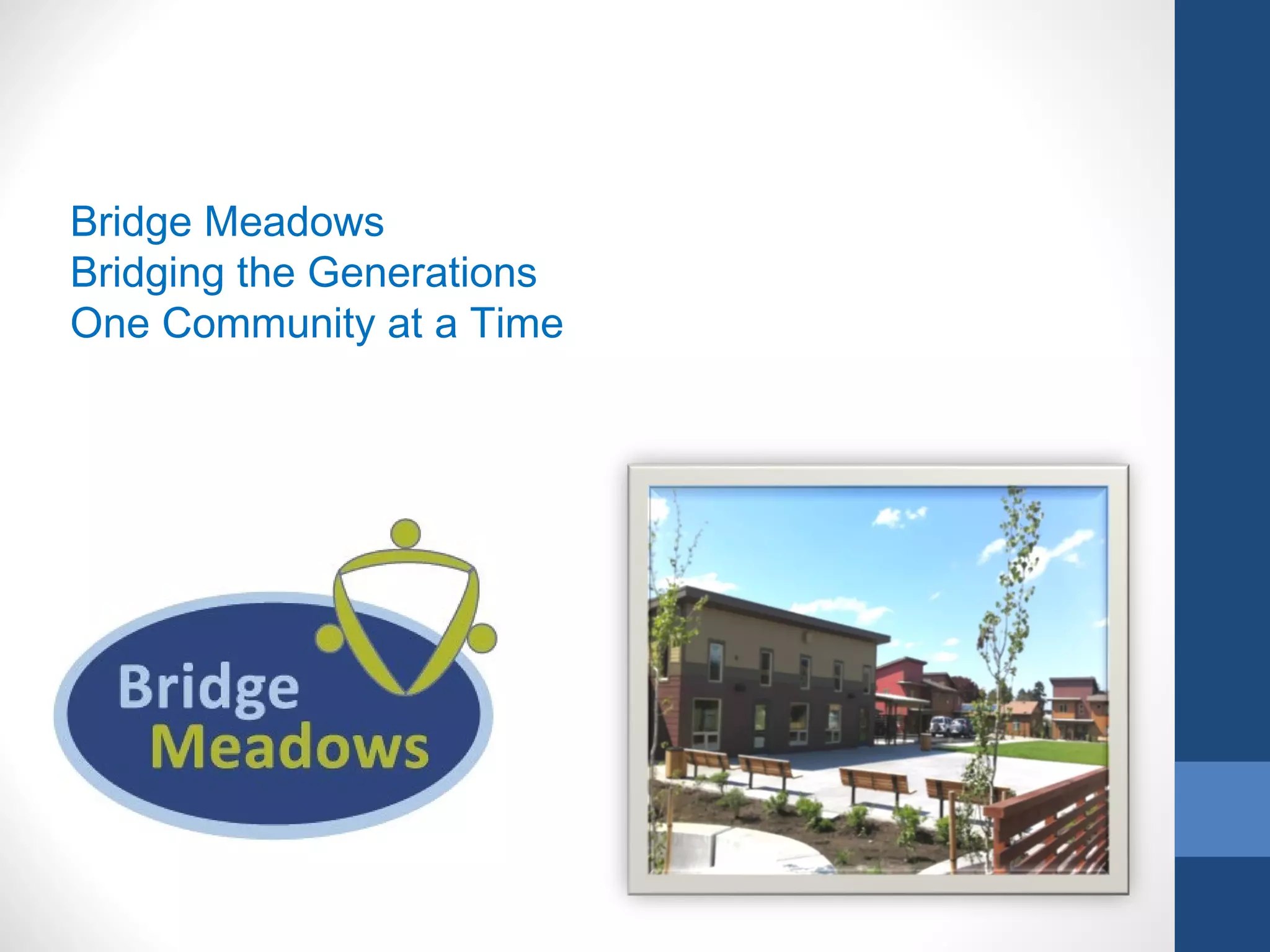
Bridge Meadows
Bridging the Generations
One Community at a Time
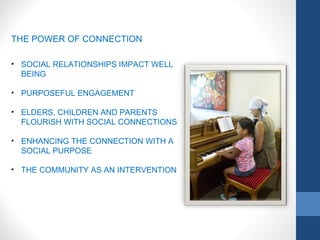
THE POWER OF CONNECTION
• SOCIAL RELATIONSHIPS IMPACT WELL
BEING
• PURPOSEFUL ENGAGEMENT
• ELDERS, CHILDREN AND PARENTS
FLOURISH WITH SOCIAL CONNECTIONS
• ENHANCING THE CONNECTION WITH A
SOCIAL PURPOSE
• THE COMMUNITY AS AN INTERVENTION
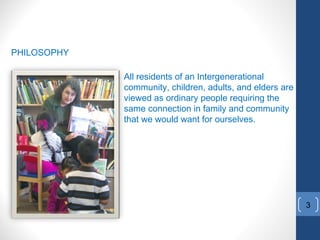
All residents of an Intergenerational
community, children, adults, and elders are
viewed as ordinary people requiring the
same connection in family and community
that we would want for ourselves.
3
PHILOSOPHY
4
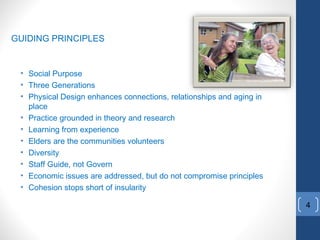
GUIDING PRINCIPLES
• Social Purpose
• Three Generations
• Physical Design enhances connections, relationships and aging in
place
• Practice grounded in theory and research
• Learning from experience
• Elders are the communities volunteers
• Diversity
• Staff Guide, not Govern
• Economic issues are addressed, but do not compromise principles
• Cohesion stops short of insularity
5
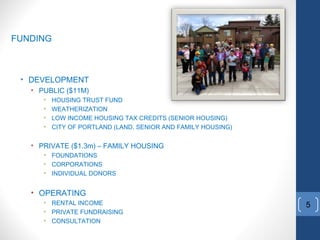
FUNDING
• DEVELOPMENT
• PUBLIC ($11M)
• HOUSING TRUST FUND
• WEATHERIZATION
• LOW INCOME HOUSING TAX CREDITS (SENIOR HOUSING)
• CITY OF PORTLAND (LAND, SENIOR AND FAMILY HOUSING)
• PRIVATE ($1.3m) – FAMILY HOUSING
• FOUNDATIONS
• CORPORATIONS
• INDIVIDUAL DONORS
• OPERATING
• RENTAL INCOME
• PRIVATE FUNDRAISING
• CONSULTATION
BRIDGE MEADOWS AS A SOLUTION
6
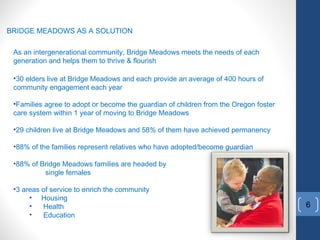
As an intergenerational community, Bridge Meadows meets the needs of each
generation and helps them to thrive & flourish
 
•30 elders live at Bridge Meadows and each provide an average of 400 hours of
community engagement each year
•Families agree to adopt or become the guardian of children from the Oregon foster
care system within 1 year of moving to Bridge Meadows
•29 children live at Bridge Meadows and 58% of them have achieved permanency
•88% of the families represent relatives who have adopted/become guardian
•88% of Bridge Meadows families are headed by
single females
•3 areas of service to enrich the community
• Housing
• Health
• Education
 
•
7
 
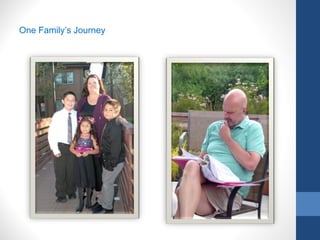
One Family’s Journey
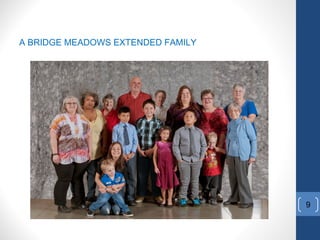
A BRIDGE MEADOWS EXTENDED FAMILY
9
THANK YOU
www.bridgemeadows.org
Derenda Schubert, PhD, Executive Director
Renee Moseley, LCSW, Associate Director
(503) 953-1100
dschubert@bridgemeadows.org
rmoseley@bridgemeadows.org
10

Housing Opportunity 2014 - Intergenerational Living: Housing and Communities for All Ages, Derenda Schubert

  • 1.
    Bridge Meadows Bridging theGenerations One Community at a Time
  • 2.
    THE POWER OFCONNECTION • SOCIAL RELATIONSHIPS IMPACT WELL BEING • PURPOSEFUL ENGAGEMENT • ELDERS, CHILDREN AND PARENTS FLOURISH WITH SOCIAL CONNECTIONS • ENHANCING THE CONNECTION WITH A SOCIAL PURPOSE • THE COMMUNITY AS AN INTERVENTION
  • 3.
    All residents ofan Intergenerational community, children, adults, and elders are viewed as ordinary people requiring the same connection in family and community that we would want for ourselves. 3 PHILOSOPHY
  • 4.
    4 GUIDING PRINCIPLES • SocialPurpose • Three Generations • Physical Design enhances connections, relationships and aging in place • Practice grounded in theory and research • Learning from experience • Elders are the communities volunteers • Diversity • Staff Guide, not Govern • Economic issues are addressed, but do not compromise principles • Cohesion stops short of insularity
  • 5.
    5 FUNDING • DEVELOPMENT • PUBLIC($11M) • HOUSING TRUST FUND • WEATHERIZATION • LOW INCOME HOUSING TAX CREDITS (SENIOR HOUSING) • CITY OF PORTLAND (LAND, SENIOR AND FAMILY HOUSING) • PRIVATE ($1.3m) – FAMILY HOUSING • FOUNDATIONS • CORPORATIONS • INDIVIDUAL DONORS • OPERATING • RENTAL INCOME • PRIVATE FUNDRAISING • CONSULTATION
  • 6.
    BRIDGE MEADOWS ASA SOLUTION 6 As an intergenerational community, Bridge Meadows meets the needs of each generation and helps them to thrive & flourish   •30 elders live at Bridge Meadows and each provide an average of 400 hours of community engagement each year •Families agree to adopt or become the guardian of children from the Oregon foster care system within 1 year of moving to Bridge Meadows •29 children live at Bridge Meadows and 58% of them have achieved permanency •88% of the families represent relatives who have adopted/become guardian •88% of Bridge Meadows families are headed by single females •3 areas of service to enrich the community • Housing • Health • Education  
  • 7.
  • 8.
  • 9.
    A BRIDGE MEADOWSEXTENDED FAMILY 9
  • 10.
    THANK YOU www.bridgemeadows.org Derenda Schubert,PhD, Executive Director Renee Moseley, LCSW, Associate Director (503) 953-1100 dschubert@bridgemeadows.org rmoseley@bridgemeadows.org 10

Editor's Notes

  • #2 Good Morning Thank you for inviting me to speak to all of you about Bridge Meadows. Bridge Meadows is an intentional intergenerational community designed with the Social Purpose of helping children who have languished in foster care find forever families, provide their families with support so that they thrive and provide elders with meaning and purpose. The model is based on the premise that the natural community becomes the healing agent. Many cultures around the world and since the beginning of time have lived in intergenerational communities as a natural part of their culture. By living in intergenerational communities valuable information is passed down to the generations, a strong sense of a community fabric or foundation is laid and the social capital of people is shared. What does "social capital" mean?The central premise of social capital is that social networks have value. Social capital refers to the collective value of all "social networks" [who people know] and the inclinations that arise from these networks to do things for each other ["norms of reciprocity"]. How does social capital work?The term social capital emphasizes not just warm and cuddly feelings, but a wide variety of quite specific benefits that flow from the trust, reciprocity, information, and cooperation associated with social networks. Social capital creates value for the people who are connected and - at least sometimes - for bystanders as well. Social capital works through multiple channels:Information flows (e.g. learning about jobs, learning about candidates running for office, exchanging ideas at college, etc.) depend on social capital norms of reciprocity (mutual aid) are dependent on social networks. Bonding networks that connect folks who are similar sustain particularized (in-group) reciprocity. Bridging networks that connect individuals who are diverse sustain generalized reciprocity. Collective action depends upon social networks (e.g., the role that the black church played in the civic rights movement) although collective action also can foster new networks. Broader identities and solidarity are encouraged by social networks that help translate an "I" mentality into a "we" mentality. What are some examples of social capital? When a group of neighbors informally keep an eye on one another's homes, that's social capital in action. When a tightly knit community of Hassidic Jews trade diamonds without having to test each gem for purity, that's social capital in action. Barn-raising on the frontier was social capital in action, and so too are e-mail exchanges among members of a cancer support group. Social capital can be found in friendship networks, neighborhoods, churches, schools, bridge clubs, civic associations, and even bars. The motto in Cheers "where everybody knows your name" captures one important aspect of social capital All of this impacts health of the individual, group, and greater community. When people live with strong social connections and a sense of meaning and purpose, they live healthier physically and emotionally. Neuroscience is demonstrating that cognitive decline, anxiety and depression are reduced. So, today, I will share with you the guiding principles, how an intentional intergenerational community comes together, Health impact for each generation Outcomes so far Future direction of BrM
  • #3 Research demonstrates Social Relationships have a positive impact on health decreasing social isolation Purposeful engagement (Rush University) Flourish Social Purpose Community as an Intervention
  • #4 The intergenerational model recognizes the community as the source of intervention. Issues of isolation, lack of meaning/purpose and the need for permanency are ameliorated with connection and belonging.
  • #5 Social Purpose Three Generations Physical Design enhances connections, relationships and aging in place Practice grounded in theory and research Learning from experience Elders are the community’s volunteers Diversity Staff Guide not Govern Economic issues are addressed but do not compromise Cohesion stops short of insularity
  • #6 Social Purpose Three Generations Physical Design enhances connections, relationships and aging in place Practice grounded in theory and research Learning from experience Elders are the community’s volunteers Diversity Staff Guide not Govern Economic issues are addressed but do not compromise Cohesion stops short of insularity
  • #7 Elders range in age 55-90 All over the United States – Manhattan, NM, CO, IL Some of the parents are elders Outcomes Stable Housing Health & Well-being Parent Resiliency Academic Achievement
  • #9 April and her newly adopted children
  • #10 April and her extended Bridge Meadows family. The photo includes other adoptive moms and elders who have become an integral part of each other’s lives.