Our Marathon, 
Graduate Student Labor, 
and 
Digital Humanities 
Jim McGrath, Northeastern University 
November 7, 2014 
@JimMc_Grath 
#GradDH
Questions for Discussion 
1. How is graduate labor on digital humanities projects 
implicitly and explicitly valued (and undervalued) by 
faculty, departments, institutions, the job market? 
2. DH projects rely heavily on graduate labor & 
collaborations between faculty and students: how 
does this dynamic reveal tensions over ideas about 
graduate labor, credit, and compensation in college 
environments?
Julia Flanders on Labor 
“Time, Labor, and ‘Alternate Careers’ in Digital Humanities 
Knowledge Work” 
Debates in the Digital Humanities (2012) 
“academic work is considered to have the privilege of self-regulation, 
being in this respect more like the work of a poet 
than of a journalist” 
work interpenetrates life, and we do what is necessary” 
“the vast preponderance of actual work involved in creating 
humanities scholarship and scholarly resources is not done by 
faculty”
Julia Flanders on Graduate Labor 
“Make it practically possible and professionally rewarding (or, at the very 
least, not damaging) for graduate students to hold jobs while pursuing 
advanced degrees. This would involve rethinking our sense of the timing of 
graduate study and its completion…” 
“Devote resources to creating meaningful job and internship opportunities at 
digital humanities research projects, scholarly publications, conferences, and 
other professional activities with the goal of integrating students as 
collaborators into these kinds of work at the outset.” 
“Encourage and reward coauthoring of research by faculty, students, and 
para-academic staff. This involves actions on the part of departments (to 
create a welcoming intellectual climate for such work) and on the part of 
journals, conferences, and their peer review structures to encourage and 
solicit such work and to evaluate it appropriately.”
Graduate Labor in DH at Northeastern
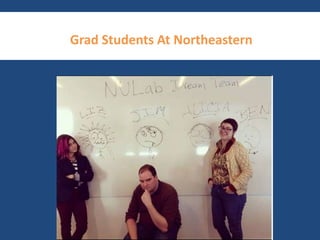
Grad Students At Northeastern
DH Projects Dependent on Grad Student Labor 
• Our Marathon 
• Early Caribbean Digital Archive 
• TAPAS 
• The Women Writers Project 
• Viral Texts 
• Digital Humanities Quarterly
northeastern.edu/marathon 
Twitter: @OurMarathon 
Share your story!
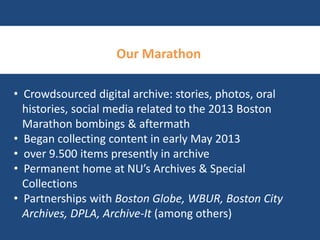
Our Marathon 
• Crowdsourced digital archive: stories, photos, oral 
histories, social media related to the 2013 Boston 
Marathon bombings & aftermath 
• Began collecting content in early May 2013 
• over 9.500 items presently in archive 
• Permanent home at NU’s Archives & Special 
Collections 
• Partnerships with Boston Globe, WBUR, Boston City 
Archives, DPLA, Archive-It (among others)
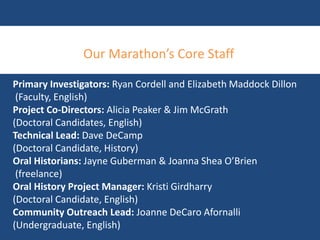
Our Marathon’s Core Staff 
Primary Investigators: Ryan Cordell and Elizabeth Maddock Dillon 
(Faculty, English) 
Project Co-Directors: Alicia Peaker & Jim McGrath 
(Doctoral Candidates, English) 
Technical Lead: Dave DeCamp 
(Doctoral Candidate, History) 
Oral Historians: Jayne Guberman & Joanna Shea O’Brien 
(freelance) 
Oral History Project Manager: Kristi Girdharry 
(Doctoral Candidate, English) 
Community Outreach Lead: Joanne DeCaro Afornalli 
(Undergraduate, English)
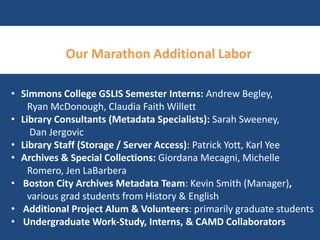
Our Marathon Additional Labor 
• Simmons College GSLIS Semester Interns: Andrew Begley, 
Ryan McDonough, Claudia Faith Willett 
• Library Consultants (Metadata Specialists): Sarah Sweeney, 
Dan Jergovic 
• Library Staff (Storage / Server Access): Patrick Yott, Karl Yee 
• Archives & Special Collections: Giordana Mecagni, Michelle 
Romero, Jen LaBarbera 
• Boston City Archives Metadata Team: Kevin Smith (Manager), 
various grad students from History & English 
• Additional Project Alum & Volunteers: primarily graduate students 
• Undergraduate Work-Study, Interns, & CAMD Collaborators
Our Marathon Funding (Primary) 
• College of Social Sciences and Humanities 
• NULab for Texts, Maps & Networks 
• WBUR (Oral History Project) 
• Northeastern Libraries 
• Iron Mountain / Boston City Archives
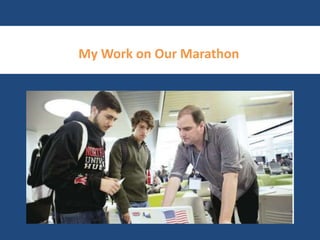
My Work on Our Marathon
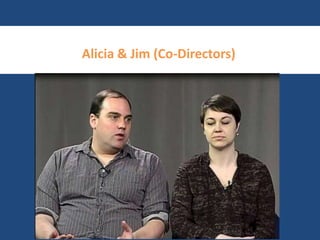
Alicia & Jim (Co-Directors)
VariousWeekly Tasks (A Sample) 
• Management of Our Marathon Staff & Volunteers 
• Management of Web Site & Contributions 
• Management of Partner Relationships 
• Oversight of Project Finances 
• Overall Project Development 
• Social Media Outreach 
• Interviews with Media & Academics 
• Oral History Work 
• Emails 
• Emails
Special Projects 
• Six-Month Anniversary Event (Snell Library, NU) 
• WCVB Anniversary Broadcast (filmed at NU) 
• “Share Your Story” Events at Public Libraries & Universities 
• Conference Talks & Posters (DPLA, NEA, 
Digital Commonwealth, DH2014) 
• WBUR One-Year Anniversary Programming 
• Physical Exhibit at Northeastern University
Professional Benefits of Our Marathon 
• Motivated me to become more invested in dissertation work 
• Experience in project management and development 
• Experience with Omeka and Neatline (Consulting Work) 
• Introduction to wider DH community (conferences & Twitter) 
• Collaborations w/ faculty members at NU 
• Collaborations w/ other grad students in DH at NU 
• Collaborations w/ Boston-Cambridge communities 
• Collaborations w/ other parts of university community 
• Collaborations with librarians, archivists, public historians 
• Useful CV material 
• Invitations to talks like this one
Challenges of Labor on Our Marathon 
• Impact on dissertation writing / article submissions 
• Value of work not always clear to dissertation committee 
• Grad student labor not always recognized by college 
• Skeptical faculty members and grad students in dept. 
• Witness to lame institutional B.S. / power trips 
• Impact on graduate funding 
• Economic costs of conference travels
Value of Grad Labor on Our Marathon 
“As we interacted with scholars from many nations, it 
was gratifying to see that Northeastern's key role in the 
emerging field of the digital humanities, fostered by 
both the Humanities Center and the NULab for Texts, 
Maps, and Networks, is widely known. The international 
community recognizes our commitment to bringing new 
digital tools into teaching, research, and public outreach 
through such projects as the Our Marathon Digital 
Archive and the upcoming NEH Workshop on Digital 
Methods for Military History.” 
-Dean Uta Poiger, CSSH (Northeastern)
Value of Grad Labor on Our Marathon 
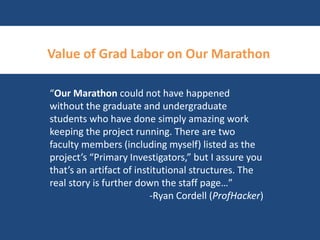
“Our Marathon could not have happened 
without the graduate and undergraduate 
students who have done simply amazing work 
keeping the project running. There are two 
faculty members (including myself) listed as the 
project’s “Primary Investigators,” but I assure you 
that’s an artifact of institutional structures. The 
real story is further down the staff page…” 
-Ryan Cordell (ProfHacker)
Value of Grad Labor on Our Marathon
Value of Grad Labor on Our Marathon 
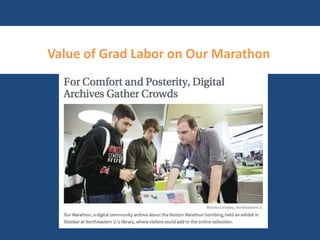
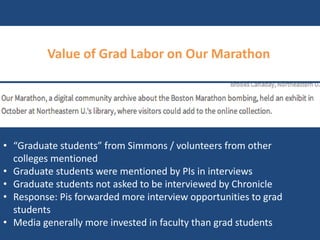
• “Graduate students” from Simmons / volunteers from other 
colleges mentioned 
• Graduate students were mentioned by PIs in interviews 
• Graduate students not asked to be interviewed by Chronicle 
• Response: Pis forwarded more interview opportunities to grad 
students 
• Media generally more invested in faculty than grad students
Value of Grad Labor on Our Marathon 
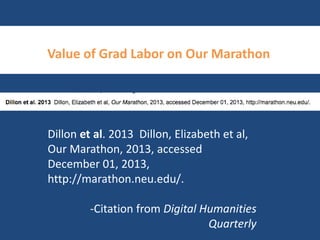
Dillon et al. 2013 Dillon, Elizabeth et al, 
Our Marathon, 2013, accessed 
December 01, 2013, 
http://marathon.neu.edu/. 
-Citation from Digital Humanities 
Quarterly
Lessons Learned by Graduate Students at NU 
• Your time is valuable: balance DH work with 
dissertation completion, protect yourself 
• The five-year degree-to-completion funding model 
does not value graduate students interested in DH 
work; limits on hourly compensation too 
• The ideals of faculty members don’t always align with 
the university’s objectives 
• You know as much / more than some PIs about DH 
• Conferences are expensive: request $$$
Tips for Grad Students in DH 
• Be pro-active in learning technical skills AND project 
management 
• Go to DHSI, HILT (and make sure your college gives you $$ to do 
so) 
• Don’t work beyond the hours you are paid 
• Consider conferences and articles; document your labor in a 
way that is valued by humanities researchers / DH 
• Consider alt-ac work, library work, archival work / value of 
these fields 
• Librarians and archivists are awesome 
• DH is pretty awesome 
• Be a mentor on campus / communicate online
Tips for Faculty / Admins 
• Pay your graduate students for their time; don’t treat them 
like hired help; Give them credit! 
• Have discussions with admins / department heads / deans 
about the importance of graduate labor; be an ally 
• Set clear objectives for projects and timelines 
• Help set objectives tied to students’ professional identities 
• Make sure graduate student roles on projects are clear 
• Open doors for grad students on campus 
• Keep an open dialogue with grad students on projects and 
larger issues related to DH at your college 
• Respond to e-mails
Final Thoughts about DH at NU 
• We have extremely supportive and generous faculty members 
at NU: Julia Flanders, Ryan Cordell, Elizabeth Maddock Dillon 
in particular 
• We have an extremely supportive library / library staff at 
Northeastern; we live at the library, tbh 
• Having a collaborative space where students and faculty 
interact at the library is extremely useful 
• We are concerned about trends re: degree-to-completion / 
economic support of grad students doing DH 
• Conversations about value of digital projects necessary 
• We are all pretty broke / in debt 
• We still love DH work and spend lots of time thinking about 
DH / talking about DH / working on our projects
Thanks! 
mcgrath.ja@husky.neu.edu 
@JimMc_Grath 
#GradDH

Scholars lab archivesandgradlabor_november_2014

  • 1.
    Our Marathon, GraduateStudent Labor, and Digital Humanities Jim McGrath, Northeastern University November 7, 2014 @JimMc_Grath #GradDH
  • 2.
    Questions for Discussion 1. How is graduate labor on digital humanities projects implicitly and explicitly valued (and undervalued) by faculty, departments, institutions, the job market? 2. DH projects rely heavily on graduate labor & collaborations between faculty and students: how does this dynamic reveal tensions over ideas about graduate labor, credit, and compensation in college environments?
  • 3.
    Julia Flanders onLabor “Time, Labor, and ‘Alternate Careers’ in Digital Humanities Knowledge Work” Debates in the Digital Humanities (2012) “academic work is considered to have the privilege of self-regulation, being in this respect more like the work of a poet than of a journalist” work interpenetrates life, and we do what is necessary” “the vast preponderance of actual work involved in creating humanities scholarship and scholarly resources is not done by faculty”
  • 4.
    Julia Flanders onGraduate Labor “Make it practically possible and professionally rewarding (or, at the very least, not damaging) for graduate students to hold jobs while pursuing advanced degrees. This would involve rethinking our sense of the timing of graduate study and its completion…” “Devote resources to creating meaningful job and internship opportunities at digital humanities research projects, scholarly publications, conferences, and other professional activities with the goal of integrating students as collaborators into these kinds of work at the outset.” “Encourage and reward coauthoring of research by faculty, students, and para-academic staff. This involves actions on the part of departments (to create a welcoming intellectual climate for such work) and on the part of journals, conferences, and their peer review structures to encourage and solicit such work and to evaluate it appropriately.”
  • 5.
    Graduate Labor inDH at Northeastern
  • 6.
    Grad Students AtNortheastern
  • 7.
    DH Projects Dependenton Grad Student Labor • Our Marathon • Early Caribbean Digital Archive • TAPAS • The Women Writers Project • Viral Texts • Digital Humanities Quarterly
  • 8.
  • 9.
    Our Marathon •Crowdsourced digital archive: stories, photos, oral histories, social media related to the 2013 Boston Marathon bombings & aftermath • Began collecting content in early May 2013 • over 9.500 items presently in archive • Permanent home at NU’s Archives & Special Collections • Partnerships with Boston Globe, WBUR, Boston City Archives, DPLA, Archive-It (among others)
  • 10.
    Our Marathon’s CoreStaff Primary Investigators: Ryan Cordell and Elizabeth Maddock Dillon (Faculty, English) Project Co-Directors: Alicia Peaker & Jim McGrath (Doctoral Candidates, English) Technical Lead: Dave DeCamp (Doctoral Candidate, History) Oral Historians: Jayne Guberman & Joanna Shea O’Brien (freelance) Oral History Project Manager: Kristi Girdharry (Doctoral Candidate, English) Community Outreach Lead: Joanne DeCaro Afornalli (Undergraduate, English)
  • 11.
    Our Marathon AdditionalLabor • Simmons College GSLIS Semester Interns: Andrew Begley, Ryan McDonough, Claudia Faith Willett • Library Consultants (Metadata Specialists): Sarah Sweeney, Dan Jergovic • Library Staff (Storage / Server Access): Patrick Yott, Karl Yee • Archives & Special Collections: Giordana Mecagni, Michelle Romero, Jen LaBarbera • Boston City Archives Metadata Team: Kevin Smith (Manager), various grad students from History & English • Additional Project Alum & Volunteers: primarily graduate students • Undergraduate Work-Study, Interns, & CAMD Collaborators
  • 12.
    Our Marathon Funding(Primary) • College of Social Sciences and Humanities • NULab for Texts, Maps & Networks • WBUR (Oral History Project) • Northeastern Libraries • Iron Mountain / Boston City Archives
  • 13.
    My Work onOur Marathon
  • 14.
    Alicia & Jim(Co-Directors)
  • 15.
    VariousWeekly Tasks (ASample) • Management of Our Marathon Staff & Volunteers • Management of Web Site & Contributions • Management of Partner Relationships • Oversight of Project Finances • Overall Project Development • Social Media Outreach • Interviews with Media & Academics • Oral History Work • Emails • Emails
  • 16.
    Special Projects •Six-Month Anniversary Event (Snell Library, NU) • WCVB Anniversary Broadcast (filmed at NU) • “Share Your Story” Events at Public Libraries & Universities • Conference Talks & Posters (DPLA, NEA, Digital Commonwealth, DH2014) • WBUR One-Year Anniversary Programming • Physical Exhibit at Northeastern University
  • 17.
    Professional Benefits ofOur Marathon • Motivated me to become more invested in dissertation work • Experience in project management and development • Experience with Omeka and Neatline (Consulting Work) • Introduction to wider DH community (conferences & Twitter) • Collaborations w/ faculty members at NU • Collaborations w/ other grad students in DH at NU • Collaborations w/ Boston-Cambridge communities • Collaborations w/ other parts of university community • Collaborations with librarians, archivists, public historians • Useful CV material • Invitations to talks like this one
  • 18.
    Challenges of Laboron Our Marathon • Impact on dissertation writing / article submissions • Value of work not always clear to dissertation committee • Grad student labor not always recognized by college • Skeptical faculty members and grad students in dept. • Witness to lame institutional B.S. / power trips • Impact on graduate funding • Economic costs of conference travels
  • 19.
    Value of GradLabor on Our Marathon “As we interacted with scholars from many nations, it was gratifying to see that Northeastern's key role in the emerging field of the digital humanities, fostered by both the Humanities Center and the NULab for Texts, Maps, and Networks, is widely known. The international community recognizes our commitment to bringing new digital tools into teaching, research, and public outreach through such projects as the Our Marathon Digital Archive and the upcoming NEH Workshop on Digital Methods for Military History.” -Dean Uta Poiger, CSSH (Northeastern)
  • 20.
    Value of GradLabor on Our Marathon “Our Marathon could not have happened without the graduate and undergraduate students who have done simply amazing work keeping the project running. There are two faculty members (including myself) listed as the project’s “Primary Investigators,” but I assure you that’s an artifact of institutional structures. The real story is further down the staff page…” -Ryan Cordell (ProfHacker)
  • 21.
    Value of GradLabor on Our Marathon
  • 22.
    Value of GradLabor on Our Marathon • “Graduate students” from Simmons / volunteers from other colleges mentioned • Graduate students were mentioned by PIs in interviews • Graduate students not asked to be interviewed by Chronicle • Response: Pis forwarded more interview opportunities to grad students • Media generally more invested in faculty than grad students
  • 23.
    Value of GradLabor on Our Marathon Dillon et al. 2013 Dillon, Elizabeth et al, Our Marathon, 2013, accessed December 01, 2013, http://marathon.neu.edu/. -Citation from Digital Humanities Quarterly
  • 24.
    Lessons Learned byGraduate Students at NU • Your time is valuable: balance DH work with dissertation completion, protect yourself • The five-year degree-to-completion funding model does not value graduate students interested in DH work; limits on hourly compensation too • The ideals of faculty members don’t always align with the university’s objectives • You know as much / more than some PIs about DH • Conferences are expensive: request $$$
  • 25.
    Tips for GradStudents in DH • Be pro-active in learning technical skills AND project management • Go to DHSI, HILT (and make sure your college gives you $$ to do so) • Don’t work beyond the hours you are paid • Consider conferences and articles; document your labor in a way that is valued by humanities researchers / DH • Consider alt-ac work, library work, archival work / value of these fields • Librarians and archivists are awesome • DH is pretty awesome • Be a mentor on campus / communicate online
  • 26.
    Tips for Faculty/ Admins • Pay your graduate students for their time; don’t treat them like hired help; Give them credit! • Have discussions with admins / department heads / deans about the importance of graduate labor; be an ally • Set clear objectives for projects and timelines • Help set objectives tied to students’ professional identities • Make sure graduate student roles on projects are clear • Open doors for grad students on campus • Keep an open dialogue with grad students on projects and larger issues related to DH at your college • Respond to e-mails
  • 27.
    Final Thoughts aboutDH at NU • We have extremely supportive and generous faculty members at NU: Julia Flanders, Ryan Cordell, Elizabeth Maddock Dillon in particular • We have an extremely supportive library / library staff at Northeastern; we live at the library, tbh • Having a collaborative space where students and faculty interact at the library is extremely useful • We are concerned about trends re: degree-to-completion / economic support of grad students doing DH • Conversations about value of digital projects necessary • We are all pretty broke / in debt • We still love DH work and spend lots of time thinking about DH / talking about DH / working on our projects
  • 28.