

The Sun Certified Enterprise Architect Certificationa pragmatic pursuit
AgendaAbout MeMotivationThe Exam
TipsI’ll use this icon for exam tips I found helpful.
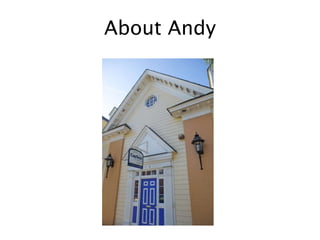
About Andy
About Andy
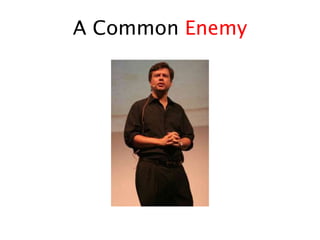
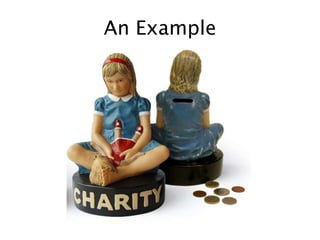
A Common Enemy
An Example
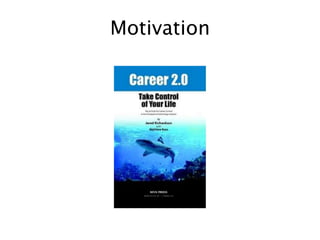
Motivation
My Motivation
What is Architecture?
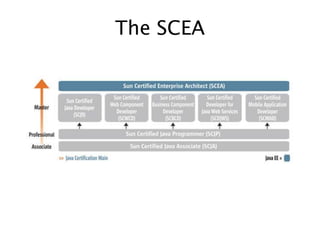
The SCEA
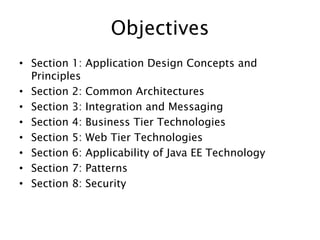
ObjectivesSection 1: Application Design Concepts and Principles Section 2: Common Architectures Section 3: Integration and Messaging Section 4: Business Tier Technologies Section 5: Web Tier Technologies Section 6: Applicability of Java EE Technology Section 7: Patterns Section 8: Security
Part 1: Exam
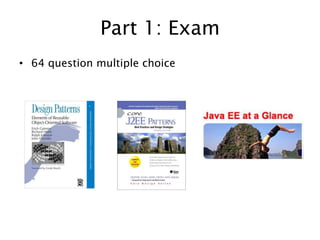
Part 1: Exam64 question multiple choice
Part 1: Examhttp://en.wikipedia.org/wiki/Design_pattern_(computer_science)
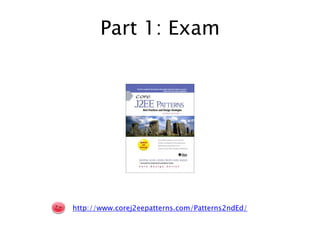
Part 1: Examhttp://www.corej2eepatterns.com/Patterns2ndEd/
Part 1: Exam
Part 2: Assignment“You are the architect for JustBuildIt Corporation, [a] construction company with significant operations in the U.S. and Canada, Europe, and the Pacific Rim. JustBuildIt operates its own forests, quarries, and steel foundries to supply its own building sites with [materials]...”“JustBuildIt has decided to build a building commodities exchange to allow both it and some of its competitors to effectively pool excess capacity in a co-opetition model.”Humphrey Sheil, http://tr.im/sceabook
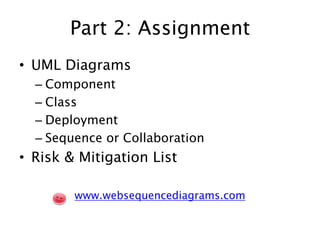
Part 2: AssignmentUML DiagramsComponentClassDeploymentSequence or CollaborationRisk & Mitigation Listwww.websequencediagrams.com
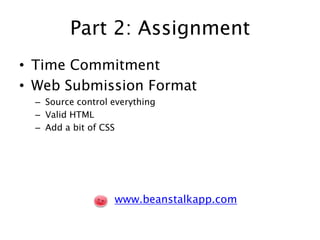
Part 2: AssignmentTime CommitmentWeb Submission FormatSource control everythingValid HTMLAdd a bit of CSSwww.beanstalkapp.com
Part 3: Essay
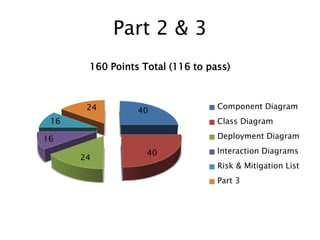
Part 2 & 3
Thanks!twitter.com/apembertonblogs.captechconsulting.com

SCEA - a pragmatic pursuit

Editor's Notes

  • #3 Working on a take-away handout for tonight’s RJUGWill distribute if I get there
  • #7 - Steve Jobs, motivating the troops against a common enemy
  • #8 - not all who give to charity do so for the same reasons- you may not call all of those reasons "good" or the "right" reasons, does that mean you shouldn't be charitable?
  • #9 - Jared Richardson, "Intellectual Portfolio"- self-investment- pragmatically: establish expertise, marketability, can help obtain vendor partnerships - better yet: often your company will finance your self-investment!
  • #11 - SCEA is heavy on software architecture (duh)- concerned with software 'ilitys' / non-functional requirements / quality of service- my current view on the role of the architect is more about the processes an architect brings
  • #12 - dubbed "pinnacle" of java certs, though where most of the earlier certs rely on scjp, scea has no pre-reqs- updated in 2007/8 for JEE5 (reflect the world at that time)- upgrade to JEE5 version is a shortened version of part 1 only - exam format: 3 part process; certified only after all 3 complete- part 1: 64 question multiple choice (more like other sun certs, are specific to JEE5 / current version, but need to know older specs)- part 2: assignment (no time limit, but some estimate 40 hours)- part 3: 8 question essay (follow up on part 2, scored together)
  • #13 - these are the objectives for all 3 sections of the exam- Section 1: Application Design Concepts and Principles (OOA/D)- Section 2: Common Architectures (n-tiered architectures, how they speak to “illity”s)- Section 3: Integration and Messaging - Section 4: Business Tier Technologies (EJB, JPA, JMS)- Section 5: Web Tier Technologies (Servlets/JSP, JSF)- Section 6: Applicability of Java EE Technology - Section 7: Patterns (primarily GoF and Core J2EE)- Section 8: Security
  • #15 - 64 question multiple choice (57% to pass)- big pool of questions written by an expert group (including humphreysheil)
  • #16 - Design Patterns - obviously dartboard driven design not the goal ;) - ability to spot design patterns - ability to know when (and when not) to apply a design pattern - Core J2EE
  • #18 - Java EE Knowledge - APIs and specifications (not programming syntax) - applicability (SCBCD + SCWCD is ideal background)
  • #19 - What you're given: - "business" domain model (this will primarily be translated into class diagram in your architecture) - high-level use cases (stick figures; these will primarily be translated to sequence diagrams in your architecture) - additional description including NFRs and other constraints- UML - be simple but thorough (don't go overboard) - think of ways to make simpler (post conditions/pre conditions rather than repeating yourself) - UML needs to be valid (multiplicity, etc.) - I used Eclipse EMF UML tools (also tried netbeans + argo) - websequencediagrams.com for sequence diagrams - add notes to all of your diagrams
  • #20 - What you're given: - "business" domain model (this will primarily be translated into class diagram in your architecture) - high-level use cases (stick figures; these will primarily be translated to sequence diagrams in your architecture) - additional description including NFRs and other constraints- UML - be simple but thorough (don't go overboard) - think of ways to make simpler (post conditions/pre conditions rather than repeating yourself) - UML needs to be valid (multiplicity, etc.) - I used Eclipse EMF UML tools (also tried netbeans + argo) - websequencediagrams.com for sequence diagrams - add notes to all of your diagrams
  • #21 - Time - 30 - 40 Hour time commitment - leave yourself review cycles - 12 months to submit from the date of download
  • #22 - Comer quote "want to make sure you're the same person who did part 2"- defending your architecture- which web framework (if any) did you choose?- security implications of your decisions?- how do your choices affect "ility"s?
  • #23 - scored together- see where to focus