THE ACCEPTANCE OF THE LGBT COMMUNITY IN THE 21st CENTURY
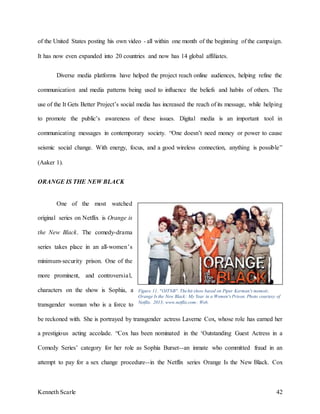
A Case Study on how Mass Media has Positively Affected the United States’ Perception and
Attitude Towards the Lesbian, Gay, Bisexual and Transgender Community
by
Kenneth Scarle
A thesis submitted to the Communications Department of Webster University in partial
fulfillment of the requirements for the Degree of Master’s of Arts in Public Relations
May, 2016
St. Louis, Missouri
© Copyright by
Kenneth Scarle
ALL RIGHTS RESERVED
(2016)
The author hereby grants to Webster University permission to reproduce and distribute publicly
paper and electronic copies of this thesis document in whole or in part for educational purposes.
Kenneth Scarle ii
ACKNOWLEDGEMENTS
I would like to that the time to thank a couple of people, who without their continued support and
guidance, I would still be wondering how to begin this crazy ride and how would I ever get through
it.
Professor Carol Richardson, my first instructor at Webster University, helped prepare me and give
me the courage to get out of my comfort zone and be brave in my convictions. She provided me
with the tools to get this far, and I will always be grateful for her guidance and expertise.
I would also like to thank my academic advisor, Kristi Morris. She helped keep me on track and
helped to optimize the balance in my family, career and education to the fullest. Many thanks for
helping me overcome all the hoops and hurdles I experienced and overcame.
Most of all I want to thank my husband, Greg, who has been a rock – forcing me to do my
homework, and, conversely, telling me to take much needed breaks. This paper, and this degree
program, is the culmination of how I would like to see the world keep on changing for the better
– for my husband and our three boys.
Kenneth Scarle iii
ABSTRACT
THE ACCEPTANCE OF THE LGBT COMMUNITY IN THE 21st CENTURY
A Case Study on how Mass Media has Positively Affected the United States’ Perception and
Attitude Towards the Lesbian, Gay, Bisexual and Transgender Community
By: Kenneth Scarle
According to Pew Research from 2001, Americans opposed LGBT rights, specifically
same-sex marriage, by a 57% to 35% margin respectively” (Pew 1). Currently, 60% of Americans
say they favor allowing gays and lesbians to marry legally, with only 37% opposed. This thesis
will showcase how mass media has positively affected the United States perception and attitude
towards the Lesbian, Gay, Bisexual and Transgender, or LGBT, community.
LGBT people have been depicted in the media in many different ways, ranging from
merely providing (and thus becoming) comic relief to portraying a particular way of life in which
one should be ashamed. This outlook has radically changed over the years, owing much of that
change in opinion to the mass media’s portrayal of the LGBT community.
Media consumption begins at a very early age, especially in the United States, becoming
one of the most powerful influences in the society. The American Academy of Pediatrics has
discovered that “American children between 2 and 18 years of age spend an average of 6 hours
and 32 minutes each day using media” (Committee on Public Education 1). While the content of
that programming is dictated by American culture, echoing current events, U.S. values and beliefs
Kenneth Scarle iv
are also created and fostered by media programming, especially concerning homosexuality and
queer culture in this country.
Utilizing secondary research, including communication theory and application textbooks,
as well as a variety of internet sources, together with extensive educational databases and articles,
this researcher found that as LGBT characters are more frequently portrayed in an ordinary manner
in American television programming and other mass media outlets, the more social change is
accomplished regarding the acceptance of LGBT rights and acceptance. By examining the
meaning-making mass communication theory, media literacy and other communication concepts,
this author has verified that as the American culture shifts, media programming will in turn reflect
those changes.
Homo-normalization is the current trend, both in the media and in U.S. culture. As one
becomes more commonplace, so does the other. LGBT culture in America is propagated by
broadcast, electronic and print media, opening up dialogues and dispelling myths or fears. In turn,
as the U.S. culture becomes more accepting, we see more of it in the media.
Kenneth Scarle v
TABLE OF CONTENTS
ACKNOWLEDGEMENTS.............................................................................................................ii
ABSTRACT....................................................................................................................................iii
TABLE OF CONTENTS.................................................................................................................v
LIST OF FIGURES .......................................................................................................................vii
CHAPTER ONE: INTRODUCTION............................................................................................. 1
PREMISE STATEMENT........................................................................................................... 3
LIMITATIONS........................................................................................................................... 3
LITERATURE REVIEW/METHODOLOGY ........................................................................... 4
CHAPTER TWO: THE POWER OF MEDIA ............................................................................... 5
CHAPTER THREE: A HISTORY OF THE LGBT COMMUNITY IN MASS MEDIA ........... 10
CHAPTER FOUR: THE EVOLVING REPRESENTATION OF LGBT IN MEDIA ................ 15
WILL & GRACE.................................................................................................................. 15
QUEER AS FOLK................................................................................................................ 17
TRUE BLOOD ..................................................................................................................... 22
GLEE .................................................................................................................................... 29
MODERN FAMILY............................................................................................................. 32
ANDERSON COOPER........................................................................................................ 34
IT GETS BETTER PROJECT.............................................................................................. 35
Kenneth Scarle vi
ORANGE IS THE NEW BLACK........................................................................................ 42
TRANSGENDER AT LOVE AND WAR ........................................................................... 44
CHAPTER FIVE: THE ACCOMPLISHMENTS OF THE LGBT COMMUNITY .................... 47
MARRIAGE EQUALITY ........................................................................................................ 48
DADT REPEAL ....................................................................................................................... 51
LOOKING AHEAD ................................................................................................................. 53
PUTTING THE “T” IN THE LGBT MILITARY................................................................ 53
EMPLOYMENT NON-DISCRIMINATION ACT ............................................................. 57
CHAPTER SIX: CONCLUSION ................................................................................................. 59
WORKS CITED ........................................................................................................................... 61
APPLICABLE COURSE WORK ................................................................................................ 68
Kenneth Scarle vii
LIST OF FIGURES
Figure 1. Support for same-sex marriage has risen......................................................................... 2
Figure 2. ''Will and Grace'' ............................................................................................................ 15
Figure 3. “Queer as Folk”............................................................................................................. 17
Figure 4. “True Blood” ................................................................................................................. 22
Figure 5. “Glee”............................................................................................................................ 29
Figure 6. “Glee – First Kiss”......................................................................................................... 30
Figure 7. “Modern Family”........................................................................................................... 32
Figure 8. “LGBT Parenting”......................................................................................................... 33
Figure 9. “Anderson Cooper” ....................................................................................................... 34
Figure 10. “It Gets Better”............................................................................................................ 36
Figure 11. "OITNB"...................................................................................................................... 42
Figure 12. "Transgender, at War and in Love”............................................................................. 44
Figure 13. The Roadmap to Victory ............................................................................................. 49
Figure 14. New marriages among same-sex couples.................................................................... 50
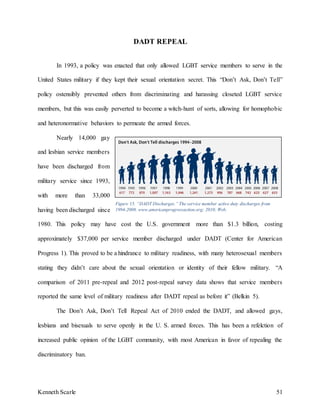
Figure 15. DADT Discharges ....................................................................................................... 51
Figure 16. LGBT Workers experience widespread discrimination .............................................. 57
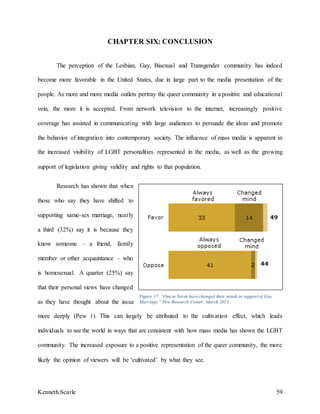
Figure 17. One in Seven have changed their minds in support of Gay Marriage......................... 59
Kenneth Scarle 1
CHAPTER ONE: INTRODUCTION
In contemporary society, media is everywhere. Ranging from movies and television to the
internet and print media, it saturates and shapes our fundamental beliefs and culture. Culture is
defined as “the symbols of expression that individuals, groups, and societies use to make sense of
daily life and to articulate their values” (Campbell 6). Mass media today reflects American lives
and experiences. That includes the depiction of non-traditional relationships and lifestyles and how
they are embraced by modern culture. The LGBT community has become a polarized issue,
especially in the recent few years. From the 2011 repeal of “Don’t Ask, Don’t Tell” which now
allows lesbian, gay and bisexual people to serve as active duty members of the military, to the
Supreme Court ruling of the Defense of Marriage Act as unconstitutional, LGBT Americans have
now received many basic human rights guaranteed to all citizens of the United States
(freedometomarry.org 1). This has been reflected through numerous programming productions on
television and other media, as more and more the United States moves from the exclusive
heterosexual viewpoint. “Heteronormativity emphasizes the extent to which everyone, straight or
queer, will be judged, measured, probed and evaluated from the perspective of the heterosexual
norm. It means that everyone and everything is judged form the perspective of straight” (Chambers
26).
Popular culture has always been a tool to help others experience different points of views
and to communicate messages to others. We see this avenue used in a wide variety of ways to
convey the expression of contemporary lifestyles. Popular culture defines “those productions, both
artistic and commercial, designed for mass consumption, which appeal to and express the tastes
and understanding of the majority of the public, free of control by minority standards. They reflect
Kenneth Scarle 2
the values, convictions, and patterns of thought and feeling generally dispersed through and
approved by American society” (Silverblatt 93). This phenomenon has, through the conduit of
mass media, helped to redefine the United States’ cultural norms and portray the reality and values
of the LGBT community. It also facilitated the examination of status quo groups in society that
measure public attitudes regarding the assimilation of LGBT people in being treated with integrity,
courage and respect.
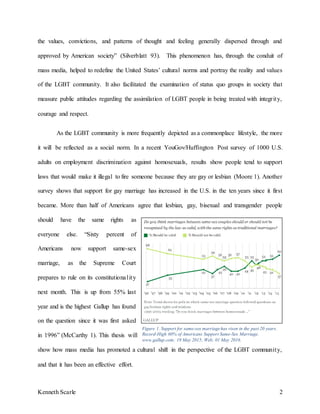
As the LGBT community is more frequently depicted as a commonplace lifestyle, the more
it will be reflected as a social norm. In a recent YouGov/Huffington Post survey of 1000 U.S.
adults on employment discrimination against homosexuals, results show people tend to support
laws that would make it illegal to fire someone because they are gay or lesbian (Moore 1). Another
survey shows that support for gay marriage has increased in the U.S. in the ten years since it first
became. More than half of Americans agree that lesbian, gay, bisexual and transgender people
should have the same rights as
everyone else. “Sixty percent of
Americans now support same-sex
marriage, as the Supreme Court
prepares to rule on its constitutionality
next month. This is up from 55% last
year and is the highest Gallup has found
on the question since it was first asked
in 1996” (McCarthy 1). This thesis will
show how mass media has promoted a cultural shift in the perspective of the LGBT community,
and that it has been an effective effort.
Figure 1. Support for same-sex marriagehas risen in the past 20 years.
Record-High 60% of Americans Support Same-Sex Marriage.
www.gallup.com; 19 May 2015; Web; 01 May 2016.
Kenneth Scarle 3
PREMISE STATEMENT
Mass media has positively affected the United States’ perception and attitude towards the
Lesbian, Gay, Bisexual and Transgender community.
LIMITATIONS
The author is a member of the LGBT community, and therefore this is a quite relevant
topic. Dealing firsthand with the bias and inequality of LGBT people in the United States, in
addition to living in a somewhat isolated part of the country in which acceptance of queer culture
is limited, has helped to influence the selection of source material used in the creation and
completion of this thesis.
The author also is a Public Affairs officer for the United States Air Force. This position
has been affected by the changes in public attitude and policy regarding the LGBT community in
the United States, especially the role of active duty LGBT service members. Recent legislation has
transformed that role and the author has had to document and advise military leadership on those
changes in the rights of service members and their families. This has contributed to the overall
view of the changes made and how they have been achieved through various media sources.
There is a large body of work and research regarding this issue, which allowed for a
detailed analysis of the data and proposed outcome. While the limitation of 9 weeks of project
completion eliminated the requirement for firsthand research, the author would have preferred to
conduct surveys and interviews to help corroborate this thesis.
Kenneth Scarle 4
LITERATURE REVIEW/METHODOLOGY
Research was conducted via communication theory and application textbooks, as well as a
variety of internet sources, including extensive educational databases and articles. The author’s
plan was to target pertinent materials, including numeric and polling data, as well as concept–
based discussion to explore the fact that perceptions of the LGBT community have grown more
favorable within the United States.
Online research was conducted regarding the status of the LGBT community in the past
decade, so as to find a comparison point. This included detailed review of Pew Research compiled
on this subject. Also various news sources detailing surveying results and public opinion were
studied to provide an accurate portrayal of the changing perspective of the American public.
Media products regarding this issue were also extensively examined to provide correlation
to the topic. Films, television programs, print media and social media platforms were studied to
see how they have reflected and reiterated popular opinion and how that has been changed.
Other secondary research sources included textbooks and theory concepts presented
through the body of the author’s Master’s Degree program, including Mass Communication
Theory, Media and Culture and the Keys to Interpreting Media Messages. These helped develop
insight as to the principles behind mass media influence and the ways it can change perceptions in
targeted publics.
Kenneth Scarle 5
CHAPTER TWO: THE POWER OF MEDIA
In contemporary society, the power of mass media is arguably one of the most influential
factors in our culture. Mass media are “the cultural industries – the channels of communication –
that produce and distribute songs, novels, TV shows, newspapers, movies, video games, Internet
services, and other cultural products to large numbers of people” (Campbell 6). Cultural values
and ideals are transmitted through these conduits, influencing more and more target audiences as
they consume the messaging sent.
Organizations utilizing technology to communicate with a large audience is critical in
today’s way of life. These media outlets are studied, refined and used in transmissions in order to
produce the most effective means of persuasion available to the entity producing the message. In
Silverblatt’s keys to analysis, he discusses the purposes of a media communicator. “Persuasion is
a function in which the communicator’s objective is to promote a particular idea or motivate the
audience to specific behaviors or attitude change” (Silverblatt 32).
This concept of media outlets encouraging specific ideals, and inversely, consumers using
media to gather information is a move into a new period of thought regarding the use and purpose
of mass media. “We are again living in an era when we are challenged by the rise of powerful new
media that is clearly altering how most of us live our lives and relate to others” (Baran and Davis
35). This is known as the fourth era of mass communication theory, the emergence of meaning
making perspectives on media.
This era of mass communication recognizes that mass communication is powerful, and that
people use it to induce a direct consequence of what they want to experience. A large part of this
concept utilizes the framing theory, which focuses on the presentation of the message and how to
Kenneth Scarle 6
have the audience process it. It is the statement “that people use expectations of the social world
to make sense of that social world” (Baran and Davis 35). Contemporary audiences seek out
information and entertainment more than any previous generation. And these people interpret the
environment around them by the messages that are presented most prominently and relate to them.
However, mass communication can be ineffective as well, depending upon the audience.
If the consumer is an active participant and utilizes media literacy, they can create meaningful
experiences for themselves using the media viewed. Media literacy is “the collection of
experiences that allow consumers to access, analyze, evaluate and create messages” (Baran and
Davis 35). This ability to determine the meaning of media messages, and thereby make informed
decisions on what to do with that information, is when audiences utilize media literacy. This can
help counteract the power of media, but is seldom practiced to perfection.
As this society becomes more and more dependent upon mass media for its information
and entertainment sources, the more likely that it will be influenced by it and the messages
produced. Mass media attempts to have consumers consider the possibility of change and newness
in their lives by presenting more and more of the topic at hand. Using the agenda-setting theory of
social learning, more importance is attached to a subject the more one is exposed to it. “Agenda-
setting researchers have argued that the mass media do not so much tell us what to think as what
to think about” (Campbell 532). Repeated exposure by the mass media helps to cement ideas into
a target audience and influence their decision making.
Also, a tool that mass media uses to sway public opinion is the cultivation effect. It states
that heavy viewing of television leads individuals to perceive the world in ways that are consistent
with television portrayals. “The more time individuals spend viewing television and absorbing its
Kenneth Scarle 7
viewpoints, the more likely their views of social reality will be ‘cultivated’ by the images and
portrayals they see on television” (Campbell 533). Mass media currently utilizes this to draw in a
target public and again help to shape the perspectives in the consumer’s thoughts and actions.
One of the most powerful mediums of mass media currently used is that of television.
According to Nielsen’s 2015 Advance National TV Household Universe Estimate, there are more
than 116.3 million TV homes in the U.S., up 0.4 percent from the 2013-2014 estimates of 115.6
million (Nielsen 1). Compared to a current population of 318 million (United States Census Bureau
1), that is approximately one television for every three people in the country. This shows the
powerful impact television can, and does, have on the U.S. culture.
Newspapers are also a huge source of information and influence. This media outlet has
been in use for decades and, as the cultivation theory suggests, the more the audience sees or reads,
the more they will be influenced by it. “The public uses these salience cues from the media to
organize their own agendas and decide which issues are most important. Over time, the issues
emphasized in new reports become the issues regard as most important to the public” (McCombs
2).
The interactive nature of the internet has also broadened the power of mass media, in that
“more than 196 million Americans use the Internet; computers sit in more than 80 percent of their
homes and 92 percent of these have internet access” (Baran and Davis 121). The accessibility of
media outlets to reach consumers has broadened exponentially. Additionally, online news
programs, internet video platforms, blog sites and social media have given the vast numbers of
people in the word a way to receive information.
Kenneth Scarle 8
Mass media utilizes all of these outlets in this new era of communication to promote
normative theories – a type of theory that describes an ideal way for a media system to be structured
and operated. They designate the way things should be if some ideal values or principles are to be
achieved. Normative theories focus on mass media conversing as a method of freedom. For
example, this focuses on the output regarding equality over law, cultural diversity and freedom.
This theory emphasizes in many people’s opinions what the world should be rather than what it is
– that the media leads the “free world.” In this theory, there is no right or wrong opinions except
democracy and freedom (Baran and Davis 100).
But while the content of the disseminated product is determined by American culture
echoing current events, U.S. values and beliefs are also created and adopted by that very content,
especially concerning homosexuality and gay culture in this country. That is a powerful avenue
for the transmittal of content and belief structuring to the American public. With the expanding
interactive nature of mass media, there is a constant give and take approach to the standards which
are accepted by the United States. While there is a subjective quality, cultural ideas are frequently
fluctuating.
The Critical Theory states that reality is defined by what is expected and how people
actually act and feel. Baran and Davis state that reality “is constantly being shaped and reshaped
by the dialectic” between structure and agency (Baran and Davis 14). This means that society is in
a constant state of flux, as new technology gives people new means in which to interact, as with
mediated communication. Mass media has much power at its disposal, due to the nature of the
American audience and its dependence upon the media for information and entertainment.
Kenneth Scarle 9
All of these theories and schools of thought work together to help shape and direct the
outlook and opinions of the American culture. Mass media helps direct these ideas, especially with
controversial issues, such as women’s health, financial crises and sexual orientation and identity
matters. It is important to realize that while the media has the power to educate and persuade, so
does the consumer. They are the final authority in policy and public opinion.
Kenneth Scarle 10
CHAPTER THREE:A HISTORY OF THE LGBT COMMUNITY IN MASS
MEDIA
For decades, Lesbian, Gay, Bisexual and Transgender (LGBT) people were frowned upon
in society, much less were they publicized via mass media. Gay and lesbian citizens faced an anti-
legal system in which their way of life was considered punishable by law. They were thought of
as aberrant to contemporary society. However, there were rare instances of the queer community
highlighted in television and other media.
“Representation of homosexuality have existed since television’s earliest days, although,
of course, in limited number. A drag queen routine was one of the favorite and most popular
items in the repertoire of Milton Berle, one of early television's most popular comedians,
and there were powerful gay undertones in the comic relationships of Jack Benny on the
Jack Benny show. The counterpart in 1950s dramas was to cast homosexual characters,
largely, male, as villains” (Dow 129).
Mainstream media habitually downplayed the reality of the LGBT community. However, when it
was portrayed, the queer culture was deemed something unclean or mentally unstable – a caricature
of the reality of the situation. “Most representations continue to perpetuate stereotypes about
homosexuality. If represented at all, gays and lesbians tend to be promiscuous, infected with HIV,
or have unsatisfying sexual and romantic relationships” (Calzo and Ward 281).
Newspapers and radio programs perpetuated these ideas, causing a further divide between
the heteronormative world and that of the LGBT culture. “Representations of gays and lesbians in
the mainstream from the 1950s through the 1970s in North America were replete with images of
the ‘sissy’ gay and ‘masculine’ lesbian, affirming cultural values in the definition of ‘good’ men
Kenneth Scarle 11
and women. Ascribed characteristics of gays and lesbians portrayed them as gender-confused,
abnormal, or even sick” (Manuel 279).
The American public, not to mention elected officials and law enforcement, were indeed
swayed by these false beliefs and portrayals. Gay and lesbian citizens were publicly scorned,
unable to congregate in public without facing ridicule, imprisonment and possible bodily harm.
Very few establishments welcomed members of the LGBT community. However, the Stonewall
Inn in Manhattan, New York City, New York was a temporary haven for the New York LGBT
community. Drag queens, transgender people, lesbians and prostitutes were made welcome at this
establishment, but it was often subjected to raids by the police force.
In 1969, patrons of the inn had enough and fought back. Gay activists rose up against yet
another discriminatory police raid at the Stonewall Inn. Gay and Lesbian patrons rebelled when
police displayed brutality to a lesbian in the crowd. The Stonewall Riots served as a catalyst for
the modern LGBT rights movement. After six days of unrest, organized activism and alliances
were formed, in groups like the Gay Liberation Front and the Gay Activists Alliance. This led to
the very first Pride march one year later.
In the early 1970s, due to the increase in visibility and further demands of equality and fair
depiction, mass media groups bowed to demands from activist groups. They wanted people to see
and experience what it meant to be an LGBT person.
“With the growth of the gay rights movement in the 1970s and resultant pressure for more
positive representations, television networks began to view homosexuality as an
appropriate topic for ‘socially relevant’ programming; that is, programming designed to
Kenneth Scarle 12
sensitively treat the ‘problem’ of homosexuality. This motive resulted in television movies
such as 1972's That Certain Summer, in which a gay man must tell his son about his
homosexuality, 1978's A Questions of Love, in which a lesbian mother fights for custody
of her son, 1985's An Early Front, the first TV movie about AIDS, which focuses on a
young man who must reveal both his illness and his homosexuality to his family, and 1992's
Doing Time on Maple Drive, in which a college student comes out to his very traditional
(and dysfunctional) family” (Dow 129).
These films, while helping to expose more of the American public to the LGBT community and
lifestyle, did not fully explore the lifestyle itself. Gays and lesbians were merely “depicted in terms
of their place in the lives of heterosexuals” (Dow 129). There wasn’t any exploration into the
intimate lives and sexuality of the queer community. Target audiences still didn’t understand or
empathize with gay Americans. It was portrayed as a problem to be solved, or an inconvenience
to everyone else surrounding the individual.
Additionally, this type of media representation caused more division in the country than it
did understanding. People were afraid of the LGBT community. Rutgers University author Ron
Becker argued that the development of gay-themed television programming was a challenge to
some and could possibly cause undue duress on the majority of the public. Becker explains that,
“Straight Panic refers to the growing anxiety of a heterosexual culture and straight
individuals confronting this shifting social landscape where categories of sexual identity
were repeatedly scrutinized and traditional moral hierarchies regulating sexuality were
challenged. In this process, the distinctions separating what are meant to be gay or lesbian
Kenneth Scarle 13
from what it meant to be straight were simultaneously sharpened and blurred, producing
an uneasy confusion” (Becker 4).
This negative outlook was augmented in addition to the huge setback to the image of the
LGBT community faced with the AIDS/HIV epidemic. In the early onset of the disease, it was
often referred to as “gay cancer” by the media and others mistakenly suggested an inherent link
between homosexuality and the new disease (AMFAR 1). The public needed a face to put on this
tragedy, so they chose that of the queer community.
In order to help battle that mindset, the documentary, The Celluloid Closet was created to
help combat the issue of a supposed LGBT threat by highlighting the actual prevalence of the
queer community already in the world. This was a film containing interviews with men and women
connected to the Hollywood industry outlining the treatment of LGBT characters. Narrated by
actress and comedian Lily Tomlin, it underscored the negative stereotyping and troubles presented
to actors and actresses portraying LGBT characters. “Films, and especially those from Hollywood,
were criticized for reproducing dominant stereotypes of homosexuals - such as the sissy, the sad
young man, the gay psychopath, the seductive androgyne, the unnatural woman, or the lesbian
vampire - and failing to represent ‘real’ gays and lesbians” (Smelik 136).
However, at the time, the film failed to gather much activist traction as it didn’t quite grasp
the current trend in the depiction of the queer community. The everyday, real life gay person was
not fully represented in the film, nor was the struggle they faced.
“For me, the saddest thing about watching The Celluloid Closet is not revisiting images of
the pathetic ‘sissies’ of the fifties, or the gay monsters and victims of the movies of the
Kenneth Scarle 14
seventies and eighties. Nor is it being reminded of all the gay characters and content that
have been rewritten as straight or edited out of feature films over the last hundred years.
For me, the most depressing thing about the documentary was its deliberately upbeat
ending which managed to imply that things were changing, strides toward equality in
cultural depictions were being made, and that we were on the brink of seeing gay characters
more fully integrated into major motion pictures” (Maio 120).
The Celluloid Closet received much negative criticism in part due to the timing of its
release. It was a tumultuous time in gay history and the gay rights movement. Former President
Bill Clinton had exasperated the situation by attempting, and failing, to revise “Don't Ask, Don't
Tell,” the policy banning gay servicemembers from serving in the Armed Forces openly. This
issue, coupled with the defamation and negative representations in the media, propagated negative
perspectives regarding the LGBT community. They were still vilified to the average American
citizen and held undesirable connotations. The perception was still that of a problem to be
overcome and a burden for the rest of society to bear.
Kenneth Scarle 15
CHAPTER FOUR: THE EVOLVING REPRESENTATION OF LGBT IN MEDIA
While Lesbian, Gay, Bisexual and Transgender people have not always been looked upon
in a favorable light to the American public, and it seemed as if it were an unsurmountable obstacle,
mass media has indeed helped to overcome some of those hurdles. It has been a valuable tool to
help the populace revise their views and become more tolerant of the queer community.
WILL & GRACE
One of the forerunners to helping
change the United States culture to
become more accepting of the gay
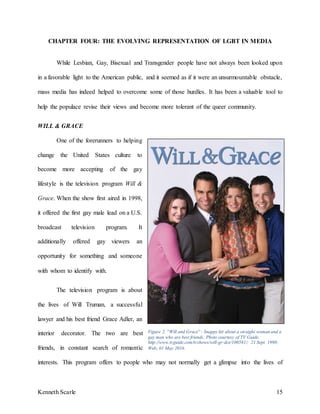
lifestyle is the television program Will &
Grace. When the show first aired in 1998,
it offered the first gay male lead on a U.S.
broadcast television program. It
additionally offered gay viewers an
opportunity for something and someone
with whom to identify with.
The television program is about
the lives of Will Truman, a successful
lawyer and his best friend Grace Adler, an
interior decorator. The two are best
friends, in constant search of romantic
interests. This program offers to people who may not normally get a glimpse into the lives of
Figure 2. ''Will and Grace'' - Snappy hit about a straight woman and a
gay man who are best friends. Photo courtesy of TV Guide.
http://www.tvguide.com/tvshows/will-gr-dce/100581/; 21 Sept. 1998;
Web; 01 May 2016.
Kenneth Scarle 16
homosexuals as a routine, everyday part of lives – being romantically involved with a same-sex
partner as if it were perfectly ordinary. This is a perfect example of the meaning-making
perspective of mass communication. Queer audiences were seeking out affirmation of their lives
and lifestyles, looking to validate their experiences. And the television networks complied,
offering an avenue for the expectations of this target audience.
In the fourth week of its airing, it was rated number one in its viewing time slot, and
garnered several honors in its eight seasons on air. “Since its premiere, Will & Grace has won
numerous awards, including a People’s Choice Award as Favorite New Comedy Series, a Golden
Globe nomination for Best Comedy Series, an American Comedy Award nomination for Funnier
Television Series, two GLADD (Gay and Lesbian Alliance Against Defamation) Media Awards
for Outstanding TV Comedy Series and a Founders Award from viewers for Quality Televisio n.
And during the 52nd annual Emmy Awards, Will & Grace was nominated in 11 categories, taking
home awards for Outstanding Comedy Series, Outstanding Supporting Actress, and Outstanding
Supporting Actor” (Battles and Morrow 87).
Although the program was a success, it has been criticized for not pushing the envelope of
LGBT personification far enough. “Will provides a mainstream audience with a likable, well-
assimilated gay character that is very different from the negative stereotypes of gay character in
early television. However, his character has been criticized for confining the portrayal of gay men
to those who are white and upper-middle class, making his character more acceptable to a
mainstream heterosexual audience at the expense of alienating a large portion of the gay
community” (Battles and Hilton-Morrow 90).
Kenneth Scarle 17
Other characters seemed to perpetuate the stereotypes. While this could be interpreted as a
step backward, it does help to demystify the world of the LGBT community. Jack McFarland was
an unapologetic gay man. “He constantly objectifies other men, refusing to conform to any
traditional notions of masculinity. He acknowledges that he doesn't ‘pay attention to the straight
world; and certainly lives in a world of his own’” (Battle and Hilton-Morrow 96). This character
was neither ashamed nor apologized for his homosexuality, but rather rejoiced in his differences.
This helped queer viewers have someone to more closely relate to.
Will & Grace has helped move LGBT people into a much more positive cultural spotlight.
No longer are they just something ignored, discounted or villainized. A major television network
portrayed them as productive members of society, with the same strengths and weaknesses of
everyone else. There was nothing to be afraid of or to be ashamed of. The United States had shifted
its perspective into more acceptance of this lifestyle.
QUEER AS FOLK
Another successful
television program that
provided one of the first and
most public avenues for LGBT
people to have their lives
exposed as ordinary was the
program Queer as Folk; an
honest depiction of what gay
people deal with on a day-to-
day basis, not merely a caricature of LGBT life. It brought the private lives of the LGBT
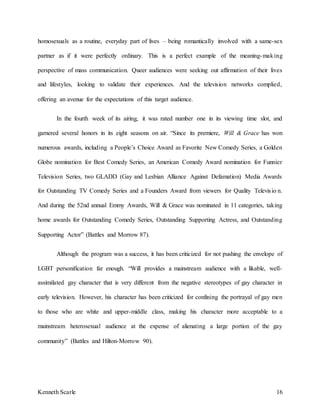
Figure 3. “Queer as Folk” - Brash humor and genuine emotion make up this
original series revolving around the lives, loves, ambitions, careers and friendships
of a group of gay men and women living on Liberty Avenue in contemporary
Pittsburgh, PA Photo courtesy of Showtime, 1998. http://www.sho.com; Dec. 2000;
Web; 01 May 2016.
Kenneth Scarle 18
community out into the open. “Visibility of queers being open about their sexuality transforms
representations, and also public discourse surrounding what being queer means to the viewer.
Visibility signals a negotiation of power between heterosexual and homosexual representation
within the media, and bridges the divide between the private/invisible and public/dominant”
(Manuel 279). Television programs like Queer as Folk have helped humanize the LGBT
community, redefine the stereotypes of gay people, and is the culmination of a long and arduous
road to queer people being treated with integrity, courage and respect.
Persuasion is one of the most important keys regarding Queer as Folk and its success in
bringing about a more thorough acceptance of LGBT relationships, on the air and in real life. The
main function behind the show was to depict the gay lifestyle and the struggles dealt with on a
routine basis. While it was somewhat glamorized to promote viewership, many issues that LGBT
people deal with were featured, including coming out, gay adoption, sexual abuse, HIV/AIDS
infection, discrimination and many others.
Although the television program Queer as Folk was originally marketed toward LGBT
audiences, the messages regarding the gay and lesbian community have reached many more groups
with its radical, innovative and often racy programming. “The serial, focused on the lives (and sex
lives) of gay men, has an estimated 50 percent female audience, most of whom, it's assumed, are
heterosexual. ‘It was intended as a gay show written for a gay audience,’ says Daniel Lipman,
who, with Ron Cowan, created the American version of the British TV hit” (Smith 1). It quickly
became the number one program for the Showtime Network in America and abroad. “The U.S.
version of the program has since been aired in 10 European countries, four countries in Latin
Kenneth Scarle 19
America, in Australia, and in one Middle Eastern country, with fan pages, blogs and forums still
active two years after the program’s formal finale” (Manuel 277).
Despite many setbacks during development, the Showtime Network pressed to produce
Queer as Folk. “At a time when the competition for television viewers has never been fiercer,
Showtime is doing everything it can think of to make sure its latest offering won't go unnoticed.
Already this year it has co-sponsored gay-pride events in a dozen cities around the country, passing
out thousands of handheld fans promoting the show” (Kaiser 3). The network promoted the show
even in the midst of controversial blowback from religious groups and conservative organizations.
Silverblatt writes about media presentations serving as barometers of current attitudes
towards historical events. Queer as Folk was a gauge for gay civil rights at the time and quickly
addressed all the pertinent issues. In the final season of the show, much of it focused on a battle
against “Proposition 14,” a fictitious threat to outlaw gay marriage, adoption and civil rights. Now
that all the states in America have declared same-sex marriage legal, this program has shown
historical sensibility in that it this issue was mirrored in several states in the 2008 election, most
publicly with Proposition 8 in California. More and more this program is underlining a cultural
sensibility regarding LGBT rights, with public opinion turning in favor of them.
But before the series premiered, the thought of mass media standing up for the LGBT
community was almost laughable. “American film was only allowed to show that gay people were
just like everyone else in matters of the heart, so long as they were either terminally ill or a drag
queen (Tom Hanks in Philadelphia; all those imitations of La Cage Aux Folles and The Adventures
of Priscilla, Queen of the Desert). And things were no better on television. Liberace, Paul Lynde,
and Charles Nelson Reilly were allowed to camp it up outrageously for Middle America, but when
Kenneth Scarle 20
Sidney, a sitcom starring Tony Randall, set out to portray a real gay man in Manhattan, the show
lost its nerve and folded right away. The task of showing gay life as it was without worrying about
its enemies seemed to be one only Europeans could master” (Brief History of a Media Taboo 1).
The context of this groundbreaking program has not been lost on American culture. As one
of the first program to show explicit content and simulated sex scenes between same sex couples,
it has been a forerunner for modern depictions of real life LGBT relations. It was one of the first
programs to show gay marriage and gay adoption in a positive light. “Thus, the mainstream media
can be queered, whereby portrayals are directed to queer audiences as ‘authentic’ over straight,
‘inauthentic’ (stereotyped) representation. For example, programs such as Queer Eye for the
Straight Guy, which debuted in 2003, have intentionally challenged negative stereotypes in order
to dispel myths surrounding gays as a threat to heterosexuality and traditional mores, and
homosexuals as powerless” (Manuel 277). Thanks in large part to Queer as Folk, the LGBT
community has an even larger part in American culture, even having entire television networks
devoted to programming that caters to gay people.
The framework of the entire production of Queer as Folk is rife with visual stimulation and
meaning behind each element of production, including each cast member, camera shots and even
the title sequence. “Print is probably still better at portraying the actual dull reality of life, its
longueurs and nagging angst; but Queer as Folk makes the most of the advantages of film. There
are scenes so true to life you'll gasp, so painful to watch that you may leave the room” (Brief
History of a Media Taboo 1).
The series followed the lives of five gay men living in Pittsburgh, Pennsylvania, Brian
(Gale Harold), Justin (Randy Harrison), Michael (Hal Sparks), Emmett (Peter Paige), and Ted
Kenneth Scarle 21
(Scott Lowell); a lesbian couple, Lindsay (Thea Gill) and Melanie (Michelle Clunie); and
Michael's mother Debbie (Sharon Gless) and his uncle Vic (Jack Wetherall). But the main premise
of the program was normalizing same-sex relationships, and all that entailed. Queer as Folk made
no apologies to being up front about the intimate details between couples of any gender. “The thing
you need to know," Michael says in the show's opening line, "is that it's all about sex.” “Visibility
of queers being open about their sexuality transforms representations, and also public discourse
surrounding what being queer means to the viewer. Visibility signals a negotiation of power
between heterosexual and homosexual representation within the media, and bridges the divide
between the private/invisible and public/dominant” (Manuel 278).
The name of the series itself is a play on words meant to help others come to realize that
the LGBT community, along with their issues and relationships, is not so different from anyone
else. The Cambridge dictionary defines it as a dialectal expression from some parts of Northern
England, “There's nowt so queer as folk”, meaning there's nothing as strange as people and that
everyone sometimes behave in very strange ways. “This dual meaning posits the message that the
queers are people as well, deserving of the same right and protections of heterosexuals. Alternately,
the opposite meaning denotes that all people are weird, that in essence no one, regardless of their
sexuality, falls under the tenets of normalcy” (Manuel 287).
Queer as Folk has helped American culture come to accept more fully the legitimacy of
same-sex relationships and the LGBT community. As the show has evolved from a program about
the sexual conquests of young gay men to events as mundane as being unemployed, growing older,
and entering and ending relationships, it became important because these events affect all people,
regardless of sexual orientation and identity. But it is important to focus on the fact that queer
Kenneth Scarle 22
people do in fact face them. “’Because all of the characters are gay, any story that you tell has a
twist to it, even going to the grocery store,’ says Lipman. ‘In one episode our Lesbian couple’s
baby gets sick, and the woman who is not the birth mother is not allowed in the emergency room.
Until that point, they were just happy parents like anyone else’” (Hensley 5). LGBT members are
a part of American society, and this television program has helped to change society’s cultural
outlook to further accept “Queer” people as equals, deserving the same rights as anyone.
TRUE BLOOD
The television program True
Blood based on The Sookie Stackhouse
Novels by Charlaine Harris has become
a cultural sensation, providing an
avenue for lesbian, gay, bisexual and
transgender people to showcase their
denial of basic human rights, the fight
to ensure they are recognized, and the
hope of a peaceful co-existence
between different groups by the allegorical representation of the vampire society on the program.
Being broadcast for seven seasons on the HBO cable network, True Blood first aired in 2008,
scoring an overall 64 on Metacritic.com, indicating favorable reviews from a compilation of
responses from published critic reviews (Metacritic 1). These reviews only continued to grow as
the program tackled issues such as non-traditional relationships, coming out to the public and even
diseases once though only prevalent in certain “communities.”
Figure 4. “TrueBlood” – The season three cast poster for True Blood, a
dark fantasy television series populated with vampires, werewolves, fairies
and shapeshifters. These are allegories for the LGBT community in our
society today. Photo courtesy of HBO. www.hbo.com; 2010; Web; 01 May
2016.
Kenneth Scarle 23
The use of homosexual and transgender characters, in both lead and supporting roles, as
well as the struggle for equality in the context of the program, has allowed True Blood to capture
the political nature of LGBT issues in the United States and the complex representation of gay
culture and the LGBT experience. This has also helped to portray the reality and convey the values
of the LBGT community as True Blood examines the status quo in contemporary culture and helps
measure public attitudes regarding the assimilation of LGBT people in being treated with integrity,
courage and respect.
Series creator and producer Alan Ball, an openly gay man, has won numerous awards for
his groundbreaking work in television helping to communicate the importance of LGBT rights and
acceptance, such as an Emmy Award, Director’s Guild of America Award for Outstanding
Directorial Achievement, and one of Out magazine’s annual list of the Most Impressive Gay Men
and Women in 2008 (Out 1). Mr. Ball had previously done much work promoting the LGBT
community, especially with the HBO network’s Six Feet Under, a program acclaimed for its
representation of a realistic portrayal of a gay lead male character on television and its exploration
of mortality.
The choice of using television as the medium for the message that True Blood conveys is
an engaging one. By utilizing the sight, sound, color and motion of television programming, the
program is able to communicate on “an affective level, presenting images that move us
emotionally” (Silverblatt 25). It also allows people to be subjected to a message in private that they
might not feel comfortable experiencing in public, helping to ease the transition of acceptance and
being a more effective means of communication.
Kenneth Scarle 24
True Blood is the story of a world where actual vampires exist, and have come “out of the
coffin” to the general public when the creation of a synthetic blood named “Tru Blood” allows
them to partake of blood without having to harm human life. This “great revelation” has the
vampires split into two camps: some who wish to integrate into mainstream society by
campaigning for equal rights and others who think that co-existence is not possible. The series
focuses on the relationship between a vampire and a human, who later turns out to be a faerie
hybrid, shunned from her community when they notice her differences and her relationship with
the vampire. The romance between the two lead characters is inevitably complicated, in that the
social and political world of vampires is as convoluted and complex as that of the humans. This
effectively mirrors the adversity LGBT couples face, especially in the conservative south, as the
program takes place in fictional Bon Temps, Louisiana. Tolerance is in short supply, for vampires,
the LGBT community or any other being who doesn’t fit in with the accepted perception of the
local populace as normal.
The vampire has long been regarded in legend and literature as a deviant, predatory
creature, rising up during periods of cultural crisis. As a fictional but obvious example of an alien
group in the middle of modern society, they have culturally moved from something to be feared
into a desired entity, one that deserves compassion and inclusion.
The vampire didn’t begin as such a sympathetic creature, though. In the 1922 film
Nosferatu, it is presented as evil, repellant and feared, just as LGBT people once were considered
aberrant, especially in the media. It wasn’t until the 1930s, when Bram Stoker’s Dracula starring
Bela Legosi, that the vampire was seen as seductive, physically attractive and powerful –
something that was exotic and desirable. The vampires of True Blood follow suit. They are
attractive, suave, intelligent, and sexually accessible. These are not the vampires of folklore,
Kenneth Scarle 25
represented as something to be shunned, but rather something mainstream society is curious about
and even longs for.
The creators of True Blood attempt to have viewers consider the possibility of otherness in
their lives, of seeing non-traditional couples mainstreamed into society. Using the agenda-setting
theory of social learning, they try to help people experience what would happen if one type of
people (vampires) were to be exposed to the general public, would attempt to shed off their
otherness and integrate into society, and observe the obstacles they face in the bid for equality.
Many similarities have been intentionally created to that of the LGBT community, in that a
particular group is spurned by the religious right and openly condemned. There is even a slogan in
the show “God Hates Fangs” adopted from a real life group opposed to LGBT people. This gives
viewers the opportunity to see just how vampires, i.e. queer people, are affected on a day to day
basis, not only by people’s bigotry, but by legislation instituted by an outdated, bigoted legal
system. “Agenda-setting researchers have argued that the mass media do not so much tell us what
to think as what to think about” (Campbell 523).
The ideology behind True Blood is simple: it wants to have people explore their own
boundaries and how they relate to otherness. Ideology refers to the system of beliefs characteristic
of an individual, group or culture. “An ideology contains assumptions about how the world should
operate, who should oversee this world, and the proper and appropriate relationships among its
inhabitants” (Silverblatt 98). True Blood challenges the standard norms of American culture and
poses the question of “who deserves the right to be and what are they entitled to?”
The context of this groundbreaking program has not been lost on American culture. While
there are few “normal” people in True Blood, the majority of the cast, from vampires to faeries,
Kenneth Scarle 26
and werewolves to witches, all represent those who are oppressed and fall victim to a
discriminating society. This is a positive reinforcement of the diversity that this culture was
founded on.
More exposure to LGBT prominent programming will help humanize the LGBT
community and redefine the stereotypes of gay people as something other than aberrant or
abnormal. Just as the vampire in True Blood faces discrimination and fear, the queer person still
fights for equal rights today. But this program has helped to disseminate messages regarding the
gay and lesbian community, reaching many more viewers with its radical, innovative and often
racy programming. The queer community now plays an even larger part in American culture,
inclusive in its programming and multimedia presence.
Silverblatt writes about media presentations serving as barometers of current attitudes
towards historical events. True Blood has a running discourse regarding citizenship, marriage and
equality in general, clearly mirroring that of the LGBT person and their struggles in the U.S. In
November 2008, the state of California passed Proposition 8, enforcing a constitutional
amendment stating that only marriages between a man and woman would be considered legal and
valid. This was echoed in a storyline in True Blood regarding the fictional Vampire Rights
Amendment, which would give vampires equal rights as to humans in the United States, including
owning property, marrying, adoption and the removal of the vampire curfew. On the program, a
rally in D.C. was created in support of this amendment, with a successful media campaign wherein
vampires are identified in a sympathetic manner with the slogan “We were people too.” It is an
unashamed attempted to draw sympathy towards the plight of the American vampire against
discrimination for simply being different.
Kenneth Scarle 27
On the opposite side of the conflict, the fictitious group the Fellowship of the Sun ran a
smear campaign trying to deny the Vampire Rights Amendment. The anti-vampire association
produced videos claiming that the vampires were “just so unnatural” and that “children see this
lifestyle and maybe they want to imitate it” (True Blood 1). This is a reflection of many
conservative religious groups that have lobbied to stop LGBT equality legislation. In the television
program, marriage between vampires and humans is considered an abomination and a “fatal blow
to the traditional family, perhaps even to the human race.” This echoes the current sentiments
expressed by opponents of same-sex marriages in the United States, who attempted to invalidate
the expression of commitment between two consenting adults.
More and more this program is underlining a cultural sensibility regarding LGBT rights,
with public opinion turning in favor of them. As more viewers watch and become acclimated to
the events unfolding onscreen, the more they are ready to accept these concepts in real life. This
cultivation effect will show viewers that heteronormativity and its perspective is flawed.
The title of the series itself is ironic in that the entire premise of the show is about vampires
co-existing with humans due to the production of synthetic blood. Vampires no longer need to
prey on humans, but can instead share their lives with them. Although it is later found that some
vampires do not agree with this cohabitation, and that a secret vampire nation is plotting to over
throw the human government. Along with the face that other supernatural entities are hiding in
plain sight, there isn’t a lot of “truth” in True Blood.
But one truth is evident. Bigotry remains constant throughout, no matter how brave a
character may be. Many characters have “come out” in this series, but one person never needed to.
Lafayette, the openly homosexual short order cook of Merlotte’s, displays many characteristics
Kenneth Scarle 28
stereotypical of the gay lifestyle. But Lafayette represents strength in knowing who he is, and
portraying a strong masculine sense, while embracing the equally strong feminine qualities about
himself. He neither apologizes nor makes excuses for his life and exudes a confidence that inspires
people to accept him for who he is, even when he is doing things that may be considered
questionable.
Many choices were made specifically to ensure the viewer is kept on their toes regarding
how to feel about the plight of the vampires, humans and other creatures in this series. It does,
however, try to reinforce the message of tolerance and encouragement even in light of resistance
and bad examples.
True Blood has been able to successfully portray the political nature of LGBT issues in the
United States and promote homo-normalization in becoming the current trend, both on television
and in U.S. culture. True Blood helps the represent the minority of the LGBT community through
the image of the vampire and helps to open up dialogues and dispel any myths or fears. In turn, as
the U.S. culture becomes more accepting, we see more of it in the media.
Kenneth Scarle 29
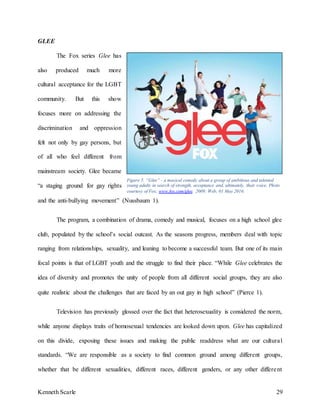
GLEE
The Fox series Glee has
also produced much more
cultural acceptance for the LGBT
community. But this show
focuses more on addressing the
discrimination and oppression
felt not only by gay persons, but
of all who feel different from
mainstream society. Glee became
“a staging ground for gay rights
and the anti-bullying movement” (Nussbaum 1).
The program, a combination of drama, comedy and musical, focuses on a high school glee
club, populated by the school’s social outcast. As the seasons progress, members deal with topic
ranging from relationships, sexuality, and leaning to become a successful team. But one of its main
focal points is that of LGBT youth and the struggle to find their place. “While Glee celebrates the
idea of diversity and promotes the unity of people from all different social groups, they are also
quite realistic about the challenges that are faced by an out gay in high school” (Pierce 1).
Television has previously glossed over the fact that heterosexuality is considered the norm,
while anyone displays traits of homosexual tendencies are looked down upon. Glee has capitalized
on this divide, exposing these issues and making the public readdress what are our cultural
standards. “We are responsible as a society to find common ground among different groups,
whether that be different sexualities, different races, different genders, or any other different
Figure 5. “Glee” - a musical comedy about a group of ambitious and talented
young adults in search of strength, acceptance and, ultimately, their voice. Photo
courtesy of Fox, www.fox.com/glee. 2009; Web; 01 May 2016.
Kenneth Scarle 30
defining trait. While it may just be a fictional sitcom, Glee has lessons that we all need to learn
from. Including the fact that while heterosexism and homophobia do exist today and at times seem
unavoidable, society can unify and find a middle ground, small or large, in which they can
communicate and achieve great things” (Pierce 1).
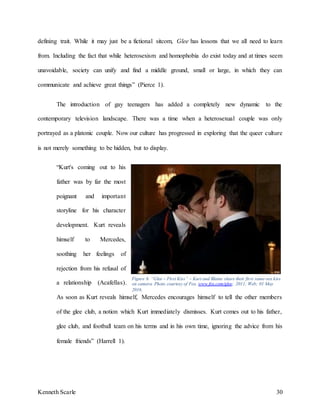
The introduction of gay teenagers has added a completely new dynamic to the
contemporary television landscape. There was a time when a heterosexual couple was only
portrayed as a platonic couple. Now our culture has progressed in exploring that the queer culture
is not merely something to be hidden, but to display.
“Kurt's coming out to his
father was by far the most
poignant and important
storyline for his character
development. Kurt reveals
himself to Mercedes,
soothing her feelings of
rejection from his refusal of
a relationship (Acafellas).
As soon as Kurt reveals himself, Mercedes encourages himself to tell the other members
of the glee club, a notion which Kurt immediately dismisses. Kurt comes out to his father,
glee club, and football team on his terms and in his own time, ignoring the advice from his
female friends” (Harrell 1).
Figure 6. “Glee – First Kiss” – Kurt and Blaine share their first same-sex kiss
on camera. Photo courtesy of Fox. www.fox.com/glee; 2011; Web; 01 May
2016.
Kenneth Scarle 31
Through the series, the lead gay character Kurt Hummel has progressed from bullied and
closeted teenager to a strong role model for LGBT teens. While his behavior is consistent with the
heteronormative version of an effeminate, and therefore inherently weak, version of a man, Kurt’s
strong character development and determination to succeed has lent itself to becoming a model on
which others can focus and learn from.
Another element of the LGBT community addressed in Glee was that of transgendered
characters. The trans character Coach Bieste struggled with being accepted as a transgendered
individual, facing ridicule and contempt. In a move to express the seriousness of gender transition
and the issues faced by them, an episode was filmed with more than 200 transgender people as
supporting staff. According to Glee executive producer and director Dante Di Loreto, it was a
calculated move to showcase the dignity of every person – everyone has a story and it is valid.
“This isn't about tolerance; it's really about coming home and coming home to who you really are
and who you're meant to be — and who you're meant to be with…This really is the face of
America, and you hope that when people see this episode, they realize, ‘Hey, they look just like
me’” (Advocate 1).
Kenneth Scarle 32
MODERN FAMILY
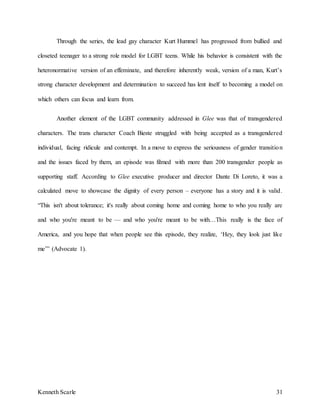
Another example of how gay culture
has been conveyed through mass media is the
television program Modern Family. The show
revolves around three families living in Los
Angeles, one of whom is a gay couple with an
adopted daughter.
What is interesting is that we see Cam
and Mitchell (the gay couple) as already
together as the show begins. They are an
established couple, with a child previously in
their family. This lends to the credibility of
the relationship being normal and standard, on
par with any television relationship.
Although Modern Family strives to convey a sense of normalization in a gay couple, it
does still portray stereotypes that could potentially become damaging to the current trend of
acceptance. “Americans, and many people around the world are getting most of their information
about gay people from this program, and are at the same time being encouraged to laugh at (instead
of with) effeminate gay men like Cam, then won’t this surely, even though clearly not the writers
intent, encourage people in society to laugh at homosexuality. Won’t this surely have an adverse
effect on many homosexual American lives?’ (Bowen 1)
Figure 7. “Modern Family” - A mockumentary-style sitcom
chronicling the unusual kinship of the extended Pritchett clan.
Photo courtesy of TV Guide.
http://www.tvguide.com/tvshows/modern-family/297616; 23 Sept.
2009; Web; 01 May 2016.
Kenneth Scarle 33
But overall the
relationship between the gay
couple is portrayed as equal
to the others on the program.
Even their adoption of a child
was seen as a joyous occasion
and not as a controversy. It is
an attempt to mainstream the
thought of an LGBT family
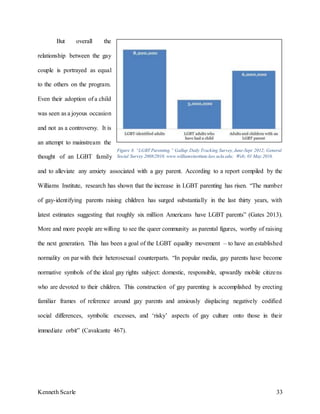
and to alleviate any anxiety associated with a gay parent. According to a report compiled by the
Williams Institute, research has shown that the increase in LGBT parenting has risen. “The number
of gay-identifying parents raising children has surged substantially in the last thirty years, with
latest estimates suggesting that roughly six million Americans have LGBT parents” (Gates 2013).
More and more people are willing to see the queer community as parental figures, worthy of raising
the next generation. This has been a goal of the LGBT equality movement – to have an established
normality on par with their heterosexual counterparts. “In popular media, gay parents have become
normative symbols of the ideal gay rights subject: domestic, responsible, upwardly mobile citizens
who are devoted to their children. This construction of gay parenting is accomplished by erecting
familiar frames of reference around gay parents and anxiously displacing negatively codified
social differences, symbolic excesses, and ‘risky’ aspects of gay culture onto those in their
immediate orbit” (Cavalcante 467).
Figure 8. “LGBT Parenting.” Gallup Daily Tracking Survey, June-Sept 2012; General
Social Survey 2008/2010. www.williamsinstitute.law.ucla.edu; Web; 01 May 2016.
Kenneth Scarle 34
ANDERSON COOPER
Mainstream media has made even
strong strides in establishing homo-
normalization, especially within journalistic
circles. Anderson Cooper, American
journalist and author is one of the most
prominent openly gay journalist on
American television. Cooper began his
career in journalism at a small news agency,
Channel One, a digital content provider for
supplementary educational and news
resources.
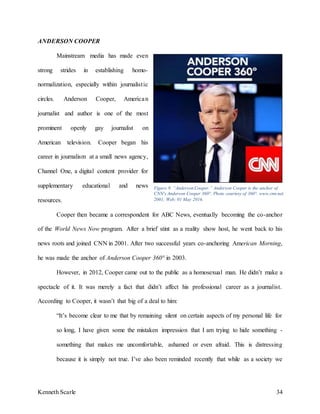
Cooper then became a correspondent for ABC News, eventually becoming the co-anchor
of the World News Now program. After a brief stint as a reality show host, he went back to his
news roots and joined CNN in 2001. After two successful years co-anchoring American Morning,
he was made the anchor of Anderson Cooper 360° in 2003.
However, in 2012, Cooper came out to the public as a homosexual man. He didn’t make a
spectacle of it. It was merely a fact that didn’t affect his professional career as a journalist.
According to Cooper, it wasn’t that big of a deal to him:
“It’s become clear to me that by remaining silent on certain aspects of my personal life for
so long, I have given some the mistaken impression that I am trying to hide something -
something that makes me uncomfortable, ashamed or even afraid. This is distressing
because it is simply not true. I’ve also been reminded recently that while as a society we
Figure 9. “Anderson Cooper.” Anderson Cooper is the anchor of
CNN's Anderson Cooper 360°. Photo courtesy of 360°. www.cnn.net.
2001; Web; 01 May 2016.
Kenneth Scarle 35
are moving toward greater inclusion and equality for all people, the tide of history only
advances when people make themselves fully visible” (Mirkinson 1).
It really says something about the cultural shift of acceptance of the LGBT community that even
after acknowledging his queer status, Cooper still became the host of his own news program. “For
one of America’s best-known television news anchors to be identified as gay was, until very
recently, seen as a potential career-killer. But then, on Monday, it happened. And the TV nation
seemed to shrug” (Stelter 1).
Since then, many journalists have embraced their LGBT status, including Harvey Levin,
Creator and managing editor, TMZ; Rachel Maddow, MSNBC's The Rachel Maddow Show; Robin
Roberts, ABC's Good Morning America; Suze Orman, CNBC's The Suze Orman Show; Don
Lemon, CNN Newsroom; Thomas Roberts, MSNBC's Way Too Early. “Since then, openly gay
anchors have made inroads in other time slots and on other television networks. At a rapid pace,
television news and opinion channels have reflected the growing acceptance of gays in society —
and perhaps have sped up that acceptance, just as TV shows like ‘Ellen’ and ‘Modern Family’
have” (Stelter 1).
IT GETS BETTER PROJECT
Another facet of mass media that has been utilized to reach audiences on behalf of the
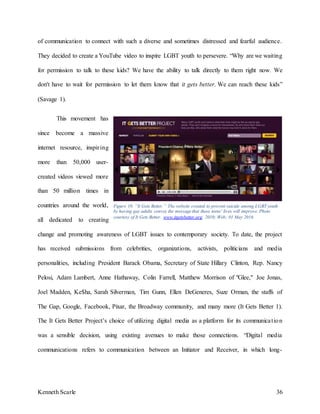
LGBT community is the internet. The It Gets Better Project began in 2010 as a response to the
increasing number of Lesbian, Gay, Bisexual and Transgendered-people suicides, caused largely
due to anti-gay bullying and amplified feelings of isolation. Gay columnist Dan Savage wanted to
reach out to LGBT youth and send a positive message of hope and resilience. But with limited
accessibility, he and his partner Terry Miller carefully considered what would be the best method
Kenneth Scarle 36
of communication to connect with such a diverse and sometimes distressed and fearful audience.
They decided to create a YouTube video to inspire LGBT youth to persevere. “Why are we waiting
for permission to talk to these kids? We have the ability to talk directly to them right now. We
don't have to wait for permission to let them know that it gets better. We can reach these kids”
(Savage 1).
This movement has
since become a massive
internet resource, inspiring
more than 50,000 user-
created videos viewed more
than 50 million times in
countries around the world,
all dedicated to creating
change and promoting awareness of LGBT issues to contemporary society. To date, the project
has received submissions from celebrities, organizations, activists, politicians and media
personalities, including President Barack Obama, Secretary of State Hillary Clinton, Rep. Nancy
Pelosi, Adam Lambert, Anne Hathaway, Colin Farrell, Matthew Morrison of "Glee," Joe Jonas,
Joel Madden, Ke$ha, Sarah Silverman, Tim Gunn, Ellen DeGeneres, Suze Orman, the staffs of
The Gap, Google, Facebook, Pixar, the Broadway community, and many more (It Gets Better 1).
The It Gets Better Project’s choice of utilizing digital media as a platform for its communication
was a sensible decision, using existing avenues to make those connections. “Digital media
communications refers to communication between an Initiator and Receiver, in which long-
Figure 10. “It Gets Better.” The website created to prevent suicide among LGBT youth
by having gay adults convey the messagethat these teens' lives will improve. Photo
courtesy of It Gets Better. www.itgetsbetter.org. 2010; Web; 01 May 2016.
Kenneth Scarle 37
established media are combined with computer technology to emulate human’s communications
patterns” (Silverblatt 380).
Savage stated that his reason in deciding upon this form of communication was based upon
a sense of urgency - the need to find a way to help as soon and as widespread as possible. “It
occurred to me that we can talk to these kids now,” Savage said. “We don't have to wait for an
invitation or permission to reach out to them using social media and YouTube" (Hubbard 1). With
the implementation of the internet, communicators no longer have to be concerned with time or
geographical constraints. Messaging is virtually instantaneous, regardless of proximity. “Digital
media promises to obliterate traditional borders, moving the world further into Marshall
McLuhan’s vision of the global village” (Silverblatt 394).
The It Gets Better Project is a type of developmental journalism, in that the videos attempt
to inform the public on events and developments in a way that might be in opposition to a core
nation’s perspective. It is geared towards dealing with “the needs, strengths, and aspirations of
journalistic endeavors in the emerging developing nation-states” (McPhail 33). The organization
helps to contact places and people previously thought to be unreachable. This helps the world see
the actual conditions of the issue, instead of what the mainstream media of the host nation might
want to produce or broadcast. This fact is true even in Western culture, as acceptance of LGBT
issues is still growing and not always considered as a positive and affirming lifestyle. The internet
is an effective medium for the program’s message, providing a safe environment for support
“because of its reach, its temporal flexibility, and its anonymity. The messages can be accessed at
convenient times, from anywhere on the planet with connectivity, and closeted queer youth can
use the digital veil of the Internet to provide anonymous cover as they seek out and consume these
resources” (Brabham 1).
Kenneth Scarle 38
The stories and testimonials featured on the It Gets Better Program’s platforms help to
shape society’s perceptions and attitudes regarding LGBT acceptance and lifestyle. The online
avenue is congruent with how today’s society consumes its media. On-demand television, social
media uploads and suggestions and streaming program websites all dictate what and how
information is accessed. “Our varied media institutions and outlets are basically in the narrative –
or storytelling – business. Media stories put events in context, helping us to better understand both
our daily lives and the larger world” (Campbell 15). The project capitalizes on the media
convergence and the impact it has on our daily lives.
The It Gets Better Program is also a good example of electronic colonialism. It’s an
organization that seeks to influence and control the mind and opinions of others through
influencing attitudes, desires, beliefs, lifestyles, and consumer behavior. This is accomplished by
exporting information and media about a particular culture or idea and advertising around the
world, in this case, LGBT rights and support. This is done through social media, the internet,
television, movies, advertising and more. The electronic colonialism theory “looks at how to
capture the minds and, to some extent, the consumer habits of others” (McPhail 16). The It Gets
Better Program is attempting to show support of at-risk youth, while helping to inform others of
the plights they face.
Some of the subject matter of the It Gets Better Project is riddled with satire and comedy,
but the core message is consistent, even though society is in a constant state of flux as new
technology gives people new means in which to interact. LGBT rights are being hailed as the new
civil rights movement. A Gallup Gay Marriage Poll finds a majority of U.S. citizens support
nationwide marriage equality law (Huffingtonpost 1). This is largely due to the fact of mass media
communicating the reality of the situation – consenting adults were being denied same rights as
Kenneth Scarle 39
other consenting adults, as was the case regarding interracial marriage and women’s suffrage. In
those instances, there was a lot of supposition, but no real “face” to the injustice. And when the
issues were brought to light, the American people fought to end that struggle.
Studying the theories regarding mass communication is therefore important, in that media
consumers understand the concepts, explanations, and principles of those aspects of the human
experience. The normative theory of communication states that an ideal standard should be set
against an existing media system so it can be judged. It describes the way things should be if some
ideal values or principles are to be realized. It focuses on the media conversing as a method of
freedom. Through user-generated content, the It Gets Better Project uses this theory and focuses
on the output regarding equality over law, cultural diversity, and freedom. It emphasizes many
people’s opinions what the world should be rather than what it is. The normative theory definitely
allows one the freedom of speech and the right to express it.
“Because it's on the Internet, anyone can access these messages, or upload one; because it's
associated with several well-known names (actress Anne Hathaway, singer Ke$ha, and
Project Runway's Tim Gunn, to name a few) it's likely to get attention and reach more teens
in crisis. And in many ways, ‘It Gets Better’ operates in the same way that decent abuse
counseling does: it identifies what is happening to these children as wrong, it tells them
that they don't deserve it and that it's not their fault, and it gives them permission to actually
perceive themselves as victims of sustained cruelty, rather than special, faulty, unlovable
freaks who bring bad treatment on themselves by virtue of existing. For people who've
been abused, these aren't just compassionate platitudes; they're necessary tools for survival.
The question, however, is whether these tools alone are enough” (Doyle 1).
Kenneth Scarle 40
Not only does the It Gets Better Program focus on the process of communication, but
emphasizes the practice of changing culture on a day to day basis to reinforce their message. The
theory of forming a social construction of reality limits new information about an issue because
people share a common sense about its reality. Once an organization or social institution is formed,
it is difficult to oppose or change their beliefs. They conduct the practice of that culture on a day
to day basis, reinforcing it. “According to social constructionists, social institutions wield
enormous power over culture because they view the culture they propagate as having a reality
beyond our control” (Baran 323). It has therefore become difficult for the message of LGBT
equality, rights and protections to be changed in the minds of those who have not observed or
openly opposed it for generations.
However, the It Gets Better Project is more appealing to those who may not be rooted in
those generational footholds and can accept that the status quo is simply no longer the case nor
acceptable. Advances in digital media and its accessibility has become a game changer in how
audiences receive new messages and changes in cultural beliefs. The Dragonfly Effect is a book
and concept created by Jennifer Aaker and Andy Smith that looks at how people are using social
media to connect and form groups that create change throughout the globe.
The authors of The Dragonfly Effect explain their theory comparing social interaction by
looking at the insect and how “the dragonfly is unique among insects in that it is the only one that
has the ability to propel itself in any direction when its four wings are working together in concert.
This uncanny ability of the dragonfly is a metaphor for how small, integrated acts can cause a
“ripple effect” that leads to great change, transformation, and positive impact” (David 1).
Kenneth Scarle 41
Using four different aspects, or wings, of exploring an issue can create a step by step
process in which to best analyze a situation and create a prompt change. “The method relies on
four essential skills, or wings: 1) focus: identify a single concrete and measurable goal; 2) grab
attention: cut through the noise of social media with something authentic and memorable; 3)
engage: create a personal connection, accessing higher emotions, compassion, empathy, and
happiness; and 4) take action: enable and empower others to take action” (Aaker 1).
The It Gets Better Project has utilized this type of analysis and action plan to successfully
confront the issue of anti-LGBT bullying and to help build hope in the future. The focus of the
organization is obviously presented as each video contains a full narrative story about the author
and the struggles they have faced. They are short, concise, and present the situation and message.
The project grabs attention through the detailed descriptions of assaults, attempted suicides and
raw emotions contained within each individual video. Many celebrities have brought a very public
face to the project. Their own filmed confessionals have done much to publicize this campaign.
The video stories in themselves are engaging, as the subject is seated in a familiar setting
of their own, often a bedroom, facing the camera, and having a candid conversation with the
“audience.” It is an authentic first-person narrative that aims to relate to the person watching the
video. The project then commands a “take action” approach by challenging viewers to create their
own videos to showcase support or sympathy to the plight of LGBT youth. It is an attainable goal,
as most of the media on which the viewers are watching is equipped with video recording
capabilities of their own.
The organization has been successful utilizing this type of digital media effect, as there
were hundreds of videos posted, more than 10 million views of them, and even having the President
Kenneth Scarle 42
of the United States posting his own video - all within one month of the beginning of the campaign.
It has now even expanded into 20 countries and now has 14 global affiliates.
Diverse media platforms have helped the project reach online audiences, helping refine the
communication and media patterns being used to influence the beliefs and habits of others. The
use of the It Gets Better Project’s social media has increased the reach of its message, while helping
to promote the public’s awareness of these issues. Digital media is an important tool in
communicating messages in contemporary society. “One doesn’t need money or power to cause
seismic social change. With energy, focus, and a good wireless connection, anything is possible”
(Aaker 1).
ORANGE IS THE NEW BLACK
One of the most watched
original series on Netflix is Orange is
the New Black. The comedy-drama
series takes place in an all-women’s
minimum-security prison. One of the
more prominent, and controversial,
characters on the show is Sophia, a
transgender woman who is a force to
be reckoned with. She is portrayed by transgender actress Laverne Cox, whose role has earned her
a prestigious acting accolade. “Cox has been nominated in the ‘Outstanding Guest Actress in a
Comedy Series’ category for her role as Sophia Burset--an inmate who committed fraud in an
attempt to pay for a sex change procedure--in the Netflix series Orange Is the New Black. Cox
Figure 11. "OITNB". Thehit show based on Piper Kerman's memoir,
Orange Is the New Black: My Year in a Women's Prison. Photo courtesy of
Netflix. 2013; www.netflix.com; Web.
Kenneth Scarle 43
tweeted her congratulations to fellow cast members on their nominations--OITNB raked up 12
Emmy nods this year, the most out of any comedy show” (Gjorgievska 1).
Previously, transgender acting roles portrayed the community with extremely negative
characteristics – either as a victim of a crime, a sex worker or a killer/villain. “Since 2002, GLAAD
catalogued 102 episodes and non-recurring storylines of scripted television that contained
transgender characters, and found that 54% of those were categorized as containing negative
representations at the time of their airing” (GLAAD 1).
Cox has made strides in this, becoming a leader in the transsexual movement. People are
beginning to have conversations about the transgender community instead of simply jumping to
conclusions. Cox explains gender identity to people who don’t understand:
“I think what they need to understand is that not everybody who is born feels that their
gender identity is in alignment with what they're assigned at birth, based on their genitalia.
If someone needs to express their gender in a way that is different, that is okay, and they
should not be denied healthcare. They should not be bullied. They don't deserve to be
victims of violence. That's what people need to understand, that it's okay and that if you
are uncomfortable with it, then you need to look at yourself” (Steinmetz 1).
In a recent survey by Greenberg Quinlan Rosner Research, data shows “35 percent of likely voters
surveyed reported that they personally know or work with a transgender person. That’s nearly 1.6
times last year’s figure of 22 percent” (HRC 1). Of those who knew a transgender person, 66
percent expressed favorable feelings toward the person. This is an increase of 53%. The mass
media visibility of the LGBT community, and transgender in particular, has helped increase the
public’s approval and homo-normative behavior.
Kenneth Scarle 44
TRANSGENDERAT LOVE AND WAR
The fight for transgender
rights and respect is still being
waged, however, especially in the
United States military. A
documentary by the New York
Times called “Transgender, at War
and in Love” features Air Force
Senior Airmen Logan Ireland, a member of the Security Force Squadron at Altus Air Force Base,
Oklahoma. Ireland was assigned feminine gender at birth, but has served in the military as male,
the gender he knows himself to be. The film documents his military deployment to Afghanistan
with a police unit, who accepts him as an Airmen, not male or female, but someone who does their
job and can be depended on to save lives (Dawson 1).
Without his command knowing, Ireland filmed the documentary, which revealed his
transgender status. Under current regulations, transgender servicemembers can be honorably
discharged because of their orientation (DoD Instruction 6130.03). Ireland risked losing his career,
but his supervisors have shown support in his gender identity, allowing him to adhere to male
military uniform and grooming standards, including growing a mustache and keeping his hair
short.
Ireland’s portrayal of the LGBT community has further promoted a sense of normalcy to
the general public and transgender rights in the military, and the country. Increased visibility of
the queer culture changes how people view them. Its displays a sign of strength between
Figure 12. "Transgender, atWar and in Love.” This short documentary
shares the challenges of a transgender military couple, who are banned from
serving openly. Photo courtesy of Netflix. June 4, 2015; www.nytimes.com;
Web.
Kenneth Scarle 45
heterosexual and homosexual depictions in mass media, and helps to bring the two world views
together.
Ireland and his finance, Army Cpl. Laila Villanueva were invited by U.S. President Barak
Obama to attend the 2015 LGBT Pride Month celebration at the White House. In another advance
for transgender service members, Ireland was given authority to wear male dress blue uniform to
the event at the Capitol, even though his official gender recorded by the military still lists him as
female. “For the first time I will be myself when I put on my blues, and I will carry a newfound
sense of pride. Representing my Air Force at the White House is a great honor. However, being
able to represent the more than 15,000 transgender military members that are still serving in silence
is why I am there” (MilitaryOnline 1). Ireland was only one of a few military members attending
who could wear the uniform that corresponds with their gender identity.
Villanueva is also a military member and a transgender person, but she doesn’t share the
same support from her branch of the military. She is still referred to as male by her command and
faces the possibility of discharge because of her gender affiliation. Villanueva had to wear civilian
attire to the Pride celebration.
Even though there is still much room for improvement, education and exposure have
helped the transgender cause within the United States military. Secretary of Defense Ash Carter
has realized the outdated information regarding service and has made moves to address the
deficiencies.
“The Defense Department's current regulations regarding transgender service members are
outdated and are causing uncertainty that distracts commanders from our core missions. At
a time when our troops have learned from experience that the most important qualification
Kenneth Scarle 46
for service members should be whether they're able and willing to do their job, our officers
and enlisted personnel are faced with certain rules that tell them the opposite. Moreover,
we have transgender soldiers, sailors, airmen, and Marines - real, patriotic Americans -
who I know are being hurt by an outdated, confusing, inconsistent approach that's contrary
to our value of service and individual merit” (Carter 1).
Kenneth Scarle 47
CHAPTER FIVE: THE ACCOMPLISHMENTS OF THE LGBT
COMMUNITY
The perception of the LGBT community by the American public began as one of fear,
scrutiny and loathing. They were treated as second-class citizens, not afforded the basic
constitutional rights each and every citizen of the United States should be enjoying. However,
major accomplishments have been made and huge hurdles overcome as social change has been
instituted on the behalf of the LGBT community. Mass media has helped to promote their agendas
and beliefs, helping the public readdress their views and become more accepting of a viewpoint
not necessarily their own. LGBT members are a part of American society, and mass media has
helped to change society’s cultural outlook to further accept queer people as equals, deserving the
same rights as anyone.
Through the use of the different platforms of media – television, film, print articles, the
internet and social media, the core message of LGBT culture has successfully permeated the
mainstream. Transgender identities are being embraced along with same-sex marriage and openly
elected gay officials. There is still work to do, but the queer culture has made huge
accomplishments in equality and respect, in large part due to the use and exploitation of mass
media and communication theory.
Kenneth Scarle 48
MARRIAGE EQUALITY
Since the Stonewall riots, same-sex couples have sought the legal right to marry. Challenge
after challenge was presented, blocking the opportunity. The United States was woefully
unprepared to acknowledge the LGBT community, much less approve a lawful statement of
validity in the eyes of the court and the country.
It took much tragedy to open the eyes of the public to the plight of queer society – the
AIDS epidemic and escalating discrimination brought national attention to the community, forcing
people to examine a once thought of aberration. In 1996, the Hawaii Supreme Court ruled that
marriage discrimination was unconstitutional and ruled that same-sex couples should have the
freedom to marry.
The Hawaii decision was appealed, and was subsequently blocked by anti-gay supporters.
This led to the successful push of the Defense of Marriage Act (DOMA), which declared “if states
began issuing marriage licenses to same-sex couples, these marriages would be denied all federal
respect, and same-sex couples would not be eligible for any of the 1,100+ protections and
responsibilities that marriage triggers at the federal level” (freedomtomarry 1). It was signed into
law, and seemed to defeat the prospect of same-sex marriage.
There arose a need to publicize the reality of this situation – that the LGBT community
was being denied basic constitutional rights that all citizens of the United States should be
guaranteed. Popular culture had made the acceptance of the queer lifestyle more palatable, but
there was still opposition to the potential of a homo-normalized country. It was issues of civil
rights, freedom of choice and social justice that needed to be addressed publicly.
Kenneth Scarle 49
The development of a
national strategy to promote
marriage equality began in 2001.
This plan, called the Roadmap to
Victory was the one responsible
for the eventual success of the
freedom to marry, “building from
27% support among the American
people (at the time of the Hawaii trial in 1996) to 63% (in 2015), from zero states to 37 states when
the Supreme Court heard oral arguments and finally ruled” (freedomtomarry 1). Through
aggressive media campaigns featuring family members of the LGBT community supporting
marriage, it helped to persuade the public that LGBT people were in valid relationships that
demanded valid acceptance.
It took until 2011 for the government to recognize that the Defense of Marriage Act
violated the 14th Amendment of the Constitution and should no longer be defended by the U.S.
government. This was another huge step to marriage equality. This reflected the success of the
media campaign, which would continue until the vote went all the way to the Supreme Court.
“Like every other successful civil rights movement, the marriage movement needed to see itself
as a long-term campaign with a focused, affirmative goal and a sustained strategy”
(freedometomarry 1).
Figure 13. “TheRoadmap to Victory.” The strategy aimed at a Supreme Court
win bringing the country to national resolution, www.freedomtomarry.org;
2016; Web.
Kenneth Scarle 50
In the spring of 2015, the United States Supreme Court ruled that same-sex marriages are
legal nationwide. “No union is
more profound than marriage,
for it embodies the highest
ideals of love, fidelity,
devotion, sacrifice, and
family…. [These men and
women] ask for equal dignity
in the eyes of the law. The
Constitution grants them that
right” (Obergefell 28). This victory helped to pave the way for LGBT families to embrace their
role as American families, with all the rights and protections of federal citizens. Their rights and
relationships were now validated by the country. This has led to an increase in same-sex marriages.
“More lesbian, gay, bisexual or transgender Americans living with a same-sex partner now report
being married (45%) than did so prior to the U.S. Supreme Court's June 26 decision to make same-
sex marriages legal in all 50 states (38%)” (Jones 1).
Figure 14. “New marriages among same-sex couples before and after US Supreme
Court Obergefell decision.” 2015 Gallup Tracking & 2014 American Community
Survey. 2015.
Kenneth Scarle 51
DADT REPEAL
In 1993, a policy was enacted that only allowed LGBT service members to serve in the
United States military if they kept their sexual orientation secret. This “Don’t Ask, Don’t Tell”
policy ostensibly prevented others from discriminating and harassing closeted LGBT service
members, but this was easily perverted to become a witch-hunt of sorts, allowing for homophobic
and heteronormative behaviors to permeate the armed forces.
Nearly 14,000 gay
and lesbian service members
have been discharged from
military service since 1993,
with more than 33,000
having been discharged since
1980. This policy may have cost the U.S. government more than $1.3 billion, costing
approximately $37,000 per service member discharged under DADT (Center for American
Progress 1). This proved to be a hindrance to military readiness, with many heterosexual members
stating they didn’t care about the sexual orientation or identity of their fellow military. “A
comparison of 2011 pre-repeal and 2012 post-repeal survey data shows that service members
reported the same level of military readiness after DADT repeal as before it” (Belkin 5).
The Don’t Ask, Don’t Tell Repeal Act of 2010 ended the DADT, and allowed gays,
lesbians and bisexuals to serve openly in the U. S. armed forces. This has been a refelction of
increased public opinion of the LGBT community, with most American in favor of repealing the
discriminatory ban.
Figure 15. “DADT Discharges.” The service member active duty discharges from
1994-2008. www.americanprogressaction.org; 2010; Web.
Kenneth Scarle 52
A six-month study was issued to test the status of mission readiness, with the addition of
opening gay and lesbian troops. The study found very favorably for the queer community. “The
repeal of DADT has had no overall negative impact on military readiness or its component
dimensions, including cohesion, recruitment, retention, assaults, harassment or morale” (Belkin
5). The study also found that there was greater openness, understanding, respect and acceptance
was now found within the military due to the repeal of DADT.
Amidst fears that retention and recruitment would be lowered, numbers actual rose in the
next few years. The value of all people volunteering to become service members in the Armed
Forces can thrive in the inclusive environment. “Military recruitment has met or exceeded goals
for both FY2012 and FY2013; In FY2011 and FY2012, all of the Active Components achieved
their recruit quantity goals and recruit quality was very strong. Retention also remained strong,
with all of the Services close to or exceeding their goals. Nearly all of the Reserve Components
met or exceeded their quantity goals, while quality remained high” (Congressional Research
Service 1).
The fundamental core of the Armed Forces have remained unchanged due to the repeal of
DADT. The institutional values and commitment to integrity and service have, if nothing,
increased due to the actions and attitudes of the integration efforts. “Gay and lesbian service
members and LGBT civilians are integral to America's armed forces. Our nation has always
benefited from the service of gay and lesbian Soldiers, Sailors, Airmen and Coast Guardsmen and
Marines. Now they can serve openly, with full honor, integrity and respect. This makes our military
and our nation stronger, much stronger’ (Hagel 1).
Kenneth Scarle 53
LOOKING AHEAD
PUTTING THE “T” IN THE LGBT MILITARY
Although transgender service members are still technically banned from serving in the
Armed Forces, the current Department of Defense administration recognizes the fact that
transgender men and women are just as capable as anyone in serving their country and the
American people
People are the most valuable asset the military has. And all service members are essential
in performing their part of the overall mission. If anyone is discounted from service simply because
of the way they are born, the mission cannot and will not be as successful as it could be. If someone
meets all their enlistment requirements, and can consistently perform their duties, why shouldn’t
they be allowed to serve? The Secretary of Defense Ash Carter’s stance on the Department of
Defense’s policy regarding Transgender service members is an optimistic one. “We must ensure
that everyone who's able and willing to serve has the full and equal opportunity to do so, and we
must treat all our people with the dignity and respect they deserve. Going forward, the Department
of Defense must and will continue to improve how we do both. Our military's future strength
depends on it” (Carter 1).
According to a Palm Center report released in 2014 from a commission co-led by former
U.S. Army Acting Surgeon General Gale Pollock, an estimated 15,500 transgender personnel were
serving in the United States armed forces. However, at that time, current policy prohibited them
from serving and required separation if they were discovered (Pollock 1).
The American Psychiatric Association board of trustees has declared that being
transgender, or gender dysphoric is no longer considered a mental disorder. This is a milestone for
Kenneth Scarle 54
people who are gender non-conforming. The new manual states that people diagnosed with gender
dysphoria can be afforded affirmative treatment and transition care, without any stigma of a mental
disorder or defect. Also, it released a position statement supporting transgender care and civil
rights. The American Psychiatric Association “urges the repeal of laws and policies that
discriminate against transgender and gender variant people” (American Psychiatric Association
1).
In understanding more about gender non-conforming personnel, more care should be used
in examining the terminology used in that arena. The word “transgender” is an all-encompassing
term for those whose gender identity, expression or behavior does not conform to that typically
associated with the sex to which they were declared at birth.
According to the APA, “gender identity” refers to a person’s internal sense of being male,
female or something else; “gender expression,” however, refers to the way a person relates gender
identity to others through behavior, clothing, hairstyle, voice or body characteristics. “Trans” is
sometimes used as a shortened version of transgender. While transgender is generally a good term
to use, not everyone whose appearance or behavior is gender-nonconforming will identify as a
transgender person. As more and more gender non-conforming people are able to be open and
express their lives without fear of reprisal, the more awareness, knowledge and openness we can
all gain in knowing one another and working side by side. And by no longer designating them with
a “disorder” is a key step in that process. The more understanding that can be reached, the more
appreciation is given to the value of each person serving in the United States military. That
appreciation will further the opportunities for transgender service members, and the entire armed
forces, today and in the future.
Kenneth Scarle 55
Under current rules, transgender individuals are considered medically unfit for service and
can be honorably discharged if diagnosed with “psychosexual conditions, including but not limited
to transsexualism, exhibitionism, transvestism, voyeurism, and other paraphilias,” (DoD
Instruction 6130.03). Thanks to the APA’s medical determination that gender dysphoria is no
longer of a mental disorder or defect, transgender service men and women are offered greater
protection against discrimination based on gender expression.
The Palm Center report states that 18 other nations, including Germany, Australia and the
United Kingdom, allow transgender individuals to serve openly in their armed services (Pollock
1). The report also noted that, unlike the ban on openly gay service that was repealed by Congress
in 2010, the current transgender service ban is not a legislative ban, but instead falls under the
authority of the president and secretary of defense. With Secretary Carter’s already stated support
of changing the current situation, this could indeed be an opening in clarifying the circumstances
surrounding non-gender conforming troops. It could show commanders they can improve the
overall mission of their command with a new sense of unified purpose, focusing on how to
accomplish the tasks at hand with personnel who have already proven they deserve to be there.
“Current regulations regarding transgender service members are outdated and are causing
uncertainty that distracts commanders from our core missions” (Carter 1).
The Air Force and Army have both made steps towards moving to allow transgender
military members to serve openly. The Air Force announced a new policy that requires high-level
Air Force officials to render those decisions. Two months prior, the Army made a similar move.
But the situation is getting even more attention, on a larger scale. The Pentagon is setting in motion
a plan to lift the longstanding prohibition on allowing transgender men and women to serve openly
in the military.
Kenneth Scarle 56
Secretary Carter has ordered the creation of a “working group” to study the issue over the
next few months and identify any readiness implications of the policy change. The group will be
led by Brad Carson, the acting Department of Defense Personnel and Readiness chief. This has
also provided more protection for transgender service members in that any administrative
discharges for those diagnosed with gender dysphoria or who identify themselves as transgender
will require approval directly from Carson. Secretary Carter has said that this is likely to limit or
effectively halt these kinds of discharges.
Advocates of allowing transgender people to serve in the U.S. military say the policy
change is about more than general notions of equality and nondiscrimination – it makes for a
stronger fighting force. Transgender service members are already a valuable asset to the United
States Armed Forces. The American Psychiatric Association board of trustees has already stated
that Gender Dysphoria is no longer considered a mental disorder and these service members
shouldn’t be discriminated against in any way. Although current regulations may not support that
stance, leaders say that they are outdated and are causing the mission to suffer. However plans are
in motion a plan to lift the longstanding prohibition on allowing transgender men and women to
serve openly in the military. If someone meets all their enlistment requirements, and can
consistently perform their duties, why shouldn’t they be allowed to serve?
According to Secretary Carter, they should be. “Moreover, we have transgender soldiers,
sailors, airmen, and Marines — real, patriotic Americans — who I know are being hurt by an
outdated, confusing, inconsistent approach that’s contrary to our value of service and individual
merit” (Carter 1).
Kenneth Scarle 57
EMPLOYMENT NON-DISCRIMINATION ACT
Though the United States has come a long way in ending the discrimination of the LGBT
community, there is still a long way to go to ensure equality and protection for all citizens.
Workplace protection for the LGBT community is still in progress. The Employment Non-
Discrimination Act (ENDA) is legislation that would make sexual orientation and gender identity
a protected class within federal nondiscrimination law. This legislation has been introduced several
times and face much opposition.
LGBT workers
experience a high rate of
discrimination. Studies show that
“anywhere from 15 percent to 43
percent of gay, lesbian, and
bisexual people have
experienced some form of
discrimination and harassment in
the workplace. Specifically, 8
percent to 17 percent of LGBT
workers report being passed over
for a job or being fired because of their sexual orientation; 10 percent to 28 percent received a
negative performance evaluation or were passed over for a promotion because they were LGBT;
and 7 percent to 41 percent of LGBT workers encountered harassment, abuse, or antigay vandalism
on the job.” (Burns and Krehely 1).
Figure 16. “LGBT Workers experience widespread discrimination.” Bureau of
Labor Statistics; 2014; Web.
Kenneth Scarle 58
The center for American Progress has launched a Workplace Discrimination series to
spread awareness of this inequality in a series of multimedia products portraying the struggles of
LGBT workers in the United States. Videos, social media post, infographics and fact sheets have
been circulated in order to help promote awareness of the reality that many LGBT members are
denied fair and equal treatment in the workplace.
The bill has support from Hillary Clinton, Bernie Sanders, corporations including
Facebook, Google, and Nike, but none of the current GOP candidates have endorsed it. More
mass media exposure could help show that workplace discrimination is real issue and should be
addressed.
Kenneth Scarle 59
CHAPTER SIX: CONCLUSION
The perception of the Lesbian, Gay, Bisexual and Transgender community has indeed
become more favorable in the United States, due in large part to the media presentation of the
people. As more and more media outlets portray the queer community in a positive and educational
vein, the more it is accepted. From network television to the internet, increasingly positive
coverage has assisted in communicating with large audiences to persuade the ideas and promote
the behavior of integration into contemporary society. The influence of mass media is apparent in
the increased visibility of LGBT personalities represented in the media, as well as the growing
support of legislation giving validity and rights to that population.
Research has shown that when
those who say they have shifted to
supporting same-sex marriage, nearly
a third (32%) say it is because they
know someone – a friend, family
member or other acquaintance – who
is homosexual. A quarter (25%) say
that their personal views have changed
as they have thought about the issue
more deeply (Pew 1). This can largely be attributed to the cultivation effect, which leads
individuals to see the world in ways that are consistent with how mass media has shown the LGBT
community. The increased exposure to a positive representation of the queer community, the more
likely the opinion of viewers will be ‘cultivated’ by what they see.
Figure 17. “Onein Seven havechanged their minds in supportof Gay
Marriage.” Pew Research Center. March 2013.
Kenneth Scarle 60
Although the American culture is constantly being shaped and reshaped, the normative
theory helps to determine what is expected and how people actually feel about a subject. With the
increasing acceptance of the LGBT community, it is evident that mass media has become a good
reflection of the trend of the American public opinion and is an effective example of the new era
of communication and the agenda-setting theories. The more the public is exposed to an issue or
ideal, the more important it becomes to them. And this is something that should continue to be
impressed on the generations to come.
“It is now our generation’s task to carry on what those pioneers began. For our journey is
not complete until our wives, our mothers, and daughters can earn a living equal to their efforts.
Our journey is not complete until our gay brothers and sisters are treated like anyone else under
the law — for if we are truly created equal, then surely the love we commit to one another must
be equal as well” (Obama 1).
Kenneth Scarle 61
WORKS CITED
Aaker, Jennifer & Andy Smith. “The Dragonfly Effect.” Stanford Social Innovation Review,
Winter 2011. Web.
Advocate. “200 Trans Singers ‘Know Where I’ve Been.’” www.advocate.com. 17 Feb 2015.
Web.
American Psychological Association (2015). Answers to Your Questions About Transgender
People, Gender Identity and Gender Expression, 1.
AMFAR. “Thirty Years of HIV/AIDS: Snapshots of an Epidemic.” www.amfar.org. 2016. Web.
Baran, Stanley J and Dennis K. Davis. Mass Communication Theory: Foundation, Ferment, and
Future. Wadsworth: Cengage Learning, 2012. Print.
Battles, Kathleen & Wendy Hilton-Morrow. “Gay Characters in Conventional Spaces: Will and
Grace and the Situation Comedy Genre.” Critical Studies in Media Communication. Vol.
19, No. 1. March 2002. Web.
Becker, Ron. Gay television and straight America. New Brunswick, New Jersey, and London:
Rutgers University Press, 2006. Print.
Belkin, Aaron, Morten Ender and Dr. Nathaniel Frank, et al. “One Year Out: An Assessment of
DADT Repeal’s Impact on Military Readiness.” Palm Center – Blueprints for Sound
Public Policy. 20 Sept. 2012. Web.
Bowen, Daniel. “Modern Family: Why Are We Laughing?” www.whatculture.com. Web.12
June 2014.
Kenneth Scarle 62
Brabham, Darne. “The Potential of Vernacular Video for Queer Youth.” www.flowtv.org. 15 Oct
2010. Web.
"Brief History of a Media Taboo." The Free Library. 2001 Gay & Lesbian Review, Inc. Web.
Burns, Crosby and Jeff Krehely. “Gay and Transgender People Face High Rates of Workplace
Discrimination and Harassment.” www.americanprogress.org. 2 June 2011. Web.
Calzo, Jerel P. & Ward, Monique L. “Media Exposure and Viewers’ Attitudes Toward
Homosexuality: Evidence for the Mainstreaming or Resonance?” Journal of
Broadcasting & Electronic Media. 2009. Web.
Campbell, Richard, Christopher R. Martin, and Bettina Fabos. Media & Culture: Mass
Communication A Digital Age. Boston, MA: Bedford/St. Martin’s, 2014. Print.
Carter, Ash (2015). Statement by Secretary of Defense Ash Carter on DOD Transgender Policy.
Press Release No: NR-272-15, 1.
Cavalcante, Andre. “Anxious Displacements: The Representation of Gay Parenting on Modern
Family and The New Normal and the Management of Cultural Anxiety.” Television &
New Media 2015. Vol 16. 2014. Web.
Center for American Progress Action Fund. “Don’t Ask, Don’t Tell By the Numbers.”
www.americanprogressaction.com. 1 Feb 2010. Web.
Chambers, Samuel and Terrell Carver. Judith Butler and Political Theory: Troubling Politics.
New York, NY: Routledge. 2008. Print.
Kenneth Scarle 63
Committee on Public Education. “Media Violence” Pediatrics Vol 108:5 (2001). Web. 25 April
2014.
David, Avril. “Names You Need To Know: The Dragonfly Effect.” www.forbes.com. 17 May
2011. Web.
Dawson, Fiona. “Transgender, at War and in Love.” Nytimes.com. 4 June 2015. Web.
DoD Instruction 6130.03 (2010). Medical Standards for Appointment, Enlistment, or Induction
in the Military, 48.
Dow, Bonnie. “Ellen, Television, and the Politics of Gay and Lesbian Visibility.” Critical
Studies in Media Communication, Vol. 189 (Iss. 2). 2001. Web.
Doyle, Sady. “Does ‘It Gets Better’ Make Life Better for Gay Teens?” www.thatatlantic.com.
07 Oct 2010. Web. 24 April 2015.
Fejes, Fred & Petrich, Kevin. (1993). Invisibility, Homophobia and Heterosexism: Lesbians,
Gays and the Media. Critical Studies in Mass Communication, Vol. 10 (Iss. 4), 396. Web.
Freedomtomarry.org. “The Defense of Marriage Act.” Freedomtomarry.org. 15 June 2014. Web.
Gates, Gary J. “LGBT Parenting in the United States.” The Williams Institute, UCLA School of
Law. 2013. Web.
Gjorgievska, Aleksandra. “Laverne Cox Becomes First Transgender Person Nominated for an
Emmy.” www.Time.com. 12 July 2014. Web.
GLAAD. (2011). “Where Are We in TV Report: 2011-2012 Season.” GLAAD.org. 2012. Web.
http://www.glaad.org/publications/tvreport10
Kenneth Scarle 64
GLAAD. “Victims or Villains: Examining Ten Years of Transgender Images on Television”.
www.glaad.org. 20 Nov 2012. Web.
Hagel, Chuck. “Airman Serves after 'Don't Ask, Don't Tell.’” www.military.com. 30 April 2014.
Web.
Harrell III, James. “Oh Em Glee: Analyzing Gay Presence in Contemporary American Media.”
E-Journal of American Studies in Hungary, 2011, Vol. 7, Issue 1. Web.
Hensley, Dennis. “Queer as Folk.” Advocate 825 (2000): 46. Academic Search Complete. Web.
22 June 2014.
HRC. “HRC National Survey of Likely Voters - Trans Visibility Matters.” www.hrc.org. 2015.
Web.
Hubbard, Jeremy. “The Conversation: The ‘It Gets Better’ Project.” www.abcnews.com. 30 Sept.
2010. Web.
Huffingtonpost. “Gallup Gay Marriage Poll Finds Majority Of U.S. Citizens Would Support
Nationwide Marriage Equality Law.” www.huffingtonpost.com. Web. 31 July 2013.
It Gets Better. “About us”. www.itgetsbetter.org. 12 May 2015. Web.
Jones, Jeffrey and Gary Gates. “Same-Sex Marriages Up After Supreme Court Ruling.”
www.gallup.com. 5 Nov 2015. Web.
Kaiser, Charles. “The Queerest Show on Earth.” New York Magazine. (June 2000). Web. 20 June
2014.
Maio, Kathi. “No Gaydar Required.” www.sfsite.com. March 2008. Web.
Kenneth Scarle 65
Manuel, Sheri L. “Becoming the Homovoyeur: Consuming Homosexual Representation in
Queer as Folk.” Social Semiotics, Vol. 19, No. 3. September 2009. Web.
McCarthy, Justin. “Record-High 60% of Americans Support Same-Sex Marriage.”
www.gallup.com. 19 May 2015. Web.
McCombs, Maxwell. Setting the Agenda: The Mass Media and Public Opinion. Cambridge,
UK: Polity Press, 2004. Print.
McPhail, Thomas. Global Communication – Theories, Stakeholders, and Trends. West Sussex,
UK: John Wiley & Sons, Inc., 2014. Print.
Middleton, Kent and William Lee. The Law of Public Communication. Upper Saddle River, New
Jersey: Pearson Education, Inc. 2014. Print.
MilitaryOnline. “Transgender troops attending White House LGBT Pride event.”
www.airforcetimes.com. 23 June 2015. Web.
Mirkinson, Jack. “Anderson Cooper Comes Out Gay.” www.huffingtonpost.com. 02 July 2012.
Web.
Moore, Peter. “Poll Results: Discrimination.” www.YouGov.com. 16 June 2014. Web.
Nielsen. “Nielsen Estimates 116.3 Million TV Homes in the U.S.” Nielsen.com. (2014) Web.
Obama, Barak. “Inaugural Address by President Barack Obama.” www.whitehouse.gov. 21 Jan.
2013. Web.
Obergefell v. Hodges, Director, Ohio Department of Health, et al. 576 U.S.C. § No. 14–556.
Kenneth Scarle 66
Out.com. “Power-List.” Out.com. 17 April 2013. Web.
Pew Research. “Changing Attitudes on Gay Marriage.” Pewforum.org. 29 July 2015. Web.
http://www.pewforum.org/2015/07/29/graphics-slideshow-changing-attitudes-on-gay-
marriage/
Pierce, Sarah. “Glee: Defining Homosexuality.” www.mhlearningsolutions.com. Web. 15 June
2014.
Pollock, MG Gale S. USA (Ret.) & Minter, Shannon JD (2014). Report of the Planning
Commission on Transgender Military Service, 3.
Reuters. “Majority of Americans Now Support Gay Marriage, Survey Finds.” www.reuters.com.
20 June 2014. Web.
Reuters. “Majority of Americans Now Support Gay Marriage, Survey Finds.” www.reuters.com.
20 June 2014. Web.
Reuters. “U.S. Military Moves Toward Lifting 'Outdated' Transgender Ban,” 1. 2015.
Savage, Dan. “Savage Love: Give ‘Em Hope.”www.TheStranger.com. 23 Sept 2010. Web. 24
April 2015.
Smelik, Anneke. “Gay and Lesbian Criticism.” The Oxford Guide to Film Studies. Oxford:
Oxford University Press. 1998. Web.
Steinmetz, Katy. “Laverne Cox Talks to TIME About the Transgender Movement.”
www.time.com. 30 May 2014. Web.
Kenneth Scarle 67
Silverblatt, Art. Media Literacy: Keys to Interpreting Media Messages. Westport, CT: Praeger
Publishers, 2008. Print.
Smith, Sean M. "Fan Swapping: Gay. Straight. Up Late." Newsweek 141.25 (2003): 65.
Academic Search Complete. Web. 19 June 2014.
Stelter, Brian. “Revelation Signals a Shift in Views of Homosexuality.” Nytimes.com. 2 July
2012. Web.
True Blood. “Vampire Rights Amendment.”
www.trueblood.wikia.com/wiki/Vampire_Rights_Amendment. 2008. Web. 20 July 2014.
United States Census Bureau. “U.S. and World Population Clock.” www.census.gov. (2014) 07
May 2014. Web.
Kenneth Scarle 68
APPLICABLE COURSE WORK
Much of the coursework in the Degree of Master’s of Arts in the Public Relations program
contributed greatly to the completion of this thesis project. The author has listed below more
specifics regarding the integral research and knowledge base applicable to this process.
MEDC 5000: Media Communications. This course provided excellent groundwork for
exploring the concepts of mass communication theory. Studying the theories regarding mass
communication is important, in that consumers understand the concepts, explanations, and
principles of those aspects of human experience. Also, the introduction to the MLA style and
how to conduct academic research was instrumental in this project and fulfilling the technical
requirements of the final thesis project.
MEDC 5300: Strategic Communications. This course introduced the author to an
integrated approach to managing all communications functions, including all direct and indirect
communications requirements for both internal and external audiences and intermediaries. It
provided great lessons about strategic planning and the importance of it during regular and crisis
communication.
MEDC 5310: Media and Culture. This course was a great identifier of what culture
exactly is and how to help craft messaging in order to reach target audiences. It helped in
understanding the nature of communication and mass media, and the roles they play in the
expression that individuals, groups, and societies use to make sense of daily life. It was
especially important in determining the process of designing cultural messages and distributing
them to large and varied audiences.
Kenneth Scarle 69
MEDC 5360: International Communications. This course focused on how to approach
various cultures. The author learned about the four ears of information colonialism theory. Most
relevant was the theory of Electronic Colonialism. This is a theory where an organization seeks
to influence and control the mind and opinions of others through influencing attitudes, desires,
beliefs, lifestyles, and consumer behavior. This can be accomplished by exporting
information/media about a particular culture or idea and advertising around the world. This is
done through social media, the internet, television, movies, advertising and more. This proved to
be an effective tool when trying to reach people with different cultural values than the
communicator.
MGMT5000: Management. In this course, the author was introduced to the basic
concept of management and organizations. The three primary functions of planning, organizing
and controlling were discussed in order to apply the techniques to reach target markets.
Particularly useful was the concept of segmentation – defining and separating publics by
demographics and psychographics to ensure more effective communication.
MRKT 5000: Marketing. This class examined the marketing process and its functions
in order to more fully understand the process of creating, distributing, and promoting an idea or
service to a target audience. It helped to further examine the marketing environment and to
establish a relationship with that core audience. Detailed analysis was taught to identify key
marketing issues and to be able to address them.
PBRL 5322: Public Relations. This course helped to explain the Research, Planning,
Implementation and Evaluation portions of a public relations messaging plan. It helped in
Kenneth Scarle 70
identifying the basics of a communication plan and the objectives needed in order to meet
organizational goals.
MEDC 6000: Seminar in Media Communications. This course helped to compile all
the precious classes into one final project. This helped to merge the concepts learned in each
course and help to see how they fit into one complete platform.

SCARLE FINAL THESIS

  • 1.
    THE ACCEPTANCE OFTHE LGBT COMMUNITY IN THE 21st CENTURY A Case Study on how Mass Media has Positively Affected the United States’ Perception and Attitude Towards the Lesbian, Gay, Bisexual and Transgender Community by Kenneth Scarle A thesis submitted to the Communications Department of Webster University in partial fulfillment of the requirements for the Degree of Master’s of Arts in Public Relations May, 2016 St. Louis, Missouri © Copyright by Kenneth Scarle ALL RIGHTS RESERVED (2016) The author hereby grants to Webster University permission to reproduce and distribute publicly paper and electronic copies of this thesis document in whole or in part for educational purposes.
  • 2.
    Kenneth Scarle ii ACKNOWLEDGEMENTS Iwould like to that the time to thank a couple of people, who without their continued support and guidance, I would still be wondering how to begin this crazy ride and how would I ever get through it. Professor Carol Richardson, my first instructor at Webster University, helped prepare me and give me the courage to get out of my comfort zone and be brave in my convictions. She provided me with the tools to get this far, and I will always be grateful for her guidance and expertise. I would also like to thank my academic advisor, Kristi Morris. She helped keep me on track and helped to optimize the balance in my family, career and education to the fullest. Many thanks for helping me overcome all the hoops and hurdles I experienced and overcame. Most of all I want to thank my husband, Greg, who has been a rock – forcing me to do my homework, and, conversely, telling me to take much needed breaks. This paper, and this degree program, is the culmination of how I would like to see the world keep on changing for the better – for my husband and our three boys.
  • 3.
    Kenneth Scarle iii ABSTRACT THEACCEPTANCE OF THE LGBT COMMUNITY IN THE 21st CENTURY A Case Study on how Mass Media has Positively Affected the United States’ Perception and Attitude Towards the Lesbian, Gay, Bisexual and Transgender Community By: Kenneth Scarle According to Pew Research from 2001, Americans opposed LGBT rights, specifically same-sex marriage, by a 57% to 35% margin respectively” (Pew 1). Currently, 60% of Americans say they favor allowing gays and lesbians to marry legally, with only 37% opposed. This thesis will showcase how mass media has positively affected the United States perception and attitude towards the Lesbian, Gay, Bisexual and Transgender, or LGBT, community. LGBT people have been depicted in the media in many different ways, ranging from merely providing (and thus becoming) comic relief to portraying a particular way of life in which one should be ashamed. This outlook has radically changed over the years, owing much of that change in opinion to the mass media’s portrayal of the LGBT community. Media consumption begins at a very early age, especially in the United States, becoming one of the most powerful influences in the society. The American Academy of Pediatrics has discovered that “American children between 2 and 18 years of age spend an average of 6 hours and 32 minutes each day using media” (Committee on Public Education 1). While the content of that programming is dictated by American culture, echoing current events, U.S. values and beliefs
  • 4.
    Kenneth Scarle iv arealso created and fostered by media programming, especially concerning homosexuality and queer culture in this country. Utilizing secondary research, including communication theory and application textbooks, as well as a variety of internet sources, together with extensive educational databases and articles, this researcher found that as LGBT characters are more frequently portrayed in an ordinary manner in American television programming and other mass media outlets, the more social change is accomplished regarding the acceptance of LGBT rights and acceptance. By examining the meaning-making mass communication theory, media literacy and other communication concepts, this author has verified that as the American culture shifts, media programming will in turn reflect those changes. Homo-normalization is the current trend, both in the media and in U.S. culture. As one becomes more commonplace, so does the other. LGBT culture in America is propagated by broadcast, electronic and print media, opening up dialogues and dispelling myths or fears. In turn, as the U.S. culture becomes more accepting, we see more of it in the media.
  • 5.
    Kenneth Scarle v TABLEOF CONTENTS ACKNOWLEDGEMENTS.............................................................................................................ii ABSTRACT....................................................................................................................................iii TABLE OF CONTENTS.................................................................................................................v LIST OF FIGURES .......................................................................................................................vii CHAPTER ONE: INTRODUCTION............................................................................................. 1 PREMISE STATEMENT........................................................................................................... 3 LIMITATIONS........................................................................................................................... 3 LITERATURE REVIEW/METHODOLOGY ........................................................................... 4 CHAPTER TWO: THE POWER OF MEDIA ............................................................................... 5 CHAPTER THREE: A HISTORY OF THE LGBT COMMUNITY IN MASS MEDIA ........... 10 CHAPTER FOUR: THE EVOLVING REPRESENTATION OF LGBT IN MEDIA ................ 15 WILL & GRACE.................................................................................................................. 15 QUEER AS FOLK................................................................................................................ 17 TRUE BLOOD ..................................................................................................................... 22 GLEE .................................................................................................................................... 29 MODERN FAMILY............................................................................................................. 32 ANDERSON COOPER........................................................................................................ 34 IT GETS BETTER PROJECT.............................................................................................. 35
  • 6.
    Kenneth Scarle vi ORANGEIS THE NEW BLACK........................................................................................ 42 TRANSGENDER AT LOVE AND WAR ........................................................................... 44 CHAPTER FIVE: THE ACCOMPLISHMENTS OF THE LGBT COMMUNITY .................... 47 MARRIAGE EQUALITY ........................................................................................................ 48 DADT REPEAL ....................................................................................................................... 51 LOOKING AHEAD ................................................................................................................. 53 PUTTING THE “T” IN THE LGBT MILITARY................................................................ 53 EMPLOYMENT NON-DISCRIMINATION ACT ............................................................. 57 CHAPTER SIX: CONCLUSION ................................................................................................. 59 WORKS CITED ........................................................................................................................... 61 APPLICABLE COURSE WORK ................................................................................................ 68
  • 7.
    Kenneth Scarle vii LISTOF FIGURES Figure 1. Support for same-sex marriage has risen......................................................................... 2 Figure 2. ''Will and Grace'' ............................................................................................................ 15 Figure 3. “Queer as Folk”............................................................................................................. 17 Figure 4. “True Blood” ................................................................................................................. 22 Figure 5. “Glee”............................................................................................................................ 29 Figure 6. “Glee – First Kiss”......................................................................................................... 30 Figure 7. “Modern Family”........................................................................................................... 32 Figure 8. “LGBT Parenting”......................................................................................................... 33 Figure 9. “Anderson Cooper” ....................................................................................................... 34 Figure 10. “It Gets Better”............................................................................................................ 36 Figure 11. "OITNB"...................................................................................................................... 42 Figure 12. "Transgender, at War and in Love”............................................................................. 44 Figure 13. The Roadmap to Victory ............................................................................................. 49 Figure 14. New marriages among same-sex couples.................................................................... 50 Figure 15. DADT Discharges ....................................................................................................... 51 Figure 16. LGBT Workers experience widespread discrimination .............................................. 57 Figure 17. One in Seven have changed their minds in support of Gay Marriage......................... 59
  • 8.
    Kenneth Scarle 1 CHAPTERONE: INTRODUCTION In contemporary society, media is everywhere. Ranging from movies and television to the internet and print media, it saturates and shapes our fundamental beliefs and culture. Culture is defined as “the symbols of expression that individuals, groups, and societies use to make sense of daily life and to articulate their values” (Campbell 6). Mass media today reflects American lives and experiences. That includes the depiction of non-traditional relationships and lifestyles and how they are embraced by modern culture. The LGBT community has become a polarized issue, especially in the recent few years. From the 2011 repeal of “Don’t Ask, Don’t Tell” which now allows lesbian, gay and bisexual people to serve as active duty members of the military, to the Supreme Court ruling of the Defense of Marriage Act as unconstitutional, LGBT Americans have now received many basic human rights guaranteed to all citizens of the United States (freedometomarry.org 1). This has been reflected through numerous programming productions on television and other media, as more and more the United States moves from the exclusive heterosexual viewpoint. “Heteronormativity emphasizes the extent to which everyone, straight or queer, will be judged, measured, probed and evaluated from the perspective of the heterosexual norm. It means that everyone and everything is judged form the perspective of straight” (Chambers 26). Popular culture has always been a tool to help others experience different points of views and to communicate messages to others. We see this avenue used in a wide variety of ways to convey the expression of contemporary lifestyles. Popular culture defines “those productions, both artistic and commercial, designed for mass consumption, which appeal to and express the tastes and understanding of the majority of the public, free of control by minority standards. They reflect
  • 9.
    Kenneth Scarle 2 thevalues, convictions, and patterns of thought and feeling generally dispersed through and approved by American society” (Silverblatt 93). This phenomenon has, through the conduit of mass media, helped to redefine the United States’ cultural norms and portray the reality and values of the LGBT community. It also facilitated the examination of status quo groups in society that measure public attitudes regarding the assimilation of LGBT people in being treated with integrity, courage and respect. As the LGBT community is more frequently depicted as a commonplace lifestyle, the more it will be reflected as a social norm. In a recent YouGov/Huffington Post survey of 1000 U.S. adults on employment discrimination against homosexuals, results show people tend to support laws that would make it illegal to fire someone because they are gay or lesbian (Moore 1). Another survey shows that support for gay marriage has increased in the U.S. in the ten years since it first became. More than half of Americans agree that lesbian, gay, bisexual and transgender people should have the same rights as everyone else. “Sixty percent of Americans now support same-sex marriage, as the Supreme Court prepares to rule on its constitutionality next month. This is up from 55% last year and is the highest Gallup has found on the question since it was first asked in 1996” (McCarthy 1). This thesis will show how mass media has promoted a cultural shift in the perspective of the LGBT community, and that it has been an effective effort. Figure 1. Support for same-sex marriagehas risen in the past 20 years. Record-High 60% of Americans Support Same-Sex Marriage. www.gallup.com; 19 May 2015; Web; 01 May 2016.
  • 10.
    Kenneth Scarle 3 PREMISESTATEMENT Mass media has positively affected the United States’ perception and attitude towards the Lesbian, Gay, Bisexual and Transgender community. LIMITATIONS The author is a member of the LGBT community, and therefore this is a quite relevant topic. Dealing firsthand with the bias and inequality of LGBT people in the United States, in addition to living in a somewhat isolated part of the country in which acceptance of queer culture is limited, has helped to influence the selection of source material used in the creation and completion of this thesis. The author also is a Public Affairs officer for the United States Air Force. This position has been affected by the changes in public attitude and policy regarding the LGBT community in the United States, especially the role of active duty LGBT service members. Recent legislation has transformed that role and the author has had to document and advise military leadership on those changes in the rights of service members and their families. This has contributed to the overall view of the changes made and how they have been achieved through various media sources. There is a large body of work and research regarding this issue, which allowed for a detailed analysis of the data and proposed outcome. While the limitation of 9 weeks of project completion eliminated the requirement for firsthand research, the author would have preferred to conduct surveys and interviews to help corroborate this thesis.
  • 11.
    Kenneth Scarle 4 LITERATUREREVIEW/METHODOLOGY Research was conducted via communication theory and application textbooks, as well as a variety of internet sources, including extensive educational databases and articles. The author’s plan was to target pertinent materials, including numeric and polling data, as well as concept– based discussion to explore the fact that perceptions of the LGBT community have grown more favorable within the United States. Online research was conducted regarding the status of the LGBT community in the past decade, so as to find a comparison point. This included detailed review of Pew Research compiled on this subject. Also various news sources detailing surveying results and public opinion were studied to provide an accurate portrayal of the changing perspective of the American public. Media products regarding this issue were also extensively examined to provide correlation to the topic. Films, television programs, print media and social media platforms were studied to see how they have reflected and reiterated popular opinion and how that has been changed. Other secondary research sources included textbooks and theory concepts presented through the body of the author’s Master’s Degree program, including Mass Communication Theory, Media and Culture and the Keys to Interpreting Media Messages. These helped develop insight as to the principles behind mass media influence and the ways it can change perceptions in targeted publics.
  • 12.
    Kenneth Scarle 5 CHAPTERTWO: THE POWER OF MEDIA In contemporary society, the power of mass media is arguably one of the most influential factors in our culture. Mass media are “the cultural industries – the channels of communication – that produce and distribute songs, novels, TV shows, newspapers, movies, video games, Internet services, and other cultural products to large numbers of people” (Campbell 6). Cultural values and ideals are transmitted through these conduits, influencing more and more target audiences as they consume the messaging sent. Organizations utilizing technology to communicate with a large audience is critical in today’s way of life. These media outlets are studied, refined and used in transmissions in order to produce the most effective means of persuasion available to the entity producing the message. In Silverblatt’s keys to analysis, he discusses the purposes of a media communicator. “Persuasion is a function in which the communicator’s objective is to promote a particular idea or motivate the audience to specific behaviors or attitude change” (Silverblatt 32). This concept of media outlets encouraging specific ideals, and inversely, consumers using media to gather information is a move into a new period of thought regarding the use and purpose of mass media. “We are again living in an era when we are challenged by the rise of powerful new media that is clearly altering how most of us live our lives and relate to others” (Baran and Davis 35). This is known as the fourth era of mass communication theory, the emergence of meaning making perspectives on media. This era of mass communication recognizes that mass communication is powerful, and that people use it to induce a direct consequence of what they want to experience. A large part of this concept utilizes the framing theory, which focuses on the presentation of the message and how to
  • 13.
    Kenneth Scarle 6 havethe audience process it. It is the statement “that people use expectations of the social world to make sense of that social world” (Baran and Davis 35). Contemporary audiences seek out information and entertainment more than any previous generation. And these people interpret the environment around them by the messages that are presented most prominently and relate to them. However, mass communication can be ineffective as well, depending upon the audience. If the consumer is an active participant and utilizes media literacy, they can create meaningful experiences for themselves using the media viewed. Media literacy is “the collection of experiences that allow consumers to access, analyze, evaluate and create messages” (Baran and Davis 35). This ability to determine the meaning of media messages, and thereby make informed decisions on what to do with that information, is when audiences utilize media literacy. This can help counteract the power of media, but is seldom practiced to perfection. As this society becomes more and more dependent upon mass media for its information and entertainment sources, the more likely that it will be influenced by it and the messages produced. Mass media attempts to have consumers consider the possibility of change and newness in their lives by presenting more and more of the topic at hand. Using the agenda-setting theory of social learning, more importance is attached to a subject the more one is exposed to it. “Agenda- setting researchers have argued that the mass media do not so much tell us what to think as what to think about” (Campbell 532). Repeated exposure by the mass media helps to cement ideas into a target audience and influence their decision making. Also, a tool that mass media uses to sway public opinion is the cultivation effect. It states that heavy viewing of television leads individuals to perceive the world in ways that are consistent with television portrayals. “The more time individuals spend viewing television and absorbing its
  • 14.
    Kenneth Scarle 7 viewpoints,the more likely their views of social reality will be ‘cultivated’ by the images and portrayals they see on television” (Campbell 533). Mass media currently utilizes this to draw in a target public and again help to shape the perspectives in the consumer’s thoughts and actions. One of the most powerful mediums of mass media currently used is that of television. According to Nielsen’s 2015 Advance National TV Household Universe Estimate, there are more than 116.3 million TV homes in the U.S., up 0.4 percent from the 2013-2014 estimates of 115.6 million (Nielsen 1). Compared to a current population of 318 million (United States Census Bureau 1), that is approximately one television for every three people in the country. This shows the powerful impact television can, and does, have on the U.S. culture. Newspapers are also a huge source of information and influence. This media outlet has been in use for decades and, as the cultivation theory suggests, the more the audience sees or reads, the more they will be influenced by it. “The public uses these salience cues from the media to organize their own agendas and decide which issues are most important. Over time, the issues emphasized in new reports become the issues regard as most important to the public” (McCombs 2). The interactive nature of the internet has also broadened the power of mass media, in that “more than 196 million Americans use the Internet; computers sit in more than 80 percent of their homes and 92 percent of these have internet access” (Baran and Davis 121). The accessibility of media outlets to reach consumers has broadened exponentially. Additionally, online news programs, internet video platforms, blog sites and social media have given the vast numbers of people in the word a way to receive information.
  • 15.
    Kenneth Scarle 8 Massmedia utilizes all of these outlets in this new era of communication to promote normative theories – a type of theory that describes an ideal way for a media system to be structured and operated. They designate the way things should be if some ideal values or principles are to be achieved. Normative theories focus on mass media conversing as a method of freedom. For example, this focuses on the output regarding equality over law, cultural diversity and freedom. This theory emphasizes in many people’s opinions what the world should be rather than what it is – that the media leads the “free world.” In this theory, there is no right or wrong opinions except democracy and freedom (Baran and Davis 100). But while the content of the disseminated product is determined by American culture echoing current events, U.S. values and beliefs are also created and adopted by that very content, especially concerning homosexuality and gay culture in this country. That is a powerful avenue for the transmittal of content and belief structuring to the American public. With the expanding interactive nature of mass media, there is a constant give and take approach to the standards which are accepted by the United States. While there is a subjective quality, cultural ideas are frequently fluctuating. The Critical Theory states that reality is defined by what is expected and how people actually act and feel. Baran and Davis state that reality “is constantly being shaped and reshaped by the dialectic” between structure and agency (Baran and Davis 14). This means that society is in a constant state of flux, as new technology gives people new means in which to interact, as with mediated communication. Mass media has much power at its disposal, due to the nature of the American audience and its dependence upon the media for information and entertainment.
  • 16.
    Kenneth Scarle 9 Allof these theories and schools of thought work together to help shape and direct the outlook and opinions of the American culture. Mass media helps direct these ideas, especially with controversial issues, such as women’s health, financial crises and sexual orientation and identity matters. It is important to realize that while the media has the power to educate and persuade, so does the consumer. They are the final authority in policy and public opinion.
  • 17.
    Kenneth Scarle 10 CHAPTERTHREE:A HISTORY OF THE LGBT COMMUNITY IN MASS MEDIA For decades, Lesbian, Gay, Bisexual and Transgender (LGBT) people were frowned upon in society, much less were they publicized via mass media. Gay and lesbian citizens faced an anti- legal system in which their way of life was considered punishable by law. They were thought of as aberrant to contemporary society. However, there were rare instances of the queer community highlighted in television and other media. “Representation of homosexuality have existed since television’s earliest days, although, of course, in limited number. A drag queen routine was one of the favorite and most popular items in the repertoire of Milton Berle, one of early television's most popular comedians, and there were powerful gay undertones in the comic relationships of Jack Benny on the Jack Benny show. The counterpart in 1950s dramas was to cast homosexual characters, largely, male, as villains” (Dow 129). Mainstream media habitually downplayed the reality of the LGBT community. However, when it was portrayed, the queer culture was deemed something unclean or mentally unstable – a caricature of the reality of the situation. “Most representations continue to perpetuate stereotypes about homosexuality. If represented at all, gays and lesbians tend to be promiscuous, infected with HIV, or have unsatisfying sexual and romantic relationships” (Calzo and Ward 281). Newspapers and radio programs perpetuated these ideas, causing a further divide between the heteronormative world and that of the LGBT culture. “Representations of gays and lesbians in the mainstream from the 1950s through the 1970s in North America were replete with images of the ‘sissy’ gay and ‘masculine’ lesbian, affirming cultural values in the definition of ‘good’ men
  • 18.
    Kenneth Scarle 11 andwomen. Ascribed characteristics of gays and lesbians portrayed them as gender-confused, abnormal, or even sick” (Manuel 279). The American public, not to mention elected officials and law enforcement, were indeed swayed by these false beliefs and portrayals. Gay and lesbian citizens were publicly scorned, unable to congregate in public without facing ridicule, imprisonment and possible bodily harm. Very few establishments welcomed members of the LGBT community. However, the Stonewall Inn in Manhattan, New York City, New York was a temporary haven for the New York LGBT community. Drag queens, transgender people, lesbians and prostitutes were made welcome at this establishment, but it was often subjected to raids by the police force. In 1969, patrons of the inn had enough and fought back. Gay activists rose up against yet another discriminatory police raid at the Stonewall Inn. Gay and Lesbian patrons rebelled when police displayed brutality to a lesbian in the crowd. The Stonewall Riots served as a catalyst for the modern LGBT rights movement. After six days of unrest, organized activism and alliances were formed, in groups like the Gay Liberation Front and the Gay Activists Alliance. This led to the very first Pride march one year later. In the early 1970s, due to the increase in visibility and further demands of equality and fair depiction, mass media groups bowed to demands from activist groups. They wanted people to see and experience what it meant to be an LGBT person. “With the growth of the gay rights movement in the 1970s and resultant pressure for more positive representations, television networks began to view homosexuality as an appropriate topic for ‘socially relevant’ programming; that is, programming designed to
  • 19.
    Kenneth Scarle 12 sensitivelytreat the ‘problem’ of homosexuality. This motive resulted in television movies such as 1972's That Certain Summer, in which a gay man must tell his son about his homosexuality, 1978's A Questions of Love, in which a lesbian mother fights for custody of her son, 1985's An Early Front, the first TV movie about AIDS, which focuses on a young man who must reveal both his illness and his homosexuality to his family, and 1992's Doing Time on Maple Drive, in which a college student comes out to his very traditional (and dysfunctional) family” (Dow 129). These films, while helping to expose more of the American public to the LGBT community and lifestyle, did not fully explore the lifestyle itself. Gays and lesbians were merely “depicted in terms of their place in the lives of heterosexuals” (Dow 129). There wasn’t any exploration into the intimate lives and sexuality of the queer community. Target audiences still didn’t understand or empathize with gay Americans. It was portrayed as a problem to be solved, or an inconvenience to everyone else surrounding the individual. Additionally, this type of media representation caused more division in the country than it did understanding. People were afraid of the LGBT community. Rutgers University author Ron Becker argued that the development of gay-themed television programming was a challenge to some and could possibly cause undue duress on the majority of the public. Becker explains that, “Straight Panic refers to the growing anxiety of a heterosexual culture and straight individuals confronting this shifting social landscape where categories of sexual identity were repeatedly scrutinized and traditional moral hierarchies regulating sexuality were challenged. In this process, the distinctions separating what are meant to be gay or lesbian
  • 20.
    Kenneth Scarle 13 fromwhat it meant to be straight were simultaneously sharpened and blurred, producing an uneasy confusion” (Becker 4). This negative outlook was augmented in addition to the huge setback to the image of the LGBT community faced with the AIDS/HIV epidemic. In the early onset of the disease, it was often referred to as “gay cancer” by the media and others mistakenly suggested an inherent link between homosexuality and the new disease (AMFAR 1). The public needed a face to put on this tragedy, so they chose that of the queer community. In order to help battle that mindset, the documentary, The Celluloid Closet was created to help combat the issue of a supposed LGBT threat by highlighting the actual prevalence of the queer community already in the world. This was a film containing interviews with men and women connected to the Hollywood industry outlining the treatment of LGBT characters. Narrated by actress and comedian Lily Tomlin, it underscored the negative stereotyping and troubles presented to actors and actresses portraying LGBT characters. “Films, and especially those from Hollywood, were criticized for reproducing dominant stereotypes of homosexuals - such as the sissy, the sad young man, the gay psychopath, the seductive androgyne, the unnatural woman, or the lesbian vampire - and failing to represent ‘real’ gays and lesbians” (Smelik 136). However, at the time, the film failed to gather much activist traction as it didn’t quite grasp the current trend in the depiction of the queer community. The everyday, real life gay person was not fully represented in the film, nor was the struggle they faced. “For me, the saddest thing about watching The Celluloid Closet is not revisiting images of the pathetic ‘sissies’ of the fifties, or the gay monsters and victims of the movies of the
  • 21.
    Kenneth Scarle 14 seventiesand eighties. Nor is it being reminded of all the gay characters and content that have been rewritten as straight or edited out of feature films over the last hundred years. For me, the most depressing thing about the documentary was its deliberately upbeat ending which managed to imply that things were changing, strides toward equality in cultural depictions were being made, and that we were on the brink of seeing gay characters more fully integrated into major motion pictures” (Maio 120). The Celluloid Closet received much negative criticism in part due to the timing of its release. It was a tumultuous time in gay history and the gay rights movement. Former President Bill Clinton had exasperated the situation by attempting, and failing, to revise “Don't Ask, Don't Tell,” the policy banning gay servicemembers from serving in the Armed Forces openly. This issue, coupled with the defamation and negative representations in the media, propagated negative perspectives regarding the LGBT community. They were still vilified to the average American citizen and held undesirable connotations. The perception was still that of a problem to be overcome and a burden for the rest of society to bear.
  • 22.
    Kenneth Scarle 15 CHAPTERFOUR: THE EVOLVING REPRESENTATION OF LGBT IN MEDIA While Lesbian, Gay, Bisexual and Transgender people have not always been looked upon in a favorable light to the American public, and it seemed as if it were an unsurmountable obstacle, mass media has indeed helped to overcome some of those hurdles. It has been a valuable tool to help the populace revise their views and become more tolerant of the queer community. WILL & GRACE One of the forerunners to helping change the United States culture to become more accepting of the gay lifestyle is the television program Will & Grace. When the show first aired in 1998, it offered the first gay male lead on a U.S. broadcast television program. It additionally offered gay viewers an opportunity for something and someone with whom to identify with. The television program is about the lives of Will Truman, a successful lawyer and his best friend Grace Adler, an interior decorator. The two are best friends, in constant search of romantic interests. This program offers to people who may not normally get a glimpse into the lives of Figure 2. ''Will and Grace'' - Snappy hit about a straight woman and a gay man who are best friends. Photo courtesy of TV Guide. http://www.tvguide.com/tvshows/will-gr-dce/100581/; 21 Sept. 1998; Web; 01 May 2016.
  • 23.
    Kenneth Scarle 16 homosexualsas a routine, everyday part of lives – being romantically involved with a same-sex partner as if it were perfectly ordinary. This is a perfect example of the meaning-making perspective of mass communication. Queer audiences were seeking out affirmation of their lives and lifestyles, looking to validate their experiences. And the television networks complied, offering an avenue for the expectations of this target audience. In the fourth week of its airing, it was rated number one in its viewing time slot, and garnered several honors in its eight seasons on air. “Since its premiere, Will & Grace has won numerous awards, including a People’s Choice Award as Favorite New Comedy Series, a Golden Globe nomination for Best Comedy Series, an American Comedy Award nomination for Funnier Television Series, two GLADD (Gay and Lesbian Alliance Against Defamation) Media Awards for Outstanding TV Comedy Series and a Founders Award from viewers for Quality Televisio n. And during the 52nd annual Emmy Awards, Will & Grace was nominated in 11 categories, taking home awards for Outstanding Comedy Series, Outstanding Supporting Actress, and Outstanding Supporting Actor” (Battles and Morrow 87). Although the program was a success, it has been criticized for not pushing the envelope of LGBT personification far enough. “Will provides a mainstream audience with a likable, well- assimilated gay character that is very different from the negative stereotypes of gay character in early television. However, his character has been criticized for confining the portrayal of gay men to those who are white and upper-middle class, making his character more acceptable to a mainstream heterosexual audience at the expense of alienating a large portion of the gay community” (Battles and Hilton-Morrow 90).
  • 24.
    Kenneth Scarle 17 Othercharacters seemed to perpetuate the stereotypes. While this could be interpreted as a step backward, it does help to demystify the world of the LGBT community. Jack McFarland was an unapologetic gay man. “He constantly objectifies other men, refusing to conform to any traditional notions of masculinity. He acknowledges that he doesn't ‘pay attention to the straight world; and certainly lives in a world of his own’” (Battle and Hilton-Morrow 96). This character was neither ashamed nor apologized for his homosexuality, but rather rejoiced in his differences. This helped queer viewers have someone to more closely relate to. Will & Grace has helped move LGBT people into a much more positive cultural spotlight. No longer are they just something ignored, discounted or villainized. A major television network portrayed them as productive members of society, with the same strengths and weaknesses of everyone else. There was nothing to be afraid of or to be ashamed of. The United States had shifted its perspective into more acceptance of this lifestyle. QUEER AS FOLK Another successful television program that provided one of the first and most public avenues for LGBT people to have their lives exposed as ordinary was the program Queer as Folk; an honest depiction of what gay people deal with on a day-to- day basis, not merely a caricature of LGBT life. It brought the private lives of the LGBT Figure 3. “Queer as Folk” - Brash humor and genuine emotion make up this original series revolving around the lives, loves, ambitions, careers and friendships of a group of gay men and women living on Liberty Avenue in contemporary Pittsburgh, PA Photo courtesy of Showtime, 1998. http://www.sho.com; Dec. 2000; Web; 01 May 2016.
  • 25.
    Kenneth Scarle 18 communityout into the open. “Visibility of queers being open about their sexuality transforms representations, and also public discourse surrounding what being queer means to the viewer. Visibility signals a negotiation of power between heterosexual and homosexual representation within the media, and bridges the divide between the private/invisible and public/dominant” (Manuel 279). Television programs like Queer as Folk have helped humanize the LGBT community, redefine the stereotypes of gay people, and is the culmination of a long and arduous road to queer people being treated with integrity, courage and respect. Persuasion is one of the most important keys regarding Queer as Folk and its success in bringing about a more thorough acceptance of LGBT relationships, on the air and in real life. The main function behind the show was to depict the gay lifestyle and the struggles dealt with on a routine basis. While it was somewhat glamorized to promote viewership, many issues that LGBT people deal with were featured, including coming out, gay adoption, sexual abuse, HIV/AIDS infection, discrimination and many others. Although the television program Queer as Folk was originally marketed toward LGBT audiences, the messages regarding the gay and lesbian community have reached many more groups with its radical, innovative and often racy programming. “The serial, focused on the lives (and sex lives) of gay men, has an estimated 50 percent female audience, most of whom, it's assumed, are heterosexual. ‘It was intended as a gay show written for a gay audience,’ says Daniel Lipman, who, with Ron Cowan, created the American version of the British TV hit” (Smith 1). It quickly became the number one program for the Showtime Network in America and abroad. “The U.S. version of the program has since been aired in 10 European countries, four countries in Latin
  • 26.
    Kenneth Scarle 19 America,in Australia, and in one Middle Eastern country, with fan pages, blogs and forums still active two years after the program’s formal finale” (Manuel 277). Despite many setbacks during development, the Showtime Network pressed to produce Queer as Folk. “At a time when the competition for television viewers has never been fiercer, Showtime is doing everything it can think of to make sure its latest offering won't go unnoticed. Already this year it has co-sponsored gay-pride events in a dozen cities around the country, passing out thousands of handheld fans promoting the show” (Kaiser 3). The network promoted the show even in the midst of controversial blowback from religious groups and conservative organizations. Silverblatt writes about media presentations serving as barometers of current attitudes towards historical events. Queer as Folk was a gauge for gay civil rights at the time and quickly addressed all the pertinent issues. In the final season of the show, much of it focused on a battle against “Proposition 14,” a fictitious threat to outlaw gay marriage, adoption and civil rights. Now that all the states in America have declared same-sex marriage legal, this program has shown historical sensibility in that it this issue was mirrored in several states in the 2008 election, most publicly with Proposition 8 in California. More and more this program is underlining a cultural sensibility regarding LGBT rights, with public opinion turning in favor of them. But before the series premiered, the thought of mass media standing up for the LGBT community was almost laughable. “American film was only allowed to show that gay people were just like everyone else in matters of the heart, so long as they were either terminally ill or a drag queen (Tom Hanks in Philadelphia; all those imitations of La Cage Aux Folles and The Adventures of Priscilla, Queen of the Desert). And things were no better on television. Liberace, Paul Lynde, and Charles Nelson Reilly were allowed to camp it up outrageously for Middle America, but when
  • 27.
    Kenneth Scarle 20 Sidney,a sitcom starring Tony Randall, set out to portray a real gay man in Manhattan, the show lost its nerve and folded right away. The task of showing gay life as it was without worrying about its enemies seemed to be one only Europeans could master” (Brief History of a Media Taboo 1). The context of this groundbreaking program has not been lost on American culture. As one of the first program to show explicit content and simulated sex scenes between same sex couples, it has been a forerunner for modern depictions of real life LGBT relations. It was one of the first programs to show gay marriage and gay adoption in a positive light. “Thus, the mainstream media can be queered, whereby portrayals are directed to queer audiences as ‘authentic’ over straight, ‘inauthentic’ (stereotyped) representation. For example, programs such as Queer Eye for the Straight Guy, which debuted in 2003, have intentionally challenged negative stereotypes in order to dispel myths surrounding gays as a threat to heterosexuality and traditional mores, and homosexuals as powerless” (Manuel 277). Thanks in large part to Queer as Folk, the LGBT community has an even larger part in American culture, even having entire television networks devoted to programming that caters to gay people. The framework of the entire production of Queer as Folk is rife with visual stimulation and meaning behind each element of production, including each cast member, camera shots and even the title sequence. “Print is probably still better at portraying the actual dull reality of life, its longueurs and nagging angst; but Queer as Folk makes the most of the advantages of film. There are scenes so true to life you'll gasp, so painful to watch that you may leave the room” (Brief History of a Media Taboo 1). The series followed the lives of five gay men living in Pittsburgh, Pennsylvania, Brian (Gale Harold), Justin (Randy Harrison), Michael (Hal Sparks), Emmett (Peter Paige), and Ted
  • 28.
    Kenneth Scarle 21 (ScottLowell); a lesbian couple, Lindsay (Thea Gill) and Melanie (Michelle Clunie); and Michael's mother Debbie (Sharon Gless) and his uncle Vic (Jack Wetherall). But the main premise of the program was normalizing same-sex relationships, and all that entailed. Queer as Folk made no apologies to being up front about the intimate details between couples of any gender. “The thing you need to know," Michael says in the show's opening line, "is that it's all about sex.” “Visibility of queers being open about their sexuality transforms representations, and also public discourse surrounding what being queer means to the viewer. Visibility signals a negotiation of power between heterosexual and homosexual representation within the media, and bridges the divide between the private/invisible and public/dominant” (Manuel 278). The name of the series itself is a play on words meant to help others come to realize that the LGBT community, along with their issues and relationships, is not so different from anyone else. The Cambridge dictionary defines it as a dialectal expression from some parts of Northern England, “There's nowt so queer as folk”, meaning there's nothing as strange as people and that everyone sometimes behave in very strange ways. “This dual meaning posits the message that the queers are people as well, deserving of the same right and protections of heterosexuals. Alternately, the opposite meaning denotes that all people are weird, that in essence no one, regardless of their sexuality, falls under the tenets of normalcy” (Manuel 287). Queer as Folk has helped American culture come to accept more fully the legitimacy of same-sex relationships and the LGBT community. As the show has evolved from a program about the sexual conquests of young gay men to events as mundane as being unemployed, growing older, and entering and ending relationships, it became important because these events affect all people, regardless of sexual orientation and identity. But it is important to focus on the fact that queer
  • 29.
    Kenneth Scarle 22 peopledo in fact face them. “’Because all of the characters are gay, any story that you tell has a twist to it, even going to the grocery store,’ says Lipman. ‘In one episode our Lesbian couple’s baby gets sick, and the woman who is not the birth mother is not allowed in the emergency room. Until that point, they were just happy parents like anyone else’” (Hensley 5). LGBT members are a part of American society, and this television program has helped to change society’s cultural outlook to further accept “Queer” people as equals, deserving the same rights as anyone. TRUE BLOOD The television program True Blood based on The Sookie Stackhouse Novels by Charlaine Harris has become a cultural sensation, providing an avenue for lesbian, gay, bisexual and transgender people to showcase their denial of basic human rights, the fight to ensure they are recognized, and the hope of a peaceful co-existence between different groups by the allegorical representation of the vampire society on the program. Being broadcast for seven seasons on the HBO cable network, True Blood first aired in 2008, scoring an overall 64 on Metacritic.com, indicating favorable reviews from a compilation of responses from published critic reviews (Metacritic 1). These reviews only continued to grow as the program tackled issues such as non-traditional relationships, coming out to the public and even diseases once though only prevalent in certain “communities.” Figure 4. “TrueBlood” – The season three cast poster for True Blood, a dark fantasy television series populated with vampires, werewolves, fairies and shapeshifters. These are allegories for the LGBT community in our society today. Photo courtesy of HBO. www.hbo.com; 2010; Web; 01 May 2016.
  • 30.
    Kenneth Scarle 23 Theuse of homosexual and transgender characters, in both lead and supporting roles, as well as the struggle for equality in the context of the program, has allowed True Blood to capture the political nature of LGBT issues in the United States and the complex representation of gay culture and the LGBT experience. This has also helped to portray the reality and convey the values of the LBGT community as True Blood examines the status quo in contemporary culture and helps measure public attitudes regarding the assimilation of LGBT people in being treated with integrity, courage and respect. Series creator and producer Alan Ball, an openly gay man, has won numerous awards for his groundbreaking work in television helping to communicate the importance of LGBT rights and acceptance, such as an Emmy Award, Director’s Guild of America Award for Outstanding Directorial Achievement, and one of Out magazine’s annual list of the Most Impressive Gay Men and Women in 2008 (Out 1). Mr. Ball had previously done much work promoting the LGBT community, especially with the HBO network’s Six Feet Under, a program acclaimed for its representation of a realistic portrayal of a gay lead male character on television and its exploration of mortality. The choice of using television as the medium for the message that True Blood conveys is an engaging one. By utilizing the sight, sound, color and motion of television programming, the program is able to communicate on “an affective level, presenting images that move us emotionally” (Silverblatt 25). It also allows people to be subjected to a message in private that they might not feel comfortable experiencing in public, helping to ease the transition of acceptance and being a more effective means of communication.
  • 31.
    Kenneth Scarle 24 TrueBlood is the story of a world where actual vampires exist, and have come “out of the coffin” to the general public when the creation of a synthetic blood named “Tru Blood” allows them to partake of blood without having to harm human life. This “great revelation” has the vampires split into two camps: some who wish to integrate into mainstream society by campaigning for equal rights and others who think that co-existence is not possible. The series focuses on the relationship between a vampire and a human, who later turns out to be a faerie hybrid, shunned from her community when they notice her differences and her relationship with the vampire. The romance between the two lead characters is inevitably complicated, in that the social and political world of vampires is as convoluted and complex as that of the humans. This effectively mirrors the adversity LGBT couples face, especially in the conservative south, as the program takes place in fictional Bon Temps, Louisiana. Tolerance is in short supply, for vampires, the LGBT community or any other being who doesn’t fit in with the accepted perception of the local populace as normal. The vampire has long been regarded in legend and literature as a deviant, predatory creature, rising up during periods of cultural crisis. As a fictional but obvious example of an alien group in the middle of modern society, they have culturally moved from something to be feared into a desired entity, one that deserves compassion and inclusion. The vampire didn’t begin as such a sympathetic creature, though. In the 1922 film Nosferatu, it is presented as evil, repellant and feared, just as LGBT people once were considered aberrant, especially in the media. It wasn’t until the 1930s, when Bram Stoker’s Dracula starring Bela Legosi, that the vampire was seen as seductive, physically attractive and powerful – something that was exotic and desirable. The vampires of True Blood follow suit. They are attractive, suave, intelligent, and sexually accessible. These are not the vampires of folklore,
  • 32.
    Kenneth Scarle 25 representedas something to be shunned, but rather something mainstream society is curious about and even longs for. The creators of True Blood attempt to have viewers consider the possibility of otherness in their lives, of seeing non-traditional couples mainstreamed into society. Using the agenda-setting theory of social learning, they try to help people experience what would happen if one type of people (vampires) were to be exposed to the general public, would attempt to shed off their otherness and integrate into society, and observe the obstacles they face in the bid for equality. Many similarities have been intentionally created to that of the LGBT community, in that a particular group is spurned by the religious right and openly condemned. There is even a slogan in the show “God Hates Fangs” adopted from a real life group opposed to LGBT people. This gives viewers the opportunity to see just how vampires, i.e. queer people, are affected on a day to day basis, not only by people’s bigotry, but by legislation instituted by an outdated, bigoted legal system. “Agenda-setting researchers have argued that the mass media do not so much tell us what to think as what to think about” (Campbell 523). The ideology behind True Blood is simple: it wants to have people explore their own boundaries and how they relate to otherness. Ideology refers to the system of beliefs characteristic of an individual, group or culture. “An ideology contains assumptions about how the world should operate, who should oversee this world, and the proper and appropriate relationships among its inhabitants” (Silverblatt 98). True Blood challenges the standard norms of American culture and poses the question of “who deserves the right to be and what are they entitled to?” The context of this groundbreaking program has not been lost on American culture. While there are few “normal” people in True Blood, the majority of the cast, from vampires to faeries,
  • 33.
    Kenneth Scarle 26 andwerewolves to witches, all represent those who are oppressed and fall victim to a discriminating society. This is a positive reinforcement of the diversity that this culture was founded on. More exposure to LGBT prominent programming will help humanize the LGBT community and redefine the stereotypes of gay people as something other than aberrant or abnormal. Just as the vampire in True Blood faces discrimination and fear, the queer person still fights for equal rights today. But this program has helped to disseminate messages regarding the gay and lesbian community, reaching many more viewers with its radical, innovative and often racy programming. The queer community now plays an even larger part in American culture, inclusive in its programming and multimedia presence. Silverblatt writes about media presentations serving as barometers of current attitudes towards historical events. True Blood has a running discourse regarding citizenship, marriage and equality in general, clearly mirroring that of the LGBT person and their struggles in the U.S. In November 2008, the state of California passed Proposition 8, enforcing a constitutional amendment stating that only marriages between a man and woman would be considered legal and valid. This was echoed in a storyline in True Blood regarding the fictional Vampire Rights Amendment, which would give vampires equal rights as to humans in the United States, including owning property, marrying, adoption and the removal of the vampire curfew. On the program, a rally in D.C. was created in support of this amendment, with a successful media campaign wherein vampires are identified in a sympathetic manner with the slogan “We were people too.” It is an unashamed attempted to draw sympathy towards the plight of the American vampire against discrimination for simply being different.
  • 34.
    Kenneth Scarle 27 Onthe opposite side of the conflict, the fictitious group the Fellowship of the Sun ran a smear campaign trying to deny the Vampire Rights Amendment. The anti-vampire association produced videos claiming that the vampires were “just so unnatural” and that “children see this lifestyle and maybe they want to imitate it” (True Blood 1). This is a reflection of many conservative religious groups that have lobbied to stop LGBT equality legislation. In the television program, marriage between vampires and humans is considered an abomination and a “fatal blow to the traditional family, perhaps even to the human race.” This echoes the current sentiments expressed by opponents of same-sex marriages in the United States, who attempted to invalidate the expression of commitment between two consenting adults. More and more this program is underlining a cultural sensibility regarding LGBT rights, with public opinion turning in favor of them. As more viewers watch and become acclimated to the events unfolding onscreen, the more they are ready to accept these concepts in real life. This cultivation effect will show viewers that heteronormativity and its perspective is flawed. The title of the series itself is ironic in that the entire premise of the show is about vampires co-existing with humans due to the production of synthetic blood. Vampires no longer need to prey on humans, but can instead share their lives with them. Although it is later found that some vampires do not agree with this cohabitation, and that a secret vampire nation is plotting to over throw the human government. Along with the face that other supernatural entities are hiding in plain sight, there isn’t a lot of “truth” in True Blood. But one truth is evident. Bigotry remains constant throughout, no matter how brave a character may be. Many characters have “come out” in this series, but one person never needed to. Lafayette, the openly homosexual short order cook of Merlotte’s, displays many characteristics
  • 35.
    Kenneth Scarle 28 stereotypicalof the gay lifestyle. But Lafayette represents strength in knowing who he is, and portraying a strong masculine sense, while embracing the equally strong feminine qualities about himself. He neither apologizes nor makes excuses for his life and exudes a confidence that inspires people to accept him for who he is, even when he is doing things that may be considered questionable. Many choices were made specifically to ensure the viewer is kept on their toes regarding how to feel about the plight of the vampires, humans and other creatures in this series. It does, however, try to reinforce the message of tolerance and encouragement even in light of resistance and bad examples. True Blood has been able to successfully portray the political nature of LGBT issues in the United States and promote homo-normalization in becoming the current trend, both on television and in U.S. culture. True Blood helps the represent the minority of the LGBT community through the image of the vampire and helps to open up dialogues and dispel any myths or fears. In turn, as the U.S. culture becomes more accepting, we see more of it in the media.
  • 36.
    Kenneth Scarle 29 GLEE TheFox series Glee has also produced much more cultural acceptance for the LGBT community. But this show focuses more on addressing the discrimination and oppression felt not only by gay persons, but of all who feel different from mainstream society. Glee became “a staging ground for gay rights and the anti-bullying movement” (Nussbaum 1). The program, a combination of drama, comedy and musical, focuses on a high school glee club, populated by the school’s social outcast. As the seasons progress, members deal with topic ranging from relationships, sexuality, and leaning to become a successful team. But one of its main focal points is that of LGBT youth and the struggle to find their place. “While Glee celebrates the idea of diversity and promotes the unity of people from all different social groups, they are also quite realistic about the challenges that are faced by an out gay in high school” (Pierce 1). Television has previously glossed over the fact that heterosexuality is considered the norm, while anyone displays traits of homosexual tendencies are looked down upon. Glee has capitalized on this divide, exposing these issues and making the public readdress what are our cultural standards. “We are responsible as a society to find common ground among different groups, whether that be different sexualities, different races, different genders, or any other different Figure 5. “Glee” - a musical comedy about a group of ambitious and talented young adults in search of strength, acceptance and, ultimately, their voice. Photo courtesy of Fox, www.fox.com/glee. 2009; Web; 01 May 2016.
  • 37.
    Kenneth Scarle 30 definingtrait. While it may just be a fictional sitcom, Glee has lessons that we all need to learn from. Including the fact that while heterosexism and homophobia do exist today and at times seem unavoidable, society can unify and find a middle ground, small or large, in which they can communicate and achieve great things” (Pierce 1). The introduction of gay teenagers has added a completely new dynamic to the contemporary television landscape. There was a time when a heterosexual couple was only portrayed as a platonic couple. Now our culture has progressed in exploring that the queer culture is not merely something to be hidden, but to display. “Kurt's coming out to his father was by far the most poignant and important storyline for his character development. Kurt reveals himself to Mercedes, soothing her feelings of rejection from his refusal of a relationship (Acafellas). As soon as Kurt reveals himself, Mercedes encourages himself to tell the other members of the glee club, a notion which Kurt immediately dismisses. Kurt comes out to his father, glee club, and football team on his terms and in his own time, ignoring the advice from his female friends” (Harrell 1). Figure 6. “Glee – First Kiss” – Kurt and Blaine share their first same-sex kiss on camera. Photo courtesy of Fox. www.fox.com/glee; 2011; Web; 01 May 2016.
  • 38.
    Kenneth Scarle 31 Throughthe series, the lead gay character Kurt Hummel has progressed from bullied and closeted teenager to a strong role model for LGBT teens. While his behavior is consistent with the heteronormative version of an effeminate, and therefore inherently weak, version of a man, Kurt’s strong character development and determination to succeed has lent itself to becoming a model on which others can focus and learn from. Another element of the LGBT community addressed in Glee was that of transgendered characters. The trans character Coach Bieste struggled with being accepted as a transgendered individual, facing ridicule and contempt. In a move to express the seriousness of gender transition and the issues faced by them, an episode was filmed with more than 200 transgender people as supporting staff. According to Glee executive producer and director Dante Di Loreto, it was a calculated move to showcase the dignity of every person – everyone has a story and it is valid. “This isn't about tolerance; it's really about coming home and coming home to who you really are and who you're meant to be — and who you're meant to be with…This really is the face of America, and you hope that when people see this episode, they realize, ‘Hey, they look just like me’” (Advocate 1).
  • 39.
    Kenneth Scarle 32 MODERNFAMILY Another example of how gay culture has been conveyed through mass media is the television program Modern Family. The show revolves around three families living in Los Angeles, one of whom is a gay couple with an adopted daughter. What is interesting is that we see Cam and Mitchell (the gay couple) as already together as the show begins. They are an established couple, with a child previously in their family. This lends to the credibility of the relationship being normal and standard, on par with any television relationship. Although Modern Family strives to convey a sense of normalization in a gay couple, it does still portray stereotypes that could potentially become damaging to the current trend of acceptance. “Americans, and many people around the world are getting most of their information about gay people from this program, and are at the same time being encouraged to laugh at (instead of with) effeminate gay men like Cam, then won’t this surely, even though clearly not the writers intent, encourage people in society to laugh at homosexuality. Won’t this surely have an adverse effect on many homosexual American lives?’ (Bowen 1) Figure 7. “Modern Family” - A mockumentary-style sitcom chronicling the unusual kinship of the extended Pritchett clan. Photo courtesy of TV Guide. http://www.tvguide.com/tvshows/modern-family/297616; 23 Sept. 2009; Web; 01 May 2016.
  • 40.
    Kenneth Scarle 33 Butoverall the relationship between the gay couple is portrayed as equal to the others on the program. Even their adoption of a child was seen as a joyous occasion and not as a controversy. It is an attempt to mainstream the thought of an LGBT family and to alleviate any anxiety associated with a gay parent. According to a report compiled by the Williams Institute, research has shown that the increase in LGBT parenting has risen. “The number of gay-identifying parents raising children has surged substantially in the last thirty years, with latest estimates suggesting that roughly six million Americans have LGBT parents” (Gates 2013). More and more people are willing to see the queer community as parental figures, worthy of raising the next generation. This has been a goal of the LGBT equality movement – to have an established normality on par with their heterosexual counterparts. “In popular media, gay parents have become normative symbols of the ideal gay rights subject: domestic, responsible, upwardly mobile citizens who are devoted to their children. This construction of gay parenting is accomplished by erecting familiar frames of reference around gay parents and anxiously displacing negatively codified social differences, symbolic excesses, and ‘risky’ aspects of gay culture onto those in their immediate orbit” (Cavalcante 467). Figure 8. “LGBT Parenting.” Gallup Daily Tracking Survey, June-Sept 2012; General Social Survey 2008/2010. www.williamsinstitute.law.ucla.edu; Web; 01 May 2016.
  • 41.
    Kenneth Scarle 34 ANDERSONCOOPER Mainstream media has made even strong strides in establishing homo- normalization, especially within journalistic circles. Anderson Cooper, American journalist and author is one of the most prominent openly gay journalist on American television. Cooper began his career in journalism at a small news agency, Channel One, a digital content provider for supplementary educational and news resources. Cooper then became a correspondent for ABC News, eventually becoming the co-anchor of the World News Now program. After a brief stint as a reality show host, he went back to his news roots and joined CNN in 2001. After two successful years co-anchoring American Morning, he was made the anchor of Anderson Cooper 360° in 2003. However, in 2012, Cooper came out to the public as a homosexual man. He didn’t make a spectacle of it. It was merely a fact that didn’t affect his professional career as a journalist. According to Cooper, it wasn’t that big of a deal to him: “It’s become clear to me that by remaining silent on certain aspects of my personal life for so long, I have given some the mistaken impression that I am trying to hide something - something that makes me uncomfortable, ashamed or even afraid. This is distressing because it is simply not true. I’ve also been reminded recently that while as a society we Figure 9. “Anderson Cooper.” Anderson Cooper is the anchor of CNN's Anderson Cooper 360°. Photo courtesy of 360°. www.cnn.net. 2001; Web; 01 May 2016.
  • 42.
    Kenneth Scarle 35 aremoving toward greater inclusion and equality for all people, the tide of history only advances when people make themselves fully visible” (Mirkinson 1). It really says something about the cultural shift of acceptance of the LGBT community that even after acknowledging his queer status, Cooper still became the host of his own news program. “For one of America’s best-known television news anchors to be identified as gay was, until very recently, seen as a potential career-killer. But then, on Monday, it happened. And the TV nation seemed to shrug” (Stelter 1). Since then, many journalists have embraced their LGBT status, including Harvey Levin, Creator and managing editor, TMZ; Rachel Maddow, MSNBC's The Rachel Maddow Show; Robin Roberts, ABC's Good Morning America; Suze Orman, CNBC's The Suze Orman Show; Don Lemon, CNN Newsroom; Thomas Roberts, MSNBC's Way Too Early. “Since then, openly gay anchors have made inroads in other time slots and on other television networks. At a rapid pace, television news and opinion channels have reflected the growing acceptance of gays in society — and perhaps have sped up that acceptance, just as TV shows like ‘Ellen’ and ‘Modern Family’ have” (Stelter 1). IT GETS BETTER PROJECT Another facet of mass media that has been utilized to reach audiences on behalf of the LGBT community is the internet. The It Gets Better Project began in 2010 as a response to the increasing number of Lesbian, Gay, Bisexual and Transgendered-people suicides, caused largely due to anti-gay bullying and amplified feelings of isolation. Gay columnist Dan Savage wanted to reach out to LGBT youth and send a positive message of hope and resilience. But with limited accessibility, he and his partner Terry Miller carefully considered what would be the best method
  • 43.
    Kenneth Scarle 36 ofcommunication to connect with such a diverse and sometimes distressed and fearful audience. They decided to create a YouTube video to inspire LGBT youth to persevere. “Why are we waiting for permission to talk to these kids? We have the ability to talk directly to them right now. We don't have to wait for permission to let them know that it gets better. We can reach these kids” (Savage 1). This movement has since become a massive internet resource, inspiring more than 50,000 user- created videos viewed more than 50 million times in countries around the world, all dedicated to creating change and promoting awareness of LGBT issues to contemporary society. To date, the project has received submissions from celebrities, organizations, activists, politicians and media personalities, including President Barack Obama, Secretary of State Hillary Clinton, Rep. Nancy Pelosi, Adam Lambert, Anne Hathaway, Colin Farrell, Matthew Morrison of "Glee," Joe Jonas, Joel Madden, Ke$ha, Sarah Silverman, Tim Gunn, Ellen DeGeneres, Suze Orman, the staffs of The Gap, Google, Facebook, Pixar, the Broadway community, and many more (It Gets Better 1). The It Gets Better Project’s choice of utilizing digital media as a platform for its communication was a sensible decision, using existing avenues to make those connections. “Digital media communications refers to communication between an Initiator and Receiver, in which long- Figure 10. “It Gets Better.” The website created to prevent suicide among LGBT youth by having gay adults convey the messagethat these teens' lives will improve. Photo courtesy of It Gets Better. www.itgetsbetter.org. 2010; Web; 01 May 2016.
  • 44.
    Kenneth Scarle 37 establishedmedia are combined with computer technology to emulate human’s communications patterns” (Silverblatt 380). Savage stated that his reason in deciding upon this form of communication was based upon a sense of urgency - the need to find a way to help as soon and as widespread as possible. “It occurred to me that we can talk to these kids now,” Savage said. “We don't have to wait for an invitation or permission to reach out to them using social media and YouTube" (Hubbard 1). With the implementation of the internet, communicators no longer have to be concerned with time or geographical constraints. Messaging is virtually instantaneous, regardless of proximity. “Digital media promises to obliterate traditional borders, moving the world further into Marshall McLuhan’s vision of the global village” (Silverblatt 394). The It Gets Better Project is a type of developmental journalism, in that the videos attempt to inform the public on events and developments in a way that might be in opposition to a core nation’s perspective. It is geared towards dealing with “the needs, strengths, and aspirations of journalistic endeavors in the emerging developing nation-states” (McPhail 33). The organization helps to contact places and people previously thought to be unreachable. This helps the world see the actual conditions of the issue, instead of what the mainstream media of the host nation might want to produce or broadcast. This fact is true even in Western culture, as acceptance of LGBT issues is still growing and not always considered as a positive and affirming lifestyle. The internet is an effective medium for the program’s message, providing a safe environment for support “because of its reach, its temporal flexibility, and its anonymity. The messages can be accessed at convenient times, from anywhere on the planet with connectivity, and closeted queer youth can use the digital veil of the Internet to provide anonymous cover as they seek out and consume these resources” (Brabham 1).
  • 45.
    Kenneth Scarle 38 Thestories and testimonials featured on the It Gets Better Program’s platforms help to shape society’s perceptions and attitudes regarding LGBT acceptance and lifestyle. The online avenue is congruent with how today’s society consumes its media. On-demand television, social media uploads and suggestions and streaming program websites all dictate what and how information is accessed. “Our varied media institutions and outlets are basically in the narrative – or storytelling – business. Media stories put events in context, helping us to better understand both our daily lives and the larger world” (Campbell 15). The project capitalizes on the media convergence and the impact it has on our daily lives. The It Gets Better Program is also a good example of electronic colonialism. It’s an organization that seeks to influence and control the mind and opinions of others through influencing attitudes, desires, beliefs, lifestyles, and consumer behavior. This is accomplished by exporting information and media about a particular culture or idea and advertising around the world, in this case, LGBT rights and support. This is done through social media, the internet, television, movies, advertising and more. The electronic colonialism theory “looks at how to capture the minds and, to some extent, the consumer habits of others” (McPhail 16). The It Gets Better Program is attempting to show support of at-risk youth, while helping to inform others of the plights they face. Some of the subject matter of the It Gets Better Project is riddled with satire and comedy, but the core message is consistent, even though society is in a constant state of flux as new technology gives people new means in which to interact. LGBT rights are being hailed as the new civil rights movement. A Gallup Gay Marriage Poll finds a majority of U.S. citizens support nationwide marriage equality law (Huffingtonpost 1). This is largely due to the fact of mass media communicating the reality of the situation – consenting adults were being denied same rights as
  • 46.
    Kenneth Scarle 39 otherconsenting adults, as was the case regarding interracial marriage and women’s suffrage. In those instances, there was a lot of supposition, but no real “face” to the injustice. And when the issues were brought to light, the American people fought to end that struggle. Studying the theories regarding mass communication is therefore important, in that media consumers understand the concepts, explanations, and principles of those aspects of the human experience. The normative theory of communication states that an ideal standard should be set against an existing media system so it can be judged. It describes the way things should be if some ideal values or principles are to be realized. It focuses on the media conversing as a method of freedom. Through user-generated content, the It Gets Better Project uses this theory and focuses on the output regarding equality over law, cultural diversity, and freedom. It emphasizes many people’s opinions what the world should be rather than what it is. The normative theory definitely allows one the freedom of speech and the right to express it. “Because it's on the Internet, anyone can access these messages, or upload one; because it's associated with several well-known names (actress Anne Hathaway, singer Ke$ha, and Project Runway's Tim Gunn, to name a few) it's likely to get attention and reach more teens in crisis. And in many ways, ‘It Gets Better’ operates in the same way that decent abuse counseling does: it identifies what is happening to these children as wrong, it tells them that they don't deserve it and that it's not their fault, and it gives them permission to actually perceive themselves as victims of sustained cruelty, rather than special, faulty, unlovable freaks who bring bad treatment on themselves by virtue of existing. For people who've been abused, these aren't just compassionate platitudes; they're necessary tools for survival. The question, however, is whether these tools alone are enough” (Doyle 1).
  • 47.
    Kenneth Scarle 40 Notonly does the It Gets Better Program focus on the process of communication, but emphasizes the practice of changing culture on a day to day basis to reinforce their message. The theory of forming a social construction of reality limits new information about an issue because people share a common sense about its reality. Once an organization or social institution is formed, it is difficult to oppose or change their beliefs. They conduct the practice of that culture on a day to day basis, reinforcing it. “According to social constructionists, social institutions wield enormous power over culture because they view the culture they propagate as having a reality beyond our control” (Baran 323). It has therefore become difficult for the message of LGBT equality, rights and protections to be changed in the minds of those who have not observed or openly opposed it for generations. However, the It Gets Better Project is more appealing to those who may not be rooted in those generational footholds and can accept that the status quo is simply no longer the case nor acceptable. Advances in digital media and its accessibility has become a game changer in how audiences receive new messages and changes in cultural beliefs. The Dragonfly Effect is a book and concept created by Jennifer Aaker and Andy Smith that looks at how people are using social media to connect and form groups that create change throughout the globe. The authors of The Dragonfly Effect explain their theory comparing social interaction by looking at the insect and how “the dragonfly is unique among insects in that it is the only one that has the ability to propel itself in any direction when its four wings are working together in concert. This uncanny ability of the dragonfly is a metaphor for how small, integrated acts can cause a “ripple effect” that leads to great change, transformation, and positive impact” (David 1).
  • 48.
    Kenneth Scarle 41 Usingfour different aspects, or wings, of exploring an issue can create a step by step process in which to best analyze a situation and create a prompt change. “The method relies on four essential skills, or wings: 1) focus: identify a single concrete and measurable goal; 2) grab attention: cut through the noise of social media with something authentic and memorable; 3) engage: create a personal connection, accessing higher emotions, compassion, empathy, and happiness; and 4) take action: enable and empower others to take action” (Aaker 1). The It Gets Better Project has utilized this type of analysis and action plan to successfully confront the issue of anti-LGBT bullying and to help build hope in the future. The focus of the organization is obviously presented as each video contains a full narrative story about the author and the struggles they have faced. They are short, concise, and present the situation and message. The project grabs attention through the detailed descriptions of assaults, attempted suicides and raw emotions contained within each individual video. Many celebrities have brought a very public face to the project. Their own filmed confessionals have done much to publicize this campaign. The video stories in themselves are engaging, as the subject is seated in a familiar setting of their own, often a bedroom, facing the camera, and having a candid conversation with the “audience.” It is an authentic first-person narrative that aims to relate to the person watching the video. The project then commands a “take action” approach by challenging viewers to create their own videos to showcase support or sympathy to the plight of LGBT youth. It is an attainable goal, as most of the media on which the viewers are watching is equipped with video recording capabilities of their own. The organization has been successful utilizing this type of digital media effect, as there were hundreds of videos posted, more than 10 million views of them, and even having the President
  • 49.
    Kenneth Scarle 42 ofthe United States posting his own video - all within one month of the beginning of the campaign. It has now even expanded into 20 countries and now has 14 global affiliates. Diverse media platforms have helped the project reach online audiences, helping refine the communication and media patterns being used to influence the beliefs and habits of others. The use of the It Gets Better Project’s social media has increased the reach of its message, while helping to promote the public’s awareness of these issues. Digital media is an important tool in communicating messages in contemporary society. “One doesn’t need money or power to cause seismic social change. With energy, focus, and a good wireless connection, anything is possible” (Aaker 1). ORANGE IS THE NEW BLACK One of the most watched original series on Netflix is Orange is the New Black. The comedy-drama series takes place in an all-women’s minimum-security prison. One of the more prominent, and controversial, characters on the show is Sophia, a transgender woman who is a force to be reckoned with. She is portrayed by transgender actress Laverne Cox, whose role has earned her a prestigious acting accolade. “Cox has been nominated in the ‘Outstanding Guest Actress in a Comedy Series’ category for her role as Sophia Burset--an inmate who committed fraud in an attempt to pay for a sex change procedure--in the Netflix series Orange Is the New Black. Cox Figure 11. "OITNB". Thehit show based on Piper Kerman's memoir, Orange Is the New Black: My Year in a Women's Prison. Photo courtesy of Netflix. 2013; www.netflix.com; Web.
  • 50.
    Kenneth Scarle 43 tweetedher congratulations to fellow cast members on their nominations--OITNB raked up 12 Emmy nods this year, the most out of any comedy show” (Gjorgievska 1). Previously, transgender acting roles portrayed the community with extremely negative characteristics – either as a victim of a crime, a sex worker or a killer/villain. “Since 2002, GLAAD catalogued 102 episodes and non-recurring storylines of scripted television that contained transgender characters, and found that 54% of those were categorized as containing negative representations at the time of their airing” (GLAAD 1). Cox has made strides in this, becoming a leader in the transsexual movement. People are beginning to have conversations about the transgender community instead of simply jumping to conclusions. Cox explains gender identity to people who don’t understand: “I think what they need to understand is that not everybody who is born feels that their gender identity is in alignment with what they're assigned at birth, based on their genitalia. If someone needs to express their gender in a way that is different, that is okay, and they should not be denied healthcare. They should not be bullied. They don't deserve to be victims of violence. That's what people need to understand, that it's okay and that if you are uncomfortable with it, then you need to look at yourself” (Steinmetz 1). In a recent survey by Greenberg Quinlan Rosner Research, data shows “35 percent of likely voters surveyed reported that they personally know or work with a transgender person. That’s nearly 1.6 times last year’s figure of 22 percent” (HRC 1). Of those who knew a transgender person, 66 percent expressed favorable feelings toward the person. This is an increase of 53%. The mass media visibility of the LGBT community, and transgender in particular, has helped increase the public’s approval and homo-normative behavior.
  • 51.
    Kenneth Scarle 44 TRANSGENDERATLOVE AND WAR The fight for transgender rights and respect is still being waged, however, especially in the United States military. A documentary by the New York Times called “Transgender, at War and in Love” features Air Force Senior Airmen Logan Ireland, a member of the Security Force Squadron at Altus Air Force Base, Oklahoma. Ireland was assigned feminine gender at birth, but has served in the military as male, the gender he knows himself to be. The film documents his military deployment to Afghanistan with a police unit, who accepts him as an Airmen, not male or female, but someone who does their job and can be depended on to save lives (Dawson 1). Without his command knowing, Ireland filmed the documentary, which revealed his transgender status. Under current regulations, transgender servicemembers can be honorably discharged because of their orientation (DoD Instruction 6130.03). Ireland risked losing his career, but his supervisors have shown support in his gender identity, allowing him to adhere to male military uniform and grooming standards, including growing a mustache and keeping his hair short. Ireland’s portrayal of the LGBT community has further promoted a sense of normalcy to the general public and transgender rights in the military, and the country. Increased visibility of the queer culture changes how people view them. Its displays a sign of strength between Figure 12. "Transgender, atWar and in Love.” This short documentary shares the challenges of a transgender military couple, who are banned from serving openly. Photo courtesy of Netflix. June 4, 2015; www.nytimes.com; Web.
  • 52.
    Kenneth Scarle 45 heterosexualand homosexual depictions in mass media, and helps to bring the two world views together. Ireland and his finance, Army Cpl. Laila Villanueva were invited by U.S. President Barak Obama to attend the 2015 LGBT Pride Month celebration at the White House. In another advance for transgender service members, Ireland was given authority to wear male dress blue uniform to the event at the Capitol, even though his official gender recorded by the military still lists him as female. “For the first time I will be myself when I put on my blues, and I will carry a newfound sense of pride. Representing my Air Force at the White House is a great honor. However, being able to represent the more than 15,000 transgender military members that are still serving in silence is why I am there” (MilitaryOnline 1). Ireland was only one of a few military members attending who could wear the uniform that corresponds with their gender identity. Villanueva is also a military member and a transgender person, but she doesn’t share the same support from her branch of the military. She is still referred to as male by her command and faces the possibility of discharge because of her gender affiliation. Villanueva had to wear civilian attire to the Pride celebration. Even though there is still much room for improvement, education and exposure have helped the transgender cause within the United States military. Secretary of Defense Ash Carter has realized the outdated information regarding service and has made moves to address the deficiencies. “The Defense Department's current regulations regarding transgender service members are outdated and are causing uncertainty that distracts commanders from our core missions. At a time when our troops have learned from experience that the most important qualification
  • 53.
    Kenneth Scarle 46 forservice members should be whether they're able and willing to do their job, our officers and enlisted personnel are faced with certain rules that tell them the opposite. Moreover, we have transgender soldiers, sailors, airmen, and Marines - real, patriotic Americans - who I know are being hurt by an outdated, confusing, inconsistent approach that's contrary to our value of service and individual merit” (Carter 1).
  • 54.
    Kenneth Scarle 47 CHAPTERFIVE: THE ACCOMPLISHMENTS OF THE LGBT COMMUNITY The perception of the LGBT community by the American public began as one of fear, scrutiny and loathing. They were treated as second-class citizens, not afforded the basic constitutional rights each and every citizen of the United States should be enjoying. However, major accomplishments have been made and huge hurdles overcome as social change has been instituted on the behalf of the LGBT community. Mass media has helped to promote their agendas and beliefs, helping the public readdress their views and become more accepting of a viewpoint not necessarily their own. LGBT members are a part of American society, and mass media has helped to change society’s cultural outlook to further accept queer people as equals, deserving the same rights as anyone. Through the use of the different platforms of media – television, film, print articles, the internet and social media, the core message of LGBT culture has successfully permeated the mainstream. Transgender identities are being embraced along with same-sex marriage and openly elected gay officials. There is still work to do, but the queer culture has made huge accomplishments in equality and respect, in large part due to the use and exploitation of mass media and communication theory.
  • 55.
    Kenneth Scarle 48 MARRIAGEEQUALITY Since the Stonewall riots, same-sex couples have sought the legal right to marry. Challenge after challenge was presented, blocking the opportunity. The United States was woefully unprepared to acknowledge the LGBT community, much less approve a lawful statement of validity in the eyes of the court and the country. It took much tragedy to open the eyes of the public to the plight of queer society – the AIDS epidemic and escalating discrimination brought national attention to the community, forcing people to examine a once thought of aberration. In 1996, the Hawaii Supreme Court ruled that marriage discrimination was unconstitutional and ruled that same-sex couples should have the freedom to marry. The Hawaii decision was appealed, and was subsequently blocked by anti-gay supporters. This led to the successful push of the Defense of Marriage Act (DOMA), which declared “if states began issuing marriage licenses to same-sex couples, these marriages would be denied all federal respect, and same-sex couples would not be eligible for any of the 1,100+ protections and responsibilities that marriage triggers at the federal level” (freedomtomarry 1). It was signed into law, and seemed to defeat the prospect of same-sex marriage. There arose a need to publicize the reality of this situation – that the LGBT community was being denied basic constitutional rights that all citizens of the United States should be guaranteed. Popular culture had made the acceptance of the queer lifestyle more palatable, but there was still opposition to the potential of a homo-normalized country. It was issues of civil rights, freedom of choice and social justice that needed to be addressed publicly.
  • 56.
    Kenneth Scarle 49 Thedevelopment of a national strategy to promote marriage equality began in 2001. This plan, called the Roadmap to Victory was the one responsible for the eventual success of the freedom to marry, “building from 27% support among the American people (at the time of the Hawaii trial in 1996) to 63% (in 2015), from zero states to 37 states when the Supreme Court heard oral arguments and finally ruled” (freedomtomarry 1). Through aggressive media campaigns featuring family members of the LGBT community supporting marriage, it helped to persuade the public that LGBT people were in valid relationships that demanded valid acceptance. It took until 2011 for the government to recognize that the Defense of Marriage Act violated the 14th Amendment of the Constitution and should no longer be defended by the U.S. government. This was another huge step to marriage equality. This reflected the success of the media campaign, which would continue until the vote went all the way to the Supreme Court. “Like every other successful civil rights movement, the marriage movement needed to see itself as a long-term campaign with a focused, affirmative goal and a sustained strategy” (freedometomarry 1). Figure 13. “TheRoadmap to Victory.” The strategy aimed at a Supreme Court win bringing the country to national resolution, www.freedomtomarry.org; 2016; Web.
  • 57.
    Kenneth Scarle 50 Inthe spring of 2015, the United States Supreme Court ruled that same-sex marriages are legal nationwide. “No union is more profound than marriage, for it embodies the highest ideals of love, fidelity, devotion, sacrifice, and family…. [These men and women] ask for equal dignity in the eyes of the law. The Constitution grants them that right” (Obergefell 28). This victory helped to pave the way for LGBT families to embrace their role as American families, with all the rights and protections of federal citizens. Their rights and relationships were now validated by the country. This has led to an increase in same-sex marriages. “More lesbian, gay, bisexual or transgender Americans living with a same-sex partner now report being married (45%) than did so prior to the U.S. Supreme Court's June 26 decision to make same- sex marriages legal in all 50 states (38%)” (Jones 1). Figure 14. “New marriages among same-sex couples before and after US Supreme Court Obergefell decision.” 2015 Gallup Tracking & 2014 American Community Survey. 2015.
  • 58.
    Kenneth Scarle 51 DADTREPEAL In 1993, a policy was enacted that only allowed LGBT service members to serve in the United States military if they kept their sexual orientation secret. This “Don’t Ask, Don’t Tell” policy ostensibly prevented others from discriminating and harassing closeted LGBT service members, but this was easily perverted to become a witch-hunt of sorts, allowing for homophobic and heteronormative behaviors to permeate the armed forces. Nearly 14,000 gay and lesbian service members have been discharged from military service since 1993, with more than 33,000 having been discharged since 1980. This policy may have cost the U.S. government more than $1.3 billion, costing approximately $37,000 per service member discharged under DADT (Center for American Progress 1). This proved to be a hindrance to military readiness, with many heterosexual members stating they didn’t care about the sexual orientation or identity of their fellow military. “A comparison of 2011 pre-repeal and 2012 post-repeal survey data shows that service members reported the same level of military readiness after DADT repeal as before it” (Belkin 5). The Don’t Ask, Don’t Tell Repeal Act of 2010 ended the DADT, and allowed gays, lesbians and bisexuals to serve openly in the U. S. armed forces. This has been a refelction of increased public opinion of the LGBT community, with most American in favor of repealing the discriminatory ban. Figure 15. “DADT Discharges.” The service member active duty discharges from 1994-2008. www.americanprogressaction.org; 2010; Web.
  • 59.
    Kenneth Scarle 52 Asix-month study was issued to test the status of mission readiness, with the addition of opening gay and lesbian troops. The study found very favorably for the queer community. “The repeal of DADT has had no overall negative impact on military readiness or its component dimensions, including cohesion, recruitment, retention, assaults, harassment or morale” (Belkin 5). The study also found that there was greater openness, understanding, respect and acceptance was now found within the military due to the repeal of DADT. Amidst fears that retention and recruitment would be lowered, numbers actual rose in the next few years. The value of all people volunteering to become service members in the Armed Forces can thrive in the inclusive environment. “Military recruitment has met or exceeded goals for both FY2012 and FY2013; In FY2011 and FY2012, all of the Active Components achieved their recruit quantity goals and recruit quality was very strong. Retention also remained strong, with all of the Services close to or exceeding their goals. Nearly all of the Reserve Components met or exceeded their quantity goals, while quality remained high” (Congressional Research Service 1). The fundamental core of the Armed Forces have remained unchanged due to the repeal of DADT. The institutional values and commitment to integrity and service have, if nothing, increased due to the actions and attitudes of the integration efforts. “Gay and lesbian service members and LGBT civilians are integral to America's armed forces. Our nation has always benefited from the service of gay and lesbian Soldiers, Sailors, Airmen and Coast Guardsmen and Marines. Now they can serve openly, with full honor, integrity and respect. This makes our military and our nation stronger, much stronger’ (Hagel 1).
  • 60.
    Kenneth Scarle 53 LOOKINGAHEAD PUTTING THE “T” IN THE LGBT MILITARY Although transgender service members are still technically banned from serving in the Armed Forces, the current Department of Defense administration recognizes the fact that transgender men and women are just as capable as anyone in serving their country and the American people People are the most valuable asset the military has. And all service members are essential in performing their part of the overall mission. If anyone is discounted from service simply because of the way they are born, the mission cannot and will not be as successful as it could be. If someone meets all their enlistment requirements, and can consistently perform their duties, why shouldn’t they be allowed to serve? The Secretary of Defense Ash Carter’s stance on the Department of Defense’s policy regarding Transgender service members is an optimistic one. “We must ensure that everyone who's able and willing to serve has the full and equal opportunity to do so, and we must treat all our people with the dignity and respect they deserve. Going forward, the Department of Defense must and will continue to improve how we do both. Our military's future strength depends on it” (Carter 1). According to a Palm Center report released in 2014 from a commission co-led by former U.S. Army Acting Surgeon General Gale Pollock, an estimated 15,500 transgender personnel were serving in the United States armed forces. However, at that time, current policy prohibited them from serving and required separation if they were discovered (Pollock 1). The American Psychiatric Association board of trustees has declared that being transgender, or gender dysphoric is no longer considered a mental disorder. This is a milestone for
  • 61.
    Kenneth Scarle 54 peoplewho are gender non-conforming. The new manual states that people diagnosed with gender dysphoria can be afforded affirmative treatment and transition care, without any stigma of a mental disorder or defect. Also, it released a position statement supporting transgender care and civil rights. The American Psychiatric Association “urges the repeal of laws and policies that discriminate against transgender and gender variant people” (American Psychiatric Association 1). In understanding more about gender non-conforming personnel, more care should be used in examining the terminology used in that arena. The word “transgender” is an all-encompassing term for those whose gender identity, expression or behavior does not conform to that typically associated with the sex to which they were declared at birth. According to the APA, “gender identity” refers to a person’s internal sense of being male, female or something else; “gender expression,” however, refers to the way a person relates gender identity to others through behavior, clothing, hairstyle, voice or body characteristics. “Trans” is sometimes used as a shortened version of transgender. While transgender is generally a good term to use, not everyone whose appearance or behavior is gender-nonconforming will identify as a transgender person. As more and more gender non-conforming people are able to be open and express their lives without fear of reprisal, the more awareness, knowledge and openness we can all gain in knowing one another and working side by side. And by no longer designating them with a “disorder” is a key step in that process. The more understanding that can be reached, the more appreciation is given to the value of each person serving in the United States military. That appreciation will further the opportunities for transgender service members, and the entire armed forces, today and in the future.
  • 62.
    Kenneth Scarle 55 Undercurrent rules, transgender individuals are considered medically unfit for service and can be honorably discharged if diagnosed with “psychosexual conditions, including but not limited to transsexualism, exhibitionism, transvestism, voyeurism, and other paraphilias,” (DoD Instruction 6130.03). Thanks to the APA’s medical determination that gender dysphoria is no longer of a mental disorder or defect, transgender service men and women are offered greater protection against discrimination based on gender expression. The Palm Center report states that 18 other nations, including Germany, Australia and the United Kingdom, allow transgender individuals to serve openly in their armed services (Pollock 1). The report also noted that, unlike the ban on openly gay service that was repealed by Congress in 2010, the current transgender service ban is not a legislative ban, but instead falls under the authority of the president and secretary of defense. With Secretary Carter’s already stated support of changing the current situation, this could indeed be an opening in clarifying the circumstances surrounding non-gender conforming troops. It could show commanders they can improve the overall mission of their command with a new sense of unified purpose, focusing on how to accomplish the tasks at hand with personnel who have already proven they deserve to be there. “Current regulations regarding transgender service members are outdated and are causing uncertainty that distracts commanders from our core missions” (Carter 1). The Air Force and Army have both made steps towards moving to allow transgender military members to serve openly. The Air Force announced a new policy that requires high-level Air Force officials to render those decisions. Two months prior, the Army made a similar move. But the situation is getting even more attention, on a larger scale. The Pentagon is setting in motion a plan to lift the longstanding prohibition on allowing transgender men and women to serve openly in the military.
  • 63.
    Kenneth Scarle 56 SecretaryCarter has ordered the creation of a “working group” to study the issue over the next few months and identify any readiness implications of the policy change. The group will be led by Brad Carson, the acting Department of Defense Personnel and Readiness chief. This has also provided more protection for transgender service members in that any administrative discharges for those diagnosed with gender dysphoria or who identify themselves as transgender will require approval directly from Carson. Secretary Carter has said that this is likely to limit or effectively halt these kinds of discharges. Advocates of allowing transgender people to serve in the U.S. military say the policy change is about more than general notions of equality and nondiscrimination – it makes for a stronger fighting force. Transgender service members are already a valuable asset to the United States Armed Forces. The American Psychiatric Association board of trustees has already stated that Gender Dysphoria is no longer considered a mental disorder and these service members shouldn’t be discriminated against in any way. Although current regulations may not support that stance, leaders say that they are outdated and are causing the mission to suffer. However plans are in motion a plan to lift the longstanding prohibition on allowing transgender men and women to serve openly in the military. If someone meets all their enlistment requirements, and can consistently perform their duties, why shouldn’t they be allowed to serve? According to Secretary Carter, they should be. “Moreover, we have transgender soldiers, sailors, airmen, and Marines — real, patriotic Americans — who I know are being hurt by an outdated, confusing, inconsistent approach that’s contrary to our value of service and individual merit” (Carter 1).
  • 64.
    Kenneth Scarle 57 EMPLOYMENTNON-DISCRIMINATION ACT Though the United States has come a long way in ending the discrimination of the LGBT community, there is still a long way to go to ensure equality and protection for all citizens. Workplace protection for the LGBT community is still in progress. The Employment Non- Discrimination Act (ENDA) is legislation that would make sexual orientation and gender identity a protected class within federal nondiscrimination law. This legislation has been introduced several times and face much opposition. LGBT workers experience a high rate of discrimination. Studies show that “anywhere from 15 percent to 43 percent of gay, lesbian, and bisexual people have experienced some form of discrimination and harassment in the workplace. Specifically, 8 percent to 17 percent of LGBT workers report being passed over for a job or being fired because of their sexual orientation; 10 percent to 28 percent received a negative performance evaluation or were passed over for a promotion because they were LGBT; and 7 percent to 41 percent of LGBT workers encountered harassment, abuse, or antigay vandalism on the job.” (Burns and Krehely 1). Figure 16. “LGBT Workers experience widespread discrimination.” Bureau of Labor Statistics; 2014; Web.
  • 65.
    Kenneth Scarle 58 Thecenter for American Progress has launched a Workplace Discrimination series to spread awareness of this inequality in a series of multimedia products portraying the struggles of LGBT workers in the United States. Videos, social media post, infographics and fact sheets have been circulated in order to help promote awareness of the reality that many LGBT members are denied fair and equal treatment in the workplace. The bill has support from Hillary Clinton, Bernie Sanders, corporations including Facebook, Google, and Nike, but none of the current GOP candidates have endorsed it. More mass media exposure could help show that workplace discrimination is real issue and should be addressed.
  • 66.
    Kenneth Scarle 59 CHAPTERSIX: CONCLUSION The perception of the Lesbian, Gay, Bisexual and Transgender community has indeed become more favorable in the United States, due in large part to the media presentation of the people. As more and more media outlets portray the queer community in a positive and educational vein, the more it is accepted. From network television to the internet, increasingly positive coverage has assisted in communicating with large audiences to persuade the ideas and promote the behavior of integration into contemporary society. The influence of mass media is apparent in the increased visibility of LGBT personalities represented in the media, as well as the growing support of legislation giving validity and rights to that population. Research has shown that when those who say they have shifted to supporting same-sex marriage, nearly a third (32%) say it is because they know someone – a friend, family member or other acquaintance – who is homosexual. A quarter (25%) say that their personal views have changed as they have thought about the issue more deeply (Pew 1). This can largely be attributed to the cultivation effect, which leads individuals to see the world in ways that are consistent with how mass media has shown the LGBT community. The increased exposure to a positive representation of the queer community, the more likely the opinion of viewers will be ‘cultivated’ by what they see. Figure 17. “Onein Seven havechanged their minds in supportof Gay Marriage.” Pew Research Center. March 2013.
  • 67.
    Kenneth Scarle 60 Althoughthe American culture is constantly being shaped and reshaped, the normative theory helps to determine what is expected and how people actually feel about a subject. With the increasing acceptance of the LGBT community, it is evident that mass media has become a good reflection of the trend of the American public opinion and is an effective example of the new era of communication and the agenda-setting theories. The more the public is exposed to an issue or ideal, the more important it becomes to them. And this is something that should continue to be impressed on the generations to come. “It is now our generation’s task to carry on what those pioneers began. For our journey is not complete until our wives, our mothers, and daughters can earn a living equal to their efforts. Our journey is not complete until our gay brothers and sisters are treated like anyone else under the law — for if we are truly created equal, then surely the love we commit to one another must be equal as well” (Obama 1).
  • 68.
    Kenneth Scarle 61 WORKSCITED Aaker, Jennifer & Andy Smith. “The Dragonfly Effect.” Stanford Social Innovation Review, Winter 2011. Web. Advocate. “200 Trans Singers ‘Know Where I’ve Been.’” www.advocate.com. 17 Feb 2015. Web. American Psychological Association (2015). Answers to Your Questions About Transgender People, Gender Identity and Gender Expression, 1. AMFAR. “Thirty Years of HIV/AIDS: Snapshots of an Epidemic.” www.amfar.org. 2016. Web. Baran, Stanley J and Dennis K. Davis. Mass Communication Theory: Foundation, Ferment, and Future. Wadsworth: Cengage Learning, 2012. Print. Battles, Kathleen & Wendy Hilton-Morrow. “Gay Characters in Conventional Spaces: Will and Grace and the Situation Comedy Genre.” Critical Studies in Media Communication. Vol. 19, No. 1. March 2002. Web. Becker, Ron. Gay television and straight America. New Brunswick, New Jersey, and London: Rutgers University Press, 2006. Print. Belkin, Aaron, Morten Ender and Dr. Nathaniel Frank, et al. “One Year Out: An Assessment of DADT Repeal’s Impact on Military Readiness.” Palm Center – Blueprints for Sound Public Policy. 20 Sept. 2012. Web. Bowen, Daniel. “Modern Family: Why Are We Laughing?” www.whatculture.com. Web.12 June 2014.
  • 69.
    Kenneth Scarle 62 Brabham,Darne. “The Potential of Vernacular Video for Queer Youth.” www.flowtv.org. 15 Oct 2010. Web. "Brief History of a Media Taboo." The Free Library. 2001 Gay & Lesbian Review, Inc. Web. Burns, Crosby and Jeff Krehely. “Gay and Transgender People Face High Rates of Workplace Discrimination and Harassment.” www.americanprogress.org. 2 June 2011. Web. Calzo, Jerel P. & Ward, Monique L. “Media Exposure and Viewers’ Attitudes Toward Homosexuality: Evidence for the Mainstreaming or Resonance?” Journal of Broadcasting & Electronic Media. 2009. Web. Campbell, Richard, Christopher R. Martin, and Bettina Fabos. Media & Culture: Mass Communication A Digital Age. Boston, MA: Bedford/St. Martin’s, 2014. Print. Carter, Ash (2015). Statement by Secretary of Defense Ash Carter on DOD Transgender Policy. Press Release No: NR-272-15, 1. Cavalcante, Andre. “Anxious Displacements: The Representation of Gay Parenting on Modern Family and The New Normal and the Management of Cultural Anxiety.” Television & New Media 2015. Vol 16. 2014. Web. Center for American Progress Action Fund. “Don’t Ask, Don’t Tell By the Numbers.” www.americanprogressaction.com. 1 Feb 2010. Web. Chambers, Samuel and Terrell Carver. Judith Butler and Political Theory: Troubling Politics. New York, NY: Routledge. 2008. Print.
  • 70.
    Kenneth Scarle 63 Committeeon Public Education. “Media Violence” Pediatrics Vol 108:5 (2001). Web. 25 April 2014. David, Avril. “Names You Need To Know: The Dragonfly Effect.” www.forbes.com. 17 May 2011. Web. Dawson, Fiona. “Transgender, at War and in Love.” Nytimes.com. 4 June 2015. Web. DoD Instruction 6130.03 (2010). Medical Standards for Appointment, Enlistment, or Induction in the Military, 48. Dow, Bonnie. “Ellen, Television, and the Politics of Gay and Lesbian Visibility.” Critical Studies in Media Communication, Vol. 189 (Iss. 2). 2001. Web. Doyle, Sady. “Does ‘It Gets Better’ Make Life Better for Gay Teens?” www.thatatlantic.com. 07 Oct 2010. Web. 24 April 2015. Fejes, Fred & Petrich, Kevin. (1993). Invisibility, Homophobia and Heterosexism: Lesbians, Gays and the Media. Critical Studies in Mass Communication, Vol. 10 (Iss. 4), 396. Web. Freedomtomarry.org. “The Defense of Marriage Act.” Freedomtomarry.org. 15 June 2014. Web. Gates, Gary J. “LGBT Parenting in the United States.” The Williams Institute, UCLA School of Law. 2013. Web. Gjorgievska, Aleksandra. “Laverne Cox Becomes First Transgender Person Nominated for an Emmy.” www.Time.com. 12 July 2014. Web. GLAAD. (2011). “Where Are We in TV Report: 2011-2012 Season.” GLAAD.org. 2012. Web. http://www.glaad.org/publications/tvreport10
  • 71.
    Kenneth Scarle 64 GLAAD.“Victims or Villains: Examining Ten Years of Transgender Images on Television”. www.glaad.org. 20 Nov 2012. Web. Hagel, Chuck. “Airman Serves after 'Don't Ask, Don't Tell.’” www.military.com. 30 April 2014. Web. Harrell III, James. “Oh Em Glee: Analyzing Gay Presence in Contemporary American Media.” E-Journal of American Studies in Hungary, 2011, Vol. 7, Issue 1. Web. Hensley, Dennis. “Queer as Folk.” Advocate 825 (2000): 46. Academic Search Complete. Web. 22 June 2014. HRC. “HRC National Survey of Likely Voters - Trans Visibility Matters.” www.hrc.org. 2015. Web. Hubbard, Jeremy. “The Conversation: The ‘It Gets Better’ Project.” www.abcnews.com. 30 Sept. 2010. Web. Huffingtonpost. “Gallup Gay Marriage Poll Finds Majority Of U.S. Citizens Would Support Nationwide Marriage Equality Law.” www.huffingtonpost.com. Web. 31 July 2013. It Gets Better. “About us”. www.itgetsbetter.org. 12 May 2015. Web. Jones, Jeffrey and Gary Gates. “Same-Sex Marriages Up After Supreme Court Ruling.” www.gallup.com. 5 Nov 2015. Web. Kaiser, Charles. “The Queerest Show on Earth.” New York Magazine. (June 2000). Web. 20 June 2014. Maio, Kathi. “No Gaydar Required.” www.sfsite.com. March 2008. Web.
  • 72.
    Kenneth Scarle 65 Manuel,Sheri L. “Becoming the Homovoyeur: Consuming Homosexual Representation in Queer as Folk.” Social Semiotics, Vol. 19, No. 3. September 2009. Web. McCarthy, Justin. “Record-High 60% of Americans Support Same-Sex Marriage.” www.gallup.com. 19 May 2015. Web. McCombs, Maxwell. Setting the Agenda: The Mass Media and Public Opinion. Cambridge, UK: Polity Press, 2004. Print. McPhail, Thomas. Global Communication – Theories, Stakeholders, and Trends. West Sussex, UK: John Wiley & Sons, Inc., 2014. Print. Middleton, Kent and William Lee. The Law of Public Communication. Upper Saddle River, New Jersey: Pearson Education, Inc. 2014. Print. MilitaryOnline. “Transgender troops attending White House LGBT Pride event.” www.airforcetimes.com. 23 June 2015. Web. Mirkinson, Jack. “Anderson Cooper Comes Out Gay.” www.huffingtonpost.com. 02 July 2012. Web. Moore, Peter. “Poll Results: Discrimination.” www.YouGov.com. 16 June 2014. Web. Nielsen. “Nielsen Estimates 116.3 Million TV Homes in the U.S.” Nielsen.com. (2014) Web. Obama, Barak. “Inaugural Address by President Barack Obama.” www.whitehouse.gov. 21 Jan. 2013. Web. Obergefell v. Hodges, Director, Ohio Department of Health, et al. 576 U.S.C. § No. 14–556.
  • 73.
    Kenneth Scarle 66 Out.com.“Power-List.” Out.com. 17 April 2013. Web. Pew Research. “Changing Attitudes on Gay Marriage.” Pewforum.org. 29 July 2015. Web. http://www.pewforum.org/2015/07/29/graphics-slideshow-changing-attitudes-on-gay- marriage/ Pierce, Sarah. “Glee: Defining Homosexuality.” www.mhlearningsolutions.com. Web. 15 June 2014. Pollock, MG Gale S. USA (Ret.) & Minter, Shannon JD (2014). Report of the Planning Commission on Transgender Military Service, 3. Reuters. “Majority of Americans Now Support Gay Marriage, Survey Finds.” www.reuters.com. 20 June 2014. Web. Reuters. “Majority of Americans Now Support Gay Marriage, Survey Finds.” www.reuters.com. 20 June 2014. Web. Reuters. “U.S. Military Moves Toward Lifting 'Outdated' Transgender Ban,” 1. 2015. Savage, Dan. “Savage Love: Give ‘Em Hope.”www.TheStranger.com. 23 Sept 2010. Web. 24 April 2015. Smelik, Anneke. “Gay and Lesbian Criticism.” The Oxford Guide to Film Studies. Oxford: Oxford University Press. 1998. Web. Steinmetz, Katy. “Laverne Cox Talks to TIME About the Transgender Movement.” www.time.com. 30 May 2014. Web.
  • 74.
    Kenneth Scarle 67 Silverblatt,Art. Media Literacy: Keys to Interpreting Media Messages. Westport, CT: Praeger Publishers, 2008. Print. Smith, Sean M. "Fan Swapping: Gay. Straight. Up Late." Newsweek 141.25 (2003): 65. Academic Search Complete. Web. 19 June 2014. Stelter, Brian. “Revelation Signals a Shift in Views of Homosexuality.” Nytimes.com. 2 July 2012. Web. True Blood. “Vampire Rights Amendment.” www.trueblood.wikia.com/wiki/Vampire_Rights_Amendment. 2008. Web. 20 July 2014. United States Census Bureau. “U.S. and World Population Clock.” www.census.gov. (2014) 07 May 2014. Web.
  • 75.
    Kenneth Scarle 68 APPLICABLECOURSE WORK Much of the coursework in the Degree of Master’s of Arts in the Public Relations program contributed greatly to the completion of this thesis project. The author has listed below more specifics regarding the integral research and knowledge base applicable to this process. MEDC 5000: Media Communications. This course provided excellent groundwork for exploring the concepts of mass communication theory. Studying the theories regarding mass communication is important, in that consumers understand the concepts, explanations, and principles of those aspects of human experience. Also, the introduction to the MLA style and how to conduct academic research was instrumental in this project and fulfilling the technical requirements of the final thesis project. MEDC 5300: Strategic Communications. This course introduced the author to an integrated approach to managing all communications functions, including all direct and indirect communications requirements for both internal and external audiences and intermediaries. It provided great lessons about strategic planning and the importance of it during regular and crisis communication. MEDC 5310: Media and Culture. This course was a great identifier of what culture exactly is and how to help craft messaging in order to reach target audiences. It helped in understanding the nature of communication and mass media, and the roles they play in the expression that individuals, groups, and societies use to make sense of daily life. It was especially important in determining the process of designing cultural messages and distributing them to large and varied audiences.
  • 76.
    Kenneth Scarle 69 MEDC5360: International Communications. This course focused on how to approach various cultures. The author learned about the four ears of information colonialism theory. Most relevant was the theory of Electronic Colonialism. This is a theory where an organization seeks to influence and control the mind and opinions of others through influencing attitudes, desires, beliefs, lifestyles, and consumer behavior. This can be accomplished by exporting information/media about a particular culture or idea and advertising around the world. This is done through social media, the internet, television, movies, advertising and more. This proved to be an effective tool when trying to reach people with different cultural values than the communicator. MGMT5000: Management. In this course, the author was introduced to the basic concept of management and organizations. The three primary functions of planning, organizing and controlling were discussed in order to apply the techniques to reach target markets. Particularly useful was the concept of segmentation – defining and separating publics by demographics and psychographics to ensure more effective communication. MRKT 5000: Marketing. This class examined the marketing process and its functions in order to more fully understand the process of creating, distributing, and promoting an idea or service to a target audience. It helped to further examine the marketing environment and to establish a relationship with that core audience. Detailed analysis was taught to identify key marketing issues and to be able to address them. PBRL 5322: Public Relations. This course helped to explain the Research, Planning, Implementation and Evaluation portions of a public relations messaging plan. It helped in
  • 77.
    Kenneth Scarle 70 identifyingthe basics of a communication plan and the objectives needed in order to meet organizational goals. MEDC 6000: Seminar in Media Communications. This course helped to compile all the precious classes into one final project. This helped to merge the concepts learned in each course and help to see how they fit into one complete platform.