Enterprise Agile
Project Management Institute
Portland Chapter
September 15, 2015
John Gugel, PMP, PMI-ACP, CSP, SAFe SPC
• Agile Coach
• Scrum Master
• Product Owner
• PMI-ACP Instructor
• Nike
• Symantec
• Xerox
• SymphonyTeleca
Roles Companies
• SAFe Agilest (SA)
Training
• SAFe Practitioner
(SP)Training
• Enterprise
Transformation
Services
www.linkedin/in/johnlgugel
john@gugel.net
Agenda
• What is Scaling Agile to the Enterprise Level?
• High-level Overview of Five Agile Scaling Approaches
• Focusing on the portfolio or enterprise level
• Contrasts of Strengths andWeaknesses
• Summary
What is Scaling Agile?
• Going beyond the team level – what does that mean?
• ScrumWorksWellWith Co-locatedTeams
• A Few AgileTeams, Multiple, Hundreds
• Geographically LocatedTeams, Dependencies
• What Framework or Approach to Use?
• Natural Growth or EnterpriseTransformation?
Different Scaling Approaches
• Scrum of Scrums
• Large Scale Scrum (LeSS)
• Disciplined Agile Delivery (DAD)
• Scaled Agile Framework (SAFe)
• Nexus
Scrum of Scrums
• Natural Step for Scaling Agile
• Multi-team Daily Standup
• Not a Status Meeting
• Identify Dependencies orAddress Integration Pain Points BetweenTeams
• Technical Representative From EachTeam
• Missing Portfolio Component
Large Scale Scrum (LeSS)
• Two Frameworks – LeSS -up to 50, LeSS Huge - 100’s on a single product
• A Single Product Backlog (because it’s for a product, not a team),
• One Potentially Shippable Product Increment at the end of each Sprint,
• One (overall) Product Owner,
• Many complete, cross-functional teams (with no specialist teams),
• One Sprint.
• All teams are in common sprint to deliver common PSPI
Copyright © 2014The LeSS Company B.V.All Rights Reserved
LeSS
• Sprint Planning Part 1 (2 members per team to identify dependencies), Part
2 (entire team)
• Daily Scrum (each team)
• Scrum of Scrums orTown Hall (several times a week)
• Overall Product Backlog Refinement ( 2 members per team), Product
Backlog Refinement (entire team)
• Sprint Review – (2 members per team) “science fair”
• Overall Retrospective – (each sprint with team), Joint – first week of
subsequent sprint with 1 team member)
Copyright © 2014The LeSS Company B.V. All Rights Reserved
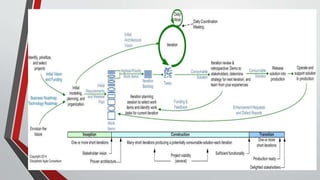
Disciplined Agile Framework (DAD)
• Hybrid Agile Approach
• 4 Lifecycles – Agile Basic, Advanced Lean, CI, Exploratory
• Delivery Phases
o Inception
o Construction
o Transition
o Ongoing
Copyright ©, 2014, DisciplinedAgileConsortium
Disciplined Agile Framework
• Focus on all solution activities (DevOps, Governance, Data Management)
• Primary Roles
• Team Lead
• Product Owner
• Architecture Owner
• Team Member
• Stakeholder
• Secondary Roles (At Scale –Temporary)
Copyright ©, 2014, DisciplinedAgileConsortium
Scaled Agile (SAFe)
CoreValues
• Alignment
• Code Quality
• Program Execution
• Transparency
• Scales successfully to large numbers of practitioners and teams
• Develop on cadence – release on demand
© 2008 - 2012 Leffingwell, LLC, Scaled Agile, Inc. and Pearson Education, Inc. All rights reserved.
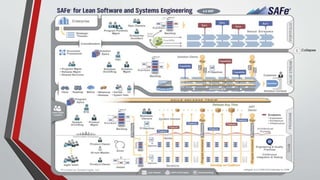
Scaled Agile Framework™ Big Picture
SAFe 4.0
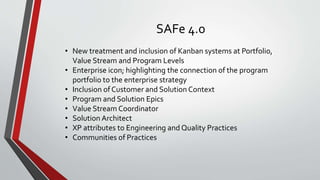
• New treatment and inclusion of Kanban systems at Portfolio,
Value Stream and Program Levels
• Enterprise icon; highlighting the connection of the program
portfolio to the enterprise strategy
• Inclusion of Customer and Solution Context
• Program and Solution Epics
• Value Stream Coordinator
• Solution Architect
• XP attributes to Engineering and Quality Practices
• Communities of Practices
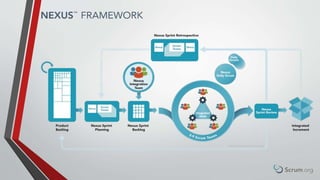
Scaled Professional Scrum (Nexus)
• Based on Scrum (Exoskeleton)
• 3-9 ScrumTeams working on a single product backlog
• Nexus + unification of more than one Nexus
• “Done” integrated increment every sprint
• Nexus IntegrationTeam (PO, SM, IntegrationTeam)
• Nexus Daily Scrum, Sprint Review, Retrospective
• Focused on dependencies and interoperation between teams
Copyright Scrum.org, 2015 All Rights Reserved
Nexus
• Nexus IntegrationTeam – PO, SM and 1 or more team members
• Nexus Sprint Planning – coordinate the activities of the ScrumTeams
• Nexus Daily Scrum – representatives from individual ScrumTeams
• Nexus Sprint Retrospective – Parts 1, 2, 3 multiple, individual teams, track
actions
• Refinement – Parts 1, 2 cross- teams, focus on dependences
Copyright Scrum.org, 2015All Rights Reserved
Framework Comparison
LeSS DADs SAFe Nexus (Scrum of
Scrums)
CoreAgile Principals Adherence to Scrum
rules
Does not strictly
adhere to scrum
Code Quality, Lean,
Scrum and Kanban
Extension of scrum
Code Quality Technical Excellence High Promotes XP concepts Augments Scrum
Size Less – 8Teams, Huge –
1000s
1000s ARTs 50 -125
developers, multiple
ARTs
3-9Teams – 100
people
Nexus Plus – multiple
Organizational Levels Portfolio – low
Program – low
Team - medium
Portfolio – medium
Program – high
Team - high
*Portfolio – medium
Program – high
Team - high
Portfolio – low
Program – low
Team - Medium
Prescriptiveness Less structured Many approaches –
tailor
22Templates
Structure around
release planning, trains
flexible design
Low – based on Scrum
Certifications Certified LeSS
Coaching Partner
DisciplinedAgile
Consortium white,
yellow, green, black
belts
SAFeAcademy– SPC,
SA, SP
Scrum. Org
Scaled Professional
Tools Minimalist approach TFS template
(independent of tools)
Version One, JIRA,
Rally
Unknown
Summary
Selection Factors For Adopting an Approach or Framework
• Co-locatedTeams
• Organizational Complexity and Maturity
• Accessibility to Qualified Coaches andTraining
• Delivery Cadence
• Maturity - NewVersions
• Tools
• Strong Case Studies
Questions

Scaled Agile - PMI

  • 1.
    Enterprise Agile Project ManagementInstitute Portland Chapter September 15, 2015
  • 2.
    John Gugel, PMP,PMI-ACP, CSP, SAFe SPC • Agile Coach • Scrum Master • Product Owner • PMI-ACP Instructor • Nike • Symantec • Xerox • SymphonyTeleca Roles Companies • SAFe Agilest (SA) Training • SAFe Practitioner (SP)Training • Enterprise Transformation Services www.linkedin/in/johnlgugel john@gugel.net
  • 3.
    Agenda • What isScaling Agile to the Enterprise Level? • High-level Overview of Five Agile Scaling Approaches • Focusing on the portfolio or enterprise level • Contrasts of Strengths andWeaknesses • Summary
  • 4.
    What is ScalingAgile? • Going beyond the team level – what does that mean? • ScrumWorksWellWith Co-locatedTeams • A Few AgileTeams, Multiple, Hundreds • Geographically LocatedTeams, Dependencies • What Framework or Approach to Use? • Natural Growth or EnterpriseTransformation?
  • 5.
    Different Scaling Approaches •Scrum of Scrums • Large Scale Scrum (LeSS) • Disciplined Agile Delivery (DAD) • Scaled Agile Framework (SAFe) • Nexus
  • 6.
    Scrum of Scrums •Natural Step for Scaling Agile • Multi-team Daily Standup • Not a Status Meeting • Identify Dependencies orAddress Integration Pain Points BetweenTeams • Technical Representative From EachTeam • Missing Portfolio Component
  • 7.
    Large Scale Scrum(LeSS) • Two Frameworks – LeSS -up to 50, LeSS Huge - 100’s on a single product • A Single Product Backlog (because it’s for a product, not a team), • One Potentially Shippable Product Increment at the end of each Sprint, • One (overall) Product Owner, • Many complete, cross-functional teams (with no specialist teams), • One Sprint. • All teams are in common sprint to deliver common PSPI Copyright © 2014The LeSS Company B.V.All Rights Reserved
  • 8.
    LeSS • Sprint PlanningPart 1 (2 members per team to identify dependencies), Part 2 (entire team) • Daily Scrum (each team) • Scrum of Scrums orTown Hall (several times a week) • Overall Product Backlog Refinement ( 2 members per team), Product Backlog Refinement (entire team) • Sprint Review – (2 members per team) “science fair” • Overall Retrospective – (each sprint with team), Joint – first week of subsequent sprint with 1 team member) Copyright © 2014The LeSS Company B.V. All Rights Reserved
  • 11.
    Disciplined Agile Framework(DAD) • Hybrid Agile Approach • 4 Lifecycles – Agile Basic, Advanced Lean, CI, Exploratory • Delivery Phases o Inception o Construction o Transition o Ongoing Copyright ©, 2014, DisciplinedAgileConsortium
  • 12.
    Disciplined Agile Framework •Focus on all solution activities (DevOps, Governance, Data Management) • Primary Roles • Team Lead • Product Owner • Architecture Owner • Team Member • Stakeholder • Secondary Roles (At Scale –Temporary) Copyright ©, 2014, DisciplinedAgileConsortium
  • 14.
    Scaled Agile (SAFe) CoreValues •Alignment • Code Quality • Program Execution • Transparency • Scales successfully to large numbers of practitioners and teams • Develop on cadence – release on demand © 2008 - 2012 Leffingwell, LLC, Scaled Agile, Inc. and Pearson Education, Inc. All rights reserved.
  • 15.
  • 17.
    SAFe 4.0 • Newtreatment and inclusion of Kanban systems at Portfolio, Value Stream and Program Levels • Enterprise icon; highlighting the connection of the program portfolio to the enterprise strategy • Inclusion of Customer and Solution Context • Program and Solution Epics • Value Stream Coordinator • Solution Architect • XP attributes to Engineering and Quality Practices • Communities of Practices
  • 18.
    Scaled Professional Scrum(Nexus) • Based on Scrum (Exoskeleton) • 3-9 ScrumTeams working on a single product backlog • Nexus + unification of more than one Nexus • “Done” integrated increment every sprint • Nexus IntegrationTeam (PO, SM, IntegrationTeam) • Nexus Daily Scrum, Sprint Review, Retrospective • Focused on dependencies and interoperation between teams Copyright Scrum.org, 2015 All Rights Reserved
  • 19.
    Nexus • Nexus IntegrationTeam– PO, SM and 1 or more team members • Nexus Sprint Planning – coordinate the activities of the ScrumTeams • Nexus Daily Scrum – representatives from individual ScrumTeams • Nexus Sprint Retrospective – Parts 1, 2, 3 multiple, individual teams, track actions • Refinement – Parts 1, 2 cross- teams, focus on dependences Copyright Scrum.org, 2015All Rights Reserved
  • 21.
    Framework Comparison LeSS DADsSAFe Nexus (Scrum of Scrums) CoreAgile Principals Adherence to Scrum rules Does not strictly adhere to scrum Code Quality, Lean, Scrum and Kanban Extension of scrum Code Quality Technical Excellence High Promotes XP concepts Augments Scrum Size Less – 8Teams, Huge – 1000s 1000s ARTs 50 -125 developers, multiple ARTs 3-9Teams – 100 people Nexus Plus – multiple Organizational Levels Portfolio – low Program – low Team - medium Portfolio – medium Program – high Team - high *Portfolio – medium Program – high Team - high Portfolio – low Program – low Team - Medium Prescriptiveness Less structured Many approaches – tailor 22Templates Structure around release planning, trains flexible design Low – based on Scrum Certifications Certified LeSS Coaching Partner DisciplinedAgile Consortium white, yellow, green, black belts SAFeAcademy– SPC, SA, SP Scrum. Org Scaled Professional Tools Minimalist approach TFS template (independent of tools) Version One, JIRA, Rally Unknown
  • 22.
    Summary Selection Factors ForAdopting an Approach or Framework • Co-locatedTeams • Organizational Complexity and Maturity • Accessibility to Qualified Coaches andTraining • Delivery Cadence • Maturity - NewVersions • Tools • Strong Case Studies
  • 23.

Editor's Notes

  • #8 Craig Larman and Bas Vodde
  • #12 Scott Ambler
  • #15 Dean Leffingwell Clear lines of authority for decentralization Cadence and sync for asset building
  • #19 Reducing dependencies – Domain Knowledge Structuring Product Backlog Software Teams
  • #22 Combined Nexus with Scrum of Scrums LeSS – Technical Excellence - engineering practices SAFe – XP (pair programming, refactoring, collective ownership, CI – can’t scale crappy code) DADs – Akido - Shu, Ha, Ri (Follow the rule, Break the rule, Be the rule)
  • #23 Centralized or Decentralized Number of products, feature or component teams Where are you starting – bottom, middle or big