Cultural Citizenship in the 'Cultural' Society: A Cosmopolitan Approach Nick Stevenson Week 9: Multicultural Citizens Sasha Harrison Spring 2011 GCE
* Overview * Seeks to develop model of cultural citizenship for a cosmopolitan age **Themes and Issues** Importance of democratic notions of “civil” society Questions of cultural exclusion Impact of media and mass communication Globalization Identity Politics
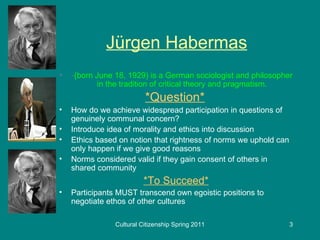
Jürgen Habermas - (born June 18, 1929) is a German sociologist and philosopher in the tradition of critical theory and pragmatism. *Question*   How do we achieve widespread participation in questions of genuinely communal concern? Introduce idea of morality and ethics into discussion Ethics based on notion that rightness of norms we uphold can only happen if we give good reasons Norms considered valid if they gain consent of others in shared community *To Succeed* Participants MUST transcend own egoistic positions to negotiate ethos of other cultures
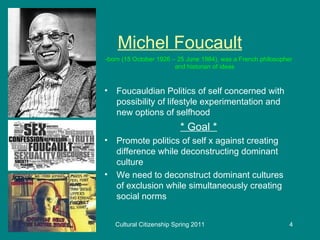
Michel Foucault -born (15 October 1926 – 25 June 1984), was a French philosopher and historian of ideas Foucauldian Politics of self concerned with possibility of lifestyle experimentation and new options of selfhood * Goal * Promote politics of self x against creating difference while deconstructing dominant culture We need to deconstruct dominant cultures of exclusion while simultaneously creating social norms
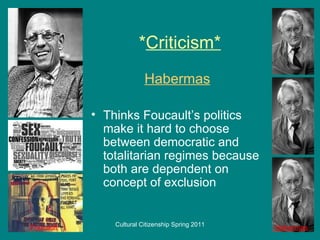
* Criticism* Habermas Thinks Foucault’s politics make it hard to choose between democratic and totalitarian regimes because both are dependent on concept of exclusion Habermas Foucault
Will Kymlicka liberal societies need to become more welcoming with respect to group rights 3 Ways to do this National societies grant minority communities rights to self government Public recognition and tolerance of cultural practices of minorities Special forms of representation that could be made, given that polity dominated by white men
Argument against Kymlicka Liberals concerned that granting group rights is actually hostile to recognition of individual rights Leaves little space for intermixing of cultures, inter-cultural relationships Could lead to form of cultural apartheid rather than intercultural recognition of differences through dialogue  Conclusion: Main purpose is that a group-differentiated citizenship is desirable since it will likely promote conditions for social unity
Joke Hermes *Argument* Media has transformed citizenship by constructing us as members of overlapping communities *Result* Opened up new forms of subjectivity and identity through popular culture Ex: Increases gendered forms of thinking, “fantasies” hopes and utopias
Tony Bennett Understanding cultural citizenship as cultural policy *Aim* “ shift from a Marxism which is overtly concerned with the colonisation of aesthetics or semiotic warfare to a social democratic analysis that seeks to make cultural studies both more practical and more relevant”
Education for Modern Citizenship Citizenship studies should be relocated within range of cultural conflicts including multiculturalism, questions of difference, popular and educated culture Create democratic cultural policies Foster dialogue and communication Cosmopolitan Educational Strategy-question Eurocentrism and monoculturalism Teach citizenship in British schools-foster “active” citizenship in schools “ Care of self” -appreciation of self to be creative Critically analyze cultural power
Discussion Questions How do we achieve Habermas’s goal of widespread participation in questions of genuinely communal concern? How can we deconstruct Foucault’s dominant cultures of exclusion while simultaneously creating social norms? Can we do this without affirmative action? What would you define as “social norms” in your culture/society? Do you think we can achieve teaching “Cultural” citizenship in our educational system? How? Would you be comfortable teaching it? ??????????????????????????????????????????????????????

Sasha Harrison: Cosmopolitan Education

  • 1.
    Cultural Citizenship inthe 'Cultural' Society: A Cosmopolitan Approach Nick Stevenson Week 9: Multicultural Citizens Sasha Harrison Spring 2011 GCE
  • 2.
    * Overview *Seeks to develop model of cultural citizenship for a cosmopolitan age **Themes and Issues** Importance of democratic notions of “civil” society Questions of cultural exclusion Impact of media and mass communication Globalization Identity Politics
  • 3.
    Jürgen Habermas -(born June 18, 1929) is a German sociologist and philosopher in the tradition of critical theory and pragmatism. *Question* How do we achieve widespread participation in questions of genuinely communal concern? Introduce idea of morality and ethics into discussion Ethics based on notion that rightness of norms we uphold can only happen if we give good reasons Norms considered valid if they gain consent of others in shared community *To Succeed* Participants MUST transcend own egoistic positions to negotiate ethos of other cultures
  • 4.
    Michel Foucault -born(15 October 1926 – 25 June 1984), was a French philosopher and historian of ideas Foucauldian Politics of self concerned with possibility of lifestyle experimentation and new options of selfhood * Goal * Promote politics of self x against creating difference while deconstructing dominant culture We need to deconstruct dominant cultures of exclusion while simultaneously creating social norms
  • 5.
    * Criticism* HabermasThinks Foucault’s politics make it hard to choose between democratic and totalitarian regimes because both are dependent on concept of exclusion Habermas Foucault
  • 6.
    Will Kymlicka liberalsocieties need to become more welcoming with respect to group rights 3 Ways to do this National societies grant minority communities rights to self government Public recognition and tolerance of cultural practices of minorities Special forms of representation that could be made, given that polity dominated by white men
  • 7.
    Argument against KymlickaLiberals concerned that granting group rights is actually hostile to recognition of individual rights Leaves little space for intermixing of cultures, inter-cultural relationships Could lead to form of cultural apartheid rather than intercultural recognition of differences through dialogue Conclusion: Main purpose is that a group-differentiated citizenship is desirable since it will likely promote conditions for social unity
  • 8.
    Joke Hermes *Argument*Media has transformed citizenship by constructing us as members of overlapping communities *Result* Opened up new forms of subjectivity and identity through popular culture Ex: Increases gendered forms of thinking, “fantasies” hopes and utopias
  • 9.
    Tony Bennett Understandingcultural citizenship as cultural policy *Aim* “ shift from a Marxism which is overtly concerned with the colonisation of aesthetics or semiotic warfare to a social democratic analysis that seeks to make cultural studies both more practical and more relevant”
  • 10.
    Education for ModernCitizenship Citizenship studies should be relocated within range of cultural conflicts including multiculturalism, questions of difference, popular and educated culture Create democratic cultural policies Foster dialogue and communication Cosmopolitan Educational Strategy-question Eurocentrism and monoculturalism Teach citizenship in British schools-foster “active” citizenship in schools “ Care of self” -appreciation of self to be creative Critically analyze cultural power
  • 11.
    Discussion Questions Howdo we achieve Habermas’s goal of widespread participation in questions of genuinely communal concern? How can we deconstruct Foucault’s dominant cultures of exclusion while simultaneously creating social norms? Can we do this without affirmative action? What would you define as “social norms” in your culture/society? Do you think we can achieve teaching “Cultural” citizenship in our educational system? How? Would you be comfortable teaching it? ??????????????????????????????????????????????????????