Sarah Murphy
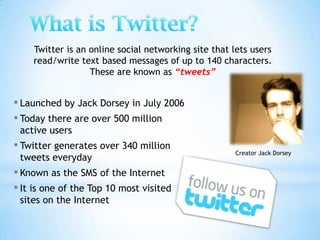
Twitter is an online social networking site that lets users
    read/write text based messages of up to 140 characters.
                  These are known as “tweets”


▪ Launched by Jack Dorsey in July 2006
▪ Today there are over 500 million
 active users
▪ Twitter generates over 340 million                 Creator Jack Dorsey
 tweets everyday
▪ Known as the SMS of the Internet
▪ It is one of the Top 10 most visited
 sites on the Internet
Simple, Time
Its

  Efficient &
Conversational
▪ There are 4 main reasons why people tweet:
     Conversation, Daily Chatter, Sharing Information or
                Reporting the news
▪ It helps social media addicts be informed on
 what is going on in the world
▪ It is a quicker way to gets news without
 having to wait for the 6 o`clock news or pick
 up a newspaper
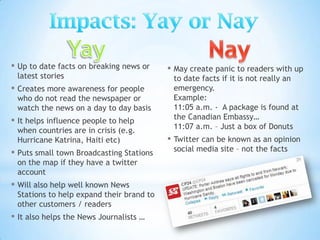
▪ Up to date facts on breaking news or    ▪ May create panic to readers with up
 latest stories                            to date facts if it is not really an
▪ Creates more awareness for people        emergency.
 who do not read the newspaper or          Example:
 watch the news on a day to day basis      11:05 a.m. - A package is found at
▪ It helps influence people to help        the Canadian Embassy…
 when countries are in crisis (e.g.        11:07 a.m. – Just a box of Donuts
 Hurricane Katrina, Haiti etc)            ▪ Twitter can be known as an opinion
▪ Puts small town Broadcasting Stations    social media site – not the facts
 on the map if they have a twitter
 account
▪ Will also help well known News
 Stations to help expand their brand to
 other customers / readers
▪ It also helps the News Journalists …
▪ In recent years more Journalists have been tweeting news
 to engage audiences as well as further their fan base
▪ It helps Journalists become active in their society and let
 the readers know that they reporting all the time (not just
 on the 6 o`clock news)
▪ It helps Journalists connect with their viewers as well as
 other Journalists to promote information-sharing, new
 experiences and knowledge
▪ Twitter also allows viewers/readers to respond to
 Journalists personal opinions as well as latest news stories
▪ Many News Broadcasts encourage their Journalists to have
 twitter accounts to help their brand as well
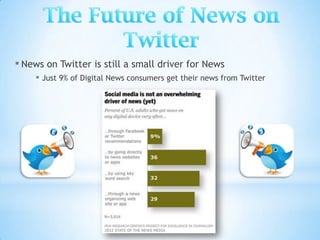
▪ News on Twitter is still a small driver for News
    ▪ Just 9% of Digital News consumers get their news from Twitter
An experiment was done in July 2009 called the `Retweet Tree
Analysis` which shows the instances of Retweeting. When a message is
    Retweeted just a few times it reaches a huge number of users
The ideas behind Stanley Milgram's original "six degrees of
 separation" experiment, which suggested that any two people on
      earth could be connected by at most six hops from one
   acquaintance to the next, have been widely applied to online
                social networks; Specifically Twitter


No matter how many followers a user has, with one retweet from a
   user it can be seen by 26 people upwards to 29,534,177 people
 (Justin Biebers follower count) with one retweet it has given each
user the power to spread information from these news sources with
                 doing nothing but clicking a mouse.
▪ With the rise of Twitter and other social media sites
 (StumbleUpon, Facebook etc) it’s now possible to have a news
 site built entirely around sharing
▪ With one Retweet from a Journalist millions of people can see
 the Breaking story of that day
▪ It seems that today`s generation is more interested in seeing
 information and sharing it with the rest of the world than just
 reading it and talking about it later with a co -worker
▪ With the way Twitter going with over 500 Million active users
 there is no stopping this phenomenon …


 Twitter has broken into this Technical Bubble and there is no
                     stopping its growth
Clayfield, M. (2012) Tweet the Press. Metro, (171), 92-97


Hargitti, E., & Litt, E. (2012) Becoming a Tweep. Information,
Communication & Society15(5), 680-702.
doi:10.1080/1369118X.2012.666256


Lasorsa, D.L., Lewis, S.C., & Holton A.E. (2012). Normalizing
Twitter. Journalizing Studies, 13(1), 19-36.
doi:10.1080é1461670X.2011.571825

Sarah murphy newsontwitterpp

  • 1.
  • 2.
    Twitter is anonline social networking site that lets users read/write text based messages of up to 140 characters. These are known as “tweets” ▪ Launched by Jack Dorsey in July 2006 ▪ Today there are over 500 million active users ▪ Twitter generates over 340 million Creator Jack Dorsey tweets everyday ▪ Known as the SMS of the Internet ▪ It is one of the Top 10 most visited sites on the Internet
  • 3.
    Simple, Time Its Efficient & Conversational
  • 4.
    ▪ There are4 main reasons why people tweet: Conversation, Daily Chatter, Sharing Information or Reporting the news ▪ It helps social media addicts be informed on what is going on in the world ▪ It is a quicker way to gets news without having to wait for the 6 o`clock news or pick up a newspaper
  • 5.
    ▪ Up todate facts on breaking news or ▪ May create panic to readers with up latest stories to date facts if it is not really an ▪ Creates more awareness for people emergency. who do not read the newspaper or Example: watch the news on a day to day basis 11:05 a.m. - A package is found at ▪ It helps influence people to help the Canadian Embassy… when countries are in crisis (e.g. 11:07 a.m. – Just a box of Donuts Hurricane Katrina, Haiti etc) ▪ Twitter can be known as an opinion ▪ Puts small town Broadcasting Stations social media site – not the facts on the map if they have a twitter account ▪ Will also help well known News Stations to help expand their brand to other customers / readers ▪ It also helps the News Journalists …
  • 6.
    ▪ In recentyears more Journalists have been tweeting news to engage audiences as well as further their fan base ▪ It helps Journalists become active in their society and let the readers know that they reporting all the time (not just on the 6 o`clock news) ▪ It helps Journalists connect with their viewers as well as other Journalists to promote information-sharing, new experiences and knowledge ▪ Twitter also allows viewers/readers to respond to Journalists personal opinions as well as latest news stories ▪ Many News Broadcasts encourage their Journalists to have twitter accounts to help their brand as well
  • 8.
    ▪ News onTwitter is still a small driver for News ▪ Just 9% of Digital News consumers get their news from Twitter
  • 9.
    An experiment wasdone in July 2009 called the `Retweet Tree Analysis` which shows the instances of Retweeting. When a message is Retweeted just a few times it reaches a huge number of users
  • 10.
    The ideas behindStanley Milgram's original "six degrees of separation" experiment, which suggested that any two people on earth could be connected by at most six hops from one acquaintance to the next, have been widely applied to online social networks; Specifically Twitter No matter how many followers a user has, with one retweet from a user it can be seen by 26 people upwards to 29,534,177 people (Justin Biebers follower count) with one retweet it has given each user the power to spread information from these news sources with doing nothing but clicking a mouse.
  • 11.
    ▪ With therise of Twitter and other social media sites (StumbleUpon, Facebook etc) it’s now possible to have a news site built entirely around sharing ▪ With one Retweet from a Journalist millions of people can see the Breaking story of that day ▪ It seems that today`s generation is more interested in seeing information and sharing it with the rest of the world than just reading it and talking about it later with a co -worker ▪ With the way Twitter going with over 500 Million active users there is no stopping this phenomenon … Twitter has broken into this Technical Bubble and there is no stopping its growth
  • 13.
    Clayfield, M. (2012)Tweet the Press. Metro, (171), 92-97 Hargitti, E., & Litt, E. (2012) Becoming a Tweep. Information, Communication & Society15(5), 680-702. doi:10.1080/1369118X.2012.666256 Lasorsa, D.L., Lewis, S.C., & Holton A.E. (2012). Normalizing Twitter. Journalizing Studies, 13(1), 19-36. doi:10.1080é1461670X.2011.571825