F
a		yomowro
hs. 
Th	
k
hb	oshp://wp.m/p1C5j-D. 
 
Ths s o
 opc whch ca

o b smm p 
 a s
	 pos. So hs pos s k
 of 
absracposwhchwo	a	kaboh
ra	rm
o	oy.Sbsq
possha		ak 
pach opca
possb	yshowcasamo.Noh
morca
spp	m
 hh	p.sap 
ssohrsh	
k.Thb	owxsjsasmmarzao
ofwhavryora
h 
	
k. 
 
A 	y compa
y sa		y b		s s srvcs a h 
 of a spp	y pro. Ths ca
 b 
proc b		
 or v
 a

a	 b		
.Wh h hh 	y b		s csomr ca
 
ra 
v
pay
 hprocb		s aks m for h csomrs, cas
 hxco
 r
of 


 a
 
sa		m
 p	a
s.  h 	y frm 
s cash o ma
a
 s crr
 
bs
sssoca
swcho		
amo
s
saofhamo
hcsomrs 
xpc oow,so ha h	y’s 	qy sma
a
.The basis of Budget Billing is 
the Budget Billing plan which sets the due dates and the Budget Billing amounts. 
• The system can automatically create Budget Billing plans during invoicing or move-in 
processing. However, one can create them manually too. 
http://help.sap.com/erp2005_ehp_07/helpdata/en/c6/4dc89feafc11d18a030000e829fbb 
d/content.htm?frameset=/en/c6/4dc89feafc11d18a030000e829fbbd/frameset.htmcurr 
ent_toc=/en/c4/02693582f4db60e10000009b38f889/plain.htmnode_id=52show_child 
ren=false 
• Contracts that have to be invoiced together (joint invoicing) are assigned a common 
Budget Billing plan. All other contracts in the contract account can have their own 
separate Budget Billing plan. Budget billing amounts can be stored either as down 
payments (statistical receivables) or as partial bills (debit entries) in Contract 
Accounts Receivable and Payable and are therefore subject to all dunning and 
payment procedures. 
There are 4 Budget Billing Procedures as mentioned and explained below. 
1. Statistical Procedure 
2. Debit Entry Procedure (Partial Bills) 
3. Payment Plan Procedure 
4. Payment Scheme Procedure 
First a bit on the categories of Budget Billing. IS-U/CCS supports ‘Average Monthly Billing 
(AMB)’ and ‘Budget Billing Procedure (BBP)’ as special budget billing categories applicable 
to North America. 
In Budget Billing, an average amount is determined either through simulation or manually. 
The customer pays that average amount for a period of 12 months. At the same time, the 
customer’s actual consumption is billed, and the results are printed on the bill. In addition, 
sapisurdg.wordpress.com http://wp.me/p1Ci5j-eD
the difference between the customer’s actual consumption and the average amount is 
calculated, updated monthly, and printed on the bill. In the last month of the meter reading 
period, the actual amount and the accumulated difference are billed. 
In Average Monthly Billing, the customer is charged an average amount based on billings 
over the last x months (we can define the number of months, including minimum and 
maximum number of months, in Customizing). In addition, the customer’s actual 
consumption is billed, and the results are printed on the bill. The amounts due for later 
months are calculated using the average of the previous monthly bills, the current bill and 
the accumulated difference. That difference is updated monthly and is printed on the bill. 
Parameter Records have a special role to play as they along with the portion which decides 
on the BB cycle and the due dates. The due dates for the budget billing amounts are 
calculated directly from the portion applicable to the contract and from the parameter 
record. 
The following data is defined: 
• The length of the budget billing period (a number of months or a year) 
• The budget billing cycle, meaning the equal distribution of dates over the period 
(one or more months) 
However, one can override the preset values from the portion either in the budget billing 
plan itself or in a contract. While changes made in the budget billing plan take effect 
immediately, entries made in the contract do not take effect until the budget billing plan is 
created again. 
Every parameter record can contain up to 5 budget billing cycles. One can select the 
following values: 
• 00: No budget billing amounts are levied 
• 01: Budget billing amounts are levied every month 
• 02: Budget billing amounts are levied every 2 months 
• 03: Budget billing amounts are levied every 3 months 
• 04: Budget billing amounts are levied every 4 months 
• 06: Budget billing amounts are levied every 6 months 
• 12: Annual payer; one budget billing amount is levied. 
When we define a budget billing cycle, we must enter the budget billing cycle as well as the 
scheduled print date of the budget billing request or the creation of the partial bill in the BB 
req./part. bill field. 
In the field Months inv.-1st BB, we define the time between the end of the last billing period 
and point when the first budget billing amount is levied. 
If we want to use the parameter record to create portions with a duration of days, we need 
to enter the number of days after the start of this period that we want the first budget 
billing item to be calculated in the field Days to Bud. Bill. The system uses this number of 
days to calculate the other budget billing items. 
sapisurdg.wordpress.com http://wp.me/p1Ci5j-eD
In the portion we have the following fields 
BB/Bill Dates (Group Due Date of Budget Billing Items and Bill) 
Here, you can define whether you want to group the due date together with the next budget 
billing amount or with the next bill. 
Dun Due Date (Dun the Last Due Date of a Budget Billing Plan) 
This indicator is only used for the statistical budget billing plan procedure. When it is set, 
the Cannot Be Dunned in BB Plan field is not set. 
Define Budget Billing Cycles 
When we select the budget billing cycle, we can specify the number of budget billing 
amounts that are charged. If we want to levy budget billing amounts, at least one permitted 
budget billing cycle must be set with the number of budget billing amounts. 
Budget Billing Cycle 
We can define a cycle in the portion as a standard cycle. We can only use budget billing 
cycles that are defined in the allocated parameter record. If we do not levy budget billing 
amounts, no data is saved in the budget billing data table TE423 (Budget Billing Dates) 
when the schedule records of the portion are generated. 
If we define more than one cycle, the entries for every cycle are saved in the table TE423. 
sapisurdg.wordpress.com http://wp.me/p1Ci5j-eD
Budget Billing Amount Calculation 
The system calculates the budget billing amount on the basis of the expected meter reading 
results (Extrapolation). Extrapolation can be based on the following information: Amounts 
from the last bill. The extrapolation lines for the budget billing amounts are generated 
automatically during periodic billing. 
• Periodic consumption 
• Reference value in the rate 
• Manual specification of the budget billing amounts 
The following functions are also available for calculating the budget billing amount: 
• In the case of an interim billing, one can specify whether the remaining budget 
billing amounts are to be adjusted. 
• In the case of budget billing, one can also perform mass changes. 
1. In case of statistical budget billing procedure, the budget billing amounts are 
displayed as a statistical posting (not a posting in general ledger) in the account 
balance display. 
2. In case of partial bill procedure, the individual amounts are entered as a 
receivable on the debit side after the completed partial bill run. The budget billing 
amounts are not displayed in the account balance display immediately after the 
budget billing plan has been created unlike statistical budget billing. The budget 
billing plan is managed for the partial bill procedure in a shadow table (DFKKMOP 
and DFKKMOPW). This is not used by FI-CA. After the report Create Partial Bill 
(transaction EA11) has been started, the item is posted in FI-CA (debit entry). This is 
an actual posting with VAT. 
3. In the payment plan, the utility company and the customer decide on the amount to 
be paid with each bill. So instead of paying the actual bill amount, which varies 
according to season, the customer pays the payment plan amount. The utility 
company records the difference between the payment plan amount and the actual 
bill amount and charges it at a later date. Depending on the category to which the 
payment plan belongs, or depending on the settings in the contract, the difference 
amount is reimbursed or charged to the customer when the payment plan expires 
or, at the very latest, when the customers moves out of the premise. Consumption 
billing must take place for every due date of the payment plan. Because of this, the 
payment plan is not comparable to a statistical budget billing plan or a partial bill, in 
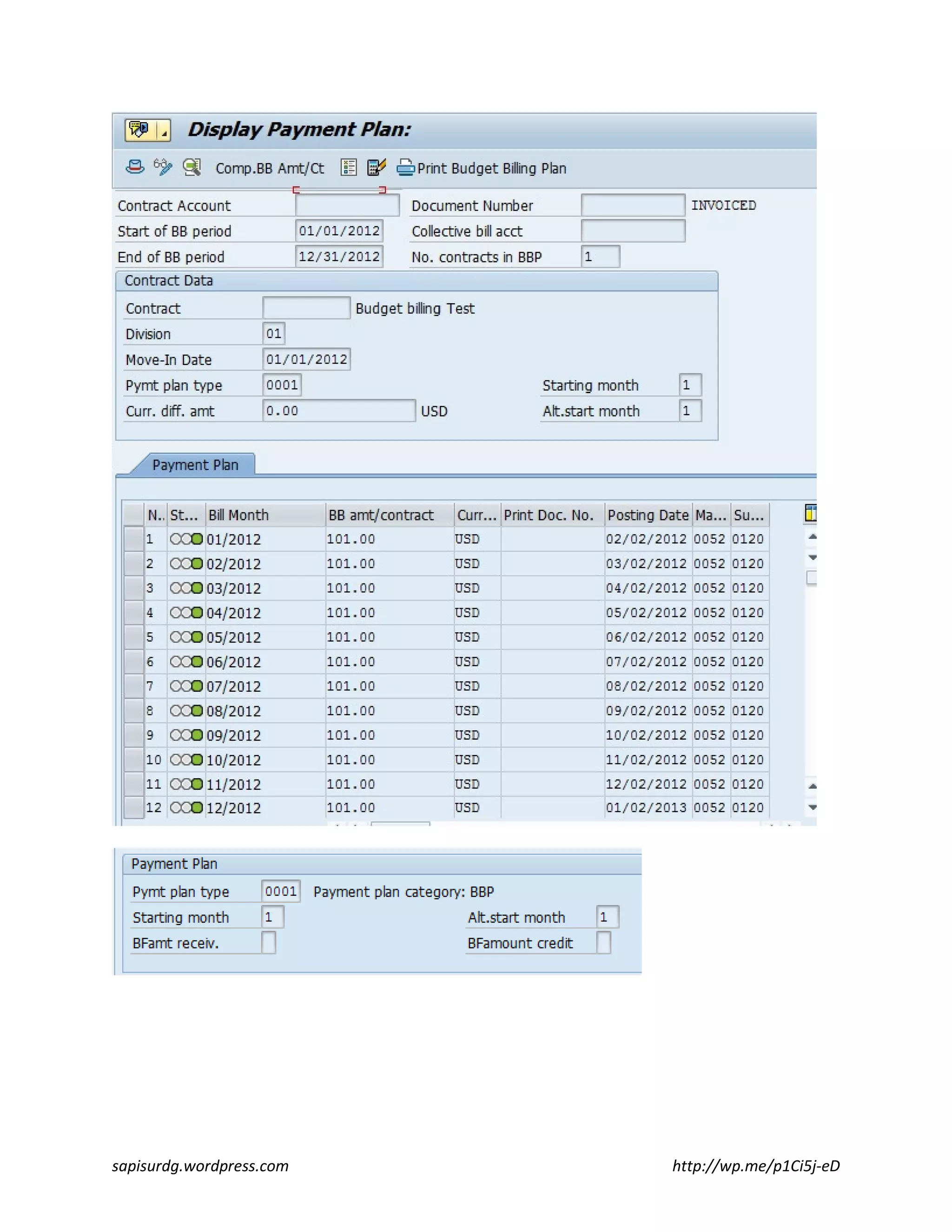
which the relevant amounts are charged in between two periodic bills. Also we can 
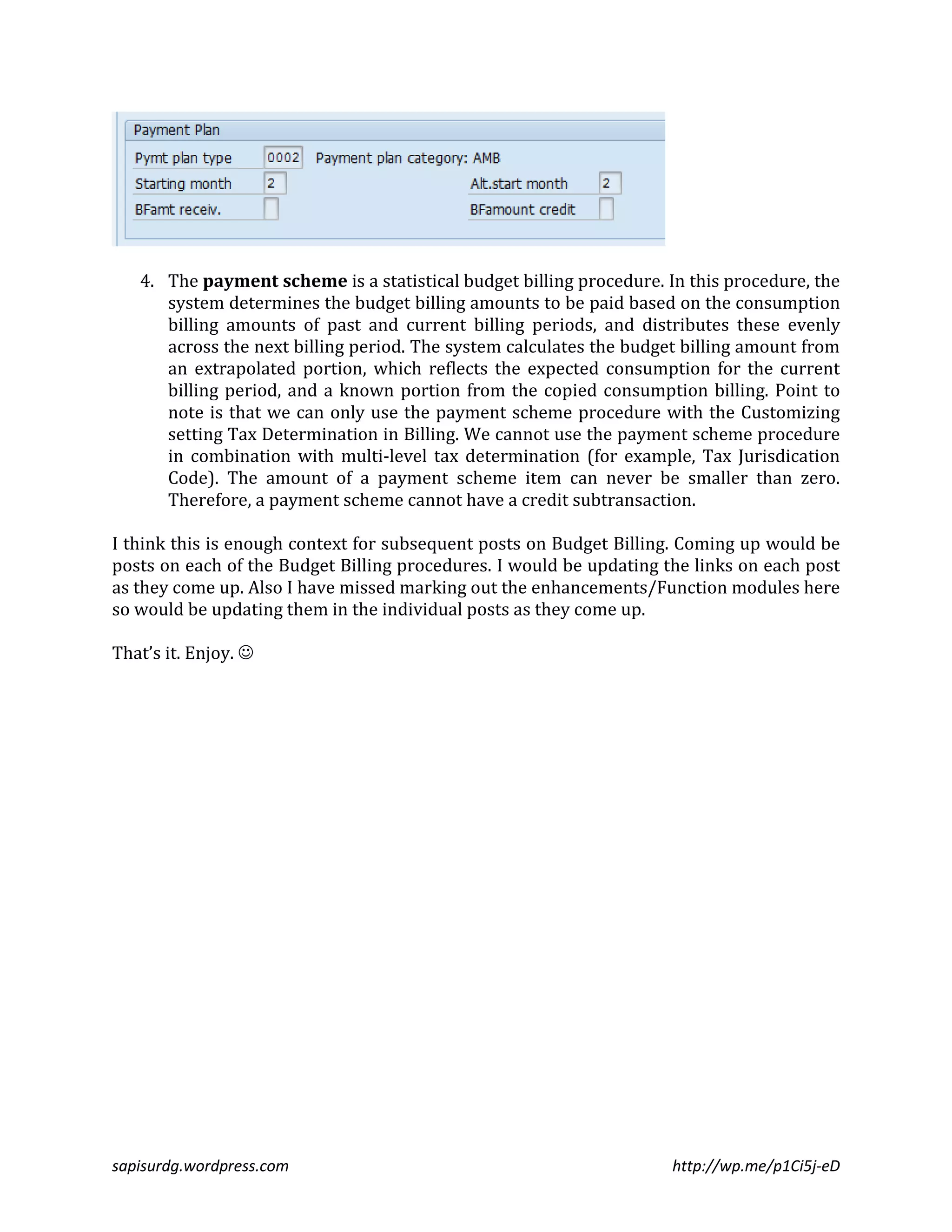
only create payment plans from category BBP. Payment plans from category AMB 
are not actually created but are managed as virtual payment plans in the system 
based on the start month or alternative start month defined in the contract. When 
the monthly bill is created, the payment plan data is evaluated and included in the 
calculation of the payment plan amount. 
sapisurdg.wordpress.com http://wp.me/p1Ci5j-eD
4. The payment scheme is a statistical budget billing procedure. In this procedure, the 
system determines the budget billing amounts to be paid based on the consumption 
billing amounts of past and current billing periods, and distributes these evenly 
across the next billing period. The system calculates the budget billing amount from 
an extrapolated portion, which reflects the expected consumption for the current 
billing period, and a known portion from the copied consumption billing. Point to 
note is that we can only use the payment scheme procedure with the Customizing 
setting Tax Determination in Billing. We cannot use the payment scheme procedure 
in combination with multi-level tax determination (for example, Tax Jurisdication 
Code). The amount of a payment scheme item can never be smaller than zero. 
Therefore, a payment scheme cannot have a credit subtransaction. 
I think this is enough context for subsequent posts on Budget Billing. Coming up would be 
posts on each of the Budget Billing procedures. I would be updating the links on each post 
as they come up. Also I have missed marking out the enhancements/Function modules here 
so would be updating them in the individual posts as they come up. 
That’s it. Enjoy.  
sapisurdg.wordpress.com http://wp.me/p1Ci5j-eD

SAP ISU : Budget Billing Basics

  • 1.
    F a yomowro hs. Th k hb oshp://wp.m/p1C5j-D. Ths s o opc whch ca o b smm p a s pos. So hs pos s k of absracposwhchwo a kaboh ra rm o oy.Sbsq possha ak pach opca possb yshowcasamo.Noh morca spp m hh p.sap ssohrsh k.Thb owxsjsasmmarzao ofwhavryora h k. A y compa y sa y b s s srvcs a h of a spp y pro. Ths ca b proc b or v a a b .Wh h hh y b s csomr ca ra v pay hprocb s aks m for h csomrs, cas hxco r of a sa m p a s. h y frm s cash o ma a s crr bs sssoca swcho amo s saofhamo hcsomrs xpc oow,so ha h y’s qy sma a .The basis of Budget Billing is the Budget Billing plan which sets the due dates and the Budget Billing amounts. • The system can automatically create Budget Billing plans during invoicing or move-in processing. However, one can create them manually too. http://help.sap.com/erp2005_ehp_07/helpdata/en/c6/4dc89feafc11d18a030000e829fbb d/content.htm?frameset=/en/c6/4dc89feafc11d18a030000e829fbbd/frameset.htmcurr ent_toc=/en/c4/02693582f4db60e10000009b38f889/plain.htmnode_id=52show_child ren=false • Contracts that have to be invoiced together (joint invoicing) are assigned a common Budget Billing plan. All other contracts in the contract account can have their own separate Budget Billing plan. Budget billing amounts can be stored either as down payments (statistical receivables) or as partial bills (debit entries) in Contract Accounts Receivable and Payable and are therefore subject to all dunning and payment procedures. There are 4 Budget Billing Procedures as mentioned and explained below. 1. Statistical Procedure 2. Debit Entry Procedure (Partial Bills) 3. Payment Plan Procedure 4. Payment Scheme Procedure First a bit on the categories of Budget Billing. IS-U/CCS supports ‘Average Monthly Billing (AMB)’ and ‘Budget Billing Procedure (BBP)’ as special budget billing categories applicable to North America. In Budget Billing, an average amount is determined either through simulation or manually. The customer pays that average amount for a period of 12 months. At the same time, the customer’s actual consumption is billed, and the results are printed on the bill. In addition, sapisurdg.wordpress.com http://wp.me/p1Ci5j-eD
  • 2.
    the difference betweenthe customer’s actual consumption and the average amount is calculated, updated monthly, and printed on the bill. In the last month of the meter reading period, the actual amount and the accumulated difference are billed. In Average Monthly Billing, the customer is charged an average amount based on billings over the last x months (we can define the number of months, including minimum and maximum number of months, in Customizing). In addition, the customer’s actual consumption is billed, and the results are printed on the bill. The amounts due for later months are calculated using the average of the previous monthly bills, the current bill and the accumulated difference. That difference is updated monthly and is printed on the bill. Parameter Records have a special role to play as they along with the portion which decides on the BB cycle and the due dates. The due dates for the budget billing amounts are calculated directly from the portion applicable to the contract and from the parameter record. The following data is defined: • The length of the budget billing period (a number of months or a year) • The budget billing cycle, meaning the equal distribution of dates over the period (one or more months) However, one can override the preset values from the portion either in the budget billing plan itself or in a contract. While changes made in the budget billing plan take effect immediately, entries made in the contract do not take effect until the budget billing plan is created again. Every parameter record can contain up to 5 budget billing cycles. One can select the following values: • 00: No budget billing amounts are levied • 01: Budget billing amounts are levied every month • 02: Budget billing amounts are levied every 2 months • 03: Budget billing amounts are levied every 3 months • 04: Budget billing amounts are levied every 4 months • 06: Budget billing amounts are levied every 6 months • 12: Annual payer; one budget billing amount is levied. When we define a budget billing cycle, we must enter the budget billing cycle as well as the scheduled print date of the budget billing request or the creation of the partial bill in the BB req./part. bill field. In the field Months inv.-1st BB, we define the time between the end of the last billing period and point when the first budget billing amount is levied. If we want to use the parameter record to create portions with a duration of days, we need to enter the number of days after the start of this period that we want the first budget billing item to be calculated in the field Days to Bud. Bill. The system uses this number of days to calculate the other budget billing items. sapisurdg.wordpress.com http://wp.me/p1Ci5j-eD
  • 3.
    In the portionwe have the following fields BB/Bill Dates (Group Due Date of Budget Billing Items and Bill) Here, you can define whether you want to group the due date together with the next budget billing amount or with the next bill. Dun Due Date (Dun the Last Due Date of a Budget Billing Plan) This indicator is only used for the statistical budget billing plan procedure. When it is set, the Cannot Be Dunned in BB Plan field is not set. Define Budget Billing Cycles When we select the budget billing cycle, we can specify the number of budget billing amounts that are charged. If we want to levy budget billing amounts, at least one permitted budget billing cycle must be set with the number of budget billing amounts. Budget Billing Cycle We can define a cycle in the portion as a standard cycle. We can only use budget billing cycles that are defined in the allocated parameter record. If we do not levy budget billing amounts, no data is saved in the budget billing data table TE423 (Budget Billing Dates) when the schedule records of the portion are generated. If we define more than one cycle, the entries for every cycle are saved in the table TE423. sapisurdg.wordpress.com http://wp.me/p1Ci5j-eD
  • 4.
    Budget Billing AmountCalculation The system calculates the budget billing amount on the basis of the expected meter reading results (Extrapolation). Extrapolation can be based on the following information: Amounts from the last bill. The extrapolation lines for the budget billing amounts are generated automatically during periodic billing. • Periodic consumption • Reference value in the rate • Manual specification of the budget billing amounts The following functions are also available for calculating the budget billing amount: • In the case of an interim billing, one can specify whether the remaining budget billing amounts are to be adjusted. • In the case of budget billing, one can also perform mass changes. 1. In case of statistical budget billing procedure, the budget billing amounts are displayed as a statistical posting (not a posting in general ledger) in the account balance display. 2. In case of partial bill procedure, the individual amounts are entered as a receivable on the debit side after the completed partial bill run. The budget billing amounts are not displayed in the account balance display immediately after the budget billing plan has been created unlike statistical budget billing. The budget billing plan is managed for the partial bill procedure in a shadow table (DFKKMOP and DFKKMOPW). This is not used by FI-CA. After the report Create Partial Bill (transaction EA11) has been started, the item is posted in FI-CA (debit entry). This is an actual posting with VAT. 3. In the payment plan, the utility company and the customer decide on the amount to be paid with each bill. So instead of paying the actual bill amount, which varies according to season, the customer pays the payment plan amount. The utility company records the difference between the payment plan amount and the actual bill amount and charges it at a later date. Depending on the category to which the payment plan belongs, or depending on the settings in the contract, the difference amount is reimbursed or charged to the customer when the payment plan expires or, at the very latest, when the customers moves out of the premise. Consumption billing must take place for every due date of the payment plan. Because of this, the payment plan is not comparable to a statistical budget billing plan or a partial bill, in which the relevant amounts are charged in between two periodic bills. Also we can only create payment plans from category BBP. Payment plans from category AMB are not actually created but are managed as virtual payment plans in the system based on the start month or alternative start month defined in the contract. When the monthly bill is created, the payment plan data is evaluated and included in the calculation of the payment plan amount. sapisurdg.wordpress.com http://wp.me/p1Ci5j-eD
  • 5.
  • 6.
    4. The paymentscheme is a statistical budget billing procedure. In this procedure, the system determines the budget billing amounts to be paid based on the consumption billing amounts of past and current billing periods, and distributes these evenly across the next billing period. The system calculates the budget billing amount from an extrapolated portion, which reflects the expected consumption for the current billing period, and a known portion from the copied consumption billing. Point to note is that we can only use the payment scheme procedure with the Customizing setting Tax Determination in Billing. We cannot use the payment scheme procedure in combination with multi-level tax determination (for example, Tax Jurisdication Code). The amount of a payment scheme item can never be smaller than zero. Therefore, a payment scheme cannot have a credit subtransaction. I think this is enough context for subsequent posts on Budget Billing. Coming up would be posts on each of the Budget Billing procedures. I would be updating the links on each post as they come up. Also I have missed marking out the enhancements/Function modules here so would be updating them in the individual posts as they come up. That’s it. Enjoy. sapisurdg.wordpress.com http://wp.me/p1Ci5j-eD