SAP HANA
Session 1
Vikram Aditya
SAP Architect
JHS Infotech
For sap online/class room training contact
EMAIL: jhsinfotech@gmail.com
www.jhsinfotech.com
Introduction to SAP HANA
Session Overview
This Session presents
Why SAP HANA has been developed
and
How this new technology can help
increasing business opportunities.
www.jhsinfotech.com
Session Objectives
 After completing this lesson, you will
be able to: Explain the current
existing pain points in a system using
a classic database
 Explain how SAP HANA can handle
the pain points and help to improve
profit
www.jhsinfotech.com
Business Example
Today, a lot of companies need to deal
with an amazing amount of data and
are not able to report on them
efficiently due to data volume.
www.jhsinfotech.com
Information Explosion
www.jhsinfotech.com
Big Problem
 First, the information explosion.
Massive amounts of data is being
created every year, and how fast your
business reacts to it determines
whether you succeed or fail.
 This is a big problem and it is getting
bigger.
www.jhsinfotech.com
Statistics
 IDC estimates that worldwide digital
content added up to 487 billion
gigabytes in 2009. They predict this
will double in 18 months, and every 18
months thereafter.
 Its like a stack of DVDs all the way to
the moon and back.
www.jhsinfotech.com
Unable to use Data
 In a Sloan Management survey in
2010 60% of executives said their
companies have more data than they
know how to use effectively. With data
doubling every 18 months, that
percentage is going to keep growing.
www.jhsinfotech.com
Size of Data
 According to EMC, by the end of 2011
there was 1.8 Zetabyte of digital data.
1Zetabyte is a trillion gigabytes.
 Kilobyte>Megabyte>Gigabyte>Terabyt
e>Petabyte>Exabyte>Zetabyte>Yotta
byte
www.jhsinfotech.com
Reality
www.jhsinfotech.com
Today’s Business
 At the same time, the consumerization
trend is driving up expectations as to
what enterprise IT can help the business
to do. People want instant access to
information – in the moment – whether
that is a moment of risk or a moment of
opportunity. If the moment has passed
and your business has not taken the
right action, it has failed. People want
instant answers. They want them to be
right.
 They want them anywhere, any time.
www.jhsinfotech.com
Reality : IT Cannot Deliver
www.jhsinfotech.com
Data - Demand
This puts IT in a tough place. IT cannot
deliver what the business needs.
Why?
Because the cost of managing that data
explosion is too high. Because there is
no practical way to instantly analyze
everything thats going on relative to the
business. IT can deliver some of the
information. The most critical slice of
information can be delivered in near real
time. But its not enough. Data is
growing. Demand is increasing.
www.jhsinfotech.com
What’s the Solution ?
We must find a way to deal with this –
A way to process and analyze massive
amounts of data in real time.
www.jhsinfotech.com
Your Reality with SAP HANA
www.jhsinfotech.com
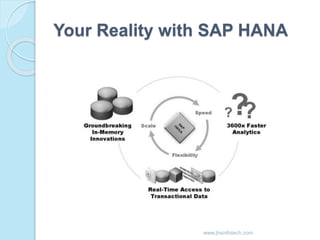
Role of HANA
Using groundbreaking in-memory
hardware and software we can manage
data at massive scale, analyze it at
amazing speed, and give the business
not only instant access to real time
transactional information and analysis
but also more flexibility. Flexibility to
analyze new types of data in different
ways, without creating custom data
warehouses and data marts. Even the
flexibility to build new applications which
were not possible before.www.jhsinfotech.com
So, whats inside HANA?
This architecture diagram explains the
main components and capabilities.We
keep throwing around words like
massive amounts of data and amazing
speed.
What kinds of scale, speed and
improvement are customers seeing?
www.jhsinfotech.com
Speed of SAP HANA
www.jhsinfotech.com
Proof Points - Proof Point 1
First, amazing speed. One of our pilot
customers reduced the time it took to run a
report from one hour to one second. That is
3600 times faster. Lets put that in
perspective. SAP talks about helping you to
“run better”, so lets use that as an example.
When an average person runs, they move at
about 7 miles per hour. 3600 times faster
would be about 25,000 miles per hour.That is
the fastest any human being has ever
travelled, and it was only done once - by the
astronauts on Apollo 10, on their return from
the moon in 1969.
www.jhsinfotech.com
Proof Point 2
Amazing amounts of data. During testing
for HANA we executed queries against
460 billion rows of data in less than one
second. That is like being able to
analyze every repair and service visit for
every car on earth in the last12 months,
in one second. Or to process every
address that everyone alive
today has ever lived at, in one second. Or
to calculate the amount of taxes paid, by
everyone on the planet, since 1950, in
one second.
www.jhsinfotech.com
Proof Point 3
And finally, amazing value. Having the
ability to create new real-time
processes and simplify your IT
landscape has a big impact. According
to a study by Oxford Economics,
companies that implement real-time
systems see an average 21% revenue
growth, and a 19% reduction in IT
cost.
www.jhsinfotech.com
Query Acceleration Example – Large Bank –
1 Month of Customer Information
www.jhsinfotech.com
Why wait for data?
All customers want to see their current
business data immediately in real-
time. Nobody wants to wait until data
is uploaded into BW.
www.jhsinfotech.com
Why wait for new systems?
Latest hardware and latest database
technology already now support real-
time reporting on massive amount of
data.
www.jhsinfotech.com
SAP Naming Update: SAP
HANA
www.jhsinfotech.com
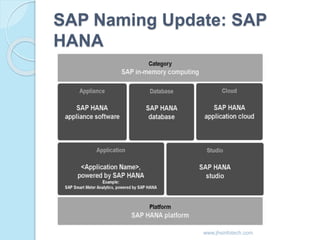
In-Memory Appliance (SAP
HANA)
www.jhsinfotech.com
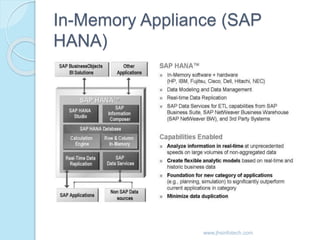
SAP HANA
 SAP HANA is a flexible, data-source-
agnostic appliance that enables
customers to analyze large volumes of
SAP ERP data in real-time, avoiding
the need to materialize
transformations.
www.jhsinfotech.com
SAP HANA as Software
Appliance
 SAP HANA appliance software is a
hardware and software combination
that integrates a number of SAP
components including the SAP HANA
database, SAP Landscape
Transformation Replication Server,
SAP HANA Direct Extractor
Connection (DXC) and Sybase
Replication technology.
www.jhsinfotech.com
SAP HANA Data Base
 The SAP HANA database is a hybrid
in-memory database that combines
row-based, column-based, and object-
based database technology. It is
optimized to exploit the parallel
processing capabilities of modern
multi-core CPU architectures. With
this architecture, SAP applications can
benefit from current hardware
technologies.
www.jhsinfotech.com
HARDWARE INNOVATIONS
www.jhsinfotech.com
Computer Architecture is Changing
www.jhsinfotech.com
Configuration
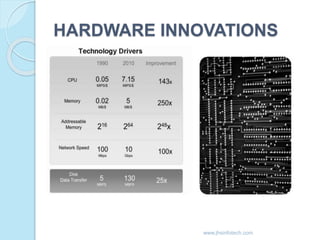
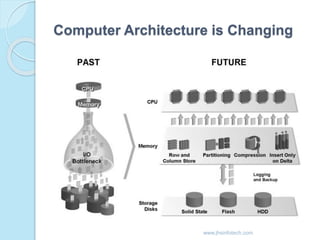
Computer architecture has changed in recent
years. Now multi-core CPUs (multiple CPUs
on one chip or in one package) are standard,
with fast communication between processor
cores enabling parallel processing. Main
memory is no-longer a limited resource,
modern servers can have 2TB of system
memory and this allows complete databases
to be held in RAM. Currently server
processors have up to 64 cores, and 128
cores will soon be available. With the
increasing number of cores, CPUs are able to
process increased data per time interval. This
shifts the performance bottleneck from disk
I/O to the data transfer between CPU cache
and main memory. www.jhsinfotech.com
Question & Answers
JHS INFOTECH
Email : info@jhsinfotech.com
jhsinfotech@gmail.com
www.jhsinfotech.com
www.jhsinfotech.com

SAP HANA Session1 JH SOFTECH

  • 1.
    SAP HANA Session 1 VikramAditya SAP Architect JHS Infotech For sap online/class room training contact EMAIL: jhsinfotech@gmail.com www.jhsinfotech.com
  • 2.
    Introduction to SAPHANA Session Overview This Session presents Why SAP HANA has been developed and How this new technology can help increasing business opportunities. www.jhsinfotech.com
  • 3.
    Session Objectives  Aftercompleting this lesson, you will be able to: Explain the current existing pain points in a system using a classic database  Explain how SAP HANA can handle the pain points and help to improve profit www.jhsinfotech.com
  • 4.
    Business Example Today, alot of companies need to deal with an amazing amount of data and are not able to report on them efficiently due to data volume. www.jhsinfotech.com
  • 5.
  • 6.
    Big Problem  First,the information explosion. Massive amounts of data is being created every year, and how fast your business reacts to it determines whether you succeed or fail.  This is a big problem and it is getting bigger. www.jhsinfotech.com
  • 7.
    Statistics  IDC estimatesthat worldwide digital content added up to 487 billion gigabytes in 2009. They predict this will double in 18 months, and every 18 months thereafter.  Its like a stack of DVDs all the way to the moon and back. www.jhsinfotech.com
  • 8.
    Unable to useData  In a Sloan Management survey in 2010 60% of executives said their companies have more data than they know how to use effectively. With data doubling every 18 months, that percentage is going to keep growing. www.jhsinfotech.com
  • 9.
    Size of Data According to EMC, by the end of 2011 there was 1.8 Zetabyte of digital data. 1Zetabyte is a trillion gigabytes.  Kilobyte>Megabyte>Gigabyte>Terabyt e>Petabyte>Exabyte>Zetabyte>Yotta byte www.jhsinfotech.com
  • 10.
  • 11.
    Today’s Business  Atthe same time, the consumerization trend is driving up expectations as to what enterprise IT can help the business to do. People want instant access to information – in the moment – whether that is a moment of risk or a moment of opportunity. If the moment has passed and your business has not taken the right action, it has failed. People want instant answers. They want them to be right.  They want them anywhere, any time. www.jhsinfotech.com
  • 12.
    Reality : ITCannot Deliver www.jhsinfotech.com
  • 13.
    Data - Demand Thisputs IT in a tough place. IT cannot deliver what the business needs. Why? Because the cost of managing that data explosion is too high. Because there is no practical way to instantly analyze everything thats going on relative to the business. IT can deliver some of the information. The most critical slice of information can be delivered in near real time. But its not enough. Data is growing. Demand is increasing. www.jhsinfotech.com
  • 14.
    What’s the Solution? We must find a way to deal with this – A way to process and analyze massive amounts of data in real time. www.jhsinfotech.com
  • 15.
    Your Reality withSAP HANA www.jhsinfotech.com
  • 16.
    Role of HANA Usinggroundbreaking in-memory hardware and software we can manage data at massive scale, analyze it at amazing speed, and give the business not only instant access to real time transactional information and analysis but also more flexibility. Flexibility to analyze new types of data in different ways, without creating custom data warehouses and data marts. Even the flexibility to build new applications which were not possible before.www.jhsinfotech.com
  • 17.
    So, whats insideHANA? This architecture diagram explains the main components and capabilities.We keep throwing around words like massive amounts of data and amazing speed. What kinds of scale, speed and improvement are customers seeing? www.jhsinfotech.com
  • 18.
    Speed of SAPHANA www.jhsinfotech.com
  • 19.
    Proof Points -Proof Point 1 First, amazing speed. One of our pilot customers reduced the time it took to run a report from one hour to one second. That is 3600 times faster. Lets put that in perspective. SAP talks about helping you to “run better”, so lets use that as an example. When an average person runs, they move at about 7 miles per hour. 3600 times faster would be about 25,000 miles per hour.That is the fastest any human being has ever travelled, and it was only done once - by the astronauts on Apollo 10, on their return from the moon in 1969. www.jhsinfotech.com
  • 20.
    Proof Point 2 Amazingamounts of data. During testing for HANA we executed queries against 460 billion rows of data in less than one second. That is like being able to analyze every repair and service visit for every car on earth in the last12 months, in one second. Or to process every address that everyone alive today has ever lived at, in one second. Or to calculate the amount of taxes paid, by everyone on the planet, since 1950, in one second. www.jhsinfotech.com
  • 21.
    Proof Point 3 Andfinally, amazing value. Having the ability to create new real-time processes and simplify your IT landscape has a big impact. According to a study by Oxford Economics, companies that implement real-time systems see an average 21% revenue growth, and a 19% reduction in IT cost. www.jhsinfotech.com
  • 22.
    Query Acceleration Example– Large Bank – 1 Month of Customer Information www.jhsinfotech.com
  • 23.
    Why wait fordata? All customers want to see their current business data immediately in real- time. Nobody wants to wait until data is uploaded into BW. www.jhsinfotech.com
  • 24.
    Why wait fornew systems? Latest hardware and latest database technology already now support real- time reporting on massive amount of data. www.jhsinfotech.com
  • 25.
    SAP Naming Update:SAP HANA www.jhsinfotech.com
  • 26.
  • 27.
    SAP HANA  SAPHANA is a flexible, data-source- agnostic appliance that enables customers to analyze large volumes of SAP ERP data in real-time, avoiding the need to materialize transformations. www.jhsinfotech.com
  • 28.
    SAP HANA asSoftware Appliance  SAP HANA appliance software is a hardware and software combination that integrates a number of SAP components including the SAP HANA database, SAP Landscape Transformation Replication Server, SAP HANA Direct Extractor Connection (DXC) and Sybase Replication technology. www.jhsinfotech.com
  • 29.
    SAP HANA DataBase  The SAP HANA database is a hybrid in-memory database that combines row-based, column-based, and object- based database technology. It is optimized to exploit the parallel processing capabilities of modern multi-core CPU architectures. With this architecture, SAP applications can benefit from current hardware technologies. www.jhsinfotech.com
  • 30.
  • 31.
    Computer Architecture isChanging www.jhsinfotech.com
  • 32.
    Configuration Computer architecture haschanged in recent years. Now multi-core CPUs (multiple CPUs on one chip or in one package) are standard, with fast communication between processor cores enabling parallel processing. Main memory is no-longer a limited resource, modern servers can have 2TB of system memory and this allows complete databases to be held in RAM. Currently server processors have up to 64 cores, and 128 cores will soon be available. With the increasing number of cores, CPUs are able to process increased data per time interval. This shifts the performance bottleneck from disk I/O to the data transfer between CPU cache and main memory. www.jhsinfotech.com
  • 33.
    Question & Answers JHSINFOTECH Email : info@jhsinfotech.com jhsinfotech@gmail.com www.jhsinfotech.com www.jhsinfotech.com