SAP HANA   AN INTRODUCTION FOR BW COMMUNITY Mishra SAP Practitioner Contact:  [email_address]
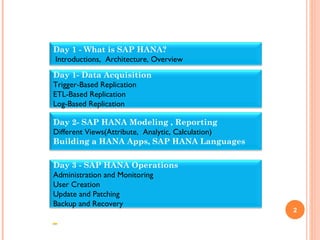
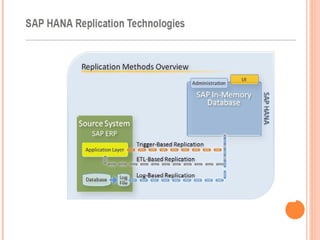
AGENDA Day 1 - What is SAP HANA? Introductions,  Architecture, Overview Day 1- Data Acquisition Trigger-Based Replication ETL-Based Replication Log-Based Replication Day 2- SAP HANA Modeling , Reporting Different Views(Attribute,  Analytic, Calculation) Building a HANA Apps, SAP HANA Languages – Day 3 - SAP HANA Operations Administration and Monitoring  User Creation Update and Patching Backup and Recovery –
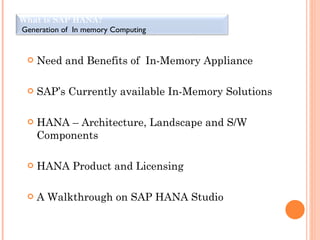
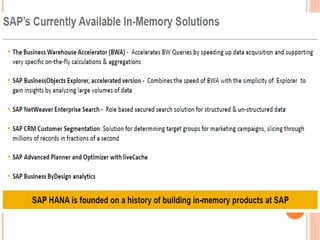
Need and Benefits of  In-Memory Appliance SAP’s Currently available In-Memory Solutions HANA – Architecture, Landscape and S/W Components HANA Product and Licensing  A Walkthrough on SAP HANA Studio What is SAP HANA? Generation of  In memory Computing
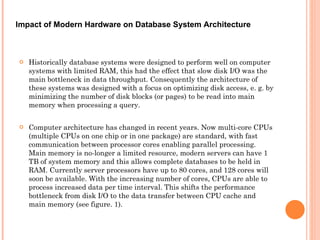
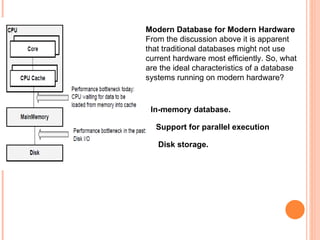
Historically database systems were designed to perform well on computer systems with limited RAM, this had the effect that slow disk I/O was the main bottleneck in data throughput. Consequently the architecture of these systems was designed with a focus on optimizing disk access, e. g. by minimizing the number of disk blocks (or pages) to be read into main memory when processing a query.  Computer architecture has changed in recent years. Now multi-core CPUs (multiple CPUs on one chip or in one package) are standard, with fast communication between processor cores enabling parallel processing. Main memory is no-longer a limited resource, modern servers can have 1 TB of system memory and this allows complete databases to be held in RAM. Currently server processors have up to 80 cores, and 128 cores will soon be available. With the increasing number of cores, CPUs are able to process increased data per time interval. This shifts the performance bottleneck from disk I/O to the data transfer between CPU cache and main memory (see figure. 1).  Impact of Modern Hardware on Database System Architecture
Modern Database for Modern Hardware  From the discussion above it is apparent that traditional databases might not use current hardware most efficiently. So, what are the ideal characteristics of a database systems running on modern hardware?  In-memory database.  Support for parallel execution  Disk storage.
 
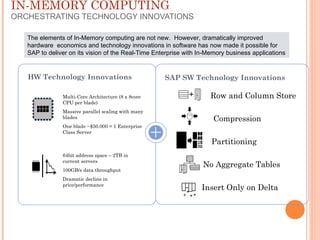
IN-MEMORY COMPUTING ORCHESTRATING TECHNOLOGY INNOVATIONS HW Technology Innovations 64bit address space – 2TB in current servers 100GB/s data throughput Dramatic decline in price/performance Multi-Core Architecture (8 x 8core CPU per blade) Massive parallel scaling with many blades One blade ~$50.000 = 1 Enterprise Class Server Row and Column Store Compression Partitioning No Aggregate Tables Insert Only on Delta SAP SW Technology Innovations The elements of In-Memory computing are not new.  However, dramatically improved hardware  economics and technology innovations in software has now made it possible for SAP to deliver on its vision of the Real-Time Enterprise with In-Memory business applications
What is SAP HANA database?  The SAP HANA database is a relational database that has been optimized to leverage state of the art hardware. It provides all of the SQL features of a standard relational database along with a feature rich set of analytical capabilities and an SAP specific programming language for stored procedures called SQL Script.  With these facilities the SAP HANA database is capable of embedding application logic within the database itself. This allows complex queries to be executed directly inside the database, thus reducing the requirement of data transfer to and from the database. This enables SAP HANA based applications to process vast amounts of data whilst operating in a responsive, real-time manner.  From the administrators perspective the SAP HANA Database is conceptually about leveraging modern hardware system landscapes to increase database performance and reliability. Traditionally databases have been designed to operate in a situation where there are limited memory and CPU resources. Currently however, servers can provide in excess of 1TB of memory and up to 80 CPU cores on a single system.  To better understand how the SAP HANA database improves on the traditional database concepts, in the next section we will compare and contrast the two approaches to database systems.
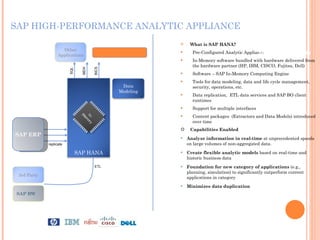
SAP HIGH-PERFORMANCE ANALYTIC APPLIANCE What is SAP HANA? Pre-Configured Analytic Appliance In-Memory software bundled with hardware delivered from the hardware partner (HP, IBM, CISCO, Fujitsu, Dell) Software – SAP In-Memory Computing Engine Tools for data modeling, data and life cycle management, security, operations, etc. Data replication,  ETL data services and SAP BO client runtimes Support for multiple interfaces Content packages  (Extractors and Data Models) introduced over time Capabilities Enabled Analyze information in real-time  at unprecedented speeds on large volumes of non-aggregated data.  Create flexible analytic models  based on real-time and historic business data Foundation for new category of applications  (e.g., planning, simulation) to significantly outperform current applications in category Minimizes data duplication SAP BW replicate ETL SQL MDX BICS SAP ERP SAP BusinessObjects SAP HANA 3rd Party Data Modeling Other Applications
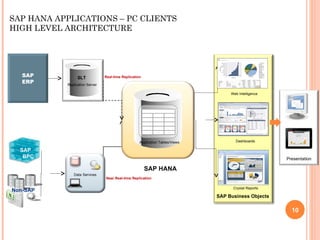
SAP HANA APPLICATIONS – PC CLIENTS HIGH LEVEL ARCHITECTURE SAP ERP SAP BPC SAP HANA Real-time   Replication Near Real-time Replication Web Intelligence Dashboards Crystal Reports Presentation SAP Business Objects Non-SAP Application Tables/Views Data   Services SLT   Replication Server
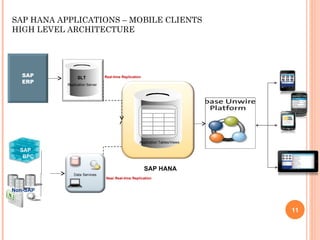
SAP HANA APPLICATIONS – MOBILE CLIENTS HIGH LEVEL ARCHITECTURE SAP ERP SAP BPC SAP HANA Real-time   Replication Near Real-time Replication Non-SAP Application Tables/Views Data   Services SLT   Replication Server


Hana Training Day 1

  • 1.
    SAP HANA AN INTRODUCTION FOR BW COMMUNITY Mishra SAP Practitioner Contact: [email_address]
  • 2.
    AGENDA Day 1- What is SAP HANA? Introductions, Architecture, Overview Day 1- Data Acquisition Trigger-Based Replication ETL-Based Replication Log-Based Replication Day 2- SAP HANA Modeling , Reporting Different Views(Attribute, Analytic, Calculation) Building a HANA Apps, SAP HANA Languages – Day 3 - SAP HANA Operations Administration and Monitoring User Creation Update and Patching Backup and Recovery –
  • 3.
    Need and Benefitsof In-Memory Appliance SAP’s Currently available In-Memory Solutions HANA – Architecture, Landscape and S/W Components HANA Product and Licensing A Walkthrough on SAP HANA Studio What is SAP HANA? Generation of In memory Computing
  • 4.
    Historically database systemswere designed to perform well on computer systems with limited RAM, this had the effect that slow disk I/O was the main bottleneck in data throughput. Consequently the architecture of these systems was designed with a focus on optimizing disk access, e. g. by minimizing the number of disk blocks (or pages) to be read into main memory when processing a query. Computer architecture has changed in recent years. Now multi-core CPUs (multiple CPUs on one chip or in one package) are standard, with fast communication between processor cores enabling parallel processing. Main memory is no-longer a limited resource, modern servers can have 1 TB of system memory and this allows complete databases to be held in RAM. Currently server processors have up to 80 cores, and 128 cores will soon be available. With the increasing number of cores, CPUs are able to process increased data per time interval. This shifts the performance bottleneck from disk I/O to the data transfer between CPU cache and main memory (see figure. 1). Impact of Modern Hardware on Database System Architecture
  • 5.
    Modern Database forModern Hardware From the discussion above it is apparent that traditional databases might not use current hardware most efficiently. So, what are the ideal characteristics of a database systems running on modern hardware? In-memory database. Support for parallel execution Disk storage.
  • 6.
  • 7.
    IN-MEMORY COMPUTING ORCHESTRATINGTECHNOLOGY INNOVATIONS HW Technology Innovations 64bit address space – 2TB in current servers 100GB/s data throughput Dramatic decline in price/performance Multi-Core Architecture (8 x 8core CPU per blade) Massive parallel scaling with many blades One blade ~$50.000 = 1 Enterprise Class Server Row and Column Store Compression Partitioning No Aggregate Tables Insert Only on Delta SAP SW Technology Innovations The elements of In-Memory computing are not new. However, dramatically improved hardware economics and technology innovations in software has now made it possible for SAP to deliver on its vision of the Real-Time Enterprise with In-Memory business applications
  • 8.
    What is SAPHANA database? The SAP HANA database is a relational database that has been optimized to leverage state of the art hardware. It provides all of the SQL features of a standard relational database along with a feature rich set of analytical capabilities and an SAP specific programming language for stored procedures called SQL Script. With these facilities the SAP HANA database is capable of embedding application logic within the database itself. This allows complex queries to be executed directly inside the database, thus reducing the requirement of data transfer to and from the database. This enables SAP HANA based applications to process vast amounts of data whilst operating in a responsive, real-time manner. From the administrators perspective the SAP HANA Database is conceptually about leveraging modern hardware system landscapes to increase database performance and reliability. Traditionally databases have been designed to operate in a situation where there are limited memory and CPU resources. Currently however, servers can provide in excess of 1TB of memory and up to 80 CPU cores on a single system. To better understand how the SAP HANA database improves on the traditional database concepts, in the next section we will compare and contrast the two approaches to database systems.
  • 9.
    SAP HIGH-PERFORMANCE ANALYTICAPPLIANCE What is SAP HANA? Pre-Configured Analytic Appliance In-Memory software bundled with hardware delivered from the hardware partner (HP, IBM, CISCO, Fujitsu, Dell) Software – SAP In-Memory Computing Engine Tools for data modeling, data and life cycle management, security, operations, etc. Data replication, ETL data services and SAP BO client runtimes Support for multiple interfaces Content packages (Extractors and Data Models) introduced over time Capabilities Enabled Analyze information in real-time at unprecedented speeds on large volumes of non-aggregated data. Create flexible analytic models based on real-time and historic business data Foundation for new category of applications (e.g., planning, simulation) to significantly outperform current applications in category Minimizes data duplication SAP BW replicate ETL SQL MDX BICS SAP ERP SAP BusinessObjects SAP HANA 3rd Party Data Modeling Other Applications
  • 10.
    SAP HANA APPLICATIONS– PC CLIENTS HIGH LEVEL ARCHITECTURE SAP ERP SAP BPC SAP HANA Real-time Replication Near Real-time Replication Web Intelligence Dashboards Crystal Reports Presentation SAP Business Objects Non-SAP Application Tables/Views Data Services SLT Replication Server
  • 11.
    SAP HANA APPLICATIONS– MOBILE CLIENTS HIGH LEVEL ARCHITECTURE SAP ERP SAP BPC SAP HANA Real-time Replication Near Real-time Replication Non-SAP Application Tables/Views Data Services SLT Replication Server
  • 12.
  • 13.
  • 14.
  • 15.
  • 16.
  • 17.
  • 18.
  • 19.
  • 20.
  • 21.
  • 22.
  • 23.
  • 24.
  • 25.