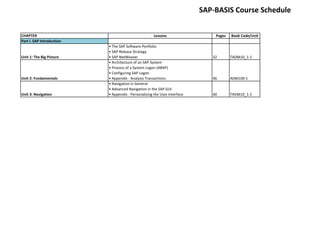
CHAPTER Lessons Pages Book Code/Unit
Part I. SAP Introduction
Unit 1: The Big Picture
• The SAP Software Portfolio
• SAP Release Strategy
• SAP NetWeaver 32 TADM10_1‐1
Unit 2: Fundamentals
• Architecture of an SAP System
• Process of a System Logon (ABAP)
• Configuring SAP Logon
• Appendix ‐ Analysis Transactions 46 ADM100‐1
Unit 3: Navigation
• Navigation in General
• Advanced Navigation in the SAP GUI
• Appendix ‐ Personalizing the User Interface 40 TADM10_1‐2
SAP-BASIS Course Schedule
Part II. ABAP Application Server
CHAPTER Lessons Pages Book Code/Unit
Part II. ABAP Application Server
Unit 1: The System Kernel
• Principal Architecture of the SAP NetWeaver Application 
Server
• AS ABAP Processes 50 TADM10_1‐3
Unit 2: Starting and Stopping SAP Systems
• System Start: Process
• System Start: Logs
• System Shutdown: How and Why?
• Appendix ‐ Starting and Stopping: Operating System‐
Specific
• Appendix ‐ Database Logs 40
TADM10_1‐4
ADM100‐2
Unit 3: Introduction to System Configuration
• How the System Evaluates Its Parameters
• How to Set System Parameters
• Setting up Operation Modes 34
TADM10_1‐5
ADM100‐3
Unit 4: Implementation of SSL for SAP NetWeaver 
AS Java • Setting up SSL 28
TADM10_1‐6
ADM200‐8
Unit 5: Software Development in SAP Systems
• Data Structure of an SAP System and Transports between 
SAP Systems (ABAP Stack)
• Accessing and Editing ABAP Repository Objects
• Introduction to the SAP NetWeaver Development 
Infrastructure (NWDI) 58 TADM10_1‐7
Unit 6: Access to Help • Configuring the Online Documentation 22
TADM12_2‐9
ADM100‐4
Unit 7: Fundamentals of Working with the 
Database
• Architecture of Database Systems
• Backing Up the Database Contents
• Overview: Monitoring the Database 26 ADM100‐5
Unit 8: Fundamentals of User Administration
• User Administration Concept
• Authorization Concept
• Login Parameters and User Info
• Appendix: Advanced User Administration Topics 46
TADM10_2‐2
ADM100‐6
Unit 9: RFC Connections
• Fundamentals and Variants for Using RFC
• Setting Up RFC Connections 22
TADM10_2‐4
ADM100‐7
SAP-BASIS Course Schedule
Part II. ABAP Application Server
Unit 10: Working with the Transport System
• Data Structure of SAP Systems and System Landscapes
• Performing and Checking Transports 30 ADM100‐8
Unit 11: Software Maintenance
• SAP Notes and Support Packages
• Support Package Manager (SPAM)
• Importing Support Packages
• Enhancement Packages. 40
TADM12_2‐6
ADM100‐9
Unit 12: Printer Connection in AS ABAP
• Configuring Printers in SAP Systems
• Concept of Logical Spool Servers
• Managing Spool Requests 44
TADM12_1‐10
ADM100‐10
Unit 13: Scheduling Background Tasks
• Fundamentals of Background Processing
• Time‐Based Scheduling of Jobs
• Event‐Based Scheduling of Jobs
• Background Processing: Other Topics 56
TADM12_1‐11
ADM100‐11
Unit 14: Data Archiving
• Fundamentals of SAP Data Archiving
• Performing Data Archiving
• Accessing Archived Data 32 ADM100‐12
Unit 15: System Monitoring and Troubleshooting
• Monitoring Architecture
• Including Remote Systems
• Creating Your Own Monitors
• Properties Variants and Threshold Values
• Concept of the SAP Solution Manager
• Trace Options
• Troubleshooting Procedure 76
TADM12_1‐7
ADM100‐13
Unit 16: Technology Components for Browser‐
Based User Dialogs
• Internet Scenarios with SAP Systems
• Appendix: SAP Internet Transaction Server (standalone)
• Internet Communication Manager
• Internet Communication Framework
• AS Java: Architecture and Basic Administration Functions
• The SAP Web Dispatcher 118
TADM10_2‐1
ADM102‐1
SAP-BASIS Course Schedule
Part II. ABAP Application Server
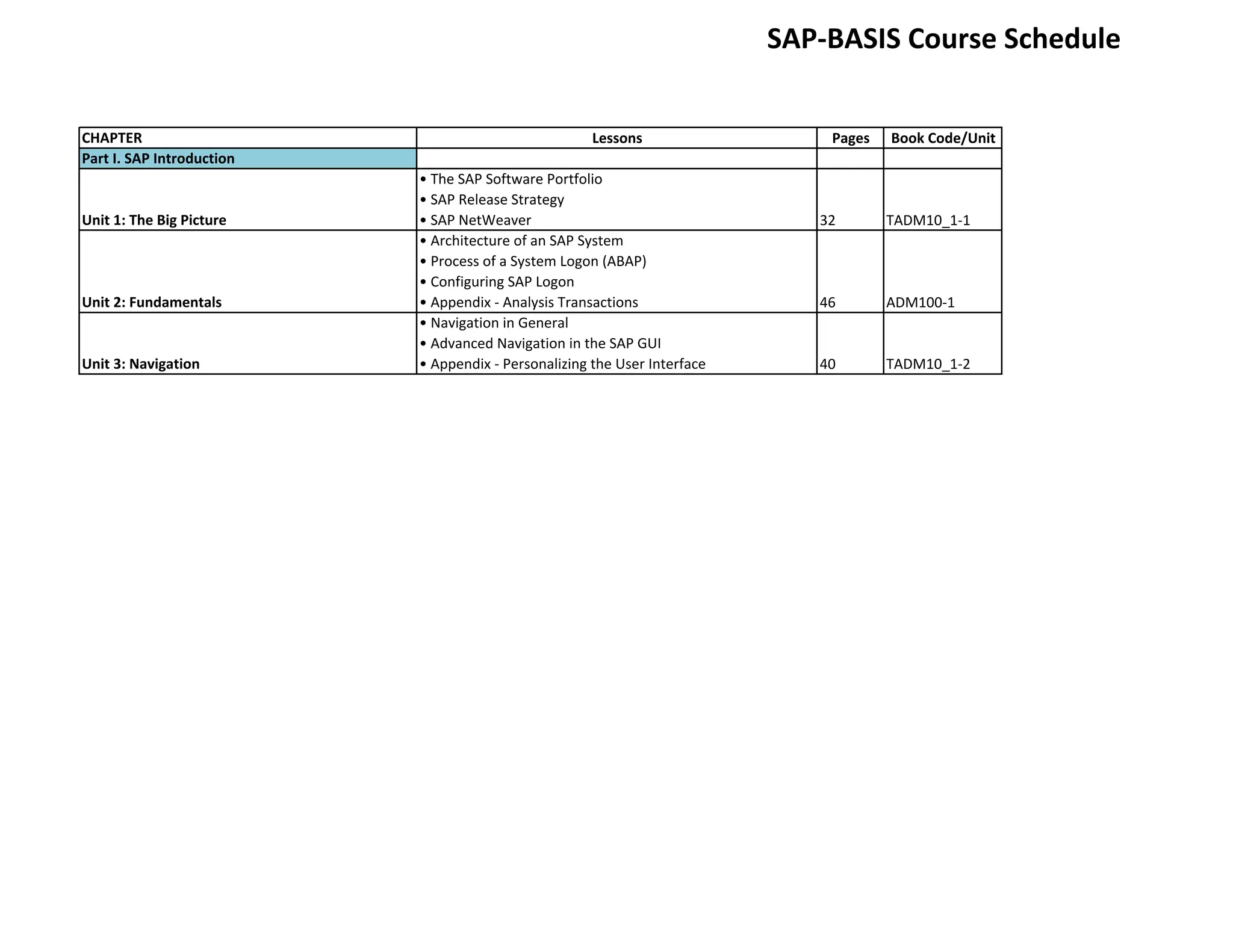
Unit 17: Technical Aspects of External 
Communication
• Communication with SAPconnect
• Communication Using SMTP 40
TADM12_1‐12
ADM102‐2
Unit 18: Extended Computer Aided Test Tool 
(eCATT)
• Fundamentals of eCATT
• Configuring eCATT
• Executing eCATT Test Scripts 50 ADM102‐3
Unit 19: Advanced User Administration Topics
• Introduction to CUA
• Setting Up a CUA
• User Administration with the CUA
• Introduction to Directory Services
• Technical Connection of Directory Services
• Data Exchange with Directory Services 112
TADM12_2‐7
ADM102‐4
Unit 20: Aspects of Globalization
• Aspects of Globalization
• Multiple Languages in an SAP System
• Unicode and Code Pages: Fundamentals 68 ADM102‐5
Unit 21: Communication and Integration 
Technologies
• Cross‐System Business Processes
• Remote Function Calls and BAPIs
• Enterprise Services‐Oriented Architecture (Enterprise SOA)
• Web Services
• SAP Business Workflow 38 TADM10_2‐5
Unit 22: Working with SAP Solution Manager
• Concept of the SAP Solution Manager
• Connecting ABAP‐Based Systems to SAP Solution Manager 58 TADM10_2‐6
Unit 23: SAP Patch Day
• Importing Corrections
• Applying Patches
• Other Tools in Software Lifecycle Management
• SAP Notes and Support Packages
• Support Package Manager (SPAM)
• Importing Support Packages
• Backing Up SAP NW AS Java 82 TADM12_1‐8
SAP-BASIS Course Schedule
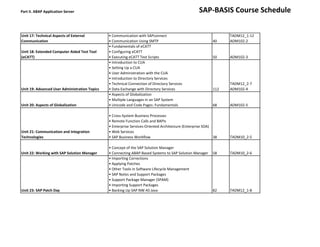
Part III. JAVA Application Server
CHAPTER Lessons Pages Book Code/Unit
Part III. JAVA Application Server
Unit 1: The System Kernel / Fundamentals
• Fundamental Concepts of Java
• AS Java Processes
• Java Cluster Architecture
• The Internal Structure of SAP NetWeaver AS Java
• Load Balancing in the SAP NetWeaver AS Java Environment 36
TADM10_1‐3
ADM200‐1
Unit 2: Starting and Stopping SAP Systems
• Overview of the Process for Starting and Stopping a SAP 
NetWeaver AS Java
• Tools for Starting and Stopping
• Java Startup and Control Framework
• Logs of the Start and Stop Processes of SAP NetWeaver AS 
Java 40
TADM10_1‐4
ADM200‐2
Unit 3: Introduction to System Configuration
• Administration and Configuration Tools of SAP NetWeaver 
AS Java
• General Configuration of the SAP NetWeaver AS Java 
Cluster with the Config Tool
• General Configuration of the SAP NetWeaver AS Java 
Cluster with the Visual Administrator
• Other Administration Tools
• Selected Configurations 88
TADM10_1‐5
ADM200‐3
Unit 4: Change management and software logistics
• Overview of the Standard J2EE Development Process
• Introduction to the SAP NetWeaver Development 
Infrastructure (NWDI)
• Configuring the SAP NetWeaver Development 
Infrastructure
• Preparing for the Development of Java Applications
• Developing Java Objects in SAP NetWeaver Developer 
Studio
• Transporting Java Developments 90 ADM200‐4
SAP-BASIS Course Schedule
Part III. JAVA Application Server
Unit 5: Monitoring AS Java
• Java Monitoring: Overview
• Monitoring SAP NetWeaver AS Java
• Appendix: Background Information About the Monitoring 
Service
• Connecting to a Central Monitoring System
• Log Viewer and Log Configuration
• Availability Monitoring
• Appendix: Statistics and the Performance Trace
• Appendix: Solution Manager Diagnostics (SMD) 140
TADM12_1‐8
ADM200‐5
Unit 6: User and Authorization Concept AS Java
• Architecture and Configuration of the User Management 
Engine (UME)
• User and Group Administration
• The Java Authorization Concept
• Special Principles 70
TADM10_2‐3
ADM200‐6
Unit 7: Software Lifecycle
• Installing SAP NW AS Java‐Based Systems
• Installation of SAP NetWeaver Developer Studio
• Importing Corrections
• Other Tools in Software Lifecycle Management
• Backing Up SAP NW AS Java 60 ADM200‐7
Unit 8: Appendix: SAP NetWeaver Administrator 
(SAP NWA)
• Architecture of the SAP NWA
• SAP NWA: Function Overview
• SAP NWA: Structure of a Central Scenario
• SAP NWA: Connecting to a Central Monitoring System
• Monitoring in the SAP NWA 56 ADM200‐9
SAP-BASIS Course Schedule
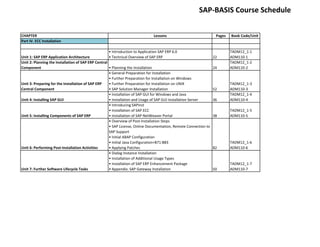
CHAPTER Lessons Pages Book Code/Unit
Part IV. ECC Installation
Unit 1: SAP ERP Application Architecture
• Introduction to Application SAP ERP 6.0
• Technical Overview of SAP ERP 22
TADM12_1‐1
ADM110‐1
Unit 2: Planning the Installation of SAP ERP Central 
Component • Planning the Installation 24
TADM12_1‐2
ADM110‐2
Unit 3: Preparing for the Installation of SAP ERP 
Central Component
• General Preparation for Installation
• Further Preparation for Installation on Windows
• Further Preparation for Installation on UNIX
• SAP Solution Manager Installation 52
TADM12_1‐3
ADM110‐3
Unit 4: Installing SAP GUI
• Installation of SAP GUI for Windows and Java
• Installation and Usage of SAP GUI Installation Server 36
TADM12_1‐4
ADM110‐4
Unit 5: Installing Components of SAP ERP
• Introducing SAPinst
• Installation of SAP ECC
• Installation of SAP NetWeaver Portal 38
TADM12_1‐5
ADM110‐5
Unit 6: Performing Post‐Installation Activities
• Overview of Post‐Installation Steps
• SAP License, Online Documentation, Remote Connection to 
SAP Support
• Initial ABAP Configuration
• Initial Java Configuration+B71:B83
• Applying Patches 82
TADM12_1‐6
ADM110‐6
Unit 7: Further Software Lifecycle Tasks
• Dialog Instance Installation
• Installation of Additional Usage Types
• Installation of SAP ERP Enhancement Package
• Appendix: SAP Gateway Installation 50
TADM12_1‐7
ADM110‐7
SAP-BASIS Course Schedule
CHAPTER Lessons Pages Book Code/Unit
Part V. Software Logistics [TMS]
Unit 1: Introduction to SAP Software Logistics
• SAP System Landscape
• Client Concept
• System and Client Change Options 28
TADM12_2‐1
ADM325‐1
Unit 2: Setting Up an SAP System Landscape
• Setting Up the Transport Management System (TMS)
• Extended Transport Control
• Configuration of Change and Transport System For 
Transporting Non‐ABAP Objects 66
TADM12_2‐2
ADM325‐2
Unit 3: Creating and Exporting Transport Requests
• Customizing and Customizing Projects
• Transport Requests for Customizing
• Customizing Procedure
• Transport Requests for Development
• Customer Development
• Modifying SAP Objects 100
TADM12_2‐3
ADM325‐3
Unit 4: Importing Transport Requests
• The Transport Process
• Imports Using TMS
• QA Approval Procedure and Transport Proposals
• Import Process
• Monitoring Tools
• Cleaning Up the Transport Directory
• Transport of non‐ABAP objects 112
TADM12_2‐4
ADM325‐4
Unit 5: Client Tool
• Client Copy and Client Transport Tools
• Client Compare and Maintenance Tools 40
TADM12_2‐6
ADM325‐5
Unit 6: SAP Note Assistant, Support Packages, SAP 
system upgrades and Enhancement Packages
• SAP Note Assistant
• Support Packages
• SAP System Upgrade 54
TADM12_2‐7
ADM325‐6
Unit 7: Addendum: Change Request Management 
with SAP Solution Manager
• Introduction to Change Management
• Overview Change Request Management with SAP Solution 
Manager
• Configuration of Change Request Management with SAP 
Solution Manager
• Process Overview of Change Request Management with 
SAP Solution Manager 44
TADM12_2‐5
ADM325‐7
SAP-BASIS Course Schedule
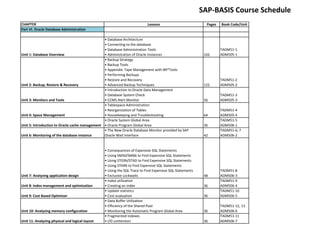
CHAPTER Lessons Pages Book Code/Unit
Part VI. Oracle Database Administration
Unit 1: Database Overview
• Database Architecture
• Connecting to the database
• Database Administration Tools
• Administration of Oracle Instances 102
TADM51‐1
ADM505‐1
Unit 2: Backup, Restore & Recovery
• Backup Strategy
• Backup Tools
• Appendix: Tape Management with BR*Tools
• Performing Backups
• Restore and Recovery
• Advanced Backup Techniques 122
TADM51‐2
ADM505‐2
Unit 3: Monitors and Tools
• Introduction to Oracle Data Management
• Database System Check
• CCMS Alert Monitor 56
TADM51‐3
ADM505‐3
Unit 4: Space Management
• Tablespace Administration
• Reorganization of Tables
• Housekeeping and Troubleshooting 64
TADM51‐4
ADM505‐4
Unit 5: Introduction to Oracle cache management
• Oracle System Global Area
• Oracle Program Global Area 36
TADM51‐5
ADM506‐1
Unit 6: Monitoring of the database instance
• The New Oracle Database Monitor provided by SAP
Oracle Wait Interface 42
TADM51‐6, 7
ADM506‐2
Unit 7: Analyzing application design
• Consequences of Expensive SQL Statements
• Using SM50/SM66 to Find Expensive SQL Statements
• Using ST03N/STAD to Find Expensive SQL Statements
• Using ST04N to Find Expensive SQL Statements
• Using the SQL Trace to Find Expensive SQL Statements
• Exclusive Lockwaits 48
TADM51‐8
ADM506‐3
Unit 8: Index management and optimization
• Index utilization
• Creating an index 36
TADM51‐9
ADM506‐4
Unit 9: Cost Based Optimizer
• Update statistics
• Cost evaluation 36
TADM51‐10
ADM506‐5
Unit 10: Analyzing memory configuration
• Data Buffer Utilization
• Efficiency of the Shared Pool
• Monitoring the Automatic Program Global Area 36
TADM51‐12, 13
ADM506‐6
Unit 11: Analyzing physical and logical layout
• Fragmented indexes
• I/O contention 36
TADM51‐11
ADM506‐7
SAP-BASIS Course Schedule

SAP BASIS Course Content

  • 1.
    CHAPTER Lessons PagesBook Code/Unit Part I. SAP Introduction Unit 1: The Big Picture • The SAP Software Portfolio • SAP Release Strategy • SAP NetWeaver 32 TADM10_1‐1 Unit 2: Fundamentals • Architecture of an SAP System • Process of a System Logon (ABAP) • Configuring SAP Logon • Appendix ‐ Analysis Transactions 46 ADM100‐1 Unit 3: Navigation • Navigation in General • Advanced Navigation in the SAP GUI • Appendix ‐ Personalizing the User Interface 40 TADM10_1‐2 SAP-BASIS Course Schedule
  • 2.
    Part II. ABAP Application Server CHAPTER Lessons PagesBook Code/Unit Part II. ABAP Application Server Unit 1: The System Kernel • Principal Architecture of the SAP NetWeaver Application  Server • AS ABAP Processes 50 TADM10_1‐3 Unit 2: Starting and Stopping SAP Systems • System Start: Process • System Start: Logs • System Shutdown: How and Why? • Appendix ‐ Starting and Stopping: Operating System‐ Specific • Appendix ‐ Database Logs 40 TADM10_1‐4 ADM100‐2 Unit 3: Introduction to System Configuration • How the System Evaluates Its Parameters • How to Set System Parameters • Setting up Operation Modes 34 TADM10_1‐5 ADM100‐3 Unit 4: Implementation of SSL for SAP NetWeaver  AS Java • Setting up SSL 28 TADM10_1‐6 ADM200‐8 Unit 5: Software Development in SAP Systems • Data Structure of an SAP System and Transports between  SAP Systems (ABAP Stack) • Accessing and Editing ABAP Repository Objects • Introduction to the SAP NetWeaver Development  Infrastructure (NWDI) 58 TADM10_1‐7 Unit 6: Access to Help • Configuring the Online Documentation 22 TADM12_2‐9 ADM100‐4 Unit 7: Fundamentals of Working with the  Database • Architecture of Database Systems • Backing Up the Database Contents • Overview: Monitoring the Database 26 ADM100‐5 Unit 8: Fundamentals of User Administration • User Administration Concept • Authorization Concept • Login Parameters and User Info • Appendix: Advanced User Administration Topics 46 TADM10_2‐2 ADM100‐6 Unit 9: RFC Connections • Fundamentals and Variants for Using RFC • Setting Up RFC Connections 22 TADM10_2‐4 ADM100‐7 SAP-BASIS Course Schedule
  • 3.
    Part II. ABAP Application Server Unit 10: Working with the Transport System • Data Structure of SAP Systems and System Landscapes • Performing and Checking Transports 30 ADM100‐8 Unit 11: Software Maintenance • SAP Notes and Support Packages • Support Package Manager (SPAM) • Importing Support Packages • Enhancement Packages.40 TADM12_2‐6 ADM100‐9 Unit 12: Printer Connection in AS ABAP • Configuring Printers in SAP Systems • Concept of Logical Spool Servers • Managing Spool Requests 44 TADM12_1‐10 ADM100‐10 Unit 13: Scheduling Background Tasks • Fundamentals of Background Processing • Time‐Based Scheduling of Jobs • Event‐Based Scheduling of Jobs • Background Processing: Other Topics 56 TADM12_1‐11 ADM100‐11 Unit 14: Data Archiving • Fundamentals of SAP Data Archiving • Performing Data Archiving • Accessing Archived Data 32 ADM100‐12 Unit 15: System Monitoring and Troubleshooting • Monitoring Architecture • Including Remote Systems • Creating Your Own Monitors • Properties Variants and Threshold Values • Concept of the SAP Solution Manager • Trace Options • Troubleshooting Procedure 76 TADM12_1‐7 ADM100‐13 Unit 16: Technology Components for Browser‐ Based User Dialogs • Internet Scenarios with SAP Systems • Appendix: SAP Internet Transaction Server (standalone) • Internet Communication Manager • Internet Communication Framework • AS Java: Architecture and Basic Administration Functions • The SAP Web Dispatcher 118 TADM10_2‐1 ADM102‐1 SAP-BASIS Course Schedule
  • 4.
    Part II. ABAP Application Server Unit 17: Technical Aspects of External  Communication • Communication with SAPconnect • Communication Using SMTP 40 TADM12_1‐12 ADM102‐2 Unit 18: Extended Computer Aided Test Tool  (eCATT) • Fundamentals of eCATT • Configuring eCATT • Executing eCATT Test Scripts 50ADM102‐3 Unit 19: Advanced User Administration Topics • Introduction to CUA • Setting Up a CUA • User Administration with the CUA • Introduction to Directory Services • Technical Connection of Directory Services • Data Exchange with Directory Services 112 TADM12_2‐7 ADM102‐4 Unit 20: Aspects of Globalization • Aspects of Globalization • Multiple Languages in an SAP System • Unicode and Code Pages: Fundamentals 68 ADM102‐5 Unit 21: Communication and Integration  Technologies • Cross‐System Business Processes • Remote Function Calls and BAPIs • Enterprise Services‐Oriented Architecture (Enterprise SOA) • Web Services • SAP Business Workflow 38 TADM10_2‐5 Unit 22: Working with SAP Solution Manager • Concept of the SAP Solution Manager • Connecting ABAP‐Based Systems to SAP Solution Manager 58 TADM10_2‐6 Unit 23: SAP Patch Day • Importing Corrections • Applying Patches • Other Tools in Software Lifecycle Management • SAP Notes and Support Packages • Support Package Manager (SPAM) • Importing Support Packages • Backing Up SAP NW AS Java 82 TADM12_1‐8 SAP-BASIS Course Schedule
  • 5.
    Part III. JAVA Application Server CHAPTER Lessons PagesBook Code/Unit Part III. JAVA Application Server Unit 1: The System Kernel / Fundamentals • Fundamental Concepts of Java • AS Java Processes • Java Cluster Architecture • The Internal Structure of SAP NetWeaver AS Java • Load Balancing in the SAP NetWeaver AS Java Environment 36 TADM10_1‐3 ADM200‐1 Unit 2: Starting and Stopping SAP Systems • Overview of the Process for Starting and Stopping a SAP  NetWeaver AS Java • Tools for Starting and Stopping • Java Startup and Control Framework • Logs of the Start and Stop Processes of SAP NetWeaver AS  Java 40 TADM10_1‐4 ADM200‐2 Unit 3: Introduction to System Configuration • Administration and Configuration Tools of SAP NetWeaver  AS Java • General Configuration of the SAP NetWeaver AS Java  Cluster with the Config Tool • General Configuration of the SAP NetWeaver AS Java  Cluster with the Visual Administrator • Other Administration Tools • Selected Configurations 88 TADM10_1‐5 ADM200‐3 Unit 4: Change management and software logistics • Overview of the Standard J2EE Development Process • Introduction to the SAP NetWeaver Development  Infrastructure (NWDI) • Configuring the SAP NetWeaver Development  Infrastructure • Preparing for the Development of Java Applications • Developing Java Objects in SAP NetWeaver Developer  Studio • Transporting Java Developments 90 ADM200‐4 SAP-BASIS Course Schedule
  • 6.
    Part III. JAVA Application Server Unit 5: Monitoring AS Java • Java Monitoring: Overview • Monitoring SAP NetWeaver AS Java • Appendix: Background Information About the Monitoring  Service • Connecting to a Central Monitoring System • Log Viewer and Log Configuration • Availability Monitoring • Appendix: Statistics and the Performance Trace • Appendix: Solution Manager Diagnostics (SMD) 140 TADM12_1‐8 ADM200‐5 Unit 6: User and Authorization Concept AS Java • Architecture and Configuration of the User Management  Engine (UME) • User and Group Administration • The Java Authorization Concept • Special Principles 70 TADM10_2‐3 ADM200‐6 Unit 7: Software Lifecycle • Installing SAP NW AS Java‐Based Systems • Installation of SAP NetWeaver Developer Studio • Importing Corrections • Other Tools in Software Lifecycle Management • Backing Up SAP NW AS Java60 ADM200‐7 Unit 8: Appendix: SAP NetWeaver Administrator  (SAP NWA) • Architecture of the SAP NWA • SAP NWA: Function Overview • SAP NWA: Structure of a Central Scenario • SAP NWA: Connecting to a Central Monitoring System • Monitoring in the SAP NWA 56 ADM200‐9 SAP-BASIS Course Schedule
  • 7.
    CHAPTER Lessons PagesBook Code/Unit Part IV. ECC Installation Unit 1: SAP ERP Application Architecture • Introduction to Application SAP ERP 6.0 • Technical Overview of SAP ERP 22 TADM12_1‐1 ADM110‐1 Unit 2: Planning the Installation of SAP ERP Central  Component • Planning the Installation 24 TADM12_1‐2 ADM110‐2 Unit 3: Preparing for the Installation of SAP ERP  Central Component • General Preparation for Installation • Further Preparation for Installation on Windows • Further Preparation for Installation on UNIX • SAP Solution Manager Installation 52 TADM12_1‐3 ADM110‐3 Unit 4: Installing SAP GUI • Installation of SAP GUI for Windows and Java • Installation and Usage of SAP GUI Installation Server 36 TADM12_1‐4 ADM110‐4 Unit 5: Installing Components of SAP ERP • Introducing SAPinst • Installation of SAP ECC • Installation of SAP NetWeaver Portal 38 TADM12_1‐5 ADM110‐5 Unit 6: Performing Post‐Installation Activities • Overview of Post‐Installation Steps • SAP License, Online Documentation, Remote Connection to  SAP Support • Initial ABAP Configuration • Initial Java Configuration+B71:B83 • Applying Patches 82 TADM12_1‐6 ADM110‐6 Unit 7: Further Software Lifecycle Tasks • Dialog Instance Installation • Installation of Additional Usage Types • Installation of SAP ERP Enhancement Package • Appendix: SAP Gateway Installation 50 TADM12_1‐7 ADM110‐7 SAP-BASIS Course Schedule
  • 8.
    CHAPTER Lessons PagesBook Code/Unit Part V. Software Logistics [TMS] Unit 1: Introduction to SAP Software Logistics • SAP System Landscape • Client Concept • System and Client Change Options 28 TADM12_2‐1 ADM325‐1 Unit 2: Setting Up an SAP System Landscape • Setting Up the Transport Management System (TMS) • Extended Transport Control • Configuration of Change and Transport System For  Transporting Non‐ABAP Objects 66 TADM12_2‐2 ADM325‐2 Unit 3: Creating and Exporting Transport Requests • Customizing and Customizing Projects • Transport Requests for Customizing • Customizing Procedure • Transport Requests for Development • Customer Development • Modifying SAP Objects 100 TADM12_2‐3 ADM325‐3 Unit 4: Importing Transport Requests • The Transport Process • Imports Using TMS • QA Approval Procedure and Transport Proposals • Import Process • Monitoring Tools • Cleaning Up the Transport Directory • Transport of non‐ABAP objects 112 TADM12_2‐4 ADM325‐4 Unit 5: Client Tool • Client Copy and Client Transport Tools • Client Compare and Maintenance Tools 40 TADM12_2‐6 ADM325‐5 Unit 6: SAP Note Assistant, Support Packages, SAP  system upgrades and Enhancement Packages • SAP Note Assistant • Support Packages • SAP System Upgrade 54 TADM12_2‐7 ADM325‐6 Unit 7: Addendum: Change Request Management  with SAP Solution Manager • Introduction to Change Management • Overview Change Request Management with SAP Solution  Manager • Configuration of Change Request Management with SAP  Solution Manager • Process Overview of Change Request Management with  SAP Solution Manager 44 TADM12_2‐5 ADM325‐7 SAP-BASIS Course Schedule
  • 9.
    CHAPTER Lessons PagesBook Code/Unit Part VI. Oracle Database Administration Unit 1: Database Overview • Database Architecture • Connecting to the database • Database Administration Tools • Administration of Oracle Instances 102 TADM51‐1 ADM505‐1 Unit 2: Backup, Restore & Recovery • Backup Strategy • Backup Tools • Appendix: Tape Management with BR*Tools • Performing Backups • Restore and Recovery • Advanced Backup Techniques 122 TADM51‐2 ADM505‐2 Unit 3: Monitors and Tools • Introduction to Oracle Data Management • Database System Check • CCMS Alert Monitor 56 TADM51‐3 ADM505‐3 Unit 4: Space Management • Tablespace Administration • Reorganization of Tables • Housekeeping and Troubleshooting 64 TADM51‐4 ADM505‐4 Unit 5: Introduction to Oracle cache management • Oracle System Global Area • Oracle Program Global Area 36 TADM51‐5 ADM506‐1 Unit 6: Monitoring of the database instance • The New Oracle Database Monitor provided by SAP Oracle Wait Interface 42 TADM51‐6, 7 ADM506‐2 Unit 7: Analyzing application design • Consequences of Expensive SQL Statements • Using SM50/SM66 to Find Expensive SQL Statements • Using ST03N/STAD to Find Expensive SQL Statements • Using ST04N to Find Expensive SQL Statements • Using the SQL Trace to Find Expensive SQL Statements • Exclusive Lockwaits 48 TADM51‐8 ADM506‐3 Unit 8: Index management and optimization • Index utilization • Creating an index 36 TADM51‐9 ADM506‐4 Unit 9: Cost Based Optimizer • Update statistics • Cost evaluation 36 TADM51‐10 ADM506‐5 Unit 10: Analyzing memory configuration • Data Buffer Utilization • Efficiency of the Shared Pool • Monitoring the Automatic Program Global Area 36 TADM51‐12, 13 ADM506‐6 Unit 11: Analyzing physical and logical layout • Fragmented indexes • I/O contention 36 TADM51‐11 ADM506‐7 SAP-BASIS Course Schedule