The Public Bank Solution
Using Existing Government Funding to create a Public Bank in
Santa Fe, New Mexico
Presented By:
Scott Baker
SSBAKER305@YAHOO.COM
What is a Comprehensive Annual Financial
Report (CAFR)?
It is not the “Budget.”
A "Budget Report" is a selective funding of x accounts from y resources
- set up to be primarily funded with taxation and done for the year.
A ”Comprehensive Annual Financial Report" is the showing of all
income: Investment, Taxation, and Enterprise, plus the accumulated
wealth over decades. Budgets are for the year, a CAFR is for it all since
creation of the government entity. CAFRs describe the assets of
government agencies and pensions.
Due to the GASB’s GAAP rules and some recent “standardizing” rule changes,
CAFRs tend to project future liabilities years, even decades, out, while offsetting
them only with current assets and revenue projections based on current receipts.
This leads to a false deficit projection. It’s as if you were expected to pay your
entire 30-year mortgage with only the assets you have now and the income
you will have based on your current level of income…and sometimes not even
that!
There is a big difference between the two. A correct analogy
would be: The annual budget to operate your house vs.
your statement of net worth.
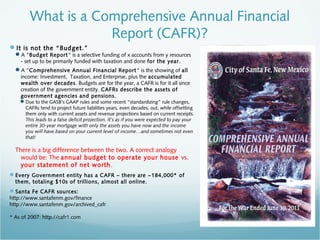
Every Government entity has a CAFR – there are ~184,000* of
them, totaling $10s of trillions, almost all online.
Santa Fe CAFR sources:
http://www.santafenm.gov/finance
http://www.santafenm.gov/archived_cafr
* As of 2007: http://cafr1.com
We are NOT interested in changing fund outlays, we are interested
in changing fund investments.
We are trying to preserve the ability for government agencies and
pensions to cover their future expenditures.
Can investments in a Public Bank be more:
Prudent and safe?
Counter-cyclical?
Able to provide consistent returns?
Supportive of the local community/job-creation?
Fiduciarily responsible?
Note: Although money will be used throughout the year, this usage is
predictable and the remainder can form the deposit base for making loans
from a Public Bank until then. (this is how North Dakota does it with the
Bank of North Dakota).
The real question: Is a Public Bank strategy safer and better, for
reasons listed above, than current investment strategies?
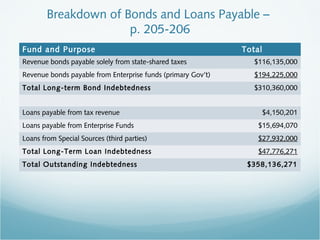
Breakdown of Bonds and Loans Payable –
p. 205-206
Fund and Purpose Total
Revenue bonds payable solely from state-shared taxes $116,135,000
Revenue bonds payable from Enterprise funds (primary Gov't) $194,225,000
Total Long-term Bond Indebtedness $310,360,000
Loans payable from tax revenue $4,150,201
Loans payable from Enterprise Funds $15,694,070
Loans from Special Sources (third parties) $27,932,000
Total Long-Term Loan Indebtedness $47,776,271
Total Outstanding Indebtedness $358,136,271
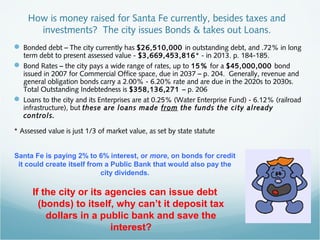
How is money raised for Santa Fe currently, besides taxes and
investments? The city issues Bonds & takes out Loans.
 Bonded debt – The city currently has $26,510,000 in outstanding debt, and .72% in long
term debt to present assessed value - $3,669,453,816* - in 2013. p. 184-185.
 Bond Rates – the city pays a wide range of rates, up to 15% for a $45,000,000 bond
issued in 2007 for Commercial Office space, due in 2037 – p. 204. Generally, revenue and
general obligation bonds carry a 2.00% - 6.20% rate and are due in the 2020s to 2030s.
Total Outstanding Indebtedness is $358,136,271 – p. 206
 Loans to the city and its Enterprises are at 0.25% (Water Enterprise Fund) - 6.12% (railroad
infrastructure), but these are loans made from the funds the city already
controls.
* Assessed value is just 1/3 of market value, as set by state statute
Santa Fe is paying 2% to 6% interest, or more, on bonds for credit
it could create itself from a Public Bank that would also pay the
city dividends.
If the city or its agencies can issue debt
(bonds) to itself, why can’t it deposit tax
dollars in a public bank and save the
interest?
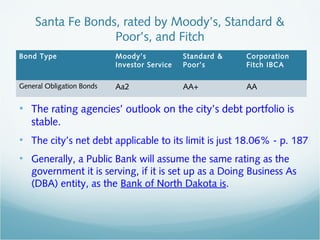
Santa Fe Bonds, rated by Moody’s, Standard &
Poor’s, and Fitch
• The rating agencies’ outlook on the city’s debt portfolio is
stable.
• The city’s net debt applicable to its limit is just 18.06% - p. 187
• Generally, a Public Bank will assume the same rating as the
government it is serving, if it is set up as a Doing Business As
(DBA) entity, as the Bank of North Dakota is.
Bond Type Moody’s
Investor Service
Standard &
Poor’s
Corporation
Fitch IBCA
General Obligation Bonds Aa2 AA+ AA
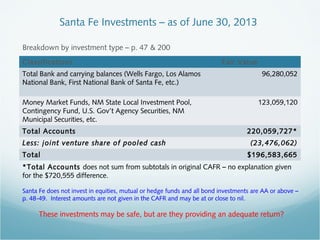
Santa Fe Investments – as of June 30, 2013
Breakdown by investment type – p. 47 & 200


Classifications  Fair Value
Total Bank and carrying balances (Wells Fargo, Los Alamos
National Bank, First National Bank of Santa Fe, etc.)
96,280,052
Money Market Funds, NM State Local Investment Pool,
Contingency Fund, U.S. Gov’t Agency Securities, NM
Municipal Securities, etc.
123,059,120
Total Accounts 220,059,727*
Less: joint venture share of pooled cash (23,476,062)
Total    $196,583,665
*Total Accounts does not sum from subtotals in original CAFR – no explanation given
for the $720,555 difference.
Santa Fe does not invest in equities, mutual or hedge funds and all bond investments are AA or above –
p. 48-49. Interest amounts are not given in the CAFR and may be at or close to nil.
These investments may be safe, but are they providing an adequate return?
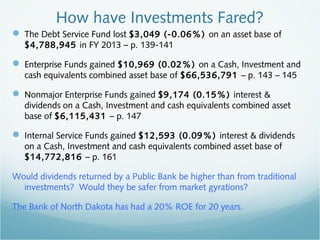
How have Investments Fared?
 The Debt Service Fund lost $3,049 (-0.06%) on an asset base of
$4,788,945 in FY 2013 – p. 139-141
 Enterprise Funds gained $10,969 (0.02%) on a Cash, Investment and
cash equivalents combined asset base of $66,536,791 – p. 143 – 145
 Nonmajor Enterprise Funds gained $9,174 (0.15%) interest &
dividends on a Cash, Investment and cash equivalents combined asset
base of $6,115,431 – p. 147
 Internal Service Funds gained $12,593 (0.09%) interest & dividends
on a Cash, Investment and cash equivalents combined asset base of
$14,772,816 – p. 161
Would dividends returned by a Public Bank be higher than from traditional
investments? Would they be safer from market gyrations?
The Bank of North Dakota has had a 20% ROE for 20 years.
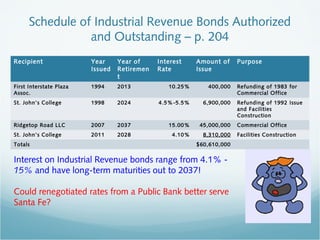
Schedule of Industrial Revenue Bonds Authorized
and Outstanding – p. 204
Recipient Year
Issued
Year of
Retiremen
t
Interest
Rate
Amount of
Issue
Purpose
First Interstate Plaza
Assoc.
1994 2013 10.25% 400,000 Refunding of 1983 for
Commercial Office
St. John’s College 1998 2024 4.5%-5.5% 6,900,000 Refunding of 1992 Issue
and Facilities
Construction
Ridgetop Road LLC 2007 2037 15.00% 45,000,000 Commercial Office
St. John’s College 2011 2028 4.10% 8,310,000 Facilities Construction
Totals $60,610,000
Interest on Industrial Revenue bonds range from 4.1% -
15% and have long-term maturities out to 2037!
Could renegotiated rates from a Public Bank better serve
Santa Fe?
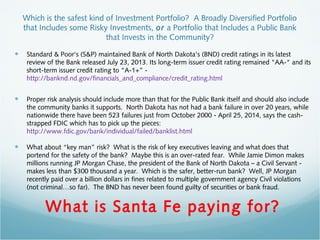
Which is the safest kind of Investment Portfolio? A Broadly Diversified Portfolio
that Includes some Risky Investments, or a Portfolio that Includes a Public Bank
that Invests in the Community?
• Standard & Poor's (S&P) maintained Bank of North Dakota's (BND) credit ratings in its latest
review of the Bank released July 23, 2013. Its long-term issuer credit rating remained "AA-" and its
short-term issuer credit rating to "A-1+” -
http://banknd.nd.gov/financials_and_compliance/credit_rating.html
• Proper risk analysis should include more than that for the Public Bank itself and should also include
the community banks it supports.  North Dakota has not had a bank failure in over 20 years, while
nationwide there have been 523 failures just from October 2000 - April 25, 2014, says the cash-
strapped FDIC which has to pick up the pieces:
http://www.fdic.gov/bank/individual/failed/banklist.html
• What about “key man” risk? What is the risk of key executives leaving and what does that
portend for the safety of the bank? Maybe this is an over-rated fear. While Jamie Dimon makes
millions running JP Morgan Chase, the president of the Bank of North Dakota – a Civil Servant -
makes less than $300 thousand a year. Which is the safer, better-run bank? Well, JP Morgan
recently paid over a billion dollars in fines related to multiple government agency Civil violations
(not criminal…so far). The BND has never been found guilty of securities or bank fraud.
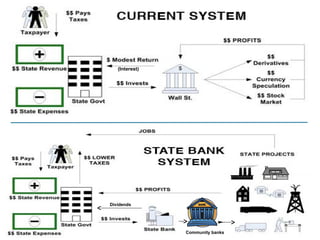
What is Santa Fe paying for?
Community banks
Dividends
(Interest)
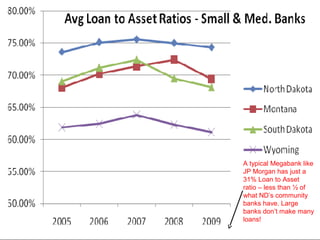
A typical Megabank like
JP Morgan has just a
31% Loan to Asset
ratio – less than ½ of
what ND’s community
banks have. Large
banks don’t make many
loans!
 Detroit, MI and Stockton, CA are in bankruptcy
proceedings. Funding and outlays from pensions and
agencies will be cut, yet their CAFRs contain billions.
See Detroit is Not Broke:
http://www.opednews.com/articles/Detroit-is-Not-Broke-by-
Scott-Baker-130805-986.html
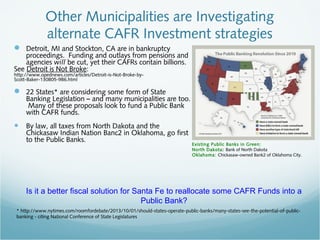
 22 States* are considering some form of State
Banking Legislation – and many municipalities are too.
Many of these proposals look to fund a Public Bank
with CAFR funds.
• By law, all taxes from North Dakota and the
Chickasaw Indian Nation Banc2 in Oklahoma, go first
to the Public Banks.
Other Municipalities are Investigating
alternate CAFR Investment strategies
Existing Public Banks in Green:
North Dakota: Bank of North Dakota
Oklahoma: Chickasaw-owned Bank2 of Oklahoma City.
Is it a better fiscal solution for Santa Fe to reallocate some CAFR Funds into a
Public Bank?
* http://www.nytimes.com/roomfordebate/2013/10/01/should-states-operate-public-banks/many-states-see-the-potential-of-public-
banking - citing National Conference of State Legislatures
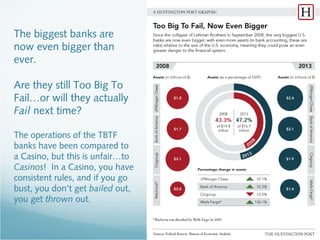
The biggest banks are
now even bigger than
ever.
Are they still Too Big To
Fail…or will they actually
Fail next time?
The operations of the TBTF
banks have been compared to
a Casino, but this is unfair…to
Casinos! In a Casino, you have
consistent rules, and if you go
bust, you don’t get bailed out,
you get thrown out.
Santa fe Public Bank presentation

Santa fe Public Bank presentation

  • 1.
    The Public BankSolution Using Existing Government Funding to create a Public Bank in Santa Fe, New Mexico Presented By: Scott Baker SSBAKER305@YAHOO.COM
  • 3.
    What is aComprehensive Annual Financial Report (CAFR)? It is not the “Budget.” A "Budget Report" is a selective funding of x accounts from y resources - set up to be primarily funded with taxation and done for the year. A ”Comprehensive Annual Financial Report" is the showing of all income: Investment, Taxation, and Enterprise, plus the accumulated wealth over decades. Budgets are for the year, a CAFR is for it all since creation of the government entity. CAFRs describe the assets of government agencies and pensions. Due to the GASB’s GAAP rules and some recent “standardizing” rule changes, CAFRs tend to project future liabilities years, even decades, out, while offsetting them only with current assets and revenue projections based on current receipts. This leads to a false deficit projection. It’s as if you were expected to pay your entire 30-year mortgage with only the assets you have now and the income you will have based on your current level of income…and sometimes not even that! There is a big difference between the two. A correct analogy would be: The annual budget to operate your house vs. your statement of net worth. Every Government entity has a CAFR – there are ~184,000* of them, totaling $10s of trillions, almost all online. Santa Fe CAFR sources: http://www.santafenm.gov/finance http://www.santafenm.gov/archived_cafr * As of 2007: http://cafr1.com
  • 4.
    We are NOTinterested in changing fund outlays, we are interested in changing fund investments. We are trying to preserve the ability for government agencies and pensions to cover their future expenditures. Can investments in a Public Bank be more: Prudent and safe? Counter-cyclical? Able to provide consistent returns? Supportive of the local community/job-creation? Fiduciarily responsible? Note: Although money will be used throughout the year, this usage is predictable and the remainder can form the deposit base for making loans from a Public Bank until then. (this is how North Dakota does it with the Bank of North Dakota). The real question: Is a Public Bank strategy safer and better, for reasons listed above, than current investment strategies?
  • 5.
    Breakdown of Bondsand Loans Payable – p. 205-206 Fund and Purpose Total Revenue bonds payable solely from state-shared taxes $116,135,000 Revenue bonds payable from Enterprise funds (primary Gov't) $194,225,000 Total Long-term Bond Indebtedness $310,360,000 Loans payable from tax revenue $4,150,201 Loans payable from Enterprise Funds $15,694,070 Loans from Special Sources (third parties) $27,932,000 Total Long-Term Loan Indebtedness $47,776,271 Total Outstanding Indebtedness $358,136,271
  • 6.
    How is moneyraised for Santa Fe currently, besides taxes and investments? The city issues Bonds & takes out Loans.  Bonded debt – The city currently has $26,510,000 in outstanding debt, and .72% in long term debt to present assessed value - $3,669,453,816* - in 2013. p. 184-185.  Bond Rates – the city pays a wide range of rates, up to 15% for a $45,000,000 bond issued in 2007 for Commercial Office space, due in 2037 – p. 204. Generally, revenue and general obligation bonds carry a 2.00% - 6.20% rate and are due in the 2020s to 2030s. Total Outstanding Indebtedness is $358,136,271 – p. 206  Loans to the city and its Enterprises are at 0.25% (Water Enterprise Fund) - 6.12% (railroad infrastructure), but these are loans made from the funds the city already controls. * Assessed value is just 1/3 of market value, as set by state statute Santa Fe is paying 2% to 6% interest, or more, on bonds for credit it could create itself from a Public Bank that would also pay the city dividends. If the city or its agencies can issue debt (bonds) to itself, why can’t it deposit tax dollars in a public bank and save the interest?
  • 7.
    Santa Fe Bonds,rated by Moody’s, Standard & Poor’s, and Fitch • The rating agencies’ outlook on the city’s debt portfolio is stable. • The city’s net debt applicable to its limit is just 18.06% - p. 187 • Generally, a Public Bank will assume the same rating as the government it is serving, if it is set up as a Doing Business As (DBA) entity, as the Bank of North Dakota is. Bond Type Moody’s Investor Service Standard & Poor’s Corporation Fitch IBCA General Obligation Bonds Aa2 AA+ AA
  • 8.
    Santa Fe Investments– as of June 30, 2013 Breakdown by investment type – p. 47 & 200                                                                                                                                                                          Classifications  Fair Value Total Bank and carrying balances (Wells Fargo, Los Alamos National Bank, First National Bank of Santa Fe, etc.) 96,280,052 Money Market Funds, NM State Local Investment Pool, Contingency Fund, U.S. Gov’t Agency Securities, NM Municipal Securities, etc. 123,059,120 Total Accounts 220,059,727* Less: joint venture share of pooled cash (23,476,062) Total    $196,583,665 *Total Accounts does not sum from subtotals in original CAFR – no explanation given for the $720,555 difference. Santa Fe does not invest in equities, mutual or hedge funds and all bond investments are AA or above – p. 48-49. Interest amounts are not given in the CAFR and may be at or close to nil. These investments may be safe, but are they providing an adequate return?
  • 9.
    How have InvestmentsFared?  The Debt Service Fund lost $3,049 (-0.06%) on an asset base of $4,788,945 in FY 2013 – p. 139-141  Enterprise Funds gained $10,969 (0.02%) on a Cash, Investment and cash equivalents combined asset base of $66,536,791 – p. 143 – 145  Nonmajor Enterprise Funds gained $9,174 (0.15%) interest & dividends on a Cash, Investment and cash equivalents combined asset base of $6,115,431 – p. 147  Internal Service Funds gained $12,593 (0.09%) interest & dividends on a Cash, Investment and cash equivalents combined asset base of $14,772,816 – p. 161 Would dividends returned by a Public Bank be higher than from traditional investments? Would they be safer from market gyrations? The Bank of North Dakota has had a 20% ROE for 20 years.
  • 10.
    Schedule of IndustrialRevenue Bonds Authorized and Outstanding – p. 204 Recipient Year Issued Year of Retiremen t Interest Rate Amount of Issue Purpose First Interstate Plaza Assoc. 1994 2013 10.25% 400,000 Refunding of 1983 for Commercial Office St. John’s College 1998 2024 4.5%-5.5% 6,900,000 Refunding of 1992 Issue and Facilities Construction Ridgetop Road LLC 2007 2037 15.00% 45,000,000 Commercial Office St. John’s College 2011 2028 4.10% 8,310,000 Facilities Construction Totals $60,610,000 Interest on Industrial Revenue bonds range from 4.1% - 15% and have long-term maturities out to 2037! Could renegotiated rates from a Public Bank better serve Santa Fe?
  • 11.
    Which is thesafest kind of Investment Portfolio? A Broadly Diversified Portfolio that Includes some Risky Investments, or a Portfolio that Includes a Public Bank that Invests in the Community? • Standard & Poor's (S&P) maintained Bank of North Dakota's (BND) credit ratings in its latest review of the Bank released July 23, 2013. Its long-term issuer credit rating remained "AA-" and its short-term issuer credit rating to "A-1+” - http://banknd.nd.gov/financials_and_compliance/credit_rating.html • Proper risk analysis should include more than that for the Public Bank itself and should also include the community banks it supports.  North Dakota has not had a bank failure in over 20 years, while nationwide there have been 523 failures just from October 2000 - April 25, 2014, says the cash- strapped FDIC which has to pick up the pieces: http://www.fdic.gov/bank/individual/failed/banklist.html • What about “key man” risk? What is the risk of key executives leaving and what does that portend for the safety of the bank? Maybe this is an over-rated fear. While Jamie Dimon makes millions running JP Morgan Chase, the president of the Bank of North Dakota – a Civil Servant - makes less than $300 thousand a year. Which is the safer, better-run bank? Well, JP Morgan recently paid over a billion dollars in fines related to multiple government agency Civil violations (not criminal…so far). The BND has never been found guilty of securities or bank fraud. What is Santa Fe paying for?
  • 13.
  • 14.
    A typical Megabanklike JP Morgan has just a 31% Loan to Asset ratio – less than ½ of what ND’s community banks have. Large banks don’t make many loans!
  • 15.
     Detroit, MIand Stockton, CA are in bankruptcy proceedings. Funding and outlays from pensions and agencies will be cut, yet their CAFRs contain billions. See Detroit is Not Broke: http://www.opednews.com/articles/Detroit-is-Not-Broke-by- Scott-Baker-130805-986.html  22 States* are considering some form of State Banking Legislation – and many municipalities are too. Many of these proposals look to fund a Public Bank with CAFR funds. • By law, all taxes from North Dakota and the Chickasaw Indian Nation Banc2 in Oklahoma, go first to the Public Banks. Other Municipalities are Investigating alternate CAFR Investment strategies Existing Public Banks in Green: North Dakota: Bank of North Dakota Oklahoma: Chickasaw-owned Bank2 of Oklahoma City. Is it a better fiscal solution for Santa Fe to reallocate some CAFR Funds into a Public Bank? * http://www.nytimes.com/roomfordebate/2013/10/01/should-states-operate-public-banks/many-states-see-the-potential-of-public- banking - citing National Conference of State Legislatures
  • 16.
    The biggest banksare now even bigger than ever. Are they still Too Big To Fail…or will they actually Fail next time? The operations of the TBTF banks have been compared to a Casino, but this is unfair…to Casinos! In a Casino, you have consistent rules, and if you go bust, you don’t get bailed out, you get thrown out.

Editor's Notes

  • #7 All figures are from the 2013 CAFR, unless otherwise noted
  • #8 Source: http://www.bizjournals.com/albuquerque/blog/morning-edition/2013/07/santa-fes-bond-rating-lowered.html
  • #11 The returns on investments pale in comparison to interest owed on outstanding debt.
  • #12 What does the repeated debt-ceiling shutdowns of the federal government do to the ratings of supposedly safe Government Securities (Treasuries)? Are Treasuries still really AAA or Aaa? Is anything? S&P downgraded Gov’t debt to AA in August, 2011.
  • #14 Substitute “City” for “State” and add community banks in between City Bank and City Projects. Don’t forget community banks! In North Dakota, there hasn’t been a bank failure in over 20 years. Nationwide, there have been over 500 bank failures just since 2000 (FDIC). Public Banks support community banks! Which system is more risky?
  • #15 Banks with low levels of loans to assets, like JPMorgan Chase & Co. (JPM - Free JPMorgan Stock Report), where loans are 31% of assets, have more diversified sources of revenue, including from investment banking and asset management. “It seems likely that larger, mostly out of state, banks were the big loan generators for the oil and gas exploration companies as they ramped up operations in the state; thus the effect on smaller, in-state banks (the BND’s target audience) was minimal.” http://www.valueline.com/Tools/Educational_Articles/Stocks/Getting_To_Know_A_Bank_With_Financial_Ratios.aspx “CSI analysis shows that banks in North Dakota reduced lending 33%-45% less than comparable states, and we believe that this is in no small part due to the stabilizing effects of its state bank.” Center for State Innovation - State Bank Legislative Guide, pg. 59
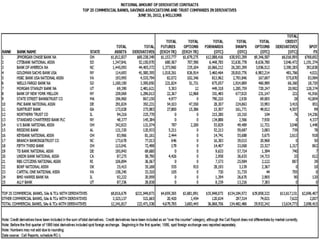
  • #17 Does anyone still believe the money center banks are a safe place to store the public’s money? (A show of hands)
  • #18 From the Office of the Comptroller of the Currency: Just in case you have forgotten what kinds of things the TBTF banks were speculating upon…Note the multi-trillion dollar notional value of derivatives of the top 8 banks trading in that space. Don’t forget to add 6 zeros. Source: Office of the Comptroller of the Currency, 2 qtr, 2012 report: http://www.occ.treas.gov/topics/capital-markets/financial-markets/trading/derivatives/derivatives-quarterly-report.html The TOTAL size of the Derivatives market? $1.2 Quadrillion: http://www.dailyfinance.com/2010/06/09/risk-quadrillion-derivatives-market-gdp/ Think about this the next time a large commercial bank says there’s no need for a Public Bank because they have “everything under control.” Where do you think the state’s money is safer?