How To Start a
Public Bank
Model: A Public Bank for the City of Oakland, California
by
Scott Baker, Senior Advisor & NY State Coordinator for the
Public Banking Institute
http://www.publicbankinginstitute.org/
This slideshow is available at:
http://www.slideshare.net/ScottOnTheSpot/how-to-start-a-public-bank
You’ve heard all the positive arguments…Now you
want to create a Public Bank for your City, County,
State, or Region. What do you do?
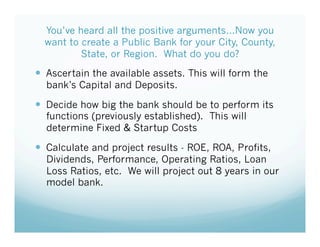
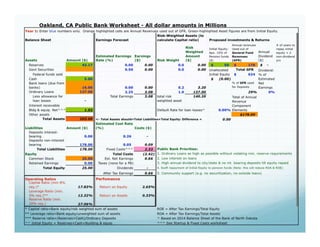
!  Ascertain the available assets. This will form the
bank’s Capital and Deposits.
!  Decide how big the bank should be to perform its
functions (previously established). This will
determine Fixed & Startup Costs
!  Calculate and project results - ROE, ROA, Profits,
Dividends, Performance, Operating Ratios, Loan
Loss Ratios, etc. We will project out 8 years in our
model bank.
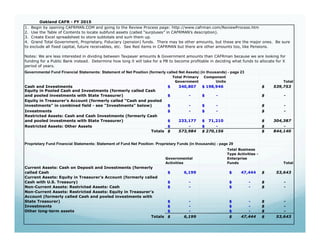
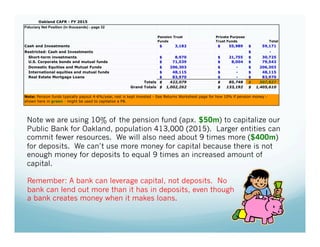
Note we are using 10% of the pension fund (apx. $50m) to capitalize our
Public Bank for Oakland, population 413,000 (2015). Larger entities can
commit fewer resources. We will also need about 9 times more ($400m)
for deposits. We can’t use more money for capital because there is not
enough money for deposits to equal 9 times an increased amount of
capital.
Remember: A bank can leverage capital, not deposits. No
bank can lend out more than it has in deposits, even though
a bank creates money when it makes loans.
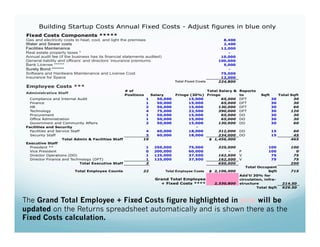
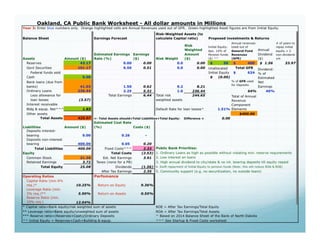
The Grand Total Employee + Fixed Costs figure highlighted in pink will be
updated on the Returns spreadsheet automatically and is shown there as the
Fixed Costs calculation.
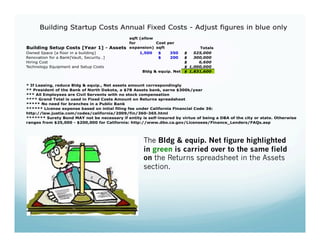
The Bldg & equip. Net figure highlighted
in green is carried over to the same field
on the Returns spreadsheet in the Assets
section.
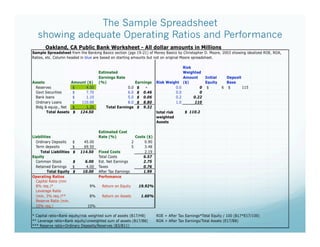
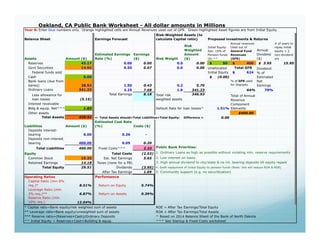
The Sample Spreadsheet
showing adequate Operating Ratios and Performance
How to start a public bank

How to start a public bank

  • 1.
    How To Starta Public Bank Model: A Public Bank for the City of Oakland, California by Scott Baker, Senior Advisor & NY State Coordinator for the Public Banking Institute http://www.publicbankinginstitute.org/ This slideshow is available at: http://www.slideshare.net/ScottOnTheSpot/how-to-start-a-public-bank
  • 2.
    You’ve heard allthe positive arguments…Now you want to create a Public Bank for your City, County, State, or Region. What do you do? !  Ascertain the available assets. This will form the bank’s Capital and Deposits. !  Decide how big the bank should be to perform its functions (previously established). This will determine Fixed & Startup Costs !  Calculate and project results - ROE, ROA, Profits, Dividends, Performance, Operating Ratios, Loan Loss Ratios, etc. We will project out 8 years in our model bank.
  • 4.
    Note we areusing 10% of the pension fund (apx. $50m) to capitalize our Public Bank for Oakland, population 413,000 (2015). Larger entities can commit fewer resources. We will also need about 9 times more ($400m) for deposits. We can’t use more money for capital because there is not enough money for deposits to equal 9 times an increased amount of capital. Remember: A bank can leverage capital, not deposits. No bank can lend out more than it has in deposits, even though a bank creates money when it makes loans.
  • 5.
    The Grand TotalEmployee + Fixed Costs figure highlighted in pink will be updated on the Returns spreadsheet automatically and is shown there as the Fixed Costs calculation.
  • 6.
    The Bldg &equip. Net figure highlighted in green is carried over to the same field on the Returns spreadsheet in the Assets section.
  • 7.
    The Sample Spreadsheet showingadequate Operating Ratios and Performance

Editor's Notes

  • #3 We are going to use a custom Microsoft Excel workbook consisting of 3 spreadsheets to figure everything out. It is based on a published spreadsheet for a simple commercial bank from “Money Basics by Christopher D. Moore, 2003” (see appendix in source document: “How To Start a Public Bank.pdf”), but with the addition of funds from existing city/country/state/region assets, modified for a public bank, and modeled out 8 years.
  • #4 Political entities over 100,000 people likely have enough available assets to start a Public Bank, but you have to learn to examine the Comprehensive Annual Financial Reports to be sure. These reports are typically hundreds of pages long, but we are only interested in a few figures. See CAFRMAN.COM.
  • #6 Startup & Fixed Costs (Tab) A Public Bank has a simpler setup than a commercial bank. There is only one branch – headquarters – and there is no need for most of the staff to meet the public, since the sole, or nearly sole, depositor is the entity that owns the bank, in this case, the city of Oakland.
  • #7 The Startup and Fixed Costs spreadsheet is split in this presentation but would appear as a single sheet in the workbook. The footnotes refer to the first section in the previous slide.
  • #8 Note: Operating Ratios are those used by Christopher Moore in 2003. These may have changed since then or be different in your area. Interest rates have come down significantly from when this spreadsheet was created. It is up to you to find out the current minimums to meet, as well as other regulatory requirements.
  • #9 Here we introduce Deposits for the first time, taken from the General Fund Revenues (GFR). $178m is deposited to start, but this will climb to 2/3 of the GFR, or $400m, by year 2. Interest rates, cost rates have been adjusted to meet current conditions (2016).
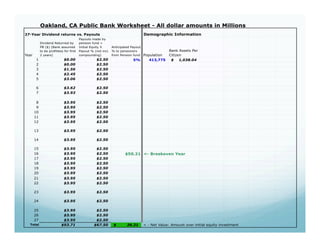
  • #10 The bank starts paying dividends back to the pension fund in year 3, after 2 start up years when there is little profit. This is only 40% of net earnings to start, but will increase yearly as profits climb. Note the payment of dividends seemingly depresses Performance; these would be much higher if dividends were kept by the bank. Operating ratios are compliant and there is a moderate rate of loan losses due to default (based on figures from the Bank of North Dakota, the nation’s only Public Bank).
  • #11 Dividend payouts increase significantly in the early years, then taper off by year 8. If we projected beyond year 8, dividends could continue to slowly increase, decreasing the time to “make up” the $50m in initial equity. Under this conservative scenario, $50m is paid back to the pension fund by year 16.
  • #12 By year 8, the bank is solidly profitable. There was no need for private investment, borrowing through bonds, or for any other money-raising activity. If there was no dividend payment the figures for ROE would be 19.20% and for ROA 1.32% which compares favorably to both the original Moore sample spreadsheet and to the balance sheet for the highly successful Bank of North Dakota. Questions?