Protecting Whose Forest? REDD and the ongoing contested land claims in Indonesia Sandra Moniaga  Learning Centre HuMa, Indonesia
Content General Overview of latent “forestry” and “indigenous peoples” issues in Indonesia Recent Development of “REDD” in Indonesia Indigenous Peoples, “Forests” and REDD in Indonesia Recommendations
Population : 221,932,000 Capital:  Jakarta; 13,194,000 Area: 1,922,570 square km (742,308 square miles) Designated “ state forest areas ”: 1,368,600 square km ( = 71 %) Corruption: ranked 143 th  worst out of 180 countries (Transparancy International, 2007) 17,500 islands (changing) Language: Bahasa Indonesia and more than 700 local dialects Religion: Muslim, Protestant, Roman Catholic, Hindu, Buddhist and indigenous religions/beliefs GDP per Capita: U.S. $3,100
General Overview of latent “Forestry” issues in Indonesia Problems with definitions: forests, forest areas, deforestation, indigenous peoples  Contested land claims
Problems of definitions Ecological forest vs Political forest  “ Forest Areas”,  customary forest, village forest etc Natural forest degradation vs Political forest reduction? Causes of natural forest degradation (policy, institutional and market failures) Indigenous peoples, masyarakat adat, masyarakat hukum adat, pribumi etc.
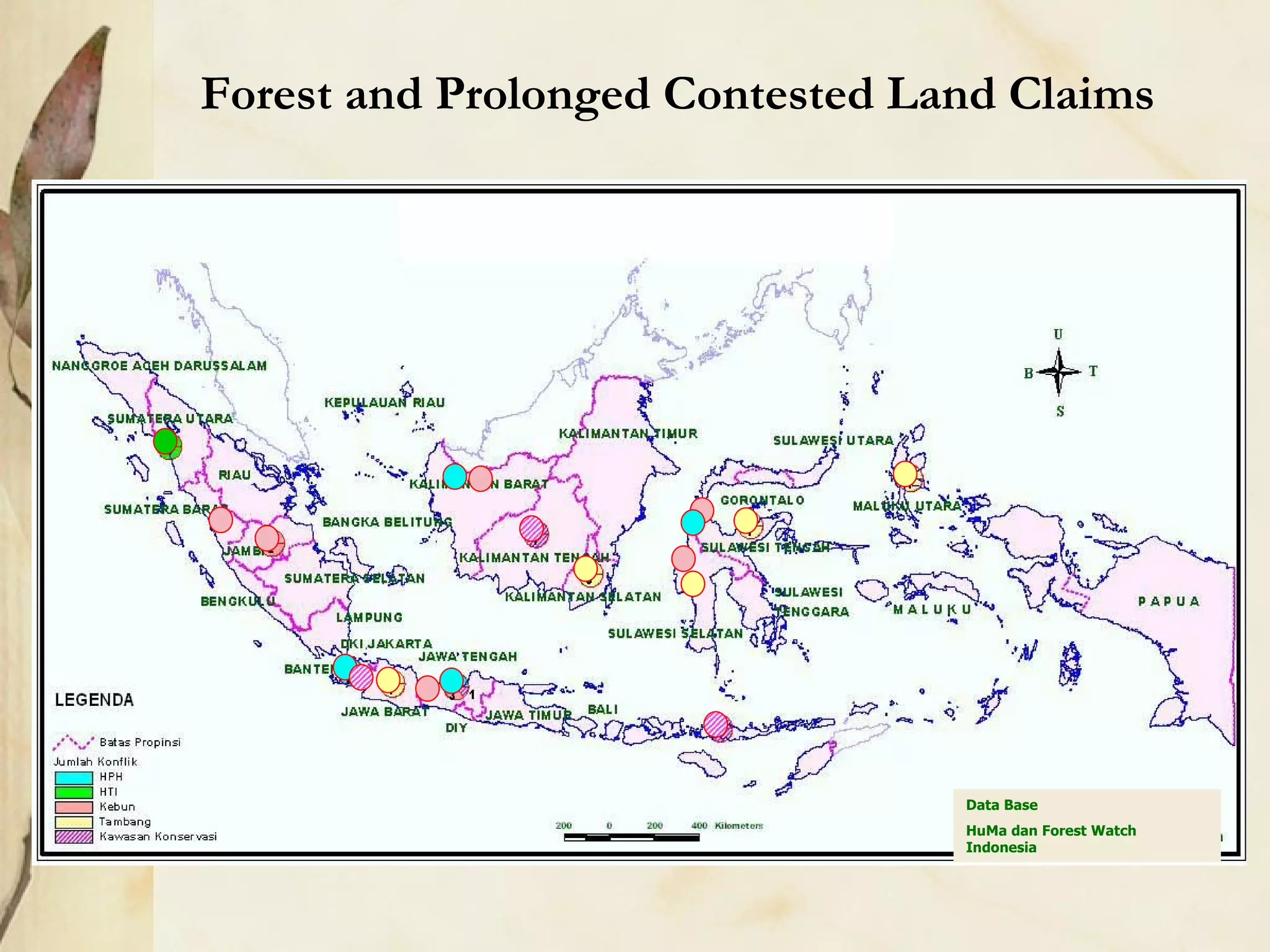
Data Base  HuMa dan Forest Watch Indonesia Forest and Prolonged Contested Land Claims
Recent REDD development in Indonesia Policy and Institutional Development  Policy development: substance and process Various State Institutions perspectives National Council for Climate Change,  Ministry of Forestry  National Planning Boards) Ministry of Environment Regional Governments (provincial and district) Indicated REDD demonstration and or proposed demo areas
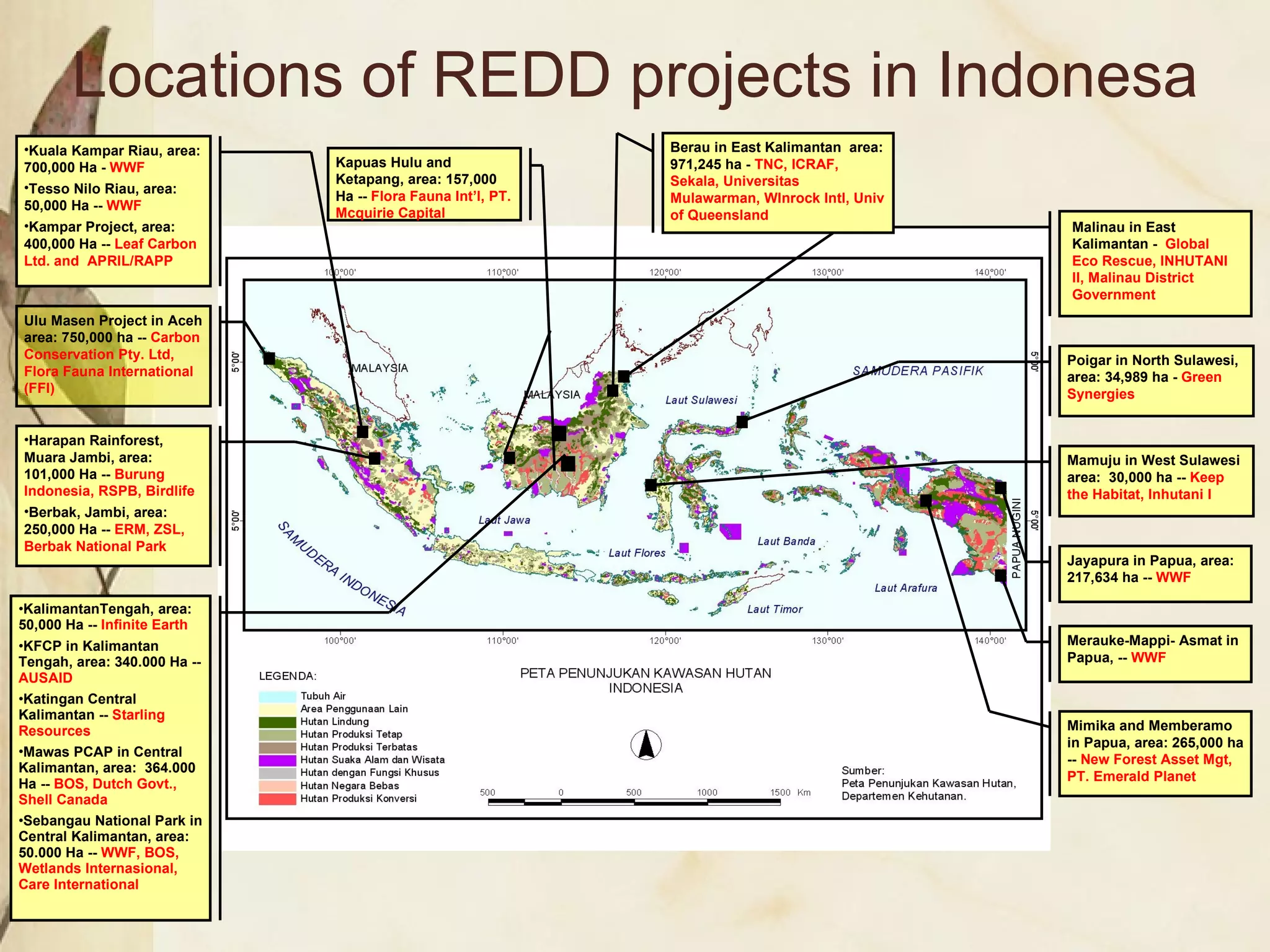
Kuala Kampar Riau, area:   700,000 Ha -  WWF Tesso Nilo Riau, area:   50,000 Ha --  WWF Kampar Project, area:   400,000 Ha --  Leaf Carbon Ltd.  and   APRIL/RAPP   Harapan Rainforest, Muara Jambi, area: 101,000 Ha --  Burung Indonesia, RSPB, Birdlife   Berbak, Jambi, area:   250,000 Ha --  ERM, ZSL, Berbak   National Park Ulu Masen  P roject in Aceh  area:  750,000 h a --  Carbon Conservation Pty. Ltd ,  Flora Fauna International (FFI) KalimantanTengah , area: 50,000 Ha --  Infinite Earth   KFCP  in  Kalimantan Tengah , area:   340.000 Ha --  AUSAID Katingan  Central  Kalimantan  --  Starling Resources   Mawas PCAP  in Central  Kalimantan , area:  364.000 Ha --  BOS,  Dutch Govt. , Shell Canada  Sebangau  National Park in Central  Kalimantan , area:  50.000 Ha --  WWF, BOS, Wetlands Internasional, Care International   Poigar  in North  Sulawesi , area:  34,989 ha  -  Green Synergies Mamuju  in West  Sulawesi  area:  30,000 ha  --  Keep the Habitat, Inhutani I Mimika  and  Memberamo  in  Papua , area:  265,000 ha  --  New Forest Asset Mgt, PT. Emerald Planet Jayapura  in  Papua , area:  217,634 ha  --  WWF Merauke-Mappi- Asmat  in  Papua , --  WWF Malinau  in East  Kalimantan  -  Global Eco Rescue, INHUTANI II, Malinau  District Government Berau  in East  Kali mantan  area:  971,245 ha  -  TNC, ICRAF, Sekala, Universitas Mulawarman, WInrock Intl, Univ of Queensland Locations of REDD projects in Indonesa Kapuas Hulu and Ketapang, area: 157,000 Ha --  F lora  F auna  I nt’l , PT. Mcquirie Capital
Indigenous Peoples, “Forests” and REDD in Indonesia REDD  There is not any final definition – negotiations still continuing     Neo “SFM” (Sustainable Forest Management)? Indicators of SFM Ecologically, economically and socially sustainable
Problems of SFM in Indonesia  Ecologically: Continuing ecological deforestation (1,8 mill/year) Causes forest fires, flood, land slides etc. Socially: Prolonged conflicts over land tenure and natural resource managements conflict (indigenous peoples and “state”) – unclearness of “ who own the forests ” Conflict/tensions of government authorities (central vs district government etc.) Insufficient legal and judicial system (content of the law and regulations, enforcement mechanism and corrupt judiciary) Economically: Declining forest quality and productivity, insecure rights for IPs and local communities become disincentive for develop sustainable programs
Is REDD part of the solution or worsening the problematic situation? Are there rooms for developing REDD to become part of the solutions?
Recommendations: ways to develop REDD to become part of the solutions Process:  Ensure the inclusion of meaningful negotiations for resolving the prolonged land and resource tenure conflicts; Ensure sufficient (and critical) understanding of IPs, peasants organizations and NGOs over the issue (forestry concept/terminologies, forest management in general and REDD);
Recommendation ….. Process: Full participation of IPs representatives, peasants organizations, their supporting NGOs and local governments in overall processes Consolidation among the different IPs, Peasants organizations, NGOs and academics Identify and recognize different problems and solutions (for forest management) for different regions
Recommendation ….. Substantive: Ensure revision of laws and regulations which constitute article/s which contradict to human rights principles (including indigenous and tribal peoples’ rights) Ensure the establishment of mechanism for resolving the prolonged land and resource tenure conflicts (incl. customary land right restitution); Adoption of Accra Caucus Key Messages Regarding REDD (contextually) + Integrate “forest carbon” management into natural resources management plans At community, district, regional (main islands), national and global policies and programs
 

Sandra's presentation

  • 1.
    Protecting Whose Forest?REDD and the ongoing contested land claims in Indonesia Sandra Moniaga Learning Centre HuMa, Indonesia
  • 2.
    Content General Overviewof latent “forestry” and “indigenous peoples” issues in Indonesia Recent Development of “REDD” in Indonesia Indigenous Peoples, “Forests” and REDD in Indonesia Recommendations
  • 3.
    Population : 221,932,000Capital: Jakarta; 13,194,000 Area: 1,922,570 square km (742,308 square miles) Designated “ state forest areas ”: 1,368,600 square km ( = 71 %) Corruption: ranked 143 th worst out of 180 countries (Transparancy International, 2007) 17,500 islands (changing) Language: Bahasa Indonesia and more than 700 local dialects Religion: Muslim, Protestant, Roman Catholic, Hindu, Buddhist and indigenous religions/beliefs GDP per Capita: U.S. $3,100
  • 4.
    General Overview oflatent “Forestry” issues in Indonesia Problems with definitions: forests, forest areas, deforestation, indigenous peoples Contested land claims
  • 5.
    Problems of definitionsEcological forest vs Political forest “ Forest Areas”, customary forest, village forest etc Natural forest degradation vs Political forest reduction? Causes of natural forest degradation (policy, institutional and market failures) Indigenous peoples, masyarakat adat, masyarakat hukum adat, pribumi etc.
  • 6.
    Data Base HuMa dan Forest Watch Indonesia Forest and Prolonged Contested Land Claims
  • 7.
    Recent REDD developmentin Indonesia Policy and Institutional Development Policy development: substance and process Various State Institutions perspectives National Council for Climate Change, Ministry of Forestry National Planning Boards) Ministry of Environment Regional Governments (provincial and district) Indicated REDD demonstration and or proposed demo areas
  • 8.
    Kuala Kampar Riau,area: 700,000 Ha - WWF Tesso Nilo Riau, area: 50,000 Ha -- WWF Kampar Project, area: 400,000 Ha -- Leaf Carbon Ltd. and APRIL/RAPP Harapan Rainforest, Muara Jambi, area: 101,000 Ha -- Burung Indonesia, RSPB, Birdlife Berbak, Jambi, area: 250,000 Ha -- ERM, ZSL, Berbak National Park Ulu Masen P roject in Aceh area: 750,000 h a -- Carbon Conservation Pty. Ltd , Flora Fauna International (FFI) KalimantanTengah , area: 50,000 Ha -- Infinite Earth KFCP in Kalimantan Tengah , area: 340.000 Ha -- AUSAID Katingan Central Kalimantan -- Starling Resources Mawas PCAP in Central Kalimantan , area: 364.000 Ha -- BOS, Dutch Govt. , Shell Canada Sebangau National Park in Central Kalimantan , area: 50.000 Ha -- WWF, BOS, Wetlands Internasional, Care International Poigar in North Sulawesi , area: 34,989 ha - Green Synergies Mamuju in West Sulawesi area: 30,000 ha -- Keep the Habitat, Inhutani I Mimika and Memberamo in Papua , area: 265,000 ha -- New Forest Asset Mgt, PT. Emerald Planet Jayapura in Papua , area: 217,634 ha -- WWF Merauke-Mappi- Asmat in Papua , -- WWF Malinau in East Kalimantan - Global Eco Rescue, INHUTANI II, Malinau District Government Berau in East Kali mantan area: 971,245 ha - TNC, ICRAF, Sekala, Universitas Mulawarman, WInrock Intl, Univ of Queensland Locations of REDD projects in Indonesa Kapuas Hulu and Ketapang, area: 157,000 Ha -- F lora F auna I nt’l , PT. Mcquirie Capital
  • 9.
    Indigenous Peoples, “Forests”and REDD in Indonesia REDD There is not any final definition – negotiations still continuing  Neo “SFM” (Sustainable Forest Management)? Indicators of SFM Ecologically, economically and socially sustainable
  • 10.
    Problems of SFMin Indonesia Ecologically: Continuing ecological deforestation (1,8 mill/year) Causes forest fires, flood, land slides etc. Socially: Prolonged conflicts over land tenure and natural resource managements conflict (indigenous peoples and “state”) – unclearness of “ who own the forests ” Conflict/tensions of government authorities (central vs district government etc.) Insufficient legal and judicial system (content of the law and regulations, enforcement mechanism and corrupt judiciary) Economically: Declining forest quality and productivity, insecure rights for IPs and local communities become disincentive for develop sustainable programs
  • 11.
    Is REDD partof the solution or worsening the problematic situation? Are there rooms for developing REDD to become part of the solutions?
  • 12.
    Recommendations: ways todevelop REDD to become part of the solutions Process: Ensure the inclusion of meaningful negotiations for resolving the prolonged land and resource tenure conflicts; Ensure sufficient (and critical) understanding of IPs, peasants organizations and NGOs over the issue (forestry concept/terminologies, forest management in general and REDD);
  • 13.
    Recommendation ….. Process:Full participation of IPs representatives, peasants organizations, their supporting NGOs and local governments in overall processes Consolidation among the different IPs, Peasants organizations, NGOs and academics Identify and recognize different problems and solutions (for forest management) for different regions
  • 14.
    Recommendation ….. Substantive:Ensure revision of laws and regulations which constitute article/s which contradict to human rights principles (including indigenous and tribal peoples’ rights) Ensure the establishment of mechanism for resolving the prolonged land and resource tenure conflicts (incl. customary land right restitution); Adoption of Accra Caucus Key Messages Regarding REDD (contextually) + Integrate “forest carbon” management into natural resources management plans At community, district, regional (main islands), national and global policies and programs
  • 15.