www.sancharexpress.com
KEY ECONOMIC MANAGEMENT CHARACTERISTICS OF THE PM
NARENDRA MODI LED GOVERNMENT
It has been little more than two months since the Prime Minister Narendra Modi
led government formed the Union Government after obtaining substantial
majority in Lok Sabha during the April-May 2014 General Election.
Poor economic management, and the widespread perception that many decisions
taken by the previous UPA (United Progressive Alliance) government, led by the
Indian National Congress (INC), were not being taken in national interest, were
major factors in favorable results obtained by Prime Minister Modi’s Bharatiya
Janata Party (BJP). Widespread perception that UPA government had over many
years significantly undermined functioning of the constitutional bodies for
partisan purposes, eroding trust between the government and the governed, also
contributed to the BJP’s victory.
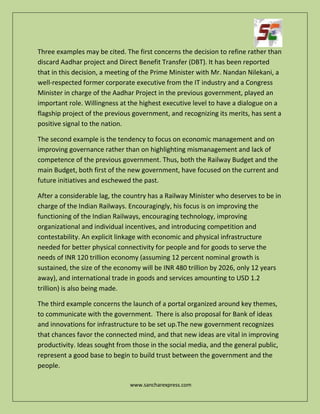
Prime Minister Narendra Modi led government has even at this early stage
provided several indications that national interest and constitutional proprieties
will govern decision making.
www.sancharexpress.com
Three examples may be cited. The first concerns the decision to refine rather than
discard Aadhar project and Direct Benefit Transfer (DBT). It has been reported
that in this decision, a meeting of the Prime Minister with Mr. Nandan Nilekani, a
well-respected former corporate executive from the IT industry and a Congress
Minister in charge of the Aadhar Project in the previous government, played an
important role. Willingness at the highest executive level to have a dialogue on a
flagship project of the previous government, and recognizing its merits, has sent a
positive signal to the nation.
The second example is the tendency to focus on economic management and on
improving governance rather than on highlighting mismanagement and lack of
competence of the previous government. Thus, both the Railway Budget and the
main Budget, both first of the new government, have focused on the current and
future initiatives and eschewed the past.
After a considerable lag, the country has a Railway Minister who deserves to be in
charge of the Indian Railways. Encouragingly, his focus is on improving the
functioning of the Indian Railways, encouraging technology, improving
organizational and individual incentives, and introducing competition and
contestability. An explicit linkage with economic and physical infrastructure
needed for better physical connectivity for people and for goods to serve the
needs of INR 120 trillion economy (assuming 12 percent nominal growth is
sustained, the size of the economy will be INR 480 trillion by 2026, only 12 years
away), and international trade in goods and services amounting to USD 1.2
trillion) is also being made.
The third example concerns the launch of a portal organized around key themes,
to communicate with the government. There is also proposal for Bank of ideas
and innovations for infrastructure to be set up.The new government recognizes
that chances favor the connected mind, and that new ideas are vital in improving
productivity. Ideas sought from those in the social media, and the general public,
represent a good base to begin to build trust between the government and the
people.
www.sancharexpress.com
There are indications that Prime Minister Modi’s government has improved
perceptions about India, and its growth prospects. This is illustrated by Barclays
Bank highlighting that 6 percent growth is closer than commonly perceived
(August 1, 2014, Emerging Markets Research). Other researchers have also
revised growth rates for India upwards.
Economic Management: Key Characteristics
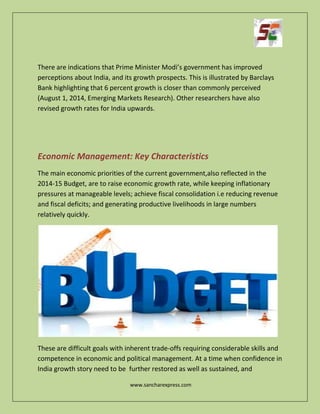
The main economic priorities of the current government,also reflected in the
2014-15 Budget, are to raise economic growth rate, while keeping inflationary
pressures at manageable levels; achieve fiscal consolidation i.e reducing revenue
and fiscal deficits; and generating productive livelihoods in large numbers
relatively quickly.
These are difficult goals with inherent trade-offs requiring considerable skills and
competence in economic and political management. At a time when confidence in
India growth story need to be further restored as well as sustained, and
www.sancharexpress.com
significant geo-economic and geo-strategic risks exist across the world,
policymakers must especially guard against potential downside risks in the
economic management approach and initiatives which they undertake.
An additional constraint which requires greater recognition is that India’s current
government administrative practices, and mind-sets of political other leadership
need reorientation, with greater focus on outcomes or results obtained, rather
than on spending.
The current government structure, therefore need to be reoriented towards
outcomes, while recognizing weak fiscal position. Those urging the government to
take bolder (some call it transformative) approaches, may well consider that any
organization, let alone as large as union Government, (the 2014-15 Union Budget
Proposes spending of INR 18.0 trillion (about USD 300 billion, equivalent to 16.3
percent of GDP, and tax revenue of INR 13.6 trillion, equivalent to 12.4 percent of
GDP cannot be undertaken at a speed for which the system is not ready. The
total number of government and semi-government employees in the country is
around 25 million, with numbering about 4 million.
The above recognition helps to explain the decision to obtain better performance
from the existing government structures and organizations, assisted by better
policy, program, and organizational coherence, application of requisite
technology, and injection of appropriate economic reasoning and literacy.
To obtain better performance from existing structures is also consistent with the
economic management approach adopted when Prime Minister Modi governed
the state of Gujarat as its chief Minister.
As system capabilities improve, and positive impact of seemingly incremental
steps become more visible, progressively more ambitions initiatives can be
expected. The methodical approach to economic management adopted, with
cumulative impact of seemingly small but having disproportionately positive
impact on outcomes, is better suited to current capabilities.
www.sancharexpress.com
However, this approach will have limitations. Once there are positive results, and
confidence and capabilities of government systems, and societal mind sets
become more consistent with achieving more rapid growth, appropriate
initiatives can be undertaken. This will require changes by all stakeholders,
including the general public and will need improved leadership at all levels, not
just in the government.
Prime Minister Narendra Modi led government has made a sound start in tapping
growth and employment generation drivers, and in improving public financial
management. The critics should not let the best be the enemy of the good.
Sanchar Express
190 Pratap Nagar, Mayur Vihar
Phase -1, Delhi – 110091
Tele/Fax: 011-22751531
Email: info@sancharexpress.com

ECONOMIC MANAGEMENT CHARACTERISTICS OF MODI

  • 1.
    www.sancharexpress.com KEY ECONOMIC MANAGEMENTCHARACTERISTICS OF THE PM NARENDRA MODI LED GOVERNMENT It has been little more than two months since the Prime Minister Narendra Modi led government formed the Union Government after obtaining substantial majority in Lok Sabha during the April-May 2014 General Election. Poor economic management, and the widespread perception that many decisions taken by the previous UPA (United Progressive Alliance) government, led by the Indian National Congress (INC), were not being taken in national interest, were major factors in favorable results obtained by Prime Minister Modi’s Bharatiya Janata Party (BJP). Widespread perception that UPA government had over many years significantly undermined functioning of the constitutional bodies for partisan purposes, eroding trust between the government and the governed, also contributed to the BJP’s victory. Prime Minister Narendra Modi led government has even at this early stage provided several indications that national interest and constitutional proprieties will govern decision making.
  • 2.
    www.sancharexpress.com Three examples maybe cited. The first concerns the decision to refine rather than discard Aadhar project and Direct Benefit Transfer (DBT). It has been reported that in this decision, a meeting of the Prime Minister with Mr. Nandan Nilekani, a well-respected former corporate executive from the IT industry and a Congress Minister in charge of the Aadhar Project in the previous government, played an important role. Willingness at the highest executive level to have a dialogue on a flagship project of the previous government, and recognizing its merits, has sent a positive signal to the nation. The second example is the tendency to focus on economic management and on improving governance rather than on highlighting mismanagement and lack of competence of the previous government. Thus, both the Railway Budget and the main Budget, both first of the new government, have focused on the current and future initiatives and eschewed the past. After a considerable lag, the country has a Railway Minister who deserves to be in charge of the Indian Railways. Encouragingly, his focus is on improving the functioning of the Indian Railways, encouraging technology, improving organizational and individual incentives, and introducing competition and contestability. An explicit linkage with economic and physical infrastructure needed for better physical connectivity for people and for goods to serve the needs of INR 120 trillion economy (assuming 12 percent nominal growth is sustained, the size of the economy will be INR 480 trillion by 2026, only 12 years away), and international trade in goods and services amounting to USD 1.2 trillion) is also being made. The third example concerns the launch of a portal organized around key themes, to communicate with the government. There is also proposal for Bank of ideas and innovations for infrastructure to be set up.The new government recognizes that chances favor the connected mind, and that new ideas are vital in improving productivity. Ideas sought from those in the social media, and the general public, represent a good base to begin to build trust between the government and the people.
  • 3.
    www.sancharexpress.com There are indicationsthat Prime Minister Modi’s government has improved perceptions about India, and its growth prospects. This is illustrated by Barclays Bank highlighting that 6 percent growth is closer than commonly perceived (August 1, 2014, Emerging Markets Research). Other researchers have also revised growth rates for India upwards. Economic Management: Key Characteristics The main economic priorities of the current government,also reflected in the 2014-15 Budget, are to raise economic growth rate, while keeping inflationary pressures at manageable levels; achieve fiscal consolidation i.e reducing revenue and fiscal deficits; and generating productive livelihoods in large numbers relatively quickly. These are difficult goals with inherent trade-offs requiring considerable skills and competence in economic and political management. At a time when confidence in India growth story need to be further restored as well as sustained, and
  • 4.
    www.sancharexpress.com significant geo-economic andgeo-strategic risks exist across the world, policymakers must especially guard against potential downside risks in the economic management approach and initiatives which they undertake. An additional constraint which requires greater recognition is that India’s current government administrative practices, and mind-sets of political other leadership need reorientation, with greater focus on outcomes or results obtained, rather than on spending. The current government structure, therefore need to be reoriented towards outcomes, while recognizing weak fiscal position. Those urging the government to take bolder (some call it transformative) approaches, may well consider that any organization, let alone as large as union Government, (the 2014-15 Union Budget Proposes spending of INR 18.0 trillion (about USD 300 billion, equivalent to 16.3 percent of GDP, and tax revenue of INR 13.6 trillion, equivalent to 12.4 percent of GDP cannot be undertaken at a speed for which the system is not ready. The total number of government and semi-government employees in the country is around 25 million, with numbering about 4 million. The above recognition helps to explain the decision to obtain better performance from the existing government structures and organizations, assisted by better policy, program, and organizational coherence, application of requisite technology, and injection of appropriate economic reasoning and literacy. To obtain better performance from existing structures is also consistent with the economic management approach adopted when Prime Minister Modi governed the state of Gujarat as its chief Minister. As system capabilities improve, and positive impact of seemingly incremental steps become more visible, progressively more ambitions initiatives can be expected. The methodical approach to economic management adopted, with cumulative impact of seemingly small but having disproportionately positive impact on outcomes, is better suited to current capabilities.
  • 5.
    www.sancharexpress.com However, this approachwill have limitations. Once there are positive results, and confidence and capabilities of government systems, and societal mind sets become more consistent with achieving more rapid growth, appropriate initiatives can be undertaken. This will require changes by all stakeholders, including the general public and will need improved leadership at all levels, not just in the government. Prime Minister Narendra Modi led government has made a sound start in tapping growth and employment generation drivers, and in improving public financial management. The critics should not let the best be the enemy of the good. Sanchar Express 190 Pratap Nagar, Mayur Vihar Phase -1, Delhi – 110091 Tele/Fax: 011-22751531 Email: info@sancharexpress.com