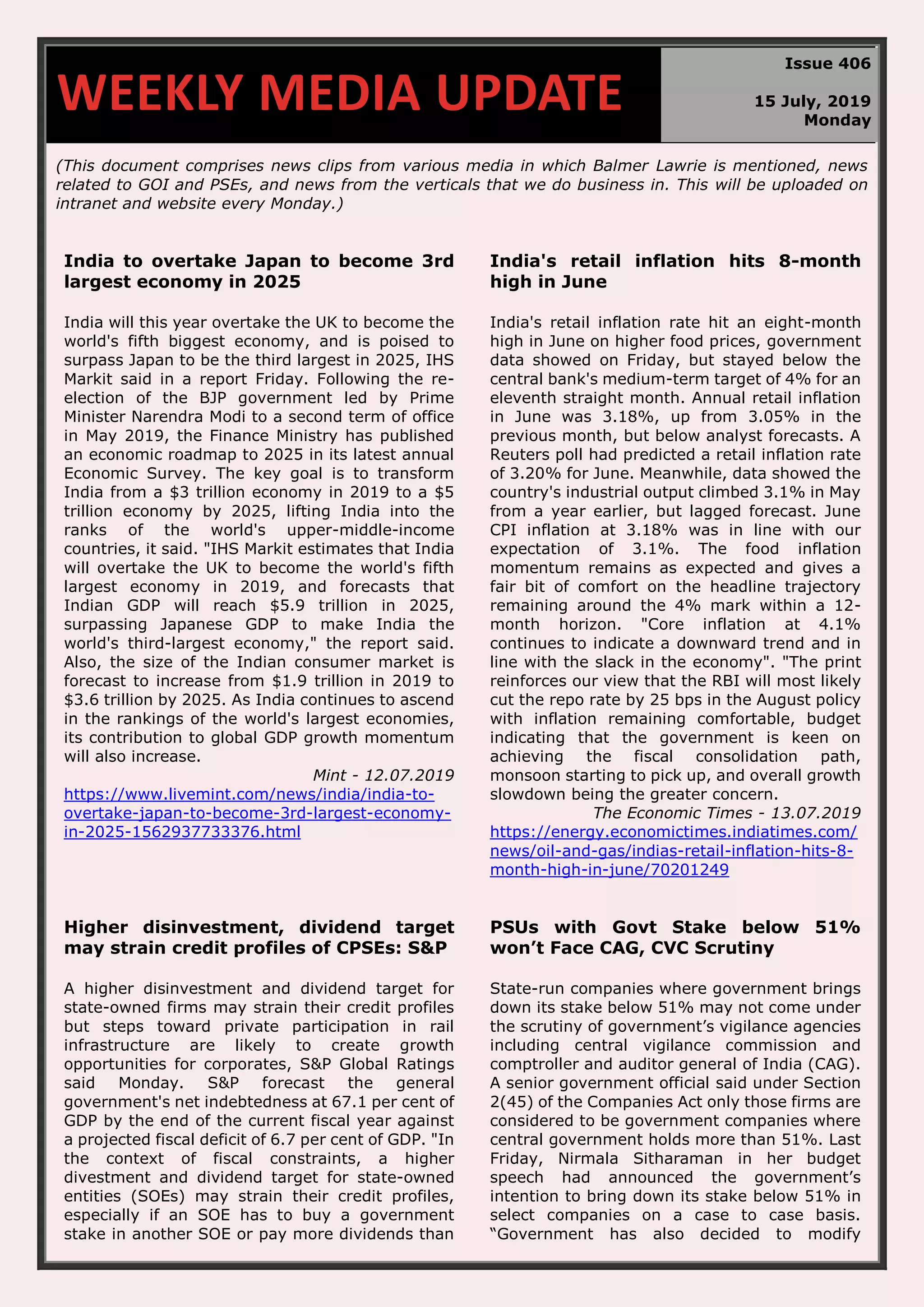
(This document comprises news clips from various media in which Balmer Lawrie is mentioned, news
related to GOI and PSEs, and news from the verticals that we do business in. This will be uploaded on
intranet and website every Monday.)
India to overtake Japan to become 3rd
largest economy in 2025
India will this year overtake the UK to become the
world's fifth biggest economy, and is poised to
surpass Japan to be the third largest in 2025, IHS
Markit said in a report Friday. Following the re-
election of the BJP government led by Prime
Minister Narendra Modi to a second term of office
in May 2019, the Finance Ministry has published
an economic roadmap to 2025 in its latest annual
Economic Survey. The key goal is to transform
India from a $3 trillion economy in 2019 to a $5
trillion economy by 2025, lifting India into the
ranks of the world's upper-middle-income
countries, it said. "IHS Markit estimates that India
will overtake the UK to become the world's fifth
largest economy in 2019, and forecasts that
Indian GDP will reach $5.9 trillion in 2025,
surpassing Japanese GDP to make India the
world's third-largest economy," the report said.
Also, the size of the Indian consumer market is
forecast to increase from $1.9 trillion in 2019 to
$3.6 trillion by 2025. As India continues to ascend
in the rankings of the world's largest economies,
its contribution to global GDP growth momentum
will also increase.
Mint - 12.07.2019
https://www.livemint.com/news/india/india-to-
overtake-japan-to-become-3rd-largest-economy-
in-2025-1562937733376.html
India's retail inflation hits 8-month
high in June
India's retail inflation rate hit an eight-month
high in June on higher food prices, government
data showed on Friday, but stayed below the
central bank's medium-term target of 4% for an
eleventh straight month. Annual retail inflation
in June was 3.18%, up from 3.05% in the
previous month, but below analyst forecasts. A
Reuters poll had predicted a retail inflation rate
of 3.20% for June. Meanwhile, data showed the
country's industrial output climbed 3.1% in May
from a year earlier, but lagged forecast. June
CPI inflation at 3.18% was in line with our
expectation of 3.1%. The food inflation
momentum remains as expected and gives a
fair bit of comfort on the headline trajectory
remaining around the 4% mark within a 12-
month horizon. "Core inflation at 4.1%
continues to indicate a downward trend and in
line with the slack in the economy". "The print
reinforces our view that the RBI will most likely
cut the repo rate by 25 bps in the August policy
with inflation remaining comfortable, budget
indicating that the government is keen on
achieving the fiscal consolidation path,
monsoon starting to pick up, and overall growth
slowdown being the greater concern.
The Economic Times - 13.07.2019
https://energy.economictimes.indiatimes.com/
news/oil-and-gas/indias-retail-inflation-hits-8-
month-high-in-june/70201249
Higher disinvestment, dividend target
may strain credit profiles of CPSEs: S&P
A higher disinvestment and dividend target for
state-owned firms may strain their credit profiles
but steps toward private participation in rail
infrastructure are likely to create growth
opportunities for corporates, S&P Global Ratings
said Monday. S&P forecast the general
government's net indebtedness at 67.1 per cent of
GDP by the end of the current fiscal year against
a projected fiscal deficit of 6.7 per cent of GDP. "In
the context of fiscal constraints, a higher
divestment and dividend target for state-owned
entities (SOEs) may strain their credit profiles,
especially if an SOE has to buy a government
stake in another SOE or pay more dividends than
PSUs with Govt Stake below 51%
won’t Face CAG, CVC Scrutiny
State-run companies where government brings
down its stake below 51% may not come under
the scrutiny of government’s vigilance agencies
including central vigilance commission and
comptroller and auditor general of India (CAG).
A senior government official said under Section
2(45) of the Companies Act only those firms are
considered to be government companies where
central government holds more than 51%. Last
Friday, Nirmala Sitharaman in her budget
speech had announced the government’s
intention to bring down its stake below 51% in
select companies on a case to case basis.
“Government has also decided to modify
WEEKLY MEDIA UPDATE
Issue 406
15 July, 2019
Monday
free cash flow allows, to support these policy
objectives," it said. The Budget 2019-20 has set a
disinvestment target of Rs 1.05 lakh crore, while
Rs 57,487 crore is expected to come from central
public sector enterprises (CPSEs) as dividend. S&P
believes that the government's proposed injection
of Rs 70,000 crore into the banking sector as
capital support should help stabilise financial
sector's conditions, although the funding is likely
to weigh on government finances at the margin.
Business Standard - 09.07.2019
https://www.business-standard.com/article/pti-
stories/higher-disinvestment-dividend-target-
may-strain-credit-profiles-of-cpses-s-p-
119070800697_1.html
present policy of retaining 51% Government
stake to retaining 51% stake inclusive of the
stake of Government controlled institutions,”
she had said. The above quoted government
official said that department of public
enterprises (DPE) which is a nodal agency for all
central public sector enterprises (CPSEs) will
look into the matter, and issue clarifications if
any. “As per the current definition they are no
longer a government company,” he added.
The Economic Times - 09.07.2019
https://epaper.timesgroup.com/Olive/ODN/Th
eEconomicTimes/shared/ShowArticle.aspx?doc
=ETKM%2F2019%2F07%2F09&entity=Ar0110
9&sk=44B3D997&mode=text
ONGC, IOC, GAIL, NTPC may lose PSU tag
after equity dilution
Several of 'maharatna' and 'navratna' companies,
including ONGC, IOC, GAIL and NTPC, could soon
become independent board-run entities outside
the scrutiny of CAG and CVC if the government
implements a proposal to take out the PSU tag
from some of the entities after its shareholding
falls below the threshold 51% mark. Government
sources said that Finance Ministry is planning to
approach NITI Aayog to prepare yet another list of
PSUs where their holding could be brought down
to below 51% and also point out which of these
could shed the PSU tag and become independently
board-run private companies. For a company to
remain a government-controlled public sector
undertaking (PSU), either the Centre or the state
government or both together should hold more
than 51% stake in it. The Budget proposed that
51% stake could include direct and indirect
shareholding of the government through other
state-run companies and financial institutions. "As
per the definition of a government company, the
Central government and the state government
together have to have 51% equity.
Mint - 12.07.2019
https://www.livemint.com/companies/news/ongc
-ioc-gail-ntpc-may-lose-psu-tag-after-equity-
dilution-1562902210252.html
Strategic disinvestment: Govt
identifies 28 PSUs for sale including Air
India; here’s the complete list
The Union government is hoping to garner more
than Rs one lakh crore in this financial year from
the sale of its shares in PSUs. In her maiden
budget, finance minister Nirmala Sitharaman
has estimated that the government’s
disinvestment proceeds to be Rs 1.05 lakh
crore, an increase of 31% over the last year’s
figure. In the revised estimate for FY 2018-19,
the Union government has pegged its
disinvestment proceeds at Rs 80,000, the same
as in the budget estimate. The government has
identified 28 central PSUs for disinvestment this
year. It also includes national air carrier Air
India. The government has been trying to find
a buyer or strategic partner for Air India for
several years. However, its efforts to sell the
national carrier has not succeeded due to huge
loan liabilities of the ailing carrier.
The Financial Express - 11.07.2019
https://www.financialexpress.com/economy/st
rategic-disinvestment-govt-identifies-28-psus-
for-sale-including-air-india-heres-the-
complete-list/1640031/
PSU disinvestment: Modi govt to raise Rs
3.25 lakh crore from stake sale in 5 years
The Indian government has plans to raise as much
as Rs 3.25 lakh crore ($47.4 billion) in the next
five years by reducing its stakes in some large
state-owned firms to 40%, two senior government
officials told Reuters, in the nation’s biggest
privatisation push in more than two decades. Last
week, finance minister Nirmala Sitharaman in her
budget announced that the government will look
to reduce direct controlling stakes in some state-
run firms on a case-by-case basis. The plan will
Shareholding reform unlikely to help
PSUs
In a major policy change, the government has
decided to reduce stake in non-financial Public
Sector Undertakings (PSUs) below 51 per cent
without ceding management control over such
entities. The government holding can even go
to as low as 25-30 per cent, a move that will
certainly help it to meet its disinvestment
target, but unlikely to unchain its proverbial
golden goose, according to experts. Finance
Minister Nirmala Sitharaman, in her maiden
open up a steady stream of state companies to
greater private investment, and target the kind of
annual divestment revenue that will be crucial to
meet fiscal deficit targets. Prime Minister Narendra
Modi’s administration already sold government
stakes in a host of companies to raise a record
$40.92 billion in his first five-year term, nearly
three times the divestment proceeds of $14.52
billion achieved by the Congress party government
in 2009-2014. Modi was re-elected for a second-
term in a landslide victory in April-May.
The Financial Express - 12.07.2019
https://www.financialexpress.com/economy/psu-
disinvestment-modi-govt-to-raise-to-raise-rs-3-
25-lakh-crore-from-stake-sale-in-5-
years/1642292/
Budget speech on July 5, announced the
government’s intention to cut its stake below 51
per cent in firms on a case-to-case basis and yet
retain control. The government intends to
encourage retail investor participation in
Central Public Sector Enterprises (CPSEs),
which has shown an upward trend of late and
ensure that CPSE boards are more
professionally managed, she added. To begin
with, equity cross-holdings of PSUs will be taken
into account.
The New Indian Express - 11.07.2019
http://www.newindianexpress.com/business/2
019/jul/11/shareholding-reform-unlikely-to-
help-psus-2002162.html
Rs 10,000 crore worth 6th tranche of
CPSE ETF to open on July 18
The government is planning to raise up to Rs
10,000 crore from the sixth tranche of CPSE ETF
which would be launched on July 18, an official
said. The CPSE Exchange Traded Fund (ETF)
tracks shares of 11 Central Public Sector
Enterprises (CPSEs) -- ONGC, NTPC, Coal India
IOC, Rural Electrification Corp, Power Finance
Corp, Bharat Electronics, Oil India, NBCC India,
NLC India and SJVN. "The follow-on fund offer
(FFO) 5 will have a base issue size of Rs 8,000
crore with an option to retain over subscription of
another Rs 2,000 crore," the official said. The
issue is likely to open on July 18 for anchor
investors and on July 19 for other investors, the
official added. The issue is likely to open on July
18 for anchor investors and on July 19 for other
investors, the official added. Through the earlier
five tranches of the CPSE ETF, the government has
already raised Rs 38,500 crore -- Rs 3,000 crore
from the first tranche in March 2014, Rs 6,000
crore in January 2017, Rs 2,500 crore from the
third in March 2017, Rs 17,000 crore in November
2018 and Rs 10,000 crore in March 2019.
The Economic Times - 10.07.2019
https://m.economictimes.com/markets/stocks/ne
ws/rs-10000-crore-worth-6th-tranche-of-cpse-
etf-to-open-on-july-
18/articleshow/70156290.cms
No proposal to merge state-owned
firms: Oil Minister Dharmendra
Pradhan
Oil Minister Dharmendra Pradhan Monday said
there is no proposal, at present, for the merger
of state-owned oil and gas entities under
consideration of his ministry. While state-
owned Oil and Natural Gas Corporation had last
year acquired government stake in Hindustan
Petroleum Corporation Ltd, Indian Oil Corp
(IOC) and Bharat Petroleum Corp Ltd were both
keen on acquiring gas utility GAIL India Ltd. "At
present, there is no proposal to merge state-run
oil and gas entities under consideration of the
ministry," Pradhan said in a written reply to a
question in the Lok Sabha here. He had on
February 7, 2018, told the Rajya Sabha that IOC
and BPCL have separately indicated to the
petroleum ministry their interest in taking over
GAIL to add natural gas to their oil refining and
marketing business. Then finance minister Arun
Jaitley had in the Budget 2017-18 unveiled the
government's plan to create integrated public
sector oil majors "through consolidation,
mergers, and acquisitions" so that the merged
company has the "capacity to bear higher risks,
avail economies of scale, take higher
investment decisions" and is "able to match the
performance of international and domestic
private companies".
The Economic Times - 09.07.2019
https://economictimes.indiatimes.com/industr
y/energy/oil-gas/no-proposal-to-merge-state-
owned-firms-oil-minister-dharmendra-
pradhan/articleshow/70128386.cms
Reduction of government stake in oil
companies a credit negative: Moody’s
The government's latest plan to reduce stake in
select state-run companies including oil and gas
firms could be credit negative for Indian Oil
Government's stake cuts unlikely to
affect energy PSU ratings: Fitch
Reduction of direct controlling stakes by the
centre in large state-owned energy companies
is unlikely to negatively impact the ratings on
Corporation (IOC), Bharat Petroleum (BPCL) and
Oil India, Moody’s Investors Service said in a
report. “A reduction in government’s direct stake
to below 51 per cent could result in a lower
assessment of support incorporated into the rating
of these companies, a credit negative. The Baa2
ratings of IOCL and BPCL incorporate two notches
of uplift, while that of OIL incorporates one notch
of uplift,” the report said. According to the rating
agency, a change in policy along with Rs 1.1
trillion disinvestment target indicate that the
government’s direct ownership could fall below 51
per cent in the state-owned oil companies - Oil and
Natural Gas Corporation (ONGC), IOC, BPCL and
Oil India, who had a market capitalization of Rs
4.5 trillion as on 5 July 2019. The government is
open to reducing its stake to as low as 40 per cent,
according to an Economic Times report. “The idea
is to unlock the value in these firms.
The Economic Times - 12.07.2019
https://energy.economictimes.indiatimes.com/ne
ws/oil-and-gas/reduction-of-government-stake-
in-oil-companies-a-credit-negative-
moodys/70185335
these entities, as long as the government
maintains majority effective ownership and
broad control of their activities, said Fitch
Ratings in a statement. The update comes on
the backdrop of a statement made by a
government official steering the centre’s asset
sale department on stake sale of energy PSUs.
The official indicated that that the centre may
reduce its direct controlling stakes in large
energy companies including Oil and Natural Gas
Corp (ONGC), Indian Oil Corp, NPTC Ltd and
GAIL (India), while maintaining effective
controlling stakes of at least 51 per cent
through arms such as Life Insurance
Corporation of India. This comes as the
government has set an enhanced target of Rs
1.05 lakh crore of divestment receipts for the
financial year ending 31 March 2020.
The Economic Times - 15.07.2019
https://energy.economictimes.indiatimes.com/
news/oil-and-gas/governments-stake-cuts-
unlikely-to-affect-energy-psu-ratings-
fitch/70225322
Ministries and Niti Aayog differ on how to
split GAIL
Though it is amply clear by now that the marketing
and pipeline businesses of state-run GAIL (India)
will be separated, opinions of departments within
the government seem to differ on the ownership
and shape of the new entity to be created. While
the ministry of petroleum and natural gas feel the
pipeline company should remain a subsidiary of
GAIL, same as GAIL Gas which operates the city
gas distribution business, the Niti Aayog and the
department of investment and public asset
management (DIPAM) are of the view that the
pipeline division should be an independent entity.
According to sources, the Prime Minister’s Office
had called a meeting to hear out both the options
but is yet to give any direction. Sale of pipelines is
part of the government’s asset recycling or
monetisation plan. Apart from pipelines,
transmission lines of Power Grid Corporation,
telecom towers of BSNL and MTNL, ports and
railway stations are the other assets under radar
of the government. GAIL started the work to
transfer its pipeline vertical into a subsidiary of the
parent company and hired a consultant to work
out the options last year. Earlier in the year,
petroleum minister Dharmendra Pradhan had
made it clear that GAIL should separate the two
businesses.
The Financial Express - 10.07.2019
https://www.financialexpress.com/economy/asse
t-monetisation-ministries-and-niti-aayog-differ-
on-how-to-split-gail/1638669/
Opec sees lower 2020 demand for its
oil, points to surplus
Opec on Thursday forecast world demand for its
crude will decline next year as rivals pump
more, pointing to the return of a surplus despite
an Opec-led pact to restrain supplies. Giving its
first 2020 forecasts in a monthly report, the
Organization of the Petroleum Exporting
Countries said the world would need 29.27
million barrels per day (bpd) of crude from its
14 members next year, down 1.34 million bpd
from this year. The drop in demand for Opec
crude highlights the sustained boost that Opec's
policy to support prices by supply cuts is giving
to US shale and other rival supply. This
potentially gives US President Donald Trump
more room to keep up sanctions on Opec
members Iran and Venezuela. "US tight crude
production is anticipated to continue to grow as
new pipelines will allow more Permian crude to
flow to the US Gulf Coast export hub," Opec
said, using another term for shale oil. Opec in
the report also forecast that world oil demand
would rise at the same pace as this year and
that the world economy would expand at this
year's pace, despite slower growth in the United
States and China.
The Economic Times - 11.07.2019
https://energy.economictimes.indiatimes.com/
news/oil-and-gas/opec-sees-lower-2020-
demand-for-its-oil-points-to-surplus/70175776
Output cuts boost Asia oil refining
margins to highest since Sept 2017
Asia oil refining margins have more than tripled in
the past four weeks to hit their highest since
September 2017, Refinitiv data showed on Friday,
after refiners cut output and tightened fuel
supplies. The complex refining margin for a typical
Singapore refinery had rebounded to $9.37 a
barrel at the close of Asia's markets on Thursday,
up from $2.74 a barrel on June 21, the lowest for
June since 2003. Profits for gasoline, naphtha,
diesel, jet fuel and high-sulphur fuel oil rose this
month after several refiners across Asia either
reduced output or shut down plants for
maintenance from late in the second-quarter after
refining margins slumped to their lowest for the
season since 2003. Refinery shutdowns in China
also propped up the market as state oil majors cut
back exports. Refineries globally have also started
to scale down high-sulphur fuel oil production six
months ahead of a switch to lower sulphur marine
fuel. The International Maritime Organization
(IMO) will require ships to burn fuel with 0.5%
sulphur instead of the current 3.5% from the start
of next year.
The Economic Times - 12.07.2019
https://energy.economictimes.indiatimes.com/ne
ws/oil-and-gas/output-cuts-boost-asia-oil-
refining-margins-to-highest-since-sept-
2017/70190679
OPEC+ oil deal will lower inventories
and stabilise prices -Iraqi oil minister
The OPEC+ group's agreement to extend oil
production cuts until the end of the first quarter
of 2020 will lower oil inventories, help stabilise
the market and address price volatility, Iraqi Oil
Minister Thamer Ghadhban said on Wednesday.
Asked about OPEC's position on prices,
Ghadhban said that the general view was that
$70 per barrel or higher was acceptable, adding
that the producer group is seeking prices that
are fair to consumers and producers alike. Iraq
hopes that navigation in the Strait of Hormuz
remains open, said Ghadhban, who was
speaking on the sidelines of an energy
conference in Baghdad.
The Economic Times - 11.07.2019
https://energy.economictimes.indiatimes.com/
news/oil-and-gas/opec-oil-deal-will-lower-
inventories-and-stabilise-prices-iraqi-oil-
minister/70160820
India’s crude oil production falls 7% in
May, pushes import dependence to 85%
India’s crude oil production in May this year fell 7
per cent to 2,800 Thousand Metric Tonne (TMT)
due to fall in production from fields operated by
Oil and Natural Gas Corporation (ONGC), Oil India
and private operators. The fall in domestic crude
oil production pushed the country’s crude oil
import dependence to 85 per cent in the month as
compared to 83.8 per cent recorded in the
corresponding month a year ago. ONGC, the
country’s largest producer of oil and natural gas
today invited private participation to help the
company boost hydrocarbon production from 64
nomination marginal fields. Cumulatively,
domestic crude oil production decreased 7 per
cent to 5,519 TMT during the first two months
(April-May) of the current financial year (2019-
2020), as compared to the corresponding period a
year ago. ONGC’s crude oil production in May fell
more than 4 per cent to 1760 TMT. Cumulatively
the company’s domestic crude oil production in the
first two months of the present financial year fell
5 per cent to 3,450 TMT. According to the oil
ministry, major reasons for lower production were
less offtake by consumers in Tripura, Cauvery and
Rajahmundry.
The Economic Times - 10.07.2019
Crude oil demand growth to remain
stable
Facts first. Crude oil prices rose 0.61 per cent
to Rs 4,157 per barrel in futures trade on July
12 as speculators raised their exposure,
tracking a rebound in global markets. On the
Multi Commodity Exchange, crude for July
delivery went up by Rs 25, or 0.61 per cent, to
Rs 4,157 per barrel in a business turnover of
23,863 lots. Analysts were not surprised at this
at all. They said that the rise in crude oil futures
was largely in tandem with a firming trend in
global trade. Significantly, West Texas
Intermediate crude rose 0.75 per cent to
$60.65, while international benchmark Brent
was up 0.83 per cent to $67.07 per barrel at the
New York Mercantile Exchange. This has to be
seen in light of the fact that crude oil production
in India increased to 687 BBL/D/1K in March
from 683 BBL/D/1K in February of 2019. Crude
oil production in India averaged 697.81
BBL/D/1K from 1994 until 2019, reaching an
all-time high of 813 BBL/D/1K in November of
2010 and a record low of 526 BBL/D/1K each in
May of 1994. India's crude oil production in May
this year fell 7 per cent to 2,800 Thousand
Metric Tonne (TMT) due to fall in production
https://energy.economictimes.indiatimes.com/ne
ws/oil-and-gas/indias-crude-oil-production-falls-
7-in-may-pushes-import-dependence-to-
85/70156404
from fields operated by ONGC, Oil India and
private operators.
Asian Age - 15.07.2019
https://www.asianage.com/business/in-other-
news/150719/crude-oil-demand-growth-to-
remain-stable.html
India's diesel demand set for detour as
drivers switch to gasoline
India's strong diesel demand growth is decoupling
from the car market as motorists increasingly turn
to gasoline vehicles, leaving it more reliant on
patchy demand from construction and heavy
industry. A slowdown in demand growth in India -
- one of Asia's biggest diesel guzzlers -- could add
to a persistent glut of diesel in the region, fuelled
in part by strong exports from China, and put
pressure on regional refining profit margins .
Transportation has historically accounted for two-
thirds of India's diesel use, but a steady decline in
diesel's discount to gasoline has seen sales of
diesel-powered cars fall to a record low share of
total sales, according to industry body Society of
Indian Automobile Manufacturers (SIAM). This
diminishing draw from autos means diesel demand
growth in Asia's third-largest economy could now
depend mainly on government and company
infrastructure spending, rather than daily use by
an increasingly mobile population. India's
economy grew at its slowest pace in more than
four years in the March quarter and the risk of a
wider fiscal deficit threatens government spending
as private investment falls, leaving the outlook for
construction activity appears uncertain over the
near to medium term.
The Economic Times - 15.07.2019
https://energy.economictimes.indiatimes.com/ne
ws/oil-and-gas/indias-diesel-demand-set-for-
detour-as-drivers-switch-to-gasoline/70221593
Flagship scheme to focus on New Age
Skills
The skill development and entrepreneurship
ministry may recast its flagship skilling
programme following the announcement in the
Union budget regarding focus on new age skills
to help youths get jobs overseas and to cope
with changing job roles in India. The
government plans to put in place structures and
incentives that would enable skilling in new age
technologies across sectors under the Pradhan
Mantri Kaushal Vikas Yojana (PMKVY). A senior
government official told ET that existing
schemes are under review as part of the
rationalisation of centrally sponsored schemes
being undertaken by the NK Singh-led 15th
Finance Commission. “With the budget
announcement there is a renewed urgency to
review and revamp PMKVY,” the official said.
“We hope to put in place new programme/
scheme by the third quarter.” Reskilling and
upskilling could also be the focus under the
flagship scheme, said the official. The
government aims to create a workforce which is
capable of accessing new opportunities and
insulate it from technological shocks. The BJP
manifesto also outlined reskilling as a priority.
The Economic Times - 15.07.2019
https://epaper.timesgroup.com/Olive/ODN/Th
eEconomicTimes/shared/ShowArticle.aspx?doc
=ETKM%2F2019%2F07%2F15&entity=Ar0111
5&sk=06F79F47&mode=text
Steel user industry urges Govt not to
hike import duty
Major steel consuming small and medium
industries have moved the Government against
steel manufacturers association plea to impose 25
per cent duty on steel imports. In a letter
addressed to Prime Minister Narendra Modi and
Finance Minister Nirmala Sitharaman the user
industry had said that imports as of May account
for less than 4.68 per cent of the country’s total
gross production. The claim of steel companies
that South Korea, Japan and China have diverted
big volumes to India due to trade barriers imposed
by the US and EU is false as the three countries
export very little to the US, said the user industry.
Safeguard measures are in response to sudden
surge in imports, but in reality imports have come
down in last three years due to protective
Leather industry fears supply crunch
with export duty cut on raw hide
The domestic leather industry has ruled the
proposal to impose a sharp export duty cut on
raw leather and hide from 60 per cent to 40 per
cent in the Union Budget 2019 tabled in
Parliament last week. Fifteen per cent export
duty on EI (Eastern India) tanned leather was
also abolished on July 5. At present, the share
of these items is not big in the leather export
basket, but an increase in their export after
budget incentives is expected to create a supply
crunch. Industry players, including leather
goods manufacturers and tanneries, are
apprehensive the cut proposal would create
acute raw material squeeze in the domestic
market and ultimately lead to uncompetitive
pricing of Indian finished products in the global
measures taken since September 2015, said the
letter also addressed to the commerce, steel and
MSME ministers. Earlier, the Indian Steel Alliance
– primary steel producers body – had petitioned
the Directorate General of Trade Remedies for
levying 25 per cent safeguard duty on wide range
of steel items imported.
The Hindu Business Line - 13.07.2019
https://www.thehindubusinessline.com/economy/
steel-user-industry-urges-govt-not-to-hike-
import-duty/article28419727.ece
arena. Currently, the share of raw hide and
leather skin in India’s net leather and leather
goods exports, which stood at more than $5.3
billion in 2018-19, is almost negligible due to
higher export duty and robust domestic
demand.
Business Standard - 09.07.2019
https://www.business-
standard.com/budget/article/leather-industry-
fears-supply-crunch-with-export-duty-cut-on-
raw-hide-119070800922_1.html
NTPC-Vindhyachal ED A K Tewary
appointed Uttar Pradesh RVUN Ltd
Director (Technical)
A K Tewary, Executive Director, NTPC
Vindhyachal, the largest power plant of the
country, has been appointed as
Director(Technical) in Uttar Pradesh Rajya Vidyut
Utpadan Nigam Ltd. (UPRVUN Ltd). NTPC
Vindhyachal achieved new and successful heights
in each area under the leadership of Tiwary. He
became Head of the project in November, 2017
and since then, Vindhyachal Project took many
initiatives in Power Generation, Environment
Management and CSR under his able guidance. He
joined NTPC as Executive Trainee in the year 1985
after completing his graduation in Mechanical
Engineering from Bhagalpur University. During his
tenure in NTPC he has served in various O&M
departments like Mechanical Maintenance and
Fuel Management and there after elevated as
Head of the O&M Department. He contributed his
services at Singrauli, Rihand, Barethi and
Vindhyachal and has made remarkable
achievement with his in-depth grass root level
knowledge and vast experience. After heading the
O&M department, he became GM and Head of the
Project in 2017, and on July 28, 2018, he was
elevated as ED of the NTPC.
Millennium Post - 12.07.2019
http://www.millenniumpost.in/business/ntpc-
vindhyachal-ed-a-k-tewary-appointeduttar-
pradesh-rvun-ltd-director-technical-362872
Sanjiv Soni is new CIL finance director
Mining major Coal India on Wednesday said
Sanjiv Soni has taken over as its new finance
director. The post was lying vacant since
October 2018 and marketing director S N
Prasad was in additional charge of the portfolio.
Soni was the finance director for Eastern
Coalfields Ltd prior to taking over the new role.
He is a member of the Institute of Chartered
Accountants of India and the Institute of Cost
Accountants of India. He has over 32 years of
experience and has served the Coal Industry in
various capacities, CIL sources said. Meanwhile,
the tenure of South Eastern Coalfields Ltd
personnel director R S Jha's tenure has been
extended till January 2021, the sources added.
The Economic Times - 11.07.2019
https://economictimes.indiatimes.com/industr
y/indl-goods/svs/metals-mining/sanjiv-soni-is-
new-cil-finance-
director/articleshow/70161647.cms?from=mdr
Mayank Jalan new president of ICC
Mayank Jalan, chairman & MD, Keventer Agro, has taken over as the president of the Indian Chamber
of Commerce (ICC) at its 91st AGM. Vikash Agarwal, president, Rupa & Co, has been elected as the
senior vice president of ICC and Pradeep Sureka, MD, Bengal Park Chambers Housing Development,
as VP, ICC.
The Times of India - 13.07.2019
https://epaper.timesgroup.com/Olive/ODN/TimesOfIndia/shared/ShowArticle.aspx?doc=TOIKM%2F2
019%2F07%2F13&entity=Ar02022&sk=8A770D2F&mode=text

Weekly media update 15 07_2019

  • 1.
    (This document comprisesnews clips from various media in which Balmer Lawrie is mentioned, news related to GOI and PSEs, and news from the verticals that we do business in. This will be uploaded on intranet and website every Monday.) India to overtake Japan to become 3rd largest economy in 2025 India will this year overtake the UK to become the world's fifth biggest economy, and is poised to surpass Japan to be the third largest in 2025, IHS Markit said in a report Friday. Following the re- election of the BJP government led by Prime Minister Narendra Modi to a second term of office in May 2019, the Finance Ministry has published an economic roadmap to 2025 in its latest annual Economic Survey. The key goal is to transform India from a $3 trillion economy in 2019 to a $5 trillion economy by 2025, lifting India into the ranks of the world's upper-middle-income countries, it said. "IHS Markit estimates that India will overtake the UK to become the world's fifth largest economy in 2019, and forecasts that Indian GDP will reach $5.9 trillion in 2025, surpassing Japanese GDP to make India the world's third-largest economy," the report said. Also, the size of the Indian consumer market is forecast to increase from $1.9 trillion in 2019 to $3.6 trillion by 2025. As India continues to ascend in the rankings of the world's largest economies, its contribution to global GDP growth momentum will also increase. Mint - 12.07.2019 https://www.livemint.com/news/india/india-to- overtake-japan-to-become-3rd-largest-economy- in-2025-1562937733376.html India's retail inflation hits 8-month high in June India's retail inflation rate hit an eight-month high in June on higher food prices, government data showed on Friday, but stayed below the central bank's medium-term target of 4% for an eleventh straight month. Annual retail inflation in June was 3.18%, up from 3.05% in the previous month, but below analyst forecasts. A Reuters poll had predicted a retail inflation rate of 3.20% for June. Meanwhile, data showed the country's industrial output climbed 3.1% in May from a year earlier, but lagged forecast. June CPI inflation at 3.18% was in line with our expectation of 3.1%. The food inflation momentum remains as expected and gives a fair bit of comfort on the headline trajectory remaining around the 4% mark within a 12- month horizon. "Core inflation at 4.1% continues to indicate a downward trend and in line with the slack in the economy". "The print reinforces our view that the RBI will most likely cut the repo rate by 25 bps in the August policy with inflation remaining comfortable, budget indicating that the government is keen on achieving the fiscal consolidation path, monsoon starting to pick up, and overall growth slowdown being the greater concern. The Economic Times - 13.07.2019 https://energy.economictimes.indiatimes.com/ news/oil-and-gas/indias-retail-inflation-hits-8- month-high-in-june/70201249 Higher disinvestment, dividend target may strain credit profiles of CPSEs: S&P A higher disinvestment and dividend target for state-owned firms may strain their credit profiles but steps toward private participation in rail infrastructure are likely to create growth opportunities for corporates, S&P Global Ratings said Monday. S&P forecast the general government's net indebtedness at 67.1 per cent of GDP by the end of the current fiscal year against a projected fiscal deficit of 6.7 per cent of GDP. "In the context of fiscal constraints, a higher divestment and dividend target for state-owned entities (SOEs) may strain their credit profiles, especially if an SOE has to buy a government stake in another SOE or pay more dividends than PSUs with Govt Stake below 51% won’t Face CAG, CVC Scrutiny State-run companies where government brings down its stake below 51% may not come under the scrutiny of government’s vigilance agencies including central vigilance commission and comptroller and auditor general of India (CAG). A senior government official said under Section 2(45) of the Companies Act only those firms are considered to be government companies where central government holds more than 51%. Last Friday, Nirmala Sitharaman in her budget speech had announced the government’s intention to bring down its stake below 51% in select companies on a case to case basis. “Government has also decided to modify WEEKLY MEDIA UPDATE Issue 406 15 July, 2019 Monday
  • 2.
    free cash flowallows, to support these policy objectives," it said. The Budget 2019-20 has set a disinvestment target of Rs 1.05 lakh crore, while Rs 57,487 crore is expected to come from central public sector enterprises (CPSEs) as dividend. S&P believes that the government's proposed injection of Rs 70,000 crore into the banking sector as capital support should help stabilise financial sector's conditions, although the funding is likely to weigh on government finances at the margin. Business Standard - 09.07.2019 https://www.business-standard.com/article/pti- stories/higher-disinvestment-dividend-target- may-strain-credit-profiles-of-cpses-s-p- 119070800697_1.html present policy of retaining 51% Government stake to retaining 51% stake inclusive of the stake of Government controlled institutions,” she had said. The above quoted government official said that department of public enterprises (DPE) which is a nodal agency for all central public sector enterprises (CPSEs) will look into the matter, and issue clarifications if any. “As per the current definition they are no longer a government company,” he added. The Economic Times - 09.07.2019 https://epaper.timesgroup.com/Olive/ODN/Th eEconomicTimes/shared/ShowArticle.aspx?doc =ETKM%2F2019%2F07%2F09&entity=Ar0110 9&sk=44B3D997&mode=text ONGC, IOC, GAIL, NTPC may lose PSU tag after equity dilution Several of 'maharatna' and 'navratna' companies, including ONGC, IOC, GAIL and NTPC, could soon become independent board-run entities outside the scrutiny of CAG and CVC if the government implements a proposal to take out the PSU tag from some of the entities after its shareholding falls below the threshold 51% mark. Government sources said that Finance Ministry is planning to approach NITI Aayog to prepare yet another list of PSUs where their holding could be brought down to below 51% and also point out which of these could shed the PSU tag and become independently board-run private companies. For a company to remain a government-controlled public sector undertaking (PSU), either the Centre or the state government or both together should hold more than 51% stake in it. The Budget proposed that 51% stake could include direct and indirect shareholding of the government through other state-run companies and financial institutions. "As per the definition of a government company, the Central government and the state government together have to have 51% equity. Mint - 12.07.2019 https://www.livemint.com/companies/news/ongc -ioc-gail-ntpc-may-lose-psu-tag-after-equity- dilution-1562902210252.html Strategic disinvestment: Govt identifies 28 PSUs for sale including Air India; here’s the complete list The Union government is hoping to garner more than Rs one lakh crore in this financial year from the sale of its shares in PSUs. In her maiden budget, finance minister Nirmala Sitharaman has estimated that the government’s disinvestment proceeds to be Rs 1.05 lakh crore, an increase of 31% over the last year’s figure. In the revised estimate for FY 2018-19, the Union government has pegged its disinvestment proceeds at Rs 80,000, the same as in the budget estimate. The government has identified 28 central PSUs for disinvestment this year. It also includes national air carrier Air India. The government has been trying to find a buyer or strategic partner for Air India for several years. However, its efforts to sell the national carrier has not succeeded due to huge loan liabilities of the ailing carrier. The Financial Express - 11.07.2019 https://www.financialexpress.com/economy/st rategic-disinvestment-govt-identifies-28-psus- for-sale-including-air-india-heres-the- complete-list/1640031/ PSU disinvestment: Modi govt to raise Rs 3.25 lakh crore from stake sale in 5 years The Indian government has plans to raise as much as Rs 3.25 lakh crore ($47.4 billion) in the next five years by reducing its stakes in some large state-owned firms to 40%, two senior government officials told Reuters, in the nation’s biggest privatisation push in more than two decades. Last week, finance minister Nirmala Sitharaman in her budget announced that the government will look to reduce direct controlling stakes in some state- run firms on a case-by-case basis. The plan will Shareholding reform unlikely to help PSUs In a major policy change, the government has decided to reduce stake in non-financial Public Sector Undertakings (PSUs) below 51 per cent without ceding management control over such entities. The government holding can even go to as low as 25-30 per cent, a move that will certainly help it to meet its disinvestment target, but unlikely to unchain its proverbial golden goose, according to experts. Finance Minister Nirmala Sitharaman, in her maiden
  • 3.
    open up asteady stream of state companies to greater private investment, and target the kind of annual divestment revenue that will be crucial to meet fiscal deficit targets. Prime Minister Narendra Modi’s administration already sold government stakes in a host of companies to raise a record $40.92 billion in his first five-year term, nearly three times the divestment proceeds of $14.52 billion achieved by the Congress party government in 2009-2014. Modi was re-elected for a second- term in a landslide victory in April-May. The Financial Express - 12.07.2019 https://www.financialexpress.com/economy/psu- disinvestment-modi-govt-to-raise-to-raise-rs-3- 25-lakh-crore-from-stake-sale-in-5- years/1642292/ Budget speech on July 5, announced the government’s intention to cut its stake below 51 per cent in firms on a case-to-case basis and yet retain control. The government intends to encourage retail investor participation in Central Public Sector Enterprises (CPSEs), which has shown an upward trend of late and ensure that CPSE boards are more professionally managed, she added. To begin with, equity cross-holdings of PSUs will be taken into account. The New Indian Express - 11.07.2019 http://www.newindianexpress.com/business/2 019/jul/11/shareholding-reform-unlikely-to- help-psus-2002162.html Rs 10,000 crore worth 6th tranche of CPSE ETF to open on July 18 The government is planning to raise up to Rs 10,000 crore from the sixth tranche of CPSE ETF which would be launched on July 18, an official said. The CPSE Exchange Traded Fund (ETF) tracks shares of 11 Central Public Sector Enterprises (CPSEs) -- ONGC, NTPC, Coal India IOC, Rural Electrification Corp, Power Finance Corp, Bharat Electronics, Oil India, NBCC India, NLC India and SJVN. "The follow-on fund offer (FFO) 5 will have a base issue size of Rs 8,000 crore with an option to retain over subscription of another Rs 2,000 crore," the official said. The issue is likely to open on July 18 for anchor investors and on July 19 for other investors, the official added. The issue is likely to open on July 18 for anchor investors and on July 19 for other investors, the official added. Through the earlier five tranches of the CPSE ETF, the government has already raised Rs 38,500 crore -- Rs 3,000 crore from the first tranche in March 2014, Rs 6,000 crore in January 2017, Rs 2,500 crore from the third in March 2017, Rs 17,000 crore in November 2018 and Rs 10,000 crore in March 2019. The Economic Times - 10.07.2019 https://m.economictimes.com/markets/stocks/ne ws/rs-10000-crore-worth-6th-tranche-of-cpse- etf-to-open-on-july- 18/articleshow/70156290.cms No proposal to merge state-owned firms: Oil Minister Dharmendra Pradhan Oil Minister Dharmendra Pradhan Monday said there is no proposal, at present, for the merger of state-owned oil and gas entities under consideration of his ministry. While state- owned Oil and Natural Gas Corporation had last year acquired government stake in Hindustan Petroleum Corporation Ltd, Indian Oil Corp (IOC) and Bharat Petroleum Corp Ltd were both keen on acquiring gas utility GAIL India Ltd. "At present, there is no proposal to merge state-run oil and gas entities under consideration of the ministry," Pradhan said in a written reply to a question in the Lok Sabha here. He had on February 7, 2018, told the Rajya Sabha that IOC and BPCL have separately indicated to the petroleum ministry their interest in taking over GAIL to add natural gas to their oil refining and marketing business. Then finance minister Arun Jaitley had in the Budget 2017-18 unveiled the government's plan to create integrated public sector oil majors "through consolidation, mergers, and acquisitions" so that the merged company has the "capacity to bear higher risks, avail economies of scale, take higher investment decisions" and is "able to match the performance of international and domestic private companies". The Economic Times - 09.07.2019 https://economictimes.indiatimes.com/industr y/energy/oil-gas/no-proposal-to-merge-state- owned-firms-oil-minister-dharmendra- pradhan/articleshow/70128386.cms Reduction of government stake in oil companies a credit negative: Moody’s The government's latest plan to reduce stake in select state-run companies including oil and gas firms could be credit negative for Indian Oil Government's stake cuts unlikely to affect energy PSU ratings: Fitch Reduction of direct controlling stakes by the centre in large state-owned energy companies is unlikely to negatively impact the ratings on
  • 4.
    Corporation (IOC), BharatPetroleum (BPCL) and Oil India, Moody’s Investors Service said in a report. “A reduction in government’s direct stake to below 51 per cent could result in a lower assessment of support incorporated into the rating of these companies, a credit negative. The Baa2 ratings of IOCL and BPCL incorporate two notches of uplift, while that of OIL incorporates one notch of uplift,” the report said. According to the rating agency, a change in policy along with Rs 1.1 trillion disinvestment target indicate that the government’s direct ownership could fall below 51 per cent in the state-owned oil companies - Oil and Natural Gas Corporation (ONGC), IOC, BPCL and Oil India, who had a market capitalization of Rs 4.5 trillion as on 5 July 2019. The government is open to reducing its stake to as low as 40 per cent, according to an Economic Times report. “The idea is to unlock the value in these firms. The Economic Times - 12.07.2019 https://energy.economictimes.indiatimes.com/ne ws/oil-and-gas/reduction-of-government-stake- in-oil-companies-a-credit-negative- moodys/70185335 these entities, as long as the government maintains majority effective ownership and broad control of their activities, said Fitch Ratings in a statement. The update comes on the backdrop of a statement made by a government official steering the centre’s asset sale department on stake sale of energy PSUs. The official indicated that that the centre may reduce its direct controlling stakes in large energy companies including Oil and Natural Gas Corp (ONGC), Indian Oil Corp, NPTC Ltd and GAIL (India), while maintaining effective controlling stakes of at least 51 per cent through arms such as Life Insurance Corporation of India. This comes as the government has set an enhanced target of Rs 1.05 lakh crore of divestment receipts for the financial year ending 31 March 2020. The Economic Times - 15.07.2019 https://energy.economictimes.indiatimes.com/ news/oil-and-gas/governments-stake-cuts- unlikely-to-affect-energy-psu-ratings- fitch/70225322 Ministries and Niti Aayog differ on how to split GAIL Though it is amply clear by now that the marketing and pipeline businesses of state-run GAIL (India) will be separated, opinions of departments within the government seem to differ on the ownership and shape of the new entity to be created. While the ministry of petroleum and natural gas feel the pipeline company should remain a subsidiary of GAIL, same as GAIL Gas which operates the city gas distribution business, the Niti Aayog and the department of investment and public asset management (DIPAM) are of the view that the pipeline division should be an independent entity. According to sources, the Prime Minister’s Office had called a meeting to hear out both the options but is yet to give any direction. Sale of pipelines is part of the government’s asset recycling or monetisation plan. Apart from pipelines, transmission lines of Power Grid Corporation, telecom towers of BSNL and MTNL, ports and railway stations are the other assets under radar of the government. GAIL started the work to transfer its pipeline vertical into a subsidiary of the parent company and hired a consultant to work out the options last year. Earlier in the year, petroleum minister Dharmendra Pradhan had made it clear that GAIL should separate the two businesses. The Financial Express - 10.07.2019 https://www.financialexpress.com/economy/asse t-monetisation-ministries-and-niti-aayog-differ- on-how-to-split-gail/1638669/ Opec sees lower 2020 demand for its oil, points to surplus Opec on Thursday forecast world demand for its crude will decline next year as rivals pump more, pointing to the return of a surplus despite an Opec-led pact to restrain supplies. Giving its first 2020 forecasts in a monthly report, the Organization of the Petroleum Exporting Countries said the world would need 29.27 million barrels per day (bpd) of crude from its 14 members next year, down 1.34 million bpd from this year. The drop in demand for Opec crude highlights the sustained boost that Opec's policy to support prices by supply cuts is giving to US shale and other rival supply. This potentially gives US President Donald Trump more room to keep up sanctions on Opec members Iran and Venezuela. "US tight crude production is anticipated to continue to grow as new pipelines will allow more Permian crude to flow to the US Gulf Coast export hub," Opec said, using another term for shale oil. Opec in the report also forecast that world oil demand would rise at the same pace as this year and that the world economy would expand at this year's pace, despite slower growth in the United States and China. The Economic Times - 11.07.2019 https://energy.economictimes.indiatimes.com/ news/oil-and-gas/opec-sees-lower-2020- demand-for-its-oil-points-to-surplus/70175776
  • 5.
    Output cuts boostAsia oil refining margins to highest since Sept 2017 Asia oil refining margins have more than tripled in the past four weeks to hit their highest since September 2017, Refinitiv data showed on Friday, after refiners cut output and tightened fuel supplies. The complex refining margin for a typical Singapore refinery had rebounded to $9.37 a barrel at the close of Asia's markets on Thursday, up from $2.74 a barrel on June 21, the lowest for June since 2003. Profits for gasoline, naphtha, diesel, jet fuel and high-sulphur fuel oil rose this month after several refiners across Asia either reduced output or shut down plants for maintenance from late in the second-quarter after refining margins slumped to their lowest for the season since 2003. Refinery shutdowns in China also propped up the market as state oil majors cut back exports. Refineries globally have also started to scale down high-sulphur fuel oil production six months ahead of a switch to lower sulphur marine fuel. The International Maritime Organization (IMO) will require ships to burn fuel with 0.5% sulphur instead of the current 3.5% from the start of next year. The Economic Times - 12.07.2019 https://energy.economictimes.indiatimes.com/ne ws/oil-and-gas/output-cuts-boost-asia-oil- refining-margins-to-highest-since-sept- 2017/70190679 OPEC+ oil deal will lower inventories and stabilise prices -Iraqi oil minister The OPEC+ group's agreement to extend oil production cuts until the end of the first quarter of 2020 will lower oil inventories, help stabilise the market and address price volatility, Iraqi Oil Minister Thamer Ghadhban said on Wednesday. Asked about OPEC's position on prices, Ghadhban said that the general view was that $70 per barrel or higher was acceptable, adding that the producer group is seeking prices that are fair to consumers and producers alike. Iraq hopes that navigation in the Strait of Hormuz remains open, said Ghadhban, who was speaking on the sidelines of an energy conference in Baghdad. The Economic Times - 11.07.2019 https://energy.economictimes.indiatimes.com/ news/oil-and-gas/opec-oil-deal-will-lower- inventories-and-stabilise-prices-iraqi-oil- minister/70160820 India’s crude oil production falls 7% in May, pushes import dependence to 85% India’s crude oil production in May this year fell 7 per cent to 2,800 Thousand Metric Tonne (TMT) due to fall in production from fields operated by Oil and Natural Gas Corporation (ONGC), Oil India and private operators. The fall in domestic crude oil production pushed the country’s crude oil import dependence to 85 per cent in the month as compared to 83.8 per cent recorded in the corresponding month a year ago. ONGC, the country’s largest producer of oil and natural gas today invited private participation to help the company boost hydrocarbon production from 64 nomination marginal fields. Cumulatively, domestic crude oil production decreased 7 per cent to 5,519 TMT during the first two months (April-May) of the current financial year (2019- 2020), as compared to the corresponding period a year ago. ONGC’s crude oil production in May fell more than 4 per cent to 1760 TMT. Cumulatively the company’s domestic crude oil production in the first two months of the present financial year fell 5 per cent to 3,450 TMT. According to the oil ministry, major reasons for lower production were less offtake by consumers in Tripura, Cauvery and Rajahmundry. The Economic Times - 10.07.2019 Crude oil demand growth to remain stable Facts first. Crude oil prices rose 0.61 per cent to Rs 4,157 per barrel in futures trade on July 12 as speculators raised their exposure, tracking a rebound in global markets. On the Multi Commodity Exchange, crude for July delivery went up by Rs 25, or 0.61 per cent, to Rs 4,157 per barrel in a business turnover of 23,863 lots. Analysts were not surprised at this at all. They said that the rise in crude oil futures was largely in tandem with a firming trend in global trade. Significantly, West Texas Intermediate crude rose 0.75 per cent to $60.65, while international benchmark Brent was up 0.83 per cent to $67.07 per barrel at the New York Mercantile Exchange. This has to be seen in light of the fact that crude oil production in India increased to 687 BBL/D/1K in March from 683 BBL/D/1K in February of 2019. Crude oil production in India averaged 697.81 BBL/D/1K from 1994 until 2019, reaching an all-time high of 813 BBL/D/1K in November of 2010 and a record low of 526 BBL/D/1K each in May of 1994. India's crude oil production in May this year fell 7 per cent to 2,800 Thousand Metric Tonne (TMT) due to fall in production
  • 6.
    https://energy.economictimes.indiatimes.com/ne ws/oil-and-gas/indias-crude-oil-production-falls- 7-in-may-pushes-import-dependence-to- 85/70156404 from fields operatedby ONGC, Oil India and private operators. Asian Age - 15.07.2019 https://www.asianage.com/business/in-other- news/150719/crude-oil-demand-growth-to- remain-stable.html India's diesel demand set for detour as drivers switch to gasoline India's strong diesel demand growth is decoupling from the car market as motorists increasingly turn to gasoline vehicles, leaving it more reliant on patchy demand from construction and heavy industry. A slowdown in demand growth in India - - one of Asia's biggest diesel guzzlers -- could add to a persistent glut of diesel in the region, fuelled in part by strong exports from China, and put pressure on regional refining profit margins . Transportation has historically accounted for two- thirds of India's diesel use, but a steady decline in diesel's discount to gasoline has seen sales of diesel-powered cars fall to a record low share of total sales, according to industry body Society of Indian Automobile Manufacturers (SIAM). This diminishing draw from autos means diesel demand growth in Asia's third-largest economy could now depend mainly on government and company infrastructure spending, rather than daily use by an increasingly mobile population. India's economy grew at its slowest pace in more than four years in the March quarter and the risk of a wider fiscal deficit threatens government spending as private investment falls, leaving the outlook for construction activity appears uncertain over the near to medium term. The Economic Times - 15.07.2019 https://energy.economictimes.indiatimes.com/ne ws/oil-and-gas/indias-diesel-demand-set-for- detour-as-drivers-switch-to-gasoline/70221593 Flagship scheme to focus on New Age Skills The skill development and entrepreneurship ministry may recast its flagship skilling programme following the announcement in the Union budget regarding focus on new age skills to help youths get jobs overseas and to cope with changing job roles in India. The government plans to put in place structures and incentives that would enable skilling in new age technologies across sectors under the Pradhan Mantri Kaushal Vikas Yojana (PMKVY). A senior government official told ET that existing schemes are under review as part of the rationalisation of centrally sponsored schemes being undertaken by the NK Singh-led 15th Finance Commission. “With the budget announcement there is a renewed urgency to review and revamp PMKVY,” the official said. “We hope to put in place new programme/ scheme by the third quarter.” Reskilling and upskilling could also be the focus under the flagship scheme, said the official. The government aims to create a workforce which is capable of accessing new opportunities and insulate it from technological shocks. The BJP manifesto also outlined reskilling as a priority. The Economic Times - 15.07.2019 https://epaper.timesgroup.com/Olive/ODN/Th eEconomicTimes/shared/ShowArticle.aspx?doc =ETKM%2F2019%2F07%2F15&entity=Ar0111 5&sk=06F79F47&mode=text Steel user industry urges Govt not to hike import duty Major steel consuming small and medium industries have moved the Government against steel manufacturers association plea to impose 25 per cent duty on steel imports. In a letter addressed to Prime Minister Narendra Modi and Finance Minister Nirmala Sitharaman the user industry had said that imports as of May account for less than 4.68 per cent of the country’s total gross production. The claim of steel companies that South Korea, Japan and China have diverted big volumes to India due to trade barriers imposed by the US and EU is false as the three countries export very little to the US, said the user industry. Safeguard measures are in response to sudden surge in imports, but in reality imports have come down in last three years due to protective Leather industry fears supply crunch with export duty cut on raw hide The domestic leather industry has ruled the proposal to impose a sharp export duty cut on raw leather and hide from 60 per cent to 40 per cent in the Union Budget 2019 tabled in Parliament last week. Fifteen per cent export duty on EI (Eastern India) tanned leather was also abolished on July 5. At present, the share of these items is not big in the leather export basket, but an increase in their export after budget incentives is expected to create a supply crunch. Industry players, including leather goods manufacturers and tanneries, are apprehensive the cut proposal would create acute raw material squeeze in the domestic market and ultimately lead to uncompetitive pricing of Indian finished products in the global
  • 7.
    measures taken sinceSeptember 2015, said the letter also addressed to the commerce, steel and MSME ministers. Earlier, the Indian Steel Alliance – primary steel producers body – had petitioned the Directorate General of Trade Remedies for levying 25 per cent safeguard duty on wide range of steel items imported. The Hindu Business Line - 13.07.2019 https://www.thehindubusinessline.com/economy/ steel-user-industry-urges-govt-not-to-hike- import-duty/article28419727.ece arena. Currently, the share of raw hide and leather skin in India’s net leather and leather goods exports, which stood at more than $5.3 billion in 2018-19, is almost negligible due to higher export duty and robust domestic demand. Business Standard - 09.07.2019 https://www.business- standard.com/budget/article/leather-industry- fears-supply-crunch-with-export-duty-cut-on- raw-hide-119070800922_1.html NTPC-Vindhyachal ED A K Tewary appointed Uttar Pradesh RVUN Ltd Director (Technical) A K Tewary, Executive Director, NTPC Vindhyachal, the largest power plant of the country, has been appointed as Director(Technical) in Uttar Pradesh Rajya Vidyut Utpadan Nigam Ltd. (UPRVUN Ltd). NTPC Vindhyachal achieved new and successful heights in each area under the leadership of Tiwary. He became Head of the project in November, 2017 and since then, Vindhyachal Project took many initiatives in Power Generation, Environment Management and CSR under his able guidance. He joined NTPC as Executive Trainee in the year 1985 after completing his graduation in Mechanical Engineering from Bhagalpur University. During his tenure in NTPC he has served in various O&M departments like Mechanical Maintenance and Fuel Management and there after elevated as Head of the O&M Department. He contributed his services at Singrauli, Rihand, Barethi and Vindhyachal and has made remarkable achievement with his in-depth grass root level knowledge and vast experience. After heading the O&M department, he became GM and Head of the Project in 2017, and on July 28, 2018, he was elevated as ED of the NTPC. Millennium Post - 12.07.2019 http://www.millenniumpost.in/business/ntpc- vindhyachal-ed-a-k-tewary-appointeduttar- pradesh-rvun-ltd-director-technical-362872 Sanjiv Soni is new CIL finance director Mining major Coal India on Wednesday said Sanjiv Soni has taken over as its new finance director. The post was lying vacant since October 2018 and marketing director S N Prasad was in additional charge of the portfolio. Soni was the finance director for Eastern Coalfields Ltd prior to taking over the new role. He is a member of the Institute of Chartered Accountants of India and the Institute of Cost Accountants of India. He has over 32 years of experience and has served the Coal Industry in various capacities, CIL sources said. Meanwhile, the tenure of South Eastern Coalfields Ltd personnel director R S Jha's tenure has been extended till January 2021, the sources added. The Economic Times - 11.07.2019 https://economictimes.indiatimes.com/industr y/indl-goods/svs/metals-mining/sanjiv-soni-is- new-cil-finance- director/articleshow/70161647.cms?from=mdr Mayank Jalan new president of ICC Mayank Jalan, chairman & MD, Keventer Agro, has taken over as the president of the Indian Chamber of Commerce (ICC) at its 91st AGM. Vikash Agarwal, president, Rupa & Co, has been elected as the senior vice president of ICC and Pradeep Sureka, MD, Bengal Park Chambers Housing Development, as VP, ICC. The Times of India - 13.07.2019 https://epaper.timesgroup.com/Olive/ODN/TimesOfIndia/shared/ShowArticle.aspx?doc=TOIKM%2F2 019%2F07%2F13&entity=Ar02022&sk=8A770D2F&mode=text