www.samsung.com
User Manual
2
Getting started
3	 About this manual
7	Layout
14	 Turning the computer on
and off
16	 Unlocking the screen
16	Windows
Basics
19	 Using the computer as a
tablet
21	 Touch screen (optional)
26	Keyboard
28	 Touchpad (optional)
32	 Memory card
35	 External display
37	 Wired LAN
(For 15.6 inch models)
40	 Wireless LAN
42	 Using the security slot
(For 15.6 inch models)
Applications
43	 Using applications
44	 Samsung Settings
45	 Samsung Update
46	 Online Support (S Service)
47	 Samsung PC Help
(Self-help application)
Settings & Upgrade
48	 LCD brightness
50	Volume
51	 BIOS (Setup utility)
57	Battery
Troubleshooting
60	 Samsung Recovery
66	 Windows recovery
function
66	Q&A
Appendix
70	 Product specifications
71	 Ergonomic tips
75	 Powering your device
77	 Safety precautions
90	 Important safety
information
93	 Replacement parts and
accessories
96	 Regulatory compliance
statements
114	 WEEE symbol information
116	 Samsung packageTake-
Back program
Table of contents
3
Getting started
About this manual
• 	This user manual is specially designed to detail the computer’s
functions and features.
• 	The user manual supplied with the computer may vary
depending on the model.
• 	Please read this manual before using the computer to ensure
safe and proper use.
• 	Optional accessories, some devices, and software referred to
in this manual may not be provided or may not be subject to
upgrades. Note that the computer environment referred in
the user manual may not be the same as your environment.
• 	Descriptions are based on the computer’s default settings
and theWindows 10 operating system. Available features and
additional services may vary depending on the computer or
operating system.
• 	This user manual describes procedures for using the
touchpad, mouse and touch screen. Instructions for using the
touch screen are for models with the touch screen feature.
• 	Images and screenshots are those of the representative model
of the series and may differ in appearance from the actual
product.
• 	Content may differ from the final product and is subject to
change without prior notice. For the latest version of the
manual, refer to the Samsung website, www.samsung.com.
Getting started
4
Copyright
Copyright © 2016 Samsung Electronics
This manual is protected under international copyright laws.
No part of this manual may be reproduced, distributed, translated,
or transmitted in any form or by any means, electronic or
mechanical, including photocopying, recording, or storing in any
information storage and retrieval system, without the prior written
permission of Samsung Electronics.
Computer specifications or the contents of this manual may
be changed without prior notice due to an upgrade of the
computer’s functions.
Instructional icons and expressions
Warning: situations that could cause injury to yourself or
others
Caution: situations that could cause damage to the
computer or other equipment
Note: notes, usage tips, or additional information
The path you should follow to carry out an instruction. For
example,“select Settings → Devices”indicates that you
should select Settings and then Devices.
Select Click the mouse or tap the touchpad or touch screen.
Getting started
5
• 	HDMI, the HDMI logo, and
the term High Definition
Multimedia Interface are
trademarks or registered
trademarks of HDMI Licensing
LLC.
• 	All other trademarks and copyrights are the property of their
respective owners.
As an ENERGY STAR®Partner,
Samsung has determined that this
product meets the ENERGY STAR®
guidelines for energy efficiency.
• 	The ENERGY STAR Program has reduced greenhouse gas
emissions and saved energy through voluntary labeling.
• 	Power management setting of this product has been enabled
by default, and has various timing settings from 1 minute to
5 hours.
• 	The product can wake with a button press on the chassis from
sleep mode.
Trademarks
• 	Samsung and the Samsung logo are trademarks or registered
trademarks of Samsung Electronics.
• 	Intel and Core are trademarks or registered trademarks of the
Intel Corporation.
• 	Microsoft, MS-DOS, andWindows are trademarks or registered
trademarks of the Microsoft Corporation.
• 	Bluetooth®is a registered trademark of Bluetooth SIG, Inc.
worldwide.
• 	Wi-Fi®,Wi-Fi Protected Setup™,Wi-Fi Direct™,Wi-Fi
CERTIFIED™, and theWi-Fi logo are registered trademarks of
theWi-Fi Alliance.
Getting started
6
Product capacity representation
Storage capacity representation
The capacity of the storage device (HDD, SSD) of the manufacturer
is calculated assuming that 1 KB = 1,000 Bytes.
However, the operating system (Windows) calculates the storage
device capacity assuming that 1 KB = 1,024 Bytes.Therefore, the
available capacity of the HDD inWindows is smaller than the
actual capacity due to the difference in capacity calculation. For
example, for an 80 GB HDD,Windows calculates the capacity as
74.5 GB, (80x1,000x1,000x1,000) Bytes/(1,024x1,024x1,024) Bytes
= 74.505 GB.
In addition, the capacity representation inWindows may be even
smaller because some programs, such as Samsung Recovery, may
reside in a hidden area of the HDD.
Memory capacity representation
The available memory capacity inWindows is less than the actual
capacity of memory.This is because some memory is required for
regular system operations.
For example, for 1 GB (= 1,024 MB) memory installed,Windows
may report the capacity as 1,022 MB or less.
Data precautions
Samsung Electronics shall not be liable for any data loss. Please
take care to avoid losing any important data and back up your
data to prevent any such data loss.
Operating system and software support
If you change the product’s factory OS (Operating System) to
another OS or if you install software which is not supported by the
product’s original factory OS, you will not receive any technical
support, product exchange or refund, and a fee will be charged
when requesting a service.
Please use your computer with the original factory OS. If you
install an OS other than the factory OS, data may be deleted or the
computer may not start.
Getting started
7
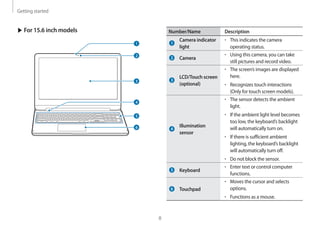
Number/Name Description
Camera indicator
light
• 	This indicates the camera
operating status.
Camera
• 	Using this camera, you can take
still pictures and record video.
LCD/Touch screen
(optional)
• 	The screen’s images are displayed
here.
• 	Recognizes touch interactions
(Only for touch screen models).
Illumination
sensor
• 	The sensor detects the ambient
light.
• 	If the ambient light level becomes
too low, the keyboard’s backlight
will automatically turn on.
• 	If there is sufficient ambient
lighting, the keyboard’s backlight
will automatically turn off.
• 	Do not block the sensor.
Keyboard
• 	Enter text or control computer
functions.
Touchpad
• 	Moves the cursor and selects
options.
• 	Functions as a mouse.
Layout
• 	Features or options may differ depending on the model.
• 	The items marked as optional may not be provided or
may be provided in different locations.
• 	Since some space on the SSD is reserved for system
recovery and operations, the available space on the SSD
may be less than the actual capacity.
Front view
▶ For 13.3 inch models
2
1
3
4
5
6
Getting started
8
Number/Name Description
Camera indicator
light
• 	This indicates the camera
operating status.
Camera
• 	Using this camera, you can take
still pictures and record video.
LCD/Touch screen
(optional)
• 	The screen’s images are displayed
here.
• 	Recognizes touch interactions
(Only for touch screen models).
Illumination
sensor
• 	The sensor detects the ambient
light.
• 	If the ambient light level becomes
too low, the keyboard’s backlight
will automatically turn on.
• 	If there is sufficient ambient
lighting, the keyboard’s backlight
will automatically turn off.
• 	Do not block the sensor.
Keyboard
• 	Enter text or control computer
functions.
Touchpad
• 	Moves the cursor and selects
options.
• 	Functions as a mouse.
▶ For 15.6 inch models
2
3
6
1
4
5
Getting started
9
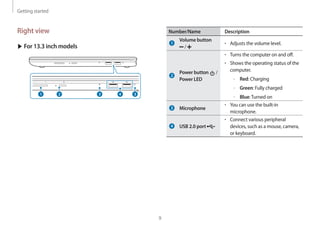
Number/Name Description
Volume button
/
• 	Adjusts the volume level.
Power button /
Power LED
• 	Turns the computer on and off.
• 	Shows the operating status of the
computer.
–– Red: Charging
–– Green: Fully charged
–– Blue:Turned on
Microphone
• 	You can use the built-in
microphone.
USB 2.0 port
• 	Connect various peripheral
devices, such as a mouse, camera,
or keyboard.
Right view
▶ For 13.3 inch models
1 2 3 34
Getting started
10
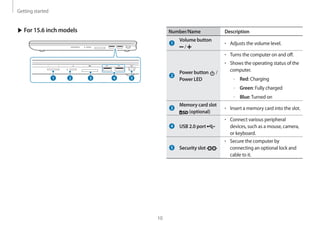
Number/Name Description
Volume button
/
• 	Adjusts the volume level.
Power button /
Power LED
• 	Turns the computer on and off.
• 	Shows the operating status of the
computer.
–– Red: Charging
–– Green: Fully charged
–– Blue:Turned on
Memory card slot
(optional)
• 	Insert a memory card into the slot.
USB 2.0 port
• 	Connect various peripheral
devices, such as a mouse, camera,
or keyboard.
Security slot
• 	Secure the computer by
connecting an optional lock and
cable to it.
▶ For 15.6 inch models
1 2 3 4 5
Getting started
11
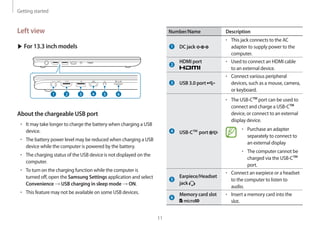
Number/Name Description
DC jack
• 	This jack connects to the AC
adapter to supply power to the
computer.
HDMI port • 	Used to connect an HDMI cable
to an external device.
USB 3.0 port
• 	Connect various peripheral
devices, such as a mouse, camera,
or keyboard.
USB-C™ port
• 	The USB-C™port can be used to
connect and charge a USB-C™
device, or connect to an external
display device.
• 	Purchase an adapter
separately to connect to
an external display
• 	The computer cannot be
charged via the USB-C™
port.
Earpiece/Headset
jack
• 	Connect an earpiece or a headset
to the computer to listen to
audio.
Memory card slot • 	Insert a memory card into the
slot.
Left view
▶ For 13.3 inch models
1 2 3 4 5 6
About the chargeable USB port
• 	It may take longer to charge the battery when charging a USB
device.
• 	The battery power level may be reduced when charging a USB
device while the computer is powered by the battery.
• 	The charging status of the USB device is not displayed on the
computer.
• 	To turn on the charging function while the computer is
turned off, open the Samsung Settings application and select
Convenience → USB charging in sleep mode → ON.
• 	This feature may not be available on some USB devices.
Getting started
12
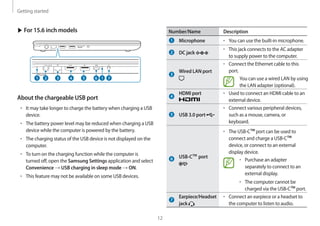
Number/Name Description
Microphone • 	You can use the built-in microphone.
DC jack
• 	This jack connects to the AC adapter
to supply power to the computer.
Wired LAN port
• 	Connect the Ethernet cable to this
port.
You can use a wired LAN by using
the LAN adapter (optional).
HDMI port • 	Used to connect an HDMI cable to an
external device.
USB 3.0 port
• 	Connect various peripheral devices,
such as a mouse, camera, or
keyboard.
USB-C™ port
• 	The USB-C™port can be used to
connect and charge a USB-C™
device, or connect to an external
display device.
• 	Purchase an adapter
separately to connect to an
external display.
• 	The computer cannot be
charged via the USB-C™port.
Earpiece/Headset
jack
• 	Connect an earpiece or a headset to
the computer to listen to audio.
▶ For 15.6 inch models
1 13 5 6 742
About the chargeable USB port
• 	It may take longer to charge the battery when charging a USB
device.
• 	The battery power level may be reduced when charging a USB
device while the computer is powered by the battery.
• 	The charging status of the USB device is not displayed on the
computer.
• 	To turn on the charging function while the computer is
turned off, open the Samsung Settings application and select
Convenience → USB charging in sleep mode → ON.
• 	This feature may not be available on some USB devices.
Getting started
13
▶ For 15.6 inch models
1
33
2
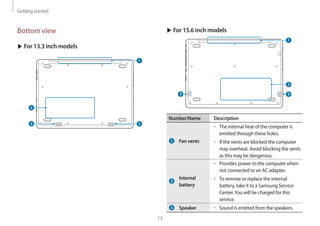
Number/Name Description
Fan vents
• 	The internal heat of the computer is
emitted through these holes.
• 	If the vents are blocked the computer
may overheat. Avoid blocking the vents
as this may be dangerous.
Internal
battery
• 	Provides power to the computer when
not connected to an AC adapter.
• 	To remove or replace the internal
battery, take it to a Samsung Service
Center.You will be charged for this
service.
Speaker • 	Sound is emitted from the speakers.
Bottom view
▶ For 13.3 inch models
1
33
2
Getting started
14
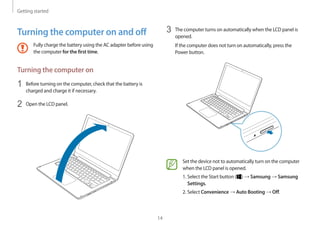
3	 The computer turns on automatically when the LCD panel is
opened.
If the computer does not turn on automatically, press the
Power button.
Set the device not to automatically turn on the computer
when the LCD panel is opened.
1. Select the Start button ( ) → Samsung → Samsung
Settings.
2. Select Convenience → Auto Booting → Off.
Turning the computer on and off
Fully charge the battery using the AC adapter before using
the computer for the first time.
Turning the computer on
1	 Before turning on the computer, check that the battery is
charged and charge it if necessary.
2	 Open the LCD panel.
Getting started
15
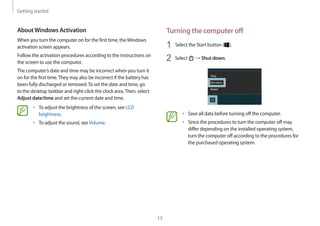
Turning the computer off
1	 Select the Start button ( ).
2	 Select → Shut down.
• 	Save all data before turning off the computer.
• 	Since the procedures to turn the computer off may
differ depending on the installed operating system,
turn the computer off according to the procedures for
the purchased operating system.
AboutWindows Activation
When you turn the computer on for the first time, theWindows
activation screen appears.
Follow the activation procedures according to the instructions on
the screen to use the computer.
The computer’s date and time may be incorrect when you turn it
on for the first time.They may also be incorrect if the battery has
been fully discharged or removed.To set the date and time, go
to the desktop taskbar and right-click the clock area.Then, select
Adjust date/time and set the current date and time.
• 	To adjust the brightness of the screen, see LCD
brightness.
• 	To adjust the sound, seeVolume.
Getting started
16
Windows
MicrosoftWindows is an operating system that is used to control a
computer.
• 	Images and available features may differ depending on
the model and operating system.
• 	This manual is designed forWindows 10 and content
may differ depending on the OS version.
• 	The image displayed on the desktop screen may differ
between models and OS versions.
Help
To access help information, select the Start button ( ) →
Get started ( ).
You can check the help information after connecting to
the Internet.
Unlocking the screen
To unlock the lock screen, do one of the following:
• 	Touch screen: Swipe upwards from the bottom of the screen.
• 	Mouse: Click the lock screen.
• 	Keyboard: Press any key.
• 	Touchpad:Tap the touchpad.
If the account has a password, enter the password to log in after
unlocking the screen.
Getting started
17
Using the control panel
You can adjust basic system settings, such as hardware, software,
or user account settings.
Select the Start button ( ) → Windows system → Control
Panel. Alternatively, right-click the Start button ( ) and select
Control Panel.
Then, select options you want to change.
Using a multi desktop
Multi desktop allows you to work on various tasks at the same
time via multiple desktops.You can use different desktops for
various purposes.
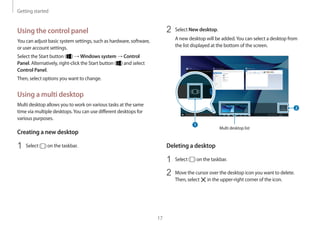
Creating a new desktop
1	 Select on the taskbar.
2	 Select New desktop.
A new desktop will be added.You can select a desktop from
the list displayed at the bottom of the screen.
Multi desktop list
Deleting a desktop
1	 Select on the taskbar.
2	 Move the cursor over the desktop icon you want to delete.
Then, select in the upper-right corner of the icon.
Getting started
18
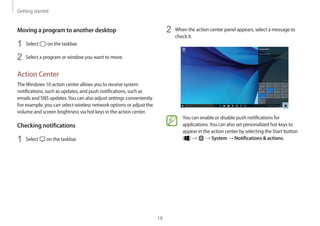
2	 When the action center panel appears, select a message to
check it.
You can enable or disable push notifications for
applications.You can also set personalized hot keys to
appear in the action center by selecting the Start button
( ) → → System → Notifications  actions.
Moving a program to another desktop
1	 Select on the taskbar.
2	 Select a program or window you want to move.
Action Center
TheWindows 10 action center allows you to receive system
notifications, such as updates, and push notifications, such as
emails and SNS updates.You can also adjust settings conveniently.
For example, you can select wireless network options or adjust the
volume and screen brightness via hot keys in the action center.
Checking notifications
1	 Select on the taskbar.
19
When the LCD panel is tilted past the transition point
• 	The keyboard and touchpad will automatically be
locked and will not function. But, during processes that
start beforeWindows operation, such as the BIOS setup
or DOS, the keyboard and touchpad will not be locked.
• 	The display will rotate automatically depending on the
computer’s orientation.
When storing the computer in a bag or carrying it, close
the LCD panel to protect the computer.
Basics
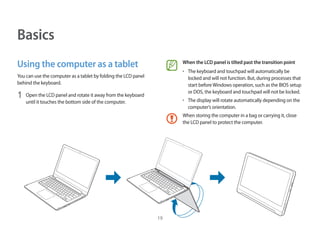
Using the computer as a tablet
You can use the computer as a tablet by folding the LCD panel
behind the keyboard.
1	 Open the LCD panel and rotate it away from the keyboard
until it touches the bottom side of the computer.
Basics
20
• 	When you rotate the LCD panel back to the normal
position, a mode switch confirmation message will
appear. Select Yes to switch the computer’s display to
desktop mode.
• 	When the screen is turned off while using the computer
as a tablet, press theVolume button to unlock the
screen.When the computer is in sleep mode, press the
Power button to unlock the screen.
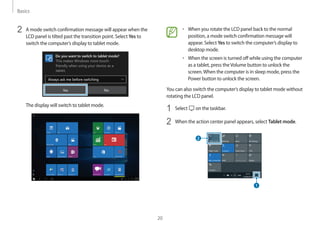
You can also switch the computer’s display to tablet mode without
rotating the LCD panel.
1	 Select on the taskbar.
2	 When the action center panel appears, select Tablet mode.
2	 A mode switch confirmation message will appear when the
LCD panel is tilted past the transition point. Select Yes to
switch the computer’s display to tablet mode.
The display will switch to tablet mode.
Basics
21
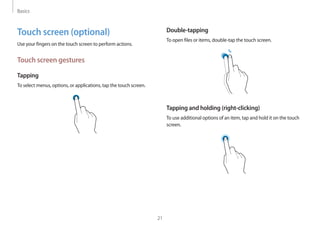
Touch screen (optional)
Use your fingers on the touch screen to perform actions.
Touch screen gestures
Tapping
To select menus, options, or applications, tap the touch screen.
Double-tapping
To open files or items, double-tap the touch screen.
Tapping and holding (right-clicking)
To use additional options of an item, tap and hold it on the touch
screen.
Basics
22
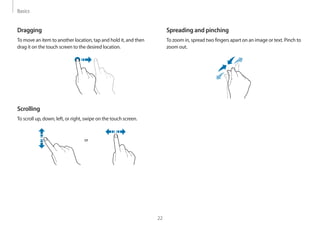
Spreading and pinching
To zoom in, spread two fingers apart on an image or text. Pinch to
zoom out.
Dragging
To move an item to another location, tap and hold it, and then
drag it on the touch screen to the desired location.
Scrolling
To scroll up, down, left, or right, swipe on the touch screen.
or
Basics
23
• 	Leaving the touch screen idle for extended periods
may result in afterimages (screen burn-in) or ghosting.
Turn off the touch screen when you are not using the
computer.
• 	Make sure your hands are clean and dry before using
the touch screen. Remove any moisture from your
hands before using the touch screen.
• 	Do not expose the computer to foreign substances.
Doing so may cause the touch screen to malfunction.
• 	Very light touches on the touch screen may not be
recognized.
• 	Precisely tap items on the touch screen for the best
results.
• 	The touch screen sensors are located on the edges of
the touch screen.Therefore, do not cover the edges of
the touch screen with protective covers or accessories.
• 	Touch screen gestures are available for touch screen
models runningWindows and work only with some
applications.
• 	Do not subject the touch screen to severe impacts or
press it with sharp objects. Doing so may damage the
touch screen.
• 	Do not allow the touch screen to come into contact
with other electrical devices. Electrostatic discharges
can cause the touch screen to malfunction.
• 	Do not expose the touch screen to water.The touch
screen may malfunction in humid conditions or when
exposed to water.
• 	Do not spray liquid cleansing solutions directly onto
the touch screen.The solution may enter the touch
screen or cause undesired operation.To clean the
screen, dampen a cloth with solution and gently wipe
the screen. Do not use solutions or cloths that contain
abrasive materials, as they may damage the touch
screen.
• 	Do not damage the edges of the touch screen. Doing so
may damage the touch screen.
Basics
24
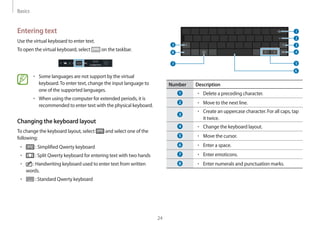
Entering text
Use the virtual keyboard to enter text.
To open the virtual keyboard, select on the taskbar.
• 	Some languages are not support by the virtual
keyboard.To enter text, change the input language to
one of the supported languages.
• 	When using the computer for extended periods, it is
recommended to enter text with the physical keyboard.
Changing the keyboard layout
To change the keyboard layout, select and select one of the
following:
• 	 : Simplified Qwerty keyboard
• 	 : Split Qwerty keyboard for entering text with two hands
• 	 : Handwriting keyboard used to enter text from written
words.
• 	 : Standard Qwerty keyboard
8
Number Description
• 	Delete a preceding character.
• 	Move to the next line.
• 	Create an uppercase character. For all caps, tap
it twice.
• 	Change the keyboard layout.
• 	Move the cursor.
• 	Enter a space.
• 	Enter emoticons.
• 	Enter numerals and punctuation marks.
Basics
25
Copying and pasting
1	 Tap and drag your finger across text to select it.
2	 Tap and hold the text to display the options.
3	 Select Copy or Cut.
4	 Tap and hold a text input field and then select Paste.
Entering uppercase
Select before entering a character. For all caps, tap it twice.
Changing language keyboards
Add keyboards to enter text in other languages. Select →
Language preferences → Region  language → Add a
language → a language.Then, select and select a language.
Handwriting
Select → , and then write a word in the on-screen text
input field.
Handwriting is not supported for some languages.
Basics
26
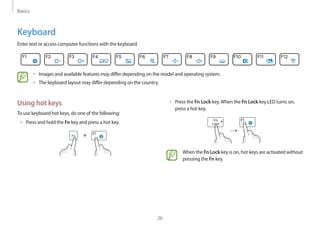
Using hot keys
To use keyboard hot keys, do one of the following:
• 	Press and hold the Fn key and press a hot key.
+
Keyboard
Enter text or access computer functions with the keyboard.
• 	Images and available features may differ depending on the model and operating system.
• 	The keyboard layout may differ depending on the country.
• 	Press the Fn Lock key.When the Fn Lock key LED turns on,
press a hot key.
→
When the Fn Lock key is on, hot keys are activated without
pressing the Fn key.
Basics
27
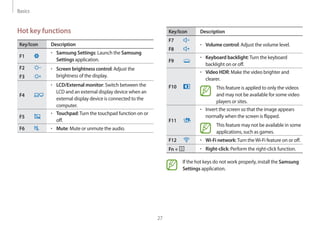
Key/Icon Description
F7
• 	Volume control: Adjust the volume level.
F8
F9
• 	Keyboard backlight:Turn the keyboard
backlight on or off.
F10
• 	Video HDR: Make the video brighter and
clearer.
This feature is applied to only the videos
and may not be available for some video
players or sites.
F11
• 	Invert the screen so that the image appears
normally when the screen is flipped.
This feature may not be available in some
applications, such as games.
F12 • 	Wi-Fi network:Turn theWi-Fi feature on or off.
Fn + • 	Right-click: Perform the right-click function.
If the hot keys do not work properly, install the Samsung
Settings application.
Hot key functions
Key/Icon Description
F1
• 	Samsung Settings: Launch the Samsung
Settings application.
F2 • 	Screen brightness control: Adjust the
brightness of the display.F3
F4
• 	LCD/External monitor: Switch between the
LCD and an external display device when an
external display device is connected to the
computer.
F5
• 	Touchpad:Turn the touchpad function on or
off.
F6 • 	Mute: Mute or unmute the audio.
Basics
28
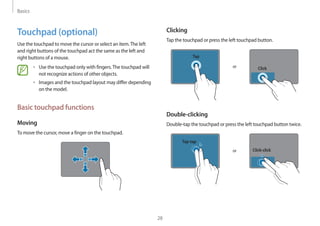
Clicking
Tap the touchpad or press the left touchpad button.
or
Tap
Click
Double-clicking
Double-tap the touchpad or press the left touchpad button twice.
or
Tap-tap
Click-click
Touchpad (optional)
Use the touchpad to move the cursor or select an item.The left
and right buttons of the touchpad act the same as the left and
right buttons of a mouse.
• 	Use the touchpad only with fingers.The touchpad will
not recognize actions of other objects.
• 	Images and the touchpad layout may differ depending
on the model.
Basic touchpad functions
Moving
To move the cursor, move a finger on the touchpad.
Basics
29
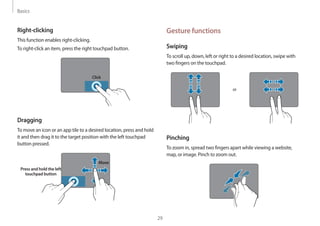
Gesture functions
Swiping
To scroll up, down, left or right to a desired location, swipe with
two fingers on the touchpad.
or
Pinching
To zoom in, spread two fingers apart while viewing a website,
map, or image. Pinch to zoom out.
Right-clicking
This function enables right-clicking.
To right-click an item, press the right touchpad button.
Click
Dragging
To move an icon or an app tile to a desired location, press and hold
it and then drag it to the target position with the left touchpad
button pressed.
Press and hold the left
touchpad button
Move
Basics
30
Press  Go gestures
Use Press  Go gestures on the touchpad to easily move to the
previous screen of the webpage or the folder, or go to the top or
bottom of the display with just one finger.
You can use only this feature in Internet Explorer, Microsoft
Edge, andWindows Explorer.
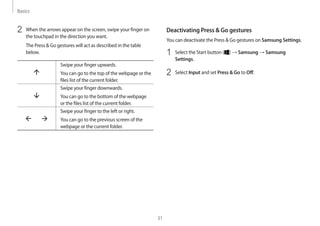
1	 Tap the touchpad lightly.
When you want to use Press  Go gestures, tap the
touchpad lightly. If the contact area of the touchpad is
too wide or you tap the touchpad firmly, the Press  Go
gestures may not function properly.
Configuring touchpad gestures
Configure touchpad gestures to use the touchpad more efficiently.
Select the Start button ( ) → Settings → Devices → Mouse 
touchpad → desired options.
Some options in the touchpad settings may not be
available depending on the model.
Touchpad lock
Press and hold the Fn key and press the F5 key to lock the
touchpad.
+
Basics
31
Deactivating Press  Go gestures
You can deactivate the Press  Go gestures on Samsung Settings.
1	 Select the Start button ( ) → Samsung → Samsung
Settings.
2	 Select Input and set Press  Go to Off.
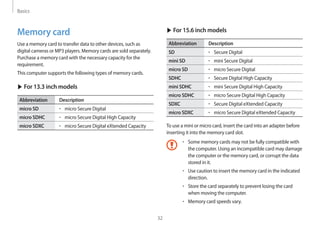
2	 When the arrows appear on the screen, swipe your finger on
the touchpad in the direction you want.
The Press  Go gestures will act as described in the table
below.
Swipe your finger upwards.
You can go to the top of the webpage or the
files list of the current folder.
Swipe your finger downwards.
You can go to the bottom of the webpage
or the files list of the current folder.
Swipe your finger to the left or right.
You can go to the previous screen of the
webpage or the current folder.
Basics
32
▶ For 15.6 inch models
Abbreviation Description
SD • 	Secure Digital
mini SD • 	mini Secure Digital
micro SD • 	micro Secure Digital
SDHC • 	Secure Digital High Capacity
mini SDHC • 	mini Secure Digital High Capacity
micro SDHC • 	micro Secure Digital High Capacity
SDXC • 	Secure Digital eXtended Capacity
micro SDXC • 	micro Secure Digital eXtended Capacity
To use a mini or micro card, insert the card into an adapter before
inserting it into the memory card slot.
• 	Some memory cards may not be fully compatible with
the computer. Using an incompatible card may damage
the computer or the memory card, or corrupt the data
stored in it.
• 	Use caution to insert the memory card in the indicated
direction.
• 	Store the card separately to prevent losing the card
when moving the computer.
• 	Memory card speeds vary.
Memory card
Use a memory card to transfer data to other devices, such as
digital cameras or MP3 players. Memory cards are sold separately.
Purchase a memory card with the necessary capacity for the
requirement.
This computer supports the following types of memory cards.
▶ For 13.3 inch models
Abbreviation Description
micro SD • 	micro Secure Digital
micro SDHC • 	micro Secure Digital High Capacity
micro SDXC • 	micro Secure Digital eXtended Capacity
Basics
33
3	 If a pop-up message appears, choose an action.
4	 Select Open folder to view files.
5	 Save, move, or delete data on the memory card.
The memory card folder opens only on the desktop.
Removing a memory card
Push the card gently until it disengages from the memory card
slot. Grasp the end of the card and pull it out of the slot.
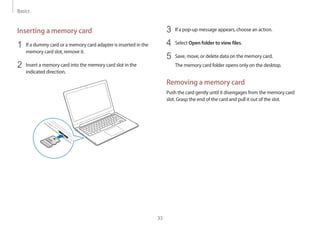
Inserting a memory card
1	 If a dummy card or a memory card adapter is inserted in the
memory card slot, remove it.
2	 Insert a memory card into the memory card slot in the
indicated direction.
Basics
34
• 	To use a memory card to exchange data with a digital
device, such as a digital camera, formatting the data
with the digital device is recommended.
• 	When trying to use a formatted memory card in
another digital device, format the memory card again in
the device.
• 	Data protected by copyright laws cannot be reviewed
or modified.
• 	Inserting and removing a memory card repeatedly may
damage the memory card.
• 	Secure Digital Input Output (SDIO) is not supported.
• 	If the write-protect tab is in the locked position, you
cannot format, write, or delete data on the card.
Formatting a memory card
Format the memory card to remove all data or before using it for
the first time.
Formatting a memory card deletes all data saved on
the card. If necessary, back up important data before
formatting the card.
1	 On the taskbar, select File Explorer ( ).
2	 Right-click the memory card drive, and then select Format.
3	 Select Start.
Basics
35
Connecting to a display
1	 Connect the HDMI cable to the corresponding port of the
computer.
2	 Connect the other end of the cable to the HDMI port of the
external display.
If the display has several HDMI ports, connect the cable to the
DVI IN port.
When using an HDMI cable
HDMI port HDMI port
External display
Connecting the computer to an external display device can be
useful for presentations or when watching a movie.The cables
and adapters required to connect an external display are sold
separately.The computer supports HDMI cables, USB-C™display
cables, and USB-C™display adapters.
HDMI cable USB-C™ display cable USB-C™ display
adapter
• 	Check the available ports on the display device to
ensure that it is compatible with the computer.
• 	An external display is not supported when using DOS or
the Command Prompt window.
Basics
36
You can also select a mode by right-clicking the Start
button ( ) and selecting Control Panel → Appearance
and Personalization → Display → Change display
settings → Multiple displays → an option. For more
information, refer to OS help.
3	 Connect the power cord to the external display.
4	 Turn on the display and change its display mode to one that
supports an external input.
5	 Press and hold the Fn key and press the F4 key.
6	 Select a mode.
PC screen only
Show the screen on the computer monitor only.
Duplicate
Show the screen on both the computer and the
external display.
Extend
Extend the screen to the external display.
Second screen only
Show the screen on the external display only.
Basics
37
Wired LAN
1	 Connect a LAN cable to the LAN port on the computer.
2	 On the desktop, right-click the Start button ( ) and select
Control Panel → Network and Internet → Network and
Sharing Center → Change adapter settings.
3	 Right-click Ethernet and select Properties.The LAN device
name may differ depending on the computer’s network
device.
Wired LAN (For 15.6 inch models)
To access the Internet at home, set up an account with an Internet
service provider (ISP).To purchase Internet service and a modem,
contact a local ISP.
• 	Some features or procedures may differ depending on
the model.
• 	These descriptions are written forWindows 10, so some
figures and descriptions may differ from your operating
system. Since the procedures for otherWindows
operating systems are similar, use the computer
referring to these descriptions.
Basics
38
5	 Configure the IP settings.
• 	When using DHCP, select Obtain an IP address
automatically.
• 	When not using DHCP, contact the network administrator
for the IP address.To use a static IP address, select Use the
following IP address and set the IP address manually.
6	 Select OK to save the settings.
4	 Select Internet ProtocolVersion 4 (TCP/IPv4) from the
list below This connection uses the following items →
Properties.
• 	The Network Component name may differ depending on
the operating system.
• 	To add a network item such as a client, service, or protocol,
select Install... under the list of network items.
Basics
39
• 	When connected to a 100 Mbps/1 Gbps wired LAN, a
message appears informing the user of connection to
a 10 Mbps/100 Mbps wired LAN when the computer
wakes from sleep mode.This happens because
restoring the network takes about 3 seconds.When the
network is restored, the computer will be connected to
the 100 Mbps/1 Gbps LAN.
• 	When the system is running on battery power, it may
take a few seconds for the connection to be established
when connecting a LAN cable.This is the result of
power saving features designed to reduce battery
consumption.
• 	When the system is running on battery power, the
speed of a wired LAN is decreased automatically
to reduce battery consumption. In this case, a
1 Gbps/100 Mbps LAN would function at the speed of a
100 Mbps/10 Mbps connection.
Wake on LAN (WOL) feature
Activate the system remotely from sleep mode when a signal,
such as a magic packet command, is received via a wired LAN.
1	 On the desktop, right-click the Start button ( ) and select
Control Panel → Network and Internet → Network and
Sharing Center → Change adapter settings.
2	 Right-click Ethernet and select Properties.
3	 Select Configure... → Power Management → Allow this
device to wake the computer → OK.
4	 Restart the computer.
• 	If the computer wakes up from sleep mode inadvertently,
disable theWake on LAN feature.
• 	This feature may not work while using other power saving
features.To disable other sleep functions, right-click the
Start button ( ) and select Control Panel → Hardware
and Sound → Power Options.
Basics
40
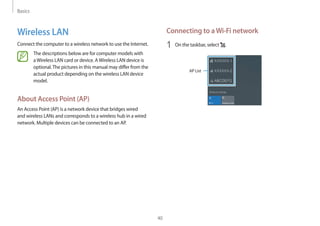
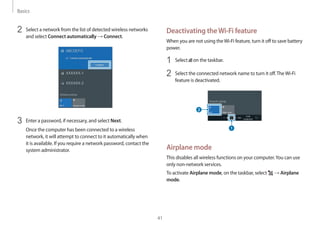
Connecting to aWi-Fi network
1	 On the taskbar, select .
AP List
Wireless LAN
Connect the computer to a wireless network to use the Internet.
The descriptions below are for computer models with
aWireless LAN card or device. AWireless LAN device is
optional.The pictures in this manual may differ from the
actual product depending on the wireless LAN device
model.
About Access Point (AP)
An Access Point (AP) is a network device that bridges wired
and wireless LANs and corresponds to a wireless hub in a wired
network. Multiple devices can be connected to an AP.
Basics
41
Deactivating theWi-Fi feature
When you are not using theWi-Fi feature, turn it off to save battery
power.
1	 Select on the taskbar.
2	 Select the connected network name to turn it off.TheWi-Fi
feature is deactivated.
Airplane mode
This disables all wireless functions on your computer.You can use
only non-network services.
To activate Airplane mode, on the taskbar, select → Airplane
mode.
2	 Select a network from the list of detected wireless networks
and select Connect automatically → Connect.
3	 Enter a password, if necessary, and select Next.
Once the computer has been connected to a wireless
network, it will attempt to connect to it automatically when
it is available. If you require a network password, contact the
system administrator.
Basics
42
Using the security slot (For 15.6
inch models)
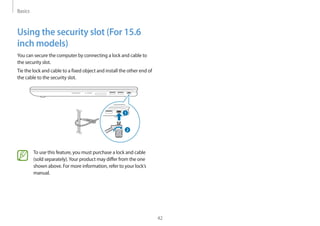
You can secure the computer by connecting a lock and cable to
the security slot.
Tie the lock and cable to a fixed object and install the other end of
the cable to the security slot.
To use this feature, you must purchase a lock and cable
(sold separately).Your product may differ from the one
shown above. For more information, refer to your lock’s
manual.
43
Applications
Using applications
• 	Images and features may differ depending on the
model and the application version.
• 	Some applications may not be supported depending
on the model.
• 	Applications that are provided by Samsung can be
installed from Samsung Update.
• 	Third-party software related services
For descriptions about and service requests for
third-party applications, please contact the relevant
manufacturer. Some troubleshooting actions in
response to service requests may not work depending
on the application manufacturer.
Applications
44
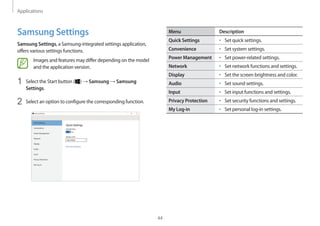
Menu Description
Quick Settings • 	Set quick settings.
Convenience • 	Set system settings.
Power Management • 	Set power-related settings.
Network • 	Set network functions and settings.
Display • 	Set the screen brightness and color.
Audio • 	Set sound settings.
Input • 	Set input functions and settings.
Privacy Protection • 	Set security functions and settings.
My Log-in • 	Set personal log-in settings.
Samsung Settings
Samsung Settings, a Samsung-integrated settings application,
offers various settings functions.
Images and features may differ depending on the model
and the application version.
1	 Select the Start button ( ) → Samsung → Samsung
Settings.
2	 Select an option to configure the corresponding function.
Applications
45
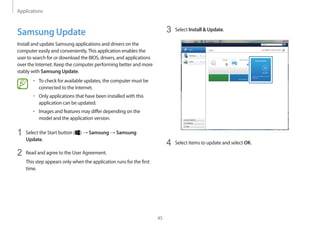
3	 Select Install  Update.
4	 Select items to update and select OK.
Samsung Update
Install and update Samsung applications and drivers on the
computer easily and conveniently.This application enables the
user to search for or download the BIOS, drivers, and applications
over the Internet. Keep the computer performing better and more
stably with Samsung Update.
• 	To check for available updates, the computer must be
connected to the Internet.
• 	Only applications that have been installed with this
application can be updated.
• 	Images and features may differ depending on the
model and the application version.
1	 Select the Start button ( ) → Samsung → Samsung
Update.
2	 Read and agree to the User Agreement.
This step appears only when the application runs for the first
time.
Applications
46
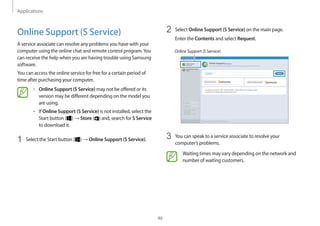
2	 Select Online Support (S Service) on the main page.
Enter the Contents and select Request.
Online Support (S Service)
3	 You can speak to a service associate to resolve your
computer’s problems.
Waiting times may vary depending on the network and
number of waiting customers.
Online Support (S Service)
A service associate can resolve any problems you have with your
computer using the online chat and remote control program.You
can receive the help when you are having trouble using Samsung
software.
You can access the online service for free for a certain period of
time after purchasing your computer.
• 	Online Support (S Service) may not be offered or its
version may be different depending on the model you
are using.
• 	If Online Support (S Service) is not installed, select the
Start button ( ) → Store ( ) and, search for S Service
to download it.
1	 Select the Start button ( ) → Online Support (S Service).
Applications
47
Installing Samsung PC Help
1	 On a smartphone, tap Play Store and search for Samsung PC
Help.
2	 Tap INSTALL → ACCEPT to complete the setup.
Using Samsung PC Help
1	 On a smartphone, tap Samsung PC Help.
2	 On the Samsung PC Help main screen, select a menu to
display the available content.
You may incur additional charges when you access
content.
Samsung PC Help (Self-help
application)
Use Samsung PC Help to access help-related content for
Samsung computers from a smartphone.
Watch the Samsung PC Help videos to become familiar with new
functions or to find solutions to problems.
For more information, visit www.samsungpchelp.com.
48
Settings  Upgrade
LCD brightness
Adjust the LCD brightness to reduce eye strain and save power.
Controlling brightness using the keyboard
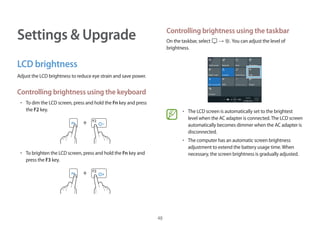
• 	To dim the LCD screen, press and hold the Fn key and press
the F2 key.
+
• 	To brighten the LCD screen, press and hold the Fn key and
press the F3 key.
+
Controlling brightness using the taskbar
On the taskbar, select → .You can adjust the level of
brightness.
• 	The LCD screen is automatically set to the brightest
level when the AC adapter is connected.The LCD screen
automatically becomes dimmer when the AC adapter is
disconnected.
• 	The computer has an automatic screen brightness
adjustment to extend the battery usage time.When
necessary, the screen brightness is gradually adjusted.
Settings  Upgrade
49
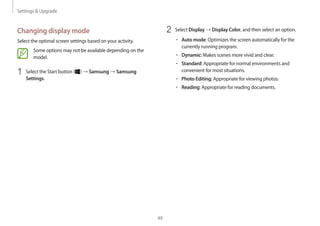
2	 Select Display → Display Color, and then select an option.
• 	Auto mode: Optimizes the screen automatically for the
currently running program.
• 	Dynamic: Makes scenes more vivid and clear.
• 	Standard: Appropriate for normal environments and
convenient for most situations.
• 	Photo Editing: Appropriate for viewing photos.
• 	Reading: Appropriate for reading documents.
Changing display mode
Select the optimal screen settings based on your activity.
Some options may not be available depending on the
model.
1	 Select the Start button ( ) → Samsung → Samsung
Settings.
Settings  Upgrade
50
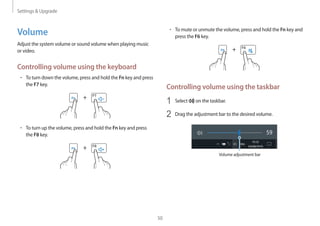
• 	To mute or unmute the volume, press and hold the Fn key and
press the F6 key.
+
Controlling volume using the taskbar
1	 Select on the taskbar.
2	 Drag the adjustment bar to the desired volume.
Volume adjustment bar
Volume
Adjust the system volume or sound volume when playing music
or video.
Controlling volume using the keyboard
• 	To turn down the volume, press and hold the Fn key and press
the F7 key.
+
• 	To turn up the volume, press and hold the Fn key and press
the F8 key.
+
Settings  Upgrade
51
Entering the BIOS screen
1	 Turn on the computer.
2	 Before the Samsung logo appears, press the F2 key several
times.
• 	If the computer is password-protected, press the F2 key
several times before the password screen appears.
• 	If the password screen or theWindows start screen
appears, restart the computer and try again.
BIOS (Setup utility)
Define a boot password, change the boot priority, or configure the
installed chipsets.
• 	Incorrect settings may cause the system to malfunction
or crash.
• 	The BIOS setup screens, menus, and items may appear
differently depending on the model and BIOS version.
• 	BIOS setup functions are subject to upgrades.
Settings  Upgrade
52
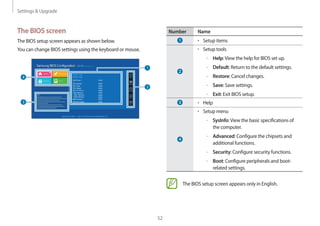
Number Name
• 	Setup items
• 	Setup tools
–– Help:View the help for BIOS set up.
–– Default: Return to the default settings.
–– Restore: Cancel changes.
–– Save: Save settings.
–– Exit: Exit BIOS setup.
• 	Help
• 	Setup menu
–– SysInfo:View the basic specifications of
the computer.
–– Advanced: Configure the chipsets and
additional functions.
–– Security: Configure security functions.
–– Boot: Configure peripherals and boot-
related settings.
The BIOS setup screen appears only in English.
The BIOS screen
The BIOS setup screen appears as shown below.
You can change BIOS settings using the keyboard or mouse.
Settings  Upgrade
53
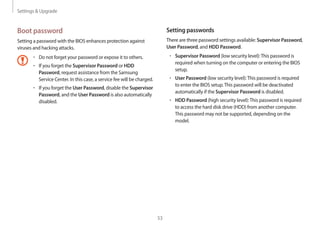
Setting passwords
There are three password settings available: Supervisor Password,
User Password, and HDD Password.
• 	Supervisor Password (low security level):This password is
required when turning on the computer or entering the BIOS
setup.
• 	User Password (low security level):This password is required
to enter the BIOS setup.This password will be deactivated
automatically if the Supervisor Password is disabled.
• 	HDD Password (high security level):This password is required
to access the hard disk drive (HDD) from another computer.
This password may not be supported, depending on the
model.
Boot password
Setting a password with the BIOS enhances protection against
viruses and hacking attacks.
• 	Do not forget your password or expose it to others.
• 	If you forget the Supervisor Password or HDD
Password, request assistance from the Samsung
Service Center. In this case, a service fee will be charged.
• 	If you forget the User Password, disable the Supervisor
Password, and the User Password is also automatically
disabled.
Settings  Upgrade
54
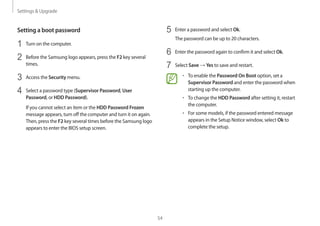
5	 Enter a password and select Ok.
The password can be up to 20 characters.
6	 Enter the password again to confirm it and select Ok.
7	 Select Save → Yes to save and restart.
• 	To enable the Password On Boot option, set a
Supervisor Password and enter the password when
starting up the computer.
• 	To change the HDD Password after setting it, restart
the computer.
• 	For some models, if the password entered message
appears in the Setup Notice window, select Ok to
complete the setup.
Setting a boot password
1	 Turn on the computer.
2	 Before the Samsung logo appears, press the F2 key several
times.
3	 Access the Security menu.
4	 Select a password type (Supervisor Password, User
Password, or HDD Password).
If you cannot select an item or the HDD Password Frozen
message appears, turn off the computer and turn it on again.
Then, press the F2 key several times before the Samsung logo
appears to enter the BIOS setup screen.
Settings  Upgrade
55
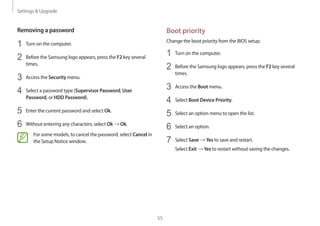
Boot priority
Change the boot priority from the BIOS setup.
1	 Turn on the computer.
2	 Before the Samsung logo appears, press the F2 key several
times.
3	 Access the Boot menu.
4	 Select Boot Device Priority.
5	 Select an option menu to open the list.
6	 Select an option.
7	 Select Save → Yes to save and restart.
Select Exit → Yes to restart without saving the changes.
Removing a password
1	 Turn on the computer.
2	 Before the Samsung logo appears, press the F2 key several
times.
3	 Access the Security menu.
4	 Select a password type (Supervisor Password, User
Password, or HDD Password).
5	 Enter the current password and select Ok.
6	 Without entering any characters, select Ok → Ok.
For some models, to cancel the password, select Cancel in
the Setup Notice window.
Settings  Upgrade
56
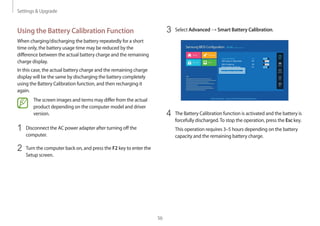
3	 Select Advanced → Smart Battery Calibration.
Aptio Setup Utility - Copy (C) XXXX American Megatrends, Inc.
Smart Battery Calibration 
Touch Pad Mouse On
USB Charge In Sleep Mode Off
USB S3 Wake-up Off
BIOS Adaptive Brightness On
4	 The Battery Calibration function is activated and the battery is
forcefully discharged.To stop the operation, press the Esc key.
This operation requires 3–5 hours depending on the battery
capacity and the remaining battery charge.
Using the Battery Calibration Function
When charging/discharging the battery repeatedly for a short
time only, the battery usage time may be reduced by the
difference between the actual battery charge and the remaining
charge display.
In this case, the actual battery charge and the remaining charge
display will be the same by discharging the battery completely
using the Battery Calibration function, and then recharging it
again.
The screen images and terms may differ from the actual
product depending on the computer model and driver
version.
1	 Disconnect the AC power adapter after turning off the
computer.
2	 Turn the computer back on, and press the F2 key to enter the
Setup screen.
Settings  Upgrade
57
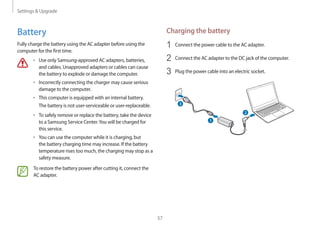
Charging the battery
1	 Connect the power cable to the AC adapter.
2	 Connect the AC adapter to the DC jack of the computer.
3	 Plug the power cable into an electric socket.
1
3
2
Battery
Fully charge the battery using the AC adapter before using the
computer for the first time.
• 	Use only Samsung-approved AC adapters, batteries,
and cables. Unapproved adapters or cables can cause
the battery to explode or damage the computer.
• 	Incorrectly connecting the charger may cause serious
damage to the computer.
• 	This computer is equipped with an internal battery.
The battery is not user-serviceable or user-replaceable.
• 	To safely remove or replace the battery, take the device
to a Samsung Service Center.You will be charged for
this service.
• 	You can use the computer while it is charging, but
the battery charging time may increase. If the battery
temperature rises too much, the charging may stop as a
safety measure.
To restore the battery power after cutting it, connect the
AC adapter.
Settings  Upgrade
58
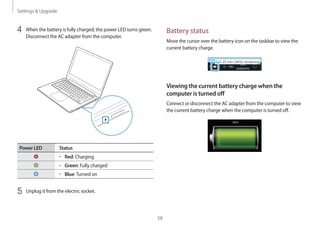
Battery status
Move the cursor over the battery icon on the taskbar to view the
current battery charge.
Viewing the current battery charge when the
computer is turned off
Connect or disconnect the AC adapter from the computer to view
the current battery charge when the computer is turned off.
10:00
2013/7/1
4	 When the battery is fully charged, the power LED turns green.
Disconnect the AC adapter from the computer.
Power LED Status
• 	Red: Charging
• 	Green: Fully charged
• 	Blue:Turned on
5	 Unplug it from the electric socket.
Settings  Upgrade
59
When battery expiration is imminent
Batteries are consumable parts and the remaining battery life is
currently low. Continued use may result in charge or discharge
failures.Whether or not batteries can be used is determined
based on safety evaluations. Please replace it with a new battery
(genuine) to prevent data loss and ensure safe usage.
When the battery has expired
Batteries are consumable parts and the current battery cannot be
used as the battery life has expired. Please replace it with a new
battery (genuine) to prevent data loss and ensure safe usage.
Whether or not batteries can be used is determined based on
safety evaluations.To prevent data loss while replacing batteries,
please be sure to save your work first.
Instruction messages related to battery life are displayed
properly when the Samsung Settings application is
installed on your computer.The messages may vary
depending on the model and software version.
Saving battery power
On the taskbar, select → Battery saver.
Battery saver mode is activated.
Battery saver mode is disabled when the AC adapter is
connected.
Battery usage time
Batteries are replaceable items and over time the battery’s
capacity to hold a charge and its power level is reduced. If a
battery can only hold its charge for half of the time that it could
when new, it is recommended to purchase a new, replacement
battery.
Checking battery life instruction messages
When the battery has expired, an instruction message may appear
on the screen.To prevent the computer from losing data and to
use the computer safely, follow the on-screen instructions.
60
Troubleshooting
Samsung Recovery
When a problem occurs with the computer, it is easy to restore
the computer back to the factory default settings by using the
Samsung Recovery application (Recovery/Backup). It is also
possible to restore the computer to a previously backed up point.
Back up important data regularly before a problem occurs with
the computer.
• 	The Samsung Recovery application may not be
provided in models with less than 64 GB of storage. If
you cannot access the Samsung Recovery application,
refer toWindows recovery function.
• 	Some functions may differ or may be unavailable
depending on the version. Refer to the application’s
help information.
• 	Run the Samsung Recovery application with
administrator privileges.
• 	The Samsung Recovery application (Recovery/Backup)
is not available when using CD/DVD drives.
• 	Recovering the computer erases the data or
applications saved after a backup point.Therefore, back
up important data regularly before a problem occurs
with the computer.
• 	When you launch the application for the first time, read
and accept theTerms and Conditions when they display
on the screen.
Troubleshooting
61
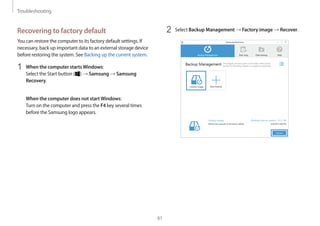
2	 Select Backup Management → Factory image → Recover.Recovering to factory default
You can restore the computer to its factory default settings. If
necessary, back up important data to an external storage device
before restoring the system. See Backing up the current system.
1	 When the computer startsWindows:
Select the Start button ( ) → Samsung → Samsung
Recovery.
When the computer does not startWindows:
Turn on the computer and press the F4 key several times
before the Samsung logo appears.
Troubleshooting
62
Backing up the current system
Back up important data to an alternate internal drive or an
external storage device regularly to prevent data loss.
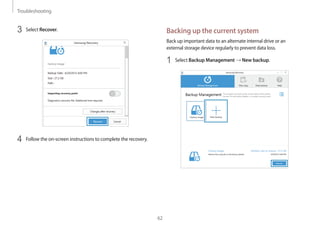
1	 Select Backup Management → New backup.
3	 Select Recover.
4	 Follow the on-screen instructions to complete the recovery.
Troubleshooting
63
3	 Follow the on-screen instructions to complete the backup.
Recovering after a backup
Select a backup point saved on an alternate internal drive or an
external storage device to recover the computer to that point.
1	 When backing up to an external storage device, connect the
device to the computer.
2	 Select the Start button ( ) → Samsung → Samsung
Recovery.
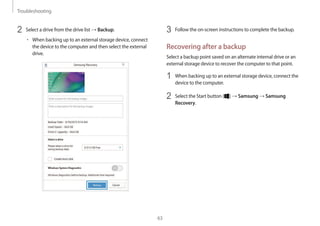
2	 Select a drive from the drive list → Backup.
• 	When backing up to an external storage device, connect
the device to the computer and then select the external
drive.
Troubleshooting
64
Copying the drive (making a disk image)
To replace the drive, move the data to the new drive by making a
disk image.The new drive must be large enough to hold the data
from the current drive. Purchase an external hard drive connector
separately to connect the new drive to the computer.
1	 Connect the new drive to the computer with an external hard
drive connector.
2	 Select the Start button ( ) → Samsung → Samsung
Recovery.
3	 Select Disk copy.
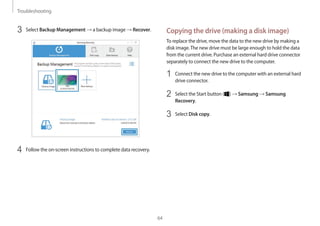
3	 Select Backup Management → a backup image → Recover.
4	 Follow the on-screen instructions to complete data recovery.
Troubleshooting
65
5	 After the data is saved to another drive, open the cover at the
bottom of the computer and replace the existing drive with
the new one.
If the computer does not have a hard drive or memory cover,
contact the nearest Samsung Service Center for assistance.
You will be charged for this service.
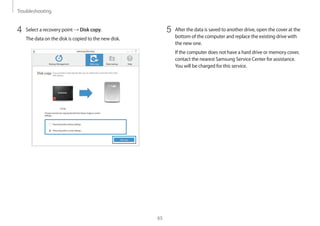
4	 Select a recovery point → Disk copy.
The data on the disk is copied to the new disk.
Troubleshooting
66
QA
When experiencing problems with the computer, try these
solutions.
Windows
How can I uninstall an application?
1	 On the desktop, right-click the Start button ( ) and select
Control Panel → Uninstall a program.
2	 On the list, right-click an application to delete, and then select
Uninstall.
Windows recovery function
If the Samsung Recovery application is not supported by the
computer, reinstallWindows using the recovery function of
Windows.
ReinstallingWindows will erase all data saved on the
computer. Back up application and personal data to an
external storage device before reinstallingWindows.
1	 Select the Start button ( ) → Settings → Update  security
→ Recovery.
2	 Select Reset this PC → Get started.
3	 Select Keep my files or Remove everything.
After the system is recovered, select the Start button
( ) → Samsung → Samsung Update to install the
required Samsung applications.
Troubleshooting
67
Samsung Recovery
What is a Recovery Area?
The computer has an additional partition for restoring data or
saving backup files (only for models with the Samsung Recovery
application).This partition is called a Recovery Area and it
includes a recovery image comprised of the operating system and
applications.
How can I start my computer in DOS?
To start the computer in DOS via a USB device:
1	 Turn on the computer.
2	 Before the Samsung logo appears, press the F2 key several
times.
3	 Select the Boot menu.
4	 Set Fast BIOS Mode to Off.
5	 Set Secure Boot Control to Off.
6	 Set OS Mode Selection to CSM OS and then restart the
computer.
Troubleshooting
68
What is a recovery image?
This refers to the operating system, drivers, and software that are
converted to a data image. It is required to recover the computer
and is embedded in the computer’s HDD. However, this is not
provided for storage devices where the capacity is less than 64 GB,
due to their small capacities.
How can I restore a computer that does not have the
Samsung Recovery application?
Restore the computer with the recovery function provided by
Windows. Refer to the Recover Functionality item in the help for
more details.
Why is the capacity representation of the hard disk
drive (HDD) inWindows different from the product
specifications?
The capacity of the storage device (HDD or SSD) of the
manufacturer is calculated assuming that 1 KB = 1,000 Bytes.
However, the operating system (Windows) calculates the storage
device capacity assuming that 1 KB = 1,024 Bytes, and therefore
the capacity representation of the HDD inWindows is smaller than
the actual capacity.The capacity representation inWindows may
be smaller than the actual capacity because some applications
occupy a certain area of the HDD outside ofWindows.
For models with the Samsung Recovery application, the HDD
capacity representation inWindows may be smaller than the
actual capacity because the Samsung Recovery application
uses a hidden area of 5–20 GB of the HDD to save the recovery
image, and that hidden area is not counted towards the total
size available toWindows.The size of the Samsung Recovery
application varies by model.
Troubleshooting
69
Miscellaneous
The camera and the microphone are not working.
How do I turn them on again?
When recording protect mode is activated, the camera and
microphone will not work.
To turn recording protect mode off, select the Start button ( ) →
Samsung → Samsung Settings → Privacy Protection → Block
Recording, and set the slide bar to Medium or below.
The computer does not turn on automatically when
the LCD panel is opened.
To turn on the computer, the LCD panel should be opened greater
than a certain angle.
The angle may differ depending on the model.
If the computer LED does not turn on automatically, press the
Power button.
70
Appendix
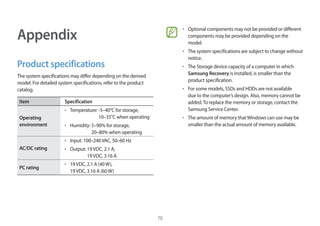
Product specifications
The system specifications may differ depending on the derived
model. For detailed system specifications, refer to the product
catalog.
Item Specification
Operating
environment
• 	Temperature: -5–40°C for storage,
10–35°C when operating
• 	Humidity: 5–90% for storage,
20–80% when operating
AC/DC rating
• 	Input: 100–240VAC, 50–60 Hz
• 	Output: 19VDC, 2.1 A,
19VDC, 3.16 A
PC rating
• 	19VDC, 2.1 A (40W),
19VDC, 3.16 A (60W)
• 	Optional components may not be provided or different
components may be provided depending on the
model.
• 	The system specifications are subject to change without
notice.
• 	The Storage device capacity of a computer in which
Samsung Recovery is installed, is smaller than the
product specification.
• 	For some models, SSDs and HDDs are not available
due to the computer’s design. Also, memory cannot be
added.To replace the memory or storage, contact the
Samsung Service Center.
• 	The amount of memory thatWindows can use may be
smaller than the actual amount of memory available.
Appendix
71
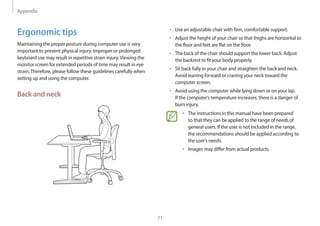
• 	Use an adjustable chair with firm, comfortable support.
• 	Adjust the height of your chair so that thighs are horizontal to
the floor and feet are flat on the floor.
• 	The back of the chair should support the lower back. Adjust
the backrest to fit your body properly.
• 	Sit back fully in your chair and straighten the back and neck.
Avoid leaning forward or craning your neck toward the
computer screen.
• 	Avoid using the computer while lying down or on your lap.
If the computer’s temperature increases, there is a danger of
burn injury.
• 	The instructions in this manual have been prepared
so that they can be applied to the range of needs of
general users. If the user is not included in the range,
the recommendations should be applied according to
the user’s needs.
• 	Images may differ from actual products.
Ergonomic tips
Maintaining the proper posture during computer use is very
important to prevent physical injury. Improper or prolonged
keyboard use may result in repetitive strain injury.Viewing the
monitor screen for extended periods of time may result in eye
strain.Therefore, please follow these guidelines carefully when
setting up and using the computer.
Back and neck
Appendix
72
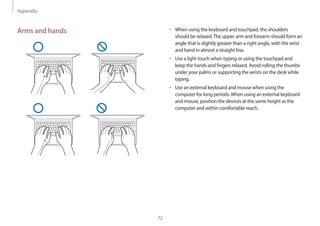
• 	When using the keyboard and touchpad, the shoulders
should be relaxed.The upper arm and forearm should form an
angle that is slightly greater than a right angle, with the wrist
and hand in almost a straight line.
• 	Use a light touch when typing or using the touchpad and
keep the hands and fingers relaxed. Avoid rolling the thumbs
under your palms or supporting the wrists on the desk while
typing.
• 	Use an external keyboard and mouse when using the
computer for long periods.When using an external keyboard
and mouse, position the devices at the same height as the
computer and within comfortable reach.
Arms and hands
Appendix
73
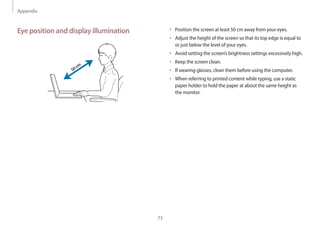
• 	Position the screen at least 50 cm away from your eyes.
• 	Adjust the height of the screen so that its top edge is equal to
or just below the level of your eyes.
• 	Avoid setting the screen’s brightness settings excessively high.
• 	Keep the screen clean.
• 	If wearing glasses, clean them before using the computer.
• 	When referring to printed content while typing, use a static
paper holder to hold the paper at about the same height as
the monitor.
Eye position and display illumination
50cm
Appendix
74
Operating conditions
• 	Take at least a 10 minute break every hour.
• 	Avoid using the computer in dark locations. Use the computer
with as much ambient light as you would when reading a
book.
• 	Indirect illumination is recommended. Use a curtain to
prevent reflections and glare on the screen.
• 	While operating a computer and talking on the phone, use a
headset. Using the computer while holding a phone on your
shoulder or with your neck may lead to muscle strain or injury.
• 	Keep frequently used items within reach.
• 	Only use the computer within the temperature and humidity
ranges specified in this manual.
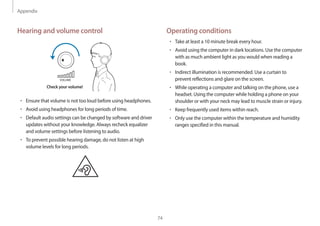
Hearing and volume control
VOLUME
Check your volume!
• 	Ensure that volume is not too loud before using headphones.
• 	Avoid using headphones for long periods of time.
• 	Default audio settings can be changed by software and driver
updates without your knowledge. Always recheck equalizer
and volume settings before listening to audio.
• 	To prevent possible hearing damage, do not listen at high
volume levels for long periods.
Appendix
75
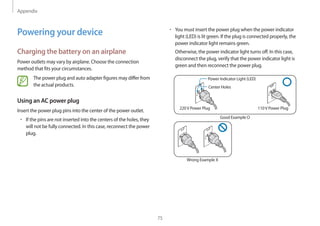
• 	You must insert the power plug when the power indicator
light (LED) is lit green. If the plug is connected properly, the
power indicator light remains green.
Otherwise, the power indicator light turns off. In this case,
disconnect the plug, verify that the power indicator light is
green and then reconnect the power plug.
Power Indicator Light (LED)
Center Holes
220V Power Plug 110V Power Plug
Good Example O
Wrong Example X
Powering your device
Charging the battery on an airplane
Power outlets may vary by airplane. Choose the connection
method that fits your circumstances.
The power plug and auto adapter figures may differ from
the actual products.
Using an AC power plug
Insert the power plug pins into the center of the power outlet.
• 	If the pins are not inserted into the centers of the holes, they
will not be fully connected. In this case, reconnect the power
plug.
Appendix
76
Using an airplane charging converter
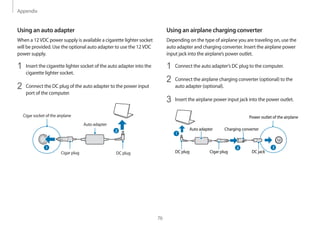
Depending on the type of airplane you are traveling on, use the
auto adapter and charging converter. Insert the airplane power
input jack into the airplane’s power outlet.
1	 Connect the auto adapter’s DC plug to the computer.
2	 Connect the airplane charging converter (optional) to the
auto adapter (optional).
3	 Insert the airplane power input jack into the power outlet.
Auto adapter Charging converter
Power outlet of the airplane
DC plug Cigar plug DC jack
2
2
Using an auto adapter
When a 12VDC power supply is available a cigarette lighter socket
will be provided. Use the optional auto adapter to use the 12VDC
power supply.
1	 Insert the cigarette lighter socket of the auto adapter into the
cigarette lighter socket.
2	 Connect the DC plug of the auto adapter to the power input
port of the computer.
Auto adapter
Cigar socket of the airplane
DC plugCigar plug
2
1
Appendix
77
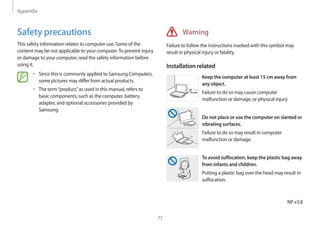
Warning
Failure to follow the instructions marked with this symbol may
result in physical injury or fatality.
Installation related
15 cm
Keep the computer at least 15 cm away from
any object.
Failure to do so may cause computer
malfunction or damage, or physical injury.
Do not place or use the computer on slanted or
vibrating surfaces.
Failure to do so may result in computer
malfunction or damage.
To avoid suffocation, keep the plastic bag away
from infants and children.
Putting a plastic bag over the head may result in
suffocation.
Safety precautions
This safety information relates to computer use. Some of the
content may be not applicable to your computer.To prevent injury
or damage to your computer, read the safety information before
using it.
• 	Since this is commonly applied to Samsung Computers,
some pictures may differ from actual products.
• 	The term“product,”as used in this manual, refers to
basic components, such as the computer, battery,
adapter, and optional accessories provided by
Samsung.
NP v3.8
Appendix
78
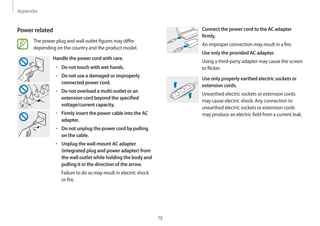
Connect the power cord to the AC adapter
firmly.
An improper connection may result in a fire.
Use only the provided AC adapter.
Using a third-party adapter may cause the screen
to flicker.
Use only properly earthed electric sockets or
extension cords.
Unearthed electric sockets or extension cords
may cause electric shock. Any connection to
unearthed electric sockets or extension cords
may produce an electric field from a current leak.
Power related
The power plug and wall outlet figures may differ
depending on the country and the product model.
Handle the power cord with care.
• 	Do not touch with wet hands.
• 	Do not use a damaged or improperly
connected power cord.
• 	Do not overload a multi-outlet or an
extension cord beyond the specified
voltage/current capacity.
• 	Firmly insert the power cable into the AC
adapter.
• 	Do not unplug the power cord by pulling
on the cable.
• 	Unplug the wall-mount AC adapter
(integrated plug and power adapter) from
the wall outlet while holding the body and
pulling it in the direction of the arrow.
Failure to do so may result in electric shock
or fire.
Appendix
79
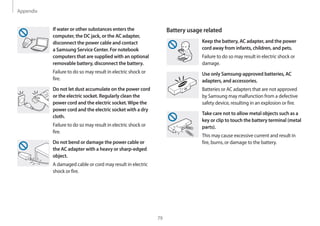
Battery usage related
Keep the battery, AC adapter, and the power
cord away from infants, children, and pets.
Failure to do so may result in electric shock or
damage.
Use only Samsung-approved batteries, AC
adapters, and accessories.
Batteries or AC adapters that are not approved
by Samsung may malfunction from a defective
safety device, resulting in an explosion or fire.
Take care not to allow metal objects such as a
key or clip to touch the battery terminal (metal
parts).
This may cause excessive current and result in
fire, burns, or damage to the battery.
If water or other substances enters the
computer, the DC jack, or the AC adapter,
disconnect the power cable and contact
a Samsung Service Center. For notebook
computers that are supplied with an optional
removable battery, disconnect the battery.
Failure to do so may result in electric shock or
fire.
Do not let dust accumulate on the power cord
or the electric socket. Regularly clean the
power cord and the electric socket.Wipe the
power cord and the electric socket with a dry
cloth.
Failure to do so may result in electric shock or
fire.
Do not bend or damage the power cable or
the AC adapter with a heavy or sharp-edged
object.
A damaged cable or cord may result in electric
shock or fire.
Appendix
80
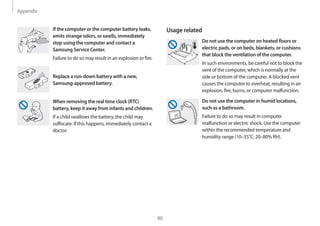
Usage related
Do not use the computer on heated floors or
electric pads, or on beds, blankets, or cushions
that block the ventilation of the computer.
In such environments, be careful not to block the
vent of the computer, which is normally at the
side or bottom of the computer. A blocked vent
causes the computer to overheat, resulting in an
explosion, fire, burns, or computer malfunction.
Do not use the computer in humid locations,
such as a bathroom.
Failure to do so may result in computer
malfunction or electric shock. Use the computer
within the recommended temperature and
humidity range (10–35°C, 20–80% RH).
If the computer or the computer battery leaks,
emits strange odors, or swells, immediately
stop using the computer and contact a
Samsung Service Center.
Failure to do so may result in an explosion or fire.
Replace a run-down battery with a new,
Samsung-approved battery.
When removing the real time clock (RTC)
battery, keep it away from infants and children.
If a child swallows the battery, the child may
suffocate. If this happens, immediately contact a
doctor.
Appendix
81
If the computer is dropped or broken,
disconnect the power cord and contact
a Samsung Service Center. For notebook
computers that are supplied with an external
removable battery, disconnect the battery as
well.
Using a broken computer may result in electric
shock or fire.
Do not touch the computer vents or the
connected AC adapter for extended periods
while the computer is on.
Contact with the vent or the connected AC
adapter for extended periods may result in low-
temperature burns, such as redness on the skin.
Never heat the computer (or the battery) or
put the computer (or the battery) into a fire. Do
not put or use the computer (or the battery)
in a hot location, such as in a sauna or inside a
vehicle when the outside temperature is high.
There is a danger of an explosion or fire.
Before cleaning the computer, disconnect all
the cables that are connected to the computer.
For notebook computers that are supplied with
an optional removable battery, disconnect the
battery.
Failure to do so may result in electric shock or
fire.
Keep the computer away from water or liquid.
Water or liquid entering the computer may
short-circuit the computer, resulting in electric
shock or fire.
Appendix
82
Storage and movement related
Do not store the computer in an enclosed
space, such as a computer bag, while it is
running.
Failure to do so may result in fire. Completely
shut down the computer before putting the
computer into an enclosed space.
When using wireless communication (LAN,
Bluetooth, etc.) always follow applicable
instructions. For example, airlines and
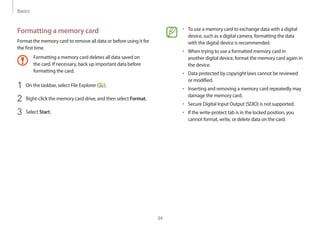
hospitals have strict requirements.
Avoid exposing a drive to magnetic fields.
Security devices with magnetic fields include
airport walk-through devices and security
wands.The airport security devices that check
carry-on luggage, such as conveyor belts,
use X-rays instead of magnetism and will not
damage a drive.
Upgrade related
Do not attempt to upgrade the computer,
unless you are qualified.
Otherwise, contact a Samsung Service Center or
an authorized technician.
Follow the specified instructions contained in
the manual for user maintenance.
Do not disassemble any other parts by yourself.
Failure to do so may result in computer
malfunction, electric shock, or fire.
Do not disassemble the power supply
unit, the AC adapter, or the battery in any
circumstances.
Failure to do so may result in electric shock, fire,
or an explosion.
Shut down the computer and disconnect all
cables before disassembling the computer. If
the notebook has a removable battery, remove
the external battery.
Failure to do so, may cause electric shock.
Appendix
83
Caution
Failure to follow instructions marked with this symbol may result
in minor physical injury or damage to the computer.
Installation related
Do not block the ports (holes), vents, etc. of the product and do
not insert objects.
Damage to a component within the computer may cause electric
shock or fire.
When using the computer on its side, ensure the vents are clear
and facing upwards.
Failure to do so, may cause the internal temperature of the
computer to rise and the computer to malfunction or halt.
When carrying the notebook computer with
other items, such as the adapter, mouse, books
etc., take care not to press anything against the
notebook computer.
If a heavy object is pressed against the notebook
computer, a white spot or stain may appear on
the LCD.Therefore, take care not to apply any
pressure to the notebook.
In this case, place the notebook computer in
a separate compartment away from the other
objects.
Appendix
84
Only use a Samsung-authorized battery.
Failure to do so may cause an explosion.
Keep the battery terminals away from metal objects such as car
keys or paper clips.
If metal objects touch the battery terminals, it may cause excessive
current and result in fire or damage to the battery.
Charge the battery according to the instructions in the manual.
Failure to do so may cause an explosion or fire.
Do not heat the product (or battery) or expose it to heat (e.g.
inside a vehicle during the summer).
There is a danger of explosion or fire.
Do not place heavy objects on the product.
This may cause a problem with the computer. In addition, the
object may fall and cause injury or damage the computer.
Connect the power cord to the nearest socket outlet when
charging the computer.
If a problem occurs and disconnection from the socket outlet is
delayed, there is a danger of electric shock or fire.
Dispose of worn-out batteries properly.
• 	There is a danger of fire or explosion.
• 	The battery disposal method may differ depending on
your country and region. Dispose of the used battery in an
appropriate way.
Do not throw or disassemble the battery and do not put it into
water.
This may cause an injury, fire or explosion.
Appendix
85
In case of lightning, immediately turn the system off, disconnect
the power cord from the wall outlet and phone line from
modem. Do not use the modem or phone.
There is a danger of electric shock or fire.
Connect only permitted devices to the connectors or ports of
the computer.
Failure to do so, may cause electric shock and fire.
Close the LCD panel only after checking if the notebook
computer is turned off.
The temperature may rise and it may cause deformation of the
product.
Do not press the eject button while the CD-ROM drive is in
operation.
You might lose data and the disc might be suddenly ejected and
could cause an injury.
Usage related
Use the pen for its intended purpose only.
Using the pen for abnormal actions such as poking eyes or ears
may cause physical injury.
Do not place a candle, light cigar, etc. over or on the product.
There is a danger of fire.
Make sure to have the product tested by a safety service
engineer after repairing the product.
Authorized Samsung Repair Centers will carry out safety checks
after a repair. Using a repaired product without testing it for safety
may cause an electric shock or fire.
Appendix
86
Do not insert the fingers into the PC Card Slot.
There is a danger of injury or electric shock.
Use recommended computer cleansing solutions when
cleaning the product and only use the computer when it is
completely dry.
Failure to do so may cause electric shock or fire.
You should not use a paper clip to perform an emergency
disc ejection while the disc is in motion. Make sure to use the
emergency disc eject method only when the Optical Disc Drive
has stopped.
There is a danger of injury.
Do not place your face close to the Optical Disc Drive tray when
it is operating.
There is a danger of injury due to an abrupt ejection.
Do not drop, hit, or apply excessive force to the computer.
Failure to do so may result in physical injury or data loss.
Do not allow the antenna and a source of electricity, such as a
socket outlet, to come into contact.
There is a danger of electric shock.
When handling computer parts, follow the instructions on the
manual supplied with the parts.
Failure to do so, may cause damage to the product.
If the computer emits smoke or there is a burning smell,
disconnect the power plug from the wall outlet and contact a
Samsung Service Center immediately. Disconnect the power
supply and remove the battery if one is fitted.
There is a danger of fire.
Do not use a damaged or modified CD.
There is a danger of damaging the product or personal injury.
Appendix
87
Upgrade Related
Take care when touching the product or parts.
The device may be damaged or you may be injured.
Take care not to throw or drop the computer or its components.
This may cause injury or damage to the product.
Make sure to close the computer cover before connecting the
power after a reassembly.
There is a danger of electric shock if your body touches an internal
part.
Only use parts authorized by Samsung.
Failure to do so, may cause fire or damage the product.
Never disassemble or repair the product by yourself.
If the computer is serviced or repaired by an unqualified person,
the warranty will not cover the repair fees.There is a danger of
accident. Use authorized Samsung Service Centers.
To connect a device that is not manufactured or authorized
by Samsung, enquire at a Samsung Service Center before
connecting the device.
There is a danger of damaging the product.
Keep the computer away from magnetic material.
• 	Magnetic materials may cause computer malfunction or cause
the battery to discharge.
• 	To avoid damaging the computer or magnetic stripe cards,
such as credit cards, keep magnetic stripe cards away from the
computer.
Do not use your computer in a hospital or on an aircraft that can
be interfered with by radio frequency.
• 	Avoid using your computer within a 15 cm range of a
pacemaker, if possible, as your computer can interfere with
the pacemaker.
• 	To minimize possible interference with a pacemaker, use your
computer only on the side of your body that is opposite the
pacemaker.
• 	If you use medical equipment, contact the equipment
manufacturer before using your computer to determine
whether or not the equipment will be affected by radio
frequencies emitted by the computer.
• 	When in a hospital, turn off your computer and follow all
hospital regulations. Radio frequencies emitted from the
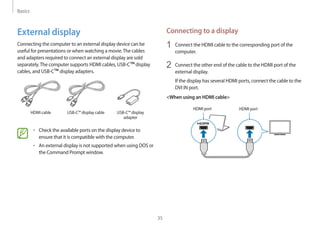
computer may affect medical equipment.
Appendix
88
Cautions on preventing data loss (hard disk
management)
Take care not to damage the data on a hard disk drive.
• 	A hard disk drive is so sensitive to external impact that an
external impact may cause loss of data on the surface of the
disk.
• 	Take extra care, because moving the computer or an impact
on the computer when it is turned on may damage the data
on the hard disk drive.
• 	Samsung is not liable for any loss of data on the hard disk
drive.
Storage and movement related
Properly shut down, disconnect and secure the computer cables
before moving it.
Failure to do so may damage the computer or cause someone to
trip over a loose cable.
For long periods of inactivity or storage, discharge the battery
and separate it from the computer (for external or removable
battery types).
This will extend the battery’s lifespan.
Do not operate or look at the computer while driving a vehicle.
There is a danger of a traffic accident. Please concentrate on
driving.
Appendix
89
LCD bad pixels
Samsung observes strict specifications regarding the quality
and reliability of the LCD. However, there is a small chance that
a few pixels may be bad. A large number of bad pixels can cause
problems with the display, but a small number of bad pixels does
not generally affect computer performance.
Samsung’s quality standards for bad pixels are as follows:
• 	Bright dot: 2 or fewer
• 	Black dot: 4 or fewer
• 	Combination (bright and dark): 4 or fewer
Cleaning the LCD screen
Clean the LCD screen with a soft cloth dampened with computer
cleansing detergent.When cleaning the screen, move the cloth in
one direction. Do not use excessive force. Doing so may damage
the LCD screen.
Situations that may damage the data of a hard disk drive and
the hard disk drive itself.
• 	The data may be lost when an external impact is applied to
the disk while disassembling or assembling the computer.
• 	The data may be lost when the computer is turned off or reset
by a power failure while the hard disk drive is operating.
• 	The data may be lost and irrecoverable due to a computer
virus.
• 	The data may be lost if the power is turned off while running
an application.
• 	Sudden impact or movement to the computer while the hard
disk drive is operating, may cause files to be corrupted or bad
sectors on the hard disk.
To prevent data loss due to damage to the hard disk drive,
please back up the data frequently.
Appendix
90
Setting up the system
• 	Read and follow all instructions marked on the product and
in the documentation before operating the system. Retain all
safety and operating instructions for future use.
• 	Do not use this product near water or a heat source such as a
radiator.
• 	Set up the system on a stable work surface.
• 	The product should be operated only with the type of power
source indicated on the rating label.
• 	Ensure that the electrical outlet to power the equipment is
easily accessible in case of fire or short circuit.
• 	If the computer has a voltage selector switch, make sure that
the switch is in the proper position for your area.
• 	Openings in the computer case are provided for ventilation.
Do not block or cover these openings. Make sure you provide
adequate space, at least 6 inches (15 cm), around the system
for ventilation when setting up your work area. Never insert
objects of any kind into the computer ventilation openings.
Important safety information
Safety instructions
The system is designed and tested to meet the latest standards for
safety of information technology equipment. However, to ensure
safe use of this product, it is important that the safety instructions
marked on the product and in the documentation are followed.
Always follow these instructions to help guard against
personal injury and damage to the system.
Appendix
91
Care during use
• 	Do not walk on the power cord or allow anything to rest on it.
• 	Do not spill anything on the computer or its components.
The best way to avoid spills is to not eat or drink near the
computer or its components.
• 	Some products have a replaceable CMOS battery on the
system board.There is a danger of explosion if the CMOS
battery is replaced incorrectly. Replace the battery with the
same or equivalent type recommended by the manufacturer.
Dispose of batteries according to the manufacturers
instructions. If the CMOS battery requires replacement ensure
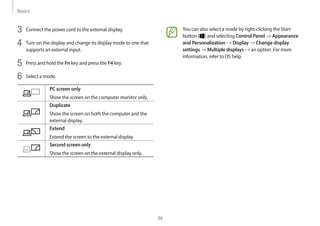
that a qualified technician performs the task.
• 	When the computer is turned off, a small amount of electrical
current still flows through the computer.
To avoid electrical shock, always unplug all power cables,
remove the battery and modem cables from the wall outlets
before cleaning the system.
• 	Ensure that the fan vents on the bottom of the casing are
clear at all times. Do not place the computer on a soft surface,
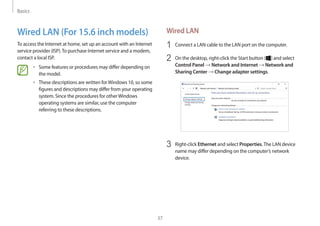
doing so will block the bottom vents.
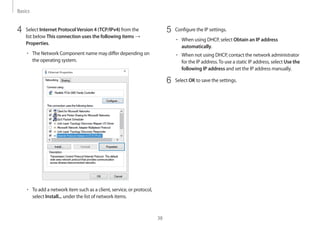
• 	When using an extension cord with this system, make sure
that the total power rating on the products plugged into the
extension cord does not exceed the extension cord power
rating.
• 	For Notebooks with glossy display bezels the user should
consider the placement of the Notebook as the bezel may
cause reflections from surrounding light and bright surfaces.
Appendix
92
Operating instructions
1	 When installing and operating devices please refer to safety
requirements in the user manual.
2	 Devices can be used only with the equipment specified in the
technical specifications of the devices.
3	 If any smell of burning or smoke is detected from the
computer the unit should be switched off and the battery
removed.The unit should be checked by a qualified
technician before reuse.
4	 Service and repair of devices should be carried out by
authorized service centers.
5	 Do not allow the portable computer to operate with the base
resting directly on exposed skin for extended periods of time.
The surface temperature of the base will rise during normal
operation (particularly when AC Power is present). Allowing
sustained contact with exposed skin can cause discomfort or
eventually a burn.
• 	Unplug the system from the wall outlet and contact a
Samsung Service Center if:
–– The power cord or plug is damaged.
–– Liquid has been spilled into the computer.
–– The computer does not operate properly when the
operating instructions are followed.
–– The computer was dropped or the casing is damaged.
–– The computer performance changes.
Appendix
93
Battery disposal
Do not put rechargeable batteries or products powered by
non-removable rechargeable batteries in the garbage.
Contact the Samsung Service Center for information on how to
dispose of batteries that you cannot use or recharge any longer.
Follow all local regulations when disposing of old batteries.
THERE IS RISK OF EXPLOSION IF BATTERY IS REPLACED BY
AN INCORRECTTYPE.
DISPOSE OF USED BATTERIES ACCORDINGTOTHE
INSTRUCTIONS.
Replacement parts and
accessories
Use only replacement parts and accessories recommended by
manufacturer.
To reduce the risk of fire, use only No. 26 AWG or larger
telecommunications line cord.
Do not use this product in areas classified as hazardous.
Such areas include patient care areas of medical and
dental facilities, oxygen rich environments, or industrial
areas.
Appendix
94
• 	Laser Safety Note: Use of controls or adjustments or
performance of procedures other than those specified
in this manual may result in hazardous radiation
exposure.To prevent exposure to laser beams, do not
try to open the enclosure of a CD or DVD drive.
• 	Class 1M laser radiation when operating part is open.
Do not view directly with optical instruments.
• 	Class 3B invisible laser radiation when open.
Avoid exposure to the beam.
Connect and disconnect the AC adapter
The socket-outlet shall be installed near the equipment and shall
be easily accessible.
Do not unplug the power cord by pulling the cable only.
Laser safety
All systems equipped with CD or DVD drives comply with the
appropriate safety standards, including IEC 60825-1.The laser
devices in these components are classified as“Class 1 Laser
Products”under a US Department of Health and Human Services
(DHHS) Radiation Performance Standard. Should the unit ever
need servicing, contact an authorized service location.
Appendix
95
General requirements
The requirements listed below are applicable to all countries:
• 	All power cord sets must be approved by an acceptable
accredited agency responsible for evaluation in the country
where the power cord set will be used.
• 	The power cord set must have a minimum current capacity
of 7A and a nominal voltage rating of 125 or 250 volts AC, as
required by each country’s power system (USA only).
• 	The appliance coupler must meet the mechanical
configuration of an EN 60 320/IEC 320 Standard Sheet C7
(or C5) connector, for mating with appliance inlet on the
computer.
Power cord requirements
The power cord set (all plug, cable and AC adapter plug) you
received with your computer meets the requirements for use in
the country where you purchased your equipment.
Power cord sets for use in other countries must meet the
requirements of the country where you use the computer. For
more information on power cord set requirements, contact your
authorized dealer, reseller, or service provider.
Appendix
96
The RF field strength of the wireless device or devices that may
be embedded in the notebook are well below all international
RF exposure limits as known at this time. Because the wireless
devices (which may be embedded into the notebook) emit less
energy than is allowed in radio frequency safety standards and
recommendations, manufacturer believes these devices are safe
for use. Regardless of the power levels, care should be taken to
minimize human contact during normal operation.
Some circumstances require restrictions on wireless devices.
Examples of common restrictions are listed on the next page:
Regulatory compliance
statements
Wireless guidance
(If fitted with 2.4 G band or 5 G band)
Low power, Radio LAN type devices (radio frequency (RF) wireless
communication devices), operating in the 2.4 GHz/5 GHz Band,
may be present (embedded) in the notebook system.The
following section is a general overview of considerations while
operating a wireless device.
Additional limitations, cautions, and concerns for specific
countries are listed in the specific country sections (or country
group sections).The wireless devices in the system are only
qualified for use in the countries identified by the Radio Approval
Marks on the system rating label. If the country you will be using
the wireless device in, is not listed, please contact your local Radio
Approval agency for requirements.Wireless devices are closely
regulated and use may not be allowed.
Appendix
97
• 	Every country has different restrictions on the use of
wireless devices. Since your system is equipped with
a wireless device, when traveling between countries
with your system, check with the local Radio Approval
authorities prior to any move or trip for any restrictions
on the use of a wireless device in the destination
country.
• 	If the system came equipped with an internal
embedded wireless device, do not operate the wireless
device unless all covers and shields are in place and the
system is fully assembled.
• 	Wireless devices are not user serviceable. Do not modify
them in any way. Modification to a wireless device will
void the authorization to use it. Please contact the
manufacturer for service.
• 	Only use drivers approved for country in which the
device will be used. See the manufacturer System
Restoration Kit, or contact the manufacturer’s technical
support for additional information.
• 	Radio frequency wireless communication can interfere
with equipment on commercial aircraft. Current
aviation regulations require wireless devices to be
turned off while traveling in an airplane.
802.11ABGN (also known as wireless Ethernet orWi-Fi)
and Bluetooth communication devices are examples of
devices that provide wireless communication.
• 	In environments where the risk of interference to other
devices or services is harmful or perceived as harmful,
the option to use a wireless device may be restricted
or eliminated. Airports, Hospitals, and Oxygen or
flammable gas laden atmospheres are limited examples
where use of wireless devices may be restricted or
eliminated.When in environments where you are
uncertain of the sanction to use wireless devices, ask
the applicable authority for authorization prior to use or
turning on the wireless device.
Appendix
98
Explosive Device ProximityWarning
Do not operate a portable transmitter (such as a wireless
network device) near unshielded blasting caps or in
an explosive environment unless the device has been
modified to be qualified for such use.
Use On Aircraft Caution
Regulations of the FCC and FAA prohibit airborne
operation of radio-frequency wireless devices because
their signals could interfere with critical aircraft
instruments.
Other wireless devices
Safety notices for other devices in the wireless network:
Refer to the documentation supplied with wireless Ethernet
adapters or other devices in the wireless network.
United States of America
USA and Canada Safety Requirements and Notices
Do not touch or move antenna while the unit is transmitting or
receiving.
Do not hold any component containing the radio such that the
antenna is very close to touching any exposed parts of the body,
especially the face or eyes, while transmitting.
Do not operate the radio or attempt to transmit data unless the
antenna is connected; if not, the radio may be damaged.
Use in specific environments:
The use of wireless devices in hazardous locations is limited by the
constraints posed by the safety directors of such environments.
The use of wireless devices on airplanes is governed by the Federal
Aviation Administration (FAA).
The use of wireless devices in hospitals is restricted to the limits
set forth by each hospital.
Appendix
99
This equipment has been tested and found to comply
with the limits for a Class B digital device pursuant to Part
15 of the FCC Rules.These limits are designed to provide
reasonable protection against harmful interference in a
residential installation.This equipment generates, uses,
and can radiate radio frequency energy. If not installed
and used in accordance with the instructions, it may
cause harmful interference. If this equipment does cause
harmful interference to radio or television reception,
which can be determined by turning the equipment
off and on, the user is encouraged to try to correct the
interference by one or more of the following measures:
• 	Reorient or relocate the receiving antenna.
• 	Increase the separation between the equipment and
receiver.
• 	Connect the equipment into an outlet on a circuit
different from that to which the receiver is connected.
• 	Consult the dealer or an experienced radio/TV
technician for help.
The Part 15 radio device operates on a non-interference
basis with other devices operating at this frequency. Any
changes or modification to said product not expressly
approved by Intel could void the user’s authority to
operate this device.
Unintentional emitter per FCC Part 15
This device complies with Part 15 of the FCC Rules. Operation is
subject to the following two conditions: (1) this device may not
cause harmful interference, and (2) this device must accept any
interference received, including interference that may cause
undesired operation.
Appendix
100
Intentional emitter per FCC Part 15
(If fitted with 2.4 G band or 5 G band)
Low power, Radio LAN type devices (radio frequency (RF) wireless
communication devices), operating in the 2.4 GHz/5 GHz Band,
may be present (embedded) in the notebook system.This section
is only applicable if these devices are present. Refer to the system
label to verify the presence of wireless devices.
Wireless devices that may be in the system are only qualified for
use in the United States of America if an FCC ID number is on the
system label.
This device is restricted to indoor use due to its operation in the
5.15 to 5.25 GHz frequency range. FCC requires this product to be
used indoors for the frequency range 5.15 to 5.25 GHz to reduce
the potential for harmful interference to co-channel Mobile
Satellite systems. High power radars are allocated as primary users
of the 5.25 to 5.35 GHz and 5.65 to 5.85 GHz bands.These radar
stations can cause interference with and/or damage this device.
If necessary, the user should consult the dealer or an experienced
radio/television technician for additional suggestions.The user
may find the following booklet helpful:“Something About
Interference.”
This is available at FCC local regional offices. Our company is not
responsible for any radio or television interference caused by
unauthorized modifications of this equipment or the substitution
or attachment of connecting cables and equipment other than
those specified by our company.The correction will be the
responsibility of the user. Use only shielded data cables with this
system.
Appendix
101
Health and safety information
Exposure to Radio Frequency (RF) Signals
Certification Information
This product can contain an embedded radio transmitter and
receiver. It is designed and manufactured not to exceed the
exposure limits for radio frequency (RF) energy set by the Federal
Communications Commission (FCC) of the U.S. government.These
FCC exposure limits are derived from the recommendations of two
expert organizations, the National Council on Radiation Protection
and Measurement (NCRP) and the Institute of Electrical and
Electronics Engineers (IEEE). In both cases, the recommendations
were developed by scientific and engineering experts drawn from
industry, government, and academia after extensive reviews of the
scientific literature related to the biological effects of RF energy.
Before a new model is available for sale to the public, it must be
certified to the FCC that it does not exceed the exposure limit
established by the FCC. Evaluation per each model is performed
in positions and locations (e.g. at the bottom on the body) as
required by the FCC.
Operation of this device is subject to the following two conditions:
(1)This device may not cause harmful interference, and (2)
this device must accept any interference received, including
interference that may cause undesired operation of the device.
Wireless devices are not user serviceable. Do not modify
them in any way.
Modification to a wireless device will void the
authorization to use it. Contact manufacturer for service.
Appendix
102
For corresponding model only
The Specific Absorption Rate (SAR) is a measure of the rate of
absorption of RF energy by the human body expressed in units
of watts per kilogram (W/kg).The FCC wireless devices to comply
with a safety limit of 1.6 watts per kilogram (1.6W/kg).
SAR level of this device while operating can be well below the
maximum value.This is because the device is designed to operate
at multiple power levels so as to use only the power required to
reach the network. In general, the closer you are to a wireless base
station antenna, the lower the power output.
For body worn operation, this model meets the FCC RF exposure
guidelines when used with Samsung accessory designated for this
product. Non-compliance with the above restrictions may result in
violation of FCC RF exposure guidelines.
RF exposure or SAR information can be viewed on-line at
www.fcc.gov/oet/ea/fccid/.This site uses this product FCC ID
number on the outside of the product. Sometimes it may be
necessary to remove the battery pack to find number. Once
you have the FCC ID number for a particular product, follow the
instructions on the website and it should provide RF exposure
information or values for typical or maximum SAR for particular
product.
Appendix
103
The term“IC”before the equipment certification number only
signifies that the Industry Canada technical specifications were
met.To reduce potential radio interference to other users, the
antenna type and its gain should be so chosen that the equivalent
isotropically radiated power (EIRP) is not more than that required
for successful communication.To prevent radio interference
to the licensed service, this device is intended to be operated
indoors and away from windows to provide maximum shielding.
Equipment (or its transmit antenna) that is installed outdoors is
subject to licensing.
(If fitted with 2.4 G band or 5 G band)
Low power, Radio LAN type devices (radio frequency (RF) wireless
communication devices), operating in the 2.4 GHz/5 GHz Band,
may be present (embedded) in your notebook system.This
section is only applicable if these devices are present. Refer to the
system label to verify the presence of wireless devices.
Wireless devices that may be in your system are only qualified for
use in Canada if an Industry Canada ID number is on the system
label.
Canada
Unintentional emitter per ICES-003
This digital apparatus does not exceed the Class B limits for radio
noise emissions from digital apparatus as set out in the radio
interference regulations of Industry Canada.
Intentional emitter per RSS 210
This device complies with RSS 210 of Industry Canada. Operation
is subject to the following two conditions: (1) this device may
not cause interference, and (2) this device must accept any
interference, including interference that may cause undesired
operation of this device.
Appendix
104
The power output of the wireless device (or devices), which may
be embedded in your notebook, is well below the RF exposure
limits as set by Industry Canada.
Operation of this device is subject to the following two conditions:
(1)This device may not cause harmful interference, and (2)
this device must accept any interference received, including
interference that may cause undesired operation of the device.
To prevent radio interference to licensed service, this
device is intended to be operated indoors and away from
windows to provide maximum shielding. Equipment (or
its transmit antenna) that is installed outdoors is subject to
licensing.
Wireless devices are not user serviceable. Do not modify
them in any way. Modification to a wireless device will
void the authorization to use it. Contact manufacturer for
service.
When using IEEE 802.11a wireless LAN, this product is restricted to
indoor use due to its operation in the 5.15 to 5.25 GHz frequency
range. Industry Canada requires this product to be used indoors
for the frequency range of 5.15 to 5.25 GHz to reduce the potential
for harmful interference to co-channel mobile satellite systems.
High power radar is allocated as the primary user of the 5.25 to
5.35 GHz and 5.65 to 5.85 GHz bands.These radar stations can
cause interference with and/or damage to this device.
The maximum allowed antenna gain for use with this device
is 6dBi in order to comply with the E.I.R.P limit for the 5.25 to
5.35 GHz and 5.725 to 5.85 GHz frequency range in point-to-point
operation.
Appendix
105
European Union
European Union CE marking and compliance notices
Products intended for sale within the European Union are
marked with the Conformité Européene (CE) Marking, which
indicates compliance with the applicable Directives and European
standards and amendments identified below.This equipment also
carries the Class 2 identifier.
The following information is only applicable to systems labeled
with the CE mark .
European Directives
This InformationTechnology Equipment has been tested and
found to comply with the following European directives:
• 	EMC Directive 2004/108/EC
• 	LowVoltage Directive 2006/95/EC
• 	RTTE Directive 1999/5/EC
Brazil
Este produto esta homologado pela ANATEL, de acordo com
os procedimentos regulamentados pela Resolucao 242/2000, e
atende aos requisitos tecnicos aplicados.
Este equipamento opera em caráter secundário, isto é, não
tem direito a proteção contra interferência prejudicial, mesmo
de estações do mesmo tipo, e não pode causar interferência a
sistemas operando em caráter primário.
Appendix
106
Wireless devices that may be in your system are only qualified for
use in the European Union or associated areas if a CE mark
with a Notified Body Registration Number and the Alert Symbol is
on the system label.
The power output of the wireless device or devices that may be
embedded in you notebook is well below the RF exposure limits
as set by the European Commission through the RTTE directive.
The low band 5.15–5.35 GHz is for indoor use only.
See 802.11b and 802.11g restrictions for specific countries
or regions within countries under the heading“European
Economic Area Restrictions”below.
Samsung Electronics (UK) Ltd, Euro QA Lab.
Blackbushe Business Park SaxonyWay,Yateley,
Hampshire GU46 6GG United Kingdom
European radio approval information (for products
fitted with EU-approved radio devices)
This Product is a Notebook computer; low power, Radio LAN type
devices (radio frequency (RF) wireless communication devices),
operating in the 2.4 GHz/5 GHz band, may be present (embedded)
in your notebook system which is intended for home or office use.
This section is only applicable if these devices are present. Refer to
the system label to verify the presence of wireless devices.
Appendix
107
Nation Description
Eesti[Estonian]
Käesolevaga kinnitab
Samsung seadme Notebook
PC vastavust direktiivi 1999/5/
EÜ põhinõuetele ja nimetatud
direktiivist tulenevatele teistele
asjakohastele sätetele.
English
Hereby, Samsung, declares
that this Notebook PC is in
compliance with the essential
requirements and other
relevant provisions of Directive
1999/5/EC.
Español[Spanish]
Por medio de la presente
Samsung declara que el
Notebook PC cumple con
los requisitos esenciales
y cualesquiera otras
disposiciones aplicables
o exigibles de la Directiva
1999/5/CE.
EU RTTE compliance statements
Nation Description
Česky[Czech]
Samsung tímto prohlašuje,
že tento Notebook PC je ve
shodě se základními požadavky
a dalšími příslušnými
ustanoveními směrnice 1999/5/
ES.
Dansk[Danish]
Undertegnede Samsung
erklærer herved, at følgende
udstyr Notebook PC overholder
de væsentlige krav og øvrige
relevante krav i direktiv 1999/5/
EF.
Deutsch[German]
Hiermit erklärt Samsung, dass
sich das Gerät Notebook PC
in Übereinstimmung mit den
grundlegenden Anforderungen
und den übrigen einschlägigen
Bestimmungen der Richtlinie
1999/5/EG befindet.
Appendix
108
Nation Description
Latviski[Latvian]
Ar šo Samsung deklarē, ka
Notebook PC atbilst Direktīvas
1999/5/EK būtiskajām prasībām
un citiem ar to saistītajiem
noteikumiem.
Lietuvių[Lithuanian]
Šiuo Samsung deklaruoja,
kad šis Notebook PC atitinka
esminius reikalavimus ir
kitas 1999/5/EB Direktyvos
nuostatas.
Nederlands[Dutch]
Hierbij verklaart Samsung dat
het toestel Notebook PC in
overeenstemming is met de
essentiële eisen en de andere
relevante bepalingen van
richtlijn 1999/5/EG.
Nation Description
Ελληνική[Greek]
ΜΕΤΗΝ ΠΑΡΟΥΣΑ Samsung
ΔΗΛΩΝΕΙ ΟΤΙ Notebook PC
ΣΥΜΜΟΡΦΩΝΕΤΑΙ ΠΡΟΣΤΙΣ
ΟΥΣΙΩΔΕΙΣ ΑΠΑΙΤΗΣΕΙΣ ΚΑΙΤΙΣ
ΛΟΙΠΕΣ ΣΧΕΤΙΚΕΣ ΔΙΑΤΑΞΕΙΣ
ΤΗΣ ΟΔΗΓΙΑΣ 1999/5/ΕΚ.
Français[French]
Par la présente Samsung
déclare que l’appareil
Notebook PC est conforme aux
exigences essentielles et aux
autres dispositions pertinentes
de la directive 1999/5/CE.
Italiano[Italian]
Con la presente Samsung
dichiara che questo Notebook
PC è conforme ai requisiti
essenziali ed alle altre
disposizioni pertinenti stabilite
dalla direttiva 1999/5/CE.
Appendix
109
Nation Description
Português[Portuguese]
Samsung declara que este
Notebook PC está conforme
com os requisitos essenciais e
outras disposições da Directiva
1999/5/CE.
Slovensko[Slovenian]
Samsung izjavlja, da je ta
Notebook PC v skladu z
bistvenimi zahtevami in
ostalimi relevantnimi določili
direktive 1999/5/ES.
Slovensky[Slovak]
Samsung týmto vyhlasuje, že
Notebook PC spĺňa základné
požiadavky a všetky príslušné
ustanovenia Smernice
1999/5/ES.
Nation Description
Malti[Maltese]
Hawnhekk, Samsung, jiddikjara
li dan Notebook PC jikkonforma
mal-ħtiāijiet essenzjali u ma
provvedimenti oħrajn relevanti
li hemm fid-Dirrettiva 1999/5/
EC.
Magyar[Hungarian]
Alulírott, Samsung nyilatkozom,
hogy a Notebook PC megfelel
a vonatkozó alapvetõ
követelményeknek és az
1999/5/EC irányelv egyéb
elõírásainak.
Polski[Polish]
Niniejszym Samsung
oświadcza, Ŝe Notebook PC
jest zgodny z zasadniczymi
wymogami oraz pozostałymi
stosownymi postanowieniami
Dyrektywy 1999/5/EC.
Appendix
110
Nation Description
Norsk[Norwegian]
Samsung erklærer herved
at utstyret Notebook
PC er i samsvar med de
grunnleggende krav og øvrige
relevante krav i direktiv 1999/5/
EF.
Türkiye[Türkçe]
Bu belge ile, Samsung bu
Notebook PC’nin 1999/5/
EC Yönetmeliğinin temel
gerekliliklerine ve ilgili
hükümlerine uygun olduğunu
beyan eder.
Nation Description
Suomi[Finnish]
Samsung vakuuttaa täten
että Notebook PC tyyppinen
laite on direktiivin 1999/5/EY
oleellisten vaatimusten ja sitä
koskevien direktiivin muiden
ehtojen mukainen.
Svenska[Swedish]
Härmed intygar Samsung
att denna Notebook PC står
I överensstämmelse med de
väsentliga egenskapskrav och
övriga relevanta bestämmelser
som framgår av direktiv
1999/5/EG.
Íslenska[Icelandic]
Hér með lýsir Samsung yfir því
að Notebook PC er í samræmi
við grunnkröfur og aðrar kröfur,
sem gerðar eru í tilskipun
1999/5/EC.
Appendix
111
Manufacturer information
Samsung Electronics Co., Ltd.
129, Samsung-Ro,Yeongtong-Gu, Suwon-City, Gyeonggi-Do,
443-742, Korea
Samsung Electronics Suzhou Computer Co., Ltd.
No. 198, Fangzhou Road, Suzhou Industrial Park, Jiangsu Province,
215021, China
Tel: +86-0512-6253-8988
Samsung ElectronicsVietnam Co., Ltd.
Yen Phong 1, I.PYenTrung Commune,Yen Phong Dist., Bac Ninh
Province,Vietnam
For the web or the phone number of the Samsung Service Center,
see theWarranty or contact the retailer where you purchased your
product.
To view the EU Declaration of Conformity
for this product (in English only), go to:
www.samsung.com/uk/support/main/supportMain.do or
www.samsung.com/uk/support then search the model number of
the product.
If the Declaration of Conformity for the model you are interested
in is not available on our web-site, please contact your distributor
or below address.
doc.eu@samsung.com
Appendix
112
Due to the fact that the frequencies used by
802.11b/802.11g wireless LAN devices may not yet be
harmonized in all countries, 802.11b/802.11g products
are designed for use only in specific countries or regions,
and are not allowed to be operated in countries or regions
other than those of designated use.
As a user of these products, you are responsible for
ensuring that the products are used only in the countries
or regions for which they were intended and for verifying
that they are configured with the correct selection of
frequency and channel for the country or region of use.
Any deviation from permissible settings and restrictions in
the country or region of use could be an infringement of
local law and may be punished as such.
European economic area restrictions
Local restriction of 802.11b/802.11g radio usage
Note to integrator:The following statements on local restrictions
must be published in all end-user documentation provided with
the system or product incorporating the wireless product.
Appendix
113
RTC caution
CAUTION: Danger of explosion if battery is incorrectly replaced.
Replace only with the same or equivalent type recommended
by the manufacturer. Discard used batteries according to the
Manufacturer’s instruction.
The European variant is intended for use throughout the European
Economic Area. However, authorization for use is further restricted
in particular countries or regions within countries, as follows:
General
European standards dictate maximum radiated transmit power
of 100 mW effective isotropic radiated power (EIRP) and the
frequency range 2400–2483.5 MHz.
The low band 5.15–5.35 GHz is for indoor use only.
Belgium
For private use outdoors in public spaces, no registration is
necessary for distances less than 300 m. For distances greater
than 300 m, you must register with the Belgian Institute for Postal
services andTelecommunications (BIPT). For commercial use
outdoors, you must obtain a license from the BIPT. For registration
or licensing, please contact the BIPT.
For other languages, refer to the corresponding manuals.
France
The low band 5.15–5.35 GHz is for indoor use only.
Appendix
114
WEEE symbol information
Correct disposal of this product (Waste Electrical 
Electronic Equipment)
(Applicable in countries with separate collection
systems)
This marking on the product, accessories or literature indicates
that the product and its electronic accessories (for example,
charger, headset, USB cable) should not be disposed of with other
household waste at the end of their working life.
To prevent possible harm to the environment or human health
from uncontrolled waste disposal, please separate these items
from other types of waste and recycle them responsibly to
promote the sustainable reuse of material resources.
Household users should contact either the retailer where
they purchased this product, or their local government office,
for details of where and how they can take these items for
environmentally safe recycling.
Business users should contact their supplier and check the terms
and conditions of the purchase contract.This product and its
electronic accessories should not be mixed with other commercial
wastes for disposal.
For information on Samsung’s environmental commitments
and product specific regulatory obligations e.g. REACH visit:
samsung.com/uk/aboutsamsung/samsungelectronics/
corporatecitizenship/data_corner.html
India only
For more information on safe disposal and recycling visit our
website www.samsung.com/in or contact our Helpline numbers -
18002668282, 180030008282.
This product is RoHS compliant.
Appendix
115
USA only
This Perchlorate warning applies only to primary CR (Manganese
Dioxide) Lithium coin cells in the product sold or distributed ONLY
in California USA.
“Perchlorate Material- special handling may apply, see
www.dtsc.ca.gov/hazardouswaste/perchlorate.”
Dispose unwanted electronics through an approved recycler.
To find the nearest recycling location, go to our website:
www.samsung.com/recyclingdirect
or call, (877) 278-0799.
For battery recycling go to call2recycle.org; or call 1-800-822-8837.
Warning:This product contains chemicals known to the state of
California to cause cancer, birth defects, or other reproductive
harm.
Correct disposal of batteries in this product
(Applicable in countries with separate collection
systems)
This marking on the battery, manual or packaging indicates that
the batteries in this product should not be disposed of with other
household waste at the end of their working life.Where marked,
the chemical symbols Hg, Cd or Pb indicate that the battery
contains mercury, cadmium or lead above the reference levels
in EC Directive 2006/66. If batteries are not properly disposed
of, these substances can cause harm to human health or the
environment.
To protect natural resources and to promote material re-use,
please separate batteries from other types of waste and recycle
them through your local, free battery return system.
Appendix
116
Samsung packageTake-Back
program
In partnering with select recyclers, Samsung offers packaging
take-back at no cost to you.
Simply call the following number for the locations nearest you.
CRT Processing, LLC
(877) 278-0799
Kathy Severson – Logistics contact
Dispose unwanted electronics through an approved recycler.
To find the nearest recycling location, go to our website:
www.samsung.com/recyclingdirect or call, (877) 278-0799
Some content may differ from the computer depending on the region, service provider, software version, or computer model, and is
subject to change without prior notice.
English. 09/2016. Rev. 2.0www.samsung.com

Samsung Series 7 Spin Notebook 13.3 Manual / User Guide

  • 1.
  • 2.
    2 Getting started 3 Aboutthis manual 7 Layout 14 Turning the computer on and off 16 Unlocking the screen 16 Windows Basics 19 Using the computer as a tablet 21 Touch screen (optional) 26 Keyboard 28 Touchpad (optional) 32 Memory card 35 External display 37 Wired LAN (For 15.6 inch models) 40 Wireless LAN 42 Using the security slot (For 15.6 inch models) Applications 43 Using applications 44 Samsung Settings 45 Samsung Update 46 Online Support (S Service) 47 Samsung PC Help (Self-help application) Settings & Upgrade 48 LCD brightness 50 Volume 51 BIOS (Setup utility) 57 Battery Troubleshooting 60 Samsung Recovery 66 Windows recovery function 66 Q&A Appendix 70 Product specifications 71 Ergonomic tips 75 Powering your device 77 Safety precautions 90 Important safety information 93 Replacement parts and accessories 96 Regulatory compliance statements 114 WEEE symbol information 116 Samsung packageTake- Back program Table of contents
  • 3.
    3 Getting started About thismanual • This user manual is specially designed to detail the computer’s functions and features. • The user manual supplied with the computer may vary depending on the model. • Please read this manual before using the computer to ensure safe and proper use. • Optional accessories, some devices, and software referred to in this manual may not be provided or may not be subject to upgrades. Note that the computer environment referred in the user manual may not be the same as your environment. • Descriptions are based on the computer’s default settings and theWindows 10 operating system. Available features and additional services may vary depending on the computer or operating system. • This user manual describes procedures for using the touchpad, mouse and touch screen. Instructions for using the touch screen are for models with the touch screen feature. • Images and screenshots are those of the representative model of the series and may differ in appearance from the actual product. • Content may differ from the final product and is subject to change without prior notice. For the latest version of the manual, refer to the Samsung website, www.samsung.com.
  • 4.
    Getting started 4 Copyright Copyright ©2016 Samsung Electronics This manual is protected under international copyright laws. No part of this manual may be reproduced, distributed, translated, or transmitted in any form or by any means, electronic or mechanical, including photocopying, recording, or storing in any information storage and retrieval system, without the prior written permission of Samsung Electronics. Computer specifications or the contents of this manual may be changed without prior notice due to an upgrade of the computer’s functions. Instructional icons and expressions Warning: situations that could cause injury to yourself or others Caution: situations that could cause damage to the computer or other equipment Note: notes, usage tips, or additional information The path you should follow to carry out an instruction. For example,“select Settings → Devices”indicates that you should select Settings and then Devices. Select Click the mouse or tap the touchpad or touch screen.
  • 5.
    Getting started 5 • HDMI,the HDMI logo, and the term High Definition Multimedia Interface are trademarks or registered trademarks of HDMI Licensing LLC. • All other trademarks and copyrights are the property of their respective owners. As an ENERGY STAR®Partner, Samsung has determined that this product meets the ENERGY STAR® guidelines for energy efficiency. • The ENERGY STAR Program has reduced greenhouse gas emissions and saved energy through voluntary labeling. • Power management setting of this product has been enabled by default, and has various timing settings from 1 minute to 5 hours. • The product can wake with a button press on the chassis from sleep mode. Trademarks • Samsung and the Samsung logo are trademarks or registered trademarks of Samsung Electronics. • Intel and Core are trademarks or registered trademarks of the Intel Corporation. • Microsoft, MS-DOS, andWindows are trademarks or registered trademarks of the Microsoft Corporation. • Bluetooth®is a registered trademark of Bluetooth SIG, Inc. worldwide. • Wi-Fi®,Wi-Fi Protected Setup™,Wi-Fi Direct™,Wi-Fi CERTIFIED™, and theWi-Fi logo are registered trademarks of theWi-Fi Alliance.
  • 6.
    Getting started 6 Product capacityrepresentation Storage capacity representation The capacity of the storage device (HDD, SSD) of the manufacturer is calculated assuming that 1 KB = 1,000 Bytes. However, the operating system (Windows) calculates the storage device capacity assuming that 1 KB = 1,024 Bytes.Therefore, the available capacity of the HDD inWindows is smaller than the actual capacity due to the difference in capacity calculation. For example, for an 80 GB HDD,Windows calculates the capacity as 74.5 GB, (80x1,000x1,000x1,000) Bytes/(1,024x1,024x1,024) Bytes = 74.505 GB. In addition, the capacity representation inWindows may be even smaller because some programs, such as Samsung Recovery, may reside in a hidden area of the HDD. Memory capacity representation The available memory capacity inWindows is less than the actual capacity of memory.This is because some memory is required for regular system operations. For example, for 1 GB (= 1,024 MB) memory installed,Windows may report the capacity as 1,022 MB or less. Data precautions Samsung Electronics shall not be liable for any data loss. Please take care to avoid losing any important data and back up your data to prevent any such data loss. Operating system and software support If you change the product’s factory OS (Operating System) to another OS or if you install software which is not supported by the product’s original factory OS, you will not receive any technical support, product exchange or refund, and a fee will be charged when requesting a service. Please use your computer with the original factory OS. If you install an OS other than the factory OS, data may be deleted or the computer may not start.
  • 7.
    Getting started 7 Number/Name Description Cameraindicator light • This indicates the camera operating status. Camera • Using this camera, you can take still pictures and record video. LCD/Touch screen (optional) • The screen’s images are displayed here. • Recognizes touch interactions (Only for touch screen models). Illumination sensor • The sensor detects the ambient light. • If the ambient light level becomes too low, the keyboard’s backlight will automatically turn on. • If there is sufficient ambient lighting, the keyboard’s backlight will automatically turn off. • Do not block the sensor. Keyboard • Enter text or control computer functions. Touchpad • Moves the cursor and selects options. • Functions as a mouse. Layout • Features or options may differ depending on the model. • The items marked as optional may not be provided or may be provided in different locations. • Since some space on the SSD is reserved for system recovery and operations, the available space on the SSD may be less than the actual capacity. Front view ▶ For 13.3 inch models 2 1 3 4 5 6
  • 8.
    Getting started 8 Number/Name Description Cameraindicator light • This indicates the camera operating status. Camera • Using this camera, you can take still pictures and record video. LCD/Touch screen (optional) • The screen’s images are displayed here. • Recognizes touch interactions (Only for touch screen models). Illumination sensor • The sensor detects the ambient light. • If the ambient light level becomes too low, the keyboard’s backlight will automatically turn on. • If there is sufficient ambient lighting, the keyboard’s backlight will automatically turn off. • Do not block the sensor. Keyboard • Enter text or control computer functions. Touchpad • Moves the cursor and selects options. • Functions as a mouse. ▶ For 15.6 inch models 2 3 6 1 4 5
  • 9.
    Getting started 9 Number/Name Description Volumebutton / • Adjusts the volume level. Power button / Power LED • Turns the computer on and off. • Shows the operating status of the computer. –– Red: Charging –– Green: Fully charged –– Blue:Turned on Microphone • You can use the built-in microphone. USB 2.0 port • Connect various peripheral devices, such as a mouse, camera, or keyboard. Right view ▶ For 13.3 inch models 1 2 3 34
  • 10.
    Getting started 10 Number/Name Description Volumebutton / • Adjusts the volume level. Power button / Power LED • Turns the computer on and off. • Shows the operating status of the computer. –– Red: Charging –– Green: Fully charged –– Blue:Turned on Memory card slot (optional) • Insert a memory card into the slot. USB 2.0 port • Connect various peripheral devices, such as a mouse, camera, or keyboard. Security slot • Secure the computer by connecting an optional lock and cable to it. ▶ For 15.6 inch models 1 2 3 4 5
  • 11.
    Getting started 11 Number/Name Description DCjack • This jack connects to the AC adapter to supply power to the computer. HDMI port • Used to connect an HDMI cable to an external device. USB 3.0 port • Connect various peripheral devices, such as a mouse, camera, or keyboard. USB-C™ port • The USB-C™port can be used to connect and charge a USB-C™ device, or connect to an external display device. • Purchase an adapter separately to connect to an external display • The computer cannot be charged via the USB-C™ port. Earpiece/Headset jack • Connect an earpiece or a headset to the computer to listen to audio. Memory card slot • Insert a memory card into the slot. Left view ▶ For 13.3 inch models 1 2 3 4 5 6 About the chargeable USB port • It may take longer to charge the battery when charging a USB device. • The battery power level may be reduced when charging a USB device while the computer is powered by the battery. • The charging status of the USB device is not displayed on the computer. • To turn on the charging function while the computer is turned off, open the Samsung Settings application and select Convenience → USB charging in sleep mode → ON. • This feature may not be available on some USB devices.
  • 12.
    Getting started 12 Number/Name Description Microphone• You can use the built-in microphone. DC jack • This jack connects to the AC adapter to supply power to the computer. Wired LAN port • Connect the Ethernet cable to this port. You can use a wired LAN by using the LAN adapter (optional). HDMI port • Used to connect an HDMI cable to an external device. USB 3.0 port • Connect various peripheral devices, such as a mouse, camera, or keyboard. USB-C™ port • The USB-C™port can be used to connect and charge a USB-C™ device, or connect to an external display device. • Purchase an adapter separately to connect to an external display. • The computer cannot be charged via the USB-C™port. Earpiece/Headset jack • Connect an earpiece or a headset to the computer to listen to audio. ▶ For 15.6 inch models 1 13 5 6 742 About the chargeable USB port • It may take longer to charge the battery when charging a USB device. • The battery power level may be reduced when charging a USB device while the computer is powered by the battery. • The charging status of the USB device is not displayed on the computer. • To turn on the charging function while the computer is turned off, open the Samsung Settings application and select Convenience → USB charging in sleep mode → ON. • This feature may not be available on some USB devices.
  • 13.
    Getting started 13 ▶ For15.6 inch models 1 33 2 Number/Name Description Fan vents • The internal heat of the computer is emitted through these holes. • If the vents are blocked the computer may overheat. Avoid blocking the vents as this may be dangerous. Internal battery • Provides power to the computer when not connected to an AC adapter. • To remove or replace the internal battery, take it to a Samsung Service Center.You will be charged for this service. Speaker • Sound is emitted from the speakers. Bottom view ▶ For 13.3 inch models 1 33 2
  • 14.
    Getting started 14 3 Thecomputer turns on automatically when the LCD panel is opened. If the computer does not turn on automatically, press the Power button. Set the device not to automatically turn on the computer when the LCD panel is opened. 1. Select the Start button ( ) → Samsung → Samsung Settings. 2. Select Convenience → Auto Booting → Off. Turning the computer on and off Fully charge the battery using the AC adapter before using the computer for the first time. Turning the computer on 1 Before turning on the computer, check that the battery is charged and charge it if necessary. 2 Open the LCD panel.
  • 15.
    Getting started 15 Turning thecomputer off 1 Select the Start button ( ). 2 Select → Shut down. • Save all data before turning off the computer. • Since the procedures to turn the computer off may differ depending on the installed operating system, turn the computer off according to the procedures for the purchased operating system. AboutWindows Activation When you turn the computer on for the first time, theWindows activation screen appears. Follow the activation procedures according to the instructions on the screen to use the computer. The computer’s date and time may be incorrect when you turn it on for the first time.They may also be incorrect if the battery has been fully discharged or removed.To set the date and time, go to the desktop taskbar and right-click the clock area.Then, select Adjust date/time and set the current date and time. • To adjust the brightness of the screen, see LCD brightness. • To adjust the sound, seeVolume.
  • 16.
    Getting started 16 Windows MicrosoftWindows isan operating system that is used to control a computer. • Images and available features may differ depending on the model and operating system. • This manual is designed forWindows 10 and content may differ depending on the OS version. • The image displayed on the desktop screen may differ between models and OS versions. Help To access help information, select the Start button ( ) → Get started ( ). You can check the help information after connecting to the Internet. Unlocking the screen To unlock the lock screen, do one of the following: • Touch screen: Swipe upwards from the bottom of the screen. • Mouse: Click the lock screen. • Keyboard: Press any key. • Touchpad:Tap the touchpad. If the account has a password, enter the password to log in after unlocking the screen.
  • 17.
    Getting started 17 Using thecontrol panel You can adjust basic system settings, such as hardware, software, or user account settings. Select the Start button ( ) → Windows system → Control Panel. Alternatively, right-click the Start button ( ) and select Control Panel. Then, select options you want to change. Using a multi desktop Multi desktop allows you to work on various tasks at the same time via multiple desktops.You can use different desktops for various purposes. Creating a new desktop 1 Select on the taskbar. 2 Select New desktop. A new desktop will be added.You can select a desktop from the list displayed at the bottom of the screen. Multi desktop list Deleting a desktop 1 Select on the taskbar. 2 Move the cursor over the desktop icon you want to delete. Then, select in the upper-right corner of the icon.
  • 18.
    Getting started 18 2 Whenthe action center panel appears, select a message to check it. You can enable or disable push notifications for applications.You can also set personalized hot keys to appear in the action center by selecting the Start button ( ) → → System → Notifications actions. Moving a program to another desktop 1 Select on the taskbar. 2 Select a program or window you want to move. Action Center TheWindows 10 action center allows you to receive system notifications, such as updates, and push notifications, such as emails and SNS updates.You can also adjust settings conveniently. For example, you can select wireless network options or adjust the volume and screen brightness via hot keys in the action center. Checking notifications 1 Select on the taskbar.
  • 19.
    19 When the LCDpanel is tilted past the transition point • The keyboard and touchpad will automatically be locked and will not function. But, during processes that start beforeWindows operation, such as the BIOS setup or DOS, the keyboard and touchpad will not be locked. • The display will rotate automatically depending on the computer’s orientation. When storing the computer in a bag or carrying it, close the LCD panel to protect the computer. Basics Using the computer as a tablet You can use the computer as a tablet by folding the LCD panel behind the keyboard. 1 Open the LCD panel and rotate it away from the keyboard until it touches the bottom side of the computer.
  • 20.
    Basics 20 • When yourotate the LCD panel back to the normal position, a mode switch confirmation message will appear. Select Yes to switch the computer’s display to desktop mode. • When the screen is turned off while using the computer as a tablet, press theVolume button to unlock the screen.When the computer is in sleep mode, press the Power button to unlock the screen. You can also switch the computer’s display to tablet mode without rotating the LCD panel. 1 Select on the taskbar. 2 When the action center panel appears, select Tablet mode. 2 A mode switch confirmation message will appear when the LCD panel is tilted past the transition point. Select Yes to switch the computer’s display to tablet mode. The display will switch to tablet mode.
  • 21.
    Basics 21 Touch screen (optional) Useyour fingers on the touch screen to perform actions. Touch screen gestures Tapping To select menus, options, or applications, tap the touch screen. Double-tapping To open files or items, double-tap the touch screen. Tapping and holding (right-clicking) To use additional options of an item, tap and hold it on the touch screen.
  • 22.
    Basics 22 Spreading and pinching Tozoom in, spread two fingers apart on an image or text. Pinch to zoom out. Dragging To move an item to another location, tap and hold it, and then drag it on the touch screen to the desired location. Scrolling To scroll up, down, left, or right, swipe on the touch screen. or
  • 23.
    Basics 23 • Leaving thetouch screen idle for extended periods may result in afterimages (screen burn-in) or ghosting. Turn off the touch screen when you are not using the computer. • Make sure your hands are clean and dry before using the touch screen. Remove any moisture from your hands before using the touch screen. • Do not expose the computer to foreign substances. Doing so may cause the touch screen to malfunction. • Very light touches on the touch screen may not be recognized. • Precisely tap items on the touch screen for the best results. • The touch screen sensors are located on the edges of the touch screen.Therefore, do not cover the edges of the touch screen with protective covers or accessories. • Touch screen gestures are available for touch screen models runningWindows and work only with some applications. • Do not subject the touch screen to severe impacts or press it with sharp objects. Doing so may damage the touch screen. • Do not allow the touch screen to come into contact with other electrical devices. Electrostatic discharges can cause the touch screen to malfunction. • Do not expose the touch screen to water.The touch screen may malfunction in humid conditions or when exposed to water. • Do not spray liquid cleansing solutions directly onto the touch screen.The solution may enter the touch screen or cause undesired operation.To clean the screen, dampen a cloth with solution and gently wipe the screen. Do not use solutions or cloths that contain abrasive materials, as they may damage the touch screen. • Do not damage the edges of the touch screen. Doing so may damage the touch screen.
  • 24.
    Basics 24 Entering text Use thevirtual keyboard to enter text. To open the virtual keyboard, select on the taskbar. • Some languages are not support by the virtual keyboard.To enter text, change the input language to one of the supported languages. • When using the computer for extended periods, it is recommended to enter text with the physical keyboard. Changing the keyboard layout To change the keyboard layout, select and select one of the following: • : Simplified Qwerty keyboard • : Split Qwerty keyboard for entering text with two hands • : Handwriting keyboard used to enter text from written words. • : Standard Qwerty keyboard 8 Number Description • Delete a preceding character. • Move to the next line. • Create an uppercase character. For all caps, tap it twice. • Change the keyboard layout. • Move the cursor. • Enter a space. • Enter emoticons. • Enter numerals and punctuation marks.
  • 25.
    Basics 25 Copying and pasting 1 Tap and drag your finger across text to select it. 2 Tap and hold the text to display the options. 3 Select Copy or Cut. 4 Tap and hold a text input field and then select Paste. Entering uppercase Select before entering a character. For all caps, tap it twice. Changing language keyboards Add keyboards to enter text in other languages. Select → Language preferences → Region language → Add a language → a language.Then, select and select a language. Handwriting Select → , and then write a word in the on-screen text input field. Handwriting is not supported for some languages.
  • 26.
    Basics 26 Using hot keys Touse keyboard hot keys, do one of the following: • Press and hold the Fn key and press a hot key. + Keyboard Enter text or access computer functions with the keyboard. • Images and available features may differ depending on the model and operating system. • The keyboard layout may differ depending on the country. • Press the Fn Lock key.When the Fn Lock key LED turns on, press a hot key. → When the Fn Lock key is on, hot keys are activated without pressing the Fn key.
  • 27.
    Basics 27 Key/Icon Description F7 • Volumecontrol: Adjust the volume level. F8 F9 • Keyboard backlight:Turn the keyboard backlight on or off. F10 • Video HDR: Make the video brighter and clearer. This feature is applied to only the videos and may not be available for some video players or sites. F11 • Invert the screen so that the image appears normally when the screen is flipped. This feature may not be available in some applications, such as games. F12 • Wi-Fi network:Turn theWi-Fi feature on or off. Fn + • Right-click: Perform the right-click function. If the hot keys do not work properly, install the Samsung Settings application. Hot key functions Key/Icon Description F1 • Samsung Settings: Launch the Samsung Settings application. F2 • Screen brightness control: Adjust the brightness of the display.F3 F4 • LCD/External monitor: Switch between the LCD and an external display device when an external display device is connected to the computer. F5 • Touchpad:Turn the touchpad function on or off. F6 • Mute: Mute or unmute the audio.
  • 28.
    Basics 28 Clicking Tap the touchpador press the left touchpad button. or Tap Click Double-clicking Double-tap the touchpad or press the left touchpad button twice. or Tap-tap Click-click Touchpad (optional) Use the touchpad to move the cursor or select an item.The left and right buttons of the touchpad act the same as the left and right buttons of a mouse. • Use the touchpad only with fingers.The touchpad will not recognize actions of other objects. • Images and the touchpad layout may differ depending on the model. Basic touchpad functions Moving To move the cursor, move a finger on the touchpad.
  • 29.
    Basics 29 Gesture functions Swiping To scrollup, down, left or right to a desired location, swipe with two fingers on the touchpad. or Pinching To zoom in, spread two fingers apart while viewing a website, map, or image. Pinch to zoom out. Right-clicking This function enables right-clicking. To right-click an item, press the right touchpad button. Click Dragging To move an icon or an app tile to a desired location, press and hold it and then drag it to the target position with the left touchpad button pressed. Press and hold the left touchpad button Move
  • 30.
    Basics 30 Press Gogestures Use Press Go gestures on the touchpad to easily move to the previous screen of the webpage or the folder, or go to the top or bottom of the display with just one finger. You can use only this feature in Internet Explorer, Microsoft Edge, andWindows Explorer. 1 Tap the touchpad lightly. When you want to use Press Go gestures, tap the touchpad lightly. If the contact area of the touchpad is too wide or you tap the touchpad firmly, the Press Go gestures may not function properly. Configuring touchpad gestures Configure touchpad gestures to use the touchpad more efficiently. Select the Start button ( ) → Settings → Devices → Mouse touchpad → desired options. Some options in the touchpad settings may not be available depending on the model. Touchpad lock Press and hold the Fn key and press the F5 key to lock the touchpad. +
  • 31.
    Basics 31 Deactivating Press Go gestures You can deactivate the Press Go gestures on Samsung Settings. 1 Select the Start button ( ) → Samsung → Samsung Settings. 2 Select Input and set Press Go to Off. 2 When the arrows appear on the screen, swipe your finger on the touchpad in the direction you want. The Press Go gestures will act as described in the table below. Swipe your finger upwards. You can go to the top of the webpage or the files list of the current folder. Swipe your finger downwards. You can go to the bottom of the webpage or the files list of the current folder. Swipe your finger to the left or right. You can go to the previous screen of the webpage or the current folder.
  • 32.
    Basics 32 ▶ For 15.6inch models Abbreviation Description SD • Secure Digital mini SD • mini Secure Digital micro SD • micro Secure Digital SDHC • Secure Digital High Capacity mini SDHC • mini Secure Digital High Capacity micro SDHC • micro Secure Digital High Capacity SDXC • Secure Digital eXtended Capacity micro SDXC • micro Secure Digital eXtended Capacity To use a mini or micro card, insert the card into an adapter before inserting it into the memory card slot. • Some memory cards may not be fully compatible with the computer. Using an incompatible card may damage the computer or the memory card, or corrupt the data stored in it. • Use caution to insert the memory card in the indicated direction. • Store the card separately to prevent losing the card when moving the computer. • Memory card speeds vary. Memory card Use a memory card to transfer data to other devices, such as digital cameras or MP3 players. Memory cards are sold separately. Purchase a memory card with the necessary capacity for the requirement. This computer supports the following types of memory cards. ▶ For 13.3 inch models Abbreviation Description micro SD • micro Secure Digital micro SDHC • micro Secure Digital High Capacity micro SDXC • micro Secure Digital eXtended Capacity
  • 33.
    Basics 33 3 If apop-up message appears, choose an action. 4 Select Open folder to view files. 5 Save, move, or delete data on the memory card. The memory card folder opens only on the desktop. Removing a memory card Push the card gently until it disengages from the memory card slot. Grasp the end of the card and pull it out of the slot. Inserting a memory card 1 If a dummy card or a memory card adapter is inserted in the memory card slot, remove it. 2 Insert a memory card into the memory card slot in the indicated direction.
  • 34.
    Basics 34 • To usea memory card to exchange data with a digital device, such as a digital camera, formatting the data with the digital device is recommended. • When trying to use a formatted memory card in another digital device, format the memory card again in the device. • Data protected by copyright laws cannot be reviewed or modified. • Inserting and removing a memory card repeatedly may damage the memory card. • Secure Digital Input Output (SDIO) is not supported. • If the write-protect tab is in the locked position, you cannot format, write, or delete data on the card. Formatting a memory card Format the memory card to remove all data or before using it for the first time. Formatting a memory card deletes all data saved on the card. If necessary, back up important data before formatting the card. 1 On the taskbar, select File Explorer ( ). 2 Right-click the memory card drive, and then select Format. 3 Select Start.
  • 35.
    Basics 35 Connecting to adisplay 1 Connect the HDMI cable to the corresponding port of the computer. 2 Connect the other end of the cable to the HDMI port of the external display. If the display has several HDMI ports, connect the cable to the DVI IN port. When using an HDMI cable HDMI port HDMI port External display Connecting the computer to an external display device can be useful for presentations or when watching a movie.The cables and adapters required to connect an external display are sold separately.The computer supports HDMI cables, USB-C™display cables, and USB-C™display adapters. HDMI cable USB-C™ display cable USB-C™ display adapter • Check the available ports on the display device to ensure that it is compatible with the computer. • An external display is not supported when using DOS or the Command Prompt window.
  • 36.
    Basics 36 You can alsoselect a mode by right-clicking the Start button ( ) and selecting Control Panel → Appearance and Personalization → Display → Change display settings → Multiple displays → an option. For more information, refer to OS help. 3 Connect the power cord to the external display. 4 Turn on the display and change its display mode to one that supports an external input. 5 Press and hold the Fn key and press the F4 key. 6 Select a mode. PC screen only Show the screen on the computer monitor only. Duplicate Show the screen on both the computer and the external display. Extend Extend the screen to the external display. Second screen only Show the screen on the external display only.
  • 37.
    Basics 37 Wired LAN 1 Connecta LAN cable to the LAN port on the computer. 2 On the desktop, right-click the Start button ( ) and select Control Panel → Network and Internet → Network and Sharing Center → Change adapter settings. 3 Right-click Ethernet and select Properties.The LAN device name may differ depending on the computer’s network device. Wired LAN (For 15.6 inch models) To access the Internet at home, set up an account with an Internet service provider (ISP).To purchase Internet service and a modem, contact a local ISP. • Some features or procedures may differ depending on the model. • These descriptions are written forWindows 10, so some figures and descriptions may differ from your operating system. Since the procedures for otherWindows operating systems are similar, use the computer referring to these descriptions.
  • 38.
    Basics 38 5 Configure theIP settings. • When using DHCP, select Obtain an IP address automatically. • When not using DHCP, contact the network administrator for the IP address.To use a static IP address, select Use the following IP address and set the IP address manually. 6 Select OK to save the settings. 4 Select Internet ProtocolVersion 4 (TCP/IPv4) from the list below This connection uses the following items → Properties. • The Network Component name may differ depending on the operating system. • To add a network item such as a client, service, or protocol, select Install... under the list of network items.
  • 39.
    Basics 39 • When connectedto a 100 Mbps/1 Gbps wired LAN, a message appears informing the user of connection to a 10 Mbps/100 Mbps wired LAN when the computer wakes from sleep mode.This happens because restoring the network takes about 3 seconds.When the network is restored, the computer will be connected to the 100 Mbps/1 Gbps LAN. • When the system is running on battery power, it may take a few seconds for the connection to be established when connecting a LAN cable.This is the result of power saving features designed to reduce battery consumption. • When the system is running on battery power, the speed of a wired LAN is decreased automatically to reduce battery consumption. In this case, a 1 Gbps/100 Mbps LAN would function at the speed of a 100 Mbps/10 Mbps connection. Wake on LAN (WOL) feature Activate the system remotely from sleep mode when a signal, such as a magic packet command, is received via a wired LAN. 1 On the desktop, right-click the Start button ( ) and select Control Panel → Network and Internet → Network and Sharing Center → Change adapter settings. 2 Right-click Ethernet and select Properties. 3 Select Configure... → Power Management → Allow this device to wake the computer → OK. 4 Restart the computer. • If the computer wakes up from sleep mode inadvertently, disable theWake on LAN feature. • This feature may not work while using other power saving features.To disable other sleep functions, right-click the Start button ( ) and select Control Panel → Hardware and Sound → Power Options.
  • 40.
    Basics 40 Connecting to aWi-Finetwork 1 On the taskbar, select . AP List Wireless LAN Connect the computer to a wireless network to use the Internet. The descriptions below are for computer models with aWireless LAN card or device. AWireless LAN device is optional.The pictures in this manual may differ from the actual product depending on the wireless LAN device model. About Access Point (AP) An Access Point (AP) is a network device that bridges wired and wireless LANs and corresponds to a wireless hub in a wired network. Multiple devices can be connected to an AP.
  • 41.
    Basics 41 Deactivating theWi-Fi feature Whenyou are not using theWi-Fi feature, turn it off to save battery power. 1 Select on the taskbar. 2 Select the connected network name to turn it off.TheWi-Fi feature is deactivated. Airplane mode This disables all wireless functions on your computer.You can use only non-network services. To activate Airplane mode, on the taskbar, select → Airplane mode. 2 Select a network from the list of detected wireless networks and select Connect automatically → Connect. 3 Enter a password, if necessary, and select Next. Once the computer has been connected to a wireless network, it will attempt to connect to it automatically when it is available. If you require a network password, contact the system administrator.
  • 42.
    Basics 42 Using the securityslot (For 15.6 inch models) You can secure the computer by connecting a lock and cable to the security slot. Tie the lock and cable to a fixed object and install the other end of the cable to the security slot. To use this feature, you must purchase a lock and cable (sold separately).Your product may differ from the one shown above. For more information, refer to your lock’s manual.
  • 43.
    43 Applications Using applications • Imagesand features may differ depending on the model and the application version. • Some applications may not be supported depending on the model. • Applications that are provided by Samsung can be installed from Samsung Update. • Third-party software related services For descriptions about and service requests for third-party applications, please contact the relevant manufacturer. Some troubleshooting actions in response to service requests may not work depending on the application manufacturer.
  • 44.
    Applications 44 Menu Description Quick Settings• Set quick settings. Convenience • Set system settings. Power Management • Set power-related settings. Network • Set network functions and settings. Display • Set the screen brightness and color. Audio • Set sound settings. Input • Set input functions and settings. Privacy Protection • Set security functions and settings. My Log-in • Set personal log-in settings. Samsung Settings Samsung Settings, a Samsung-integrated settings application, offers various settings functions. Images and features may differ depending on the model and the application version. 1 Select the Start button ( ) → Samsung → Samsung Settings. 2 Select an option to configure the corresponding function.
  • 45.
    Applications 45 3 Select Install Update. 4 Select items to update and select OK. Samsung Update Install and update Samsung applications and drivers on the computer easily and conveniently.This application enables the user to search for or download the BIOS, drivers, and applications over the Internet. Keep the computer performing better and more stably with Samsung Update. • To check for available updates, the computer must be connected to the Internet. • Only applications that have been installed with this application can be updated. • Images and features may differ depending on the model and the application version. 1 Select the Start button ( ) → Samsung → Samsung Update. 2 Read and agree to the User Agreement. This step appears only when the application runs for the first time.
  • 46.
    Applications 46 2 Select OnlineSupport (S Service) on the main page. Enter the Contents and select Request. Online Support (S Service) 3 You can speak to a service associate to resolve your computer’s problems. Waiting times may vary depending on the network and number of waiting customers. Online Support (S Service) A service associate can resolve any problems you have with your computer using the online chat and remote control program.You can receive the help when you are having trouble using Samsung software. You can access the online service for free for a certain period of time after purchasing your computer. • Online Support (S Service) may not be offered or its version may be different depending on the model you are using. • If Online Support (S Service) is not installed, select the Start button ( ) → Store ( ) and, search for S Service to download it. 1 Select the Start button ( ) → Online Support (S Service).
  • 47.
    Applications 47 Installing Samsung PCHelp 1 On a smartphone, tap Play Store and search for Samsung PC Help. 2 Tap INSTALL → ACCEPT to complete the setup. Using Samsung PC Help 1 On a smartphone, tap Samsung PC Help. 2 On the Samsung PC Help main screen, select a menu to display the available content. You may incur additional charges when you access content. Samsung PC Help (Self-help application) Use Samsung PC Help to access help-related content for Samsung computers from a smartphone. Watch the Samsung PC Help videos to become familiar with new functions or to find solutions to problems. For more information, visit www.samsungpchelp.com.
  • 48.
    48 Settings Upgrade LCDbrightness Adjust the LCD brightness to reduce eye strain and save power. Controlling brightness using the keyboard • To dim the LCD screen, press and hold the Fn key and press the F2 key. + • To brighten the LCD screen, press and hold the Fn key and press the F3 key. + Controlling brightness using the taskbar On the taskbar, select → .You can adjust the level of brightness. • The LCD screen is automatically set to the brightest level when the AC adapter is connected.The LCD screen automatically becomes dimmer when the AC adapter is disconnected. • The computer has an automatic screen brightness adjustment to extend the battery usage time.When necessary, the screen brightness is gradually adjusted.
  • 49.
    Settings Upgrade 49 2 Select Display → Display Color, and then select an option. • Auto mode: Optimizes the screen automatically for the currently running program. • Dynamic: Makes scenes more vivid and clear. • Standard: Appropriate for normal environments and convenient for most situations. • Photo Editing: Appropriate for viewing photos. • Reading: Appropriate for reading documents. Changing display mode Select the optimal screen settings based on your activity. Some options may not be available depending on the model. 1 Select the Start button ( ) → Samsung → Samsung Settings.
  • 50.
    Settings Upgrade 50 • To mute or unmute the volume, press and hold the Fn key and press the F6 key. + Controlling volume using the taskbar 1 Select on the taskbar. 2 Drag the adjustment bar to the desired volume. Volume adjustment bar Volume Adjust the system volume or sound volume when playing music or video. Controlling volume using the keyboard • To turn down the volume, press and hold the Fn key and press the F7 key. + • To turn up the volume, press and hold the Fn key and press the F8 key. +
  • 51.
    Settings Upgrade 51 Enteringthe BIOS screen 1 Turn on the computer. 2 Before the Samsung logo appears, press the F2 key several times. • If the computer is password-protected, press the F2 key several times before the password screen appears. • If the password screen or theWindows start screen appears, restart the computer and try again. BIOS (Setup utility) Define a boot password, change the boot priority, or configure the installed chipsets. • Incorrect settings may cause the system to malfunction or crash. • The BIOS setup screens, menus, and items may appear differently depending on the model and BIOS version. • BIOS setup functions are subject to upgrades.
  • 52.
    Settings Upgrade 52 NumberName • Setup items • Setup tools –– Help:View the help for BIOS set up. –– Default: Return to the default settings. –– Restore: Cancel changes. –– Save: Save settings. –– Exit: Exit BIOS setup. • Help • Setup menu –– SysInfo:View the basic specifications of the computer. –– Advanced: Configure the chipsets and additional functions. –– Security: Configure security functions. –– Boot: Configure peripherals and boot- related settings. The BIOS setup screen appears only in English. The BIOS screen The BIOS setup screen appears as shown below. You can change BIOS settings using the keyboard or mouse.
  • 53.
    Settings Upgrade 53 Settingpasswords There are three password settings available: Supervisor Password, User Password, and HDD Password. • Supervisor Password (low security level):This password is required when turning on the computer or entering the BIOS setup. • User Password (low security level):This password is required to enter the BIOS setup.This password will be deactivated automatically if the Supervisor Password is disabled. • HDD Password (high security level):This password is required to access the hard disk drive (HDD) from another computer. This password may not be supported, depending on the model. Boot password Setting a password with the BIOS enhances protection against viruses and hacking attacks. • Do not forget your password or expose it to others. • If you forget the Supervisor Password or HDD Password, request assistance from the Samsung Service Center. In this case, a service fee will be charged. • If you forget the User Password, disable the Supervisor Password, and the User Password is also automatically disabled.
  • 54.
    Settings Upgrade 54 5 Enter a password and select Ok. The password can be up to 20 characters. 6 Enter the password again to confirm it and select Ok. 7 Select Save → Yes to save and restart. • To enable the Password On Boot option, set a Supervisor Password and enter the password when starting up the computer. • To change the HDD Password after setting it, restart the computer. • For some models, if the password entered message appears in the Setup Notice window, select Ok to complete the setup. Setting a boot password 1 Turn on the computer. 2 Before the Samsung logo appears, press the F2 key several times. 3 Access the Security menu. 4 Select a password type (Supervisor Password, User Password, or HDD Password). If you cannot select an item or the HDD Password Frozen message appears, turn off the computer and turn it on again. Then, press the F2 key several times before the Samsung logo appears to enter the BIOS setup screen.
  • 55.
    Settings Upgrade 55 Bootpriority Change the boot priority from the BIOS setup. 1 Turn on the computer. 2 Before the Samsung logo appears, press the F2 key several times. 3 Access the Boot menu. 4 Select Boot Device Priority. 5 Select an option menu to open the list. 6 Select an option. 7 Select Save → Yes to save and restart. Select Exit → Yes to restart without saving the changes. Removing a password 1 Turn on the computer. 2 Before the Samsung logo appears, press the F2 key several times. 3 Access the Security menu. 4 Select a password type (Supervisor Password, User Password, or HDD Password). 5 Enter the current password and select Ok. 6 Without entering any characters, select Ok → Ok. For some models, to cancel the password, select Cancel in the Setup Notice window.
  • 56.
    Settings Upgrade 56 3 Select Advanced → Smart Battery Calibration. Aptio Setup Utility - Copy (C) XXXX American Megatrends, Inc. Smart Battery Calibration Touch Pad Mouse On USB Charge In Sleep Mode Off USB S3 Wake-up Off BIOS Adaptive Brightness On 4 The Battery Calibration function is activated and the battery is forcefully discharged.To stop the operation, press the Esc key. This operation requires 3–5 hours depending on the battery capacity and the remaining battery charge. Using the Battery Calibration Function When charging/discharging the battery repeatedly for a short time only, the battery usage time may be reduced by the difference between the actual battery charge and the remaining charge display. In this case, the actual battery charge and the remaining charge display will be the same by discharging the battery completely using the Battery Calibration function, and then recharging it again. The screen images and terms may differ from the actual product depending on the computer model and driver version. 1 Disconnect the AC power adapter after turning off the computer. 2 Turn the computer back on, and press the F2 key to enter the Setup screen.
  • 57.
    Settings Upgrade 57 Chargingthe battery 1 Connect the power cable to the AC adapter. 2 Connect the AC adapter to the DC jack of the computer. 3 Plug the power cable into an electric socket. 1 3 2 Battery Fully charge the battery using the AC adapter before using the computer for the first time. • Use only Samsung-approved AC adapters, batteries, and cables. Unapproved adapters or cables can cause the battery to explode or damage the computer. • Incorrectly connecting the charger may cause serious damage to the computer. • This computer is equipped with an internal battery. The battery is not user-serviceable or user-replaceable. • To safely remove or replace the battery, take the device to a Samsung Service Center.You will be charged for this service. • You can use the computer while it is charging, but the battery charging time may increase. If the battery temperature rises too much, the charging may stop as a safety measure. To restore the battery power after cutting it, connect the AC adapter.
  • 58.
    Settings Upgrade 58 Batterystatus Move the cursor over the battery icon on the taskbar to view the current battery charge. Viewing the current battery charge when the computer is turned off Connect or disconnect the AC adapter from the computer to view the current battery charge when the computer is turned off. 10:00 2013/7/1 4 When the battery is fully charged, the power LED turns green. Disconnect the AC adapter from the computer. Power LED Status • Red: Charging • Green: Fully charged • Blue:Turned on 5 Unplug it from the electric socket.
  • 59.
    Settings Upgrade 59 Whenbattery expiration is imminent Batteries are consumable parts and the remaining battery life is currently low. Continued use may result in charge or discharge failures.Whether or not batteries can be used is determined based on safety evaluations. Please replace it with a new battery (genuine) to prevent data loss and ensure safe usage. When the battery has expired Batteries are consumable parts and the current battery cannot be used as the battery life has expired. Please replace it with a new battery (genuine) to prevent data loss and ensure safe usage. Whether or not batteries can be used is determined based on safety evaluations.To prevent data loss while replacing batteries, please be sure to save your work first. Instruction messages related to battery life are displayed properly when the Samsung Settings application is installed on your computer.The messages may vary depending on the model and software version. Saving battery power On the taskbar, select → Battery saver. Battery saver mode is activated. Battery saver mode is disabled when the AC adapter is connected. Battery usage time Batteries are replaceable items and over time the battery’s capacity to hold a charge and its power level is reduced. If a battery can only hold its charge for half of the time that it could when new, it is recommended to purchase a new, replacement battery. Checking battery life instruction messages When the battery has expired, an instruction message may appear on the screen.To prevent the computer from losing data and to use the computer safely, follow the on-screen instructions.
  • 60.
    60 Troubleshooting Samsung Recovery When aproblem occurs with the computer, it is easy to restore the computer back to the factory default settings by using the Samsung Recovery application (Recovery/Backup). It is also possible to restore the computer to a previously backed up point. Back up important data regularly before a problem occurs with the computer. • The Samsung Recovery application may not be provided in models with less than 64 GB of storage. If you cannot access the Samsung Recovery application, refer toWindows recovery function. • Some functions may differ or may be unavailable depending on the version. Refer to the application’s help information. • Run the Samsung Recovery application with administrator privileges. • The Samsung Recovery application (Recovery/Backup) is not available when using CD/DVD drives. • Recovering the computer erases the data or applications saved after a backup point.Therefore, back up important data regularly before a problem occurs with the computer. • When you launch the application for the first time, read and accept theTerms and Conditions when they display on the screen.
  • 61.
    Troubleshooting 61 2 Select BackupManagement → Factory image → Recover.Recovering to factory default You can restore the computer to its factory default settings. If necessary, back up important data to an external storage device before restoring the system. See Backing up the current system. 1 When the computer startsWindows: Select the Start button ( ) → Samsung → Samsung Recovery. When the computer does not startWindows: Turn on the computer and press the F4 key several times before the Samsung logo appears.
  • 62.
    Troubleshooting 62 Backing up thecurrent system Back up important data to an alternate internal drive or an external storage device regularly to prevent data loss. 1 Select Backup Management → New backup. 3 Select Recover. 4 Follow the on-screen instructions to complete the recovery.
  • 63.
    Troubleshooting 63 3 Follow theon-screen instructions to complete the backup. Recovering after a backup Select a backup point saved on an alternate internal drive or an external storage device to recover the computer to that point. 1 When backing up to an external storage device, connect the device to the computer. 2 Select the Start button ( ) → Samsung → Samsung Recovery. 2 Select a drive from the drive list → Backup. • When backing up to an external storage device, connect the device to the computer and then select the external drive.
  • 64.
    Troubleshooting 64 Copying the drive(making a disk image) To replace the drive, move the data to the new drive by making a disk image.The new drive must be large enough to hold the data from the current drive. Purchase an external hard drive connector separately to connect the new drive to the computer. 1 Connect the new drive to the computer with an external hard drive connector. 2 Select the Start button ( ) → Samsung → Samsung Recovery. 3 Select Disk copy. 3 Select Backup Management → a backup image → Recover. 4 Follow the on-screen instructions to complete data recovery.
  • 65.
    Troubleshooting 65 5 After thedata is saved to another drive, open the cover at the bottom of the computer and replace the existing drive with the new one. If the computer does not have a hard drive or memory cover, contact the nearest Samsung Service Center for assistance. You will be charged for this service. 4 Select a recovery point → Disk copy. The data on the disk is copied to the new disk.
  • 66.
    Troubleshooting 66 QA When experiencing problemswith the computer, try these solutions. Windows How can I uninstall an application? 1 On the desktop, right-click the Start button ( ) and select Control Panel → Uninstall a program. 2 On the list, right-click an application to delete, and then select Uninstall. Windows recovery function If the Samsung Recovery application is not supported by the computer, reinstallWindows using the recovery function of Windows. ReinstallingWindows will erase all data saved on the computer. Back up application and personal data to an external storage device before reinstallingWindows. 1 Select the Start button ( ) → Settings → Update security → Recovery. 2 Select Reset this PC → Get started. 3 Select Keep my files or Remove everything. After the system is recovered, select the Start button ( ) → Samsung → Samsung Update to install the required Samsung applications.
  • 67.
    Troubleshooting 67 Samsung Recovery What isa Recovery Area? The computer has an additional partition for restoring data or saving backup files (only for models with the Samsung Recovery application).This partition is called a Recovery Area and it includes a recovery image comprised of the operating system and applications. How can I start my computer in DOS? To start the computer in DOS via a USB device: 1 Turn on the computer. 2 Before the Samsung logo appears, press the F2 key several times. 3 Select the Boot menu. 4 Set Fast BIOS Mode to Off. 5 Set Secure Boot Control to Off. 6 Set OS Mode Selection to CSM OS and then restart the computer.
  • 68.
    Troubleshooting 68 What is arecovery image? This refers to the operating system, drivers, and software that are converted to a data image. It is required to recover the computer and is embedded in the computer’s HDD. However, this is not provided for storage devices where the capacity is less than 64 GB, due to their small capacities. How can I restore a computer that does not have the Samsung Recovery application? Restore the computer with the recovery function provided by Windows. Refer to the Recover Functionality item in the help for more details. Why is the capacity representation of the hard disk drive (HDD) inWindows different from the product specifications? The capacity of the storage device (HDD or SSD) of the manufacturer is calculated assuming that 1 KB = 1,000 Bytes. However, the operating system (Windows) calculates the storage device capacity assuming that 1 KB = 1,024 Bytes, and therefore the capacity representation of the HDD inWindows is smaller than the actual capacity.The capacity representation inWindows may be smaller than the actual capacity because some applications occupy a certain area of the HDD outside ofWindows. For models with the Samsung Recovery application, the HDD capacity representation inWindows may be smaller than the actual capacity because the Samsung Recovery application uses a hidden area of 5–20 GB of the HDD to save the recovery image, and that hidden area is not counted towards the total size available toWindows.The size of the Samsung Recovery application varies by model.
  • 69.
    Troubleshooting 69 Miscellaneous The camera andthe microphone are not working. How do I turn them on again? When recording protect mode is activated, the camera and microphone will not work. To turn recording protect mode off, select the Start button ( ) → Samsung → Samsung Settings → Privacy Protection → Block Recording, and set the slide bar to Medium or below. The computer does not turn on automatically when the LCD panel is opened. To turn on the computer, the LCD panel should be opened greater than a certain angle. The angle may differ depending on the model. If the computer LED does not turn on automatically, press the Power button.
  • 70.
    70 Appendix Product specifications The systemspecifications may differ depending on the derived model. For detailed system specifications, refer to the product catalog. Item Specification Operating environment • Temperature: -5–40°C for storage, 10–35°C when operating • Humidity: 5–90% for storage, 20–80% when operating AC/DC rating • Input: 100–240VAC, 50–60 Hz • Output: 19VDC, 2.1 A, 19VDC, 3.16 A PC rating • 19VDC, 2.1 A (40W), 19VDC, 3.16 A (60W) • Optional components may not be provided or different components may be provided depending on the model. • The system specifications are subject to change without notice. • The Storage device capacity of a computer in which Samsung Recovery is installed, is smaller than the product specification. • For some models, SSDs and HDDs are not available due to the computer’s design. Also, memory cannot be added.To replace the memory or storage, contact the Samsung Service Center. • The amount of memory thatWindows can use may be smaller than the actual amount of memory available.
  • 71.
    Appendix 71 • Use anadjustable chair with firm, comfortable support. • Adjust the height of your chair so that thighs are horizontal to the floor and feet are flat on the floor. • The back of the chair should support the lower back. Adjust the backrest to fit your body properly. • Sit back fully in your chair and straighten the back and neck. Avoid leaning forward or craning your neck toward the computer screen. • Avoid using the computer while lying down or on your lap. If the computer’s temperature increases, there is a danger of burn injury. • The instructions in this manual have been prepared so that they can be applied to the range of needs of general users. If the user is not included in the range, the recommendations should be applied according to the user’s needs. • Images may differ from actual products. Ergonomic tips Maintaining the proper posture during computer use is very important to prevent physical injury. Improper or prolonged keyboard use may result in repetitive strain injury.Viewing the monitor screen for extended periods of time may result in eye strain.Therefore, please follow these guidelines carefully when setting up and using the computer. Back and neck
  • 72.
    Appendix 72 • When usingthe keyboard and touchpad, the shoulders should be relaxed.The upper arm and forearm should form an angle that is slightly greater than a right angle, with the wrist and hand in almost a straight line. • Use a light touch when typing or using the touchpad and keep the hands and fingers relaxed. Avoid rolling the thumbs under your palms or supporting the wrists on the desk while typing. • Use an external keyboard and mouse when using the computer for long periods.When using an external keyboard and mouse, position the devices at the same height as the computer and within comfortable reach. Arms and hands
  • 73.
    Appendix 73 • Position thescreen at least 50 cm away from your eyes. • Adjust the height of the screen so that its top edge is equal to or just below the level of your eyes. • Avoid setting the screen’s brightness settings excessively high. • Keep the screen clean. • If wearing glasses, clean them before using the computer. • When referring to printed content while typing, use a static paper holder to hold the paper at about the same height as the monitor. Eye position and display illumination 50cm
  • 74.
    Appendix 74 Operating conditions • Takeat least a 10 minute break every hour. • Avoid using the computer in dark locations. Use the computer with as much ambient light as you would when reading a book. • Indirect illumination is recommended. Use a curtain to prevent reflections and glare on the screen. • While operating a computer and talking on the phone, use a headset. Using the computer while holding a phone on your shoulder or with your neck may lead to muscle strain or injury. • Keep frequently used items within reach. • Only use the computer within the temperature and humidity ranges specified in this manual. Hearing and volume control VOLUME Check your volume! • Ensure that volume is not too loud before using headphones. • Avoid using headphones for long periods of time. • Default audio settings can be changed by software and driver updates without your knowledge. Always recheck equalizer and volume settings before listening to audio. • To prevent possible hearing damage, do not listen at high volume levels for long periods.
  • 75.
    Appendix 75 • You mustinsert the power plug when the power indicator light (LED) is lit green. If the plug is connected properly, the power indicator light remains green. Otherwise, the power indicator light turns off. In this case, disconnect the plug, verify that the power indicator light is green and then reconnect the power plug. Power Indicator Light (LED) Center Holes 220V Power Plug 110V Power Plug Good Example O Wrong Example X Powering your device Charging the battery on an airplane Power outlets may vary by airplane. Choose the connection method that fits your circumstances. The power plug and auto adapter figures may differ from the actual products. Using an AC power plug Insert the power plug pins into the center of the power outlet. • If the pins are not inserted into the centers of the holes, they will not be fully connected. In this case, reconnect the power plug.
  • 76.
    Appendix 76 Using an airplanecharging converter Depending on the type of airplane you are traveling on, use the auto adapter and charging converter. Insert the airplane power input jack into the airplane’s power outlet. 1 Connect the auto adapter’s DC plug to the computer. 2 Connect the airplane charging converter (optional) to the auto adapter (optional). 3 Insert the airplane power input jack into the power outlet. Auto adapter Charging converter Power outlet of the airplane DC plug Cigar plug DC jack 2 2 Using an auto adapter When a 12VDC power supply is available a cigarette lighter socket will be provided. Use the optional auto adapter to use the 12VDC power supply. 1 Insert the cigarette lighter socket of the auto adapter into the cigarette lighter socket. 2 Connect the DC plug of the auto adapter to the power input port of the computer. Auto adapter Cigar socket of the airplane DC plugCigar plug 2 1
  • 77.
    Appendix 77 Warning Failure to followthe instructions marked with this symbol may result in physical injury or fatality. Installation related 15 cm Keep the computer at least 15 cm away from any object. Failure to do so may cause computer malfunction or damage, or physical injury. Do not place or use the computer on slanted or vibrating surfaces. Failure to do so may result in computer malfunction or damage. To avoid suffocation, keep the plastic bag away from infants and children. Putting a plastic bag over the head may result in suffocation. Safety precautions This safety information relates to computer use. Some of the content may be not applicable to your computer.To prevent injury or damage to your computer, read the safety information before using it. • Since this is commonly applied to Samsung Computers, some pictures may differ from actual products. • The term“product,”as used in this manual, refers to basic components, such as the computer, battery, adapter, and optional accessories provided by Samsung. NP v3.8
  • 78.
    Appendix 78 Connect the powercord to the AC adapter firmly. An improper connection may result in a fire. Use only the provided AC adapter. Using a third-party adapter may cause the screen to flicker. Use only properly earthed electric sockets or extension cords. Unearthed electric sockets or extension cords may cause electric shock. Any connection to unearthed electric sockets or extension cords may produce an electric field from a current leak. Power related The power plug and wall outlet figures may differ depending on the country and the product model. Handle the power cord with care. • Do not touch with wet hands. • Do not use a damaged or improperly connected power cord. • Do not overload a multi-outlet or an extension cord beyond the specified voltage/current capacity. • Firmly insert the power cable into the AC adapter. • Do not unplug the power cord by pulling on the cable. • Unplug the wall-mount AC adapter (integrated plug and power adapter) from the wall outlet while holding the body and pulling it in the direction of the arrow. Failure to do so may result in electric shock or fire.
  • 79.
    Appendix 79 Battery usage related Keepthe battery, AC adapter, and the power cord away from infants, children, and pets. Failure to do so may result in electric shock or damage. Use only Samsung-approved batteries, AC adapters, and accessories. Batteries or AC adapters that are not approved by Samsung may malfunction from a defective safety device, resulting in an explosion or fire. Take care not to allow metal objects such as a key or clip to touch the battery terminal (metal parts). This may cause excessive current and result in fire, burns, or damage to the battery. If water or other substances enters the computer, the DC jack, or the AC adapter, disconnect the power cable and contact a Samsung Service Center. For notebook computers that are supplied with an optional removable battery, disconnect the battery. Failure to do so may result in electric shock or fire. Do not let dust accumulate on the power cord or the electric socket. Regularly clean the power cord and the electric socket.Wipe the power cord and the electric socket with a dry cloth. Failure to do so may result in electric shock or fire. Do not bend or damage the power cable or the AC adapter with a heavy or sharp-edged object. A damaged cable or cord may result in electric shock or fire.
  • 80.
    Appendix 80 Usage related Do notuse the computer on heated floors or electric pads, or on beds, blankets, or cushions that block the ventilation of the computer. In such environments, be careful not to block the vent of the computer, which is normally at the side or bottom of the computer. A blocked vent causes the computer to overheat, resulting in an explosion, fire, burns, or computer malfunction. Do not use the computer in humid locations, such as a bathroom. Failure to do so may result in computer malfunction or electric shock. Use the computer within the recommended temperature and humidity range (10–35°C, 20–80% RH). If the computer or the computer battery leaks, emits strange odors, or swells, immediately stop using the computer and contact a Samsung Service Center. Failure to do so may result in an explosion or fire. Replace a run-down battery with a new, Samsung-approved battery. When removing the real time clock (RTC) battery, keep it away from infants and children. If a child swallows the battery, the child may suffocate. If this happens, immediately contact a doctor.
  • 81.
    Appendix 81 If the computeris dropped or broken, disconnect the power cord and contact a Samsung Service Center. For notebook computers that are supplied with an external removable battery, disconnect the battery as well. Using a broken computer may result in electric shock or fire. Do not touch the computer vents or the connected AC adapter for extended periods while the computer is on. Contact with the vent or the connected AC adapter for extended periods may result in low- temperature burns, such as redness on the skin. Never heat the computer (or the battery) or put the computer (or the battery) into a fire. Do not put or use the computer (or the battery) in a hot location, such as in a sauna or inside a vehicle when the outside temperature is high. There is a danger of an explosion or fire. Before cleaning the computer, disconnect all the cables that are connected to the computer. For notebook computers that are supplied with an optional removable battery, disconnect the battery. Failure to do so may result in electric shock or fire. Keep the computer away from water or liquid. Water or liquid entering the computer may short-circuit the computer, resulting in electric shock or fire.
  • 82.
    Appendix 82 Storage and movementrelated Do not store the computer in an enclosed space, such as a computer bag, while it is running. Failure to do so may result in fire. Completely shut down the computer before putting the computer into an enclosed space. When using wireless communication (LAN, Bluetooth, etc.) always follow applicable instructions. For example, airlines and hospitals have strict requirements. Avoid exposing a drive to magnetic fields. Security devices with magnetic fields include airport walk-through devices and security wands.The airport security devices that check carry-on luggage, such as conveyor belts, use X-rays instead of magnetism and will not damage a drive. Upgrade related Do not attempt to upgrade the computer, unless you are qualified. Otherwise, contact a Samsung Service Center or an authorized technician. Follow the specified instructions contained in the manual for user maintenance. Do not disassemble any other parts by yourself. Failure to do so may result in computer malfunction, electric shock, or fire. Do not disassemble the power supply unit, the AC adapter, or the battery in any circumstances. Failure to do so may result in electric shock, fire, or an explosion. Shut down the computer and disconnect all cables before disassembling the computer. If the notebook has a removable battery, remove the external battery. Failure to do so, may cause electric shock.
  • 83.
    Appendix 83 Caution Failure to followinstructions marked with this symbol may result in minor physical injury or damage to the computer. Installation related Do not block the ports (holes), vents, etc. of the product and do not insert objects. Damage to a component within the computer may cause electric shock or fire. When using the computer on its side, ensure the vents are clear and facing upwards. Failure to do so, may cause the internal temperature of the computer to rise and the computer to malfunction or halt. When carrying the notebook computer with other items, such as the adapter, mouse, books etc., take care not to press anything against the notebook computer. If a heavy object is pressed against the notebook computer, a white spot or stain may appear on the LCD.Therefore, take care not to apply any pressure to the notebook. In this case, place the notebook computer in a separate compartment away from the other objects.
  • 84.
    Appendix 84 Only use aSamsung-authorized battery. Failure to do so may cause an explosion. Keep the battery terminals away from metal objects such as car keys or paper clips. If metal objects touch the battery terminals, it may cause excessive current and result in fire or damage to the battery. Charge the battery according to the instructions in the manual. Failure to do so may cause an explosion or fire. Do not heat the product (or battery) or expose it to heat (e.g. inside a vehicle during the summer). There is a danger of explosion or fire. Do not place heavy objects on the product. This may cause a problem with the computer. In addition, the object may fall and cause injury or damage the computer. Connect the power cord to the nearest socket outlet when charging the computer. If a problem occurs and disconnection from the socket outlet is delayed, there is a danger of electric shock or fire. Dispose of worn-out batteries properly. • There is a danger of fire or explosion. • The battery disposal method may differ depending on your country and region. Dispose of the used battery in an appropriate way. Do not throw or disassemble the battery and do not put it into water. This may cause an injury, fire or explosion.
  • 85.
    Appendix 85 In case oflightning, immediately turn the system off, disconnect the power cord from the wall outlet and phone line from modem. Do not use the modem or phone. There is a danger of electric shock or fire. Connect only permitted devices to the connectors or ports of the computer. Failure to do so, may cause electric shock and fire. Close the LCD panel only after checking if the notebook computer is turned off. The temperature may rise and it may cause deformation of the product. Do not press the eject button while the CD-ROM drive is in operation. You might lose data and the disc might be suddenly ejected and could cause an injury. Usage related Use the pen for its intended purpose only. Using the pen for abnormal actions such as poking eyes or ears may cause physical injury. Do not place a candle, light cigar, etc. over or on the product. There is a danger of fire. Make sure to have the product tested by a safety service engineer after repairing the product. Authorized Samsung Repair Centers will carry out safety checks after a repair. Using a repaired product without testing it for safety may cause an electric shock or fire.
  • 86.
    Appendix 86 Do not insertthe fingers into the PC Card Slot. There is a danger of injury or electric shock. Use recommended computer cleansing solutions when cleaning the product and only use the computer when it is completely dry. Failure to do so may cause electric shock or fire. You should not use a paper clip to perform an emergency disc ejection while the disc is in motion. Make sure to use the emergency disc eject method only when the Optical Disc Drive has stopped. There is a danger of injury. Do not place your face close to the Optical Disc Drive tray when it is operating. There is a danger of injury due to an abrupt ejection. Do not drop, hit, or apply excessive force to the computer. Failure to do so may result in physical injury or data loss. Do not allow the antenna and a source of electricity, such as a socket outlet, to come into contact. There is a danger of electric shock. When handling computer parts, follow the instructions on the manual supplied with the parts. Failure to do so, may cause damage to the product. If the computer emits smoke or there is a burning smell, disconnect the power plug from the wall outlet and contact a Samsung Service Center immediately. Disconnect the power supply and remove the battery if one is fitted. There is a danger of fire. Do not use a damaged or modified CD. There is a danger of damaging the product or personal injury.
  • 87.
    Appendix 87 Upgrade Related Take carewhen touching the product or parts. The device may be damaged or you may be injured. Take care not to throw or drop the computer or its components. This may cause injury or damage to the product. Make sure to close the computer cover before connecting the power after a reassembly. There is a danger of electric shock if your body touches an internal part. Only use parts authorized by Samsung. Failure to do so, may cause fire or damage the product. Never disassemble or repair the product by yourself. If the computer is serviced or repaired by an unqualified person, the warranty will not cover the repair fees.There is a danger of accident. Use authorized Samsung Service Centers. To connect a device that is not manufactured or authorized by Samsung, enquire at a Samsung Service Center before connecting the device. There is a danger of damaging the product. Keep the computer away from magnetic material. • Magnetic materials may cause computer malfunction or cause the battery to discharge. • To avoid damaging the computer or magnetic stripe cards, such as credit cards, keep magnetic stripe cards away from the computer. Do not use your computer in a hospital or on an aircraft that can be interfered with by radio frequency. • Avoid using your computer within a 15 cm range of a pacemaker, if possible, as your computer can interfere with the pacemaker. • To minimize possible interference with a pacemaker, use your computer only on the side of your body that is opposite the pacemaker. • If you use medical equipment, contact the equipment manufacturer before using your computer to determine whether or not the equipment will be affected by radio frequencies emitted by the computer. • When in a hospital, turn off your computer and follow all hospital regulations. Radio frequencies emitted from the computer may affect medical equipment.
  • 88.
    Appendix 88 Cautions on preventingdata loss (hard disk management) Take care not to damage the data on a hard disk drive. • A hard disk drive is so sensitive to external impact that an external impact may cause loss of data on the surface of the disk. • Take extra care, because moving the computer or an impact on the computer when it is turned on may damage the data on the hard disk drive. • Samsung is not liable for any loss of data on the hard disk drive. Storage and movement related Properly shut down, disconnect and secure the computer cables before moving it. Failure to do so may damage the computer or cause someone to trip over a loose cable. For long periods of inactivity or storage, discharge the battery and separate it from the computer (for external or removable battery types). This will extend the battery’s lifespan. Do not operate or look at the computer while driving a vehicle. There is a danger of a traffic accident. Please concentrate on driving.
  • 89.
    Appendix 89 LCD bad pixels Samsungobserves strict specifications regarding the quality and reliability of the LCD. However, there is a small chance that a few pixels may be bad. A large number of bad pixels can cause problems with the display, but a small number of bad pixels does not generally affect computer performance. Samsung’s quality standards for bad pixels are as follows: • Bright dot: 2 or fewer • Black dot: 4 or fewer • Combination (bright and dark): 4 or fewer Cleaning the LCD screen Clean the LCD screen with a soft cloth dampened with computer cleansing detergent.When cleaning the screen, move the cloth in one direction. Do not use excessive force. Doing so may damage the LCD screen. Situations that may damage the data of a hard disk drive and the hard disk drive itself. • The data may be lost when an external impact is applied to the disk while disassembling or assembling the computer. • The data may be lost when the computer is turned off or reset by a power failure while the hard disk drive is operating. • The data may be lost and irrecoverable due to a computer virus. • The data may be lost if the power is turned off while running an application. • Sudden impact or movement to the computer while the hard disk drive is operating, may cause files to be corrupted or bad sectors on the hard disk. To prevent data loss due to damage to the hard disk drive, please back up the data frequently.
  • 90.
    Appendix 90 Setting up thesystem • Read and follow all instructions marked on the product and in the documentation before operating the system. Retain all safety and operating instructions for future use. • Do not use this product near water or a heat source such as a radiator. • Set up the system on a stable work surface. • The product should be operated only with the type of power source indicated on the rating label. • Ensure that the electrical outlet to power the equipment is easily accessible in case of fire or short circuit. • If the computer has a voltage selector switch, make sure that the switch is in the proper position for your area. • Openings in the computer case are provided for ventilation. Do not block or cover these openings. Make sure you provide adequate space, at least 6 inches (15 cm), around the system for ventilation when setting up your work area. Never insert objects of any kind into the computer ventilation openings. Important safety information Safety instructions The system is designed and tested to meet the latest standards for safety of information technology equipment. However, to ensure safe use of this product, it is important that the safety instructions marked on the product and in the documentation are followed. Always follow these instructions to help guard against personal injury and damage to the system.
  • 91.
    Appendix 91 Care during use • Do not walk on the power cord or allow anything to rest on it. • Do not spill anything on the computer or its components. The best way to avoid spills is to not eat or drink near the computer or its components. • Some products have a replaceable CMOS battery on the system board.There is a danger of explosion if the CMOS battery is replaced incorrectly. Replace the battery with the same or equivalent type recommended by the manufacturer. Dispose of batteries according to the manufacturers instructions. If the CMOS battery requires replacement ensure that a qualified technician performs the task. • When the computer is turned off, a small amount of electrical current still flows through the computer. To avoid electrical shock, always unplug all power cables, remove the battery and modem cables from the wall outlets before cleaning the system. • Ensure that the fan vents on the bottom of the casing are clear at all times. Do not place the computer on a soft surface, doing so will block the bottom vents. • When using an extension cord with this system, make sure that the total power rating on the products plugged into the extension cord does not exceed the extension cord power rating. • For Notebooks with glossy display bezels the user should consider the placement of the Notebook as the bezel may cause reflections from surrounding light and bright surfaces.
  • 92.
    Appendix 92 Operating instructions 1 Wheninstalling and operating devices please refer to safety requirements in the user manual. 2 Devices can be used only with the equipment specified in the technical specifications of the devices. 3 If any smell of burning or smoke is detected from the computer the unit should be switched off and the battery removed.The unit should be checked by a qualified technician before reuse. 4 Service and repair of devices should be carried out by authorized service centers. 5 Do not allow the portable computer to operate with the base resting directly on exposed skin for extended periods of time. The surface temperature of the base will rise during normal operation (particularly when AC Power is present). Allowing sustained contact with exposed skin can cause discomfort or eventually a burn. • Unplug the system from the wall outlet and contact a Samsung Service Center if: –– The power cord or plug is damaged. –– Liquid has been spilled into the computer. –– The computer does not operate properly when the operating instructions are followed. –– The computer was dropped or the casing is damaged. –– The computer performance changes.
  • 93.
    Appendix 93 Battery disposal Do notput rechargeable batteries or products powered by non-removable rechargeable batteries in the garbage. Contact the Samsung Service Center for information on how to dispose of batteries that you cannot use or recharge any longer. Follow all local regulations when disposing of old batteries. THERE IS RISK OF EXPLOSION IF BATTERY IS REPLACED BY AN INCORRECTTYPE. DISPOSE OF USED BATTERIES ACCORDINGTOTHE INSTRUCTIONS. Replacement parts and accessories Use only replacement parts and accessories recommended by manufacturer. To reduce the risk of fire, use only No. 26 AWG or larger telecommunications line cord. Do not use this product in areas classified as hazardous. Such areas include patient care areas of medical and dental facilities, oxygen rich environments, or industrial areas.
  • 94.
    Appendix 94 • Laser SafetyNote: Use of controls or adjustments or performance of procedures other than those specified in this manual may result in hazardous radiation exposure.To prevent exposure to laser beams, do not try to open the enclosure of a CD or DVD drive. • Class 1M laser radiation when operating part is open. Do not view directly with optical instruments. • Class 3B invisible laser radiation when open. Avoid exposure to the beam. Connect and disconnect the AC adapter The socket-outlet shall be installed near the equipment and shall be easily accessible. Do not unplug the power cord by pulling the cable only. Laser safety All systems equipped with CD or DVD drives comply with the appropriate safety standards, including IEC 60825-1.The laser devices in these components are classified as“Class 1 Laser Products”under a US Department of Health and Human Services (DHHS) Radiation Performance Standard. Should the unit ever need servicing, contact an authorized service location.
  • 95.
    Appendix 95 General requirements The requirementslisted below are applicable to all countries: • All power cord sets must be approved by an acceptable accredited agency responsible for evaluation in the country where the power cord set will be used. • The power cord set must have a minimum current capacity of 7A and a nominal voltage rating of 125 or 250 volts AC, as required by each country’s power system (USA only). • The appliance coupler must meet the mechanical configuration of an EN 60 320/IEC 320 Standard Sheet C7 (or C5) connector, for mating with appliance inlet on the computer. Power cord requirements The power cord set (all plug, cable and AC adapter plug) you received with your computer meets the requirements for use in the country where you purchased your equipment. Power cord sets for use in other countries must meet the requirements of the country where you use the computer. For more information on power cord set requirements, contact your authorized dealer, reseller, or service provider.
  • 96.
    Appendix 96 The RF fieldstrength of the wireless device or devices that may be embedded in the notebook are well below all international RF exposure limits as known at this time. Because the wireless devices (which may be embedded into the notebook) emit less energy than is allowed in radio frequency safety standards and recommendations, manufacturer believes these devices are safe for use. Regardless of the power levels, care should be taken to minimize human contact during normal operation. Some circumstances require restrictions on wireless devices. Examples of common restrictions are listed on the next page: Regulatory compliance statements Wireless guidance (If fitted with 2.4 G band or 5 G band) Low power, Radio LAN type devices (radio frequency (RF) wireless communication devices), operating in the 2.4 GHz/5 GHz Band, may be present (embedded) in the notebook system.The following section is a general overview of considerations while operating a wireless device. Additional limitations, cautions, and concerns for specific countries are listed in the specific country sections (or country group sections).The wireless devices in the system are only qualified for use in the countries identified by the Radio Approval Marks on the system rating label. If the country you will be using the wireless device in, is not listed, please contact your local Radio Approval agency for requirements.Wireless devices are closely regulated and use may not be allowed.
  • 97.
    Appendix 97 • Every countryhas different restrictions on the use of wireless devices. Since your system is equipped with a wireless device, when traveling between countries with your system, check with the local Radio Approval authorities prior to any move or trip for any restrictions on the use of a wireless device in the destination country. • If the system came equipped with an internal embedded wireless device, do not operate the wireless device unless all covers and shields are in place and the system is fully assembled. • Wireless devices are not user serviceable. Do not modify them in any way. Modification to a wireless device will void the authorization to use it. Please contact the manufacturer for service. • Only use drivers approved for country in which the device will be used. See the manufacturer System Restoration Kit, or contact the manufacturer’s technical support for additional information. • Radio frequency wireless communication can interfere with equipment on commercial aircraft. Current aviation regulations require wireless devices to be turned off while traveling in an airplane. 802.11ABGN (also known as wireless Ethernet orWi-Fi) and Bluetooth communication devices are examples of devices that provide wireless communication. • In environments where the risk of interference to other devices or services is harmful or perceived as harmful, the option to use a wireless device may be restricted or eliminated. Airports, Hospitals, and Oxygen or flammable gas laden atmospheres are limited examples where use of wireless devices may be restricted or eliminated.When in environments where you are uncertain of the sanction to use wireless devices, ask the applicable authority for authorization prior to use or turning on the wireless device.
  • 98.
    Appendix 98 Explosive Device ProximityWarning Donot operate a portable transmitter (such as a wireless network device) near unshielded blasting caps or in an explosive environment unless the device has been modified to be qualified for such use. Use On Aircraft Caution Regulations of the FCC and FAA prohibit airborne operation of radio-frequency wireless devices because their signals could interfere with critical aircraft instruments. Other wireless devices Safety notices for other devices in the wireless network: Refer to the documentation supplied with wireless Ethernet adapters or other devices in the wireless network. United States of America USA and Canada Safety Requirements and Notices Do not touch or move antenna while the unit is transmitting or receiving. Do not hold any component containing the radio such that the antenna is very close to touching any exposed parts of the body, especially the face or eyes, while transmitting. Do not operate the radio or attempt to transmit data unless the antenna is connected; if not, the radio may be damaged. Use in specific environments: The use of wireless devices in hazardous locations is limited by the constraints posed by the safety directors of such environments. The use of wireless devices on airplanes is governed by the Federal Aviation Administration (FAA). The use of wireless devices in hospitals is restricted to the limits set forth by each hospital.
  • 99.
    Appendix 99 This equipment hasbeen tested and found to comply with the limits for a Class B digital device pursuant to Part 15 of the FCC Rules.These limits are designed to provide reasonable protection against harmful interference in a residential installation.This equipment generates, uses, and can radiate radio frequency energy. If not installed and used in accordance with the instructions, it may cause harmful interference. If this equipment does cause harmful interference to radio or television reception, which can be determined by turning the equipment off and on, the user is encouraged to try to correct the interference by one or more of the following measures: • Reorient or relocate the receiving antenna. • Increase the separation between the equipment and receiver. • Connect the equipment into an outlet on a circuit different from that to which the receiver is connected. • Consult the dealer or an experienced radio/TV technician for help. The Part 15 radio device operates on a non-interference basis with other devices operating at this frequency. Any changes or modification to said product not expressly approved by Intel could void the user’s authority to operate this device. Unintentional emitter per FCC Part 15 This device complies with Part 15 of the FCC Rules. Operation is subject to the following two conditions: (1) this device may not cause harmful interference, and (2) this device must accept any interference received, including interference that may cause undesired operation.
  • 100.
    Appendix 100 Intentional emitter perFCC Part 15 (If fitted with 2.4 G band or 5 G band) Low power, Radio LAN type devices (radio frequency (RF) wireless communication devices), operating in the 2.4 GHz/5 GHz Band, may be present (embedded) in the notebook system.This section is only applicable if these devices are present. Refer to the system label to verify the presence of wireless devices. Wireless devices that may be in the system are only qualified for use in the United States of America if an FCC ID number is on the system label. This device is restricted to indoor use due to its operation in the 5.15 to 5.25 GHz frequency range. FCC requires this product to be used indoors for the frequency range 5.15 to 5.25 GHz to reduce the potential for harmful interference to co-channel Mobile Satellite systems. High power radars are allocated as primary users of the 5.25 to 5.35 GHz and 5.65 to 5.85 GHz bands.These radar stations can cause interference with and/or damage this device. If necessary, the user should consult the dealer or an experienced radio/television technician for additional suggestions.The user may find the following booklet helpful:“Something About Interference.” This is available at FCC local regional offices. Our company is not responsible for any radio or television interference caused by unauthorized modifications of this equipment or the substitution or attachment of connecting cables and equipment other than those specified by our company.The correction will be the responsibility of the user. Use only shielded data cables with this system.
  • 101.
    Appendix 101 Health and safetyinformation Exposure to Radio Frequency (RF) Signals Certification Information This product can contain an embedded radio transmitter and receiver. It is designed and manufactured not to exceed the exposure limits for radio frequency (RF) energy set by the Federal Communications Commission (FCC) of the U.S. government.These FCC exposure limits are derived from the recommendations of two expert organizations, the National Council on Radiation Protection and Measurement (NCRP) and the Institute of Electrical and Electronics Engineers (IEEE). In both cases, the recommendations were developed by scientific and engineering experts drawn from industry, government, and academia after extensive reviews of the scientific literature related to the biological effects of RF energy. Before a new model is available for sale to the public, it must be certified to the FCC that it does not exceed the exposure limit established by the FCC. Evaluation per each model is performed in positions and locations (e.g. at the bottom on the body) as required by the FCC. Operation of this device is subject to the following two conditions: (1)This device may not cause harmful interference, and (2) this device must accept any interference received, including interference that may cause undesired operation of the device. Wireless devices are not user serviceable. Do not modify them in any way. Modification to a wireless device will void the authorization to use it. Contact manufacturer for service.
  • 102.
    Appendix 102 For corresponding modelonly The Specific Absorption Rate (SAR) is a measure of the rate of absorption of RF energy by the human body expressed in units of watts per kilogram (W/kg).The FCC wireless devices to comply with a safety limit of 1.6 watts per kilogram (1.6W/kg). SAR level of this device while operating can be well below the maximum value.This is because the device is designed to operate at multiple power levels so as to use only the power required to reach the network. In general, the closer you are to a wireless base station antenna, the lower the power output. For body worn operation, this model meets the FCC RF exposure guidelines when used with Samsung accessory designated for this product. Non-compliance with the above restrictions may result in violation of FCC RF exposure guidelines. RF exposure or SAR information can be viewed on-line at www.fcc.gov/oet/ea/fccid/.This site uses this product FCC ID number on the outside of the product. Sometimes it may be necessary to remove the battery pack to find number. Once you have the FCC ID number for a particular product, follow the instructions on the website and it should provide RF exposure information or values for typical or maximum SAR for particular product.
  • 103.
    Appendix 103 The term“IC”before theequipment certification number only signifies that the Industry Canada technical specifications were met.To reduce potential radio interference to other users, the antenna type and its gain should be so chosen that the equivalent isotropically radiated power (EIRP) is not more than that required for successful communication.To prevent radio interference to the licensed service, this device is intended to be operated indoors and away from windows to provide maximum shielding. Equipment (or its transmit antenna) that is installed outdoors is subject to licensing. (If fitted with 2.4 G band or 5 G band) Low power, Radio LAN type devices (radio frequency (RF) wireless communication devices), operating in the 2.4 GHz/5 GHz Band, may be present (embedded) in your notebook system.This section is only applicable if these devices are present. Refer to the system label to verify the presence of wireless devices. Wireless devices that may be in your system are only qualified for use in Canada if an Industry Canada ID number is on the system label. Canada Unintentional emitter per ICES-003 This digital apparatus does not exceed the Class B limits for radio noise emissions from digital apparatus as set out in the radio interference regulations of Industry Canada. Intentional emitter per RSS 210 This device complies with RSS 210 of Industry Canada. Operation is subject to the following two conditions: (1) this device may not cause interference, and (2) this device must accept any interference, including interference that may cause undesired operation of this device.
  • 104.
    Appendix 104 The power outputof the wireless device (or devices), which may be embedded in your notebook, is well below the RF exposure limits as set by Industry Canada. Operation of this device is subject to the following two conditions: (1)This device may not cause harmful interference, and (2) this device must accept any interference received, including interference that may cause undesired operation of the device. To prevent radio interference to licensed service, this device is intended to be operated indoors and away from windows to provide maximum shielding. Equipment (or its transmit antenna) that is installed outdoors is subject to licensing. Wireless devices are not user serviceable. Do not modify them in any way. Modification to a wireless device will void the authorization to use it. Contact manufacturer for service. When using IEEE 802.11a wireless LAN, this product is restricted to indoor use due to its operation in the 5.15 to 5.25 GHz frequency range. Industry Canada requires this product to be used indoors for the frequency range of 5.15 to 5.25 GHz to reduce the potential for harmful interference to co-channel mobile satellite systems. High power radar is allocated as the primary user of the 5.25 to 5.35 GHz and 5.65 to 5.85 GHz bands.These radar stations can cause interference with and/or damage to this device. The maximum allowed antenna gain for use with this device is 6dBi in order to comply with the E.I.R.P limit for the 5.25 to 5.35 GHz and 5.725 to 5.85 GHz frequency range in point-to-point operation.
  • 105.
    Appendix 105 European Union European UnionCE marking and compliance notices Products intended for sale within the European Union are marked with the Conformité Européene (CE) Marking, which indicates compliance with the applicable Directives and European standards and amendments identified below.This equipment also carries the Class 2 identifier. The following information is only applicable to systems labeled with the CE mark . European Directives This InformationTechnology Equipment has been tested and found to comply with the following European directives: • EMC Directive 2004/108/EC • LowVoltage Directive 2006/95/EC • RTTE Directive 1999/5/EC Brazil Este produto esta homologado pela ANATEL, de acordo com os procedimentos regulamentados pela Resolucao 242/2000, e atende aos requisitos tecnicos aplicados. Este equipamento opera em caráter secundário, isto é, não tem direito a proteção contra interferência prejudicial, mesmo de estações do mesmo tipo, e não pode causar interferência a sistemas operando em caráter primário.
  • 106.
    Appendix 106 Wireless devices thatmay be in your system are only qualified for use in the European Union or associated areas if a CE mark with a Notified Body Registration Number and the Alert Symbol is on the system label. The power output of the wireless device or devices that may be embedded in you notebook is well below the RF exposure limits as set by the European Commission through the RTTE directive. The low band 5.15–5.35 GHz is for indoor use only. See 802.11b and 802.11g restrictions for specific countries or regions within countries under the heading“European Economic Area Restrictions”below. Samsung Electronics (UK) Ltd, Euro QA Lab. Blackbushe Business Park SaxonyWay,Yateley, Hampshire GU46 6GG United Kingdom European radio approval information (for products fitted with EU-approved radio devices) This Product is a Notebook computer; low power, Radio LAN type devices (radio frequency (RF) wireless communication devices), operating in the 2.4 GHz/5 GHz band, may be present (embedded) in your notebook system which is intended for home or office use. This section is only applicable if these devices are present. Refer to the system label to verify the presence of wireless devices.
  • 107.
    Appendix 107 Nation Description Eesti[Estonian] Käesolevaga kinnitab Samsungseadme Notebook PC vastavust direktiivi 1999/5/ EÜ põhinõuetele ja nimetatud direktiivist tulenevatele teistele asjakohastele sätetele. English Hereby, Samsung, declares that this Notebook PC is in compliance with the essential requirements and other relevant provisions of Directive 1999/5/EC. Español[Spanish] Por medio de la presente Samsung declara que el Notebook PC cumple con los requisitos esenciales y cualesquiera otras disposiciones aplicables o exigibles de la Directiva 1999/5/CE. EU RTTE compliance statements Nation Description Česky[Czech] Samsung tímto prohlašuje, že tento Notebook PC je ve shodě se základními požadavky a dalšími příslušnými ustanoveními směrnice 1999/5/ ES. Dansk[Danish] Undertegnede Samsung erklærer herved, at følgende udstyr Notebook PC overholder de væsentlige krav og øvrige relevante krav i direktiv 1999/5/ EF. Deutsch[German] Hiermit erklärt Samsung, dass sich das Gerät Notebook PC in Übereinstimmung mit den grundlegenden Anforderungen und den übrigen einschlägigen Bestimmungen der Richtlinie 1999/5/EG befindet.
  • 108.
    Appendix 108 Nation Description Latviski[Latvian] Ar šoSamsung deklarē, ka Notebook PC atbilst Direktīvas 1999/5/EK būtiskajām prasībām un citiem ar to saistītajiem noteikumiem. Lietuvių[Lithuanian] Šiuo Samsung deklaruoja, kad šis Notebook PC atitinka esminius reikalavimus ir kitas 1999/5/EB Direktyvos nuostatas. Nederlands[Dutch] Hierbij verklaart Samsung dat het toestel Notebook PC in overeenstemming is met de essentiële eisen en de andere relevante bepalingen van richtlijn 1999/5/EG. Nation Description Ελληνική[Greek] ΜΕΤΗΝ ΠΑΡΟΥΣΑ Samsung ΔΗΛΩΝΕΙ ΟΤΙ Notebook PC ΣΥΜΜΟΡΦΩΝΕΤΑΙ ΠΡΟΣΤΙΣ ΟΥΣΙΩΔΕΙΣ ΑΠΑΙΤΗΣΕΙΣ ΚΑΙΤΙΣ ΛΟΙΠΕΣ ΣΧΕΤΙΚΕΣ ΔΙΑΤΑΞΕΙΣ ΤΗΣ ΟΔΗΓΙΑΣ 1999/5/ΕΚ. Français[French] Par la présente Samsung déclare que l’appareil Notebook PC est conforme aux exigences essentielles et aux autres dispositions pertinentes de la directive 1999/5/CE. Italiano[Italian] Con la presente Samsung dichiara che questo Notebook PC è conforme ai requisiti essenziali ed alle altre disposizioni pertinenti stabilite dalla direttiva 1999/5/CE.
  • 109.
    Appendix 109 Nation Description Português[Portuguese] Samsung declaraque este Notebook PC está conforme com os requisitos essenciais e outras disposições da Directiva 1999/5/CE. Slovensko[Slovenian] Samsung izjavlja, da je ta Notebook PC v skladu z bistvenimi zahtevami in ostalimi relevantnimi določili direktive 1999/5/ES. Slovensky[Slovak] Samsung týmto vyhlasuje, že Notebook PC spĺňa základné požiadavky a všetky príslušné ustanovenia Smernice 1999/5/ES. Nation Description Malti[Maltese] Hawnhekk, Samsung, jiddikjara li dan Notebook PC jikkonforma mal-ħtiāijiet essenzjali u ma provvedimenti oħrajn relevanti li hemm fid-Dirrettiva 1999/5/ EC. Magyar[Hungarian] Alulírott, Samsung nyilatkozom, hogy a Notebook PC megfelel a vonatkozó alapvetõ követelményeknek és az 1999/5/EC irányelv egyéb elõírásainak. Polski[Polish] Niniejszym Samsung oświadcza, Ŝe Notebook PC jest zgodny z zasadniczymi wymogami oraz pozostałymi stosownymi postanowieniami Dyrektywy 1999/5/EC.
  • 110.
    Appendix 110 Nation Description Norsk[Norwegian] Samsung erklærerherved at utstyret Notebook PC er i samsvar med de grunnleggende krav og øvrige relevante krav i direktiv 1999/5/ EF. Türkiye[Türkçe] Bu belge ile, Samsung bu Notebook PC’nin 1999/5/ EC Yönetmeliğinin temel gerekliliklerine ve ilgili hükümlerine uygun olduğunu beyan eder. Nation Description Suomi[Finnish] Samsung vakuuttaa täten että Notebook PC tyyppinen laite on direktiivin 1999/5/EY oleellisten vaatimusten ja sitä koskevien direktiivin muiden ehtojen mukainen. Svenska[Swedish] Härmed intygar Samsung att denna Notebook PC står I överensstämmelse med de väsentliga egenskapskrav och övriga relevanta bestämmelser som framgår av direktiv 1999/5/EG. Íslenska[Icelandic] Hér með lýsir Samsung yfir því að Notebook PC er í samræmi við grunnkröfur og aðrar kröfur, sem gerðar eru í tilskipun 1999/5/EC.
  • 111.
    Appendix 111 Manufacturer information Samsung ElectronicsCo., Ltd. 129, Samsung-Ro,Yeongtong-Gu, Suwon-City, Gyeonggi-Do, 443-742, Korea Samsung Electronics Suzhou Computer Co., Ltd. No. 198, Fangzhou Road, Suzhou Industrial Park, Jiangsu Province, 215021, China Tel: +86-0512-6253-8988 Samsung ElectronicsVietnam Co., Ltd. Yen Phong 1, I.PYenTrung Commune,Yen Phong Dist., Bac Ninh Province,Vietnam For the web or the phone number of the Samsung Service Center, see theWarranty or contact the retailer where you purchased your product. To view the EU Declaration of Conformity for this product (in English only), go to: www.samsung.com/uk/support/main/supportMain.do or www.samsung.com/uk/support then search the model number of the product. If the Declaration of Conformity for the model you are interested in is not available on our web-site, please contact your distributor or below address. doc.eu@samsung.com
  • 112.
    Appendix 112 Due to thefact that the frequencies used by 802.11b/802.11g wireless LAN devices may not yet be harmonized in all countries, 802.11b/802.11g products are designed for use only in specific countries or regions, and are not allowed to be operated in countries or regions other than those of designated use. As a user of these products, you are responsible for ensuring that the products are used only in the countries or regions for which they were intended and for verifying that they are configured with the correct selection of frequency and channel for the country or region of use. Any deviation from permissible settings and restrictions in the country or region of use could be an infringement of local law and may be punished as such. European economic area restrictions Local restriction of 802.11b/802.11g radio usage Note to integrator:The following statements on local restrictions must be published in all end-user documentation provided with the system or product incorporating the wireless product.
  • 113.
    Appendix 113 RTC caution CAUTION: Dangerof explosion if battery is incorrectly replaced. Replace only with the same or equivalent type recommended by the manufacturer. Discard used batteries according to the Manufacturer’s instruction. The European variant is intended for use throughout the European Economic Area. However, authorization for use is further restricted in particular countries or regions within countries, as follows: General European standards dictate maximum radiated transmit power of 100 mW effective isotropic radiated power (EIRP) and the frequency range 2400–2483.5 MHz. The low band 5.15–5.35 GHz is for indoor use only. Belgium For private use outdoors in public spaces, no registration is necessary for distances less than 300 m. For distances greater than 300 m, you must register with the Belgian Institute for Postal services andTelecommunications (BIPT). For commercial use outdoors, you must obtain a license from the BIPT. For registration or licensing, please contact the BIPT. For other languages, refer to the corresponding manuals. France The low band 5.15–5.35 GHz is for indoor use only.
  • 114.
    Appendix 114 WEEE symbol information Correctdisposal of this product (Waste Electrical Electronic Equipment) (Applicable in countries with separate collection systems) This marking on the product, accessories or literature indicates that the product and its electronic accessories (for example, charger, headset, USB cable) should not be disposed of with other household waste at the end of their working life. To prevent possible harm to the environment or human health from uncontrolled waste disposal, please separate these items from other types of waste and recycle them responsibly to promote the sustainable reuse of material resources. Household users should contact either the retailer where they purchased this product, or their local government office, for details of where and how they can take these items for environmentally safe recycling. Business users should contact their supplier and check the terms and conditions of the purchase contract.This product and its electronic accessories should not be mixed with other commercial wastes for disposal. For information on Samsung’s environmental commitments and product specific regulatory obligations e.g. REACH visit: samsung.com/uk/aboutsamsung/samsungelectronics/ corporatecitizenship/data_corner.html India only For more information on safe disposal and recycling visit our website www.samsung.com/in or contact our Helpline numbers - 18002668282, 180030008282. This product is RoHS compliant.
  • 115.
    Appendix 115 USA only This Perchloratewarning applies only to primary CR (Manganese Dioxide) Lithium coin cells in the product sold or distributed ONLY in California USA. “Perchlorate Material- special handling may apply, see www.dtsc.ca.gov/hazardouswaste/perchlorate.” Dispose unwanted electronics through an approved recycler. To find the nearest recycling location, go to our website: www.samsung.com/recyclingdirect or call, (877) 278-0799. For battery recycling go to call2recycle.org; or call 1-800-822-8837. Warning:This product contains chemicals known to the state of California to cause cancer, birth defects, or other reproductive harm. Correct disposal of batteries in this product (Applicable in countries with separate collection systems) This marking on the battery, manual or packaging indicates that the batteries in this product should not be disposed of with other household waste at the end of their working life.Where marked, the chemical symbols Hg, Cd or Pb indicate that the battery contains mercury, cadmium or lead above the reference levels in EC Directive 2006/66. If batteries are not properly disposed of, these substances can cause harm to human health or the environment. To protect natural resources and to promote material re-use, please separate batteries from other types of waste and recycle them through your local, free battery return system.
  • 116.
    Appendix 116 Samsung packageTake-Back program In partneringwith select recyclers, Samsung offers packaging take-back at no cost to you. Simply call the following number for the locations nearest you. CRT Processing, LLC (877) 278-0799 Kathy Severson – Logistics contact Dispose unwanted electronics through an approved recycler. To find the nearest recycling location, go to our website: www.samsung.com/recyclingdirect or call, (877) 278-0799
  • 117.
    Some content maydiffer from the computer depending on the region, service provider, software version, or computer model, and is subject to change without prior notice. English. 09/2016. Rev. 2.0www.samsung.com