Annotated Bibliography	 AB1
Research in the Teaching of English Volume 53, Number 3, February 2019	 AB1
Annotated Bibliography of Research
in theTeaching of English
Amy Frederick
University of Wisconsin, River Falls
Anne Crampton and Sam David
University of Minnesota
Jodi Baker, Richard Beach, Elizabeth Fogarty, Keitha-Gail Martin-Kerr,
Debra Peterson, Stephanie Rollag Yoon, Andrew Rummel,
and Sara Sterner
University of Minnesota
	 Kathryn Allen	 Mikel Cole
	 University of Wisconsin, Oshkosh	 Clemson University
	 Candance Doerr-Stevens	 Anne Ittner
	 University of Wisconsin, Milwaukee	 Western Oregon University
	 Madeleine Israelson	 Robin Jocius
	
College of Saint Benedict and Saint John’s University	 The Citadel
	 Lauren Aimonette Liang	 Michael Madson
	 University of Utah	 Medical University of South Carolina
	 Lisa Ortmann	 Tracey Pyscher
	 University of North Dakota	 Western Washington University
	 Jeff Share	 Maggie Struck
	 University of California, Los Angeles	 Hamline University
	 Erin Stutelberg	 Mark Sulzer
	 Salisbury University	 University of Cincinnati
	 	 Amanda Haertling Thein
		 University of Iowa
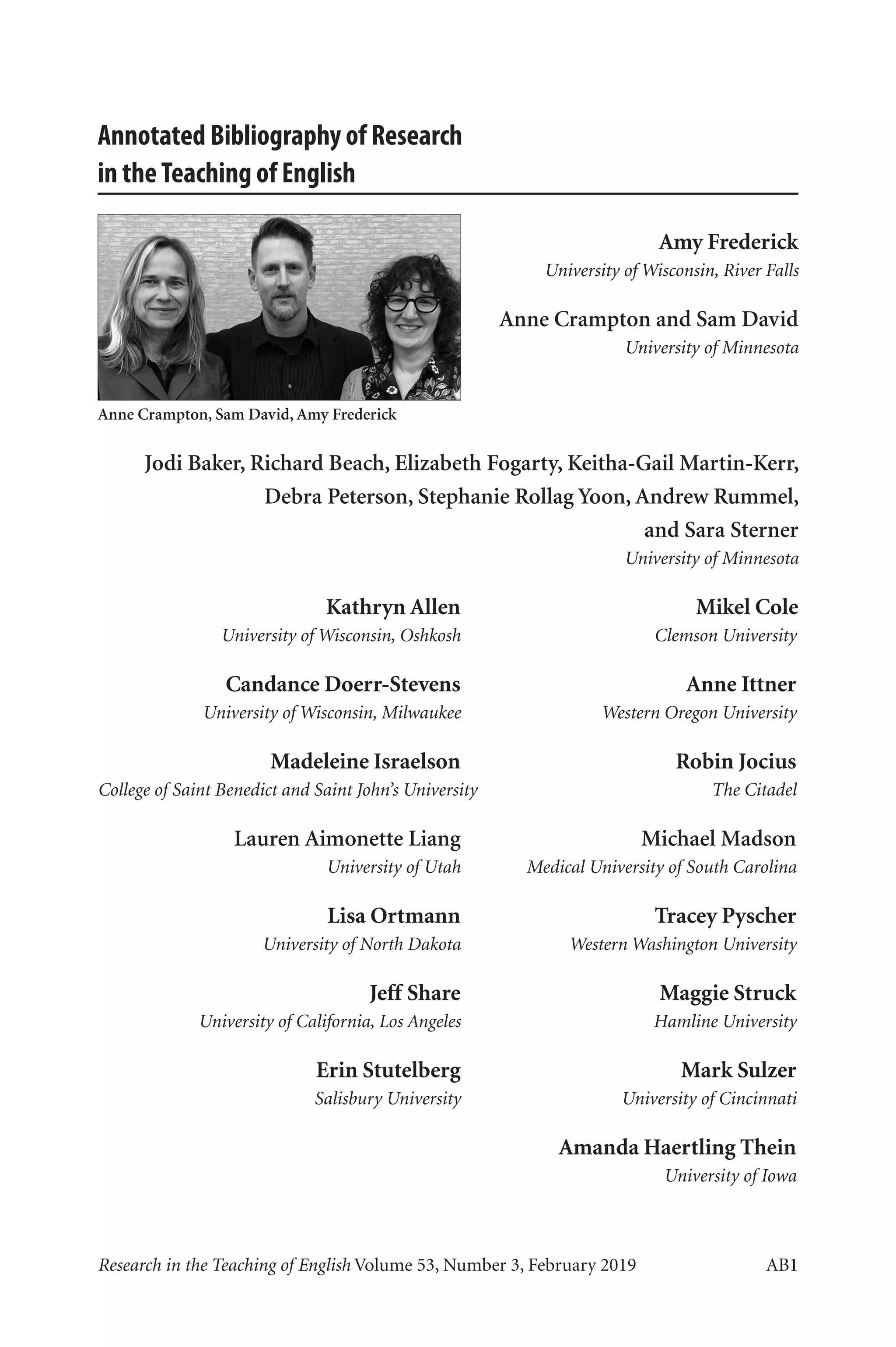
Anne Crampton, Sam David, Amy Frederick
L-AB1-AB43-Feb19-RTE.indd 1 3/1/19 9:49 AM
Copyright © 2019 by the National Council of Teachers of English. All rights reserved.
AB2   
Research in the Teaching of English  	 Volume 53    February 2019
Introduction
Since 2003, RTE has published the annual “Annotated Bibliography of Research
in the Teaching of English.”As the new editorial team, we are proud to share these
curated and annotated citations once again. The goal of this bibliography is to
select, compile, and abstract high-quality research studies related to the teaching
of English language arts in order to construct a manageable body of important
research that RTE readers may want to explore further. Abstracted citations and
those featured in the “Other Related Research” sections were published, either in
print or online, between June 2017 and May 2018. The bibliography is divided
into nine subject-area sections. A three-person team of scholars with diverse
research interests and background experiences in preK–16 educational settings
chose the manuscripts for each section.Team members reviewed library databases
and leading empirical journals to select relevant reports in each area of the bib-
liography. Teams identified and abstracted the most significant contributions to
the body of peer-reviewed studies that employ systematic analysis of phenomena
using a variety of research methods. Works listed in the “Other Related Research”
sections may include additional important research studies in the field, position
papers from leading organizations, or comprehensive handbooks. The listings are
selective; we make no attempt to include all research that appeared in the period
under review. Because this bibliography is published for readers of Research in
the Teaching of English, articles from RTE are not included since they would likely
already be familiar to the audience.
The subject-area sections of the bibliography are:
Digital/Technology Tools
Discourse/Narrative Analysis/Cultural Difference
Literacy
Literary Response/Literature/Narrative
Media Literacy
Professional Development/Teacher Education
Reading
Second Language Literacy
Writing
The National Council of Teachers of English provides free access to the an-
nual bibliographies as downloadable PDF files at http://www2.ncte.org/resources/
journals/research-in-the-teaching-of-english/.
Please enjoy this valuable service to the RTE scholarly community.
L-AB1-AB43-Feb19-RTE.indd 2 3/1/19 9:49 AM
Annotated Bibliography	 AB3
Digital/Technology Tools
This section focuses on digital literacy research that emphasizes technology and online platforms
for instructional purposes. Priority was given to studies that address aspects of pedagogy connected
to the knowledge and skills needed to use digital technologies to facilitate literacy learning. Specifi-
cally, digital literacy in English language arts contexts that incorporates digital writing, production,
communication,or reading tools/apps; technology for instructional purposes including blogs,coding,
wikis, e-books/e-reading, digital storytelling, online discussion, digital video production, podcasts,
and digital portfolios; and how social networking,online feedback,and learning management systems
enhance literacy instructional practices. (Candance Doerr-Stevens, lead contributor)
Baker, E. A. (2017). Apps, iPads, and literacy: Examining the feasibility of speech recognition in
a first-grade classroom. Reading Research Quarterly, 52, 291–310.
Employsethnographicmethodstoexaminethebenefitsof usingspeechrecognition(SR)technol-
ogy to support struggling readers in an early childhood setting. Uses sociocultural and systems
theory frameworks for a qualitative study of SR technology in a first-grade classroom.Finds that
SR supported readers’ engagement and accuracy in writing. Notes that from a systems theory
perspective,SR is just one element of a complex writing process and that integrated apps should
support students as they compose and edit. Concludes that SR, in conjunction with purpose-
ful classroom integration and app design, can support struggling readers in the early grades.
Burke,A.,& Hughes,J.(2018).A shifting landscape: Using tablets to support learning in students
with diverse abilities. Technology, Pedagogy and Education, 27, 183–198.
Examines benefits and challenges of using tablets in the classroom to support middle school
students with diverse learning needs. Draws on qualitative case studies of two teachers who
frequently used tablets with their students to make connections across theory and practice.
Finds that tablets offer significant benefits for students with learning disabilities. Argues that
challenges related to safety, security, and disruptive behavior are associated with classroom use
of tablets. Discusses affordances and constraints of classroom tablet use and offers practical
solutions for educators.
Burnett, C., & Merchant, G. (2018). Affective encounters: Enchantment and the possibility of
reading for pleasure. Literacy, 52, 62–69.
Explores and imagines emergent literacy practices within acts of reading for pleasure. Seeks to
theorize about pleasure and reading by analyzing vignettes that describe digital texts and the
authors’interactions in and around them,as well as observational notes on children’s engagement
with digital texts. Applies Bennett’s notion of enchantment to look at how affective encounters
are fostered in the interactions between readers, digital texts, and things. Describes the literacy
practices located within intersecting continua ranging from immersive to lightweight,sustained
to ephemeral, individual to collective, and serious to flippant, as well as from momentary hilar-
ity to deep engagement. Urges teacher educators and students to critically and collaboratively
examine the array of texts that students engage with, specifically multimodal texts. Concludes
that foregrounding material-social relationality and potentiality in literacy practices may allow
for generative moves within literacy pedagogy.
Burwell, C. (2017). Game changers: Making new meanings and new media with video games.
English Journal, 106(6), 41–47.
Examines the emerging media paratext of Let’s Play videos, in which video game players make
screenshot videos of their game play in-progress. Describes these videos as creative learning
sites that display active meaning-making and interrogation of games as cultural texts. Presents
three ways English educators might use Let’s Play videos in the classroom: (1) as texts for ana-
lyzing video games, (2) as models for media production, and (3) as starting places for critical
conversations about the gaming industry.
L-AB1-AB43-Feb19-RTE.indd 3 3/1/19 9:49 AM
AB4   
Research in the Teaching of English  	 Volume 53    February 2019
Cho,B.-Y.,Woodward,L.,& Li,D.(2018).Epistemic processing when adolescents read online:A
verbal protocol analysis of more and less successful online readers. Reading Research Quarterly,
53, 197–221.
Investigates how more and less successful adolescent readers activate and engage epistemic
beliefs when completing a critical online reading task. Draws on theories of epistemology and
online reading to identify epistemic processes that emerge from a grounded theoretical analysis
of readers in an unconstrained online setting. Compares two groups of high school students
identified as “more successful” or “less successful” performers on an Internet reading task to
identify epistemic processes and to analyze how readers negotiate multiple sources on a socially
controversial topic. Argues that more successful online readers are more likely to engage in
critique and high-level epistemic processes while less successful peers are less likely to consider
critical interpretations and are distracted by low-level epistemic processes. Calls for instruction
focused on online reading to support students in recognizing the value and nature of online
reading as an intellectual activity.
Howell, E. (2018). Scaffolding multimodality: Writing process, collaboration and digital tools.
English Teaching: Practice and Critique, 17, 132–147.
Describes various uses of scaffolding for improving argumentative writing, both conventional
and digital/multimodal. Uses formative experiment methods for data collection and analysis
to compare the ways teachers integrate forms of scaffolding and multimodal composition in
two high school English classrooms. Presents three key findings: (1) scaffolding in the writing
process is needed to blend conventional and digital forms; (2) collaboration, although resisted,
is a key part of digital scaffolding; and (3) digital tools mediate students’thinking.Recommends
that teachers provide scaffolding of students’ argumentative writing with collaborative use of
digital tools, which promote student understanding of complex content.
Jocius, R. (2018). Becoming entangled: An analysis of 5th grade students’ collaborative multi-
modal composing practices. Computers and Composition, 47, 14–30.
Explores the collaborative process of two fifth-grade students as they navigate artifacts, spaces,
and structures to compose multimodal responses to literature (e.g., videos and PowerPoints).
Draws on several data sets: video and audio recordings of classroom interactions, students’
multimodal compositions, artifacts from the composing process, screen recordings, in-process
and final student interviews, surveys, and instructional artifacts. Takes a social semiotic view of
multimodality and uses idea tracing as a method to analyze students’ collaborative composing
processes and products. Finds that students take on a variety of interactional roles in the cre-
ation of their joint work and that collaborative composing occurs in different forms: modally-
determined composing, in which the mode drives the composition, and composing in pieces, in
which each student composes parts individually. Suggests that educators consider the material
features of digital tools and physical spaces when planning for young adolescents’collaborative,
multimodal composing.
Kazakoff, E. R., Macaruso, P., & Hook, P. (2018). Efficacy of a blended learning approach to
elementary school reading instruction for students who are English learners. Educational Tech-
nology Research and Development, 66, 429–449.
Investigates the effectiveness of a personalized, adaptive, blended learning approach to reading
instruction for both English learners and non-ELs.Uses a large-scale,quasi-experimental group
design to evaluate the effectiveness of a blended learning approach to reading instruction over
the course of two years. Compares the reading growth of 442 ELs and 442 non-ELs matched in
reading ability from 64 schools in a Midwestern state in the first year of the study. Documents
all the research participants’ beginning-of-year and end-of-year scores on reading assessments
(aimsweb and Core5).Analyzes the reading growth of 130 students using Core5 with fidelity in
the second year of the study. Finds that both groups demonstrated gains on aimsweb reading
L-AB1-AB43-Feb19-RTE.indd 4 3/1/19 9:49 AM
Annotated Bibliography	 AB5
assessment, with no difference between groups for kindergarten, and higher score increases
for second- through fifth-grade ELs over non-ELs. Identifies similar changes in aimsweb tier
status for ELs and non-ELs in the second year of the study. Notes a reduction in the percentage
of students labeled as at-risk for reading development among both the EL and non-EL groups.
Lee, V. J., Hoekje, B., & Levine, B. (2018). Introducing technology to immigrant families to
support early literacy development and two-generation learning. Language Arts, 95, 133–148.
Examines the use of digital tools to support bilingual parents’ digital literacy knowledge and
two-generation literacy learning. Analyzes qualitative data from Project LIFE, an early literacy
and language program in which technology was a critical resource and a funds of knowledge
framework was used to engage families in interconnected home and school literacies. Finds
that technology supported parents and children in developing agency in literacy activities and
co-constructing literacy practices. Calls for family literacy programs to position parents and
guardians as teachers and educational leaders for their children. Advocates for a balanced ap-
proach to technology use in early literacy programs in order to boost confidence in supporting
literacy activities at home.
Mills,K.,& Unsworth,L.(2017).iPad animations: Powerful multimodal practices for adolescent
literacy and emotional language. Journal of Adolescent & Adult Literacy, 61, 609–620.
Explores the use of digital animation production for multimodal literacy learning, in particular
the multimodal expression of emotions.Uses appraisal theory to analyze examples of adolescent
interpretation and production of emotions in animated films and 2-D cartoon animations
using drawings with an iPad application and stylus. Finds that emotional expression within
multimodal communications is enhanced by knowledge of how animated characters represent
emotions through different facial expressions, gestures, body movements, and physiological
changes. Recommends explicit instruction of emotional communications through production
of animations as well as through vocabulary, images, and body language.
Mirra, N., Morrell, E., & Filipiak, D. (2018). From digital consumption to digital invention:
Toward a new critical theory and practice of multiliteracies. Theory Into Practice, 57, 12–19.
Offers a new critical theory of pedagogy and production that recognizes the evolving tools
and technologies available to young people. Positions young people as media producers, not
consumers, and describes ways to apply this to classroom contexts. Posits a new critical theory
of multiliteracies that includes four types of digital engagement: (a) critical digital consump-
tion, (b) critical digital production, (c) critical distribution, and (d) critical digital invention.
Provides examples of approaches to this work, such as youth participatory action research and
connected learning.Argues that ultimately,literacy educators and researchers need to go beyond
theorizing students as consumers of digital technologies and instead facilitate communities of
learning that promote digital production.
Smith, B. E. (2018). Composing for affect, audience, and identity: Toward a multidimensional
understanding of adolescents’ multimodal composing goals and designs. Written Communica-
tion, 35, 182–214.
Examines adolescents’perspectives of their own multimodal composing goals and designs when
creating digital projects in the context of an English language arts classroom. Uses sociocultural
and social semiotics frameworks to understand six 12th-grade students’viewpoints when com-
posing three multimodal products: a website, hypertext literary analysis, and podcast. Analyzes
screen capture and video observations, design interviews, written reflections, and multimodal
products. Finds that adolescents concurrently composed for multiple purposes and audiences
during the literature analysis unit,including viewing projects as a platform to emotionally affect
and entertain audiences,and representing themselves as composers.Provides a multidimensional
understanding of adolescents’ various multimodal composing goals and how these students
leverage modal affordances in the classroom.
L-AB1-AB43-Feb19-RTE.indd 5 3/1/19 9:49 AM
AB6   
Research in the Teaching of English  	 Volume 53    February 2019
Tour,E.(2017).Understanding digital literacy practices:What can be learnt with visual methods?
Changing English, 24, 413–425.
Employs participant-generated digital photography, photo-elicitation, and online observa-
tions to investigate how five language and literacy teachers from Melbourne, Australia, used
digital technologies in their lives. Reports on the teachers’ experiences using cameras and their
perceptions of these experiences. Argues that visual research methods provide opportunities
for understanding everyday literacy practices, how they emerge, and the reasons why people
participate in them in specific ways. Identifies key challenges of using visual research methods
and concludes that spending more time and building relationships with research participants
could help to address some of these challenges.
Wiklund, M., & Andersson, A. (2018). Student-initiated use of technology—friend and foe.
E-Learning and Digital Media, 15, 3–16.
Documents student-initiated uses of technology in the classroom setting and the impact on
conditions for learning. Analyzes quantitative and qualitative data from a three-year study of a
1:1 device initiative across 23 schools in Sweden. Employs observations, interviews, and surveys
to explore classroom technology use and teacher/student initiation of digital tools. Finds that
students were the most frequent users of technology in classrooms and that student-initiated
use was mainly curricular in nature and related to tasks and assignments.Cautions that student-
initiated use of social media,games,and communicative apps was viewed by many teachers and
students as a distraction.Questions the curricular/noncurricular dichotomy.Calls for technology,
social media, and students to be viewed as an assemblage of learning.
Zheng, D., Liu,Y., Lambert,A., Lu,A., Tomei, J., & Holden, D. (2018).An ecological community
becoming: Language learning as first-order experiencing with place and mobile technologies.
Linguistics and Education, 44, 45–57.
Uses multimodal analysis and cognitive event analysis to examine how language learners en-
gage with place and design. Positions language learning in a constructed mobile game design
as“languaging in place.” Suggests that this design, which involved 3-D holographic experience,
provided openings for participants to utilize semiotic resources with the support of mobile
technologies. Describes limitations and affordances of community as offering emergent and
spirited opportunities for linguistic choices and skilled linguistic action through place and
mobile technologies.
Other Related Research
Guise, M., & Friend, N. (2017). Demystifying poetry for middle grades students through col-
laborative, multimodal writing. Language Arts, 94, 395–406
Kim,S.(2018).“It was kind of a given that we were all multilingual”:Transnational youth identity
work in digital translanguaging. Linguistics and Education, 43, 39–52.
Nel, L. (2017). Students as collaborators in creating meaningful learning experiences in tech-
nology-enhanced classrooms: An engaged scholarship approach. British Journal of Educational
Technology, 48, 1131–1142.
Rodrigue, T. K. (2017). The digital reader, the alphabetic writer, and the space between: A study
in digital reading and source-based writing. Computers and Composition, 46, 4–20.
Talib, S. (2018). Social media pedagogy: Applying an interdisciplinary approach to teach mul-
timodal critical digital literacy. E-Learning and Digital Media, 15, 55–66.
Thibaut,P.,& Curwood,J.S.(2018).Multiliteracies in practice: Integrating multimodal produc-
tion across the curriculum. Theory Into Practice, 57, 48–55.
van Thiel,L.(2018).Professional learning design framework: Supporting technology integration
in Alberta. Research in Learning Technology, 26, 1–24.
L-AB1-AB43-Feb19-RTE.indd 6 3/1/19 9:49 AM
Annotated Bibliography	 AB7
Discourse/Narrative Analysis/Cultural Difference
The research in this list centers the voices and experiences of youth and/or researchers with diverse
cultural standpoints. While most of the studies emphasize literacy learning in ELA classrooms, we
have also included strong contributions to research focused on language use, discourse, and narra-
tive in general educational settings, as well as in out-of-school/community literacies in less formal
learning spaces. (Anne Crampton, lead contributor)
Åberg, M., & Olin-Scheller, C. (2017). Wolf cries: On power, emotions and critical literacy in
first-language teaching in Sweden. Gender and Education, 30, 882–898.
Describes the effects of emotions and affective power relations on Swedish ninth-grade students’
critical literacies when they were dialogically positioned to engage with emotionally charged
argumentative texts.Explores how emotion mediates the teaching and learning experience.Maps
the discursive movement of a nationally politicized argument related to the management of
wolves into an emotive object that opened possibilities for students to engage in charged critical
literacy discussions that evoked populist national politics, calcified forms of heteronormativity,
and racist retellings. Suggests new ways to facilitate critical literacy learning and the circulation
of emotions, both pleasurable and difficult, for both students and the teacher.
Adair, J. K., Colegrove, K. S.-S., & McManus, M. (2017). How the word gap argument negatively
impacts young conceptualizations of learning. Harvard Educational Review, 87, 309–335.
Analyzes responses to an ethnographic film documenting two first-grade classrooms with dy-
namic, agentic learning cultures. Finds that viewer focus groups of nonparticipant first-grade
students,parents,teachers,and administrators (N= 232) believed that the agentic learning shown
in the film wasn’t right or possible for their own schools, despite their similar demographics
of Latinx children of immigrants. Locates educators’ justifications for these beliefs in the per-
sistence of the “word gap” argument. Warns that if agentic learning is seen as something to be
earned or deserved by demonstrating sufficient vocabulary, children of immigrants and other
marginalized communities will rarely be“ready”enough to learn creative problem-solving and
experience passionate investment in complex questions, factors known to position all children
for subsequent success and leadership in schooling and beyond.
Durand, E. S., & Jiménez-García, M. (2018). Unsettling representations of identities: A critical
review of diverse youth literature. Research on Diversity in Youth Literature, 1(1), 1–24.
Explores recent shifts in representations of identity through a critical review and analysis of 36
children’s and young adult texts written by Indigenous authors and authors of color,using postco-
lonialand decolonial theories,culturally sustainingpedagogy,andintersectionality.Demonstrates
how the changing portrayals of protagonist identities move away from essentialist depictions
in the selected texts to take up powerful discourses that recognize the fluid, overlapping, and
intersectional identities of Indigenous youth and youth of color. Discusses these depictions as
offering cultural visibility,entangled histories,intersectional counter-narratives,and alternative
realities and futures.Concludes with a recognition of the need for literature with more than just
mirrors and windows, but also lenses to more conscientiously glimpse the multidimensional
identities of Indigenous youth and youth of color in literature.
Gallo,S.,& Dabkowski,M.(2018).The permanence of departure:Young Mexican immigrant stu-
dents’discursive negotiations of imagined childhoods allá.Linguistics and Education,45,92–100.
Examines patterns of school-based talk and discursive tools used by Mexican immigrant
elementary-aged children in mixed-status families, recognizing their agency to form social
interactions through language. Explores discourses and sense-making processes of children
who experience contrapuntal lives with unknown futures and potential forced repatriation to
Mexico.Calls for educators to recognize that policy overlooks the complex realities of immigrant
L-AB1-AB43-Feb19-RTE.indd 7 3/1/19 9:49 AM
AB8   
Research in the Teaching of English  	 Volume 53    February 2019
children, to create safe spaces for students to discursively navigate these realities, and to counter
negative stereotypes and xenophobia through pedagogical practices that provide more nuanced
depictions of immigrant identities, immigration processes, and countries of origin.
Gebhard,A.(2018).Discursive (re)productions of (im)possible students in the Canadian prairies.
Discourse: Studies in the Cultural Politics of Education. Advance online publication. Retrieved
from https://www.tandfonline.com/toc/cdis20/current
Uses interview data from teachers of Indigenous students in the Canadian prairies to understand
discursive constructions and interpellations of both students and schools. Draws on poststruc-
tural perspectives on subjectivation and performativity to argue that “well-meaning” teachers’
common tropes follow the long history of violent institutional discourses and practices, con-
tinuing to render Indigenous (in this study, mostly identified as Métis) students as“impossible”
while simultaneously producing teachers as“heroic and good-willed.”Notes that the innocence
of present-day schooling experiences can be maintained when emphasis is placed on the historic
violence of residential schooling for Indigenous students, downplaying current and recent vio-
lences of schooling.Asks how teachers might resist racialized and racist constructions of students
through words and practices that expand rather than foreclose possibilities for studenthood.
Gilbert, J., Fields, J., Mamo, L., & Lesko, N. (2018). Intimate possibilities: The Beyond Bullying
project and stories of LGBTQ sexuality and gender in US schools. Harvard Educational Review,
88, 163–184.
Discusses findings from over 450 recorded stories told by LGBTQ youth and teachers in “Be-
yond Bullying” booths, located in three urban high schools (Minneapolis, New York, and San
Francisco).Uses flash ethnography and interview data from participants,in addition to analysis
of the narratives, to find broad themes of desire, family, and school life. Describes discourses of
possibility, joy, desire, and community, expanding common discourses associated with LGBTQ
identities such as bullying, rejection, and despair. Argues that the anonymous storytelling was
unstructured and interrogative, offering freeing opportunities for “intimate possibilities” that
allowed participants and readers to imagine different futures.
Golden, N. A. (2017).“In a position I see myself in”: (Re)Positioning identities and culturally-
responsive pedagogies. Equity & Excellence in Education, 50, 355–367.
Uses narrative analysis case study to focus on a 20-year-old African American man negotiating
and resisting formal school deficit discourses through (re)positioning practices as a cultural
process and through recognition of researcher/researched member checking.Draws on theories
of identity formation and counter-storytelling as double consciousness. Asks how educator
pedagogies shape marginalized experience through deficit ideologies and how the one being
marginalized (re)positions agentic identities in response through complicated methodologies of
narrative retelling as situated actions and renegotiations of subject positions.Offers both literacy
researchers and educators culturally sustaining approaches to better capture how marginalized
learners navigate deficit discourses and make use of their own cultural practices (“tools”) in the
resistance and (re)negotiation of marginalizing experiences and ever-emergent agentic identities.
Itay, P., Segal, A., Lefstein, A., & Meshulam, A. (2018). Teaching controversial issues in a fragile
democracy: Defusing deliberation in Israeli primary classrooms. Journal of Curriculum Studies,
50, 387–409.
Explores the teaching of controversial issues as a pedagogical tool in democratic societies, with
an in-depth consideration of practices in one Israeli elementary school. Describes the complex
historical, political, and polarized context of Israel, recognizing that controversial discussions
must take different paths due to the lack of a national consensus. Using linguistic ethnographic
methods and microanalysis,examines three cases of teachers enacting the Path-Breaking Leader-
ship curriculum (which explores the lives and policies of former leaders) as a core component
L-AB1-AB43-Feb19-RTE.indd 8 3/1/19 9:49 AM
Annotated Bibliography	 AB9
of citizenship education. Finds that the teachers used sidestepping (a process that focuses on
unifying messages and consensus building) and scholasticizing (positioning content as subor-
dinate to the language arts skills and grading rubric) to expose students to controversial issues
without creating combative or dismissive treatments of the issues. Asserts that civic education
must move beyond surface engagement with controversial issues to develop citizens who will
fully engage in the complexities of a democratic society.
Jocson, K. M. (2018).“I want to do more and change things”: Reframing CTE toward possibili-
ties in urban education. Urban Education, 53, 640–667.
Notes that discourses associated with vocational education serve to divide career-track schooling
from academic learning. Points out the paradox of valuing the marketability and employability
associated with career and technical education (CTE) programming while simultaneously de-
valuing it, and, by extension, the prospects for students who pursue applied learning. Reviews
the history and current landscape of CTE policies that track racially and culturally minoritized
youth away from“traditional”academic schooling.Explores student reflections from a two-year
ethnographic study in an urban high school CTE program in multimedia communications, as
well as drawing from the researcher’s past experience with vocational learning. Argues in favor
of CTE as a pathway to better futures,especially when integrated with critical academic curricu-
lum, and asks what we can learn from CTE to foster engagement and success by meaningfully
linking academics to broader contexts.
Lavoie, C., & Blanchet, P. A. (2018). Teaching life narratives in the classroom: Strategies based
on Indigenous traditions. Diaspora, Indigenous, and Minority Education, 12, 155–166.
Illustrates the importance of using life narratives based on the oral traditions of Indigenous
communities as a pedagogical tool to recenter Indigenous epistemologies, cultivate cultural
heritage preservation,build critical consciousness,and support decolonization.Discusses plan-
ning, implementation, and integration strategies for educational experiences. Suggests that the
life narrative model offers a key dialogic practice that would be beneficial in the classroom and,
while based on Indigenous ways of knowing,would be helpful to other minoritized communities
as a tool to create and share counter-narratives to hegemonic discourses.
LeBlanc, R. J. (2018). Those who know and are known: Students using ethnography to inter-
rogate language and literacy ideologies. Journal of Adolescent & Adult Literacy, 61, 489–499.
Describes participatory ethnographic research conducted with a small group of multilingual
adolescents, Vietnamese and Spanish speakers who collaboratively investigated their own lan-
guage and literacy practices. Demonstrates students’ agency in undoing deficit language and
literacy ideologies (e.g., English monolingualism, standard English deficit models) through
participation in literacy ethnographies and the use of related research tools. Maps how White
teachers problematically position multilingual language and literacy resources from the per-
spective of youth participants. Discusses how youth of color disrupt deficit representations
through the use of their own intertextual research analysis (tools of ethnography) and their
journals and recordings as counter-hegemonic stances against standards of whiteness. Suggests
that educators and schools incorporate pedagogies and access for diverse youth to engage in
ethnographic work (tools) as agentic practices toward envisioning new possibilities to disrupt
language and literacy deficit discourses while (re)positioning marginalized youth by offering
counter-narratives informed by their own lived experiences.
Pyscher, T. (2017). Domestic violence and girlhood: The making and breaking of a disordered
subjectivity. Cultural Studies ↔ Critical Methodologies, 17, 399–405.
Focuses on adolescent girls with histories of domestic violence using data from a larger ethno-
graphic study.Frames the resistive actions of these girls as agentic and often necessary responses
to moments of force in educational settings,such as being labeled as emotionally and behaviorally
L-AB1-AB43-Feb19-RTE.indd 9 3/1/19 9:49 AM
AB10   
Research in the Teaching of English  	 Volume 53    February 2019
disordered.Argues that domestic violence is a social experience that shapes identities and brings
with it particular tools,viewed as cultural knowledges,as a means to counter violence,including
the violence of educational discourses that limit and restrict the subjectivities of these youth.
Draws on theories of performativity, resistance, and standpoint (specifically the author’s own
history), combined with mediated discourse analysis, to examine and recast a focal student’s
classroom power struggle as a moment of agency.
Sosa, T. (2017). Recently I was in a fatal incident: Personal narratives and social identities. Lin-
guistics and Education, 42, 34–42.
Examines the dialogic constructions of identity that are taken up by and ascribed to students of
color, specifically young Black men, in historically oppressive institutional spaces. Explores the
agentic literacy practices and discursive moves of Wes, in a ninth-grade ELA classroom where
his identity had been defined by racist and gendered discourses that positioned his Black male
identity as a difficult, disruptive, and “at-risk” troublemaker. Analyzes classroom discourse
through an identity framework model with four stances (nature, institutional, discourse, and
affinity) and Bakhtinian concepts of polyphony and heteroglossia. Recognizes the complex and
powerful ways that Wes challenged the status quo and navigated a classroom space that did not
value him,while acknowledging that the larger system is not changed by these agentic dialogisms.
Calls educators to examine and reconstruct the ways in which student identities are positioned in
schools,to create pedagogies that center student knowledges,and to open up spaces for genuine
dialogue, especially when it disrupts institutional power structures.
Young,S.L.B.(2018).From situated privilege to dis/abilities: Developing critical literacies across
social issues. Journal of Adolescent & Adult Literacy, 61, 501–509.
Examines how one female high school student came to make meaning of her situated privileges
and her own marginalized identities in a learning context shaped by critical literacy, social is-
sues, and activism. Uses critical practitioner research and critical discourse analysis to examine
language, literacy, and examples of activism. Highlights how students with multiple situated
privileges can also come to not only recognize and disrupt dominant ideologies,but also embrace
their own more marginalized identities (e.g.,dis/ability) as an asset to advocate for social change
for themselves and their larger social worlds. Suggests implications for teachers related to the
complexity of identities and social locations within critical literacy pedagogies.
Wohlwend,K.E.(2018).Playing to our strengths: Finding innovation in children’s and teachers’
imaginative expertise. Language Arts, 95, 162–170.
Offers extensive review of recent innovative research and practice related to young children’s
literacy learning as a way to (re)position curriculum as secondary to a child’s learning experience.
Asks whether children are nurtured as innovators, producers, and players to inspire learning in
preschool and kindergarten settings. Asks to what extent schools value children’s diversities as
resources, as well as their everyday engagement with new technologies. Considers innovations
that inspire possibilities for emergent literacy practices and pedagogies, and suggests new ap-
proaches that evoke children’s“imaginative expertise.”Reviews instruction built with teachers to
help counter the weight of neoliberal standardization and deficit ideologies set within “teacher
accountability discourses” over the joy of child-centered learning for marginalized children.
Argues that access to these kinds of literacy learning is a “fundamental matter of social justice.”
Other Related Research
Beaudrie, S. M. (2018). On the relationship between self-concept and literacy development in
the Spanish heritage language context. Reading & Writing Quarterly, 34, 147–159.
Comber, B. (2017). Literacy geography and pedagogy. Literacy Research: Theory, Method, and
Practice, 66, 53–72.
L-AB1-AB43-Feb19-RTE.indd 10 3/1/19 9:49 AM
Annotated Bibliography	 AB11
Dyches, J. (2017). Shaking off Shakespeare: A White teacher, urban students, and the mediating
powers of a canonical counter-curriculum. Urban Review, 49, 300–325.
Enciso, P. E. (2017). Stories lost and found. Literacy Research: Theory, Method, and Practice, 66,
29–52.
Huang, S. Y. (2018). Postfeminist influences on fairy tales, real and imagined: A critical media
literacy classroom investigation. Gender and Education. Advance online publication. Retrieved
from https://www.tandfonline.com/toc/cgee20/current
Jaeger, E. L. (2018). Bella here and there: Forming and re-forming identities across school con-
texts. Reading & Writing Quarterly, 34, 306–321.
Lindsey, T. B. (2018). Ain’t nobody got time for that: Anti-Black girl violence in the era of
#SayHerName. Urban Education, 53, 162–175.
Machado, E., Vaughan, A., Coppola, R., & Woodard, R. (2017). “Lived life through a colored
lens”: Culturally sustaining poetry in an urban literacy classroom. Language Arts, 94, 367–381.
Merga, M. K., & Booth, S. (2017). Investigating debates around racism in sport to facilitate
perspective transformation in the secondary English classroom. Journal of Transformative
Education, 15, 184–202.
Reese, D. (2018). Critical indigenous literacies: Selecting and using children’s books about
indigenous peoples. Language Arts, 95, 389–393.
Strong,K.(2018).DoAfrican lives matter to Black Lives Matter?Youth uprisings and the borders
of solidarity. Urban Education, 53, 265–285.
Winn, M. T. (2018). Building a “lifetime circle”: English education in the age of #BlackLives
Matter. Urban Education, 53, 248–264.
Literacy
In selecting our articles, we looked for studies that conceptualized literacy as a whole. The research
included in this section covers a wide range of literacy learners. We included studies focusing on
early childhood, childhood, adolescent, and adult literacy learners. Most of the articles selected came
from the United States of America, Australia, and Africa. Priority was given to studies related to
community literacy, home literacy, counter-stories, and different ways of knowing and being literate.
(Keitha-Gail Martin-Kerr, lead contributor)
Akello, J. A., Lutwama-Rukundo, E., & Musiimenta, P. (2017). Functional adult literacy: An
alternative gateway to grassroots women’s improved income generation in Lango subregion,
Northern Uganda. Adult Education Quarterly, 67, 79–96.
Examines women’s experiences of functional adult literacy as a gateway to financial progress.
Analyzes focus group discussions, in-depth interviews, observations, and document reviews of
45 participants. Finds that functional adult literacy brings out women’s individual and collec-
tive agency through conscientization concepts and dialogue. Concludes that functional literacy
training improves women’s livelihoods.
Brown, E., Rosenthal, J., & Dynega, N. (2018). Teaching strategies to develop a family-school
literacy partnership. International Journal of Whole Schooling, 14(1), 31–56.
Explores a first-grade team’s efforts to develop a family-school literacy partnership. Reports on
a teacher-administered survey of families that revealed unexpected at-home literacy practices.
Highlights the finding that teacher communication may have created confusion for parents
around which books brought home as homework were appropriate for independent reading
versus read-aloud. Additionally, notes that families reported less at-home reading than was
expected by teachers.Argues that teachers should make home literacy expectations clear so that
parents understand how to help their children.
L-AB1-AB43-Feb19-RTE.indd 11 3/1/19 9:49 AM
AB12   
Research in the Teaching of English  	 Volume 53    February 2019
Degener, R. M. (2018). Title IX story club: Creating possibilities for minoritized middle school
girls in physical activity. Journal of Adolescent & Adult Literacy, 62, 195–203.
Investigates the trendof adolescentgirls’decliningparticipationinsports—specificallyBlackgirls,
whose rate of decline is twice that of White girls.Examines the use of critical counter-storytelling
that allows students to name stories told about them and resist such narratives by creating new
stories. Follows the researcher’s facilitation of a story club with three racially minoritized girls
during their seventh- and eighth-grade school years,connecting participants’lives withYA texts
about Black female athletes. Finds that the dialogue helped participants identify stereotypical
stories through the critical process of thinking,talking,and writing about their own experiences.
Highlights how the girls’ families also supported critical counter-storytelling. Concludes that
analyzing texts alongside personal stories created opportunities for the girls to make sense of
their situations and resist narratives placed on them by others.
Denston, A., Everatt, J., Parkhill, F., & Marriott, C. (2018). Morphology: Is it a means by which
teachers can foster literacy development in older primary students with literacy learning dif-
ficulties? Australian Journal of Language and Literacy, 41, 94–102.
Follows an explicit morphology intervention to examine changes in literacy skills among two
groups of students with literacy learning difficulties. Finds that students made significant gains
in both reading accuracy and reading comprehension. Concludes that teachers should focus on
morphology to benefit the literacy development of students with literacy learning difficulties.
International Literacy Association. (2018). What’s hot in literacy: 2018 report. Retrieved from
https://www.literacyworldwide.org/docs/default-source/resource-documents/whats-hot-
2018-report.pdf
Utilizes survey data to provide a snapshot of what literacy professionals from 91 countries deem
the most critical topics for advancing literacy worldwide. Finds that digital literacy topped the
list for the second year in a row, and access to books, mother tongue literacy, and equity literacy
were also highly ranked. Concludes that the survey helps to identify where more support is
needed for literacy professionals.
Kim, J. S., Burkhauser, M. A., Quinn, D. M., Guryan, J., Kingston, H. C., & Aleman, K. (2017).
Effectiveness of structured teacher adaptations to an evidence-based summer literacy program.
Reading Research Quarterly, 52, 443–467.
Examines data from a summer program designed to provide reading materials and support to
fourth-grade students in high-poverty schools. In a cluster-randomized trial, 27 high-poverty
elementary schools were matched based on prior reading achievement and poverty level, and
randomly assigned to one of two implementation conditions: a core treatment that included
provision of lesson plans, books, and family engagement materials; or the same core treatment,
with the exception that teachers were also encouraged to adapt the program to fit their context,
including modifying and extending the lesson support, providing time for summer check-ins,
personalizing the lessons, and holding after-school family events. Data included recordings of
lessons, student surveys, homework assignments, attendance logs, and standardized test scores.
Hierarchical linear modeling shows that while students in both conditions improved in reading
comprehension,those in the adaptive condition made more progress in reading comprehension,
student engagement with books,and family engagement than students whose teachers delivered
the core treatment with complete fidelity.
Lacour, M. M., McDonald, C., Tissington, L. D., & Thomason, G. (2017). Improving pre-
kindergarten children’s attitude and interest in reading through a parent workshop on the use
of dialogic reading techniques. Reading Improvement, 54(2), 71–81.
Describes a study in which parents of prekindergarten children were taught to use dialogic
reading techniques, such as prompting their child about the story and rephrasing answers.
L-AB1-AB43-Feb19-RTE.indd 12 3/1/19 9:49 AM
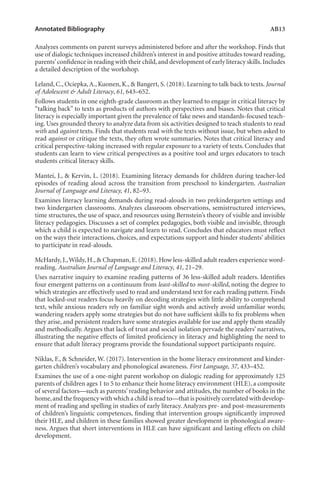
Annotated Bibliography	 AB13
Analyzes comments on parent surveys administered before and after the workshop. Finds that
use of dialogic techniques increased children’s interest in and positive attitudes toward reading,
parents’confidence in reading with their child,and development of early literacy skills.Includes
a detailed description of the workshop.
Leland, C., Ociepka,A., Kuonen, K., & Bangert, S. (2018). Learning to talk back to texts. Journal
of Adolescent & Adult Literacy, 61, 643–652.
Follows students in one eighth-grade classroom as they learned to engage in critical literacy by
“talking back” to texts as products of authors with perspectives and biases. Notes that critical
literacy is especially important given the prevalence of fake news and standards-focused teach-
ing. Uses grounded theory to analyze data from six activities designed to teach students to read
with and against texts. Finds that students read with the texts without issue, but when asked to
read against or critique the texts, they often wrote summaries. Notes that critical literacy and
critical perspective-taking increased with regular exposure to a variety of texts. Concludes that
students can learn to view critical perspectives as a positive tool and urges educators to teach
students critical literacy skills.
Mantei, J., & Kervin, L. (2018). Examining literacy demands for children during teacher-led
episodes of reading aloud across the transition from preschool to kindergarten. Australian
Journal of Language and Literacy, 41, 82–93.
Examines literacy learning demands during read-alouds in two prekindergarten settings and
two kindergarten classrooms. Analyzes classroom observations, semistructured interviews,
time structures, the use of space, and resources using Bernstein’s theory of visible and invisible
literacy pedagogies. Discusses a set of complex pedagogies, both visible and invisible, through
which a child is expected to navigate and learn to read. Concludes that educators must reflect
on the ways their interactions, choices, and expectations support and hinder students’ abilities
to participate in read-alouds.
McHardy, J.,Wildy, H., & Chapman, E. (2018). How less-skilled adult readers experience word-
reading. Australian Journal of Language and Literacy, 41, 21–29.
Uses narrative inquiry to examine reading patterns of 36 less-skilled adult readers. Identifies
four emergent patterns on a continuum from least-skilled to most-skilled, noting the degree to
which strategies are effectively used to read and understand text for each reading pattern. Finds
that locked-out readers focus heavily on decoding strategies with little ability to comprehend
text, while anxious readers rely on familiar sight words and actively avoid unfamiliar words;
wandering readers apply some strategies but do not have sufficient skills to fix problems when
they arise, and persistent readers have some strategies available for use and apply them steadily
and methodically. Argues that lack of trust and social isolation pervade the readers’ narratives,
illustrating the negative effects of limited proficiency in literacy and highlighting the need to
ensure that adult literacy programs provide the foundational support participants require.
Niklas, F., & Schneider, W. (2017). Intervention in the home literacy environment and kinder-
garten children’s vocabulary and phonological awareness. First Language, 37, 433–452.
Examines the use of a one-night parent workshop on dialogic reading for approximately 125
parents of children ages 1 to 5 to enhance their home literacy environment (HLE), a composite
of several factors—such as parents’ reading behavior and attitudes, the number of books in the
home,and the frequency with which a child is read to—that is positively correlated with develop-
ment of reading and spelling in studies of early literacy. Analyzes pre- and post-measurements
of children’s linguistic competences, finding that intervention groups significantly improved
their HLE, and children in these families showed greater development in phonological aware-
ness. Argues that short interventions in HLE can have significant and lasting effects on child
development.
L-AB1-AB43-Feb19-RTE.indd 13 3/1/19 9:49 AM
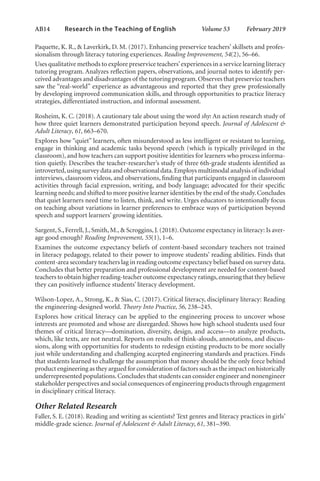
AB14   
Research in the Teaching of English  	 Volume 53    February 2019
Paquette, K. R., & Laverkirk, D. M. (2017). Enhancing preservice teachers’ skillsets and profes-
sionalism through literacy tutoring experiences. Reading Improvement, 54(2), 56–66.
Uses qualitative methods to explore preservice teachers’experiences in a service learning literacy
tutoring program. Analyzes reflection papers, observations, and journal notes to identify per-
ceived advantages and disadvantages of the tutoring program.Observes that preservice teachers
saw the “real-world” experience as advantageous and reported that they grew professionally
by developing improved communication skills, and through opportunities to practice literacy
strategies, differentiated instruction, and informal assessment.
Rosheim, K. C. (2018). A cautionary tale about using the word shy: An action research study of
how three quiet learners demonstrated participation beyond speech. Journal of Adolescent &
Adult Literacy, 61, 663–670.
Explores how “quiet” learners, often misunderstood as less intelligent or resistant to learning,
engage in thinking and academic tasks beyond speech (which is typically privileged in the
classroom), and how teachers can support positive identities for learners who process informa-
tion quietly. Describes the teacher-researcher’s study of three 6th-grade students identified as
introverted,using survey data and observational data.Employs multimodal analysis of individual
interviews, classroom videos, and observations, finding that participants engaged in classroom
activities through facial expression, writing, and body language; advocated for their specific
learning needs; and shifted to more positive learner identities by the end of the study.Concludes
that quiet learners need time to listen, think, and write. Urges educators to intentionally focus
on teaching about variations in learner preferences to embrace ways of participation beyond
speech and support learners’ growing identities.
Sargent, S., Ferrell, J., Smith, M., & Scroggins, J. (2018). Outcome expectancy in literacy: Is aver-
age good enough? Reading Improvement, 55(1), 1–6.
Examines the outcome expectancy beliefs of content-based secondary teachers not trained
in literacy pedagogy, related to their power to improve students’ reading abilities. Finds that
content-area secondary teachers lag in reading outcome expectancy belief based on survey data.
Concludes that better preparation and professional development are needed for content-based
teachers to obtain higher reading-teacher outcome expectancy ratings,ensuring that they believe
they can positively influence students’ literacy development.
Wilson-Lopez, A., Strong, K., & Sias, C. (2017). Critical literacy, disciplinary literacy: Reading
the engineering-designed world. Theory Into Practice, 56, 238–245.
Explores how critical literacy can be applied to the engineering process to uncover whose
interests are promoted and whose are disregarded. Shows how high school students used four
themes of critical literacy—domination, diversity, design, and access—to analyze products,
which, like texts, are not neutral. Reports on results of think-alouds, annotations, and discus-
sions, along with opportunities for students to redesign existing products to be more socially
just while understanding and challenging accepted engineering standards and practices. Finds
that students learned to challenge the assumption that money should be the only force behind
product engineering as they argued for consideration of factors such as the impact on historically
underrepresented populations.Concludes that students can consider engineer and nonengineer
stakeholder perspectives and social consequences of engineering products through engagement
in disciplinary critical literacy.
Other Related Research
Faller, S. E. (2018). Reading and writing as scientists? Text genres and literacy practices in girls’
middle-grade science. Journal of Adolescent & Adult Literacy, 61, 381–390.
L-AB1-AB43-Feb19-RTE.indd 14 3/1/19 9:49 AM
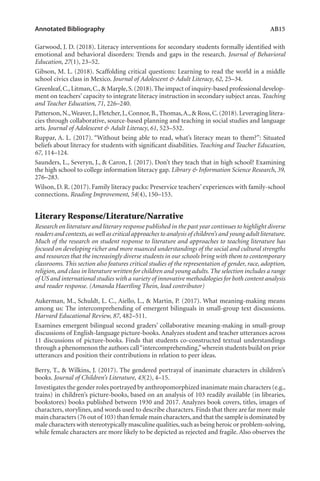
Annotated Bibliography	 AB15
Garwood, J. D. (2018). Literacy interventions for secondary students formally identified with
emotional and behavioral disorders: Trends and gaps in the research. Journal of Behavioral
Education, 27(1), 23–52.
Gibson, M. L. (2018). Scaffolding critical questions: Learning to read the world in a middle
school civics class in Mexico. Journal of Adolescent & Adult Literacy, 62, 25–34.
Greenleaf,C.,Litman,C.,& Marple,S.(2018).The impact of inquiry-based professional develop-
ment on teachers’ capacity to integrate literacy instruction in secondary subject areas. Teaching
and Teacher Education, 71, 226–240.
Patterson,N.,Weaver,J.,Fletcher,J.,Connor,B.,Thomas,A.,& Ross,C.(2018).Leveraging litera-
cies through collaborative, source-based planning and teaching in social studies and language
arts. Journal of Adolescent & Adult Literacy, 61, 523–532.
Ruppar, A. L. (2017). “Without being able to read, what’s literacy mean to them?”: Situated
beliefs about literacy for students with significant disabilities. Teaching and Teacher Education,
67, 114–124.
Saunders, L., Severyn, J., & Caron, J. (2017). Don’t they teach that in high school? Examining
the high school to college information literacy gap. Library & Information Science Research, 39,
276–283.
Wilson, D. R. (2017). Family literacy packs: Preservice teachers’ experiences with family-school
connections. Reading Improvement, 54(4), 150–153.
Literary Response/Literature/Narrative
Research on literature and literary response published in the past year continues to highlight diverse
readers and contexts,as well as critical approaches to analysis of children’s and young adult literature.
Much of the research on student response to literature and approaches to teaching literature has
focused on developing richer and more nuanced understandings of the social and cultural strengths
and resources that the increasingly diverse students in our schools bring with them to contemporary
classrooms. This section also features critical studies of the representation of gender, race, adoption,
religion, and class in literature written for children and young adults. The selection includes a range
of US and international studies with a variety of innovative methodologies for both content analysis
and reader response. (Amanda Haertling Thein, lead contributor)
Aukerman, M., Schuldt, L. C., Aiello, L., & Martin, P. (2017). What meaning-making means
among us: The intercomprehending of emergent bilinguals in small-group text discussions.
Harvard Educational Review, 87, 482–511.
Examines emergent bilingual second graders’ collaborative meaning-making in small-group
discussions of English-language picture-books. Analyzes student and teacher utterances across
11 discussions of picture-books. Finds that students co-constructed textual understandings
through a phenomenon the authors call“intercomprehending,”wherein students build on prior
utterances and position their contributions in relation to peer ideas.
Berry, T., & Wilkins, J. (2017). The gendered portrayal of inanimate characters in children’s
books. Journal of Children’s Literature, 43(2), 4–15.
Investigates the gender roles portrayed by anthropomorphized inanimate main characters (e.g.,
trains) in children’s picture-books, based on an analysis of 103 readily available (in libraries,
bookstores) books published between 1930 and 2017. Analyzes book covers, titles, images of
characters, storylines, and words used to describe characters. Finds that there are far more male
main characters (76 out of 103) than female main characters,and that the sample is dominated by
male characters with stereotypically masculine qualities,such as being heroic or problem-solving,
while female characters are more likely to be depicted as rejected and fragile. Also observes the
L-AB1-AB43-Feb19-RTE.indd 15 3/1/19 9:49 AM
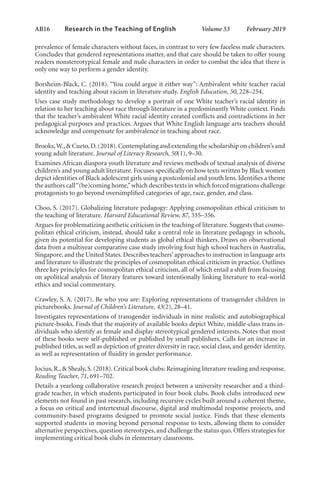
AB16   
Research in the Teaching of English  	 Volume 53    February 2019
prevalence of female characters without faces, in contrast to very few faceless male characters.
Concludes that gendered representations matter, and that care should be taken to offer young
readers nonstereotypical female and male characters in order to combat the idea that there is
only one way to perform a gender identity.
Borsheim-Black, C. (2018). “You could argue it either way”: Ambivalent white teacher racial
identity and teaching about racism in literature study. English Education, 50, 228–254.
Uses case study methodology to develop a portrait of one White teacher’s racial identity in
relation to her teaching about race through literature in a predominantly White context. Finds
that the teacher’s ambivalent White racial identity created conflicts and contradictions in her
pedagogical purposes and practices. Argues that White English language arts teachers should
acknowledge and compensate for ambivalence in teaching about race.
Brooks,W.,& Cueto,D.(2018).Contemplating and extending the scholarship on children’s and
young adult literature. Journal of Literacy Research, 50(1), 9–30.
Examines African diaspora youth literature and reviews methods of textual analysis of diverse
children’s and young adult literature. Focuses specifically on how texts written by Black women
depict identities of Black adolescent girls using a postcolonial and youth lens. Identifies a theme
the authors call“(be)coming home,”which describes texts in which forced migrations challenge
protagonists to go beyond oversimplified categories of age, race, gender, and class.
Choo, S. (2017). Globalizing literature pedagogy: Applying cosmopolitan ethical criticism to
the teaching of literature. Harvard Educational Review, 87, 335–356.
Argues for problematizing aesthetic criticism in the teaching of literature. Suggests that cosmo-
politan ethical criticism, instead, should take a central role in literature pedagogy in schools,
given its potential for developing students as global ethical thinkers. Draws on observational
data from a multiyear comparative case study involving four high school teachers in Australia,
Singapore, and the United States. Describes teachers’approaches to instruction in language arts
and literature to illustrate the principles of cosmopolitan ethical criticism in practice. Outlines
three key principles for cosmopolitan ethical criticism, all of which entail a shift from focusing
on apolitical analysis of literary features toward intentionally linking literature to real-world
ethics and social commentary.
Crawley, S. A. (2017). Be who you are: Exploring representations of transgender children in
picturebooks. Journal of Children’s Literature, 43(2), 28–41.
Investigates representations of transgender individuals in nine realistic and autobiographical
picture-books. Finds that the majority of available books depict White, middle-class trans in-
dividuals who identify as female and display stereotypical gendered interests. Notes that most
of these books were self-published or published by small publishers. Calls for an increase in
published titles, as well as depiction of greater diversity in race, social class, and gender identity,
as well as representation of fluidity in gender performance.
Jocius, R., & Shealy, S. (2018). Critical book clubs: Reimagining literature reading and response.
Reading Teacher, 71, 691–702.
Details a yearlong collaborative research project between a university researcher and a third-
grade teacher, in which students participated in four book clubs. Book clubs introduced new
elements not found in past research, including recursive cycles built around a coherent theme,
a focus on critical and intertextual discourse, digital and multimodal response projects, and
community-based programs designed to promote social justice. Finds that these elements
supported students in moving beyond personal response to texts, allowing them to consider
alternative perspectives, question stereotypes, and challenge the status quo. Offers strategies for
implementing critical book clubs in elementary classrooms.
L-AB1-AB43-Feb19-RTE.indd 16 3/1/19 9:49 AM
Annotated Bibliography	 AB17
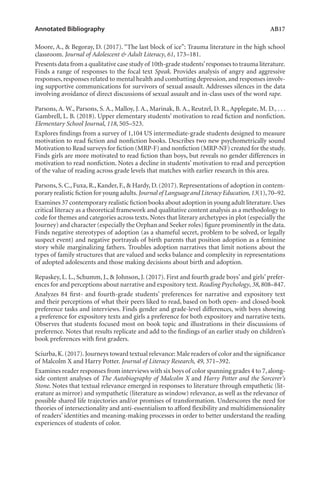
Moore, A., & Begoray, D. (2017). “The last block of ice”: Trauma literature in the high school
classroom. Journal of Adolescent & Adult Literacy, 61, 173–181.
Presents data from a qualitative case study of 10th-grade students’responses to trauma literature.
Finds a range of responses to the focal text Speak. Provides analysis of angry and aggressive
responses,responses related to mental health and combatting depression,and responses involv-
ing supportive communications for survivors of sexual assault. Addresses silences in the data
involving avoidance of direct discussions of sexual assault and in-class uses of the word rape.
Parsons, A. W., Parsons, S. A., Malloy, J. A., Marinak, B. A., Reutzel, D. R., Applegate, M. D., . . .
Gambrell, L. B. (2018). Upper elementary students’ motivation to read fiction and nonfiction.
Elementary School Journal, 118, 505–523.
Explores findings from a survey of 1,104 US intermediate-grade students designed to measure
motivation to read fiction and nonfiction books. Describes two new psychometrically sound
Motivation to Read surveys for fiction (MRP-F) and nonfiction (MRP-NF) created for the study.
Finds girls are more motivated to read fiction than boys, but reveals no gender differences in
motivation to read nonfiction. Notes a decline in students’ motivation to read and perception
of the value of reading across grade levels that matches with earlier research in this area.
Parsons, S. C., Fuxa, R., Kander, F., & Hardy, D. (2017). Representations of adoption in contem-
porary realistic fiction for young adults.Journal of Language and Literacy Education,13(1),70–92.
Examines 37 contemporary realistic fiction books about adoption in young adult literature.Uses
critical literacy as a theoretical framework and qualitative content analysis as a methodology to
code for themes and categories across texts. Notes that literary archetypes in plot (especially the
Journey) and character (especially the Orphan and Seeker roles) figure prominently in the data.
Finds negative stereotypes of adoption (as a shameful secret, problem to be solved, or legally
suspect event) and negative portrayals of birth parents that position adoption as a feminine
story while marginalizing fathers. Troubles adoption narratives that limit notions about the
types of family structures that are valued and seeks balance and complexity in representations
of adopted adolescents and those making decisions about birth and adoption.
Repaskey, L. L., Schumm, J., & Johnson, J. (2017). First and fourth grade boys’ and girls’ prefer-
ences for and perceptions about narrative and expository text. Reading Psychology, 38, 808–847.
Analyzes 84 first- and fourth-grade students’ preferences for narrative and expository text
and their perceptions of what their peers liked to read, based on both open- and closed-book
preference tasks and interviews. Finds gender and grade-level differences, with boys showing
a preference for expository texts and girls a preference for both expository and narrative texts.
Observes that students focused most on book topic and illustrations in their discussions of
preference. Notes that results replicate and add to the findings of an earlier study on children’s
book preferences with first graders.
Sciurba,K.(2017).Journeys toward textual relevance: Male readers of color and the significance
of Malcolm X and Harry Potter. Journal of Literacy Research, 49, 371–392.
Examines reader responses from interviews with six boys of color spanning grades 4 to 7,along-
side content analyses of The Autobiography of Malcolm X and Harry Potter and the Sorcerer’s
Stone. Notes that textual relevance emerged in responses to literature through empathetic (lit-
erature as mirror) and sympathetic (literature as window) relevance, as well as the relevance of
possible shared life trajectories and/or promises of transformation. Underscores the need for
theories of intersectionality and anti-essentialism to afford flexibility and multidimensionality
of readers’ identities and meaning-making processes in order to better understand the reading
experiences of students of color.
L-AB1-AB43-Feb19-RTE.indd 17 3/1/19 9:49 AM
AB18   
Research in the Teaching of English  	 Volume 53    February 2019
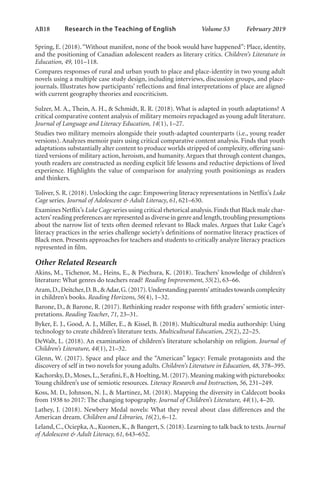
Spring, E. (2018).“Without manifest, none of the book would have happened”: Place, identity,
and the positioning of Canadian adolescent readers as literary critics. Children’s Literature in
Education, 49, 101–118.
Compares responses of rural and urban youth to place and place-identity in two young adult
novels using a multiple case study design, including interviews, discussion groups, and place-
journals. Illustrates how participants’ reflections and final interpretations of place are aligned
with current geography theories and ecocriticism.
Sulzer, M. A., Thein, A. H., & Schmidt, R. R. (2018). What is adapted in youth adaptations? A
critical comparative content analysis of military memoirs repackaged as young adult literature.
Journal of Language and Literacy Education, 14(1), 1–27.
Studies two military memoirs alongside their youth-adapted counterparts (i.e., young reader
versions). Analyzes memoir pairs using critical comparative content analysis. Finds that youth
adaptations substantially alter content to produce worlds stripped of complexity, offering sani-
tized versions of military action, heroism, and humanity.Argues that through content changes,
youth readers are constructed as needing explicit life lessons and reductive depictions of lived
experience. Highlights the value of comparison for analyzing youth positionings as readers
and thinkers.
Toliver, S. R. (2018). Unlocking the cage: Empowering literacy representations in Netflix’s Luke
Cage series. Journal of Adolescent & Adult Literacy, 61, 621–630.
Examines Netflix’s Luke Cage series using critical rhetorical analysis.Finds that Black male char-
acters’reading preferences are represented as diverse in genre and length,troubling presumptions
about the narrow list of texts often deemed relevant to Black males. Argues that Luke Cage’s
literacy practices in the series challenge society’s definitions of normative literacy practices of
Black men. Presents approaches for teachers and students to critically analyze literacy practices
represented in film.
Other Related Research
Akins, M., Tichenor, M., Heins, E., & Piechura, K. (2018). Teachers’ knowledge of children’s
literature: What genres do teachers read? Reading Improvement, 55(2), 63–66.
Aram,D.,Deitcher,D.B.,&Adar,G.(2017).Understanding parents’attitudes towards complexity
in children’s books. Reading Horizons, 56(4), 1–32.
Barone, D., & Barone, R. (2017). Rethinking reader response with fifth graders’ semiotic inter-
pretations. Reading Teacher, 71, 23–31.
Byker, E. J., Good, A. J., Miller, E., & Kissel, B. (2018). Multicultural media authorship: Using
technology to create children’s literature texts. Multicultural Education, 25(2), 22–25.
DeWalt, L. (2018). An examination of children’s literature scholarship on religion. Journal of
Children’s Literature, 44(1), 21–32.
Glenn, W. (2017). Space and place and the “American” legacy: Female protagonists and the
discovery of self in two novels for young adults. Children’s Literature in Education, 48, 378–395.
Kachorsky,D.,Moses,L.,Serafini,F.,& Hoelting,M.(2017).Meaning making with picturebooks:
Young children’s use of semiotic resources. Literacy Research and Instruction, 56, 231–249.
Koss, M. D., Johnson, N. J., & Martinez, M. (2018). Mapping the diversity in Caldecott books
from 1938 to 2017: The changing topography. Journal of Children’s Literature, 44(1), 4–20.
Lathey, J. (2018). Newbery Medal novels: What they reveal about class differences and the
American dream. Children and Libraries, 16(2), 6–12.
Leland, C., Ociepka,A., Kuonen, K., & Bangert, S. (2018). Learning to talk back to texts. Journal
of Adolescent & Adult Literacy, 61, 643–652.
L-AB1-AB43-Feb19-RTE.indd 18 3/1/19 9:49 AM
Annotated Bibliography	 AB19
Macaluso, M. (2017). Teaching To Kill a Mockingbird today: Coming to terms with race, racism,
and America’s novel. Journal of Adolescent & Adult Literacy, 61, 279–287.
McClung,N.A.(2018).Learning to queer text: Epiphanies from a family critical literacy practice.
Reading Teacher, 71, 401–410.
Nichols-Besel, K., Scharber, C., O’Brien, D. G., & Dillon, D. R. (2018). A space for boys and
books: Guys Read book clubs. Children and Libraries, 16(2), 18–26.
Pantaleo,S.(2017).Critical thinking and children’s exploration of picturebook artwork.Language
and Education, 31, 152–168.
Renga, I. P., & Lewis, M. (2018).Wisdom, mystery, and dangerous knowledge: Exploring depic-
tions of the archetypal sage in young adult literature. Study and Scrutiny: Research on Young
Adult Literature, 3(1), 27–50.
Smith, A., Hazlett, L., & Lennon, S. (2018). Young adult literature in the English language arts
classroom: A survey of middle and secondary teachers’ beliefs about YAL. Study and Scrutiny:
Research on Young Adult Literature, 3(1), 1–24.
Stewart,M.A.(2017).“I love this book because that’s like me!”A multilingual refugee/adolescent
girl responds from her homeplace. International Multilingual Research Journal, 11, 239–254.
Wu, J. (2018).A bibliometric analysis of picture book research between 1993 and 2015. Reading
Psychology, 39, 413–331.
Media Literacy
The research on media literacy in this section examines uses of certain types of media (television,
online news, social media, etc.); attitudes toward and levels of trust in the media; media representa-
tions of various groups and issues; effects of critical media literacy instruction on users’ actions and
attitudes; and use of media production tools to engage students in multimodal media productions.
Priority was given to studies using large-scale databases to document particular uses of media and
analyses of media literacy instructional methods. (Richard Beach, lead contributor)
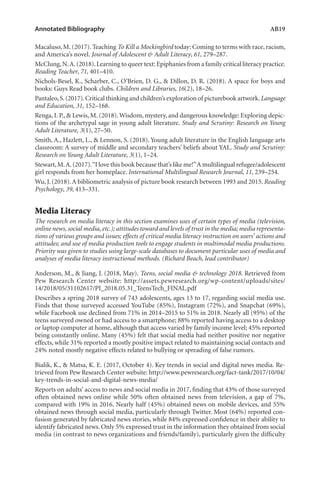
Anderson, M., & Jiang, J. (2018, May). Teens, social media & technology 2018. Retrieved from
Pew Research Center website: http://assets.pewresearch.org/wp-content/uploads/sites/
14/2018/05/31102617/PI_2018.05.31_TeensTech_FINAL.pdf
Describes a spring 2018 survey of 743 adolescents, ages 13 to 17, regarding social media use.
Finds that those surveyed accessed YouTube (85%), Instagram (72%), and Snapchat (69%),
while Facebook use declined from 71% in 2014–2015 to 51% in 2018. Nearly all (95%) of the
teens surveyed owned or had access to a smartphone; 88% reported having access to a desktop
or laptop computer at home, although that access varied by family income level; 45% reported
being constantly online. Many (45%) felt that social media had neither positive nor negative
effects, while 31% reported a mostly positive impact related to maintaining social contacts and
24% noted mostly negative effects related to bullying or spreading of false rumors.
Bialik, K., & Matsa, K. E. (2017, October 4). Key trends in social and digital news media. Re-
trieved from Pew Research Center website: http://www.pewresearch.org/fact-tank/2017/10/04/
key-trends-in-social-and-digital-news-media/
Reports on adults’ access to news and social media in 2017, finding that 43% of those surveyed
often obtained news online while 50% often obtained news from television, a gap of 7%,
compared with 19% in 2016. Nearly half (45%) obtained news on mobile devices, and 55%
obtained news through social media, particularly through Twitter. Most (64%) reported con-
fusion generated by fabricated news stories, while 84% expressed confidence in their ability to
identify fabricated news. Only 5% expressed trust in the information they obtained from social
media (in contrast to news organizations and friends/family), particularly given the difficulty
L-AB1-AB43-Feb19-RTE.indd 19 3/1/19 9:49 AM
AB20   
Research in the Teaching of English  	 Volume 53    February 2019
of identifying sources of information on social media. Respondents were more likely to take
action based on information from friends/family (73% ) than information from social media
(53%) or news websites (47%).
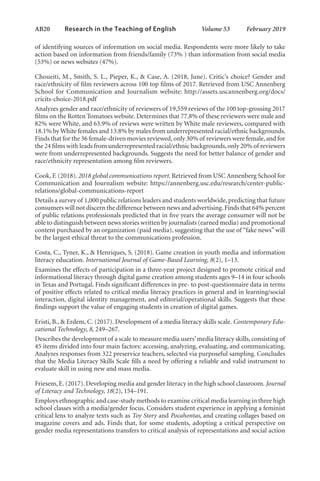
Choueiti, M., Smith, S. L., Pieper, K., & Case, A. (2018, June). Critic’s choice? Gender and
race/ethnicity of film reviewers across 100 top films of 2017. Retrieved from USC Annenberg
School for Communication and Journalism website: http://assets.uscannenberg.org/docs/
cricits-choice-2018.pdf
Analyzes gender and race/ethnicity of reviewers of 19,559 reviews of the 100 top-grossing 2017
films on the Rotten Tomatoes website. Determines that 77.8% of these reviewers were male and
82% were White, and 63.9% of reviews were written by White male reviewers, compared with
18.1% by White females and 13.8% by males from underrepresented racial/ethnic backgrounds.
Finds that for the 36 female-driven movies reviewed,only 30% of reviewers were female,and for
the 24 films with leads from underrepresented racial/ethnic backgrounds,only 20% of reviewers
were from underrepresented backgrounds. Suggests the need for better balance of gender and
race/ethnicity representation among film reviewers.
Cook, F. (2018). 2018 global communications report. Retrieved from USC Annenberg School for
Communication and Journalism website: https://annenberg.usc.edu/research/center-public-
relations/global-communications-report
Details a survey of 1,000 public relations leaders and students worldwide, predicting that future
consumers will not discern the difference between news and advertising.Finds that 64% percent
of public relations professionals predicted that in five years the average consumer will not be
able to distinguish between news stories written by journalists (earned media) and promotional
content purchased by an organization (paid media), suggesting that the use of “fake news” will
be the largest ethical threat to the communications profession.
Costa, C., Tyner, K., & Henriques, S. (2018). Game creation in youth media and information
literacy education. International Journal of Game-Based Learning, 8(2), 1–13.
Examines the effects of participation in a three-year project designed to promote critical and
informational literacy through digital game creation among students ages 9–14 in four schools
in Texas and Portugal. Finds significant differences in pre- to post-questionnaire data in terms
of positive effects related to critical media literacy practices in general and in learning/social
interaction, digital identity management, and editorial/operational skills. Suggests that these
findings support the value of engaging students in creation of digital games.
Eristi, B., & Erdem, C. (2017). Development of a media literacy skills scale. Contemporary Edu-
cational Technology, 8, 249–267.
Describes the development of a scale to measure media users’media literacy skills, consisting of
45 items divided into four main factors: accessing, analyzing, evaluating, and communicating.
Analyzes responses from 322 preservice teachers, selected via purposeful sampling. Concludes
that the Media Literacy Skills Scale fills a need by offering a reliable and valid instrument to
evaluate skill in using new and mass media.
Friesem, E. (2017). Developing media and gender literacy in the high school classroom. Journal
of Literacy and Technology, 18(2), 154–191.
Employs ethnographic and case-study methods to examine critical media learning in three high
school classes with a media/gender focus. Considers student experience in applying a feminist
critical lens to analyze texts such as Toy Story and Pocahontas, and creating collages based on
magazine covers and ads. Finds that, for some students, adopting a critical perspective on
gender media representations transfers to critical analysis of representations and social action
L-AB1-AB43-Feb19-RTE.indd 20 3/1/19 9:49 AM
Annotated Bibliography	 AB21
beyond the students’ classes. Suggests a need for research on the long-term effects of critical
media literacy instruction.
Gallup/Knight Foundation. (2018). American views: Trust, media and democracy. Retrieved
from https://kf-site-production.s3.amazonaws.com/publications/pdfs/000/000/242/original/
KnightFoundation_AmericansViews_Client_Report_010917_Final_Updated.pdf
Reports on a survey of 19,000 US adults regarding their perceptions of the news media. Finds
that while more than 80% believed the media plays an important role in providing information
related to preserving democracy,58% indicated that given the plethora of available information,
it is more difficult to be adequately informed. Only 27% were “very confident” in determin-
ing whether a news source is reporting factual news versus commentary or opinion, with 66%
believing that the media fails to separate fact from opinion. More expressed a negative percep-
tion of the news versus a positive perception (43% vs. 33%, respectively). Democrats and older
participants had a more positive sense of trust in the media than Republicans and younger
participants, and a majority of US adults considered “fake news” to be a very serious threat to
our democracy. Television news and newspapers were perceived to be the most trusted news
sources, particularly by older participants. There was less trust in social media as a news source,
although 70% of respondents obtained news from Google, Facebook, or Yahoo.
Gerodimos,R.(2018).Youth and the city:Reflective photography as a tool of urban voice.Journal
of Media Literacy Education, 10, 82–103.
Uses participatory photography as a tool for capturing the voice of urban youth—in this case,
British undergraduate students. A methodological framework for the coding and analysis of
participants’ images and reflective pieces was used in a pilot study involving 51 students. By
employing a participatory/reflective photography methodology analyzing youth engagement
with the urban landscape, the exercise produced highly engaged and emotive visual and textual
narratives.Student work focused on issues of unemployment,dereliction,and conglomeration.
Findings reveal that participants focused more on the social and economic properties of place
than on aesthetic and architectural properties.
Mitchell, A., Gottfried, J., Barthel, M., & Sumida, N. (2018, June 18). Distinguishing between
factual and opinion statements in the news. Retrieved from Pew Research Center Journalism
& Media website: http://www.journalism.org/2018/06/18/distinguishing-between-factual-and-
opinion-statements-in-the-news/
Analyzes a survey of 5,035 US adults to determine their ability to distinguish between five fac-
tual statements and five opinion statements. Finds that while a majority of Americans correctly
identified at least three of the five statements in each set as fact or opinion,far fewer were able to
correctly identify all items, and a quarter got most or all wrong. Adults who had high levels of
political awareness, were digitally savvy, and placed high levels of trust in the news media were
better able to distinguish fact from opinion. Republicans and Democrats were more likely to
identify items as fact or opinion according to whether items appealed to their political stances.
Respondents who perceived a news statement as factual tended to also believe the statement
was accurate; when they incorrectly classified a factual statement as opinion, they were more
likely to disagree with the statement.
Riggs, A., Montgomery, D., & Blackwell, C. (2017). Exploring perspectives of students studying
communication toward media access and use: A Q methodological study. Journal of Applied
Communications, 101(1), 69–84.
Applies Q methodology and relies on Stephenson’s play theory and Dutta-Bergman’s media
complementarity theory to analyze students’ perspectives of news. Analyzes data from 34 un-
dergraduate university students pursuing communications-related majors, who were asked to
complete a Q sort and demographic instrument, resulting in 33 usable sorts. Identifies three
L-AB1-AB43-Feb19-RTE.indd 21 3/1/19 9:49 AM
AB22   
Research in the Teaching of English  	 Volume 53    February 2019
main themes to describe trends in student perspectives, labeled “Old-school Media Hounds,”
“Sensational Snippets,”and“Complimentary Convergers.”Recommends classroom adaptations
for teachers in response to these three perspectives.
Tukachinsky, R., Mastro, D., & Yarchi, M. (2017). The effect of prime time television ethnic/
racial stereotypes on Latino and Black Americans: A longitudinal national level study. Journal
of Broadcasting & Electronic Media, 61, 538–556.
Investigates the effects of stereotypical media representations of racial and ethnic minorities
on Black and Latino American audiences, based on a longitudinal National Science Founda-
tion study. Notes that most research has sought to understand the effects of these portrayals on
White audiences.Combines cross-sectional survey data from Black and Latino respondents with
content analysis of the 40 most-viewed US prime-time shows per year between 1987 and 2008
to predict trends in attitudes about racial/ethnic minoritized groups among members of those
groups.Uses social identity theory to support the idea that media exposure can have an effect on
viewers’ self-concepts, as well as influencing beliefs about their own racial/ethnic communities
(in-group) and beliefs about Whites (out-group). Finds that favorable and nonstereotypical
television representations of Black and Latino characters were associated with warm attitudes
about the in-group, whereas negative representations reduced warm feelings toward the in-
group.Representations of racial/ethnic minoritized groups,positive or negative,had little effect
on viewers’ attitudes toward Whites.
Wade,T.D.,Wilksch,S.M.,Paxton,S.J.,Byrne,S.M.,& Austin,S.B.(2017).Do universal media
literacy programs have an effect on weight and shape concern by influencing media internaliza-
tion? International Journal of Eating Disorders, 50(7), 731–738.
Compares the effects of participation in a media literacy program or a healthy lifestyle program
on adolescents’ perceptions of body weight/thinness. Looks at the self-perceptions of female
participants—roughly two thirds of the group—who were randomly assigned to the two treat-
ment conditions. Finds that those participating in the media literacy program experienced a
reduction of media internalization about ideal body weight and shape due to critical analysis of
media representations,in comparison with participants engaged in the healthy lifestyle program.
Walker,D.(2018).“Getting our spirits out”,letting youth spirits and life worlds into the classroom
through youth radio arts for transnational students. Ethnography and Education, 13, 286–307.
Analyzes the cultural practices that were introduced in a radio improvisation session on the
first day of a youth radio arts class for immigrant students, and how these practices served as
resources to mediate students’understanding and realization of“voice”over time.Analyzes these
practices by combining insights from interactional ethnography and postmodern approaches to
multilingual language ecologies.Focuses on speech body play,parody,and embodied expression
as salient dimensions of interactions with the radio improvisation mentor that found echoes
in student end-of-year reflections regarding the purpose of the program and the meanings of
voice and communication.
Wargo, J. M. (2018). #SoundingOutMySilence: Reading a LGBTQ youth’s sonic cartography as
multimodal (counter)storytelling. Journal of Adolescent & Adult Literacy, 62, 13–23.
Draws on theories of multiliteracies, queer phenomenology, and sound studies to forward
adolescent literacy research that analyzes the use of sound. Follows one LGBTQ adolescent’s
multimodal writing projects from a larger study,here with a focus on sonic compositions created
through a GoPro video recorder.Describes sonic cartography as a practice of mapping narrative
through sound, involving attention to the use of rhythms, routes, and frictions. Finds that sonic
cartography can serve as a valued resource for creating narratives as a form of (counter)storytell-
ing for LGBTQ youth who are often silenced in mainstream school spaces. Offers curriculum
design suggestions for teachers seeking to add audio composition to their plans.
L-AB1-AB43-Feb19-RTE.indd 22 3/1/19 9:49 AM
Annotated Bibliography	 AB23
Other Related Research
Ashley, S., Maksl, A., & Craft, S. (2017). News media literacy and political engagement: What’s
the connection? Journal of Media Literacy Education, 9, 79–98.
Brandle, S. M. (2018). Media coverage of human rights in the USA and UK: The violations still
will not be televised (or published). Human Rights Review, 19, 167–191.
Cybart-Persenaire,A.,& Literat,I.(2018).Writing stories,rewriting identities: Using journalism
education and mobile technologies to empower marginalized high school students. Learning,
Media and Technology, 43, 181–196.
Dukes, K. N., & Gaither, S. E. (2017). Black racial stereotypes and victim blaming: Implications
for media coverage and criminal proceedings in cases of police violence against racial and ethnic
minorities. Journal of Social Issues, 73, 789–807.
Erba,J.(2018).Media representations of Latina and Latino students’stereotype threat behavior.
Howard Journal of Communications, 29, 83–102.
Gretter,S.,&Yadav,A.(2018).What do preservice teachers think about teaching media literacy?
An exploratory study using the theory of planned behavior. Journal of Media Literacy Educa-
tion, 10, 104–123.
Hultén,G.,& Edwardsson,M.P.(2018).Storylab lessons:A collaborative project between courses
in journalism and media technology. NORDICOM Review, 39(1), 3–17.
Lammers, J. C., & Palumbo, N. P. (2017). Barriers to fanfiction access: Results from a usability
inspection of Fanfiction.net. Journal of Media Literacy Education, 9, 76–90.
Lane,L.,Woloshyn,V.,& Taber,N.(2018).Tangles,tears and messy conversations: Using a media
discussion group to explore notions of strong women. Journal of Gender Studies, 27, 497–508.
Malita, L., & Grosseck, G. (2018). Tackling fake news in a digital literacy curriculum. In I.
Roceanu (Ed.), 14th International Conference eLearning and Software for Education: eLearning
challenges and new horizons (Vol. 4, pp. 343–350). Bucharest, Romania: “Carol I” National De-
fence University Publishing House.
Marien,S.(2017).Assessing the role of television,the family,and the school in the development
of political trust in adolescence. Social Science Quarterly, 98, 818–835.
Ottonicar, S. L. C., da Silva, R. C., & Barboza, E. L. (2018). The contributions of information
and media literacy to public hybrid libraries. Library Quarterly, 88, 225–236.
Pacheco, M. (2017). Learning and becoming writers: Meaning, identity, and epistemology in a
newsroom community of practice. Mind, Culture, and Activity, 25, 105–124.
Ranieri,M.,& Bruni,I.(2018).Promoting digital and media competencies of pre- and in-service
teachers: Research findings of a project from six European countries. Journal of E-Learning and
Knowledge Society, 14, 111–125.
Simons, M., Meeus, W., & T’Sas, J. (2017). Measuring media literacy for media education: De-
velopment of a questionnaire for teachers’ competencies. Journal of Media Literacy Education,
9, 99–115.
Solmaz, O. (2017). Adapting new media literacies to participatory spaces: Social media literacy
practices of multilingual students. Journal of Media Literacy Education, 9, 36–63.
Sutherland,K.,Davis,C.,Terton,U.,&Visser,I.(2018).University student social media use and its
influence on offline engagement in higher educational communities. Student Success,9(2),13–24.
Tamplin, N. C., McLean, S. A., & Paxton, S. J. (2018). Social media literacy protects against the
negative impact of exposure to appearance ideal social media images in young adult women
but not men. Body Image, 26, 29–37.
Vahedi, Z., Sibalis, A., & Sutherland, J. E. (2018). Are media literacy interventions effective at
changing attitudes and intentions towards risky health behaviors in adolescents?A meta-analytic
review. Journal of Adolescence, 67, 140–152.
L-AB1-AB43-Feb19-RTE.indd 23 3/1/19 9:49 AM
AB24   
Research in the Teaching of English  	 Volume 53    February 2019
Vogel, E. A., & Rose, J. P. (2017). Perceptions of perfection: The influence of social media on
interpersonal evaluations. Basic and Applied Social Psychology, 39(6), 317–325.
Professional Development/Teacher Education
In this section, we present important research on literacy teacher education and professional de-
velopment published in the past year. In determining what to abstract, we attended to the rigor of
the inquiry, as well as the innovation of the approaches presented. Thus, the list represents a range
of methodologies and topics we considered to be of interest to scholars and teacher educators in the
field. Trends in teacher education included mixed-methods studies of literacy preservice teacher
development, as well as application of critical frameworks in an effort to decolonize and problema-
tize traditional teacher education approaches. Similar themes extended into studies of professional
development: Experimental studies indicated positive effects on teacher and student outcomes of
literacy coaching at the high school level, and yielded evidence-based definitions of high-quality
professional development. Others applied sociocultural frameworks of learning and literacy to ex-
plorations using narrative and collaborative inquiry. (Lisa Ortmann, lead contributor)
Babinski, L. M., Amendum, S. J., Knotek, S. E., Sánchez, M., & Malone, P. (2017). Improving
young English learners’ language and literacy skills through teacher professional development:
A randomized controlled trial. American Educational Research Journal, 55, 117–143.
Examines how systematic and ongoing professional development can support teachers as they
scaffold language and literacy instruction for English learners in grades K–2.Employs a random-
ized trial to investigate the “implementation gap”—the gap between evidence-based practices
and implementations in schools.Professional development for 45 general education and English
learner teachers selected for the treatment condition included a five-day summer institute and
monthly coaching throughout the school year. Teachers learned strategies for teaching con-
strained skills (phonemic awareness and phonics) and unconstrained skills (vocabulary and
comprehension).Data include language proficiency scores for student outcomes and classroom
observations for teacher outcomes. Results from the intervention group indicate a positive im-
pact on teacher practice of strategies taught in the professional development sessions. Student
outcomes in the intervention group indicate growth in two (story recall and verbal analogies)
out of seven areas of the language proficiency measure.
Cavazos, L., Linan-Thompson, S., & Ortiz,A. (2018). Job-embedded professional development
for teachers of English learners: Preventing literacy difficulties through effective core instruction.
Teacher Education and Special Education, 41, 203–214.
Investigates the effects of job-embedded professional development in core literacy instruction
for four teachers of English learners in kindergarten and first grade. Utilizes professional de-
velopment components of content-focus, active learning, coherence, duration, and collective
participation over seven 2-hour sessions and differentiated coaching throughout the school
year. Analyzes teacher content knowledge using pre- and post-surveys, observations, logs, and
interviews.Finds a significant difference in teacher knowledge between the pre- and post-surveys
and positive perceptions of job-embedded professional development.
Ciampa, K., & Gallagher, T. L. (2018). A comparative examination of Canadian and American
pre-service teachers’self-efficacy beliefs for literacy instruction.Reading andWriting,31,457–481.
Examines Canadian andAmerican preservice elementary teachers’self-efficacy beliefs for literacy
instruction, and the contextual variables (methods courses and fieldwork experiences) that
contributed to those beliefs, through a mixed-methods study. The Teachers’ Sense of Efficacy
for Literacy Instruction survey was administered before and after elementary literacy methods
courses at two universities,over multiple semesters,for a total purposive sample of 173 preservice
L-AB1-AB43-Feb19-RTE.indd 24 3/1/19 9:49 AM
Annotated Bibliography	 AB25
teachers. Paired t-test results of pre- and post-survey showed no significant changes in preser-
vice teachers’ overall self-efficacy beliefs, although a significant difference was found in beliefs
related to oral reading. Canadian and American preservice teachers had similar low-scoring
items (assessment and writing), while Canadian preservice teachers’ scores on items relating
to differentiation and engagement increased the more tutoring and field experiences they had.
Findings suggest a need for closer examination of how“micro-systems”(classroom-level factors)
and the training received contribute to preservice teachers’ beliefs and practices.
Colwell,J.,& Hutchison,A.C.(2018).Considering a Twitter-based professional learning network
in literacy education. Literacy Research and Instruction, 57, 5–25.
Explores the ways 26 preservice secondary content teachers experienced a Twitter-based disciplin-
ary literacy professional learning network. Through phenomenological analysis of anonymous
responses to online questionnaires and course-related blog posts, reveals that: (1) participating
in the professional learning network required difficult and intricate decision-making processes
for preservice teachers; (2) their initial skepticism of the project shifted toward more positive
views throughout the course; and (3) they found value in the use of the program for their
professional learning. Recommends ways to prepare preservice teachers to engage in digital
professional dialogue with other educators and disciplinary experts.
Davis,M.H.,McPartland,J.M.,Pryseski,C.,& Kim,E.(2018).The effects of coaching on English
teachers’reading instruction practices and adolescent students’reading comprehension.Literacy
Research and Instruction, 57, 255–275.
Utilizes a randomized controlled trial methodology to investigate the effect of literacy coaching
for 130 high school English teachers who worked with struggling readers. Investigates whether
student achievement and engagement and teacher instructional practice was improved through
coaching, using three experimental conditions: workshop approach, workshop plus materials,
and workshop plus materials and coaching. Analyzes results of a student comprehension as-
sessment, a student survey, teacher observations conducted by the coach, and a teacher survey.
Finds a statistically significant effect on comprehension scores for students in classrooms where
teachers received the workshop, materials, and coaching. Contributes to the current research
base on the impact of literacy coaching at the high school level.
DeLuca, C., Bolden, B., & Chan, J. (2017). Systemic professional learning through collaborative
inquiry: Examining teachers’ perspectives. Teaching and Teacher Education, 67, 67–78.
Examines collaborative inquiry (CI) and its impact on teacher professional learning. Defines
seven characteristics of CI: relevant, collaborative, reflective, iterative, reasoned, adaptive, and
reciprocal. Utilizes quantitative and qualitative methods through surveys and focus group in-
terviews of 292 elementary teachers. Identifies factors that influence CI (teacher choice, time,
trusting relationships,and honoring teacher expertise) as well as inhibiting factors for CI (time,
change in instructional focus of school, and fear). Reports perceived impacts of CI, including
increases in teacher confidence, reflection, and student empowerment and achievement.
Desimone,L.M.,& Pak,K.(2017).Instructional coaching as high-quality professional develop-
ment. Theory Into Practice, 56, 3–12.
Synthesizes key findings from studies in the area of instructional coaching in literacy. Uses
cross-sectional studies, longitudinal studies, and literature reviews of experimental and quasi-
experimental studies to provide an evidence-based framework comprising five key features:
content-focus, active learning, coherence, sustained duration, and collective participation.
Identifies recent studies that show that these five features help to conceptualize improving
student outcomes in literacy. Calls for continued empirical studies to confirm coaching as a
valuable practice for teachers.
L-AB1-AB43-Feb19-RTE.indd 25 3/1/19 9:49 AM
AB26   
Research in the Teaching of English  	 Volume 53    February 2019
Di Domenico,P.M.,Elish-Piper,L.,Manderino,M.,& L’Allier,S.K.(2018).Coaching to support
disciplinary literacy instruction: Navigating complexity and challenges for sustained teacher
change. Literacy Research and Instruction, 57, 81–99.
Examines the impacts of a disciplinary literacy coaching program at a high school, in which
several teachers received weekly coaching sessions over the course of three years.Uses case study
methodology to investigate the effects of coaching on disciplinary teachers’ instruction and
curriculum. Finds that a focus on improving disciplinary literacy instruction through coaching
had a positive impact on teacher practice, with teachers showing improvement in the following
areas: vocabulary and argumentation instruction (social studies teacher), note-taking methods
and authentic writing (English teacher), and scaffolding (math teacher). Adds to the research
base on literacy coaching in secondary contexts.
Kosnik, C., Menna, L., Dharamshi, P., & Beck, C. (2018). Constructivism as a framework for
literacy teacher education courses: The cases of six literacy teacher educators. European Journal
of Teacher Education, 41, 105–119. 
Uses a modified grounded theory methodology to develop a theory of constructivism within
literacy teacher educator pedagogy. Explores why some literacy teacher educators use construc-
tivist frameworks and how those frameworks are enacted. Finds that constructivism entails
holding an inquiry orientation, modeling and unpacking the constructivist approach used in
teaching, building on prior experience, and connecting theory and practice. Recommends that
literacy teacher educators experience examples of constructivist teaching in action as part of
their preparation.
Kucan,L.,& Palincsar,A.S.(2018).Text analysis: Critical component of planning for text-based
discussion focused on comprehension of informational texts. Literacy Research and Instruction,
57, 100–116.
Investigates reading specialist candidates’ use of a new text analysis tool in their planning for
text-based discussions with students. The text analysis tool applied rhetorical and linguistic
approaches to analysis of micro- and macro-level features of a text. Participants selected from
a set of exemplar texts ranging in readability and accessibility, wrote analyses using the tool,
participated in class discussions, and wrote end-of-course reflections. Findings indicate that
use of the tool prompted candidates to think critically about important text content and the
frameworks of a text, helped them identify potentially distracting or missing information, and
supported their ability to make informed planning decisions.
Mendoza, A. (2018). Preparing preservice educators to teach critical, place-based literacies.
Journal of Adolescent & Adult Literacy, 61, 413–420.
Argues for decolonizing literacy curricula in teacher education courses through métissage—a
method of qualitative critical inquiry into existing dichotomous discourses of Indigenous peoples
and White colonials. Focuses on 34 secondary preservice teachers in a disciplinary and digital
literacies-based methods course who participated in a class field trip to a museum exhibit on
Amazonian cultures.Analyzes participants’ answers to open-ended written prompts that asked
them to adapt discipline-specific curriculum to an imaginary Brazilian high school,synthesizing
their responses into three ways of thinking about an issue: in terms of universality, duality, and/
or multiplicity. Suggests that place-based literacy pedagogies, such as ethnographic research of
neighborhoods, field trips, and linguistic landscapes, be included in teacher education courses.
Mitton-Kükner, J., & Murray Orr, A. (2018). A multi-year study of pre-service teachers’ literacy
practices in the content areas: Time epistemologies and indicators of stasis and growth. Pedago-
gies: An International Journal, 13, 19–35.
Investigates preservice teachers’development of pedagogical content knowledge over three years
through their perspectives of integrating literacy into content-area teaching.Analyzes interview
L-AB1-AB43-Feb19-RTE.indd 26 3/1/19 9:49 AM
Annotated Bibliography	 AB27
data to explore the time epistemologies of 42 preservice teachers, including sequential learning
of content (didactics) and real-time implementation in classrooms (pedagogy).Finds six factors
related to time (scheduling,cooperating teacher expectations,loss of teaching days,curriculum,
student responses to instruction,use of classroom time) and three themes:(1) preservice teachers
are aware of the importance of integrating literacy into content-area teaching,but believe it takes
too much time; (2) preservice teachers evaluated their success with literacy integration through
observations of students’time investment; (3) preservice teachers misjudged the time necessary
for successfully scaffolding learning. Discusses implications for the use of time epistemologies
as analysis of preservice teachers’ growth in pedagogical content knowledge.
Scales,R.Q.,Wolsey,T.D.,Lenski,S.,Smetana,L.,Yoder,K.K.,Dobler,E.,. . .Young,J.R.(2018).
Are we preparing or training teachers? Developing professional judgment in and beyond teacher
preparation programs. Journal of Teacher Education, 69, 7–21.
Describes a longitudinal multiple-case study of how four novice elementary teachers developed
professional judgment during literacy instruction over their trajectory from teacher candidate
to student teacher to novice teacher.Analyzes three years of coursework,interview,and observa-
tional data first within and then across cases in order to develop storylines of how participants
positioned themselves and were positioned by others when demonstrating their use of profes-
sional judgment.Finds that although participants wanted to implement pedagogical knowledge,
it was their responsibility to determine when and how to exercise professional judgment.Suggests
opportunities for use of “discrepant events” and “refutational texts” to create opportunities for
teacher candidates to practice exercising professional judgment in teacher education programs.
Sedova,K.(2017).A case study of a transition to dialogic teaching as a process of gradual change.
Teaching and Teacher Education, 67, 278–290.
Presents a case study on the process of change in teaching as movement toward dialogic in-
struction through a professional development project. Defines dialogic instruction through the
elements of indicators, principles, and methods. Examines how the change process happens for
eight teachers and the role of reflective interviews in that process. Employs quantitative and
qualitative analytical methods, including linguistic ethnography. Argues that teacher change is
dynamic and nonlinear, and that the elements of the professional development project interact
and can create stages of regression of development toward dialogic teaching.
Wetzel, M. M., Hoffman, J. V., Roach, A. K., & Russell, K. (2018). Practical knowledge and
teacher reflection from a practice-based literacy teacher education program in the first years: A
longitudinal study. Teacher Education Quarterly, 45(1), 87–111.
Analyzes one university’s literacy educator preparation program through the lenses of cultural
historical activity theory and expansive learning. Explores two cases to analyze elements of
tension, challenge, and dissonance through activity systems. Establishes reflective routines that
helped participants navigate tensions.Recommends increasing the amount of conversation and
explicit instruction around strategic approaches to tensions and struggles in teacher education
programs. Also highlights the importance of continued engagement with teachers in their first
years in the profession.
Other Related Research
Bates, C. C., & Morgan, D. N. (2018). Seven elements of effective professional development.
Reading Teacher, 71, 623–626.
Bean,R.M.,& Kern,D.(2018).Multiple roles of specialized literacy professionals: The ILA 2017
Standards. Reading Teacher, 71, 615–621.
Bogard, T., Sableski, M., Arnold, J., & Bowman, C. (2017). Minding the gap: Mentor and pre-
service teachers’ability perceptions of content-area literacy instruction. Journal of the Scholarship
of Teaching and Learning, 17(4), 44–66.
L-AB1-AB43-Feb19-RTE.indd 27 3/1/19 9:49 AM
AB28   
Research in the Teaching of English  	 Volume 53    February 2019
Brodeur, K., & Ortmann, L. (2018). Preservice teachers’ beliefs about struggling readers and
themselves. Mid-Western Educational Researcher, 30, 1–27.
Christ, T., & Sharma, S. A. (2018). Searching for mirrors: Preservice teachers’ journey toward
more culturally relevant pedagogy. Reading Horizons, 57(1), 55–73.
Egert,F.,Fukkink,R.G.,& Eckhardt,A.G.(2018).Impact of in-service professional development
programs for early childhood teachers on quality ratings and child outcomes: A meta-analysis.
Review of Educational Research, 88, 401–433.
McNeill, B. C. (2018). Improving preservice teachers’ phonemic awareness, morphological
awareness and orthographic knowledge. Australian Journal of Teacher Education, 43(1), 28–41.
Meeks,L.J.,& Kemp,C.R.(2017).How well prepared are Australian preservice teachers to teach
early reading skills? Australian Journal of Teacher Education, 42(11), 1–17.
Nash, K. (2018). They have “verve”: Preservice teachers’ perceptions about culturally relevant/
responsive pedagogy. New Educator, 14, 153–170.
Piper, B., Zuilkowski, S. S., Dubeck, M., Jepkemei, E., & King, S. J. (2018). Identifying the essen-
tial ingredients to literacy and numeracy improvement: Teacher professional development and
coaching,student textbooks,and structured teachers’guides.World Development,106,324–336.
Salerno,A. S., & Kibler,A. K. (2018). Relational challenges and breakthroughs: How pre-service
English teachers’ figured worlds impact their relationships with students. Teachers College Re-
cord, 120(6), 1–35.
Savitz, R. S., & Rasinski, T. (2018).What role do we expect secondary master reading teachers to
play? Clearing House: A Journal of Educational Strategies, Issues and Ideas, 91, 72–77.
Skerrett, A., Warrington, A., & Williamson, T. (2018). Generative principles for professional
learning for equity-oriented urban English teachers. English Education, 50, 116–146.
Stefanski,A.J.,Leitze,A.,& Fife-Demski,V.(2018).Preservice teacher sense-making as they learn
to teach reading as seen through computer-mediated discourse. Reading Horizons, 57(1),32–54.
Toll, C. A. (2018). Progress in literacy coaching success—A dozen years on. Clearing House: A
Journal of Educational Strategies, Issues and Ideas, 91, 14–20.
Vernon-Feagans, L., Bratsch-Hines, M., Varghese, C., Cutrer, E. A., & Garwood, J. D. (2018).
Improving struggling readers’ early literacy skills through a Tier 2 professional development
program for rural classroom teachers: The targeted reading intervention. Elementary School
Journal, 118, 525–548.
Reading
This section features studies of reading conducted with a range of students (preK–16) in a variety of
instructional contexts. Studies in both multimodal and print-based formats were considered, with
final selections determined by the researchers’ focus on alphabetics, fluency, and comprehension.
Studies included quantitative, qualitative, and mixed research methodologies. Additionally, two of
the selected studies are meta-analyses of the effects of instruction and interventions on comprehen-
sion outcomes. Trends in reading research include an emphasis on emotive aspects of reading in
relation to comprehension and engagement, exploration of connections between vocabulary and
reading comprehension, and the effect of summer programs on reading achievement. (Kathryn
Allen, lead contributor)
Asadi,I.A.(2018).Reading comprehension subgroups in Arabic:A simple but not a multiplica-
tive model. Reading & Writing Quarterly, 34, 281–290.
Evaluates the validity of the Simple View of Reading (reading comprehension is a product of
decoding and listening comprehension) in an Arabic context using a sample of first- through
L-AB1-AB43-Feb19-RTE.indd 28 3/1/19 9:49 AM
Annotated Bibliography	 AB29
sixth-grade students: 1,012 students identified as “good readers” and 370 students identified as
having poor reading comprehension.Finds that 80% of students with poor reading comprehen-
sion fit into the Simple View of Reading subgroups of hyperlexic (poor at listening compre-
hension), dyslexic (poor at decoding), and“garden variety poor readers”(poor at both). Offers
evidence that 26% of students with adequate reading comprehension demonstrated weakness
in decoding or listening comprehension, thus supporting the assertion that the interaction
between decoding and listening comprehension is more additive than multiplicative in nature.
Beach, K. D., McIntyre, E., Philippakos, Z. A., Mraz, M., Pilonieta, P., & Vintinner, J. P. (2018).
Effects of a summer reading intervention on reading skills for low-income Black and Hispanic
students in elementary school. Reading & Writing Quarterly, 34, 263–280.
Presents the results of a summer reading intervention designed to prevent declines in founda-
tional reading skills in at-risk second and third graders (n = 39).The intervention was conducted
during a summer reading camp using evidenced-based curriculum taught by credentialed
teachers who received training in the selected curriculum. Within-group analysis determined
gains in foundational skills (sight word reading, phonemic decoding, oral reading fluency,
and oral reading accuracy) in the experimental group. Between-group analyses compared the
performance of participants with that of a demographically matched comparison group using
district-collected reading data the following school year. Results were variable, with effect sizes
measuring few gains and no losses in foundational reading skills. Findings suggest that explicit,
systematic instruction during intensive summer reading programs may help prevent summer
reading loss in young, at-risk readers.
Chisholm,J.,Shelton,A.,& Sheffield,C.(2017).Mediating emotive empathy with informational
texts:Three students’think-aloud protocols of Gettysburg:The graphic novel.Journal of Adolescent
& Adult Literacy, 61, 289–298.
Examines the meaning-making processes of three students reading graphic novels in an
eighth-grade US history class. Posits that the multimodal format of graphic novels may afford
a wider range of meaning-making opportunities for students. Participants read Gettysburg: The
Graphic Novel and produced written artifacts using the RAFT (role,audience,format,and topic)
method.Think-aloud interviews in which students articulated their process were analyzed using
grounded theory. Analysis took place in three phases: incident-with-incident coding, emotion-
related language, and other mediating factors. Findings indicate that the graphic novel format
facilitated students’ emotive empathy for historical figures due to the integration of visual and
linguistic texts.
Frijters, J., Tsujimoto, K., Boada, R., Gottwald, S., Hill, D., Jacobson, L., . . . Gruen, J. (2018).
Reading-related causal attributions for success and failure: Dynamic links with reading skill.
Reading Research Quarterly, 53, 127–148.
Assesses the performance of 1,105AfricanAmerican and HispanicAmerican students ages 8–15
years on a multitude of measures, including: reading comprehension and contextual word-
reading accuracy at the paragraph level, sight word efficiency, phonemic awareness efficiency
(blending words),and a self-report measure of causal attributions for success and failure related
to reading experiences. Uses quartile regressions to determine the relationship between skills,
attributions,and outcomes.Causal attributions for success and failure,phonological awareness,
and rapid automatized naming varied in their effects on reading outcomes across levels of read-
ing skills. As skills increased, there was greater exposure to success, which was connected to an
increased sense of competence.
Gouldthorp, B., Katsipis, L., & Mueller, C. (2018). An investigation of the role of sequencing in
children’s reading comprehension. Reading Research Quarterly, 53, 91–106.
L-AB1-AB43-Feb19-RTE.indd 29 3/1/19 9:49 AM
AB30   
Research in the Teaching of English  	 Volume 53    February 2019
Examines the differences between middle-grade elementary students designated as “high” or
“low”comprehenders (n = 64) in their ability to identify and recall the temporal events in short,
unfamiliar narrative texts that incorporated either a forward or backward temporal shift. Ana-
lyzes results of a researcher-developed reading and sequencing task and measures of verbal and
visuospatial working memory. Finds that all participants produced more accurate sequences
with forward temporal shifts than with backward shifts; students who had demonstrated high
comprehension produced more accurate sequences in all conditions of the task than those
who had demonstrated low comprehension; and working memory did not interact with either
sequencing or comprehension.
Jenkins,J.,Schulze,M.,Marti,A.,& Harbaugh,A.G.(2017).Curriculum-based measurement of
reading growth:Weekly versus intermittent progress monitoring.Exceptional Children,84, 42–54.
Compares the instructional decision-making accuracy of five different intermittent progress-
monitoring schedules with the accuracy of weekly progress monitoring. Analyzes curriculum-
based measurements of reading data from 56 second- through sixth-grade students receiving
special education reading instruction and the accuracy of 11 special education teachers’decision-
making (to change or retain an intervention). Finds that intermittent progress monitoring was
at least as accurate as weekly progress monitoring, and in some instances yielded more accurate
instructional decision-making.Calls for additional research on intermittent progress monitoring
as a practice to improve decision-making accuracy and data-based individualization.
Litman, C., & Greenleaf, C. (2018). Argumentation tasks in secondary English language arts,
history, and science: Variations in instructional focus and inquiry space. Reading Research
Quarterly, 53, 107–126.
Examines 40 English language arts, history, and science lessons taught by 18 middle and sec-
ondary teachers for instructional focus (categorized as learning-to-argue, arguing-to-learn, and
interactive argumentation focused on generating and evaluating different interpretations of text)
and inquiry space (i.e.,teacher-generated versus student-generated questions).Data include field
notes and audiovisual recordings of observed lessons, pre- and post-lesson interviews, and les-
son artifacts. Findings suggest that instructional focus tended to involve both learning-to-argue
and arguing-to-learn tasks, but most tasks were based on predetermined questions, answers,
and content. Instances of interactive argumentation were more rooted in students’ questions
and interpretations, and tended to reveal students’ argumentative reasoning, including their
willingness to evaluate and consider multiple perspectives and interpretations.
Meneses, A., Uccelli, P., Santelices, M., Ruiz, M., Acevedo, D., & Figueroa, J. (2018). Academic
language as a predictor of reading comprehension in monolingual Spanish-speaking readers:
Evidence from Chilean early adolescents. Reading Research Quarterly, 53, 223–247.
Assesses the performance of 810 Chilean monolingual Spanish-speaking students in grades 4 to
8 on four measures: reading comprehension, word-reading fluency, Spanish cross-disciplinary
academic vocabulary, and Spanish core academic-language skills. Uses regression analysis to
determine the predictive nature of each of the assessments related to students’reading compre-
hension.Reports that core academic-language skills combined with cross-disciplinary academic
vocabulary accounted for 63% of the variance in students’comprehension,beyond the effects of
grade level, school factors (including socioeconomic status), and word-reading fluency.
Orkin, M., Pott, M., Wolf, M., May, S., & Brand, E. (2017). Beyond gold stars: Improving the
skills and engagement of struggling readers through intrinsic motivation. Reading & Writing
Quarterly, 34, 203–217.
Employs cluster randomized control design to explore how elements of self-determination
theory might foster intrinsic motivation in struggling readers ages 7–10 during a summer read-
ing program.Both experimental (n = 24) and control (n = 23) groups received daily instruction
L-AB1-AB43-Feb19-RTE.indd 30 3/1/19 9:49 AM
Annotated Bibliography	 AB31
in curriculum designed to improve fluency and phonics. While teachers in the control group
utilized a system of incentives to motivate students,teachers in the experimental group integrated
motivational strategies supporting students’ needs for autonomy, belonging, competence, and
meaning. Results indicate that students in the experimental group made gains in reading flu-
ency and comprehension,and also demonstrated increased frequency of engagement behaviors.
Implications include a rationale and practical suggestions for using motivational interventions
with struggling readers.
Pyle, N.,Vasquez,A. C., Lignugaris/Kraft, B., Gillam, S. L., Reutzel, D. R., Olszewski,A., . . . Pyle,
D.(2017).Effects of expository text structure interventions on comprehension:A meta-analysis.
Reading Research Quarterly, 52, 469–501.
Identifies 19 studies of expository text structure interventions designed to increase the com-
prehension of K–12 students, published between 1970 and 2013. Studies include experimental,
quasi-experimental, and single-case designs with typically achieving students, students at risk
for reading difficulties,and students with identified learning disabilities.Random-effects analysis
shows a significant mean effect of the interventions on comprehension, though effects were
stronger in grades K–5 than in 6–12. Characteristics of interventions with significant effects
on students’ outcomes include: 11–20 hours of interventions, one or two text features taught
through explicit instruction,teacher modeling,the gradual release of responsibility,and the use
of researchers as implementers of the interventions.
Rasinski, T., Paige, D., Rains, C., Stewart, F., Julovich, B., Prenkert, D., Rupley, W. H., & Nichols,
W. D. (2017). Effects of intensive fluency instruction on the reading proficiency of third-grade
struggling readers. Reading & Writing Quarterly, 33, 519–532.
Explores the effects of intensive fluency instruction conducted with third-grade struggling read-
ers enrolled in a summer reading clinic. Students received daily fluency interventions through
the Fluency Development Lesson,an integrated and iterative instructional method.Measures of
word recognition accuracy,word recognition automaticity,prosody,and comprehension using a
modified informal reading inventory protocol identified changes in reading progress.Statistical
analyses of pre- and post-test scores indicate significant gains across all measures, suggesting
that intensive fluency instruction supports the development of foundational reading skills.
The authors recommend an increased emphasis on fluency instruction for primary students.
Swanson, E., Stevens, E. A., Scammacca, N. K., Capin, P., Stewart, A. A., & Austin, C. R. (2017).
The impact of Tier 1 reading instruction on reading outcomes for students in grades 4–12: A
meta-analysis. Reading and Writing, 30, 1639–1665.
Presents the results of a meta-analysis of 37 publications (2000–2015) on the effects of Tier 1
interventions on students’ comprehension and vocabulary outcomes. Includes experimental
and quasi-experimental studies of Tier 1 interventions delivered by general education teachers
in grades 4–12. Reports that students who received Tier 1 instruction with at least one reading
component outperformed peers on reading outcome measures. Also presents evidence that
struggling readers may benefit from multicomponent interventions, such as combining com-
prehension and vocabulary instruction in Tier 1 interventions. Concludes that Tier 1 reading
comprehension instruction in English language arts and content-area classes is beneficial to all
students,with limited evidence that Tier 1 instruction alone can be effective for struggling readers.
Troyer, M. (2017). A mixed-methods study of adolescents’ motivation to read. Teachers College
Record, 119(5), 1–48.
Describes a mixed-methods study designed to identify distinct profiles of reading achievement
and motivation for adolescents.Reports on cluster analysisof standardizedreadingtestresultsand
a motivation-to-read survey given to 68 seventh graders, and generates four profiles of reading
motivation and achievement: (1) average achievement, high motivation; (2) high achievement,
L-AB1-AB43-Feb19-RTE.indd 31 3/1/19 9:49 AM
AB32   
Research in the Teaching of English  	 Volume 53    February 2019
average motivation; (3) low achievement, low motivation; and (4) average achievement, low
motivation. Describes qualitative analysis of classroom observation and interview data from a
subsample of eight students (one from each cluster) and two teachers to identify key levers that
foster adolescents’ motivation to read. Argues that teachers may increase adolescents’ motiva-
tion to read by encouraging feelings of competence, building personal relationships, providing
engaging and relatable texts, and allowing students autonomy in text and task selection.
Yeomans-Maldonado,G.(2017).Development of comprehension monitoring in beginner read-
ers. Reading and Writing, 30, 2039–2067.
Presents a longitudinal study of the development of students’comprehension-monitoring skills
as they progress through the early stages of beginning reading. Follows 113 children from first
grade through third grade, measuring their decoding, vocabulary, working memory, compre-
hension monitoring,and reading comprehension.Finds that students’abilities to monitor their
comprehension grew significantly between first grade and third grade, and that comprehension
monitoring in first grade predicted unique variance in future reading comprehension.Concludes
that higher-level language skills, such as comprehension monitoring, should be included in
beginning reading curriculum to reduce risk of later reading comprehension failure.
Other Related Research
Cartwright, K. B., Coppage, E. A., Lane, A. B., Singleton, T., Marshall, T. R., & Bentivegna, C.
(2017).Cognitive flexibility deficits in children with specific reading comprehension difficulties.
Contemporary Educational Psychology, 50, 33–44.
Davis, D., & Vehabovic, N. (2018). The dangers of test preparation: What students learn (and
don’t learn) about reading comprehension from test-centric literacy instruction. Reading
Teacher, 71, 579–588.
Evans, E. (2017). Learning from high school students’ lived experiences of reading e-books and
printed books. Journal of Adolescent & Adult Literacy, 61, 311–318.
Ferrer, A., Vidal-Abarca, E., Serrano, M., & Gilabert, R. (2017). Impact of text availability and
question format on reading comprehension processes. Contemporary Educational Psychology,
51, 404–415.
Kiuru, N., DeLay, D., Laursen, B., Burk, W. J., Lerkkanen, M., Poikkeus, A., & Nurmi, J. (2017).
Peer selection and influence on children’s reading skills in early primary grades:A social network
approach. Reading and Writing, 30, 1473–1500.
Mesmer, H., & Rose-McCully, M. (2018). A close look at close reading: Three under-the-radar
skills needed to comprehend sentences. Reading Teacher, 71, 451–461.
Michener,C.J.,Proctor,C.P.,& Silverman,R.D.(2018).Features of instructional talk predictive
of reading comprehension. Reading and Writing, 31, 725–756.
Miles, K., Rubin, G., & Gonzalez-Frey, S. (2018). Rethinking sight words. Reading Teacher, 71,
715–726.
Morris, D., & Perney, J. (2018). Using a sight word measure to predict reading fluency problems
in grades 1 to 3. Reading & Writing Quarterly, 34, 338–348.
Olszewski, A., Guo, Y., & Breit-Smith, A. (2018). The effect of a shared book-reading interven-
tion on the story retelling and phonemic awareness of a third grader with disabilities. Reading
& Writing Quarterly, 34, 233–247.
Oslund,E.L.,Clemens,N.H.,Simmons,D.C.,& Simmons,L.E.(2018).The direct and indirect
effects of word reading and vocabulary on adolescents’ reading comprehension: Comparing
struggling and adequate comprehenders. Reading and Writing, 31, 355–379.
Parenti, M. (2018). Becoming disciplined about disciplinary literacy through guided retelling.
Reading Teacher, 71, 473–478.
L-AB1-AB43-Feb19-RTE.indd 32 3/1/19 9:49 AM
Annotated Bibliography	 AB33
Sparapani, N., Connor, C. M., McLean, L., Wood, T., Toste, J., & Day, S. (2018). Direct and
reciprocal effects among social skills, vocabulary, and reading comprehension in first grade.
Contemporary Educational Psychology, 53, 159–167.
Stanley, C. T., Petscher,Y., & Catts, H. (2018).A longitudinal investigation of direct and indirect
links between reading skills in kindergarten and reading comprehension in tenth grade.Reading
and Writing, 31, 133–153.
Wagner, D. (2017). Children’s reading in low-income countries. Reading Teacher, 71, 127–133.
Wanzek, J., Martinez, L., Fall, A., Roberts, G., Stillman, S., & Kent, S. C. (2018). Text reading
supports in social studies content instruction and their relationship to student knowledge
acquisition. Reading & Writing Quarterly, 34, 349–360.
Second Language Literacy
The research included in this section focuses on multilingual learners’ acquisition and use of lan-
guage. In determining which research would be abstracted, we attempted to represent a variety of
methodologies, ages, languages, contexts, and modalities. Studies in this section are representative
of a continued interest in the examination of bilingual and biliterate pedagogies, translanguaging,
identities and critical literacies in curricula, and teacher development. This year saw a growing
emphasis on asset-based perspectives in research that counter the wider deficit narratives of im-
migrants. Other trends included work with unique populations of emergent bilinguals such as
long-term English learners, refugee students, and students receiving special education services. (Amy
Frederick, lead contributor)
Anderson, J., Chung, Y. C., & Macleroy, V. (2018). Creative and critical approaches to language
learning and digital technology: Findings from a multilingual digital storytelling project. Lan-
guage and Education, 32, 195–211.
Presents findings from the global literacy project, Critical Connections: Multilingual Digital
Storytelling,which combines a focus on language and digital communication with the creation,
sharing, and critiquing of personal stories. Includes data from over 500 students and 16 lead
teachers at 13 schools in or near London, as well as 3 schools in Algeria, Taiwan, and Palestine.
Examines how young people moved through preproduction, production, and postproduction
phases of digital story composition,making decisions about their languages and representation.
Uses critical ethnographic methods to analyze student learning and engagement, pedagogical
principles and structures, and implications for policy and teacher professional development.
Axelrod, Y., & Cole, M. W. (2018). “The pumpkins are coming . . . vienen las calabazas . . . that
sounds funny”: Translanguaging practices of young emergent bilinguals. Journal of Early Child-
hood Literacy, 18, 129–153.
Explores biliterate activities of young emergent bilinguals in a before-school,“valuing heritage
language”program. Uses ethnographic case study methods to describe the processes employed
by young emergent bilinguals to create text. Demonstrates how children draw upon their full
repertoires of language and literacy skills and construct meanings derived from the intercon-
nectedness of Spanish and English in their lives. Asserts that multilingual educational spaces
are critically important for students—even for those as young as kindergarten-aged—especially
in monolingual settings.
Brooks, M. D. (2017). “She doesn’t have the basic understanding of a language”: Using spell-
ing research to challenge deficit conceptualizations of adolescent bilinguals. Journal of Literacy
Research, 49, 342–370.
Using case study data from a high school student classified as a long-term English learner,exam-
ines how alternative spelling practices,typically referred to as misspellings,can be reinterpreted in
L-AB1-AB43-Feb19-RTE.indd 33 3/1/19 9:49 AM
AB34   
Research in the Teaching of English  	 Volume 53    February 2019
insightful ways.Considers eight focal texts to contextualize analyses emerging from biographical
understanding of the student’s prior schooling experiences and home life. Draws upon critical
theoretical frameworks of the curricularization of language and raciolinguistic ideologies to
demonstrate the student’s strategic approach to spelling informed by home- and school-based
language practices, despite frequent non-normative constructions. Offers implications for the
assessment of ELs, generally, and for classroom teachers of high school ELs, in particular.
Daniel, S. M., & Eley, C. (2018). Improving cohesion in our writing: Findings from an identity
text workshop with resettled refugee teens. Journal of Adolescent & Adult Literacy, 61, 421–431.
Shares how refugee teens developed their writing cohesion in an afterschool workshop on college
entrance essay writing. Highlights the genre expectation that writers make clear connections
between past experiences and future goals, and the challenges experienced by refugee teens in
mastering this genre. Uses qualitative coding to identify features of the workshop that helped
students write cohesively about their identities. Discusses two main features of the intervention
that supported students’ability to notice how ideas are connected in texts they read and to refine
how ideas are connected in their own writing: flexible use of personalized semantic maps on
the theme of identity, and a type of teacher questioning routine the authors call “connective
press.” Describes how these tools enabled teens to discuss how multiple features of a writer’s
identity can be connected and expanded, question how one’s goals are informed by one’s past,
and integrate multiple aspects of identity into a text.
Gámez, P. B., González, D., & Urbin, L. M. (2017). Shared book reading and English learners’
narrative production and comprehension. Reading Research Quarterly, 52, 275–290.
Explores the relationship between exposure to shared book reading and Spanish-speaking English
learners’narrative production and comprehension skills in kindergarten. Participants included
21 kindergarten teachers in a transitional bilingual education setting and a random sample of
their Spanish-speaking EL students (n = 102).Data included teachers’recorded Spanish-language
book reading sessions, coded for extratextual talk and gestures, and students’ oral retellings of
a silent cartoon in fall and spring, coded for word tokens and story structure. Comprehension
was assessed using multiple-choice questions.Through multiple regression analyses,researchers
found differential influence of teachers’ social and linguistic cues during book reading: specifi-
cally,teachers’extratextual talk predicted ELs’narrative production (story structure) gains,while
teachers’ gestures were positively associated with narrative comprehension gains.
Godfroid, A., Ahn, J., Choi, I., Ballard, L., Cui, Y., Johnston, S., . . . Yoon, H. J. (2018). Incidental
vocabulary learning in a natural reading context: An eye-tracking study. Bilingualism: Language
and Cognition, 21, 563–584.
Examines incidental vocabulary learning during second language reading using eye tracking as
participants, 19 native speakers of English and 17 nonnative speakers between 17 and 35 years
old, read five chapters of an English-language novel with naturally embedded foreign words.
Explores how the processing of unfamiliar words changes with repeated exposure and how the
repeated exposure and processing affect word learning. Finds that reading times decreased with
repeated exposure to vocabulary for all participants, although nonnative English speakers did
read the target words more slowly overall.Also indicates that participants showed fuller learning
of words with longer and more frequent exposures related to attentive processing than by simply
seeing a word repeatedly.Recommends that readers review words to commit them to long-term
memory and deliberately focus on words in context to develop rich knowledge of word meaning.
Hall, C., Roberts, G. J., Cho, E., McCulley, L. V., Carroll, M., & Vaughn, S. (2017). Reading
instruction for English learners in the middle grades: A meta-analysis. Educational Psychology
Review, 29, 763–794.
Assesses the effectiveness of reading instruction across the content areas for English learners
L-AB1-AB43-Feb19-RTE.indd 34 3/1/19 9:49 AM
Annotated Bibliography	 AB35
in grades 4 through 8 that was not part of a prepackaged intervention (e.g., Success for All
or Reading Mastery) in 11 experimental and quasi-experimental studies. Includes data from
interventions with middle school students (92%), all delivered whole-class in general educa-
tion classrooms. Notes that most instructors reported providing at least some support in
students’ home languages. Uses Hedges’s g to control for small-sample-size bias and finds that
the standardized mean effect size across all interventions was g = .35, with a sizeable disparity
between standardized measures (g = .01) and unstandardized measures (g = .43). Concludes
that interventions that focused solely on vocabulary (g = .08) were far less effective than those
that included vocabulary and comprehension instruction (g = .39). Indicates that study quality
is an important moderator of effect sizes, with higher-quality studies consistently producing
smaller effect sizes than lower-quality studies.
Karam, F. J. (2018). Language and identity construction: The case of a refugee digital bricoleur.
Journal of Adolescent & Adult Literacy, 61, 511–521.
Studies the case of Zein, a 14-year-old Iraqi English learner who came with his family to the
United States as a refugee. Employs Ivanič’s theory of the interconnectedness among language,
learning, and identity as a lens to analyze videotaped classroom observations, multimodal
artifacts, and semistructured interviews. Explores Zein’s resistance to learning in monomodal
contexts in class, in contrast to his active engagement in digital interactions with peers and
multimodal literacy practices in the classroom. Views Zein’s out-of-school literacy as that of a
bricoleur who tinkers with computers and develops video games by writing code.Recommends
that teachers allow students to exercise agency in negotiating engagement in classroom tasks.
Also suggests that teachers find ways to support students who are uncomfortable speaking in
class by helping them use language beyond traditional monomodal means to interact with peers
and construct meaning.
Kibler, A. K. (2017). Becoming a “Mexican feminist”: A minoritized bilingual’s development of
disciplinary identities through writing. Journal of Second Language Writing, 38, 26–41.
Describes an 8-year longitudinal case study exploring the role of writing in the disciplinary
“becoming” of a Spanish-English bilingual named Fabiola. Constructs disciplinary becoming
in terms of knowledge, identities, and navigation of institutional pathways, and uses a longitu-
dinal interactive histories approach to analyze selected writing events between ninth grade and
university graduation, centering on the “critical event” of Fabiola’s decision to major in gender
and women’s studies. Discusses contradictions in Fabiola’s disciplinary identities as a feminist,
as a language learner, and as a writer.
Latham Keh,M.(2017).Understanding and evaluating English learners’oral reading with miscue
analysis. Journal of Adolescent & Adult Literacy, 60, 643–653.
Analyzes oral reading miscues of eight adolescent English learners who were not yet proficient
in English in order to determine unique features of second language reading. Finds that ELs’
oral reading is influenced by: partial vocabulary knowledge, nonnative phonology, developing
grammar,attention,and personal learning experiences.Demonstrates that ELs’ungrammatical
readings may have little impact on comprehension and likely result from interlanguage. Rec-
ommends that teachers use comprehension measures alongside miscue analysis to determine
reading level and count only phonological and grammatical differences not heard in the student’s
oral language.
Lesaux, N. K., & Harris, J. R. (2017). An investigation of comprehension processes among
adolescent English learners with reading difficulties. Topics in Language Disorders, 37, 182–203.
Explores the ways in which English learners who are experiencing reading difficulties employ
comprehension processes. Reports on a mixed-methods study examining the nature of reading
difficulties among 41 early-adolescent,US-born children of Spanish-speaking immigrant parents
L-AB1-AB43-Feb19-RTE.indd 35 3/1/19 9:49 AM
AB36   
Research in the Teaching of English  	 Volume 53    February 2019
using assessments of word-reading skills,vocabulary knowledge,and passage comprehension,as
well as student interviews. Draws on quantitative results to reaffirm that many adolescent ELs
experiencing reading difficulties have adequate word-reading skills but below-average vocabulary
knowledge.Also finds that students engaged in essential comprehension processes,though they
were not generally effective due to vocabulary difficulties. Asserts that: (1) assessing a student’s
comprehension level and discerning the sources of difficulty might require teachers to elicit
students’ verbal descriptions; and (2) there is a need for a concerted focus on language and
knowledge development (for example, unpacking complex syntax and building understanding
of disciplinary topics).
Noguerón-Liu,S.,Shimek,C.H.,& Bahlmann Bollinger,C.(2018).“Dime de que se trató/Tell me
what it was about”: Exploring emergent bilinguals’ linguistic resources in reading assessments
with parent participation. Journal of Early Childhood Literacy. Advance online publication.
Retrieved from https://journals.sagepub.com/home/ecl
Examines the ways two first-grade emergent bilinguals navigated oral retellings of English texts
with their mothers in home settings.Using a translanguaging lens,the authors note the fluid ways
that students employed linguistic resources during assessment,specifically using miscue analysis
to highlight the sociopsycholinguistic strategies these young readers employed during the reading
tasks. The focal interactions were drawn from four assessments of each child completed over
a seven-month period, and analyses of other data sources included parent interviews and field
notes from home visits. During these focal sessions, students initially read social studies texts in
English, and fluency data and miscue data were collected before students then retold the stories
to their mothers in Spanish. Reveals the complexity of students’ pooled linguistic resources as
they integrated school- and home-based literacy practices to create an interactively constructed
retelling that capitalized on L1 and experiential resources. Offers practical implications for
the equitable assessment of emergent bilinguals, suggesting that cultural and familial literacy
practices shape retelling performance and demonstrating that valid assessments for multilingual
individuals must take into account the linguistic resources these students bring to the task.
Proctor, C. P., Harring, J. R., & Silverman, R. D. (2017). Linguistic interdependence between
Spanish language and English language and reading: A longitudinal exploration from second
through fifth grade. Bilingual Research Journal, 40, 372–391.
With theoretical grounding in Cummins’s interdependence hypothesis, examines the relation-
ship between Spanish oral language skills (vocabulary and syntax) and subsequent English
reading skills (vocabulary, morphology, semantics, syntax, and comprehension). Reports on a
longitudinal,cohort-sequential study to explore the performance of 156 bilingual Latinx students
from grades 2 to 5. Analyses included developmental trajectories using linear growth models
for the observed variables of English vocabulary, morphology, semantics, and syntax, as well as
a developmental trajectory for a latent construct of English reading comprehension based on
data from three standardized comprehension measures.Conditional models that controlled for
the effects of free and reduced-price lunch status were then computed to examine the effects of
Spanish vocabulary and syntax on English reading performance. Spanish vocabulary did not
significantly predict grade 5 performance or growth from grades 2 to 5 on any of the English
reading outcomes, but Spanish syntax was a significant predictor for both grade 5 performance
and growth from grades 2 to 5 on every English reading outcome. Findings support previous
research that suggests that linguistic interdependence is variable across constructs and opera-
tionalization of those constructs.Findings also offer some support for both the interdependence
continuum model and the bidirectional transfer hypothesis. Results suggest that practitioners
would benefit from early L1 assessment of bilingual students,especially Spanish-speaking English
learners, and that subsequent English reading performance would benefit from instruction in
Spanish oral language skills, especially those needing syntactic support.
L-AB1-AB43-Feb19-RTE.indd 36 3/1/19 9:49 AM
Annotated Bibliography	 AB37
Rothoni, A. (2018). The complex relationship between home and school literacy: A blurred
boundary between formal and informal English literacy practices of Greek teenagers. TESOL
Quarterly, 52, 331–359.
Uses case study methods to investigate teenagers’ everyday literacy practices in English as a
foreign language in Greece. Draws on new literacy studies, discourse analysis, and ethnography
to analyze interviews, field notes, literacy diaries, in-home observations, documents, and pho-
tographs collected over 18 months with 15 Athenian teenagers. Describes participants’ English
literacy practices as constituted by flows between formal and informal sites, and offers a holistic
account of Greek teenagers’ literacy in English, highlighting how practices are stretched across
school and home domains, and how teenagers actively mobilize and shift resources from one
domain to another for specific purposes. Critiques the notion of separable school and home
literacy practices and, specifically, the home-school mismatch hypothesis as an explanation for
poor academic outcomes.
Taboada Barber, A., Buehl, M. M., Beck, J. S., Ramirez, E. M., Gallagher, M., Richey Nuland, L.
N., & Archer, C. J. (2018). Literacy in social studies: The influence of cognitive and motivational
practices on the reading comprehension of English learners and non-English learners. Reading
& Writing Quarterly, 34, 79–97.
Examines the effectiveness of a social studies reading intervention (USHER) for sixth-grade
English learners and non-English learners. The intervention included elements of reading
motivation and cognitive and metacognitive strategy instruction, drawing in particular on the
CORI model that relies on the fusion of these components rather than the teaching of them
in isolation. Participants included 203 students in 14 classes taught by 7 teachers; 40% of the
students were Spanish-speaking English learners.The research design utilized a pretest-posttest
comparison group with switching replications, and group equivalency was established using
propensity score matching since random assignment was not feasible. Repeated measures
ANOVA analyses indicated that students in both sequences benefited from the intervention
and that English learners and non-English learners demonstrated similar growth on measures
of history reading comprehension, strategy use, reading self-efficacy, and reading engagement.
Fidelity of implementation measures indicate that higher-fidelity implementation resulted in
greater growth in student outcomes, highlighting the challenges of teacher preparation and
delivery during complex, multiple-component interventions.
Other Related Research
Alghasab, M., & Handley, Z. (2017). Capturing (non-)collaboration in wiki-mediated col-
laborative writing activities: The need to examine discussion posts and editing acts in tandem.
Computer Assisted Language Learning, 30, 664–691.
Eckstein, G., & Ferris, D. (2018). Comparing L1 and L2 texts and writers in first‐year composi-
tion. TESOL Quarterly, 52, 137–162.
Gevers, J. (2018). Translingualism revisited: Language difference and hybridity in L2 writing.
Journal of Second Language Writing, 40, 73–83.
Holm, L. (2017). Constructions of the literacy competence levels of multilingual students.
Language and Education, 31, 449–462.
Moses, L., & Kelly, L. B. (2017). The development of positive literate identities among emerging
bilingual and monolingual first graders. Journal of Literacy Research, 49, 393–423.
Pritchard, R., & O’Hara, S. (2017). Framing the teaching of academic language to English learn-
ers: A Delphi study of expert consensus. TESOL Quarterly, 51, 418–428.
Sasaki, M., Mizumoto, A., & Murakami, A. (2018). Developmental trajectories in L2 writing
strategy use: A self-regulation perspective. Modern Language Journal, 102, 292–309.
L-AB1-AB43-Feb19-RTE.indd 37 3/1/19 9:49 AM
AB38   
Research in the Teaching of English  	 Volume 53    February 2019
Wang, X. (2017). Spatial and literacy practices of Chinese international students across a bridge
writing classroom and WeChat. Language and Education, 31, 561–579.
Writing
This section features studies selected mainly for their rigorous methods and significant results, with
a diversity of instructional contexts considered.Taken together, the selected studies report qualitative
approaches about as commonly as quantitative ones, and the major foci are secondary education
and primary education, in that order. Importantly, some of the studies draw needed attention to
underserved populations, including refugees, incarcerated youth, college writers with disabilities,
and contingent faculty members who teach writing. (Michael Madson, lead contributor)
Anson, I. G., & Anson, C. (2017). Assessing peer and instructor response to writing: A corpus
analysis from an expert survey. Assessing Writing, 33, 12–24.
Examines the properties of instructor and peer response to 1,000 first-year college students’writ-
ing. Explains the creation of an expert lexicon of terms used to describe high-quality responses
to writing,based on a survey of 475 writing instructors and scholars.Applies large-scale content
analysis to a corpus of 50,000 student and 50,000 instructor responses to the same papers, fo-
cusing on the frequency and correlation of terms from the expert lexicon. Finds that instructor
feedback often contained some of the components of lexical high-quality responses, and shows
that peer responses also incorporated the lexical features, although to a lesser degree. Suggests
that research on feedback is being incorporated into writing courses, and peer feedback may
be related to instructional feedback, emphasizing the importance of instructors modeling and
clearly defining expectations for feedback.
Baird, N., & Dilger, B. (2017). How students perceive transitions: Dispositions and transfer in
internships. College Composition and Communication, 68, 684–712.
Investigates why some students succeed in transferring their writing skills in “work-to-learn”
settings, such as internships, and what individual factors may affect that transfer. Provides thick
description of two university students (“Ford” and “Mitchell”) produced as part of a larger,
longitudinal study, drawing on interviews, process tracing, and discourse-based techniques.
Highlights key differences between Ford (who successfully transferred his writing skills in his
internship) and Mitchell (who did not) in terms of four dispositions: expectancy-value, self-
efficacy, ease, and ownership. Notes that classroom practices are critical for successful transfer
in work-to-learn settings and calls for further research on transfer that explores interactions
between students’ dispositions.
Collins, J. L., Lee, J., Fox, J. D., & Madigan, T. P. (2017). Bringing together reading and writing:
An experimental study of writing intensive reading comprehension in low-performing urban
elementary schools. Reading Research Quarterly, 52, 311–332.
Investigates whether writing assistance (for example, through graphic organizers and think-
sheets) can improve students’ reading comprehension. Reports on a cluster randomized trial,
analyzing pre- and post-test data from 502 fourth graders and 560 fifth graders,who represented
50 low-performing classrooms across 10 schools (3 schools served as controls).Using hierarchi-
cal linear modeling, finds that assisted writing had small to moderate effect sizes on students’
reading comprehension. Concludes by discussing the potential value of teaching writing and
reading together, especially for low-achieving students.
Cremin, T., & Oliver, L. (2017). Teachers as writers: A systematic review. Research Papers in
Education, 32, 269–295.
Responding to the widespread assumption that “teachers of writing must write,” scrutinizes
empirical research on teachers as writers through four related research questions. Researchers
L-AB1-AB43-Feb19-RTE.indd 38 3/1/19 9:49 AM
Annotated Bibliography	 AB39
searched for the key terms teacher, writing, writer, and identity in three databases, and after
analyzing methodological strength and applying further inclusion/exclusion criteria, reduced
the initial corpus of 439 papers to 22.Though the evidence base was weak,the relations between
teachers’ attitudes, beliefs, concepts, and pedagogies of writing were complicated and uncom-
fortable, often manifesting in a variety of unresolved tensions. The authors note the influence
of preservice and inservice training programs in developing teachers’ conceptions of writing as
well as their own identities as writers,and call for additional,longitudinal research that examines
different cultural contexts.
De Smedt, F., Merchie, E., Barendse, M., Rosseel,Y., De Naeghel, J., & Van Keer, H. (2018). Cog-
nitive and motivational challenges in writing: Studying the relation with writing performance
across students’ gender and achievement level. Reading Research Quarterly, 53, 249–272.
Examines the cognitive and motivational challenges that mediate students’writing performance
and how these factors vary for boys and girls and for students of different achievement levels.
Analyzes questionnaires completed by 1,577 fifth- and sixth-grade students about writing self-
efficacy,writing motivation,and writing strategies,as well as two writing tests taken by half of the
participants on the informational or narrative textgenre.Usesdatatodeveloptwomultiple-group
structural equation models, one for boys and girls and one for low, average, and high achievers.
Demonstrates how studying writing models for different student groups provides more refined
understanding of the relationship between cognitive and motivational challenges in students’
writing performance. Argues that teachers should address students’ motivational writing chal-
lenges,along with teaching cognitive writing strategies,in order to increase writers’self-efficacy.
Dutro, E., & Haberl, E. (2018). Blurring material and rhetorical walls: Children writing the
border/lands in a second-grade classroom. Journal of Literacy Research, 50, 167–189.
Explores how seven 2nd-grade writers engaged with the affective, political, and ideological di-
mensions of the United States/Mexico border through their writing. Uses critical approaches to
textual analysis to study students’ writing notebooks. Draws on feminist and post-structuralist
theories, including testimonios and Anzaldua’s border/lands, to analyze how children’s writing
captured complex personal and political worlds across borders.Finds that students’writing both
identified and blurred physical and ideological borders and spoke back to xenophobic discourses
by challenging the very existence of borders.Argues that teachers should view children’s writing
as a legitimate source of knowledge about borders and intentionally support writing practices
that center students’ ways of knowing.
Flores, T. (2018). Breaking silence and amplifying voices: Youths writing and performing their
worlds. Journal of Adolescent & Adult Literacy, 61, 653–661.
Studies the ways culturally and linguistically diverse youth engage in writing and performance
literacies in a summer creative writing program,theYouthWriting Collective.Analyzes observa-
tions,surveys,and semistructured interviews through the lens of third space theory to understand
the collective and individual literacy experiences of Youth Writing Collective participants.Finds
that providing opportunities for writing/performance in home languages, culturally relevant
texts and materials, and invitations to compose texts about one’s life and experiences blurs
the boundaries between “official” and “unofficial” literacy spaces and promotes expression of
student voice. Suggests that out-of-school writing approaches can inspire classroom teachers
to improve writing instruction in school.
Kiger Lee,B.,Enciso,P.,& Austin Theatre Alliance.(2017).The big glamorous monster (or Lady
Gaga’s adventures at sea): Improving student writing through dramatic approaches in schools.
Journal of Literacy Research, 49, 157–180.
Explores how an eight-week improvisational drama intervention influenced third-grade stu-
dents’ writing in 29 Title I classrooms and 12 non-Title I classrooms. Draws on asset-oriented
L-AB1-AB43-Feb19-RTE.indd 39 3/1/19 9:49 AM
AB40   
Research in the Teaching of English  	 Volume 53    February 2019
sociocultural theories of learning and imagination to describe the program design, including
cycles of storymaking and an improvisational drama frame.Uses a controlled quasi-experimental
design, including pre- and post-measures of students’ prewriting self-efficacy, story building,
idea generation, and revision. Finds that students in intervention classrooms significantly in-
creased their performance across most measures, and either matched or surpassed their peers
in non–Title I schools on nearly all postmeasures.Suggests increasing opportunities for teachers
to utilize assets-based and sociocultural theories of imagination when teaching writing.
Lammers, J. C., & Marsh, V. L. (2017). “A writer more than . . . a child”: A longitudinal study
examining adolescent writer identity. Written Communication, 35, 89–114.
Utilizes literacy-and-identity theory to develop a theoretical frame of “identity cube” to trace
one adolescent’s writing identity over a four-year study across multiple contexts, including her
classroom,an online fanfiction community,and a theater community.Uses qualitative data and
grounded theory to analyze how the student was positioned as a writer in different spaces and
how she responded to the positioning. Shows the ways she enacted her identity as a passionate
writer while laminating identity positions of perfectionism, expertise, risk taking, and learn-
ing. Highlights how identity both has enduring elements and is contextually positioned across
audiences and purposes.Suggests that adolescents approach writing with a durable core identity
while flexibly laminating identity positions.
McMaster, K. M., Shin, J., Espin, C., Jung, P., Wayman, M., & Deno, S. (2017). Monitoring
elementary students’ writing progress using curriculum-based measures: Grade and gender
differences. Reading and Writing, 30, 2069–2091.
Investigates the technical characteristics of slopes from curriculum-based measures of writing
(CBM-W),evaluating these slopes as indicators of students’growth in writing.Draws on a study
that recruited 51 students from grades 2–3 and 38 students from grades 4–5 at two elementary
schools in a large urban area. Analyzes the slopes from the students’ 5-minute CBM-W story
prompts through linear mixed modeling. Concludes that teachers can effectively use CBM-W
to monitor how students with writing difficulties respond to instruction.
Olsen, A. W., Van Der Heide, J., Goff, B., & Dunn, M. B. (2017). Examining intertextual con-
nections in written arguments: A study of student writing as social participation and response.
Written Communication, 35, 58–88.
Applies the concept of“intertextual trace”to examine how students in a ninth-grade English and
humanities course made intertextual connections within a community of writers over the course
of a 17-day unit focused on argument writing. Describes how data from a larger collaborative
research project were utilized to conduct intertextual analysis and backward mapping processes,
with a focus on identifying intertextual traces. Categorizes tracing within student writing into
thematic,structural,and lexical types.Finds that students make intertextual connections through
the actions of reordering, extending, responding, and repeating texts from previous events
and exchanges with teachers and other students. Suggests that intertextual analysis provides a
complex understanding of students’ social participation in writing processes and points to the
importance of writing communities.
Rietdijk, S., Janssen, T., van Wijen, D., van den Bergh, H., & Rijlaarsdam, G. (2017). Improv-
ing writing in primary schools through a comprehensive writing program. Journal of Writing
Research, 9, 173–225.
Examines the effects of a comprehensive writing program, focused on communicative writing,
process writing, and writing strategy instruction, on students’ writing performance and on
teachers’classroom practices,beliefs,and skills in writing instruction.Describes an experimental
design implemented in 33 Dutch primary classrooms, including a comprehensive writing pro-
gram–only condition, a condition that combined the program with professional development,
L-AB1-AB43-Feb19-RTE.indd 40 3/1/19 9:49 AM
Annotated Bibliography	 AB41
and a control condition. Analyzes measurements of students’ writing performance, teachers’
writing classroom practices, teachers’ beliefs, teachers’ skills, and fidelity of implementation.
Finds that the comprehensive program improved students’ writing performance more than
regular writing instruction, the number of lessons taught influenced the effectiveness of the
program, and an increase in teachers’ writing strategy implementation raised their belief in the
use of learning strategies.
Smedt, F., & Van Keer, H. (2018). Fostering writing in upper primary grades: A study into the
distinct and combined impact of explicit instruction and peer assistance. Reading and Writing,
31, 325–354.
Investigates the distinct and combined effectiveness of two instructional writing practices,explicit
instruction and writing with peer assistance, and examines effects for students with different
background characteristics (gender and general achievement level). Researchers randomly
assigned 11 teachers and their 206 fifth- and sixth-grade students to one of five conditions
(four experimental and one control group). Students in the explicit instruction plus individual
writing group, explicit instruction plus peer assistance group, and peer assistance alone group
outperformed students in the control group. Students who received explicit instruction plus
individual writing outperformed students who did individual writing only.The authors conclude
that explicit instruction in writing knowledge and strategies improves learning outcomes for
students, and offer evidence-based guidelines for teaching writing in daily practice.
Troia, G. G., Olinghouse, N. G., Zhang, M., Wilson, J., Stewart, K. A., Mo, Y., & Hawkins, L.
(2018). Content and alignment of state writing standards and assessments as predictors of
student writing achievement: An analysis of 2007 National Assessment of Educational Progress
data. Reading and Writing, 31, 835–864.
Explores how student writing performance relates to state writing standards and assessments.
Describes the results of policy instrument content analysis and hierarchical linear modeling using
data from 28 states.Determines that student demographics had the largest effect on between-state
differences, followed by variables involving state policy. Also finds that higher student writing
scores correlated significantly with state writing tests that showed closer alignment with the 2007
NationalAssessment of Educational Progress.Discusses three hypotheses of why student writing
performance was not associated with state standards: teachers might struggle to implement an
array of standards in their pedagogy, teachers might largely ignore standards that conflict with
their own beliefs and priorities, and certain dimensions of writing instruction might be more
important for student writing performance than others.
Wood, T. (2017). Cripping time in the college composition classroom. College Composition and
Communication, 69, 260–286.
Investigates the impact of normative conceptions of time and production on college writers with
disabilities.Draws on theoretical perspectives from disability studies and composition theory to
examine students’perspectives on disability,access,and college writing.Analyzes interview data
from 35 college students with a wide range of registered and unregistered disabilities,selected via
purposive sampling methods. Finds that the typical writing accommodation for students with
disabilities (increased time) does not improve students’ access to the writing process. Suggests
that to expand accessibility, it is imperative for educators to rethink the concept of time itself.
Develops the concept of “crip time” as a more flexible, inclusive, and humanizing pedagogical
frame for understanding disability, accommodations, and how students experience writing in
the college classroom.
Other Related Research
Arrimada, M., Torrance, M., & Fidalgo, R. (2018). Supporting first-grade writers who fail to
learn: Multiple single-case evaluation of a response to intervention approach. Reading and
Writing, 31, 865–891.
L-AB1-AB43-Feb19-RTE.indd 41 3/1/19 9:49 AM
AB42   
Research in the Teaching of English  	 Volume 53    February 2019
Barnes, M. (2018). Centering the how: What teacher candidates’means of mediation can tell us
about engaging adolescent writers. Journal of Adolescent & Adult Literacy, 62, 35–43.
Beers, S. F., Mickail, T., Abbott, R., & Verninger, V. (2017). Effects of transcription ability and
transcription mode on translation: Evidence from written compositions, language bursts and
pauses when students in grades 4 to 9, with and without persisting dyslexia or dysgraphia,
compose by pen or by keyboard. Journal of Writing Research, 9, 1–25.
Bersh, L. (2018). Writing autobiography to develop culturally responsive competency: Teach-
ers’ intersections of personal histories, cultural backgrounds and biases. International Journal
of Educational Research, 88, 31–41.
Blikstad-Balas, M., Roe, A., & Klette, K. (2018). Opportunities to write: An exploration of stu-
dent writing during language arts lessons in Norwegian lower secondary classrooms. Written
Communication, 35, 119–154.
Bonneton-Botté, N., Bara, F., Marec-Breton, N., De La Haye-Nicolas, F., & Gonthier, C. (2018).
Perception of the cursive handwriting movement in writers and pre-writers. Reading and Writ-
ing, 31, 927–943.
Bouwer, R., Koster, M., & van den Bergh, H. (2018). Effects of a strategy-focused instructional
program on the writing quality of upper elementary students in the Netherlands. Journal of
Educational Psychology, 110, 58–71.
Braaksma, M. A. H., Rijlaarsdam, G., & van den Bergh, H. (2018). Effects of hypertext writing
and observational learning on content knowledge acquisition,self-efficacy,and text quality: Two
experimental studies exploring aptitude treatment interactions. Journal of Writing Research, 9,
259–300.
Branson, T. S., Sanchez, J. C., Robbins, S. R., & Whelburg, C. M. (2017). Collaborative ecologies
of emergent assessment: Challenges and benefits linked to a writing-based institutional partner-
ship. College Composition and Communication, 69, 287–316.
Cerrato-Lara,M.,Castelló,M.,García-Velázquez,R.,& Lonka,K.(2017).Validation of the writ-
ing process questionnaire in two Hispanic populations: Spain and Mexico. Journal of Writing
Research, 9, 151–171.
Coker, D. L., Jennings, A. S., Farley-Ripple, E., & MacArthur, C. A. (2018). The type of writing
instruction and practice matters:The direct and indirect effects of writing instruction and student
practice on reading achievement. Journal of Educational Psychology, 110, 502–517.
Ferguson, M. L., Dole, J. A., Scarpulla, L. F., & Adamson, S. L. (2018). A summer program to as-
sist diverse,urban adolescent writers in becoming college and career ready.Journal of Adolescent
& Adult Literacy, 62, 79–87.
Figueroa, J., Meneses, A., & Chandia, E. (2018). Academic language and the quality of written
arguments and explanations of Chilean 8th graders. Reading and Writing, 31, 703–723.
Gadd, M., & Parr, J. M. (2017). Practices of effective writing teachers. Reading and Writing, 30,
1551–1574.
Gardner, P., & Kuzich, S. (2017). Green writing: The influence of natural spaces on primary
students’ poetic writing in the UK and Australia. Cambridge Journal of Education, 48, 427–443.
Gosse, C., Carbonnelle, S., de Vleeschouwer, C., & Van Reybroeck, M. (2018). Specifying the
graphic characteristics of words that influence children’s handwriting. Reading and Writing,
31, 1181–1207.
Green,K.,Shippen,M.,& Flores,M.(2018).An examination of the writing skills of incarcerated
male youth. Reading & Writing Quarterly, 34, 18–28.
Grover, S. D., Cook, K. C., Harris, H. S., & DePew, K. E. (2017). Immersion, reflection, failure:
Teaching graduate students to teach writing online. Technical Communication Quarterly, 26,
242–255.
L-AB1-AB43-Feb19-RTE.indd 42 3/1/19 9:49 AM
Annotated Bibliography	 AB43
Hewett, B. L., & Martini, R. H. (2018). Educating online writing instructors using the Jungian
personality types. Computers and Composition, 47, 34–58.
Johnson,A. C.,Wilson, J., & Roscoe, R. D. (2017). College student perceptions of writing errors,
text quality, and author characteristics. Assessing Writing, 34, 72–87.
Lachner,A.,& Schurer,T.(2018).Effects of the specificity and the format of external representa-
tions on students’ revisions of fictitious others’ texts. Journal of Writing Research, 9, 333–351.
Lichtinger, E. (2018). Gap between self-efficacy and college students’ writing skills. Journal of
College Reading and Learning, 48, 124–137.
Limpo, T., & Alves, R. A. (2017). Relating beliefs in writing skill malleability to writing perfor-
mance:Themediatingroleof achievementandself-efficacy.JournalofWritingResearch,9,97–125.
Limpo, T., & Alves, R. A. (2017). Written language bursts mediate the relationship between
transcription skills and writing performance. Written Communication, 34, 306–332.
Malpique,A.A.,Pino-Pasternak,D.,&Valcan,D.(2017).Handwriting automaticity and writing
instruction inAustralian kindergarten:An exploratory study.Reading andWriting,30, 1789–1812.
Meloncon, L. (2017). Contingent faculty, online writing instruction, and professional develop-
ment in technical and professional communication. Technical Communication Quarterly, 26,
256–272.
Mo,Y.,& Troia,G.A.(2017).Similarities and differences in constructs represented by U.S.states’
middle school writing tests and the 2007 National Assessment of Educational Progress writing
assessment. Assessing Writing, 33, 48–67.
Myhill,D.,Jones,S.,& Lines,H.(2018).Supporting less proficient writers through linguistically
aware teaching. Language and Education, 32, 333–349.
Rice-Bailey, T., & Baker, K. S. (2017). Introducing a writing coach into an MBA course: Perspec-
tives of students and coaches. Journal of Technical Writing and Communication, 47, 478–491.
Salig, L. K., Epting, L. K., & Rand, L. A. (2018). Rarely say never: Essentialist rhetorical choices
in college students’ perceptions of persuasive writing. Journal of Writing Research, 9, 301–331.
Trapman, M., van Gelderen, A., van Schooten, E., & Hulstijn, J. (2018). Writing proficiency
level and writing development of low-achieving adolescents: The roles of linguistic knowledge,
fluency, and metacognitive knowledge. Reading and Writing, 31, 893–926.
Van Der Steen, S., Samuelson, D., & Thomson, J. M. (2017). The effect of keyboard-based word
processing on students with different working memory capacity during the process of academic
writing. Written Communication, 34, 280–305.
Weissbach,R.S.,& Pflueger,R.C.(2018).Collaborating with writing centers on interdisciplinary
peer tutor training to improve writing support for engineering students. IEEE Transactions on
Professional Communication, 61, 206–220.
Weyand, L., Goff, B., & Newell, G. (2018). The social construction of warranting evidence in
two classrooms. Journal of Literacy Research, 50, 97–122.
Wilson, J., Roscoe, R., & Ahmed, Y. (2017). Automated formative writing assessment using a
levels of language framework. Assessing Writing, 34, 16–36.
L-AB1-AB43-Feb19-RTE.indd 43 3/1/19 9:49 AM

Sample-Annotated-Bibliography.pdf

  • 1.
    Annotated Bibliography AB1 Researchin the Teaching of English Volume 53, Number 3, February 2019 AB1 Annotated Bibliography of Research in theTeaching of English Amy Frederick University of Wisconsin, River Falls Anne Crampton and Sam David University of Minnesota Jodi Baker, Richard Beach, Elizabeth Fogarty, Keitha-Gail Martin-Kerr, Debra Peterson, Stephanie Rollag Yoon, Andrew Rummel, and Sara Sterner University of Minnesota Kathryn Allen Mikel Cole University of Wisconsin, Oshkosh Clemson University Candance Doerr-Stevens Anne Ittner University of Wisconsin, Milwaukee Western Oregon University Madeleine Israelson Robin Jocius College of Saint Benedict and Saint John’s University The Citadel Lauren Aimonette Liang Michael Madson University of Utah Medical University of South Carolina Lisa Ortmann Tracey Pyscher University of North Dakota Western Washington University Jeff Share Maggie Struck University of California, Los Angeles Hamline University Erin Stutelberg Mark Sulzer Salisbury University University of Cincinnati Amanda Haertling Thein University of Iowa Anne Crampton, Sam David, Amy Frederick L-AB1-AB43-Feb19-RTE.indd 1 3/1/19 9:49 AM Copyright © 2019 by the National Council of Teachers of English. All rights reserved.
  • 2.
    AB2    Research in theTeaching of English   Volume 53    February 2019 Introduction Since 2003, RTE has published the annual “Annotated Bibliography of Research in the Teaching of English.”As the new editorial team, we are proud to share these curated and annotated citations once again. The goal of this bibliography is to select, compile, and abstract high-quality research studies related to the teaching of English language arts in order to construct a manageable body of important research that RTE readers may want to explore further. Abstracted citations and those featured in the “Other Related Research” sections were published, either in print or online, between June 2017 and May 2018. The bibliography is divided into nine subject-area sections. A three-person team of scholars with diverse research interests and background experiences in preK–16 educational settings chose the manuscripts for each section.Team members reviewed library databases and leading empirical journals to select relevant reports in each area of the bib- liography. Teams identified and abstracted the most significant contributions to the body of peer-reviewed studies that employ systematic analysis of phenomena using a variety of research methods. Works listed in the “Other Related Research” sections may include additional important research studies in the field, position papers from leading organizations, or comprehensive handbooks. The listings are selective; we make no attempt to include all research that appeared in the period under review. Because this bibliography is published for readers of Research in the Teaching of English, articles from RTE are not included since they would likely already be familiar to the audience. The subject-area sections of the bibliography are: Digital/Technology Tools Discourse/Narrative Analysis/Cultural Difference Literacy Literary Response/Literature/Narrative Media Literacy Professional Development/Teacher Education Reading Second Language Literacy Writing The National Council of Teachers of English provides free access to the an- nual bibliographies as downloadable PDF files at http://www2.ncte.org/resources/ journals/research-in-the-teaching-of-english/. Please enjoy this valuable service to the RTE scholarly community. L-AB1-AB43-Feb19-RTE.indd 2 3/1/19 9:49 AM
  • 3.
    Annotated Bibliography AB3 Digital/TechnologyTools This section focuses on digital literacy research that emphasizes technology and online platforms for instructional purposes. Priority was given to studies that address aspects of pedagogy connected to the knowledge and skills needed to use digital technologies to facilitate literacy learning. Specifi- cally, digital literacy in English language arts contexts that incorporates digital writing, production, communication,or reading tools/apps; technology for instructional purposes including blogs,coding, wikis, e-books/e-reading, digital storytelling, online discussion, digital video production, podcasts, and digital portfolios; and how social networking,online feedback,and learning management systems enhance literacy instructional practices. (Candance Doerr-Stevens, lead contributor) Baker, E. A. (2017). Apps, iPads, and literacy: Examining the feasibility of speech recognition in a first-grade classroom. Reading Research Quarterly, 52, 291–310. Employsethnographicmethodstoexaminethebenefitsof usingspeechrecognition(SR)technol- ogy to support struggling readers in an early childhood setting. Uses sociocultural and systems theory frameworks for a qualitative study of SR technology in a first-grade classroom.Finds that SR supported readers’ engagement and accuracy in writing. Notes that from a systems theory perspective,SR is just one element of a complex writing process and that integrated apps should support students as they compose and edit. Concludes that SR, in conjunction with purpose- ful classroom integration and app design, can support struggling readers in the early grades. Burke,A.,& Hughes,J.(2018).A shifting landscape: Using tablets to support learning in students with diverse abilities. Technology, Pedagogy and Education, 27, 183–198. Examines benefits and challenges of using tablets in the classroom to support middle school students with diverse learning needs. Draws on qualitative case studies of two teachers who frequently used tablets with their students to make connections across theory and practice. Finds that tablets offer significant benefits for students with learning disabilities. Argues that challenges related to safety, security, and disruptive behavior are associated with classroom use of tablets. Discusses affordances and constraints of classroom tablet use and offers practical solutions for educators. Burnett, C., & Merchant, G. (2018). Affective encounters: Enchantment and the possibility of reading for pleasure. Literacy, 52, 62–69. Explores and imagines emergent literacy practices within acts of reading for pleasure. Seeks to theorize about pleasure and reading by analyzing vignettes that describe digital texts and the authors’interactions in and around them,as well as observational notes on children’s engagement with digital texts. Applies Bennett’s notion of enchantment to look at how affective encounters are fostered in the interactions between readers, digital texts, and things. Describes the literacy practices located within intersecting continua ranging from immersive to lightweight,sustained to ephemeral, individual to collective, and serious to flippant, as well as from momentary hilar- ity to deep engagement. Urges teacher educators and students to critically and collaboratively examine the array of texts that students engage with, specifically multimodal texts. Concludes that foregrounding material-social relationality and potentiality in literacy practices may allow for generative moves within literacy pedagogy. Burwell, C. (2017). Game changers: Making new meanings and new media with video games. English Journal, 106(6), 41–47. Examines the emerging media paratext of Let’s Play videos, in which video game players make screenshot videos of their game play in-progress. Describes these videos as creative learning sites that display active meaning-making and interrogation of games as cultural texts. Presents three ways English educators might use Let’s Play videos in the classroom: (1) as texts for ana- lyzing video games, (2) as models for media production, and (3) as starting places for critical conversations about the gaming industry. L-AB1-AB43-Feb19-RTE.indd 3 3/1/19 9:49 AM
  • 4.
    AB4    Research in theTeaching of English   Volume 53    February 2019 Cho,B.-Y.,Woodward,L.,& Li,D.(2018).Epistemic processing when adolescents read online:A verbal protocol analysis of more and less successful online readers. Reading Research Quarterly, 53, 197–221. Investigates how more and less successful adolescent readers activate and engage epistemic beliefs when completing a critical online reading task. Draws on theories of epistemology and online reading to identify epistemic processes that emerge from a grounded theoretical analysis of readers in an unconstrained online setting. Compares two groups of high school students identified as “more successful” or “less successful” performers on an Internet reading task to identify epistemic processes and to analyze how readers negotiate multiple sources on a socially controversial topic. Argues that more successful online readers are more likely to engage in critique and high-level epistemic processes while less successful peers are less likely to consider critical interpretations and are distracted by low-level epistemic processes. Calls for instruction focused on online reading to support students in recognizing the value and nature of online reading as an intellectual activity. Howell, E. (2018). Scaffolding multimodality: Writing process, collaboration and digital tools. English Teaching: Practice and Critique, 17, 132–147. Describes various uses of scaffolding for improving argumentative writing, both conventional and digital/multimodal. Uses formative experiment methods for data collection and analysis to compare the ways teachers integrate forms of scaffolding and multimodal composition in two high school English classrooms. Presents three key findings: (1) scaffolding in the writing process is needed to blend conventional and digital forms; (2) collaboration, although resisted, is a key part of digital scaffolding; and (3) digital tools mediate students’thinking.Recommends that teachers provide scaffolding of students’ argumentative writing with collaborative use of digital tools, which promote student understanding of complex content. Jocius, R. (2018). Becoming entangled: An analysis of 5th grade students’ collaborative multi- modal composing practices. Computers and Composition, 47, 14–30. Explores the collaborative process of two fifth-grade students as they navigate artifacts, spaces, and structures to compose multimodal responses to literature (e.g., videos and PowerPoints). Draws on several data sets: video and audio recordings of classroom interactions, students’ multimodal compositions, artifacts from the composing process, screen recordings, in-process and final student interviews, surveys, and instructional artifacts. Takes a social semiotic view of multimodality and uses idea tracing as a method to analyze students’ collaborative composing processes and products. Finds that students take on a variety of interactional roles in the cre- ation of their joint work and that collaborative composing occurs in different forms: modally- determined composing, in which the mode drives the composition, and composing in pieces, in which each student composes parts individually. Suggests that educators consider the material features of digital tools and physical spaces when planning for young adolescents’collaborative, multimodal composing. Kazakoff, E. R., Macaruso, P., & Hook, P. (2018). Efficacy of a blended learning approach to elementary school reading instruction for students who are English learners. Educational Tech- nology Research and Development, 66, 429–449. Investigates the effectiveness of a personalized, adaptive, blended learning approach to reading instruction for both English learners and non-ELs.Uses a large-scale,quasi-experimental group design to evaluate the effectiveness of a blended learning approach to reading instruction over the course of two years. Compares the reading growth of 442 ELs and 442 non-ELs matched in reading ability from 64 schools in a Midwestern state in the first year of the study. Documents all the research participants’ beginning-of-year and end-of-year scores on reading assessments (aimsweb and Core5).Analyzes the reading growth of 130 students using Core5 with fidelity in the second year of the study. Finds that both groups demonstrated gains on aimsweb reading L-AB1-AB43-Feb19-RTE.indd 4 3/1/19 9:49 AM
  • 5.
    Annotated Bibliography AB5 assessment,with no difference between groups for kindergarten, and higher score increases for second- through fifth-grade ELs over non-ELs. Identifies similar changes in aimsweb tier status for ELs and non-ELs in the second year of the study. Notes a reduction in the percentage of students labeled as at-risk for reading development among both the EL and non-EL groups. Lee, V. J., Hoekje, B., & Levine, B. (2018). Introducing technology to immigrant families to support early literacy development and two-generation learning. Language Arts, 95, 133–148. Examines the use of digital tools to support bilingual parents’ digital literacy knowledge and two-generation literacy learning. Analyzes qualitative data from Project LIFE, an early literacy and language program in which technology was a critical resource and a funds of knowledge framework was used to engage families in interconnected home and school literacies. Finds that technology supported parents and children in developing agency in literacy activities and co-constructing literacy practices. Calls for family literacy programs to position parents and guardians as teachers and educational leaders for their children. Advocates for a balanced ap- proach to technology use in early literacy programs in order to boost confidence in supporting literacy activities at home. Mills,K.,& Unsworth,L.(2017).iPad animations: Powerful multimodal practices for adolescent literacy and emotional language. Journal of Adolescent & Adult Literacy, 61, 609–620. Explores the use of digital animation production for multimodal literacy learning, in particular the multimodal expression of emotions.Uses appraisal theory to analyze examples of adolescent interpretation and production of emotions in animated films and 2-D cartoon animations using drawings with an iPad application and stylus. Finds that emotional expression within multimodal communications is enhanced by knowledge of how animated characters represent emotions through different facial expressions, gestures, body movements, and physiological changes. Recommends explicit instruction of emotional communications through production of animations as well as through vocabulary, images, and body language. Mirra, N., Morrell, E., & Filipiak, D. (2018). From digital consumption to digital invention: Toward a new critical theory and practice of multiliteracies. Theory Into Practice, 57, 12–19. Offers a new critical theory of pedagogy and production that recognizes the evolving tools and technologies available to young people. Positions young people as media producers, not consumers, and describes ways to apply this to classroom contexts. Posits a new critical theory of multiliteracies that includes four types of digital engagement: (a) critical digital consump- tion, (b) critical digital production, (c) critical distribution, and (d) critical digital invention. Provides examples of approaches to this work, such as youth participatory action research and connected learning.Argues that ultimately,literacy educators and researchers need to go beyond theorizing students as consumers of digital technologies and instead facilitate communities of learning that promote digital production. Smith, B. E. (2018). Composing for affect, audience, and identity: Toward a multidimensional understanding of adolescents’ multimodal composing goals and designs. Written Communica- tion, 35, 182–214. Examines adolescents’perspectives of their own multimodal composing goals and designs when creating digital projects in the context of an English language arts classroom. Uses sociocultural and social semiotics frameworks to understand six 12th-grade students’viewpoints when com- posing three multimodal products: a website, hypertext literary analysis, and podcast. Analyzes screen capture and video observations, design interviews, written reflections, and multimodal products. Finds that adolescents concurrently composed for multiple purposes and audiences during the literature analysis unit,including viewing projects as a platform to emotionally affect and entertain audiences,and representing themselves as composers.Provides a multidimensional understanding of adolescents’ various multimodal composing goals and how these students leverage modal affordances in the classroom. L-AB1-AB43-Feb19-RTE.indd 5 3/1/19 9:49 AM
  • 6.
    AB6    Research in theTeaching of English   Volume 53    February 2019 Tour,E.(2017).Understanding digital literacy practices:What can be learnt with visual methods? Changing English, 24, 413–425. Employs participant-generated digital photography, photo-elicitation, and online observa- tions to investigate how five language and literacy teachers from Melbourne, Australia, used digital technologies in their lives. Reports on the teachers’ experiences using cameras and their perceptions of these experiences. Argues that visual research methods provide opportunities for understanding everyday literacy practices, how they emerge, and the reasons why people participate in them in specific ways. Identifies key challenges of using visual research methods and concludes that spending more time and building relationships with research participants could help to address some of these challenges. Wiklund, M., & Andersson, A. (2018). Student-initiated use of technology—friend and foe. E-Learning and Digital Media, 15, 3–16. Documents student-initiated uses of technology in the classroom setting and the impact on conditions for learning. Analyzes quantitative and qualitative data from a three-year study of a 1:1 device initiative across 23 schools in Sweden. Employs observations, interviews, and surveys to explore classroom technology use and teacher/student initiation of digital tools. Finds that students were the most frequent users of technology in classrooms and that student-initiated use was mainly curricular in nature and related to tasks and assignments.Cautions that student- initiated use of social media,games,and communicative apps was viewed by many teachers and students as a distraction.Questions the curricular/noncurricular dichotomy.Calls for technology, social media, and students to be viewed as an assemblage of learning. Zheng, D., Liu,Y., Lambert,A., Lu,A., Tomei, J., & Holden, D. (2018).An ecological community becoming: Language learning as first-order experiencing with place and mobile technologies. Linguistics and Education, 44, 45–57. Uses multimodal analysis and cognitive event analysis to examine how language learners en- gage with place and design. Positions language learning in a constructed mobile game design as“languaging in place.” Suggests that this design, which involved 3-D holographic experience, provided openings for participants to utilize semiotic resources with the support of mobile technologies. Describes limitations and affordances of community as offering emergent and spirited opportunities for linguistic choices and skilled linguistic action through place and mobile technologies. Other Related Research Guise, M., & Friend, N. (2017). Demystifying poetry for middle grades students through col- laborative, multimodal writing. Language Arts, 94, 395–406 Kim,S.(2018).“It was kind of a given that we were all multilingual”:Transnational youth identity work in digital translanguaging. Linguistics and Education, 43, 39–52. Nel, L. (2017). Students as collaborators in creating meaningful learning experiences in tech- nology-enhanced classrooms: An engaged scholarship approach. British Journal of Educational Technology, 48, 1131–1142. Rodrigue, T. K. (2017). The digital reader, the alphabetic writer, and the space between: A study in digital reading and source-based writing. Computers and Composition, 46, 4–20. Talib, S. (2018). Social media pedagogy: Applying an interdisciplinary approach to teach mul- timodal critical digital literacy. E-Learning and Digital Media, 15, 55–66. Thibaut,P.,& Curwood,J.S.(2018).Multiliteracies in practice: Integrating multimodal produc- tion across the curriculum. Theory Into Practice, 57, 48–55. van Thiel,L.(2018).Professional learning design framework: Supporting technology integration in Alberta. Research in Learning Technology, 26, 1–24. L-AB1-AB43-Feb19-RTE.indd 6 3/1/19 9:49 AM
  • 7.
    Annotated Bibliography AB7 Discourse/NarrativeAnalysis/Cultural Difference The research in this list centers the voices and experiences of youth and/or researchers with diverse cultural standpoints. While most of the studies emphasize literacy learning in ELA classrooms, we have also included strong contributions to research focused on language use, discourse, and narra- tive in general educational settings, as well as in out-of-school/community literacies in less formal learning spaces. (Anne Crampton, lead contributor) Åberg, M., & Olin-Scheller, C. (2017). Wolf cries: On power, emotions and critical literacy in first-language teaching in Sweden. Gender and Education, 30, 882–898. Describes the effects of emotions and affective power relations on Swedish ninth-grade students’ critical literacies when they were dialogically positioned to engage with emotionally charged argumentative texts.Explores how emotion mediates the teaching and learning experience.Maps the discursive movement of a nationally politicized argument related to the management of wolves into an emotive object that opened possibilities for students to engage in charged critical literacy discussions that evoked populist national politics, calcified forms of heteronormativity, and racist retellings. Suggests new ways to facilitate critical literacy learning and the circulation of emotions, both pleasurable and difficult, for both students and the teacher. Adair, J. K., Colegrove, K. S.-S., & McManus, M. (2017). How the word gap argument negatively impacts young conceptualizations of learning. Harvard Educational Review, 87, 309–335. Analyzes responses to an ethnographic film documenting two first-grade classrooms with dy- namic, agentic learning cultures. Finds that viewer focus groups of nonparticipant first-grade students,parents,teachers,and administrators (N= 232) believed that the agentic learning shown in the film wasn’t right or possible for their own schools, despite their similar demographics of Latinx children of immigrants. Locates educators’ justifications for these beliefs in the per- sistence of the “word gap” argument. Warns that if agentic learning is seen as something to be earned or deserved by demonstrating sufficient vocabulary, children of immigrants and other marginalized communities will rarely be“ready”enough to learn creative problem-solving and experience passionate investment in complex questions, factors known to position all children for subsequent success and leadership in schooling and beyond. Durand, E. S., & Jiménez-García, M. (2018). Unsettling representations of identities: A critical review of diverse youth literature. Research on Diversity in Youth Literature, 1(1), 1–24. Explores recent shifts in representations of identity through a critical review and analysis of 36 children’s and young adult texts written by Indigenous authors and authors of color,using postco- lonialand decolonial theories,culturally sustainingpedagogy,andintersectionality.Demonstrates how the changing portrayals of protagonist identities move away from essentialist depictions in the selected texts to take up powerful discourses that recognize the fluid, overlapping, and intersectional identities of Indigenous youth and youth of color. Discusses these depictions as offering cultural visibility,entangled histories,intersectional counter-narratives,and alternative realities and futures.Concludes with a recognition of the need for literature with more than just mirrors and windows, but also lenses to more conscientiously glimpse the multidimensional identities of Indigenous youth and youth of color in literature. Gallo,S.,& Dabkowski,M.(2018).The permanence of departure:Young Mexican immigrant stu- dents’discursive negotiations of imagined childhoods allá.Linguistics and Education,45,92–100. Examines patterns of school-based talk and discursive tools used by Mexican immigrant elementary-aged children in mixed-status families, recognizing their agency to form social interactions through language. Explores discourses and sense-making processes of children who experience contrapuntal lives with unknown futures and potential forced repatriation to Mexico.Calls for educators to recognize that policy overlooks the complex realities of immigrant L-AB1-AB43-Feb19-RTE.indd 7 3/1/19 9:49 AM
  • 8.
    AB8    Research in theTeaching of English   Volume 53    February 2019 children, to create safe spaces for students to discursively navigate these realities, and to counter negative stereotypes and xenophobia through pedagogical practices that provide more nuanced depictions of immigrant identities, immigration processes, and countries of origin. Gebhard,A.(2018).Discursive (re)productions of (im)possible students in the Canadian prairies. Discourse: Studies in the Cultural Politics of Education. Advance online publication. Retrieved from https://www.tandfonline.com/toc/cdis20/current Uses interview data from teachers of Indigenous students in the Canadian prairies to understand discursive constructions and interpellations of both students and schools. Draws on poststruc- tural perspectives on subjectivation and performativity to argue that “well-meaning” teachers’ common tropes follow the long history of violent institutional discourses and practices, con- tinuing to render Indigenous (in this study, mostly identified as Métis) students as“impossible” while simultaneously producing teachers as“heroic and good-willed.”Notes that the innocence of present-day schooling experiences can be maintained when emphasis is placed on the historic violence of residential schooling for Indigenous students, downplaying current and recent vio- lences of schooling.Asks how teachers might resist racialized and racist constructions of students through words and practices that expand rather than foreclose possibilities for studenthood. Gilbert, J., Fields, J., Mamo, L., & Lesko, N. (2018). Intimate possibilities: The Beyond Bullying project and stories of LGBTQ sexuality and gender in US schools. Harvard Educational Review, 88, 163–184. Discusses findings from over 450 recorded stories told by LGBTQ youth and teachers in “Be- yond Bullying” booths, located in three urban high schools (Minneapolis, New York, and San Francisco).Uses flash ethnography and interview data from participants,in addition to analysis of the narratives, to find broad themes of desire, family, and school life. Describes discourses of possibility, joy, desire, and community, expanding common discourses associated with LGBTQ identities such as bullying, rejection, and despair. Argues that the anonymous storytelling was unstructured and interrogative, offering freeing opportunities for “intimate possibilities” that allowed participants and readers to imagine different futures. Golden, N. A. (2017).“In a position I see myself in”: (Re)Positioning identities and culturally- responsive pedagogies. Equity & Excellence in Education, 50, 355–367. Uses narrative analysis case study to focus on a 20-year-old African American man negotiating and resisting formal school deficit discourses through (re)positioning practices as a cultural process and through recognition of researcher/researched member checking.Draws on theories of identity formation and counter-storytelling as double consciousness. Asks how educator pedagogies shape marginalized experience through deficit ideologies and how the one being marginalized (re)positions agentic identities in response through complicated methodologies of narrative retelling as situated actions and renegotiations of subject positions.Offers both literacy researchers and educators culturally sustaining approaches to better capture how marginalized learners navigate deficit discourses and make use of their own cultural practices (“tools”) in the resistance and (re)negotiation of marginalizing experiences and ever-emergent agentic identities. Itay, P., Segal, A., Lefstein, A., & Meshulam, A. (2018). Teaching controversial issues in a fragile democracy: Defusing deliberation in Israeli primary classrooms. Journal of Curriculum Studies, 50, 387–409. Explores the teaching of controversial issues as a pedagogical tool in democratic societies, with an in-depth consideration of practices in one Israeli elementary school. Describes the complex historical, political, and polarized context of Israel, recognizing that controversial discussions must take different paths due to the lack of a national consensus. Using linguistic ethnographic methods and microanalysis,examines three cases of teachers enacting the Path-Breaking Leader- ship curriculum (which explores the lives and policies of former leaders) as a core component L-AB1-AB43-Feb19-RTE.indd 8 3/1/19 9:49 AM
  • 9.
    Annotated Bibliography AB9 ofcitizenship education. Finds that the teachers used sidestepping (a process that focuses on unifying messages and consensus building) and scholasticizing (positioning content as subor- dinate to the language arts skills and grading rubric) to expose students to controversial issues without creating combative or dismissive treatments of the issues. Asserts that civic education must move beyond surface engagement with controversial issues to develop citizens who will fully engage in the complexities of a democratic society. Jocson, K. M. (2018).“I want to do more and change things”: Reframing CTE toward possibili- ties in urban education. Urban Education, 53, 640–667. Notes that discourses associated with vocational education serve to divide career-track schooling from academic learning. Points out the paradox of valuing the marketability and employability associated with career and technical education (CTE) programming while simultaneously de- valuing it, and, by extension, the prospects for students who pursue applied learning. Reviews the history and current landscape of CTE policies that track racially and culturally minoritized youth away from“traditional”academic schooling.Explores student reflections from a two-year ethnographic study in an urban high school CTE program in multimedia communications, as well as drawing from the researcher’s past experience with vocational learning. Argues in favor of CTE as a pathway to better futures,especially when integrated with critical academic curricu- lum, and asks what we can learn from CTE to foster engagement and success by meaningfully linking academics to broader contexts. Lavoie, C., & Blanchet, P. A. (2018). Teaching life narratives in the classroom: Strategies based on Indigenous traditions. Diaspora, Indigenous, and Minority Education, 12, 155–166. Illustrates the importance of using life narratives based on the oral traditions of Indigenous communities as a pedagogical tool to recenter Indigenous epistemologies, cultivate cultural heritage preservation,build critical consciousness,and support decolonization.Discusses plan- ning, implementation, and integration strategies for educational experiences. Suggests that the life narrative model offers a key dialogic practice that would be beneficial in the classroom and, while based on Indigenous ways of knowing,would be helpful to other minoritized communities as a tool to create and share counter-narratives to hegemonic discourses. LeBlanc, R. J. (2018). Those who know and are known: Students using ethnography to inter- rogate language and literacy ideologies. Journal of Adolescent & Adult Literacy, 61, 489–499. Describes participatory ethnographic research conducted with a small group of multilingual adolescents, Vietnamese and Spanish speakers who collaboratively investigated their own lan- guage and literacy practices. Demonstrates students’ agency in undoing deficit language and literacy ideologies (e.g., English monolingualism, standard English deficit models) through participation in literacy ethnographies and the use of related research tools. Maps how White teachers problematically position multilingual language and literacy resources from the per- spective of youth participants. Discusses how youth of color disrupt deficit representations through the use of their own intertextual research analysis (tools of ethnography) and their journals and recordings as counter-hegemonic stances against standards of whiteness. Suggests that educators and schools incorporate pedagogies and access for diverse youth to engage in ethnographic work (tools) as agentic practices toward envisioning new possibilities to disrupt language and literacy deficit discourses while (re)positioning marginalized youth by offering counter-narratives informed by their own lived experiences. Pyscher, T. (2017). Domestic violence and girlhood: The making and breaking of a disordered subjectivity. Cultural Studies ↔ Critical Methodologies, 17, 399–405. Focuses on adolescent girls with histories of domestic violence using data from a larger ethno- graphic study.Frames the resistive actions of these girls as agentic and often necessary responses to moments of force in educational settings,such as being labeled as emotionally and behaviorally L-AB1-AB43-Feb19-RTE.indd 9 3/1/19 9:49 AM
  • 10.
    AB10    Research in theTeaching of English   Volume 53    February 2019 disordered.Argues that domestic violence is a social experience that shapes identities and brings with it particular tools,viewed as cultural knowledges,as a means to counter violence,including the violence of educational discourses that limit and restrict the subjectivities of these youth. Draws on theories of performativity, resistance, and standpoint (specifically the author’s own history), combined with mediated discourse analysis, to examine and recast a focal student’s classroom power struggle as a moment of agency. Sosa, T. (2017). Recently I was in a fatal incident: Personal narratives and social identities. Lin- guistics and Education, 42, 34–42. Examines the dialogic constructions of identity that are taken up by and ascribed to students of color, specifically young Black men, in historically oppressive institutional spaces. Explores the agentic literacy practices and discursive moves of Wes, in a ninth-grade ELA classroom where his identity had been defined by racist and gendered discourses that positioned his Black male identity as a difficult, disruptive, and “at-risk” troublemaker. Analyzes classroom discourse through an identity framework model with four stances (nature, institutional, discourse, and affinity) and Bakhtinian concepts of polyphony and heteroglossia. Recognizes the complex and powerful ways that Wes challenged the status quo and navigated a classroom space that did not value him,while acknowledging that the larger system is not changed by these agentic dialogisms. Calls educators to examine and reconstruct the ways in which student identities are positioned in schools,to create pedagogies that center student knowledges,and to open up spaces for genuine dialogue, especially when it disrupts institutional power structures. Young,S.L.B.(2018).From situated privilege to dis/abilities: Developing critical literacies across social issues. Journal of Adolescent & Adult Literacy, 61, 501–509. Examines how one female high school student came to make meaning of her situated privileges and her own marginalized identities in a learning context shaped by critical literacy, social is- sues, and activism. Uses critical practitioner research and critical discourse analysis to examine language, literacy, and examples of activism. Highlights how students with multiple situated privileges can also come to not only recognize and disrupt dominant ideologies,but also embrace their own more marginalized identities (e.g.,dis/ability) as an asset to advocate for social change for themselves and their larger social worlds. Suggests implications for teachers related to the complexity of identities and social locations within critical literacy pedagogies. Wohlwend,K.E.(2018).Playing to our strengths: Finding innovation in children’s and teachers’ imaginative expertise. Language Arts, 95, 162–170. Offers extensive review of recent innovative research and practice related to young children’s literacy learning as a way to (re)position curriculum as secondary to a child’s learning experience. Asks whether children are nurtured as innovators, producers, and players to inspire learning in preschool and kindergarten settings. Asks to what extent schools value children’s diversities as resources, as well as their everyday engagement with new technologies. Considers innovations that inspire possibilities for emergent literacy practices and pedagogies, and suggests new ap- proaches that evoke children’s“imaginative expertise.”Reviews instruction built with teachers to help counter the weight of neoliberal standardization and deficit ideologies set within “teacher accountability discourses” over the joy of child-centered learning for marginalized children. Argues that access to these kinds of literacy learning is a “fundamental matter of social justice.” Other Related Research Beaudrie, S. M. (2018). On the relationship between self-concept and literacy development in the Spanish heritage language context. Reading & Writing Quarterly, 34, 147–159. Comber, B. (2017). Literacy geography and pedagogy. Literacy Research: Theory, Method, and Practice, 66, 53–72. L-AB1-AB43-Feb19-RTE.indd 10 3/1/19 9:49 AM
  • 11.
    Annotated Bibliography AB11 Dyches,J. (2017). Shaking off Shakespeare: A White teacher, urban students, and the mediating powers of a canonical counter-curriculum. Urban Review, 49, 300–325. Enciso, P. E. (2017). Stories lost and found. Literacy Research: Theory, Method, and Practice, 66, 29–52. Huang, S. Y. (2018). Postfeminist influences on fairy tales, real and imagined: A critical media literacy classroom investigation. Gender and Education. Advance online publication. Retrieved from https://www.tandfonline.com/toc/cgee20/current Jaeger, E. L. (2018). Bella here and there: Forming and re-forming identities across school con- texts. Reading & Writing Quarterly, 34, 306–321. Lindsey, T. B. (2018). Ain’t nobody got time for that: Anti-Black girl violence in the era of #SayHerName. Urban Education, 53, 162–175. Machado, E., Vaughan, A., Coppola, R., & Woodard, R. (2017). “Lived life through a colored lens”: Culturally sustaining poetry in an urban literacy classroom. Language Arts, 94, 367–381. Merga, M. K., & Booth, S. (2017). Investigating debates around racism in sport to facilitate perspective transformation in the secondary English classroom. Journal of Transformative Education, 15, 184–202. Reese, D. (2018). Critical indigenous literacies: Selecting and using children’s books about indigenous peoples. Language Arts, 95, 389–393. Strong,K.(2018).DoAfrican lives matter to Black Lives Matter?Youth uprisings and the borders of solidarity. Urban Education, 53, 265–285. Winn, M. T. (2018). Building a “lifetime circle”: English education in the age of #BlackLives Matter. Urban Education, 53, 248–264. Literacy In selecting our articles, we looked for studies that conceptualized literacy as a whole. The research included in this section covers a wide range of literacy learners. We included studies focusing on early childhood, childhood, adolescent, and adult literacy learners. Most of the articles selected came from the United States of America, Australia, and Africa. Priority was given to studies related to community literacy, home literacy, counter-stories, and different ways of knowing and being literate. (Keitha-Gail Martin-Kerr, lead contributor) Akello, J. A., Lutwama-Rukundo, E., & Musiimenta, P. (2017). Functional adult literacy: An alternative gateway to grassroots women’s improved income generation in Lango subregion, Northern Uganda. Adult Education Quarterly, 67, 79–96. Examines women’s experiences of functional adult literacy as a gateway to financial progress. Analyzes focus group discussions, in-depth interviews, observations, and document reviews of 45 participants. Finds that functional adult literacy brings out women’s individual and collec- tive agency through conscientization concepts and dialogue. Concludes that functional literacy training improves women’s livelihoods. Brown, E., Rosenthal, J., & Dynega, N. (2018). Teaching strategies to develop a family-school literacy partnership. International Journal of Whole Schooling, 14(1), 31–56. Explores a first-grade team’s efforts to develop a family-school literacy partnership. Reports on a teacher-administered survey of families that revealed unexpected at-home literacy practices. Highlights the finding that teacher communication may have created confusion for parents around which books brought home as homework were appropriate for independent reading versus read-aloud. Additionally, notes that families reported less at-home reading than was expected by teachers.Argues that teachers should make home literacy expectations clear so that parents understand how to help their children. L-AB1-AB43-Feb19-RTE.indd 11 3/1/19 9:49 AM
  • 12.
    AB12    Research in theTeaching of English   Volume 53    February 2019 Degener, R. M. (2018). Title IX story club: Creating possibilities for minoritized middle school girls in physical activity. Journal of Adolescent & Adult Literacy, 62, 195–203. Investigates the trendof adolescentgirls’decliningparticipationinsports—specificallyBlackgirls, whose rate of decline is twice that of White girls.Examines the use of critical counter-storytelling that allows students to name stories told about them and resist such narratives by creating new stories. Follows the researcher’s facilitation of a story club with three racially minoritized girls during their seventh- and eighth-grade school years,connecting participants’lives withYA texts about Black female athletes. Finds that the dialogue helped participants identify stereotypical stories through the critical process of thinking,talking,and writing about their own experiences. Highlights how the girls’ families also supported critical counter-storytelling. Concludes that analyzing texts alongside personal stories created opportunities for the girls to make sense of their situations and resist narratives placed on them by others. Denston, A., Everatt, J., Parkhill, F., & Marriott, C. (2018). Morphology: Is it a means by which teachers can foster literacy development in older primary students with literacy learning dif- ficulties? Australian Journal of Language and Literacy, 41, 94–102. Follows an explicit morphology intervention to examine changes in literacy skills among two groups of students with literacy learning difficulties. Finds that students made significant gains in both reading accuracy and reading comprehension. Concludes that teachers should focus on morphology to benefit the literacy development of students with literacy learning difficulties. International Literacy Association. (2018). What’s hot in literacy: 2018 report. Retrieved from https://www.literacyworldwide.org/docs/default-source/resource-documents/whats-hot- 2018-report.pdf Utilizes survey data to provide a snapshot of what literacy professionals from 91 countries deem the most critical topics for advancing literacy worldwide. Finds that digital literacy topped the list for the second year in a row, and access to books, mother tongue literacy, and equity literacy were also highly ranked. Concludes that the survey helps to identify where more support is needed for literacy professionals. Kim, J. S., Burkhauser, M. A., Quinn, D. M., Guryan, J., Kingston, H. C., & Aleman, K. (2017). Effectiveness of structured teacher adaptations to an evidence-based summer literacy program. Reading Research Quarterly, 52, 443–467. Examines data from a summer program designed to provide reading materials and support to fourth-grade students in high-poverty schools. In a cluster-randomized trial, 27 high-poverty elementary schools were matched based on prior reading achievement and poverty level, and randomly assigned to one of two implementation conditions: a core treatment that included provision of lesson plans, books, and family engagement materials; or the same core treatment, with the exception that teachers were also encouraged to adapt the program to fit their context, including modifying and extending the lesson support, providing time for summer check-ins, personalizing the lessons, and holding after-school family events. Data included recordings of lessons, student surveys, homework assignments, attendance logs, and standardized test scores. Hierarchical linear modeling shows that while students in both conditions improved in reading comprehension,those in the adaptive condition made more progress in reading comprehension, student engagement with books,and family engagement than students whose teachers delivered the core treatment with complete fidelity. Lacour, M. M., McDonald, C., Tissington, L. D., & Thomason, G. (2017). Improving pre- kindergarten children’s attitude and interest in reading through a parent workshop on the use of dialogic reading techniques. Reading Improvement, 54(2), 71–81. Describes a study in which parents of prekindergarten children were taught to use dialogic reading techniques, such as prompting their child about the story and rephrasing answers. L-AB1-AB43-Feb19-RTE.indd 12 3/1/19 9:49 AM
  • 13.
    Annotated Bibliography AB13 Analyzescomments on parent surveys administered before and after the workshop. Finds that use of dialogic techniques increased children’s interest in and positive attitudes toward reading, parents’confidence in reading with their child,and development of early literacy skills.Includes a detailed description of the workshop. Leland, C., Ociepka,A., Kuonen, K., & Bangert, S. (2018). Learning to talk back to texts. Journal of Adolescent & Adult Literacy, 61, 643–652. Follows students in one eighth-grade classroom as they learned to engage in critical literacy by “talking back” to texts as products of authors with perspectives and biases. Notes that critical literacy is especially important given the prevalence of fake news and standards-focused teach- ing. Uses grounded theory to analyze data from six activities designed to teach students to read with and against texts. Finds that students read with the texts without issue, but when asked to read against or critique the texts, they often wrote summaries. Notes that critical literacy and critical perspective-taking increased with regular exposure to a variety of texts. Concludes that students can learn to view critical perspectives as a positive tool and urges educators to teach students critical literacy skills. Mantei, J., & Kervin, L. (2018). Examining literacy demands for children during teacher-led episodes of reading aloud across the transition from preschool to kindergarten. Australian Journal of Language and Literacy, 41, 82–93. Examines literacy learning demands during read-alouds in two prekindergarten settings and two kindergarten classrooms. Analyzes classroom observations, semistructured interviews, time structures, the use of space, and resources using Bernstein’s theory of visible and invisible literacy pedagogies. Discusses a set of complex pedagogies, both visible and invisible, through which a child is expected to navigate and learn to read. Concludes that educators must reflect on the ways their interactions, choices, and expectations support and hinder students’ abilities to participate in read-alouds. McHardy, J.,Wildy, H., & Chapman, E. (2018). How less-skilled adult readers experience word- reading. Australian Journal of Language and Literacy, 41, 21–29. Uses narrative inquiry to examine reading patterns of 36 less-skilled adult readers. Identifies four emergent patterns on a continuum from least-skilled to most-skilled, noting the degree to which strategies are effectively used to read and understand text for each reading pattern. Finds that locked-out readers focus heavily on decoding strategies with little ability to comprehend text, while anxious readers rely on familiar sight words and actively avoid unfamiliar words; wandering readers apply some strategies but do not have sufficient skills to fix problems when they arise, and persistent readers have some strategies available for use and apply them steadily and methodically. Argues that lack of trust and social isolation pervade the readers’ narratives, illustrating the negative effects of limited proficiency in literacy and highlighting the need to ensure that adult literacy programs provide the foundational support participants require. Niklas, F., & Schneider, W. (2017). Intervention in the home literacy environment and kinder- garten children’s vocabulary and phonological awareness. First Language, 37, 433–452. Examines the use of a one-night parent workshop on dialogic reading for approximately 125 parents of children ages 1 to 5 to enhance their home literacy environment (HLE), a composite of several factors—such as parents’ reading behavior and attitudes, the number of books in the home,and the frequency with which a child is read to—that is positively correlated with develop- ment of reading and spelling in studies of early literacy. Analyzes pre- and post-measurements of children’s linguistic competences, finding that intervention groups significantly improved their HLE, and children in these families showed greater development in phonological aware- ness. Argues that short interventions in HLE can have significant and lasting effects on child development. L-AB1-AB43-Feb19-RTE.indd 13 3/1/19 9:49 AM
  • 14.
    AB14    Research in theTeaching of English   Volume 53    February 2019 Paquette, K. R., & Laverkirk, D. M. (2017). Enhancing preservice teachers’ skillsets and profes- sionalism through literacy tutoring experiences. Reading Improvement, 54(2), 56–66. Uses qualitative methods to explore preservice teachers’experiences in a service learning literacy tutoring program. Analyzes reflection papers, observations, and journal notes to identify per- ceived advantages and disadvantages of the tutoring program.Observes that preservice teachers saw the “real-world” experience as advantageous and reported that they grew professionally by developing improved communication skills, and through opportunities to practice literacy strategies, differentiated instruction, and informal assessment. Rosheim, K. C. (2018). A cautionary tale about using the word shy: An action research study of how three quiet learners demonstrated participation beyond speech. Journal of Adolescent & Adult Literacy, 61, 663–670. Explores how “quiet” learners, often misunderstood as less intelligent or resistant to learning, engage in thinking and academic tasks beyond speech (which is typically privileged in the classroom), and how teachers can support positive identities for learners who process informa- tion quietly. Describes the teacher-researcher’s study of three 6th-grade students identified as introverted,using survey data and observational data.Employs multimodal analysis of individual interviews, classroom videos, and observations, finding that participants engaged in classroom activities through facial expression, writing, and body language; advocated for their specific learning needs; and shifted to more positive learner identities by the end of the study.Concludes that quiet learners need time to listen, think, and write. Urges educators to intentionally focus on teaching about variations in learner preferences to embrace ways of participation beyond speech and support learners’ growing identities. Sargent, S., Ferrell, J., Smith, M., & Scroggins, J. (2018). Outcome expectancy in literacy: Is aver- age good enough? Reading Improvement, 55(1), 1–6. Examines the outcome expectancy beliefs of content-based secondary teachers not trained in literacy pedagogy, related to their power to improve students’ reading abilities. Finds that content-area secondary teachers lag in reading outcome expectancy belief based on survey data. Concludes that better preparation and professional development are needed for content-based teachers to obtain higher reading-teacher outcome expectancy ratings,ensuring that they believe they can positively influence students’ literacy development. Wilson-Lopez, A., Strong, K., & Sias, C. (2017). Critical literacy, disciplinary literacy: Reading the engineering-designed world. Theory Into Practice, 56, 238–245. Explores how critical literacy can be applied to the engineering process to uncover whose interests are promoted and whose are disregarded. Shows how high school students used four themes of critical literacy—domination, diversity, design, and access—to analyze products, which, like texts, are not neutral. Reports on results of think-alouds, annotations, and discus- sions, along with opportunities for students to redesign existing products to be more socially just while understanding and challenging accepted engineering standards and practices. Finds that students learned to challenge the assumption that money should be the only force behind product engineering as they argued for consideration of factors such as the impact on historically underrepresented populations.Concludes that students can consider engineer and nonengineer stakeholder perspectives and social consequences of engineering products through engagement in disciplinary critical literacy. Other Related Research Faller, S. E. (2018). Reading and writing as scientists? Text genres and literacy practices in girls’ middle-grade science. Journal of Adolescent & Adult Literacy, 61, 381–390. L-AB1-AB43-Feb19-RTE.indd 14 3/1/19 9:49 AM
  • 15.
    Annotated Bibliography AB15 Garwood,J. D. (2018). Literacy interventions for secondary students formally identified with emotional and behavioral disorders: Trends and gaps in the research. Journal of Behavioral Education, 27(1), 23–52. Gibson, M. L. (2018). Scaffolding critical questions: Learning to read the world in a middle school civics class in Mexico. Journal of Adolescent & Adult Literacy, 62, 25–34. Greenleaf,C.,Litman,C.,& Marple,S.(2018).The impact of inquiry-based professional develop- ment on teachers’ capacity to integrate literacy instruction in secondary subject areas. Teaching and Teacher Education, 71, 226–240. Patterson,N.,Weaver,J.,Fletcher,J.,Connor,B.,Thomas,A.,& Ross,C.(2018).Leveraging litera- cies through collaborative, source-based planning and teaching in social studies and language arts. Journal of Adolescent & Adult Literacy, 61, 523–532. Ruppar, A. L. (2017). “Without being able to read, what’s literacy mean to them?”: Situated beliefs about literacy for students with significant disabilities. Teaching and Teacher Education, 67, 114–124. Saunders, L., Severyn, J., & Caron, J. (2017). Don’t they teach that in high school? Examining the high school to college information literacy gap. Library & Information Science Research, 39, 276–283. Wilson, D. R. (2017). Family literacy packs: Preservice teachers’ experiences with family-school connections. Reading Improvement, 54(4), 150–153. Literary Response/Literature/Narrative Research on literature and literary response published in the past year continues to highlight diverse readers and contexts,as well as critical approaches to analysis of children’s and young adult literature. Much of the research on student response to literature and approaches to teaching literature has focused on developing richer and more nuanced understandings of the social and cultural strengths and resources that the increasingly diverse students in our schools bring with them to contemporary classrooms. This section also features critical studies of the representation of gender, race, adoption, religion, and class in literature written for children and young adults. The selection includes a range of US and international studies with a variety of innovative methodologies for both content analysis and reader response. (Amanda Haertling Thein, lead contributor) Aukerman, M., Schuldt, L. C., Aiello, L., & Martin, P. (2017). What meaning-making means among us: The intercomprehending of emergent bilinguals in small-group text discussions. Harvard Educational Review, 87, 482–511. Examines emergent bilingual second graders’ collaborative meaning-making in small-group discussions of English-language picture-books. Analyzes student and teacher utterances across 11 discussions of picture-books. Finds that students co-constructed textual understandings through a phenomenon the authors call“intercomprehending,”wherein students build on prior utterances and position their contributions in relation to peer ideas. Berry, T., & Wilkins, J. (2017). The gendered portrayal of inanimate characters in children’s books. Journal of Children’s Literature, 43(2), 4–15. Investigates the gender roles portrayed by anthropomorphized inanimate main characters (e.g., trains) in children’s picture-books, based on an analysis of 103 readily available (in libraries, bookstores) books published between 1930 and 2017. Analyzes book covers, titles, images of characters, storylines, and words used to describe characters. Finds that there are far more male main characters (76 out of 103) than female main characters,and that the sample is dominated by male characters with stereotypically masculine qualities,such as being heroic or problem-solving, while female characters are more likely to be depicted as rejected and fragile. Also observes the L-AB1-AB43-Feb19-RTE.indd 15 3/1/19 9:49 AM
  • 16.
    AB16    Research in theTeaching of English   Volume 53    February 2019 prevalence of female characters without faces, in contrast to very few faceless male characters. Concludes that gendered representations matter, and that care should be taken to offer young readers nonstereotypical female and male characters in order to combat the idea that there is only one way to perform a gender identity. Borsheim-Black, C. (2018). “You could argue it either way”: Ambivalent white teacher racial identity and teaching about racism in literature study. English Education, 50, 228–254. Uses case study methodology to develop a portrait of one White teacher’s racial identity in relation to her teaching about race through literature in a predominantly White context. Finds that the teacher’s ambivalent White racial identity created conflicts and contradictions in her pedagogical purposes and practices. Argues that White English language arts teachers should acknowledge and compensate for ambivalence in teaching about race. Brooks,W.,& Cueto,D.(2018).Contemplating and extending the scholarship on children’s and young adult literature. Journal of Literacy Research, 50(1), 9–30. Examines African diaspora youth literature and reviews methods of textual analysis of diverse children’s and young adult literature. Focuses specifically on how texts written by Black women depict identities of Black adolescent girls using a postcolonial and youth lens. Identifies a theme the authors call“(be)coming home,”which describes texts in which forced migrations challenge protagonists to go beyond oversimplified categories of age, race, gender, and class. Choo, S. (2017). Globalizing literature pedagogy: Applying cosmopolitan ethical criticism to the teaching of literature. Harvard Educational Review, 87, 335–356. Argues for problematizing aesthetic criticism in the teaching of literature. Suggests that cosmo- politan ethical criticism, instead, should take a central role in literature pedagogy in schools, given its potential for developing students as global ethical thinkers. Draws on observational data from a multiyear comparative case study involving four high school teachers in Australia, Singapore, and the United States. Describes teachers’approaches to instruction in language arts and literature to illustrate the principles of cosmopolitan ethical criticism in practice. Outlines three key principles for cosmopolitan ethical criticism, all of which entail a shift from focusing on apolitical analysis of literary features toward intentionally linking literature to real-world ethics and social commentary. Crawley, S. A. (2017). Be who you are: Exploring representations of transgender children in picturebooks. Journal of Children’s Literature, 43(2), 28–41. Investigates representations of transgender individuals in nine realistic and autobiographical picture-books. Finds that the majority of available books depict White, middle-class trans in- dividuals who identify as female and display stereotypical gendered interests. Notes that most of these books were self-published or published by small publishers. Calls for an increase in published titles, as well as depiction of greater diversity in race, social class, and gender identity, as well as representation of fluidity in gender performance. Jocius, R., & Shealy, S. (2018). Critical book clubs: Reimagining literature reading and response. Reading Teacher, 71, 691–702. Details a yearlong collaborative research project between a university researcher and a third- grade teacher, in which students participated in four book clubs. Book clubs introduced new elements not found in past research, including recursive cycles built around a coherent theme, a focus on critical and intertextual discourse, digital and multimodal response projects, and community-based programs designed to promote social justice. Finds that these elements supported students in moving beyond personal response to texts, allowing them to consider alternative perspectives, question stereotypes, and challenge the status quo. Offers strategies for implementing critical book clubs in elementary classrooms. L-AB1-AB43-Feb19-RTE.indd 16 3/1/19 9:49 AM
  • 17.
    Annotated Bibliography AB17 Moore,A., & Begoray, D. (2017). “The last block of ice”: Trauma literature in the high school classroom. Journal of Adolescent & Adult Literacy, 61, 173–181. Presents data from a qualitative case study of 10th-grade students’responses to trauma literature. Finds a range of responses to the focal text Speak. Provides analysis of angry and aggressive responses,responses related to mental health and combatting depression,and responses involv- ing supportive communications for survivors of sexual assault. Addresses silences in the data involving avoidance of direct discussions of sexual assault and in-class uses of the word rape. Parsons, A. W., Parsons, S. A., Malloy, J. A., Marinak, B. A., Reutzel, D. R., Applegate, M. D., . . . Gambrell, L. B. (2018). Upper elementary students’ motivation to read fiction and nonfiction. Elementary School Journal, 118, 505–523. Explores findings from a survey of 1,104 US intermediate-grade students designed to measure motivation to read fiction and nonfiction books. Describes two new psychometrically sound Motivation to Read surveys for fiction (MRP-F) and nonfiction (MRP-NF) created for the study. Finds girls are more motivated to read fiction than boys, but reveals no gender differences in motivation to read nonfiction. Notes a decline in students’ motivation to read and perception of the value of reading across grade levels that matches with earlier research in this area. Parsons, S. C., Fuxa, R., Kander, F., & Hardy, D. (2017). Representations of adoption in contem- porary realistic fiction for young adults.Journal of Language and Literacy Education,13(1),70–92. Examines 37 contemporary realistic fiction books about adoption in young adult literature.Uses critical literacy as a theoretical framework and qualitative content analysis as a methodology to code for themes and categories across texts. Notes that literary archetypes in plot (especially the Journey) and character (especially the Orphan and Seeker roles) figure prominently in the data. Finds negative stereotypes of adoption (as a shameful secret, problem to be solved, or legally suspect event) and negative portrayals of birth parents that position adoption as a feminine story while marginalizing fathers. Troubles adoption narratives that limit notions about the types of family structures that are valued and seeks balance and complexity in representations of adopted adolescents and those making decisions about birth and adoption. Repaskey, L. L., Schumm, J., & Johnson, J. (2017). First and fourth grade boys’ and girls’ prefer- ences for and perceptions about narrative and expository text. Reading Psychology, 38, 808–847. Analyzes 84 first- and fourth-grade students’ preferences for narrative and expository text and their perceptions of what their peers liked to read, based on both open- and closed-book preference tasks and interviews. Finds gender and grade-level differences, with boys showing a preference for expository texts and girls a preference for both expository and narrative texts. Observes that students focused most on book topic and illustrations in their discussions of preference. Notes that results replicate and add to the findings of an earlier study on children’s book preferences with first graders. Sciurba,K.(2017).Journeys toward textual relevance: Male readers of color and the significance of Malcolm X and Harry Potter. Journal of Literacy Research, 49, 371–392. Examines reader responses from interviews with six boys of color spanning grades 4 to 7,along- side content analyses of The Autobiography of Malcolm X and Harry Potter and the Sorcerer’s Stone. Notes that textual relevance emerged in responses to literature through empathetic (lit- erature as mirror) and sympathetic (literature as window) relevance, as well as the relevance of possible shared life trajectories and/or promises of transformation. Underscores the need for theories of intersectionality and anti-essentialism to afford flexibility and multidimensionality of readers’ identities and meaning-making processes in order to better understand the reading experiences of students of color. L-AB1-AB43-Feb19-RTE.indd 17 3/1/19 9:49 AM
  • 18.
    AB18    Research in theTeaching of English   Volume 53    February 2019 Spring, E. (2018).“Without manifest, none of the book would have happened”: Place, identity, and the positioning of Canadian adolescent readers as literary critics. Children’s Literature in Education, 49, 101–118. Compares responses of rural and urban youth to place and place-identity in two young adult novels using a multiple case study design, including interviews, discussion groups, and place- journals. Illustrates how participants’ reflections and final interpretations of place are aligned with current geography theories and ecocriticism. Sulzer, M. A., Thein, A. H., & Schmidt, R. R. (2018). What is adapted in youth adaptations? A critical comparative content analysis of military memoirs repackaged as young adult literature. Journal of Language and Literacy Education, 14(1), 1–27. Studies two military memoirs alongside their youth-adapted counterparts (i.e., young reader versions). Analyzes memoir pairs using critical comparative content analysis. Finds that youth adaptations substantially alter content to produce worlds stripped of complexity, offering sani- tized versions of military action, heroism, and humanity.Argues that through content changes, youth readers are constructed as needing explicit life lessons and reductive depictions of lived experience. Highlights the value of comparison for analyzing youth positionings as readers and thinkers. Toliver, S. R. (2018). Unlocking the cage: Empowering literacy representations in Netflix’s Luke Cage series. Journal of Adolescent & Adult Literacy, 61, 621–630. Examines Netflix’s Luke Cage series using critical rhetorical analysis.Finds that Black male char- acters’reading preferences are represented as diverse in genre and length,troubling presumptions about the narrow list of texts often deemed relevant to Black males. Argues that Luke Cage’s literacy practices in the series challenge society’s definitions of normative literacy practices of Black men. Presents approaches for teachers and students to critically analyze literacy practices represented in film. Other Related Research Akins, M., Tichenor, M., Heins, E., & Piechura, K. (2018). Teachers’ knowledge of children’s literature: What genres do teachers read? Reading Improvement, 55(2), 63–66. Aram,D.,Deitcher,D.B.,&Adar,G.(2017).Understanding parents’attitudes towards complexity in children’s books. Reading Horizons, 56(4), 1–32. Barone, D., & Barone, R. (2017). Rethinking reader response with fifth graders’ semiotic inter- pretations. Reading Teacher, 71, 23–31. Byker, E. J., Good, A. J., Miller, E., & Kissel, B. (2018). Multicultural media authorship: Using technology to create children’s literature texts. Multicultural Education, 25(2), 22–25. DeWalt, L. (2018). An examination of children’s literature scholarship on religion. Journal of Children’s Literature, 44(1), 21–32. Glenn, W. (2017). Space and place and the “American” legacy: Female protagonists and the discovery of self in two novels for young adults. Children’s Literature in Education, 48, 378–395. Kachorsky,D.,Moses,L.,Serafini,F.,& Hoelting,M.(2017).Meaning making with picturebooks: Young children’s use of semiotic resources. Literacy Research and Instruction, 56, 231–249. Koss, M. D., Johnson, N. J., & Martinez, M. (2018). Mapping the diversity in Caldecott books from 1938 to 2017: The changing topography. Journal of Children’s Literature, 44(1), 4–20. Lathey, J. (2018). Newbery Medal novels: What they reveal about class differences and the American dream. Children and Libraries, 16(2), 6–12. Leland, C., Ociepka,A., Kuonen, K., & Bangert, S. (2018). Learning to talk back to texts. Journal of Adolescent & Adult Literacy, 61, 643–652. L-AB1-AB43-Feb19-RTE.indd 18 3/1/19 9:49 AM
  • 19.
    Annotated Bibliography AB19 Macaluso,M. (2017). Teaching To Kill a Mockingbird today: Coming to terms with race, racism, and America’s novel. Journal of Adolescent & Adult Literacy, 61, 279–287. McClung,N.A.(2018).Learning to queer text: Epiphanies from a family critical literacy practice. Reading Teacher, 71, 401–410. Nichols-Besel, K., Scharber, C., O’Brien, D. G., & Dillon, D. R. (2018). A space for boys and books: Guys Read book clubs. Children and Libraries, 16(2), 18–26. Pantaleo,S.(2017).Critical thinking and children’s exploration of picturebook artwork.Language and Education, 31, 152–168. Renga, I. P., & Lewis, M. (2018).Wisdom, mystery, and dangerous knowledge: Exploring depic- tions of the archetypal sage in young adult literature. Study and Scrutiny: Research on Young Adult Literature, 3(1), 27–50. Smith, A., Hazlett, L., & Lennon, S. (2018). Young adult literature in the English language arts classroom: A survey of middle and secondary teachers’ beliefs about YAL. Study and Scrutiny: Research on Young Adult Literature, 3(1), 1–24. Stewart,M.A.(2017).“I love this book because that’s like me!”A multilingual refugee/adolescent girl responds from her homeplace. International Multilingual Research Journal, 11, 239–254. Wu, J. (2018).A bibliometric analysis of picture book research between 1993 and 2015. Reading Psychology, 39, 413–331. Media Literacy The research on media literacy in this section examines uses of certain types of media (television, online news, social media, etc.); attitudes toward and levels of trust in the media; media representa- tions of various groups and issues; effects of critical media literacy instruction on users’ actions and attitudes; and use of media production tools to engage students in multimodal media productions. Priority was given to studies using large-scale databases to document particular uses of media and analyses of media literacy instructional methods. (Richard Beach, lead contributor) Anderson, M., & Jiang, J. (2018, May). Teens, social media & technology 2018. Retrieved from Pew Research Center website: http://assets.pewresearch.org/wp-content/uploads/sites/ 14/2018/05/31102617/PI_2018.05.31_TeensTech_FINAL.pdf Describes a spring 2018 survey of 743 adolescents, ages 13 to 17, regarding social media use. Finds that those surveyed accessed YouTube (85%), Instagram (72%), and Snapchat (69%), while Facebook use declined from 71% in 2014–2015 to 51% in 2018. Nearly all (95%) of the teens surveyed owned or had access to a smartphone; 88% reported having access to a desktop or laptop computer at home, although that access varied by family income level; 45% reported being constantly online. Many (45%) felt that social media had neither positive nor negative effects, while 31% reported a mostly positive impact related to maintaining social contacts and 24% noted mostly negative effects related to bullying or spreading of false rumors. Bialik, K., & Matsa, K. E. (2017, October 4). Key trends in social and digital news media. Re- trieved from Pew Research Center website: http://www.pewresearch.org/fact-tank/2017/10/04/ key-trends-in-social-and-digital-news-media/ Reports on adults’ access to news and social media in 2017, finding that 43% of those surveyed often obtained news online while 50% often obtained news from television, a gap of 7%, compared with 19% in 2016. Nearly half (45%) obtained news on mobile devices, and 55% obtained news through social media, particularly through Twitter. Most (64%) reported con- fusion generated by fabricated news stories, while 84% expressed confidence in their ability to identify fabricated news. Only 5% expressed trust in the information they obtained from social media (in contrast to news organizations and friends/family), particularly given the difficulty L-AB1-AB43-Feb19-RTE.indd 19 3/1/19 9:49 AM
  • 20.
    AB20    Research in theTeaching of English   Volume 53    February 2019 of identifying sources of information on social media. Respondents were more likely to take action based on information from friends/family (73% ) than information from social media (53%) or news websites (47%). Choueiti, M., Smith, S. L., Pieper, K., & Case, A. (2018, June). Critic’s choice? Gender and race/ethnicity of film reviewers across 100 top films of 2017. Retrieved from USC Annenberg School for Communication and Journalism website: http://assets.uscannenberg.org/docs/ cricits-choice-2018.pdf Analyzes gender and race/ethnicity of reviewers of 19,559 reviews of the 100 top-grossing 2017 films on the Rotten Tomatoes website. Determines that 77.8% of these reviewers were male and 82% were White, and 63.9% of reviews were written by White male reviewers, compared with 18.1% by White females and 13.8% by males from underrepresented racial/ethnic backgrounds. Finds that for the 36 female-driven movies reviewed,only 30% of reviewers were female,and for the 24 films with leads from underrepresented racial/ethnic backgrounds,only 20% of reviewers were from underrepresented backgrounds. Suggests the need for better balance of gender and race/ethnicity representation among film reviewers. Cook, F. (2018). 2018 global communications report. Retrieved from USC Annenberg School for Communication and Journalism website: https://annenberg.usc.edu/research/center-public- relations/global-communications-report Details a survey of 1,000 public relations leaders and students worldwide, predicting that future consumers will not discern the difference between news and advertising.Finds that 64% percent of public relations professionals predicted that in five years the average consumer will not be able to distinguish between news stories written by journalists (earned media) and promotional content purchased by an organization (paid media), suggesting that the use of “fake news” will be the largest ethical threat to the communications profession. Costa, C., Tyner, K., & Henriques, S. (2018). Game creation in youth media and information literacy education. International Journal of Game-Based Learning, 8(2), 1–13. Examines the effects of participation in a three-year project designed to promote critical and informational literacy through digital game creation among students ages 9–14 in four schools in Texas and Portugal. Finds significant differences in pre- to post-questionnaire data in terms of positive effects related to critical media literacy practices in general and in learning/social interaction, digital identity management, and editorial/operational skills. Suggests that these findings support the value of engaging students in creation of digital games. Eristi, B., & Erdem, C. (2017). Development of a media literacy skills scale. Contemporary Edu- cational Technology, 8, 249–267. Describes the development of a scale to measure media users’media literacy skills, consisting of 45 items divided into four main factors: accessing, analyzing, evaluating, and communicating. Analyzes responses from 322 preservice teachers, selected via purposeful sampling. Concludes that the Media Literacy Skills Scale fills a need by offering a reliable and valid instrument to evaluate skill in using new and mass media. Friesem, E. (2017). Developing media and gender literacy in the high school classroom. Journal of Literacy and Technology, 18(2), 154–191. Employs ethnographic and case-study methods to examine critical media learning in three high school classes with a media/gender focus. Considers student experience in applying a feminist critical lens to analyze texts such as Toy Story and Pocahontas, and creating collages based on magazine covers and ads. Finds that, for some students, adopting a critical perspective on gender media representations transfers to critical analysis of representations and social action L-AB1-AB43-Feb19-RTE.indd 20 3/1/19 9:49 AM
  • 21.
    Annotated Bibliography AB21 beyondthe students’ classes. Suggests a need for research on the long-term effects of critical media literacy instruction. Gallup/Knight Foundation. (2018). American views: Trust, media and democracy. Retrieved from https://kf-site-production.s3.amazonaws.com/publications/pdfs/000/000/242/original/ KnightFoundation_AmericansViews_Client_Report_010917_Final_Updated.pdf Reports on a survey of 19,000 US adults regarding their perceptions of the news media. Finds that while more than 80% believed the media plays an important role in providing information related to preserving democracy,58% indicated that given the plethora of available information, it is more difficult to be adequately informed. Only 27% were “very confident” in determin- ing whether a news source is reporting factual news versus commentary or opinion, with 66% believing that the media fails to separate fact from opinion. More expressed a negative percep- tion of the news versus a positive perception (43% vs. 33%, respectively). Democrats and older participants had a more positive sense of trust in the media than Republicans and younger participants, and a majority of US adults considered “fake news” to be a very serious threat to our democracy. Television news and newspapers were perceived to be the most trusted news sources, particularly by older participants. There was less trust in social media as a news source, although 70% of respondents obtained news from Google, Facebook, or Yahoo. Gerodimos,R.(2018).Youth and the city:Reflective photography as a tool of urban voice.Journal of Media Literacy Education, 10, 82–103. Uses participatory photography as a tool for capturing the voice of urban youth—in this case, British undergraduate students. A methodological framework for the coding and analysis of participants’ images and reflective pieces was used in a pilot study involving 51 students. By employing a participatory/reflective photography methodology analyzing youth engagement with the urban landscape, the exercise produced highly engaged and emotive visual and textual narratives.Student work focused on issues of unemployment,dereliction,and conglomeration. Findings reveal that participants focused more on the social and economic properties of place than on aesthetic and architectural properties. Mitchell, A., Gottfried, J., Barthel, M., & Sumida, N. (2018, June 18). Distinguishing between factual and opinion statements in the news. Retrieved from Pew Research Center Journalism & Media website: http://www.journalism.org/2018/06/18/distinguishing-between-factual-and- opinion-statements-in-the-news/ Analyzes a survey of 5,035 US adults to determine their ability to distinguish between five fac- tual statements and five opinion statements. Finds that while a majority of Americans correctly identified at least three of the five statements in each set as fact or opinion,far fewer were able to correctly identify all items, and a quarter got most or all wrong. Adults who had high levels of political awareness, were digitally savvy, and placed high levels of trust in the news media were better able to distinguish fact from opinion. Republicans and Democrats were more likely to identify items as fact or opinion according to whether items appealed to their political stances. Respondents who perceived a news statement as factual tended to also believe the statement was accurate; when they incorrectly classified a factual statement as opinion, they were more likely to disagree with the statement. Riggs, A., Montgomery, D., & Blackwell, C. (2017). Exploring perspectives of students studying communication toward media access and use: A Q methodological study. Journal of Applied Communications, 101(1), 69–84. Applies Q methodology and relies on Stephenson’s play theory and Dutta-Bergman’s media complementarity theory to analyze students’ perspectives of news. Analyzes data from 34 un- dergraduate university students pursuing communications-related majors, who were asked to complete a Q sort and demographic instrument, resulting in 33 usable sorts. Identifies three L-AB1-AB43-Feb19-RTE.indd 21 3/1/19 9:49 AM
  • 22.
    AB22    Research in theTeaching of English   Volume 53    February 2019 main themes to describe trends in student perspectives, labeled “Old-school Media Hounds,” “Sensational Snippets,”and“Complimentary Convergers.”Recommends classroom adaptations for teachers in response to these three perspectives. Tukachinsky, R., Mastro, D., & Yarchi, M. (2017). The effect of prime time television ethnic/ racial stereotypes on Latino and Black Americans: A longitudinal national level study. Journal of Broadcasting & Electronic Media, 61, 538–556. Investigates the effects of stereotypical media representations of racial and ethnic minorities on Black and Latino American audiences, based on a longitudinal National Science Founda- tion study. Notes that most research has sought to understand the effects of these portrayals on White audiences.Combines cross-sectional survey data from Black and Latino respondents with content analysis of the 40 most-viewed US prime-time shows per year between 1987 and 2008 to predict trends in attitudes about racial/ethnic minoritized groups among members of those groups.Uses social identity theory to support the idea that media exposure can have an effect on viewers’ self-concepts, as well as influencing beliefs about their own racial/ethnic communities (in-group) and beliefs about Whites (out-group). Finds that favorable and nonstereotypical television representations of Black and Latino characters were associated with warm attitudes about the in-group, whereas negative representations reduced warm feelings toward the in- group.Representations of racial/ethnic minoritized groups,positive or negative,had little effect on viewers’ attitudes toward Whites. Wade,T.D.,Wilksch,S.M.,Paxton,S.J.,Byrne,S.M.,& Austin,S.B.(2017).Do universal media literacy programs have an effect on weight and shape concern by influencing media internaliza- tion? International Journal of Eating Disorders, 50(7), 731–738. Compares the effects of participation in a media literacy program or a healthy lifestyle program on adolescents’ perceptions of body weight/thinness. Looks at the self-perceptions of female participants—roughly two thirds of the group—who were randomly assigned to the two treat- ment conditions. Finds that those participating in the media literacy program experienced a reduction of media internalization about ideal body weight and shape due to critical analysis of media representations,in comparison with participants engaged in the healthy lifestyle program. Walker,D.(2018).“Getting our spirits out”,letting youth spirits and life worlds into the classroom through youth radio arts for transnational students. Ethnography and Education, 13, 286–307. Analyzes the cultural practices that were introduced in a radio improvisation session on the first day of a youth radio arts class for immigrant students, and how these practices served as resources to mediate students’understanding and realization of“voice”over time.Analyzes these practices by combining insights from interactional ethnography and postmodern approaches to multilingual language ecologies.Focuses on speech body play,parody,and embodied expression as salient dimensions of interactions with the radio improvisation mentor that found echoes in student end-of-year reflections regarding the purpose of the program and the meanings of voice and communication. Wargo, J. M. (2018). #SoundingOutMySilence: Reading a LGBTQ youth’s sonic cartography as multimodal (counter)storytelling. Journal of Adolescent & Adult Literacy, 62, 13–23. Draws on theories of multiliteracies, queer phenomenology, and sound studies to forward adolescent literacy research that analyzes the use of sound. Follows one LGBTQ adolescent’s multimodal writing projects from a larger study,here with a focus on sonic compositions created through a GoPro video recorder.Describes sonic cartography as a practice of mapping narrative through sound, involving attention to the use of rhythms, routes, and frictions. Finds that sonic cartography can serve as a valued resource for creating narratives as a form of (counter)storytell- ing for LGBTQ youth who are often silenced in mainstream school spaces. Offers curriculum design suggestions for teachers seeking to add audio composition to their plans. L-AB1-AB43-Feb19-RTE.indd 22 3/1/19 9:49 AM
  • 23.
    Annotated Bibliography AB23 OtherRelated Research Ashley, S., Maksl, A., & Craft, S. (2017). News media literacy and political engagement: What’s the connection? Journal of Media Literacy Education, 9, 79–98. Brandle, S. M. (2018). Media coverage of human rights in the USA and UK: The violations still will not be televised (or published). Human Rights Review, 19, 167–191. Cybart-Persenaire,A.,& Literat,I.(2018).Writing stories,rewriting identities: Using journalism education and mobile technologies to empower marginalized high school students. Learning, Media and Technology, 43, 181–196. Dukes, K. N., & Gaither, S. E. (2017). Black racial stereotypes and victim blaming: Implications for media coverage and criminal proceedings in cases of police violence against racial and ethnic minorities. Journal of Social Issues, 73, 789–807. Erba,J.(2018).Media representations of Latina and Latino students’stereotype threat behavior. Howard Journal of Communications, 29, 83–102. Gretter,S.,&Yadav,A.(2018).What do preservice teachers think about teaching media literacy? An exploratory study using the theory of planned behavior. Journal of Media Literacy Educa- tion, 10, 104–123. Hultén,G.,& Edwardsson,M.P.(2018).Storylab lessons:A collaborative project between courses in journalism and media technology. NORDICOM Review, 39(1), 3–17. Lammers, J. C., & Palumbo, N. P. (2017). Barriers to fanfiction access: Results from a usability inspection of Fanfiction.net. Journal of Media Literacy Education, 9, 76–90. Lane,L.,Woloshyn,V.,& Taber,N.(2018).Tangles,tears and messy conversations: Using a media discussion group to explore notions of strong women. Journal of Gender Studies, 27, 497–508. Malita, L., & Grosseck, G. (2018). Tackling fake news in a digital literacy curriculum. In I. Roceanu (Ed.), 14th International Conference eLearning and Software for Education: eLearning challenges and new horizons (Vol. 4, pp. 343–350). Bucharest, Romania: “Carol I” National De- fence University Publishing House. Marien,S.(2017).Assessing the role of television,the family,and the school in the development of political trust in adolescence. Social Science Quarterly, 98, 818–835. Ottonicar, S. L. C., da Silva, R. C., & Barboza, E. L. (2018). The contributions of information and media literacy to public hybrid libraries. Library Quarterly, 88, 225–236. Pacheco, M. (2017). Learning and becoming writers: Meaning, identity, and epistemology in a newsroom community of practice. Mind, Culture, and Activity, 25, 105–124. Ranieri,M.,& Bruni,I.(2018).Promoting digital and media competencies of pre- and in-service teachers: Research findings of a project from six European countries. Journal of E-Learning and Knowledge Society, 14, 111–125. Simons, M., Meeus, W., & T’Sas, J. (2017). Measuring media literacy for media education: De- velopment of a questionnaire for teachers’ competencies. Journal of Media Literacy Education, 9, 99–115. Solmaz, O. (2017). Adapting new media literacies to participatory spaces: Social media literacy practices of multilingual students. Journal of Media Literacy Education, 9, 36–63. Sutherland,K.,Davis,C.,Terton,U.,&Visser,I.(2018).University student social media use and its influence on offline engagement in higher educational communities. Student Success,9(2),13–24. Tamplin, N. C., McLean, S. A., & Paxton, S. J. (2018). Social media literacy protects against the negative impact of exposure to appearance ideal social media images in young adult women but not men. Body Image, 26, 29–37. Vahedi, Z., Sibalis, A., & Sutherland, J. E. (2018). Are media literacy interventions effective at changing attitudes and intentions towards risky health behaviors in adolescents?A meta-analytic review. Journal of Adolescence, 67, 140–152. L-AB1-AB43-Feb19-RTE.indd 23 3/1/19 9:49 AM
  • 24.
    AB24    Research in theTeaching of English   Volume 53    February 2019 Vogel, E. A., & Rose, J. P. (2017). Perceptions of perfection: The influence of social media on interpersonal evaluations. Basic and Applied Social Psychology, 39(6), 317–325. Professional Development/Teacher Education In this section, we present important research on literacy teacher education and professional de- velopment published in the past year. In determining what to abstract, we attended to the rigor of the inquiry, as well as the innovation of the approaches presented. Thus, the list represents a range of methodologies and topics we considered to be of interest to scholars and teacher educators in the field. Trends in teacher education included mixed-methods studies of literacy preservice teacher development, as well as application of critical frameworks in an effort to decolonize and problema- tize traditional teacher education approaches. Similar themes extended into studies of professional development: Experimental studies indicated positive effects on teacher and student outcomes of literacy coaching at the high school level, and yielded evidence-based definitions of high-quality professional development. Others applied sociocultural frameworks of learning and literacy to ex- plorations using narrative and collaborative inquiry. (Lisa Ortmann, lead contributor) Babinski, L. M., Amendum, S. J., Knotek, S. E., Sánchez, M., & Malone, P. (2017). Improving young English learners’ language and literacy skills through teacher professional development: A randomized controlled trial. American Educational Research Journal, 55, 117–143. Examines how systematic and ongoing professional development can support teachers as they scaffold language and literacy instruction for English learners in grades K–2.Employs a random- ized trial to investigate the “implementation gap”—the gap between evidence-based practices and implementations in schools.Professional development for 45 general education and English learner teachers selected for the treatment condition included a five-day summer institute and monthly coaching throughout the school year. Teachers learned strategies for teaching con- strained skills (phonemic awareness and phonics) and unconstrained skills (vocabulary and comprehension).Data include language proficiency scores for student outcomes and classroom observations for teacher outcomes. Results from the intervention group indicate a positive im- pact on teacher practice of strategies taught in the professional development sessions. Student outcomes in the intervention group indicate growth in two (story recall and verbal analogies) out of seven areas of the language proficiency measure. Cavazos, L., Linan-Thompson, S., & Ortiz,A. (2018). Job-embedded professional development for teachers of English learners: Preventing literacy difficulties through effective core instruction. Teacher Education and Special Education, 41, 203–214. Investigates the effects of job-embedded professional development in core literacy instruction for four teachers of English learners in kindergarten and first grade. Utilizes professional de- velopment components of content-focus, active learning, coherence, duration, and collective participation over seven 2-hour sessions and differentiated coaching throughout the school year. Analyzes teacher content knowledge using pre- and post-surveys, observations, logs, and interviews.Finds a significant difference in teacher knowledge between the pre- and post-surveys and positive perceptions of job-embedded professional development. Ciampa, K., & Gallagher, T. L. (2018). A comparative examination of Canadian and American pre-service teachers’self-efficacy beliefs for literacy instruction.Reading andWriting,31,457–481. Examines Canadian andAmerican preservice elementary teachers’self-efficacy beliefs for literacy instruction, and the contextual variables (methods courses and fieldwork experiences) that contributed to those beliefs, through a mixed-methods study. The Teachers’ Sense of Efficacy for Literacy Instruction survey was administered before and after elementary literacy methods courses at two universities,over multiple semesters,for a total purposive sample of 173 preservice L-AB1-AB43-Feb19-RTE.indd 24 3/1/19 9:49 AM
  • 25.
    Annotated Bibliography AB25 teachers.Paired t-test results of pre- and post-survey showed no significant changes in preser- vice teachers’ overall self-efficacy beliefs, although a significant difference was found in beliefs related to oral reading. Canadian and American preservice teachers had similar low-scoring items (assessment and writing), while Canadian preservice teachers’ scores on items relating to differentiation and engagement increased the more tutoring and field experiences they had. Findings suggest a need for closer examination of how“micro-systems”(classroom-level factors) and the training received contribute to preservice teachers’ beliefs and practices. Colwell,J.,& Hutchison,A.C.(2018).Considering a Twitter-based professional learning network in literacy education. Literacy Research and Instruction, 57, 5–25. Explores the ways 26 preservice secondary content teachers experienced a Twitter-based disciplin- ary literacy professional learning network. Through phenomenological analysis of anonymous responses to online questionnaires and course-related blog posts, reveals that: (1) participating in the professional learning network required difficult and intricate decision-making processes for preservice teachers; (2) their initial skepticism of the project shifted toward more positive views throughout the course; and (3) they found value in the use of the program for their professional learning. Recommends ways to prepare preservice teachers to engage in digital professional dialogue with other educators and disciplinary experts. Davis,M.H.,McPartland,J.M.,Pryseski,C.,& Kim,E.(2018).The effects of coaching on English teachers’reading instruction practices and adolescent students’reading comprehension.Literacy Research and Instruction, 57, 255–275. Utilizes a randomized controlled trial methodology to investigate the effect of literacy coaching for 130 high school English teachers who worked with struggling readers. Investigates whether student achievement and engagement and teacher instructional practice was improved through coaching, using three experimental conditions: workshop approach, workshop plus materials, and workshop plus materials and coaching. Analyzes results of a student comprehension as- sessment, a student survey, teacher observations conducted by the coach, and a teacher survey. Finds a statistically significant effect on comprehension scores for students in classrooms where teachers received the workshop, materials, and coaching. Contributes to the current research base on the impact of literacy coaching at the high school level. DeLuca, C., Bolden, B., & Chan, J. (2017). Systemic professional learning through collaborative inquiry: Examining teachers’ perspectives. Teaching and Teacher Education, 67, 67–78. Examines collaborative inquiry (CI) and its impact on teacher professional learning. Defines seven characteristics of CI: relevant, collaborative, reflective, iterative, reasoned, adaptive, and reciprocal. Utilizes quantitative and qualitative methods through surveys and focus group in- terviews of 292 elementary teachers. Identifies factors that influence CI (teacher choice, time, trusting relationships,and honoring teacher expertise) as well as inhibiting factors for CI (time, change in instructional focus of school, and fear). Reports perceived impacts of CI, including increases in teacher confidence, reflection, and student empowerment and achievement. Desimone,L.M.,& Pak,K.(2017).Instructional coaching as high-quality professional develop- ment. Theory Into Practice, 56, 3–12. Synthesizes key findings from studies in the area of instructional coaching in literacy. Uses cross-sectional studies, longitudinal studies, and literature reviews of experimental and quasi- experimental studies to provide an evidence-based framework comprising five key features: content-focus, active learning, coherence, sustained duration, and collective participation. Identifies recent studies that show that these five features help to conceptualize improving student outcomes in literacy. Calls for continued empirical studies to confirm coaching as a valuable practice for teachers. L-AB1-AB43-Feb19-RTE.indd 25 3/1/19 9:49 AM
  • 26.
    AB26    Research in theTeaching of English   Volume 53    February 2019 Di Domenico,P.M.,Elish-Piper,L.,Manderino,M.,& L’Allier,S.K.(2018).Coaching to support disciplinary literacy instruction: Navigating complexity and challenges for sustained teacher change. Literacy Research and Instruction, 57, 81–99. Examines the impacts of a disciplinary literacy coaching program at a high school, in which several teachers received weekly coaching sessions over the course of three years.Uses case study methodology to investigate the effects of coaching on disciplinary teachers’ instruction and curriculum. Finds that a focus on improving disciplinary literacy instruction through coaching had a positive impact on teacher practice, with teachers showing improvement in the following areas: vocabulary and argumentation instruction (social studies teacher), note-taking methods and authentic writing (English teacher), and scaffolding (math teacher). Adds to the research base on literacy coaching in secondary contexts. Kosnik, C., Menna, L., Dharamshi, P., & Beck, C. (2018). Constructivism as a framework for literacy teacher education courses: The cases of six literacy teacher educators. European Journal of Teacher Education, 41, 105–119.  Uses a modified grounded theory methodology to develop a theory of constructivism within literacy teacher educator pedagogy. Explores why some literacy teacher educators use construc- tivist frameworks and how those frameworks are enacted. Finds that constructivism entails holding an inquiry orientation, modeling and unpacking the constructivist approach used in teaching, building on prior experience, and connecting theory and practice. Recommends that literacy teacher educators experience examples of constructivist teaching in action as part of their preparation. Kucan,L.,& Palincsar,A.S.(2018).Text analysis: Critical component of planning for text-based discussion focused on comprehension of informational texts. Literacy Research and Instruction, 57, 100–116. Investigates reading specialist candidates’ use of a new text analysis tool in their planning for text-based discussions with students. The text analysis tool applied rhetorical and linguistic approaches to analysis of micro- and macro-level features of a text. Participants selected from a set of exemplar texts ranging in readability and accessibility, wrote analyses using the tool, participated in class discussions, and wrote end-of-course reflections. Findings indicate that use of the tool prompted candidates to think critically about important text content and the frameworks of a text, helped them identify potentially distracting or missing information, and supported their ability to make informed planning decisions. Mendoza, A. (2018). Preparing preservice educators to teach critical, place-based literacies. Journal of Adolescent & Adult Literacy, 61, 413–420. Argues for decolonizing literacy curricula in teacher education courses through métissage—a method of qualitative critical inquiry into existing dichotomous discourses of Indigenous peoples and White colonials. Focuses on 34 secondary preservice teachers in a disciplinary and digital literacies-based methods course who participated in a class field trip to a museum exhibit on Amazonian cultures.Analyzes participants’ answers to open-ended written prompts that asked them to adapt discipline-specific curriculum to an imaginary Brazilian high school,synthesizing their responses into three ways of thinking about an issue: in terms of universality, duality, and/ or multiplicity. Suggests that place-based literacy pedagogies, such as ethnographic research of neighborhoods, field trips, and linguistic landscapes, be included in teacher education courses. Mitton-Kükner, J., & Murray Orr, A. (2018). A multi-year study of pre-service teachers’ literacy practices in the content areas: Time epistemologies and indicators of stasis and growth. Pedago- gies: An International Journal, 13, 19–35. Investigates preservice teachers’development of pedagogical content knowledge over three years through their perspectives of integrating literacy into content-area teaching.Analyzes interview L-AB1-AB43-Feb19-RTE.indd 26 3/1/19 9:49 AM
  • 27.
    Annotated Bibliography AB27 datato explore the time epistemologies of 42 preservice teachers, including sequential learning of content (didactics) and real-time implementation in classrooms (pedagogy).Finds six factors related to time (scheduling,cooperating teacher expectations,loss of teaching days,curriculum, student responses to instruction,use of classroom time) and three themes:(1) preservice teachers are aware of the importance of integrating literacy into content-area teaching,but believe it takes too much time; (2) preservice teachers evaluated their success with literacy integration through observations of students’time investment; (3) preservice teachers misjudged the time necessary for successfully scaffolding learning. Discusses implications for the use of time epistemologies as analysis of preservice teachers’ growth in pedagogical content knowledge. Scales,R.Q.,Wolsey,T.D.,Lenski,S.,Smetana,L.,Yoder,K.K.,Dobler,E.,. . .Young,J.R.(2018). Are we preparing or training teachers? Developing professional judgment in and beyond teacher preparation programs. Journal of Teacher Education, 69, 7–21. Describes a longitudinal multiple-case study of how four novice elementary teachers developed professional judgment during literacy instruction over their trajectory from teacher candidate to student teacher to novice teacher.Analyzes three years of coursework,interview,and observa- tional data first within and then across cases in order to develop storylines of how participants positioned themselves and were positioned by others when demonstrating their use of profes- sional judgment.Finds that although participants wanted to implement pedagogical knowledge, it was their responsibility to determine when and how to exercise professional judgment.Suggests opportunities for use of “discrepant events” and “refutational texts” to create opportunities for teacher candidates to practice exercising professional judgment in teacher education programs. Sedova,K.(2017).A case study of a transition to dialogic teaching as a process of gradual change. Teaching and Teacher Education, 67, 278–290. Presents a case study on the process of change in teaching as movement toward dialogic in- struction through a professional development project. Defines dialogic instruction through the elements of indicators, principles, and methods. Examines how the change process happens for eight teachers and the role of reflective interviews in that process. Employs quantitative and qualitative analytical methods, including linguistic ethnography. Argues that teacher change is dynamic and nonlinear, and that the elements of the professional development project interact and can create stages of regression of development toward dialogic teaching. Wetzel, M. M., Hoffman, J. V., Roach, A. K., & Russell, K. (2018). Practical knowledge and teacher reflection from a practice-based literacy teacher education program in the first years: A longitudinal study. Teacher Education Quarterly, 45(1), 87–111. Analyzes one university’s literacy educator preparation program through the lenses of cultural historical activity theory and expansive learning. Explores two cases to analyze elements of tension, challenge, and dissonance through activity systems. Establishes reflective routines that helped participants navigate tensions.Recommends increasing the amount of conversation and explicit instruction around strategic approaches to tensions and struggles in teacher education programs. Also highlights the importance of continued engagement with teachers in their first years in the profession. Other Related Research Bates, C. C., & Morgan, D. N. (2018). Seven elements of effective professional development. Reading Teacher, 71, 623–626. Bean,R.M.,& Kern,D.(2018).Multiple roles of specialized literacy professionals: The ILA 2017 Standards. Reading Teacher, 71, 615–621. Bogard, T., Sableski, M., Arnold, J., & Bowman, C. (2017). Minding the gap: Mentor and pre- service teachers’ability perceptions of content-area literacy instruction. Journal of the Scholarship of Teaching and Learning, 17(4), 44–66. L-AB1-AB43-Feb19-RTE.indd 27 3/1/19 9:49 AM
  • 28.
    AB28    Research in theTeaching of English   Volume 53    February 2019 Brodeur, K., & Ortmann, L. (2018). Preservice teachers’ beliefs about struggling readers and themselves. Mid-Western Educational Researcher, 30, 1–27. Christ, T., & Sharma, S. A. (2018). Searching for mirrors: Preservice teachers’ journey toward more culturally relevant pedagogy. Reading Horizons, 57(1), 55–73. Egert,F.,Fukkink,R.G.,& Eckhardt,A.G.(2018).Impact of in-service professional development programs for early childhood teachers on quality ratings and child outcomes: A meta-analysis. Review of Educational Research, 88, 401–433. McNeill, B. C. (2018). Improving preservice teachers’ phonemic awareness, morphological awareness and orthographic knowledge. Australian Journal of Teacher Education, 43(1), 28–41. Meeks,L.J.,& Kemp,C.R.(2017).How well prepared are Australian preservice teachers to teach early reading skills? Australian Journal of Teacher Education, 42(11), 1–17. Nash, K. (2018). They have “verve”: Preservice teachers’ perceptions about culturally relevant/ responsive pedagogy. New Educator, 14, 153–170. Piper, B., Zuilkowski, S. S., Dubeck, M., Jepkemei, E., & King, S. J. (2018). Identifying the essen- tial ingredients to literacy and numeracy improvement: Teacher professional development and coaching,student textbooks,and structured teachers’guides.World Development,106,324–336. Salerno,A. S., & Kibler,A. K. (2018). Relational challenges and breakthroughs: How pre-service English teachers’ figured worlds impact their relationships with students. Teachers College Re- cord, 120(6), 1–35. Savitz, R. S., & Rasinski, T. (2018).What role do we expect secondary master reading teachers to play? Clearing House: A Journal of Educational Strategies, Issues and Ideas, 91, 72–77. Skerrett, A., Warrington, A., & Williamson, T. (2018). Generative principles for professional learning for equity-oriented urban English teachers. English Education, 50, 116–146. Stefanski,A.J.,Leitze,A.,& Fife-Demski,V.(2018).Preservice teacher sense-making as they learn to teach reading as seen through computer-mediated discourse. Reading Horizons, 57(1),32–54. Toll, C. A. (2018). Progress in literacy coaching success—A dozen years on. Clearing House: A Journal of Educational Strategies, Issues and Ideas, 91, 14–20. Vernon-Feagans, L., Bratsch-Hines, M., Varghese, C., Cutrer, E. A., & Garwood, J. D. (2018). Improving struggling readers’ early literacy skills through a Tier 2 professional development program for rural classroom teachers: The targeted reading intervention. Elementary School Journal, 118, 525–548. Reading This section features studies of reading conducted with a range of students (preK–16) in a variety of instructional contexts. Studies in both multimodal and print-based formats were considered, with final selections determined by the researchers’ focus on alphabetics, fluency, and comprehension. Studies included quantitative, qualitative, and mixed research methodologies. Additionally, two of the selected studies are meta-analyses of the effects of instruction and interventions on comprehen- sion outcomes. Trends in reading research include an emphasis on emotive aspects of reading in relation to comprehension and engagement, exploration of connections between vocabulary and reading comprehension, and the effect of summer programs on reading achievement. (Kathryn Allen, lead contributor) Asadi,I.A.(2018).Reading comprehension subgroups in Arabic:A simple but not a multiplica- tive model. Reading & Writing Quarterly, 34, 281–290. Evaluates the validity of the Simple View of Reading (reading comprehension is a product of decoding and listening comprehension) in an Arabic context using a sample of first- through L-AB1-AB43-Feb19-RTE.indd 28 3/1/19 9:49 AM
  • 29.
    Annotated Bibliography AB29 sixth-gradestudents: 1,012 students identified as “good readers” and 370 students identified as having poor reading comprehension.Finds that 80% of students with poor reading comprehen- sion fit into the Simple View of Reading subgroups of hyperlexic (poor at listening compre- hension), dyslexic (poor at decoding), and“garden variety poor readers”(poor at both). Offers evidence that 26% of students with adequate reading comprehension demonstrated weakness in decoding or listening comprehension, thus supporting the assertion that the interaction between decoding and listening comprehension is more additive than multiplicative in nature. Beach, K. D., McIntyre, E., Philippakos, Z. A., Mraz, M., Pilonieta, P., & Vintinner, J. P. (2018). Effects of a summer reading intervention on reading skills for low-income Black and Hispanic students in elementary school. Reading & Writing Quarterly, 34, 263–280. Presents the results of a summer reading intervention designed to prevent declines in founda- tional reading skills in at-risk second and third graders (n = 39).The intervention was conducted during a summer reading camp using evidenced-based curriculum taught by credentialed teachers who received training in the selected curriculum. Within-group analysis determined gains in foundational skills (sight word reading, phonemic decoding, oral reading fluency, and oral reading accuracy) in the experimental group. Between-group analyses compared the performance of participants with that of a demographically matched comparison group using district-collected reading data the following school year. Results were variable, with effect sizes measuring few gains and no losses in foundational reading skills. Findings suggest that explicit, systematic instruction during intensive summer reading programs may help prevent summer reading loss in young, at-risk readers. Chisholm,J.,Shelton,A.,& Sheffield,C.(2017).Mediating emotive empathy with informational texts:Three students’think-aloud protocols of Gettysburg:The graphic novel.Journal of Adolescent & Adult Literacy, 61, 289–298. Examines the meaning-making processes of three students reading graphic novels in an eighth-grade US history class. Posits that the multimodal format of graphic novels may afford a wider range of meaning-making opportunities for students. Participants read Gettysburg: The Graphic Novel and produced written artifacts using the RAFT (role,audience,format,and topic) method.Think-aloud interviews in which students articulated their process were analyzed using grounded theory. Analysis took place in three phases: incident-with-incident coding, emotion- related language, and other mediating factors. Findings indicate that the graphic novel format facilitated students’ emotive empathy for historical figures due to the integration of visual and linguistic texts. Frijters, J., Tsujimoto, K., Boada, R., Gottwald, S., Hill, D., Jacobson, L., . . . Gruen, J. (2018). Reading-related causal attributions for success and failure: Dynamic links with reading skill. Reading Research Quarterly, 53, 127–148. Assesses the performance of 1,105AfricanAmerican and HispanicAmerican students ages 8–15 years on a multitude of measures, including: reading comprehension and contextual word- reading accuracy at the paragraph level, sight word efficiency, phonemic awareness efficiency (blending words),and a self-report measure of causal attributions for success and failure related to reading experiences. Uses quartile regressions to determine the relationship between skills, attributions,and outcomes.Causal attributions for success and failure,phonological awareness, and rapid automatized naming varied in their effects on reading outcomes across levels of read- ing skills. As skills increased, there was greater exposure to success, which was connected to an increased sense of competence. Gouldthorp, B., Katsipis, L., & Mueller, C. (2018). An investigation of the role of sequencing in children’s reading comprehension. Reading Research Quarterly, 53, 91–106. L-AB1-AB43-Feb19-RTE.indd 29 3/1/19 9:49 AM
  • 30.
    AB30    Research in theTeaching of English   Volume 53    February 2019 Examines the differences between middle-grade elementary students designated as “high” or “low”comprehenders (n = 64) in their ability to identify and recall the temporal events in short, unfamiliar narrative texts that incorporated either a forward or backward temporal shift. Ana- lyzes results of a researcher-developed reading and sequencing task and measures of verbal and visuospatial working memory. Finds that all participants produced more accurate sequences with forward temporal shifts than with backward shifts; students who had demonstrated high comprehension produced more accurate sequences in all conditions of the task than those who had demonstrated low comprehension; and working memory did not interact with either sequencing or comprehension. Jenkins,J.,Schulze,M.,Marti,A.,& Harbaugh,A.G.(2017).Curriculum-based measurement of reading growth:Weekly versus intermittent progress monitoring.Exceptional Children,84, 42–54. Compares the instructional decision-making accuracy of five different intermittent progress- monitoring schedules with the accuracy of weekly progress monitoring. Analyzes curriculum- based measurements of reading data from 56 second- through sixth-grade students receiving special education reading instruction and the accuracy of 11 special education teachers’decision- making (to change or retain an intervention). Finds that intermittent progress monitoring was at least as accurate as weekly progress monitoring, and in some instances yielded more accurate instructional decision-making.Calls for additional research on intermittent progress monitoring as a practice to improve decision-making accuracy and data-based individualization. Litman, C., & Greenleaf, C. (2018). Argumentation tasks in secondary English language arts, history, and science: Variations in instructional focus and inquiry space. Reading Research Quarterly, 53, 107–126. Examines 40 English language arts, history, and science lessons taught by 18 middle and sec- ondary teachers for instructional focus (categorized as learning-to-argue, arguing-to-learn, and interactive argumentation focused on generating and evaluating different interpretations of text) and inquiry space (i.e.,teacher-generated versus student-generated questions).Data include field notes and audiovisual recordings of observed lessons, pre- and post-lesson interviews, and les- son artifacts. Findings suggest that instructional focus tended to involve both learning-to-argue and arguing-to-learn tasks, but most tasks were based on predetermined questions, answers, and content. Instances of interactive argumentation were more rooted in students’ questions and interpretations, and tended to reveal students’ argumentative reasoning, including their willingness to evaluate and consider multiple perspectives and interpretations. Meneses, A., Uccelli, P., Santelices, M., Ruiz, M., Acevedo, D., & Figueroa, J. (2018). Academic language as a predictor of reading comprehension in monolingual Spanish-speaking readers: Evidence from Chilean early adolescents. Reading Research Quarterly, 53, 223–247. Assesses the performance of 810 Chilean monolingual Spanish-speaking students in grades 4 to 8 on four measures: reading comprehension, word-reading fluency, Spanish cross-disciplinary academic vocabulary, and Spanish core academic-language skills. Uses regression analysis to determine the predictive nature of each of the assessments related to students’reading compre- hension.Reports that core academic-language skills combined with cross-disciplinary academic vocabulary accounted for 63% of the variance in students’comprehension,beyond the effects of grade level, school factors (including socioeconomic status), and word-reading fluency. Orkin, M., Pott, M., Wolf, M., May, S., & Brand, E. (2017). Beyond gold stars: Improving the skills and engagement of struggling readers through intrinsic motivation. Reading & Writing Quarterly, 34, 203–217. Employs cluster randomized control design to explore how elements of self-determination theory might foster intrinsic motivation in struggling readers ages 7–10 during a summer read- ing program.Both experimental (n = 24) and control (n = 23) groups received daily instruction L-AB1-AB43-Feb19-RTE.indd 30 3/1/19 9:49 AM
  • 31.
    Annotated Bibliography AB31 incurriculum designed to improve fluency and phonics. While teachers in the control group utilized a system of incentives to motivate students,teachers in the experimental group integrated motivational strategies supporting students’ needs for autonomy, belonging, competence, and meaning. Results indicate that students in the experimental group made gains in reading flu- ency and comprehension,and also demonstrated increased frequency of engagement behaviors. Implications include a rationale and practical suggestions for using motivational interventions with struggling readers. Pyle, N.,Vasquez,A. C., Lignugaris/Kraft, B., Gillam, S. L., Reutzel, D. R., Olszewski,A., . . . Pyle, D.(2017).Effects of expository text structure interventions on comprehension:A meta-analysis. Reading Research Quarterly, 52, 469–501. Identifies 19 studies of expository text structure interventions designed to increase the com- prehension of K–12 students, published between 1970 and 2013. Studies include experimental, quasi-experimental, and single-case designs with typically achieving students, students at risk for reading difficulties,and students with identified learning disabilities.Random-effects analysis shows a significant mean effect of the interventions on comprehension, though effects were stronger in grades K–5 than in 6–12. Characteristics of interventions with significant effects on students’ outcomes include: 11–20 hours of interventions, one or two text features taught through explicit instruction,teacher modeling,the gradual release of responsibility,and the use of researchers as implementers of the interventions. Rasinski, T., Paige, D., Rains, C., Stewart, F., Julovich, B., Prenkert, D., Rupley, W. H., & Nichols, W. D. (2017). Effects of intensive fluency instruction on the reading proficiency of third-grade struggling readers. Reading & Writing Quarterly, 33, 519–532. Explores the effects of intensive fluency instruction conducted with third-grade struggling read- ers enrolled in a summer reading clinic. Students received daily fluency interventions through the Fluency Development Lesson,an integrated and iterative instructional method.Measures of word recognition accuracy,word recognition automaticity,prosody,and comprehension using a modified informal reading inventory protocol identified changes in reading progress.Statistical analyses of pre- and post-test scores indicate significant gains across all measures, suggesting that intensive fluency instruction supports the development of foundational reading skills. The authors recommend an increased emphasis on fluency instruction for primary students. Swanson, E., Stevens, E. A., Scammacca, N. K., Capin, P., Stewart, A. A., & Austin, C. R. (2017). The impact of Tier 1 reading instruction on reading outcomes for students in grades 4–12: A meta-analysis. Reading and Writing, 30, 1639–1665. Presents the results of a meta-analysis of 37 publications (2000–2015) on the effects of Tier 1 interventions on students’ comprehension and vocabulary outcomes. Includes experimental and quasi-experimental studies of Tier 1 interventions delivered by general education teachers in grades 4–12. Reports that students who received Tier 1 instruction with at least one reading component outperformed peers on reading outcome measures. Also presents evidence that struggling readers may benefit from multicomponent interventions, such as combining com- prehension and vocabulary instruction in Tier 1 interventions. Concludes that Tier 1 reading comprehension instruction in English language arts and content-area classes is beneficial to all students,with limited evidence that Tier 1 instruction alone can be effective for struggling readers. Troyer, M. (2017). A mixed-methods study of adolescents’ motivation to read. Teachers College Record, 119(5), 1–48. Describes a mixed-methods study designed to identify distinct profiles of reading achievement and motivation for adolescents.Reports on cluster analysisof standardizedreadingtestresultsand a motivation-to-read survey given to 68 seventh graders, and generates four profiles of reading motivation and achievement: (1) average achievement, high motivation; (2) high achievement, L-AB1-AB43-Feb19-RTE.indd 31 3/1/19 9:49 AM
  • 32.
    AB32    Research in theTeaching of English   Volume 53    February 2019 average motivation; (3) low achievement, low motivation; and (4) average achievement, low motivation. Describes qualitative analysis of classroom observation and interview data from a subsample of eight students (one from each cluster) and two teachers to identify key levers that foster adolescents’ motivation to read. Argues that teachers may increase adolescents’ motiva- tion to read by encouraging feelings of competence, building personal relationships, providing engaging and relatable texts, and allowing students autonomy in text and task selection. Yeomans-Maldonado,G.(2017).Development of comprehension monitoring in beginner read- ers. Reading and Writing, 30, 2039–2067. Presents a longitudinal study of the development of students’comprehension-monitoring skills as they progress through the early stages of beginning reading. Follows 113 children from first grade through third grade, measuring their decoding, vocabulary, working memory, compre- hension monitoring,and reading comprehension.Finds that students’abilities to monitor their comprehension grew significantly between first grade and third grade, and that comprehension monitoring in first grade predicted unique variance in future reading comprehension.Concludes that higher-level language skills, such as comprehension monitoring, should be included in beginning reading curriculum to reduce risk of later reading comprehension failure. Other Related Research Cartwright, K. B., Coppage, E. A., Lane, A. B., Singleton, T., Marshall, T. R., & Bentivegna, C. (2017).Cognitive flexibility deficits in children with specific reading comprehension difficulties. Contemporary Educational Psychology, 50, 33–44. Davis, D., & Vehabovic, N. (2018). The dangers of test preparation: What students learn (and don’t learn) about reading comprehension from test-centric literacy instruction. Reading Teacher, 71, 579–588. Evans, E. (2017). Learning from high school students’ lived experiences of reading e-books and printed books. Journal of Adolescent & Adult Literacy, 61, 311–318. Ferrer, A., Vidal-Abarca, E., Serrano, M., & Gilabert, R. (2017). Impact of text availability and question format on reading comprehension processes. Contemporary Educational Psychology, 51, 404–415. Kiuru, N., DeLay, D., Laursen, B., Burk, W. J., Lerkkanen, M., Poikkeus, A., & Nurmi, J. (2017). Peer selection and influence on children’s reading skills in early primary grades:A social network approach. Reading and Writing, 30, 1473–1500. Mesmer, H., & Rose-McCully, M. (2018). A close look at close reading: Three under-the-radar skills needed to comprehend sentences. Reading Teacher, 71, 451–461. Michener,C.J.,Proctor,C.P.,& Silverman,R.D.(2018).Features of instructional talk predictive of reading comprehension. Reading and Writing, 31, 725–756. Miles, K., Rubin, G., & Gonzalez-Frey, S. (2018). Rethinking sight words. Reading Teacher, 71, 715–726. Morris, D., & Perney, J. (2018). Using a sight word measure to predict reading fluency problems in grades 1 to 3. Reading & Writing Quarterly, 34, 338–348. Olszewski, A., Guo, Y., & Breit-Smith, A. (2018). The effect of a shared book-reading interven- tion on the story retelling and phonemic awareness of a third grader with disabilities. Reading & Writing Quarterly, 34, 233–247. Oslund,E.L.,Clemens,N.H.,Simmons,D.C.,& Simmons,L.E.(2018).The direct and indirect effects of word reading and vocabulary on adolescents’ reading comprehension: Comparing struggling and adequate comprehenders. Reading and Writing, 31, 355–379. Parenti, M. (2018). Becoming disciplined about disciplinary literacy through guided retelling. Reading Teacher, 71, 473–478. L-AB1-AB43-Feb19-RTE.indd 32 3/1/19 9:49 AM
  • 33.
    Annotated Bibliography AB33 Sparapani,N., Connor, C. M., McLean, L., Wood, T., Toste, J., & Day, S. (2018). Direct and reciprocal effects among social skills, vocabulary, and reading comprehension in first grade. Contemporary Educational Psychology, 53, 159–167. Stanley, C. T., Petscher,Y., & Catts, H. (2018).A longitudinal investigation of direct and indirect links between reading skills in kindergarten and reading comprehension in tenth grade.Reading and Writing, 31, 133–153. Wagner, D. (2017). Children’s reading in low-income countries. Reading Teacher, 71, 127–133. Wanzek, J., Martinez, L., Fall, A., Roberts, G., Stillman, S., & Kent, S. C. (2018). Text reading supports in social studies content instruction and their relationship to student knowledge acquisition. Reading & Writing Quarterly, 34, 349–360. Second Language Literacy The research included in this section focuses on multilingual learners’ acquisition and use of lan- guage. In determining which research would be abstracted, we attempted to represent a variety of methodologies, ages, languages, contexts, and modalities. Studies in this section are representative of a continued interest in the examination of bilingual and biliterate pedagogies, translanguaging, identities and critical literacies in curricula, and teacher development. This year saw a growing emphasis on asset-based perspectives in research that counter the wider deficit narratives of im- migrants. Other trends included work with unique populations of emergent bilinguals such as long-term English learners, refugee students, and students receiving special education services. (Amy Frederick, lead contributor) Anderson, J., Chung, Y. C., & Macleroy, V. (2018). Creative and critical approaches to language learning and digital technology: Findings from a multilingual digital storytelling project. Lan- guage and Education, 32, 195–211. Presents findings from the global literacy project, Critical Connections: Multilingual Digital Storytelling,which combines a focus on language and digital communication with the creation, sharing, and critiquing of personal stories. Includes data from over 500 students and 16 lead teachers at 13 schools in or near London, as well as 3 schools in Algeria, Taiwan, and Palestine. Examines how young people moved through preproduction, production, and postproduction phases of digital story composition,making decisions about their languages and representation. Uses critical ethnographic methods to analyze student learning and engagement, pedagogical principles and structures, and implications for policy and teacher professional development. Axelrod, Y., & Cole, M. W. (2018). “The pumpkins are coming . . . vienen las calabazas . . . that sounds funny”: Translanguaging practices of young emergent bilinguals. Journal of Early Child- hood Literacy, 18, 129–153. Explores biliterate activities of young emergent bilinguals in a before-school,“valuing heritage language”program. Uses ethnographic case study methods to describe the processes employed by young emergent bilinguals to create text. Demonstrates how children draw upon their full repertoires of language and literacy skills and construct meanings derived from the intercon- nectedness of Spanish and English in their lives. Asserts that multilingual educational spaces are critically important for students—even for those as young as kindergarten-aged—especially in monolingual settings. Brooks, M. D. (2017). “She doesn’t have the basic understanding of a language”: Using spell- ing research to challenge deficit conceptualizations of adolescent bilinguals. Journal of Literacy Research, 49, 342–370. Using case study data from a high school student classified as a long-term English learner,exam- ines how alternative spelling practices,typically referred to as misspellings,can be reinterpreted in L-AB1-AB43-Feb19-RTE.indd 33 3/1/19 9:49 AM
  • 34.
    AB34    Research in theTeaching of English   Volume 53    February 2019 insightful ways.Considers eight focal texts to contextualize analyses emerging from biographical understanding of the student’s prior schooling experiences and home life. Draws upon critical theoretical frameworks of the curricularization of language and raciolinguistic ideologies to demonstrate the student’s strategic approach to spelling informed by home- and school-based language practices, despite frequent non-normative constructions. Offers implications for the assessment of ELs, generally, and for classroom teachers of high school ELs, in particular. Daniel, S. M., & Eley, C. (2018). Improving cohesion in our writing: Findings from an identity text workshop with resettled refugee teens. Journal of Adolescent & Adult Literacy, 61, 421–431. Shares how refugee teens developed their writing cohesion in an afterschool workshop on college entrance essay writing. Highlights the genre expectation that writers make clear connections between past experiences and future goals, and the challenges experienced by refugee teens in mastering this genre. Uses qualitative coding to identify features of the workshop that helped students write cohesively about their identities. Discusses two main features of the intervention that supported students’ability to notice how ideas are connected in texts they read and to refine how ideas are connected in their own writing: flexible use of personalized semantic maps on the theme of identity, and a type of teacher questioning routine the authors call “connective press.” Describes how these tools enabled teens to discuss how multiple features of a writer’s identity can be connected and expanded, question how one’s goals are informed by one’s past, and integrate multiple aspects of identity into a text. Gámez, P. B., González, D., & Urbin, L. M. (2017). Shared book reading and English learners’ narrative production and comprehension. Reading Research Quarterly, 52, 275–290. Explores the relationship between exposure to shared book reading and Spanish-speaking English learners’narrative production and comprehension skills in kindergarten. Participants included 21 kindergarten teachers in a transitional bilingual education setting and a random sample of their Spanish-speaking EL students (n = 102).Data included teachers’recorded Spanish-language book reading sessions, coded for extratextual talk and gestures, and students’ oral retellings of a silent cartoon in fall and spring, coded for word tokens and story structure. Comprehension was assessed using multiple-choice questions.Through multiple regression analyses,researchers found differential influence of teachers’ social and linguistic cues during book reading: specifi- cally,teachers’extratextual talk predicted ELs’narrative production (story structure) gains,while teachers’ gestures were positively associated with narrative comprehension gains. Godfroid, A., Ahn, J., Choi, I., Ballard, L., Cui, Y., Johnston, S., . . . Yoon, H. J. (2018). Incidental vocabulary learning in a natural reading context: An eye-tracking study. Bilingualism: Language and Cognition, 21, 563–584. Examines incidental vocabulary learning during second language reading using eye tracking as participants, 19 native speakers of English and 17 nonnative speakers between 17 and 35 years old, read five chapters of an English-language novel with naturally embedded foreign words. Explores how the processing of unfamiliar words changes with repeated exposure and how the repeated exposure and processing affect word learning. Finds that reading times decreased with repeated exposure to vocabulary for all participants, although nonnative English speakers did read the target words more slowly overall.Also indicates that participants showed fuller learning of words with longer and more frequent exposures related to attentive processing than by simply seeing a word repeatedly.Recommends that readers review words to commit them to long-term memory and deliberately focus on words in context to develop rich knowledge of word meaning. Hall, C., Roberts, G. J., Cho, E., McCulley, L. V., Carroll, M., & Vaughn, S. (2017). Reading instruction for English learners in the middle grades: A meta-analysis. Educational Psychology Review, 29, 763–794. Assesses the effectiveness of reading instruction across the content areas for English learners L-AB1-AB43-Feb19-RTE.indd 34 3/1/19 9:49 AM
  • 35.
    Annotated Bibliography AB35 ingrades 4 through 8 that was not part of a prepackaged intervention (e.g., Success for All or Reading Mastery) in 11 experimental and quasi-experimental studies. Includes data from interventions with middle school students (92%), all delivered whole-class in general educa- tion classrooms. Notes that most instructors reported providing at least some support in students’ home languages. Uses Hedges’s g to control for small-sample-size bias and finds that the standardized mean effect size across all interventions was g = .35, with a sizeable disparity between standardized measures (g = .01) and unstandardized measures (g = .43). Concludes that interventions that focused solely on vocabulary (g = .08) were far less effective than those that included vocabulary and comprehension instruction (g = .39). Indicates that study quality is an important moderator of effect sizes, with higher-quality studies consistently producing smaller effect sizes than lower-quality studies. Karam, F. J. (2018). Language and identity construction: The case of a refugee digital bricoleur. Journal of Adolescent & Adult Literacy, 61, 511–521. Studies the case of Zein, a 14-year-old Iraqi English learner who came with his family to the United States as a refugee. Employs Ivanič’s theory of the interconnectedness among language, learning, and identity as a lens to analyze videotaped classroom observations, multimodal artifacts, and semistructured interviews. Explores Zein’s resistance to learning in monomodal contexts in class, in contrast to his active engagement in digital interactions with peers and multimodal literacy practices in the classroom. Views Zein’s out-of-school literacy as that of a bricoleur who tinkers with computers and develops video games by writing code.Recommends that teachers allow students to exercise agency in negotiating engagement in classroom tasks. Also suggests that teachers find ways to support students who are uncomfortable speaking in class by helping them use language beyond traditional monomodal means to interact with peers and construct meaning. Kibler, A. K. (2017). Becoming a “Mexican feminist”: A minoritized bilingual’s development of disciplinary identities through writing. Journal of Second Language Writing, 38, 26–41. Describes an 8-year longitudinal case study exploring the role of writing in the disciplinary “becoming” of a Spanish-English bilingual named Fabiola. Constructs disciplinary becoming in terms of knowledge, identities, and navigation of institutional pathways, and uses a longitu- dinal interactive histories approach to analyze selected writing events between ninth grade and university graduation, centering on the “critical event” of Fabiola’s decision to major in gender and women’s studies. Discusses contradictions in Fabiola’s disciplinary identities as a feminist, as a language learner, and as a writer. Latham Keh,M.(2017).Understanding and evaluating English learners’oral reading with miscue analysis. Journal of Adolescent & Adult Literacy, 60, 643–653. Analyzes oral reading miscues of eight adolescent English learners who were not yet proficient in English in order to determine unique features of second language reading. Finds that ELs’ oral reading is influenced by: partial vocabulary knowledge, nonnative phonology, developing grammar,attention,and personal learning experiences.Demonstrates that ELs’ungrammatical readings may have little impact on comprehension and likely result from interlanguage. Rec- ommends that teachers use comprehension measures alongside miscue analysis to determine reading level and count only phonological and grammatical differences not heard in the student’s oral language. Lesaux, N. K., & Harris, J. R. (2017). An investigation of comprehension processes among adolescent English learners with reading difficulties. Topics in Language Disorders, 37, 182–203. Explores the ways in which English learners who are experiencing reading difficulties employ comprehension processes. Reports on a mixed-methods study examining the nature of reading difficulties among 41 early-adolescent,US-born children of Spanish-speaking immigrant parents L-AB1-AB43-Feb19-RTE.indd 35 3/1/19 9:49 AM
  • 36.
    AB36    Research in theTeaching of English   Volume 53    February 2019 using assessments of word-reading skills,vocabulary knowledge,and passage comprehension,as well as student interviews. Draws on quantitative results to reaffirm that many adolescent ELs experiencing reading difficulties have adequate word-reading skills but below-average vocabulary knowledge.Also finds that students engaged in essential comprehension processes,though they were not generally effective due to vocabulary difficulties. Asserts that: (1) assessing a student’s comprehension level and discerning the sources of difficulty might require teachers to elicit students’ verbal descriptions; and (2) there is a need for a concerted focus on language and knowledge development (for example, unpacking complex syntax and building understanding of disciplinary topics). Noguerón-Liu,S.,Shimek,C.H.,& Bahlmann Bollinger,C.(2018).“Dime de que se trató/Tell me what it was about”: Exploring emergent bilinguals’ linguistic resources in reading assessments with parent participation. Journal of Early Childhood Literacy. Advance online publication. Retrieved from https://journals.sagepub.com/home/ecl Examines the ways two first-grade emergent bilinguals navigated oral retellings of English texts with their mothers in home settings.Using a translanguaging lens,the authors note the fluid ways that students employed linguistic resources during assessment,specifically using miscue analysis to highlight the sociopsycholinguistic strategies these young readers employed during the reading tasks. The focal interactions were drawn from four assessments of each child completed over a seven-month period, and analyses of other data sources included parent interviews and field notes from home visits. During these focal sessions, students initially read social studies texts in English, and fluency data and miscue data were collected before students then retold the stories to their mothers in Spanish. Reveals the complexity of students’ pooled linguistic resources as they integrated school- and home-based literacy practices to create an interactively constructed retelling that capitalized on L1 and experiential resources. Offers practical implications for the equitable assessment of emergent bilinguals, suggesting that cultural and familial literacy practices shape retelling performance and demonstrating that valid assessments for multilingual individuals must take into account the linguistic resources these students bring to the task. Proctor, C. P., Harring, J. R., & Silverman, R. D. (2017). Linguistic interdependence between Spanish language and English language and reading: A longitudinal exploration from second through fifth grade. Bilingual Research Journal, 40, 372–391. With theoretical grounding in Cummins’s interdependence hypothesis, examines the relation- ship between Spanish oral language skills (vocabulary and syntax) and subsequent English reading skills (vocabulary, morphology, semantics, syntax, and comprehension). Reports on a longitudinal,cohort-sequential study to explore the performance of 156 bilingual Latinx students from grades 2 to 5. Analyses included developmental trajectories using linear growth models for the observed variables of English vocabulary, morphology, semantics, and syntax, as well as a developmental trajectory for a latent construct of English reading comprehension based on data from three standardized comprehension measures.Conditional models that controlled for the effects of free and reduced-price lunch status were then computed to examine the effects of Spanish vocabulary and syntax on English reading performance. Spanish vocabulary did not significantly predict grade 5 performance or growth from grades 2 to 5 on any of the English reading outcomes, but Spanish syntax was a significant predictor for both grade 5 performance and growth from grades 2 to 5 on every English reading outcome. Findings support previous research that suggests that linguistic interdependence is variable across constructs and opera- tionalization of those constructs.Findings also offer some support for both the interdependence continuum model and the bidirectional transfer hypothesis. Results suggest that practitioners would benefit from early L1 assessment of bilingual students,especially Spanish-speaking English learners, and that subsequent English reading performance would benefit from instruction in Spanish oral language skills, especially those needing syntactic support. L-AB1-AB43-Feb19-RTE.indd 36 3/1/19 9:49 AM
  • 37.
    Annotated Bibliography AB37 Rothoni,A. (2018). The complex relationship between home and school literacy: A blurred boundary between formal and informal English literacy practices of Greek teenagers. TESOL Quarterly, 52, 331–359. Uses case study methods to investigate teenagers’ everyday literacy practices in English as a foreign language in Greece. Draws on new literacy studies, discourse analysis, and ethnography to analyze interviews, field notes, literacy diaries, in-home observations, documents, and pho- tographs collected over 18 months with 15 Athenian teenagers. Describes participants’ English literacy practices as constituted by flows between formal and informal sites, and offers a holistic account of Greek teenagers’ literacy in English, highlighting how practices are stretched across school and home domains, and how teenagers actively mobilize and shift resources from one domain to another for specific purposes. Critiques the notion of separable school and home literacy practices and, specifically, the home-school mismatch hypothesis as an explanation for poor academic outcomes. Taboada Barber, A., Buehl, M. M., Beck, J. S., Ramirez, E. M., Gallagher, M., Richey Nuland, L. N., & Archer, C. J. (2018). Literacy in social studies: The influence of cognitive and motivational practices on the reading comprehension of English learners and non-English learners. Reading & Writing Quarterly, 34, 79–97. Examines the effectiveness of a social studies reading intervention (USHER) for sixth-grade English learners and non-English learners. The intervention included elements of reading motivation and cognitive and metacognitive strategy instruction, drawing in particular on the CORI model that relies on the fusion of these components rather than the teaching of them in isolation. Participants included 203 students in 14 classes taught by 7 teachers; 40% of the students were Spanish-speaking English learners.The research design utilized a pretest-posttest comparison group with switching replications, and group equivalency was established using propensity score matching since random assignment was not feasible. Repeated measures ANOVA analyses indicated that students in both sequences benefited from the intervention and that English learners and non-English learners demonstrated similar growth on measures of history reading comprehension, strategy use, reading self-efficacy, and reading engagement. Fidelity of implementation measures indicate that higher-fidelity implementation resulted in greater growth in student outcomes, highlighting the challenges of teacher preparation and delivery during complex, multiple-component interventions. Other Related Research Alghasab, M., & Handley, Z. (2017). Capturing (non-)collaboration in wiki-mediated col- laborative writing activities: The need to examine discussion posts and editing acts in tandem. Computer Assisted Language Learning, 30, 664–691. Eckstein, G., & Ferris, D. (2018). Comparing L1 and L2 texts and writers in first‐year composi- tion. TESOL Quarterly, 52, 137–162. Gevers, J. (2018). Translingualism revisited: Language difference and hybridity in L2 writing. Journal of Second Language Writing, 40, 73–83. Holm, L. (2017). Constructions of the literacy competence levels of multilingual students. Language and Education, 31, 449–462. Moses, L., & Kelly, L. B. (2017). The development of positive literate identities among emerging bilingual and monolingual first graders. Journal of Literacy Research, 49, 393–423. Pritchard, R., & O’Hara, S. (2017). Framing the teaching of academic language to English learn- ers: A Delphi study of expert consensus. TESOL Quarterly, 51, 418–428. Sasaki, M., Mizumoto, A., & Murakami, A. (2018). Developmental trajectories in L2 writing strategy use: A self-regulation perspective. Modern Language Journal, 102, 292–309. L-AB1-AB43-Feb19-RTE.indd 37 3/1/19 9:49 AM
  • 38.
    AB38    Research in theTeaching of English   Volume 53    February 2019 Wang, X. (2017). Spatial and literacy practices of Chinese international students across a bridge writing classroom and WeChat. Language and Education, 31, 561–579. Writing This section features studies selected mainly for their rigorous methods and significant results, with a diversity of instructional contexts considered.Taken together, the selected studies report qualitative approaches about as commonly as quantitative ones, and the major foci are secondary education and primary education, in that order. Importantly, some of the studies draw needed attention to underserved populations, including refugees, incarcerated youth, college writers with disabilities, and contingent faculty members who teach writing. (Michael Madson, lead contributor) Anson, I. G., & Anson, C. (2017). Assessing peer and instructor response to writing: A corpus analysis from an expert survey. Assessing Writing, 33, 12–24. Examines the properties of instructor and peer response to 1,000 first-year college students’writ- ing. Explains the creation of an expert lexicon of terms used to describe high-quality responses to writing,based on a survey of 475 writing instructors and scholars.Applies large-scale content analysis to a corpus of 50,000 student and 50,000 instructor responses to the same papers, fo- cusing on the frequency and correlation of terms from the expert lexicon. Finds that instructor feedback often contained some of the components of lexical high-quality responses, and shows that peer responses also incorporated the lexical features, although to a lesser degree. Suggests that research on feedback is being incorporated into writing courses, and peer feedback may be related to instructional feedback, emphasizing the importance of instructors modeling and clearly defining expectations for feedback. Baird, N., & Dilger, B. (2017). How students perceive transitions: Dispositions and transfer in internships. College Composition and Communication, 68, 684–712. Investigates why some students succeed in transferring their writing skills in “work-to-learn” settings, such as internships, and what individual factors may affect that transfer. Provides thick description of two university students (“Ford” and “Mitchell”) produced as part of a larger, longitudinal study, drawing on interviews, process tracing, and discourse-based techniques. Highlights key differences between Ford (who successfully transferred his writing skills in his internship) and Mitchell (who did not) in terms of four dispositions: expectancy-value, self- efficacy, ease, and ownership. Notes that classroom practices are critical for successful transfer in work-to-learn settings and calls for further research on transfer that explores interactions between students’ dispositions. Collins, J. L., Lee, J., Fox, J. D., & Madigan, T. P. (2017). Bringing together reading and writing: An experimental study of writing intensive reading comprehension in low-performing urban elementary schools. Reading Research Quarterly, 52, 311–332. Investigates whether writing assistance (for example, through graphic organizers and think- sheets) can improve students’ reading comprehension. Reports on a cluster randomized trial, analyzing pre- and post-test data from 502 fourth graders and 560 fifth graders,who represented 50 low-performing classrooms across 10 schools (3 schools served as controls).Using hierarchi- cal linear modeling, finds that assisted writing had small to moderate effect sizes on students’ reading comprehension. Concludes by discussing the potential value of teaching writing and reading together, especially for low-achieving students. Cremin, T., & Oliver, L. (2017). Teachers as writers: A systematic review. Research Papers in Education, 32, 269–295. Responding to the widespread assumption that “teachers of writing must write,” scrutinizes empirical research on teachers as writers through four related research questions. Researchers L-AB1-AB43-Feb19-RTE.indd 38 3/1/19 9:49 AM
  • 39.
    Annotated Bibliography AB39 searchedfor the key terms teacher, writing, writer, and identity in three databases, and after analyzing methodological strength and applying further inclusion/exclusion criteria, reduced the initial corpus of 439 papers to 22.Though the evidence base was weak,the relations between teachers’ attitudes, beliefs, concepts, and pedagogies of writing were complicated and uncom- fortable, often manifesting in a variety of unresolved tensions. The authors note the influence of preservice and inservice training programs in developing teachers’ conceptions of writing as well as their own identities as writers,and call for additional,longitudinal research that examines different cultural contexts. De Smedt, F., Merchie, E., Barendse, M., Rosseel,Y., De Naeghel, J., & Van Keer, H. (2018). Cog- nitive and motivational challenges in writing: Studying the relation with writing performance across students’ gender and achievement level. Reading Research Quarterly, 53, 249–272. Examines the cognitive and motivational challenges that mediate students’writing performance and how these factors vary for boys and girls and for students of different achievement levels. Analyzes questionnaires completed by 1,577 fifth- and sixth-grade students about writing self- efficacy,writing motivation,and writing strategies,as well as two writing tests taken by half of the participants on the informational or narrative textgenre.Usesdatatodeveloptwomultiple-group structural equation models, one for boys and girls and one for low, average, and high achievers. Demonstrates how studying writing models for different student groups provides more refined understanding of the relationship between cognitive and motivational challenges in students’ writing performance. Argues that teachers should address students’ motivational writing chal- lenges,along with teaching cognitive writing strategies,in order to increase writers’self-efficacy. Dutro, E., & Haberl, E. (2018). Blurring material and rhetorical walls: Children writing the border/lands in a second-grade classroom. Journal of Literacy Research, 50, 167–189. Explores how seven 2nd-grade writers engaged with the affective, political, and ideological di- mensions of the United States/Mexico border through their writing. Uses critical approaches to textual analysis to study students’ writing notebooks. Draws on feminist and post-structuralist theories, including testimonios and Anzaldua’s border/lands, to analyze how children’s writing captured complex personal and political worlds across borders.Finds that students’writing both identified and blurred physical and ideological borders and spoke back to xenophobic discourses by challenging the very existence of borders.Argues that teachers should view children’s writing as a legitimate source of knowledge about borders and intentionally support writing practices that center students’ ways of knowing. Flores, T. (2018). Breaking silence and amplifying voices: Youths writing and performing their worlds. Journal of Adolescent & Adult Literacy, 61, 653–661. Studies the ways culturally and linguistically diverse youth engage in writing and performance literacies in a summer creative writing program,theYouthWriting Collective.Analyzes observa- tions,surveys,and semistructured interviews through the lens of third space theory to understand the collective and individual literacy experiences of Youth Writing Collective participants.Finds that providing opportunities for writing/performance in home languages, culturally relevant texts and materials, and invitations to compose texts about one’s life and experiences blurs the boundaries between “official” and “unofficial” literacy spaces and promotes expression of student voice. Suggests that out-of-school writing approaches can inspire classroom teachers to improve writing instruction in school. Kiger Lee,B.,Enciso,P.,& Austin Theatre Alliance.(2017).The big glamorous monster (or Lady Gaga’s adventures at sea): Improving student writing through dramatic approaches in schools. Journal of Literacy Research, 49, 157–180. Explores how an eight-week improvisational drama intervention influenced third-grade stu- dents’ writing in 29 Title I classrooms and 12 non-Title I classrooms. Draws on asset-oriented L-AB1-AB43-Feb19-RTE.indd 39 3/1/19 9:49 AM
  • 40.
    AB40    Research in theTeaching of English   Volume 53    February 2019 sociocultural theories of learning and imagination to describe the program design, including cycles of storymaking and an improvisational drama frame.Uses a controlled quasi-experimental design, including pre- and post-measures of students’ prewriting self-efficacy, story building, idea generation, and revision. Finds that students in intervention classrooms significantly in- creased their performance across most measures, and either matched or surpassed their peers in non–Title I schools on nearly all postmeasures.Suggests increasing opportunities for teachers to utilize assets-based and sociocultural theories of imagination when teaching writing. Lammers, J. C., & Marsh, V. L. (2017). “A writer more than . . . a child”: A longitudinal study examining adolescent writer identity. Written Communication, 35, 89–114. Utilizes literacy-and-identity theory to develop a theoretical frame of “identity cube” to trace one adolescent’s writing identity over a four-year study across multiple contexts, including her classroom,an online fanfiction community,and a theater community.Uses qualitative data and grounded theory to analyze how the student was positioned as a writer in different spaces and how she responded to the positioning. Shows the ways she enacted her identity as a passionate writer while laminating identity positions of perfectionism, expertise, risk taking, and learn- ing. Highlights how identity both has enduring elements and is contextually positioned across audiences and purposes.Suggests that adolescents approach writing with a durable core identity while flexibly laminating identity positions. McMaster, K. M., Shin, J., Espin, C., Jung, P., Wayman, M., & Deno, S. (2017). Monitoring elementary students’ writing progress using curriculum-based measures: Grade and gender differences. Reading and Writing, 30, 2069–2091. Investigates the technical characteristics of slopes from curriculum-based measures of writing (CBM-W),evaluating these slopes as indicators of students’growth in writing.Draws on a study that recruited 51 students from grades 2–3 and 38 students from grades 4–5 at two elementary schools in a large urban area. Analyzes the slopes from the students’ 5-minute CBM-W story prompts through linear mixed modeling. Concludes that teachers can effectively use CBM-W to monitor how students with writing difficulties respond to instruction. Olsen, A. W., Van Der Heide, J., Goff, B., & Dunn, M. B. (2017). Examining intertextual con- nections in written arguments: A study of student writing as social participation and response. Written Communication, 35, 58–88. Applies the concept of“intertextual trace”to examine how students in a ninth-grade English and humanities course made intertextual connections within a community of writers over the course of a 17-day unit focused on argument writing. Describes how data from a larger collaborative research project were utilized to conduct intertextual analysis and backward mapping processes, with a focus on identifying intertextual traces. Categorizes tracing within student writing into thematic,structural,and lexical types.Finds that students make intertextual connections through the actions of reordering, extending, responding, and repeating texts from previous events and exchanges with teachers and other students. Suggests that intertextual analysis provides a complex understanding of students’ social participation in writing processes and points to the importance of writing communities. Rietdijk, S., Janssen, T., van Wijen, D., van den Bergh, H., & Rijlaarsdam, G. (2017). Improv- ing writing in primary schools through a comprehensive writing program. Journal of Writing Research, 9, 173–225. Examines the effects of a comprehensive writing program, focused on communicative writing, process writing, and writing strategy instruction, on students’ writing performance and on teachers’classroom practices,beliefs,and skills in writing instruction.Describes an experimental design implemented in 33 Dutch primary classrooms, including a comprehensive writing pro- gram–only condition, a condition that combined the program with professional development, L-AB1-AB43-Feb19-RTE.indd 40 3/1/19 9:49 AM
  • 41.
    Annotated Bibliography AB41 anda control condition. Analyzes measurements of students’ writing performance, teachers’ writing classroom practices, teachers’ beliefs, teachers’ skills, and fidelity of implementation. Finds that the comprehensive program improved students’ writing performance more than regular writing instruction, the number of lessons taught influenced the effectiveness of the program, and an increase in teachers’ writing strategy implementation raised their belief in the use of learning strategies. Smedt, F., & Van Keer, H. (2018). Fostering writing in upper primary grades: A study into the distinct and combined impact of explicit instruction and peer assistance. Reading and Writing, 31, 325–354. Investigates the distinct and combined effectiveness of two instructional writing practices,explicit instruction and writing with peer assistance, and examines effects for students with different background characteristics (gender and general achievement level). Researchers randomly assigned 11 teachers and their 206 fifth- and sixth-grade students to one of five conditions (four experimental and one control group). Students in the explicit instruction plus individual writing group, explicit instruction plus peer assistance group, and peer assistance alone group outperformed students in the control group. Students who received explicit instruction plus individual writing outperformed students who did individual writing only.The authors conclude that explicit instruction in writing knowledge and strategies improves learning outcomes for students, and offer evidence-based guidelines for teaching writing in daily practice. Troia, G. G., Olinghouse, N. G., Zhang, M., Wilson, J., Stewart, K. A., Mo, Y., & Hawkins, L. (2018). Content and alignment of state writing standards and assessments as predictors of student writing achievement: An analysis of 2007 National Assessment of Educational Progress data. Reading and Writing, 31, 835–864. Explores how student writing performance relates to state writing standards and assessments. Describes the results of policy instrument content analysis and hierarchical linear modeling using data from 28 states.Determines that student demographics had the largest effect on between-state differences, followed by variables involving state policy. Also finds that higher student writing scores correlated significantly with state writing tests that showed closer alignment with the 2007 NationalAssessment of Educational Progress.Discusses three hypotheses of why student writing performance was not associated with state standards: teachers might struggle to implement an array of standards in their pedagogy, teachers might largely ignore standards that conflict with their own beliefs and priorities, and certain dimensions of writing instruction might be more important for student writing performance than others. Wood, T. (2017). Cripping time in the college composition classroom. College Composition and Communication, 69, 260–286. Investigates the impact of normative conceptions of time and production on college writers with disabilities.Draws on theoretical perspectives from disability studies and composition theory to examine students’perspectives on disability,access,and college writing.Analyzes interview data from 35 college students with a wide range of registered and unregistered disabilities,selected via purposive sampling methods. Finds that the typical writing accommodation for students with disabilities (increased time) does not improve students’ access to the writing process. Suggests that to expand accessibility, it is imperative for educators to rethink the concept of time itself. Develops the concept of “crip time” as a more flexible, inclusive, and humanizing pedagogical frame for understanding disability, accommodations, and how students experience writing in the college classroom. Other Related Research Arrimada, M., Torrance, M., & Fidalgo, R. (2018). Supporting first-grade writers who fail to learn: Multiple single-case evaluation of a response to intervention approach. Reading and Writing, 31, 865–891. L-AB1-AB43-Feb19-RTE.indd 41 3/1/19 9:49 AM
  • 42.
    AB42    Research in theTeaching of English   Volume 53    February 2019 Barnes, M. (2018). Centering the how: What teacher candidates’means of mediation can tell us about engaging adolescent writers. Journal of Adolescent & Adult Literacy, 62, 35–43. Beers, S. F., Mickail, T., Abbott, R., & Verninger, V. (2017). Effects of transcription ability and transcription mode on translation: Evidence from written compositions, language bursts and pauses when students in grades 4 to 9, with and without persisting dyslexia or dysgraphia, compose by pen or by keyboard. Journal of Writing Research, 9, 1–25. Bersh, L. (2018). Writing autobiography to develop culturally responsive competency: Teach- ers’ intersections of personal histories, cultural backgrounds and biases. International Journal of Educational Research, 88, 31–41. Blikstad-Balas, M., Roe, A., & Klette, K. (2018). Opportunities to write: An exploration of stu- dent writing during language arts lessons in Norwegian lower secondary classrooms. Written Communication, 35, 119–154. Bonneton-Botté, N., Bara, F., Marec-Breton, N., De La Haye-Nicolas, F., & Gonthier, C. (2018). Perception of the cursive handwriting movement in writers and pre-writers. Reading and Writ- ing, 31, 927–943. Bouwer, R., Koster, M., & van den Bergh, H. (2018). Effects of a strategy-focused instructional program on the writing quality of upper elementary students in the Netherlands. Journal of Educational Psychology, 110, 58–71. Braaksma, M. A. H., Rijlaarsdam, G., & van den Bergh, H. (2018). Effects of hypertext writing and observational learning on content knowledge acquisition,self-efficacy,and text quality: Two experimental studies exploring aptitude treatment interactions. Journal of Writing Research, 9, 259–300. Branson, T. S., Sanchez, J. C., Robbins, S. R., & Whelburg, C. M. (2017). Collaborative ecologies of emergent assessment: Challenges and benefits linked to a writing-based institutional partner- ship. College Composition and Communication, 69, 287–316. Cerrato-Lara,M.,Castelló,M.,García-Velázquez,R.,& Lonka,K.(2017).Validation of the writ- ing process questionnaire in two Hispanic populations: Spain and Mexico. Journal of Writing Research, 9, 151–171. Coker, D. L., Jennings, A. S., Farley-Ripple, E., & MacArthur, C. A. (2018). The type of writing instruction and practice matters:The direct and indirect effects of writing instruction and student practice on reading achievement. Journal of Educational Psychology, 110, 502–517. Ferguson, M. L., Dole, J. A., Scarpulla, L. F., & Adamson, S. L. (2018). A summer program to as- sist diverse,urban adolescent writers in becoming college and career ready.Journal of Adolescent & Adult Literacy, 62, 79–87. Figueroa, J., Meneses, A., & Chandia, E. (2018). Academic language and the quality of written arguments and explanations of Chilean 8th graders. Reading and Writing, 31, 703–723. Gadd, M., & Parr, J. M. (2017). Practices of effective writing teachers. Reading and Writing, 30, 1551–1574. Gardner, P., & Kuzich, S. (2017). Green writing: The influence of natural spaces on primary students’ poetic writing in the UK and Australia. Cambridge Journal of Education, 48, 427–443. Gosse, C., Carbonnelle, S., de Vleeschouwer, C., & Van Reybroeck, M. (2018). Specifying the graphic characteristics of words that influence children’s handwriting. Reading and Writing, 31, 1181–1207. Green,K.,Shippen,M.,& Flores,M.(2018).An examination of the writing skills of incarcerated male youth. Reading & Writing Quarterly, 34, 18–28. Grover, S. D., Cook, K. C., Harris, H. S., & DePew, K. E. (2017). Immersion, reflection, failure: Teaching graduate students to teach writing online. Technical Communication Quarterly, 26, 242–255. L-AB1-AB43-Feb19-RTE.indd 42 3/1/19 9:49 AM
  • 43.
    Annotated Bibliography AB43 Hewett,B. L., & Martini, R. H. (2018). Educating online writing instructors using the Jungian personality types. Computers and Composition, 47, 34–58. Johnson,A. C.,Wilson, J., & Roscoe, R. D. (2017). College student perceptions of writing errors, text quality, and author characteristics. Assessing Writing, 34, 72–87. Lachner,A.,& Schurer,T.(2018).Effects of the specificity and the format of external representa- tions on students’ revisions of fictitious others’ texts. Journal of Writing Research, 9, 333–351. Lichtinger, E. (2018). Gap between self-efficacy and college students’ writing skills. Journal of College Reading and Learning, 48, 124–137. Limpo, T., & Alves, R. A. (2017). Relating beliefs in writing skill malleability to writing perfor- mance:Themediatingroleof achievementandself-efficacy.JournalofWritingResearch,9,97–125. Limpo, T., & Alves, R. A. (2017). Written language bursts mediate the relationship between transcription skills and writing performance. Written Communication, 34, 306–332. Malpique,A.A.,Pino-Pasternak,D.,&Valcan,D.(2017).Handwriting automaticity and writing instruction inAustralian kindergarten:An exploratory study.Reading andWriting,30, 1789–1812. Meloncon, L. (2017). Contingent faculty, online writing instruction, and professional develop- ment in technical and professional communication. Technical Communication Quarterly, 26, 256–272. Mo,Y.,& Troia,G.A.(2017).Similarities and differences in constructs represented by U.S.states’ middle school writing tests and the 2007 National Assessment of Educational Progress writing assessment. Assessing Writing, 33, 48–67. Myhill,D.,Jones,S.,& Lines,H.(2018).Supporting less proficient writers through linguistically aware teaching. Language and Education, 32, 333–349. Rice-Bailey, T., & Baker, K. S. (2017). Introducing a writing coach into an MBA course: Perspec- tives of students and coaches. Journal of Technical Writing and Communication, 47, 478–491. Salig, L. K., Epting, L. K., & Rand, L. A. (2018). Rarely say never: Essentialist rhetorical choices in college students’ perceptions of persuasive writing. Journal of Writing Research, 9, 301–331. Trapman, M., van Gelderen, A., van Schooten, E., & Hulstijn, J. (2018). Writing proficiency level and writing development of low-achieving adolescents: The roles of linguistic knowledge, fluency, and metacognitive knowledge. Reading and Writing, 31, 893–926. Van Der Steen, S., Samuelson, D., & Thomson, J. M. (2017). The effect of keyboard-based word processing on students with different working memory capacity during the process of academic writing. Written Communication, 34, 280–305. Weissbach,R.S.,& Pflueger,R.C.(2018).Collaborating with writing centers on interdisciplinary peer tutor training to improve writing support for engineering students. IEEE Transactions on Professional Communication, 61, 206–220. Weyand, L., Goff, B., & Newell, G. (2018). The social construction of warranting evidence in two classrooms. Journal of Literacy Research, 50, 97–122. Wilson, J., Roscoe, R., & Ahmed, Y. (2017). Automated formative writing assessment using a levels of language framework. Assessing Writing, 34, 16–36. L-AB1-AB43-Feb19-RTE.indd 43 3/1/19 9:49 AM