1 | P a g e
Republic of the Philippines
COMMISSION ON HIGHER EDUCATION
Region V (Bicol)
TIWI COMMUNITY COLLEGE
Tiwi, Albay
SUBJECT: SCIENCE, TECHNOLOGY AND SOCIETY
INSTRUCTRESS: MS. ARLENE B. CERDEŇO
SESSIONPLAN FORMAT FOR SECONDARY (7 E’s)
Disclaimer: This format is based on various up-to-date sources from the web. This is NOT claimed as
personal ownership and is solely utilized for students use. CTTO
Session Plan
I. Objectives:
At the end of the period, students should be able to:
1. define mitosis;
2. appreciate the importance of mitosis in cell division; and
3. illustrate the different stages of mitosis.
II. Subject Matter
Topic: Stages of Mitosis
Values Integration: Appreciation for one's uniqueness
Materials: Projector, Laptop, Printed Materials, Manila Paper and Pentlepen
References:
 You and the Natural World; Teresita F. Religioso et al pg. 20-22
 Gilchrist, D. (2023). Mitosis. Genome.gov. https://www.genome.gov/genetics-
glossary/Mitosis#:~:text=Mitosis%20is%20the%20process%20by
 Britannica. (2019). mitosis | Definition, Stages, Diagram, & Facts. In Encyclopædia
Britannica. https://www.britannica.com/science/mitosis
 Khan Academy. (2015). Phases of mitosis. Khan Academy.
https://www.khanacademy.org/science/ap-biology/cell-communication-and-cell-
cycle/cell-cycle/a/phases-of-mitosis
 7.1: Introduction. (2019, July 26). Biology LibreTexts.
https://bio.libretexts.org/Bookshelves/Biotechnology/Bio-
OER_(CUNY)/07%3A_Cell_Division/7.01%3A_Introduction
III. Procedure
INTRODUCTION:
In the fascinating world of cell division, where the intricate dance of life unfolds at the microscopic
level. In this learning material, we embark on a journey to explore one of the fundamental processes that
govern the existence of all living organisms: cell division, specifically focusing on mitosis. Cell division
is an essential in nature, for growth, development, and the maintenance of life. At the heart of this
phenomenon lies mitosis, a series of events that ensures the faithful replication of cells. Whether it's the
growth of a multicellular organism, tissue repair, or the replacement of damaged cells, mitosis is the engine
that drives these processes.
In this discussion, we will delve into the key concepts surrounding mitosis, unraveling the stages
and mechanisms that make this process both intricate and awe-inspiring. From the initial preparation of
2 | P a g e
the cell to the precise separation of genetic material, each step plays a crucial role in maintaining genetic
stability and diversity across generations. Our exploration will extend beyond mere descriptions, delving
into the significance of mitosis in various biological contexts. We'll reveal the role of mitosis in embryonic
development, tissue regeneration, and how abnormalities in this process can lead to diseases like cancer.
Through engaging visuals, interactive activities, and concise explanations, we aim to make the intricate
details of mitosis accessible and enjoyable.
By the end of this learning material, you'll not only have a profound understanding of mitosis but
also an appreciation for the exquisite beauty hidden within the microscopic world of cellular life.
The teacher will do the preliminary activities like checking of the attendance and room management
Present the objectives of the lesson.
- Prayer
- Present the objectives of the lesson in the module
A. ELICIT
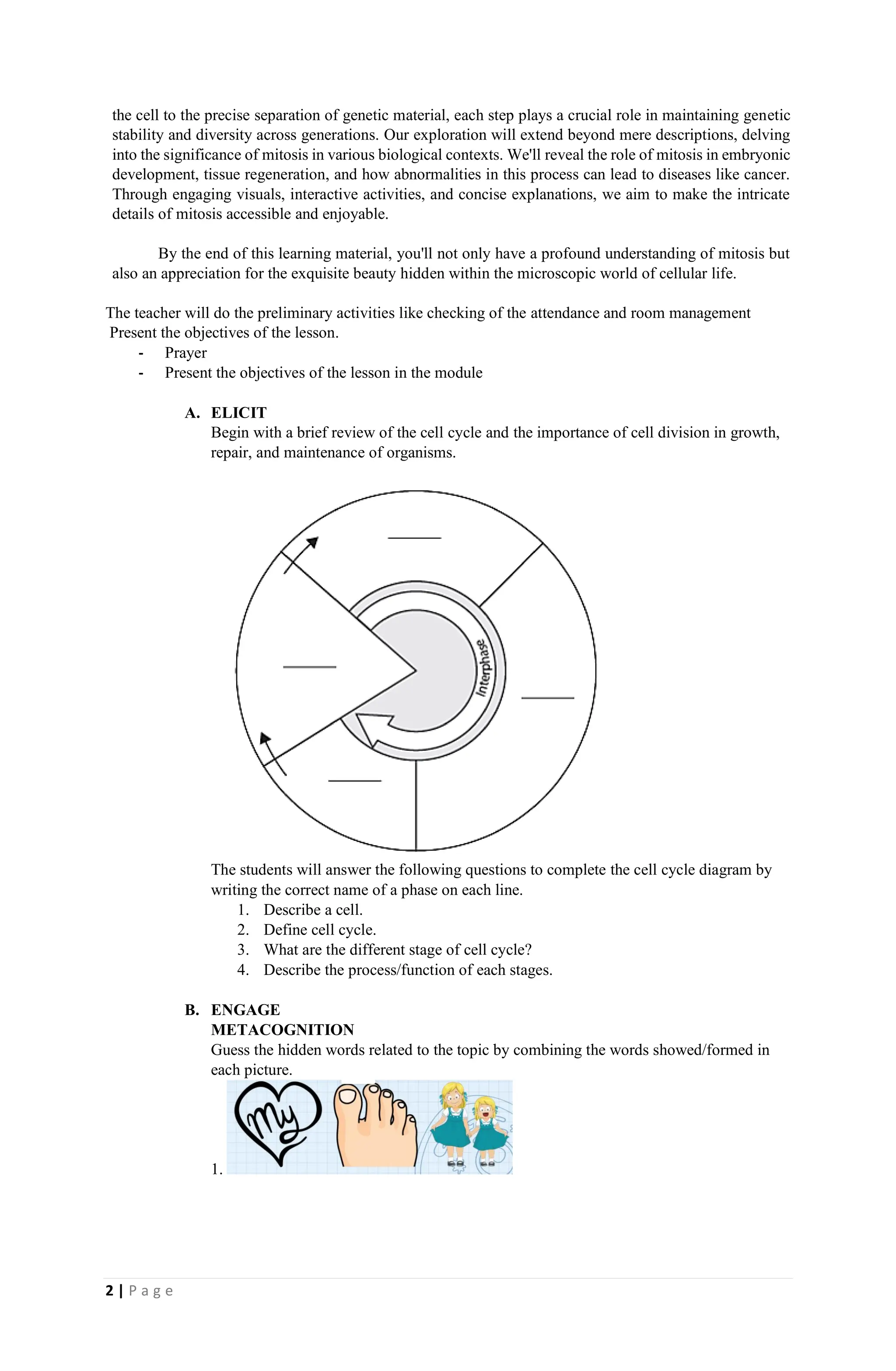
Begin with a brief review of the cell cycle and the importance of cell division in growth,
repair, and maintenance of organisms.
The students will answer the following questions to complete the cell cycle diagram by
writing the correct name of a phase on each line.
1. Describe a cell.
2. Define cell cycle.
3. What are the different stage of cell cycle?
4. Describe the process/function of each stages.
B. ENGAGE
METACOGNITION
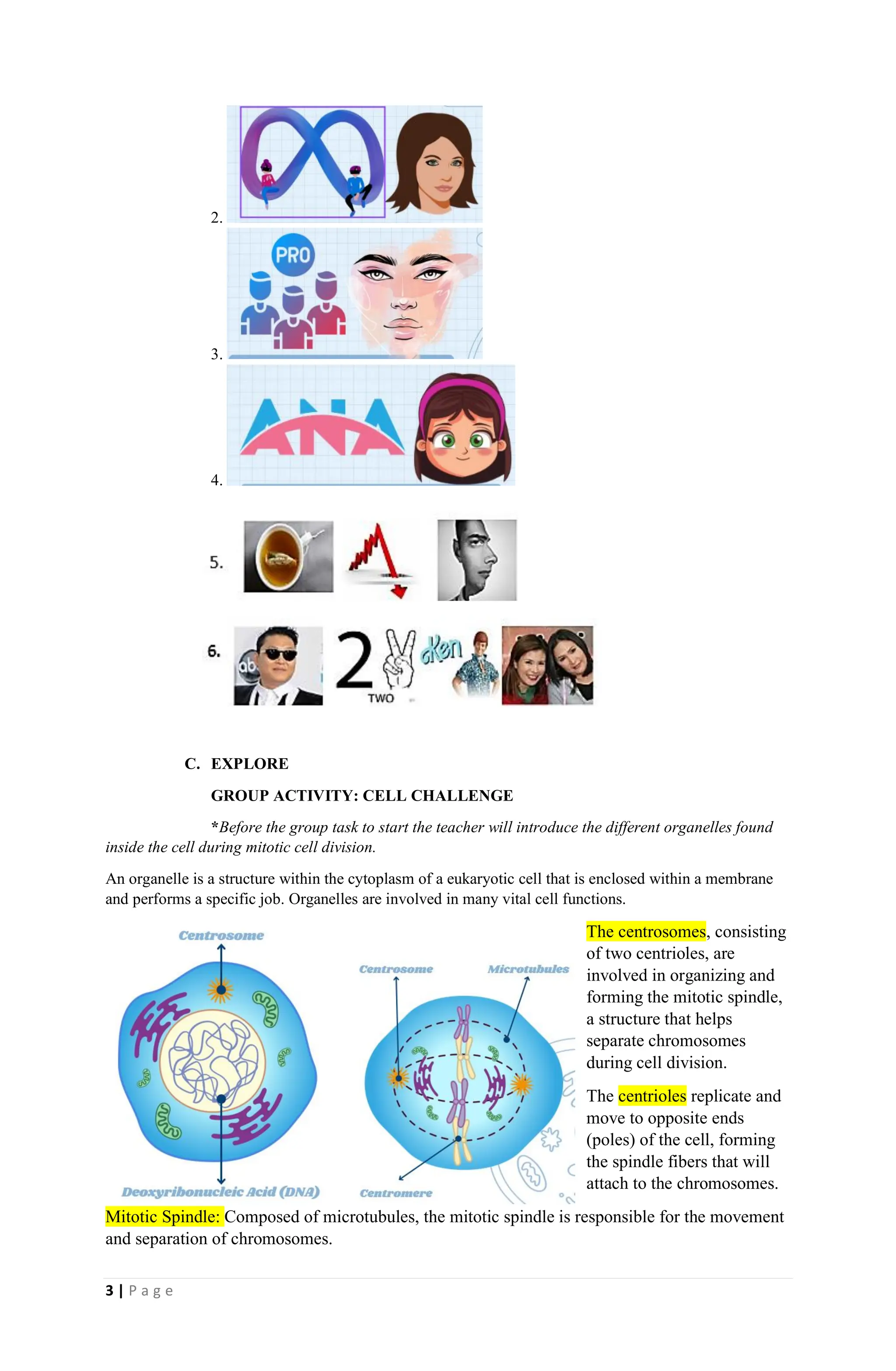
Guess the hidden words related to the topic by combining the words showed/formed in
each picture.
1.
3 | P a g e
2.
3.
4.
C. EXPLORE
GROUP ACTIVITY: CELL CHALLENGE
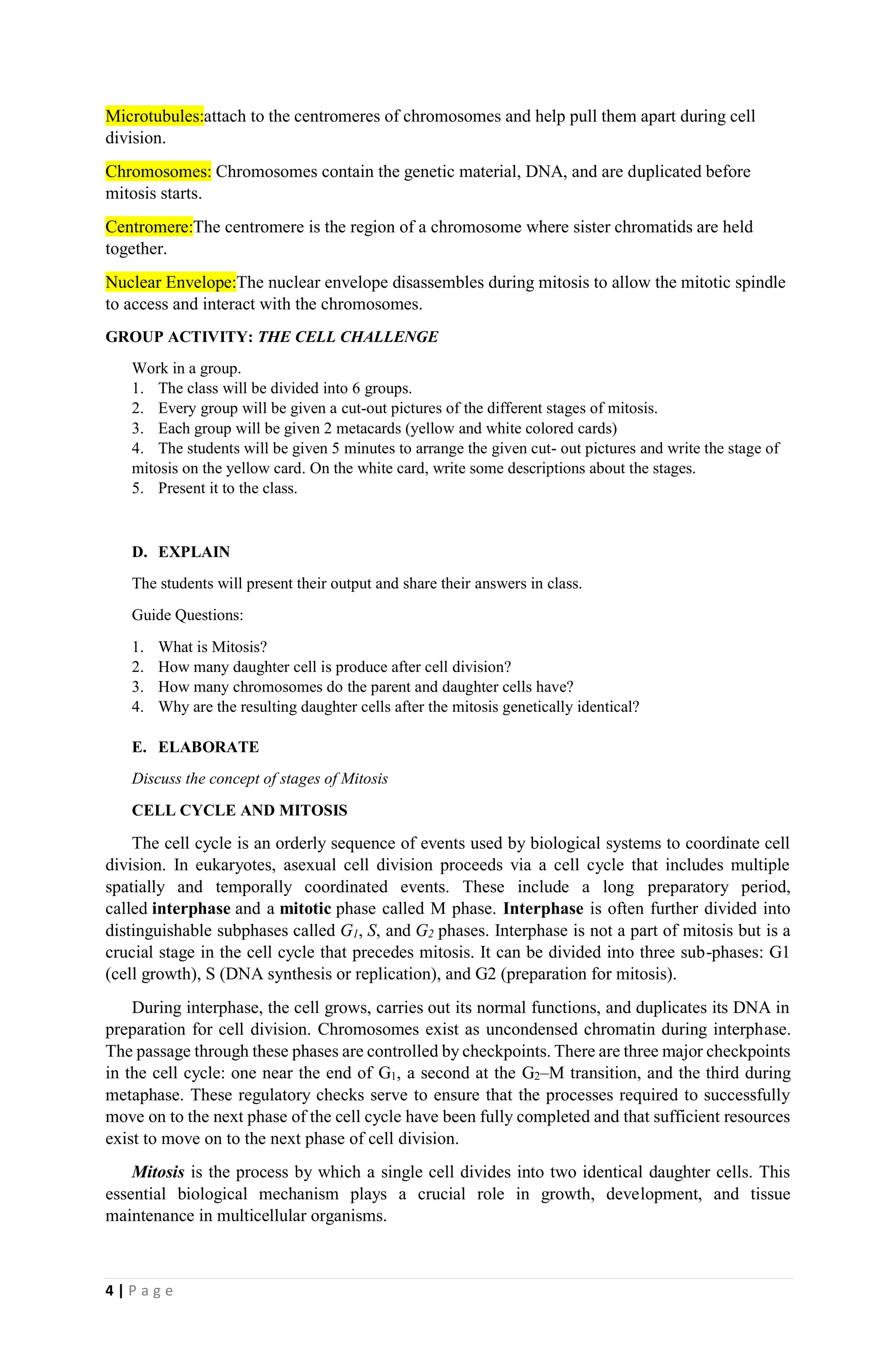
*Before the group task to start the teacher will introduce the different organelles found
inside the cell during mitotic cell division.
An organelle is a structure within the cytoplasm of a eukaryotic cell that is enclosed within a membrane
and performs a specific job. Organelles are involved in many vital cell functions.
The centrosomes, consisting
of two centrioles, are
involved in organizing and
forming the mitotic spindle,
a structure that helps
separate chromosomes
during cell division.
The centrioles replicate and
move to opposite ends
(poles) of the cell, forming
the spindle fibers that will
attach to the chromosomes.
Mitotic Spindle: Composed of microtubules, the mitotic spindle is responsible for the movement
and separation of chromosomes.
4 | P a g e
Microtubules:attach to the centromeres of chromosomes and help pull them apart during cell
division.
Chromosomes: Chromosomes contain the genetic material, DNA, and are duplicated before
mitosis starts.
Centromere:The centromere is the region of a chromosome where sister chromatids are held
together.
Nuclear Envelope:The nuclear envelope disassembles during mitosis to allow the mitotic spindle
to access and interact with the chromosomes.
GROUP ACTIVITY: THE CELL CHALLENGE
Work in a group.
1. The class will be divided into 6 groups.
2. Every group will be given a cut-out pictures of the different stages of mitosis.
3. Each group will be given 2 metacards (yellow and white colored cards)
4. The students will be given 5 minutes to arrange the given cut- out pictures and write the stage of
mitosis on the yellow card. On the white card, write some descriptions about the stages.
5. Present it to the class.
D. EXPLAIN
The students will present their output and share their answers in class.
Guide Questions:
1. What is Mitosis?
2. How many daughter cell is produce after cell division?
3. How many chromosomes do the parent and daughter cells have?
4. Why are the resulting daughter cells after the mitosis genetically identical?
E. ELABORATE
Discuss the concept of stages of Mitosis
CELL CYCLE AND MITOSIS
The cell cycle is an orderly sequence of events used by biological systems to coordinate cell
division. In eukaryotes, asexual cell division proceeds via a cell cycle that includes multiple
spatially and temporally coordinated events. These include a long preparatory period,
called interphase and a mitotic phase called M phase. Interphase is often further divided into
distinguishable subphases called G1, S, and G2 phases. Interphase is not a part of mitosis but is a
crucial stage in the cell cycle that precedes mitosis. It can be divided into three sub-phases: G1
(cell growth), S (DNA synthesis or replication), and G2 (preparation for mitosis).
During interphase, the cell grows, carries out its normal functions, and duplicates its DNA in
preparation for cell division. Chromosomes exist as uncondensed chromatin during interphase.
The passage through these phases are controlled by checkpoints. There are three major checkpoints
in the cell cycle: one near the end of G1, a second at the G2–M transition, and the third during
metaphase. These regulatory checks serve to ensure that the processes required to successfully
move on to the next phase of the cell cycle have been fully completed and that sufficient resources
exist to move on to the next phase of cell division.
Mitosis is the process by which a single cell divides into two identical daughter cells. This
essential biological mechanism plays a crucial role in growth, development, and tissue
maintenance in multicellular organisms.
5 | P a g e
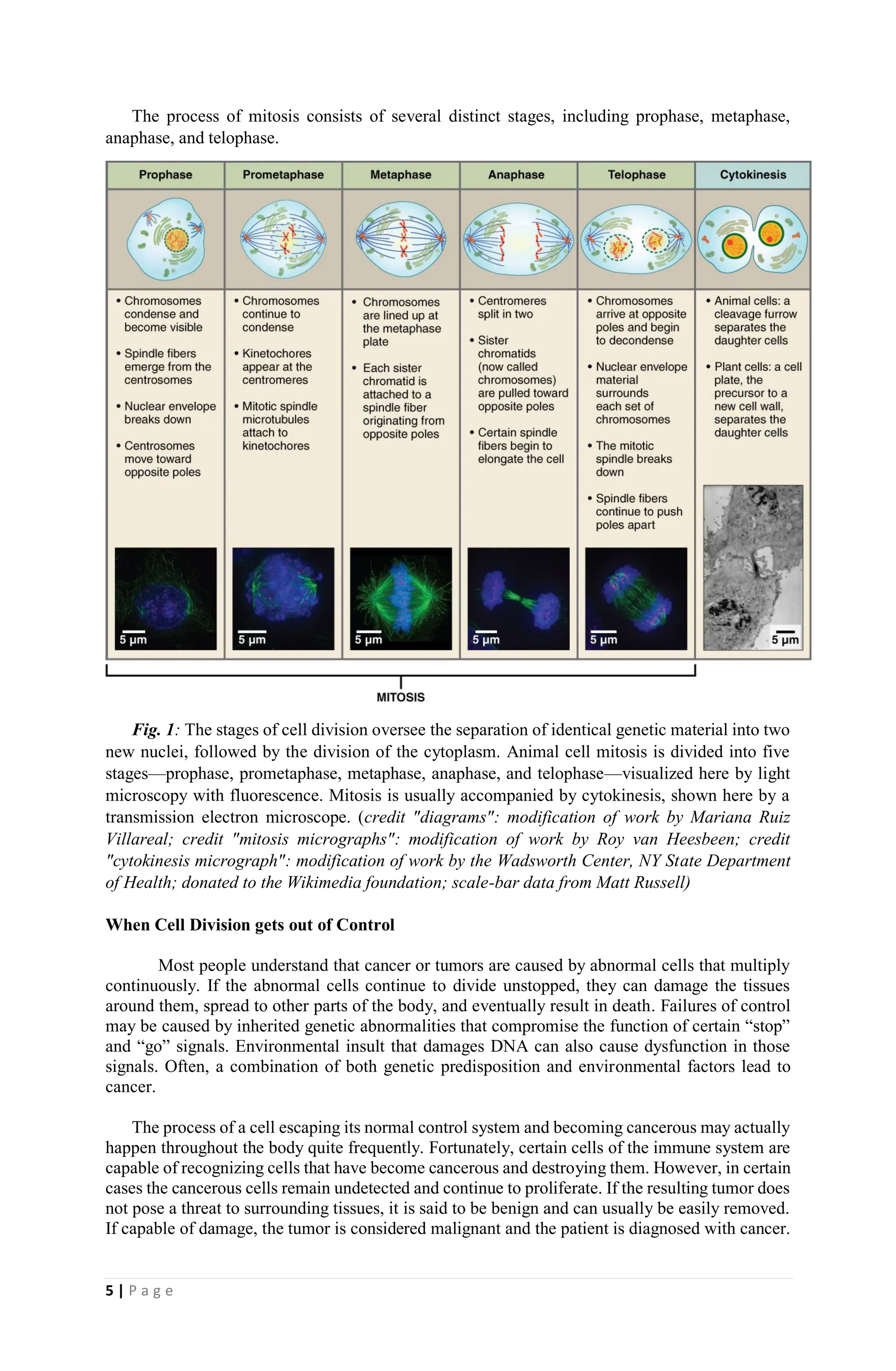
The process of mitosis consists of several distinct stages, including prophase, metaphase,
anaphase, and telophase.
Fig. 1: The stages of cell division oversee the separation of identical genetic material into two
new nuclei, followed by the division of the cytoplasm. Animal cell mitosis is divided into five
stages—prophase, prometaphase, metaphase, anaphase, and telophase—visualized here by light
microscopy with fluorescence. Mitosis is usually accompanied by cytokinesis, shown here by a
transmission electron microscope. (credit "diagrams": modification of work by Mariana Ruiz
Villareal; credit "mitosis micrographs": modification of work by Roy van Heesbeen; credit
"cytokinesis micrograph": modification of work by the Wadsworth Center, NY State Department
of Health; donated to the Wikimedia foundation; scale-bar data from Matt Russell)
When Cell Division gets out of Control
Most people understand that cancer or tumors are caused by abnormal cells that multiply
continuously. If the abnormal cells continue to divide unstopped, they can damage the tissues
around them, spread to other parts of the body, and eventually result in death. Failures of control
may be caused by inherited genetic abnormalities that compromise the function of certain “stop”
and “go” signals. Environmental insult that damages DNA can also cause dysfunction in those
signals. Often, a combination of both genetic predisposition and environmental factors lead to
cancer.
The process of a cell escaping its normal control system and becoming cancerous may actually
happen throughout the body quite frequently. Fortunately, certain cells of the immune system are
capable of recognizing cells that have become cancerous and destroying them. However, in certain
cases the cancerous cells remain undetected and continue to proliferate. If the resulting tumor does
not pose a threat to surrounding tissues, it is said to be benign and can usually be easily removed.
If capable of damage, the tumor is considered malignant and the patient is diagnosed with cancer.
6 | P a g e
Practical application of concepts and application of skills.
1. Why is mitosis important?
2. Imagine you are a biologist studying cell division in a particular tissue. During your research, you
observe a high rate of mitotic activity in the cells. Explain how the process of mitosis contributes to
the growth and repair of the tissue, and discuss any potential implications for health or disease.
F. EVALUATION
A. Choose the letter of the correct answer.
1. It is a type of cell division wherein the cell divides into two exact copies of two daughter cell?
a. Cell Cycle b. Mitosis c. Meiosis d. Reproduction
2. In which phase of mitosis do the chromosomes align at the cell's equator?
a. Prophase b. Metaphase c. Anaphase d. Telophase
3. What structure is responsible for organizing and separating the chromosomes during mitosis?
a. Centrosome b. Nucleolus c. Ribosome d. Endoplasmic reticulum
4. At which stage do sister chromatids separate and move towards opposite poles of the cell?
a. Prophase b. Metaphase c. Anaphase d. Telophase
5. What is the significance of mitosis in multicellular organisms?
a. It produces gametes for sexual reproduction.
b. It creates genetic diversity in offspring.
c. It ensures growth, development, and tissue repair.
d. It has no effect on the body.
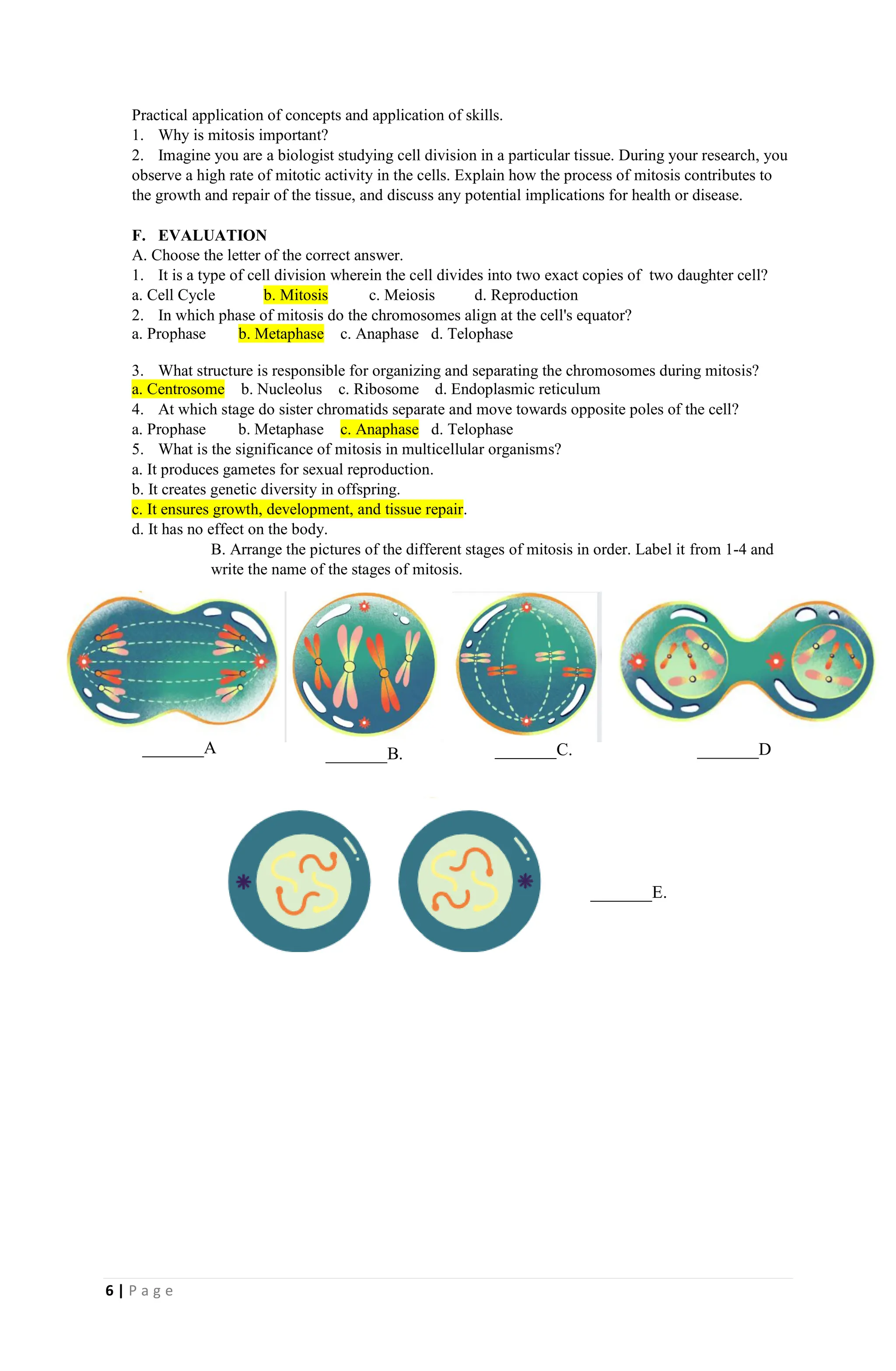
B. Arrange the pictures of the different stages of mitosis in order. Label it from 1-4 and
write the name of the stages of mitosis.
_______A
.
_______B. _______C. _______D
.
_______E.
7 | P a g e
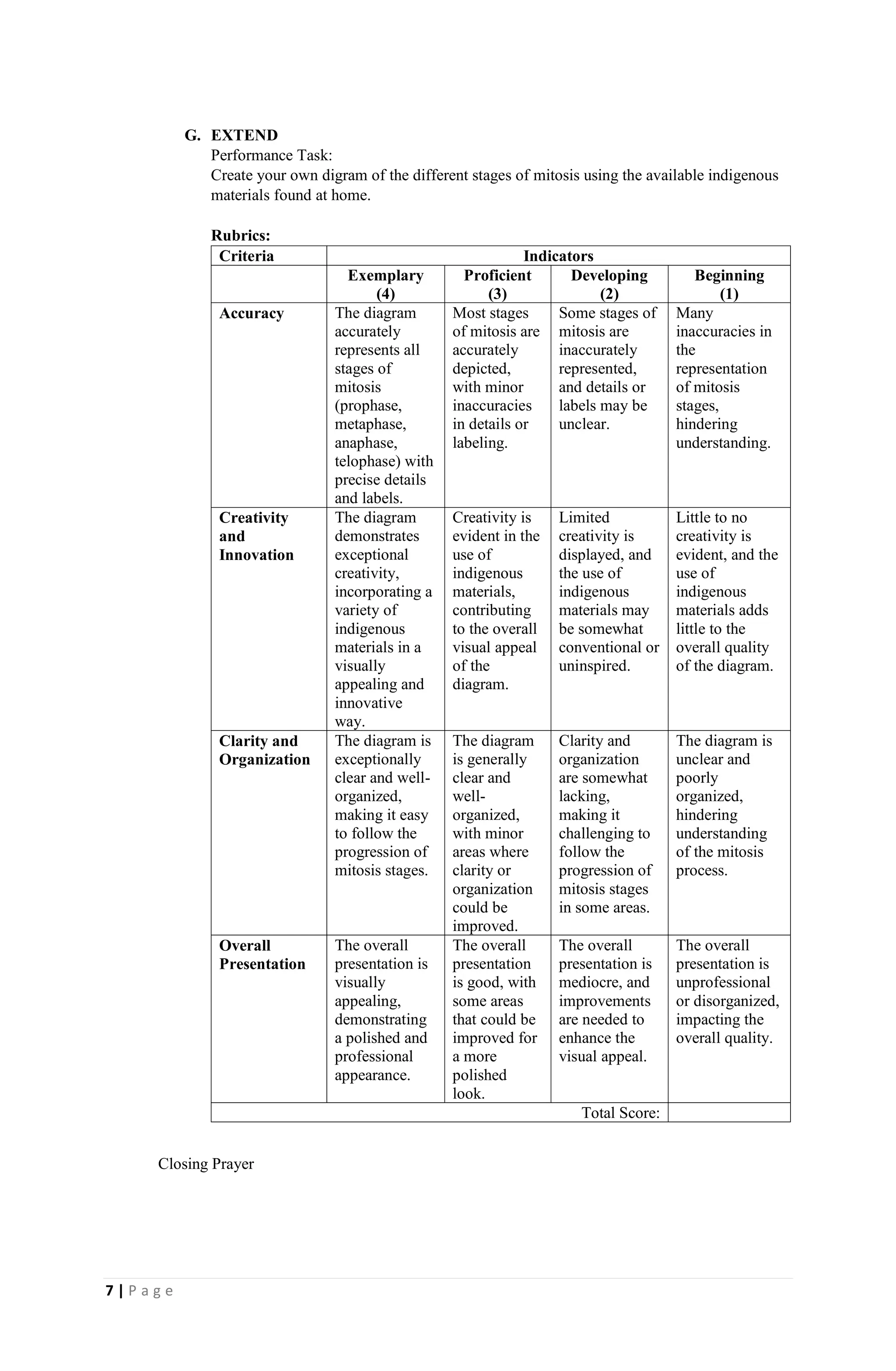
G. EXTEND
Performance Task:
Create your own digram of the different stages of mitosis using the available indigenous
materials found at home.
Rubrics:
Criteria Indicators
Exemplary
(4)
Proficient
(3)
Developing
(2)
Beginning
(1)
Accuracy The diagram
accurately
represents all
stages of
mitosis
(prophase,
metaphase,
anaphase,
telophase) with
precise details
and labels.
Most stages
of mitosis are
accurately
depicted,
with minor
inaccuracies
in details or
labeling.
Some stages of
mitosis are
inaccurately
represented,
and details or
labels may be
unclear.
Many
inaccuracies in
the
representation
of mitosis
stages,
hindering
understanding.
Creativity
and
Innovation
The diagram
demonstrates
exceptional
creativity,
incorporating a
variety of
indigenous
materials in a
visually
appealing and
innovative
way.
Creativity is
evident in the
use of
indigenous
materials,
contributing
to the overall
visual appeal
of the
diagram.
Limited
creativity is
displayed, and
the use of
indigenous
materials may
be somewhat
conventional or
uninspired.
Little to no
creativity is
evident, and the
use of
indigenous
materials adds
little to the
overall quality
of the diagram.
Clarity and
Organization
The diagram is
exceptionally
clear and well-
organized,
making it easy
to follow the
progression of
mitosis stages.
The diagram
is generally
clear and
well-
organized,
with minor
areas where
clarity or
organization
could be
improved.
Clarity and
organization
are somewhat
lacking,
making it
challenging to
follow the
progression of
mitosis stages
in some areas.
The diagram is
unclear and
poorly
organized,
hindering
understanding
of the mitosis
process.
Overall
Presentation
The overall
presentation is
visually
appealing,
demonstrating
a polished and
professional
appearance.
The overall
presentation
is good, with
some areas
that could be
improved for
a more
polished
look.
The overall
presentation is
mediocre, and
improvements
are needed to
enhance the
visual appeal.
The overall
presentation is
unprofessional
or disorganized,
impacting the
overall quality.
Total Score:
Closing Prayer
8 | P a g e
Prepared by:
ARLENE B. CERDEŇO
Year and Section:

Sample-Session-Plan-Secondalllllllry.pdf

  • 1.
    1 | Pa g e Republic of the Philippines COMMISSION ON HIGHER EDUCATION Region V (Bicol) TIWI COMMUNITY COLLEGE Tiwi, Albay SUBJECT: SCIENCE, TECHNOLOGY AND SOCIETY INSTRUCTRESS: MS. ARLENE B. CERDEŇO SESSIONPLAN FORMAT FOR SECONDARY (7 E’s) Disclaimer: This format is based on various up-to-date sources from the web. This is NOT claimed as personal ownership and is solely utilized for students use. CTTO Session Plan I. Objectives: At the end of the period, students should be able to: 1. define mitosis; 2. appreciate the importance of mitosis in cell division; and 3. illustrate the different stages of mitosis. II. Subject Matter Topic: Stages of Mitosis Values Integration: Appreciation for one's uniqueness Materials: Projector, Laptop, Printed Materials, Manila Paper and Pentlepen References:  You and the Natural World; Teresita F. Religioso et al pg. 20-22  Gilchrist, D. (2023). Mitosis. Genome.gov. https://www.genome.gov/genetics- glossary/Mitosis#:~:text=Mitosis%20is%20the%20process%20by  Britannica. (2019). mitosis | Definition, Stages, Diagram, & Facts. In Encyclopædia Britannica. https://www.britannica.com/science/mitosis  Khan Academy. (2015). Phases of mitosis. Khan Academy. https://www.khanacademy.org/science/ap-biology/cell-communication-and-cell- cycle/cell-cycle/a/phases-of-mitosis  7.1: Introduction. (2019, July 26). Biology LibreTexts. https://bio.libretexts.org/Bookshelves/Biotechnology/Bio- OER_(CUNY)/07%3A_Cell_Division/7.01%3A_Introduction III. Procedure INTRODUCTION: In the fascinating world of cell division, where the intricate dance of life unfolds at the microscopic level. In this learning material, we embark on a journey to explore one of the fundamental processes that govern the existence of all living organisms: cell division, specifically focusing on mitosis. Cell division is an essential in nature, for growth, development, and the maintenance of life. At the heart of this phenomenon lies mitosis, a series of events that ensures the faithful replication of cells. Whether it's the growth of a multicellular organism, tissue repair, or the replacement of damaged cells, mitosis is the engine that drives these processes. In this discussion, we will delve into the key concepts surrounding mitosis, unraveling the stages and mechanisms that make this process both intricate and awe-inspiring. From the initial preparation of
  • 2.
    2 | Pa g e the cell to the precise separation of genetic material, each step plays a crucial role in maintaining genetic stability and diversity across generations. Our exploration will extend beyond mere descriptions, delving into the significance of mitosis in various biological contexts. We'll reveal the role of mitosis in embryonic development, tissue regeneration, and how abnormalities in this process can lead to diseases like cancer. Through engaging visuals, interactive activities, and concise explanations, we aim to make the intricate details of mitosis accessible and enjoyable. By the end of this learning material, you'll not only have a profound understanding of mitosis but also an appreciation for the exquisite beauty hidden within the microscopic world of cellular life. The teacher will do the preliminary activities like checking of the attendance and room management Present the objectives of the lesson. - Prayer - Present the objectives of the lesson in the module A. ELICIT Begin with a brief review of the cell cycle and the importance of cell division in growth, repair, and maintenance of organisms. The students will answer the following questions to complete the cell cycle diagram by writing the correct name of a phase on each line. 1. Describe a cell. 2. Define cell cycle. 3. What are the different stage of cell cycle? 4. Describe the process/function of each stages. B. ENGAGE METACOGNITION Guess the hidden words related to the topic by combining the words showed/formed in each picture. 1.
  • 3.
    3 | Pa g e 2. 3. 4. C. EXPLORE GROUP ACTIVITY: CELL CHALLENGE *Before the group task to start the teacher will introduce the different organelles found inside the cell during mitotic cell division. An organelle is a structure within the cytoplasm of a eukaryotic cell that is enclosed within a membrane and performs a specific job. Organelles are involved in many vital cell functions. The centrosomes, consisting of two centrioles, are involved in organizing and forming the mitotic spindle, a structure that helps separate chromosomes during cell division. The centrioles replicate and move to opposite ends (poles) of the cell, forming the spindle fibers that will attach to the chromosomes. Mitotic Spindle: Composed of microtubules, the mitotic spindle is responsible for the movement and separation of chromosomes.
  • 4.
    4 | Pa g e Microtubules:attach to the centromeres of chromosomes and help pull them apart during cell division. Chromosomes: Chromosomes contain the genetic material, DNA, and are duplicated before mitosis starts. Centromere:The centromere is the region of a chromosome where sister chromatids are held together. Nuclear Envelope:The nuclear envelope disassembles during mitosis to allow the mitotic spindle to access and interact with the chromosomes. GROUP ACTIVITY: THE CELL CHALLENGE Work in a group. 1. The class will be divided into 6 groups. 2. Every group will be given a cut-out pictures of the different stages of mitosis. 3. Each group will be given 2 metacards (yellow and white colored cards) 4. The students will be given 5 minutes to arrange the given cut- out pictures and write the stage of mitosis on the yellow card. On the white card, write some descriptions about the stages. 5. Present it to the class. D. EXPLAIN The students will present their output and share their answers in class. Guide Questions: 1. What is Mitosis? 2. How many daughter cell is produce after cell division? 3. How many chromosomes do the parent and daughter cells have? 4. Why are the resulting daughter cells after the mitosis genetically identical? E. ELABORATE Discuss the concept of stages of Mitosis CELL CYCLE AND MITOSIS The cell cycle is an orderly sequence of events used by biological systems to coordinate cell division. In eukaryotes, asexual cell division proceeds via a cell cycle that includes multiple spatially and temporally coordinated events. These include a long preparatory period, called interphase and a mitotic phase called M phase. Interphase is often further divided into distinguishable subphases called G1, S, and G2 phases. Interphase is not a part of mitosis but is a crucial stage in the cell cycle that precedes mitosis. It can be divided into three sub-phases: G1 (cell growth), S (DNA synthesis or replication), and G2 (preparation for mitosis). During interphase, the cell grows, carries out its normal functions, and duplicates its DNA in preparation for cell division. Chromosomes exist as uncondensed chromatin during interphase. The passage through these phases are controlled by checkpoints. There are three major checkpoints in the cell cycle: one near the end of G1, a second at the G2–M transition, and the third during metaphase. These regulatory checks serve to ensure that the processes required to successfully move on to the next phase of the cell cycle have been fully completed and that sufficient resources exist to move on to the next phase of cell division. Mitosis is the process by which a single cell divides into two identical daughter cells. This essential biological mechanism plays a crucial role in growth, development, and tissue maintenance in multicellular organisms.
  • 5.
    5 | Pa g e The process of mitosis consists of several distinct stages, including prophase, metaphase, anaphase, and telophase. Fig. 1: The stages of cell division oversee the separation of identical genetic material into two new nuclei, followed by the division of the cytoplasm. Animal cell mitosis is divided into five stages—prophase, prometaphase, metaphase, anaphase, and telophase—visualized here by light microscopy with fluorescence. Mitosis is usually accompanied by cytokinesis, shown here by a transmission electron microscope. (credit "diagrams": modification of work by Mariana Ruiz Villareal; credit "mitosis micrographs": modification of work by Roy van Heesbeen; credit "cytokinesis micrograph": modification of work by the Wadsworth Center, NY State Department of Health; donated to the Wikimedia foundation; scale-bar data from Matt Russell) When Cell Division gets out of Control Most people understand that cancer or tumors are caused by abnormal cells that multiply continuously. If the abnormal cells continue to divide unstopped, they can damage the tissues around them, spread to other parts of the body, and eventually result in death. Failures of control may be caused by inherited genetic abnormalities that compromise the function of certain “stop” and “go” signals. Environmental insult that damages DNA can also cause dysfunction in those signals. Often, a combination of both genetic predisposition and environmental factors lead to cancer. The process of a cell escaping its normal control system and becoming cancerous may actually happen throughout the body quite frequently. Fortunately, certain cells of the immune system are capable of recognizing cells that have become cancerous and destroying them. However, in certain cases the cancerous cells remain undetected and continue to proliferate. If the resulting tumor does not pose a threat to surrounding tissues, it is said to be benign and can usually be easily removed. If capable of damage, the tumor is considered malignant and the patient is diagnosed with cancer.
  • 6.
    6 | Pa g e Practical application of concepts and application of skills. 1. Why is mitosis important? 2. Imagine you are a biologist studying cell division in a particular tissue. During your research, you observe a high rate of mitotic activity in the cells. Explain how the process of mitosis contributes to the growth and repair of the tissue, and discuss any potential implications for health or disease. F. EVALUATION A. Choose the letter of the correct answer. 1. It is a type of cell division wherein the cell divides into two exact copies of two daughter cell? a. Cell Cycle b. Mitosis c. Meiosis d. Reproduction 2. In which phase of mitosis do the chromosomes align at the cell's equator? a. Prophase b. Metaphase c. Anaphase d. Telophase 3. What structure is responsible for organizing and separating the chromosomes during mitosis? a. Centrosome b. Nucleolus c. Ribosome d. Endoplasmic reticulum 4. At which stage do sister chromatids separate and move towards opposite poles of the cell? a. Prophase b. Metaphase c. Anaphase d. Telophase 5. What is the significance of mitosis in multicellular organisms? a. It produces gametes for sexual reproduction. b. It creates genetic diversity in offspring. c. It ensures growth, development, and tissue repair. d. It has no effect on the body. B. Arrange the pictures of the different stages of mitosis in order. Label it from 1-4 and write the name of the stages of mitosis. _______A . _______B. _______C. _______D . _______E.
  • 7.
    7 | Pa g e G. EXTEND Performance Task: Create your own digram of the different stages of mitosis using the available indigenous materials found at home. Rubrics: Criteria Indicators Exemplary (4) Proficient (3) Developing (2) Beginning (1) Accuracy The diagram accurately represents all stages of mitosis (prophase, metaphase, anaphase, telophase) with precise details and labels. Most stages of mitosis are accurately depicted, with minor inaccuracies in details or labeling. Some stages of mitosis are inaccurately represented, and details or labels may be unclear. Many inaccuracies in the representation of mitosis stages, hindering understanding. Creativity and Innovation The diagram demonstrates exceptional creativity, incorporating a variety of indigenous materials in a visually appealing and innovative way. Creativity is evident in the use of indigenous materials, contributing to the overall visual appeal of the diagram. Limited creativity is displayed, and the use of indigenous materials may be somewhat conventional or uninspired. Little to no creativity is evident, and the use of indigenous materials adds little to the overall quality of the diagram. Clarity and Organization The diagram is exceptionally clear and well- organized, making it easy to follow the progression of mitosis stages. The diagram is generally clear and well- organized, with minor areas where clarity or organization could be improved. Clarity and organization are somewhat lacking, making it challenging to follow the progression of mitosis stages in some areas. The diagram is unclear and poorly organized, hindering understanding of the mitosis process. Overall Presentation The overall presentation is visually appealing, demonstrating a polished and professional appearance. The overall presentation is good, with some areas that could be improved for a more polished look. The overall presentation is mediocre, and improvements are needed to enhance the visual appeal. The overall presentation is unprofessional or disorganized, impacting the overall quality. Total Score: Closing Prayer
  • 8.
    8 | Pa g e Prepared by: ARLENE B. CERDEŇO Year and Section: