

www.compliantfqhc.com
Continuous Compliance Series- It’s not JUST an
OSV Prep
COMPLIATRIC WEBINAR SERIES
Presented by : Jennifer Genua-McDaniel
jgenua@genuaconsulting.com
Board Authority (Chapter 19)
This presentation is not endorsed by Management Strategists
Consulting Group (MSCG)
This presentation is not endorsed by Health Resources Services
Administration (HRSA) or Bureau of Primary Health Care (BPHC)
Not employed by MSCG or BPHC
Independent Consultant who is contracted to do Operational Site
Visits (OSV)s and Technical Assistance (TA)
Not intended to provide legal advice
 Updates to Site Visit Protocol (SVP) for Board
Authority
 Understand the requirements and why they are
important
 Methods to maintain continuous compliance
◦ Requirements are the “floor not the ceiling”
 How to use the requirements in everyday practice
◦ “Good to Great” to improve excellence
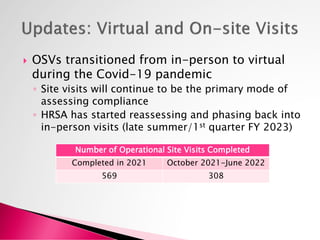
 OSVs transitioned from in-person to virtual
during the Covid-19 pandemic
◦ Site visits will continue to be the primary mode of
assessing compliance
◦ HRSA has started reassessing and phasing back into
in-person visits (late summer/1st quarter FY 2023)
Number of Operational Site Visits Completed
Completed in 2021 October 2021-June 2022
569 308
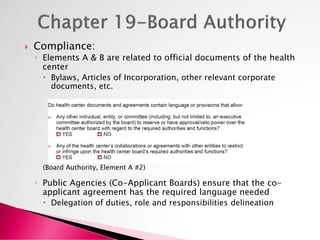
 Compliance:
◦ Elements A & B are related to official documents of the health
center
 Bylaws, Articles of Incorporation, other relevant corporate
documents, etc.
(Board Authority, Element A #2)
◦ Public Agencies (Co-Applicant Boards) ensure that the co-
applicant agreement has the required language needed
 Delegation of duties, role and responsibilities delineation
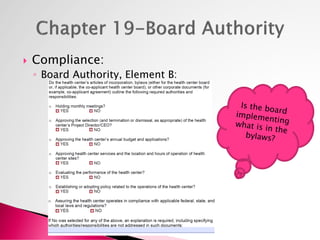
 Compliance:
◦ Board Authority, Element B:
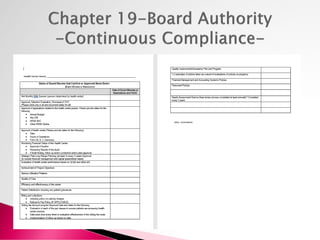
 Compliance:
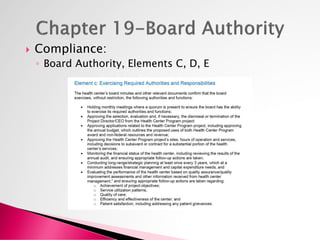
◦ Board Authority, Elements C, D, E
 Compliance:
◦ Board Authority, Elements D, E
 In the last 3 years, adopted, evaluated the following policies:
 Sliding Fee Discount Program
 Quality Improvement/Quality Assurance Program
 Billing and Collections
 INCLUDING a policy for waiving or reducing patient fees
 IF APPLICABLE: Refusal to Pay policy
 Financial Management and Accounting Systems
 Personnel
**Health Centers that are Public Entity, Co-Applicant Model, Fiscal and
Personnel can be N/A if it’s stated in the co-applicant agreement and bylaws
that Public Entity will oversee**
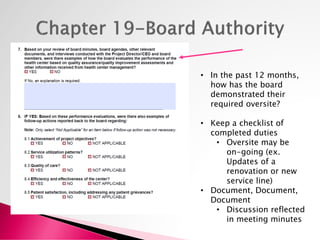
• In the past 12 months,
how has the board
demonstrated their
required oversite?
• Keep a checklist of
completed duties
• Oversite may be
on-going (ex.
Updates of a
renovation or new
service line)
• Document, Document,
Document
• Discussion reflected
in meeting minutes
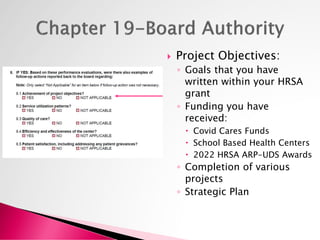
 Project Objectives:
◦ Goals that you have
written within your HRSA
grant
◦ Funding you have
received:
 Covid Cares Funds
 School Based Health Centers
 2022 HRSA ARP-UDS Awards
◦ Completion of various
projects
◦ Strategic Plan
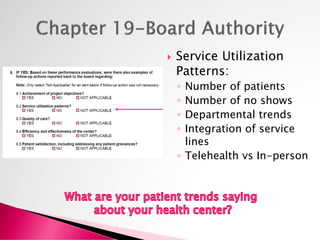
 Service Utilization
Patterns:
◦ Number of patients
◦ Number of no shows
◦ Departmental trends
◦ Integration of service
lines
◦ Telehealth vs In-person
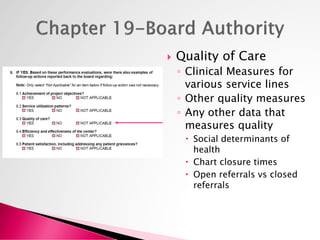
 Quality of Care
◦ Clinical Measures for
various service lines
◦ Other quality measures
◦ Any other data that
measures quality
 Social determinants of
health
 Chart closure times
 Open referrals vs closed
referrals
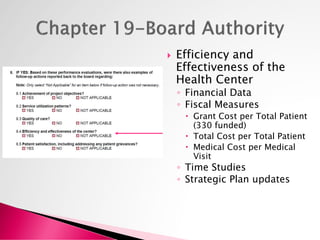
 Efficiency and
Effectiveness of the
Health Center
◦ Financial Data
◦ Fiscal Measures
 Grant Cost per Total Patient
(330 funded)
 Total Cost per Total Patient
 Medical Cost per Medical
Visit
◦ Time Studies
◦ Strategic Plan updates
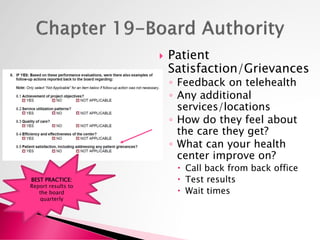
 Patient
Satisfaction/Grievances
◦ Feedback on telehealth
◦ Any additional
services/locations
◦ How do they feel about
the care they get?
◦ What can your health
center improve on?
 Call back from back office
 Test results
 Wait times
BEST PRACTICE:
Report results to
the board
quarterly
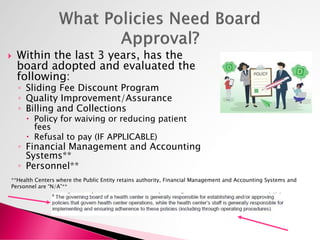
 Within the last 3 years, has the
board adopted and evaluated the
following:
◦ Sliding Fee Discount Program
◦ Quality Improvement/Assurance
◦ Billing and Collections
 Policy for waiving or reducing patient
fees
 Refusal to pay (IF APPLICABLE)
◦ Financial Management and Accounting
Systems**
◦ Personnel**
**Health Centers where the Public Entity retains authority, Financial Management and Accounting Systems and
Personnel are “N/A”**
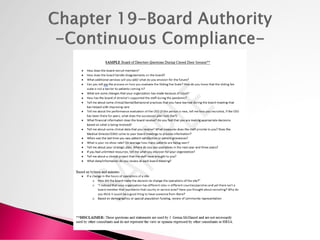
 Spend time with the Board of Directors:
◦ How the board oversees the health center program
◦ Do they understand their roles and responsibilities?
◦ Is the data provided easy to understand, in their
preferred language, so they are able to make decisions?
◦ How is clinical and financial data provided?
◦ If the health center has special populations, how are
those populations represented on the board?
 Source: Instagram
 How to keep this requirement compliant:
◦ Keep a calendar or schedule to ensure governance
requirements are completed
◦ Meeting minutes are key!
 Consistent documentation to capture board discussion
 Use Roberts Rules of Order
 HRSA required approvals should not be in a consent
agenda
 Business conducted is reflective of current process
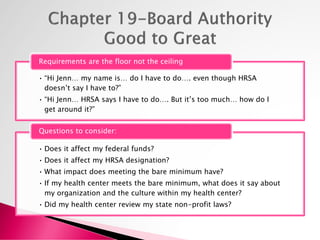
• “Hi Jenn… my name is… do I have to do…. even though HRSA
doesn’t say I have to?”
• “Hi Jenn… HRSA says I have to do…. But it’s too much… how do I
get around it?”
Requirements are the floor not the ceiling
• Does it affect my federal funds?
• Does it affect my HRSA designation?
• What impact does meeting the bare minimum have?
• If my health center meets the bare minimum, what does it say about
my organization and the culture within my health center?
• Did my health center review my state non-profit laws?
Questions to consider:
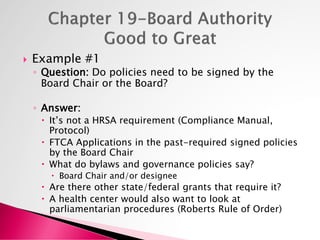
 Example #1
◦ Question: Do policies need to be signed by the
Board Chair or the Board?
◦ Answer:
 It’s not a HRSA requirement (Compliance Manual,
Protocol)
 FTCA Applications in the past-required signed policies
by the Board Chair
 What do bylaws and governance policies say?
 Board Chair and/or designee
 Are there other state/federal grants that require it?
 A health center would also want to look at
parliamentarian procedures (Roberts Rule of Order)
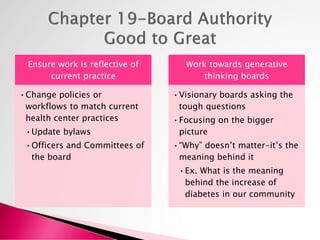
Ensure work is reflective of
current practice
•Change policies or
workflows to match current
health center practices
•Update bylaws
•Officers and Committees of
the board
Work towards generative
thinking boards
•Visionary boards asking the
tough questions
•Focusing on the bigger
picture
•“Why” doesn’t matter-it’s the
meaning behind it
•Ex. What is the meaning
behind the increase of
diabetes in our community
https://bphc.hrsa.gov/programrequirements/compliancemanual/index.html
https://www.healthcenterinfo.org/
https://bphc.hrsa.gov/programrequirements/svprotocol
 Jennifer Genua-McDaniel, BA (Hons), CHCEF
◦ Genua Consulting, LLC
◦ marketing@compliatric.com

2022 Compliatric Continuous Compliance Series - Chapter 19.pdf

  • 1.
    www.compliantfqhc.com Continuous Compliance Series-It’s not JUST an OSV Prep COMPLIATRIC WEBINAR SERIES Presented by : Jennifer Genua-McDaniel jgenua@genuaconsulting.com
  • 2.
  • 4.
    This presentation isnot endorsed by Management Strategists Consulting Group (MSCG) This presentation is not endorsed by Health Resources Services Administration (HRSA) or Bureau of Primary Health Care (BPHC) Not employed by MSCG or BPHC Independent Consultant who is contracted to do Operational Site Visits (OSV)s and Technical Assistance (TA) Not intended to provide legal advice
  • 5.
     Updates toSite Visit Protocol (SVP) for Board Authority  Understand the requirements and why they are important  Methods to maintain continuous compliance ◦ Requirements are the “floor not the ceiling”  How to use the requirements in everyday practice ◦ “Good to Great” to improve excellence
  • 7.
     OSVs transitionedfrom in-person to virtual during the Covid-19 pandemic ◦ Site visits will continue to be the primary mode of assessing compliance ◦ HRSA has started reassessing and phasing back into in-person visits (late summer/1st quarter FY 2023) Number of Operational Site Visits Completed Completed in 2021 October 2021-June 2022 569 308
  • 8.
     Compliance: ◦ ElementsA & B are related to official documents of the health center  Bylaws, Articles of Incorporation, other relevant corporate documents, etc. (Board Authority, Element A #2) ◦ Public Agencies (Co-Applicant Boards) ensure that the co- applicant agreement has the required language needed  Delegation of duties, role and responsibilities delineation
  • 9.
     Compliance: ◦ BoardAuthority, Element B:
  • 10.
     Compliance: ◦ BoardAuthority, Elements C, D, E
  • 11.
     Compliance: ◦ BoardAuthority, Elements D, E  In the last 3 years, adopted, evaluated the following policies:  Sliding Fee Discount Program  Quality Improvement/Quality Assurance Program  Billing and Collections  INCLUDING a policy for waiving or reducing patient fees  IF APPLICABLE: Refusal to Pay policy  Financial Management and Accounting Systems  Personnel **Health Centers that are Public Entity, Co-Applicant Model, Fiscal and Personnel can be N/A if it’s stated in the co-applicant agreement and bylaws that Public Entity will oversee**
  • 12.
    • In thepast 12 months, how has the board demonstrated their required oversite? • Keep a checklist of completed duties • Oversite may be on-going (ex. Updates of a renovation or new service line) • Document, Document, Document • Discussion reflected in meeting minutes
  • 13.
     Project Objectives: ◦Goals that you have written within your HRSA grant ◦ Funding you have received:  Covid Cares Funds  School Based Health Centers  2022 HRSA ARP-UDS Awards ◦ Completion of various projects ◦ Strategic Plan
  • 14.
     Service Utilization Patterns: ◦Number of patients ◦ Number of no shows ◦ Departmental trends ◦ Integration of service lines ◦ Telehealth vs In-person
  • 15.
     Quality ofCare ◦ Clinical Measures for various service lines ◦ Other quality measures ◦ Any other data that measures quality  Social determinants of health  Chart closure times  Open referrals vs closed referrals
  • 16.
     Efficiency and Effectivenessof the Health Center ◦ Financial Data ◦ Fiscal Measures  Grant Cost per Total Patient (330 funded)  Total Cost per Total Patient  Medical Cost per Medical Visit ◦ Time Studies ◦ Strategic Plan updates
  • 17.
     Patient Satisfaction/Grievances ◦ Feedbackon telehealth ◦ Any additional services/locations ◦ How do they feel about the care they get? ◦ What can your health center improve on?  Call back from back office  Test results  Wait times BEST PRACTICE: Report results to the board quarterly
  • 18.
     Within thelast 3 years, has the board adopted and evaluated the following: ◦ Sliding Fee Discount Program ◦ Quality Improvement/Assurance ◦ Billing and Collections  Policy for waiving or reducing patient fees  Refusal to pay (IF APPLICABLE) ◦ Financial Management and Accounting Systems** ◦ Personnel** **Health Centers where the Public Entity retains authority, Financial Management and Accounting Systems and Personnel are “N/A”**
  • 19.
     Spend timewith the Board of Directors: ◦ How the board oversees the health center program ◦ Do they understand their roles and responsibilities? ◦ Is the data provided easy to understand, in their preferred language, so they are able to make decisions? ◦ How is clinical and financial data provided? ◦ If the health center has special populations, how are those populations represented on the board?
  • 20.
  • 21.
     How tokeep this requirement compliant: ◦ Keep a calendar or schedule to ensure governance requirements are completed ◦ Meeting minutes are key!  Consistent documentation to capture board discussion  Use Roberts Rules of Order  HRSA required approvals should not be in a consent agenda  Business conducted is reflective of current process
  • 24.
    • “Hi Jenn…my name is… do I have to do…. even though HRSA doesn’t say I have to?” • “Hi Jenn… HRSA says I have to do…. But it’s too much… how do I get around it?” Requirements are the floor not the ceiling • Does it affect my federal funds? • Does it affect my HRSA designation? • What impact does meeting the bare minimum have? • If my health center meets the bare minimum, what does it say about my organization and the culture within my health center? • Did my health center review my state non-profit laws? Questions to consider:
  • 25.
     Example #1 ◦Question: Do policies need to be signed by the Board Chair or the Board? ◦ Answer:  It’s not a HRSA requirement (Compliance Manual, Protocol)  FTCA Applications in the past-required signed policies by the Board Chair  What do bylaws and governance policies say?  Board Chair and/or designee  Are there other state/federal grants that require it?  A health center would also want to look at parliamentarian procedures (Roberts Rule of Order)
  • 26.
    Ensure work isreflective of current practice •Change policies or workflows to match current health center practices •Update bylaws •Officers and Committees of the board Work towards generative thinking boards •Visionary boards asking the tough questions •Focusing on the bigger picture •“Why” doesn’t matter-it’s the meaning behind it •Ex. What is the meaning behind the increase of diabetes in our community
  • 27.
  • 28.
     Jennifer Genua-McDaniel,BA (Hons), CHCEF ◦ Genua Consulting, LLC ◦ marketing@compliatric.com