Apex Programming
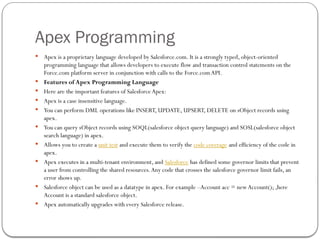
Apexis a proprietary language developed by Salesforce.com. It is a strongly typed, object-oriented
programming language that allows developers to execute flow and transaction control statements on the
Force.com platform server in conjunction with calls to the Force.comAPI.
Features of Apex Programming Language
Here are the important features of SalesforceApex:
Apex is a case insensitive language.
You can perform DML operations like INSERT, UPDATE, UPSERT, DELETE on sObject records using
apex.
You can query sObject records using SOQL(salesforce object query language) and SOSL(salesforce object
search language) in apex.
Allows you to create a unit test and execute them to verify the code coverage and efficiency of the code in
apex.
Apex executes in a multi-tenant environment, and Salesforce has defined some governor limits that prevent
a user from controlling the shared resources.Any code that crosses the salesforce governor limit fails, an
error shows up.
Salesforce object can be used as a datatype in apex. For example –Account acc = new Account(); ,here
Account is a standard salesforce object.
Apex automatically upgrades with every Salesforce release.
3.
Apex Syntax
VariableDeclaration: contact con = new contact();
SOQL Query: Account acc = [select id, name fromAccount Limit 1];
Loop Statement: list<Account>listOfAccounts
= [select id, name from account limit 100]; // iteration over the list of
accounts for(Account acc : listOfAccounts){ //your logic }
Flow Control Statement: list<Account>listOfAccounts = [select id,
name from account limit 100]; // execute the logic if the size of the
account list is greater than zero if(listOfAccounts.size() >0){ //your logic
}
DML statement: Account acc
= newAccount(Name =‘TestAccount’); Insert acc; //DML statement to
create account record.
4.
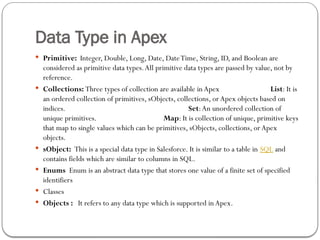
Data Type inApex
Primitive: Integer, Double, Long, Date, DateTime, String, ID, and Boolean are
considered as primitive data types.All primitive data types are passed by value, not by
reference.
Collections: Three types of collection are available in Apex List: It is
an ordered collection of primitives, sObjects, collections, orApex objects based on
indices. Set:An unordered collection of
unique primitives. Map: It is collection of unique, primitive keys
that map to single values which can be primitives, sObjects, collections, orApex
objects.
sObject: This is a special data type in Salesforce. It is similar to a table in SQL and
contains fields which are similar to columns in SQL.
Enums Enum is an abstract data type that stores one value of a finite set of specified
identifiers
Classes
Objects : It refers to any data type which is supported in Apex.
5.
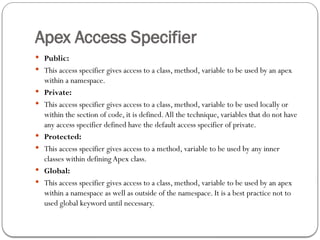
Apex Access Specifier
Public:
This access specifier gives access to a class, method, variable to be used by an apex
within a namespace.
Private:
This access specifier gives access to a class, method, variable to be used locally or
within the section of code, it is defined.All the technique, variables that do not have
any access specifier defined have the default access specifier of private.
Protected:
This access specifier gives access to a method, variable to be used by any inner
classes within defining Apex class.
Global:
This access specifier gives access to a class, method, variable to be used by an apex
within a namespace as well as outside of the namespace. It is a best practice not to
used global keyword until necessary.
6.
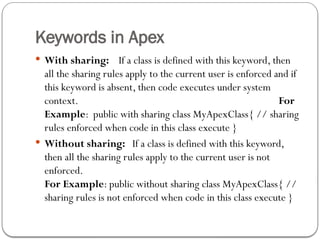
Keywords in Apex
With sharing: If a class is defined with this keyword, then
all the sharing rules apply to the current user is enforced and if
this keyword is absent, then code executes under system
context. For
Example: public with sharing class MyApexClass{ // sharing
rules enforced when code in this class execute }
Without sharing: If a class is defined with this keyword,
then all the sharing rules apply to the current user is not
enforced.
For Example: public without sharing class MyApexClass{ //
sharing rules is not enforced when code in this class execute }
![Apex Syntax
Variable Declaration: contact con = new contact();
SOQL Query: Account acc = [select id, name fromAccount Limit 1];
Loop Statement: list<Account>listOfAccounts
= [select id, name from account limit 100]; // iteration over the list of
accounts for(Account acc : listOfAccounts){ //your logic }
Flow Control Statement: list<Account>listOfAccounts = [select id,
name from account limit 100]; // execute the logic if the size of the
account list is greater than zero if(listOfAccounts.size() >0){ //your logic
}
DML statement: Account acc
= newAccount(Name =‘TestAccount’); Insert acc; //DML statement to
create account record.](https://image.slidesharecdn.com/salesforcetraining-251208113602-1dbce052/85/Salesforce-Journey-for-Beginners-it-will-solve-Basic-Issue-3-320.jpg)